
Article

Mechanistic Modeling of Absorber-Driven Optical Darkening and Long-Timescale Feedback-Mediated Structural Evolution


1
Department of Physics, California State University Dominguez Hills, Carson, CA 90747, USA
2
Department of Physics, Middle Tennessee State University, Murfreesboro, TN 37132, USA
*
Author to whom correspondence should be addressed.
Biophysica 2026, 6(4), 56; https://doi.org/10.3390/biophysica6040056 (registering DOI)

Submission received: 12 May 2026 / Revised: 15 June 2026 / Accepted: 22 June 2026 / Published: 26 June 2026

Abstract

Localized optical absorption by nanoscale inclusions can profoundly alter energy deposition in optical traps, giving rise to nonlinear and long-timescale dynamics. Recent experiments have reported the formation of expanding optically darkened regions and episodic plasma-like emission during pulsed near-infrared optical trapping of magnetic beads interacting with biological cells. Here, we develop a reduced-order mechanistic model to investigate whether absorber-driven optical–thermal feedback associated with Fe3O4 inclusions is sufficient to reproduce the observed pre-plasma darkening dynamics. The model is constructed progressively from first-principles electromagnetic absorption and pulse-scale thermal diffusion to nonlinear feedback mediated by an evolving optically modified region. Single-pulse and multi-pulse simulations demonstrate that isolated iron-oxide absorbers cool too rapidly to sustain long-timescale thermal accumulation through linear heating alone. However, incorporation of a bubble-mediated optical feedback channel produces bounded growth, partial optical darkening, and slow relaxation dynamics consistent with experimentally observed minute-scale evolution. Electromagnetic absorption was computed using full core–shell Mie theory, yielding absorption cross-sections sufficient to support strong localized optical attenuation under experimentally relevant trapping conditions. The resulting reduced-order feedback framework reproduces stable growth–relaxation cycles, finite transmission plateaus, and self-limited optical darkening without requiring runaway heating or catastrophic cavitation. To evaluate the model quantitatively, simulated transmission dynamics were compared against experimentally measured normalized transmission traces digitized from previously reported optical trapping experiments. The fitted model reproduced the observed finite transmission plateau and slow post-activation relaxation with good agreement ( R 2 0.86 , RMSE 1.3 × 10 2 ). These results support the interpretation that experimentally observed optical darkening arises from a feedback-regulated optical–thermal process involving slowly evolving structural modification of the trapping region rather than cumulative thermal storage within isolated absorbers. The present framework provides a quantitatively constrained reduced-order description of feedback-mediated optical darkening under pulsed optical trapping conditions and establishes iron-oxide absorption as a physically plausible ignition mechanism for dark-state formation in the pre-plasma regime.

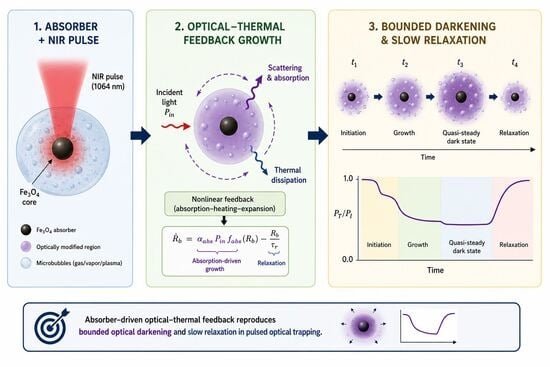
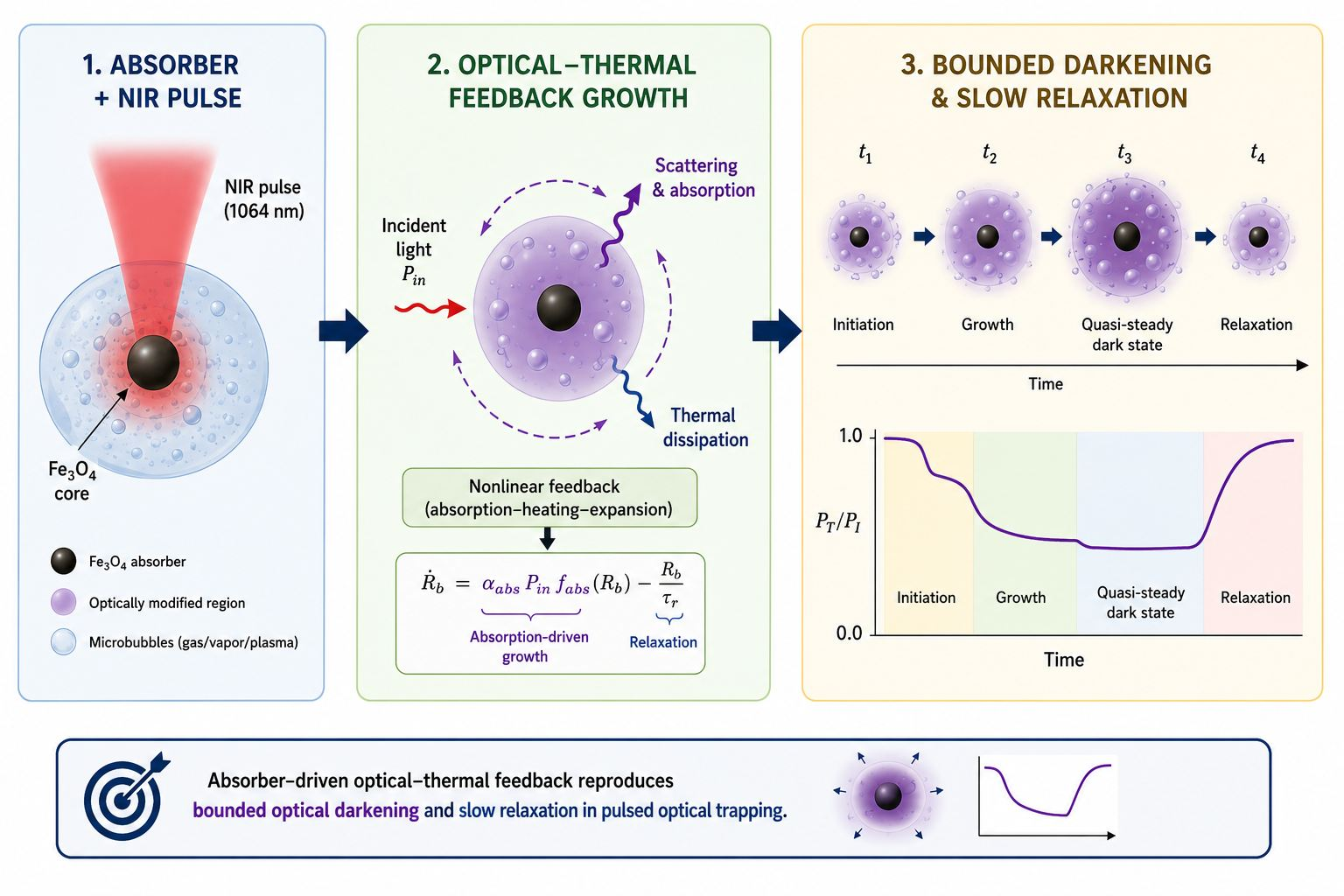
Graphical Abstract

1. Introduction

Optical trapping and optical manipulation techniques have transformed the study of microscopic systems since the pioneering work of Ashkin on radiation-pressure-driven particle confinement [1]. Subsequent developments established stable single-beam optical trapping for dielectric particles and biological systems [2,3,4], leading to broad applications in soft matter physics, biological imaging, cell manipulation, and single-particle dynamics. In biological environments, optical trapping has enabled investigations ranging from molecular force spectroscopy to single-cell manipulation and nanoparticle-assisted photothermal processes [4,5].
Localized optical absorption can substantially modify trapping dynamics through laser-induced heating, thermally driven refractive-index changes, cavitation, and bubble formation [5,6,7]. In plasmonic and strongly absorbing systems, optical excitation can produce highly nonlinear optical–thermal responses including transient vapor nanobubbles, localized superheating, optical limiting, and nonlinear scattering phenomena [6,7,8]. These processes depend sensitively on absorber geometry, thermal diffusion, pulse duration, and optical feedback between evolving material structure and the incident electromagnetic field [7,8].
Recent experiments involving Fe3O4-containing magnetic microbeads in pulsed optical trapping systems reported the emergence of expanding dark regions accompanied by strong transmission reduction, slow growth–relaxation dynamics, and broadband luminous emission under sustained near-infrared excitation [9]. The experiments further showed that the observed darkening dynamics evolved on timescales substantially longer than the thermal diffusion time associated with individual nanosecond laser pulses [9]. Measurements of transmitted optical power demonstrated large transient reductions in transmission correlated with the growth of the darkened region [9]. These observations suggest the presence of a nonlinear feedback mechanism coupling optical absorption, thermal evolution, and structural modification within the trapping region.
Strong optical absorption by conductive or partially conductive inclusions can generate rapid localized heating and transient vapor formation even under moderate optical intensities [6,7,10,11,12]. In particular, Fe3O4-containing particles exhibit enhanced electromagnetic absorption relative to surrounding dielectric media, allowing efficient conversion of optical energy into localized thermal excitation. Theoretical descriptions of light interaction with layered or composite particles are commonly formulated using generalized Mie scattering theory [10,11,12], while thermal evolution is governed by heat diffusion and phase-transition dynamics [13,14,15,16,17,18]. Under pulsed optical excitation, the interplay between absorption, cooling, and structural evolution can produce nonlinear temporal responses including bounded bubble growth, transient optical opacity, and feedback-regulated scattering behavior [18,19,20,21,22].
Several previous studies have investigated cavitation, optical breakdown, nonlinear scattering, and laser-induced bubble dynamics in absorbing nanoparticle systems [15,18,19,20,21,22,23,24,25,26,27]. These works established that transient vapor structures and optical nonlinearities can strongly alter local electromagnetic energy deposition. However, the long-timescale darkening and reversible transmission dynamics observed in pulsed trapping experiments involving Fe3O4-containing microbeads [9] remain incompletely understood. In particular, it is unclear whether cumulative heating of isolated absorbers alone is sufficient to sustain the experimentally observed minute-scale dynamics, or whether additional nonlinear optical–thermal feedback mechanisms are required.
The present work develops a reduced-order nonlinear optical–thermal feedback model designed to identify the minimal physical mechanisms sufficient to reproduce the experimentally observed darkening behavior reported in Ref. [9]. The framework combines pulse-resolved electromagnetic absorption, conductive thermal diffusion, and effective optical-depth evolution associated with slowly relaxing structural modification of the trapping region. Full core–shell Mie absorption calculations are incorporated to estimate energy deposition by Fe3O4-containing absorbers embedded within polymer-coated microbeads. The resulting feedback model reproduces bounded optical darkening, finite transmission plateaus, and long-timescale growth–relaxation dynamics quantitatively consistent with experimentally measured transmission behavior. Quantitative comparison against experimentally digitized transmission trajectories is additionally used to constrain the reduced-order feedback parameters and evaluate model consistency with measured observables.
The present framework is intentionally reduced-order and phenomenological. Its purpose is not to uniquely determine the microscopic origin of the observed dark state, nor to provide a first-principles treatment of cavitation hydrodynamics, plasma kinetics, or irreversible dielectric breakdown. Instead, the model is intended to identify the minimal optical–thermal feedback processes capable of reproducing the experimentally observed transmission and dark-region dynamics. By separating pulse-scale heating from slower structural evolution, the analysis provides a quantitatively constrained mechanistic framework for feedback-regulated optical darkening in pulsed optical trapping systems.

2. Results

2.1. Single-Pulse and Steady-State Thermal Response

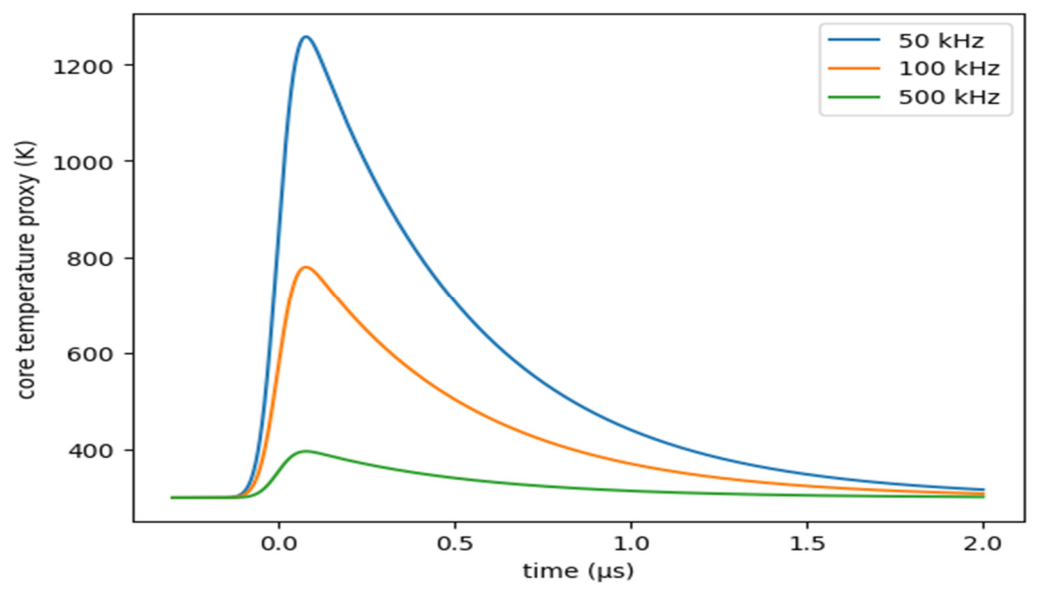
The transient thermal response of an isolated iron-oxide core under nanosecond pulsed excitation is shown in Figure 1 for repetition rates of 50, 100, and 500 kHz at fixed average power. Each pulse produces a rapid temperature rise followed by exponential cooling on a sub-microsecond timescale. Increasing repetition rate reduces the peak temperature due to the corresponding reduction in pulse energy.
Analytical estimates of the thermal response of an isolated Fe3O4 absorber indicate that the temperature remains only weakly elevated above ambient under the conditions considered. Because the characteristic cooling time is much shorter than the pulse-to-pulse interval, the predicted temperature exhibits negligible long-term accumulation. These results demonstrate that linear heating of an isolated absorber is insufficient to account for the experimentally observed minute-scale optical darkening, motivating the inclusion of a feedback-mediated mechanism. Additional thermal-response calculations are provided in Supplementary Figure S1.

2.2. Bubble-Mediated Feedback Dynamics

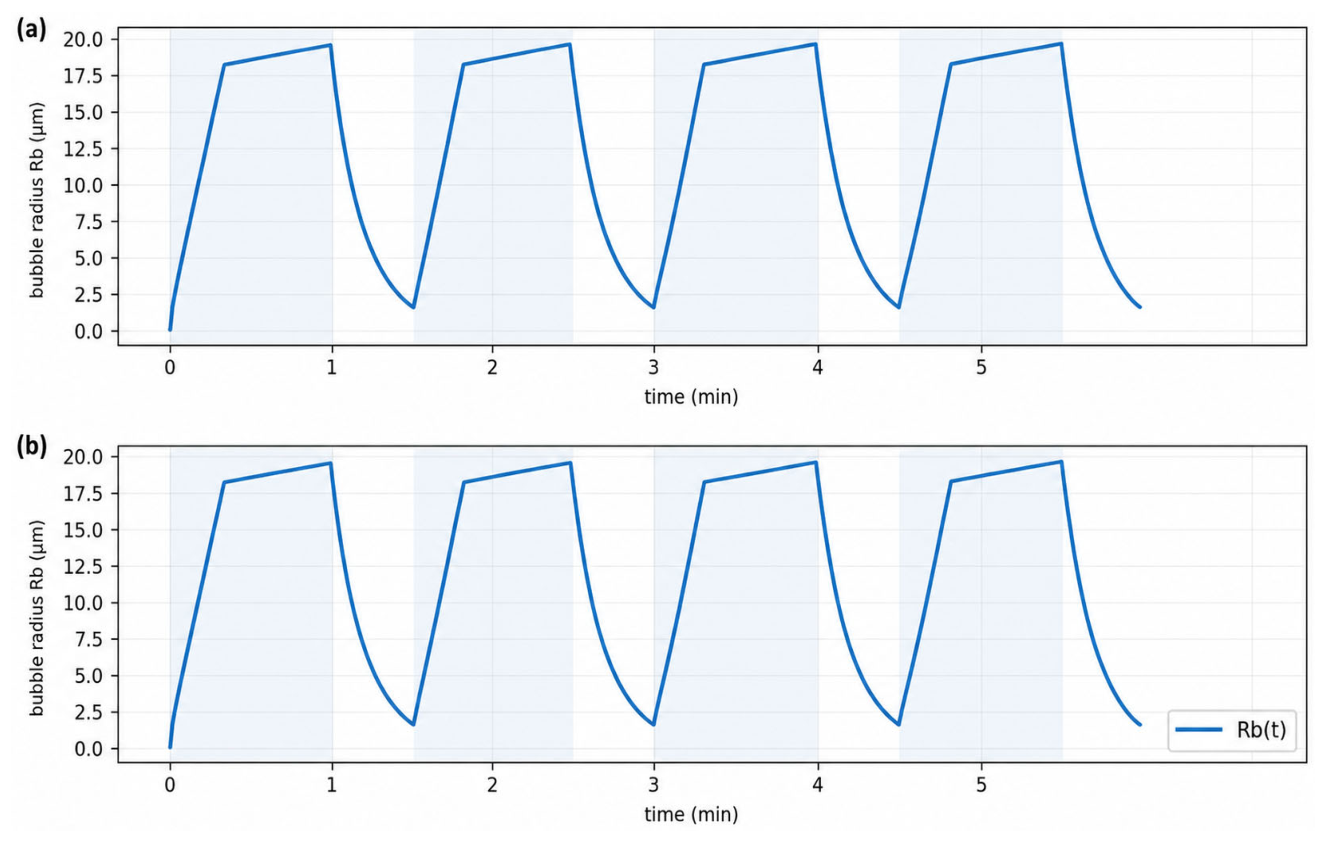
Introducing a bubble-mediated feedback channel produces behavior that is qualitatively distinct from isolated absorber heating. Figure 2a shows the simulated bubble-radius response under repeated laser ON/OFF cycles. During each ON interval, the effective bubble radius R b ( t ) grows smoothly, while during each OFF interval it partially relaxes toward a smaller residual value. The shaded regions indicate the laser-on portions of the pulse sequence.
Figure 2b shows the corresponding repeated growth–relaxation behavior with the simulated R b ( t ) trace identified explicitly. The maximum bubble radius remains bounded at approximately R b 20   μ m , indicating that the feedback channel does not produce runaway expansion under the simulated conditions. Instead, each laser pulse recharges the optically modified region, while each dark interval permits partial recovery.
Together, Figure 2a,b demonstrate reproducible bubble “breathing” dynamics over repeated pulses. The absence of abrupt collapse events or explosive expansion indicates that the system operates in a bounded quasi-steady feedback regime rather than a cavitation-dominated or plasma-driven expansion regime. This behavior provides a reduced-order mechanism by which pulsed optical absorption can produce long-timescale structural and optical evolution without requiring continuous monotonic thermal accumulation.

2.3. Optical Feedback: Transmission and Absorption

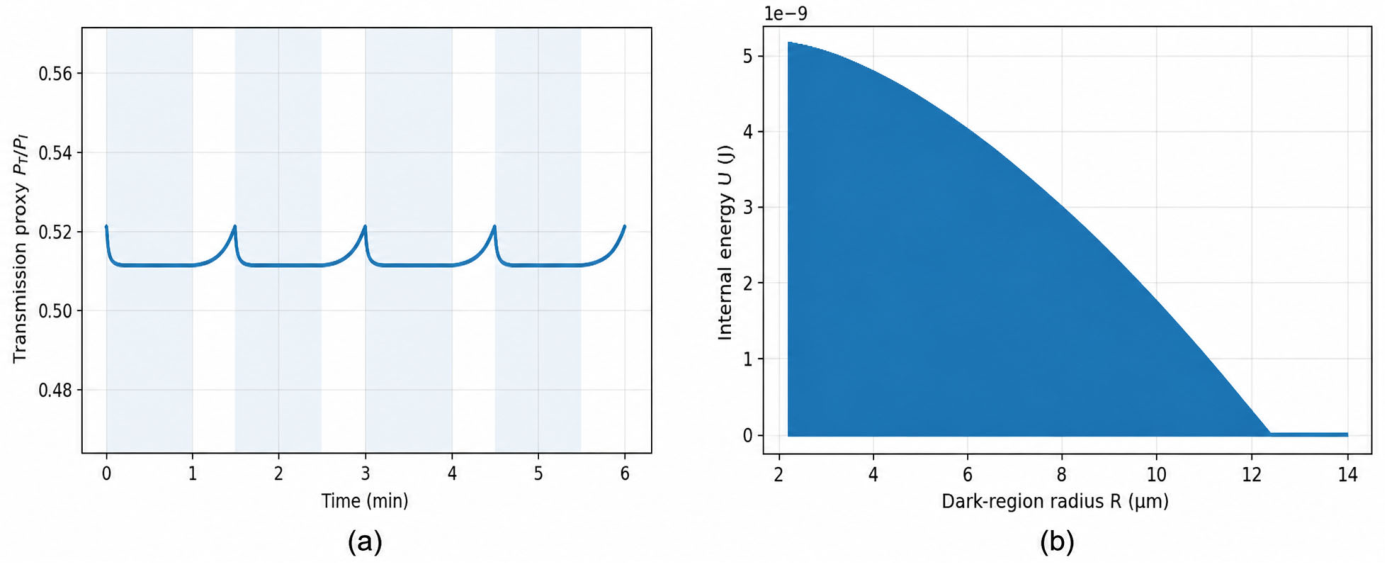
The formation of a microbubble modifies the local optical environment and feeds back on absorption. Figure 3 shows the normalized transmission proxy P T / P I , which decreases during bubble growth and partially recovers during relaxation. Importantly, transmission remains finite throughout the cycle, consistent with partial optical darkening rather than complete beam extinction. Figure 3a shows the normalized transmitted power P T / P I as a function of time under periodic pulsed excitation. The transmission remains finite throughout the experiment, exhibiting shallow, repeatable modulations synchronized with the laser ON intervals. This behavior indicates partial optical darkening rather than complete extinction, consistent with a feedback-limited absorption mechanism operating below plasma-formation thresholds. Figure 3b presents the corresponding phase-space trajectory of the internal energy U and dark-region radius R . The dynamics collapse onto a bounded loop, demonstrating the existence of a stable bounded dynamical regime in the coupled energy–bubble system. The absence of divergence in either variable confirms that optical feedback, thermal dissipation, and bubble relaxation jointly enforce self-regulated behavior.
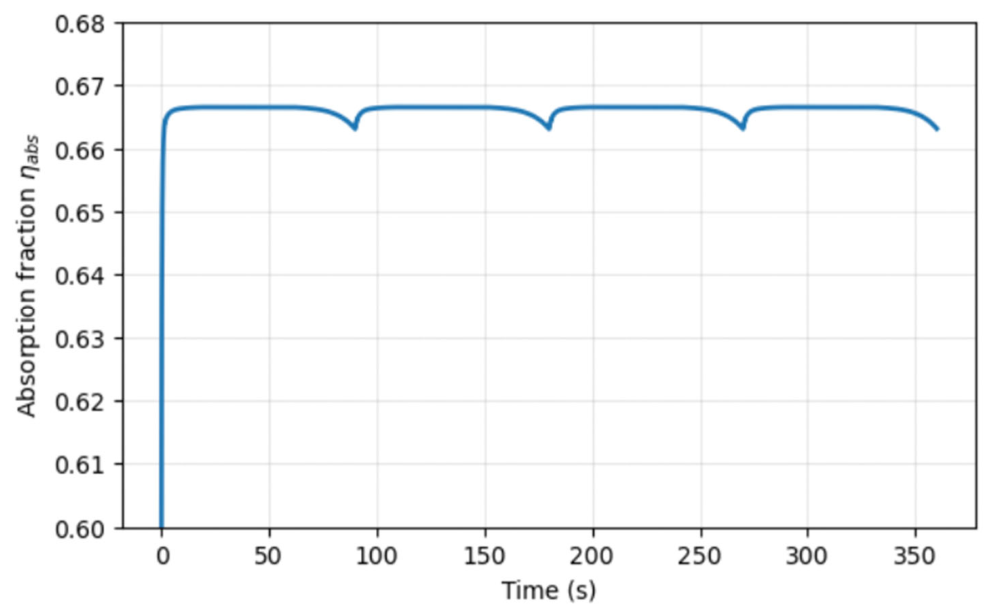
The corresponding effective absorption fraction η a b s is shown in Figure 4. The absorption fraction remains bounded between approximately 0.6 and 0.67, with small transient dips during OFF intervals. The absence of saturation at unity ensures that optical feedback remains self-limiting and prevents runaway heating. Figure 4 shows the time-dependent transmission proxy P T / P I computed from the effective optical depth of the bubble–core system. Transmission decreases during bubble growth phases but remains finite throughout the cycle, indicating partial optical darkening rather than complete extinction. The small periodic modulations reflect reversible changes in optical depth associated with bubble expansion and contraction.

2.4. Energy Partitioning and Thermal Envelope

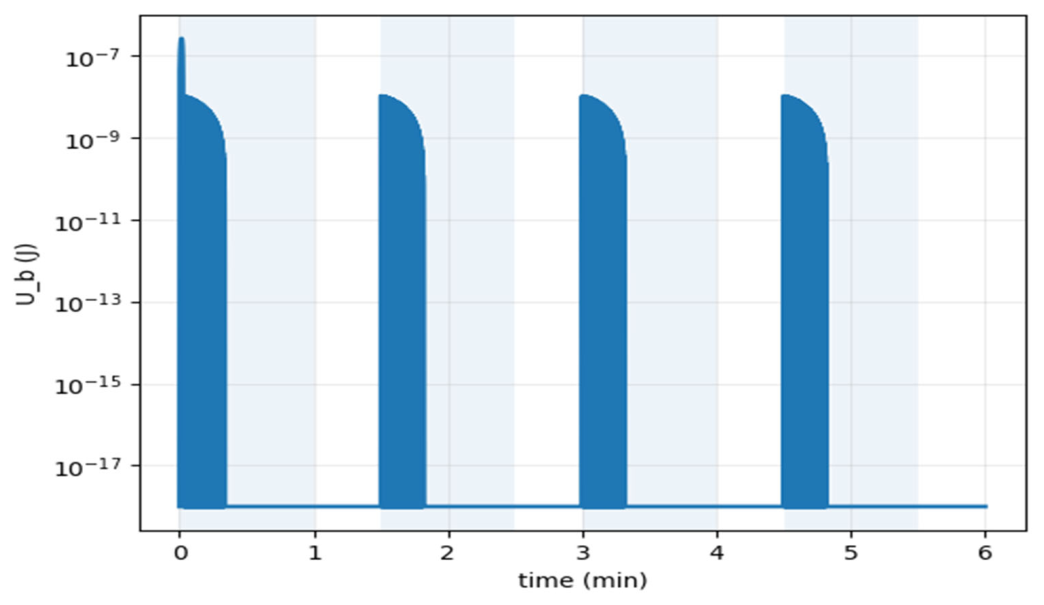
Figure 5 shows the bubble-channel state energy U b on a logarithmic scale. The energy rises during each ON interval and decays rapidly during OFF intervals, reaching peak values on the order of 10 7 J. No long-term accumulation is observed, confirming that the bubble channel acts as a small activation reservoir rather than a bulk energy store.
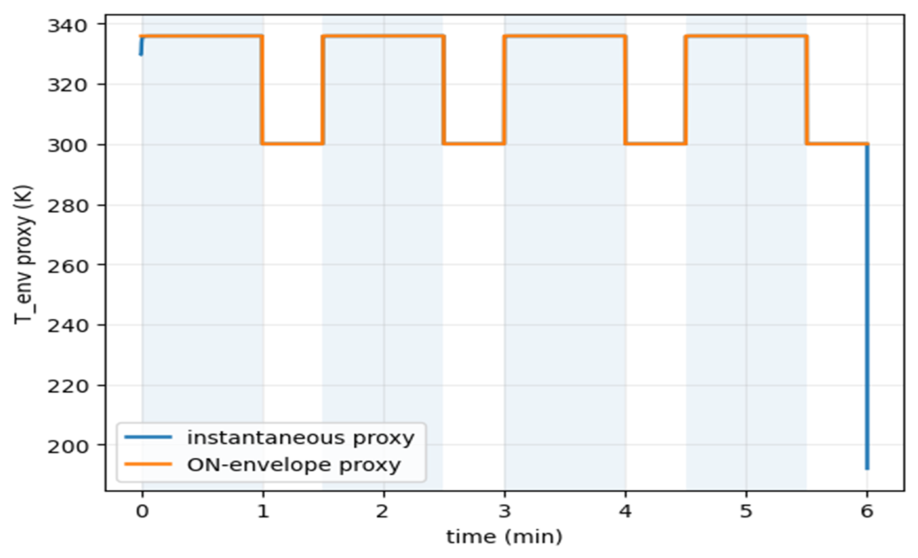
Figure 6 compares two temperature proxies: an instantaneous temperature derived from absorbed power and a cycle-averaged ON-envelope temperature. While the instantaneous proxy reflects rapid modulation, the envelope temperature exhibits smooth RC-like behavior, rising to approximately 330–340 K during ON intervals. This modest temperature elevation is sufficient to modify local mechanical and optical properties without inducing thermal damage.
Key characteristic quantities extracted from Figure 1, Figure 2, Figure 3, Figure 4, Figure 5 and Figure 6 are summarized in Table 1. Values are derived from the results shown in Figure 1, Figure 2, Figure 3, Figure 4, Figure 5 and Figure 6 and characterize optical absorption, transmission, bubble dynamics, and energy partitioning under pulsed 1064 nm optical trapping. All quantities correspond to the baseline parameters listed in Table 2 show in Section 4.

Experimental–Simulation Comparison

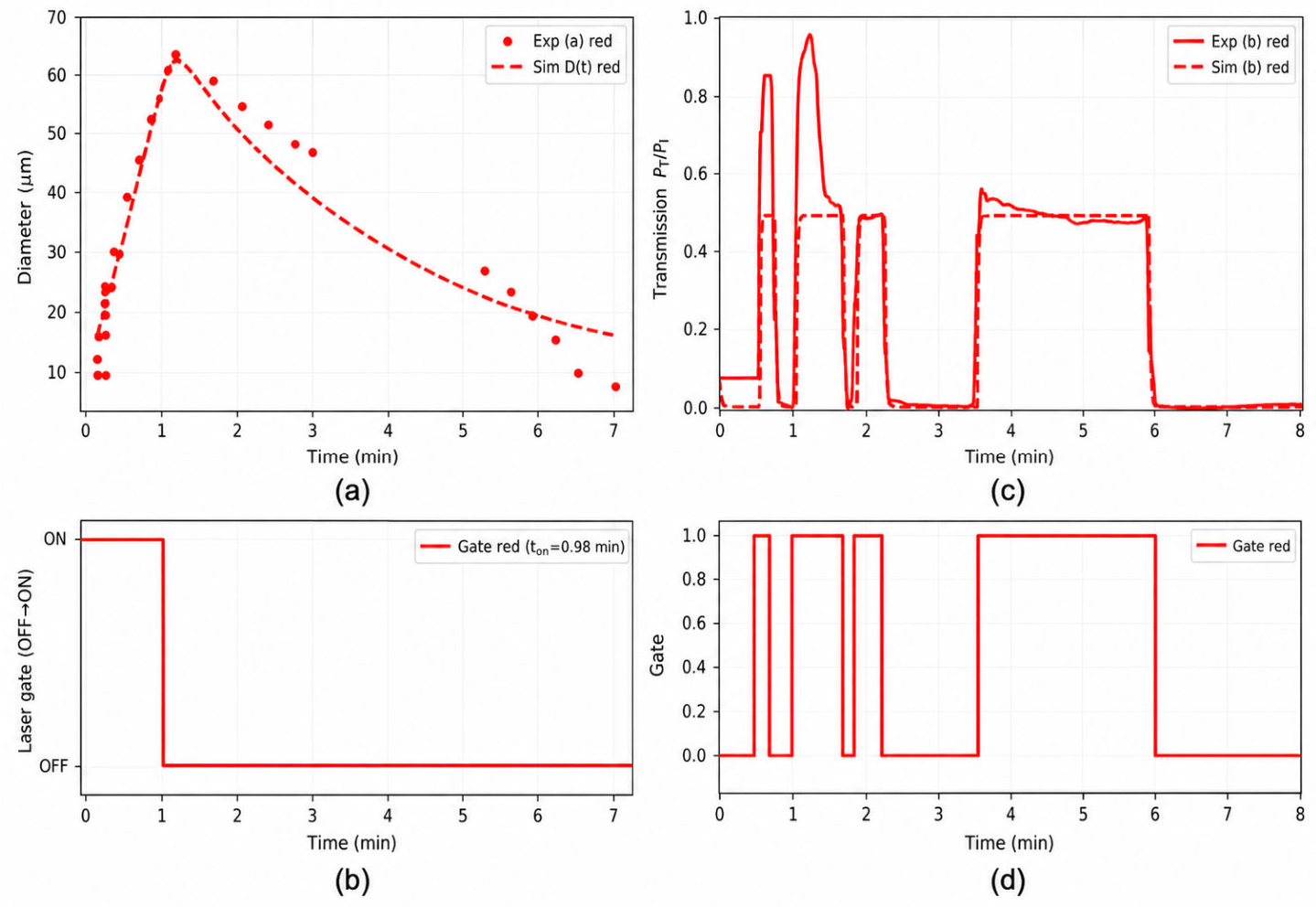
Figure 7 compares representative experimental measurements of bubble diameter and optical transmission with the corresponding outputs of the bubble-feedback model. The complete set of experimental traces previously shown in the original Figure 7 has been moved to the Supplementary Materials (Section S6) to simplify the main text and improve readability (see Figure S4).
Figure 7a shows experimentally measured bubble diameters extracted from Ref. [9] together with the simulated bubble diameter 2 R b ( t ) . The experimental traces exhibit a rapid initial increase in diameter during laser illumination, followed by saturation at a finite maximum size and subsequent relaxation on minute timescales after the laser is switched off. The simulated curves reproduce the main features of this behavior, including the rapid growth phase, bounded maximum diameter, and slow post-illumination relaxation.
Figure 7b shows the laser ON/OFF gating functions inferred from the diameter traces in Figure 7a. In these curves, G ( t ) = 1 corresponds to the charging or growth interval, while G ( t ) = 0 corresponds to the discharging or relaxation interval. These gate functions provide a compact representation of the effective illumination history associated with each experimental run.
Figure 7c compares representative experimental transmission traces P T / P I with simulated transmission responses obtained from the time-dependent optical depth of the bubble–core system. Experimentally, the transmission decreases rapidly upon bubble formation, reaches a finite nonzero plateau during the darkened state, and recovers when the bubble relaxes or the illumination is removed. The simulations reproduce the same qualitative behavior: partial optical darkening, bounded transmission, and recovery following relaxation of the optically modified region.
Figure 7d shows the ON/OFF gating functions used as inputs to the transmission simulations in Figure 7c. These gates encode the experimentally observed activation intervals and directly drive the absorption and relaxation terms in the reduced-order model. Their inclusion is essential for reproducing the step-like transmission plateaus and recovery events observed experimentally.
Figure 3 and Figure 4 report model-internal optical quantities. Figure 3 shows the Beer–Lambert transmission proxy,
P T / P I = e x p [ τ e f f ( t ) ] ,
where τ e f f ( t ) is the effective optical depth generated by the evolving bubble state.
Figure 4 shows the complementary absorbed fraction
η a b s ( t ) = 1 P T / P I
where P T and P I are the transmitted and incident optical powers, respectively.
Together, these quantities describe the self-limited optical darkening predicted by the feedback model. Because the experimental transmission P T / P I is a detector-channel observable that includes scattering, refraction, and collection-geometry effects, direct comparison requires mapping the model output to the measured signal. This comparison is performed in Figure 7, while the full set of traces and gating sequences is provided in the Supplementary Materials.

3. Discussion

The results presented here support the interpretation that the experimentally observed optical darkening arises from a feedback-regulated optical–thermal process rather than from cumulative thermal storage within isolated absorbers. Simulations of an isolated Fe3O4 core under nanosecond pulsed excitation demonstrate rapid pulse-to-pulse heating followed by efficient conductive cooling on sub-microsecond timescales (Figure 1). Because the conductive relaxation time remains substantially shorter than the interpulse spacing, the model predicts only modest steady-state temperature accumulation in the absence of nonlinear feedback. These findings indicate that linear thermal accumulation alone is insufficient to explain the experimentally observed minute-scale darkening dynamics reported in Ref. [9].
In contrast, incorporation of a slowly evolving feedback channel produces qualitatively different behavior. The reduced-order optical–thermal framework generates bounded growth of an optically modified region together with finite transmission plateaus and gradual recovery dynamics consistent with experimental observations. Rather than exhibiting unrestricted runaway heating or complete optical extinction, the system evolves toward a self-limited darkened state in which optical transmission remains finite and partially reversible over long timescales (Figure 2, Figure 3, Figure 4 and Figure 5). Similar feedback-regulated optical responses have been observed previously in studies of laser-induced nanobubbles, optical limiting, and thermally driven refractive-index modification in absorbing nanoparticle systems [7,18,19,20,21,22,23,24].
The mechanistic implications of the reduced-order feedback model are summarized in Figure S5. The coupled evolution of optical absorption, effective optical depth, and structural relaxation produces stable bounded trajectories in which local energy deposition and dissipation remain dynamically balanced. In this framework, repeated pulsed excitation redistributes absorbed optical energy into a slowly evolving low-density or structurally modified region surrounding the absorber. The evolving optical depth then alters subsequent energy deposition, establishing a nonlinear feedback cycle between optical attenuation and structural relaxation. Importantly, the effective structural variable used in the model should not be interpreted as a uniquely resolved microscopic bubble boundary. Instead, it represents a coarse-grained dynamical measure of optical modification within the trapping region.
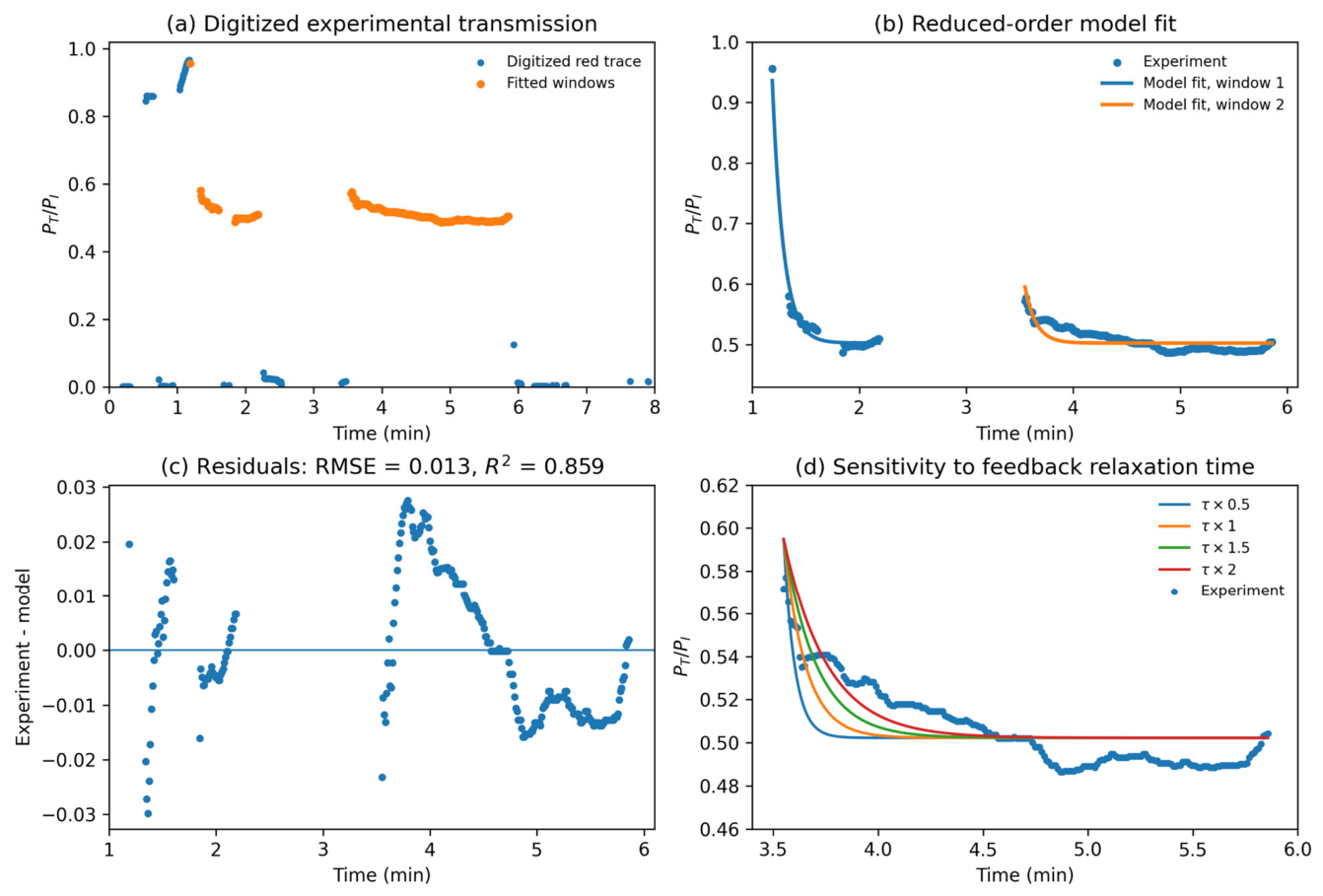
Furthermore, Figure 8 provides a quantitative comparison between the reduced-order model and experimentally measured transmission dynamics. Figure 8 compares simulated transmission trajectories against experimentally digitized normalized transmission data extracted from Ref. [9]. The model reproduces the principal observable features of the measured transmission evolution, including rapid activation, finite transmission plateaus, and slow post-illumination relaxation. The fitted steady-state transmission remains finite rather than collapsing toward complete opacity, further supporting the interpretation that the experimentally observed darkened state corresponds to a bounded feedback-mediated optical regime rather than catastrophic optical breakdown.
The quantitative validation shown in Figure 8 further demonstrates that the experimentally observed transmission dynamics are consistent with the proposed nonlinear optical–thermal feedback mechanism. Figure 8a shows the digitized experimental transmission trace extracted from Ref. [9], while Figure 8b compares the experimentally measured transmission with the fitted reduced-order model trajectories. The model successfully reproduces the finite transmission plateau and gradual post-activation relaxation observed experimentally.
The fitted steady-state transmission plateau was found to be
( P T P I ) s s 0.50 ,
indicating that the darkened state remains partially transmissive rather than evolving toward complete optical extinction. The characteristic relaxation time extracted from the fit was
τ r 0.10   m i n ,
consistent with the experimentally observed slow dissipative evolution of the optically modified region.
Quantitative agreement between the model and experiment was evaluated using the root-mean-square residual (RMSE) and coefficient of determination R 2 .
The fitted transmission dynamics yielded R M S E 1.3 × 10 2 , with R 2 0.86 .  These results indicate that the reduced-order feedback framework captures the dominant macroscopic features of the experimentally observed transmission response despite not explicitly resolving microscopic cavitation or plasma-scale dynamics. Residual analysis further shows that deviations between the model and experiment remain comparatively small over most of the transmission evolution. Sensitivity studies additionally demonstrate that bounded darkening behavior persists over broad variations in relaxation and optical-depth parameters, indicating that the observed dynamics do not require extreme parameter fine tuning.
The present framework additionally clarifies the role of energy partitioning within the system. Although strong localized absorption occurs near the Fe3O4 inclusion, most deposited optical energy is rapidly dissipated into the surrounding medium rather than stored thermally within the absorber itself. The simulated feedback-channel energy remains in the sub-microjoule range (Figure 5), while the surrounding envelope temperature increase remains comparatively modest (Figure 6). These findings suggest that long-timescale optical darkening is governed primarily by feedback-mediated structural and optical evolution rather than sustained bulk thermal accumulation or explosive cavitation.
Several limitations of the present framework should nevertheless be emphasized. The model is intentionally reduced-order and does not explicitly resolve plasma kinetics, cavitation hydrodynamics, shock-wave generation, magnetic interactions, or collective multiparticle effects. In addition, the experimentally measured transmission represents a detector-channel observable that may include contributions from scattering, beam steering, refractive-index gradients, and collection geometry that are not explicitly incorporated into the present model. Consequently, the agreement shown in Figure 8 should be interpreted as evidence that the proposed feedback mechanism captures the dominant macroscopic transmission dynamics rather than proof of a unique microscopic pathway.
We emphasize that the present model is intentionally phenomenological. The coupling between bubble-channel growth and optical darkening is introduced as an effective description of the experimentally observed transmission changes rather than as a microscopic description of the underlying optical scattering processes.
Despite these limitations, the results establish that absorber-driven optical–thermal feedback provides a quantitatively consistent and physically plausible mechanism for the formation of long-lived optically darkened states under pulsed optical trapping conditions. The framework developed here therefore provides a useful reduced-order foundation for future studies incorporating more detailed hydrodynamic, electromagnetic, and plasma-mediated processes in laser-driven magnetic micro- and nanosystems.

4. Methods

4.1. Reduced-Order Absorber–Feedback Model

We modeled optical darkening as a feedback-mediated process initiated by localized absorption in an Fe3O4 inclusion. The absorber was treated as the primary source of deposited optical energy, while the surrounding optically modified region was represented by an effective bubble or low-density feedback channel with radius R b ( t ) . This radius is not intended to describe a fully resolved hydrodynamic interface, but instead serves as a coarse-grained variable describing the spatial extent of the optically modified region.
The feedback channel is represented by an effective radius R b ( t ) . The model does not assume that a vapor bubble forms inside the polymer bead. Instead, R b ( t ) denotes the spatial extent of a low-density or optically modified region surrounding the Fe3O4 absorber and extending into the adjacent aqueous environment. This effective region modifies the local optical properties and provides the feedback mechanism responsible for the observed darkening dynamics.
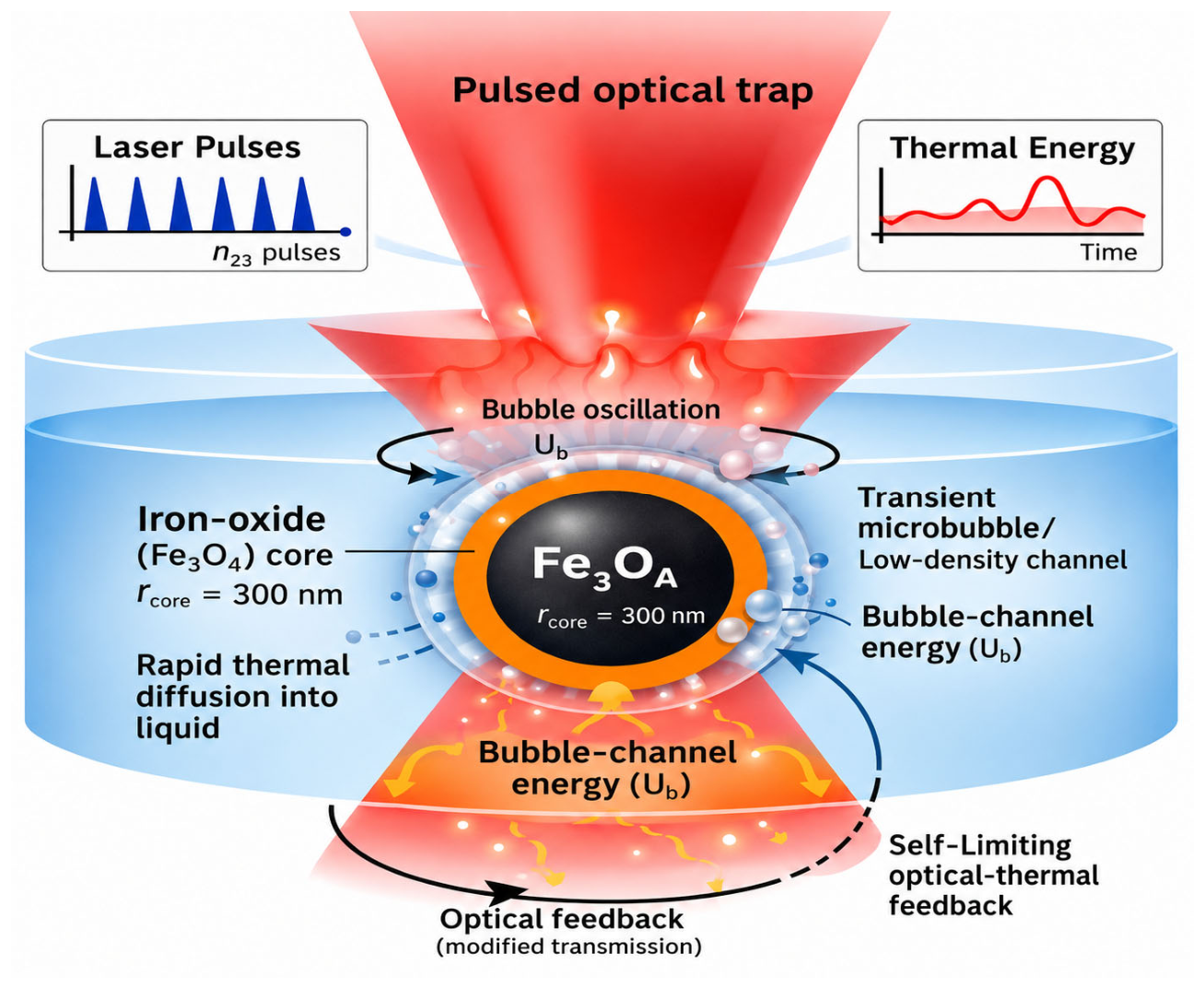
Figure 9 summarizes the reduced-order physical model and the computational update sequence used in the simulations. The imposed laser gate determines the absorbed optical power, which updates the bubble-feedback radius, effective optical depth, transmitted fraction, and absorbed fraction at each time step.
The absorbed optical power was written as
P a b s ( t ) = C a b s I ( t ) ,
where C a b s is the absorption cross section of the absorber–bead system and I ( t ) is the local laser intensity. The laser pulse train was represented by a binary gating function G ( t ) , where G = 1 corresponds to laser ON and G = 0 corresponds to laser OFF.
The feedback-mediated bubble radius evolved using a reduced growth–relaxation equation
d R b d t = G ( t ) F g r o w ( P a b s , R b ) [ 1 G ( t ) ] F r e l a x ( R b ) ,
where the first term describes bubble or dark-region growth during illumination and the second term describes relaxation after the laser is removed. The functional forms were chosen to enforce bounded growth and finite relaxation, consistent with the experimentally observed absence of runaway expansion.
The absorption cross section of the Fe3O4-core/polymer-shell particle was calculated using core–shell Mie theory. The resulting absorption cross section C a b s was used to determine the absorbed optical power P a b s = C a b s I 0 . Details of the Aden–Kerker formulation are provided in Supplementary Section S2.

4.2. Optical Transmission and Absorption

The evolving bubble state was coupled to the optical response through an effective optical depth τ e f f ( t ) . The transmitted fraction was modeled using a Beer–Lambert-type proxy Equation (1) and the corresponding absorbed fraction form Equation (2). A central assumption of the reduced-order model is that growth of the bubble-mediated feedback channel increases the effective optical depth of the absorber–medium system. This assumption is introduced phenomenologically to represent the experimentally observed correlation between dark-region formation and reduced transmission. The model therefore does not attempt to resolve the underlying microscopic scattering, refractive-index, or structural mechanisms responsible for the observed optical darkening.
This representation captures partial optical darkening while ensuring that transmission remains finite in the bounded pre-plasma regime.

4.3. Numerical Implementation

The reduced-order feedback equations were implemented and solved using Python 3.11.8, with NumPy 1.26.4, SciPy 1.13.1, and Matplotlib 3.8.4. Time integration was performed using an explicit finite-difference update on a uniform time grid. At each time step, the laser state G ( t ) , absorbed power, bubble radius R b ( t ) , effective optical depth τ e f f ( t ) , transmitted fraction P T / P I , and absorbed fraction η a b s  were updated sequentially.
The simulations were written using standard Python scientific libraries, including NumPy for array operations and time stepping, SciPy where needed for fitting and interpolation, pandas for handling digitized experimental data, and Matplotlib for figure generation. Both single-pulse and repeated-pulse excitation sequences were simulated by prescribing the laser gate G ( t ) as a binary ON/OFF function.
The optical field near the trap focus was approximated as a diffraction-limited Gaussian beam. The beam waist was estimated using:
w 0 = 0.61 λ N A ,
with numerical aperture NA = 1.25, yielding w 0 0.52 and a focal area A b e a m = π w 0 2 . Unless otherwise stated, spherical symmetry was assumed and convective transport was neglected.
The numerical time step was chosen to resolve the imposed pulse structure and the slower relaxation of the optically modified region. The principal simulation outputs were R b ( t ) , 2 R b ( t ) , τ e f f ( t ) , P T / P I , and η a b s ( t ) . Detailed code-level implementation, convergence checks, and sensitivity tests are provided in the Supplementary Materials.

4.4. Comparison with Experimental Data

Experimental bubble-diameter and transmission traces were digitized from Ref. [9]. Diameter traces were compared directly with the simulated diameter 2 R b ( t ) . For transmission traces, experimentally inferred ON/OFF gating functions were extracted from the measured temporal response and used as inputs to the reduced transmission model.
For representative traces, the simulated transmission was compared with the measured normalized transmission
T ( t ) = P T ( t ) P I .
The comparison focused on the primary dynamical features: rapid darkening during activation, bounded finite transmission plateaus, and slow recovery following relaxation. The complete set of digitized traces and gate-extraction procedures is provided in the Supplementary Materials.
The baseline parameters used throughout the reduced-order optical–thermal feedback simulations are summarized in Table 2. Material properties were obtained from experimentally reported literature values where available, while phenomenological feedback coefficients were selected to enforce finite transmission plateaus, bounded dark-region growth, and separation between fast thermal relaxation and slow structural evolution timescales.

5. Scope and Limitations

The present framework is intentionally reduced-order and phenomenological. Its purpose is to identify the minimal optical–thermal feedback mechanisms sufficient to reproduce the experimentally observed long-timescale optical darkening dynamics under pulsed optical trapping conditions. The model therefore focuses specifically on experimentally measurable macroscopic observables, including transmission evolution, dark-region growth, and relaxation behavior, rather than attempting to uniquely resolve microscopic plasma or cavitation structure.
This work deliberately isolates the optical and thermal consequences of iron-oxide absorption within the trapping region. Effects associated with polymer coatings, cellular membranes, collective multiparticle interactions, magnetic forces, chemical reactions, plasma kinetics, and hydrodynamic flow are not explicitly resolved. Instead, these processes are incorporated implicitly through phenomenological feedback and dissipation parameters designed to reproduce the observed bounded transmission dynamics and structural relaxation behavior.
The model is additionally restricted to the reversible pre-plasma regime of optical darkening. Terminal events observed experimentally, characterized by rapid irreversible structural destabilization and loss of optical confinement, are represented phenomenologically as irreversible state transitions beyond which no well-defined dark-region radius exists. The present framework therefore does not attempt to model shock-wave generation, ionization dynamics, cavitation hydrodynamics, or plasma formation, which are expected to dominate at substantially higher local intensities and shorter timescales [15,23,26].
All simulations shown in Figure 1, Figure 2, Figure 3, Figure 4, Figure 5, Figure 6, Figure 7 and Figure 8 use the baseline parameters listed in Table 2. Parameters were selected either from experimentally reported material properties or from physically motivated constraints enforcing bounded absorption, finite dissipation, and separation between fast thermal relaxation and slow structural evolution timescales. The qualitative dynamics reported here remain robust under order-of-magnitude variations in the phenomenological parameters governing dark-region growth and relaxation.
Despite these simplifications, the reduced-order framework successfully reproduces several experimentally observed macroscopic features, including bounded dark-region growth, finite transmission plateaus, gradual recovery dynamics, and run-to-run variability associated with externally imposed laser gating. The results therefore support the interpretation that feedback-mediated optical–thermal structural evolution provides a physically plausible mechanism for long-timescale optical darkening under pulsed optical trapping conditions.

6. Outlook and Future Work

The mechanistic framework developed here captures the emergence of optically dark states driven by iron-oxide cores in the pre-plasma regime. By explicitly separating thermal, optical, and bubble-mediated energy channels, the model provides a physically transparent description of long-timescale feedback under pulsed optical trapping. An important direction for future work is to extend this framework beyond the isolated-core approximation by incorporating multilayer structures, including polymer coatings and cellular membranes, through explicit optical and thermal boundary conditions. Such extensions would enable direct quantitative comparison with composite magnetic beads and biologically relevant environments [22,25,28,29,30]. From a statistical-physics perspective, the dark state can be viewed as a metastable nonequilibrium configuration sustained by periodic driving and nonlinear feedback, rather than as a thermodynamic steady state. The transition to irreversible disruption corresponds to loss of boundedness in the internal energy–structure phase space.
A second promising avenue is to explore the transition from the stable bubble-breathing regime identified here to the onset of cavitation and plasma formation observed at higher intensities. This will require coupling the present energy-partition model to ionization dynamics, shock formation, and transient changes in optical constants [23,26]. Experimentally, simultaneous measurements of transmission, scattering, and acoustic emission could provide stringent tests of these extensions. Together, these developments would establish a unified description of energy localization, structural reorganization, and plasma generation in laser-driven magnetic micro- and nanosystems.

7. Conclusions

This study provides a mechanistic theoretical framework for understanding laser-induced optically darkened region formation under pulsed optical trapping, with specific emphasis on the role of an iron-oxide (Fe3O4) core. By systematically building the model from isolated nanoparticle heating to nonlinear, bubble-mediated absorption, we identify the minimum physical ingredients required to reproduce the qualitative behavior observed experimentally.
Our analysis shows that although pulsed optical trapping generates extreme transient heating within an iron core, rapid conductive dissipation prevents long-term energy storage in the absence of nonlinear feedback. The emergence of a dark bubble fundamentally alters this balance by increasing optical depth and suppressing dissipation, enabling slow optical–thermal feedback and RC-like growth–collapse cycles. When electromagnetic absorption is treated self-consistently using full core–shell Mie theory, the iron core is shown to absorb a substantial fraction of the focused laser power, placing the system in a strongly optically thick regime.
Together, these results demonstrate that iron-core absorption provides a physically plausible ignition mechanism sufficient to initiate feedback-mediated optically darkened region formation, even without invoking explicit plasma, magnetic, or biological effects. The framework developed here establishes a conservative baseline for interpreting experimental observations and provides a foundation for future extensions incorporating plasma kinetics, hydrodynamics, and magnetically driven morphology.

Supplementary Materials

The following supporting information can be downloaded at: https://www.mdpi.com/article/10.3390/biophysica6040056/s1, Figure S1: Thermal response of an isolated Fe3O4 absorber under pulsed excitation. Simulated temperature evolution obtained from the lumped-capacitance thermal model described in Section S1. Following each excitation event, the absorber cools rapidly toward ambient temperature on a timescale much shorter than the experimentally observed minute-scale darkening and recovery dynamics. The absence of significant thermal accumulation between successive excitation cycles demonstrates that linear heating of an isolated Fe3O4 absorber cannot account for the long-timescale optical response, motivating the introduction of a feedback-mediated energy-storage mechanism. Figure S2: Conceptual schematic of the absorber-driven optical feedback mechanism. Optical absorption by a Fe3O4-containing bead under pulsed near-infrared illumination initiates formation of a bubble-mediated optically modified region surrounding the absorber. Growth of this region increases the effective optical depth of the absorber–medium system, reducing transmission and producing partial optical darkening. The feedback loop couples absorbed optical power, bubble-channel energy storage, bubble-radius evolution, and transmission changes. Relaxation and energy-loss processes limit expansion, resulting in bounded growth, finite transmission plateaus, and recovery following removal of the optical drive. Figure S3: Sensitivity analysis of the reduced-order feedback model. Effects of variations in the contraction timescale τ c  and feedback strength α b  on the predicted bubble and transmission dynamics. (a) Simulated bubble radius R b ( t )  for different values of the contraction timescale τ c . (b) Corresponding normalized transmission P T / P I , demonstrating the influence of relaxation dynamics on recovery following laser-off intervals. (c) Simulated bubble radius R b ( t )  for different values of the feedback strength α b . (d) Corresponding normalized transmission P T / P I , showing the effect of optical feedback on the magnitude of darkening. Shaded regions indicate laser-on intervals. Across all parameter variations, the model preserves bounded growth, finite transmission plateaus, and recovery after removal of the optical drive, demonstrating robustness of the reduced-order feedback framework. Figure S4: Extraction of effective ON/OFF driving sequences and reduced transmission-response modeling. (a) Experimental diameter evolution of the optically darkened region together with the fitted growth–decay model. (b) Diameter-derived ON/OFF gate sequence, where the charging interval corresponds to d D / d t > 0 and the discharging interval corresponds to d D / d t < 0 . (c) Experimental transmission trace and corresponding reduced first-order switching-model reconstruction. (d) Threshold-extracted ON/OFF sequence obtained from the normalized transmission signal using hysteretic switching thresholds. Figure S5: Conceptual representation of the absorber-driven feedback mechanism underlying the reduced-order model. Optical absorption by the Fe3O4-containing bead generates a localized optically modified region in the surrounding medium. Growth of this region increases the effective optical depth, reduces transmission, and produces partial optical darkening. Relaxation and energy-loss processes limit expansion, resulting in bounded growth and recovery following removal of the optical drive. The schematic is intended as a phenomenological interpretation of the observed dynamics and does not imply a specific microscopic mechanism. Figure S6: Additional validation and sensitivity analysis of the reduced-order feedback model. Dependence of simulated bubble-radius evolution and transmission dynamics on key phenomenological parameters, including the relaxation time and optical-feedback strength. Variations in parameter values modify the quantitative growth rate, maximum bubble size, and transmission plateau level, but do not alter the principal model predictions of bounded growth, finite optical darkening, and recovery after cessation of illumination. These results demonstrate that the qualitative behavior of the model is robust over physically reasonable parameter ranges.

Author Contributions

Conceptualization, T.D., D.B.E. and H.T.C.; methodology, R.H., H.T.C. and T.D.; software, R.H.; validation, R.H., T.D. and D.B.E.; formal analysis, R.H.; investigation, R.H., H.T.C. and T.D.; resources, D.B.E. and H.T.C.; data curation, R.H.; writing—original draft preparation, H.T.C. and R.H.; writing—review and editing, R.H., T.D., D.B.E. and H.T.C.; visualization, R.H.; supervision, D.B.E. and H.T.C.; project administration, H.T.C.; funding acquisition, D.B.E. and H.T.C. All authors have read and agreed to the published version of the manuscript.

Funding

This research was funded by the U.S. Department of Education under Grant No. P031S240353 and by the U.S. Department of Defense under Grant No. W911NF231028. The APC was funded by California State University Dominguez Hills and Middle Tennessee State University.

Institutional Review Board Statement

Not applicable.

Informed Consent Statement

Not applicable.

Data Availability Statement

The data supporting the findings of this study are available from the corresponding author upon reasonable request. No publicly archived datasets were generated during the current study.

Acknowledgments

The authors thank colleagues and collaborators for valuable discussions and feedback during the development of this work. Computational resources were provided by California State University Dominguez Hills institutional facilities. During the preparation of this manuscript, the authors used ChatGPT (OpenAI, GPT-5.5) for language editing, formatting assistance, and manuscript organization. The authors reviewed and edited all generated content and take full responsibility for the content of this publication.

Conflicts of Interest

The authors declare no conflicts of interest.

References

  1. Ashkin, A. Acceleration and trapping of particles by radiation pressure. Phys. Rev. Lett. 1970, 24, 156–159. [Google Scholar] [CrossRef]
  2. Ashkin, A.; Dziedzic, J.M.; Bjorkholm, J.E.; Chu, S. Observation of a single-beam gradient force optical trap for dielectric particles. Opt. Lett. 1986, 11, 288–290. [Google Scholar] [CrossRef] [PubMed]
  3. Grier, D.G. A revolution in optical manipulation. Nature 2003, 424, 810–816. [Google Scholar] [CrossRef] [PubMed]
  4. Neuman, K.C.; Block, S.M. Optical trapping. Rev. Sci. Instrum. 2004, 75, 2787–2809. [Google Scholar] [CrossRef] [PubMed]
  5. Peterman, E.J.; Gittes, F.; Schmidt, C.F. Laser-induced heating in optical traps. Biophys. J. 2003, 84, 1308–1316. [Google Scholar] [CrossRef] [PubMed]
  6. Baffou, G.; Quidant, R. Thermo-plasmonics: Using metallic nanostructures as nanosources of heat. Laser Photon. Rev. 2013, 7, 171–187. [Google Scholar]
  7. Lapotko, D. Plasmonic nanobubbles as transient vapor nanobubbles generated around plasmonic nanoparticles. ACS Nano 2009, 3, 3549–3555. [Google Scholar]
  8. Lukianova-Hleb, E.Y.; Volkov, A.N.; Lapotko, D.O. Laser pulse duration is critical for the generation of plasmonic nanobubbles. Langmuir 2014, 30, 7425–7434. [Google Scholar] [CrossRef] [PubMed]
  9. Erenso, D.; Tran, L.; Abualrob, I.; Bushra, M.; Hengstenberg, J.; Muhammed, E.; Endale, I.; Endale, N.; Endale, E.; Mayhut, S.; et al. Observation of magnet-induced star-like radiation of a plasma created from cancer cells in a laser trap. Eur. Biophys. J. 2024, 53, 123–131. [Google Scholar] [PubMed]
  10. Aden, A.; Kerker, M. Scattering of electromagnetic waves from two concentric spheres. J. Appl. Phys. 1951, 22, 1242–1246. [Google Scholar] [CrossRef]
  11. Bohren, C.F.; Huffman, D.R. Absorption and Scattering of Light by Small Particles; Wiley: New York, NY, USA, 1983. [Google Scholar]
  12. Peña, O.; Pal, U. Scattering of electromagnetic radiation by a multilayered sphere. Comput. Phys. Commun. 2009, 180, 2348–2354. [Google Scholar] [CrossRef]
  13. Brennen, C.E. Cavitation and Bubble Dynamics; Chapter 4; Oxford University Press: Oxford, UK, 1995. [Google Scholar]
  14. Ashkin, A. Optical trapping and manipulation of neutral particles using lasers. Proc. Natl. Acad. Sci. USA 1997, 94, 4853–4860. [Google Scholar] [CrossRef] [PubMed]
  15. Vogel, A.; Venugopalan, V. Mechanisms of pulsed laser ablation of biological tissues. Chem. Rev. 2003, 103, 577–644. [Google Scholar] [CrossRef] [PubMed]
  16. Goldenberg, H.; Tranter, C.J. Heat flow in an infinite medium heated by a sphere. Br. J. Appl. Phys. 1952, 3, 296–298. [Google Scholar] [CrossRef]
  17. Govorov, A.O.; Richardson, H.H.; Stockman, M.I. Photothermal effects in plasmonic nanoparticles. Nano Today 2007, 2, 30–38. [Google Scholar] [CrossRef]
  18. Hou, L.; Yorulmaz, M.; Verhart, N.R.; Orrit, M. Explosive formation and dynamics of vapor nanobubbles around a continuously heated gold nanosphere. New J. Phys. 2015, 17, 013050. [Google Scholar] [CrossRef]
  19. Kotaidis, V.; Plech, A. Bubble dynamics around laser-heated nanoparticles. Appl. Phys. Lett. 2005, 87, 213102. [Google Scholar]
  20. Lukianova-Hleb, E.Y.; Hu, Y.; Latterini, L.; Tarpani, L.; Lee, S.; Drezek, R.A.; Hafner, J.H.; Lapotko, D.O. Plasmonic nanobubbles as transient vapor nanobubbles generated around heated nanoparticles. Nano Lett. 2010, 10, 2165–2171. [Google Scholar]
  21. Wang, Y.; Zayats, M.; Zayats, A.V. Optically induced microbubble dynamics. Phys. Rev. E 2016, 93, 063102. [Google Scholar]
  22. Baffou, G.; Polleux, J.; Rigneault, H.; Monneret, S. Super-heating and micro-bubble generation around plasmonic nanoparticles under continuous-wave illumination. Nat. Mater. 2014, 13, 946–952. [Google Scholar]
  23. Vogel, A.; Noack, J.; Hüttman, G.; Paltauf, G. Optical breakdown in water and tissue. Appl. Phys. B 2005, 81, 1015–1047. [Google Scholar]
  24. Tutt, L.W.; Boggess, T.F. A review of optical limiting mechanisms. Prog. Quantum Electron. 1993, 17, 299–338. [Google Scholar] [CrossRef]
  25. McDuffie, A.; Hollingsworth, J.A.; Schaller, R.D. Nonlinear scattering and optical limiting. Opt. Lett. 2015, 40, 3986–3989. [Google Scholar]
  26. Kennedy, P.K. A first-order model for computation of laser-induced breakdown thresholds in aqueous media. IEEE J. Quantum Electron. 1995, 31, 2241–2249. [Google Scholar]
  27. Qin, Z.; Bischof, J.C. Thermophysical and biological responses of gold nanoparticle laser heating. Chem. Soc. Rev. 2012, 41, 1191–1217. [Google Scholar] [PubMed]
  28. Lin, J.; Wang, S.; Huang, P.; Liu, Z. Thermoplasmonic manipulation of biological systems. Nat. Commun. 2017, 8, 1–11. [Google Scholar]
  29. Berry, C.C.; Curtis, A.S.G. Functionalisation of magnetic nanoparticles for applications in biomedicine. J. Phys. D Appl. Phys. 2003, 36, R198–R206. [Google Scholar] [CrossRef]
  30. Vogel, A.; Busch, S.; Parlitz, U. Shock wave emission and cavitation bubble generation by picosecond and nanosecond optical breakdown in water. J. Acoust. Soc. Am. 1996, 100, 148–165. [Google Scholar] [CrossRef]
Figure 1. Single-pulse temperature response of an iron-oxide core. Transient core temperature proxy following a single 1064 nm laser pulse for repetition rates of 50, 100, and 500 kHz at fixed average power. Higher repetition rates produce lower peak temperatures due to reduced pulse energy.
Biophysica 06 00056 g001
Figure 2. Bubble-radius response under repeated pulsed excitation. (a) Time-dependent bubble radius R b ( t ) during a representative multi-pulse sequence, showing rapid growth during each illumination interval followed by partial collapse during the off period. The light-blue shaded regions indicate laser-on intervals. (b) Corresponding simulation with the legend included, illustrating that the bubble-mediated feedback channel produces reproducible growth–collapse cycles over repeated pulses while remaining bounded. The repeated recovery of R b ( t ) to a finite residual radius between pulses indicates that the response is not simple monotonic thermal accumulation, but instead reflects a feedback-mediated charging and relaxation process.
Biophysica 06 00056 g002
Figure 3. Optical feedback dynamics in the bubble-mediated dark state. (a) Normalized transmitted power P T / P I as a function of time under periodic pulsed excitation. The transmission remains finite and exhibits shallow, repeatable modulations synchronized with the laser ON intervals, indicating partial optical darkening rather than complete extinction. (b) Phase-space representation of the coupled internal energy U and effective dark-region radius R . The dynamics collapse onto a bounded loop, revealing a stable bounded dynamical regime of the driven, dissipative system. This behavior demonstrates feedback-regulated energy storage and release, preventing runaway heating or explosive cavitation.
Biophysica 06 00056 g003
Figure 4. Effective absorption fraction. Time-dependent absorption fraction η a b s , showing bounded, self-limiting absorption without saturation.
Biophysica 06 00056 g004
Figure 5. Bubble-channel state energy. Logarithmic plot of the bubble-channel energy U b . The light-blue shaded regions indicate laser-on intervals. Energy remains in the microjoule to nanojoule range and does not accumulate over cycles.
Biophysica 06 00056 g005
Figure 6. Heat-channel envelope proxies. Comparison of instantaneous temperature proxy (blue) and ON-envelope temperature proxy (orange). The envelope temperature exhibits RC-like behavior with modest elevation above ambient. The light-blue shaded regions indicate laser-on intervals.
Biophysica 06 00056 g006
Figure 7. Experimental–simulation comparison of dark-region growth and transmission dynamics. (a) Experimental diameter measurements (symbols, extracted from Ref. [9]) compared with the simulated dark-region diameter D ( t ) (dashed curve). The model reproduces the rapid growth phase during illumination, the attainment of a bounded maximum diameter, and the subsequent slow relaxation on minute timescales. (b) Diameter-derived ON/OFF gate sequence used to represent the effective charging ( G = 1 ) and discharging ( G = 0 ) intervals associated with the diameter evolution shown in panel (a). (c) Experimental transmission P T / P I (solid curve) compared with the simulated transmission response (dashed curve). The model captures the principal features of the measurements, including rapid optical darkening, finite transmission plateaus, and recovery following relaxation of the optically modified region. (d) ON/OFF gating function extracted from the transmission signal and used as the driving input for the transmission simulation in panel (c). The gate identifies the activation intervals responsible for the observed transmission dynamics and provides a compact representation of the experimentally inferred illumination history.
Biophysica 06 00056 g007
Figure 8. Comparison between experimental transmission data and reduced-order model results. (a) Digitized red transmission trace (blue dots) extracted from Ref. [9] and the fitted time windows used for model calibration (orange dots). (b) Reduced-order model fits (solid lines) compared with experimental transmission data (blue dots) for two post-activation darkening intervals. (c) Residual analysis (experiment − model) as a function of time. Blue dots represent the residual values at each measurement point, while the horizontal blue line denotes zero residual, corresponding to perfect agreement between experiment and model. The reported RMSE and R2 values quantify the overall goodness of fit. (d) Sensitivity of the fitted transmission dynamics to variations in the feedback relaxation time τ. Colored curves show model predictions obtained for different values of τ, while blue dots represent the experimental transmission data.
Biophysica 06 00056 g008
Figure 9. Schematic of pulsed optical trapping of an iron-oxide core and the emergence of a bubble-mediated feedback channel. A focused 1064 nm pulsed laser forms an optical trap around a single iron-oxide (Fe3O4) core suspended in an aqueous medium. Optical absorption by the core leads to rapid, pulse-to-pulse heating followed by efficient thermal diffusion into the surrounding liquid. Under repeated pulsed excitation, a transient low-density microbubble (or bubble-channel) nucleates and undergoes growth–relaxation oscillations around the core. This bubble modifies the local refractive index and scattering environment, producing a self-limiting optical–thermal feedback that alters transmission and absorption without inducing cavitation or plasma formation. Curved arrows indicate the coupled pathways of absorbed optical energy, bubble-channel energy storage U b , thermal diffusion, and optical feedback that stabilize the observed darkened state.
Biophysica 06 00056 g009
Table 1. Summary of key quantities extracted from the simulations describing iron-core–mediated optical darkening in the stable pre-plasma regime.
QuantitySymbolValueUnits
Absorption cross-section (Mie)σabs4.37 × 10−13m2
Scattering cross-sectionσsca1.29 × 10−12m2
Extinction cross-sectionσext1.73 × 10−12m2
Absorption efficiencyQabs1.14
Optical size parameterx2.06
Maximum absorbed fractionηabs,max0.67
Minimum transmission(PT/PI)min0.33
Maximum bubble radiusRb,max19.7µm
Maximum bubble energyUb,max2.6 × 10−1µJ
Rapid relaxation eventsNcollapse0
Characteristic growth timetgrowth~40s
Table 2. Optical, thermal, geometric, and material parameters used in simulations of an isolated polymer-coated iron-oxide (Fe3O4) core embedded in an aqueous medium and illuminated by a pulsed 1064 nm optical trap. Unless otherwise stated, all figures are generated using these baseline values.
CategoryParameterSymbolValueUnits
Optical (trap)Laser wavelengthλ1064nm
Numerical apertureNA1.25
Beam waistw00.52µm
Beam areaAbeam8.47 × 10−13m2
Average incident powerPavg0.806W
Pulse durationτp10ns
Repetition ratefrep50–500kHz
GeometryIron-oxide core radiusr1300nm
Polymer shell thicknesstpoly50nm
Cell membrane thicknesstmem50nm
Initial bubble radiusr3400nm
Thermal (effective)Thermal resistanceRth6.63 × 105K·W−1
Heat capacityC7.08 × 10−13J·K−1
Cooling time constantτcool4.70 × 10−7s
Material (Fe3O4)Refractive index (real)ncore2.5
Extinction coefficientkcore0.4
Material (polymer)Refractive indexnshell1.45
Medium (aqueous)Refractive indexnmed1.33
Optical feedbackBaseline optical depthτ00.52
Optical depth capτclip3.0
Bubble attenuation strengthαb0.6
Feedback exponentqfb1.0
Energy partitionHeat fractionfth1 × 10−4
Bubble-channel fractionfbubble1 − fth
Stored energy fractionfstore1 × 10−6
Bubble dynamicsMaximum growth velocityvgrow2.0µm·s−1
Bubble contraction timeτcontract15s
Bubble energy loss timeτloss00.8s
Growth energy coefficientLg1 × 10−2J·m−1
Nucleation energy scaleUnuc1 × 10−15J
Collapse threshold radiusRexplode45µm
Disclaimer/Publisher’s Note: The statements, opinions and data contained in all publications are solely those of the individual author(s) and contributor(s) and not of MDPI and/or the editor(s). MDPI and/or the editor(s) disclaim responsibility for any injury to people or property resulting from any ideas, methods, instructions or products referred to in the content.