
Integrating AI with Cellular and Mechanobiology: Trends and Perspectives

Abstract
1. Introduction
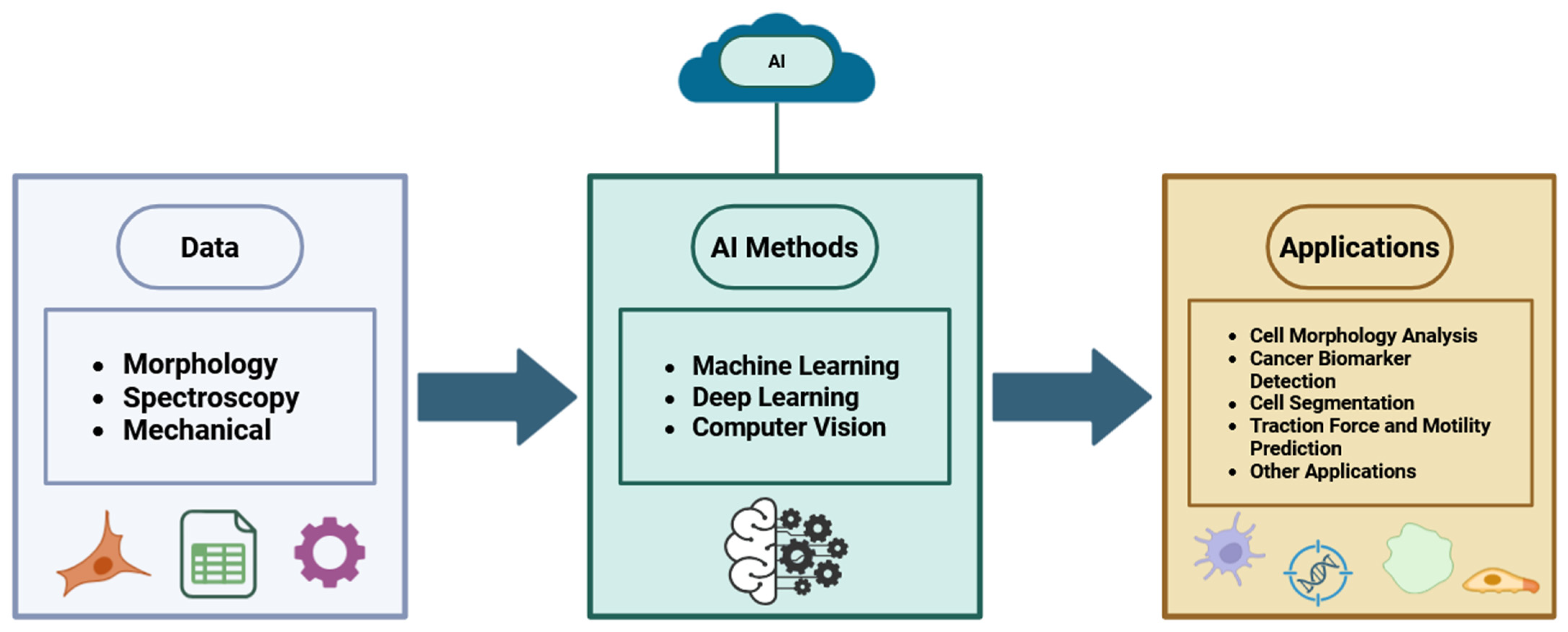
2. AI Along the Mechanobiological Pipeline
3. Background on AI
Learning Paradigms
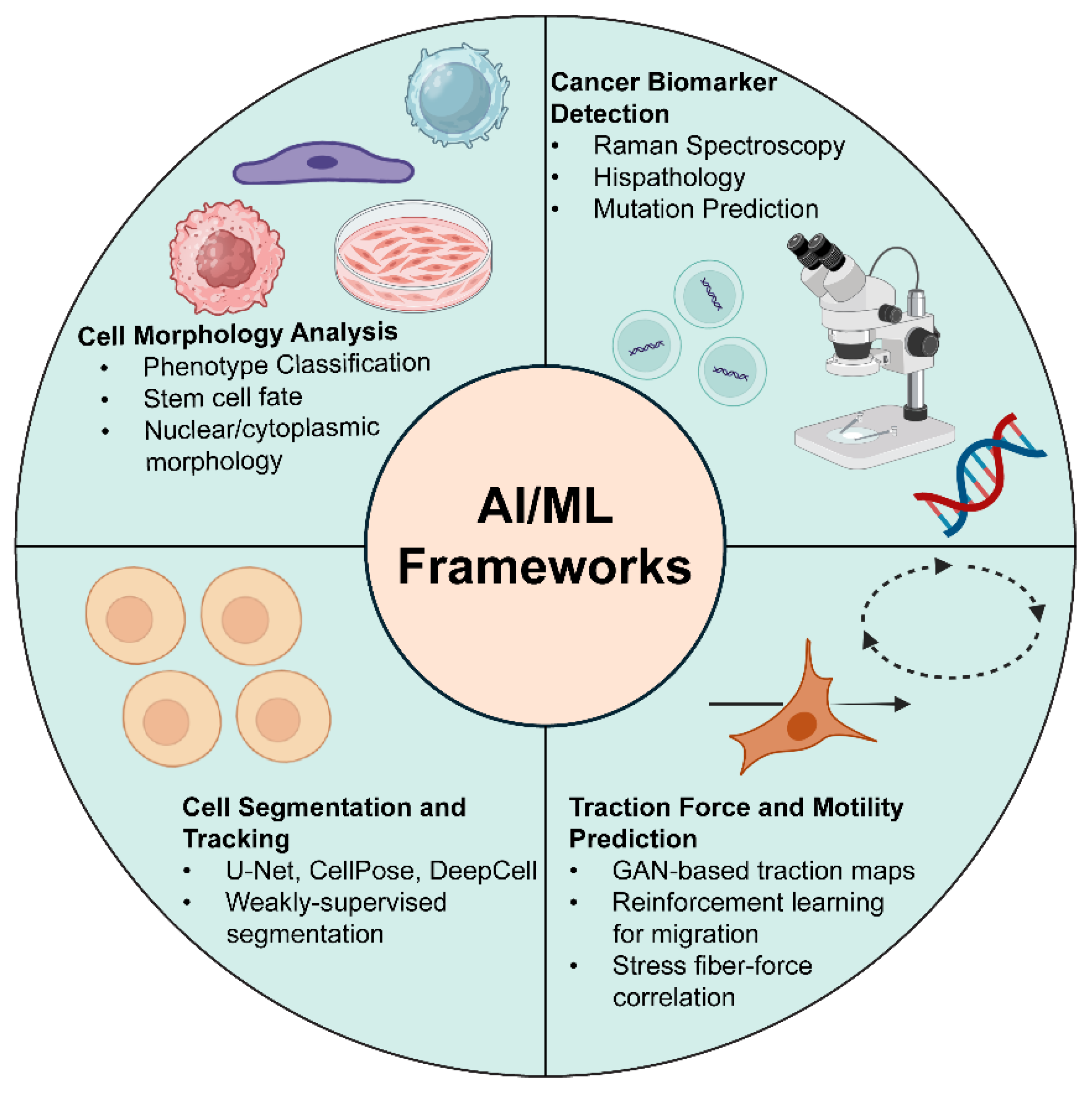
4. Cell Morphology Analysis
4.1. Traditional ML and Feature-Based Approaches
4.2. DL for End-to-End Morphology Recognition
4.3. Weakly Supervised and Transfer-Learning Approaches
4.4. Generative and Hybrid Models
4.5. Synthesis
5. Cancer Biomarker Detection
5.1. Spectroscopy-Based Biomarker Detection
5.2. Image-Based Biomarker Analysis
5.3. DL Approaches
5.4. Generative and Mechano-Biology-Informed Models
5.5. Synthesis
6. Cell Segmentation
6.1. General-Purpose DL Frameworks
6.2. Accessible and Lightweight Tools
6.3. Data-Efficient Learning
6.4. Advanced Architectures
6.5. Three-Dimensional and Four-Dimensional Segmentation
6.6. Synthesis
7. Traction Forces and Motility Prediction
7.1. Wrinkle-Based and Direct Learning Approaches
7.2. Morphology and Physics-Informed Models
7.3. Generative and 3D Force Prediction
7.4. Cell Motility Prediction with Reinforcement Learning
7.5. Synthesis
8. Additional Applications Relevant to Mechanobiology
Synthesis
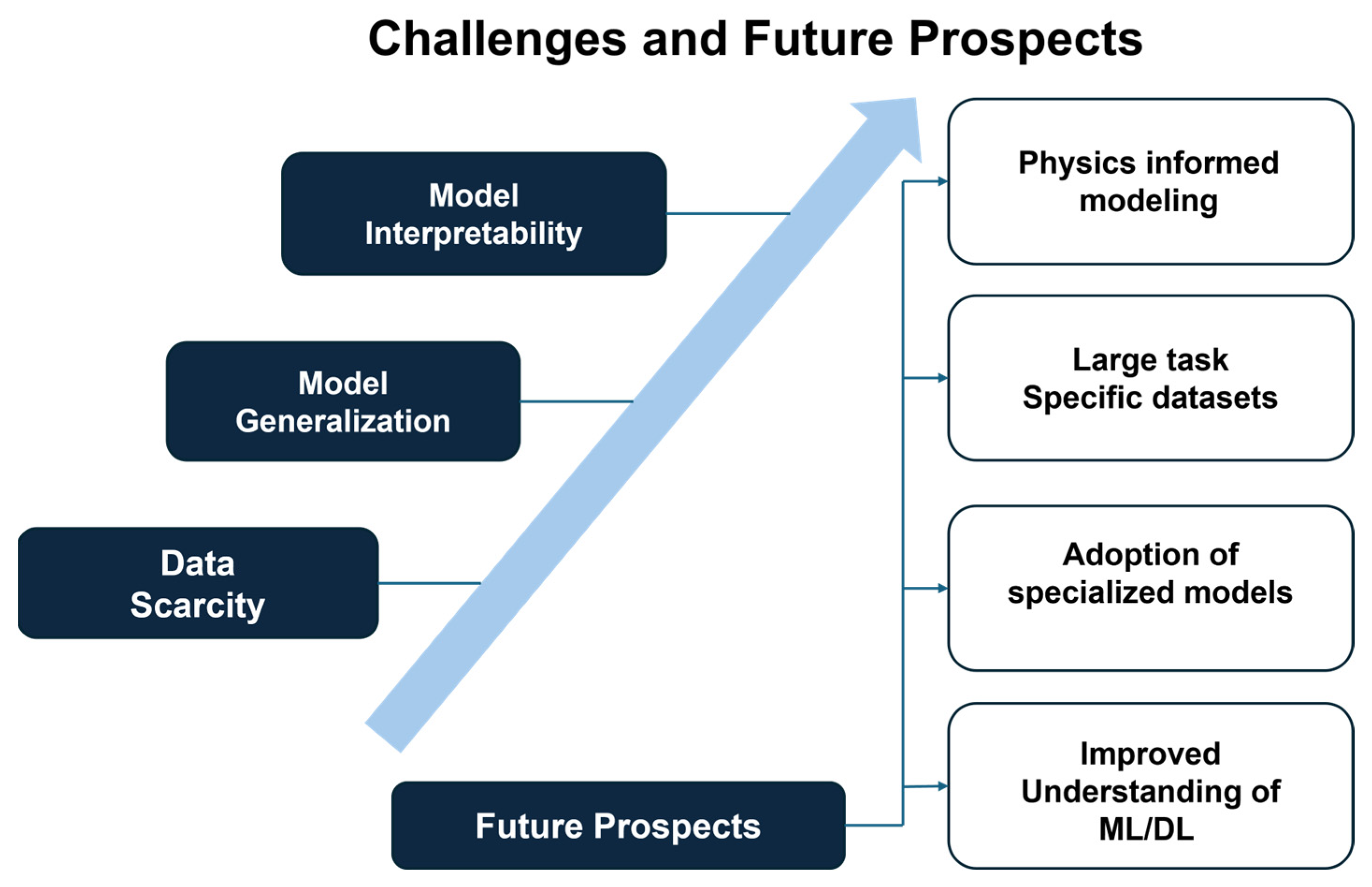
9. Limitations and Prospects
10. Conclusions
Author Contributions
Funding
Institutional Review Board Statement
Informed Consent Statement
Data Availability Statement
Conflicts of Interest
References
- Jamialahmadi, H.; Khalili-Tanha, G.; Nazari, E.; Rezaei-Tavirani, M. Artificial intelligence and bioinformatics: A journey from traditional techniques to smart approaches. Gastroenterol. Hepatol. Bed Bench 2024, 17, 241. [Google Scholar] [CrossRef] [PubMed]
- Ballard, J.L.; Wang, Z.; Li, W.; Shen, L.; Long, Q. Deep learning-based approaches for multi-omics data integration and analysis. BioData Min. 2024, 17, 38. [Google Scholar] [CrossRef] [PubMed]
- Qiu, J.; Li, L.; Sun, J.; Peng, J.; Shi, P.; Zhang, R.; Dong, Y.; Lam, K.; Lo, F.P.W.; Xiao, B.; et al. Large AI Models in Health Informatics: Applications, Challenges, and the Future. IEEE J. Biomed. Health Inform. 2023, 27, 6074–6087. [Google Scholar] [CrossRef] [PubMed]
- Chowdhury, F.; Huang, B.; Wang, N. Cytoskeletal prestress: The cellular hallmark in mechanobiology and mechanomedicine. Cytoskeleton 2021, 78, 249–276. [Google Scholar] [CrossRef]
- Ouyang, M.; Hu, Y.; Chen, W.; Li, H.; Ji, Y.; Qiu, L.; Zhu, L.; Ji, B.; Bu, B.; Deng, L. Cell mechanics regulates the dynamic anisotropic remodeling of fibril matrix at large scale. Research 2023, 6, 0270. [Google Scholar] [CrossRef]
- Chowdhury, F.; Huang, B.; Wang, N. Forces in stem cells and cancer stem cells. Cells Dev. 2022, 170, 203776. [Google Scholar] [CrossRef]
- LeCun, Y.; Bengio, Y.; Hinton, G. Deep learning. Nature 2015, 521, 436–444. [Google Scholar] [CrossRef]
- Lecun, Y.; Bottou, L.; Bengio, Y.; Haffner, P. Gradient-based learning applied to document recognition. Proc. IEEE 1998, 86, 2278–2324. [Google Scholar] [CrossRef]
- Paszke, A.; Gross, S.; Massa, F.; Lerer, A.; Bradbury, J.; Chanan, G.; Killeen, T.; Lin, Z.; Gimelshein, N.; Antiga, L. Pytorch: An imperative style, high-performance deep learning library. Adv. Neural Inf. Process. Syst. 2019, 32. [Google Scholar] [CrossRef]
- Abadi, M.; Barham, P.; Chen, J.; Chen, Z.; Davis, A.; Dean, J.; Devin, M.; Ghemawat, S.; Irving, G.; Isard, M. TensorFlow: A system for large-scale machine learning. In Proceedings of the 12th USENIX Symposium on Operating Systems Design and Implementation (OSDI 16), Savannah, GA, USA, 2–4 November 2016; pp. 265–283. [Google Scholar]
- Schneider, J.; Meske, C.; Kuss, P. Foundation models: A new paradigm for artificial intelligence. Bus. Inf. Syst. Eng. 2024, 66, 221–231. [Google Scholar] [CrossRef]
- Yang, L.; Zhang, Z.; Song, Y.; Hong, S.; Xu, R.; Zhao, Y.; Zhang, W.; Cui, B.; Yang, M.-H. Diffusion models: A comprehensive survey of methods and applications. ACM Comput. Surv. 2023, 56, 1–39. [Google Scholar] [CrossRef]
- Mann, B.; Ryder, N.; Subbiah, M.; Kaplan, J.; Dhariwal, P.; Neelakantan, A.; Shyam, P.; Sastry, G.; Askell, A.; Agarwal, S. Language models are few-shot learners. arXiv 2020. [Google Scholar] [CrossRef]
- Manning, C.D. Human language understanding & reasoning. Daedalus 2022, 151, 127–138. [Google Scholar] [CrossRef]
- Senior, A.W.; Evans, R.; Jumper, J.; Kirkpatrick, J.; Sifre, L.; Green, T.; Qin, C.; Žídek, A.; Nelson, A.W.; Bridgland, A. Improved protein structure prediction using potentials from deep learning. Nature 2020, 577, 706–710. [Google Scholar] [CrossRef]
- Jumper, J.; Evans, R.; Pritzel, A.; Green, T.; Figurnov, M.; Ronneberger, O.; Tunyasuvunakool, K.; Bates, R.; Žídek, A.; Potapenko, A. Highly accurate protein structure prediction with AlphaFold. Nature 2021, 596, 583–589. [Google Scholar] [CrossRef] [PubMed]
- Abramson, J.; Adler, J.; Dunger, J.; Evans, R.; Green, T.; Pritzel, A.; Ronneberger, O.; Willmore, L.; Ballard, A.J.; Bambrick, J. Accurate structure prediction of biomolecular interactions with AlphaFold 3. Nature 2024, 630, 493–500. [Google Scholar] [CrossRef] [PubMed]
- Meng, Y.; Zhang, Z.; Zhou, C.; Tang, X.; Hu, X.; Tian, G.; Yang, J.; Yao, Y. Protein structure prediction via deep learning: An in-depth review. Front. Pharmacol. 2025, 16, 1498662. [Google Scholar] [CrossRef] [PubMed]
- Jiang, Q.; Sun, G.; Li, T.; Tang, J.; Xia, W.; Wang, Y.; Jiang, L.; Liang, R. AutoMA: Automated Generation of Multi-level Annotations for Time Series Visualization. In Proceedings of the 2025 IEEE 18th Pacific Visualization Conference (PacificVis), Taipei, Taiwan, 22–25 April 2025; pp. 80–90. [Google Scholar]
- Fallahpour, A.; Magnuson, A.; Gupta, P.; Ma, S.; Naimer, J.; Shah, A.; Duan, H.; Ibrahim, O.; Goodarzi, H.; Maddison, C.J. BioReason: Incentivizing Multimodal Biological Reasoning within a DNA-LLM Model. arXiv 2025. [Google Scholar] [CrossRef]
- Tsou, C.-H.; Ozery-Flato, M.; Barkan, E.; Mahajan, D.; Shapira, B. BioVERSE: Representation Alignment of Biomedical Modalities to LLMs for Multi-Modal Reasoning. arXiv 2025. [Google Scholar] [CrossRef]
- Bradley, A.P. The use of the area under the ROC curve in the evaluation of machine learning algorithms. Pattern Recognit. 1997, 30, 1145–1159. [Google Scholar] [CrossRef]
- Cristianini, N.; Ricci, E. Support Vector Machines. In Encyclopedia of Algorithms; Kao, M.-Y., Ed.; Springer: Boston, MA, USA, 2008; pp. 928–932. [Google Scholar]
- Castro, H.M.; Ferreira, J.C. Linear and logistic regression models: When to use and how to interpret them? J. Bras. Pneumol. 2023, 48, e20220439. [Google Scholar] [CrossRef]
- Lowd, D.; Domingos, P. Naive Bayes models for probability estimation. In Proceedings of the 22nd International Conference on Machine Learning, Bonn, Germany, 7–11 August 2005; pp. 529–536. [Google Scholar]
- Mucherino, A.; Papajorgji, P.J.; Pardalos, P.M. k-Nearest Neighbor Classification. In Data Mining in Agriculture; Springer: New York, NY, USA, 2009; pp. 83–106. [Google Scholar]
- Fürnkranz, J. Decision Tree. In Encyclopedia of Machine Learning; Sammut, C., Webb, G.I., Eds.; Springer: Boston, MA, USA, 2010; pp. 263–267. [Google Scholar]
- Breiman, L. Random Forests. Mach. Learn. 2001, 45, 5–32. [Google Scholar] [CrossRef]
- Chen, T.; Guestrin, C. XGBoost: A Scalable Tree Boosting System. In Proceedings of the 22nd ACM SIGKDD International Conference on Knowledge Discovery and Data Mining, San Francisco, CA, USA, 13–17 August 2016; pp. 785–794. [Google Scholar]
- Popescu, M.-C.; Balas, V.E.; Perescu-Popescu, L.; Mastorakis, N. Multilayer perceptron and neural networks. WSEAS Trans. Cir. Syst. 2009, 8, 579–588. Available online: https://dl.acm.org/doi/abs/10.5555/1639537.1639542 (accessed on 10 December 2025).
- Albawi, S.; Mohammed, T.A.; Al-Zawi, S. Understanding of a convolutional neural network. In Proceedings of the 2017 International Conference on Engineering and Technology (ICET), Antalya, Turkey, 21–23 August 2017; pp. 1–6. [Google Scholar] [CrossRef]
- Schmidt, R.M. Recurrent Neural Networks (RNNs): A gentle Introduction and Overview. arXiv 2019. [Google Scholar] [CrossRef]
- Vaswani, A.; Shazeer, N.M.; Parmar, N.; Uszkoreit, J.; Jones, L.; Gomez, A.N.; Kaiser, L.; Polosukhin, I. Attention is All you Need. In Proceedings of the Neural Information Processing Systems, Long Beach, CA, USA, 4–9 December 2017. [Google Scholar]
- Dosovitskiy, A.; Beyer, L.; Kolesnikov, A.; Weissenborn, D.; Zhai, X.; Unterthiner, T.; Dehghani, M.; Minderer, M.; Heigold, G.; Gelly, S.; et al. An Image is Worth 16x16 Words: Transformers for Image Recognition at Scale. arXiv 2020. [Google Scholar] [CrossRef]
- Jin, X.; Han, J. K-Means Clustering. In Encyclopedia of Machine Learning; Sammut, C., Webb, G.I., Eds.; Springer: Boston, MA, USA, 2010; pp. 563–564. [Google Scholar]
- Ester, M.; Kriegel, H.-P.; Sander, J.; Xu, X. A density-based algorithm for discovering clusters in large spatial databases with noise. In Proceedings of the Second International Conference on Knowledge Discovery and Data Mining, Portland, Oregon, 2–4 August 1996; pp. 226–231. [Google Scholar]
- Reynolds, D. Gaussian Mixture Models. In Encyclopedia of Biometrics; Li, S.Z., Jain, A., Eds.; Springer: Boston, MA, USA, 2009; pp. 659–663. [Google Scholar]
- Maćkiewicz, A.; Ratajczak, W. Principal components analysis (PCA). Comput. Geosci. 1993, 19, 303–342. [Google Scholar] [CrossRef]
- Maaten, L.V.D.; Hinton, G.E. Visualizing Data using t-SNE. J. Mach. Learn. Res. 2008, 9, 2579–2605. [Google Scholar]
- Li, P.; Pei, Y.; Li, J. A comprehensive survey on design and application of autoencoder in deep learning. Appl. Soft Comput. 2023, 138, 110176. [Google Scholar] [CrossRef]
- Kingma, D.P.; Welling, M. An Introduction to Variational Autoencoders. Found. Trends Mach. Learn. 2019, 12, 307–392. [Google Scholar] [CrossRef]
- Shahapure, K.R.; Nicholas, C. Cluster quality analysis using silhouette score. In Proceedings of the 2020 IEEE 7th International Conference on Data Science and Advanced Analytics (DSAA), Sydney, Australia, 6–9 October 2020; pp. 747–748. [Google Scholar]
- Watkins, C.J.C.H.; Dayan, P. Q-learning. Mach. Learn. 1992, 8, 279–292. [Google Scholar] [CrossRef]
- Yang, L.; Jiang, D.; Guo, F.; Fu, M. The State-Action-Reward-State-Action Algorithm in Spatial Prisoner’s Dilemma Game. arXiv 2024. [Google Scholar] [CrossRef]
- Hafiz, A.M.; Bhat, G.M. Deep Q-Network Based Multi-agent Reinforcement Learning with Binary Action Agents. arXiv 2020. [Google Scholar] [CrossRef]
- Silver, D.; Schrittwieser, J.; Simonyan, K.; Antonoglou, I.; Huang, A.; Guez, A.; Hubert, T.; Baker, L.; Lai, M.; Bolton, A.; et al. Mastering the game of Go without human knowledge. Nature 2017, 550, 354–359. [Google Scholar] [CrossRef]
- Schindelin, J.; Arganda-Carreras, I.; Frise, E.; Kaynig, V.; Longair, M.; Pietzsch, T.; Preibisch, S.; Rueden, C.; Saalfeld, S.; Schmid, B. Fiji: An open-source platform for biological-image analysis. Nat. Methods 2012, 9, 676–682. [Google Scholar] [CrossRef]
- Qin, Q.; Laub, S.; Shi, Y.; Ouyang, M.; Peng, Q.; Zhang, J.; Wang, Y.; Lu, S. Fluocell for ratiometric and high-throughput live-cell image visualization and quantitation. Front. Phys. 2019, 7, 154. [Google Scholar] [CrossRef]
- Khotanzad, A.; Hong, Y.H. Invariant image recognition by Zernike moments. IEEE Trans. Pattern Anal. Mach. Intell. 1990, 12, 489–497. [Google Scholar] [CrossRef]
- Haralick, R.M. Statistical and structural approaches to texture. Proc. IEEE 1979, 67, 786–804. [Google Scholar] [CrossRef]
- Neto, N.G.B.; O’Rourke, S.A.; Zhang, M.; Fitzgerald, H.K.; Dunne, A.; Monaghan, M.G. Non-invasive classification of macrophage polarisation by 2P-FLIM and machine learning. eLife 2022, 11, e77373. [Google Scholar] [CrossRef]
- Rostam, H.M.; Reynolds, P.M.; Alexander, M.R.; Gadegaard, N.; Ghaemmaghami, A.M. Image based Machine Learning for identification of macrophage subsets. Sci. Rep. 2017, 7, 3521. [Google Scholar] [CrossRef]
- McInnes, L.; Healy, J.; Melville, J. Umap: Uniform manifold approximation and projection for dimension reduction. arXiv 2018. [Google Scholar] [CrossRef]
- Dürr, O.; Sick, B. Single-cell phenotype classification using deep convolutional neural networks. J. Biomol. Screen. 2016, 21, 998–1003. [Google Scholar] [CrossRef]
- Bray, M.-A.; Gustafsdottir, S.M.; Rohban, M.H.; Singh, S.; Ljosa, V.; Sokolnicki, K.L.; Bittker, J.A.; Bodycombe, N.E.; Dančík, V.; Hasaka, T.P. A dataset of images and morphological profiles of 30 000 small-molecule treatments using the Cell Painting assay. Gigascience 2017, 6, giw014. [Google Scholar] [CrossRef]
- Tharwat, A.; Gaber, T.; Ibrahim, A.; Hassanien, A.E. Linear discriminant analysis: A detailed tutorial. AI Commun. 2017, 30, 169–190. [Google Scholar] [CrossRef]
- Huang, G.; Liu, Z.; Van Der Maaten, L.; Weinberger, K.Q. Densely connected convolutional networks. In Proceedings of the IEEE Conference on Computer Vision and Pattern Recognition, Honolulu, HI, USA, 21–26 July 2017; pp. 4700–4708. [Google Scholar]
- Kim, H.; Park, K.; Yon, J.-M.; Kim, S.W.; Lee, S.Y.; Jeong, I.; Jang, J.; Lee, S.; Cho, D.-W. Predicting multipotency of human adult stem cells derived from various donors through deep learning. Sci. Rep. 2022, 12, 21614. [Google Scholar] [CrossRef]
- Wong, K.S.; Zhong, X.; Low, C.S.L.; Kanchanawong, P. Self-supervised classification of subcellular morphometric phenotypes reveals extracellular matrix-specific morphological responses. Sci. Rep. 2022, 12, 15329. [Google Scholar] [CrossRef]
- Godinez, W.J.; Hossain, I.; Lazic, S.E.; Davies, J.W.; Zhang, X. A multi-scale convolutional neural network for phenotyping high-content cellular images. Bioinformatics 2017, 33, 2010–2019. [Google Scholar] [CrossRef]
- Zhu, D.; Shen, X.; Mosbach, M.; Stephan, A.; Klakow, D. Weaker than you think: A critical look at weakly supervised learning. arXiv 2023. [Google Scholar] [CrossRef]
- Kraus, O.Z.; Ba, J.L.; Frey, B.J. Classifying and segmenting microscopy images with deep multiple instance learning. Bioinformatics 2016, 32, i52–i59. [Google Scholar] [CrossRef]
- Ilse, M.; Tomczak, J.; Welling, M. Attention-based deep multiple instance learning. In Proceedings of the International Conference on Machine Learning, Stockholm, Sweden, 10–15 July 2018; pp. 2127–2136. [Google Scholar]
- Simonyan, K.; Vedaldi, A.; Zisserman, A. Deep inside convolutional networks: Visualising image classification models and saliency maps. arXiv 2013. [Google Scholar] [CrossRef]
- Xu, X.; Xiao, Z.; Zhang, F.; Wang, C.; Wei, B.; Wang, Y.; Cheng, B.; Jia, Y.; Li, Y.; Li, B. CellVisioner: A Generalizable Cell Virtual Staining Toolbox based on Few-Shot Transfer Learning for Mechanobiological Analysis. Research 2023, 6, 0285. [Google Scholar] [CrossRef]
- Ronneberger, O.; Fischer, P.; Brox, T. U-net: Convolutional networks for biomedical image segmentation. In Proceedings of the International Conference on Medical image Computing and Computer-Assisted Intervention, Munich, Germany, 5–9 October 2015; pp. 234–241. [Google Scholar]
- Mirza, M.; Osindero, S. Conditional generative adversarial nets. arXiv 2014. [Google Scholar] [CrossRef]
- Zhuang, F.; Qi, Z.; Duan, K.; Xi, D.; Zhu, Y.; Zhu, H.; Xiong, H.; He, Q. A comprehensive survey on transfer learning. Proc. IEEE 2020, 109, 43–76. [Google Scholar] [CrossRef]
- Szegedy, C.; Vanhoucke, V.; Ioffe, S.; Shlens, J.; Wojna, Z. Rethinking the inception architecture for computer vision. In Proceedings of the IEEE Conference on Computer Vision and Pattern Recognition, Las Vegas, NV, USA, 27–30 June 2016; pp. 2818–2826. [Google Scholar]
- Wang, Z.J.; Walsh, A.J.; Skala, M.C.; Gitter, A. Classifying T cell activity in autofluorescence intensity images with convolutional neural networks. J. Biophotonics 2020, 13, e201960050. [Google Scholar] [CrossRef]
- Palma, A.; Theis, F.J.; Lotfollahi, M. Predicting cell morphological responses to perturbations using generative modeling. Nat. Commun. 2025, 16, 505. [Google Scholar] [CrossRef]
- Jing, Y.; Yang, Y.; Feng, Z.; Ye, J.; Yu, Y.; Song, M. Neural style transfer: A review. IEEE Trans. Vis. Comput. Graph. 2019, 26, 3365–3385. [Google Scholar] [CrossRef]
- Aida, S.; Okugawa, J.; Fujisaka, S.; Kasai, T.; Kameda, H.; Sugiyama, T. Deep learning of cancer stem cell morphology using conditional generative adversarial networks. Biomolecules 2020, 10, 931. [Google Scholar] [CrossRef]
- Sullivan, D.P.; Winsnes, C.F.; Åkesson, L.; Hjelmare, M.; Wiking, M.; Schutten, R.; Campbell, L.; Leifsson, H.; Rhodes, S.; Nordgren, A. Deep learning is combined with massive-scale citizen science to improve large-scale image classification. Nat. Biotechnol. 2018, 36, 820–828. [Google Scholar] [CrossRef]
- Natarajan, S.; Mathur, S.; Sidheekh, S.; Stammer, W.; Kersting, K. Human-in-the-loop or AI-in-the-loop? Automate or Collaborate? In Proceedings of the AAAI Conference on Artificial Intelligence, Philadelphia, PA, USA, 25 February–4 March 2025; pp. 28594–28600. [Google Scholar]
- Wu, Z.; Feng, Y.; Bi, R.; Liu, Z.; Niu, Y.; Jin, Y.; Li, W.; Chen, H.; Shi, Y.; Du, Y. Image-based evaluation of single-cell mechanics using deep learning. Cell Regen. 2025, 14, 21. [Google Scholar] [CrossRef]
- Buggenthin, F.; Buettner, F.; Hoppe, P.S.; Endele, M.; Kroiss, M.; Strasser, M.; Schwarzfischer, M.; Loeffler, D.; Kokkaliaris, K.D.; Hilsenbeck, O. Prospective identification of hematopoietic lineage choice by deep learning. Nat. Methods 2017, 14, 403–406. [Google Scholar] [CrossRef]
- Zhu, Y.; Huang, R.; Wu, Z.; Song, S.; Cheng, L.; Zhu, R. Deep learning-based predictive identification of neural stem cell differentiation. Nat. Commun. 2021, 12, 2614. [Google Scholar] [CrossRef]
- Chollet, F. Xception: Deep learning with depthwise separable convolutions. In Proceedings of the IEEE Conference on Computer Vision and Pattern Recognition, Honolulu, HI, USA, 21–26 July 2017; pp. 1251–1258. [Google Scholar]
- Sommer, C.; Hoefler, R.; Samwer, M.; Gerlich, D.W. A deep learning and novelty detection framework for rapid phenotyping in high-content screening. Mol. Biol. Cell 2017, 28, 3428–3436. [Google Scholar] [CrossRef]
- Wang, Y.; Mao, H.; Yi, Z. Stem cell motion-tracking by using deep neural networks with multi-output. Neural Comput. Appl. 2019, 31, 3455–3467. [Google Scholar] [CrossRef]
- Yang, X.; Yang, Y.; Zhang, Z.; Li, M. Deep learning image recognition-assisted atomic force microscopy for single-cell efficient mechanics in co-culture environments. Langmuir 2023, 40, 837–852. [Google Scholar] [CrossRef]
- Bonnevie, E.D.; Ashinsky, B.G.; Dekky, B.; Volk, S.W.; Smith, H.E.; Mauck, R.L. Cell morphology and mechanosensing can be decoupled in fibrous microenvironments and identified using artificial neural networks. Sci. Rep. 2021, 11, 5950. [Google Scholar] [CrossRef]
- Piccinini, F.; Balassa, T.; Szkalisity, A.; Molnar, C.; Paavolainen, L.; Kujala, K.; Buzas, K.; Sarazova, M.; Pietiainen, V.; Kutay, U.; et al. Advanced Cell Classifier: User-Friendly Machine-Learning-Based Software for Discovering Phenotypes in High-Content Imaging Data. Cell Syst. 2017, 4, 651–655.e5. [Google Scholar] [CrossRef]
- Jin, J.; Schorpp, K.; Samaga, D.; Unger, K.; Hadian, K.; Stockwell, B.R. Machine Learning Classifies Ferroptosis and Apoptosis Cell Death Modalities with TfR1 Immunostaining. ACS Chem. Biol. 2022, 17, 654–660. [Google Scholar] [CrossRef]
- Boland, M.V.; Murphy, R.F. A neural network classifier capable of recognizing the patterns of all major subcellular structures in fluorescence microscope images of HeLa cells. Bioinformatics 2001, 17, 1213–1223. [Google Scholar] [CrossRef]
- Mohammad, S.; Roy, A.; Karatzas, A.; Sarver, S.L.; Anagnostopoulos, I.; Chowdhury, F. Deep Learning Powered Identification of Differentiated Early Mesoderm Cells from Pluripotent Stem Cells. Cells 2024, 13, 534. [Google Scholar] [CrossRef]
- He, L.; Li, M.; Wang, X.; Wu, X.; Yue, G.; Wang, T.; Zhou, Y.; Lei, B.; Zhou, G. Morphology-based deep learning enables accurate detection of senescence in mesenchymal stem cell cultures. BMC Biol. 2024, 22, 1. [Google Scholar] [CrossRef]
- Wang, S.; Han, J.; Huang, J.; Islam, K.; Shi, Y.; Zhou, Y.; Kim, D.; Zhou, J.; Lian, Z.; Liu, Y.; et al. Deep learning-based predictive classification of functional subpopulations of hematopoietic stem cells and multipotent progenitors. Stem Cell Res. Ther. 2024, 15, 74. [Google Scholar] [CrossRef]
- Tipatet, K.S.; Davison-Gates, L.; Tewes, T.J.; Fiagbedzi, E.K.; Elfick, A.; Neu, B.; Downes, A. Detection of acquired radioresistance in breast cancer cell lines using Raman spectroscopy and machine learning. Analyst 2021, 146, 3709–3716. [Google Scholar] [CrossRef]
- Wu, J.; Ji, Y.; Zhao, L.; Ji, M.; Ye, Z.; Li, S. A mass spectrometric analysis method based on PPCA and SVM for early detection of ovarian cancer. Comput. Math. Methods Med. 2016, 2016, 6169249. [Google Scholar] [CrossRef]
- Tipping, M.E.; Bishop, C.M. Probabilistic principal component analysis. J. R. Stat. Soc. Ser. B Stat. Methodol. 1999, 61, 611–622. [Google Scholar] [CrossRef]
- Al-Tarawneh, S.K.; Bencharit, S. Applications of surface-enhanced laser desorption/ionization time-of-flight (SELDI-TOF) mass spectrometry in defining salivary proteomic profiles. Open Dent. J. 2009, 3, 74. [Google Scholar] [CrossRef]
- Mandrell, C.T.; Holland, T.E.; Wheeler, J.F.; Esmaeili, S.M.A.; Amar, K.; Chowdhury, F.; Sivakumar, P. Machine Learning Approach to Raman Spectrum Analysis of MIA PaCa-2 Pancreatic Cancer Tumor Repopulating Cells for Classification and Feature Analysis. Life 2020, 10, 181. [Google Scholar] [CrossRef]
- Shen, B.; Ma, C.; Tang, L.; Wu, Z.; Peng, Z.; Pan, G.; Li, H. Applying machine learning for multi-individual Raman spectroscopic data to identify different stages of proliferating human hepatocytes. iScience 2024, 27, 109500. [Google Scholar] [CrossRef]
- Rozova, V.S.; Anwer, A.G.; Guller, A.E.; Es, H.A.; Khabir, Z.; Sokolova, A.I.; Gavrilov, M.U.; Goldys, E.M.; Warkiani, M.E.; Thiery, J.P.; et al. Machine learning reveals mesenchymal breast carcinoma cell adaptation in response to matrix stiffness. PLoS Comput. Biol. 2021, 17, e1009193. [Google Scholar] [CrossRef]
- Carpenter, A.E.; Jones, T.R.; Lamprecht, M.R.; Clarke, C.; Kang, I.H.; Friman, O.; Guertin, D.A.; Chang, J.H.; Lindquist, R.A.; Moffat, J. CellProfiler: Image analysis software for identifying and quantifying cell phenotypes. Genome Biol. 2006, 7, R100. [Google Scholar] [CrossRef]
- Kandaswamy, C.; Silva, L.M.; Alexandre, L.A.; Santos, J.M. High-content analysis of breast cancer using single-cell deep transfer learning. J. Biomol. Screen. 2016, 21, 252–259. [Google Scholar] [CrossRef][Green Version]
- Chappell, M.; Humphreys, M.S. An auto-associative neural network for sparse representations: Analysis and application to models of recognition and cued recall. Psychol. Rev. 1994, 101, 103. [Google Scholar] [CrossRef]
- Forslid, G.; Wieslander, H.; Bengtsson, E.; Wählby, C.; Hirsch, J.M.; Stark, C.R.; Sadanandan, S.K. Deep Convolutional Neural Networks for Detecting Cellular Changes Due to Malignancy. In Proceedings of the 2017 IEEE International Conference on Computer Vision Workshops (ICCVW), Venice, Italy, 22–29 October 2017; pp. 82–89. [Google Scholar]
- He, K.; Zhang, X.; Ren, S.; Sun, J. Deep residual learning for image recognition. In Proceedings of the IEEE Conference on Computer Vision and Pattern Recognition, Las Vegas, NV, USA, 27–30 June 2016; pp. 770–778. [Google Scholar]
- Mohammad, S.; Amar, K.; Chowdhury, F. Hybrid AI models allow label-free identification and classification of pancreatic tumor repopulating cell population. Biochem. Biophys. Res. Commun. 2023, 677, 126–131. [Google Scholar] [CrossRef]
- Sirinukunwattana, K.; Raza, S.E.A.; Tsang, Y.-W.; Snead, D.R.; Cree, I.A.; Rajpoot, N.M. Locality sensitive deep learning for detection and classification of nuclei in routine colon cancer histology images. IEEE Trans. Med. Imaging 2016, 35, 1196–1206. [Google Scholar] [CrossRef]
- Banerjee, K.; Gupta, R.R.; Vyas, K.; Mishra, B. Exploring alternatives to softmax function. In Proceedings of the 2nd International Conference on Deep Learning Theory and Applications—DeLTA, Virtual, 7–9 July 2021. [Google Scholar] [CrossRef]
- Berryman, S.; Matthews, K.; Lee, J.H.; Duffy, S.P.; Ma, H. Image-based phenotyping of disaggregated cells using deep learning. Commun. Biol. 2020, 3, 674. [Google Scholar] [CrossRef]
- Foo, K.Y.; Shaddy, B.; Murgoitio-Esandi, J.; Hepburn, M.S.; Li, J.; Mowla, A.; Sanderson, R.W.; Vahala, D.; Amos, S.E.; Choi, Y.S. Tumor spheroid elasticity estimation using mechano-microscopy combined with a conditional generative adversarial network. Comput. Methods Programs Biomed. 2024, 255, 108362. [Google Scholar] [CrossRef]
- Van Valen, D.A.; Kudo, T.; Lane, K.M.; Macklin, D.N.; Quach, N.T.; DeFelice, M.M.; Maayan, I.; Tanouchi, Y.; Ashley, E.A.; Covert, M.W. Deep learning automates the quantitative analysis of individual cells in live-cell imaging experiments. PLoS Comput. Biol. 2016, 12, e1005177. [Google Scholar] [CrossRef]
- Sadanandan, S.K.; Ranefall, P.; Le Guyader, S.; Wählby, C. Automated training of deep convolutional neural networks for cell segmentation. Sci. Rep. 2017, 7, 7860. [Google Scholar] [CrossRef]
- Stringer, C.; Wang, T.; Michaelos, M.; Pachitariu, M. Cellpose: A generalist algorithm for cellular segmentation. Nat. Methods 2021, 18, 100–106. [Google Scholar] [CrossRef]
- Pachitariu, M.; Stringer, C. Cellpose 2.0: How to train your own model. Nat. Methods 2022, 19, 1634–1641. [Google Scholar] [CrossRef]
- Griebel, M.; Segebarth, D.; Stein, N.; Schukraft, N.; Tovote, P.; Blum, R.; Flath, C.M. Deep learning-enabled segmentation of ambiguous bioimages with deepflash2. Nat. Commun. 2023, 14, 1679. [Google Scholar] [CrossRef]
- Liu, Z.; Mao, H.; Wu, C.; Feichtenhofer, C.; Darrell, T.; Xie, S. A ConvNet for the 2020s. In Proceedings of the 2022 IEEE/CVF Conference on Computer Vision and Pattern Recognition (CVPR), New Orleans, LA, USA, 18–24 June 2022; pp. 11966–11976. [Google Scholar] [CrossRef]
- Wiggins, L.; Lord, A.; Murphy, K.L.; Lacy, S.E.; O’Toole, P.J.; Brackenbury, W.J.; Wilson, J. The CellPhe toolkit for cell phenotyping using time-lapse imaging and pattern recognition. Nat. Commun. 2023, 14, 1854. [Google Scholar] [CrossRef]
- Arzt, M.; Deschamps, J.; Schmied, C.; Pietzsch, T.; Schmidt, D.; Tomancak, P.; Haase, R.; Jug, F. LABKIT: Labeling and segmentation toolkit for big image data. Front. Comput. Sci. 2022, 4, 777728. [Google Scholar] [CrossRef]
- Bannon, D.; Moen, E.; Schwartz, M.; Borba, E.; Kudo, T.; Greenwald, N.; Vijayakumar, V.; Chang, B.; Pao, E.; Osterman, E. DeepCell Kiosk: Scaling deep learning–enabled cellular image analysis with Kubernetes. Nat. Methods 2021, 18, 43–45. [Google Scholar] [CrossRef]
- Tsai, H.-F.; Gajda, J.; Sloan, T.F.; Rares, A.; Shen, A.Q. Usiigaci: Instance-aware cell tracking in stain-free phase contrast microscopy enabled by machine learning. SoftwareX 2019, 9, 230–237. [Google Scholar] [CrossRef]
- Robitaille, M.C.; Byers, J.M.; Christodoulides, J.A.; Raphael, M.P. Self-supervised machine learning for live cell imagery segmentation. Commun. Biol. 2022, 5, 1162. [Google Scholar] [CrossRef]
- Liu, X.; Zhang, F.; Hou, Z.; Mian, L.; Wang, Z.; Zhang, J.; Tang, J. Self-supervised learning: Generative or contrastive. IEEE Trans. Knowl. Data Eng. 2021, 35, 857–876. [Google Scholar] [CrossRef]
- Ghaznavi, A.; Rychtáriková, R.; Císař, P.; Ziaei, M.M.; Štys, D. Symmetry Breaking in the U-Net: Hybrid Deep-Learning Multi-Class Segmentation of HeLa Cells in Reflected Light Microscopy Images. Symmetry 2024, 16, 227. [Google Scholar] [CrossRef]
- Simonyan, K.; Zisserman, A. Very deep convolutional networks for large-scale image recognition. arXiv 2014. [Google Scholar] [CrossRef]
- Szegedy, C.; Liu, W.; Jia, Y.; Sermanet, P.; Reed, S.; Anguelov, D.; Erhan, D.; Vanhoucke, V.; Rabinovich, A. Going deeper with convolutions. In Proceedings of the IEEE Conference on Computer Vision and Pattern Recognition, Boston, MA, USA, 7–12 June 2015; pp. 1–9. [Google Scholar]
- Hollandi, R.; Szkalisity, A.; Toth, T.; Tasnadi, E.; Molnar, C.; Mathe, B.; Grexa, I.; Molnar, J.; Balind, A.; Gorbe, M. nucleAIzer: A parameter-free deep learning framework for nucleus segmentation using image style transfer. Cell Syst. 2020, 10, 453–458.e6. [Google Scholar] [CrossRef]
- He, K.; Gkioxari, G.; Dollár, P.; Girshick, R. Mask r-cnn. In Proceedings of the IEEE International Conference on Computer Vision, Venice, Italy, 22–29 October 2017; pp. 2961–2969. [Google Scholar]
- Jian, Z.; Song, T.; Zhang, Z.; Ai, Z.; Zhao, H.; Tang, M.; Liu, K. An improved nested U-net network for fluorescence in situ hybridization cell image segmentation. Sensors 2024, 24, 928. [Google Scholar] [CrossRef]
- Zhou, Z.; Siddiquee, M.M.R.; Tajbakhsh, N.; Liang, J. UNet++: A Nested U-Net Architecture for Medical Image Segmentation. In Deep Learning in Medical Image Analysis and Multimodal Learning for Clinical Decision Support; Springer: Cham, Switzerland, 2018; Volume 11045, pp. 3–11. [Google Scholar]
- Shakoori, A.R. Fluorescence in situ hybridization (FISH) and its applications. In Chromosome Structure and Aberrations; Springer: New Delhi, India, 2017; pp. 343–367. [Google Scholar]
- Pelt, D.M.; Sethian, J.A. A mixed-scale dense convolutional neural network for image analysis. Proc. Natl. Acad. Sci. USA 2018, 115, 254–259. [Google Scholar] [CrossRef]
- Badrinarayanan, V.; Kendall, A.; Cipolla, R. Segnet: A deep convolutional encoder-decoder architecture for image segmentation. IEEE Trans. Pattern Anal. Mach. Intell. 2017, 39, 2481–2495. [Google Scholar] [CrossRef]
- Chen, J.; Ding, L.; Viana, M.P.; Lee, H.; Sluezwski, M.F.; Morris, B.; Hendershott, M.C.; Yang, R.; Mueller, I.A.; Rafelski, S.M. The Allen Cell and Structure Segmenter: A new open source toolkit for segmenting 3D intracellular structures in fluorescence microscopy images. bioRxiv 2018. [Google Scholar] [CrossRef]
- Amat, F.; Lemon, W.; Mossing, D.P.; McDole, K.; Wan, Y.; Branson, K.; Myers, E.W.; Keller, P.J. Fast, accurate reconstruction of cell lineages from large-scale fluorescence microscopy data. Nat. Methods 2014, 11, 951–958. [Google Scholar] [CrossRef]
- Tamajka, M.; Benešová, W. Supervoxel algorithm for medical image processing. In Proceedings of the 2017 IEEE International Conference on Power, Control, Signals and Instrumentation Engineering (ICPCSI), Chennai, India, 21–22 September 2017; pp. 3121–3127. [Google Scholar]
- Zhao, W.; Xu, X.; Zhu, Y.; Xu, F. Active contour model based on local and global Gaussian fitting energy for medical image segmentation. Optik 2018, 158, 1160–1169. [Google Scholar] [CrossRef]
- Li, L. A spatiotemporal association method for multi-source targets based on joint-similarity constrained clustering. In Proceedings of the 2022 IEEE International Conference on Unmanned Systems (ICUS), Guangzhou, China, 28–30 October 2022; pp. 992–997. [Google Scholar]
- Zancla, A.; Mozetic, P.; Orsini, M.; Forte, G.; Rainer, A. A primer to traction force microscopy. J. Biol. Chem. 2022, 298, 101867. [Google Scholar] [CrossRef]
- Wang, Y.-l.; Lin, Y.-C. Traction force microscopy by deep learning. Biophys. J. 2021, 120, 3079–3090. [Google Scholar] [CrossRef]
- Li, H.; Matsunaga, D.; Matsui, T.S.; Aosaki, H.; Deguchi, S. Image based cellular contractile force evaluation with small-world network inspired CNN: SW-UNet. Biochem. Biophys. Res. Commun. 2020, 530, 527–532. [Google Scholar] [CrossRef]
- Pupeikis, R. Revised 2D fast fourier transform. In Proceedings of the 2015 Open Conference of Electrical, Electronic and Information Sciences (eStream), Vilnius, Lithuania, 21 April 2015; pp. 1–4. [Google Scholar]
- Li, H.; Matsunaga, D.; Matsui, T.S.; Aosaki, H.; Kinoshita, G.; Inoue, K.; Doostmohammadi, A.; Deguchi, S. Wrinkle force microscopy: A machine learning based approach to predict cell mechanics from images. Commun. Biol. 2022, 5, 361. [Google Scholar] [CrossRef] [PubMed]
- Goodfellow, I.; Pouget-Abadie, J.; Mirza, M.; Xu, B.; Warde-Farley, D.; Ozair, S.; Courville, A.; Bengio, Y. Generative adversarial networks. Commun. ACM 2020, 63, 139–144. [Google Scholar] [CrossRef]
- Pielawski, N.; Hu, J.; Strömblad, S.; Wählby, C. In silico prediction of cell traction forces. In Proceedings of the 2020 IEEE 17th International Symposium on Biomedical Imaging (ISBI), Iowa City, IA, USA, 3–7 April 2020; pp. 877–881. [Google Scholar]
- Jégou, S.; Drozdzal, M.; Vázquez, D.; Romero, A.; Bengio, Y. The One Hundred Layers Tiramisu: Fully Convolutional DenseNets for Semantic Segmentation. In Proceedings of the 2017 IEEE Conference on Computer Vision and Pattern Recognition Workshops (CVPRW), Honolulu, HI, USA, 21–26 July 2016; pp. 1175–1183. [Google Scholar]
- Goan, E.; Fookes, C. Bayesian Neural Networks: An Introduction and Survey. In Case Studies in Applied Bayesian Data Science: CIRM Jean-Morlet Chair, Fall 2018; Mengersen, K.L., Pudlo, P., Robert, C.P., Eds.; Springer International Publishing: Cham, Switzerland, 2020; pp. 45–87. [Google Scholar]
- Fujiwara, K.; Fujikawa, R.; Suzuki, Y.; Suzuki, K.T.; Sakumura, Y. Cell Morphology and Biophysical Mechanisms-Informed Traction Force Microscopy Using Machine Learning. bioRxiv 2025. [Google Scholar] [CrossRef]
- Kratz, F.S.; Möllerherm, L.; Kierfeld, J. Enhancing robustness, precision, and speed of traction force microscopy with machine learning. Biophys. J. 2023, 122, 3489–3505. [Google Scholar] [CrossRef]
- SubramanianBalachandar, V.; Islam, M.M.; Steward, R. A machine learning approach to predict cellular mechanical stresses in response to chemical perturbation. Biophys. J. 2023, 122, 3413–3424. [Google Scholar] [CrossRef]
- Gómez, R.S.; García, C.G. Stepwise regression revisited. arXiv 2025. [Google Scholar] [CrossRef]
- Gu, Y.; Song, Z.; Zhang, L. Faster algorithms for structured linear and kernel support vector machines. arXiv 2023. [Google Scholar] [CrossRef]
- Duan, X.; Huang, J. Deep-learning-based 3D cellular force reconstruction directly from volumetric images. Biophys. J. 2022, 121, 2180–2192. [Google Scholar] [CrossRef]
- Li, C.; Feng, L.; Park, Y.J.; Yang, J.; Li, J.; Zhang, S. Machine learning traction force maps for contractile cell monolayers. Extrem. Mech. Lett. 2024, 68, 102150. [Google Scholar] [CrossRef]
- Schmitt, M.S.; Colen, J.; Sala, S.; Devany, J.; Seetharaman, S.; Caillier, A.; Gardel, M.L.; Oakes, P.W.; Vitelli, V. Machine learning interpretable models of cell mechanics from protein images. Cell 2024, 187, 481–494.e24. [Google Scholar] [CrossRef]
- Wang, J.; Su, X.; Zhao, L.; Zhang, J. Deep reinforcement learning for data association in cell tracking. Front. Bioeng. Biotechnol. 2020, 8, 298. [Google Scholar] [CrossRef]
- Wang, Z.; Xu, Y.; Wang, D.; Yang, J.; Bao, Z. Hierarchical deep reinforcement learning reveals novel mechanism of cell movement. Nat. Mach. Intell. 2022, 4, 73–83. [Google Scholar] [CrossRef]
- Wen, C.; Miura, T.; Voleti, V.; Yamaguchi, K.; Tsutsumi, M.; Yamamoto, K.; Otomo, K.; Fujie, Y.; Teramoto, T.; Ishihara, T. 3DeeCellTracker, a deep learning-based pipeline for segmenting and tracking cells in 3D time lapse images. Elife 2021, 10, e59187. [Google Scholar] [CrossRef]
- Häring, M.; Großhans, J.; Wolf, F.; Eule, S. Automated segmentation of epithelial tissue using cycle-consistent generative adversarial networks. bioRxiv 2018. [Google Scholar] [CrossRef]
- Zhu, J.-Y.; Park, T.; Isola, P.; Efros, A.A. Unpaired image-to-image translation using cycle-consistent adversarial networks. In Proceedings of the IEEE International Conference on Computer Vision, Venice, Italy, 22–29 October 2017; pp. 2223–2232. [Google Scholar]
- Mahmood, F.; Borders, D.; Chen, R.J.; McKay, G.N.; Salimian, K.J.; Baras, A.; Durr, N.J. Deep adversarial training for multi-organ nuclei segmentation in histopathology images. IEEE Trans. Med. Imaging 2019, 39, 3257–3267. [Google Scholar] [CrossRef]
- Coudray, N.; Ocampo, P.S.; Sakellaropoulos, T.; Narula, N.; Snuderl, M.; Fenyö, D.; Moreira, A.L.; Razavian, N.; Tsirigos, A. Classification and mutation prediction from non–small cell lung cancer histopathology images using deep learning. Nat. Med. 2018, 24, 1559–1567. [Google Scholar] [CrossRef]
- Oh, D.; Strattan, J.S.; Hur, J.K.; Bento, J.; Urban, A.E.; Song, G.; Cherry, J.M. CNN-Peaks: ChIP-Seq peak detection pipeline using convolutional neural networks that imitate human visual inspection. Sci. Rep. 2020, 10, 7933. [Google Scholar] [CrossRef]
- Zhang, Y.; Liu, T.; Meyer, C.A.; Eeckhoute, J.; Johnson, D.S.; Bernstein, B.E.; Nusbaum, C.; Myers, R.M.; Brown, M.; Li, W. Model-based analysis of ChIP-Seq (MACS). Genome Biol. 2008, 9, R137. [Google Scholar] [CrossRef]
- Misra, D.; Henaff, M.; Krishnamurthy, A.; Langford, J. Kinematic state abstraction and provably efficient rich-observation reinforcement learning. In Proceedings of the International Conference on Machine Learning, Virtual, 13–18 July 2020; pp. 6961–6971. [Google Scholar]
- Giolando, P.; Kakaletsis, S.; Zhang, X.; Weickenmeier, J.; Castillo, E.; Dortdivanlioglu, B.; Rausch, M.K. AI-dente: An open machine learning based tool to interpret nano-indentation data of soft tissues and materials. Soft Matter 2023, 19, 6710–6720. [Google Scholar] [CrossRef]
- Stashko, C.; Hayward, M.-K.; Northey, J.J.; Pearson, N.; Ironside, A.J.; Lakins, J.N.; Oria, R.; Goyette, M.-A.; Mayo, L.; Russnes, H.G. A convolutional neural network STIFMap reveals associations between stromal stiffness and EMT in breast cancer. Nat. Commun. 2023, 14, 3561. [Google Scholar] [CrossRef]
- Hassanlou, L.; Meshgini, S.; Alizadeh, E. Evaluating adipocyte differentiation of bone marrow-derived mesenchymal stem cells by a deep learning method for automatic lipid droplet counting. Comput. Biol. Med. 2019, 112, 103365. [Google Scholar] [CrossRef] [PubMed]
- Caforio, F.; Regazzoni, F.; Pagani, S.; Karabelas, E.; Augustin, C.; Haase, G.; Plank, G.; Quarteroni, A. Physics-informed neural network estimation of material properties in soft tissue nonlinear biomechanical models. Comput. Mech. 2025, 75, 487–513. [Google Scholar] [CrossRef]
- Pezzotta, A.; Briscoe, J. Optimal control of gene regulatory networks for morphogen-driven tissue patterning. Cell Syst. 2023, 14, 940–952.e11. [Google Scholar] [CrossRef] [PubMed]
- Oria, R.; Jain, K.; Weaver, V.M. Exploring the intersection of mechanobiology and artificial intelligence. Npj Biol. Phys. Mech. 2025, 2, 9. [Google Scholar] [CrossRef]
- O’Dowling, A.T.; Rodriguez, B.J.; Gallagher, T.K.; Thorpe, S.D. Machine learning and artificial intelligence: Enabling the clinical translation of atomic force microscopy-based biomarkers for cancer diagnosis. Comput. Struct. Biotechnol. J. 2024, 24, 661–671. [Google Scholar] [CrossRef]
- Haider, S.; Kumar, G.; Goyal, T.; Raj, A. Stiffness estimation and classification of biological cells using constriction microchannel: Poroelastic model and machine learning. Microfluid. Nanofluidics 2024, 28, 14. [Google Scholar] [CrossRef]
- Liu, Z.; Lin, Y.; Cao, Y.; Hu, H.; Wei, Y.; Zhang, Z.; Lin, S.; Guo, B. Swin Transformer: Hierarchical Vision Transformer using Shifted Windows. In Proceedings of the 2021 IEEE/CVF International Conference on Computer Vision (ICCV), Montreal, QC, Canada, 10–17 October 2021; pp. 9992–10002. [Google Scholar] [CrossRef]
- Edlund, C.; Jackson, T.R.; Khalid, N.; Bevan, N.; Dale, T.; Dengel, A.; Ahmed, S.; Trygg, J.; Sjögren, R. LIVECell-A large-scale dataset for label-free live cell segmentation. Nat. Methods 2021, 18, 1038–1045. [Google Scholar] [CrossRef]
- Greenwald, N.F.; Miller, G.; Moen, E.; Kong, A.; Kagel, A.; Dougherty, T.; Fullaway, C.C.; McIntosh, B.J.; Leow, K.X.; Schwartz, M.S.; et al. Whole-cell segmentation of tissue images with human-level performance using large-scale data annotation and deep learning. Nat. Biotechnol. 2022, 40, 555–565. [Google Scholar] [CrossRef]
- Májovský, M.; Černý, M.; Kasal, M.; Komarc, M.; Netuka, D. Artificial intelligence can generate fraudulent but authentic-looking scientific medical articles: Pandora’s box has been opened. J. Med. Internet Res. 2023, 25, e46924. [Google Scholar] [CrossRef]
- Selvaraju, R.R.; Cogswell, M.; Das, A.; Vedantam, R.; Parikh, D.; Batra, D. Grad-CAM: Visual Explanations from Deep Networks via Gradient-Based Localization. In Proceedings of the 2017 IEEE International Conference on Computer Vision (ICCV), Venice, Italy, 22–29 October 2017; pp. 618–626. [Google Scholar]
- Ribeiro, M.T.; Singh, S.; Guestrin, C. “Why Should I Trust You?”: Explaining the Predictions of Any Classifier. In Proceedings of the 22nd ACM SIGKDD International Conference on Knowledge Discovery and Data Mining, San Francisco, CA, USA, 13–17 August 2016. [Google Scholar] [CrossRef]
- Raissi, M.; Perdikaris, P.; Karniadakis, G.E. Physics-informed neural networks: A deep learning framework for solving forward and inverse problems involving nonlinear partial differential equations. J. Comput. Phys. 2019, 378, 686–707. [Google Scholar] [CrossRef]
- Du, H.; Guo, B.; He, Q. Differentiable neural-integrated meshfree method for forward and inverse modeling of finite strain hyperelasticity. Eng. Comput. 2025, 41, 1597–1617. [Google Scholar] [CrossRef]
- Xiong, W.; Long, X.; Bordas, S.P.; Jiang, C. The deep finite element method: A deep learning framework integrating the physics-informed neural networks with the finite element method. Comput. Methods Appl. Mech. Eng. 2025, 436, 117681. [Google Scholar] [CrossRef]



| References | ML Algorithms Used | Key Contribution |
|---|---|---|
| Neto et al. [51] | RF, UMAP | Classified macrophage subtypes and revealed clustering patterns in Two-Photon Fluorescence Lifetime Imaging Microscopy (2P-FILM) data. |
| Bonnevie et al. [83] | Self-organizing map (SOM) + Artificial neural network (ANN) | Predicted YAP/transcriptional coactivator with PDZ-binding motif (TAZ) localization from morphological features. |
| Dürr et al. [54] | CNN | Phenotype classification in the Cell Painting assay, achieving 93.4% accuracy. |
| Kim et al. [58] | DenseNet121 CNN | Predicted stem cell multipotency rate. |
| Wong et al. [59] | SE-RNN + PCA/t-SNE | Classified fibroblast as well as epithelial morphologies on ECM substrates. |
| Godinez et al. [60] | Multi-scale CNN | Classified microscopy images directly from raw pixels. |
| Kraus et al. [62] | CNN + MIL | Weakly supervised microscopy classification with interpretable saliency maps. |
| Piccinini et al. [84] | MLP, SVM, RF | Advanced Cell Classifier for phenotype discovery. |
| Xu et al. [65] | U-Net + cGAN | CellVisioner tool for extracting morphology and mechanobiological parameters. |
| Jin et al. [85] | Logistic Lasso Regression | Classified apoptosis and ferroptosis in fibrosarcoma cells. |
| Sommer et al. [80] | AE | Novelty detection in mitotic and nuclear morphologies. |
| Wang et al. [81] | TDNN (CNN + particle filter) | Real-time tracking and mitosis detection in stem cells. |
| Bolad et al. [86] | Neural Network | Classified subcellular localization patterns with up to 99% accuracy in populations. |
| Rostam et al. [52] | RF, Logistic Regression | Label-free macrophage phenotype classification, achieved an accuracy of over 90%. |
| Wang et al. [70] | InceptionV3 CNN | Classified T-cell activation with 98.8% accuracy. |
| Yang et al. [82] | YOLOX-MobileNet | Guided AFM-based stiffness and adhesion measurements. |
| Mohammad et al. [87] | U-Net + InceptionV3 | Segmented and classified early mesoderm cells from pluripotent stem cells. |
| He et al. [88] | Cascade region-based CNN (R-CNN) | Identified senescent vs. non-senescent mesenchymal stem cells (MSCs) with an F1 score of 0.9. |
| Wang et al. [89] | CNN | Distinguished murine hematopoietic stem cell (HSC) subtypes and age groups. |
| Buggenthin et al. [77] | CNN-RNN hybrid | Predicted lineage commitment of HSPCs before the appearance of biomarkers. |
| Zhu et al. [78] | Xception CNN | Predicted neural stem cell fate, obtaining 82.7% accuracy. |
| Palma et al. [71] | Style-transfer AE | Detected genetic as well as chemical-perturbation-induced morphological shifts. |
| Aida et al. [73] | cGAN | Segmented cancer stem cells from phase-contrast and nucleus images. |
| Sullivan et al. [74] | Human-in-the-loop DL | Citizen science annotations improved protein localization in Human Atlas Images. |
| Wu et al. [76] | CNN | Predicted single-cell stiffness from brightfield microscopy images. |
| References | ML Algorithms Used | Key Contribution |
|---|---|---|
| Tipatet et al. [90] | PCA + ML classifiers | Classified wild-type and radio-resistant breast cancer cells using Raman spectra. |
| Wu et al. [91] | PPCA + SVM | Distinguished ovarian cancer patients from healthy controls using SELDI-TOF-MS data. |
| Mandrell et al. [94] | PCA + k-NN/SVM | Identified TRCs in pancreatic cancer lines using Raman spectroscopy. |
| Shen et al. [95] | t-SNE + SVM | Classified hepatocyte proliferation stages from Raman spectra with a specificity of 0.98. |
| Rozova et al. [96] | CellProfiler + RF | Classified breast cancer morphologies from antibody-stained fluorescence features. |
| Kandaswamy et al. [98] | SAA + deep transfer learning | Predicted compound mechanisms of action from single-cell imaging, obtaining 87.9% accuracy. |
| Forslid et al. [100] | ResNet CNN | Differentiated normal vs. cancerous cervical cells from microscopy images. |
| Mohammad et al. [102] | CNN + Linear/Tree-based ML models | Extracted features from pancreatic cancer cells and classified three subtypes within the TRCs. |
| Sirinukunwattana et al. [103] | SC-CNN + Softmax CNN + NEP | Detected (with an F1 score of 0.802) and classified (with an F1 score of 0.784) nuclei in colorectal tissues. |
| Berryman et al. [105] | Custom CNN | Classified disaggregated cancer cells across eight cell lines, achieving an F1 score of 95.3%. |
| Foo et al. [106] | cGAN | Estimated tumor spheroid elasticity, reduced error by 29% vs. algebraic methods. |
| References | ML Algorithms Used | Key Contribution |
|---|---|---|
| Van Valen et al. [107] | Custom CNN | Performed automated segmentation of bacterial and mammalian cells in live-cell imaging. |
| Sadanandan et al. [108] | Custom CNN | Segmented label-free brightfield microscopy images using fluorescent endpoint masks. |
| Stringer et al. [109,110] | U-Net-like CNN | Developed Cellpose, a general-purpose segmentation model for 2D/3D cell images. |
| Griebel et al. [111] | ConvNext encoder | Introduced Deepflash2 for ambiguous cell image segmentation. |
| Wiggins et al. [113] | LDA, RF, SVM, clustering | Worked on CellPhe for long-term phenotyping and segmentation. |
| Arzt et al. [114] | Classical ML models | Introduced LABKIT, a lightweight ImageJ-Fiji segmentation plugin. |
| Bannon et al. [115] | CNN + Cloud | Developed DeepCell, a scalable segmentation platform with a web interface. |
| Tsai et al. [116] | Semi-automated ML | Worked on a tool called Usiigaci for fibroblast segmentation and tracking. |
| Robitaille et al. [117] | SSL model | Segmented live-cell images with minimal labeled data. |
| Ghaznavi et al. [119] | U-Net variants | Segmented HeLa phase-contrast cells with a mIoU of 0.81. |
| Hollandi et al. [122] | Mask R-CNN + U-Net refinement + style transfer | Performed cross-modality nucleus segmentation. |
| Jian et al. [124] | SEAM U-Net++ | Segmented FISH images with an IoU of 0.91. |
| Pelt et al. [127] | MS-D CNN | Multi-scale segmentation with 40×fewer parameters. |
| Chen et al. [129] | Allen Cell Segmenter | Performed 3D intracellular segmentation with over 98% accuracy. |
| Amat et al. [130] | Supervoxel + GMM + Spatiotemporal association | Four-dimensional segmentation and tracking with a 97% linkage accuracy. |
| References | ML Algorithms Used | Key Contribution |
|---|---|---|
| Li et al. [136] | SW-U-Net | Segmented substrate wrinkles to measure cell traction forces. |
| Li et al. [138] | GAN | Generated traction force maps from previously segmented wrinkles. |
| Pielawski et al. [140] | Tiramisu segmentation network, BNN | Predicted traction forces and their uncertainty using cell geometry. |
| Fujiwara et al. [143] | U-Net | Incorporated physiological data for traction estimation. |
| Wang et al. [146] | Three-dimensional U-Net | Predicted traction maps from synthetic data. |
| Kratz et al. [145] | Custom CNN | Predicted traction maps from synthetic data. |
| SubramanianBalachandar et al. [146] | SLR, Quadratic SVM | Predicted traction and intercellular stresses from morphology and drug dosage. |
| Duan et al. [148] | Custom CNN | Calculated 3D traction force maps from bead displacement images only. |
| Li et al. [149] | GAN | Predicted traction maps from only phase-contrast images. |
| Schmitt et al. [150] | Neural networks (U-Net, physics-constrained, physics-agnostic) | Predicted mechanical forces using zyxin signals. |
| Wang et al. [151] | RL, Residual CNN | Solved cell tracking data association as a linear assignment problem. |
| Wang et al. [152] | Hierarchical Deep RL | Modeled cell migration behavior using cell and nuclear morphologies. |
| References | ML Algorithms Used | Key Contribution |
|---|---|---|
| Wen et al. [153] | Three-dimensional U-Net | Segmented and tracked neurons in whole-brain 3D time-lapse images of C. elegans. |
| Häring et al. [154] | CycleGAN | Performed automated segmentation of epithelial tissue in Drosophila embryos. |
| Mahmood et al. [156] | cGAN with CycleGAN synthetic augmentation | Segmented the nuclei in H&E-stained histopathology. |
| Coudray et al. [157] | InceptionV3 CNN | Distinguished normal and mutated tissues from TCGA slides with an AUC of 0.97. |
| Oh et al. [158] | Custom CNN | Detected enriched regions in ChIP-seq and other sequencing data. |
| Giolando et al. [159] | Forward/Inverse Neural Networks (AI-dente) | Performed extraction of mechanical parameters from nano-indentation of mouse brain tissues. |
| Stashko et al. [162] | Custom CNN | Predicted stromal stiffness from collagen and nuclear features in breast cancer tissues. |
| Hassanlou et al. [163] | Custom CNN | Introduced a method for label-free lipid droplet counting in MSC adipogenesis with 94.45% accuracy. |
| Haider et al. [168] | ANN, SVM | Predicted Young’s modulus and viscosity in multiple cell lines. |
Disclaimer/Publisher’s Note: The statements, opinions and data contained in all publications are solely those of the individual author(s) and contributor(s) and not of MDPI and/or the editor(s). MDPI and/or the editor(s) disclaim responsibility for any injury to people or property resulting from any ideas, methods, instructions or products referred to in the content. |
© 2025 by the authors. Licensee MDPI, Basel, Switzerland. This article is an open access article distributed under the terms and conditions of the Creative Commons Attribution (CC BY) license (https://creativecommons.org/licenses/by/4.0/).
Share and Cite
Mohammad, S.; Hossain, M.S.; Sarver, S.L. Integrating AI with Cellular and Mechanobiology: Trends and Perspectives. Biophysica 2025, 5, 62. https://doi.org/10.3390/biophysica5040062
Mohammad S, Hossain MS, Sarver SL. Integrating AI with Cellular and Mechanobiology: Trends and Perspectives. Biophysica. 2025; 5(4):62. https://doi.org/10.3390/biophysica5040062
Chicago/Turabian StyleMohammad, Sakib, Md Sakhawat Hossain, and Sydney L. Sarver. 2025. "Integrating AI with Cellular and Mechanobiology: Trends and Perspectives" Biophysica 5, no. 4: 62. https://doi.org/10.3390/biophysica5040062
APA StyleMohammad, S., Hossain, M. S., & Sarver, S. L. (2025). Integrating AI with Cellular and Mechanobiology: Trends and Perspectives. Biophysica, 5(4), 62. https://doi.org/10.3390/biophysica5040062