Review

Integrated Intensification and Nutrient Recovery Strategies in Two-Stage Anaerobic Co-Digestion of Sewage Sludge and the Organic Fraction of Municipal Solid Waste: State of the Art, Engineering Challenges of Scale-Up, and Perspectives


1
Université de Technologie de Compiègne, ESCOM, TIMR, Alliance Sorbonne Université, 60200 Compiègne, France
2
Institut Polytechnique UniLaSalle, ECLORE—ULR 7519, Rue Pierre Waguet, BP 30313, 60026 Beauvais, France
3
John Cockerill Proserpol, 38 Boulevard Paul Cézanne, CS60731, Les Miroirs, 78280 Guyancourt Cedex, France
4
Sources France, 3 Rue Montpréau, 92000 Nanterre, France
*
Authors to whom correspondence should be addressed.
Eng 2026, 7(9), 450; https://doi.org/10.3390/eng7090450
Submission received: 30 June 2026 / Revised: 21 August 2026 / Accepted: 2 September 2026 / Published: 3 September 2026
(This article belongs to the Section Chemical, Civil and Environmental Engineering)

Abstract

Two-stage anaerobic digestion (TSAD) is an alternative to single-stage anaerobic digestion, separating hydrolytic–acidogenic and methanogenic phases to improve stability, organic matter degradation, and methane production. This review examines TSAD for co-digestion of sewage sludge (SS) and the organic fraction of municipal solid waste (OFMSW), emphasizing performance, scale-up challenges, digestate intensification, and nutrient recovery. TSAD can increase methane production by 25–50% compared with single-stage systems, while volatile solids removal can reach 87–93% depending on substrate type, temperature regime, hydraulic retention time, and organic loading rate. However, improvement remains variable and depends on substrate biodegradability, reactor configuration, and process control. Beyond methane recovery, the review highlights valorizing digestate as a secondary resource. Digestate post-treatment technologies, including thermal hydrolysis and steam explosion, report methane improvements from 26% to more than 300%, although energy demand and economic feasibility remain constraints. Nitrogen recovery technologies, including ammonia stripping and membrane contactors, can achieve efficiencies above 80–95% under optimized conditions, while phosphorus may be recovered through struvite precipitation, calcium phosphate recovery, or biochar-based pathways. Future TSAD development should integrate biological conversion, digestate recirculation, nutrient recovery, techno-economic assessment, and life-cycle evaluation to support circular, resource-efficient organic waste treatment systems.

1. Introduction

The growing transition toward a circular bioeconomy has intensified interest in technologies capable of simultaneously recovering energy, nutrients, and valuable materials from organic waste streams. In Europe, this transition is supported by initiatives such as the European Green Deal and the Circular Economy Action Plan, which promote waste valorization, nutrient recycling, and greenhouse gas mitigation [1]. Among the organic residues generated worldwide, sewage sludge (SS) and the organic fraction of municipal solid waste (OFMSW) represent two major waste streams requiring sustainable management. Sewage sludge is an unavoidable by-product of wastewater treatment and is produced in increasing quantities as treatment coverage expands globally. Although it represents only a small fraction of treated wastewater volume (1–2%), it contains high levels of organic matter, nutrients, pathogens, heavy metals, and micropollutants. These characteristics make sludge treatment technically challenging and economically significant [2]. Sludge handling and treatment may account for 20–60% of wastewater treatment plant (WWTP) operating costs in Europe [3]. Similarly, municipal solid waste (MSW) is a heterogeneous mixture composed of biodegradable organic matter, paper and cardboard, plastics, glass, metals, textiles, and inert materials. Among these fractions, the organic fraction of municipal solid waste constitutes approximately 40–60% of MSW generated in many urban regions [4,5,6].
Currently, several waste treatment and management strategies have been developed for the treatment of the organic fraction of municipal solid waste and SS, including landfilling, incineration, composting, and anaerobic digestion (AD). These technologies differ considerably in terms of their environmental impacts, energy recovery potential, operational complexity, and contribution to resource recovery. Compared with landfilling, incineration, and composting, anaerobic digestion offers the advantage of simultaneously stabilizing organic waste while recovering renewable energy in the form of biogas. AD is a mature technology for treating organic waste. Through microbial action, organic matter converts into methane-rich biogas and nutrient-rich digestate. AD is widely applied to sewage sludge, agricultural, industrial, and municipal wastes because it reduces waste volume, stabilizes organic matter, generates energy, and conserves nutrients [7,8]. It is therefore central to circular bioeconomy strategies. Interest in AD has increased considerably in recent years because it simultaneously addresses several global challenges, including sustainable waste management, renewable energy production, greenhouse gas mitigation, and resource recovery [9,10].
Despite the rapid development of AD technologies, several technical and operational challenges remain. Improving biogas yields, ensuring stable reactor performance, and optimizing the treatment of heterogeneous organic wastes continue to be critical issues. In addition, the treatment of single waste streams (monodigestion) often results in suboptimal process performance due to nutrient imbalance, low biodegradability, or insufficient microbial diversity [11]. Anaerobic co-digestion (AnCoD) has therefore emerged as an attractive strategy. It involves the simultaneous treatment of two or more complementary substrates to enhance microbial activity, improve nutrient balance, dilute inhibitory compounds, and increase methane production and process stability [12]. However, methane improvements depend on substrate composition, mixing ratios, loading rates, retention times, and reactor configurations [13,14]. Therefore, co-digestion should be viewed as a dynamic feedstock management strategy rather than an inherently superior approach. To further improve stability and conversion efficiency, increasing attention has also been directed toward two-stage anaerobic digestion (TSAD), especially for readily biodegradable substrates that are prone to rapid acidification in single-stage anaerobic digestion (SSAD) systems [8].
Nevertheless, research on both anaerobic co-digestion and two-stage anaerobic digestion remains limited in fully exploiting their potential for enhanced methane production and the recovery of valuable nutrients [15]. Despite its effectiveness, AD does not fully degrade the organic matter contained in the feedstock. As a result, approximately 30 to 60% of the initial organic matter may remain as partially degraded compounds that still possess recoverable methane potential (BMP) in the digestate [16]. In food waste (FW) derived digestates, these residual fractions may include approximately 69% lignin-rich materials, 18% bone-derived materials, and 12% plastics, showing the persistence of recalcitrant components that resist microbial degradation [16,17]. As a result, increasing attention has been directed toward digestate post-treatment and process intensification strategies. These approaches aim to improve digestate biodegradability, enhance methane production, and maximize resource and energy recovery from AD systems [16]. Examples of such technologies include thermal hydrolysis, hydrothermal treatment, steam explosion, ultrasonication, alkaline treatment, acid treatment, and ozonation. These treatments enhance the accessibility of residual organic matter and can improve methane production when the treated digestate is recirculated to the AD system [18,19,20]. Since digestate contains nutrients, attention has also been directed toward nutrient recovery from digestate [21]. Nitrogen (N) and phosphorus (P) are essential for agricultural production but are often lost during waste treatment processes. This highlights the need for efficient recovery and recycling strategies. Ammonia stripping, membrane contactors, and electrodialysis have shown potential for nitrogen recovery. Struvite precipitation, calcium phosphate recovery, vivianite extraction, thermochemical conversion, and pyrolysis have also emerged as promising phosphorus recovery strategies [22,23,24].
Although substantial progress has been made in individual AD strategies, the literature remains fragmented because co-digestion, TSAD, digestate post-treatment, and nutrient recovery have usually been reviewed separately. Mata-Alvarez et al. [7] reviewed co-digestion of solid wastes, including sewage sludge and OFMSW, emphasizing substrate combinations, methane production, and modelling, but not integration with TSAD, digestate intensification, or nutrient recovery. Holl et al. [15] examined TSAD configurations, status, limitations, and energy-system roles, but digestate post-treatment and nutrient recovery were not central. Romio et al. [16] focused on digestate post-treatment for biogas recovery, while Lorick et al. [25] reviewed nutrient recovery technologies such as struvite precipitation and ammonia stripping. Thus, previous reviews have treated these topics independently rather than as interacting parts of an integrated TSAD-based resource recovery system. Consequently, few studies have examined how these technologies interact within a single resource recovery framework, particularly in two-stage systems with advantages over conventional single-stage digestion. The limited literature on integrated TSAD-based biorefineries therefore reflects the separate historical development of these research areas, rather than a lack of scientific or practical relevance. The challenge for next-generation AD systems is not only demonstrating the feasibility of TSAD, digestate recirculation, thermal hydrolysis, ammonia stripping, or struvite precipitation, but understanding how to combine them to maximize carbon conversion, nutrient recovery, process stability, energy efficiency, and environmental sustainability.
This review critically examines the performance of TSAD systems and evaluates intensification and nutrient recovery strategies investigated across the broader anaerobic digestion literature. It also assesses their potential integration within future two-stage co-digestion systems treating common feedstocks such as SS and OFMSW [2]. These feedstocks are also relevant within the French waste management context, where SS and OFMSW represent major organic waste streams generated by wastewater [26]. These organic wastes have proved to be successful in co-digestion performance in other previous studies, where their complementary characteristics contributed to improved process stability and methane production. This therefore highlights their potential as suitable feedstocks for integrated TSAD-based resource recovery systems [26,27]. Specifically, this review aims to: (i) reassess the engineering basis of AnCoD synergy between SS and OFMSW; (ii) evaluate the role of TSAD in enhancing process stability; (iii) identify key challenges for TSAD scale-up; (iv) examine digestate post-treatment and intensification strategies reported across the AD literature; (v) critically assess nitrogen and phosphorus recovery technologies applicable to digestate streams; and (vi) develop a conceptual framework describing how these technologies could be integrated into next-generation resource recovery platforms. By adopting this systems-level perspective, the review seeks to move beyond methane-centered optimization and identify pathways toward more engineered, circular, resilient, and resource-efficient anaerobic digestion systems.

2. Anaerobic Digestion: Opportunities and Limitations

Anaerobic digestion is a biological process in which complex organic matter is degraded under oxygen-free conditions by a diverse and syntrophic consortium of microorganisms, producing biogas and a nutrient-rich digestate [28,29,30]. The process involves four major sequential and interconnected steps: hydrolysis, acidogenesis, acetogenesis, and methanogenesis. During hydrolysis, hydrolytic bacteria degrade complex organic polymers into soluble compounds, which are subsequently converted by acidogenic microorganisms into volatile fatty acids (VFAs), alcohols, hydrogen (H2), and carbon dioxide (CO2). These intermediates are further converted by acetogenic and homoacetogenic bacteria into acetate, H2, and CO2, which subsequently serve as substrates for methanogenic archaea during the final stage of methanogenesis. The resulting biogas typically contains 50–70% methane (CH4) and 30–50% CO2 [11,30,31,32,33,34].
The efficiency and stability of AD rely on the balanced interaction among these microbial communities. Disruptions between hydrolytic, acidogenic, acetogenic, and methanogenic activities can lead to the accumulation of intermediates, particularly VFAs, causing pH reduction and inhibition of sensitive methanogens [32,33,35]. Therefore, operational factors such as substrate composition, temperature, pH, hydraulic retention time (HRT), and organic loading rate (OLR) play critical roles in maintaining microbial activity and ensuring stable methane production.
The performance of the conventional AD, which integrates hydrolysis, acidogenesis, acetogenesis, and methanogenesis within a single reactor [36] remains limited by substrate heterogeneity, low biodegradability of lignocellulosic materials and microbial biomass, nutrient imbalance, and the accumulation of inhibitory compounds such as ammonia and VFAs, especially during monodigestion and single-stage AD. Therefore, a portion of the organic matter often remains unconverted in the digestate, preventing complete recovery of the methane potential of the treated substrates [36,37,38,39].
To overcome these limitations, several strategies have been developed, including anaerobic co-digestion, which combines complementary substrates to improve nutrient balance and process stability, and TSAD, which spatially separates hydrolytic–acidogenic and methanogenic processes to provide optimized conditions for different microbial communities [40,41,42]. Furthermore, digestate post-treatment and valorization strategies have gained increasing interest as approaches to recover residual methane potential and valuable nutrients, particularly nitrogen and phosphorus [43,44].

3. Anaerobic Co-Digestion of Sewage Sludge and OFMSW

3.1. Characteristics of Sewage Sludge and OFMSW

The selection of appropriate feedstocks is a key factor determining the efficiency, stability, methane yield, digestate quality, and overall resource recovery potential of anaerobic digestion systems. The physicochemical characteristics of organic wastes, including their organic composition, biodegradability, moisture content, nutrient availability, particle size distribution, and presence of inhibitory or inert compounds, directly influence microbial activity and process performance [7,45,46]. Consequently, understanding the complementary properties of different substrates is essential for the design of efficient AnCoD systems.
Among the numerous organic residues available for anaerobic treatment, sewage sludge and the organic fraction of municipal solid waste have attracted increasing attention because of their abundance, complementary characteristics, and relevance within the European and French waste management contexts. These substrates have also demonstrated successful AnCoD performance in several previous studies, where their combination improved methane production, nutrient balance, and overall process stability [2,26].
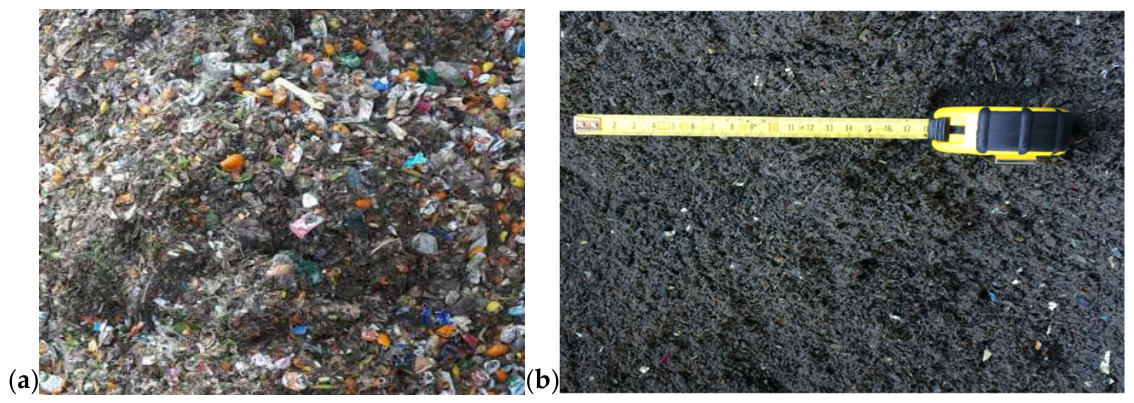
OFMSW represents one of the largest biodegradable waste streams generated in urban areas and mainly consists of food residues, garden waste, and other biodegradable materials [47]. Due to its high volatile solids (VS) and carbohydrate contents, OFMSW exhibits considerable biodegradability and methane production potential. In many urban regions, it constitutes the greatest proportion of MSW, making it an important resource for renewable energy production through AD [6,48]. Prior to source separation and treatment, MSW typically contains a complex mixture of biodegradable materials and non-biodegradable contaminants, including plastics, metals, glass, textiles, rubber, and mineral particles (Figure 1a). Mechanical-biological treatment and source-sorting processes substantially improve the quality of the organic fraction by removing a large proportion of these contaminants, producing a more suitable substrate for AD (Figure 1b). Nevertheless, even after sorting and treatment, OFMSW remains a heterogeneous substrate and may still contain approximately 4–5% inert materials (Table 1), which can create operational challenges related to handling, pumping, clogging, mixing, equipment wear, and reactor performance [49].
In addition to these physical challenges, the high content of readily biodegradable organic matter in OFMSW can promote rapid hydrolysis and acidogenesis. When digested as a sole substrate, this rapid degradation may lead to excessive volatile fatty acid accumulation, reactor acidification, and process instability [45,50,51].
Sewage sludge is an unavoidable by-product of municipal wastewater treatment and remains one of the most widely treated substrates in anaerobic digesters. It contains significant quantities of proteins, nitrogen, phosphorus, and active microbial biomass, providing nutrients, moisture, buffering capacity, and microbial inoculum that support AD processes [33,52]. However, the relatively low carbon-to-nitrogen (C/N) ratio of sewage sludge, the presence of recalcitrant microbial biomass and extracellular polymeric substances (EPS) often constrain biodegradation, making hydrolysis one of the principal rate-limiting steps [53]. In addition, its elevated nitrogen content may lead to ammonia accumulation and methanogenic inhibition during mono-digestion [54].
Table 1 summarizes the typical physicochemical characteristics of SS and OFMSW reported in the literature.
Table 1. Characteristics of OFMSW and SS.
ParameterSSOFMSWReferences
Total solids (TS) (%)2–915–50[26,33,55,56,57]
Volatile solids (% TS)60–8050–90[26,33,57,58]
Protein (% TS)33–4414–24[56,59]
Lipids (% TS)6–1713–27[56,59]
Carbohydrates (% TS)16–3333–60[56,59]
Total nitrogen (% TS)1.5–5.01.5–3.8[57,58,59]
Total phosphorus (% TS)0.2–2.80.05–1.3[57,58]
C/N ratio10–2025–38[26,60]
pH6.0–6.85.4–7.3[57,58]
Cellulose (% TS)37.4–45[49,58]
Hemicellulose (% TS)9.1[49,58]
Lignin (% TS)10.5[49,58]
Inert material in sorted OFMSW (e.g., plastics, rubber, sand, stones, etc) (%, wet basis)4–5% [49]
Typical particle size(mm)>25–20[26,61,62,63]
Methane potential (NLCH4·kgVS−1)180–425305–580[26,57,62,64]

3.2. Synergistic Mechanisms of Co-Digestion

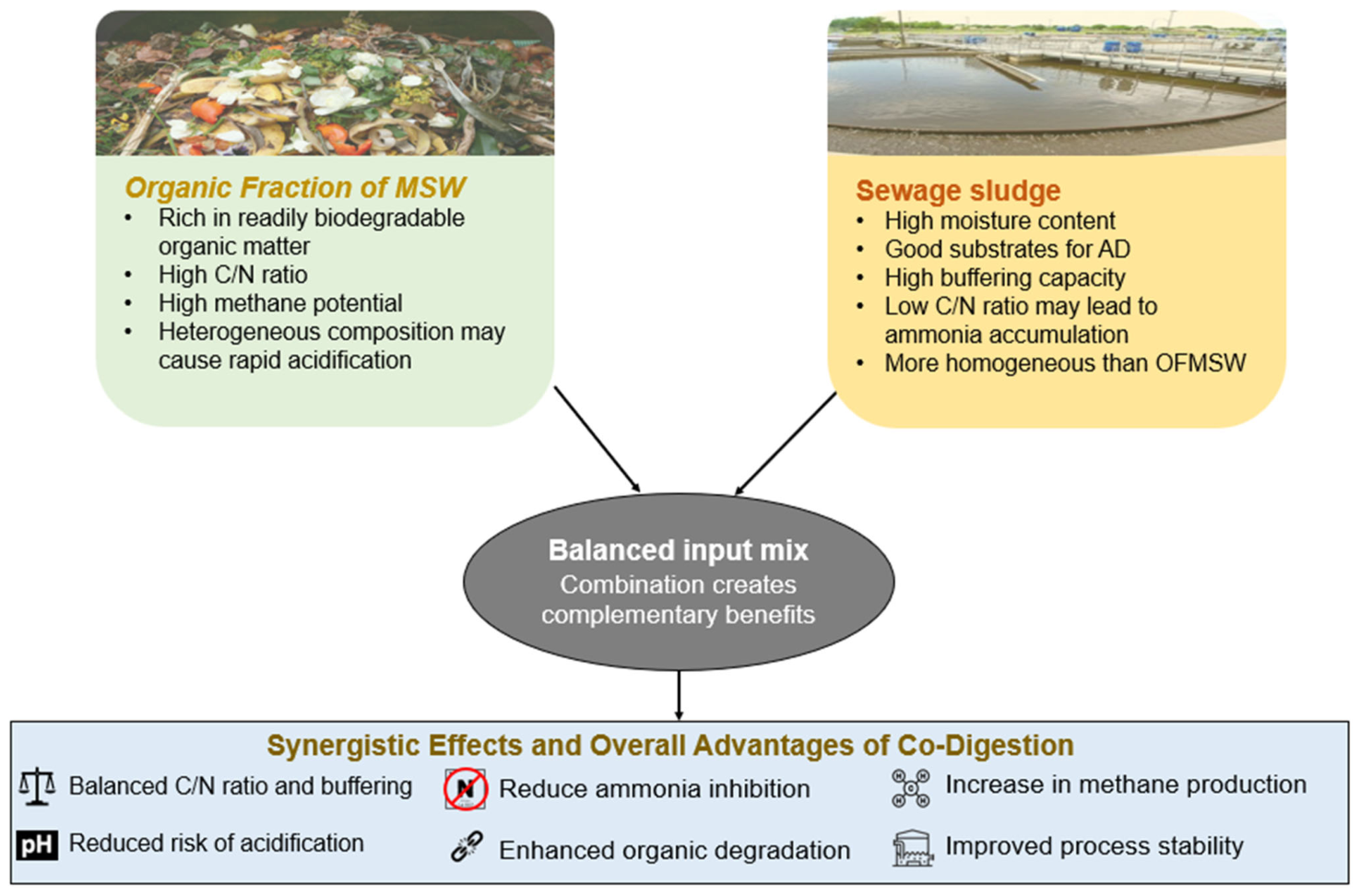
The rationale for co-digesting sewage sludge and OFMSW is based on the complementary characteristics of these substrates. Individually, each substrate presents limitations that can negatively affect AD performance. OFMSW provides abundant readily biodegradable carbon and a high methane potential but is susceptible to rapid acidification due to the fast production of volatile fatty acids. In contrast, sewage sludge supplies moisture, alkalinity, nutrients, and microbial populations that can buffer pH fluctuations and support stable microbial activity, although its relatively low C/N ratio and high nitrogen content may promote ammonia accumulation [6,48]. When combined, these complementary properties create a more balanced substrate mixture that can improve digestion performance through several synergistic mechanisms. In co-digestion studies, synergistic effects can be evaluated by comparing the experimental methane production of a substrate mixture with the theoretical production calculated from the methane potential of each individual substrate, weighted according to its volatile solids contribution in the mixture. The synergistic effect can be expressed using the coefficient α [65]:
α = E x p e r i m e n t a l   p r o d u c t i o n T h e o r e t i c a l   p r o d u c t i o n
where the experimental production corresponds to the methane production measured during BMP tests for each co-digestion mixture, while the theoretical production is calculated from the BMP of the individual substrates according to their VS contribution in the final mixture. When α > 1, the mixture presents a positive synergistic effect; when α = 1, the substrates behave independently; and when α < 1, competitive or inhibitory interactions occur. Therefore, improved substrate balance, such as a more favorable C/N ratio, should not alone be considered direct evidence of synergy unless the experimental methane production exceeds the theoretical value expected from the individual substrates. In the case of SS–OFMSW co-digestion, the observed benefits are mainly associated with the balancing of complementary substrate limitations. First, co-digestion contributes to a more favorable C/N ratio by balancing the carbon-rich characteristics of OFMSW with the nitrogen-rich nature of sewage sludge. Maintaining an appropriate C/N ratio is essential for microbial growth and helps reduce the risks of both ammonia inhibition and nutrient limitation [45,50,51].
Second, sewage sludge provides buffering capacity and alkalinity that can partially offset the rapid acidification commonly associated with OFMSW digestion. This buffering effect helps stabilize the pH of the reactor, reducing the risk of process failure caused by excessive VFA accumulation. Third, the combination of substrates promotes a more diverse microbial community and a broader spectrum of biodegradable compounds, supporting enhanced microbial activity and improved substrate utilization.
In addition to biochemical interactions, AnCoD also improves the physical characteristics of the feed mixture. The high moisture content of sewage sludge facilitates the handling and pumping of OFMSW, while dilution effects can reduce the concentration of potentially inhibitory compounds present in individual substrates. Collectively, these mechanisms contribute to enhanced organic matter degradation, increased methane production, and improved process stability compared with the mono-digestion of either substrate alone.
The synergistic interactions between SS and OFMSW are summarized in Figure 2. Beyond improving methane production, these interactions create favorable conditions for the development of more integrated resource recovery systems. Indeed, the resulting digestate remains rich in organic carbon, nitrogen, and phosphorus, creating opportunities for subsequent valorization through digestate recirculation, nutrient recovery, and thermochemical conversion pathways. Such characteristics make SS–OFMSW co-digestion an attractive foundation for future TSAD-based circular biorefinery systems.

4. Two-Stage Anaerobic Digestion

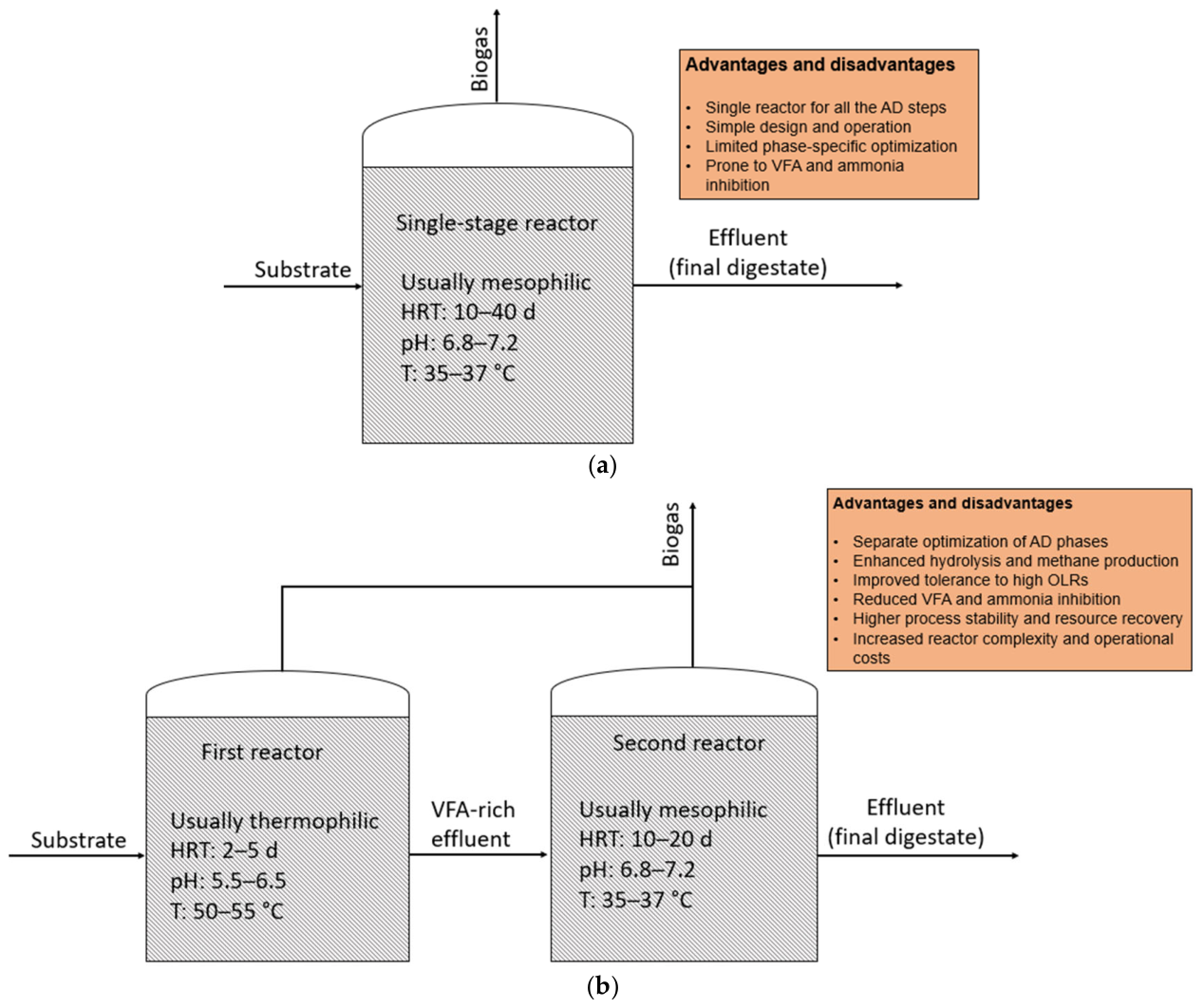
Although conventional single-stage AD systems, as illustrated in Figure 3a, are simple to design and operate, they provide limited control over the distinct conditions required by the different microbial communities involved in anaerobic digestion. This can lead to process imbalances, particularly under high organic loading rates or variable feedstock compositions, resulting in VFA accumulation, methanogenic inhibition, reduced biogas production, and decreased operational stability [11,66,67].
This constraint increases the susceptibility of single-stage systems to operational instability and limits their ability to maintain consistent performance under variable loading and feedstock conditions, thereby motivating the development and application of TSAD systems that allow for the separation and independent optimization of the individual biochemical processes [66,68]. This separation uses two reactors: the first receives substrates for intermediate production (e.g., volatile fatty acid, VFA), while the second processes the first reactor’s effluent for biogas production (Figure 3b). These phases are categorized by predominant biological processes, with the initial stage operating at lower pH and the subsequent stage for methane generation [15]. Although TSAD can operate under the same temperature regime (mesophilic–mesophilic or thermophilic–thermophilic), the most common configuration is temperature-phased anaerobic digestion, which combines a thermophilic first stage for rapid hydrolysis with a mesophilic second stage for stable methane production [53]. In TSAD, the first stage allows fast-growing acidogens and H2-producing bacteria to produce VFA and H2 in the first reactor [54]. In effect, TSAD provides enhanced stability and higher loading capacities compared with conventional single-stage AD. Indeed, the first reactor separates hydrolysis and acidogenesis from methanogenesis, allowing VFA production and pH variations to occur under conditions more suitable for acidogenic microorganisms. This separation reduces the direct exposure of methanogens to rapid pH drops and VFA accumulation, which could inhibit methanogenesis in a single-stage AD system [40,69].

4.1. Performance of the TSAD System

TSAD has been applied to a wide range of substrates and various AnCoD mixtures, including sewage sludge and OFMSW. However, as summarized in Table 2, the reported benefits of TSAD vary considerably between studies. This variability is mainly explained by differences in substrate biodegradability, temperature regime, HRT/SRT distribution between stages, organic loading rate (OLR), reactor scale, operation mode, pH control, and the availability of a direct single-stage control. Therefore, TSAD should not be considered as a universally superior configuration, but rather as a process intensification strategy whose effectiveness depends strongly on feedstock characteristics and operating conditions.
For OFMSW-related substrates, including food waste, kitchen waste and vegetable waste, high methane or biogas yields are generally associated with the high content of readily biodegradable organic matter. For example, Majhi and Jash [70] reported high biogas yields during the TSAD of vegetable market waste, while Li et al. [71] reported high methane yields during the thermophilic two-stage co-digestion of kitchen waste and municipal sewage sludge under optimized OLRs. These results confirm that TSAD can effectively exploit rapidly biodegradable substrates by separating acid-producing and methane-producing stages. However, highly biodegradable substrates are also more prone to rapid VFA accumulation and acidification, particularly when OLR is excessive or when the first-stage HRT is not properly controlled. This explains why high methane yields reported for food waste-rich systems cannot be directly generalized to more heterogeneous OFMSW streams, especially those containing lignocellulosic or inert fractions.
For sewage sludge, the main advantage of TSAD appears to be improved hydrolysis and solids destruction rather than maximization of methane yield alone. Riau et al. [72] reported VS removal efficiencies of up to 87% during thermophilic–mesophilic digestion of sludge, whereas Borowski [73] reported a lower VS removal of about 52% and a methane yield of 333 LCH4·kgVS−1 under thermophilic–mesophilic conditions. These contrasting results show that similar temperature-phased configurations can lead to different performances depending on sludge characteristics, first-stage retention time, OLR and reactor operation. Sludge contains microbial biomass, extracellular polymeric substances and particulate organic matter that are less readily degradable than food waste. Consequently, the benefit of TSAD for sludge-rich substrates is often expressed through enhanced solubilization, stabilization and VS reduction rather than through very high specific methane yields.
Temperature regime is another important factor explaining the differences among studies. Thermophilic or hyperthermophilic first stages can promote cell lysis, EPS disruption and solubilization of particulate organic matter, thereby accelerating hydrolysis. For example, Bolzonella et al. [74] showed that incorporating a hyperthermophilic first stage before thermophilic methanogenesis improved VS and chemical oxygen demand (COD) removal. Similarly, thermophilic–mesophilic systems can combine rapid hydrolysis in the first stage with more stable methanogenesis in the second stage. Nevertheless, thermophilic operation also increases heat demand and may increase the risk of VFA or ammonia inhibition if the methanogenic stage is not sufficiently buffered. Therefore, the benefits of thermophilic–mesophilic TSAD must be evaluated together with energy balance, process control requirements and operational stability.
The effect of OLR and hydraulic retention time/solid retention time (SRT) distribution is also critical. TSAD can tolerate relatively high OLRs because the hydrolytic–acidogenic stage absorbs part of the shock load and prevents direct exposure of methanogens to rapidly accumulating VFAs. For instance, some OFMSW or kitchen waste studies reported successful operation at elevated OLRs, while Li et al. [71] identified optimum OLRs of 12.5 gVS⋅L−1⋅d−1 in the hydrogen-producing stage and 5.0 gVS⋅L−1⋅d−1 in the methane-producing stage. However, these benefits are not unlimited. Excessive OLR can reduce pH, increase VFA accumulation and decrease methane conversion efficiency. Similarly, too short first-stage HRT may lead to incomplete hydrolysis, whereas too long first-stage HRT may allow methanogenesis to begin in the acidogenic reactor, reducing the effectiveness of phase separation. This highlights the need to optimize both OLR and HRT/SRT allocation rather than considering TSAD configuration alone.
Comparison between TSAD and single-stage AD also shows that the magnitude of improvement depends on the operating conditions and substrates used. Hu and Shen [75] reported that thermophilic–mesophilic temperature-phased co-digestion of sewage sludge and food waste increased methane yield by 50.3% compared with mesophilic single-phase co-digestion (MacD) and by 32.7% compared with thermophilic single-phase co-digestion (TAcD). Paranjpe et al. [76] reported a 41.9% increase in cumulative biogas production and a 9.8% improvement in VS removal for TSAD compared with single-stage anaerobic digestion using food waste/sewage sludge mixture. In contrast, several studies listed in Table 2 did not include or report an equivalent single-stage control.
Co-digestion introduces further complexity because performance depends not only on reactor configuration but also on substrate complementarity. Wang et al. [77] reported VS and total COD removal efficiencies of 64.7% and 60.8%, respectively, during the two-phase co-digestion of food waste and sewage sludge, but no direct single-stage control was included. Paranjpe et al. [76], by contrast, directly compared TSAD and SSAD and showed that the TSAD configuration improved cumulative biogas production, methane concentration and VS removal. These results suggest that the benefit of co-digestion is not always reflected only in methane yield; it may also appear as improved pH stability, reduced VFA accumulation, higher methane content, better COD removal and greater process robustness.
Our previous study [26] is particularly relevant because it involved a realistic mixture of OFMSW, sewage sludge and straw-rich equine manure. Although the methane yields of 235–245 NLCH4·kgVS−1 were lower than values reported for food waste-rich systems, the system operated stably and achieved methane production corresponding to approximately 77–80% of the mixture BMP. The addition of equine manure also contributed to reducing ammonium nitrogen concentrations from approximately 4.7 to 2.6 g·L−1. This illustrates an important point: lower methane yield does not necessarily indicate poor TSAD performance when the system treats realistic, heterogeneous and more recalcitrant waste mixtures. In such cases, process stability, ammonia control, solids handling and feedstock representativeness are equally important performance indicators and hence require careful substrate selection.
It is worth mentioning that most of the reviewed studies were conducted at laboratory scale, which limits the direct transferability of the reported methane improvements to industrial operation. Scale-up introduces additional constraints, including heat demand, mixing efficiency, solids handling, pumping requirements, clogging risks, instrumentation, process control, maintenance complexity, and higher capital and operating costs, as discussed further in Section 4.2. These factors may reduce the practical advantage of TSAD if the additional methane or biogas recovery does not offset the increased engineering and energy requirements.
Table 2. Comparative performance of TSAD systems treating sewage sludge and OFMSW.
Substrate(s)Scale and ModeTemperature I/II (°C)Working Volume I/II (L)HRT or SRT I/II (d)OLR I/II (gVS⋅L−1⋅d−1)TSAD PerformanceSingle-Stage/ControlImprovement over Single-StageRef.
Sewage sludge
Primary sludgeLaboratory; semi-continuous50–70/350.6/42/10–20NR54% VS destructionNR+20–25% CH4 yield[78]
Raw sludgeLaboratory; semi-continuous55/354.5/915/15; 5/15; 3/15; 3/12NR78% VS removal at 5/15 d and 87% at 3/15 and 3/12 d35 °C single-stage; 15 d+21% VS removal; +120% CH4 yield[72]
Waste activated sludgePilot; continuous65/55200/13002/1815/2.355% VS removal; 490 LbiogaskgVS−155 °C; OLR 2.2 gVS⋅L−1⋅d−1; 20 d SRT+15% VS removal; +9% biogas yield[74]
OFMSW/Food waste
Vegetable market wastePilot/bench; continuous solid-phase 37/3752.5/2NRNR860–889 LbiogaskgVS−1; 82–86% VS reduction.NRNR[70]
Mechanically treated OFMSWLaboratory; semi-continuous55–57/35–374.5/4.54/10 and 3/6NRAt 4/10 d, 75% VS removalNR+35–45% VS removal [79]
Food wastePilot; continuous35/355000/5000NR0.79 ± 0.16 gCOD⋅L−1⋅d−1/NR446 NLCH4·kgVS−1 versus 380 NLCH4·kgVS−1 in single-stage AD35 °C single-stage; OLR 3.79 gVS⋅L−1⋅d−1+17% methane yield[80]
Laboratory; batch/sequential55/351.7/1.74–5/15–26NROptimum thermophilic duration: 4–5 d; 82–85% VS removalNRNR[81]
Oily food wasteLaboratory; continuous; with/without recycling55/352/86/2412/3.1All systems produced about 440 LCH4·kgVS−1. Recycle increased first-stage pH to 5.4, promoted 35.3% and enabled H2 production.NRNR[82]
Sewage sludge + OFMSW/Food waste
Hydromechanically separated OFMSW + sewage sludgeLaboratory; semi-continuous55/353/31/1444.57/3.63333 NLCH4·kgVS−1; 52.1% VS removal.35 °C; OLR 2.9 gVS⋅L−1⋅d−1; 15 d+40% VS removal; +45% CH4 yield[73]
Food waste + sewage sludge Laboratory; semi-continuous35/357/305/20NR/1.264.7% VS removalNRNR[77]
Deoiled food waste + waste activated sludgePilot; semi-continuous35/3520/1007/33NR29:1 food-waste/sludge ratio with VS removal up to 90% and methane production reached about 410 LCH4·kgVS−1NRNR[83]
Thermally treated kitchen waste + municipal sewage sludgeLaboratory; high-solids, two-stage55/552.5/8NR12.5/5.065.4% VS removalNRNR[71]
Food waste + activated sludgeLaboratory; semi-continuous37/373/12NR14.2/2.5Second-stage biogas increased by approximately 26% and VS degradation by 9%NRNR[84]
Sewage sludge + food wasteLaboratory; batch/sequential55/353/32/18NR298.6 LCH4·kgVS−135 °C MAcD: 204.1 LCH4·kgVS−1; 55 °C TAcD: 224.7 LCH4·kgVS−1 +50.3% vs. mesophilic single-phase; +32.7% vs. thermophilic single-phase[75]
OFMSW + sewage sludge + straw-rich equine manureLaboratory; semi-continuous55/3716/162/12 or 1512/6.7 or 5.3235–245 NLCH4·kgVS−1 (approximately 77–80% of mixture BMP)NRNR[26]
Food waste + sewage sludgeLaboratory; batch35/3516/16NRNRCumulative biogas was 1.92 L in TSAD versus 1.35 L in SSAD; CH4 increased from about 51% to 75%.HRT of 35 d+41.9% cumulative biogas; +9.8% VS removal[76]
I/II: operating parameters of the first stage (I) and the second stage (II); NR: not reported.
However, the reviewed studies generally show that TSAD can improve hydrolysis, solids destruction, methane production, and process stability, although the magnitude of improvement is highly dependent on substrate type and operating conditions. The greatest improvements are typically observed when readily biodegradable substrates are treated under well-controlled phase separation and when direct single-stage comparisons are available. For sludge-rich or heterogeneous OFMSW-based mixtures, the advantages of TSAD are more often related to enhanced solubilization, stabilization, ammonia control, and operational robustness.

4.2. Engineering Challenges for the Scale-Up of TSAD Systems

Although many laboratory-scale studies have demonstrated the technical advantages of TSAD, its successful transfer to pilot and industrial scales remains challenging. Most published studies focus mainly on methane yield, volatile solids destruction, VFA conversion, and process stability under controlled laboratory conditions. In contrast, fewer studies examine the engineering requirements needed for large-scale implementation, including solids handling, hydraulic transfer, mixing, heat integration, process monitoring, maintenance, and overall economic feasibility. Therefore, the scale-up of TSAD remains one of the main barriers limiting its wider industrial adoption.
As discussed above, TSAD can improve methane production, organic matter degradation, and process stability compared with conventional single-stage digestion. However, these advantages are usually accompanied by increased process complexity, higher capital investment, and more demanding operational requirements. Holl et al. [15] emphasized that, despite the well-documented biological benefits of TSAD, industrial implementation remains limited by the additional infrastructure, control requirements, and maintenance associated with multi-stage systems. Consequently, future TSAD development should not focus only on improving biological performance, but also on engineering optimization, process integration, long-term reliability, and economic viability under realistic feedstock conditions [15,36,85].
A relevant example of TSAD scale-up was reported by Garção et al. [86], who scaled a two-stage anaerobic digestion system from a 100 L laboratory reactor to a pilot plant approximately 100 times larger. Their study showed that scaling up TSAD is not simply a matter of increasing reactor volume. Instead, it requires redesign of solids management, hydraulic operation, recirculation systems, filtration units, pumping, and process monitoring. Several solutions that were effective at laboratory scale became impractical at pilot scale because of clogging, maintenance constraints, unstable hydraulic transfer, or inadequate solids retention. The main engineering challenges and possible responses for pilot- and full-scale TSAD systems are summarized in Table 3 and briefly outlined below.

4.2.1. Dissociation of Solid Retention Time from Hydraulic Retention Time

Among scale-up challenges, managing slowly degradable solids is important. In laboratory-scale TSAD systems, sieves or filtration devices can retain lignocellulosic particles in the reactor, increasing residence time and improving degradation. However, configurations are difficult to maintain at pilot scale because of clogging and cleaning requirements. For example, Garção et al. [86] reported that a 100 µm sieve was not suitable for pilot-scale operation. To overcome this limitation, the authors introduced a filtration and recirculation system with a 1000 µm edge-gap filter, allowing undegraded fibres to return to the hydrolytic reactor while intermediates were transferred to the methanogenic stage. This strategy decouples solid retention time from hydraulic retention time, allowing degradable solids to remain longer without increasing liquid-phase residence time. This approach is relevant for TSAD systems treating SS and OFMSW, because these substrates may contain fibres, microbial cell debris, and inert materials [4,5,6]; if unmanaged, they can promote sedimentation, clogging, poor mixing and incomplete substrate conversion.
These challenges are also relevant for semi-industrial and full-scale systems treating realistic waste mixtures. Operational experience from the COMETHA semi-industrial pilot plant, consisting of a 6.5 m3 thermophilic reactor and a 90 m3 mesophilic reactor, highlighted the practical difficulties associated with residual inert materials in OFMSW-based feedstocks. To limit their accumulation and reduce clogging risks, a decantation system was installed upstream of the feed tank. This example shows that feedstock preparation and solids management are not secondary operational details, but central requirements for the successful scale-up of TSAD.

4.2.2. Recirculation and Intensification

Solids retention and recirculation can improve degradation of slowly biodegradable particles by increasing effective residence time, but they do not necessarily improve the intrinsic biodegradability of recalcitrant material. In TSAD systems treating SS and OFMSW, much organic matter may remain trapped in lignocellulosic fibres, microbial cells, extracellular polymeric substances, and other particulate structures even after extended digestion [4,5,6]. Therefore, digestate intensification before recirculation may complement recirculation. Post-treatment technologies such as steam explosion, flash expansion, ultrasonication, alkaline treatment, and mechanical disintegration can disrupt cell walls, solubilize particulate organic matter, degrade extracellular polymeric substances, and increase soluble COD and VFA concentrations [20,87], making previously inaccessible fractions more available for anaerobic conversion [88]. Combined solids retention and digestate intensification may be useful at scale, but feasibility depends on energy demand, equipment cost, inhibitory compounds, and the balance between methane recovery and cost; therefore, they should be assessed by mass and energy balances and techno-economic analysis, not methane yield alone [89,90].

4.2.3. Hydraulic Operation, Equipment and Monitoring Requirements

Beyond solids management, hydraulic operation becomes more complex as TSAD systems are scaled up. Large-scale systems require coordinated operation of reactors, transfer pumps, recirculation loops, storage tanks, valves, filtration units and monitoring devices. Maintaining stable HRT, SRT, OLR, liquid transfer rate and phase separation is more difficult at industrial scale than in laboratory reactors [91]. This difficulty is increased when the feedstock contains variable proportions of SS, OFMSW and other co-substrates, because changes in solids content, viscosity, particle size distribution and contaminant concentration can affect pumping, mixing and filtration performance [4,5,6,86].
Process monitoring and control are also more demanding in TSAD than in single-stage AD. Each stage has different biological functions and therefore different control requirements. The first stage must promote hydrolysis and acidogenesis without excessive acidification, while the second stage must maintain stable methanogenesis. Large-scale TSAD therefore requires monitoring of pH, temperature, VFA, alkalinity, ammonia concentration, gas production, gas composition, liquid transfer rates and solids movement. Garção et al. [86] reported the need for extensive instrumentation, including flow meters, level sensors, pressure sensors, pH probes, temperature probes and gas analysis systems. Such instrumentation improves process control but also increases investment cost, maintenance needs and operational complexity.

4.2.4. Thermal Management

Thermal management is another important consideration, especially for thermophilic–mesophilic configurations. A thermophilic first stage can increase hydrolysis rates, improve organic matter solubilization and contribute to pathogen reduction [92,93]. However, it also requires additional heat input, insulation and temperature control. Therefore, the net energy benefit of TSAD depends not only on increased methane production but also on the ability to recover and efficiently reuse heat within the process.
Poor thermal integration may reduce or even offset the advantages of enhanced biological performance [94]. Heat losses, cold feedstock addition, large reactor volumes, insufficient insulation and inefficient heat exchangers can increase the energy demand of TSAD. For this reason, heat recovery from digestate streams, feedstock preheating, combined heat and power integration, and optimized insulation are essential for industrial implementation.

4.2.5. Modeling and AI-Assisted Support for TSAD Scale-Up

The engineering modifications required for TSAD scale-up should be supported by predictive modeling rather than direct extrapolation from laboratory-scale methane yields. Mechanistic models such as ADM1 and its two-stage adaptations can simulate hydrolysis, acidogenesis, VFA accumulation, ammonia inhibition, methanogenesis, and phase separation, while simplified or reduced models may be useful for control-oriented applications when detailed substrate characterization is limited [95,96,97,98]. These models can support the estimation of reactor volume, HRT/SRT distribution, OLR limits, heat demand, recirculation needs, and operating stability before pilot or industrial implementation.
Recent artificial-intelligence approaches can complement mechanistic models by improving prediction and monitoring under variable feedstock and full-scale conditions. Machine-learning models, including support vector machines, random forest, LSTM networks, NARX neural networks, and hybrid ADM1–machine-learning approaches, have been applied to predict biogas or methane production, estimate influential operating parameters, and support process optimization [99,100,101,102,103]. However, these models should complement rather than replace mechanistic understanding, because their reliability depends on data quality, sensor availability, site-specific calibration, interpretability, and validation under real operating conditions.

5. Intensification/Post-Treatment and Nutrient Recovery Technologies

A TSAD system could be enhanced by integrating digestate recirculation, nutrient recovery, and thermochemical valorization technologies. This creates opportunities to maximize recovery but increases system complexity. Management of liquid and solid side streams, nutrient-rich fractions, recirculation loops, and recovery units must be considered during design rather than as post-treatment additions [104]. This aligns with the concept of digestate-centered process intensification, where digestate is viewed not as a by-product but as a stream containing recoverable C, N, and P. Available literature suggests that barriers to industrial TSAD deployment are no longer purely biological but increasingly engineering-related. Future research should prioritize pilot-scale demonstrations, solids management, digestate post-treatment, process integration, and performance under feedstock variability to bridge the gap between laboratory-scale successes and widespread industrial TSAD implementation.

5.1. Post/Intensification Treatment Technologies

Digestate post-treatment technologies aim to enhance the conversion of residual organic matter by overcoming the physical, chemical, and biological barriers that limit microbial accessibility. These treatments increase the solubilization of particulate organic matter and promote the release of readily biodegradable compounds, including soluble COD, sugars, proteins, and volatile fatty acids, which can subsequently be converted into methane following digestate recirculation.
The need for such technologies arises from the incomplete degradation of organic matter during AD. As shown in Table 4, digestates often remain enriched in lignocellulosic compounds, with reported lignin contents frequently exceeding 35–40% TS and residual cellulose and hemicellulose contents reaching 20–35% TS and 10–25% TS, respectively [105,106]. The accumulation of these recalcitrant fractions indicates that a substantial proportion of the residual organic matter remains poorly accessible to anaerobic microorganisms and therefore represents a potential target for further methane recovery.
To overcome these limitations, a variety of digestate post-treatment technologies have been developed and can generally be classified into chemical, biological, and thermal/physicochemical approaches (Table 5). Although many of these technologies were initially developed for substrate pretreatment, they have increasingly been investigated for digestate recirculation because of their ability to improve the accessibility of residual organic matter and enhance methane recovery [19,20,87,107].
  • Chemical treatments
Chemical treatments improve digestate biodegradability by modifying lignocellulosic structures and solubilizing organic matter [111,113]. Acid treatments promote hemicellulose hydrolysis and alter cellulose crystallinity, whereas alkaline treatments facilitate lignin depolymerization, biomass swelling, and cleavage of lignin–carbohydrate linkages, increasing microbial accessibility to structural carbohydrates. Oxidative treatments, such as hydrogen peroxide and ozone oxidation, enhance degradation of resistant organic compounds. Effectiveness varies with digestate composition and treatment severity. Ozone oxidation on agricultural digestates resulted in methane yield improvements up to 13% [114], whereas CaO treatments increased methane production by 15–66% [115] (Table 6). Greater improvements were reported for thermo-alkaline treatments, with enhancements of 48 to 320% for agricultural digestates and 63–190% for thermo-acidic treatment of sludge digestates [116,117]. Despite these results, industrial implementation remains constrained by chemical consumption, inhibitor formation, corrosion, and operational costs [19,87,113].
  • Biological treatments
Biological treatments rely on enzymes or microorganisms to selectively degrade recalcitrant organic fractions under mild operating conditions [113]. Enzymatic hydrolysis employs cellulases, hemicellulases, and ligninolytic enzymes to break down complex polymers, whereas fungal treatments, particularly those involving white-rot fungi, promote lignin degradation through extracellular oxidative enzymes [118]. Compared with chemical and thermal approaches, biological treatments generally require lower energy inputs and produce fewer inhibitory by-products. However, their application to digestate remains relatively limited, and most studies have focused on substrate pretreatment rather than digestate recirculation. Long treatment durations, strict environmental requirements, and high enzyme costs currently restrict their large-scale implementation [19].
  • Thermal and physicochemical treatments
Thermal and physicochemical treatments represent the most extensively investigated approaches for digestate valorization [119]. Technologies such as thermal hydrolysis, hydrothermal treatment, steam explosion, ultrasonication, and mechanical disintegration promote microbial cell disruption, extracellular polymeric substance solubilization, particle size reduction, and modification of lignocellulosic structures. Consequently, these treatments substantially increase the availability of biodegradable organic matter for subsequent anaerobic conversion. For agricultural digestates rich in residual fibers, thermal treatments have reported methane improvements ranging from 48 to 171%. Steam explosion, one of the most effective treatments, has been shown to increase methane production by 75–136%, depending on the conditions [120,121,122]. Thermal hydrolysis can substantially enhance methane recovery from sewage sludge digestates, with reported improvements ranging from 29 to 327% [123,124,125]. In addition, Díaz et al. [123] showed that intermediate thermal hydrolysis between digestion stages of sludge enhanced methane potential and increased volatile solids removal to approximately 61%. Likewise, steam explosion treatments applied to sludge digestates achieved methane enhancements ranging from 26 to 125%, while inter-stage steam explosion improved overall biogas production by approximately 45% [124].
Table 6. Common post/intensification treatments applied to different substrates.
Digestate TypeTreatment CategorySpecific TreatmentConditionsMethane ImprovementRef.
Agricultural digestatesThermalThermal treatment120 °C, 30 min+171%[120]
Chemical oxidationOzonation5–30 g O3 kg−1 TS+13%[121]
AlkalineCaO treatment6–10% CaO+15–66%[122]
Thermo-alkalineNaOH treatment121 °C+26%[114]
Thermo-alkalineThermal + CaO185 °C, CaO (1–3%) +115%[126]
Sewage sludge digestatesThermalThermal hydrolysis170 °C, 15–25 min+29–41%[115]
ThermalSteam explosion165–200 °C+26–125%[123]
ThermalInter-stage steam explosion180–200 °C °, 30 min+45%[124]
Acid-thermalAcid + Thermal 170 °C, pH+14–21%[116]
Mixed lignocellulosic digestatesThermalThermal hydrolysis120–190 °C+52.4%[125]
Based on the methane improvements reported for digestate post-treatment and recirculation, thermal and thermochemical treatments appear to be the most effective approaches for recovering residual methane potential [125,126]. However, available studies remain largely limited to sewage sludge and agricultural digestates, whereas studies on OFMSW digestates, SS–OFMSW co-digestates, and TSAD recirculation systems are still scarce. From the available literature, thermal hydrolysis should be prioritized when the digestate is sludge-dominant or rich in microbial biomass and EPS, whereas steam explosion/flash expansion appears more appropriate when the solid fraction contains a higher proportion of fibrous OFMSW residues. Thermo-alkaline treatment may also be considered as a secondary option, provided that chemical consumption, salt accumulation, and possible inhibition are controlled. Nevertheless, further studies are required to compare these technologies under similar conditions and to determine their energy balance, economic feasibility, and long-term effects on TSAD stability.

5.2. Nutrient Recovery

5.2.1. Nitrogen Recovery

The recovery of N is important because agriculture relies on synthetic N fertilizers, produced through the energy-intensive Haber–Bosch process [127]. This process converts atmospheric N into ammonia under high temperature and pressure, consuming 1–2% of the energy supply and contributing to greenhouse gas emissions [128]. Therefore, recovering nitrogen from wastewater or digestate can reduce dependence on fossil-based fertilizer production and improve sustainability. During AD, nitrogen compounds undergo hydrolysis and deamination, releasing ammoniacal N, which exists in equilibrium between ammonium ions (NH4+) and free ammonia (NH3) [129,130,131]. Following digestate separation, most soluble nitrogen is present in the liquid fraction as ammonium nitrogen (NH4+–N), making it attractive for nutrient recovery [23,132]. Thus, nitrogen recovery from digestate can produce fertilizer products while addressing direct land application limitations, including transportation costs, nutrient imbalance, ammonia volatilization, nitrate leaching, greenhouse gas emissions, and pathogen or contaminant risks [43,44].
Numerous technologies have been developed to recover and concentrate N from digestate into valuable fertilizer products. These technologies, with their recovery capacity shown in Table 7 and briefly discussed below, include ammonia stripping and acid absorption, membrane-based separation, ion exchange and adsorption processes, biological assimilation, and emerging electrochemical technologies [22,23,133]. The selection of the most appropriate recovery pathway depends on nitrogen concentration, digestate composition, energy demand, operational cost, and the desired characteristics of the final fertilizer product [22].
  • Ammonia Stripping
Ammonia stripping is one of the most mature and widely implemented technologies for N recovery from anaerobic digestates due to its high recovery efficiency, relatively simple operation, and potential to produce marketable nitrogen fertilizers. The process is based on the conversion of dissolved ammonium ions into gaseous free ammonia (NH3), which can subsequently be transferred from the liquid to the gas phase and recovered through acid absorption [134,135].
The distribution between NH4+ and NH3 is governed by the ammonium–ammonia equilibrium, with a pKa of approximately 9.25 at 25 °C. At this equilibrium point, nearly 50% of total ammoniacal N is present as NH3 and the remaining 50% as NH4+. The NH3/NH4+ ratio is strongly influenced by pH and temperature, where alkaline conditions and elevated temperatures shift the equilibrium toward NH3, thereby enhancing ammonia volatilization and stripping efficiency [135].
The equilibrium can be described by the following reactions [136]:
NH4+ + H2O ⇌ NH3 + OH
2 H2O ⇌ H3O+ + OH
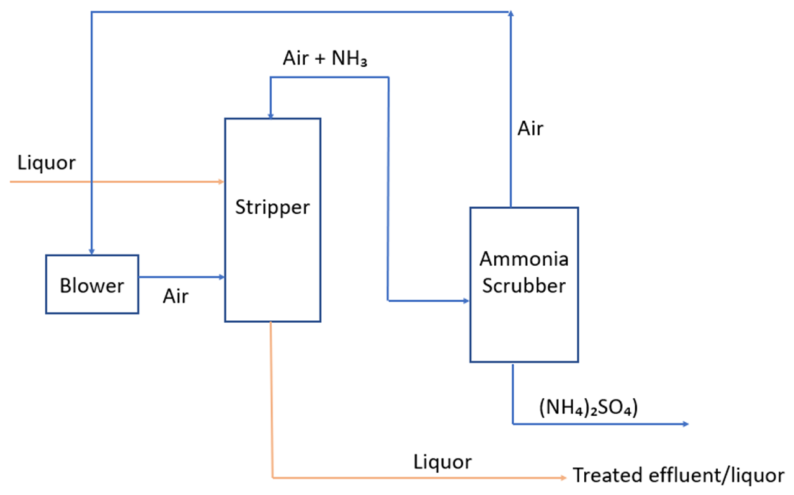
As depicted in Figure 4, during operation, air or another stripping gas is passed through the ammonia-rich digestate in a stripping column, promoting the transfer of NH3 from the liquid to the gas phase. The ammonia-containing gas stream is subsequently directed to an absorption unit, where it is commonly captured using sulfuric acid due to its low cost and high availability, producing ammonium sulfate ((NH4)2SO4), a valuable nitrogen fertilizer [133,137]. Therefore, ammonia stripping not only reduces N concentrations in digestate but also converts a potentially harmful pollutant into a reusable agricultural product.
The efficiency of ammonia stripping depends on parameters, including pH, temperature, air-to-liquid ratio, column design, and contact time. Studies have reported nitrogen removal efficiencies above 90%, sometimes exceeding 99%, under optimized alkaline pH (>9), elevated temperatures (typically 50–90 °C), and gas transfer rates [133,138]. Yin et al. [138] reported ammonia removal efficiencies up to 99.3% at pH 11 and temperatures approaching 90 °C. Although studies focused on industrial wastewaters, comparable performance has been demonstrated for anaerobic digestates. Liu et al. [139] achieved ammonia removal efficiencies up to 96.8% during air-recirculated stripping of pig manure digestate containing 1450 mg NH4+-N L−1 at 36 °C, pH 12.4, and a gas-to-liquid ratio of 3000. Ammonia stripping is widely applied due to its simplicity, high nitrogen recovery efficiency, and relatively low cost. However, chemical consumption, energy demand, and scaling issues remain important limitations [133,138].
  • Membrane Contactors
Membrane contactors are an alternative to air stripping for N recovery from anaerobic digestate due to their selectivity, compact design, and reduced ammonia losses [140]. The process relies on diffusion of free ammonia across a hydrophobic membrane into sulfuric acid, producing ammonium salts. It can achieve approximately 80–95% N removal depending on digestate composition and operating conditions [140,141]. Compared with air stripping, membrane contactors operate under milder conditions, require a smaller footprint, and are easier to integrate into AD facilities. However, scaling remains constrained by membrane fouling, pore wetting, and high membrane material cost [140,142]. Nevertheless, they are promising for TSAD-based biorefineries treating SS and OFMSW.
  • Ion Exchange and Adsorption
Ion exchange and adsorption technologies are approaches for recovering ammoniacal nitrogen from digestate, especially the liquid fraction after solid–liquid separation [132]. These processes rely on selective adsorption of NH4+ onto materials, with natural and synthetic zeolites the most studied adsorbents because of high cation exchange capacity, availability, and low cost [132]. Studies found recovery efficiencies ranging from 60 to 90%, depending on adsorbent type, ammonium concentration, contact time, and competing ions such as potassium, calcium, and magnesium [143]. Once saturated, the adsorbent can be regenerated using solutions to produce concentrated ammonium-rich streams or applied as a slow-release fertilizer, creating opportunities for nutrient recycling [133,143,144]. While ion exchange requires little energy and no extreme operating conditions, competing ions and adsorbent regeneration can limit large-scale application [144].
  • Struvite Precipitation
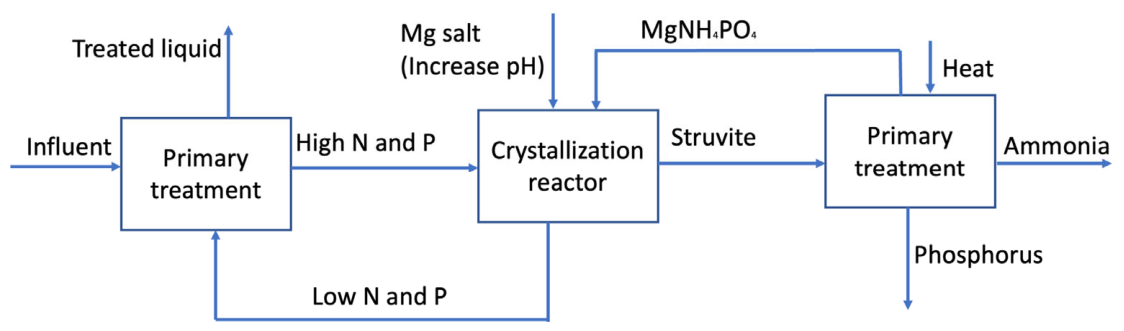
Struvite precipitation is a widely investigated nutrient recovery technology that enables the simultaneous recovery of ammonium and phosphate from the liquid fraction of anaerobic digestate. The process, as depicted in Figure 5, involves the formation of magnesium ammonium phosphate hexahydrate (MgNH4PO4·6H2O) through the reaction between magnesium, ammonium, and phosphate ions under alkaline conditions, typically at pH values between 8 and 10 [24,133].
The process is particularly attractive for digestate streams rich in ammonium and phosphorus, where it transforms dissolved nutrients into a solid crystalline product that can be directly used as a slow-release fertilizer.
Depending on digestate composition, magnesium source, and conditions, nitrogen recovery efficiencies range from 30 to 80%, while phosphorus recovery often exceeds 80–95% [133,146,147]. Recovered struvite exhibits low heavy metal content, agronomic properties, and nutrient composition comparable to fertilizers, making it promising for circular agriculture [136]. Struvite precipitation simultaneously recovers nitrogen and phosphorus without high temperatures or energy inputs. However, implementation may be limited by magnesium addition, pH adjustment, and control of crystallization conditions [148]. Only the ammonium fraction associated with phosphate precipitation is recovered, resulting in lower nitrogen recovery than air stripping or membrane contactors [24,149].
Table 7. Common technologies for ammoniacal nitrogen recovery.
TechnologyMechanismN Recovery (%)Main Recovered ProductAdvantagesLimitationsRefs.
Ammonia stripping NH3 volatilization and acid capture80–95Ammonium sulfateMature, high recovery efficiencyChemical and energy demand[138,139]
Membrane contactorsNH3 diffusion through hydrophobic membrane70–95Ammonium saltsHigh selectivity, moderate temperatureMembrane fouling, cost[140,142]
Ion exchange and adsorptionNH4+ adsorption60–90Ammonium-rich regenerant or fertilizerLow energy requirementAdsorbent regeneration[133,143,144]
Struvite PrecipitationCrystallization of MgNH4PO4·6H2O by reaction of NH4+, Mg2+, and PO43− under alkaline conditions30–80Struvite (magnesium ammonium phosphate)Simultaneous recovery of N and P, low energy requirement, production of slow-release fertilizerRequires magnesium addition, pH adjustment, and controlled crystallization conditions[133,146,147]

5.2.2. Phosphorus Recovery

Phosphorus, like nitrogen, is an essential macronutrient for agricultural productivity and global food security [150]. Unlike nitrogen, which can be industrially fixed through the Haber–Bosch process, phosphorus is mainly obtained from finite phosphate rock reserves [151]. Concerns over phosphate depletion, increasing fertilizer demand, and environmental impacts of phosphorus losses have intensified interest in phosphorus recovery from waste streams [152]. In this context, anaerobic digestion offers an opportunity to recover both energy and nutrients from organic wastes. During digestion, most feedstock phosphorus is conserved and concentrated in the digestate, which can therefore be valorized as a secondary phosphorus resource [103]. Depending on substrate composition and separation method, digestate can contain approximately 12–18 g P kg−1 (1.2–1.8% TS), with phosphorus distributed between the liquid and solid fractions after dewatering [153]. The recovery strategy therefore depends largely on this distribution, which is influenced by centrifugation, screw pressing, and other separation processes [154]. The liquid fraction may contain about 35–45% of total phosphorus and can be treated mainly through precipitation-based technologies. As discussed above, struvite precipitation remains the most established approach, enabling simultaneous recovery of ammonium and phosphate as magnesium ammonium phosphate [133,146,147]. Calcium phosphate precipitation has also been investigated in streams with high phosphorus concentrations and favorable calcium availability, producing phosphate-rich compounds suitable for fertilizer use [155]. Another emerging pathway is phosphorus recovery as vivianite (Fe3(PO4)2·8H2O), especially from sewage sludge digestates where iron salts are commonly used during wastewater treatment [156]. Recent studies show that phosphorus in iron-rich digestates can occur as vivianite, which can be separated magnetically and valorized as a phosphorus source [157,158].
However, a proportion of phosphorus (approximately 55–70%) remains in the solid digestate fraction, particularly in sewage sludge and lignocellulosic co-digestion systems [130,159], making it a target for phosphorus recovery. Thermochemical technologies, especially pyrolysis, have attracted interest in valorizing phosphorus-rich solids. During pyrolysis, matter is converted into gaseous products (syngas), condensable liquids (bio-oil), and carbon-rich biochar in which most phosphorus is retained and concentrated [160,161,162]. Several studies have reported phosphorus retention efficiencies of approximately 70–95% in the biochar, enabling its use as a phosphorus-enriched amendment or feedstock for phosphorus extraction through acid leaching followed by purification and recovery processes, such as solvent extraction, to produce concentrated phosphorus products [149,150,151]. Compared with digestate application, phosphorus-rich biochar offers lower mass and volume, storage and transportation properties, carbon stabilization, and reduced risks from pathogens and organic contaminants [163,164].

5.3. Thermochemical Valorization of Digestate for Additional Energy Recovery (Syngas)

While pyrolysis enables the concentration and recovery of phosphorus within the biochar fraction, it also converts remaining volatile organic compounds into valuable gaseous products, creating an additional pathway for energy recovery from digestate [165,166].
During thermochemical processes such as pyrolysis and gasification, the organic fraction of digestate undergoes thermal decomposition under oxygen-limited or controlled oxidation conditions, producing a combustible gas mixture known as syngas. Syngas is mainly composed of H2, carbon monoxide (CO), CH4, CO2, and light hydrocarbons, with its composition depending on feedstock characteristics and process conditions [167].
The generated syngas can be directly used for heat and electricity production through combined heat and power systems or further upgraded into hydrogen, synthetic fuels, and other value-added chemicals [168]. Integrating thermochemical conversion with AD therefore provides an opportunity to maximize residual carbon recovery by combining biomethane production from readily biodegradable substrates with syngas and biochar generation from recalcitrant organic residues.
Although integrated TSAD–pyrolysis systems remain poorly quantified for SS–OFMSW digestates, AD–pyrolysis studies show that residual solid digestate can provide additional energy after methane recovery. Monlau et al. reported that coupling AD with digestate pyrolysis increased electricity production by approximately 42% compared with AD alone [169]. Tayibi et al. reported that pyrolysis of separated solid digestate produced 29.3 wt% syngas, in addition to biochar and bio-oil [170]. More recently, Yang et al. reported an optimized AD–pyrolysis energy efficiency of 71.9% and a net energy gain of 2.0 MJ kg−1 wet biomass [171]. Therefore, future SS–OFMSW TSAD biorefineries should estimate total integrated energy recovery as the sum of methane energy and recoverable energy from pyrolysis products, particularly syngas and bio-oil, after subtracting drying and process heat requirements.
However, the implementation of thermochemical technologies requires careful consideration of energy demand, process optimization, gas cleaning, tar formation, and the capital costs of high-temperature systems [167]. Nevertheless, their integration into future TSAD-based biorefineries offers a promising strategy for achieving more complete utilization of organic waste resources through the simultaneous production of biomethane, nutrient-rich fertilizers, biochar, and renewable gaseous energy carriers.

6. Future Perspectives: Toward Integrated Circular Biorefineries Based on Two-Stage Anaerobic Digestion

The future development of TSAD should move beyond methane-centered optimization toward integrated circular biorefineries that recover energy, carbon, and nutrients from organic wastes. Rather than treating digestate as a residual by-product, future systems should consider it as a secondary resource stream that can be separated, treated, recirculated, or converted into additional products.
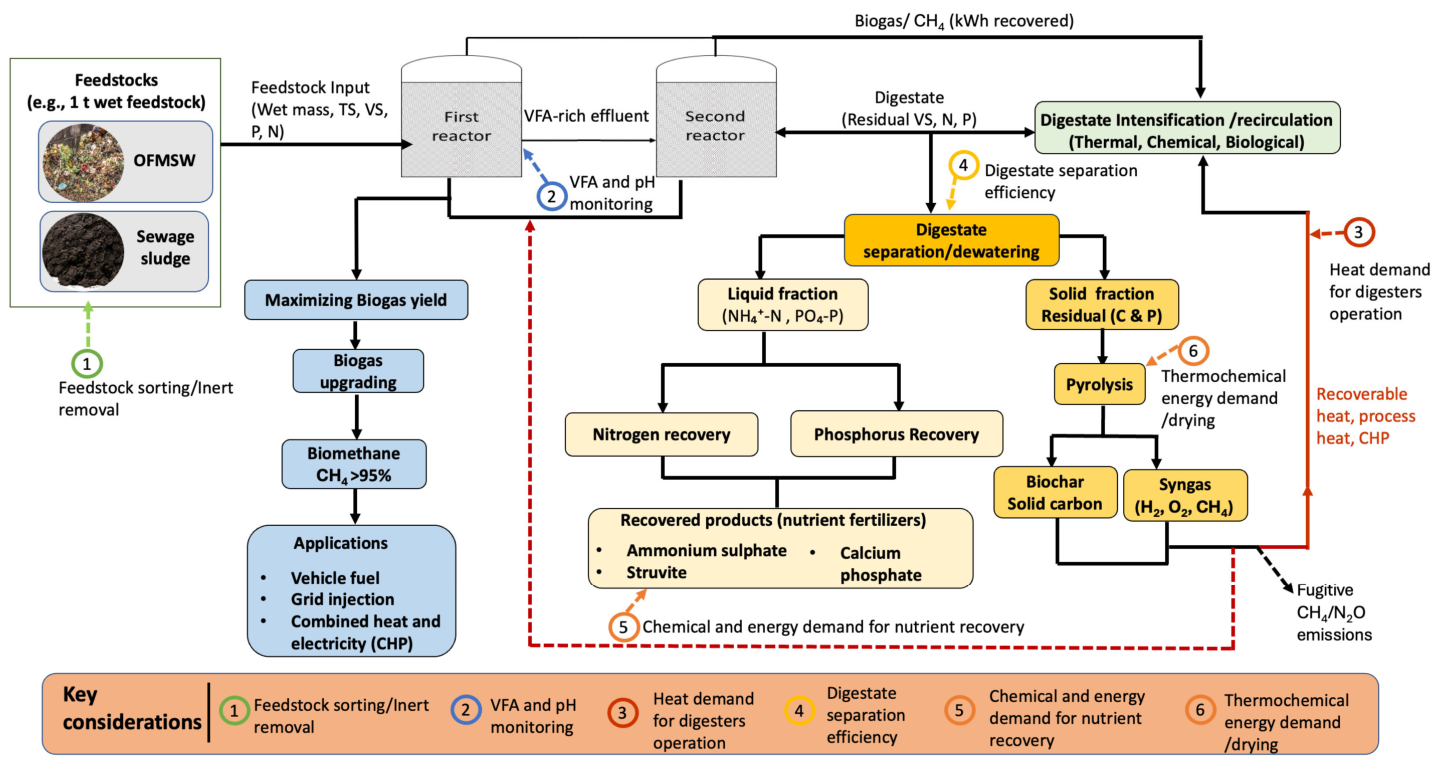
As illustrated in Figure 6, sewage sludge and OFMSW can first be converted into methane-rich biogas through TSAD. After upgrading and CO2 removal, the resulting biomethane can be used for vehicle fuel, grid injection, or combined heat and power production. The remaining digestate still contains residual organic matter, nitrogen, and phosphorus, and can therefore be directed toward separation, nutrient recovery, intensification, recirculation, and thermochemical valorization. In this framework, the main streams to be quantified include feedstock input, VFA-rich effluent, biogas/CH4 recovered, final digestate, liquid and solid fractions, recovered fertilizer products, biochar, syngas, recoverable heat, and fugitive CH4/N2O emissions.
Digestate separation is a key step because it determines how residual carbon, nitrogen, and phosphorus are distributed between the liquid and solid fractions. The liquid fraction can serve as a source of recoverable nitrogen and phosphorus, producing fertilizer products such as ammonium sulfate through ammonia stripping and acid absorption, as well as struvite and calcium phosphate. Digestate post-treatment and recirculation may also improve residual organic matter utilization and methane recovery, although the effect depends on the fraction recirculated. As discussed earlier, intensification technologies such as thermal hydrolysis, steam explosion/flash expansion, ultrasonication, alkaline treatment, and thermo-alkaline treatment can improve solubilization and increase the accessibility of residual particulate or fibrous organic matter before recirculation. The liquid fraction can serve as a source of recoverable nitrogen and phosphorus, producing fertilizer products such as ammonium sulfate through ammonia stripping and acid absorption, as well as struvite and calcium phosphate. Digestate post-treatment and recirculation may also improve residual organic matter utilization and methane recovery, although the effect depends on the fraction recirculated. Liquid-fraction recirculation may decrease the effective C/N ratio due to the return of NH4+-N, whereas prior nitrogen removal can limit its accumulation. Conversely, solid-fraction recirculation retains more particulate organic matter and increases solids retention time, potentially promoting further degradation and methane production [172]. The remaining solid fraction can also be thermochemically converted into biochar, phosphorus-rich products, and syngas.
Thermochemical valorization provides an additional route for recovering energy and carbon from the recalcitrant solid fraction. Pyrolysis or gasification can convert residual solids into biochar and syngas, while recoverable heat from CHP units or thermochemical processes may partly support digester heating, digestate drying, or post-treatment operations. However, the overall benefit of this integration depends on whether the additional methane, syngas, nutrient products, and biochar compensate for the heat demand, electricity use, chemical inputs, drying requirements, gas cleaning, and fugitive emissions.
This study identifies the main streams and assessment criteria needed for future integrated TSAD biorefineries, including feedstock sorting, VFA/pH monitoring, heat demand, digestate separation, nutrient-recovery inputs, thermochemical energy demand, drying requirements, and fugitive CH4/N2O emissions. Fixed mass-flow values were not assigned because complete mass and energy balances are not yet available for integrated SS–OFMSW TSAD systems combining digestate intensification, recirculation, nutrient recovery, and thermochemical valorization.
Integrated TSAD biorefineries also remain challenging to implement. Combining biological conversion, nutrient recovery, recirculation, and thermochemical processes increases operational complexity and requires coordinated mass and energy integration, process control, and techno-economic and environmental assessment. Future research should therefore focus on pilot- and full-scale studies using realistic SS–OFMSW mixtures to confirm whether these systems can become practical resource recovery hubs.

7. Life-Cycle Assessment and Environmental Trade-Offs

Although no complete life-cycle assessment (LCA) has been reported for an integrated TSAD system combining SS–OFMSW co-digestion, digestate intensification, nutrient recovery, and thermochemical valorization, AD and co-digestion LCA studies provide benchmarks. Karolinczak et al. [173] showed that co-digestion of sewage sludge with OFMSW reduced the carbon footprint of biogas-energy production from 1509 g CO2-eq·kWh−1 for sewage-sludge mono-digestion to 872–481 g CO2-eq·kWh−1 as the OFMSW proportion increased. In this study, carbon footprint of digestate management decreased from 1508 g CO2-eq·kWh−1 for sludge mono-digestion to 396 g CO2-eq·kWh−1 for an SS ratio of 25:75. These results show that methane production alone cannot assess sustainability, because digestate management adds comparable environmental burdens.
Azevedo et al. [174] also reported adding 10% fruit and vegetable waste to sewage sludge in a WWTP reduced glabal warming potential (GWP100) from 6.40 × 10⁻² to 6.04 × 10⁻² kg CO2-eq·m−3 of wastewater, a 5.6% reduction. It reduced terrestrial acidification by 13.4%, marine eutrophication by 6.8%, and fossil fuel potential by 4.8%, because biogas production reduced grid-electricity dependence. Psomopoulos et al. [175] found anaerobic digestion with biogas utilization outperformed composting in most categories and became energy-positive, while composting imposed ecosystem and human-health burdens. These findings support integrating AD into waste-management systems, but benefits depend on biogas utilization, energy substitution, and system boundary considered.
For TSAD systems, these results imply that environmental performance should be evaluated using net energy recovery and avoided emissions rather than methane yield alone. Thermophilic operation, feedstock preheating, pumping, mixing, digestate drying, chemical use for nutrient recovery, transport, and fugitive methane emissions may offset benefits from higher methane recovery. This is important because biogenic CH4 remains a potent greenhouse gas, with a 100-year global warming potential of about 27 kg CO2-eq·kg−1 CH4 [176]. Recent work on wastewater biogas systems reported measured methane leakage rates ranging from 0.4% to 65%, while net climate-benefit thresholds were estimated at approximately 2–10% of produced biogas depending on heat recovery, grid-emission intensity, and biogas-use pathway [177].

8. Conclusions

Two-stage anaerobic digestion offers a relevant route for improving the co-treatment of sewage sludge and OFMSW, but its performance remains strongly influenced by substrate characteristics, HRT distribution, OLR, temperature regime, reactor configuration, and operational stability. This review highlights that future research should move beyond evaluating TSAD mainly through methane production and should instead consider its integration with digestate management and resource recovery under realistic operating conditions.
A key limitation in the current literature is that most studies still examine TSAD, digestate post-treatment, recirculation, nutrient recovery, or thermochemical valorization separately. As a result, the combined effects of these pathways on methane recovery, C/N balance, ammonia accumulation, nutrient recovery, energy demand, and process stability remain poorly quantified for SS–OFMSW systems. This limitation becomes particularly important at pilot and industrial volumes, where practical constraints that are not captured in laboratory reactors begin to emerge, including feedstock variability, mixing, heat transfer, pumping, clogging, instrumentation, and digestate handling.
Future work should therefore prioritize integrated pilot- and full-scale studies using real SS–OFMSW mixtures. Particular attention should be given to optimizing digestate recirculation and post-treatment, testing nutrient recovery from liquid and solid fractions under real operating conditions, applying digital monitoring and process-control tools, performing mass and energy balances as well as techno-economic and life-cycle assessments. These efforts are needed to determine whether TSAD can move from an intensified digestion process toward a practical circular biorefinery platform for renewable energy production, nutrient recycling, and sustainable organic waste management.

Author Contributions

Writing—original draft, visualization, validation, formal analysis, methodology, data curation, conceptualization, J.A.A.; writing—review and editing, visualization, validation, supervision, project administration, methodology, funding acquisition, formal analysis, data curation, conceptualization, X.L.; writing–review and editing, visualization, validation, supervision, project administration, methodology, funding acquisition, formal analysis, data curation, conceptualization, L.A.; writing–review and editing, visualization, validation, supervision, project administration, methodology, funding acquisition, formal analysis, data curation, conceptualization, project administration, A.B. (Adrien Belacel); resources, funding acquisition, conceptualization, project administration, A.B. (Antoine Brunet); resources, funding acquisition, conceptualization, project administration, B.R.; resources, funding acquisition, conceptualization, project administration, T.M.; resources, funding acquisition, conceptualization, A.M.; resources, funding acquisition, conceptualization, O.B.; resources, funding acquisition, conceptualization, N.M.; resources, funding acquisition, conceptualization, F.R.; resources, funding acquisition, conceptualization, P.B.; writing—review and editing, visualization, validation, supervision, project administration, methodology, funding acquisition, formal analysis, data curation, conceptualization, A.P.; writing–review & editing, visualization, validation, supervision, project administration, methodology, funding acquisition, formal analysis, data curation, conceptualization, T.R. All authors have read and agreed to the published version of the manuscript.

Funding

This work received funding from the French Ministry of Higher Education and Research (MESR, France), John Cockerill (France) and Sources (France) within the framework of “Cométha” (https://www.cometha.fr/), an innovative partnership led by SIAAP (Syndicat Interdépartemental pour l’Assainissement de l’Agglomération) and SYCTOM (Syndicat mixte central de traitement des ordures ménagères).

Data Availability Statement

No new data were created or analyzed in this study. Data sharing is not applicable to this article.

Acknowledgments

During the preparation of this work, the authors used GPT-5.6 Luna (OpenAI) in order to improve English language. After using these tools, the authors reviewed and edited the content as needed and take full responsibility for the content of the publication.

Conflicts of Interest

Among the co-authors, Adrien Belacel, Thomas Moreau, Alain Magis, Olivier Bernat, and Nabil Mabrouk are employed by John Cockerill Proserpol, while Antoine Brunet, Benjamin Remy, Florian Routhier, and Patrick Billette are employed by Sources France. The remaining authors declare that the research was conducted in the absence of any commercial or financial relationships that could be construed as a potential conflict of interest. The authors declare that this employment did not influence the design of the study, data collection, analysis, interpretation of results, writing of the manuscript, or the decision to submit the manuscript for publication. No other conflicts of interest are declared.

Abbreviations

ADAnaerobic digestion
ADM1Anaerobic Digestion Model No. 1
AIArtificial intelligence
AnCoDAnaerobic co-digestion
BMPBiomethane potential
CAPEXCapital expenditure
CHPCombined heat and power
CODChemical oxygen demand
C/NCarbon-to-nitrogen ratio
EPSExtracellular polymeric substances
FWFood waste
GHGGreenhouse gas
GWPGlobal warming potential
HRTHydraulic retention time
LCALife-cycle assessment
MAcDMesophilic anaerobic co-digestion
MSWMunicipal solid waste
NNitrogen
NH3Free ammonia
NH4+Ammonium
OFMSWOrganic fraction of municipal solid waste
OLROrganic loading rate
OPEXOperating expenditure
PPhosphorus
SMPSpecific methane production
SSSewage sludge
SSADSingle-stage anaerobic digestion
SRTSolid retention time
TAcDThermophilic anaerobic co-digestion
TEATechno-economic assessment
TPADTemperature-phased anaerobic digestion
TSTotal solids
TSADTwo-stage anaerobic digestion
VFAVolatile fatty acids
VSVolatile solids
WWTPWastewater treatment plant

References

  1. Salim, S.S.; Luxembourg, S.L.; Smekens, K.; Dalla Longa, F.; van der Zwaan, B. Pathways to Climate Neutrality: Europe’s Energy Transition under the Green Deal. Renew. Sustain. Energy Rev. 2026, 226, 116272. [Google Scholar] [CrossRef] [Scilit]
  2. Scarlat, N.; Dallemand, J.F.; Fahl, F. Biogas: Developments and Perspectives in Europe. Renew. Energy 2018, 129, 457–472. [Google Scholar] [CrossRef] [Scilit]
  3. Neri, A.; Rizzuni, A.; Garrone, P.; Cagno, E. Influence of Policymakers and Civil Society Stakeholders on Sewage Sludge Management Strategies: Empirical Results from European Utilities. J. Environ. Manag. 2024, 364, 121396. [Google Scholar] [CrossRef] [Scilit] [PubMed]
  4. Angouria-Tsorochidou, E.; Walk, S.; Körner, I.; Thomsen, M. Environmental and Economic Assessment of Household Food Waste Source-Separation Efficiency in a German Case Study. Clean. Waste Syst. 2023, 5, 100092. [Google Scholar] [CrossRef] [Scilit]
  5. Fei, F.; Wen, Z.; Huang, S.; De Clercq, D. Mechanical Biological Treatment of Municipal Solid Waste: Energy Efficiency, Environmental Impact and Economic Feasibility Analysis. J. Clean. Prod. 2018, 178, 731–739. [Google Scholar] [CrossRef] [Scilit]
  6. Zamri, M.F.M.A.; Hasmady, S.; Akhiar, A.; Ideris, F.; Shamsuddin, A.H.; Mofijur, M.; Fattah, I.M.R.; Mahlia, T.M.I. A Comprehensive Review on Anaerobic Digestion of Organic Fraction of Municipal Solid Waste. Renew. Sustain. Energy Rev. 2021, 137, 110637. [Google Scholar] [CrossRef] [Scilit]
  7. Mata-Alvarez, J.; Dosta, J.; Macé, S.; Astals, S. Codigestion of Solid Wastes: A Review of Its Uses and Perspectives Including Modeling. Crit. Rev. Biotechnol. 2011, 31, 99–111. [Google Scholar] [CrossRef] [Scilit] [PubMed]
  8. Tonanzi, B.; Gallipoli, A.; Gianico, A.; Montecchio, D.; Pagliaccia, P.; Rossetti, S.; Braguglia, C.M. Elucidating the Key Factors in Semicontinuous Anaerobic Digestion of Urban Biowaste: The Crucial Role of Sludge Addition in Process Stability, Microbial Community Enrichment and Methane Production. Renew. Energy 2021, 179, 272–284. [Google Scholar] [CrossRef] [Scilit]
  9. Jameel, M.K.; Mustafa, M.A.; Ahmed, H.S.; Mohammed, A.J.; Ghazy, H.; Shakir, M.N.; Lawas, A.M.; Mohammed, S.K.; Idan, A.H.; Mahmoud, Z.H.; et al. Biogas: Production, Properties, Applications, Economic and Challenges: A Review. Results Chem. 2024, 7, 101549. [Google Scholar] [CrossRef] [Scilit]
  10. Paranjpe, A.; Saxena, S.; Jain, P. A Review on Performance Improvement of Anaerobic Digestion Using Co-Digestion of Food Waste and Sewage Sludge. J. Environ. Manag. 2023, 338, 117733. [Google Scholar] [CrossRef] [Scilit] [PubMed]
  11. DelaVega-Quintero, J.C.; Nuñez-Pérez, J.; Lara-Fiallos, M.; Barba, P.; Burbano-García, J.L.; Espín-Valladares, R. Advances and Challenges in Anaerobic Digestion for Biogas Production: Policy, Technological, and Microbial Perspectives. Processes 2025, 13, 3648. [Google Scholar] [CrossRef] [Scilit]
  12. Rajendran, K.; Mahapatra, D.; Venkatraman, A.V.; Muthuswamy, S.; Pugazhendhi, A. Advancing Anaerobic Digestion through Two-Stage Processes: Current Developments and Future Trends. Renew. Sustain. Energy Rev. 2020, 123, 109746. [Google Scholar] [CrossRef] [Scilit]
  13. Gu, J.; Liu, R.; Cheng, Y.; Stanisavljevic, N.; Li, L.; Djatkov, D.; Peng, X.; Wang, X. Anaerobic Co-Digestion of Food Waste and Sewage Sludge under Mesophilic and Thermophilic Conditions: Focusing on Synergistic Effects on Methane Production. Bioresour. Technol. 2020, 301, 122765. [Google Scholar] [CrossRef] [Scilit] [PubMed]
  14. Liu, M.; Li, Y.; Zheng, Z.; Li, L.; Hao, J.; Liu, S.; Wang, Y.; Qi, C. Ordered Changes in Methane Production Performance and Metabolic Pathway Transition of Methanogenic Archaea under Gradually Increasing Sodium Propionate Stress Intensity. Fermentation 2024, 10, 201. [Google Scholar] [CrossRef] [Scilit]
  15. Holl, E.; Steinbrenner, J.; Merkle, W.; Krümpel, J.; Lansing, S.; Baier, U.; Oechsner, H.; Lemmer, A. Two-Stage Anaerobic Digestion: State of Technology and Perspective Roles in Future Energy Systems. Bioresour. Technol. 2022, 360, 127633. [Google Scholar] [CrossRef] [Scilit] [PubMed]
  16. Romio, C.; Kofoed, M.V.W.; Møller, H.B. Digestate Post-Treatment Strategies for Additional Biogas Recovery: A Review. Sustainability 2021, 13, 9295. [Google Scholar] [CrossRef] [Scilit]
  17. Giwa, A.S.; Xu, H.; Fengmin, C.; Wang, B.; Guo, X.; Wang, K. Recalcitrant Organic Residue Compositions and the Resource Recovery from a Food Waste Treatment Facility. J. Mater. Cycles Waste Manag. 2021, 23, 1479–1489. [Google Scholar] [CrossRef] [Scilit]
  18. Kumari, M.; Chandel, M.K. Anaerobic Co-Digestion of Sewage Sludge and Organic Fraction of Municipal Solid Waste: Focus on Mix Ratio Optimization and Synergistic Effects. J. Environ. Manag. 2023, 345, 118821. [Google Scholar] [CrossRef] [Scilit] [PubMed]
  19. Paudel, S.R.; Banjara, S.P.; Choi, O.K.; Park, K.Y.; Kim, Y.M.; Lee, J.W. Pretreatment of Agricultural Biomass for Anaerobic Digestion: Current State and Challenges. Bioresour. Technol. 2017, 245, 1194–1205. [Google Scholar] [CrossRef] [Scilit] [PubMed]
  20. Veluchamy, C.; Kalamdhad, A.S. Influence of Pretreatment Techniques on Anaerobic Digestion of Pulp and Paper Mill Sludge: A Review. Bioresour. Technol. 2017, 245, 1206–1219. [Google Scholar] [CrossRef] [Scilit] [PubMed]
  21. Senevirathne, N.; Kaparaju, P. Enhancing the Agronomic Value of Anaerobic Digestate: A Review of Current vs. Emerging Technologies, Challenges and Future Directions. Agriculture 2025, 15, 2108. [Google Scholar] [CrossRef] [Scilit]
  22. Riaño, B.; Molinuevo-Salces, B.; Vanotti, M.B.; García-González, M.C. Ammonia Recovery from Digestate Using Gas-Permeable Membranes: A Pilot-Scale Study. Environments 2021, 8, 133. [Google Scholar] [CrossRef] [Scilit]
  23. Chen, T.L.; Chen, L.H.; Lin, Y.J.; Yu, C.P.; Ma, H.W.; Chiang, P.C. Advanced Ammonia Nitrogen Removal and Recovery Technology Using Electrokinetic and Stripping Process towards a Sustainable Nitrogen Cycle: A Review. J. Clean. Prod. 2021, 309, 127369. [Google Scholar] [CrossRef] [Scilit]
  24. Liu, D.; Cui, C.; Wu, Y.; Chen, H.; Geng, J.; Xia, J. Highly Efficient Removal of Ammonia Nitrogen from Wastewater by Dielectrophoresis-Enhanced Adsorption. PeerJ 2018, 6, e5001. [Google Scholar] [CrossRef] [Scilit] [PubMed]
  25. Lorick, D.; Macura, B.; Ahlström, M.; Grimvall, A.; Harder, R. Effectiveness of Struvite Precipitation and Ammonia Stripping for Recovery of Phosphorus and Nitrogen from Anaerobic Digestate: A Systematic Review. Environ. Evid. 2020, 9, 27. [Google Scholar] [CrossRef] [Scilit]
  26. André, L.; Agumah, J.A.; Picard, F.; Liu, X.; Moreau, T.; Magis, A.; Bernat, O.; Mabrouk, N.; Routhier, F.; Brunet, A.; et al. Thermophilic and Mesophilic Two-Phase Co-Digestion of the Organic Fraction of Municipal Solid Waste with Sewage Sludge and Equine Manure. Bioresour. Technol. Rep. 2026, 34, 102614. [Google Scholar] [CrossRef] [Scilit]
  27. Hadin, Å.; Eriksson, O.; Hillman, K. A Review of Potential Critical Factors in Horse Keeping for Anaerobic Digestion of Horse Manure. Renew. Sustain. Energy Rev. 2016, 65, 432–442. [Google Scholar] [CrossRef] [Scilit]
  28. Bumharter, C.; Bolonio, D.; Amez, I.; García Martínez, M.J.; Ortega, M.F. New Opportunities for the European Biogas Industry: A Review on Current Installation Development, Production Potentials and Yield Improvements for Manure and Agricultural Waste Mixtures. J. Clean. Prod. 2023, 388, 135867. [Google Scholar] [CrossRef] [Scilit]
  29. Lohani, S.P.; Havukainen, J. Anaerobic Digestion: Factors Affecting Anaerobic Digestion Process. In Waste Bioremediation; Energy, Environment, and Sustainability; Springer: Singapore, 2018; pp. 343–359. [Google Scholar] [CrossRef] [Scilit]
  30. Zito, P.F.; Brunetti, A.; Barbieri, G. Renewable Biomethane Production from Biogas Upgrading via Membrane Separation: Experimental Analysis and Multistep Configuration Design. Renew. Energy 2022, 200, 777–787. [Google Scholar] [CrossRef] [Scilit]
  31. Harirchi, S.; Wainaina, S.; Sar, T.; Nojoumi, S.A.; Parchami, M.; Parchami, M.; Varjani, S.; Khanal, S.K.; Wong, J.; Awasthi, M.K.; et al. Microbiological Insights into Anaerobic Digestion for Biogas, Hydrogen or Volatile Fatty Acids (VFAs): A Review. Bioengineered 2022, 13, 6521–6557. [Google Scholar] [CrossRef] [Scilit] [PubMed]
  32. Akuzawa, M.; Hori, T.; Haruta, S.; Ueno, Y.; Ishii, M.; Igarashi, Y. Distinctive Responses of Metabolically Active Microbiota to Acidification in a Thermophilic Anaerobic Digester. Microb. Ecol. 2011, 61, 595–605. [Google Scholar] [CrossRef] [Scilit] [PubMed]
  33. Agumah, J.; Liu, X.; André, L.; Auneau, C.; Thibault, S.; Bureau, C.; Guérin, S.; Rocher, V.; Lacroix, C.; Chapleur, O.; et al. Mesophilic Anaerobic Digestion of Municipal Sewage Sludge Under High Sodium Propionate Concentrations in Semi-Continuous Conditions: Inhibition and Microbial Community Shifts. Clean Technol. 2026, 8, 89. [Google Scholar] [CrossRef] [Scilit]
  34. Saady, N.M.C. Homoacetogenesis during Hydrogen Production by Mixed Cultures Dark Fermentation: Unresolved Challenge. Int. J. Hydrogen Energy 2013, 38, 13172–13191. [Google Scholar] [CrossRef] [Scilit]
  35. Meegoda, J.N.; Li, B.; Patel, K.; Wang, L.B. A Review of the Processes, Parameters, and Optimization of Anaerobic Digestion. Int. J. Environ. Res. Public Health 2018, 15, 2224. [Google Scholar] [CrossRef] [Scilit] [PubMed]
  36. Cremonez, P.A.; Teleken, J.G.; Weiser Meier, T.R.; Alves, H.J. Two-Stage Anaerobic Digestion in Agroindustrial Waste Treatment: A Review. J. Environ. Manag. 2021, 281, 111854. [Google Scholar] [CrossRef] [Scilit] [PubMed]
  37. Sillero, L.; Perez, M.; Solera, R. Optimisation of Anaerobic Co-Digestion in Two-Stage Systems for Hydrogen, Methane and Biofertiliser Production. Fuel 2024, 365, 131186. [Google Scholar] [CrossRef] [Scilit]
  38. Feng, K.; Wang, Q.; Li, H.; Zhang, Y.; Deng, Z.; Liu, J.; Du, X. Effect of Fermentation Type Regulation Using Alkaline Addition on Two-Phase Anaerobic Digestion of Food Waste at Different Organic Load Rates. Renew. Energy 2020, 154, 385–393. [Google Scholar] [CrossRef] [Scilit]
  39. Pham Van, D.; Takeshi, F.; Hoang Minh, G.; Pham Phu, S.T. Comparison Between Single and Two-Stage Anaerobic Digestion of Vegetable Waste: Kinetics of Methanogenesis and Carbon Flow. Waste Biomass Valorization 2020, 11, 6095–6103. [Google Scholar] [CrossRef] [Scilit]
  40. Akcakaya, M.; Tuncay, S.; Icgen, B. Two-Stage Anaerobic Digestion of Ozonated Sewage Sludge Predominantly Took over by Acetotrophic Methanogens with Increased Biogas and Methane Production. Fuel 2022, 317, 123434. [Google Scholar] [CrossRef] [Scilit]
  41. Ponsá, S.; Gea, T.; Sánchez, A. Anaerobic Co-Digestion of the Organic Fraction of Municipal Solid Waste with Several Pure Organic Co-Substrates. Biosyst. Eng. 2011, 108, 352–360. [Google Scholar] [CrossRef] [Scilit]
  42. Tyagi, V.K.; Fdez-Güelfo, L.A.; Zhou, Y.; Álvarez-Gallego, C.J.; Garcia, L.I.R.; Ng, W.J. Anaerobic Co-Digestion of Organic Fraction of Municipal Solid Waste (OFMSW): Progress and Challenges. Renew. Sustain. Energy Rev. 2018, 93, 380–399. [Google Scholar] [CrossRef] [Scilit]
  43. Nayak, J.K.; Ranade, V.V. Valorisation of Digestate: Characteristics, Products, Processes and Potential. Chem. Eng. J. Adv. 2025, 24, 100887. [Google Scholar] [CrossRef] [Scilit]
  44. Chojnacka, K.; Moustakas, K. Anaerobic Digestate Management for Carbon Neutrality and Fertilizer Use: A Review of Current Practices and Future Opportunities. Biomass Bioenergy 2024, 180, 106991. [Google Scholar] [CrossRef] [Scilit]
  45. Kumar, A.; Samadder, S.R. Performance Evaluation of Anaerobic Digestion Technology for Energy Recovery from Organic Fraction of Municipal Solid Waste: A Review. Energy 2020, 197, 117253. [Google Scholar] [CrossRef] [Scilit]
  46. Deena, S.R.; Vickram, A.S.; Manikandan, S.; Subbaiya, R.; Karmegam, N.; Ravindran, B.; Chang, S.W.; Awasthi, M.K. Enhanced Biogas Production from Food Waste and Activated Sludge Using Advanced Techniques—A Review. Bioresour. Technol. 2022, 355, 127234. [Google Scholar] [CrossRef] [Scilit] [PubMed]
  47. Nanda, S.; Berruti, F. Municipal Solid Waste Management and Landfilling Technologies: A Review. Environ. Chem. Lett. 2021, 19, 1433–1456. [Google Scholar] [CrossRef] [Scilit]
  48. Angelonidi, E.; Smith, S.R. A Comparison of Wet and Dry Anaerobic Digestion Processes for the Treatment of Municipal Solid Waste and Food Waste. Water Environ. J. 2015, 29, 549–557. [Google Scholar] [CrossRef] [Scilit]
  49. Stylianou, E.; Pateraki, C.; Ladakis, D.; Cruz-Fernández, M.; Latorre-Sánchez, M.; Coll, C.; Koutinas, A. Evaluation of Organic Fractions of Municipal Solid Waste as Renewable Feedstock for Succinic Acid Production. Biotechnol. Biofuels 2020, 13, 72. [Google Scholar] [CrossRef] [Scilit] [PubMed]
  50. Jiang, H.; Wang, S.; Li, B.; Feng, L.; Zhai, L.; Zhou, H.; Li, Y.; Pan, J. Anaerobic Digestion of Organic Fraction of Municipal Solid Waste Using a Novel Two-Stage Solid-Liquid System. J. Clean. Prod. 2022, 370, 133521. [Google Scholar] [CrossRef] [Scilit]
  51. Nguyen, K.L.P.; Chuang, Y.H.; Chen, H.W.; Chang, C.C. Impacts of Socioeconomic Changes on Municipal Solid Waste Characteristics in Taiwan. Resour. Conserv. Recycl. 2020, 161, 104931. [Google Scholar] [CrossRef] [Scilit]
  52. Zhu, X.; Blanco, E.; Bhatti, M.; Borrion, A. Mitigating Overload-Induced Stress in Anaerobic Digestion: Long-Term Performance and Fate of Nano Magnetite Additives. Water Res. 2025, 286, 124241. [Google Scholar] [CrossRef] [Scilit] [PubMed]
  53. Nabaterega, R.; Kumar, V.; Khoei, S.; Eskicioglu, C. A Review on Two-Stage Anaerobic Digestion Options for Optimizing Municipal Wastewater Sludge Treatment Process. J. Environ. Chem. Eng. 2021, 9, 105502. [Google Scholar] [CrossRef] [Scilit]
  54. Pan, N.; Wang, H.; Tian, Y.; Chorukova, E.; Simeonov, I.; Christov, N. Comparison Study of Dynamic Models for One-Stage and Two-Stage Anaerobic Digestion Processes; Elsevier: Amsterdam, The Netherlands, 2022; Volume 55, pp. 667–672. [Google Scholar]
  55. Wang, T.; Chen, J.; Shen, H.; An, D. Effects of Total Solids Content on Waste Activated Sludge Thermophilic Anaerobic Digestion and Its Sludge Dewaterability. Bioresour. Technol. 2016, 217, 265–270. [Google Scholar] [CrossRef] [Scilit] [PubMed]
  56. Cheong, W.L.; Chan, Y.J.; Tiong, T.J.; Chong, W.C.; Kiatkittipong, W.; Kiatkittipong, K.; Mohamad, M.; Daud, H.; Suryawan, I.W.K.; Sari, M.M.; et al. Anaerobic Co-Digestion of Food Waste with Sewage Sludge: Simulation and Optimization for Maximum Biogas Production. Water Switz. 2022, 14, 1075. [Google Scholar] [CrossRef] [Scilit]
  57. Campuzano, R.; González-Martínez, S. Characteristics of the Organic Fraction of Municipal Solid Waste and Methane Production: A Review. Waste Manag. 2016, 54, 3–12. [Google Scholar] [CrossRef] [Scilit] [PubMed]
  58. Zhu, B.; Zhang, R.; Gikas, P.; Rapport, J.; Jenkins, B.; Li, X. Biogas Production from Municipal Solid Wastes Using an Integrated Rotary Drum and Anaerobic-Phased Solids Digester System. Bioresour. Technol. 2010, 101, 6374–6380. [Google Scholar] [CrossRef] [Scilit] [PubMed]
  59. Fan, Y.; Li, Q.; Fonseca, F.G.; Song, J.; Gong, M. Optimizing the Extraction of Sugars from Sewage Sludge Using Ultrasound Combined with Thermal–Alkali. Water Switz. 2024, 16, 1289. [Google Scholar] [CrossRef] [Scilit]
  60. Sawatdeenarunat, C.; Surendra, K.C.; Takara, D.; Oechsner, H.; Khanal, S.K. Anaerobic Digestion of Lignocellulosic Biomass: Challenges and Opportunities. Bioresour. Technol. 2015, 178, 178–186. [Google Scholar] [CrossRef] [Scilit] [PubMed]
  61. Agoe, A.K.; Poulopoulos, S.G.; Sarbassov, Y.; Shah, D. Investigation of Sewage Sludge–Derived Biochar for Enhanced Pollutant Adsorption: Effect of Particle Size and Alkali Treatment. Energies 2024, 17, 4554. [Google Scholar] [CrossRef] [Scilit]
  62. Guo, H.; Van Lier, J.B.; De Kreuk, M. Digestibility of Waste Aerobic Granular Sludge from a Full-Scale Municipal Wastewater Treatment System. Water Res. 2020, 173, 115617. [Google Scholar] [CrossRef] [Scilit] [PubMed]
  63. Zhang, Y.; Banks, C.J. Impact of Different Particle Size Distributions on Anaerobic Digestion of the Organic Fraction of Municipal Solid Waste. Waste Manag. 2013, 33, 297–307. [Google Scholar] [CrossRef] [Scilit] [PubMed]
  64. Paul, P.; Stephane, K.L.; Mayigue, C.; Sorel, C.-D.V.; Osée, M.; Derbetini Appolinaire, V. Potential Assessment of Biomethane Fuel Production from Municipal Sewage Plant Sludge: Kinetic Modeling Studies and Techno-Economic Analysis. Results Eng. 2025, 27, 106312. [Google Scholar] [CrossRef] [Scilit]
  65. Nielfa, A.; Cano, R.; Fdz-Polanco, M. Theoretical Methane Production Generated by the Co-Digestion of Organic Fraction Municipal Solid Waste and Biological Sludge. Biotechnol. Rep. 2015, 5, 14–21. [Google Scholar] [CrossRef] [Scilit] [PubMed]
  66. Náthia-Neves, G.; Berni, M.; Dragone, G.; Mussatto, S.I.; Forster-Carneiro, T. Anaerobic Digestion Process: Technological Aspects and Recent Developments. Int. J. Environ. Sci. Technol. 2018, 15, 2033–2046. [Google Scholar] [CrossRef] [Scilit]
  67. Kothari, R.; Pandey, A.K.; Kumar, S.; Tyagi, V.V.; Tyagi, S.K. Different Aspects of Dry Anaerobic Digestion for Bio-Energy: An Overview. Renew. Sustain. Energy Rev. 2014, 39, 174–195. [Google Scholar] [CrossRef] [Scilit]
  68. Azizi, A.; Hosseini Koupaie, E.; Hafez, H.; Elbeshbishy, E. Improving Single- and Two-Stage Anaerobic Digestion of Source Separated Organics by Hydrothermal Pretreatment. Biochem. Eng. J. 2019, 148, 77–86. [Google Scholar] [CrossRef] [Scilit]
  69. Menon, A.; Wang, J.Y.; Giannis, A. Optimization of Micronutrient Supplement for Enhancing Biogas Production from Food Waste in Two-Phase Thermophilic Anaerobic Digestion. Waste Manag. 2017, 59, 465–475. [Google Scholar] [CrossRef] [Scilit] [PubMed]
  70. Majhi, B.K.; Jash, T. Two-Phase Anaerobic Digestion of Vegetable Market Waste Fraction of Municipal Solid Waste and Development of Improved Technology for Phase Separation in Two-Phase Reactor. Waste Manag. 2016, 58, 152–159. [Google Scholar] [CrossRef] [Scilit] [PubMed]
  71. Li, B.; Dong, Z.; Yue, Y.; Xu, C.; Li, Z.; Yu, J.; Hu, T. Hydrogen and Methane Production in a Two-Stage Thermophilic Anaerobic Digestion System by Co-Digestion of Kitchen Waste and Municipal Sewage Sludge with a High Solid Content. Environ. Eng. Sci. 2023, 40, 253–261. [Google Scholar] [CrossRef] [Scilit]
  72. Riau, V.; De la Rubia, M.Á.; Pérez, M. Temperature-Phased Anaerobic Digestion (TPAD) to Obtain Class A Biosolids: A Semi-Continuous Study. Bioresour. Technol. 2010, 101, 2706–2712. [Google Scholar] [CrossRef] [Scilit] [PubMed]
  73. Borowski, S. Temperature-Phased Anaerobic Digestion of the Hydromechanically Separated Organic Fraction of Municipal Solid Waste with Sewage Sludge. Int. Biodeterior. Biodegrad. 2015, 105, 106–113. [Google Scholar] [CrossRef] [Scilit]
  74. Bolzonella, D.; Cavinato, C.; Fatone, F.; Pavan, P.; Cecchi, F. High Rate Mesophilic, Thermophilic, and Temperature Phased Anaerobic Digestion of Waste Activated Sludge: A Pilot Scale Study. Waste Manag. 2012, 32, 1196–1201. [Google Scholar] [CrossRef] [Scilit] [PubMed]
  75. Shen, F.; Yuan, H.; Pang, Y.; Chen, S.; Zhu, B.; Zou, D.; Liu, Y.; Ma, J.; Yu, L.; Li, X. Performances of Anaerobic Co-Digestion of Fruit & Vegetable Waste (FVW) and Food Waste (FW): Single-Phase vs. Two-Phase. Bioresour. Technol. 2013, 144, 80–85. [Google Scholar] [CrossRef] [Scilit] [PubMed]
  76. Paranjpe, A.; Saxena, S.; Jain, P. Biogas Yield Using Single and Two Stage Anaerobic Digestion: An Experimental Approach. Energy Sustain. Dev. 2023, 74, 6–19. [Google Scholar] [CrossRef] [Scilit]
  77. Wang, F.; Li, W.Y.; Yi, X.N. Two-Phase Anaerobic Co-Digestion of Food Waste and Sewage Sludge. Water Sci. Technol. 2015, 71, 52–58. [Google Scholar] [CrossRef] [Scilit] [PubMed]
  78. Ge, H.; Jensen, P.D.; Batstone, D.J. Pre-Treatment Mechanisms during Thermophilic-Mesophilic Temperature Phased Anaerobic Digestion of Primary Sludge. Water Res. 2010, 44, 123–130. [Google Scholar] [CrossRef] [Scilit] [PubMed]
  79. Fernández-Rodríguez, J.; Pérez, M.; Romero, L.I. Semicontinuous Temperature-Phased Anaerobic Digestion (TPAD) of Organic Fraction of Municipal Solid Waste (OFMSW). Comparison with Single-Stage Processes. Chem. Eng. J. 2016, 285, 409–416. [Google Scholar] [CrossRef] [Scilit]
  80. Grimberg, S.J.; Hilderbrandt, D.; Kinnunen, M.; Rogers, S. Anaerobic Digestion of Food Waste through the Operation of a Mesophilic Two-Phase Pilot Scale Digester—Assessment of Variable Loadings on System Performance. Bioresour. Technol. 2015, 178, 226–229. [Google Scholar] [CrossRef] [Scilit] [PubMed]
  81. Fernández-Rodríguez, J.; Pérez, M.; Romero, L.I. Temperature-Phased Anaerobic Digestion of Industrial Organic Fraction of Municipal Solid Waste: A Batch Study. Chem. Eng. J. 2015, 270, 597–604. [Google Scholar] [CrossRef] [Scilit]
  82. Wu, L.J.; Kobayashi, T.; Li, Y.Y.; Xu, K.Q. Comparison of Single-Stage and Temperature-Phased Two-Stage Anaerobic Digestion of Oily Food Waste. Energy Convers. Manag. 2015, 106, 1174–1182. [Google Scholar] [CrossRef] [Scilit]
  83. Jiang, W.; Tao, J.; Luo, J.; Xie, W.; Zhou, X.; Cheng, B.; Guo, G.; Ngo, H.H.; Guo, W.; Cai, H.; et al. Pilot-Scale Two-Phase Anaerobic Digestion of Deoiled Food Waste and Waste Activated Sludge: Effects of Mixing Ratios and Functional Analysis. Chemosphere 2023, 329, 138653. [Google Scholar] [CrossRef] [Scilit] [PubMed]
  84. Baldi, F.; Pecorini, I.; Iannelli, R. Comparison of Single-Stage and Two-Stage Anaerobic Co-Digestion of Food Waste and Activated Sludge for Hydrogen and Methane Production. Renew. Energy 2019, 143, 1755–1765. [Google Scholar] [CrossRef] [Scilit]
  85. Simeonov, I.; Chorukova, E.; Kabaivanova, L. Two-Stage Anaerobic Digestion for Green Energy Production: A Review. Processes 2025, 13, 294. [Google Scholar] [CrossRef] [Scilit]
  86. Lima Garção, M.I.; Müller, J.; Lemmer, A. Scale-Up of a Two-Stage Anaerobic Digestion System: From Laboratory Reactor to Pilot Plant. Fermentation 2026, 12, 255. [Google Scholar] [CrossRef] [Scilit]
  87. Kumar, D.; Murthy, G.S. Impact of Pretreatment and Downstream Processing Technologies on Economics and Energy in Cellulosic Ethanol Production. Biotechnol. Biofuels 2011, 4, 27. [Google Scholar] [CrossRef] [Scilit] [PubMed]
  88. Jain, S.; Kumar, S. Advances and Challenges in Pretreatment Technologies for Bioethanol Production: A Comprehensive Review. Sustain. Chem. Clim. Action 2024, 5, 100053. [Google Scholar] [CrossRef] [Scilit]
  89. Sant’Ana Júnior, D.B.; Kelbert, M.; Hermes De Araújo, P.H.; De Andrade, C.J. Physical Pretreatments of Lignocellulosic Biomass for Fermentable Sugar Production. Sustain. Chem. 2025, 6, 13. [Google Scholar] [CrossRef] [Scilit]
  90. Darmey, J.; Narra, S.; Achaw, O.-W.; Stinner, W.; Ahiekpor, J.C.; Ansah, H.F.; N’guessan, B.A.; Agyekum, T.O.; Nutakor, E.M.K. A Review of Pretreatment Strategies for Anaerobic Digestion: Unlocking the Biogas Generation Potential of Wastes in Ghana. Waste 2025, 3, 24. [Google Scholar] [CrossRef] [Scilit]
  91. Appels, L.; Lauwers, J.; Degrève, J.; Helsen, L.; Lievens, B.; Willems, K.; Van Impe, J.; Dewil, R. Anaerobic Digestion in Global Bio-Energy Production: Potential and Research Challenges. Renew. Sustain. Energy Rev. 2011, 15, 4295–4301. [Google Scholar] [CrossRef] [Scilit]
  92. Alrowais, R.; Said, N.; Al-Otaibi, A.; Hatata, A.Y.; Essa, M.A.; Abdel Daiem, M.M. Comparing the Effect of Mesophilic and Thermophilic Anaerobic Co-Digestion for Sustainable Biogas Production: An Experimental and Recurrent Neural Network Model Study. J. Clean. Prod. 2023, 392, 136248. [Google Scholar] [CrossRef] [Scilit]
  93. De Vrieze, J.; Smet, D.; Klok, J.; Colsen, J.; Angenent, L.T.; Vlaeminck, S.E. Thermophilic Sludge Digestion Improves Energy Balance and Nutrient Recovery Potential in Full-Scale Municipal Wastewater Treatment Plants. Bioresour. Technol. 2016, 218, 1237–1245. [Google Scholar] [CrossRef] [Scilit] [PubMed]
  94. Rios, R.; Marin-Calvo, N.; Deago, E. Thermal and Dynamic Behavior of Anaerobic Digesters Under Neotropical Conditions: A Review. Energies 2026, 19, 1838. [Google Scholar] [CrossRef] [Scilit]
  95. Mo, R.; Guo, W.; Batstone, D.; Makinia, J.; Li, Y. Modifications to the Anaerobic Digestion Model No. 1 (ADM1) for Enhanced Understanding and Application of the Anaerobic Treatment Processes—A Comprehensive Review. Water Res. 2023, 244, 120504. [Google Scholar] [CrossRef] [Scilit] [PubMed]
  96. Blumensaat, F.; Keller, J. Modelling of Two-Stage Anaerobic Digestion Using the IWA Anaerobic Digestion Model No. 1 (ADM1). Water Res. 2005, 39, 171–183. [Google Scholar] [CrossRef] [Scilit] [PubMed]
  97. Batstone, D.J.; Puyol, D.; Flores-Alsina, X.; Rodríguez, J. Mathematical Modelling of Anaerobic Digestion Processes: Applications and Future Needs. Rev. Environ. Sci. Biotechnol. 2015, 14, 595–613. [Google Scholar] [CrossRef] [Scilit]
  98. Batstone, D.J.; Keller, J.; Angelidaki, I.; Kalyuzhnyi, S.V.; Pavlostathis, S.G.; Rozzi, A.; Sanders, W.T.M.; Siegrist, H.; Vavilin, V.A. The IWA Anaerobic Digestion Model No 1 (ADM1). Water Sci. Technol. 2002, 45, 65–73. [Google Scholar] [CrossRef] [Scilit]
  99. Ganeshan, P.; Bose, A.; Lee, J.; Barathi, S.; Rajendran, K. Machine Learning for High Solid Anaerobic Digestion: Performance Prediction and Optimization. Bioresour. Technol. 2024, 400, 130665. [Google Scholar] [CrossRef] [Scilit] [PubMed]
  100. Tisocco, S.; Weinrich, S.; Møller, H.B.; Ward, A.J.; Kilmartin, L.; Zhan, X.; Crosson, P. Machine Learning vs. ADM1: Reliable Biogas Prediction with Minimal Data Requirements in Full-Scale Plants. Environ. Sci. Ecotechnol. 2026, 29, 100662. [Google Scholar] [CrossRef] [Scilit] [PubMed]
  101. Kim, M.; Kim, D.; Park, C.; Kim, M.; Lee, W.; Cui, F. Development of Artificial Neural Network Model for Anaerobic Digestion-Elutriated Phase Treatment. J. Environ. Manag. 2025, 379, 124814. [Google Scholar] [CrossRef] [Scilit] [PubMed]
  102. Ge, Y.; Tao, J.; Wang, Z.; Mu, L.; Guo, W.; Cheng, Z.; Yan, B.; Shi, Y.; Su, H.; Chen, G. A Hybrid Approach of Anaerobic Digestion Model No. 1 and Machine Learning to Model and Optimize Continuous Anaerobic Digestion Processes. Biomass Bioenergy 2024, 184, 107176. [Google Scholar] [CrossRef] [Scilit]
  103. Ge, Y.; Tao, J.; Wang, Z.; Chen, C.; Mu, L.; Ruan, H.; Rodríguez Yon, Y.; Su, H.; Yan, B.; Chen, G. Modification of Anaerobic Digestion Model No.1 with Machine Learning Models towards Applicable and Accurate Simulation of Biomass Anaerobic Digestion. Chem. Eng. J. 2023, 454, 140369. [Google Scholar] [CrossRef] [Scilit]
  104. Mazzanti, G.; Demichelis, F.; Fino, D.; Tommasi, T. A Closed-Loop Valorization of the Waste Biomass through Two-Stage Anaerobic Digestion and Digestate Exploitation. Renew. Sustain. Energy Rev. 2025, 207, 114938. [Google Scholar] [CrossRef] [Scilit]
  105. Herkowiak, M.; Adamski, M.; Marek, P.; Waliszewska, B.; Dzida, K.; Kapłan, M.; Klimek, K.E. Development of Digestate for Energy Purposes Using Excess Heat from Biogas Plants. Energies 2025, 18, 4896. [Google Scholar] [CrossRef] [Scilit]
  106. Chen, Y.; Yang, H.; Zhao, Z.; Zou, H.; Zhu, R.; Jiang, Q.; Sun, T.; Li, M.; Li, L.; Shi, D.; et al. Comprehensively Evaluating the Digestive Performance of Sludge with Different Lignocellulosic Components in Mesophilic Anaerobic Digester. Bioresour. Technol. 2019, 293, 122042. [Google Scholar] [CrossRef] [Scilit] [PubMed]
  107. Carrere, H.; Antonopoulou, G.; Affes, R.; Passos, F.; Battimelli, A.; Lyberatos, G.; Ferrer, I. Review of Feedstock Pretreatment Strategies for Improved Anaerobic Digestion: From Lab-Scale Research to Full-Scale Application. Bioresour. Technol. 2016, 199, 386–397. [Google Scholar] [CrossRef] [Scilit] [PubMed]
  108. Liu, X.; Lendormi, T.; Lanoisellé, J.-L. Overview of Hygienization Pretreatment for Pasteurization and Methane Potential Enhancement of Biowaste: Challenges, State of the Art and Alternative Technologies. J. Clean. Prod. 2019, 236, 117525. [Google Scholar] [CrossRef] [Scilit]
  109. Shah, F.A.; Mahmood, Q.; Rashid, N.; Pervez, A.; Raja, I.A.; Shah, M.M. Co-Digestion, Pretreatment and Digester Design for Enhanced Methanogenesis. Renew. Sustain. Energy Rev. 2015, 42, 627–642. [Google Scholar] [CrossRef] [Scilit]
  110. Hendriks, A.T.W.M.; Zeeman, G. Pretreatments to Enhance the Digestibility of Lignocellulosic Biomass. Bioresour. Technol. 2009, 100, 10–18. [Google Scholar] [CrossRef] [Scilit] [PubMed]
  111. Munshi, F.M.A.; Almegbl, A.M.; Rahmani, A.M.; Khursheed, A.; Ali, M.; Khursheed, A. Thermal Chemical Pretreatment of Waste-Activated Sludge for Enhanced Solubilization and Biogas Production: A Review. Water Reuse 2024, 14, 459–480. [Google Scholar] [CrossRef] [Scilit]
  112. Meenakshisundaram, S.; Fayeulle, A.; Léonard, E.; Ceballos, C.; Liu, X.; Pauss, A. Combined Biological and Chemical/Physicochemical Pretreatment Methods of Lignocellulosic Biomass for Bioethanol and Biomethane Energy Production—A Review. Appl. Microbiol. 2022, 2, 716–734. [Google Scholar] [CrossRef] [Scilit]
  113. Pasalari, H.; Gharibi, H.; Darvishali, S.; Farzadkia, M. The Effects of Different Pretreatment Technologies on Microbial Community in Anaerobic Digestion Process: A Systematic Review. J. Environ. Health Sci. Eng. 2024, 22, 439–453. [Google Scholar] [CrossRef] [Scilit] [PubMed]
  114. Tsapekos, P.; Kougias, P.G.; Frison, A.; Raga, R.; Angelidaki, I. Improving Methane Production from Digested Manure Biofibers by Mechanical and Thermal Alkaline Pretreatment. Bioresour. Technol. 2016, 216, 545–552. [Google Scholar] [CrossRef] [Scilit] [PubMed]
  115. Nielsen, H.B.; Thygesen, A.; Thomsen, A.B.; Schmidt, J.E. Anaerobic Digestion of Waste Activated Sludge—Comparison of Thermal Pretreatments with Thermal Inter-stage Treatments. J. Chem. Technol. Biotechnol. 2011, 86, 238–245. [Google Scholar] [CrossRef] [Scilit]
  116. Takashima, M.; Tanaka, Y. Acidic Thermal Post-Treatment for Enhancing Anaerobic Digestion of Sewage Sludge. J. Environ. Chem. Eng. 2014, 2, 773–779. [Google Scholar] [CrossRef] [Scilit]
  117. Rizzioli, F.; Cirilli, M.; Frison, N.; Bolzonella, D.; Battista, F. Nutrient Recovery from Anaerobic Digestate by Different Combination of Pressure Driven Membranes. J. Clean. Prod. 2025, 494, 144958. [Google Scholar] [CrossRef] [Scilit]
  118. Khan, M.U.; Usman, M.; Ashraf, M.A.; Dutta, N.; Luo, G.; Zhang, S. A Review of Recent Advancements in Pretreatment Techniques of Lignocellulosic Materials for Biogas Production: Opportunities and Limitations. Chem. Eng. J. Adv. 2022, 10, 100263. [Google Scholar] [CrossRef] [Scilit]
  119. Axelsson Bjerg, M.; Ekstrand, E.M.; Sundgren, I.; Shakeri Yekta, S.; Moestedt, J.; Björn, A. Moderate Thermal Post-Treatment of Digestate to Improve Biomethane Production from Agricultural- and Food Waste. Bioresour. Technol. Rep. 2024, 27, 101887. [Google Scholar] [CrossRef] [Scilit]
  120. Menardo, S.; Balsari, P.; Dinuccio, E.; Gioelli, F. Thermal Pre-Treatment of Solid Fraction from Mechanically-Separated Raw and Digested Slurry to Increase Methane Yield. Bioresour. Technol. 2011, 102, 2026–2032. [Google Scholar] [CrossRef] [Scilit] [PubMed]
  121. Somers, M.H.; Azman, S.; Sigurnjak, I.; Ghyselbrecht, K.; Meers, E.; Meesschaert, B.; Appels, L. Effect of Digestate Disintegration on Anaerobic Digestion of Organic Waste. Bioresour. Technol. 2018, 268, 568–576. [Google Scholar] [CrossRef] [Scilit] [PubMed]
  122. Bruni, E.; Jensen, A.P.; Angelidaki, I. Comparative Study of Mechanical, Hydrothermal, Chemical and Enzymatic Treatments of Digested Biofibers to Improve Biogas Production. Bioresour. Technol. 2010, 101, 8713–8717. [Google Scholar] [CrossRef] [Scilit] [PubMed]
  123. Díaz, I.; Díaz-Curbelo, A.; Ignacio Matute, K.; Fdz-Polanco, M.; Pérez-Elvira, S.I. Influence of the Operating Conditions of the Intermediate Thermal Hydrolysis on the Energetic Efficiency of the Sludge Treatment Process. Bioresour. Technol. 2021, 333, 125114. [Google Scholar] [CrossRef] [Scilit] [PubMed]
  124. Ortega-Martinez, E.; Sapkaite, I.; Fdz-Polanco, F.; Donoso-Bravo, A. From Pre-Treatment toward Inter-Treatment. Getting Some Clues from Sewage Sludge Biomethanation. Bioresour. Technol. 2016, 212, 227–235. [Google Scholar] [CrossRef] [Scilit] [PubMed]
  125. Bjerg-Nielsen, M.; Ward, A.J.; Møller, H.B.; Ottosen, L.D.M. Influence on Anaerobic Digestion by Intermediate Thermal Hydrolysis of Waste Activated Sludge and Co-Digested Wheat Straw. Waste Manag. 2018, 72, 186–192. [Google Scholar] [CrossRef] [Scilit] [PubMed]
  126. Khan, M.U.; Ahring, B.K. Pretreatment of Digested Manure Fibers at High Temperature (185 °C) with Lime Added Enhances Methane Production. Biocatal. Agric. Biotechnol. 2022, 44, 102460. [Google Scholar] [CrossRef] [Scilit]
  127. Navarro, B.B.; Machado, M.J.; Figueira, A. Nitrogen Use Efficiency in Agriculture: Integrating Biotechnology, Microbiology, and Novel Delivery Systems for Sustainable Agriculture. Plants 2025, 14, 2974. [Google Scholar] [CrossRef] [Scilit] [PubMed]
  128. Smith, C.; Hill, A.K.; Torrente-Murciano, L. Current and Future Role of Haber–Bosch Ammonia in a Carbon-Free Energy Landscape. Energy Environ. Sci. 2020, 13, 331–344. [Google Scholar] [CrossRef] [Scilit]
  129. Li, Y.; Zhu, J.; Tang, Y.; Shi, X.; Anwar, S.; Wang, J.; Gao, L.; Zhang, J. Impact of Varying Mass Concentrations of Ammonia Nitrogen on Biogas Production and System Stability of Anaerobic Fermentation. Agriculture 2023, 13, 1645. [Google Scholar] [CrossRef] [Scilit]
  130. Logan, M.; Visvanathan, C. Management Strategies for Anaerobic Digestate of Organic Fraction of Municipal Solid Waste: Current Status and Future Prospects. Waste Manag. Res. J. Sustain. Circ. Econ. 2019, 37, 27–39. [Google Scholar] [CrossRef] [Scilit] [PubMed]
  131. Abdelfatah-Aldayyat, E.; González-Rojo, S.; Gómez, X. Reviewing Digestate Thermal Valorization: Focusing on the Energy Demand and the Treatment of Process Water. Environments 2024, 11, 239. [Google Scholar] [CrossRef] [Scilit]
  132. Farghali, M.; Chen, Z.; Osman, A.I.; Ali, I.M.; Hassan, D.; Ihara, I.; Rooney, D.W.; Yap, P.-S. Strategies for Ammonia Recovery from Wastewater: A Review. Environ. Chem. Lett. 2024, 22, 2699–2751. [Google Scholar] [CrossRef] [Scilit]
  133. Xiang, S.; Liu, Y.; Zhang, G.; Ruan, R.; Wang, Y.; Wu, X.; Zheng, H.; Zhang, Q.; Cao, L. New Progress of Ammonia Recovery during Ammonia Nitrogen Removal from Various Wastewaters. World J. Microbiol. Biotechnol. 2020, 36, 144. [Google Scholar] [CrossRef] [Scilit] [PubMed]
  134. Abbà, A.; Domini, M.; Baldi, M.; Pedrazzani, R.; Bertanza, G. Ammonia Recovery from Livestock Manure Digestate through an Air-Bubble Stripping Reactor: Evaluation of Performance and Energy Balance. Energies 2023, 16, 1643. [Google Scholar] [CrossRef] [Scilit]
  135. Sewunet, H.Y.; Chowdhary, A.K.; Xia, Y.; Sekine, M.; Bhatia, P.; Woldie, A.A.; Toda, T. Optimizing Ammonium Supply Strategies for Mitigation of Free Ammonia Inhibition in the Mass Cultivation of Limnospira Fusiformis. Biochem. Eng. J. 2026, 227, 110018. [Google Scholar] [CrossRef] [Scilit]
  136. Kim, E.J.; Kim, H.; Lee, E. Influence of Ammonia Stripping Parameters on the Efficiency and Mass Transfer Rate of Ammonia Removal. Appl. Sci. Switz. 2021, 11, 441. [Google Scholar] [CrossRef] [Scilit]
  137. Zangeneh, A.; Sabzalipour, S.; Takdatsan, A.; Yengejeh, R.J.; Khafaie, M.A. Ammonia Removal Form Municipal Wastewater by Air Stripping Process: An Experimental Study. S. Afr. J. Chem. Eng. 2021, 36, 134–141. [Google Scholar] [CrossRef] [Scilit]
  138. Yin, S.; Chen, K.; Srinivasakannan, C.; Guo, S.; Li, S.; Peng, J.; Zhang, L. Enhancing Recovery of Ammonia from Rare Earth Wastewater by Air Stripping Combination of Microwave Heating and High Gravity Technology. Chem. Eng. J. 2018, 337, 515–521. [Google Scholar] [CrossRef] [Scilit]
  139. Liu, L.; Pang, C.; Wu, S.; Dong, R. Optimization and Evaluation of an Air-Recirculated Stripping for Ammonia Removal from the Anaerobic Digestate of Pig Manure. Process Saf. Environ. Prot. 2015, 94, 350–357. [Google Scholar] [CrossRef] [Scilit]
  140. Sakar, H.; Soares, A. Ammonia Recovery from Ion Exchange Brine via Hollow Fibre Membrane Contactors: Operational Insights and Product Formation. Chem. Eng. J. 2025, 523, 167872. [Google Scholar] [CrossRef] [Scilit]
  141. Qi, S.; Zhang, W.; Ramon, G.Z.; Ronen, A. Sustainable Ammonia Recovery in Electrochemical Membranes: The Critical Role of Electromigration. J. Membr. Sci. 2025, 726, 124018. [Google Scholar] [CrossRef] [Scilit]
  142. Dutta, A.; Kalam, S.; Lee, J. Elucidating the Inherent Fouling Tolerance of Membrane Contactors for Ammonia Recovery from Wastewater. J. Membr. Sci. 2022, 645, 120197. [Google Scholar] [CrossRef] [Scilit]
  143. Thakare, N.P.; Bhanvase, B.A. A Review on Ammoniacal Nitrogen Removal and Its Recovery Approaches from Wastewater. Sep. Purif. Technol. 2025, 379, 134847. [Google Scholar] [CrossRef] [Scilit]
  144. Choi, H.J.; Tahmid, M.; Barrera, L.; Alvarez-Pugliese, C.E.; Chipoco Haro, D.A.; Weber, D.J.; Cardona Velez, W.J.; Mete, B.; Donneys-Victoria, D.; Zhang, Z.; et al. Nutrient Separation Systems: Current Progress and Future Opportunities. ACS EST Eng. 2026, 6, 567–596. [Google Scholar] [CrossRef] [Scilit] [PubMed]
  145. Saadabadi, S.A.; Patel, H.; Woudstra, T.; Aravind, P.V. Thermodynamic Analysis of Solid Oxide Fuel Cell Integrated System Fuelled by Ammonia from Struvite Precipitation Process. Fuel Cells 2020, 20, 143–157. [Google Scholar] [CrossRef] [Scilit]
  146. Ulfa, R.; Machdar, I.; Yunardi, Y.; Suhendrayatna, S. Influence of Ammonia Concentration on Struvite Production and Ammonia Removal Efficiency in Continuous Flow Crystallizer Reactor. J. Ecol. Eng. 2024, 25, 83–92. [Google Scholar] [CrossRef] [Scilit] [PubMed]
  147. Li, Z.; Ren, X.; Zuo, J.; Liu, Y.; Duan, E.; Yang, J.; Chen, P.; Wang, Y. Struvite Precipitation for Ammonia Nitrogen Removal in 7-Aminocephalosporanic Acid Wastewater. Molecules 2012, 17, 2126–2139. [Google Scholar] [CrossRef] [Scilit] [PubMed]
  148. Abu Hasan, H.; Hamdi, R.; Muhamad, M.H.; Nazairi, N.A. Efficient Nitrogen Recovery from Domestic Wastewater Through Struvite Precipitation: Optimizing Process Parameters and Characterization Analysis. Ain Shams Eng. J. 2025, 16, 103760. [Google Scholar] [CrossRef] [Scilit]
  149. Wu, H.; Vaneeckhaute, C. Nutrient Recovery from Wastewater: A Review on the Integrated Physicochemical Technologies of Ammonia Stripping, Adsorption and Struvite Precipitation. Chem. Eng. J. 2022, 433, 133664. [Google Scholar] [CrossRef] [Scilit]
  150. García-Berumen, J.A.; Flores De La Torre, J.A.; De Los Santos-Villalobos, S.; Espinoza-Canales, A.; Echavarría-Cháirez, F.G.; Gutiérrez-Bañuelos, H. Phosphorus Dynamics and Sustainable Agriculture: The Role of Microbial Solubilization and Innovations in Nutrient Management. Curr. Res. Microb. Sci. 2025, 8, 100326. [Google Scholar] [CrossRef] [Scilit] [PubMed]
  151. Geissler, B.; Hermann, L.; Mew, M.C.; Steiner, G. Striving Toward a Circular Economy for Phosphorus: The Role of Phosphate Rock Mining. Minerals 2018, 8, 395. [Google Scholar] [CrossRef] [Scilit]
  152. Reijnders, L. Phosphorus Resources, Their Depletion and Conservation, a Review. Resour. Conserv. Recycl. 2014, 93, 32–49. [Google Scholar] [CrossRef] [Scilit]
  153. Romio, C.; Ward, A.J.; Møller, H.B. Characterization and Valorization of Biogas Digestate and Derived Organic Fertilizer Products from Separation Processes. Front. Sustain. Food Syst. 2024, 8, 1415508. [Google Scholar] [CrossRef] [Scilit]
  154. Proskynitopoulou, V.; Vourros, A.; Garagounis, I.; Lorentzou, S.; Zouboulis, A.; Panopoulos, K. Integrated Digestate Management: Contaminant Control, Valorisation and Circular Pathways. J. Environ. Manag. 2026, 405, 129629. [Google Scholar] [CrossRef] [Scilit] [PubMed]
  155. Masindi, V.; Foteinis, S. Recovery of Phosphate from Real Municipal Wastewater and Its Application for the Production of Phosphoric Acid. J. Environ. Chem. Eng. 2021, 9, 106625. [Google Scholar] [CrossRef] [Scilit]
  156. Cao, J.; Wu, Y.; Zhao, J.; Jin, S.; Aleem, M.; Zhang, Q.; Fang, F.; Xue, Z.; Luo, J. Phosphorus Recovery as Vivianite from Waste Activated Sludge via Optimizing Iron Source and pH Value during Anaerobic Fermentation. Bioresour. Technol. 2019, 293, 122088. [Google Scholar] [CrossRef] [Scilit] [PubMed]
  157. Wu, M.; Liu, J.; Gao, B.; Sillanpää, M. Phosphate Substances Transformation and Vivianite Formation in P-Fe Containing Sludge during the Transition Process of Aerobic and Anaerobic Conditions. Bioresour. Technol. 2021, 319, 124259. [Google Scholar] [CrossRef] [Scilit] [PubMed]
  158. Prot, T.; Pannekoek, W.; Belloni, C.; Dugulan, A.I.; Hendrikx, R.; Korving, L.; Van Loosdrecht, M.C.M. Efficient Formation of Vivianite without Anaerobic Digester: Study in Excess Activated Sludge. J. Environ. Chem. Eng. 2022, 10, 107473. [Google Scholar] [CrossRef] [Scilit]
  159. Tuszynska, A.; Czerwionka, K.; Obarska-Pempkowiak, H. Phosphorus Concentration and Availability in Raw Organic Waste and Post Fermentation Products. J. Environ. Manag. 2021, 278, 111468. [Google Scholar] [CrossRef] [Scilit] [PubMed]
  160. Qian, J.; Jiang, S.; Lv, B.; Zheng, X. Thermochemical Conversion of Food Waste into Biochar/Hydrochar for Soil Amendment: A Review. Agronomy 2026, 16, 389. [Google Scholar] [CrossRef] [Scilit]
  161. Knijnenburg, J.T.N.; Suwanree, S.; Macquarrie, D.; Kasemsiri, P.; Jetsrisuparb, K. Phosphorus Recovery from Animal Manures through Pyrolysis: Phosphorus Transformations, Release Mechanisms, and Applications of Manure Biochars in Agriculture. RSC Sustain. 2025, 3, 1084–1101. [Google Scholar] [CrossRef] [Scilit]
  162. Baldi, M.; Martinotti, A.; Sorlini, S.; Katsoyiannis, I.; Abbà, A.; Carnevale Miino, M.; Collivignarelli, M. Extraction and Purification of Phosphorus from the Ashes of Incinerated Biological Sewage Sludge. Water 2021, 13, 1102. [Google Scholar] [CrossRef] [Scilit]
  163. Li, P.; Liu, Y.; Sun, Y.; Zhang, C. Biochar Innovations for Organic Pollutant Remediation in Contaminated Soils. Molecules 2026, 31, 432. [Google Scholar] [CrossRef] [Scilit] [PubMed]
  164. Afshar, M.; Mofatteh, S. Biochar for a Sustainable Future: Environmentally Friendly Production and Diverse Applications. Results Eng. 2024, 23, 102433. [Google Scholar] [CrossRef] [Scilit]
  165. Papurello, D.; Somek, K.; Zhang, Y.; Dionisi, D.; Qin, T.H.; Wang, T.; Lanzini, A. Waste-to-Hydrogen Pathways: Gas Composition and Char Structure Evolution during Pyrolysis of Food and Digestate Waste. Int. J. Hydrogen Energy 2026, 218, 153906. [Google Scholar] [CrossRef] [Scilit]
  166. Kwon, E.E.; Kim, S.; Lee, J. Pyrolysis of Waste Feedstocks in CO2 for Effective Energy Recovery and Waste Treatment. J. CO2 Util. 2019, 31, 173–180. [Google Scholar] [CrossRef] [Scilit]
  167. Saha, N.; Smith, R.C.; Klinger, J. Opportunities and Challenges in Thermochemical Conversion of Municipal Solid Waste: A Comprehensive Review. Fuel Process. Technol. 2026, 286, 108447. [Google Scholar] [CrossRef] [Scilit]
  168. Mahinpey, N.; Farooqui, A.; Abdalla, A.; Asghari, K. Power Generation from Syngas. In Advances in Synthesis Gas: Methods, Technologies and Applications; Elsevier: Amsterdam, The Netherlands, 2023; pp. 289–319. ISBN 978-0-323-91878-7. [Google Scholar]
  169. Monlau, F.; Sambusiti, C.; Antoniou, N.; Barakat, A.; Zabaniotou, A. A New Concept for Enhancing Energy Recovery from Agricultural Residues by Coupling Anaerobic Digestion and Pyrolysis Process. Appl. Energy 2015, 148, 32–38. [Google Scholar] [CrossRef] [Scilit]
  170. Tayibi, S.; Monlau, F.; Marias, F.; Cazaudehore, G.; Fayoud, N.-E.; Oukarroum, A.; Zeroual, Y.; Barakat, A. Coupling Anaerobic Digestion and Pyrolysis Processes for Maximizing Energy Recovery and Soil Preservation According to the Circular Economy Concept. J. Environ. Manag. 2021, 279, 111632. [Google Scholar] [CrossRef] [Scilit] [PubMed]
  171. Yang, J.; Tang, S.; Song, B.; Jiang, Y.; Zhu, W.; Zhou, W.; Yang, G. Optimization of Integrated Anaerobic Digestion and Pyrolysis for Biogas, Biochar and Bio-Oil Production from the Perspective of Energy Flow. Sci. Total Environ. 2023, 872, 162154. [Google Scholar] [CrossRef] [Scilit] [PubMed]
  172. Akhiar, A.; Battimelli, A.; Torrijos, M.; Carrere, H. Comprehensive Characterization of the Liquid Fraction of Digestates from Full-Scale Anaerobic Co-Digestion. Waste Manag. 2017, 59, 118–128. [Google Scholar] [CrossRef] [Scilit] [PubMed]
  173. Karolinczak, B.; Walczak, J.; Bogacka, M.; Zubrowska-Sudol, M. Life Cycle Assessment of Sewage Sludge Mono-Digestion and Co-Digestion with the Organic Fraction of Municipal Solid Waste at a Wastewater Treatment Plant. Sci. Total Environ. 2024, 907, 167801. [Google Scholar] [CrossRef] [Scilit] [PubMed]
  174. Azevedo, A.; Moldão-Martins, M.; Duarte, E.; Lapa, N. Life Cycle Assessment of Anaerobic Co-Digestion of Mixed Sewage Sludge with Fruit and Vegetable Waste in a Wastewater Treatment Plant. Sustainability 2026, 18, 3638. [Google Scholar] [CrossRef] [Scilit]
  175. Psomopoulos, C.S.; Kiskira, K.; Kalkanis, K. Comparative Life Cycle Assessment of Composting and Anaerobic Digestion Technologies in the Greek Context: Focus on Energy and Environmental Impacts. Biomass Bioenergy 2026, 214, 109493. [Google Scholar] [CrossRef] [Scilit]
  176. Mar, K.A.; Unger, C.; Walderdorff, L.; Butler, T. Beyond CO2 Equivalence: The Impacts of Methane on Climate, Ecosystems, and Health. Environ. Sci. Policy 2022, 134, 127–136. [Google Scholar] [CrossRef] [Scilit]
  177. Li, X.; Zhu, J.-J.; Yan, Y.; Le, T.; Ren, Z.J. Methane Leakage Thresholds for Net Climate Benefits of Wastewater Biogas Recovery. Nat. Sustain. 2026, 9, 1005–1015. [Google Scholar] [CrossRef] [Scilit]
Figure 1. Photographs: (a) unsorted municipal solid waste; (b) sorted and mechanically treated OFMSW.
Eng 07 00450 g001
Figure 2. Synergistic effects of the co-digestion of OFMSW and SS.
Eng 07 00450 g002
Figure 3. Schematic representation: (a) single-stage AD system; (b) two-stage AD system.
Eng 07 00450 g003
Figure 4. Simplified ammonia stripping process. Adapted from [25], under the CC-BY license.
Eng 07 00450 g004
Figure 5. Schematic of struvite precipitation process. Redrawn and adapted from [145], under the CC-BY 4.0 license.
Eng 07 00450 g005
Figure 6. Conceptual process model of an integrated TSAD-based resource recovery system.
Eng 07 00450 g006
Table 3. Main engineering challenges and predictive-support approaches for the scale-up of TSAD systems treating complex organic wastes.
Scale-up ChallengeMain Implication for TSADSpecific Risk Possible Engineering SolutionModeling/AI Support
Retention of slowly degradable solidsRecalcitrant particles may leave the first stage before complete hydrolysisPremature loss of lignocellulosic fibres, microbial cell debris and particulate organic matterDecoupling SRT from HRT using filtration, recirculation or selective solids retentionKinetic models can estimate hydrolysis rates and support SRT/HRT optimization
Solids accumulation and cloggingAccumulated particles can reduce reactor efficiency and cause operational failureSedimentation, pipe blockage, pump wear, filter clogging and reduced effective reactor volumeScreening, grit removal, robust pumps, flushing systems, edge-gap filters and controlled recirculationPredictive monitoring can identify abnormal flow, pressure or feeding patterns linked to clogging
Hydraulic managementStable transfer between acidogenic and methanogenic stages becomes more difficult at larger scaleUnstable HRT, variable OLR and uncontrolled transfer of VFA-rich effluentDedicated transfer pumps, flow control, recirculation loops and buffer/storage tanksDynamic models can simulate HRT, OLR and recirculation strategies before scale-up
Process monitoring and controlEach stage must be monitored independently while remaining functionally connectedDelayed detection of VFA accumulation, pH imbalance, ammonia inhibition or gas-production declineOnline or semi-online monitoring of pH, temperature, VFA, alkalinity, ammonia, gas flow and gas compositionAI-based tools can support early-warning detection, fault diagnosis and process optimization
Thermal managementThermophilic stages require additional heat input and insulationHeat losses may reduce the net energy benefit of TSADHeat recovery, feedstock preheating, insulation, combined heat and power (CHP) integration and energy-balance optimizationMass and energy balance models can estimate heat demand and net energy recovery
Maintenance and operational complexityMore reactors and auxiliary equipment increase maintenance needsHigher downtime, more frequent intervention and greater technical expertise requiredSimplified process layout, accessible equipment design, preventive maintenance and operator trainingData-driven monitoring can support preventive maintenance and anomaly detection
Economic feasibilityAdditional equipment increases CAPEX and OPEXMethane gains may not compensate for higher heat, pumping, monitoring and maintenance costsTechno-economic assessment, heat integration, process simplification and full-scale cost validationTechno-economic assessment models and hybrid decision-support tools can compare methane gains with CAPEX/OPEX
Table 4. Typical lignocellulosic composition of digestates reported in the literature.
Digestate SourceLignin (% TS)Cellulose (% TS)Hemicellulose (% TS)RemarksRefs.
Cattle manure + corn silage digestate39.231.416.7High residual cellulose and lignin indicate incomplete degradation of lignocellulosic biomass[105]
Agricultural and food waste digestate41.126.221.4Significant enrichment of lignin following digestion[105]
Lignocellulosic digestates (general)>3520–3510–25Residual fibers constitute the major fraction of undegraded organic matter[105,106]
Table 5. Digestate post-treatment technologies, advantages and limitations.
Treatment TypeSub-Method/ExampleMain AdvantagesMain LimitationsRefs.
ChemicalAcid treatment (e.g., H2SO4, HNO3, H3PO4, HCl)Enhanced cellulose accessibility and hydrolysisFormation of inhibitory compounds, corrosion, sugar loss, neutralization requirement[19,20,87,108]
Alkaline treatment (e.g., NH3, NaOH, KOH, Ca(OH)2)Effective lignin removal and improved microbial accessibilityCostly chemical consumption and safety concerns[19,109,110]
Oxidative treatment (e.g., H2O2, oxygen/air)Effective for sludge and lignocellulosic biomassHigh energy demand and operational costs[19,111]
BiologicalEnzymatic treatmentEnvironmentally friendly with limited inhibitor formationHigh enzyme cost and dosage requirements[111]
Fungal treatmentMild operating conditions and reduced chemical inputSlow kinetics and long treatment times, competition of substrates between various communities[19,112]
Thermal/PhysicochemicalThermal hydrolysisStrong increase in soluble COD and biodegradabilityHigh energy demand and infrastructure cost[107]
Hydrothermal treatmentEffective for wet digestates without dryingPossible formation of refractory compounds[107]
Flash/Steam explosionEnhanced fiber accessibility and particle disruptionHigh-pressure operation, energy requirements, and potential inhibitor formation[20]
UltrasonicationIncreased solubilization and hydrolysis ratesHigh electrical energy consumption[107,111]
Disclaimer/Publisher’s Note: The statements, opinions and data contained in all publications are solely those of the individual author(s) and contributor(s) and not of MDPI and/or the editor(s). MDPI and/or the editor(s) disclaim responsibility for any injury to people or property resulting from any ideas, methods, instructions or products referred to in the content.