1. Introduction
Accurate quantification of methane emissions from offshore oil and gas production facilities is essential for regulatory reporting and climate assessment [
1,
2,
3], yet it remains unclear under what atmospheric conditions quantification is physically meaningful [
4]. Current quantification methods assume that a valid emission estimate can be achieved using sufficiently accurate instrumentation within an established sampling approach [
5,
6,
7,
8,
9,
10,
11]. However, this assumption has not been systematically evaluated in offshore environments, where atmospheric structure can fundamentally limit plume observability and affect the meaningfulness of derived emission estimates [
4].
Offshore oil and gas facilities range from smaller fixed installations emitting on the order of 10 kg CH
4 h
−1 to larger processing facilities emitting approximately 100 kg CH
4 h
−1, depending on facility type and production activity [
12,
13]. Together, these installations represent a diverse range of offshore engineering systems whose methane emissions are increasingly subject to independent measurement and verification. Existing approaches have been developed to quantify methane emissions from offshore engineering systems, including Gaussian plume inversions, mass-balance methods, and remote sensing techniques using aircraft or satellites [
5,
6,
7,
9,
10,
11,
14,
15]. Although these methods differ substantially in implementation, all rely on assumptions regarding plume transport, detectability, sampling completeness, wind representation, and the relationship between measured methane concentrations and underlying emissions [
1,
16,
17,
18,
19,
20,
21,
22].
While these approaches differ in measurement platform and analytical formulation, they share common assumptions regarding the emitted methane plume: that it can be observed, adequately sampled, and interpreted geometrically to yield a reliable emission rate. This implies that uncertainty in emission estimates arises primarily from measurement uncertainty or the sampling and modelling approach and may therefore be reduced through improvements in instrumentation or methodology. However, it is not currently clear whether these assumptions, which are often valid for emission sources on land [
18,
23,
24,
25,
26,
27], can be applied to offshore environments where atmospheric structure differs significantly.
Reported offshore methane emissions span a wide range, including measurements that are close to zero, negative, or substantially below values expected from engineering-based estimates of operating facilities [
2,
5,
6,
12,
14]. These observations are often treated as measurement uncertainty, yet they may also indicate situations in which plume observability or sampling assumptions are not satisfied. In such cases, the issue is not necessarily how accurately emissions are calculated, but whether a physically meaningful emission estimate can be obtained at all. These observations highlight the need to define the atmospheric conditions under which offshore methane quantification is physically meaningful. Similar challenges associated with plume detectability, transport, and interpretation have also been identified in other methane-emitting sectors, including coal mining, highlighting the broader importance of understanding the conditions under which atmospheric measurements can be reliably related to emissions [
28].
Recent work suggests that, even when measurements are obtained, emission estimates derived from different methods may not agree under certain offshore atmospheric regimes, due to structural differences in plume transport within the marine boundary layer [
4]. This raises a more fundamental question as to whether emission estimates are always obtainable. In particular, it remains unclear under which conditions plumes remain undetected or are inadequately sampled, leading to very small or highly uncertain estimates, including apparent zero or negative emissions [
6,
14,
29]. This represents a critical knowledge gap, as methane emissions from offshore facilities are expected to be positive and typically fall within the range of 10 to 90 kg CH
4 h
−1 depending on facility size and production rates [
12,
30]. Here, it is proposed that failure to detect or quantify emissions may arise from atmospheric effects, rather than the absence of emissions or limitations in measurement methodology.
The offshore atmospheric environments differ from onshore in several key respects. While the terrestrial boundary layer is generally deep and well mixed, the marine boundary layer is less deep, has reduced vertical mixing, and can become stratified especially in stable or near-neutral conditions [
31,
32]. Stratification within the marine boundary layer is typically caused by the ocean surface temperature and by solar heating of clouds which decouple atmospheric layers [
33,
34]. This means that plume transport, especially from emission sources on a production facility’s working deck, cannot always be inferred from the measurement of near-surface wind speed unlike in the terrestrial boundary layer and wind speeds and directions may be completely different from the air being measured at the surface [
31,
32].
Previous work showed that offshore methane estimates derived from different methods may not agree because plume behaviour in the marine boundary layer violates core assumptions used to infer emissions [
4]. The present study takes a more fundamental step by asking whether a meaningful emission estimate can be obtained at all under a given set of atmospheric conditions. The aim is therefore not to improve measurement accuracy, but to identify the atmospheric conditions under which emission quantification is physically meaningful. Within this framework, quantification is only considered valid when the plume can be detected, adequately sampled, and reliably interpreted.
This paper develops a conceptual framework for assessing when offshore methane emissions can be meaningfully quantified from atmospheric measurements. The framework defines three necessary conditions for successful quantification: plume detectability, adequate sampling, and reliable inference. An illustrative modelling exercise is then used to examine how these conditions interact under different atmospheric regimes and to identify testable hypotheses for future studies. The analysis treats offshore methane quantification as an engineering feasibility problem, where atmospheric transport forms part of the measurement system and determines whether physically meaningful emission estimates can be obtained. The aim is not to develop a new quantification technique, but to establish the conditions under which existing measurement approaches can be expected to produce defensible emission estimates. To the author’s knowledge, this is among the first studies to explicitly examine the conditions required for meaningful offshore methane quantification, rather than the performance of a specific quantification method.
2. An Environmental Measurement Methodology for Offshore Methane Quantification
2.1. Atmospheric Controls on Methane Quantification
From an engineering perspective, the atmosphere functions as part of the measurement system itself because atmospheric transport governs whether emitted methane can be observed and interpreted. Unlike terrestrial environments, the marine boundary layer is frequently shallow, weakly mixed, and prone to stratification, resulting in reduced vertical mixing, wind–plume decoupling, and layered flow. These processes can alter both the position and structure of a methane plume relative to the measurement system and can lead to a decoupling between the measured concentration and the emission rate calculated by methods tuned for onshore conditions.
These effects imply that the performance of any quantification method is not determined solely by instrumentation or sampling strategy, but by whether atmospheric conditions allow the plume to be observed and interpreted in a physically meaningful way. Offshore methane quantification is therefore fundamentally controlled by the interaction between atmospheric structure and measurement geometry.
The reliability of an offshore methane measurement system can therefore be expressed in terms of three engineering performance requirements: detectability (
D), interception (
I), and inference (
R). Successful quantification (
S) is defined as the simultaneous satisfaction of these three conditions (Equation (1)):
2.2. Detectability
Whether a plume can be detected depends on three things: how much methane is emitted, how rapidly it is diluted by the atmosphere, and whether the instrument is sensitive enough to observe the resulting enhancement. Under strongly mixed conditions, emissions disperse rapidly, reducing peak concentrations but increasing the distance travelled, which increases the likelihood that the plume is observed. In contrast, under stratified conditions, plume lift and vertical decoupling can prevent near-surface sensors from detecting the plume entirely, leading to non-detection even when emissions are present. Detection is the first requirement for quantification. If the plume cannot be observed, no emission estimate can be obtained.
2.3. Interception
Detection of a plume does not necessarily lead to valid quantification. Detecting a plume is not enough. The measurement system must sample enough of the plume to support an emission estimate. This requirement is referred to here as interception. For transect-based measurements, interception depends on alignment between the plume trajectory and the sampling geometry, and on the extent to which the plume structure is captured.
Interception fails when the sampling transect misses part of the plume, misses the plume core, or only captures the edge of the plume. This typically arises due to spatial misalignment, insufficient sampling extent, or vertical confinement of the plume. These problems become more common under weakly mixed or stratified conditions, where plume position and structure are more sensitive to atmospheric processes. In these situations, two measurements of the same emission source may sample different fractions of the plume and produce very different emission estimates.
2.4. Probability
Even when a plume is detected and sampled, the emission estimate is only as good as the assumptions used to convert methane concentration into an emission rate. Inference therefore refers to whether the observed plume can be interpreted in a way that produces a meaningful emission estimate. In Gaussian plume approaches, these assumptions include steady-state transport, homogeneous turbulence, and consistent dispersion behaviour. Under shallow or stratified boundary layers, the plume may become vertically confined, tilted, or transported differently from that assumed by the inversion model and can introduce systematic bias or instability in inferred emissions, even when the plume is detected and partially sampled.
2.5. Regime-Dependent Quantification Success
Taken together, these three conditions suggest that measurement system performance is fundamentally regime dependent. Whether these conditions are satisfied depends strongly on the atmospheric regime, resulting in distinct patterns of quantification success and failure. This implies that successful quantification is controlled by the interaction between atmospheric structure and measurement geometry, rather than by measurement capability alone. The following section applies this framework in a simplified modelling context to quantify how these processes combine to determine the probability of successful emission estimation across atmospheric regimes.
The framework above is intended to be applicable to a wide range of offshore engineering systems and is not tied to a specific measurement technology. Detectability, interception, and inference are proposed as general requirements for valid quantification. Together, these conditions represent the minimum requirements for quantification because a plume must be observed, sufficiently sampled, and physically interpretable before an emission estimate can be considered meaningful.
The following section uses a simplified Gaussian boat-based example solely to demonstrate how the framework may be applied in practice. An emission estimate is not necessarily meaningful simply because it can be calculated. Whether that estimate is valid depends on the atmospheric conditions under which the measurement was made.
2.6. Use of Generative Artificial Intelligence
Microsoft 365 Copilot (Microsoft Corporation) was used during manuscript preparation to assist with drafting, restructuring, and improving the clarity of the text. The tool was not used to generate research questions, design the study, develop the modelling framework, produce data, perform analyses, interpret results, or draw scientific conclusions. All scientific content, modelling assumptions, analyses, and conclusions were developed and verified by the author.
3. Illustrative Application of Quantification Across Atmospheric Regimes
3.1. Illustrative Demonstration Using a Gaussian Boat-Based Measurement System
To illustrate how the validity framework behaves under different atmospheric conditions, it is applied to an idealised Gaussian boat-based measurement scenario around a representative offshore engineering system. The objective is not to predict real-world measurement success rates, but to demonstrate how detectability, interception, and inference may interact under contrasting atmospheric regimes. Here, successful quantification is treated as a binary outcome and indicates whether a measurement can detect the plume, capture sufficient plume structure, and produce a reasonable emission estimate. This simple test case examines how plume behaviour, measurement geometry, and model assumptions combine to determine whether quantification succeeds under different atmospheric conditions. The aim is not to evaluate a specific method, but to investigate how the underlying atmospheric physics controls whether valid quantification is possible. This is a conceptual feasibility model, not a predictive dispersion model.
3.2. Methods: Monte Carlo Assessment of Sampling and Inference
3.2.1. Overview
A Monte Carlo modelling framework was developed to assess the feasibility of offshore methane emission quantification using boat-based Gaussian plume methods. The model combines a simple Gaussian plume representation with random variations in sampling geometry to examine how plume detection, sampling, and emission inference change under different atmospheric conditions. The model is deliberately simple. The aim is to isolate the effects of plume behaviour and sampling geometry rather than reproduce real measurement campaigns.
3.2.2. Plume Modelling Framework
Methane dispersion from a point source was simulated using a Gaussian plume formulation with modifications to represent marine boundary layer structure. The concentration at a point in space (
x,
y,
z) can be calculated from the emission rate (
Q, g s
−1), the wind speed (
u, m s
−1), the emission source height (
Hs, m) and horizontal and vertical dispersion parameters (
σy,
σz) (Equation (2)) [
16,
17,
19,
22]. The maximum concentration along the transect was identified and Equation 2 rearranged to solve for Q using the known wind speed, distance, and dispersion parameters. The dispersion parameters were scaled with downwind distance and surface roughness (
z0 = 0.0001 m) [
19]. Atmospheric regimes were represented using progressively constrained plume behaviour within the Gaussian framework. Land neutral deep and marine neutral deep conditions were treated as well-mixed reference cases using the baseline dispersion parameterisation. Marine neutral shallow conditions were represented through a 70% reduction in vertical dispersion (
σz × 0.3), reflecting reduced vertical mixing and plume confinement. Marine stratified conditions incorporated the same reduction in
σz together with plume-height constraints, plume lift, and lateral plume displacement to represent decoupled transport and reduced plume observability. These modifications are illustrative and were selected to represent progressively constrained plume behaviour rather than a detailed atmospheric parameterisation (
Table 1).
Data used in the Gaussian plume simulations were selected to represent typical offshore measurement conditions while allowing the influence of atmospheric structure on plume behaviour to be isolated (
Table 2). A representative emission rate and source height were used to reflect common offshore production facilities, while wind speed was held constant to remove variability associated with changing meteorological forcing. Dispersion parameters were scaled with downwind distance and surface roughness consistent with open ocean conditions, and then systematically modified to represent different offshore atmospheric regimes through changes in vertical mixing and plume confinement. The sampling geometry and spatial domain were chosen to reflect typical boat-based measurement configurations, with variability introduced through Monte Carlo sampling to capture realistic uncertainty in plume position and measurement alignment. The aim was not to reproduce a specific field campaign, but to examine how atmospheric conditions affect plume behaviour, sampling, and inference. Together, these parameters provide a simplified representation of a typical offshore measurement scenario. The parameters in
Table 1 are not intended to represent a universal offshore measurement configuration. They provide a simple test case for exploring the framework.
3.2.3. Atmospheric Regimes
Four idealised atmospheric regimes were defined to represent characteristic boundary layer structures: Land neutral deep: well-mixed boundary layer, strong vertical coupling; Marine neutral deep: reduced turbulence with similar structure; Marine neutral shallow: limited boundary layer depth and vertical confinement; and Marine stratified: strongly stratified and vertically decoupled flow.
Four idealised atmospheric regimes were defined to represent characteristic boundary layer structures. Stability descriptors, including the Monin–Obukhov stability parameter (z/L) and bulk Richardson number (RiB), are included only to provide a physical interpretation of the regimes and are not used directly within the Gaussian plume calculations. The values were selected to represent a progression from well-mixed to strongly stratified atmospheric conditions. The three offshore regimes therefore represent a progression from well-mixed to highly structured atmospheric conditions:
Land neutral deep: Well-mixed, single-layer flow typical of terrestrial boundary layers, represented by near-neutral stability (|z/L| < 0.1), low Richardson number (RiB < 0.1), and a deep mixed layer (zi > 1000 m), ensuring strong vertical mixing, vertically coherent turbulence, and consistent coupling between plume transport and near-surface wind measurements.
Marine neutral deep: Well-mixed, single-layer flow represented by near-neutral stability (|z/L| < 0.1), low Richardson number (RiB < 0.1), and a deep mixed layer (zi > 500 m), ensuring vertically coherent turbulence and strong wind–plume coupling.
Marine neutral shallow: Vertically confined but still coupled, characterised by shallow boundary layers (zi ~ 100 m) and weakly stable conditions (0 < |z/L| < 1, RiB ≈ 0.1–0.25), causing the plume to remain vertically confined.
Marine stratified: Layered and decoupled flow representative of strongly stable conditions (|z/L| >> 1, RiB > 0.25). Such conditions are typically associated with suppressed turbulence (σw < 0.2 m s−1), allowing the plume to become decoupled from near-surface winds. The turbulence parameter is included as a descriptive indicator of atmospheric structure and is not used directly within the Gaussian plume calculations.
These regimes are defined relative to a well-mixed terrestrial baseline, which provides a reference case in which the assumptions underlying standard quantification methods are typically satisfied. Land neutral deep and marine neutral deep are included as terrestrial and offshore reference cases, respectively. Although both are treated as well-mixed conditions in the illustrative model, the terrestrial case provides a benchmark for assessing how offshore atmospheric structure influences quantification outcomes.
3.2.4. Boat-Based Sampling Approach
Boat-based sampling was represented by randomly varying the measurement geometry within realistic limits. For each simulation, measurement geometry was randomly varied within the realistic bounds of: downwind distances between 200 and 1000 m; sampling heights between 1.5 and 3 m above surface; the crosswind transect across ± 500 m, and a lateral offset of plume relative to transect: normally distributed (σ ≈ 30 m). The lateral offset represents navigation uncertainty and wind–plume misalignment, a key mechanism of sampling error in offshore conditions. For each simulation, methane concentration was sampled along a crosswind transect and the emission rate calculated using the Gaussian inversion approach (Equation (2)). The concentration was taken as the peak concentration observed along the transect.
3.2.5. Metrics for Valid Offshore Methane Quantification
Each simulated measurement was evaluated against three criteria representing necessary conditions for a successful emission quantification: (1) detectability, (2) interception, and (3) accuracy. The plume was considered detectable if observed concentrations exceed a threshold of 5 ppb above background, consistent with the offshore observations [
7] and with the general requirement that plume detection is defined relative to measurable enhancement above background variability [
35,
36].
A proxy for plume interception (
I) was defined as the fraction of the modelled plume captured by the measurement transect, approximated as the ratio of the integrated sampled plume signal to the integrated plume signal across the model domain. Values of
I close to one indicate that most of the plume has been sampled, whereas low values indicate partial or missed plume sampling. Values below a threshold (
I < 0.05) were classified as insufficient interception, corresponding to conditions where too little of the plume was sampled to support meaningful emission quantification. Values below a threshold (I < 0.05) indicate insufficient plume sampling, corresponding to conditions where the plume is only partially captured or missed entirely. Although the threshold is somewhat arbitrary, it reflects the practical requirement that enough of the plume must be observed to support emission quantification [
2].
Emission accuracy was defined as successful when the calculated emission was within a factor of four of the known emission rate (88 kg h
−1). This reflects the magnitude of variability commonly observed in methane quantification studies, where uncertainties arising from wind representation, plume sampling, and transport assumptions can lead to order-of-magnitude variation in inferred emissions [
2,
37].
3.2.6. Monte Carlo Analysis
For each atmospheric regime, 300 independent simulations were performed, with randomised sampling geometry. Outcomes were classified into four categories: No detection: plume not observed; Missed plume: insufficient interception; Bad inference: observed but incorrectly quantified; or Success: all criteria satisfied. The likelihood of a successful quantification within the illustrative framework was defined as the fraction of simulations satisfying the detectability, interception, and inference criteria. Failure mode distributions were also computed to identify dominant causes of quantification failure.
3.3. Results: Regime Dependence of Quantification Success
Quantification Success Across Atmospheric Regimes
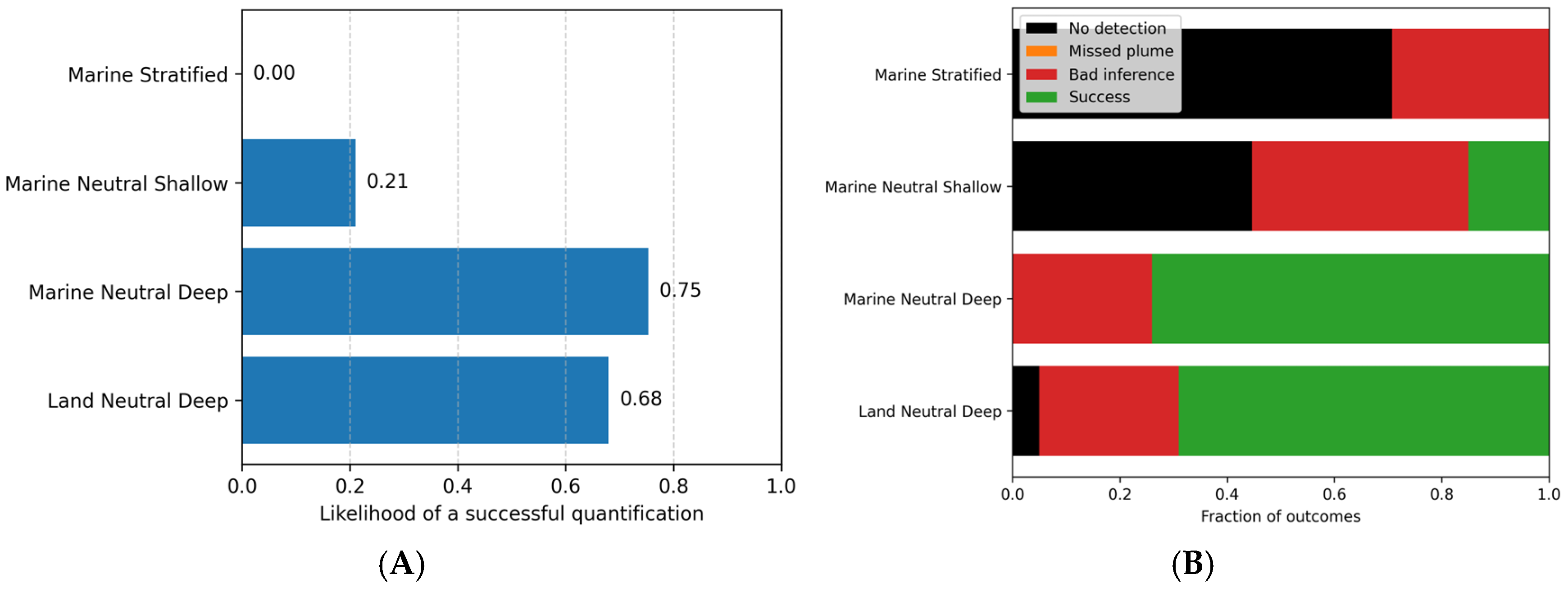
Within the illustrative model framework and under well-mixed conditions, quantification success remains relatively high. In the land neutral deep regime, the likelihood of a successful quantification within the illustrative framework is approximately 0.7, indicating that most sampling configurations yield physically meaningful emission estimates (
Figure 1A). A similarly high likelihood of a successful quantification is estimated under marine neutral deep conditions (~0.7), where plume dispersion remains sufficiently coupled to the measurement geometry to support detection and sampling.
In contrast, quantification success declines sharply in more constrained offshore regimes. Under marine neutral shallow conditions, the likelihood of a successful quantification decreases to approximately 0.2, indicating that successful quantification becomes the exception rather than the norm. Under marine stratified conditions, no successful quantification outcomes were obtained within the simulated scenarios, suggesting that strongly stratified conditions are likely to severely constrain the likelihood of valid quantification. The simulations suggest a transition from regimes where quantification is frequently achievable to regimes where it is operationally impractical within the assumed framework, reflecting the increasing influence of atmospheric structure on plume observability and sampling.
3.4. Failure Modes: Detection, Sampling, and Inference Limits
3.4.1. Land Neutral Deep
Under land neutral deep conditions, failure is dominated by inference error rather than plume detection or interception. The majority of simulations result in successful quantification, while the remaining failures arise primarily from inaccurate emission estimates despite successful plume observation (
Figure 1B). This indicates that under well-mixed conditions, plume observability and sampling are generally robust, and uncertainty is primarily associated with limitations in the inversion model.
3.4.2. Marine Neutral Deep
In the marine neutral deep regime, plume detection remains consistently high, with negligible instances of complete detection failure (
Figure 1B). However, a substantial fraction of simulations still results in incorrect inference. This reflects the influence of reduced vertical mixing and modified dispersion structure, which introduce systematic deviations from idealised Gaussian behaviour. As a result, inference uncertainty persists even when the plume is well observed.
3.4.3. Marine Neutral Shallow
Under shallow marine boundary layer conditions, failure is characterised by a combination of detection and inference limitations. A large fraction of simulations results in no detection or incomplete sampling, while the remaining cases are dominated by inaccurate inference (
Figure 1B). The reduced boundary layer depth constrains plume vertical extent and increases sensitivity to sampling height and alignment, resulting in a regime where both plume observability and inference stability are compromised.
3.4.4. Marine Stratified
In the stratified regime, failure is dominated by plume non-detection. The majority of simulations result in no detection, with the remaining cases producing incorrect inference (
Figure 1B). Successful quantification does not occur in any realisation. These results reflect the combined effects of vertical decoupling, plume lifting, and lateral displacement, which frequently prevent the sampling transect from intersecting the plume. Under these conditions, failure arises primarily from the inability to observe the plume, rather than from errors in interpretation.
3.4.5. Regime-Dependent Failure Mechanisms
Taken together, failure mechanisms shift systematically with atmospheric regime (
Figure 1B). Under well-mixed conditions, failure is primarily driven by inference uncertainty. Under moderately constrained conditions, failure reflects a combination of incomplete sampling and unstable inference. Under strongly stratified conditions, failure is dominated by plume non-observability. This progression corresponds directly to the decline in the likelihood of a successful quantification within the illustrative framework (
Figure 1A) and highlights a transition from method-limited to physics-limited quantification. As atmospheric constraints increase, the limiting factor shifts from how emissions are inferred to whether the plume can be observed at all.
3.4.6. Implications for Quantification Feasibility
The simulations suggest that valid offshore methane quantification is unlikely to be considered universally achievable, even under idealised measurement conditions. Instead, quantification emerges as a probabilistic outcome governed by atmospheric structure and sampling geometry. In particular, the absence of successful quantification under stratified conditions suggests that, for certain regimes, no feasible measurement configuration exists within the assumed framework. Conversely, the presence of substantial inference error under well-mixed conditions indicates that successful plume detection does not guarantee accurate emission quantification. These findings suggest that likelihood of obtaining a physically meaningful emission estimate is inherently atmospheric regime dependent, and that differences in atmospheric structure can fundamentally alter both plume observability and the validity of measurement assumptions.
3.5. Interpretation: When Quantification Fails
The results suggest that the feasibility of obtaining a valid offshore methane emission estimate is fundamentally controlled by atmospheric transport processes. In particular, the transition from successful quantification under well-mixed conditions to systematic failure under stratified regimes reflects a step-change from inference-limited measurements, where emission estimates may be observable but could be biased, to observability-limited measurements, where the plume is not reliably detected and meaningful quantification is not possible. Under deep boundary layers, measurements typically intercept the plume, and uncertainty arises mainly from differences between assumed and actual dispersion. In contrast, under stratified conditions, plume displacement and vertical decoupling often prevent the sampling transect from intersecting the plume at all, leading to non-detection and a failure in quantification.
As changes in atmospheric regime are not always visible in the measurement data, it is not always obvious when a measurement is valid. This implies that methane concentration measurements alone are not sufficient to assess the validity of emission estimates. Additional data are required to determine whether the plume was detectable, adequately sampled, and consistent with the assumptions of the inference method. In practice, this includes measurements of wind speed and direction, atmospheric stability, and boundary layer structure, as well as information on sampling geometry. Without such context, it may not be possible to distinguish between low emissions and failure to observe or sample the plume, particularly under stratified offshore conditions.
This simple modelling exercise indicates that valid offshore methane quantification is likely conditional and probabilistic, with quantification only achievable when the necessary criteria are satisfied, rather than through improved measurement design alone. The modelling framework used here is intentionally idealised, allowing atmospheric structure and measurement configuration to be isolated. The next step is to test whether the failure modes identified—particularly plume non-detection, misalignment, and unstable inference—persist under real conditions. In this context, controlled release experiments provide a means to test these mechanisms and assess under what conditions valid quantification is achievable in practice.
4. Atmospheric Regimes and Geographic Variability in Quantification Feasibility
To place the measurement methodology within an operational context, this section evaluates how often atmospheric conditions supporting valid methane quantification occur within representative offshore engineering environments, using historical meteorological data from ERA5 for 2023. Wind speed and temperature fields were used to derive simple proxies for mixing and stability. ERA5 atmospheric reanalysis data for 2023 were obtained from the Copernicus Climate Change Service (C3S) Climate Data Store. This study contains modified Copernicus Climate Change Service information. Neither the European Commission nor ECMWF is responsible for any use that may be made of the information contained herein.
Two representative offshore locations were selected to capture contrasting conditions: a central North Sea site (56.5° N, 2.0° E), characterised by stronger winds and frequent mixing, and a Gulf of Mexico site (27.0° N, −90.0° E), characterised by warmer sea surface temperatures and more variable winds. Hourly data were averaged over a small spatial domain to produce a representative time series at each location.
Atmospheric conditions were classified into four regimes using wind speed as a proxy for mixing and the surface–air temperature difference as an indicator of stability: well-mixed, neutral, shallow boundary layer, and stratified. Based on the criteria defined in
Section 2, emission estimates are expected to be valid under well-mixed and neutral conditions, conditionally valid under shallow boundary layers, and unlikely to be valid under stratified conditions. These thresholds provide a first-order representation of atmospheric regime rather than a detailed characterisation of boundary layer structure.
4.1. Atmospheric Regime Frequency in the North Sea (Baseline)
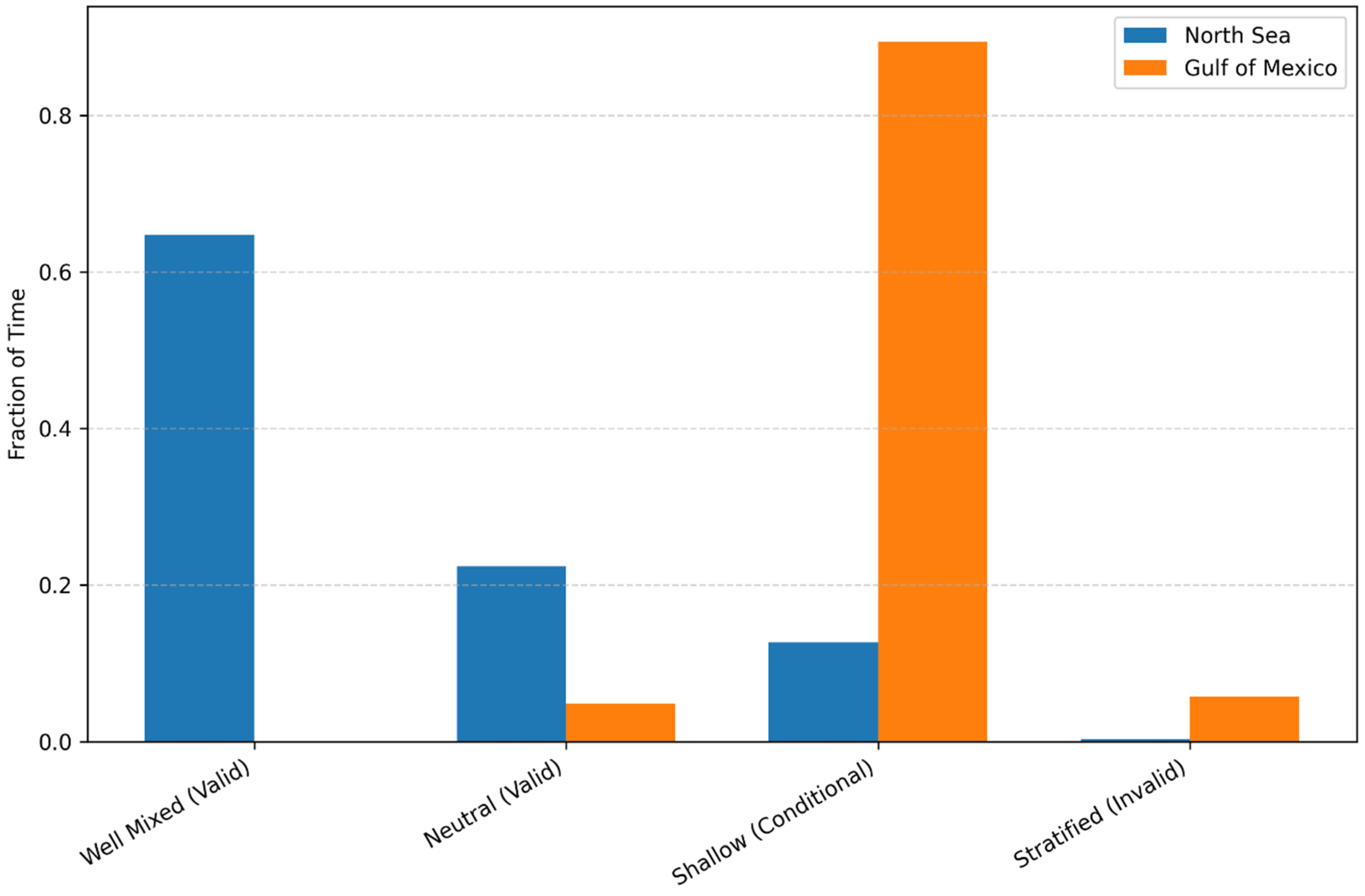
At the North Sea location, well-mixed conditions occur approximately 44% of the time, with a further 27% classified as neutral (
Figure 2). Together, these regimes account for around 70% of the observed atmospheric state and correspond to conditions under which methane quantification is likely to be valid. A further ~28% of conditions fall within a shallow boundary layer regime. Under these conditions, reduced mixing increases sensitivity to plume height, sampling geometry, and wind–plume alignment, leading to conditional quantification with increased uncertainty. Stratified conditions occur infrequently (~1%) but represent cases where plume observability is strongly reduced and measurement failure is likely. This low frequency is likely underestimated in ERA5 due to its limited resolution, which smooths near-surface stratification. Overall, the North Sea is dominated by conditions that support valid quantification, but a significant fraction of time (~30%) corresponds to regimes where results are uncertain or sensitive to measurement configuration.
4.2. Atmospheric Regime Frequency in the Gulf of Mexico
In contrast, the Gulf of Mexico is dominated by weakly mixed conditions. Approximately 90% of observations fall within the shallow boundary layer regime, with only a small fraction (~5%) classified as neutral and very few well-mixed conditions (
Figure 2). Stratified conditions occur more frequently (~5%) than in the North Sea, reflecting stronger thermal structure and reduced mixing. Although still a minority of cases, these conditions increase the likelihood of plume non-observability and invalid quantification. Overall, the Gulf of Mexico is characterised by a persistent absence of strongly mixed conditions and a dominance of regimes where quantification is conditional and highly sensitive to plume structure and sampling geometry.
4.3. Comparison and Implications for Successful Quantification
The contrast between the North Sea and Gulf of Mexico highlights the strong dependence of successful quantification on atmospheric environment. The North Sea is frequently well-mixed, allowing robust emission estimates for much of the time, whereas the Gulf of Mexico is dominated by weakly mixed conditions where quantification is less reliable. In the North Sea, emission estimates are likely to be valid, with occasional periods of increased uncertainty. In the Gulf of Mexico, measurements are more likely to be conditionally valid and sensitive to sampling strategy, with a greater risk of plume non-observability under stratified conditions.
4.4. Implications for Measurement Campaigns
These findings have direct implications for how offshore methane measurements should be designed and interpreted. Measurement system performance is not determined solely by instrumentation or sampling design. Instead, performance depends on the interaction between the offshore engineering environment, atmospheric transport processes, and measurement configuration. Under well-mixed conditions, measurements are more likely to intercept the plume and produce stable estimates, with uncertainty dominated by the inference method. Under weakly mixed or stratified conditions, limitations arise from plume behaviour itself, including displacement, confinement, and misalignment. In these cases, measurements may fail to sample the plume adequately even when instrumentation is optimal.
This means that measurement campaigns should be treated as conditional on atmospheric regime, rather than uniformly representative of emissions. In regions such as the Gulf of Mexico, measurements are likely to operate predominantly under conditions of conditional validity, while regions such as the North Sea offer more frequent opportunities for robust quantification. Rather than attempting to reduce uncertainty solely through improved instrumentation or sampling density, measurement strategies should prioritise understanding and characterising atmospheric conditions. Emission estimates should be interpreted in the context of whether the conditions required for valid quantification were met. More broadly, offshore methane measurement should be viewed as an environmental measurement problem, where system performance is constrained by atmospheric forcing. In this context, the key question is not just how to measure emissions, but when meaningful quantification is physically possible.
5. Conditions for Valid Quantification and a Pathway to Testing
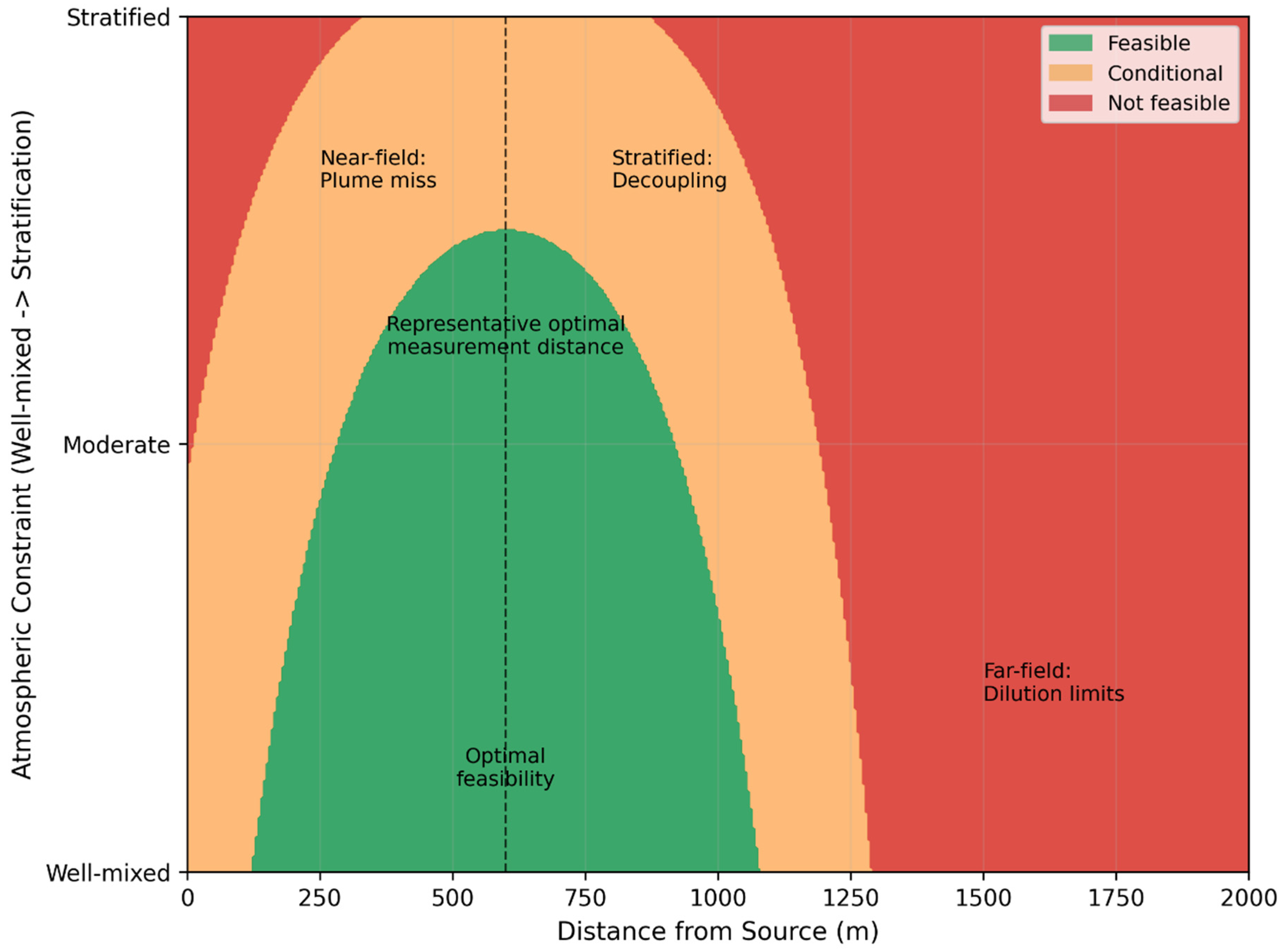
The results suggest that valid offshore methane quantification is constrained by a set of regime-dependent physical processes that control plume transport, detectability, and sampling. These are not secondary sources of uncertainty, but define whether emission inference is possible at all. Quantification should therefore not be treated as universally achievable, but as conditional on the interaction between atmospheric structure, plume behaviour, and measurement configuration. This can be summarised as a simple feasibility envelope relating distance from the source to atmospheric constraint (
Figure 3).
Figure 3 should be viewed as a conceptual representation of the mechanisms identified in the illustrative vessel-based framework rather than a universal operating envelope. Different measurement systems, including aircraft and drones, may operate over substantially different spatial scales and sampling geometries, although the underlying constraints associated with plume observability, interception, and atmospheric structure remain applicable. The feasibility envelope is also expected to depend on measurement height, particularly for elevated offshore sources where sampling above the near-surface layer may improve plume interception and extend the range over which plume detection remains possible.
Taken together, the modelling results suggest that quantification is constrained by both distance from the source and atmospheric regime. Close to the source, limited vertical dispersion increases the likelihood of plume–sensor misalignment. At intermediate distances, plume spreading improves interception and quantification is most likely to be valid. Further downwind, dilution reduces concentrations and progressively limits detectability. Increasing atmospheric stratification reduces this feasible region by suppressing mixing and weakening plume–wind coupling.
Under well-mixed conditions, vertical transport is coherent and the feasible region expands. As stratification increases, vertical mixing is suppressed and plume–wind coupling weakens, reducing both detectability and representativeness. Under strongly stratified conditions, the feasible region collapses and quantification becomes largely infeasible regardless of measurement design. This behaviour highlights that quantification depends on operating within a constrained spatial and atmospheric window, rather than simply moving closer to the source or increasing measurement effort.
5.1. Conditions for Successful Quantification
Based on these results, valid quantification is only feasible when a small number of conditions are satisfied:
The plume is observable within the measurement domain;
The wind field represents plume transport;
The plume is sufficiently sampled;
The signal remains detectable within the sampling range.
If any of these conditions are not met, the relationship between concentration and emission becomes non-unique and quantification is not robust. In these cases, increasing sampling density or measurement precision does not resolve the problem, as the limitation is physical rather than technical.
5.2. Implications for Measurement
This has direct implications for how offshore measurements are designed and interpreted. Measurement success is controlled by atmospheric conditions as much as by instrumentation. Under well-mixed conditions, quantification is generally achievable. Under weakly mixed or stratified conditions, failure arises from plume displacement, incomplete sampling, or non-detection, even for large emissions. This means measurement campaigns should be treated as conditional on atmospheric regime, rather than uniformly representative. In practice, this requires capturing sufficient information on atmospheric structure to determine whether the conditions for valid quantification are met.
5.3. Pathway to Experimental Testing
The modelling framework used here is intentionally simplified and isolates the governing processes. The next step is to test whether the same failure modes—plume non-detection, incomplete sampling, and unstable inference—occur under real conditions. The purpose of the current modelling exercise is therefore not to establish quantitative limits, but to identify testable hypotheses that can be examined through controlled release experiments. The aim is not to demonstrate successful quantification, but to identify when it likely to succeed and when it could fail.
6. Discussion: Atmospheric Limits on Methane Quantification
Recent work examined why different offshore methane quantification methods can produce different emission estimates under the same atmospheric conditions [
4]. The present study addresses a more fundamental question: whether a physically meaningful emission estimate can be obtained at all. The framework developed here suggests that offshore methane quantification may be fundamentally constrained by atmospheric structure, in addition to measurement capability. While improvements in instrumentation and methodology have increased the ability to detect and analyse plumes, they are unlikely to overcome the physical limits imposed by plume transport under all conditions. The model used here is deliberately simple and is intended to illustrate this framework rather than predict operational success rates. The specific probabilities reported in
Section 3 depend on the assumptions adopted in the illustrative Gaussian framework, including the sampling geometry, detection threshold, and inversion criteria, and should therefore not be interpreted as representative of field performance. Instead, the value of the analysis lies in identifying the physical mechanisms that determine whether meaningful emission estimates can be obtained and in providing a structured framework for examining how detectability, interception, and inference change across atmospheric regimes. Future experimental studies should focus on testing these mechanisms under real conditions rather than on reproducing the illustrative probabilities reported here. Two distinct failure modes emerge from the framework. Under well-mixed conditions, uncertainty is mainly associated with how emissions are inferred. Under shallow and stratified conditions, the primary problem becomes plume observability. Under well-mixed conditions, plumes are typically detected and adequately sampled, and uncertainty arises mainly from the assumptions used to infer emissions. In contrast, under shallow and stratified boundary layers, the limiting factor is likely plume observability. In these conditions, simulations suggest failure occurs not because the measurement cannot be interpreted, but because the plume cannot be reliably observed or sampled in the first place. This has direct implications for how offshore methane measurements are interpreted. Increasing sampling density, improving sensor sensitivity, or refining inversion methods may reduce uncertainty under well-mixed conditions, but cannot resolve failure modes driven by plume non-detection or incomplete sampling. Measurement outcomes should therefore be treated as conditional on the atmospheric state, rather than as direct indicators of emission magnitude.
ERA5 analysis suggests that these constraints are not rare and vary strongly by region. In the North Sea, data show well-mixed conditions are common, so quantification is likely often valid, although transitional regimes could still introduce uncertainty. In the Gulf of Mexico, data suggest weakly mixed conditions dominate, and measurements are likely made under conditions where quantification is conditional and sensitive to plume structure and sampling geometry. These results also provide a plausible explanation for the wide range of reported emission estimates from offshore measurements, particularly in the Gulf of Mexico where very small or near-zero emissions have been observed from operating facilities, despite the expectation that operating facilities emit methane continuously [
6,
14,
29]. Previous studies have suggested that these low estimates may reflect atmospheric effects rather than true emission rates, particularly under conditions where the marine boundary layer becomes stratified or vertically decoupled [
2]. Within the framework presented here, such observations are consistent with observability-limited behaviour. Under weakly mixed or stratified conditions, plume displacement, vertical confinement, or decoupling from near-surface winds could prevent the plume from being detected or adequately sampled, even when emissions are present. In these cases, low or zero emission estimates do not necessarily indicate low emissions but instead may reflect a failure to observe or sample the plume within the measurement domain.
Offshore methane measurement should therefore be treated as a measurement problem that is strongly constrained by atmospheric conditions. The key challenge is not only improving measurement capability but identifying the conditions under which measurements are physically meaningful. This places constraints on how measurement campaigns are designed, how emission estimates are interpreted, and how results are compared across regions. Overall, valid offshore methane quantification is not universally achievable, but conditionally feasible within a limited range of atmospheric and measurement conditions. Outside of these conditions, the relationship between measured concentration and emission rate becomes non-unique, and quantification cannot be considered robust.
7. Conclusions: Conditions for Valid Quantification
Offshore methane quantification should be regarded as an environmental measurement methodology operating within offshore engineering systems, rather than as a universally deployable measurement capability. By defining three necessary conditions for valid quantification—plume detectability, adequate interception, and reliable inference—this study suggests that emission estimates are only physically meaningful when all three are satisfied. Using an idealised modelling framework, the probability of making a meaningful emission estimate varies strongly across atmospheric regimes. Under well-mixed conditions, quantification is likely achievable, with uncertainty dominated by limitations in the inversion method. Under shallow boundary layers, quantification is likely to become conditional, with increased sensitivity to plume structure and sampling geometry. Under strongly stratified conditions, plume observability is likely reduced and valid emission estimates may not be obtainable at all.
The principal contribution of this study is the development of a conceptual framework for assessing whether offshore methane emissions can be meaningfully quantified. The accompanying modelling exercise serves as an illustrative demonstration of how the framework may be applied and should not be interpreted as a definitive assessment of measurement performance under real-world conditions.
ERA5 analysis suggests that these conditions are not rare and vary significantly between regions. In the North Sea, conditions favourable to quantification occur for much of the time. In contrast, the Gulf of Mexico is dominated by weakly mixed conditions, meaning measurements are more likely to operate in regimes where successful quantification is conditional and highly sensitive to sampling. Taken together, these results suggest that offshore methane quantification must be treated as a regime-dependent and probabilistic process, rather than a capability that can be assumed under all conditions. The analysis suggests that atmospheric structure defines important boundary conditions on when meaningful emission estimates can be obtained.
In relation to previous work, emission estimates derived from different methods may not agree due to differences in how atmospheric transport is represented [
4]. This study identifies that, under certain atmospheric regimes, the issue is likely more fundamental: a representative emission estimate may not be obtainable at all, because the plume cannot be reliably observed or sampled. This distinction is important because a measurement cannot be made more accurate if the plume is not observed in the first place. This shifts the focus from improving measurement capability to understanding the conditions under which measurements are physically meaningful. Within this framework, offshore methane quantification is not simply a measurement problem, but one constrained by atmospheric physics.
Two practical implications follow from this:
Measurement design must include atmospheric characterisation, so that the conditions under which data are collected can be assessed against the requirements for valid quantification.
Emission estimates must be interpreted conditionally, recognising that measurements made outside favourable regimes may reflect sampling limitations rather than true emission rates.
These results define a feasibility envelope within which offshore methane quantification can be credibly attempted and provide a basis for targeted experimental testing. Future work should focus on quantifying these limits under real conditions and identifying when quantification is physically achievable, rather than assuming it can be achieved in all environments.