Article

Research on Multi-Field Coupling Response and Alignment Control of Super-Long-Span Steel Box Girder Synchronous Lifting

1
School of Civil Engineering and Architecture, Henan University of Science and Technology, Luoyang 471023, China
2
The First Construction Co., Ltd. of China Railway Construction 15th Group, Xi’an 710032, China
*
Author to whom correspondence should be addressed.
Eng 2026, 7(6), 290; https://doi.org/10.3390/eng7060290
Submission received: 9 April 2026 / Revised: 3 June 2026 / Accepted: 9 June 2026 / Published: 11 June 2026
(This article belongs to the Section Chemical, Civil and Environmental Engineering)

Abstract

To investigate the posture control of super-long-span heavy steel box girders during synchronous lifting, this study takes the integral lifting project of the 82 m-span steel box girder of Xiaotun Bridge on the Fuyi Expressway as a case study. A fluid–solid–thermal three-field coupled numerical model was established using Midas NFX 2024 R1 (a general-purpose finite element analysis software for multi-physics and fluid–structure interaction simulations) to explore the alignment and end-displacement characteristics of the steel box girder throughout the lifting process. The results show that under combined thermal and wind loads, girder deflection presents a daily cyclic pattern: temperature rise induces upward arching, while wind-induced vibration generates a mid-span instantaneous amplitude of ±25.0 mm, with a maximum coupled deflection of 31.78 mm. Girder end-displacement increases significantly at lifting heights of 5–25 m and peaks at 25 m. With further height increase and shortened sling length, sway frequency rises while maximum displacement gradually declines. When the plane tilt ratio exceeds 0.17% or the overall unbalanced displacement at lifting points exceeds 12 mm, local stress exceeds 95% of the allowable value, implying potential instability risks. For construction safety, a synchronous intelligent hydraulic lifting system based on the “displacement synchronization and load balancing” strategy was applied. Supported by real-time sensor feedback and adjustment, the system achieves millimeter-level lifting precision and welding positioning accuracy. This study provides a reference for similar synchronous lifting practices of large-span steel box girders.

1. Introduction

With the development of bridge construction, the overall lifting construction technology of super-long-span steel box girders has gradually matured in recent years. In this process, steel box girder components are prefabricated in the factory, and then transported to the site for overall assembly and lifting, which can effectively ensure the forming quality of components and structural integrity, and significantly improve the efficiency of site installation, so it has been widely used in engineering practice [1]. For the installation of steel box girders in large sections or super-large sections, the overall lifting technology is favored because of its advantages of high efficiency, safety and low environmental impact, especially for busy navigable waters, complex terrain areas or situations requiring rapid construction [2]. However, when the span, lifting height and weight of steel box girder reach super-large scale, the structural response in the construction process becomes extremely complex, and it is difficult to meet the engineering accuracy requirements by simply relying on traditional static analysis [3].
In recent years, domestic and foreign scholars have carried out a lot of research on the mechanical characteristics of steel box girder lifting construction, and have obtained a series of results. Liu, M et al. [4] discussed the influence of thermal load on the reaction force of the support during the lifting process of the complex steel frame, and pointed out that the change in the reaction force of the support caused by temperature load should not be ignored. Li, G et al. [5] studied the time-varying mechanical behavior of large-span spatial steel structures in the process of synchronous and asynchronous overall lifting, and proposed a refined construction method based on time-varying mechanics theory and displacement difference control theory. Yang, Y et al. [6] studied the mechanical behavior of long-span steel box girder in the process of lifting, and studied the influence law of the lifting point arrangement on the internal force of the structure. In the analysis of wind load and fluid–structure interaction, researchers are increasingly combining computational fluid dynamics (CFD) and structural dynamics methods to simulate aerodynamic responses in fine detail. Roy et al. [7] used CFD-FSI method to simulate the atmospheric boundary layer around the double box girder bridge deck, and verified the cost and efficiency advantages of numerical method over wind tunnel test. Liu, Z. et al. [8] studied the vortex-induced vibration (VIV) mechanism and aerodynamic control measures of streamlined steel box girder by combining wind tunnel tests with CFD, and analyzed the fluid-solid interaction of the main girder by embedding Newmark β algorithm into the simulation software and applying dynamic grid technology. Zhang, Z et al. [9] conducted a numerical study on the independence of wind-induced vibration of streamlined box girder, systematically discussed the influence of time resolution and mesh refinement on CFD calculation results, and provided a reference for the practice of bridge aerodynamic numerical simulation. Wang, Y. et al. [10] studied the temperature effect of wide steel box girder of suspension bridge based on long-term monitoring data, and put forward the conclusion that the temperature distribution can significantly change the structural performance. Zhang, Y. et al. [11] studied the effect of Reynolds number on aerodynamic force and VIV characteristics of streamlined box girder, and found that the locking interval became narrower with the increase in Reynolds number. Lei, W et al. [12] studied the VIV performance of streamlined steel box girder of cross-sea cable-stayed bridge, and obtained the internal relationship between VIV response and wind speed, damping ratio and structural mode. Hu, C et al. [13] proposed the simplified vortex mode of tortuous vortex-induced force of a typical streamlined box girder and the suppression mechanism of its aerodynamic control measures, which provided a new method for analyzing the VIV mechanism of box girder and the suppression mechanism of its aerodynamic control measures. In terms of aeroelastic analysis and wind resistance design, Verma, S et al. [14] proposed a shape- and frequency-dependent self-excitation force simulation method suitable for the aerostructural design of a blunt-body bridge deck, and integrated it into the aerostructural optimization framework. Zhang Y et al. [15] proposed a new multi-modal analysis method focusing on the dynamic mechanism of bridge flutter. Kildal, O et al. [16] studied the parametric effect of turbulence on fluttering stability of suspension bridges. In terms of wind tunnel test and experimental research, Zeng Lei et al. [17] carried out the wind resistance performance test of the main girder segment model for the long-span single-tower cable-stayed bridge, and studied the vortex-induced vibration, flutter stability and aerodynamic control measures of the streamlined closed steel box girder. Tuo, D et al. [18] studied the influence of the Reynolds number and reduction ratio on VIV tests of a railway blunt-body box girder in the context of a railway steel box girder cable-stayed bridge with a main span of 672 m. Chen X et al. [19] discussed the influence of auxiliary components on vortex-induced vibration of streamlined box girders, which provided a basis for understanding the role of auxiliary components in changing aerodynamic behavior. Cui, F et al. [20] studied the temperature field effect and thermogenic response of curved steel box girder bridge based on field monitoring data and numerical evaluation, and found that the vertical temperature gradient could be closely characterized by an exponential function, while the lateral temperature gradient followed a Gaussian distribution. Liu Z et al. [21] took the Fenshuihe River Bridge as the background, studied the temperature model and influence effect of steel box girder with large height to width ratio and exposed straight web, and gave the safety standard of temperature gradient. Wang, S et al. [22] studied the temperature response of a double-layer steel-truss bridge under solar radiation, and concluded that the vertical, transverse and longitudinal temperature gradients have significant differences in position and temperature difference. Huang X et al. [23] analyzed the temperature of the steel box girder considering the actual wind field, and obtained that the actual wind flowing through the outer surface of the box girder significantly affected the convective heat transfer coefficient, and concluded that the temperature change would affect the stress and deformation of the main girder of the steel box girder bridge, leading to changes in the characteristics of the whole bridge. Huang X et al. [24] studied the temperature field characteristics of the flat steel box girder based on field measurement and numerical simulation, and pointed out that the incoming wind speed used in conventional thermal analysis ignored the actual wind field around the box girder, which may lead to inaccurate evaluation of the temperature characteristics. Hao J et al. [25] studied the vertical temperature gradient of steel box girder through field measurement and numerical simulation, and confirmed that the vertical temperature gradient was the main factor causing thermal stress or deformation of bridge structure. Ma W et al. [26] conducted a statistical analysis on the longitudinal non-uniform temperature distribution of the long-span steel box girder bridge, and concluded that the surface temperature of the box girder has significant three-dimensional spatial characteristics. In terms of the complex wind field in mountainous areas, Jun, H et al. [27] studied the non-stationary characteristics of the measured wind speed of a continuous rigidframe bridge with high pier and long span and analyzed the characteristic parameters of turbulent wind speed through the field measurement of an ultra-high pier bridge site in China. Chen, Z et al. [28] studied the aerodynamic response of a long-span bridge under a complex twin-mountain terrain through a field verified large eddy simulation, indicating that the canyon and shelter effects of the terrain can significantly amplify or attenuate the bridge wind load, emphasizing the need to include detailed terrain effects and site-specific design in the wind-resistant design of mountain bridges.
However, the current research on the alignment control of hoisted steel box girders mostly relies on static analysis, and wind loads are generally simplified with quasi-static assumptions, failing to fully consider the transient aerodynamic–structural coupling effect. Meanwhile, few studies have comprehensively incorporated the multi-field coupling effects of non-stationary wind fields and temperature gradients into the lifting process analysis. For non-floor lifting construction of super-span and large-tonnage steel box girders, the suspended structure features high flexibility and low damping; the coupling mechanism between wind-induced vortex-induced vibration and solar-thermal deformation has not been systematically revealed, resulting in notable deviations in numerical predictions of girder alignment under complex mountain wind conditions. Compared with existing unidirectional CFD-FSI and thermo–structural lifting research, the novelty and advancement of this work lie in constructing a bidirectional fluid–solid–thermal multi-field coupling framework. Taking the Xiaotun Bridge project on Fuyi Expressway as the engineering background, this study adopts the weak fluid–structure interaction (FSI) method, simulates unsteady wind fields using the SST k-ω model, and couples temperature gradient effects to establish a three-field numerical model via Midas NFX. By analyzing the lifting alignment and end-displacement of steel box girders and validating against field monitoring data, this paper further discusses the critical values of plane tilt ratio and uneven displacement at lifting points, and proposes targeted control measures, providing practical references for similar large-tonnage steel box girder lifting projects.

2. Project Overview

2.1. Project Background

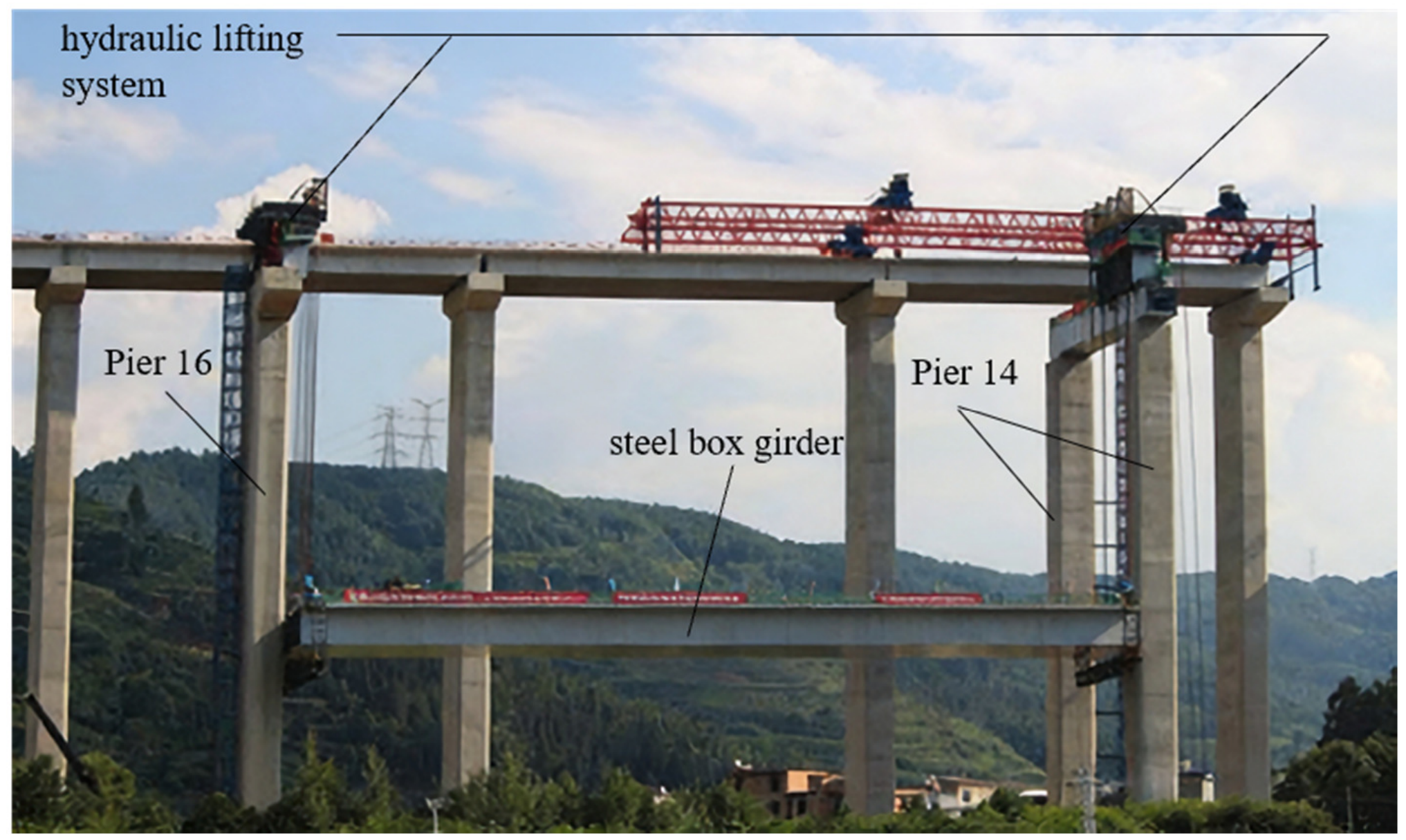
As an important part of the highway network of Yunnan Province, the Fuyi Expressway is responsible for alleviating the traffic pressure in the central city of Kunming and Kun-Shi Expressway, and aims to promote the economic integration process of eastern Yunnan and Southeast Yunnan, and promote the economic and social development of regions along the line. The total length of the expressway is 53.27 km, of which the left line of Xiaotun Bridge is 1235 m in length. The sixth link (Pier 14#~16#) is a steel box girder structure with a total single-span length of 82 m, while the length of the actual lifting segment is 77.22 m, which crosses the secondary road of Chengyang Road. The plane alignment of the bridge is a left circular curve with R = 1828 m, and the vertical curve with R = 22,000 m in the vertical section. This bridge is the first steel box girder constructed by the “intelligent hydraulic synchronous lifting method of super large components” in the expressway field of Yunnan Province, and has created three records of the maximum span (82 m), maximum lifting height (60.15 m) and total weight (920 t) in the province, while the weight of the actual lifting segment is 866 t. The steel box girder is made of Q345qC, with a streamlined section of single box and double chamber. The top slab width (roof width) is 16.55 m, and the bottom slab width (bottom width) is 12.61 m; the beam depth is 3.62 m. The bridge deck has a 3% one-way cross slope. The support sections are equipped with solid web diaphragms, and the other sections are equipped with open web diaphragms at a spacing of 2 m to ensure sufficient torsional stiffness during lifting. Pier 14 is a 4 m × 4 m thin-walled hollow pier with a height of 57 m and is equipped with a 35 m long steel gate-shaped cap beam weighing 203 t above; pier #16 is a 9 m × 4 m thin-walled hollow pier, on which a C40 prestressed concrete overhang beam is set. In the construction process, the combination of ‘factory prefabricated plate unit, ground projection surface overall assembly and core-through intelligent hydraulic synchronous lifting technology’ was adopted to realize the overall lifting of one-time crossing Chengyang Road. Figure 1 shows the on-site synchronous lifting scene of the steel box girder, in which Pier 14, Pier 16, the steel box girder, and hydraulic lifting system are clearly marked for clear identification.

2.2. Construction Challenges

The sixth steel box girder of Xiaotun Bridge was installed by the “intelligent hydraulic synchronous lifting method of super large components”. Its actual lifting segment length of 77.22 m, lifting height of 60.15 m and lifting segment weight of 866 t all set records for similar projects in Yunnan Province. The method is based on hydraulic system to realize multi-point synchronous lifting, which has the advantages of high synchronization, precise control, strong adaptability and multiple safety protection, and is suitable for high altitude lifting of large mass and long-span components. However, restricted by the complex environmental conditions and site construction in the bridge site area, the overall lifting faces the following key difficulties. Firstly, the wind environment of the bridge site is complex and the unsteady wind load induces the structure vortex-induced vibration. According to the observation data of the Yunnan Meteorological Bureau in the past 10 years, the average annual wind speed in this area is 3.5 m/s, but the instantaneous maximum wind speed can reach 23 m/s due to the canyon effect. The short-term wind measurement results show that the instantaneous peak turbulence intensity at the construction height can reach up to 35% under gust conditions, highlighting the strong unsteady nature of the canyon wind field. For the numerical simulations, the mean turbulence intensity at the model inlet is not taken as a fixed value but is determined following the procedure recommended in the Chinese Wind-Resistant Design Specification for Highway Bridges (JTG/T 3360-01-2018) [29] according to the local mountainous terrain. The resulting mean turbulence level at the reference height is then used as the inlet condition in the subsequent CFD simulations (see Section 4.1). Such strong turbulence and instantaneous wind gusts are likely to cause vortex-induced vibration of long-period and massive components, which seriously threatens the stability of girder posture and the synchronization of multi-point lifting. Secondly, the gradient effect of sunlight temperature difference is strong, which leads to temperature displacement at the end of the steel box girder. The total annual solar radiation at the project site is greater than 5800 MJ/m2. In the early stage, the measured data of the temperature sensor installed in the steel box girder in the test section show that the maximum temperature difference between day and night on the outer surface of the box girder is 19.3 °C, and the maximum temperature difference between the top and bottom plate under the action of sunlight is 24.7 °C. The temperature gradient can cause obvious temperature deformation at the end of the 82 m-span steel box girder, and the displacement is likely to exceed the allowable installation deviation of the design, which puts forward high requirements for the precise alignment of the closure section. Complex construction conditions on site further increase the lifting risk. The lifting steel box girder spans a secondary highway, and the steel box girder project is located in a mountainous area, so the lifting process is easily affected by the sudden cross wind in the mountainous area, and the eddy shock effect is significant. In addition, the total lifting process lasts 7 days, and such a long construction duration further increases the risk of sudden strong winds or severe temperature gradients threatening construction safety. The above factors put forward higher requirements for the control accuracy, wind stability and safety redundancy design of the hydraulic synchronous lifting system.

3. Governing Equations of Multi-Field Coupled Steel Box Girder Model

3.1. Transient Temperature Gradient Boundary Equation

Regarding the setting of boundary conditions for the transient temperature field of steel box girder, combined with heat conduction, boundary conditions and thermal–solid coupling mechanism, the significant modification effect of topography on sunshine radiation and the near-surface wind field is considered. The transient temperature field model used in this study integrates the mechanisms of direct solar radiation, scattered radiation, long-wave radiation and convective heat transfer. The governing equations are as follows:
ρ c T t = k T
where T is the temperature field function; ρ is the density of steel; c is the specific heat capacity of steel; and k is the thermal conductivity tensor.
Furthermore, combined with the roof and web of the steel box girder, the boundary is regarded as the solar radiation–convection mixed boundary, and the engineering scene of sunshine radiation and convection heat transfer suitable for complex mountain environment is given. The boundary condition control equation is as follows [30]:
ρ c T t = q h c T T a   ε σ T 4 T y   4
q = α s I dir cos θ + α s I diff
For the bottom flange of a steel box girder, the convective boundary heat transfer equation is as follows:
k T n = h c ( T T a ) + ε σ ( T 4 T s 4 )
where q represents the total heat, αs is the surface solar absorption coefficient (taken as 0.7), and Idir is the direct radiation intensity; Idiff is the diffuse radiation intensity; both intensities are determined based on the latitude and longitude of the bridge location and meteorological data; hc is the convective heat transfer coefficient, which is related to wind speed; ε is the surface emissivity of the heat flux, taken as 0.88; σ is the Stefan-Boltzmann constant, with a value of 5.67 × 10⁻⁸ W/(m2·K4); Ty = 0.0552Ta1.5, where Ta is the air temperature, and Ts is the ground or adjacent structure temperature.
The applicability of this model to complex mountainous environments is primarily demonstrated by its ability to distinguish between direct and diffuse radiation, thereby capturing the non-uniform and dynamic distribution of solar radiation on the sun-facing and shaded sides of structures caused by topographic shading. By treating the convective heat transfer coefficient hc as a variable dependent on wind speed rather than a constant, the model can accurately reflect the transient, intense convective heat transfer characteristics resulting from phenomena such as the “narrow-channel effect” in canyons.

3.2. Turbulence Model Equations

Given that the objective of this study is to evaluate the overall aerodynamic loads on steel box girders under canyon wind conditions and their impact on alignment, different from the high-precision transient analysis of the flow in the boundary layer, the SST k-ω model with scalable wall functions is adopted in this paper, which takes into account computational efficiency and accuracy. This wall treatment is suitable for y+ values in the range of 30 to 300, and post-simulation examination shows that the y+ values on the steel box girder surface are mainly within 80 to 250, which fully meets the requirements of the SST k-ω model using scalable wall functions. This model activates k-ω behavior in the near-wall region via a mixing function and switches to k-ε behavior in the far-field mainstream region, enabling more accurate capture of complex phenomena such as high-shear flow, reverse pressure gradients, and flow separation. In view of the unique environmental characteristics of the mountain canyon bridge site, including streamline bending caused by terrain forcing, local wind speed acceleration induced by canyon wind tunnel test, strong non-equilibrium turbulence under sudden gusts, and significant temperature gradient caused by strong solar radiation and daily temperature variation, the SST k-ω model shows excellent adaptability. On the one hand, by imposing transport constraints on turbulent shear stress, this model enhances the simulation capability for sudden, non-stationary wind loads in mountainous areas. Subsequently, the reasonable configuration of its wall function and turbulent Prandtl number effectively couples thermal convection effects, accurately reflecting the influence of temperature gradients on the turbulent structure in the near-wall region and heat exchange at the wall surface, thereby providing a unified and reliable turbulence framework for three-field (fluid–structure–thermal) coupled analysis. Therefore, the SST k-ω model is suitable for simulating the lifting process of steel box girders under the combined action of complex wind fields and temperature loads at bridge sites in mountainous canyons in Yunnan Province.
ρ k t + ρ k u i x i = x j Γ k k x j + P ~ k β * ρ k ω
ρ ω t + ρ ω u i x i = x j Γ ω ω x j + γ ν t P k β ρ ω 2 + 2 1 F 1 ρ σ ω 2 ω k x j ω x j
where xi and xj represent fluid coordinates, ui is the fluid velocity; t is time; ρ is the fluid density; and Pk is the turbulent kinetic energy k induced by the velocity gradient. Γk and Γω are the effective diffusion coefficients for k and ω, respectively. F1 is the mixing function. Ω is the vorticity magnitude; the model constant β* = 0.09 is adopted as the standard default value for the SST k-ω turbulence model recommended in relevant literature and commercial CFD software (Midas NFX 2024 R1).

4. Finite Element Model of Steel Box Girder

4.1. Finite Element Model Parameters

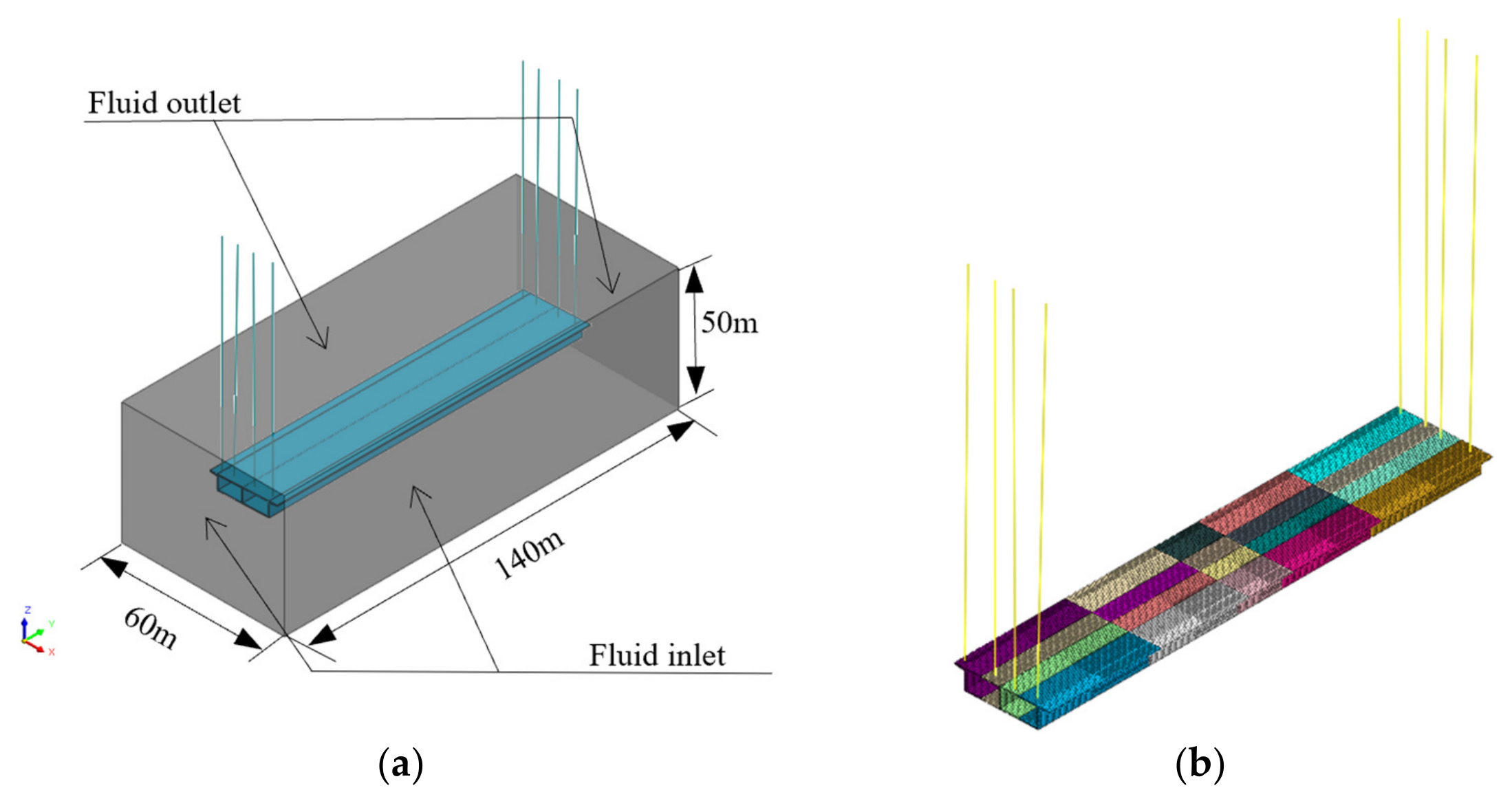
The finite element model and all subsequent numerical calculations are uniformly based on the actual lifting segment: length = 77.22 m, weight = 866 t, to ensure parameter consistency. Using Midas NFX, a finite element model of the sixth continuous steel box girder of the Xiaotun Bridge on the Fuyi Expressway was established, as shown in Figure 2, with lifting points modeled as flexible connections. To accurately simulate the geometric changes during lifting, the mesh was partitioned according to the assembly sequence, and different segments were connected by weld seams, as illustrated in Figure 2b. Butt welds were modeled using solid elements with material properties identical to the base metal, accounting for strength reduction in the heat-affected zone. For critical fillet weld connections, constraint equations and equivalent stiffness elements were employed to simulate their shear and tensile stiffness. The fluid domain was extracted using CFD volume extraction, and a weakly coupled partitioned algorithm was adopted to solve the fluid domain, solid domain, and the interface transfer between them.
The total coupling time was 72 h. A fixed time-step size of 0.05 s was adopted for the transient simulation to satisfy the CFL condition and to capture the high-frequency wind-induced vibrations under canyon wind conditions. Convergence was ensured with continuity and momentum residuals lower than 1 × 10⁻⁵ in each time step, and the time histories of girder displacement and sling force were continuously monitored to confirm stable solutions. Considering both computational efficiency and accuracy [31], the fluid domain dimensions were set to 140 m (length) × 60 m (width) × 50 m (height). Following general principles of wind engineering CFD simulations, the bridge was placed centrally along the longitudinal direction, with a net width of approximately twice the beam width on each side to reduce lateral boundary constraints. For the adopted SST k–ω turbulence model, the inlet turbulent kinetic energy k and specific dissipation rate ω are calculated from on-site measured wind velocity and the turbulence intensity determined according to the Chinese Wind-Resistant Design Specification for Highway Bridges (JTG/T 3360-01-2018) for the local mountainous terrain, as described in Section 2.2. Scalable wall functions are applied for the girder surface boundaries. In the vertical direction, the domain height exceeded three times the beam height to accommodate atmospheric boundary layer simulation. Furthermore, the ratio of the structure’s frontal area to the fluid domain cross-sectional area was 2.87%, satisfying the recommended value of less than 5% and suppressing spurious acceleration effects caused by sidewalls. Throughout the lifting process, the fluid domain continuously enclosed the steel box girder. Lifting slings were modeled using 1D cable elements, while the steel box girder was modeled using 3D elements. The cable elements were hinged to the steel box girder, with mesh refinement near the lifting points, achieving a minimum element size of 0.04 m. Considering the prevailing southwest wind in the local climate, fluid inlet and outlet boundaries were defined as shown in the figure: a velocity inlet and a zero-velocity outlet, with the top and bottom boundaries of the fluid domain modeled as slip walls and the fluid assumed incompressible. The fluid domain mesh consisted of 4.52 × 10⁶ elements, and the structural mesh contained 2.53 × 10⁶ elements. Material parameters of the finite element model are listed in Table 1.
Solar radiation is applied as time-varying surface heat flux ranging from 0 to 820 W/m2, following the diurnal variation in local solar intensity, with a 15% reduction coefficient introduced to account for canyon terrain shading effects. Environmental thermal calibration is conducted using on-site measured air temperature data (daily variation: 12–34 °C). The convection heat transfer coefficient is calibrated to 12.5 W/(m2·K) by matching simulated girder surface temperature with field monitoring data, ensuring thermal boundary conditions align with actual mountain-canyon environmental conditions.
The multi-physics coupling procedure was implemented in the following sequence. First, a steady-state thermo-mechanical analysis of the steel box girder was performed using field-measured meteorological parameters, where the heat flux was adjusted to replicate the daily temperature variation observed in the actual environment. To enable fluid–thermal–structural three-field coupling, a combination of sequential coupling and weak fluid–structure interaction (FSI) was adopted [32]. For wind loads, a steady-state CFD simulation was first initialized, followed by transient calculations at each time step to extract the aerodynamic parameters on the structural surface. Subsequently, the same field-measured meteorological parameters were applied to define the boundary conditions for solar radiation and wind temperature, and finally a coupling calculation that accounted for heat transfer between the air and the structure was conducted. Specifically, within each time step, a fluid–thermal interaction was first performed to solve the unsteady wind field under the influence of ambient temperature, yielding the convective heat transfer coefficient and the aerodynamic loads on the structure. Next, a thermal–structural analysis was executed to obtain the transient temperature field and the resulting thermoelastic deformation. Finally, a weakly coupled fluid–structure update was carried out, in which the structural displacement was passed as a boundary condition to the fluid domain for the next time step. Owing to the relatively high structural stiffness during the lifting process, the feedback effect of displacement on the flow field was weaker than the driving effects of wind and thermal loads. Consequently, this approach improved computational efficiency while ensuring that wind-induced vibrations and thermal deformations were accurately captured. A time-step size of 0.05 s was adopted for transient simulation to satisfy the CFL condition and capture high-frequency wind-induced vibration under canyon wind conditions. Convergence is ensured with continuity and momentum residuals lower than 1 × 10⁻⁵, together with stable time-history curves of girder displacement and sling force during continuous calculation.
The minimum grid size of 0.04 m is determined by balancing computational efficiency and the valid y+ range required by the scalable wall function, ensuring both accuracy and efficiency for the three-field coupling simulation. The steel box girder is discretized with 3–5 linear finite elements through the plate thickness. This configuration balances numerical accuracy and computational efficiency, and is sufficient to resolve the through-thickness temperature gradient and thermal stress distribution under solar radiation. A preliminary mesh independence study confirmed that further increasing the number of layers (beyond 5) has a negligible effect on the calculated temperature and stress results.
Although the steel box girder undergoes considerable rigid-body lateral swing under wind loads, the swing only changes the overall position rather than the girder cross-sectional geometry. According to on-site monitoring data (Section 2.2) and the good agreement between measured and simulated sling forces (Section 6.1), the flow-field disturbance induced by rigid swing is estimated to be below 5%, which has negligible influence on aerodynamic performance. Temperature-induced deformation is quasi-static and has minor flow-field feedback. The iterative weak coupling can fully capture wind-induced swing loads with higher computational efficiency, which is suitable for this engineering-scale simulation.

4.2. Reliability Verification of Finite Element Model

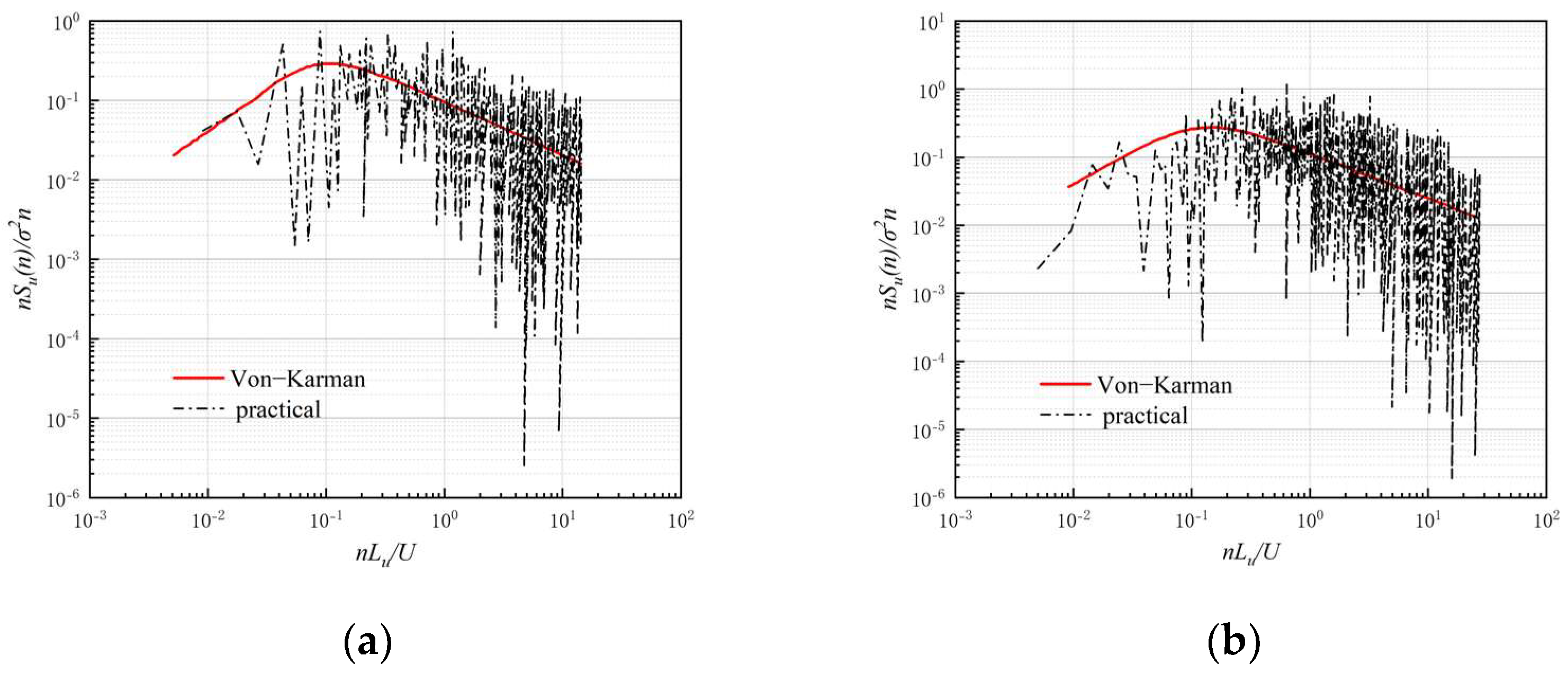
In order to verify the rationality of the wind load model used in this study, the field measured wind spectrum and the standard von-Karman spectrum were compared in the along-wind direction and the vertical direction as shown in Figure 3. The measured spectral density is highly consistent with von-Karman, and the main frequency band is highly consistent. There is a small amount of deviation in low frequency and high frequency due to terrain factors, indicating the effectiveness of numerical simulation using von-Karman standard spectrum.
Further quantitative statistical evaluation is performed to assess the agreement between the measured wind spectrum and the von-Kármán standard spectrum. For the along-wind direction, the coefficient of determination R2 = 0.92, mean absolute error (MAE = 0.042), and root-mean-square error (RMSE = 0.058). For the vertical direction, R2 = 0.90, MAE = 0.047, and RMSE = 0.064. High-correlation coefficients and low-error values quantitatively verify that the von-Kármán spectrum well matches the field-measured wind characteristics in the canyon terrain, confirming the reliability of the wind-load model adopted in this study.
In order to verify the reliability of the model and minimize the impact of discrete errors, the grid division is verified for independence. Five levels are set according to the degree of grid density. The grid division is shown in Table 2.
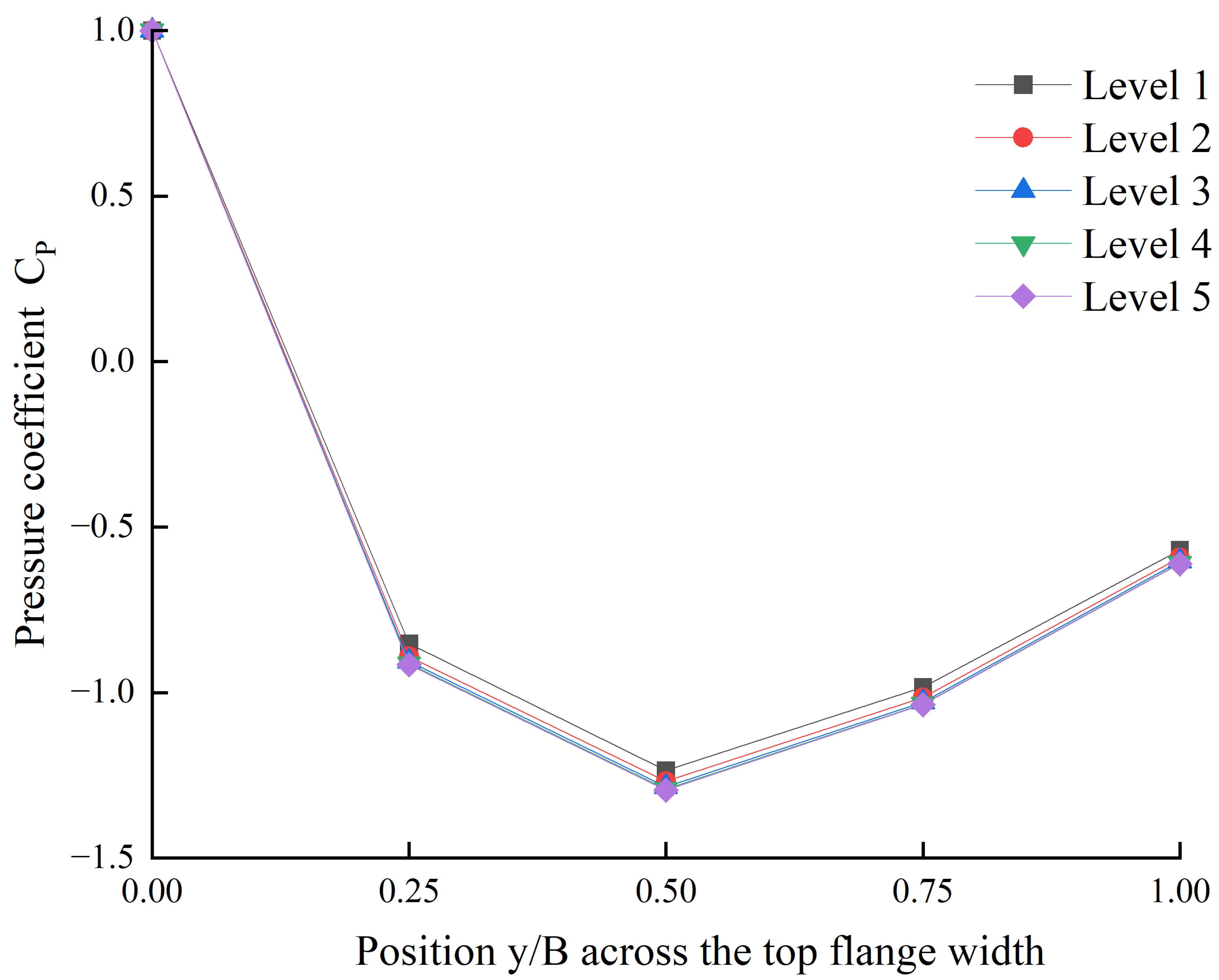
The lift coefficient and drag coefficient calculated by the five grids are compared and analyzed, as shown in Table 3. The stationary points on the windward side of the mid-span cross-section of the steel box girder, the pressure coefficients at 1/4, 1/2, and 3/4 of the steel box girder roof and the separation points on the leeward side were extracted for comparison, as shown in Figure 4. According to the comprehensive analysis of Table 3 and Figure 4, the error of key parameters of Grid Level 3 is less than 2%, which is the best balance between calculation accuracy and efficiency. Therefore, Grid Level 3 is selected as the grid division method for subsequent analysis in this paper.
In order to evaluate the influence of grid density on the reliability of structural mechanical response results, the maximum von Mises stress in the hanging point area under different grid levels is further compared, and the results are shown in Table 4. The analysis shows that the response parameters change greatly when the grid is refined from level 1 to level 2, and the change rate is less than 0.1% when the grid is refined to level 3. Based on the above two mesh independence verifications, Grid Level 3 for the fluid domain and Grid Level 2 for the structural domain were adopted uniformly in the subsequent 72 h fluid–thermal–structural three-field coupling simulation, which ensured both calculation accuracy and solution efficiency.
This numerical simulation focuses on the synchronous lifting stage of the steel box girder. Consistent with the actual construction sequence, the model only considers the restraint effect of the temporary wind-resistant limiting device to control lateral offset. Permanent welding connections are not activated in the lifting analysis, as all welding operations are performed on-site only after the girder is accurately positioned and stabilized.

5. Structural Response Analysis of Steel Box Girder Lifting Process Under Multi-Field Coupling

5.1. Deflection Analysis of a Steel Box Girder Considering the Coupling of Heat Transfer Effects and Wind Loads

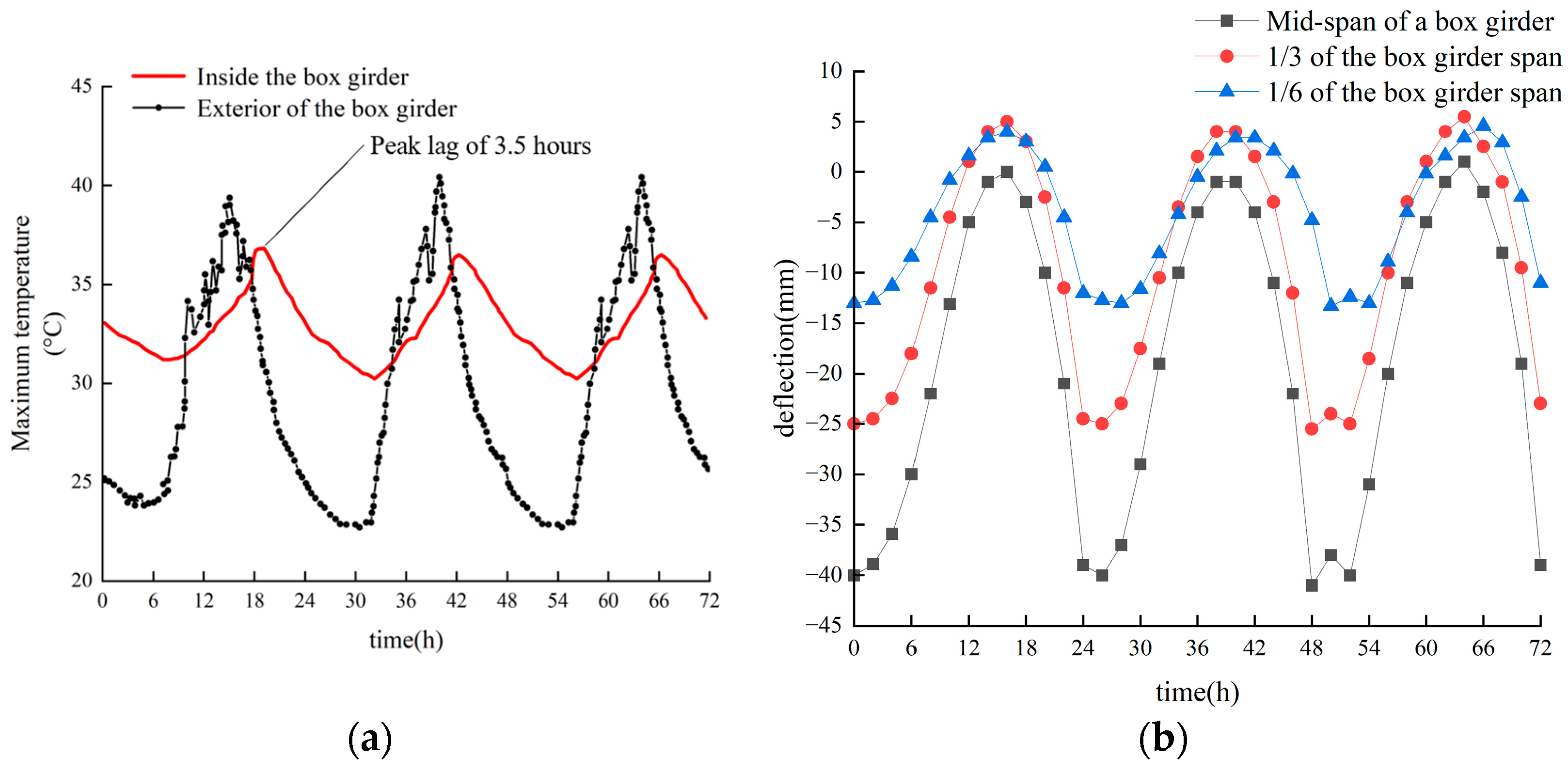
To investigate the heat transfer characteristics within the structure, the temperatures at external nodes of the box girder were used to reflect heat exchange between the structural surface and the environment, while the temperatures at internal nodes served to examine the heat accumulation effect of the enclosed air. The vertical displacements of various cross-sections were obtained from the maximum deflection values predicted by the model. Monitoring data of ambient temperatures inside and outside the box girder over a daily temperature cycle were selected for analysis, as shown in Figure 5. The external ambient temperature reached its maximum value of 39.56 °C at 15.2 h, whereas the internal ambient temperature peaked at 37.02 °C at 18.8 h. The peak temperature inside the box girder thus lagged behind the external peak by approximately 3.5 h. Furthermore, the daily temperature fluctuation range outside the box was 15.81 °C, while inside it was only 6.85 °C, indicating that the temperature variation inside the box was considerably lower. The time lag of about 3.5 h for the internal peak temperature clearly demonstrates that the structural system imposes a significant delay effect on heat transfer.
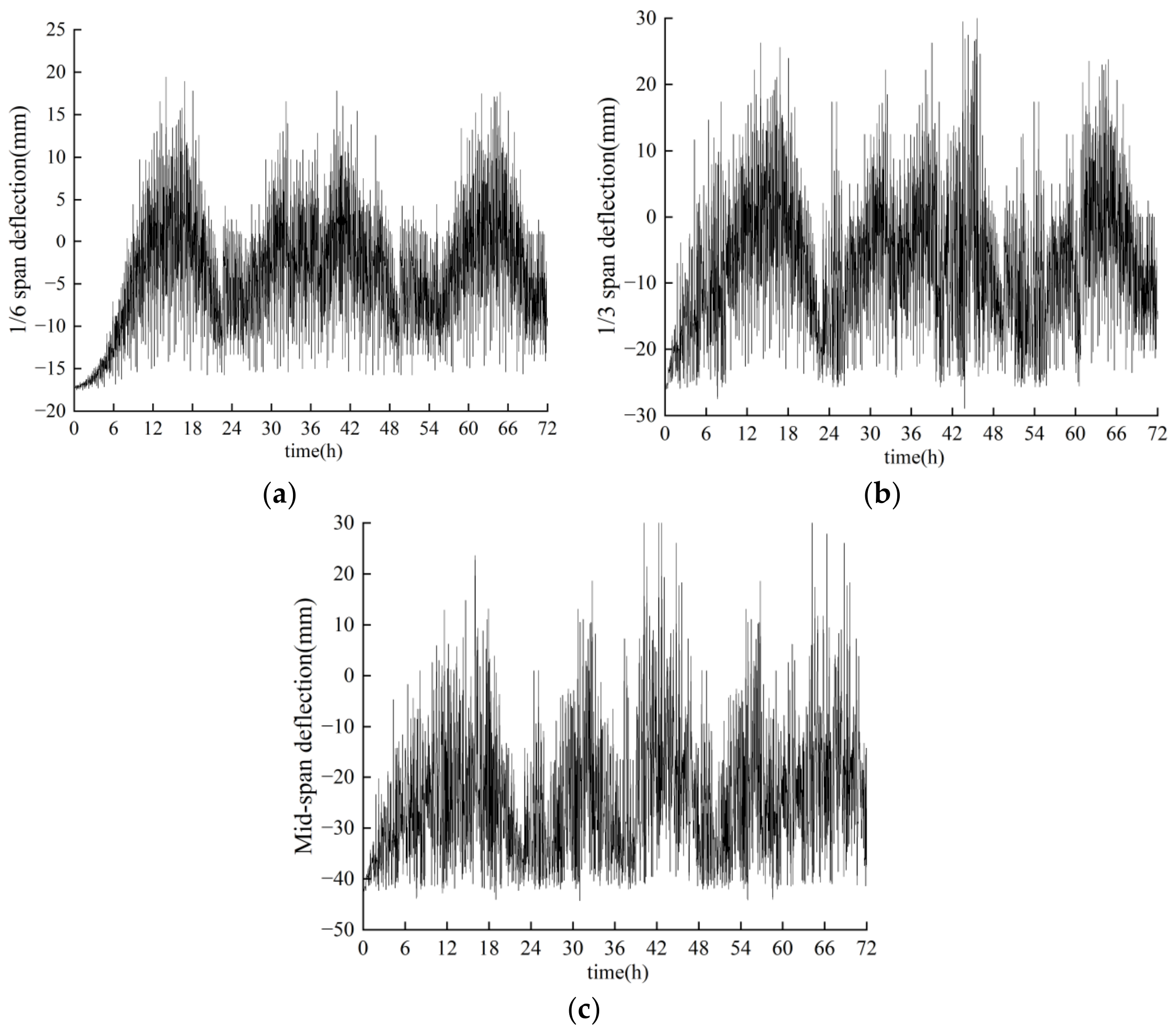
The deflection of each section of the steel box girder shows a relatively consistent periodic change in day and night, showing an upward trend, but the values are different. The mid-span section has the highest temperature sensitivity, and the daily variation range reaches 41 mm. The variation range of the 1/3 span section is 30.5 mm; the variation range of the 1/6 span section is reduced to 17.9 mm due to its proximity to the lifting point.
In order to better fit the characteristics of the on-site construction environment, a three-phase coupling model is established on the basis of the original working conditions to study the deflection change in the steel box girder during the lifting process. The reference wind speed is set to 8 m/s, and the solar heat flux on the sunny side of the roof is 800 W/m2, and the shady side is 200 W/m2. In order to determine the wind load conditions in the subsequent fluid–solid–thermal coupling analysis, the wind-induced responses of the structure under different wind directions are compared. Three typical wind direction angles of 0° longitudinal bridge direction, 45° oblique bridge direction and 90° transverse bridge direction were selected and analyzed under the reference wind speed. The comparison results are shown in Table 5.
Based on the comparative analysis of Table 5, the 90° cross-bridge wind has the most adverse effects on the lateral stiffness, structural strength and overall stability of the system. Therefore, the subsequent multi-field coupling analysis related to wind load is carried out, and this most unfavorable 90° wind direction angle condition is adopted to ensure the safety and conservatism of the analysis results.
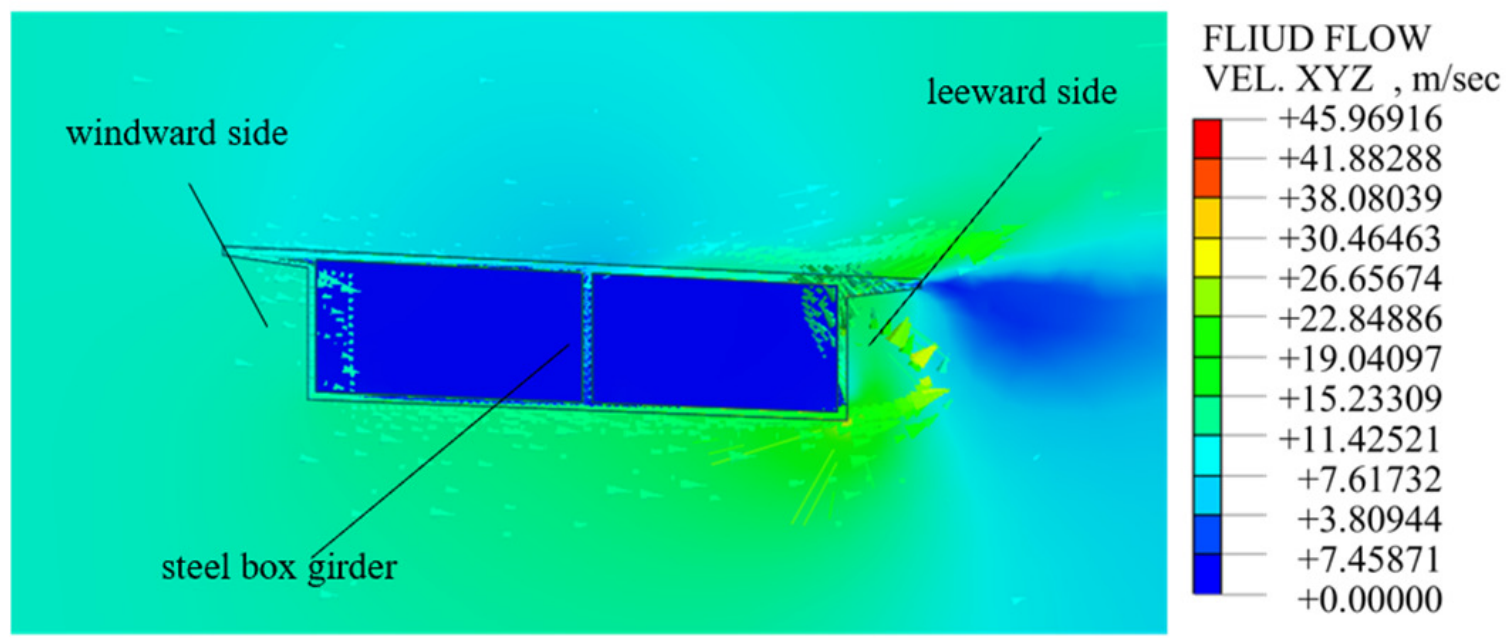
Figure 6 illustrates the external flow field around the steel box girder with heat transfer effects taken into account. In the displacement coordinate system shown, the positive direction along the cross-section of the girder runs from left to right, which aligns with the incoming wind direction. The maximum wind speed, approximately 30.46 m/s, occurs at the bottom corner of the girder. Vortex shedding is observed at the top and near the trailing edge on the leeward side, resulting in a net downward aerodynamic force exerted on the steel box girder by the fluid.
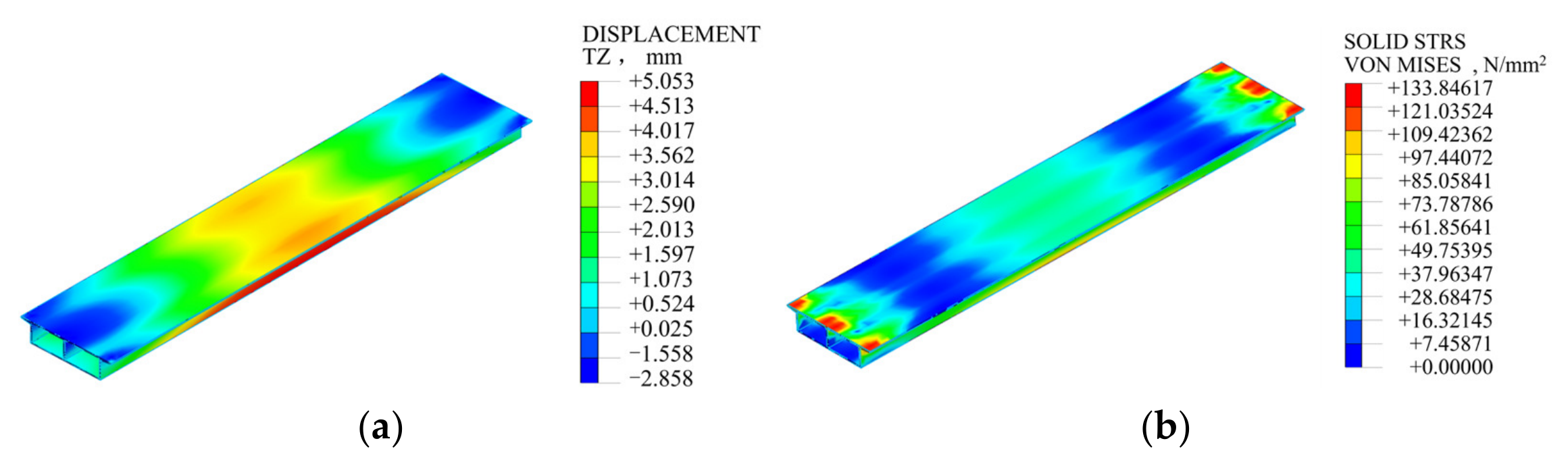
Figure 7 shows the vertical displacement deformation characteristics of the steel box girder under multi-field coupling. The temperature distribution is characterized by the transverse temperature difference in the roof, which leads to the transverse bending deformation of the structure and the upwarp attitude. The total displacement value of the roof area of the steel box girder under the temperature gradient is obviously higher than that of the floor area, and the maximum deformation is concentrated in the central position of the roof. And the size of the transverse bridge deformation is different, because the weld is coupled with uneven solar light. At the same time, the von Mises stress distribution shows that the constraint deformation caused by the temperature gradient in the connection area between the top plate and the web is large, and there is a stress concentration phenomenon, which indicates that the temperature gradient has a great influence on the stress state of the steel box girder structure.
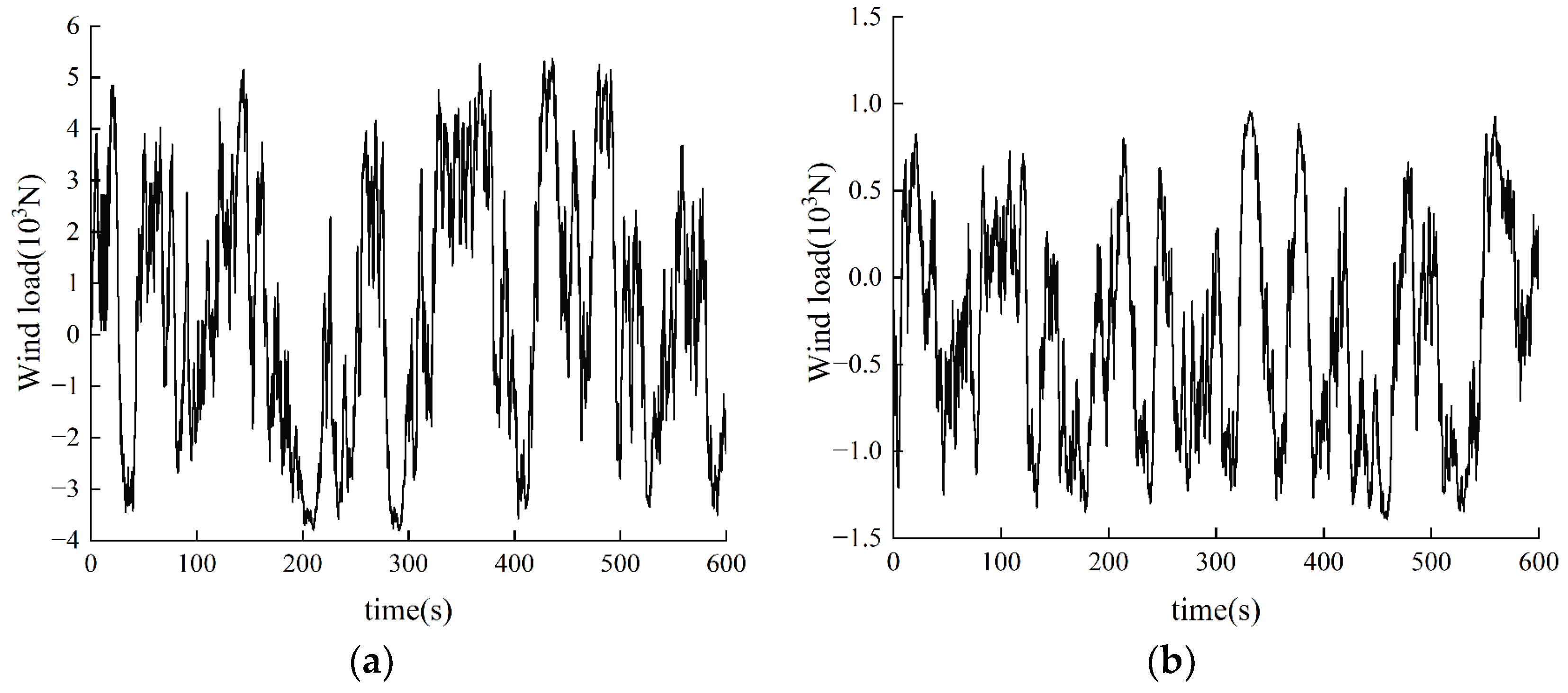
Figure 8 shows the wind load time-history curve of the steel box girder per unit length. The resistance amplitude fluctuates from −3.87 kN to +5.21 kN, and the lift time history shows obvious asymmetric characteristics. The maximum value is about 1.03 kN, and the minimum value is close to −0.3 kN. This kind of fluctuating wind load further aggravates the vibration response of steel box girder, and may induce vortex-induced vibration in the critical wind speed range, which has an adverse effect on the wind stability of lifting construction. To further quantitatively characterize the fluctuating wind-load properties, fast Fourier transform (FFT) is performed on the drag and lift force time-history data. Power spectral density (PSD) analysis indicates a dominant frequency of 0.038 Hz. Using the beam depth D = 3.62 m as the characteristic length and the reference wind speed U = 8 m/s, the corresponding Strouhal number would be St = f D/U ≈ 0.017. This low frequency (period ≈ 26 s) corresponds to the lateral sway frequency of the flexible sling-girder system under canyon wind excitation.
Figure 9 shows the vertical deflection curve of the steel box girder under the combined action of wind load, temperature load and self-weight within 72 h after the start of the synchronous lifting; the vertical deflection at the three sections of 1/6 span, 1/3 span and mid-span changes with time. The deflection response of each section shows obvious time series correlation, and the response amplitude is closely related to the section position, and the deflection of the mid-span section changes significantly. The vertical deflection time-history curve of the main beam shows dense high-frequency oscillations during the daytime period (06:00–20:00), and the maximum instantaneous amplitude can reach ±25.0 mm. The change in deflection in 72 h is roughly periodic with simple harmonic motion, and the three sections will arch upward with the change in temperature between day and night every day. The maximum value of the overall trend appears at about 16:00 (16 h, 40 h, 64 h) every day, and the deflection of each section changes rapidly.
The coefficient of variation in the deflection time history of the three sections within 72 h is calculated respectively, and the dispersion degree of the deflection data is analyzed to evaluate the dynamic amplification effect of wind-induced vibration. The calculation formula of the coefficient of variation is:
C V = σ μ
where CV is the coefficient of variation; σ is the standard deviation of the data set; and μ is the mean (average) value of the data set. The coefficients of variation of 1/6, 1/3 and mid-span are 0.374, 0.396 and 0.414, respectively, indicating that the degree of deflection time-history dispersion gradually increases when it is close to the mid-span.
This phenomenon arises from the combined effects of diurnal thermal expansion/contraction and unsteady turbulent wind excitation, where temperature drives the low-frequency cyclic deflection and fluctuating wind load induces high-frequency dynamic oscillations.

5.2. Analysis of End Sway of a Steel Box Girder

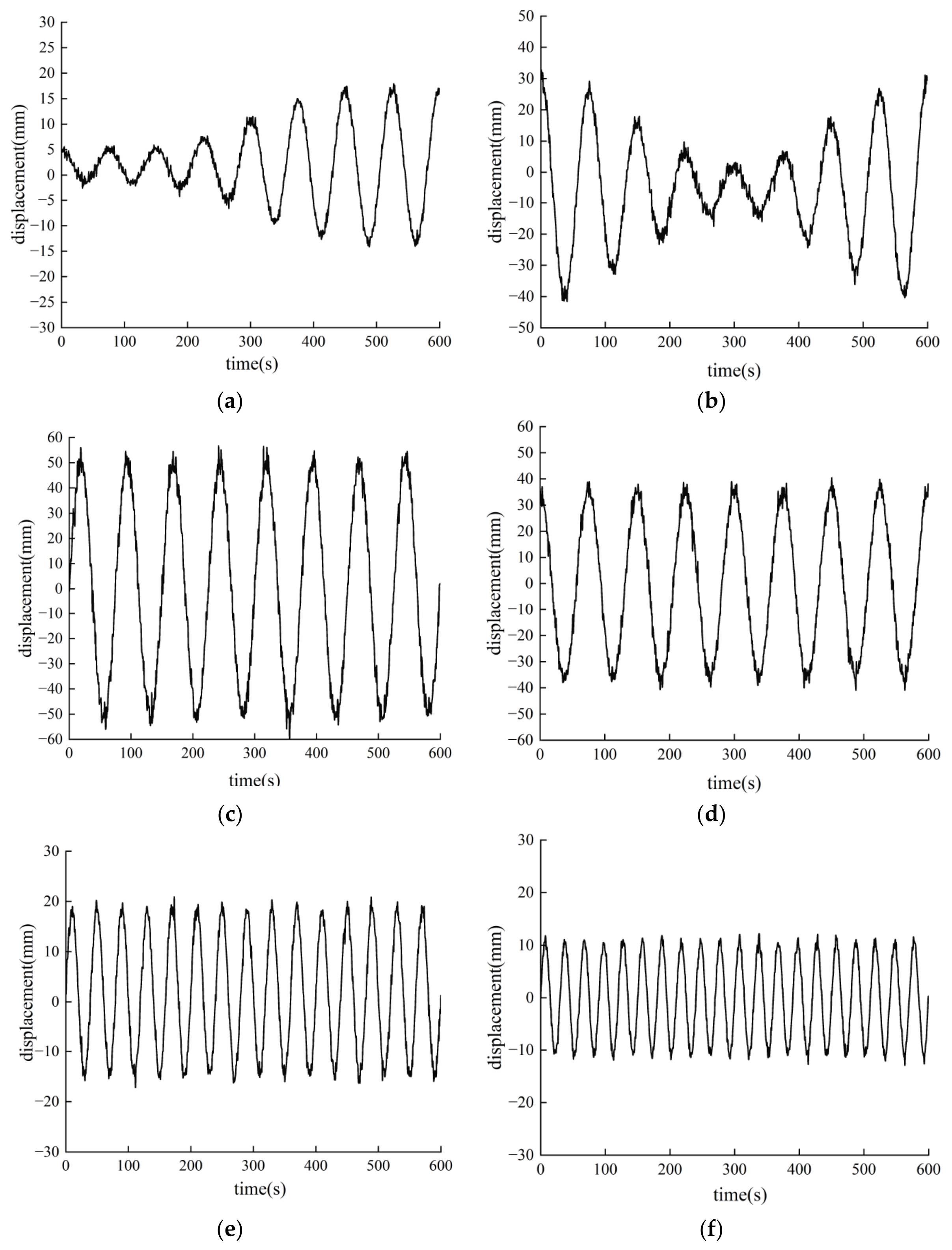
The posture control parameters and measures of the whole process steel box girder are further analyzed to achieve the welding accuracy required by the project. Therefore, the change in the end-displacement of the steel box girder in the wind field and temperature field still needs to be studied after the formal lifting. The displacement load is applied at the lifting point, and the length of the lifting sling is reduced with the increase in the lifting height to simulate the end-displacement caused by the lateral swing of the steel box girder. Combined with the vertical deflection in the plane, the change law of the end-displacement of the steel box girder was comprehensively studied. After several simulations, it was concluded that the displacement of both ends of the steel box girder was symmetrical and the difference was small. Figure 10 shows the time-history curve of the end motion of the steel box girder at different lifting heights.
According to the displacement time-history curves of the end of the steel box girder at different lifting heights shown in Figure 10, the dynamic response of the structure during the lifting process is analyzed. As the lifting height gradually increases from 5 m to 55 m, the displacement response of the end of the steel box girder shows obvious time-varying characteristics and high correlation. At the lifting height of 5–15 m, the fluctuation range of the displacement time-history curve is relatively small, and the incomplete cycle phenomenon occurs, because the lower basin of the steel box girder is not completely expanded. When the lifting height is 25 m, the swing range is −58.2 mm–+57.1 mm, and then the lateral displacement reaches the maximum. Then, with the increase in the lifting height, it gradually decreases and is more linear, but the motion frequency increases. When the lifting height is 25 m, the action space of the flow field changes significantly, the beam is separated from the ground, the lower flow field can be freely expanded, and the area and strength of the wind load tend to be maximized, thereby increasing the end-displacement.
In addition, the dynamic characteristics of the structure are coupled with the wind load spectrum. The sway frequency of the lifting system composed of steel box girder and rigging gradually increases with the increase in height. At the height of 25 m, the system frequency falls into the main pulsation frequency band of the canyon wind-field, causing obvious dynamic amplification effect, which conforms to the resonance excitation mechanism of girder erection under mountainous canyon wind conditions reported in previous research [33]. After exceeding this height, the system frequency gradually deviates from the wind-energy concentrated frequency band, and the shortening of the rigging also enhances the system constraint, which makes the vibration response gradually attenuate. Therefore, the 25 m lifting height is the most unfavorable critical height for the matching of wind-load excitation and structural dynamic characteristics, and it is a sensitive area that needs to be focused on.
The observed variation in end sway is governed by the changing dynamic characteristics of the sling-girder system and the matching between structural frequency and wind energy spectrum, which jointly determine the aerodynamic response at different lifting heights.

5.3. Analysis of the Influence of Deflection and End-Displacement on Synchronous Lifting

The mechanism of the influence of deflection and end-displacement on synchronous lifting is further analyzed, and the asynchronous response of steel box girder caused by two kinds of nonlinearity of temperature and wind load in the whole process of steel box girder lifting is studied. The maximum values of plane tilt ratio and end-displacement of the steel box girder in the model are extracted, and the patterns of the corresponding plane tilt ratio α and the combined unbalanced displacement CD of the lifting point of the steel box girder are explored. The calculation formula of CD is as follows:
C D = w 1 Δ n + w 2 Δ w + w 3 Δ n Δ w
where CD is the comprehensive unbalanced displacement of the lifting point, Δw and Δn are the simulated values of the relative displacement of the outer and inner lifting points, respectively. To quantitatively determine the weighting coefficients in Equation (8), a series of control-variable numerical simulations was performed specifically for this study. In these simulations, each of the three geometric deviation indices (Δw, Δn, and Δw − Δn) was set to the critical threshold of 12 mm while the other two were held at zero. The resulting maximum lifting-point reaction force was extracted from the numerical model under the combined canyon wind and thermal loading conditions.
As summarized in Table 6, the baseline reaction force (all indices zero) was Ro = 1023.74 kN. Setting Δw = 12 mm alone increased the reaction force to Rw = 1432.57 kN, giving an increment of ΔRw = 408.83 kN. Setting Δn = 12 mm increased the reaction force to Rn = 1327.15 kN (ΔRn = 303.41 kN), and setting (Δw − Δn) = 12 mm increased it to Rdiff = 1335.24 kN (ΔRdiff = 311.50 kN). Their proportions are approximately 39.93%, 29.63%, and 30.44%. Based on this proportional relationship, the contribution of Δw to the total unbalanced effect is taken as 40%, while Δn and (Δw − Δn) each contribute approximately 30%. Therefore, the three weighting coefficients (w1, w2, w3) in Equation (8) are adopted as 0.40, 0.30, and 0.30, respectively.
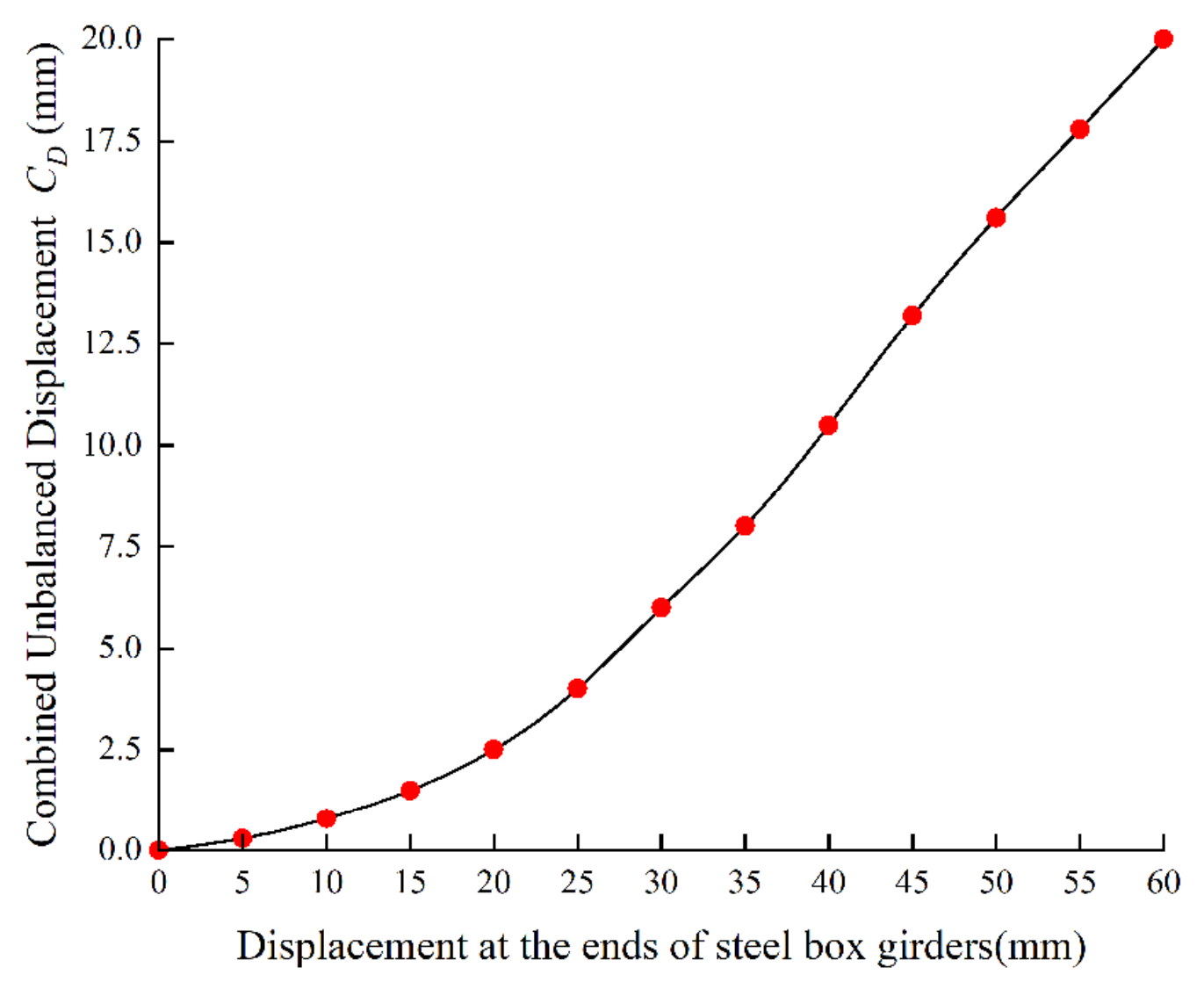
The law of the end-displacement and the comprehensive unbalanced displacement of the lifting point during the lifting process of the steel box girder is shown in Figure 11. There is a non-linear positive correlation between the end-displacement and the comprehensive unbalanced displacement. As the displacement increases, the growth rate of CD gradually accelerates, and the growth is significant after the displacement exceeds 25 mm.
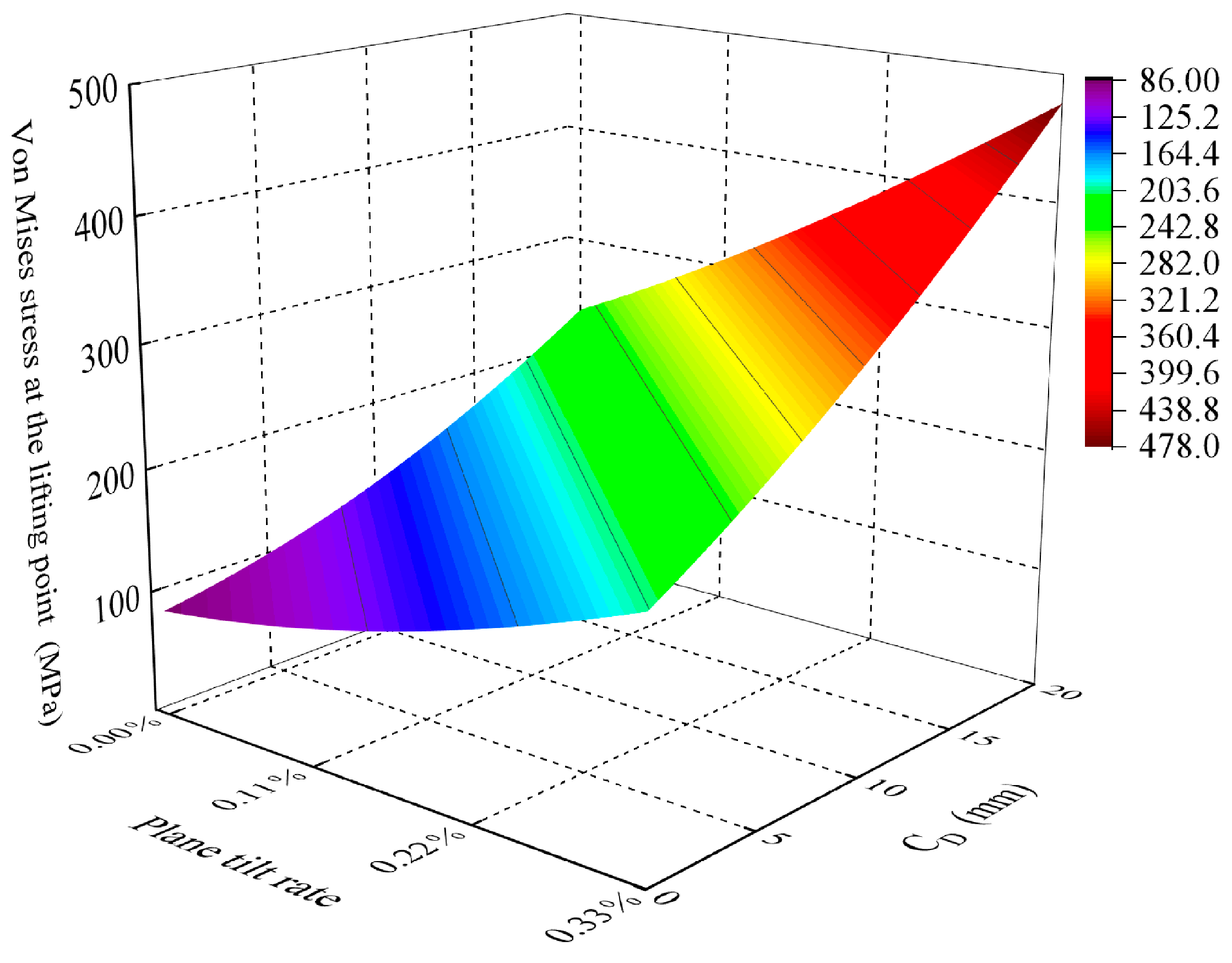
The data of the plane tilt ratio and the unbalanced displacement of the hanging point of the steel box girder under the coupling of temperature and wind load are fitted to obtain the number of three-dimensional surfaces, as shown in Figure 12. Under the combined action of the plane tilt ratio and the relative displacement mean of the lifting point, the maximum stress of the lifting point of the steel box girder is non-linearly distributed. The data coverage includes the plane tilt ratio of 0–0.33% and the comprehensive unbalanced displacement of the lifting point of 0–20 mm. The minimum stress value is 86.0 MPa, and the maximum stress value is 478.0 MPa.
The influence of the plane tilt ratio on the stress state is higher than that of the lifting point, but the coupling effect of the two is more significant to the stress change in the steel box girder, which means that the two factors must be controlled cooperatively in the synchronous lifting. Combined with the ‘Code for Construction of Steel Structures’ (GB 50755-2012) and the ‘Safety Technical Code for Construction Lifting Engineering’ (JGJ 276-2012) [34,35], when the plane tilt ratio α exceeds 0.17% or the comprehensive unbalanced displacement of lifting points CD exceeds 12 mm, the stress level exceeds 95% of the allowable stress of the material. This 95% stress threshold follows the well-established engineering safety principle defined in Clause 9.3.1 of GB 6067.1-2010 [36], where an alarm signal is required when the actual lifted load reaches 95% of the rated capacity, ensuring a safety buffer before reaching the ultimate limit, the torque effect of the beam body is significantly enhanced, and the synchronous-control system has a failure risk.

6. Field Monitoring and Verification of Lifting Construction Effects

6.1. Comparison of Construction Site Monitoring Data and Simulation Data

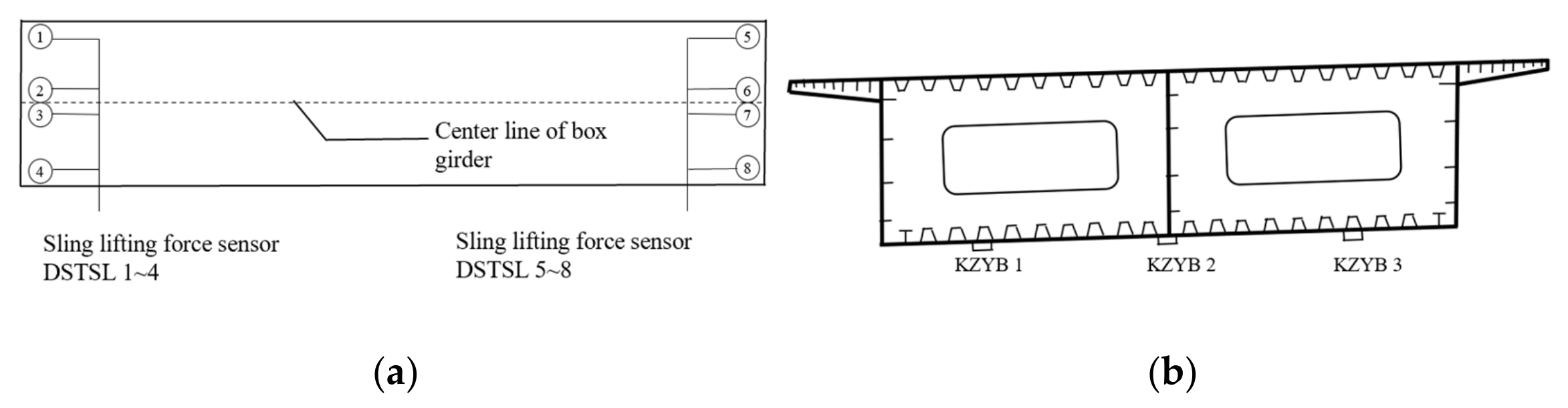
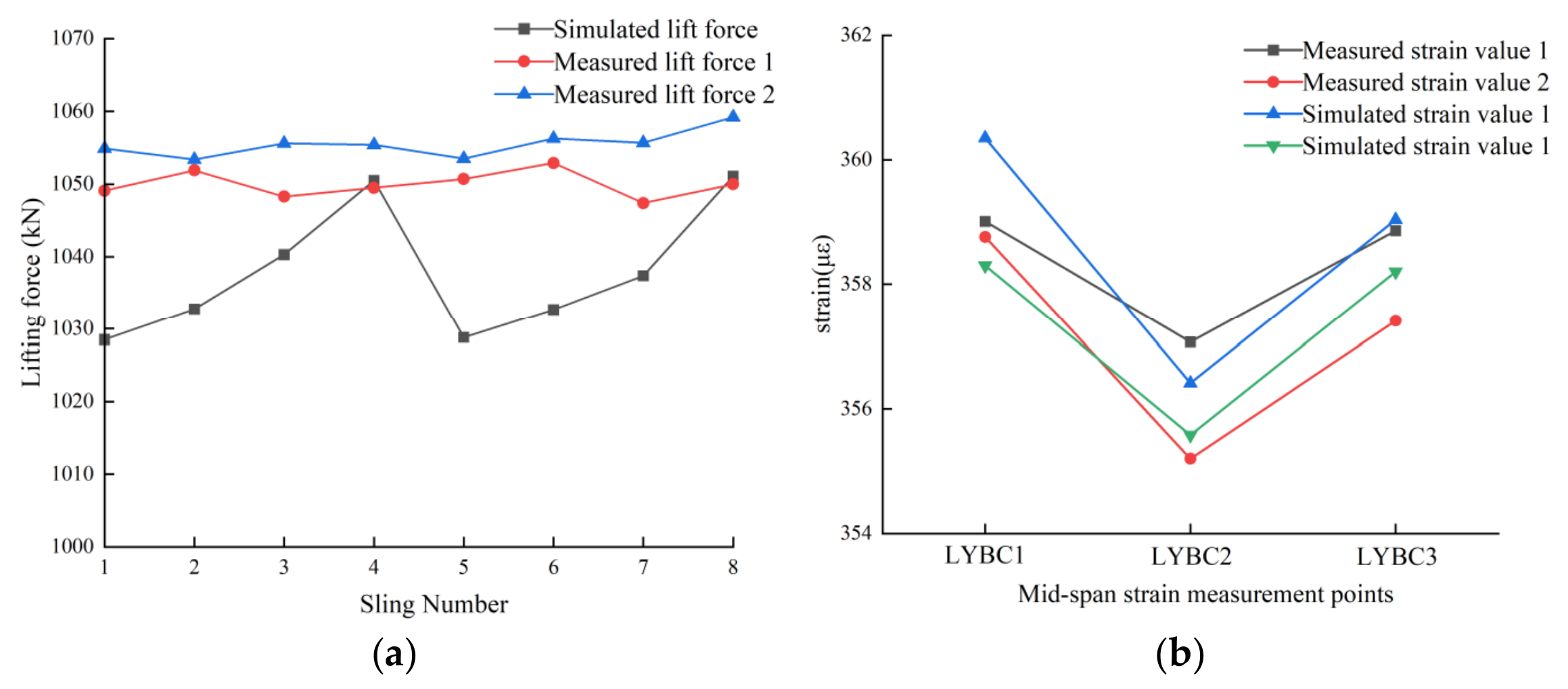
The sensor measurement points of the synchronous lifting system are arranged as shown in Figure 13. During the lifting process, the measured values of the pre-lifting stage and the formal lifting stage are selected as input data and compared with the simulated values. The comparison between the measured input data and the simulated value of the synchronous lifting control system is shown in Figure 14.
The error between the measured and simulated values of the sling force of each sling and the mid-span strain of the steel box girder ranges from 0.1% to 2.6%, and the error does not exceed 5% of the specification requirements, indicating that the adopted numerical model is reasonable and credible in terms of load and boundary condition setting. Under the other lifting conditions, the sling force of each lifting point and the static response results of the steel box girder can provide reference for the optimization of the actual construction scheme. Quantitative statistical indicators are further calculated to assess the agreement between numerical predictions and field-measured lifting force and strain data. For sling lifting force, the coefficient of determination R2 = 0.94, mean absolute error (MAE) = 11.2 kN, and root-mean-square error (RMSE) = 13.8 kN. For mid-span girder strain, R2 = 0.96, MAE = 0.52 με, RMSE = 0.61 με. These high-correlation and low-error results quantitatively verify the reliability and accuracy of the established multi-field coupling numerical model. In addition, minor deviations are mainly attributed to stochastic canyon wind fluctuations, sensor measurement noise, and simplified structural boundary constraints in the numerical model, which are typical inherent uncertainties in on-site monitoring-numerical simulation comparisons for complex lifting construction.
Figure 14. Comparison curves of measured and simulated maximal mechanical responses (a) sling force comparison; (b) comparison of mid-span strain.
Eng 07 00290 g014

6.2. Construction Measures and Implementation Effect
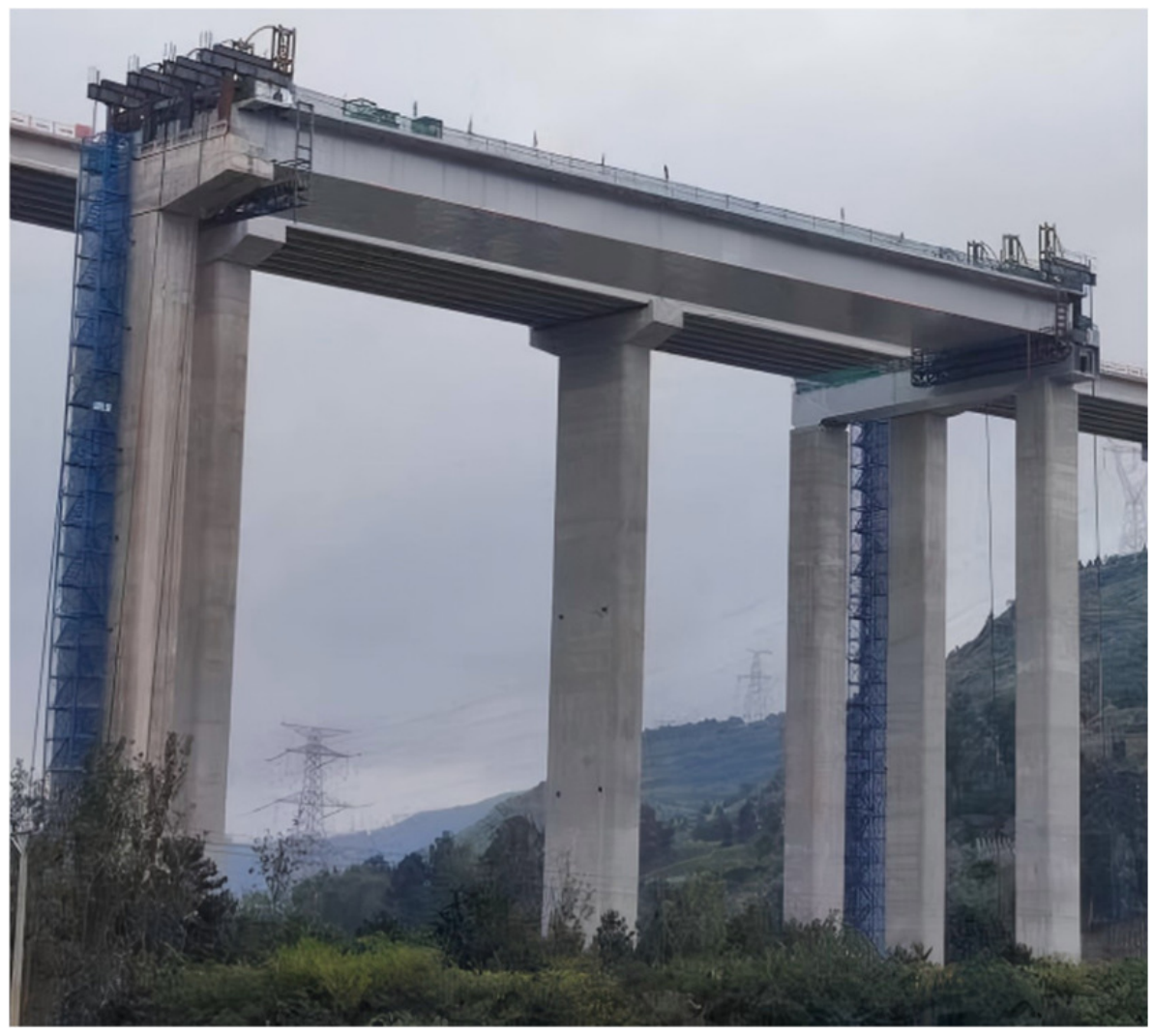
Based on the obtained structural response patterns and control critical value, in order to ensure the safety and accuracy of the lifting process, the ‘synchronous intelligent hydraulic lifting’ technology is adopted. This technology adjusts the posture of the steel box girder through real-time sensing feedback lifting system, so as to compensate the temperature and wind-induced response in real time. The real-time monitoring and early warning thresholds of tilt rate and unbalanced displacement are set to 0.15% and 10 mm, slightly lower than the theoretical critical value, so as to reserve an appropriate safety space and prevent system instability. The information source of the synchronous lifting control system is provided based on the distance sensors distributed at each lifting point. During the lifting process, the sensor monitors the height data of the component in real time and transmits it to the main control computer through the on-site real-time network. According to the height deviation of each lifting point, the main control computer dynamically adjusts the response action of the lifting device and the wind-resistant device (A temporary wind-resistant limiting device is installed at the girder’s lifting point during synchronous lifting. This device is designed to restrict the lateral displacement of the steel box girder under wind loads and prevent excessive swing, ensuring construction safety during lifting) to achieve ultra-high precision displacement fine-tuning, so as to ensure the synchronous stability of the steel box girder during the lifting process. The lifting completion site is shown in Figure 15.
Figure 15. Actual scene of steel box girder lifting completion.
Eng 07 00290 g015
The scheme adopted in this project has achieved expected results in practical application. Firstly, in terms of law reliability, the maximum height difference and plane tilt ratio of the lifting point in Table 7 are effective and safe within the control threshold range based on multi-field coupling analysis, and the structural response in the construction process is consistent with the simulation prediction law. Secondly, in terms of feasibility, the comprehensive comparison shows that compared with the traditional segmental lifting, this scheme shows significant advantages in many core dimensions such as construction efficiency and control accuracy, which verifies that the technical path has practical engineering value for solving the installation problem of the long-span steel box girder in mountainous areas.

7. Conclusions

In this study, a coupled fluid–thermal–structural numerical model is established to reveal the wind–thermal-induced deformation and end-sway mechanism of a super-long-span steel box girder during integral lifting, and an intelligent lifting control scheme is proposed for practical construction. The key conclusions are summarized as follows:
(1) Thermal effect dominates the daily cyclic deflection of the steel box girder, presenting a negative correlation with ambient temperature. Wind-induced vibration further introduces high-frequency oscillation and obvious dynamic amplification, with an instantaneous swing amplitude of ±25.0 mm. The mid-span section exhibits the largest deflection response under the coupling effect of temperature and wind load.
(2) The girder end-displacement varies regularly with lifting height, with 25 m identified as the critical unfavorable height. At this height, the fluid field is fully developed, leading to the maximum end swing range of −58.2 mm ~ +57.1 mm; above this height, the end-displacement amplitude decreases linearly with increasing lifting height.
(3) The plane tilt ratio has a non-linear correlation with the comprehensive unbalanced displacement of lifting points. A critical safety threshold is determined: when the tilt ratio exceeds 0.17% or the unbalanced displacement exceeds 12 mm, the local stress approaches 95% of the allowable stress, bringing risks of torque amplification and synchronous-control instability. Dual-index real-time monitoring is thus required for construction safety.
(4) The intelligent hydraulic lifting system with displacement-synchronization and load-balancing strategy can realize millimeter-level synchronous control, guaranteeing welding precision and overall structural stability. Limited by on-site monitoring conditions, the present study focuses on short-term lifting responses; long-term structural performance under multi-field coupling will be further investigated in future work.

Author Contributions

Conceptualization, H.X. and X.S.; methodology, X.S. and W.L.; software, X.S.; validation, H.X. and X.L.; formal analysis, H.X., X.S. and W.L.; investigation, X.L.; resources, X.L.; data curation, X.S.; writing—original draft preparation, X.S.; writing—review and editing, H.X. and W.L.; visualization, X.S.; supervision, H.X. and X.L.; project administration, X.L.; funding acquisition, H.X. All authors have read and agreed to the published version of the manuscript.

Funding

This research was financially supported by the National Natural Science Foundation of China (Grant No. 51678284).

Institutional Review Board Statement

Not applicable.

Informed Consent Statement

Not applicable.

Data Availability Statement

The datasets generated and analyzed during the current study are not currently available in a public repository due to their original nature as proprietary findings from a specific engineering project. However, they are available from the corresponding author upon reasonable request for academic and research purposes.

Acknowledgments

The authors wish to extend their profound gratitude to the School of Civil Engineering and Architecture at Henan University of Science and Technology for their foundational role in this re-search. The university’s provision of advanced computational resources and essential software licenses was instrumental in conducting the sophisticated numerical simulations presented in this work. Additionally, the authors thank the collaborative partners from The First Construction Co., Ltd. of China Railway Construction 15th Group for their vital role in facilitating the on-site data collection and monitoring efforts.

Conflicts of Interest

Author Xiaofeng Liu was employed by the company The First Construction Co., Ltd. of China Railway Construction 15th Group. The remaining authors declare that the research was conducted in the absence of any commercial or financial relationships that could be construed as a potential conflict of interest.

References

  1. Zhou, Z. Key Construction Techniques for Whole-Hole Lifting and Erection of Long-Span Steel Girders of the Hong Kong-Zhuhai-Macao Bridge. Ind. Constr. 2025, 55, 245–252. [Google Scholar] [CrossRef]
  2. Aurier, L.; Hassan, M.; Jaworski, J.; Guizani, L. Review of Accelerated Bridge Construction Systems for Bridge Superstructures and Their Adaptability for Cold Weather. CivilEng 2023, 4, 83–104. [Google Scholar] [CrossRef]
  3. Van de Ven, J.; de Boer, A. Dynamic Control and Numerical Modelling of Synchronous Lifting of Heavy Bridge Girders in Complex Terrain. Eng. Struct. 2022, 257, 114102. [Google Scholar] [CrossRef]
  4. Liu, M.; Wu, Y.; Fan, S.; Wu, Q.; Liang, D. Local–distortional interaction buckling of stainless steel lipped C-section beams. J. Constr. Steel Res. 2023, 201, 107731. [Google Scholar] [CrossRef]
  5. Li, G.; Wu, G.; Tan, L.; Fan, H. A Review: Design and Optimization Approaches of the Darrieus Water Turbine. Sustainability 2023, 15, 11308. [Google Scholar] [CrossRef]
  6. Yang, Y.; Du, H.; Yao, G.; Ma, X.; Men, W. Time-Varying Mechanical Analysis of Long-Span Spatial Steel Structures Integral Lifting in Construction Basing Building Information Model. Sustainability 2023, 15, 11256. [Google Scholar] [CrossRef]
  7. Roy, A.K.; Yadav, H.; Dasu, S.C.; Kumar, P.; Chanotra, A. Wind responses on twin box girder bridge deck using a fluid–structure interaction approach. Asian J. Civ. Eng. 2023, 2, 2959–2972. [Google Scholar] [CrossRef]
  8. Liu, Z.; Jiang, Z.; Li, X.; Shao, C.; Wang, C.; Chen, Z. Study on Mechanism and Aerodynamic Control Measures for Vortex-induced Vibration of a Streamlined-box Steel Girder. China J. Highw. Transp. 2022, 35, 133–146. [Google Scholar] [CrossRef]
  9. Zhang, Z.; Xu, F.; Liu, Z.; Wang, Q.; Zhang, M. Three-Dimensional Flutter Analysis of Aeroelastic Models of Bridge Decks Based on Large-Eddy Simulations. J. Struct. Eng. 2025, 151, 04025065. [Google Scholar] [CrossRef]
  10. Wang, Y.; Zhang, G.; Wang, H.; Liu, L.; Wang, X.; Zheng, S.; Huang, J.; Fu, B.; Zhou, L. Investigation of Temperature Effects on Wide Steel Box Girder of Suspension Bridge Based on Long-Term Monitoring. Sci. Rep. 2024, 14, 9691. [Google Scholar] [CrossRef]
  11. Zhang, Y.; Liu, J.; Wang, T.; Li, S.; Zhao, M. Study of Reynolds Number Effects on Aerodynamic Forces and Vortex-Induced Vibration Characteristics of a Streamlined Box Girder. Appl. Sci. 2025, 15, 2202. [Google Scholar] [CrossRef]
  12. Lei, W.; Wang, Q.; Zhang, Y.; Li, Z. Study on VIV Performance of Streamlined Steel Box Girder of a Sea-Crossing Cable-Stayed Bridge. Ocean Eng. 2024, 295, 116897. [Google Scholar] [CrossRef]
  13. Hu, C.; Guan, X.; Zhao, L.; Ge, Y. Simplified vortex modes of torsional vortex-excitation forces in a typical streamlined box girder and its suppression mechanism with aerodynamic countermeasures. J. Vib. Eng. 2025, 38, 302–309. [Google Scholar] [CrossRef]
  14. Verma, S.; Cid Montoya, M.; Mishra, A. Shape- and frequency-dependent self-excited forces emulation for the aero-structural design of bluff deck bridges. J. Wind Eng. Ind. Aerodyn. 2024, 252, 105769. [Google Scholar] [CrossRef]
  15. Zhang, Y.; Liao, H.; Wu, B.; Zhou, Q. A Novel Multi-Modal Analytical Method Focusing on Dynamic Mechanism of Bridge Flutter. Comput. Struct. 2024, 294, 107257. [Google Scholar] [CrossRef]
  16. Kildal, O.; Petersen, Ø.W.; Øiseth, O. On the identification of aerodynamic derivatives using forced vibration in active grid generated turbulent flow. Phys. Conf. Ser. 2024, 2647, 242001. [Google Scholar] [CrossRef]
  17. Zeng, L.; Liu, X.; Deng, Z.; Liu, Z.; Meng, Y.; Jiang, Z.; Chen, Z. Main girder segment model test on wind resistance performance of long-span single-pylon cable-stayed bridge. J. Highw. Transp. Res. Dev. 2025, 42, 175–181. [Google Scholar] [CrossRef]
  18. Tuo, D.; Zeng, G.; Zhang, Y. Effects of Reynolds number and scale ratio on VIV tests for railway blunt box girders. Sci. Rep. 2025, 15, 19146. [Google Scholar] [CrossRef]
  19. Chen, X.; Qiu, F.; Tang, H.; Li, Y.; Xu, X. Effects of Secondary Elements on Vortex-Induced Vibration of a Streamlined Box Girder. KSCE J. Civ. Eng. 2020, 25, 173–184. [Google Scholar] [CrossRef]
  20. Cui, F.; Zhang, X.; Li, H.; Elghazouli, A.Y. Temperature field effects and thermal-induced response of curved steel box-girder bridges using field monitoring data and numerical assessments. J. Constr. Steel Res. 2026, 237, 110102. [Google Scholar] [CrossRef]
  21. Liu, Z.; Luo, S.; Jiang, M. Study on the Temperature Model and Influence Effect of Uncovered Steel Box Girder with Large Height–Width Ratio and Straight Web Plate. Buildings 2025, 15, 1818. [Google Scholar] [CrossRef]
  22. Wang, S.; Zhang, G.; Li, J.; Wang, Y.; Chen, B. Temperature Response of Double-Layer Steel Truss Bridge Girders. Buildings 2023, 13, 2889. [Google Scholar] [CrossRef]
  23. Huang, X.; Zhu, J.; Li, Y.-L. Temperature analysis of steel box girder considering actual wind field. Eng. Struct. 2021, 246, 113020. [Google Scholar] [CrossRef]
  24. Huang, X.; Zhu, J.; Jiang, S.; Zhao, J.; Li, Y. Temperature Field Characteristics of Flat Steel Box Girders Based on In Situ Field Measurement and Numerical Simulation. J. Bridge Eng. 2023, 2, 04023065. [Google Scholar] [CrossRef]
  25. Hao, J.; Lu, H.L.; Wang, Y.Q.H.; Chen, L. Field measurement and numerical simulation on vertical temperature gradient of steel box girders. Struct. Infrastruct. Eng. 2024, 1–12. [Google Scholar] [CrossRef]
  26. Ma, W.; Wu, B.; Qin, D.; Zhao, B.; Yang, X. Statistical Analyses of the Non-Uniform Longitudinal Temperature Distribution in Steel Box Girder Bridge. Buildings 2023, 13, 1316. [Google Scholar] [CrossRef]
  27. Hu, J.; Zhang, X.; Li, Z.; Wu, H.; Wen, J. Non-stationary characteristics of measured wind speed of continuous rigid frame bridge with high piers in mountains. J. Civ. Struct. Health Monit. 2025, 15, 2245–2260. [Google Scholar] [CrossRef]
  28. Chen, Z.; Wu, Y.; Xu, Y.; Zhang, Z.; Li, H.; Ning, G. Field-validated LES study on the aerodynamic response of a long-span bridge in complex double-mountain terrain. Eng. Struct. 2025, 343, 121260. [Google Scholar] [CrossRef]
  29. JTG/T 3360-01-2018; Wind-Resistant Design Specification for Highway Bridges. Ministry of Transport of the People’s Republic of China: Beijing, China, 2018.
  30. Zhan, Y.; Chen, K.; Li, Z.; Shao, J.; Li, J.; Tian, B.; Li, Y. Solar-induced temperature distribution in vase-shaped bridge towers under terrain shading simulated with an accelerated shadow identification algorithm. Structures 2025, 71, 108054. [Google Scholar] [CrossRef]
  31. Che, X.; Zhao, X.; Dang, J. Flow Characteristics of Steel Box Girder Cross-section with Non-uniformly Closed Railing. J. Highly. Transp. Res. Dev. 2024, 41, 172–179. [Google Scholar] [CrossRef]
  32. Hou, G.; Wang, J.; Layton, A. Numerical Methods for Fluid–Structure Interaction—A Review. Commun. Comput. Phys. 2012, 12, 337–377. [Google Scholar] [CrossRef]
  33. Zhu, S.; Sun, X.; Liu, X.; Li, W.; Liang, B. Analysis of Wind-Induced Response During the Lifting Construction of Super-Large-Span Heavy Steel Box Girders. Buildings 2026, 16, 251. [Google Scholar] [CrossRef]
  34. GB 50755-2012; Code for Construction of Steel Structures. China Architecture & Building Press: Beijing, China, 2012.
  35. JGJ 276-2012; Technical Code for Safety of Lifting in Construction. China Architecture & Building Press: Beijing, China, 2012.
  36. GB/T 6067.1-2010; Safety Rules for Lifting Appliances—Part 1: General. Standardization Administration of China: Beijing, China, 2010.
Figure 1. On-site synchronous lifting of steel box girder.
Eng 07 00290 g001
Figure 2. Finite element model. (a) Overview of finite element models; (b) sectional grid of steel box girder.
Eng 07 00290 g002
Figure 3. Comparison between the measured spectrum and the canonical spectrum: (a) downwind wind spectrum; (b) vertical wind direction wind spectrum.
Eng 07 00290 g003
Figure 4. Top flange pressure coefficients at different grid refinement levels.
Eng 07 00290 g004
Figure 5. Steel box girder temperature and temperature linear change: (a) Curves of temperature variation inside and outside steel box girder; (b) temperature deflection variation in three sections of steel box girder under temperature gradient.
Eng 07 00290 g005
Figure 6. Velocity contour distribution around the steel box girder cross-section.
Eng 07 00290 g006
Figure 7. Vertical displacement and von Mises stress of steel box girder under multi-field coupling effect: (a) perpendicular displacement; (b) von Mises stress.
Eng 07 00290 g007
Figure 8. Time-history curve of wind load per unit length (a) drag time-history curve; (b) lift time-history curve.
Eng 07 00290 g008
Figure 9. Time-history curve of steel box girder end under different lifting heights (a) 1/6 cross-section deflection time-history curve; (b) 1/3 cross-section deflection time-history curve; (c) mid-span section deflection time-history curve.
Eng 07 00290 g009
Figure 10. Lateral end-displacement of the steel box girder during synchronous lifting. (a) lifting height 5 m; (b) lifting height 15 m; (c) lifting height 25 m; (d) lifting height 35 m; (e) lifting height 45 m; (f) lifting height 55 m.
Eng 07 00290 g010
Figure 11. The variation law of end-displacement of steel box girder and combined unbalanced displacement of lifting point.
Eng 07 00290 g011
Figure 12. Three-dimensional surface of von Mises stress of lifting point.
Eng 07 00290 g012
Figure 13. Arrangement of sensor measurement points (a) sling force sensor; (b) steel box girder mid-span strain gauge.
Eng 07 00290 g013
Table 1. Finite element model material parameters.
MaterialsDensity/(kg·m−3)Poisson’s RatioElastic Modulus (MPa)
Steel78500.312.06 × 105
Air1.1845\\
Table 2. Different levels of fluid domain meshing method.
LevelNumber of UnitsNumber of NodesMinimum Grid Size (m)
18.25 × 1054.53 × 1050.15
21.98 × 1061.12 × 1060.08
34.52 × 1062.60 × 1060.04
48.47 × 1064.88 × 1060.02
51.52 × 1078.92 × 1060.01
Table 3. Calculation results of aerodynamic force coefficients for different meshing levels.
LevelDrag Coefficient CdLift Coefficient CL
11.2540.083
21.1980.091
31.1720.095
41.1700.096
51.1710.095
Table 4. Sensitivity analysis of structural response with different mesh density levels.
LevelNumber of UnitsMinimum Mesh Size (m)Maximum Stress at the Lifting Point
18.03 × 1050.2125.71
22.53 × 1060.04133.83
33.52 × 1070.01133.84
Table 5. Comparison of wind-induced static responses under different wind angles.
Response Index45°90°
Maximum lateral displacement (mm)2.531.450.7
Mid-span twist angle (°)0.010.190.21
Maximum lifting point stress (MPa)42.188.5124.6
Table 6. Control-variable simulation results for weighting coefficients.
Simulation CaseΔw (mm)Δn (mm)w − Δn) (mm)ΔR (kN)Contribution
Only Δw1200408.8340%
Only Δn0120303.4130%
Only (Δw − Δn)0012311.5030%
Table 7. Summary of the key measured data of the project.
IndexAbsolute Value of Lifting Point Height DifferenceDesign Elevation
Deviation
Maximum Plane Tilt Ratio
Measured data4.7 mm−7 ~ +3 mm0.06%
Disclaimer/Publisher’s Note: The statements, opinions and data contained in all publications are solely those of the individual author(s) and contributor(s) and not of MDPI and/or the editor(s). MDPI and/or the editor(s) disclaim responsibility for any injury to people or property resulting from any ideas, methods, instructions or products referred to in the content.