
Rheological Modeling in Recycled Polyolefin Systems: A Systematic Review of Model Classification, Applicability, and Limitations for Eco-Composite Design



Abstract
1. Introduction
- RQ1: What types of rheological models are most commonly applied in polyolefin-based systems?
- RQ2: How have these models been used to support material formulation and processing?
- RQ3: What are the main challenges and opportunities associated with their application to recycled polyolefin systems?
2. Methodology
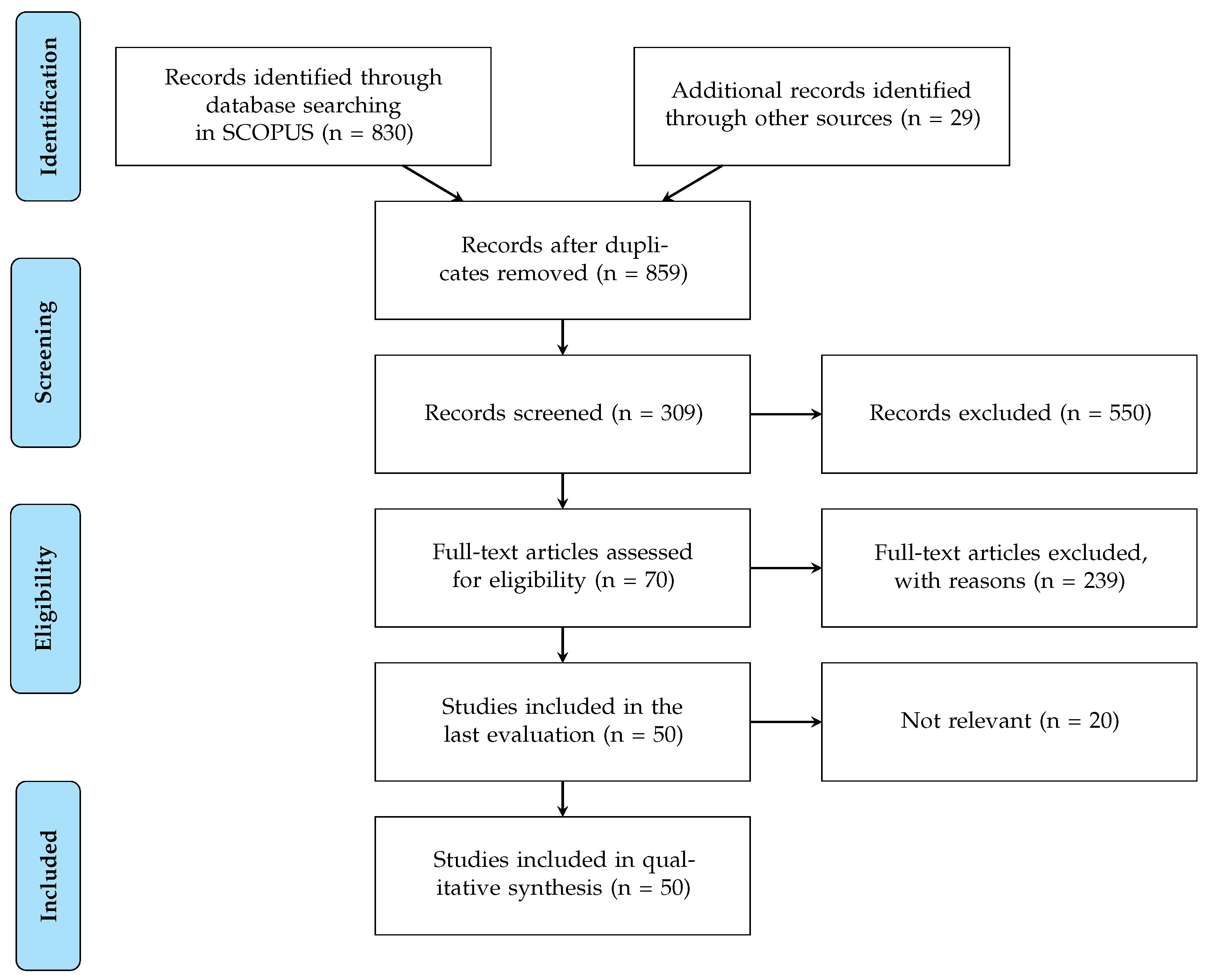
2.1. Identification Phase
2.1.1. Records Identified in SCOPUS
- Publication period: 2015–2025,
- Document types: Research articles and review papers,
- Subject areas: Engineering, materials science, chemistry, environmental science, and chemical engineering,
- Language: English.
2.1.2. Additional Records Identified in Google Scholar
2.2. Screening Phase
2.3. Eligibility Phase
2.3.1. Inclusion and Exclusion Criteria
- Peer-reviewed journal articles (original research or review).
- Studies involving polyolefins (PE, PP, or their blends).
- Explicit rheological characterization or application of rheological models in the molten state.
- Systems involving recycling, composites, or related processing contexts.
- Studies incorporating natural fibers or lignocellulosic reinforcement.
- Publications in English within the period 2015–2025.
- Studies lacking rheological characterization or modeling (except those using MFI as a flow indicator).
- Studies focused exclusively on thermal, mechanical, or morphological characterization without rheological context.
- Non-thermoplastic polymer systems.
- Non-peer-reviewed documents, including conference papers, theses, patents, and technical reports.
2.3.2. Final Study Selection
2.4. Inclusion Phase (Data Analysis)
- Polymer system (virgin, recycled, or composite)
- Type of reinforcement (if applicable)
- Rheological model(s) used (primary and secondary)
- Rheological variables considered (e.g., viscosity, storage modulus, loss modulus)
- Application of the model (fitting, predictive, process-related, or structural)
- Level of model complexity.
3. Results and Findings
3.1. Classification of Identified Rheological Models
3.2. Modeling Approaches Reported in the Review Corpus
3.3. Relationship Between System Type and Modeling Level
3.4. Types of Rheological Modeling Usage
3.5. Rheological Variables Considered
3.6. Evidence of Fragmentation in Modeling Approaches
4. Discussion
4.1. Rheological Model Typology and Distribution (RQ1)
4.2. Application of Rheological Modeling in Formulation and Processing (RQ2)
4.3. Challenges and Opportunities in Recycled Systems (RQ3)
- Initial characterization using melt flow index (MFI) and viscosity curves to establish baseline flow behavior and detect major variations due to degradation.
- Identification of key rheological parameters such as zero-shear viscosity, flow behavior index, and viscoelastic moduli as indicators of structural and compositional changes.
- Selection of an appropriate modeling level based on system complexity, using generalized Newtonian models for process-oriented analysis and more advanced approaches when sufficient data are available.
- Integration of rheological data into process simulation and formulation strategies, enabling indirect assessment of material behavior in systems with unknown composition.
5. Conclusions
Supplementary Materials
Author Contributions
Funding
Institutional Review Board Statement
Informed Consent Statement
Data Availability Statement
Conflicts of Interest
References
- Awais, H.; Nawab, Y.; Amjad, A.; Anjang, A.; Md Akil, H.; Zainol Abidin, M.S. Environmental benign natural fibre reinforced thermoplastic composites: A review. Compos. Part Open Access 2021, 4, 100082. [Google Scholar] [CrossRef]
- Nassar, M.M.A.; Alzebdeh, K.I.; Pervez, T.; Al-Hinai, N.; Munam, A. Progress and challenges in sustainability, compatibility, and production of eco-composites: A state-of-art review. J. Appl. Polym. Sci. 2021, 138, 51284. [Google Scholar] [CrossRef]
- Schyns, Z.O.G.; Shaver, M.P. Mechanical Recycling of Packaging Plastics: A Review. Macromol. Rapid Commun. 2021, 42, 2000415. [Google Scholar] [CrossRef] [PubMed]
- Faust, K.; Denifl, P.; Hapke, M. Recent Advances in Catalytic Chemical Recycling of Polyolefins. ChemCatChem 2023, 15, e202300310. [Google Scholar] [CrossRef]
- Dorigato, A. Recycling of polymer blends. Adv. Ind. Eng. Polym. Res. 2021, 4, 53–69. [Google Scholar] [CrossRef]
- Johansen, M.R.; Christensen, T.B.; Ramos, T.M.; Syberg, K. A review of the plastic value chain from a circular economy perspective. J. Environ. Manag. 2022, 302, 113975. [Google Scholar] [CrossRef]
- Baztan, J.; Jorgensen, B.; Almroth, B.C.; Bergmann, M.; Farrelly, T.; Muncke, J.; Syberg, K.; Thompson, R.; Boucher, J.; Olsen, T.; et al. Primary plastic polymers: Urgently needed upstream reduction. Camb. Prism. Plast. 2024, 2, e7. [Google Scholar] [CrossRef]
- Ncube, L.K.; Ude, A.U.; Ogunmuyiwa, E.N.; Zulkifli, R.; Beas, I.N. An Overview of Plastic Waste Generation and Management in Food Packaging Industries. Recycling 2021, 6, 12. [Google Scholar] [CrossRef]
- Kibria, M.G.; Masuk, N.I.; Safayet, R.; Nguyen, H.Q.; Mourshed, M. Plastic Waste: Challenges and Opportunities to Mitigate Pollution and Effective Management. Int. J. Environ. Res. 2023, 17, 20. [Google Scholar] [CrossRef] [PubMed]
- Evode, N.; Qamar, S.A.; Bilal, M.; Barcelo, D.; Iqbal, H.M.N. Plastic waste and its management strategies for environmental sustainability. Case Stud. Chem. Environ. Eng. 2021, 4, 100142. [Google Scholar] [CrossRef]
- Diggle, A.; Walker, T.R. Environmental and Economic Impacts of Mismanaged Plastics and Measures for Mitigation. Environments 2022, 9, 15. [Google Scholar] [CrossRef]
- Helm, L.T.; Murphy, E.L.; McGivern, A.; Borrelle, S.B. Impacts of plastic waste management strategies. Environ. Rev. 2023, 31, 45–65. [Google Scholar] [CrossRef]
- Walker, T.R.; Fequet, L. Current trends of unsustainable plastic production and micro(nano)plastic pollution. TrAC Trends Anal. Chem. 2023, 160, 116984. [Google Scholar] [CrossRef]
- Johansson, O. The End-of-Waste for the Transition to Circular Economy: A Legal Review of the European Union Waste Framework Directive. Environ. Policy Law 2023, 53, 167–179. [Google Scholar] [CrossRef]
- Segura-Bonilla, O.; Jimenez Elizondo, K. Ciudades y Territorios Inteligentes: Retos y Oportunidades para el Desarrollo en Costa Rica; Universidad Nacional of Costa Rica: Heredia, Costa Rica, 2021. [Google Scholar]
- Lamtai, A.; Elkoun, S.; Robert, M.; Mighri, F.; Diez, C. Mechanical Recycling of Thermoplastics: A Review of Key Issues. Waste 2023, 1, 860–883. [Google Scholar] [CrossRef]
- Damayanti, D.; Saputri, D.R.; Marpaung, D.S.S.; Yusupandi, F.; Sanjaya, A.; Simbolon, Y.M.; Asmarani, W.; Ulfa, M.; Wu, H.S. Current Prospects for Plastic Waste Treatment. Polymers 2022, 14, 3133. [Google Scholar] [CrossRef]
- Martin, A.J.; Mondelli, C.; Jaydev, S.D.; Perez-Ramirez, J. Catalytic processing of plastic waste on the rise. Chem 2021, 7, 1487–1533. [Google Scholar] [CrossRef]
- Oladele, I.O.; Okoro, C.J.; Taiwo, A.S.; Onuh, L.N.; Agbeboh, N.I.; Balogun, O.P.; Olubambi, P.A.; Lephuthing, S.S. Modern Trends in Recycling Waste Thermoplastics and Their Prospective Applications: A Review. J. Compos. Sci. 2023, 7, 198. [Google Scholar] [CrossRef]
- Kumar, R.; Verma, A.; Shome, A.; Sinha, R.; Sinha, S.; Jha, P.K.; Kumar, R.; Kumar, P.; Shubham; Das, S.; et al. Impacts of Plastic Pollution on Ecosystem Services, Sustainable Development Goals, and Need to Focus on Circular Economy and Policy Interventions. Sustainability 2021, 13, 9963. [Google Scholar] [CrossRef]
- Kulichikhin, V.G.; Malkin, A.Y. The Role of Structure in Polymer Rheology: Review. Polymers 2022, 14, 1262. [Google Scholar] [CrossRef]
- Banerjee, R.; Ray, S.S. Role of Rheology in Morphology Development and Advanced Processing of Thermoplastic Polymer Materials: A Review. ACS Omega 2023, 8, 27969–28001. [Google Scholar] [CrossRef]
- Sangroniz, L.; Fernandez, M.; Santamaria, A. Polymers and rheology: A tale of give and take. Polymer 2023, 271, 125811. [Google Scholar] [CrossRef]
- Tadmor, Z.; Gogos, C.G. Principles of Polymer Processing; John Wiley & Sons: Hoboken, NJ, USA, 2013. [Google Scholar]
- Zhao, X.; Li, B.; Liu, S.; Peng, L.; Huang, X.; Yu, W. Modeling linear and nonlinear rheology of industrial incompatible polymer blends. J. Rheol. 2024, 68, 187–204. [Google Scholar] [CrossRef]
- Seifert, L.; Leuchtenberger-Engel, L.; Hopmann, C. Development of an Analytical Model for Predicting the Shear Viscosity of Polypropylene Compounds. Polymers 2025, 17, 126. [Google Scholar] [CrossRef] [PubMed]
- Mazzanti, V.; Mollica, F.; El Kissi, N. Rheological and mechanical characterization of polypropylene-based wood plastic composites. Polym. Compos. 2016, 37, 3460–3473. [Google Scholar] [CrossRef]
- Egelmeers, T.; Jaensson, N.; Anderson, P.; Cardinaels, R. In situ experimental investigation of fiber orientation kinetics and rheology of polymer composites in shear flow. J. Rheol. 2025, 69, 139–157. [Google Scholar] [CrossRef]
- Montanes, N.; Quiles-Carrillo, L.; Ferrandiz, S.; Fenollar, O.; Boronat, T. Effects of Lignocellulosic Fillers from Waste Thyme on Melt Flow Behavior and Processability of Wood Plastic Composites (WPC) with Biobased Poly(ethylene) by Injection Molding. J. Polym. Environ. 2019, 27, 747–756. [Google Scholar] [CrossRef]
- Wilczynski, K.; Buziak, K.; Nastaj, A.; Lewandowski, A.; Wilczynski, K. Rheology for Modeling of Extrusion of Wood Plastic Composites. Macromol. Symp. 2022, 405, 2100285. [Google Scholar] [CrossRef]
- Sarbazi, F.; Entezam, M.; Khonakdar, H. Interfacial properties of polyethylene/poly(lactic acid)/maleic anhydride-grafted polyethylene ternary blends and its relationship with rheology, morphology and mechanical properties. Polym. Bull. 2024, 81, 16299–16328. [Google Scholar] [CrossRef]
- Wilczynski, K.; Buziak, K.; Lewandowski, A.; Nastaj, A.; Wilczynski, K. Rheological basics for modeling of extrusion process of wood polymer composites. Polymers 2021, 13, 622. [Google Scholar] [CrossRef]
- Strugova, D.; David, E.; Demarquette, N. Linear viscoelasticity of PP/PS/MWCNT composites with co-continuous morphology. J. Rheol. 2022, 66, 671–681. [Google Scholar] [CrossRef]
- Edeleva, M.; Tang, D.; Van Waeleghem, T.; Marchesini, F.; Cardon, L.; D hooge, D. Testing the PTT rheological model for extrusion of virgin and composite materials in view of enhanced conductivity and mechanical recycling potential. Processes 2021, 9, 1969. [Google Scholar] [CrossRef]
- Muzata, T.; Matuana, L.; Rabnawaz, M. Challenges in the mechanical recycling and upcycling of mixed postconsumer recovered plastics (PCR): A review. Curr. Res. Green Sustain. Chem. 2024, 8, 100407. [Google Scholar] [CrossRef]
- Kharghanian, M.; Perchicot, R.; Irusta, S.; Argon, C.; Leonardi, F.; Dagreou, S. Manufacture and rheological behavior of all recycled PET/PP microfibrillar blends. Polym. Eng. Sci. 2023, 63, 1702–1715. [Google Scholar] [CrossRef]
- Genoyer, J.; Lentzakis, H.; Demarquette, N. Effect of the addition of cellulose filaments on the relaxation behavior of thermoplastics. J. Rheol. 2021, 65, 779–789. [Google Scholar] [CrossRef]
- Asoodeh, F.; Aghvami-Panah, M.; Salimian, S.; Naeimirad, M.; Khoshnevis, H.; Zadhoush, A. The Effect of Fibers Length Distribution and Concentration on Rheological and Mechanical Properties of Glass Fiber Reinforced Polypropylene Composite. J. Ind. Text. 2022, 51, 8452S–8471S. [Google Scholar] [CrossRef]
- Kazmer, D.; Nzeh, S.; Shen, B.; Elbert, D.; Nagarajan, R.; Sobkowicz-Kline, M.; Nguyen, T. Characterization, processing, and modeling of industrial recycled polyolefins. Polym. Eng. Sci. 2024, 64, 4801–4815. [Google Scholar] [CrossRef]
- Shahroodi, Z.; Zidar, D.; Momeni, V.; Arbeiter, F.; Duretek, I.; Krempl, N.; Berger-Weber, G.; Holzer, C. Tailored recycled composites: Enhancing the performance of injection moulded post-consumer polypropylene composites using Box-Behnken Design. Polym. Test. 2025, 144, 108743. [Google Scholar] [CrossRef]
- Diouf, P.; Thiandoume, C.; Abdulrahman, S.; Ndour, O.; Jibin, K.; Maria, H.; Thomas, S.; Tidjani, A. Mechanical and rheological properties of recycled high-density polyethylene and ronier palm leaf fiber based biocomposites. J. Appl. Polym. Sci. 2022, 139, 51713. [Google Scholar] [CrossRef]
- Cherizol, R.; Sain, M.; Tjong, J. Review of Non-Newtonian Mathematical Models for Rheological Characteristics of Viscoelastic Composites. Green Sustain. Chem. 2015, 5, 6–14. [Google Scholar] [CrossRef]
- Memon, G.M.; Memon, S.I.; Wang, X.; He, Y. Anisotropic permeability and non-Newtonian flow in melt impregnation of thermoplastic composites. Polym. Compos. 2025, 46, S396–S409. [Google Scholar] [CrossRef]
- Panin, S.V.; Bochkareva, S.A.; Buslovich, D.G.; Kornienko, L.A.; Lyukshin, B.A.; Panov, I.L.; Shil ko, S.V. Computer-Aided Design of the Composition of Extrudable Polymer Polymer UHMWPE Composites with Specified Antifriction and Mechanical Properties. J. Frict. Wear 2019, 40, 501–510. [Google Scholar] [CrossRef]
- Carvalho, M.S.d.; Azevedo, J.B.; Barbosa, J.D.V. Effect of the melt flow index of an HDPE matrix on the properties of composites with wood particles. Polym. Test. 2020, 90, 106678. [Google Scholar] [CrossRef]
- Talcott, S.; Uptmor, B.; McDonald, A.G. Evaluation of the Mechanical, Thermal and Rheological Properties of Hop, Hemp and Wood Fiber Plastic Composites. Materials 2023, 16, 4187. [Google Scholar] [CrossRef] [PubMed]
- Al-Juhani, A. Rheology, mechanical properties, and thermal stability of maleated polyethylene filled with nanoclays. J. Nanomater. 2015, 2015, 792080. [Google Scholar] [CrossRef]
- Bird, R.B.; Wiest, J.M. Constitutive Equations for Polymeric Liquids. Annu. Rev. Fluid Mech. 1995, 27, 169–193. [Google Scholar] [CrossRef]
- Hsissou, R.; Hilali, M.; Dagdag, O.; Fatima Zahra, A.; Elbachiri, A.; Rafik, M. Rheological Behavior Models of Polymers. Biointerface Res. Appl. Chem. 2022, 12, 1263–1272. [Google Scholar] [CrossRef]
- Teixeira, P.F.; Hilliou, L.; Covas, J.A.; Narimissa, E.; Poh, L.; Wagner, M.H. Comparison of shear viscosity and normal stress measurements by rotational and on-line slit rheometers with tube model predictions. Rheol. Acta 2022, 61, 799–809. [Google Scholar] [CrossRef]
- Miller, P.; Sbarski, I.; Iovenitti, P.; Masood, S.; Kosior, E. Rheological properties of blends of recycled HDPE and virgin polyolefins. Polym. Recycl. 2001, 6, 181. [Google Scholar]
- Aho, J. Rheological Characterization of Polymer Melts in Shear and Extension: Measurement Reliability and Data for Practical Processing; Tampere University of Technology: Tampere, Finland, 2011. [Google Scholar]
- Irgens, F. Rheology and Non-Newtonian Fluids; Springer International Publishing: Berlin/Heidelberg, Germany, 2014. [Google Scholar] [CrossRef]
- Rudolph, N.; Osswald, T. Polymer Rheology: Fundamentals and Applications; Polymer Engineering Center: Madison, WI, USA, 2015. [Google Scholar] [CrossRef]
- Dealy, J.M.; Wang, J. Melt Rheology and its Applications in the Plastics Industry; Engineering Materials and Processes; Springer: Dordrecht, The Netherlands, 2013. [Google Scholar] [CrossRef]
- Ilyin, S.O. Structural Rheology in the Development and Study of Complex Polymer Materials. Polymers 2024, 16, 2458. [Google Scholar] [CrossRef]
- Aydogan, A.; Kneidinger, C.; Zitzenbacher, G. Characterization of the rheological behavior of mixed miscible polymers derived from recycling processes. AIP Conf. Proc. 2024, 3158, 130004. [Google Scholar] [CrossRef]
- Ibar, J.P. Raising Two More Fundamental Questions Regarding the Classical Views on the Rheology of Polymer Melts. Polymers 2024, 16, 2042. [Google Scholar] [CrossRef]
- Ibar, J.P. The Great Myths of Polymer Melt Rheology, Part I: Comparison of Experiment and Current Theory. J. Macromol. Sci. Part B 2009, 48, 1143–1189. [Google Scholar] [CrossRef]
- Venerus, D.C.; Mick, R.M.; Kashyap, T. Equibiaxial elongational rheology of entangled polystyrene melts. J. Rheol. 2019, 63, 157–165. [Google Scholar] [CrossRef]
- Osswald, T.A.; Rudolph, N. Polymer Rheology: Fundamentals and Applications; Carl Hanser Verlag GmbH Co KG: Munchen, Germany, 2014. [Google Scholar]
- Fletcher, B.; MacKay, M. A model of plastics recycling: Does recycling reduce the amount of waste? Resour. Conserv. Recycl. 1996, 17, 141–151. [Google Scholar] [CrossRef]
- Lamnawar, K.; Maazouz, A. Rheology and Processing of Polymers. Polymers 2022, 14, 2327. [Google Scholar] [CrossRef] [PubMed]
- Zhang, J.; Hirschberg, V.; Goecke, A.; Wilhelm, M.; Yu, W.; Orfgen, M.; Rodrigue, D. Effect of mechanical recycling on molecular structure and rheological properties of high-density polyethylene (HDPE). Polymer 2024, 297, 126866. [Google Scholar] [CrossRef]
- Khabbaz, H.; Demets, R.; Gahleitner, M.; Duscher, B.; Stam, R.; Dimitrova, A.; Fiorio, R.; Gijsman, P.; Ragaert, K.; Gooneie, A. Rheological insights into the degradation behavior of PP/HDPE blends. Polym. Degrad. Stab. 2024, 225, 110819. [Google Scholar] [CrossRef]
- Marschik, C.; Roland, W.; Miethlinger, J. A network-theory-based comparative study of melt-conveying models in single-screw extrusion: A. isothermal flow. Polymers 2018, 10, 929. [Google Scholar] [CrossRef]
- Gnoffo, C.; Arrigo, R.; Frache, A. An Upcycling Strategy for Polyethylene Terephthalate Fibers: All-Polymer Composites with Enhanced Mechanical Properties. J. Compos. Sci. 2024, 8, 527. [Google Scholar] [CrossRef]
- Fu, T.; Haworth, B.; Mascia, L. Analysis of process parameters related to the single-screw extrusion of recycled polypropylene blends by using design of experiments. J. Plast. Film. Sheeting 2017, 33, 168–190. [Google Scholar] [CrossRef]
- Ziganova, M.; Merijs-Meri, R.; Zicans, J.; Ivanova, T.; Bochkov, I.; Kalnins, M.; B edzki, A.K.; Danilovas, P.P. Characterisation of nanoclay and spelt husk microfiller-modified polypropylene composites. Polymers 2022, 14, 4332. [Google Scholar] [CrossRef]
- Estela Garcia, J.E.; Roman, A.J.; Osswald, T.A. Correlating processing variables to material properties in recycled polypropylene: A data driven approach. SPE Polym. 2025, 6, e70012. [Google Scholar] [CrossRef]
- Casteran, F.; Delage, K.; Hascoet, N.; Ammar, A.; Chinesta, F.; Cassagnau, P. Data-driven modelling of polyethylene recycling under high-temperature extrusion. Polymers 2022, 14, 800. [Google Scholar] [CrossRef]
- Fracz, W.; Janowski, G. Determination of viscosity curve and PVT properties for wood-polymer composite. Wood Res. 2018, 2, 321–334. [Google Scholar]
- Wang, X.; Qiu, X.; Zhang, X.; Zhao, L.; Xi, Z. Effect of Elasticity on Heat and Mass Transfer of Highly Viscous Non-Newtonian Fluids Flow in Circular Pipes. Polymers 2025, 17, 1393. [Google Scholar] [CrossRef]
- Bata, A.; Nagy, D.; Weltsch, Z. Effect of recycling on the mechanical, thermal and rheological properties of polypropylene/carbon nanotube composites. Polymers 2022, 14, 5257. [Google Scholar] [CrossRef] [PubMed]
- Appiah, H.; Bar-Ziv, E.; Klinger, J.L.; McDonald, A.G. Exploring new applications of municipal solid waste. Sustainability 2025, 17, 3719. [Google Scholar] [CrossRef]
- Radebe, L.; Wesley-Smith, J.; Focke, W.W.; Ramjee, S. Formulating calcium carbonate masterbatches. J. Polym. Eng. 2023, 43, 80–88. [Google Scholar] [CrossRef]
- Wilczynski, K.; Nastaj, A.; Lewandowski, A.; Wilczynski, K.J.; Buziak, K. Fundamentals of global modeling for polymer extrusion. Polymers 2019, 11, 2106. [Google Scholar] [CrossRef]
- Spina, R.; Gurrado, N. Green Recycling for Polypropylene Components by Material Extrusion. Polymers 2024, 16, 3502. [Google Scholar] [CrossRef]
- Guzdemir, O.; Ogale, A.A. Influence of spinning temperature and filler content on the properties of melt-spun soy flour/polypropylene fibers. Fibers 2019, 7, 83. [Google Scholar] [CrossRef]
- Mazzanti, V.; Mollica, F. In-line rheometry of polypropylene based Wood Polymer Composites. Polym. Test. 2015, 47, 30–35. [Google Scholar] [CrossRef]
- Siddiq, B.; Shamim, M.; Fathima, Q.; Shaik, N.B.; Rehamn, M.F. Investigating Non-Newtonian Flow Characteristics of Polypropylene: A Computational Fluid Dynamics Study Utilizing COMSOL Multiphysics. Eng. J. 2024, 28, 57–66. [Google Scholar] [CrossRef]
- Sonkratok, P. Investigation of Fiber Orientations and Weld Lines of Short Fiber-Reinforced Injection-Molded Components. Master’s Thesis, Johannes Kepler University Linz, Linz, Austria, 2024. [Google Scholar]
- Ambrus, M.; Mucsi, G.; Nagy, S. Lab-scale processing of waste airbags for the development of fibre-reinforced geopolymer composite. J. Environ. Chem. Eng. 2025, 13, 116942. [Google Scholar] [CrossRef]
- Hammani, S.; Moulai-Mostefa, N.; Samyn, P.; Bechelany, M.; Dufresne, A.; Barhoum, A. Morphology, rheology and crystallization in relation to the viscosity ratio of polystyrene/polypropylene polymer blends. Materials 2020, 13, 926. [Google Scholar] [CrossRef]
- Nachtane, M.; Meraghni, F.; Chatzigeorgiou, G.; Harper, L.T.; Pelascini, F. Multiscale viscoplastic modeling of recycled glass fiber-reinforced thermoplastic composites: Experimental and numerical investigations. Compos. Part Eng. 2022, 242, 110087. [Google Scholar] [CrossRef]
- Estela-Garcia, J.E.; Hohoff, P.; Osswald, T.A. Processing behavior evolution of recycled polypropylene: An integrated experimental and Computer-Aided engineering simulation study. Phys. Fluids 2025, 37, 033110. [Google Scholar] [CrossRef]
- Fracz, W.; Pacana, A.; Siwiec, D.; Janowski, G.; Bak, Ł. Reprocessing possibilities of poly (3-hydroxybutyrate-co-3-hydroxyvalerate) hemp fiber composites regarding the material and product quality. Materials 2023, 17, 55. [Google Scholar] [CrossRef]
- Wagner, E.; Kneidinger, C.; Burgstaller, C.; Zitzenbacher, G. Simulation of the Melt Conveying Zone of a Single-Screw Extruder for Mixed Polymer Materials Using an Isothermal Analytical Flat Plate Model. Polymers 2025, 17, 3145. [Google Scholar] [CrossRef]



| Model | Governing Equation | Parameters and Variables |
|---|---|---|
| Newtonian | : shear stress; : viscosity; : shear rate | |
| Power Law (Ostwald–de Waele) | K: consistency index; n: flow behavior index | |
| Bingham Plastic | : yield stress; : plastic viscosity | |
| Herschel–Bulkley | : yield stress; K: consistency; n: flow index | |
| Cross Model | : zero-shear viscosity; : infinite-shear viscosity; : constants | |
| Carreau Model | : zero-shear viscosity; : time constant; n: index | |
| Carreau–Yasuda | : viscosities; : time constant; : parameters | |
| Ellis Model | : zero-shear viscosity; : reference stress; : index | |
| Maxwell Model | : relaxation time; : viscosity | |
| Kelvin–Voigt | E: elastic modulus; : viscosity | |
| Oldroyd-B | : relaxation times; : viscosity | |
| Giesekus | : relaxation time; : mobility factor | |
| Phan–Thien–Tanner (PTT) | f(tr | : relaxation time; f: stress function |
| Rolie-Poly | Tube-based constitutive equation | Parameters related to reptation, stretch, and relaxation |
| ID | Title | Year | Polymer Matrix | Reinforcement/Filler | Material System | Material Condition |
|---|---|---|---|---|---|---|
| 1 | A comparative study of kraft pulp fibres and the corresponding fibrillated materials | 2023 | PE (LDPE, HDPE) | Kraft pulp fibers/CNF | PE biocomposites with cellulosic reinforcement | Virgin |
| 2 | Anisotropic permeability and non-Newtonian flow in melt impregnation | 2025 | PP | Glass fiber | PP + glass fiber composite | Virgin |
| 3 | Challenges in the mechanical recycling and upcycling of mixed PCR | 2024 | Mixed polyolefins | None | Mixed post-consumer plastics review | Recycled |
| 4 | Characterization, processing, and modeling of industrial recycled polyolefins | 2024 | rPP | None | Industrial recycled polyolefins | Recycled |
| 5 | Computer-Aided Design of the Composition of Extrudable Polymer–Polymer UHMWPE Composites | 2019 | UHMWPE | PP + HDPE-g-SMA | Polymer–polymer UHMWPE composites | Virgin |
| 6 | Effect of the addition of cellulose filaments on the relaxation behavior of thermoplastics | 2021 | PS, PP | Cellulose filaments | Thermoplastic composites with cellulose filaments | Virgin |
| 7 | Effect of the melt flow index of an HDPE matrix on the properties of composites with wood particles | 2020 | HDPE | Wood particles | HDPE + wood particle composites | Virgin |
| 8 | Effects of lignocellulosic fillers from waste thyme on melt flow behavior | 2019 | Bio-HDPE | Industrial thyme waste | Bio-HDPE lignocellulosic composite | Virgin |
| 9 | Evaluation of the Mechanical, Thermal and Rheological Properties of Hop, Hemp and Wood Fiber Plastic Composites | 2023 | HDPE | Hop bines/hemp/wood fibers | WPC systems with natural fibers | Virgin |
| 10 | In situ experimental investigation of fiber orientation kinetics and rheology of polymer composites | 2025 | PE | Short glass fibers | Short-fiber reinforced PE | Virgin |
| 11 | Interfacial properties of polyethylene/PLA blends | 2024 | LDPE | PLA dispersed phase | LDPE/PLA blends with PE-g-MAH | Virgin |
| 12 | Linear viscoelasticity of PP/PS/MWCNT composites | 2022 | PP/PS blend | MWCNT | PP/PS/MWCNT composite | Virgin |
| 13 | Manufacture and rheological behavior of all recycled PET/PP microfibrillar blends | 2023 | rPP | rPET microfibrils | Recycled rPET/rPP microfibrillar blend | Recycled |
| 14 | Mechanical and rheological properties of recycled HDPE and ronier palm fiber biocomposites | 2022 | rHDPE | Palm leaf fiber | rHDPE natural fiber composite | Recycled |
| 15 | Modeling linear and nonlinear rheology of industrial incompatible polymer blends | 2024 | PP | POE dispersed phase | Incompatible PP/POE blends | Virgin |
| 16 | Rheological Basics for Modeling of Extrusion Process of Wood Polymer Composites | 2021 | PP | Wood flour | PP-based wood–plastic composites | Virgin |
| 17 | Rheology, Mechanical Properties, and Thermal Stability of Maleated Polyethylene Filled with Nanoclays | 2015 | MAPE | Nanoclay | MAPE nanoclay composites | Virgin |
| 18 | Rheology for Modeling of Extrusion of Wood Plastic Composites | 2022 | PP/HDPE | Wood flour | WPC extrusion review | Virgin |
| 19 | Tailored recycled composites: Enhancing the performance of injection moulded post-consumer polypropylene composites | 2025 | rPP/homoPP | Glass fiber | Recycled PP reinforced composites | Recycled |
| 20 | Testing the PTT Rheological Model for Extrusion of Virgin and Composite Materials in View of Enhanced Conductivity and Mechanical Recycling Potential | 2021 | PP | Graphite | Filled PP composites | Virgin |
| 21 | The Effect of Fibers’ Length Distribution and Concentration on Rheological and Mechanical Properties of Glass Fiber–Reinforced Polypropylene Composite | 2022 | PP | Glass fiber | Short-fiber reinforced PP | Virgin |
| 22 | A Network-Theory-Based Comparative Study of Melt-Conveying Models in Single-Screw Extrusion: A. Isothermal Flow | 2018 | Polyolefins | None | Melt conveying in extrusion | Virgin |
| 23 | An Upcycling Strategy for Polyethylene Terephthalate Fibers: All-Polymer Composites with Enhanced Mechanical Properties | 2024 | HDPE | rPET fibers | rPET-fiber reinforced HDPE | Recycled |
| 24 | Analysis of process parameters related to the single screw extrusion of recycled polypropylene blends by using design of experiments | — | PP/rPP | None | Recycled PP blends under extrusion | Recycled |
| 25 | Characterisation of Nanoclay and Spelt Husk Microfiller-Modified Polypropylene Composites | 2022 | PP | Husk + nanoclay | PP lignocellulosic/nanoclay composite | Virgin |
| 26 | Correlating processing variables to material properties in recycled polypropylene: A data-driven approach | 2025 | PP | None | Recycled PP under controlled reprocessing | Recycled |
| 27 | Data-Driven Modelling of Polyethylene Recycling under High-Temperature Extrusion | 2022 | PE | None | Recycled PE under high-temperature extrusion | Recycled |
| 28 | Determination of Viscosity Curve and PVT Properties for Wood-Polymer Composite | 2018 | PP | Wood fibers | WPC processing rheology | Virgin |
| 29 | Effect of Elasticity on Heat and Mass Transfer of Highly Viscous Non-Newtonian Fluids Flow in Circular Pipes | 2025 | POE | None | Highly viscous polyolefin elastomer melt | Virgin |
| 30 | Effect of Recycling on the Mechanical, Thermal and Rheological Properties of Polypropylene/Carbon Nanotube Composites | 2022 | PP | MWCNT | PP/MWCNT nanocomposite under recycling cycles | Recycled |
| 31 | Exploring New Applications of Municipal Solid Waste | 2025 | Mixed polymers (PE/PP/PS/PET) | Mixed waste fibers/inorganics | MSW-based composites | Recycled |
| 32 | Formulating calcium carbonate masterbatches | 2022 | LLDPE | CaCO3 | CaCO3 masterbatch | Virgin |
| 33 | Fundamentals of Global Modeling for Polymer Extrusion | 2019 | General polymers | None | Global modeling of extrusion | Virgin |
| 34 | Green Recycling for Polypropylene Components by Material Extrusion | 2024 | PP | None | Recycled PP for material extrusion (MEX) | Recycled |
| 35 | Influence of Spinning Temperature and Filler Content on the Properties of Melt-Spun Soy Flour/Polypropylene Fibers | 2019 | PP | Soy flour | Soy flour/PP fibers | Virgin |
| 36 | In-line rheometry of polypropylene based Wood Polymer Composites | 2015 | PP | Wood fibers | PP-based WPC | Virgin |
| 37 | Investigating Non-Newtonian Flow Characteristics of Polypropylene: A Computational Fluid Dynamics Study Utilizing COMSOL Multiphysics | 2024 | PP | None | PP melt through extrusion die | Virgin |
| 38 | Investigation of Fiber Orientations and Weld Lines of Short Fiber–Reinforced Injection-Molded Components | 2024 | PP, PA66, PPS | Glass fibers | Short-fiber reinforced injection-molded polymers | Virgin |
| 39 | Lab-scale processing of waste airbags for the development of fibre-reinforced geopolymer composite | 2025 | Geopolymer matrix | Waste airbag polyamide fibers | Fiber-reinforced geopolymer | Recycled fibers |
| 40 | Morphology, Rheology and Crystallization in Relation to the Viscosity Ratio of Polystyrene/Polypropylene Polymer Blends | 2020 | PS | PP dispersed phase | PS/PP blends | Virgin |
| 41 | Multiscale viscoplastic modeling of recycled glass fiber-reinforced thermoplastic composite | 2022 | PA66 | Glass fibers | Recycled glass-fiber reinforced thermoplastic composite | Recycled |
| 42 | Processing Behavior Evolution of Recycled Polypropylene: An Integrated Experimental and Computer-Aided Engineering Simulation Study | 2024 | PP | None | Recycled PP through multiple extrusion cycles | Recycled |
| 43 | Reprocessing Possibilities of Poly(3-hydroxybutyrate-co-3-hydroxyvalerate)–Hemp Fiber Composites Regarding the Material and Product Quality | 2024 | PHBV | Hemp fiber | PHBV/hemp biocomposite under reprocessing | Reprocessed |
| 44 | Rheological Properties of Wood–Plastic Composites by 3D Numerical Simulations: Different Components | 2021 | HDPE | Wood fiber | WPC with varying wood content | Virgin |
| 45 | Simulation of the Melt Conveying Zone of a Single-Screw Extruder for Mixed Polymer Materials Using an Isothermal Analytical Flat Plate Model | 2025 | PP/PA12 blends | None | Mixed polymer materials in single-screw extrusion | Mixed/recycled-like |
| 46 | Simulation and modeling of macro and micro components produced by powder injection molding: A review | 2020 | Binder systems | Powders | Powder injection molding feedstocks | Composite |
| 47 | Structure–Property Relationships in Polyethylene-Based Composites Filled with Biochar Derived from Waste Coffee Grounds | 2019 | PE | Biochar from coffee grounds | PE + biochar composite | Virgin |
| 48 | Structure-rheology Properties of Polyethylenes with Varying Macromolecular Architectures | 2023 | LDPE/LLDPE | None | Polyethylenes with varying architecture | Virgin |
| 49 | Study on the Melt Rheological Characterization of Micro-Tube Gas-Assisted Extrusion Based on the Cross-Scale Viscoelastic Model | 2024 | Polymer melt | Gas-assisted layers (not reinforcement) | Micro-tube gas-assisted extrusion | Virgin |
| 50 | Synergy of Fiber Surface Chemistry and Flow: Multi-Phase Transcrystallization in Fiber-Reinforced Thermoplastics | 2022 | iPP | Glass fibers/aramid fibers | Fiber-reinforced thermoplastics | Virgin |
| ID | Model Type | Modeling Level | Approach Type | Purpose | Relation to Formulation | Key Insight | Justification |
|---|---|---|---|---|---|---|---|
| 1 | Micromechanical (non-rheological) | Level 1 | Experimental | Formulation/ processability context | Indirect | Pulp fibers outperformed CNF; limited melt-flow relevance | Contains flow-related parameter and formulation relevance |
| 2 | Herschel–Bulkley + Navier–Stokes | Level 3 | Constitutive/ computational | Processing | Indirect | Model predicted impregnation flow with low error | Explicit rheological model validated experimentally |
| 3 | Cox–Merz/Mark–Houwink (theoretical use) | Level 1 | Review/empirical | Characterization | Indirect | Rheology is central to understanding recyclability and degradation | Strong rheological characterization framework |
| 4 | Power-law (process-oriented) | Level 2 | Empirical/ computational | Processing | Indirect | Materials with similar MFI may behave very differently during processing | Uses rheological variables and process modeling |
| 5 | DOE/response surface | Level 1 | Computational/ optimization | Formulation | Direct | MFI incorporated as a design variable for formulation optimization | Computational modeling uses rheological parameter explicitly |
| 6 | Modified Carreau–Yasuda + percolation | Level 3 | Constitutive/ structural | Structure–property | Indirect | Yield stress and relaxation behavior revealed percolation | Explicit model with strong rheological interpretation |
| 7 | — | Level 1 | Experimental | Formulation | Direct | Lower MFI matrix improved dispersion and final properties | Uses MFI to guide formulation behavior |
| 8 | Cross–WLF | Level 2 | Constitutive/ simulation | Processing | Direct | Filler increased viscosity and affected injection processability | Explicit rheological model used in processing simulation |
| 9 | — | Level 1 | Experimental | Characterization | Direct | Fiber type and size affected viscosity and processability | Relevant rheological characterization |
| 10 | Jeffery/Folgar–Tucker | Level 4 | Structural/ computational | Modeling | Indirect | Fiber orientation kinetics govern rheological response under shear | Structural model connecting flow and orientation |
| 11 | Palierne | Level 4 | Structural/ constitutive | Formulation/ interface analysis | Direct | Compatibilizer reduced interfacial tension and improved blend morphology | Explicit structural rheological model |
| 12 | YZZ (modified) | Level 4 | Structural | Structure–property | Indirect | Model linked rheology with domain size and co-continuity | Advanced structural rheological model |
| 13 | Cross with yield stress | Level 3 | Constitutive | Structure–property/ formulation | Direct | Microfibrillation strongly altered rheological response and formulation behavior | Recycled system with explicit rheological model |
| 14 | Einstein-type/correlational | Level 1 | Experimental | Characterization | Direct | Fiber addition increased moduli and altered viscoelastic behavior | Clear rheological characterization despite limited modeling |
| 15 | Rolie-Double-Poly | Level 3 | Multiscale/constitutive | Predictive modeling | Indirect | Model predicted linear and nonlinear rheology from molecular structure | Advanced constitutive model |
| 16 | Power-law + Klein + Navier slip | Level 2 | Process rheology | Processing | Indirect | Rheological properties directly controlled extrusion behavior | Explicit flow models for WPC processing |
| 17 | Cross | Level 2 | Constitutive | Structure–rheology | Indirect | Percolation-like filler effects modified viscoelastic response | Explicit rheological model |
| 18 | Ostwald–de Waele/Navier/ Bingham | Level 2 | Review/process modeling | Processing | Indirect | Slip and yield stress are critical in WPC extrusion | Relevant rheological modeling review |
| 19 | DOE/RSM | Level 1 | Statistical/empirical | Optimization | Direct | Processing variables and rheological indicators guide composite optimization | Uses rheological variables in predictive optimization |
| 20 | Phan–Thien–Tanner (PTT) | Level 3 | Constitutive | Processing simulation | Indirect | PTT captured viscoelastic flow behavior at low filler contents | Advanced viscoelastic model |
| 21 | Herschel–Bulkley | Level 4 | Structural/ constitutive | Structure–flow analysis | Direct | Fiber length distribution affected rheological parameters and flow | Model links structure and rheology |
| 22 | Power-law/Carreau–Yasuda | Level 2 | Process modeling | Processing | Indirect | Non-Newtonian rheology governs melt conveying in extrusion | Strong theoretical rheology for extrusion |
| 23 | Carreau–Yasuda | Level 3 | Structural/ constitutive | Structure–flow | Indirect | Elongational flow induced fibrillation and changed rheological response | Explicit rheological model in recycled composite |
| 24 | DOE/RSM | Level 1 | Statistical/ empirical | Processing optimization | Indirect | Viscosity-related variables controlled torque and extrusion pressure | Reology implicit but relevant to processing |
| 25 | — | Level 1 | Experimental | Characterization | Indirect | Nanoclay and husk modified melt viscosity only moderately | Rheological characterization relevant to formulation |
| 26 | Mark–Houwink + ML (SVM/ANN/RSM) | Level 5 | Hybrid/data-driven | Prediction/process optimization | Direct | ML correlated residence time, viscosity, and molecular weight | Data-driven rheological prediction |
| 27 | Carreau–Yasuda + Cox–Merz + ML | Level 5 | Hybrid/ constitutive/ML | Prediction | Indirect | Inverse rheology enabled prediction of molecular weight degradation | Strong integration of rheology and ML |
| 28 | Power-law (implicit) | Level 2 | Experimental/ simulation | Processing | Indirect | Injection-based method improved viscosity estimation for WPCs | Relevant rheological curve determination |
| 29 | Cross + Wagner | Level 3 | Constitutive/CFD | Processing | Indirect | Elasticity strongly affected pressure drop and residence-time distribution | Advanced constitutive modeling |
| 30 | Carreau–Yasuda + Cox–Merz | Level 3 | Experimental/ constitutive | Characterization | Indirect | Recycling altered zero-shear viscosity but preserved useful performance | Strong rheological modeling in recycled nanocomposite |
| 31 | — | Level 1 | Experimental | Feasibility/ characterization | Indirect | Heterogeneous MSW composites showed rheological behavior comparable to WPCs | Highly relevant to unknown-composition systems |
| 32 | Modified Carreau–Yasuda | Level 2 | Formulation/ constitutive | Formulation | Direct | Additives controlled viscosity and facilitated masterbatch design | Explicit rheological model for formulation |
| 33 | Global model | Level 2 | Theoretical/ simulation | Processing | Indirect | Extrusion requires coupled modeling of solids, melting, and melt flow | Provides processing framework |
| 34 | — | Level 1 | Experimental | Processing/ printability | Indirect | Recycled PP showed comparable printability to virgin filament under controlled conditions | Rheology used to define processing window |
| 35 | — | Level 1 | Experimental | Processing | Indirect | Filler loading and temperature strongly affected melt-spinning processability | Clear rheological processing relevance |
| 36 | Cox–Merz/shift factor (supporting) | Level 2 | Experimental/ in-line | Processing | Indirect | In-line rheometry captured real-process behavior better than off-line methods | Highly relevant for process-representative rheology |
| 37 | Carreau–Yasuda | Level 2 | Computational/CFD | Processing | Indirect | Shear thinning explained velocity and pressure distributions in the die | Explicit rheological model in CFD |
| 38 | Power-law/Modified Cross–WLF | Level 4 | CAE/structural | Processing simulation | Indirect | Gate position dominated weld lines and fiber orientation | Rheology embedded in processing simulation |
| 39 | Bingham | Level 1 | Experimental | Formulation/ processing | Indirect | Fiber addition caused exponential rise in yield stress | Comparative rheological context involving recycled polymer fibers |
| 40 | Carreau–Yasuda fit/viscosity ratio framework | Level 4 | Experimental/ structural | Structure–rheology | Indirect | Viscosity ratio governed droplet-to-fibril morphology transition | Key structure–rheology study |
| 41 | Viscoplastic constitutive model | Level 4 | Multiscale/FE | Structure–property | Indirect | Microstructure controlled the viscoplastic mechanical response of recycled composite | Links microstructure and constitutive behavior |
| 42 | — | Level 1 | Experimental + CAE | Processing behavior | Indirect | Repeated extrusion caused progressive viscosity reduction while retaining processability | Directly relevant to simulated aging/recycling |
| 43 | — | Level 1 | Experimental | Recyclability/ processing | Indirect | Repeated processing caused limited changes in viscosity and product quality | Useful comparative recyclability study |
| 44 | Power-law | Level 2 | Experimental/CFD | Processing | Indirect | Higher wood content increased pseudoplasticity and shear thinning | Explicit model plus simulation |
| 45 | Bird–Carreau–Yasuda + mixing rules | Level 5 | Analytical/ experimental | Prediction of extrusion behavior | Direct | Mixing rules predicted effective viscosity of polymer mixtures with low error | Highly relevant to unknown-composition systems |
| 46 | Cross–WLF/Carreau–Yasuda/Herschel–Bulkley | Level 2 | Review/ modeling | Process simulation | Indirect | Accurate simulation depends on reliable rheological inputs | Supports role of rheology in process simulation |
| 47 | — | Level 4 | Experimental/ structural | Structure–property | Direct | Filler slowed chain dynamics and improved thermo-oxidative stability | Highly relevant to coffee-derived reinforcement systems |
| 48 | TTS/structural rheology | Level 4 | Experimental/ structural | Structure–rheology | Indirect | Long-chain branching dominated rheological response and strain hardening | Core structure–rheology reference |
| 49 | DCPP cross-scale viscoelastic model | Level 5 | Simulation + experiment | Cross-scale processing analysis | Indirect | Scale-dependent viscoelasticity significantly affected extrusion behavior | Advanced multiscale rheological modeling |
| 50 | FEM-supported transcrystallization framework | Level 4 | Experimental + modeling | Morphology development | Indirect | Morphology resulted from synergy between flow and interface chemistry | Connects flow, interface, and morphology |
| Modeling Level | Model Type | Model Examples | Typical Systems | Main Variables | Application Context | Typical Application |
|---|---|---|---|---|---|---|
| Level 1 | Indirect flow parameters | MFI/MFR, Torque | Recycled polymers, heterogeneous systems | Melt flow index, torque | Processability assessment, screening | Screening |
| Level 2 | Generalized Newtonian Fluid (GNF) | Power-law, Cross, Carreau–Yasuda | Virgin polymers, simple blends, recycled systems | Viscosity, shear rate, flow index | Rheological curve fitting, basic process modeling | Descriptive |
| Level 3 | Viscoelastic constitutive models | PTT, Giesekus, Rolie-Double-Poly | Virgin polymers, controlled composites | Storage and loss modulus, relaxation time | Advanced flow simulation, time-dependent behavior | Predictive |
| Level 4 | Structural/ microstructural models | Suspension models, fiber orientation models | Fiber-reinforced composites, multiphase systems | Viscosity, structural parameters | Structure–property relationships, dispersion analysis | Predictive/ Structural |
| Level 5 | Advanced/ hybrid approaches | Multiscale models, ML-assisted models, mixing rules | Complex blends, recycled systems, eco-composites | Effective viscosity, multiscale parameters | Predictive | Predictive/ Integrative |
| Study | System | T (°C) | n | a | Key Observation | ||
|---|---|---|---|---|---|---|---|
| [53] | Representative system | ~200 | ~3.1 × 10³ | ~0.52 | ~0.53 | ~0.46 | Typical CY behavior in polyolefin system |
| [56] | HDPE | 200 | ~3.2 × 10⁵ | 9.18 | 0.2 | 0.57 | High entanglement, strong shear-thinning |
| [61] | Recycled PE | 190 | ~2.5 × 10⁶ | 0.33 | 0.058 | 0.25 | Degradation modifies rheological response |
| [74] | PS (base) | — | 3150 | 0.517 | 0.534 | 0.457 | Reference condition |
| [74] | PP55 (high filler) | — | 389 | 0.114 | 0.67 | 0.933 | Filler reduces and alters flow behavior |
| Model | Governing Equation | Key Parameters | Physical Interpretation | Applicability in Polyolefins |
|---|---|---|---|---|
| Power-law (Ostwald–de Waele) | K: consistency; n: flow index | Empirical description of shear-thinning | Simple flow characterization; limited predictive capability | |
| Cross | Transition from Newtonian plateau to shear-thinning | Processing simulations; extrusion/injection modeling | ||
| Carreau–Yasuda | Captures full viscosity curve and shear-thinning behavior | Most versatile model for polyolefin melts | ||
| Herschel–Bulkley | , K, n | Incorporates yield stress + shear-thinning | Filled systems; particle-reinforced composites | |
| Phan–Thien–Tanner (PTT) | Constitutive viscoelastic equation | Nonlinear viscoelastic behavior | Advanced simulations; viscoelastic flow | |
| Oldroyd-B | Constitutive viscoelastic equation | Ideal viscoelastic fluid behavior | Theoretical reference; limited practical use |
Disclaimer/Publisher’s Note: The statements, opinions and data contained in all publications are solely those of the individual author(s) and contributor(s) and not of MDPI and/or the editor(s). MDPI and/or the editor(s) disclaim responsibility for any injury to people or property resulting from any ideas, methods, instructions or products referred to in the content. |
© 2026 by the authors. Licensee MDPI, Basel, Switzerland. This article is an open access article distributed under the terms and conditions of the Creative Commons Attribution (CC BY) license.
Share and Cite
Spíndola-Barrón, G.; Rodríguez-Resendiz, J.; Huerta-Manzanilla, E.L. Rheological Modeling in Recycled Polyolefin Systems: A Systematic Review of Model Classification, Applicability, and Limitations for Eco-Composite Design. Eng 2026, 7, 214. https://doi.org/10.3390/eng7050214
Spíndola-Barrón G, Rodríguez-Resendiz J, Huerta-Manzanilla EL. Rheological Modeling in Recycled Polyolefin Systems: A Systematic Review of Model Classification, Applicability, and Limitations for Eco-Composite Design. Eng. 2026; 7(5):214. https://doi.org/10.3390/eng7050214
Chicago/Turabian StyleSpíndola-Barrón, Genaro, Juvenal Rodríguez-Resendiz, and Eric Leonardo Huerta-Manzanilla. 2026. "Rheological Modeling in Recycled Polyolefin Systems: A Systematic Review of Model Classification, Applicability, and Limitations for Eco-Composite Design" Eng 7, no. 5: 214. https://doi.org/10.3390/eng7050214
APA StyleSpíndola-Barrón, G., Rodríguez-Resendiz, J., & Huerta-Manzanilla, E. L. (2026). Rheological Modeling in Recycled Polyolefin Systems: A Systematic Review of Model Classification, Applicability, and Limitations for Eco-Composite Design. Eng, 7(5), 214. https://doi.org/10.3390/eng7050214