3.4.1. Correlation Analysis of Study Sample
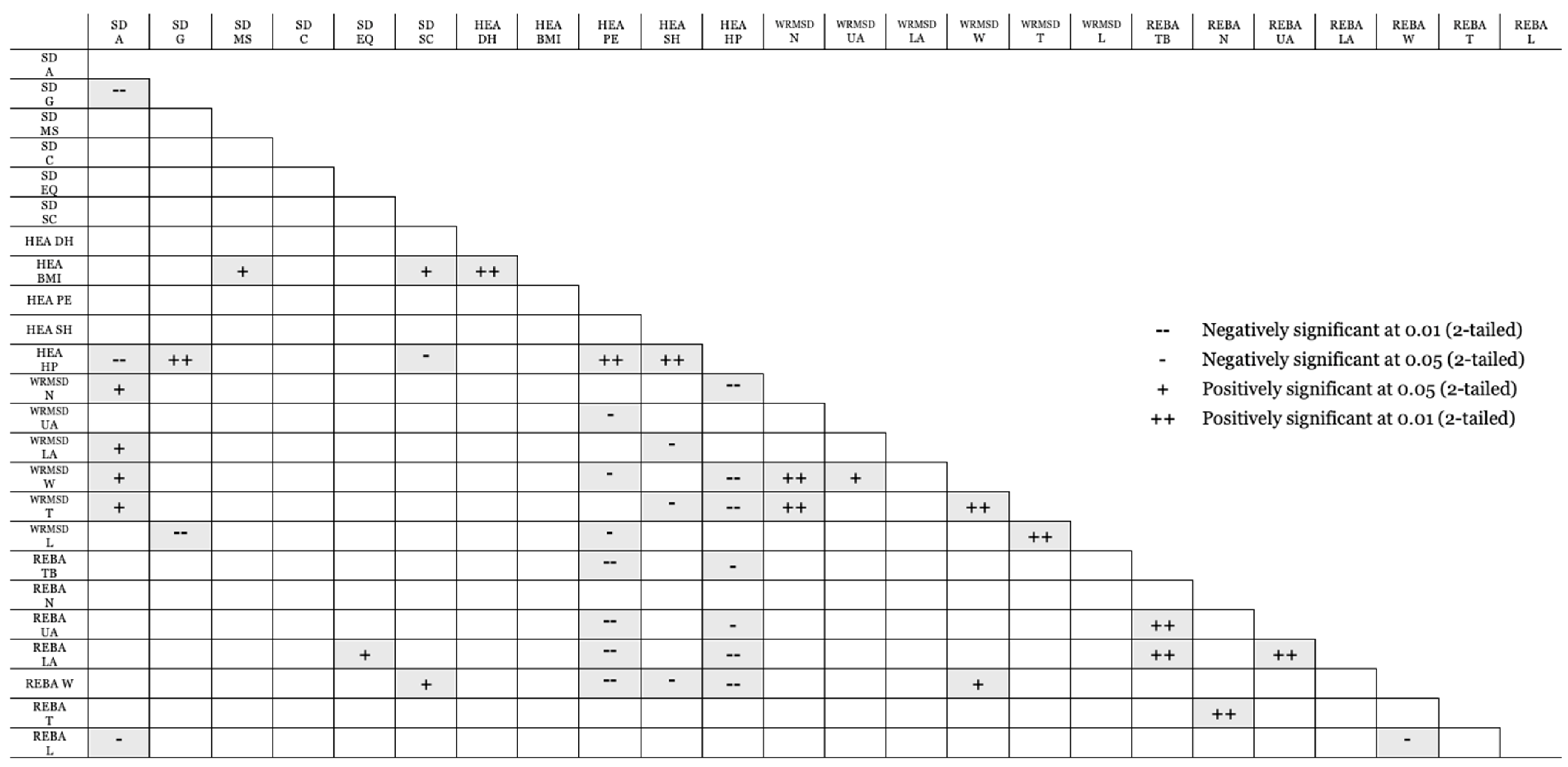
To begin with, a Spearman correlation was performed for the entire sample under study (
Supplementary Materials S3), as outlined in
Figure 9. For the total sample, the age variable showed a strong negative correlation (at the 0.01 level) with the gender variable, indicating that with increasing age, there is a tendency for operators to be female. Similarly, age also demonstrated a strong negative correlation (0.01 level) with the variable overall health perception, suggesting a trend towards more negative self-assessments of health as age increases. Additionally, the age variable exhibited positive correlations (0.05 level) with several variables related to musculoskeletal symptomatology reported by workers, particularly in the neck, lower arms, wrists, and trunk regions. This indicates an increase in reported FDP among older workers. Lastly, the age variable showed a negative correlation (0.05 level) with the REBA score for the legs, indicating that older operators tend to be exposed to lower musculoskeletal risks in the legs.
Regarding the gender variable, it showed a strong positive correlation (0.01 level) with the self-reported health perception variable, indicating that male workers tend to evaluate their health more positively. Conversely, gender also showed a strong negative correlation (0.01 level) with the variable for leg symptoms, meaning that male workers are less likely to report symptoms in the legs. The marital status variable showed a positive correlation (0.05 level) with BMI, suggesting that individuals with a higher BMI are more likely to be in a more advanced marital status, i.e., not single. Furthermore, educational qualifications were positively correlated (0.05 level) with lower arm symptomatology, indicating that workers with higher education levels report more symptoms in the lower arms.
Moving on to the analysis of the final sociodemographic variable, namely professional status, the variable seniority in the company was positively correlated (0.05 level) with BMI, suggesting that workers who have been with the company longer tend to have higher BMI levels. Similarly, seniority also showed a positive correlation (0.05 level) with the REBA score for the wrists, indicating a tendency for longer-seniority employees to exhibit higher risks of developing musculoskeletal disorders in the wrists. Additionally, seniority in the company presented a negative correlation (0.05 level) with self-perceived health, meaning that more aged operators tend to evaluate their health more negatively.
Next, an analysis was conducted of the health and lifestyle variables. The hand dominance variable showed a strong positive correlation (0.01 level) with BMI, indicating that operators who are ambidextrous tend to have higher BMI levels. The variable for physical exercise showed a strong positive correlation (0.01 level) with self-reported health perception, revealing that workers who engage in physical activity tend to evaluate their general health more positively. Moreover, physical exercise correlated negatively (0.05 level) with musculoskeletal symptom reports in the upper arms, wrists, and legs, and exhibited strong negative correlations (0.01 level) with REBA scores for the whole body, as well as for the upper arms, lower arms, and wrists. This indicates that workers who exercise regularly are less likely to report symptoms in these areas and have an even lower risk of developing work-related musculoskeletal disorders (WRMSDs) across these regions.
The variable for sleep habits showed a strong positive correlation (0.01 level) with self-perceived health, indicating that operators who sleep longer tend to evaluate their health more positively. This variable also showed negative correlations (0.05 level) with symptom reports in the lower arms, trunk, and wrists, suggesting that workers who sleep more tend to report fewer symptoms of FDP in these regions.
Self-reported health perception was also strongly negatively correlated (0.01 level) with musculoskeletal symptoms in the neck, wrists, and trunk, indicating that operators with better health perceptions tend to report fewer symptoms in these areas. Furthermore, health perception also showed a negative correlation (0.05 level) with REBA scores for the whole body and the lower arms, and a strong negative correlation (0.01 level) with REBA scores for the lower arms and wrists, suggesting that as operators rate their general health more positively, there is a tendency for lower WRMSD risks for the whole body, upper limbs, and particularly the lower arms and wrists.
Considering the musculoskeletal symptoms reported by operators, strong positive correlations (0.01 level) were found between neck symptoms and symptoms in the wrists and trunk, meaning that those who report neck symptoms also tend to report symptoms in the wrists and trunk. Likewise, symptoms in the upper arms were positively correlated (0.05 level) with symptoms in the wrists, indicating a tendency for individuals with upper arm symptoms to also report wrist discomfort. Additionally, wrist symptoms were strongly positively correlated (0.01 level) with trunk symptoms and also showed a positive correlation (0.05 level) with the REBA wrist score, indicating that workers who experience more wrist symptoms also tend to report trunk symptoms and are at greater risk of developing WRMSDs in the wrists. Likewise, trunk symptoms were strongly positively correlated (0.01 level) with leg symptoms, revealing that workers reporting discomfort in the trunk are also more likely to report symptoms in the legs.
Finally, the REBA score for the whole body was strongly positively correlated (0.01 level) with the REBA scores for the upper and lower arms, suggesting that operators with higher risks of WRMSDs in the arms are also at greater risk across the whole body. Furthermore, there was a strong positive correlation (0.01 level) between neck and trunk REBA scores, indicating a trend whereby operators at high musculoskeletal risk in the neck are also at elevated risk in the trunk. Similarly, a strong positive correlation (0.01 level) was found between REBA scores for the upper and lower arms. Conversely, the REBA score for the wrists showed a negative correlation (0.05 level) with the REBA score for the legs, suggesting that operators with a higher risk of WRMSDs in the wrists tend to have a lower risk in the legs.
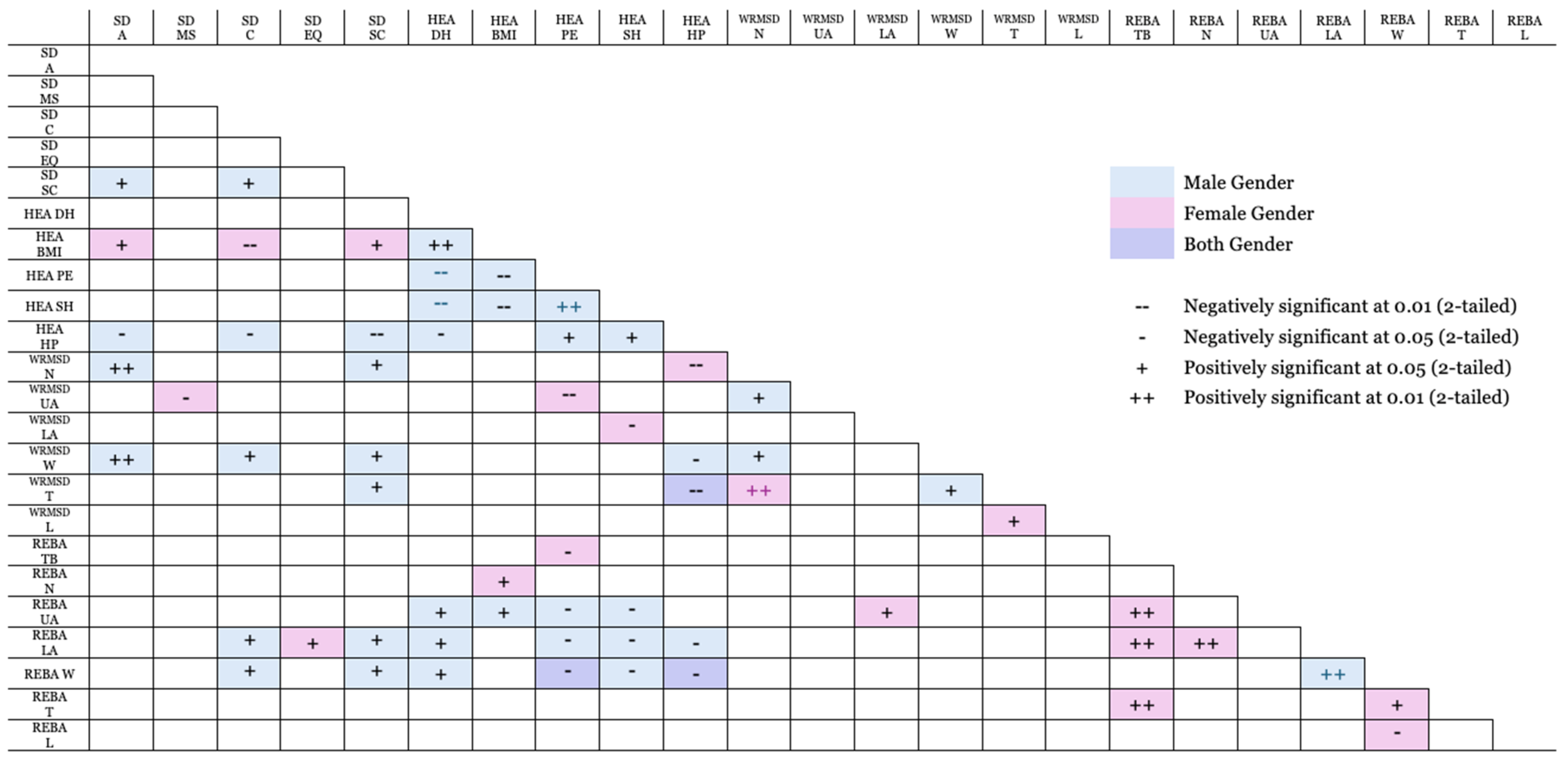
Subsequently, the Spearman correlation analysis of the sample by gender was performed (
Supplementary Materials S4), as illustrated in
Figure 10. A strong positive correlation (0.01 level) was observed between the sociodemographic variables of age and seniority in the company, exclusively among males. In other words, older men tended to have longer seniority within the company. Also exclusive to the male group, age was negatively correlated (0.05 level) with workers’ health perception, indicating that older male operators tended to evaluate their health more negatively. Furthermore, among male participants, age demonstrated strong positive correlations (0.01 level) with musculoskeletal symptoms reported in the neck and wrists, suggesting that older men were more likely to report discomfort in these regions. For females, age was positively associated (0.05 level) with BMI, showing that older women tended to present higher BMI levels.
For women, marital status was negatively correlated (0.05 level) with reported upper arm symptoms, indicating that single women reported more frequent upper arm complaints. For men, educational qualifications were positively associated with REBA scores for the lower arms, suggesting that male workers with higher educational qualifications exhibited a greater risk of developing WRMSDs in the lower arms.
Regarding cohabitation with children under the age of 16, male operators who had longer seniority in the company were more likely to cohabit with younger children (positive correlation, 0.05 level). In addition, for men, this variable was negatively correlated (0.05 level) with health perception, revealing that male workers living with children tended to evaluate their health more negatively. Among men, cohabitation with children under 16 years also showed a positive correlation (0.05 level) with reported wrist symptoms and with REBA scores for the lower arms and wrists, indicating that these workers were more likely to report wrist discomfort and to face increased risks of developing WRMSDs in these anatomical regions.
With respect to seniority in the company, female operators only displayed a positive correlation (0.05 level) between seniority and BMI, showing that longer-seniority women tended to present higher BMI. For men, seniority in the company was strongly and negatively correlated (0.01 level) with health perception, meaning that older male workers with longer service were more likely to evaluate their health negatively. Additionally, male seniority was positively correlated (0.05 level) with reported symptoms of FDP in the neck, wrists, and trunk. Furthermore, older men also displayed a positive correlation (0.05 level) with REBA scores of the lower arms and wrists, indicating greater musculoskeletal risk in these areas.
Regarding hand dominance, correlations were identified solely among male workers. Hand dominance demonstrated a strong positive correlation (0.01 level) with BMI, indicating that ambidextrous male operators exhibited higher BMI levels. These workers also showed strong negative correlations (0.01 level) with exercise and sleep habits, suggesting that ambidextrous men tended to exercise more regularly and to experience longer sleep durations. However, a negative correlation (0.05 level) was observed between hand dominance and health perception, revealing that ambidextrous workers were more likely to evaluate their health negatively. Moreover, hand dominance was positively correlated (0.05 level) with REBA scores for the upper arms, lower arms, and wrists, signifying that ambidextrous men tended to face greater risks of WRMSDs in these anatomical regions.
Considering BMI, among males, there were strong negative correlations (0.01 level) between BMI and both exercise and sleep habits. This indicates that male workers with higher BMI levels were those who did not engage in physical exercise or had shorter sleep durations, suggesting that good health practices, including physical activity and healthy sleep habits, are linked to lower BMI. For men, BMI was also positively associated (0.05 level) with REBA scores for the upper arms, suggesting that a higher BMI is linked to increased risk of musculoskeletal disorders in this area. Conversely, among females, BMI was positively correlated (0.05 level) with musculoskeletal risk in the neck, indicating that women with higher BMI levels exhibited a greater risk of WRMSDs in that region.
Regarding physical exercise, for men, this variable was strongly and positively correlated (0.01 level) with sleep habits, indicating that male workers who engaged in physical activity tended to also have longer sleep durations. Physical exercise was further positively correlated (0.05 level) with health perception in men, meaning that male workers who exercised were more likely to evaluate their health positively. Among women, physical activity displayed a strong negative correlation (0.01 level) with upper arm symptoms, indicating that physically active female operators reported fewer upper arm complaints. Additionally, for women, physical activity was negatively associated (0.05 level) with global REBA scores, suggesting that female workers engaging in physical activities faced lower overall musculoskeletal risk. Among men, physical exercise was negatively correlated (0.05 level) with REBA scores for the upper and lower arms, showing reduced WRMSD risk in these regions. Both genders demonstrated a negative correlation (0.05 level) between physical exercise and REBA scores for the wrists, indicating that workers engaging in exercise have a lower risk of WRMSDs in the wrists.
Considering sleep habits, for men, this variable was positively associated (0.05 level) with health perception, indicating that those who slept longer tended to evaluate their health more positively. For women, sleep habits were negatively correlated (0.05 level) with lower arm symptoms, meaning that women with shorter sleep durations tended to report more symptoms in this region. For men, sleep habits also correlated negatively (0.05 level) with REBA scores for the upper arms, lower arms, and wrists, implying that shorter sleep durations were linked to greater musculoskeletal risks in these areas.
Regarding health perception, women who assessed their health more positively reported fewer neck symptoms (strong negative correlation, 0.01 level). Among men, health perception was negatively correlated (0.05 level) with wrist symptoms and REBA scores for the lower arms, indicating that men with better health perception reported fewer wrist problems and were exposed to lower risks of WRMSDs in the lower arms. For both genders, health perception was strongly and negatively correlated (0.01 level) with trunk symptoms and negatively correlated (0.05 level) with REBA scores for the wrists. Thus, workers who evaluated their health more positively tended to report fewer trunk symptoms and presented reduced risks of WRMSDs in the wrists.
For male operators, a positive correlation (0.05 level) was observed between reported neck symptoms and symptoms in the upper arms and wrists, indicating that those experiencing neck issues also reported complaints in these regions. Additionally, a positive correlation (0.05 level) was found between wrist symptoms and trunk complaints among men. For women, a strong positive correlation (0.01 level) was found between neck and trunk symptoms, showing that female workers with neck complaints reported trunk discomfort as well. For women, positive correlations (0.05 level) were identified between lower arm and upper arm symptoms, and between trunk and leg symptoms, suggesting clustered reporting of these complaints among female operators.
Finally, when evaluating musculoskeletal risks, the female group demonstrated stronger associations. Strong positive correlations (0.01 level) were identified between the overall REBA score and REBA scores for the upper arms, lower arms, and trunk, indicating that female workers at greater risk of WRMSDs in any of these regions also tended to present higher overall musculoskeletal risk. Among women, strong positive correlations (0.01 level) were also observed between REBA scores for the neck and lower arms, suggesting combined regional risks. Positive correlations (0.05 level) were identified between REBA scores for the wrists and trunk, and a negative correlation (0.05 level) was found between wrists and legs, revealing that women at greater musculoskeletal risk in the wrists also tended to have higher trunk risks but lower risks in the legs. By contrast, males displayed only a strong positive correlation (0.01 level) between REBA scores of the lower arms and wrists, meaning that male workers exposed to higher risk in the lower arms also exhibited higher musculoskeletal risks in the wrists.
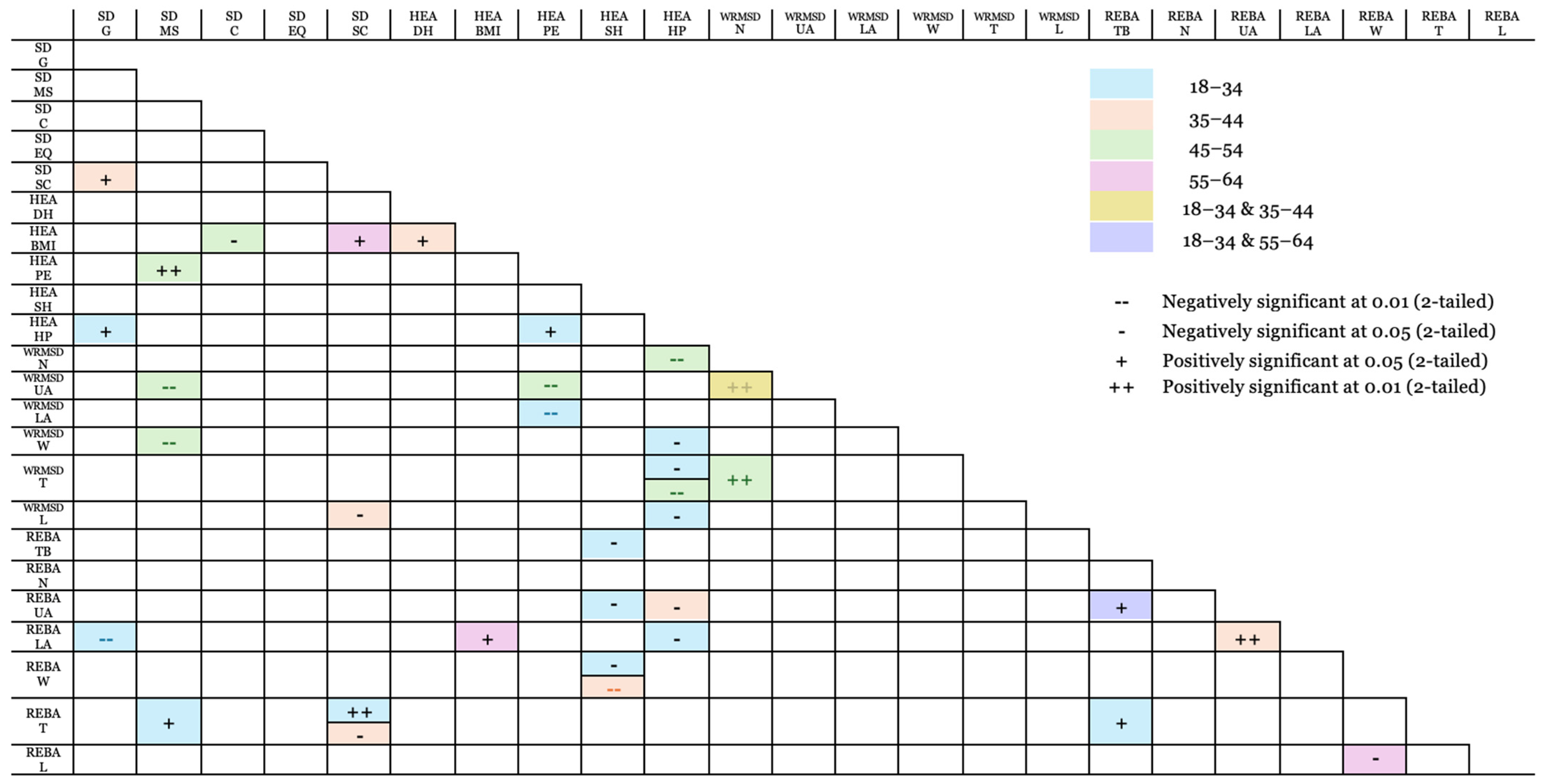
As a final stage of analysis, the Spearman correlation was conducted by age groups (
Supplementary Materials S5), as illustrated in
Figure 11. Operators of intermediate age (35–44 years) showed a positive correlation (0.05 level) between gender and company seniority. This indicates that male operators within this intermediate age group tended to have longer seniority in the company. Younger workers (18–34 years) also revealed correlations with gender: a positive correlation (0.05 level) between gender and general health perception, meaning that younger male operators reported better self-assessments of their health; and a perfectly negative correlation (0.01 level) between gender and musculoskeletal risk in the lower arms, indicating that men in this age range were at minimal risk of developing WRMSDs in the lower arms.
Among the younger operators, there was a positive correlation (0.05 level) between marital status and REBA scores for the trunk, showing that younger workers who were no longer single tended to be at greater risk of WRMSDs in the trunk. By contrast, the ageing group (45–54 years) presented a strongly positive correlation (0.01 level) between marital status and health perception, indicating that workers in this age group who were married or in long-term unions evaluated their health more positively. Furthermore, these workers exhibited perfectly negative correlations (0.01 level) between marital status and reported symptoms in the upper arms and wrists, meaning that ageing operators who were not single were less likely to report symptoms in these regions. They also showed a negative correlation (0.05 level) between cohabitation with children under 16 and BMI, indicating that ageing operators without young children at home tended to exhibit lower BMI levels.
Considering company seniority, senior operators (55–64 years) presented a positive correlation (0.05 level) between tenure and BMI, suggesting that senior operators with longer service tended to have higher BMI levels. Operators of intermediate age displayed a negative correlation (0.05 level) between seniority and symptoms reported in the legs, showing that employees in this group with longer seniority tended to report fewer leg complaints, such as FDP. These operators also displayed a negative correlation (0.05 level) between seniority and REBA scores for the trunk, indicating that intermediate-age operators with longer seniority were less exposed to musculoskeletal risk in this region. Conversely, younger workers presented a strongly positive correlation (0.01 level) between seniority and trunk REBA scores, meaning that younger employees with comparatively longer service were more likely to face increased musculoskeletal risks in the trunk.
With respect to hand dominance, only the intermediate-age cluster displayed correlations, namely a positive correlation (0.05 level) between hand dominance and BMI. This suggests that operators in this group who used both hands for work tasks tended to exhibit higher BMI. Meanwhile, the senior cluster revealed a positive correlation (0.05 level) between BMI and REBA scores for the lower arms, meaning that older operators with higher BMI were more exposed to musculoskeletal risks in the lower arms.
Among younger workers, physical exercise correlated positively (0.05 level) with health perception, indicating that younger employees engaging in physical activity were more likely to evaluate their health positively. This group also showed a perfectly negative correlation (0.01 level) between physical exercise and symptoms in the lower arms, meaning that young operators who exercised did not report lower arm symptoms. Similarly, for ageing operators, a perfectly negative correlation (0.01 level) was detected between physical exercise and reported upper arm symptoms, showing that workers in this age group who practised physical activity did not report symptoms in the upper arms.
In relation to sleep habits, younger operators exhibited negative correlations (0.05 level) between sleep habits and REBA scores for the whole body, upper arms, and wrists. This suggests that younger workers with better sleep habits, i.e., longer sleep duration, faced lower overall musculoskeletal risk as well as reduced risks in the upper arms and wrists. With the same pattern, and more pronounced in the intermediate age group, sleep habits presented a perfectly negative correlation (0.01 level) with REBA scores for the wrists, showing that intermediate-age workers with longer sleep duration tended to have reduced musculoskeletal risks in the wrists.
For general health perception, ageing operators revealed perfectly negative correlations (0.01 level) with symptoms reported in the neck and trunk. This indicates that older workers who evaluated their health more positively were those who did not report symptoms in these regions. Younger operators also showed negative correlations (0.05 level) between health perception and symptomatology in the wrists, trunk, and legs, indicating that young workers who self-assessed their health more favourably reported fewer complaints in these regions. Furthermore, this group presented a negative correlation (0.05 level) between health perception and lower arm REBA scores, meaning that younger operators who assessed their health more positively were also at lower musculoskeletal risk in the lower arms. Intermediate-age workers showed a negative correlation (0.05 level) between health perception and REBA scores for the upper arms, suggesting that those with more positive health evaluations had lower musculoskeletal risks in the upper arms.
Regarding symptoms of FDP, the younger and intermediate groups (18–44 years) displayed a perfectly positive correlation (0.01 level) between symptoms in the neck and upper arms, suggesting symptom clustering in these body regions. A similar pattern was found in the ageing group, with a perfectly positive correlation (0.01 level) between reported neck and trunk symptoms.
Finally, for the extreme age groups, i.e., younger and senior workers, overall body musculoskeletal risks correlated positively (0.05 level) with REBA scores for the upper arms, indicating that workers with higher exposure in the upper arms also tended to have greater overall musculoskeletal risk. Moreover, among younger workers, overall musculoskeletal risk was positively correlated (0.05 level) with REBA scores for the trunk, suggesting that younger operators with musculoskeletal risks in the trunk tended to present overall body risks as well. Intermediate-age workers showed a strongly positive correlation (0.05 level) between REBA scores for the upper arms and lower arms, meaning that those with increased musculoskeletal risk in the upper arms also tended to present risks in the lower arms. Conversely, the senior cluster displayed a negative correlation (0.05 level) between REBA scores for the wrists and legs, showing that older operators at risk of WRMSDs in the wrists were less likely to face risks in the legs.