Article

Validity of the eJamar Game Controller for Measuring Hand Range of Motion and Grip Strength in Hand Rehabilitation


by
Andrés Cela
1,*,†,
Edwin Daniel Oña
2,† and
Alberto Jardón
2
1
Department of Automation and Industrial Control, Faculty of Electrical and Electronic Engineering, Escuela Politécnica Nacional, Ladrón de Guevara, Quito 170525, Ecuador
2
Robotics Lab, Department of Systems Engineering and Automation, Universidad Carlos III de Madrid, Avenida de la Universidad, 30, 28911 Leganés, Madrid, Spain
*
Author to whom correspondence should be addressed.
These authors contributed equally to this work.
Eng 2026, 7(5), 197; https://doi.org/10.3390/eng7050197
Submission received: 24 March 2026 / Revised: 23 April 2026 / Accepted: 24 April 2026 / Published: 26 April 2026

Abstract

Hand range of motion (ROM) measurement is crucial for diagnosing joint limitations, tracking rehabilitation progress, and creating personalized treatment plans. In recent years, exergames combined with dedicated game controllers have emerged as promising tools to complement traditional hand rehabilitation; however, their validity as motor function assessment tools remains insufficiently explored. This study evaluates the validity of the eJamar game controller as a tool for measuring hand ROM and hand grip strength (HGS), by comparing its outputs with standard goniometry and dynamometry. In a prior technical validation using a robotic arm under controlled conditions, the device showed a mean error of approximately 1.5°, indicating high measurement precision under ideal conditions. In the clinical validation with 32 patients undergoing hand rehabilitation, performance was movement-dependent. Pronation and supination showed strong agreement (MAE < 3°) and higher agreement compared with other movements, whereas flexion, extension, and radial-ulnar deviation exhibited weaker correlations and substantially higher errors (around 20°). In contrast, grip strength measurements for more and less affected hands, respectively, showed high correlation (0.88–0.91) and moderate agreement (ICC 0.81–0.66) with MAE values around 4 kg-f. Overall, results suggest that the eJamar shows preliminary suitability for assessing HGS and forearm pronation and supination in clinical settings. However, for HGS, agreement should be interpreted with caution due to the observed bias and error levels, indicating that further validation and calibration are required before stronger clinical claims can be made. For wrist flexion, extension, and radial-ulnar deviation, the device currently shows limited accuracy and requires further improvement.

1. Introduction

Hand mobility can be evaluated through the range of motion (ROM) of the wrist and hand, including flexion, extension, and radial/ulnar deviation of the wrist, as well as forearm pronation and supination [1]. A minimum degree of ROM is essential to perform activities of daily living (ADLs). The normative limits for each wrist movement have been established in previous studies [2,3]. However, conditions such as arthritis, arthrosis, fractures, or hand surgeries often lead to a significant reduction in ROM, directly impairing an individual’s ability to carry out ADLs [4,5]. Furthermore, hand grip strength (HGS) is considered an important indicator of both functional capacity and general health [1,6]. These two parameters, ROM and HGS, are widely used in clinical settings to evaluate the progress of patients undergoing hand and wrist rehabilitation, as they are directly related to essential daily activities such as holding objects, opening doors, writing, or reading [7]. The traditional instruments to measure the HGS and ROM are the dynamometer and goniometer [8], respectively.
In recent years, digital devices have emerged that allow for more precise and objective recording of both ROM and HGS [9]. For instance, the xGrip, an electronic dynamometer, can digitally measure HGS up to 100 kg-f, while digital goniometers display measurements on screens, minimizing reading errors and inter-observer variability [9]. Regarding HGS, the analog JAMAR ®Hydraulic Dynamometer remains the gold standard [10], offering reliable estimates [6]. However, in this study, the xGrip device was selected because its digital output enables faster readings, reduces transcription errors, and facilitates data management and reproducibility.
In addition, several validation studies have been conducted in order to compare instrumented devices with traditional tools. For example, a recent study compared ROM measurements obtained by a goniometer, a smartphone, and a glove equipped with an IMU [11]. Another study, after reviewing various technologies to measure both ROM and HGS, also proposed a glove-based system equipped with Flexpoint bend sensors to detect joint angles, an IMU, and pressure sensors on the fingertips to estimate HGS [12]. In addition, the system includes a Bluetooth transmitter that enables wireless data transmission to a mobile application. Although no statistical validation of functionality was reported, the integration of IMU sensors and Bluetooth connectivity demonstrates the potential advantages of such technologies in the development of wearable assessment tools. Other studies have used computer vision techniques to estimate the angles of the wrist joint without physical contact [7,13]. Although this method needs more electronic equipment, it has excellent results with high correlations compared with the goniometer measurements. On the other hand, devices like Leap Motion have also been used to track hand and finger movements [14,15] in 3D space through depth and pattern recognition [16].
The above systems propose feasible alternatives to classical measurement tools, increasing assessment accuracy. However, these devices cannot be used for rehabilitation, requiring patients to use additional instruments for hand function recovery. The most common solutions for improving hand strength rely on elastic bands and spring-loaded grips, whose main advantage is allowing joint movement (isotonic). However, these are not suitable for measurement. In contrast, standard hand strength measurement devices either promote the simultaneous use of all fingers (JAMAR) or measure grip strength one finger at a time (Jamar variants), involve isometric measurements (muscles generate tension, but there is no joint movement). The same happens with devices designed for ROM assessment. Furthermore, these are neither designed nor suitable for rehabilitation. In this context, in a previous study [17], the eJamar game controller (eJGC) was presented as a portable electromechanical device that allows both HGS training and ROM measurement, powered by exergames.
Although the eJGC was initially designed as a game-based rehabilitation device, its technological capabilities enable accurate measurement of both parameters. Therefore, this study evaluates the clinical validation of the eJGC as a tool for measuring ROM and HGS in a group of 32 patients with motor impairments. The measurements obtained with the eJGC were compared with those recorded by a rehabilitation specialist (RS) using a standard analog goniometer and a digital dynamometer. In addition, this work explores the potential of integrating assessment and rehabilitation functionalities into a single device, representing a novel approach in hand rehabilitation technologies.

2. Materials and Methods

2.1. eJamar Game Controller

The eJGC device was originally developed as a game controller for the exergames Peter Jumper and Andrómeda, described in a previous work [17]. It integrates a 6-degree-of-freedom (DoF) IMU sensor capable of capturing angular velocity and orientation across three axes. In addition, the device includes a pressure-sensitive force sensor, coupled with a signal amplifier, which allows the measurement of HGS exerted by the user on the device’s handle.
All data are processed by a 32-bit microcontroller and transmitted wirelessly via Bluetooth to any compatible receiving device, such as a smartphone or computer. In addition to HGS measurement, the eJGC can estimate the ROM angles when the user performs movements such as pronation, supination, flexion, extension, and radial and ulnar deviation. For this purpose, the eJGC firmware was improved to enable ROM angle estimation. Figure 1 illustrates the hand movements that the device can measure and the correct hand positioning.
The eJGC measurements were obtained using the device’s internal signal processing and calibration algorithms implemented in its firmware. These include predefined transformation functions based on prior calibration models described in previous work [17]. Importantly, these algorithms are part of the standard operation of the device and were not derived from or optimized using the data collected in the present clinical study.
Note that the eJGC uses two holding positions for angle estimation. In the holding position A, the rotations over Z- and Y-axes are quantified to measure the radial-ulnar deviations and pronation–supination movements, respectively. In holding position B, the rotation over the X-axis is tracked to measure the flexion-extension of the wrist.
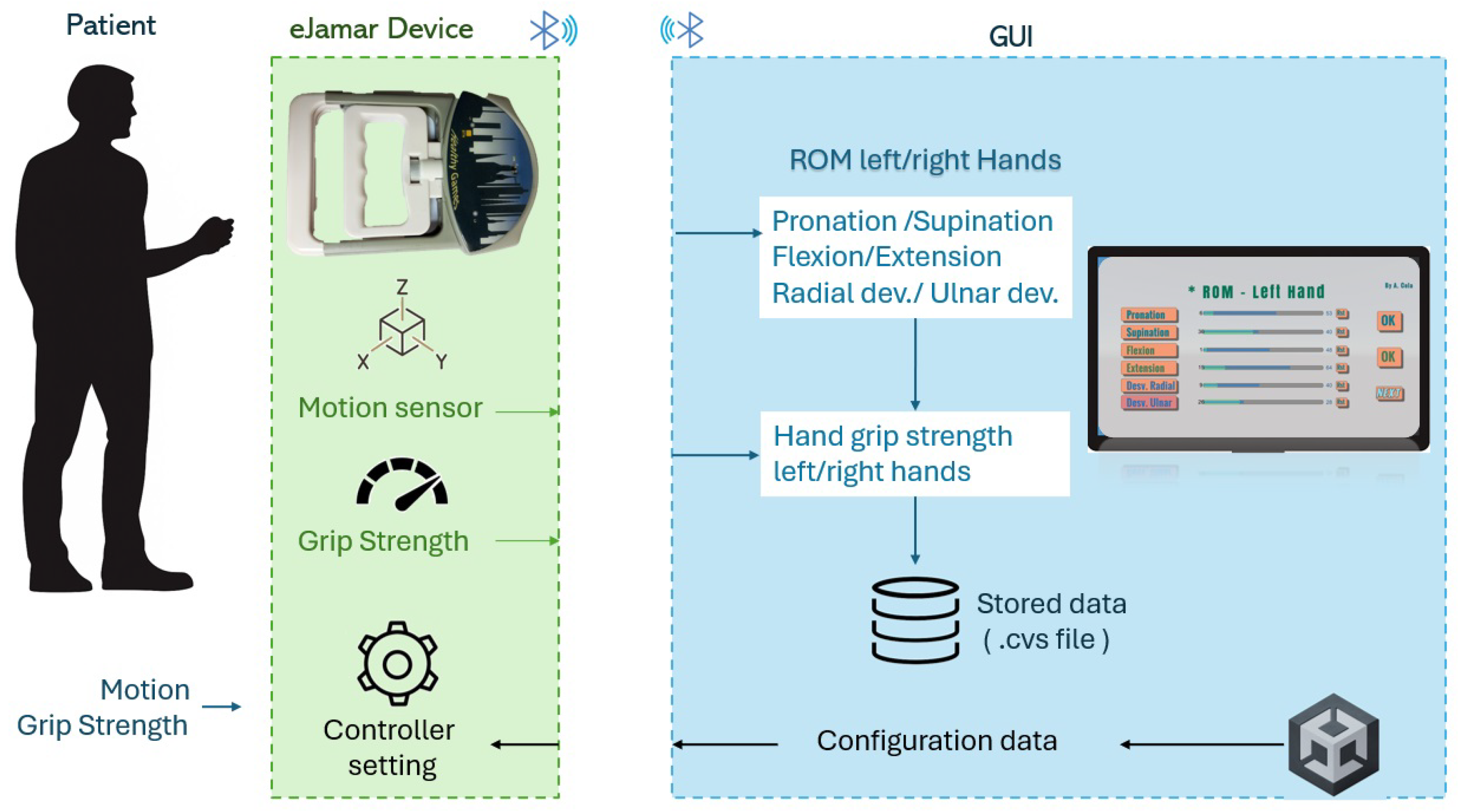
Figure 2 shows the workflow for ROM and HGS measurement, where the interaction between the patient and the eJGC and the data transmission to the graphical user interface (GUI) is described.

2.2. Angle Estimation Method

The eJGC integrates a 6-DoF IMU. To estimate the ROM angles, the angles from the accelerometer Y- and Z-axes were used. These angles range from −90° to 90°, with a resolution of 1°. For pronation and supination, the eJGC is held in a vertical position, as shown in Figure 1a. In this orientation, the Z-axis is at 0° and rotates around the Y-axis. When held in the right hand, forearm pronation varies from 0° to −90° and supination from 0° to 90°; this is reversed for the left hand. For flexion and extension, the eJGC is held horizontally with the Z-axis pointing upward, as illustrated in Figure 1b. In this position, the Y-axis starts at 0° and rotates around the X-axis. In both hands, flexion is represented by a change in the Y-axis from 0° to −90° and extension from 0° to 90°. To assess radial and ulnar deviation, the device is held vertically. In this case, the rotation of the Y-axis around the Z-axis is measured. For both hands, the Y axis starts at 0°, ranging from 0° to −90° for ulnar deviation and from 0° to 90° for radial deviation. Measurements are taken for each hand following the order described above. The user interface automatically identifies and records the values corresponding to each movement.

2.3. ROM Assessment Graphical User Interface

A graphical user interface (GUI) was developed using the Unity game engine, aiming to assist physiotherapists in performing the eJGC-based assessment procedure and data collection. The GUI consists of multiple interactive screens that facilitate patient data entry, ROM measurements, and HGS acquisition for both hands. It receives the Bluetooth-transmitted data from the eJGC and converts them into corresponding motion or force values.
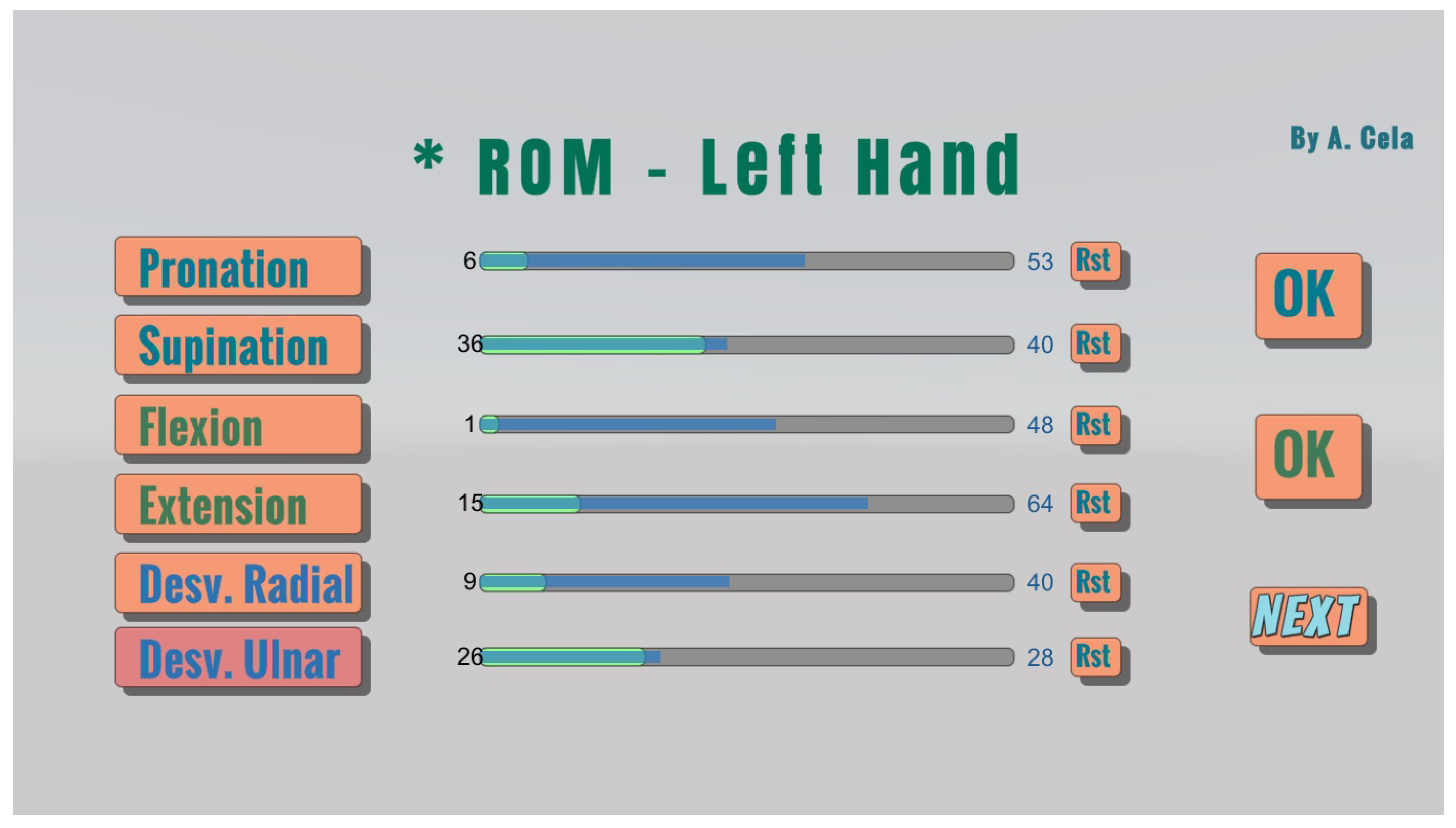
The demographic and clinical information of the patient is first collected. Subsequently, the GUI guides the user through dedicated screens to record ROM angles for pronation, supination, flexion, extension, and radial and ulnar deviation. Finally, HGS is assessed for each hand on a separate screen. All data collected are automatically stored in a .CSV file, enabling further analysis of patient outcomes. Figure 3 shows screenshots of the GUI for left-hand ROM.

2.4. Validation Procedure

Since the eJGC was originally designed as a controller for exergames [17], no previous studies had evaluated its accuracy and efficiency in measuring ROM. For this reason, two complementary validation approaches were conducted. In a previous study [18], a technical validation was presented that compared the angles measured by the eJGC with the angular movements of a robotic arm, allowing the assessment of the measurement accuracy at different movement speeds. In this paper, a clinical validation involving patients referred for hand rehabilitation was conducted, allowing the evaluation of device performance under clinical conditions, where factors such as reduced mobility, pain, and hand weakness could influence measurement reliability.

2.4.1. Participants

A total of 32 patients were recruited from the hand rehabilitation unit of the Outpatient Clinical Surgical Center, El Batán Day Hospital, located in Quito, Ecuador. This sample size is consistent with previous validation studies of similar rehabilitation and measurement devices [19,20], where moderate sample sizes are commonly used to assess agreement and preliminary clinical performance. Accordingly, this study should be interpreted as an initial clinical validation.
All participants provided their informed consent after being fully informed about the study procedures. The protocol was approved by the institutional ethics committee of the Central University of Ecuador under registration 003-EXT-2025 and was conducted over a one-week period. Each patient completed one session of approximately 30 min. Table 1 provides demographic information about the participants.
The inclusion criteria were: patients over 18 years of age referred by a specialist at the medical center to receive hand rehabilitation treatment; ability to follow basic instructions; grip strength greater than 2 on the Medical Research Council scale [21]; and provision of written informed consent prior to participation. The exclusion criteria were: severe cognitive impairment interfering with task comprehension (e.g., recent stroke or dementia); acute pain; recent fractures; or recent surgeries.
The main pathologies among the participating patients were: carpal tunnel syndrome (21.8%), trigger finger (18.8%), fractures (15.6%), arthritis and osteoarthritis (12.5%), De Quervain’s syndrome (9.4%), and others (21.9%).

2.4.2. Protocol

The protocol designed for this study includes two stages to quantify ROM and HGS. The first stage focused on obtaining measurements using gold standard instruments, and the second stage focused on measurements using the proposed eJGC. Patients were seated upright during all procedures. The details for each stage are described as follows.
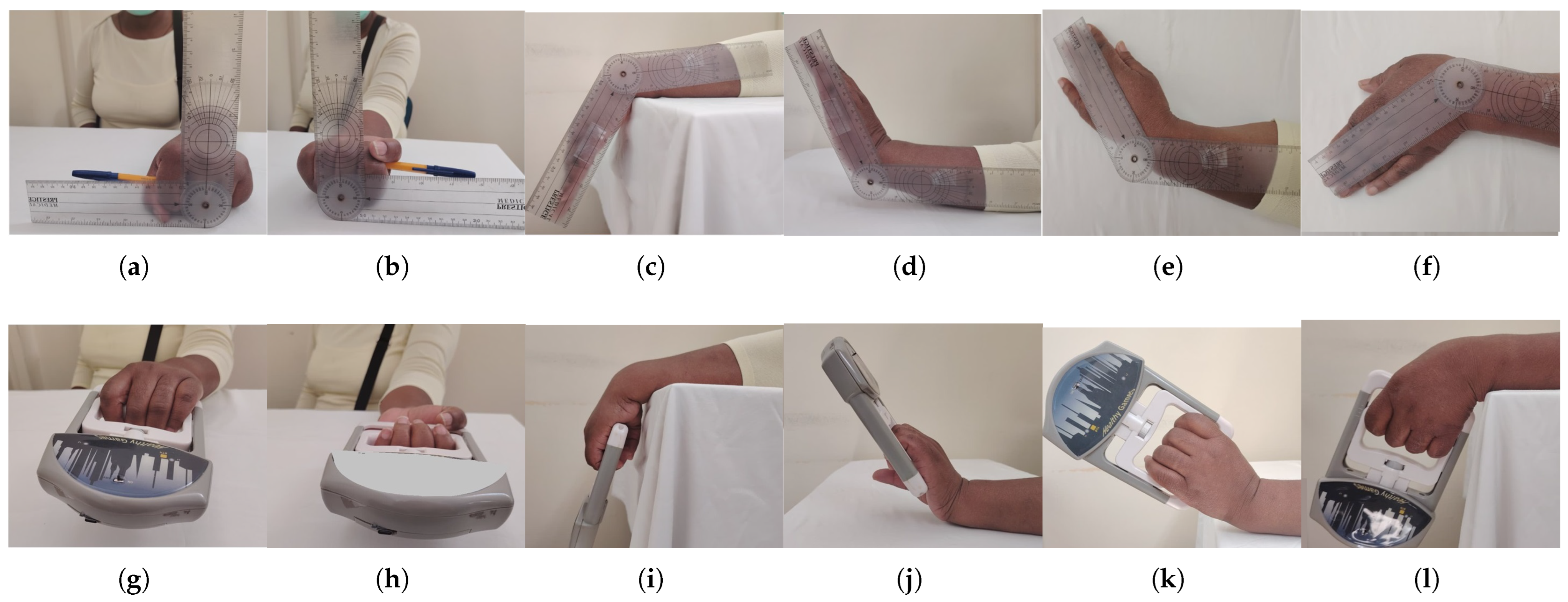
On the one hand, a trained RS performed the ROM assessments using a standard plastic goniometer, following this sequence: pronation, supination, flexion, extension, radial deviation, and ulnar deviation. All ROM measurements corresponded to active movements performed by the patients under the supervision of the RS. During the assessment, patients were seated with their forearms supported on a table to ensure consistent positioning, while the specialist monitored and minimized compensatory movements, following standard goniometric procedures and anatomical landmarks, as described by the National Library of Medicine [8]. Both hands were assessed, and an assistant recorded the values in a digital log. Figure 4 shows the measurement positions for all six ROM movements for both the goniometer and the eJGC.
After completing the ROM assessments, patients were asked to rest each hand on a table and grip the XGrip digital dynamometer. This device records grip force in kg-f, with a resolution of 0.1 kg-f, and displays the values on a screen. Two attempts were made for each hand, and the highest value was retained. All measurements were documented by the assistant.
On the other hand, the RS conducted ROM measurements using the eJGC. Patients remained seated with their forearms resting on a table to ensure consistent positioning. Pronation and supination were measured with the eJGC held vertically, mimicking the motion as with the plastic goniometer (Figure 4g,h). Flexion and extension were measured with the device held horizontally (Figure 4i,j). In some cases, the RS assisted the patient in holding the device due to its weight, which could affect alignment.
Radial and ulnar deviation were also measured with the device in a vertical orientation (Figure 4k,l). Although these movements are traditionally assessed with the hand placed horizontally (Figure 4e,f), the eJGC does not include sensors capable of capturing deviation angles in that posture. Therefore, an alternative vertical orientation was adopted. This limitation and its potential influence on the measurements are addressed in the Section 4.
During the eJGC assessment, although the RS assisted the patient in performing the movements, the measurement values were not visible to the RS, as they were recorded directly by the GUI and monitored by an assistant. Therefore, the RS was not aware of the eJGC measurement outcomes during data acquisition, partially reducing potential expectation bias.
The order was not randomized, and conventional goniometric assessment was consistently performed prior to eJGC evaluation. This approach was adopted to maintain a structured clinical workflow and to minimize potential fatigue effects associated with handling the eJGC, which has a higher weight compared with the goniometer. In addition, time constraints within the clinical setting prevented randomization of the measurement sequence.
Finally, the HGS was recorded through the GUI screen. Patients were instructed to hold the eJGC vertically and squeeze it with maximum effort. Two trials were conducted per hand, with the highest value retained. All measurements captured by the GUI were automatically saved in a digital file.

2.5. Statistical Analysis

For the performance evaluation of the eJGC system using the robotic manipulator, mean absolute error and variance were used as primary metrics. The results obtained at the two tested velocities (5°/s and 100°/s) were analyzed and compared with determine whether the accuracy of the eJGC measurements depended on the robot’s movement speed.
On the other hand, Bland–Altman analyses [22] were performed for each movement type by pooling measurements from the MAH and LAH, in order to evaluate agreement between the eJGC and the reference instrument while avoiding unnecessary duplication of plots. Besides, Pearson correlation, 95% Intraclass Correlation Coefficient (ICC), Mean Absolute Error (MAE), and Agreement Rate (AR) were used for the statistical analysis of the eJGC measurements in patients. Pearson correlations were used to assess the strength of the relationship between the measurements obtained with the eJGC and those of the standard goniometer or digital dynamometer. ICCs were computed using a two-way mixed effects model for absolute agreement and single measurements ICC(A,1) to assess agreement between goniometer and eJGC measurements. MAE was used to quantify the average difference between the two measurement methods.
The Bland–Altman analysis was the primary assessment, while the AR was included as a complementary metric. Given the inherent variability associated with goniometric measurements in clinical practice, errors within a range of approximately ±5° are commonly considered acceptable in ROM assessment [2]. For HGS, no clinically established threshold for agreement rate is available in the literature. Therefore, the selected margin ±3 kg-f is reported for descriptive purposes only and should not be interpreted as a clinically validated criterion of agreement. All these metrics were calculated using a custom script developed in Python v3.13.

2.6. Use of the GenAI

In this section, DeepSeek AI was used to generate Python code for statistical analysis, while ChatGPT 5.2 was employed to review the results and assist with organizing ideas, as well as improving grammar, spelling, and formatting of the text.

3. Results

3.1. Robot-Based Validation of eJGC Angle Measures

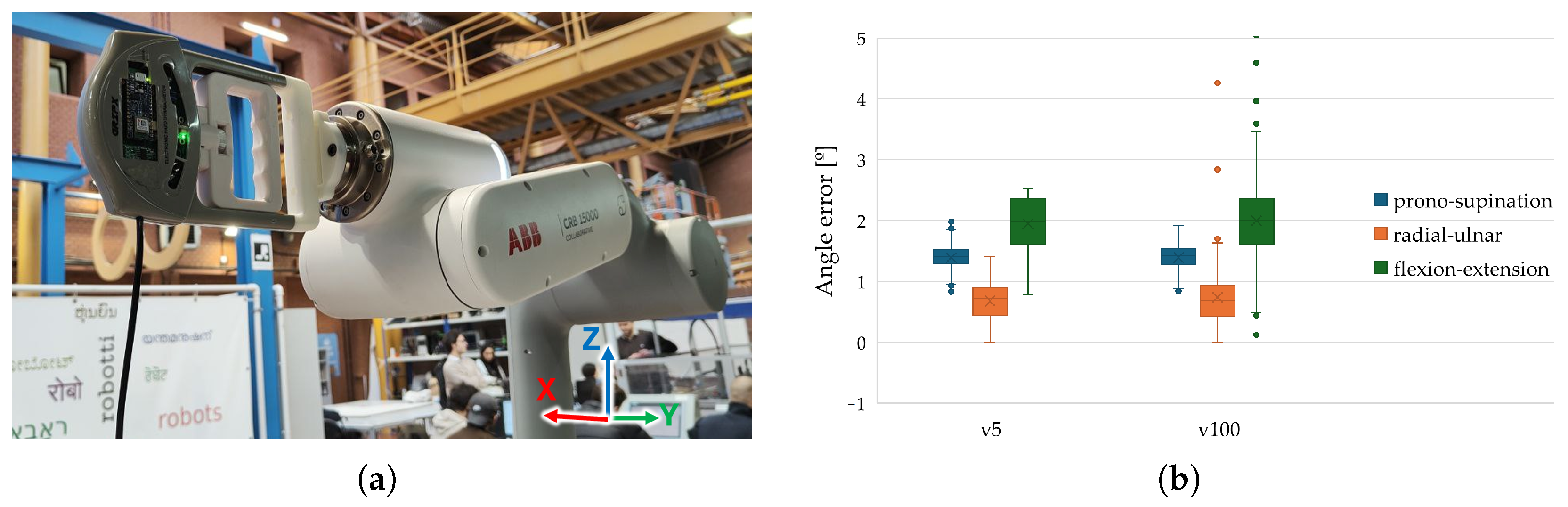
The setup for the technical validation of the eJGC in angle measurement is presented in Figure 5a. The eJGC’s handle was replaced by a custom 3D-printed piece allowing attachment to the robot’s flange. The device was placed, replicating its expected orientation when hand-held by a patient. The robot base reference frame aligns with the patient’s wrist frame, which is used to interpret hand movements. After initial calibration, the robot executed two programmed angular movements: (1) incremental step angular movements by 10°/step, keeping position for 5 s (Stepwise); and (2) angular motion performed at a constant speed (Continuous).
All the trajectories are performed back and forth, finishing at the corresponding starting point [+90°]. Robot movements were executed at different speeds, simulating various hand speeds in order to analyze the effect of hand acceleration. Robot trajectories were executed once, and they covered a range of 180° [90° to −90°]. Note that the ROM executed by the robot is greater than the functional ROM of the human wrist. The robot used was the ABB CRB 15000 (GoFa), having 0.02 mm position repeatability.
The validation results for the wrist ROM movements, performed using the CRB15000 robot, were satisfactory. The mean errors did not exceed 3%, as detailed in Figure 5b. The data show that radial and ulnar deviation movements yielded the smallest errors (<1%), while flexion and extension movements exhibited the highest, at approximately 2%. Furthermore, the results were highly consistent across the two tested velocities, 5°/s and 100°/s, although a greater data dispersion was observed at the higher velocity. This suggests that the eJGC can be operational within this velocity range. It is also important to note that a patient with hand mobility impairments would be unlikely to achieve the high velocity (100°/s) replicated by the robot.
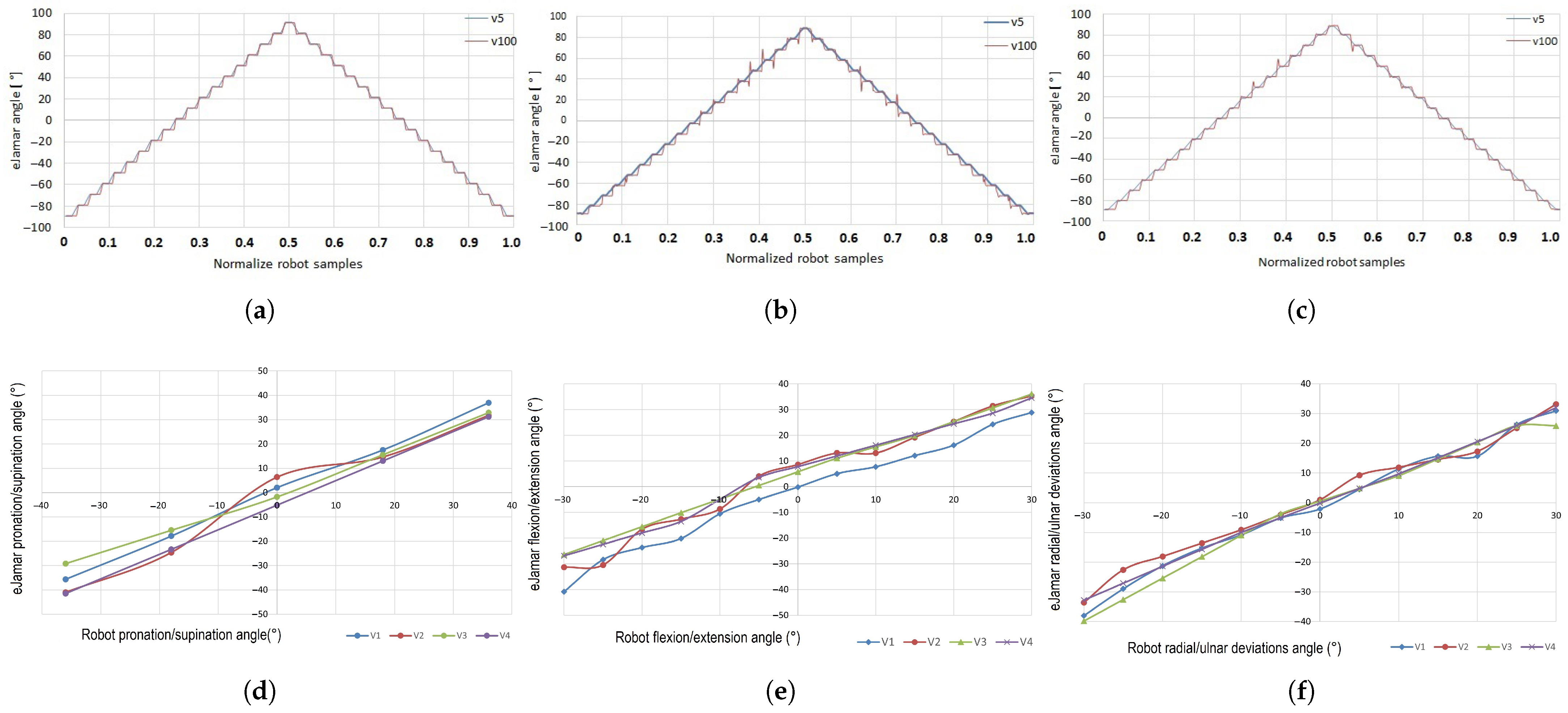
The effect of acceleration and deceleration was also observed in the step-by-step execution presented in Figure 6a–c for pronation–supination, flexion-extension, and ulnar-radial deviation movements, respectively. It can be observed that the peak appears for the higher speed (v100), but the angular position measurement is stabilized in a short time.
Additionally, the influence of speed in a continuous movement on the eJGC’s measurements was also analyzed to quantify the effect of this parameter. For this purpose, the ROM movements were executed in a continuous mode (without pauses) at four different angular velocities: V1 = 5°/s, V2 = 10°/s, V3 = 50°/s, and V4 = 100°/s. As shown in Figure 6d–f, the measurements for all ROM movements exhibited a largely linear relationship with the reference standard across the tested speeds. The most accurate results were obtained at the lowest velocity (V1 = 5°/s), which exhibited a bias close to zero. Among the movements, pronation–supination showed the most linear behavior, Figure 6d, while flexion-extension displayed larger deviations, particularly at higher velocities, as shown in Figure 6e. These findings indicate that the eJGC is capable of capturing angular measurements with good precision under controlled, idealized conditions. However, this robotic validation should be interpreted as a technical proof-of-concept rather than direct evidence of clinical validity. Therefore, a detailed analysis of the device performance under clinical conditions is presented in the following section.

3.2. Performance of eJGC with Patients

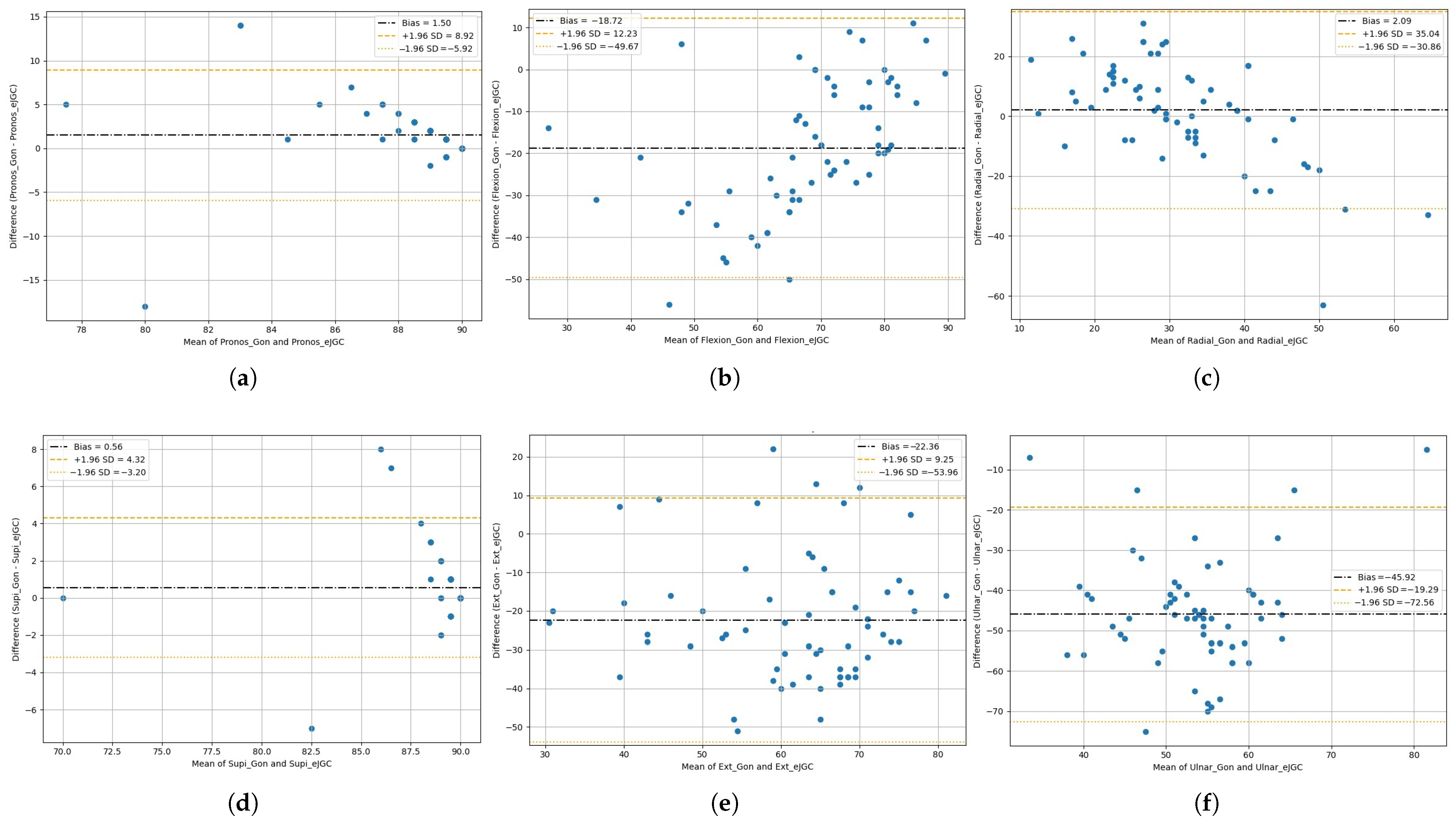
Bland–Altman analysis was performed for each ROM movement to further assess agreement between the eJGC and the reference goniometer, as it is shown in Figure 7. Pronation and supination, Figure 7a and Figure 7d, respectively, exhibited relatively small mean differences (bias ≤ 1.50°) with narrower limits of agreement (approximately −5.92° to 8.92° for pronation and −3.20° to 4.32° for supination) compared with the other movements. In contrast, flexion and extension, Figure 7b and Figure 7e, respectively, showed larger mean differences (bias around −18.72° and −22.36°, respectively) and wider limits of agreement, indicating greater dispersion between measurements. Radial deviation, Figure 7c, also presented wide limits of agreement (bias around 2.09°) with noticeable variability across the measurement range. Ulnar deviation, Figure 7f, showed the largest mean difference and the widest limits of agreement among all movements (bias around −45.92°). Overall, the dispersion of the differences varied depending on the type of movement, with some movements showing tighter clustering around the mean difference and others presenting a broader spread of values.
Besides, Pearson correlation was calculated using all ROM data collected by the eJGC and compared with goniometer measurements for each hand, yielding coefficients of r = 0.61 for the most affected hand and r = 0.62 for the less affected hand, both with ρ < 0.001 , as reported in Table 2. These results indicate a moderate correlation between eJGC measurements and those obtained using a conventional goniometer. The mean absolute error (MAE) values were around 18%, reflecting a relatively high overall measurement error. Furthermore, the intraclass correlation coefficient (ICC) values were 0.478 and 0.54 for the MAH and LAH, respectively, indicating moderate reliability of the ROM measurements obtained with the eJGC.
The percentage of values within a ±5° margin of agreement (AR) did not exceed 42.2% in either hand, as it is shown in Table 2. This suggests that pointwise agreement between the two measurement methods is limited. Given these overall results, a more detailed analysis is presented below for each specific ROM movement, considering both the most and least affected hands, in order to identify movement-dependent differences in measurement performance.
The distinction between the MAH and LAH was introduced to evaluate whether the level of impairment influenced the measurement performance of the eJGC. This classification was based on HGS, where the hand with lower HGS was considered the most affected. In this study, the mean HGS in the most affected hand was 14 kg-f, compared with 18.9 kg-f in the less affected hand, indicating a clear functional difference between them. This distinction is particularly relevant given the heterogeneity of pathologies included, where some conditions affect one hand while others may affect both hands asymmetrically.

3.2.1. ROM Correlations for Most Affected Hand

Table 3 displays the results for the MAH, including Pearson’s correlation, MAE, ICC, and AR between the measurements obtained using the eJGC and a standard goniometer. Pronation and supination showed comparatively better results than the other movements. Pronation exhibited low Pearson (0.27) and ICC (0.26) values, with a MAE of 2.6° and an AR of 93.8%. Supination showed higher correlation values, with Pearson and ICC both around 0.85, a low MAE, and the same AR as pronation, indicating closer agreement between the two measurement methods for this movement.
For flexion and extension, correlations were low, with Pearson values of 0.34 and 0.40, respectively. These movements presented the highest errors, with MAE values > 19°, as well as low ICC values (0.16 and 0.19) and low AR values, indicating limited agreement between methods. Radial and ulnar deviation showed very low Pearson and ICC correlations (≤0.12), with non-significant ρ -values in most cases. The MAE values were 12.9° for radial deviation and 47.5° for ulnar deviation, while AR values remained below 30%, indicating low pointwise agreement for these movements.

3.2.2. ROM Correlations for Less Affected Hand

The same evaluations were performed on the LAH, as it is displayed in Table 4. Pronation and supination yielded the best results, with MAE ≤ 2°, and AR ≥ 93%, indicating comparatively better measurement performance. The negative correlations observed in the table (−0.076 and −0.12) are not meaningful ( ρ > 0.50), likely due to low variability in the data, as most pronation and supination values clustered around similar ranges. Flexion showed a correlation of 0.62 and an AR of 15.6%, indicating moderate correlation but limited pointwise agreement. In contrast, extension did not exhibit significant correlation ( ρ = 0.42), and the AR of 3.13% points to very low agreement between measurements. Radial deviation showed a correlation of 0.46, MAE of 12.63°, and AR of 31.3%, indicating limited agreement. On the other hand, ulnar deviation showed low correlation (0.20) and very low AR, suggesting poor precision for this specific movement.

3.2.3. Analysis for Hand Grip Strength

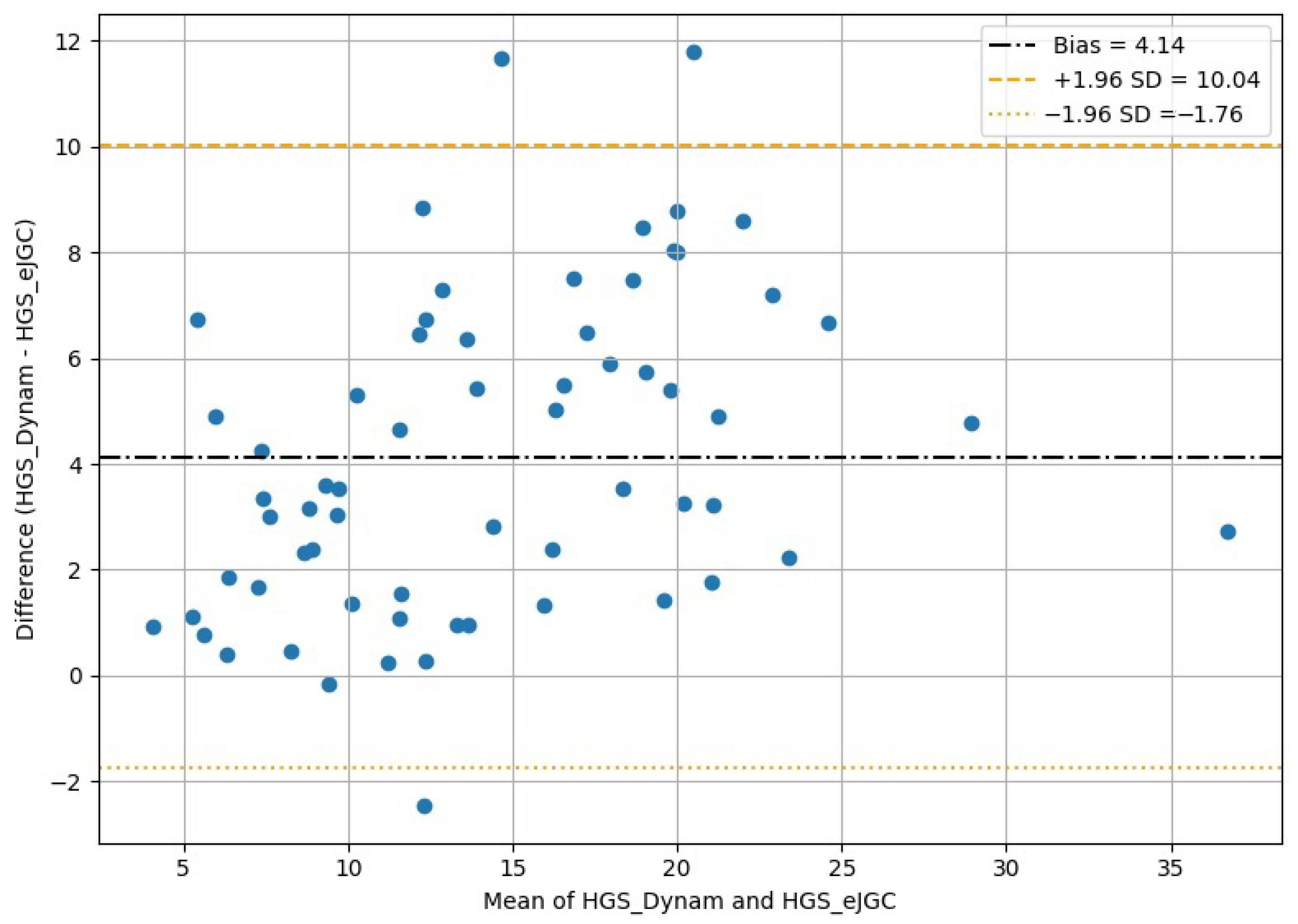
Bland–Altman analysis was also performed for HGS measurements. It is shown in Figure 8. The analysis showed a positive mean difference (bias around 4.14 kg-f), with limits of agreement ranging from approximately −1.76 kg-f to 10.04 kg-f. Most of the data points were distributed within these limits, with a moderate spread across the measurement range. The differences were relatively consistent across lower and higher strength values, although some variability was observed, particularly at higher mean values.
Grip strength measurements showed high correlation, with Pearson values around 0.90, and ICC values of 0.81 and 0.66, as presented in Table 5. Furthermore, the MAE values were 3.93 kg-f and 4.51 kg-f, indicating moderate differences between the eJGC readings and those recorded by the digital dynamometer. Although AR values were low for both hands, at 6.25% for the MAH and 3.12% for the LAH, the overall evaluation of the indicators suggests that the eJGC provides consistent measurements of HGS.

4. Discussion

This study aimed to investigate whether the eJGC could be used for the clinical assessment of ROM and HGS of the hand and wrist in patients referred for physical rehabilitation of the hand due to traumatic or rheumatic pathologies. The results of robotic validation, simulating ROM movements, demonstrate that the eJGC provides data with errors of approximately 1.5% on average across different application velocities, as shown in Figure 6. This suggests that the movement angle data from the eJGC exhibit high measurement precision under controlled conditions. Theoretically, these results indicate that the eJGC could be used to measure wrist ROM. However, as shown by the results obtained with patients, several variables can affect clinical measurements, including the device weight, patient strength, pain experienced due to their condition, and the specific method for measuring radial and ulnar deviation.
It is important to note that while other studies have proposed technological tools for measuring ROM [7,11], to our best knowledge, none have previously validated their technology against a movement benchmark using a robotic manipulator, as performed in this work. Moreover, the eJGC’s dual application as both an assessment tool and a game controller offers a practical advantage: it consolidates the tools required for evaluation and rehabilitation into a single device, potentially increasing clinical efficiency.
The Bland–Altman analysis indicates that the performance of the eJGC in measuring ROM is strongly dependent on the type of movement, with narrower limits of agreement for pronation and supination and substantially wider limits for the remaining movements.
Regarding patient ROM measurements, the results indicate that the eJGC can provide more consistent measurements for pronation and supination compared with other movements. This is supported by relatively low MAE values (1–3°) and higher agreement levels compared with the other ROM movements. These findings suggest that the eJGC may be suitable for the clinical evaluation of pronation and supination. This assessment is particularly valuable, as these movements also provide functional information on elbow mobility. A recent work reported a phone application to measure these movements with an ICC ranging from 0.42 to 0.87 [13]. In comparison, the eJGC presented in this work achieved ICC values of up to 0.85 for supination.
On the other hand, for flexion, extension, and radial/ulnar deviation movements, the results show substantially higher errors and wider variability between measurements. In particular, flexion and extension exhibited MAE values around 20°, while radial and ulnar deviation showed even larger discrepancies, especially for ulnar deviation. These findings are consistent with the wide limits of agreement observed in the Bland–Altman analysis. The reduced performance in these movements may be attributed to the device’s weight (approximately 0.5 kg), which can affect patient performance during measurement. If the patient’s hand is painful, the device’s weight may prevent full ROM or alter the natural movement. Another contributing factor is the measurement methodology for radial and ulnar deviation. While a goniometer measures these movements with the hand resting horizontally on a table, the eJGC measurement is taken with the arm resting on the table and the hand held vertically while gripping the device, as shown in Figure 4k,l. This methodological difference likely influences the observed discrepancies.
A possible solution is to improve the eJGC’s ergonomic design to mitigate the effect of its weight. This could be approached in two ways. First, the device housing could be redesigned to reposition its center of gravity closer to the wrist, which would likely reduce the perceived weight and its influence on movement. Second, an additional support could be implemented to help hold the device, preventing its full weight from resting on the patient’s hand. Furthermore, the technology within the eJGC could be enhanced by integrating a 9-DoF IMU instead of the currently used 6-DoF IMU. This upgrade would significantly reduce errors in measuring radial and ulnar deviation. The key advantage is that it would allow the device to be used horizontally on a table (much like a goniometer) rather than vertically, thereby eliminating the need for the hand to support its weight during these specific measurements.
Finally, the Bland–Altman analysis demonstrated more consistent agreement patterns for HGS compared with ROM, reinforcing that the eJGC is better suited for grip strength assessment than for certain ROM movements. In addition, the results for HGS measurement show that the eJGC provides more consistent performance compared with ROM measurements. Pearson correlation values (0.88–0.91) and ICC values (0.81–−0.66) indicate moderate to high agreement with the reference dynamometer, while the Bland–Altman analysis showed a relatively stable bias (around 4.14 kg-f) and acceptable limits of agreement. Although AR values were low, the overall consistency across different statistical indicators suggests that the eJGC shows promising performance for HGS assessment; however, agreement should be interpreted with caution due to the observed bias and error levels, and further validation and calibration are required before considering it a suitable clinical tool.
Based on these results, the eJGC demonstrates potential for clinical assessment of HGS and selected ROM movements, even without further mechanical or firmware improvements. This represents a relevant contribution, as the integration of measurement and rehabilitation functionalities within a single device has not been clearly demonstrated in the studies discussed in this section.
This study presents several methodological limitations. First, although efforts were made to reduce expectation bias by ensuring that the rehabilitation specialist was not aware of the eJGC measurement outputs during data acquisition, a fully blinded procedure was not implemented. Second, the use of a fixed measurement order may have introduced potential order effects. This decision was influenced by clinical workflow constraints and the need to minimize fatigue associated with the use of the eJGC device.
Another limitation concerns the assessment of radial and ulnar deviation, where measurements were not performed under equivalent conditions between methods. While conventional goniometry is conducted with the hand supported in a horizontal position, the eJGC requires a vertical orientation due to sensor constraints. Consequently, the observed discrepancies in these movements may reflect not only device-related limitations but also differences in measurement posture, which should be considered when interpreting the results.
Additionally, due to clinical and logistical constraints, it was not feasible to include a broader and more heterogeneous patient population. Expanding the diversity of pathologies would have required a longer study duration and was beyond the scope of the present investigation.
Although these factors were taken into account during the study design, their potential influence on the results cannot be completely excluded.

5. Conclusions

According to the obtained results, the eJGC demonstrates strong potential for use as a clinical assessment tool for forearm pronation and supination movements. For HGS, the device shows promising performance; however, agreement should be interpreted with caution due to the observed bias and error levels, and further validation and calibration are required before it can be considered a reliable clinical assessment tool. In contrast, for flexion, extension, and radial and ulnar deviation movements, the eJGC showed lower agreement and higher measurement variability, indicating that further improvements in both device design and measurement methodology are required to achieve the level of precision needed for clinical settings.

Author Contributions

Conceptualization, A.C., E.D.O. and A.J.; methodology, A.C. and E.D.O.; software, A.C.; validation, A.C., E.D.O. and A.J.; formal analysis, A.C.; investigation, A.C. and E.D.O.; resources, A.C. and A.J.; data curation, A.C.; writing—original draft preparation, A.C.; writing—review and editing, A.C. and E.D.O.; visualization, E.D.O.; supervision, A.J.; funding acquisition, A.C. and A.J. All authors have read and agreed to the published version of the manuscript.

Funding

This research has been partially financed by “iREHAB: AI-powered Robotic Personalized Rehabilitation” project DTS22/00105, financed by Instituto de Salud Carlos III (ISCIII) and European Union; and by the Escuela Politécnica Nacional under Grant DAJ-061-2022.

Institutional Review Board Statement

The study was conducted in accordance with the Declaration of Helsinki and was approved by the Ethics Committee of the Universidad Central del Ecuador under registration code 003-EXT-2025, approved on 27 May 2025.

Informed Consent Statement

Informed consent was obtained from all subjects involved in the study.

Data Availability Statement

The dataset used in this study can be obtained from the authors upon reasonable request.

Acknowledgments

The authors would like to acknowledge Kely González, health professional assistant, as well as Ramiro Mallitaxi and María F. Palomino, directors of the rehabilitation area, for their valuable support. The authors also extend their gratitude to all the patients who participated in this study and to the Outpatient Clinical Surgical Center, El Batán Day Hospital, for facilitating the development of this research. During the preparation of this manuscript, the authors used ChatGPT 5.2 to check normality assumptions. The authors have reviewed and edited the output and take full responsibility for the content of this publication.

Conflicts of Interest

The authors declare no conflicts of interest. The funders had no role in the design of the study; in the collection, analyses, or interpretation of data; in the writing of the manuscript; or in the decision to publish the results.

Abbreviations

The following abbreviations are used in this manuscript:
ADLactivities of daily living
ARagreement rate
eJGCeJamar game controller
DoFdegrees of freedom
GUIgraphical user interface
HGShand grip strength
ICCintraclass correlation coefficient
IMUinertial measurement unit
MAEmean absolute error
ROMrange of motion
RSrehabilitation specialist

References

  1. Yang, Z.; Lim, P.P.H.; Teo, S.H.; Chen, H.; Qiu, H.; Pua, Y.H. Association of wrist and forearm range of motion measures with self-reported functional scores amongst patients with distal radius fractures: A longitudinal study. BMC Musculoskelet. Disord. 2018, 19, 142. [Google Scholar] [CrossRef] [PubMed]
  2. Norkin, C.C.; White, D.J. Measurement of Joint Motion: A Guide to Goniometry; FA Davis: Philadelphi, PA, USA, 2016. [Google Scholar]
  3. Ryu, J.; Cooney, W.P., III; Askew, L.J.; An, K.N.; Chao, E.Y. Functional ranges of motion of the wrist joint. J. Hand Surg. 1991, 16, 409–419. [Google Scholar] [CrossRef] [PubMed]
  4. Keller, M.M.; Barnes, R.; Brandt, C.; Hepworth, L.M. Hand rehabilitation programmes for second to fifth metacarpal fractures: A systematic literature review. S. Afr. J. Physiother. 2021, 77, 1536. [Google Scholar] [CrossRef] [PubMed]
  5. Pozmohova, N.; Bogdanovska, N.; Kalonova, I.; Boichenko, C.; Bessarabova, O. Effect of occupational therapy intervention in a comprehensive rehabilitation program on patients with early rheumatoid arthritis. J. Phys. Educ. Sport 2021, 21, 3024–3029. [Google Scholar]
  6. Vaishya, R.; Misra, A.; Vaish, A.; Ursino, N.; D’Ambrosi, R. Hand grip strength as a proposed new vital sign of health: A narrative review of evidences. J. Heal. Popul. Nutr. 2024, 43, 7. [Google Scholar] [CrossRef] [PubMed]
  7. Kassay, A.D.; Daher, B.; Lalone, E. An analysis of wrist and forearm range of motion using the Dartfish motion analysis system. J. Hand Ther. 2021, 34, 604–611. [Google Scholar] [CrossRef] [PubMed]
  8. Gandbhir, V.N.; Cunha, B. Goniometer. 2025. Available online: https://www.ncbi.nlm.nih.gov/books/NBK558985/ (accessed on 20 March 2026).
  9. McGrath, R.; Johnson, N.; Klawitter, L.; Mahoney, S.; Trautman, K.; Carlson, C.; Rockstad, E.; Hackney, K.J. What are the association patterns between handgrip strength and adverse health conditions? A topical review. SAGE Open Med. 2020, 8, 2050312120910358. [Google Scholar] [CrossRef] [PubMed]
  10. Beaudart, C.; Rolland, Y.; Cruz-Jentoft, A.J.; Bauer, J.M.; Sieber, C.; Cooper, C.; Al-Daghri, N.; Araujo de Carvalho, I.; Bautmans, I.; Bernabei, R.; et al. Assessment of muscle function and physical performance in daily clinical practice: A position paper endorsed by the European Society for Clinical and Economic Aspects of Osteoporosis, Osteoarthritis and Musculoskeletal Diseases (ESCEO). Calcif. Tissue Int. 2019, 105, 1–14. [Google Scholar] [CrossRef] [PubMed]
  11. Surangsrirat, D.; Bualuangngam, T.; Sri-iesaranusorn, P.; Chaiyaroj, A.; Buekban, C.; Thanawattano, C.; Poopitaya, S. Comparison of the wrist range of motion measurement between inertial measurement unit glove, smartphone device and standard goniometer. Appl. Sci. 2022, 12, 3418. [Google Scholar] [CrossRef]
  12. Rashid, A.; Hasan, O. Wearable technologies for hand joints monitoring for rehabilitation: A survey. Microelectron. J. 2019, 88, 173–183. [Google Scholar] [CrossRef]
  13. Reid, S.; Egan, B. The validity and reliability of DrGoniometer, a smartphone application, for measuring forearm supination. J. Hand Ther. 2019, 32, 110–117. [Google Scholar] [CrossRef] [PubMed]
  14. Arman, N.; Oktay, A.B.; Tarakci, D.; Tarakci, E.; Akgul, Y.S. The validity of an objective measurement method using the Leap Motion Controller for fingers wrist, and forearm ranges of motion. Hand Surg. Rehabil. 2021, 40, 394–399. [Google Scholar] [CrossRef] [PubMed]
  15. Gonçalves, R.S.; Souza, M.R.d.; Carbone, G. Analysis of the leap motion controller’s performance in measuring wrist rehabilitation tasks using an industrial robot arm reference. Sensors 2022, 22, 4880. [Google Scholar] [CrossRef] [PubMed]
  16. Weichert, F.; Bachmann, D.; Rudak, B.; Fisseler, D. Analysis of the accuracy and robustness of the leap motion controller. Sensors 2013, 13, 6380–6393. [Google Scholar] [CrossRef] [PubMed]
  17. Cela, A.F.; Oña, E.D.; Jardón, A. eJamar: A Novel Exergame Controller for Upper Limb Motor Rehabilitation. Appl. Sci. 2024, 14, 11676. [Google Scholar] [CrossRef]
  18. Oña, E.D.; Yepez-Figueroa, J.J.; Cela, A.; Jardón, A. Preliminary Evaluation of eJamar Game Controller as Hand Range of Motion Measurement Tool. In Advances in Applied Technologies for Disability and Inclusion, Proceedings of the 13th Congreso Iberoamericano de Tecnologías de Apoyo a la Discapacidad, IBERDISCAP 2025, Seville, Spain, 3–5 November 2025; Springer: Cham, Switzerland, 2026; in press. [Google Scholar]
  19. Cazañas, A.; de San Miguel, A.; Parra, E. Estimating Sample Size for Usability Testing. Enfoque UTE 2017, 8, 172–185. [Google Scholar] [CrossRef]
  20. Rojo, A.; Santos-Paz, J.Á.; Sánchez-Picot, Á.; Raya, R.; García-Carmona, R. FarmDay: A Gamified Virtual Reality Neurorehabilitation Application for Upper Limb Based on Activities of Daily Living. Appl. Sci. 2022, 12, 7068. [Google Scholar] [CrossRef]
  21. Naqvi, U.; Margetis, K.; Sherman, A.L. Muscle strength grading. In StatPearls [Internet]; StatPearls Publishing: Treasure Island, FL, USA, 2025. [Google Scholar]
  22. Doğan, N.Ö. Bland-Altman analysis: A paradigm to understand correlation and agreement. Turk. J. Emerg. Med. 2018, 18, 139–141. [Google Scholar] [CrossRef] [PubMed]
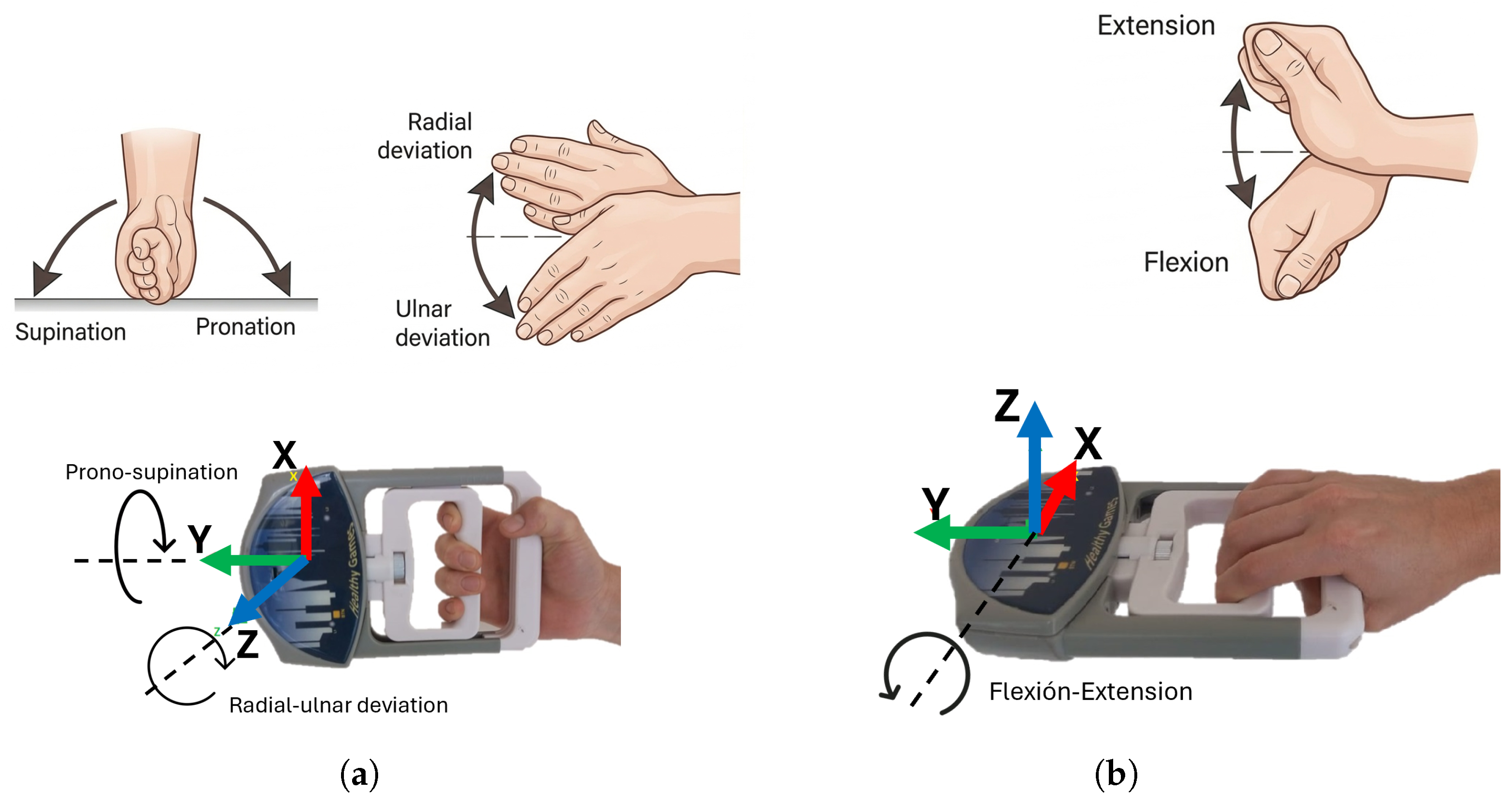
Figure 1. ROM measurements using eJamar. (a) Vertical configuration. (b) Horizontal configuration.
Eng 07 00197 g001
Figure 2. Architecture of the system for ROM and HGS assessments.
Eng 07 00197 g002
Figure 3. A screen of the GUI. ROM measurements.
Eng 07 00197 g003
Figure 4. Wrist and hand movements measured with the goniometer and eJGC, respectively. (a,g) Pronation. (b,h) Supination. (c,i) Flexion. (d,j) Extension. (e,k) Radial deviation. (f,l) Ulnar deviation.
Eng 07 00197 g004
Figure 5. Robot-aided angle measurement testing. (a) Experimental setup. (b) Obtained errors.
Eng 07 00197 g005
Figure 6. Effect of speed in angle measurement in step mode and comparisons of the robot and eJGC measurements. (a,d) Pronation–supination angle. (b,e) Flexion–extension angle. (c,f) Ulnar–radial deviations.
Eng 07 00197 g006
Figure 7. Bland–Altman plots or agreement between Goniometer and eJGC measurements in ROM. (a,d) Pronation–supination. (b,e) Flexion–extension. (c,f) Radial—ulnar deviations.
Eng 07 00197 g007
Figure 8. Bland–Altman plot for HGS measurements.
Eng 07 00197 g008
Table 1. Demographic information of the participants.
Mean (SD)Female/MaleRight/Left
Age58 (12.5)
Gender 26/6
Dominant hand 31/1
More affected hand 14/18
Table 2. Overall statistical indicators for ROM in both hands.
HandPearson ρ -FactorMAE (°)ICCIC 95%AR (%)
MAH0.61<0.001 *18.20.478[0.38, 0.57]39.8
LAH0.62<0.001 *17.530.54[0.46, 0.61]42.2
* significance ρ < 0.05. MAH, most affected hand; LAH, less affected hand; MAE, mean absolute error; ICC, 95% intraclass correlation; AR, agreement rate at ±5°.
Table 3. Measurements indicators for the most affected hand.
ROMPearson ρ -FactorMAE (°)ICCIC 95%AR (%)
Pronation0.270.142.60.26[−0.087, 0.56]93.8
Supination0.85<0.05 *1.130.84[0.70, 0.91]93.8
Flexion0.340.0619.90.16[−0.069, 0.57]18.8
Extension0.40<0.05 *21.20.19[0.070, 0.66]3.13
Radial dev.0.120.5312.90.10[−0.26, 0.43]25.0
Ulnar dev.−0.0160.9247.5−0.001[−0.35, 0.33]0.0
* significance ρ < 0.05. ROM, range of motion; MAE, mean absolute error in °; ICC, 95% intraclass correlation; AR, agreement rate at ±5°. This table shows the data obtained of correlations and comparison between eJGC measures and health specialist measures with the standard goniometer for the most affected hand.
Table 4. Measurements indicators for the less affected hand.
ROMPearson ρ -FactorMAE (°)ICCIC 95%AR (%)
Pronation−0.0760.681.94−0.018[−0.36, 0.32]93.8
Supination−0.120.501.10−0.044[−0.39, 0.29]96.9
Flexion0.62<0.05 *20.20.32[0.27, 0.76]15.6
Extension0.150.42250.05[−0.21, 0.47]3.13
Radial dev.0.46<0.05 *12.630.33[−0.012, 0.61]31.3
Ulnar dev.0.200.265.800.02[−0.15, 0.51]3.13
* significance ρ < 0.05. ROM, range of motion; MAE, mean absolute error in °; ICC, 95% intraclass correlation; AR, agreement rate at ±5°. This table shows the data obtained from correlations and comparisons between eJGC measures and health specialist measures with the standard goniometer for the most affected hand.
Table 5. Statistical indicators for HGS in both hands.
HandPearson ρ -FactorMAE (kg-f)ICCIC 95%AR (%)
MAH0.88<0.05 *3.930.81[0.58, 0.91]6.25
LAH0.91<0.05 *4.510.66[0.25, 0.85]3.12
* significance ρ < 0.05. MAH, most affected hand; LAH, less affected hand; MAE, mean absolute error in kg-f; ICC, 95% intraclass correlation; AR, agreement rate at ±3 kg-f.
Disclaimer/Publisher’s Note: The statements, opinions and data contained in all publications are solely those of the individual author(s) and contributor(s) and not of MDPI and/or the editor(s). MDPI and/or the editor(s) disclaim responsibility for any injury to people or property resulting from any ideas, methods, instructions or products referred to in the content.