Article

Evaluation of La-Based Mixed Oxide Catalysts in Catalytic Ammonia Decomposition

by
Mihaela Litinschi (Bilegan)
1,
Rami Doukeh
1,*,
Ionuț Banu
2,
Romuald Győrgy
2,
Alexandru Vlaicu
3,
Gabriel Vasilievici
3,
Sorin Georgian Moga
4,
Andreea Madalina Pandele
5,
Lujain Moazeen
6 and
Dragoș Mihael Ciuparu
1,*
1
Department of Petroleum Refining Engineering and Environmental Protection, Petroleum-Gas University of Ploiesti, 39 Bucharest Blvd., 100680 Ploiesti, Romania
2
Department of Chemical and Biochemical Engineering, National University of Science and Technology Politehnica Bucharest, 060042 Bucharest, Romania
3
National Institute for Research Development for Chemistry and Petrochemistry—ICECHIM-București, 202 Spl. Independenței, 060021 Bucharest, Romania
4
Regional Center of Research & Development for Materials, Processes and Innovative Products Dedicated to the Automotive Industry (CRC&D-AUTO), Pitesti University Centre, National University of Science and Technology Politehnica Bucharest, 110040 Pitesti, Romania
5
Advanced Polymers Materials Group, National University of Science and Technology Politehnica Bucharest, Gheorghe Polizu 1-7, 011061 Bucuresti, Romania
6
Chemistry Department, Faculty of Science, University of Damascus, Damascus P.O. Box 30621, Syria
*
Authors to whom correspondence should be addressed.
Eng 2026, 7(4), 172; https://doi.org/10.3390/eng7040172
Submission received: 10 March 2026 / Revised: 1 April 2026 / Accepted: 7 April 2026 / Published: 9 April 2026

Abstract

Ammonia decomposition represents a promising route for carbon-free hydrogen production, provided that efficient and cost-effective catalysts are developed. In this study, lanthanum-based mixed oxide catalysts (LaNi, LaCo, and LaCe) were synthesized via a controlled co-precipitation method and systematically evaluated for catalytic ammonia decomposition under atmospheric pressure in the temperature range of 350–500 °C. Comprehensive characterization combining N2 physisorption, XRD, SEM–EDX, TGA–DTG, XPS, and FTIR-pyridine adsorption revealed pronounced structure–property relationships. LaNi exhibited the highest surface area (31.11 m2·g−1), well-developed mesoporosity, and a balanced Lewis/Brønsted acidity (CL/CB ≈ 0.82), leading to superior catalytic performance with NH3 conversion reaching ~48% at 500 °C (GHSV = 50 h−1). LaCo showed intermediate activity (~30% conversion), while LaCe displayed limited performance (<13%), most likely due to its dense morphology and low surface accessibility. Increasing gas hourly space velocity resulted in decreased ammonia conversion for all catalysts, highlighting the critical role of residence time. These findings demonstrate that the catalytic efficiency of lanthanum-based systems is governed by the synergistic interplay between surface area, mesoporous architecture, and acidity distribution, with LaNi emerging as the most promising catalyst among the investigated materials.

1. Introduction

Ammonia decomposition to hydrogen is a critical process in the transition to sustainable energy systems, as it addresses key challenges in hydrogen storage and transportation. Ammonia (NH3) is an excellent hydrogen carrier due to its high hydrogen content (17.6 wt%), ease of liquefaction at moderate pressures, and well-established global infrastructure for production and distribution [1,2]. Unlike hydrogen, which requires costly cryogenic or high-pressure storage, ammonia can be stored and transported safely and efficiently, making it a practical medium for delivering hydrogen to end-users [3,4]. Within this framework, extensive research efforts have been devoted to identifying highly active and durable catalysts capable of efficiently promoting ammonia decomposition under practical operating conditions.
The main catalysts studied for ammonia (NH3) decomposition include ruthenium (Ru)-based catalysts, recognized as the most active due to their optimal nitrogen-binding energy and high conversion rates at relatively low temperatures (e.g., >90% at 450 °C) [4,5]. Nickel (Ni)- and cobalt (Co)-based catalysts are also widely investigated as cost-effective alternatives, though they typically require higher temperatures and suffer from deactivation due to nitrogen poisoning [6]. Iron (Fe)-based catalysts, historically linked to ammonia synthesis, are explored for decomposition, but face challenges like undesirable iron nitride formation and lower activity compared to Ru [7]. Recent advances highlight the role of bimetallic systems and rare-earth promoters, particularly lanthanum (La) or cerium (Ce), in enhancing metal dispersion, stability, and surface reactivity. Moreover, tailored supports such as La2O3-based oxides and advanced nanostructured materials significantly improve metal–support interactions and thermal durability [5]. Accordingly, efforts to reduce noble-metal reliance while optimizing non-precious catalysts (e.g., Fe, Ni, and Co) remain a central research focus [8].
Lanthanum enhances the efficiency of ammonia decomposition for hydrogen production by improving the activity and stability of transition-metal-based catalysts through structural and electronic modifications. For example, LaNiO3 perovskites synthesized via self-combustion achieve near-complete NH3 conversion (99%) at 450 °C due to La’s ability to stabilize small, well-dispersed Ni crystallites [9].
In a similar manner, La-doped Al2O3 supports enhance Co catalyst performance by forming LaAlO3 phases that improve metal dispersion and surface basicity [10]. Lanthanum’s electron-donating properties weaken N-metal bonds, facilitating nitrogen desorption, which is widely regarded as the rate-limiting step in NH3 decomposition [11]. Additionally, La incorporation prevents support degradation (e.g., Al2O3 phase transitions) at high temperatures, ensuring long-term catalyst durability [12]. These attributes make lanthanum a key component in advancing carbon-free hydrogen production via NH3 decomposition. These structure–activity relationships are further supported by detailed experimental investigations. Wang et al. [10] investigated ammonia (NH3) decomposition over a Co catalyst supported on La-doped Al2O3, demonstrating that La incorporation enhances Co dispersion and surface basicity, leading to improved catalytic activity and stability. An optimal La loading of 5 wt% increased NH3 conversion by approximately 50% compared to the undoped catalyst and enabled high activity at relatively low temperatures, highlighting its potential for hydrogen production.
Beyond supported systems, perovskite-type lanthanum-based catalysts have also attracted considerable attention. Self-combustion-synthesized LaNiO3 and LaCoO3 perovskites demonstrated high catalytic activity toward ammonia decomposition, with the optimized LaNiO3 catalyst reaching 99% NH3 conversion at 450 °C under high space velocity. Moreover, both perovskite catalysts exhibited excellent stability, maintaining conversion levels above 97% during 24 h of time-on-stream evaluation [9]. Chen et al. [13] focused on improving the efficiency of ammonia catalytic decomposition also using perovskite catalysts, specifically Lanthanum Strontium Titanate Nickel (LSTN). The key innovation of this work lies in a balanced strategy combining cation doping with controlled cation deficiencies, thereby optimizing catalytic performance.
Complementary insights into lanthanum-based systems were provided by studies on mixed oxide catalysts. Xun et al. [14] prepared a series of Fe- and Co-doped lanthanum oxide catalysts, synthesized via a co-precipitation–hydrothermal approach and evaluated for catalytic ammonia decomposition. However, the catalyst composition was varied over a limited atomic percentage range without establishing a fixed La/M stoichiometric ratio. The results revealed Fe2N and metallic Co as the dominant active phases, with Co-based catalysts exhibiting superior activity; notably, the 50Co–La catalyst achieved NH3 conversion exceeding 80% at 600 °C. In addition, La2O3 functioned as an effective structural promoter by suppressing metal sintering and preserving high surface area during reaction.
The synergistic role of lanthanum in noble-metal systems has also been demonstrated. Efficient Ru/La2O3 catalysts for hydrogen production without CO2 emissions via ammonia decomposition, focusing on optimizing support synthesis and promoter effects, were investigated by Huang et al. [15]. Here, lanthanum serves as an optimal basic support for ruthenium. La2O3 was prepared via the citric acid complex method and calcined at 700 °C (La2O3-700-i), and formed a pure hexagonal La2O3 phase.
Recent studies on ammonia decomposition over La-based catalysts have explored a wide range of synthesis methods, catalyst compositions, and structural designs; however, a targeted comparison of these factors remains limited. Various preparation methods, including co-precipitation, sol–gel, hydrothermal, and combustion techniques, have been widely employed, with catalytic performance strongly influenced by both synthesis conditions and catalyst structure [16]. For example, Pinzón et al. [9] prepared LaCoO3 perovskite catalyst via a self-combustion method and demonstrated that synthesis parameters, such as fuel-to-metal ratio and calcination temperature, significantly affect crystallite size, dispersion, and, ultimately, catalytic activity. Similarly, Podila et al. [17] used a citric acid-assisted combustion method to synthesize La-based perovskites (LaMO3, M = Ni, Co), where partial substitution with Ce enhanced performance by increasing oxygen vacancies and improving metal reducibility. Importantly, the influence of the synthesis method itself has been clearly demonstrated, as catalysts prepared via co-precipitation can exhibit superior activity compared to those prepared by impregnation due to improved incorporation of active metal species into the catalyst structure, leading to enhanced ammonia conversion at higher metal loadings [18].
In terms of catalyst composition, both binary and ternary La-based systems have been extensively investigated. More complex ternary systems, such as La1−xSrxAlO3-supported Ru catalysts, have been developed to tune electronic properties through cation substitution [19]. Here, the La/Sr ratio is tuned, but the relationship between La and the active metal (Ru) does not have a defined stoichiometry, as the metal is introduced as a supported phase. In these systems, the catalytic performance is mainly governed by electronic modulation and metal–support interactions rather than by the intrinsic composition of La-based mixed oxides. Furthermore, many studies rely on supported catalyst systems, where active metals (e.g., Ni, Fe, Co, Ru) are dispersed on oxides such as La2O3 via impregnation or deposition methods [20,21]. In such systems, lanthanum primarily acts as a support, or promoter, that enhances basicity and stabilizes the active phase, as also observed in rare-earth-modified catalysts [22] and Ni/La2O3 systems [23]. These reports indicate that most of the current research predominantly focuses on structural engineering, electronic tuning, and metal dispersion, rather than on the rational design of La-based mixed oxides with controlled composition.
A key limitation across these studies is the lack of control over the La/M molar ratio. Most catalytic systems are designed by varying metal loading (typically in the range of 1 to 40 wt%) or through partial substitution strategies, rather than by establishing a fixed stoichiometric ratio between lanthanum and the active metal [20]. Even in more complex composite systems, such as the LaCoOx-based catalyst reported by Han et al. [24], where a Co/La ratio close to unity is observed, the material consists of a heterogeneous structure combining amorphous LaCoOx species, metal nanoparticles, and a carbon matrix, where the atomic ratio is not controlled through a defined synthesis strategy.
Despite the extensive development of La-based catalysts for ammonia decomposition, a systematic investigation of well-defined La–M mixed oxides with controlled La/M molar ratios remains largely unexplored. This gap highlights the need for simple and controllable synthesis strategies that enable precise composition tuning. In this context, the present work introduces a controlled co-precipitation approach to synthesize La-based mixed oxides with a fixed 1:1 La/M molar ratio, allowing a direct and systematic comparison of LaNi, LaCo, and LaCe catalysts. This strategy provides a clear framework to elucidate the role of metal identity under identical stoichiometric conditions, thereby addressing the lack of composition-controlled studies in currently available literature.
In previous studies, we have reported that the surface properties of oxides can be finely tuned by synthesizing ternary mixed oxide crystalline phases capable of shifting the energy of metal–oxygen bonds by as much as 1 eV, thus modifying the acid-base character of the surface [25]. Based on the critical role of lanthanum in enhancing metal dispersion, surface basicity, and thermal stability reported in previous studies, this work aims to provide a systematic experimental evaluation of La-based mixed oxide catalysts for ammonia decomposition. By employing a unified synthesis strategy and combining complementary physicochemical and catalytic investigations, the present study seeks to elucidate how textural properties, morphology, surface acidity, and operating conditions collectively govern catalytic performance. The comparative investigation of LaNi, LaCo, and LaCe catalysts allows for the establishing of a direct correlation between structural features and reactivity, thereby defining a clear design criteria for efficient lanthanum-based catalysts in ammonia-to-hydrogen conversion.

2. Material and Methods

2.1. Materials

All chemicals employed in this work were Lanthanum nitrate hexahydrate (La(NO3)3·6H2O, ≥99.9%, Sigma Aldrich, purity ≥ 99.9%, St. Louis, MO, USA), ammonium hydroxide solution (NH4OH, 35 wt%, Chimreactiv, Bucharest, Romania), nickel nitrate hexahydrate (Ni(NO3)2·6H2O, ≥99%) obtained from Acros Organics (Geel, Belgium), cobalt(II) acetate tetrahydrate (Co(CH3COO)2·4H2O, ≥99.9%), and cerium nitrate hexahydrate (Ce(NO3)3·6H2O, ≥99.9%) supplied by Merck (Darmstadt, Germany).

2.2. Catalysts Synthesis

Lanthanum-containing catalysts were prepared via a controlled co-precipitation route [25,26], employing appropriate metal salt precursors to obtain a targeted La-to-metal molar ratio of 1:1 (M = Ni, Co, or Ce). For the synthesis of the La–Co catalyst (LaCo), lanthanum nitrate hexahydrate (19.50 g, La(NO3)3·6H2O) was combined with cobalt(II) acetate tetrahydrate (11.2 g, Co(CH3COO)2·4H2O). The La–Ni system (LaNi) was obtained using 19.50 g of La(NO3)3·6H2O and 13.1 g of Ni(NO3)2·6H2O, while the La–Ce catalyst (LaCe) was synthesized from 16.9 g of La(NO3)3·6H2O and 19.5 g of Ce(NO3)3·6H2O.
In each case, the selected precursor salts were dissolved in 1000 mL of distilled water, followed by thermal equilibration at 60 °C under vigorous magnetic stirring (1500 rpm) for 30 min to ensure solution homogeneity. To avoid unwanted oxidation or carbonate formation, the synthesis was conducted under a continuous flow of nitrogen throughout the dissolution and precipitation stages.
Precipitation was induced at 60 °C by the gradual addition of aqueous ammonium hydroxide (35 wt%), adjusting the system to strongly basic conditions (pH 10–11). The base was introduced dropwise, and the suspension was maintained under stirring for 60 min to allow complete nucleation and growth of the precipitated phase. Given the sensitivity of phase formation to alkalinity, the pH was carefully monitored using a calibrated pH meter.
Upon completion of the precipitation step, the solid products were recovered by decantation and repeatedly rinsed with distilled water to eliminate residual ionic species and soluble by-products. The washed precipitates were subsequently dried at 200 °C for 6 h and then thermally treated at 600 °C for 4 h under a static air environment. This calcination step resulted in the formation of the corresponding lanthanum-based mixed oxide catalysts, denoted as LaCo, LaNi, and LaCe.

2.3. Characterization Equipment

The catalysts were extensively examined by combining several complementary characterization methods, including X-ray diffraction (XRD), scanning electron microscopy (SEM), thermogravimetric analysis coupled with differential thermogravimetry (TGA–DTG), textural analysis based on nitrogen adsorption–desorption, Fourier-transform infrared (FTIR) spectroscopy, and surface acidity assessment via pyridine adsorption followed by FTIR analysis (FTIR-Py).
Crystalline phase identification was performed by X-ray diffraction (XRD). The measurements were conducted using a Rigaku Ultima IV diffractometer (Rigaku Corporation, Tokyo, Japan) equipped with a copper (Cu) anode X-ray tube (Kα1 radiation, λ = 1.54178 Å) and a graphite monochromator. The diffractometer was operated at 45 kV and 40 mA in Bragg–Brentano (θ–2θ) geometry under reflection mode.
The surface chemistry was studied by X-ray photoelectron spectroscopy (XPS) using a K-Alpha instrument from Thermo Scientific (Thermo Fisher Scientific, Waltham, MA, USA) with a monochromatic Al Kα source (1486.6 eV) at a low pressure of 2 × 10⁻⁹ mbar. Charging effects were compensated by a flood gun and binding energies were calibrated by placing the C1s peak at 284.4 eV as the internal standard. A pass energy of 200 eV and 20 eV was used for survey and high-resolution spectra acquisition, respectively [25,27].
The surface morphology and microstructural features of the samples were investigated using a scanning electron microscope (SEM) and energy dispersive X-ray spectroscopy (EDS) analysis—Hitachi TM4000plus II scanning electron microscope (Hitachi, Ibaraki, Japan). Thermal stability and decomposition behavior were evaluated through TGA–DTG measurements performed on a thermal analysis system from METTLER TOLEDO (Greifensee, Switzerland) [25,28]. These analyses were conducted between 25 and 700 °C under a nitrogen atmosphere with a flow rate of 30 mL/min, applying a constant heating rate of 10 °C/min.
Textural characteristics, including surface area and pore structure, were determined by nitrogen physisorption measurements using a NOVA 2200e gas sorption analyzer from Quantachrome (Boynton Beach, FL, USA) [25,27,28]. Adsorption–desorption isotherms were acquired at 77.35 K over a relative pressure (p/p0) interval from 0.005 to 1.0, and the resulting data were processed using NovaWin software (version 11.03). The specific surface area was calculated according to the Brunauer–Emmett–Teller (BET) approach, while the total pore volume and pore-size distribution were estimated using the Barrett–Joyner–Halenda (BJH) method based on the desorption branch [25,27,28].
FTIR spectroscopy of adsorbed pyridine (FTIR-Py) was employed to determine the concentrations of acid sites of the catalysts. Measurements were carried out using an IRAffinity-1S spectrometer (Shimadzu, Kyoto, Japan) equipped with a GladiATR-10 accessory for attenuated total reflectance (ATR) [28,29]. The spectra were recorded in the wavenumber range of 1400–1560 cm−1 with a spectral resolution of 4 cm−1.

2.4. Catalytic Evaluation Studies

The catalytic studies were carried out in a vertical carbon steel tubular fixed-bed reactor (i.d. = 1.2 cm, h = 60 cm) loaded with 2.5 g of catalyst. All experiments were performed at atmospheric pressure (1 bar) within a temperature range of 350–500 °C, using temperature intervals of 75 °C. The volumetric feed flow rate of ammonia was varied between 3 and 10 L·h−1, corresponding to weight hourly space velocities (GHSV) of 50, 102 and 170 h−1.
Ammonia conversion was determined using a gas chromatograph equipped with a thermal conductivity detector (TCD) (AGILENT 6890N) and a CP-Sil 5 CB capillary column (Agilent Technologies, Santa Clara, CA, USA), with helium employed as the carrier gas. The gas chromatograph was equipped with a sampling valve incorporating a 0.5 mL sample loop, ensuring accurate and reproducible gas sampling. The NH3 concentration in the gas mixture at the reactor outlet was continuously monitored following the catalytic decomposition reaction.
The applied temperature program consisted of an initial step at 50 °C maintained for 1 min, followed by heating at a rate of 10 °C·min−1 up to 150 °C, where the temperature was held constant for 5 min.

3. Results and Discussion

3.1. Catalyst Characterization

3.1.1. XRD Analysis

The XRD patterns of the LaNi, LaCo, and LaCe catalysts (Figure 1) confirm the formation of multiphase La-based oxide systems, whose phase composition strongly depends on the nature of the secondary metal. Phase identification was performed by comparison with reference patterns from the ICDD PDF-5+ database.
For the LaNi sample, the diffraction pattern reveals the presence of a layered La–Ni mixed oxide phase La8Ni4O17 (ICDD PDF-5 + 04-011-5431). The main reflections are observed at 2θ = 28.1° (004), 31.5° (103), 32.8° (110), 42.25° (006), 43.37° (114), and 47.15° (200).
In the high-angle region, additional reflections are detected around 64–65°, which can be attributed to higher-index planes such as (215)/(206), and at ~69.8°, corresponding to the (220) plane. Furthermore, secondary phases of La2O3 are identified at 27.37° (002), 39.58° (102), 48.70° (103), and 55.31° (200), in agreement with ICDD PDF-5 + 01-089-4016. Minor contributions from NiO are also detected at 36.1° (111) and 77.5° (311) (ICDD PDF-5 + 04-023-3539), indicating partial segregation of nickel as a separate oxide phase.
The LaCo catalyst exhibits diffraction peaks characteristic of the perovskite-type LaCoO3 phase (ICDD PDF-5 + 04-013-6817), with reflections at 2θ = 28.0° (101), 33.35° (112), 40.6° (021), 47.52° (202), 53.6° (113), 59.0° (122), 68.98° (220), 69.92° (024), 78.82° (312), and 79.45° (214). Residual La2O3 is also detected (ICDD PDF-5 + 01-089-4016 and 04-004-4119), together with reflections attributed to Co2.95O4 at 36.92° (311) and 59.7° (511), consistent with ICDD PDF-5 + 04-007-2519. This phase assemblage indicates substantial Co incorporation into the La–Co lattice, while secondary cobalt oxide domains remain present.
For LaCe, the diffraction pattern is dominated by a La–Ce mixed oxide solid solution La0.2Ce0.8O1.9 (ICDD PDF-5 + 01-080-5544), with characteristic reflections at 2θ = 28.06° (111), 32.6° (200), 46.78° (220), 58.3° (222), 75.62° (331), and 77.75° (420). Additional diffraction peaks at 2θ ≈ 26.2°, 30.31°, and 43.48° are assigned to non-stoichiometric cerium oxide (CeO1.695), consistent with ICDD PDF-5 + 04-018-6657. The deviation from the ideal fluorite CeO2 peak positions suggests lattice distortion associated with oxygen deficiency [30].
Overall, the XRD results in Figure 1 confirm that LaNi and LaCo preferentially form La–transition-metal mixed oxide or perovskite-type phases, whereas LaCe is governed by La–ceria solid solutions and non-stoichiometric cerium oxide. These crystallographic differences indicate variations in phase composition, metal incorporation, and structural organization, which are expected to directly influence the dispersion of active species and catalytic behavior.
The average crystallite size (D) of the catalysts was determined using the Debye–Scherrer equation [25,27,31], and the calculated values are summarized in Table 1. For the LaNi catalyst, the main La8Ni4O17 phase exhibits an average crystallite size of approximately 13.33 nm, while the secondary La2O3 and NiO phases show average crystallite sizes of ~13.44 nm and ~7.95 nm, respectively. The relatively smaller crystallite size of the NiO phase suggests improved dispersion of nickel species, which is likely beneficial for catalytic activity by increasing the number of accessible active sites.
In contrast, the LaCo catalyst displays a significantly larger average crystallite size for the main LaCoO3 phase (~19.88 nm), indicating a higher degree of crystallinity and larger grain domains, which may reduce the available surface-active sites. For the LaCe catalyst, its La–Ce mixed oxide phase exhibits the smallest crystallite size (~10.70 nm), accompanied by relatively small La2O3 (~9.83 nm) and CeOx (~8.08 nm) domains; however, despite these smaller crystallites, the catalytic performance remains limited, indicating that crystallite size alone is not the determining factor.
When correlated with the textural properties (Table 2), it becomes evident that LaNi combines a moderate crystallite size with the highest specific surface area (31.11 m2·g−1) and well-developed mesoporosity, which together enhance the dispersion and accessibility of active sites. This structural–textural synergy explains the superior catalytic performance of LaNi compared to LaCo and LaCe, demonstrating that catalytic activity is governed most likely by the combined effects of crystallite size, phase composition, and surface properties rather than a single structural parameter.

3.1.2. X-Ray Photoelectron Spectroscopy (XPS) Analysis

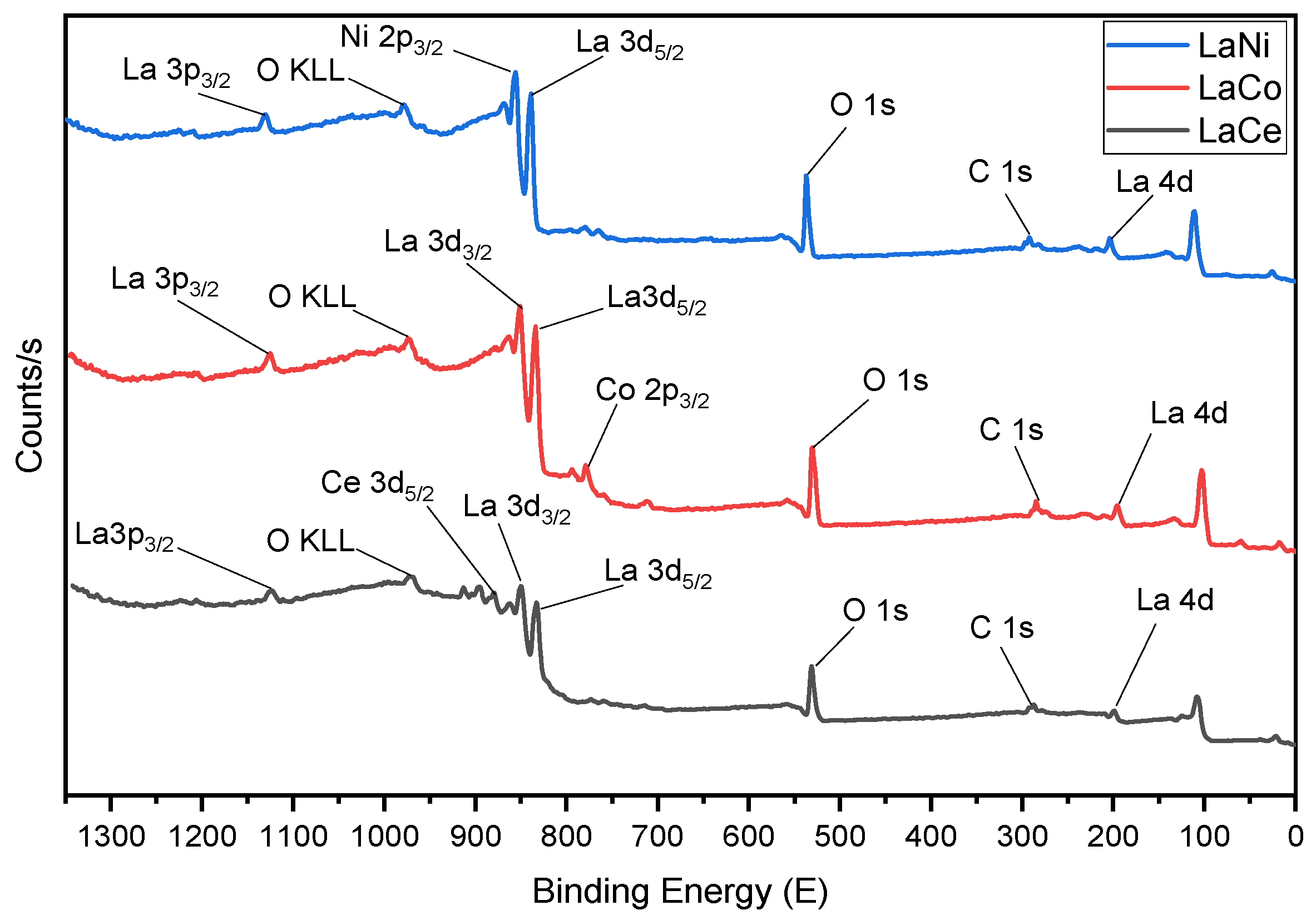
The XPS survey spectra of LaNi, LaCo, and LaCe catalysts (Figure 2) confirm the presence of La, O, and the respective transition-metal species (Ni, Co, or Ce), demonstrating effective surface integration of the targeted lanthanum-based mixed oxide structures. No extraneous elements are detected, indicating high purity of the prepared materials.
For all catalysts, the binding energy of La 3d3/2 is ~856 eV, and the La 3d5/2 component appears in the 834–836 eV region [32,33,34,35,36], accompanied by the La 3p3/2 feature at ~1132 eV [36,37,38]. Additionally, a La 4d signal is observed in the ~198–200 eV region, further confirming the presence of lanthanum in oxidic coordination environments [39]. These binding energies are characteristic of La3+ species in La–O coordination environments and are consistent with lanthanum stabilized in oxidic form. No additional low-binding-energy contributions are detected in the surveyed region, indicating that lanthanum is predominantly stabilized in oxidic coordination environments at the catalyst surface [36,37,38,40].
In the LaNi sample, the Ni 2p3/2 signal located at approximately ~856 eV falls within the binding energy range typically reported for nickel species stabilized in oxidic environments. It is important to note that this binding energy region lies in close proximity to the La 3d3/2 component (~856 eV), which may result in partial spectral overlap in lanthanum-based oxide systems [41,42,43]. Therefore, the assignment of the contribution in this energy region is made in correlation with literature-reported Ni 2p values and in conjunction with the phase composition identified by XRD. This interpretation is consistent with the multiphase oxide structure revealed by X-ray diffraction, where La8Ni4O17 coexists with NiO and La2O3, suggesting that nickel is incorporated within the lanthanum-based oxide framework.
For LaCo, the Co 2p3/2 peak observed at ~779 eV falls within the binding energy range typically reported for cobalt species stabilized in oxidic environments, including cobalt oxides and perovskite-type LaCoO3 structures. This assignment is made in accordance with the literature-reported Co 2p3/2 values [40,44,45], and in correlation with the phase composition identified by XRD. The XRD analysis indicates the predominance of the LaCoO3 perovskite phase accompanied by cobalt oxide contributions, which supports the stabilization of cobalt within lanthanum-based oxide lattices.
In the LaCe catalyst, the Ce 3d5/2 region centered around ~881 eV confirms the presence of oxidized cerium species. Cerium oxide systems typically exhibit mixed Ce3+/Ce4+ states associated with oxygen vacancy formation and non-stoichiometric ceria structures [46,47,48]. The detected Ce 3d features are therefore consistent with the La–Ce mixed oxide (La0.2Ce0.8O1.9) and non-stoichiometric CeO1.695 phases identified by XRD, suggesting partial oxygen deficiency at the surface.
The O 1s peak observed at ~533–534 eV in all catalysts is attributed to lattice oxygen (O2−) together with contributions from surface hydroxyl species and defect-related oxygen. Slight variations in O 1s binding energy among the samples are likely due to differences in local coordination environments and surface defect concentrations. The C 1s peak at ~284 eV corresponds to adventitious carbon and was used for charge correction of all spectra [32,33,34,35,36,40,44,45]. In addition, the feature observed at approximately 975 eV in the survey spectra is attributed to the O KLL Auger transition, which is commonly present in oxide materials and does not provide direct information on the oxidation states of the constituent elements [49,50].
Overall, the XPS analysis confirms that all catalysts are dominated by oxidized transition-metal species embedded within lanthanum-based oxide matrices. In combination with the phase composition identified by XRD. These results indicate that catalytic activity is associated with transition-metal species stabilized in oxide coordination environments. The differences in surface metal environments among LaNi, LaCo, and LaCe provide a consistent surface-level explanation for the observed catalytic activity trend (LaNi > LaCo > LaCe).

3.1.3. Nitrogen Adsorption–Desorption Analysis

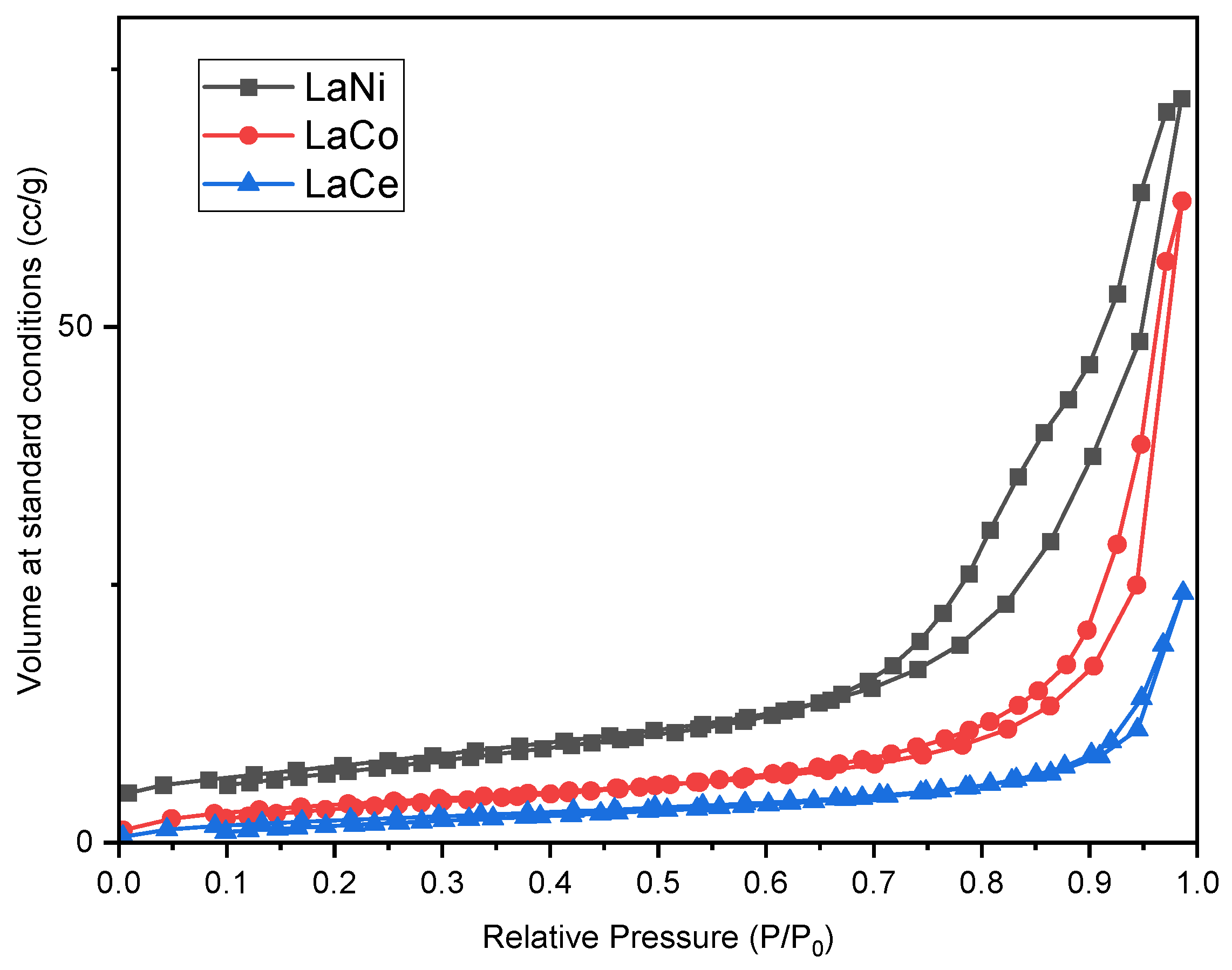
The N2 adsorption–desorption profiles of the LaNi, LaCo, and LaCe catalysts display a pronounced uptake at intermediate-to-high relative pressures, which is characteristic of mesoporous solids where capillary condensation becomes significant at elevated P/P0, as shown in Figure 3. According to the IUPAC classification, the overall shape is consistent with a Type IV isotherm, confirming that mesoporosity constitutes the dominant contribution to the porous texture of these lanthanum-based materials [51,52]. In all cases, the adsorption branch increases gradually at low P/P0, followed by a steeper rise toward higher relative pressures P/P0, reflecting progressive filling of mesopores and, at the highest relative pressures, additional condensation within larger interparticle voids.
A visible divergence between the adsorption and desorption branches at high P/P0 indicates the presence of a hysteresis loop, which is typically associated with capillary condensation in mesopores and/or textural porosity formed by particle aggregation. Based on the loop development predominantly in the high-pressure region and the absence of a strong initial uptake at very low P/P0, the hysteresis behavior is most consistent with an H3-type loop, commonly linked to slit-shaped pores and interparticle voids generated by the packing of aggregated nanoparticles [51,52]. This interpretation is further supported by the broad pore-size features extending into larger diameters, particularly for LaCo.
Quantitatively, LaNi exhibits the highest adsorption capacity across the entire pressure range, in agreement with its larger BET surface area and pore volume (Table 2). Specifically, LaNi shows SBET (31.11 m2·g−1) and Vpore (0.114 cm3·g−1) which are markedly higher than those of LaCo (16.15 m2·g−1, 0.098 cm3·g−1) and LaCe (7.21 m2·g−1, 0.037 cm3·g−1). The higher textural development of LaNi implies an increased density of accessible surface sites and enhanced diffusion pathways, which are beneficial for ammonia decomposition, as efficient reactant transport and product desorption are critical for catalytic performance [53,54].
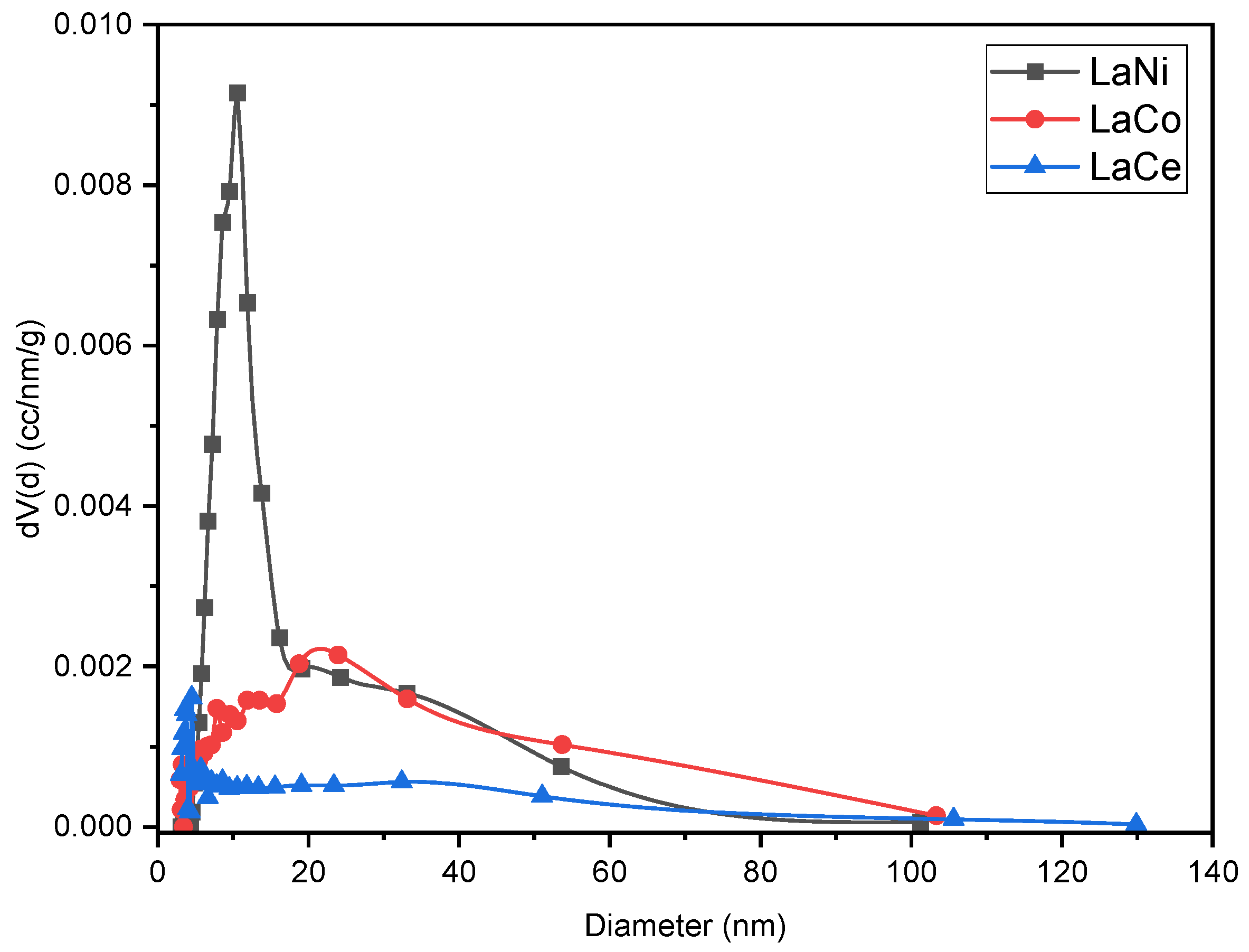
The BJH pore-size distribution further confirms the mesoporous nature of all catalysts while highlighting clear differences in pore architecture, as shown in Figure 4.
LaNi exhibits a relatively narrower and more pronounced mesopore population centered around 10.54 nm (Table 2), indicating a more uniform mesostructure. The LaNi sample also exhibits a bimodal pore-size distribution with an extended tail at higher pore diameters, suggesting the presence of both mesopores and larger interparticle voids.
By contrast, LaCo displays a broader pore-size distribution with a significantly larger average pore diameter of 23.94 nm, suggesting a greater contribution from wider mesopores and textural/interparticle porosity. LaCe shows the lowest pore volume and the smallest characteristic pore diameter (4.536 nm), consistent with its reduced nitrogen uptake and comparatively weaker mesoporous development.
In summary, nitrogen physisorption analysis confirms that all catalysts possess predominantly mesoporous structures, while highlighting substantial differences in surface area and pore architecture depending on the secondary metal. The superior textural properties of LaNi, combining higher surface area with well-developed mesoporosity, are expected to favor improved dispersion of active species and enhanced mass-transfer characteristics, which are critical for efficient catalytic ammonia decomposition compared to the less porous LaCo and LaCe systems.

3.1.4. Morphological and Elemental Analysis by SEM–EDX

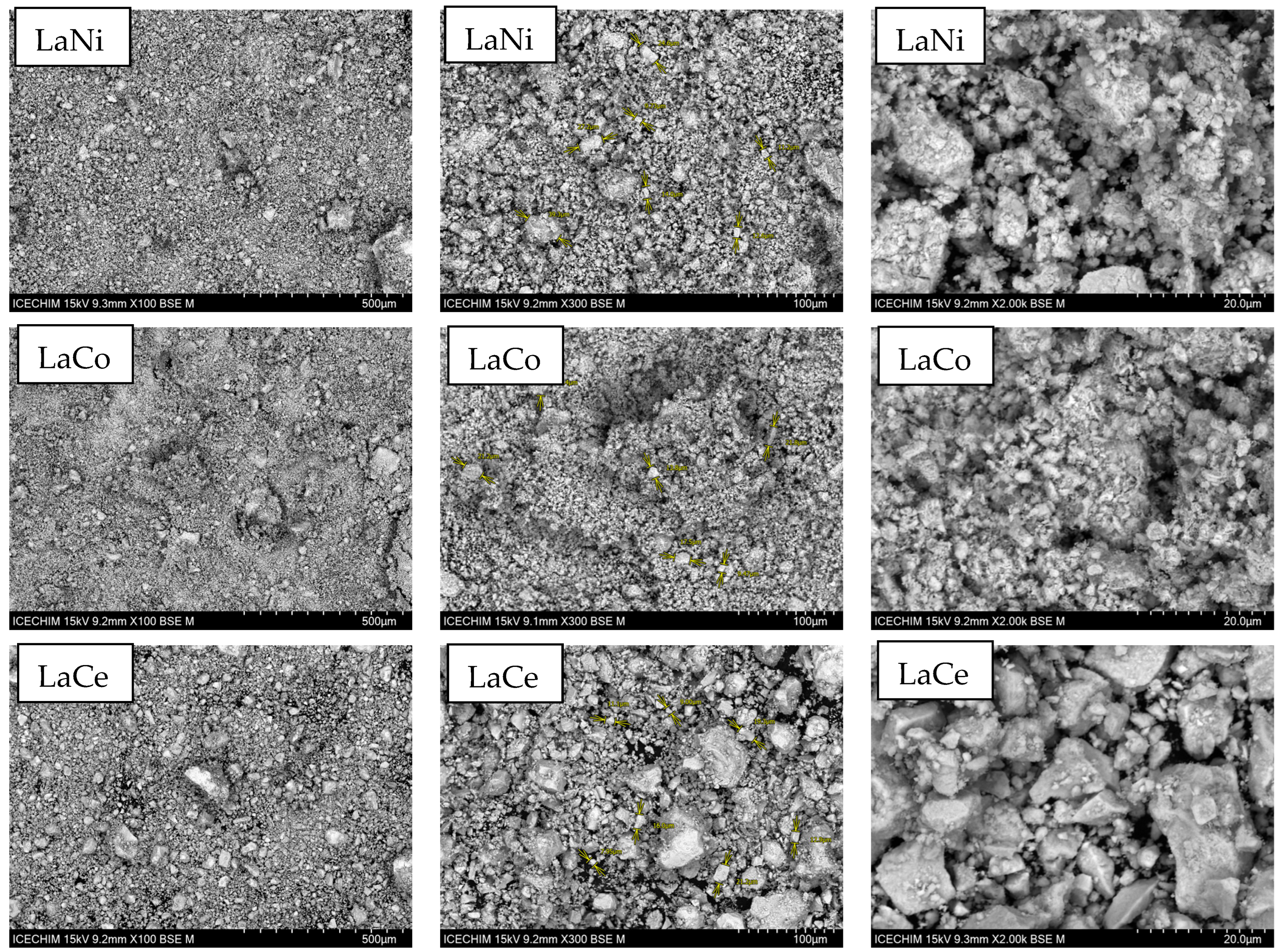
The SEM micrographs of the LaNi, LaCo, and LaCe catalysts reveal distinct morphological features that strongly depend on the nature of the secondary metal incorporated into the lanthanum-based system, as shown in Figure 5.
The LaNi catalyst is characterized by a relatively homogeneous morphology composed of finely divided particles forming loose agglomerates. At higher magnifications, the surface appears highly fragmented, with abundant interparticle voids and irregular pores. This open and disordered aggregation is fully consistent with the higher BET surface area and pore volume determined by nitrogen adsorption–desorption analysis, indicating that the assembly of small primary particles plays a major role in generating accessible mesoporosity.
In contrast, the LaCo catalyst exhibits a more compact and heterogeneous morphology, dominated by larger agglomerates with less uniform particle packing. Although interparticle voids are still present, they appear wider and less interconnected. This morphological feature correlates well with the lower surface area but significantly larger average pore diameter observed in the BJH analysis, suggesting that the porosity of LaCo is mainly textural in nature and arises from inter-agglomerate spaces rather than from a finely developed internal pore network.
The LaCe catalyst displays the densest morphology among the investigated samples, consisting of larger, tightly packed particles with limited surface roughness and reduced fragmentation. Such compact particle assembly explains the markedly lower BET surface area and pore volume obtained from nitrogen physisorption, indicating restricted pore accessibility and weaker development of mesoporosity.
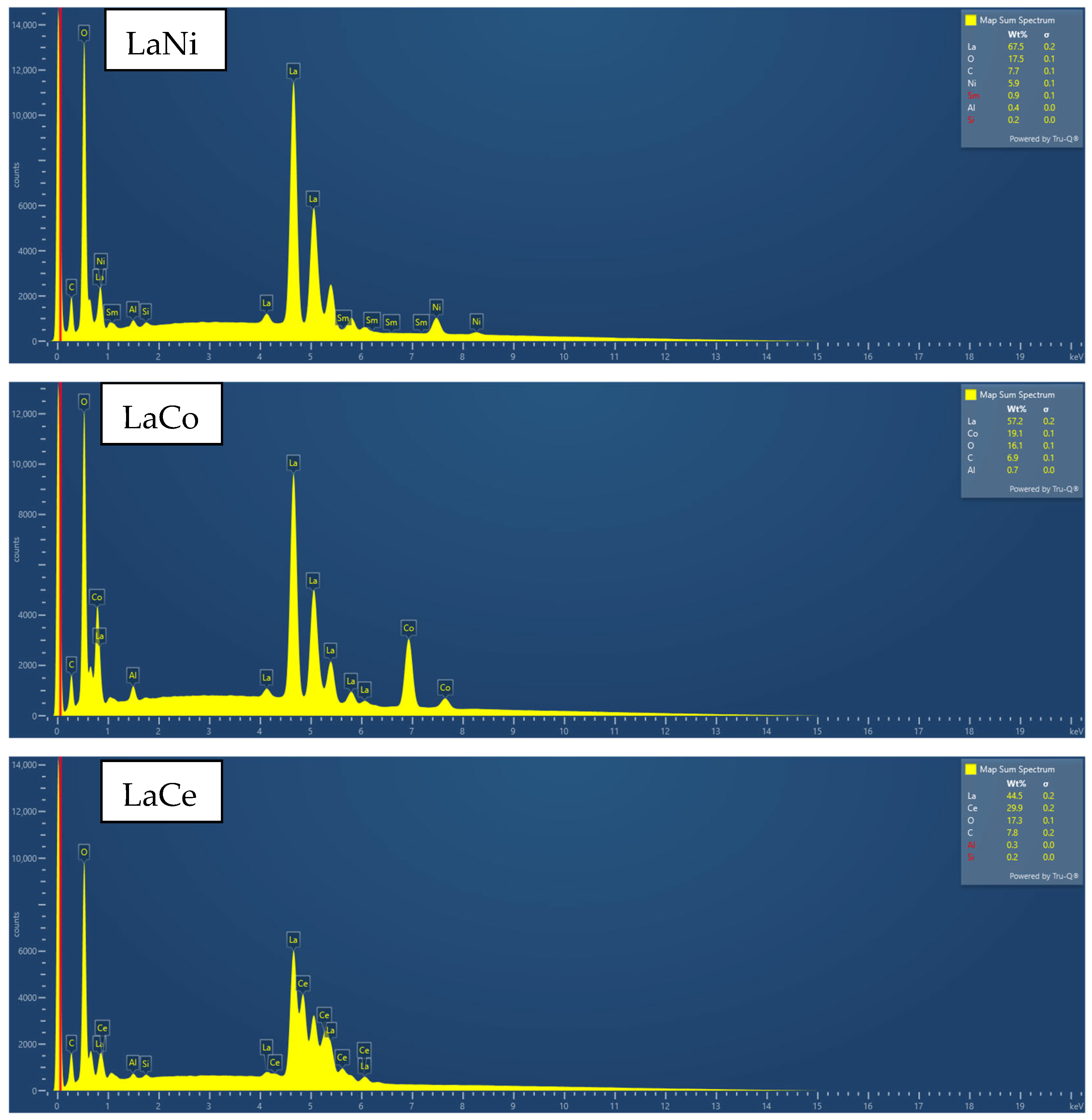
Representative EDX spectra presented in Figure 6 confirm the presence of lanthanum together with the corresponding secondary metal (Ni, Co, or Ce), without detectable contamination from foreign elements. The relatively uniform distribution of elements observed in the analyzed areas supports the effective incorporation of the secondary metal into the lanthanum-based matrix, in agreement with the synthesis strategy employed and with the XRD results indicating a dominant mixed oxide single crystalline phase. The absence of segregated metallic-rich domains in the EDX spectra further suggests that no large-scale phase separation occurred during catalyst preparation.
Overall, the SEM–EDX observations are in agreement with the textural properties derived from N2 physisorption. The finer particle aggregation and more open morphology of LaNi account for its higher surface area and well-developed mesoporosity, while the progressively denser morphologies of LaCo and LaCe result in reduced surface accessibility and lower pore volumes. These structure–texture correlations are widely reported for lanthanum-based mixed oxides and play a decisive role in governing mass transport and surface accessibility in ammonia decomposition catalysts [10,55].

3.1.5. TGA–DTG Analysis

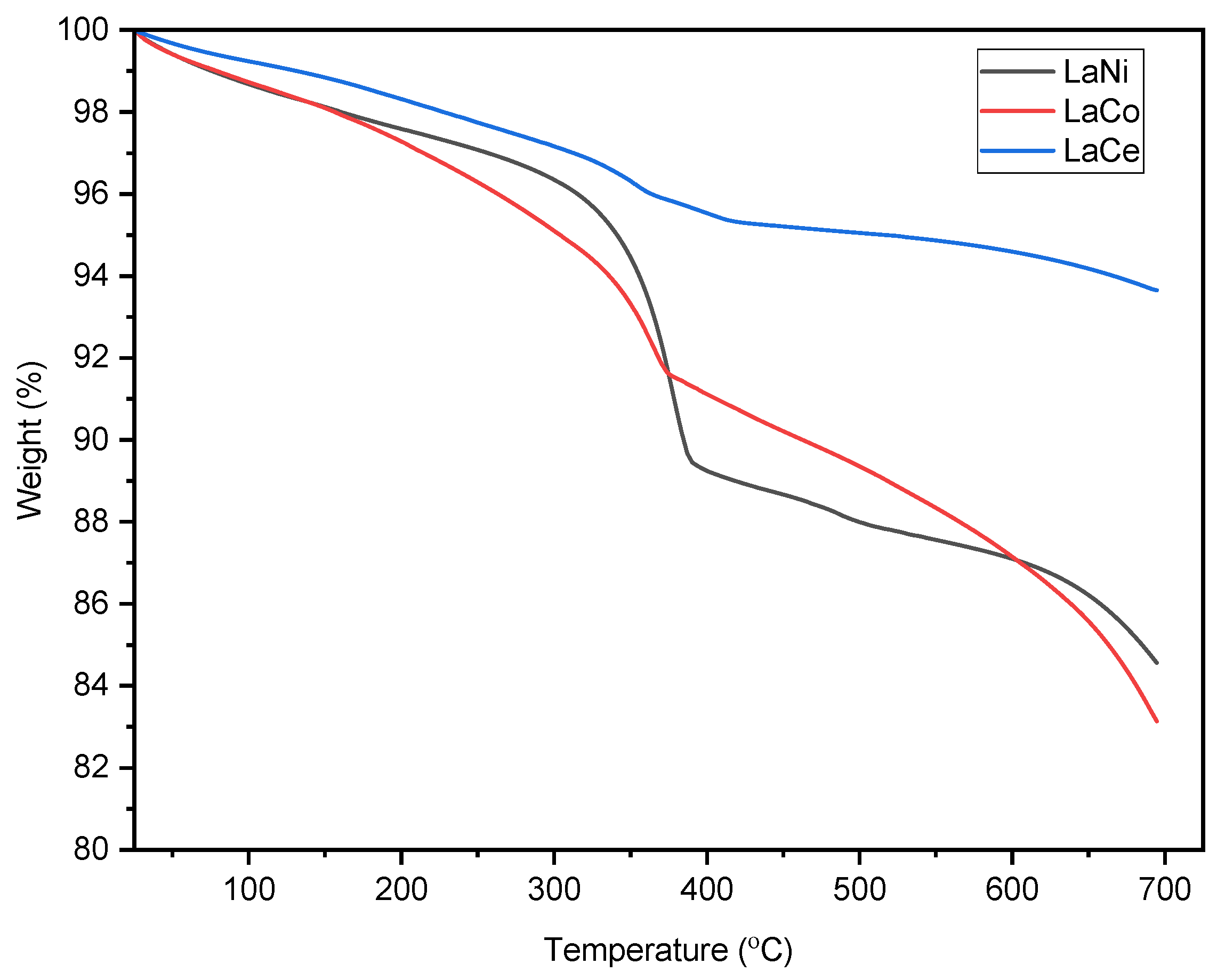
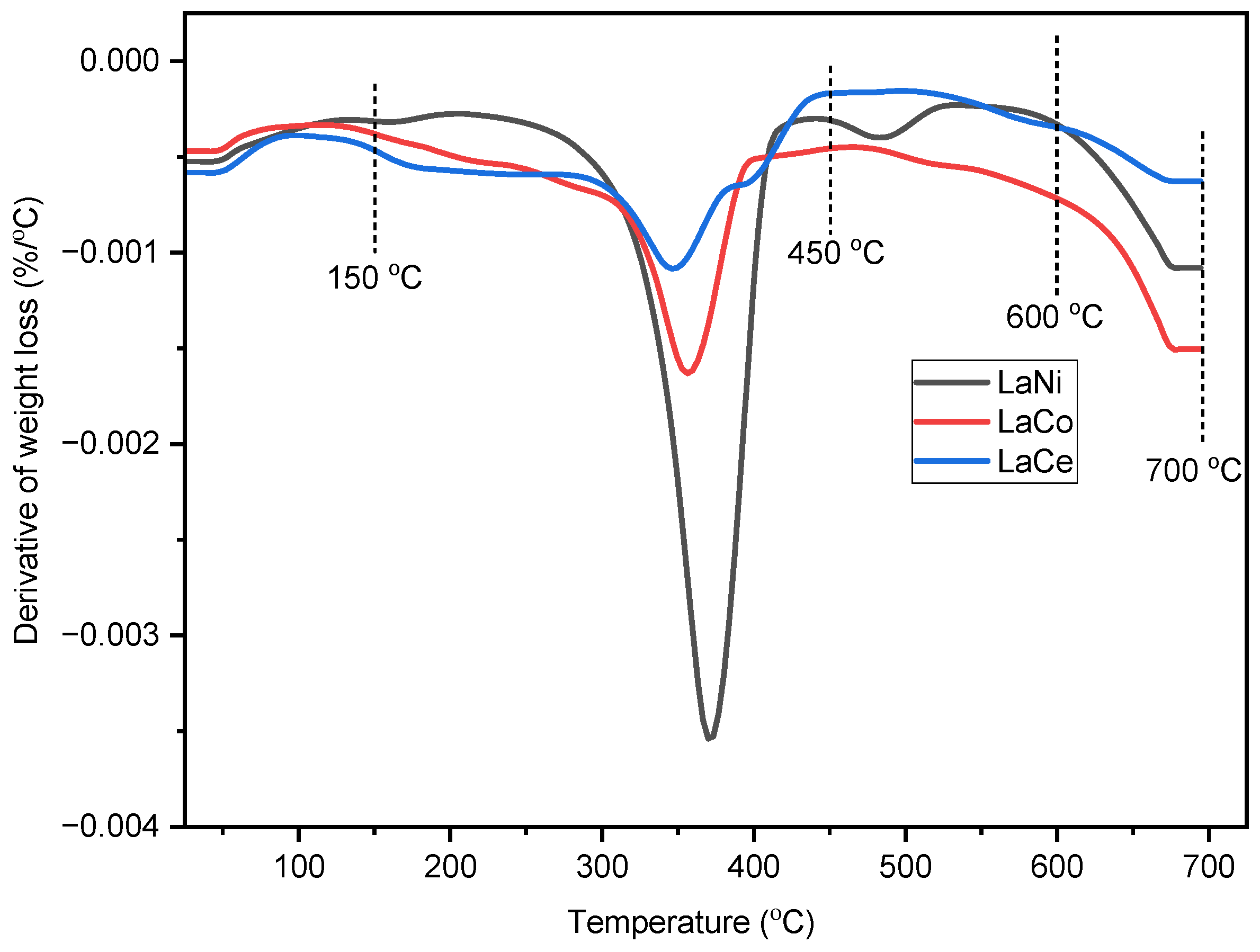
The thermal behavior of the LaNi, LaCo, and LaCe catalysts was investigated by thermogravimetric analysis under an inert N2 atmosphere, as illustrated by the TGA and DTG profiles shown in Figure 7 and Figure 8, respectively. In the low-temperature region up to approximately 150–200 °C, all catalysts exhibit a minor weight loss, which is attributed to the desorption of physically adsorbed moisture and weakly bound surface water [56,57]. As indicated in Figure 7, the magnitude of this initial loss is lowest for LaCe (~1.2%), while higher values are observed for LaCo (~2%) and LaNi (~2.0%). This trend is consistent with nitrogen adsorption–desorption analysis, where LaNi and LaCo display higher surface accessibility than LaCe, thereby favoring the adsorption of larger amounts of surface water.
A more pronounced mass-loss step occurs in the intermediate temperature range between approximately 200 and 500 °C, accompanied by distinct DTG minima centered around ~450 °C in Figure 7. This region is commonly associated with the dehydroxylation of metal oxyhydroxide species and the decomposition of residual anionic fragments originating from the synthesis precursors [56,57]. In this temperature interval, LaNi exhibits the largest mass loss (~9.4%), followed by LaCo (~7.9%), whereas LaCe shows a significantly smaller loss (~3.6%). The higher losses observed for LaNi and LaCo therefore indicate a greater density of removable hydroxyl surface species, in agreement with their larger and more open porosity observed by SEM and their higher BET surface areas relative to LaCe.
At higher temperatures above approximately 600 °C, an additional mass-loss event is observed, particularly pronounced for LaNi and LaCo, as clearly shown in Figure 7. In this region, LaNi undergoes a further weight loss of approximately 2.5%, while LaCo shows an additional loss of about 4.1%, whereas LaCe exhibits only a marginal decrease (~0.6–0.9%). Under inert N2 conditions, the high-temperature mass loss observed above 600 °C is more likely associated with an increased extent of bond cleavage and the progressive release of residual surface groups. At elevated temperatures beyond the calcination temperature, oxide catalysts may undergo further dehydroxylation and structural rearrangements—most likely due to the lower calcination temperatures of these samples (i.e., 600 °C), accompanied by the gradual release of residual volatile surface species and limited mass loss [58,59].
Overall, the combined TGA–DTG results, shown in Figure 7 and Figure 8, confirm that the thermal stability and decomposition behavior of the La-based catalysts are strongly governed by their surface accessibility and pore architecture. The pronounced mass losses observed for LaNi and LaCo, particularly above 600 °C, are mainly associated with enhanced dehydroxylation, bond rearrangement, and structural consolidation processes, whereas the reduced losses for LaCe are consistent with its denser morphology and weaker development of mesoporosity.

3.1.6. Surface Acidity Analysis by FTIR-Py

The surface acidic properties of the LaNi, LaCo, and LaCe catalysts were investigated by Fourier transform infrared spectroscopy of adsorbed pyridine (FTIR-Py). The same experimental procedure established in our earlier work [28] was applied to all samples to ensure a consistent and reliable comparison. Pyridine adsorption was carried out by exposing 0.5 g of each catalyst to pyridine vapor for 6 h at room temperature in a sealed vessel, followed by thermal treatment at 115 °C for 2 h to remove weakly physisorbed pyridine prior to FTIR analysis.
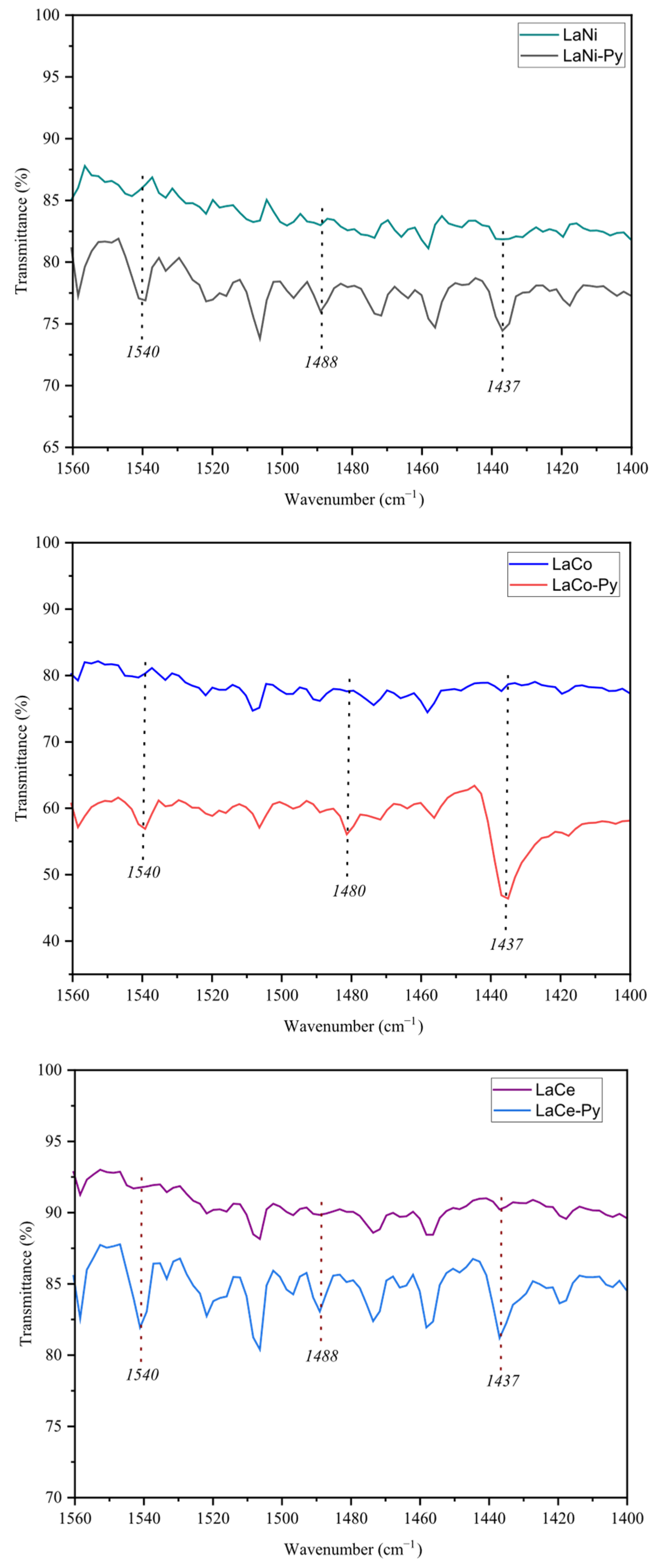
Figure 9 displays the representative FTIR-Py spectra of the investigated catalysts. Three characteristic absorption bands are clearly observed at approximately 1540, 1480, and 1437 cm−1 [60,61]. The band centered at ~1540 cm−1 is assigned to pyridinium ions formed upon protonation of pyridine, indicating the presence of Brønsted acid sites. The absorption at ~1437 cm−1 corresponds to pyridine coordinatively bound to Lewis acid sites, while the band at ~1480 cm−1 arises from the combined interaction of pyridine with both Brønsted and Lewis acid sites. These assignments are in good agreement with the literature reports [26,60,62,63]. The band observed at ~1510 cm−1 is tentatively attributed also to pyridinium ions (PyH+) formed upon protonation of pyridine on Brønsted acid sites, with the slight shift toward lower wavenumbers compared to the typical ~1540 cm−1 band suggests relatively weak Brønsted acid sites, or interactions of adsorbed pyridine ions with the mixed oxide framework.
Quantitative evaluation of surface acidity was performed using the Emeis method [64], based on the integrated areas of the characteristic FTIR bands and their corresponding molar extinction coefficients. The calculated concentrations of Lewis (CL), Brønsted (CB), and total acid sites are summarized in Table 3.
As can be observed in Table 3, all catalysts predominantly exhibit Lewis acidity, as evidenced by CL values that exceed the corresponding CB values. Among the investigated materials, LaNi shows the highest total acidity (3.049 mmol·g−1), arising from comparable contributions of Lewis (1.374 mmol·g−1) and Brønsted (1.675 mmol·g−1) acid sites, resulting in the lowest CL/CB ratio (0.82). This behavior indicates a more balanced distribution of surface acid sites on LaNi. By contrast, LaCo exhibits the highest Lewis acidity (2.574 mmol·g−1) and the largest CL/CB ratio (3.41), reflecting a strong predominance of Lewis acid sites with a relatively limited Brønsted contribution. Similarly, LaCe shows the lowest overall acidity (2.396 mmol·g−1) and a CL/CB ratio of 0.60, indicating reduced acid site density and weaker surface acidity.
The observed differences in surface acidity are consistent with the structural and textural characteristics previously discussed. The higher density of accessible surface sites and more open morphology of LaNi, as evidenced by nitrogen physisorption and SEM analysis, favor the development of both Lewis and Brønsted acid sites. In contrast, the more compact morphology and lower surface area of LaCe limit the formation and accessibility of surface acid sites, while LaCo preferentially stabilizes coordinatively unsaturated metal ion centers acting as Lewis acid sites. These acidity features are expected to play a decisive role in governing ammonia adsorption and activation during the catalytic decomposition process.

3.2. Evaluation of Catalytic Performance of La-Based Catalysts

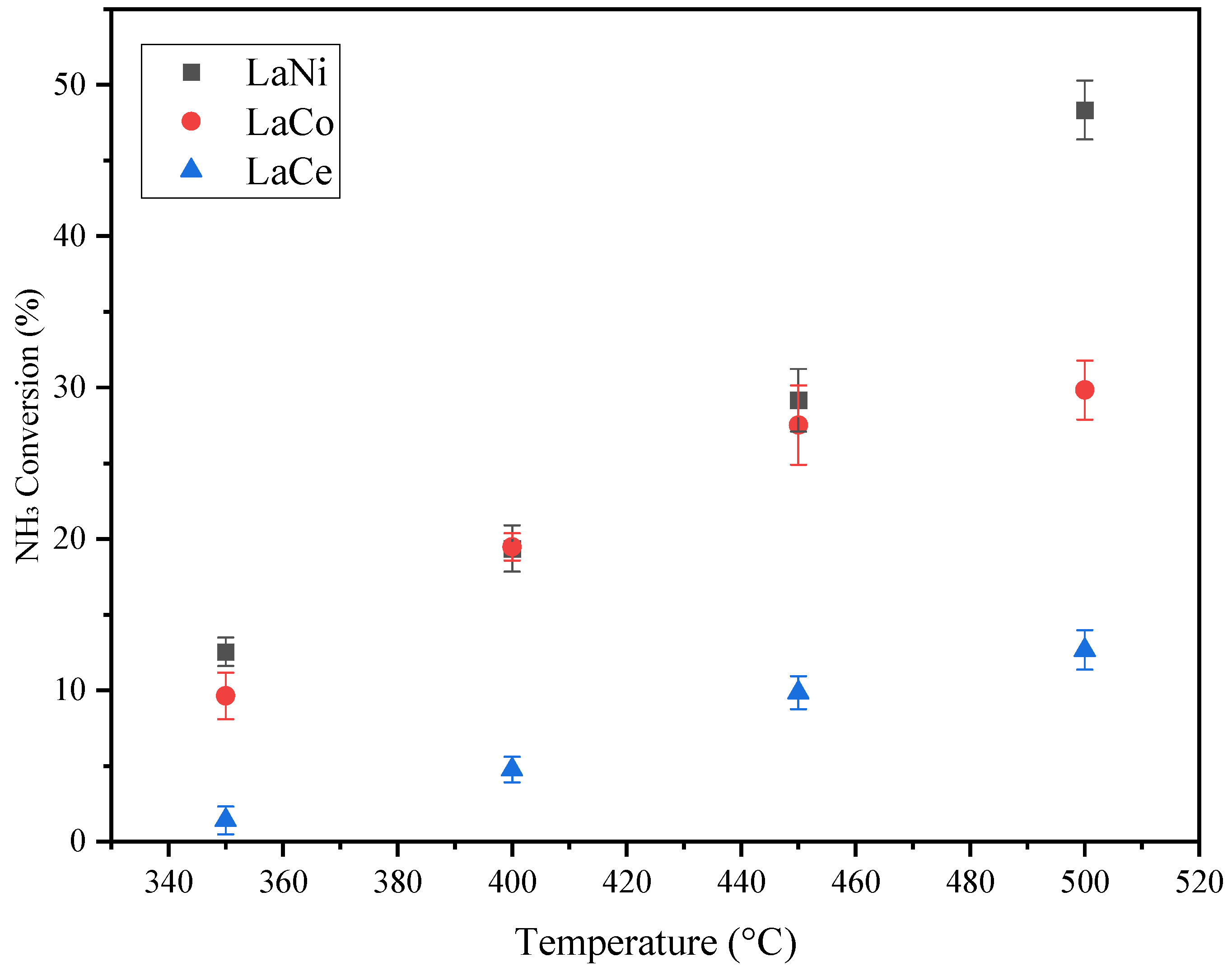
The catalytic performance of the LaNi, LaCo, and LaCe catalysts in ammonia decomposition is governed by the combined effects of catalyst structure, surface acidity, and operating conditions. As shown in Figure 10, at a constant space velocity (GHSV = 50 h−1), ammonia conversion increases with temperature for all catalysts, consistent with the endothermic and kinetically activated nature of ammonia decomposition. Nevertheless, pronounced activity differences are observed, reflecting the decisive role of catalyst composition and surface properties.
Among the investigated systems, LaNi exhibits the highest activity, reaching approximately 48% NH3 conversion at 500 °C (Figure 10). This superior performance correlates with its higher BET surface area 31.11 m2·g−1 (Table 2), well-developed mesoporosity, and open morphology, which together provide enhanced surface accessibility and improved mass-transfer pathways. In addition, FTIR-Py analysis revealed a relatively balanced distribution of Lewis and Brønsted acid sites (CL/CB ≈ 0.82), which seems to be favorable for NH3 adsorption, activation, and subsequent dehydrogenation steps, as observed in our experimental results. It is worth mentioning that the XRD analysis revealed the formation of a La–Ni mixed oxide phase (La8Ni4O17) coexisting with minor NiO and La2O3 domains, demonstrating the structural integration of nickel within a lanthanum-containing oxide lattice at the bulk level. This structural feature is further supported by XPS results, where the Ni 2p3/2 signal (~856 eV) is consistent with nickel stabilized in oxidic coordination environments in close energetic proximity to La core-level features. The combined bulk (XRD) and surface (XPS) evidence confirms that nickel is not present as an isolated phase, but it is incorporated within a La-based oxide framework, resulting in multiple nickel coordination environments. Such structural heterogeneity, together with the enhanced surface area and mesoporosity of LaNi, provides accessible active sites that facilitate NH3 adsorption and activation.
LaCo shows intermediate activity, with ammonia conversion increasing to ~30% at 500 °C (Figure 10). Despite its high Lewis acidity and large CL/CB ratio, its lower surface area (16.15 m2·g−1) and more compact morphology limit the number of accessible active sites, thereby restricting overall catalytic efficiency. The predominance of Lewis acid sites may also lead to stronger NH3 adsorption, which can hinder rapid turnover at elevated temperatures. This behavior is consistent with XRD results showing the dominance of the perovskite-type LaCoO3 phase accompanied by secondary cobalt oxide (Co2.95O4) and residual La2O3. In combination with the compact morphology and reduced textural development observed by SEM and N2 physisorption, this phase assemblage leads to a structurally dense framework with limited interparticle porosity, which can reduce the effective accessibility of Co-based active sites and hinder rapid catalytic turnover at elevated temperatures.
By contrast, LaCe displays significantly lower activity, with conversion remaining below ~13% even at 500 °C. This behavior is consistent with its dense morphology, low surface area (7.21 m2·g−1), reduced pore volume (0.037 cm3·g−1), as shown in Table 2, and lower total acidity (2.396 mmol·g−1), which collectively limit NH3 adsorption and activation. XRD analysis confirms that LaCe is dominated by La–Ce mixed oxide solid solutions (La0.2Ce0.8O1.9) and non-stoichiometric cerium oxide (CeO1.695), phases that lack catalytic centers capable of directly promoting NH3 dehydrogenation, thereby explaining its inferior catalytic performance.
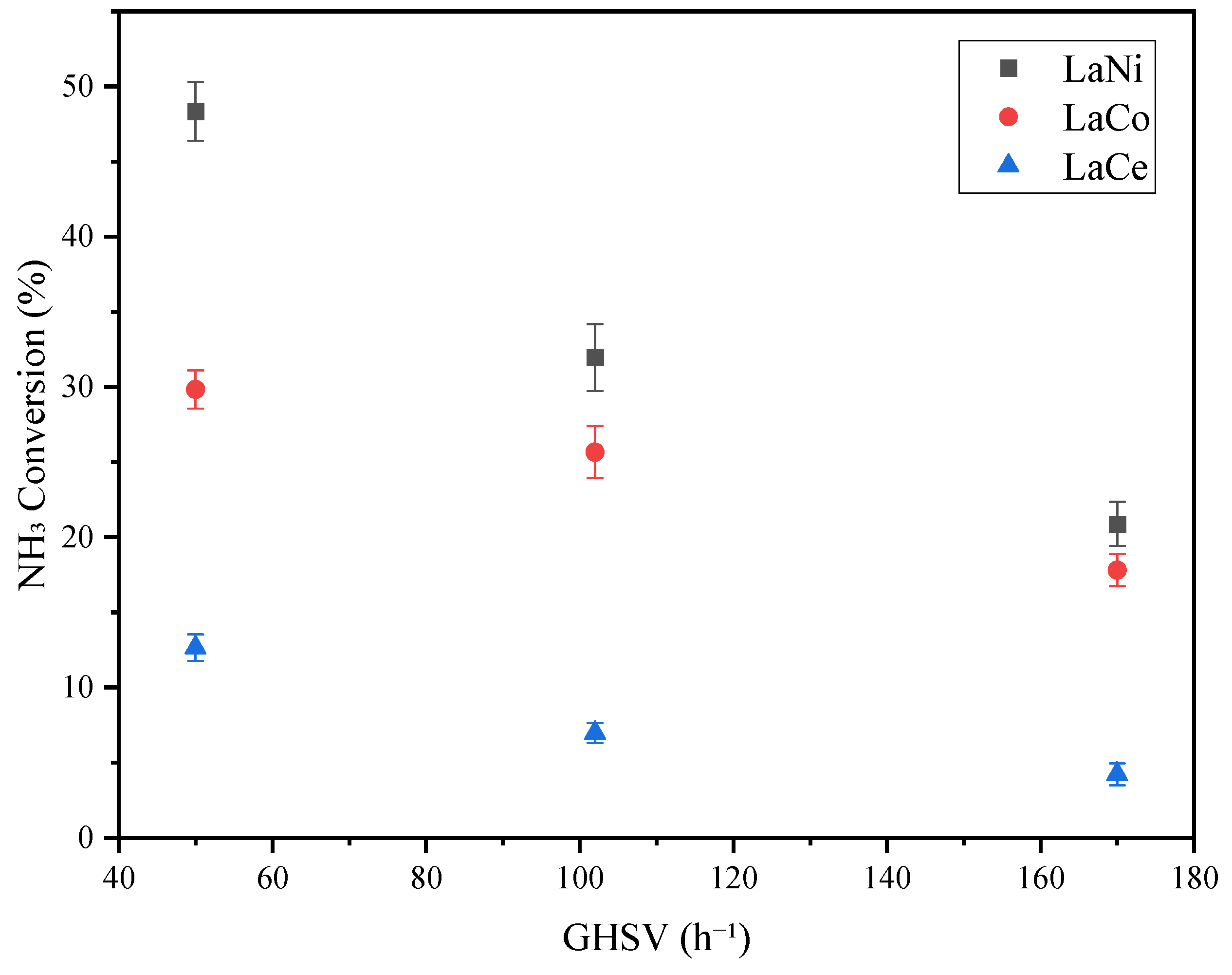
The influence of gas hourly space velocity further highlights the structure–activity relationship. As shown in Figure 11, at 500 °C, increasing GHSV results in a systematic decrease in ammonia conversion for all catalysts, emphasizing the importance of residence time in controlling the reaction extent. LaNi maintains the highest conversion across the investigated GHSV range. However, it shows the most significant drop in conversion among the investigated catalytic systems, likely indicating a different structure of the active site and ammonia chemisorption kinetics. The LaCo and LaCe exhibit similar sensitivity to reduced contact time, suggesting similar surface kinetics for ammonia decomposition on these catalysts.
From a kinetic viewpoint, the drop in conversion as GHSV increases likely signals a shift from a near-equilibrium regime to a kinetically controlled one, where inadequate residence time hinders full completion of NH3 decomposition steps. The sharper GHSV sensitivity of LaNi suggests its superior intrinsic activity relates to a quicker rate-determining step. Although pinpointing the exact rate-determining step based on our results would be speculative, the milder GHSV effects seen with LaCo and LaCe point to lower overall intrinsic rates, potentially due to weaker adsorption, slower N-H bond cleavage, or slower hydrogen desorption kinetics. Furthermore, the dependence of conversion on GHSV suggests that ammonia decomposition over these catalysts is not purely diffusion-limited under the investigated conditions but is strongly influenced by surface reaction kinetics and adsorption–desorption equilibria. These trends are consistent with previous studies reporting that ammonia decomposition over Ni- and Co-based catalysts is strongly influenced by surface area [65,66], metal dispersion, and residence time, with higher space velocities leading to reduced conversion values due to insufficient contact time for complete NH3 dehydrogenation steps [65,67,68,69].
Ammonia can interact with catalyst surfaces either through coordination to Lewis acid sites or via protonation on Brønsted acid sites, forming adsorbed NH3 and/or NH4+ species, respectively, which play distinct roles in adsorption and activation processes. While Lewis sites are generally associated with ammonia coordination and activation, Brønsted sites influence adsorption strength and proton transfer steps, thereby affecting N–H bond cleavage [70]. Although the exact role of acidity in ammonia decomposition remains system-dependent, it is widely recognized that surface interactions between NH3 and active sites govern the overall reaction kinetics [71]. The surface acidity derived from our FTIR-Py measurements suggests that a balanced distribution of Lewis and Brønsted acid sites may play a significant role in the kinetics of ammonia decomposition. Lewis acid sites are likely involved in ammonia adsorption and activation through coordination to the nitrogen lone pair, while Brønsted acid sites may facilitate proton transfer processes, thereby influencing N–H bond cleavage. This interpretation is consistent with the catalytic performance observed in this study. In particular, the LaNi catalyst, which exhibits the most balanced Lewis-to-Brønsted acidity ratio, demonstrates superior activity compared to the other mixed oxides, which are characterized by an excess of either Lewis or Brønsted acid sites. Furthermore, both LaNi and LaCo, possessing a higher concentration of Lewis acid sites, outperform LaCe, which is richer in Brønsted acidity. These observations suggest that ammonia adsorption may play a critical role in determining the overall reaction rate. However, additional mechanistic investigations are required to conclusively identify the rate-determining step.
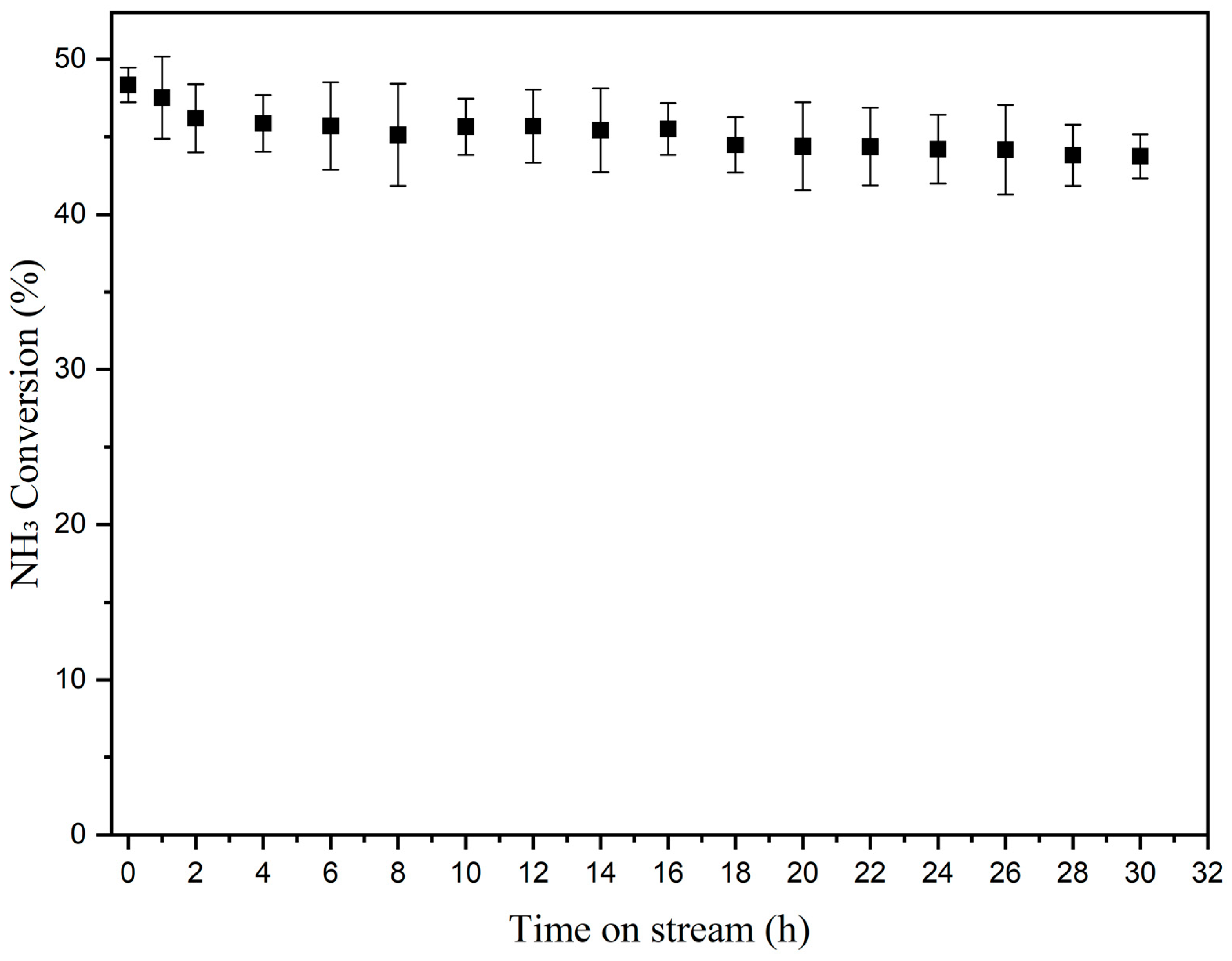
To further evaluate the catalyst stability under continuous operation, a time-on-stream (TOS) test was conducted over the LaNi catalyst at 500 °C and a GHSV of 50 h−1 (Figure 12). The NH3 conversion shows a decrease from 48.34% to 43.8% over 30 h of continuous operation, indicating a relatively stable catalytic performance under the applied conditions. This limited deactivation can be directly correlated with the structural and textural properties of the LaNi catalyst discussed above. In particular, the high BET surface area (31.11 m2·g−1), well-developed mesoporosity, and homogeneous morphology observed by SEM contribute to enhanced dispersion and accessibility of active sites, which mitigate particle agglomeration and reduce the likelihood of sintering during operation. In addition, XRD and XPS analyses confirmed the formation of a La–Ni mixed oxide phase with nickel species stabilized within the lanthanum-based framework, which further contributes to structural stability under reaction conditions. Furthermore, the balanced distribution of Lewis and Brønsted acid sites, as revealed by FTIR-pyridine analysis, promotes effective NH3 adsorption and activation, while preventing excessive surface coverage by reaction intermediates, thus limiting catalyst poisoning. Therefore, these results indicate that the LaNi catalyst maintains stable activity due to the synergistic effect of its structural integrity, surface properties, and controlled composition, which collectively enhance resistance to deactivation during prolonged operation.
Overall, these results demonstrate that efficient ammonia decomposition over lanthanum-based catalysts requires a synergistic combination of high surface area, accessible mesoporosity, and balanced surface acidity, as well as the formation of structurally favorable La–transition-metal mixed oxide or perovskite-like phases, as revealed by XRD analysis. The superior performance of LaNi arises most likely from the optimal integration of these features, whereas the reduced activity of LaCo and LaCe can be attributed to increasing structural compactness that induces less favorable acidity distributions and different structures of the active sites.

4. Conclusions

Lanthanum-based mixed oxide catalysts (LaNi, LaCo, and LaCe) were systematically investigated for catalytic ammonia decomposition, revealing a strong dependence of activity on textural properties, surface acidity, and operating conditions. Among the studied systems, LaNi exhibited superior performance, achieving approximately 48% NH3 conversion at 500 °C, which is attributed to its higher surface area, well-developed mesoporosity, open morphology, and balanced distribution of Lewis and Brønsted acid sites. LaCo showed intermediate activity dominated by Lewis’s acidity but limited by lower surface accessibility, while LaCe displayed poor performance due to its dense structure, low surface area, reduced total acidity and its differently structured active site. The observed decrease in ammonia conversion with increasing GHSV for all catalysts highlights the critical role of residence time and surface-controlled kinetics in governing the reaction rate. Overall, the results suggest that the optimal integration of accessible mesoporosity and balanced surface acidity, as well as incorporating the transition metals in the lanthanum framework, is essential for efficient ammonia decomposition, positioning LaNi as a promising non-noble-metal catalyst for hydrogen production from ammonia decomposition.

Author Contributions

Conceptualization, D.M.C. and R.D.; Methodology, R.D., M.L. and I.B.; Validation, D.M.C. and R.D.; Formal analysis, R.D., R.G. and L.M.; Investigation, A.M.P., R.D. and G.V.; Data curation, R.D., A.V. and S.G.M.; Writing—original draft, D.M.C., R.D. and I.B.; Writing—review and editing, R.D. and L.M.; Supervision, D.M.C. and R.D.; Project administration, D.M.C.; Funding acquisition, D.M.C. and R.D. All authors have read and agreed to the published version of the manuscript.

Funding

This research received no external funding.

Institutional Review Board Statement

Not applicable.

Informed Consent Statement

Not applicable.

Data Availability Statement

The original contributions presented in this study are included in the article. Further inquiries can be directed to the corresponding authors.

Acknowledgments

GV acknowledges the support of the PN 23.06 Core Program—ChemNewDeal, within the National Plan for Research, Development and Innovation 2022–2027, developed with the support of the Ministry of Research, Innovation and Digitalization, Project No. PN 23.06.02.01, InteGral.

Conflicts of Interest

The authors declare no conflict of interest.

References

  1. Zhu, N.; Yang, F.; Hong, Y.; Liang, J. Hydrogen production from ammonia decomposition: Advances in Ru- and Ni-based catalysts. Int. J. Hydrogen Energy 2025, 98, 1243–1261. [Google Scholar] [CrossRef]
  2. Li, X.; Wang, Q.; Wu, S.; Hu, Z.; Bai, J. Critical upstream technologies for hydrogen energy industry: Research progress on ammonia decomposition catalysts. Sustain. Chem. Pharm. 2024, 38, 101492. [Google Scholar] [CrossRef]
  3. Lu, Z.; Jiang, B.; Chen, Z.; Shi, J.; Jing, D.; Lu, Y.; Liu, M. Advancements in thermocatalytic ammonia decomposition for hydrogen production. Innov. Energy 2024, 1, 100056. [Google Scholar] [CrossRef]
  4. Sun, S.; Jiang, Q.; Zhao, D.; Cao, T.; Sha, H.; Zhang, C.; Song, H.; Da, Z. Ammonia as hydrogen carrier: Advances in ammonia decomposition catalysts for promising hydrogen production. Renew. Sustain. Energy Rev. 2022, 169, 112918. [Google Scholar] [CrossRef]
  5. Li, J.; Sheng, B.; Chen, Y.; Yang, J.; Wang, P.; Li, Y.; Yu, T.; Pan, H.; Qiu, L.; Li, Y.; et al. Utilizing full-spectrum sunlight for ammonia decomposition to hydrogen over GaN nanowires-supported Ru nanoparticles on silicon. Nat. Commun. 2024, 15, 7393. [Google Scholar] [CrossRef] [PubMed]
  6. Takahashi, A.; Fujitani, T. Kinetic Analysis of Decomposition of Ammonia over Nickel and Ruthenium Catalysts. J. Chem. Eng. Jpn. 2016, 49, 22–28. [Google Scholar] [CrossRef]
  7. Purcel, M.; Berendts, S.; Bonati, L.; Perego, S.; Müller, A.; Lerch, M.; Parrinello, M.; Muhler, M. Iron Nitride Formation and Decomposition during Ammonia Decomposition over a Wustite-Based Bulk Iron Catalyst. ACS Catal. 2024, 14, 13947–13957. [Google Scholar] [CrossRef]
  8. Huang, X.; Lei, K.; Mi, Y.; Fang, W.; Li, X. Recent Progress on Hydrogen Production from Ammonia Decomposition: Technical Roadmap and Catalytic Mechanism. Molecules 2023, 28, 5245. [Google Scholar] [CrossRef]
  9. Pinzón, M.; Sánchez-Sánchez, A.; Sánchez, P.; de la Osa, A.R.; Romero, A. Ammonia as a carrier for hydrogen production by using lanthanum based perovskites. Energy Convers. Manag. 2021, 246, 114681. [Google Scholar] [CrossRef]
  10. Wang, W.; Fu, Y.; Wang, W.; Xiang, M.; Chen, G.; Su, Y.; Duan, J. Ammonia decomposition over La-doped Al2O3 supported Co catalyst. Ceram. Int. 2024, 50, 36604–36614. [Google Scholar] [CrossRef]
  11. Bell, T.E.; Torrente-Murciano, L. H2 Production via Ammonia Decomposition Using Non-Noble Metal Catalysts: A Review. Top. Catal. 2016, 59, 1438–1457. [Google Scholar] [CrossRef]
  12. Weissenberger, T.; Zapf, R.; Pennemann, H.; Kolb, G. Catalyst Coatings for Ammonia Decomposition in Microchannels at High Temperature and Elevated Pressure for Use in Decentralized and Mobile Hydrogen Generation. Catalysts 2024, 14, 104. [Google Scholar] [CrossRef]
  13. Chen, T.-B.; Rabiee, H.; Yan, P.; Zhu, Z.; Ge, L. Enhancing the Ammonia Catalytic Decomposition of Lanthanum Strontium Titanate Nickel Perovskite Catalysts via a Balanced Cation Doping and Deficiency Strategy. Energy Fuels 2024, 38, 5449–5456. [Google Scholar] [CrossRef]
  14. Xun, Y.; He, X.; Yan, H.; Gao, Z.; Jin, Z.; Jia, C. Fe- and Co-doped lanthanum oxides catalysts for ammonia decomposition: Structure and catalytic performances. J. Rare Earths 2017, 35, 15–23. [Google Scholar] [CrossRef]
  15. Huang, C.; Yu, Y.; Yang, J.; Yan, Y.; Wang, D.; Hu, F.; Wang, X.; Zhang, R.; Feng, G. Ru/La2O3 catalyst for ammonia decomposition to hydrogen. Appl. Surf. Sci. 2019, 476, 928–936. [Google Scholar] [CrossRef]
  16. Salehabadi, A.; Zanganeh, J.; Moghtaderi, B. Mixed metal oxides in catalytic ammonia cracking process for green hydrogen production: A review. Int. J. Hydrogen Energy 2024, 63, 828–843. [Google Scholar] [CrossRef]
  17. Podila, S.; Driss, H.; Ali, A.M.; Al-Zahrani, A.A.; Daous, M.A. Influence of Ce substitution in LaMO3 (M = Co/Ni) perovskites for COx-free hydrogen production from ammonia decomposition. Arab. J. Chem. 2022, 15, 103547. [Google Scholar] [CrossRef]
  18. Adamou, P.; Bellomi, S.; Hafeez, S.; Harkou, E.; Al-Salem, S.M.; Villa, A.; Dimitratos, N.; Manos, G.; Constantinou, A. Recent progress for hydrogen production from ammonia and hydrous hydrazine decomposition: A review on heterogeneous catalysts. Catal. Today 2023, 423, 114022. [Google Scholar] [CrossRef]
  19. Cao, C.-F.; Wu, K.; Zhou, C.; Yao, Y.-H.; Luo, Y.; Chen, C.-Q.; Lin, L.; Jiang, L. Electronic metal-support interaction enhanced ammonia decomposition efficiency of perovskite oxide supported ruthenium. Chem. Eng. Sci. 2022, 257, 117719. [Google Scholar] [CrossRef]
  20. Lucentini, I.; Garcia, X.; Vendrell, X.; Llorca, J. Review of the Decomposition of Ammonia to Generate Hydrogen. Ind. Eng. Chem. Res. 2021, 60, 18560–18611. [Google Scholar] [CrossRef]
  21. Lamb, K.E.; Dolan, M.D.; Kennedy, D.F. Ammonia for hydrogen storage; A review of catalytic ammonia decomposition and hydrogen separation and purification. Int. J. Hydrogen Energy 2019, 44, 3580–3593. [Google Scholar] [CrossRef]
  22. Okura, K.; Okanishi, T.; Muroyama, H.; Matsui, T.; Eguchi, K. Promotion effect of rare-earth elements on the catalytic decomposition of ammonia over Ni/Al2O3 catalyst. Appl. Catal. A Gen. 2015, 505, 77–85. [Google Scholar] [CrossRef]
  23. Maslova, V.; Cordier, N.; Fourré, E.; Grishin, A.; Veryasov, G.; Batiot-Dupeyrat, C. Hydrogen production from ammonia decomposition in electric field over La-based materials. Int. J. Hydrogen Energy 2024, 85, 694–704. [Google Scholar] [CrossRef]
  24. Han, X.; Hu, M.; Yu, J.; Xu, X.; Jing, P.; Liu, B.; Gao, R.; Zhang, J. Dual confinement of LaCoOx modified Co nanoparticles for superior and stable ammonia decomposition. Appl. Catal. B Environ. 2023, 328, 122534. [Google Scholar] [CrossRef]
  25. Charif, M.L.; Doukeh, R.; Ciuparu, D.M. The Catalytic Performance of Metal-Oxide-Based Catalysts in the Synthesis of Glycerol Carbonate: Toward the Green Valorization of Glycerol. Catalysts 2025, 15, 534. [Google Scholar] [CrossRef]
  26. Doukeh, R.; Râpă, M.; Matei, E.; Prodan, D.; Győrgy, R.; Trifoi, A.; Banu, I. An Evaluation of Glycerol Acetalization with Benzaldehyde over a Ferromagnetic Heteropolyacid Catalyst. Catalysts 2023, 13, 782. [Google Scholar] [CrossRef]
  27. Charif, M.L.; Ciuparu, D.M.; Lixandru Matei, I.L.; Vasilievici, G.; Banu, I.; Băjan, M.; Bomboș, D.; Dușescu-Vasile, C.; Ghețiu, I.V.; Panaitescu, C.; et al. An Experimental Study of Glycerol Carbonate Synthesis over g-C3N4 Catalysts. Appl. Sci. 2025, 15, 6236. [Google Scholar] [CrossRef]
  28. Doukeh, R.; Joe, A.-C.; Onuțu, I.; Ghețiu, I.V.; Băjan, M.; Vasilievici, G.; Bomboș, D.; Baioun, A.; Panaitescu, C.; Banu, I.; et al. A Glycerol Acetylation Study on a Tin Ferrite Nanocatalyst. ChemEngineering 2025, 9, 86. [Google Scholar] [CrossRef]
  29. Vasilievici, G.; Sanda, M.; Băjan, M.; Dușescu-Vasile, C.; Onuțu, I.; Brănoiu, G.; Bomboș, D.; Baioun, A.; Borcea, A.F.; Stănică, A.-I. Synthesis and Characterization of Biochar Obtained by Partial Delignification of Waste Biomass. Molecules 2025, 30, 4505. [Google Scholar] [CrossRef]
  30. Trovarelli, A. Catalytic Properties of Ceria and CeO2-Containing Materials. Catal. Rev. 1996, 38, 439–520. [Google Scholar] [CrossRef]
  31. Doukeh, R.; Eparu, C.N.; Prundurel, A.P.; Tudose, M.; Brănoiu, G.; Ghețiu, I.V.; Păun, L.Ș.; Mihai, S.; Stan, I.G.; Stoica, D.B. Synthesis, Characterization, and Performance Evaluation of Nanocrystalline Metal Oxides for Shale Inhibition in Water-Based Drilling Fluids. Sustain. Chem. 2026, 7, 3. [Google Scholar] [CrossRef]
  32. Puphal, P.; Sundaramurthy, V.; Zimmermann, V.; Küster, K.; Starke, U.; Isobe, M.; Keimer, B.; Hepting, M. Phase formation in hole- and electron-doped rare-earth nickelate single crystals. APL Mater. 2023, 11, 081107. [Google Scholar] [CrossRef]
  33. Ivanova, O.P.; Vasilyev, L.A.; Naumkin, A.V.; Kantsel, V.V. XPS studies of natural monazite and relative compounds under ion bombardment. Appl. Surf. Sci. 1993, 72, 307–312. [Google Scholar] [CrossRef]
  34. Emara, J.; Kia, A.M.; Bönhardt, S.; Mart, C.; Kühnel, K.; Haufe, N.; Puurunen, R.L.; Utriainen, M.; Weinreich, W. Lanthanum doped hafnium oxide thin films deposited on a lateral high aspect ratio structure using atomic layer deposition: A comparative study of surface composition and uniformity using x-ray photoelectron spectroscopy and time-of-flight secondary ion mass spectrometry. Appl. Surf. Sci. 2025, 680, 161408. [Google Scholar] [CrossRef]
  35. Bhaskaran, A.; Singh, S.A.; Da Costa, P.; Roy, S. Unveiling the catalytic behaviour of LaNiO3 and La2NiO4 for dry reforming of methane. Int. J. Hydrogen Energy 2024, 68, 623–634. [Google Scholar] [CrossRef]
  36. Duan, Z.; Cui, Y.; Yang, Z.; Li, K.; Wan, Y.; Lu, Z.; Xie, Y.; Zhang, J. Growth of highly c-axis oriented LaNiO3 films with improved surface morphology on Si substrate using chemical solution deposition and rapid heat treatment process. Ceram. Int. 2018, 44, 695–702. [Google Scholar] [CrossRef]
  37. Nichau, A.; Schnee, M.; Schubert, J.; Besmehn, A.; Rubio-Zuazo, J.; Breuer, U.; Bernardy, P.; Holländer, B.; Mücklich, A.; Castro, G.R.; et al. Photoemission spectroscopy study of the lanthanum lutetium oxide/silicon interface. J. Chem. Phys. 2013, 138, 154709. [Google Scholar] [CrossRef]
  38. Teterin, Y.A.; Teterin, A.Y. Structure of X-ray photoelectron spectra of lanthanide compounds. Russ. Chem. Rev. 2002, 71, 347–381. [Google Scholar] [CrossRef]
  39. Duan, Z.; Cui, Y.; Shi, X.; Wei, J.; Ren, P.; Zhao, G. Facile fabrication of micro-patterned LSMO films with unchanged magnetic properties by photosensitive sol-gel method on LaAlO3 substrates. Ceram. Int. 2016, 42, 14100–14106. [Google Scholar] [CrossRef]
  40. Ma, Q.; Gao, Q.; Li, S.; Li, T.; Fan, Z.; Mu, B.; Zhang, Y. Preparation of Perovskite-Type LaCoO3 and Its Catalytic Degradation of Formaldehyde in Wastewater. Toxics 2025, 13, 955. [Google Scholar] [CrossRef]
  41. Tsubouchi, K.; Ohkubo, I.; Kumigashira, H.; Matsumoto, Y.; Ohnishi, T.; Lippmaa, M.; Koinuma, H.; Oshima, M. Epitaxial growth and surface metallic nature of LaNiO3 thin films. Appl. Phys. Lett. 2008, 92, 262109. [Google Scholar] [CrossRef]
  42. Rivero-Mendoza, D.E.; Stanley, J.N.G.; Scott, J.; Aguey-Zinsou, K.-F. An Alumina-Supported Ni-La-Based Catalyst for Producing Synthetic Natural Gas. Catalysts 2016, 6, 170. [Google Scholar] [CrossRef]
  43. Li, P.; Tian, C.; Yang, W.; Zhao, W.; Lü, Z. LaNiO3 modified with Ag nanoparticles as an efficient bifunctional electrocatalyst for rechargeable zinc–air batteries. Front. Mater. Sci. 2019, 13, 277–287. [Google Scholar] [CrossRef]
  44. Lombardo, E.A.; Tanaka, K.; Toyoshima, I. XPS Characterization of reduced LaCoO3 perovskite. J. Catal. 1983, 80, 340–349. [Google Scholar] [CrossRef]
  45. Zhang, B.; Yu, C.; Li, Z. Enhancing the Electrochemical Properties of LaCoO3 by Sr-Doping, rGO-Compounding with Rational Design for Energy Storage Device. Nanoscale Res. Lett. 2020, 15, 184. [Google Scholar] [CrossRef]
  46. Zhang, J.; Wong, H.; Yu, D.; Kakushima, K.; Iwai, H. X-ray photoelectron spectroscopy study of high-k CeO2/La2O3 stacked dielectrics. AIP Adv. 2014, 4, 117117. [Google Scholar] [CrossRef]
  47. Mullins, D.R. The surface chemistry of cerium oxide. Surf. Sci. Rep. 2015, 70, 42–85. [Google Scholar] [CrossRef]
  48. Meng, X.; Wang, Z.; Li, K.; Liu, Y.; Zhao, D.; Fu, Y. Degradation of ofloxacin by lanthanum cerate perovskite activated bisulfite. Environ. Technol. Innov. 2023, 32, 103370. [Google Scholar] [CrossRef]
  49. Seok, J.; Molina Villarino, A.; Shi, Z.; Yang, Y.; Ahmadi, M.; Muller, D.A.; DiSalvo, F.J.; Abruña, H.D. La-Based Perovskite Oxide Catalysts for Alkaline Oxygen Reduction: The Importance of Electrochemical Stability. J. Phys. Chem. C 2022, 126, 3098–3108. [Google Scholar] [CrossRef]
  50. Bekhoukh, A.; Moulefera, I.; Sabantina, L.; Benyoucef, A. Development, Investigation, and Comparative Study of the Effects of Various Metal Oxides on Optical Electrochemical Properties Using a Doped PANI Matrix. Polymers 2021, 13, 3344. [Google Scholar] [CrossRef]
  51. Thommes, M.; Kaneko, K.; Neimark, A.V.; Olivier, J.P.; Rodriguez-Reinoso, F.; Rouquerol, J.; Sing, K.S.W. Physisorption of gases, with special reference to the evaluation of surface area and pore size distribution (IUPAC Technical Report). Pure Appl. Chem. 2015, 87, 1051–1069. [Google Scholar] [CrossRef]
  52. Chen, K.; Zhang, T.; Chen, X.; He, Y.; Liang, X. Model construction of micro-pores in shale: A case study of Silurian Longmaxi Formation shale in Dianqianbei area, SW China. Pet. Explor. Dev. 2018, 45, 412–421. [Google Scholar] [CrossRef]
  53. Maccarrone, D.; Italiano, C.; Giorgianni, G.; Centi, G.; Perathoner, S.; Vita, A.; Abate, S. A Comprehensive Review on Hydrogen Production via Catalytic Ammonia Decomposition. Catalysts 2025, 15, 811. [Google Scholar] [CrossRef]
  54. Alamoudi, M.A.; Podila, S. Role of Perovskite Phase in CeXO3 (X = Ni, Co, Fe) Catalysts for Low-Temperature Hydrogen Production from Ammonia. Catalysts 2025, 15, 1079. [Google Scholar] [CrossRef]
  55. Usman, M.; Ali, A.; Jedidi, A.; Ajeebi, A.; Hossain, M.M.; Yau, K.M.; Alghamdi, H.; Aziz, M.A.; Shaikh, M.N. Rare earth metal promoters (La, Ce, Nd, Sm) on nickel-supported Al2O3 catalysts for ammonia decomposition. Fuel 2025, 396, 135272. [Google Scholar] [CrossRef]
  56. Busca, G. The surface of transitional aluminas: A critical review. Catal. Today 2014, 226, 2–13. [Google Scholar] [CrossRef]
  57. Unger, K.K. (Ed.) Chapter 3 Surface chemistry of porous silica. In Journal of Chromatography Library; Elsevier: Amsterdam, The Netherlands, 1979; Volume 16, pp. 57–146. [Google Scholar]
  58. Bera, P.; Rajamathi, M.; Hegde, M.S.; Kamath, P.V. Thermal behaviour of hydroxides, hydroxysalts and hydrotalcites. Bull. Mater. Sci. 2000, 23, 141–145. [Google Scholar] [CrossRef]
  59. Shu, Q.; Liu, J.; Zhang, J.; Zhang, M. Investigation on the thermal decomposition of aged La2O3. J. Univ. Sci. Technol. Beijing Miner. Metall. Mater. 2006, 13, 456–460. [Google Scholar] [CrossRef]
  60. Topaloǧlu Yazıcı, D.; Bilgiç, C. Determining the surface acidic properties of solid catalysts by amine titration using Hammett indicators and FTIR-pyridine adsorption methods. Surf. Interface Anal. 2010, 42, 959–962. [Google Scholar] [CrossRef]
  61. Barzetti, T.; Selli, E.; Moscotti, D.; Forni, L. Pyridine and ammonia as probes for FTIR analysis of solid acid catalysts. J. Chem. Soc. Faraday Trans. 1996, 92, 1401–1407. [Google Scholar] [CrossRef]
  62. Xiao, H.; Zhang, J.; Wang, P.; Zhang, Z.; Zhang, Q.; Xie, H.; Yang, G.; Han, Y.; Tan, Y. Mechanistic insight to acidity effects of Ga/HZSM-5 on its activity for propane aromatization. RSC Adv. 2015, 5, 92222–92233. [Google Scholar] [CrossRef]
  63. Doukeh, R.; Bombos, D.; Bombos, M.; Oprescu, E.-E.; Dumitrascu, G.; Vasilievici, G.; Calin, C. Catalytic hydrotreating of bio-oil and evaluation of main noxious emissions of gaseous phase. Sci. Rep. 2021, 11, 6176. [Google Scholar] [CrossRef]
  64. Emeis, C.A. Determination of Integrated Molar Extinction Coefficients for Infrared Absorption Bands of Pyridine Adsorbed on Solid Acid Catalysts. J. Catal. 1993, 141, 347–354. [Google Scholar] [CrossRef]
  65. Sarangi, P.K.; Srivastava, R.K.; Singh, A.K.; Shadangi, K.P.; Vivekanand, V.; Subudhi, S.; Singh, T.A.; Sahoo, U.K.; Prus, P.; Șmuleac, L.; et al. Sustainable hydrogen through decomposition of ammonia and its derivatives by thermochemical processes: A review. Int. Agrophys. 2024, 38, 325–344. [Google Scholar] [CrossRef]
  66. Im, Y.; Muroyama, H.; Matsui, T.; Eguchi, K. Ammonia decomposition over nickel catalysts supported on alkaline earth metal aluminate for H2 production. Int. J. Hydrogen Energy 2020, 45, 26979–26988. [Google Scholar] [CrossRef]
  67. Lendzion-Bielun, Z.; Narkiewicz, U.; Arabczyk, W. Cobalt-based Catalysts for Ammonia Decomposition. Materials 2013, 6, 2400–2409. [Google Scholar] [CrossRef]
  68. Solanki, B.S.; Lim, H.; Yoon, S.J.; Ham, H.C.; Park, H.S.; Lee, H.E.; Lee, S.H. Recent advancement of non-noble metal catalysts for hydrogen production by NH3 decomposition. Renew. Sustain. Energy Rev. 2025, 207, 114974. [Google Scholar] [CrossRef]
  69. Fu, E.; Qiu, Y.; Lu, H.; Wang, S.; Liu, L.; Feng, H.; Yang, Y.; Wu, Z.; Xie, Y.; Gong, F.; et al. Enhanced NH3 decomposition for H2 production over bimetallic M (M = Co, Fe, Cu)Ni/Al2O3. Fuel Process. Technol. 2021, 221, 106945. [Google Scholar] [CrossRef]
  70. Hu, K.; Dong, F.; He, X.; Han, W.; Tang, Z. Engineering spinel NiMgAlOx catalysts derived from in situ confined Ni into MgAl-LDH for hydrogen production via ammonia decomposition. Catal. Sci. Technol. 2026, 16, 1872–1888. [Google Scholar] [CrossRef]
  71. Han, T.; Wei, L.; Xie, S.; Liu, Y.; Dai, H.; Deng, J. Catalyst design for ammonia decomposition: An overview. Ind. Chem. Mater. 2025, 3, 311–331. [Google Scholar] [CrossRef]
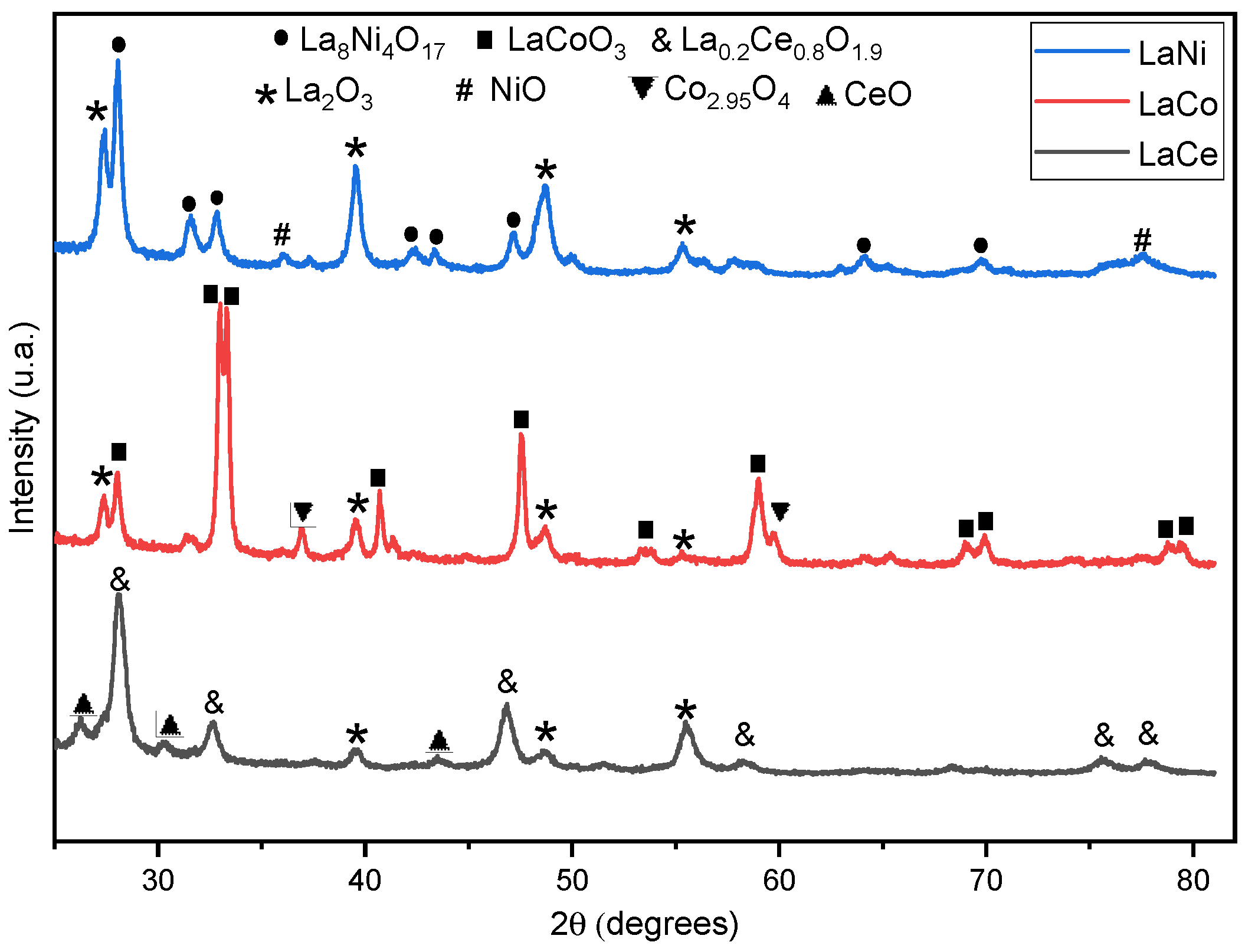
Figure 1. X-ray diffraction (XRD) patterns of LaNi, LaCo, and LaCe catalysts.
Eng 07 00172 g001
Figure 2. XPS survey spectra of LaNi, LaCo, and LaCe catalysts with identified core-level peaks.
Eng 07 00172 g002
Figure 3. Nitrogen adsorption–desorption isotherms of LaNi, LaCo, and LaCe catalysts.
Eng 07 00172 g003
Figure 4. BJH pore-size distribution curves of LaNi, LaCo, and LaCe catalysts calculated from the desorption branch of the N2 isotherms.
Eng 07 00172 g004
Figure 5. SEM micrographs of LaNi, LaCo, and LaCe catalysts recorded at different magnifications.
Eng 07 00172 g005
Figure 6. Representative EDX spectra of LaNi, LaCo, and LaCe catalysts.
Eng 07 00172 g006
Figure 7. Thermogravimetric (TGA) weight-loss profiles of LaNi, LaCo, and LaCe catalysts.
Eng 07 00172 g007
Figure 8. Derivative thermogravimetric (DTG) curves of LaNi, LaCo, and LaCe catalysts.
Eng 07 00172 g008
Figure 9. FTIR-Py spectra of LaNi, LaCo, and LaCe catalysts showing characteristic bands of Lewis and Brønsted acid sites.
Eng 07 00172 g009
Figure 10. Effect of reaction temperature on ammonia conversion over LaNi, LaCo, and LaCe catalysts (GHSV = 50 h−1).
Eng 07 00172 g010
Figure 11. Effect of gas hourly space velocity (GHSV) on ammonia conversion over LaNi, LaCo, and LaCe catalysts at 500 °C.
Eng 07 00172 g011
Figure 12. Durability test over LaNi catalyst at 500 °C and the GHSV of 50 h−1.
Eng 07 00172 g012
Table 1. XRD-derived crystallite size and phase identification of La-based catalysts.
CatalystPhase(hkl)2θ (°)D (nm)Average D (nm)
LaNiLa8Ni4O17(004)28.1017.5513.33
(103)31.5010.79
(110)32.8013.21
(006)42.259.43
(114)43.3716.41
(200)47.1512.11
(215)/(206)around 64–6512.54
22069.8114.56
La2O3(002)27.3714.3013.44
(102)39.5815.89
(103)48.7010.07
(200)55.3113.49
NiO(111)36.107.707.95
(311)77.508.20
LaCoLaCoO3(101)23.3516.3119.88
(112)33.3525.48
(021)40.6029.61
(202)47.5226.59
(113)53.6010.40
(122)59.0016.24
(220)68.9817.69
(024)69.9221.16
(312)78.8216.88
(214)79.4518.46
La2O3(002)27.3616.3115.68
(102)39.5816.74
(103)48.659.13
(200)55.2820.55
Co2.95O4(311)36.9219.9720.21
(511)59.7020.44
LaCeLa0.2Ce0.8O1.9(111)28.0611.6010.70
(200)32.608.58
(220)46.7811.50
(222)58.309.17
(331)75.6210.20
(420)77.7513.13
La2O3(102)39.5410.959.83
(103)48.607.50
(200)55.4811.06
CeO1.695-26.206.558.08
-30.318.85
-43.488.85
Table 2. Textural properties of La-based catalysts derived from N2 adsorption–desorption analysis.
CatalystSBET
(m2·g−1)
Vpore
(cm3·g−1)
Diameter, DV(d)
(nm)
LaNi31.110.11410.54
LaCo16.150.09823.94
LaCe7.210.0374.536
Table 3. Quantitative surface acidity of LaNi, LaCo, and LaCe catalysts determined by FTIR-Py adsorption.
CatalystLewis Conc. (CL) mmol·g−1Bronsted Conc. (CB) mmol·g−1Total Conc.
mmol·g−1
CL/CB
LaCo2.5740.7543.3283.41
LaNi1.3741.6753.0490.82
LaCe0.8961.5002.3960.60
Disclaimer/Publisher’s Note: The statements, opinions and data contained in all publications are solely those of the individual author(s) and contributor(s) and not of MDPI and/or the editor(s). MDPI and/or the editor(s) disclaim responsibility for any injury to people or property resulting from any ideas, methods, instructions or products referred to in the content.