Article

Experimental and Numerical Impact Assessment of a Heavy-Duty Truck Cab Reconstructed from 3D Scanning According to the Swedish VVFS 2003:29 Procedure


by
Ana-Maria Dumitrache
1,
Ionut-Alin Dumitrache
2,3,*,
Daniel Iozsa
1 and
Alexandra Molea
1
1
Automotive Engineering Department, Faculty of Transports, Politehnica University of Bucharest, 060042 Bucuresti, Romania
2
Romanian Research and Development Institute for Gas Turbines—COMOTI, 061103 Bucharest, Romania
3
Doctoral School of Industrial Engineering and Robotics, Politehnica University of Bucharest, 060042 Bucuresti, Romania
*
Author to whom correspondence should be addressed.
Eng 2026, 7(3), 137; https://doi.org/10.3390/eng7030137
Submission received: 11 February 2026 / Revised: 11 March 2026 / Accepted: 14 March 2026 / Published: 17 March 2026
(This article belongs to the Special Issue Interdisciplinary Insights in Engineering Research 2026)

Abstract

Ensuring the crashworthiness of heavy-duty truck cabs is essential for reducing occupant fatalities and improving passive safety in commercial vehicles. Regulatory frameworks such as UNECE Regulation No. 29 (R29) define structural integrity requirements through full-scale destructive impact tests, which are costly and limit iterative design. In this study, an integrated experimental–numerical methodology is presented for the impact assessment of a real Iveco Eurocargo 120E18 truck cab reconstructed using high-resolution 3D scanning. The scanned geometry was used to generate a dimensionally accurate CAD model of the load-bearing cab structure, which was analysed using explicit finite element simulations in ANSYS Academic Mechanical and CFD Teaching package under impact conditions compliant with UNECE R29 and implemented according to the Swedish regulation VVFS 2003:29. In parallel, a full-scale physical pendulum impact test was performed on the same cab using a cylindrical impactor with a diameter of 580 mm, a length of 1800 mm, and a mass of approximately 1000 kg, impacting the upper region of the A-pillar. The experimental setup was instrumented using high-speed optical measurements and an accelerometer to capture impact kinematics and structural response. The numerical predictions showed good agreement with experimental results in terms of acceleration–time histories, absorbed energy evolution, and structural deformation, with differences generally below 6%. Critical regions susceptible to local buckling and plastic collapse were consistently identified in both approaches, while preservation of the driver survival space was confirmed. The results demonstrate that scan-based finite element models, when properly calibrated and validated, can reliably reproduce certification-level impact behaviour. The proposed workflow provides a robust and cost-effective framework for regulatory pre-validation, structural optimisation, and digitalisation of crashworthiness assessment for heavy-duty truck cabs.

1. Introduction

Occupant protection in heavy-duty truck cabs depends primarily on the structural integrity of the cab, its capacity to absorb impact energy, and the preservation of a defined survival space during crash events [1,2,3,4,5,6]. For vehicles with a separate cab, these requirements are regulated in Europe by UNECE Regulation No. 29 (R29), which specifies full-scale structural tests including frontal wall loading, pendulum impact on the A-pillar, and roof strength assessment [7]. Although such tests remain the reference for homologation, they are destructive, costly, and time-consuming, which limits their use during iterative design and early-stage development.
The Swedish regulation VVFS 2003:29 represents a national implementation of UNECE R29 and provides a detailed procedural framework for cab strength assessment under pendulum impact conditions [8]. In particular, it defines the pendulum configuration, impactor geometry, and test arrangement used to evaluate the structural response of the upper A-pillar region, which is a critical load-transfer zone affecting roof integrity, windscreen frame stability, and the preservation of the driver survival space [7,8]. For this reason, the A-pillar pendulum impact scenario remains highly relevant for regulatory crashworthiness validation of truck cab structures.
Explicit-dynamic finite element analysis (FEA) has become a widely used tool for reproducing the highly nonlinear response associated with regulatory crash events, including large plastic deformations, short-duration impact loading, and complex contact interactions [9,10,11]. Previous studies have shown that explicit FEA can reproduce UNECE R29 test conditions with satisfactory accuracy and can support the assessment of deformation modes, absorbed energy, and residual survival space in large vehicle structures [12,13]. In parallel, optimisation-based approaches have been used to improve impact performance while reducing structural mass, and recent investigations have explored lightweight metallic and composite solutions for crashworthy transport structures [14,15,16]. Recent research on polymer-based composite materials and reinforced structural components further highlights the potential of advanced materials to improve strength-to-weight ratios in vehicle structures while maintaining structural integrity under dynamic loading conditions [17,18,19]. In addition, data-driven methodologies are emerging as complementary tools for rapid crash-response prediction based on high-fidelity simulation datasets [20,21].
Despite these advances, two limitations remain important in the context of regulatory truck-cab validation. First, many numerical studies still rely on idealised CAD models that do not adequately represent manufacturing-related geometric features, such as local curvature variations, thickness transitions, and weld-influenced structural topology, all of which may affect load paths and collapse mechanisms during impact. Second, relatively few studies provide a direct correlation between scan-based finite element models and standardized, instrumented, full-scale impact tests performed under regulation-aligned procedures such as UNECE R29 and VVFS 2003:29 [12,13].
The present study addresses these gaps through an integrated experimental–numerical investigation of a real heavy-duty truck cab (Iveco Eurocargo 120E18). The cab structure was digitally reconstructed from high-resolution 3D scanning to preserve production-level geometric fidelity and subsequently modelled using explicit finite element analysis in ANSYS R15.0. The numerical simulations were conducted under pendulum impact conditions compliant with UNECE R29 and implemented according to the Swedish regulation VVFS 2003:29. In parallel, a full-scale physical pendulum impact test was performed on the same cab, instrumented with high-speed optical measurements and an accelerometer to capture impact kinematics and structural response.
By combining scan-based numerical modelling with full-scale experimental validation, this work establishes a robust and regulation-aligned framework for crashworthiness assessment of heavy-duty truck cabs. The proposed methodology supports pre-certification evaluation, improves confidence in simulation-based design decisions, and contributes to a more traceable and efficient approach to enhancing passive safety in commercial vehicles.

2. Materials and Methods

2.1. Cab Description, 3D Scanning and CAD Reconstruction

The investigated structure is a heavy-duty truck cab from an Iveco Eurocargo 120E18 (Iveco S.p.A., Turin, Italy) vehicle, representative of medium-duty commercial trucks widely used in European freight transport. According to the manufacturer’s technical documentation, the cab consists of a welded thin-walled steel structure with nominal sheet thicknesses between 1.5 mm and 2.0 mm in the primary load-bearing components, including the A-pillars, roof rails, side walls, and floor reinforcements [22]. These structural elements are critical for maintaining cab integrity and preserving occupant survival space under impact conditions regulated by UNECE Regulation No. 29.
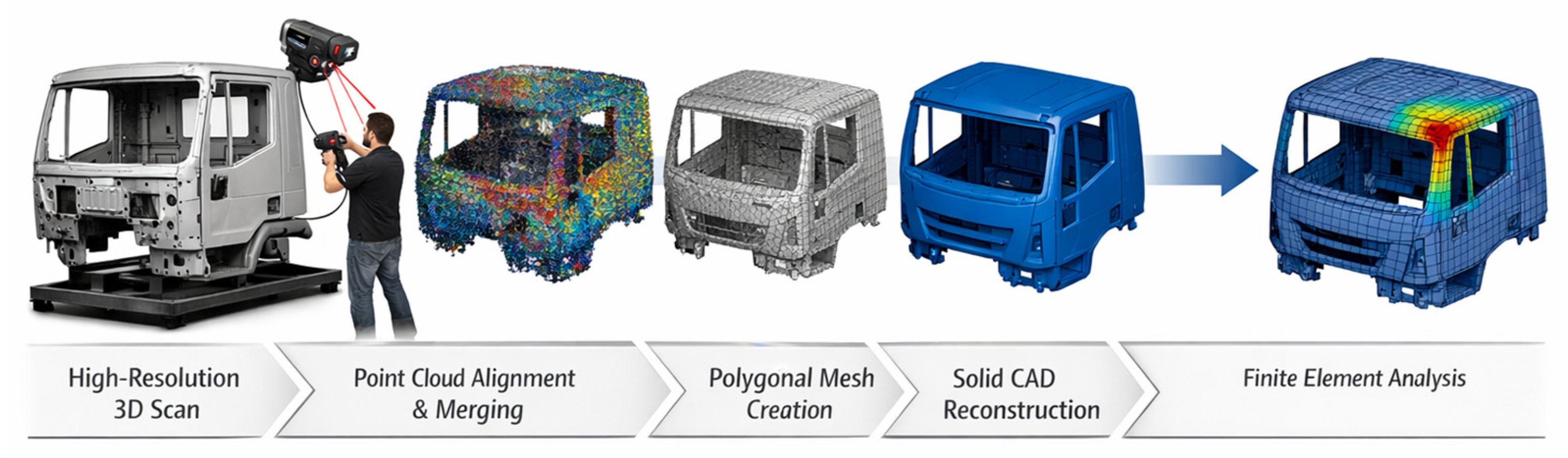
To achieve production-level geometric fidelity, the cab structure was digitised using a ZEISS T-SCAN hawk 2 handheld laser (Carl Zeiss GOM Metrology GmbH, Braunschweig, Germany) scanning system, designed for high-accuracy acquisition of large and complex industrial geometries [23]. The scanning campaign was conducted on the bare cab prior to impact testing, capturing the external and internal surfaces relevant to structural load transfer. The overall scanning and reconstruction workflow is illustrated in Figure 1. The applied scanning resolution provided millimetre-level accuracy, sufficient to preserve local geometric features such as curvature transitions and pillar cross-sections that significantly influence crash response.
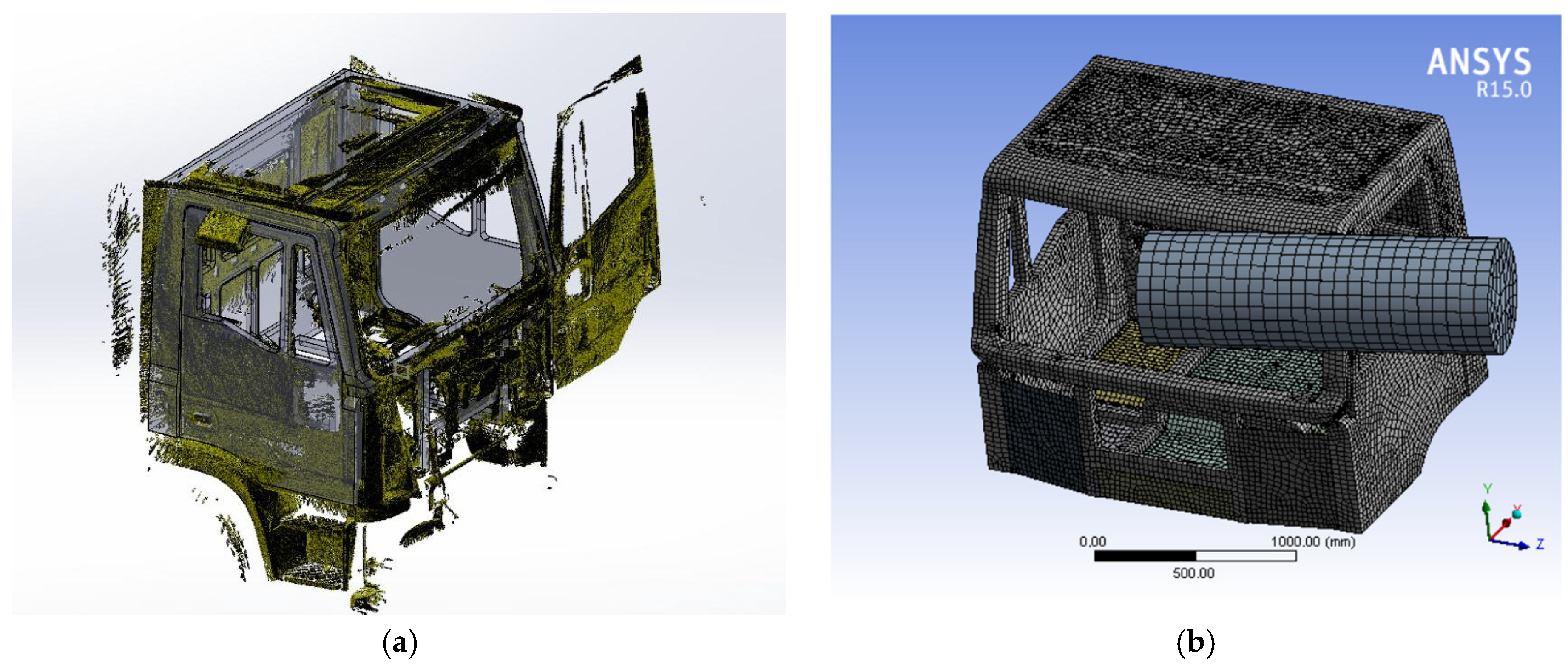
The acquired point-cloud data were post-processed to remove noise and ensure surface continuity before being imported into SOLIDWORKS (Dassault Systèmes, Vélizy-Villacoublay, France), version 2023. A dimensionally consistent solid model of the cab structure was then reconstructed using a controlled simplification strategy aimed at balancing geometric accuracy and computational efficiency. Non-structural components, such as interior trims and secondary brackets, were removed, while all primary load-bearing elements—including the A-pillars, roof structure, windscreen frame, side panels, and floor assemblies—were retained with their scanned dimensions. The reconstructed CAD geometry and the corresponding shell-based finite element discretisation, including local mesh refinement in the A-pillar impact region, are shown in Figure 2.
Unlike idealised CAD geometries typically used in crashworthiness simulations, scan-based reconstruction preserves manufacturing-related geometric characteristics present in the real cab structure, including local thickness transitions, curvature deviations, and geometric irregularities resulting from stamping and welding processes. While individual weld beads were not explicitly modelled, their geometric influence on the surrounding structural topology was inherently captured by the scanning process. This approach therefore improves the representation of real structural load paths compared with a simplified CAD model. Particular attention was given to the upper region of the A-pillar, corresponding to the impact location defined by UNECE R29 and its Swedish implementation VVFS 2003:29. Local geometric details, including curvature radii and thickness transitions, were preserved to ensure a realistic representation of stiffness distribution and energy absorption mechanisms. The resulting CAD model constitutes a geometrically accurate digital counterpart of the tested cab and provides a consistent basis for both finite element simulations and subsequent experimental–numerical correlation.

2.2. Numerical Modelling and Impact Simulation

The numerical assessment of the cab impact response was performed using an explicit finite element approach implemented in ANSYS Workbench—Explicit Dynamics (ANSYS Inc., Canonsburg, PA, USA). The simulations were carried out using an academic license of the ANSYS Academic Mechanical and CFD Teaching package provided through the ANSYS Academic program [24]. An explicit dynamic formulation was selected due to its suitability for highly nonlinear transient events involving large plastic deformations, short impact durations, and complex contact interactions, which are characteristic of regulatory pendulum impact tests defined by UNECE Regulation No. 29 and its national implementations [7,12,13].
The scan-based CAD model described in Section 2.1 was discretised primarily using shell finite elements, in accordance with established practice for crashworthiness analysis of thin-walled welded vehicle structures [10,13,15]. Shell elements allow accurate representation of bending and membrane behaviour while maintaining reasonable computational efficiency compared to fully solid discretisations, particularly for large structural assemblies subjected to impact loading [11,25]. The cab structure was discretised using four-node shell elements implemented in the explicit dynamic solver. Five through-thickness integration points were employed to accurately capture bending behaviour and the evolution of plastic deformation in the thin-walled structural components. Shell thicknesses were assigned individually to structural components based on the reconstructed scan geometry and available manufacturer specifications, with nominal thickness values ranging between 1.5 mm and 2.0 mm in the primary load-bearing regions of the cab, including the A-pillars, roof rails, and windscreen frame.
A non-uniform meshing strategy was adopted to balance numerical accuracy and computational cost. A global element size of approximately 15 mm was applied to non-critical regions of the structure, while local refinement was introduced in areas expected to experience high deformation gradients, particularly in the A-pillar impact region, roof rail junctions, and windscreen frame. In these critical zones, the element size was reduced to approximately 8–10 mm to adequately capture local buckling and progressive folding mechanisms commonly observed in thin-walled steel structures under impact [25]. The resulting finite element discretisation, including the locally refined mesh in the A-pillar region, is illustrated in Figure 2b. Mesh quality was verified to ensure numerical stability, with element aspect ratios maintained within recommended limits for explicit dynamic analysis [11]. The selected element sizes were based on common guidelines for crashworthiness simulations of thin-walled automotive structures reported in the literature [11,25]. Element sizes between 5 mm and 15 mm are typically recommended to accurately capture local buckling and folding mechanisms while maintaining computational efficiency. Preliminary mesh sensitivity checks confirmed that further mesh refinement below 8 mm in the A-pillar region resulted in changes in peak displacement below 2%, indicating that the adopted mesh resolution provides a suitable balance between accuracy and computational cost.
The cab structure was assumed to be manufactured from structural automotive-grade steel and was modelled using an elastic–plastic constitutive law with isotropic hardening defined by the stress–plastic strain points listed in Table 1b. The elastic response was defined by a Young’s modulus of 210 GPa and a Poisson’s ratio of 0.3, while the plastic behaviour was characterised by a yield strength of 500 MPa and an ultimate tensile strength of approximately 620 MPa, consistent with values reported for high-strength steels used in commercial vehicle cabins [1,2,13]. A material density of 7850 kg/m3 was adopted throughout the model. To account for the dynamic nature of the impact event, strain-rate sensitivity was modelled using the Cowper–Symonds overstress formulation with parameters C = 40 s−1 and p = 5, adopted from the classical experimental study of Cowper and Symonds [26]. This approach has been widely applied in crash simulations of steel vehicle structures and has been shown to provide reliable predictions under impact loading conditions [13,15,16]. Material failure and element erosion were not activated, as UNECE R29 primarily evaluates structural deformation and survival space preservation rather than fracture, and reliable calibration of failure criteria would require additional experimental data [12,13].
Boundary conditions were defined to replicate the regulatory test configuration as closely as possible. The cab was constrained at the chassis attachment points by fixing all translational and rotational degrees of freedom, representing the rigid mounting conditions typically adopted in full-scale regulatory impact tests [7,12]. This configuration allowed realistic global deformation of the cab structure while preventing rigid-body motion.
The impactor was modelled as a rigid cylindrical body consistent with the Swedish VVFS 2003:29 implementation of UNECE R29. The cylinder had a diameter of 580 mm, a length of 1800 mm, and a total mass of approximately 1000 kg, corresponding to the experimental pendulum used in the physical test. The impactor was constrained to move only along the longitudinal direction of the vehicle, and an initial velocity corresponding to the prescribed impact energy was applied, resulting in a nominal impact velocity of approximately 7.7 m/s at contact. Contact between the impactor and the cab structure was defined using a surface-to-surface penalty-based formulation. A frictionless contact condition was assumed to avoid artificial energy dissipation and ensure stable transfer of impact forces, in line with common practice in regulatory-oriented crash simulations [10].
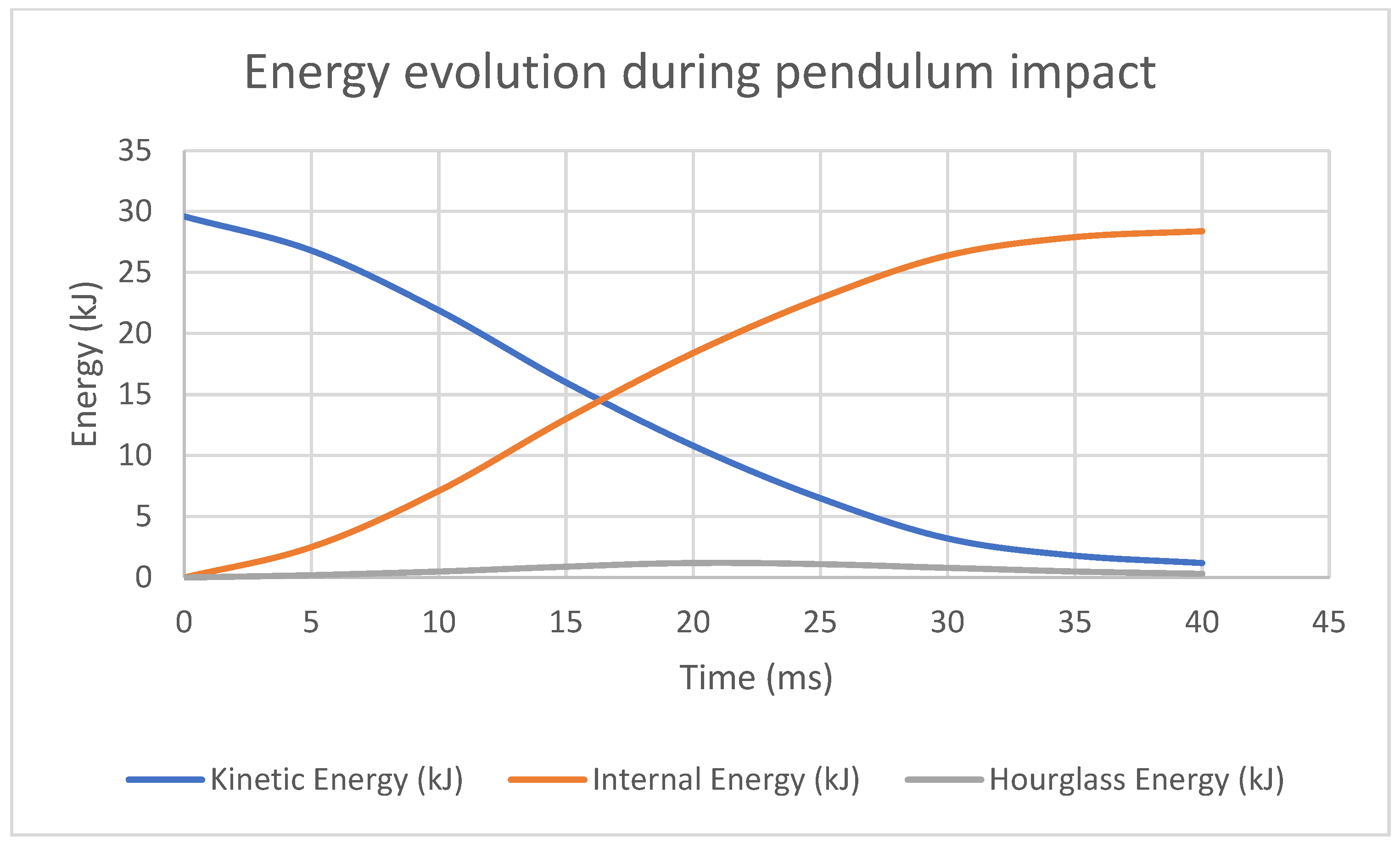
The explicit time integration scheme was governed by the Courant–Friedrichs–Lewy stability condition, with the time step automatically controlled by the solver based on the smallest element characteristic length and material wave speed [10]. For the adopted mesh, the stable time increment was on the order of 10−7–10−6 s, and the total simulation time was set to 45 ms to capture the complete impact event and subsequent structural response. Throughout the simulation, kinetic, internal, contact, and hourglass energies were monitored to verify numerical stability and physical consistency. The results confirmed that the initial kinetic energy of the impactor was progressively converted into internal energy of the cab structure, with hourglass energy remaining below 5% of the total energy, satisfying accepted criteria for explicit crash simulations [10,11,27].

2.3. Experimental Impact Test According to VVFS 2003:29

To validate the numerical predictions and ensure traceability with regulatory requirements, a full-scale physical impact test was conducted on the same Iveco Eurocargo 120E18 cab analysed numerically. The experimental procedure followed the Swedish regulation VVFS 2003:29, which represents a national implementation of UNECE Regulation No. 29 (R29) and defines the pendulum impact test on the upper region of the A-pillar as a critical assessment of cab structural integrity and survival space preservation [7,12].

2.3.1. Test Configuration and Boundary Conditions

The cab was mounted on a rigid support frame replicating the boundary conditions prescribed by the regulation, corresponding to a fixed attachment of the cab to the vehicle chassis. All translational and rotational degrees of freedom at the mounting points were restrained to prevent rigid-body motion during impact while allowing realistic deformation of the cab structure.
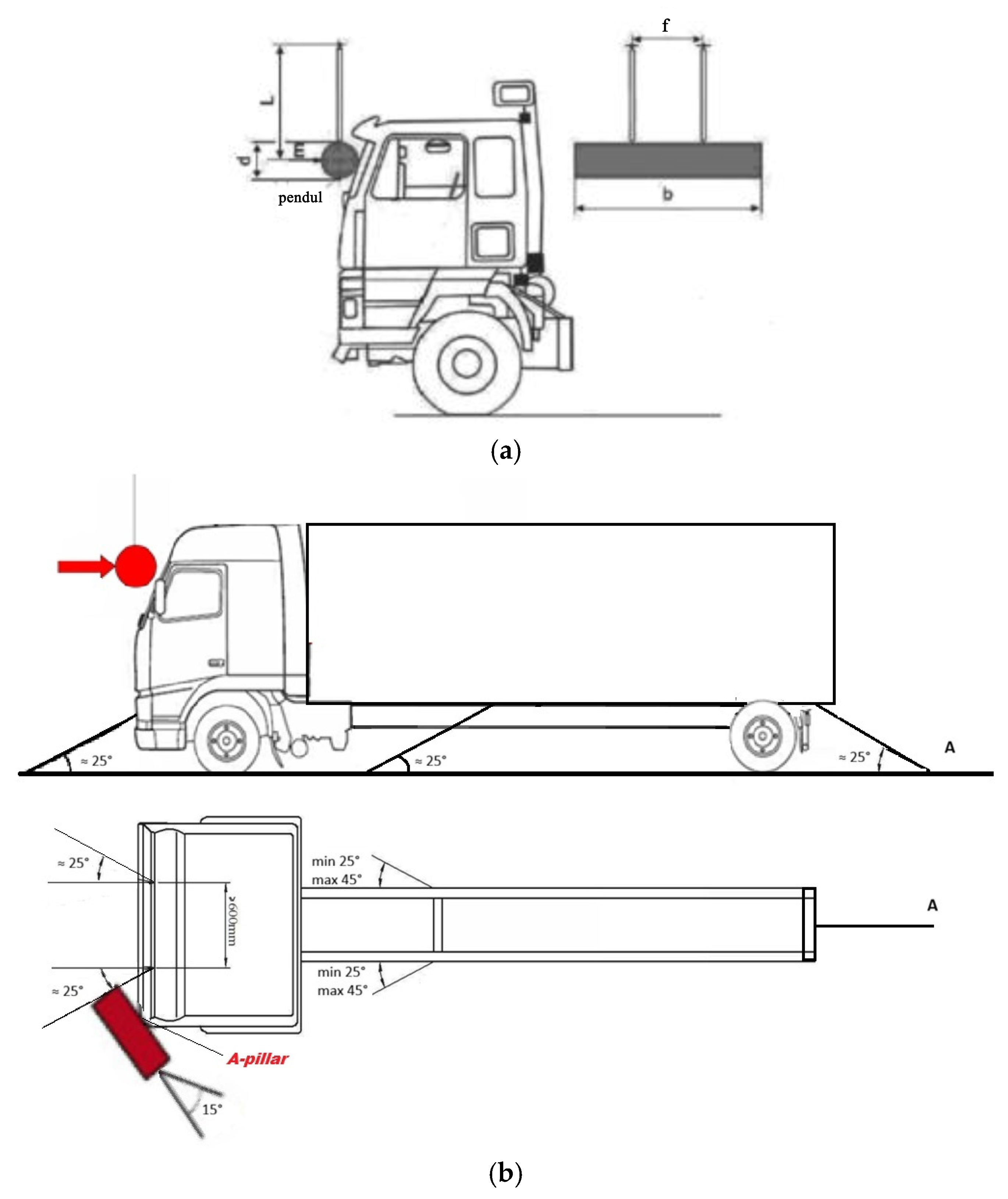
The overall experimental configuration, including cab positioning, pendulum suspension, and impact direction, is illustrated in Figure 3. The impact was applied to the upper region of one A-pillar, identified as a critical load-transfer zone affecting roof integrity, windscreen frame stability, and intrusion into the driver survival space [7,12].

2.3.2. Impactor Characteristics and Impact Conditions

The impactor consisted of a rigid cylindrical steel pendulum with a diameter of 580 mm, a length of 1800 mm, and a total mass of approximately 1000 kg, consistent with the requirements of the Swedish VVFS 2003:29 regulation. The pendulum was suspended in a free-swing configuration and constrained to impact the cab in the longitudinal direction.
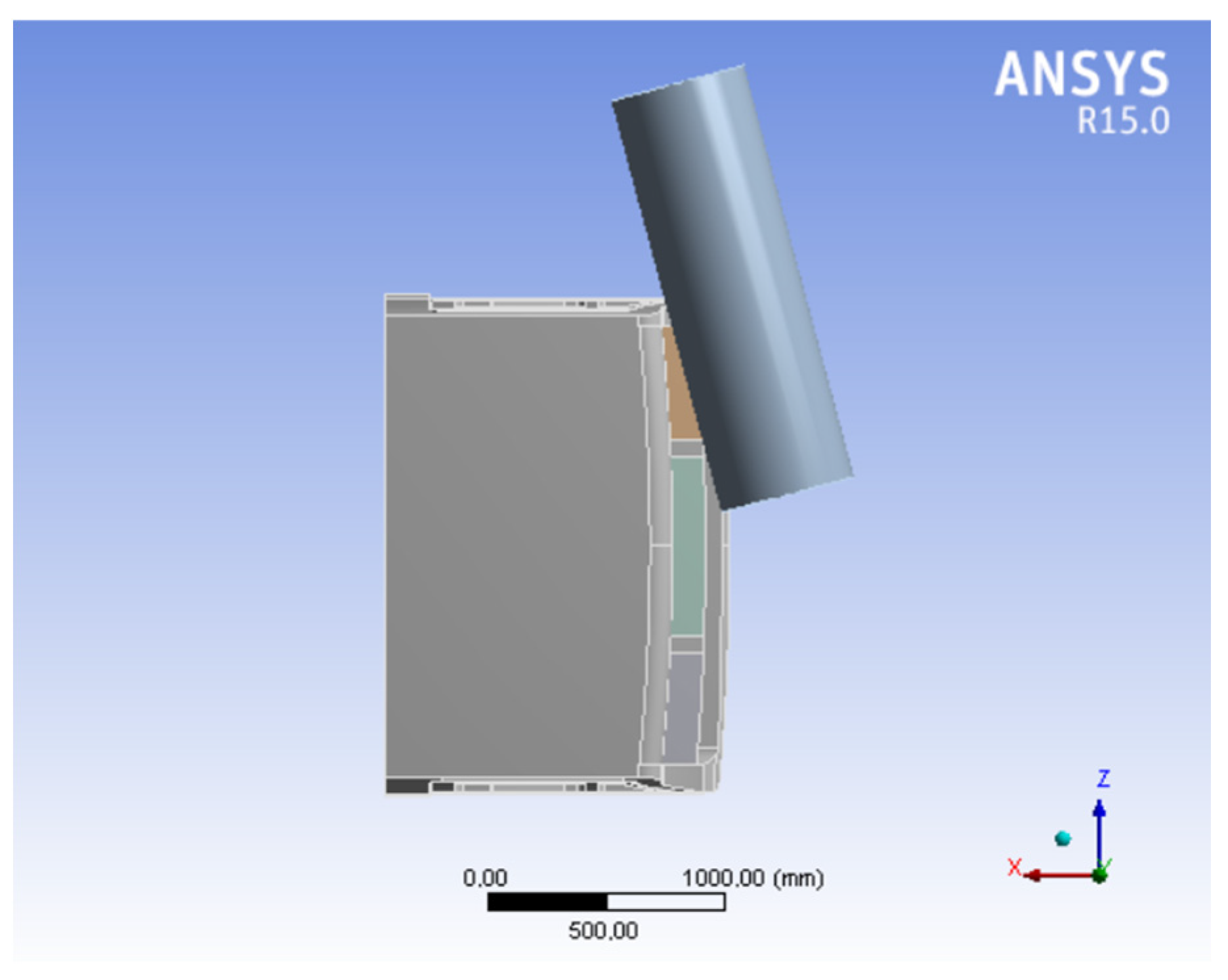
A detailed view of the impactor geometry and its positioning relative to the A-pillar impact location is shown in Figure 4. The impact velocity was derived from the prescribed regulatory impact energy, resulting in a nominal velocity of approximately 7.7 m/s at the moment of contact, ensuring equivalence with the numerical simulations.

2.3.3. Instrumentation and Data Acquisition

The experimental test was instrumented to capture both global kinematics and local structural response. High-speed optical measurements were performed using a high-frame-rate camera system positioned perpendicular to the impact plane, enabling visualisation of deformation evolution during the impact event.
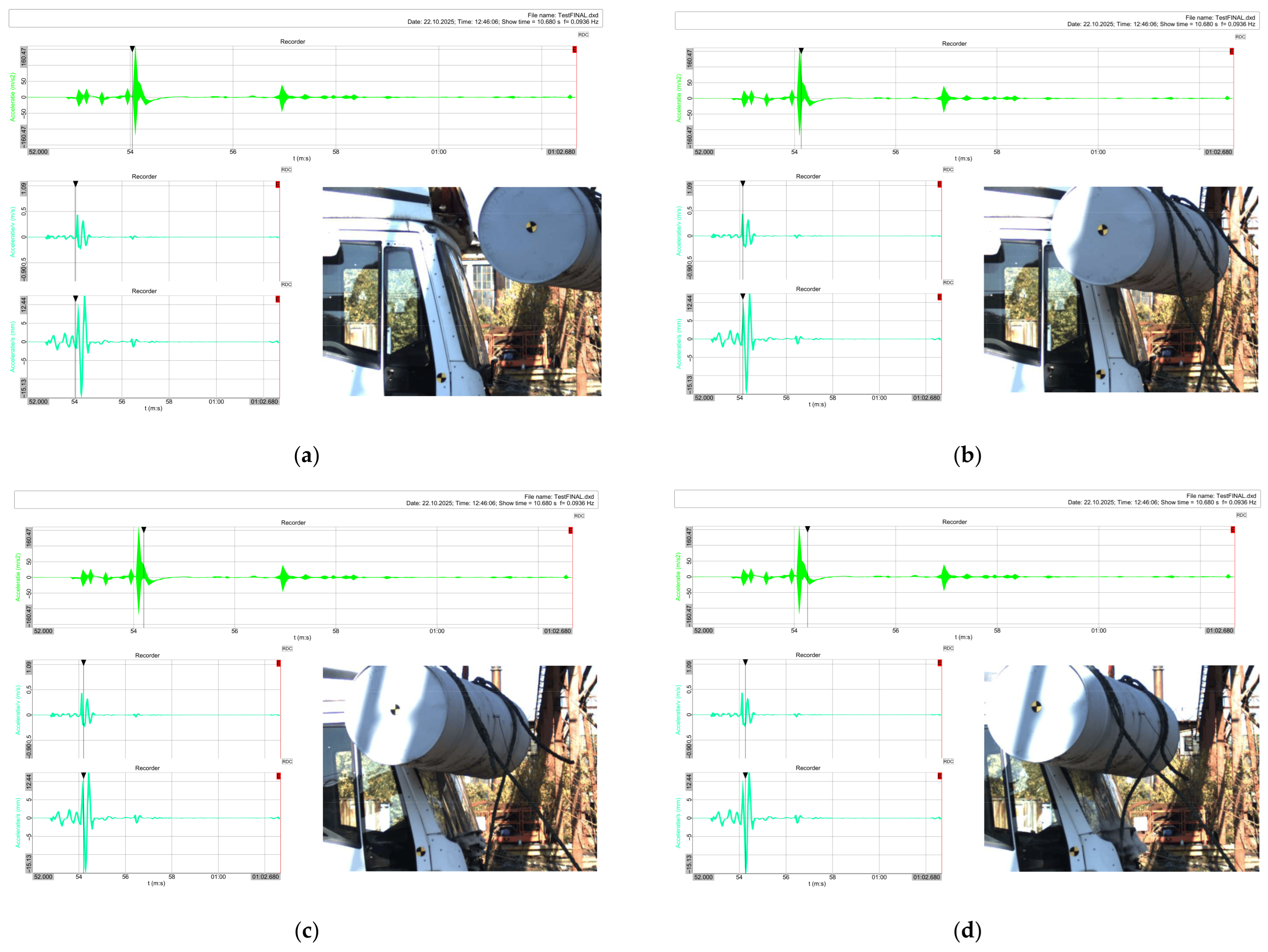
A sequence of representative high-speed images illustrating the progressive deformation of the A-pillar and roof region during impact is presented in Figure 5. These images allow qualitative comparison with the deformation patterns predicted by the explicit finite element simulations.
In addition, an accelerometer was mounted on the pendulum impactor to measure acceleration time histories during impact. The acceleration signal was acquired using a Dewesoft data acquisition system (Dewesoft d.o.o., Trbovlje, Slovenia), providing high temporal resolution suitable for short-duration impact events [28]. The measured acceleration signal was later used to derive impact force and energy dissipation characteristics. The acceleration signal was recorded using the Dewesoft data acquisition system and expressed in m/s2. A low-pass filter was applied prior to post-processing to reduce high-frequency noise. The acceleration signal was acquired at a sampling frequency of 20 kHz and filtered using a fourth-order Butterworth low-pass filter with a cut-off frequency of 2 kHz. Prior to numerical integration, the acceleration baseline offset was removed by subtracting the mean value calculated over a pre-impact time window. The pendulum velocity and displacement were obtained by numerical integration of the filtered acceleration signal using the trapezoidal rule. To reduce integration drift, a post-impact correction was applied by enforcing the velocity to approach zero after rebound of the pendulum. As a consistency check, the absorbed energy computed from the force–displacement relation Equation (3) and from kinetic energy reduction Equation (4) showed good agreement, with differences below approximately 3%.

2.3.4. Measured Quantities and Data Reduction

Due to practical and financial constraints of the experimental campaign, the instrumentation of the full-scale impact test was limited to a single accelerometer mounted on the pendulum impactor and a high-speed camera system focused on the impact region. Despite this limited sensor setup, the selected measurements are sufficient to derive the key quantities required for regulatory assessment and experimental–numerical correlation, provided that appropriate post-processing procedures are applied.
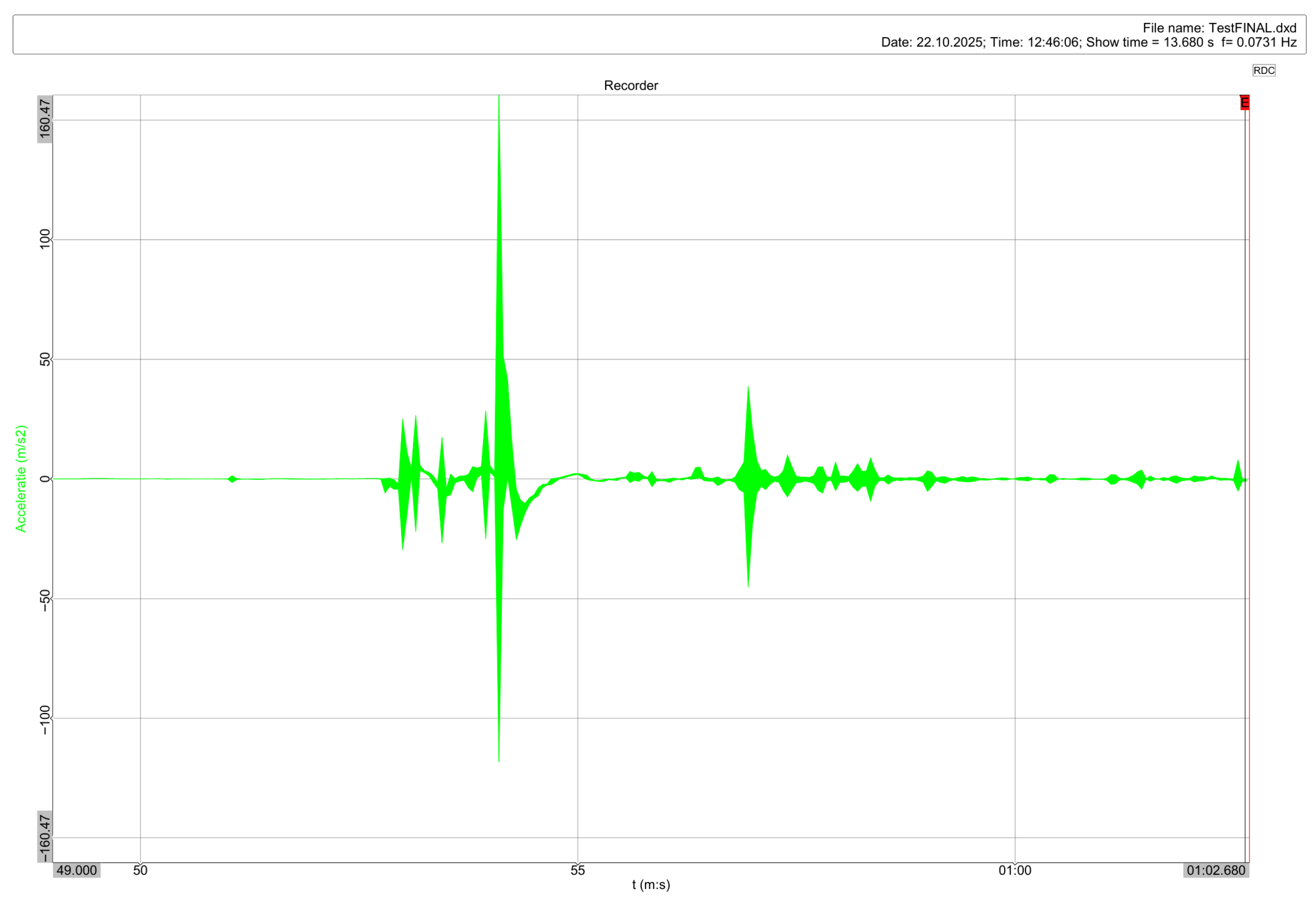
The primary directly measured quantity was the acceleration–time history of the pendulum, recorded using the Dewesoft data acquisition system. This signal represents the fundamental experimental input from which additional impact-related quantities were derived. The measured acceleration–time history is shown in Figure 6.
Based on the recorded acceleration signal a t , the impactor velocity  v t was obtained by time integration:
v ( t ) = v 0 + 0 t a ( τ )   d τ
The impact force transmitted to the cab structure was estimated using Newton’s second law:
F ( t ) = m a ( t )
where m is the known mass of the pendulum (approximately 1000 kg). Since the impact occurs close to the lowest point of the pendulum trajectory, the measured acceleration is dominated by the tangential deceleration during the short contact event. Therefore, the contact force was approximated as F(t) = m a(t) along the impact direction. This represents a practical approximation; rotational effects and geometric components of the pendulum suspension are neglected and are treated as a source of uncertainty.
The absorbed energy during the impact event was derived from the work done by the impact force over the pendulum displacement:
E abs ( t ) = 0 s ( t ) F ( s )   d s
Alternatively, the absorbed energy can be evaluated from the reduction in kinetic energy of the pendulum:
E abs ( t ) = 1 2 m v 0 2 v ( t ) 2
Both formulations were used as consistency checks during post-processing and showed good agreement.
The acceleration signal was acquired using the Dewesoft data acquisition system at a constant sampling frequency. Prior to numerical processing, the signal was filtered using a low-pass digital filter to remove high-frequency measurement noise associated with the impact event. Baseline offset was corrected by subtracting the mean acceleration value measured in a short pre-impact time window. The pendulum velocity and displacement were obtained by numerical integration of the filtered acceleration signal using the trapezoidal integration scheme. Integration drift was controlled by enforcing the pendulum velocity to approach zero after the rebound phase of the impact event. These signal-processing steps ensure numerical stability and are consistent with common practices in impact dynamics and crashworthiness data reduction procedures reported in the literature [1,2,10].
High-speed camera recordings were used to qualitatively and semi-quantitatively assess the deformation evolution of the cab during impact. Frame-by-frame image analysis enabled identification of maximum A-pillar displacement, global deformation modes, local buckling mechanisms, and residual deformation after unloading. Although the optical measurements were not fully three-dimensional, they provided sufficient resolution to extract displacement trends and peak values for correlation with numerical predictions.

3. Results

3.1. Numerical Impact Results

The explicit finite element simulation provided the temporal evolution of structural deformation, energy absorption, and contact response of the cab structure under VVFS 2003:29–compliant impact conditions. In practice, global instability was checked by monitoring: (i) the intrusion of any structural node into the UNECE R29 survival space envelope; (ii) the deformation propagation beyond the impacted A-pillar/roof-rail junction into the opposite side frame; and (iii) the absence of a sudden drop of the reaction force accompanied by runaway deformation, which would indicate loss of load-carrying capacity.
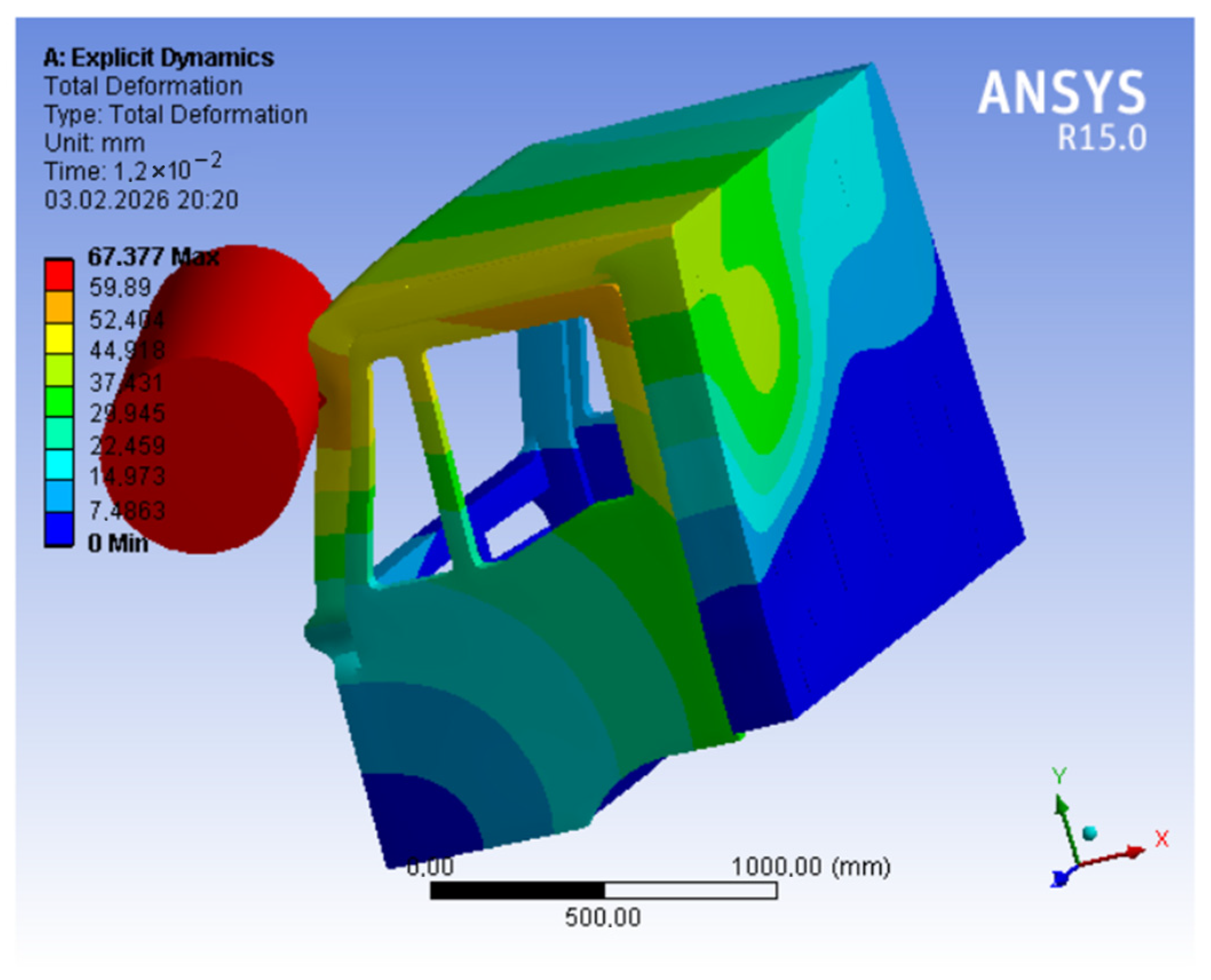
Figure 7 presents selected deformation states of the cab during the impact event. Plastic deformation initiated at the upper region of the impacted A-pillar immediately after contact, followed by progressive local buckling and load redistribution towards the roof rail and windscreen frame. No global structural instability was observed during the simulation. In the present study, global instability is defined as large-scale structural collapse leading to uncontrolled deformation propagation across the cab frame or intrusion into the driver survival space as defined by UNECE R29. The deformation remained localised primarily in the impacted A-pillar and adjacent roof rail region.
The numerical energy balance is shown in Figure 8. The initial kinetic energy of the pendulum was progressively converted into internal energy of the cab structure, indicating stable energy dissipation through plastic deformation. At the end of the impact event, approximately 95% of the initial kinetic energy was absorbed by the structure, while hourglass energy remained below 5% of the total energy, confirming numerical stability.
The maximum displacement of the A-pillar reference point occurred approximately 15–20 ms after initial contact, reaching a maximum value of approximately 67 mm. The residual deformation after unloading remained within the driver survival space limits defined by UNECE R29.

3.2. Experimental Impact Results

The full-scale pendulum impact test produced deformation patterns consistent with regulatory expectations for the A-pillar impact scenario defined by VVFS 2003:29. Representative high-speed image frames illustrating the deformation sequence are shown in Figure 5.
The experimentally measured acceleration–time history of the pendulum, recorded using the Dewesoft data acquisition system, is presented in Figure 6. Peak deceleration occurred shortly after first contact, followed by a gradual decrease as the impact energy was dissipated through structural deformation.
Using the post-processing methodology described in Section 2.3.4, the pendulum velocity, displacement, impact force, and absorbed energy were derived from the measured acceleration signal. Post-impact inspection of the cab confirmed permanent deformation localised primarily in the impacted A-pillar and adjacent roof rail region. No intrusion into the defined driver survival space was observed. The maximum structural displacements were estimated from frame-by-frame analysis of the high-speed recordings.

3.3. Quantitative Comparison of Experimental and Numerical Results

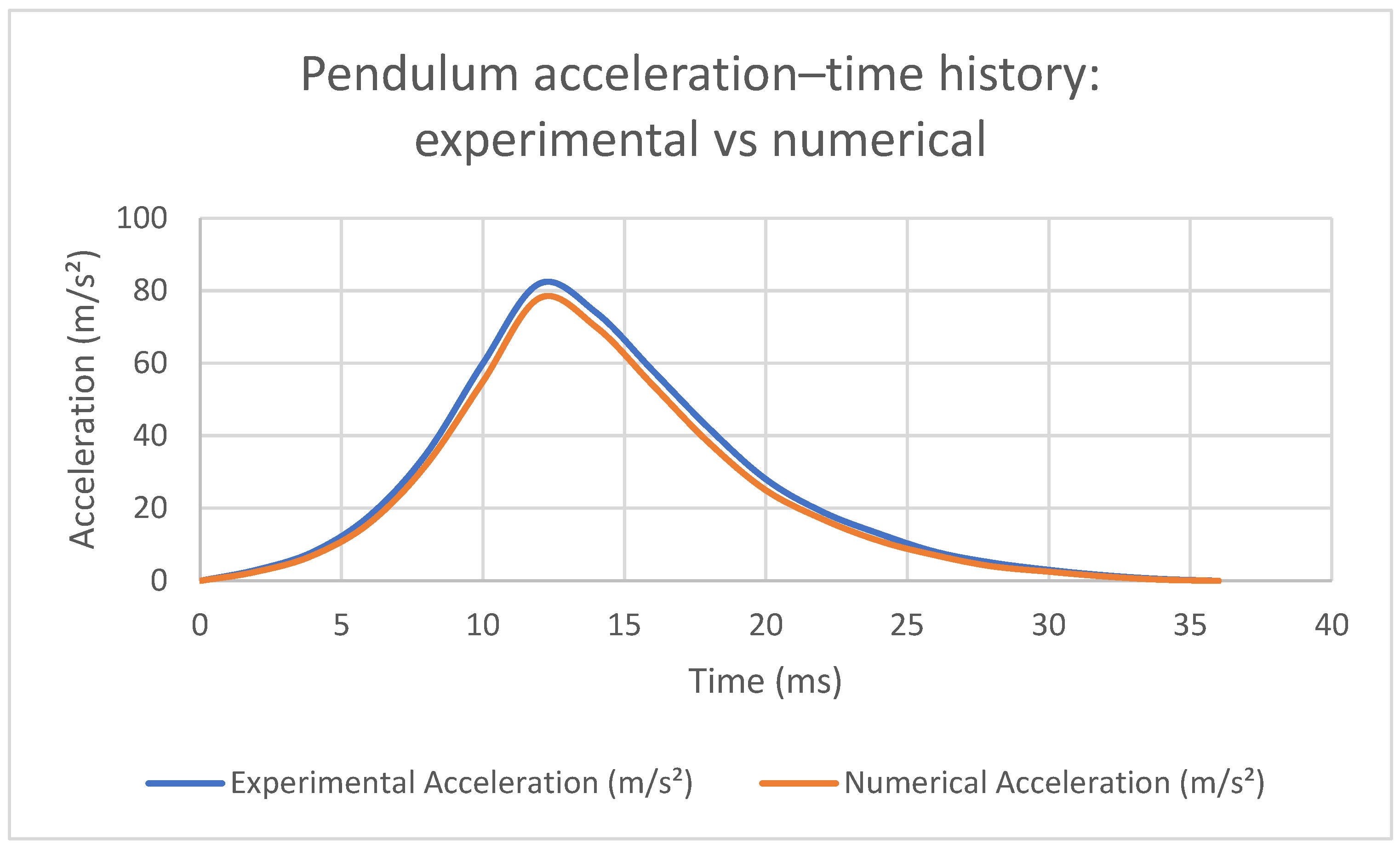
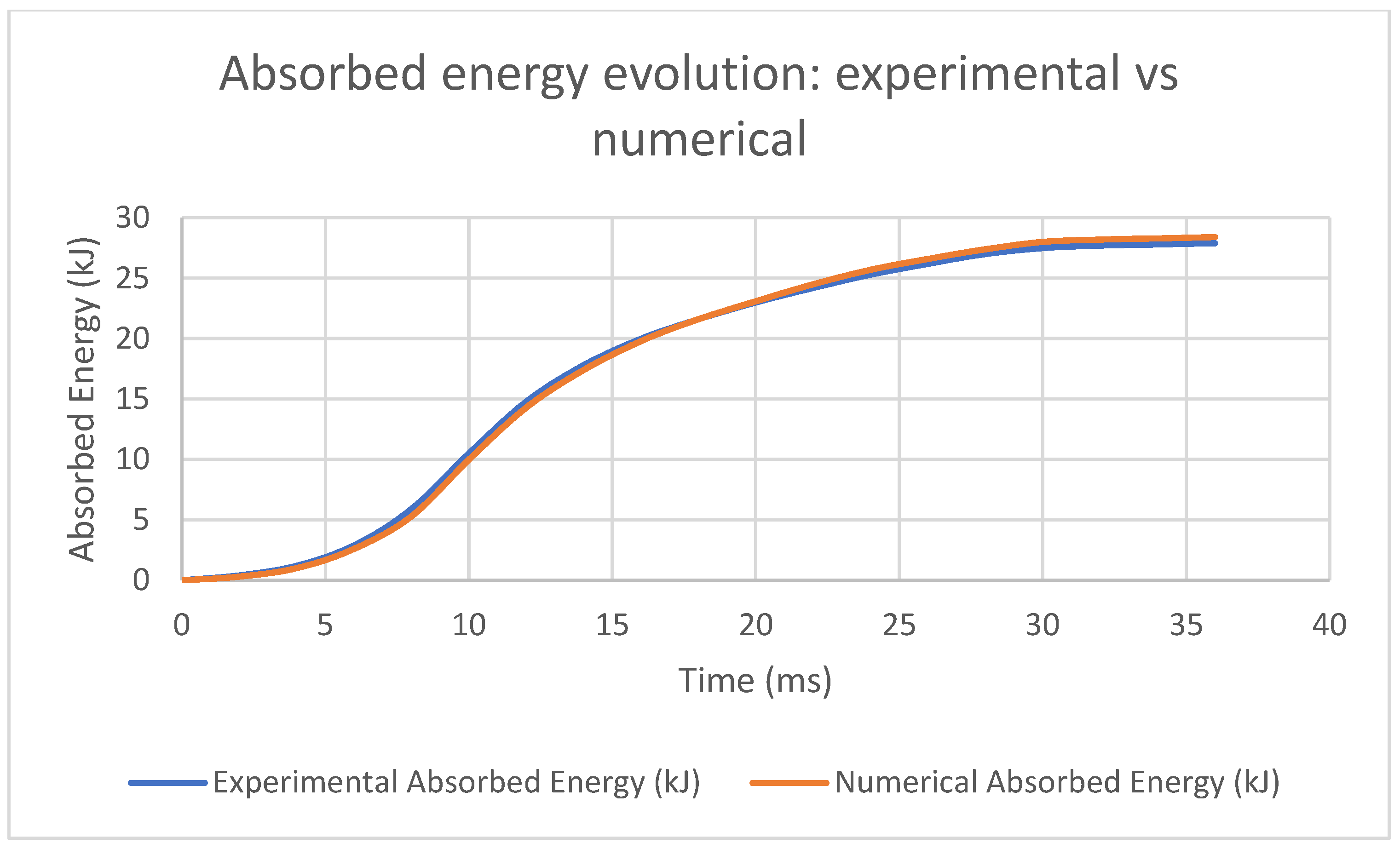
The acceleration–time histories obtained experimentally and numerically are directly compared in Figure 9, showing similar peak deceleration levels and impact durations. The experimental peak deceleration (82.4 m/s2) was slightly higher than the numerical prediction (78.6 m/s2), corresponding to a relative difference of approximately 4.6%. The evolution of absorbed energy derived from experimental measurements closely follows the numerical internal energy response, as illustrated in Figure 10. Quantitative agreement between the two approaches is further summarised in Table 2, Table 3 and Table 4, with differences generally below 6%.

4. Discussion

The results presented in this study demonstrate that a scan-based finite element modelling approach can reliably reproduce the structural response of a heavy-duty truck cab subjected to a regulatory pendulum impact test conducted in accordance with the Swedish VVFS 2003:29 procedure and aligned with UNECE Regulation No. 29. A close correlation was obtained between numerical predictions and experimental measurements across multiple response metrics, including acceleration–time histories, absorbed energy evolution, and structural deformation patterns.
Quantitatively, the numerical model reproduced the peak pendulum deceleration with a relative difference below 5% compared to the experimental measurement, while the overall impact duration and pulse shape were consistently captured. Similarly, the absorbed energy evolution showed good agreement throughout the impact event, with final absorbed energy levels differing by less than 3% between experiment (27.9 kJ) and simulation (28.4 kJ). These results indicate that the explicit-dynamic simulation accurately represents the global stiffness and energy dissipation characteristics of the cab structure under regulatory impact conditions. The maximum A-pillar displacement predicted numerically (67.4 mm) was within approximately 1% of the experimentally estimated value, which is considered very good agreement for a full-scale impact test involving complex, welded, thin-walled structures.
A key contribution of the present work lies in the use of high-resolution 3D scanning to reconstruct the cab geometry with production-level fidelity. In contrast to idealised CAD models commonly adopted in crashworthiness studies, the scan-based approach preserves local geometric features such as curvature transitions, cross-sectional variations, and realistic pillar geometries, which play a critical role in defining load paths and local collapse mechanisms. The strong agreement observed in both global deformation modes and local A-pillar response suggests that geometric fidelity is a decisive factor in accurately capturing stiffness distribution and progressive plastic deformation during impact.
The experimental campaign was intentionally conducted with limited instrumentation, consisting of a single accelerometer mounted on the pendulum and high-speed optical recording of the impact event. While this setup does not provide full-field structural measurements, the adopted post-processing methodology enabled derivation of the key quantities required for regulatory assessment and experimental–numerical correlation, including impact velocity, force, absorbed energy, and maximum deformation. The experimental A-pillar displacement was estimated from frame-by-frame analysis of high-speed camera recordings, which introduces an uncertainty on the order of ±1–2 mm. Within this context, the level of agreement achieved between experimental and numerical results is considered robust. Although more advanced instrumentation, such as distributed accelerometers or full-field digital image correlation, could further reduce uncertainty, the present setup reflects realistic industrial testing constraints and demonstrates that meaningful validation can be achieved using cost-effective experimental configurations.
Although a direct numerical comparison with an idealised CAD model was beyond the scope of the present study, previous investigations have demonstrated that simplified geometries can lead to deviations in stiffness distribution and energy absorption behaviour in thin-walled structures. The strong correlation obtained between the scan-based numerical model and the experimental results suggests that the improved geometric fidelity contributes to the accuracy of the predicted response. Future studies will include a systematic comparison between idealised and scan-based geometries to quantify this effect.
From a regulatory and industrial perspective, the proposed experimental–numerical workflow provides a practical framework for early-stage design evaluation and optimisation of heavy-duty truck cabs. By establishing a traceable correlation between simulation outputs and full-scale regulatory test results, the methodology increases confidence in simulation-driven design decisions and supports a reduction in the number of costly and destructive physical tests required during development. This is particularly relevant for pre-certification assessments, design iteration, and structural optimisation under UNECE R29 constraints.
While data-driven approaches based on machine learning have recently emerged as promising tools for rapid crash response prediction, they typically require large training datasets generated from numerous high-fidelity simulations or experimental tests. In contrast, the methodology proposed in this study relies on physics-based modelling directly calibrated against a full-scale regulatory impact test. This ensures traceability and interpretability of the structural response, which is particularly important for regulatory validation and certification-oriented studies. Therefore, the present approach complements rather than replaces data-driven techniques by providing reliable, high-fidelity datasets suitable for future training of such models.
Nevertheless, the findings of this study are specific to the investigated cab configuration and the A-pillar pendulum impact scenario defined by VVFS 2003:29. Extension of the proposed approach to additional UNECE R29 test cases, different cab architectures, and alternative material solutions would further strengthen its general applicability. Future work could also address the influence of material parameter uncertainty and strain-rate sensitivity on the predicted response, as well as the integration of enhanced experimental measurement techniques.
Overall, the present results support the role of integrated scan-based numerical modelling combined with targeted full-scale experimental validation as a robust, regulation-aligned, and industrially relevant approach for advancing passive safety assessment of heavy-duty truck cabs.
Although the present study focuses on the A-pillar pendulum impact defined by VVFS 2003:29, the developed scan-based modelling framework can be extended to additional UNECE R29 test scenarios, including frontal wall loading and roof strength assessments. Future work will investigate the predictive capability of the proposed model under multiple regulatory impact configurations in order to further evaluate its robustness and general applicability.

5. Conclusions

This study presented an integrated experimental–numerical assessment of a heavy-duty truck cab subjected to a regulatory pendulum impact according to the Swedish VVFS 2003:29 procedure and UNECE Regulation No. 29. The main findings are summarised below:
A scan-based geometric reconstruction enabled the development of a finite element model with production-level fidelity, preserving local structural features of the cab.
Explicit dynamic finite element simulations accurately reproduced the global deformation modes and survival space preservation observed in the full-scale experimental impact test. Quantitative comparison between numerical and experimental results showed good agreement, with differences generally below 6% for peak deceleration, absorbed energy, and maximum A-pillar displacement.
Despite limited experimental instrumentation, the measurements were sufficient for regulatory-oriented validation of the numerical model.
The proposed experimental–numerical workflow provides a robust and cost-effective framework for pre-certification assessment and structural optimisation of heavy-duty truck cabs. The methodology can be extended to other UNECE R29 test scenarios and similar vehicle architectures.

Author Contributions

Conceptualization, A.-M.D. and D.I.; methodology (experimental), A.-M.D.; methodology (numerical), A.-M.D. and A.M.; validation, D.I. and A.-M.D.; 3D scanning, I.-A.D.; reverse engineering and CAD reconstruction, I.-A.D.; software, A.M. and I.-A.D.; formal analysis, A.M.; investigation, A.-M.D., I.-A.D., A.M. and D.I.; data curation, A.M. and I.-A.D.; writing—original draft preparation, I.-A.D.; writing—review and editing, A.-M.D., D.I. and A.M.; visualization, I.-A.D. and A.M.; supervision, A.-M.D. and D.I.; project administration, A.-M.D.; funding acquisition, A.-M.D. A.-M.D., I.-A.D., D.I., and A.M. contributed equally to this work. All authors have read and agreed to the published version of the manuscript.

Funding

This research was funded by Universitatea Națională de Știință și Tehnologie POLITEHNICA București through the internal research grant program “Granturi naționale (GNAC ARUT 2023)”, Grant code 82, Contract no. 121/04.12.2023.

Institutional Review Board Statement

Not applicable.

Informed Consent Statement

Not applicable.

Data Availability Statement

The data presented in this study are available from the corresponding author upon reasonable request.

Acknowledgments

The authors acknowledge the Romanian Research and Development Institute for Gas Turbines—COMOTI for providing access to the ZEISS T-SCAN hawk 2 handheld laser scanning system used in this study. The authors also acknowledge the support of Universitatea Națională de Știință și Tehnologie POLITEHNICA București for facilitating the experimental and numerical activities carried out within the funded research project.

Conflicts of Interest

The authors declare no conflicts of interest.

Abbreviations

The following abbreviations are used in this manuscript:
CADComputer-Aided Design;
FEAFinite Element Analysis;
R29UNECE Regulation No. 29;
VVFSSwedish National Regulations (VVFS 2003:29).

References

  1. Brach, R.M.; Brach, M. Vehicle Accident Analysis and Reconstruction Methods; SAE International: Warrendale, PA, USA, 2005. [Google Scholar]
  2. Du Bois, P.; Chou, C.C.; Fileta, B.B.; Khalil, T.B.; King, A.I.; Mahmood, H.F.; Mertz, H.J.; Wismans, J. Vehicle Crashworthiness and Occupant Protection; American Iron and Steel Institute: Southfield, MI, USA, 2004. [Google Scholar]
  3. Garrett, T.K.; Newton, K.; Steels, W. Vehicle Safety; Elsevier: Oxford, UK, 2001. [Google Scholar]
  4. Malen, D.E. Fundamentals of Automobile Body Structure Design; SAE International: Warrendale, PA, USA, 2011. [Google Scholar]
  5. Iozsa, D. Caroserii pentru Autovehicule Rutiere; Politehnica Press: București, Romania, 2016. [Google Scholar]
  6. Peng, X.; Zhao, L.; Liu, F.; Sun, Y.; Zhang, X. Frontal A-Pillar Impact Study Based on Commercial Vehicle Cabs. In Journal of Physics: Conference Series; IOP Publishing: Bristol, UK, 2025. [Google Scholar] [CrossRef]
  7. European Union. UNECE Regulation No. 29—Uniform Provisions Concerning the Approval of Vehicles with Regard to the Protection of the Occupants of the Cab of a Commercial Vehicle. EUR-Lex Document 42019X1850. Available online: https://eur-lex.europa.eu/eli/reg/2019/1850/oj (accessed on 14 August 2024).
  8. Swedish Road Administration (Vägverket). VVFS 2003:29—National Type Approval Regulations for Systems, Components and Separate Technical Units; Annex 1: Body Strength—Truck Cab. Issued 29 April 2003. Available online: https://technical-regulation-information-system.ec.europa.eu/es/notification/24921/text/D/EN (accessed on 23 April 2025).
  9. Dukic Willstrand, T.; Holmquist, K.; Fredriksson, R.; Rizzi, M. Potential of heavy goods vehicle countermeasures to reduce the number of fatalities in crashes with vulnerable road users in Sweden. Traffic Saf. Res. 2024, 6, e000053. [Google Scholar] [CrossRef]
  10. Hallquist, J.O. LS-DYNA Theory Manual; Livermore Software Technology Corporation: Livermore, CA, USA, 2017. [Google Scholar]
  11. Belytschko, T.; Liu, W.K.; Moran, B. Nonlinear Finite Elements for Continua and Structures; Wiley: Chichester, UK, 2013. [Google Scholar]
  12. Holenko, K.; Dykha, O.; Koda, E.; Kernytskyy, I.; Royko, Y.; Horbay, O.; Berezovetska, O.; Rys, V.; Humenuyk, R.; Berezovetskyi, S.; et al. Validation of frontal crashworthiness simulation for low-entry type bus body according to UNECE R29 requirements. Appl. Sci. 2024, 14, 5595. [Google Scholar] [CrossRef]
  13. Lopes, R.; Ramos, N.V.; Cunha, R.; Maia, R.; Rodrigues, R.; Parente, M.P.L.; Moreira, P.M. Passive safety solutions on coach according ECE R29: Experimental and numerical analyses. Procedia Struct. Integr. 2022, 42, 1159–1168. [Google Scholar] [CrossRef]
  14. Silva, C.J.; Lopes, R.F.; Domingues, T.M.; Parente, M.P.L.; Moreira, P.M. Crashworthiness topology optimisation of a crash box to improve passive safety during a frontal impact. Struct. Multidiscip. Optim. 2024, 68, 3. [Google Scholar] [CrossRef]
  15. Papavassiliou, A.; Pavlovic, A.; Minak, G. Crashworthiness investigation on a carbon fiber reinforced plastic solar vehicle. Compos. Struct. 2024, 340, 118147. [Google Scholar] [CrossRef]
  16. Bahatmaka, A.; Maulana, A.Y.; Amin, M.; Pratama, F.R.S.; Prabowo, A.R.; Seo, H.A.; Ju, H.; Cho, J.H. Material performance analysis in frontal collision simulation of electric vehicle frames using explicit dynamic finite element analysis. Results Eng. 2025, 28, 107130. [Google Scholar] [CrossRef]
  17. Kader, E.E.; Abed, A.M.; Radojković, M.; Savić, S.; Milojević, S.; Stojanović, B. Design of a Copolymer-Reinforced Composite Material for Leaf Springs Inside the Elastic Suspension Systems of Light-Duty Trucks. J. Compos. Sci. 2025, 9, 227. [Google Scholar] [CrossRef]
  18. Bukvić, M.; Milojević, S.; Gajević, S.; Đorđević, M.; Stojanović, B. Production Technologies and Application of Polymer Composites in Engineering: A Review. Polymers 2025, 17, 2187. [Google Scholar] [CrossRef] [PubMed]
  19. Johnson, G.R.; Cook, W.H. A constitutive model and data for metals subjected to large strains, high strain rates and high temperatures. In Proceedings of the 7th International Symposium on Ballistics, The Hague, The Netherlands, 19–21 April 1983. [Google Scholar]
  20. Lahoz Navarro, M.; Jehle, J.S.; Apellániz, P.A.; Parras, J.; Zazo, S.; Gerdts, M. Deep learning as a new framework for passive vehicle safety design using finite element models data. Appl. Sci. 2024, 14, 9296. [Google Scholar] [CrossRef]
  21. Bayley, T.; Reddy, S.; Fard, M. Vehicle Crash Can FEA Model Simulation and Validation with Experiment Data. Nonlinear Eng. 2015, 4, 83–90. [Google Scholar]
  22. Iveco S.p.A. Iveco Eurocargo—Technical Specifications and Body Builder Guidelines; Iveco Group: Turin, Italy; Available online: https://www.iveco.com/ (accessed on 23 April 2025).
  23. ZEISS. T-SCAN hawk 2—Handheld Laser Scanner: Technical Specifications; Carl Zeiss GOM Metrology GmbH: Braunschweig, Germany; Available online: https://www.handsonmetrology.com/products/t-scan-hawk-2/?utm_source=google&utm_medium=search-ad&utm_campaign=13173922067&utm_content=119328358021&utm_term=t%20scan%20hawk%202&gad_source=1&gad_campaignid=13173922067&gbraid=0AAAAABqLbfngjMMWvWUkTn9YQYiHyoUpA&gclid=CjwKCAjw1N7NBhAoEiwAcPchpwY5f95tDg4nrK7FzVFC8H0LVkuWf7Bz4EnpF2f0G7O_RrMdZbpCjRoCuekQAvD_BwE#Technical_Data (accessed on 23 October 2025).
  24. ANSYS Inc. ANSYS Academic Products: Simulation Engineering Software for Teaching and Research; ANSYS Inc.: Canonsburg, PA, USA; Available online: https://www.inas.ro/files/docs/ansys/brochures121/ansys-academic-summary (accessed on 10 March 2026).
  25. Wierzbicki, T.; Abramowicz, W. On the crushing mechanics of thin-walled structures. J. Appl. Mech. 1983, 50, 727–734. [Google Scholar] [CrossRef]
  26. Cowper, G.R.; Symonds, P.S. Strain Hardening and Strain Rate Effects in the Impact Loading of Cantilever Beams; Brown University Report No. 28: Providence, RI, USA, 1957. [Google Scholar]
  27. NAFEMS. Best Practice for the Verification and Validation of Engineering Simulation Models; NAFEMS: Hamilton, UK, 2021. [Google Scholar]
  28. Dewesoft d.o.o. Dewesoft Data Acquisition Systems—Hardware and Software Solutions for Measurement and Testing; Dewesoft d.o.o.: Trbovlje, Slovenia; Available online: https://dewesoft.com (accessed on 10 March 2026).
Figure 1. 3D Scanning and CAD Reconstruction Workflow.
Eng 07 00137 g001
Figure 2. (a) Reconstructed 3D scan-based CAD geometry of the truck cab structure; (b) shell-based finite element model with local mesh refinement in the A-pillar impact region.
Eng 07 00137 g002
Figure 3. Experimental impact test configuration according to VVFS 2003:29: (a) global view of the pendulum impact test setup; (b) schematic representation of the cab fixation points used to replicate the chassis attachment conditions.
Eng 07 00137 g003
Figure 4. Pendulum impactor and A-pillar impact location.
Eng 07 00137 g004
Figure 5. Representative high-speed frames illustrating the deformation evolution of the A-pillar region during the pendulum impact test according to VVFS 2003:29: (a) pre-impact stage; (b) initial contact between the pendulum and the A-pillar; (c) maximum structural deformation; (d) post-impact structural response.
Eng 07 00137 g005
Figure 6. Measured pendulum acceleration–time history.
Eng 07 00137 g006
Figure 7. Numerical deformation sequence at selected time instants.
Eng 07 00137 g007
Figure 8. Numerical kinetic and internal energy evolution.
Eng 07 00137 g008
Figure 9. Comparison of experimental and numerical acceleration–time histories.
Eng 07 00137 g009
Figure 10. Comparison of absorbed energy evolution (experimental vs. numerical).
Eng 07 00137 g010
Table 1. a. Material properties used in the numerical model. b. Plastic hardening curve used in the numerical model.
a
PropertySymbolValue
Densityρ7850 kg/m3
Young’s modulusE210 GPa
Poisson ratioν0.3
Yield strengthσy500 MPa
Ultimate tensile strengthσu620 MPa
Cowper–Symonds parameterC40 s−1
Cowper–Symonds exponentp5
b
Plastic StrainTrue Stress (MPa)
0.000500
0.010520
0.030550
0.060585
0.100620
Table 2. Impact input parameters: experimental vs. numerical.
ParameterSymbolExperimentalNumericalDifference (%)
Pendulum mass (kg)m100010000
Release angle (deg)θ33330
Impact velocity (m/s)v07.727.70.26
Impact energy (kJ)E029.829.60.7
Impact duration (ms)t_imp32306.3
Peak deceleration (m/s2)a_max82.478.64.6
Table 3. Structural deformation metrics.
MetricUnitExperimentalNumericalDifference (%)
Maximum A-pillar displacementmm68.167.3771.06
Residual A-pillar deformationmm62.059.83.6
Maximum roof rail displacementmm25.023.94.4
Survival space intrusionmm
Global cab instabilityNoNo
Table 4. Energy absorption comparison.
QuantityUnitExperimentalNumerical
Initial kinetic energykJ29.829.6
Absorbed energykJ27.928.4
Remaining kinetic energykJ1.91.2
Energy absorbed%93.695.9
Disclaimer/Publisher’s Note: The statements, opinions and data contained in all publications are solely those of the individual author(s) and contributor(s) and not of MDPI and/or the editor(s). MDPI and/or the editor(s) disclaim responsibility for any injury to people or property resulting from any ideas, methods, instructions or products referred to in the content.