
Article

Gaussian Process Modeling of EDM Performance Using a Taguchi Design

by
Dragan Rodić
1,*,
Milenko Sekulić
1,
Borislav Savković
1,
Anđelko Aleksić
1,
Aleksandra Kosanović
1 and
Vladislav Blagojević
2
1
Faculty of Technical Sciences, University of Novi Sad, 21102 Novi Sad, Serbia
2
Faculty of Mechanical Engineering, University of Niš, 18000 Niš, Serbia
*
Author to whom correspondence should be addressed.
Eng 2026, 7(1), 14; https://doi.org/10.3390/eng7010014 (registering DOI)
Submission received: 30 November 2025 / Revised: 20 December 2025 / Accepted: 25 December 2025 / Published: 1 January 2026
(This article belongs to the Special Issue Emerging Trends and Technologies in Manufacturing Engineering)

Abstract

Electrical discharge machining (EDM) is widely used for machining hard and difficult-to-cut materials; however, the complex and nonlinear nature of the process makes the accurate prediction of key performance indicators challenging, particularly when only limited experimental data are available. In this study, a combined Taguchi design and Gaussian process regression (GPR) modeling framework is proposed to predict the surface roughness (Ra), material removal rate (MRR), and overcut (OC) in die-sinking EDM. An L18 Taguchi orthogonal array was employed to efficiently design experiments involving discharge current, pulse duration, and electrode material. GPR models with an automatic relevance determination (ARD) radial basis function kernel were developed to capture nonlinear relationships and varying parameter relevance. Model performance was evaluated using strict leave-one-out cross-validation (LOOCV). The developed GPR models achieved low prediction errors, with RMSE (MAE) values of 0.54 µm (0.41 µm) for Ra, 1.56 mm3/min (1.21 mm3/min) for MRR, and 0.0065 mm (0.0055 mm) for OC, corresponding to approximately 9.8%, 5.4%, and 5.9% of the respective response ranges. These results confirm stable and reliable predictive accuracy within the investigated parameter domain. Based on the validated surrogate models, multi-objective optimization was performed to identify Pareto-optimal process conditions, revealing graphite electrodes as the dominant choice within the feasible operating region. The proposed approach demonstrates that accurate and robust prediction of EDM performance can be achieved even with compact experimental datasets, providing a practical tool for process analysis and optimization.

1. Introduction

Electrical discharge machining (EDM) is widely used in modern manufacturing to process hard machine materials with high precision in advanced industries. Despite its advantages, EDM performance is strongly influenced by complex interactions between electrical and thermal phenomena, which affect key output responses, including the material removal rate, surface roughness, accuracy, and process stability [1]. As these relationships are highly nonlinear and often difficult to express analytically, developing accurate predictive models for EDM performance remains a significant challenge [2,3].
To address these challenges, various methods have been employed to model and optimize EDM performance. Although EDM performance is often modeled or optimized using response surface methodology (RSM) and Taguchi methods for outputs such as surface roughness, material removal rate, tool wear, and overcut, these approaches exhibit notable limitations, particularly when the number of experimental runs is limited [4]. Because they rely on linear or low-order polynomial approximations, they are not ideal to capture the strong nonlinear interactions characteristic of the EDM process [5]. In addition, these models do not provide uncertainty estimates, which reduces their reliability when the selected parameter settings are transferred to real manufacturing conditions. To date, only a limited number of studies have examined Gaussian process regression (GPR) for EDM modeling and optimization, leaving a clear gap for flexible, nonparametric techniques that can learn nonlinear relationships while simultaneously quantifying predictive uncertainty [6,7].
Nonlinear interactions between input parameters such as the discharge current, pulse duration, and electrode material type make EDM behavior difficult to approximate with mathematical models, especially when multiple outputs such as the surface roughness, material removal rate, and overcut are considered simultaneously. Recent studies on EDM modeling confirm that process responses show pronounced nonlinear trends and complex effects, which are only partially captured by traditional methods [8,9]. Accordingly, GPR provides a flexible, nonparametric framework that can learn highly nonlinear input–output mappings from relatively small experimental designs, as already demonstrated in several EDM applications. For example, ref. [10] developed a variable accuracy level surrogate model that integrates low accuracy thermal simulation data with high accuracy experimental EDM results to accurately represent the relationship between process parameters and key performance measures. By employing this fused surrogate within a sequential quadratic programming framework, the authors achieved optimized settings that increased MRR while keeping Ra within allowable limits, demonstrating the practical advantages of the proposed approach. Similarly, ref. [11] applied a GPR model to predict the material removal rate in electrical discharge diamond surface grinding of Inconel-718 using the wheel speed, current, pulse on time, and duty factor as descriptors. The authors showed that GPR provides a simple, accurate, and stable predictive tool, and when combined with Taguchi-based parameter optimization, it enables extracting more quantitative insight with fewer experimental trials.
Despite these advances, several important limitations remain in existing EDM modeling studies. Most focus on single-output prediction, typically Ra or MRR, without jointly modeling overcut or combined quality and productivity responses [12,13]. Moreover, many studies do not employ efficient Taguchi orthogonal arrays, relying instead on full factorial experimental datasets, which require more experiments and provide less informative results per run, thereby increasing cost and reducing design efficiency [14]. In ref. [15], the GPR model was trained exclusively on simulation data generated by the TTM-MDS model, without using a compact experimental design. As a result, this approach does not address the challenge of modeling the actual die-sinking EDM process with a limited number of experimental points, leaving room for applications of GPR based on efficient plans such as the Taguchi design. In addition, very few studies implement GPR in multi-output modeling, and those that do focus on WEDM rather than traditional die-sinking EDM [16]. It is well established that die-sinking EDM has a much wider range of input parameters than WEDM [17]. For example, ref. [18] developed a GPR-based multi-objective optimization framework for high-speed WEDM, where MRR and SR were modeled using multiple GPR models that explicitly account for measurement noise and process nonlinearity. The authors then used the predictive variances of GPR as a measure of reliability when forming the Pareto solution, experimentally demonstrating that GPR provides more accurate and stable optimization compared to classical regression approaches. Consequently, the application of this methodology to die-sinking EDM remains limited.
Although EDM has been widely studied, few works combine small experimental designs with models that can handle uncertainty, and comparisons with traditional methods are still rare. This study aims to fill these gaps by providing accurate predictions with a small amount of data and by clearly showing the trade-offs between quality and productivity. A Taguchi design was used with two numerical factors at three levels and one factor for tool material. The independent variables were discharge current, pulse duration, and electrode material, while the dependent variables were Ra, MRR, and OC. GPR allows different kernel choices, which are usually tested to reduce prediction error. We chose GPR because Taguchi designs only show the effects of factors but do not provide a full input-to-output model, whereas GPR produces a continuous model and provides an estimate of uncertainty based on the experimental data.
The anisotropic squared-exponential ARD (Automatic Relevance Determination) RBF (Radial Basis Function) kernel was chosen because EDM responses change smoothly with discharge current and pulse duration. This kernel automatically identifies how important each input variable is for prediction. The dataset is relatively small, and ARD accounts for differences between input variables, including electrode material. This kernel also achieved the lowest leave-one-out cross-validation error among the tested options. The study includes both graphite and copper electrodes and provides practical Pareto-based recommendations that respect practical quality limits. The main contribution of this work is a reproducible modeling workflow that links experimental design, surrogate model selection, predictive validation, and balanced multi-objective analysis. This framework demonstrates that a small, economical experiment can support reliable Gaussian process surrogates and offers a general approach that can be applied to other EDM investigations and similar nonconventional machining processes.

2. Materials and Methods

2.1. Experimental Setup

The electrical discharge machine used in this study was a FUMEC CNC 21 (South Korea Technologies, Seoul, Republic of Korea). The workpiece material was manganese–vanadium tool steel (ASTM A681) [19] with a hardness of 62 HRC. Two tool electrodes were employed. First, electrolytic copper with 99.9% purity and second, nodular graphite with an average grain size of 12 µm. Both tools featured a 20 × 10 mm cross-section (area Se = 200 mm2). Petroleum (kerosene) served as the dielectric fluid. Natural flushing was applied due to the small eroding area and shallow cavity. Figure 1 shows the experimental setup of the die-sinking EDM process used in this study.
Machining was carried out with variable discharge current and pulse duration. The current ranged from Ie = (5–13) A, corresponding to a current density of 2.5–6.5 A/cm2. Pulse duration was selected within ti = (2–7) μs to match the chosen current. All other pulse parameters were held constant per the manufacturer’s recommendations: open-circuit voltage U0 = 100 V, duty factor τ = 0.8, and positive tool-electrode polarity. The process parameters and their level settings are shown in Table 1.
The ranges of discharge current and pulse duration were selected based on manufacturer recommendations and preliminary trials to ensure stable die-sinking EDM conditions. In addition, the selected current levels correspond to commonly used current density values for die-sinking EDM, ranging from 2.5 to 10 A/cm2 for the electrode cross-section. Lower current density values, around 2.5 A/cm2, are typically associated with fine or finishing EDM, where reduced discharge energy promotes improved surface quality and dimensional accuracy [20]. In contrast, current density levels exceeding approximately 10 A/cm2 are characteristic of rough machining regimes, where higher discharge energy leads to increased material removal rates but also higher surface roughness.
Accordingly, the chosen parameter window represents a conservative semi-finishing operating regime that balances productivity and surface quality, while deliberately avoiding unstable discharge conditions such as arcing, excessive tool wear, or process instability. This selection ensures both experimental reliability and practical relevance of the developed predictive models within the investigated domain.
The surface roughness was measured using a PERTHOMETER S5P (Mahr, Goettingen, Germany). The material removal rate (MRR) was determined indirectly by recording the machining time required to achieve the prescribed erosion depth. Both the erosion depth and the machining time were monitored through the CNC control unit of the machine. The mass (weight) loss obtained from the machine data was then converted to a volumetric removal rate (expressed in mm3/min) according to Equation (1).
M R R = Δ V w T = Δ w w ρ w g T .
In the equation, Δ V w is the volume of removed workpiece material, T is the machining time (e.g., in minutes), Δ w w is the loss of weight of the workpiece (a force, in newtons), ρ w is the density of the workpiece material (in kg/m3), and g is the gravitational acceleration.
The dimensional accuracy of the EDM process was evaluated through the side overcut, a, defined as the clearance between the electrode and the machined cavity. The overcut was calculated as one-half of the difference between the electrode dimensions and the corresponding workpiece dimensions. All measurements were performed using electronic calipers with a resolution of 0.001 mm.

2.2. Taguchi Design

The experiments were planned using Taguchi’s design of experiments. Because the study considered three factors, one at two levels and two at three levels, a mixed-level orthogonal design was required. Accordingly, the L18 orthogonal array was selected to estimate main effects efficiently with a reduced number of runs. The experimental conditions are summarized in Table 2.
Since the Taguchi method is based on orthogonal arrays and factor effect analysis, it does not inherently generate an explicit predictive equation. Any linear relations that may be derived stem from additional post-experimental regression analysis, not from the Taguchi method itself. Therefore, Gaussian process modeling is well-suited for small datasets such as the L18 design. It captures nonlinear trends and interactions without assuming a predefined model structure and provides smooth response surfaces with credible intervals that quantify prediction uncertainty [21,22].

2.3. Gaussian Process Modeling

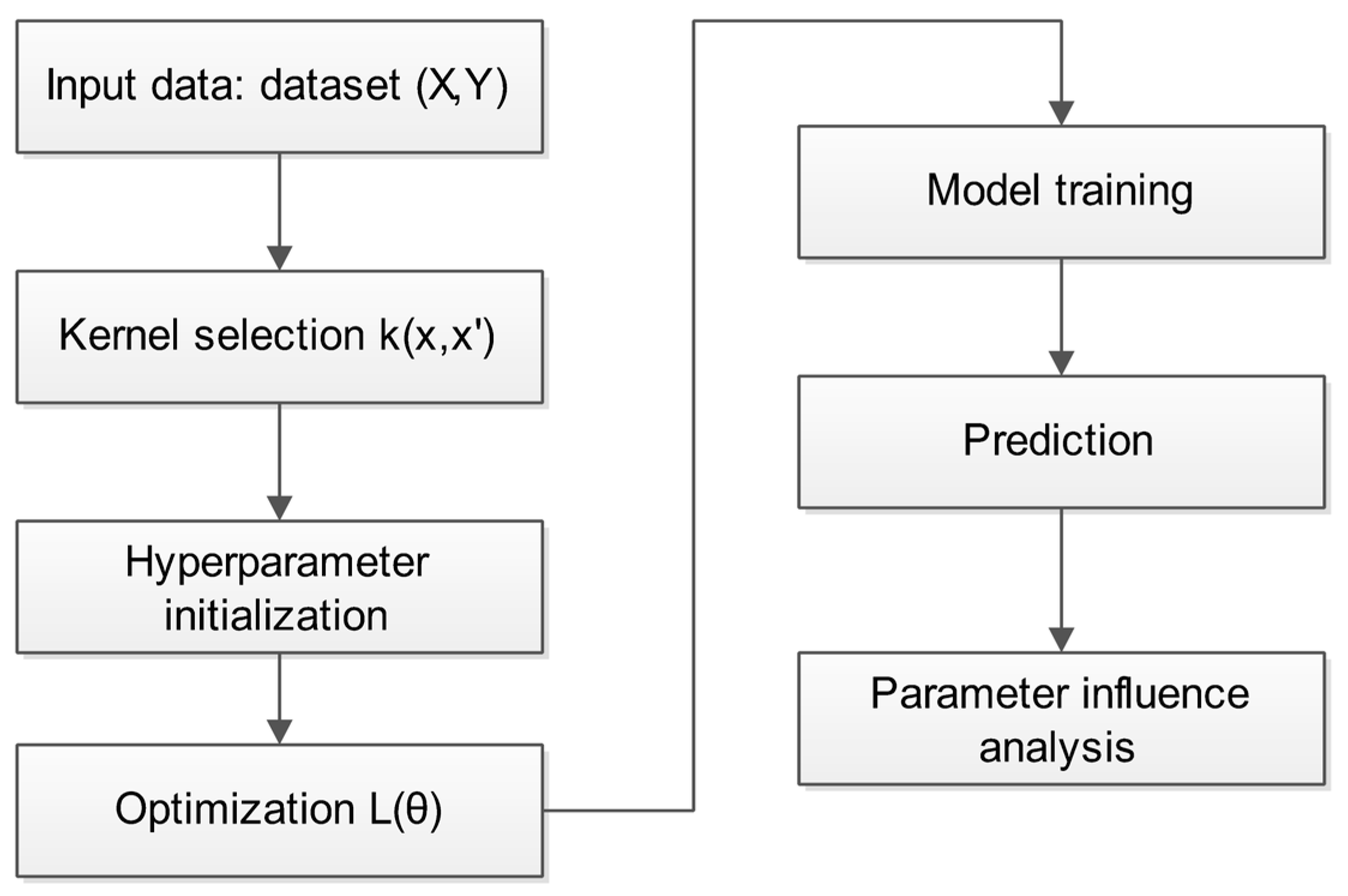
Gaussian process regression (GPR) is a Bayesian non-parametric model that defines a prior over functions and, using observed data, computes a posterior predictive distribution [23]. In this study, the dataset obtained from a Taguchi L18 design, consisting of input combinations of tool material, discharge current, and pulse duration with corresponding responses (Ra, MRR, OC), was used to train and validate the GPR model. The overall workflow is illustrated in Figure 2, starting from the dataset, followed by the selection of the covariance (kernel) function and optimization of hyperparameters, and ending with the prediction of the mean response and its uncertainty. GPR was selected because it performs well on small, structured datasets, naturally controls model complexity through its Bayesian formulation, and provides explicit predictive uncertainty. The ARD RBF kernel was chosen to allow flexible modeling of nonlinear EDM behavior while capturing the relative importance of each input parameter, providing physically meaningful differentiation between factors. The suitability of this approach was confirmed through strict leave-one-out cross-validation (LOOCV), which ensures maximum utilization of the dataset and robust estimation of predictive performance. A standard isotropic RBF kernel was also considered during preliminary analysis, but the ARD variant consistently achieved lower prediction error and more stable predictive uncertainty across all experiments [24]. Consequently, the model provides reliable predictions within the investigated parameter ranges, while extrapolation beyond these ranges is associated with increased uncertainty and potentially reduced accuracy.
In second step, the covariance function k x , x , also known as the kernel, is defined to describe the correlation between pairs of data points in the input space. The kernel determines the smoothness and generalization behavior of the Gaussian Process model. In this study, the anisotropic squared-exponential (ARD RBF) kernel was employed, expressed in Equation (2), with log (Gaussian) measurement noise in Equation (3).
k x , x = σ f 2 e x p 1 2 I I l I 2 + t t l t 2 + m m l m 2 ,
k x , x o b s = k x , x + σ n 2 δ x x .
In Equation (2), k x , x is the ARD RBF kernel that measures similarity between two input points x = I , t , m and x = I , t , m where I is discharge current,   t is pulse duration, and m ϵ 0 , 1 encodes the tool material (0 = copper, 1 = graphite). The parameter σ f 2 is the signal variance (overall amplitude), while l I , l t , l m   are length scales controlling how quickly the response changes along each input dimension (smaller means stronger sensitivity). The exponential of the scaled squared distance yields large covariance for nearby points and decreases towards zero as they separate, enforcing a smooth prior over EDM response functions. Equation (3) augments this kernel with measurement noise, where σ n 2 is the noise variance added only on the diagonal via the Kronecker delta δ x x (1 if x = x , 0 otherwise). Together, Equations (2) and (3) define the covariance of the Gaussian process used to compute predictive means and uncertainties.
The kernel in Equation (1) defines the similarity only. To obtain the predictive equation, the alpha parameters are defined. These are not added parametric kernels but weights calculated from the data after the kernel hyperparameters are determined. They sum the contribution of each training example to the prediction, using Equation (4).
y ^ = i = 1 n α i k x , x i ,    α = K + σ n 2 I 1 y .    
In the third step, the kernel hyperparameters are initialized before model optimization. These include the signal variance η   o r   σ f 2 , the noise variance σ 2 , and the characteristic length-scales l i for each input. Sensible initialization provides the optimizer a good starting point and promotes stable convergence to hyperparameters that fit the experimental data well.
In the fourth step, the GPR hyperparameters θ = l i , σ f 2 , σ n 2 are estimated by maximizing the log marginal probability of the data. This balances data fit and smoothness and helps prevent overfitting. The objective function is presented in Equation (5):
l o g p y X , θ = 1 2 y T K θ 1 y 1 2 l o g K θ N 2 l o g 2 π ,
where K θ = K X , X ; l i ,   σ f 2 is the covariance from the chosen kernel plus noise. Maximizing this probability yields hyperparameters that best explain the experimental data.
After estimating the optimal hyper-parameters, the GPR model is fit to the data by forming the covariance matrix with the optimized kernel. This yields a learned posterior over functions that links inputs to responses. The trained model is then used for prediction and uncertainty quantification in the subsequent analysis.
With the optimized hyperparameters, the trained GPR model predicts responses for new inputs x = I , t , m . For each x , it returns the predictive mean (expected response) and variance (uncertainty), as shown in Equation (6):
μ x = k K 1 y ,   σ 2 x = k x , x k T K 1 k ,
where k = x , X is the covariance vector between x and the training inputs X , and K = K X , X + σ n 2 I is the training covariance (kernel plus noise). This provides both point predictions and quantified confidence for each setting.
The sixth and final step is parameter influence analysis. Input importance is inferred from the ARD length scales l i learned by GPR. A smaller l i indicates a stronger influence of input x i , whereas a larger l i implies a weaker effect. A simple quantitative ranking uses normalized sensitivities, as expressed in Equation (7).
w i = 1 l i j 1 l j .
In Equation (7), w i represents the normalized influence weight of the input factors ( I , t , m ). Higher values of w i indicate a stronger relative importance. The weights are dimensionless and normalized such that i w i = 1 .
This analysis provides a clear understanding of how each parameter shapes the process behavior and creates a basis for comparing and interpreting the model outcomes. By quantifying the relative influence of the inputs, it becomes clear which factors most strongly affect Ra, MRR, and OC in the Taguchi L18 experiments. In this way, the theoretical GPR formulation is directly linked to its behavior on the experimental dataset.

3. Results and Discussion

3.1. GPR Configuration and Learned Hyperparameters

Gaussian process regression was selected as the surrogate modeling approach due to its ability to accurately model nonlinear relationships in manufacturing processes using limited experimental data. Unlike conventional regression techniques, GPR does not require an explicit functional form and inherently controls model complexity through Bayesian inference. Furthermore, the predictive uncertainty provided by GPR allows explicit assessment of model reliability within the investigated parameter domain, which is particularly relevant for EDM process modeling.
The setup of the GPR model used to describe EDM performance is presented. The selected kernel, model parameters, and the training and data standardization procedures are described based on the experimental design and measurements. The optimized parameters with brief plausibility checks are also reported. These steps form the basis for subsequent validation, influence analysis, and multi-objective optimization.
Instead of classical ANOVA-based significance testing, parameter effects in this study are assessed using the ARD mechanism of the GPR model. In ARD-based kernels, each input variable has a separate length scale parameter, whose learned value provides a model-based measure of input relevance and sensitivity within the investigated domain. Shorter length scales indicate a stronger influence of a given parameter on the model response, while longer length scales correspond to weaker or smoother effects [24,25]. The observed differences in ARD length scales, together with the consistent trends identified in the main effect plots, indicate that the selected parameters and their investigated ranges have a meaningful influence on Ra, MRR, and OC. This confirms that variations within the chosen parameter window significantly affect the process responses and supports the relevance of the subsequent multi-objective optimization.
Table 3 reports the learned hyperparameters l I , l t , l m , σ f ,   a n d   σ n of the ARD RBF kernel used in the model (Equation (1)) with white Gaussian noise (Equation (2)). The values were obtained by maximizing the log marginal probability (Equation (3)).
The parameters σ f and σ n are reported as standard deviations, while the kernel uses σ f 2 and σ n 2 . The tool material is encoded as m = 0 for copper and m = 1 for graphite. Smaller length scales l I , l t , l m indicate the stronger influence of the corresponding input, whereas larger values indicate weaker influence. All inputs were standardized before training so that hyperparameters are comparable across dimensions.
Table 4 reports the learned weight coefficients αi for all 18 experiments and for each output. The coefficients were computed according to Equation (4) and represent the contribution of each training point to the predictive mean used in the subsequent expressions for the three responses.
For all three output characteristics, the predictive equations follow Equations (2) and (3), using the learned hyperparameters and the associated weight coefficients. An example equation for the Ra response is shown in Equation (8).
R ^ a I e , t , m = i = 1 18 α i σ f 2 e x p 1 2 I I l I 2 + t t l t 2 + m m l m 2 .
By inserting the coefficients from Table 3 and Table 4 for Ra, a mathematical expression is obtained. Equation (9) shows the partially unwrapped form, the first few terms. For m = 0, it is copper, and for m = 1, it is graphite. The noise σn = 0.1032 is used during learning but does not influence the prediction mean itself.
R ^ a I e , t , m = 2.261 2 [ 1.894 e 1 2 I 13 0.976 2 + t 7 3.373 2 + m 0 3.361 2 2.714 e 1 2 I 5 0.976 2 + t 7 3.373 2 + m 0 3.361 2 1.034 e 1 2 I 5 0.976 2 + t 2 3.373 2 + m 0 3.361 2 2.011 e 1 2 I 13 0.976 2 + t 5 3.373 2 + m 0 3.361 2 + 5.910 e 1 2 I 9 0.976 2 + t 2 3.373 2 + m 0 3.361 2 + + 3.059 e 1 2 I 13 0.976 2 + t 2 3.373 2 + m 0 3.361 2 + ]
Equation (9) illustrates the Ra prediction as an example, where only a portion of the full expanded expression is shown due to its length. Following the same procedure, analogous predictive equations can be obtained for MRR and OC.

3.2. Predictive Accuracy and Validation

Despite the compact experimental dataset, reliable prediction is achieved through the combined use of a structured Taguchi L18 design, the Bayesian formulation of GPR, and strict leave-one-out cross-validation. GPR is well-suited for small experimental datasets because its Bayesian framework naturally controls model complexity through marginal likelihood optimization, while LOOCV ensures robust and unbiased error estimation despite the limited number of experiments. In addition, the predictive variance provided by the GPR model offers an explicit measure of uncertainty, which increases toward the boundaries of the experimental domain and reflects the underlying data density. This combination enables stable model behavior and controlled generalization within the investigated parameter range.
The standardization of input and output data was applied carefully to avoid information leakage during validation. At each step of the leave-one-out procedure, the standardization parameters (mean and standard deviation) were computed exclusively from the remaining 17 training samples, while the excluded experiment was standardized using these values. This procedure prevents the transfer of information from the test point to the training set and provides a realistic assessment of the model’s generalization ability.
In practice, leave-one-out cross-validation (LOOCV) was implemented by iteratively excluding one experiment from the dataset, training the GPR model on the remaining 17 experiments, and using the excluded point for validation, such that all 18 experiments were used once as independent test samples.
For a dataset containing only 18 experiments, k-fold cross-validation would further reduce the size of the training set and increase the variability of the error estimate. In contrast, LOOCV ensures maximum utilization of the available data at each validation step and provides a more stable and consistent estimate of predictive performance, which is particularly important for GPR models that are sensitive to data density in the input domain. Consequently, model accuracy is intrinsically linked to the selected parameter ranges and is guaranteed only within the investigated experimental domain.
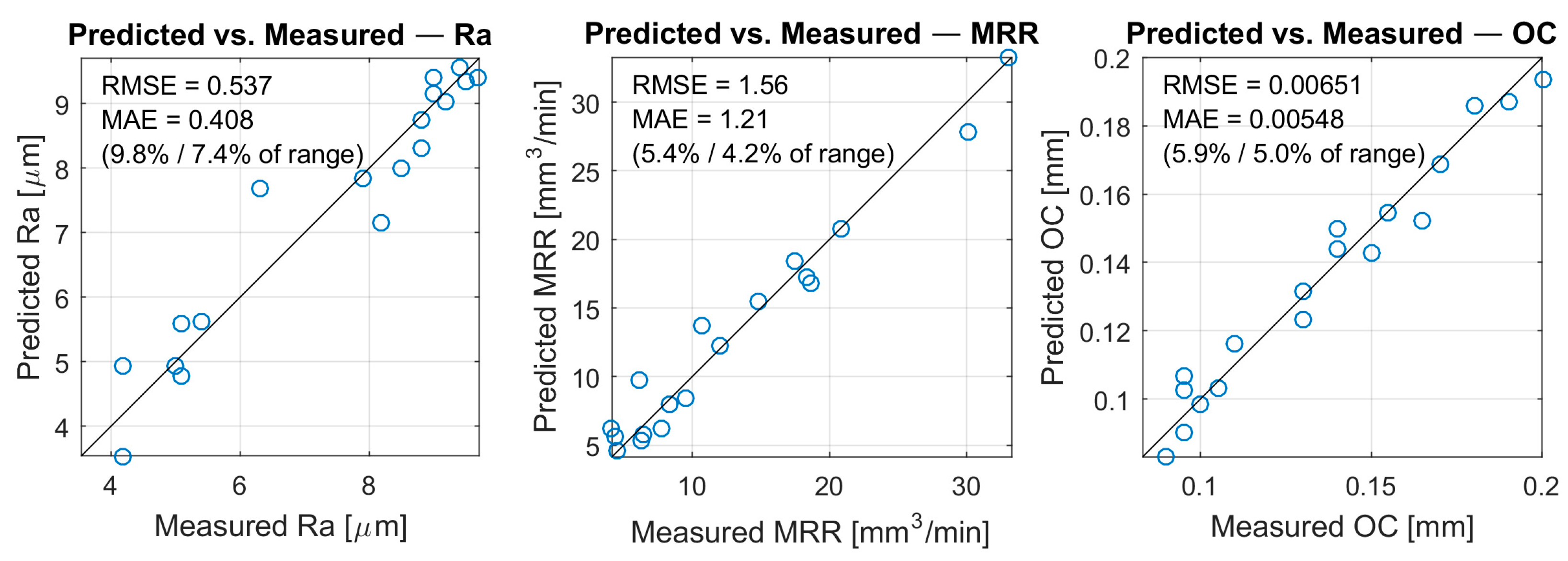
Table 5 summarizes the generalization performance of GPR models under LOOCV. For each response (Ra (µm), MRR (mm3/min), OC (mm)), RMSE is reported as the square root of the average squared prediction error, and MAE as the average absolute difference between predicted and observed values, together with their percentages relative to the observed response range. RMSE indicates the typical size of prediction errors while giving more influence to larger deviations, whereas MAE represents the average absolute prediction error [26].
The errors are small in absolute terms and moderate in relative terms: about 9.8% and 7.4% for Ra, 5.4% and 4.2% for MRR, and 5.9% and 5.0% for OC. These errors indicate stable predictive behavior without material overfitting. The residuals are randomly distributed around zero, indicating that the model does not systematically make mistakes in any part of the data. The errors were evenly distributed around zero, with no clear trend relative to the predicted values or input parameters. This indicates that the model does not favor any particular region of the data and consistently predicts Ra, MRR, and OC within the examined range.
These results agree with the plots in Figure 3, where most predicted points lie close to the 45° line, with only a slight underestimation at the highest MRR values. The predictive intervals also behave consistently: most measured values fall within the model’s ± 2σ bounds, showing that the GPR uncertainty estimates are well calibrated and reflect the actual variability of the process.
The largest errors occur at the extreme values of discharge current and pulse duration because the model has the least amount of data to train in these zones. This is the expected behavior of a GPR model. Predictions are most reliable in the middle of the experimental domain, where the data density is highest, while at the edges, they are somewhat less accurate due to the limited number of points. This behavior is typical for GPR models trained on small experimental datasets, where limited data near the edges of the design space can slightly reduce prediction accuracy.
When compared with similar studies in EDM modeling using Gaussian processes, the obtained errors fall within or below the ranges typically reported in the literature. Previous works commonly report RMSE values of about 10% of the response range for surface roughness and MRR prediction using GPR or related probabilistic surrogate models [27,28]. The present results, therefore, confirm that the ARD-RBF GPR model captures the nonlinear EDM behavior effectively even with a compact L18 dataset. Overall, the LOOCV results demonstrate that the model generalizes well and provides a reliable basis for subsequent influence analysis and multi-objective optimization.

3.3. Parameter Influence Analysis (ARD)

Table 6 presents the automatic relevance determination (ARD) influence weights wI, wt, and wm and the corresponding length-scales lI, lt, and lm for the GPR model. Influence weights indicate the relative importance of each input variable: discharge current (Ie), pulse duration (ti), and electrode material (m) for predicting output performances. Higher weights correspond to greater relevance. Length-scales reflect the model’s sensitivity to each input parameter: smaller l values indicate higher significance, while larger values suggest reduced influence.
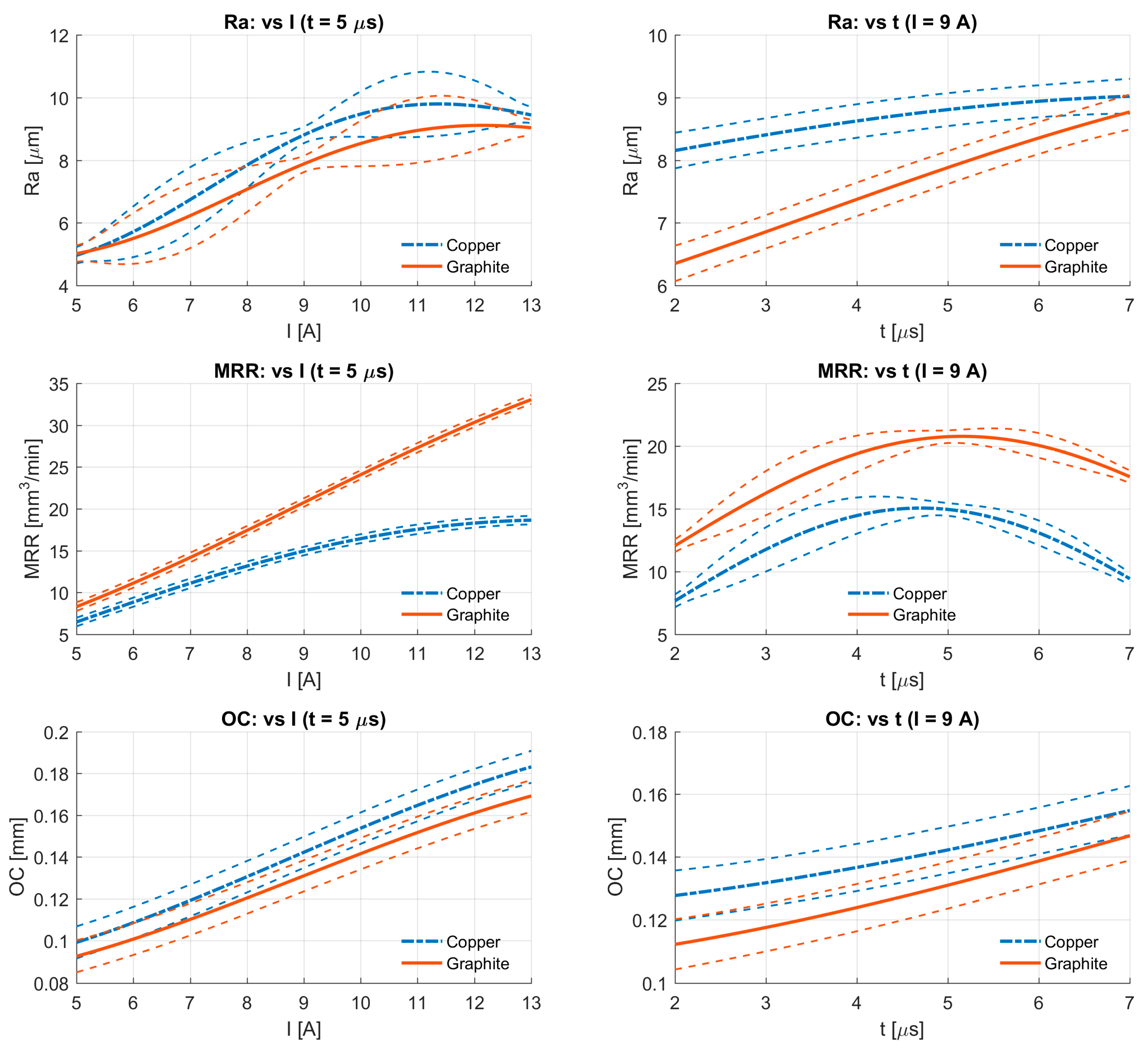
The ARD values in Table 6 indicate the relative importance of each input parameter for predicting Ra, MRR, and OC. To visualize these effects more clearly, the main effect curves are shown in Figure 4. These figures show how the predicted responses change with discharge current, pulse duration, and tool material. In addition, plots provide an intuitive interpretation of the ARD ranking and allow visual comparison of parameter influence across the three outputs.
For Ra, the discharge current exhibits the strongest slope in the curves, matching its highest ARD weight (wI = 0.644). Both pulse duration and tool material show noticeably smaller gradients, which correspond to their lower influence. This agrees with the physical behavior of EDM, where higher discharge energy primarily increases crater size and surface peaks, thus raising surface roughness [29].
For MRR, the main effect curves follow the ARD ranking: tool material has the largest impact (wm = 0.420), reflected by consistently higher predicted MRR values for graphite across all combinations of discharge current and pulse duration. Pulse duration has a moderate influence, while discharge current shows the smallest effect within the investigated range. These trends align with the expected thermal differences between copper and graphite, where graphite typically supports higher removal efficiency [30].
For OC, the plots again highlight discharge current as the dominant factor (wI = 0.544). The OC curves rise most steeply with current, while changes along the pulse duration axis are milder, and material-dependent differences remain small. This is consistent with the physics of EDM, where higher discharge current increases the plasma channel radius and leads to wider side-gap formation [31].
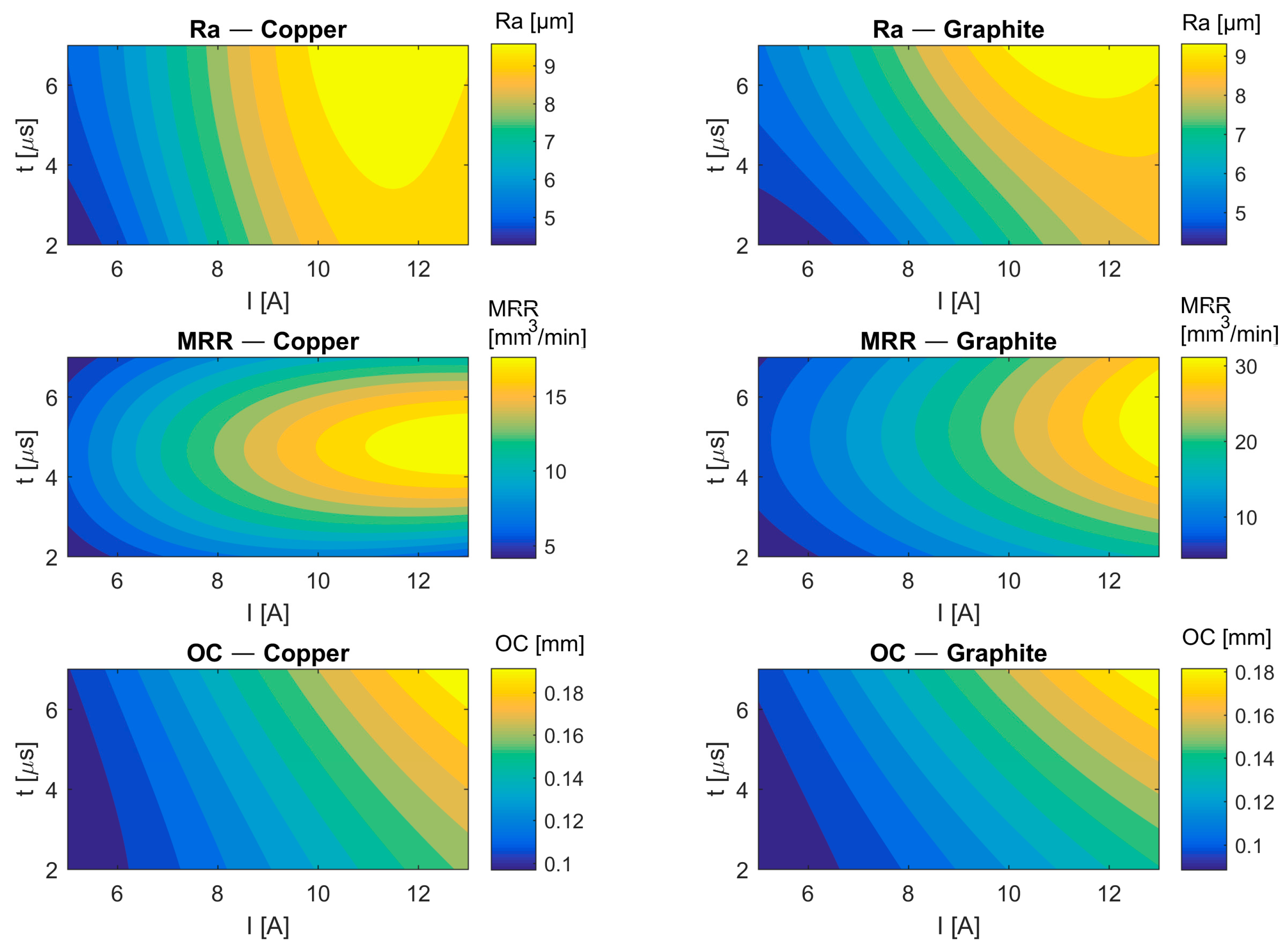
The 2D contour maps reinforce these conclusions (Figure 5). For Ra and OC, the steepest color transitions occur along the discharge current axis, indicating strong sensitivity, while the pulse duration axis varies more smoothly.
For MRR, the separation between the copper and graphite maps is visually clear, confirming the material is leading ARD influence. Overall, the figures match the ARD values and provide intuitive visual confirmation of the learned parameter relevance.

3.4. Multi-Objective Decision Analysis

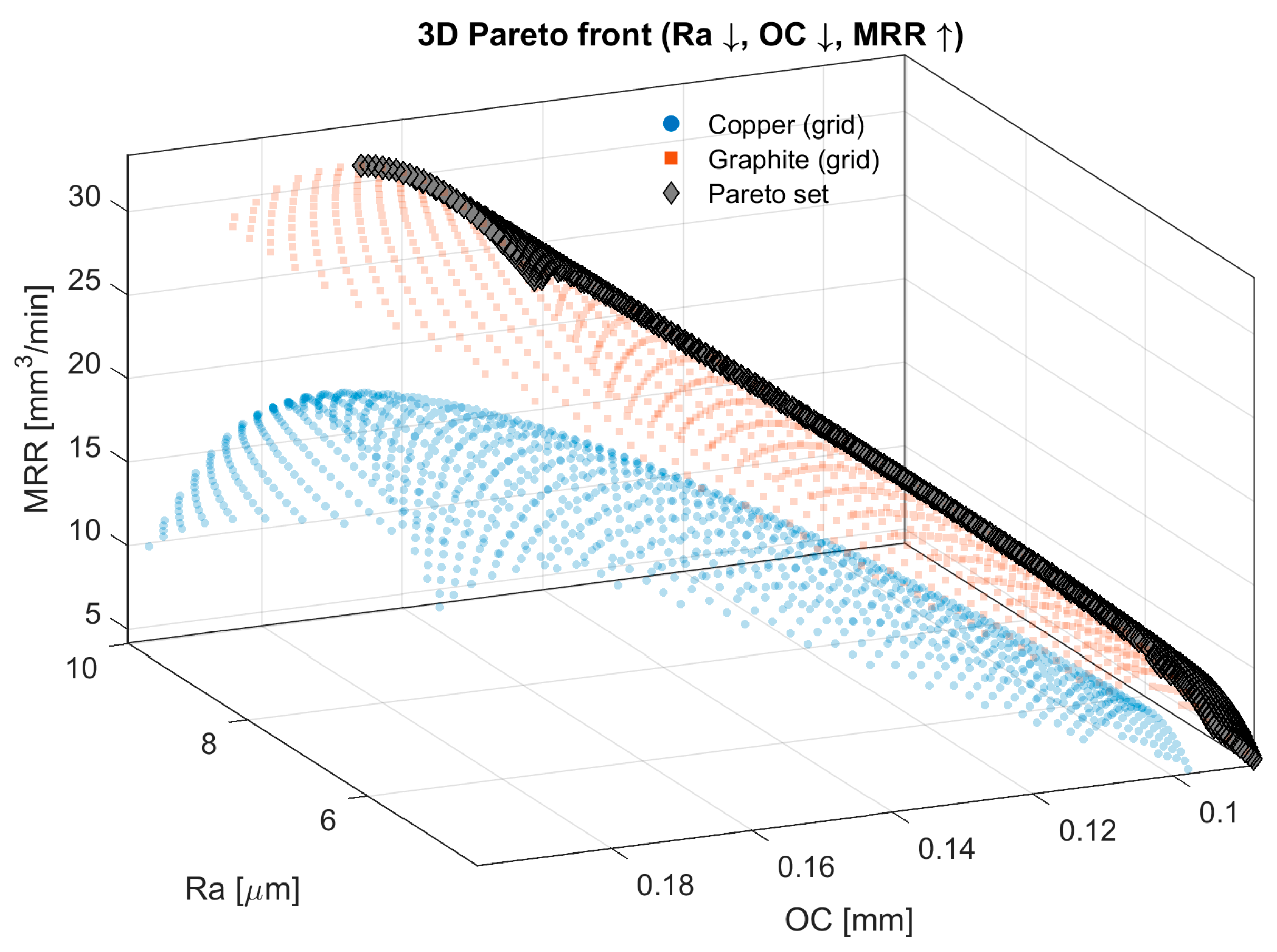
The GPR surrogate models were used to explore the balance between the three key EDM performance measures: minimizing Ra and OC while maximizing MRR. A dense prediction grid was generated over the full (Ie, ti, material) domain, and the non-dominated points were extracted to form the Pareto set. This approach identifies parameter combinations in which improving one objective would potentially worsen at least one other.
To focus on practically relevant conditions, the Pareto set was filtered using the application-oriented limits Ra ≤ 8 μm and OC ≤ 0.12 mm. These limits correspond to typical semi-finishing requirements in die-sinking EDM and are consistent with the achievable performance range observed in our experiments.
The quality limits were selected based on typical semi-finishing conditions reported in thd EDM literature. Studies commonly show surface roughness values between 4–10 µm in medium-energy die-sinking regimes [32], with finer settings achieving 2–6 µm [33]. Reported overcut values for similar cavity dimensions generally range from 0.10 to 0.15 mm [8], making OC ≈ 0.12 mm a practical limit for maintaining dimensional accuracy. These thresholds, therefore, represent realistic and industrially relevant criteria for evaluating feasible Pareto solutions.
The 3D Pareto front in Figure 6 illustrates the balanced surface predicted by the GPR model. Graphite-based settings dominate most of the feasible region: they achieve lower Ra and OC at equal or higher MRR compared to copper, which appears as a separate cluster of points. This separation reflects the physical differences between the two tool materials, primarily thermal conductivity and discharge energy distribution. Copper remains included because it is widely used in practice, but its Pareto points are located in regions with slightly higher roughness and lower productivity.
The representative Pareto candidates listed in Table 7 capture the main balanced categories: lowest Ra, lowest OC, highest MRR, and a knee point that provides the most balanced compromise. The knee solution is particularly useful for process planning because it offers a good balance between all three objectives without significantly sacrificing any of them. Overall, the multi-objective analysis shows that even with a compact Taguchi L18 dataset, the GPR models provide consistent and interpretable objective balances that support practical decision-making in die-sinking EDM.
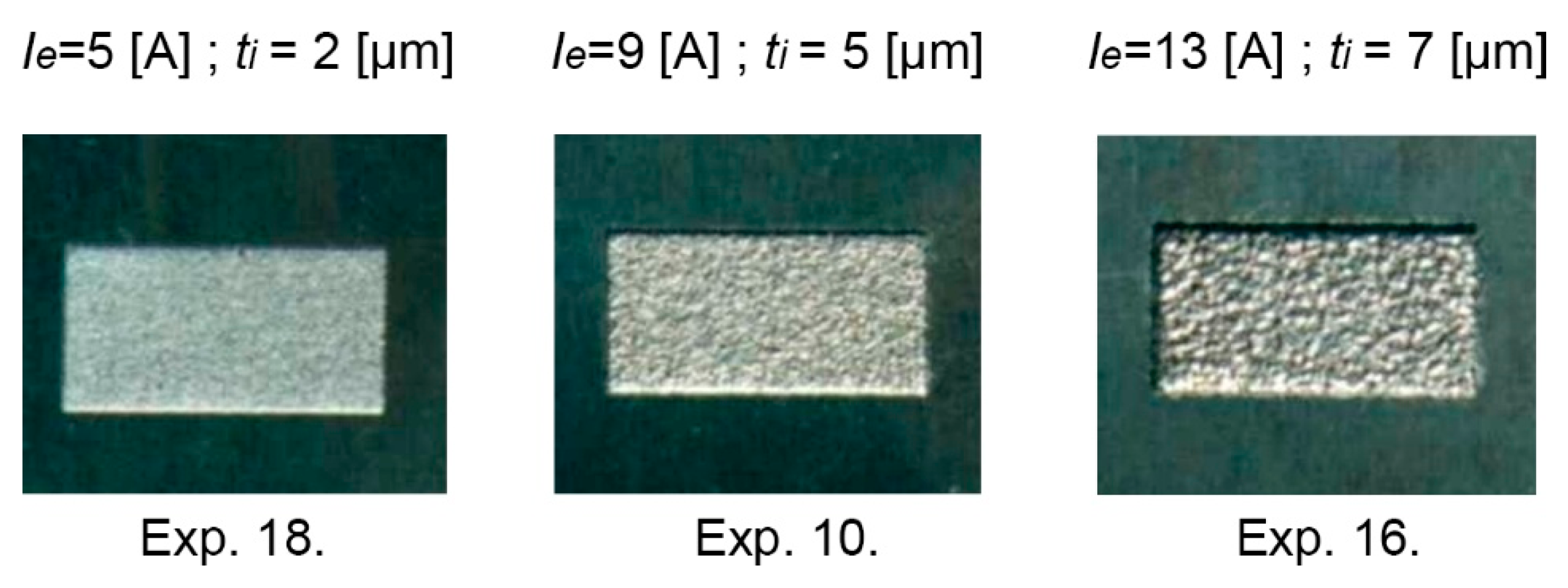
Figure 7 presents representative optical images of EDM-machined surfaces produced with graphite electrodes for three characteristic experiments from the Taguchi L18 design: Exp. 18 (Ie = 5 A, ti = 2 µs), Exp. 10 (Ie = 9 A, ti = 5 µs), and Exp. 16 (Ie = 13 A, ti = 7 µs). These conditions correspond to low-, medium-, and high-energy discharge regimes, respectively. The images illustrate the progressive change in surface texture with increasing discharge energy, characterized by more pronounced craters and surface irregularities at higher energy levels.
The observed surface features are consistent with the measured roughness values and reflect the underlying EDM discharge behavior across the investigated parameter range. Graphite electrodes are shown as representative cases due to their dominant presence in the feasible operating region identified in the study and their clear manifestation of surface morphology evolution.

3.5. Limitations and Practical Implications

Although the GPR-based modeling framework provides consistent and interpretable predictions, certain limitations should be noted. The Taguchi L18 design includes only 18 experimental points, which inevitably restricts the model’s resolution, especially near the edges of the design space where fewer data points are available. As a result, prediction uncertainty increases in regions far from the tested combinations of discharge current and pulse duration. The model also does not incorporate electrode wear, flushing efficiency, or transient thermal effects, which may influence process behavior under extended machining conditions. These limitations highlight areas for future research.
The experimental work was conducted under controlled laboratory conditions and with a fixed discharge voltage, duty factor and positive electrode polarity. Consequently, the findings apply to operating windows that follow similar constraints. Additional experiments with different polarities, flushing modes, or deeper cavities would further improve the generality of the model. Moreover, the categorical electrode material variable is limited to copper and graphite; extending the study to coated electrodes or mixed-material tools could reveal additional trends.
Despite these constraints, the practical relevance of the results is substantial. The recommended parameter combinations listed in Table 8 (low-Ra, low-OC, high-MRR, and knee-point categories) provide actionable guidance for selecting operating points that balance quality and productivity. These settings were extracted from the feasible Pareto set and satisfy the imposed quality limits (Ra ≤ 8 μm and OC ≤ 0.12 mm), making them directly usable in semi-finishing EDM applications. Graphite electrodes achieve superior combinations of Ra, MRR, and OC in the explored domain, while copper remains a viable alternative when cost, availability or wear considerations are important.
Given the limited number of experimental samples, the use of additional data-driven modeling techniques was intentionally avoided to prevent overfitting and ensure statistically robust model interpretation.
Overall, the study shows that a compact and economical experimental plan, when combined with GPR modeling, can produce reliable predictive tools for process planning, optimization and parameter selection. With additional experiments or expanded factor ranges, this methodology can be readily adapted to broader EDM conditions and other nonconventional machining processes.

4. Conclusions

This study developed Gaussian process regression (GPR) models for predicting surface roughness (Ra), material removal rate (MRR), and overcut (OC) in die-sinking EDM using a Taguchi L18 experimental design. The models demonstrated high predictive accuracy, with LOOCV confirming stable performance across the input domain and increased uncertainty only near the design-space boundaries. Automatic relevance determination (ARD) showed that the discharge current is the dominant factor affecting all three responses, while the pulse duration and electrode material indicate secondary but important contributions.
The GPR models were used to generate multi-objective predictions and to identify a feasible balance between Ra, MRR, and OC. By applying practical quality limits (Ra ≤ 8 µm and OC ≤ 0.12 mm), a filtered Pareto set was obtained, from which representative operating points were extracted. These solutions include settings that minimize surface roughness and overcut, maximize productivity, or provide a balanced compromise (knee point). Graphite electrodes generally yields superior performance in the examined domain, although copper remains a viable option when tool wear, cost, or geometry considerations dominate.
The results show that reliable, uncertainty-aware modeling of EDM performance can be achieved even with a small experimental dataset. The proposed framework provides actionable guidance for parameter selection in semi-finishing die-sinking EDM and can support process planning in practical applications. Future work should extend the experimental space, include additional electrode materials or flushing conditions, and explore hybrid modeling approaches that combine GPR with physics-informed features to further enhance prediction robustness.

Author Contributions

Conceptualization, D.R. and M.S.; methodology, D.R. and A.A.; software, A.K.; validation, M.S., B.S., and V.B.; formal analysis, A.A.; investigation, A.K. and A.A.; resources, M.S. and B.S.; data curation, A.K.; writing—original draft preparation, A.A.; writing—review and editing, D.R. and M.S.; visualization, A.K.; supervision, D.R.; project administration, D.R.; funding acquisition, D.R. All authors have read and agreed to the published version of the manuscript.

Funding

This research was supported by the Ministry of Science, Technological Development and Innovation (Contract No. 451-03-137/2025-03/200156) and the Faculty of Technical Sciences, University of Novi Sad, through the project “Scientific and Artistic Research Work of Researchers in Teaching and Associate Positions at the Faculty of Technical Sciences, University of Novi Sad 2025” (No. 01-50/295).

Institutional Review Board Statement

Not applicable.

Informed Consent Statement

Not applicable.

Data Availability Statement

All data supporting the findings of this study are included in the article.

Acknowledgments

The authors would like to thank the Ministry of Science, Technological Development, and Innovation of the Republic of Serbia and the Faculty of Technical Sciences, University of Novi Sad, for their institutional support. The authors also acknowledge the technical and administrative assistance provided during the execution of the experimental work and manuscript preparation.

Conflicts of Interest

The authors declare no conflicts of interest.

References

  1. Tufail, M.; Giri, J.; Makki, E.; Sathish, T.; Chadge, R.; Sunheriya, N. Machinability of different cutting tool materials for electric discharge machining: A review and future prospects. AIP Adv. 2024, 14, 040702. [Google Scholar] [CrossRef]
  2. Ming, W.; Zhang, G.; Li, H.; Guo, J.; Zhang, Z.; Huang, Y.; Chen, Z. A hybrid process model for EDM based on finite-element method and Gaussian process regression. Int. J. Adv. Manuf. Technol. 2014, 74, 1197–1211. [Google Scholar] [CrossRef]
  3. Stepanić, P.; Dučić, N.; Stanković, N. Development of Artificial Neural Network models for vibration classification in machining process on Brownfield CNC machining center. J. Prod. Eng. 2024, 27, 16–20. [Google Scholar] [CrossRef]
  4. Selvam, R.; Vignesh, M.; Pugazhenthi, R.; Anbuchezhiyan, G.; Satyanarayana Gupta, M. Effect of process parameter on wire cut EDM using RSM method. Int. J. Interact. Des. Manuf. (IJIDeM) 2024, 18, 2957–2968. [Google Scholar] [CrossRef]
  5. Sahu, J.; Shrivastava, S. Fuzzy based multi-response optimization: A case study on EDM machining process. SN Appl. Sci. 2021, 3, 701. [Google Scholar] [CrossRef]
  6. Qasem, I.; Alsakarneh, A. Machine learning-based prediction of EDM material removal rate and surface roughness. J. Manuf. Mater. Process. 2025, 9, 274. [Google Scholar] [CrossRef]
  7. Hasan, M.M.; Saleh, T.; Sophian, A.; Rahman, M.A.; Huang, T.; Mohamed Ali, M.S. Experimental modeling techniques in electrical discharge machining (EDM): A review. Int. J. Adv. Manuf. Technol. 2023, 127, 2125–2150. [Google Scholar] [CrossRef]
  8. Hemalatha, S.; Anusha, K. Optimization of machining parameters material removal rate and surface roughness by using reponse surface methodology and Grey Taguchi technique on Electric Discharge Machine. Next Mater. 2025, 6, 100504. [Google Scholar] [CrossRef]
  9. Samantra, C.; Barua, A.; Pradhan, S.; Kumari, K.; Pallavi, P. Parametric investigation of die-sinking EDM of Ti6Al4V using the hybrid Taguchi-RAMS-RATMI method. Appl. Sci. 2024, 14, 7139. [Google Scholar] [CrossRef]
  10. Ma, J.; Yin, C.; Li, X.; Han, X.; Ming, W.; Chen, S.; Cao, Y.; Liu, K. Optimization of EDM process parameters based on variable-fidelity surrogate model. Int. J. Adv. Manuf. Technol. 2022, 122, 2031–2041. [Google Scholar] [CrossRef]
  11. Zhang, Y.; Xu, X. Predicting the material removal rate during electrical discharge diamond grinding using the Gaussian process regression: A comparison with the artificial neural network and response surface methodology. Int. J. Adv. Manuf. Technol. 2021, 113, 1527–1533. [Google Scholar] [CrossRef]
  12. Manjaiah, M.; Laubscher, R.F.; Kumar, A.; Basavarajappa, S. Parametric optimization of MRR and surface roughness in wire electro discharge machining (WEDM) of D2 steel using Taguchi-based utility approach. Int. J. Mech. Mater. Eng. 2016, 11, 7. [Google Scholar] [CrossRef]
  13. Sultan, T.; Kumar, A.; Gupta, R.D. Material removal rate, electrode wear rate, and surface roughness evaluation in die sinking EDM with hollow tool through response surface methodology. Int. J. Manuf. Eng. 2014, 2014, 259129. [Google Scholar] [CrossRef]
  14. Hashemitaheri, M.; Mekarthy, S.M.R.; Cherukuri, H. Prediction of specific cutting forces and maximum tool temperatures in orthogonal machining by support vector and Gaussian process regression methods. Procedia Manuf. 2020, 48, 1000–1008. [Google Scholar] [CrossRef]
  15. Chen, Y.; Guo, X.; Zhang, G.; Cao, Y.; Shen, D.; Li, X.; Zhang, S.; Ming, W. Development of a hybrid intelligent process model for micro-electro discharge machining using the TTM-MDS and gaussian process regression. Micromachines 2022, 13, 845. [Google Scholar] [CrossRef]
  16. Küpper, U.; Klink, A.; Bergs, T. Data-driven model for process evaluation in wire EDM. CIRP Ann. 2023, 72, 169–172. [Google Scholar] [CrossRef]
  17. Shastri, R.K.; Mohanty, C.P.; Dash, S.; Gopal, K.M.P.; Annamalai, A.R.; Jen, C.-P. Reviewing performance measures of the die-sinking electrical discharge machining process: Challenges and future scopes. Nanomaterials 2022, 12, 384. [Google Scholar] [CrossRef]
  18. Yuan, J.; Wang, K.; Yu, T.; Fang, M. Reliable multi-objective optimization of high-speed WEDM process based on Gaussian process regression. Int. J. Mach. Tools Manuf. 2008, 48, 47–60. [Google Scholar] [CrossRef]
  19. ASTM A681; Standard Specification for Tool Steels Alloy. ASTM: West Conshohocken, PA, USA, 2022.
  20. Rodić, D.; Gostimirović, M.; Sekulić, M.; Savković, B.; Aleksić, A. Fuzzy logic approach to predict surface roughness in powder mixed electric discharge machining of titanium alloy. Stroj. Vestn.-J. Mech. Eng. 2023, 69, 376–387. [Google Scholar] [CrossRef]
  21. Pardo, S.A.; Pardo, Y.A. Empirical Modeling and Data Analysis for Engineers and Applied Scientists; Springer: Basel, Switzerland, 2016. [Google Scholar]
  22. El Majdoub, W.; Hamza Daud, M.; Sztankovics, I. Form accuracy and cutting forces in turning of X5CrNi18-10 shafts: Investigating the influence of thrust force on roundness deviation under low-feed machining conditions. J. Prod. Eng. 2025, 28, 26–33. [Google Scholar] [CrossRef]
  23. Bernardo, J.; Berger, J.; Dawid, A.; Smith, A. Regression and classification using Gaussian process priors. Bayesian Stat. 1998, 6, 475. [Google Scholar]
  24. Williams, C.K.; Rasmussen, C.E. Gaussian Processes for Machine Learning; MIT Press: Cambridge, MA, USA, 2006; Volume 2. [Google Scholar]
  25. Paananen, T.; Piironen, J.; Andersen, M.R.; Vehtari, A. Variable selection for Gaussian processes via sensitivity analysis of the posterior predictive distribution. In Proceedings of the 22nd International Conference on Artificial Intelligence and Statistics, Okinawa, Japan, 16–18 April 2019; pp. 1743–1752. [Google Scholar]
  26. Hyndman, R.J.; Koehler, A.B. Another look at measures of forecast accuracy. Int. J. Forecast. 2006, 22, 679–688. [Google Scholar] [CrossRef]
  27. Saha, S.; Gupta, K.K.; Maity, S.R.; Dey, S. Data-driven probabilistic performance of Wire EDM: A machine learning based approach. Proc. Inst. Mech. Eng. Part B J. Eng. Manuf. 2022, 236, 908–919. [Google Scholar] [CrossRef]
  28. Hao, Z.; Cheng, G.; Fan, Y. Research on surface roughness prediction in turning Inconel 718 based on Gaussian process regression. Phys. Scr. 2022, 98, 015216. [Google Scholar] [CrossRef]
  29. Schulze, H.-P.; Herms, R.; Juhr, H.; Schaetzing, W.; Wollenberg, G. Comparison of measured and simulated crater morphology for EDM. J. Mater. Process. Technol. 2004, 149, 316–322. [Google Scholar] [CrossRef]
  30. Amorim, F.L.; Weingaertner, W.L. The behavior of graphite and copper electrodes on the finish die-sinking electrical discharge machining (EDM) of AISI P20 tool steel. J. Braz. Soc. Mech. Sci. Eng. 2007, 29, 366–371. [Google Scholar] [CrossRef]
  31. Shabgard, M.; Ahmadi, R.; Seyedzavvar, M.; Oliaei, S.N.B. Mathematical and numerical modeling of the effect of input-parameters on the flushing efficiency of plasma channel in EDM process. Int. J. Mach. Tools Manuf. 2013, 65, 79–87. [Google Scholar] [CrossRef]
  32. Belgassim, O.; Abusada, A. Optimization of the EDM parameters on the surface roughness of AISI D3 tool steel. In Proceedings of Proceedings of the 2012 International Conference on Industrial Engineering and Operations Management, Istanbul, Turkey, 3–6 July 2012; pp. 3–6. [Google Scholar]
  33. Ishfaq, K.; Sana, M.; Waseem, M.U.; Ashraf, W.M.; Anwar, S.; Krzywanski, J. Enhancing EDM machining precision through deep cryogenically treated electrodes and ANN modelling approach. Micromachines 2023, 14, 1536. [Google Scholar] [CrossRef]
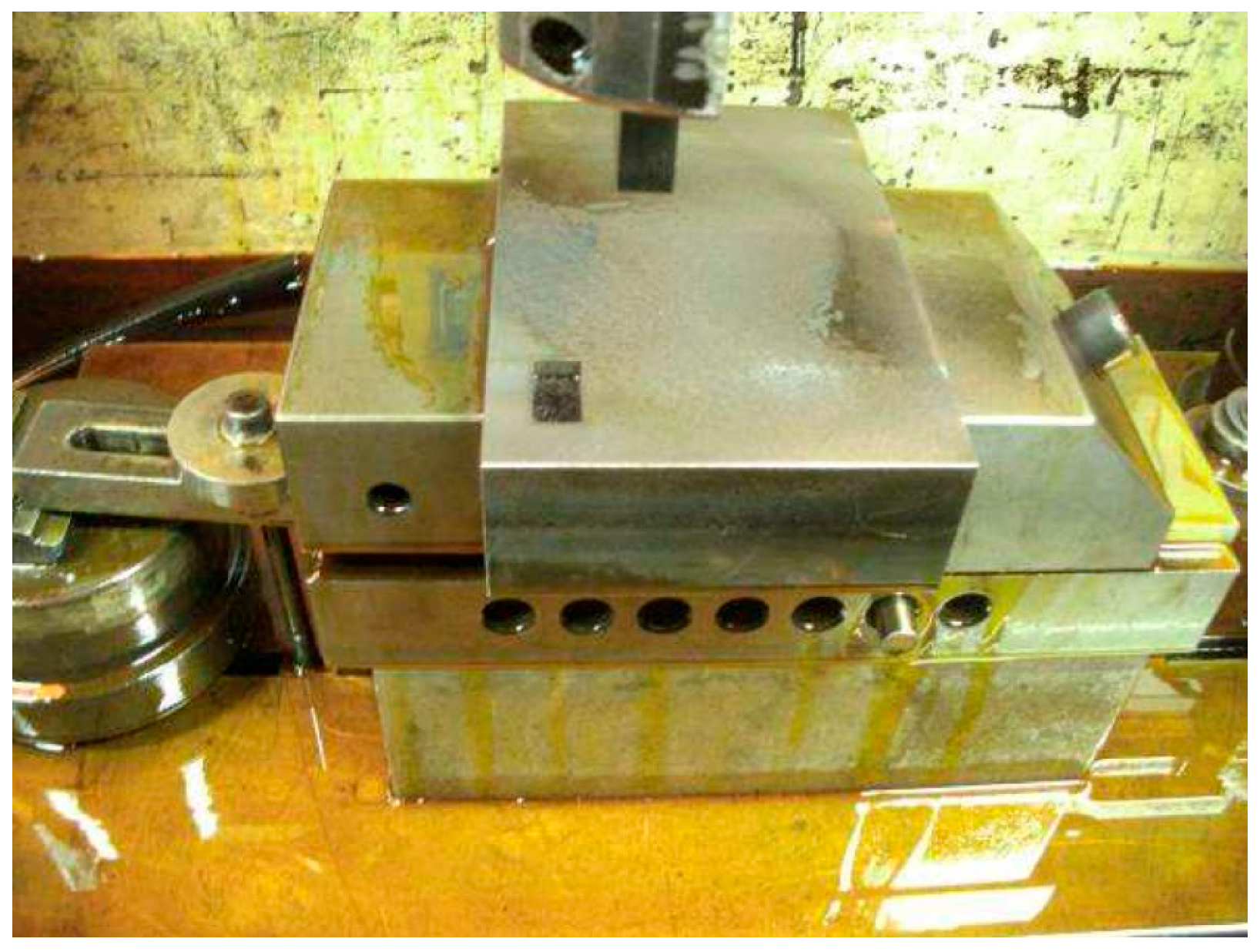
Figure 1. Experimental setup of the die-sinking EDM process.
Eng 07 00014 g001
Figure 2. Flowchart of the GPR procedure.
Eng 07 00014 g002
Figure 3. Predicted vs. measured responses for (left) Ra, (center) MRR, and (right) OC using leave-one-out cross-validation.
Eng 07 00014 g003
Figure 4. Main effect curves with uncertainty for Ra, MRR, and OC.
Eng 07 00014 g004
Figure 5. Two-dimensional contour maps of GPR mean predictions for Ra, MRR, and OC.
Eng 07 00014 g005
Figure 6. Three-dimensional Pareto front (minimize Ra and OC, maximize MRR).
Eng 07 00014 g006
Figure 7. Representative optical images of EDM-machined surfaces using a graphite electrode.
Eng 07 00014 g007
Table 1. EDM process parameters with value ranges and factor levels.
Machining ParameterLevel 1Level 2Level 3
Tool materialCopperGraphite-
Discharge current, Ie (A)5913
Pulse duration, ti (µs)257
Table 2. Taguchi L18 orthogonal array and factor levels.
No.Tool MaterialDischarge Current
(A)
Pulse
Duration
(µs)
Surface Roughness
(µm)
Material
Removal Rate
(mm3/min)
Overcut
(mm)
1.Copper1379.710.710.2
2.Copper575.14.310.105
3.Copper524.24.160.095
4.Copper1359.418.710.18
5.Copper928.27.710.13
6.Copper1329.26.130.165
7.Copper958.814.890.14
8.Copper9799.490.155
9.Copper555.16.470.1
10.Graphite957.920.780.13
11.Graphite575.46.320.095
12.Graphite926.312.050.11
13.Graphite135933.060.17
14.Graphite1328.518.360.14
15.Graphite5558.280.095
16.Graphite1379.530.050.19
17.Graphite978.817.510.15
18.Graphite524.24.550.09
Table 3. Learned hyperparameters for the GPR model.
Output l I l t l m σ f σ n
Ra0.9763.7373.3612.2610.103
MRR2.9341.7901.53315.2410.185
OC2.4494.6767.7780.0580.003
Table 4. Taguchi learned Gaussian process weight coefficients.
iα_Raα_MRRα_OCiα_Raα_MRRα_OC
m = 0 m = 1
1.1.894−0.181144.76410.−0.3130.009−20.318
2.−2.714−0.009189.88011.4.2110.015−143.862
3.−1.0340.00217.93612.−4.0490.001−220.082
4.−2.0110.018−221.72113.1.0150.06183.604
5.5.9100.017269.90314.−0.5330.145−310.265
6.3.059−0.117387.28415.−4.5840.01945.951
7.−1.9210.015−78.07416.1.6100.226−11.984
8.0.6310.007−19.80017.2.3210.004106.992
9.3.634−0.005−93.19618.1.9490.00416.461
Table 5. LOOCV RMSE and MAE with the percentage of the response range.
ResponseRMSEMAERMSE
(% of Range)
MAE
(% of Range)
Response Range
Ra0.536860.407849.76117.41535.5
MRR1.56251.20655.40674.174828.9
OC0.00651250.0054795.92054.98090.11
Table 6. ARD influence weights (and length-scales).
wIwtwmlIltlm
Ra0.6440.1680.1870.9763.7373.361
MRR0.2200.3600.4202.9341.7901.533
OC0.5440.2850.1712.4494.6767.778
Table 7. Representative Pareto candidates (minimize Ra and OC, maximize MRR).
Ie
[A]
ti
[µs]
MaterialRa
(µm)
MRR (mm3/min)OC
(mm)
RaSDMRRSDOCSD
5.002.0Graphite4.1794.54720.0884620.142510.260540.0041408
5.963.8Graphite5.064910.1390.0964090.395530.815800.0038061
6.123.7Graphite5.110010.4200.0972790.433420.853480.0038135
8.683.8Graphite7.026517.9530.1195400.177960.811580.0037694
8.364.3Graphite7.028917.9990.1196100.264830.558910.0037679
8.524.1Graphite7.055318.1470.1199000.219680.670450.0037671
Table 8. Recommended EDM settings from the Pareto-optimal feasible set (graphite and copper).
RoleIe
(A)
ti
(µs)
MaterialRa (µm)MRR (mm3/min)OC
(mm)
RaSDMRRSDOCSD
Low-Ra5.002.00Graphite4.1790.1434.5470.2610.0880.004
High-MRR8.474.17Graphite7.0470.23518.1080.6340.1200.004
Knee6.073.67Graphite5.0690.42110.2230.8640.0970.004
Low-Ra4.841.90Copper4.1710.1673.8170.3130.0960.004
Low-OC4.842.75Copper4.3990.1574.9370.7820.0960.004
High-MRR5.364.05Copper5.0140.2117.2630.6980.1010.004
Knee4.843.33Copper4.5460.1575.5590.9220.0960.004
Disclaimer/Publisher’s Note: The statements, opinions and data contained in all publications are solely those of the individual author(s) and contributor(s) and not of MDPI and/or the editor(s). MDPI and/or the editor(s) disclaim responsibility for any injury to people or property resulting from any ideas, methods, instructions or products referred to in the content.