Article

A Systematic Methodology for Design in Multi-Material Additive Manufacturing Derived by a Reverse-Traced Workflow


Department of Civil, Environmental, and Architectural Engineering, University of Padova, Via Venezia, 1, 35131 Padova, Italy
*
Author to whom correspondence should be addressed.
Eng 2026, 7(1), 13; https://doi.org/10.3390/eng7010013 (registering DOI)
Submission received: 14 November 2025 / Revised: 13 December 2025 / Accepted: 22 December 2025 / Published: 1 January 2026

Abstract

Multi-material additive manufacturing (MMAM) enables integration of multiple materials within single products, but existing design methodologies lack systematic frameworks linking detailed consolidation decisions to product-level functional requirements while preserving functional independence. This paper presents a methodology that extends the conventional design process model with a reverse-traced workflow connecting part-level decisions to higher-level product architecture. By tracing how Design for MMAM (DfMMAM) affects design decisions in reverse, designers can identify the best opportunities to use MMAM based on their project scope. The methodology introduces a Level of Process Integration (LPI) framework based on design novelty that structures redesign scope according to whether changes affect part geometry, component assembly, or function allocation, enabling designers to balance consolidation benefits against validation complexity at each level. Sequential decision-making workflows systematically determine which functions can be co-located within unified components while maintaining functional independence through zone-specific design parameters. The methodology is illustrated through a qualitative case study on trail running shoe design across three integration levels, identifying substantial consolidation potential while establishing the foundation for future quantitative validation. Unlike existing approaches limited to part-level redesign, this framework traces detailed consolidation decisions back to product architecture trade-offs, clarifying redesign scope and validation rigor required at each integration level. By operationalizing the relationship between functional decomposition, physical architecture, and MMAM capabilities, this framework provides designers with structured decision pathways to balance consolidation benefits against redesign complexity at each design phase.

1. Introduction

The design of complex products involving multiple materials presents a transformative opportunity enabled by advances in MMAM. As performance demands grow and manufacturing capabilities expand, engineers are increasingly tasked with integrating materials possessing distinct and sometimes conflicting properties into cohesive products [1]. In multi-material systems, this integration is particularly challenging, requiring careful management of material transitions and the nesting of independent functions without relying on traditional interfaces or adding unnecessary bulk [2]. While MMAM enables cost-effective manufacturing of geometrically complex parts and offers the ability to tailor material composition and allocations to their functional roles [3,4], current software tools and design methodologies remain insufficiently mature [5,6]. Despite significant research into process innovation [7], industrial scalability [8], and material modeling [9], comparatively little work has been directed toward upstream MMAM design methodologies [6] that include structured design protocols, design rules, and decision-making tools tailored for multi-material systems [1]. Consequently, the goal in MMAM should be to define a product architecture, or in the case of redesign, a bill of materials (BoM), that is minimal yet functional and manufacturable within a single print job [10,11].
The literature predominantly addresses detailed design phases, employing Design for Manufacturing (DfM) and Assembly (DfA) principles [12] through strategies such as part consolidation and function sharing [10,11,13,14,15,16]. However, design tools that support functional sharing, feasible function combination, and architectural definition remain less developed. Existing design process models [17] provide an organized series of phases and stages, yet they lack dedicated guidelines to assess whether DfMMAM can be introduced without limiting the design space. For example, Heitkamp et al. [18] propose a continuous fiber reinforced additive manufacturing (AM) design process model offering valuable process-oriented guidance; however, the early introduction of manufacturing constraints during conceptual design can prematurely restrict the design space, limit exploration of alternative functional principles, and inhibit innovation.
Furthermore, MMAM can couple multiple functions within the same volume, increasing the risk of failure, a challenge that Axiomatic Design’s [19,20] independence axiom directly addresses by dictating that functional requirements (FRs) be maintained independently. Recent research has explored multiple approaches: Wargnier et al. [13] propose early material categorization based on FRs to streamline design, yet this approach may inadvertently constrain alternative solutions and compromise functional independence. Yang et al. [21] present a consistent-assembly/reduced-assembly (CA/RA) framework emphasizing early functional analysis and explicit identification of functional sets before structural optimization, though formal decision support for consolidation limits remains limited. Sossou et al. [11] introduce an assembly-oriented design framework spanning conceptual through detailed design with emphasis on minimizing assembly, yet this framework places limited emphasis on MMAM’s conceptual potential and lacks systematic tools for assessing multi-functionality without coupling during early design stages. Yang et al. [22] argue that AM’s conceptual design impact is fundamentally constrained by the nature of innovation itself. AM enables incremental innovation by optimizing physical forms, but cannot independently drive radical innovation because it does not alter core working principles.
A persistent gap exists: existing frameworks provide valuable downstream decision support but rarely enable reverse propagation of design implications from detailed part consolidation back to early embodiment phases where critical performance and robustness factors originate. This paper addresses this gap by proposing a systematic methodology for MMAM that extends the conventional design process model by Pahl and Beitz [23] (conceptual, embodiment, and detailed design) with a reverse-traced workflow. By tracing DfMMAM guidelines in reverse, this approach facilitates evaluation of consolidation, functional combination, and independence strategies where critical performance and robustness factors originate, thereby linking detailed consolidation decisions back to product architecture trade-offs. While the proposed reverse-traced workflow is conceptually applicable to various product domains, its value emerges in multi-material systems where functional complexity and material transitions are critical, such as advanced footwear, aerospace and automotive components, medical devices, and thermal management systems.
The investigation seeks to answer four key research questions:
(RQ1) How can parts be consolidated without compromising the independence of functional requirements?
(RQ2) Which criteria should govern part merging, and to what extent are these criteria generalizable across applications?
(RQ3) How should functional integration rules be applied at each phase of the design process?
(RQ4) At what points in the workflow do these integration rules most effectively ensure both performance and manufacturability?
By addressing these questions, the proposed approach aims to formulate design strategies that preserve functional clarity, support robust design, and fully exploit the design potential of MMAM technologies [1,2].
The innovation content of the proposed methodology compared to the state of the art consists of three elements: (1) function sharing and hybrid material decision-making workflows that embed systematic decision-making prior to function allocation and during embodiment design, enabling hybrid material solutions without compromising functional independence; (2) assembly consolidation decision-making workflows that employ an iterative design process synchronizing material, process selections, and assembly strategies; and (3) a reverse design workflow with LPI framework that classifies redesign scope according to design novelty (variant, adaptive, original design), clarifying which decisions must be preserved and where design freedom exists at each level.
The key novelty compared to prior work lies in three critical aspects. First, unlike Wargnier et al. [13], which employs early material categorization that may constrain functional exploration, this framework delays material decisions until function sharing and combination are established, preserving design freedom. Second, unlike Yang et al.’s [21] CA/RA approach, which emphasizes early functional analysis but lacks formal decision support for consolidation limits, this methodology provides structured workflows for determining which functions can be co-located while maintaining functional independence through zone-specific design parameters. Third, unlike Sossou et al. [11], which focuses on assembly minimization through functional interface connection but underemphasizes MMAM’s conceptual potential, this reverse-traced workflow explicitly links detailed consolidation decisions back to product architecture trade-offs across three explicit LPIs. The fundamental differentiator is the reverse propagation of design implications from detailed design back to embodiment and conceptual phases, enabling designers to assess consolidation feasibility against higher-level functional requirements from the outset, rather than accepting early decisions as fixed constraints.

2. Methodology and Theoretical Framework

The methodology follows three steps. First, the conventional design process is described. It covers conceptual design, embodiment design, and detailed design. Second, MMAM opportunities and constraints are shown at each design phase. Third, a reverse workflow is introduced. This workflow starts with detailed design and moves backward toward conceptual design. Moving backward helps designers connect part-level decisions to high-level requirements and customer needs, ensuring the design remains robust. By identifying which decisions affect higher levels through LPI, this approach enables designers to understand their own design type and choose appropriate strategies.

2.1. Conventional Design Process

The design process [24] encompasses the following phases: conceptual design, embodiment design, and detailed design:
  • The conceptual design phase begins with the needs analysis phase that gathers customer requirements (CRs) and project constraints and defines the functional requirements (FRs) and nonfunctional requirements (NFRs) of the product [25,26]. FRs specify what the product must do, and NFRs express how well the product should perform its functions, including constraints such as reliability, maintainability, usability, performance thresholds, and compliance requirements from legislation and standards. Design Criteria (DCs) are constructed from NFRs as measurable, quantifiable specifications that operationalize each NFR into explicit targets or thresholds. DCs form the fundamental basis for design decision-making across all design phases and enable systematic trade-offs and traceability. The concept generation phase serves as a bridge between understanding the problem and defining viable solutions. This process translates FRs into functions and explores solutions as a combination of working principles that address those functions. The functions can be seen as a black box that processes flows. Those flows connect functions and can be described as a flow of signal, material, and energy. The network of functions connected by flows refers to a structure. Based on the abstraction levels, the structure can be detailed and narrow the solution space. Indeed, begin with high-level functions that are decomposed into sub-functions based on the context and constraints, thereby reducing the level of abstraction. This decomposition enables the refinement of solutions, whereby the sub-functions are associated with physical or digital entities called design parameters (DPs) [19,20,27,28]. DPs are defined as parameters that govern the solutions, enabling satisfaction of the specified FRs. This process refers in the literature to Functional Modeling [29], and the functions and flows can be described using ontology as the Functional Basis proposed by Stone et al. [30]. When solutions are defined using function-flow pairs, they can be translated into mathematical forms for analysis, providing neutral comparison methods for different solutions. The output of this phase is a concept with its functional architecture and DPs.
  • The embodiment design phase [23] translates functional architecture into physical architecture by defining spatial arrangement, interfaces, materials, and manufacturing processes for each product component. Physical architecture development follows three main stages: allocating functions to components through activities such as function sharing and combination; defining functional interfaces and spatial arrangements using bounding volumes and geometric envelopes; and implementing auxiliary functions (e.g., thermal management, environmental protections, and maintenance). Functions to components are basically the association of the functions with the components that physically or digitally realize them. In this stage, the notion of a module is defined. There can be two main situations in the creation of modules in the product: the association of one function to one component (modular architecture) and the association of multiple functions to one component (integral architecture). Different perspectives can be used for this allocation decision, such as supply chain or product variety, but among them, two distinct methods are based on a function’s perspective. Function sharing joins similar functions into a shared DP when they handle similar flows and targets under matching DCs. Whereas, function combination integrates distinct functions into the same component, assigning multiple DPs before finalizing spatial arrangements. Functional interfaces, which may passively transmit or actively transform flows, also establish component positioning and orientation. Interfaces can be classified according to interaction type [31]: through-flow, in which the flow passes through the interface unchanged; diverging flow, in which the flow is split or separated; or converging flow, in which multiple flows are combined. Material and manufacturing process selection involves a bidirectional trade-off with the definition of the physical architecture; the function defines material property regions, materials constrain process options, and process choice determines shape, size, quality, and cost. Process variables (PVs), material and process selections, are progressively defined across embodiment and detailed design phases: at embodiment design, process and material subclasses are selected; at detailed design, process and material members (e.g., layer thickness, build orientation, specific material grade, processing conditions) are specified. Finally, component consolidation strategies evaluate geometric adjacency, relative motion, process subclass, and material compatibility to merge, embed, or assemble components, looping through material or process changes if necessary. The output of this phase is the physical architecture (layout defined by component allocation and orientation and interfaces), the selected material and process subclass for each component, and the assembly strategy.
  • The detailed design phase [23] aims to convert the components established during embodiment design into precise, production-ready specifications. Material and process selections continue to follow the previously outlined methodology, while Design for Excellence (DfX) principles [32] are applied to suit the chosen process and material members. It involves the specification of all product parts, including geometries, tolerances, materials, and PVs [19,20,27,28]. It concludes with the preparation of the complete technical documentation. Additionally, components may be subdivided into parts, or new parts can be introduced to accommodate assembly requirements; for instance, separate fasteners (e.g., screws or clips) or subassemblies may be specified to ensure correct fit, ease of assembly or manufacture, and reliable function in the final product. Additionally, low-level DCs guide geometry optimization, while PVs support the setup of manufacturing conditions to achieve the desired product requirements and define the material member (e.g., the specific supplier-grade material) and the process member (e.g., the exact machine or tooling used for production).

2.2. Reversing the Design Process to Enable DfMMAM

Reversing the design process to enable DfMMAM leads to the identification of three key levels of abstractions where MMAM affects the workflow at different stages (Figure 1). These levels are used to answer RQ1–RQ3, each highlighting how MMAM alters design decisions and introduces specific constraints and opportunities. This forms the basis for addressing RQ4.
MMAM enables the design and manufacturing of geometrically complex components that are difficult or impossible to produce using conventional processes. This capability opens new opportunities for higher-performing, innovative products. Four types of complexity can be leveraged through MMAM, each corresponding to a design dimension [33,34]: shape complexity, process complexity, material complexity, and functional complexity. Among these, MMAM’s process complexity offers distinctive advantages compared to conventional manufacturing. These include reduced assembly steps, shortened lead times, simplified supply chains, agile distributed manufacturing, and the ability to manage small production batches [33]. Table 1 presents the design opportunities available through the remaining three complexity dimensions (shape, material, and function), each with corresponding examples.
While Table 1 highlights the opportunities, the realization of these benefits is strictly governed by material compatibility. The potential of MMAM is as diverse as the material combinations it enables, spanning metal–metal, polymer–polymer, ceramic–ceramic, and hybrid pairings, yet miscibility remains a critical constraint [35,36].
For example, in metal–metal combinations, miscibility is determined by mixing enthalpy and electrochemical potential; positive mixing enthalpy leads to pseudo-alloys that may require intermediate gradient layers to prevent brittle intermetallic phases [37,38]. For polymer–polymer combinations, adhesion is dictated by chemical affinity (predictable via Hansen Solubility Parameters) and thermal compatibility [39]. Specifically, processing temperatures (melting and glass-transition temperature) must align, and Coefficients of Thermal Expansion (CTE) must be matched to prevent residual stress. Significant mismatches in shrinkage, particularly between amorphous and semi-crystalline polymers, require mitigation strategies such as mechanical interlocking, compatibilizers, or gradient transitions [40]. Finally, designers must weigh these integration benefits against sustainability, as the fusion of dissimilar materials significantly complicates end-of-life recycling and separation.
To quantify the influence of a bottom-up design approach, the LPI index is introduced. The LPI indicates the level of abstraction at which the design must adapt while preserving decisions from conceptualization through product realization. Pahl and Beitz [23] identify three degrees of design novelty. Original design solves new tasks using new solution principles or novel combinations of known principles, encompassing both inventions (truly new solutions grounded in current scientific insight) and innovations (new functions or properties achieved by recombining existing solutions). Adaptive design retains established solution principles while adapting the embodiment to new requirements and constraints; where necessary, individual assemblies or components may demand original design effort, but the overall principle remains unchanged, with emphasis on shape, process, and materials. Variant design alters sizes and arrangements within established product structures. Original design effort is needed only once, after which subsequent orders mainly adjust dimensions, often termed “principle design” or “design with fixed principle”.
Within this work, the LPI scale follows these categories:
LPI-1 (variant design, part level). The product is redesigned for MMAM while keeping the physical and functional architecture and the material subclasses unchanged; only part geometry and process variables vary. This corresponds to CA in Yang et al. [21] and is consistent with Sossou et al.’s use of CA-type adaptations when architecture is preserved.
LPI-2 (adaptive design, assembly level). Design freedom increases to permit alternative assembly strategies via embodiment changes or component consolidation, and to allow modification of the material subclass, while the functional architecture and the locations and orientations of functions and DPs remain fixed. This aligns with RA in Yang et al. [21] and with Sossou et al.’s [10] architecture-minimization procedures under process-aware constraints.
LPI-3 (adaptive design, function level). Design freedom is highest: the functional architecture remains fixed, but function locations and orientations can be reassigned, enabling co-location of multiple functions within the same component volume and the use of hybrid-material solutions to reconcile conflicting requirements in a single bulk. This tier is conceptually compatible with the advanced integration capabilities discussed by Sossou et al. [10], and it extends beyond CA/RA by explicitly sanctioning function replacement and hybridization to achieve an integral, multifunctional product in one design space.
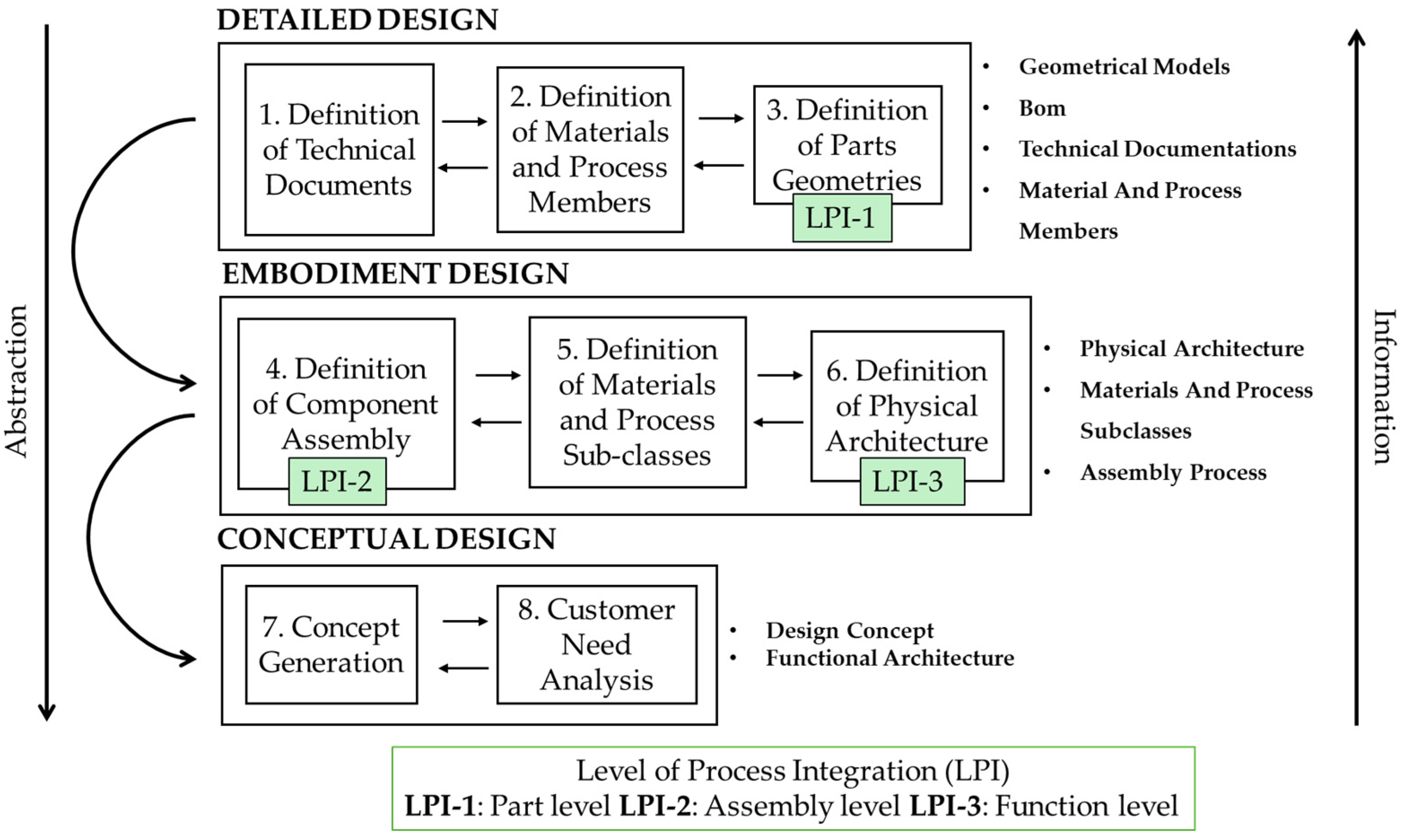
Because the LPI framework operates within established working principles, MMAM under LPI cannot attain the original design, which requires introducing new solution principles rather than adapting existing ones. Indeed, a comprehensive review confirms that established approaches for function integration in AM focus on adaptive and variant design levels [41]. Nevertheless, MMAM-enabled functional integration can simplify the functional architecture by combining decoupled functions into fewer, higher-order functions; this reduced function structure can inform more compact conceptual solutions and, in subsequent development, support new combinations of solution principles to satisfy high-level functions [33].
Figure 1. Systematic methodology framework: conventional design process extended with reverse-traced workflow for support of DfMMAM.
Eng 07 00013 g001

2.2.1. LPI-1: Variant Design—Part Level

In this level, parts can be reproduced using different manufacturing processes if their dimensional, geometrical characteristics, and material subclass are maintained. This ensures the product meets the high-level requirements of the original design and delivers the required performance to satisfy the customer’s needs. During detailed design, components may be subdivided based on the assembly strategy and manufacturing process constraints through DfX guidelines. Afterwards, the consolidation of parts that come from different components could inadvertently introduce coupling between previously independent functions, which must be avoided. Part consolidation should be guided by ensuring spatial adjacency and no relative motion, preservation of functional independence, and compatibility of materials and manufacturing processes (RQ2). Other factors include manufacturability constraints and DfX principles like ease of maintenance and disassembly.
While these criteria broadly apply across industries, their priority and application depend on the specific product and context. For instance, material selection in this level is limited to the original material subclass to maintain MMAM compatibility and satisfy DCs.
When consolidation is feasible, the combined geometry should be redesigned according to DfMMAM principles. For example, fixed joining methods such as adhesive bonding and welding can be avoided when the merged parts share the same material or replaced with graded transitions or mechanical interlocks tailored for MMAM. In practice, DfMMAM lets the joining strategy be redesigned: merge parts if the material is the same or connect dissimilar materials through interlocks or graded zones. This enables the fabrication of a multi-material, multifunctional component in a single print without a joining process.

2.2.2. LPI-2: Adaptive Design—Assembly Level

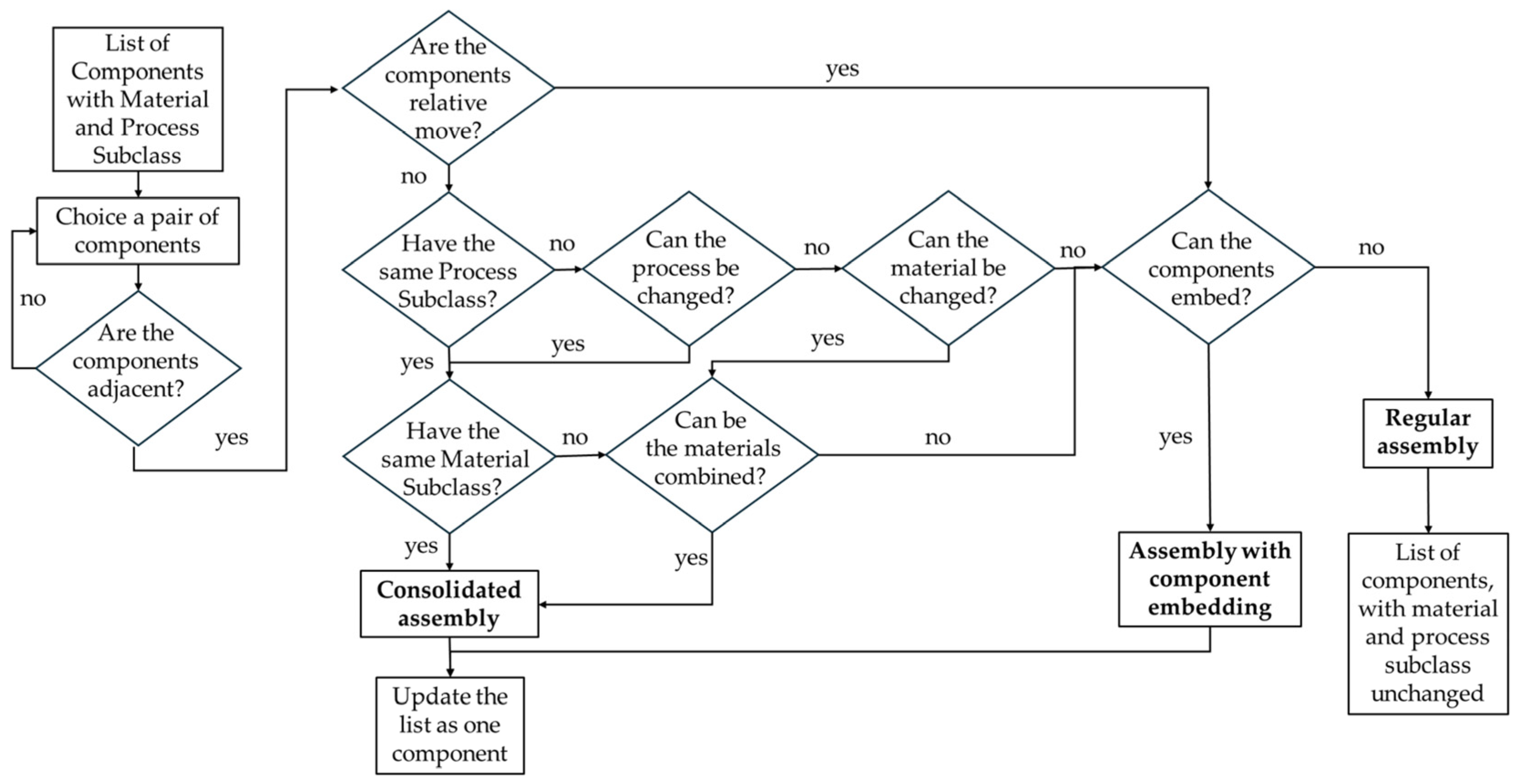
This level is characterized by the process of component consolidation (Figure 2), which is used to define the assembly approach, whether it results in a consolidated assembly, an embedded assembly, or a regular one. In this case, the physical architecture remains unchanged. The functional decomposition and allocation of low-level FRs to components, and the spatial arrangement of components, are preserved. Since the functions are already linked to specific components and the functional interfaces are defined, the design approach at this level focuses on consolidation based on those interfaces. This can follow two main paths: component consolidation, where components made of the same or compatible materials are merged into a single part, or embedded design, where one component is created with another embedded within it.

2.2.3. LPI-3: Adaptive Design—Function Level

In the last level, MMAM bridges the functional and physical architectures by determining which components carry which functions. While the functional architecture is established early, the physical layout, how functions are spatially arranged within components, remains flexible, allowing multiple functions to be integrated into single, multifunctional components. This integration enables the development of hybrid materials tailored to the spatial distribution of functions, influenced by DPs, DCs, and architecture drivers.
At the conceptual design phase, function combination is deliberately avoided to preserve design freedom and encourage innovation; the focus is on defining a functional architecture without limiting the physical solution space. During embodiment design, the functional architecture guides a function-sharing analysis to identify similar functions that can be grouped within a single DP.
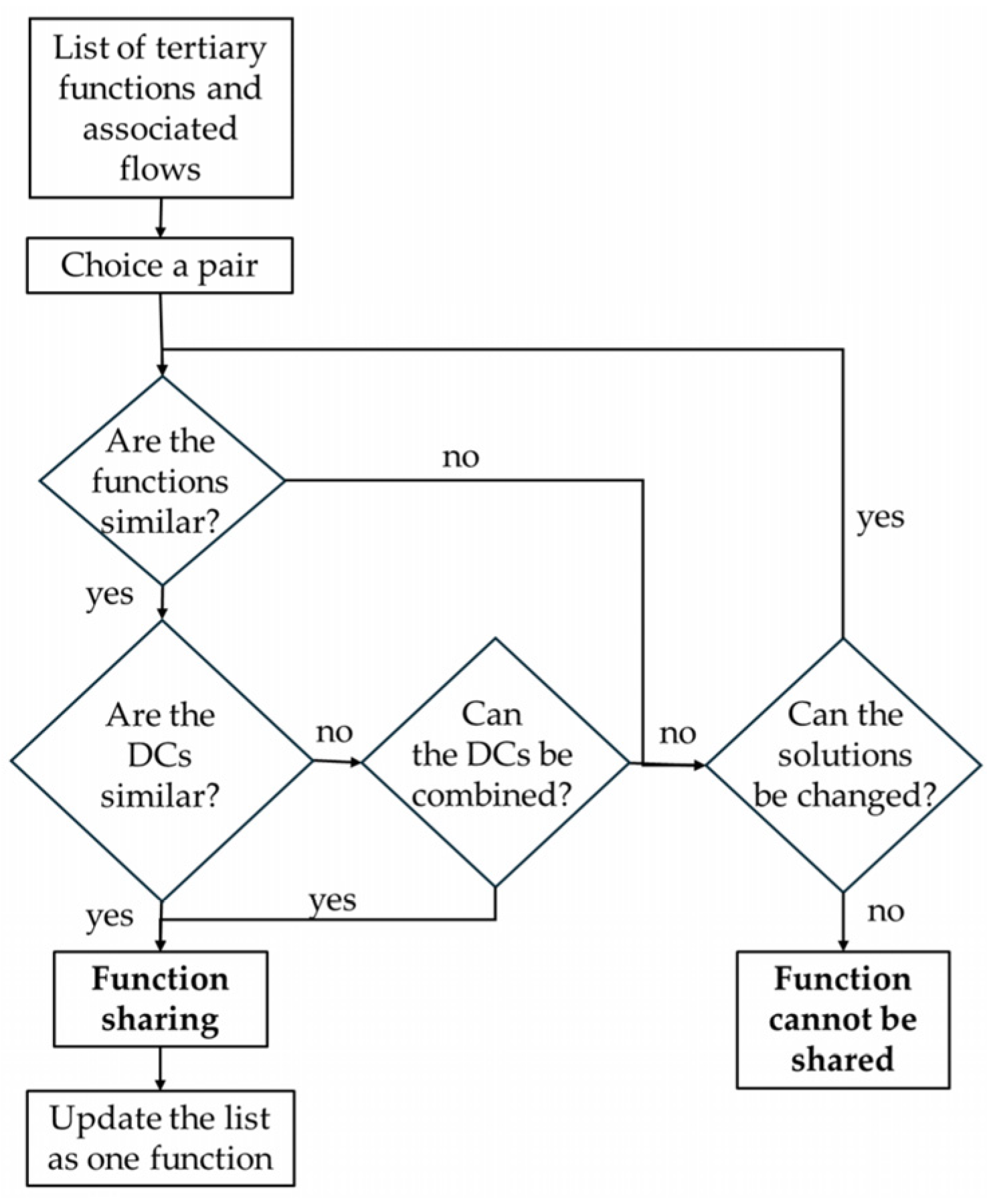
In the literature [33,42], function-sharing is often used broadly to describe any instance of a single part performing multiple functions. However, to support the specific decision-making of this framework, a distinction is made: function sharing is defined here as the consolidation of similar functions (redundancy reduction) into a single DP (Figure 3), whereas function combination refers to the integration of distinct functions into a unified component volume, enabled by the spatial variation in material properties.
Function similarity [43,44] is defined by the flow characteristics and by the Function Basis ontology [30], which provides an ontology for functions and flows (Figure 3). At the tertiary level, functions and flows are described in detail due to deeper decomposition. Secondary functions give a mathematical connotation to the second level, while tertiary functions specify the flows and definitions that point to the relevant technologies or physical principles. Tertiary functions with the same input and output flows are treated as similar. If two functions act on the same flow with the same target inputs and outputs, they are identical and can be merged to enable function sharing. When the functions have different DCs, choose according to the most restrictive DCs or a combination of them; consider an alternative solution that allows a revised decomposition to recover functional similarity. If this cannot be achieved, keep the functions distinct and evaluate other pairs for possible merging.
This process simplifies functional allocation, ideally achieving a one-to-one mapping between components and dominant functions.
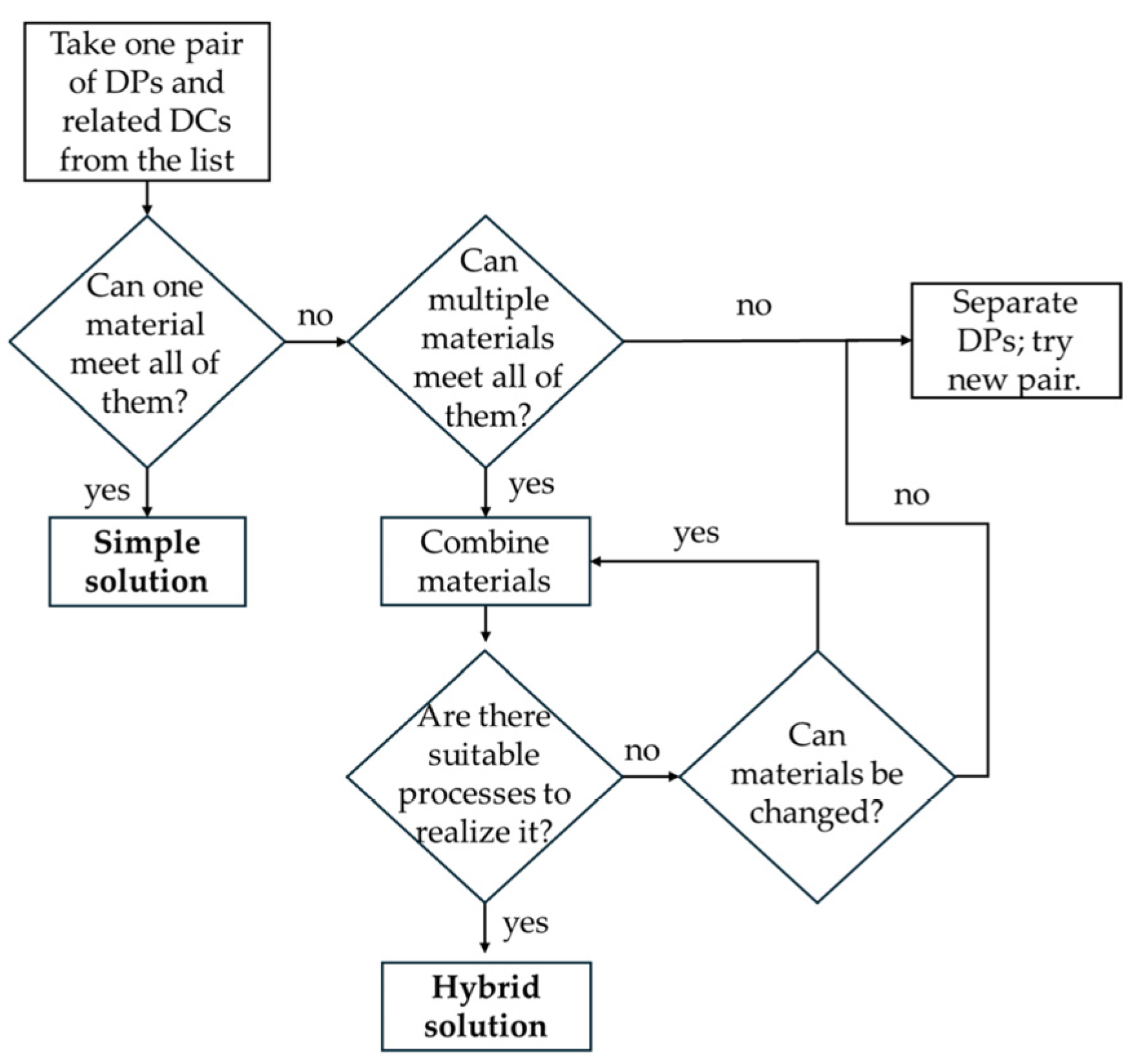
Once function similarity is established, multiple decoupled functions can be combined into one component while respecting their independence, enabling the creation of multifunctional, hybrid designs (Figure 4).
Figure 3. Systematic decision-making workflow for function sharing.
Eng 07 00013 g003
Figure 4. Systematic decision-making workflows for hybrid material solution identification.
Eng 07 00013 g004
This approach produces fully integrated components where distinct functions are controlled independently by their own DPs, enhancing the efficiency and capabilities enabled by MMAM.
A modular strategy, Otto and Wood [45] can guide how to combine functions and where to place interfaces along the flow: the dominant-flow heuristic groups functions that share one uninterrupted flow into a single component; the conversion-transmission heuristic groups a conversion step with its immediate transmission path; and the branching-flow heuristic places interfaces where flows split or join. In addition, tools such as the design structure matrix (DSM), dendrograms, and node-link diagrams highlight connectivity based on component adjacency or functional relations, helping identify functions that can be combined.

3. Case Study: Trail Running Shoe Using Reverse-Traced Workflow

The case study is based on a generic trail running shoe. While a multi-case approach across different product domains would strengthen generalizability, this product was selected for its functional complexity with 25 components subdivided into multiple parts, which exercises the methodology across all three LPI levels. Future work will systematically extend this framework to aerospace, medical, and automotive applications.
In the beginning, a description of a conventional design process is presented to describe a trail running shoe across the design phase. Then, the reverse workflow begins backwards with the detailed design that has as input the technical documentation that defines technical requirements, materials, and manufacturing process members, and the geometric model of the trail running shoe parts.

3.1. Design Based on Conventional Design Process

The case study illustrates the application of the design process model described in this work, presenting its implementation in the context of a trail running shoe. The needs analysis begins with an examination of the Voice of the Customer (VoC), based on feedback from the target market segment in which the company aims to position itself [46]. This process identifies customer needs, which are then translated into CRs. Additional CRs are derived from the expectations of internal and external stakeholders relevant to the project. The detailed analysis phase is not presented in this work; instead, a representative set of CRs is provided as an example.
CR1: The shoe must prevent injuries from rocks, roots, and sharp objects.
CR2: The shoe must withstand rough usage.
CR3: The shoe must prevent ankle twisting or rolling.
CR4: The shoe should support the foot on uneven terrain.
CR5: The shoe should reduce the shock transferred to the foot to prevent fatigue.
CR6: The shoe shall distribute forces evenly to optimize user experience.
CRn…
Next, those CRs are translated into FRs and NFRs to derive functions and DCs to give direction to the design process, reflecting the operational requirement of the trail running shoe, which is to enable users to safely and comfortably traverse off-road environments under varying terrain and weather conditions while supporting performance, protection, and adaptability throughout outdoor usage scenarios.
For example, CR1 can be translated into FR1: Protect the foot from external impacts, where the constraints can be NFR1: Maximize localized impact force and penetration depth.
CR5 and CR6 can be translated into FR5: Stabilize the foot during movement, where the constraints can be NFR5: Energy absorption efficiency.
Based on the identified high-level FRs and NFRs, the conceptual design phase established their correspondence with the high-level systems representing the top-tier DPs: Protective System, Movement Control System, Energy-Absorbing System, Ground-Interfacing System, User-Adjustable System, Weather-Resilient System, and Pressure Distribution System.
Abstraction governs the level of decomposition throughout the conceptual design phase. For example, most shoes currently on the market adopt similar functional solutions for the user adjusting system, typically a traditional lacing mechanism. Increasing the level of abstraction allows designers to reconsider this function and explore alternative solutions, such as the BOA closure system.
The conceptual design phase delivers the selected concept with its functional architecture up to the second level of decomposition, together with the product specification defined as FRs and their related DCs. The embodiment design then uses this information to define the third level of function decomposition and the physical architecture: allocation of functions to components, product layout as the spatial location and orientation of components and their physical interfaces, and the selection of materials, manufacturing, and assembly processes down to the subclass level.
In the case of a trail running shoe, the physical architecture can be described as follows: the bottom layer consists of the outsole at the base with tread lugs on its exterior surface, a shank plate embedded between the outsole and midsole in the midfoot region, and a heel crash pad integrated into the rear portion above the outsole. The middle layer features the midsole spanning the full shoe length, with energy-return pods embedded within specific zones, a medial post inserted on the inner side, and the insole positioned directly on top. The upper layer encompasses flexible parts wrapping around the foot’s perimeter, protective overlays bonded to the exterior surface, a toe cap covering the front, a rigid heel counter placed at the back, side reinforcements integrated laterally and medially, a tongue positioned beneath the laces between the upper sides, laces running along the instep, a collar surrounding the ankle opening, a waterproof membrane laminated within the upper layers, and breathability zones distributed across selected upper regions.
The BoM for the reference trail running shoe is summarized below. For each component, the table reports the selected material subclass together with the shaping and joining process subclasses used in the baseline architecture (Table 2).
Finally, in the detailed design, the component geometries are tailored to the DCs and the PVs and may be divided into parts to satisfy process constraints. For example, the outer layer and the flexible upper are made by cutting pieces from a textile sheet and assembling them by sewing and adhesive bonding. To optimize the process and achieve the final geometry, these components are split into multiple parts, which are then assembled with the other shoe components.

3.2. Design Based on Reverse-Traced Workflow

The reverse workflow runs backward through the design process and considers three levels where applying MMAM gives the designer extra freedom without changing the decisions already made from high-level needs to product-level, detailed information. These limitations are directly reflected in the types of decisions that can be made across the three levels (Table 3). To preserve those decisions, the redesign maintains the functional architecture, and the changes allowed depend on the abstraction level and the information available. In LP-1, constraints include the functional architecture, interfaces, component locations/orientations, assemblies, and material subclass; design freedom includes material members, part shape, and parts/assembly details, enabling opportunities such as part consolidation and refined part geometry. In LPI-2, constraints include the functional architecture, interfaces, and component locations/orientations; design freedom includes component assembly, material subclass, interfaces, and component placement, enabling opportunities such as component consolidation. In LPI-3, the main constraint is the functional architecture; design freedom includes material family and high-level interface placement, enabling opportunities such as combining functions and proposing hybrid-material solutions.
Table 3. Summary of key constraints, freedom, and opportunities along LPI levels.
Design PhaseDetailed DesignEmbodiment Design
LPI LevelLPI-1LPI-2LPI-3
Constrain Functional architecture
Functional interfaces
Component location and orientation
Component assembly
Material subclass
Functional architecture
Functional interfaces
Component location and orientation
Functional architecture
FreedomMaterial member
Part shape
Parts assembly
Component assembly
Material subclass
Functional Interfaces
Component location and orientation
Material family
OpportunityPart consolidation
Part geometry
Component consolidationFunction combination
Hybrid material solution

3.2.1. LPI-1: Trail Running Shoe—Part Level

This level operates at the detailed design phase and assumes the functional and physical architectures are already defined. The objective is to reproduce existing parts via AM without altering the physical and functional architecture, then evaluate functional uncoupled consolidation at the part level, ensuring that functional independence is preserved and that DCs for FRs/NFRs remain satisfied.
In a trail running shoe, the modular architecture supports decoupling between FRs-DPs, enabling consolidation of physically adjacent components that exhibit no relative motion, such as the midsole, energy-return pods, shank plate, outsole, and multi-zone tread lugs. To consolidate parts without compromising functional independence (RQ1), it is essential to know the original component affiliation of each part.
The midsole is used as an example; it concentrates the energy absorption, recovery, and pressure distribution requirements that are central to trail footwear performance. The midsole material subclass is Ethylene-Vinyl Acetate (EVA) with 20% Vinyl Acetate (VA); the midsole geometry is designed for injection molding to achieve DCs such as energy absorption (e.g., ≥50% of the impact force), recovery time (≤0.3 s at 50% strain), pressure uniformity (e.g., variance ≤ 15% across plantar regions), and local compression limits governed by Shore hardness. The redesign for DfMMAM replaces molding with an AM direction (e.g., FFF) while retaining geometry and material subclass equivalence; molding PVs (e.g., foaming ratio, expansion temperature, cooling rate) are substituted with AM PVs (e.g., layer thickness, slicing parameters, build orientation). Consolidation is then considered between the midsole and the energy-return pods only if three conditions are simultaneously met: geometric adjacency with no required relative motion; compatibility of material and process subclasses; and explicit protection of FR-DP independence so that tuning rebound via lattice density does not force retuning pressure distribution via zonal thickness. When merging is admitted, local interlocks or graded transitions replace the former interface, preventing stress concentrations and delamination. If any DP sensitivity analysis reveals coupling advantages, the parts remain separate. This level thus delivers AM part files (e.g., 3MF [47]) that support the design information related to the material distribution, PV tables mapped to the original FRs/NFRs, and minimal interface redesign features while keeping the architecture unchanged and the reverse-workflow trace intact.

3.2.2. LPI-2: Trail Running Shoe—Assembly Level

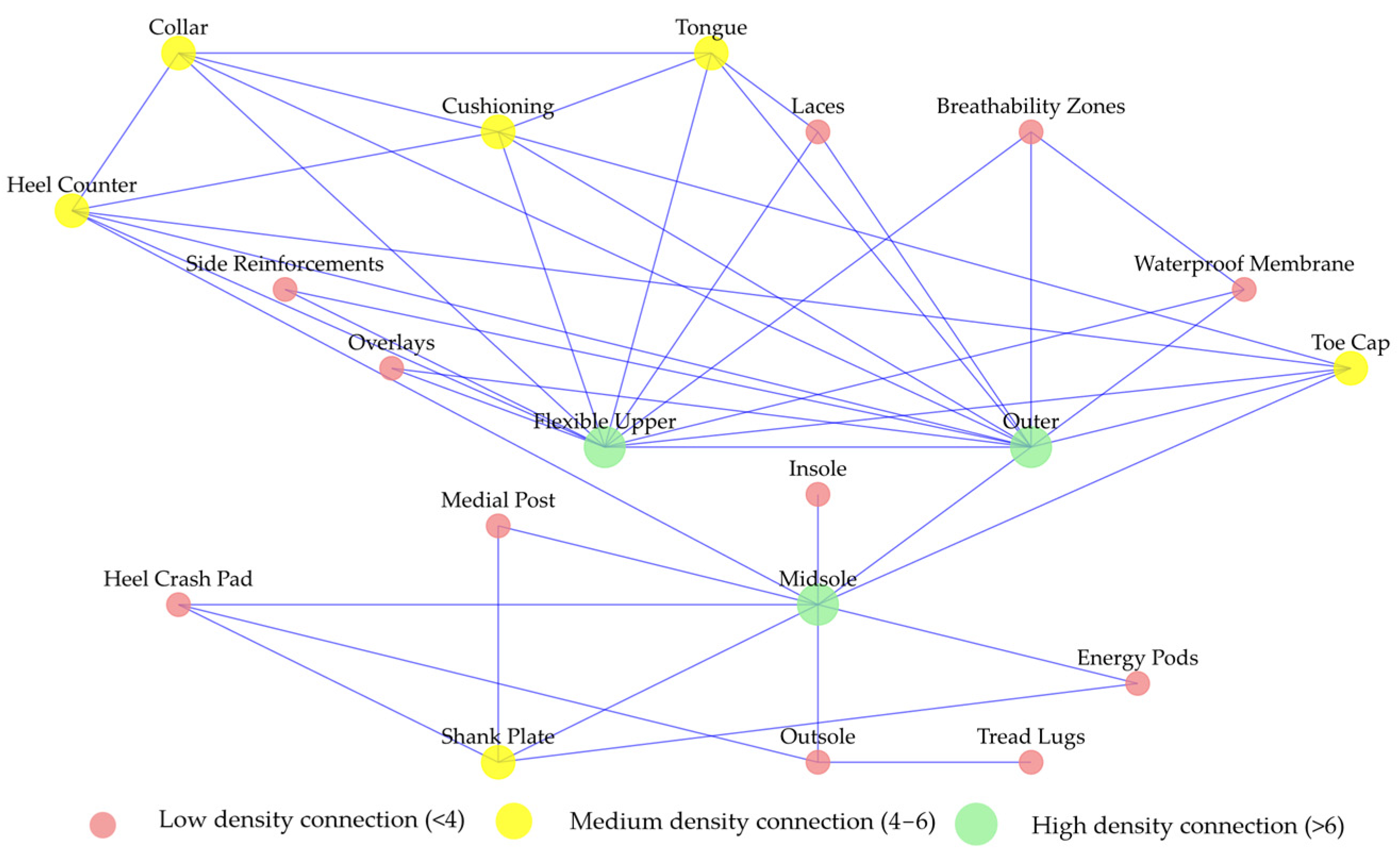
This level operates in the embodiment design phase and keeps the product architecture unchanged. The mapping of functions to components and their spatial layout remains the same. The objective is to reduce assembly by consolidating components across suitable interfaces or by adopting embedded assemblies. Decisions follow an interface-led sequence. Figure 5 presents a connectivity graph on the relationship between the components that describes the type of flow at the interfaces and the density of the connections. This information helps ensure compatibility and synergy between interacting systems and aids in identifying points where modular separation or functional combination is most effective.
In the trail running shoe, the sole offers a clear application of this approach while preserving the architecture.
In this level, functionally graded lattice structures, where properties vary according to shape and relative density, can be considered equivalent to graded materials.
The midsole originally molded in EVA can be redesigned using lattice structures tailored to fulfill the required functions, such as impact energy absorption. Bending-dominated lattice structures like the octet lattice can be used for this purpose, and areas like the heel counter can feature thicker lattice zones. By changing the lattice cell topology locally, it is possible to tune stiffness, for instance, using a cubic close-cell lattice in the shank plate area to provide higher torsional rigidity. Similarly, in the location of the energy return pods, a lattice structure can be selected to improve energy return, like a diamond lattice.
All these lattice structures can be consolidated into a single part. The outsole, including multi-zone tread lugs, can also be integrated into the same building using multi-material printing techniques, such as combining stiffness gradients or mechanical interlocking strategies. The result is a consolidated component fabricated in one build process, representing a redefinition of geometry but not of the physical architecture, since the arrangement of components and the allocation of functions remain the same. If the friction layer material of the outsole is not compatible with the midsole’s process subclass, the outsole remains a separate component and is joined with a high-shear adhesive. Where consolidation or embedding is not admitted due to motion or compatibility, joining methods are selected according to interface function and service needs; for example, eyelets are used for the laces to the upper to preserve adjustability and durability. These choices align with the interface roles and help avoid unwanted coupling.
Critically, LPI-2 consolidates components while preserving the fixed function allocation defined in the baseline design; the spatial zoning and lattice structures emerge as a physical implementation strategy within unchanged functional boundaries. In contrast, LPI-3 goes further by consolidating the functions themselves, merging tertiary function identities through function sharing and combination, thereby changing the function-to-component mapping itself.
The outputs of this level are an interface-based decision record for each candidate pair. Independence is preserved by keeping separate DPs per function, for example, by verifying that local lattice tuning does not force retuning of torsion or traction parameters.

3.2.3. LPI-3: Trail Running Shoe—Function Level

At this level, MMAM enables the integration of multiple independent functions into single, multifunctional components through hybrid materials and spatial zoning. This integration preserves functional independence by assigning separate DPs to each zone, allowing distinct functions to be controlled independently despite physical co-location.
The LPI-3 approach operates in two sequential phases: first, function sharing identifies and consolidates similar tertiary-level functions; second, function combination strategically co-locates distinct functions within unified component volumes.
At LPI-3, the reverse workflow operates at the embodiment phase by reverse-tracing the existing physical architecture back to its functional purpose. Starting from the 25 components documented in Table 4 with their interfaces and flows, tertiary-level functions are extracted and mapped to show how each physical component currently implements functional behavior. This extraction process, moving from physical components backwards to functional flows, identifies tertiary-level functions (Table 4), which represent the finest level of functional abstraction currently realized in the design. Simultaneously, these tertiary functions are the highest abstraction level relative to physical architecture; they describe what each component does within the existing layout, since multiple components realize these functions across the existing shoe layout.
The objective at LPI-3 is to determine whether multiple tertiary functions (currently dispersed across separate components) can be co-located into fewer, multifunctional components using MMAM’s hybrid-material capabilities, while preserving the functional architecture (the relationships and independence of tertiary functions) and maintaining each function’s independent DP control through spatial zoning. Table 4 documents all tertiary-level functions extracted from the existing 25-component shoe design, mapped to their corresponding components, DP, and DC. These functions are not derived from top-down decomposition in this reverse workflow but rather reconstructed by analyzing how the physical shoe components currently implement functional behavior through their interfaces and flows.
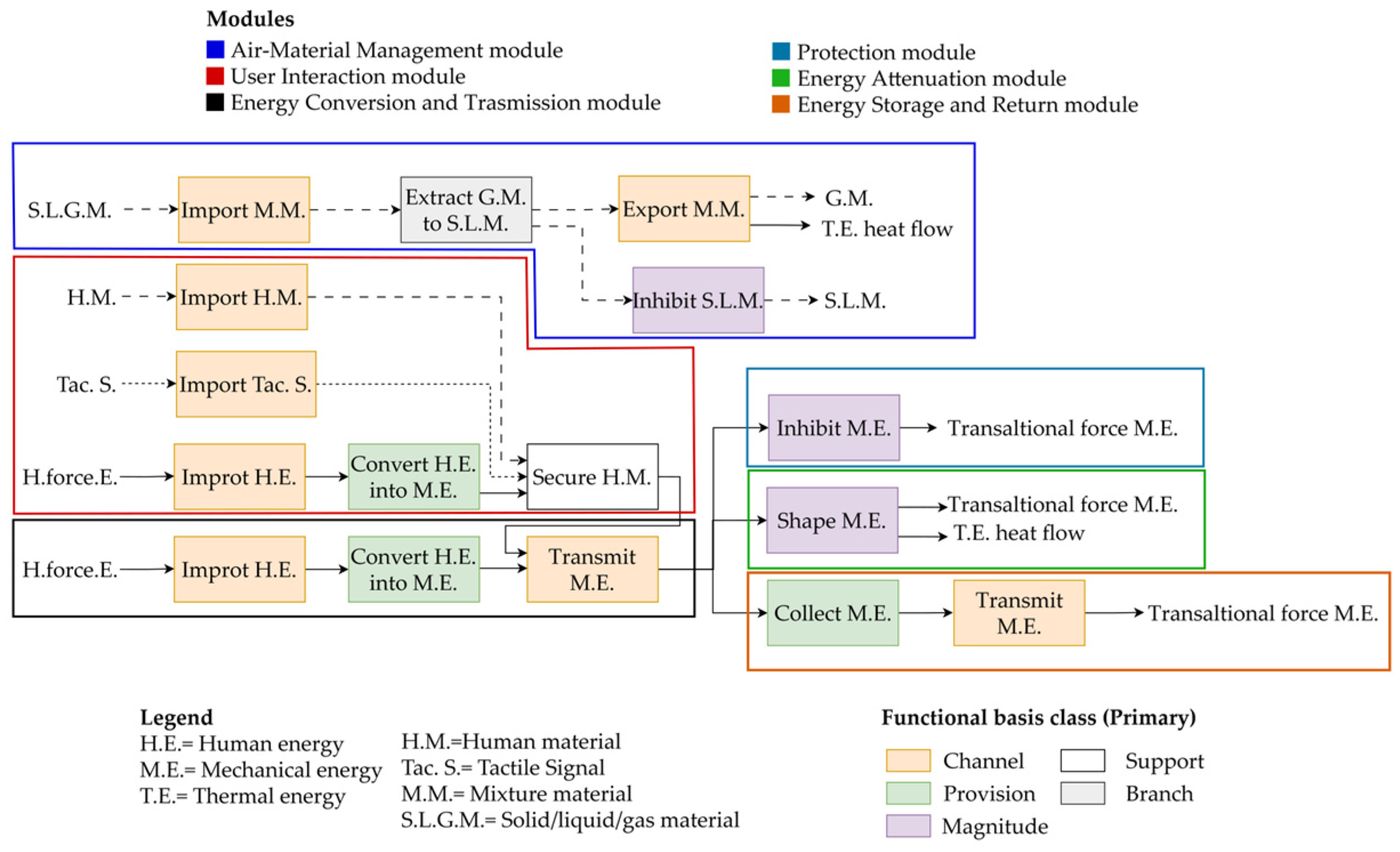
The functional model in Figure 6 is described as follows:
Import mixture material (M.M.) defines the interaction of the shoe with the external environment, where the input flow is a mixture material (air, water, debris).
Extract gas material to solid/liquid/gas (S.L.G.M.), separate the gas material (air) from the mixture to enable the ventilation of the foot, and then Export gas material (G.M.) to the breathable air and moisture vapor out of the shoe within the function Inhibit solid/liquid material (S.L.M.) that blocks the ingress of mud and water.
The interfaces with the user are defined by Import Human Material (H.M.) for the foot entering the shoe and Import Human Energy (H.E.) to provide tension to the lacing system and import tactile status signal (Tac. S.) for the user feedback via lacing pressure, Convert (H.E. into M.E.) to convert the human force into tensile force at the foot–shoe interface, and Secure (H.M.) to wrap the foot inside the shoe system.
Another interface with the user is defined by Import Human Energy (H.E.) to provide motion to the foot and the interaction with the environment (also impact with external forces), Convert (H.E. into M.E.) to convert the human force into mechanical force, and Transmit (M.E.) mechanical energy through the sole and outer.
Then, Inhibit mechanical energy (Inhibit M.E.) arrests high-impact forces between the foot and the environment, Shape (M.E.) mechanical energy absorbs impact energy during the foot strike, Collect (M.E.) mechanical energy stores elastic energy, and finally, Transmit (M.E.) mechanical energy provides rebound force returned to the ground for propulsion.
Function similarity at the tertiary level is determined by similar flow types and tertiary function classes using the Functional Basis ontology. When two or more tertiary functions extracted from different components act on the same flow with identical input-output characteristics, they are candidates for function sharing, merging them under a shared DP. When these similar functions have different DCs, the consolidated design must satisfy all DCs simultaneously by reconciling them through spatial zoning and material gradation. A key example is Shape M.E. (shaping mechanical energy), which appears in multiple components across the shoe: Heel Crash Pad, Insole, Midsole, and Medial Post.
All four components have identical tertiary function and flow, and they all transform and shape mechanical energy flowing through the foot-ground interface. This makes them candidates for function sharing.
However, their DCs differ due to distinct performance targets at each anatomical location. Through function sharing, these four Shape M.E. functions merge into a single shared DP (sole geometry), but the consolidated design must satisfy all four DCs simultaneously. This is achieved through spatially graded lattice design with independent material configurations per zone. This case was discussed in the LPI-2 regarding the combination of lattice structures. And in LPI-1, each lattice zone can be controlled by its own independent DP (lattice type, cell size, local density); tuning the heel lattice topology for absorption does not force retuning the arch pressure response, and modifying forefoot rebound behavior does not require changes to medial stiffness. This preserves functional independence despite physical co-location within a single midsole/sole assembly. The four original components (Heel Crash Pad, Insole, Midsole, and Medial Post) are now consolidated into a single integrated sole, and sharing does not eliminate the different performance targets; instead, it reconciles them through spatial material design.
This consolidation introduces a hierarchical DP structure: at the macro level, a single shared DP governs the overall sole geometry and integration strategy; at the meso level, spatially distinct sub-DPs control each zone’s lattice topology, density, and local material properties. Independence is preserved because each sub-DP can be tuned without affecting others; for example, modifying heel lattice density does not force retuning of forefoot rebound behavior, even though all zones reside in one fabricated component.
After function sharing identifies and consolidates similar tertiary functions, distinct yet decoupled functions can be physically combined into integrated modules while preserving their independence. Modular heuristics guide where to place interfaces along functional flows, determining which functions co-locate and which remain separate.
The module construction draws directly upon the third-level functional model (Figure 6) and employs six distinct modulus grouping heuristics:
  • Dominant-Flow Heuristic: Air-Material Management Module: The four functions—Import M.M., Extract G.M. to S.L.M., Export M.M., and Inhibit S.L.M.—operate on a continuous, unbroken air-mixture material flow path. This path flows through breathability zones, through the waterproof membrane, and then vents out backward, with liquid blocking at each stage. The flow does not branch until the gas and solid/liquid mixture are fully separated. Because these four tertiary functions share one uninterrupted flow from entry to internal separation, they consolidate into a single Air-Material Management Module. By clustering these functions, the design achieves a cohesive module responsible for both ventilation and waterproofing.
  • Conversion-Transmission Heuristic: User Interaction and Transmission Module: Convert H.E. to M.E. (Rigid Heel Counter) converts user force into mechanical force, which is immediately transmitted via Transmit M.E. (Shank Plate). These sequential conversion-transmission functions have no branching between them; conversion flows directly into transmission. The modular heuristic groups them into a single Energy Conversion and Transmission Module, where force is converted at the heel and transmitted through the midfoot in one physical assembly.
  • Branching-Flow Heuristic: Energy Modules: After primary mechanical energy transmission, the functional flow diverges into three parallel branches, establishing natural module boundaries: Protection, Energy Attenuation, Storage, and Return Module.
After function sharing identifies and consolidates similar tertiary functions into shared DPs, the methodology proceeds to function combination, integrating distinct functions into single modules despite their differing flow roles. This step follows the decision-making workflow (Figure 4) that guides when and how functions can be combined while preserving independence through spatial zoning and hybrid materials.
One example is the Air-Material Management functions (Import M.M., Extract G.M. to S.L.M., Export M.M., and Inhibit S.L.M.) operate on continuous air-mixture flows and naturally consolidate into a single module through the dominant-flow heuristic. However, function combination extends this further by integrating the Protective Module (Inhibit M.E.) with the Air-Material Management Module despite their differing flow roles:
Inhibit (S.L.M.) imposes a barrier to prevent solid and liquid material (mud, water) from entering the shoe interior.
Inhibit (M.E.) imposes a zero-velocity boundary to arrest peak mechanical loads at the toe and lateral surfaces.
Although these functions operate on different material flows (mixture material vs. mechanical energy), both serve an external protection purpose. Following Figure 4’s decision workflow, they can be combined into a unified Air Management and Protection Module by assigning distinct spatial zones: breathability grids for air-mixture flow in dorsal regions, waterproof barriers for underfoot contact, and impact-resistant outer shells at toe and heel. Each zone maintains its own DP without functional coupling.
Similarly, function combination merges the Energy Attenuation Module (Shape M.E. functions for absorption) and the Energy Storage and Return Module (Collect M.E. and Transmit M.E. for elastic rebound and propulsion). These modules share the same mechanical energy flow and output type, yet operate distinct functions:
Shape M.E. attenuates and absorbs impact energy.
Collect M.E. and Transmit M.E. capture, store, and return elastic energy for propulsion.
Using Figure 4’s decision workflow, these distinct tertiary functions are merged into a single Energy Attenuation, Storage, and Return Module. Integrating them into one physical assembly, a multifunctional sole (as the result in LPI-2), while preserving each function’s separate DPs through spatial zoning.
Function combination achieves robust multifunctional designs through hybrid material solutions with spatially graded properties. Each zone must operate under its own DP, satisfying its distinct DC without introducing functional coupling. This approach enables the consolidation of four separate components (Heel Crash Pad, Insole, Midsole, Medial Post) performing Shape M.E. into one integrated structure, with six additional components (energy-return pods, outsole, multi-zone tread lugs) contributing Collect M.E. and Transmit M.E. functions within the same multifunctional volume.
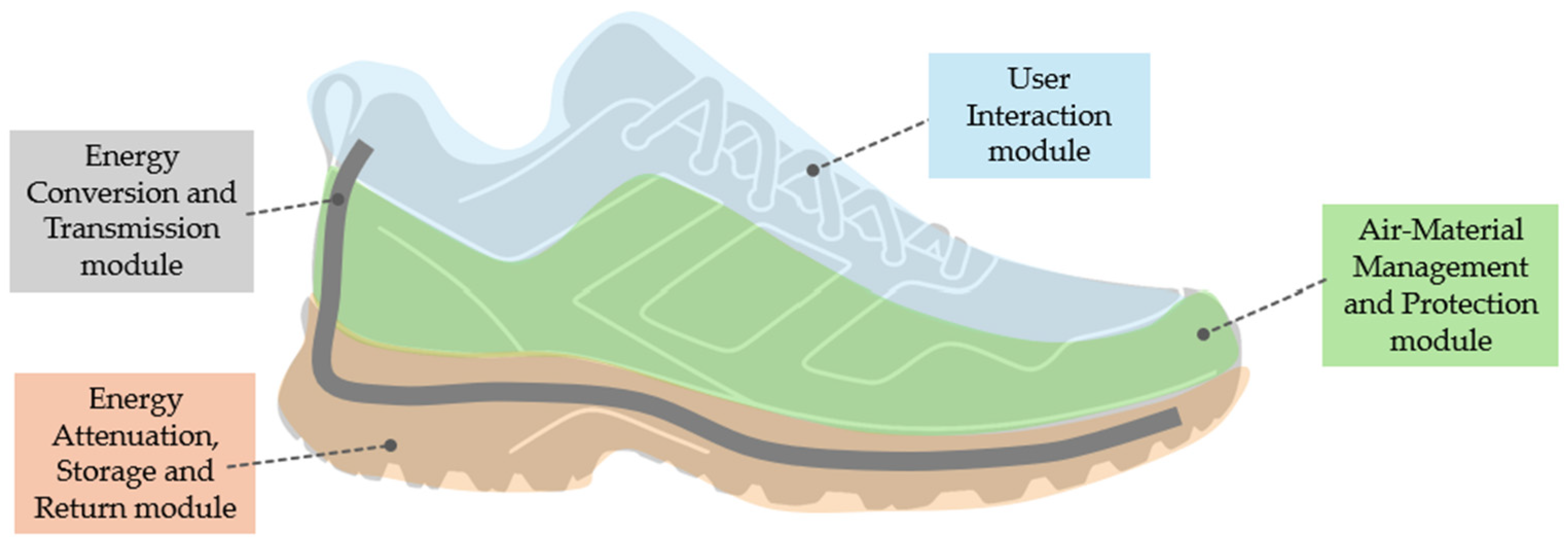
The result of applying function sharing and function combination workflows (Figure 4) is the consolidation of the trail running shoe’s original 25-component assembly into four integrated functional modules:
Air Management and Protection module: Combines material-flow functions with mechanical protection
Energy Conversion and Transmission module: Combines force input conversion with transmission, structural support and torsional control.
User Interaction module: Combines user fitting, setting, and foot retention functions.
Energy Attenuation, Storage, and Return module: Integrates multiple Shape/Collect/Transmit M.E. functions through spatial zoning.
At LPI-3, these four modules define the spatial layout and interfaces of the shoe (Figure 7), establishing that multiple functions can be co-located within unified component volumes while maintaining functional independence.

4. Discussion

The systematic methodology, incorporating a reverse-traced workflow and LPI framework, integrates MMAM considerations throughout the product design process. The trail running shoe case study demonstrates how the methodology assists design decisions through qualitative application examples across the LPI levels. The reverse workflow appears most effective for products with significant functional integration opportunities, while simpler products with minimal consolidation potential may favor LPI-1 adjustments. By addressing the four research questions posed in the introduction, the proposed approach establishes a theoretical foundation for MMAM design methodology while identifying critical gaps requiring future validation.
RQ1: How can parts be consolidated without compromising the independence of functional requirements? Part consolidation without compromising FR independence is achieved by preserving the mapping between FRs and their associated DPs while maintaining component-level functional architecture. According to Axiomatic Design’s independence axiom, each DP should affect only one FR. This principle operates consistently across three LPIs.
LPI-1 (variant design): Consolidation occurs only within parts belonging to the same component, with functional and physical architecture unchanged. Since parts from the same component already share DPs, maintaining FR independence by design, physical consolidation introduces no new coupling.
LPI-2 (adaptive design): Component consolidation uses three assembly approaches (consolidated, embedded, and regular assembly), with function allocation and locations remaining fixed to preserve functional decomposition. FR independence is verified through interface-led assessment, ensuring one component’s DP tuning does not force another.
LPI-3 (adaptive design): Functions co-locate within unified volumes via spatial zoning, with each zone assigned dedicated DPs tuned independently. Spatial zoning ensures functional independence despite physical co-location through material property boundaries that minimize problematic cross-coupling.
RQ2: Which criteria should govern part merging, and to what extent are these criteria generalizable across applications? Part consolidation is governed by criteria with varying generalizability.
The primary criterion, preservation of FR independence as established by Axiomatic Design, is broadly generalizable across all LPI levels and industries.
Secondary criteria such as geometric adjacency, material compatibility, process feasibility, and DfX considerations have context-dependent weighting; their implementation strategies and relative weighting are product- and industry-specific.
The LPI framework applies identically across all domains: varying geometry and process variables (LPI-1), consolidating components through assembly strategies (LPI-2), and integrating functions via spatial zoning and zone-specific DPs (LPI-3) operate through the same logical structures and decision criteria regardless of manufacturing sector or product type.
RQ3: How should functional integration rules be applied at each phase of the design process? Functional combination rules operate sequentially across design phases with deliberate phase-specific restrictions, ensuring that consolidation decisions emerge from functional analysis rather than premature architectural commitment.
Conceptual design deliberately avoids combining FRs to preserve design freedom and innovation space, ensuring that all solutions remain open before commitment to specific working principles.
Embodiment design first applies LPI-3, using function-sharing analysis to identify opportunities for grouping similar FRs within single DPs and function combinations to combine functions into modules, allowing the creation of hybrid material solutions. For LPI-3, this involves defining spatial zones and assigning distinct FRs to distinct zones within a unified component volume. Then, LPI-2 addresses assembly strategy (consolidated, embedded, and regular assembly) that best matches the product’s performance and manufacturability requirements. The consolidation strategy chosen at embodiment design directly shapes downstream detailed design activities.
Detailed design optimizes the geometry under PV constraints, enabling fully integrated parts where multiple FRs are fulfilled by independently controlled DPs. At detailed design, component consolidation is not revisited; the consolidation strategy is locked from the embodiment phase. Instead, detailed design focuses on geometry optimization within consolidated part boundaries; mesostructural design (lattice topology, material gradients, density profiles) supporting zone-specific DPs; and manufacturing process parameter selection, with voxel/layer-level control of material composition and deposition sequence to maintain zone-specific DP independence, ensuring the consolidation strategy is feasible.
RQ4: At what points in the workflow do these integration rules most effectively ensure both performance and manufacturability? The most effective workflow integration points occur when MMAM rules are matched to design scope and risk tolerance at specific decision moments. Designers select the LPI level by matching scope and risk:
LPI-1 for fast, low-risk updates that only tune geometry or process variables; it offers minimal cost and the fastest iteration, but limited integration potential with small part count reduction, no architectural change, and the lowest redesign/verification cost.
LPI-2, when the goal is assembly/interface reduction with fixed function locations, it provides meaningful BoM/interface reduction with moderate validation overhead, redesign effort, and potential serviceability constraints.
LPI-3 when architectural simplification requires co-locating functions via spatial zoning while keeping the functional decomposition fixed, balancing consolidation benefit against redesign and validation effort. LPI-3 maximizes integration/performance gains and part count reduction but requires the highest redesign/validation rigor and stricter independence control through zoned DPs/DCs.
Industrial parallels illustrate how each LPI level manifests across product types.
LPI-1 aligns with redesigns that swap PVs and geometry while keeping architecture fixed. Porsche Design 3D MTRX II [48] exemplifies this approach, adjusting cushioning profiles through lattice topology tuning without modifying the fundamental upper/midsole/outsole structure or their distinct functional roles. This level represents the fastest, lowest-risk consolidation path, ideal for performance optimization within existing component boundaries.
LPI-2 corresponds to component consolidation into fewer parts with fixed function allocation and locations. Conformal lattice midsoles exemplify this by integrating impact absorption and energy return within a single consolidated component while preserving the upper and outsole as separate functional modules. Adidas 4DFWD [49] demonstrates this approach across product versions, consolidating cushioning and energy return elements while maintaining architectural clarity. Sintratec’s Cryptide sneaker [50] extends LPI-2 principles further, using laser sintering with flexible TPE to merge multiple footwear elements into one continuous part, proving viable assembly reduction without functional requirement reassignment. This level balances meaningful part-count and assembly cost savings against moderate verification complexity.
LPI-3 reflects function-level integration in a single design space with spatial zoning and co-location of distinct FRs. Fully printed footwear exemplifies this paradigm by merging upper, midsole, and outsole layers while embedding internal structures, all within one consolidated component. Zellerfeld’s fully 3D-printed Nike Air Max 1000 [51] merges upper and lower layers while embedding an internal air-cushioning structure, demonstrating sophisticated spatial integration. Neri Oxman’s “O0” shoe [52] represents an advanced vision for fully integrated, sustainable design made entirely from polyhydroxyalkanoates (PHAs). This mono-material multifunctional component uses material gradients and spatial zoning to achieve structural support, cushioning, and environmental protection with distinct zone-specific DPs, all without assembly or adhesives. This level unlocks maximum consolidation but demands the highest verification rigor.
These examples reinforce the findings of this research: when systematically integrated, MMAM could enhance design outcomes by minimizing assembly needs, enabling novel functional configurations, and unlocking higher levels of product performance.
Context-dependent factors vary significantly across industries (e.g., automotive, aerospace, consumer electronics, medical devices), but these variations affect the weighting of consolidation criteria and validation rather than the framework’s core logic. This consistency of core logic despite varying implementation rigor is the framework’s strength: it provides universal guidance applicable across domains while accommodating sector-specific risk profiles and regulatory constraints.
This work remains primarily theoretical, and the case study provides only qualitative functional analysis and DP mapping. The case study has not yet been supported by FEA-based sensitivity studies to verify that local DP adjustments do not induce unacceptable FR-DP coupling or require DC compensation in adjacent zones. For a hybrid material incorporating functionally graded properties, the material property distribution within each DP zone could be validated through Representative Volume Element (RVE) analysis [53]. Following homogenization approaches [54,55,56,57,58,59], the validation determines mechanical properties as a function of local porosity [60], fiber content [54], and material composition [53], enabling designers to confirm that zone-specific DP modifications preserve functional independence while avoiding unacceptable stress concentrations at material interfaces. Time and cost effects are also not documented through measured data on baseline development effort, LPI-specific redesign loops, manufacturing and assembly costs, or lifecycle impacts (maintenance, disassembly, recycling), which limits the ability to substantiate claimed efficiency gains. These limitations reflect the theoretical nature of the design framework and define clear priorities for future work.

5. Conclusions

This research addresses the challenge of integrating MMAM into product design by extending the conventional design process model with a reverse-traced methodology. This approach preserves functional independence while enabling robust consolidation decisions across conceptual, embodiment, and detailed design phases.
The work presents a reverse-traced MMAM design framework that extends the conventional process with explicit decision workflows for function sharing and combination, governed by the LPI framework. The framework clarifies the redesign scope at each level: LPI-1 varies geometry and PVs while keeping the functional and physical architecture fixed; LPI-2 consolidates components via interfaces and material/process subclasses without changing function allocation; and LPI-3 maintains the fixed functional decomposition but reassigns locations to co-locate functions within unified volumes through spatial zoning, preparing the design for subsequent material selection and assembly strategy definition. Crucially, the framework operationalizes Axiomatic Design for MMAM. It makes consolidation decisions traceable to tertiary-level functions, DPs, and DCs, while preserving design freedom by deferring material and process decisions until function sharing and combination are established. Its applicability is strongest for complex products with significant functional integration opportunities; for simpler products, lightweight LPI-1 adjustments alone offer superior tradeoff time/benefit.
The trail running shoe case study demonstrates substantial consolidation capability, with an 84% part-count reduction achieved through systematic function sharing and combination. Progression toward industrial application requires coupling the proposed workflow with systematic experimental and numerical validation, including finite element sensitivity studies and RVE analysis for hybrid materials.
Future research will focus on collecting application-specific cost–benefit data across diverse sectors (e.g., automotive, aerospace, and medical) to validate generalizability and establish sector-specific guidelines. Furthermore, a software application is currently under development to operationalize the LPI framework and automate consolidation workflows, enabling industrial practitioners to apply the methodology systematically.

Author Contributions

Conceptualization, P.D.F. and G.S.; methodology, P.D.F.; validation, P.D.F., G.S., and L.G.; formal analysis, P.D.F. and G.S.; investigation, P.D.F. and G.S.; resources, G.S.; data curation, P.D.F. and G.S.; writing—original draft preparation, P.D.F. and G.S.; writing—review and editing, P.D.F. and G.S.; visualization, P.D.F. and G.S.; supervision, G.S.; project administration, P.D.F. and G.S.; funding acquisition, P.D.F. and G.S. All authors have read and agreed to the published version of the manuscript.

Funding

This research was funded by the European Union—NextGenerationEU, Mission 4, Component 2, “From Research to Enterprise”, CUP C96E22000180005; the project “GOALS, Green Optimizations by Additive-manufactured Lightweight Structures”, Project 20228PFA89, CUP J53D23001980006, Progetti di Ricerca di Rilevante Interesse Nazionale PRIN 2022, funded under the National Recovery and Resilience Plan (NRRP), Mission 4 Component C2 Investment 1.1 by the European Union—NextGenerationEU.

Institutional Review Board Statement

Not applicable.

Informed Consent Statement

Not applicable.

Data Availability Statement

The original contributions presented in this study are included in the article. Further inquiries can be directed to the corresponding author.

Acknowledgments

During the preparation of this manuscript, the author(s) utilized ChatGPT-5 for academic English grammar correction and for generating the shoe image. The authors have reviewed and edited the output and take full responsibility for the content of this publication.

Conflicts of Interest

The authors declare no conflicts of interest. The funders had no role in the design of the study; in the collection, analyses, or interpretation of data; in the writing of the manuscript; or in the decision to publish the results.

Abbreviations

The following abbreviations are used in this manuscript:
MMAMMulti-Material Additive Manufacturing
AMAdditive Manufacturing
RQResearch Question
CAConsistent Assembly
RAReduced Assembly
FRFunctional Requirement
NFRNon-Functional Requirement
CRCustomer Requirement
DPDesign Parameter
DCDesign Criteria
PVProcess Variable
DfXDesign for Excellence
DfADesign for Assembly
DfMDesign for Manufacturing
DfMMAMDesign for Multi-Material Additive Manufacturing

Glossary

Branching-flow HeuristicA modular design rule suggesting that module boundaries should be placed at points where material, energy, or signal flows diverge (split) or converge [45].
CAConsistent Assembly. A design approach where the original assembly structure and part count are preserved, focusing on making the existing assembly manufacturable [21].
ComponentA distinct physical unit within a product that performs specific functions. In this framework, a component may consist of a single part or multiple parts.
ConsolidationThe process of merging multiple discrete items into one, eliminating assembly interfaces [11,16,21,33].
Conversion-transmission HeuristicA modular design rule suggesting that a function converting a flow (e.g., electrical to mechanical) should be grouped with the subsequent transmission function [45].
CRsCustomer Requirements. The initial set of needs and expectations gathered from the “Voice of the Customer” and stakeholders [19,20].
DCsDesign Criteria. Measurable, quantitative specifications derived from NFRs used to evaluate design solutions [25].
DfADesign for Assembly. A methodology focusing on reducing product assembly cost and complexity, primarily by minimizing part count and simplifying assembly operations [12].
DfMDesign for Manufacturing. A methodology focusing on minimizing the cost and complexity of manufacturing individual parts (e.g., maximizing ease of fabrication) [12].
DfMMAMDesign for Multi-Material Additive Manufacturing. Design guidelines specifically tailored to exploit the capabilities of MMAM technologies [6,33].
DfXDesign for Excellence. A systematic approach to product development that considers the full product lifecycle (manufacturing, assembly, service, etc.) [46].
Dominant-flow HeuristicA modular design rule suggesting that a chain of functions sharing a single, continuous flow should be grouped into the same module [45].
DPsDesign Parameters. The key physical variables or solution elements in the physical domain chosen to satisfy the specified FRs [19,20].
FGMsFunctionally Graded Materials. Materials characterized by gradual variation in composition and structure over volume, resulting in corresponding changes in properties [61,62,63,64].
FlowThe material, energy, or signal that is exchanged or transformed between functions (e.g., electricity, mechanical force, data) [30].
FRsFunctional Requirements. A minimum set of independent requirements that characterize the functional needs of the product (what the product must do) [25].
FunctionAn abstract formulation of a task, independent of any specific solution, defined as the transformation of inputs (flows) into outputs. In the Functional Basis, it is typically expressed as an active verb (the function) acting on a flow (the object) [25,30].
Function CombinationThe integration of distinct functions (with different requirements) into a single component volume. MMAM enables this by spatially distributing different material properties (allocating distinct DPs) within a unified part, preserving functional independence.
Function SharingThe consolidation of similar functions (handling similar flows) into a single DP. This strategy eliminates functional redundancy by satisfying multiple overlapping requirements with a single physical feature.
Functional BasisA standardized design language (ontology) is used to describe product functions and flows (material, energy, signal) in a uniform manner [30].
LPILevel of Process Integration. A framework introduced in this work is to classify redesign scopes into three levels based on design novelty. 
MMAMMulti-Material Additive Manufacturing. Additive manufacturing processes capable of depositing or fusing different materials within a single build [1,6,35].
ModuleA physical unit composed of one or more functions that facilitate specific interactions; often the result of consolidation in LPI-3 [45,46,65].
NFRsNon-Functional Requirements. Constraints on the design (e.g., cost, weight, reliability) describe how well the product must perform its functions, often determining the quality of the solution [25].
PartThe lowest level of physical hierarchy; an elementary piece that cannot be disassembled further without destruction.
Physical PrincipleOr called Working Principles, is the physical effect (e.g., friction, leverage, thermal expansion) selected to realize a specific function. The combination of several working principles results in the working structure of a solution. [23]
PVsProcess Variables. The key variables in the process domain (manufacturing settings and material properties) that characterize the process used to generate the specified DPs [19,20].
RAReduced Assembly. A design approach focusing on reducing part count through consolidation and function integration [21].
Tertiary FunctionsTertiary functions are the third level of the functional hierarchy in the Functional Basis, which provide more specific function definitions than the class (primary) or secondary levels, leading to specific technologies or physical principles [30].

References

  1. Hasanov, S.; Alkunte, S.; Rajeshirke, M.; Gupta, A.; Huseynov, O.; Fidan, I.; Alifui-Segbaya, F.; Rennie, A. Review on Additive Manufacturing of Multi-Material Parts: Progress and Challenges. J. Manuf. Mater. Process. 2021, 6, 4. [Google Scholar] [CrossRef]
  2. Loh, G.H.; Pei, E.; Harrison, D.; Monzón, M.D. An Overview of Functionally Graded Additive Manufacturing. Addit. Manuf. 2018, 23, 34–44. [Google Scholar] [CrossRef]
  3. López, C.; Burggraeve, S.; Lietaert, P.; Stroobants, J.; Xie, X.; Jonckheere, S.; Pluymers, B.; Desmet, W. Model-Based, Multi-Material Topology Optimization Taking into Account Cost and Manufacturability. Struct. Multidiscip. Optim. 2020, 62, 2951–2973. [Google Scholar] [CrossRef]
  4. Yu, X.; Griffis, J.; Manogharan, G.; Panesar, A. Multi-Material Additive Manufacturing: A Computational Design Perspective. Virtual Phys. Prototyp. 2025, 20, e2546671. [Google Scholar] [CrossRef]
  5. Han, D.; Lee, H. Recent Advances in Multi-Material Additive Manufacturing: Methods and Applications. Curr. Opin. Chem. Eng. 2020, 28, 158–166. [Google Scholar] [CrossRef]
  6. Nazir, A.; Gokcekaya, O.; Md Masum Billah, K.; Ertugrul, O.; Jiang, J.; Sun, J.; Hussain, S. Multi-Material Additive Manufacturing: A Systematic Review of Design, Properties, Applications, Challenges, and 3D Printing of Materials and Cellular Metamaterials. Mater. Des. 2023, 226, 111661. [Google Scholar] [CrossRef]
  7. Muller, P.; Mognol, P.; Hascoet, J.-Y. Functionally Graded Material (FGM) Parts: From Design to the Manufacturing Simulation. In Proceedings of the Engineering Systems Design and Analysis; American Society of Mechanical Engineers: New York, NY, USA, 2012; Volume 44878, pp. 123–131. [Google Scholar] [CrossRef]
  8. Perez, B.; Anderson, D.; Hölttä-Otto, K.; Wood, K.L. Crowdsourced Design Principles for Leveraging the Capabilities of Additive Manufacturing. In Proceedings of the 20th International Conference on Engineering Design (ICED 15), Milan, Italy, 27 July 2015. [Google Scholar]
  9. Yang, W.; Calius, E.; Huang, L.; Singamneni, S. Artificial Evolution and Design for Multi-Material Additive Manufacturing. 3D Print. Addit. Manuf. 2020, 7, 326–337. [Google Scholar] [CrossRef]
  10. Sossou, G.; Demoly, F.; Gomes, S.; Montavon, G. An Assembly-Oriented Design Framework for Additive Manufacturing. Designs 2022, 6, 20. [Google Scholar] [CrossRef]
  11. Sossou, G.; Demoly, F.; Montavon, G.; Gomes, S. An Additive Manufacturing Oriented Design Approach to Mechanical Assemblies. J. Comput. Des. Eng. 2018, 5, 3–18. [Google Scholar] [CrossRef]
  12. Formentini, G.; Boix Rodríguez, N.; Favi, C. Design for Manufacturing and Assembly Methods in the Product Development Process of Mechanical Products: A Systematic Literature Review. Int. J. Adv. Manuf. Technol. 2022, 120, 4307–4334. [Google Scholar] [CrossRef]
  13. Wargnier, H.; Kromm, F.X.; Danis, M.; Brechet, Y. Proposal for a Multi-Material Design Procedure. Mater. Des. 2014, 56, 44–49. [Google Scholar] [CrossRef]
  14. Yao, X.; Moon, S.K.; Bi, G.; Wei, J. A Multi-Material Part Design Framework in Additive Manufacturing. Int. J. Adv. Manuf. Technol. 2018, 99, 2111–2119. [Google Scholar] [CrossRef]
  15. Watschke, H.; Kuschmitz, S.; Heubach, J.; Lehne, G.; Vietor, T. A Methodical Approach to Support Conceptual Design for Multi-Material Additive Manufacturing. In Proceedings of the International Conference on Engineering Design, ICED 2019, Delft, The Netherlands, 5–8 August 2019; pp. 659–668. [Google Scholar] [CrossRef]
  16. Yang, S.; Tang, Y.; Zhao, Y.F. A New Part Consolidation Method to Embrace the Design Freedom of Additive Manufacturing. J. Manuf. Process. 2015, 20, 444–449. [Google Scholar] [CrossRef]
  17. Tomiyama, T.; Gu, P.; Jin, Y.; Lutters, D.; Kind, C.; Kimura, F. Design Methodologies: Industrial and Educational Applications. CIRP Ann. Manuf. Technol. 2009, 58, 543–565. [Google Scholar] [CrossRef]
  18. Heitkamp, T.; Hilbig, K.; Girnth, S.; Kuschmitz, S.; Waldt, N.; Klawitter, G.; Vietor, T. Adapted Design Process for Continuous Fiber-Reinforced Additive Manufacturing—A Methodological Framework. Materials 2024, 17, 3194. [Google Scholar] [CrossRef] [PubMed]
  19. Gebala, D.A.; Suh, P. An Application of Axiomatic Design. Res. Eng. Des. 1992, 3, 149–162. [Google Scholar] [CrossRef]
  20. Suh, N.P. Designing-in of Quality Through Axiomatic Design. IEEE Trans. Reliab. 1995, 25, 256–264. [Google Scholar] [CrossRef]
  21. Yang, S.; Tang, Y.; Zhao, Y.F. Assembly-Level Design for Additive Manufacturing: Issues and Benchmark. In Proceedings of the ASME 2016 International Design Engineering Technical Conferences and Computers and Information in Engineering Conference, Charlotte, NC, USA, 21–24 August 2016. [Google Scholar]
  22. Yang, S.; Zhao, Y.F. Conceptual Design for Assembly in the Context of Additive Manufacturing. In Proceedings of the Solid Freeform Fabrication Symposium—An Additive Manufacturing Conference, Austin, TX, USA, 8–10 August 2016. [Google Scholar]
  23. Pahl, G.; Beitz, W. Engineering Design: A Systematic Approach, 3rd ed.; Wallace, K., Blessing, L., Eds.; Springer: London, UK, 2007; ISBN 9781846283185. [Google Scholar]
  24. Gericke, K.; Blessing, L. An Analysis of Design Process Models Across Disciplines. In Proceedings of the International Design Conference, Dubrovnik, Croatia, 21 May 2012. [Google Scholar]
  25. Burge, S. The Systems Engineering Tool Box—Holistic Requirements Model (HRM). 2006. Available online: https://www.burgehugheswalsh.co.uk/Uploaded/1/Documents/Holistic-Requirements-Model-Tool-v2.pdf (accessed on 26 October 2025).
  26. National Aeronautics and Space Administration NASA. NASA Systems Engineering Handbook (SP-2016-6105) Rev 2; NASA: Washington, DC, USA, 2017; ISBN 3016210134. [Google Scholar]
  27. Salonitis, K. Design for Additive Manufacturing Based on the Axiomatic Design Method. Int. J. Adv. Manuf. Technol. 2016, 87, 989–996. [Google Scholar] [CrossRef]
  28. Puik, E.; Lafeber, R. Mathematical Approach of High-Tech Systems Design—Axiomatic Design. Mikroniek 2023, 3, 10–15. [Google Scholar]
  29. Burge, S. The Systems Engineering Tool Box—Functional Modelling. 2011. Available online: https://www.burgehugheswalsh.co.uk/Uploaded/1/Documents/Functional-Modelling-Tool-Draft-2.pdf (accessed on 26 October 2025).
  30. Hirtz, J.; Stone, R.B.; McAdams, D.A.; Szykman, S.; Wood, K.L. A Functional Basis for Engineering Design: Reconciling and Evolving Previous Efforts. Res. Eng. Des.—Theory Appl. Concurr. Eng. 2002, 13, 65–82. [Google Scholar] [CrossRef]
  31. David Ullman The Mechanical Design Process; McGraw-Hill Education: Columbus, OH, USA, 2008.
  32. Chiu, M.C.; Kremer, G.E.O. Investigation of the Applicability of Design for X Tools during Design Concept Evolution: A Literature Review. Int. J. Prod. Dev. 2011, 13, 132. [Google Scholar] [CrossRef]
  33. Gibson, I.; Rosen, D.; Stucker, B.; Khorasani, M. Design for Additive Manufacturing. In Additive Manufacturing Technologies; Springer International Publishing: Cham, Switzerland, 2021; pp. 555–607. [Google Scholar]
  34. Ashby, M. Materials Selection in Mechanical Design, 4th ed.; Elsevier: Amsterdam, The Netherlands, 2010; Volume 9780080952, ISBN 9780080952239. [Google Scholar]
  35. Nipu, S.M.A.; Tang, T.; Joralmon, D.; Liu, T.; Li, R.; Yoo, M.; Li, X. Advances and Perspectives in Multi-Material Additive Manufacturing of Heterogenous Metal-Polymer Components. npj Adv. Manuf. 2025, 2, 31. [Google Scholar] [CrossRef]
  36. Wargnier, H.; Castillo, G.; Danis, M.; Brechet, Y. Study of the Compatibility between Criteria in a Set of Materials Requirements: Application to a Machine Tool Frame. Mater. Des. 2010, 31, 732–740. [Google Scholar] [CrossRef]
  37. Clare, A.T.; Woizeschke, P.; Rankouhi, B.; Pfefferkorn, F.E.; Bartels, D.; Schmidt, M.; Wits, W.W. Metal Multi-Material Additive Manufacturing: Overcoming Barriers to Implementation. CIRP Ann. 2025, 74, 869–893. [Google Scholar] [CrossRef]
  38. Liu, Q.; Luo, N.; Fu, Z.; Niu, B.; Wu, X.; Wang, X.; Mei, D.; Li, Q.; Song, B.; He, J. Additive Manufacturing of Immiscible Alloys: Breaking the Preparation Bottleneck and Unlocking the Property Potential. J. Alloys Compd. 2025, 1027, 180544. [Google Scholar] [CrossRef]
  39. Fakirov, S. Is Compatibility Critical in Polymer Engineering? Adv. Ind. Eng. Polym. Res. 2024, 7, 355–362. [Google Scholar] [CrossRef]
  40. Kuipers, T.; Su, R.; Wu, J.; Wang, C.C.L. ITIL: Interlaced Topologically Interlocking Lattice for Continuous Dual-Material Extrusion. Addit. Manuf. 2022, 50, 102495. [Google Scholar] [CrossRef]
  41. Tüzün, G.J.; Roth, D.; Kreimeyer, M. Function Integration in Additive Manufacturing: A Review of Approaches. In Proceedings of the Design Society; Cambridge University Press: Cambridge, UK, 2023; Volume 3, pp. 2005–2014. [Google Scholar]
  42. Ulrich, K.T.; Seering, W.P. Function Sharing in Mechanical Design. In Proceedings of the AAAI-88 Proceedings; AAAI: Washington, DC, USA, 1988; pp. 342–346. [Google Scholar]
  43. McAdams, D.A.; Stone, R.B.; Wood, K.L. Functional Interdependence and Product Similarity Based on Customer Needs. Res. Eng. Des. 1999, 11, 1–19. [Google Scholar] [CrossRef]
  44. Nandy, A.; Dong, A.; Goucher-Lambert, K. Evaluating Quantitative Measures for Assessing Functional Similarity in Engineering Design. J. Mech. Des. 2022, 144, 031401. [Google Scholar] [CrossRef]
  45. Otto, K.; Wood, K. Product Design: Techniques in Reverse Engineering and New Product Development; Prentice Hall: Hoboken, NJ, USA, 2001; ISBN 0-13-021271-7. [Google Scholar]
  46. Ulrich, K.T.; Eppinger, S.D. Product Design and Development; McGraw-Hill Education: Columbus, OH, USA, 2016; ISBN 9780078029066. [Google Scholar]
  47. 3MF Consortium. Available online: https://3mf.io/ (accessed on 14 November 2025).
  48. Porsche Design 3D MTRX II. Available online: https://shop.porsche.com/it/it-IT/p/3d-mtrx-ii-sneaker-P-P5740-62/4056487067896 (accessed on 14 November 2025).
  49. Adidas 4dfwd. Available online: https://www.carbon3d.com/resources/case-study/introducing-adidas-4dfwd-the-worlds-first-3d-printed-anisotropic-lattice-midsole-designed-to-move-you-forward (accessed on 27 October 2025).
  50. Cryptide Sneaker. Available online: https://3dprintingindustry.com/news/german-designer-unveils-customizable-creature-like-3d-printed-cryptide-sneaker-204957/ (accessed on 27 October 2025).
  51. Zellerfeld—3D Printed Shoes. Available online: https://www.zellerfeld.com (accessed on 26 October 2025).
  52. Oxman-Projects O0. Available online: https://oxman.com/projects/o0 (accessed on 26 October 2025).
  53. Dal Fabbro, P.; Maltauro, M.; Grigolato, L.; Rosso, S.; Meneghello, R.; Concheri, G.; Savio, G. Representative Volume Element Analysis in Material Coextrusion. In Proceedings of the Lecture Notes in Mechanical Engineering; Springer Science and Business Media Deutschland GmbH: Berlin, Germany, 2024; pp. 371–379. [Google Scholar]
  54. Kalamkarov, A.L.; Andrianov, I.V.; Danishevs’kyy, V.V. Asymptotic Homogenization of Composite Materials and Structures. Appl. Mech. Rev. 2009, 62, 030802. [Google Scholar] [CrossRef]
  55. Savio, G.; Curtarello, A.; Rosso, S.; Meneghello, R.; Concheri, G. Homogenization Driven Design of Lightweight Structures for Additive Manufacturing. Int. J. Interact. Des. Manuf. 2019, 13, 263–276. [Google Scholar] [CrossRef]
  56. Ptochos, E.; Labeas, G. Elastic Modulus and Poisson’s Ratio Determination of Micro-Lattice Cellular Structures by Analytical, Numerical and Homogenisation Methods. J. Sandw. Struct. Mater. 2012, 14, 597–626. [Google Scholar] [CrossRef]
  57. Dong, G.; Tang, Y.; Zhao, Y.F. A 149 Line Homogenization Code for Three-Dimensional Cellular Materials Written in MATLAB. J. Eng. Mater. Technol. Trans. ASME 2019, 141, 011005. [Google Scholar] [CrossRef]
  58. Hasanov, S.; Gupta, A.; Alifui-Segbaya, F.; Fidan, I. Hierarchical Homogenization and Experimental Evaluation of Functionally Graded Materials Manufactured by the Fused Filament Fabrication Process. Compos. Struct. 2021, 275, 114488. [Google Scholar] [CrossRef]
  59. Gonabadi, H.; Chen, Y.; Yadav, A.; Bull, S. Investigation of the Effect of Raster Angle, Build Orientation, and Infill Density on the Elastic Response of 3D Printed Parts Using Finite Element Microstructural Modeling and Homogenization Techniques. Int. J. Adv. Manuf. Technol. 2022, 118, 1485–1510. [Google Scholar] [CrossRef]
  60. Grigolato, L.; Savio, G. Development of Functionally Graded Properties Components via Filament Foaming in Material Extrusion. Int. J. Interact. Des. Manuf. 2025. [Google Scholar] [CrossRef]
  61. Boggarapu, V.; Gujjala, R.; Ojha, S.; Acharya, S.; Venkateswara babu, P.; Chowdary, S.; kumar Gara, D. State of the Art in Functionally Graded Materials. Compos. Struct. 2021, 262, 113596. [Google Scholar] [CrossRef]
  62. Zhang, B.; Jaiswal, P.; Rai, R.; Nelaturi, S. Additive Manufacturing of Functionally Graded Material Objects: A Review. J. Comput. Inf. Sci. Eng. 2018, 18, 041002. [Google Scholar] [CrossRef]
  63. Li, Y.; Feng, Z.; Hao, L.; Huang, L.; Xin, C.; Wang, Y.; Bilotti, E.; Essa, K.; Zhang, H.; Li, Z.; et al. A Review on Functionally Graded Materials and Structures via Additive Manufacturing: From Multi-Scale Design to Versatile Functional Properties. Adv. Mater. Technol. 2020, 5, 1900981. [Google Scholar] [CrossRef]
  64. El-Galy, I.M.; Saleh, B.I.; Ahmed, M.H. Functionally Graded Materials Classifications and Development Trends from Industrial Point of View. SN Appl. Sci. 2019, 1, 1378. [Google Scholar] [CrossRef]
  65. Börjesson, F. Approaches to Modularity in Product Architecture; Royal Institute of Technology: Stockholm, Sweden, 2012. [Google Scholar]
Figure 2. Systematic decision-making workflow for component consolidation.
Eng 07 00013 g002
Figure 5. The diagram illustrates the relationships between various shoe components; lines represent the physical interfaces, and nodes represent individual components, colored according to their connection density.
Eng 07 00013 g005
Figure 6. Tertiary functional model of trail running shoe. Box colors denote primary functional basis classes; tertiary functions are connected by tertiary-level flows whose primary class is material, energy, or signal. Functions are clustered using dominant-flow, conversion-transmission, and branching-flow heuristics to define modules.
Eng 07 00013 g006
Figure 7. LPI-3 trail running shoe spatial layout: four multifunctional modules from function sharing and combination.
Eng 07 00013 g007
Table 1. Capabilities and opportunities of the MMAM process.
AM Unique
Capabilities
OpportunitiesExample
Shape
Complexity
Tailored geometry to different contexts and at different scales.Part consolidation and embodiment for a reduced BoM. Custom-designed geometries. Tailored mesostructures and part-scale macrostructures.
Material
Complexity
Tailored material composition.A hybrid material that satisfies multiple conflicting requirements.
FGM to tailor the transition and enable the combination of incompatible materials. Tailored nano-/microstructures.
Functional
Complexity
Tailored functions allocations.Functions sharing and combinations. More functions are associated with the same component.
Table 2. Materials and process subclasses for trail running shoe components.
ComponentsMaterial
Subclass
Shaping Process
Subclass
Joining Process Subclass
Breathability ZonesPolyamide meshCuttingLamination
Waterproof MembraneExpanded polytetrafluoroethylene membraneCuttingLamination
Protective OverlaysThermoplastic polyurethaneInjection moldingAdhesive Dispensing
OuterPolyamide meshCuttingAdhesive Dispensing, Sewing
Toe CapThermoplastic polyurethaneThermoformingAdhesive Dispensing
Side ReinforcementsThermoplastic polyurethaneCuttingPolymer welding
LacesPolyamide BraidingEyelet
TonguePolyamide meshCuttingSewing
CollarPolyamide meshCuttingSewing
Flexible Upper PartsThermoplastic polyurethaneCuttingSewing
Cushioning (liner)PolyurethaneCuttingAdhesive Dispensing
Rigid Heel CounterThermoplastic polyurethaneInjection moldingAdhesive Dispensing
Shank PlateGlass fiber-reinforced polymerCompression moldingAdhesive Dispensing
Heel Crash PadEthylene-vinyl acetateCompression moldingAdhesive Dispensing
InsoleEthylene-vinyl acetateCuttingAdhesive Dispensing
MidsoleEthylene-vinyl acetateCompression moldingAdhesive Dispensing
Medial PostEthylene-vinyl acetateCompression moldingAdhesive Dispensing
Energy-Return PodsThermoplastic polyurethaneInjection moldingAdhesive Dispensing
OutsoleStyrene-butadiene rubberCompression moldingAdhesive Dispensing
Multi-Zone Tread LugsStyrene-butadiene rubberCompression moldingAdhesive Dispensing
Table 4. Tertiary functional basis decomposition: Functions, Flows, DPs, and DCs for trail running shoe components.
ComponentsFunctions Lev. 3DPs Lev. 3DCs Lev. 3
Breathability ZonesImport M.M. (admit air)
Inhibit S.L.M. (block splash)
Export G.M. (export air)
Mesh opening architecture (grid spacing)Airflow passage capacity ≥ 2 cm3/(s·cm2)
Waterproof MembraneExtract G.M. to S.L.M. (block liquid, pass vapor)Membrane channel structure (passage width)Channel passage allows vapor transmission ≥ 1000 g/(m2·24 h)
Protective OverlaysInhibit M.E. (external protection)Overlay coverage pattern (spatial area distribution)Tear strength ≥ 45 N
Abrasion ≥ 10,000 cycles
OuterInhibit S.L.M. (coverage)Outer shell structure (coverage pattern and surface integrity profile)Coverage area ≥ 95% of dorsal surface, Abrasion ≥ 10,000 cycles
Toe CapInhibit M.E. (protect toes)Shell dome structure (radial wall curvature)Deflection angle ≤ 15°, Abrasion ≥ 10,000 cycles, Impact resist ≥ 50 J
Side ReinforcementsInhibit M.E. (lateral bracing)Geometric profile and thickness distributionLateral displacement ≤ 5 mm in dynamic motion
Abrasion ≥ 10,000 cycles
LacesImport H.M. (enable closure)Spacing architecture and sizing topologyEyelet spacing supports easy lacing/unlacing
TongueImport Tac. S. (buffer laces)Slot distribution pattern and buffer topologyTongue pressure ≤ 75 kPa under lacing, Abrasion ≥ 100,000 cycles
CollarSecure H.M. (comfort hold)Circumferential support profile and contact topologyCollar pressure ≤ 50 kPa around ankle, Abrasion ≥ 10,000 cycles
Flexible Upper Parts (vamp)Secure H.M. (allow motion)Dorsal-to-ventral profile and opening topologyFlex zones support ≥ 30° dorsiflexion, Flex cycles and Abrasion ≥ 100,000.
Cushioning (liner)Shape M.E. (offload laterals)Cushion layer thickness distribution (thickness profile across surface)Peak pressure ≤ 150 kPa on lateral surfaces, compression set ≤ 8% after 100,000 cycles
Rigid Heel CounterConvert H.E.to M.E. (stabilize heel)Cushion layer thickness distribution (thickness profile across surface)Flex-zone position and thickness control ≤ 5 mm heel displacement at 50 N load
Shank PlateTransmit M.E. (torsion control)Shank plate cross-section profile and contact area.Cross-section shape provides ≥ 15 Nm/degree torsional rigidity
Heel Crash PadShape M.E. (attenuate heel impact)Heel crash wedge shape (wedge angle and height profile)Wedge profile achieves ≥ 50% energy absorption during impact
InsoleShape M.E. (distribute load)Insole contact area and arch structure (arch rise profile across length)Peak plantar pressure ≤ 280 kPa during gait, compression set ≤ 8% after 100,000 cycles
MidsoleShape M.E. (attenuate shock)Midsole contour shape (curvature and thickness profile)Energy absorption ≥ 50%, Abrasion ≥ 100,000 cycles, compression set ≤ 8% after 100 000 cycles,
hardness 45 Asker C
Medial PostShape M.E. (limit pronation)Medial post projection shape (projection depth and angle)Medial stiffness ≥ 2 × lateral in rearfoot, Abrasion ≥ 10,000 cycles, compression set ≤ 8% after 100 000 cycles
Energy-Return PodsCollect M.E. (store energy)Energy pod cavity structure (cavity shape and spatial arrangement)Energy return efficiency ≥ 60% 
OutsoleTransmit M.E. (release energy to ground interface)Outsole base plate geometry (thickness and surface profile)Coefficient of friction ≥ 0.65 on wet surfaces, Abrasion ≥ 100,000 cycles
hardness 70 Shore A
Multi-Zone Tread LugsTransmit M.E. (multi-direction grip)Tread lug array structure (lug base shape, height, and spacing pattern)Grip ≥ 0.7 coefficient in all directions, Abrasion ≥ 100,000 cycles
Disclaimer/Publisher’s Note: The statements, opinions and data contained in all publications are solely those of the individual author(s) and contributor(s) and not of MDPI and/or the editor(s). MDPI and/or the editor(s) disclaim responsibility for any injury to people or property resulting from any ideas, methods, instructions or products referred to in the content.