1. Introduction
Tall buildings are increasingly required to satisfy stringent performance demands under lateral loading, particularly under seismic excitation. Among the structural systems used to control lateral response, the outrigger system has been widely recognized as an effective solution for enhancing the stiffness and overall seismic performance of core-based tall buildings. By coupling the core wall to perimeter columns, the outrigger system mobilizes the axial resistance of the exterior columns and reduces the overturning demand imposed on the core [
1]. However, conventional outriggers may also introduce abrupt variations in story stiffness and internal force distribution, which can increase the likelihood of weak-story behavior and localized damage concentration during strong earthquakes [
2].
To address these limitations, damped outrigger systems have been developed to enhance seismic performance through supplemental energy dissipation in addition to stiffness improvement. This concept has attracted considerable attention because it improves structural response by increasing effective damping rather than relying solely on additional stiffness [
3,
4,
5,
6]. In such systems, energy dissipation devices can be installed at outrigger connection zones to absorb seismic input energy, reduce structural demand, and improve post-earthquake functionality. Therefore, damped outrigger systems are closely related to the broader concept of seismic resilience, in which structural systems are expected not only to prevent collapse but also to limit damage, reduce repair demands, and support faster recovery after earthquakes. These objectives are consistent with recent resilience-based studies on building systems, in which seismic performance is evaluated not only through strength and collapse prevention, but also through damage limitation, functionality, and post-earthquake recovery [
7,
8]. A wide range of damping strategies, including passive, active, semi-active, and hybrid systems, have been investigated for this purpose [
9].
Previous studies have investigated the optimal placement of outriggers to control the lateral response of tall buildings. It has been shown that the location of outriggers significantly influences structural performance, particularly in reducing drift demands and improving overall stiffness characteristics [
10]. In addition, parametric studies have demonstrated that the interaction between outrigger stiffness and placement plays a critical role in optimizing structural behavior [
11]. These studies confirm that outrigger efficiency depends not only on the presence of outrigger elements but also on their vertical location, stiffness contribution, and interaction with the global lateral deformation pattern of the structure.
Among available energy dissipation devices, buckling-restrained braces (BRBs) have emerged as an effective solution due to their stable hysteretic behavior, high axial stiffness, and ability to dissipate seismic energy under cyclic loading. Previous studies have examined the seismic behavior and optimal configuration of BRB-based damped outrigger systems using response spectrum analysis, nonlinear time-history analysis, and other numerical procedures [
12,
13,
14]. These studies demonstrated that BRB-based damped outriggers can effectively reduce seismic response and that the optimal outrigger elevation depends on the structural configuration, number of outriggers, building height, and response measure considered. However, these studies also indicate that identifying suitable BRB–outrigger configurations becomes increasingly complex when multiple outrigger levels and stiffness distributions are considered simultaneously.
In addition to identifying favorable outrigger elevations, several researchers have investigated the optimal number and arrangement of outriggers using simplified mechanical models, genetic algorithms, sensitivity-based optimization, and exhaustive combinational analysis [
15,
16,
17,
18,
19,
20,
21]. These approaches have provided useful insight into the relationship between outrigger number, placement, and structural response. For example, previous studies have shown that the benefit of adding outriggers is not proportional to the number of outriggers alone, and that the interaction between outrigger quantity, vertical placement, and device properties plays an important role in determining structural performance [
15,
19,
21]. Other studies have also shown that the optimal location of outriggers may vary depending on the earthquake record and selected performance objective [
22,
23,
24]. Although these methods are valuable, many of them require repeated analyses, large combinational searches, or predefined assumptions regarding stiffness distribution. As a result, their direct application may be computationally demanding during preliminary design and rapid configuration assessment.
Therefore, the main research gap addressed in this study is the need for a computationally efficient optimization framework that can identify effective multi-outrigger BRB configurations while maintaining a clear link with structural response and drift-control performance. The novelty of the present study does not lie in simply showing that outrigger location and BRB stiffness influence seismic response, as this has already been established in the literature. Rather, the contribution of this study is the development of a power-based sequential stiffness-allocation approach that reduces the number of required analyses while identifying optimal or near-optimal outrigger–BRB placement patterns. In contrast to exhaustive combinational optimization, the proposed method evaluates a limited number of candidate models at each step and retains the most effective stiffness-placement decision based on the maximum inter-story drift response.
To address this issue, this study proposes a power-based sequential optimization approach for identifying the effective number, placement, and stiffness distribution of outrigger–BRBs based on the minimization of maximum inter-story drift ratio. A nine-zone finite element model is developed in MATLAB based on a previously tested structural configuration [
25], and nonlinear time-history analysis is conducted using the 1940 El Centro ground motion. The model is used as a controlled benchmark to examine the proposed optimization framework and to compare its results with a complete combinational reference search within the selected candidate space. This comparison is used to evaluate the consistency of the proposed sequential procedure, rather than to claim general superiority over all mainstream structural optimization algorithms.
It should be emphasized that the purpose of the present study is to develop and demonstrate a sequential optimization framework for outrigger–BRB placement, rather than to provide a final design optimization of a specific real-scale tall building. The proposed method builds upon the authors’ previous studies on power-based optimization of BRB placement in structural systems [
26,
27,
28], where sequential stiffness allocation was applied to different structural configurations. In particular, the previous studies examined BRB placement in shear wall–frame and outrigger–BRB systems, while the present study extends the concept to multi-outrigger BRB configurations by focusing on the interaction between outrigger elevation, BRB stiffness distribution, and maximum inter-story drift response. The benchmark model used herein therefore serves as a controlled numerical platform for examining the behavior of the proposed algorithm within a clearly defined candidate space. The optimization framework is formulated based on the minimization of inter-story drift ratio, which is widely recognized as a primary performance indicator for lateral deformation control, damage limitation, and seismic performance assessment in tall building systems.
2. Modeling Procedure
A nine-zone finite element (FE) model was developed in MATLAB R2025.a (25.1.0.2943329) to evaluate the seismic response of the proposed outrigger–BRB system under nonlinear time-history analysis using the 1940 El Centro ground motion. In the present study, the design variables are the number of outriggers, their vertical locations, and the stiffness distribution of the BRBs. The optimization objective is to minimize the maximum inter-story drift ratio of the structure. Candidate outrigger–BRB locations are considered at each eligible outrigger level from zone 2 to zone 9.
The analytical model is based on the structural configuration of a previously tested outrigger damping specimen investigated at Guangzhou University [
25]. The previous specimen provides a useful reference for defining the general core–outrigger–perimeter-column arrangement, connection concept, and mass distribution. However, the present study does not claim that this benchmark model represents all practical tall-building design conditions. Instead, the model is used as a controlled and reproducible numerical platform for examining the proposed sequential optimization procedure. This approach allows the influence of outrigger number, outrigger elevation, and BRB stiffness distribution to be evaluated under identical geometry, mass, boundary condition, and seismic input assumptions. The novelty of the present study relative to the previous specimen is therefore methodological: the previous work provided an experimental reference configuration for an outrigger damping system, whereas the present study reformulates the system as a multi-candidate outrigger–BRB optimization problem.
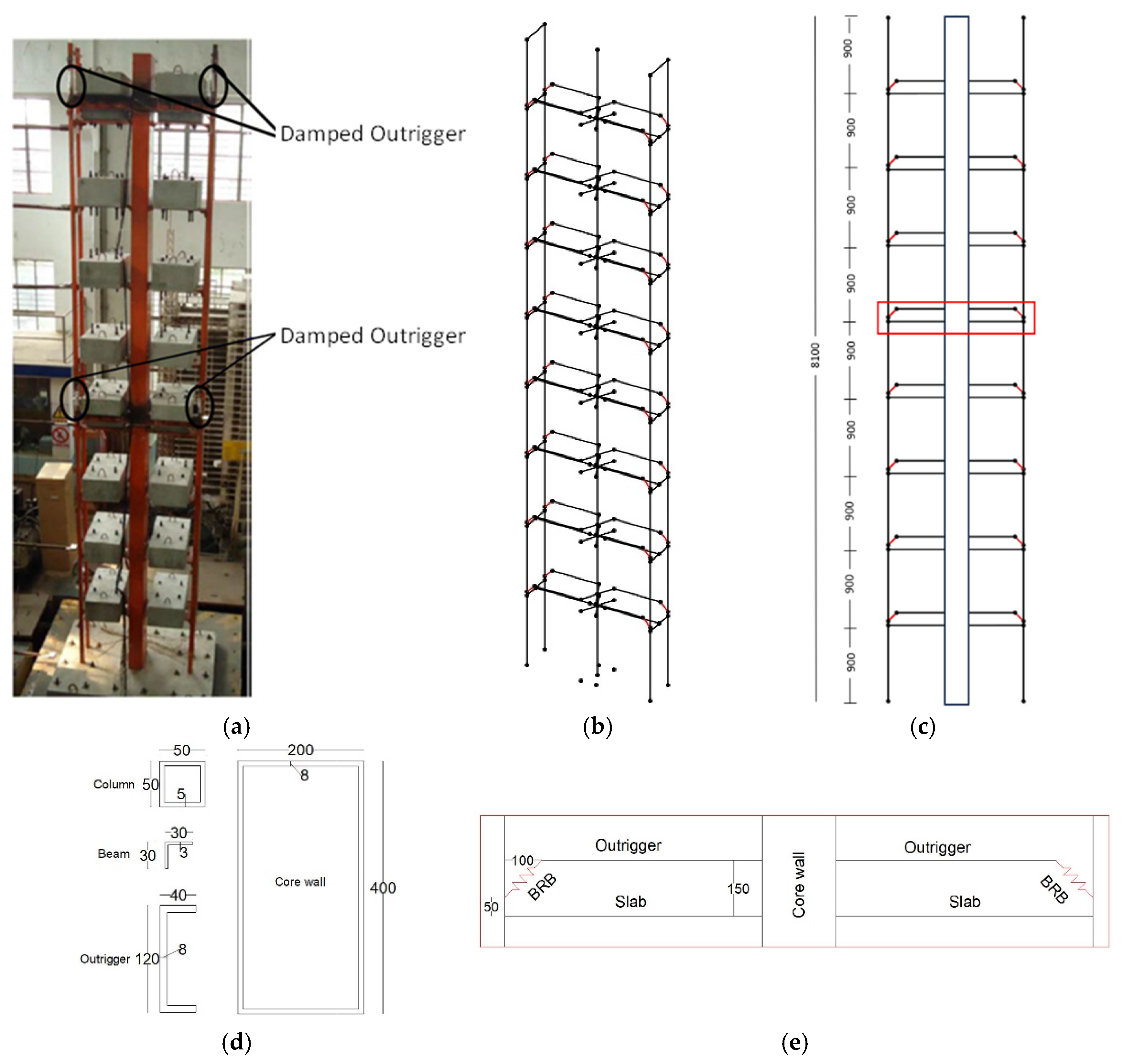
The prototype model has plan dimensions of 1600 mm × 400 mm. All structural members are assumed to be steel with a nominal yield strength of 345 MPa. The core tube has a cross-section of 200 mm × 400 mm with a wall thickness of 8 mm. The perimeter columns have dimensions of 50 mm × 50 mm with a thickness of 5 mm. In each zone, the core and perimeter column are connected in the Y-direction by two L-shaped steel beams with dimensions of 30 mm × 30 mm and a thickness of 3 mm. The outriggers are modeled as steel channels with a cross-section of 120 mm × 40 mm and a thickness of 8 mm. An additional lumped mass of 280 kg is assigned to each story. The original specimen shown in
Figure 1a includes two outriggers with attached viscous dampers located at zones 4 and 8 [
25].
For the present study, the overall structural height was modified to 8100 mm, resulting in a nine-zone analytical model with a zone height of 900 mm, as illustrated in
Figure 1b,c. Outriggers are considered from zone 2 to zone 9, and BRBs are introduced at each candidate outrigger level to represent a damped outrigger–BRB configuration. The outriggers are fixed to the core wall and positioned 150 mm above the floor level. A 100 mm gap is provided between each outrigger end and the perimeter column to accommodate the BRB element.
Each BRB is installed between the outrigger and the perimeter column, with the i-end connected to the outrigger at the outrigger level and the j-end connected to the column at a point 50 mm above the floor level, as shown in
Figure 1e. The BRBs are idealized as axial elements whose stiffness can be varied during the optimization process. This modeling approach allows the effect of BRB stiffness allocation at different elevations to be examined systematically while maintaining the same structural geometry, mass distribution, boundary conditions, and loading input for all candidate configurations.
To ensure fair comparison among different optimization cases, the same modeling assumptions are used throughout the study. The candidate outrigger–BRB locations are fixed from zone 2 to zone 9, the ground motion input is kept identical for all analyses, and only the number, location, and stiffness distribution of BRBs are varied. Accordingly, the analytical model is used to determine how the outrigger number, vertical placement, and BRB stiffness distribution influence the maximum inter-story drift response. This provides a consistent numerical platform for evaluating the efficiency of the proposed sequential optimization method and comparing it with a complete combinational reference search. Although the model does not include all practical features of a standard real-scale design building, it allows the optimization procedure to be examined transparently under controlled assumptions.
3. Optimization Framework
3.1. Power-Based Sequential Optimization Approach
To solve the optimization problem, a power-based sequential optimization approach is proposed to determine the optimal placement and stiffness distribution of outrigger–BRBs. The method incrementally allocates BRB stiffness to candidate stories and identifies the most effective placement sequence based on structural response. The objective of optimization is to minimize the maximum inter-story drift of the structure. The maximum inter-story drift ratio is selected as the primary optimization objective due to its direct relationship with structural damage control, serviceability limits, and code-based performance criteria. The design variables include the number of outrigger–BRBs and the distribution of BRB stiffness at each candidate story. The optimization problem can be expressed as:
where
is the BRB stiffness assigned to the
i-th story,
is the total available BRB stiffness, and
is the maximum inter-story drift response at the
i-th story. In this formulation, the optimization process searches for a stiffness allocation pattern that provides the greatest reduction in the maximum inter-story drift ratio under the selected seismic input. The proposed approach proceeds in a stepwise manner by incrementally assigning BRB stiffness
to candidate outrigger locations. At each optimization step, a set of candidate models is generated by adding
to one candidate location while keeping the stiffness distribution obtained from previous step. Each candidate model is then analyzed using nonlinear time history analysis, and the configuration that produces the minimum value of the objective function is selected. Therefore, the method does not simply select outrigger locations geometrically; rather, it evaluates the structural effectiveness of each candidate stiffness allocation based on the resulting drift response.
The optimization procedure consists of the following steps:
- (a)
Define the structural model with N candidate outrigger locations and specify the incremental BRB stiffness and total available stiffness .
- (b)
Generate N candidate models by assigning an incremental stiffness to each candidate story, while maintaining the optimal stiffness distribution obtained from previous steps.
- (c)
Perform nonlinear time-history analysis for each candidate model and evaluate the maximum inter-story drift response.
- (d)
Select the candidate model that produces the minimum value of the objective function .
- (e)
Update the BRB stiffness distribution and repeat steps (b)–(d) until the total available stiffness is reached or until the target number of outrigger–BRBs is obtained.
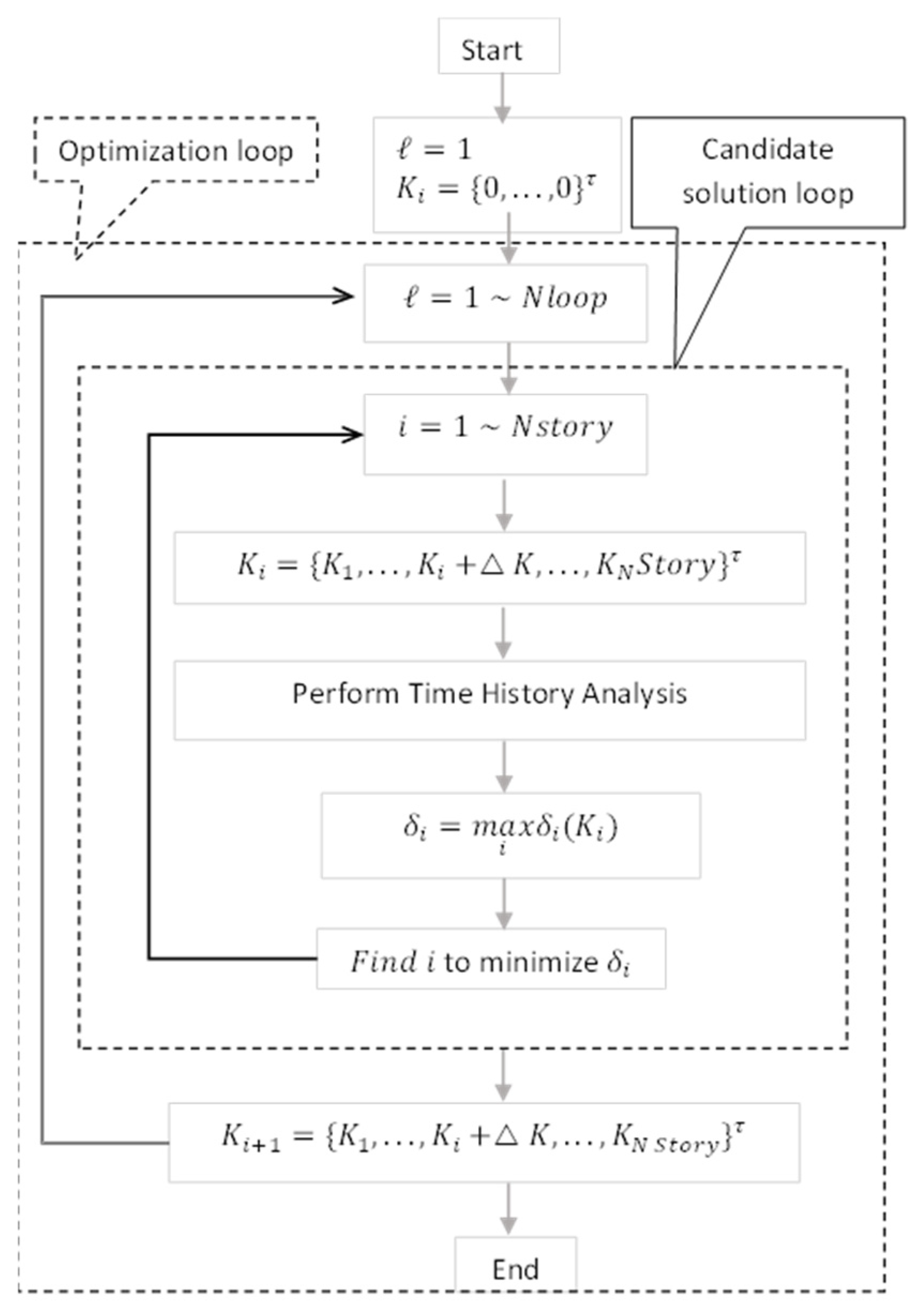
The complete procedure of the proposed optimization algorithm is illustrated in
Figure 2.
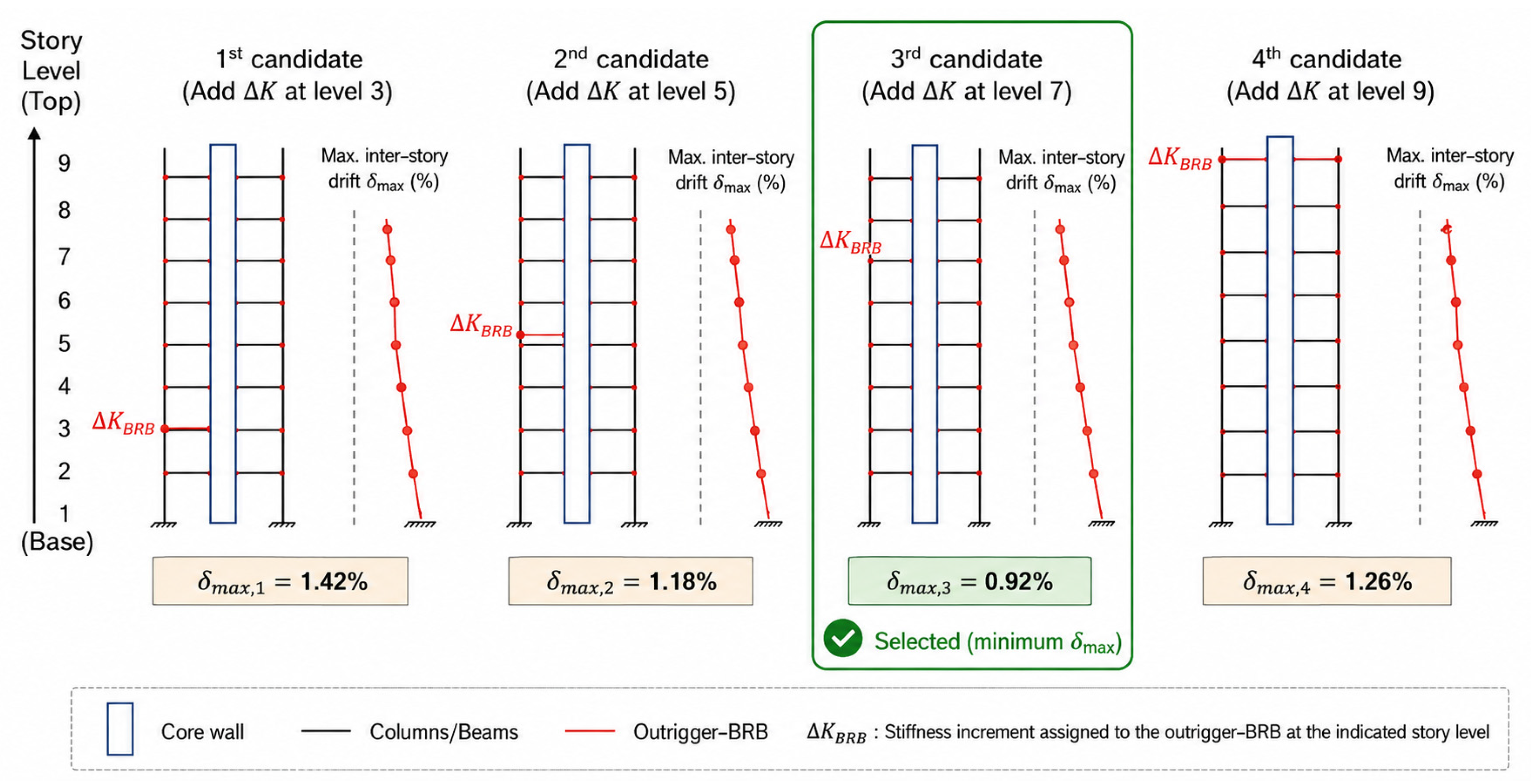
Figure 3 provides a schematic illustration of candidate generation and selection at a given optimization step. Once a story is selected as optimal at a given step, it is retained in subsequent steps. This means that the algorithm preserves the stiffness-placement decision that produced the greatest drift reduction in the previous step and then searches for the next most effective location for additional stiffness allocation. This retained-decision strategy allows the method to build the outrigger–BRB configuration progressively, based on the cumulative effect of stiffness distribution on the global drift response. In structural terms, the method reflects the fact that the effectiveness of a new outrigger–BRB depends not only on its own elevation but also on the stiffness already assigned to other outrigger levels. Therefore, the procedure accounts for the interaction between outrigger location, BRB stiffness, global stiffness distribution, and drift-control performance.
The main advantage of the proposed approach is that it evaluates only a limited number of candidate models at each step, where (N) is the number of available candidate outrigger levels. This substantially reduces computational effort compared with exhaustive combinational optimization, which requires all possible placement combinations to be analyzed. Although the proposed method follows a sequential allocation strategy and therefore does not mathematically guarantee the global optimum in all possible cases, it is intended to provide an efficient preliminary design and screening tool for identifying effective outrigger–BRB configurations with significantly fewer analyses.
3.2. Optimization Without Stiffness Constraint
In this case, the proposed power-based sequential optimization approach described in
Section 3.1 is applied without imposing an upper limit on the BRB stiffness at each outrigger level. This configuration represents the baseline condition for evaluating the inherent behavior of the optimization process. At each optimization step, an incremental stiffness
is assigned independently to each candidate outrigger location, generating a set of
candidate models. Nonlinear time-history analysis is performed for all candidate models, and the configuration that minimizes the maximum inter-story drift is selected as the optimal solution for that step.
The selected story is retained in subsequent optimization steps, and the procedure is repeated for the remaining candidate locations until the total stiffness is reached. Since no upper stiffness limit is imposed in this case, the algorithm is free to concentrate stiffness in the most effective outrigger zones if doing so results in a lower drift response. This case is therefore useful for identifying the preferred stiffness concentration pattern of the structure under the selected seismic input. It also provides a reference solution for comparison with stiffness-constrained optimization and exhaustive combinational optimization cases.
3.3. Optimization with Stiffness Constraint
To investigate the influence of BRB stiffness limitation on the optimal placement of outriggers, the power-based sequential optimization approach is extended by introducing an upper limit on the BRB stiffness at each outrigger level. This constrained case follows the same stepwise procedure as the unconstrained case; however, the BRB stiffness assigned to each candidate story is restricted by a predefined maximum value. Five different stiffness limits are considered to represent different allowable BRB capacity levels at each outrigger connection zone.
At each optimization step, a set of feasible candidate models is generated by assigning an incremental stiffness to candidate stories while satisfying the imposed stiffness constraint. Nonlinear time-history analysis is then performed for all feasible candidate models, and the configuration that minimizes the maximum inter-story drift is selected as the optimal solution.
As the optimization progresses, the number of feasible candidate solutions decreases due to the stiffness limitation, resulting in a more restricted search space compared to the unconstrained case. The stiffness constraint can be expressed as:
where
is the BRB stiffness at the
i-th story and
is the prescribed upper limit.
As optimization progresses, the number of feasible candidate solutions may decrease because some outrigger levels reach the prescribed stiffness limit. In such cases, the algorithm redistributes additional stiffness to other effective locations rather than continuing to concentrate stiffness at a single level. This allows the constrained case to examine how practical BRB capacity limitations influence the placement sequence, stiffness distribution, and drift-reduction performance. Therefore, this case provides a controlled comparison with unconstrained optimization and helps clarify whether the optimal placement pattern is governed mainly by structural response characteristics or by the imposed stiffness capacity limit.
3.4. Complete Combinational Reference Search
To evaluate whether the proposed sequential procedure can identify configurations close to the best solution within the selected candidate space, a complete combinational reference search is performed. This reference search should not be interpreted as a state-of-the-art optimization algorithm. Rather, it is used as a deterministic baseline that evaluates all possible outrigger–BRB placement combinations for a given number of outriggers. Therefore, it provides the best-performing configuration within the limited candidate set considered in this study.
In the present study, the number of candidate outrigger locations is limited to zones 2 through 9, resulting in a total of Z = 8 possible placement levels. The exhaustive combinational analysis is conducted for configurations consisting of one to four outrigger–BRBs. The upper limit of four outriggers is selected to maintain computational feasibility, as the number of possible combinations increases significantly with additional outriggers.
For a given number of outriggers
i, the total number of possible configurations
is determined as:
where
Z is the total number of candidate zones and
i is the number of outriggers. Accordingly, the number of candidate configurations evaluated in this study is:
1 outrigger: 8 configurations;
2 outriggers: 28 configurations;
3 outriggers: 56 configurations;
4 outriggers: 70 configurations.
Each configuration is analyzed using nonlinear time-history analysis, and the optimal solution is identified as the configuration that minimizes the maximum inter-story drift response. Unlike the proposed power-based sequential optimization approach, which evaluates a limited number of candidate models at each step, the exhaustive combinational method evaluates all possible configurations within the defined search space. As a result, it provides a reference solution for optimal placement but requires significantly greater computational effort. This comparison is useful because it allows the consistency of the proposed sequential procedure to be examined without introducing additional uncertainty associated with heuristic optimization parameters such as population size, mutation rate, convergence tolerance, or initial search conditions. The purpose of this comparison is therefore not to claim superiority over mainstream optimization algorithms, but to examine whether the proposed method can identify optimal or near-optimal solutions within the selected design space while requiring fewer nonlinear analyses than a complete search.
The optimization cases considered in this study, together with their constraints and roles, are summarized in
Table 1. The comparison between these cases enables evaluation of the effectiveness, robustness, and computational efficiency of the proposed optimization approach. For clarity, the combinational procedure is illustrated through representative cases. For a single outrigger–BRB, eight configurations are evaluated corresponding to placement in zones 2 to 9. For multiple outriggers, combinations are generated by selecting distinct zone locations without repetition. For example, in the case of two outriggers, all unique pairs of zones are evaluated, resulting in 28 configurations. Similarly, 56 and 70 configurations are evaluated for three and four outriggers, respectively. Each configuration is analyzed independently, and the optimal solution is identified based on the minimum inter-story drift response. This combinational procedure is computationally intensive, as all possible configurations must be evaluated.
4. Results
4.1. Optimization Results Without Stiffness Constraint
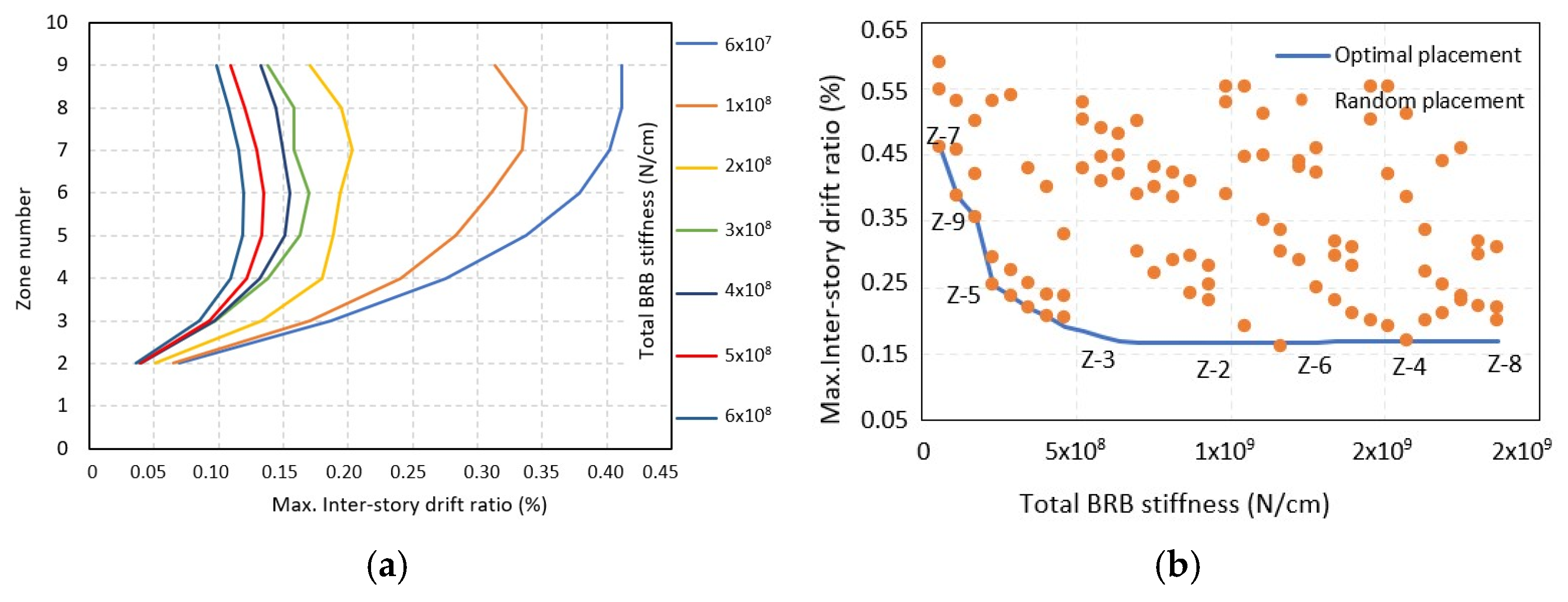
The optimization results obtained using the proposed power-based sequential optimization approach without stiffness constraint are presented in
Figure 4.
Figure 4a shows the distribution of maximum inter-story drift ratio along the building height for different BRB stiffness levels, while
Figure 4b compares the variation in maximum inter-story drift ratio with total BRB stiffness for the optimized and randomly generated outrigger–BRB configurations. This comparison is consistent with previous studies showing that the effectiveness of outrigger systems depends on the interaction between outrigger elevation, stiffness contribution, and the global deformation pattern of the structure. Therefore, the lower drift response obtained from the optimized cases is not only a result of adding BRB stiffness, but also of assigning that stiffness to locations where it most effectively modifies the lateral deformation response.
The results indicate that the introduction of outrigger–BRB systems reduces the maximum inter-story drift ratio compared with non-optimized placement cases. As the total BRB stiffness increases, the maximum inter-story drift ratio decreases progressively, demonstrating the effectiveness of stiffness allocation in controlling lateral deformation. However, the rate of reduction is not constant. Larger drift reductions are observed during the initial stiffness-allocation steps, while the improvement becomes less significant as additional stiffness is introduced. This trend indicates that the structural benefit of BRB stiffness depends not only on the total stiffness provided but also on where the stiffness is assigned along the building height.
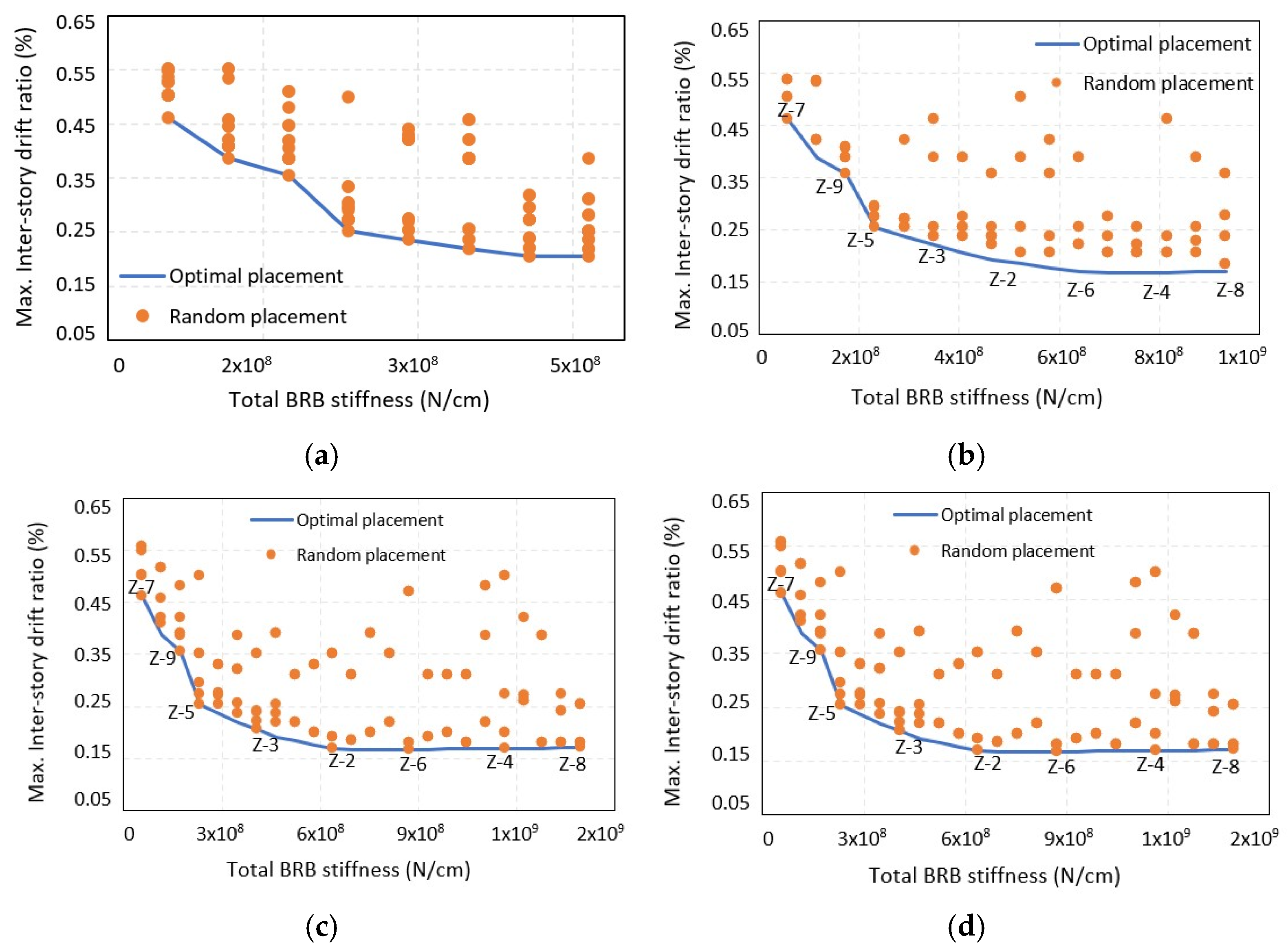
The optimized configurations consistently produce lower maximum inter-story drift ratios than the randomly generated configurations shown in
Figure 4b. In this study, “random placement” refers to non-optimized outrigger–BRB configurations generated by selecting placement zones arbitrarily within the allowable range, without applying the proposed optimization procedure. The comparison demonstrates that the proposed method can identify more effective outrigger–BRB locations than arbitrary placement using the same available stiffness. This finding supports the importance of systematic stiffness allocation and confirms that the proposed sequential approach can improve drift-control performance without increasing the total BRB stiffness demand.
The optimal placement zones also change during the sequential optimization process. In the early steps, BRB stiffness is assigned to locations that provide a larger contribution to drift reduction. As the optimization progresses, the influence of additional BRB placement becomes smaller because the most effective locations have already been selected. This behavior is consistent with the structural role of outriggers, which reduce lateral deformation by mobilizing the axial resistance of perimeter columns and modifying the global deformation pattern of the core–outrigger system. Therefore, the results show that the proposed method is not simply selecting outrigger locations in a predefined manner but is progressively identifying the zones that provide the greatest drift reduction at each stiffness-allocation step.
4.2. Optimization Results with Stiffness Constraint
The optimization results under different stiffness constraints are presented in
Figure 5. Each subfigure corresponds to a specific upper limit imposed on the BRB stiffness at each outrigger level. These cases are used to examine how practical limitations on BRB stiffness influence the optimal placement sequence, stiffness distribution, and drift-reduction performance.
The results show that the introduction of stiffness constraints affects both the optimal placement sequence and the resulting maximum inter-story drift response. Compared with the unconstrained case, the reduction in inter-story drift becomes more gradual because the algorithm cannot continue assigning stiffness to a single highly effective location once the prescribed upper limit is reached. As a result, additional stiffness must be distributed to other feasible candidate zones, leading to a broader stiffness distribution along the height of the structure.
Despite the imposed stiffness constraints, the proposed optimization approach continues to identify configurations that reduce the maximum inter-story drift ratio effectively. The optimal placement zones remain relatively consistent across different stiffness limits, although slight variations are observed depending on the level of constraint. This indicates that the preferred outrigger–BRB placement pattern is mainly governed by the structural response characteristics of the model, while the stiffness constraint controls how much stiffness can be concentrated at each selected level. This behavior supports the practical importance of considering stiffness limits during preliminary design.
Table 2 summarizes the distribution of stiffness allocation increments, Δk, across the outrigger zones for different stiffness-constraint cases at the optimal steps of the proposed optimization approach. For lower stiffness limits, the stiffness increments are distributed more uniformly across the available outrigger zones. As allowable stiffness increases, the distribution becomes less uniform, with greater stiffness concentration in selected zones. In the unconstrained case, the algorithm assigns more stiffness to the zones that provide the largest drift reduction. This result explains why the unconstrained case produces a faster reduction in inter-story drift, while the constrained cases show a more gradual response improvement.
These findings indicate that stiffness constraints do not only limit the magnitude of the BRB stiffness; they also change the way in which the optimization procedure distributes stiffness along the building height. From a practical design perspective, this is important because actual BRB stiffness and capacity are limited by device size, connection capacity, architectural constraints, and constructability. Therefore, the stiffness-constrained cases provide useful insight into how the proposed method can be applied when unlimited stiffness concentration at one or two outrigger levels is not feasible.
4.3. Comparison with Exhaustive Combinational Optimization
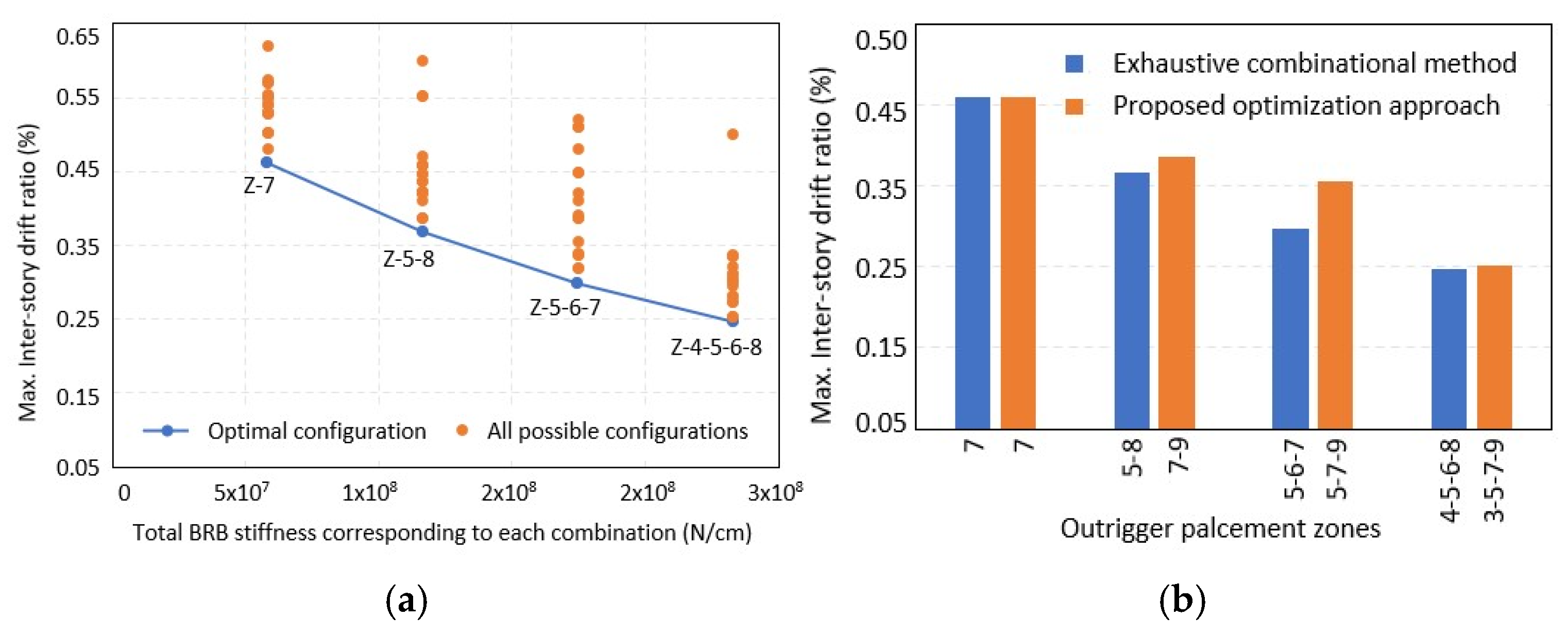
Figure 6 compares the results obtained from the proposed power-based sequential optimization approach with those from the exhaustive combinational optimization procedure. The comparison focuses on the optimal placement configurations and the corresponding maximum inter-story drift responses.
The results obtained from the proposed power-based sequential optimization approach are compared with those from the complete combinational reference search. The comparison focuses on the optimal placement configurations and the corresponding maximum inter-story drift responses within the selected candidate space. This comparison is intended to evaluate the consistency of the proposed sequential allocation procedure, not to benchmark it against all available structural optimization algorithms.
The key advantage of the proposed method is the reduction in the number of required analyses. The exhaustive combinational method evaluates all possible configurations within the defined search space. For the cases considered in this study, this includes 8, 28, 56, and 70 configurations for one, two, three, and four outriggers, respectively. In contrast, the proposed sequential method evaluates only a limited number of candidate models at each step. Therefore, the proposed approach can identify effective placement configurations with substantially lower computational effort.
The comparison also clarifies the role of the proposed method. The purpose of the sequential approach is not to replace detailed final design or to guarantee the global optimum for every possible structural system and seismic input. Rather, it provides a rapid screening procedure that can identify effective outrigger–BRB configurations before more detailed design checks, multi-objective optimization, or multi-record nonlinear analysis are performed. This makes the method particularly useful during preliminary design and parametric studies, where many possible outrigger numbers, locations, and stiffness levels must be evaluated efficiently.
5. Discussion
The results show that the placement and stiffness distribution of outrigger–BRB systems significantly influence the maximum inter-story drift response of the structure. This finding is consistent with previous studies showing that outrigger efficiency depends on the interaction between outrigger location, device stiffness, and the global deformation pattern of the building. However, the main contribution of this study is not simply confirming that outrigger location and BRB stiffness affect seismic response. Rather, the contribution is the development of a sequential stiffness-allocation method that can identify effective outrigger–BRB configurations with substantially fewer analyses than exhaustive combinational search.
From a structural design perspective, the optimization results can be explained by the role of outriggers in coupling the core wall with the perimeter columns and mobilizing axial forces in the exterior columns. When BRBs are installed at the outrigger connection zones, the system provides both stiffness contribution and energy dissipation capacity. Therefore, the most effective outrigger–BRB locations are those that modify the global lateral deformation pattern and reduce the critical inter-story drift demand. This explains why the proposed method initially assigns stiffness to the zones that provide the largest reduction in maximum inter-story drift.
The results also indicate that increasing BRB stiffness does not lead to proportional improvement in structural response. In the early stages of the optimization process, stiffness allocation produces a clear reduction in inter-story drift. However, as additional stiffness is introduced, the rate of improvement decreases because the most effective deformation-sensitive zones have already been controlled. This diminishing-return behavior supports the need for an optimization strategy that considers both stiffness quantity and vertical placement, rather than relying only on increasing the number or stiffness of outrigger–BRBs.
The stiffness-constrained cases provide useful insight for practical design. When an upper limit is imposed on the BRB stiffness at each outrigger level, the algorithm distributes stiffness more broadly across the building height instead of concentrating it at only a few locations. This produces a more gradual reduction in inter-story drift. This result is important because real BRB systems are limited by device capacity, connection strength, architectural constraints, and constructability. Therefore, the constrained cases show how the proposed method can be applied under more realistic design conditions.
The comparison with the complete combinational reference search demonstrates that the proposed sequential method can identify the main effective outrigger–BRB placement pattern within the selected candidate space. The reference search evaluates all possible combinations for the considered candidate levels and therefore provides a deterministic baseline for this specific benchmark problem. However, this comparison should not be interpreted as a general benchmark against all mainstream structural optimization algorithms. The proposed method is better understood as a preliminary screening and stiffness-allocation strategy that reduces the number of nonlinear analyses needed to identify promising outrigger–BRB configurations before more detailed optimization or design verification is performed.
It should be noted that the present study is based on a controlled nine-zone benchmark model subjected to a single ground-motion record. Therefore, the identified optimal configurations are specific to the investigated model, modeling assumptions, and seismic input. The model does not include all features of real-scale design buildings, such as detailed floor diaphragms, gravity framing systems, foundation flexibility, multiple hazard levels, design-code load combinations, and record-to-record variability. Therefore, the results should be interpreted as a demonstration of the proposed sequential optimization framework rather than a complete validation for all practical tall-building systems. Future work should extend the framework to standard real-scale reference buildings, multiple ground motions, different structural systems, and comparisons with genetic algorithms, gradient-based methods, sensitivity-based optimization, and surrogate-assisted optimization.
6. Conclusions
This study presented a power-based sequential optimization approach for determining the effective placement and stiffness distribution of outrigger–BRB systems in a benchmark tall-building model. The proposed method was evaluated using nonlinear time-history analysis and compared with exhaustive combinational optimization. Based on the results, the following conclusions can be drawn:
The proposed sequential optimization approach identified optimal or near-optimal outrigger–BRB configurations within the selected candidate space while requiring fewer analyses than the complete combinational reference search. This demonstrates its potential as a preliminary screening tool for outrigger–BRB layout selection.
The results confirmed that the seismic response of outrigger–BRB systems is influenced not only by the total BRB stiffness but also by the vertical placement and distribution of stiffness along the building height.
The sequential stiffness-allocation process showed that the greatest drift reduction occurs during the early optimization steps, while additional stiffness produces gradually smaller improvements. This indicates that effective stiffness placement is more important than simply increasing BRB stiffness or the number of outriggers.
The stiffness-constrained cases showed that limiting the BRB stiffness at each outrigger level leads to a broader distribution of stiffness across multiple zones and a more gradual reduction in inter-story drift. This provides useful insight for practical design cases where BRB capacity, connection strength, and architectural constraints limit stiffness concentration.
The comparison with the complete combinational reference search showed that the proposed method can capture the main effective placement pattern while reducing computational demand within the investigated benchmark problem. However, this comparison should be interpreted as a deterministic reference comparison, not as a general benchmark against all mainstream structural optimization algorithms.
The main application of the proposed method is in the preliminary design stage of tall buildings equipped with outrigger–BRB systems, where several possible outrigger numbers, locations, and stiffness levels must be evaluated efficiently. However, the present study is limited to a controlled nine-zone benchmark model subjected to a single ground-motion record. Therefore, the results should be interpreted as a demonstration of the proposed sequential optimization framework rather than a complete validation for all practical tall-building systems.
Future work should extend the proposed framework to standard real-scale reference buildings, multiple ground motions, different building heights, and multi-objective performance criteria. In addition to maximum inter-story drift ratio, future studies should consider floor acceleration, base shear, member force demands, residual deformation, and BRB energy dissipation. Comparisons with mainstream structural optimization methods, including genetic algorithms, gradient-based methods, sensitivity-based optimization, and surrogate-assisted optimization, should also be conducted to further evaluate the computational performance of the proposed method.