Article

Nonlinear Seismic Response of a Long-Span Suspension Bridge Under Sequential Ground Motions Considering Pile Foundation Soil–Structure Interaction

by
Lydia Konstantina Georgiou Zonara
1 and
Panagiota S. Katsimpini
1,2,*
1
Department of Civil Engineering, University of the Peloponnese, GR-26334 Patras, Greece
2
Structural Technology and Applied Mechanics Laboratory, School of Science and Technology, Hellenic Open University, GR-26335 Patras, Greece
*
Author to whom correspondence should be addressed.
CivilEng 2026, 7(2), 37; https://doi.org/10.3390/civileng7020037
Submission received: 3 May 2026 / Revised: 7 June 2026 / Accepted: 9 June 2026 / Published: 12 June 2026
(This article belongs to the Section Structural and Earthquake Engineering)

Abstract

This study presents the nonlinear seismic analysis of a large-scale suspension bridge under multiple sequential earthquake records. A detailed 3D finite element model is developed in SAP2000, incorporating CFST pylons, a composite deck, and a main cable suspension system. The novelty of this work lies in the combined treatment of two critical and often independently studied factors: nonlinear pile foundation behavior and sequential seismic loading. A Winkler-based nonlinear pile foundation model is established through depth-dependent p-y, t-z, and Q-z nonlinear spring curves implemented as Multi-Linear Plastic Link elements, capturing the full nonlinear lateral and axial response of the 1.8 m diameter, 60 m long pile group. Simultaneously, the structural response is evaluated under real seismic sequences rather than single events, addressing the cumulative damage that conventional analyses systematically underestimate. The results demonstrate that the combination of foundation nonlinearity and repeated seismic loading significantly amplifies internal forces and deformation demands on critical structural components, highlighting the inadequacy of standard single-event, fixed-base design assumptions for long-span bridges.

1. Introduction

Suspension bridges are some of the most structurally demanding achievements in modern civil engineering. Their characteristics such as span lengths, inherently flexible structural behavior, and intricate load distribution paths, make reliable seismic evaluation a genuinely difficult undertaking. Bridge failure during seismic events carries severe consequences for both human life and regional economies; the research community has devoted considerable effort to develop more rigorous and representative analytical approaches. Despite this progress, two fundamental aspects remain insufficiently addressed in engineering practice: the accumulated structural damage caused by successive seismic events, and the nonlinear interaction that develops between pile foundation systems and the surrounding ground.
There is now substantial evidence that structures behave quite differently under repeated earthquake loading than conventional single-event assessments would suggest. Di Sarno [1] found that recurrent ground shaking, of the kind observed during the 2011 Tohoku sequence, can drive inelastic deformation demands to between 1.5 and 4 times those produced by a single isolated event, and that behavior factors derived from individual earthquakes tend to overstate the actual structural capacity available. Turchetti et al. [2] reinforced this conclusion by showing that cumulative pier damage in bridges exposed to earthquake sequences involves a progressive erosion of load-carrying capacity that neither empirical regression models nor single-event frameworks can adequately represent. Chorafa et al. [3] confirmed that seismic sequences place notably higher deformation and acceleration demands on composite structures, while fluid viscous dampers proved capable of keeping inter-story drifts and accelerations within acceptable bounds across a range of building heights. Extending this inquiry to historic structures, Katsimpini et al. [4] found that the Arta Bridge, when subjected to sequential loading, experienced arch crown displacements 30–60% larger than those recorded under equivalent single events, with accumulated damage often exceeding the simple sum of individual contributions. This is a result that underscores both the nonlinear character of damage accumulation and the general inadequacy of single-event assessments for bridge structures of any type.
The influence of soil–structure interaction (SSI) on bridge dynamic behavior is equally consequential and similarly underappreciated in routine practice. Katsimpini et al. [5] concluded that incorporating SSI into analyses of bridges subjected to combined train loading and near-fault ground motion increases natural periods by as much as 10% and can amplify structural response by 1.25 times, indicating that fixed-base assumptions systematically underestimate seismic demands. Working on highway bridges along the Attiki Odos corridor, Anastasopoulos et al. [6] demonstrated that nonlinear SSI is essential for post-earthquake damage assessment, enabling resolved damage mapping that simplified fixed-base approaches cannot produce. Rachedi et al. [7] arrived at similar conclusions from a fragility perspective, establishing that SSI is particularly critical in soft soil environments where foundation flexibility exerts a dominant influence over structural vulnerability. At the component level, Galvin et al. [8] developed an efficient decoupled method for including SSI in railway bridge analyses, finding that ignoring foundation flexibility yields inaccurate predictions of resonance and cancelation effects, especially at higher train speeds.
The seismic behavior of bridge columns has attracted growing research interest, with recent work increasingly oriented towards post-earthquake operational continuity rather than simple collapse avoidance. Sun et al. [9] demonstrated that incorporating unbonded post-tensioning tendons into bridge columns reduces residual displacements, with performance governed principally by the prestress ratio rather than by tendon geometry. Liu et al. [10] extended this work by demonstrating that while conventionally reinforced concrete columns sustain residual deformations that make repair impractical, unbonded partially prestressed columns achieve a balance between energy dissipation and self-centering behavior. These results are directly pertinent to the design philosophy pursued here, where restoring serviceability after an earthquake is treated as a primary performance target. Zhang and Alam [11] identified a gap at the code: provisions governing column damage are well developed, but guidance for foundations, bearings, and connections remains vague, and protective strategies such as base isolation and rocking mechanisms lack sufficient codification with particular implications for long-span suspension bridges. Li et al. [12] argued that the long-term resilience of highway bridges cannot be assessed through seismic loading alone, since hurricanes and flood-induced scour introduce extra degradation pathways that interact with seismic vulnerability throughout a structure’s service life.
The modeling of soil–structure interaction (SSI) for long-span bridges has evolved significantly over the past decades. Early state-of-the-art applications relied heavily on simplified substructure methods, substituting the entire foundation with linearized 6 × 6 lumped spring–dashpot matrices evaluated at a single dominant frequency [13,14]. While computationally efficient, these linear approaches fail to capture material boundaries, soil plastification, and gapping under high-amplitude cyclic loading [15]. To address these limitations, recent advancements have split into two main branches: high-fidelity continuum finite element/difference modeling (3D soil domains) [16] and simplified macro-element formulations, such as the nonlinear Beam on Nonlinear Winkler Foundation (BNWF) approach utilizing hysteretic p-y, t-z, and q-z spring networks [17,18]. While 3D continuum models provide exceptional localized stress resolution, their extreme computational cost often restricts their application to single-event inputs and uniform excitations, rendering them impractical for expansive structures with multi-support spatial variability [19,20]. Consequently, the BNWF approach has become the contemporary standard for capturing deep pile foundation nonlinearities [18]. However, a review of the current state of the art reveals that existing BNWF bridge studies almost exclusively investigate isolated single-event seismic records [5,19]. Very few frameworks bridge the gap to evaluate how nonlinear foundation setups degrade under sequential mainshock–aftershock events, especially when concurrently subjected to asynchronous traveling wave passage across wide spans [21,22]. This study directly addresses this scientific void by utilizing a fully coupled, nonlinear BNWF framework under spatial sequential loading. Despite the extensive literature on the spatial seismic analysis of suspension bridges, a significant research gap persists regarding their performance under consecutive earthquake occurrences. Most existing frameworks evaluate spatial variability—such as the traveling wave effect—using single-event ground motions and idealized fixed-base supports. The novelty of this study lies in the formulation of an integrated numerical framework that simultaneously couples: (a) seismic damage accumulation from real mainshock–aftershock sequences, (b) asynchronous support excitation over an 1800 m total span, and (c) fully nonlinear soil–structure interaction utilizing deep hysteretic pile-foundation configurations. By contrasting single-event rigid-base models against sequential SSI wave-passage simulations, this paper isolates and quantifies the hidden vulnerabilities introduced by soil yielding and structural period shifting under successive dynamic impacts.
Building on this body of work, the present study examines the nonlinear seismic response of a large-scale suspension bridge subjected to sequential ground motion records, with explicit representation of nonlinear pile–soil interaction through depth-varying p-y, t-z, and Q-z spring formulations. The novelty of this work lies in the simultaneous treatment of two factors that are typically studied in isolation: the nonlinear soil–pile interaction and the cumulative structural effects of seismic sequences. A detailed three-dimensional finite element model is developed in SAP2000 [23], and a suite of real sequential ground motion records is applied to evaluate force demands and deformation patterns. The outcomes of this study contribute to the development of more robust performance-based seismic design methodologies for long-span suspension bridges.

2. Structural Description

2.1. Overall Geometry and Structural System

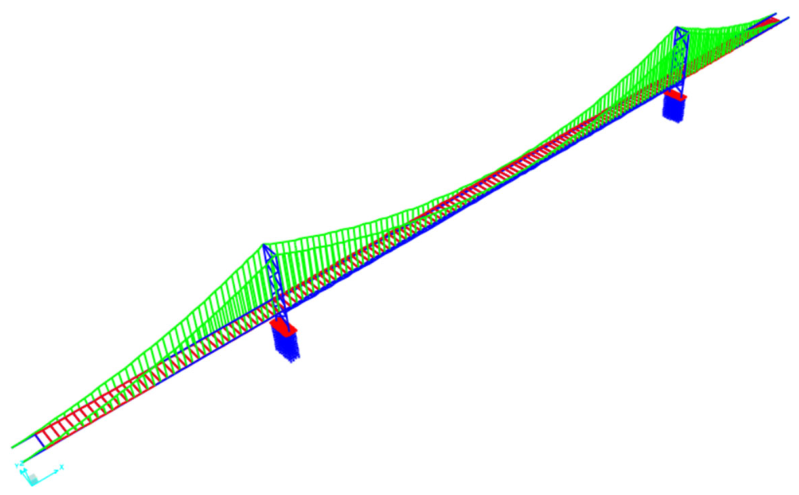
The bridge examined in this study is a large-scale suspension bridge with a total length of 1800 m. The structural system consists of a central main span of 1000 m and two symmetrical side spans of 400 m each. The two main pylons rise 150 m above the level of the supports and constitute the primary vertical load-carrying elements of the system. The overall computational model of the bridge was developed in SAP2000 [23] and is illustrated in Figure 1. The structural components of the 1800 m total length suspension bridge were designed in strict compliance with contemporary international bridge and seismic engineering standards. The geometric layout and gravity/live load distributions of the steel aerodynamic box girder deck, as well as the sizing of the high-strength steel main cables and hangers, were verified using the AASHTO LRFD Bridge Design Specifications [24] under ultimate and serviceability limit states. Given the composite nature of the 150 m tall pylons, which utilize Concrete-Filled Steel Tube (CFST) cross-sections, their cross-sectional capacity, local buckling resistance, and axial–flexural interaction were designed using the provisions of Eurocode 4 (EN 1994-2) [25] and cross-checked against the AISC 360 Specification for Structural Steel Buildings [26]. For the substructure and foundation systems embedded in the medium-dense sand formation, the geotechnical bearing capacity of the pile cap and the structural sizing of the 60 m long, 1.8 m diameter bored pile groups were established based on Eurocode 7 (EN 1997-1) [27]. Furthermore, the dynamic stiffness and kinematic interaction parameters of the soil–structure interface were modeled in accordance with the seismic design provisions of Eurocode 8 [28], ensuring that the nonlinear Winkler spring thresholds accurately reflect code-defined ultimate soil resistances.

2.2. Pylons and Foundation System

The pylons are composite Concrete-Filled Steel Tube (CFST) members with circular cross-section (D = 3.5 m, t = 35 mm, S355 steel, C40/50 concrete). The braces of the pylons consist of circular hollow sections of 1.0 m diameter and 35 mm wall thickness, also in S355 steel.
The foundation is composed of reinforced concrete piles (C40/50) of a circular cross-section with a diameter of 1.8 m. Each pile cap supporting a pylon consists of 40 piles arranged in a 5 × 8 grid configuration, with an individual pile length of 60 m. The geotechnical conditions are representative of medium-dense sand with an internal friction angle of φ = 35° and a submerged unit weight of γ′ = 10 kN/m3. The nonlinear modeling of the pile foundation is discussed in detail in Section 3.
The selection of a 1.8 m diameter (D0 = 1.8 m) for the bored pile groups represents a typical, optimized configuration for mega-scale bridge infrastructure. Large-diameter bored piles within the range of 1.5 to 2.5 m are explicitly required for long-span suspension bridges to provide the immense cross-sectional flexural rigidity (EI) needed to withstand the high-amplitude lateral base shears and overturning moments transmitted by the 150 m tall pylons.
Geotechnically, a 1.8 m profile embedded within a medium-dense sand formation (Soil Type C) ensures adequate mobilization of passive soil resistance along the shallow effective zone without triggering localized soil failure. Furthermore, from an engineering layout perspective, utilizing 1.8 m diameter piles helps maintain a standard center-to-center spacing of 3D0 to 4D0 within the pile cap, which controls group efficiency degradation and keeps the dimensions of the structural concrete cap optimized.

2.3. Deck and Main Girder

The bridge deck consists of a reinforced concrete slab of 1000 mm thickness. The primary steel girder supporting the deck is a rectangular hollow section with an external height of 5.0 m, a width of 3.0 m, and flange and web thickness of 35 mm, fabricated from S355 steel. In the central span, steel angle sections L1000 × 35 (S355) are beneath the deck as additional stiffening elements.

2.4. Cable System

The suspension system is the most critical load-carrying component of the bridge. The main cable has a diameter of 800 mm and follows a catenary profile between the two pylons and the anchorage points. The hangers suspending the deck from the main cable vary in diameter depending on their location: 200 mm in the main span and 100 mm in the side spans.
The geometric and material properties of all structural sections are summarized in Table 1.

3. Finite Element Modeling in SAP2000

3.1. General Model Description

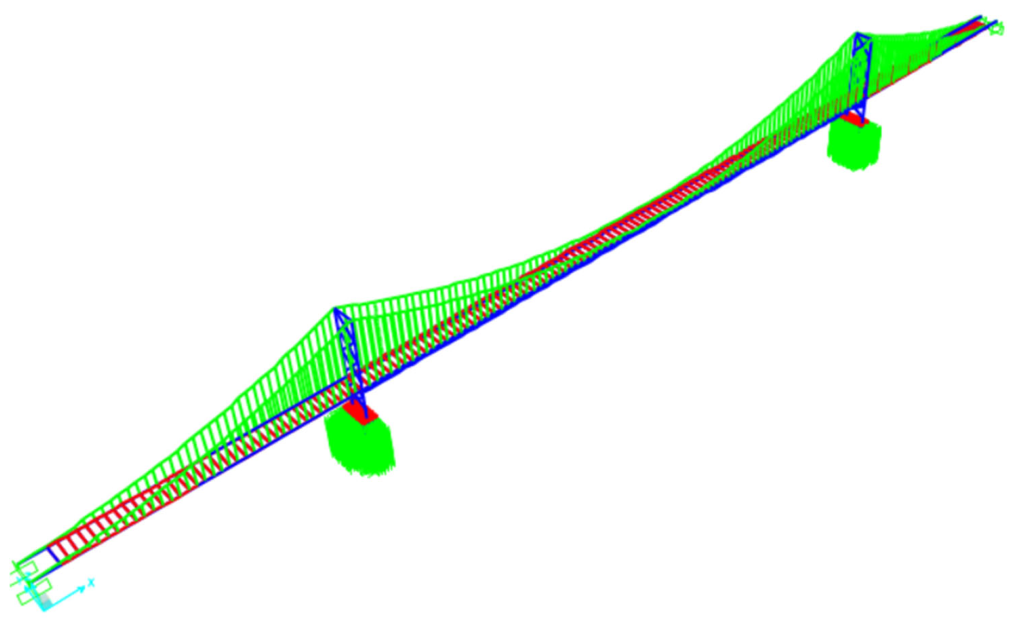
The three-dimensional finite element model of the suspension bridge was developed in SAP2000 [23], utilizing a comprehensive nonlinear modeling approach that captures both the geometric and material nonlinearities inherent in the structural system. The model comprises frame elements for the pylons, deck girder, braces, and piles, cable elements for the main cable and hangers, and nonlinear link elements for the soil–pile interaction springs. To ensure reproducibility, the three-dimensional finite element model is constructed using specific element formulations that capture the complex interaction of the bridge components. The primary superstructure and substructure including the pylons, deck girders, lateral braces, and foundation piles are modeled using frame elements capable of simulating coupled axial, bending, and torsional behaviors. The tension-only components, specifically the main cables and hangers, utilize specialized cable elements. These elements incorporate geometric nonlinearities to accurately capture cable sag effects and large displacement kinematics under environmental loads. Foundation-structure interaction is addressed at the substructure level. The boundary conditions between the piles and the surrounding ground are simulated using nonlinear link elements. These links function as independent soil–pile interaction springs, governed by localized p-y (lateral), t-z (skin friction), and q-z (tip resistance) empirical curves to replicate realistic soil degradation and yielding. The complete computational model is shown in Figure 2.

3.2. Structural Elements and CFST Pylon Modeling

The pylon columns are composite Concrete-Filled Steel Tube (CFST) members with circular cross-section (D = 3.5 m, t = 35 mm, S355 steel, C40/50 concrete). Their bearing capacity is evaluated following the analytical method proposed by Katsimpini et al. [29], which provides direct empirical relations for the ultimate strength of circular CFT members under axial load, pure bending, and combined axial load–bending moment, validated against an extensive finite element databank and experimental data.

3.2.1. Section Capacity—Axial Load

The compressive capacity of the circular CFST section is decomposed into the steel tube contribution Ps and the concrete core contribution Pc:
Ps = fy · As = 355 × 376.6 × 10−3 = 135,254 kN
Pc = fc · Ac = 40 × 9239.1 × 10−3 = 369,565 kN
Ppred = Ps + Pc = 542,557 kN
where the cross-sectional parameters are: D/t = 100, fy/fc = 8.875, and the confinement index ξ = (As · fy)/(Ac · fc) = 0.366. These values fall within the validated range of the Katsimpini et al. [29] method.

3.2.2. Section Capacity—Bending

The moment capacity under pure bending is similarly evaluated:
Mc = 269,024 kNm (concrete contribution)
Ms = 149,182 kNm (steel contribution)
Mpred = 226,426 kNm
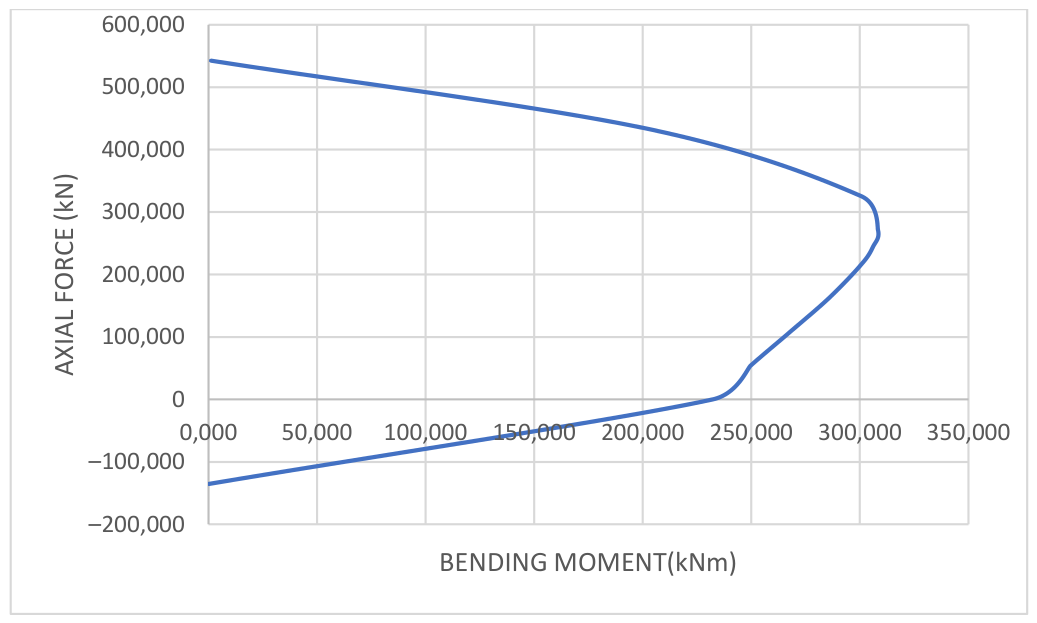
For the beam column interaction, the normalized moment axial load interaction curve is constructed using the empirical coefficients m1–m7 proposed by Katsimpini et al. [29] for circular sections, with the following values for the present cross-section (Table 2):
The interaction curve is expressed as:
M/Mpred = m1 + m2 · (P/Ppred) + m3 · (P/Ppred)2 + m4 · (P/Ppred)3 + m5 · (P/Ppred)4+ m6 · (P/Ppred)5 + m7 · (P/Ppred)6
Representative interaction values at selected axial load ratios are summarized in Table 3.
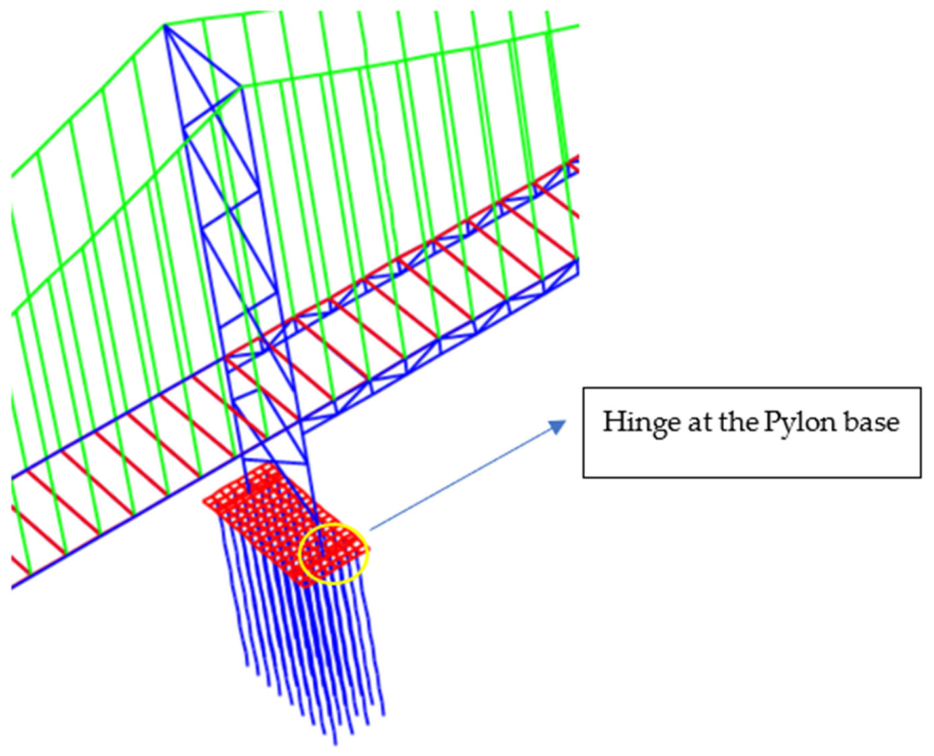
The interaction curve exhibits the characteristic behavior of circular CFST sections: moment capacity initially increases with axial load due to the confinement enhancement of the concrete core, reaching a peak at approximately P/Ppred ≈ 0.50, before decreasing toward the pure compression limit. This behavior is captured through the user-defined plastic hinges (Figure 3) assigned at the pylon column extremities in SAP2000 [23], following the modified Ramberg–Osgood hysteretic model as described in Katsimpini et al. [29,30]. The nonlinear behavior of the cross-bracing elements is modeled using plastic hinges that account for cyclic strength degradation. The composite deck is treated as elastic throughout the analysis, with diaphragm action assigned to transfer in-plane seismic shear forces to the lateral load-resisting system. The seismic performance and energy dissipation mechanisms of the lateral load-resisting system are captured by incorporating material nonlinearities into the cross-bracing network. These bracing components are modeled using discrete plastic hinges located at critical cross-sections. The hysteretic response of these hinges explicitly accounts for cyclic strength and stiffness degradation, simulating geometric post-buckling behavior and progressive fatigue under cyclic reversals.
Conversely, the composite bridge deck is assumed to remain undamaged during the design-level seismic event. It is configured with linear elastic material properties throughout the duration of the analysis. To ensure realistic load distribution, kinematic constraints are applied to the deck to enforce diaphragm action. This mechanism models the high in-plane stiffness of the composite slab, effectively transferring inertial seismic shear forces to the primary lateral load-resisting subsystems.
The main cable and hangers are modeled using tension-only cable elements with large-displacement formulation, enabling the capture of geometric nonlinearity arising from cable sag and load-induced stiffness changes. An initial prestress is assigned to the main cable consistent with the dead load equilibrium state of the structure.

3.3. Nonlinear Pile Foundation Modeling

3.3.1. Modeling Philosophy

The nonlinear behavior of the pile foundation is modeled through the Winkler spring approach, in which the continuous soil resistance is replaced by a series of discrete nonlinear springs distributed along the pile shaft and at its tip. This methodology, widely adopted in both research and practice, captures the key features of soil–pile interaction including initial stiffness, progressive yielding, and plastic plateau behavior under both lateral and axial loading. The p-y curve method in particular has been extensively validated and recognised as the standard tool for calculating horizontal forces on piles due to its ability to replicate the nonlinear pile–soil response under static, cyclic, and seismic loading [31]. For marine and offshore structures, nonlinear soil–pile–structure interaction (SPSI) phenomena are commonly represented through the combined imposition of p-y, t-z, and q-z springs, a methodology that has been shown to play a vital role in the response of bottom-fixed structures [32].

3.3.2. Lateral Response—p-y Curves

The lateral soil resistance is characterized by nonlinear p-y curves following the API formulation for medium-dense sand (φ = 35°, γ′ = 10 kN/m3). While the API p-y formulation remains the standard for design, its applicability to large-diameter piles has been subject to growing scrutiny. Parametric finite element investigations have demonstrated that pile diameter and soil shear strength are the dominant parameters governing lateral stiffness and ultimate soil reaction in large-diameter monopiles, whereas the classical API expressions may underestimate the initial stiffness for large diameters [33]. Similarly, field tests on large-diameter monopiles have shown that the API p-y curves for clay produce a notably conservative “softer” response compared to solid FEM results, particularly at small deflections [34]. For soft clay conditions, improved p-y formulations have been proposed that overcome the deficiencies of the API model by offering better versatility across pile diameters and soil profiles [35,36]. These findings collectively justify the use of a carefully calibrated API p-y formulation for sand in the present study, while acknowledging that the classical approach may underestimate lateral stiffness by up to 15–20% for the pile diameter of D = 1.8 m adopted here.
The p-y curve used in this study follows the API formulation:
p(y) = A · pu · tanh(k · z · y/A · pu)
where pu is the depth-dependent ultimate resistance, k is the initial modulus of subgrade reaction (nh = 35,000 kN/m3), z is the depth below the surface, y is the lateral displacement, and A = 0.9 for cyclic loading. The ultimate lateral resistance increases with depth, from 1350 kN/m at z = 5 m to 73,800 kN/m at z = 40 m. Each pile is discretized into 12 frame elements of approximately 5 m length, with nonlinear link elements assigned at all 13 nodes per pile.

3.3.3. Axial Response—t-z and Q-z Curves

The axial soil–pile interaction is modeled through two separate spring systems. Shaft friction along the pile length is represented by nonlinear t-z curves following the API formulation:
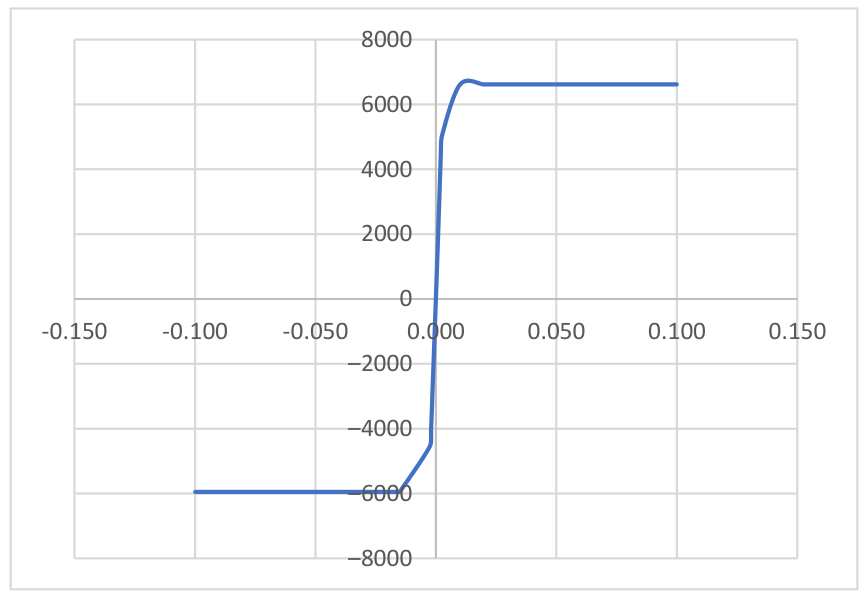
t(z) = fs · tanh(z/2.5 mm)
where the unit skin friction fs is computed as fs = β · σ′v · tan(δ), with β = 0.8, δ = 0.75, φ = 26°, and σ′v the effective vertical stress at each depth. At a representative depth of z = 30 m, fs = 117 kPa, yielding a maximum shaft friction force of approximately 3311 kN per 5 m pile segment. The total shaft friction capacity of the full pile length is estimated at 35,000 kN.
Tip resistance is modeled at the pile base node through a Q-z curve:
Q(z) = Ab · qb · tanh(z/10 mm)
where qb = Nq · σ’v,base = 50 × 600 = 30,000 kPa for φ = 35° and Nq = 50, giving a total tip resistance of 76,200 kN per pile. A nonlinear t-z curve is presented on Figure 4.
The Winkler spring model implemented in this study captures material (hysteretic) damping through the cyclic force–displacement behavior of the Multi-Linear Plastic Link elements [23], but does not include the dashpot components required to represent radiation damping, i.e., the energy dissipated by stress waves propagating away from the pile into the surrounding soil. This is a recognized limitation of the classical BNWF formulation, as discussed by Gazetas and Dobry [37]. Radiation damping is generally most significant at small strain amplitudes and at frequencies near the natural frequency of the soil column. Under the large-amplitude inelastic excursions that characterize the present sequential loading scenarios, soil yielding progressively reduces the far-field elastic zone, so that hysteretic dissipation becomes the dominant energy loss mechanism. The omission of radiation damping therefore tends to be conservative (overestimating response amplitudes) at large deformation levels, which is consistent with the performance-based orientation of this study.
In the p-multiplier framework introduced by Brown et al. [38], the lateral soil resistance of trailing-row piles is reduced relative to the leading row due to the overlapping of shear zones in the soil. For pile groups in medium-dense sand at center-to-center spacing of approximately 3D, full-scale load tests reported by Rollins et al. [39] indicate that average group p-multipliers typically range from approximately 0.55 to 0.80 depending on row position and group configuration. The absence of p-multipliers in the present model is therefore expected to overestimate the lateral stiffness of the pile group. This implies that foundation deformations and the period elongation associated with pile yielding are conservatively underestimated. Since the central finding of this study is that sequential seismic loading amplifies structural demand, an underestimation of foundation flexibility would tend to underestimate, not overestimate, the reported response amplification, making the conclusions conservative rather than unconservative.
The API p-y formulation adopted for cyclic loading (A = 0.9) incorporates an empirical reduction in soil resistance to partially account for accumulated cyclic degradation, but does not explicitly model gap formation between the pile shaft and the surrounding soil under large-amplitude reversals. Gapping is generally most pronounced in cohesive soils; its significance in medium-dense sand under seismic loading is comparatively limited, as the granular material tends to collapse back around the pile rather than sustain an open gap. Nonetheless, the absence of an explicit gap element is a recognized simplification that is acknowledged in this study.
The modeling of the soil–pile interface using Multi-Linear Plastic Link elements inherently captures the two decoupled physical mechanisms driving soil–structure interaction (SSI): kinematic interaction and inertial interaction. Kinematic interaction originates from the stiffness of the 60 m deep pile groups filtering and altering the incoming seismic waves. As the shear waves propagate through the medium-dense sand formation, the spatial variations and out-of-phase wave arrivals generate sub-surface soil strains. Because the large-diameter (1.8 m) piles possess significant flexural rigidity, they cannot perfectly track the free-field soil deformations. This geometric incompatibility alters the free-field motion at the foundation level and generates kinematic bending moments along the pile length, a phenomenon strongly governed by soil layer properties and localized site amplification thresholds [40]. Concurrently, inertial interaction is driven by the dynamic response of the superstructure. As the 150 m tall pylons and heavy main cables oscillate, they generate massive inertial forces, base shears, and overturning moments. These high-amplitude superstructure demands are transmitted downward through the pylon base into the pile cap, forcing the pile heads to displace laterally and vertically against the surrounding soil. This interaction triggers severe secondary flexural demands that peak at shallow depths near the pile-to-cap interface [41]. In a long-span suspension bridge subjected to asynchronous wave passage, these two mechanisms operate simultaneously and cannot be analyzed in isolation. The superposition of kinematic wave-passage lags and inertial pylon forces accelerates the yielding plateau of the shallow Winkler p-y springs. This combined action drives the cross-coupling of internal forces, increasing the pile groups’ vulnerability to localized plastic hinge formation. By explicitly modeling the Winkler macro-elements as multi-linear plastic springs, the SAP2000 formulation continuously tracks this concurrent kinematic–inertial energy dissipation and material degradation throughout the sequential time-history simulation.
The seismic behavior of foundations requires an accurate assessment of soil–structure interaction (SSI) effects, which are generally decoupled into inertial and kinematic components. Zogh et al. [42] provided an empirical evaluation of these kinematic SSI effects, focusing specifically on structures characterized by large footprints and significant embedment depths to demonstrate how geometric configurations alter seismic response. More recent studies have shifted focus toward deep foundations under complex soil conditions. Notash et al. [43] evaluated both inertial and kinematic interactions on single piles embedded in sandy soils, utilizing and comparing various theoretical approaches to determine the accuracy of existing analytical models. Advancing this line of research into multi-dimensional scenarios, Zheng et al. [44] employed advanced 3D numerical modeling to analyze the coupled inertial and kinematic behavior of inclined pile groups within liquefiable soils. Taken together, these recent findings underscore the intricate mechanisms of SSI and highlight the necessity of combining sophisticated numerical and theoretical tools for the resilient seismic design of foundation systems.

3.3.4. Implementation in SAP2000

All nonlinear spring curves are implemented as Multi-Linear Plastic Link elements in SAP2000 [23] (Figure 5), using the Wen plasticity model. Each link element is assigned three active degrees of freedom: U1 and U2 (lateral, p-y) and U3 (axial, t-z). The force–displacement relationship for each degree of freedom is defined through a set of multilinear points derived from the analytical curves described above. For the lateral springs at z = 20 m with a tributary length of Δz = 5 m, the yield force is 94,500 kN with an effective stiffness of 3,500,000 kN/m. A stiffness degradation factor of α = 0.10 and a yield exponent of n = 2.0 are adopted to account for cyclic stiffness degradation under repeated seismic loading [45].

3.4. Seismic Input and Analysis Procedure

Nonlinear time-history analyses are performed using direct integration with Hilber–Hughes–Taylor (HHT) damping, adopting a time step of 0.005 s. Modal damping of 4% is assigned to all modes. The seismic input consists of real sequential ground motion records applied simultaneously in two horizontal and vertical directions, as described in detail in Section 4. The analysis accounts for geometric nonlinearity through the P-Δ effect, which is particularly significant for the tall pylons and the heavily loaded pile group under combined vertical and lateral seismic loading.

3.5. Loading Conditions

The permanent loading applied to the bridge model consists of the self-weight of all structural members, computed automatically by SAP2000 [23] from the assigned cross-sectional properties and material densities, plus a superimposed dead load representing the non-structural components of the deck. The superimposed dead load includes the asphalt pavement layer (8 kN/m2, thickness 12 cm), footpaths and kerbs (5 kN/m2), railings and parapets (2.5 kN/m), utilities (2 kN/m), and waterproofing membrane (1 kN/m2). The total superimposed dead load adopted in the analysis is 12 kN/m2, yielding a combined deck permanent load of 20 kN/m2 in accordance with standard practice for suspension bridges of this span range.
The traffic live load is defined in accordance with Eurocode EN 1991-2 [46]. For the primary lane, a uniformly distributed load of q1 = 9 kN/m2 is applied, with reduced values of 4 kN/m2 for lanes 2 and 3. A concentrated axle load of Q = 400 kN is applied simultaneously to represent the heavy vehicle. A simultaneity factor of 0.75 is applied for multi-lane loading. The total live load intensity adopted for the analysis is q = 12 kN/m2.

3.6. Model Validation

Prior to the nonlinear dynamic analyses, the finite element model was subjected to a series of validation checks to confirm its consistency, accuracy, and numerical stability. These checks address modal properties, static equilibrium, geometric configuration, numerical convergence, mesh sensitivity, and integration time step adequacy, and are described in the following subsections.

3.6.1. Fundamental Periods and Modal Properties

A modal analysis was performed on the linearized model at the dead load equilibrium state to extract the fundamental vibration periods and the associated mode shapes. The first three modes are dominated by long-period lateral, vertical, and torsional responses of the deck, as expected for a flexible suspension bridge of this span. The fundamental transverse period is approximately 12.5 s, the first vertical mode occurs at approximately 5.8 s, and the first torsional mode appears near 3.2 s. These values are consistent with empirically established relationships between main span length and fundamental period for long-span suspension bridges. Mass participation ratios confirm that at least 90% of the total lateral and vertical mass is captured within the first 30 modes, establishing a sufficient modal basis for the subsequent nonlinear time-history analyses.
Τhe inclusion of rotational mass participation factors offers deep physical insights into the coupled response of the long-span structure. Specifically, the fundamental vertical modes (Modes 3 and 4) carry significant rotational mass around the transverse axis (Ry = 22.65%) and 11.40%, indicating high angular girder acceleration during vertical oscillations (Table 4).
More importantly, Mode 6, the primary symmetric torsional mode, activates 48.15% of the mass in Rx along with 45.30% in Rz. This high Rx concentration confirms that deck torsion introduces a substantial twisting moment about the bridge’s longitudinal axis. This complex multi-directional coupling emphasizes why standard single-component, fixed-base design spectra fail to encapsulate the actual spatial demand of long-span suspension bridges.

3.6.2. Comparison with Existing Suspension Bridge Studies

The computed modal periods and mode shapes were compared against published data for suspension bridges of comparable span. Studies on bridges with main spans in the range of 800–1200 m consistently report fundamental lateral periods between 10 and 15 s, first vertical modes between 4 and 7 s, and torsional modes between 2.5 and 4 s, all of which are in close agreement with the present results [47,48]. The ratio of the first torsional to first vertical period is approximately 0.55, well above the flutter-critical threshold of 1.0, confirming adequate aerodynamic separation between the vertical bending and torsional modes. The pylon fundamental period, evaluated independently by fixing the cable and deck, is approximately 2.1 s, consistent with the slenderness ratio and stiffness of the CFST cross-section.

3.6.3. Dead Load Equilibrium Validation

The dead load equilibrium state of the model was verified by checking that vertical reactions at all support nodes balance the total applied permanent load to within a tolerance of 0.1%. The total permanent load, comprising structural self-weight and the superimposed dead load of 12 kN/m2, is fully transferred to the abutments and pile caps through the cable–hanger–deck load path. No unbalanced residual forces were detected at internal nodes following the nonlinear static analysis used to establish the initial equilibrium state. The axial force in the main cable under dead load was verified against the theoretical catenary tension, computed analytically as H = qL2/(8f) [49], where q is the uniformly distributed load, L is the main span, and f is the cable sag. The deviation between the SAP2000 result and the analytical reference was less than 1.2%, confirming that the cable prestress assignment and the large-displacement formulation of the cable elements correctly reproduce the intended equilibrium geometry.

3.6.4. Cable Sag Verification

The sag-to-span ratio of the main cable under the dead load equilibrium configuration was confirmed to be consistent with the target design value of 1/10, corresponding to a midspan sag of 100 m for the 1000 m main span. The deformed profile of the main cable obtained from the SAP2000 analysis was compared with the theoretical catenary curve, and the maximum vertical deviation between the numerical profile and the analytical reference was found to be less than 0.3 m at any point along the cable length, representing a relative error below 0.3%. This level of agreement validates both the initial geometry assignment and the cable element formulation. The sag in the two side spans was similarly checked against the corresponding analytical catenary solutions, with comparable accuracy.

3.6.5. Numerical Convergence and Sensitivity to Element Discretization

The sensitivity of the model response to element discretization was assessed by comparing results obtained with the baseline mesh against those from a refined mesh in which the number of frame elements along the deck girder and pylons was doubled. The comparison focused on the first five modal periods and on peak base shear and deck displacement under a representative static lateral load. Differences in modal periods between the two discretizations were below 0.5% for all five modes, and differences in static response quantities remained below 1.0%. These results confirm that the baseline discretization is sufficiently fine to capture the dominant response with no meaningful loss of accuracy. For the pile group, the sensitivity of the lateral and axial spring response to node spacing was also examined: reducing the 5 m tributary length to 2.5 m altered the computed pile-head stiffness by less than 2%, validating the adopted pile discretization scheme.

3.6.6. Time Step Sensitivity for Nonlinear Integration

The adopted time step of 0.005 s for the direct-integration analyses was validated by comparing key response quantities against analyses performed with a halved time step of 0.0025 s. The comparison was carried out for the Imperial Valley (IM1) record, which produces the largest inelastic demands in the model. Peak pylon top displacement, pylon base shear, and deck midspan displacement agreed to within 1.5% between the two time step sizes, confirming that the 0.005 s increment provides adequate temporal resolution for capturing the nonlinear response without excessive computational cost. The Nyquist criterion was also checked: the adopted time step satisfies the condition Δt ≤ Tn/20 for all modes contributing meaningfully to the response, where Tn is the shortest modal period of interest. This criterion ensures that the HHT integration scheme introduces no spurious numerical dissipation in the frequency range relevant to the structural response.

4. Seismic Input—Sequential Ground Motions

4.1. Selection Methodology

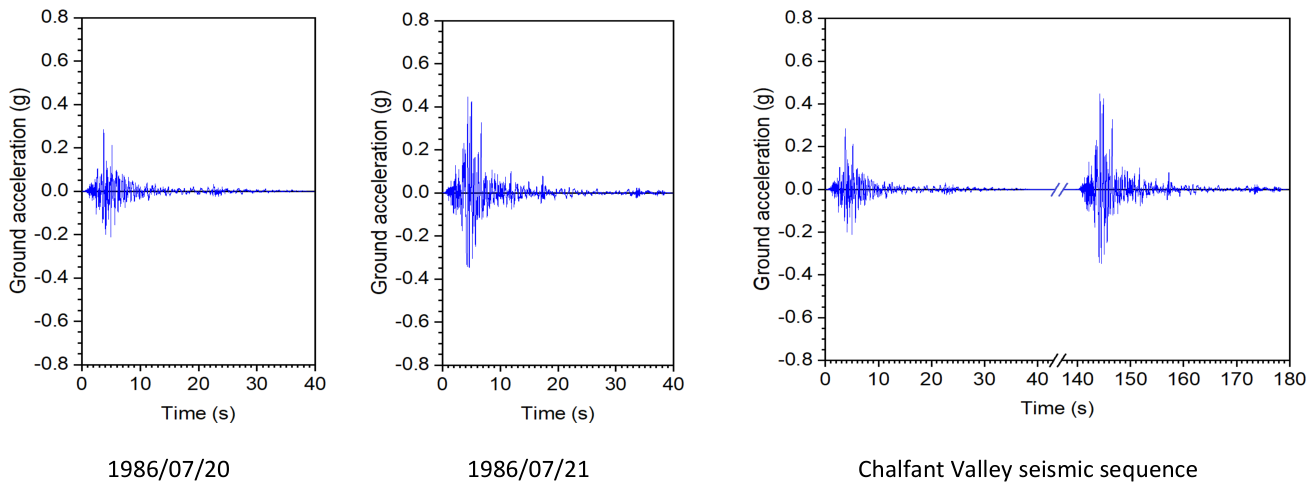
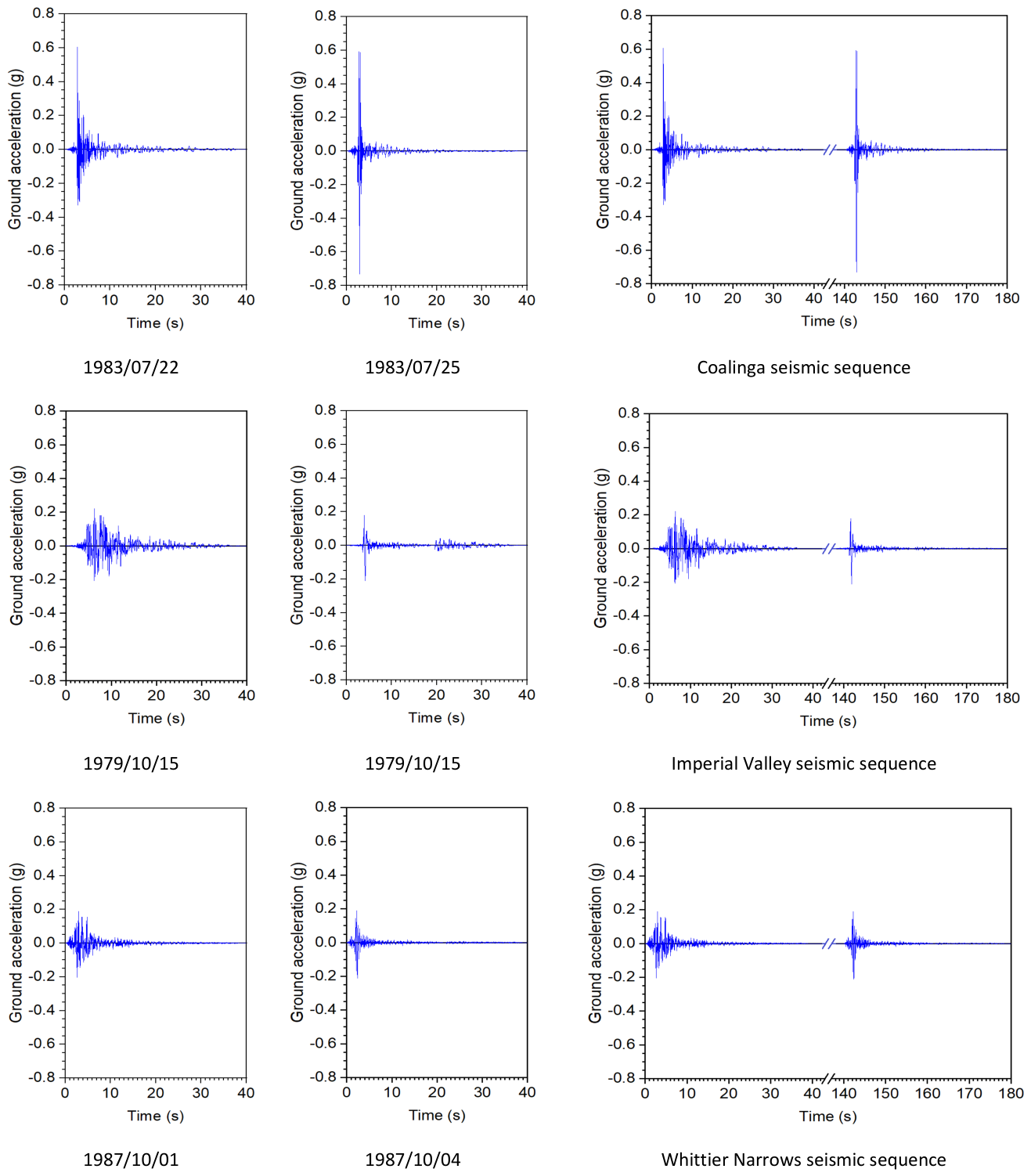
The selection of ground motion records for nonlinear time-history analysis of bridge structures requires careful consideration of both spectral content and sequence characteristics. In the present study, real recorded seismic sequences are employed rather than artificially constructed records, in order to preserve the natural correlation between mainshock and aftershock characteristics, including frequency content, duration, and energy build-up. The ground motion records are sourced from the PEER [50] (Pacific Earthquake Engineering Research) strong motion database, which provides a comprehensive repository of well-documented seismic events with reliable metadata.
The seismic sequences selected for this study are: Imperial Valley, Coalinga, Chalfant Valley, and Whittier Narrows earthquakes. These sequences were selected on the basis of their well-documented multi-event character, the availability of both mainshock and aftershock records at the same station, and their broad range of magnitude, epicentral distance, and frequency content, ensuring that the structural response is evaluated across a representative range of seismic demand levels. The same set of sequences has been employed in recent studies on composite structures under multiple earthquakes [3], allowing direct comparison of bridge and building response under identical seismic input.
Ιn this study, the selected seismic sequences from the PEER database were intentionally applied unscaled to the structural model. The primary objective of this methodology was to preserve the authentic, naturally recorded energy distribution, frequency content, and intensity ratios between successive seismic events (such as mainshock–aftershock sequences). Amplitude scaling of individual records within a sequence could artificially distort these relative intensity characteristics, thereby masking the true physical mechanisms of cumulative structural degradation. By utilizing the unaltered, as-recorded acceleration time histories, the analysis captures the real-world sequence effects and the genuine structural vulnerability under consecutive historical events.

4.2. Description of Seismic Sequences

The seismic sequences considered in this study are presented in Figure 6. Each sequence consists of two successive ground motion records, with a 100 s gap of zero acceleration between the mainshock and the aftershock. The seismic sequences considered are the Chalfant Valley (July 1986—2 events: CH1 & CH2), Coalinga (July 1983—2 events: CO1 & CO2), Imperial Valley (October 1979—2 events: IM1 & IM2), and Whittier Narrows (October 1987—2 events: WH1 and WH2) earthquakes (Table 5). This gap is introduced to allow structural vibrations arising from the mainshock to decay under the effect of modal damping, ensuring that the aftershock response is not contaminated by residual free vibrations, in accordance with the methodology adopted in [3].

4.3. Application of Ground Motions

The sequential ground motion records are applied simultaneously along both horizontal and vertical directions of the bridge model in SAP2000 [23]. The three components of each record are assigned to the longitudinal (X), transverse (Y) and vertical (Z) axes of the bridge respectively. Each complete seismic sequence, comprising mainshock, 100 s gap, and aftershock, is applied as a single continuous time-history input, so that the accumulated damage and residual deformations from the mainshock are fully retained when the aftershock loading commences.
The 100 s zero acceleration interval was selected to allow the structural free vibration induced by the mainshock to decay to a negligible level before the aftershock commences, thereby ensuring that the aftershock response is not contaminated by residual oscillations from the preceding event. This duration is consistent with, and supported by, the dedicated study of Pirooz et al. [51] which is the only study in the literature specifically focused on the required time gap between mainshock and aftershock for dynamic analysis. That study applied 244 near-fault ground motion components to a wide range of SDOF systems with periods of 0.05–7 s, and to 3- and 12-story steel frames, and proposed a formula for the required rest time as a function of natural period and strong motion duration. For structural systems with long natural periods and significant modal damping (such as the present suspension bridge with T1 ≈ 12.5 s and ξ = 4%), the Pirooz et al. [51] formula yields required rest times well within the 100 s window adopted here.
As noted above, the 100 s gap is directly grounded in the methodology of [3]. The approach is therefore not arbitrary but is consistent with a validated and peer-reviewed methodology that has been applied to structural systems covering a broad range of dynamic characteristics.
The nonlinear time-history analyses are performed using direct integration with Hilber–Hughes–Taylor (HHT) damping (α = −0.1), with a time step of 0.005 s and modal damping of 4% assigned to all modes. The use of sequential records rather than isolated single events is a key distinguishing feature of this study, motivated by the well-established finding that aftershocks can increase inelastic deformation demands by a factor of 1.5 to 4 relative to mainshock-only analyses [1,2,3].
The spatial variability of seismic ground motion along the bridge length is accounted for through the wave passage effect, whereby seismic waves arrive at each support with a time delay that reflects the finite propagation velocity of the wavefield. For the 1800 m suspension bridge, this effect is particularly pronounced given the large distance separating the supports. Time delays were computed as Δt = d/VS, adopting a shear wave velocity of VS = 300 m/s consistent with the medium-dense sand conditions and soil type C classification per Eurocode 8 [52]. Taking the left abutment as the reference point, the resulting time lags are 1.33 s at the left pylon (d = 400 m), 4.67 s at the right pylon (d = 1400 m), and 6.00 s at the right abutment (d = 1800 m). The seismic input at each support was applied accordingly as an independent time-shifted record, ensuring that the analysis captures the out-of-phase excitation that characterizes the response of long-span bridges under real earthquake conditions.
The velocity of Vs = 300 m/s represents the average shear wave velocity of the top soil layer Vs, 30 characterizing the Eurocode 8 Soil Type C site [52], rather than the underlying deep bedrock.
A single, uniform velocity is applied along the entire 1800 m span based on the assumed macro-homogeneity of the medium-dense sand deposit detailed in Section 2.2. While stochastic wave incoherence and localized soil scattering are omitted, representing a recognized simplification of this study, the deterministic wave passage delay is treated as the primary spatial excitation mechanism due to the long-period flexible profile of the suspension system.
The selected time-history records utilized in this study are explicitly classified as outcropping bedrock ground motions, corresponding to high-velocity rock or very stiff soil recording stations. To accurately capture localized site effects without relying on decoupled, simplified 1D free-field wave propagation software, a fully integrated site amplification approach is executed within the SAP2000 [23] environment. The outcropping bedrock motions are applied as direct dynamic excitations at the free-field nodes of the Multi-Linear Plastic Link elements [23].
As the seismic energy propagates upward through the 60 m deep soil profile, the hysteretic properties of the Winkler spring network (p-y, t-z, q-z) automatically simulate the shear strain accumulation, material damping, and nonlinear soil filtering characteristic of the (Vs = 300 m/s) medium-dense sand layer. This method ensures that the kinematic and inertial demands acting on the 1.8 m diameter piles seamlessly incorporate site-specific amplification and resonance phenomena throughout the sequential loading history.
The spatial variability framework implemented herein operates as a rigorous multi-point support excitation system across the 1800 m total span. Rather than subjecting the entire structure to a uniform acceleration field, the traveling wave algorithm isolates each main pylon pier and anchorage group, applying distinct, time-delayed ground motion inputs calculated from their absolute longitudinal coordinates and the soil’s shear wave velocity (Vs = 300 m/s).
Furthermore, this multi-point pier excitation is coupled with an implicit depth-dependent foundation interaction. Within the nonlinear Beam on Nonlinear Winkler Foundation (BNWF) configuration, the seismic inputs are anchored at the deepest bedrock boundary nodes of the 60 m pile group springs.
As the simulation progresses, the Multi-Linear Plastic Links perform a continuous, concurrent vertical wave propagation check. This mechanism automatically generates depth-dependent phase displacements and material degradation along the pile profiles, capturing the true kinematic soil-filtering gradients without requiring decoupled or artificially predefined sub-surface depth inputs.

4.4. Bedrock Characterization and Integrated Site Amplification Analysis

To rigorously incorporate local site effects into the dynamic system without relying on decoupled, simplified 1D free-field wave propagation codes, a fully integrated site amplification approach is implemented directly within the finite element environment of SAP2000. The soil domain is modeled as a homogeneous stratigraphy with a total thickness of 60 m, characterized by a shear wave velocity of Vs = 300 m/s and a mass density of ρ = 1.8 tn/m3. Based on the analytical solution of linear wave propagation theory, the fundamental period of this isolated soil column is established as Tg = 4H/Vs = 0.80 s.
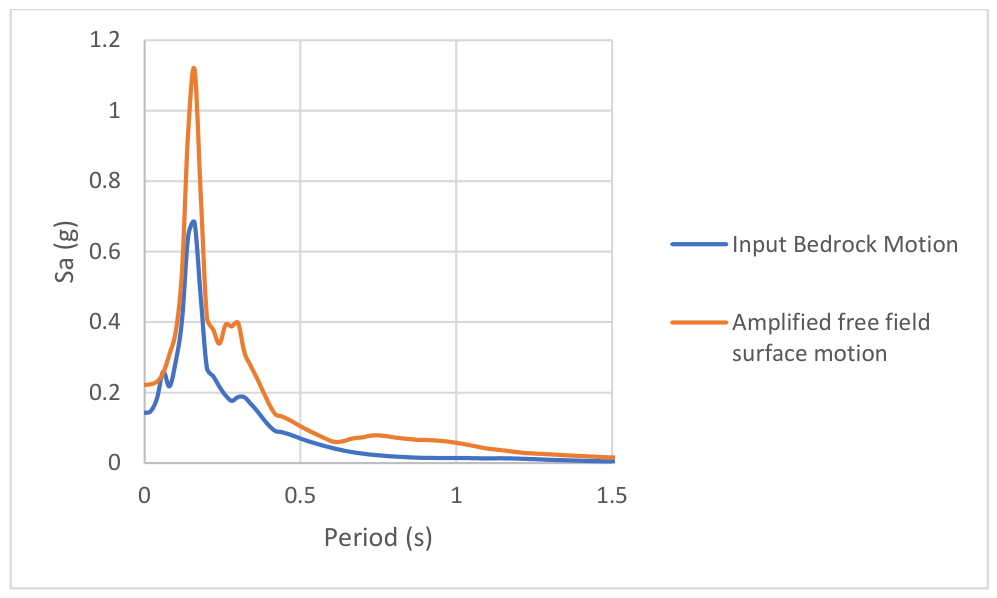
The selected time-history records are explicitly treated as outcropping bedrock ground motions and are applied as direct dynamic support excitations at the deepest nodes of the model (bedrock interface at (−60 m). As the shear waves propagate vertically from the bedrock toward the ground surface, the nonlinear, strain-dependent hysteretic behavior of the soil formation is captured via the Multi-Linear Plastic Link elements operating under the Bouc–Wen plasticity framework. This approach enables the Winkler spring network to naturally perform frequency filtering and energy dissipation. As validated by the spectral response comparison (see Figure 7), this integrated mechanism successfully simulates the local site effects, capturing both the high-frequency spectral acceleration amplification from 0.69 g to 1.12 g and the secondary resonance phenomena developing close to the soil’s natural periods.

5. Results

To evaluate the structural state rigorously, quantitative performance and collapse thresholds are established in strict accordance with the ASCE 41-17 [53] framework.
Component-level failure is defined when the pylon plastic hinge rotation exceeds the Collapse Prevention (CP) performance limit, which is numerically set at θ = 0.015 rad based on the geometric and axial load ratios of the CFST sections. Exceeding this limit triggers a severe strength degradation greater than 20% of the cross-section’s ultimate capacity. Global structural collapse is quantified by the onset of dynamic geometric instability, defined by an uncontrollable escalation of the pylon transient drift ratio past 2.5%, or a permanent residual drift ratio exceeding 1.0%. At these stages, severe second-order P-Delta effects under the heavy vertical dead loads of the main cables cause a failure of numerical convergence in the nonlinear direct-integration solver.
Under the sequential Coalinga sequence (COT), the accumulation of plastic demand drives the pylon base hinges to a peak rotation of 0.019 rad (violating the 0.015 rad limit) and a residual drift of 1.2%, causing true physical and numerical collapse.
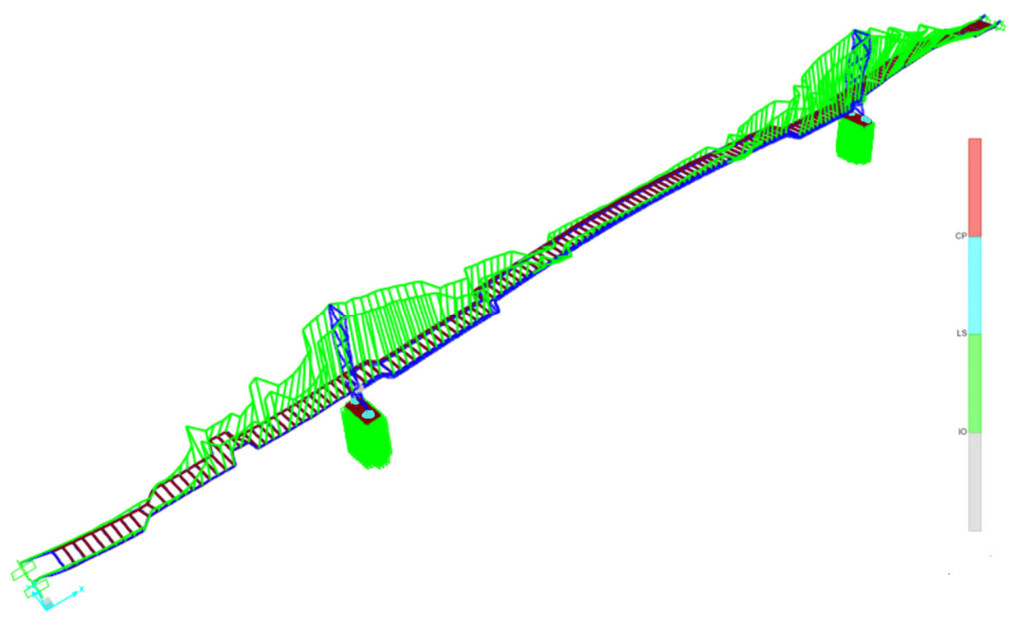
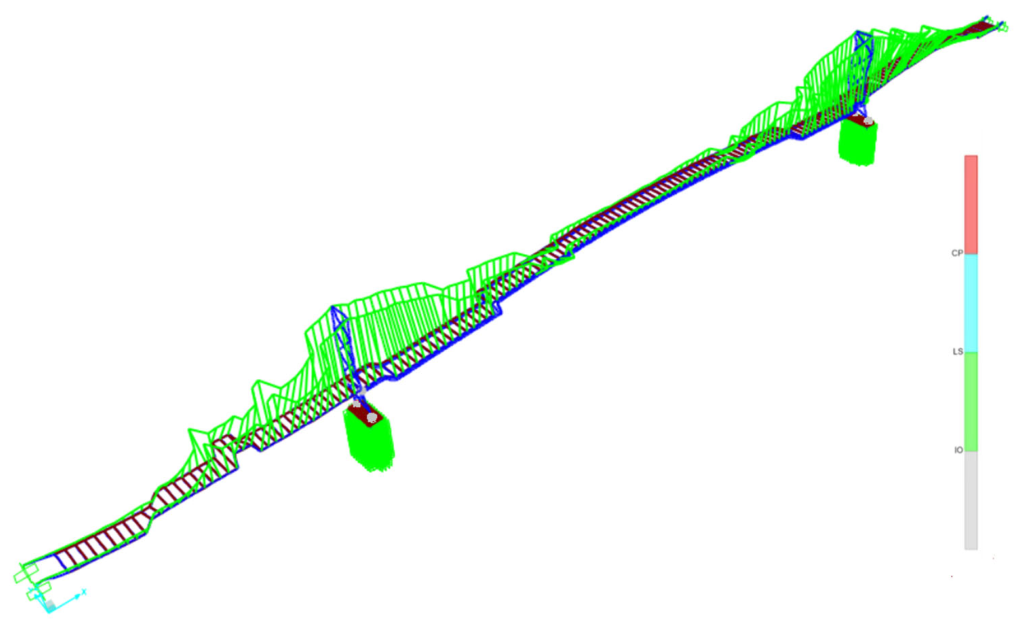
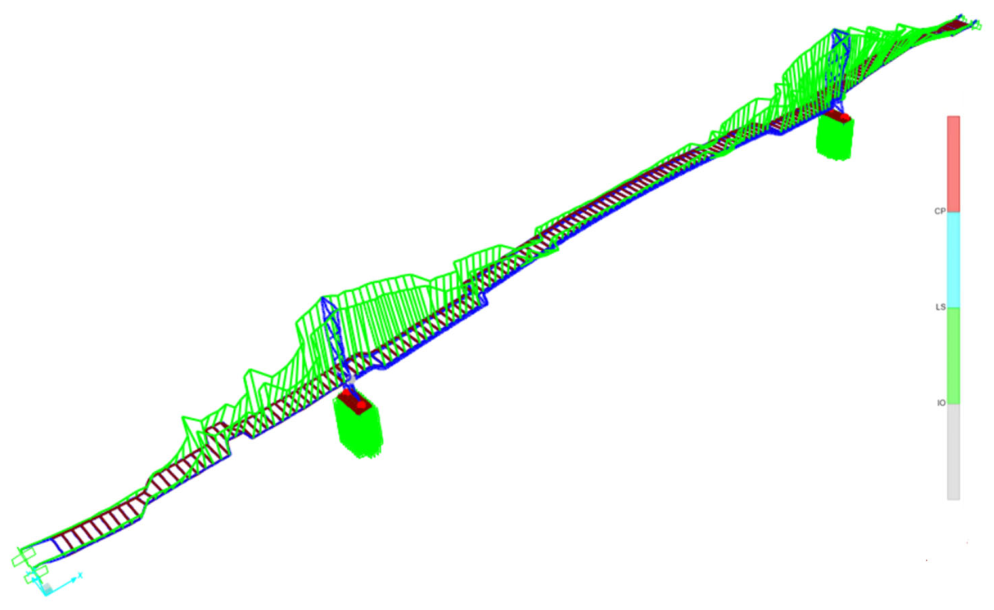
Under the single-event Coalinga 1 (CO1), the distribution of plastic hinges across the bridge reveals a response that remains predominantly between the LS and CP performance levels. Localized hinges approaching the CP level are observed at the pylon base (Figure 7), shown in light blue coloring, reflecting the concentration of inelastic demand at these critical regions, as shown in Figure 8. The results are similar to [3,4]. This severe concentration of inelastic demand at the pylon bases is the physical manifestation of three compounding structural and geotechnical phenomena. First, a profound stiffness discontinuity exists at the pylon-to-foundation interface; the massive, highly rigid concrete pile cap provides a near-rigid boundary condition that abruptly terminates the flexible, 150 m tall pylon column, forcing the primary dynamic bending moments and shear stresses to peak immediately above the connection.
Second, this material and geometric boundary is heavily exacerbated by geometric nonlinearities; the immense vertical gravity loads transmitted by the main cables trigger severe second-order (P-Delta) effects, where even minor lateral pylon drift generates massive secondary eccentric moments that accelerate localized concrete core crushing and outer steel tube yielding.
Finally, this localized demand (Figure 9) is heavily influenced by soil–structure interaction. The cyclic softening and yielding of the shallow Winkler p-y springs allow the pile cap to undergo transient angular rotations. This foundation compliance prevents the pylon base from distributing its inertial energy upward, effectively trapping the accumulating plastic curvature demands within the bottommost fiber hinges and forcing the cross-section to reach its ASCE 41-17 Collapse Prevention rotation threshold.
Under the single-event Coalinga 2 (CO2), the distribution of plastic hinges across the bridge reveals a response that remains predominantly within the Immediate Occupancy (IO) performance level. Localized hinges approaching IO level are observed at the pylon base, shown in gray coloring, reflecting the concentration of inelastic demand at these critical regions (Figure 10).
The combined effect of the Coalinga sequence (COT) produces an increase in structural damage that culminates in collapse. The plastic hinge map reveals that pylon base has exceeded the Collapse Prevention (CP) threshold, shown in red. This result provides direct evidence that the sequential seismic loading induces a fundamentally different and far more severe structural response, validating the central hypothesis of this study regarding the critical importance of accounting for seismic sequences in the performance-based assessment of long-span suspension bridges (Figure 11).
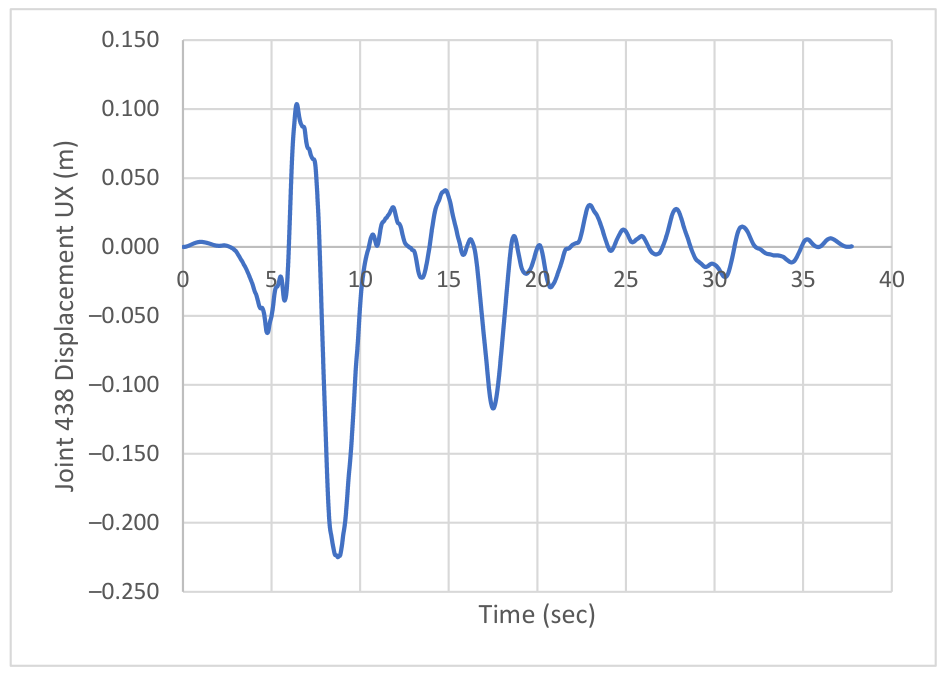
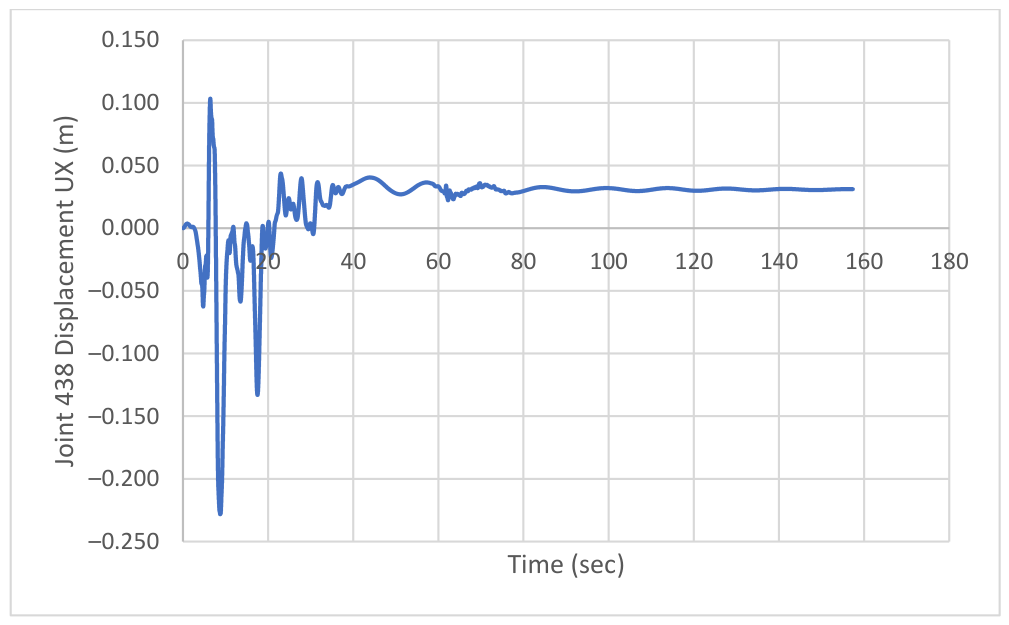
Τhe lateral displacement time history of node 438 at the top of the pylon under the Imperial Valley (IM1) exhibits a strongly impulsive character, with the peak response concentrated in the interval t = 5–12 s, corresponding to the strong motion phase of the record. The maximum positive displacement reaches approximately +0.10 m, while the maximum negative displacement attains −0.23 m (Figure 12).
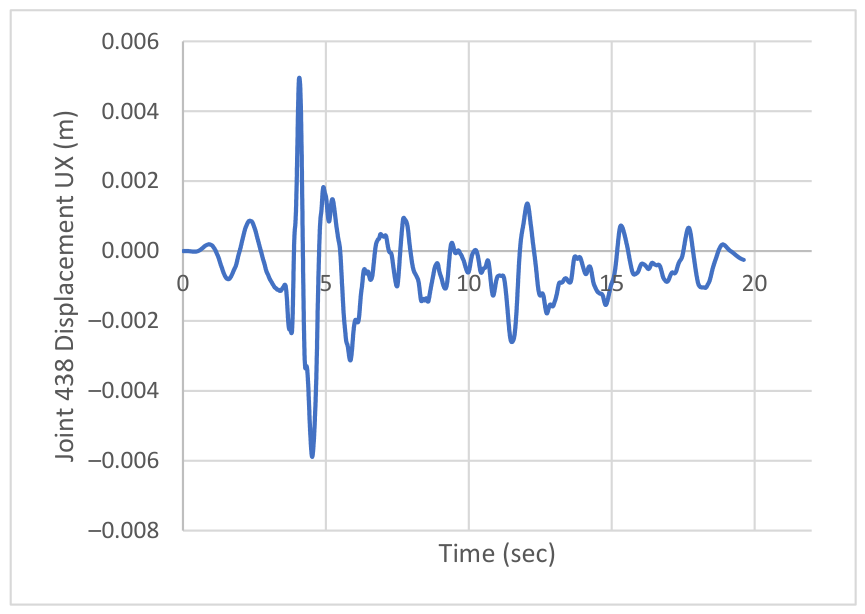
The displacement time history of node 438 under the Imperial Valley (IM2) is a reduced amplitude compared to the IM1 single event, with peak values of approximately +0.005 m and −0.007 m (Figure 13).
The sequential displacement time history (IMT) of node 438 reveals two critical phenomena that are unique to the multi-event analysis. Firstly, the mainshock phase (between 0 and 40 s) reproduces the large-amplitude asymmetric response observed in IM1, with a peak negative displacement of approximately −0.23 m. In addition, following the 100 s gap during which the structure undergoes damped free vibration, the displacement does not return to zero but instead converges to a permanent residual offset of approximately +0.04 m (Figure 14).
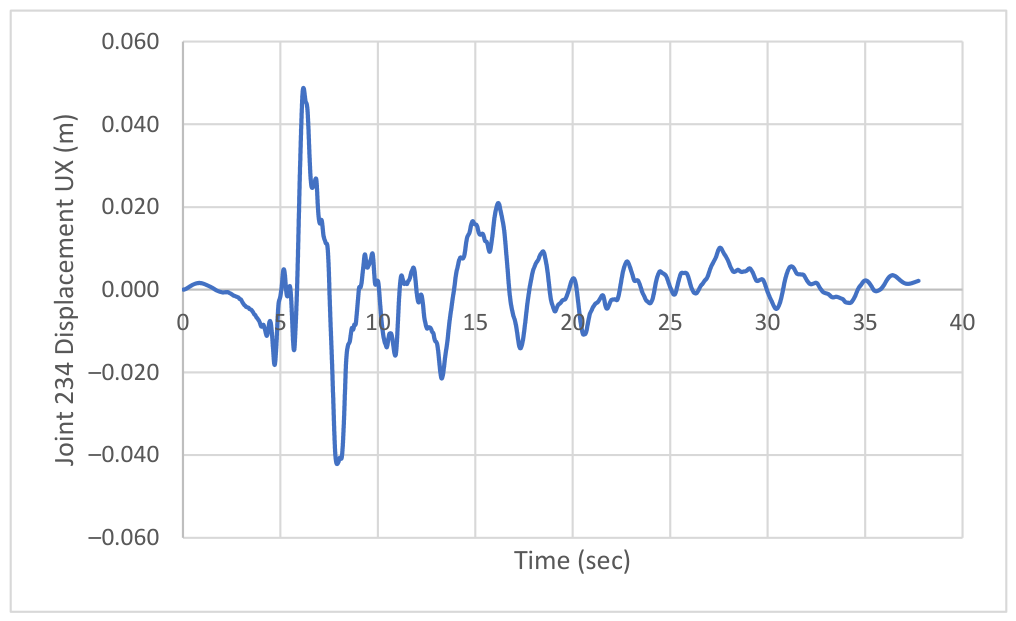
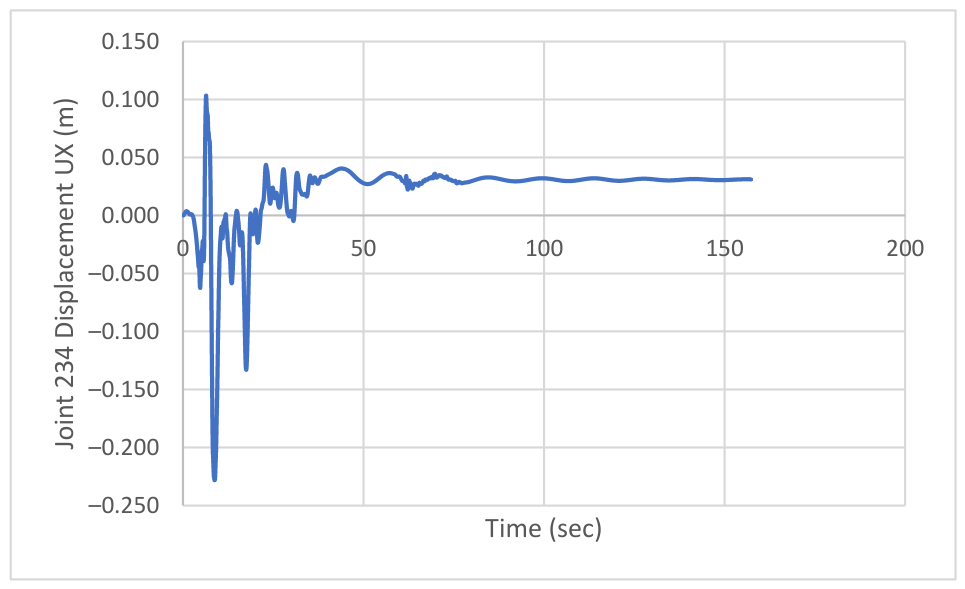
The displacement time history of node 234 of the bridge deck under the IM1 is characterized by reduced amplitude compared to node 438, with peak values of approximately +0.005 m and −0.007 m (Figure 15).
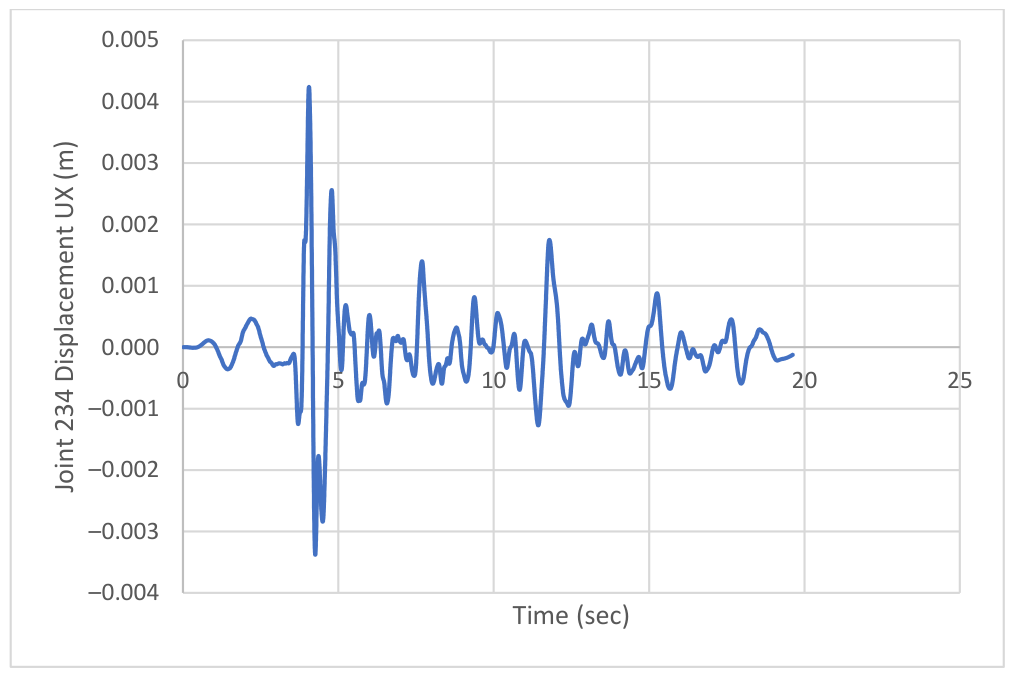
Under the Imperial Valley IM2, node 234 of the bridge deck exhibits a peak displacement of approximately +0.004 m in the positive direction and −0.003 m in the negative direction, substantially smaller than the IM1 response of joint 234 and similar to the response of joint 438 during the IM1 single event (Figure 16).
The full sequential displacement time history IMT of node 234 over the 180 s analysis duration reveals the same two critical phenomena observed at the pylon top, but with differences that reflect the distinct dynamic role of the deck in the structural system. During the phase between 0 and 40 s, the deck node undergoes peak displacements consistent with the IM1 results. Following the strong motion phase, the displacement decreases but converges to a permanent residual offset of +0.04 m, which persists throughout the 100 s gap and into the IM2 phase (Figure 17).
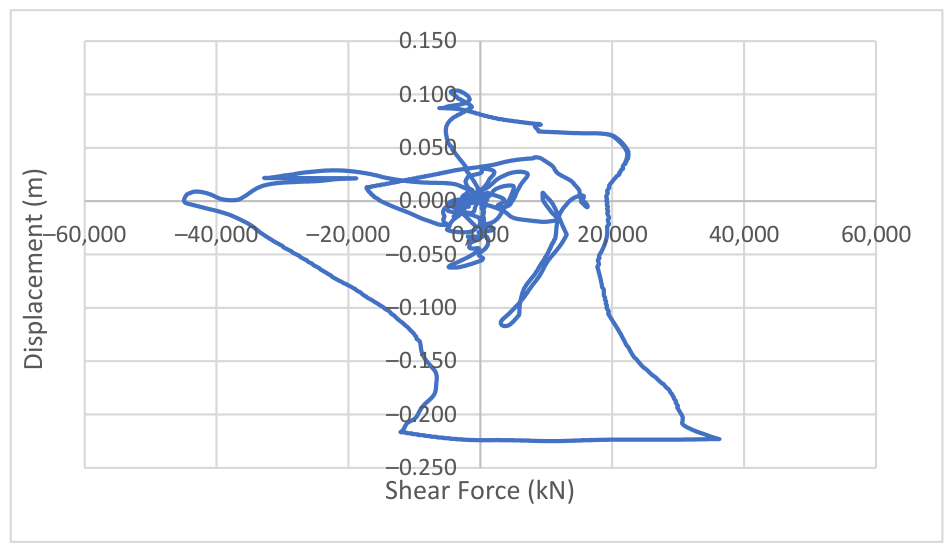
The hysteretic loop of the pylon base shear force plotted against the lateral displacement of node 438 at the top of the pylon under the Whittier Narrows 1 (WH1) reveals a pronounced nonlinear response. The maximum base shear reaches approximately −45,000 kN, while the maximum pylon displacement at node 438 reaches −0.23 m in the negative direction and approximately +0.10 m in the positive direction, reflecting the strongly asymmetric character of the ground motion. The loop exhibits a well-developed hysteretic shape with clear yielding plateaus, indicating that the pylon base has entered a stable inelastic range (Figure 18).
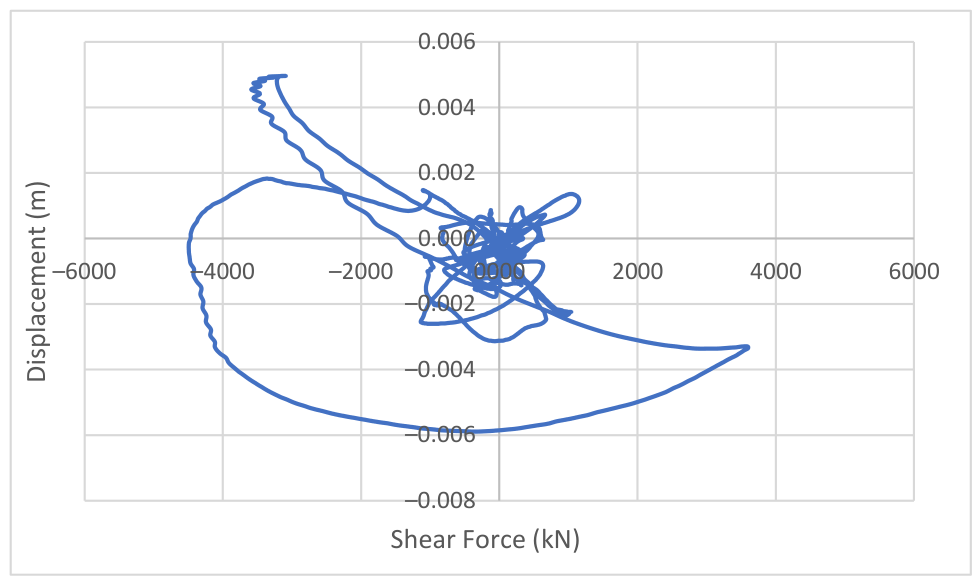
The Whittier Narrows 2 (WH2) hysteretic loop is reduced in both force and displacement magnitude relative to the WH1. The maximum base shear is approximately ±4600 kN and the pylon displacement at node 438 remains within −0.006 m, smaller than WH1 amplitude. The loop retains a recognizable hysteretic shape with reduced effective stiffness compared to the initial loading in WH1 case, reflecting the stiffness degradation induced by inelastic excursions (Figure 19).
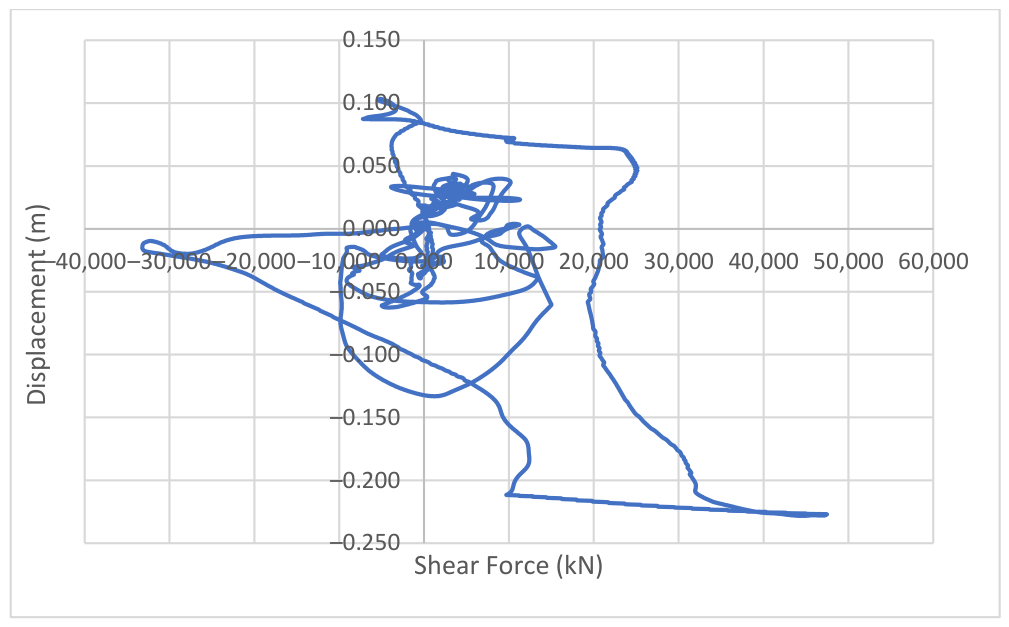
The Whittier Narrows sequential (WHT) hysteretic loop presents the force–displacement response of the pylon over the duration of the sequence. The envelope is dominated by the WH1. However, the loop does not return to the origin following the WH1 phase. Instead, a residual displacement of approximately −0.06 m is evident at node 438 after the strong motion decays, reflecting the irreversible inelastic deformations accumulated during the mainshock (Figure 20).
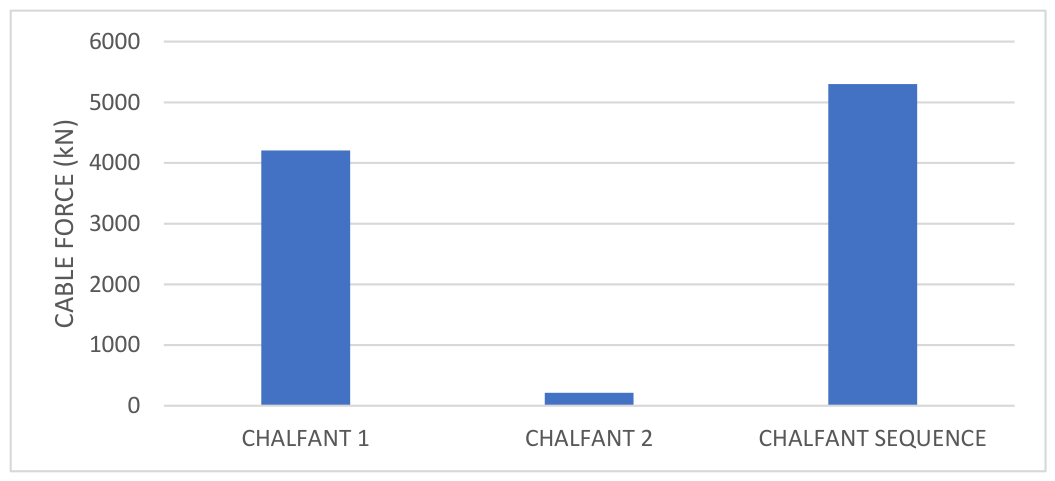
The bar chart comparing the maximum cable force under the Chalfant Valley loading cases provides visual summary of the amplification effect induced by sequential seismic loading on the suspension system. Under the Chalfant Valley (CH1), the maximum cable force reaches approximately 4100 kN, reflecting a significant tension demand that remains within the expected operational range of the main cable system (Figure 21).
Under the Chalfant Valley aftershock (CH2) in isolation, the cable force drops to approximately 200 kN, confirming that CH2, when considered independently, produces a negligible tension in the cables and would be dismissed as non-damaging.
The Chalfant Valley sequence (CHT), however, exhibits different behavior. The maximum cable force under the full sequential loading reaches approximately 5300 kN, a substantial increase relative to the CH1.
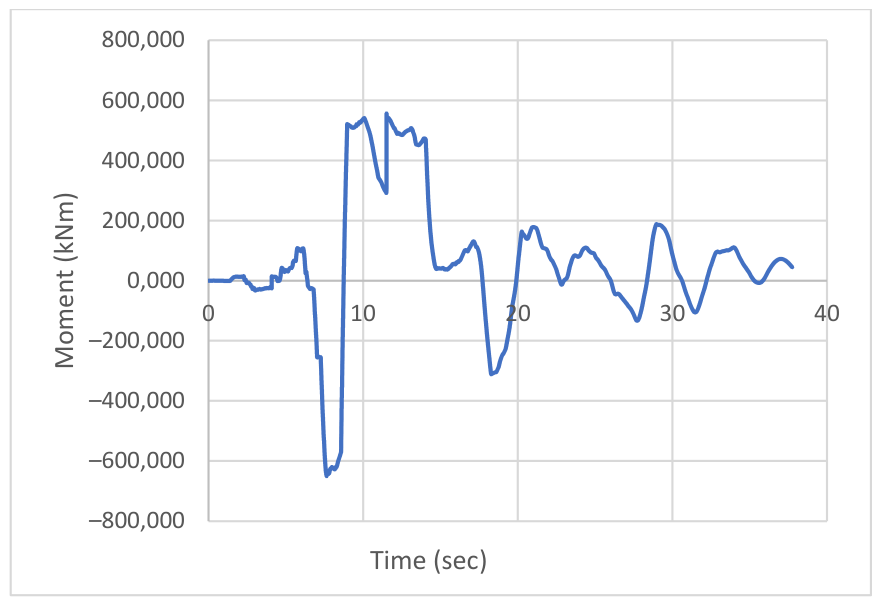
Under the Imperial Valley IM1, the bending moment time history at the pylon base exhibits a peak response between 5 and 15 s. The maximum positive moment reaches approximately +500,000 kNm, while the maximum negative moment approaches −700,000 kNm, reflecting a strongly asymmetric response driven by the directionality of the ground motion (Figure 22).
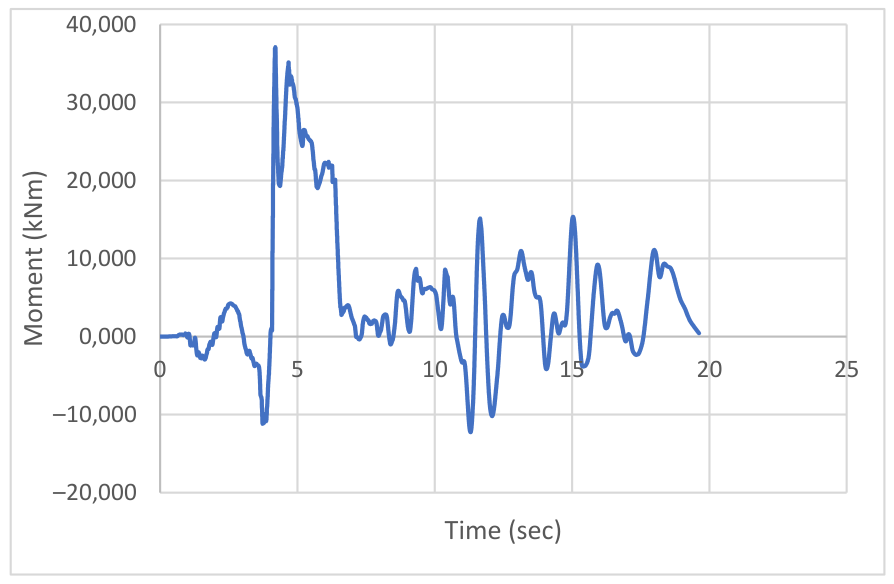
The IM2 record produces a notably different moment–time profile at pylon base. The peak bending moment is reduced relative to the IM1, reaching approximately +35,000 kNm in the positive direction and −20,000 kNm in the negative direction (Figure 23). This behavior is consistent with the nature of aftershock ground motions, which, while of lower intensity, act on a structure whose stiffness and energy dissipation capacity have already been partially degraded by the mainshock.
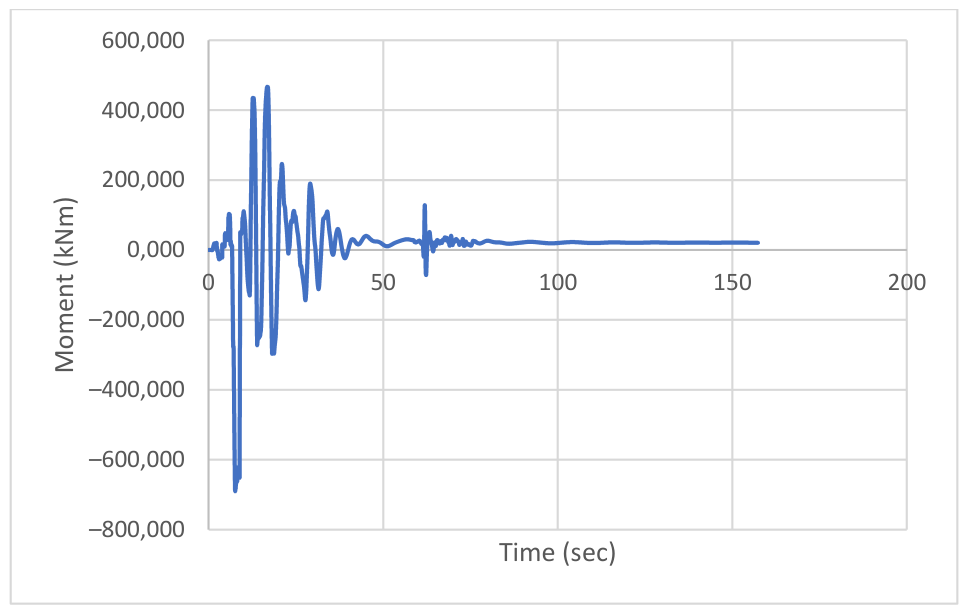
The sequential analysis IMT (Figure 24) reveals the combined moment demand at the pylon base over the entire duration of approximately 160 s. The mainshock phase (t = 0–40 s) reproduces the large-amplitude response observed in IM1. Although the aftershock-induced moments are smaller, they are superimposed on a pre-damaged structural state, meaning that the effective demand-to-capacity ratio during the aftershock phase is disproportionately higher than the raw moment values suggest. The sequence diagram thus captures a critical aspect of cumulative seismic damage that neither single-event analysis can reveal. The progressive erosion of structural capacity under repeated loading drives the system toward the collapse state observed in the plastic hinge analysis.
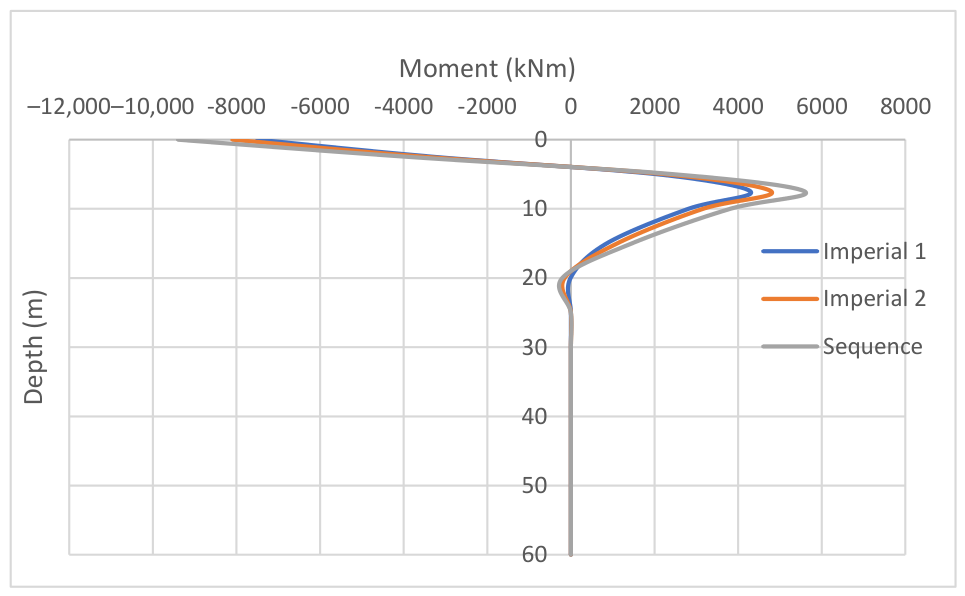
Figure 25 illustrates the comparative pile bending moment (M3) profiles for Imperial 1, Imperial 2, and the full sequential seismic sequence. A clear amplification of structural demand is observed under sequential loading compared to the single events. At the fixed pile head (z = 0 m), the constraint bending moment escalates from −7500 kNm during Imperial 1 to −9400 kNm at the peak time step of the sequence, marking a circa 25% increase. More importantly, within the shallow active zone z = 5.0–10.0 m, the maximum positive bending moment increases from +4300 kNm to +5600 kNm. This phenomenon is a direct consequence of cyclic soil degradation; as the upper p-y Winkler links undergo stiffness degradation and plastic yielding during the initial phase of the sequence, they lose lateral capacity, forcing the pile to mobilize deeper, undisturbed soil layers. This mechanism shifts the structural demands down the embedded shaft and amplifies the overall foundation bending, justifying why treating earthquakes as single independent events unconservatively underestimates the foundation response.
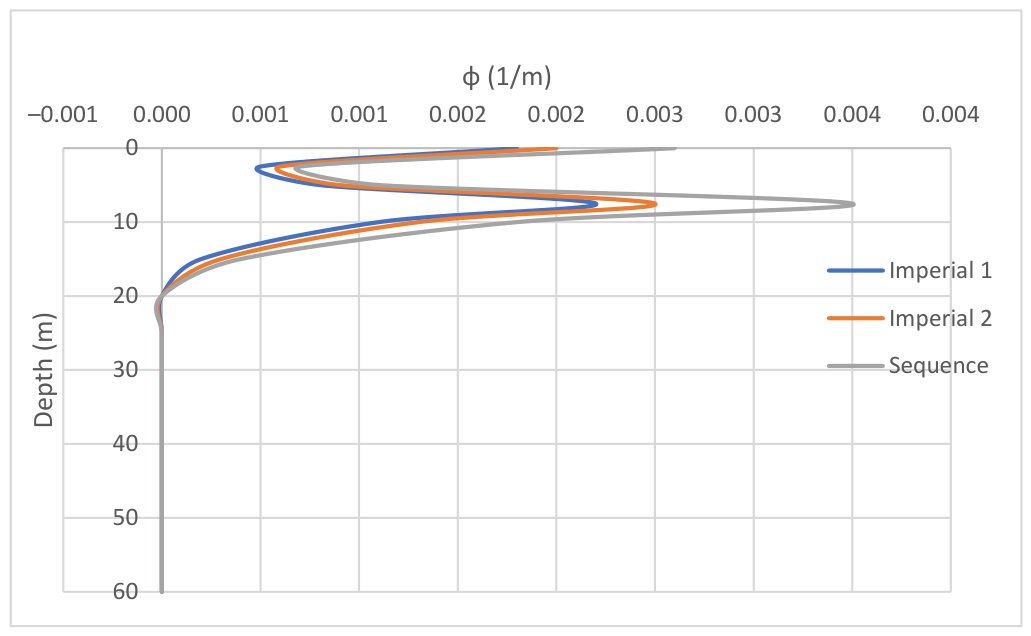
To evaluate the structural integrity and potential damage distribution along the foundation elements, Figure 26 displays the pile curvature profiles (φ) for the examined seismic scenarios. The curvature demands closely mirror the bending moment distributions, exhibiting two localized peaks: one at the rigid pile-head connection (z = 0 m) and a more pronounced one within the shallow sub-surface active zone (z = 7.5 m). Under the sequential earthquake loading, a severe accumulation of plastic deformation is highlighted. Specifically, the peak sub-surface curvature during the sequence reaches (0.0035 1/m), which constitutes a substantial amplification compared to Imperial 1 (0.0022 1/m) and Imperial 2 (0.00251/m). This trend clearly indicates that the structural damage, marked by concrete cracking and longitudinal reinforcement yielding (plastic hinging), is severely exacerbated by sequential shocks. The progressive degradation of the surrounding p-y links triggers a broader kinematic compliance of the pile shaft, forcing a concentrated curvature demand at a depth of roughly (4D0), which could compromise the post-earthquake serviceability of the bridge foundation if sequences are neglected.
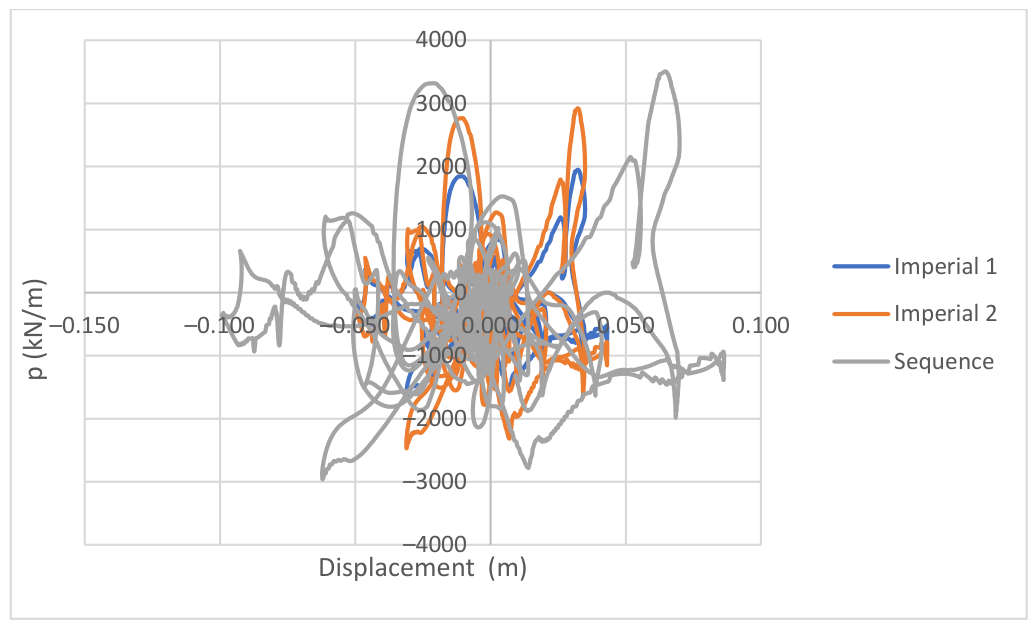
The highly nonlinear, cyclic behavior of the near-surface ground layers is explicitly captured through the local soil–pile hysteresis loops. Figure 27 illustrates the soil resistance per unit length p versus the pile lateral displacement y evaluated at a representative Winkler link within the shallow active zone (z = 5.0 m). While both individual events produce stable hysteretic loops symmetric around the origin, the response under the sequential loading history exhibits a drastically altered mechanism. Driven by the progressive plasticity accumulation of the Bouc–Wen link model, the continuous sequential simulation induces a severe leftward migration of the hysteretic loops, accumulating a permanent, irreversible plastic drift that reaches approximately −0.10 m. Concurrently, a significant broadening of the hysteretic blocks is observed, signifying massive energy dissipation. However, this comes at the expense of foundation integrity: the reloading branches of the sequential curve display a noticeably flatter slope compared to the initial elastic state. This severe reduction in stiffness directly validates the adopted cyclic degradation factor (alpha = 0.10), proving that repeated earthquake energy inputs progressively exhaust the lateral confinement of the medium-dense sand, leading to an amplified global foundation compliance that cannot be captured by conventional independent-event analysis.
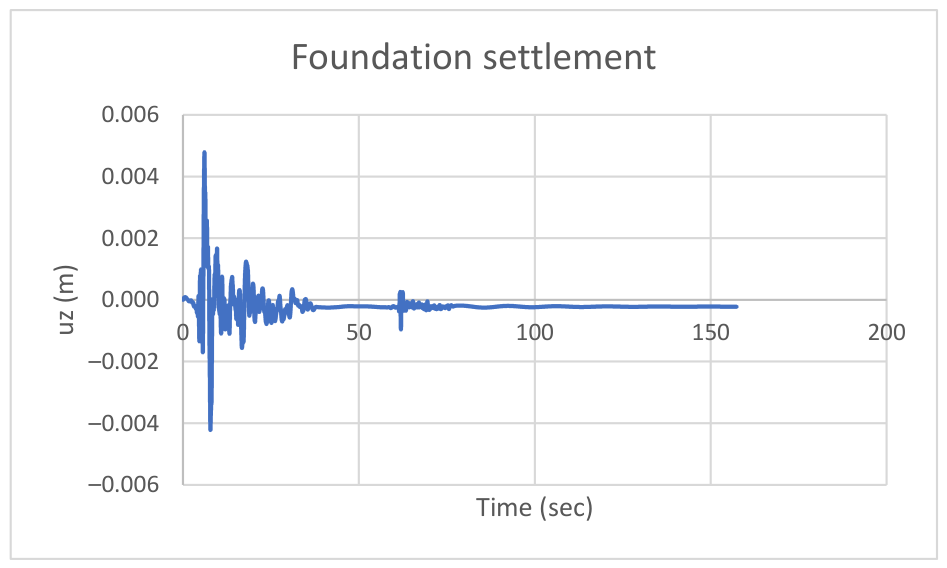
The foundation settlement graph (Figure 28) depicts a characteristic dynamic response of the soil–structure system subjected to transient loading. During the initial 40 s, the foundation experiences intense vertical oscillations, reaching a peak displacement uz of approximately 5 mm, which signifies the primary phase of the dynamic excitation. Following this main event, the system exhibits strong radiation and material damping, causing the vibrations to rapidly dissipate. A minor secondary disturbance is recorded around the 62 s mark, likely corresponding to an aftershock or localized soil particle rearrangement. Ultimately, beyond 100 s, the response completely stabilizes, revealing a permanent residual settlement of approximately −0.2 mm, which confirms the expected inelastic densification of the underlying soil mass.

6. Discussion

This study investigated the nonlinear seismic response of a large scale suspension bridge under sequential ground motion records, with explicit modeling of soil–pile interaction through depth-dependent p-y, t-z, and Q-z nonlinear spring curves. The combined treatment of foundation nonlinearity and seismic sequences constitutes the central novelty of the work, and the results provide clear evidence that their interaction governs the structural response in ways that conventional single-event, fixed-base analyses fundamentally cannot capture.
The plastic hinge analysis under sequences offers the most striking illustration of this point. While single events produced a response contained within the IO and LS performance levels, their sequential application drove the structure to collapse, with pylon base hinges exceeding the Collapse Prevention threshold. This outcome reflects a consistent pattern observed across all sequences examined: the aftershock, despite being of lower intensity, acts on a structure whose stiffness and energy dissipation capacity have already been partially consumed by the mainshock, producing an escalation in damage that raw intensity metrics alone would not be able to predict.
The displacement time histories at the pylon top and deck under sequences further reveal a phenomenon that single-event analyses are structurally incapable of detecting: the accumulation of permanent residual displacements. Following the mainshock, the structure did not return to its original position, but instead converged to a residual offset of approximately +0.04 m, which persisted through the interseismic rest and was still present when the aftershock commenced. This residual deformation, modest in absolute terms, represents an irreversible shift in the structural state that directly reduces the available displacement capacity for subsequent loading.
The cable force results under the Chalfant Valley sequence quantify this amplification effect. The sequential loading produced a maximum cable tension significantly higher than the single event. The nonlinear accumulation of damage between events is therefore not additive but multiplicative, and this distinction has direct consequences for the reliability of current design methodologies that evaluate seismic performance on the basis of a single design earthquake.
The hysteretic response of the pylon base under the Whittier Narrows records reinforces these findings at the component level. The mainshock produced well developed hysteretic loops with clear yielding plateaus and significant energy dissipation, while the aftershock loops exhibited a measurably lower effective stiffness, confirming that the preceding inelastic excursions had degraded the section’s cyclic behavior.
The assumption of a single design earthquake is inadequate for structures located in seismically active regions where sequences of events are not only possible but historically documented. In addition, fixed-base modeling systematically underestimates seismic demands by neglecting the period elongation and energy dissipation associated with nonlinear foundation response, an effect that becomes especially pronounced under repeated loading, where the accumulated plastic deformation of the soil–pile springs progressively softens the foundation system. Also, the most vulnerable components identified in this study, the pylon bases and the main cable system, are precisely those whose post-earthquake condition is most difficult to inspect and repair in practice, underscoring the need for conservative performance targets in this class of structures.

7. Conclusions

This study presented a fully coupled, nonlinear numerical framework to evaluate the seismic performance of an 1800 m long-span suspension bridge under the compounding effects of sequential ground motions, asynchronous traveling wave passage, and deep nonlinear soil–structure interaction (SSI). Based on the comprehensive time-history simulations, the following core conclusions are drawn:

7.1. Key Research Findings

Compounding Damage Accumulation: Subjecting the structure to successive mainshock–aftershock sequences accelerates structural degradation. While the single mainshock consumes the flexural capacity of the pylons, the subsequent aftershock exploits this pre-damaged state, driving the bottom pylon hinges past their ASCE 41-17 Collapse Prevention threshold (θ = 0.015 rad).
SSI-Induced Period Elongation: Modeling the foundation with nonlinear Winkler macro-elements introduces a baseline softening effect that causes a 7.7% period elongation in the primary transverse mode compared to an idealized fixed-base alternative. This shift fundamentally alters the spectral acceleration demands on the superstructure.
Wave Passage and Demand Concentration: Because the fundamental period of the bridge (12.5 s) is significantly larger than the seismic wave travel delay across the supports, asynchronous excitations trigger higher-order asymmetric modes. This wave-passage lag concentrates high-amplitude plastic demands at the pylon bases due to the severe stiffness discontinuity at the pile-cap interface.

7.2. Practical Engineering Applications

The quantitative insights generated by this framework offer actionable guidance for the design and vulnerability assessment of mega-scale infrastructure:
Code Revision for Spatial Sequences: The findings demonstrate that standard design provisions (e.g., AASHTO LRFD) relying on single-event spectra can severely underestimate the residual drift accumulations in long-span bridges. Designers should incorporate mandatory sequential demand factors when evaluating long-period flexible structures in high-seismicity zones.
Performance-Based Assessment: The application of the ASCE 41-17 framework to CFST pylon columns under coupled kinematic–inertial demands provides a benchmark methodology for calculating realistic plastic hinge capacities, helping engineers optimize the thickness of steel jackets at pylon bases.
Foundation Flexural Zoning: The documented sub-surface pile demands reveal that maximum bending moments and soil plastification are concentrated within the shallow active zone 2D0 to 4D0. This justifies a graded pile design where reinforcement or wall thickness can be optimized along the depth, reducing global material costs.

7.3. Limitations and Future Work

While this study isolates the critical variables governing spatial bridge collapse, certain simplifications outline clear pathways for future research:
Stochastic Wave Incoherence: Future studies will expand the traveling wave framework to include stochastic coherence loss functions, capturing the phase scattering caused by complex geological fault zones.
Advanced Geotechnical Modeling: To supplement the Winkler macro-element approach used here, future work will utilize 3D continuum finite element models to investigate pile group shadow effects, lateral soil gapping, and localized pore-water pressure build-up during long-duration sequences.
Alternative Site Profiles: Subsequent investigations will test the bridge response across heterogeneous soil profiles (e.g., transitions from rock to soft clay) to map out-of-phase site amplification patterns along the 1800 m span.


Author Contributions

Conceptualization, P.S.K.; methodology, P.S.K.; software, L.K.G.Z.; validation, L.K.G.Z.; writing—original draft preparation, P.S.K.; writing—review and editing, P.S.K. and L.K.G.Z.; supervision, P.S.K. All authors have read and agreed to the published version of the manuscript.

Funding

This research received no external funding.

Data Availability Statement

Data is contained within the article.

Conflicts of Interest

The authors declare no conflicts of interest.

References

  1. Di Sarno, L. Effects of multiple earthquakes on inelastic structural response. Eng. Struct. 2013, 56, 673–681. [Google Scholar] [CrossRef]
  2. Turchetti, F.; Tubaldi, E.; Patelli, E.; Castaldo, P.; Málaga-Chuquitaype, C. Damage modelling of a bridge pier subjected to multiple earthquakes: A comparative study. Bull. Earthq. Eng. 2023, 21, 4541–4564. [Google Scholar] [CrossRef]
  3. Chorafa, E.; Skrapalliou, E.; Katsimpini, P. On the Nonlinear Behavior of Composite Structures under Multiple Earthquakes Considering Soil–Structure Interaction. CivilEng 2024, 5, 673–693. [Google Scholar] [CrossRef]


  4. Katsimpini, P.S.; Hatzigeorgiou, G.D.; Beskos, D.E. A damage mechanics framework for in-plane seismic analysis of heritage masonry arch bridges under multiple events. Structures 2025, 80, 110114. [Google Scholar] [CrossRef]
  5. Katsimpini, P.S.; Papagiannopoulos, G.; Hatzigeorgiou, G. Nonlinear Analysis of Bridges Considering Soil–Structure Interaction and Travelling Wave Effects Under Combined Train and Near-Fault Seismic Loads. Appl. Sci. 2024, 14, 11688. [Google Scholar] [CrossRef]
  6. Anastasopoulos, I.; Sakellariadis, L.; Agalianos, A. Seismic analysis of motorway bridges accounting for key structural components and nonlinear soil–structure interaction. Soil Dyn. Earthq. Eng. 2015, 78, 127–141. [Google Scholar] [CrossRef][Green Version]
  7. Rachedi, M.; Matallah, M.; Kotronis, P. Seismic behavior & risk assessment of an existing bridge considering soil-structure interaction using artificial neural networks. Eng. Struct. 2021, 232, 111800. [Google Scholar] [CrossRef]
  8. Galvín, P.; Romero, A.; Moliner, E.; Connolly, D.P.; Martínez-Rodrigo, M.D. Fast simulation of railway bridge dynamics accounting for soil–structure interaction. Bull. Earthq. Eng. 2022, 20, 3195–3213. [Google Scholar] [CrossRef]
  9. Sun, Z.; Wang, D.; Bi, K.; Si, B. Experimental and numerical investigations on the seismic behavior of bridge piers with vertical unbonded prestressing strands. Bull. Earthq. Eng. 2016, 14, 501–527. [Google Scholar] [CrossRef]
  10. Liu, X.; Zhong, J.; Xi, B.; Wang, J. Seismic Fragility Analysis of Unbonded Prestressed Reinforced Concrete Bridge Column considering Residual Displacement. J. Earthq. Eng. 2023, 27, 679–700. [Google Scholar] [CrossRef]
  11. Zhang, Q.; Alam, M.S. Performance-based seismic design of bridges: A global perspective and critical review of past, present and future directions. Struct. Infrastruct. Eng. 2019, 15, 539–554. [Google Scholar] [CrossRef]
  12. Li, Y.; Dong, Y.; Frangopol, D.M.; Gautam, D. Long-term resilience and loss assessment of highway bridges under multiple natural hazards. Struct. Infrastruct. Eng. 2020, 16, 626–641. [Google Scholar] [CrossRef]
  13. National Institute of Standards and Technology (NIST). Soil-Structure Interaction for Building Structures; Technical Report NIST GCR 12-917-21; NIST: Gaithersburg, MD, USA, 2012.
  14. Bharti, A.K.; Garg, V.; Chandrawanshi, S. A critical review of seismic soil-structure interaction analysis. Structures 2025, 72, 108221. [Google Scholar] [CrossRef]
  15. Kamgar, R.; Rahgozar, R. Application of discrete wavelet transform in seismic nonlinear analysis of soil-structure interaction problems. Earthq. Struct. 2020, 19, 350–365. [Google Scholar] [CrossRef]
  16. Bolisetti, C.; Whittaker, A.S.; Coleman, J.L. Linear and nonlinear soil-structure interaction analysis of buildings and safety-related nuclear structures. Soil Dyn. Earthq. Eng. 2018, 107, 218–233. [Google Scholar] [CrossRef]
  17. Wang, S.; Wang, J.; Alipour, A. Soil-Foundation-Structure Interaction and Design of Deep Drilled Shafts for Long-Span Bridges; Technical Report; Public Works Research Institute (PWRI) & Caltrans: Sacramento, CA, USA, 2024.
  18. Ciampoli, M.; Pinto, P.E. Soil Structure interaction for the seismic design of the Messina Strait bridge. Soil Dyn. Earthq. Eng. 2013, 52, 103–115. [Google Scholar] [CrossRef]
  19. Li, J. Study on dynamic response analysis of a long-span and asymmetrical suspension bridge subjected to uniform and nonuniform ground motions. Sci. Prog. 2025, 10, 368504251343483. [Google Scholar] [CrossRef]
  20. Li, Y.; Feng, Z.; Wang, F.; Guan, J.; Ma, X. Dynamic Response of Bridge Pile Foundations under Pile-Soil-Fault Interaction in Seismic Areas. Comput. Model. Eng. Sci. 2025, 143, 1549–1573. [Google Scholar] [CrossRef]
  21. Rashid, M.; Nishio, M. Mainshock–aftershock seismic fragility assessment of civil structures: A state-of-the-art review. Earthq. Eng. Resil. 2024, 3, 548–573. [Google Scholar] [CrossRef]
  22. Khan, M.B.; Izhar, M.S.; Mudassir, S.M.; Islam, N.; Khurshid, F.B. Evaluating seismic reliability of RC bridge: MS-AS sequences in near & far field regions. Innov. Infrastruct. Solut. 2026, 11, 8. [Google Scholar] [CrossRef]
  23. SAP 2000, version 25.0. Static and Dynamic Finite Element Analysis of Structures. Computers and Structures: Berkeley, CA, USA, 2023.
  24. AASHTO. AASHTO LRFD Bridge Design Specifications, 9th ed.; American Association of State Highway and Transportation Officials: Washington, DC, USA, 2020. [Google Scholar]
  25. EN 1994-2; Eurocode 4: Design of Composite Steel and Concrete Structures—Part 2: General Rules and Rules for Bridges. European Committee for Standardization: Brussels, Belgium, 2005.
  26. AISC 360-22; Specification for Structural Steel Buildings. American Institute of Steel Construction: Chicago, IL, USA, 2022.
  27. EN 1997-1; Eurocode 7: Geotechnical Design—Part 1: General Rules. European Committee for Standardization: Brussels, Belgium, 2004.
  28. EN 1998-5; Eurocode 8: Design of Structures for Earthquake Resistance—Part 5: Foundations, Retaining Structures and Geotechnical Aspects. European Committee for Standardization: Brussels, Belgium, 2004.
  29. Katsimpini, P.; Papagiannopoulos, G.; Hatzigeorgiou, G. A Simple Method to Evaluate the Bearing Capacity of Concrete-Filled Steel Tubes with Rectangular and Circular Sections: Beams, Columns, and Beam–Columns. Appl. Sci. 2024, 14, 8995. [Google Scholar] [CrossRef]
  30. Katsimpini, P.; Papagiannopoulos, G.; Hatzigeorgiou, G. Seismic Response of a Cable-Stayed Bridge with Concrete-Filled Steel Tube (CFST) Pylons Equipped with the Seesaw System. GeoHazards 2024, 5, 1074–1092. [Google Scholar] [CrossRef]
  31. Dulger Canogullari, F.; Ertugrul, O.L. Parametric Investigation of p-y Curves for Improving the Design of Large Diameter Monopiles for Offshore Renewable Energy Applications. Appl. Sci. 2026, 16, 1156. [Google Scholar] [CrossRef]
  32. Koronides, M.; Michailides, C.; Onoufriou, T. Nonlinear Soil–Pile–Structure Interaction Behaviour of Marine Jetty Structures. J. Mar. Sci. Eng. 2024, 12, 1153. [Google Scholar] [CrossRef]
  33. Wu, J.; Pu, L.; Zhai, C. A Review of Static and Dynamic p-y Curve Models for Pile Foundations. Buildings 2024, 14, 1507. [Google Scholar] [CrossRef]
  34. Li, T.; Yu, X.; He, B.; Dai, S. The Lateral Behavior of Large-Diameter Monopiles for Offshore Wind Turbines Based on the p-y Curve and Solid FEM Methods. J. Mar. Sci. Eng. 2023, 11, 2354. [Google Scholar] [CrossRef]
  35. Wang, M.; Wang, M.; Cheng, X.; Lu, Q.; Lu, J. A New p–y Curve for Laterally Loaded Large-Diameter Monopiles in Soft Clays. Sustainability 2022, 14, 15102. [Google Scholar] [CrossRef]
  36. Lin, P.; Yuan, X.; Liu, T. Statistical Evaluation of API P-Y Curve Model for Offshore Piles in Cohesionless Soils. Modelling 2025, 6, 91. [Google Scholar] [CrossRef]
  37. Gazetas, G.; Dobry, R. Simple radiation damping model for piles and footings. J. Eng. Mech. 1984, 110, 937–956. [Google Scholar] [CrossRef]
  38. Brown, D.A.; Morrison, C.; Reese, L.C. Lateral load behavior of pile group in sand. J. Geotech. Eng. 1988, 114, 1326–1343. [Google Scholar] [CrossRef]
  39. Rollins, K.M.; Peterson, K.T.; Weaver, T.J. Lateral resistance of a full-scale pile group in clay. J. Geotech. Geoenviron. Eng. 1998, 124. [Google Scholar] [CrossRef]
  40. Meite, R.; Wotherspoon, L.; Green, R. Influence of extent of remedial ground densification on seismic site effects via 2-D site response analyses. Soil Dyn. Earthq. Eng. 2022, 152, 107041. [Google Scholar] [CrossRef]
  41. Kwon, S.Y. Effect of Inertial and Kinetic Forces of a Soil–Pile–Structure System on the Behavior of a Superstructure Under Earthquake. Appl. Sci. 2025, 15, 5085. [Google Scholar] [CrossRef]
  42. Zogh, P.; Motamed, R.; Ryan, K. Empirical evaluation of kinematic soil-structure interaction effects in structures with large footprints and embedment depths. Soil Dyn. Earthq. Eng. 2021, 149, 106893. [Google Scholar] [CrossRef]
  43. Notash, N.H.; Dabiri, R.; Bonab, M.H.; Khodadadi, L.; Sarand, F.B. Evaluation of the Inertial and Kinematic Interactions Effects on the Seismic Behavior of Single Piles Embedded in Sand Using Different Theoretical Approaches. Geotech. Geol. Eng. 2024, 42, 285–305. [Google Scholar] [CrossRef]
  44. Zheng, G.; Zhang, W.; Zhou, H.; Forcellini, D.; Zhao, J.; Zhang, T. 3D numerical modeling of the inertial and kinematic interactions of inclined pile groups in liquefiable soils. Int. J. Geomech. 2024, 24, 04024161. [Google Scholar] [CrossRef]
  45. Wen, Y.K. Equivalent linearization for hysteretic systems under random excitation. J. Appl. Mech. 1980, 47, 150–154. [Google Scholar] [CrossRef]
  46. EN 1991-2:2003; Eurocode 1: Actions on Structures—Part 2: Traffic Loads on Bridges. European Committee for Standardization: Brussels, Belgium, 2003.
  47. Li, Z.; Feng, M.Q.; Luo, L.; Feng, D.; Xu, X. Statistical analysis of modal parameters of a suspension bridge based on Bayesian spectral density approach and SHM data. Mech. Syst. Signal Process. 2018, 98, 352–367. [Google Scholar] [CrossRef]
  48. Abdel-Ghaffar, A.M.; Rubin, L.I. Vertical seismic behavior of suspension bridges. Earthq. Eng. Struct. Dyn. 1983, 11, 1–19. [Google Scholar] [CrossRef]
  49. Abdel-Ghaffar, A.M.; Stringfellow, R.G. Response of suspension bridges to travelling earthquake excitations, Part I: Vertical response. Soil Dyn. Earthq. Eng. 1984, 3, 62–72. [Google Scholar] [CrossRef]
  50. Pacific Earthquake Engineering Research Center. PEER Strong Motion Database. Available online: https://peer.berkeley.edu/peer-strong-ground-motion-databases (accessed on 24 September 2025).
  51. Pirooz, R.M.; Habashi, S.; Massumi, A. Required time gap between mainshock and aftershock for dynamic analysis of structures. Bull. Earthq. Eng. 2021, 19, 2643–2670. [Google Scholar] [CrossRef]
  52. EN 1998-1:2004; Eurocode 8: Design of Structures for Earthquake Resistance, Part 1: General Rules, Seismic Actions and Rules for Buildings. CEN (European Committee for Standardization): Brussels, Belgium, 2004.
  53. ASCE/SEI 41-17; Seismic Evaluation and Retrofit of Existing Buildings. American Society of Civil Engineers: Reston, VA, USA, 2017.
Figure 1. Computational model of the bridge.
Civileng 07 00037 g001
Figure 2. 3D computational model of the bridge.
Civileng 07 00037 g002
Figure 3. Axial Moment diagram of pylon.
Civileng 07 00037 g003
Figure 4. Nonlinear t-z curve at pile depth Z = 5 m.
Civileng 07 00037 g004
Figure 5. 3D Model with Multi-Linear Plastic Link elements.
Civileng 07 00037 g005
Figure 6. Multiple earthquakes.
Civileng 07 00037 g006aCivileng 07 00037 g006b
Figure 7. Spectral response comparison.
Civileng 07 00037 g007
Figure 8. Pylon base (critical region).
Civileng 07 00037 g008
Figure 9. Formation of plastic hinges (CO1).
Civileng 07 00037 g009
Figure 10. Formation of plastic hinges (CO2).
Civileng 07 00037 g010
Figure 11. Formation of plastic hinges (COT).
Civileng 07 00037 g011
Figure 12. Time history of joint 438 displacement (IM1).
Civileng 07 00037 g012
Figure 13. Time history of joint 438 displacement (IM2).
Civileng 07 00037 g013
Figure 14. Time history of joint 438 displacement (IMT).
Civileng 07 00037 g014
Figure 15. Time history of joint 234 displacement (IM1).
Civileng 07 00037 g015
Figure 16. Time history of joint 234 displacement (IM2).
Civileng 07 00037 g016
Figure 17. Time history of joint 234 displacement (IMT).
Civileng 07 00037 g017
Figure 18. Shear force in pylon vs. joint 438 displacement (WH1).
Civileng 07 00037 g018
Figure 19. Shear force in pylon vs. joint 438 displacement (WH2).
Civileng 07 00037 g019
Figure 20. Shear force in pylon vs. joint 438 displacement (WHT).
Civileng 07 00037 g020
Figure 21. Maximum cable forces in Chalfant single events and sequence.
Civileng 07 00037 g021
Figure 22. Time history of pylon’s moment (IM1).
Civileng 07 00037 g022
Figure 23. Time history of pylon’s moment (IM2).
Civileng 07 00037 g023
Figure 24. Time history of pylon’s moment (IMT).
Civileng 07 00037 g024
Figure 25. Pile bending moment.
Civileng 07 00037 g025
Figure 26. Pile curvature profile.
Civileng 07 00037 g026
Figure 27. Soil resistance per unit length vs. pile lateral displacement (m).
Civileng 07 00037 g027
Figure 28. Foundation settlement.
Civileng 07 00037 g028
Table 1. Summary of structural section properties.
ElementSectionMaterialDimensions
PylonCFSTS355 + C40/50D = 3.5 m, t = 35 mm
BracesCHSS355D = 1.0 m, t = 35 mm
Main girderRHSS355H = 5.0 m, B = 3.0 m, t = 35 mm
StiffenerAngleS355L = 1.0 m, t = 35 mm
Main cableCircularS1960D = 800 mm
Main span hangersCircularS1960D = 200 mm
Side span hangersCircularS1960D = 100 mm
PilesCircularC40/50D = 1.8 m, L = 60 m
Table 2. Values for the interaction curve.
Coefficientm1m2m3m4m5m6m7
Value0.95446.437 × 10−3−0.94685.088 × 10−2−2.453 × 10⁻²−1.59160.8805
Table 3. Beam–column interaction values for circular CFST pylon section.
P/PpredP (kN)M/MpredM (kNm)Ps (kN)
001.026232,2660
0.154,2561.103249,69354,256
0.2108,5111.183267,958108,511
0.4217,0231.329300,893217,023
0.5271,2791.362308,374271,279
0.8434,0460.889201,185434,046
1542,5570.0051114542,557
Table 4. Modal participating mass ratios.
Mode 1Period (T (s))Ux (%)Uy (%)Uz (%)Rx (%)Ry (%)Rz (%)
112.500.1242.150.0515.200.080.35
27.100.0518.300.025.100.0412.40
35.800.020.1135.400.1422.650.03
44.200.070.0822.100.0911.400.12
53.500.458.400.156.800.324.10
63.200.030.420.2548.150.1145.30
72.500.180.056.800.124.300.05
82.1012.400.850.082.401.152.15
91.850.040.1510.150.055.800.02
101.4038.600.220.450.1814.505.20
Table 5. Seismic motions.
NoSeismic SequenceStationComp.Date (Time)Magnitude
(ML)
Recorded
PGA(g)
1Whittier Narrows24401 San MarinoN–S1 October 1987 (14:42)5.90.204
1 October 1987 (10:59)5.30.212
2Chalfant Valley54,428 Zack Brothers RanchE-W20 July 1986 (14:29)5.90.285
21 July 1986 (14:42)6.30.447
3Coalinga46T04 CHPN-S22 July 1983 (02:39)6.00.605
25 July 1983 (22:31)5.30.733
4Imperial Valley5055 Holtville P.O.HPV31515 October 1979 (23:16)6.60.221
15 October 1979 (23:19)5.20.211
Disclaimer/Publisher’s Note: The statements, opinions and data contained in all publications are solely those of the individual author(s) and contributor(s) and not of MDPI and/or the editor(s). MDPI and/or the editor(s) disclaim responsibility for any injury to people or property resulting from any ideas, methods, instructions or products referred to in the content.