

Seismic Performance and Parameter Optimization of Traditional Chinese Timber Structure Reinforced with Friction Dampers

Abstract
1. Introduction
2. Performance and Mechanism of the Friction Damper
2.1. Construction of the Friction Damper
2.2. Performance and Working Mechanism of the Damper
3. Establishment and Verification of the Dynamic Analysis Model
3.1. Shaking Table Model Parameters
3.2. Establishment of Analysis Model
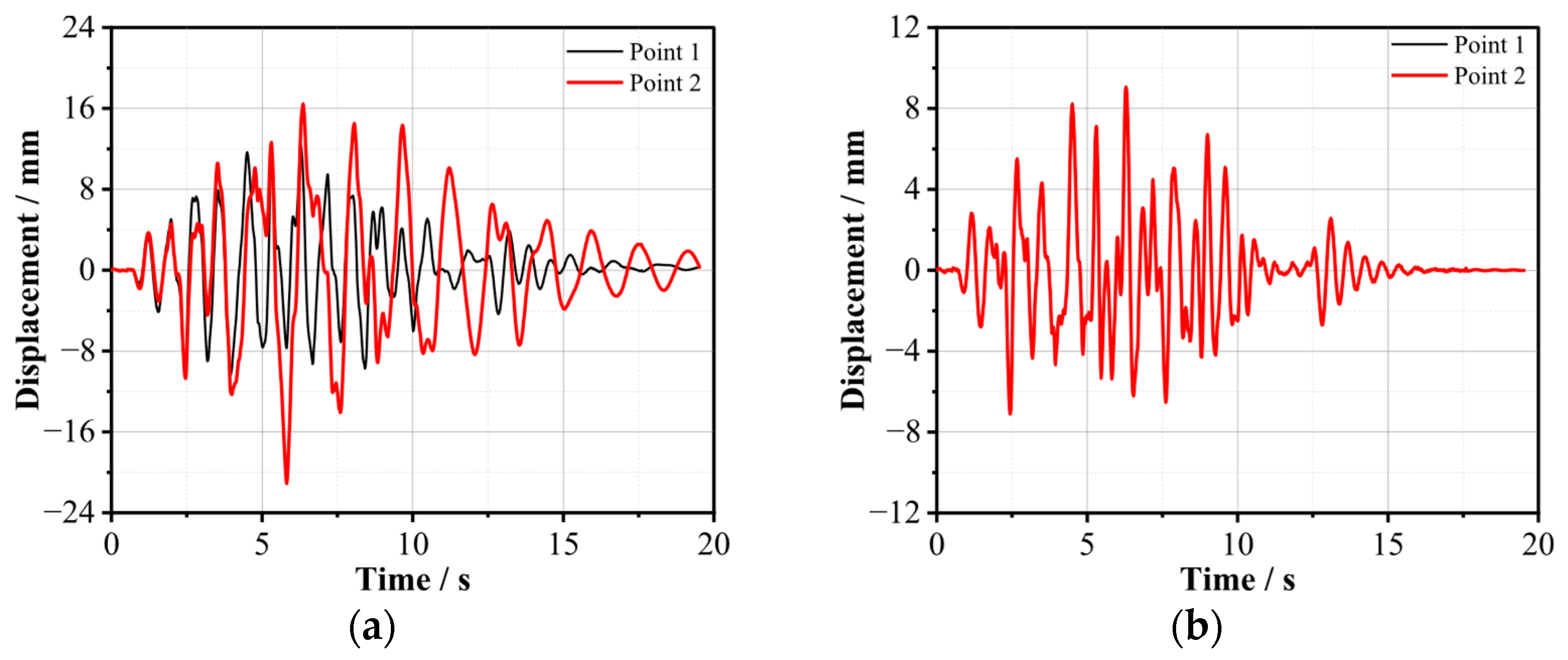
3.3. Analysis Model Comparison and Verification
- Comparison of Natural Frequency
- 2.
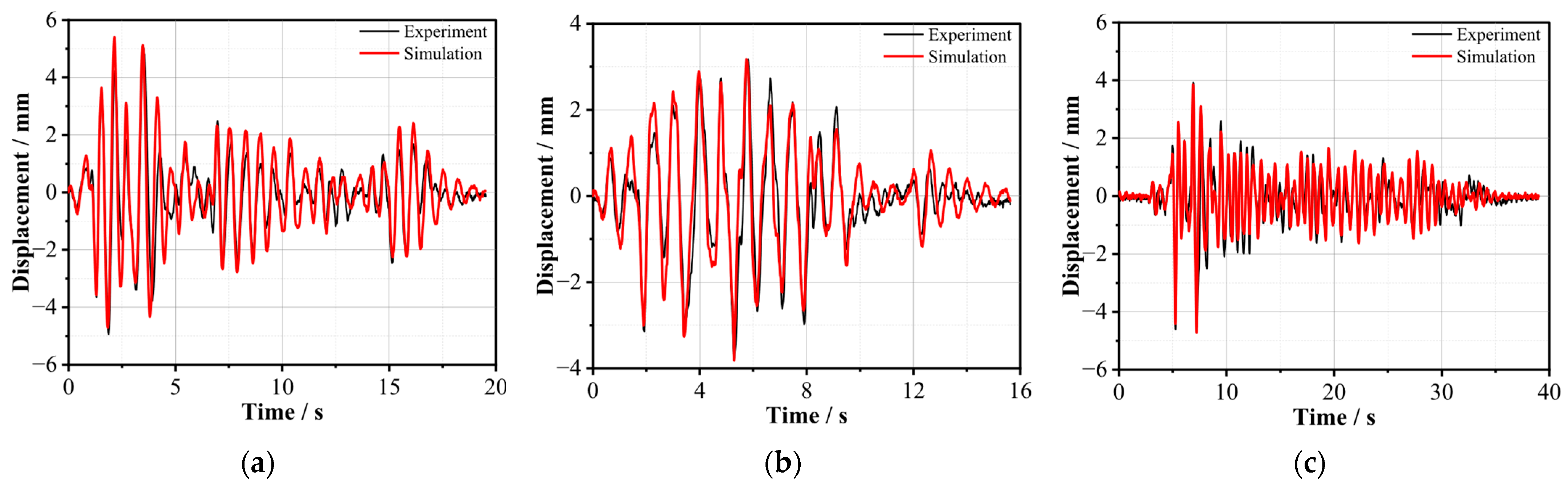
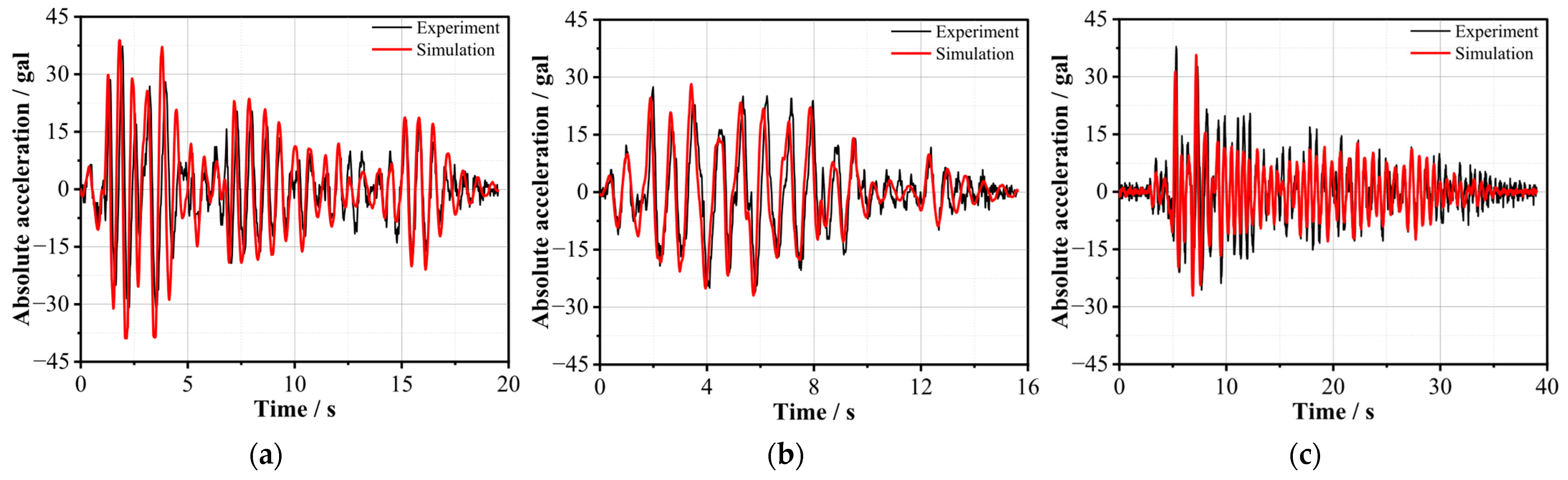
- Validation of seismic response
- 3.
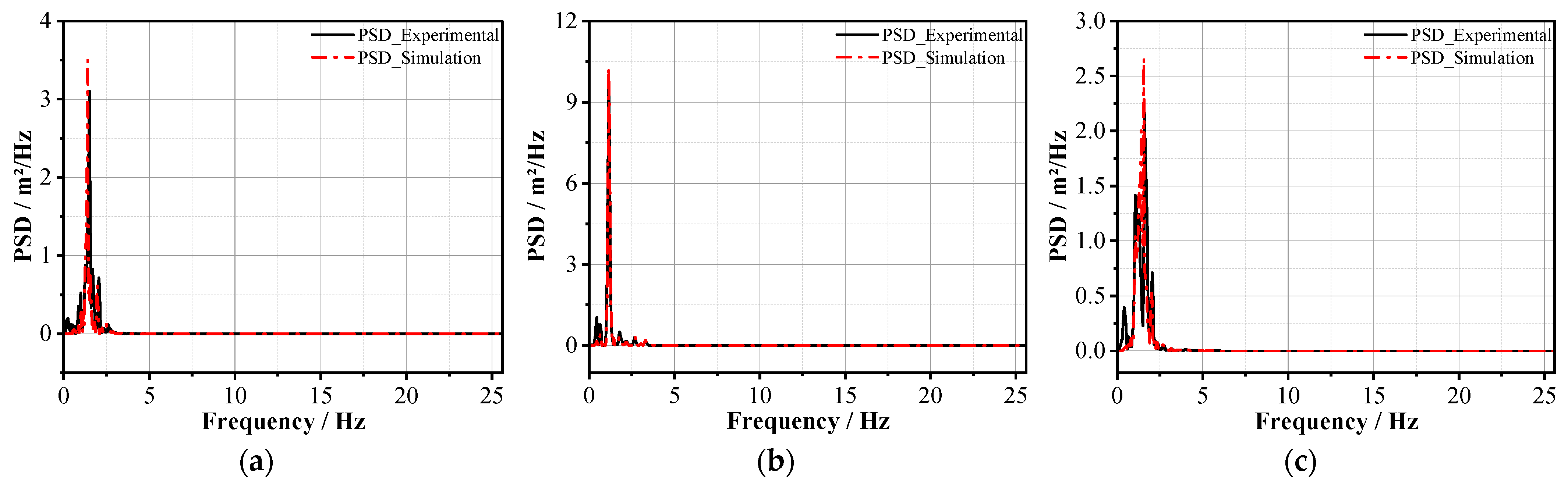
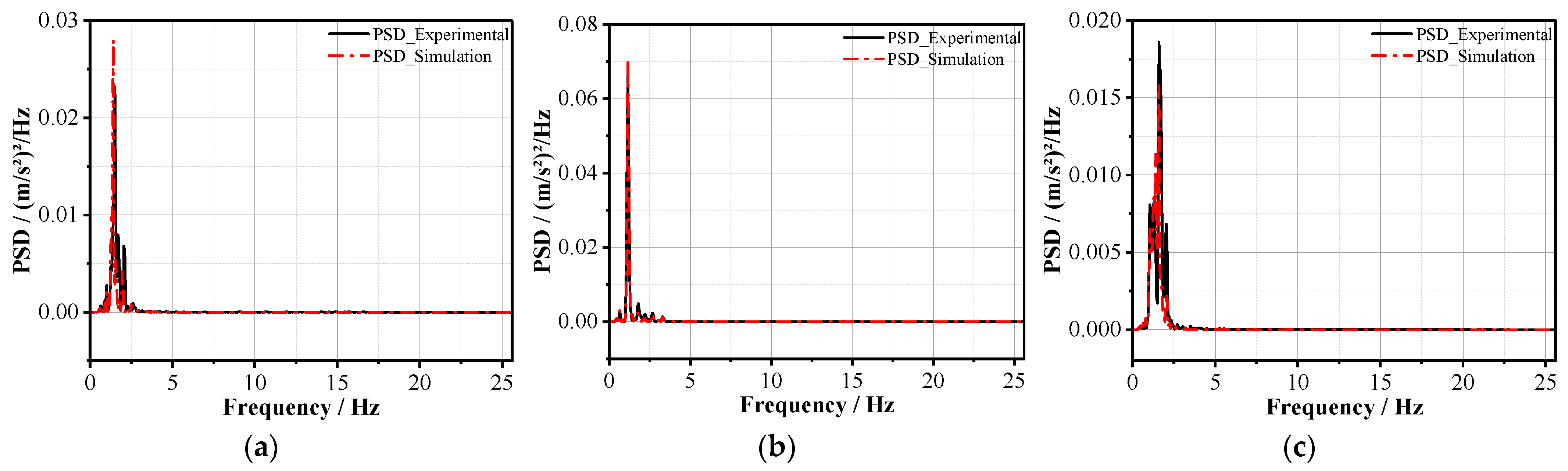
- Validation of power spectral density (PSD)
4. Dynamic Response Analysis
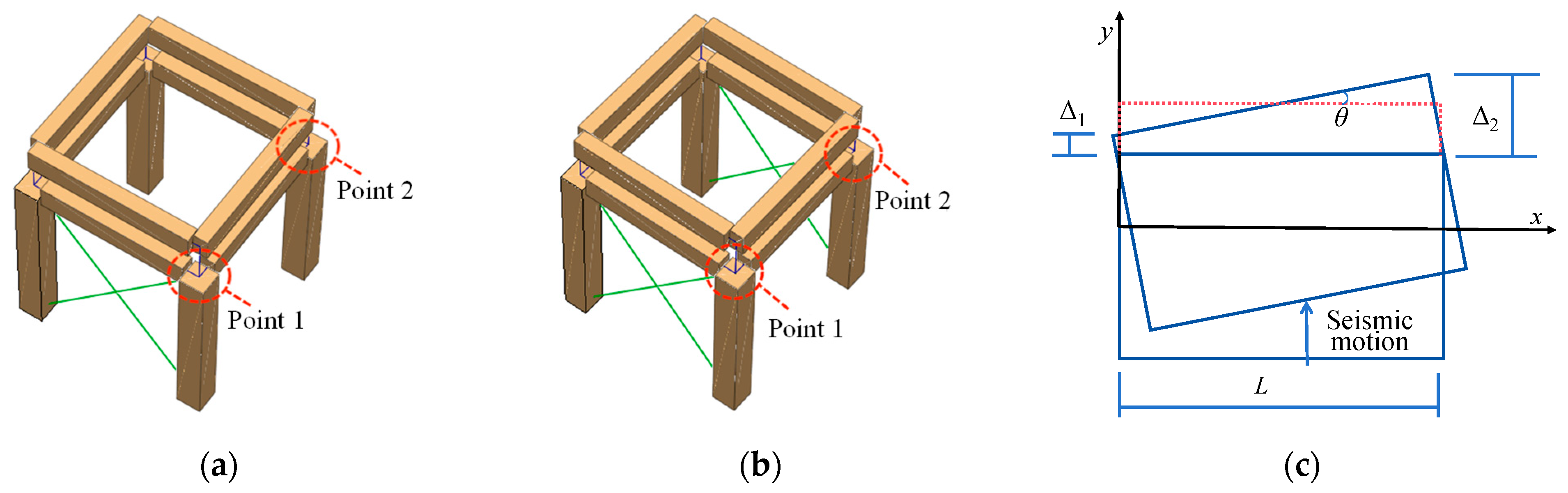
4.1. Layout Scheme of DARFDs
4.2. Reinforcement Efficiency Analysis
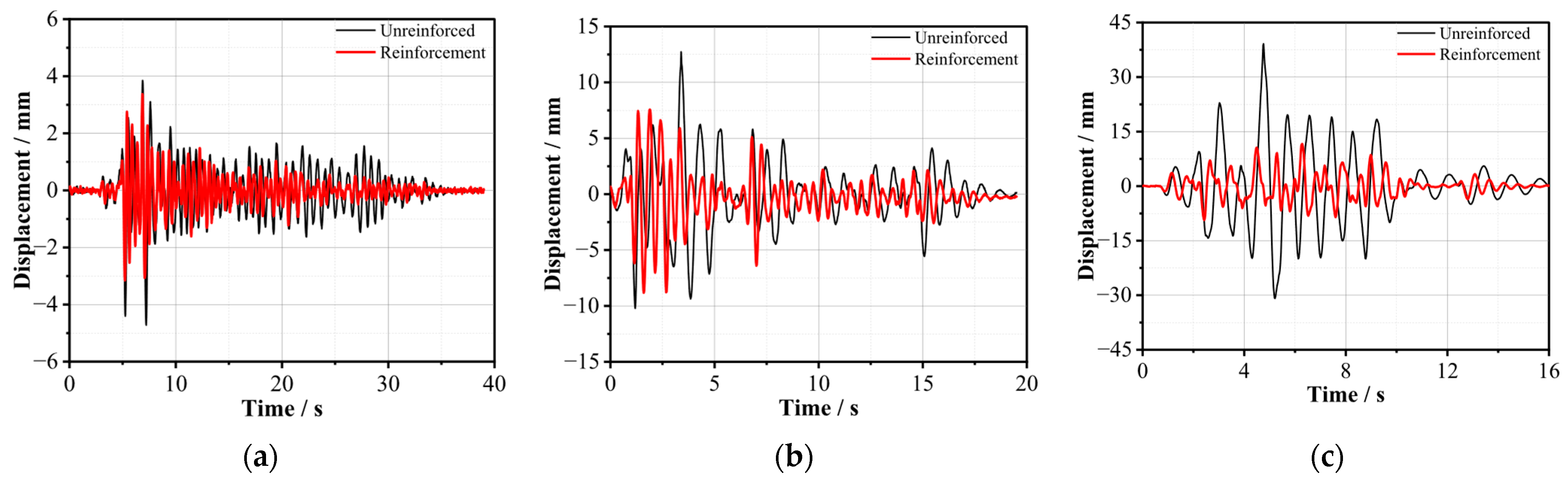
4.2.1. Comparison of Displacement Response
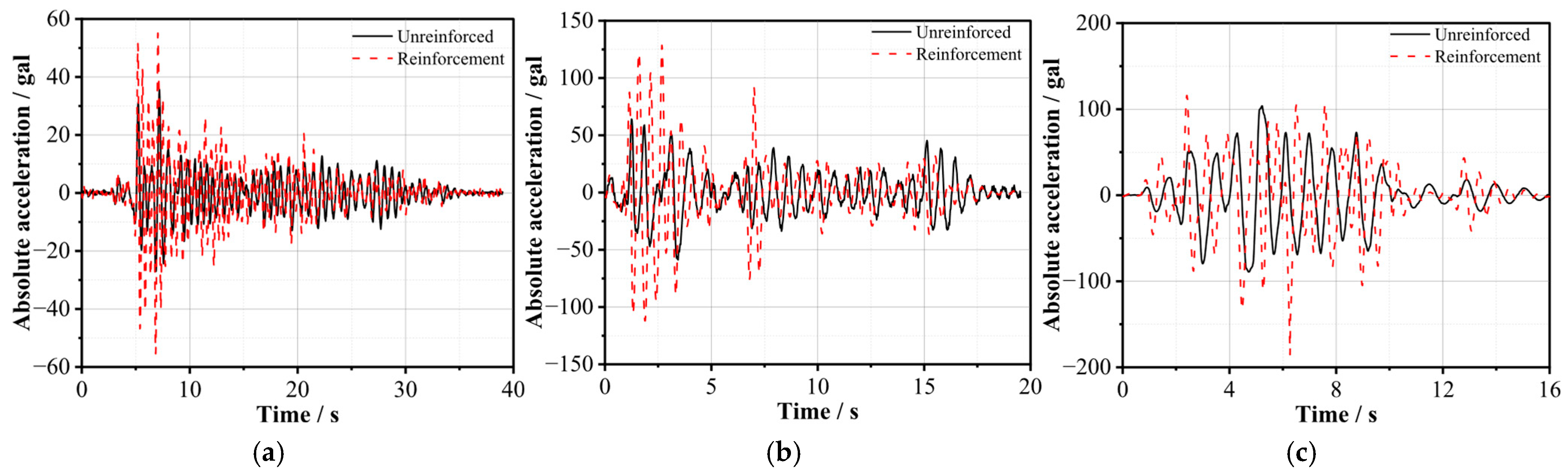
4.2.2. Comparison of Acceleration Response
5. Dual-Objective Parameter Optimization Analysis
5.1. Selection and Definition of Optimization Variables
5.2. Optimization Problem Definition and Mathematical Model Establishment
5.3. Numerical Sampling and Optimal Selection
6. Conclusions
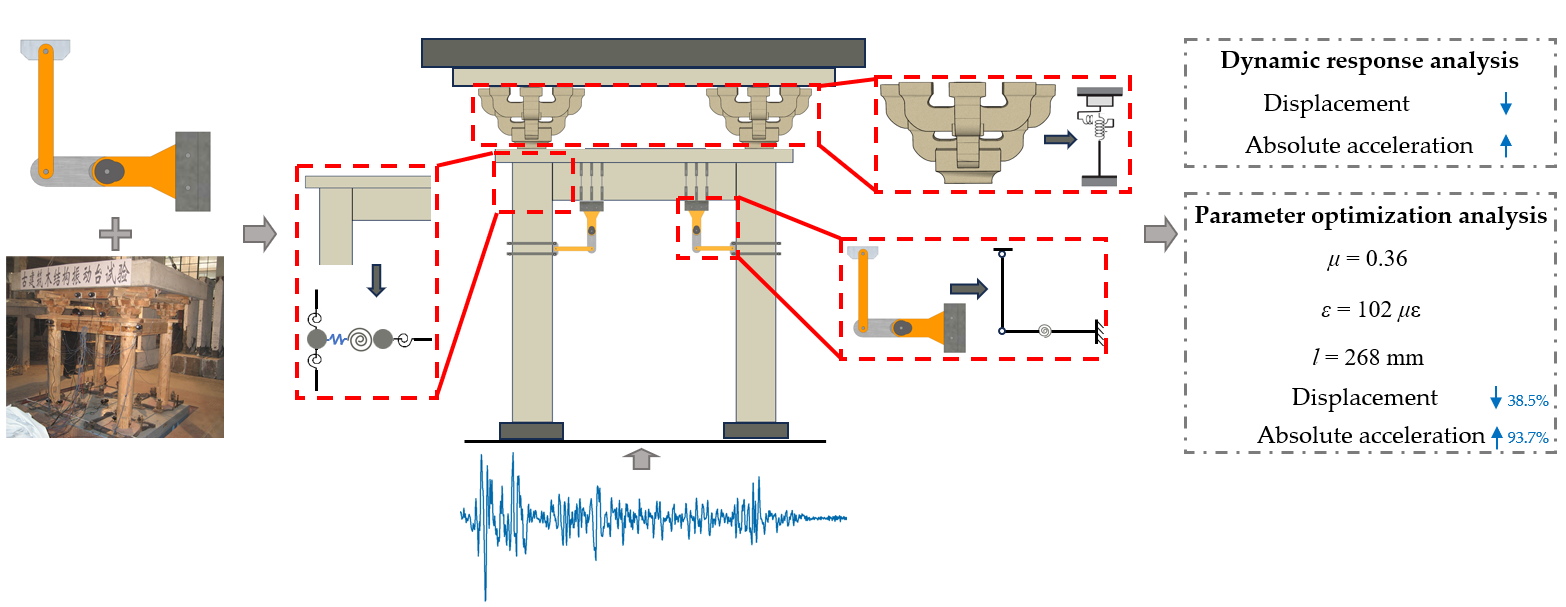
- An extended discrete element model integrating the friction dampers within a full palace-style timber structural system was developed. The results indicated a reasonable agreement with experimental data, with a computed natural frequency of 1.85 Hz (9% error compared to tests) and simulated responses showing consistent trends with measurements under various ground motions, supporting the use of the model for the subsequent parametric analysis within the defined scope.
- The installation of friction dampers significantly enhanced the structural energy dissipation capacity, reducing the peak displacement by up to 70%. However, the system-level analysis revealed a critical side effect: the added initial stiffness of the dampers markedly increased the lateral stiffness of the column frame, leading to a substantial amplification of the absolute acceleration response, with a maximum increase of 77%. This clarifies the inherent trade-off between displacement control and acceleration amplification associated with this retrofit strategy.
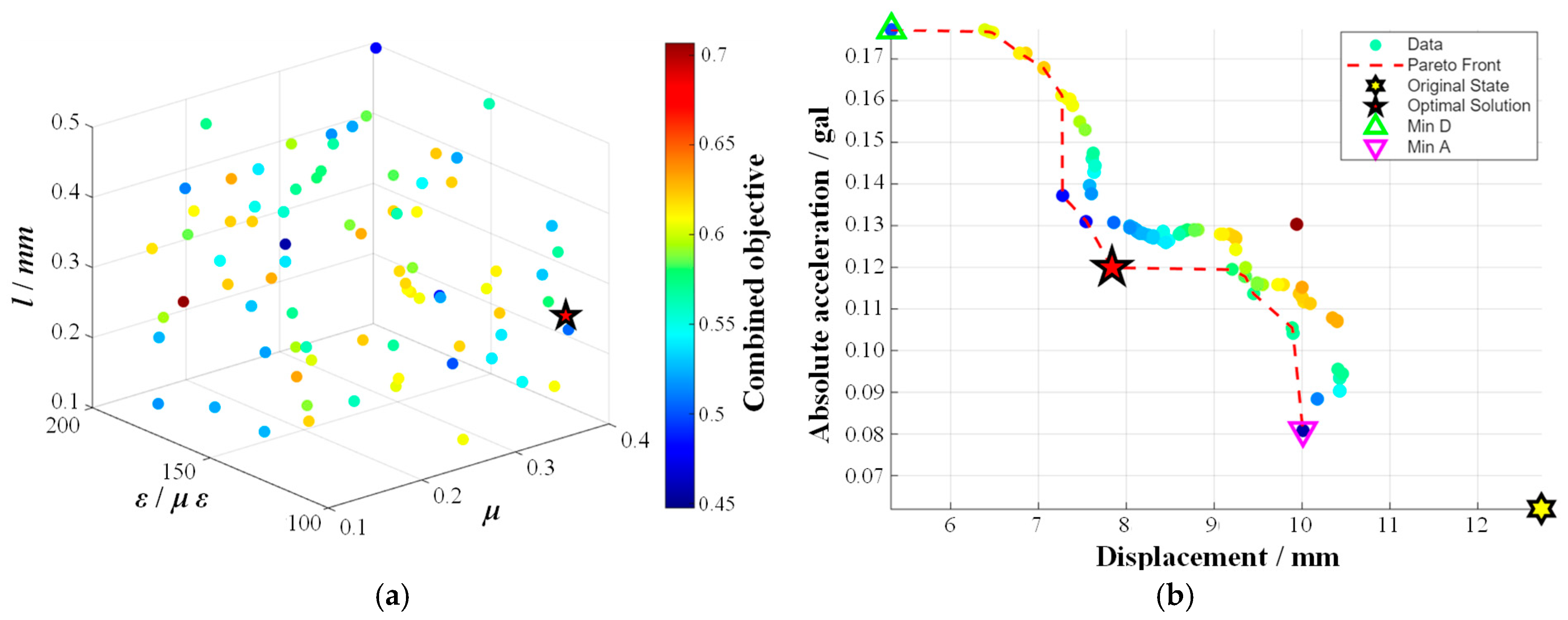
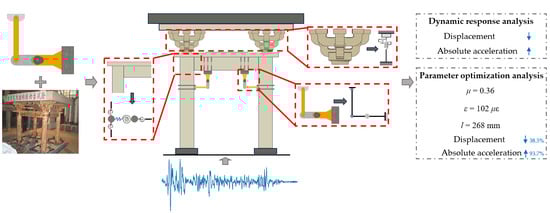
- A multi-objective parameter optimization framework was implemented. The peak relative displacement (D) and peak absolute acceleration (A) of the structure were selected as the optimization objectives. Under the condition of weighting coefficients λa = λb = 0.5, the optimal parameter combination for the damper, determined based on the comprehensive objective value, is μ = 0.36, ε = 102 με, and l = 268 mm. Under this specific set of conditions and objectives, the structural displacement response was reduced by 38.5%, while the acceleration response increased by 93.7%. This framework illustrates a principled approach to tailor damper design based on specific performance priorities.
Author Contributions
Funding
Data Availability Statement
Acknowledgments
Conflicts of Interest
References
- Zhang, Y.H.; Guo, H.S. Chinese Ancient Architecture; Science and Technology of China Press: Beijing, China, 1990. (In Chinese) [Google Scholar]
- Qi, Y.T. Protection and Maintenance of Ancient Chinese Architecture; Cultural Relics Press: Beijing, China, 1986. (In Chinese) [Google Scholar]
- Liu, L.L.; Zhang, X.C.; Wu, Y.W. Lateral performance of traditional Chinese penetrated mortise-tenon frames: Experimental and numerical simulation. J. Build. Eng. 2025, 106, 112691. [Google Scholar] [CrossRef]
- Fang, D.P.; Iwasaki, S.; Yu, M.H.; Shen, Q.P.; Miyamoto, Y.; Hikosaka, H. Ancient Chinese timber architecture. I: Experimental study. J. Struct. Eng. 2001, 127, 1348–1357. [Google Scholar] [CrossRef]
- Zhang, X.C.; Liu, K.; Han, Y.N. Moment-rotation calculation method and parameter analysis for loose continuous-tenon joint in column-and-tie timber structure. Int. J. Archit. Herit. 2024, 18, 1712–1726. [Google Scholar] [CrossRef]
- Zhang, X.C.; Zhao, H.T.; Zhang, F.L.; Sui, Y. Theoretical research on base sliding collapse performance of Chinese ancient timber buildings. Adv. Mater. Res. 2012, 368, 660–664. [Google Scholar] [CrossRef]
- Wu, Y.J.; Lin, H.S.; Wang, L.; Xie, Q.F.; Zhang, L.P. Influence of support interface on the lateral performance of rocking columns in traditional Chinese timber structures. Structures 2023, 48, 2037–2047. [Google Scholar] [CrossRef]
- Zhang, C.W.; Chun, Q.; Lin, Y.J. Experimental and numerical research on horizontal hysteretic performance of the typical Dou-gong based on an automatic contact pair generation strategy. J. Build. Eng. 2025, 101, 111849. [Google Scholar] [CrossRef]
- Yang, R.Y.; Mapesela, S.; Li, H.T.; Lorenzo, R. Mechanical properties of Dougong bracket in Chinese traditional timber structure under vertical loads: A systematic review. J. Build. Eng. 2023, 68, 106125. [Google Scholar] [CrossRef]
- Yang, Q.S.; Liu, K.; Yu, P.; Law, S.S. The analytical lateral load resisting performances of a bracket set frame in a traditional Chinese timber structure. Structures 2024, 61, 106128. [Google Scholar] [CrossRef]
- Zheng, X.Z.; Lam, F.; Li, Z.; He, M.J. Long-term performance assessment of post-tensioned timber connections under different climates. Constr. Build. Mater. 2023, 368, 130360. [Google Scholar] [CrossRef]
- Xie, Q.F.; Xue, J.Y.; Zhao, H.T. Seismic damage investigation and analysis of ancient buildings in Wenchuan earthquake. J. Build. Struct. 2010, 31, 18–23. (In Chinese) [Google Scholar]
- Pan, Y.; Fan, Y.Q.; Ren, Y.; Yang, B.; Hou, J.R.; Xiong, Y.Q. Typical seismic damage investigation and analysis in Mountain area after Ms 6. 1 Lushan earthquake. China Civ. Eng. J. 2023, 56, 35–48. (In Chinese) [Google Scholar]
- Xie, Q.F.; Zhao, H.T.; Xue, J.Y.; Men, J.J.; Wang, W. Analysis and investigation on the seismic damage of timber buildings in Wenchuan Earthquake. J. Xi’an Univ. Archit. Technol. (Nat. Sci. Ed.) 2008, 40, 658–661. (In Chinese) [Google Scholar]
- Zhang, X.C.; Xue, J.Y.; Zhao, H.T.; Sui, Y. Experimental study on Chinese ancient timber-frame building by shaking table test. Struct. Eng. Mech. 2011, 40, 453–469. [Google Scholar] [CrossRef]
- Yang, Q.S.; Yu, P.; Law, S. Load resisting mechanism of the mortise-tenon connection with gaps under in-plane forces and moments. Eng. Struct. 2020, 219, 110755. [Google Scholar] [CrossRef]
- Chen, Q.J.; Lei, J.; Bradford, M.A.; Liu, X.P.; Zhang, Y.Q.; Qiu, K.X.; Tang, X.L.; Cai, J. Experimental study on seismic performance of spatial and planar hoop-head mortise and tenon timber joints in historical architecture. Constr. Build. Mater. 2024, 438, 136989. [Google Scholar] [CrossRef]
- Lu, W.J.; Qiu, H.X.; Lu, Y. Theoretical model for the analysis of rotational behavior of penetrated mortise-tenon joints in traditional timber structures. Int. J. Archit. Herit. 2024, 18, 709–724. [Google Scholar] [CrossRef]
- Ogawa, K.; Sasaki, Y.; Yamasaki, M. Theoretical estimation of the mechanical performance of traditional mortise–tenon joint involving a gap. J. Wood Sci. 2016, 62, 242–250. [Google Scholar] [CrossRef]
- Tanahashi, H.; Okamura, M.; Suzuki, Y. Simple formulation of elasto-plastic embedment behavior of orthotropic wood considering densification. In Proceedings of the WCTE2008: 10th World Conference on Timber Engineering 2008, Miyazaki, Japan, 2–5 June 2008; p. 217. [Google Scholar]
- Tanahashi, H.; Suzuki, Y. Characteristics of elasto-plastic rotational embedment of traditional wooden joints and formulation of crosspiece joints. J. Struct. Constr. Eng. 2011, 76, 1675–1684. [Google Scholar] [CrossRef]
- Tanahashi, H.; Ooka, Y.; Suzuki, Y. Rotational embedment characteristics and formulation of traditional wooden T-type joints. J. Struct. Constr. Eng. 2017, 82, 1403–1411. [Google Scholar] [CrossRef]
- Tanahashi, H.; Suzuki, Y. Review on the mechanical models and formulations of embedment of traditional timber joints in Japan. Jpn. Archit. Rev. 2020, 3, 148–164. [Google Scholar] [CrossRef]
- Gan, S.R.; Pan, W.; Su, H.X.; Jin, Y.C.; Zhu, C.W.; Yu, S.B. Experimental Study and Numerical Simulation Analysis on Reinforcement of Mortise-Tenon Joints with Flat Steel Strips. Adv. Civ. Eng. 2023, 2023, 5398662. [Google Scholar] [CrossRef]
- Dai, B.H.; Gao, Y.L.; Tao, Z.; Su, H.H.; Su, H.X. Fan-shaped shear dampers strengthen mortise-tenon joints in Chinese traditional timber structures. Int. J. Archit. Herit. 2023, 17, 1079–1092. [Google Scholar] [CrossRef]
- Yi, D.H.; Fan, Y.Q.; Pan, Y.; Yuan, J.C. Seismic behavior of predamaged mortise-and-tenon joints reinforced using viscoelastic dampers. J. Struct. Eng. 2023, 149, 04023124. [Google Scholar] [CrossRef]
- Yi, D.H.; Fan, Y.Q.; Pan, Y. Hysteretic Behavior Characterization of Mortise and Tenon Joints Reinforced Using Viscoelastic Dampers in Historic Timber Frames. J. Struct. Eng. 2025, 151, 04025024. [Google Scholar] [CrossRef]
- Shimoyama, M.; Miyazu, Y.; Miyata, Y.; Wakita, T.; Ishiyama, H. Development of knee-brace friction damper for mid-rise timber frame building. AIJ J. Technol. Des. 2022, 28, 1189–1194. (In Japanese) [Google Scholar] [CrossRef]
- Zhang, X.C.; Liu, L.L.; Qiu, Z.H.; Cui, L.H.; Hu, C.M. Replaceable Displacement-Amplifying Rotary Friction Damper: Experimental and Numerical Investigation. Struct. Control Health Monit. 2024, 2024, 9402792. [Google Scholar] [CrossRef]
- Zhang, X.C.; Liu, L.L.; Cui, L.H.; Liu, K.; Li, J.Y. Nonlinear dynamic analysis of ancient timber structures with rotary friction dampers. J. Build. Eng. 2025, 100, 111707. [Google Scholar] [CrossRef]
- Kapasakalis, K.A.; Antoniadis, I.A.; Sapountzakis, E.J. Performance assessment of the KDamper as a seismic Absorption Base. Struct. Control Health Monit. 2020, 27, e2482. [Google Scholar] [CrossRef]
- Kapasakalis, K.A.; Antoniadis, I.A.; Sapountzakis, E.J. Constrained optimal design of seismic base absorbers based on an extended KDamper concept. Eng. Struct. 2021, 226, 111312. [Google Scholar] [CrossRef]
- Kapasakalis, K.A. Seismic retrofit of multi-story structures with KDamper-based vibration control systems considering soil–structure-interaction. Soil Dyn. Earthq. Eng. 2025, 196, 109429. [Google Scholar] [CrossRef]
- Nakagawa, T.; Ohta, M. Collapsing process simulations of timber structures under dynamic loading II: Simplification and quantification of the calculating method. J. Wood Sci. 2003, 49, 499–504. [Google Scholar] [CrossRef]
- Li, J. Ying Zao Fa Shi; The Commercial Press: Shanghai, China, 1950. (In Chinese) [Google Scholar]
- Liu, L.L.; Zhang, X.C.; Wu, Y.W.; Nie, M.Z.; Cui, L.H.; Li, J.Y.; Tian, Q.H. Stiffness compensation and multi-objective parameter optimization for seismic performance of ancient timber structures retrofitted with friction dampers. Structures 2025, 82, 110698. [Google Scholar] [CrossRef]
- Zhang, X.C.; Qiu, Z.H.; Wu, C.W.; Ma, H.; Huo, J.; Shi, M.X. Seismic evaluation of a traditional Chinese palace-style timber structure. Soil Dyn. Earthq. Eng. 2023, 169, 107878. [Google Scholar] [CrossRef]
- Xue, J.Y.; Li, Y.Z.; Xia, H.L.; Sui, Y. Experimental study on seismic performance of dovetail Joints of ancient buildings with different degrees of loosening. J. Build. Struct. 2016, 37, 73–79. (In Chinese) [Google Scholar]
- Sui, Y.; Zhao, H.T.; Xue, J.Y.; Zhang, X.C. Experimental study on stiffness of Dougong in Chinese ancient buildings. Adv. Mater. Res. 2012, 368, 819–822. [Google Scholar] [CrossRef]
- Zhang, X.C. Dynamic Analysis of Ancient Timber-Frame Buildings under Seismic Excitations. Ph.D. Thesis, Xi’an University of Architecture & Technology, Xi’an, China, 2013. (In Chinese) [Google Scholar]
- Song, Z.M.; Li, R.; Qian, M.; Shi, W.B.; Qian, K.; Ma, H.; Chen, Q.Y.; Zhang, G.P. Optimizing Prestress of Fatigue Property-dominated 8.8-grade Bolts. Chin. J. Mater. Res 2019, 33, 629–634. [Google Scholar]
- Yang, G.W.; Yang, L.; Chen, J.S.; Xiao, S.N.; Jiang, S.L. Competitive failure of bolt loosening and fatigue under different preloads. Chin. J. Mech. Eng. 2021, 34, 141. [Google Scholar] [CrossRef]
- Marler, R.T.; Arora, J.S. The weighted sum method for multi-objective optimization: New insights. Struct. Multidiscip. Optim. 2010, 41, 853–862. [Google Scholar] [CrossRef]
- Wang, R.; Zhou, Z.B.; Ishibuchi, H.; Liao, T.J.; Zhang, T. Localized weighted sum method for many-objective optimization. IEEE Trans. Evol. Comput. 2016, 22, 3–18. [Google Scholar] [CrossRef]



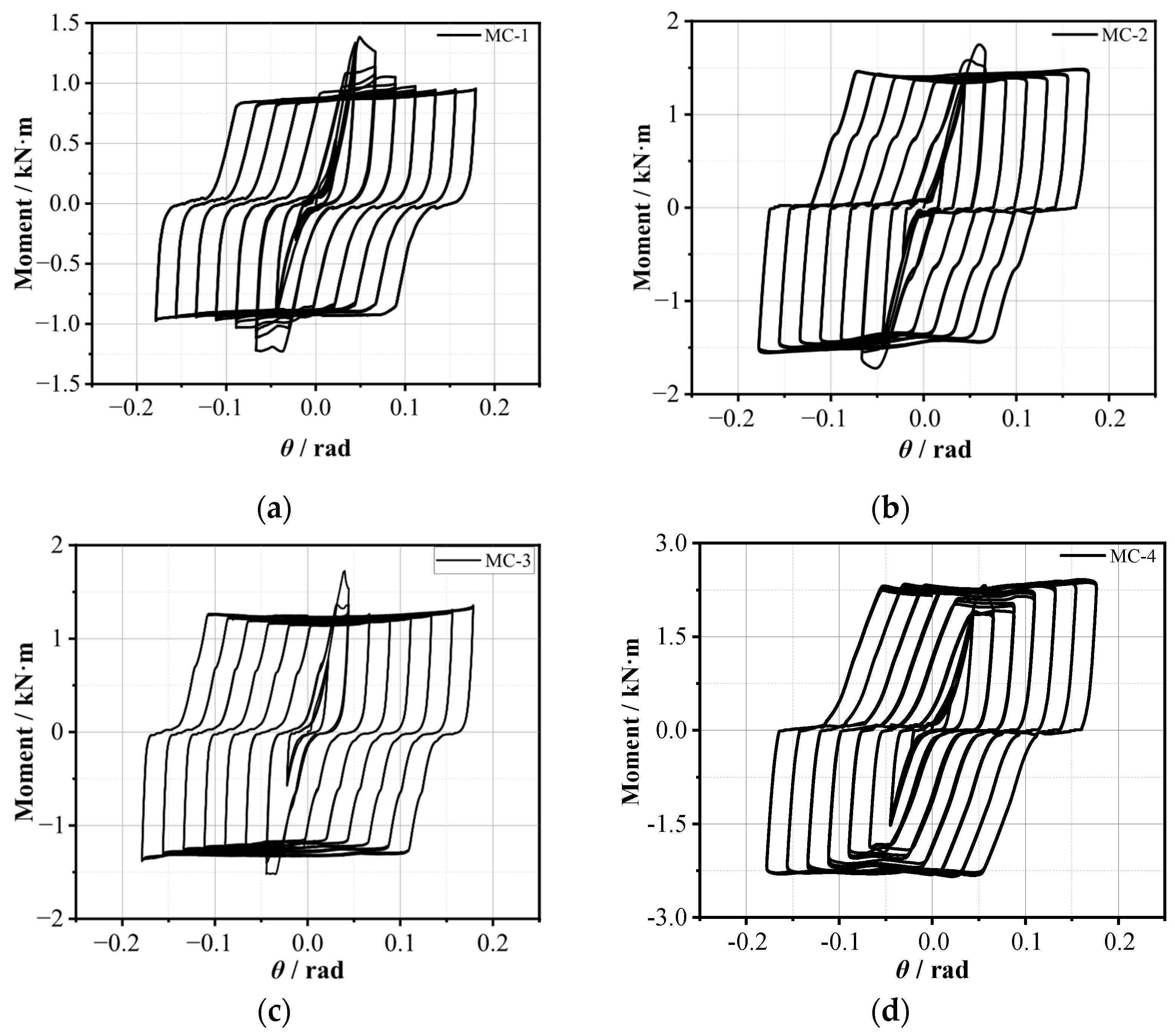
| Specimen | Material of the Friction Plate | Friction Coefficient μ | Pre-Tension Strain με |
|---|---|---|---|
| MC-1 | Steel fiber composite material | 0.40 | 150 |
| MC-2 | 200 | ||
| MC-3 | Ceramic fiber composite material | 0.50 | 150 |
| MC-4 | 200 |
| Specimen | Positive Loading (M/kN m) | Error/% | Reverse Loading (M/kN m) | Error/% | ||
|---|---|---|---|---|---|---|
| Calculation | Test | Calculation | Test | |||
| MC-1 | 0.911 | 0.953 | 4.41% | −0.911 | −0.974 | 6.47% |
| MC-2 | 1.454 | 1.487 | 2.22% | −1.454 | −1.539 | 5.52% |
| MC-3 | 1.361 | 1.355 | 0.44% | −1.361 | −1.383 | 1.59% |
| MC-4 | 2.223 | 2.401 | 7.41% | −2.223 | −2.361 | 5.84% |
| Condition | Displacement | Absolute Acceleration | ||||
|---|---|---|---|---|---|---|
| UR/mm | R/mm | η/% | UR/Gal | R/Gal | η/% | |
| Taft-0.05g | 4.71 | 3.37 | 30% | 35.71 | 55.46 | −55% |
| El Centro-0.15g | 12.73 | 7.57 | 41% | 61.92 | 125.51 | −77% |
| Lanzhou-0.3g | 39.14 | 11.61 | 70% | 103.82 | 185.3 | −30% |
| μ | ε/με | l/mm | D/mm | A/g | Displacement Reduction | Acceleration Increase |
|---|---|---|---|---|---|---|
| 0.36 | 102 | 268 | 7.83 | 0.12 | 38.5% | 93.7% |
| λa | λb | μ | ε/με | l/mm | D/mm | A/g |
|---|---|---|---|---|---|---|
| 0.2 | 0.8 | 0.11 | 121 | 442 | 10.01 | 0.08 |
| 0.3 | 0.7 | 0.11 | 121 | 442 | 10.01 | 0.08 |
| 0.4 | 0.6 | 0.15 | 133 | 486 | 9.57 | 0.09 |
| 0.5 | 0.5 | 0.36 | 102 | 268 | 7.83 | 0.12 |
| 0.6 | 0.4 | 0.39 | 162 | 102 | 5.32 | 0.18 |
| 0.7 | 0.3 | 0.39 | 162 | 102 | 5.32 | 0.18 |
Disclaimer/Publisher’s Note: The statements, opinions and data contained in all publications are solely those of the individual author(s) and contributor(s) and not of MDPI and/or the editor(s). MDPI and/or the editor(s) disclaim responsibility for any injury to people or property resulting from any ideas, methods, instructions or products referred to in the content. |
© 2026 by the authors. Licensee MDPI, Basel, Switzerland. This article is an open access article distributed under the terms and conditions of the Creative Commons Attribution (CC BY) license.
Share and Cite
Xiang, M.; Niu, Y.; Liu, L.; Zhang, X.; Nie, M.; Cui, Y. Seismic Performance and Parameter Optimization of Traditional Chinese Timber Structure Reinforced with Friction Dampers. CivilEng 2026, 7, 17. https://doi.org/10.3390/civileng7010017
Xiang M, Niu Y, Liu L, Zhang X, Nie M, Cui Y. Seismic Performance and Parameter Optimization of Traditional Chinese Timber Structure Reinforced with Friction Dampers. CivilEng. 2026; 7(1):17. https://doi.org/10.3390/civileng7010017
Chicago/Turabian StyleXiang, Meng, Yanping Niu, Leilei Liu, Xicheng Zhang, Maozhe Nie, and Yao Cui. 2026. "Seismic Performance and Parameter Optimization of Traditional Chinese Timber Structure Reinforced with Friction Dampers" CivilEng 7, no. 1: 17. https://doi.org/10.3390/civileng7010017
APA StyleXiang, M., Niu, Y., Liu, L., Zhang, X., Nie, M., & Cui, Y. (2026). Seismic Performance and Parameter Optimization of Traditional Chinese Timber Structure Reinforced with Friction Dampers. CivilEng, 7(1), 17. https://doi.org/10.3390/civileng7010017