

Optimization of Compressive Strength and Drying Shrinkage of Calcium-Based Alkali-Activated Mortars Using Expansive and Shrinkage-Reducing Agents


Abstract
1. Introduction
2. Materials and Methods
2.1. Raw Materials
2.2. CCD and Sample Preparation
2.3. Test Methods
2.3.1. Mortar Test Methods
- Compressive Strength
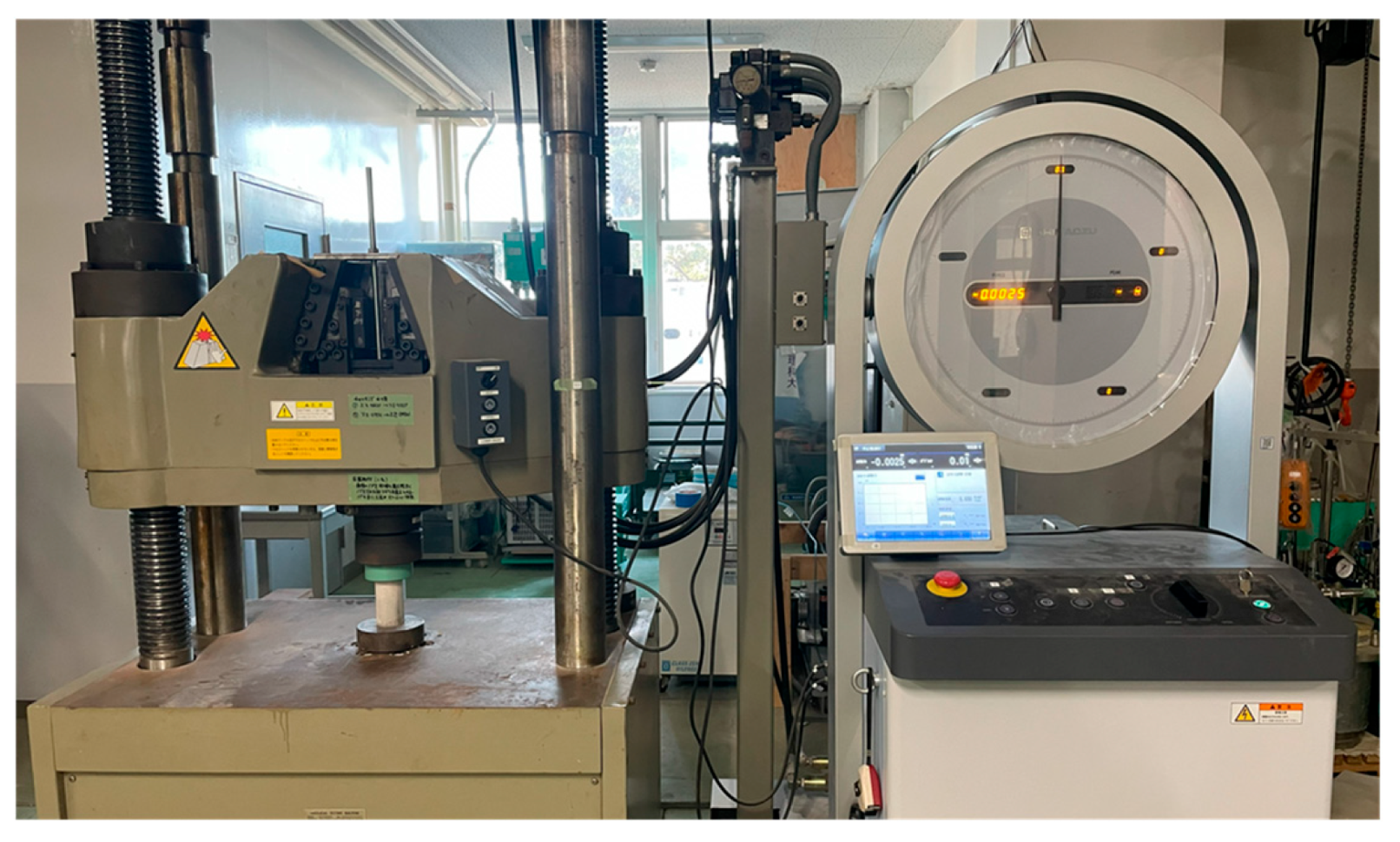
- Compressive strength tests were conducted to evaluate the mechanical performance of the materials. The mortar was poured into a cylindrical mold, and the specimens were demolded after 4 d. The samples were then sealed and cured until the measured ages were attained. The compressive strength was measured at 4, 7, and 28 d in accordance with JIS R 5201 [29]. The compressive strength test equipment is presented in Figure 4. At least two specimens were tested for each condition, and the average values were recorded.
- Drying Shrinkage
- 1.
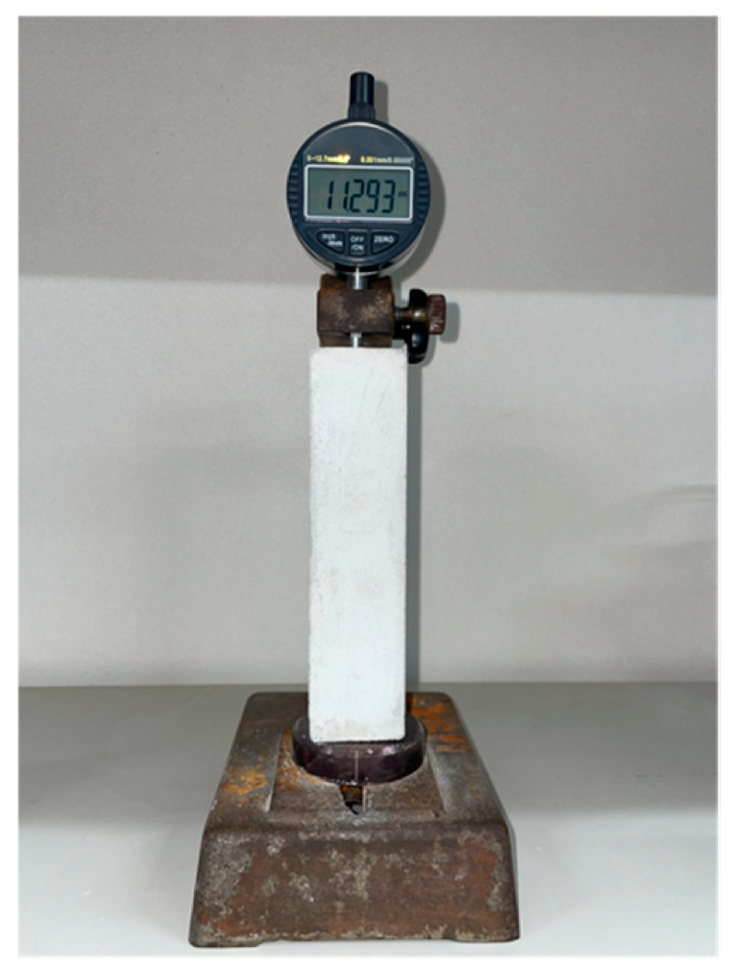
- After mortar casting, the mortar samples under investigation were sealed and cured in the laboratory at 20 °C for 4 d, then stored in a curing room at 20 ± 2 °C and 55 ± 5% RH. The changes in length was measured according to JIS A 1129 [30], as shown in Figure 5. The length measurements were performed using a digital micrometer (resolution: 0.001 mm, standard bar: 150 mm). The changes in length were calculated before and after drying.
2.3.2. Paste Test Methods
- Heat of Hydration
- 2.
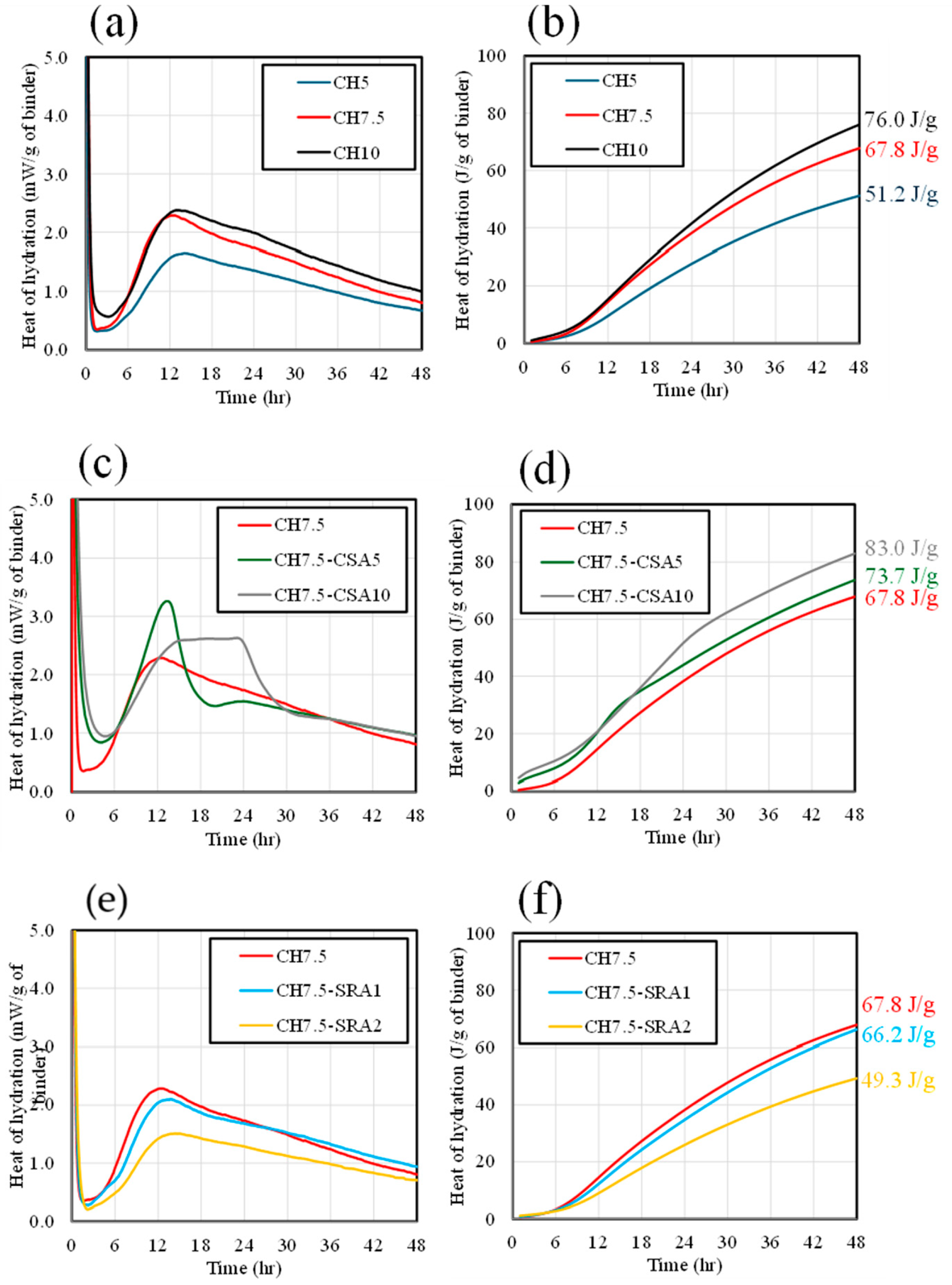
- Heat-of-hydration tests were conducted to evaluate the hydration reaction rates of the CAAM. This experiment was conducted with reference to the existing literature [31,32]. All materials were placed in a chamber at 22 °C for approximately 24 h before use. Approximately 30 g of the binder and distilled water were mixed by hand mixer for 2–3 min. Approximately 20 g of the paste was placed in a polyethylene (PP) container and inserted into the heat-of-hydration measuring device. Subsequently, the voltage was measured for 48 h using a data logger (TDS-540; Tokyo Measuring Instruments Laboratory, Tokyo, Japan). The time interval between measurements was 3 min. The baseline for each sensor was measured as follows: The calibration coefficient was obtained by filling the polyethylene container with distilled water and measuring the voltage for 24 h. The calibration coefficient was obtained using 100 Ω resistors and an external voltage supply. At least three measurements were taken for each paste, and the average values were used.
- pH Value
- 3.
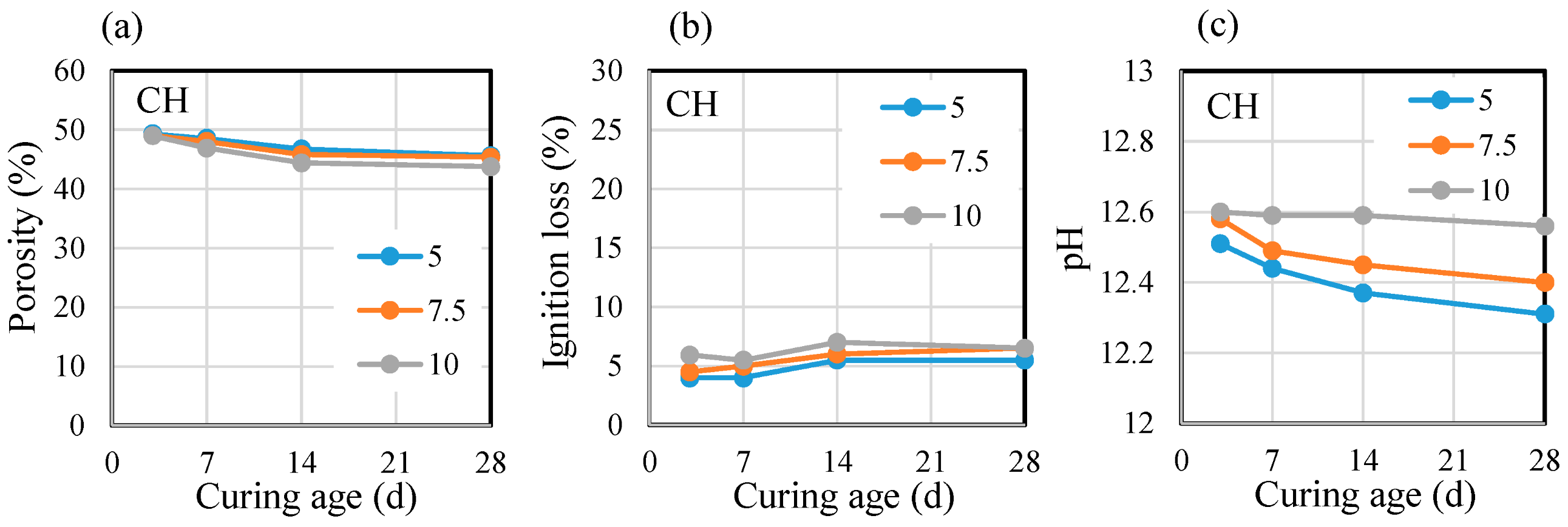
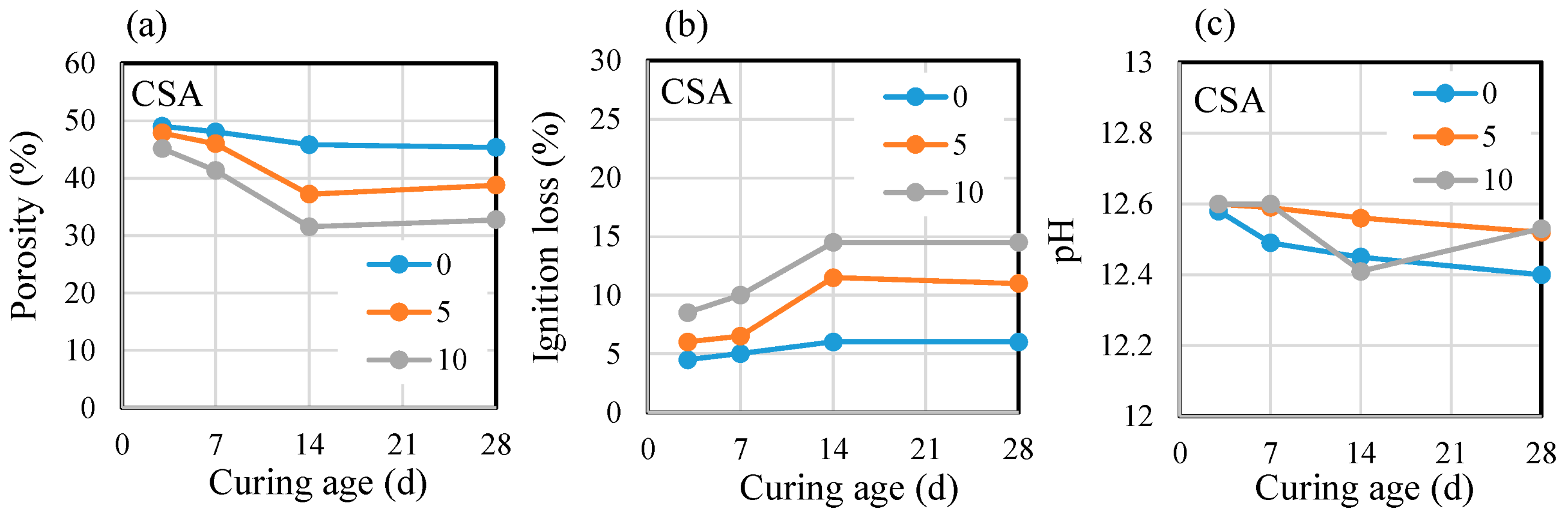
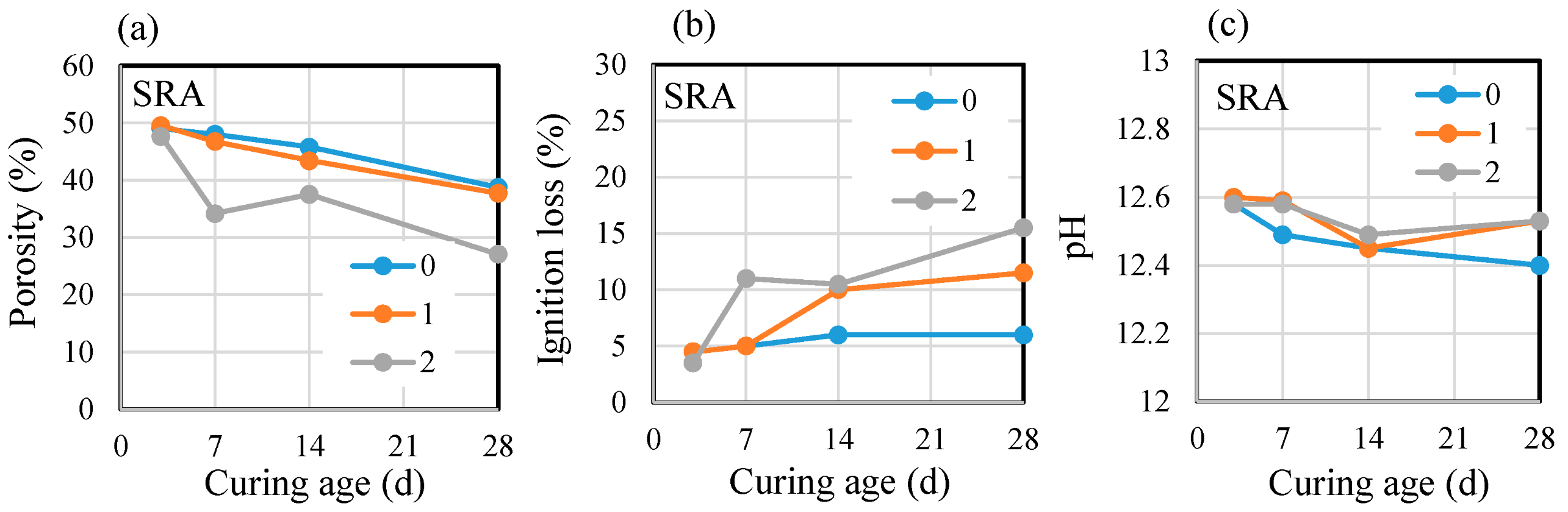
- To determine the effect of each material design on the alkalinity of the liquid, pH tests were conducted. These tests were conducted based on the authors’ previous research methods [23]. The paste was mixed for approximately 5 min using a hand mixer, placed in a 75 × 75 × 5 mm silicone mold, and stored in a polyethylene bag to prevent water evaporation. After 3 d, the paste was demolded and sealed for curing. After 4, 7, 14, and 28 d of curing, the samples were dried in an oven at 40 °C for 3 d. The paste was then ground to a size of 150 µm or less. A liquid-to-solid ratio of 10 was used, with 1–2 g of ground paste in this experiment. The paste was mixed with distilled water for approximately 2 min and the pH was measured after 5 min using a pH meter (DKK-TOA Co., HM-30P; DKK-TOA Co., Tokyo, Japan).
- Porosity
- 4.
- The Archimedean porosity was measured to evaluate changes in paste porosity induced by each additive. This test was conducted based on the authors’ previous research methods [23]. The paste was prepared using the same method as that used for the pH measurement and then sealed and cured. Before measurement, the hydration of the paste was stopped using ethanol. All samples were dried at 40 °C for 3 d to remove residual ethanol, and the absolute dry weight was measured. The paste was then immersed in water for 1 d using a vacuum pump, and the submerged dry weight and surface dry weight were measured.
- Ignition Loss
- 5.
- The ignition loss was measured to evaluate the changes in the hydration reaction with various mixtures. The paste preparation method was identical to that used for the pH tests. Hydration of the paste was stopped using ethanol, and the paste samples were dried at 40 °C for 3 d. The dried paste samples were then ground to a particle size of less than 150 µm, and 1–2 g of paste was placed in an electric furnace at 350 °C for 60 min [23]. The temperature varied from 40 °C to 350 °C, and the ignition loss was calculated using the formula (m40 − m350)/m40 × 100, where m40 and m350 represent the sample masses at 40 °C and 350 °C, respectively.
- Water Desorption Behavior
- 6.
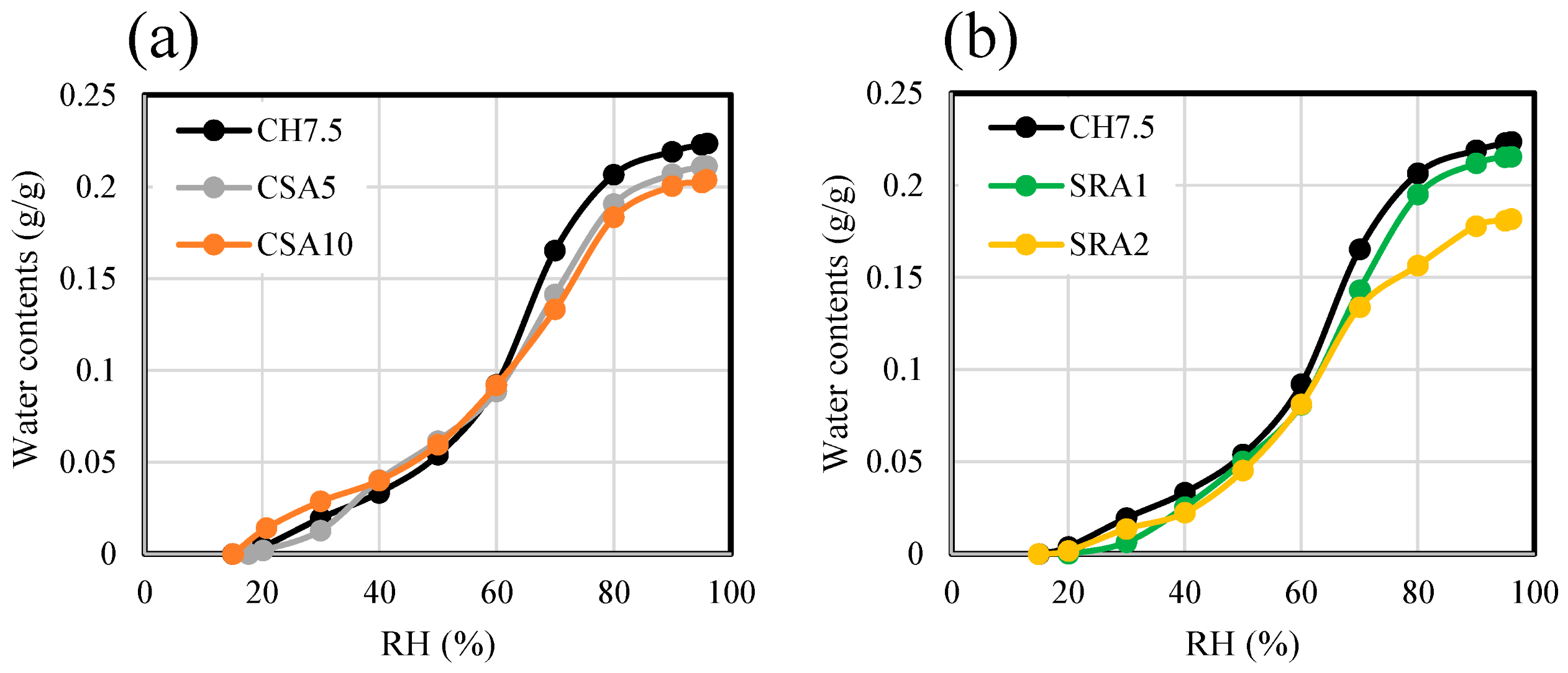
- To evaluate the effects of the CSA and SRA on the water desorption behavior, DVS (AQUADYNE DVS1, Quantachrome Instruments, Aton-Paar, Boynton Beach, FL, USA) was measured. Paste specimens sealed and cured for 28 d were used. Before the analysis, all the pastes were cut to approximately 1 mm thickness [33] using a water-cooled cutter. The samples were then slowly exposed to RHs of 96%, 95%, 90%, 80%, 70%, 60%, 50%, 40%, 30%, 20%, and 15% and mass changes were recorded. The mass loss rate and equivalent temperature were adjusted to 0.0001% min−1 and 25 °C, respectively.
- XRD Analyses
- 7.
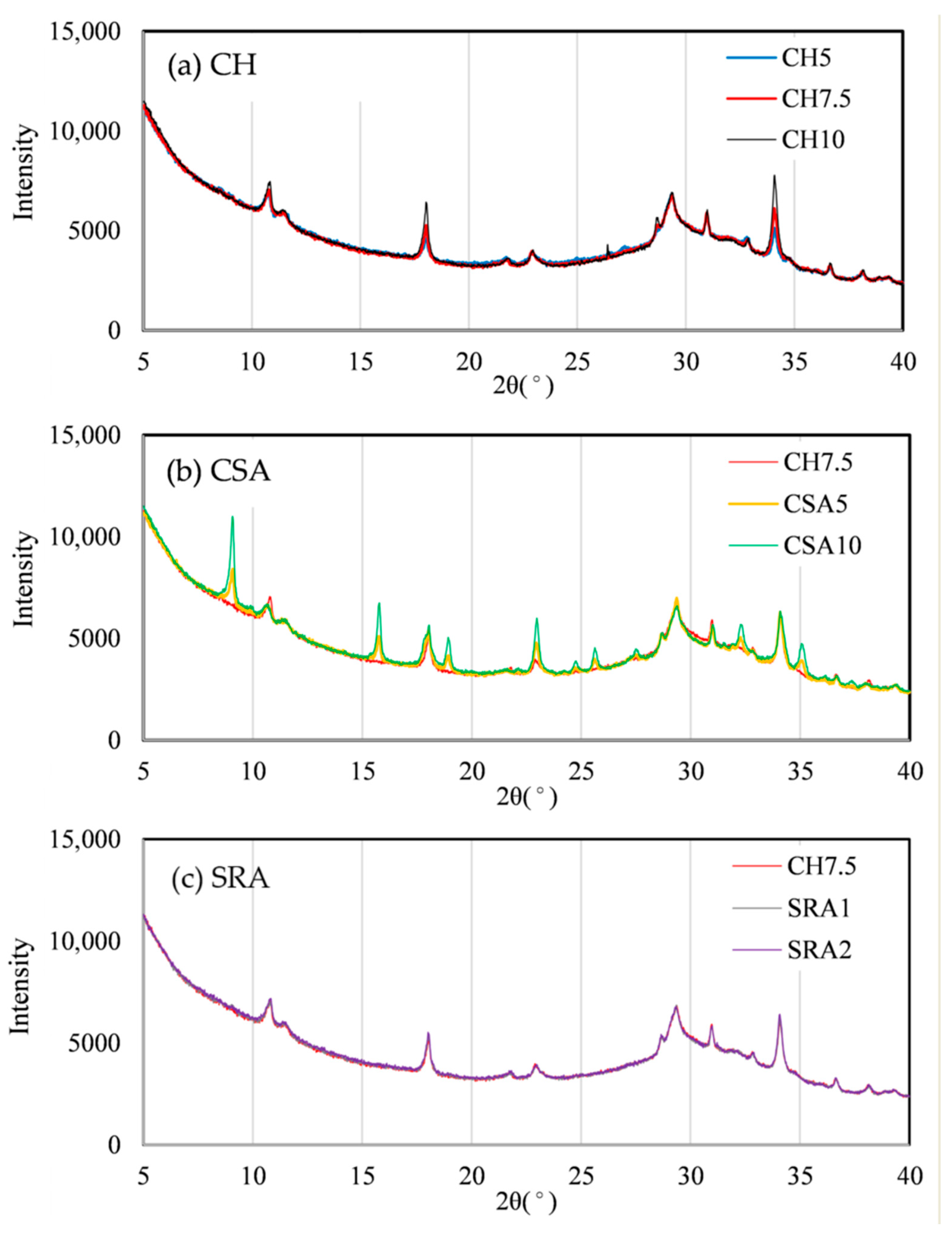
- Hydration reactions of the paste specimens, which were sealed and cured for 28 d, were stopped using ethanol. The samples were then vacuum-dried at 20 °C for 24 h. The hydration products of the pastes were then evaluated using a SmartLab X-ray diffractometer (Rigaku Corporation, Tokyo, Japan) using paste samples with particle sizes smaller than 150 µm.
3. Results
3.1. Compressive Strength and Length-Change Results
= 12.31 − 0.715 CH + 0.628 CSA − 2.173 SRA + 0.0482 CH × CH − 0.0059 CSA × CSA + 0.151 SRA × SRA − 0.0050 CH × CSA + 0.1450 CH × SRA + 0.0025 CSA × SRA
= 12.99 + 0.79 CH + 1.055 CSA − 1.43 SRA − 0.072 CH × CH − 0.0735 CSA × CSA − 0.092 SRA × SRA + 0.0291 CH × CSA + 0.133 CH × SRA − 0.0296 CSA × SRA
= 4.0 + 4.81 CH + 0.682 CSA − 0.12 SRA − 0.344 CH × CH − 0.0643 CSA × CSA − 0.99 SRA × SRA + 0.0642 CH × CSA + 0.022 CH × SRA + 0.181 CSA × SRA
= −3136 + 321 CH + 280.3 CSA + 94 SRA − 27.1 CH × CH − 15.14 CSA × CSA + 176.1 SRA × SRA − 0.10 CH × CSA + 25.1 CH × SRA − 46.1 CSA × SRA
3.2. Analysis of Variance
3.3. Main Effects
3.4. Interaction Effects
3.5. Optimization and Verification of Compressive Strength and Length Change
3.6. Hydration Heat of Paste
3.7. Results of pH, Porosity, and Ignition Loss of Paste
3.8. XRD Analysis
3.9. DVS Results
4. Discussion
4.1. Effect of CSA
4.2. Effect of SRA
5. Conclusions
- (a)
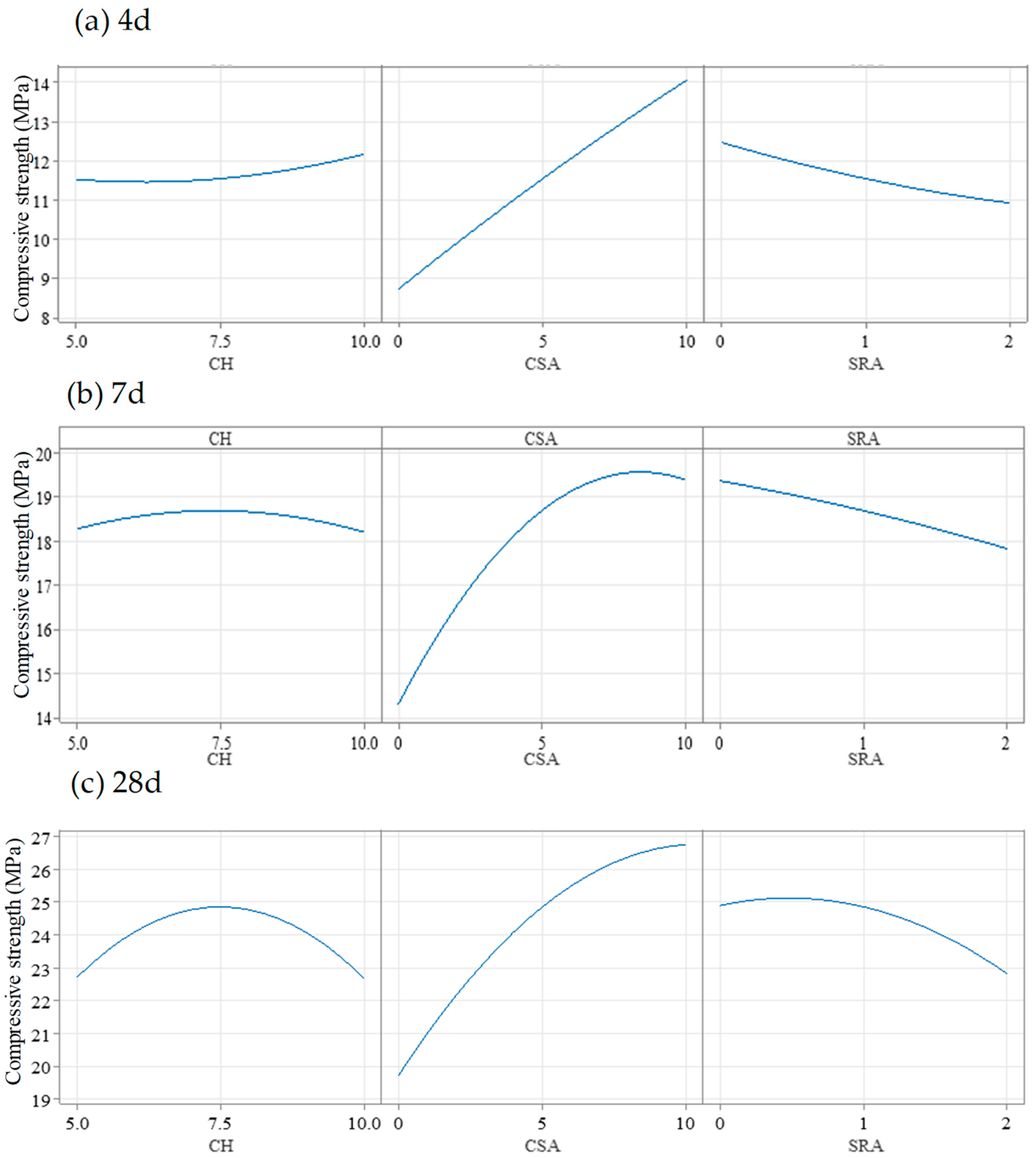
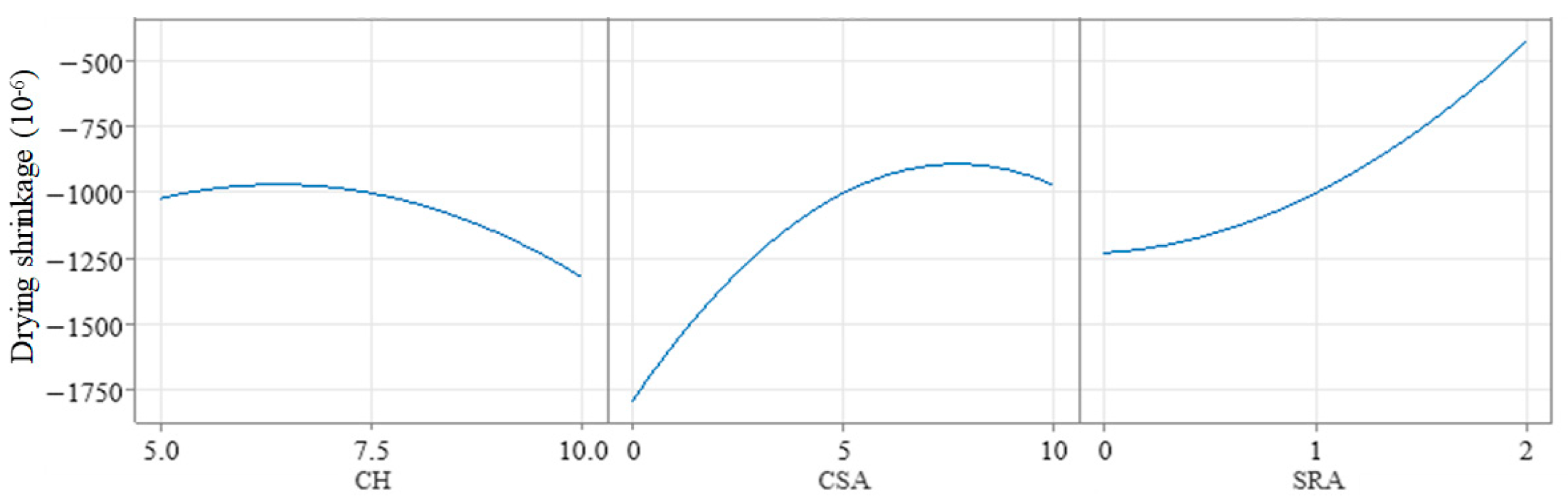
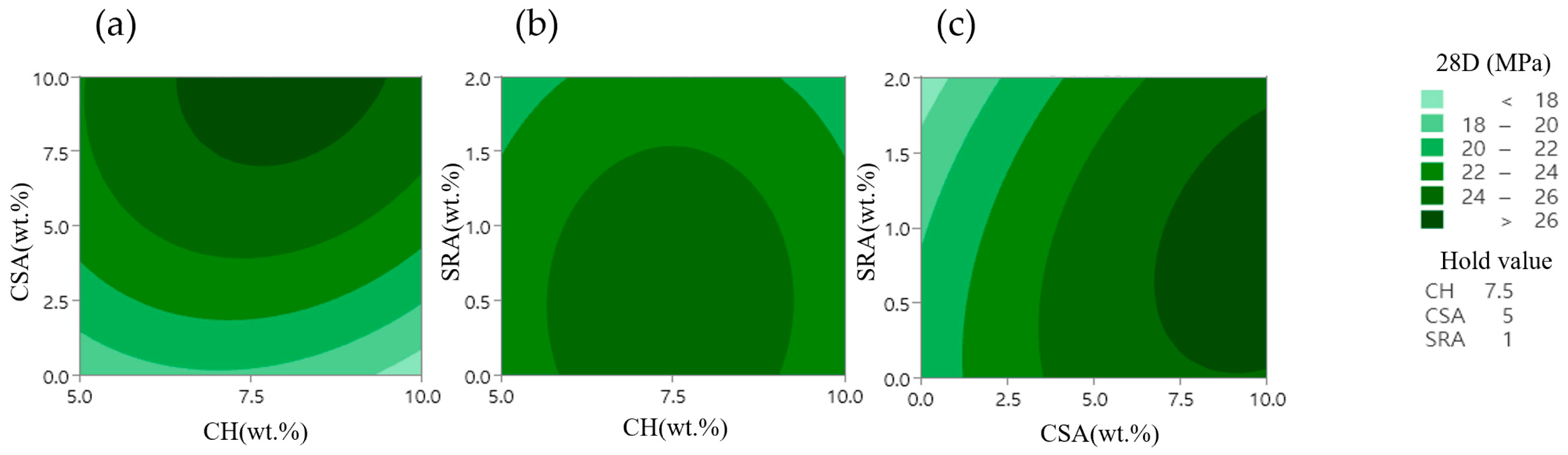
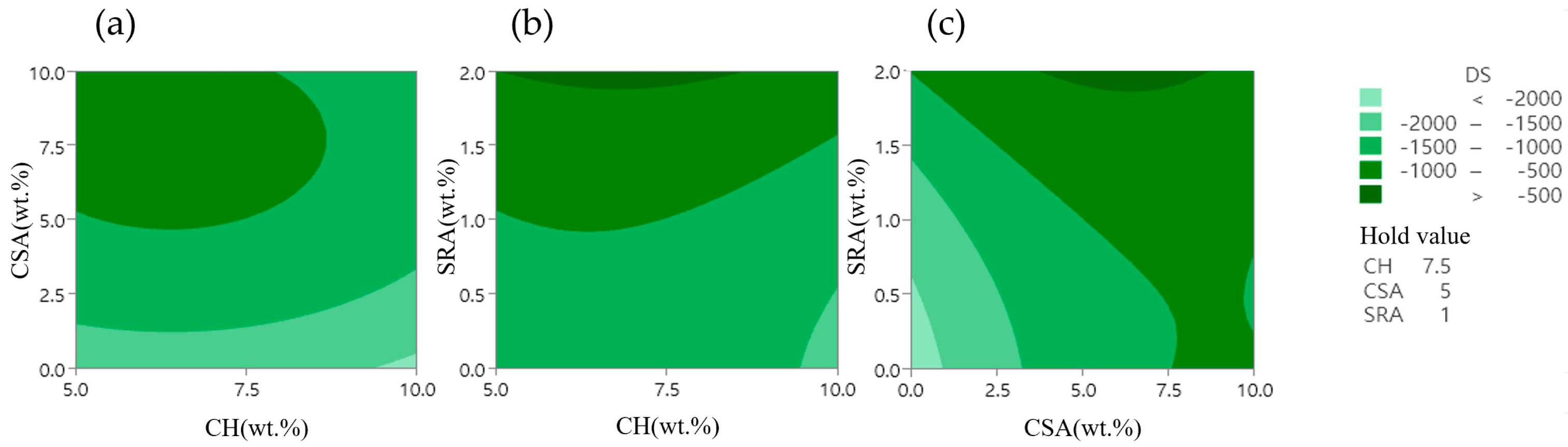
- Analysis of variance for compressive strength revealed that the CH content exhibited higher p-values than the CSA and SRA. In contrast, the CSA showed lower p-values, which contributed to the improvement in the compressive strength of the CAAM. Analysis of variance for length change revealed that both CSA and SRA exhibited lower p-values than CH, indicating that these ingredients positively contributed to the improvement in drying shrinkage of the CAAM.
- (b)
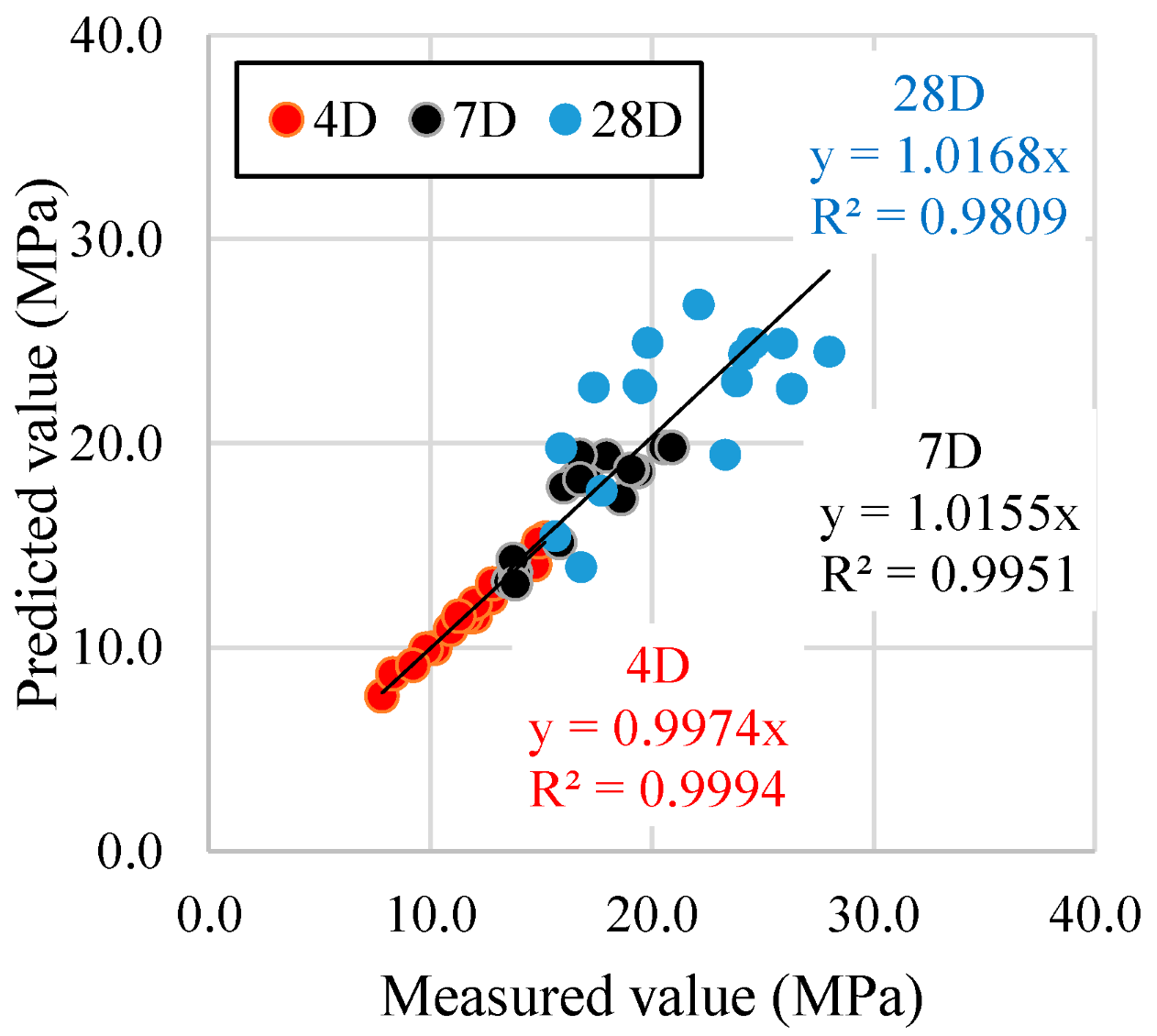
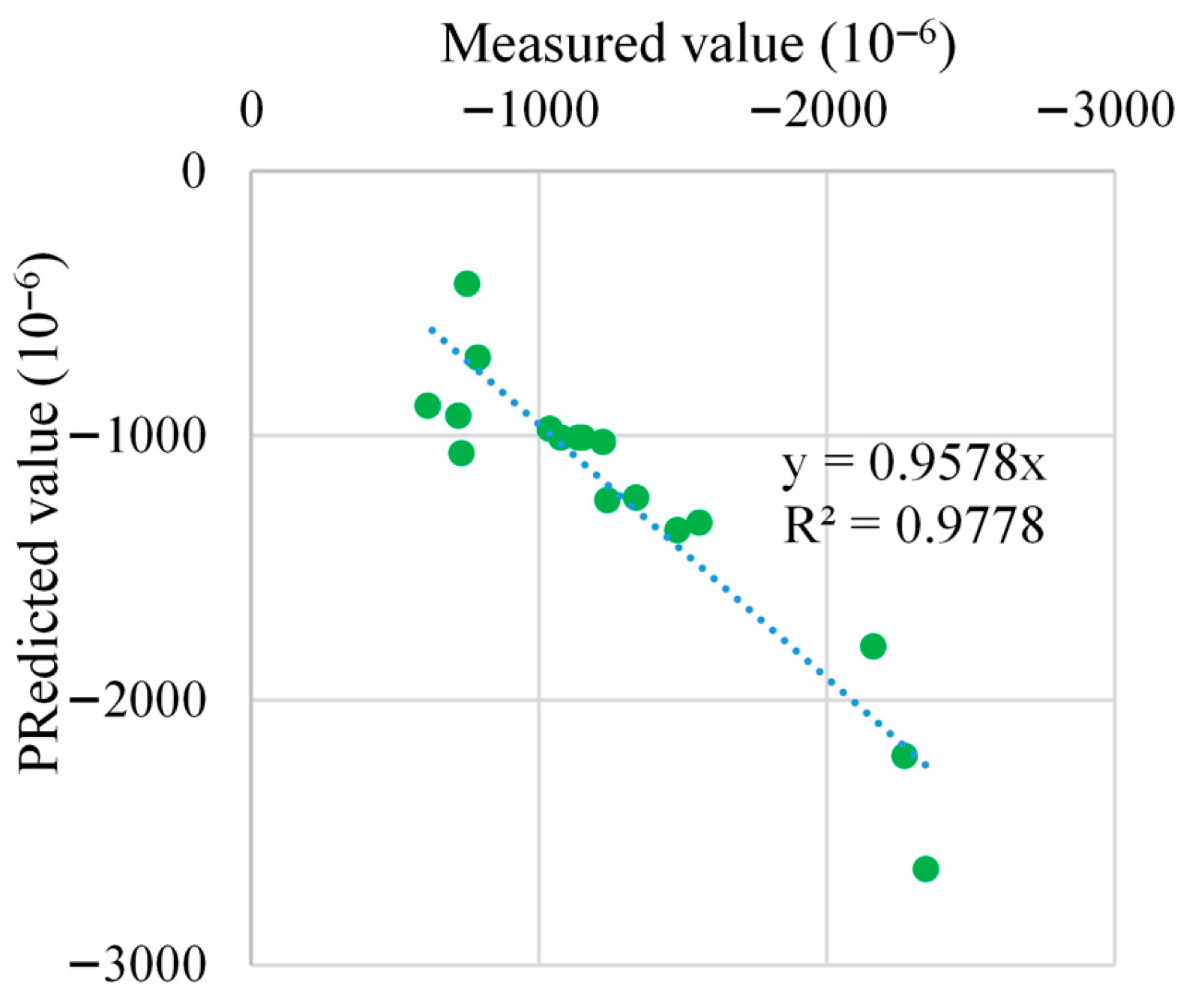
- Using a CCD and ANOVA, prediction equations for the compressive strength and length change in mortar composed of CH, CSA and SRA were proposed. The optimal contents of CH, CSA and SRA for improving the compressive strength and length change were calculated to be 8.54, 10.0, and 0.76 wt.%, respectively. The compressive strength and length changes were measured again under these material conditions, showing that the experimental values closely matched the predicted values, confirming the reliability of the optimization approach.
- (c)
- Compressive strength measurements showed that the compressive strength increased with increasing CSA replacement ratio. This enhancement was associated with higher CSA replacement ratios. Conversely, increasing the SRA content resulted in a reduction in the compressive strength, consistent with the delayed hydration behavior observed in the paste.
- (d)
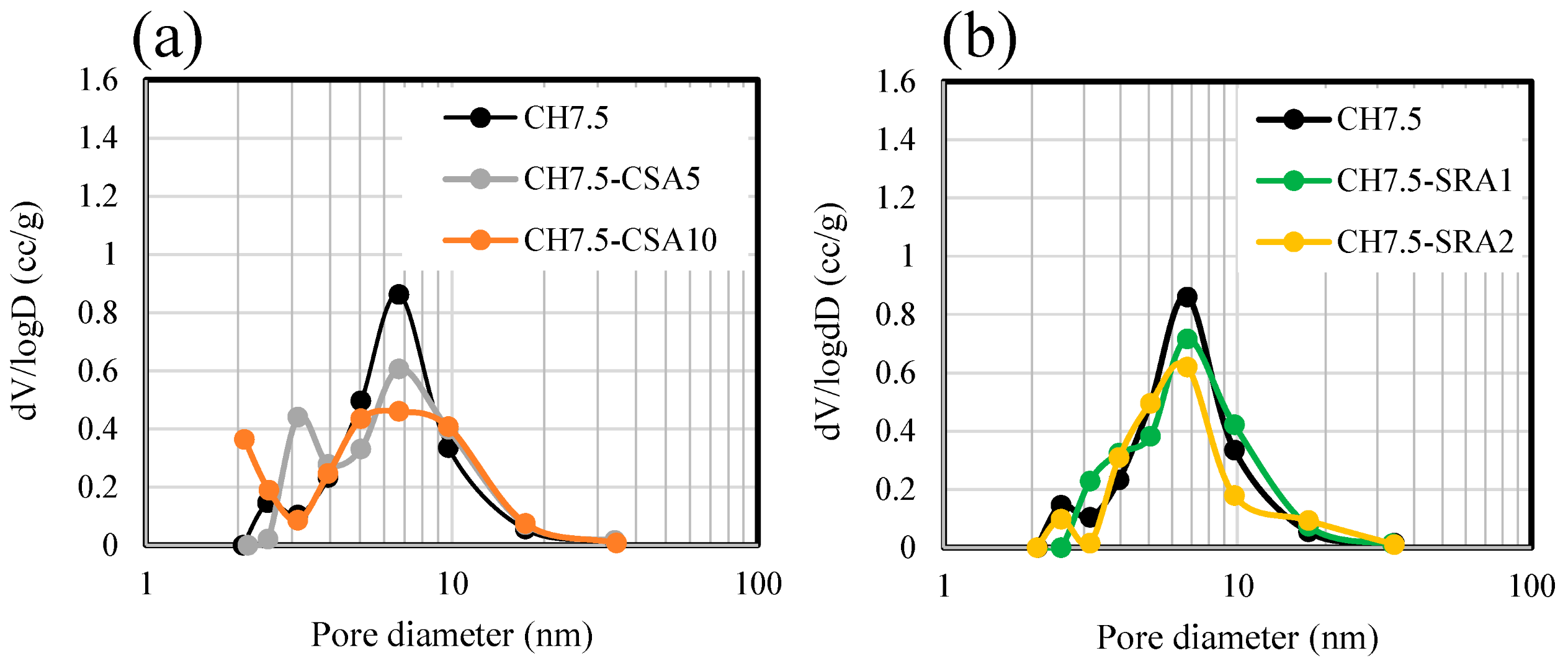
- Length-change measurements demonstrated that the use of CSA and SRA significantly improved the dimensional stability. Furthermore, the DVS analysis results were correlated with a reduction in water desorption at RH above 60% and revealed the presence of large gel pores, which may be related to the observed shrinkage-mitigation behavior. The use of CSA and SRA therefore represents a potentially effective strategy for overcoming the well-recognized drying shrinkage limitations of CAAM.
Author Contributions
Funding
Data Availability Statement
Acknowledgments
Conflicts of Interest
References
- Andrew, R.M. Global CO2 emissions from cement production, 1928–2018. Earth Syst. Sci. Data 2019, 11, 1675–1710. [Google Scholar] [CrossRef]
- Al-Zu, M.; Fan, M.; Al Rjoub, Y.S.; Ashteyat, A.; Al-Kheetan, M.J.; Anguilano, L. The effect of length and inclination of carbon fiber reinforced polymer laminates on shear capacity of near-surface mounted retrofitted reinforced concrete beams. Struct. Concr. 2021, 22, 3677–3691. [Google Scholar] [CrossRef]
- Ganapathi Chottemada, P.; Kar, A.; Kara De Maeijer, P. Environmental Impact Analysis of Alkali-Activated Concrete with Fiber Reinforcement. Infrastructures 2023, 8, 68. [Google Scholar] [CrossRef]
- Shaqour, F.; Ismeik, M.; Esaifan, M. Alkali activation of natural clay using a Ca(OH)2/Na2CO3 alkaline mixture. Clay Miner. 2017, 52, 485–496. [Google Scholar] [CrossRef]
- Xu, Z.K.; Yue, J.C.; Pang, G.H.; Li, R.; Zhang, P.; Xu, S. Influence of the Activator Concentration and Solid/Liquid Ratio on the Strength and Shrinkage Characteristics of Alkali-Activated Slag Geopolymer Pastes. Adv. Civ. Eng. 2021, 2021, 6631316. [Google Scholar] [CrossRef]
- Kheradmand, M.; Abdollahnejad, Z.; Pacheco-Torgal, F. Shrinkage Performance of Fly Ash Alkali-activated Cement Based Binder Mortars. KSCE J. Civ. Eng. 2018, 22, 1854–1864. [Google Scholar] [CrossRef]
- Görhan, G.; Kürklü, G. The influence of the NaOH solution on the properties of the fly ash-based geopolymer mortar cured at different temperatures. Compos. Part B Eng. 2014, 58, 371–377. [Google Scholar] [CrossRef]
- Shilar, F.A.; Ganachari, S.V.; Patil, V.B.; Khan, T.M.Y.; Dawood Abdul Khadar, S. Molarity activity effect on mechanical and microstructure properties of geopolymer concrete: A review. Case Stud. Constr. Mater. 2022, 16, e01014. [Google Scholar] [CrossRef]
- Menchaca-Ballinas, L.E.; Gorokhovsky, A.V.; Escalante-Garcia, J.I. Waste glass as a precursor in sustainable hydraulic cements activated with CaO-NaOH-Na2CO3. Constr. Build. Mater. 2021, 302, 124099. [Google Scholar] [CrossRef]
- Fapohunda, C.; Akinbile, B.; Shittu, A. Structure and properties of mortar and concrete with rice husk ash as partial replacement of ordinary Portland cement—A review. Int. J. Sustain. Built Environ. 2017, 6, 675–692. [Google Scholar] [CrossRef]
- Kovtun, M.; Kearsley, E.P.; Shekhovtsova, J. Chemical acceleration of a neutral granulated blast-furnace slag activated by sodium carbonate. Cem. Concr. Res. 2015, 72, 1–9. [Google Scholar] [CrossRef]
- Thomas, R.J.; Lezama, D.; Peethamparan, S. On Drying Shrinkage in Alkali-Activated Concrete: Improving Dimensional Stability by Aging or Heat-Curing. Cem. Concr. Res. 2017, 91, 13–23. [Google Scholar] [CrossRef]
- Cai, Y.; Yu, L.; Yang, Y.; Gao, Y.; Yang, C. Effect of Early Age-Curing Methods on Drying Shrinkage of Alkali-Activated Slag Concrete. Materials 2019, 12, 1633. [Google Scholar] [CrossRef] [PubMed]
- Zhang, J.; Kang, S.; Shen, Y.; Song, C.; Lei, H.; Xie, W.; Chen, X.; Wang, J.; Wu, W.; Wang, X. Effects of Sand Type and Alkali Equivalent on Drying Shrinkage and Microstructure of Seawater–Sea Sand Alkali-Activated Slag Concrete. Materials 2025, 18, 1005. [Google Scholar] [CrossRef]
- Zhu, X.; Tang, D.; Yang, K.; Zhang, Z.; Li, Q.; Pan, Q.; Yang, C. Effect of Ca(OH)2 on shrinkage characteristics and microstructures of alkali-activated slag concrete. Constr. Build. Mater. 2018, 17, 467–482. [Google Scholar] [CrossRef]
- Zhang, W.; Xue, M.; Lin, H.; Duan, X.; Jin, Y.; Su, F. Effect of polyether shrinkage reducing admixture on the drying shrinkage properties of alkali-activated slag. Cem. Concr. Compos. 2023, 136, 104865. [Google Scholar] [CrossRef]
- Al Makhadmeh, W.; Soliman, A. On the mechanisms of shrinkage reducing admixture in alkali activated slag binders. J. Build. Eng. 2022, 56, 104812. [Google Scholar] [CrossRef]
- Fang, Y.; Zhang, L.; Hu, T.; Sun, H.; Yu, F.; Li, C. A comprehensive review on shrinkage behaviors of alkali-activated metakaolin-blast furnace slag cementitious materials: Shrinkage mechanism, properties and mitigate strategies. Case Stud. Constr. Mater. 2025, 22, e04391. [Google Scholar] [CrossRef]
- Xu, R.; Kong, F.; Yang, R.; Wang, H.; Hong, T. Drying shrinkage mitigation of alkali-activated blast furnace slag-copper slag by polyether-based shrinkage reducing admixture and MgO-based expansion agent. Constr. Build. Mater. 2024, 416, 135172. [Google Scholar] [CrossRef]
- Zhang, L.; Ma, Y.; Ouyang, X.; Fu, J.; Li, Z. Effect of CaO on the shrinkage and microstructure of alkali-activated slag/fly ash microsphere. Constr. Build. Mater. 2024, 421, 135672. [Google Scholar] [CrossRef]
- Wang, S.; Wu, K.; Yang, Z.; Tang, L. Long-term (2 years) drying shrinkage evaluation of alkali-activated slag mortar: Experiments and partial factor analysis. Case Stud. Constr. Mater. 2023, 18, e01956. [Google Scholar] [CrossRef]
- Cheng, C.; Wang, X.; Ding, L.; Zhou, J.; Hao, X.; Xie, J.; Wu, Z. Effects of additives on alkali-activated slag/fly ash based geopolymer mortar: Mechanical properties, shrinkage properties, and shrinkage prediction model. Constr. Build. Mater. 2025, 494, 143556. [Google Scholar] [CrossRef]
- Na, S.; Zhang, W. Evaluation of the Efficiency of Alkali-Activated Material Consisting of Rice Husk Ash by Physical and Mechanical Characteristics. Constr. Mater. 2025, 5, 21. [Google Scholar] [CrossRef]
- Na, S.; Zhang, W.; Kitagawa, M.; Hirooka, A.; Komatsu, M. Optimization Using Central Composite Design of the Response Surface Methodology for the Compressive Strength of Alkali-Activated Material from Rice Husk Ash. Constr. Mater. 2025, 5, 5. [Google Scholar] [CrossRef]
- Na, S.; Zhang, W.; Ichikawa, Y.; Komatsu, M.; Takemura, A. Fundamental Study on Alkali-Activated Slag System with Sodium Carbonate or Calcium Hydroxide. J. Mater. Sci. Chem. Eng. 2024, 12, 55–70. [Google Scholar] [CrossRef]
- Zou, Z.; Gao, H.; Zhang, Y.; Li, J.; Li, M.; Yu, Y. Multi-Variable Optimization of Sustainable Alkali-Activated Mortar with High Waste Concrete Powder Dosage for Enhanced Drying Shrinkage Resistance. Buildings 2025, 15, 3903. [Google Scholar] [CrossRef]
- Ali, M.; Kumar, A.; Yvaz, A.; Sala, B. Central composite design application in the optimization of the effect of pumice stone on lightweight concrete properties using RSM. Case Stud. Constr. Mater. 2023, 18, e01958. [Google Scholar] [CrossRef]
- Sinkhonde, D.; Onchiri, R.O.; Oyawa, W.O.; Mwero, J.N. Response surface methodology-based optimization of cost and compressive strength of rubberised concrete incorporating burnt clay brick powder. Heliyon 2021, 7, e08565. [Google Scholar] [CrossRef]
- JIS R 5201; Physical Testing Methods for Cement. Japan Industrial Standards Committee: Tokyo, Japan, 2015.
- JIS 1129-3; Methods of Measurement for Length Change of Mortar and Concrete—Part 3: Method with Dial Gauge. Japan Industrial Standards Committee: Tokyo, Japan, 2010.
- Wadsö, L.; Li, X. A Simple Rate Law Experiment Using a Custom-Built Isothermal Heat Conduction Calorimeter. J. Chem. Educ. 2008, 85, 1. [Google Scholar] [CrossRef]
- Linderoth, O.; Wadsö, L.; Jansen, D. Long-term cement hydration studies with istohermal calorimetry. Cem. Concr. Res. 2021, 141, 106344. [Google Scholar] [CrossRef]
- Huang, L.; Tang, L.; Wadsö, L.; Löfgren, I.; Olsson, N.; Yang, Z. Using water vapour and N2 isotherms to unveil effects of SCMs on nanopores and evaluate hydration degree. Cem. Concr. Res. 2023, 164, 107042. [Google Scholar] [CrossRef]
- Masanaga, M.; Hirata, T.; Kawakami, H.; Morinaga, Y.; Nawa, T.; Elakneswaran, Y. Effects of a New Type of Shrinkage-Reducing Agent on Concrete Properties. Materials 2020, 13, 3018. [Google Scholar] [CrossRef] [PubMed]
- Linderoth, O. Hydration, Pore Structure, and Related Moisture Properties of Fly Ash Blended Cement-Based Materials: Experimental Methods and Laboratory Measurements; Department of Building and Environmental Technology, Lund University: Lund, Sweden, 2020. [Google Scholar]
- Barrett, E.P.; Joyner, L.G.; Halenda, P.P. The determination of pore volume and area distributions in porous substances. I. Computations from nitrogen isotherms. J. Am. Chem. Soc. 1951, 73, 373–380. [Google Scholar] [CrossRef]
- Yu, J.; Qian, J.; Tang, J.; Ji, Z.; Fan, Y. Effect of ettringite seed crystals on the properties of calcium sulphoaluminate cement. Constr. Build. Mater. 2019, 207, 249–257. [Google Scholar] [CrossRef]
- Yoon, H.N.; Seo, J.; Kim, S.; Lee, H.K.; Park, S. Hydration of calcium sulfoaluminate cement blended with blast-furnace slag. Constr. Build. Mater. 2021, 268, 121214. [Google Scholar] [CrossRef]
- Amare, H.B.; Shen, W.; Zhao, D.; Gebreyohannes, M.A.; Yixin, S.; Wang, G.; Wu, Q. Investigation on calcium sulfoaluminate clinker prepared from raw granular steel slag and phosphogypsum: Composition, thermal behaviour, and hydration kinetics. Constr. Build. Mater. 2025, 503, 144517. [Google Scholar] [CrossRef]
- Li, C.-H.; Tanaka, Y.; Yokozuka, K. Fundamental study on micro-pore structure and oxygen diffusion coefficient of expansive mortars. Cem. Sci. Concr. Technol. 2011, 65, 111–117. [Google Scholar] [CrossRef][Green Version]
- Morioka, M.; Hagiwara, H.; Sakai, E.; Daimon, M. Micro Structure of Hardened Cement with Expansive Additives. Trans. Jpn. Concr. Inst. 1998, 20, 169–174. Available online: https://data.jci-net.or.jp/data_pdf/20/020-01-2029.pdf (accessed on 9 January 2026).
- Zhang, W.; Duan, X.; Su, F.; Zhu, J.; Hama, Y. Drying shrinkage inhibition effect and mechanism of polyol shrinkagex reducing admixture on the metakaolin-based geopolymer. J. Mater. Res. Technol. 2024, 28, 2021–2032. [Google Scholar] [CrossRef]
- Rajabipour, F.; Sant, G.; Weiss, J. Interactions between shrinkage reducing admixtures (SRA) and cement paste’s pore solution. Cem. Concr. Res. 2008, 38, 606–615. [Google Scholar] [CrossRef]
- Rahoui, H.; Maruyama, I.; Vandamme, M.; Pereira, J.-M.; Mosquet, M. Impact of alkalis and shrinkage-reducing admixtures on hydration and pore structure of hardened cement pastes. Cem. Concr. Res. 2024, 184, 107620. [Google Scholar] [CrossRef]
- Narumi, R.; Zhang, W.; Kishimoto, Y.; Hama, Y. Investigation of affecting factors on reduction of drying shrinkage and degradation of frost resistance of mortar with shrinkage reducing agent. J. Struct. Constr. Eng. Trans. AIJ 2014, 79, 671–680. [Google Scholar] [CrossRef][Green Version]



| Oxides | BFS | CH | CSA |
|---|---|---|---|
| CaO | 52.3 | 98.6 | 64.0 |
| SiO2 | 28.9 | 0.1 | 1.2 |
| Al2O3 | 10.7 | 0.4 | 5.4 |
| MgO | 4.3 | 0.3 | 0.7 |
| Fe2O3 | 0.6 | 0.4 | 0.8 |
| SO3 | 2.1 | 0.1 | 27.9 |
| Total (%) | 98.9 | 99.9 | 99.9 |
| Level of Factor | CH | CSA | SRA |
|---|---|---|---|
| (wt.%) | (wt.%) | (wt.%) | |
| −1 | 5 | 0 | 0 |
| 0 | 7.5 | 5 | 1 |
| 1 | 10 | 10 | 2 |
| No. | CH | CSA | SRA | No. | CH | CSA | SRA |
|---|---|---|---|---|---|---|---|
| (wt.%) | (wt.%) | (wt.%) | (wt.%) | (wt.%) | (wt.%) | ||
| 1 | 5 | 10 | 0 | 10 | 7.5 | 5 | 0 |
| 2 | 5 | 0 | 2 | 11 | 7.5 | 10 | 1 |
| 3 | 10 | 0 | 0 | 12 | 10 | 5 | 1 |
| 4 | 10 | 10 | 2 | 13 | 5 | 10 | 2 |
| 5 | 5 | 5 | 1 | 14 | 5 | 0 | 0 |
| 6 | 7.5 | 0 | 1 | 15 | 10 | 10 | 0 |
| 7 | 7.5 | 5 | 1 | 16 | 10 | 0 | 2 |
| 8 | 7.5 | 5 | 2 | 17 | 7.5 | 5 | 1 |
| 9 | 7.5 | 5 | 1 |
| No. | Factors | Compressive Strength (MPa) | Length Change (10−6) | ||||||||
|---|---|---|---|---|---|---|---|---|---|---|---|
| CH | CSA | SRA | Measured Value | Predicted Value | Measured | Predicted | |||||
| wt.% | wt.% | wt.% | 4 | 7 | 28 | 4 | 7 | 28 | |||
| 1 | 5 | 10 | 0 | 15.2 | 20.5 | 23.8 | 15.4 | 19.8 | 23.1 | −719 | −925 |
| 2 | 5 | 0 | 2 | 7.8 | 13.5 | 15.6 | 7.6 | 13.2 | 15.5 | −731 | −1065 |
| 3 | 10 | 0 | 0 | 10.2 | 13.8 | 17.7 | 10.0 | 13.7 | 17.7 | −2342 | −2636 |
| 4 | 10 | 10 | 2 | 14.4 | 19.4 | 24.2 | 14.4 | 18.6 | 24.4 | −613 | −885 |
| 5 | 5 | 5 | 1 | 11.9 | 16.5 | 17.4 | 11.5 | 18.3 | 22.8 | −1221 | −1023 |
| 6 | 7.5 | 0 | 1 | 8.3 | 13.7 | 15.9 | 8.7 | 14.3 | 19.8 | −2159 | −1795 |
| 7 | 7.5 | 5 | 1 | 12.0 | 17.0 | 24.6 | 11.5 | 18.7 | 24.9 | −1077 | −1006 |
| 8 | 7.5 | 5 | 2 | 10.9 | 16.0 | 19.4 | 10.9 | 17.9 | 22.9 | −750 | −426 |
| 9 | 7.5 | 5 | 1 | 11.6 | 19.1 | 24.5 | 11.5 | 18.7 | 24.9 | −1152 | −1006 |
| 10 | 7.5 | 5 | 0 | 12.7 | 17.9 | 19.8 | 12.5 | 19.4 | 24.9 | −1336 | −1234 |
| 11 | 7.5 | 10 | 1 | 14.7 | 16.7 | 22.1 | 14.1 | 19.4 | 26.8 | −1036 | −974 |
| 12 | 10 | 5 | 1 | 12.0 | 16.7 | 19.5 | 12.2 | 18.2 | 22.7 | −1556 | −1327 |
| 13 | 5 | 10 | 2 | 12.8 | 18.6 | 26.3 | 13.1 | 17.3 | 22.7 | −786 | −703 |
| 14 | 5 | 0 | 0 | 9.8 | 15.8 | 23.3 | 9.9 | 15.1 | 19.5 | −2270 | −2209 |
| 15 | 10 | 10 | 0 | 14.9 | 20.9 | 28.0 | 15.2 | 19.8 | 24.5 | −1480 | −1357 |
| 16 | 10 | 0 | 2 | 9.2 | 13.8 | 16.8 | 9.1 | 13.1 | 13.9 | −1236 | −1242 |
| 17 | 7.5 | 5 | 1 | 11.3 | 19.0 | 25.9 | 11.5 | 18.7 | 24.9 | −1137 | −1006 |
| Source | Sum of Squares | Degree of Freedom | Mean Square | F Value | p-Value |
|---|---|---|---|---|---|
| Prob > F | |||||
| Model | 11 | 79.8362 | 7.2578 | 34.24 | 0.001 |
| Blocks | 2 | 0.2587 | 0.1293 | 0.61 | 0.579 |
| Linear | 3 | 78.242 | 26.0807 | 123.03 | 0.000 |
| CH | 1 | 1.024 | 1.024 | 4.83 | 0.079 |
| CSA | 1 | 71.289 | 71.289 | 336.29 | 0.000 |
| SRA | 1 | 5.929 | 5.929 | 27.97 | 0.003 |
| Square | 3 | 0.2993 | 0.0998 | 0.47 | 0.716 |
| CH × CH | 1 | 0.2025 | 0.2025 | 0.96 | 0.373 |
| CSA × CSA | 1 | 0.0493 | 0.0493 | 0.23 | 0.650 |
| SRA × SRA | 1 | 0.0511 | 0.0511 | 0.24 | 0.644 |
| 2-Way Interaction | 3 | 1.0838 | 0.3613 | 1.70 | 0.281 |
| CH × CSA | 1 | 0.0313 | 0.0313 | 0.15 | 0.717 |
| CH × SRA | 1 | 1.0513 | 1.0513 | 4.96 | 0.076 |
| CSA × SRA | 1 | 0.0013 | 0.0013 | 0.01 | 0.942 |
| Error | 5 | 1.0599 | 0.212 | ||
| Lack-of-Fit | 4 | 0.9696 | 0.2424 | 2.68 | 0.425 |
| Pure Error | 1 | 0.0903 | 0.0903 | ||
| Total | 16 | 80.8962 |
| Source | Sum of Squares | Degree of Freedom | Mean Square | F Value | p-Value |
|---|---|---|---|---|---|
| Prob > F | |||||
| Model | 11 | 84.2192 | 7.6563 | 5.63 | 0.035 |
| Blocks | 2 | 7.7717 | 3.8859 | 2.86 | 0.149 |
| Linear | 3 | 70.4199 | 23.4733 | 17.25 | 0.005 |
| CH | 1 | 0.0144 | 0.0144 | 0.01 | 0.922 |
| CSA | 1 | 64.4869 | 64.4869 | 47.4 | 0.001 |
| SRA | 1 | 5.9187 | 5.9187 | 4.35 | 0.091 |
| Square | 3 | 8.8768 | 2.9589 | 2.18 | 0.209 |
| CH × CH | 1 | 0.4502 | 0.4502 | 0.33 | 0.59 |
| CSA × CSA | 1 | 7.5373 | 7.5373 | 5.54 | 0.065 |
| SRA × SRA | 1 | 0.0189 | 0.0189 | 0.01 | 0.911 |
| 2-Way Interaction | 3 | 2.1115 | 0.7038 | 0.52 | 0.688 |
| CH × CSA | 1 | 1.0573 | 1.0573 | 0.78 | 0.418 |
| CH × SRA | 1 | 0.8794 | 0.8794 | 0.65 | 0.458 |
| CSA × SRA | 1 | 0.1749 | 0.1749 | 0.13 | 0.735 |
| Error | 5 | 6.8019 | 1.3604 | ||
| Lack-of-Fit | 4 | 4.6461 | 1.1615 | 0.54 | 0.755 |
| Pure Error | 1 | 2.1558 | 2.1558 | ||
| Total | 16 | 91.0211 |
| Source | Sum of Squares | Degree of Freedom | Mean Square | F Value | p-Value |
|---|---|---|---|---|---|
| Prob > F | |||||
| Model | 11 | 216.471 | 19.679 | 2.93 | 0.123 |
| Blocks | 2 | 69.391 | 34.696 | 5.17 | 0.061 |
| Linear | 3 | 133.771 | 44.59 | 6.64 | 0.034 |
| CH | 1 | 0.006 | 0.006 | 0.00 | 0.977 |
| CSA | 1 | 122.99 | 122.99 | 18.31 | 0.008 |
| SRA | 1 | 10.774 | 10.774 | 1.60 | 0.261 |
| Square | 3 | 23.192 | 7.731 | 1.15 | 0.414 |
| CH × CH | 1 | 10.334 | 10.334 | 1.54 | 0.270 |
| CSA × CSA | 1 | 5.763 | 5.763 | 0.86 | 0.397 |
| SRA × SRA | 1 | 2.208 | 2.208 | 0.33 | 0.591 |
| 2-Way Interaction | 3 | 11.72 | 3.907 | 0.58 | 0.652 |
| CH × CSA | 1 | 5.152 | 5.152 | 0.77 | 0.421 |
| CH × SRA | 1 | 0.025 | 0.025 | 0.00 | 0.954 |
| CSA × SRA | 1 | 6.543 | 6.543 | 0.97 | 0.369 |
| Error | 5 | 33.581 | 6.716 | ||
| Lack-of-Fit | 4 | 33.579 | 8.395 | 6466.37 | 0.009 |
| Pure Error | 1 | 0.001 | 0.001 | ||
| Total | 16 | 250.052 |
| Source | Sum of Squares | Degree of Freedom | Mean Square | F Value | p-Value |
|---|---|---|---|---|---|
| Prob > F | |||||
| Model | 11 | 4,617,188 | 419,744 | 18.88 | 0.002 |
| Blocks | 2 | 302,998 | 151,499 | 6.82 | 0.037 |
| Linear | 3 | 3,535,218 | 117,8406 | 53.02 | 0.000 |
| CH | 1 | 225,525 | 225,525 | 10.15 | 0.024 |
| CSA | 1 | 1,683,727 | 1,683,727 | 75.75 | 0.000 |
| SRA | 1 | 1,625,967 | 1,625,967 | 73.15 | 0.000 |
| Square | 3 | 446,911 | 148,970 | 6.70 | 0.033 |
| CH × CH | 1 | 63,777 | 63,777 | 2.87 | 0.151 |
| CSA × CSA | 1 | 319,394 | 319,394 | 14.37 | 0.013 |
| SRA × SRA | 1 | 69,148 | 69,148 | 3.11 | 0.138 |
| 2-Way Interaction | 3 | 456,599 | 152,200 | 6.85 | 0.032 |
| CH × CSA | 1 | 12 | 12 | 0.00 | 0.982 |
| CH × SRA | 1 | 31,422 | 31,422 | 1.41 | 0.288 |
| CSA × SRA | 1 | 425,165 | 425,165 | 19.13 | 0.007 |
| Error | 5 | 111,138 | 22,228 | ||
| Lack-of-Fit | 4 | 108,281 | 27,070 | 9.47 | 0.238 |
| Pure Error | 1 | 2857 | 2857 | ||
| Total | 16 | 4,728,326 |
| Factors | Value |
|---|---|
| CH (wt.%) | 8.54 |
| CSA (wt.%) | 10.00 |
| SRA (wt.%) | 0.76 |
| Predicted compressive strength (MPa) | 28.0 |
| Measured compressive strength (MPa) | 26.7 |
| Predicted drying shrinkage (×10−6) | −1100 |
| Measured drying shrinkage (×10−6) | −1033 |
Disclaimer/Publisher’s Note: The statements, opinions and data contained in all publications are solely those of the individual author(s) and contributor(s) and not of MDPI and/or the editor(s). MDPI and/or the editor(s) disclaim responsibility for any injury to people or property resulting from any ideas, methods, instructions or products referred to in the content. |
© 2026 by the authors. Licensee MDPI, Basel, Switzerland. This article is an open access article distributed under the terms and conditions of the Creative Commons Attribution (CC BY) license.
Share and Cite
Na, S.; Zhang, W.; Lee, W.; Taniguchi, M. Optimization of Compressive Strength and Drying Shrinkage of Calcium-Based Alkali-Activated Mortars Using Expansive and Shrinkage-Reducing Agents. CivilEng 2026, 7, 16. https://doi.org/10.3390/civileng7010016
Na S, Zhang W, Lee W, Taniguchi M. Optimization of Compressive Strength and Drying Shrinkage of Calcium-Based Alkali-Activated Mortars Using Expansive and Shrinkage-Reducing Agents. CivilEng. 2026; 7(1):16. https://doi.org/10.3390/civileng7010016
Chicago/Turabian StyleNa, Seunghyun, Wenyang Zhang, Woonggeol Lee, and Madoka Taniguchi. 2026. "Optimization of Compressive Strength and Drying Shrinkage of Calcium-Based Alkali-Activated Mortars Using Expansive and Shrinkage-Reducing Agents" CivilEng 7, no. 1: 16. https://doi.org/10.3390/civileng7010016
APA StyleNa, S., Zhang, W., Lee, W., & Taniguchi, M. (2026). Optimization of Compressive Strength and Drying Shrinkage of Calcium-Based Alkali-Activated Mortars Using Expansive and Shrinkage-Reducing Agents. CivilEng, 7(1), 16. https://doi.org/10.3390/civileng7010016