Article

The Effect of a Physical and Psychological Warm-Up on the Demands Experienced by Surgeons Performing Robot-Assisted Laparoscopic Surgery: A Randomized Crossover Trial
by
Abdulwarith Shugaba
1,
David Tod
1,
Joel E. Lambert
1,2,
Theodoros M. Bampouras
3,
Lawrence D. Hayes
1,
Helen E. Nuttall
4,
Daren A. Subar
1,2,
Nilihan E. M. Sanal-Hayes
5 and
Christopher J. Gaffney
1,*
1
Lancaster Medical School, Lancaster University, Health Innovation One, Sir John Fisher Drive, Lancaster LA1 4AT, UK
2
East Lancashire Hospitals NHS Trust, Haslingden Road, Blackburn BB2 3HH, UK
3
School of Sport and Exercise Sciences, Liverpool John Moores University, Tom Reilly Building, Byrom Street, Liverpool L3 3AF, UK
4
Department of Psychology, Lancaster University, Lancaster LA1 4YF, UK
5
School of Health and Society, University of Salford, Salford M6 6PU, UK
*
Author to whom correspondence should be addressed.
Surgeries 2026, 7(3), 78; https://doi.org/10.3390/surgeries7030078
Submission received: 15 April 2026 / Revised: 10 June 2026 / Accepted: 24 June 2026 / Published: 30 June 2026
(This article belongs to the Special Issue Laparoscopic Surgery, 2nd Edition)

Abstract

Background/Objectives: Minimally invasive surgery benefits patients but places physical and cognitive demands on surgeons. While robot-assisted laparoscopic surgery (RALS) reduces musculoskeletal strain, it may increase cognitive load. This study examined whether physical and psychological preparatory protocols (warm-ups) influence surgeon strain during RALS. Methods: Ten consultant surgeons from East Lancashire Hospitals NHS Trust (UK) participated in a preregistered, randomized study. Each performed RALS under three conditions: control, physical warm-up (10 min simulation tasks on the Da Vinci system), and psychological warm-up (10 min PETTLEP-based mental imagery). Electromyography (EMG) and electroencephalography (EEG) were recorded during key surgical phases. EMG data were normalized to maximal voluntary contractions. Results: The physical warm-up significantly increased EMG activity in the right deltoid and right trapezius (p < 0.05) compared to control, with no differences observed in other muscle groups. EEG alpha power data did not significantly differ between conditions. Conclusions: These findings suggest that brief physical warm-up can enhance muscle activation in key regions involved in RALS, potentially improving motor control and reducing fatigue. Incorporating such strategies may support surgeon performance and well-being.

1. Introduction

The era of minimally invasive surgery has heralded a transformative shift in surgical practice, significantly advancing patient care and outcomes [1,2]. Characterized by less invasive procedures, minimally invasive surgery offers a plethora of benefits such as minimized postoperative discomfort, reduced hospital stays, and expedited recovery [3] thereby enhancing the overall patient experience. Consequently, there has been a notable surge in its adoption across various surgical disciplines, underscoring its pivotal role in modern medicine.
The ergonomic benefits of robot-assisted laparoscopic surgery (RALS), as evidenced by a body of research including our previous work [4], signify a marked reduction in musculoskeletal demands when compared to traditional laparoscopic surgery (LS). This ergonomic advantage, however, does not come without its own set of challenges. For example, we have previously revealed an intriguing paradox where the decreased physical strain of RALS is counterbalanced by heightened cognitive and attentional demands [4]. However, this observation is not ubiquitous as findings remain heterogeneous. A systematic review by Shugaba et al. [4] synthesizing ten observational studies reported that the majority demonstrated lower cognitive load during RALS, as assessed using validated tools such as NASA-TLX, suggesting a potential advantage of robotic systems in reducing mental fatigue. In contrast, a broader systematic review by Park et al. [5], including 30 studies, found inconclusive results, with some studies favoring RALS and others showing no difference, and overall substantial methodological variability across cognitive workload measures. Together, these findings indicate a trend towards reduced cognitive load with RALS but highlight a lack of consensus due to heterogeneity in study design, measurement tools, and surgical contexts, under-scoring the need for more standardized and high-quality research in this area.
The mechanism behind these cognitive differences is presently unknown, yet one thing is certain; surgeons and workplace policies should consider these additional cognitive demands and attempt to mitigate these additional stresses [6,7]. In parallel, developments in surgical technologies continue to explore strategies borrowed from other similar professions like elite sports and the performance arts to mitigate the inherent demands of surgical procedures. Practices such as warm-up exercises, akin to those utilized by athletes and performers to enhance their physical and cognitive readiness, are gaining traction in surgical training and preparation [8]. For example, warm-up exercises used by athletes to increase blood flow and flexibility can similarly help surgeons by reducing muscle stiffness and improving precision during operations. Studies have shown that surgeons who perform targeted warm-up activities before procedures experience improved manual dexterity and reduced error rates [9], which parallels findings in sports performance enhancement [10].
The ergonomic benefits of RALS [4] introduces a nuanced set of challenges, particularly in terms of the physical and cognitive demands placed on surgeons [11,12]. Laparoscopic surgery imposes substantial musculoskeletal strain, a drawback markedly mitigated by RALS [4,13]. Yet, the reduced physical strain of RALS is counterbalanced by heightened cognitive and attentional demands [4]. Consequently, developments in surgical technologies continue to explore strategies to mitigate the demands of procedures. The specific objective of this study was to test preparing surgeons before operating through physical and psychological warm-ups, to examine if these could benefit surgeons by influencing musculoskeletal and cognitive strain during RALS.

2. Materials and Methods

Ten consultant surgeons from the East Lancashire Hospitals NHS Trust (UK) provided written informed consent to participate (Table 1), as did patients of the participating surgeons (Ethics number: FHM-2023-3462-IRAS1), and the study was preregistered (NCT05884385). No changes were made to the methods after trial commencement. Surgeons undertook RALS under three conditions in a randomized order. Inclusion criteria were: possession of a certification of completion of training (CCT), and competence in RALS and LS. Exclusion criteria were substantial musculoskeletal health conditions; pain or stiffness; manifesting any cognitive symptoms, including but not limited to poor motor coordination, memory loss, visual disturbances, or persistent headaches; prescribed medications known to alter cognitive function, such as psychoactive drugs, antidepressants, or anticonvulsants; or a positive COVID-19 test. Ten participants were recruited and enrolled, and all participants completed all conditions. The study ran from March 2023 to December 2023.
In the control condition, surgeons performed RALS in their usual manner (as per local standard operating procedures), mirroring their everyday clinical practices. In the physical warm-up condition, surgeons engaged in preselected simulation tasks on the Da Vinci robotic console (Intuitive, 2023, Sunnyvale, CA, USA; Mimic Technologies, 2023, Seattle, WA, USA) for 10 min. In the psychological warm-up protocol, participants completed 10 min of guided mental visualization using the Physical, Environment, Task, Timing, Learning, Emotion, and Perspective (PETTLEP) model of mental practice [14]. Randomization to different study condition orders was managed using an online randomizer tool (https://www.randomizer.org), using block randomization, whilst adhering to established randomization principles. The lead author allocated sequence, enrolled participants, and assigned body sites to interventions. Detailed descriptions of the robot-assisted surgical procedures are available in the Supplementary Material.

2.1. EMG Methods

Whilst performing the surgical procedures, surgeons were fitted with electromyography (EMG; biceps brachii, deltoid, trapezius, latissimus dorsi muscles) and electroencephalography (EEG) monitoring devices [13], which continuously recorded data at predetermined surgical points of interest. These were selected to capture a comprehensive spectrum of surgeons’ physical exertion and cognitive engagement during key phases of the surgical process and represented critical phases in each procedure that were comparable across specialties, during dissection, organ mobilization, tissue dissection, and suturing. Surgeries encompassed various specialties, including nephrectomies, bowel resections, hysterectomies, and hepatectomies. To maintain the integrity of the study, operations that extended beyond 50% of the average surgery time due to complications were excluded. Points of interest are displayed in Table 2.
The preparatory steps for affixing the EMG sensors involved shaving any hair from the relevant skin areas and then cleansing these areas with a 70% isopropyl alcohol solution (VWR International, Leuven, Belgium). Utilizing wireless EMG sensors (Trigno, Delsys, Inc., Boston, MA, USA), placement on the specified muscles was carried out in accordance with SENIAM guidelines, supplemented by additional recommendations [15]. Prior to the onset of surgical activities, surgeons were asked to engage in a maximal voluntary contraction (MVC) for each muscle group, during which EMG data were captured. Further, EMG measurements were conducted for 120 s at designated surgical points of interest within the surgeries, especially at stages requiring interaction with the robotic console. EMG signals were recorded at a frequency of 2000 Hz and then filtered to isolate frequencies ranging from 10 to 500 Hz. Subsequently, the signal underwent a smoothing process via a root mean square (RMS) calculated over 150 ms intervals (EMG Works, Delsys Inc., Boston, MA, USA). The resulting mean average RMS EMG data from the surgical points of interest were normalized against the MVC EMG readings, presented as a percentage of MVC RMS.

2.2. EEG Methods

The Enobio 8 5G wireless EEG device (Neuroelectrics, Cambridge, MA, USA) was used to capture brainwave activity from surgeons during the surgical procedures. Utilizing an eight-channel setup, specifically channels Cz, Fz, P7, P8, P3, P4, O1, and O2, the device adhered to the internationally recognized 10–20 Montage system [16]. A reference electrode was affixed to the right earlobe for enhanced signal stability. Silver-chloride electrodes, integrated into a wearable cap, were positioned on surgeons prior to their surgical preparation, with semi-solid gel enhancing the connectivity and signal capture between the scalp and electrodes. Data collection commenced at a 500 Hz sampling rate. To refine the signal quality, electrical interference typical of power lines (50 Hz) was mitigated using a notch filter, while artifacts from eye movements were addressed with an EMG filter through the ENOBIO NIC1.4 software (Neuroelectrics, Barcelona, Spain). The device’s Holter mode facilitated uninterrupted data recording, ensuring synchronization with the timing of identified POI, including baseline measurements. The processing stage of EEG signals utilized EEGLAB (v.2023.0), a MATLAB (EEGLAB, v.2023.0) toolbox, where signals were down-sampled to 256 Hz and referenced against the mean average of all electrode channels. Bandpass filtering was then applied to isolate frequencies between 0.1 and 40 Hz. Analysis segments were aligned with four critical temporal POIs, within which the spectral power for each relevant frequency band was derived using EEGLAB’s spectopo() function. Power spectral density (PSD) metrics were computed via MATLAB’s pwelch() function, using a 400 ms Hamming window with 50% overlap for signal analysis. Power across each frequency band was calculated by averaging spectral power across the eight channels, subsequently expressed in decibels (10 × log(microvolt2)/Hz). This spectral power was then averaged across all electrodes to yield a comprehensive overview of spectral density throughout the entire electrode arrangement. PSD in the alpha frequency band (8–13 Hz) was used as a measure of cognitive demand during zeroing, and points of interest 1, 2, and 3. Here, alpha power is used as a proxy for attention, whereby greater attentional demand is indicated by lower alpha (alpha desynchronization).

2.3. Statistical Analysis

To determine sample size, our primary outcome variable was EMG. Previous findings indicated that warm-up exercises could significantly enhance surgical performance, with a notable difference in Reznick composite mean scores between warm-up (22.96) and no warm-up (19.33) conditions [17]. Similar effects were observed in another study that reported significant differences in median scores between groups with and without warm-up (28.5 vs. 19.3, respectively) [8]. These findings gave an effect size (Cohen’s d) of d ≈ 1.5. Therefore, we predicted a more conservative effect size of d ≈ 1.2 (f = 0.6). Using this effect size, we calculated our desired sample size for a one-way (within-subjects) repeated measures analysis of variance (ANOVA). Using the Web-Power package in R Studio (version 2026.05.0) and the wp.rmanova function, with one group, three times, f = 0.6, assuming sphericity, α = 0.05, and 1 − β = 0.8, the total number of samples required was 28 (n = 10 with three repeated measures). Consequently, we aimed to recruit 10 participants.
EMG and EEG data were processed as previously described [13]. In brief, we first conducted a Shapiro–Wilk test to check for the normal distribution of the EMG %MVC RMS and EEG peak alpha amplitude data, ensuring that the assumptions for further analysis were met. Once normality was confirmed, a repeated measures one-way within-group ANOVA for both EMG and EEG data were conducted. These were complemented by Bonferroni corrections, to examine the differences in both EMG %MVC RMS and EEG alpha amplitude across the different conditions: no intervention, physical warm-up, and psychological warm-up. Statistics were conducted in GraphPad Prism v9.4.1 (GraphPad Software, San Diego, CA, USA), and significance was defined as p < 0.05.

3. Results

3.1. EMG

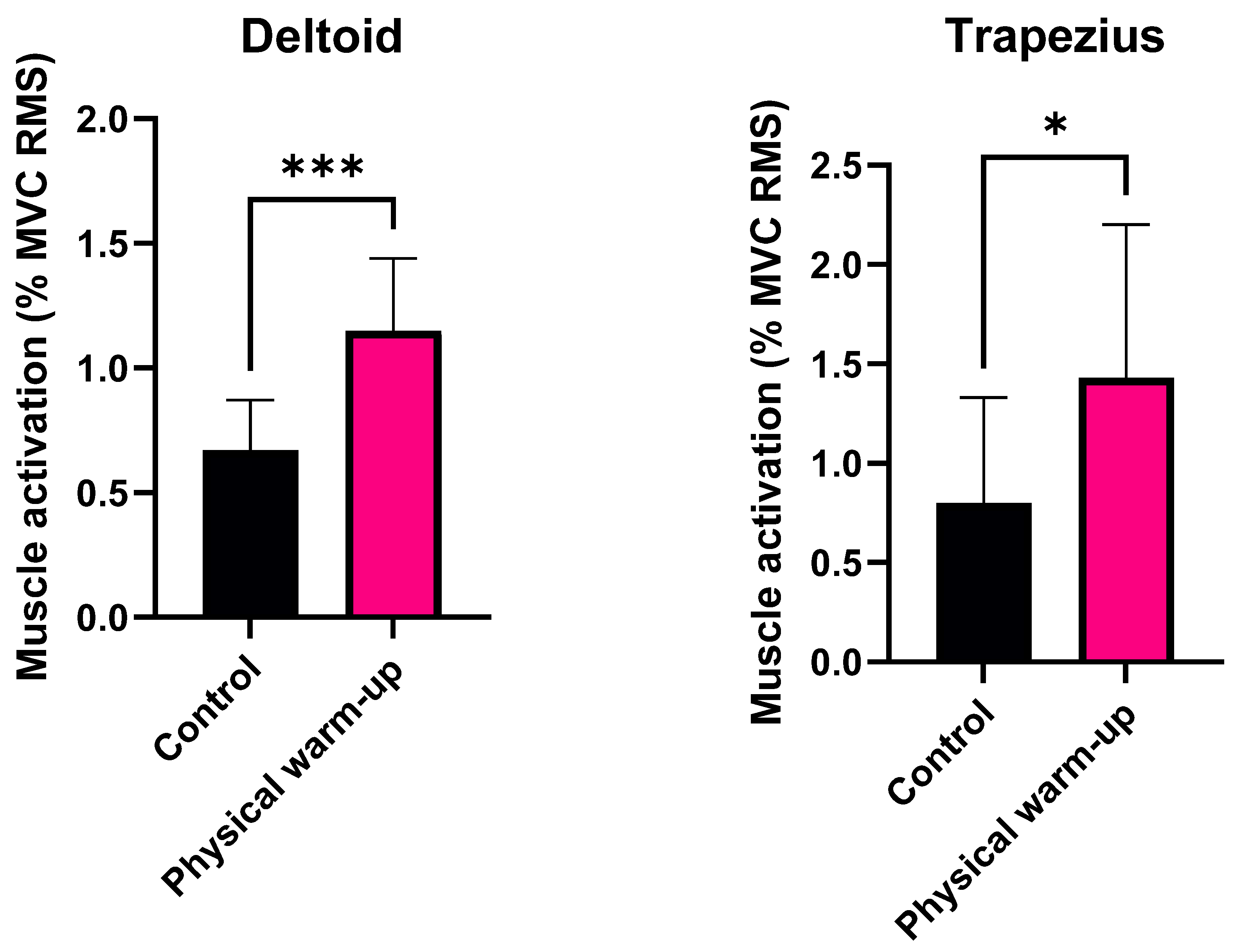
The ANOVA revealed effects of condition for EMG in the right deltoid (p < 0.05) and the right trapezius (p < 0.05), but not the right biceps brachii (p = 0.975), left biceps brachii (p = 0.767), left deltoid (p = 0.903), left trapezius (p = 0.997), right latissimus dorsi (p = 0.920), or left latissimus dorsi (p = 0.690). Post-hoc analyses revealed differences in EMG between physical warm-up and control in the right deltoid (p < 0.001, d = 1.93) and the right trapezius (p = 0.0490, d = 0.95) whereby the physical warm-up increased EMG. These pairwise comparisons are visualized in Figure 1.

3.2. EEG

There were no differences in EEG for alpha power at any point of interest between conditions (zeroing, p = 0.292; point of interest 1, p = 0.271; point of interest 2, p = 0.296; point of interest 3, p = 0.282).

4. Discussion

The aim of the study was to explore the effects of a physical warm-up and psychological warm-up on the physical and cognitive demands experienced by surgeons during real-life RALS. The findings show differential impacts, with a physical warm-up demonstrating a notable reduction in musculoskeletal demands and psychological warm-up showing no effect on cognitive load.
The observed increase in EMG activity in the right deltoid and trapezius following a physical warm-up suggests that preparatory exercise may enhance neuromuscular engagement during task performance. Rather than reflecting increased strain, this pattern may indicate improved neuromotor readiness, facilitating more efficient muscle recruitment. Importantly, increased EMG activity does not inherently equate to increased fatigue or strain but instead reflects the level of muscle activation required to perform a task [18,19,20]. As such, the present findings should be interpreted as a change in activation patterns rather than a reduction in physical load.
This interpretation aligns with evidence from both the surgical and sports science literature, where warm-up protocols are known to enhance motor unit activation, coordination, and task efficiency [19,20,21]. In the context of RALS, where surgeons operate in static postures for prolonged periods [7,22], optimizing neuromuscular engagement may reduce fatigue accumulation and mitigate the risk of musculoskeletal injury over time [23]. Previous work has consistently demonstrated lower overall musculoskeletal demand in RALS compared to laparoscopic surgery [4,7,13,22,24,25,26], but the present findings extend this by suggesting that targeted physical warm-ups may further modulate these demands at a muscular level.
Alternative interpretations of increased EMG amplitude must also be considered. Increased EMG amplitude may reflect greater muscular effort rather than improved efficiency [27], particularly if task demands remain constant [28]. It is also possible that the observed increases represent compensatory activation patterns or altered motor strategies, rather than beneficial adaptations [29,30]. Without direct measures of fatigue, efficiency, or performance outcomes, it is not possible to determine whether the increased activation reflects advantageous or maladaptive changes.
EMG amplitude reflects the level of muscle activation rather than strain or fatigue per se and therefore should not be interpreted in isolation as a marker of reduced or increased musculoskeletal load. Future work incorporating measures of endurance, fatigue, or task performance will be necessary to better contextualize these findings.
The physical warm-up likely served to prime the surgeons’ musculoskeletal system, reducing fatigue and the risk of injury [31]. Such preparation is crucial for maintaining surgeon health and well-being, particularly in the context of long, physically demanding procedures typical of RALS. The implications of these findings are potentially far-reaching. By incorporating structured warm-up exercises into their routines, surgeons can potentially enhance their performance and longevity in the profession [32]. This reduction in musculoskeletal strain could lead to shorter recovery times between surgeries, thus enabling surgeons to handle more cases and potentially reducing patient waiting lists [25]. Moreover, the decreased physical strain could result in shorter surgery times [6], as fatigue is less likely to impair performance towards the end of a procedure. As a low-cost and easily implementable intervention, these exercises are highly scalable and can be readily integrated into surgical training programs and daily practice without requiring significant resources [6,11].
On the cognitive aspect, psychological warm-up was hypothesized to reduce cognitive load, reflected by increased EEG alpha activity. Alpha oscillations are widely implicated in attentional regulation and internal cognitive processing and are commonly interpreted as an index of reduced task-related demand or more efficient neural processing when increased during task performance [33,34]. Accordingly, psychological preparation strategies such as visualization may facilitate a transition toward a more internally focused, anticipatory cognitive state, potentially improving task readiness without necessarily increasing overt neural effort.
However, the absence of significant EEG changes in the present study suggests that the cognitive effects of psychological warm-up may be subtle, highly contextual, or smaller in magnitude than those elicited by physical warm-up interventions. Cognitive workload is inherently complex and multidimensional, encompassing attention, working memory, decision making, and perceptual processing, and may not be fully captured by single-frequency EEG metrics alone. Indeed, increases in alpha power can reflect multiple underlying processes, including inhibition of task-irrelevant regions, shifts toward internally directed cognition, or neural efficiency, making interpretation dependent on task context and experimental design [34,35]. Further complexity arises from the nature of mental imagery. Visualization has reportedly modulated alpha activity, with increases in alpha power observed during internally generated imagery and memory-driven processing [35]. This suggests that psychological warm-up may not uniformly reduce cognitive load but instead redistribute cognitive resources toward preparatory processes, which may not manifest as reduced workload in conventional EEG indices.
Taken together, these findings suggest that the impact of psychological warm-up on cognitive load is likely nuanced, task-dependent, and not adequately captured by single EEG measures in isolation. Future work should therefore adopt multimodal approaches, combining EEG with behavioral performance metrics, subjective workload assessments, and potentially other physiological markers, to better characterize the effects of mental preparation strategies on surgical cognition.
Importantly, the differential effects observed across physiological domains highlight a potential dissociation between physical and cognitive responses to warm-up. While physical preparation clearly influenced neuromuscular activation, no corresponding effect was observed in neural indices of cognitive load. This may suggest that physical and cognitive systems respond differently to short-term preparatory interventions, or that cognitive adaptations occur over longer timeframes or require more targeted strategies. Understanding this interaction is critical, as surgical performance relies on the integration of both physical and cognitive processes.
This study has several limitations. The sample size was modest and may limit statistical power, particularly for detecting subtle cognitive effects. Although conducted in a real-world operative setting, this introduces variability in case complexity, surgeon specialty, surgeon behaviour, and environmental factors that may influence physiological responses. EMG amplitude reflects activation rather than fatigue or efficiency, limiting interpretation of underlying mechanisms without complementary performance or endurance measures. Similarly, EEG-derived alpha activity provides only a partial representation of cognitive workload and may lack sensitivity to detect subtle or transient changes in real-world tasks. The absence of behavioral or performance metrics further limits the interpretation of whether observed physiological changes translate to meaningful improvements. Finally, the study captures acute responses to warm-up interventions and does not address longer-term adaptations or cumulative effects.

5. Conclusions

These findings support the potential value of incorporating brief, targeted physical warm-up routines to enhance muscle activation, which may contribute to improved motor control and reduced fatigue. In turn, this could help mitigate musculoskeletal strain and support surgeon health and performance during prolonged procedures. Such preparation could be crucial for maintaining surgeon health and well-being, particularly in long, physically demanding procedures typical of RALS. By incorporating preselected simulation tasks into their routines, surgeons could enhance their RALS performance and longevity. This reduction in musculoskeletal strain could lead to shorter recovery times between surgeries, enabling surgeons to handle more cases and potentially reducing patient waiting lists [25].

Supplementary Materials

The following supporting information can be downloaded at: https://www.mdpi.com/article/10.3390/surgeries7030078/s1, Supplementary data.

Author Contributions

A.S., D.T., T.M.B., H.E.N., D.A.S. and C.J.G., study conception and design. A.S., J.E.L. and D.A.S., acquisition of data. All authors: analysis and interpretation of data. A.S., L.D.H., N.E.M.S.-H. and C.J.G. wrote the manuscript. All authors have read and agreed to the published version of the manuscript.

Funding

This research received no external funding.

Institutional Review Board Statement

The study was conducted in accordance with the Declaration of Helsinki, and ethical approval for this study was granted by Lancaster University Faculty of Health and Medicine Research Ethics Committee (FHM2023-3462-IRAS1) on the 21 March 2023.

Informed Consent Statement

Informed consent for participation was obtained from all subjects involved in the study.

Data Availability Statement

Data from this study will be made available on reasonable request.

Conflicts of Interest

The authors declare no conflicts of interest.

References

  1. Hu, J.C.; Wang, Q.; Pashos, C.L.; Lipsitz, S.R.; Keating, N.L. Utilization and Outcomes of Minimally Invasive Radical Prostatectomy. J. Clin. Oncol. 2008, 26, 2278–2284. [Google Scholar] [CrossRef] [PubMed]
  2. Oh, S.-Y.; Kwon, S.; Lee, K.-G.; Suh, Y.-S.; Choe, H.-N.; Kong, S.-H.; Lee, H.-J.; Kim, W.H.; Yang, H.-K. Outcomes of Minimally Invasive Surgery for Early Gastric Cancer Are Comparable with Those for Open Surgery: Analysis of 1013 Minimally Invasive Surgeries at a Single Institution. Surg. Endosc. 2014, 28, 789–795. [Google Scholar] [CrossRef] [PubMed]
  3. Patel, P.D.; Canseco, J.A.; Houlihan, N.; Gabay, A.; Grasso, G.; Vaccaro, A.R. Overview of Minimally Invasive Spine Surgery. World Neurosurg. 2020, 142, 43–56. [Google Scholar] [CrossRef] [PubMed]
  4. Shugaba, A.; Lambert, J.E.; Bampouras, T.M.; Nuttall, H.E.; Gaffney, C.J.; Subar, D.A. Should All Minimal Access Surgery Be Robot-Assisted? A Systematic Review into the Musculoskeletal and Cognitive Demands of Laparoscopic and Robot-Assisted Laparoscopic Surgery. J. Gastrointest. Surg. 2022, 26, 1520–1530. [Google Scholar] [CrossRef] [PubMed]
  5. Park, L.S.; Pan, F.; Steffens, D.; Young, J.; Hong, J. Are Surgeons Working Smarter or Harder? A Systematic Review Comparing the Physical and Mental Demands of Robotic and Laparoscopic or Open Surgery. World J. Surg. 2021, 45, 2066–2080. [Google Scholar] [CrossRef] [PubMed]
  6. Park, A.; Lee, G.; Seagull, F.J.; Meenaghan, N.; Dexter, D. Patients Benefit While Surgeons Suffer: An Impending Epidemic. J. Am. Coll. Surg. 2010, 210, 306–313. [Google Scholar] [CrossRef] [PubMed]
  7. Menon, N.; Guidozzi, N.; Kamarajah, S.K.; Gujjuri, R.; Markar, S.R. Strain on the Surgeon: A Systematic Review of the Methods of Measuring Strain in Abdominal and Thoracic Surgery. Surgeon 2025, 23, 257–264. [Google Scholar] [CrossRef] [PubMed]
  8. Kroft, J.; Ordon, M.; Arthur, R.; Pittini, R. Does Surgical “Warming up” Improve Laparoscopic Simulator Performance? Simul. Healthc. J. Soc. Simul. Healthc. 2012, 7, 339–342. [Google Scholar] [CrossRef] [PubMed]
  9. Arora, S.; Sevdalis, N.; Aggarwal, R.; Sirimanna, P.; Darzi, A.; Kneebone, R. Stress Impairs Psychomotor Performance in Novice Laparoscopic Surgeons. Surg. Endosc. 2010, 24, 2588–2593. [Google Scholar] [CrossRef] [PubMed]
  10. Cochrane, D.J.; Stannard, S.R.; Sargeant, A.J.; Rittweger, J. The Rate of Muscle Temperature Increase during Acute Whole-Body Vibration Exercise. Eur. J. Appl. Physiol. 2008, 103, 441–448. [Google Scholar] [CrossRef] [PubMed]
  11. Alleblas, C.C.J.; de Man, A.M.; van den Haak, L.; Vierhout, M.E.; Jansen, F.W.; Nieboer, T.E. Prevalence of Musculoskeletal Disorders Among Surgeons Performing Minimally Invasive Surgery: A Systematic Review. Ann. Surg. 2017, 266, 905–920. [Google Scholar] [CrossRef] [PubMed]
  12. Khan, Z.; Shugaba, A.; Davitt, M.; Shrestha, D.; Lambert, J.E.; Clark, T.J.; Bampouras, T.M.; Hayes, L.D.; Nuttall, H.E.; Subar, D.A.; et al. Obstetrics and Gynecology Trainees Face Higher Musculoskeletal Demands than General Surgery Trainees in Simulated Laparoscopic Tasks-An Observational Study. Healthcare 2025, 13, 3223. [Google Scholar] [CrossRef] [PubMed]
  13. Shugaba, A.; Subar, D.A.; Slade, K.; Willett, M.; Abdel-Aty, M.; Campbell, I.; Heywood, N.; Vitone, L.; Sheikh, A.; Gill, M.; et al. Surgical Stress: The Muscle and Cognitive Demands of Robotic and Laparoscopic Surgery. Ann. Surg. Open 2023, 4, e284. [Google Scholar] [CrossRef] [PubMed]
  14. Holmes, P.S.; Collins, D.J. The PETTLEP Approach to Motor Imagery: A Functional Equivalence Model for Sport Psychologists. J. Appl. Sport Psychol. 2001, 13, 60–83. [Google Scholar] [CrossRef]
  15. Hermens, H.J.; Freriks, B.; Disselhorst-Klug, C.; Rau, G. Development of Recommendations for SEMG Sensors and Sensor Placement Procedures. J. Electromyogr. Kinesiol. 2000, 10, 361–374. [Google Scholar] [CrossRef] [PubMed]
  16. Acharya, J.N.; Acharya, V.J. Overview of EEG Montages and Principles of Localization. J. Clin. Neurophysiol. 2019, 36, 325–329. [Google Scholar] [CrossRef] [PubMed]
  17. Chen, C.C.G.; Green, I.C.; Colbert-Getz, J.M.; Steele, K.; Chou, B.; Lawson, S.M.; Andersen, D.K.; Satin, A.J. Warm-up on a Simulator Improves Residents’ Performance in Laparoscopic Surgery: A Randomized Trial. Int. Urogynecol. J. 2013, 24, 1615–1622. [Google Scholar] [CrossRef] [PubMed]
  18. Michaud, F.; Lamas, M.; Lugrís, U.; Cuadrado, J. A Fair and EMG-Validated Comparison of Recruitment Criteria, Musculotendon Models and Muscle Coordination Strategies, for the Inverse-Dynamics Based Optimization of Muscle Forces during Gait. J. Neuroeng. Rehabil. 2021, 18, 17. [Google Scholar] [CrossRef] [PubMed]
  19. Stewart, D.; Macaluso, A.; De Vito, G. The Effect of an Active Warm-up on Surface EMG and Muscle Performance in Healthy Humans. Eur. J. Appl. Physiol. 2003, 89, 509–513. [Google Scholar] [CrossRef] [PubMed]
  20. Roberts, T.J.; Gabaldón, A.M. Interpreting Muscle Function from EMG: Lessons Learned from Direct Measurements of Muscle Force. Integr. Comp. Biol. 2008, 48, 312–320. [Google Scholar] [CrossRef] [PubMed]
  21. Lee, J.; Park, D.; Lee, J.-Y.; Park, J. Effect of Warm-Up Exercise on Functional Regulation of Motor Unit Activation during Isometric Torque Production. J. Hum. Kinet. 2024, 92, 29–41. [Google Scholar] [CrossRef] [PubMed]
  22. Cooper, H.; Lau, H.M.; Mohan, H. A Systematic Review of Ergonomic and Muscular Strain in Surgeons Comparing Robotic to Laparoscopic Approaches. J. Robot. Surg. 2025, 19, 252. [Google Scholar] [CrossRef] [PubMed]
  23. Reijmerink, I.M.; van der Laan, M.J.; Wietasch, J.K.G.; Hooft, L.; Cnossen, F. Impact of Fatigue in Surgeons on Performance and Patient Outcome: Systematic Review. Br. J. Surg. 2023, 111, znad397. [Google Scholar] [CrossRef] [PubMed]
  24. Lendvay, T.S.; Brand, T.C.; White, L.; Kowalewski, T.; Jonnadula, S.; Mercer, L.D.; Khorsand, D.; Andros, J.; Hannaford, B.; Satava, R.M. Virtual Reality Robotic Surgery Warm-up Improves Task Performance in a Dry Laboratory Environment: A Prospective Randomized Controlled Study. J. Am. Coll. Surg. 2013, 216, 1181–1192. [Google Scholar] [CrossRef] [PubMed]
  25. Godfrey, A. Robotic Technology Speeds Recovery and Improves Outcomes. J. Am. Acad. Physician Assist. 2010, 23, 53–54. [Google Scholar] [CrossRef]
  26. Karam, B.; Soriano, I. Ergonomics and Body Wellness during Surgery: A Review and Practical Guide. Semin. Colon Rectal Surg. 2025, 36, 101085. [Google Scholar] [CrossRef]
  27. Subbu, R.; Weiler, R.; Whyte, G. The Practical Use of Surface Electromyography during Running: Does the Evidence Support the Hype? A Narrative Review. BMJ Open Sport Exerc. Med. 2015, 1, e000026. [Google Scholar] [CrossRef] [PubMed]
  28. Decorte, N.; Lafaix, P.A.; Millet, G.Y.; Wuyam, B.; Verges, S. Central and Peripheral Fatigue Kinetics during Exhaustive Constant-Load Cycling. Scand. J. Med. Sci. Sports 2012, 22, 381–391. [Google Scholar] [CrossRef] [PubMed]
  29. Li, X.; Holobar, A.; Gazzoni, M.; Merletti, R.; Rymer, W.Z.; Zhou, P. Examination of Post-Stroke Alteration in Motor Unit Firing Behavior Using High Density Surface EMG Decomposition. IEEE Trans. Biomed. Eng. 2015, 62, 1242–1252. [Google Scholar] [CrossRef] [PubMed]
  30. Lin, J.; Lim, H.K.; Soto-quijano, D.A.; Hanten, W.P.; Olson, S.L.; Roddey, T.S.; Sherwood, A.M. Altered Patterns of Muscle Activation during Performance of Four Functional Tasks in Patients with Shoulder Disorders: Interpretation from Voluntary Response Index. J. Electromyogr. Kinesiol. 2006, 16, 458–468. [Google Scholar] [CrossRef] [PubMed]
  31. Abdalla, G.; Moran-Atkin, E.; Chen, G.; Schweitzer, M.A.; Magnuson, T.H.; Steele, K.E. The Effect of Warm-up on Surgical Performance: A Systematic Review. Surg. Endosc. 2015, 29, 1259–1269. [Google Scholar] [CrossRef] [PubMed]
  32. Van Cutsem, J.; Marcora, S.; De Pauw, K.; Bailey, S.; Meeusen, R.; Roelands, B. The Effects of Mental Fatigue on Physical Performance: A Systematic Review. Sports Med. 2017, 47, 1569–1588. [Google Scholar] [CrossRef] [PubMed]
  33. Raufi, B.; Longo, L. An Evaluation of the EEG Alpha-to-Theta and Theta-to-Alpha Band Ratios as Indexes of Mental Workload. Front. Neuroinform. 2022, 16, 861967. [Google Scholar] [CrossRef] [PubMed]
  34. Gkintoni, E.; Halkiopoulos, C. Mapping EEG Metrics to Human Affective and Cognitive Models: An Interdisciplinary Scoping Review from a Cognitive Neuroscience Perspective. Biomimetics 2025, 10, 730. [Google Scholar] [CrossRef] [PubMed]
  35. Das Chakladar, D.; Roy, P.P. Cognitive Workload Estimation Using Physiological Measures: A Review. Cogn. Neurodyn. 2024, 18, 1445–1465. [Google Scholar] [CrossRef] [PubMed]
Figure 1. Muscle activation during robot-assisted laparoscopic surgery following control or physical warm-up. * Indicates p < 0.05; *** indicates p < 0.001.
Surgeries 07 00078 g001
Table 1. Description of surgeon characteristics included in this study (n = 10). Data are displayed as mean ± SD.
Age (years)47 ± 3
Body mass (kg)92 ± 2
Height (m)1.74 ± 0.04
BMI (kg·m2)30.1 ± 0.5
Handedness (Left:Right)1:9
Average Glove size7.5 ± 0.1
Years of Experience9 ± 1
Specialty (Colorectal:Urology:Gynaecology)6:2:2
Table 2. Description of points of interest within the present study.
Point of InterestColorectalUrologyGynecology
ZeroingZeroing ZeroingZeroing
Point of interest 1Bowel mobilizationBowel mobilizationRound ligament dissection
Point of interest 2Vessel dissection and controlVessel dissection and controlVessel dissection and control
Point of interest 3Mesenteric dissectionKidney MobilizationColpectomy
Disclaimer/Publisher’s Note: The statements, opinions and data contained in all publications are solely those of the individual author(s) and contributor(s) and not of MDPI and/or the editor(s). MDPI and/or the editor(s) disclaim responsibility for any injury to people or property resulting from any ideas, methods, instructions or products referred to in the content.