Pediatric and Adolescent Pancreatic Tumors: Population-Based Outcomes and Machine Learning Analysis



Abstract
1. Introduction
2. Materials and Methods
2.1. Study Design and Cohort Definition
2.2. Variables and Outcomes
2.3. Statistical Analysis
3. Results
3.1. Cohort Characteristics
3.2. Temporal Distribution
3.3. Age-Stratified Clinicopathologic Analysis
3.4. Treatment Patterns by Histology and Stage
3.5. Survival Analysis
3.6. Multivariable Analysis
3.7. Exploratory Machine Learning Analysis
4. Discussion
5. Conclusions
Supplementary Materials
Author Contributions
Funding
Institutional Review Board Statement
Informed Consent Statement
Data Availability Statement
Conflicts of Interest
References
- Mylonas, K.S.; Nasioudis, D.; Tsilimigras, D.I.; Doulamis, I.P.; Masiakos, P.T.; Kelleher, C.M. A population-based analysis of a rare oncologic entity: Malignant pancreatic tumors in children. J. Pediatr. Surg. 2018, 53, 647–652. [Google Scholar] [CrossRef]
- Picado, O.; Ferrantella, A.; Zabalo, C.; Rao, K.; Thorson, C.M.; Sola, J.E.; Perez, E.A. Treatment patterns and outcomes for pancreatic tumors in children: An analysis of the National Cancer Database. Pediatr. Surg. Int. 2020, 36, 357–363. [Google Scholar] [CrossRef]
- Mylonas, K.S.; Doulamis, I.P.; Tsilimigras, D.I.; Nasioudis, D.; Schizas, D.; Masiakos, P.T.; Kelleher, C.M. Solid pseudopapillary and malignant pancreatic tumors in childhood: A systematic review and evidence quality assessment. Pediatr. Blood Cancer 2018, 65, e27114. [Google Scholar] [CrossRef]
- Qi, X.; Zhou, B.; Liang, F.; Wang, X. Prognostic factors of pancreatic tumors in children and adolescents: A population study based on the Surveillance, Epidemiology, and End Results database. BMC Gastroenterol. 2024, 24, 108. [Google Scholar] [CrossRef] [PubMed]
- Beger, H.G.; Rau, B.; Gansauge, F.; Poch, B.; Link, K.H. Treatment of pancreatic cancer: Challenge of the facts. World J. Surg. 2003, 27, 1075–1084. [Google Scholar] [CrossRef] [PubMed]
- Bengtsson, A.; Andersson, R.; Ansari, D. The actual 5-year survivors of pancreatic ductal adenocarcinoma based on real-world data. Sci. Rep. 2020, 10, 16425. [Google Scholar] [CrossRef] [PubMed]
- Law, J.K.; Ahmed, A.; Singh, V.K.; Akshintala, V.S.; Olson, M.T.; Raman, S.P.; Ali, S.Z.; Fishman, E.K.; Kamel, I.; Canto, M.I.; et al. A systematic review of solid pseudopapillary neoplasms: Are these rare lesions? Pancreas 2014, 43, 331–337. [Google Scholar] [CrossRef]
- Papavramidis, T.; Papavramidis, S. Solid pseudopapillary tumors of the pancreas: Review of 718 patients reported in English literature. J. Am. Coll. Surg. 2005, 200, 965–972. [Google Scholar] [CrossRef]
- Nasher, O.; Hall, N.J.; Sebire, N.J.; de Coppi, P.; Pierro, A. Pancreatic tumours in children: Diagnosis, treatment and outcome. Pediatr. Surg. Int. 2015, 31, 831–835. [Google Scholar] [CrossRef]
- Lowery, M.A.; Jordan, E.J.; Basturk, O.; Ptashkin, R.N.; Zehir, A.; Berger, M.F.; Leach, T.; Herbst, B.; Askan, G.; Maynard, H.; et al. Real-time genomic profiling of pancreatic ductal adenocarcinoma: Potential actionability and correlation with clinical phenotype. Clin. Cancer Res. 2017, 23, 6094–6100. [Google Scholar] [CrossRef]
- Klein, A.P. Genetic susceptibility to pancreatic cancer. Mol. Carcinog. 2012, 51, 14–24. [Google Scholar] [CrossRef] [PubMed]
- Klimstra, D.; Wenig, B.; Adair, C.; Heffess, C. Pancreatoblastoma. A clinicopathologic study and review of the literature. Am. J. Surg. Pathol. 1995, 19, 1371–1389. [Google Scholar] [CrossRef] [PubMed]
- Li, S.; Zhong, W.; Yi, L.; Yu, J. Clinical and Biologic Analysis of Pancreatoblastoma. Pancreas 2005, 30, 87–90. [Google Scholar] [PubMed]
- Basturk, O.; Coban, I.; Adsay, N.V. Pancreatic tumors in childhood: A comprehensive review. Semin. Diagn. Pathol. 2014, 31, 36–47. [Google Scholar] [CrossRef]
- Tagge, E.P.; Hill, J.G.; Tagge, D.U.; Macpherson, R. Pancreatic surgery in children. Curr. Opin. Pediatr. 1995, 7, 342–348. [Google Scholar] [CrossRef] [PubMed]
- Chung, E.M.; Travis, M.D.; Conran, R.M. Pancreatic tumors in children: Radiologic-pathologic correlation. Radiographics 2006, 26, 1211–1238. [Google Scholar] [CrossRef]
- Esteva, A.; Robicquet, A.; Ramsundar, B.; Kuleshov, V.; DePristo, M.; Chou, K.; Cui, C.; Corrado, G.; Thrun, S.; Dean, J. A guide to deep learning in healthcare. Nat. Med. 2019, 25, 24–29. [Google Scholar] [CrossRef]
- Beam, A.L.; Kohane, I.S. Big data and machine learning in health care. JAMA 2018, 319, 1317–1318. [Google Scholar] [CrossRef]
- Shickel, B.; Tighe, P.J.; Bihorac, A.; Rashidi, P. Deep EHR: A survey of recent advances in deep learning techniques for electronic health record analysis. IEEE J. Biomed. Health Inform. 2018, 22, 1589–1604. [Google Scholar] [CrossRef]
- Strobel, O.; Neoptolemos, J.; Jäger, D.; Büchler, M.W. Optimizing the outcomes of pancreatic cancer surgery. Nat. Rev. Clin. Oncol. 2019, 16, 11–26. [Google Scholar] [CrossRef] [PubMed]
- Rahib, L.; Smith, B.D.; Aizenberg, R.; Rosenzweig, A.B.; Fleshman, J.M.; Matrisian, L.M. Projecting cancer incidence and deaths to 2030: The unexpected burden of pancreatic cancer in the United States. Cancer Res. 2014, 74, 2913–2921. [Google Scholar] [CrossRef] [PubMed]
- Tempero, M.A.; Malafa, M.P.; Al-Hawary, M.; Behrman, S.W.; Benson, A.B., III; Cardin, D.B.; Chiorean, E.G.; Chung, V.; Czito, B.; Del Chiaro, M.; et al. Pancreatic adenocarcinoma, version 1.2021. J. Natl. Compr. Canc. Netw. 2021, 19, 439–457. [Google Scholar] [CrossRef] [PubMed]
- Harrell, F.E.; Lee, K.L.; Mark, D.B. Multivariable prognostic models: Issues in developing models, evaluating assumptions and adequacy, and measuring and reducing errors. Stat. Med. 1996, 15, 361–387. [Google Scholar] [CrossRef]



| Domain | Characteristic | Overall Cohort, n (%) |
|---|---|---|
| Age at diagnosis | <1 year | 6 (3.0) |
| 1–4 years | 10 (4.9) | |
| 5–9 years | 16 (7.9) | |
| 10–14 years | 53 (26.1) | |
| 15–19 years | 118 (58.1) | |
| Sex | Female | 144 (70.9) |
| Male | 59 (29.1) | |
| Race | White | 150 (73.9) |
| Black | 21 (10.3) | |
| Asian or Pacific Islander | 21 (10.3) | |
| American Indian/Alaska Native | 4 (2.0) | |
| Unknown | 7 (3.4) | |
| Histology | SPN | 108 (53.2) |
| Neuroendocrine neoplasm | 59 (29.1) | |
| Pancreatoblastoma | 16 (7.9) | |
| Histology | Acinar cell carcinoma | 4 (2.0) |
| Adenocarcinoma variant | 5 (2.5) | |
| Other rare histology | 11 (5.4) | |
| Stage at diagnosis | Localized | 124 (61.1) |
| Regional | 42 (20.7) | |
| Distant | 32 (15.8) | |
| Unknown | 5 (2.5) | |
| Treatment | Surgery | 173 (85.2) |
| Chemotherapy | 33 (16.3) | |
| Beam radiotherapy | 5 (2.5) | |
| Diagnosis era | 2004–2008 | 20 (9.9) |
| 2009–2013 | 33 (16.3) | |
| 2014–2017 | 61 (30.0) | |
| 2018–2021 | 89 (43.8) |
| Domain | Characteristic | 0–9 Years | 10–14 Years | 15–19 Years | p Value |
|---|---|---|---|---|---|
| Cohort size | N | 32 | 53 | 118 | |
| Sex | Female | 16 (50.0) | 41 (77.4) | 87 (73.7) | 0.016 |
| Male | 16 (50.0) | 12 (22.6) | 31 (26.3) | ||
| Histology | SPN | 6 (18.8) | 39 (73.6) | 63 (53.4) | <0.001 |
| Neuroendocrine neoplasm | 6 (18.8) | 11 (20.8) | 42 (35.6) | ||
| Pancreatoblastoma | 12 (37.5) | 1 (1.9) | 3 (2.5) | ||
| Acinar cell carcinoma | 2 (6.2) | 1 (1.9) | 1 (0.8) | ||
| Adenocarcinoma variant | 0 (0.0) | 0 (0.0) | 5 (4.2) | ||
| Other rare histology | 6 (18.8) | 1 (1.9) | 4 (3.4) | ||
| Stage | Localized | 13 (40.6) | 33 (62.3) | 78 (66.1) | 0.085 |
| Regional | 8 (25.0) | 14 (26.4) | 20 (16.9) | ||
| Distant | 10 (31.2) | 5 (9.4) | 17 (14.4) | ||
| Unknown | 1 (3.1) | 1 (1.9) | 3 (2.5) | ||
| Treatment | Surgery | 26 (81.2) | 47 (88.7) | 100 (84.7) | 0.630 |
| Chemotherapy | 15 (46.9) | 6 (11.3) | 12 (10.2) | <0.001 | |
| Beam radiotherapy | 3 (9.4) | 1 (1.9) | 1 (0.8) | Not tested * | |
| Survival | 5-year OS | 80.3% | 89.7% | 89.2% | 0.551 |
| 10-year OS | 80.3% | 89.7% | 82.9% |
| A | |||
| Histology | Surgery Yes | Chemotherapy Yes | Beam Radiotherapy |
| Acinar cell carcinoma | 4 (100.0) | 3 (75.0) | 0 (0.0) |
| Adenocarcinoma variant | 1 (20.0) | 4 (80.0) | 1 (20.0) |
| Neuroendocrine neoplasm | 47 (79.7) | 9 (15.3) | 0 (0.0) |
| Other rare histology | 5 (45.5) | 5 (45.5) | 2 (18.2) |
| Pancreatoblastoma | 13 (81.2) | 11 (68.8) | 2 (12.5) |
| SPN | 103 (95.4) | 1 (0.9) | 0 (0.0) |
| B | |||
| Stage | Surgery yes | Chemotherapy yes | Beam radiotherapy |
| Distant | 17 (53.1) | 19 (59.4) | 4 (12.5) |
| Localized | 114 (91.9) | 5 (4.0) | 1 (0.8) |
| Regional | 38 (90.5) | 9 (21.4) | 0 (0.0) |
| Unknown | 4 (80.0) | 0 (0.0) | 0 (0.0) |
| Domain | Group | N | Deaths | 5-Year OS (%) | 10-Year OS (%) | Log-Rank p |
|---|---|---|---|---|---|---|
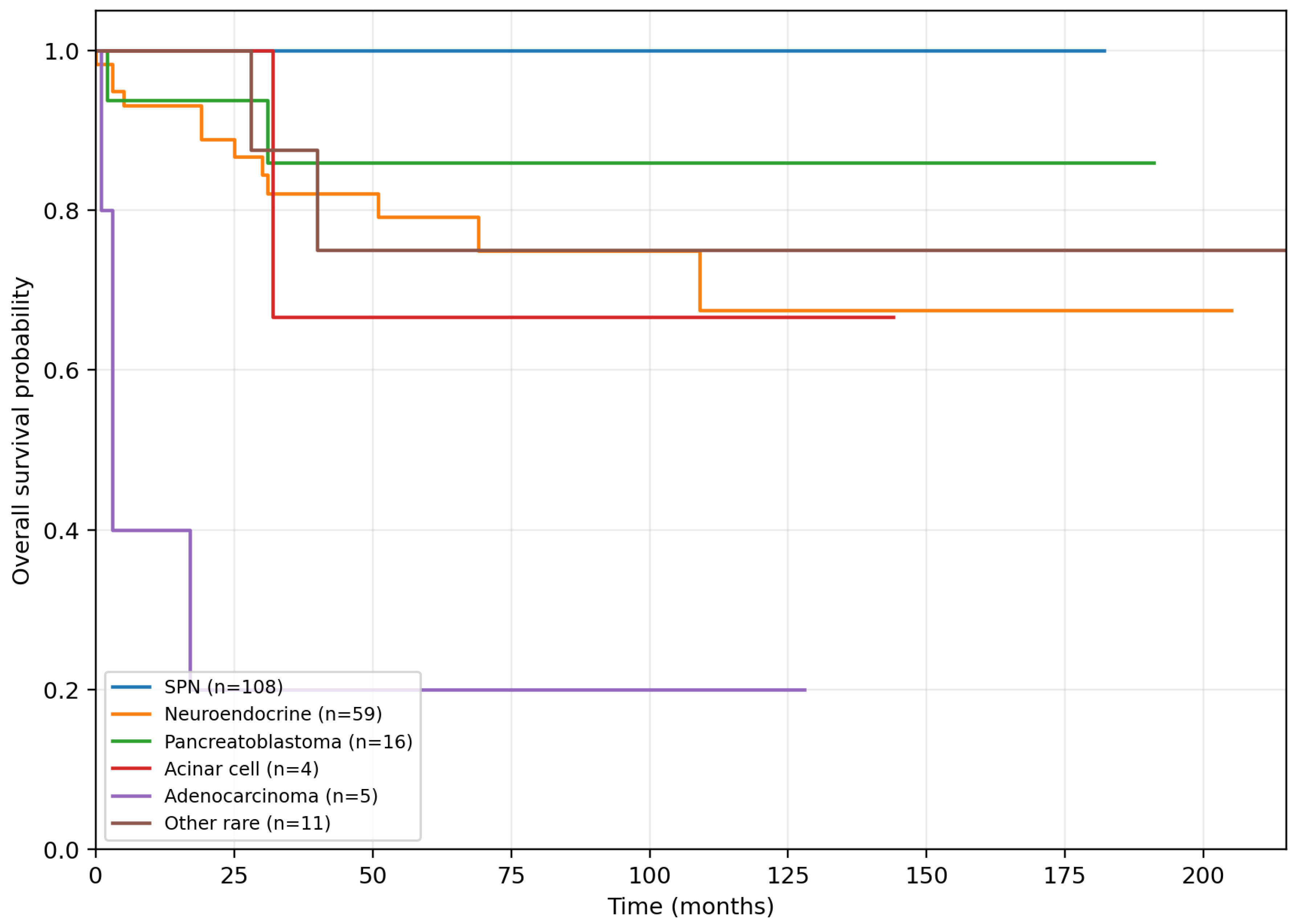
| Histology | SPN | 108 | 0 | 100.0 | 100.0 | <0.001 |
| Neuroendocrine neoplasm | 59 | 12 | 79.1 | 67.5 | ||
| Pancreatoblastoma | 16 | 2 | 85.9 | 85.9 | ||
| Acinar cell carcinoma | 4 | 1 | 66.7 | 66.7 | ||
| Adenocarcinoma variant | 5 | 4 | 20.0 | 20.0 | ||
| Other rare histology | 11 | 2 | 75.0 | 75.0 | ||
| Stage | Localized | 124 | 1 | 100.0 | 94.1 | <0.001 |
| Regional | 42 | 2 | 91.9 | 91.9 | ||
| Distant | 32 | 18 | 43.0 | 38.7 | ||
| Surgery | Yes | 173 | 7 | 95.6 | 90.9 | <0.001 |
| No | 30 | 14 | 44.8 | 44.8 |
| Variable | HR | 95% CI | p |
|---|---|---|---|
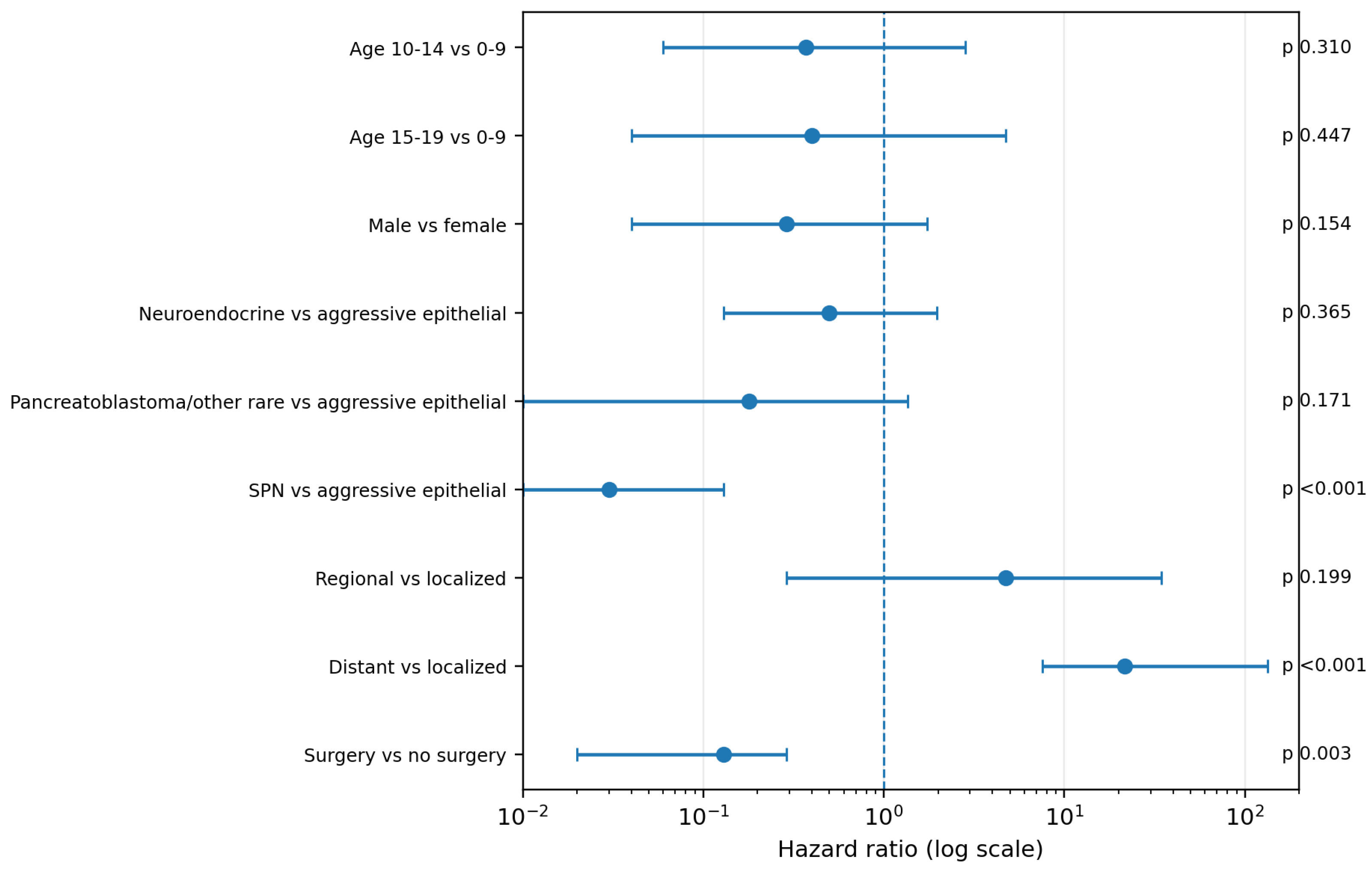
| Age 10–14 vs. 0–9 years | 0.37 | 0.06–2.83 | 0.310 |
| Age 15–19 vs. 0–9 years | 0.40 | 0.04–4.71 | 0.447 |
| Male vs. female | 0.29 | 0.04–1.74 | 0.154 |
| Neuroendocrine vs. aggressive epithelial histology | 0.50 | 0.13–1.96 | 0.365 |
| Pancreatoblastoma/other rare vs. aggressive epithelial histology | 0.18 | 0.01–1.36 | 0.171 |
| SPN vs. aggressive epithelial histology | 0.03 | 0.01–0.13 | <0.001 |
| Regional vs. localized stage | 4.72 | 0.29–34.55 | 0.199 |
| Distant vs. localized stage | 21.49 | 7.52–133.41 | <0.001 |
| Surgery vs. no surgery | 0.13 | 0.02–0.29 | 0.003 |
Disclaimer/Publisher’s Note: The statements, opinions and data contained in all publications are solely those of the individual author(s) and contributor(s) and not of MDPI and/or the editor(s). MDPI and/or the editor(s) disclaim responsibility for any injury to people or property resulting from any ideas, methods, instructions or products referred to in the content. |
© 2026 by the authors. Licensee MDPI, Basel, Switzerland. This article is an open access article distributed under the terms and conditions of the Creative Commons Attribution (CC BY) license.
Share and Cite
Moris, D.; Radkani, P.; Gupta, P. Pediatric and Adolescent Pancreatic Tumors: Population-Based Outcomes and Machine Learning Analysis. Surgeries 2026, 7, 50. https://doi.org/10.3390/surgeries7020050
Moris D, Radkani P, Gupta P. Pediatric and Adolescent Pancreatic Tumors: Population-Based Outcomes and Machine Learning Analysis. Surgeries. 2026; 7(2):50. https://doi.org/10.3390/surgeries7020050
Chicago/Turabian StyleMoris, Dimitrios, Pejman Radkani, and Piyush Gupta. 2026. "Pediatric and Adolescent Pancreatic Tumors: Population-Based Outcomes and Machine Learning Analysis" Surgeries 7, no. 2: 50. https://doi.org/10.3390/surgeries7020050
APA StyleMoris, D., Radkani, P., & Gupta, P. (2026). Pediatric and Adolescent Pancreatic Tumors: Population-Based Outcomes and Machine Learning Analysis. Surgeries, 7(2), 50. https://doi.org/10.3390/surgeries7020050