

Article

Shock Wave-Induced Regeneration in Soft Tissue Reconstruction: Clinical Application in Hand Surgery
by
Luciana Marzella
1,
Michele Riccio
2,
Maria Cristina D’Agostino
3,
Alberto Lazzerini
1 and
Francesco De Francesco
2,*
1
Unit of Hand Surgery, IRCCS Istituto Ortopedico Galeazzi, 20157 Milan, Italy
2
Department of Reconstructive Surgery and Hand Surgery, Azienda Ospedaliera Universitaria delle Marche, 60126 Ancona, Italy
3
Unit of Extracorporeal Shock Wave, Department of Rehabilitation, Humanitas Clinical and Research Center, IRCCS Rozzano, 20157 Milan, Italy
*
Author to whom correspondence should be addressed.
Surgeries 2026, 7(1), 4; https://doi.org/10.3390/surgeries7010004
Submission received: 20 November 2025 / Revised: 12 December 2025 / Accepted: 21 December 2025 / Published: 25 December 2025
(This article belongs to the Special Issue Feature Papers in Hand Surgery and Research)

Abstract

Background/Objectives: Chronic ulcers are often characterized by impaired microcirculation, delayed epithelialization, and persistent pain. Extracorporeal shock wave therapy (ESWT) has emerged as a regenerative approach capable of modulating angiogenesis and tissue repair. This study aimed to evaluate the effects of ESWT on wound healing, microvascular remodeling, sensory recovery, and joint mobility in patients with chronic ulcerative lesions. Methods: In this prospective observational study, patients with chronic ulcers underwent a standardized ESWT protocol in addition to conventional wound care. Clinical outcomes were assessed at baseline and at the end of follow-up using the Bates–Jensen Wound Assessment Tool (BWAT), pain visual analogue scale (VAS), capillaroscopy, Semmes–Weinstein monofilament test (SWMT), two-point discrimination (2PD), and range of motion (ROM). Results: ESWT was associated with a significant improvement in wound status, pain, sensory function, and ROM. Capillaroscopy showed robust correlations with clinical recovery, inversely with BWAT (ρ = −0.64, p < 0.01), SWMT (ρ = −0.55, p < 0.05), and 2PD (ρ = −0.49, p < 0.05), and positively with ROM recovery (ρ = 0.58, p < 0.01). Diabetic and smoking patients required a longer healing period (5.8 ± 1.3 weeks) than non-diabetic, non-smoking patients (4.2 ± 0.9 weeks, p = 0.03), although BWAT, capillaroscopy, and ROM values converged by week 8. Conclusions: ESWT was associated with meaningful structural, microvascular, and functional improvements in chronic ulcers. Microvascular remodeling, assessed by capillaroscopy, emerged as a key correlate of clinical recovery. Despite slower early healing in diabetic and smoking patients, final regenerative outcomes were ultimately comparable across risk profiles.

1. Introduction

Soft-tissue defects of the hand remain a major clinical challenge, owing to the unique combination of functional demand, complex anatomy and the need for both aesthetic and sensory restoration [1]. Traditional reconstructive techniques—ranging from secondary intention healing to skin grafts, local and free flaps—are encapsulated within the concept of the “reconstructive ladder” [2,3,4]. However, such approaches frequently result in fibrotic scar formation, compromised sensitivity or bulkiness, and a suboptimal restoration of fine hand function. In this context, a paradigm shift is emerging—from mere repair towards true biological regeneration of soft tissues [5,6]. In recent years, extracorporeal shock-wave therapy (ESWT) has gained attention as a minimally invasive, regenerative modality capable of enhancing tissue repair and promoting soft-tissue regeneration [7,8,9,10]. The therapeutic application of extracorporeal shock-wave therapy (ESWT) traces back to the 1980s with the development of extracorporeal shock wave lithotripsy (ESWL) for urinary stones [11]. Initially used in urology for stone fragmentation, the technology was adapted for musculoskeletal and soft-tissue indications when observations noted enhanced bone healing and tissue responses adjacent to treated zones [12]. Over the subsequent decades, ESWT has become a non-invasive therapeutic option in orthopedics [13], sports medicine [14], aesthetics/body contouring [15,16] and wound care settings [17,18].
In recent years, ESWT has gained attention as a minimally invasive, regenerative modality capable of enhancing tissue repair and promoting soft-tissue regeneration. Multiple experimental and clinical investigations demonstrate that ESWT triggers mechanotransduction pathways, induces transient increases in cell membrane permeability, promotes the release of nitric oxide (NO), up-regulates angiogenic growth factors such as VEGF and eNOS, enhances stem-cell recruitment and proliferation, and stimulates extracellular matrix remodeling [14,19,20]. These effects lead to improved microcirculation, reduced inflammation and accelerated wound healing. For example, a review noted that ESWT fosters mesenchymal stem cell recruitment [21,22], anti-inflammatory and antimicrobial effects [23,24,25], and suppression of nociception [26,27]. In the context of wound healing, several meta-analyses have shown that ESWT, when added to conventional wound care, significantly increases healing rates, accelerates epithelialization and reduces healing time in acute and chronic wounds [7,8]. Moreover, early evidence indicates efficacy of ESWT in hand-specific indications, such as improvement of hand function, scar quality and pain relief following nerve injury or post-burn hypertrophic scarring [28,29]. Despite growing data, application of ESWT in reconstructive hand surgery—especially as a stand-alone regenerative approach for soft tissue defects of the hand—is still under-represented in the literature. This gap suggests both an opportunity and a need: to investigate ESWT not simply as adjunctive analgesic or trophic support, but as an active regenerative treatment aiming to restore morphology, elasticity and sensitivity of hand soft tissue. Accordingly, the present article reports our clinical experience using ESWT as a regenerative tool in soft tissue reconstruction of the hand, assessing wound closure, pain reduction, skin quality and functional recovery.

2. Materials and Methods

2.1. Patient Selection

This prospective observational study was conducted at the Hand Surgery and Microsurgery Unit of IRCCS Ospedale Galeazzi–Sant’Ambrogio, Milan (Italy) and Reconstructive Surgery and Hand Surgery of Azienda Ospedaliera Universitaria delle Marche (AOUM), Ancona (Italy), between January 2021 and March 2023. The study aimed to assess the regenerative potential of extracorporeal shock wave therapy (ESWT) as a stand-alone treatment for soft-tissue defects of the hand. The study protocol was approved by the institutional ethics committee and was conducted in accordance with the Declaration of Helsinki. Written informed consent was obtained from all participants before enrollment. This study was intentionally designed as a prospective observational, non-comparative investigation, as approved by the Institutional Ethics Committee. The observational design was selected to evaluate the feasibility, safety, and biological response of ESWT in real-world clinical settings. Given the ethical and logistical constraints of randomizing patients with complex hand wounds to a non-ESWT or purely surgical control group, each patient served as their own control through serial intra-subject assessments over time.
A total of sixty-four patients (54 males and 10 females; age range 21–74 years) were included. All presented with soft-tissue injuries or defects of the hand, such as traumatic skin loss, fingertip amputations, post-flap necrosis, and postoperative wounds. Exclusion criteria included active infection, uncontrolled diabetes, osteomyelitis, systemic malignancy, severe peripheral vascular disease, or inability to provide informed consent. Patients under anticoagulant therapy were included only if clinically stable. All participants provided written informed consent after receiving detailed information about the study and alternative standard surgical options. Patients who preferred conventional surgery were not enrolled.

2.2. Treatment Protocol

All procedures were performed using a focused ESWT device (Orthogold 100, MTS Medical, Konstanz, Germany). Each session was conducted on an outpatient basis, with the hand positioned on a sterile support and coupling gel applied to ensure optimal acoustic transmission.
Treatment parameters were standardized as follows: an energy flux density (EFD) of 0.10 mJ/mm2, 350–1000 impulses per cm2 per session, and one session per week for a total of three to six sessions depending on wound evolution. Local anesthesia with 2% lidocaine was administered when required for patient comfort.
The shock waves were delivered across the entire wound area, extending approximately 5–10 mm beyond its edges to stimulate the perilesional microcirculation and cellular response. Routine wound care continued throughout the study period, and amoxicillin–clavulanic acid (1 tablet three times daily for seven days) was prescribed as prophylaxis when indicated. No adjunctive regenerative procedures were used.

2.3. Clinical Evaluation

All clinical assessments were performed by the same surgical team to ensure procedural consistency. Patients were examined before the initiation of therapy, after each ESWT session, and at scheduled follow-up visits one, two, four, and eight weeks after completion of treatment. Evaluations included both macroscopic and microvascular parameters, with standardized documentation throughout the study period.
Pain intensity was measured at every visit using the Visual Analogue Scale (VAS, 0–10). Local inflammatory signs such as erythema, edema, and increased temperature were monitored through inspection and palpation, while the presence and quantity of exudate were recorded when applicable. Wound healing was evaluated through direct observation and high-resolution photographic documentation obtained at a fixed distance and under controlled lighting conditions. For each patient, the area of granulation, margin contraction, and epithelial coverage was measured and recorded at each session. The progression of epithelialization was tracked until complete wound closure was achieved.
In addition to clinical wound assessment, nailfold videocapillaroscopy was performed in a subset of patients to evaluate microcirculatory changes in the treated area. The examinations were carried out in a controlled ambient temperature after a 15-min acclimatization period, using a digital videocapillaroscope (magnification 100× to 200×). Capillary density, morphology, tortuosity, and microhemorrhages were documented and stored for comparative evaluation. Capillaroscopic imaging was obtained at baseline, after the third ESWT session, and at the end of the treatment cycle to detect modifications in microvascular pattern and perfusion.
Qualitative assessment of the regenerated tissue included clinical evaluation of skin pliability, hydration, and sensory recovery, performed by gentle palpation and light-touch testing. The range of motion (ROM) of the involved digits was measured using a goniometer at baseline and at each follow-up visit, and functional photographs were obtained for comparison. All findings were recorded in standardized forms and stored in the institutional database for subsequent statistical analysis.
All findings were recorded in standardized forms and stored in the institutional database for subsequent statistical analysis.
The clinical and microvascular parameters were evaluated using validated scales and assessment tools, as summarized in Table 1.

2.4. Statistical Analysis

Quantitative data were analyzed using descriptive and nonparametric statistical methods. Continuous variables were expressed as mean ± standard deviation (SD), and categorical variables as frequencies and percentages. Pre- and post-treatment comparisons were performed using the Wilcoxon signed-rank test. Correlations between variables were assessed using Spearman’s rank correlation coefficient (ρ). A p-value < 0.05 was considered statistically significant. Statistical analyses were performed using GraphPad Prism 9.0 (GraphPad Software, San Diego, CA, USA).

3. Results

A total of sixty-four patients completed the study protocol and were included in the final analysis. All patients tolerated extracorporeal shock wave therapy (ESWT) without adverse events or treatment discontinuation. No skin breakdown, hematoma, or infection was recorded at any time during the observation period. Demographic and clinical characteristics of the study population are summarized in Table 2.

3.1. Clinical and Functional Outcomes

All sixty-four patients completed the full treatment cycle and follow-up period. Clinical evolution was evaluated at baseline, after the third ESWT session, at the end of the treatment cycle, and after eight weeks. The overall results (Table 3) demonstrated progressive improvement across all clinical parameters, with statistically significant differences between baseline and the end of therapy (p < 0.05 for all variables).

3.1.1. Pain and Inflammation

Pain intensity decreased markedly during the treatment period. The mean VAS score declined from 5.9 ± 0.7 at baseline to 2.1 ± 0.6 after three sessions and 0.8 ± 0.5 at the end of treatment (p < 0.001). Local inflammatory signs, assessed by the CEA and IGA-I scales, followed a parallel trend: CEA values decreased from 2.6 ± 0.5 to 0.6 ± 0.5, and IGA-I scores from 3.4 ± 0.6 to 0.8 ± 0.4 (p < 0.01). In diabetic and smoking patients, resolution of erythema and edema required one to two additional sessions, but the final outcomes remained comparable to those of the non-smoking, non-diabetic group.

3.1.2. Wound Healing and Epithelialization

According to the Bates–Jensen Wound Assessment Tool (BWAT), the mean score improved from 45.1 ± 3.9 at baseline to 17.2 ± 3.0 at the end of treatment (p < 0.01), reflecting consistent epithelialization and reduction of wound size. Complete closure was achieved within 4.5 ± 1.1 weeks on average (range 3–6). Fingertip defects exhibited faster closure (mean 4.0 weeks), whereas free flap ischemic edges required longer (mean 5.5 weeks). At the eight-week follow-up, all wounds remained stable without recurrence. Newly formed skin appeared well integrated, soft, and elastic, with no hypertrophic scarring or dehiscence.

3.1.3. Microvascular Response (Capillaroscopy)

Nailfold videocapillaroscopy, performed on the subset of 34 patients with digital injuries, revealed clear microvascular remodeling. The mean semiquantitative score (Cutolo et al.) increased from 3.6 ± 0.8 at baseline to 7.7 ± 0.6 after the final session (p < 0.05). Increased capillary density and uniformity of distribution were visible after the third session, indicating enhanced microcirculation at the wound margins. This trend was less pronounced in smokers, who displayed slower normalization of the capillary pattern but achieved similar final values after extended treatment.

3.1.4. Sensory Recovery

Sensory evaluation, performed exclusively on fingertip and flap reconstruction cases, demonstrated progressive recovery of tactile perception. The Semmes–Weinstein Monofilament Test (SWMT) improved from 5.12 ± 0.7 (protective sensation only) to 3.61 ± 0.6 (light touch restored), while static Two-Point Discrimination (2PD) decreased from 12.8 ± 2.3 mm to 6.4 ± 1.8 mm (p < 0.05).
Free flaps with secondary innervation showed delayed response, achieving normal discriminative capacity after approximately six weeks.

3.1.5. Functional Outcome

The active range of motion (ROM) improved steadily throughout treatment, from 40.2 ± 9.7% at baseline to 94.7 ± 5.3% at the end of follow-up (p < 0.001). Early mobilization was possible in all cases, and no secondary stiffness occurred. Functional recovery paralleled wound closure and sensory improvement, particularly in fingertip reconstructions.

3.1.6. Representative Clinical Cases

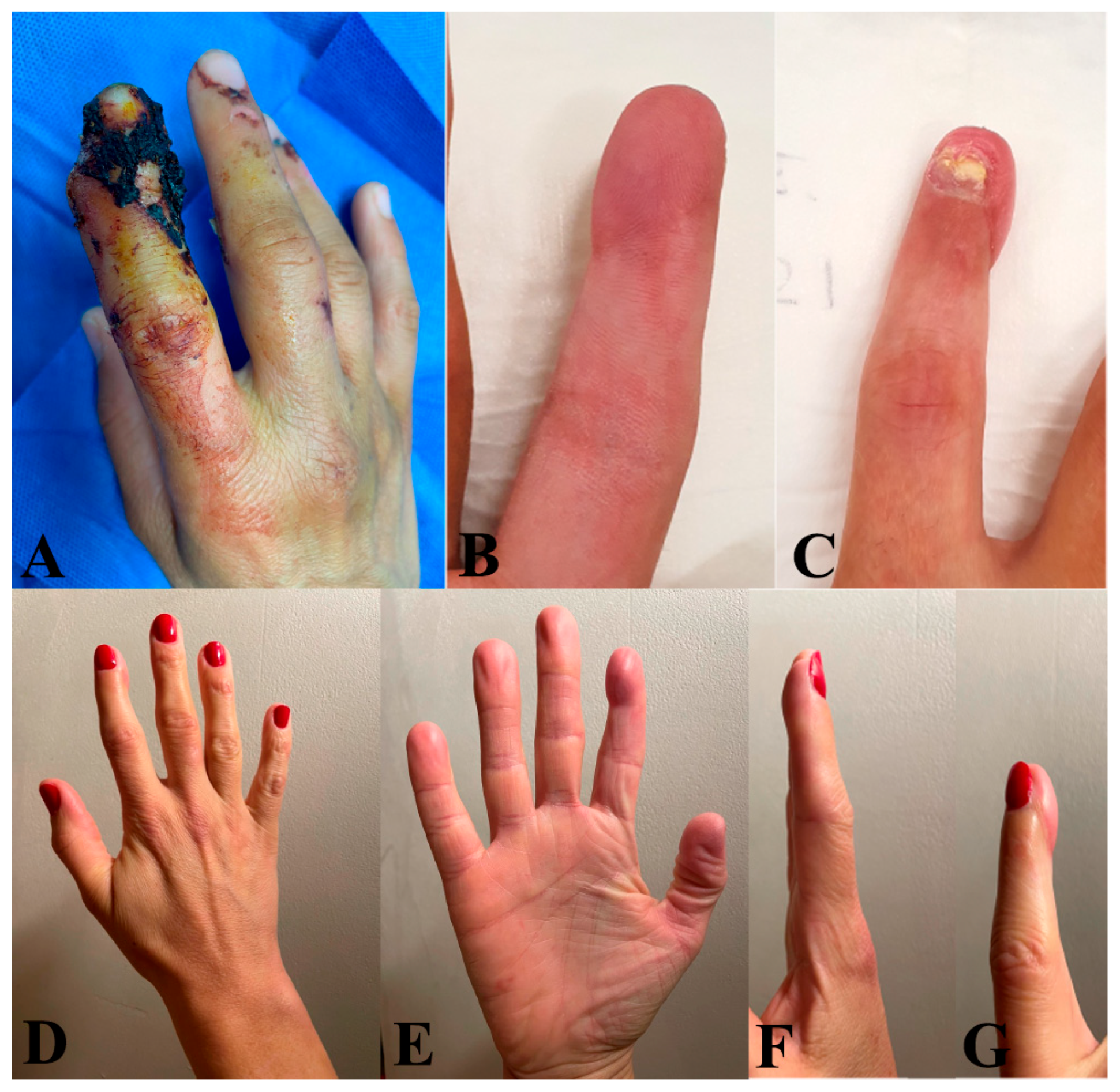
Case 1: A 46-year-old woman manual worker presented with a distal subamputation of the index fingertip. The mechanism was a crush injury by a circular saw blade. The patient was treated at a peripheral hospital with simple skin suturing, without any diagnostic investigation or additional surgical procedure. The patient subsequently presented to our attention with presence of dried blood over the dorsal aspect of distal phalanx, nail bed necrosis and viable soft tissue margin (Figure 1A). The patient was a current smoker (15 pack-years) and non-diabetic; no other relevant comorbidities. ESWT was initiated on post-trauma day 10. The patient received three weekly sessions of focused ESWT (EFD 0.10 mJ/mm2, 800 impulses/cm2 each) followed by other three further sessions weekly for a total of 6 sessions. No local anesthesia was required. During treatment, standard moist wound dressings were maintained; no adjunctive regenerative grafts or flaps were used. After session 3 (Figure 1B,C), photographs documented well-vascularized granulation tissue covering > 70% of the defect; VAS pain decreased from 6 to 3. Capillaroscopy (performed on the adjacent nailfold area) showed increase in visible capillary loops from baseline 3.2 to 5.8 (semi-quantitative score) indicating enhanced microcirculation. At end of treatment (Figure 1D–G), a complete epithelialization was achieved. CEA (erythema) reduced from baseline 2 to 0, IGA-I reduced from baseline 3 to 1. BWAT score improved from 47 to 18. SWMT improved from 5.4 to 3.2; 2-point discrimination (2PD) reduced from 13 mm to 5 mm; ROM of the index finger recovered to 98% of contralateral side. At 8-week follow-up, The skin over the fingertip was well integrated, soft and sensate (light touch and two-point discrimination maintained at 5 mm). The patient had returned to manual work without pain or cold intolerance.
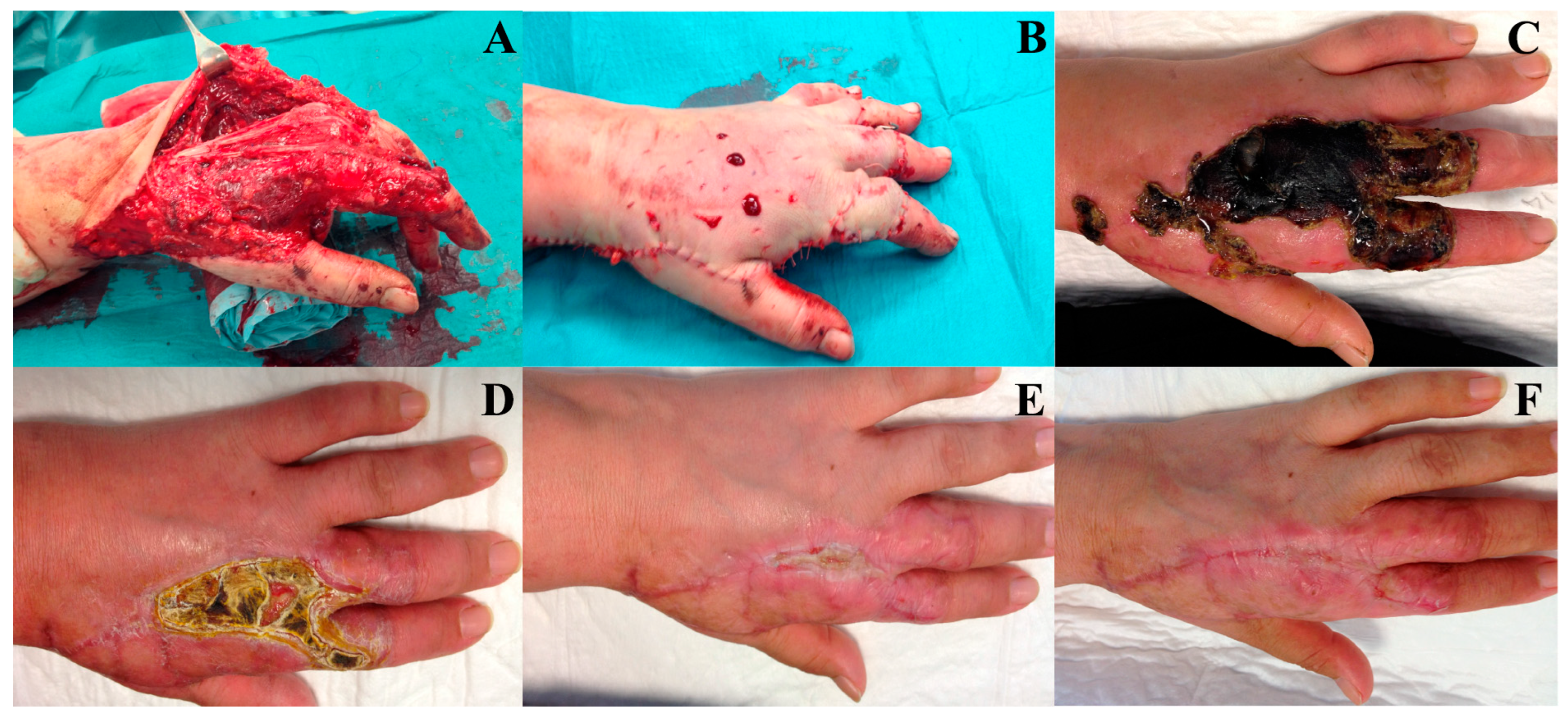
Case 2: A 51-year-old man sustained a severe post-traumatic degloving injury of the left hand following a road-traffic accident (Figure 2A). Initial management consisted of wound debridement and primary skin suturing without vascular assessment or reconstructive procedures. The patient presented 14 days after trauma with partial skin necrosis involving the dorsal aspect of the proximal phalanx and metacarpal region, extending to the wound margins (Figure 2B,C). Following stabilization of the soft tissues, focused ESWT was initiated on day 30 post-trauma to enhance microvascular perfusion and promote tissue regeneration. Treatment parameters were identical to the standard protocol (EFD 0.10 mJ/mm2, 700–900 impulses/cm2, once weekly). A total of four sessions were administered. Standard local dressings were maintained between sessions; no skin grafts or adjunctive regenerative agents were used. After the second ESWT session (Figure 2D), the wound margins appeared more viable with reduction of the necrotic rim and early granulation tissue formation. Pain scores decreased from VAS 6 to 2, and inflammatory signs (CEA = 3 → 1; IGA-I = 4 → 1) diminished rapidly. At five weeks (Figure 2E), complete re-epithelialization was achieved with restoration of skin continuity and texture. No secondary necrosis or wound dehiscence occurred. At the 8-week follow-up (Figure 2F), the reconstructed area remained stable and supple with normal pigmentation and sensitivity to light touch. The ROM of the fingers was 90% of the contralateral hand, and the patient resumed daily activities without discomfort.
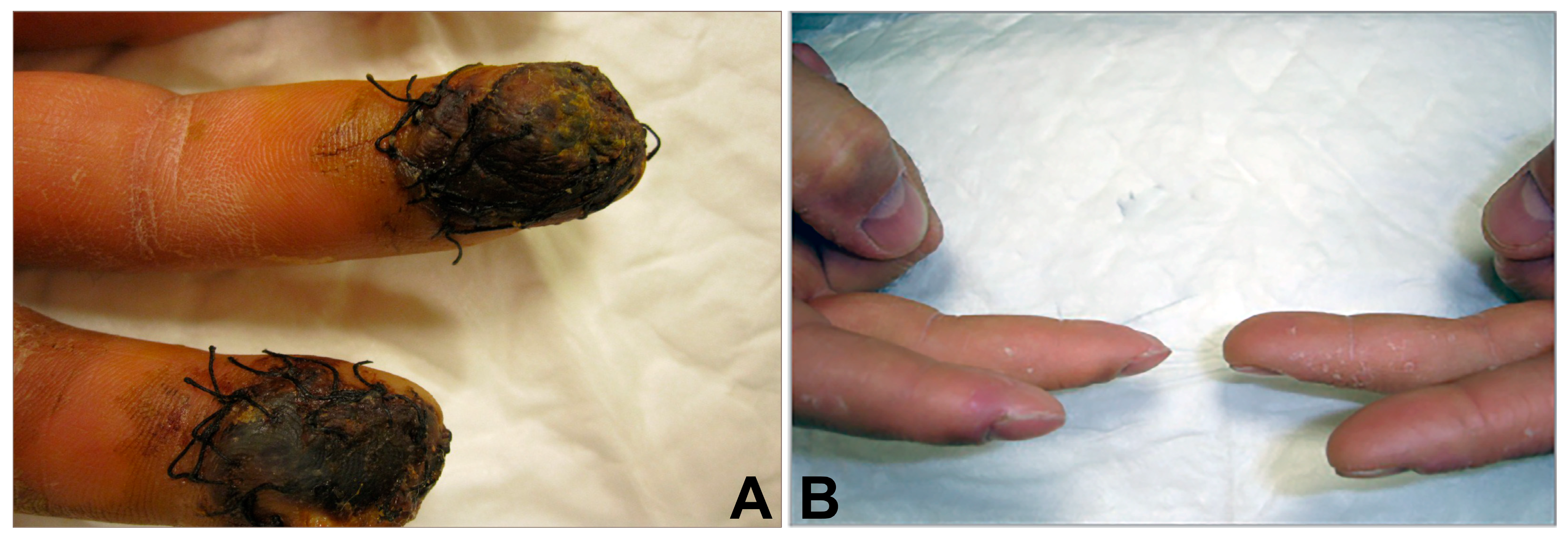
Case 3: A 43-year-old male carpenter presented with post-traumatic soft-tissue necrosis of the distal phalanges of the index and middle fingers after a crush injury (Figure 3A). Initial management at a peripheral center consisted of wound cleaning and primary closure with non-absorbable sutures. Upon referral to our unit 10 days later, the distal fingertip areas showed adherent eschar with apparent necrosis and fibrinous crusting but preserved capillary refill at the margins. Focused extracorporeal shock wave therapy (EFD 0.10 mJ/mm2; 900 impulses/cm2; one session per week) was initiated on day 12 post-trauma to stimulate microvascular remodeling and prevent tissue loss. A total of five sessions were administered, without adjunctive grafts or flaps. At six weeks, complete re-epithelialization of both fingertips had occurred with full restoration of contour and pigmentation (Figure 3B). No secondary necrosis or infection was recorded. Pain (VAS 6 → 1), erythema (CEA 3 → 0), and inflammation (IGA-I 4 → 1) markedly improved, while sensory function normalized (2PD 5 mm; SWMT 3.2). Functional assessment revealed a full active range of motion and tactile discrimination comparable to the contralateral hand, with no stiffness or sensory deficit. The patient resumed manual activity without discomfort, and skin suppleness and sensitivity were maintained at 8-week follow-up.

3.1.7. Statistical Outcomes

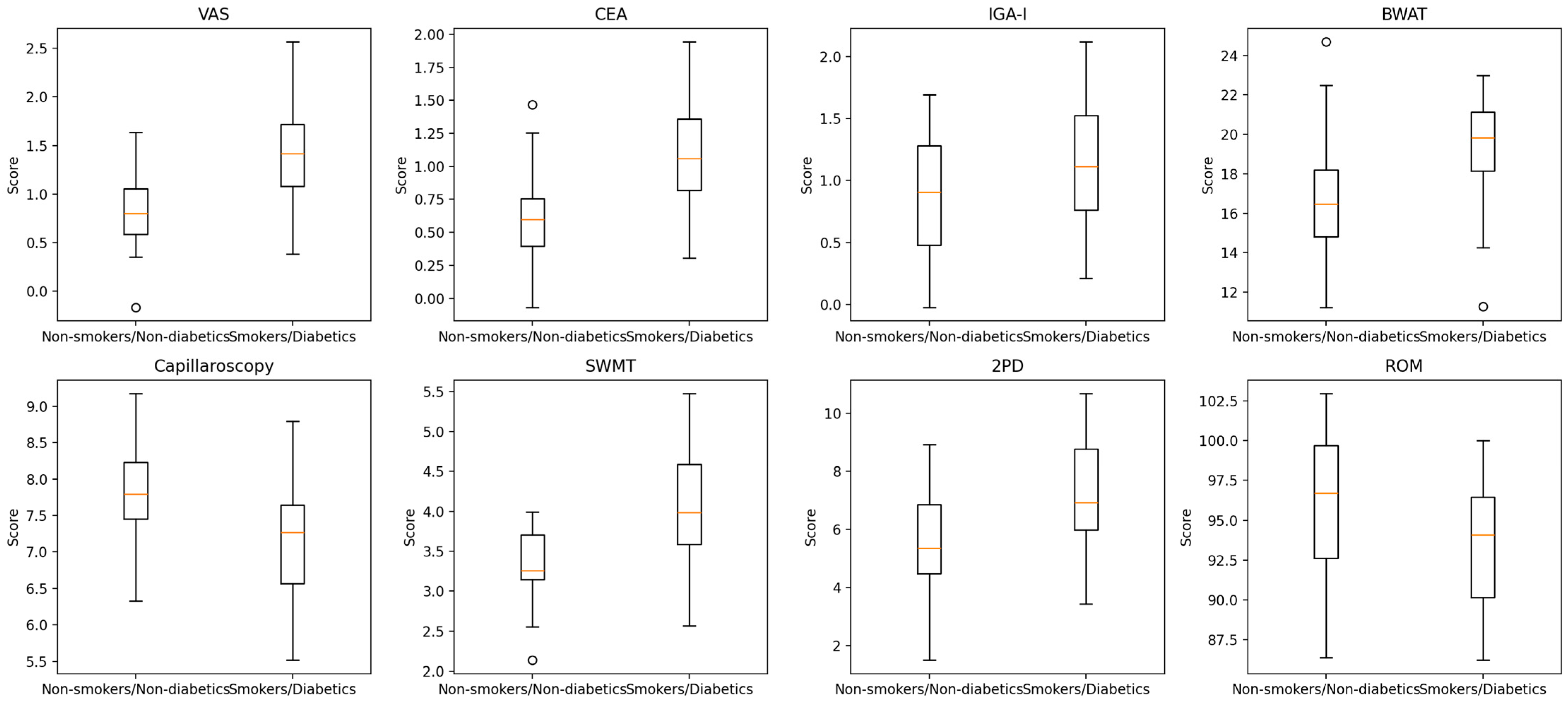
Significant improvements were observed in all primary outcomes—VAS, CEA, IGA-I, BWAT, capillaroscopy score, SWMT, 2PD, and ROM recovery—across the treatment timeline (baseline, after three ESWT sessions, end of treatment, and 8-week follow-up). Pain and inflammatory indices progressively decreased, while wound healing parameters and functional outcomes improved over time (p < 0.05 for all), as summarized in Table 4 and illustrated in Figure 4.
Between-group comparisons showed that smoking and diabetic patients had a slower progression, with persistently higher scores of pain, erythema, inflammation, and BWAT, and lower capillaroscopy and functional recovery values (p < 0.05 for all). Nevertheless, despite this delayed trajectory, by the end of follow-up both cohorts achieved comparable final outcomes.
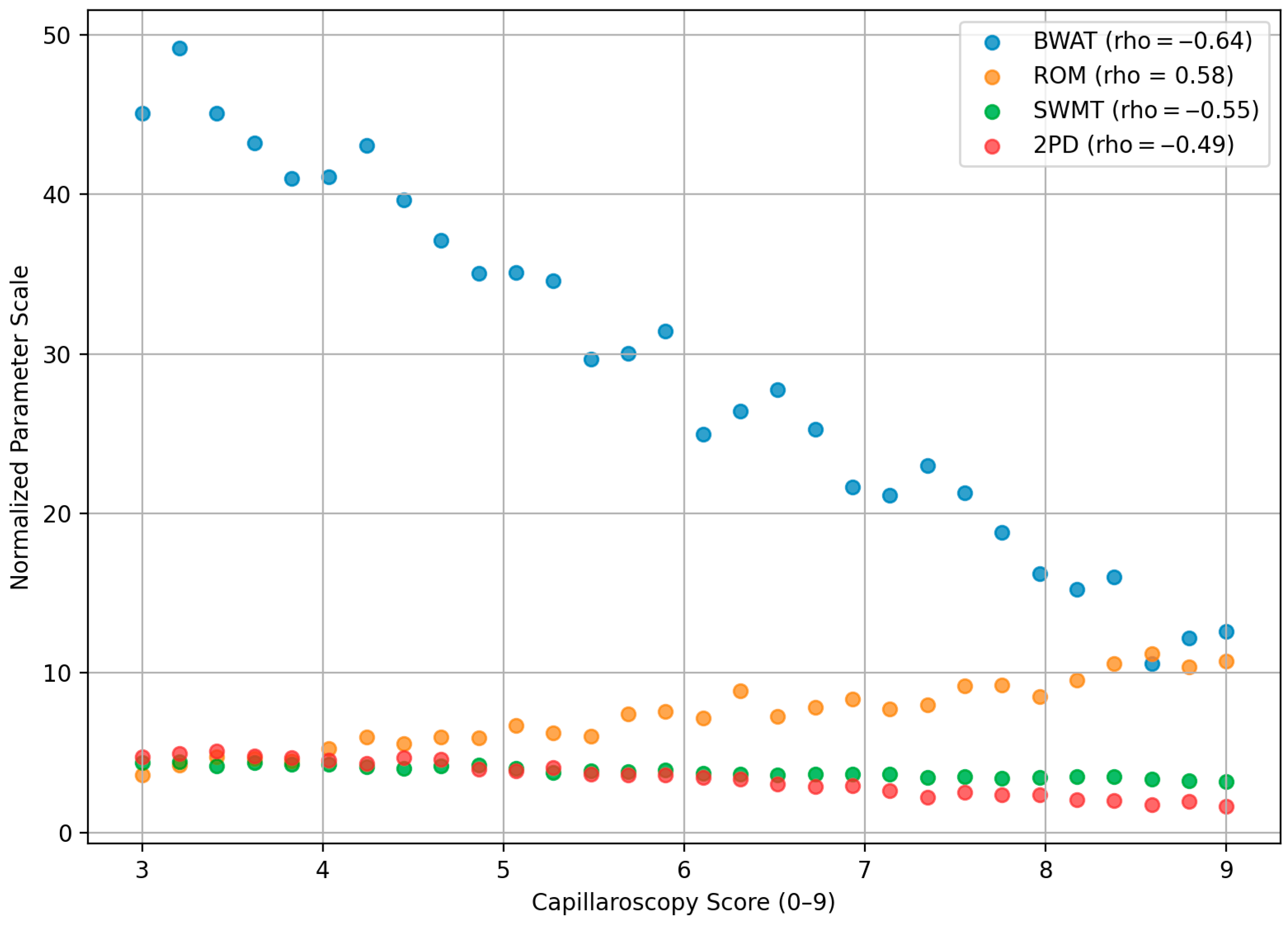
Correlation analysis demonstrated consistent and clinically relevant associations between microvascular remodeling and clinical recovery. Capillaroscopy scores correlated inversely with BWAT (ρ = −0.64, p < 0.01), SWMT (ρ = −0.55, p < 0.05), and 2PD (ρ = −0.49, p < 0.05), and positively with ROM recovery (ρ = 0.58, p < 0.01), as summarized in Table 5 and depicted in Figure 5. These findings indicate that improved capillary density and morphology are strongly associated with faster epithelialization, enhanced sensory function, and greater joint mobility.
Subgroup analysis confirmed that diabetic and smoking patients required a significantly longer healing period (5.8 ± 1.3 weeks) compared with non-diabetic, non-smoking patients (4.2 ± 0.9 weeks, p = 0.03). However, by week 8, BWAT, capillaroscopy, and ROM values converged between groups, suggesting that once healing had been achieved, the regenerative outcomes of ESWT were ultimately comparable across risk profiles.

4. Discussion

In this prospective study we evaluated the effects of extracorporeal shock wave therapy (ESWT) on wound healing, pain, microvascular remodeling, sensory recovery, and joint mobility in patients with chronic ulcerative lesions. Overall, ESWT was associated with a clinically meaningful improvement in tissue quality and pain control, together with progressive recovery of sensory function and range of motion over the follow-up period. Although diabetic and smoking patients exhibited a slower early trajectory of healing, by the end of follow-up both high-risk and low-risk cohorts achieved comparable final outcomes, suggesting that once the reparative process is initiated, the regenerative potential induced by ESWT tends to converge across different risk profiles. It is important to underline that this study was not designed to demonstrate superiority of ESWT over conventional reconstructive or wound-care techniques, but to assess its feasibility, safety, and biological effectiveness in real-world clinical practice. These results confirm the reproducibility and clinical feasibility of a standardized ESWT protocol for soft-tissue defects of the hand, supporting its potential translation into broader reconstructive and regenerative practice.
Our findings are consistent with previous reports showing that ESWT can accelerate the healing of chronic wounds, particularly in patients with diabetes or vascular compromise. Randomized and observational studies on diabetic foot ulcers have demonstrated that ESWT, when added to standard wound care, increases the rate of complete wound closure and reduces healing time compared with conventional therapy alone [37,38]. Similar effects have been described in venous leg ulcers and pressure ulcers, with improvements in epithelialization, granulation tissue formation, and overall wound severity scores [39,40]. Comparable outcomes were reported by Zhang and colleagues [8], Dolibog and colleagues [17], and Wu and colleagues [18], who documented enhanced re-epithelialization and microvascular remodeling following ESWT in chronic cutaneous wounds. The present study extends these observations to hand soft-tissue reconstruction, confirming consistent trends across different anatomical and etiological contexts.
In our cohort, the progressive reduction in BWAT scores from baseline to the end of follow-up, together with the convergence of wound status across subgroups at week 8, supports the concept that ESWT can “unlock” stalled or slowly healing ulcers, even in the presence of adverse systemic risk factors.
Furthermore, the biological mechanisms underlying these effects are in line with the growing body of literature describing the regenerative and homeostatic roles of low-intensity shockwave therapy (LISWT). Beyond musculoskeletal and vascular applications, ESWT has been demonstrated to improve endothelial function and tissue oxygenation in various clinical settings. For instance, low-intensity shockwave treatment improved penile rigidity in eugonadal subjects with erectile dysfunction, through the activation of nitric oxide signaling and microvascular recruitment [41]. Similarly, shockwave therapy has been described as an effective regenerative tool in stress fractures, promoting angiogenesis and bone turnover through mechanotransduction pathways [42]. Experimental data also support a pivotal immunomodulatory role of shockwaves in tissue repair. Sukubo et al. demonstrated that ESWT modulates macrophage polarization toward an anti-inflammatory, reparative phenotype, fostering tissue remodeling and extracellular matrix regeneration [43]. Similarly, Craig et al. hypothesized that the biological action of shockwaves may serve as a “homeostatic autoimmune restorative treatment,” promoting immune balance and self-repair in chronic degenerative diseases [44]. From a clinical standpoint, ESWT has shown promising outcomes in several orthopedic and reconstructive applications, including bone marrow edema syndrome [45], pillar pain after carpal tunnel release [46], and Kienböck’s disease [47]. These results align with our current findings and reinforce the concept that ESWT exerts a pleiotropic regenerative influence extending beyond musculoskeletal repair to encompass microvascular and neural components of soft tissue healing.
While the temporal association between ESWT application and progressive healing is strong, the observational design of this study does not allow for definitive causal inference. The improvements in capillaroscopy and clinical parameters should therefore be interpreted as consistent with the known biological effects of ESWT rather than as exclusive proof of causality. Future randomized controlled trials will be necessary to confirm these associations under controlled conditions. A key aspect of the present work is the close relationship between microvascular remodeling and clinical recovery. Correlational analysis using Spearman’s rank coefficient showed that capillaroscopy values were inversely correlated with BWAT, SWMT, and 2PD and positively correlated with ROM recovery (ρ = −0.64, p < 0.01 for BWAT; ρ = −0.55, p < 0.05 for SWMT; ρ = −0.49, p < 0.05 for 2PD; ρ = 0.58, p < 0.01 for ROM). These associations indicate that improved capillary density and morphology are linked not only to faster epithelialization but also to better sensory function and greater joint mobility. From a pathophysiological perspective, this is plausible given that ESWT has been shown to promote angiogenesis, upregulate pro-angiogenic and pro-regenerative mediators, modulate inflammation, and stimulate fibroblast and endothelial cell activity. Enhanced microvascular perfusion may provide a more favorable environment for oxygen and nutrient delivery, waste removal, and cellular turnover, ultimately facilitating tissue regeneration and functional recovery.
The different temporal pattern observed in diabetic and smoking patients is also in line with current knowledge on chronic wound pathophysiology. Both diabetes and smoking are associated with endothelial dysfunction, impaired angiogenesis, reduced nitric oxide bioavailability, and chronic low-grade inflammation, all of which contribute to delayed wound healing and a higher risk of ulcer persistence or recurrence. In our study, diabetic and smoking patients required a significantly longer healing period compared with non-diabetic, non-smoking patients (5.8 ± 1.3 vs. 4.2 ± 0.9 weeks, p = 0.03), confirming the detrimental impact of these factors on the kinetics of tissue repair. However, by week 8 the overall BWAT, capillaroscopy, and ROM values had converged between groups, suggesting that ESWT can partially compensate for the baseline disadvantage of high-risk patients, provided that sufficient time and adequate supportive care are ensured. Clinically, this means that expectations regarding the speed of healing should be more cautious in diabetic and smoking patients, but the ultimate regenerative outcome may still be comparable if the therapeutic window is extended and systemic risk factors are adequately managed.
Another relevant finding is the consistent improvement in pain and sensory parameters. Reduction in VAS scores over time is in agreement with previous reports indicating that ESWT can modulate nociceptive pathways, possibly through a combination of peripheral and central mechanisms, including altered expression of neuropeptides, changes in local inflammatory mediators, and modulation of mechanosensitive nociceptors. The parallel improvement in SWMT and 2PD suggests that ESWT may also support sensory recovery and neural remodeling, which is particularly relevant in patients with neuropathic components or long-standing ulcers. The observed positive correlation between capillaroscopy and ROM recovery further supports the idea that microvascular improvements translate into better functional outcomes, likely by reducing pain, stiffness, and periarticular fibrosis, and by promoting more effective tissue remodeling around joints.
Taken together, these data reinforce the concept of ESWT as a multimodal regenerative therapy rather than a purely mechanical intervention. By simultaneously targeting microcirculation, inflammation, nociception, and tissue repair, ESWT appears to facilitate an integrated recovery of structural, sensory, and functional domains. In this context, capillaroscopy emerges as a particularly valuable tool, providing an objective measure of microvascular status that correlates with both wound severity and patient-centered outcomes. Its use in routine clinical practice could help identify early responders and non-responders, monitor the biological impact of ESWT over time, and guide personalized adjustments in treatment intensity and duration.
This study has some limitations that must be taken into account. The overall sample size, although sufficient to detect significant changes in key endpoints, remains relatively modest and derives from a single center, which may limit external validity. The lack of a control group treated exclusively with standard care prevents us from attributing all observed improvements solely to ESWT, even if the direction and magnitude of the effects are consistent with prior controlled trials. In addition, although we stratified patients by diabetes and smoking status, we could not comprehensively adjust for all potential confounders, such as detailed glycemic control indices, duration and severity of neuropathy, concomitant medications, and adherence to offloading and wound-care protocols. Capillaroscopic assessment, despite being performed with standardized procedures, may still be subject to intra- and inter-observer variability, and the use of composite scores may not fully capture the complexity of local microvascular changes. Finally, the follow-up period was limited to the early and intermediate phases of regeneration; longer-term data on scar quality, recurrence rates, and durability of functional gains would be needed to fully characterize the lasting impact of ESWT. When the aim of a clinical investigation is to assess the regenerative potential and methodological feasibility of an innovative therapy, an observational design can be scientifically appropriate and ethically justified. This approach allows detailed monitoring of temporal biological and functional responses without subjecting patients to potentially inequitable treatment allocation. Accordingly, ESWT outcomes were analyzed within subjects over time, providing insight into the regenerative mechanisms and clinical trajectory of healing.
Despite these limitations, our findings add to the growing body of evidence supporting ESWT as a valuable adjunctive option in the multidisciplinary management of chronic ulcers, particularly in patients at increased vascular and metabolic risk. Future studies with larger, multicenter samples and randomized controlled designs are warranted to confirm these results, refine the optimal ESWT protocol in different etiological subgroups, and further explore the integration of microvascular imaging and sensory assessment into personalized rehabilitation pathways.

5. Conclusions

In summary, this prospective observational study demonstrates that extracorporeal shock wave therapy (ESWT) is associated with meaningful improvements in wound healing, microvascular architecture, sensory recovery, and joint mobility in patients with chronic hand ulcers. Although diabetic and smoking patients required a longer healing period, by the end of follow-up, their structural and functional outcomes were comparable to those of non-diabetic, non-smoking individuals, suggesting that ESWT can effectively promote tissue regeneration across different risk profiles when adequate follow-up is ensured.
The strong correlations between capillaroscopic findings and clinical recovery support the concept that microvascular remodeling is a key mediator of ESWT efficacy. Capillaroscopy emerges as a valuable, objective tool for monitoring treatment response and linking local vascular changes to functional outcomes. Taken together, these results reinforce the potential of ESWT as a multimodal regenerative adjunct in the multidisciplinary management of complex ulcers, particularly in patients with vascular and metabolic comorbidities.
The observational design confirms the real-world feasibility and biological plausibility of this protocol while recognizing that, in the absence of a control group, the observed benefits cannot be solely attributed to ESWT. Future prospective, multicenter, and randomized studies comparing ESWT with conventional reconstructive techniques—such as skin grafts or local and free flaps—are warranted to validate these findings, refine treatment protocols, and better define the role of microvascular imaging and sensory assessment in guiding personalized ESWT-based rehabilitation strategies.

Author Contributions

Conceptualization, L.M.; methodology, L.M. and F.D.F.; validation, A.L. and M.R.; formal analysis, L.M., M.C.D. and F.D.F.; investigation, L.M., M.C.D. and F.D.F.; resources, A.L. and M.R.; data curation, L.M., M.C.D. and F.D.F.; writing—original draft preparation, F.D.F.; writing—review and editing, F.D.F.; visualization, A.L. and M.R.; supervision, A.L. and M.R.; project administration, A.L. and M.R. All authors have read and agreed to the published version of the manuscript.

Funding

This research received no external funding.

Institutional Review Board Statement

The study was conducted in accordance with the Declaration of Helsinki and approved by the Institutional Review Board of IRCCS Ospedale Galeazzi–Sant’Ambrogio, Milan, Italy (protocol code ESWT-Hand-2021, approved on 15 January 2021).

Informed Consent Statement

Informed consent was obtained from all subjects involved in the study and written informed consent has been obtained from the patients to publish this paper.

Data Availability Statement

The data presented in this study are available on reasonable request from the corresponding author. The data are not publicly available due to privacy and ethical restrictions, as they include clinical information and photographic material of patients treated at IRCCS Ospedale Galeazzi–Sant’Ambrogio (Milan, Italy) and Azienda Ospedaliera Universitaria delle Marche (Ancona, Italy).

Conflicts of Interest

The authors declare no conflicts of interest.

Abbreviations

The following abbreviations are used in this manuscript:
ESWTExtracorporeal Shock Wave Therapy
EFDEnergy Flux Density
VASVisual Analogue Scale
CEAClinical Erythema Assessment
IGA-IInvestigator’s Global Assessment of Inflammation
BWATBates–Jensen Wound Assessment Tool
ROMRange of Motion
SWMTSemmes–Weinstein Monofilament Test
2PDTwo-Point Discrimination
NONitric Oxide
VEGFVascular Endothelial Growth Factor
eNOSEndothelial Nitric Oxide Synthase
IRCCSIstituto di Ricovero e Cura a Carattere Scientifico

References

  1. Friedrich, J.B.; Katolik, L.I.; Vedder, N.B. Soft tissue reconstruction of the hand. J. Hand Surg. Am. 2009, 34, 1148–1155. [Google Scholar] [CrossRef]
  2. Levin, L.S. The reconstructive ladder: An orthoplastic approach. Orthop. Clin. N. Am. 1993, 24, 393–409. [Google Scholar] [CrossRef]
  3. Simman, R. Wound closure and the reconstructive ladder in plastic surgery. J. Am. Col. Certif. Wound Spec. 2009, 1, 6–11. [Google Scholar] [CrossRef]
  4. Grosu-Bularda, A.; Hodea, F.V.; Cretu, A.; Lita, F.F.; Bordeanu-Diaconescu, E.M.; Vancea, C.V.; Lascar, I.; Popescu, S.A. Reconstructive paradigms: A problem-solving approach in complex tissue defects. J. Clin. Med. 2024, 13, 1728. [Google Scholar] [CrossRef]
  5. De Francesco, F.; Zingaretti, N.; Parodi, P.C.; Riccio, M. The evolution of current concept of the reconstructive ladder in plastic surgery: The emerging role of translational medicine. Cells 2023, 12, 2567. [Google Scholar] [CrossRef] [PubMed]
  6. Da Silva, K.; Kumar, P.; Choonara, Y.E. The paradigm of stem cell secretome in tissue repair and regeneration: Present and future perspectives. Wound Repair. Regen. 2025, 33, e13251. [Google Scholar] [CrossRef] [PubMed]
  7. Mittermzyr, R.; Antonic, V.; Hartinger, J.; Kaufmann, H.; Redl, H.; Teot, L.; Stojadinovic, A.; Schaden, W. Extracorporeal shock wave therapy (ESWT) for wound healing: Technology, mechanisms, and clinical efficacy. Wound Repair. Regen. 2012, 20, 456–465. [Google Scholar] [CrossRef]
  8. Zhang, L.; Fu, X.B.; Chen, S.; Zhao, Z.B.; Schmitz, C.; Weng, C.S. Efficacy and safety of extracorporeal shock wave therapy for acute and chronic soft tissue wounds: A systematic review and meta-analysis. Int. Wound J. 2018, 15, 590–599. [Google Scholar] [CrossRef]
  9. Yang, R.; Ren, L.; Wang, H.; Guo, L.; Liu, L.; Chen, M.; Tian, X. Extracorporeal shockwave therapy for the treatment of deep dermal burns of the hand: A preliminary study. J. Plast. Reconstr. Aesthet. Surg. 2025, 102, 185–194. [Google Scholar] [CrossRef]
  10. Sugiyama, T.; Murakami, H.; Tanaka, S.; Yoshida, S.; Sato, T.; Hiraoka, K. Effects of extracorporeal Shockwave therapy on wound healing in rats. Cureus 2025, 17, e83369. [Google Scholar] [CrossRef] [PubMed]
  11. Auersperg, V.; Trieb, K. Extracorporeal shock wave therapy: An update. EFORT Open Rev. 2020, 5, 584–592. [Google Scholar] [CrossRef]
  12. Rola, P.; Wlodarczak, A.; Barycki, M.; Doroszko, A. Use of the shock wave therapy in basic research and clinical applications-from bench to bedsite. Biomedicines 2022, 10, 568. [Google Scholar] [CrossRef] [PubMed]
  13. Wang, C.J. Extracorporeal shockwave therapy in musculoskeletal disorders. J. Orthop. Surg. Res. 2012, 7, 11. [Google Scholar] [CrossRef] [PubMed]
  14. Simplicio, C.L.; Purita, J.; Murrell, W.; Santos, G.S.; Gonzales Dos Santos, R.; Santos Duarte Lana, J.F. Extracorporeal shock wave therapy mechanisms in musculoskeletal regenerative medicine. J. Clin. Orthop. Trauma. 2020, 11, S309–S318. [Google Scholar] [CrossRef]
  15. Ferraro, G.A.; De Francesco, F.; Cataldo, C.; Rossano, F.; Nicoletti, G.; D’Andrea, F. Synergistic effects of cryolipolysis and shock waves for noninvasive body contouring. Aesthetic Plast. Surg. 2012, 36, 666–679. [Google Scholar] [CrossRef]
  16. Knobloch, K.; Kraemer, R. Extracorporeal shock wave therapy (ESWT) for the treatment of cellulite—A current meta analysis. Int. J. Surg. 2015, 24, 210–217. [Google Scholar] [CrossRef] [PubMed]
  17. Dolibog, P.; Dolibog, P.; Franek, A.; Brzezinska-Wcislo, L.; Arasiewicz, H.; Wrobel, B.; Chmielewska, D.; Ziaja, J.; Blaszczak, E. Randomized, controlled clinical pilot study of venous leg ulcers treated with using two types of shockwave therapy. Int. J. Med. Sci. 2018, 15, 1275–1285. [Google Scholar] [CrossRef]
  18. Wu, F.; Qi, Z.; Pan, B.; Tao, R. Extracorporeal shock wave therapy (ESWT) favors healing of diabetic foot ulcers: A systematic review and meta-analysis. Diabetes Res. Clin. Pract. 2024, 217, 111843. [Google Scholar] [CrossRef]
  19. Kuo, Y.R.; Wang, C.T.; Wang, F.S.; Yang, K.D.; Chiang, Y.C.; Wang, C.J. Extracorporeal shock wave treatment modulates skin fibroblast recruitment and leukocyte infiltration for enhancing extended skin-flap survival. Wound Repair. Regen. 2009, 17, 80–87. [Google Scholar] [CrossRef]
  20. Kuo, Y.R.; Wang, C.T.; Wang, F.S.; Chiang, Y.C.; Wang, C.J. Extracorporeal shock-wave therapy enhanced wound healing via increasing topical blood perfusion and tissue regeneration in a rat model of STZ-induced diabetes. Wound Repair. Regen. 2009, 17, 522–530. [Google Scholar] [CrossRef]
  21. Weihs, A.M.; Fuchs, C.; Teuschl, A.H.; Hartinger, J.; Slezak, P.; Mittermayr, R.; Redl, H.; Junger, W.G.; Sitte, H.H.; Runzler, D. Shock wave treatment enhances cell proliferation and improves wound healing by ATP release-coupled extracellular signal-regulated kinase (ERK) activation. J. Biol. Chem. 2014, 289, 27090–27104. [Google Scholar] [CrossRef]
  22. Kou, D.; Chen, Q.; Wang, Y.; Xu, G.; Lei, M.; Tang, X.; Ni, H.; Zhang, F. The application of extracorporeal shock wave therapy on stem cells therapy to treat various diseases. Stem Cell Res. Ther. 2024, 15, 271. [Google Scholar] [CrossRef]
  23. Mariotto, S.; de Prati, A.C.; Cavalieri, E.; Amelio, E.; Marlinghaus, E.; Suzuki, H. Extracorporeal shock wave therapy in inflammatory diseases: Molecular mechanism that triggers anti-inflammatory action. Curr. Med. Chem. 2009, 16, 2366–2372. [Google Scholar] [CrossRef]
  24. Datey, A.; Thaha, C.S.A.; Patil, S.R.; Gopalan, J.; Chakravortty, D. Shockwave Therapy Efficiently Cures Multispecies Chronic Periodontitis in a Humanized Rat Model. Front. Bioeng. Biotechnol. 2019, 7, 382. [Google Scholar] [CrossRef]
  25. Milstrey, A.; Rosslenbroich, S.; Everding, J.; Raschke, M.J.; Richards, R.G.; Moriarty, T.F.; Puetzler, J. Antibiofilm efficacy of focused high-energy extracorporeal shockwaves and antibiotics in vitro. Bone Joint Res. 2021, 10, 77–84. [Google Scholar] [CrossRef]
  26. Ryskalin, L.; Morucci, G.; Natale, G.; Soldani, P.; Gesi, M. Molecular Mechanisms Underlying the Pain-Relieving Effects of Extracorporeal Shock Wave Therapy: A Focus on Fascia Nociceptors. Life 2022, 12, 743. [Google Scholar] [CrossRef] [PubMed]
  27. Bae, W.J.; Shin, D.; Piao, J.J.; Kim, S.; Choi, Y.S.; Park, B.H.; Jung, H.J.; Sorkhi, S.; Chawla, S.; Cheon, C.W.; et al. Extracorporeal Shockwave Therapy Alleviates Inflammatory Pain by Down-Regulating NLRP3 Inflammasome in Experimental Chronic Prostatitis and Chronic Pelvic Pain Syndrome. World J. Mens. Health 2024, 42, 157–167. [Google Scholar] [CrossRef] [PubMed]
  28. Joo, S.Y.; Lee, S.Y.; Cho, Y.S.; Seo, C.H. Clinical Utility of Extracorporeal Shock Wave Therapy on Hypertrophic Scars of the Hand Caused by Burn Injury: A Prospective, Randomized, Double-Blinded Study. J. Clin. Med. 2020, 9, 1376. [Google Scholar] [CrossRef] [PubMed]
  29. Lee, S.Y.; Cho, Y.S.; Seo, C.H.; Seo, J.; Joo, S.Y. Clinical utility of extracorporeal shock wave therapy in restoring hand function of patients with nerve injury and hypertrophic scars due to burns: A prospective, randomized, double-blinded study. Int. J. Surg. 2024, 110, 7487–7494. [Google Scholar] [CrossRef]
  30. Huskisson, E.C. Measurement of pain. Lancet 1974, 2, 1127–1131. [Google Scholar] [CrossRef]
  31. Tan, J.; Liu, H.; Leyden, J.J.; Leoni, M.J. Reliability of Clinician Erythema Assessment grading scale. J. Am. Acad. Dermatol. 2014, 71, 760–763. [Google Scholar] [CrossRef]
  32. Bates-Jensen, B.M.; McCreath, H.E.; Harputlu, D.; Patlan, A. Reliability of the Bates-Jensen wound assessment tool for pressure injury assessment: The pressure ulcer detection study. Wound Repair. Regen. 2019, 27, 386–395. [Google Scholar] [CrossRef]
  33. Cutolo, M.; Sulli, A.; Secchi, M.E.; Paolino, S.; Pizzorni, C. Nailfold capillaroscopy is useful for the diagnosis and follow-up of autoimmune rheumatic diseases. A future tool for the analysis of microvascular heart involvement? Rheumatology 2006, 45, iv43–iv46. [Google Scholar] [CrossRef] [PubMed]
  34. Soucie, J.M.; Wang, C.; Forsyth, A.; Funk, S.; Denny, M.; Roach, K.E.; Boone, D.; Hemophilia Treatment Center Network. Range of motion measurements: Reference values and a database for comparison studies. Haemophilia 2011, 17, 500–507. [Google Scholar] [CrossRef] [PubMed]
  35. Dellon, A.L.; Mackinnon, S.E.; Crosby, P.M. Reliability of two-point discrimination measurements. J. Hand Surg. Am. 1987, 12, 693–696. [Google Scholar] [CrossRef]
  36. Bell-Krotoski, J.; Tomancik, E. The repeatability of testing with Semmes-Weinstein monofilaments. J. Hand Surg. Am. 1987, 12, 155–161. [Google Scholar] [CrossRef]
  37. Moretti, B.; Notarnicola, A.; Garofalo, R.; Moretti, L.; Patella, S.; Marlinghaus, E.; Patella, V. Shock waves in the treatment of stress fractures. Ultrasound Med. Biol. 2009, 35, 1042–1049. [Google Scholar] [CrossRef]
  38. Snyder, R.; Galiano, R.; Mayer, P.; Rogers, L.C.; Alvarez, O. Sanuwave Trial Investigators Diabetic foot ulcer treatment with focused shockwave therapy: Two multicentre prospective controlled double-blinded randomised phase IIIclinical trials. J. Wound Care 2018, 27, 822–836. [Google Scholar] [CrossRef] [PubMed]
  39. Schaden, W.; Thiele, R.; Kölpl, C.; Pusch, M.; Nissan, A.; Attinger, C.E.; Maniscalco-Theberge, M.E.; Peoples, G.E.; Elster, E.A.; Stojadinovic, A. Shock wave therapy for acute and chronic soft tissue wounds: A feasibility study. J. Surg. Res. 2007, 143, 1–12. [Google Scholar] [CrossRef]
  40. Aschermann, I.; Noor, S.; Venturelli, S.; Sinnberg, T.; Mnich, C.D.; Busch, C. Extracorporal Shock Waves Activate Migration, Proliferation and Inflammatory Pathways in Fibroblasts and Keratinocytes, and Improve Wound Healing in an Open-Label, Single-Arm Study in Patients with Therapy-Refractory Chronic Leg Ulcers. Cell Physiol. Biochem. 2017, 41, 890–906. [Google Scholar] [CrossRef]
  41. Vena, W.; Vaccalluzzo, L.; La Vignera, S.; Morenghi, E.; D’Agostino, C.; Perri, A.; Giammusso, B.; Lania, A.G.; Aversa, A.; Pizzocaro, A. Low-intensity shockwave treatment (LISWT) improves penile rigidity in eugonadal subjects with erectile dysfunction: A pilot study. Minerva Endocrinol. 2023, 48, 4–11. [Google Scholar] [CrossRef]
  42. Leal, C.; D’Agostino, C.; Gomez Garcia, S.; Fernandez, A. Current concepts of shockwave therapy in stress fractures. Int. J. Surg. 2015, 24, 195–200. [Google Scholar] [CrossRef] [PubMed]
  43. Sukubo, N.G.; Tibalt, E.; Respizzi, S.; Locati, M.; d’Agostino, M.C. Effect of shock waves on macrophages: A possible role in tissue regeneration and remodeling. Int. J. Surg. 2015, 24, 124–130. [Google Scholar] [CrossRef] [PubMed]
  44. Craig, K.; d’Agostino, C.; Poratt, D.; Walker, M. Original hypothesis: Extracorporeal shockwaves as a homeostatic autoimmune restorative treatment (HART) for Type 1 diabetes mellitus. Med. Hypotheses 2014, 83, 250–253. [Google Scholar] [CrossRef] [PubMed]
  45. d’Agostino, C.; Romeo, P.; Lavanga, V.; Pisani, S.; Sansone, V. Effectiveness of extracorporeal shock wave therapy in bone marrow edema syndrome of the hip. Rheumatol. Int. 2014, 34, 1513–1518. [Google Scholar] [CrossRef]
  46. Romeo, P.; d’Agostino, M.C.; Lazzerini, A.; Sansone, V.C. Extracorporeal shock wave therapy in pillar pain after carpal tunnel release: A preliminary study. Ultrasound Med. Biol. 2011, 37, 1603–1608. [Google Scholar] [CrossRef] [PubMed]
  47. D’Agostino, C.; Romeo, P.; Amelio, E.; Sansone, V. Effectiveness of ESWT in the treatment of Kienböck’s disease. Ultrasound Med. Biol. 2011, 37, 1452–1456. [Google Scholar] [CrossRef]
Figure 1. Fingertip amputation of the index finger treated with focused extracorporeal shock wave therapy (ESWT). (A) Clinical aspect 10 days after the traumatic injury showing partial pulp loss and exposed tissue; (B,C) appearance after three ESWT sessions with progressive tissue formation and re-epithelialization; (DG) complete epithelialization and restoration of skin texture eight weeks after treatment, with normal sensitivity and preserved contour of the distal phalanx.
Surgeries 07 00004 g001
Figure 2. Post-traumatic degloving injury of the left hand with partial marginal skin necrosis treated with focused extracorporeal shock wave therapy (ESWT). (A) Initial appearance immediately after trauma; (B) Immediately after surgery, cutaneous hyperemia with signs of tissue distress was observed; (C) 14 days after injury, showing partial skin necrosis extending to the wound margins; (D) after two ESWT sessions, with progressive reduction of necrotic tissue and early granulation; (E) complete re-epithelialization and restoration of skin texture at week 5; (F) eight-week follow-up demonstrating stable, well-vascularized skin with preserved pigmentation and sensitivity.
Surgeries 07 00004 g002
Figure 3. Post-traumatic distal fingertip necrosis of the index and middle fingers treated with focused extracorporeal shock wave therapy (ESWT). (A) Initial presentation showing adherent eschar and fibrinous crust with preserved marginal perfusion; (B) complete re-epithelialization and restoration of skin texture, pigmentation, and contour six weeks after ESWT, comparable to the contralateral fingers.
Surgeries 07 00004 g003
Figure 4. Comparison of clinical and sensory outcomes between subgroups (smokers/diabetics vs. non-smokers/non-diabetics). Boxplots show significantly higher VAS, CEA, IGA-I, and BWAT scores among smokers and diabetics, indicating delayed healing and persistent inflammation (p < 0.05 for all). Conversely, capillaroscopy, SWMT, and ROM recovery values were lower in the same subgroup, suggesting slower microvascular and functional recovery.
Surgeries 07 00004 g004
Figure 5. Correlations between capillaroscopy score and clinical/sensory outcomes. Scatterplots demonstrate inverse correlations between capillaroscopy and BWAT (ρ = −0.64), SWMT (ρ = −0.55), and 2PD (ρ = −0.49), as well as a positive correlation with ROM recovery (ρ = 0.58). These findings indicate that improved microvascular density and organization are directly associated with enhanced healing, sensory restoration, and functional mobility.
Surgeries 07 00004 g005
Table 1. Validated scales and tools used for clinical and microvascular assessment.
Parameter EvaluatedAssessment Tool/ScaleRange/Grading
Pain Intensity [30]Visual Analogue Scale (VAS)0 = no pain–10 = worst imaginable pain
Erythema severity [31]Clinical Erythema Assessment (CEA)0 = none; 1 = mild; 2 = moderate; 3 = severe
Inflammation/EdemaInvestigator’s Global Assessment of Inflammation (IGA-I)0 = none; 1 = minimal; 2 = mild; 3 = moderate; 4 = severe
Wound healing/Epithelialization [32]Bates-Jensen Wound Assessment Tool (BWAT)13–65 (decrease indicates improvement)
Microvascular changes [33]Semi-quantitative Nailfold Capillaroscopy Score (Cutolo)0–9 (density, dimension, ramification 0–3 each)
Functional Recovery [34]Goniometric Measurement (AAOS standard)%recovery vs. contralateral hand
Sensory Recovery [35,36]Semes-Weinstein Monofilament Test (SWMT) and Two-Point Discrimination (2PD)SWMT: 2.83–6.65
2PD: <6 mm = normal; >15 mm = poor discrimination
Table 2. Demographic and clinical characteristics of the study population (n = 64).
VariableValue
Number of patients64
Sex (M/F)54/10
Mean age (years, range)46.3 ± 17.8 (21–74)
Dominant hand involved (n, %)38 (59%)
Smoking status (n, %)21 (33%) current smokers
Diabetes mellitus (n, %)7 (11%) controlled type 2 diabetes
Other comorbidities5 (8%) mild hypertension; no peripheral vascular disease
Anticoagulant/antiplatelet
therapy
6 (9%) low-dose ASA; no contraindications to ESWT
Type of lesionFingertip amputation/skin loss = 46 (72%)
Local flap necrosis = 8 (13%)
Postoperative wounds = 5 (8%)
Chronic post-traumatic ulcer/scar retraction = 5 (8%)
Etiology of injuryMechanical/crush = 27 (42%)
sharp injury = 21 (33%)
burn/electrical = 8 (13%)
chronic non-healing wound = 8 (13%)
Time since injury or surgery before ESWT (weeks)6.2 ± 3.4 (3–16)
Mean wound area at baseline (cm2)2.4 ± 1.1 (0.8–5.0)
Previous reconstructive procedures (n, %)9 (14%) prior local or free flap
Treatment sessions (mean ± SD)4.3 ± 1.2 (3–6)
Anesthesia required (n, %)22 (34%) local lidocaine 2% infiltration
Follow-up duration (weeks)8.5 ± 2.1
Adverse eventsNone reported (no infection, hematoma, or skin breakdown)
Table 3. Clinical and functional outcomes during ESWT treatment and follow-up (mean ± SD).
ParameterBaselineAfter 3
Sessions
End of
Treatment
8-Week
Follow-Up
p-Value
(Baseline vs. End)
VAS5.9 ± 0.72.1 ± 0.60.8 ± 0.50.6 ± 0.4<0.001
CEA2.6 ± 0.51.2 ± 0.40.6 ± 0.50.4 ± 0.3<0.01
IGA-I3.4 ± 0.61.6 ± 0.50.8 ± 0.40.6 ± 0.3<0.01
BWAT45.1 ± 3.928.5 ± 3.117.2 ± 3.016.5 ± 2.7<0.01
Capillaroscopy Score (0–9)3.6 ± 0.86.1 ± 0.77.7 ± 0.67.8 ± 0.5<0.05
SWMT (Monofilament)5.12 ± 0.74.31 ± 0.63.61 ± 0.63.48 ± 0.5<0.05
2PD (mm)12.8 ± 2.38.5 ± 1.96.4 ± 1.86.1 ± 1.7<0.05
ROM Recovery (%)40.2 ± 9.772.4 ± 7.394.7 ± 5.395.1 ± 4.8<0.001
Table 4. Statistical results for subgroups (smokers/diabetics vs. non).
ParameterNon-Smokers/Non Diabetics (Mean ± SD)Smokers/Diabetics
(Mean ± SD)
p-Value
VAS (pain)0.8 ± 0.41.3 ± 0.60.02
CEA (erythema)0.6 ± 0.31.1 ± 0.40.04
IGA-I (inflammation)0.8 ± 0.41.2 ± 0.50.03
BWAT (wound healing)17.0 ± 2.820.2 ± 3.10.03
Capillaroscopy score (0–9)7.9 ± 0.67.2 ± 0.80.04
SWMT (monofilament)3.5 ± 0.53.9 ± 0.60.05
2PD (mm)6.0 ± 1.87.2 ± 2.10.03
ROM recovery (%)95.5 ± 4.891.8 ± 5.40.02
Table 5. Correlations between capillaroscopy and clinical/sensory parameters.
CorrelationSpearman ρp-Value
Capillaroscopy vs. BWAT−0.64<0.01
Capillaroscopy vs. ROM0.58<0.01
Capillaroscopy vs. SWMT−0.55<0.05
Capillaroscopy vs. 2PD−0.49<0.05
Disclaimer/Publisher’s Note: The statements, opinions and data contained in all publications are solely those of the individual author(s) and contributor(s) and not of MDPI and/or the editor(s). MDPI and/or the editor(s) disclaim responsibility for any injury to people or property resulting from any ideas, methods, instructions or products referred to in the content.