1. Introduction
Microsurgical replantation of amputated digits has become a standard of care in developed countries since it was first achieved in the 1960s [
1,
2]. Replantation can restore the anatomy and function of a lost finger far better than revision amputation, especially for thumbs or multiple fingers, and often leads to improved patient-reported outcomes [
3]. However, this procedure remains scarce in low- and middle-income countries due to a lack of microsurgical infrastructure and trained specialists. In many sub-Saharan African hospitals, traumatic digit amputations are typically managed by simple wound closure or amputation, as replantation is not routinely available [
4]. The gap in access to such specialised care contributes to long-term disability for injury victims in these regions.
Over the past decade, efforts have been made to introduce advanced reconstructive techniques into resource-limited settings through surgical outreach and training missions [
5,
6]. In a 6-year experience at a rural Kenyan hospital (North Kinangop Catholic Hospital), our visiting teams performed 17 microsurgical operations—including free flaps and one hand/digit replantation—with an overall success rate of 82% [
7]. This diagonal approach, combining service delivery with training, has been identified as a model to sustainably improve local surgical capacity [
8].
Here, we present a case of complete finger amputation treated with replantation in a resource-constrained Kenyan hospital. We describe the surgical management and outcome and discuss the implications of performing such a technically demanding procedure in a low-resource setting. This case exemplifies the possibilities and challenges of extending high-level surgical care (“microsurgery without borders”) to underserved areas [
5].
2. Case Presentation
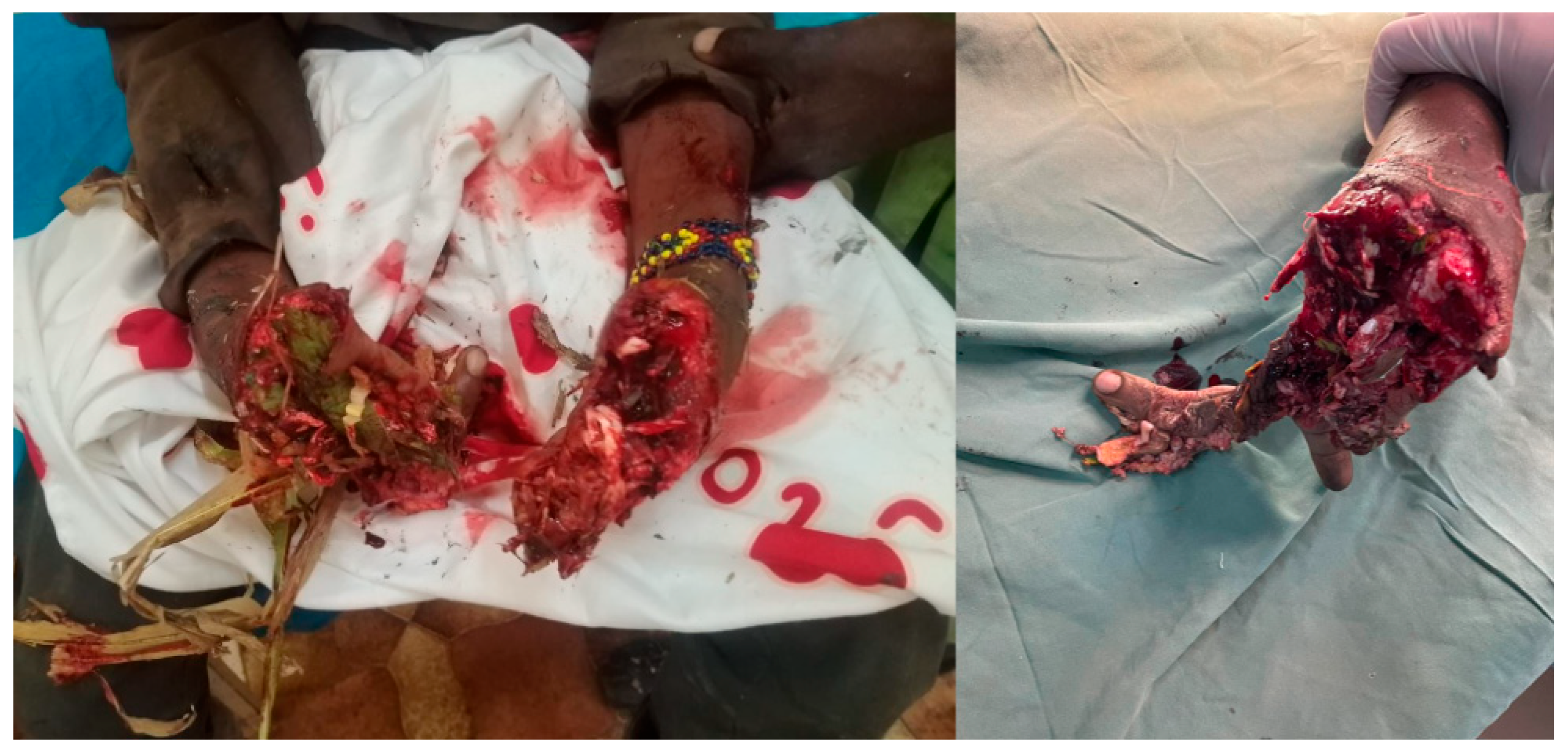
Patient and Injury: A 28-year-old right-hand-dominant male subsistence farmer from rural Kenya sustained a mangled multi-digit amputation of all ten digit with only a fifth finger suitable for replantation. The patient travelled approximately 50 km to reach our volunteer surgical camp at a mission hospital, arriving about 6 h after the injury. On examination, the bilateral traumatic amputation sites of all ten digits were heavily contaminated with corn husk debris, consistent with an agricultural machine injury (
Figure 1). Given the patient’s stable condition and the complete ten-digit amputation, we considered it mandatory to replant the only preserved digit, the little finger in the fourth-ray position of the dominant hand, to secure a staged reconstructive pathway during the subsequent mission, including toe transfer procedures. The patient was counselled regarding the procedure, including the need for intensive postoperative monitoring and prolonged rehabilitation. He provided informed consent for the attempt to reattach the finger.
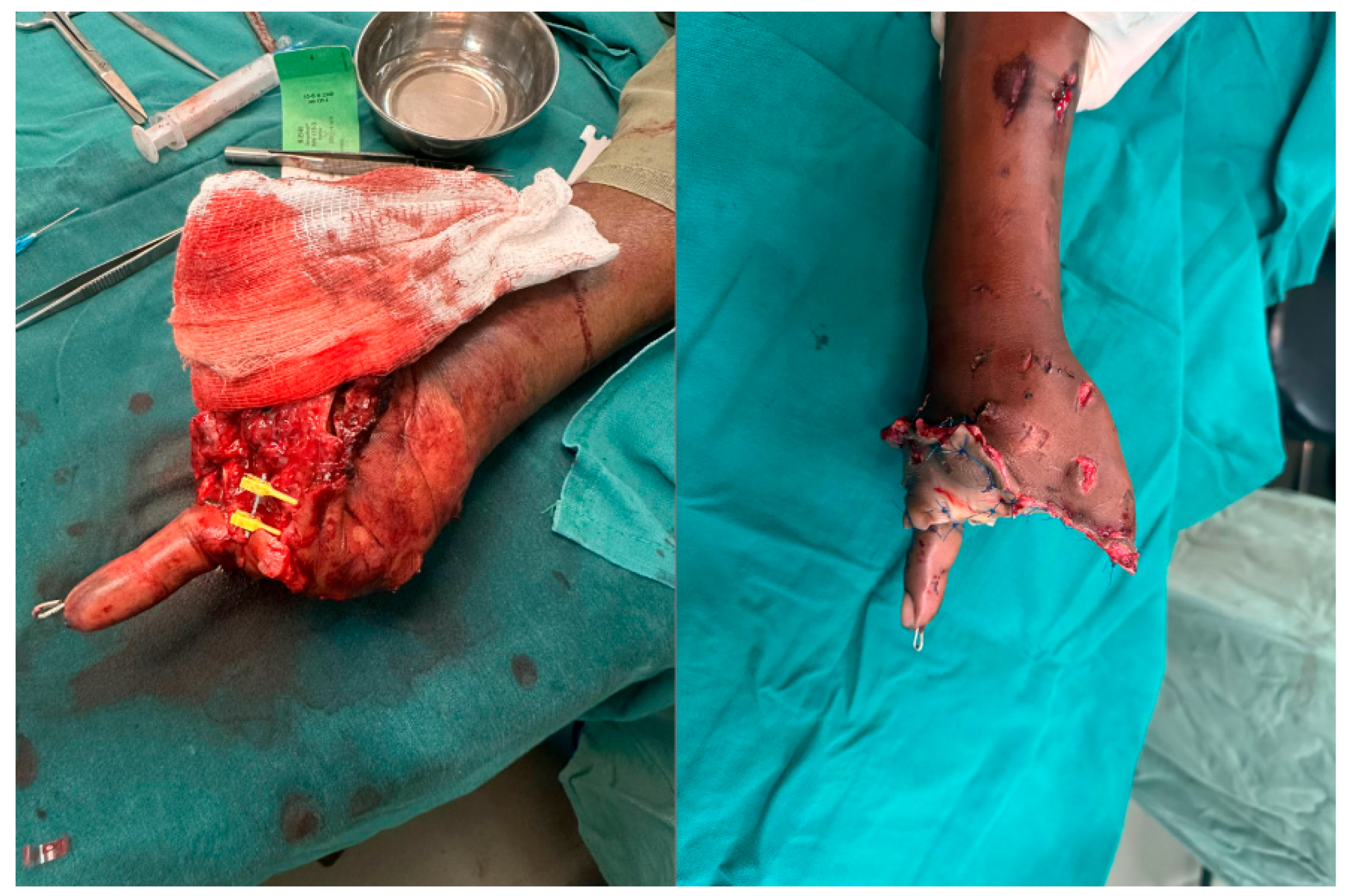
Operative Technique: The surgery was performed under general anesthesia, in an operating theatre equipped with basic microsurgical instruments brought by the mission team. An operating theatre and the full surgical and anaesthetic teams were immediately available on arrival, which minimised transfer and setup time. Magnification was achieved using surgical loupes (3.5×) and a portable operating microscope for the microvascular repairs. The amputated part was initially debrided of devitalised tissue. Corn husk and soil contamination was addressed with repeated high-volume irrigation and sharp excision of clearly non-viable tissue before reconstruction. No additional viable digits or tissue segments were available for banking, venous grafting, or spare-parts reconstruction. Both hands were initially scrubbed with povidone iodine then irrigated with 10 litres of normal saline per hand to reduce the gross bacterial and particulate load. The proximal phalanx fracture was shortened by approximately 3–4 mm to allow tension-free repair and fixed with a single 1.5 mm Kirschner wire. The extensor digitorum tendon was identified and repaired using a 4-0 prolene suture, and the flexor digitorum profundus tendon was likewise approximated. The flexor digitorum profundus was definitively repaired using a 4-strand Adelaide core suture, using a 4-0 prolene suture. Next, attention was turned to the vessels: the digital arteries (radial and ulnar proper digital arteries) were identified in the finger and hand. The vessel ends were trimmed until good-quality, back-bleeding channels were obtained. Only the ulnar proper digital artery was repaired, as the contralateral collateral artery was not suitable for reconstruction on intraoperative assessment. On restoration of arterial inflow, the fingertip regained colour and turgor. Venous repair was more challenging due to the very small size of the dorsal veins; one dorsal vein was successfully anastomosed with 10-0 nylon to re-establish outflow. The digital nerves were coapted under magnification with 8-0 nylon epineurial sutures to facilitate eventual sensory recovery. The skin was approximated with fine nylon sutures, leaving a small dorsal finger skin gap, which was covered with a local rotation flap (
Figure 2). Total ischemia time from injury to reperfusion was approximately 8 h (including surgical time). Given that only one digit was replanted and the hand was widely open, vessel exposure and microvascular access were straightforward, which shortened the anastomosis phase. Throughout the procedure, gentle handling of tissues and judicious use of papaverine and heparinized saline irrigation were employed to prevent vasospasm and thrombosis. Intraoperative fracture assessment and K wire positioning were confirmed with a mobile fluoroscopy unit, but the device did not allow image printing or export. The surgical team included one experienced microsurgeon from the visiting mission and two local surgeons-in-training who assisted and learned during the operation.
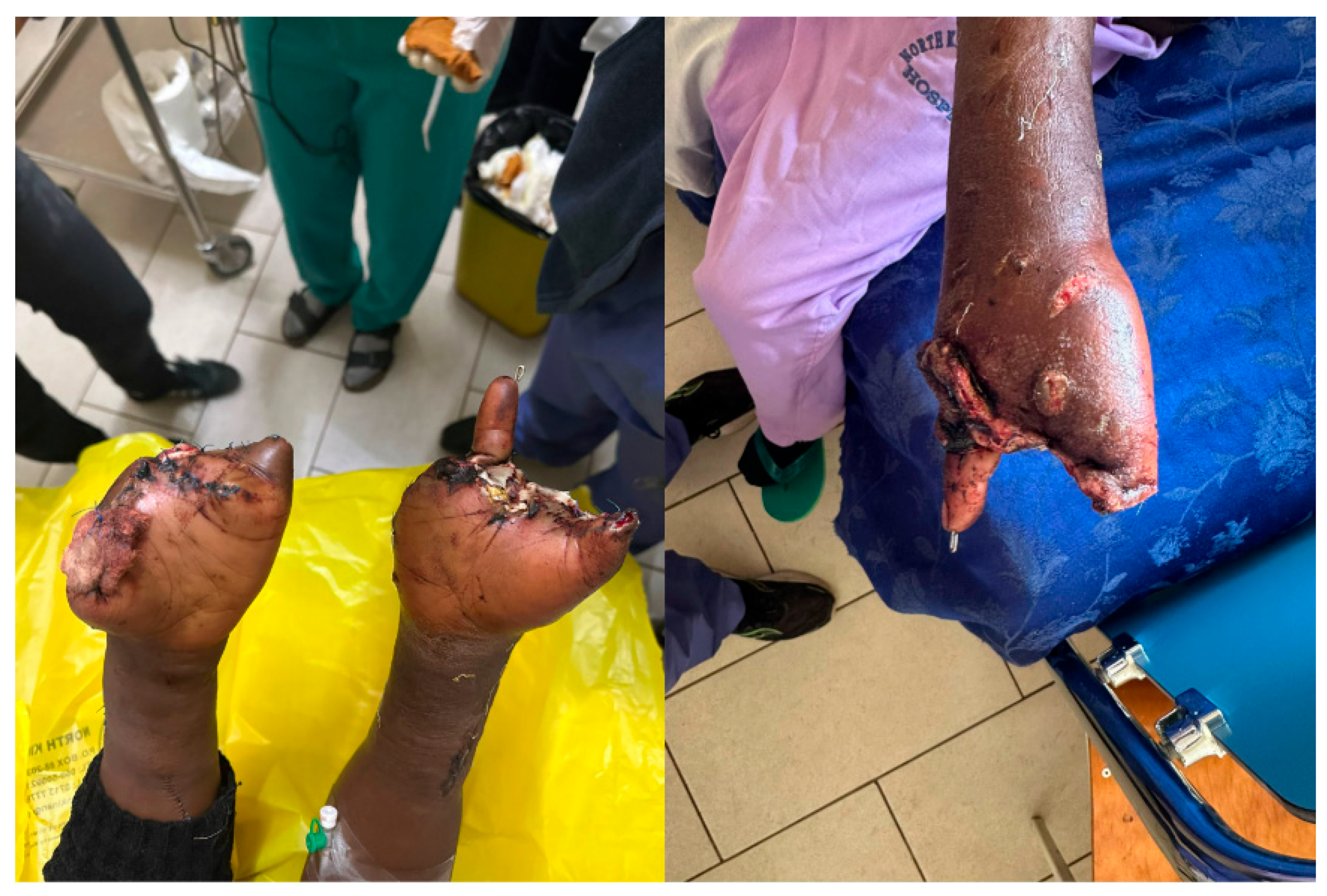
Postoperative Management: The patient was admitted to the ward for close monitoring. In the absence of advanced monitoring devices, clinical observation relied upon nursing staff, whom we had trained in flap and replant observation, who checked the replanted finger’s color, capillary refill, and warmth hourly for the first 48 h. The hand was loosely splinted and held in an elevated position to reduce postoperative edema. Prophylactic antibiotics were given (Ceftriaxone plus metronidazole for 14 days was selected to provide broad coverage including anaerobes within local formulary availability), and anticoagulation consisted of subcutaneous low-molecular-weight heparin (40 mg daily) and oral aspirin 75 mg daily. The postoperative course was fortunately uneventful, the replanted finger demonstrated robust perfusion, and no signs of arterial compromise or venous congestion were observed. By postoperative day 2, the capillary refill time was under 2 s and the fingertip had a healthy pink color. The patient began a gentle passive range of motion exercises of the finger’s joints at day 15 under supervision of a physiotherapist, to prevent stiffness while protecting the repair (
Figure 3). The surgical wounds healed primarily. The K-wires were left in situ for 4 weeks to stabilise the bone.
Follow-Up: The mission team remained at the hospital for four weeks, during which the patient was seen daily. Upon the team’s departure, his care was handed over to the local surgical staff and hand therapist, with detailed instructions for rehabilitation. At the one-month follow-up, the patient’s little finger remained viable and attached. The patient was extremely satisfied to have his finger salvaged. He continued hand therapy exercises at home, focusing on improving joint mobility. The patient had resumed light activities using the hand.
3. Discussion
This case demonstrates that digital replantation, one of the most technically demanding procedures in hand surgery, can be successfully accomplished in a resource-limited setting given the right circumstances. To our knowledge, this is the first reported case of a completely amputated finger being replanted in Kenya and one of only a few in sub-Saharan Africa (a recent report from Togo documented a successful hand replantation in a non-specialised hospital) [
1]. The importance of surgical expertise and adequate equipment cannot be overstated; digital artery repairs require sutures as fine as 9-0 or 10-0 and magnification, which are seldom available in district hospitals in low-income countries. By bringing these resources into the local hospital, the volunteer team effectively created a setting where advanced surgery could take place. Finally, successful postoperative management and monitoring were crucial. We coordinated closely with the local nursing staff to ensure vigilant monitoring of the replanted finger, and we established a clear protocol for detecting vascular compromise (such as colour change or capillary refill delay). This case benefited from the overlap of the mission presence during the highest-risk period for thrombosis; however, it also relied on the capabilities of the local team after our departure. Their engagement and training in postoperative care were integral in achieving a good outcome.
In high-income settings, many surgeons carefully weigh the indications for replantation, especially for a single finger, because of the prolonged rehabilitation required and the possibility of a suboptimal functional result. For example, a large multicenter study (the FRANCHISE study) found that replantation of a single finger amputation (particularly if distal) generally led to better patient-reported outcomes than revision amputation, but the differences narrowed for proximal finger injuries [
3]. In our case, the multi-digit amputation, involving all ten digits, made it mandatory to attempt the salvage of the only replantable finger, also considering the patient’s young age and his dependence on manual labour. Multiple reconstructive options are further available in this case; however, they depend on the patient’s acceptance, the feasibility of multiple frequent procedures, and long-term follow-up.
4. Global Surgery Implications
A major challenge in outreach surgery is postoperative care once the volunteer team leaves. Continuity of care is a common criticism of short-term surgical missions, particularly regarding who manages complications and therapy after visitors depart. In this instance, we mitigated this risk by embedding our mission within a long-term partnership. The local surgical staff were present during the operation and were mentored on postoperative management and rehabilitation protocols, consistent with capacity building strategies aimed at transferring knowledge and skills to host-country professionals. As part of our programme, we conduct formal workshops and daily bedside teaching during each mission and remain in contact for remote consultations between visits [
8,
9]. This approach aligns with recommended models in global surgery missions, including the diagonal development model, whereby interventions address immediate patient needs while strengthening the health system [
10]. A six-year review of microsurgery camps in Kenya similarly concluded that foreign expert teams can safely perform advanced surgery and support progressive development of local capability toward independent practice [
7]. In this framework, education of local staff remains central, with the objective of enabling local surgeons to acquire the skills and confidence to perform these procedures over time.
5. Limitations
Our report has limitations inherent to a single case: follow-up is short, and long-term functional outcome has not been measured with standardized instruments. Moreover, this outcome may reflect selection bias, as the case benefited from the presence of a highly experienced visiting microsurgical team. Success relied on the intersection of favourable factors, including an expert external team on site, a cooperative patient, and receptive local staff, which may not always coincide. Caution is therefore warranted in generalising this experience to all settings. Nevertheless, it provides a concrete data point that can inform future efforts and supports prior observations that replantation can be feasible in non-specialised hospitals in sub-Saharan Africa under appropriate conditions [
1].
6. Conclusions
The replantation of only one suitable finger in a mangled multi-digit amputation of all ten digits in a rural Kenyan hospital was accomplished with a favourable early outcome. This case underscores that with appropriate expertise, equipment, and local collaboration, even the most complex reconstructive procedures can be carried out safely in resource-limited settings. The keys to success included the presence of a skilled microsurgical team (through a humanitarian mission) working alongside local providers, and meticulous perioperative management including training of staff for postoperative care. Beyond the technical triumph, the case highlights the value of integrating capacity building into humanitarian surgical missions. Enabling local surgeons and nurses to participate and learn ensures that such successes can be replicated and sustained. For the patient, the main benefit was avoidance of definitive revision amputation and preservation of a viable digit remnant; however, we did not perform standardized functional testing, and the functional contribution may be limited by residual digit length and joint stiffness. For the health system, this case serves as a catalyst, demonstrating what is achievable and inspiring further development in hand trauma care. We advocate for continued support of “microsurgery without borders” initiatives, where international collaboration and knowledge transfer can bridge the gap in specialised surgical services. As global surgery efforts progress, we hope that finger replantation and similar advanced procedures will move from being rare miracles in low-resource regions to becoming routine, locally provided options for those who need them.
Author Contributions
Conceptualization, A.L.C., L.F. and A.M.; methodology, A.L.C., L.F. and A.M.; writing—original draft preparation, A.L.C. and L.F.; writing—review and editing, A.L.C., L.F., A.M. and F.B.; visualization, A.L.C.; supervision F.B. All authors have read and agreed to the published version of the manuscript.
Funding
This research received no external funding.
Institutional Review Board Statement
The study was conducted in accordance with the Declaration of Helsinki and approved by the Institutional Review Board of North Kinangop Catholic Hospital and Azienda Ospedale Università di Padova.
Informed Consent Statement
Informed consent was obtained from all subjects involved in the study, and written informed consent has been obtained from the patient to publish this paper.
Data Availability Statement
The original contributions presented in this study are included in the article. Further inquiries can be directed to the corresponding author.
Conflicts of Interest
The authors declare no conflicts of interest.
Abbreviations
The following abbreviations are used in this manuscript:
| MCP | Metacarpophalangeal |
| PIP | Proximal interphalangeal |
References
- Amouzou, K.S.; Amakoutou, K. Hand replantation: First experience in a sub-Saharan African country (Togo). Indian J. Plast. Surg. 2016, 49, 109–111. [Google Scholar] [CrossRef] [PubMed][Green Version]
- Sabapathy, S.R.; Venkatramani, H. Replantation surgery. J. Hand Surg. Am. 2011, 36, 1104–1110. [Google Scholar] [CrossRef] [PubMed]
- Chung, K.C.; Yoon, A.P.; Malay, S.; Shauver, M.J.; Wang, L.; Kaur, S.; FRANCHISE Group. Patient-Reported and Functional Outcomes After Revision Amputation and Replantation of Digit Amputations: The FRANCHISE Multicenter International Retrospective Cohort Study. JAMA Surg. 2019, 154, 637–646. [Google Scholar] [CrossRef] [PubMed]
- Banda, C.H.; Georgios, P.; Narushima, M.; Ishiura, R.; Fujita, M.; Goran, J. Challenges in global reconstructive microsurgery: The sub-Saharan african surgeons’ perspective. JPRAS Open 2019, 20, 19–26. [Google Scholar] [CrossRef] [PubMed]
- Tocco-Tussardi, I.; Presman, B. Microsurgery “without borders”: New limits for reconstruction of post-burn sequelae in the humanitarian setting. Ann. Burn. Fire Disasters 2016, 29, 66–70. [Google Scholar]
- Corlew, S.; Fan, V.Y. A model for building capacity in international plastic surgery: ReSurge International. Ann. Plast. Surg. 2011, 67, 568–570. [Google Scholar] [CrossRef] [PubMed]
- Garusi, C.; Codolini, L.; Sonda, R.; Ray, A.; Teo, T.C.; Bassetto, F. Achieving microsurgery missions in Kenya—A 6-year experience of a non-governmental organization. Eur. J. Plast. Surg. 2021, 44, 475–482. [Google Scholar] [CrossRef]
- Vosbikian, M.M. Finger Replantation: Indications and Outcomes. SurgiColl 2024, 2. [Google Scholar] [CrossRef]
- O’Flynn, E.; Andrew, J.; Hutch, A.; Kelly, C.; Jani, P.; Kakande, I.; Derbew, M.; Tierney, S.; Mkandawire, N.; Erzingatsian, K. The Specialist Surgeon Workforce in East, Central and Southern Africa: A Situation Analysis. World J. Surg. 2016, 40, 2620–2627. [Google Scholar] [CrossRef] [PubMed]
- Patel, P.B.; Hoyler, M. An opportunity for diagonal development in global surgery: Cleft lip and palate care in resource-limited settings. Plast. Surg. Int. 2012, 2012, 892437. [Google Scholar] [CrossRef] [PubMed]
| Disclaimer/Publisher’s Note: The statements, opinions and data contained in all publications are solely those of the individual author(s) and contributor(s) and not of MDPI and/or the editor(s). MDPI and/or the editor(s) disclaim responsibility for any injury to people or property resulting from any ideas, methods, instructions or products referred to in the content. |