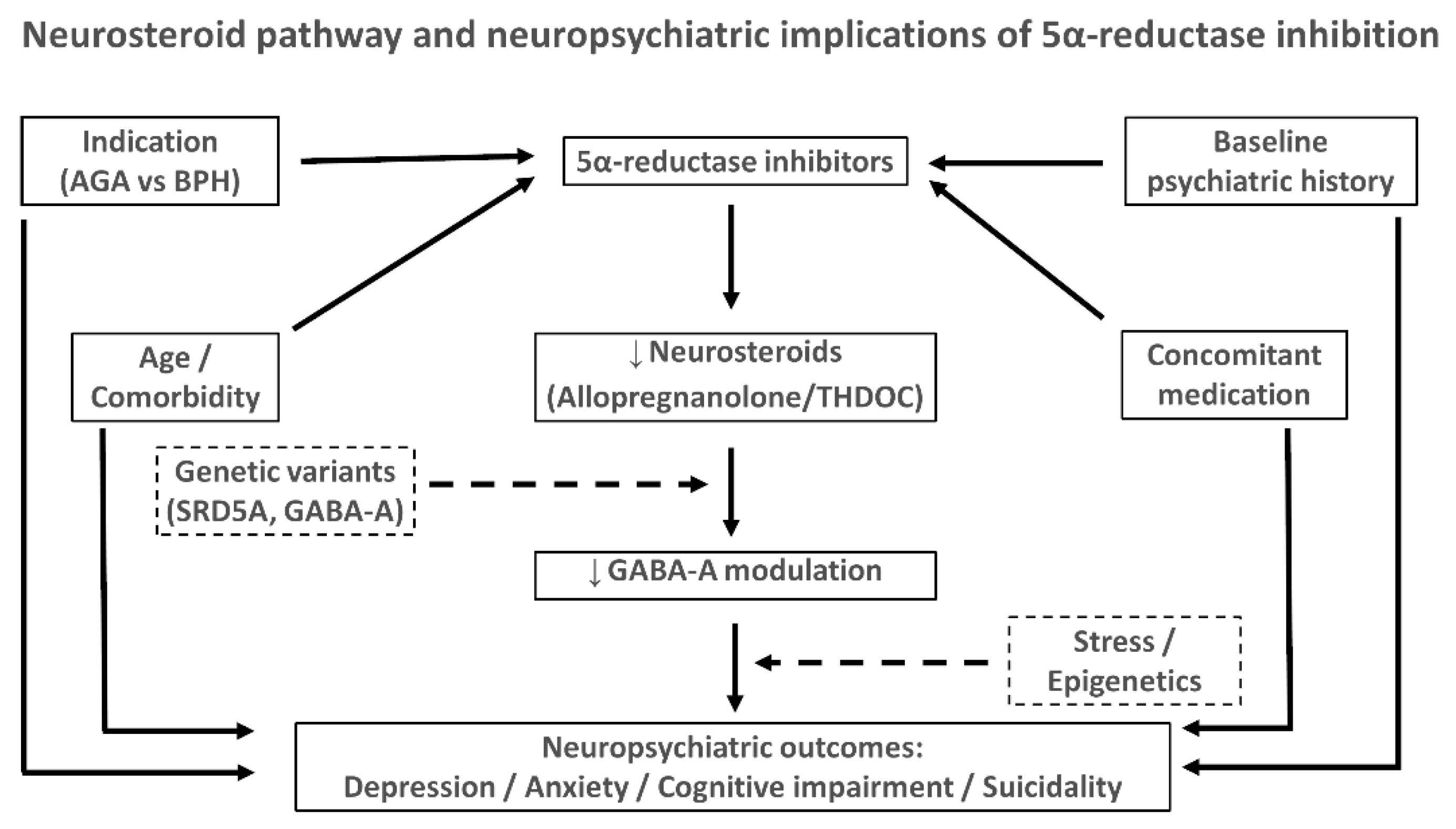

5α-Reductase Isoenzymes: From Neurosteroid Biosynthesis to Neuropsychiatric Outcomes


Abstract
1. Introduction
2. Materials and Methods
2.1. Search Terms
- “5-alpha reductase” OR “SRD5A”.
- “neurosteroids” OR “allopregnanolone”.
- “mood disorders” OR “depression” OR “anxiety” OR “suicidal ideation”.
- “finasteride” OR “dutasteride” OR “5-alpha reductase inhibitors”.
- “genetic polymorphism” OR “susceptibility”.
2.2. Inclusion Criteria
- Original articles, systematic reviews, meta-analyses, and case series published in English or Spanish.
- Human and animal studies addressing the following:
- Isoenzymes and distribution of 5α-reductase.
- The role of 5α-R in neurosteroid synthesis.
- Association of 5α-R inhibitors (finasteride, dutasteride) with neuropsychiatric symptoms.
- Genetic evidence of predisposition to adverse effects.
2.3. Exclusion Criteria
- Articles not available in full text.
- Publications with poor methodological quality (assessed based on study design, sample size, and validity of conclusions).
- Gray literature (conference abstracts, unpublished theses, non-peer-reviewed communications).
2.4. Study Selection and Analysis
2.5. PRISMA Statement
3. Main Findings of Literature Review
4. Discussion
5. Conclusions
6. Future Directions
Funding
Data Availability Statement
Conflicts of Interest
References
- Han, Y.; Zhuang, Q.; Sun, B.; Lv, W.; Wang, S.; Xiao, Q.; Pang, B.; Zhou, Y.; Wang, F.; Chi, P.; et al. Crystal structure of steroid reductase SRD5A reveals conserved steroid reduction mechanism. Nat. Commun. 2021, 12, 449. [Google Scholar] [CrossRef] [PubMed]
- Radmayr, C.; Lunacek, A.; Schwentner, C.; Oswald, J.; Klocker, H.; Bartsch, G. 5-alpha-reductase and the development of the human prostate. Indian J. Urol. 2008, 24, 309–312. [Google Scholar] [CrossRef] [PubMed]
- Traish, A.M. 5α-reductases in human physiology: An unfolding story. Endocr. Pract. 2012, 18, 965–975. [Google Scholar] [CrossRef] [PubMed]
- Sánchez, P.; Torres, J.M.; Vílchez, P.; Del Moral, R.G.; Ortega, E. Effects of sulpiride on prolactin and mRNA levels of steroid 5α-reductase isozymes in adult rat brain. Neurochem. Res. 2008, 33, 820–825. [Google Scholar] [CrossRef]
- Azzouni, F.; Godoy, A.; Li, Y.; Mohler, J. The 5 alpha-reductase isozyme family: A review of basic biology and their role in human diseases. Adv. Urol. 2012, 2012, 530121. [Google Scholar] [CrossRef]
- Cantagrel, V.; Lefeber, D.J.; Ng, B.G.; Guan, Z.; Silhavy, J.L.; Bielas, S.L.; Lehle, L.; Hombauer, H.; Adamowicz, M.; Swiezewska, E.; et al. SRD5A3 is required for converting polyprenol to dolichol and is mutated in a congenital glycosylation disorder. Cell 2010, 142, 203–217. [Google Scholar] [CrossRef]
- Melcangi, R.C.; Garcia-Segura, L.M.; Mensah-Nyagan, A.G. Neuroactive steroids: State of the art and new perspectives. Cell. Mol. Life Sci. 2008, 65, 777–797. [Google Scholar] [CrossRef]
- Schiller, C.E.; Schmidt, P.J.; Rubinow, D.R. Allopregnanolone as a mediator of affective switching in reproductive mood disorders. Psychopharmacology 2014, 231, 3557–3567. [Google Scholar] [CrossRef]
- Joshi, S.; Rajasekaran, K.; Williamson, J.; Kapur, J. Neurosteroid-sensitive δ-GABAA receptors: A role in epileptogenesis? Epilepsia 2017, 58, 494–504. [Google Scholar] [CrossRef]
- Joshi, S.; Kapur, J. Neurosteroid regulation of GABAA receptors: A role in catamenial epilepsy. Brain Res. 2019, 1703, 31–40. [Google Scholar] [CrossRef]
- Liang, J.J.; Rasmusson, A.M. Overview of the molecular steps in steroidogenesis of the GABAergic neurosteroids allopregnanolone and pregnanolone. Chronic Stress 2018, 2, 2470547018818555. [Google Scholar] [CrossRef]
- Piraccini, B.M.; Blume-Peytavi, U.; Scarci, F.; Jansat, J.M.; Falqués, M.; Otero, R.; Tamarit, M.L.; Galván, J.; Tebbs, V.; Massana, E.; et al. Efficacy and safety of topical finasteride spray solution for male androgenetic alopecia: A phase III, randomized, controlled clinical trial. J. Eur. Acad. Dermatol. Venereol. 2022, 36, 286–294. [Google Scholar] [CrossRef] [PubMed]
- Zhou, Z.; Song, S.; Gao, Z.; Wu, J.; Ma, J.; Cui, Y. The efficacy and safety of dutasteride compared with finasteride in treating men with androgenetic alopecia: A systematic review and meta-analysis. Clin. Interv. Aging 2019, 14, 399–406. [Google Scholar] [CrossRef] [PubMed]
- Irwig, M.S.; Kolukula, S. Persistent sexual side effects of finasteride for male pattern hair loss. J. Sex. Med. 2011, 8, 1747–1753. [Google Scholar] [CrossRef] [PubMed]
- Traish, A.M. Post-finasteride syndrome: A surmountable challenge for clinicians. Fertil. Steril. 2020, 113, 21–50. [Google Scholar] [CrossRef]
- Romero Pérez, P. Post-finasteride syndrome. Literature review. Arch. Esp. Urol. 2022, 75, 382–399. [Google Scholar] [CrossRef]
- Gupta, A.K.; Bamimore, M.A.; Williams, G.; Talukder, M. Finasteride use: Evaluation of depression and suicide risk. J. Cosmet. Dermatol. 2025, 24, e70102. [Google Scholar] [CrossRef]
- Melcangi, R.C.; Santi, D.; Spezzano, R.; Grimoldi, M.; Tabacchi, T.; Fusco, M.L.; Diviccaro, S.; Giatti, S.; Carrà, G.; Caruso, D.; et al. Neuroactive steroid levels and psychiatric and andrological features in post-finasteride patients. J. Steroid Biochem. Mol. Biol. 2017, 171, 229–235. [Google Scholar] [CrossRef]
- Thaibah, H.A.; Banji, O.J.F.; Banji, D.; Almansour, H.A.; Alshammari, T.M. Suicidality Risks Associated with Finasteride, a 5-Alpha Reductase Inhibitor: An Evaluation of Real-World Data from the FDA Adverse Event Reports. Pharmaceuticals 2025, 18, 957. [Google Scholar] [CrossRef]
- Li, X.; Guo, Y.; Lu, Y.; Li, H.; Yan, S.; Li, H.; Li, Y. Case report: A study of the clinical characteristics and genetic variants of post-finasteride syndrome patients. Transl. Androl. Urol. 2022, 11, 1452–1457. [Google Scholar] [CrossRef]
- Diviccaro, S.; Cioffi, L.; Falvo, E.; Giatti, S.; Melcangi, R.C. Allopregnanolone: An overview on its synthesis and effects. J. Neuroendocrinol. 2022, 34, e12996. [Google Scholar] [CrossRef]
- Maguire, J.L.; Mennerick, S. Neurosteroids: Mechanistic considerations and clinical prospects. Neuropsychopharmacology 2024, 49, 73–82. [Google Scholar] [CrossRef] [PubMed]
- Fedotcheva, T.A.; Shimanovsky, N.L. Neurosteroids progesterone and dehydroepiandrosterone: Molecular mechanisms of action in neuroprotection and neuroinflammation. Pharmaceuticals 2025, 18, 945. [Google Scholar] [CrossRef] [PubMed]
- Standeven, L.R.; Osborne, L.M.; Betz, J.F.; Yenokyan, G.; Voegtline, K.; Hantsoo, L.; Payne, J.L. Allopregnanolone and depression and anxiety symptoms across the peripartum: An exploratory study. Arch. Women’s Ment. Health 2022, 25, 521–526. [Google Scholar] [CrossRef] [PubMed]
- Meltzer-Brody, S.; Colquhoun, H.; Riesenberg, R.; Epperson, C.N.; Deligiannidis, K.M.; Rubinow, D.R.; Li, H.; Sankoh, A.J.; Clemson, C.; Schacterle, A.; et al. Brexanolone injection in post-partum depression: Two multicentre, double-blind, randomised, placebo-controlled, phase 3 trials. Lancet 2018, 392, 1058–1070. [Google Scholar] [CrossRef]
- Gerbasi, M.E.; Meltzer-Brody, S.; Acaster, S.; Fridman, M.; Bonthapally, V.; Hodgkins, P.; Kanes, S.J.; Eldar-Lissai, A. Brexanolone in postpartum depression: Post hoc analyses to help inform clinical decision-making. J. Women’s Health 2021, 30, 385–392. [Google Scholar] [CrossRef]
- Deligiannidis, K.M.; Meltzer-Brody, S.; Maximos, B.; Peeper, E.Q.; Freeman, M.; Lasser, R.; Bullock, A.; Kotecha, M.; Li, S.; Forrestal, F.; et al. Zuranolone for the treatment of postpartum depression. Am. J. Psychiatry 2023, 180, 668–675. [Google Scholar] [CrossRef]
- Welk, B.; McArthur, E.; Ordon, M.; Anderson, K.K.; Hayward, J.; Dixon, S. Association of suicidality and depression with 5α-reductase inhibitors. JAMA Intern. Med. 2017, 177, 683–691. [Google Scholar] [CrossRef]
- Laanani, M.; Weill, A.; Jollant, F.; Zureik, M.; Dray-Spira, R. Suicidal risk associated with finasteride versus dutasteride among men treated for benign prostatic hyperplasia: Nationwide cohort study. Sci. Rep. 2023, 13, 5308. [Google Scholar] [CrossRef]
- Brezis, M. Failing Public Health Again? Analytical Review of Depression and Suicidality from Finasteride. J. Clin. Psychiatry 2025, 86, 25nr15862. [Google Scholar] [CrossRef] [PubMed]
- Uleri, A.; Cornu, J.N.; Gobbo, A.; Herrmann, T.R.W.; De Nunzio, C.; Hashim, H.; Baboudjian, M. Association of 5α-reductase inhibitors with depression and suicide: A mini systematic review and meta-analysis. Eur. Urol. Focus 2024, 10, 751–753. [Google Scholar] [CrossRef] [PubMed]
- Fatemi, S.H.; Folsom, T.D.; Rooney, R.J.; Thuras, P.D. Expression of GABAA α2-, β1- and ɛ-receptors are altered significantly in the lateral cerebellum of subjects with schizophrenia, major depression and bipolar disorder. Transl. Psychiatry 2013, 3, e303. [Google Scholar] [CrossRef] [PubMed]
- Page, M.J.; McKenzie, J.E.; Bossuyt, P.M.; Boutron, I.; Hoffmann, T.C.; Mulrow, C.D.; Shamseer, L.; Tetzlaff, J.M.; Akl, E.A.; Brennan, S.E.; et al. The PRISMA 2020 statement: An updated guideline for reporting systematic reviews. BMJ 2021, 372, n71. [Google Scholar] [CrossRef] [PubMed]
- Dou, R.; Qian, J.; Wu, W.; Zhang, Y.; Yuan, Y.; Guo, M.; Wei, R.; Yang, S.; Jurczyszyn, A.; Janz, S.; et al. Suppression of steroid 5α-reductase type I promotes cellular apoptosis and autophagy via PI3K/Akt/mTOR pathway in multiple myeloma. Cell Death Dis. 2021, 12, 206. [Google Scholar] [CrossRef]
- Wang, Z.; Deng, T.; Long, X.; Lin, X.; Wu, S.; Wang, H.; Ge, R.; Zhang, Z.; Wu, C.L.; Taplin, M.E.; et al. Methylation of SRD5A2 promoter predicts a better outcome for castration-resistant prostate cancer patients undergoing androgen deprivation therapy. PLoS ONE 2020, 15, e0229754. [Google Scholar] [CrossRef]
- Wei, S.; Sun, J.; Wen, J.; Yu, J.; Xuan, Y.; Huang, J.; Yang, J.; Zhang, J. High SRD5A3 expression is correlated with promotion of proliferation and inhibition of apoptosis in B-cell non-Hodgkin lymphoma and suggests a poor prognosis. PLoS ONE 2025, 20, e0323965. [Google Scholar] [CrossRef]
- Leliefeld, H.H.J.; Debruyne, F.M.J.; Reisman, Y. The post-finasteride syndrome: Possible etiological mechanisms and symptoms. Int. J. Impot. Res. 2025, 37, 414–421. [Google Scholar] [CrossRef]
- Diviccaro, S.; Melcangi, R.C.; Giatti, S. Post-finasteride syndrome: An emerging clinical problem. Neurobiol. Stress 2020, 12, 100209. [Google Scholar] [CrossRef]
- Pereira, A.F.J.R.; Coelho, T.O.d.A. Post-finasteride syndrome. An. Bras. Dermatol. 2020, 95, 271–277. [Google Scholar] [CrossRef]
- Medicines and Healthcare Products Regulatory Agency (MHRA). Men on Finasteride Asked to Stay Vigilant for Possible Psychiatric and Sexual Side Effects. GOV.UK; 2023. Available online: https://www.gov.uk/government/news/men-on-finasteride-asked-to-stay-vigilant-for-possible-psychiatric-and-sexual-side-effects (accessed on 20 August 2025).
- European Medicines Agency (EMA). Meeting Highlights from the Pharmacovigilance Risk Assessment Committee (PRAC) 5–8 May 2025. EMA. 2025. Available online: https://www.ema.europa.eu/en/news/meeting-highlights-pharmacovigilance-risk-assessment-committee-prac-5-8-may-2025 (accessed on 20 August 2025).
- Dyson, T.E.; Cantrell, M.A.; Lund, B.C. Lack of Association between 5α-Reductase Inhibitors and Depression. J. Urol. 2020, 204, 793–798. [Google Scholar] [CrossRef]
- Maguire, J.; Mody, I. Neurosteroid synthesis-mediated regulation of GABAA receptors: Relevance to the ovarian cycle and stress. J. Neurosci. 2007, 27, 2155–2162. [Google Scholar] [CrossRef] [PubMed]
- Giatti, S.; Diviccaro, S.; Falvo, E.; Garcia-Segura, L.M.; Melcangi, R.C. Physiopathological role of the enzymatic complex 5α-reductase and 3α/β-hydroxysteroid oxidoreductase in the generation of progesterone and testosterone neuroactive metabolites. Front. Neuroendocrinol. 2020, 57, 100836. [Google Scholar] [CrossRef] [PubMed]
- Reddy, D.S. Neurosteroids: Endogenous role in the human brain and therapeutic potentials. Prog. Brain Res. 2010, 186, 113–137. [Google Scholar] [CrossRef] [PubMed]
- Gao, Q.; Sun, W.; Wang, Y.R.; Li, Z.F.; Zhao, F.; Geng, X.W.; Xu, K.Y.; Chen, D.; Liu, K.; Xing, Y.; et al. Role of allopregnanolone-mediated γ-aminobutyric acid A receptor sensitivity in the pathogenesis of premenstrual dysphoric disorder: Toward precise targets for translational medicine and drug development. Front. Psychiatry 2023, 14, 1140796. [Google Scholar] [CrossRef]
- Schüle, C.; Nothdurfter, C.; Rupprecht, R. The role of allopregnanolone in depression and anxiety. Prog. Neurobiol. 2014, 113, 79–87. [Google Scholar] [CrossRef]
- Deligiannidis, K.M.; Meltzer-Brody, S.; Gunduz-Bruce, H.; Doherty, J.; Jonas, J.; Li, S.; Sankoh, A.J.; Silber, C.; Campbell, A.D.; Werneburg, B.; et al. Effect of zuranolone vs placebo in postpartum depression: A randomized clinical trial. JAMA Psychiatry 2021, 78, 951–959, Erratum in JAMA Psychiatry 2022, 79, 740. https://doi.org/10.1001/jamapsychiatry.2022.1274. Erratum in JAMA Psychiatry 2023, 80, 191. https://doi.org/10.1001/jamapsychiatry.2022.4181. [Google Scholar] [CrossRef]
- Rasmusson, A.M.; Marx, C.E.; Pineles, S.L.; Locci, A.; Scioli-Salter, E.R.; Nillni, Y.I.; Liang, J.J.; Pinna, G. Neuroactive steroids and PTSD treatment. Neurosci. Lett. 2017, 649, 156–163. [Google Scholar] [CrossRef]
- Locci, A.; Pinna, G. Neurosteroid biosynthesis down-regulation and changes in GABAA receptor subunit composition: A biomarker axis in stress-induced cognitive and emotional impairment. Br. J. Pharmacol. 2017, 174, 3226–3241. [Google Scholar] [CrossRef]
- Zorumski, C.F.; Paul, S.M.; Covey, D.F.; Mennerick, S. Neurosteroids as novel antidepressants and anxiolytics: GABA-A receptors and beyond. Neurobiol. Stress 2019, 11, 100196. [Google Scholar] [CrossRef]
- Walton, N.; Maguire, J. Allopregnanolone-based treatments for postpartum depression: Why/how do they work? Neurobiol. Stress 2019, 11, 100198. [Google Scholar] [CrossRef]
- Gunn, B.G.; Cunningham, L.; Mitchell, S.G.; Swinny, J.D.; Lambert, J.J.; Belelli, D. GABAA receptor-acting neurosteroids: A role in the development and regulation of the stress response. Front. Neuroendocrinol. 2015, 36, 28–48. [Google Scholar] [CrossRef] [PubMed]
- Sasibhushana, R.B.; Rao, B.S.S.; Srikumar, B.N. Anxiety- and depression-like behavior following short-term finasteride administration is associated with impaired synaptic plasticity and cognitive behavior in male rats. J. Psychiatr. Res. 2024, 174, 304–318. [Google Scholar] [CrossRef]
- Mosher, L.J.; Godar, S.C.; Morissette, M.; McFarlin, K.M.; Scheggi, S.; Gambarana, C.; Fowler, S.C.; Di Paolo, T.; Bortolato, M. Steroid 5α-reductase 2 deficiency leads to reduced dominance-related and impulse-control behaviors. Psychoneuroendocrinology 2018, 91, 95–104. [Google Scholar] [CrossRef] [PubMed]
- Nguyen, D.D.; Marchese, M.; Cone, E.B.; Paciotti, M.; Basaria, S.; Bhojani, N.; Trinh, Q.D. Investigation of suicidality and psychological adverse events in patients treated with finasteride. JAMA Dermatol. 2021, 157, 35–42. [Google Scholar] [CrossRef] [PubMed]
- Garcia-Argibay, M.; Hiyoshi, A.; Fall, K.; Montgomery, S. Association of 5α-reductase inhibitors with dementia, depression, and suicide. JAMA Netw. Open 2022, 5, e2248135. [Google Scholar] [CrossRef]
- Motofei, I.G.; Rowland, D.L.; Tampa, M.; Sarbu, M.I.; Mitran, M.I.; Mitran, C.I.; Stoian, A.P.; Diaconu, C.C.; Paunica, S.; Georgescu, S.R. Finasteride and androgenic alopecia; from therapeutic options to medical implications. J. Dermatol. Treat. 2020, 31, 415–421. [Google Scholar] [CrossRef]
- Zhou, Y.; Chen, C.; Qu, Q.; Zhang, C.; Wang, J.; Fan, Z.; Miao, Y.; Hu, Z. The effectiveness of combination therapies for androgenetic alopecia: A systematic review and meta-analysis. Dermatol. Ther. 2020, 33, e13741. [Google Scholar] [CrossRef]
- Rasmusson, A.M.; King, M.W.; Valovski, I.; Gregor, K.; Scioli-Salter, E.; Pineles, S.L.; Hamouda, M.; Nillni, Y.I.; Anderson, G.M.; Pinna, G. Relationships between cerebrospinal fluid GABAergic neurosteroid levels and symptom severity in men with PTSD. Psychoneuroendocrinology 2019, 102, 95–104. [Google Scholar] [CrossRef]
- McEwen, B.S.; Akil, H. Revisiting the stress concept: Implications for affective disorders. J. Neurosci. 2020, 40, 12–21. [Google Scholar] [CrossRef]
- Feder, A.; Fred-Torres, S.; Southwick, S.M.; Charney, D.S. The biology of human resilience: Opportunities for enhancing resilience across the life span. Biol. Psychiatry 2019, 86, 443–453. [Google Scholar] [CrossRef]
- Shrank, W.H.; Patrick, A.R.; Brookhart, M.A. Healthy user and related biases in observational studies of preventive interventions: A primer for physicians. J. Gen. Intern. Med. 2011, 26, 546–550. [Google Scholar] [CrossRef] [PubMed]
- Irwig, M.S. Depressive symptoms and suicidal thoughts among former users of finasteride with persistent sexual side effects. J. Clin. Psychiatry 2012, 73, 1220–1223. [Google Scholar] [CrossRef] [PubMed]
- Huang, R.; Xu, R.; Dulai, P.S. Sensitivity analysis of treatment effect to unmeasured confounding in observational studies with survival and competing risks outcomes. Stat. Med. 2020, 39, 3397–3411. [Google Scholar] [CrossRef] [PubMed]
- Sandhu, J.S.; Bixler, B.R.; Dahm, P.; Goueli, R.; Kirkby, E.; Stoffel, J.T.; Wilt, T.J. Management of lower urinary tract symptoms attributed to benign prostatic hyperplasia (BPH): AUA guideline amendment 2023. J. Urol. 2024, 211, 11–19. [Google Scholar] [CrossRef]
- Adil, A.; Godwin, M. The effectiveness of treatments for androgenetic alopecia: A systematic review and meta-analysis. J. Am. Acad. Dermatol. 2017, 77, 136–141.e5. [Google Scholar] [CrossRef]
- Katzer, T.; Leite Junior, A.; Beck, R.; da Silva, C. Physiopathology and current treatments of androgenetic alopecia: Going beyond androgens and anti-androgens. Dermatol. Ther. 2019, 32, e13059. [Google Scholar] [CrossRef]
- Nestor, M.S.; Ablon, G.; Gade, A.; Han, H.; Fischer, D.L. Treatment options for androgenetic alopecia: Efficacy, side effects, compliance, financial considerations, and ethics. J. Cosmet. Dermatol. 2021, 20, 3759–3781. [Google Scholar] [CrossRef]
- Danesh-Shakiba, M.; Poorolajal, J.; Alirezaei, P. Androgenetic alopecia: Relationship to anthropometric indices, blood pressure and lifestyle habits. Clin. Cosmet. Investig. Dermatol. 2020, 13, 137–143. [Google Scholar] [CrossRef]
- Bakry, O.A.; Shoeib, M.A.M.; El Shafiee, M.K.; Hassan, A. Androgenetic alopecia, metabolic syndrome, and insulin resistance: Is there any association? A case-control study. Indian Dermatol. Online J. 2014, 5, 276–281. [Google Scholar] [CrossRef]
- Saceda-Corralo, D.; Domínguez-Santas, M.; Vañó-Galván, S.; Grimalt, R. What’s new in therapy for male androgenetic alopecia? Am. J. Clin. Dermatol. 2023, 24, 15–24. [Google Scholar] [CrossRef]
- Trost, L.; Saitz, T.R.; Hellstrom, W.J. Side effects of 5-alpha reductase inhibitors: A comprehensive review. Sex. Med. Rev. 2013, 1, 24–41. [Google Scholar] [CrossRef] [PubMed]
- Diviccaro, S.; Giatti, S.; Cioffi, L.; Falvo, E.; Herian, M.; Caruso, D.; Melcangi, R.C. Gut inflammation induced by finasteride withdrawal: Therapeutic effect of allopregnanolone in adult male rats. Biomolecules 2022, 12, 1567. [Google Scholar] [CrossRef] [PubMed]
- Walton, N.L.; Antonoudiou, P.; Maguire, J.L. Neurosteroid influence on affective tone. Neurosci. Biobehav. Rev. 2023, 152, 105327. [Google Scholar] [CrossRef] [PubMed]
- Traish, A.M.; Melcangi, R.C.; Bortolato, M.; Garcia-Segura, L.M.; Zitzmann, M. Adverse effects of 5α-reductase inhibitors: What do we know, don’t know, and need to know? Rev. Endocr. Metab. Disord. 2015, 16, 177–198. [Google Scholar] [CrossRef]
- Shrestha, S.; Jain, S. A Bayesian-bandit adaptive design for N-of-1 clinical trials. Stat. Med. 2021, 40, 1825–1844. [Google Scholar] [CrossRef]
- Schmid, C.; Yang, J. Bayesian models for N-of-1 trials. Harv. Data Sci. Rev. 2022, 2022, 10-1162. [Google Scholar] [CrossRef]
- Ntshingila, S.; Oputu, O.; Arowolo, A.T.; Khumalo, N.P. Androgenetic alopecia: An update. JAAD Int. 2023, 13, 150–158. [Google Scholar] [CrossRef]
- Zhong, X.; Yang, Y.; Wei, S.; Liu, Y. Multidimensional assessment of adverse events of finasteride: A real-world pharmacovigilance analysis based on FDA Adverse Event Reporting System (FAERS) from 2004 to April 2024. PLoS ONE 2025, 20, e0309849. [Google Scholar] [CrossRef]
- Zhang, J.J.; Shi, X.; Wu, T.; Zhang, M.D.; Tang, J.; Yin, G.M.; Long, Z.; He, L.Y.; Qi, L.; Wang, L. Sexual, physical, and overall adverse effects in patients treated with 5α-reductase inhibitors: A systematic review and meta-analysis. Asian J. Androl. 2022, 24, 390–397. [Google Scholar] [CrossRef]
- Wang, M. Neurosteroids and GABA-A receptor function. Front. Endocrinol. 2011, 2, 44. [Google Scholar] [CrossRef]
- Frith, H.; Jankowski, G.S. Psychosocial impact of androgenetic alopecia on men: A systematic review and meta-analysis. Psychol. Health Med. 2024, 29, 822–842. [Google Scholar] [CrossRef]



| Topic | Key Findings | References |
|---|---|---|
| Isoenzymes and tissue distribution | Three isoforms have been identified. SRD5A1 is expressed in liver, skin, and brain. SRD5A2 is mainly expressed in prostate and seminal vesicles. SRD5A3 is involved in glycosylation processes and prostate cancer. Together, these isoenzymes participate in peripheral androgen metabolism and neuroendocrine regulation. | [1,2,3,4,5,6,7] |
| Neurosteroid synthesis | 5α-reductase initiates the conversion of progesterone to allopregnanolone. Allopregnanolone is a positive allosteric modulator of GABA-A receptors. It exerts anxiolytic, antidepressant, anticonvulsant, and mood-stabilizing effects. Reduced levels are associated with depression, anxiety, epilepsy, and postpartum depression. | [8,9,10,11,21,22,23] |
| Psychiatric manifestations of inhibition | Finasteride and dutasteride are effective treatments for BPH and AGA. In a subset of patients, their use has been associated with anxiety, depression, cognitive symptoms, and post-finasteride syndrome. Regulatory agencies (MHRA, EMA, FDA) have issued warnings regarding depression and suicidal ideation. | [12,14,15,17,19] |
| Clinical and translational studies | Brexanolone, an intravenous allopregnanolone analog, produces rapid improvement in postpartum depression. Zuranolone, an oral analog, is effective in postpartum depression and treatment-resistant major depressive disorder. | [24,25,26,27] |
| Postmarketing pharmacovigilance studies and healthcare records analyses | Postmarketing pharmacovigilance studies and healthcare database analyses report signals of increased depression, anxiety, and suicidality in finasteride-treated patients. These findings are reported regardless of indication (BPH or AGA). They represent reporting associations and do not establish causality. | [19,28,29,30,31] |
| Genetic and individual susceptibility | Polymorphisms in SRD5A2 and in GABA-A receptor subunits may explain individual vulnerability. Small-sample studies suggest potential for personalized medicine. | [24,32] |
| Population/Design | Main Findings | References |
|---|---|---|
| FDA pharmacovigilance database (FAERS); postmarketing analysis in AGA | Identified consistent signal of depression, anxiety, suicidal ideation, and suicide in younger men treated with finasteride for alopecia. | [19] |
| Canadian population-based cohort; >93,000 men with BPH | Slightly increased risk of self-harm and depression during first 18 months of finasteride use; no increased risk of suicide overall. | [28] |
| French national health insurance database; >200,000 men treated with 5α-R inhibitors (BPH) | Confirmed association between finasteride and increased risk of depression and suicidal ideation in older men with BPH. | [29] |
| Italian multicenter retrospective cohort; elderly men with BPH | No significant increase in depression or suicidality among finasteride users; study limited to BPH population (not AGA). | [30] |
| Meta-analysis of observational studies and case reports | Reported heterogeneity in psychiatric outcomes; emphasized need for genetic stratification and better phenotyping. | [32] |
| Gene/Variant | Key Findings/Relevance | References |
|---|---|---|
| SRD5A3 | Involved in glycosylation pathways; mutations associated with congenital glycosylation disorders; role in CNS vulnerability not fully defined. | [6] |
| SRD5A1 | Expressed in liver, skin, brain; polymorphisms may influence allopregnanolone synthesis; preliminary links with stress-related disorders. | [7] |
| SRD5A2 (A49T polymorphism) | Gain-of-function mutation; increases enzyme activity; reported in urological disease but potential neuropsychiatric implications remain under investigation. | [15] |
| SRD5A2 (V89L polymorphism) | Reduced enzyme activity; associated with decreased DHT and altered neurosteroid synthesis; linked to vulnerability for depression and anxiety in some cohorts. | [20] |
| GABRA2 (GABA-A receptor subunit α2) | Variants modulate receptor sensitivity to allopregnanolone; associated with alcohol dependence, anxiety, and mood disorders. | [32] |
| GABRB3 (GABA-A receptor subunit β3) | Mutations linked to epilepsy, autism spectrum disorder, and mood instability; may interact with neurosteroid modulation. | [42] |
Disclaimer/Publisher’s Note: The statements, opinions and data contained in all publications are solely those of the individual author(s) and contributor(s) and not of MDPI and/or the editor(s). MDPI and/or the editor(s) disclaim responsibility for any injury to people or property resulting from any ideas, methods, instructions or products referred to in the content. |
© 2026 by the author. Licensee MDPI, Basel, Switzerland. This article is an open access article distributed under the terms and conditions of the Creative Commons Attribution (CC BY) license.
Share and Cite
Rodriguez-Cerdeira, C. 5α-Reductase Isoenzymes: From Neurosteroid Biosynthesis to Neuropsychiatric Outcomes. NeuroSci 2026, 7, 20. https://doi.org/10.3390/neurosci7010020
Rodriguez-Cerdeira C. 5α-Reductase Isoenzymes: From Neurosteroid Biosynthesis to Neuropsychiatric Outcomes. NeuroSci. 2026; 7(1):20. https://doi.org/10.3390/neurosci7010020
Chicago/Turabian StyleRodriguez-Cerdeira, Carmen. 2026. "5α-Reductase Isoenzymes: From Neurosteroid Biosynthesis to Neuropsychiatric Outcomes" NeuroSci 7, no. 1: 20. https://doi.org/10.3390/neurosci7010020
APA StyleRodriguez-Cerdeira, C. (2026). 5α-Reductase Isoenzymes: From Neurosteroid Biosynthesis to Neuropsychiatric Outcomes. NeuroSci, 7(1), 20. https://doi.org/10.3390/neurosci7010020