
Functional Networks in Developmental Dyslexia: Auditory Discrimination of Words and Pseudowords



Abstract
1. Introduction
1.1. Developmental Dyslexia: The Phonological Deficit and Cognitive Models
1.2. Neurobiological Foundations: Streams and Atypical Neural Correlates
1.3. The Functional Connectome in Dyslexia
1.4. Hypotheses and Goals of the Study
2. Materials and Methods
2.1. Auditory Discrimination of Monosyllabic Stimuli (Words and Pseudowords)
2.2. Stimuli Characteristics and Creation
2.3. Selection of Groups
2.4. Instruments
2.4.1. Participant Groups and Initial Assessment
2.4.2. Diagnostic and Psychometric Measures
2.5. EEG Data Acquisition and Processing
2.5.1. EEG Data Acquisition
2.5.2. EEG Data Preprocessing
2.5.3. Analyzed Data and Frequency Bands
2.6. Functional Connectivity
2.7. Statistical Analysis
3. Results
3.1. Behavior Parameters in Auditory Discrimination of Words and Pseudowords
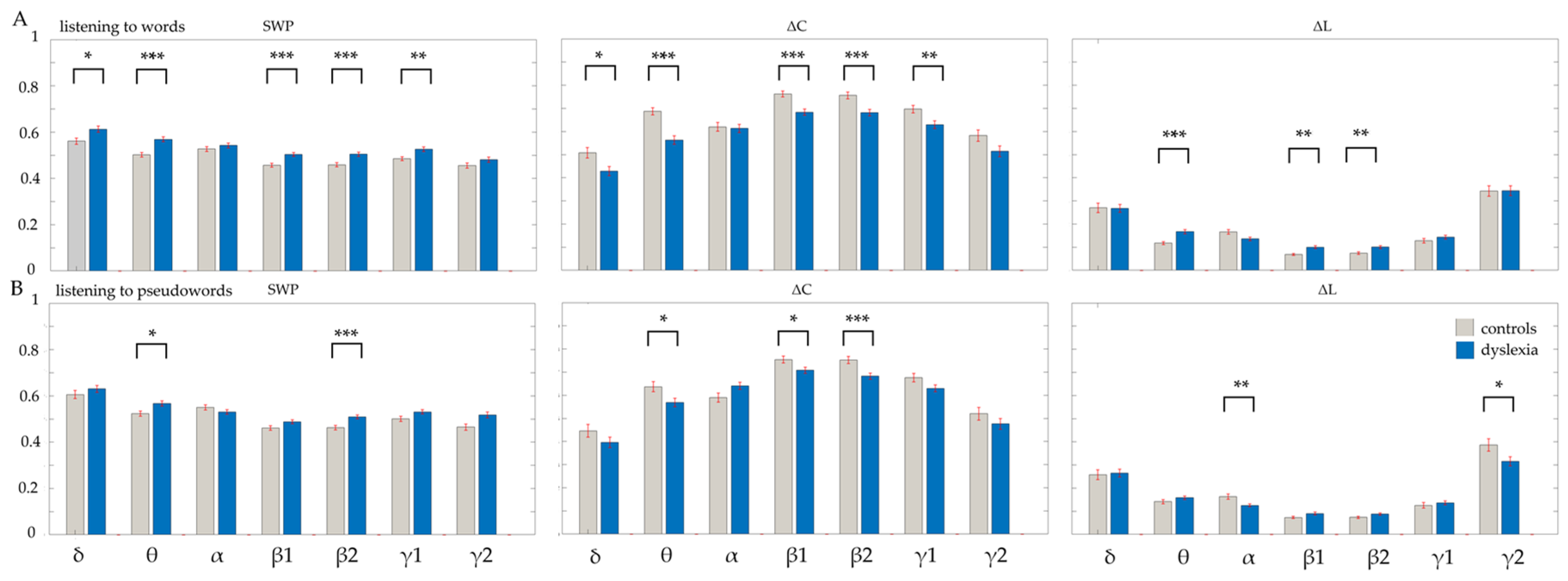
3.2. Global Measures During Auditory Discrimination of Monosyllabic Words
3.3. Global Measures During Auditory Discrimination of Monosyllabic Pseudowords
3.4. Assessing the Predictive Relationship Between Small-World Propensity and Behavioral Efficiency
3.5. Local Measures of the Frequency Functional EEG Networks During Auditory Word Discrimination
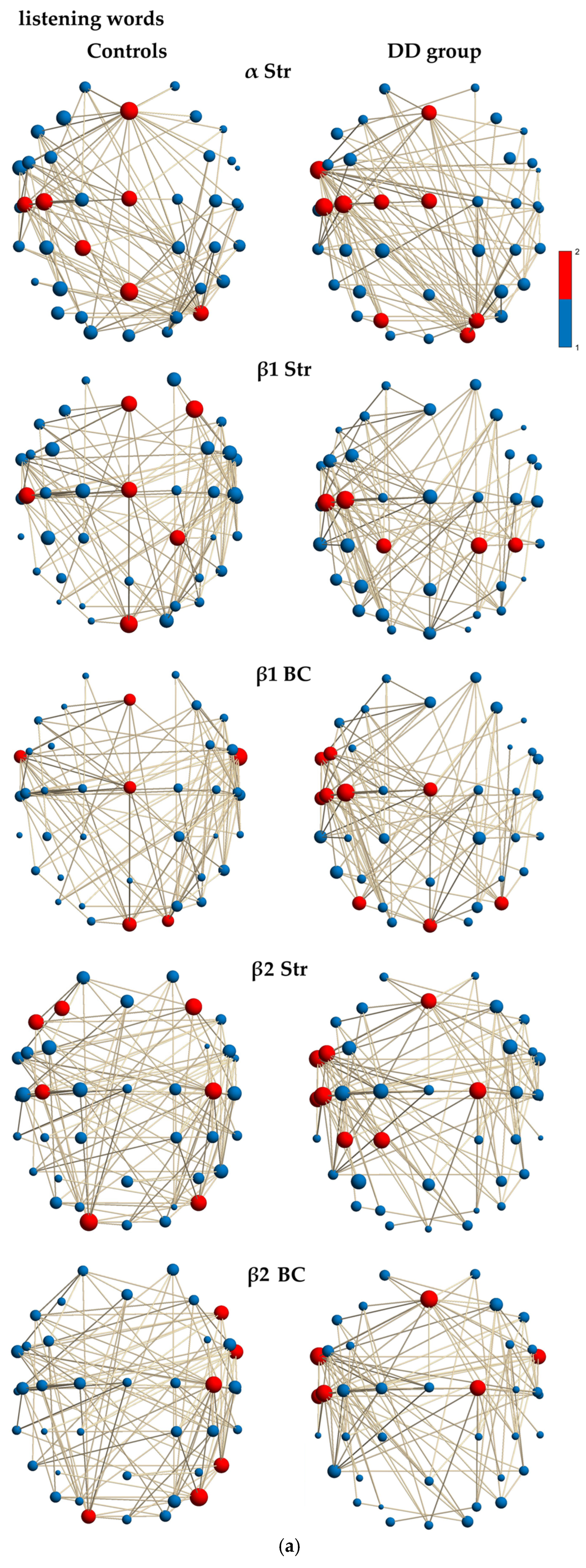
3.5.1. Alpha-Frequency Network During Auditory Word Discrimination
3.5.2. Beta1-Frequency Network During Auditory Word Discrimination
3.5.3. Beta2-Frequency Network During Auditory Word Discrimination
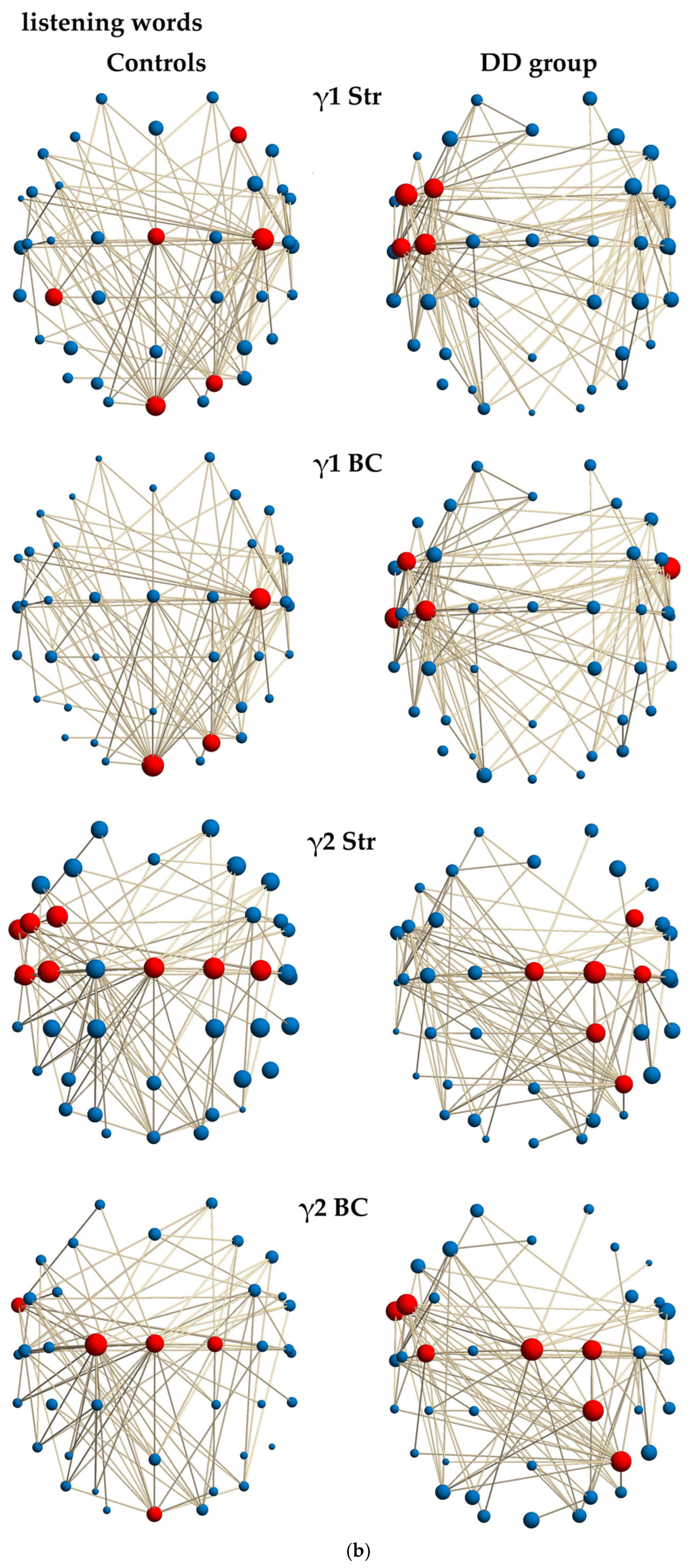
3.5.4. Gamma1-Frequency Network During Auditory Word Discrimination
3.5.5. Gamma2-Frequency Network During Auditory Word Discrimination
3.6. Local Measures of the Frequency Functional EEG Networks During Auditory Discrimination of Pseudowords
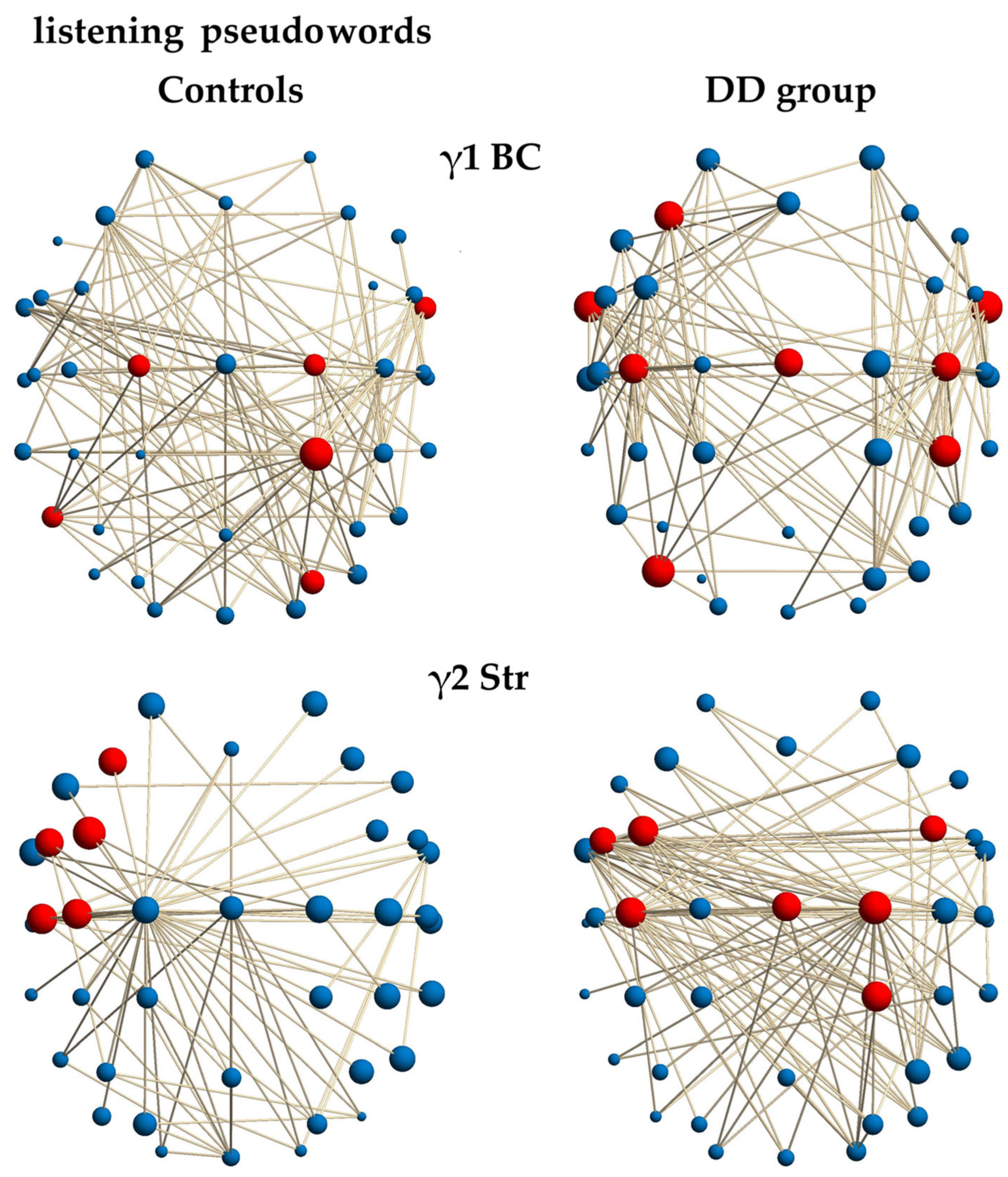
3.6.1. Gamma1-Frequency Network During Auditory Pseudoword Discrimination
3.6.2. Gamma2-Frequency Network During Auditory Pseudoword Discrimination
4. Discussion
4.1. Network Differences in Listening of Words
4.2. Network Differences in Listening to Pseudowords
5. Limitations
6. Conclusions
Supplementary Materials
Author Contributions
Funding
Institutional Review Board Statement
Informed Consent Statement
Data Availability Statement
Acknowledgments
Conflicts of Interest
References
- International Dyslexia Association (IDA). Definition of Dyslexia. Available online: https://dyslexiaida.org/definition-of-dyslexia/ (accessed on 24 January 2026).
- Lukic, S.; Jiang, F.; Mandelli, M.L.; Qi, T.; Inkelis, S.M.; Rosenthal, E.; Miller, Z.; Wellman, E.; Bunge, S.A.; Gorno-Tempini, M.L.; et al. A semantic strength and neural correlates in developmental dyslexia. Front. Psychol. 2025, 15, 1405425. [Google Scholar] [CrossRef] [Scilit]
- Snowling, M.J.; Hulme, C.; Nation, K. Defining and understanding dyslexia: Past, present and future. Oxf. Rev. Educ. 2020, 46, 501–513. [Google Scholar] [CrossRef] [Scilit]
- Tapionkaski, A.; Tapionkaski, S. Phonological deficits in developmental dyslexia in a psycholinguistic framework: Unguided phonological encoding. Lang. Dev. Res. 2025, 5, 72–103. [Google Scholar]
- Konopka, A.K.; Kasprzyk, A.; Pyttel, J.; Chmielik, L.P.; Niedzielski, A. Etiology, Diagnostic, and Rehabilitative Methods for Children with Central Auditory Processing Disorders—A Scoping Review. Audiol. Res. 2024, 14, 736–746. [Google Scholar] [CrossRef] [Scilit]
- Martin, K.C.; DeMarco, A.T.; Dyslin, S.M.; Turkeltaub, P.E. Rapid auditory and phonemic processing relies on the left planum temporale. Cortex 2025, 191, 12–24. [Google Scholar] [CrossRef] [Scilit]
- Kalantari, A.; Marashian, F.; Bozorgi, Z.; Hafezi, F. Effectiveness of Brain Training Exercises on Visual and Auditory Memory in Students with Dyslexia. Educ. Res. Med. Sci. 2024, 13, e151747. [Google Scholar] [CrossRef] [Scilit]
- Gkintoni, E.; Michou, E. Advancing Neuropsychological Rehabilitation in Primary Progressive Aphasia Based on Principles of Cognitive Neuroscience: A Scoping Review and Systematic Analysis of the Data. Brain Sci. 2024, 14, 1234. [Google Scholar] [CrossRef] [Scilit]
- Castles, A. The dual route model and the developmental dyslexias. Lond. Rev. Educ. 2006, 4, 49–61. [Google Scholar] [CrossRef] [Scilit]
- Coltheart, M.; Rastle, K.; Perry, C.; Langdon, R.; Ziegler, J. DRC: A dual route cascaded model of visual word recognition and reading aloud. Psychol. Rev. 2001, 108, 204–256. [Google Scholar] [CrossRef] [Scilit]
- Pritchard, S.C.; Coltheart, M.; Palethorpe, S.; Castles, A. Nonword reading: Comparing dual-route cascaded and connectionist dual-process models with human data. J. Exp. Psychol. Hum. Percept. Perform. 2012, 38, 1268–1288. [Google Scholar] [CrossRef] [Scilit] [PubMed]
- Peterson, R.L.; Pennington, B.F. Developmental dyslexia. Annu. Rev. Clin. Psychol. 2015, 11, 283–307. [Google Scholar] [CrossRef] [Scilit]
- Ring, J.; Black, J.L. The multiple deficit model of dyslexia. Ann. Dyslexia 2018, 68, 104–125. [Google Scholar] [CrossRef] [Scilit]
- Vellutino, F.R.; Tunmer, W.E.; Jaccard, J.; Chen, R. Components of Reading Ability: Multivariate Evidence for a Convergent Skills Model of Reading Development. Sci. Stud. Read. 2007, 11, 3–32. [Google Scholar] [CrossRef]
- Melby-Lervåg, M.; Lyster, S.A.H.; Hulme, C. Phonological skills and their relationship to reading acquisition: A meta-analysis. Psychol. Bull. 2012, 138, 629–654. [Google Scholar] [CrossRef] [Scilit]
- Stein, J. Theories about Developmental Dyslexia. Brain Sci. 2023, 13, 208. [Google Scholar] [CrossRef] [Scilit]
- Werth, R. Is Developmental Dyslexia Due to a Visual and Not a Phonological Impairment? Brain Sci. 2021, 11, 1313. [Google Scholar] [CrossRef] [Scilit]
- Facoetti, A.; Franceschini, S.; Gori, S. Role of Visual Attention in Developmental Dyslexia. In Developmental Dyslexia Across Languages and Writing Systems; Verhoeven, L., Perfetti, C., Pugh, K., Eds.; Cambridge University Press: Cambridge, UK, 2019; pp. 307–326. [Google Scholar]
- Wolf, M.; Bowers, P.G. The double-deficit hypothesis for the developmental dyslexias. J. Educ. Psychol. 1999, 91, 415–438. [Google Scholar] [CrossRef]
- Wolf, M.; O’Rourke, A.G.; Gidney, C.; Lovett, M.; Cirino, P.; Morris, R. The second deficit: An investigation of the independence of phonological and naming-speed deficits in developmental dyslexia. Read. Writ. 2002, 15, 43–72. [Google Scholar] [CrossRef] [Scilit]
- DeWitt, I.; Rauschecker, J.P. Phoneme and word recognition in the auditory ventral stream. Proc. Natl. Acad. Sci. USA 2012, 109, E505–E514. [Google Scholar] [CrossRef] [Scilit] [PubMed]
- Bowers, P.G.; Wolf, M. Theoretical links among naming speed, precise timing mechanisms and orthographic skill in dyslexia. Read. Writ. Interdiscip. J. 1993, 5, 69–85. [Google Scholar] [CrossRef] [Scilit]
- Hickok, G.; Poeppel, D. Dorsal and ventral streams: A framework for understanding aspects of the functional anatomy of language. Cognition 2004, 92, 67–99. [Google Scholar] [CrossRef] [Scilit]
- Rauschecker, J.P.; Scott, S.K. Maps and streams in the auditory cortex: Nonhuman primates illuminate human speech processing. Nat. Neurosci. 2009, 12, 718–724. [Google Scholar] [CrossRef] [Scilit]
- Gagl, B.; Richlan, F.; Ludersdorfer, P.; Sassenhagen, J.; Eisenhauer, S.; Gregorova, K.; Fiebach, C.J. The lexical categorization model: A computational model of left ventral occipito-temporal cortex activation in visual word recognition. PLoS Comput. Biol. 2022, 18, e1009995. [Google Scholar] [CrossRef] [Scilit]
- Davis, M.H.; Johnsrude, I.S. Hierarchical processing in spoken language comprehension. J. Neurosci. 2003, 23, 3423–3431. [Google Scholar] [CrossRef] [Scilit]
- Hickok, G.; Poeppel, D. The cortical organization of speech processing. Nat. Rev. Neurosci. 2007, 8, 393–402. [Google Scholar] [CrossRef] [Scilit]
- Obleser, J.; Eisner, F. Pre-lexical abstraction of speech in the auditory cortex. Trends Cogn. Sci. 2009, 13, 14–19. [Google Scholar] [CrossRef] [Scilit] [PubMed]
- Rolls, E.T.; Rauschecker, J.P.; Deco, G.; Huang, C.-C.; Feng, J. Auditory cortical connectivity in humans. Cereb. Cortex 2023, 33, 6207–6227. [Google Scholar] [CrossRef] [Scilit] [PubMed]
- Scott, S.K.; Blank, C.C.; Rosen, S.; Wise, R.J. Identification of a pathway for intelligible speech in the left temporal lobe. Brain 2000, 123, 2400–2406. [Google Scholar] [CrossRef] [Scilit]
- Friederici, A.D. The brain basis of language processing: From structure to function. Physiol. Rev. 2011, 91, 1357–1392. [Google Scholar] [CrossRef] [Scilit]
- Friederici, A.D.; Chomsky, N. Language in Our Brain: The Origins of a Uniquely Human Capacity; MIT Press Scholarship Online: Cambridge, MA, USA, 2017. [Google Scholar] [CrossRef]
- Schwarz, J.; Lizarazu, M.; Lallier, M.; Klimovich-Gray, A. Phonological deficits in dyslexia impede lexical processing of spoken words: Linking behavioural and MEG data. Cortex 2024, 171, 204–222. [Google Scholar] [CrossRef] [Scilit] [PubMed]
- Zhang, Z. Neuroimaging Meta-Analyses of Phonological Awareness Deficits in Children with Developmental Dyslexia. Brain Imaging Behav. 2025; advanced online publication.
- Goswami, U. A temporal sampling framework for developmental dyslexia. Trends Cogn. Sci. 2011, 15, 3–10. [Google Scholar] [CrossRef] [Scilit] [PubMed]
- Power, A.J.; Colling, L.J.; Mead, N.; Barnes, L.; Goswami, U. Neural encoding of the speech envelope by children with developmental dyslexia. Brain Lang. 2016, 60, 1–10. [Google Scholar] [CrossRef] [Scilit]
- Lizarazu, M.; di Covella, L.S.; van Wassenhove, V.; Rivière, D.; Mizzi, R.; Lehongre, K.; Hertz-Pannier, L.; Ramus, F. Neural entrainment to speech and nonspeech in dyslexia: Conceptual replication and extension of previous investigations. Cortex 2021, 137, 160–178. [Google Scholar] [CrossRef] [Scilit]
- Taskov, T.; Dushanova, J. Reading-Network in Developmental Dyslexia before and after Visual Training. Brain Sci. 2020, 12, 1842. [Google Scholar] [CrossRef] [Scilit]
- Araújo, J.; Simons, B.D.; Peter, V.; Mandke, K.; Kalashnikova, M.; Macfarlane, A.; Gabrielczyk, F.; Wilson, A.; Di Liberto, G.M.; Burnham, D.; et al. Atypical low-frequency cortical encoding of speech identifies children with developmental dyslexia. Front. Hum. Neurosci. 2024, 18, 1403677. [Google Scholar] [CrossRef] [Scilit] [PubMed]
- Giraud, A.-L.; Poeppel, D. Cortical oscillations and speech processing: Emerging computational principles and operations. Nat. Neurosci. 2012, 15, 511–517. [Google Scholar] [CrossRef] [Scilit] [PubMed]
- Stein, J. The magnocellular theory of developmental dyslexia. In Reading and Dyslexia; Literacy Studies; Lachmann, T., Weis, T., Eds.; Springer: Cham, Switzerland, 2018; Volume 16. [Google Scholar] [CrossRef] [Scilit]
- Richlan, F.; Kronbichler, M.; Wimmer, H. Meta-analyzing brain dysfunctions in dyslexic children and adults. NeuroImage 2011, 56, 1735–1742. [Google Scholar] [CrossRef] [Scilit]
- Bullmore, E.; Sporns, O. Complex brain networks: Graph theoretical analysis of structural and functional systems. Nat. Rev. Neurosci. 2009, 10, 186–198. [Google Scholar] [CrossRef] [Scilit] [PubMed]
- Rubinov, M.; Sporns, O. Complex network measures of brain connectivity: Uses and interpretations. NeuroImage 2010, 52, 1059–1069. [Google Scholar] [CrossRef] [Scilit]
- Olson, H.A.; Day, T.K.M.; Hiersche, K.J.; Manning, B.L.; Bradley, H.; Choi, S.; Abdurokhmonova, G.; McCormick, S.A.; Conrad, A.L.; Scheinost, D.; et al. Utilizing functional neuroimaging to study early language development. Dev. Cogn. Neurosci. 2025, 76, 101641. [Google Scholar] [CrossRef] [Scilit]
- Chen, B.; Linke, A.; Olson, L.; Ibarra, C.; Kinnear, M.; Fishman, I. Resting state functional networks in 1-to-3-year-old typically developing children. Dev. Cogn. Neurosci. 2021, 51, 100991. [Google Scholar] [CrossRef] [Scilit]
- Pugh, K.R.; Mencl, W.E.; Jenner, A.R.; Katz, L.; Frost, S.J.; Lee, J.R.; Shaywitz, S.E.; Shaywitz, B.A. Functional neuroimaging studies of reading and reading disability (developmental dyslexia). Ment. Retard. Dev. Disabil. Res. Rev. 2000, 6, 207–213. [Google Scholar] [CrossRef] [PubMed]
- Lehongre, K.; Morillon, B.; Giraud, A.-L.; Ramus, F. Impaired auditory sampling in dyslexia: Further evidence from combined fMRI and EEG. Front. Hum. Neurosci. 2013, 7, 454. [Google Scholar] [CrossRef] [Scilit]
- Turker, S.; Kuhnke, P.; Jiang, Z.; Hartwigsen, G. Disrupted network interactions serve as a neural marker of dyslexia. Commun. Biol. 2023, 6, 1114. [Google Scholar] [CrossRef] [Scilit]
- Taskov, T.; Dushanova, J. Pure-tone frequency discrimination and auditory functional connectivity in Developmental Dyslexia. J. Integr. Neurosci. 2025, 24, 42398. [Google Scholar] [CrossRef] [Scilit] [PubMed]
- Nikolova, T. Frequency Dictionary of the Bulgarian Conversational Language; Science and Art: Sofia, Bulgarian, 1987; Available online: https://miryan.org/glotta/cvetanka_nikolova_rechnik.html (accessed on 13 October 2014).
- Raichev, P.; Geleva, T.; Valcheva, M.; Rasheva, M.; Raicheva, M. Protocol on neurological and neuropsychological studies of children with specific learning disabilities. In Integrated Learning and Resource Teacher; Evgenieva, E., Ed.; Publishing House “Dr. Ivan Bogorov”: Sofia, Bulgaria, 2005; pp. 82–105. (In Bulgarian) [Google Scholar]
- Annett, M. A classification of hand preference by association analysis. Br. J. Psychol. 1970, 61, 303–321. [Google Scholar] [CrossRef] [Scilit] [PubMed]
- Matanova, V.; Todorova, E. DDE-2 Test Battery for Evaluation of Dyslexia of Development—Bulgarian Adaptation; OS Bulgaria Ltd.: Sofia, Bulgaria, 2013; Available online: https://www.giuntipsy.bg/testove/dde-2-testova-baterija-za-ocenka-na-disleksija-na-razvitieto (accessed on 1 October 2013).
- Sartori, G.; Remo, J.; Tressoldi, P.E. Updated and revised edition for the evaluation of dyslexia. In DDE-2, Battery for the Devel-opmental Dyslexia and Evolutionary Disorders-2, 1995; Giunti O.S.: Florence, Italy, 2007. [Google Scholar]
- Kalonkina, A.; Lalova, J. Normative indicators for the test battery for a written speech assessment. In Logopedical Diagnostics; Tyubele, S., Iossifova, R., Eds.; Rommel Publishing House: Bulgaria, Balkans, 2016; pp. 30–38. [Google Scholar]
- Girolami-Boulinier, A. Contrôle des Aptitudes à la Lecture et àl’Ecriture (CALE); CALE: Paris, France, 1985. (In French) [Google Scholar]
- Yakimova, R. Abnormalities of Written Speech; Rommel Publuling House: Sofia, Bulgaria, 2004. (In Bulgarian) [Google Scholar]
- Raven, J.; Raven, J.C.; Court, J.H. Manual for Raven’s Progressive Matrices and Vocabulary Scales. Section 2: The Colored Progressive Matrices; Oxford Psychologists Press: Oxford, UK; The Psychological Corporation: San Antonio, TX, USA, 1998. [Google Scholar]
- Totev, T.; Taskov, T.; Dushanova, J. A wireless EEG system for Neurofeedback training. Appl. Sci. 2022, 13, 96. [Google Scholar] [CrossRef] [Scilit]
- Koessler, L.; Maillard, L.; Benhadid, A.; Vignal, J.P.; Felblinger, J.; Vespignani, H.; Braun, M. Automated cortical projection of EEG sensors: Anatomical correlation via the international 10–10 system. NeuroImage 2009, 46, 64–72. [Google Scholar] [CrossRef] [Scilit]
- Giacometti, P.; Perdue, K.L.; Diamond, S.G. Algorithm to find high density EEG scalp coordinates and analysis of their correspondence to structural and functional regions of the brain. J. Neurosci. Methods 2014, 229, 84–96. [Google Scholar] [CrossRef] [Scilit]
- Ríos-Herrera, W.A.; Olguín-Rodríguez, P.V.; Arzate-Mena, J.D.; Corsi-Cabrera, M.; Escalona, J.; Marín-García, A.; Ramos-Loyo, J.; Rivera, A.L.; Rivera-López, D.; Zapata-Berruecos, J.F.; et al. The Influence of EEG References on the Analysis of Spatio-Temporal Interrelation Patterns. Front. Neurosci. 2019, 13, 941. [Google Scholar] [CrossRef] [Scilit]
- Dushanova, J.; Christov, M. Auditory event-related brain potentials for an early discrimination between normal and pathological brain aging. Neural Regen. Res. 2013, 8, 1390–1399. [Google Scholar]
- Stam, C.J.; Nolte, G.; Daffertshofer, A. Phase lag index: Assessment of functional connectivity from multi channel EEG and MEG with diminished bias from common sources. Hum. Brain Mapp. 2007, 28, 1178–1193. [Google Scholar] [CrossRef] [Scilit]
- Vinck, M.; Oostenveld, R.; van Wingerden, M.; Battaglia, F.; Pennartz, C.M.A. An improved index of phase-synchronization for electrophysiological data in the presence of volume-conduction, noise and sample-size bias. NeuroImage 2011, 55, 1548–1565. [Google Scholar] [CrossRef] [Scilit]
- Muldoon, S.F.; Bridgeford, E.W.; Bassett, D.S. Small-World Propensity and Weighted Brain Networks. Sci. Rep. 2016, 6, 22057. [Google Scholar] [CrossRef] [Scilit] [PubMed]
- Stam, C.J.; van Straaten, E.C.W. The organization of physiological brain networks. Clin. Neurophysiol. 2012, 123, 1067–1087. [Google Scholar] [CrossRef] [Scilit]
- Xia, M.; Wang, J.; He, Y. BrainNet Viewer: A network visualization tool for human brain connectomics. PLoS ONE 2013, 8, e68910. [Google Scholar] [CrossRef] [Scilit] [PubMed]
- Frossard, J.; Renaud, O. Permutation Tests for Regression, ANOVA, and Comparison of Signals: The permuco Package. J. Stat. Softw. 2021, 99, 1–32. [Google Scholar] [CrossRef] [Scilit]
- Mason, D.M.; Newton, M.A. A Rank Statistics Approach to the Consistency of a General Bootstrap. Ann. Stat. 1992, 20, 1611–1624. [Google Scholar] [CrossRef] [Scilit]
- Maris, E.; Oostenveld, R. Nonparametric statistical testing of EEG- and MEG-data. J. Neurosci. Methods 2007, 164, 177–190. [Google Scholar] [CrossRef] [Scilit]
- Benjamini, Y.; Hochberg, Y. Controlling the False Discovery Rate: A Practical and Powerful Approach to Multiple Testing. J. R. Stat. Soc. Ser. B Stat. Methodol. 1995, 57, 289–300. [Google Scholar] [CrossRef] [Scilit]
- Breznitz, Z. Speed of phonological and orthographic processing as factors in dyslexia: Electrophysiological evidence. Genet. Soc. Gen. Psychol. Monogr. 2003, 129, 183–206. [Google Scholar]
- Statsenko, Y.; Habuza, T.; Gorkom, K.N.; Zaki, N.; Almansoori, T.M. Applying the Inverse Efficiency Score to Visual–Motor Task for Studying Speed-Accuracy Performance While Aging. Front. Aging Neurosci. 2020, 12, 574401. [Google Scholar] [CrossRef] [Scilit] [PubMed]
- Pereira, C.L.W.; Zhou, R.; Pitt, M.A.; Myung, J.I.; Rossi, P.J.; Caverzasi, E.; Rah, E.; Allen, I.E.; Mandelli, M.L.; Meyer, M.; et al. Probabilistic Decision-Making in Children With Dyslexia. Front. Neurosci. 2022, 16, 782306. [Google Scholar] [CrossRef] [Scilit] [PubMed]
- Di Dona, G.; Scaltritti, M.; Sulpizio, S. Formant-invariant voice and pitch representations are pre-attentively formed from constantly varying speech and non-speech stimuli. Eur. J. Neurosci. 2022, 56, 4086–4106. [Google Scholar] [CrossRef] [Scilit] [PubMed]
- Glica, A.; Wasilewska, K.; Jurkowska, J.; Żygierewicz, J.; Kossowski, B.; Jednoróg, K. Reevaluating the neural noise in dyslexia using biomarkers from electroencephalography and high-resolution magnetic resonance spectroscopy. eLife 2025, 13, RP99920. [Google Scholar] [CrossRef] [Scilit]
- Turri, C.; Di Dona, G.; Santoni, A.; Zamfira, D.A.; Franchin, L.; Melcher, D.; Ronconi, L. Periodic and Aperiodic EEG Features as Potential Markers of Developmental Dyslexia. Biomedicines 2023, 11, 1607. [Google Scholar] [CrossRef] [Scilit]
- Engel, A.K.; Fries, P. Beta-band oscillations—Signalling the status quo? Curr. Opin. Neurobiol. 2010, 20, 156–165. [Google Scholar] [CrossRef] [Scilit]
- Fries, P. Rhythms for cognition: Communication through coherence. Neuron 2015, 88, 220–235. [Google Scholar] [CrossRef] [Scilit]
- Vellutino, F.R.; Fletcher, J.M.; Snowling, M.J.; Scanlon, D.M. Specific reading disability (dyslexia): What have we learned in the past four decades? J. Child. Psychol. Psychiatry 2004, 45, 2–40. [Google Scholar] [CrossRef] [Scilit]



| Frequency Group | Rank Range | Frequency Range (Numerator/Denominator) |
|---|---|---|
| High | 46 to 110.5 | 387/5 to 138/5 |
| Average | 150 to 273 | 88/5 to 40/5 |
| Low | 368.5 to 624.5 | 13/3 to 25/5 |
| f | P | Controls | Children with DD | Controls/ | Children DD |
|---|---|---|---|---|---|
| Mean ± s.e. | Mean ± s.e. | p | χ2 | ||
| δ | ϕ | 0.5609 ± 0.0137 | 0.6128 ± 0.0128 | 0.0112 | 6.4295 |
| ΔC | 0.5081 ± 0.0229 | 0.4289 ± 0.0199 | 0.0103 | 6.5818 | |
| ΔL | 0.2701 ± 0.0207 | 0.2673 ± 0.0168 | 0.7575 | 0.0953 | |
| θ | ϕ | 0.5021 ± 0.0104 | 0.5687 ± 0.0108 | 1.1 × 10⁻⁵ | 19.289 |
| ΔC | 0.6875 ± 0.0157 | 0.5625 ± 0.0180 | 1.3 × 10⁻⁶ | 23.449 | |
| ΔL | 0.1176 ± 0.0065 | 0.1667 ± 0.0092 | 1.7 × 10⁻⁵ | 18.505 | |
| α | ϕ | 0.5268 ± 0.0099 | 0.5425 ± 0.0105 | 0.406 | 0.6901 |
| ΔC | 0.6198 ± 0.0187 | 0.6131 ± 0.0175 | 0.7709 | 0.0847 | |
| ΔL | 0.1658 ± 0.0101 | 0.1358 ± 0.0074 | 0.0171 | 5.6783 | |
| β1 | ϕ | 0.4567 ± 0.0087 | 0.5032 ± 0.0081 | 9.1 × 10⁻⁵ | 15.314 |
| ΔC | 0.7621 ± 0.0129 | 0.6834 ± 0.0135 | 5.3 × 10⁻⁵ | 16.345 | |
| ΔL | 0.0689 ± 0.0042 | 0.0996 ± 0.0064 | 0.0011 | 10.573 | |
| β2 | ϕ | 0.4589 ± 0.0093 | 0.5046 ± 0.0089 | 0.0001 | 14.028 |
| ΔC | 0.7558 ± 0.0145 | 0.6817 ± 0.0144 | 9.3 × 10⁻⁵ | 15.272 | |
| ΔL | 0.0742 ± 0.0051 | 0.1006 ± 0.0063 | 0.0005 | 11.931 | |
| γ1 | ϕ | 0.4853 ± 0.0089 | 0.5258 ± 0.0095 | 0.0036 | 8.4308 |
| ΔC | 0.6966 ± 0.0161 | 0.6291 ± 0.0169 | 0.0043 | 8.1416 | |
| ΔL | 0.1279 ± 0.0095 | 0.1433 ± 0.0091 | 0.2019 | 1.6279 | |
| γ2 | ϕ | 0.4551 ± 0.0113 | 0.4807 ± 0.0113 | 0.1714 | 1.8699 |
| ΔC | 0.5821 ± 0.0243 | 0.5144 ± 0.0236 | 0.0908 | 2.8596 | |
| ΔL | 0.3431 ± 0.0225 | 0.3440 ± 0.0213 | 0.7133 | 0.1349 |
| f | P | Control | Children with DD | Controls/ | Children DD |
|---|---|---|---|---|---|
| Mean ± s.e. | Mean ± s.e. | p | χ2 | ||
| δ | ϕ | 0.6056 ± 0.0177 | 0.6300 ± 0.0143 | 0.1741 | 1.8465 |
| ΔC | 0.4462 ± 0.0280 | 0.3961 ± 0.0228 | 0.1222 | 2.3887 | |
| ΔL | 0.2576 ± 0.0214 | 0.2644 ± 0.0169 | 0.7063 | 0.1419 | |
| θ | ϕ | 0.5233 ± 0.0117 | 0.5672 ± 0.0112 | 0.0162 | 5.7753 |
| ΔC | 0.6369 ± 0.0215 | 0.5685 ± 0.0187 | 0.0111 | 6.4371 | |
| ΔL | 0.1413 ± 0.0094 | 0.1582 ± 0.0082 | 0.0861 | 2.9449 | |
| α | ϕ | 0.5502 ± 0.0113 | 0.5299 ± 0.0100 | 0.1425 | 2.1498 |
| ΔC | 0.5893 ± 0.0198 | 0.6404 ± 0.0158 | 0.0434 | 4.0785 | |
| ΔL | 0.16362 ± 0.011 | 0.1253 ± 0.0062 | 0.0069 | 7.2961 | |
| β1 | ϕ | 0.4609 ± 0.0096 | 0.4878 ± 0.0085 | 0.0222 | 5.2285 |
| ΔC | 0.7537 ± 0.0149 | 0.7078 ± 0.0136 | 0.0131 | 6.1522 | |
| ΔL | 0.0733 ± 0.0049 | 0.0897 ± 0.0062 | 0.0764 | 3.139 | |
| β2 | ϕ | 0.4626 ± 0.0103 | 0.5091 ± 0.0087 | 0.0005 | 12.051 |
| ΔC | 0.7516 ± 0.0156 | 0.6823 ± 0.0133 | 0.0004 | 12.344 | |
| ΔL | 0.0737 ± 0.0049 | 0.0875 ± 0.0042 | 0.0292 | 4.751 | |
| γ1 | ϕ | 0.5004 ± 0.0111 | 0.5308 ± 0.0090 | 0.0424 | 4.1163 |
| ΔC | 0.6760 ± 0.0183 | 0.6294 ± 0.0146 | 0.0395 | 4.2373 | |
| ΔL | 0.1252 ± 0.0118 | 0.1366 ± 0.0086 | 0.1445 | 2.1293 | |
| γ2 | ϕ | 0.465 ± 0.0131 | 0.5172 ± 0.0125 | 0.0183 | 5.566 |
| ΔC | 0.5198 ± 0.0273 | 0.4762 ± 0.0233 | 0.3173 | 0.9998 | |
| ΔL | 0.3857 ± 0.0269 | 0.3152 ± 0.0199 | 0.0142 | 6.0045 |
| f | P | Controls | Children with DD | Controls/ | Children DD |
|---|---|---|---|---|---|
| hubs | hubs | p | χ2 | ||
| δ | str | FC3 FC5 Cz C3 C6 CP1 P8 | AF3 Fz F3 FC3 F7 FC5 C3 CP1 T7 | 0.5456 | 0.3652 |
| BC | F7 C3 P3 P04 P8 P08 O2 | FC3 FT9–10 C3 P08 T7 | 0.4581 | 0.5505 | |
| θ | str | AF3 F3 FC3 FC5 T8 | AF3 F3 FC3 F7 FC5 C3 C5 | 0.7104 | 0.1378 |
| BC | Fz F3 FC4 FT9 P04 P8 | AF3 FT9 C3 P7 P07-P08 | 0.5967 | 0.2799 | |
| α | str | Fz Cz C3 C5 CP1 Pz P08 | FT9 Fz C1 Cz C3 C5 P03–04 O2 | 0.0134 | 6.114 |
| BC | Fz FT9 CP2 P04 P08 | Fz FT9 C3 P04 P08 P8 O2 | 0.4865 | 0.4842 | |
| β1 | str | Fz F4 Cz C5 CP2 Oz | C3 C5 CP1–2 CP4 | 4.57 × 10⁻⁶ | 21.01 |
| BC | Fz FT9–10 Cz Oz O2 | FC5 FT9 Cz C3 C5 T7 P07-P08 Oz | 0.0014 | 10.192 | |
| β2 | str | F3–4 F7 C3–4 P08 O1 | Fz FC5 FT9 C2 C5 CP1 CP3 T7 | 4.03 × 10⁻⁷ | 25.678 |
| BC | F8 FT10 C4 P08 P8 O1 | Fz FT9–10 C2 C5 T7 | 0.0003 | 12.994 | |
| γ1 | str | F4 Cz C4 CP3 P04 Oz | FC3 FC5 C3 C5 | 0.0003 | 13.352 |
| BC | C4 P04 Oz | FC5 FT10 C3 T7 | 0.0017 | 9.768 | |
| γ2 | str | FC3 FC5 FT9 C2 Cz C3–C4 C5 | FC4 C2 Cz C4 CP2 P4 | 4.3 × 10⁻¹¹ | 43.463 |
| BC | FT9 C1–2 Cz Oz | FC5 FT9 C2 Cz C3 CP2 P4 | 0.0004 | 12.652 |
| F | P | Controls | Children DD | Controls/ | Children DD |
|---|---|---|---|---|---|
| hubs | hubs | p | χ2 | ||
| δ | str | F3–4 Fz C3 CP1 T7 O2 | AF4 Fz F4 FC3 FC5 F7 C3 | 0.0323 | 4.577 |
| BC | FT10 P08 T7 O1–2 | AF4 FC3 FC5 C6 P04 O2 | 0.4490 | 0.5729 | |
| θ | str | AF4 Fz F4 FC3 F8 C6 TP8 | Fz F7 FC3 FT9 C3 C5 | 0.8497 | 0.0358 |
| BC | Fz F8 FT9 P04 P7 P08 TP8 | Fz FT9 C3 P07–08 | 0.8057 | 0.0604 | |
| α | str | CP2 CP4 P4 P04 P8 | FC3 C3 C5 CP1–2 P4 P04 | 0.3203 | 0.9875 |
| BC | TP8 P04 P8 P08 Oz O1–2 | F7 C3 TP7 P04 P7 P08 | 0.319 | 0.9930 | |
| β1 | str | F3 FC3 FC5 F7 C3 C5 CP4 | FC3 FC5 FT9 C3 C5 CP1 P3 | 0.2248 | 1.4735 |
| BC | F7 FC3 FT9 T7 | FC3 F7 FT9–10 Cz C3 T7 P04 P08 O1 | 0.4948 | 0.4659 | |
| β2 | str | FC5 FT10 C3 CP2 CP4 | FC3–4 C3 C5 T7 | 0.4691 | 0.5239 |
| BC | AF3–4 FC5 FT10 C3 | C3 T7 P8 | 0.0439 | 4.0593 | |
| γ1 | str | F3–4 FC6 CP2 P4 P04 | AF4 C3 CP2 CP4 | 0.0461 | 3.9778 |
| BC | FT10 C1–C2 P7 CP2 P04 | F3 FT9–10 Cz C3–4 CP4 P07 | 0.0002 | 13.211 | |
| γ2 | str | F3 FC3 FC5 C3 C5 | FC3–4 FC5 C2 Cz C3 CP2 | 0.0032 | 8.6855 |
| BC | C1 Cz | FT9 C2 Cz C3 | 0.1582 | 1.9914 |
Disclaimer/Publisher’s Note: The statements, opinions and data contained in all publications are solely those of the individual author(s) and contributor(s) and not of MDPI and/or the editor(s). MDPI and/or the editor(s) disclaim responsibility for any injury to people or property resulting from any ideas, methods, instructions or products referred to in the content. |
© 2026 by the authors. Licensee MDPI, Basel, Switzerland. This article is an open access article distributed under the terms and conditions of the Creative Commons Attribution (CC BY) license.
Share and Cite
Taskov, T.; Dushanova, J. Functional Networks in Developmental Dyslexia: Auditory Discrimination of Words and Pseudowords. NeuroSci 2026, 7, 21. https://doi.org/10.3390/neurosci7010021
Taskov T, Dushanova J. Functional Networks in Developmental Dyslexia: Auditory Discrimination of Words and Pseudowords. NeuroSci. 2026; 7(1):21. https://doi.org/10.3390/neurosci7010021
Chicago/Turabian StyleTaskov, Tihomir, and Juliana Dushanova. 2026. "Functional Networks in Developmental Dyslexia: Auditory Discrimination of Words and Pseudowords" NeuroSci 7, no. 1: 21. https://doi.org/10.3390/neurosci7010021
APA StyleTaskov, T., & Dushanova, J. (2026). Functional Networks in Developmental Dyslexia: Auditory Discrimination of Words and Pseudowords. NeuroSci, 7(1), 21. https://doi.org/10.3390/neurosci7010021