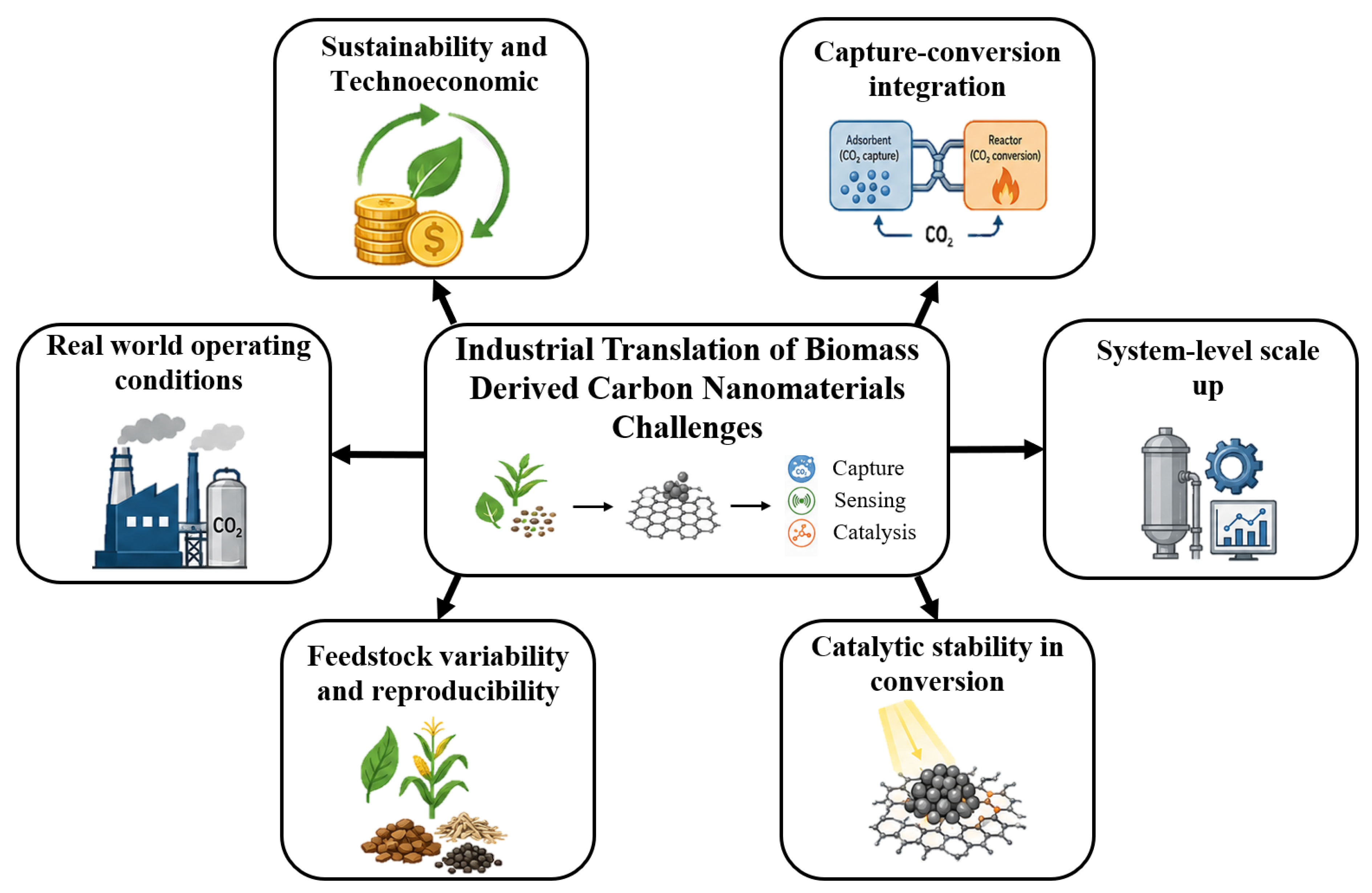

Biomass-Derived Nanoengineered Carbon Materials for Environmental Remediation and CO2 Valorization


Abstract
1. Introduction
2. Scope and Synthesis Framework
2.1. Literature Search Strategy
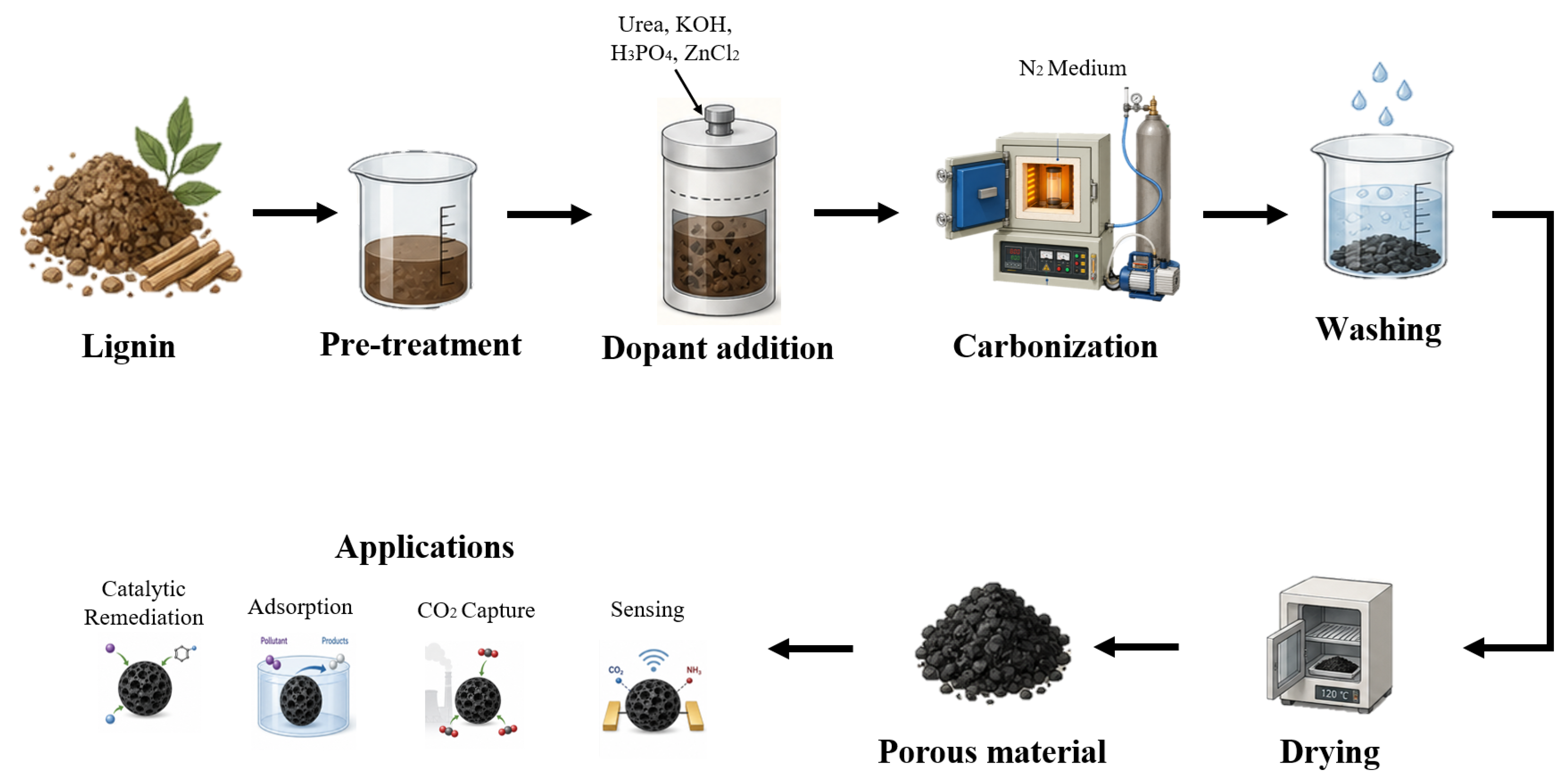
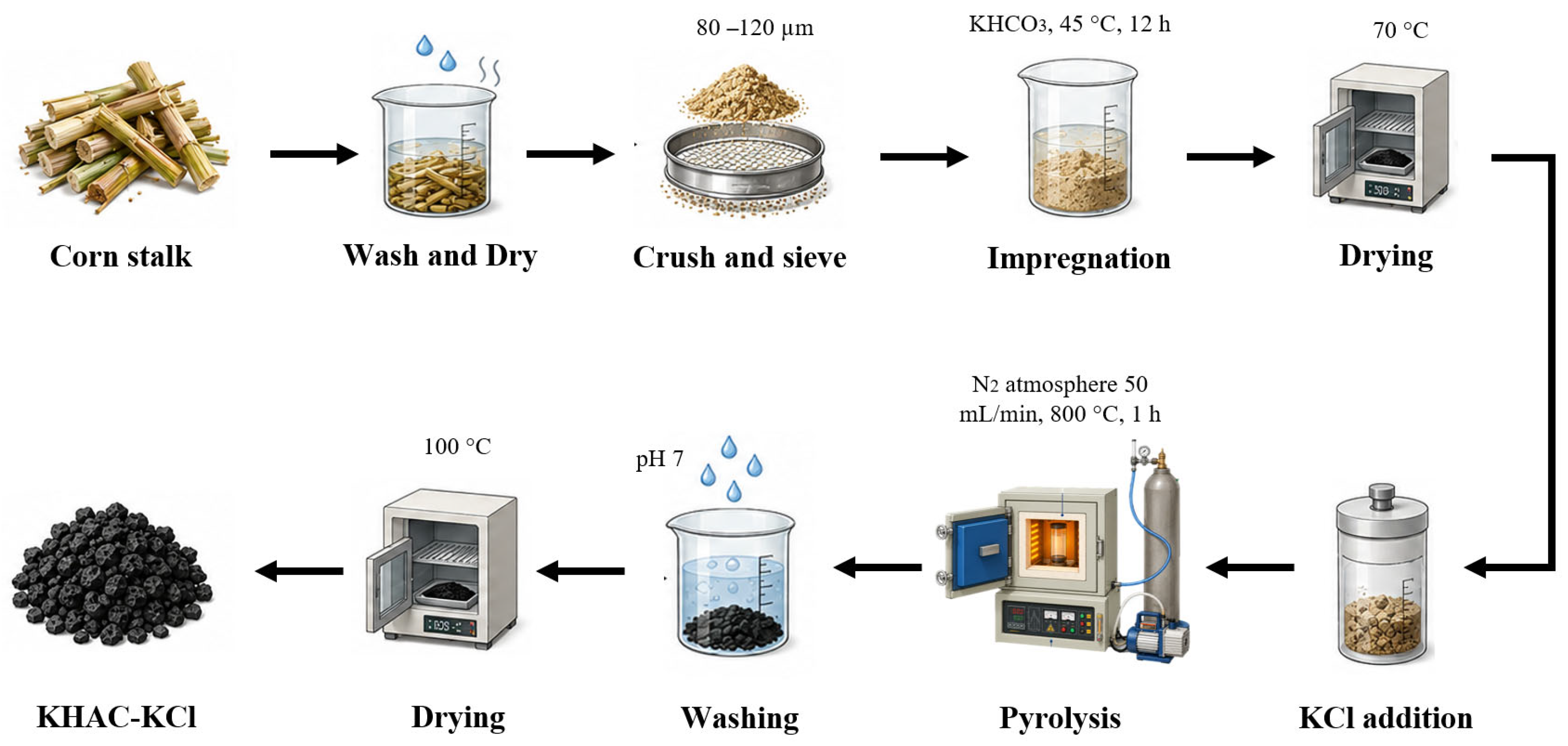
2.2. From Biomass to Nanoengineered Carbon Materials: Sustainable Precursors and Conversion Routes
2.2.1. Hydrothermal Carbonization (HTC)
2.2.2. Microwave-Assisted Conversion
2.2.3. Controlled Pyrolysis and Combustion
2.2.4. Sustainability Metrics and Techno-Economic Considerations
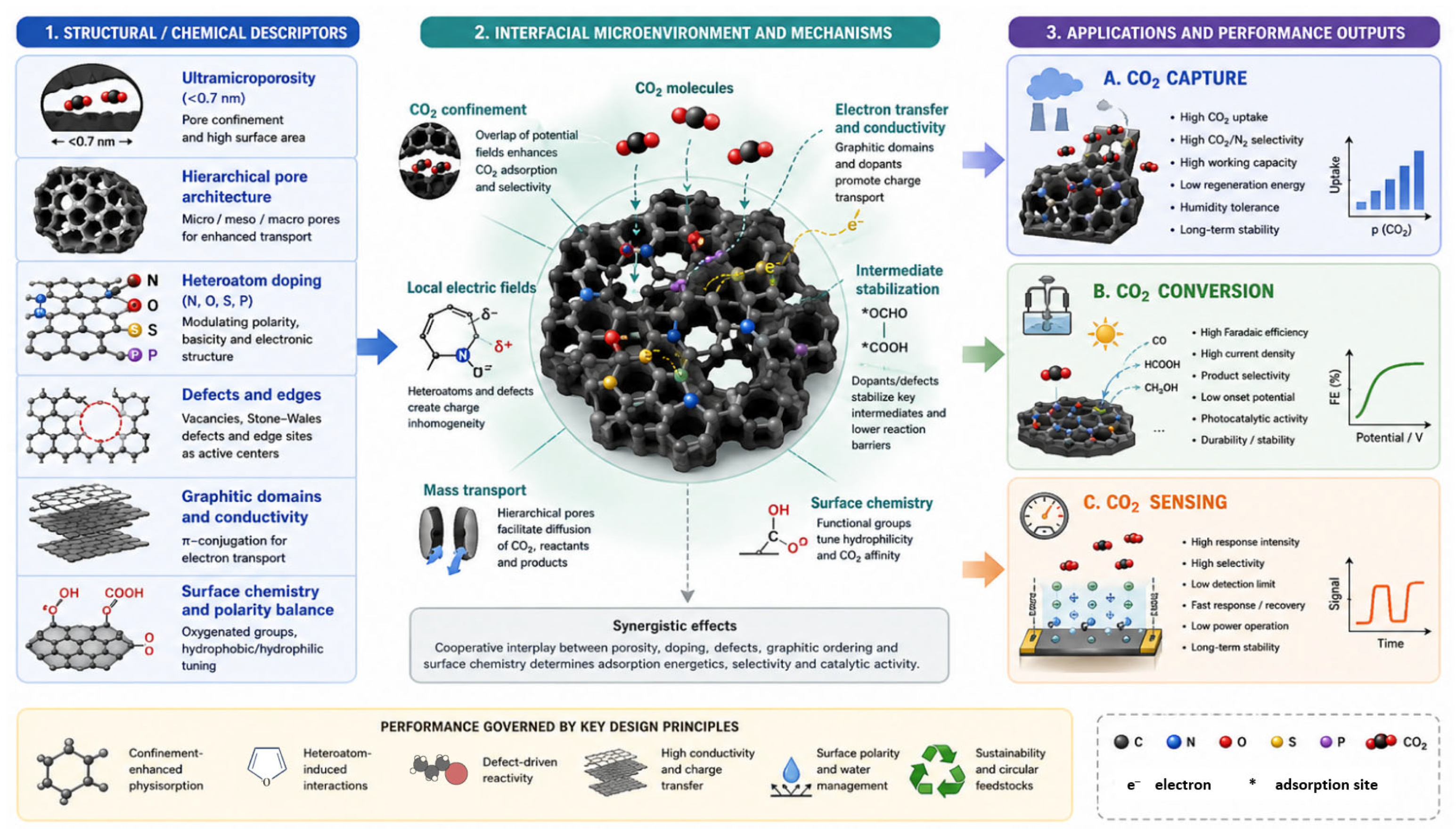
3. Structure-Function Design Principles Enabling CO2 Capture, Adsorption and Catalytic Conversion
3.1. Ultramicroporosity and Confinement-Enhanced Physisorption
3.2. Surface Chemistry: Doping and Heteroatom Availability
3.3. Electronic Structure and Catalytic Microenvironments
4. CO2 as a Target Molecule: Capture, Catalytic Valorization and Electrochemical Detection
4.1. CO2 Capture: From Pore Engineering to Process-Relevant Adsorption Behavior
4.2. CO2 Conversion: Nanoengineered Carbon Materials as Supports and Co-Catalysts in Catalytic and Electrochemical Pathways
Electrochemical Cell Configurations for CO2 Conversion
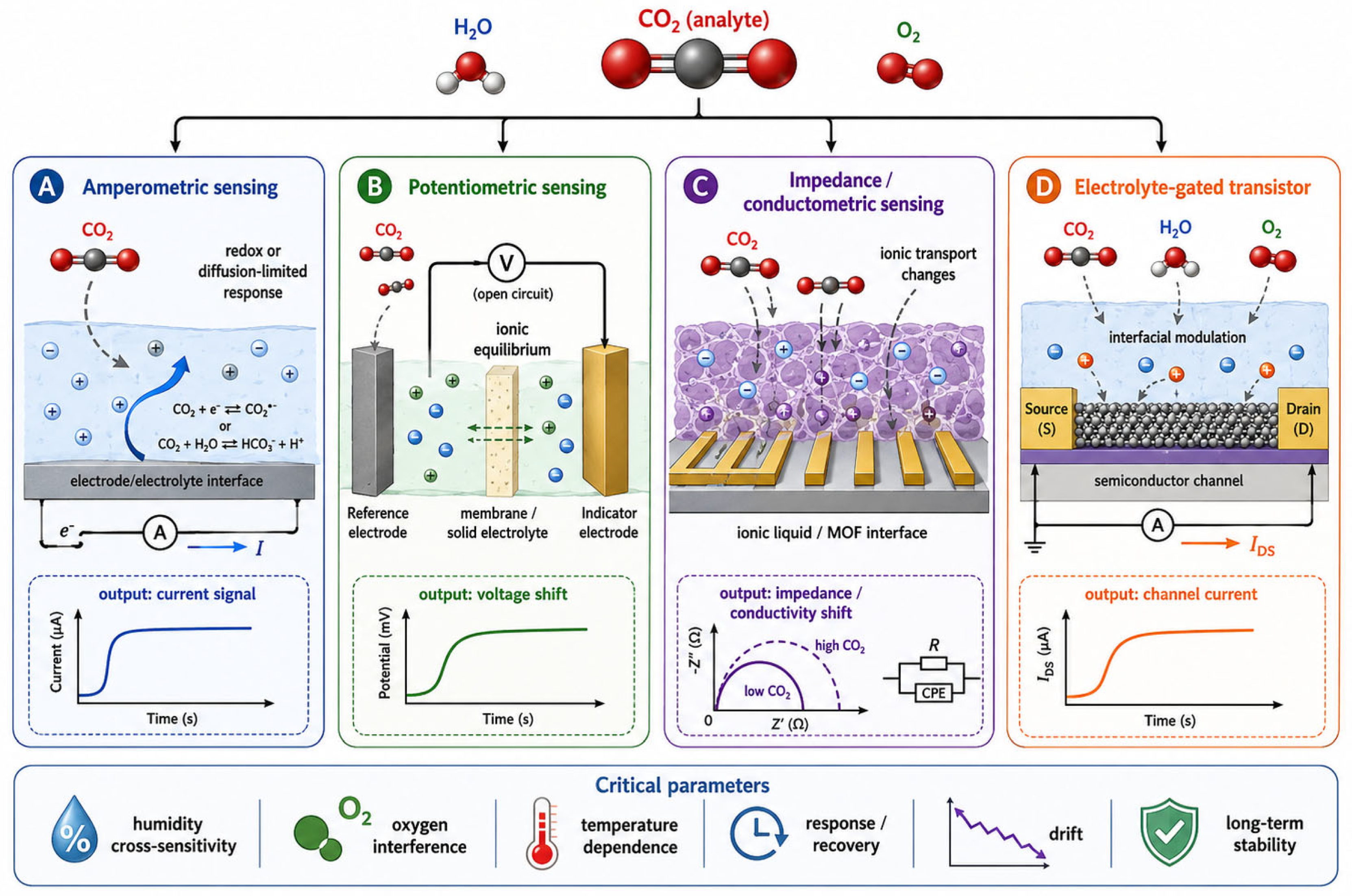
4.3. Electrochemical Pathways for CO2 Detection
5. Challenges, Scale-Up Limitations and Future Industrial Translation
6. Future Perspectives and Conclusions
Author Contributions
Funding
Institutional Review Board Statement
Informed Consent Statement
Data Availability Statement
Conflicts of Interest
References
- Hamda, A.S.; Areti, H.A.; Gudeta, R.L.; Abo, L.D.; Jayakumar, M. Carbon-Based Nanomaterials for Water Treatment: A Comprehensive Review of Recent Advances and Mechanisms. Chem. Eng. J. Adv. 2025, 23, 100834. [Google Scholar] [CrossRef] [Scilit]
- Masud, M.A.A.; Samaraweera, H. Carbon-Based Catalysts in Advanced Oxidation Processes for Sulfonamide Degradation: Environmental Challenges and Innovations. Curr. Opin. Environ. Sci. Health 2025, 46, 100628. [Google Scholar] [CrossRef] [Scilit]
- Kuligowska, M.; Neffe, S. Carbon Dots as Sensors and Sorbents in Environmental Monitoring Protection and Chemical Analysis. TrAC Trends Anal. Chem. 2024, 176, 117767. [Google Scholar] [CrossRef] [Scilit]
- Bressi, V.; Ferlazzo, A.; Iannazzo, D.; Espro, C. Graphene Quantum Dots by Eco-Friendly Green Synthesis for Electrochemical Sensing: Recent Advances and Future Perspectives. Nanomaterials 2021, 11, 1120. [Google Scholar] [CrossRef] [Scilit]
- Dong, Z.; Zhou, Q. Carbon-Based Nanostructured Materials Incorporating Carbon Dots for Supercapacitors: A Review. Nanoscale 2025, 17, 9786–9803. [Google Scholar] [CrossRef] [Scilit]
- Nag, A.; Chaudhuri, D. Advances in Nanomaterials for Energy and Sensing Applications: From Fundamentals to Device. Discov. Electron. 2026, 3, 13. [Google Scholar] [CrossRef] [Scilit]
- Liu, X.; Wang, S.; Sun, C.; Liu, H.; Stevens, L.; Dwomoh, P.K.; Snape, C. Synthesis of Functionalized 3D Microporous Carbon Foams for Selective CO2 Capture. Chem. Eng. J. 2020, 402, 125459. [Google Scholar] [CrossRef] [Scilit]
- Li, Y.; Wang, X.; Cao, M. Three-Dimensional Porous Carbon Frameworks Derived from Mangosteen Peel Waste as Promising Materials for CO2 Capture and Supercapacitors. J. CO2 Util. 2018, 27, 204–216. [Google Scholar] [CrossRef] [Scilit]
- Li, J.; Michalkiewicz, B.; Min, J.; Ma, C.; Chen, X.; Gong, J.; Mijowska, E.; Tang, T. Selective Preparation of Biomass-Derived Porous Carbon with Controllable Pore Sizes toward Highly Efficient CO2 Capture. Chem. Eng. J. 2019, 360, 250–259. [Google Scholar] [CrossRef] [Scilit]
- Khosrowshahi, M.S.; Abdol, M.A.; Mashhadimoslem, H.; Khakpour, E.; Emrooz, H.B.M.; Sadeghzadeh, S.; Ghaemi, A. The Role of Surface Chemistry on CO2 Adsorption in Biomass-Derived Porous Carbons by Experimental Results and Molecular Dynamics Simulations. Sci. Rep. 2022, 12, 8917. [Google Scholar] [CrossRef] [Scilit]
- Dipta, I.K.R.A.; Lee, C.W. Anode Surface Engineering for Tunable Carbon Nanotube Growth via Integrated Carbon Capture and Conversion in Low-Cost Molten Carbonates. Int. J. Energy Res. 2026, 2026, 4730702. [Google Scholar] [CrossRef] [Scilit]
- Kant, R.; Sharma, I. Recent Advances in Hybrid Nano-Interfaces for Environmental Pollutant Detection: Design Principles, Signal Transduction, and Analytical Performance. Microchim. Acta 2026, 193, 453. [Google Scholar] [CrossRef] [Scilit]
- Bressi, V.; Len, T.; Abate, S.; Espro, C.; Luque, R. From Waste to Fuel: Metal-Free Carbon Nanodots for Selective CO2 Photoreduction into Methanol. Chem. Eng. J. 2024, 485, 149989. [Google Scholar] [CrossRef] [Scilit]
- CO2 Emissions—Global Energy Review 2025. Available online: https://www.iea.org/reports/global-energy-review-2025/co2-emissions (accessed on 10 February 2026).
- Li, G.; He, J.; Yao, J. A Review of Recent Advances in Biomass-Derived Porous Carbon Materials for CO2 Capture. C 2025, 11, 92. [Google Scholar] [CrossRef] [Scilit]
- Ahmed, S.; Khan, M.K.; Kim, J. Revolutionary Advancements in Carbon Dioxide Valorization via Metal-Organic Framework-Based Strategies. Carbon Capture Sci. Technol. 2025, 15, 100405. [Google Scholar] [CrossRef] [Scilit]
- Hao, X.; An, X.; Patil, A.M.; Wang, P.; Ma, X.; Du, X.; Hao, X.; Abudula, A.; Guan, G. Biomass-Derived N-Doped Carbon for Efficient Electrocatalytic CO2 Reduction to CO and Zn-CO2 Batteries. ACS Appl. Mater. Interfaces 2021, 13, 3738–3747. [Google Scholar] [CrossRef] [Scilit]
- Gawal, P.M.; Ishrat, J.; Bhattacharyya, K.; Golder, A.K. Experimental and Theoretical Studies on Photocatalytic CO2 Reduction to HCOOH by Biomass-Derived Carbon Dots Embedded Phytochemical-Based CdS Quantum Dots. Langmuir 2025, 41, 11161–11172. [Google Scholar] [CrossRef] [Scilit]
- Fang, X.; Zhao, Y.; Chen, H. Carbon Dioxide Capture by Zeolitic Porous Materials: Intrinsic Adsorption Mechanisms, Current Challenges and Future Perspectives. J. Solid State Chem. 2026, 358, 125923. [Google Scholar] [CrossRef] [Scilit]
- Wang, Y.; Liao, S.; Peng, J.; Liu, B.; Wu, Y. Enhancement of CO2 and CH4 Sensing Performance on Ni and Pt Doped BN: A First-Principles Study. Chem. Pap. 2026, 80, 7137–7146. [Google Scholar] [CrossRef] [Scilit]
- Palanisamy, S.; Fu, X.; Abdelhamid, A.S.; Alcheikh, N. MXene-Based Hybrid Materials for CO2 Sensing: Interfacial Mechanisms and Environmental Applications. Adv. Compos. Hybrid Mater. 2026. [Google Scholar] [CrossRef] [Scilit]
- Sharma, A.; Marwaha, L.; Thokker, Z.A. Green and Sustainable Nanomaterials: Focus on Bio-Derived Carbon Nanomaterials and Low-Temperature Synthesis Routes to Reduce Environmental Impact. In Evolving Approaches to Fuel Desulfurization with Nanocomposites; IGI Global Scientific Publishing: Hershey, PA, USA, 2026; pp. 147–180. ISBN 979-8-3373-5966-3. [Google Scholar]
- Lesch, R.; Visser, E.D.; Seroka, N.S.; Khotseng, L. Biomass-Derived Carbon-Based Nanomaterials: Current Research, Trends, and Challenges. J. Renew. Mater. 2025, 13, 1935–1977. [Google Scholar] [CrossRef] [Scilit]
- Almaraz-Vega, E.; Morales-Vargas, A.I.; Gómez Delgado, G.; Castellanos-Arteaga, L.; Iñiguez Gómez, O.; Flores Salcedo, C.C. Sustainable Carbon Nanomaterials from Biomass Precursors: Green Synthesis Strategies and Environmental Applications. Nanomaterials 2026, 16, 75. [Google Scholar] [CrossRef] [Scilit]
- Vijeata, A.; Chaudhary, G.R.; Chaudhary, S.; Ibrahim, A.A.; Umar, A. Recent Advancements and Prospects in Carbon-Based Nanomaterials Derived from Biomass for Environmental Remediation Applications. Chemosphere 2024, 357, 141935. [Google Scholar] [CrossRef] [Scilit]
- Matveeva, V.G.; Bronstein, L.M. From Renewable Biomass to Nanomaterials: Does Biomass Origin Matter? Prog. Mater. Sci. 2022, 130, 100999. [Google Scholar] [CrossRef] [Scilit]
- Ikram, M.; Haider, A.; Moeen, S.; Haider, J. Carbon-Based Nanomaterials for Environmental Applications; Engineering Materials; Springer: Cham, Switzerland, 2024; ISBN 978-3-031-59389-5. [Google Scholar]
- Barker-Rothschild, D.; Chen, J.; Wan, Z.; Renneckar, S.; Burgert, I.; Ding, Y.; Lu, Y.; Rojas, O.J. Lignin-Based Porous Carbon Adsorbents for CO2 Capture. Chem. Soc. Rev. 2025, 54, 623–652. [Google Scholar] [CrossRef] [Scilit]
- Ji, Y.; Du, J.; Chen, A.; Gao, X.; Peng, M. Transition Metal-Nitrogen-Carbon Single-Atom Catalysts Enhanced CO2 Electroreduction Reaction: A Review. ChemSusChem 2025, 18, e202401557. [Google Scholar] [CrossRef] [Scilit]
- Taher, T.; Maulana, S.; Mawaddah, N.; Munandar, A.; Rianjanu, A.; Lesbani, A. Low-Temperature Hydrothermal Carbonization of Activated Carbon Microsphere Derived from Microcrystalline Cellulose as Carbon Dioxide (CO2) Adsorbent. Mater. Today Sustain. 2023, 23, 100464. [Google Scholar] [CrossRef] [Scilit]
- Yue, L.; Rao, L.; Wang, L.; An, L.; Hou, C.; Ma, C.; DaCosta, H.; Hu, X. Efficient CO2 Adsorption on Nitrogen-Doped Porous Carbons Derived from d-Glucose. Energy Fuels 2018, 32, 6955–6963. [Google Scholar] [CrossRef] [Scilit]
- Maulana Kusdhany, M.I.; Vorokhta, M.; Sasaki, K.; Nishihara, M.; Lyth, S.M. Solvent Driven Pore Engineering in Coffee-Derived Activated Hydrochar: Implications for Post-Combustion CO2 Capture. Carbon Energy 2026, 8, e70141. [Google Scholar] [CrossRef] [Scilit]
- Qiu, T.; Cao, W.; Xie, K.; Ahmad, F.; Zhao, W.; Mostafa, E.; Zhang, Y. CO2 Capture Performances of H3PO4/KOH Activated Microwave Pyrolyzed Porous Biochar. Sustain. Carbon Mater. 2025, 1. [Google Scholar] [CrossRef] [Scilit]
- Song, C.; Ye, W.; Liu, Y.; Huang, H.; Zhang, H.; Lin, H.; Lu, R.; Zhang, S. Facile Preparation of Porous Carbon Derived from Industrial Biomass Waste as an Efficient CO2 Adsorbent. ACS Omega 2020, 5, 28255–28263. [Google Scholar] [CrossRef] [Scilit]
- Foorginezhad, S.; Zerafat, M.M.; Asadnia, M.; Rezvannasab, G. Activated Porous Carbon Derived from Sawdust for CO2 Capture. Mater. Chem. Phys. 2024, 317, 129177. [Google Scholar] [CrossRef] [Scilit]
- Cheng, Z.; Liu, X.; Diao, R.; Qi, F.; Ma, P. Structural Regulation of Ultra-Microporous Biomass-Derived Carbon Materials Induced by Molten Salt Synergistic Activation and Its Application in CO2 Capture. Chem. Eng. J. 2024, 486, 150227. [Google Scholar] [CrossRef] [Scilit]
- Xing, L.; Yang, F.; Zhong, X.; Liu, Y.; Lu, H.; Guo, Z.; Lv, G.; Yang, J.; Yuan, A.; Pan, J. Ultra-Microporous Cotton Fiber-Derived Activated Carbon by a Facile One-Step Chemical Activation Strategy for Efficient CO2 Adsorption. Sep. Purif. Technol. 2023, 324, 124470. [Google Scholar] [CrossRef] [Scilit]
- Dziejarski, B.; Serafin, J.; Hernández-Barreto, D.F.; Naumovska, E.; Sreńscek-Nazzal, J.; Klomkliang, N.; Tam, E.; Krzyżyńska, R.; Andersson, K.; Knutsson, P. Tailoring Highly Surface and Microporous Activated Carbons (ACs) from Biomass via KOH, K2C2O4 and KOH/K2C2O4 Activation for Efficient CO2 Capture and CO2/N2 Selectivity: Characterization, Experimental and Molecular Simulation Insights. Chem. Eng. J. 2025, 524, 169677. [Google Scholar] [CrossRef] [Scilit]
- Villardon, A.; Alcazar-Ruiz, A.; Cencerrero, J.; Romero, A.; Sanchez- Silva, L.; Dorado, F. Olive Stone-Derived Biochar as a Sustainable Catalyst Support for CO2 Methanation. J. CO2 Util. 2025, 96, 103102. [Google Scholar] [CrossRef] [Scilit]
- Gamal, A.; Tang, M.; Chehimi, M.M.; Khalil, A.M.; Ozoemena, K.I.; Abdullah, A.M.; Jlassi, K. Effect of Metal Loading and Ce Addition on Biochar-Supported Co Catalysts for CO2 Methanation. Biochar 2025, 7, 73. [Google Scholar] [CrossRef] [Scilit]
- Du, Y.; Meng, X.; Qi, J.; Gong, B.; Ma, Y.; Li, J.; Zou, H.; Qiu, J. Engineering Efficient Self-Supporting SnO2/Carbon Nanofiber Electrode for Electrochemical CO2 Reduction. Chem. Eng. Sci. 2025, 318, 122147. [Google Scholar] [CrossRef] [Scilit]
- Hoang, T.-D.; Liu, Y.; Le, M.T. Synthesis and Characterization of Biochars and Activated Carbons Derived from Various Biomasses. Sustainability 2024, 16, 5495. [Google Scholar] [CrossRef] [Scilit]
- Lee, B.; He, J. Circular Carbon Capture: Comparative Life Cycle and Techno-Economic Assessment of Waste-Derived Activated Carbons. Environ. Sci. Technol. 2025, 59, 25791–25802. [Google Scholar] [CrossRef] [Scilit]
- Nowrouzi, M.; Abyar, H.; Younesi, H.; Khaki, E. Life Cycle Environmental and Economic Assessment of Highly Efficient Carbon-Based CO2 Adsorbents: A Comparative Study. J. CO2 Util. 2021, 47, 101491. [Google Scholar] [CrossRef] [Scilit]
- Lee, S.; Choi, W.; Kim, J.H.; Park, S.; Hwang, Y.J.; Na, J. Techno-Economic Analysis and Life-Cycle Assessment of the Electrochemical Conversion Process with Captured CO2 in an Amine-Based Solvent. Green Chem. 2023, 25, 10398–10414. [Google Scholar] [CrossRef] [Scilit]
- Gao, X.; Yang, S.; Hu, L.; Cai, S.; Wu, L.; Kawi, S. Carbonaceous Materials as Adsorbents for CO2 Capture: Synthesis and Modification. Carbon Capture Sci. Technol. 2022, 3, 100039. [Google Scholar] [CrossRef] [Scilit]
- Sharma, A.; Jindal, J.; Mittal, A.; Kumari, K.; Maken, S.; Kumar, N. Carbon Materials as CO2 Adsorbents: A Review. Env. Chem. Lett. 2021, 19, 875–910. [Google Scholar] [CrossRef] [Scilit]
- Talapaneni, S.N.; Singh, G.; Kim, I.Y.; AlBahily, K.; Al-Muhtaseb, A.H.; Karakoti, A.S.; Tavakkoli, E.; Vinu, A. Nanostructured Carbon Nitrides for CO2 Capture and Conversion. Adv. Mater. 2020, 32, 1904635. [Google Scholar] [CrossRef] [Scilit]
- Simari, C. Nanomaterials for Direct Air Capture of CO2: Current State of the Art, Challenges and Future Perspectives. Molecules 2025, 30, 3048. [Google Scholar] [CrossRef] [Scilit]
- Sneddon, G.; Greenaway, A.; Yiu, H.H.P. The Potential Applications of Nanoporous Materials for the Adsorption, Separation, and Catalytic Conversion of Carbon Dioxide. Adv. Energy Mater. 2014, 4, 1301873. [Google Scholar] [CrossRef] [Scilit]
- Khandaker, T.; Hossain, M.S.; Dhar, P.K.; Rahman, M.S.; Hossain, M.A.; Ahmed, M.B. Efficacies of Carbon-Based Adsorbents for Carbon Dioxide Capture. Processes 2020, 8, 654. [Google Scholar] [CrossRef] [Scilit]
- Kamran, U.; Park, S.-J. Chemically Modified Carbonaceous Adsorbents for Enhanced CO2 Capture: A Review. J. Clean. Prod. 2021, 290, 125776. [Google Scholar] [CrossRef] [Scilit]
- Wang, J.; Yang, G.; Wu, L.; Zhou, B.; Wang, Z.; Huang, Z.; Liu, G.; Wang, M. Porous Carbon-Based Adsorbents for CO2 Sequestration from Flue Gases: Tuning Porosity, Surface Chemistry, and Metal Impregnation for Sustainable Capture. Green Chem. Technol. 2026, 3, 10003. [Google Scholar] [CrossRef] [Scilit]
- Mohan, T.V.R.; Sridhar, P.; Selvam, P. Experimental and Modelling Studies of Carbon Dioxide Capture onto Pristine, Nitrogen-Doped, and Activated Ordered Mesoporous Carbons. RSC Adv. 2023, 13, 973–989. [Google Scholar] [CrossRef] [Scilit]
- Chen, H.; Guo, Y.; Du, Y.; Xu, X.; Su, C.; Zeng, Z.; Li, L. The Synergistic Effects of Surface Functional Groups and Pore Sizes on CO2 Adsorption by GCMC and DFT Simulations. Chem. Eng. J. 2021, 415, 128824. [Google Scholar] [CrossRef] [Scilit]
- Petrovic, B.; Gorbounov, M.; Masoudi Soltani, S. Impact of Surface Functional Groups and Their Introduction Methods on the Mechanisms of CO2 Adsorption on Porous Carbonaceous Adsorbents. Carbon Capture Sci. Technol. 2022, 3, 100045. [Google Scholar] [CrossRef] [Scilit]
- Feng, T.; Yang, J.; Huang, J.; Zhang, T.; Lu, S. Carbon-Based Nanomaterials for Carbon Neutralization through Electrochemical CO2 Reduction and C–N Coupling. Matter 2025, 8, 102077. [Google Scholar] [CrossRef] [Scilit]
- Han, H.; Yang, L.; Han, C.; Bi, M.; Li, H.; Zeng, Y.; Pan, K.; Yin, S.; Wang, F.; Pan, S. Enhancing CO2 Reduction Performance on Cu-Based Catalysts: Modulating Electronic Properties and Molecular Configurations. Materials 2025, 18, 4964. [Google Scholar] [CrossRef] [Scilit]
- Mansilla-Roux, A.; Lara-Angulo, M.A.; Serrano-Ruiz, J.C. Metal–Support Interactions in Single-Atom Catalysts for Electrochemical CO2 Reduction. Nanomaterials 2026, 16, 103. [Google Scholar] [CrossRef] [Scilit]
- Wu, H.; Singh-Morgan, A.; Qi, K.; Zeng, Z.; Mougel, V.; Voiry, D. Electrocatalyst Microenvironment Engineering for Enhanced Product Selectivity in Carbon Dioxide and Nitrogen Reduction Reactions. ACS Catal. 2023, 13, 5375–5396. [Google Scholar] [CrossRef] [Scilit]
- Cui, Y.; Cheng, Y.; Yang, C.; Su, Y.; Yao, D.; Liufu, B.; Li, J.; Fang, Y.; Liu, S.; Zhong, Z.; et al. High-Performance Electrocatalytic CO2 Reduction for CO Generation Using Hydrophobic Porous Carbon Supported Au. ACS Sustain. Chem. Eng. 2023, 11, 11229–11238. [Google Scholar] [CrossRef] [Scilit]
- Yusuf, B.O.; Abdulrasheed, A.A.; Hambali, H.U.; Gbadamosi, A.; Yusuff, A.S.; Afolabi, F.; Aliyu, M.; Ganiyu, S.A. Carbon Dioxide (CO2) Capture and Utilization Technologies: New Developments toward Net-Zero Emissions and Climate-Change Mitigation. Carbon Capture Sci. Technol. 2026, 18, 100589. [Google Scholar] [CrossRef] [Scilit]
- Chen, S.; Liu, J.; Zhang, Q.; Teng, F.; McLellan, B.C. A Critical Review on Deployment Planning and Risk Analysis of Carbon Capture, Utilization, and Storage (CCUS) toward Carbon Neutrality. Renew. Sustain. Energy Rev. 2022, 167, 112537. [Google Scholar] [CrossRef] [Scilit]
- Karayil, A.; Elseragy, A.; Aliyu, A.M. An Assessment of CO2 Capture Technologies towards Global Carbon Net Neutrality. Energies 2024, 17, 1460. [Google Scholar] [CrossRef] [Scilit]
- Wang, Y.; Suo, Y.; Xu, Y.; Zhang, Z. Enhancing CO2 Adsorption Performance of Porous Nitrogen-Doped Carbon Materials Derived from ZIFs: Insights into Pore Structure and Surface Chemistry. Sep. Purif. Technol. 2024, 335, 126117. [Google Scholar] [CrossRef] [Scilit]
- Xue, D.; Xia, H.; Yan, W.; Zhang, J.; Mu, S. Defect Engineering on Carbon-Based Catalysts for Electrocatalytic CO2 Reduction. Nano-Micro Lett. 2020, 13, 5. [Google Scholar] [CrossRef] [Scilit]
- Asmaly, H.A.; Elbager, M.A.; Iqbal, A.; Elkhider, S.M. Enhanced CO2 Capture Using Sustainable Biomass-Derived Activated Carbon from Desert Date Seed Husk: Adsorption Isotherms, Selectivity, and RSM Optimization. J. CO2 Util. 2026, 107, 103411. [Google Scholar] [CrossRef] [Scilit]
- Jagiello, J.; Kenvin, J.; Celzard, A.; Fierro, V. Enhanced Resolution of Ultra Micropore Size Determination of Biochars and Activated Carbons by Dual Gas Analysis Using N2 and CO2 with 2D-NLDFT Adsorption Models. Carbon 2019, 144, 206–215. [Google Scholar] [CrossRef] [Scilit]
- Tang, Z.; Gao, J.; Zhang, Y.; Du, Q.; Feng, D.; Dong, H.; Peng, Y.; Zhang, T.; Xie, M. Ultra-Microporous Biochar-Based Carbon Adsorbents by a Facile Chemical Activation Strategy for High-Performance CO2 Adsorption. Fuel Process. Technol. 2023, 241, 107613. [Google Scholar] [CrossRef] [Scilit]
- Wu, Q.; Zhang, G.; Gao, M.; Huang, L.; Li, L.; Liu, S.; Xie, C.; Zhang, Y.; Yu, S. N-Doped Porous Carbon from Different Nitrogen Sources for High-Performance Supercapacitors and CO2 Adsorption. J. Alloys Compd. 2019, 786, 826–838. [Google Scholar] [CrossRef] [Scilit]
- Li, Y.; Ding, T.; Xu, X.; Chakir, S.; Ding, Y.; Zhu, S.; Mei, J.; Wang, H.; Wang, X. Synergistic Effect of Pore Generation and Nitrogen Doping on the Enhanced CO2 Capture and Selectivity of Carbon Nanofibers. J. Environ. Chem. Eng. 2024, 12, 113197. [Google Scholar] [CrossRef] [Scilit]
- Zhao, K.; Quan, X. Carbon-Based Materials for Electrochemical Reduction of CO2 to C2+ Oxygenates: Recent Progress and Remaining Challenges. ACS Catal. 2021, 11, 2076–2097. [Google Scholar] [CrossRef] [Scilit]
- Boppella, R.; Kim, Y.; Joshi Reddy, K.A.; Song, I.; Eom, Y.; Sim, E.; Kim, T.K. Synergistic Electronic Structure Modulation in Single-Atomic Ni Sites Dispersed on Ni Nanoparticles Encapsulated in N-Rich Carbon Nanotubes Synthesized at Low Temperature for Efficient CO2 Electrolysis. Appl. Catal. B Environ. Energy 2024, 345, 123699. [Google Scholar] [CrossRef] [Scilit]
- Liu, F.; Niu, J.; Chuan, X.; Zhao, Y. Nitrogen and Phosphorus Co-Doped Porous Carbon: Dopant, Synthesis, Performance Enhancement Mechanism and Versatile Applications. J. Power Sources 2024, 601, 234308. [Google Scholar] [CrossRef] [Scilit]
- Mekkat, R.; Kutorglo, E.M.; Setka, M.; Prokhorov, A.; Šoóš, M. A Novel N-Doped Porous Carbon-Supported g-C3N4 Composite for Enhanced Photocatalytic CO2 Conversion. J. Photochem. Photobiol. A Chem. 2025, 467, 116454. [Google Scholar] [CrossRef] [Scilit]
- Selvam, D.C.; Devarajan, Y.; Manjunath, H.R.; Gm, S.; Acharya, S.K.; Tiwari, A.; Srivastava, P.; Mehar, K. Review of Emerging Nanomaterials for CO2 Capture and Capture-to-Conversion: Materials, Devices, and System-Level Perspectives. Chem. Eng. J. Adv. 2026, 26, 101127. [Google Scholar] [CrossRef] [Scilit]
- Saxena, A.; Gupta, J.P.; Tiwary, J.K.; Kumar, A.; Sharma, S.; Pandey, G.; Biswas, S.; Chaturvedi, K.R. Innovative Pathways in Carbon Capture: Advancements and Strategic Approaches for Effective Carbon Capture, Utilization, and Storage. Sustainability 2024, 16, 10132. [Google Scholar] [CrossRef] [Scilit]
- Kim, C.; Talapaneni, S.N.; Dai, L. Porous Carbon Materials for CO2 Capture, Storage and Electrochemical Conversion. Mater. Rep. Energy 2023, 3, 100199. [Google Scholar] [CrossRef] [Scilit]
- Otto, A.; Grube, T.; Schiebahn, S.; Stolten, D. Closing the Loop: Captured CO2 as a Feedstock in the Chemical Industry. Energy Environ. Sci. 2015, 8, 3283–3297. [Google Scholar] [CrossRef] [Scilit]
- Ning, H.; Li, Y.; Zhang, C. Recent Progress in the Integration of CO2 Capture and Utilization. Molecules 2023, 28, 4500. [Google Scholar] [CrossRef] [Scilit]
- Raganati, F.; Ammendola, P. CO2 Post-Combustion Capture: A Critical Review of Current Technologies and Future Directions. Energy Fuels 2024, 38, 13858–13905. [Google Scholar] [CrossRef] [Scilit]
- Nwabueze, Q.A.; Leggett, S. Advancements in the Application of CO2 Capture and Utilization Technologies—A Comprehensive Review. Fuels 2024, 5, 508–532. [Google Scholar] [CrossRef] [Scilit]
- Abdul-Manan, A.F.N. Enabling Gigatonne Scale Engineering Based Carbon Capture Solutions and Novel Chemical Based CO2 Sequestrations. npj Clean Energy 2025, 1, 4. [Google Scholar] [CrossRef] [Scilit]
- Batool, S.M.; Batool, S.S.; Aliashghar, B.; Thomsan, D.; Miranda, M.; Braaten, B.D.; Oduor, P.G. Structural Modifications in Metal–Organic Frameworks for CO2 Adsorption and Sensing through Sustainable Synthesis and Emerging Designs. Mater. Today Sustain. 2026, 34, 101321. [Google Scholar] [CrossRef] [Scilit]
- Shi, W.; Guo, Y.; Lu, Q.; Li, H.; Liang, Y.; Ma, F.; Yang, B.; Chang, B. Dynamic Tailoring of the Gradient Porosity of Biomass-Derived Porous Carbons for Highly Effective CO2 Capture. Green Chem. 2025, 27, 11416–11428. [Google Scholar] [CrossRef] [Scilit]
- Querejeta, N.; Plaza, M.G.; Rubiera, F.; Pevida, C. Water Vapor Adsorption on Biomass Based Carbons under Post-Combustion CO2 Capture Conditions: Effect of Post-Treatment. Materials 2016, 9, 359. [Google Scholar] [CrossRef] [Scilit]
- Wang, J.; Wang, L.; Zhang, D.; Wang, Y.; Cao, Y.; Wang, X.; Li, J.; Huang, J.; Liu, Y.-N. Bifunctional Core-Shell Zr-MOFs@COFs Hybrids for CO2 Capture and Photocatalytic Oxidative Amine Coupling. Chem. Eng. Sci. 2023, 281, 119171. [Google Scholar] [CrossRef] [Scilit]
- Alli, Y.A.; Oladoye, P.O.; Ejeromedoghene, O.; Bankole, O.M.; Alimi, O.A.; Omotola, E.O.; Olanrewaju, C.A.; Philippot, K.; Adeleye, A.S.; Ogunlaja, A.S. Nanomaterials as Catalysts for CO2 Transformation into Value-Added Products: A Review. Sci. Total Environ. 2023, 868, 161547. [Google Scholar] [CrossRef] [Scilit]
- Song, W.; Xiao, C.; Ding, J.; Huang, Z.; Yang, X.; Zhang, T.; Mitlin, D.; Hu, W. Review of Carbon Support Coordination Environments for Single Metal Atom Electrocatalysts (SACS). Adv. Mater. 2024, 36, 2301477. [Google Scholar] [CrossRef] [Scilit]
- Fang, S.; Rahaman, M.; Bharti, J.; Reisner, E.; Robert, M.; Ozin, G.A.; Hu, Y.H. Photocatalytic CO2 Reduction. Nat. Rev. Methods Prim. 2023, 3, 61. [Google Scholar] [CrossRef] [Scilit]
- Lu, S.; Zhang, S.; Liu, Q.; Wang, W.; Hao, N.; Wang, Y.; Li, Z.; Luo, D. Recent Advances in Novel Materials for Photocatalytic Carbon Dioxide Reduction. Carbon Neutraliz. 2024, 3, 142–168. [Google Scholar] [CrossRef] [Scilit]
- Kumar, P.R.; Deepak, K.; Raguraman, D.; Venkatesh, J.; Ram, S. The Role of Nano Materials for Carbon Capture and Conversion for a Low-Carbon Future. Interactions 2026, 247, 13. [Google Scholar] [CrossRef] [Scilit]
- Zheng, Z.; Zhou, X.; Li, L.; Chen, H.; Zhang, X.; Qian, L. Membrane Electrode Assembly for CO2 Reduction Reaction. ChemSusChem 2026, 19, e202501685. [Google Scholar] [CrossRef] [Scilit]
- Belsa, B.; Xia, L.; García de Arquer, F.P. CO2 Electrolysis Technologies: Bridging the Gap toward Scale-up and Commercialization. ACS Energy Lett. 2024, 9, 4293–4305. [Google Scholar] [CrossRef] [Scilit]
- Sajna, M.S.; Zavahir, S.; Popelka, A.; Kasak, P.; Al-Sharshani, A.; Onwusogh, U.; Wang, M.; Park, H.; Han, D.S. Electrochemical System Design for CO2 Conversion: A Comprehensive Review. J. Environ. Chem. Eng. 2023, 11, 110467. [Google Scholar] [CrossRef] [Scilit]
- Haas, T.; Krause, R.; Weber, R.; Demler, M.; Schmid, G. Technical Photosynthesis Involving CO2 Electrolysis and Fermentation. Nat. Catal. 2018, 1, 32–39. [Google Scholar] [CrossRef] [Scilit]
- Hu, L.; Wrubel, J.A.; Baez-Cotto, C.M.; Intia, F.; Park, J.H.; Kropf, A.J.; Kariuki, N.; Huang, Z.; Farghaly, A.; Amichi, L.; et al. A Scalable Membrane Electrode Assembly Architecture for Efficient Electrochemical Conversion of CO2 to Formic Acid. Nat. Commun. 2023, 14, 7605. [Google Scholar] [CrossRef] [Scilit]
- Ambrogi, E.K.; Mirica, K.A. Electronic Chemical Sensors Based on Conductive Framework Materials. Anal. Chem. 2025, 97, 4253–4274. [Google Scholar] [CrossRef] [Scilit]
- Guo, H.; Huang, Z.; Zhang, X.; Zhang, H.; Sun, J.; Zeng, Y.; Hu, Y.; Zhou, Y.; Wan, H.; Wang, P. Advancements in Smart Electrochemical Gas Sensors: Bridging IoT, Self-Powering, and Machine Learning for Healthcare. Sens. Diagn. 2025, 4, 1060–1085. [Google Scholar] [CrossRef] [Scilit]
- Daniel, M.; Mathew, G.; Anpo, M.; Neppolian, B. MOF Based Electrochemical Sensors for the Detection of Physiologically Relevant Biomolecules: An Overview. Coord. Chem. Rev. 2022, 468, 214627. [Google Scholar] [CrossRef] [Scilit]
- Kidanemariam, A.; Cho, S. Advanced Metal–Organic Framework-Based Sensor Systems for Gas and Environmental Monitoring: From Material Design to Embedded Applications. Sensors 2025, 25, 6539. [Google Scholar] [CrossRef] [Scilit]
- Machín, A.; Márquez, F. Next-Generation Chemical Sensors: The Convergence of Nanomaterials, Advanced Characterization, and Real-World Applications. Chemosensors 2025, 13, 345. [Google Scholar] [CrossRef] [Scilit]
- Kalyakin, A.S.; Medvedev, D.A.; Volkov, A.N. Electrochemical Sensors Based on Proton-Conducting Electrolytes for Determination of Concentration and Diffusion Coefficient of CO2 in Inert Gases. Chem. Eng. Sci. 2021, 229, 116046. [Google Scholar] [CrossRef] [Scilit]
- Struzik, M.; Garbayo, I.; Pfenninger, R.; Rupp, J.L.M. A Simple and Fast Electrochemical CO2 Sensor Based on Li7La3Zr2O12 for Environmental Monitoring. Adv. Mater. 2018, 30, 1804098. [Google Scholar] [CrossRef] [Scilit]
- Digvijay, B.; Amala, J.; Aravind, S.P.; Bhuvaneshwari, S.; Mohanraj, P. CuxO/Cu Based Electrochemical Sensor for the Detection of CO2 Gas. Indian Chem. Eng. 2022, 64, 479–493. [Google Scholar] [CrossRef] [Scilit]
- Mulmi, S.; Thangadurai, V. (Eds.) Choice—Review—Solid-State Electrochemical Carbon Dioxide Sensors: Fundamentals, Materials and Applications. J. Electrochem. Soc. 2020, 167, 037567. [Google Scholar] [CrossRef] [Scilit]
- Zosel, J.; Oelßner, W.; Decker, M.; Gerlach, G.; Guth, U. The Measurement of Dissolved and Gaseous Carbon Dioxide Concentration. Meas. Sci. Technol. 2011, 22, 072001. [Google Scholar] [CrossRef] [Scilit]
- Molino, D.; Ferraro, G.; Lettieri, S.; Zaccagnini, P.; Etzi, M.; Astorino, C.; De Nardo, E.; Bartoli, M.; Lamberti, A.; Pirri, C.F.; et al. Enhanced CO2 Detection Using Potentiometric Sensors Based on PIM-1/DBU Imidazolate Membranes. Adv. Sustain. Syst. 2024, 8, 2400415. [Google Scholar] [CrossRef] [Scilit]
- Kaaliveetil, S.; Lee, Y.-Y.; Li, Z.; Cheng, Y.-H.; Menon, N.H.; Dongare, S.; Gurkan, B.; Basuray, S. Ionic Liquid-Packed Microfluidic Device with Non-Planar Microelectrode as a Miniaturized Electrochemical Gas Sensor. J. Electrochem. Soc. 2023, 170, 087508. [Google Scholar] [CrossRef] [Scilit]
- Gassensmith, J.J.; Kim, J.Y.; Holcroft, J.M.; Farha, O.K.; Stoddart, J.F.; Hupp, J.T.; Jeong, N.C. A Metal–Organic Framework-Based Material for Electrochemical Sensing of Carbon Dioxide. J. Am. Chem. Soc. 2014, 136, 8277–8282. [Google Scholar] [CrossRef] [Scilit]
- Ersöz, B.; Schmitt, K.; Wöllenstein, J. Electrolyte-Gated Transistor for CO2 Gas Detection at Room Temperature. Sens. Actuators B Chem. 2020, 317, 128201. [Google Scholar] [CrossRef] [Scilit]
- Ersöz, B.; Schmitt, K.; Wöllenstein, J. CO2 Gas Sensing with an Electrolyte-Gated Transistor Using Impedance Spectroscopy. Sens. Actuators B Chem. 2021, 334, 129598. [Google Scholar] [CrossRef] [Scilit]
- Besseling, T.H.; Chidambaram, A.; Bembnowicz, P.; Oudenhoven, J.F.M. Single-Use Impedimetric Carbon Dioxide Sensor Using a Room-Temperature Ionic-Liquid-Based Gel Electrolyte. IEEE Sens. J. 2023, 23, 25716–25723. [Google Scholar] [CrossRef] [Scilit]
- Bulemo, P.M.; Kim, D.-H.; Shin, H.; Cho, H.-J.; Koo, W.-T.; Choi, S.-J.; Park, C.; Ahn, J.; Güntner, A.T.; Penner, R.M.; et al. Selectivity in Chemiresistive Gas Sensors: Strategies and Challenges. Chem. Rev. 2025, 125, 4111–4183. [Google Scholar] [CrossRef] [Scilit]
- Lai, W.; Qiao, Y.; Wang, Y.; Huang, H. Stability Issues in Electrochemical CO2 Reduction: Recent Advances in Fundamental Understanding and Design Strategies. Adv. Mater. 2023, 35, 2306288. [Google Scholar] [CrossRef] [Scilit]
- Seo, K.; Edgar, T.F.; Stadtherr, M.A.; Baldea, M. Design and Optimization of Carbon Capture Processes Using Ionic Liquid Solvents. Curr. Opin. Chem. Eng. 2023, 42, 100978. [Google Scholar] [CrossRef] [Scilit]
- Zhang, H. Optimization of Electrochemical Sensors and Their Application in CO2 Detection. Trans. Mater. Biotechnol. Life Sci. 2024, 4, 25–30. [Google Scholar] [CrossRef] [Scilit]
- Manoharan Nair Sudha Kumari, S.; Thankappan Suryabai, X. Sensing the Future—Frontiers in Biosensors: Exploring Classifications, Principles, and Recent Advances. ACS Omega 2024, 9, 48918–48987. [Google Scholar] [CrossRef] [Scilit]
- Zdrachek, E.; Bakker, E. Potentiometric Sensing. Anal. Chem. 2019, 91, 2–26. [Google Scholar] [CrossRef] [Scilit]
- Wang, X.; He, T.; Hu, J.; Liu, M. The Progress of Nanomaterials for Carbon Dioxide Capture via the Adsorption Process. Environ. Sci. Nano 2021, 8, 890–912. [Google Scholar] [CrossRef] [Scilit]
- Abdoulmoumine, N.; Adhikari, S.; Kulkarni, A.; Chattanathan, S. A Review on Biomass Gasification Syngas Cleanup. Appl. Energy 2015, 155, 294–307. [Google Scholar] [CrossRef] [Scilit]
- Puxty, G.; Maeder, M.; Moore, T. The Chemistry and Thermodynamics of Point Source CO2 Capture by Liquid Chemical Absorption and Its Impact on Process Performance. Chem. Rev. 2025, 125, 10956–10993. [Google Scholar] [CrossRef] [Scilit]
- Asghar, U.; Rafiq, S.; Anwar, A.; Iqbal, T.; Ahmed, A.; Jamil, F.; Khurram, M.S.; Akbar, M.M.; Farooq, A.; Shah, N.S.; et al. Review on the Progress in Emission Control Technologies for the Abatement of CO2, SOx and NOx from Fuel Combustion. J. Environ. Chem. Eng. 2021, 9, 106064. [Google Scholar] [CrossRef] [Scilit]
- Blankenship, L.S.; Jagiello, J.; Mokaya, R. Confirmation of Pore Formation Mechanisms in Biochars and Activated Carbons by Dual Isotherm Analysis. Mater. Adv. 2022, 3, 3961–3971. [Google Scholar] [CrossRef] [Scilit]
- Wu, W.; Wang, Y.; Hu, X. Mass Transfer Driven Pore Engineering of Activated Carbon from the Activation of Biomass. Green Chem. 2026, 28, 3486–3511. [Google Scholar] [CrossRef] [Scilit]
- Alamiery, A. Standardized Protocols and Applications in Mechanochemical Synthesis for Organic and Inorganic Materials. Discov. Chem. 2026, 3, 65. [Google Scholar] [CrossRef] [Scilit]
- Jayabal, R.; Khambhati, D.; Rajendran, N.K.; Choudhury, P.; Nanda, B.; Smerat, A. Waste-Derived Carbon Scaffolds and Carbon-Hydrogel Composites for Sustainable Regenerative Engineering: From Circular Bioeconomy to Clinical Translation. Carbon Trends 2026, 23, 100646. [Google Scholar] [CrossRef] [Scilit]
- Baba, I.A.; Mustapha, S.; Abdulkareem, A.S.; Tijani, J.O.; Obayomi, K.S. Biomass-to-Nanomaterial Pathways for Sustainable Environmental Remediation: Advances in Green Synthesis, Functional Mechanisms, and Circular Economy Prospects. Ind. Crops Prod. 2026, 243, 123103. [Google Scholar] [CrossRef] [Scilit]
- Hsu, L.-Y.; Teng, H. Influence of Different Chemical Reagents on the Preparation of Activated Carbons from Bituminous Coal. Fuel Process. Technol. 2000, 64, 155–166. [Google Scholar] [CrossRef] [Scilit]
- Li, N.; Zhu, Y.; Lin, Y.; Yang, Z.; Chen, G.; Ma, T.; Dai, Q.; Liu, H. Life Cycle Sustainability Assessment of Activated Carbon Production Technologies in China: Comparative Analysis of Coal-Derived versus Biomass-Derived Pathways. ACS Sustain. Chem. Eng. 2025, 13, 10715–10728. [Google Scholar] [CrossRef] [Scilit]
- Pathak, B.; Sarma, N.; Handique, K.C.; Das, H.; Saikia, P.; Kalita, P.K. Nanomaterials for Electrochemical CO2 Conversion: Mechanistic Insights and Emerging Hybrid Strategies. Emergent Mater. 2025, 8, 5387–5424. [Google Scholar] [CrossRef] [Scilit]
- Fu, H.; Li, H.; Li, M.; Yin, S.; Liu, B.; Duan, Y. Tunable Catalytic Platforms: Metal–Organic Frameworks for Electrocatalytic Carbon Dioxide Reduction Toward Value-Added Chemicals. Catalysts 2026, 16, 303. [Google Scholar] [CrossRef] [Scilit]
- Wang, H.; Yan, L. Recent Advances in Single-Atom Catalysts for High-Performance Carbon Dioxide Electroreduction: Synthetic Strategies and Electrochemical Frontiers. Int. J. Electrochem. Sci. 2025, 20, 101131. [Google Scholar] [CrossRef] [Scilit]
- Wu, H.; Yu, H.; Chow, Y.-L.; Webley, P.A.; Zhang, J. Toward Durable CO2 Electroreduction with Cu-Based Catalysts via Understanding Their Deactivation Modes. Adv. Mater. 2024, 36, 2403217. [Google Scholar] [CrossRef] [Scilit]
- Chen, X.; Sun, Y.-L.; Lin, X.-M.; Dong, J.-C.; Li, J.-F. In Situ Studies of Electrochemical Energy Conversion and Storage Technologies: From Materials, Intermediates, and Products to Surroundings. Nano-Micro Lett. 2026, 18, 170. [Google Scholar] [CrossRef] [Scilit]
- Hadi, A.I.; Yan, A.; Hu, Y.; Lin, B.; Zhou, T.; Ouyang, D.; Tang, J. A Comprehensive Review of Carbon Capture: From Conventional to Emerging Electrochemical Technologies. Next Energy 2025, 9, 100415. [Google Scholar] [CrossRef] [Scilit]
- Elokl, M.A.; Ali, A.G.; Abdelmohsen, A.M.; Taha, A.A.; Ashour, A.A.; Elshabrawy, S.; Allam, N.K. Integrated CO2 Capture and Conversion: Dual-Functional Materials, Mechanisms, and Pathways to Industrial Decarbonization. EES Catal. 2026, 4, 522–641. [Google Scholar] [CrossRef] [Scilit]
- Lu, G.; Li, T.; Li, Q.; Wu, J.; Tu, W.; Li, H.; Zou, Z.; Tong, S.-Y. Integrated CO2 Capture and Utilization: Toward Value-Added Products. Interdiscip. Mater. 2026, 5, 124–166. [Google Scholar] [CrossRef] [Scilit]
- Davidraj, J.M.; Sathish, C.I.; Ruban, A.M.; Perumalsamy, V.; Narayanan, V.; Yu, X.; Breese, M.B.H.; Yi, J.; Vinu, A. Functionalized Nanoporous Biocarbon Derived from Garlic Waste for Enhanced CO2 Capture and Supercapacitor Performance. Carbon 2025, 242, 120409. [Google Scholar] [CrossRef] [Scilit]
- Senthilkumar, A.K.; Kumar, M.; Kader, M.A.; Shkir, M.; Chang, J.-H. Unveiling the CO2 Adsorption Capabilities of Carbon Nanostructures from Biomass Waste: An Extensive Review. Carbon Capture Sci. Technol. 2025, 14, 100339. [Google Scholar] [CrossRef] [Scilit]
- Sartape, R.; Chauhan, R.; Swaminathan, S.; Goyal, I.; Thorat, A.; Shah, J.K.; Singh, M.R. Trends and Limits of CO2 Capture in Solid and Liquid Sorbents at Standard Conditions. J. CO2 Util. 2026, 105, 103338. [Google Scholar] [CrossRef] [Scilit]
- Khan, S.A.; Ahmed, S.; Ali, S.; Altaf, F. Advances in CO2 Capture Materials: From Strategies to CO2-Based Fertilizers for a Sustainable Future. Carbon Neutraliz. 2025, 4, e70063. [Google Scholar] [CrossRef] [Scilit]
- Goerzen, D.; Pasquali, M.; Kim, M.; Heller, D.A. Industrial Adoption of Carbon Nanotubes. Nano Lett. 2026, 26, 4004–4013. [Google Scholar] [CrossRef] [Scilit]
- Jeerapan, I.; Ma, N. Challenges and Opportunities of Carbon Nanomaterials for Biofuel Cells and Supercapacitors: Personalized Energy for Futuristic Self-Sustainable Devices. C 2019, 5, 62. [Google Scholar] [CrossRef] [Scilit]
- Otyepka, M.; Pykal, M.; Otyepka, M. Advancing Materials Discovery through Artificial Intelligence. Appl. Mater. Today 2025, 47, 102981. [Google Scholar] [CrossRef] [Scilit]
- Ding, R.; Chen, J.; Chen, Y.; Liu, J.; Bando, Y.; Wang, X. Unlocking the Potential: Machine Learning Applications in Electrocatalyst Design for Electrochemical Hydrogen Energy Transformation. Chem. Soc. Rev. 2024, 53, 11390–11461. [Google Scholar] [CrossRef] [Scilit]
- Mim, J.J.; Mamun, A.A.; Nayem, M.H.; Mahmud, S.; Nath, A.; Rahman, S.M.; Fidal, S.A.; Hossain, N. Machine Learning-Driven Advances in Nanotechnology: From Materials Design to Process Optimization—A Review. Mater. Today Commun. 2026, 50, 114485. [Google Scholar] [CrossRef] [Scilit]



| Biomass/Waste Precursor | Synthesis Route | Activation/Functionalization | Main Structural Features | CO2-Related Application | Representative Performance | Key Limitation/Critical Note | Refs. |
|---|---|---|---|---|---|---|---|
| Microcrystalline cellulose | Hydrothermal carbonization at 200 °C followed by chemical activation | KOH activation | Activated hydrochar microspheres; developed microporosity | CO2 adsorption | CO2 uptake up to 7.07 mmol g−1 at 25 °C | Chemical activation may increase reagent consumption and washing demand | [30] |
| D-glucose | Hydrothermal treatment followed by N-doping and activation | Urea treatment and K2CO3 activation | N-doped porous carbon; tunable basic sites | CO2 adsorption from combustion exhaust streams | Enhanced CO2 adsorption through combined porosity and N-functionality | Model precursor, less representative of real biomass variability | [31] |
| Coffee-derived biowaste | HTC-derived hydrochar followed by activation | Solvent washing/purification before activation | Pore-engineered activated hydrochar; modified ultramicroporosity | Post-combustion CO2 capture | Solvent-driven pore engineering significantly affects capture performance | Downstream purification can alter environmental footprint | [32] |
| Cedar wood biomass | HTC-assisted synthesis followed by high-temperature treatment | Melamine and FeCl3-assisted N-doping/graphitization | 3D N-doped graphitized carbon; 5.38% N; 1673.6 m2 g−1 | Electrochemical CO2 reduction to CO | 91% Faradaic efficiency toward CO; stability ≥ 20 h | Stability still evaluated over relatively short laboratory times | [17] |
| Corn straw | Microwave-assisted pyrolysis | H3PO4 pre-activation followed by KOH etching | Hierarchical porous biochar; tuned pore network | CO2 adsorption | Optimized CO2 uptake through balance between transport and adsorption kinetics | Multi-step activation increases process complexity | [33] |
| A. marmelos leaf extract | Integrated microwave–HTC route | Coupling with phytochemical CdS quantum dots | Biomass-derived carbon dots embedded in semiconductor hybrid | Photocatalytic CO2 reduction to HCOOH | Improved charge separation and interfacial reaction control | Hybrid photocatalyst stability and recovery require evaluation | [18] |
| Soybean cake | Pyrolysis followed by chemical activation | KOH activation | Industrial biomass-waste-derived porous carbon | CO2 adsorption; CO2/N2 and CO2/CH4 separation | Evaluated for CO2 uptake and gas selectivity | Activation severity and yield should be reported systematically | [34] |
| Sawdust/wood waste | Pyrolysis/activation | Physical or chemical activation | Porous activated carbon; surface functional groups | CO2 capture | Scalable waste-derived adsorbent platform | Performance depends strongly on precursor composition and activation protocol | [35] |
| Biomass-derived carbon | Molten-salt synergistic activation | KHCO3–KCl activation | High surface area; abundant ultramicropores < 0.7 nm; oxygen-containing groups | CO2 capture | Improved adsorption capacity, CO2/N2 selectivity, kinetics and cyclic stability | Salt recovery and washing steps should be considered | [36] |
| Cotton fibers | One-step chemical activation | Alkali activation | Ultramicroporous activated carbon; sub-nanometer pore regulation | CO2 adsorption | Efficient CO2 adsorption through optimized ultramicropore window | Optimization sensitive to alkali/carbon ratio and activation temperature | [37] |
| Biomass-derived activated carbons | KOH, K2C2O4 or mixed activation | Controlled activation chemistry | High surface area and microporosity; tunable surface functionality | CO2 capture and CO2/N2 selectivity | Up to ~5.95 mmol g−1 at 25 °C and 9.65 mmol g−1 at 0 °C | Trade-off between high uptake, burn-off and chemical consumption | [38] |
| Olive-kernel biochar | Biochar preparation followed by metal catalyst deposition | Ni-based catalytic phase on biochar support | Carbon support promoting metal dispersion and stability | Thermocatalytic CO2 methanation | 72% CO2 conversion and 95.5% CH4 selectivity | Requires high-temperature operation and long-term deactivation studies | [39] |
| Engineered biochar | Biochar-supported metal catalyst preparation | Co nanoparticles; Ce promotion | Metal nanoparticles dispersed on biochar | CO2 methanation | Up to 60% CO2 conversion; CH4 selectivity approaching 80% with Ce | Metal loading, sintering and support stability require optimization | [40] |
| Carbon nanofiber-based electrode | Electrospinning/carbonization route | SnO2 embedded in carbon nanofibers | Self-supporting conductive carbon framework | Electrochemical CO2 reduction to formate | Faradaic efficiency > 90% toward formate | Long-term stability and scale-up of electrode architecture remain critical | [41] |
| Carbon nanodots from waste biomass | Biomass conversion to carbon nanodots | Metal-free carbon nanodot preparation | Nanoscale carbon dots; photoactive/electron-mediating features | Photocatalytic CO2 reduction to methanol | Selective CO2 photoreduction into methanol | Product selectivity, quantum efficiency and scale-up require further validation | [13] |
| System | Assessment Scope | Application Basis | Key Economic Indicator | Main Cost and Environmental Drivers | Main Implication | Ref. |
|---|---|---|---|---|---|---|
| Waste-derived activated carbons from six feedstocks for post-combustion CO2 capture. | Integrated LCA and TEA, including activated-carbon production, use-phase carbon offset and electricity scenarios. | Production and application of waste-derived activated carbons for post-combustion CO2 capture. | Minimum selling price: 3.63–7.97 USD kg−1, depending on feedstock and process yield. | KOH consumption was the dominant production-cost driver; the electricity source strongly affected life-cycle emissions. | All assessed carbons offset their production-related emissions during operation. Renewable electricity reduced life-cycle emissions by up to 72%. | [43] |
| Activated carbon and Cu-modified activated carbon. | LCA coupled with life-cycle costing, cumulative energy demand, ecological footprint and CO2 adsorption. | Production and use of activated carbon and modified activated carbon for the adsorption of 1 kg CO2. | Production cost: 1.6 USD kg−1 for activated carbon and 2.0 USD kg−1 for Cu-modified activated carbon. | Equipment and construction accounted for >23% of the economic burden. H3PO4 and Cu inputs contributed 97% and 61.48% of the respective environmental burdens. | Cu-modified activated carbon caused significant life-cycle impacts and needed a 2.6-fold higher cumulative energy demand, despite the fact that treatment enhanced CO2 adsorption. | [44] |
| Coal- and biomass-derived activated-carbon. | Life-cycle sustainability assessment integrating environmental, economic and energy-efficiency dimensions. | Five activated-carbon production technologies: two coal-derived and three biomass-derived routes. | Comparative production-cost assessment of the five production routes. | Activation method, energy supply, raw-material consumption and process yield governed the overall sustainability performance. | Steam-activated kernel-shell carbon showed the most favorable environmental profile, demonstrating that biomass origin alone does not guarantee superior sustainability. | [15] |
| Direct electrochemical conversion of captured CO2 in an amine-based solvent to CO. | Process-level TEA and LCA comparing captured-CO2 reduction with conventional CO2 reduction. | Cost and life-cycle impacts of the produced CO. | The levelized CO cost of captured CO2 reduction was 3.5 times higher at current performance; at technological parity, it was predicted to be 6.1% lower than conventional CO2 reduction. | Electricity supply, capture-conversion integration, and electrolyzer performance. | By avoiding CO2 emission and solvent-regeneration penalties, direct capture-conversion integration could become competitive; renewable electricity is necessary for environmental benefits. | [45] |
| Sensor Type | Representative Interface/Material | Main Transduction Mechanism | Signal Output | Operating Detection Range Reported in Text | Main Advantages | Critical Limitations | Ref. |
|---|---|---|---|---|---|---|---|
| Amperometric CO2 sensor | Proton-conducting solid electrolyte | CO2-related diffusion-limited current response at high temperature | Current variation | 2–14 vol% CO2 in wet N2; 500–600 °C | Suitable for industrial gas streams; direct current readout | High operating temperature; humidity and gas-composition dependence | [103] |
| Amperometric/solid-state sensor | Li-garnet solid electrolyte, e.g., Li7La3Zr2O12-based systems | CO2-dependent charge-transfer processes at tailored electrodes | Current response/electrochemical signal | 400–4000 ppm CO2; response on the order of ~1 min | Fast response; solid-state configuration | Electrode/electrolyte engineering required; possible cross-sensitivity | [104] |
| Aqueous electrochemical CO2 sensor | CuxO/Cu working electrode in NaCl/KCl medium | CO2-related redox behavior characterized by CV and Tafel analysis | Current response | Up to 8000 ppm CO2 | Simple aqueous configuration; redox-based quantification | Electrolyte composition and electrode stability may affect reproducibility | [105] |
| Solid-state potentiometric CO2 sensor | Selective electrodes coupled with ionic conductors | CO2 interaction with electrode/electrolyte generates electrochemical potential difference | Voltage response | Application-dependent | Simple signal acquisition; low power demand | Temperature dependence; electrode selectivity; long-term drift | [106,107] |
| Potentiometric CO2 sensor | PIM-1/DBU-imidazolate membrane | Reversible CO2 binding and ion-exchange equilibria | Open-circuit voltage shift | Logarithmic voltage response versus CO2 concentration | Low-power operation; suitable for continuous monitoring | Membrane stability, humidity effects and drift must be controlled | [108] |
| Impedance-based CO2 sensor | Room-temperature ionic-liquid gel on ITO | CO2-induced changes in ionic conductivity and electrical double layer | Impedance variation/ΔZ | 500–2000 ppm CO2 in humid air | Room-temperature operation; sensitive to interfacial ionic changes | Humidity cross-sensitivity; response/recovery and drift | [113] |
| Microfluidic ionic-liquid CO2 sensor | [EMIM][2-CNpyr]-based microfluidic interface | CO2 adduct formation modifies conductivity/impedance | Conductivity or impedance change | Application-dependent | Miniaturization potential; tunable ionic-liquid chemistry | Viscosity, humidity and long-term ionic-liquid stability | [109] |
| MOF-based impedance sensor | CDMOF-2 | CO2 reaction with cyclodextrin hydroxyl groups forming alkyl carbonate species | Proton conductivity decrease/impedance shift | Application-dependent | Chemisorption-driven selectivity; framework-based transduction | Framework stability, reversibility and moisture sensitivity | [110] |
| Electrolyte-gated transistor CO2 sensor | In2O3/ionic-liquid electrolyte-gated transistor | Pseudo-gating mechanism involving CO2, H2O and O2 near semiconductor interface | Semiconductor channel current modulation | 400–4000 ppm CO2 under ambient conditions | Ambient operation; amplified transistor response | Mixed ionic/electronic effects; humidity and oxygen interference | [111] |
| Electrolyte-gated transistor/impedance-assisted platform | In2O3/ionic-liquid hybrid interface | Frequency-dependent mixed ionic/electronic response; CO2-sensitive interfacial processes | Channel current + impedance response | Application-dependent | EIS helps separate CO2 response from overlapping interfacial effects | Requires careful interpretation of frequency domains and humidity effects | [112] |
| General electrochemical CO2 sensing platforms | Amperometric, potentiometric, impedance/conductometric and transistor-based systems | Redox reactions, ionic equilibria, adduct formation, transport modulation and gating | Current, voltage, impedance/conductivity or channel current | From ppm to vol% depending on architecture | Flexible design; suitable for compact and low-power monitoring | Humidity, O2 interference, temperature dependence, drift and long-term stability | [98,100,114] |
Disclaimer/Publisher’s Note: The statements, opinions and data contained in all publications are solely those of the individual author(s) and contributor(s) and not of MDPI and/or the editor(s). MDPI and/or the editor(s) disclaim responsibility for any injury to people or property resulting from any ideas, methods, instructions or products referred to in the content. |
© 2026 by the authors. Licensee MDPI, Basel, Switzerland. This article is an open access article distributed under the terms and conditions of the Creative Commons Attribution (CC BY) license.
Share and Cite
Sanoja-Lopez, K.A.; Espro, C.; Bressi, V. Biomass-Derived Nanoengineered Carbon Materials for Environmental Remediation and CO2 Valorization. Sustain. Chem. 2026, 7, 47. https://doi.org/10.3390/suschem7030047
Sanoja-Lopez KA, Espro C, Bressi V. Biomass-Derived Nanoengineered Carbon Materials for Environmental Remediation and CO2 Valorization. Sustainable Chemistry. 2026; 7(3):47. https://doi.org/10.3390/suschem7030047
Chicago/Turabian StyleSanoja-Lopez, Kelvin Adrian, Claudia Espro, and Viviana Bressi. 2026. "Biomass-Derived Nanoengineered Carbon Materials for Environmental Remediation and CO2 Valorization" Sustainable Chemistry 7, no. 3: 47. https://doi.org/10.3390/suschem7030047
APA StyleSanoja-Lopez, K. A., Espro, C., & Bressi, V. (2026). Biomass-Derived Nanoengineered Carbon Materials for Environmental Remediation and CO2 Valorization. Sustainable Chemistry, 7(3), 47. https://doi.org/10.3390/suschem7030047