Article

Deconvoluting Cathode Performance from Anodic Selectivity Limits: A Multicriteria Methodology for Electrochemical Oxidation Assessment


by
Katarina Stojanović
1,
Tanja Brdarić
1,
Danka Aćimović
1,
Marija Simić
1,
Radojica Pešić
2,
Dubravka Relić
3 and
Marija Ječmenica Dučić
1,*
1
Department of Physical Chemistry, Vinča Institute of Nuclear Sciences-National Institute of the Republic of Serbia, University of Belgrade, Mike Petrovića Alasa 12–14, 11000 Belgrade, Serbia
2
Department of Chemical Engineering, Faculty of Technology and Metallurgy, University of Belgrade, Karnegijeva 4, 11000 Belgrade, Serbia
3
Department of Applied Chemistry, Faculty of Chemistry, University of Belgrade, Studentski trg 12–16, 11000 Belgrade, Serbia
*
Author to whom correspondence should be addressed.
Sustain. Chem. 2026, 7(3), 46; https://doi.org/10.3390/suschem7030046
Submission received: 3 July 2026 / Revised: 17 August 2026 / Accepted: 19 August 2026 / Published: 21 August 2026

Abstract

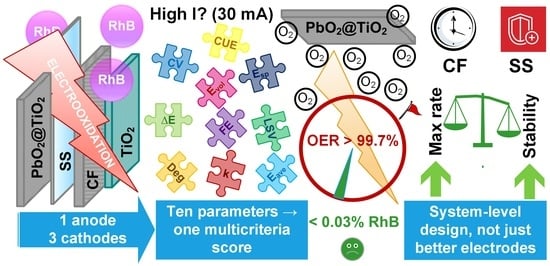
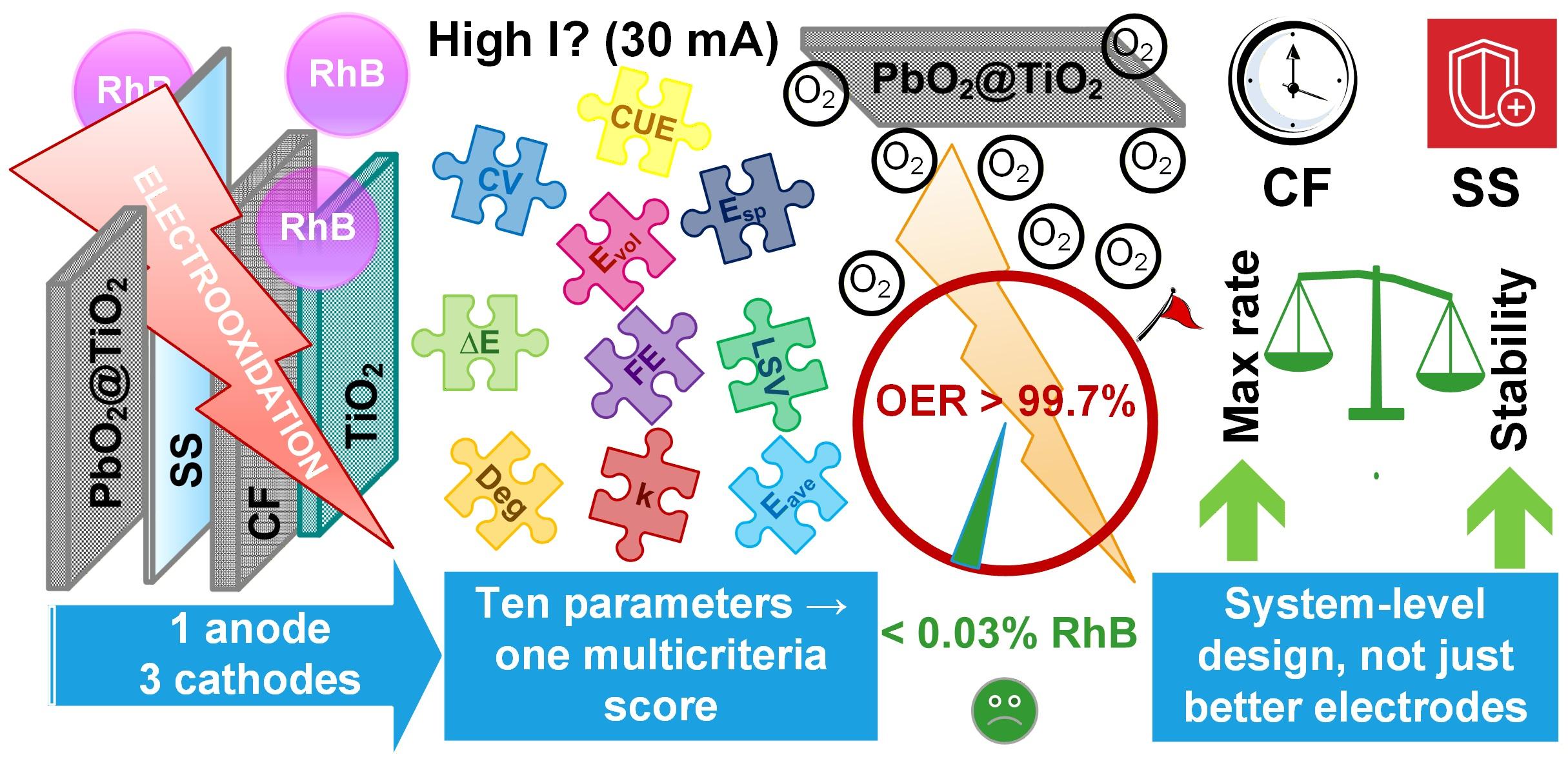
The contribution of the cathode to system-level efficiency in electrochemical oxidation (EO) is rarely isolated from anodic selectivity limitations, even though its influence on cell voltage, hydrogen evolution kinetics, and energy consumption is well recognized. This study presents a multicriteria methodology that deconvolutes cathode performance from these anodic constraints. A stable lead dioxide anode was paired with three cathodes, carbon felt (CF), stainless steel (SS), and titanium dioxide (TiO2), for Rhodamine B degradation. The methodology combines conventional electrochemical diagnostics, a ten-parameter multicriteria assessment spanning activity, efficiency, and economics, and a sensitivity analysis prioritizing operational metrics. Application revealed that cathode material governs system-level performance through trade-offs between degradation rate and energy consumption: SS minimized cathodic voltage contribution, while CF maximized degradation rate, with sensitivity analysis confirming CF as the optimal practical choice. However, all systems were constrained by a universal limitation: Faradaic efficiencies remained below 0.3% at an applied current of 30 mA, with anode potential well above the oxygen evolution reaction (OER) threshold and more than 99.7% of charge diverted to unwanted water oxidation. Thus, cathode selection modulates cost and yield but cannot resolve the underlying anodic OER limitation. This methodology offers a transferable diagnostic protocol, indicating that future efforts should prioritize integrated system design over single-electrode optimization to overcome EO selectivity limitations.

Graphical Abstract

1. Introduction

Electrochemical oxidation (EO) holds promise for degrading persistent organic pollutants [1,2,3] via potent oxidants, primarily hydroxyl radicals (●OH), generated at the anode [4,5]. This has driven extensive research into anode materials such as boron-doped diamond [6] and mixed metal oxides [7,8,9] to enhance activity, stability, and selectivity [10,11,12]. However, this anode-centric focus has inadvertently relegated the cathode to a passive role, typically chosen just for its conductivity and cost, rather than being considered as an integral component of a coupled electrochemical system.
Yet, the cathode actively shapes system performance: its material properties determine hydrogen evolution reaction (HER) overpotential [13,14], influence cell voltage [15], modify local pH, and affect mass transport [16,17]. Given this multifaceted role, the cathode has attracted significant interest in electrochemical advanced oxidation processes (EAOPs) [18,19], particularly in configurations where it serves as an active component for H2O2 electrogeneration, which is subsequently consumed in Fenton-based systems [20,21]. The extensive body of work has generated detailed knowledge on how individual operational parameters, such as current density, pH, and electrolyte concentration, affect degradation efficiency, with cathode performance typically assessed through isolated metrics (e.g., cell voltage, H2O2 yield) [22,23,24] or within membrane-divided cells that physically separate anodic and cathodic processes [25,26]. The breadth of these studies, and the diversity of experimental conditions and metrics employed, underscores the need for a systematic, transferable framework that simultaneously integrates electrochemical activity, degradation kinetics, and energy economics within a single undivided cell, reflecting practical EO operation.
A more fundamental question, however, underlies this gap: can cathode engineering meaningfully improve overall process efficiency when the dominant energy loss stems from the competing oxygen evolution reaction (OER) at the anode? The OER presents a profound selectivity challenge, often consuming the vast majority of the applied electrical charge and limiting Faradaic efficiencies for pollutant oxidation [27,28]. While cathode selection affects cell voltage [29], its role relative to this anodic limitation has not been clearly quantified [30,31].
This study addresses this gap by presenting a multicriteria methodology that quantitatively isolates cathode-specific effects from the fundamental anodic OER bottleneck, integrates multiple performance dimensions into a unified scoring framework, and evaluates the sensitivity of material rankings to application-specific priorities. The novelty of this work lies not in demonstrating that cathode material affects EO performance, a fact already established in the EAOP literature, but in providing a transferable protocol that explicitly separates cathodic from anodic contributions and quantifies their relative significance against the universal baseline of anodic OER dominance. It posits that overcoming the OER limitation requires a paradigm shift, from isolated electrode optimization toward integrated system design that actively circumvents this inherent selectivity limitation. The main hypothesis suggests that while cathode properties have a notable impact on system energy dynamics, the anodic OER remains the primary limiting factor for Faradaic efficiency. Consequently, rational cathode selection must operate within this constrained electrochemical window, guided not by maximizing individual electrode performance, but by optimizing the coupled anode–cathode system.
To address this, it is essential to employ a model system that facilitates precise electrochemical analysis. In this study, a stable lead dioxide anode (PbO2@TiO2) was paired with three different types of cathodes: carbon felt (CF), stainless steel (SS), and titanium dioxide (TiO2), for Rhodamine B (RhB) degradation. RhB is selected as a well-documented model pollutant [32,33], while PbO2 offers high OER overpotential and stability [34,35]. The methodology integrates conventional electrochemical diagnostics with a multiparameter assessment framework spanning activity, efficiency, and economics, complemented by a sensitivity analysis prioritizing operational metrics. The objective was to quantify how cathode selection influences both kinetics and energy efficiency. The results reveal a striking convergence: despite measurable cathode-induced variations in cell voltage, all systems exhibit fundamentally limited Faradaic efficiencies under high-current operation, with over 99.7% of charge diverted to parasitic OER. This limitation, however, can be partially circumvented through operational rather than material design, as demonstrated by operation at reduced current.
Finally, to synthesize multi-dimensional and often conflicting results into a unified comparative framework, a holistic scoring system was applied. The multicriteria assessment framework employed draws upon established multicriteria decision analysis (MCDA) methodologies commonly used in environmental engineering [36,37]. This holistic approach enables a quantitative comparison that transcends single-parameter rankings and addresses recent calls for system-level assessment in EO research [38]. These findings reframe the challenge: rather than seeking a universally “best” cathode, EO process design must prioritize strategies that bypass or suppress the OER bottleneck, whether through modulated current regimes, reactor engineering, or integrated anode–cathode design.

2. Materials and Methods

2.1. Electrode Materials and Experimental Setup

Three independent electrochemical systems were constructed, each defined by its counter electrode material: carbon felt (CF), stainless steel 316 plate (SS), or a titanium oxide mesh (TiO2). The working electrode (anode) in all systems was a commercially obtained lead dioxide on titanium oxide substrate mesh (PbO2@TiO2) with a geometric area of 2.0 cm2 (1 × 2 cm, 1 mm thickness). The cathodes differed in their geometric surface areas: CF had dimensions of 2 × 3 cm with a 3 mm thickness (6.0 cm2); SS measured 3 × 9 cm with a 0.5 mm thickness (27.0 cm2); and TiO2 was 1 × 2 cm with a 1 mm thickness (2.0 cm2). All electrodes were obtained from the same manufacturer (Baoji Taihengte Metal Co., Ltd., Baoji City, China). Before each experiment, all electrodes were meticulously cleaned by rinsing with ethanol and deionized water.
All experiments were conducted using a computer-controlled potentiostat (QL 335 DC Power Supply, Aim and Thurlby Thandar Instruments, Huntingdon, Cambridgeshire, UK) in a single-compartment glass cell containing 60 mL of 0.1 M Na2SO4 as the supporting electrolyte. The electrolyte composition and concentration were selected based on our previous studies [39,40,41,42], where it was established as a stable and reproducible medium for electrochemical oxidation experiments. The pH was adjusted to 4 using concentrated H2SO4 (Sigma-Aldrich, Merck KGaA, Burlington, VT, USA). This value lies near the pKa of the carboxyl group of RhB (~4.3), ensuring that the dye is present predominantly in its zwitterionic form with consistent electrochemical behavior [43], while also maintaining the stability of the PbO2 anode [44].

2.2. Electrochemical Characterization

Fundamental electrochemical characterization was conducted in a standard three-electrode configuration using an Ag/AgCl electrode (3 M KCl) as the reference. Before degradation experiments, each electrochemical system was stabilized via cyclic voltammetry (CV) between 1 and 3 V vs. Ag/AgCl at a scan rate of 50 mV s−1 until reproducible voltammograms were obtained. The anodic activity, CV @2 V, for each system was quantified as the current density at 2.0 V vs. Ag/AgCl from the final stable CV.
Linear sweep voltammetry (LSV) was performed from 0.5 to 2.2 V vs. Ag/AgCl at 10 mV s−1. The anodic activity, LSV @1.75 V, for each system was quantified as the current density at 1.75 V vs. Ag/AgCl. To enable a direct comparison with steady-state behavior, a separate CV scan was recorded within the same potential range (0.5 to 2.2 V vs. Ag/AgCl at 50 mV s−1), and anodic activity was also estimated at 1.75 V vs. Ag/AgCl (CV @1.75 V). To directly characterize the cathodic half-reaction, separate LSVs were run in the cathodic direction (+0.8 to −1.5 V vs. Ag/AgCl, 10 mV s−1) for each cathode material (CF, SS, TiO2). Measured current densities in CVs are normalized to the geometric area of the PbO2@TiO2 electrode (2 cm2).
Onset potentials for oxygen evolution (EOER) and hydrogen evolution (EHER) reactions were determined from derivative analysis of LSV data [45,46]. Methodological details and results are provided in Supplementary Materials (Text S1, Figure S1). The electrochemical window for RhB degradation was calculated as ∆E = EOER − EHER. When ΔE is greater, there is a broader range of potential that allows current to be mainly used for degrading RhB while minimizing unwanted gas evolution reactions.
Tafel analysis was conducted to quantify both OER and HER kinetics (Text S2). Tafel slopes (b, mV dec−1) and exchange current densities (j0, mA cm−2) were extracted via linear regression, with fit quality validated by correlation coefficients R2 > 0.97 for all cases.
Chronopotentiometry was performed during degradation experiments using a two-electrode configuration at constant current (30 mA), with cell voltage recorded every 1 s. The average cell voltage ( E ave ) was calculated as the arithmetic mean of all recorded voltage values over the entire experimental duration.

2.3. Degradation Experiments and Analysis

Constant-current electrooxidation experiments were performed at 30 mA (janodic = 15 mA cm−2) for 120 min in a magnetically stirred reactor (800 rpm). The model organic pollutant, Rhodamine B (RhB, Sigma-Aldrich, Merck KGaA, Burlington, VT, USA), was introduced at an initial concentration of 5 ppm. Aliquot samples (0.5 mL) were periodically withdrawn from the reactor and analyzed immediately. RhB concentration was monitored via UV-Vis spectroscopy (Lambda 35, Perkin Elmer, Inc., Shelton, CT, USA) by measuring its characteristic absorbance at 554 nm. All measurements were performed in triplicate, and reported values represent the mean.
The degradation percentage (%) was calculated using Equation (1):
D e g r a d a t i o n = C 0 − C t C 0 × 100 %
where C 0 and C t are the RhB concentrations (ppm) at time zero and time t , respectively.
The degradation kinetics were modeled using a pseudo-first-order rate law (Equation (2)):
l n C t C 0 = − k t
where k is the pseudo-first-order degradation rate constant (h−1). The value of k was obtained from the slope of a linear regression of l n C t / C 0 versus time.
Hydrogen peroxide (H2O2) formation during galvanostatic degradation was monitored spectrophotometrically (UV-Vis) using the titanium (IV) oxalate method [47]. The titanium reagent was prepared by dissolving 0.4425 g of potassium titanium (IV) oxalate dihydrate (RhB, Sigma-Aldrich, Merck KGaA, Burlington, VT, USA) in 3.4 mL conc. H2SO4 and 8.6 mL deionized water (total 12 mL). At predetermined time intervals (0–120 min), 250 μL aliquots were withdrawn from the reactor and mixed with 125 μL of the titanium reagent. The absorbance (A) of the resulting yellow pertitanic acid complex was immediately recorded at a fixed wavelength of 400 nm.
To enable direct quantitative comparison of H2O2 generation dynamics across the three cathode systems, absorbance values were normalized to a common reference. Because significant peroxide accumulation was observed exclusively with the CF cathode, the maximum absorbance recorded in that system, attained at the end of the 120 min treatment, was selected as the reference value, Aref. The normalized hydrogen peroxide concentration, defined as [H2O2]norm = A/Aref, is directly proportional to the actual H2O2 concentration. It expresses the peroxide accumulated in each cathode system as a fraction of the maximum level generated by the CF cathode over the full experimental duration.

2.4. Performance Metrics and Evaluation

The three cathodes were deliberately retained in their commercially available form factors: stainless steel as a flat plate (27.0 cm2), carbon felt as a porous fabric (6.0 cm2), and TiO2 as a mesh (2.0 cm2). This variation reflects the practical reality that different electrode materials are manufactured and deployed in inherently different form factors. The large geometric area of the SS cathode was intentionally preserved to operate it at a low cathodic current density (1.11 mA cm−2 at 30 mA total current), thereby minimizing parasitic reactions and the formation of corrosion products that could interfere with UV-Vis spectrophotometric monitoring of RhB. The CF and TiO2 cathodes were used in their own characteristic architectures, which are inherent to their practical application. Thus, the comparison reflects the integrated effect of both material identity and its realistic geometric implementation, which is precisely the system-level assessment this methodology is designed to provide.
To evaluate this integrated performance from both applied and fundamental perspectives, a multicriteria set of metrics was calculated. The total electrical energy consumption per experiment, E total (Wh), was calculated by integrating the instantaneous power over the operational time required to achieve >90% RhB degradation (Equation (3)). This provides energy metrics relevant to practical, target-driven operation.
E total = ∫ I ⋅ E ( t ) d t
where I is the constant applied current (A) and E ( t ) is the time-dependent cell voltage (V). The value of E total underpins two key application-oriented metrics: the volumetric energy consumption, E vol (kWh m−3), representing the energy consumed to treat a unit volume (Equation (4)); and the specific energy consumption, E sp (Wh g−1), representing the energy required to degrade a unit mass of pollutant (Equation (5)):
E vol = E total V
E sp = E total Δ m RhB
where V is the solution volume (m3), and Δ m RhB is the mass of RhB degraded (g).
The total electrical charge passed through the system was Q total = I ⋅ t (C). The Faradaic efficiency (FE) for the oxidation of RhB, assuming a 4-electron transfer for RhB decolorization [48,49,50], was calculated as follows:
FE = n F ⋅ ( Δ m RhB / M RhB ) Q total × 100 %
where n = 4, F is Faraday’s constant (96,485 C mol−1), and M RhB is the molar mass of Rhodamine B (479.02 g mol−1).
To explicitly account for geometric differences among the cathodes and to directly assess their contribution to bulk degradation efficiency, a cathodic current utilization efficiency, CUE (h−1 per mA cm−2), was defined as a metric that normalizes performance to cathode area (Equation (7)). It relates the observed degradation rate constant ( k ) to the applied cathodic current density ( j cathodic ), which varied with the geometric area of each cathode.
CUE = k j cathodic
TOC analysis was performed using the NPOC mode on a TOC-LCPH analyzer (Shimadzu Co., Kyoto, Japan). The Faradaic efficiency for mineralization was calculated as follows:
F E T O C = 4 F ⋅ ( Δ m C / M C ) Q total × 100 %
where Δ m C is the mass of organic carbon removed (g), M C is the atomic mass of carbon (12.01 g mol−1), and the factor 4 reflects the stoichiometric requirement of four electrons per carbon atom mineralized (C → CO2).

2.5. Performance Score Calculation

To enable a quantitative comparison of cathode materials, a multi-parameter performance scoring system was developed. The ten selected parameters were chosen to capture three complementary dimensions of system behavior: (i) intrinsic electrochemical activity (CV@2 V, LSV@1.75 V, and ∆E), (ii) degradation kinetics and extent ( k , degradation %, and CUE), and (iii) process efficiency and economics ( E ave , E vol , E sp , and FE). The parameters were drawn exclusively from measurable or readily calculable quantities within a standard electrochemical oxidation experiment. These ensure that the framework remains accessible and transferable without requiring specialized instrumentation, but the parameter set is not intended to be exhaustive or prescriptive. Depending on the specific application, researchers may modify metrics, for instance, replacing degradation % with TOC or COD removal, or adding H2O2 yield when peroxide-mediated oxidation pathways are relevant [51]. The methodology itself is thus separable from the specific metrics used in this demonstration case, and its structure accommodates adaptation to different experimental capabilities and treatment objectives.
Parameters were normalized to a 0–10 scale based on their relative performance across the three cathodes. The normalization procedure ensures that all parameters contribute equally to the total score on a common scale. For parameters where higher values indicate better performance (CV @2V and LSV @1.75 V, ∆E, k , degradation percentage, CUE, and FE), the normalized score for cathode i and parameter j was calculated as follows:
N o r m a l i z e d   s c o r e i , j = X i , j − X m i n , j X m a x , j − X m i n , j × 10
where X i , j is the raw (original) value, and X m i n , j and X m a x , j are the minimum and maximum values for that parameter across the three cathodes.
For parameters where lower values are better ( E ave , E vol , E sp ), the inverse relationship was applied:
N o r m a l i z e d   s c o r e i , j = X m a x , j − X i , j X m a x , j − X m i n , j × 10
The unweighted total score for each cathode was then obtained by summing all ten normalized parameters (Equation (11)), yielding a maximum possible score of 100. Cathodes are ranked in descending order of total score (#1—best, #3—worst).
Total   score i ,   u n w e i g h t e d = ∑ j = 1 10 Normalized   score i , j
In the baseline scoring system (Equation (11)), all parameters were assigned equal weight. The equal-weight approach ensures methodological neutrality and transparency, avoiding a priori assumptions about the relative importance of individual metrics, and enables straightforward replication by other researchers. However, in a real-world engineering context, not all parameters carry equal significance, and practical system design is inherently application-specific. Treating low-concentration wastewater in continuous flow, for example, might prioritize energy consumption and throughput, while batch treatment of highly concentrated effluents might emphasize degradation extent and Faradaic efficiency. Different applications would therefore prioritize different metrics, and no single weighting scheme is universally applicable [38].
To assess the sensitivity of cathode ranking to such application-specific priorities, a weighted scoring scheme was applied as a demonstration case. In this scenario, weights were assigned to reflect a typical practical design context in which operational cost and treatment capacity are paramount. Consequently, specific energy consumption ( E sp ) was given the highest weight (3×), followed by degradation rate constant k (2×), average cell voltage ( E ave ) and Faradaic efficiency (1.5× each), while purely diagnostic parameters (LSV and CV activities) were down-weighted (0.5×). All other parameters retained unit weight. The weighted raw score was calculated as in Equation (12), where w j represents the weight for parameter j .
Total   score i , weighted   = ∑ j = 1 10 w j ⋅ Normalized   score i , j
The maximum possible total (raw) weighted score was ∑ w i × 10 = 130 . For direct comparison with the unweighted scores, these values were normalized to a 0–100 scale, according to Equation (13). This normalization preserves the relative contributions of each parameter while enabling a direct comparison of cathode performance under different weighting scenarios.
Total   score i , w e i g h t e d n o r m a i l z e d = Total   score i , weighted   ∑ w j × 10 × 100
It should be noted that the unweighted scoring serves as a transparent baseline for comparison rather than a definitive ranking. Given the normalization procedure and the absence of replicate-based uncertainty estimates, score differences of less than approximately 5 points on the 0–100 scale should be considered indistinguishable. The weighted scoring, which incorporates application-specific priorities, is the primary decision-support output of the framework.
Data processing, kinetic analysis (including Tafel analysis, reaction onset determination via derivatives, and pollutant degradation kinetics), and visualization were performed using MATLAB R2023a (MathWorks, Natick, MA, USA).

3. Results

Table S1 compiles all electrochemical parameters, kinetic data (with corresponding regression statistics), and performance metrics for each cathode system.

3.1. Cathode-Dependent Modulation of Anodic Response

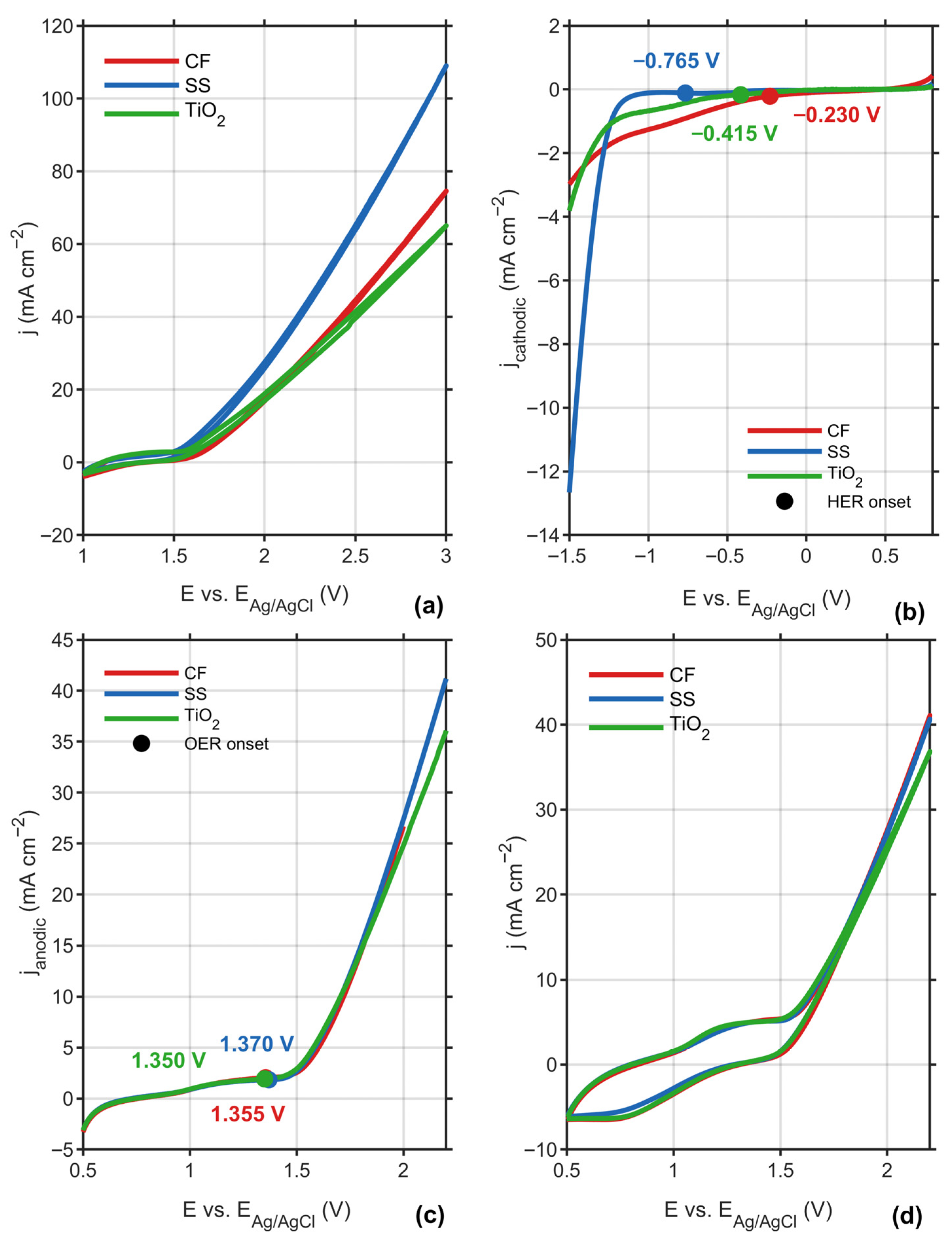
The fundamental electrochemical response of the PbO2@TiO2 anode was first characterized in a three-electrode configuration paired with each cathode. Cyclic voltammetry revealed that the magnitude of the anodic current was strongly dependent on the counter electrode material (Figure 1a). The system with the SS cathode yielded the highest anodic current density across the scanned range. At 2.0 V, the current density reached 27.5 mA cm−2, which was approximately 54.5% and 45.5% greater than with the CF and TiO2 cathodes, respectively (Table S1).
This enhancement is attributed to the lower overall cell resistance and favorable interfacial properties of SS, rather than its hydrogen-evolution kinetics. Cathodic LSV revealed a significantly more negative HER onset (EHER) for SS (−0.77 V vs. Ag/AgCl) compared to CF (−0.23 V) and TiO2 (−0.42 V) (Figure 1b, Figure S1a). While a more negative onset might initially appear disadvantageous, it in fact provides a wider electrochemical window in which the cathode operates below the HER threshold, suppressing unwanted hydrogen evolution and its associated energy consumption during anodic oxidation. Once HER is initiated, however, SS exhibits the lowest Tafel slope (559.3 mV dec−1), indicating a steeper current–potential dependence that contributes to its stable performance under dynamic conditions (Table S1, Figure S2).
Anodic LSV (Figure 1c and Figure S1b) and subsequent Tafel analysis provided a critical mechanistic insight. While the current magnitude was cathode-dependent, the fundamental kinetic characteristics of the anodic reaction remained consistent. The Tafel slopes were determined to be 487.0, 321.5, and 381.7 mV dec−1 for the CF, SS, and TiO2 systems, respectively (Table S1, Figure S3). Slopes within this range are characteristic of a multi-step OER on metal oxide anodes where the initial discharge of water to form an adsorbed ●OH intermediate is rate-limiting [52]. The observed variation of approximately 60–100 mV dec−1 suggests subtle differences in the interfacial environment or surface intermediate coverage, potentially influenced by pH changes or products from the different cathodic reactions, but does not indicate a change in the core reaction pathway. Furthermore, the onset potentials (EOER) for significant anodic current were virtually identical at ~1.36 V vs. Ag/AgCl for all configurations (Figure 1c and Figure S1b), confirming that the thermodynamics of initiating the anodic process are unaltered by the distant cathode. To enable a direct comparison with steady-state behavior, a separate CV scan was recorded within the same, lower potential range used for anodic LSV; these comparative results are shown in Figure 1d.

3.2. Activity of the Anode and Potential Window for Electrochemical Degradation

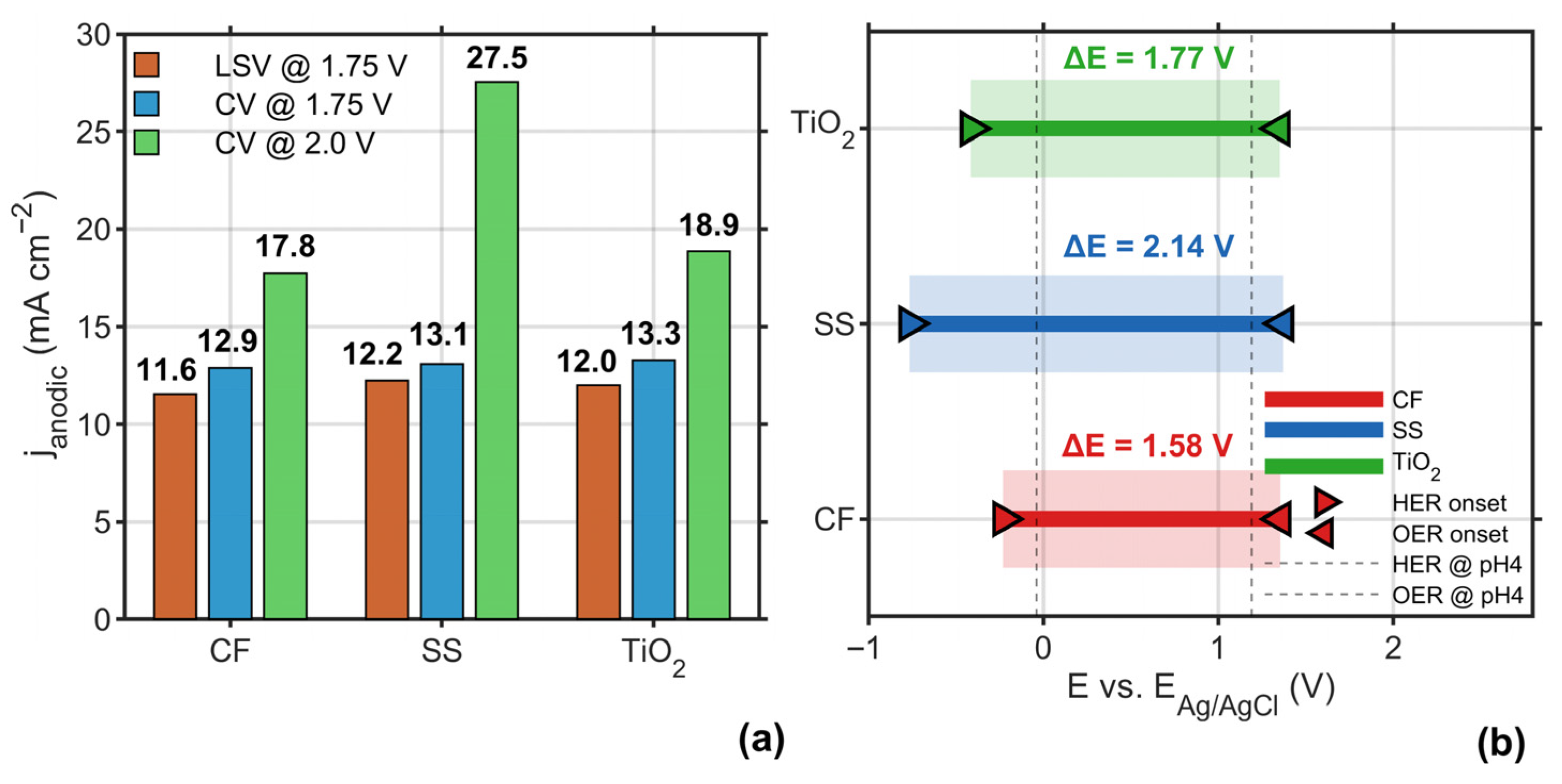
Figure 2a presents a detailed comparison of three distinct anodic activity metrics evaluated at characteristic potentials for each cathode material: (i) LSV @1.75 V—current density derived from anodic LSVs at 1.75 V vs. Ag/AgCl, representing steady-state anodic activity; (ii) CV @1.75 V—current density derived from comparative CVs at 1.75 V vs. Ag/AgCl, capturing cyclic voltammetry response; and (iii) CV @2.0 V—CV activity at 2.0 V vs. Ag/AgCl, indicating high-potential performance (Table S1). Results suggest that CV activity effectively reflects the steady-state anodic behavior captured by LSV measurements. This is demonstrated by the fact that the activities measured at 1.75 V vs. Ag/AgCl, LSV @1.75 V, and CV @1.75 V exhibit very similar values, with an average deviation of only 9.8%. The minimal variation across three markedly different cathode configurations (varying 13.5-fold in area) strongly indicates that the anodic response is governed primarily by the working electrode potential, not by the counter electrode geometry. The small residual variation likely originates from differences in ohmic drop and local mass transport, which practically can be inseparable from the cathode material’s physical implementation. Nevertheless, the close agreement substantiates that the three-electrode measurements provide a reliable basis for comparing anodic activity across the systems studied.
Notably, LSV @1.75 V and CV @2.0 V exhibit a consistent trend across all cathode materials, with both metrics showing the same relative performance ranking: SS > TiO2 > CF. Given this agreement and their complementary nature in characterizing different aspects of electrode performance, LSV @1.75 V (steady-state) and CV @2.0 V (high-potential) will be employed as the primary activity parameters for subsequent system performance evaluation.
Figure 2b illustrates the electrochemical windows (ΔE) defined by the potential difference between the oxygen evolution reaction (EOER) and hydrogen evolution reaction onset (EHER) for the three cathode configurations. A wider ΔE reflects a higher HER overpotential at the cathode, which delays cathodic hydrogen evolution and thereby expands the stable operating range of the system before cathodic limitations arise. This is particularly relevant for indirect oxidation pathways involving ●OH radicals, as these typically require high anodic potentials. Under such conditions, premature HER at the cathode could otherwise limit system performance. Among the tested materials, SS exhibits the widest electrochemical window (ΔE = 2.14 V), followed by TiO2 (ΔE = 1.77 V) and CF (ΔE = 1.58 V). For easier comparison with literature values reported in different reference scales, all onset potentials converted to both reversible hydrogen electrode (RHE) and standard hydrogen electrode (SHE) scales are provided in Table S2.

3.3. The Activity-Efficiency Paradox in Pollutant Degradation

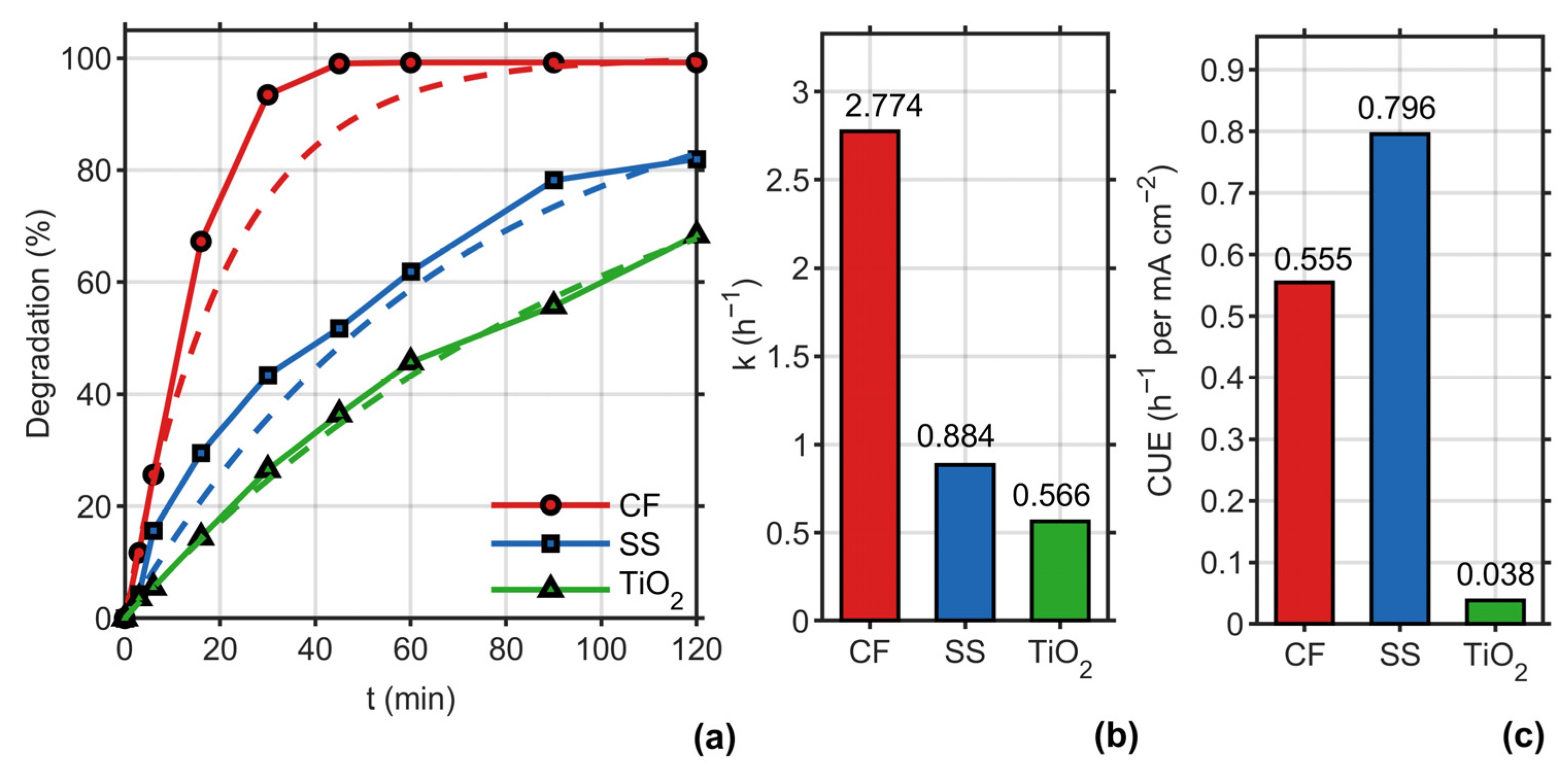
Under applied, galvanostatic conditions, an unexpected and intriguing performance paradox appeared (Figure 3a). Despite operating at an identical anodic current density, the RhB degradation rates differed dramatically. The system with the CF cathode achieved the fastest degradation, with a pseudo-first-order rate constant k of 2.774 h−1, corresponding to a half-life of merely 15 min. This was 3.1 times and 4.9 times faster than the rates achieved with the SS (0.884 h−1) and TiO2 (0.566 h−1) cathodes, respectively (Figure 3b). This outcome reverses the performance hierarchy indicated by the voltametric activity, in which SS demonstrated superior results.
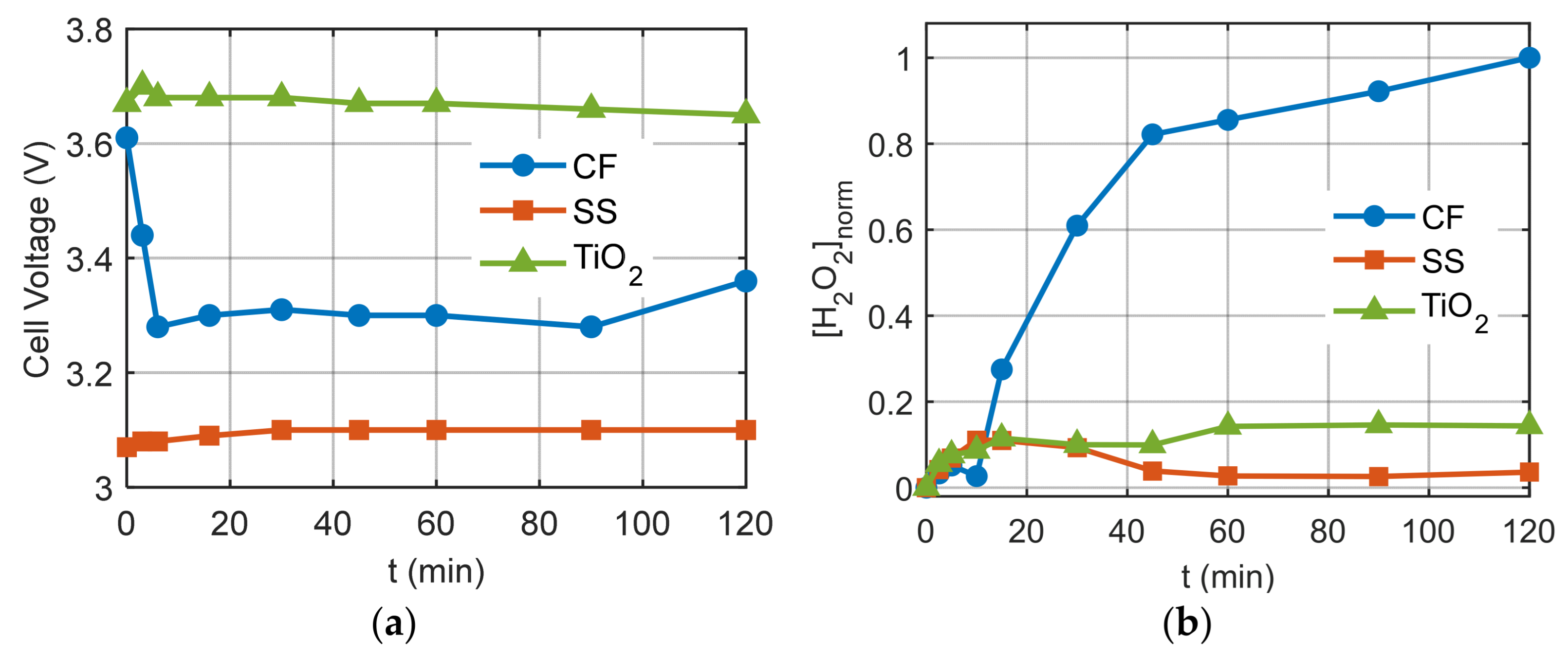
The key to resolving this paradox lies in the operational cathodic current density ( j cathodic ). Due to the different geometric areas of the cathodes, the fixed total current of 30 mA resulted in vastly different j cathodic values: 5.00 mA cm−2 for CF, 1.11 mA cm−2 for SS, and 15.00 mA cm−2 for TiO2. The CUE metric was introduced to evaluate the efficiency of translating this cathodic current into bulk chemical degradation. Analysis revealed that the SS cathode achieved the highest CUE of 0.796 h−1 per mA cm−2 (Figure 3c), indicating superior efficiency in utilizing cathodic current. The superior voltage stability and low ohmic loss of the SS cathode, evidenced by its HER kinetics and most stable chronopotentiometric profile (Figure 4a), minimized the cathodic contribution to the total cell voltage. This allowed a greater fraction of the applied potential to drive the anodic process, resulting in the lowest operational cell voltage observed during galvanostatic degradation (Table S1, Figure 4a). At higher cathodic current densities, mass-transport limitations likely become more pronounced for CF and TiO2.
The CF cathode maintained a robust CUE of 0.555 h−1 per mA cm−2, despite its fivefold higher operating j cathodic compared to SS. In stark contrast, the TiO2 cathode, forced to operate at an extreme current density, suffered from severe mass transport limitations due to extensive H2 bubble coverage [53,54], which blocks active sites and increases ohmic resistance [55], resulting in a negligible CUE of 0.038 h−1 per mA cm−2. Thus, the paradox can be rationalized: the SS cathode is advantageous for charge utilization efficiency, reflecting its stable operation and high HER overpotential, which minimizes energy losses. The CF cathode is optimized for maximum absolute chemical yield, a capability potentially enhanced by its porous structure, which may facilitate the 2-electron oxygen reduction reaction (ORR) to H2O2 [56,57].
A control experiment confirmed that adsorption of RhB onto the CF cathode reached approximately 10% within the first 2.5 min and plateaued (Figure S4). Its contribution is rapid, saturable, and small relative to the total degradation extent achieved (more than 90% in 45 min). Since CF represents the most adsorption-prone material, adsorption onto the SS and TiO2 cathodes can reasonably be assumed negligible. The reported degradation rate constants and CUE values therefore predominantly reflect net electrochemical performance without deconvoluting every individual removal mechanism (adsorption, electrooxidation, and cathodic H2O2 generation).
To experimentally verify the hypothesized contribution of cathodic H2O2 generation to the observed degradation kinetics, the time-resolved accumulation of hydrogen peroxide was monitored spectrophotometrically in all three cathode configurations during galvanostatic RhB degradation (Figure 4b). The three cathode systems displayed fundamentally different H2O2 generation profiles. In the SS and TiO2 configurations, [H2O2]norm remained at or near the detection limit throughout the experiment, reaching final values of only 3.6% and 14.3% of the CF reference level, respectively. This indicates the absence of sustained, catalytically significant H2O2 production on either electrode.
In contrast, the CF cathode exhibited pronounced H2O2 accumulation with a distinct three-stage temporal profile: an initial lag phase (0–10 min), followed by rapid accumulation (10–45 min) that coincided with the period of fastest RhB degradation (Figure 3a), and a final slow accumulation phase (45–120 min) after near-complete pollutant removal. By the end of the experiment, the CF system had generated 28-fold and 7-fold more H2O2 than the SS and TiO2 systems, respectively. The observed temporal profile is mechanistically consistent with the in situ generation of H2O2 via the two-electron oxygen reduction reaction (ORR) at the porous carbon cathode. The initial lag phase likely reflects the time required to accumulate sufficient dissolved O2, produced anodically via parasitic OER, for subsequent cathodic reduction. The rapid accumulation during active pollutant degradation suggests that peroxide may serve as a supplementary oxidant, either directly or through secondary reactive species, while the transition to slow accumulation after RhB removal indicates that H2O2 behaves predominantly as a stable end-product in the absence of reactive substrate.

3.4. Comprehensive Energy Assessment

The analysis of energy in the galvanostatic experiments (Table 1) highlights the practical significance of the kinetic results and reveals a profound, unifying limitation. The CF system exhibited superior degradation kinetics, achieving the shortest treatment time (~90% removal in ~60 min, Figure 3a) and the lowest volumetric energy consumption (1.245 kWh m−3). Although it operated at a higher cell voltage (3.353 V), CF required the least specific energy to destroy a unit mass of RhB (251.4 Wh g−1), establishing it as the most efficient cathode for targeted contaminant removal. In contrast, the SS cathode delivered the lowest average cell voltage (3.091 V) despite displaying the most negative HER onset potential (Figure 1b) and consequently the highest kinetic overpotential for hydrogen evolution (Figure S2). This apparent contradiction indicates that under sustained galvanostatic operation, factors such as electrode conductivity, interfacial contact resistance, and bubble-induced resistance dominate the overall cell voltage, outweighing the influence of intrinsic cathode kinetics. Therefore, when scaling up under constant-current conditions, SS may offer enhanced energy efficiency due to its advantageous ohmic and interfacial characteristics.
However, the most critical finding is the extremely low apparent Faradaic efficiency (FE < 0.3%) across all systems at 30 mA, indicating that over 99.7% of the charge was consumed by unwanted side reactions. This calculation assumes a 4-electron transfer ( n = 4) for RhB decolorization [58], an assumption that, while commonly employed, carries inherent uncertainty: RhB degradation proceeds through multiple sequential steps (de-ethylation, chromophore cleavage, ring opening), and the effective number of electrons transferred per decolorized molecule is neither an integer nor constant across conditions. The reported values are therefore best interpreted as apparent Faradaic efficiencies, suitable for comparative rather than absolute purposes. Since complete mineralization would require substantially more electrons per molecule, these values also represent an upper-bound estimate. Nevertheless, even if the true n were an order of magnitude larger, the FE would remain below 3%, and the relative comparison among cathode systems, where n is applied consistently, remains valid.
To assess whether the low decolorization-based Faradaic efficiencies genuinely reflect limited mineralization, total organic carbon (TOC) analysis was performed on the PbO2@TiO2/CF system. After 120 min, TOC removal reached 63%, corresponding to a mineralization F E T O C on the order of 2%, roughly seven times higher than the decolorization-based value, yet still confirming that over 98% of the charge is consumed by OER. This indicates that a fraction of the charge contributes to oxidation beyond chromophore cleavage, but that anodic selectivity limitations dominate regardless of the diagnostic metric employed.
Electrochemical diagnostics clearly show the connection between the operational conditions used and the observed low efficiency: when operating at high current (30 mA) in galvanostatic mode, the anode potential is forced significantly positive of the OER onset to sustain the current, resulting in water oxidation becoming the primary reaction.

3.5. The Cost of High-Current Operation: Holistic Performance Under OER Dominance

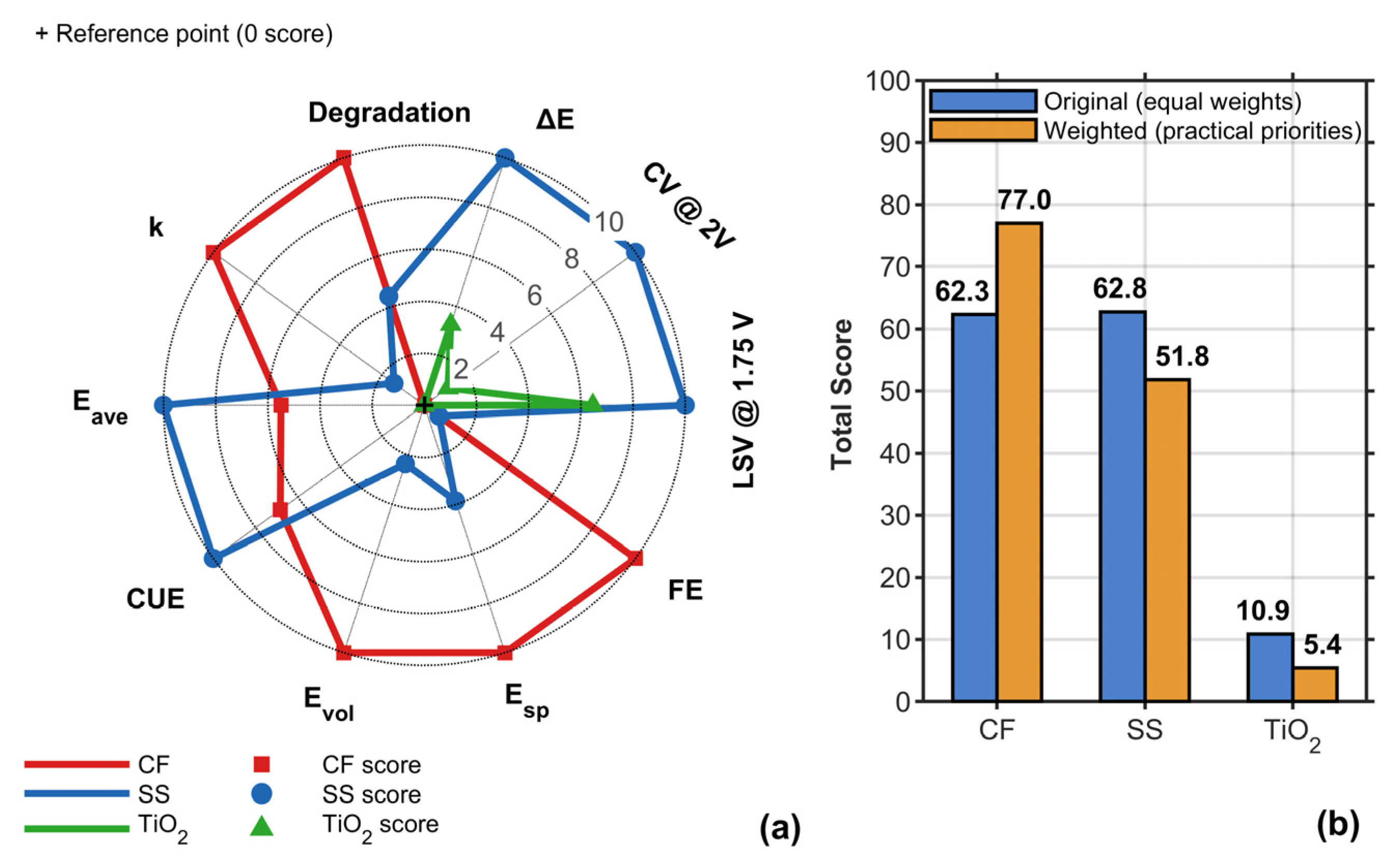
A comprehensive evaluation of the cathode materials conducted at an intentionally elevated level of 30 mA provides quantifiable insight into the performance trade-offs that emerge when the system is forced to operate extensively within the OER-dominated regime (Figure 5). Under the equal-weight scoring scheme, the radar chart (Figure 5a) and aggregated scores (blue bars in Figure 5b, Table S1) reveal complementary profiles: the SS cathode dominates in fundamental electrochemical metrics and efficiency parameters (anodic activity, ΔE, CUE, and E ave ) due to its lower cell voltage and superior voltage stability during prolonged operation, reflecting low interfacial degradation and minimal bubble-induced resistance, while the CF cathode leads in applied performance metrics (degradation rate, degradation percentage, E vol , E sp , and FE), likely aided by its porous structure, albeit at a higher operational voltage. Aggregation of these normalized scores yields total performance rankings of 62.8/100 for SS, 62.3/100 for CF, and 10.9/100 for TiO2 (Figure 5b, Table S1).
The 0.5-point difference between CF and SS in the unweighted ranking is within the resolution limit of the methodology and indicates that, in the absence of application-specific priorities, these two materials are essentially indistinguishable. This equivalence is instructive in itself: without a defined design objective, there is no universal “best” cathode. The analysis rather offers quantitative guidelines for rational selection of the cathode based on the primary system objective: Choose the CF cathode if minimizing operational energy cost per volume of treated wastewater is the priority (process economics). Choose the SS cathode when the goal is to operate safely at high anodic potentials close to the OER onset (electrochemical stability). The operational cathodic current density, a parameter directly controlled by the anode-to-cathode area ratio, is thus revealed as a critical, adjustable design variable.
To assess the robustness of this ranking under real-world design priorities, a sensitivity analysis was performed by applying differential weights to the ten performance parameters. The weighted scenario was designed to reflect an application context in which operational costs and treatment throughput are the primary concerns, acknowledging that different applications would warrant different weighting schemes [59]. As described in Section 2.5, specific energy consumption ( E sp ) was weighted most heavily (3×), followed by degradation rate constant k (2×), average cell voltage ( E ave ) and Faradaic efficiency (1.5× each). LSV and CV activities, which probe the intrinsic anodic response and are largely insensitive to cathode material as shown in Section 3.2, were down-weighted (0.5×). All other parameters retained unit weight.
The results reveal a dramatic shift in rankings when practical considerations are prioritized (orange bars in Figure 5b, Table S3). While SS and CF were nearly indistinguishable in the unweighted analysis (62.8 vs. 62.3 points), CF emerges as the preferred option under practical weighting, achieving 77.0 points compared to 51.8 for SS. This 25.2-point margin reflects CF’s superior performance in degradation kinetics ( k ) and competitive energy consumption ( E sp ), both of which carry high weights. Conversely, SS loses its advantage as its strengths in diagnostic parameters (anodic activity, ΔE) are down-weighted. TiO2 remains the lowest-ranked cathode under both schemes, with its weighted score dropping to 5.4 points due to poor performance across all practically significant parameters. It should be noted that TiO2 is employed here exclusively as a cathode, operating under HER conditions. The well-documented oxidative surface chemistry of TiO2, including its capacity for adsorption and charge-transfer-mediated oxidation of aromatics [60,61], is relevant to its behavior as an anode or photocatalyst but does not manifest under the cathodic polarization conditions applied in this study.
The ten evaluation parameters can be broadly grouped into three families: electrochemical diagnostics (LSV, CV, and ΔE), degradation kinetics ( k , degradation %, and CUE), and energy economics E ave ( E vol , E sp , and FE). The convergence of CF and SS under equal weights reflects a balance among these families, in which SS’s advantages in electrochemical diagnostics and cell voltage compensate for CF’s superiority in kinetics and energy efficiency. Under an energy-prioritized weighting scheme, where E sp and E ave receive the highest weights, the gap between CF and SS would narrow as SS’s lower cell voltage becomes more influential. Conversely, a kinetics-prioritized scheme would further widen CF’s lead, reflecting its 3.1-fold higher degradation rate constant. The sensitivity of the ranking to these alternative scenarios confirms that the multicriteria framework is not prescriptive; it transparently translates user-defined design objectives into a quantitative material ranking, and the outcome depends systematically on which performance dimensions are prioritized.
The analysis clarifies the practical consequence of the OER bottleneck: when the anode operates well above its onset potential, it essentially acts like a water electrolyzer. In this scenario, the choice of cathode only affects voltage and, consequently, the energy cost.

3.6. Circumventing the OER Bottleneck: Operational Optimization and Mechanistic Validation

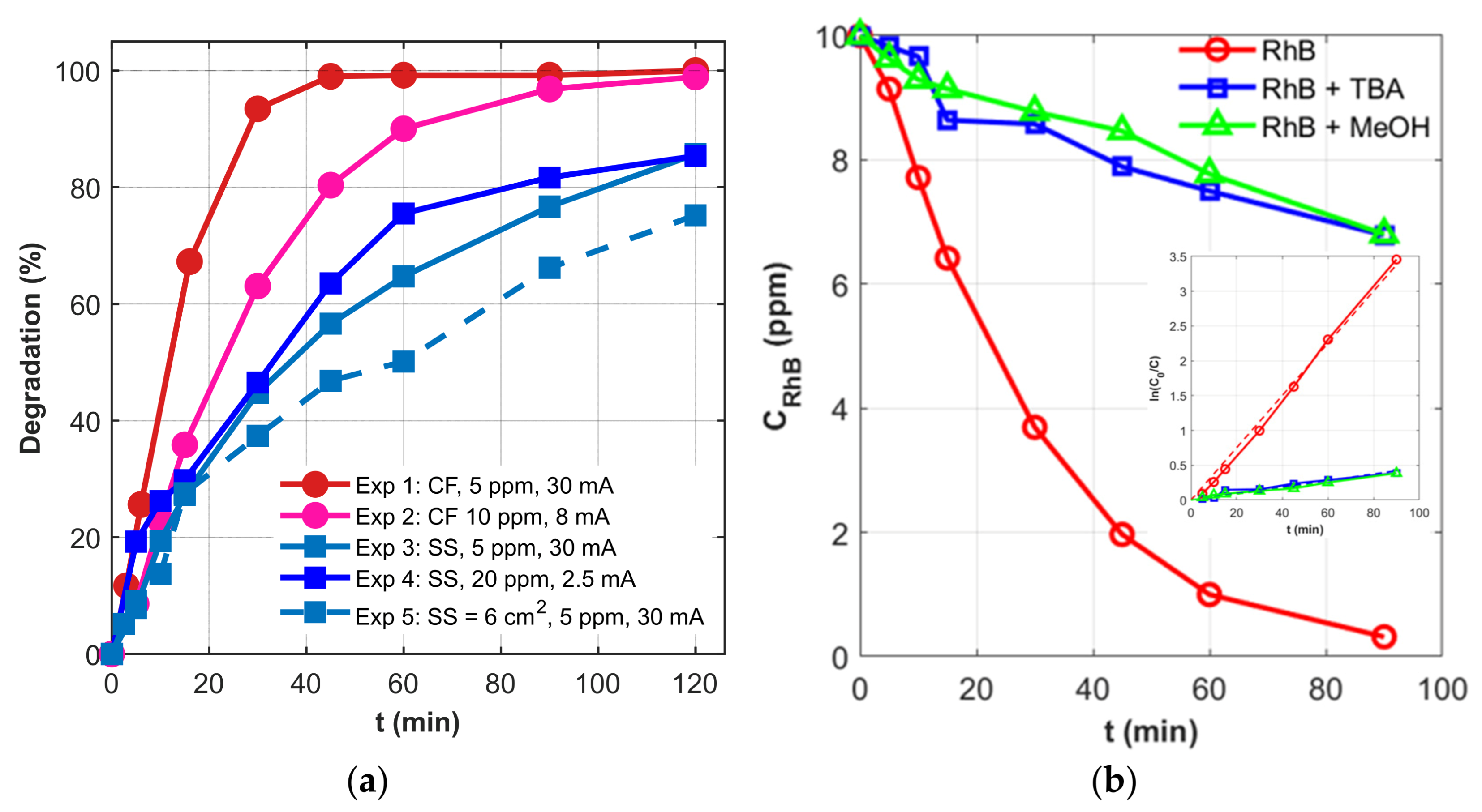
To directly test the hypothesis that dominant water oxidation at 30 mA decreases overall process efficiency, controlled comparative experiments were performed under moderate conditions (Figure 6a). Both the CF and SS systems were evaluated at reduced current and elevated initial RhB concentration (Tables S4 and S5). For CF, reducing the current from 30 to 8 mA and increasing the concentration from 5 to 10 ppm preserved rapid degradation kinetics ( k from 2.774 to 2.253 h−1) while cutting specific energy consumption by 91% (from 502.9 to 43.1 Wh g−1) and increasing Faradaic efficiency 7.3-fold (from 0.149% to 1.084%). For SS, a more aggressive optimization, 30 to 2.5 mA, 5 to 20 ppm, yielded a 50-fold increase in Faradaic efficiency (from 0.092% to 4.584%) and a 98% reduction in specific energy consumption (from 734.9 to 9.7 Wh g−1), while the degradation rate constant improved slightly (from 0.884 to 0.992 h−1). Both systems achieved these gains at substantially lower cell voltages, confirming that the OER bottleneck can be mitigated through operational rather than material design. This stark contrast underscores that the key to energy-efficient EO lies not in maximizing current but in optimizing the operational window to maximize charge utilization toward the target reaction.
The differing optimization profiles of the two systems reflect their distinct degradation architectures. CF retained a clear kinetic advantage but showed a more modest FE improvement, consistent with its dual-pathway mechanism: at high current, parasitic OER supplies dissolved O2 for cathodic H2O2 generation (Section 3.3), so reducing the current limits both anodic OER competition and the cathodic O2 supply. In SS, where H2O2 generation is negligible, efficiency gains from current reduction translate directly into improved charge utilization.
The CUE metric was introduced (Section 2.4) to normalize degradation kinetics for differences in cathodic current density arising from the varying geometric areas of the three cathodes. To empirically validate CUE, the SS cathode was additionally tested at a reduced area matching CF (6.0 cm2) under baseline conditions (30 mA, 5 ppm RhB; Table S6). Reducing the SS area decreased CUE 5.5-fold (from 0.796 to 0.145 h−1 per mA cm−2), while the average cell voltage remained nearly unchanged, indicating that the low operating voltage of SS is an intrinsic material property.
When compared at equal geometry and equal cathodic current density, CF outperformed SS by a factor of 3.8 in both degradation rate constant (2.774 vs. 0.727 h−1) and CUE (0.555 vs. 0.145 h−1 per mA cm−2), consistent with CF’s kinetic superiority being a genuine material-specific effect rather than an artifact of geometry and supporting the use of CUE as a meaningful normalized parameter within the multicriteria framework.
The kinetic advantage of CF is mechanistically linked to cathodic H2O2 generation. However, H2O2 may contribute to degradation either directly or via secondary ●OH formed through homolytic cleavage. To distinguish between these pathways, radical scavenging experiments were performed on the optimized CF system (10 ppm RhB, 8 mA) using methanol (MeOH, 100 mM), which quenches both ●OH and SO4●−, and tert-butanol (TBA, 250 mM), a selective ●OH scavenger (Figure 6b). MeOH reduced the degradation rate constant from 2.253 to 0.252 h−1 (88.7% inhibition), while TBA reduced it to 0.282 h−1 (87.5% inhibition). The small difference between the two scavengers indicates a negligible contribution from sulfate radicals. Kinetic deconvolution attributes the degradation to ●OH-mediated oxidation (87.5%), direct anodic electron transfer (11.3%), and SO4●−-mediated oxidation (1.2%). At the end of the 90 min treatment, total degradation reached 96.8%.
The dominance of ●OH is consistent with the established PbO2 oxidation mechanism [62], although the scavenging experiment cannot distinguish anodic ●OH from ●OH derived from H2O2 homolysis. When viewed alongside the H2O2 generation data and the geometric control experiments, the results strongly suggest that a significant fraction of the ●OH flux in the CF system derives from the cathodic H2O2 pathway. The SS system, which lacks this pathway, achieves substantially lower degradation rates despite operating via the same anodic ●OH mechanism. The dual-pathway architecture of CF, anodic ●OH coupled with cathodic H2O2 and its secondary radicals, thus offers a unified mechanistic explanation for its superior performance across all operating regimes.

4. Discussion

The results demonstrate that the counter electrode in electrochemical oxidation acts as an active regulator of system-level performance, primarily through its influence on the hydrogen evolution reaction overpotential, which determines the cell voltage and energy consumption. This observation aligns with earlier EAOP studies documenting that cathode material and geometry influence energy consumption and current efficiency and that operational parameters, especially current density, often govern overall treatment efficiency [18,21]. However, the present methodology extends these findings by quantifying this influence within a unified multicriteria framework that simultaneously accounts for parameters rarely assessed together (degradation kinetics, energy costs, and Faradaic efficiency) and by explicitly demonstrating that cathode optimization cannot overcome the anodic OER bottleneck.
This study offers direct electrochemical evidence that cathode engineering has a secondary effect compared to the anodic oxygen evolution reaction. The OER onset potential of the PbO2@TiO2 anode (~1.36 V) provides a fixed thermodynamic benchmark. The catastrophic Faradaic efficiencies observed at high currents are a direct consequence of operating the anode at potentials far exceeding this threshold, a condition that is largely invariant to the distant cathode material. Thus, while the cathode influences energy efficiency, the anode’s OER onset ultimately limits the maximum achievable oxidation efficiency.
The complementary performance profiles of SS and CF cathodes, revealed by the multi-parameter assessment, reflect distinct underlying mechanisms. The chronopotentiometric stability, combined with the lowest operational cell voltage, indicates that SS benefits from minimal interfacial degradation and reduced resistive losses, while its delayed HER onset postpones hydrogen evolution, thereby minimizing H2-induced mass transport limitations that could hinder ●OH generation and RhB oxidation. The CF cathode demonstrates a greater absolute degradation rate, attributed to its ability to generate H2O2 via cathodic ORR. Radical scavenging experiments further indicate that ●OH is the dominant reactive species, consistent with a dual-pathway mechanism in which anodically generated ●OH is supplemented by ●OH derived from cathodic H2O2 homolysis. However, this advantage operates within the same fundamental charge-utilization constraint imposed by the anode, as reflected in the persistently low Faradaic efficiencies for both decolorization and TOC mineralization.
The holistic performance synthesis underscores that there is no universally superior cathode. Instead, the choice represents a strategic decision based on the primary process objective by understanding the OER limitation. If the target pollutant is easily oxidized (i.e., it reacts at relatively low anodic potentials), CF is the preferred cathode because it minimizes energy consumption and maximizes degradation rate. However, if the pollutant demands high anodic potentials close to the OER onset, SS offers a distinct advantage: its higher HER overpotential delays cathodic hydrogen evolution, resulting in a wider stable electrochemical window. This provides a larger safety margin for operating at elevated anodic potentials by ensuring that cathodic hydrogen evolution does not become limiting, allowing the system to maintain stable current even when the anode is driven deep into the OER region. Thus, choosing the optimal cathode depends on the pollutant’s oxidation potential and the intended trade-off between energy efficiency and operational potential range.
The sensitivity analysis further refines this picture by testing the robustness of cathode rankings under practically relevant weighting scenarios. When specific energy consumption ( E sp ) and degradation rate ( k ) are weighted to reflect their direct impact on operational costs, CF emerges as the clear leader, while SS loses its advantage as its strengths in diagnostic parameters are down-weighted. These results demonstrate that while SS offers a balanced profile across all measured parameters, CF is the superior choice when degradation rate and energy efficiency are the primary design criteria, the most relevant considerations for real-world wastewater treatment applications. The sensitivity analysis thus reinforces the central message: cathode selection must be guided by application-specific priorities, and the equal-weight framework provides a transparent baseline from which such tailored decisions can be made. Finally, a natural refinement of the framework would be the incorporation of formal uncertainty propagation, which would allow meaningful differences in total scores to be distinguished from experimental variability.
These insights have important implications for the advancement of electrochemical oxidation processes. Current findings indicate that further incremental optimization of cathode materials within conventional cell configurations will yield diminishing returns against the dominant OER loss. Consequently, a more innovative approach is required. Future research should concentrate on strategies that address this intrinsic anode–cathode coupling limitation [63,64]. Promising directions include (i) developing anode materials featuring intrinsically higher OER overpotentials to favor pollutant oxidation versus water splitting [65]; (ii) engineering cathodes to function as active components for targeted functions, such as in situ H2O2 generation or localized pH regulation [14,16]; (iii) optimizing operational parameters, particularly interfacial current densities, to manage radical production and unwanted reactions [66,67]; (iv) designing new reactor configurations that physically or temporally decouple the primary ●OH generation zone from the bulk pollutant stream [68]; and (v) employing advanced operational modes like pulsed electrolysis to dynamically regulate surface conditions and enhance charge efficiency [69]. In these integrated system architectures, the cathode may be engineered to balance HER onset while enabling additional synergistic functions, thereby contributing to overall process optimization [70].

5. Conclusions

This study presented a multicriteria methodology for deconvoluting cathode performance from anodic selectivity limits in electrochemical oxidation. Building on the established understanding that cathode material influences EO system performance, this framework provides a systematic integration of electrochemical, kinetic, and economic metrics with a sensitivity analysis that adapts to application-specific design priorities. Applied to three contrasting cathode materials (CF, SS, and TiO2), paired with a PbO2 anode, the framework integrated conventional electrochemical diagnostics, a ten-parameter assessment spanning activity, efficiency, and economics, and a sensitivity analysis prioritizing operational metrics.
The deconvolution yielded two distinct insights. First, the cathode material measurably governs system-level performance through trade-offs between degradation rate and energy consumption: SS minimized cell voltage, while CF maximized degradation kinetics. Sensitivity analysis, reflecting a practical design scenario in which operational costs are paramount, confirmed CF as the optimal choice, demonstrating how the framework adapts to application-specific priorities. Second, and more critically, the analysis isolated a universal anodic limitation: across all cathode configurations, the overwhelming majority of applied charge was consumed by parasitic oxygen evolution, constraining Faradaic efficiencies to near-negligible levels regardless of cathode identity.
The central conclusion is that cathode engineering, while necessary, is inherently insufficient to overcome the OER bottleneck. Adjusting the cathode modulates cost and reaction yield but cannot resolve the fundamental anodic selectivity problem. The methodology presented here provides a transferable diagnostic protocol for evaluating electrochemical oxidation systems, with both the parameter set and weighting scheme designed to be adapted rather than adopted prescriptively. Its application to the present case demonstrates that meaningful progress in EO efficiency will require integrated system designs that actively circumvent OER, rather than incremental single-electrode optimization within conventional configurations.

Supplementary Materials

The following supporting information can be downloaded at https://www.mdpi.com/article/10.3390/suschem7030046/s1, Text S1: Methodological details for determining onset potentials for oxygen evolution (EOER) and hydrogen evolution (EHER), Text S2: Methodological details for Tafel analysis; Figure S1: Onset potential determination via derivative analysis of LSV curves: (a) cathodic HER—working electrode: CF, SS or TiO2, counter electrode: PbO2@TiO2; (b) anodic OER—working electrode: PbO2@TiO2, counter electrode: CF, SS or TiO2; Figure S2: Tafel analysis for the hydrogen evolution reaction (HER) on different cathode materials. Counter electrode: PbO2@TiO2; working electrode: (a) CF, (b) SS, and (c) TiO2; Figure S3: Tafel analysis for the oxygen evolution reaction (OER) on different cathode materials. Working electrode: PbO2@TiO2; counter electrode: (a) CF, (b) SS, and (c) TiO2; Figure S4: Adsorption profile of RhB on the CF cathode, where C 0 and C t are the RhB concentrations (ppm) at time zero and time t , respectively. Experimental conditions mirror those of the degradation experiments: 5 ppm RhB in 0.1 M Na2SO4, 60 mL solution volume, and 800 rpm magnetic stirring; Table S1: Complete electrochemical characterization, degradation performance, and normalized unweighted scores for CF, SS, and TiO2 cathodes; Table S2: Onset potentials for HER (measured on CF, SS and TiO2) and OER (measured on PbO2@TiO2) expressed versus Ag/AgCl, SHE, RHE (pH 4), and SCE; Table S3: Weighted normalized performance scores (0–10 scale) for the three cathode materials (CF, SS and TiO2), showing the contribution of each parameter to the total weighted score under practical significance weighting; Table S4: Performance comparison of PbO2@TiO2/CF system under different operating regimes. Conventional (5 ppm RhB, 30 mA) vs. optimized (10 ppm RhB, 8 mA) conditions; Table S5: Performance comparison of PbO2@TiO2/SS system under different operating regimes. Conventional (5 ppm RhB, 30 mA) vs. optimized (20 ppm RhB, 2.5 mA) conditions; Table S6: Performance comparison of PbO2@TiO2/SS system under conventional conditions (5 ppm RhB, 30 mA) with different cathode geometry: conventional SS (3 × 9 cm = 27.0 cm2) vs. reference SS (2 × 3 cm = 6.0 cm2), the latter matching the geometric area of the CF cathode.

Author Contributions

Conceptualization, M.J.D.; methodology, K.S., T.B., D.A., R.P. and M.J.D.; software, M.J.D.; validation, K.S., T.B., D.A., M.S., R.P., D.R. and M.J.D.; formal analysis, K.S., T.B., D.A., M.S., R.P. and M.J.D.; investigation, K.S., D.A. and M.S.; resources, T.B. and D.R.; data curation, K.S., D.A., M.S., R.P., D.R. and M.J.D.; writing—original draft preparation, M.J.D.; writing—review and editing, K.S., T.B., D.A., M.S., R.P., D.R. and M.J.D.; visualization, M.J.D.; supervision, T.B., D.R. and M.J.D.; project administration, T.B. and D.R.; funding acquisition, T.B. All authors have read and agreed to the published version of the manuscript.

Funding

This research was funded by the Ministry of Science, Technological Development, and Innovation of the Republic of Serbia, grant number 451-03-33/2026-03/200017.

Institutional Review Board Statement

Not applicable.

Informed Consent Statement

Not applicable.

Data Availability Statement

The original contributions presented in this study are included in the article/Supplementary Materials. Further inquiries can be directed to the corresponding author.

Acknowledgments

This work was supported by the Ministry of Science, Technological Development, and Innovation of the Republic of Serbia [grant numbers 451-03-33/2026-03/200017, 451-03-34/2026-03/200135, and 451-03-33/2026-03/200168]. During the preparation of this manuscript, the authors used DeepSeek-V4-Pro to assist language editing and paraphrasing of selected text. The authors have reviewed and edited the output and take full responsibility for the content of this publication.

Conflicts of Interest

The authors declare no conflicts of interest. The funders had no role in the design of the study; in the collection, analyses, or interpretation of data; in the writing of the manuscript; or in the decision to publish the results.

Abbreviations

The following abbreviations are used in this manuscript:
EOElectrochemical oxidation
EAOPsElectrochemical advanced oxidation processes
CFCarbon felt
SSStainless steel
OEROxygen evolution reaction
●OHHydroxyl radicals
HERHydrogen evolution reaction
RhBRhodamine B
CVCyclic voltammetry
LSVLinear sweep voltammetry
ORROxygen reduction reaction

References

  1. Moreira, F.C.; Boaventura, R.A.R.; Brillas, E.; Vilar, V.J.P. Electrochemical Advanced Oxidation Processes: A Review on Their Application to Synthetic and Real Wastewaters. Appl. Catal. B Environ. 2017, 202, 217–261. [Google Scholar] [CrossRef] [Scilit]
  2. Najafinejad, M.S.; Chianese, S.; Fenti, A.; Iovino, P.; Musmarra, D. Application of Electrochemical Oxidation for Water and Wastewater Treatment: An Overview. Molecules 2023, 28, 4208. [Google Scholar] [CrossRef] [Scilit] [PubMed]
  3. Zhang, P.; Zeng, Q.; Yan, L.; Xiao, H.; Yang, Z.; Li, Y. Electrochemical Remediation Technologies for Persistent Organic Pollutants in Soil and Water. Environ. Res. 2026, 296, 124033. [Google Scholar] [CrossRef] [Scilit] [PubMed]
  4. Ganiyu, S.O.; Gamal El-Din, M. Insight into In-Situ Radical and Non-Radical Oxidative Degradation of Organic Compounds in Complex Real Matrix during Electrooxidation with Boron Doped Diamond Electrode: A Case Study of Oil Sands Process Water Treatment. Appl. Catal. B Environ. 2020, 279, 119366. [Google Scholar] [CrossRef] [Scilit]
  5. Fernández-Aguirre, M.G.; Berenguer, R.; Beaumont, S.; Nuez, M.; La Rosa-Toro, A.; Peralta-Hernández, J.M.; Morallón, E. The Generation of Hydroxyl Radicals and Electro-Oxidation of Diclofenac on Pt-Doped SnO2–Sb Electrodes. Electrochimica Acta 2020, 354, 136686. [Google Scholar] [CrossRef] [Scilit]
  6. Brosler, P.; Girão, A.V.; Silva, R.F.; Tedim, J.; Oliveira, F.J. Electrochemical Advanced Oxidation Processes Using Diamond Technology: A Critical Review. Environments 2023, 10, 15. [Google Scholar] [CrossRef] [Scilit]
  7. Palma-Goyes, R.E.; Silva-Agredo, J.; Vazquez-Arenas, J.; Romero-Ibarra, I.; Torres-Palma, R.A. The Effect of Different Operational Parameters on the Electrooxidation of Indigo Carmine on Ti/IrO2-SnO2-Sb2O3. J. Environ. Chem. Eng. 2018, 6, 3010–3017. [Google Scholar] [CrossRef] [Scilit]
  8. Ganiyu, S.O.; Oturan, N.; Raffy, S.; Cretin, M.; Causserand, C.; Oturan, M.A. Efficiency of Plasma Elaborated Sub-Stoichiometric Titanium Oxide (Ti4O7) Ceramic Electrode for Advanced Electrochemical Degradation of Paracetamol in Different Electrolyte Media. Sep. Purif. Technol. 2019, 208, 142–152. [Google Scholar] [CrossRef] [Scilit]
  9. Niu, Y.; Wang, H.; Guo, S.; Xu, J.; Zhu, Y.; Guo, F.; Zhang, Y.; Wu, J. A Novel Iron-Doped Mineral/Carbon Composite Electrocatalyst Synthesized by Reconstituting Ash Phase of Coal Gasification Fine Slag for Synergistically Improving Electrooxidation Efficiency. J. Environ. Chem. Eng. 2024, 12, 112464. [Google Scholar] [CrossRef] [Scilit]
  10. Shestakova, M.; Sillanpää, M. Electrode Materials Used for Electrochemical Oxidation of Organic Compounds in Wastewater. Rev. Environ. Sci. Biotechnol. 2017, 16, 223–238. [Google Scholar] [CrossRef] [Scilit]
  11. Moradi, M.; Vasseghian, Y.; Khataee, A.; Kobya, M.; Arabzade, H.; Dragoi, E.-N. Service Life and Stability of Electrodes Applied in Electrochemical Advanced Oxidation Processes: A Comprehensive Review. J. Ind. Eng. Chem. 2020, 87, 18–39. [Google Scholar] [CrossRef] [Scilit]
  12. Wei, Z.; Kang, X.; Xu, S.; Zhou, X.; Jia, B.; Feng, Q. Electrochemical Oxidation of Rhodamine B with Cerium and Sodium Dodecyl Benzene Sulfonate Co-Modified Ti/PbO2 Electrodes: Preparation, Characterization, Optimization, Application. Chin. J. Chem. Eng. 2021, 32, 191–202. [Google Scholar] [CrossRef] [Scilit]
  13. Chen, Z. Studies on Oxygen Reduction on Platinum Electrode in NaOH And NaOH-NaCl Mixed Solutions. Acta Chim. Sin. 1984, 42, 872–879. [Google Scholar]
  14. Ali, I.; Barros de Souza, A.; De Laet, S.; Van Eyck, K.; Dewil, R. Anodic Oxidation of Sulfamethoxazole Paired to Cathodic Hydrogen Peroxide Production. Chemosphere 2023, 319, 137984. [Google Scholar] [CrossRef] [Scilit] [PubMed]
  15. Shmychkova, O.B.; Knysh, V.A.; Luk’yanenko, T.V.; Amadelli, R.; Velichenko, A.B. Electrocatalytic Processes on PbO2 Electrodes at High Anodic Potentials. Surf. Eng. Appl. Electrochem. 2018, 54, 38–46. [Google Scholar] [CrossRef] [Scilit]
  16. Yin, F.; Fang, L.; Liu, H. pH Overpotential for Unveiling the pH Gradient Effect of H+/OH− Transport in Electrode Reaction Kinetics. CCS Chem. 2021, 4, 369–380. [Google Scholar] [CrossRef] [Scilit]
  17. Sepahi, F.; Verzicco, R.; Lohse, D.; Krug, D. Mass Transport at Gas-Evolving Electrodes. J. Fluid Mech. 2024, 983, A19. [Google Scholar] [CrossRef] [Scilit]
  18. Martínez-Huitle, C.A.; Ferro, S. Electrochemical Oxidation of Organic Pollutants for the Wastewater Treatment: Direct and Indirect Processes. Chem. Soc. Rev. 2006, 35, 1324–1340. [Google Scholar] [CrossRef] [Scilit] [PubMed]
  19. Sirés, I.; Brillas, E.; Oturan, M.A.; Rodrigo, M.A.; Panizza, M. Electrochemical Advanced Oxidation Processes: Today and Tomorrow. A Review. Environ. Sci. Pollut. Res. 2014, 21, 8336–8367. [Google Scholar] [CrossRef] [Scilit] [PubMed]
  20. Brillas, E.; Sirés, I.; Oturan, M.A. Electro-Fenton Process and Related Electrochemical Technologies Based on Fenton’s Reaction Chemistry. Chem. Rev. 2009, 109, 6570–6631. [Google Scholar] [CrossRef] [Scilit] [PubMed]
  21. Martínez-Huitle, C.A.; Panizza, M. Electrochemical Oxidation of Organic Pollutants for Wastewater Treatment. Curr. Opin. Electrochem. 2018, 11, 62–71. [Google Scholar] [CrossRef] [Scilit]
  22. Zhang, M.; Shi, Q.; Song, X.; Wang, H.; Bian, Z. Recent Electrochemical Methods in Electrochemical Degradation of Halogenated Organics: A Review. Environ. Sci. Pollut. Res. 2019, 26, 10457–10486. [Google Scholar] [CrossRef] [Scilit] [PubMed]
  23. Liu, H.; Ni, X.-Y.; Huo, Z.-Y.; Peng, L.; Li, G.-Q.; Wang, C.; Wu, Y.-H.; Hu, H.-Y. Carbon Fiber-Based Flow-Through Electrode System (FES) for Water Disinfection via Direct Oxidation Mechanism with a Sequential Reduction–Oxidation Process. Environ. Sci. Technol. 2019, 53, 3238–3249. [Google Scholar] [CrossRef] [Scilit] [PubMed]
  24. Garcia-Costa, A.L.; Savall, A.; Zazo, J.A.; Casas, J.A.; Serrano, K.G. On the Role of the Cathode for the Electro-Oxidation of Perfluorooctanoic Acid. Catalysts 2020, 10, 902. [Google Scholar] [CrossRef] [Scilit]
  25. Lin, H.; Zhang, H.; Wang, X.; Wang, L.; Wu, J. Electro-Fenton Removal of Orange II in a Divided Cell: Reaction Mechanism, Degradation Pathway and Toxicity Evolution. Sep. Purif. Technol. 2014, 122, 533–540. [Google Scholar] [CrossRef] [Scilit]
  26. Li, C.; Zhu, X.; Yang, S.; Tian, S.; Li, Y.; Li, B.; Pan, Z.; Li, H. Novel Strategy for the Efficient Degradation of Organic Contaminants Using Porous Graphite Electrodes: Synergistic Mechanism of Anodic and Cathodic Reactions. Chem. Eng. J. 2022, 429, 132340. [Google Scholar] [CrossRef] [Scilit]
  27. Tian, J.; Cao, C.; Ma, D.-D.; Han, S.-G.; He, Y.; Wu, X.-T.; Zhu, Q.-L. Killing Two Birds with One Stone: Selective Oxidation of Small Organic Molecule as Anodic Reaction to Boost CO2 Electrolysis. Small Struct. 2022, 3, 2100134. [Google Scholar] [CrossRef] [Scilit]
  28. Shen, T.; Xu, Y.; Zhao, Y.; Jiang, C.; Lai, Y.; Hong, Z.; Qian, C.; Zhou, S. Boosting Faradaic Efficiency in Anodic Chlorination: Strategies from Electrode Modification to Device Development. AIChE J. 2025, 71, e18880. [Google Scholar] [CrossRef] [Scilit]
  29. Xu, T.; Fu, L.; Lu, H.; Zhang, M.; Wang, W.; Hu, B.; Zhou, Y.; Yu, G. Electrochemical Oxidation Degradation of Rhodamine B Dye on Boron-Doped Diamond Electrode: Input Mode of Power Attenuation. J. Clean. Prod. 2023, 401, 136794. [Google Scholar] [CrossRef] [Scilit]
  30. Ahmadi, M.; Adeleye, O.; Vonalt, G.; Nazemi, M. Identifying Sweet Spots for Redox Reactions in Electrochemical Advanced Oxidation and Reduction Processes for Pollutant Degradation and Resource Recovery. Environ. Sci. Technol. 2025, 59, 17952–17977. [Google Scholar] [CrossRef] [Scilit] [PubMed]
  31. Li, F.; Qin, N.; Zhang, H.; Zhang, C.; Alomar, M.; Bao, L.; Zhao, S.; Zhang, J.; Lu, X. Engineering Carbonaceous Materials for Electrochemical Four-Electron and Two-Electron Oxygen Reduction Reactions. Renewables 2025, 3, 2–20. [Google Scholar] [CrossRef] [Scilit]
  32. Wang, L.; Wang, J.; Zhao, M. Kinetic Studies on Electrochemical Degradation of Rhodamine B. J. Water Chem. Technol. 2021, 43, 123–130. [Google Scholar] [CrossRef] [Scilit]
  33. Nguyen, H.T.; Doan, V.-D.; Huong Nguyen, T.L.; Nguyen, A.-T.; Tran, Q.-H.; Tran, V.A.; Le, V.T. Mechanistic Pathway and Optimization of Rhodamine B Degradation Using Mn3O4/ZnO Nanocomposite on Microalgae-Based Carbon. RSC Adv. 2025, 15, 6241–6259. [Google Scholar] [CrossRef] [Scilit] [PubMed]
  34. Guo, H.; Hu, W.; Xu, Z.; Guo, S.; Qiao, D.; Wang, X.; Xu, H.; Yan, W. How to Improve Lead Dioxide Anodes Performance in Organic Wastewater Treatment: Review and Prospect. Process Saf. Environ. Prot. 2022, 164, 189–207. [Google Scholar] [CrossRef] [Scilit]
  35. Rahmani, A.; Shabanloo, A.; Shabanloo, N. A Mini-Review of Recent Progress in Lead Dioxide Electrocatalyst for Degradation of Toxic Organic Pollutants. Mater. Today Chem. 2023, 27, 101311. [Google Scholar] [CrossRef] [Scilit]
  36. Huang, I.B.; Keisler, J.; Linkov, I. Multi-Criteria Decision Analysis in Environmental Sciences: Ten Years of Applications and Trends. Sci. Total Environ. 2011, 409, 3578–3594. [Google Scholar] [CrossRef] [Scilit] [PubMed]
  37. Cinelli, M.; Coles, S.R.; Kirwan, K. Analysis of the Potentials of Multi Criteria Decision Analysis Methods to Conduct Sustainability Assessment. Ecol. Indic. 2014, 46, 138–148. [Google Scholar] [CrossRef] [Scilit]
  38. Apaydin, Ö. Deciding on the Priority of Process Parameters Using the Analytical Hierarchy Process in Electrochemical Wastewater Treatment and Investigation of Paint Wastewater Treatability. Desalin. Water Treat. 2024, 320, 100587. [Google Scholar] [CrossRef] [Scilit]
  39. Ječmenica Dučić, M.; Aćimović, D.; Savić, B.; Rakočević, L.; Simić, M.; Brdarić, T.; Vasić Anićijević, D. Is It Possible to Restrain OER on Simple Carbon Electrodes to Efficiently Electrooxidize Organic Pollutants? Molecules 2022, 27, 5203. [Google Scholar] [CrossRef] [Scilit] [PubMed]
  40. Ječmenica Dučić, M.; Krstić, A.; Zdolšek, N.; Aćimović, D.; Savić, B.; Brdarić, T.; Vasić Anićijević, D. Low-Cost Graphene-Based Composite Electrodes for Electrochemical Oxidation of Phenolic Dyes. Crystals 2023, 13, 125. [Google Scholar] [CrossRef] [Scilit]
  41. Simić, M.D.; Savić, B.G.; Ognjanović, M.R.; Stanković, D.M.; Relić, D.J.; Aćimović, D.D.; Brdarić, T.P. Degradation of Bisphenol A on SnO2-MWCNT Electrode Using Electrochemical Oxidation. J. Water Process Eng. 2023, 51, 103416. [Google Scholar] [CrossRef] [Scilit]
  42. Simić, M.D.; Brdarić, T.P.; Savić Rosić, B.G.; Švorc, Ľ.; Relić, D.J.; Aćimović, D.D. Degradation of Bisphenol A via the Electro–Fenton Process Using Nanostructured Carbon-Metal Oxide Anodes: Intermediates and Reaction Mechanisms Study. J. Environ. Chem. Eng. 2024, 12, 113369. [Google Scholar] [CrossRef] [Scilit]
  43. Honeychurch, K.C. Voltammetric Behaviour of Rhodamine B at a Screen-Printed Carbon Electrode and Its Trace Determination in Environmental Water Samples. Sensors 2022, 22, 4631. [Google Scholar] [CrossRef] [Scilit] [PubMed]
  44. Hyde, M.E.; Jacobs, R.M.J.; Compton, R.G. An AFM Study of the Correlation of Lead Dioxide Electrocatalytic Activity with Observed Morphology. J. Phys. Chem. B 2004, 108, 6381–6390. [Google Scholar] [CrossRef] [Scilit] [PubMed]
  45. Trasatti, S. Electrocatalysis in the Anodic Evolution of Oxygen and Chlorine. Electrochimica Acta 1984, 29, 1503–1512. [Google Scholar] [CrossRef] [Scilit]
  46. Bard, A.J.; Faulkner, L.R. Electrochemical Methods: Fundamentals and Applications, 2nd ed.; John Wiley & Sons: New York, NY, USA, 2001. [Google Scholar]
  47. Sellers, R.M. Spectrophotometric Determination of Hydrogen Peroxide Using Potassium Titanium(IV) Oxalate. Analyst 1980, 105, 950–954. [Google Scholar] [CrossRef] [Scilit]
  48. Boulesbaa, A.; Huang, Z.; Wu, D.; Lian, T. Competition between Energy and Electron Transfer from CdSe QDs to Adsorbed Rhodamine B. J. Phys. Chem. C 2010, 114, 962–969. [Google Scholar] [CrossRef] [Scilit]
  49. Brocato, S.; Lau, C.; Atanassov, P. Mechanistic Study of Direct Electron Transfer in Bilirubin Oxidase. Electrochimica Acta 2012, 61, 44–49. [Google Scholar] [CrossRef] [Scilit]
  50. Kempler, P.A.; Nielander, A.C. Reliable Reporting of Faradaic Efficiencies for Electrocatalysis Research. Nat. Commun. 2023, 14, 1158. [Google Scholar] [CrossRef] [Scilit] [PubMed]
  51. Lee, K.-M.; Lee, H.-J.; Seo, J.; Lee, T.; Yoon, J.; Kim, C.; Lee, C. Electrochemical Oxidation Processes for the Treatment of Organic Pollutants in Water: Performance Evaluation Using Different Figures of Merit. ACS EST Eng. 2022, 2, 1797–1824. [Google Scholar] [CrossRef] [Scilit]
  52. Trasatti, S. Electrocatalysis: Understanding the Success of DSA®. Electrochimica Acta 2000, 45, 2377–2385. [Google Scholar] [CrossRef] [Scilit]
  53. Guo, S.; Yu, M.; Lee, J.-K.; Qiu, M.; Yuan, D.; Hu, Z.; Zhu, C.; Wu, Y.; Shi, Z.; Ma, W.; et al. Separating Nanobubble Nucleation for Transfer-Resistance-Free Electrocatalysis. Nat. Commun. 2025, 16, 919. [Google Scholar] [CrossRef] [Scilit] [PubMed]
  54. Li, Y.; Yu, F.; Shang, H.; Yang, X.; Zhou, B.; Li, Z.; Xing, Y.; Gui, X. Advances in Bubble Dynamics Regulation for Water Electrolysis Hydrogen Production: From Interfacial Design to External-Field Intensification. Renew. Sustain. Energy Rev. 2026, 228, 116599. [Google Scholar] [CrossRef] [Scilit]
  55. Zhang, C.; Xu, Z.; Han, N.; Tian, Y.; Kallio, T.; Yu, C.; Jiang, L. Superaerophilic/Superaerophobic Cooperative Electrode for Efficient Hydrogen Evolution Reaction via Enhanced Mass Transfer. Sci. Adv. 2023, 9, eadd6978. [Google Scholar] [CrossRef] [Scilit] [PubMed]
  56. Huang, B.; Cui, Y.; Hu, R.; Huang, J.; Guan, L. Promoting the Two-Electron Oxygen Reduction Reaction Performance of Carbon Nanospheres by Pore Engineering. ACS Appl. Energy Mater. 2021, 4, 4620–4629. [Google Scholar] [CrossRef] [Scilit]
  57. Hu, C.; Paul, R.; Dai, Q.; Dai, L. Carbon-Based Metal-Free Electrocatalysts: From Oxygen Reduction to Multifunctional Electrocatalysis. Chem. Soc. Rev. 2021, 50, 11785–11843. [Google Scholar] [CrossRef] [Scilit] [PubMed]
  58. Cui, Y.; Goldup, S.M.; Dunn, S. Photodegradation of Rhodamine B over Ag Modified Ferroelectric BaTiO3 under Simulated Solar Light: Pathways and Mechanism. RSC Adv. 2015, 5, 30372–30379. [Google Scholar] [CrossRef] [Scilit]
  59. von Kurnatowski, M.; Bortz, M. Modeling and Multi-Criteria Optimization of a Process for H2O2 Electrosynthesis. Processes 2021, 9, 399. [Google Scholar] [CrossRef] [Scilit]
  60. Aguirre, M.E.; Zhou, R.; Eugene, A.J.; Guzman, M.I.; Grela, M.A. Cu2O/TiO2 Heterostructures for CO2 Reduction through a Direct Z-Scheme: Protecting Cu2O from Photocorrosion. Appl. Catal. B Environ. 2017, 217, 485–493. [Google Scholar] [CrossRef] [Scilit]
  61. Hoque, M.A.; Barrios Cossio, J.; Guzman, M.I. Photocatalysis of Adsorbed Catechol on Degussa P25 TiO2 at the Air–Solid Interface. J. Phys. Chem. C Nanomater. Interfaces 2024, 128, 17470–17482. [Google Scholar] [CrossRef] [Scilit] [PubMed]
  62. Li, H.; Du, Y.; Shen, X.; Kuang, X.; Zhu, J.; Wang, H. Comparative Electrochemical Oxidation of Bisphenol A Using BDD, PbO2, and IrO2 Anodes: Identification of Active Free Radicals. Int. J. Electrochem. Sci. 2022, 17, 221121. [Google Scholar] [CrossRef] [Scilit]
  63. Martínez-Sánchez, C.; Robles, I.; Godínez, L.A. Review of Recent Developments in Electrochemical Advanced Oxidation Processes: Application to Remove Dyes, Pharmaceuticals, and Pesticides. Int. J. Environ. Sci. Technol. 2022, 19, 12611–12678. [Google Scholar] [CrossRef] [Scilit]
  64. Xu, Y.; Zhang, X.; Zhao, Y.; Wu, Y.; Liu, Y.; Wang, R.; Yang, Y.; Chen, J. Research Status and Progress in Degradation of Organic Pollutants via Hydrogen Evolution Reaction and Oxygen Evolution Reaction in Wastewater Electrochemical Treatment. Int. J. Hydrogen Energy 2023, 48, 33746–33762. [Google Scholar] [CrossRef] [Scilit]
  65. Xu, M.; Gao, C.; Zhang, X.; Liang, X.; Hu, Y.; Wang, F. Development of SDS-Modified PbO2 Anode Material Based on Ti3+ Self-Doping Black TiO2NTs Substrate as a Conductive Interlayer for Enhanced Electrocatalytic Oxidation of Methylene Blue. Molecules 2023, 28, 6993. [Google Scholar] [CrossRef] [Scilit] [PubMed]
  66. Wei, R.; Pei, S.; Yu, Y.; Zhang, J.; Liu, Y.; You, S. Water Flow-Driven Coupling Process of Anodic Oxygen Evolution and Cathodic Oxygen Activation for Water Decontamination and Prevention of Chlorinated Byproducts. Environ. Sci. Technol. 2023, 57, 17404–17414. [Google Scholar] [CrossRef] [Scilit] [PubMed]
  67. Cai, J.; Parmentier, D.; Van Hulle, S.W.H. Applying a Continuous Electrooxidation Reactor for the Removal of Bulk Organic Pollutants and Fluorophores in Biologically Treated Landfill Leachate: Influence of Operational Conditions and Online Monitoring. J. Environ. Chem. Eng. 2025, 13, 118005. [Google Scholar] [CrossRef] [Scilit]
  68. Wei, K.; Cui, T.; Huang, F.; Zhang, Y.; Han, W.; Wei, K.; Cui, T.; Huang, F.; Zhang, Y.; Han, W. Membrane Separation Coupled with Electrochemical Advanced Oxidation Processes for Organic Wastewater Treatment: A Short Review. Membranes 2020, 10, 337. [Google Scholar] [CrossRef] [Scilit] [PubMed]
  69. Zhou, Z.; Zheng, W.; Xie, M.; Ren, Y.; Liu, M.; You, S.; Nanayakkara, N.; Liu, Y. Pulsed Electrochemical Degradation of Micropollutants via In Situ Generated Sulfate Radical: Rapid Reaction Kinetics and Low Energy Requirement. ACS EST Eng. 2025, 5, 1740–1748. [Google Scholar] [CrossRef] [Scilit]
  70. Chen, G.; Li, X.; Feng, X. Upgrading Organic Compounds through the Coupling of Electrooxidation with Hydrogen Evolution. Angew. Chem. Int. Ed. 2022, 61, e202209014. [Google Scholar] [CrossRef] [Scilit] [PubMed]
Figure 1. Cathode-mediated modulation of anodic response and kinetics: (a) cyclic voltammograms of the PbO2@TiO2 anode paired with CF, SS, and TiO2 cathodes (1–3 V vs. Ag/AgCl, 50 mV s−1); (b) cathodic linear sweep voltammograms of the three cathode materials (+0.8 to −1.5 V vs. Ag/AgCl, 10 mV s−1). Colored dots represent HER onset for each electrode: red—CF, blue—SS, and green—TiO2; (c) anodic linear sweep voltammograms of the PbO2@TiO2 anode (0.5–2.2 V vs. Ag/AgCl, 10 mV s−1). Colored dots represent OER onset for each electrode: red—CF, blue—SS, and green—TiO2; (d) comparative cyclic voltammograms for the PbO2@TiO2 anode with different cathodes (0.5–2.2 V vs. Ag/AgCl, 50 mV s−1).
Suschem 07 00046 g001
Figure 2. Comparative activity and electrochemical window of the PbO2@TiO2 anode paired with CF, SS, and TiO2 cathodes: (a) activity indicators extracted from cyclic voltammetry (CV) and linear sweep voltammetry (LSV): anodic current densities at 2.0 V (CV @2.0 V) and at 1.75 V (CV @1.75 V and LSV@ 1.75 V); (b) experimentally determined electrochemical windows (∆E) for each cathode configuration. Dashed lines indicate the theoretical HER (−0.04 V) and OER (1.19 V) potentials vs. Ag/AgCl calculated for pH 4 using the Nernst equation.
Suschem 07 00046 g002
Figure 3. Kinetics of Rhodamine B (RhB) degradation on the PbO2@TiO2 anode paired with CF, SS, and TiO2 cathodes under constant current of 30 mA: (a) degradation profiles (solid lines) with pseudo-first-order fits (dashed lines); (b) comparison of degradation rate constants, k (h−1); (c) comparison of cathodic current utilization efficiencies, CUE (h−1 per mA cm−2).
Suschem 07 00046 g003
Figure 4. Rhodamine B (RhB) degradation on the PbO2@TiO2 anode paired with CF, SS, and TiO2 cathodes under a constant current of 30 mA: (a) cell voltage evolution over time, E(t); (b) normalized hydrogen peroxide accumulation [H2O2]norm.
Suschem 07 00046 g004
Figure 5. Multi-parameter performance evaluation of RhB degradation using PbO2@TiO2 anode paired with CF, SS, and TiO2 cathodes (30 mA): (a) Radar chart of normalized scores for ten performance parameters. For each parameter, scores are normalized to a 0–10 scale, with 10 assigned to the best-performing cathode and 0 to the worst. (b) Sensitivity analysis comparing unweighted (equal-weight) and practically weighted total scores (scaled to a maximum of 100). The weighted scoring (orange bars) reflects a user-defined engineering scenario prioritizing operational costs and treatment throughput; it is not intended as a universally applicable weighting scheme.
Suschem 07 00046 g005
Figure 6. (a) Performance comparison of PbO2@TiO2/SS and PbO2@TiO2/CF systems under conventional and optimized operating regimes (numerical data in Tables S4–S6). (b) Radical scavenging experiments on the optimized CF system (10 ppm RhB, 8 mA) with methanol (MeOH, 100 mM) and tert-butanol (TBA, 250 mM).
Suschem 07 00046 g006
Table 1. Key operational, energy, and efficiency metrics for galvanostatic RhB degradation on the PbO2@TiO2 anode paired with CF, SS, and TiO2 cathodes at 30 mA constant current.
Cathode E a v e , V E vol , kWh m−3 E sp , Wh g−1FE, %
CF3.3531.245251.40.295
SS3.0913.097734.90.092
TiO23.6733.6681073.00.077
Disclaimer/Publisher’s Note: The statements, opinions and data contained in all publications are solely those of the individual author(s) and contributor(s) and not of MDPI and/or the editor(s). MDPI and/or the editor(s) disclaim responsibility for any injury to people or property resulting from any ideas, methods, instructions or products referred to in the content.