1. Introduction
The progressive increase in water contamination by heavy metals remains one of the most critical environmental challenges associated with industrialization, mining activities, electroplating, battery manufacturing, pigment production, and phosphate fertilizer use [
1]. Unlike many organic contaminants, heavy metals are not biodegradable and can persist in aquatic systems for long periods, where they may undergo complex transport and accumulation processes. Their continuous release into natural waters has therefore raised increasing concern regarding ecosystem integrity and human health [
2,
3].
Among toxic metal pollutants, cadmium is considered particularly hazardous because of its high mobility in aqueous systems, long biological half-life, and marked tendency to bioaccumulate [
4,
5]. Chronic exposure to cadmium has been associated with nephrotoxicity, bone demineralization, oxidative stress, and carcinogenic effects, even at relatively low concentrations [
6]. In addition, cadmium can progressively accumulate along food chains, increasing long-term environmental risk [
7,
8]. Regulatory agencies have consequently established increasingly stringent discharge and drinking-water limits, reinforcing the need for efficient and economically sustainable remediation strategies [
9,
10].
Conventional technologies for heavy metal removal include membrane filtration, electrochemical reduction, ion exchange, coagulation–flocculation, and chemical precipitation [
11,
12,
13,
14,
15]. Although these methods can provide effective metal removal under controlled conditions, they are frequently associated with operational drawbacks such as high energy consumption, membrane fouling, limited selectivity, large reagent demand, or generation of secondary sludge requiring further treatment. In this context, adsorption has emerged as one of the most promising alternatives because of its operational simplicity, flexibility, comparatively low infrastructure requirements, and potential applicability to dilute metal concentrations [
16,
17,
18,
19].
A broad range of adsorbent materials has been investigated for Cd(II) removal, including activated carbons, biochars, zeolites, clays, polymeric sorbents, layered materials, and metal-based nanostructures [
18,
20]. Among these, iron oxides are particularly attractive owing to their relatively low toxicity, chemical stability, environmental compatibility, and strong affinity toward metal ions [
21,
22,
23,
24]. Their surfaces are rich in hydroxyl functionalities capable of undergoing protonation and deprotonation reactions, enabling specific interactions with dissolved metal species through electrostatic attraction and surface complexation mechanisms. Furthermore, iron oxides can often be synthesized using relatively simple procedures and low-cost precursors, which may favor their implementation in water treatment systems [
25,
26,
27].
The physicochemical properties of iron oxide adsorbents strongly depend on the synthesis route employed. Parameters such as precursor composition, oxidation state, pH, thermal treatment, and complexing agents can significantly influence crystallinity, particle aggregation, surface hydroxyl density, and consequently adsorption behavior [
28,
29,
30]. Conventional hydrothermal synthesis methods allow relatively good control over particle formation, but they are often associated with prolonged heating times and elevated energy demand. Microwave-assisted synthesis has emerged as a potentially advantageous alternative because it enables rapid and homogeneous volumetric heating, which may accelerate nucleation processes and reduce synthesis time [
31,
32,
33]. Nevertheless, the relationship between microwave-assisted preparation conditions, resulting surface properties, and adsorption performance remains insufficiently clarified for many iron oxide systems.
In recent years, several studies have reported the use of iron oxide-based materials for heavy metal adsorption; however, many investigations focus primarily on adsorption capacity while providing limited discussion of the relationship between synthesis conditions, structural features, and adsorption mechanisms. In addition, sustainability-related claims are often introduced qualitatively without considering the practical implications of synthesis efficiency, material simplicity, or process scalability. Therefore, there remains a need for mechanistically coherent studies capable of connecting synthesis strategy, material characteristics, adsorption behavior, and potential process implications within a unified framework [
34,
35,
36,
37].
The present work does not aim to introduce a fundamentally new adsorbent class, but rather to provide a systematic and critically interpreted evaluation of a microwave-assisted iron oxide synthesis–adsorption system for Cd(II) removal. A preliminary screening of different synthesis conditions was performed in order to evaluate the influence of precursor composition, organic additives, and inorganic modifiers on structural and adsorption properties [
38]. The selected material was subsequently characterized by FTIR, SEM, and XRD analyses and evaluated through adsorption experiments under controlled conditions. Particular attention was devoted to the influence of pH, adsorption equilibrium behavior, and mechanistic interpretation based on surface complexation concepts. Finally, the possible implications of rapid microwave-assisted synthesis for more sustainable water treatment strategies were critically discussed while avoiding unsupported claims regarding process sustainability.
2. Materials and Methods
2.1. Materials
All chemicals were of analytical grade and used as received without further purification. Iron precursors included iron(III) chloride hexahydrate (FeCl3·6H2O, Carlo Erba Reagents, Milan, Italy) and ammonium iron(II) sulfate hexahydrate (Mohr’s salt, (NH4)2Fe(SO4)2·6H2O, Sigma-Aldrich, St. Louis, MO, USA). Citric acid (C6H8O7, 99%), L-(+)-tartaric acid (C4H6O6, 99.5%), ammonium hydroxide solution (NH4OH, 32%), and calcium bromide dihydrate (CaBr2·2H2O, 99%) were supplied by Sigma-Aldrich (St. Louis, MO, USA), while sodium nitrate (NaNO3, 99.5%) was purchased from Carlo Erba Reagents (Milan, Italy). Sodium chloride and sodium hydroxide solutions used for adsorption experiments were of analytical grade. Cadmium standard solutions were prepared by appropriate dilution of a certified analytical standard solution (1000 mg L−1 Cd) supplied by Merck (Darmstadt, Germany) using ultrapure water produced by a Milli-Q purification system (Millipore, Bedford, MA, USA) with a resistivity of ≥18.2 MΩ·cm. Nitric acid (HNO3, Suprapur®, 65%) used for sample acidification was obtained from Merck (Darmstadt, Germany). Working solutions were obtained by serial dilution to the desired concentrations. All glassware was acid-washed (10% HNO3) and rinsed thoroughly with ultrapure water prior to use to avoid trace metal contamination. Unless otherwise stated, all experiments were carried out at ambient temperature (25 ± 2 °C).
2.2. Synthesis of Iron Oxides
Iron oxides were synthesized through a microwave-assisted hydrothermal method using an Ethos One microwave digestion system (Milestone, Bergamo, Italy). A series of materials was prepared under different compositional conditions in order to perform a preliminary screening of the influence of precursor composition, organic additives, and inorganic salts on morphology, magnetic separability, and Cd(II) adsorption behavior. The synthesis procedure was adapted from hydrothermal methods commonly employed for the preparation of iron oxide nanostructures, with modifications aimed at reducing reaction times and improving process homogeneity.
In a typical synthesis, iron(III) chloride hexahydrate (FeCl
3·6H
2O) and ammonium iron(II) sulfate hexahydrate (Mohr’s salt, (NH
4)
2Fe(SO
4)
2·6H
2O) were dissolved in ultrapure water under continuous magnetic stirring to obtain a mixed Fe(III)/Fe(II) precursor solution. For the Fe(II)-only series reported in
Table 1, FeCl
3·6H
2O was omitted and only Mohr’s salt was employed as iron precursor. Depending on the sample composition, citric acid and/or L-(+)-tartaric acid were added as complexing agents potentially influencing nucleation, particle growth, and colloidal stability during synthesis. For the Fe(II)-Citr-x and Fe(II)-Tart-x series, the concentration of citric or tartaric acid was progressively varied at 0.1, 0.25, 0.5, 0.75, and 1 mmol in order to evaluate its influence on particle formation, crystallinity, and magnetic separability. In selected preparations, inorganic additives such as sodium nitrate or calcium bromide were introduced in order to evaluate their possible effects on crystallinity, morphology, magnetic separability, and adsorption behavior.
The pH of the reaction mixtures was adjusted to alkaline conditions (approximately pH 9–10) by controlled addition of 1 mL ammonium hydroxide solution under vigorous stirring until formation of a homogeneous dark suspension was observed. Unless otherwise specified, all syntheses were performed in 20 mL aqueous solution. The resulting mixtures were then transferred into sealed Teflon vessels suitable for microwave-assisted hydrothermal treatment.
Microwave synthesis was carried out using a temperature program in which the reaction mixtures were heated to 180 °C within 4 min and maintained at this temperature for 2 h under autogenous pressure. Compared to conventional hydrothermal synthesis, microwave-assisted heating provides rapid and more homogeneous energy transfer, favoring fast nucleation and limiting excessive particle growth.
After completion of the thermal treatment, the vessels were allowed to cool naturally to room temperature. The resulting solid products were separated by centrifugation and washed repeatedly with water until neutral pH of the supernatant was reached. For selected samples characterized by finer particles and more difficult phase separation, sodium chloride was added exclusively during the washing step in order to increase ionic strength and facilitate sedimentation, without being involved in subsequent adsorption experiments. In tentative calcium-imprinted samples, an additional washing step with dilute nitric acid was performed to promote removal of residual calcium species potentially remaining on the oxide surface. Finally, the materials were dried at 60 °C, gently homogenized in an agate mortar, and stored in sealed containers until characterization and adsorption experiments.
The complete compositions and synthesis conditions of the investigated materials are summarized in
Table 1. The preliminary screening strategy combined qualitative evaluation of magnetic separability with FTIR, SEM, and XRD characterization, together with preliminary adsorption tests, in order to identify the most suitable material for detailed investigation. Among the tested compositions, the Fe-Tart sample exhibited the most favorable balance between structural homogeneity, magnetic separability, and Cd(II) adsorption performance, and was therefore selected for the adsorption experiments discussed in the following sections.
2.3. Characterization Techniques
Fourier-transform infrared (FTIR) spectra were acquired using a Spectrum Two™ FTIR spectrometer (PerkinElmer, Waltham, MA, USA) equipped with a deuterated triglycine sulfate (DTGS) detector and a Universal ATR (uATR) accessory featuring a single-bounce diamond crystal. Spectra were recorded over the 4000–400 cm−1 range with a spectral resolution of 1 cm−1. For each sample, twelve scans were averaged in order to improve the signal-to-noise ratio. Before each acquisition, the ATR crystal was cleaned with methanol and air-dried to minimize contamination and signal carryover. Spectra were acquired using Spectrum 10 software (PerkinElmer, Waltham, MA, USA), baseline-corrected, and normalized prior to interpretation.
Scanning electron microscopy coupled with energy-dispersive X-ray spectroscopy (SEM-EDS) was employed to investigate the morphology and elemental composition of the synthesized materials. Analyses were carried out using a GeminiSEM 500 instrument (Zeiss, Oberkochen, Germany) equipped with an Oxford Aztec Energy EDS system and an INCA X-ACT detector (Oxford Instruments, Abingdon, UK). Measurements were performed at an accelerating voltage of 20 kV and a working distance of 9.0 mm. Powdered samples were mounted on aluminum stubs using conductive carbon tape and, when necessary, sputter-coated with a thin Au/Pd layer to minimize charging effects during acquisition. Representative SEM micrographs at different magnifications were collected to evaluate particle morphology, aggregation, and surface texture. EDS microanalyses were acquired over selected areas as elemental maps in order to qualitatively assess the distribution of the main inorganic components and verify the absence of major compositional heterogeneities.
X-ray diffraction (XRD) patterns were acquired using a PW3050/60 X’Pert PRO MPD diffractometer (PANalytical, Almelo, The Netherlands) equipped with a Cu Kα radiation source (λ = 0.154 nm) operating in Debye–Scherrer geometry. Approximately 200 mg of powdered sample was placed into a zero-background sample holder and analyzed under continuous sample spinning in order to improve particle statistics and reduce preferential orientation effects. Diffraction patterns were collected over a 2θ range from 20° to 70°, covering the principal diffraction peaks characteristic of iron oxide phases. Phase identification was performed by comparison with reference patterns from the ICDD PDF database. Because of the broad and weak diffraction features observed for the synthesized materials, the XRD analysis was primarily intended as a qualitative evaluation of structural organization and phase compatibility rather than for detailed crystallographic refinement or crystallite size determination.
2.4. Adsorption Experiments
Batch adsorption experiments were conducted in polypropylene tubes by dispersing 25 mg of adsorbent into 25 mL of Cd(II) aqueous solutions with initial concentrations ranging from 10 mg L−1 for preliminary screening experiments to 200 mg L−1 for equilibrium adsorption studies. The suspensions were agitated in an orbital shaker at 200 rpm for contact times ranging from 1 to 24 h. Preliminary equilibration experiments indicated that near-equilibrium conditions were reached within approximately 4 h; therefore, this contact time was selected for subsequent equilibrium adsorption experiments. Although detailed kinetic modeling is beyond the scope of the present study, this preliminary verification supports the validity of the equilibrium assumptions adopted for isotherm analysis. All experiments were performed at 25 ± 2 °C.
The solution pH was adjusted at the beginning of each experiment using dilute HCl or NaOH solutions and monitored with a calibrated pH meter (±0.01). For pH-dependent studies, the initial pH was varied in the range 4–8, avoiding conditions where Cd(OH)2 precipitation is expected. No buffer was used to prevent competitive complexation; the final pH was recorded to assess drift during adsorption. Potential pH variations during equilibration were found to be limited (<0.3 pH units), indicating that the system remained within the intended experimental conditions.
After equilibration, the solid phase was separated by centrifugation at 6000 rpm for 10 min. The supernatant was collected and acidified with concentrated HNO3 prior to analysis. Residual Cd(II) concentrations (Ce) were determined by ICP-OES using an iCAP PRO XP Duo instrument (Thermo Fisher Scientific, Bremen, Germany) at 228.802 nm. External calibration was performed using Cd calibration standards prepared by serial dilution of a 1000 mg L−1 certified Cd standard solution supplied by Merck (Darmstadt, Germany). The calibration range was 0.05–10.0 mg L−1, and samples exceeding the upper calibration limit were appropriately diluted before analysis. The amount adsorbed at equilibrium, qe (mg g−1), was calculated according to qe = (C0 − Ce)·V/m. All experiments were performed in at least triplicate, and results are reported as mean ± standard deviation. The adsorbed amount was calculated from the decrease in Cd(II) concentration in solution, according to the mass balance equation reported above. Blank experiments without adsorbent were used to verify that Cd(II) losses due to precipitation or adsorption onto vessel walls were negligible under the investigated conditions.
Control experiments (blanks without adsorbent) were carried out to verify the absence of Cd losses due to adsorption onto vessel walls or precipitation within the investigated pH range. No additional electrolyte was introduced during the adsorption experiments in order to avoid competitive interactions and changes in Cd(II) speciation.
2.5. Adsorption Modeling
The adsorption data were quantitatively analyzed using the Langmuir and Freundlich isotherm models in order to obtain a rigorous description of the equilibrium behavior and to derive physically meaningful parameters [
39]. The Langmuir model is based on the assumption of monolayer adsorption onto a finite number of energetically equivalent sites and can be expressed as
where
qe is the amount adsorbed at equilibrium,
Ce is the equilibrium concentration in solution,
qmax represents the maximum adsorption capacity, and
KL is the Langmuir affinity constant related to the free energy of adsorption. This model implicitly assumes the absence of lateral interactions between adsorbed species and uniform surface energy, conditions that are rarely fully satisfied in real systems but provide a useful reference for evaluating site saturation and adsorption capacity.
In parallel, the Freundlich model was applied to account for surface heterogeneity and the distribution of adsorption energies:
where
KF is the Freundlich constant associated with adsorption capacity and 1/
n is an empirical parameter related to adsorption intensity and surface heterogeneity. Values of 1/
n lower than unity are typically indicative of favorable adsorption and a heterogeneous distribution of active sites.
The fitting procedure was performed by non-linear least-squares regression using the original, non-transformed forms of the Langmuir and Freundlich equations. Model parameters were obtained by minimizing the residual differences between experimental qe values and model-predicted qe values. The adequacy of each model in describing the experimental data was evaluated using the coefficient of determination (R2), root mean square error (RMSE), and chi-square statistic (χ2). This approach avoids the potential bias associated with linearized isotherm transformations and provides a more reliable estimation of the adsorption parameters. The combined interpretation of Langmuir and Freundlich parameters provides insight into the nature of the adsorption process, enabling comparison between ideal monolayer adsorption behavior and heterogeneous surface adsorption mechanisms.
3. Results and Discussion
3.1. Material Characterization
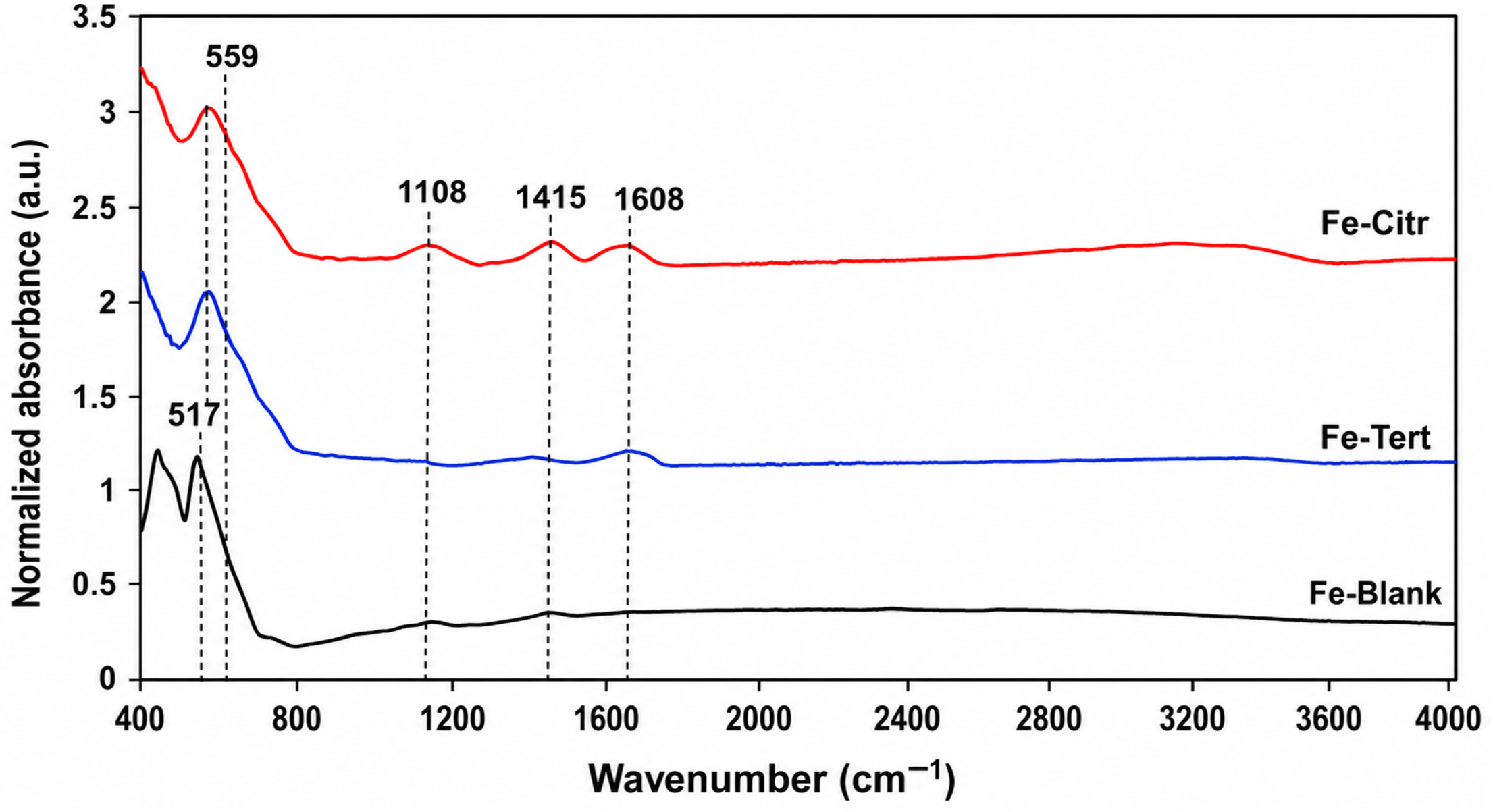
FTIR analysis confirmed the formation of hydroxylated iron oxide materials characterized by Fe–O lattice vibrations and surface hydroxyl groups. The spectra of the Fe-Blank, Fe-Tart, and Fe-Citr samples are reported in
Figure 1. All materials exhibited a broad absorption band in the 3200–3500 cm
−1 region, assigned to O–H stretching vibrations associated with surface hydroxyl groups and adsorbed water molecules, together with signals around 1608–1630 cm
−1 attributable to H–O–H bending vibrations.
The most intense low-wavenumber bands were observed in the 517–559 cm−1 region and are characteristic of Fe–O lattice vibrations, supporting the formation of iron oxide phases. These signals are consistent with magnetite- and maghemite-like structures, although FTIR alone does not allow unequivocal discrimination between iron oxide polymorphs. In the Fe-Citr sample, weak additional bands around 1108 and 1415 cm−1 were detected and may tentatively indicate residual oxygenated surface species associated with citrate-derived functionalities. However, their low intensity and broad profile do not allow definitive conclusions regarding stable surface functionalization.
Comparison among the different synthesized materials revealed only limited spectral variations, indicating that the use of different organic additives did not substantially modify the fundamental oxide framework. Similar FTIR profiles were also obtained for the additional samples synthesized during the preliminary screening stage, suggesting that all preparations generated chemically comparable iron oxide structures dominated by Fe–O and hydroxyl-related vibrations. Because of the partial overlap between Fe–O and organic-related bands, the FTIR discussion was intentionally limited to the identification of the principal functional groups without overinterpretation of weak secondary features. Overall, the spectra support the formation of structurally similar hydroxylated iron oxide materials potentially involved in Cd(II) adsorption through pH-dependent surface complexation mechanisms.
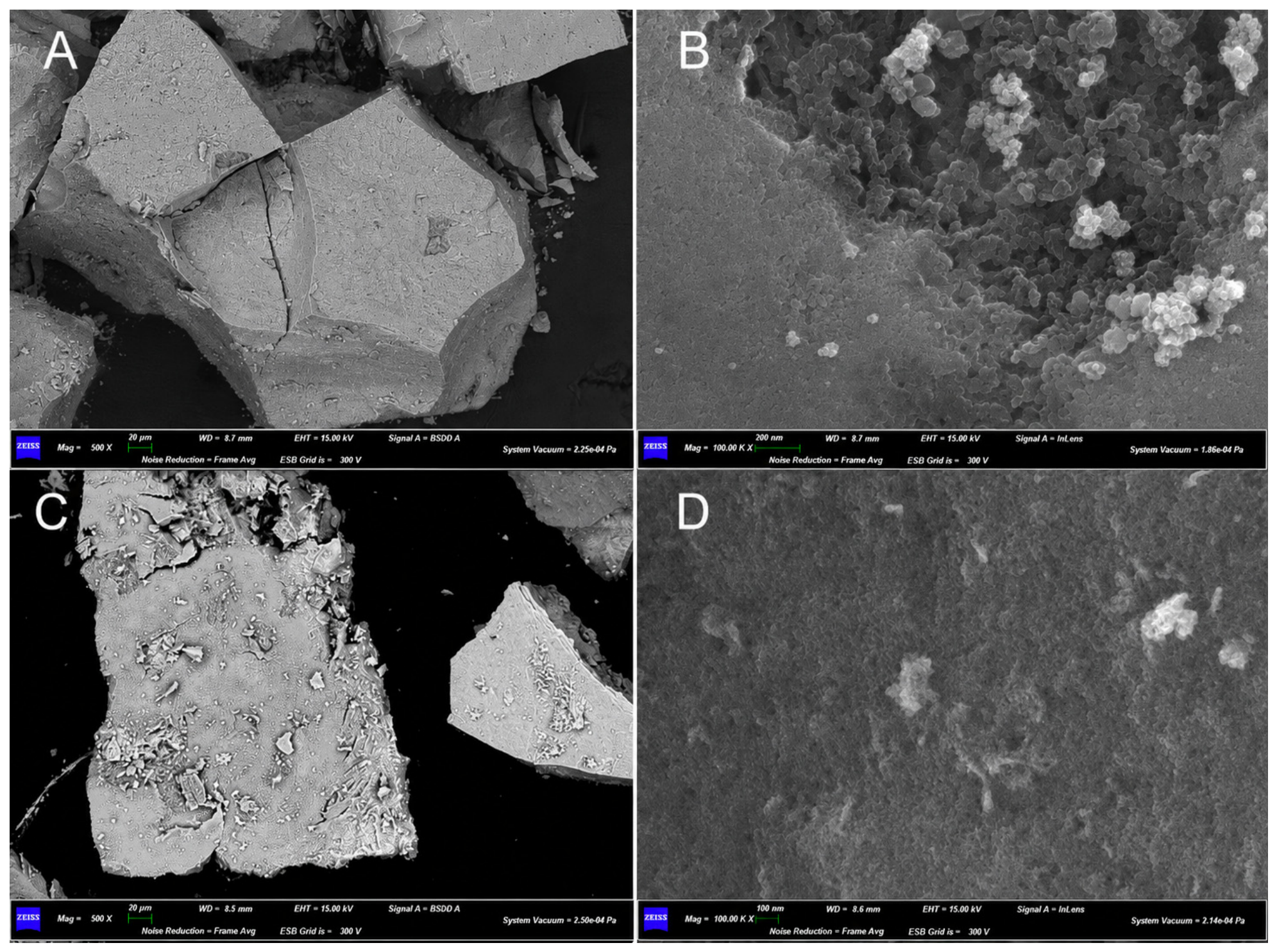
SEM micrographs of the Fe-Tart and Fe-Citr samples are reported in
Figure 2. At lower magnification (
Figure 2A,C), both materials appeared as compact micrometric aggregates with irregular morphology, fractured surfaces, and heterogeneous particle organization. Such aggregation behavior is commonly observed for iron oxide materials synthesized under rapid precipitation conditions and may also be favored by magnetic interactions and surface energy minimization during particle growth and drying. Higher magnification images (
Figure 2B,D) revealed rough surface domains and fine granular features distributed over the aggregates, suggesting the presence of structurally disordered surface domains and interparticle voids. No well-defined crystalline particles were observed, in agreement with the broad and poorly resolved diffraction profiles obtained by XRD analysis. Moreover, no substantial morphological differences were detected between Fe-Tart and Fe-Citr, indicating that the different organic additives did not markedly alter the overall aggregation behavior or surface organization of the synthesized materials.
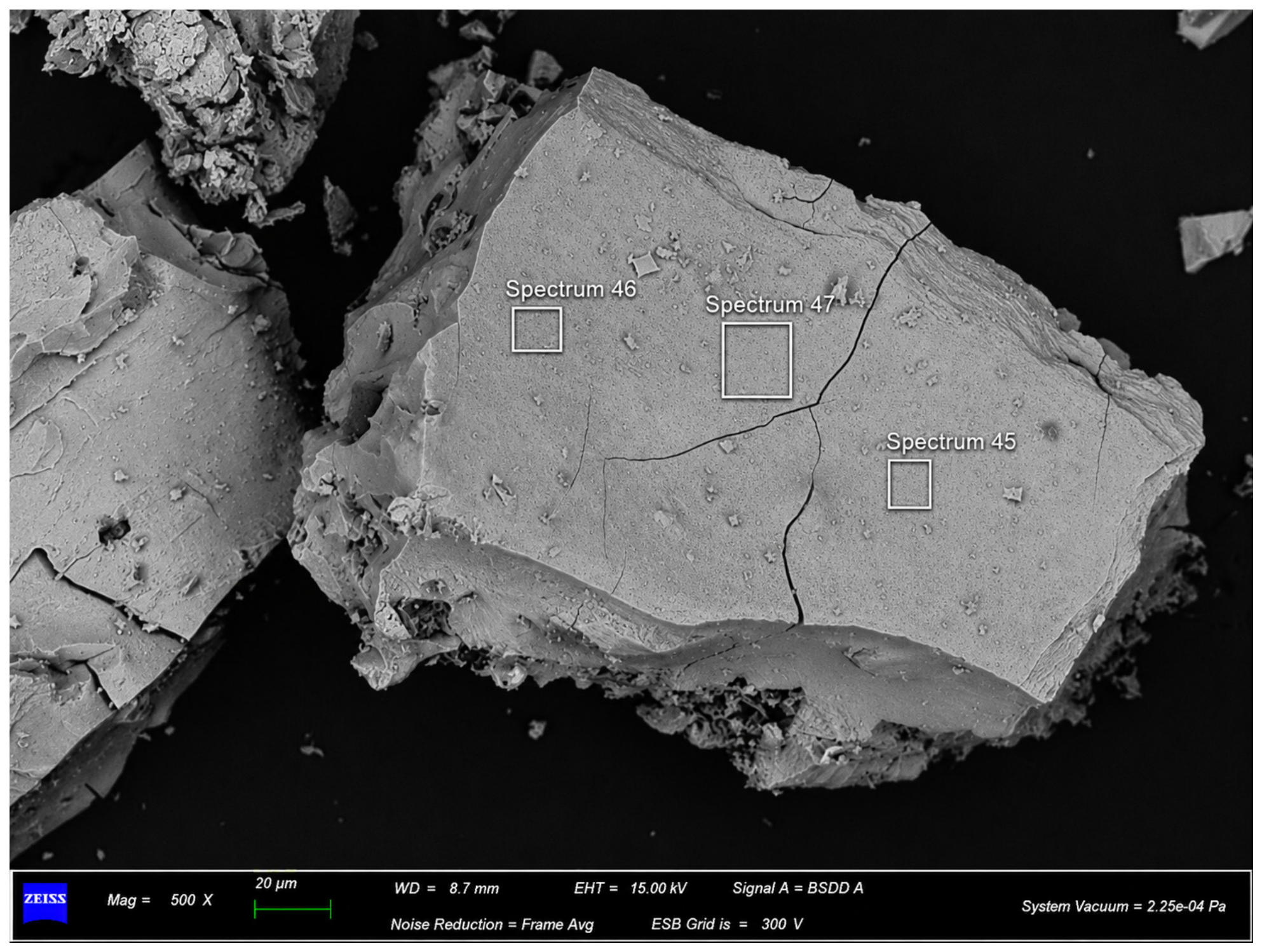
Representative EDS spectra acquired on selected regions of the Fe-Tart sample are reported in
Figure 3. Fe and O were identified as the predominant elements in all analyzed domains, supporting the iron oxide-type composition of the synthesized material. Semi-quantitative EDS analyses performed on three different regions yielded average compositions of 73.3 ± 4.1 wt% Fe and 21.4 ± 4.2 wt% O (mean ± standard deviation,
n = 3), values broadly consistent with iron oxide-type materials. The remaining minor fraction was associated with weak residual signals, including a faint S contribution, plausibly related to trace sulfate species originating from Mohr’s salt used as Fe(II) precursor. Local variations in Fe/O ratios were observed among different analyzed areas, likely reflecting surface heterogeneity, topographic effects, and the semi-quantitative nature of EDS measurements. Because EDS does not provide information on iron oxidation state or crystallographic phase, no attempt was made to distinguish between magnetite-, maghemite-, or other iron oxide polymorphs solely on the basis of elemental composition.
Overall, the combined SEM-EDS observations support the formation of relatively homogeneous Fe/O distribution at the micrometric scale but structurally disordered iron oxide aggregates characterized by heterogeneous surface textures potentially favorable for Cd(II) adsorption through the presence of heterogeneous hydroxylated surface regions, as further supported by EDS elemental mapping (
Figure S1).
XRD analysis revealed broad and poorly defined diffraction profiles, indicating the formation of predominantly poorly crystalline iron oxide materials. Only partial correspondence with the reference Fe3O4 pattern was observed, particularly in the 30–40° and 55–65° 2θ regions, preventing unequivocal phase identification. The absence of sharp secondary reflections nevertheless suggests that no highly crystalline impurity phases formed during synthesis. Similar diffraction profiles were also observed for the additional materials prepared during the preliminary screening stage, indicating that the different synthesis conditions did not substantially alter the predominantly poorly crystalline nature of the obtained iron oxide phases. The limited crystallinity observed for both Fe-Tart and Fe-Citr samples is consistent with rapid microwave-assisted nucleation and restricted crystal growth, resulting in structurally disordered oxide materials potentially favorable for adsorption applications because of the presence of accessible hydroxylated surface regions and limited long-range structural organization.
3.2. Effect of pH on Adsorption
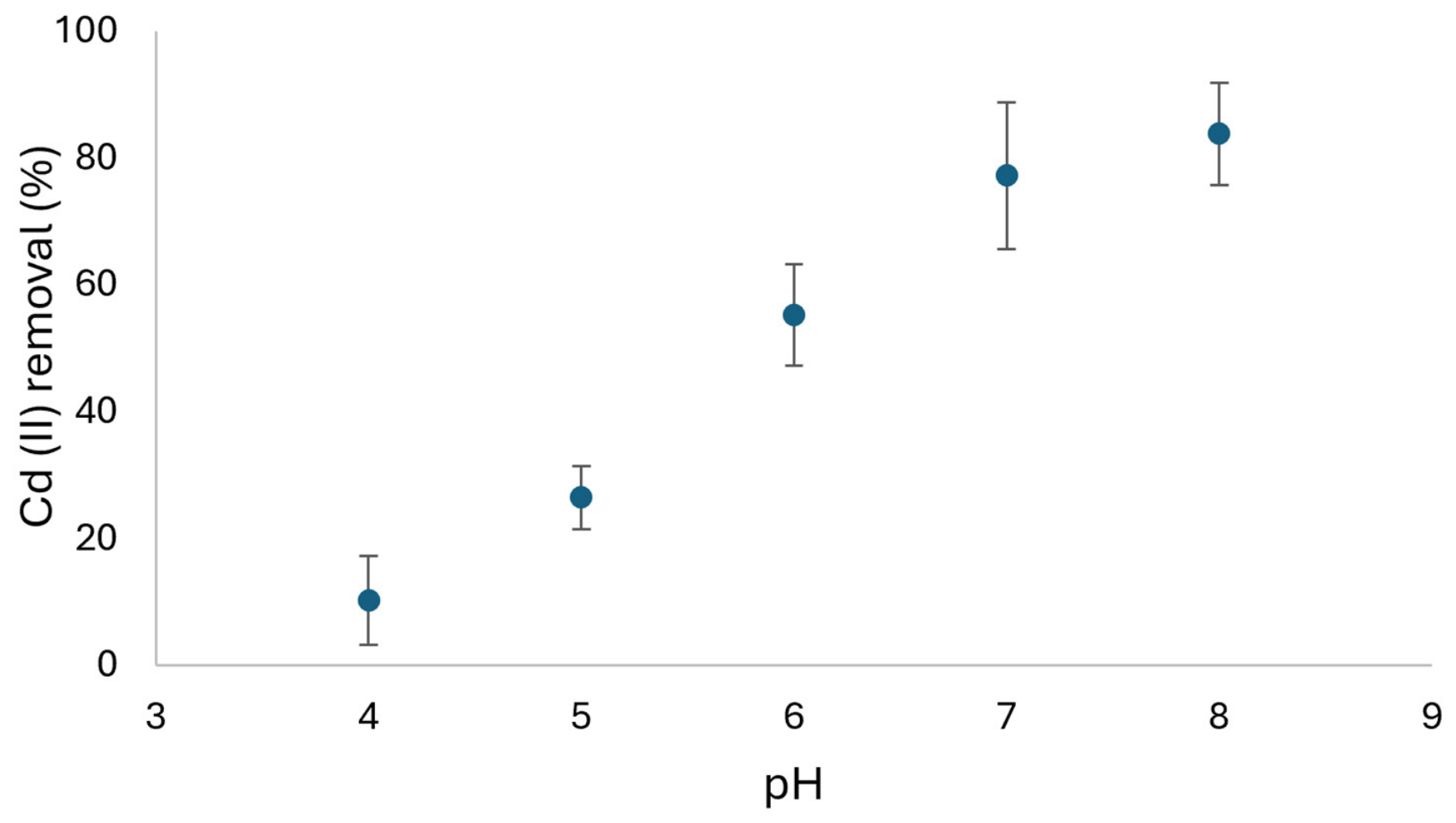
The adsorption of Cd(II) showed a marked dependence on solution pH (
Figure 4), reflecting the coupled effects of surface charge development and metal speciation.
Under acidic conditions, limited adsorption was observed, with removal efficiencies below 30% at pH 4–5. This behavior is consistent with the predominance of protonated surface hydroxyl groups, which reduces the availability of negatively charged adsorption sites and promotes competition between Cd(II) ions and protons for surface binding.
A progressive increase in adsorption efficiency was observed with increasing pH, reaching approximately 80% removal under near-neutral conditions. The most pronounced increase occurred between pH 5 and 7, suggesting that progressive deprotonation of surface hydroxyl groups enhances the interaction between Cd(II) species and the iron oxide surface. Under these conditions, adsorption is likely favored by stronger surface complexation interactions involving oxygen-containing surface sites.
At pH values above neutrality, the adsorption trend approached a plateau, indicating progressive saturation of the most accessible adsorption sites. Experimental conditions were selected to minimize Cd(OH)
2 precipitation; therefore, the observed removal is mainly attributed to adsorption phenomena rather than bulk precipitation processes. Nevertheless, minor contributions from hydrolyzed Cd species at higher pH values cannot be completely excluded. Although the point of zero charge (pHPZC) of the Fe-Tart material was not directly measured in this study, literature data for structurally related iron oxide and oxyhydroxide phases indicate that their pHPZC values generally fall in the near-neutral to weakly alkaline range [
40,
41,
42]. Reported values are commonly around pH 6–8 for magnetite-, maghemite-, goethite-, and ferrihydrite-type surfaces. Since FTIR and XRD results indicate the formation of hydroxylated and poorly crystalline iron oxide phases with partial similarity to magnetite/maghemite-like structures, the adsorption experiments performed at pH 4–5 can reasonably be considered to occur below the expected pHPZC range. Under these conditions, the surface is expected to be predominantly protonated, which is consistent with the limited Cd(II) adsorption observed at acidic pH. Conversely, the increase in adsorption between pH 5 and 7 is consistent with progressive deprotonation of surface hydroxyl groups and increased availability of oxygen-containing adsorption sites.
3.3. Adsorption Isotherms
A preliminary adsorption screening was initially performed in order to compare the Cd(II) uptake behavior of the synthesized iron oxide materials under identical experimental conditions. The experiments were conducted using Cd(II) solutions with an initial concentration of 10 mg L
−1 and a fixed contact time of 3 h in order to ensure direct comparison among the investigated formulations. Although equilibrium conditions were not fully established at this contact time, the screening experiments were performed under identical experimental conditions for all materials and were intended solely as a comparative assessment of their relative adsorption performance as reported in
Table 2. The objective of this preliminary stage was therefore not to determine equilibrium adsorption capacities but rather to identify promising formulations for subsequent detailed investigations conducted under equilibrium conditions. Additional Fe(II)-Citr-x and Fe(II)-Tart-x series prepared with progressively increasing concentrations of citric and tartaric acid were not further considered in the detailed discussion because they did not exhibit substantial differences in adsorption performance compared to the corresponding base formulations. Among the investigated systems, both Fe-Tart and Fe-Citr-Ca exhibited the highest Cd(II) removal efficiencies. Fe-Tart was selected for subsequent equilibrium studies because it provided the same removal efficiency as Fe-Citr-Ca while relying on a simpler formulation, without calcium-assisted synthesis or additional acid-washing steps aimed at removing residual calcium species. This reduced the number of compositional and procedural variables involved in the preparation of the adsorbent. Therefore, Fe-Tart was selected as a representative high-performing formulation suitable for detailed adsorption investigation, rather than as evidence of superior structural or magnetic properties.
Preliminary time-dependent adsorption experiments were additionally performed in order to evaluate the equilibration behavior of the Fe-Tart material. Cd(II) uptake progressively increased during the first hours of contact and approached near-equilibrium conditions within approximately 4 h. Consequently, a contact time of 4 h was selected for the subsequent equilibrium adsorption experiments in order to ensure stable adsorption conditions while avoiding unnecessarily prolonged experimental times. Based on these preliminary screening and equilibration results, detailed equilibrium adsorption studies were subsequently carried out using the Fe-Tart material under controlled experimental conditions. The equilibrium isotherm experiments were carried out at pH 4.9 in order to evaluate Cd(II) adsorption under controlled conditions in which Cd hydrolysis and possible Cd(OH)2 precipitation were minimized. Although higher removal efficiencies were observed at pH 7–8, these conditions are closer to the region where hydrolyzed Cd species and precipitation-related contributions may become more relevant. Therefore, pH 4.9 was selected as a conservative working condition for equilibrium modeling, prioritizing mechanistic interpretability and solution-phase stability over maximum removal efficiency.
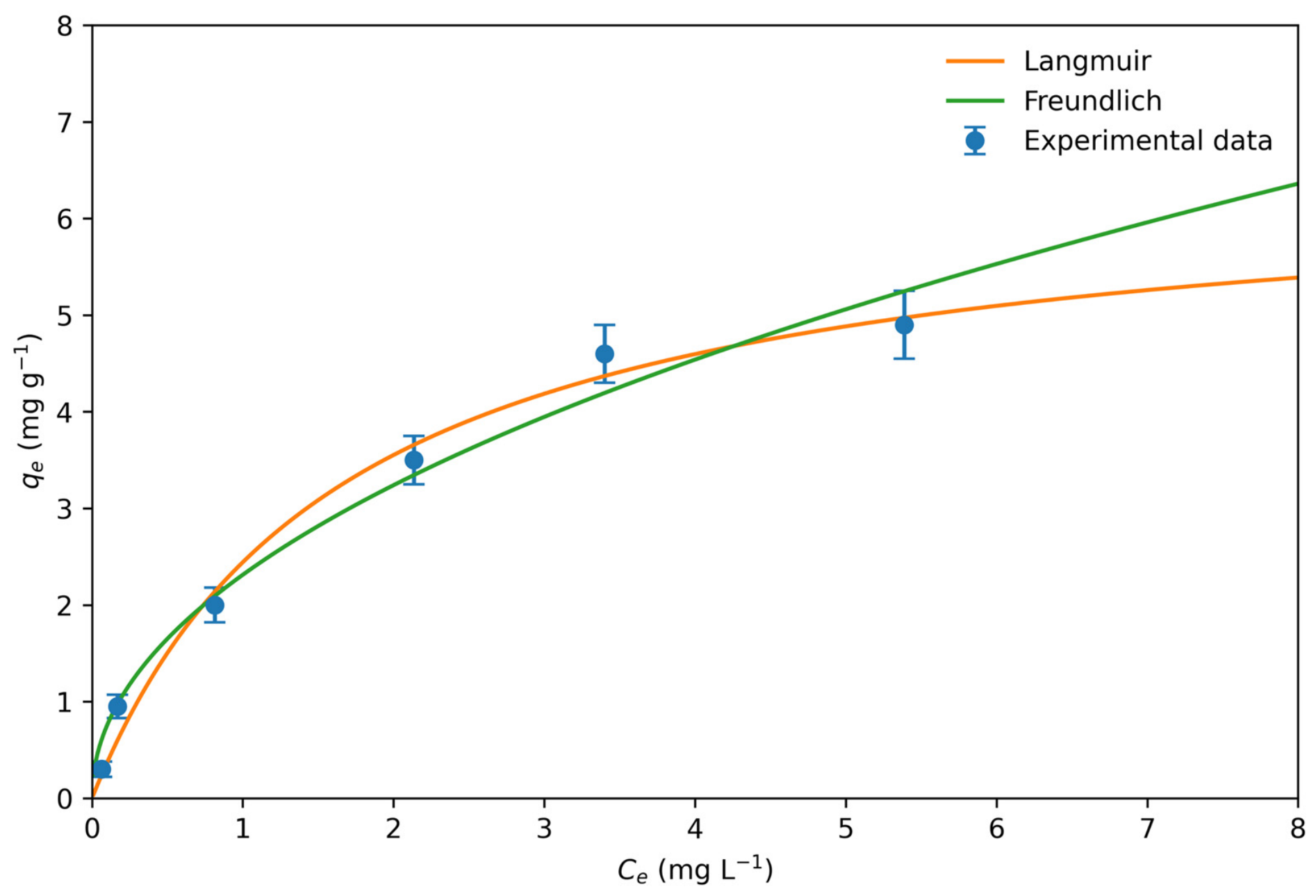
Equilibrium adsorption behavior was investigated through adsorption isotherms obtained using the Fe-Tart material under controlled conditions. The experimental adsorption isotherm is reported in
Figure 5, where the amount of adsorbed Cd(II) progressively increased with equilibrium concentration before approaching a tendency toward saturation at higher concentrations.
The experimental equilibrium data were fitted using both Langmuir and Freundlich isotherm models through non-linear regression in order to evaluate the adsorption mechanism and the distribution of active sites on the adsorbent surface [
39]. The resulting fitting parameters are summarized in
Table S1. Both models provided a satisfactory description of the adsorption behavior; however, the Langmuir model yielded a slightly better fit, with a coefficient of determination (
R2 = 0.988) higher than that obtained for the Freundlich model (
R2 = 0.978). The Langmuir parameters indicated a maximum adsorption capacity (
qmax) of 6.51 mg g
−1 and a Langmuir affinity constant (
KL) of 0.60 L mg
−1. The better performance of the Langmuir model suggests that Cd(II) adsorption predominantly occurs on a finite number of energetically similar surface sites, resulting in the formation of a monolayer under the investigated experimental conditions. This behavior suggests that Cd(II) adsorption predominantly occurs through progressive occupation of a finite number of energetically comparable surface sites, leading to a tendency toward monolayer coverage at equilibrium. The good agreement with the Langmuir model is reasonably consistent with the adsorption behavior typically observed for divalent metal cations on hydroxylated oxide surfaces, where adsorption is mainly governed by specific interactions between Cd(II) species and surface oxygen-containing functional groups. In this framework, the adsorption process can be interpreted as a progressive filling of accessible surface sites rather than extensive multilayer adsorption phenomena.
Although SEM and XRD analyses revealed a relatively heterogeneous and structurally disordered material, the good agreement obtained with the Langmuir model (R2 = 0.988) indicates that the adsorption process is largely governed by surface sites exhibiting comparable adsorption affinity toward Cd(II). Nevertheless, the slightly lower fitting quality obtained for the Freundlich model (R2 = 0.978) and the small deviations observed at higher equilibrium concentrations suggest that some degree of surface heterogeneity cannot be completely excluded. Overall, the adsorption behavior appears consistent with pH-dependent interactions between Cd(II) species and hydroxylated iron oxide surfaces. The irregular morphology observed by SEM may additionally contribute to the availability of accessible adsorption regions involved in metal uptake, although further surface characterization would be required to establish a direct correlation between textural properties and adsorption performance.
The
qmax value obtained for Fe-Tart in this work was 6.51 mg g
−1. This value falls within the range reported for non-composite iron oxide-based Cd(II) adsorbents, being higher than some green-synthesized Fe
2O
3 nanoparticles (3.48 mg g
−1) but lower than values reported for hematite (13.70 mg g
−1), akaganeite (17.1 mg g
−1), magnetite nanoparticles (19.36 mg g
−1), and maghemite nanoparticles (52.63 mg g
−1) [
43,
44,
45,
46]. Recent reviews emphasize that the relevance of iron oxide adsorbents is not determined exclusively by maximum adsorption capacity, but also by their hydroxylated reactive surfaces, pH-dependent surface charge, tunable surface chemistry, low-cost preparation, and, for magnetic phases, simplified recovery from aqueous media. In this context, Fe-Tart should not be presented as a high-capacity adsorbent, but rather as a simple microwave-synthesized iron oxide system obtained without complex functionalization or post-synthesis calcination [
47,
48,
49].
3.4. Adsorption Mechanisms
The adsorption behavior of the Fe-Tart material can be interpreted within a surface complexation framework in which hydroxylated iron oxide surfaces represent the principal reactive domains involved in Cd(II) uptake. This interpretation is supported by the combined evidence obtained from FTIR characterization, pH-dependent adsorption behavior, equilibrium isotherm analysis, and SEM-XRD observations. However, since no direct spectroscopic investigation of adsorbed Cd species was performed, the proposed mechanism should be regarded as a chemically consistent interpretation rather than definitive structural proof.
FTIR analysis revealed abundant surface hydroxyl functionalities together with Fe–O lattice vibrations characteristic of hydroxylated iron oxide systems. Such hydroxyl groups are expected to act as the primary adsorption sites through protonation-deprotonation equilibria occurring at the oxide-water interface. Under acidic conditions, the oxide surface remains predominantly protonated, limiting the availability of negatively charged adsorption sites and favoring electrostatic competition between Cd(II) ions and protons. Accordingly, relatively low adsorption efficiencies were observed at pH 4–5.
A substantial increase in adsorption efficiency was observed as the solution pH approached near-neutral values. This behavior is consistent with progressive deprotonation of surface hydroxyl groups, which enhances the interaction between dissolved Cd(II) species and oxygen-containing surface sites. The marked increase in adsorption observed between pH 5 and 7 suggests a transition from weak electrostatic interactions toward stronger surface coordination phenomena under less acidic conditions. Nevertheless, because no spectroscopic confirmation of adsorption complexes was obtained after metal uptake, the exact nature of the surface complexes cannot be unequivocally established.
The equilibrium adsorption results are also consistent with this interpretation. The relatively good agreement observed for the Langmuir model (R2 = 0.995) suggests that Cd(II) uptake predominantly occurs through occupation of a finite number of energetically comparable surface sites, leading to a tendency toward monolayer coverage at equilibrium. At the same time, the satisfactory fit obtained for the Freundlich model indicates that a certain degree of surface heterogeneity remains present, which is coherent with the structurally disordered morphology observed by SEM and the poorly crystalline character indicated by XRD analysis.
Additional textural characterization performed by N
2 adsorption–desorption analysis (
Figures S3 and S4 and Table S2) revealed a moderately developed mesoporous structure associated with interparticle voids generated by the aggregation of iron oxide particles. The measured BET surface area confirms that the synthesized material possesses an accessible surface capable of supporting Cd(II) uptake. At the same time, the relatively moderate adsorption capacity observed in this study suggests that adsorption performance cannot be explained solely by textural parameters, but is also influenced by the density, accessibility, and chemical nature of the available surface adsorption sites.
SEM observations revealed irregular aggregates characterized by rough surface regions, interparticle voids, and heterogeneous surface textures. Such features are commonly associated with rapidly precipitated iron oxide systems and may contribute to increasing the accessibility of reactive hydroxylated domains. Similarly, the broad and weak diffraction features observed by XRD suggest limited long-range structural organization, indicating that adsorption is more likely governed by accessible surface functionalities than by highly ordered crystallographic domains.
Overall, the combined characterization and adsorption results suggest that Cd(II) uptake is mainly controlled by pH-dependent interactions occurring on hydroxylated iron oxide surfaces, while the structurally disordered and heterogeneous hydroxylated surface regions of the synthesized materials may contribute to increasing the density and accessibility of reactive adsorption sites.
However, since post-adsorption surface-sensitive spectroscopic analyses such as XPS or EXAFS were not performed, the proposed adsorption mechanism should be regarded as an indirect interpretation rather than as direct structural evidence of Cd(II) surface complex formation. Future studies should include these techniques to directly investigate the chemical environment of adsorbed Cd(II) species and confirm the nature of the surface complexes formed on the iron oxide surface.
3.5. Sustainability Considerations
Although a quantitative life-cycle or energy-consumption assessment was beyond the scope of the present work, some practical aspects of the proposed synthesis route can be discussed in comparison with iron oxide preparation methods reported in the literature. The Fe-Tart material was obtained through a microwave-assisted hydrothermal treatment performed at 180 °C for 2 h, using inexpensive iron salts and simple organic additives, without templating agents or post-synthesis calcination.
This preparation route is comparable to other low-intensity or process-simplified syntheses of iron oxide materials, in which reduced reaction times and limited post-treatment steps are considered advantageous from an operational perspective [
32,
50,
51,
52,
53,
54]. In contrast, several conventional or post-treated iron oxide systems require substantially longer hydrothermal treatments, commonly in the range of 12–24 h, or additional calcination steps at temperatures above 300 °C, often reaching 400–700 °C, in order to improve phase purity, crystallinity, or structural organization [
55,
56,
57,
58,
59]. Such thermal post-treatments may be useful for obtaining well-defined crystalline phases, particularly hematite-type materials, but they inevitably increase process complexity and thermal demand.
Therefore, while no direct energy balance was performed, the relatively short synthesis time, absence of high-temperature calcination, and use of simple precursors suggest that the present microwave-assisted route may represent a comparatively less demanding preparation strategy than several conventional thermally treated iron oxide systems. These considerations should be interpreted as qualitative process-related observations rather than as a quantitative demonstration of sustainability.
4. Conclusions
Iron oxide materials synthesized through a microwave-assisted hydrothermal route were successfully evaluated for Cd(II) removal from aqueous systems, demonstrating reproducible and interpretable adsorption behavior under the investigated experimental conditions. Preliminary screening experiments revealed that the Fe-Tart formulation provided the most favorable balance between adsorption efficiency and magnetic separability among the investigated materials and was therefore selected for detailed characterization and adsorption studies.
FTIR, SEM, EDS, and XRD analyses consistently indicated the formation of hydroxylated iron oxide materials characterized by structurally disordered and poorly crystalline features. The synthesized adsorbents exhibited heterogeneous surface textures, rough aggregate morphology, and broad diffraction profiles, suggesting limited long-range crystallographic organization together with the presence of accessible hydroxylated and structurally disordered surface regions potentially involved in metal uptake. The adsorption process was strongly influenced by solution pH, with adsorption efficiency progressively increasing from acidic to near-neutral conditions. This behavior is consistent with pH-dependent surface charge development and progressive deprotonation of hydroxylated surface sites. Equilibrium adsorption data were satisfactorily described by both Langmuir and Freundlich models, although the Langmuir equation provided the best non-linear fitting results (R2 = 0.988), suggesting that adsorption predominantly occurs through occupation of a finite number of energetically comparable surface sites with a tendency toward monolayer coverage at equilibrium.
The combined interpretation of characterization and adsorption data supports a mechanistic framework in which Cd(II) uptake is mainly governed by interactions between dissolved metal species and hydroxylated iron oxide surfaces. At the same time, the structurally disordered morphology observed by SEM and XRD likely contributes to generating heterogeneous reactive domains and increasing the accessibility of adsorption sites. From a process perspective, microwave-assisted synthesis enabled relatively rapid material preparation compared to many conventional hydrothermal approaches, suggesting possible advantages in terms of synthesis efficiency and operational simplification. Although the adsorption capacity obtained in the present work remains lower than that reported for some highly engineered adsorbent systems described in the literature, the relatively simple composition and straightforward preparation route of the investigated iron oxides may still represent a potentially attractive basis for developing accessible adsorption systems for water remediation.
Nevertheless, several limitations remain to be addressed before practical implementation can be fully evaluated. Future studies should investigate adsorbent regeneration and reuse, adsorption behavior in real water matrices and multicomponent systems containing common competing ions such as Ca2+, Mg2+, Na+, K+, and other potentially interfering metal species, long-term stability, and quantitative assessment of energy consumption and environmental impact. These experiments will be necessary to evaluate the selectivity, robustness, and practical applicability of the material under environmentally relevant conditions. Post-adsorption surface-sensitive spectroscopic analyses, such as XPS or EXAFS, should also be included to directly probe the chemical environment of adsorbed Cd(II) species and validate the proposed surface-complexation mechanism.