
Sustainable Potential of Piper Essential Oils Against Agricultural Pests of the Order Lepidoptera: A Review



Abstract
1. Introduction
2. Methods
3. Phytochemistry and Efficacy of Piper Essential Oils
3.1. Piper Species EOs
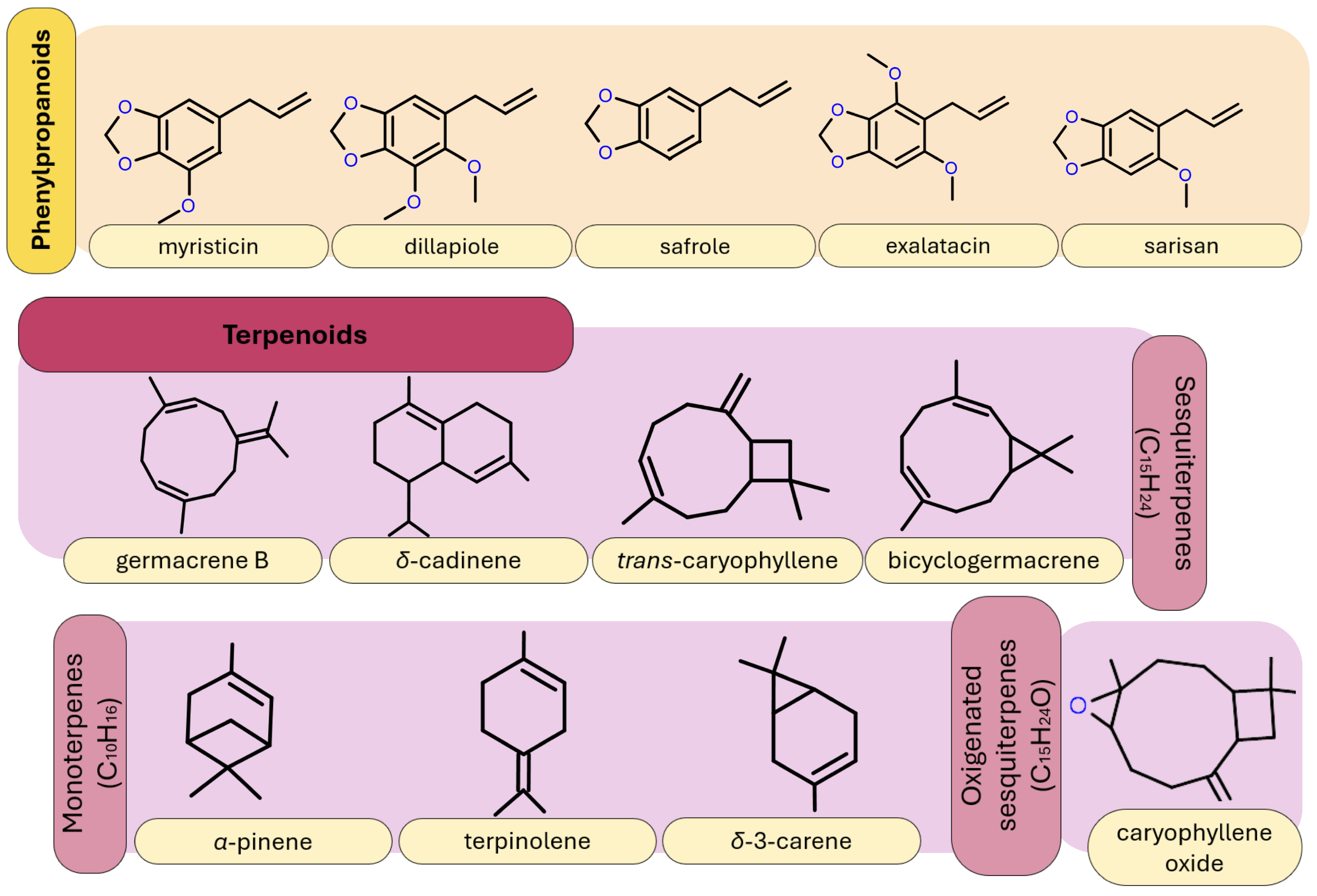
3.2. Main Metabolites Isolated from Piper EOs
3.3. Methodologies in Toxicity Evaluation
3.4. Toxicity Results of EOs in Lepidoptera
3.4.1. Topical Toxicity
3.4.2. Bioinsecticidal Activities via Ingestion
3.4.3. Bioinsecticidal Activities Under Residual Contact
3.4.4. Ovicidal Activities
4. Conclusions
Supplementary Materials
Author Contributions
Funding
Institutional Review Board Statement
Informed Consent Statement
Data Availability Statement
Acknowledgments
Conflicts of Interest
Abbreviations
| AC | Antifeedant concentration values |
| CD | Feeding deterrence concentration |
| CI | Confidence interval |
| CT | Chemotype |
| EC | Feeding index inhibition |
| EO | Essential oil |
| FDI | Feeding index deterrence |
| LC | Lethal concentration |
| LD | Lethal doses |
| LT | Median lethal time |
| ODI | Oviposition deterrence index |
| PBO | Piperonyl butoxide |
| PI | Preference index |
References
- Monteiro, A.; Murugesan, S.N.; Prakash, A.; Papa, R.; Juan, S.; Rico, P. The Developmental Origin of Novel Complex Morphological Traits in Lepidoptera. Annu. Rev. Entomol. 2025, 70, 421–439. [Google Scholar] [CrossRef]
- Ministério do Meio Ambiente (BR). Sumário Executivo do Plano de Ação Nacional Para Conservação dos Lepidópteros Ameaçados de Extinção; ICMBio: Brasília, Brazil, 2010. [Google Scholar]
- Sehnal, F.; Svacha, P.; Zrzavy, J. Evolution of Insect Metamorphosis; Lawrence, I.G., Jamshed, R., Tata, B., Atkinson, G., Eds.; Academic Press: Ceske Budejovice, Czech Republic, 1996. [Google Scholar]
- Pohl, G.R.; Cannings, R.A.; Landry, J.; Holden, D.G.; Scudder, G.G.E. Checklist of the Lepidoptera of British Columbia, Canada; Entomological Society of British Columbia: Kamloops, BC, Canada, 2015. [Google Scholar]
- Nieukerken, E.J.V.; Kaila, L.; Kitching, I.J.; Kristensen, N.P.; Lees, D.C.; Minet, J.; Mitter, C.; Mutanen, M.; Regier, J.C.; Simonsen, T.J.; et al. Order Lepidoptera Linnaeus, 1758. In Animal Biodiversity: An Outline of Higher-Level Classification and Survey of Taxonomic Richness; Zhang, Z.-Q., Ed.; Zootaxa: Auckland, New Zealand, 2011; pp. 212–221. [Google Scholar] [CrossRef]
- Mitter, C.; Davis, D.R.; Cummings, M.P. Phylogeny and Evolution of Lepidoptera. Annu. Rev. Entomol. 2017, 62, 265–283. [Google Scholar] [CrossRef]
- Ahmed, K.S.; Mikhail, W.Z.A.; Sobhy, H.M.; Radwan, E.M.M.; Salaheldin, T.A. Impact of Nanosilver-Profenofos on Cotton Leafworm, Spodoptera littoralis (Boisd.) Larvae. Bull. Natl. Res. Cent. 2019, 43, 46. [Google Scholar] [CrossRef]
- El-Aswad, A.F.; Abdelgaleil, S.A.M.; Nakatani, M. Feeding Deterrent and Growth Inhibitory Properties of Limonoids from Khaya Senegalensis against the Cotton Leafworm, Spodoptera littoralis. Pest Manag. Sci. 2004, 60, 199–203. [Google Scholar] [CrossRef]
- Cruz, I.; Valicente, H.F.; Afonso, V.P.; Mendes, S.M. Risco Potencial das Pragas de Milho e de Sorgo no Brasil; Embrapa Milho e Sorgo: Sete Lagoas, Brazil, 2013. [Google Scholar]
- Machekano, H.; Mvumi, B.M.; Nyamukondiwa, C. Plutella xylostella (L.): Pest Status, Control Practices, Perceptions and Knowledge on Existing and Alternative Management Options in Arid Small-Scale Farming Environments. Int. J. Pest Manag. 2020, 66, 48–64. [Google Scholar] [CrossRef]
- Mayanglambam, S.; Singh, K.D.; Rajashekar, Y. Current Biological Approaches for Management of Crucifer Pests. Sci. Rep. 2021, 11, 11831. [Google Scholar] [CrossRef]
- Marcelino, S.; Hamdane, S.; Gaspar, P.D.; Paço, A. Sustainable Agricultural Practices for the Production of Medicinal and Aromatic Plants: Evidence and Recommendations. Sustainability 2023, 15, 14095. [Google Scholar] [CrossRef]
- Jalli, M.; Huusela, E.; Jalli, H.; Kauppi, K.; Niemi, M.; Himanen, S.; Jauhiainen, L. Effects of Crop Rotation on Spring Wheat Yield and Pest Occurrence in Different Tillage Systems: A Multi-Year Experiment in Finnish Growing Conditions. Front. Sustain. Food Syst. 2021, 5, 647335. [Google Scholar] [CrossRef]
- Boldorini, G.X.; McCary, M.A.; Romero, G.Q.; Mills, K.L.; Sanders, N.J.; Reich, P.B.; Michalko, R.; Gonçalves-Souza, T. Predators Control Pests and Increase Yield across Crop Types and Climates: A Meta-Analysis. Proc. Biol. Sci. 2024, 291, 20232522. [Google Scholar] [CrossRef]
- Kumari, B.R.; Vijayabharathi, R.; Srinivas, V.; Gopalakrishnan, S. Microbes as Interesting Source of Novel Insecticides: A Review. Afr. J. Biotechnol. 2014, 13, 2582–2592. [Google Scholar] [CrossRef]
- Maedeh, M.; Hamzeh, I.; Hossein, D.; Majid, A.; Karimi Reza, R. Bioactivity of Essential Oil from Satureja hortensis (Laminaceae) against Three Stored-Product Insect Species. Afr. J. Biotechnol. 2011, 10, 6620–6627. [Google Scholar] [CrossRef]
- Raut, J.S.; Karuppayil, S.M. A Status Review on the Medicinal Properties of Essential Oils. Ind. Crops Prod. 2014, 62, 250–264. [Google Scholar] [CrossRef]
- Bizzo, H.R.; Hovell, M.C.; Rezende, C.M. Óleos Essenciais No Brasil: Aspectos Gerais, Desenvolvimento e Perspectivas. Quim. Nova 2009, 32, 588–594. [Google Scholar] [CrossRef]
- Urzúa, A.; Cosmo, D.D.; Echeverría, J.; Santander, R.; Palacios, M.S.; Rossi, Y. Insecticidal Effect of Schinus latifolius Essential Oil on the Housefly, Musca domestica L. Bol. Latinoam. Caribe Plantas Med. Aromat. 2011, 10, 470–475. [Google Scholar]
- Burt, S. Essential Oils: Their Antibacterial Properties and Potential Applications in Foods—A Review. Int. J. Food Microbiol. 2004, 94, 223–253. [Google Scholar] [CrossRef] [PubMed]
- Cruz, R.C.D.d.; Carvalho, K.d.S.; Costa, R.J.O.; Silva, P.A.d.; Silva, S.L.d.C.e.; Gualberto, S.A.; Gusmão, N.B.d.; Souza, I.A.d. Phytochemical and Toxicological Evaluation of a Blend of Essential Oils of Croton Species on Aedes Aegypti and Mus Musculus. S. Afr. J. Bot. 2020, 132, 188–195. [Google Scholar] [CrossRef]
- Fenibo, E.O.; Ijoma, G.N.; Nurmahomed, W.; Matambo, T. The Potential and Green Chemistry Attributes of Biopesticides for Sustainable Agriculture. Sustainability 2022, 14, 14417. [Google Scholar] [CrossRef]
- Lengai, G.M.W.; Muthomi, J.W.; Mbega, E.R. Phytochemical Activity and Role of Botanical Pesticides in Pest Management for Sustainable Agricultural Crop Production. Sci. Afr. 2020, 7, e00239. [Google Scholar] [CrossRef]
- Reisig, D.D.; Kurtz, R. Bt Resistance Implications for Helicoverpa zea (Lepidoptera: Noctuidae) Insecticide Resistance Management in the United States. Environ. Entomol. 2018, 47, 1357–1364. [Google Scholar] [CrossRef]
- Wilson, A.N.; Grieshop, M.J.; Roback, J.; Dell’Orco, S.; Huang, J.; Perkins, J.A.; Nicholson, S.; Chiaramonti, D.; Nimlos, M.R.; Christensen, E. Efficacy, Economics, and Sustainability of Bio-Based Insecticides from Thermochemical Biorefineries. Green Chem. 2021, 23, 10145–10156. [Google Scholar] [CrossRef]
- Kikuchi, D.W.; Lasso, E.; Dalling, J.W.; Nur, N. Pollinators and Pollen Dispersal of Piper dilatatum (Piperaceae) on Barro Colorado Island, Panama. J. Trop. Ecol. 2007, 23, 603–606. [Google Scholar] [CrossRef]
- World Flora Online Plant List. Available online: https://wfoplantlist.org (accessed on 28 April 2026).
- De Queiroz, G.A.; de Barros, A.A.M.; Guimarães, E.F. Piper (Piperaceae) from Serra Da Tiririca State Park, Niterói/Maricá, RJ, Brazil. Rodriguesia 2020, 7, e01992018. [Google Scholar] [CrossRef]
- Regasini, L.O.; Cotinguiba, F.; Siqueira, J.R.; Bolzani, V.S.; Silva, D.H.S.; Furlan, M.; Kato, M.J. Radical Scavenging Capacity of Piper Arboreum and Piper tuberculatum (Piperaceae). Lat. Am. J. Pharm. 2008, 27, 900–903. [Google Scholar]
- Durant-Archibold, A.A.; Santana, A.I.; Gupta, M.P. Ethnomedical Uses and Pharmacological Activities of Most Prevalent Species of Genus Piper in Panama: A Review. J. Ethnopharmacol. 2018, 217, 63–82. [Google Scholar] [CrossRef]
- Lima, C.N.F.; De Lima, L.F.; Correia, D.B.; Machado, S.T.d.S.; De Sousa, J.P.; Santos, E.S.; Delmondes, G.d.A.; De Menezes, I.R.A.; Felipe, C.F.B.; Coutinho, H.D.M.; et al. Systematic Review: Medicinal Use and Scientific Elucidation of the Piper Genus for the Treatment of Symptoms and Inflammatory Diseases. J. Med. Plants Res. 2020, 14, 62–72. [Google Scholar] [CrossRef]
- Xiang, C.-P.; Shi, Y.-N.; Liu, F.-F.; Li, H.-Z.; Zhang, Y.-J.; Yang, C.-R.; Xu, M. A Survey of the Chemical Compounds of Piper spp. (Piperaceae) and Their Biological Activities. Nat. Prod. Commun. 2016, 9, 1403–1408. [Google Scholar] [CrossRef]
- Usseglio, V.L.; Dambolena, J.S.; Zunino, M.P. Can Essential Oils Be a Natural Alternative for the Control of Spodoptera frugiperda? A Review of Toxicity Methods and Their Modes of Action. Plants 2023, 12, 3. [Google Scholar] [CrossRef]
- Pavela, R.; Benelli, G. Essential Oils as Ecofriendly Biopesticides? Challenges and Constraints. Trends Plant Sci. 2016, 21, 1000–1007. [Google Scholar] [CrossRef] [PubMed]
- Eliseo, C.; Aguirre, D.; Pratissoli, D.; Romário De Carvalho, J.; Pacheco Damascena, A.; Moreira De Araujo Junior, L.; Zago, H.B. Actividad Insecticida de Aceites Esenciales Sobre Helicoverpa armígera (Hübner) (Lepidoptera: Noctuidae) Essential Oils Insecticide Activity on Helicoverpa armigera (Hübner) (Lepidoptera: Noctuidae). Idesia 2020, 38, 59–64. [Google Scholar]
- Pinheiro, K.D.; Rezende, K.F.; Krinski, D. Efeito Ovicida de Óleo Essencial de Folhas e Frutos de Piper fuligineum (Piperaceae) Sobre Ovos de Spodoptera frugiperda (Lepidoptera). J. Educ. Sci. Health 2022, 2, 1–10. [Google Scholar] [CrossRef]
- Sangha, J.S.; Astatkie, T.; Cutler, G.C. Ovicidal, Larvicidal, and Behavioural Effects of Some Plant Essential Oils on Diamondback moth (Lepidoptera: Plutellidae). Can. Entomol. 2017, 149, 639–648. [Google Scholar] [CrossRef]
- Sanchez, B.M.; Pinedo, M.N.; Montaño, M.S.H. Uso de Aceites Esenciales Para El Control Del Estado Larval de La Mariposa Blanca de La Col (Pieris brassicae) En Laboratorio. Acta Nova 2021, 10, 173–189. [Google Scholar]
- Dutra, K.; Wanderley-Teixeira, V.; Guedes, C.; Cruz, G.; Navarro, D.; Monteiro, A.; Agra, A.; Lapa Neto, C.; Teixeira, Á. Toxicity of Essential Oils of Leaves of Plants from the Genus Piper with Influence on the Nutritional Parameters of Spodoptera frugiperda (J.E. Smith) (Lepidoptera: Noctuidae). J. Essent. Oil-Bear. Plants 2020, 23, 213–229. [Google Scholar] [CrossRef]
- Dutra, K.A.; Wanderley Teixeira, V.; Cruz, G.S.; Silva, C.T.S.; D’Assunção, C.G.; Ferreira, C.G.M.; Monteiro, A.L.B.; Agra Neto, A.C.; Lapa Neto, C.J.C.; Teixeira, A.A.C.; et al. Morphological and Immunohistochemical Study of the Midgut and Fat Body of Spodoptera frugiperda (J.E. Smith) (Lepidoptera: Noctuidae) Treated with Essential Oils of the Genus Piper. Biotech. Histochem. 2019, 94, 498–513. [Google Scholar] [CrossRef]
- Negrini, M.; Fidelis, E.G.; Schurt, D.A.; Silva, F.d.S.; Pereira, R.S.; Bizzo, H.R. Insecticidal Activity of Essential Oils in Controlling Fall Armyworm, Spodoptera frugiperda. Arq. Inst. Biol. 2019, 86, 1–9. [Google Scholar] [CrossRef]
- Gomes da Camara, C.A.; do Nascimento, A.F.; Monteiro, V.B.; de Moraes, M.M. Larvicidal, Ovicidal and Antifeedant Activities of Essential Oils and Constituents against Spodoptera frugiperda. Arch. Phytopathol. Plant Prot. 2022, 55, 851–873. [Google Scholar] [CrossRef]
- Hummelbrunner, L.A.; Isman, M.B. Acute, Sublethal, Antifeedant, and Synergistic Effects of Monoterpenoid Essential Oil Compounds on the Tobacco Cutworm, Spodoptera litura (Lepidoptera: Noctuidae). J. Agric. Food Chem. 2001, 49, 715–720. [Google Scholar] [CrossRef]
- Sanini, C.; Massarolli, A.; Krinski, D.; Butnariu, A.R. Essential Oil of Spiked Pepper, Piper aduncum L. (Piperaceae), for the Control of Caterpillar Soybean Looper, Chrysodeixis includens Walker (Lepidoptera: Noctuidae). Rev. Bras. Bot. 2017, 40, 399–404. [Google Scholar] [CrossRef]
- Dos Santos, T.L.B.; Turchen, L.M.; Dall’oglio, E.L.; Butnariu, A.R.; Pereira, M.J.B. Phytochemical of Piper Essential Oil and Acute Toxicity against Helicoverpa armigera (Lepidoptera: Noctuidae). Rev. Bras. Ciênc. Agrár. 2017, 12, 484–489. [Google Scholar] [CrossRef]
- Fazolin, M.; Estrela, J.L.V.; Medeiros, A.F.M.; Da Silva, I.M.; Gomes, L.P.; De Farias Silva, M.S. Combining the Essential Oil of Piper aduncum L. with Commercial Insecticides. Semin. Cienc. Agrar. 2016, 37, 3903–3914. [Google Scholar] [CrossRef]
- Fazolin, M.; Estrela, J.L.V.; Medeiros, A.F.M.; da Silva, I.M.; Gomes, L.P.; Silva, M.S.d.F. Potencial Sinérgico Do Óleo Essencial Rico Em Dilapiol Para Inseticidas Piretroides Sintéticos Frente à Lagarta-Do-Cartucho. Cienc. Rural. 2016, 46, 382–388. [Google Scholar] [CrossRef]
- Fazolin, M.; Estrela, J.L.V.; Monteiro, A.F.M.; da Silva, I.M.; Gomes, L.P. Sinérgico Alternativo Para Inseticidas Inibidores de Acetilcolinesterase. RAGRO 2017, 11, 232. [Google Scholar] [CrossRef]
- Al-Sarar, A.; Hall, F.R.; Downer, R.A. Impact of Spray Application Methodology on the Development of Resistance to Cypermethrin and Spinosad by Fall Armyworm Spodoptera frugiperda (JE Smith). Pest Manag. Sci. 2006, 62, 1023–1031. [Google Scholar] [CrossRef]
- Lima, R.K.; Cardoso, M.G.; Campos Moraes, J.; Melo, B.A.; Rodrigues, V.G.; Guimarães, P.L. Atividade Inseticida Do Óleo Essencial de Pimenta Longa (Piper hispidinervum C. DC.) Sobre Lagarta-Do-Cartucho Do Milho Spodoptera frugiperda (J. E. Smith, 1797) (Lepidoptera: Noctuidae). Acta Amaz. 2009, 39, 377–382. [Google Scholar] [CrossRef]
- Lina, E.C.; Holeng, H.S.F.; Nelly, N.; Reflin, R.; Ernis, G. Nanoemulsion of the Mixture of Citronella Grass Distillation Waste and Piper aduncum Essential Oil to Control Spodoptera frugiperda (Lepidoptera: Noctuidae). Philipp. J. Sci. 2023, 152, 1131–1137. [Google Scholar] [CrossRef]
- Pavela, R.; Guedes, R.N.C.; Maggi, F.; Desneux, N.; Benelli, G. Essential Oil Antifeedants against Armyworms: Promises and Challenges. Entomol. Gen. 2023, 43, 689–704. [Google Scholar] [CrossRef]
- Andrés, M.F.; Rossa, G.E.; Cassel, E.; Vargas, R.M.F.; Santana, O.; Díaz, C.E.; González-Coloma, A. Biocidal Effects of Piper hispidinervum (Piperaceae) Essential Oil and Synergism among Its Main Components. Food Chem. Toxicol. 2017, 109, 1086–1092. [Google Scholar] [CrossRef]
- Santana, O.; Andrés, F.; Sanz, J.; Errahmani, N.; Abdeslam, L.; González-Coloma, A. Valorization of Essential Oils from Moroccan Aromatic Plants. Nat. Prod. Commun. 2014, 9, 1109–1114. [Google Scholar] [CrossRef]
- Santana, M.L.G.; De Melo, J.P.R.; Da Camara, C.A.G.; De Moraes, M.M.; De Araujo, C.A.; De Vasconcelos, G.J.N.; Pereira, M.R.S.; Zartman, C.E. Lethal and Sublethal Effects of Essential Oils from Piper capitarianum Yunck and Piper krukoffii Yunck on Plutella xylostella L. Acad. Bras. Ciênc. 2022, 94, e20200072. [Google Scholar] [CrossRef]
- Neto Bandeira, G.; Augusto Gomes da Camara, C.; Martins de Moraes, M.; Barros, R.; Muhammad, S.; Akhtar, Y. Insecticidal Activity of Muntingia calabura Extracts against Larvae and Pupae of Diamondback, Plutella xylostella (Lepidoptera, Plutellidae). J. King Saud. Univ. Sci. 2013, 25, 83–89. [Google Scholar] [CrossRef]
- Alves, T.J.S.; Cruz, G.S.; Wanderley-Teixeira, V.; Teixeira, A.A.C.; Oliveira, J.V.; Correia, A.A.; Câmara, C.A.G.; Cunha, F.M. Effects of Piper hispidinervum on Spermatogenesis and Histochemistry of Ovarioles of Spodoptera frugiperda. Biotech. Histochem. 2014, 89, 245–255. [Google Scholar] [CrossRef]
- Pobożniak, M.; Olczyk, M. Biocontrol in Integrated Pest Management in Fruit and Vegetable Field Production. Horticulturae 2025, 11, 522. [Google Scholar] [CrossRef]
- Koul, O.; Walia, S.; Dhaliwal, G.S. Essential Oils as Green Pesticides: Potential and Constraints. Biopestic. Int. 2008, 4, 63–84. [Google Scholar]
- Bogorni, P.C.; Vendramim, J.D. Efeito Subletal de Extratos Aquosos de Trichilia spp. Sobre o de Spodoptera frugiperda (J.E. Smith) (Lepidoptera: Noctuidae) Em Milho. Neotrop. Entomol. 2005, 34, 311–317. [Google Scholar] [CrossRef]
- Estrela, J.L.V.; Fazolin, M.; Catani, V.; Rodrigues Alécio, M.; De Lima, M.S. Toxicidade de Óleos Essenciais de Piper aduncum e Piper hispidinervum Em Sitophilus zeamais. Pesq. Agropec. Bras. 2006, 41, 217–222. [Google Scholar] [CrossRef]
- Krinski, D.; Foerster, L.A.; Deschamps, C. Ovicidal Effect of the Essential Oils from 18 Brazilian Piper Species: Controlling Anticarsia gemmatalis (Lepidoptera, Erebidae) at the initial Stage of Development. Acta Sci. Agron. 2018, 40, 35273. [Google Scholar] [CrossRef]
- Zago, H.B.; Barros, R.; Torres, J.B.; Pratissoli, D. Distribuição de Ovos de Plutella xylostella (L.) (Lepidoptera: Plutellidae) E o Parasitismo Por Trichogramma pretiosum Riley (Hymenoptera: Trichogrammatidae). Neotrop. Entomol. 2010, 39, 241–247. [Google Scholar] [CrossRef]
- Tavares, W.S.; Cruz, I.; Fonseca, F.G.; Gouveia, N.L.; Serrão, J.E.; Zanuncio, J.C. Deleterious Activity of Natural Products on Postures of Spodoptera frugiperda (Lepidoptera: Noctuidae) and Diatraea saccharalis (Lepidoptera: Pyralidae). Z. Naturforsch. 2010, 65, 412–418. [Google Scholar] [CrossRef]
- Krinski, C.A.; Teixeira, V.W.; Dutra, K.A.; Navarro, D.M.A.F.; Cruz, G.S.; Lapa Neto, C.J.C.; Correia, A.A.; Sandes, J.M.; Brayner, F.A.; Alves, L.C.; et al. Evaluation of Piper marginatum (Piperales: Piperaceae) Oil and Geraniol on the Embryonic Development of Spodoptera frugiperda (Lepidoptera: Noctuidae) in Comparison to Formulated Products. J. Econ. Entomol. 2020, 113, 239–248. [Google Scholar] [CrossRef]
- Lobo, A.P.; da Camara, C.A.G.; de Melo, J.P.R.; de Moraes, M.M. Chemical Composition and Repellent Activity of Essential Oils from the Leaves of Cinnamomum zeylanicum and Eugenia uniflora against Diaphania hyalinata L. (Lepidoptera: Crambidae). J. Plant Dis. Prot. 2019, 126, 79–87. [Google Scholar] [CrossRef]
- Prajapati, V.; Tripathi, A.K.; Aggarwal, K.K.; Khanuja, S.P.S. Insecticidal, Repellent and Oviposition-Deterrent Activity of Selected Essential Oils against Anopheles stephensi, Aedes aegypti and Culex quinquefasciatus. Bioresour. Technol. 2005, 96, 1749–1757. [Google Scholar] [CrossRef]
- Pavela, R. History, Presence and Perspective of Using Plant Extracts as Commercial Botanical Insecticides and Farm Products for Protection against Insects—A Review. Plant Prot. Sci. 2016, 52, 229–241. [Google Scholar] [CrossRef]
- Sheldon, R.A. Green and Sustainable Manufacture of Chemicals from Biomass: State of the Art. Green Chem. 2014, 16, 950–963. [Google Scholar] [CrossRef]
- Barbosa, Q.P.S.; Da Câmara, C.A.G.; Ramos, C.S.; Nascimento, D.C.O.; Lima-Filho, J.V.; Guimarães, E.F. Chemical Composition, Circadian Rythm and Antibacterial Activity of Essential Oils of Piper divaricatum: A New Source of Safrole. Quim. Nova 2012, 35, 1806–1808. [Google Scholar] [CrossRef]
- Bibiano, C.S.; Alves, D.S.; Freire, B.C.; Vilela Bertolucci, S.K.; Carvalho, G.A. Toxicity of Essential Oils and Pure Compounds of Lamiaceae Species against Spodoptera frugiperda (Lepidoptera: Noctuidae) and Their Safety for the Nontarget Organism Trichogramma pretiosum (Hymenoptera: Trichogrammatidae). Crop. Prot. 2022, 158, 106011. [Google Scholar] [CrossRef]
- Villaverde, J.J.; Sandín España, P.; Sevilla-Morán, B.; López Goti, C.; Alonso Prados, J.L. Biopesticides from Natural Products Current Development, Legislative Framework, and Future Trends. BioResources 2016, 11, 5618–5640. [Google Scholar] [CrossRef]
- Beckel, H.d.S.; Lorini, I.; Lazzari, S.M.N. Efeito Do Sinergista Butóxido de Piperonila Na Resistência de Oryzaephilus surinamensis (L.) (Coleoptera, Silvanidae) a Deltametrina e Fenitrotiom. Rev. Bras. Entomol. 2006, 50, 110–114. [Google Scholar] [CrossRef]
- Fazolin, M.; Bizzo, H.R.; Monteiro, A.F.M.; Lima, M.E.C.; Maisforte, N.S.; Gama, P.E. Synergism in Two-Component Insecticides with Dillapiole against Fall armyworm. Plants 2023, 12, 3042. [Google Scholar] [CrossRef]
- Érica Costa De Lima, M.; Lopes, H.K.; Oliveira, G.; Fabio, A.; Monteiro, M.; Fazolin, M. Avaliação Inseticida de Composições Químicas Por Adição de Monoterpenos, Sesquiterpenos e Fenilpropanoides Ao Dilapiol; Embrapa Acre: Rio Branco, Brazil, 2019; pp. 51–59. [Google Scholar]
- Munyemana, F.; Lucas Alberto, A. Evaluation of Larvicidal Activity of Selected Plant Extracts against Plutella xylostella (Lepidoptera: Plutellidae) Larvae on Cabbage. Adv. Med. Plant Res. 2017, 5, 11–20. [Google Scholar] [CrossRef]
- Koul, O. Phytochemicals and Insect Control: An Antifeedant Approach. Crit. Rev. Plant Sci. 2008, 27, 1–24. [Google Scholar] [CrossRef]
- Ishaaya, I.; Nauen, R.; Horowitz, A.R. Insecticides Design Using Advanced Technologies; Ishaaya, I., Nauen, R., Horowitz, A.R., Eds.; Springer: Dordrecht, The Netherlands, 2007. [Google Scholar]
- Zimmer, C.T.; Panini, M.; Singh, K.S.; Randall, E.L.; Field, L.M.; Roditakis, E.; Mazzoni, E.; Bass, C. Use of the Synergist Piperonyl Butoxide Can Slow the Development of Alpha-Cypermethrin Resistance in the Whitefly Bemisia tabaci. Insect Mol. Biol. 2017, 26, 152–163. [Google Scholar] [CrossRef]
- De Araújo, M.J.C.; Da Camara, C.A.G.; De Moraes, M.M.; Born, F.S. Insecticidal Properties and Chemical Composition of Piper aduncum L., Lippia sidoides Cham. and Schinus terebinthifolius Raddi Essential Oils against Plutella xylostella L. Acad. Bras. Ciênc. 2020, 92, 1–14. [Google Scholar] [CrossRef]
- França, L.P.; Amaral, A.C.F.; Ramos, A.d.S.; Ferreira, J.L.P.; Maria, A.C.B.; Oliveira, K.M.T.; Araujo, E.S., Jr.; Branches, A.D.S.; Silva, J.N.; Silva, N.G.; et al. Piper Capitarianum Essential Oil: A Promising Insecticidal Agent for the Management of Aedes Aegypti and Aedes albopictus. Environ. Sci. Pollut. Res. 2020, 28, 9760–9776. [Google Scholar] [CrossRef]
- Hematpoor, A.; Liew, S.Y.; Azirun, M.S.; Awang, K. Insecticidal Activity and the Mechanism of Action of Three Phenylpropanoids Isolated from the Roots of Piper sarmentosum Roxb. Sci. Rep. 2017, 7, 12576. [Google Scholar] [CrossRef]
- Da Silva Filho, J.G.; de Farias, T.I.; de Melo, I.A.; Santoro, K.R.; Anton, S.; Badji, C.A. High Resistance Levels in Brazilian Plutella xylostella Populations: Needs for Adjustments in Field Concentration. Rev. Caatinga 2023, 36, 53–60. [Google Scholar] [CrossRef]
- Souto, A.L.; Sylvestre, M.; Tölke, E.D.; Tavares, J.F.; Barbosa-Filho, J.M.; Cebrián-Torrejón, G. Plant-Derived Pesticides as an Alternative to Pest Management and Sustainable Agricultural Production: Prospects, Applications and Challenges. Molecules 2021, 26, 4835. [Google Scholar] [CrossRef]
- Isman, M.B. Commercial development of plant essential oils and their constituents as active ingredients in bioinsecticides. Phytochem. Rev. 2019, 19, 235–241. [Google Scholar] [CrossRef]
- Fernández, D.C.; VanLaerhoven, S.L.; McCreary, C.; Labbé, R.M. An overview of the Pepper weevil (Coleoptera: Curculionidae) as a pest of greenhouse peppers. J. Integr. Pest Manag. 2020, 11, 26. [Google Scholar] [CrossRef]


| Species | CT | Target Insect | Stage | Toxicity | Ref. |
|---|---|---|---|---|---|
| P. aduncum | 1 | Chrysodeixis includens | 3rd instar | LC50 = 16.2 (14.7–17.7) (24 h) | [44] |
| Piper spp. | Helicoverpa armigera | 1st instar | Mortality = 0% | [35] | |
| P. aduncum | 5 | Helicoverpa armigera | 1st instar | LT50 = 14.68 dias (±1.86) (5 mg/mL) | [45] |
| P. aduncum | 5 | Helicoverpa armigera | 3rd instar | LT50 = 20.77 dias (±0.67) (5 mg/mL) | [45] |
| P. nigrum | Plutella xylostella | 1st instar | 4 live larvae in 10 | [37] | |
| P. arboreum | Spodoptera frugiperda | 3rd instar | LD50 = 10.91 (8.37–14.20) mg/g of insect | [39] | |
| P. corcovadensis | Spodoptera frugiperda | 3rd instar | LD50 = 3.58 (3.10–4.02) mg/g of insect | [39] | |
| P. marginatum | Spodoptera frugiperda | 3rd instar | LD50 = 4.18 (3.18–5.30) mg/g of insect | [39] | |
| P. aduncum | 2 | Spodoptera frugiperda | 3rd instar | LD50 = 1.07 (1.59–6.31) µL/mg of insect | [46] |
| P. aduncum | 3 | Spodoptera frugiperda | 3rd instar | LD50 = 1.28 (1.09–1.58) mg/g of insect | [42] |
| P. divaricatum | Spodoptera frugiperda | 3rd instar | LD50 = 1.53 (0.95–2.19) mg/g of insect | [42] | |
| P. aduncum | 4 | Spodoptera frugiperda | 3rd instar | LD50 = 0.012 (7.1 × 10⁻³–1.8 × 10⁻²) µL/mg of insect | [47] |
| P. hispidinervum | Spodoptera frugiperda | 3rd instar | LD50 = 361.38 (320.22–407.85) µg/ caterpillar | [50] |
| Species | CT | Target Insect | Stage | Toxicity | Ref. |
|---|---|---|---|---|---|
| P. hispidinervum | 1 | Spodoptera frugiperda | 3rd instar | CD50 = 0.81 mg/mL (0.46–1.41) | [50] |
| P. aduncum | 1 | Spodoptera frugiperda | 3rd instar | PI = 0.73 (±0.08) | [42] |
| P. divaricatum | 1 | Spodoptera frugiperda | 3rd instar | PI = 0.58 (±0.07) | [42] |
| P. hispidinervum (1.5 atm) | 2 | Spodoptera littoralis | 6th instar | EC50 = 3.1 µg/cm2 (1.1–8.4) | [53] |
| P. dilatatum | Spodoptera littoralis | 6th instar | FDI = 65.3% (±1.3) | [52] | |
| P. divaricatum | 2 | Spodoptera littoralis | 6th instar | FDI = 70.7% (±5.2) | [52] |
| P. hispidum | Spodoptera littoralis | 6th instar | FDI = 76.2% (±2.5) | [52] | |
| P. marginatum Jacq. (Acandi) | Spodoptera littoralis | 6th instar | FDI = 64.3% (±17.9) | [52] | |
| P. marginatum Jacq. (Turbaco) | Spodoptera littoralis | 6th instar | FDI = 80.6% (±12.1) | [52] | |
| P. sanctifelicis Trel. | Spodoptera littoralis | 6th instar | FDI = 96.9% (±0.9) | [52] | |
| P. aduncum | 3 | Helicoverpa armigera | 1st instar | LT50 = 14.20 days (± 1.56) (5 mg/mL) | [45] |
| P. aduncum | 3 | Helicoverpa armigera | 3rd instar | LT50 = 20.20 days (±1.27) (5 mg/mL) | [45] |
| P. krukoffii | Plutella xylostella | 3rd instar | AC50 = 0.07 mg/mL (0.06–0.08) | [54] | |
| P. capitarianum | Plutella xylostella | 3rd instar | AC50 = 3.32 mg/mL (3.32–3.55) | [54] | |
| P. aduncum | 2 | Chrysodeixis includens | 3rd instar | LC50 = 3.5 (3.0–4.0) (24 h) | [44] |
| Species | CT | Target Insect | Stage | Toxicity | Ref. |
|---|---|---|---|---|---|
| P. krukoffii | Plutella xylostella | 3rd instar | LC50 = 6.37 (5.10–8.05) mg/mL | [54] | |
| P. capitarianum | Plutella xylostella | 3rd instar | LC50 = 0.21 (0.15–0.29) mg/mL | [54] | |
| P. nigurm | Plutella xylostella | Adults | ODI = 117.4 | [37] | |
| P. aduncum | 1 | Spodoptera frugiperda | 3rd instar | LC50 = 1169.70 (698.40–1755.40) ppm | [46] |
| P. aduncum | 2 | Spodoptera frugiperda | 3rd instar | LC50 = 11.42 (9.73–12.95) mg/mL | [42] |
| P. divaricatum | Spodoptera frugiperda | 3rd instar | LC50 = 15.05 (13.69–16.50) mg/mL | [42] | |
| P. aduncum | 3 | Spodoptera frugiperda | 3rd instar | LC50 = 1.1 × 10⁻⁴ (6.3 × 10⁻³–1.6 × 10⁻⁴) µL/cm−2 | [47] |
| Species | CT | Target Insect | Stage | Toxicity | Ref. |
|---|---|---|---|---|---|
| P. abutiloides Kunth. | Anticarsia gemmatalis | Egg | LC50 = 1.9 (1.8–2.0)% | [62] | |
| P. aduncum L. | Anticarsia gemmatalis | Egg | LC50 = 0.6 (0.3–0.9)% | [62] | |
| P. amalago L. | Anticarsia gemmatalis | Egg | LC50 = 2.2 (2.1–2.3)% | [62] | |
| P. arboreum Aubl. | Anticarsia gemmatalis | Egg | LC50 = 1.7 (1.4–1.9)% | [62] | |
| P. caldense | 1 | Anticarsia gemmatalis | Egg | LC50 = 1.2 (0.6–1.8)% | [62] |
| P. caldense C. DC. | 2 | Anticarsia gemmatalis | Egg | LC50 = 1.1 (0.7–1.4)% | [62] |
| P. crassinervium Kunth | Anticarsia gemmatalis | Egg | LC50 = 1.3 (0.9–1.7)% | [62] | |
| P. fuligineum Kunth. | Anticarsia gemmatalis | Egg | LC50 = 0.4 (0.3–1.1)% | [62] | |
| P. gaudichaudianum | 2 | Anticarsia gemmatalis | Egg | LC50 = 1.5 (1.2–1.9)% | [62] |
| P. gaudichaudianum Kunth. | 1 | Anticarsia gemmatalis | Egg | LC50 = 12.9 (12.4–13.3)% | [62] |
| P. hispidum Sw. | Anticarsia gemmatalis | Egg | LC50 = 1091.4 (1095.2–1087.7)% | [62] | |
| P. lhotzkyanum Kunth. | Anticarsia gemmatalis | Egg | LC50 = 1.6 (1.3–2.0)% | [62] | |
| P. malacophyllum Prels. | Anticarsia gemmatalis | Egg | LC50 = 3.7 (3.6–3.8)% | [62] | |
| P. marginatum L. | 1 | Anticarsia gemmatalis | Egg | LC50 = 1.0 (0.4–1.5)% | [62] |
| P. mikanianum (Kunth) Steud. | Anticarsia gemmatalis | Egg | LC50 = 1.6 (1.2–1.9)% | [62] | |
| P. mollicomum | 2 | Anticarsia gemmatalis | Egg | LC50 = 0.4 (0.3–1.2)% | [62] |
| P. mollicomum Kunth. | 1 | Anticarsia gemmatalis | Egg | LC50 = 1.3 (0.8–1.8)% | [62] |
| P. mosenii C. DC. | Anticarsia gemmatalis | Egg | LC50 = 0.6 (0.0–1.1)% | [62] | |
| P. solmsianum C. DC | Anticarsia gemmatalis | Egg | LC50 = 765.7 (771.1–760.3)% | [62] | |
| P. tuberculatum Jacq. | Anticarsia gemmatalis | Egg | LC50 = 1.4 (1.0–1.9)% | [62] | |
| P. umbellatum L. | Anticarsia gemmatalis | Egg | LC50 = 12.0 (11.6–12.3)% | [62] | |
| P. aduncum | Spodoptera frugiperda | Egg | LC50 = 6.41 (5.42–7.32) | [42] | |
| P. divaricatum | Spodoptera frugiperda | Egg | LC50 = 4.98 (10.84–21.14) | [42] | |
| P. marginatum L. | 2 | Spodoptera frugiperda | Egg | LC50 = 152.95 ppm (132.55–176.60) | [67] |
| P. capitatum | Plutellla xylostella | Egg | LC50 = 0.079 mg/mL (0.068–0.092) | [55] | |
| P. krukoffii | Plutella xylostella | Egg | LC50 = 2.68 mg/mL (2.39–3.03) | [56] |
Disclaimer/Publisher’s Note: The statements, opinions and data contained in all publications are solely those of the individual author(s) and contributor(s) and not of MDPI and/or the editor(s). MDPI and/or the editor(s) disclaim responsibility for any injury to people or property resulting from any ideas, methods, instructions or products referred to in the content. |
© 2026 by the authors. Licensee MDPI, Basel, Switzerland. This article is an open access article distributed under the terms and conditions of the Creative Commons Attribution (CC BY) license.
Share and Cite
Silva, I.A.S.d.; Cotinguiba, F. Sustainable Potential of Piper Essential Oils Against Agricultural Pests of the Order Lepidoptera: A Review. Sustain. Chem. 2026, 7, 25. https://doi.org/10.3390/suschem7020025
Silva IASd, Cotinguiba F. Sustainable Potential of Piper Essential Oils Against Agricultural Pests of the Order Lepidoptera: A Review. Sustainable Chemistry. 2026; 7(2):25. https://doi.org/10.3390/suschem7020025
Chicago/Turabian StyleSilva, Igor Alencar Sales da, and Fernando Cotinguiba. 2026. "Sustainable Potential of Piper Essential Oils Against Agricultural Pests of the Order Lepidoptera: A Review" Sustainable Chemistry 7, no. 2: 25. https://doi.org/10.3390/suschem7020025
APA StyleSilva, I. A. S. d., & Cotinguiba, F. (2026). Sustainable Potential of Piper Essential Oils Against Agricultural Pests of the Order Lepidoptera: A Review. Sustainable Chemistry, 7(2), 25. https://doi.org/10.3390/suschem7020025