1. Introduction
Heavy-metal contamination in aqueous matrices remains a priority issue due to its persistence, bioaccumulation, and systemic toxicity, with impacts ranging from neurotoxic and renal alterations to chronic risks even at low concentrations [
1]. In particular, Hg(II), Cd(II), and Pd(II) are among the cations of greatest concern due to their environmental mobility and the regulatory pressure on drinking water and effluents [
2,
3]. In this context, the development of low-cost adsorbents with high efficiency and genuine selectivity under ionic competition remains a scientific and technological bottleneck, because removal does not depend solely on ‘capacity’ but on the fine chemistry of the active site and the acid–base microenvironment that governs metal and polymer speciation [
1,
2,
3].
Chitosan, a partially deacetylated derivative of chitin, is an especially attractive platform for biosorption due to its abundance, biodegradability, and high density of amino and hydroxyl groups that can coordinate metal cations [
4,
5]. From a physicochemical standpoint, its performance is governed by structural variables (degree of deacetylation, acetyl distribution, molar mass), conformational factors (flexibility and accessibility of sites), and medium effects (pH, ionic strength, site competition), which explains why ‘similar’ adsorbents may display different selectivities toward Hg(II), Cd(II), and Pd(II). Therefore, targeted chemical modification of chitosan should not be viewed as an empirical adjustment, but rather as a strategy to reconfigure the hardness/softness of the coordinating site, its effective charge, and its ability to stabilize complexes through primary (coordination) and secondary interactions (H-bonding, electrostatic contacts) [
4,
5,
6].
Functionalization with thiol (–SH/–S
−) and carboxylate (–CH
2–COO
−) groups is particularly relevant because it enables ‘programming’ of coordination preferences: Hg(II), as a soft acid, tends to be stabilized by soft bases (thiolates), whereas Cd(II) and Pd(II) often exhibit borderline behavior in which covalent and electrostatic contributions coexist; by contrast, carboxylates provide harder sites and an anionic architecture that favors capture via Coulombic attraction and multidentate chelation under conditions where deprotonation is significant [
7,
8,
9,
10]. Moreover, the introduction of carboxylic motifs (e.g., N-/O-carboxymethylation) modifies complexation thermodynamics and the enthalpy–entropy balance of metal–polymer associating, while hybrid chitosan–CMC networks offer ‘green’ routes to stabilize multiple sites and enhance performance in Pd(II)/Cd(II) removal [
8,
9].
Nevertheless, in many biosorption systems, the mechanistic discussion remains incomplete: removal is reported, but it is not resolved which interaction dominates (N/O/S coordination, ion pairing, charge transfer), how it changes with adsorbent protonation, or why selectivity emerges among competing cations. In this scenario, computational chemistry provides a traceable framework to connect structure and affinity: previous DFT studies on chitosan and its derivatives have shown that the nature of the coordinating heteroatom, local geometry, and electronic redistribution explain stability trends for Hg(II) and Pd(II) [
11,
12,
13], and even model metal–glucosamine-unit systems have been useful to decompose bonding contributions and site preferences. To approximate realistic aqueous conditions, continuum solvation models (e.g., SMD) are critical for estimating relative energies and electronic profiles that are comparable across complexes [
14]. In parallel, NBO analysis enables quantification of donor/acceptor (donor→acceptor) interactions and rationalization of charge transfer [
15]. Complementary electron-density analyses can further clarify whether stabilization arises from localized coordinative contacts or from broader weak-interaction networks. In this context, electrostatic potential mapping reveals the spatial distribution of attractive and repulsive regions. In contrast, NCI analysis visualizes dispersive, attractive, and steric contributions that help organize the metal–biopolymer assembly [
16,
17,
18]. Tools such as Multiwfn facilitate reproducible extraction of ESP and NCI descriptors from DFT wavefunctions [
18], and platforms such as Gaussian enable a standard implementation of these workflows [
19].
3. Results and Discussion
3.1. Geometry Optimization and Selection of the Level of Theory (M06-2X-D3 vs. ωB97X-D; LANL2DZ)
Before constructing the metal–biopolymer complexes and quantifying affinities, an internal benchmark was performed to select the production-level methodology. The adsorbent models (CTS, CTS–COO
−, CTS–COOH, CTS–SH, and CTS–NH
3+) and the aqueous metal species represented as pentahydrated complexes [M(H
2O)
5]
2+ (M = Cd, Pd, Hg) were optimized. The comparison was carried out using two density functionals (M06-2X-D3 and ωB97X-D) while keeping the LANL2DZ basis set fixed. No continuum solvation was employed; instead, the aqueous character was incorporated via explicit cation microhydration (
Table 1,
Table 2,
Table 3 and
Table 4).
At this stage, absolute electronic energies (E), enthalpies (H), and Gibbs free energies (G), all in Hartree, are reported for traceability purposes only and should not be interpreted as a direct criterion for selecting the production methodology. Likewise, HOMO and LUMO energies, together with the HOMO–LUMO gap, were analyzed descriptively to probe the internal electronic response of the isolated adsorbents and hydrated metal species, rather than as a standalone metric of functional performance. In this context, the comparison between M06-2X-D3 and ωB97X-D was used as an internal consistency test to verify whether the main electronic trends and structural features were preserved across two functionals commonly employed for noncovalent and coordinative systems. The HOMO–LUMO gap was computed as ΔEgap = (E
LUMO − E
HOMO) × 27.2114 eV (
Table 5).
Across the adsorbent series, both functionals consistently show that chemical functionalization perturbs the frontier orbital manifold relative to native CTS. The most robust result is the behavior of the carboxylate-containing model, CTS–COO−, which remains the most electronically perturbed system in the series, whereas protonated CTS–NH3+ is comparatively less activated. This qualitative agreement is more relevant than the absolute magnitude of the gap, because it indicates that both methods preserve the same chemically meaningful ordering of electronic response across the adsorption-site models.
A similar pattern is observed for the pentahydrated metal species, [M(H2O)5]2+ (M = Cd, Pd, Hg). In these cases, ωB97X-D yields a more conservative electronic description, characterized by larger frontier-orbital separations and a reduced apparent tendency toward excessive charge redistribution. This behavior is methodologically relevant in coordination models where the interaction between hydrated cations and highly polar donor sites must be described without artificially exaggerating charge-transfer contributions. Importantly, however, the role of this comparison is not to identify the “best” functional based on a larger ΔEgap, but to verify that the principal qualitative trends are maintained while avoiding an overdelocalized electronic picture.
Thermal corrections do not materially alter this conclusion. For the adsorbents, the H − G difference remains nearly constant across functionals, and the same behavior is observed for the hydrated metal species. Thus, within this set of isolated structures, the effect of functional choice is governed primarily by electronic effects rather than by thermal contributions.
Because the major qualitative trends are preserved across both methods, and because ωB97X-D provides a balanced treatment of long-range and dispersive effects that is appropriate for metal–adsorbent interactions, ωB97X-D/LANL2DZ was selected as the principal level of theory for the construction and discussion of metal–biopolymer complexes and their associated thermodynamics.
3.2. Ionization Potential and Electron Affinity of Adsorbents and Microhydrated Complexes
To further refine the electronic characterization of the adsorbents and microhydrated metal complexes, a complementary analysis based on the ionization potential (I) and electron affinity (A) was introduced. These quantities were estimated from frontier orbital energies within the Koopmans approximation using the relationships I = −E
HOMO and A = −E
LUMO (
Table 6). This approach enables a more transparent interpretation of each system’s relative ability to donate or accept electron density, avoiding reliance solely on the HOMO–LUMO gap, whose magnitude can be strongly affected by the description of the virtual space, particularly by the energetic sensitivity of the LUMO. Within this framework, larger values of I indicate a greater resistance to electron removal, whereas more positive values of A suggest an enhanced capacity to stabilize additional electronic charge. Conversely, negative values of A indicate a low propensity for charge acceptance, consistent with positive-energy LUMO orbitals and poor orbital stabilization of the reduced state.
From this standpoint, the methodological comparison between M06-2X-D3 and ωB97X-D was grounded on descriptors with more direct physicochemical meaning than absolute total energies, which, although useful for computational traceability, are not suitable for establishing functional superiority due to their explicit dependence on both the functional and the basis set. For the adsorbents, the I values indicate that ωB97X-D generally predicts greater stabilization of the occupied frontier state, particularly for CTS, CTS–COO−, CTS–COOH, and CTS–SH, leading to slightly higher ionization potentials than M06-2X-D3. The only clear exception was CTS–NH3+, for which M06-2X-D3 yielded a higher I value, suggesting a distinct electronic response associated with the protonated amino group. Regarding electron affinity, CTS–COO− exhibited positive values with both functionals, indicating that this microenvironment retains the highest propensity to accept electron density among the adsorbents. CTS–COOH showed an intermediate behavior, with a weakly positive electron affinity in M06-2X-D3 and a negative value in ωB97X-D, whereas CTS, CTS–SH, and CTS–NH3+ displayed negative A values, consistent with a lower stabilization of the added charge.
For the [M(H2O)5]2+ complexes, both functionals preserved the same general trend: I values increased in the order Cd < Pd < Hg, indicating that the mercury complex is the least susceptible to ionization among the three microhydrated systems. However, ωB97X-D systematically predicted higher I values than M06-2X-D3, reinforcing the notion of a stronger stabilization of the occupied frontier orbital. In contrast, electron affinity showed greater sensitivity to the choice of functional. At the M06-2X-D3 level, only the Pd(II) complex exhibited a positive A value, whereas Cd(II) and Hg(II) retained negative electron affinities. Under ωB97X-D, all three complexes presented negative A values, indicating a less favorable stabilization of the incoming electron. Overall, these results demonstrate that, although both levels of theory preserve comparable qualitative trends, the description of electron-accepting capability is considerably more sensitive to the treatment of the virtual orbital space than the description of ionization. Consequently, the combined use of I and A provides a more nuanced interpretation of the relative electronic response of both adsorbents and metal complexes than that obtained exclusively from the HOMO–LUMO gap.
3.3. Final Set of Optimized Structures and Dominant Coordination Modes (N/O/S)
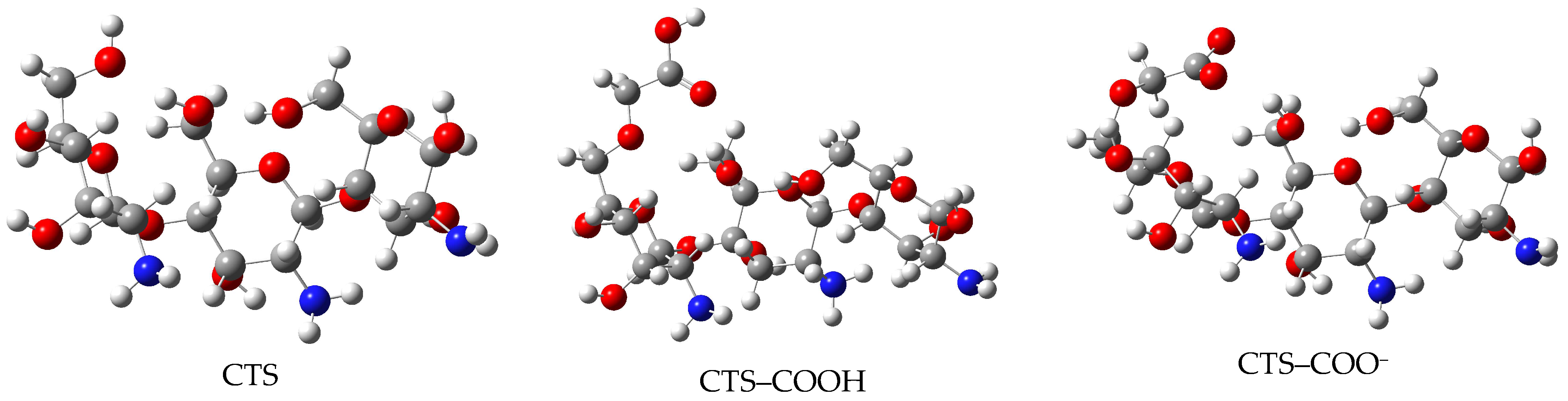
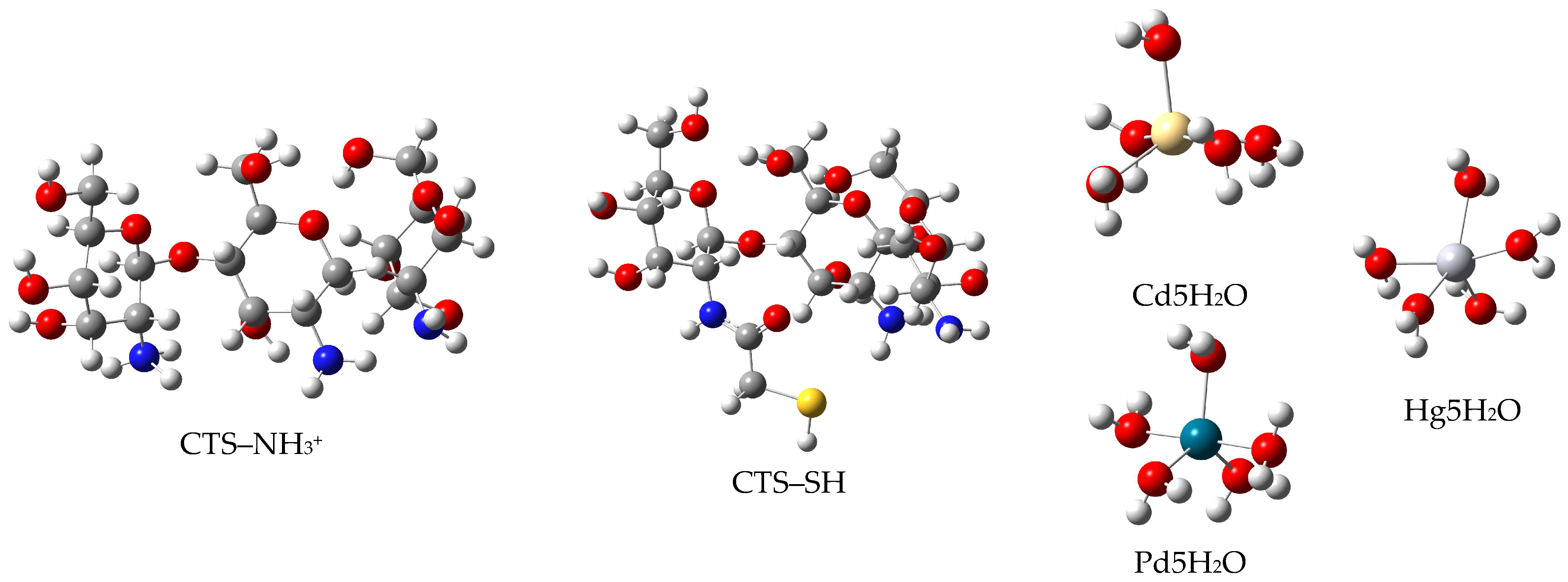
Figure 1 compiles the optimized geometries of the five adsorbent models (CTS, CTS–COO
−, CTS–COOH, CTS–NH
3+, and CTS–SH), obtained at the ωB97X-D/LANL2DZ level and verified as true minima (0 imaginary frequencies). In the absence of continuum solvation, these structures represent the “intrinsic state” of the fragment: the resulting conformation is governed by the balance between polysaccharide-backbone flexibility and conformational closure induced by intramolecular interactions (primarily hydrogen bonding). Therefore, before complexation with [M(H
2O)
5]
2+, it is important to establish whether functionalization (–COO
−/–COOH/–NH
3+/–SH) reorganizes the folding and, in particular, whether the functional group remains exposed or becomes partially “shielded” by the internal network of weak interactions.
Overall, the conformational parameters (
Table 7) indicate that carboxymethylation tends to yield slightly more extended structures than the parent chitosan. In particular, CTS–COO
− exhibits the largest effective size (radius of gyration, Rg = 4.57 Å) and the greatest internal maximum dimension (Dmax = 14.60 Å), consistent with the idea that incorporation of an anionic motif and additional oxygen atoms favors a less compact geometry under non-solvated conditions. By contrast, CTS and CTS–SH display comparable and relatively compact conformations (Rg ≈ 4.25 Å and 4.24 Å, respectively), suggesting that thiolation introduces a soft donor site without drastically perturbing the folding of the polysaccharide “core”.
A particularly informative case is CTS–NH3+, where protonation increases the number of hydrogen-bond donors and strengthens the intramolecular network: the geometric count of intramolecular H-bonds increases (4 in CTS–NH3+ versus 2 in the other models). This reinforcement is accompanied by a lower minimum positive vibrational frequency (νmin = 8.38 cm−1), indicative of soft torsional modes and substantial residual flexibility, as typically observed for polysaccharide fragments with many degrees of freedom. Mechanistically, this anticipates that upon formation of metal–biopolymer complexes, the protonated environment may respond more sensitively to the approach of the pentahydrated metal (local reorganization via H-bonding), whereas in CTS–COO− the dominant control is expected to be electrostatic and/or O-chelating in nature.
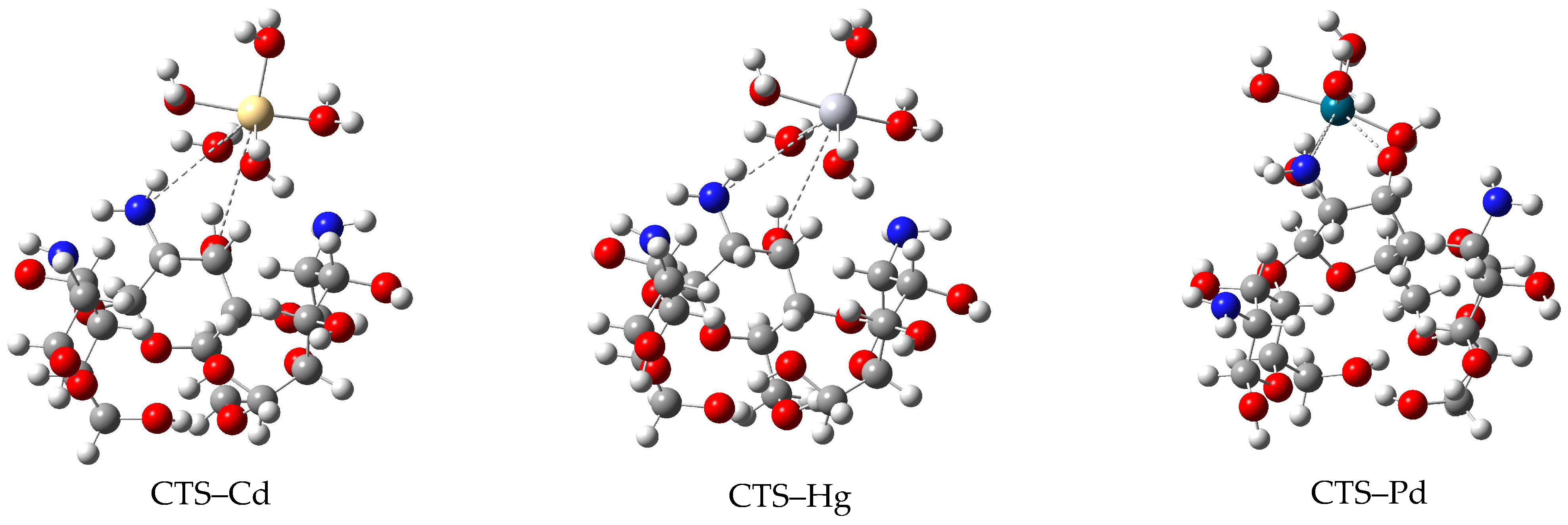
Figure 2 presents the optimized geometries of the CTS–Cd, CTS–Hg, and CTS–Pd complexes, computed at the ωB97X-D/LANL2DZ level of theory. A common structural feature across all three systems is that the hydrated cation fully retains its first coordination sphere as a penta-aqua complex; that is, the [M(H
2O)
5]
2+ unit remains ‘closed’, and no water-to-chitosan donor substitution is observed under these optimized geometrical conditions.
As summarized in
Table 8, all optimized CTS–M adducts correspond to genuine minima on the potential energy surface and consistently preserve the first hydration shell of the metal center, as indicated by CNOw = 5 and k = 0 in all cases. The M–Ow distances remain within a compact range for Cd and Hg [2.077 ± 0.028 and 2.077 ± 0.032 Å, respectively]. At the same time, Pd shows a slightly broader distribution [2.083 ± 0.072 Å], but without loss of any coordinated water molecule. Thus, native chitosan does not induce ligand substitution at the primary coordination sphere of the microhydrated cation. This conclusion is reinforced by the metal···heteroatom separations, since the shortest contacts with chitosan remain outside a clear inner-sphere coordination regime, namely 3.703 Å for CTS–Cd, 3.689 Å for CTS–Hg, and 3.182 Å for CTS–Pd. Accordingly, the CTS–M interaction should be interpreted as an outer-sphere association governed primarily by electrostatic attraction, water-mediated coupling, and local second-sphere reorganization, rather than by direct donor coordination at the metal center.
Table 8 also reveals a preference for a metal-dependent approach. For Cd and Hg, the nearest contact is with a nitrogen atom of chitosan, whereas for Pd, the closest approach is to oxygen. Although these differences do not support first-sphere coordination, they do indicate that the hydrated metal center responds to distinct local electrostatic environments on the polymer surface. In this sense, native CTS acts mainly as a platform for outer-sphere associating, whose stability depends on the organization of the surrounding hydrated microenvironment rather than on systematic direct coordination.
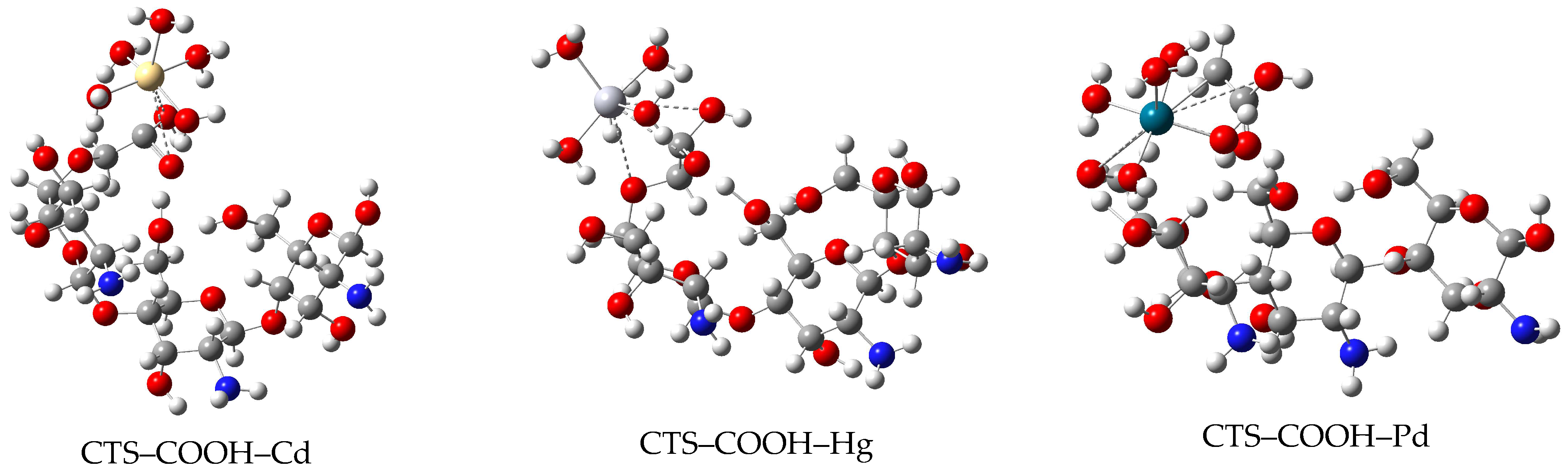
Figure 3 compiles the optimized structures of CTS–COOH–Cd, CTS–COOH–Hg, and CTS–COOH–Pd. In all three cases, the metal remains as a penta-aqua species ([M(H
2O)
5]
2+), with no geometrical evidence of water substitution by biopolymer heteroatoms. Consequently, the dominant associating motif corresponds to an outer-sphere association, in which stabilization arises from long-range metal···(X) contacts and a hydrogen-bond network mediated by the coordinated water molecules.
Structurally, the first hydration shell remains robust throughout the CTS–COOH series. For Cd, the Cd–Ow distances remain compact and close to those observed for native CTS, indicating that the neutral carboxylic motif does not displace coordinated water molecules or effectively compete for inner-sphere associating. A similar behavior is observed for Hg and Pd, where the hydrated cation remains intact, and the closest contacts with the biopolymer remain within a non-substitutive regime. Thus, the optimized geometries do not support water exchange or direct coordination of the protonated –COOH group at the metal center.
A mechanistically relevant effect of –COOH functionalization is instead the modification of the preferred region of approach of the hydrated metal toward the polymer. In the optimized structures, the nearest contacts shift toward oxygen-rich domains relative to native CTS, but this should not be interpreted as evidence of inner-sphere coordination by the carboxylic acid group itself. Rather, in its protonated state, –COOH appears to reorganize the local electrostatic environment and hydrogen-bonding network, thereby favoring outer-sphere stabilization through second-sphere interactions and conformational preorganization. Accordingly, the coordinating behavior typically associated with carboxylate sites should be reserved for the deprotonated –COO
− form, rather than inferred from the CTS–COOH–M complexes (
Table 9).
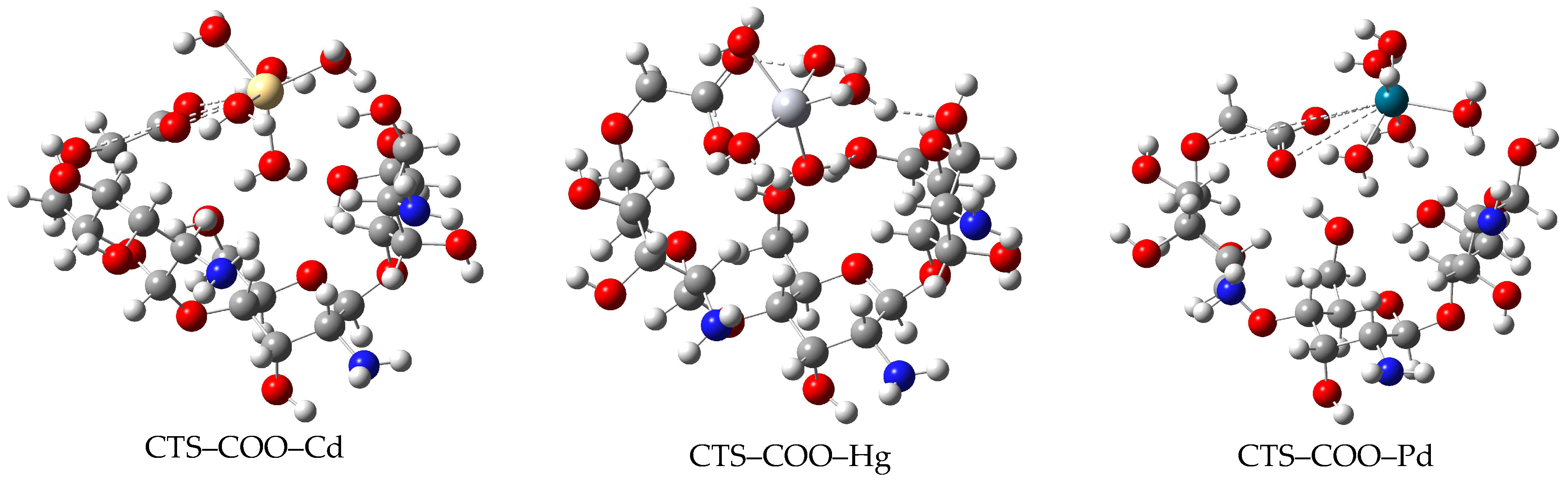
Figure 4 presents the optimized structures of CTS–COO
−–Cd, CTS–COO
−–Hg, and CTS–COO
−–Pd. In contrast to CTS and CTS–COOH (where outer-sphere association dominates), introduction of the carboxylate (–COO
−) increases the ability to ‘anchor’ the hydrated cation through electrostatic interaction and O-site preorganization. However, the behavior is strongly metal-dependent: only Cd shows geometrical evidence of incipient inner-sphere coordination with the carboxylate, whereas Hg remains within an outer-sphere regime.
In the CTS–COO− series, the metal-dependent response becomes more clearly differentiated. For Cd, one carboxylate oxygen approaches the metal center to 2.658 Å, which is consistent with an incipient coordinative contact. However, because the five coordinated water molecules are still retained [d(Cd–Ow) = 2.040–2.097 Å; 2.076 ± 0.021 Å], this structure is more appropriately described as a partially inner-sphere or solvent-shared arrangement rather than as full ligand substitution. Thus, the carboxylate behaves as a strong anchoring region for Cd(II), promoting direct approach to the metal center while the optimized minimum still preserves the primary hydration shell.
By contrast, Hg and Pd remain in an outer-sphere regime in the optimized CTS–COO
− complexes. In both cases, the carboxylate contacts remain substantially longer, and no clear evidence of first-sphere water replacement is observed, while the hydrated metal core remains structurally preserved. These results indicate that the carboxylate does not affect all metals equally. Under the adopted microhydration model, it promotes a more direct and incipiently coordinative interaction for Cd(II). In contrast, for Hg(II) and Pd(II), their role is mainly to generate an anionic electrostatic anchoring site without consolidating systematic inner-sphere coordination (
Table 10).
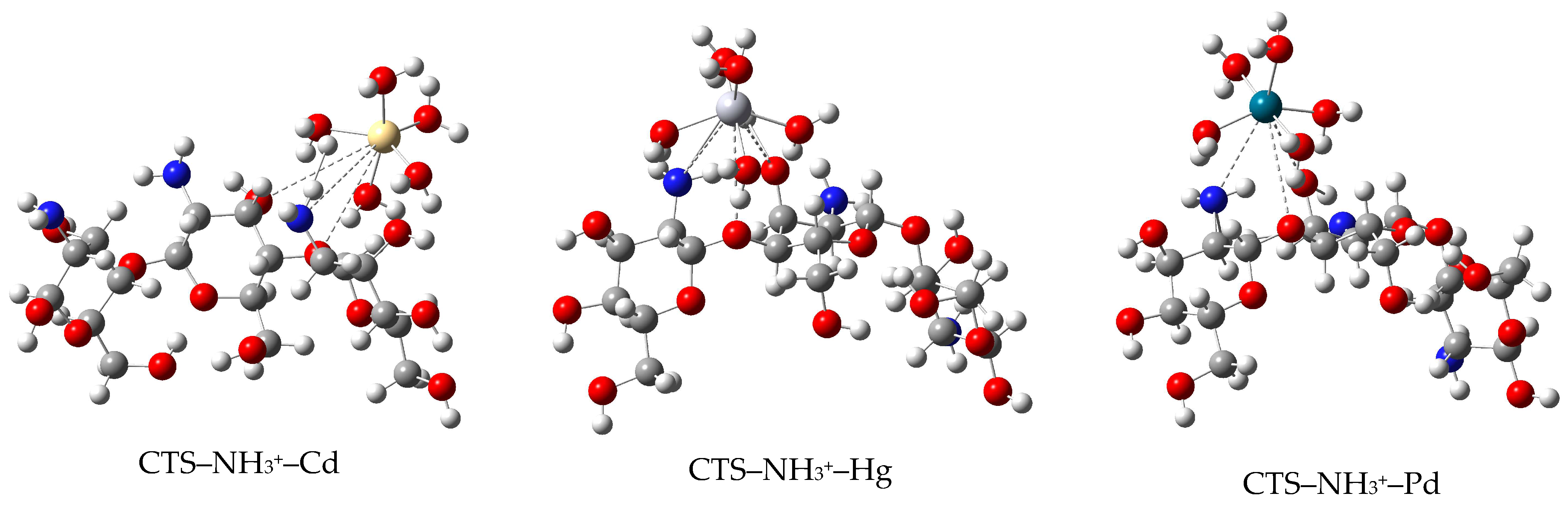
Figure 5 summarizes the optimized geometries of CTS–NH
3+–Cd, CTS–NH
3+–Hg, and CTS–NH
3+–Pd. The dominant feature across all three systems is unambiguous: the metal center retains its first hydration shell as a penta-aqua species (CNOw = 5), with no substitution by heteroatoms from the biopolymer. Accordingly, k = 0 in all cases, and the complexes correspond to an outer-sphere regime.
From a chemical standpoint, this behavior is consistent with protonation of the amino site. Because the –NH3+ group no longer provides a lone pair for direct donation, the protonated environment primarily serves as an electrostatic field modifier and organizer of the local hydrogen-bond network. Accordingly, the optimized minima correspond to outer-sphere association, in which the hydrated metal remains separated from the polymer donor atoms by the preserved water shell. Therefore, any stabilization gain observed for CTS–NH3+ should not be interpreted as direct nitrogen coordination. Instead, it reflects how protonation reshapes the local microenvironment, modifies the distribution of attractive regions on the adsorbent surface, and influences second-sphere organization around the hydrated cation.
Quantitatively (
Table 11), the M–Ow distances remain compact and characteristic of a stable hydration sphere: Cd–Ow = 2.029–2.101 Å (2.077 ± 0.027 Å) and Hg–Ow = 2.027–2.134 Å (2.076 ± 0.037 Å). At the same time, the closest contact to the biopolymer occurs at long distances, particularly in CTS–NH
3+–Cd, where the metal is notably farther from the adsorbent (d(Cd···O) = 4.015 Å), suggesting an even more strongly solvated association than in the neutral CTS or CTS–COOH complexes. For CTS–NH
3+–Hg, the minimum contact (3.314 Å) remains consistent with an outer-sphere regime, reflecting that Hg(II) does not find in –NH
3+ a site competitive with water. This anticipates that a transition toward genuine inner-sphere coordination for Hg(II) should arise from soft donors (e.g., –SH) or strongly anionic sites (–COO
−) under appropriate conditions.
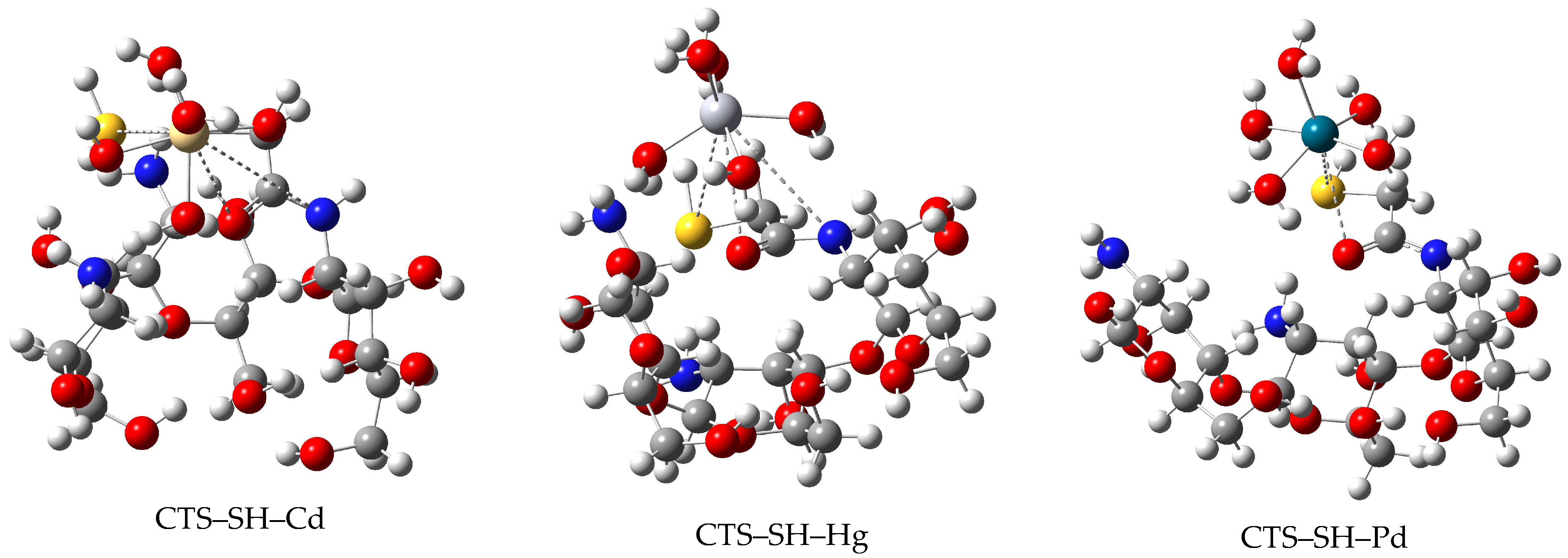
Figure 6 shows the optimized geometries of the CTS–SH–Cd, CTS–SH–Hg, and CTS–SH–Pd complexes. In this series, despite incorporating a soft sulfur donor, the dominant structural outcome is that the metal retains its first hydration shell as a penta-aqua species; that is, the [M(H
2O)
5] fragment remains intact, and the thiol group displaces no water molecules. Accordingly, the microhydration parameters remain CNOw = 5 and k = 0 for the three complexes (
Table 12), and the associated motif corresponds to an outer-sphere association.
This result indicates that the sulfur-containing derivative does not promote systematic first-sphere water substitution in the optimized minima discussed here. The thiol group remains in its neutral form, and the M···S distances are too long to support a clear inner-sphere M–S bond within this model. Consequently, the favorable thermodynamics calculated for some metals in the CTS–SH series should not be interpreted as proof of direct sulfur coordination in every case.
Instead, the role of the thiolated derivative is better understood in terms of a sulfur-containing polarizable microenvironment. The presence of sulfur modifies the local electronic response of the adsorbent. It can strengthen metal association through induced polarization, electrostatic anisotropy, and cooperative second-sphere interactions, even when the first hydration shell remains intact.
In addition, the aqueous shell exhibits different degrees of “deformability” depending on the metal: Cd shows a very compact first coordination sphere (σ ≈ 0.027 Å), whereas Hg and Pd display larger dispersion in M–Ow distances (σ ≈ 0.052–0.074 Å), consistent with a more flexible hydrated environment. However, this flexibility does not translate into M–S bond formation. In fact, the shortest non-aqueous contact in all three complexes involves an oxygen atom from the biopolymer (3.28–3.58 Å), confirming that even the approach toward sulfur does not geometrically dominate the assembly in the isolated phase (
Table 12).
3.4. Biosorption Thermodynamics: Affinity and Selectivity (ΔEassoc/ΔGassoc)
In this section, association free energies (ΔGassoc) are discussed as the thermodynamic metric for comparing relative metal affinities across functional groups within the adopted explicit microhydration framework. More negative ΔGassoc values indicate a more favorable formation of the hydrated metal–adsorbent adduct. Because most optimized structures retain the metal’s primary hydration shell, these values should be interpreted as descriptors of comparative stabilization of microhydrated assemblies rather than as direct measures of systematic first-sphere ligand substitution. Accordingly, relative differences between materials for a given metal, and between metals for a given material, are used here to discuss selectivity trends (
Table 13).
For Cd(II), the calculated trend indicates that the CTS–COOH microenvironment provides the most favorable stabilization within the present model, clearly outperforming native CTS and the remaining functionalizations. This result suggests that the acidic carboxylic environment promotes a particularly favorable organization of the hydrated metal–polymer assembly. Importantly, this trend should not be interpreted as evidence that the protonated carboxylic group systematically behaves as a stronger direct ligand than the carboxylate. Rather, the data support a cooperative mechanism in which conformational preorganization, local electrostatic directionality, and second-sphere interactions contribute significantly to the calculated free-energy gain.
For Hg(II), the most favorable calculated association is obtained for the thiolated derivative, followed by CTS–NH3+ and CTS–COO−, whereas CTS and CTS–COOH are comparatively less favorable. This trend indicates that Hg(II) is especially sensitive to the electronic character and polarizability of the local microenvironment. However, because the optimized CTS–SH–Hg structure retains the primary hydration shell and does not show a short inner-sphere Hg–S bond, the observed stabilization is better attributed to the sulfur-containing polarizable environment than to systematic direct sulfur coordination. In this sense, thiolation appears to “program” a favorable microenvironment for Hg(II) association within the adopted computational scheme.
Pd(II) displays the most distinctive behavior in the present series, with native CTS providing the most favorable calculated association free energy, followed closely by CTS–SH and CTS–NH3+. In contrast, carboxylic functionalization significantly reduces stabilization. This result indicates that Pd(II) responds differently to local chemical modification than Cd(II) and Hg(II), and that introducing additional charge or donor groups does not necessarily improve its affinity within the adopted model. Because Pd(II) is particularly sensitive to coordination environment and speciation, these results should be interpreted comparatively and supported by the subsequent electronic and noncovalent interaction analyses rather than as a universal prediction independent of solution conditions.
When selectivity is analyzed by adsorbent (metal competition on the same material), three clear design rules emerge. Native CTS is strongly selective toward Pd(II) (Pd ≪ Cd ≈ Hg in ΔGassoc), positioning it as a baseline platform for Pd capture in the presence of other cations. CTS–COOH directs selectivity toward Cd(II), with a large thermodynamic separation relative to Hg(II) and Pd(II), and thus behaves as a “Cd-specific” adsorbent under the modeled conditions. CTS–SH is essentially co-selective for Hg(II) and Pd(II) (difference ~3 kcal·mol−1) and strongly discriminates against Cd(II), which is particularly advantageous when Cd acts as an interferent. CTS–COO− and CTS–NH3+ occupy an intermediate regime: they increase affinity for Hg(II) and Cd(II) relative to CTS. Yet, they retain an overall preference for Pd(II), suggesting a preference for “polyvalent” materials with moderate selectivity.
3.5. Electrostatic Origin of Preference: ESP/MEP Analysis
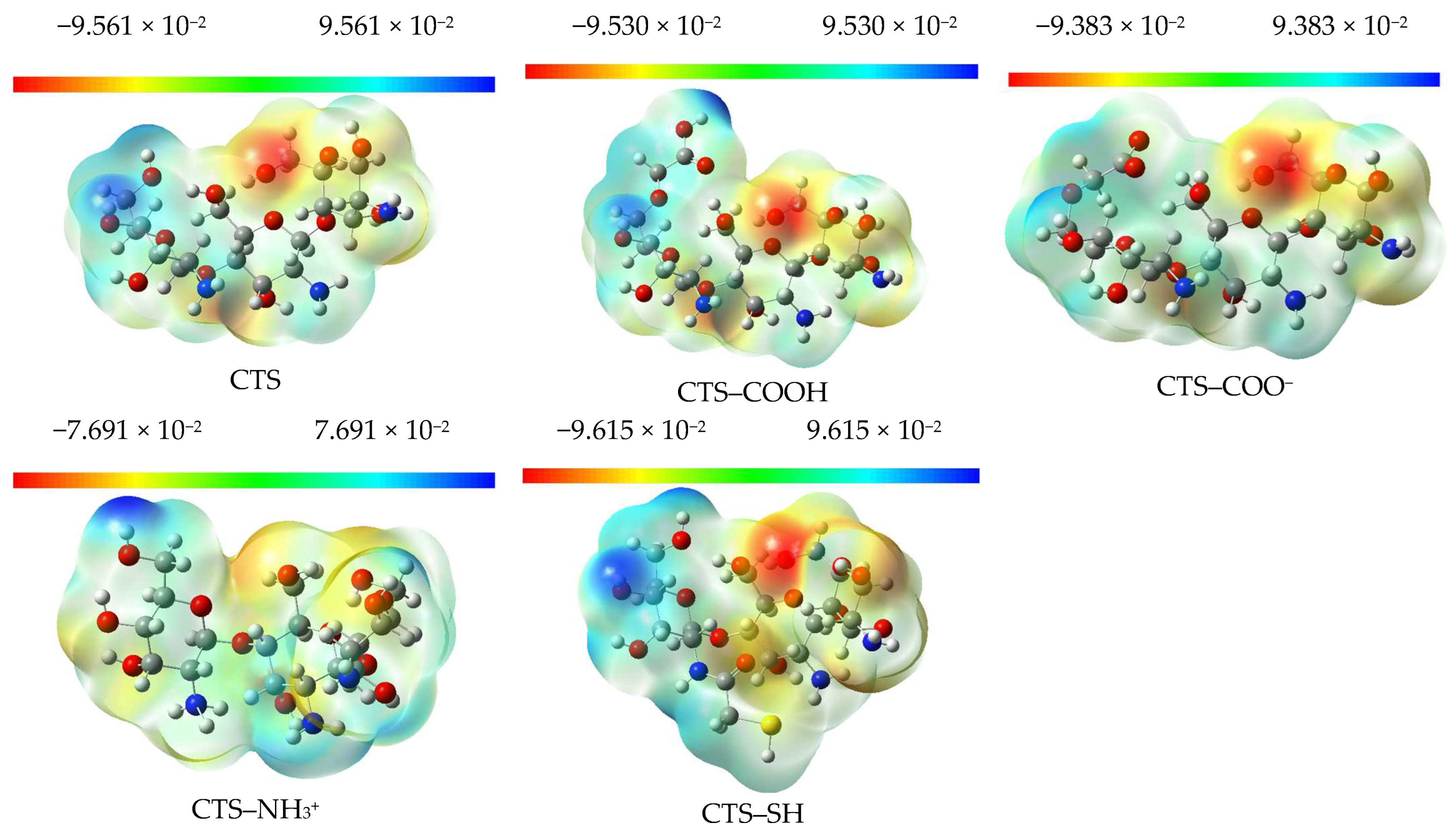
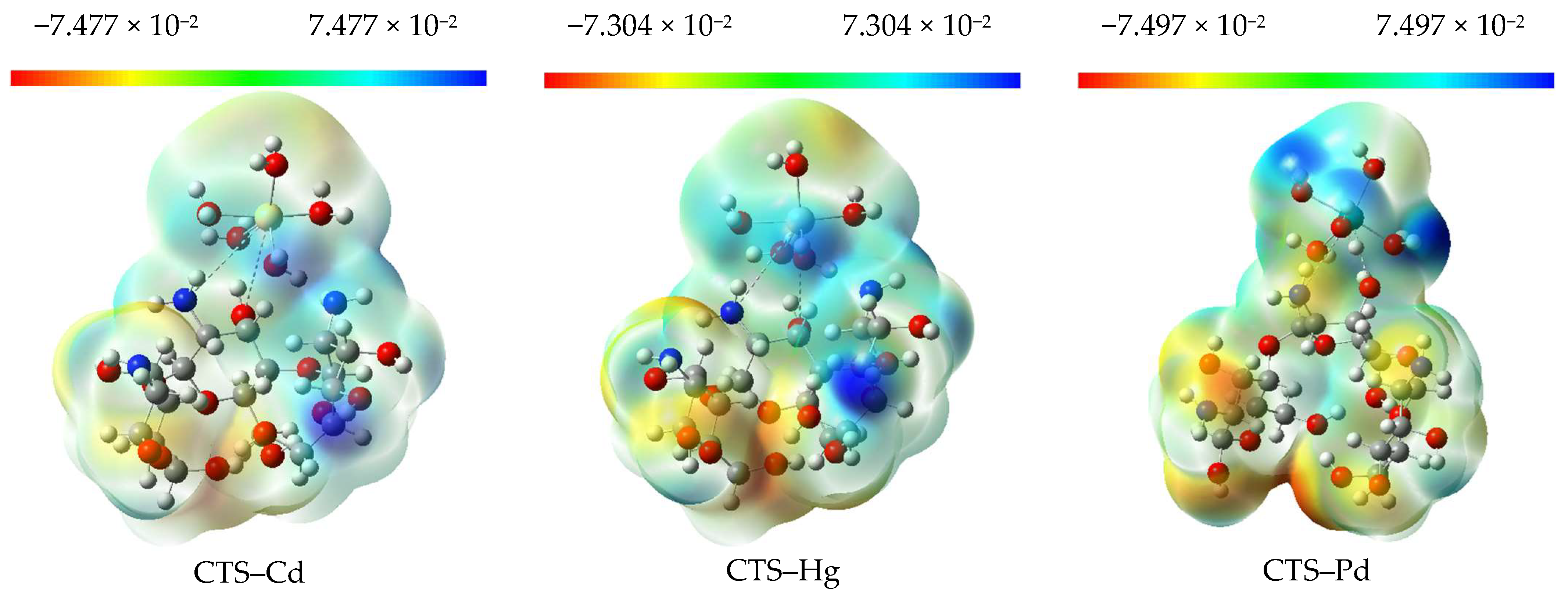
Because most optimized complexes retain the first hydration sphere of the metal, the ESP/MEP analysis is interpreted here primarily as a descriptor of induced polarization and electrostatic organization of the adsorbent microenvironment, rather than as direct proof of inner-sphere metal–heteroatom coordination. In
Figure 7, CTS exhibits moderate anisotropy in the potential: the most negative regions are concentrated around oxygen-bearing heteroatoms (electron-density-rich sites), whereas the positive regions are associated with relatively electron-poor domains (notably environments enriched in polar hydrogens). This “baseline” pattern is consistent with capture dominated by outer-sphere interactions and second-sphere stabilization, in which the metal preferentially positions itself near accessible negative patches, and the complex is stabilized through local microenvironment reorganization.
Carboxylic functionalization introduces a more directional electrostatic signature. In CTS–COOH, the acidic group generates a local dipole (oxygen atoms with more negative potential coexisting with a relatively positive proton), producing a heterogeneous patch that can stabilize cation approach through a combination of attraction toward the oxygen atoms and coupling to the surrounding hydrogen-bond network. This point is relevant because it anticipates that the thermodynamic preference observed for Cd(II) on CTS–COOH does not necessarily correlate linearly with “more negative charge”, but rather with the site’s ability to organize cooperative interactions (electrostatics + H-bonding) around the cation.
In CTS–COO−, the carboxylate increases both the intensity and spatial continuity of negative regions around the –COO− motif, generating a more pronounced electrostatic attractor for positively charged species. However, while this scenario favors initial Coulombic anchoring, it may also entail (depending on the metal and the explicit microenvironment) a higher energetic cost associated with reorganization/desolvation or with the loss of specific hydrogen-bond stabilization present in –COOH. Thus, within the thermodynamic results framework, the MEP supports the notion that selectivity is not purely electrostatic, but rather “contextual” electrostatics modulated by the final geometry and second-sphere stabilization.
The ammonium state CTS–NH3+ exhibits a distinctive pattern: an electropositive domain associated with the protonated group is evident (consistent with suppression of direct donation from the N lone pair), accompanied by residual negative patches in oxygen-rich regions. Moreover, the displayed potential range is comparatively narrower, compatible with partial “screening” of the overall electrostatic contrast. In terms of affinity, this pattern supports an interpretation in which –NH3+ acts primarily as a field modulator and microenvironment organizer (e.g., promoting hydration arrangements and indirect stabilization) rather than as a hard first-sphere coordinating site.
Finally, CTS–SH preserves a high anisotropy in the potential, with a characteristic contribution from the sulfur-containing environment: sulfur does not necessarily generate the most negative patch, but it does contribute a spatially diffuse, highly polarizable domain. This is consistent with a preference for soft/polarizable cations (such as Hg) that cannot be explained solely by MEP magnitude.
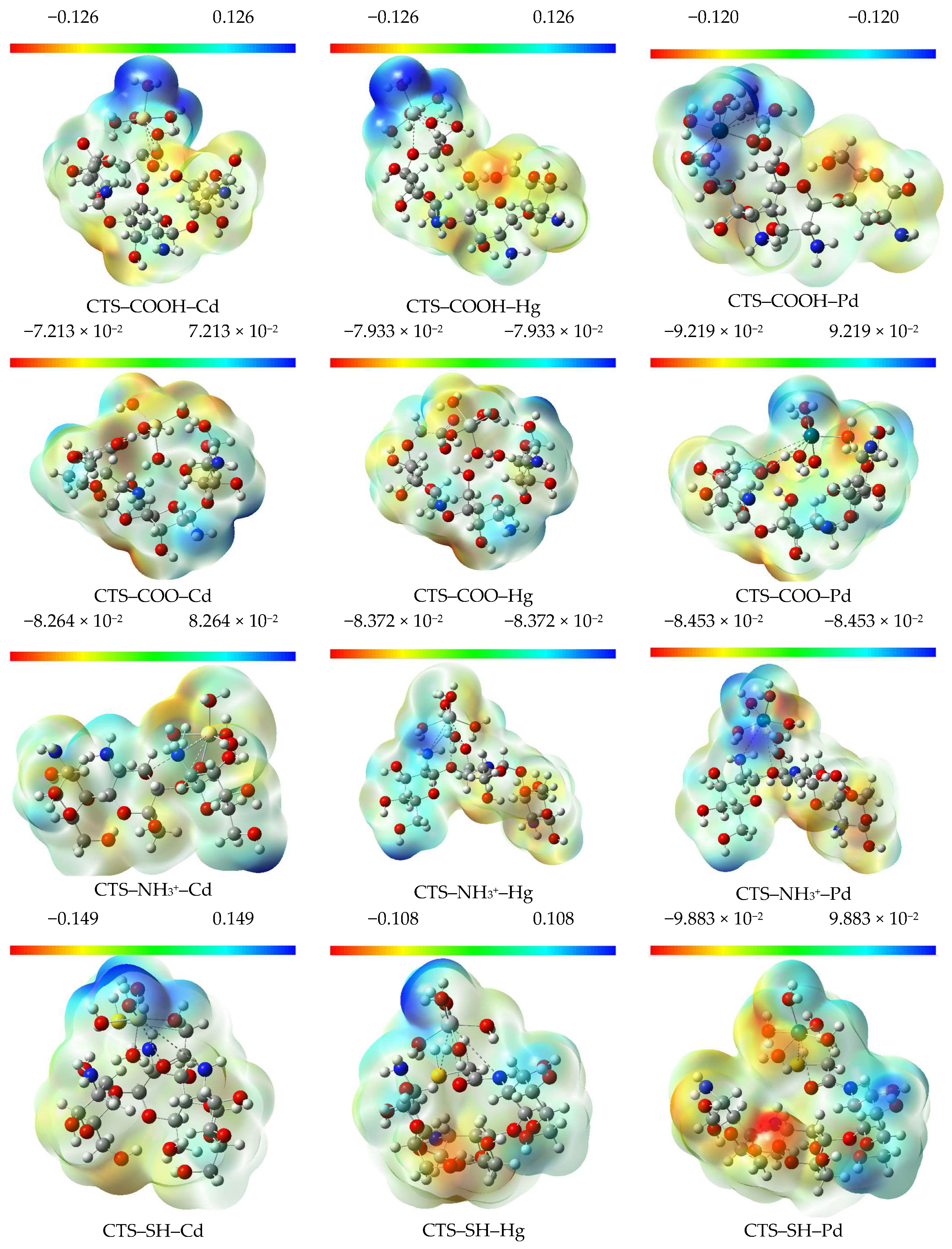
Upon complex formation (CTS–COOH–M, CTS–COO
−–M, CTS–NH
3+–M, and CTS–SH–M), the ESP/MEP maps reveal clear induced polarization (
Figure 8): the potential becomes markedly electropositive in the immediate vicinity of the cation (blue lobe), while the most electronegative regions intensify over the heteroatoms of the anchoring site (red–yellow zones). This spatial separation of potentials constitutes the “electrostatic fingerprint” of complexation: the metal imposes a strong field, and the adsorbent responds by redistributing electron density and orienting polar groups within the local microenvironment.
A useful indicator here is the scale range (|V|max) for each complex. For CTS–COOH–M, the ranges are on the order of ±0.12 a.u., reflecting a relatively high polarization that is, importantly, well localized around the carboxylic motif. This pattern is consistent with a site that behaves as a structured dipole (C=O/–OH) capable of stabilizing the cation not only through attraction toward oxygen atoms, but also through cooperative coupling with the hydrogen-bond network (second sphere). In other words, the “electrostatic origin” here is not merely net charge, but directionality and microenvironment preorganization.
In CTS–COO−–M, the ranges decrease to ~(0.07–0.09) a.u., and the negative potential becomes more spatially extended over the carboxylate and nearby oxygens, suggesting a less “focal” and more distributed electrostatic attractor. This type of signature typically favors the initial Coulombic interaction between the cation and the ligand. Yet, it can translate into only moderate thermodynamic stabilization if the final complex remains governed by reorganization/hydration (especially when first-sphere coordination is not consolidated). Put differently, a broader electrostatic well does not, by itself, guarantee the deepest minimum in ΔGassoc; the final geometry and second-sphere stabilization remain decisive.
For CTS–NH3+–M, the maps exhibit a persistent electropositive domain associated with the ammonium group and intermediate ranges (~±0.083–0.085 a.u.). The key point is that the metal cation does not “compete” with the ammonium as a direct donor; rather, N protonation reshapes the global electrostatic landscape (a field effect), shifting and organizing attractor regions around oxygenated and other polar groups. This supports a mechanistic interpretation in which –NH3+ contributes primarily as a microenvironment (and second-sphere) modulator, rather than as a classical lone-pair coordination center.
Finally, CTS–SH–M shows the most pronounced electrostatic contrast for Cd (±0.149 a.u.) and still-elevated ranges for Hg and Pd (≈±0.108 and ±0.0988 a.u.). This increased contrast is consistent with the high polarizability of the sulfur-containing motif: the site can generate a strong electrostatic response to the cationic field even if the local formal “charge” is not extreme. This result is particularly important for Hg and Pd because it suggests that preference is not explained solely by static electrostatics, but by induced polarization of the site (which commonly correlates with a larger specific contribution from metal–site interactions).
3.6. Acid–Base Modeling: Protonation States and Charge Consistency
As summarized in
Table 13, the results confirm that protonation state modulates metal affinity not only through formal charge, but also through changes in donor availability, electrostatic directionality, and local hydration organization. Within the present microhydrated model, Cd(II) is most strongly stabilized in the CTS–COOH environment, Hg(II) is preferentially favored by the sulfur-containing CTS–SH derivative, and Pd(II) remains most stabilized by native CTS and other non-carboxylic environments. These trends indicate that the protonation state determines the material’s capture profile within the local coordinating microenvironment.
At the same time, these results should not be interpreted as a direct representation of experimental pH-dependent speciation. Rather, the selected acid–base forms are used here as comparative states to evaluate how local protonation perturbs metal association under a controlled computational framework with explicit microhydration. In this sense, the observed selectivity arises from the combined effects of protonation state, site accessibility, and second-sphere organization, rather than from formal charge alone. Therefore, charge consistency across the compared models remains essential for interpreting relative ΔGassoc values.
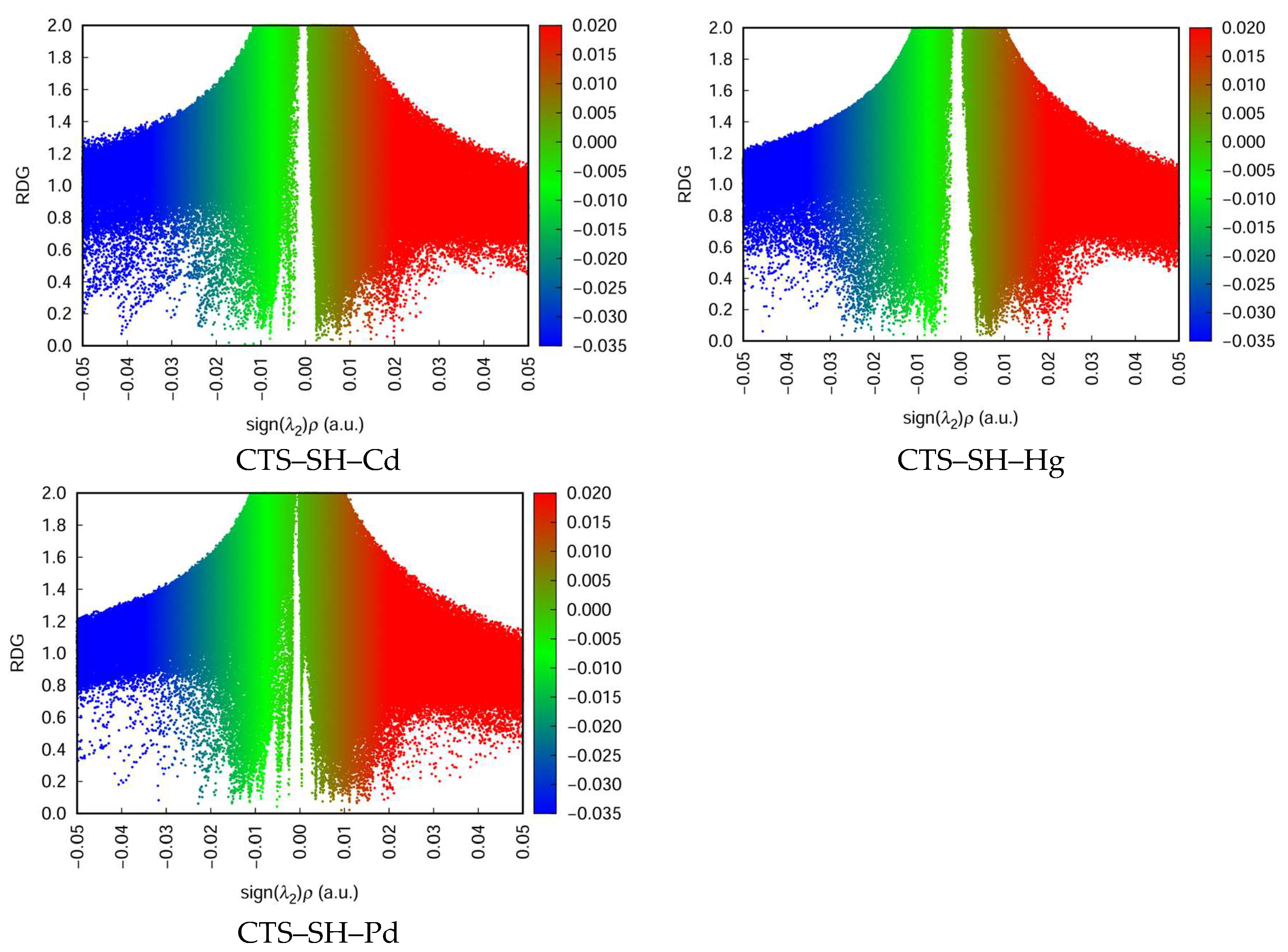
3.7. Secondary Interactions and the Role of Microhydration: NCI/RDG
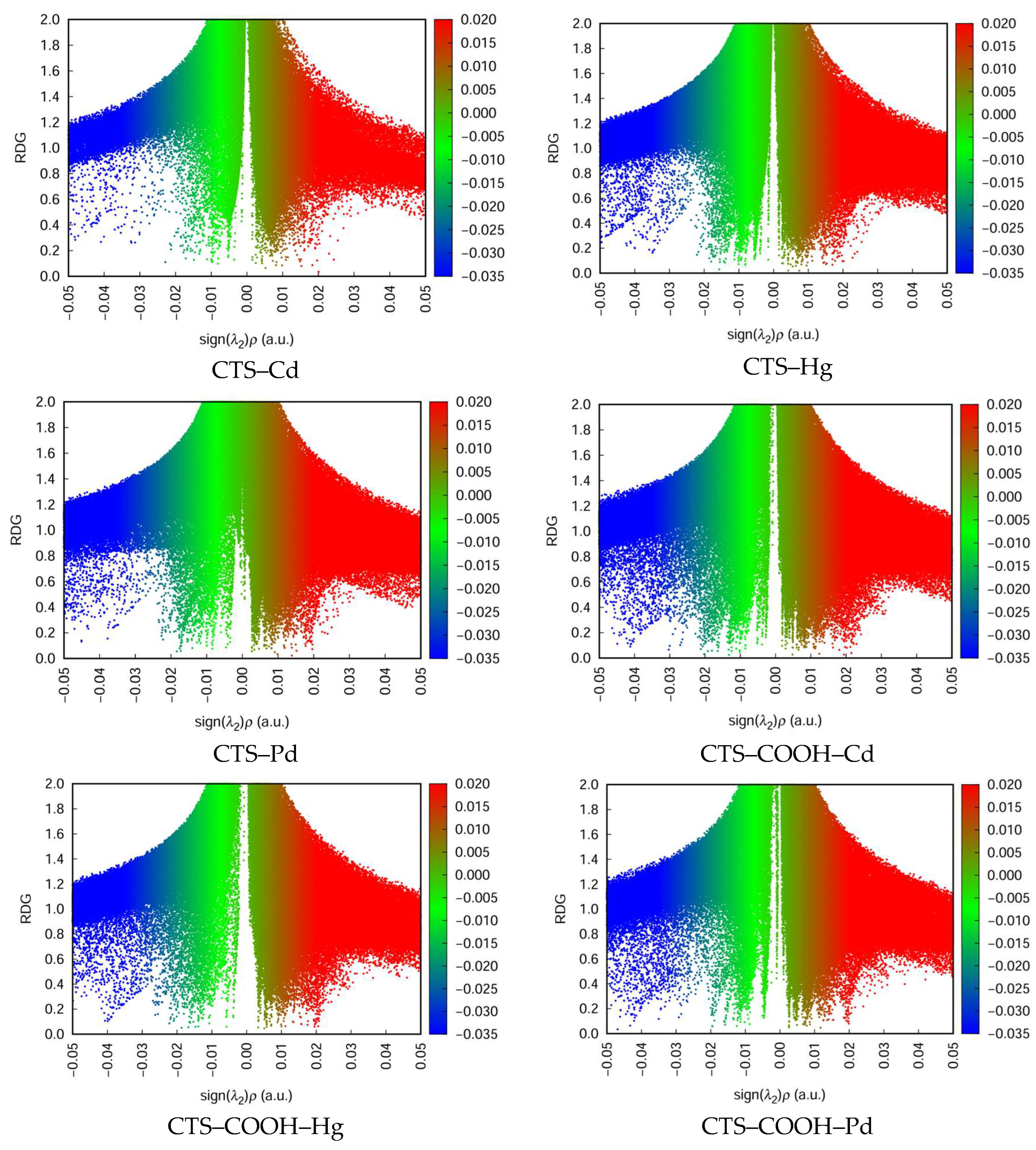
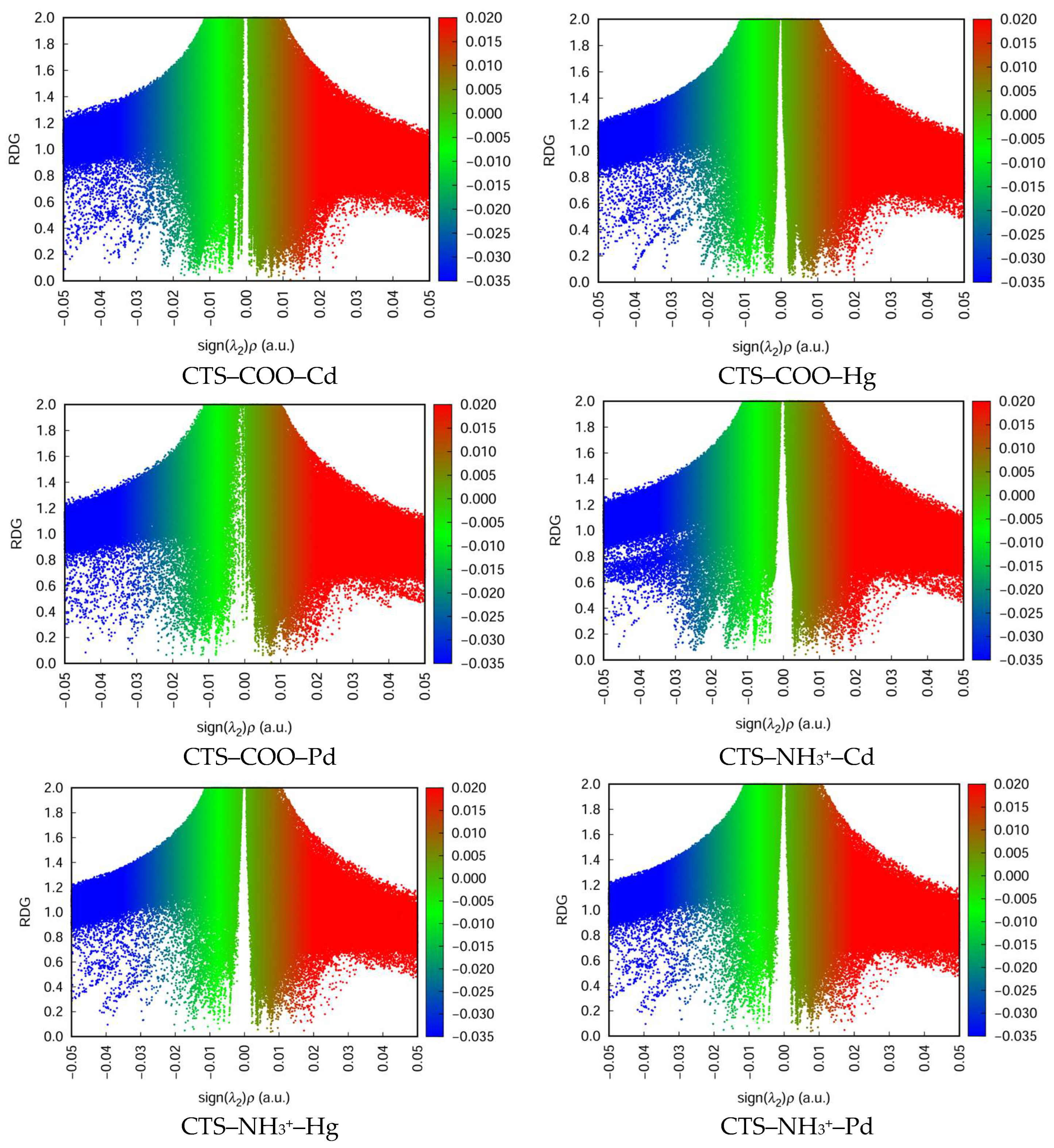
To clarify the physical origin of stability beyond the electrostatic term, noncovalent interactions were evaluated using the NCI formalism by representing RDG as a function of sign(λ
2)P for the CTS–M complexes and the functionalized materials (
Figure 9). Within this framework, negative sign(λ
2)P values are associated with attractive (stabilizing) regions, values near zero reflect dispersive van der Waals contacts, and positive values correspond to steric (Pauli) repulsion. Overall, the plots exhibit a consistent pattern: the dominant contribution is centered on sign(λ
2)P ≈ 0, indicating that global complex stabilization is strongly influenced by dispersive interactions and microenvironment packing, in line with a biosorption mechanism in which the second sphere (local reorganization and multiple weak contacts) is structurally relevant.
For the non-functionalized CTS complexes (CTS–Cd, CTS–Hg, and CTS–Pd), the point cloud shows an appreciable contribution in the negative domain, but without a pronounced shift toward very negative sign(λ2)P values. This suggests that, although attractive metal–environment regions exist, the interaction is not dominated by a single highly directional contact; instead, it reflects a set of distributed, moderate contributions (long-range electrostatics, dispersion, and polarization). The fact that the overall pattern is similar across Cd, Hg, and Pd further supports that, in the parent material, selectivity does not originate from an isolated “strong bond”, but rather from how each metal reorganizes the polar environment of the biopolymer.
Introducing the carboxylic group perturbs the balance between attractive/repulsive forces without altering the predominantly noncovalent character of the coupling. In CTS–COOH–M, the density of points in the negative region becomes more marked and more continuous around mildly negative values, consistent with additional second-sphere attractive interactions (e.g., hydrogen bonds and polarized contacts) around the acidic site. This outcome is particularly consistent with the high thermodynamic affinity observed for Cd(II) on CTS–COOH: the NCI signature indicates that stabilization need not arise from enforcing strongly covalent inner-sphere coordination, but can emerge from a cooperative network of weak interactions that, in aggregate, deepens ΔGassoc. By contrast, the carboxylate form (CTS–COO−–M) retains the near-zero dispersive domain as the dominant contribution and shows a more “diffuse” attraction (sign(λ2)P < 0), consistent with a more extended electrostatic attractor that is less focalized into specific contacts; this can rationalize why, despite a higher formal charge, it does not necessarily maximize free-energy stabilization for all metals.
In the CTS–NH3+–M systems, the presence of ammonium reinforces the “microenvironment” interpretation: the central van der Waals (vdW) contribution is preserved, and a moderate attractive contribution appears in the negative domain, yet without evidence of a shift toward extremely strong interactions. In other words, the protonated group primarily organizes the interaction landscape (electrostatic field + H-bond network) rather than serving as a direct coordination center. This point is methodologically important because it prevents an incorrect interpretation of the type “protonated N coordinates”: the NCI signature indicates that any observed stability gain arises from cooperative rearrangement of the surrounding environment.
Overall, the NCI analysis indicates that the calculated selectivity does not arise from an all-or-nothing distinction between covalent and noncovalent binding. Instead, stabilization emerges from a cooperative balance of multiple moderate attractions, persistent dispersive contributions, and local reorganization of the hydrated interface. This interpretation is fully consistent with the optimized geometries, in which most systems retain the metal’s primary hydration shell and therefore behave predominantly as outer-sphere assemblies, with varying degrees of second-sphere stabilization.
3.8. Comparison with Experimental Literature
The calculated trends are qualitatively consistent with several experimental observations reported for chitosan-based adsorbents. However, the correspondence should be interpreted with caution because the present calculations employ a simplified microhydrated cation model. In the case of Hg(II), thiolated chitosan materials have been experimentally reported to display enhanced mercury uptake relative to non-thiolated chitosan, supporting the idea that sulfur-containing modification promotes a favorable chemical environment for Hg capture [
7,
20]. In the present calculations, this favorable behavior is expressed as a stronger association of Hg(II) with CTS–SH, although the optimized structures indicate that the effect is mainly mediated by a polarizable sulfur-containing microenvironment and second-sphere stabilization rather than by systematic direct Hg–S bond formation.
For Cd(II), previous experimental studies on carboxymethylated chitosan have shown that introduction of carboxylic/carboxylate functionality improves the interaction with divalent metal ions and can enhance adsorption performance relative to native chitosan [
8,
21]. This experimental background is qualitatively consistent with the present prediction that the carboxylic microenvironment strongly favors Cd(II) association. However, the specific result that the protonated CTS–COOH model is thermodynamically more favorable than CTS–COO− should be regarded as a model-dependent outcome that still requires direct experimental verification.
For Pd(II), both native and modified chitosan-based materials have been experimentally explored for selective palladium recovery [
9,
22]. The present calculations predict a particularly favorable association for native CTS. Still, this trend should be interpreted cautiously because the real aqueous speciation of Pd(II) depends strongly on solution composition and may differ substantially from the simplified cationic microhydration scheme used here. Therefore, the strongest value of the present study lies in defining relative electronic and microenvironmental trends that can guide future experimental validation under controlled pH, ionic strength, and ligand conditions.