Article

Metol Electrochemical Sensing over LASIS Gold Nanoparticle-Modified Screen-Printed Carbon Electrodes in Adsorption Studies with Waste Biomass-Derived Highly Porous Carbon Material


1
Vinča Institute of Nuclear Sciences–National Institute of the Republic of Serbia, University of Belgrade, P.O. Box 522, 11000 Belgrade, Serbia
2
Faculty of Chemistry, University of Belgrade, Studentski Trg 12-14, 11158 Belgrade, Serbia
*
Author to whom correspondence should be addressed.
Sustain. Chem. 2026, 7(1), 5; https://doi.org/10.3390/suschem7010005
Submission received: 8 December 2025 / Revised: 29 December 2025 / Accepted: 4 January 2026 / Published: 13 January 2026

Abstract

This work used activated carbon material obtained by chemical activation of abundantly available agricultural sunflower waste residues to remove metol (4-(methylamino) phenol sulfate, MTL) from aqueous solutions. The adsorbent structure was characterized using SEM-EDS and FT-IR spectroscopy. A modified screen-printed carbon electrode (SPCE) with gold nanoparticles synthesized using the Laser Ablation Synthesis in Solution (LASIS) method was used to detect MTL. The successful LASIS formation of gold nanoparticles was confirmed by the specific dark burgundy–red color. TEM measurements showed uniform pseudo-spherical particles with an average diameter of 7.9 ± 0.2 nm. The modified electrode showed improved electrochemical activity, which was confirmed by comparing it with an unmodified electrode using cyclic voltammetry and electrochemical impedance spectroscopy. The modified electrode was subsequently used to optimize the MTL detection conditions. UV–Vis spectroscopy was used to optimize the adsorption conditions, with the optimal values for pH and contact time found to be 8 and 120 min, respectively. The electrochemical detection of MTL was performed using differential pulse voltammetry, and the linear calibration range was established for concentrations ranging from 0.73–49.35 µM. The obtained limits of detection (LOD) and quantification (LOQ) were 0.06 µM and 0.2 µM, respectively. The efficiency of MTL removal was 100% after a contact time of 1 min and remained at 100% after 120 min.

1. Introduction

The pollution of the aquatic environment has become increasingly severe due to the presence of organic pollutants, representing a serious ecological and human health problem. Among various organic contaminants (organic dyes, pesticides, insecticides, plasticizers, pharmaceutical and personal care products, etc.), compounds containing nitrogen and sulfur are well known for their high levels of toxicity, environmental persistence, and resistance to natural degradation [1,2,3]. Metol (N-methyl-p-aminophenol sulfate) is an aromatic compound containing amino and hydroxyl functional groups that enable pronounced redox activity even at low concentrations. However, these same structural characteristics confer high chemical stability and poor biodegradability, leading to its long-term persistence in aquatic environments. Owing to these properties, Metol has been extensively utilized in various industrial and technological applications, including photographic, radiographic, and holographic processes, as well as in cosmetic and pharmaceutical formulations [1,4,5,6]. Due to its high solubility and stability, metol can readily enter surface and groundwater systems, where it poses significant risks to aquatic life and potentially to human health. Studies have demonstrated that concentrations as low as 0.25 mg/L (approximately 0.726 µmol/L) may exert lethal effects on aquatic organisms. Prolonged exposure to metol-contaminated water has been associated with skin irritation, eye and respiratory discomfort, nausea, and damage to internal organs. Moreover, most photographic developing agents are derived from aromatic amines—compounds known for their mutagenic, toxic, and carcinogenic properties [4,5,7,8,9].
Adsorption represents an alternative, more efficient, and sustainable treatment, characterized by its simplicity, cost-effectiveness, and ability to achieve high pollutant removal efficiency without producing harmful secondary waste [10]. Agricultural residues, due to their abundant availability, low cost, and environmental sustainability, serve as a promising precursor for activated carbon production with adjustable structures and excellent properties [11]. Sunflower (Helianthus annuus) is a globally cultivated oilseed crop valued as a source of premium edible oil and dietary fiber that contributes positively to human nutrition. As the world’s population continues to grow, the demand for sunflower-based food products has risen significantly [12]. Post-harvest, agricultural systems generate considerable quantities of residual biomass such as stalks, leaves, and flower heads, which remain in the field. In the absence of effective management, the accumulation of these lignocellulosic residues can pose significant environmental challenges, underscoring the need to develop sustainable and efficient value-added utilization strategies for sunflower by-products [13]. The synthesis of carbon-based materials from biomass represents a promising conversion pathway, yielding high-performance adsorbents with broad applicability in environmental remediation. The extensive porous structure, high surface area, and consequent superior adsorption capacity of activated carbon material establish it as a leading adsorbent for wastewater treatment processes [14,15,16,17]. In the present work, activated carbon was prepared from briquetted sunflower agro-industrial waste by chemical activation with KOH and employed as an efficient adsorbent for the removal of metol from aqueous solutions. This study integrates two advanced material fabrication strategies: the synthesis of a porous adsorbent from sustainable biomass and the creation of a sensitive detection system using nanoparticles produced from an environmentally friendly and green pulsed laser ablation in liquid (PLAL) method. Although chemical approaches dominate nanoparticle synthesis, they often lead to contamination due to the use of reducing and stabilizing agents. In contrast, pulsed laser ablation in liquid (PLAL) has emerged as a promising green technique that facilitates the formation of highly pure nanoparticles with desired particle size and morphology, while eliminating the need for external chemical reagents [18,19,20].
Based on the physicochemical properties of metol, its environmental impact, and its toxicity, it is essential to develop rapid and sensitive methods for its detection in aquatic environments. Various analytical techniques have been employed for metol determination, including photolysis, ceric oxidimetry, standard enzyme-linked immunoassay, ratiometric fluorescence analysis, the Fenton reagent method, mass chromatogram spectrometry, high-performance liquid chromatography, spectrophotometry, and electrochemical techniques. The electrochemical methods are widely recognized for their rapid response, cost-effectiveness, high sensitivity, operational simplicity, and reliability, making them highly suitable for practical environmental monitoring applications [1,4,5,6,7,21,22,23]. Choosing an adequate electrode material represents a crucial step in the development of reliable electrochemical sensors [23]. In this context, screen-printing technology has emerged as a modern and versatile technique for fabricating miniaturized, portable, and sensitive electrochemical devices. Since the 1990s, screen-printed electrodes have gained significant attention as disposable, point-of-care diagnostic tools due to their cost-effectiveness, reproducibility, and suitability for large-scale production [24,25,26]. The integration of working, reference, and counter electrodes onto a single substrate enables compact design, portability, and on-site operation. Among various materials used in electrode fabrication, carbon-based inks are the most common because of their affordability, chemical inertness, wide potential window, and ease of modification, although noble metals such as gold, platinum, and silver are also employed for specific analytical applications [19,27,28]. To enhance analytical performance, screen-printed electrodes are often modified with nanomaterials, polymers, or metallic nanoparticles that improve the electroactive surface area, electron transfer kinetics, and overall sensitivity. Gold-based nanostructures have become especially attractive modifiers owing to their excellent conductivity, biocompatibility, and large effective surface area. The incorporation of gold enhances charge transfer efficiency and lowers the detection limit by providing numerous active sites for redox reactions. Consequently, Au-modified screen-printed electrodes represent a promising class of electrochemical sensors with high sensitivity, selectivity, and stability, suitable for diverse applications in environmental monitoring, biomedical diagnostics, and food safety analysis [26,28,29,30]. The principal aims of this research are (1) to synthesize and characterize activated carbon derived from sunflower waste, (2) to produce gold nanoparticles via the pulsed laser ablation in liquid (PLAL) technique and its utilization for the functional modification of screen-printed carbon electrodes, and (3) to employ differential pulse voltammetry (DPV) using LASIS gold nanoparticle-modified screen-printed carbon electrodes as a highly sensitive and rapid analytical method for monitoring the adsorption kinetics and efficiency of metol removal by the activated carbon material.
In this study, a LASIS gold nanoparticle-modified screen-printed carbon electrode was used for the detection of metol to address the need for faster and more practical methods for environmental monitoring. We propose this sensitive and cost-effective electrochemical detection technique using LASIS gold nanoparticle-modified screen-printed carbon electrodes as a new strategy for the rapid monitoring of metol in wastewater, thereby overcoming the drawbacks of conventional, time-consuming analytical procedures.

2. Materials and Methods

2.1. The Carbon Material Synthesis

Sunflower residue briquettes (Gebi Čantavir Ltd., Maršala Tita 46 24220, Čantavir, Serbia) were used as a starting material for preparing activated carbon (AC). AC was prepared by carbonization and chemical modification. The starting material was first carbonized under a constant nitrogen flow rate at a temperature of 900 °C and heating rate of 5 °C/min, and then chemically modified using KOH as an activating agent with a mass ratio of 2:1. The activation process was carried out under the same conditions as the carbonization procedure. The final product was thoroughly washed with distilled water, followed by deionized water until the pH of the filtrate was 6–7. The obtained material was characterized by SEM and FT-IR analysis.

2.2. Gold Nanoparticle Synthesis and Preparation of AuNPs-Modified SPCEs

Gold nanoparticles were produced by pulsed laser ablation of a gold sheet (99.99%, Johnson, Matthey & Co. Limited, London, UK) in 3 mL deionized water. The Au sheet was ablated using a focused 28 mJ Nd: YAG picosecond laser beam (FWHM = 150 ps, EKSPLA SL212, Vilnius, Lithuania) operating at a fundamental wavelength of 1064 nm with a repetition rate of 10 Hz. The incident angle of the laser beam was ∼90°. After synthesis, the obtained solution of AuNPs was characterized by UV–Vis, ICP-OES, DLS, and TEM methods. UV–Vis spectroscopy was used to confirm that Au nanoparticles obtained by LASIS were formed. The UV–Vis spectrum of the AuNPs water solution was recorded on an LLG—uniSPEC 4 UV/Vis—spectrophotometer in the wavelength range from 190–700 nm. Additionally, the same solution was analyzed by JEM-1400 plus 120 kV microscope (JEOL, Tokyo, Japan). Particle size distribution was determined by manually measuring 60–120 particles using the public domain software ImageJ 1.54g [31]. Finally, the total Au concentration in the obtained colloid solution was determined using a Thermo Scientific iCap 7400 duo ICP-OES spectrometer (Thermo Fisher Scientific (Bremen) GmbH, Bremen, Germany).
A Metrohm DropSens electrode (DRP-C11L) was modified with gold nanoparticles. The gold colloid solution obtained by the LASIS procedure was centrifuged at 10,000 rpm for 10 min to remove water and then dissolved in 100 µL of N,N-dimethylformamide (DMF). DMF was chosen as the dispersion solvent because its high polarity and dielectric constant enable stable, homogeneous nanoparticle suspensions by preventing agglomeration, while its uniform evaporation promotes good adhesion of nanoparticles to the SPCE surface [32]. An area of approximately 7 mm2 was modified with 3 µL AuNPs and allowed to dry overnight (AuNPs-DRP-C11L).

2.3. Experimental Techniques

The surface morphology of activated carbon bare, and modified screen-printed electrodes were analyzed using a JEOL (Tokyo, Japan) emission scanning electron microscopes (SEM) (JSM-6610LV/JSM-7001F) coupled with an Oxford Instruments (Abingdon, UK) energy-dispersive X-ray spectrometers (X-Max Large Area Analytical Silicon Drift connected with INCAEnergy 350 Microanalysis System/Xplore 15). The micrographs were recorded at two magnification scales using photographic techniques to characterize the morphology of different areas of the samples. Besides morphology analysis, energy-dispersive X-ray spectroscopy (EDS) analysis of electrodes was also performed to determine the gold concentration on the surface of the electrodes.
Electroanalytical measurements were performed using a PalmSens4 potentiostat (PalmSens BV, Houten, The Netherlands) and commercially available screen-printed electrodes with Ag and Ag/AgCl as counter and reference electrodes. This device was combined with a Frequency Response Analyser (FRA) for Electrochemical Impedance Spectroscopy (EIS). EIS measurements were performed in a 5 mM K3[Fe(CN)6]/K4[Fe(CN)6] (1:1) mixture as a redox probe in a 0.1 M KCl solution with the frequency changed from 100 kHz to 0.1 Hz, with scan rate 50 mV/s and potential amplitude 0.01 Vrms. The effect of the scan rate and pH of 0.1 M Britton–Robinson (BR) buffer on the metol (MTL) signal was investigated using cyclic voltammetry. The analytical quantification of MTL was determined using AuNPs-DRP-C11L and differential pulse voltammetry (DPV).
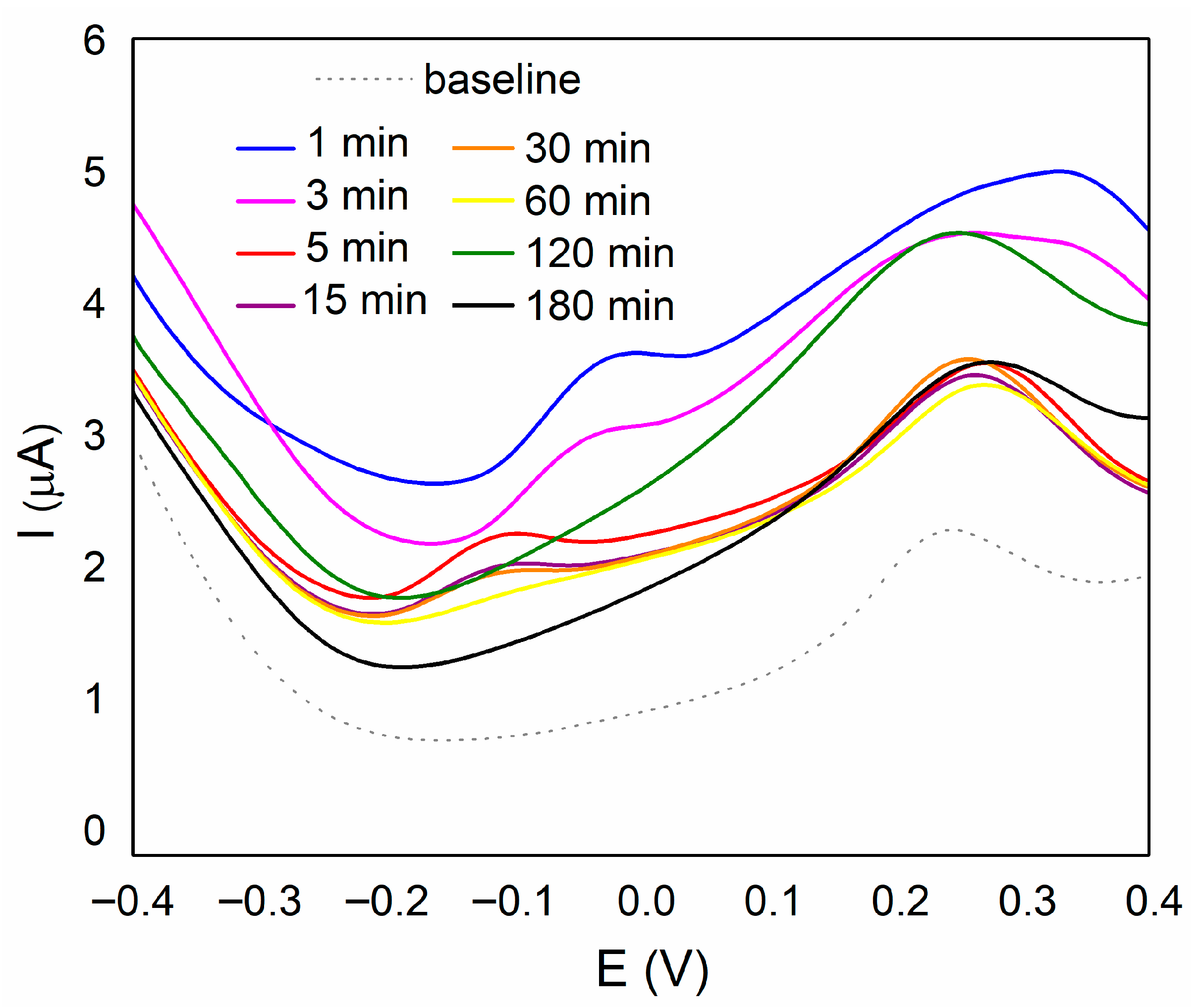
Furthermore, batch adsorption experiments were conducted while varying the pH of aqueous solutions, and the contact time while keeping the initial concentration of MTL and the dosage of the AC constant. For the optimization of pH value, a stock solution of MTL (100 mg/L) was prepared and adjusted with 1% KOH 1% HCL to obtain a set of solutions in the pH range 2–10. Each one of them was treated with 20 mg of adsorbent for 120 min on an orbital shaker at 150 rpm. The supernatants were filtered and analyzed using UV–Vis spectrometry. The same stock solution was used to optimize the contact time. Using the optimal pH and the same dosage of AC, different contact times were tested (1, 3, 5, 15, 30, 60, 120, and 180). The supernatants from this experiment were filtered and analyzed using UV–Vis spectrometry and DPV.

3. Results and Discussion

3.1. Gold Nanoparticles Characterization

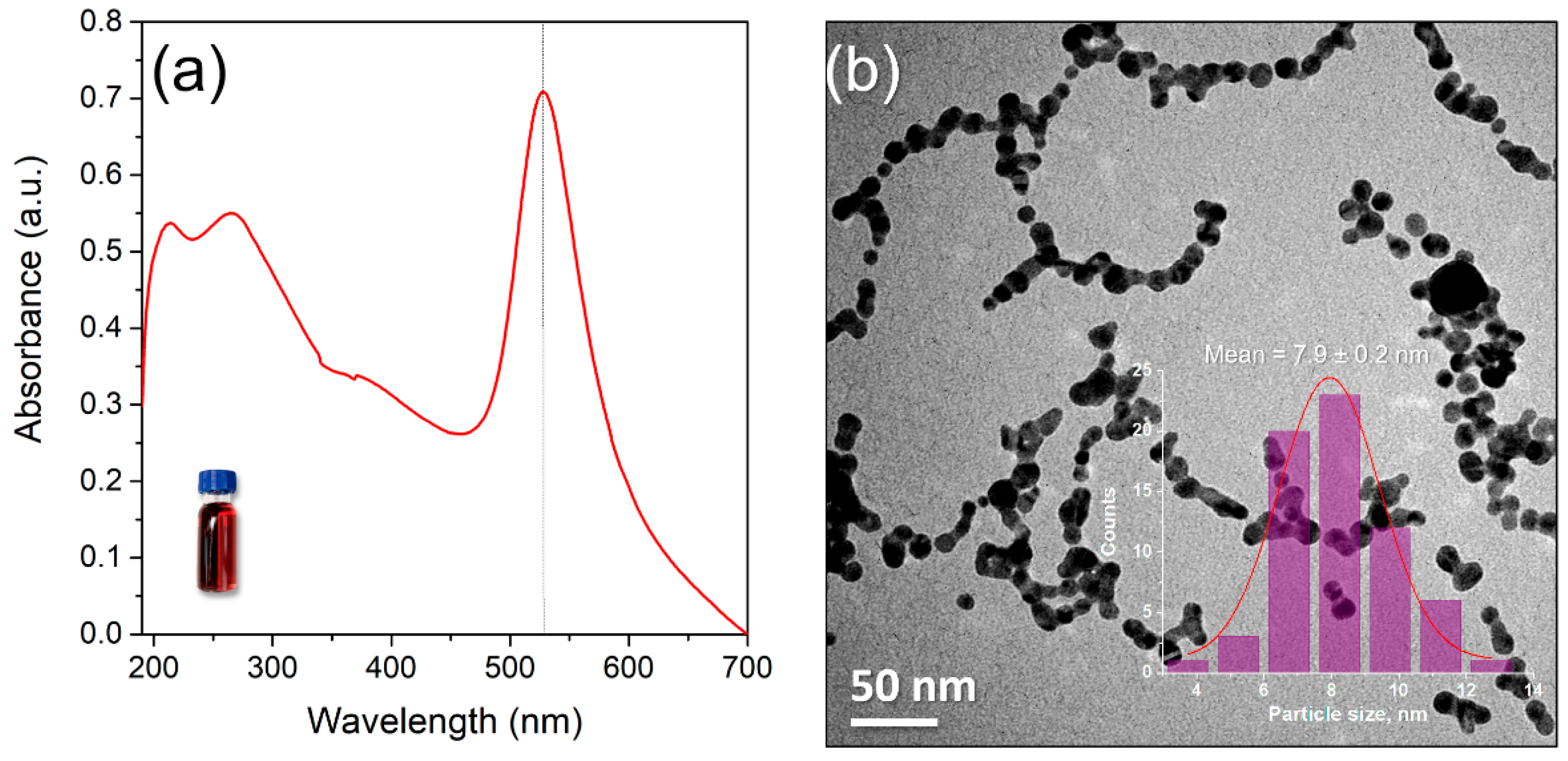
A dark burgundy–red colloid water solution of Au nanoparticles was characterized by UV–Vis spectroscopy. A characteristic surface plasmon resonance band (SPR) for gold nanoparticles at 527.5 nm was detected, confirming the synthesis of gold nanoparticles in this solution (Figure 1a). Since this band represents an extinction spectrum that depends on the size, shape, and aggregation of AuNPs, this spectrum allows estimation of gold nanoparticle size and aggregation level [33]. The nanoparticle size was theoretically estimated by applying the analytical approach proposed by Haiss et al. [34]. This method relies on the correlation between the localized SPR peak position and the relative absorbance at a reference wavelength, in this case 600 nm. Specifically, we calculated the ratio of the measured absorption maximum to the absorbance at 600 nm, which enables the estimation of the mean particle diameter. The calculated value indicated an average particle size of approximately 7 nm. Additionally, aggregation of nanoparticles leads to a significant red shift of the surface plasmon resonance frequency, a broadening of the surface plasmon band, and a change in the color of the solution from red to blue due to interparticle plasmon coupling [33]. Based on these observations, it could be concluded that the obtained colloid solution contains a high concentration of small spherical gold nanoparticles. Thus, ICP-OES and TEM analysis were employed to confirm these conclusions. ICP-OES analysis showed that the total concentration of Au in the solution was 125 ± 1 mg/L. Additionally, a TEM micrograph (Figure 1b) showed the presence of small pseudo-spherical gold nanoparticles partially agglomerated on each other. The size distributions of AuNPs were determined by manually measuring around 65 particles using the public domain software ImageJ [35], which showed that their sizes are subject to the log-normal size distribution with an average diameter of 7.9 ± 0.2 nm (Figure 1b).
This colloid solution of AuNPs was used to modify the working electrode on DRP-C11L. Based on the total gold concentration determined by ICP-OES (125 mg L−1 in water, 1875 mg L−1 in DMF) and the average nanoparticle diameter obtained from TEM analysis (7.9 nm), the number concentration of gold nanoparticles in the colloidal solution was estimated as described in [36]. Assuming pseudo-spherical particles and using the bulk density of gold (19.3 g cm−3), the mass of a single nanoparticle was calculated to be approximately 5 × 10⁻¹⁸ g, resulting in an estimated nanoparticle concentration of ~2.5 × 10¹⁶ particles L−1 in water and ~3.76 × 10¹⁷ particles L−1 in DMF. Consequently, the drop-casting of 3 µL of AuNPs DMF dispersion corresponds to the deposition of approximately 1.13 × 10¹² nanoparticles onto the working electrode surface. This estimation confirms the high nanoparticle loading and supports the enhanced electrochemical performance of the modified SPCE.

3.2. Surface Morphology of AC and SPCE Electrodes

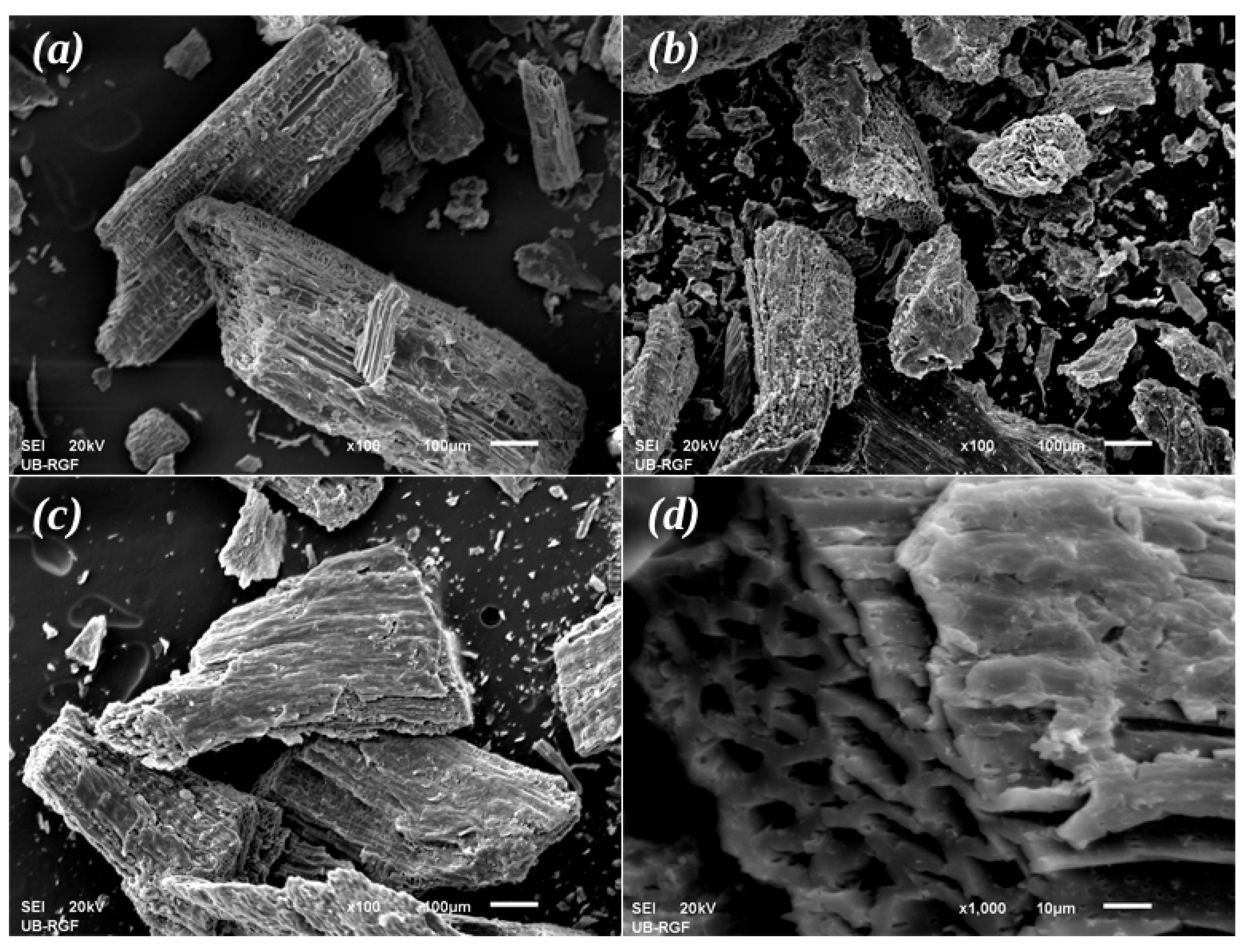
SEM images of raw waste biomass and carbonized and activated material are shown in Figure 2. Based on these micrographs, it can be determined that there is heterogeneity in the surface of the examined material. By comparison with SEM micrographs of the initial raw materials (Figure 2a), it can be concluded that carbonization (Figure 2b) and KOH chemical activation (Figure 2c,d) caused the creation of cracks on the heterogeneous surface of a material with the presence of microcavities that taper into pores of smaller dimensions.

3.3. Electrochemical Behavior of MTL at the AuNPs-DRP-C11L Electrode

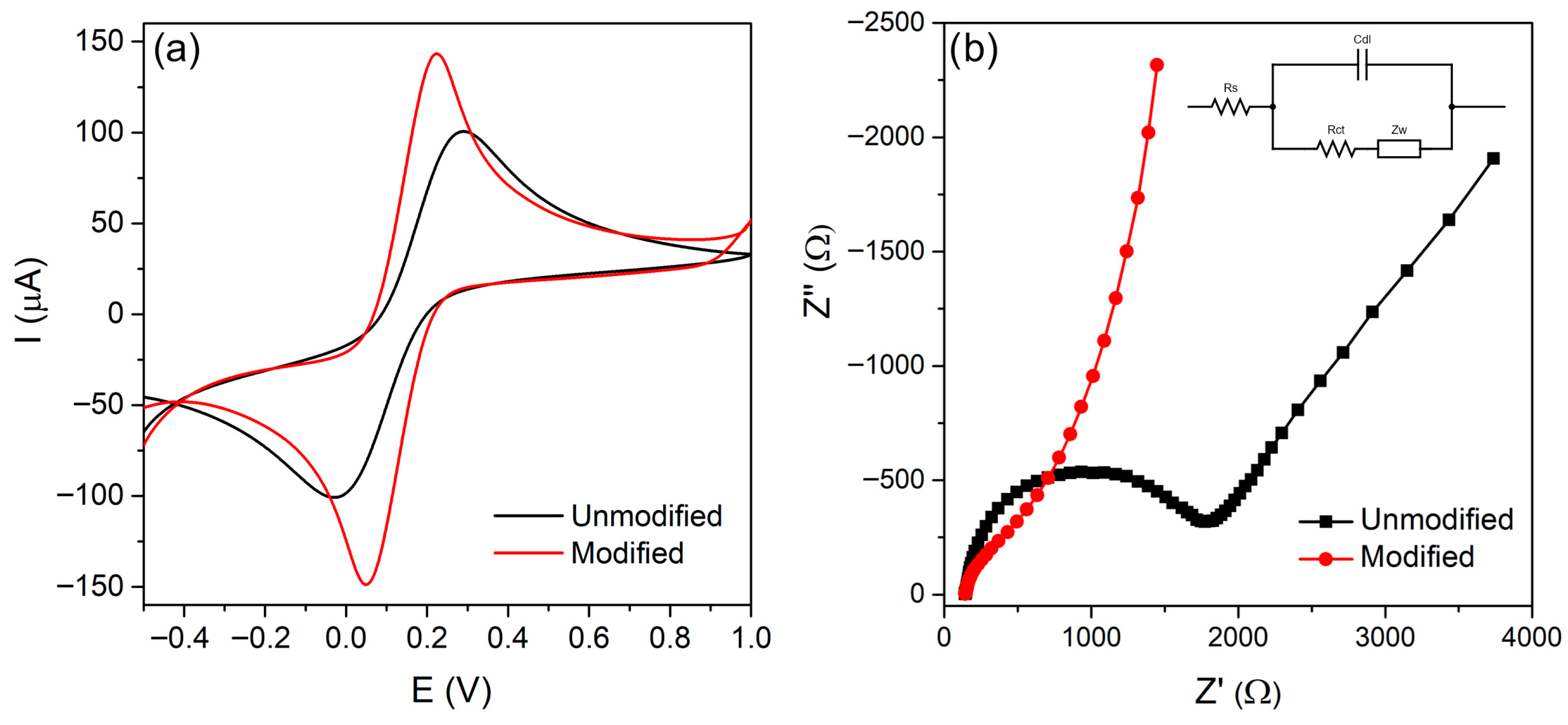
Cyclic voltammetry (CV) was used as an efficient method for the investigation of the electrochemical behavior of modified electrodes. Resulting voltammograms of different electrodes (unmodified DRP-C11L and modified AuNPs-DRP-C11L) were recorded in a 5 mM [Fe(CN)6]3−/4− solution; the results are shown in Figure 3a. A pair of redox peaks from the electrode reaction of [Fe(CN)6]3−/4− was observed for DRP-C11L, with the peak-to-peak separation (ΔEp) of around 305 mV at the scan rate of 50 mV/s (black curve), whereas for AuNPs-DRP-C11L, both cathodic and anodic peak currents increased significantly and the ΔEp value decreased to 170 mV (red curve), which could be attributed to the presence of Au nanospheres on the electrode surface. From these results, the electroactive surface areas of both electrodes were calculated using the Randles–Sevcik equation:
Ip = 2.69 × 10⁵ n3/2 A D1/2 C V1/2
where Ip is the peak current (A), n stands for the number of electrons transferred, D signifies the diffusion coefficient (cm2 s−1), C is the concentration of the solution (mol cm−3), and V denotes the scan rate (Vs−1). The calculated areas were 0.0391, 0.0518 cm2. When rescanning both electrodes under the same conditions, identical values were obtained, which indicates that the electrodes could be reused. These results suggested that the fabricated electrode had better electrocatalytic activity than the bare printed electrode [37]. Figure 3b shows the obtained EIS graphs for modified AuNPs-DRP-C11L and the unmodified electrode. The resistance during electron transfer is obtained from the difference between the low-frequency (Z’max) and high-frequency (Z’min) components of the real part of the impedance. The calculated Rct values are 1627 Ω and around 700 Ω for the pristine electrode and the electrode modified with gold nanoparticles, respectively. This appearance of the EIS curve for the modified electrode is primarily due to the reduced charge transfer resistance. The smaller semicircle at higher frequencies indicates a significant reduction in charge transfer resistance compared to the unmodified electrode. This suggests improved electron transfer kinetics. In addition, there is improved conductivity/diffusion. The steeper slope (Warburg impedance) at lower frequencies for the modified electrode (which occurs significantly earlier than in the case of the unmodified electrode) indicates more efficient ion transport or improved material conductivity, which facilitates diffusion processes. The observed inset equivalent electrical circuit shows the components that change: solution resistance, charge transfer resistance, double layer capacitance, and Warburg impedance. The change in the shape of the curve directly reflects how the modification affected these parameters, making the electrode more efficient for electrochemical reactions. This reduced resistance is consistent with the cyclic voltammogram (Figure 3a), where the modified electrode shows higher peak currents (both anodic and cathodic) and a smaller potential difference between the peaks, indicating a faster and more reversible Faraday reaction. These results show that the prepared material is a promising catalyst for application in electrochemical sensors [38].
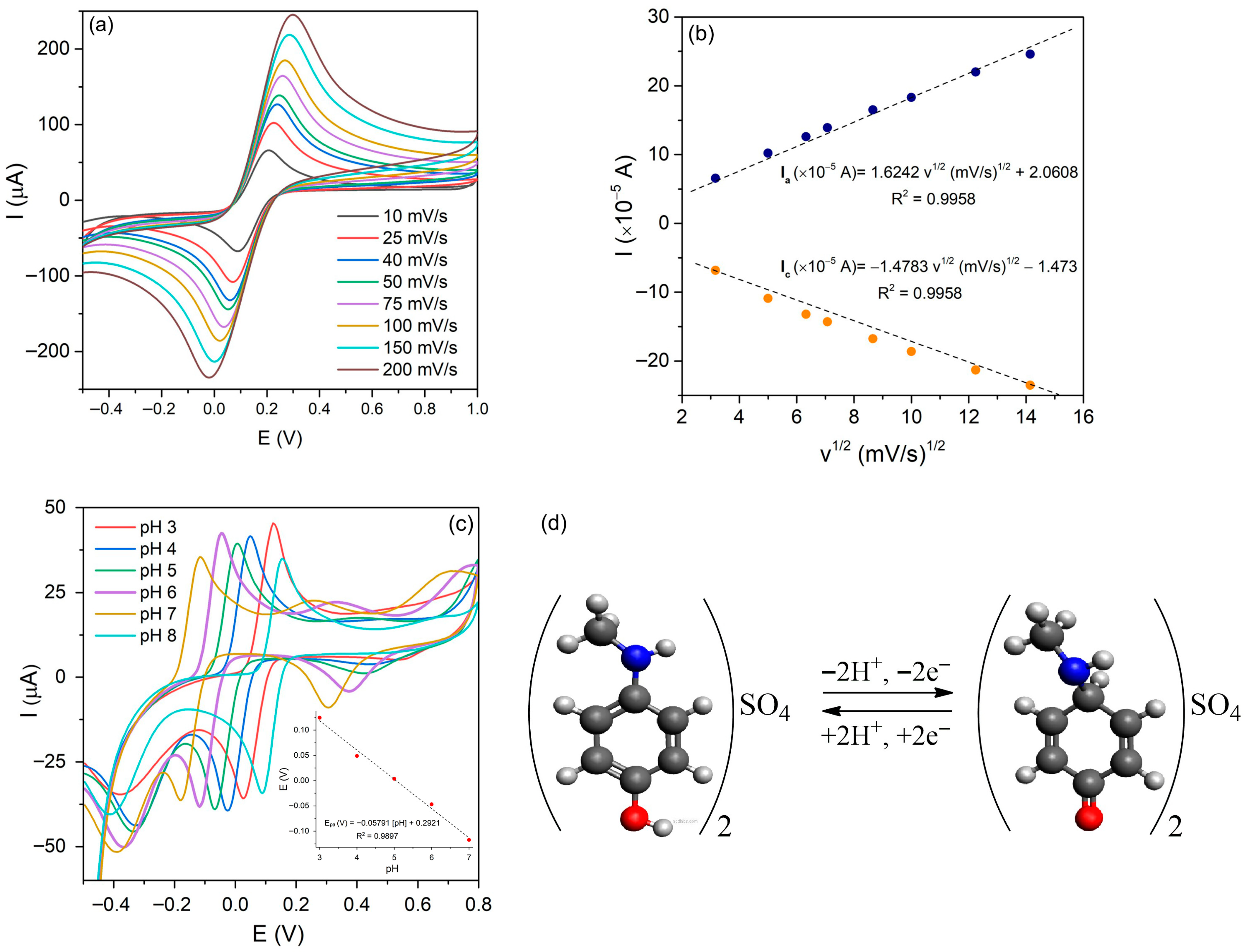
CV scan rate is a critical parameter in electrochemical experiments, as it allows detailed insight into reaction mechanisms, kinetics, and transport processes. Figure 4a shows the dependence of the electric current on the applied potential for the AuNPs-DRP-C11L electrode at different scan rates. The current of the oxidation and reduction peaks continuously increases with increasing scanning speed. The difference between the potentials of the anodic and cathodic peaks is constant (∆E = 0.28 V), which indicates that the redox reaction is reversible. Additionally, a linear relationship between the current response and the square root of the scan rate is observed (Figure 4b), indicating the dominance of the diffusion process in the oxidation-reduction reaction. The parameters of fitting were as follows (Equations (2) and (3)):
Ia (×10−5) = 1.6242 v½ (mV/s)½ + 2.0608, R2 = 0.9958
Ic (×10−5) = −1.4783 v½ (mV/s)½ − 1.473, R2 = 0.9958
The effect of the pH value of the supporting electrolyte on the analytical properties of the modified electrode is investigated and evaluated. For this purpose, CV studies were conducted in the BR buffer solutions with different pH values (from 3 to 8) while the scan rate (50 mV/s) and concentration of MTL (1 mM) were kept constant. Resulting voltammograms are given in Figure 4c. It can be observed that MTL shows voltammetric response in the range from −0.2 V to 0.2 V. Additionally, with the increase in pH values, the redox peak potential is shifted towards negative values. The experimental data indicate that the optimal pH level for electrocatalytic detection of MTL using the AuNPs-DRP-C11L electrode was 3, based on the slightly higher peaks currents. Notably, the results for pH 6 have a closely similar value to those for pH 3, and since this pH value was closer to the optimal pH value in adsorption studies, further experiments were conducted at pH 6. Correlation between pH values and redox peak potential is shown in Figure 4c, with the corresponding Equation (4):
Epa (V) = −0.05791 [pH] + 0.2921, R2 = 0.9897
The obtained slope value is −57.91 mV and could be considered as close to the theoretical value (59 mV) in the Nernst equation [1], which confirms that an equal number of electrons and protons are involved in the electrocatalytic reduction of MTL. Taking into account the obtained result and the literature data, the redox reaction of metol over the developed sensor can be shown in Figure 4d. The presumed mechanism involves the oxidation of the hydroxyl group and the formation of a quinone structure.

3.4. Analytical Quantification of MTL at the AuNPs-DRP-C11L Electrode

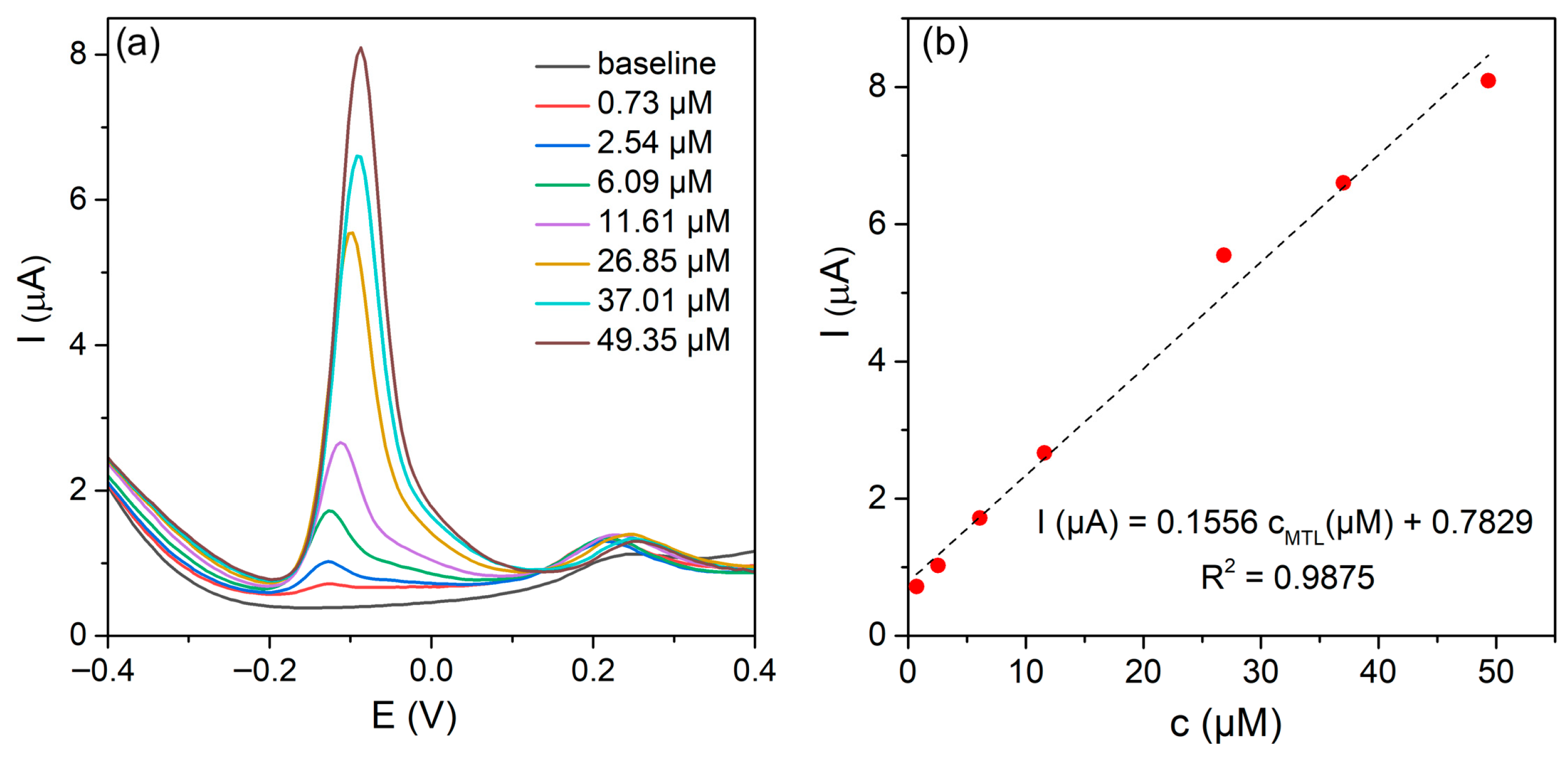
Differential pulse voltammetry (DPV) was employed for the precise quantification of MTL [22,39,40]. This technique offers high sensitivity, high selectivity, dynamic response range, and trace-level detection, which were needed for this study. For this purpose, a certain amount of 1 mM solution of MTL was added to the electrochemical cell filled with BR buffer solution at pH 6, and voltammograms were recorded in a potential range of −0.5–0.6 V at a scan rate of 25 mV/s. The obtained voltammograms and corresponding calibration curve are given in Figure 5. In the concentration range 0.73–49.35 µM, the calibration curve shows excellent linearity with a regression coefficient R2 = 0.9875. The limit of detection and limit of quantification were calculated as LOD = 3SD/slope and LOQ = 10 SD/slope, and the following values were obtained: LOD = 0.06 µM and LOQ = 0.2 µM. The proposed sensor was compared with the reported values for the detection of MTL found in the literature. As shown in Table 1, the obtained results are quite comparable to sensors developed for the voltametric (electrochemical) determination of MTL. Electrodes with the lowest LOD, such as CuBi2O4/hBN (LOD = 0.005 µM, linear range 0.001–1987 µM) and Au@Ce2Sn2O7/MXene/SPCE (LOD = 0.00563 µM, linear range 0.00125–1021.96 µM), enable the detection of MTL at very low concentrations while also covering a wide concentration range. On the other hand, electrodes such as IL/CPE (LOD = 2 µM, linear range 4–5000 µM) have a significantly broader linear range but a higher LOD. Compared with the results of this work, AuNPs-DRP-C11L exhibits a relatively narrow range (0.73–49.35 µM) and an LOD of 0.06 µM. Overall, these results highlight that electrode selection must consider both the expected concentration range and the necessary detection sensitivity, and the AuNPs-DRP-C11L electrode exhibits a favorable combination of analytical sensitivity and a suitably broad linear range for practical application in real sample measurements, especially with low-end devices.

3.5. Sensor Stability and Reliability Studies

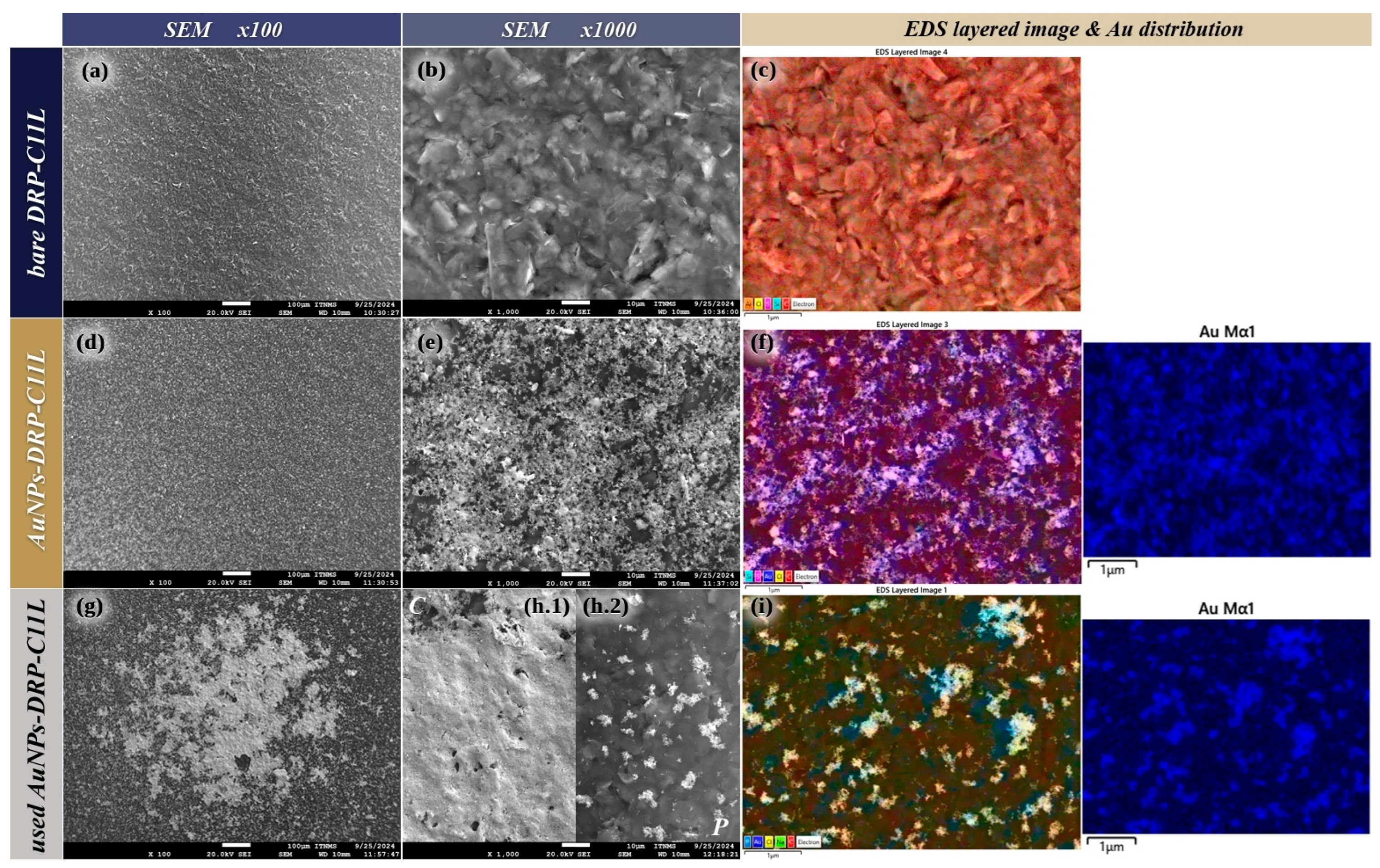
Additionally, the morphology of the bare DRP-C11L, modified AuNPs-DRP-C11L, and used AuNPs-DRP-C11L are shown in Figure 6 alongside the EDS layered images and gold distribution. Figure 6a,b shows the surface roughness of the printed electrode, while Figure 6c shows that no Au is present on the electrode surface. Additionally, SEM images of the SPCE after modification with gold nanoparticles show a good distribution across the working electrode and the distribution of Au is shown in Figure 6f. After 10 times of usage, the working electrode was examined, and images obtained showed dislocation of gold nanoparticles towards the center of the working electrode. The EDS layered image was taken in the middle part, and the white shade in these images corresponds to the gold deposition. Furthermore, EDS spectra were recorded in order to obtain the approximate concentration of gold deposition. Results presented in Table 2 showed that gold is not present in the bare electrode, while deposition provides 12.3 weight % of Au. After repeated use, a higher concentration is allocated around the center of the working electrode, and less than 2% was present at the peripheral parts, which can indicate the formation of multilayers of AuNPs in the center of the electrode.

3.6. Optimization of MTL Adsorption Conditions Using Activated Carbon Material and Evaluation Using DPV Method

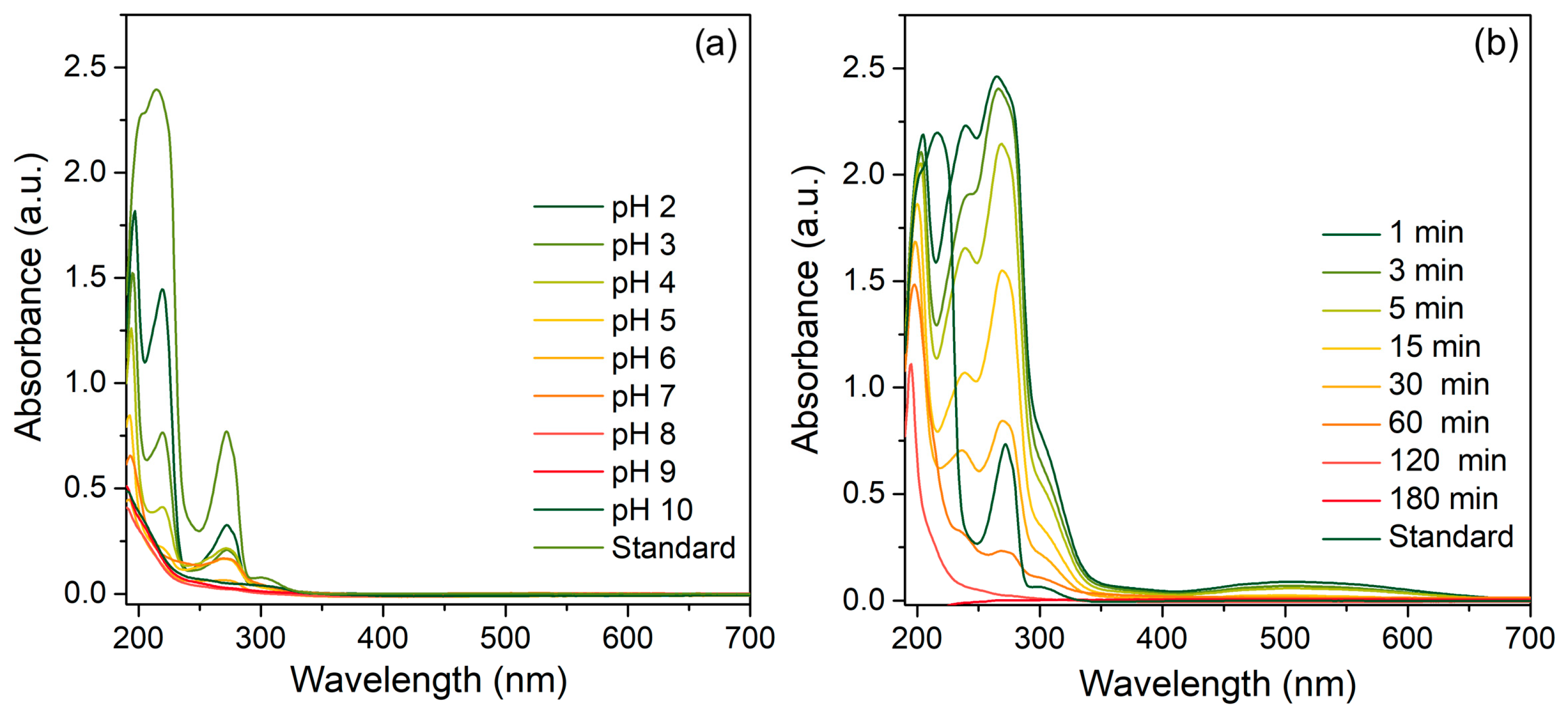
In order to optimize the adsorption conditions with AC material, the removal of MTL from aqueous solutions was observed by UV–Vis spectroscopy with an absorption maximum at a wavelength of 271 nm. Based on the obtained results and the graphs shown in Figure 7, the highest adsorption efficiency was achieved at pH 8, while the equilibrium of MTL adsorption was established after 120 min.
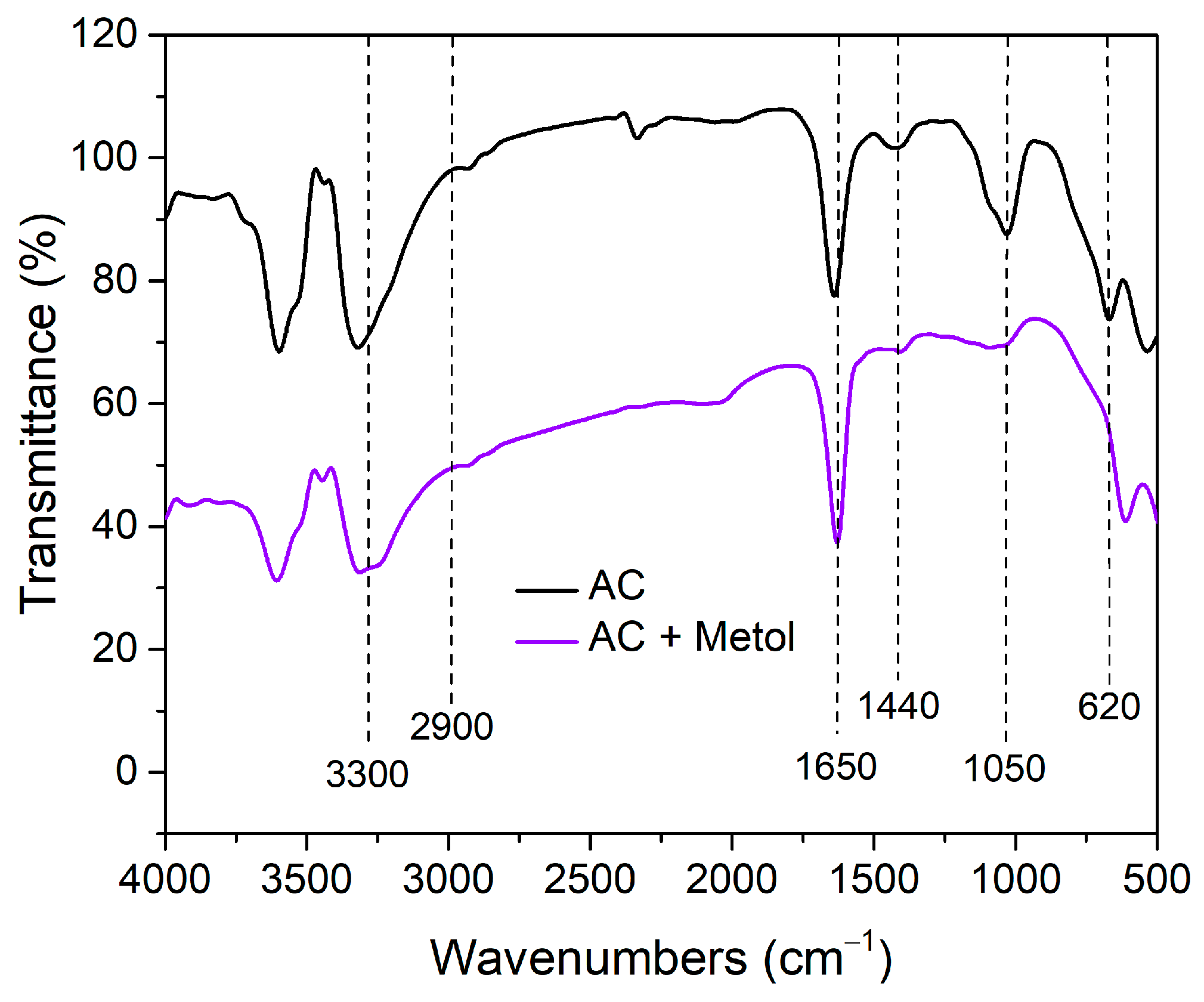
Furthermore, the adsorption of MTL was confirmed by FT-IR analysis of AC materials. The FT-IR spectrum of the AC material before MTL adsorption shows a band around 3300 cm−1, and can be attributed to the stretching vibrations of the hydroxyl group (Figure 8). The band appearing at 2900 cm−1 corresponds to C-H vibrations, while the peak appearing at 1650 cm−1 originates from C=C stretching of the aromatic ring, or C=O groups conjugated to the aromatic ring [45]. Similar infrared spectra were obtained for both carbon materials that are the subject of our previous research [14], also activated with KOH in different mass ratios. Peaks at 1440 cm−1, 1050 cm−1, and 620 cm−1 refer to C-H vibrations, C-O stretching, and C-H vibrations of aromatic rings. After the adsorption of MTL, the reduced intensities of the bands are observed, and deformations and shifts of the peaks towards higher or lower values of the wave numbers appear. Peaks occurring at wavenumbers of 1650 cm−1, 1440 cm−1, 1050 cm−1, and 620 cm−1 were shifted to values of 1620 cm−1, 1402 cm−1, 1032 cm−1, and 602 cm−1 due to the interaction of surface groups of AC material with MTL. The reduced intensities of the bands at the wavenumbers 1440 and 1050 cm−1 are also noticeable, which can be explained by the π-π arrangement of the aromatic rings of the carbon skeleton of the adsorbent and MTL, as well as by the interaction with C-O bonds. This indicates that the adsorbate stably binds and adheres to the surface of the adsorbent [46].

3.7. Analytical Application of the Sensor for the MTL Adsorption Study

Newly developed sensor was tested for the MTL adsorption study. This method is previously optimized, and details are provided in Section 3.5. All voltammetric measurements were performed by mixing the supernatant after adsorption and Britton–Robinson buffer in a volume ratio of 1:1. Figure 9 shows a graph of the dependence of the current intensity on the applied potential after the adsorption treatment of MTL with an initial concentration of 100 mg/L with activated carbon material of 1:2. During DPV of the aliquot after 1 min of adsorption, the presence of a peak corresponding to the oxidation of MTL was determined, at a potential of about −0.05 V. With increasing contact time during adsorption, the peak shifted to more negative potentials. Considering the initial dilution, the current intensity reading, and integration into the calibration curve equation (Figure 5b), the residual MTL concentrations after adsorption at the tested time intervals are calculated (Table 3). Based on the obtained results, it was determined that with increasing contact time during adsorption, the MTL concentration decreases, with the MTL removal efficiency after one minute being 82.9%, while MTL was completely adsorbed after a contact time of 120 min (Table 3).

4. Conclusions

An economical and simple electrochemical sensor with a “green” gold nanoparticle deposited on the surface of the working electrode was developed and used for the detection of metol in aqueous solutions after adsorption treatment on activated carbon material synthesized from sunflower agro-industrial waste. The modified electrode provided favorable electrocatalytic activity for the determination of MTL with an enhanced response compared to the unmodified electrode. The results showed that the developed sensor exhibits excellent electrocatalytic activity, sensitivity, selectivity, stability, and reproducibility in the detection of MTL. Low detection and quantification limit values (0.06 µM and 0.2 µM, respectively) and a wide range of linearity (0.73–49.35 µM) were achieved.

Author Contributions

Conceptualization, methodology, and supervision, S.Ž. and D.S.; validation, M.O., D.S. and S.Ž.; formal analysis, M.R., A.L., M.K., A.K. and A.D.; investigation, M.R. and M.K.; resources, S.Ž. and D.S.; data curation, M.O.; writing—original draft preparation, M.R., M.K. and S.Ž.; writing—review and editing, M.O., D.S., A.K., A.D., D.R. and S.Ž.; funding acquisition, S.Ž. All authors have read and agreed to the published version of the manuscript.

Funding

This research was funded by the Ministry of Science, Technological Development and Innovation of the Republic of Serbia (Contract number: 451-03-136/2025-03/200017 and 451-03-136/2025-03/200168). D.S. has been financially supported by the European Union, MOBILES: Monitoring and detection of biotic and abiotic pollutants by electronic, plants and microorganisms based sensors, Grant Agreement 101135402, https://doi.org/10.3030/101135402.

Data Availability Statement

The data used to support the findings of this study will be provided individually at request.

Conflicts of Interest

The authors declare no conflicts of interest.

References

  1. Prasanna, S.B.; Jagtap, A.A.; Kumar, G.S.; Ningappa, K.S.; Lin, Y.-C.; Lu, Y.-C.; Sakthivel, R.; Liu, T.-Y.; Chung, R.-J. A Developed Highly Selective and Sensitive Electrochemical Sensor Using Gold Nanoparticles on Cerium Stannate/MXene as an Electrode Matrix for Detection of Metol in Various Environmental and Biological Samples. Electrochim. Acta 2024, 499, 144703. [Google Scholar] [CrossRef]
  2. Tarigan, M.; Raji, S.; Al-Fatesh, H.; Czermak, P.; Ebrahimi, M. The Occurrence of Micropollutants in the Aquatic Environment and Technologies for Their Removal. Processes 2025, 13, 843. [Google Scholar] [CrossRef]
  3. Wołowicz, A.; Munir, H.M.S. Emerging Organic Micropollutants as Serious Environmental Problem: A Comprehensive Review. Sci. Total Environ. 2025, 958, 177948. [Google Scholar] [CrossRef]
  4. Sathya, H.; Abdel Hafez, A.A.; Govindasamy, M.; Chen, P.-Y. Tweaking the Electrocatalytic Efficiency of Sonochemically Synthesized Bi2S3 Nanorods through Decoration with F-MWCNTs: A Selective on-Site Detection of METOL in Environmental Samples. Ultrason. Sonochem. 2025, 121, 107531. [Google Scholar] [CrossRef]
  5. Annadurai, B.H.; Ragumoorthy, C.; Chen, S.-M.; Vengudusamy, R.; Kao, C.R. ZIF-67 on Graphitic Platforms: Carbon-Based Synergy for Trace-Level Metol Detection. J. Environ. Chem. Eng. 2025, 13, 119125. [Google Scholar] [CrossRef]
  6. Kulkarni, B.; Kokulnathan, T.; Wang, T.-J.; Al-Ansari, M.M.; Balakrishna, R.G. Trace-Level Electrochemical Detection of Organic Pollutant Metol in Environmental Samples Using MIL-101(Cr)@F-MWCNTs Nanocomposite. J. Environ. Chem. Eng. 2025, 13, 119262. [Google Scholar] [CrossRef]
  7. Kaur, B.; Satpati, B.; Srivastava, R. ZrO2 Supported Nano-ZSM-5 Nanocomposite Material for the Nanomolar Electrochemical Detection of Metol and Bisphenol A. RSC Adv. 2016, 6, 65736–65746. [Google Scholar] [CrossRef]
  8. Sun, W.; Deng, Y.; Liu, J.; Liu, W.; Cheng, Y.; Wang, L.; Gu, Y. Electrochemical Behavior and Voltammetric Determination of P-Methylaminophenol Sulfate Using LiCoO2 Nanosphere Modified Electrode. Thin Solid Films 2014, 564, 379–383. [Google Scholar] [CrossRef]
  9. Chen, J.-Y.; Wei, Y.-P.; Chen, J.-S.; Liu, X.-P.; Mao, C.-J.; Jin, B.-K. Self-Catalyzed Nitrogen-Doped Carbon Nanotubes Connected FeCo Nanostructures for Electrochemical Sensitive Detection of Metol. Talanta 2025, 290, 127761. [Google Scholar] [CrossRef] [PubMed]
  10. Radenkovic, M.; Momcilovic, M.; Petrovic, J.; Mrakovic, A.; Relic, D.; Popovic, A.; Zivkovic, S. Removal of Heavy Metals from Aqueous Media by Sunflower Husk: A Comparative Study of Biosorption Efficiency by Using ICP-OES and LIBS. J. Serbian Chem. Soc. 2022, 87, 939–952. [Google Scholar] [CrossRef]
  11. Pap, S.; Šolević Knudsen, T.; Radonić, J.; Maletić, S.; Igić, S.M.; Turk Sekulić, M. Utilization of Fruit Processing Industry Waste as Green Activated Carbon for the Treatment of Heavy Metals and Chlorophenols Contaminated Water. J. Clean. Prod. 2017, 162, 958–972. [Google Scholar] [CrossRef]
  12. Anastopoulos, I.; Ighalo, J.O.; Adaobi Igwegbe, C.; Giannakoudakis, D.A.; Triantafyllidis, K.S.; Pashalidis, I.; Kalderis, D. Sunflower-Biomass Derived Adsorbents for Toxic/Heavy Metals Removal from (Waste) Water. J. Mol. Liq. 2021, 342, 117540. [Google Scholar] [CrossRef]
  13. Lingamdinne, L.P.; Angaru, G.K.R.; Pal, C.A.; Koduru, J.R.; Karri, R.R.; Mubarak, N.M.; Chang, Y.-Y. Insights into Kinetics, Thermodynamics, and Mechanisms of Chemically Activated Sunflower Stem Biochar for Removal of Phenol and Bisphenol-A from Wastewater. Sci. Rep. 2024, 14, 4267. [Google Scholar] [CrossRef]
  14. Radenković, M.; Petrović, J.; Pap, S.; Kalijadis, A.; Momčilović, M.; Krstulović, N.; Živković, S. Waste Biomass Derived Highly-Porous Carbon Material for Toxic Metal Removal: Optimisation, Mechanisms and Environmental Implications. Chemosphere 2024, 347, 140684. [Google Scholar] [CrossRef] [PubMed]
  15. Sultana, M.; Rownok, M.H.; Sabrin, M.; Rahaman, M.H.; Alam, S.M.N. A Review on Experimental Chemically Modified Activated Carbon to Enhance Dye and Heavy Metals Adsorption. Clean. Eng. Technol. 2022, 6, 100382. [Google Scholar] [CrossRef]
  16. Scholz, M. How Activated Carbon Can Help You—Processes, Properties and Technological Applications. Technologies 2023, 11, 153. [Google Scholar] [CrossRef]
  17. Gayathiri, M.; Pulingam, T.; Lee, K.T.; Sudesh, K. Activated Carbon from Biomass Waste Precursors: Factors Affecting Production and Adsorption Mechanism. Chemosphere 2022, 294, 133764. [Google Scholar] [CrossRef]
  18. Nemoda, M.; Radovanović, M.; Živković, S.; Momčilović, M.; Rajić, V.; Bošković, M.; Nikolić, B.; Marinković, J. Comparative Analysis of Antibacterial and Antibiofilm Potential of Chemically- and Green Laser-Produced Gold and Silver Nanoparticles against Dental Pathogens. Arch. Oral Biol. 2025, 179, 106393. [Google Scholar] [CrossRef]
  19. Ognjanović, M.; Nikolić, K.; Radenković, M.; Lolić, A.; Stanković, D.; Živković, S. Picosecond Laser-Assisted Synthesis of Silver Nanoparticles with High Practical Application as Electroanalytical Sensor. Surf. Interfaces 2022, 35, 102464. [Google Scholar] [CrossRef]
  20. Blažeka, D.; Radičić, R.; Maletić, D.; Živković, S.; Momčilović, M.; Krstulović, N. Enhancement of Methylene Blue Photodegradation Rate Using Laser Synthesized Ag-Doped ZnO Nanoparticles. Nanomaterials 2022, 12, 2677. [Google Scholar] [CrossRef]
  21. Sun, W.; Jiang, Q.; Wang, Y.; Jiao, K. Electrochemical Behaviors of Metol on Hydrophilic Ionic Liquid 1-Ethyl-3-Methylimidazolium Tetrafluoroborate-Modified Electrode. Sens. Actuators B Chem. 2009, 136, 419–424. [Google Scholar] [CrossRef]
  22. Tharuman, S.; Nataraj, N.; Chen, T.-W.; Chen, S.-M.; Lou, B.-S.; Abbasi, A.M.; Ali, M.A.; Elshikh, M.S. Hydrothermal Synthesis of MnCo2S4/CoS2 for the Effective Electrochemical Detection of Metol. J. Environ. Chem. Eng. 2025, 13, 116276. [Google Scholar] [CrossRef]
  23. Manimaran, P.; Tamilalagan, E.; Chen, S.-M.; Govindharaj, A. Development of an Ultrasensitive Sensor for Detecting Metol in Environmental Water Samples Using Ruddlesden-Popper Type Layered Perovskite (La2NiO4) Combined with Graphene Oxide. Water Res. 2025, 273, 122998. [Google Scholar] [CrossRef]
  24. González-Sánchez, M.I.; Gómez-Monedero, B.; Agrisuelas, J.; Iniesta, J.; Valero, E. Highly Activated Screen-Printed Carbon Electrodes by Electrochemical Treatment with Hydrogen Peroxide. Electrochem. Commun. 2018, 91, 36–40. [Google Scholar] [CrossRef]
  25. Liu, C.-Y.; Chou, Y.-C.; Tsai, J.-H.; Huang, T.-M.; Chen, J.-Z.; Yeh, Y.-C. Tyrosinase/Chitosan/Reduced Graphene Oxide Modified Screen-Printed Carbon Electrode for Sensitive and Interference-Free Detection of Dopamine. Appl. Sci. 2019, 9, 622. [Google Scholar] [CrossRef]
  26. Oliveira, I.G.S.; Gallina, F.C.; da Silva, A.P.; da Silva, A.C.; Bimbi Júnior, F.E.; de Carvalho, A.E.; Lanza, M.R.V.; Martelli, S.M.; Barros, W.R.P. Disposable and Flexible Screen-Printed-Carbon Electrode Modified with Au/Poly-Beta-Cyclodextrin as Electrochemical Platform for Estriol Detection. Microchem. J. 2024, 206, 111521. [Google Scholar] [CrossRef]
  27. Haroon, N.; Stine, K.J. Surface Modification of Screen-Printed Carbon Electrodes. Coatings 2025, 15, 1182. [Google Scholar] [CrossRef]
  28. Zakiyyah, S.N.; Satriana, N.P.; Fransisca, N.; Gaffar, S.; Syakir, N.; Irkham, I.; Hartati, Y.W. Gold Nanoparticle-Modified Screen-Printed Carbon Electrodes for Label-Free Detection of SARS-CoV-2 RNA Using Drop Casting and Spray Coating Methods. ADMET DMPK 2025, 13, 2577. [Google Scholar] [CrossRef] [PubMed]
  29. Li, Y.; Chen, X.; Yuan, Z.; Yi, Z.; Wang, Z.; Wang, R. Nanoporous Gold-Modified Screen-Printed Electrodes for the Simultaneous Determination of Pb2+ and Cu2+ in Water. Sensors 2024, 24, 5745. [Google Scholar] [CrossRef]
  30. Jirasirichote, A.; Punrat, E.; Suea-Ngam, A.; Chailapakul, O.; Chuanuwatanakul, S. Voltammetric Detection of Carbofuran Determination Using Screen-Printed Carbon Electrodes Modified with Gold Nanoparticles and Graphene Oxide. Talanta 2017, 175, 331–337. [Google Scholar] [CrossRef] [PubMed]
  31. Schneider, C.A.; Rasband, W.S.; Eliceiri, K.W. NIH Image to ImageJ: 25 Years of Image Analysis. Nat. Methods 2012, 9, 671–675. [Google Scholar] [CrossRef]
  32. Karimmirza, E.; Manavizadeh, N. High-Performance Flexible Triboelectric Nanogenerators Enabled by Metal Nanoparticle–Silicone Composites for Wearable Biomedical Applications. Results Eng. 2025, 28, 107593. [Google Scholar] [CrossRef]
  33. Amendola, V.; Meneghetti, M. Size Evaluation of Gold Nanoparticles by UV−vis Spectroscopy. J. Phys. Chem. C 2009, 113, 4277–4285. [Google Scholar] [CrossRef]
  34. Haiss, W.; Thanh, N.T.K.; Aveyard, J.; Fernig, D.G. Determination of Size and Concentration of Gold Nanoparticles from UV−Vis Spectra. Anal. Chem. 2007, 79, 4215–4221. [Google Scholar] [CrossRef] [PubMed]
  35. Filipović Tričković, J.; Momčilović, M.; Joksić, G.; Živković, S.; Ilić, B.; Ognjanović, M.; Novaković, M.; Valenta Šobot, A. Laser Ablated Citrate-Stabilized Silver Nanoparticles Display Size and Concentration Dependant Biological Effects. Nanomater. Nanotechnol. 2023, 2023, 9854356. [Google Scholar] [CrossRef]
  36. Kovačević, M.; Simić, M.; Živković, S.; Milović, M.; Tolić Stojadinović, L.; Relić, D.; Vasić Anićijević, D. Uncovering Metal-Decorated TiO2 Photocatalysts for Ciprofloxacin Degradation—A Combined Experimental and DFT Study. Int. J. Mol. Sci. 2024, 25, 11844. [Google Scholar] [CrossRef]
  37. Glaubitz, F.; Mirceski, V.; Schröder, U. A Comparative Analysis of Square-Wave Voltammetry and Multi-Frequency Electrochemical Faradaic Spectroscopy for Kinetic Characterisation. J. Solid State Electrochem. 2024, 28, 3491–3500. [Google Scholar] [CrossRef]
  38. Liu, J.; Xu, Y.; Liu, S.; Yu, S.; Yu, Z.; Low, S.S. Application and Progress of Chemometrics in Voltammetric Biosensing. Biosensors 2022, 12, 494. [Google Scholar] [CrossRef]
  39. Mutic, T.; Stankovic, V.; Milikic, J.; Bajuk-Bogdanovic, D.; Kalcher, K.; Ortner, A.; Manojlovic, D.; Stankovic, D. Sustainable Synthesis of Samarium Molybdate Nanoparticles: A Simple Electrochemical Tool for Detection of Environmental Pollutant Metol. J. Serbian Chem. Soc. 2024, 89, 1571–1585. [Google Scholar] [CrossRef]
  40. Venkatesh, K.; Muthukutty, B.; Chen, S.-M.; Karuppasamy, P.; Haidyrah, A.S.; Karuppiah, C.; Yang, C.-C.; Ramaraj, S.K. Spinel CoMn2O4 Nano-/Micro-Spheres Embedded RGO Nanosheets Modified Disposable Electrode for the Highly Sensitive Electrochemical Detection of Metol. J. Ind. Eng. Chem. 2022, 106, 287–296. [Google Scholar] [CrossRef]
  41. John, A.J.V.; Disouza, F.P.D.; Chen, T.-W.; Chen, S.-M.; Alagarsamy, S.; Liou, W.-C.; Al-onazi, W.A.; Algarni, T.S.; Elshikh, M.S. Spinel CuBi2O4 Integrated with Boron Nitride Hexagons for a Sensitive Electro-Analytical Quantification of Environmental Organic Pollutants. Process Saf. Environ. Prot. 2024, 188, 1246–1255. [Google Scholar] [CrossRef]
  42. Mutharani, B.; Gopi, P.K.; Chen, S.-M.; Tsai, H.-C.; Ahmed, F.; Haidyrah, A.S.; Ranganathan, P. Amperometric Determination of Ecotoxic N-Methyl-p-Aminophenol Sulfate in Photographic Solution and River Water Samples Based on Graphene Oxide/CeNbO4 Nanocomposite Catalyst. Ecotoxicol. Environ. Saf. 2021, 220, 112373. [Google Scholar] [CrossRef]
  43. Samanta, S.; Srivastava, R. CuCo2O4 Based Economical Electrochemical Sensor for the Nanomolar Detection of Hydrazine and Metol. J. Electroanal. Chem. 2016, 777, 48–57. [Google Scholar] [CrossRef]
  44. Niu, X.; Yan, L.; Wen, Z.; Li, X.; Niu, Y.; Lu, Y.; Sun, W. Voltammetric Determination of Metol on a Gold Nanoparticle Modified Carbon Molecular Wire Electrode. Anal. Lett. 2017, 50, 325–335. [Google Scholar] [CrossRef]
  45. Ji, Y.; Li, T.; Zhu, L.; Wang, X.; Lin, Q. Preparation of Activated Carbons by Microwave Heating KOH Activation. Appl. Surf. Sci. 2007, 254, 506–512. [Google Scholar] [CrossRef]
  46. Spessato, L.; Bedin, K.C.; Cazetta, A.L.; Souza, I.P.A.F.; Duarte, V.A.; Crespo, L.H.S.; Silva, M.C.; Pontes, R.M.; Almeida, V.C. KOH-Super Activated Carbon from Biomass Waste: Insights into the Paracetamol Adsorption Mechanism and Thermal Regeneration Cycles. J. Hazard. Mater. 2019, 371, 499–505. [Google Scholar] [CrossRef]
Figure 1. (a) UV–Vis spectrum of AuNPs solution and (b) TEM analysis of LASIS gold nanoparticles, including the size distribution.
Suschem 07 00005 g001
Figure 2. SEM micrographs at 100× magnification of (a) raw waste; (b) carbonized material; (c) chemically activated carbon material; and (d) 1000× magnification of AC material.
Suschem 07 00005 g002
Figure 3. (a) Cyclic voltammograms of (black) DRP-C11L and (red) AuNPs-DRP-C11L in 5 mM [Fe(CN)6]3−/4− solution containing 0.1 mol/L KCl. Scan rate: 100 mV/s. (b) Electrochemical impedance spectra of (black) DRP-C11L and (red) AuNPs-DRP-C11L in 5 mM [Fe(CN)6]3−/4− and 0.1 mol/L KCl with the frequencies swept from 100 kHz to 0.1 Hz, with scan rate 50 mV/s and potential amplitude 0.01 Vrms.
Suschem 07 00005 g003
Figure 4. (a,b) Cyclic voltammograms for 1 mM MTL at different scan rates (10–200 mV/s) at the AuNPs-DRP-C11L electrode at pH 2 and its respective linear plots; (c) CVs for 1 mM MTL at various pH levels of BR buffer solutions; and (d) possible electro-redox mechanism of MTL.
Suschem 07 00005 g004
Figure 5. (a) DPV voltammograms for different concentrations of MTL in the range from 0.73 µM to 49.35 µM at AuNPs-DRP-C11L and (b) Calibration curve for concentration vs. peak current.
Suschem 07 00005 g005
Figure 6. SEM images of bare DRP-C11L (a,b), modified AuNPs-DRP-C11L (d,e), and used AuNPs-DRP-C11L (g,h), at magnifications 100× and 1000×, and corresponding EDS layered image and Au distribution (c,f,i).
Suschem 07 00005 g006
Figure 7. Optimization of adsorption conditions: (a) effect of pH value and (b) time of contact on the adsorption efficiency.
Suschem 07 00005 g007
Figure 8. FT-IR spectra of AC and AC after the adsorption of MTL.
Suschem 07 00005 g008
Figure 9. DPV of supernatants after the adsorption treatment of MTL on AC.
Suschem 07 00005 g009
Table 1. Comparison table of MTL determination using electrochemical techniques.
ElectrodeDetection MethodLinear Range (µM)LOD (µM)Ref.
CuBi2O4/hBNDPV0.001–19870.005[41]
Au@Ce2Sn2O7/MXene/SPCEDPV0.00125–1021.960.00563[1]
Go/CeNbO4/GCEi-t0.02–3560.01[42]
MnCo2S4/CoS2/GCEDPV0.4975–2973.90.025[22]
Sm2(MoO4)3/CPESWV0.1–3000.047[39]
CoMn2O4@RGO-SPCEDPV0.01–137.650.05[40]
CuCo2O4/GCEDPV0.02–10000.06[43]
AuNPs-DRP-C11LDPV0.73–49.350.06This work
LiCoO2/CILEDPV0.4–4000.25[8]
AuNPs/carbon molecular wireDPV2.0–8000.64[44]
IL/CPECV4–50002[21]
CoMn2O4@RGO-SPCEDPV0.01–137.650.05[40]
Table 2. EDS analysis results.
ElectrodeAu Weight %
DRP-C11Ln.d.
AuNPs-DRP-C11L12.3%
Used AuNPs-DRP-C11L36.3% in the center, <2% in the periphery
Table 3. MTL removal efficiency based on the contact time.
Time of Contact (Min)MTL Concentration (µM)Removal Efficiency (%)
135.9882.9
327.8586.8
518.6791.2
1515.6092.6
3014.8393
6012.9793.8
120n.d. *100
180n.d. *100
* not detected.
Disclaimer/Publisher’s Note: The statements, opinions and data contained in all publications are solely those of the individual author(s) and contributor(s) and not of MDPI and/or the editor(s). MDPI and/or the editor(s) disclaim responsibility for any injury to people or property resulting from any ideas, methods, instructions or products referred to in the content.