Article

Mercury Removal and Antibacterial Performance of A TiO2–APTES Kaolin Composite

by
Awal Adava Abdulsalam
1,
Sabina Khabdullina
1,
Zhamilya Sairan
1,
Yersain Sarbassov
1,
Madina Pirman
2,
Dilnaz Amrasheva
2,
George Z. Kyzas
3,
Tri Thanh Pham
2,
Elizabeth Arkhangelsky
4 and
Stavros G. Poulopoulos
1,*
1
Department of Chemical and Materials Engineering, School of Engineering and Digital Science, Nazarbayev University, Astana 010000, Kazakhstan
2
Department of Biology, School of Sciences and Humanities, Nazarbayev University, Astana 010000, Kazakhstan
3
Hephaestus Laboratory, School of Chemistry, Faculty of Sciences, Democritus University of Thrace, GR-65404 Kavala, Greece
4
School of Engineering and Digital Sciences, Nazarbayev University, Astana 010000, Kazakhstan
*
Author to whom correspondence should be addressed.
Sustain. Chem. 2025, 6(4), 48; https://doi.org/10.3390/suschem6040048 (registering DOI)

Submission received: 25 October 2025 / Revised: 19 November 2025 / Accepted: 25 November 2025 / Published: 1 December 2025

Abstract

Mercury (Hg2+) contamination in water systems poses a severe environmental and health hazard due to its high toxicity and bioaccumulation potential. In this study, a novel adsorbent was developed by sequentially modifying kaolin via acid–base treatment, titanium dioxide (TiO2) incorporation, and 3-aminopropyltriethoxysilane (APTES) grafting. Batch adsorption experiments revealed that the fully modified kaolin (TiO2-loaded and APTES grafted) exhibited the highest adsorption capacity (25.6 mg/g) compared to the acid–base-treated (5.8 mg/g) and TiO2-loaded (17.7 mg/g) kaolin. Under optimal conditions (75 mg adsorbent dosage; 70 mg/L Hg2+; pH 5), the fully modified kaolin maintained its performance even in the presence of varying ionic strengths, natural organic matter, and competing metal ions. Adsorption kinetics followed a pseudo-second-order model, and the equilibrium data were well fitted by the Langmuir isotherm. Antibacterial activity assay revealed that the TiO2-loaded kaolin effectively inhibited S. aureus (minimum inhibitory concentration = 2.5 mg/mL) and showed moderate activity against E. coli (BL21) (minimum inhibitory concentration = 5 mg/mL). However, antibacterial activity decreased after amine functionalization, indicating a compromise between enhancing adsorption capacity and preserving antibacterial functionality. This study presents a promising cost-efficient approach for the simultaneous removal of Hg2+ ions from water matrices and inhibiting bacterial growth, aligning with SDG 6 (Clean Water and Sanitation).

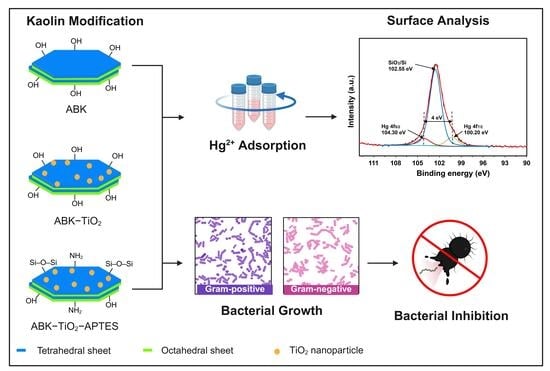
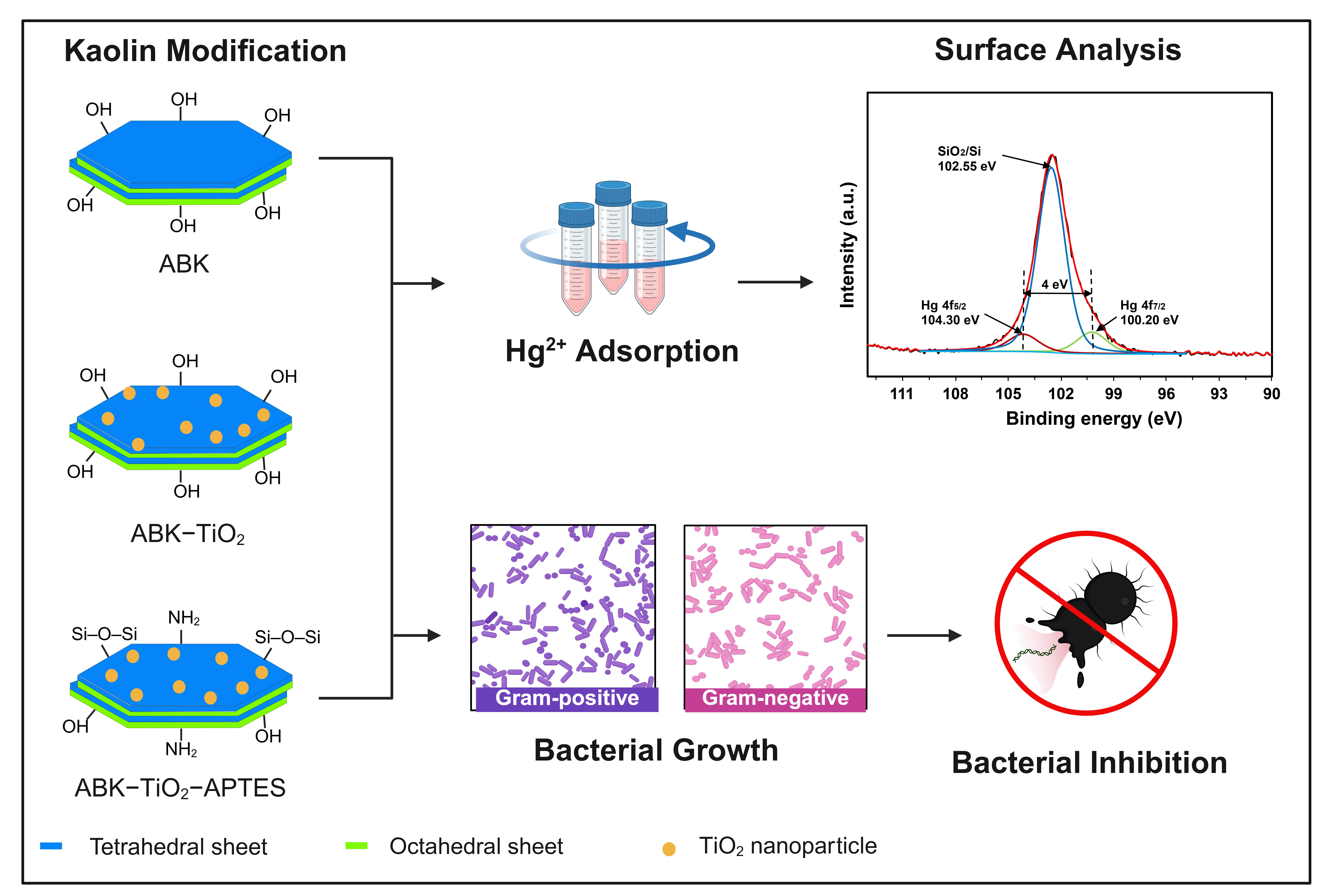
Graphical Abstract

1. Introduction

Rapid population growth and industrialization have intensified the discharge of pollutants into aquatic environments [1]. Industrial effluents often contain hazardous metal ions such as mercury, lead, and cadmium, which are nonbiodegradable and tend to bioaccumulate in ecosystems [2,3,4]. Mercury, in particular, is a priority pollutant due to its extreme toxicity and persistence. Once released into water bodies, inorganic mercury can be transformed through microbes into organic mercury (e.g., methylmercury), a form that bioaccumulates in aquatic food chains [5,6]. This leads to high mercury concentrations in predatory fish and poses serious health risks to wildlife and humans upon consumption [7]. Even at very low concentrations, mercury can damage the nervous, immune, and renal systems and is particularly harmful to developing fetuses [8,9]. The World Health Organization (WHO) considers mercury one of the top ten chemicals of major public health concern. Accordingly, regulatory agencies have set extremely low limits for mercury in drinking water (e.g., the WHO guideline of ~0.001 mg/L) [10], necessitating the development of effective removal technologies for mercury-contaminated waters.
To remediate mercury contamination in water systems, a variety of treatment methods such as chemical precipitation [11], membrane filtration [12], ion exchange [13], and adsorption [14] have been developed over the years. Most of these methods have been found to achieve high removal efficiencies, often exceeding 90% and even reaching 100% in ideal cases, owing to their high selectivity, operational simplicity, and scalability [15]. However, these technologies face practical limitations such as high operational costs and sludge generation. Adsorption is a promising alternative due to its simplicity, cost-effectiveness, and versatility [16,17]. Activated carbon is the most common adsorbent; however, its rising cost necessitates the search for cheaper alternatives [18]. Therefore, low-cost porous solids such as natural clays [19,20], zeolites [21], and agricultural wastes [22] have been extensively studied as adsorbents for mercury remediation. Among these, clay minerals are particularly attractive due to their abundance, affordability, and ability to be chemically modified to enhance performance [23,24].
Kaolinite, which is the primary component of kaolin, is a widely available 1:1 layered aluminosilicate that has been explored as an adsorbent for mercury removal from aqueous solutions [25,26,27]. It typically has a moderate cation exchange capacity and surface area, and its adsorption capability for metal ions is often lower than that of 2:1 clay, such as montmorillonite [23]. However, the large natural abundance and chemical stability of kaolin make it an appealing base material for water treatment applications [25,28]. Studies have found that various surface modifications can substantially improve the metal uptake capacity of kaolin. For example, acid or alkaline activation can increase surface area and create new active sites [28,29]. Inorganic oxide incorporation, such as titanium dioxide (TiO2) loading, can also enhance the adsorption properties of kaolin by increasing its surface area, porosity, and introducing new functional sites [28]. Surface modification with organic compounds such as organosilanes is another effective strategy [30,31]. For instance, 3-aminopropyltriethoxysilane (APTES), an organosilane that grafts amine (–NH2) groups onto the surface of materials, endows adsorbents with chelating groups that strongly bind heavy metal ions via coordination or electrostatic attraction [32,33]. Previous studies with APTES-modified adsorbents have demonstrated marked improvements in capacity. Abdellaoui et al., (2024) found that APTES-grafted zeolite and silica materials exhibited lead and cadmium adsorption capacities in the range of 200–400 mg/g, exceeding those for unmodified materials [34]. In the case of kaolin, APTES treatment has been found not only to enhance metal uptake but also to increase the stability and dispersion of kaolin in water [35]. By combining TiO2 with APTES grafting, the resulting composite is expected to synergistically benefit from both inorganic and organic modification: TiO2 provides a high-surface-area scaffold and additional binding sites, while APTES supplies targeted functional groups for mercury capture [36,37].
Water contaminated with heavy metals often harbors pathogenic microorganisms [38,39], so an ideal treatment medium would remove toxic metals while simultaneously inhibiting microbial growth. TiO2 is a widely studied antimicrobial agent. Under ultraviolet illumination, it generates reactive oxygen species (ROS) such as •OH radicals that can destroy bacteria and viruses [40], and the incorporation of APTES can further improve antibacterial performance. Recent studies on APTES-modified TiO2 nanoparticles (NPs) showed that APTES not only helps disperse NPs but also introduces a positively charged surface (due to protonated –NH3+ groups) that promotes adhesion to negatively charged bacterial cell walls [41]. TiO2–APTES-modified kaolin is anticipated to inhibit bacterial growth via a combination of contact killing and photocatalytic disinfection mechanisms. Thus, this material can address both chemical pollution (Hg2+ ions removal) and biological contamination (bacterial growth inhibition), making it a versatile candidate for water purification and contributing directly to Sustainable Development Goal (SDG) 6 (Clean Water and Sanitation).
In this study, TiO2–APTES-modified kaolin was developed to evaluate its performance in mercury adsorption and antibacterial activity. Key objectives include: (1) determining the mercury adsorption capacity of the modified kaolin and comparing it to unmodified kaolin, (2) studying the adsorption isotherms and kinetics to understand the uptake mechanism, and (3) assessing the antibacterial activity of synthesized materials against representative Gram-positive (S. aureus) and Gram-negative (E. coli) bacteria. The multi-step surface engineering approach employed in this study is novel and is expected to yield a dual-functional adsorbent with both mercury-binding capacity and inherent antibacterial activity.

2. Materials and Methods

2.1. Materials and Chemicals

Raw kaolin (RK) was purchased from Sigma–Aldrich and used without purification. Hydrochloric acid (HCl; 37%), sodium hydroxide (NaOH; >97%), titanium tetraisopropoxide (TTIP; ≥99%), APTES (≥98%), ethanol (96%), ethylenediaminetetraacetic acid disodium salt dihydrate (EDTA 2Na·2H2O; ≥99%), potassium iodide (KI; 99%), copper(II) nitrate trihydrate (98–103%), nickel(II) sulfate hexahydrate (≥98%), zinc sulfate heptahydrate (≥99%), cadmium nitrate tetrahydrate ≥99%), and mercury(II) chloride (≥99.5%) were all purchased from Sigma–Aldrich. All reagents were of analytical grade and were used without further purification. Deionized (DI) water (18.2 MΩ·cm) was used for all preparations and washing steps.

2.2. Material Preparation

2.2.1. Acid–Base Treatment of Kaolin

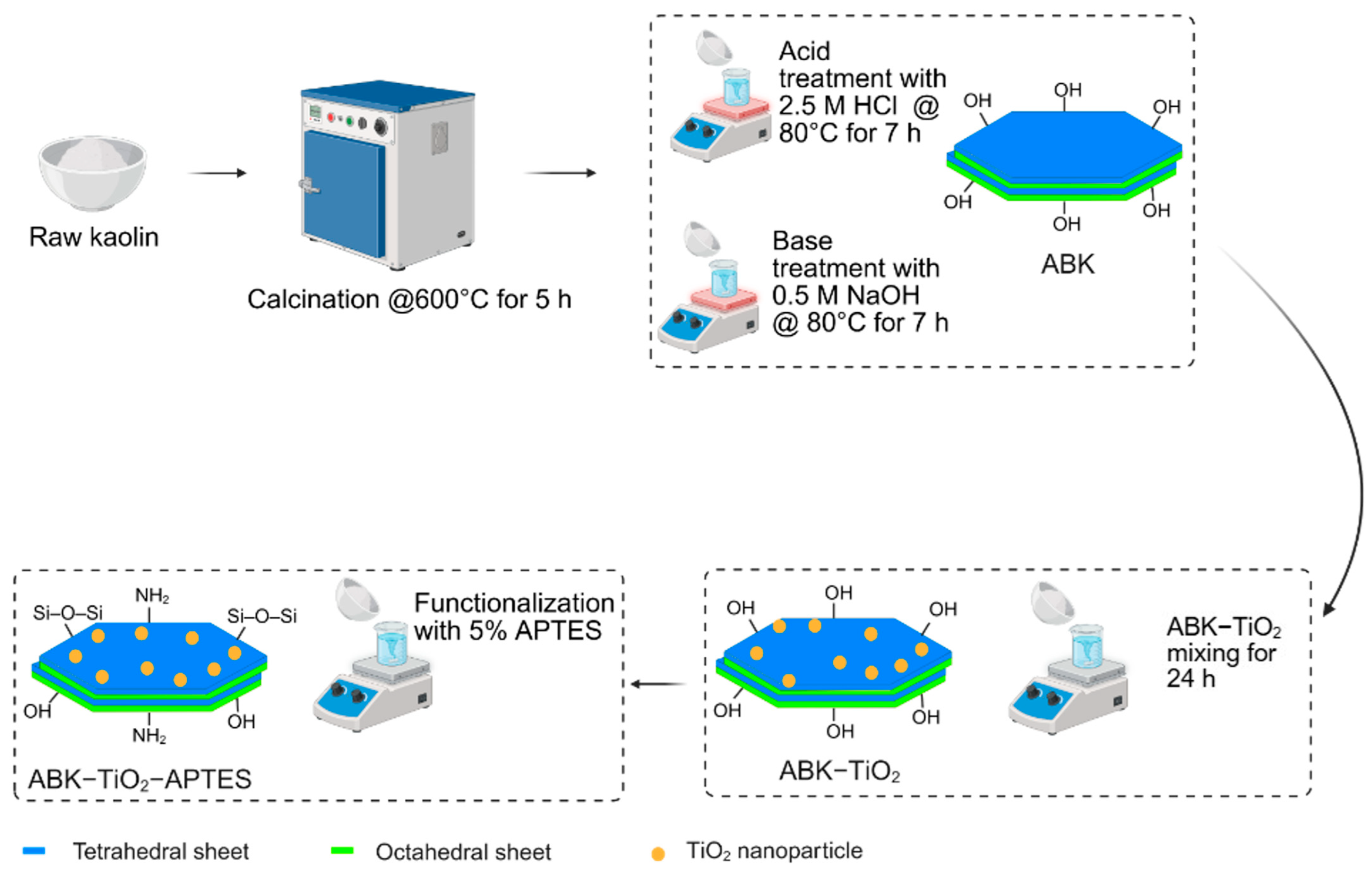
RK was activated through a sequential acid and base treatment, adapted from methods reported by Abdulsalam et al., (2025) [42]. First, RK was thermally activated by heating to 600 °C (ramp rate of 10 °C/min) and holding for 5 h in a muffle furnace. This calcination step converts kaolin to a more reactive metakaolin phase. After cooling, the calcined kaolin was subjected to acid leaching in 2.5 M of HCl at 80 °C for 7 h to remove a portion of Al3+ from the lattice and increase surface porosity. This treatment generated additional silanol groups, increasing the density of reactive sites. The acid-treated kaolin was filtered and washed repeatedly with DI water until pH 7 to remove excess acid and dried overnight at 90 °C. Next, the material was treated with 0.5 M NaOH solution at 80 °C for 7 h to induce mild alkaline activation. This step partially etched the silica-rich surface, increasing surface roughness and porosity without causing complete dissolution of the aluminosilicate framework. The alkaline treatment also led to partial modification of the surface silicate network, further enhancing the reactivity of the kaolin surface for subsequent functionalization. The resulting acid–base-treated kaolin was thoroughly washed with DI water until neutral pH and then oven-dried at 90 °C overnight. This product is hereafter referred to as ABK.
Nano-TiO2 was synthesized via a sol–gel process adopted from Mustapha et al., (2021) to ensure uniform particle size, high purity, and a well-defined anatase phase [37]. Here, 20 mL of TTIP was added to 200 mL of DI water under vigorous stirring. The hydrolysis of the titanium precursor was initiated by adjusting the mixture to pH ≈ 8 with dropwise addition of 0.1 M NaOH, resulting in the formation of a white titania sol. The suspension was continuously stirred and allowed to age for 24 h at room temperature (25 °C) to ensure complete hydrolysis and polycondensation. The precipitated TiO2 was then collected and washed several times with DI water to remove any impurities. The washed solid was dried at 100 °C for 3 h, and subsequently calcined at 450 °C for 3 h to obtain crystalline TiO2 NPs.

2.2.2. TiO2 Loading and APTES Grafting on Kaolin

To prepare a TiO2–APTES-modified kaolin composite, ABK was first incorporated with the synthesized TiO2 NPs and then functionalized with –NH2 groups via APTES grafting. First, ABK and the prepared TiO2 NPs were mixed at a mass ratio of 20:80 (TiO2:ABK) in DI water, and the slurry was stirred for 24 h at room temperature. This process allowed TiO2 NPs to distribute and attach to the kaolin surface. After mixing, the solid composite was recovered by filtration and washed with DI water to remove unattached particles. The product was dried at 90 °C overnight, yielding TiO2-loaded kaolin, denoted as ABK–TiO2. Subsequently, ABK–TiO2 was functionalized with –NH2 groups via APTES grafting. Here, 5 mL of APTES was added to a mixture of ethanol and water (95 mL of ethanol:5 mL of DI water) and stirred for 30 min. Then, 5 g of ABK–TiO2 was introduced. The suspension was stirred at room temperature for 7 h, allowing the silane to hydrolyze and subsequently form a covalent bond with hydroxyl groups on the TiO2–kaolin surface. After grafting, the sample was centrifuged at 4000 rpm and washed thoroughly with ethanol, followed by DI water, to remove any unreacted APTES or by-products. The APTES-modified composite was then dried overnight at 90 °C. The final functionalized material is referred to as ABK–TiO2–APTES. Figure 1 shows a schematic illustration of the preparation process of AB, ABK–TiO2, and ABK–TiO2–APTES.

2.3. Characterization

Raw and modified kaolin were characterized by various analytical techniques to confirm their composition, structure, and morphology. X-ray fluorescence (XRF) analysis was conducted by preparing fused beads of the samples using the Scientific xrFuse 6 instrument (XRF Scientific, Avenue de Roodebeek, Brussels, Belgium) and then analyzing them for chemical composition using an Axios Max wavelength dispersive XRF spectrometer (Malvern Panalytical, Almelo, The Netherlands). X-ray diffraction (XRD) patterns were recorded with a Rigaku diffractometer (Rigaku Corporation, Tokyo, Japan). The instrument was operated at 40 kV and 50 mA with Cu Kα radiation (λ = 1.5406 Å). Scans were collected over a 2θ range of 5–70° at a step size of 0.01°, with a scanning speed of 3° min−1. Fourier transform infrared spectroscopy (FTIR) spectra were obtained using an ALPHA II FTIR spectrometer (Bruker Optik GmbH, Ettlingen, Germany) equipped with a platinum attenuated total reflectance module over the range 4000–400 cm−1 at a resolution of 4 cm−1 with 32 scans per sample. Surface morphologies were examined through scanning electron microscopy (SEM; Carl Zeiss AG, Oberkochen, Germany), while a JEOL JEM-1400 Plus transmission electron microscope (TEM; JEOL Ltd., Tokyo, Japan) operated at an accelerating voltage of 120 kV was used to observe the fine structure of the TiO2 NPs and their attachment on the kaolin surface. Nitrogen adsorption–desorption isotherms were measured at 77 K using a 3Flex gas adsorption analyzer (Micromeritics Instrument Corporation, Norcross, GA, USA), and the specific surface area of the samples was calculated from the adsorption data using the Brunauer–Emmett–Teller (BET) model. Zeta potential over the range of pH 3 to 11 was measured using a ZetaView PMX-230 TWIN nanoparticle analyzer (Particle Metrix, Ammersee, Germany). Surface elemental composition of the modified kaolin was investigated before and after adsorption through X-ray photoelectron spectroscopy (XPS) using a NEXSA XPS system (Thermo Scientific, Waltham, MA, USA).

2.4. Adsorption Studies

Batch adsorption experiments were conducted to evaluate the performance of the materials in removing Hg2+ ions from aqueous solution and to study the effects of various operational parameters. In each experiment, a known mass of adsorbent was added to 50 mL of Hg2+ solution in a paraffin-sealed conical flask and agitated at a constant speed (150 rpm) using an orbital shaker. A preliminary adsorption study was conducted to determine the equilibrium time using an initial Hg2+ concentration of 50 mg/L and a dosage of 25 mg. Subsequently, the effect of dosage (12.5–100 mg), initial Hg2+ concentration (10–90 mg/L), and solution pH (3–11) was investigated. The effect of natural organic matter (NOM) was determined using humic acid (HA) and glucose at concentrations ranging from 1 to 50 mg/L. Finally, to examine the effect of ionic strength and the influence of coexisting heavy metals, adsorption experiments were performed in the presence of NaNO3 (0.005–0.1 M) and selected heavy metals, including Cu2+, Cd2+, Zn2+, and Ni2+. Two sets of adsorption experiments were conducted by spiking the optimal concentration of Hg2+ solution with 5 and 10 mg/L of each coexisting metal, resulting in total coexisting metal concentrations of 20 and 40 mg/L, respectively. Mercury concentrations before and after adsorption were measured using a Lumex RA-915M mercury analyzer (Lumex Instruments, St. Petersburg, Russia), while Cu2+, Cd2+, Zn2+, and Ni2+ concentrations were determined using an inductively coupled plasma optical emission spectroscopy system (iCAP 6300; Thermo Scientific, Renfrew, United Kingdom). For each set of conditions, the experiments were performed in triplicate to ensure reproducibility. All reported results are the mean values, and error bars on graphs represent the percentage error (typically within ±5% of the value). The percentage removal and the amount of Hg2+ adsorbed at equilibrium (qe) were calculated using Equations (1) and (2), respectively.
R e m o v a l = C 0 C e C 0 × 100 %
q e = C 0 C e m × V
where C0 and Ce are the initial and equilibrium Hg2+ concentrations (mg/L), respectively, m is the mass (g) of the adsorbent, and V is the volume (L) of Hg2+ solution. For kinetic studies, the adsorption capacity (qt) of Hg2+ adsorbed at time t (h) was calculated using Equation (3) as follows:
q t = C 0 C t m × V
where Ct is the concentration (mg/L) of Hg2+ at time t (h).

2.5. Adsorption Modeling

Adsorption kinetics and isotherms were analyzed using standard models to describe the mechanism of Hg2+ uptake. Two kinetic models, the pseudo-first-order (PFO) and pseudo-second-order (PSO) models, were applied to the time-dependent adsorption data. The nonlinear forms of these models are given in Equations (4) and (5), respectively:
q t = q m ( 1 e K 1 t )
q t = q m 2 K 2 t 1 + q m K 2 t
where qt (mg/g) is the amount of Hg2+ adsorbed at time t (h), qm (mg/g) is the maximum adsorption capacity, K1 (h−1) is the rate constant for the PFO model, and K2 (g mg−1 h−1) is the rate constant for the PSO model.
Similarly, the equilibrium adsorption data were fitted with the Langmuir and Freundlich isotherm models. The Langmuir isotherm [43] assumes monolayer adsorption onto a homogeneous surface with finite identical sites, while the Freundlich isotherm [44] is an empirical equation assuming a heterogeneous surface with sites of varied affinities. These models are mathematically expressed by Equations (6) and (7), respectively:
q e = q m K L C e 1 + K L C e
q e = K F C e 1 n
where qe (mg/g) is the amount of Hg2+ adsorbed at equilibrium, qm (mg/g) is the maximum adsorption capacity, KL (L/mg) is the Langmuir constant related to adsorption affinity, Ce (mg/L) is the equilibrium concentration of Hg2+, and KF ((mg/g)/(mg/L)n) and n are Freundlich constants representing adsorption capacity and intensity, respectively.

2.6. Desorption and Reuse Studies

In each desorption cycle, 75 mg of Hg2+-loaded ABK–TiO2–APTES was placed into a 100 mL Erlenmeyer flask containing 50 mL of desorbing solution (0.1-M EDTA, KI, and HCl). The flask was sealed with paraffin and agitated at 150 rpm for 2 h. After shaking, the solid and liquid phases were separated through centrifugation at 4000 rpm, rinsed with DI water, and oven-dried at 70 °C overnight. The dried adsorbents were reused directly for each cycle. The percentage of Hg2+ desorbed in each cycle was calculated using Equation (8) as follows:
D e s o r b e d = M d M a × 100 %
where Md (mg/g) is the amount of desorbed Hg2+, and Ma (mg/g) is the amount of adsorbed Hg2+.

2.7. Antibacterial Activity Assay

Antibacterial activity test was conducted following the method outlined by Mergenbayeva et al., (2024) [45]. Here, a micro-dilution technique was used to test the antibacterial activity of RK, ABK, ABK–TiO2, and ABK–TiO2–APTES through the determination of their minimum inhibitory concentration (MIC) against E. coli (BL21) and S. aureus. To prepare the bacteria for inoculation, a single colony of each bacterium was chosen from an agar plate stock and cultivated in 10 mL of nutritional broth for 16 h at 37 °C while being continuously shaken at 250 rpm. E. coli (BL21) was cultured in Luria–Bertani broth, and S. aureus in Tryptic Soy Broth. Fifty microliters of the diluted bacterial suspension and 50 μL of culture broth with twice the quantity of microparticles needed were then mixed in each well of a sterile 96-well microplate to form a final volume of 100 μL. VICTOR Nivo S multiplate reader was used to monitor the bacterial growth in each well through absorbance reading while the plate was incubated at 37 °C and shaken at 600 rpm. The optical density at 600 nm was recorded every 15 min over a period of 24 h. The results were subsequently standardized and plotted from 1 h after the initial recording to ensure that maximum mixing and uniformity in absorbance had been achieved.

3. Results and Discussion

3.1. Characterization

3.1.1. Chemical Composition

XRF results (Table 1) revealed clear compositional trends corresponding to each modification step. RK is rich in alumina and silica, but after acid–base treatment, the Al2O3 content dropped from ~37.58 wt% to 27.78 wt%, whereas the SiO2 content increased from 49.56 wt% to 56.06 wt%. This change reflects the leaching of Al3+ from the octahedral layers of RK under harsh acid conditions [46], increasing the SiO2/Al2O3 ratio from 1.32 to 2.02, thereby leaving a silica-enriched structure [47]. The presence of K2O in all samples (1.55–1.90 wt%) can be attributed to the occurrence of minor accessory minerals such as illite, while the appearance of Na2O after acid–base can be attributed to residual Na+ from the alkaline activation step. Upon TiO2 incorporation to form ABK–TiO2, the content of TiO2 increased significantly from 0.84 to 23.92 wt%, directly confirming its successful introduction into the kaolinite matrix [37]. For ABK–TiO2–APTES, TiO2 remained high at 22.88 wt%, indicating that the TiO2 phase is retained after silane functionalization. Al2O3 dropped further to 22.43 wt%, while SiO2 increased to 49.81 wt%. The slight increase in SiO2 from ABK–TiO2 to ABK–TiO2–APTES likely reflects additional silicon introduced by the APTES molecules grafted onto the kaolin/TiO2 surface.

3.1.2. Structural Characterization

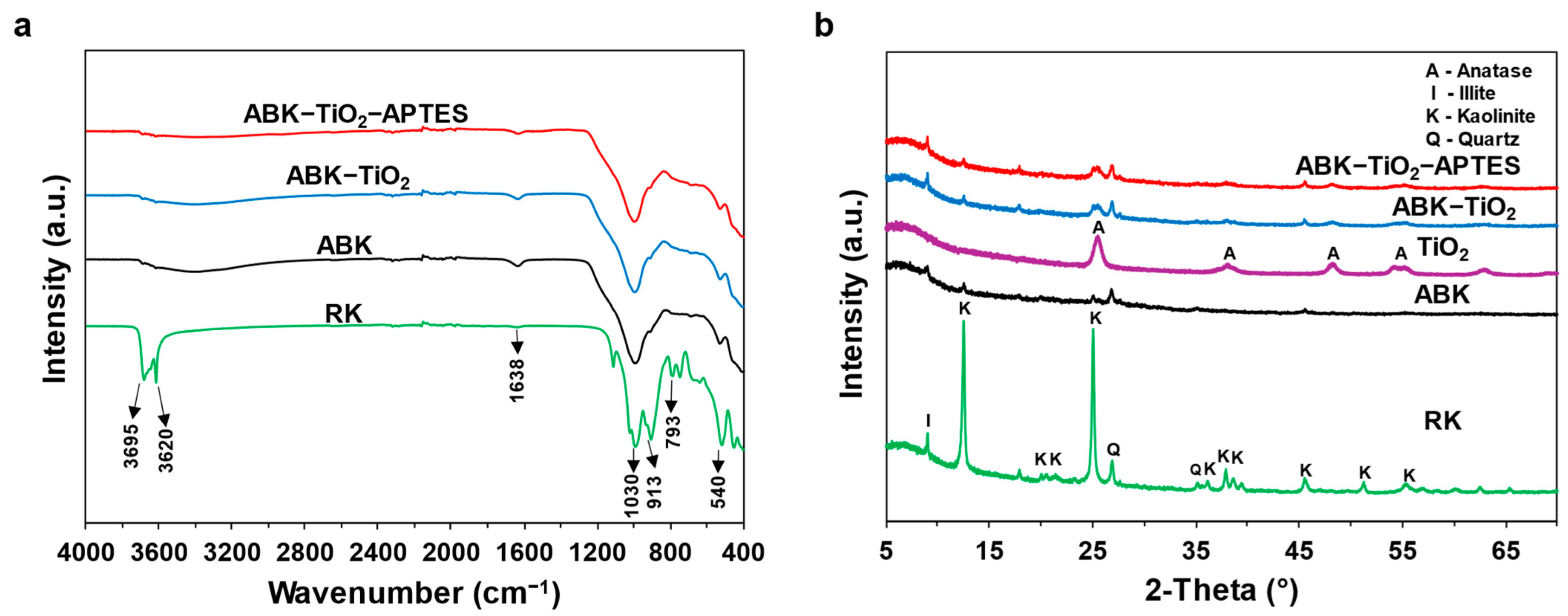
FTIR spectra (Figure 2a) revealed that RK exhibits the characteristic O–H stretching bands of inner-surface and inner hydroxyl groups at ∼3695 and 3620 cm−1, respectively, and the bending mode of molecular water at ∼1638 cm−1 [42]. In the low wavenumber region, the peaks at 1110 and 991 cm−1 are attributed to Si–O stretching in quartz, while the peak at 913 cm−1 corresponds to inner Al–OH bending [47,48]. Additionally, the peak at 773 cm−1 is associated with the bending vibration of Al–O–Si bonds, whereas the peak at 540 cm−1 is attributed to Si–O/Al–O deformation. In ABK, the intensity of the OH bands (~3600–3700 cm−1) is greatly weakened, indicating a loss of structural –OH groups due to thermal treatment and leaching of Al–OH during acid–base treatment [46]. ABK–TiO2 and ABK–TiO2–APTES samples showed an even further reduction in the –OH band intensity, suggesting that the thermal and chemical conditions of TiO2 incorporation (e.g., hydrolysis of Ti precursors and calcination) consumed or replaced additional –OH groups [49]. Meanwhile, the primary Si–O–Si framework vibrations of kaolin (stretching around ∼1000 cm−1) remain present in all samples, indicating that the silicate lattice largely persists through the treatments [42,50].
XRD patterns (Figure 2b) showed that RK exhibited distinct crystalline peaks corresponding to its mineral constituents. These peaks include strong reflections from kaolinite at 2θ ≈ 12.3° (001) and 25° (111). After acid–base treatment, these peaks drastically reduced in intensity [29]. This decrease in diffraction peaks signals that ABK has an amorphous structure [47]. For nano-synthesized TiO2, a notable peak appeared at 2θ ≈ 25.3°, corresponding to the (101) reflection of anatase TiO2 [49]. Additionally, smaller anatase peaks can be identified at 2θ values of ∼37.8°, 48.0°, 53.9°, and 62.5°. These matches standard JCPDS data for anatase TiO2 (JCPDS 00-021-1272). With TiO2 incorporation (ABK–TiO2), new crystalline features emerged in the XRD patterns, with the anatase TiO2 peaks overlapping partly with the broad background. For ABK–TiO2–APTES, the XRD pattern remained largely similar to ABK–TiO2 in terms of phase composition. The anatase TiO2 peaks (e.g., at ~25°) are still observable, showing that the TiO2 phase persists through the silanization step. Thus, XRD aligns with the other analyses: ABK is largely amorphous dealuminated silica, while ABK–TiO2 and ABK–TiO2–APTES contain new anatase TiO2 crystallites embedded in the amorphous matrix.

3.1.3. Morphological Characterization

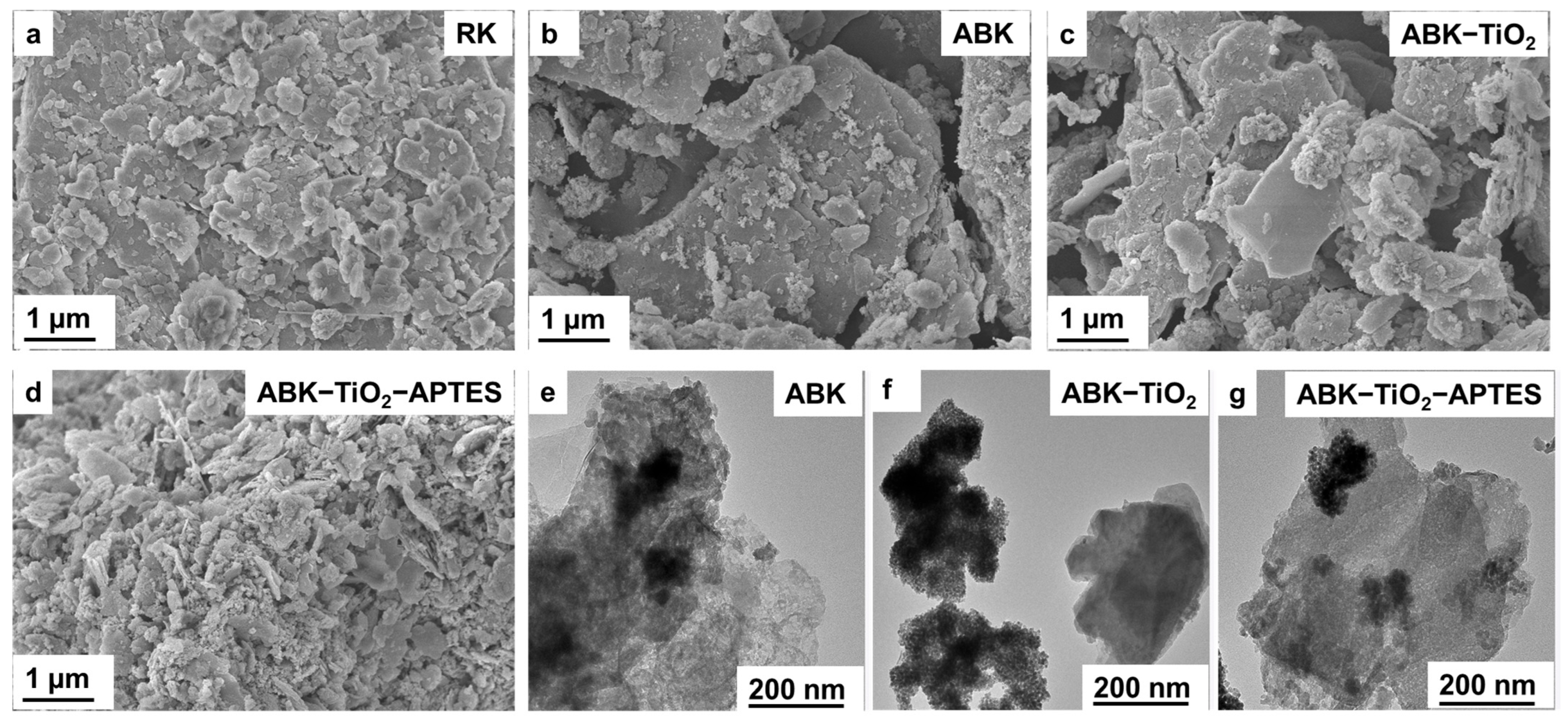
SEM images (Figure 3a) show that RK consists of micrometer-sized, plate-like particles with relatively smooth faces and tightly stacked layers. After acid–base treatment, surface etching occurred, creating meso- to macro-porosity and rougher textures in ABK (Figure 3b). The overall architecture is a loosely layered structure, as acid attack partially delaminated the stacks and base washing removed residues, thereby yielding a more open microstructure [51]. Upon TiO2 incorporation to form ABK–TiO2 (Figure 3c), TiO2 NPs dispersed as granules are observed on the kaolinite surface. ABK–TiO2–APTES (Figure 3d) exhibits more edge-to-face contacts and random orientations of plates, as APTES grafting disrupts the close face-to-face packing of the plates. TEM image for ABK (Figure 3e) further reveals a partially exfoliated, sheet-like structure with irregular edges and increased porosity. Nano-sized clusters around the kaolinite plate were observed in ABK–TiO2 (Figure 3f), appearing as a dark, scattered region due to the higher atomic number of Ti. In ABK–TiO2–APTES (Figure 3g), the APTES layer was not directly visible, but its presence could be inferred from the perfect anchoring of TiO2 NPs on the kaolinite surface.

3.1.4. Textural Properties

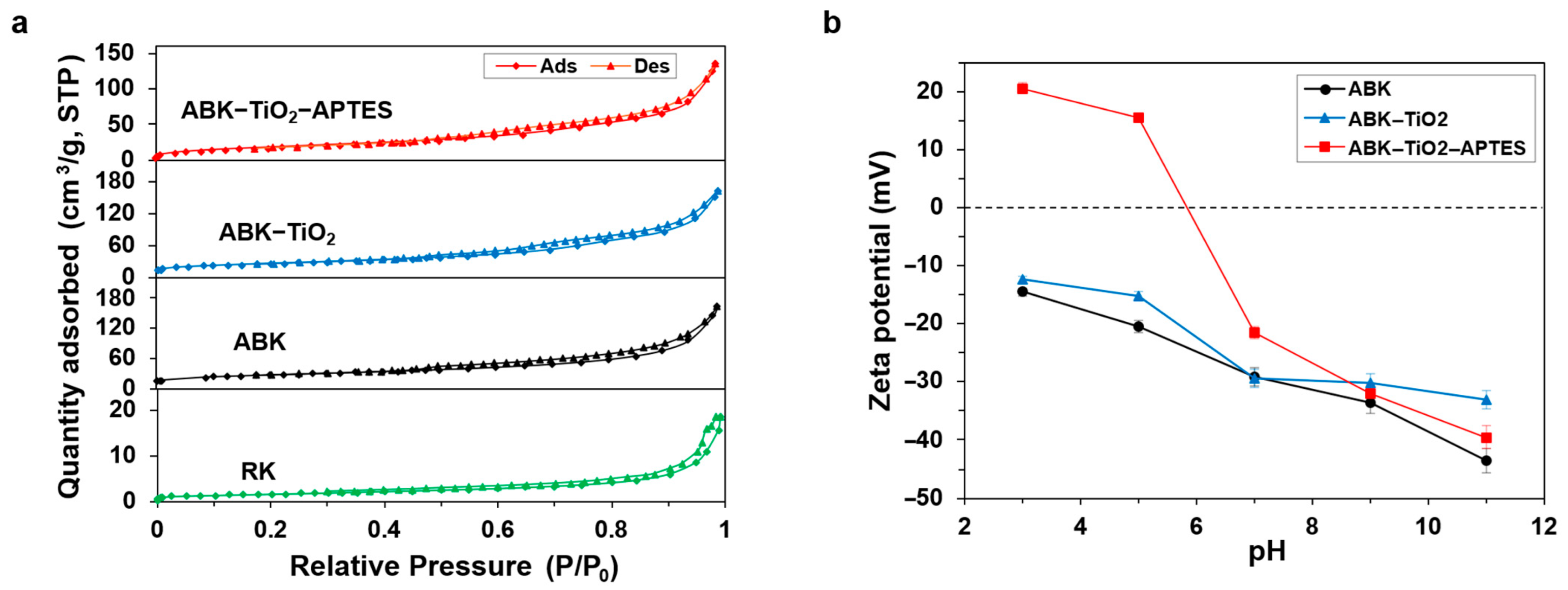
RK exhibited a relatively low BET surface area and pore volume (17 m2/g and 0.063 cm3/g, respectively) due to its platy morphology and limited internal porosity. However, the BET surface area and pore volume increased significantly (94 m2/g and 0.238 cm3/g, respectively) for ABK. This is likely due to the formation of new mesopores created by Al3+ leaching and structural collapse. TiO2 incorporation further modified the textural properties of ABK–TiO2 by slightly increasing the overall surface area (95 m2/g) and pore volume (0.243 cm3/g). After APTES grafting, the BET surface area and pore volume of ABK–TiO2–APTES were reduced to 68 m2/g and 0.203 cm3/g, respectively. This reduction is due to –NH2 groups blocking the pores of the material. The porosity type for RK, ABK, ABK–TiO2, and ABK–TiO2–APTES exhibits a Type IV nitrogen isotherm with an H3 hysteresis loop (Figure 4a), indicating mesopore formation [37]. Table 2 summarizes the BET surface characteristics.
Figure 4b shows zeta potential measurements of ABK, ABK–TiO2, and ABK–TiO2–APTES as a function of pH. The surface charge of ABK (−14.54 mV to −43.52 mV) and ABK–TiO2 (−12.34 mV to −33.01 mV) were all negative across pH 3 to 11. This is due to the leaching of Al–OH groups in these materials, resulting in good colloidal stability that is favorable for binding Hg2+ via Coulombic attraction. For ABK–TiO2–APTES, positive surface charges were observed at pH 3 (20.6 mV) and pH 5 (15.38 mV). This is because the –NH2 groups on ABK–TiO2–APTES are readily protonated to –NH3+, imparting a positive surface charge [47]. However, at pH 7, 9, and 11, surface charges were between −21.56 mV and −39.58 mV. Note that while a negatively charged surface generally enhances Hg2+ adsorption through electrostatic attraction, mercury uptake is not solely governed by surface charge. Even under conditions where the surface is positively charged, Hg2+ ions can still interact strongly with functional groups such as –NH2 and –OH through coordination or complexation mechanisms [52].

3.2. Adsorption Studies

3.2.1. Contact Time

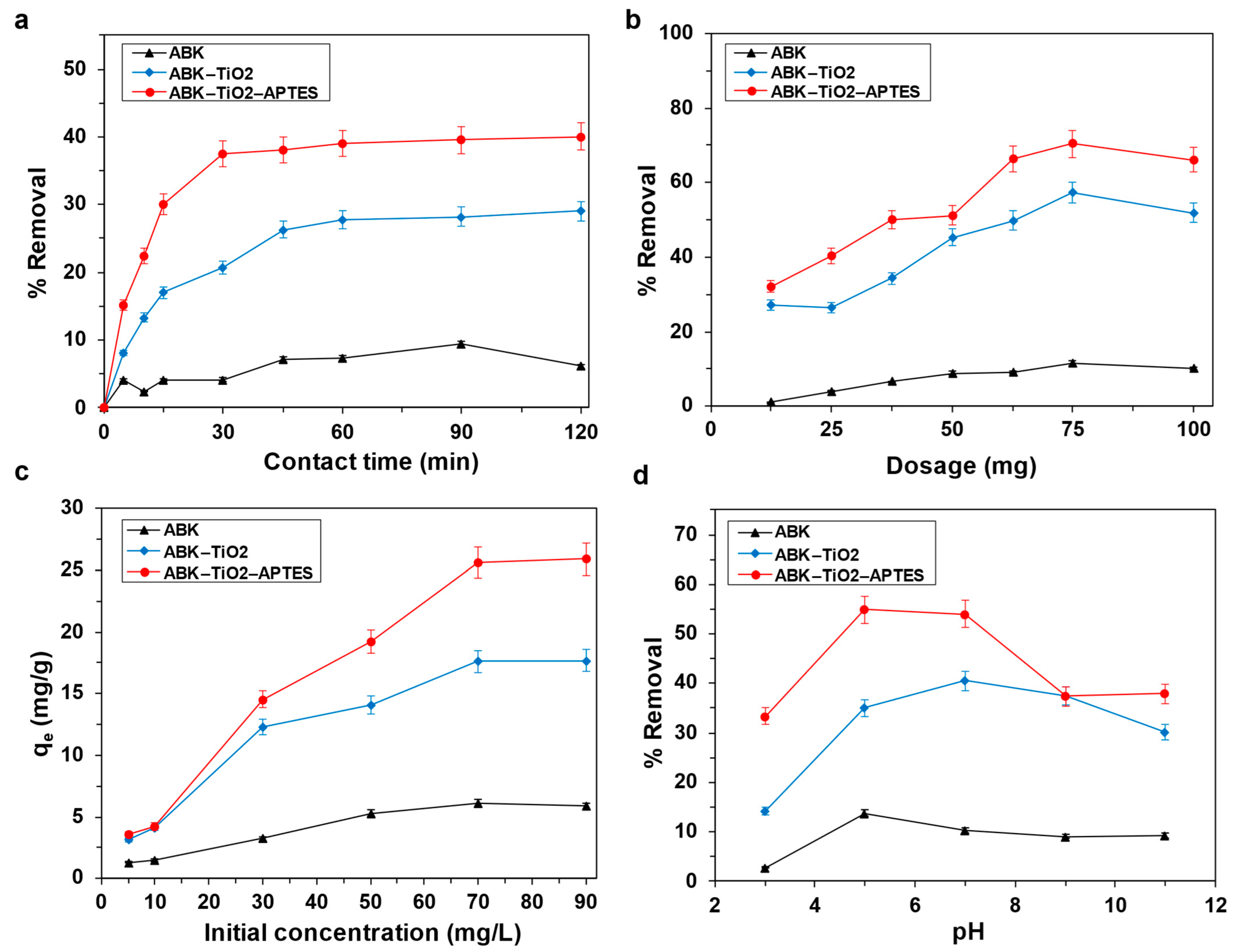
Figure 5a presents the effect of contact time on Hg2+ uptake for ABK, ABK–TiO2, and ABK–TiO2–APTES. ABK–TiO2–APTES showed the highest removal, reaching ~39% Hg2+ removal within 60 min and ~40% by 120 min, whereas ABK–TiO2 achieved 26.3% in 60 min and plateaued at ~29% thereafter. By contrast, ABK attained only 7.3% by 60 min and dropped to 6.1% at 120 min. This two-stage adsorption (initial rapid surface binding followed by slower intraparticle diffusion) is typical for metal sorption on porous solids [53,54]. The much higher Hg2+ uptake by ABK–TiO2–APTES highlights the effectiveness of surface functionalization. By comparison, Hg2+ uptake on ABK likely occurs only at silanol and aluminol sites via cation exchange, which is slower and limited [25]. ABK–TiO2 intermediate performance suggests TiO2 NPs add adsorptive hydroxyl sites and possibly increase surface area, thus improving performance over ABK [37]. All adsorbents achieved near-equilibrium by 90–120 min, so a 120 min contact time was chosen for subsequent experiments to ensure maximum Hg2+ removal.

3.2.2. Effect of Adsorbent Dosage

Hg2+ removal efficiency increased with adsorbent dosage for all three materials (Figure 5b), due to the greater availability of binding sites at higher loading [37]. At a low dose of 12.5 mg, ABK removed only ~1% of Hg2+, while ABK–TiO2 and ABK–TiO2–APTES achieved 27.2% and ~32% removal, respectively. Increasing the dose to 50 mg raised Hg2+ removal to 8.9% for ABK, 45.3% for ABK–TiO2, and 51.2% for ABK–TiO2–APTES. An optimal dosage was achieved at 75 mg, where ABK–TiO2–APTES resulted in 70.4% removal, compared to 57.3% for ABK–TiO2 and 11.6% for ABK. Beyond this point, the removal percentage declined for all materials. This is likely due to possible adsorbent agglomeration, thereby reducing the effective surface area [55]. The incorporation of TiO2 and –NH2 functional groups onto the ABK surface increases the number of active sites and enhances the binding affinity toward Hg2+ ions, thereby reducing the amount of adsorbent required to achieve effective removal. These results agree with previous reports that functionalizing clays with inorganic oxides or organic ligands greatly improves their adsorptive efficiency [35,37].

3.2.3. Effect of Initial Mercury Concentration

Equilibrium uptake rose with increasing initial Hg2+ concentrations (Figure 5c) for all adsorbents, approaching saturation at higher concentrations. For example, at 5 mg/L of Hg2+, the adsorption capacity of ABK was 1.3 mg/g, whereas ABK–TiO2 reached 3.1 mg/g and ABK–TiO2–APTES 3.6 mg/g. At 50 mg/L Hg2+, adsorption capacities were significantly higher: ABK 5.3 mg/g, ABK–TiO2 14.1 mg/g, and ABK–TiO2–APTES 19.2 mg/g. Finally, at the optimal concentration (70 mg/L), ABK–TiO2–APTES achieved an adsorption capacity of 25.6 mg/g, compared to 17.7 mg/g for ABK–TiO2 and 5.8 mg/g for ABK. These trends indicate that a greater driving force (Hg2+ concentration) increases the amount of uptake. ABK–TiO2–APTES clearly exhibits superior performance with a capacity roughly five times that of ABK. This aligns with the literature, which shows that –NH2-functionalized adsorbents have substantially higher Hg2+ capacities due to specific metal–ligand complexation [54,56]. ABK–TiO2 also achieved a capacity thrice that of ABK, likely due to the presence of additional hydroxyl binding sites and increased surface area.

3.2.4. Effect of Solution pH

Solution pH substantially affects Hg2+ adsorption by influencing both metal speciation and adsorbent surface charge. Figure 5d shows that ABK had 2.8% removal at pH 3 but increased to 13.7% at pH 5 (optimum). This is due to the deprotonation of kaolinite sites and reduced competition from H+ [54,56]. At pH 7, the performance of ABK dropped to 10.3% and remained low at ~9% for pH 9 and 11. ABK–TiO2 exhibited an optimal pH of around 7, with removal increasing from 14.3% at pH 3 to ~35% at pH 5 and 40.5% at pH 7. Subsequently, removal decreased to 37.5% at pH 9 and 30.1% at pH 11. The TiO2-loaded adsorbent thus favors neutral pH, consistent with the point of zero charge of TiO2, which is between 6 and 7. ABK–TiO2–APTES exhibited optimal Hg2+ removal at pH 5, achieving a removal efficiency of 54.9%, despite its positively charged surface as indicated by zeta potential analysis. This performance is likely attributed to the coordination between surface –NH2 groups and Hg2+ ions, facilitating inner-sphere complexation that overcomes electrostatic repulsion [57]. At pH 3, Hg2+ removal was 33.3%, reaching 54% at pH 7, and then decreasing to ~37% at pH 9 and 11. At pH 3, the –NH2 groups are protonated to –NH3+, while kaolinite surface sites are neutralized by H+, thereby suppressing electrostatic attraction [47]. By contrast, at pH 7 to 11, the formation of hydroxo-complexes such as Hg(OH)2, Hg(OH)3, Hg2(OH)22+ limits the available Hg2+ in solution [56]. These species exhibit very low solubility in aqueous media, and as the hydroxide ion concentration increases, they readily condense or aggregate to form colloidal and precipitated mercury hydroxide phases. This process effectively decreases the concentration of free Hg2+ ions available in solution for adsorption, thereby reducing the apparent adsorption capacity of the adsorbent. Overall, the pH-dependent trends agree with literature for Hg2+ on clays: minimal uptake at pH <4 due to proton competition, a maximum in mildly acidic to neutral conditions, and interference from metal hydroxide precipitation at high pH [54]. Therefore, subsequent experiments were conducted using ABK–TiO2–APTES at pH 5, with an optimized dosage of 75 mg and an initial Hg2+ concentration of 70 mg/L to ensure maximum adsorption performance under representative conditions.

3.3. Effect of Water Matrix Components on Adsorption Efficiency

3.3.1. Effect of Natural Organic Matter

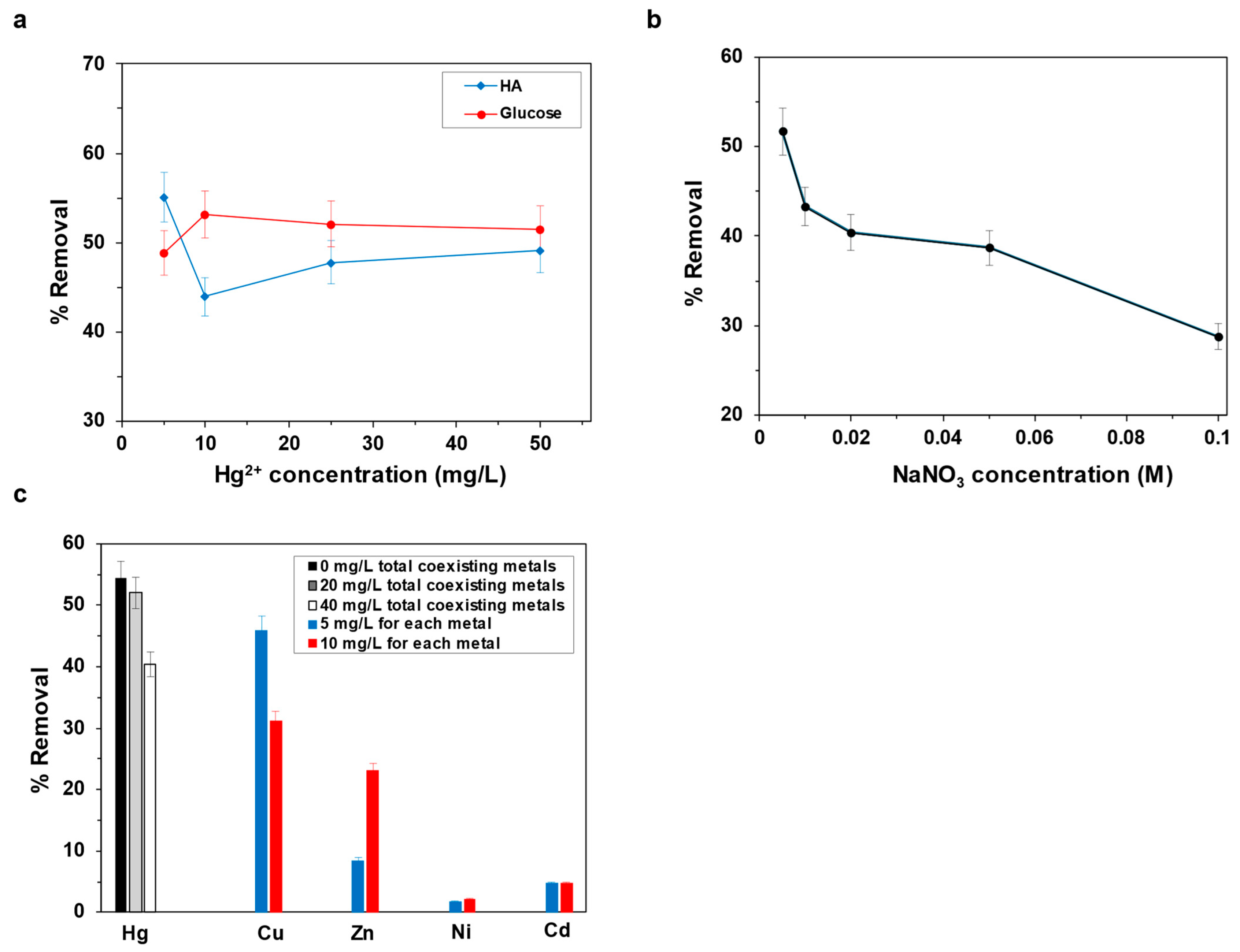
Figure 6a shows the effect of HA and glucose during Hg2+ uptake on ABK–TiO2–APTES. HA caused a slight overall reduction in Hg2+ removal, whereas glucose had no marked effect. In the presence of 1 mg/L of HA, 52.3% of Hg2+ removal was observed. With 5 mg/L of HA, Hg2+ removal was 55.1%, but dropped to 43.9% at 10 mg/L. Higher HA concentrations of 25 and 50 mg/L resulted in Hg2+ removal of 47.8% and 49.1%, respectively. By contrast, with 10–50 mg/L glucose, Hg2+ removal remained between 51% and 53% with no notable decline. These results indicate that humic substances can moderately interfere with Hg2+ uptake, whereas an inert organic carbon source such as glucose does not. The transient ~10% decrease in removal at 10 mg/L of HA suggests competitive binding. This can be due to the abundance of functional groups (carboxyl, carbonyl, hydroxyl, thiol, and amino) present in HA, which form strong complexes with Hg2+ in solution, thereby preventing it from adsorbing onto ABK–TiO2–APTES. These functional groups (oxygen- and sulfur-containing moieties) readily form stable Hg–O and Hg–S complexes, thereby reducing the availability of free Hg2+ ions for adsorption onto ABK–TiO2–APTES. In addition, the adsorption of HA onto the adsorbent surface may partially block active sites, further hindering mercury uptake [56]. This observation highlights the importance of considering NOM competition in practical water treatment systems when using functionalized clay-based adsorbents such as ABK–TiO2–APTES.

3.3.2. Effect of Ionic Strength

Figure 6b shows that a significant decrease in Hg2+ removal was observed, from 51.7% at 0.005 M NaNO3 to 28.7% at 0.1 M. This trend indicates that higher ionic strength decreases Hg2+ uptake. Increased ionic strength generally screens the electrostatic attractions between charged adsorbent sites and metal ions, and cations like Na+ can compete for exchange sites on the kaolinite surface [56]. In the case of ABK–TiO2–APTES, the decline in performance suggests that a portion of Hg2+ binding involves electrostatic outer-sphere interactions that are weakened by a compressed electric double layer [58]. However, a substantial fraction of Hg2+ was still adsorbed, even at an ionic strength of 0.1 M. This resilience is due to the chemical binding of Hg2+ on ABK–TiO2–APTES. Previous studies on Hg2+–clay systems have indeed found that ionic strength decreases mercury uptake. For instance, Huang et al., (2019) found that NaNO3, with a concentration ranging from 0 to 0.1 M, decreased Hg2+ uptake from 88.7% to 79.3% and CH3Hg+ uptake from 98.8% to 86.0% [56]. This finding highlights the sensitivity of mercury species to competitive ionic environments, where increased background electrolyte concentrations can hinder adsorption efficiency.

3.3.3. Effect of Coexisting Heavy Metals

The presence of Cu2+, Zn2+, Ni2+, and Cd2+ suppressed Hg2+ uptake (Figure 6c). In the control (no co-ions), Hg2+ removal was ~55%. With 5 mg/L of Cu2+, Zn2+, Ni2+, and Cd2+ each (20 mg/L in total), Hg2+ removal fell to ~52%, whereas at 10 mg/L each, it fell to ~40%. Meanwhile, Cu2+ removal was ~46% (dropping to ~31% at higher loading), Zn2+ removal was low (~9% rising to ~22%), and Ni2+/Cd2+ uptake remained negligible (<5%). These results reflect competitive adsorption, where additional cations occupy binding sites and reduce Hg2+ binding, yet Hg2+ remains the predominant adsorbed ion. The fact that Hg2+ retention remains relatively robust indicates that ABK–TiO2–APTES binding sites preferentially chelate soft, low-hydration metals. Huang et al., (2019) demonstrated that the thiol-functionalized graphene oxide/Fe–Mn composite exhibited similar trends where metals with strong water coordination (e.g., Ni2+ and Zn2+) showed minimal adsorption, while softer metals dominated uptake [56].

3.4. Adsorption Kinetics and Isotherms

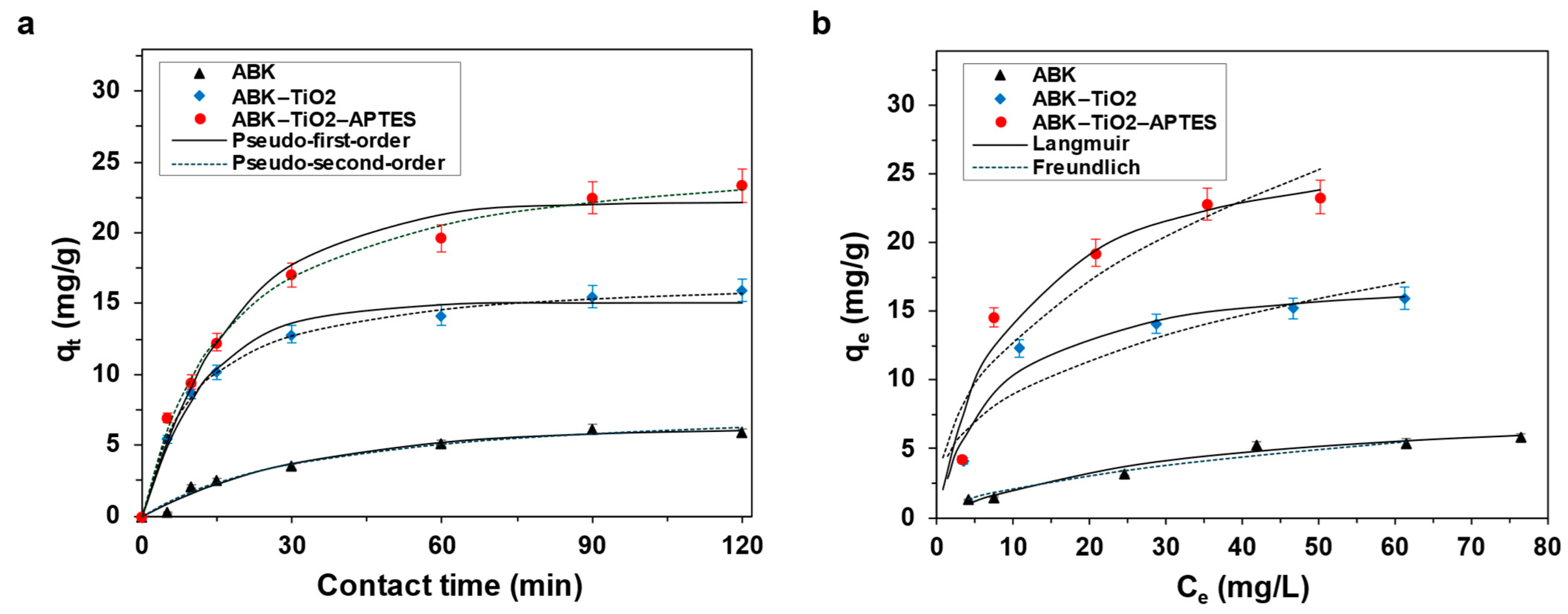
Figure 7a compares the PFO and PSO kinetic models for Hg2+ adsorption onto ABK, ABK–TiO2, and ABK–TiO2–APTES, with their corresponding fitting parameters presented in Table 3. For ABK–TiO2 and ABK–TiO2–APTES, the PSO model yielded an excellent fit (R2 ≈ 0.996–0.999) and much lower sum of squared residuals (SSR) than the PFO model. A similar study on Hg2+ uptake using functionalized kaolin reported R2 values of 0.966 and 0.983 for PFO and PSO models, respectively [26]. Similarly, Moussout et al., (2018) observed that PSO offers superior correlation (R2 ≈ 1), but recommended using both R2 and error metrics to judge kinetic fits [59]. The PSO fit for both ABK–TiO2 and ABK–TiO2–APTES yields not only a higher R2 but also a significantly lower SSE (0.315 and 1.923, respectively), indicating a more accurate representation of the uptake rate. The superior fit to the PSO model suggests that chemisorption is the governing mechanism, as this model assumes the rate-limiting step involves valence forces between the adsorbate and the adsorbent [42]. By contrast, ABK exhibited much lower capacity and a more gradual approach to equilibrium. Here, PFO and PSO fits are more similar, with both models yielding an R2 of 0.981 and 0.979, respectively. This suggests that the physisorption process dominates Hg2+ uptake, indicating that ABK likely relies on weaker interactions.
Figure 7b shows the adsorption isotherms for ABK, ABK–TiO2, and ABK–TiO2–APTES, with the corresponding fitting parameters detailed in Table 3. The Langmuir model provided excellent fits for ABK, ABK–TiO2, and ABK–TiO2–APTES with R2 values of 0.974, 0.968, and 0.961, respectively. This behavior aligns with findings for other functionalized adsorbents (e.g., biochar) where Langmuir isotherms dominate, indicating monolayer adsorption on homogeneous sites [60]. The progression of Langmuir monolayer capacity values from 8.4 mg/g for ABK to 18 mg/g for ABK–TiO2, and then to 28.4 mg/g for ABK–TiO2–APTES, indicates a progressive enhancement of adsorption capacity with each successive surface modification.

3.5. Adsorption Mechanism

The performance of ABK–TiO2 and ABK–TiO2–APTES in Hg2+ removal can be attributed to multiple complementary mechanisms at the surface. Electrostatic attraction is one contributing factor: at an initial solution pH of around 5 to 7, where ABK–TiO2 and ABK–TiO2–APTES surfaces acquire a negative charge, Hg2+ cations are drawn to the surface by Coulombic forces [57]. This initial attraction can increase local Hg2+ concentration near the interface, facilitating further binding. However, pure electrostatic adsorption (outer-sphere) is relatively weak and not solely responsible for the uptake observed. More importantly, ligand exchange and surface complexation play a dominant role in the adsorption process. TiO2 and Si–OH groups on ABK–TiO2 binds Hg2+ through an inner-sphere mechanism: Hg2+ coordinates directly to oxygen atoms by displacing a proton or H2O ligand, essentially exchanging ligands and forming a surface–Hg bond. This ligand exchange is a classic route for heavy-metal adsorption on oxides and creates a surface complex anchored to the kaolinite/TiO2 framework [61]. In ABK–TiO2–APTES, the presence of grafted –NH2 groups introduces additional strong binding sites. These –NH2 coordinates to Hg2+ by donating the lone pair of electrons from nitrogen, forming Hg–N [57]. Such chemical bonding with N- and O-ligands firmly immobilizes the Hg2+ on the surface.
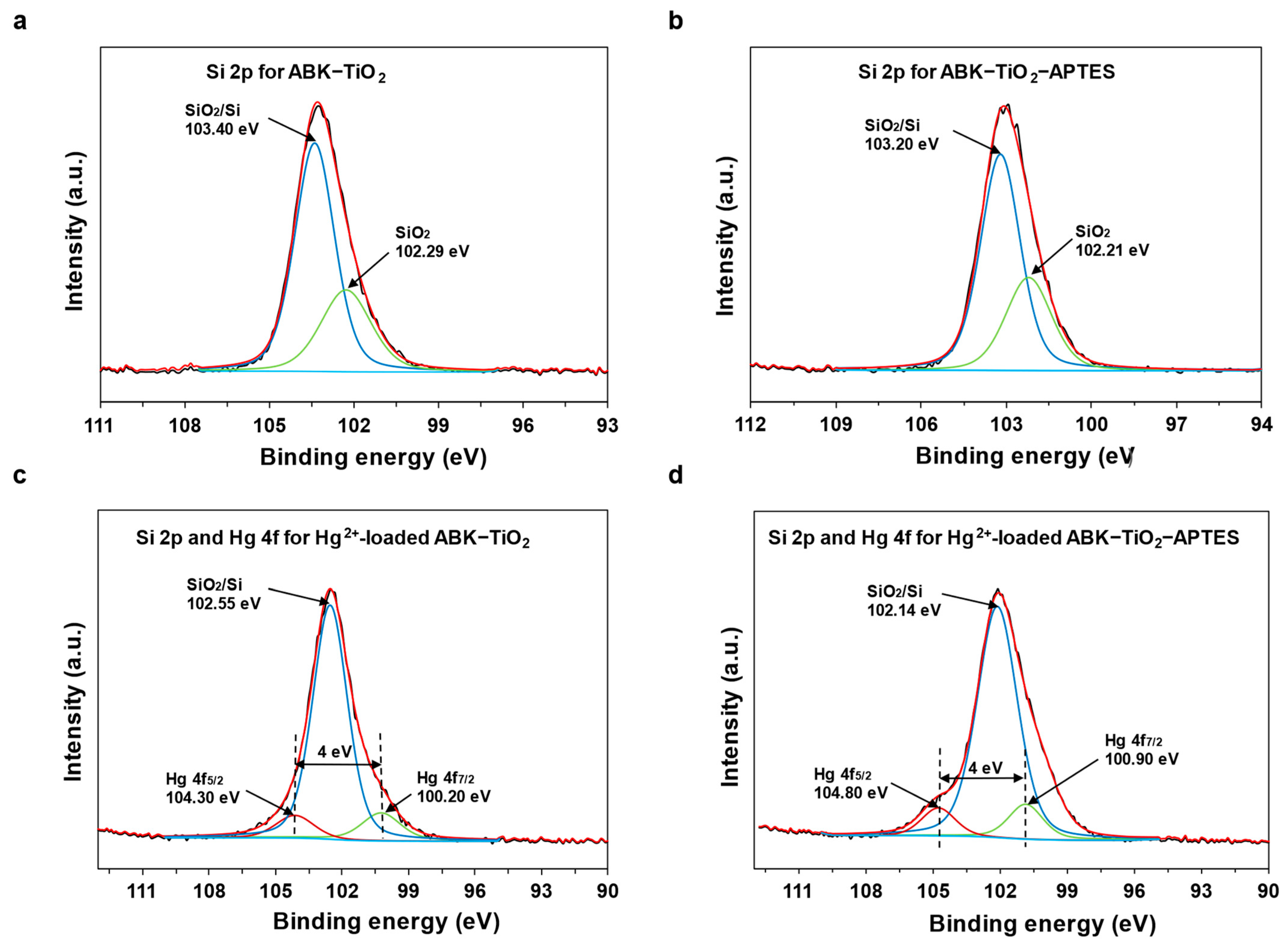
XPS analysis (Figure 8a–d) was conducted before and after Hg2+ adsorption for ABK–TiO2 and ABK–TiO2–APTES to provide direct evidence of inner-sphere interactions. After Hg2+ adsorption, new peaks appeared in the high-resolution XPS corresponding to Hg 4f. Specifically, Hg 4f7/2 and 4f5/2 doublet peaks were observed at binding energies of 100.2 and 104.3 eV for ABK–TiO2 and 100.9 and 104.8 eV for ABK–TiO2–APTES with a spin–orbit separation of ∼4.0 eV [54]. This spectral signature is characteristic of Hg2+ species chemisorbed onto ligating atoms (such as O or N) on a surface [62]. This rules out the presence of metallic Hg0 (which would appear at a lower binding energy, ~99 eV) and confirms that Hg remains in the oxidized state, likely bound as surface complexes (–O–Hg2+ and –N–Hg2+). Notably, the Si 2p region of XPS in ABK–TiO2 and ABK–TiO2–APTES showed a shift toward lower binding energy upon Hg2+ adsorption. This is due to charge redistribution within the Si–O–Si/Ti–O–Si network, indicating that the Si–O bonds in the kaolin matrix remained chemically stable and were not directly involved in Hg2+ coordination. These observations support a mechanism where Hg2+ is chemisorbed via specific coordination to surface functional groups.

3.6. Desorption and Reuse Studies

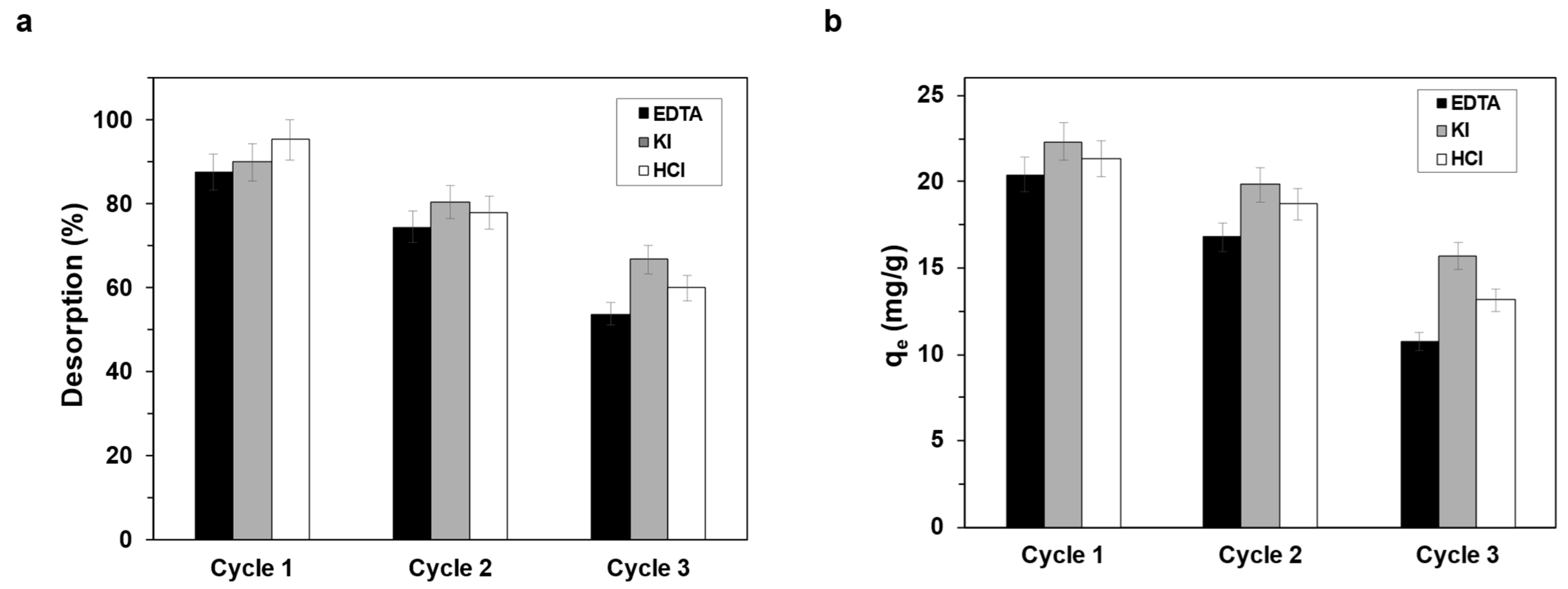
Figure 9a,b show the desorption and reuse studies, respectively, for ABK–TiO2–APTES using different eluents (HCl, KI, and EDTA). Desorption efficiencies declined across three cycles for all eluents, with HCl yielding the highest (~95%) in the first cycle, followed by KI (~90%) and EDTA (~88%). By Cycle 3, desorption levels dropped to ~60% (HCl), 67% (KI), and 54% (EDTA). Similarly, the adsorption capacity of the desorbed ABK–TiO2–APTES after reuse decreased (~21 mg/g to 13 mg/g for HCl, ~22 mg/g to 16 mg/g for KI, and ~20 mg/g to 11 mg/g for EDTA). The stronger regeneration effect of HCl is consistent with other Hg2+ adsorbents, where 0.1-M HCl recovered most adsorbed Hg2+ [47]. By Cycle 3, the performance of KI is comparable to HCl, reflecting the high affinity of iodide for Hg2+, whereas the lower efficiency of EDTA implies incomplete chelation. Overall, only ~50%–70% of the initial capacity was retained after three cycles, indicating that a significant fraction of Hg2+ is bound irreversibly. This behavior is consistent with a chemisorptive mechanism via Hg–N and Hg–O coordination [63]. Table 4 compares this study with previous ones on the removal of Hg2+ using kaolin and modified kaolin adsorbents.

3.7. Antibacterial Activity

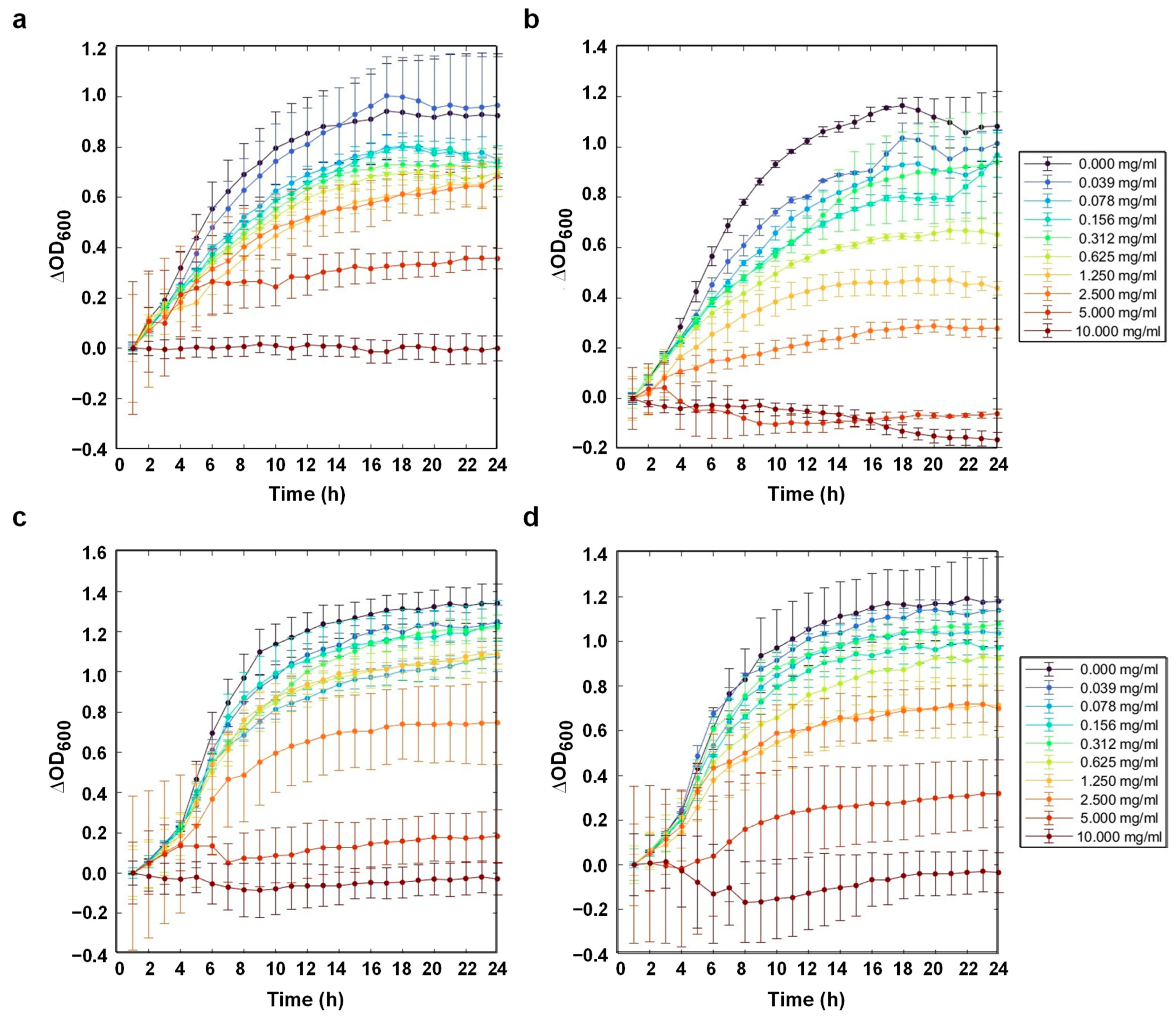
Figure 10a shows that RK exhibited antibacterial activity against E. coli (BL21) with an MIC of 10 mg/mL. Both ABK (Figure 10b) and ABK–TiO2 (Figure 10c) exhibited enhanced antibacterial activity with an MIC of 5 mg/mL, indicating that the antibacterial ability of RK was improved by acid–base treatment. Despite the known antibacterial properties of TiO2, ABK–TiO2–APTES (Figure 10d) did not exhibit enhanced antibacterial activity against E. coli (BL21), as evidenced by the unchanged MIC compared to RK.
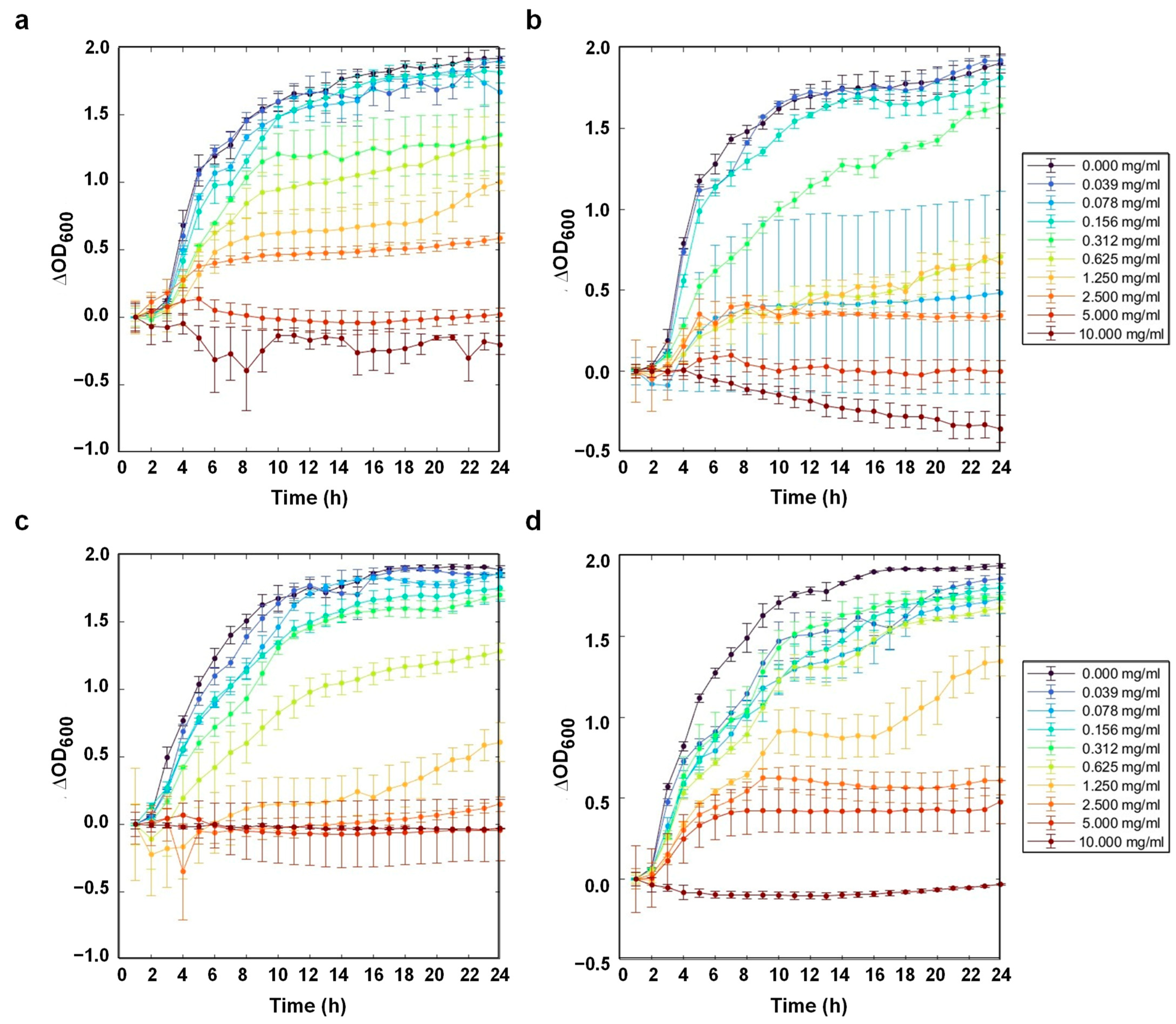
For S. aureus, RK (Figure 11a) and ABK (Figure 11b) exhibited antibacterial activity with MIC = 5 mg/mL, whereas ABK–TiO2 (Figure 11c) showed the greatest antibacterial efficacy with an MIC of 2.5 mg/mL. Notably, ABK–TiO2–APTES (Figure 11d) again exhibited the weakest antibacterial activity (MIC = 10 mg/mL). The greater susceptibility of S. aureus to ABK–TiO2 may be due to stronger interactions between the positively charged TiO2 surface and the Gram-positive bacterial membrane, which may be mediated by increased ROS generation.
Previous studies have shown that ultraviolet-activated TiO2 surfaces inactivate S. aureus more rapidly than E. coli (BL21), which aligns with the observed pattern [66]. This is most likely due to the absence of an outer membrane in S. aureus, which typically restricts ROS penetration in Gram-negative organisms [67,68]. According to Tang et al., (2019), TiO2 NPs generate photocatalytic ROS that damage intracellular proteins, DNA, and bacterial membranes, resulting in antibacterial actions [69]. While NH2 functional groups can confer antibacterial properties to APTES, the reduced efficacy of ABK–TiO2–APTES suggests a more complex relationship. APTES is commonly used as a surface modifier or linker rather than an active biocidal agent. It primarily alters the zeta potential, bandgap characteristics, and surface chemistry of TiO2 NPs through the formation of Ti–O–Si bonds [70]. Functionalization may result in a multilayer surface coating that covers active sites and thus reduces the efficiency of ROS-mediated bacterial killing, even as it increases susceptibility to visible light. Rokicka-Konieczna et al., (2023) found that increasing the APTES concentration from 300 to 400 mM decreased antibacterial activity due to a masking effect and a reduction in surface area and pore volume, despite a higher surface charge [41]. Table 5 summarizes the MIC values for RK, ABK, ABK–TiO2, and ABK–TiO2–APTES.

4. Conclusions

In this study, sequential acid–base treatment, TiO2 NP incorporation, and APTES grafting of kaolin successfully yielded a dual-functional adsorbent. The modified kaolin (ABK–TiO2 and ABK–TiO2–APTES) demonstrated a Hg2+ adsorption capacity (17.7 and 25.6 mg/g, respectively) approximately three and five times higher than that of acid–base-treated kaolin (ABK; 5.8 mg/g). Among the tested materials, ABK–TiO2–APTES was the most effective and was therefore evaluated under challenging water matrices. ABK–TiO2–APTES maintained its Hg2+ removal efficiency across a wide range of conditions, including variations in ionic strength, NOM, and the presence of competing heavy metal ions (Cu2+, Zn2+, Cd2+, and Ni2+). Isotherm modeling and XPS analysis confirmed that Hg2+ uptake occurs primarily through chemisorption via inner-sphere complexation to the TiO2 hydroxyls and grafted –NH2 groups. ABK–TiO2–APTES maintained stable performance across multiple regeneration cycles, demonstrating its reusability. For antibacterial activity, ABK–TiO2 inhibited the growth of S. aureus (MIC of 2.5 mg/mL), while showing a moderate effect against E. coli (BL21). However, ABK–TiO2–APTES exhibited a slight reduction in bacterial inhibition, suggesting a trade-off between maximizing adsorption capacity and preserving antimicrobial sites. This multifunctional adsorbent presents a promising solution for the simultaneous removal of toxic metals and microbial pathogens, aligning with SDG 6.

Author Contributions

Conceptualization, S.G.P.; methodology, A.A.A. and T.T.P.; formal analysis, A.A.A., S.K., Z.S., Y.S., M.P. and D.A.; investigation, A.A.A., S.K., Z.S., Y.S., M.P. and D.A.; resources, S.G.P. and T.T.P.; data curation, G.Z.K., T.T.P. and E.A.; writing—original draft preparation, A.A.A., S.K., Z.S., Y.S. and M.P., writing—review and editing, S.G.P., G.Z.K., T.T.P. and E.A.; visualization, S.G.P., G.Z.K., T.T.P. and E.A.; supervision, S.G.P.; project administration, S.G.P.; funding acquisition, S.G.P. and T.T.P. All authors have read and agreed to the published version of the manuscript.

Funding

This research was funded by the Nazarbayev University project “Valorization of local kaolin as adsorbent and catalyst for water/wastewater treatment”, Faculty Development Competitive Research Grant Program (General) 2024–2026, Grant Number 201223FD8809 awarded to S.G. Poulopoulos.

Data Availability Statement

The original contributions presented in this study are included in the article.

Conflicts of Interest

The authors declare no conflicts of interest.

References

  1. Kanafin, Y.N.; Abduvalov, A.; Kaikanov, M.; Poulopoulos, S.G.; Atabaev, T.S. A Review on WO3 Photocatalysis Used for Wastewater Treatment and Pesticide Degradation. Heliyon 2025, 11, e40788. [Google Scholar] [CrossRef] [PubMed]
  2. Alkhudhiri, A.; Hakami, M.; Zacharof, M.-P.; Abu Homod, H.; Alsadun, A. Mercury, Arsenic and Lead Removal by Air Gap Membrane Distillation: Experimental Study. Water 2020, 12, 1574. [Google Scholar] [CrossRef]
  3. Aguiar, A.B.S.; Costa, J.M.; Santos, G.E.; Sancinetti, G.P.; Rodriguez, R.P. Removal of Metals by Biomass Derived Adsorbent in Its Granular and Powdered Forms: Adsorption Capacity and Kinetics Analysis. Sustain. Chem. 2022, 3, 535–550. [Google Scholar] [CrossRef]
  4. Tapia-Quiroz, G.E.; Valencia-Leal, S.A.; Vázquez-Guerrero, A.; Alfaro-Cuevas-Villanueva, R.; Escudero-García, R.; Cortés-Martínez, R. Surfactant-Enhanced Guava Seed Biosorbent for Lead and Cadmium Removal: Kinetics, Thermodynamics, and Reusability Insights. Sustain. Chem. 2025, 6, 5. [Google Scholar] [CrossRef]
  5. Tolkou, A.K.; Toubanaki, D.K.; Kyzas, G.Z. Detection of Arsenic, Chromium, Cadmium, Lead, and Mercury in Fish: Effects on the Sustainable and Healthy Development of Aquatic Life and Human Consumers. Sustainability 2023, 15, 16242. [Google Scholar] [CrossRef]
  6. Sun, Q.; Wang, L.; Li, Y.; Li, L.; Li, S.; Zhu, G. Highly Efficient Removal of Mercury Ions from Aqueous Solutions by Thiol-Functionalized Graphene Oxide. Water 2023, 15, 2529. [Google Scholar] [CrossRef]
  7. Dack, K.; Fell, M.; Taylor, C.M.; Havdahl, A.; Lewis, S.J. Prenatal Mercury Exposure and Neurodevelopment up to the Age of 5 Years: A Systematic Review. Int. J. Environ. Res. Public. Health 2022, 19, 1976. [Google Scholar] [CrossRef]
  8. Rice, K.M.; Walker, E.M.; Wu, M.; Gillette, C.; Blough, E.R. Environmental Mercury and Its Toxic Effects. J. Prev. Med. Pub. Health 2014, 47, 74–83. [Google Scholar] [CrossRef]
  9. Zahir, F.; Rizwi, S.J.; Haq, S.K.; Khan, R.H. Low Dose Mercury Toxicity and Human Health. Environ. Toxicol. Pharmacol. 2005, 20, 351–360. [Google Scholar] [CrossRef]
  10. Das, S.; Sultana, K.W.; Ndhlala, A.R.; Mondal, M.; Chandra, I. Heavy Metal Pollution in the Environment and Its Impact on Health: Exploring Green Technology for Remediation. Environ. Health Insights 2023, 17. [Google Scholar] [CrossRef]
  11. Qin, S.; Yang, B.; Northwood, D.O.; Waters, K.E.; Ma, H. The Deep Removal of Mercury in Contaminated Acid by Colloidal Agglomeration Materials M201. Minerals 2024, 14, 782. [Google Scholar] [CrossRef]
  12. Islam, M.S.; Vogler, R.J.; Abdullah Al Hasnine, S.M.; Hernandez, S.; Malekzadeh, N.; Hoelen, T.P.; Hatakeyama, E.S.; Bhattacharyya, D. Mercury Removal from Wastewater Using Cysteamine Functionalized Membranes. ACS Omega 2020, 5, 22255–22267. [Google Scholar] [CrossRef]
  13. Cardoso, S.P.; Faria, T.L.; Pereira, E.; Portugal, I.; Lopes, C.B.; Silva, C.M. Mercury Removal from Aqueous Solution Using ETS-4 in the Presence of Cations of Distinct Sizes. Materials 2021, 14, 11. [Google Scholar] [CrossRef]
  14. Al-Ghouti, M.A.; Da’ana, D.; Abu-Dieyeh, M.; Khraisheh, M. Adsorptive Removal of Mercury from Water by Adsorbents Derived from Date Pits. Sci. Rep. 2019, 9, 15327. [Google Scholar] [CrossRef] [PubMed]
  15. Ahmad, I.; Fatima, N.; Naz, E.; Farooqi, Z.U.R.; Bulgariu, L. Treatment Methods for Mercury Removal From Soil and Wastewater. In Mercury Toxicity Mitigation: Sustainable Nexus Approach; Springer: Cham, Switzerland, 2024; pp. 257–281. [Google Scholar]
  16. Gkika, D.A.; Tolkou, A.K.; Poulopoulos, S.G.; Kalavrouziotis, I.K.; Kyzas, G.Z. Cost-Effectiveness of Regenerated Green Materials for Removal of Pharmaceuticals from Wastewater. Waste Manag. 2025, 204, 114952. [Google Scholar] [CrossRef] [PubMed]
  17. Teweldebrihan, M.D.; Dinka, M.O. Adsorptive Removal of Hexavalent Chromium from Aqueous Solution Utilizing Activated Carbon Developed from Spathodea Campanulata. Sustain. Chem. 2025, 6, 8. [Google Scholar] [CrossRef]
  18. Ali, I. The Quest for Active Carbon Adsorbent Substitutes: Inexpensive Adsorbents for Toxic Metal Ions Removal from Wastewater. Sep. Purif. Rev. 2010, 39, 95–171. [Google Scholar] [CrossRef]
  19. Wang, Y.; He, T.; Yin, D.; Han, Y.; Zhou, X.; Zhang, G.; Tian, X. Modified Clay Mineral: A Method for the Remediation of the Mercury-Polluted Paddy Soil. Ecotoxicol. Environ. Saf. 2020, 204, 111121. [Google Scholar] [CrossRef]
  20. Azanfire, B.-E.; Bulgariu, D.; Cimpoeşu, N.; Bulgariu, L. Efficient Removal of Toxic Heavy Metals on Kaolinite-Based Clay: Adsorption Characteristics, Mechanism and Applicability Perspectives. Water 2025, 17, 1938. [Google Scholar] [CrossRef]
  21. Inglezakis, V.J.; Kudarova, A.; Guney, A.; Kinayat, N.; Tauanov, Z. Efficient Mercury Removal from Water by Using Modified Natural Zeolites and Comparison to Commercial Adsorbents. Sustain. Chem. Pharm. 2023, 32, 101017. [Google Scholar] [CrossRef]
  22. Rao, M.M.; Reddy, D.H.K.K.; Venkateswarlu, P.; Seshaiah, K. Removal of Mercury from Aqueous Solutions Using Activated Carbon Prepared from Agricultural By-Product/Waste. J. Environ. Manage. 2009, 90, 634–643. [Google Scholar] [CrossRef] [PubMed]
  23. Abu, T.O.; Adegoke, H.I.; Odebunmi, E.O.; Shehzad, M.A. Enhancing Adsorption Capacity of a Kaolinite Mineral through Acid Activation and Manual Blending with a 2:1 Clay. Niger. J. Technol. Dev. 2024, 21, 131–151. [Google Scholar] [CrossRef]
  24. Mudzielwana, R.; Gitari, M.W.; Ndungu, P. Uptake of As(V) from Groundwater Using Fe-Mn Oxides Modified Kaolin Clay: Physicochemical Characterization and Adsorption Data Modeling. Water 2019, 11, 1245. [Google Scholar] [CrossRef]
  25. Altunkaynak, Y.; Canpolat, M.; Yavuz, Ö. Adsorption of Mercury (II) Ions on Kaolinite from Aqueous Solutions: Isothermal, Kinetic, and Thermodynamic Studies. Environ. Prog. Sustain. Energy 2024, 43, e14295. [Google Scholar] [CrossRef]
  26. Lin, Z.; Pan, Z.; Zhao, Y.; Qian, L.; Shen, J.; Xia, K.; Guo, Y.; Qu, Z. Removal of Hg2+ with Polypyrrole-Functionalized Fe3O4/Kaolin: Synthesis, Performance and Optimization with Response Surface Methodology. Nanomaterials 2020, 10, 1370. [Google Scholar] [CrossRef]
  27. Xu, Y.; Zhang, S.; Zhao, Y.; Yang, J.; Shen, S.; Zhang, G.; Guo, Y.; Zheng, X. Efficient Removal of Hg2+ by L-Cysteine and Polypyrrole-Functionalized Magnetic Kaolin: Condition Optimization, Model Fitting and Mechanism. Res. Chem. Intermed. 2022, 48, 4287–4311. [Google Scholar] [CrossRef]
  28. Chen, M.; Yang, T.; Han, J.; Zhang, Y.; Zhao, L.; Zhao, J.; Li, R.; Huang, Y.; Gu, Z.; Wu, J. The Application of Mineral Kaolinite for Environment Decontamination: A Review. Catalysts 2023, 13, 123. [Google Scholar] [CrossRef]
  29. Kumar, S.; Panda, A.K.; Singh, R.K. Preparation and Characterization of Acids and Alkali Treated Kaolin Clay. Bull. Chem. React. Eng. Catal. 2013, 8, 61–69. [Google Scholar] [CrossRef]
  30. Makó, É.; Sarkadi, Z.; Ható, Z.; Kristóf, T. Characterization of Kaolinite-3-Aminopropyltriethoxysilane Intercalation Complexes. Appl. Clay Sci. 2023, 231, 106753. [Google Scholar] [CrossRef]
  31. Avila, L.R.; Faria, E.H.d.; Ciuffi, K.J.; Nassar, E.J.; Calefi, P.S.; Vicente, M.A.; Trujillano, R. New Synthesis Strategies for Effective Functionalization of Kaolinite and Saponite with Silylating Agents. J. Colloid Interface Sci. 2010, 341, 186–193. [Google Scholar] [CrossRef]
  32. Donga, C.; Mishra, S.; Aziz, A.; Ndlovu, L.; Kuvarega, A.; Mishra, A.K. (3-Aminopropyl) Triethoxysilane (APTES) Functionalized Magnetic Nanosilica Graphene Oxide (MGO) Nanocomposite for the Comparative Adsorption of the Heavy Metal (Pb(II), Cd(II) and Ni(II)) Ions from Aqueous Solution. J. Inorg. Organomet. Polym. Mater. 2021, 32, 2235–2248. [Google Scholar] [CrossRef]
  33. Mao, S.; Gao, M. Functional Organoclays for Removal of Heavy Metal Ions from Water: A Review. J. Mol. Liq. 2021, 334, 116143. [Google Scholar] [CrossRef]
  34. Abdellaoui, Y.; El Ibrahimi, B.; Ahrouch, M.; Kassab, Z.; El Kaim Billah, R.; Coppel, Y.; López-Maldonado, E.A.; Abou Oualid, H.; Díaz de León, J.N.; Leiviskä, T.; et al. New Hybrid Adsorbent Based on APTES Functionalized Zeolite W for Lead and Cadmium Ions Removal: Experimental and Theoretical Studies. Chem. Eng. J. 2024, 499, 156056. [Google Scholar] [CrossRef]
  35. Meroufel, B.; Zenasni, M.A. Preparation, Characterization, and Heavy Metal Ion Adsorption Property of APTES-Modified Kaolin: Comparative Study with Original Clay. In Handbook of Environmental Materials Management; Springer International Publishing: Berlin/Heidelberg, Germany, 2018; pp. 1–25. [Google Scholar]
  36. Cui, H.; Qian, Y.; Li, Q.; Wei, Z.; Zhai, J. Fast Removal of Hg(II) Ions from Aqueous Solution by Amine-Modified Attapulgite. Appl. Clay Sci. 2013, 72, 84–90. [Google Scholar] [CrossRef]
  37. Mustapha, S.; Tijani, J.O.; Ndamitso, M.M.; Abdulkareem, A.S.; Shuaib, D.T.; Mohammed, A.K. Adsorptive Removal of Pollutants from Industrial Wastewater Using Mesoporous Kaolin and Kaolin/TiO2 Nanoadsorbents. Environ. Nanotechnol. Monit. Manag. 2021, 15, 100414. [Google Scholar] [CrossRef]
  38. Afonso, A.C.; Saavedra, M.J.; Gomes, I.B.; Simões, M.; Simões, L.C. Current Microbiological Challenges in Drinking Water. J. Water Process Eng. 2025, 72, 107614. [Google Scholar] [CrossRef]
  39. Martins, V.V.; Zanetti, M.O.B.; Pitondo-Silva, A.; Stehling, E.G. Aquatic Environments Polluted with Antibiotics and Heavy Metals: A Human Health Hazard. Environ. Sci. Pollut. Res. 2014, 21, 5873–5878. [Google Scholar] [CrossRef]
  40. Serov, D.A.; Gritsaeva, A.V.; Yanbaev, F.M.; Simakin, A.V.; Gudkov, S.V. Review of Antimicrobial Properties of Titanium Dioxide Nanoparticles. Int. J. Mol. Sci. 2024, 25, 519. [Google Scholar] [CrossRef]
  41. Rokicka-Konieczna, P.; Wanag, A.; Sienkiewicz, A.; Izuma, D.S.; Ekiert, E.; Kusiak-Nejman, E.; Terashima, C.; Yasumori, A.; Fujishima, A.; Morawski, A.W. Photocatalytic Inactivation of Co-Culture of E. Coli and S. Epidermidis Using APTES-Modified TiO2. Molecules 2023, 28, 1655. [Google Scholar] [CrossRef]
  42. Abdulsalam, A.A.; Pirman, M.; Begenova, D.; Kyzas, G.Z.; Xia, D.; Pham, T.T.; Golman, B.; Poulopoulos, S.G. Thiol Functionalized Kaolin Pellets: Development and Optimization for Mercury Ion Removal from Aqueous Solutions. Appl. Clay Sci. 2025, 277, 107983. [Google Scholar] [CrossRef]
  43. Langmuir, I. Adsorption of gasbs on glass, mica and platinum. The adsorption of gases on plane surfaces of glass, mica and platinum. J. Am. Chem. Soc. 1918, 40, 1361–1403. [Google Scholar] [CrossRef]
  44. Freundlich, H. Über Die Adsorption in Lösungen. Z. Für Phys. Chem. 1907, 57U, 385–470. [Google Scholar] [CrossRef]
  45. Mergenbayeva, S.; Bekaliyev, A.; Junissov, A.; Begenova, D.; Pham, T.T.; Poulopoulos, S.G. 4-Nitrophenol Reduction and Antibacterial Activity of Ag-Doped TiO2 Photocatalysts. Environ. Sci. Pollut. Res. Int. 2024, 31, 4640–4653. [Google Scholar] [CrossRef]
  46. Erasto, L.; Hellar-Kihampa, H.; Mgani, Q.A.; Lugwisha, E.H.J. Comparative Analysis of Cationic Dye Adsorption Efficiency of Thermally and Chemically Treated Tanzanian Kaolin. Environ Earth Sci. 2023, 82, 101. [Google Scholar] [CrossRef]
  47. Zhang, Q.; Yan, Z.; Ouyang, J.; Zhang, Y.; Yang, H.; Chen, D. Chemically Modified Kaolinite Nanolayers for the Removal of Organic Pollutants. Appl. Clay Sci. 2018, 157, 283–290. [Google Scholar] [CrossRef]
  48. Karunadasa, K.S.P.; Wijekoon, A.S.K.; Manoratne, C.H. TiO2-Kaolinite Composite Photocatalyst for Industrial Organic Waste Decontamination. Next Materials. 2024, 3, 100065. [Google Scholar] [CrossRef]
  49. Li, X.; Peng, K.; Chen, H.; Wang, Z. TiO2 Nanoparticles Assembled on Kaolinites with Different Morphologies for Efficient Photocatalytic Performance. Sci. Rep. 2018, 8, 11663. [Google Scholar] [CrossRef]
  50. Kanafin, Y.N.; Turpanova, R.; Beisekova, M.; Poulopoulos, S.G. Sewage Sludge Biochar as a Persulfate Activator for Methylene Blue Degradation. Clean Technol. 2025, 7, 74. [Google Scholar] [CrossRef]
  51. Belver, C.; Bañares Muñoz, M.A.; Vicente, M.A. Chemical Activation of a Kaolinite under Acid and Alkaline Conditions. Chem. Mater. 2002, 14, 2033–2043. [Google Scholar] [CrossRef]
  52. Wang, P.; Shen, X.; Qiu, S.; Zhang, L.; Ma, Y.; Liang, J. Clay-Based Materials for Heavy Metals Adsorption: Mechanisms, Advancements, and Future Prospects in Environmental Remediation. Crystals 2024, 14, 1046. [Google Scholar] [CrossRef]
  53. El Mouden, A.; Aasli, B.; El Messaoudi, N.; El Guerraf, A.; Miyah, Y.; Erraji, F.Z.; Almehizia, A.A.; Jada, A.; Lacherai, A. Synthesis of 3-Aminopropyltriethoxysilane-Modified Phoenix dactylifera Date Stone Combined with Natural Clay for Adsorption of Mercury Ions from Aqueous Solution. J. Dispers. Sci. Technol. 2025, 1–14. [Google Scholar] [CrossRef]
  54. Pei, P.; Sun, T.; Xu, Y.; Sun, Y. Using Thiol-Functionalized Montmorillonites for Chemically Immobilizing Hg in Contaminated Water and Soil: A Comparative Study of Intercalation and Grafting Functionalization. Appl. Clay Sci. 2022, 216, 106381. [Google Scholar] [CrossRef]
  55. Iftekhar, S.; Ramasamy, D.L.; Srivastava, V.; Asif, M.B.; Sillanpää, M. Understanding the Factors Affecting the Adsorption of Lanthanum Using Different Adsorbents: A Critical Review. Chemosphere 2018, 204, 413–430. [Google Scholar] [CrossRef] [PubMed]
  56. Huang, Y.; Gong, Y.; Tang, J.; Xia, S. Effective Removal of Inorganic Mercury and Methylmercury from Aqueous Solution Using Novel Thiol-Functionalized Graphene Oxide/Fe-Mn Composite. J. Hazard. Mater. 2019, 366, 130–139. [Google Scholar] [CrossRef]
  57. Ezzeddine, Z.; Batonneau-Gener, I.; Ghssein, G.; Pouilloux, Y. Recent Advances in Heavy Metal Adsorption via Organically Modified Mesoporous Silica: A Review. Water Switz. 2025, 17, 669. [Google Scholar] [CrossRef]
  58. Inbaraj, B.S.; Wang, J.S.; Lu, J.F.; Siao, F.Y.; Chen, B.H. Adsorption of Toxic Mercury(II) by an Extracellular Biopolymer Poly(γ-Glutamic Acid). Bioresour. Technol. 2009, 100, 200–207. [Google Scholar] [CrossRef]
  59. Moussout, H.; Ahlafi, H.; Aazza, M.; Maghat, H. Critical of Linear and Nonlinear Equations of Pseudo-First Order and Pseudo-Second Order Kinetic Models. Karbala Int. J. Mod. Sci. 2018, 4, 244–254. [Google Scholar] [CrossRef]
  60. Huang, Y.; Xia, S.; Lyu, J.; Tang, J. Highly Efficient Removal of Aqueous Hg2+ and CH3 Hg+ by Selective Modification of Biochar with 3-Mercaptopropyltrimethoxysilane. Chem. Eng. J. 2019, 360, 1646–1655. [Google Scholar] [CrossRef]
  61. Wang, S.; Meng, D.; Ma, Y.; Li, C.; Chen, W.; Zheng, Y.; Pan, L.; Li, B.; Huang, W. Carboxyl-Functionalized TiO2 as a Highly Efficient Adsorbent for Separation, Enrichment, and Immobilization of Cu(II), Pb(II), and Hg(II). Chem. Eng. J. 2025, 520, 165774. [Google Scholar] [CrossRef]
  62. Kokkinos, E.; Lampou, A.; Kellartzis, I.; Karfaridis, D.; Zouboulis, A. Thiol-Functionalization Carbonaceous Adsorbents for the Removal of Methyl-Mercury from Water in the Ppb Levels. Water Switz. 2022, 14, 49. [Google Scholar] [CrossRef]
  63. Davarnejad, R.; Afshar, S.; Pirhadi, M.; Mirhosseini, M. Mercury (II) Adsorption Process from an Aqueous Solution through Activated Carbon Blended with Fresh Pistachio Green Shell Powder. Sci. Rep. 2025, 15, 53. [Google Scholar] [CrossRef] [PubMed]
  64. Yılmaz, Ş.; Şahan, T.; Karabakan, A. Response Surface Approach for Optimization of Hg(II) Adsorption by 3-Mercaptopropyl Trimethoxysilane-Modified Kaolin Minerals from Aqueous Solution. Korean J. Chem. Eng. 2017, 34, 2225–2235. [Google Scholar] [CrossRef]
  65. Santos, I.D.S.D.; Bao, S.X.; Musah, B.I. Metakaolin-Based Geopolymer for Mercury Removal from Model Wastewater. Water Environ. Res. 2022, 94, e10779. [Google Scholar] [CrossRef] [PubMed]
  66. Aguilar, S.; Guerrero, B.; Benítez, Á.; Ramos, D.R.; Santaballa, J.A.; Canle, M.; Rosado, D.; Moreno-Andrés, J. Inactivation of E. Coli and S. Aureus by Novel Binary Clay/Semiconductor Photocatalytic Macrocomposites under UVA and Sunlight Irradiation. J. Environ. Chem. Eng. 2023, 11, 110813. [Google Scholar] [CrossRef]
  67. Azam, A.; Ahmed, A.S.; Oves, M.; Khan, M.S.; Habib, S.S.; Memic, A. Antimicrobial Activity of Metal Oxide Nanoparticles against Gram-Positive and Gram-Negative Bacteria: A Comparative Study. Int. J. Nanomed. 2012, 7, 6003–6009. [Google Scholar] [CrossRef]
  68. Bonetta, S.; Bonetta, S.; Motta, F.; Strini, A.; Carraro, E. Photocatalytic Bacterial Inactivation by TiO2-Coated Surfaces. AMB Express 2013, 3, 59. [Google Scholar] [CrossRef]
  69. Tang, Y.; Sun, H.; Shang, Y.; Zeng, S.; Qin, Z.; Yin, S.; Li, J.; Liang, S.; Lu, G.; Liu, Z. Spiky Nanohybrids of Titanium Dioxide/Gold Nanoparticles for Enhanced Photocatalytic Degradation and Anti-Bacterial Property. J. Colloid Interface Sci. 2019, 535, 516–523. [Google Scholar] [CrossRef]
  70. Klaysri, R.; Tubchareon, T.; Praserthdam, P. One-Step Synthesis of Amine-Functionalized TiO2 Surface for Photocatalytic Decolorization under Visible Light Irradiation. J. Ind. Eng. Chem. 2017, 45, 229–236. [Google Scholar] [CrossRef]
Figure 1. Schematic illustration of the preparation process of AB, ABK–TiO2, and ABK–TiO2–APTES.
Suschem 06 00048 g001
Figure 2. (a) FTIR spectra and (b) XRD patterns for RK, ABK, ABK–TiO2, and ABK–TiO2–APTES.
Suschem 06 00048 g002
Figure 3. SEM images of (a) RK, (b) ABK, (c) ABK–TiO2, and (d) ABK–TiO2–APTES; and TEM images of (e) ABK, (f) ABK–TiO2, and (g) ABK–TiO2–APTES.
Suschem 06 00048 g003
Figure 4. (a) Nitrogen adsorption–desorption isotherms and (b) zeta potential.
Suschem 06 00048 g004
Figure 5. Effect of (a) contact time, (b) dosage, (c) initial Hg2+ concentration, and (d) pH. Adsorption conditions for preliminary experiments: C0 = 30 mg/L; m = 25 mg; V = 50 mL.
Suschem 06 00048 g005
Figure 6. Effect of (a) NOM, (b) ionic strength, and (c) coexisting heavy metals (Cu2+, Zn2+, Ni2+, and Cd2+). Adsorption conditions: C0 = 70 mg/L; m = 75 mg; V = 50 mL; t = 120 min; pH = 5.
Suschem 06 00048 g006
Figure 7. Adsorption (a) kinetics and (b) isotherms. Adsorption conditions: C0 = 70 mg/L; m = 75 mg; V = 50 mL; t = 120 min.
Suschem 06 00048 g007
Figure 8. XPS spectra of Si 2p and Hg 4f for ABK–TiO2 and ABK–TiO2–APTES before (a,b) and after (c,d) Hg2+ adsorption.
Suschem 06 00048 g008
Figure 9. (a) Desorption and (b) reuse of Hg2+-adsorbed ABK–TiO2–APTES. Adsorption conditions: C0 = 70 mg/L; m = 75 mg; V = 50 mL; t = 120 min.
Suschem 06 00048 g009
Figure 10. Effect of (a) RK, (b) ABK, (c) ABK–TiO2, and (d) ABK–TiO2–APTES on E. coli (BL21) growth.
Suschem 06 00048 g010
Figure 11. Effect of (a) RK, (b) ABK, (c) ABK–TiO2, and (d) ABK–TiO2–APTES on S. aureus growth.
Suschem 06 00048 g011
Table 1. Chemical composition of raw and modified adsorbent.
SampleContent (wt%)
SiO2Al2O3Fe2O3TiO2Na2OK2OCaOSiO2/Al2O3
RK49.5637.580.100.70-1.900.121.32
ABK56.0627.780.810.843.441.820.082.02
ABK–TiO247.7823.050.8623.921.511.750.062.07
ABK–TiO2–APTES49.8122.430.7422.881.601.55-2.22
Table 2. BET surface characteristics of raw and modified adsorbent.
RKABKABK–TiO2ABK–TiO2–APTES
Surface area (m2/g)17949568
Pore volume (cm3/g)0.0630.2380.2430.203
Table 3. Adsorption kinetics and isotherm fitting parameters.
ModelParameterABKABK–TiO2ABK–TiO2–APTES
Pseudo-first orderK10.0310.0790.054
qm6.215.122.2
R20.9810.9870.985
SSE0.7622.8037.768
Pseudo-second orderK20.0030.0060.002
qm8.117.126.2
R20.9780.9990.996
SSE0.8580.3151.923
Langmuirqm8.418.028.4
R20.9740.9680.961
KL0.0320.1340.105
SSE0.5605.26115.395
Freundlichn1.9022.8032.400
R20.9600.8950.920
KF0.6323.9424.953
SSE0.85617.68132.395
Table 4. Summary of studies on the use of kaolin for Hg2+ adsorption.
AdsorbentSizeInitial Concentration (mg/L)Dosage (g/L)Adsorption Capacity (mg/g)Removal (%)Study
Natural Kaolin<100 µm3000.510.1–10.9-[25]
3-mercaptopropyltrimethoxysilane modified kaolin≤125 µm30.830.130.198.0[64]
Polypyrrole-functionalized Fe3O4/kaolin-500.05317.7-[26]
Metakaolin-based geopolymer150 µm500.0538.065.1[65]
L-cysteine and polypyrrole-functionalized magnetic kaolin-400.05482.7-[27]
TiO2-loaded APTES grafted kaolin≤125 µm701.525.654.5This study
Table 5. Minimum inhibitory concentration for RK, ABK, ABK–TiO2, and ABK–TiO2–APTES.
BacteriaRK (mg/mL)ABK (mg/mL)ABK–TiO2 (mg/mL)ABK–TiO2–APTES (mg/mL)
E. coli (BL21)105510
S. aureus552.510
Disclaimer/Publisher’s Note: The statements, opinions and data contained in all publications are solely those of the individual author(s) and contributor(s) and not of MDPI and/or the editor(s). MDPI and/or the editor(s) disclaim responsibility for any injury to people or property resulting from any ideas, methods, instructions or products referred to in the content.