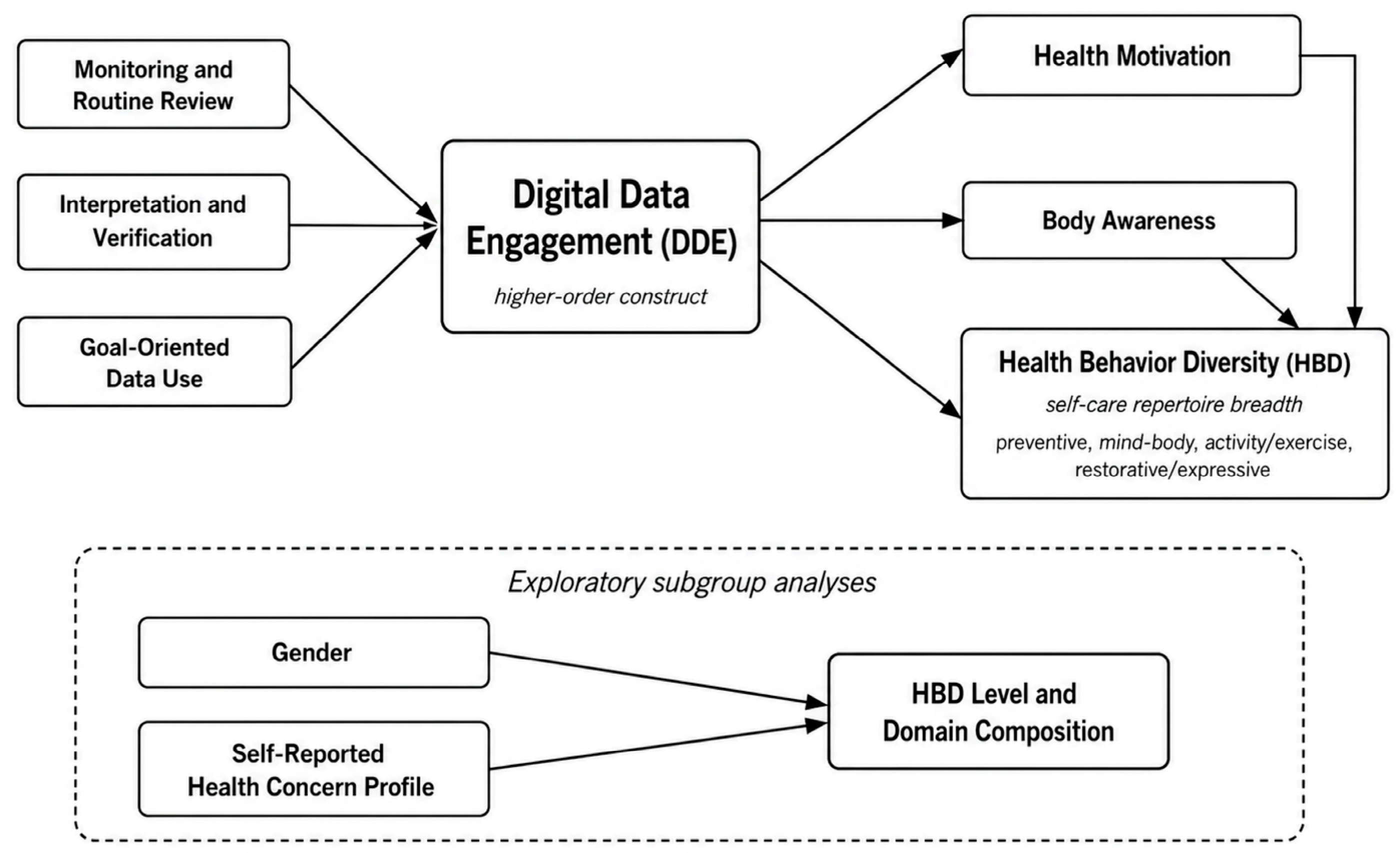

Digital Data Engagement and Health Behavior Diversity Among Smartwatch Users


Abstract
1. Introduction
2. Research Model and Hypotheses
3. Materials and Methods
3.1. Study Design and Participants
3.2. Measures
3.2.1. Body Awareness
3.2.2. Health Motivation
3.2.3. Digital Data Engagement
3.2.4. Behavior Diversity
3.2.5. Heterogeneity Variables
3.3. Data Analysis
4. Results
4.1. Sample Characteristics
4.2. Measurement Model Assessment
4.3. Structural Model Results
4.4. Domain Composition and Subgroup Variation in HBD
4.4.1. Domain Composition of Health Behavior Diversity
4.4.2. Gender and Health Concern Profile Differences in HBD Level and Domain Composition
4.5. Poisson Regression Robustness Check
5. Discussion
5.1. From Device Use to Data Engagement
5.2. Motivation, Bodily Awareness, and the Limits of Awareness-to-Action Assumptions
5.3. Self-Care Repertoires and Contextualized Smartwatch-Enabled Self-Care
5.4. Limitations and Future Research
6. Conclusions
Supplementary Materials
Author Contributions
Funding
Institutional Review Board Statement
Informed Consent Statement
Data Availability Statement
Conflicts of Interest
References
- Köhler, C.; Bartschke, A.; Fürstenau, D.; Schaaf, T.; Salgado-Baez, E. The value of smartwatches in the health care sector for monitoring, nudging, and predicting: Viewpoint on 25 years of research. J. Med. Internet Res. 2024, 26, e58936. [Google Scholar] [CrossRef] [Scilit]
- Figueiredo, M.C.; Chen, Y. Patient-generated health data: Dimensions, challenges, and open questions. Found. Trends Hum.-Comput. Interact. 2020, 13, 165–297. [Google Scholar] [CrossRef] [Scilit]
- Eikey, E.V.; Caldeira, C.M.; Figueiredo, M.C.; Chen, Y.; Borelli, J.L.; Mazmanian, M.; Zheng, K. Beyond self-reflection: Introducing the concept of rumination in personal informatics. Pers. Ubiquitous Comput. 2021, 25, 601–616. [Google Scholar] [CrossRef] [Scilit]
- Feng, S.; Mäntymäki, M.; Dhir, A.; Salmela, H. How self-tracking and the quantified self promote health and well-being: Systematic review. J. Med. Internet Res. 2021, 23, e25171. [Google Scholar] [CrossRef] [Scilit]
- Coşkun, A.; Karahanoğlu, A. Data sensemaking in self-tracking: Towards a new generation of self-tracking tools. Int. J. Hum.-Comput. Interact. 2023, 39, 2339–2360. [Google Scholar] [CrossRef] [Scilit]
- Oh, J.; Kang, H. User engagement with smart wearables: Four defining factors and a process model. Mob. Media Commun. 2021, 9, 314–335. [Google Scholar] [CrossRef] [Scilit]
- Siepmann, C.; Kowalczuk, P. Understanding continued smartwatch usage: The role of emotional as well as health and fitness factors. Electron. Mark. 2021, 31, 795–809. [Google Scholar] [CrossRef] [Scilit]
- Mehling, W.E.; Acree, M.; Stewart, A.; Silas, J.; Jones, A. The multidimensional assessment of interoceptive awareness, version 2 (MAIA-2). PLoS ONE 2018, 13, e0208034. [Google Scholar] [CrossRef] [Scilit]
- Boldi, A.; Silacci, A.; Boldi, M.-O.; Cherubini, M.; Caon, M.; Zufferey, N.; Huguenin, K.; Rapp, A. Exploring the impact of commercial wearable activity trackers on body awareness and body representations: A mixed-methods study on self-tracking. Comput. Hum. Behav. 2024, 151, 108036. [Google Scholar] [CrossRef] [Scilit]
- Jarrahi, M.H.; Gafinowitz, N.; Shin, G. Activity trackers, prior motivation, and perceived informational and motivational affordances. Pers. Ubiquitous Comput. 2018, 22, 433–448. [Google Scholar] [CrossRef] [Scilit]
- Narasimhan, M.; Allotey, P.; Hardon, A. Self care interventions to advance health and wellbeing: A conceptual framework to inform normative guidance. BMJ 2019, 365, l688. [Google Scholar] [CrossRef] [Scilit]
- Silva, C.C.; Presseau, J.; van Allen, Z.; Schenk, P.M.; Moreto, M.; Dinsmore, J.; Marques, M.M. Effectiveness of interventions for changing more than one behavior at a time to manage chronic conditions: A systematic review and meta-analysis. Ann. Behav. Med. 2024, 58, 432–444. [Google Scholar] [CrossRef] [Scilit]
- Richardson, S.; Lawrence, K.; Schoenthaler, A.M.; Mann, D. A framework for digital health equity. npj Digit. Med. 2022, 5, 119. [Google Scholar] [CrossRef] [Scilit] [PubMed]
- Van Kessel, R.; Wong, B.L.H.; Clemens, T.; Brand, H. Digital health literacy as a super determinant of health: More than simply the sum of its parts. Internet Interv. 2022, 27, 100500. [Google Scholar] [CrossRef] [Scilit]
- Shields, S.A.; Mallory, M.E.; Simon, A. The body awareness questionnaire: Reliability and validity. J. Pers. Assess. 1989, 53, 802–815. [Google Scholar] [CrossRef] [Scilit]
- Mehling, W.E.; Gopisetty, V.; Daubenmier, J.; Price, C.J.; Hecht, F.M.; Stewart, A. Body awareness: Construct and self-report measures. PLoS ONE 2009, 4, e5614. [Google Scholar] [CrossRef] [Scilit]
- Snell, W.E., Jr.; Johnson, G.; Lloyd, P.J.; Hoover, M.W. The health orientation scale: A measure of psychological tendencies associated with health. Eur. J. Pers. 1991, 5, 169–183. [Google Scholar] [CrossRef] [Scilit]
- Perski, O.; Blandford, A.; West, R.; Michie, S. Conceptualising engagement with digital behaviour change interventions: A systematic review using principles from critical interpretive synthesis. Transl. Behav. Med. 2017, 7, 254–267. [Google Scholar] [CrossRef] [Scilit]
- Tung, F.-W. Self-quantification and Data Engagement: Insights from Smartwatch Users. In HCI International 2025—Late Breaking Papers; Lecture Notes in Computer Science; Duffy, V.G., Ed.; Springer: Cham, Switzerland, 2026; Volume 16339, pp. 50–60. [Google Scholar] [CrossRef] [Scilit]
- Ekhtiar, T.; Karahanoğlu, A.; Gouveia, R.; Ludden, G. Goals for goal setting: A scoping review on personal informatics. In Proceedings of the 2023 ACM Designing Interactive Systems Conference, Pittsburgh, PA, USA, 10–14 July 2023. [Google Scholar]
- Kulbok, P.A.; Carter, K.F.; Baldwin, J.H.; Gilmartin, M.J.; Kirkwood, B. The Multidimensional Health Behavior Inventory. J. Nurs. Meas. 1999, 7, 177–195. [Google Scholar] [CrossRef] [Scilit]
- Spring, B.; Moller, A.C.; Coons, M.J. Multiple health behaviours: Overview and implications. J. Public Health 2012, 34, i3–i10. [Google Scholar] [CrossRef] [Scilit]
- Dean, K. Self-care components of lifestyles: The importance of gender, attitudes and the social situation. Soc. Sci. Med. 1989, 29, 137–152. [Google Scholar] [CrossRef] [Scilit]
- Pascoe, M.C.; Thompson, D.R.; Jenkins, Z.M.; Ski, C.F. Mindfulness mediates the physiological markers of stress: Systematic review and meta-analysis. J. Psychiatr. Res. 2017, 95, 156–178. [Google Scholar] [CrossRef] [Scilit]
- Bull, F.C.; Al-Ansari, S.S.; Biddle, S.; Borodulin, K.; Buman, M.P.; Cardon, G.; Carty, C.; Chaput, J.P.; Chastin, S.; Chou, R.; et al. World Health Organization 2020 guidelines on physical activity and sedentary behaviour. Br. J. Sports Med. 2020, 54, 1451–1462. [Google Scholar] [CrossRef] [Scilit]
- Dingle, G.A.; Sharman, L.S.; Bauer, Z.; Beckman, E.; Broughton, M.; Bunzli, E.; Davidson, R.; Draper, G.; Fairley, S.; Farrell, C.; et al. How do music activities affect health and well-being? A scoping review of studies examining psychosocial mechanisms. Front. Psychol. 2021, 12, 713818. [Google Scholar] [CrossRef] [Scilit]
- Fancourt, D.; Finn, S. What Is the Evidence on the Role of the Arts in Improving Health and Well-being? A Scoping Review; World Health Organization, Regional Office for Europe: Copenhagen, Denmark, 2019. [Google Scholar]
- Rooksby, J.; Rost, M.; Morrison, A.; Chalmers, M. Personal tracking as lived informatics. In Proceedings of the SIGCHI Conference on Human Factors in Computing Systems, Toronto, ON, Canada, 26 April–1 May 2014. [Google Scholar]
- Epstein, D.A.; Ping, A.; Fogarty, J.; Munson, S.A. A lived informatics model of personal informatics. In Proceedings of the 2015 ACM International Joint Conference on Pervasive and Ubiquitous Computing, Osaka, Japan, 7–11 September 2015. [Google Scholar]
- Rapp, A.; Tirabeni, L. Personal informatics for sport: Meaning, body, and social relations in amateur and elite athletes. ACM Trans. Comput.-Hum. Interact. (TOCHI) 2018, 25, 1–30. [Google Scholar]
- Kersten-van Dijk, E.T.; Westerink, J.H.; Beute, F.; Ijsselsteijn, W.A. Personal informatics, self-insight, and behavior change: A critical review of current literature. Hum.-Comput. Interact. 2017, 32, 268–296. [Google Scholar] [CrossRef] [Scilit]
- Schwarzer, R. Modeling health behavior change: How to predict and modify the adoption and maintenance of health behaviors. Appl. Psychol. 2008, 57, 1–29. [Google Scholar] [CrossRef] [Scilit]
- Michie, S.; Van Stralen, M.M.; West, R. The behaviour change wheel: A new method for characterising and designing behaviour change interventions. Implement. Sci. 2011, 6, 42. [Google Scholar] [CrossRef] [Scilit]
- Prochaska, J.J.; Prochaska, J.O. A review of multiple health behavior change interventions for primary prevention. Am. J. Lifestyle Med. 2011, 5, 208–221. [Google Scholar] [CrossRef] [Scilit]
- Courtenay, W.H. Constructions of masculinity and their influence on men’s well-being: A theory of gender and health. Soc. Sci. Med. 2000, 50, 1385–1401. [Google Scholar] [CrossRef] [Scilit]
- Portela-Pino, I.; López-Castedo, A.; Martínez-Patiño, M.J.; Valverde-Esteve, T.; Domínguez-Alonso, J. Gender differences in motivation and barriers for the practice of physical exercise in adolescence. Int. J. Environ. Res. Public Health 2020, 17, 168. [Google Scholar] [CrossRef] [Scilit]
- Di Benedetto, M.; Towt, C.J.; Jackson, M.L. A cluster analysis of sleep quality, self-care behaviors, and mental health risk in Australian university students. Behav. Sleep Med. 2020, 18, 309–320. [Google Scholar] [CrossRef] [Scilit]
- Zahrt, O.H.; Evans, K.; Murnane, E.; Santoro, E.; Baiocchi, M.; Landay, J.; Delp, S.; Crum, A. Effects of wearable fitness trackers and activity adequacy mindsets on affect, behavior, and health: Longitudinal randomized controlled trial. J. Med. Internet Res. 2023, 25, e40529. [Google Scholar] [CrossRef] [Scilit]


| Construct | Dimension | Questionnaire Items |
|---|---|---|
| Body Awareness | — | I am very aware of my bodily sensations. |
| I immediately notice when I feel physical discomfort. | ||
| I am highly sensitive to the internal signals of my body. | ||
| Health Motivation | — | I am highly motivated to maintain my physical health. |
| I am strongly motivated to invest time and effort in maintaining my physical health. | ||
| I have a strong desire to keep myself in good physical health. | ||
| Maintaining an adequate level of physical health is very important to me. | ||
| I strive to keep myself in the best possible physical condition. | ||
| Digital Data Engagement | Monitoring & routine review | It is important to me to understand the physiological or activity data tracked by my smartwatch. |
| I use my smartwatch to monitor my physiological or activity patterns. | ||
| I regularly review the data tracked by my smartwatch. | ||
| I regularly analyze the data tracked by my smartwatch. | ||
| Interpretation & verification | I can connect my smartwatch data with my own behavior. | |
| I look for relevant information to help me understand my smartwatch data. | ||
| My smartwatch data are meaningful and help me better understand my daily life. | ||
| My confidence in the device increases when my personal experience matches my smartwatch data. | ||
| I actively look for the cause when my smartwatch data show unexpected changes. | ||
| Goal-oriented data use | I set health-related behavior or activity goals based on my smartwatch data. | |
| I use multiple apps to monitor my physiological or activity data for more comprehensive health management. | ||
| My smartwatch helps me track my progress toward my health management goals. |
| Characteristic | Category | Total, n (%) | No Concern | Psychological/Sleep-Related | Physiological/Metabolic | Mixed Concerns | Other-Only/Ambiguous |
|---|---|---|---|---|---|---|---|
| Gender | Men | 398 (47.5%) | 85 | 115 | 78 | 116 | 4 |
| Women | 440 (52.5%) | 63 | 107 | 101 | 165 | 4 | |
| Age | 19–25 | 166 (19.8%) | 24 | 42 | 29 | 71 | 0 |
| 26–35 | 316 (37.7%) | 62 | 76 | 65 | 110 | 3 | |
| 36–45 | 299 (35.7%) | 57 | 84 | 70 | 83 | 5 | |
| 46–55 | 44 (5.3%) | 4 | 15 | 13 | 12 | 0 | |
| 56 and above | 13 (1.6%) | 1 | 5 | 2 | 5 | 0 |
| Construct Level | Construct/Dimension | Indicators | Loadings | Cronbach’s α | CR | AVE |
|---|---|---|---|---|---|---|
| Lower order | Monitoring and routine review | 4 items | 0.832–0.877 | 0.883 | 0.919 | 0.738 |
| Lower order | Interpretation and verification | 5 items | 0.732–0.865 | 0.872 | 0.908 | 0.664 |
| Lower order | Goal-oriented data use | 3 items | 0.787–0.876 | 0.802 | 0.881 | 0.713 |
| Higher order | DDE | 3 lower-order dimensions | 0.918–0.946 | 0.919 | 0.949 | 0.860 |
| Reflective construct | Body awareness | 3 items | 0.875–0.901 | 0.866 | 0.918 | 0.788 |
| Reflective construct | Health motivation | 5 items | 0.845–0.885 | 0.918 | 0.939 | 0.754 |
| (A) | |||||||
| Hypothesis | Path | β | SE | t | f2 | 95% CI | Inner VIF |
| H1 | DDE → Health motivation | 0.589 | 0.027 | 21.83 *** | 0.531 | [0.535, 0.641] | 1.00 |
| H2 | DDE → Body awareness | 0.477 | 0.031 | 15.61 *** | 0.295 | [0.415, 0.535] | 1.00 |
| H3 | Health motivation → HBD | 0.276 | 0.041 | 6.73 *** | 0.049 | [0.196, 0.357] | 1.77 |
| H4 | Body awareness → HBD | −0.031 | 0.041 | 0.76 | 0.001 | [−0.113, 0.048] | 1.50 |
| H5 | DDE → HBD | 0.134 | 0.041 | 3.29 ** | 0.013 | [0.051, 0.212] | 1.62 |
| (B) | |||||||
| Endogenous Construct | R2 | Adjusted R2 | Q2 | ||||
| Health motivation | 0.347 | 0.346 | 0.260 | ||||
| Body awareness | 0.228 | 0.227 | 0.176 | ||||
| Health behavior diversity | 0.125 | 0.122 | 0.122 | ||||
| (C) | |||||||
| Indirect Path | β | SE | t | 95% CI | Result | ||
| DDE → Health motivation → HBD | 0.163 | 0.025 | 6.429 *** | [0.115, 0.214] | Supported | ||
| DDE → Body awareness → HBD | −0.015 | 0.020 | 0.756 | [−0.055, 0.022] | Not supported | ||
| HBD Domain | No. of Items | Mean | SD | Raw Share of HBD (%) | Item-Adjusted Coverage (%) |
|---|---|---|---|---|---|
| Preventive self-care | 3 | 1.23 | 0.94 | 31.2 | 41.0 |
| Mind–body regulation | 2 | 0.19 | 0.43 | 4.8 | 9.5 |
| Physical activity/exercise | 8 | 1.83 | 1.29 | 46.5 | 22.9 |
| Restorative/expressive well-being | 3 | 0.69 | 0.85 | 17.4 | 22.9 |
| Total HBD | 16 | 3.94 | 2.12 | 100.0 | 24.6 |
| (A) | |||||||
| Outcome | Male (n = 398), M (SD) | Female (n = 440), M (SD) | p | Cohen’s d | |||
| HBD total | 3.90 (1.98) | 3.97 (2.25) | 0.639 | −0.032 | |||
| Domain diversity | 2.15 (0.79) | 2.33 (0.92) | 0.003 | −0.208 | |||
| Preventive self-care | 1.18 (0.96) | 1.28 (0.91) | 0.110 | −0.111 | |||
| Mind–body regulation | 0.12 (0.37) | 0.25 (0.48) | <0.001 | −0.301 | |||
| Physical activity/exercise | 2.08 (1.24) | 1.61 (1.29) | <0.001 | 0.372 | |||
| Restorative/expressive well-being | 0.53 (0.74) | 0.83 (0.92) | <0.001 | −0.367 | |||
| (B) | |||||||
| Outcome | No Concern (n = 148), M (SD) | Psych/Sleep (n = 222), M (SD) | Physio/Metabolic (n = 179), M (SD) | Mixed Concern (n = 281), M (SD) | F | p | η2 |
| HBD total | 4.05 (2.28) | 3.63 (2.04) | 3.74 (2.02) | 4.23 (2.16) | 3.98 | 0.008 | 0.014 |
| Domain diversity | 2.20 (0.89) | 2.17 (0.88) | 2.15 (0.78) | 2.40 (0.87) | 4.37 | 0.005 | 0.016 |
| Preventive self-care | 1.34 (1.03) | 1.17 (0.92) | 1.13 (0.86) | 1.27 (0.94) | 1.84 | 0.139 | 0.007 |
| Mind–body regulation | 0.15 (0.38) | 0.19 (0.45) | 0.17 (0.42) | 0.22 (0.46) | 1.12 | 0.340 | 0.004 |
| Physical activity/exercise | 1.91 (1.39) | 1.59 (1.31) | 1.94 (1.21) | 1.91 (1.25) | 3.56 | 0.014 | 0.013 |
| Restorative/expressive | 0.65 (0.80) | 0.68 (0.83) | 0.50 (0.79) | 0.83 (0.91) | 5.66 | 0.001 | 0.020 |
Disclaimer/Publisher’s Note: The statements, opinions and data contained in all publications are solely those of the individual author(s) and contributor(s) and not of MDPI and/or the editor(s). MDPI and/or the editor(s) disclaim responsibility for any injury to people or property resulting from any ideas, methods, instructions or products referred to in the content. |
© 2026 by the authors. Licensee MDPI, Basel, Switzerland. This article is an open access article distributed under the terms and conditions of the Creative Commons Attribution (CC BY) license.
Share and Cite
Tung, F.-W.; Jia, L.-M. Digital Data Engagement and Health Behavior Diversity Among Smartwatch Users. World 2026, 7, 143. https://doi.org/10.3390/world7090143
Tung F-W, Jia L-M. Digital Data Engagement and Health Behavior Diversity Among Smartwatch Users. World. 2026; 7(9):143. https://doi.org/10.3390/world7090143
Chicago/Turabian StyleTung, Fang-Wu, and Liang-Ming Jia. 2026. "Digital Data Engagement and Health Behavior Diversity Among Smartwatch Users" World 7, no. 9: 143. https://doi.org/10.3390/world7090143
APA StyleTung, F.-W., & Jia, L.-M. (2026). Digital Data Engagement and Health Behavior Diversity Among Smartwatch Users. World, 7(9), 143. https://doi.org/10.3390/world7090143