1. Introduction
The transition towards sustainable economic systems is one of the central challenges of the 21st century [
1,
2,
3,
4]. Climate change, biodiversity loss, and resource degradation require profound transformations in production and consumption patterns [
5,
6,
7]. In this context, businesses are increasingly expected to contribute actively to environmental protection and social well-being, rather than focusing exclusively on profit maximization [
8,
9,
10].
The concept of the triple bottom line [
8] marked a turning point by proposing that firms should simultaneously pursue economic, environmental, and social objectives. Building on this approach, the notion of shared value creation [
9] suggests that economic success can be aligned with societal progress. Likewise, sustainable entrepreneurship has emerged as a field exploring how entrepreneurial initiatives can address environmental and social problems while remaining economically viable [
11,
12].
Traditional economic perspectives often consider environmental protection and profitability as competing objectives [
13,
14]. However, a growing body of literature challenges this view by demonstrating that sustainability can enhance innovation, reduce costs, and open new markets [
15,
16]. Firms that integrate environmental concerns into their core strategy may achieve long-term competitive advantages [
17].
In parallel, increasing attention has been paid to hybrid organizational forms that combine market-based and mission-driven objectives. These organizations frequently operate at the interface between private firms, civil society organizations, and academic institutions. The triple-helix model [
18] highlights the importance of such interactions in fostering innovation and addressing complex societal challenges.
Another relevant dimension is the growing recognition of the restoration economy, which frames ecological restoration as both a necessity and an economic opportunity [
19,
20,
21]. Restoration initiatives can generate ecosystem services, employment, and sustainable production systems, yet their integration into business models remains limited.
Despite increasing interest in sustainable entrepreneurship, long-term detailed longitudinal studies documenting the complete life cycle of small environmental enterprises remain uncommon. Most published studies focus on start-up phases, short-term performance, or theoretical frameworks [
10,
22,
23], whereas fewer studies analyze experiences spanning two decades.
This study addresses this gap by analyzing the full life cycle of Environmentally Sustainable Investments (INAMSOS, hereafter), an environmental enterprise operating in Spain between 2006 and 2026 and liquidated after completing its intended business cycle. The company represents a unique case of (a) a sustainability-driven business model, (b) a collaboration with an ecological restoration NGO, and (c) connections with a university.
The study aims to answer three research questions:
Can a small environmental enterprise generate positive economic returns over the long term?
Can economic, social, and environmental objectives be effectively combined?
What lessons can be derived from hybrid business–NGO–university arrangements?
A single, twenty-year-old enterprise cannot, on its own, demonstrate that sustainability-oriented business models are viable at the scale of whole economic sectors: broader macro-economic dynamics, sectoral competition, and technological change operate well beyond what any individual case can capture. With this caveat in mind, the answer to these questions may help inform—though not by itself establish—the wider feasibility of similar initiatives, contributing cautiously to the broader debate on transitions towards a more sustainable economy.
2. Materials and Methods
This research follows a longitudinal, single-case study design, chosen because it allows an in-depth, contextualized understanding of how a small hybrid enterprise pursued economic and ecological objectives over an extended period—an object of inquiry not easily captured through cross-sectional or purely quantitative approaches. Consistent with recommended case-study practice, data triangulation was pursued by combining multiple, largely primary sources: corporate accounts and shareholder registries, minutes and internal reports of the company’s Board of Directors, project documentation held by the International Foundation for Ecosystem Restoration (FIRE hereafter, the historical Spanish acronym), and correspondence and institutional records documenting the relationship with the University of Alcalá (UAH). Monetary figures (valuations, distributions, and donations) were cross-checked against at least two independent internal sources where available. Because the author was also directly involved in the company’s management, an explicit reflexivity statement is provided in
Section 4.4.
INAMSOS was established in Spain in 2006 with the objective of developing economic activities consistent with principles of environmental sustainability and ecological responsibility. Note that it started to operate right before the Spanish Great Recession (2008–2014), a period characterized by the collapse of the real estate sector, the financial crisis, and severe job destruction [
24].
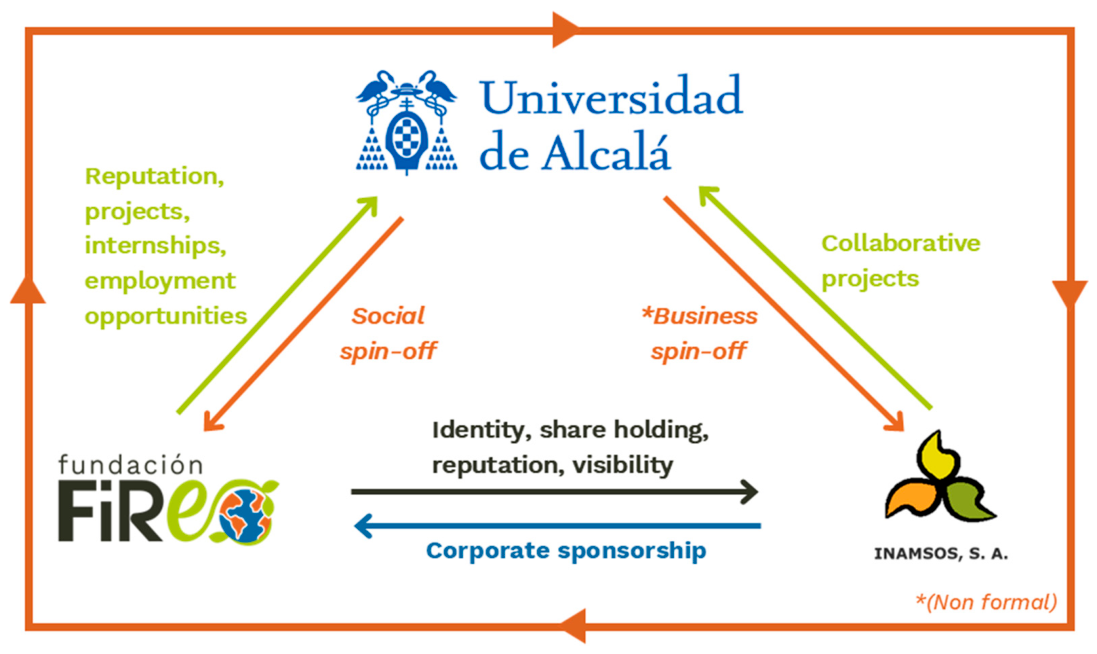
The company was promoted by and maintained close links with FIRE, a non-profit organization dedicated to ecological restoration and biodiversity conservation, and with the University of Alcalá (UAH), representing a non-formal business spin-off of this university. Through these relationships, INAMSOS sought to generate economic value for its shareholders, support environmental initiatives, and facilitate knowledge transfer. A conceptual representation of these relationships is provided in
Figure 1. To ensure alignment between the company’s economic activities and its environmental mission, two of the three members of the company’s Board of Directors simultaneously served on FIRE’s Board of Trustees.
Conflicts of interest arising from this dual board membership were managed through disclosure at board meetings and abstention from voting by the affected directors on matters directly involving FIRE; given the company’s small size, no independent audit committee was established. FIRE corresponds to the acronym of the organization’s original Spanish name, Fundación Internacional para la Restauración de Ecosistemas; the English name is used throughout this article for the benefit of the international readership, while the historical acronym FIRE has been retained for institutional consistency.
To achieve its economic and sustainability objectives, INAMSOS adopted a diversified investment strategy. Investments were allocated across several sectors consistent with the company’s environmental values, including (1) an agroecological production enterprise, (2) photovoltaic solar panels within a grid-connected solar energy facility serving multiple clients, (3) an ecological clothing company, (4) publicly traded companies operating in the renewable energy and natural health products sectors, and (5) mutual funds classified as sustainable according to prevailing environmental, social, and governance (ESG) criteria. This diversification strategy aimed to reduce financial risk while maintaining coherence with the company’s sustainability mission.
The study is based on documentary analysis of company records accumulated during the period 2006–2026. The analyzed sources included (1) corporate documentation; (2) shareholder records; (3) financial information; (4) institutional reports; (5) internal communications; and (6) documentation concerning relationships with FIRE and UAH.
Three groups of indicators were considered [
8].
- (1)
Economic indicators: initial company valuation, final company valuation, accumulated revaluation, annualized return, inflation-adjusted performance based upon official annual inflation rates (INE), and total shareholder return (TSR).
- (2)
Social indicators: number of shareholders, stakeholder participation, student involvement, employment generation, shareholder benefits provided through complementary agroecological products and contribution to environmental awareness.
- (3)
Environmental indicators: financial support provided to restoration initiatives and number of restoration-related projects supported.
Economic indicators were calculated as follows. Company valuations were taken directly from the corresponding notarized deeds or shareholder agreements at each capital operation. Accumulated revaluation was calculated as the percentage change between the initial (2006) and final (2026) valuations, and the annualized return was derived using the compound annual growth rate (CAGR) formula over the 20-year period. Inflation-adjusted (real) performance was obtained by deflating nominal values using the annual Consumer Price Index series published by the Spanish National Statistics Institute (INE), compounded over the full period. Total shareholder return (TSR) was calculated as the sum of (i) capital appreciation and (ii) the nominal value of non-monetary distributions to shareholders (agroecological products), expressed as a percentage of the initial valuation, and was estimated both in nominal terms and after deflation by cumulative inflation.
Social indicators (e.g., stakeholder participation, environmental awareness contributions) were assessed qualitatively through content analysis of corporate communications, internal reports, and shareholder correspondence, and are reported descriptively rather than on a standardized numerical scale, given the exploratory nature of these constructs in this context.
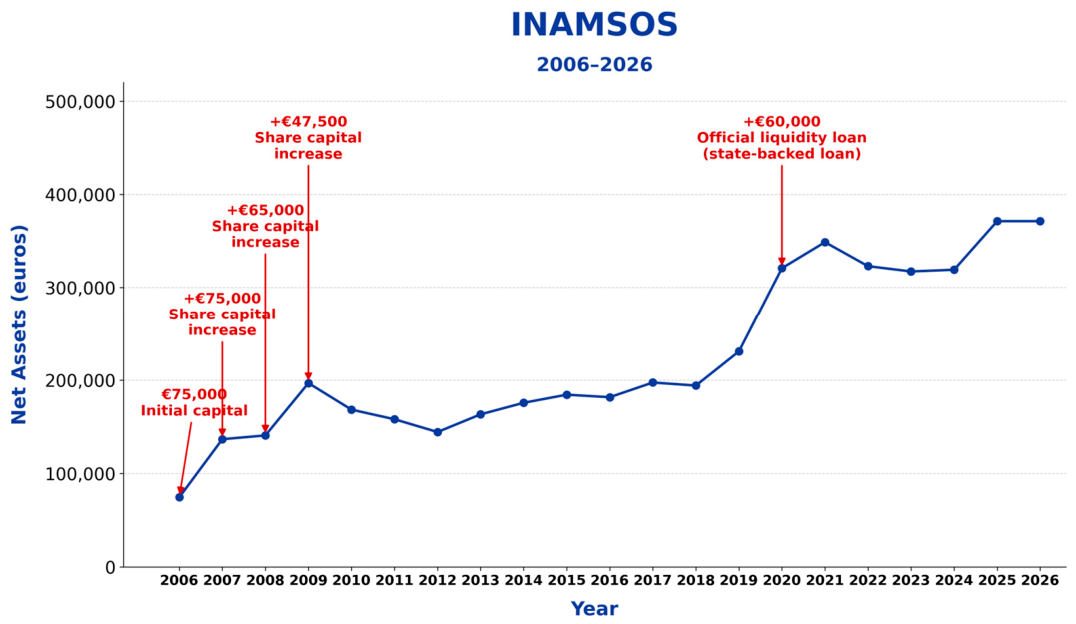
Environmental indicators (financial support to restoration and number of supported projects) were obtained directly from FIRE’s project records and INAMSOS’s donation ledger. The €262,500 baseline used for accumulated revaluation, annualized return and TSR corresponds to the total nominal share capital contributed by shareholders during the founding period (2006–2009: the initial contribution plus three subsequent share capital increases), and not to the company’s year-end net asset value in 2006 (€74,493.51, as shown in
Figure 2); this distinction is made explicit because the two figures could otherwise be conflated.
3. Results
3.1. Economic Performance
Following the life-cycle logic suggested during peer review, INAMSOS’s twenty-year trajectory can be divided into five broad stages, illustrated in
Figure 2: (i) foundation (2006); (ii) the Great Recession (2008–2014); (iii) post-recession recovery and reinforcement, marked by three successive share capital increases; (iv) a pandemic-related liquidity phase, including a state-backed loan received in 2020; and (v) consolidation and wind-down, culminating in liquidation in early 2026.
The company remained operational for approximately 20 years, from 2006 until its liquidation in early 2026. Following its incorporation, the company underwent three share capital increases because several individuals wished to become new shareholders and some of the original shareholders sought to increase their involvement in the company (
Figure 2). This figure shows that the last share capital increase balanced off the negative impact of the 2008–2014 Great Recession. In addition, in 2020, the company received a €60,000 state-backed liquidity loan from the Instituto de Crédito Oficial (
Figure 2).
Across these stages, FIRE’s role was most prominent during the foundation and consolidation phases, when the NGO’s institutional legitimacy facilitated shareholder recruitment and, later, coordinated the ecological restoration projects that received INAMSOS’s financial support. UAH’s involvement, mediated mainly through the founder’s academic position, remained comparatively stable but modest throughout, consisting principally of informal knowledge exchange rather than formal joint projects—consistent with the weaker-than-expected academic linkage discussed in
Section 4.3.
In short, the results of its economic indicators suggest that the company preserved and moderately increased the real value of invested capital (
Table 1).
The company valuation increased from €262,500 to €371,270 between October 2006 and February 2026, representing an accumulated revaluation of ca. 41%. Here, the €262,500 baseline refers to the total nominal share capital contributed by shareholders across the founding period (€75,000 initial contribution in 2006 plus three subsequent share capital increases of €75,000, €65,000 and €47,500 in 2007–2009; see
Figure 2), rather than to the company’s year-end net asset value in 2006, which was €74,493.51. This baseline was chosen because it reflects total shareholder capital at risk over the founding period and is therefore the more meaningful reference point for assessing investment performance; accordingly, the accumulated revaluation, annualized return and TSR reported throughout this article are all computed relative to it. This corresponds to an annualized nominal return of 1.8% per year. Given that cumulative inflation in Spain over the same period was about 35%, the company’s inflation-adjusted performance was positive, yielding a real TSR of 18.19% (0.84% annually).
3.2. Social and Environmental Contributions
Beyond purely financial performance, INAMSOS pursued a set of objectives explicitly aligned with sustainability principles and environmental stewardship. The company was conceived not only as an investment vehicle but also as an instrument for generating social and ecological value, contributing to a multidimensional conception of returns. A summary of the main social and environmental indicators considered in this study is presented in
Table 2.
A central component of the company’s value generation strategy was the provision of non-monetary benefits to shareholders. These benefits took the form of agroecological products—specifically organic olive oil, organic wine, and organic chickpeas—derived from environmentally responsible production systems associated with restoration-oriented land management run by FIRE. Over the company’s lifetime, the total nominal value of these distributed products amounted to €37,495.25 (not adjusted for inflation). These distributions complemented financial returns and constituted an additional channel through which value was delivered to stakeholders.
The company’s ownership structure included 31 shareholders, characterized by heterogeneous profiles and motivations. FIRE was itself one of the shareholders, contributing to the alignment between ownership structure and environmental objectives. Stakeholder participation can therefore be described as diverse, combining individuals primarily motivated by financial considerations with others sharing a strong commitment to sustainability.
From an environmental perspective, INAMSOS provided direct support to restoration initiatives through financial contributions and sponsorship activities run by FIRE. The total amount allocated to these purposes reached €9812.5 (nominal value, not adjusted for inflation). This funding was primarily directed to a single restoration-related project, Fields for Life, whose guiding principle—“We produce food and biodiversity”—integrates agricultural production with biodiversity conservation.
In addition to financial support, the company contributed to environmental awareness through several communication and outreach mechanisms. These included the environmental labeling of agroecological products, as well as dissemination via the company’s website, newsletters, and social media platforms. These activities contributed to increasing the visibility of restoration-oriented production systems and sustainability principles.
Employment generation and student involvement were not among the primary objectives of the company. These functions were largely assumed by FIRE, which operated in parallel and maintained links with UAH. Consequently, the role of INAMSOS in these areas was indirect.
4. Discussion
This study aimed to evaluate whether a small environmental enterprise explicitly inspired by sustainability principles can simultaneously generate economic, social, and environmental value over the long term. By examining the complete life cycle of INAMSOS over a 20-year period, the analysis provides an infrequently available longitudinal perspective on sustainability-oriented entrepreneurship. The uniqueness of the case lies in the combination of three key elements: a mission-driven business model, its close linkage with an ecological restoration NGO (FIRE), and its connection with an academic institution. This hybrid configuration offers an opportunity to explore how economic viability and environmental commitment can be integrated in practice.
4.1. Economic Viability of Sustainability-Oriented Enterprises
The results of this study indicate that environmental entrepreneurship can be compatible with long-term economic viability. Over its 20-year operational cycle, INAMSOS achieved a positive real financial performance, preserving and marginally increasing shareholder value after adjusting for inflation.
To situate this performance, INAMSOS’s nominal and real annualized returns (1.8% and 0.84%, respectively) were compared with the low-risk, domestic benchmark available to Spanish savers over the same period. Based on Banco de España data on the yield of Spanish long-term (approximately 10-year) government bonds, the average nominal yield between January 2006 and May 2026 was approximately 2.95% per year (monthly values ranging from 0.04% in December 2020 to 6.79% in July 2012), falling to an average of about 1.1% during 2015–2021 (with roughly 40% of months below 1%) before rising to an average of about 3.0% from 2022 onward [
25]. Deflating this nominal average by the cumulative inflation reported above yields an approximate real annualized bond yield of 1.4%. On this basis, INAMSOS’s real annualized return (0.84%) was somewhat below this conservative domestic benchmark, indicating that a risk-free government bond investment would, in purely financial terms, have modestly outperformed the company over the period. This comparison situates INAMSOS’s financial performance in context and underscores that its overall value proposition rests substantially on the social and environmental returns and not on financial return alone, consistent with prior evidence that impact-oriented investments tend to generate financial returns similar to, or somewhat below, conventional low-risk benchmarks while delivering additional social and environmental value [
26].
Although the annualized returns and accumulated revaluation were not extraordinary relative to this benchmark, they demonstrate that sustainability-oriented enterprises can remain economically viable over extended periods. This finding is consistent with previous research suggesting that environmentally responsible business models do not necessarily imply a financial disadvantage and may, under certain conditions, achieve competitive parity or modest returns while delivering additional forms of value [
15,
16,
17]. An additional factor contributing to financial stability was the company’s strategy of diversified investments, which reduced exposure to individual market fluctuations and helped preserve capital over the long term [
27,
28].
The moderate financial performance observed in this case aligns with studies on impact investing, which suggest that investments explicitly targeting environmental and social outcomes may generate slightly lower or comparable financial returns while providing additional non-financial benefits [
26]. From this perspective, the INAMSOS experience supports the notion that investors may accept lower or moderate returns in exchange for measurable social and environmental impacts, particularly when these align with their values and long-term objectives.
4.2. Multi-Dimensional Value Creation and Stakeholder Engagement
These findings are also consistent with the broader literature on sustainability-oriented business models, which emphasizes the potential of such models to create competitive advantages through stakeholder engagement, reputation enhancement, and mission-driven differentiation [
9,
22,
23]. In the case of INAMSOS, the distribution of agroecological products and the explicit connection to ecological restoration initiatives contributed to strengthening stakeholder relationships and reinforcing the company’s identity as a mission-driven enterprise. This type of engagement has been identified as a key factor in the success of sustainable enterprises, as it fosters trust, commitment, and long-term alignment among stakeholders [
10,
23]. This is consistent with foundational stakeholder theory, which holds that firms create sustained value by attending to the interests of the full range of stakeholders they affect and depend on, rather than shareholders alone [
29].
The case illustrates the relevance of shared value creation, as conceptualized by [
9]. Unlike conventional firms focused exclusively on financial returns, INAMSOS generated multiple forms of value, including economic returns (through capital appreciation, distributed incentives and donations), environmental support (through funding and promotion of restoration initiatives), and social value (through stakeholder engagement and awareness-raising). This multidimensional approach to value creation is consistent with the triple bottom line framework [
8] and with more recent approaches advocating for integrated value generation in business strategies [
28,
30].
4.3. Hybrid Organizational Model: Enterprise–NGO–University Interactions
A particularly noteworthy aspect of this study is the interaction between a private company, a non-governmental organization, and a university. Such hybrid arrangements, which combine economic, social, and knowledge-generation functions, remain underrepresented in the empirical literature despite their potential to contribute to sustainability transitions [
18,
31]. The INAMSOS case provides evidence that these hybrid configurations can facilitate the mobilization of complementary resources: entrepreneurial capacity from the private sector, legitimacy and mission orientation from civil society, and knowledge from academic institutions. The case also highlights the importance of personal motivation among project leaders, whose long-term commitment played a decisive role in sustaining the initiative despite limited financial incentives. This finding resonates with research on entrepreneurial passion and commitment as drivers of venture persistence, particularly in mission-driven contexts where financial incentives are limited [
32,
33].
However, the results also suggest that the intensity and benefits of university involvement may be lower in practice than what theoretical models such as the Triple Helix might predict. This observation is consistent with other studies indicating that university–industry collaborations often face institutional, organizational, or incentive-related barriers that limit their full potential [
34,
35]. In this regard, the INAMSOS experience highlights both the opportunities and the challenges associated with integrating academic actors into sustainability-oriented business initiatives.
The case also illustrates trade-offs inherent to hybrid organizing [
36]. Maintaining close integration with FIRE and UAH offered legitimacy and mission alignment, but also entailed opportunity costs, such as reliance on a small circle of mission-driven leaders rather than broader managerial diversification, and a preference for reinvestment and in-kind distribution over more aggressive market expansion. These trade-offs were managed informally, chiefly through the founder’s dual role in the company and in FIRE, rather than through codified governance mechanisms—consistent with accounts of small hybrid organizations balancing social and commercial logic [
36].
In terms of social capital, INAMSOS’s ties with FIRE resemble what has been described as ‘bonding’ capital-dense, trust-based relationships among closely aligned actors—whereas its connection with UAH more closely resembles ‘bridging’ capital, linking the company to a different institutional logic and resource base [
37]. The comparatively weaker academic linkage may partly reflect this distinction: bridging ties across organizations with different incentive structures (academic career incentives centered on publications rather than commercial engagement) are generally harder to sustain than bonding ties among actors who already share a common mission, such as INAMSOS and FIRE. The transferability of these dynamics to other contexts is likely to be shaped by country-specific factors, including university incentive and knowledge-transfer policies, regulatory frameworks for small enterprises and NGOs, and cultural attitudes towards academic entrepreneurship, all of which may differ substantially outside the Spanish setting studied here.
The environmental dimension of the case further contributes to the growing literature on the restoration economy [
19]. Although the scale of direct financial contributions to restoration initiatives was modest, the integration of agroecological production and biodiversity objectives within the Fields for Life project illustrates how productive systems can be aligned with restoration goals. This approach is consistent with emerging perspectives emphasizing the role of nature-based solutions and regenerative practices in sustainable development [
2,
38].
4.4. Caveats and Future Research
Despite these contributions, I acknowledge several limitations. First, this is a single case study, which limits the generalizability of the findings. While the longitudinal nature of the analysis provides valuable insights, further comparative studies are needed to determine whether similar outcomes can be observed across different contexts and sectors. Second, some indicators, particularly those related to environmental and social impacts, remain partially qualitative, which constrains the ability to quantify outcomes in a standardized manner. This limitation reflects a broader challenge in sustainability research, where the measurement of non-financial performance is often complex and context dependent [
39].
More specifically, several features of this case are likely to be context-specific and not readily transferable, including the Spanish regulatory and tax environment for small shareholder-owned companies, FIRE’s pre-existing institutional legitimacy and network, and the leadership profile of the founder, who combined roles in both organizations. Conversely, other features may be more broadly generalizable, including the value of a diversified investment strategy for financial resilience, the relevance of non-monetary benefits as a complementary value-creation channel, and the importance of mission-driven, low-compensation leadership in sustaining small hybrid ventures over long periods. Given the single-case design, the associations described throughout this article should be interpreted as illustrative and hypothesis-generating rather than as evidence of general causal mechanisms.
Third, the direct involvement of the author in the creation and management of INAMSOS introduces a potential source of interpretative bias. While I have made efforts to ensure objectivity and transparency, this limitation should be considered when interpreting the results. Nevertheless, insider perspectives have also been recognized as valuable in providing detailed and longitudinal insights that may be difficult to obtain through external observation alone [
40].
Future research could build on this study by conducting comparative analyses of environmental enterprises across different institutional and geographic contexts. Cross-country comparisons could shed light on the role of regulatory frameworks, cultural factors, and market conditions in shaping the performance of sustainability-oriented business models. Additionally, further research is needed to develop robust methods for quantifying social and environmental impacts, as well as to explore the long-term dynamics of hybrid organizational forms integrating business, civil society, and academia.
5. Conclusions
This study examined the complete life cycle of INAMSOS, S.A., an environmental enterprise operating in Spain between 2006 and 2026, with the aim of assessing whether sustainability-oriented business models can generate multiple forms of value over the long term.
Regarding the first research question, the results indicate that a small environmental enterprise can generate positive economic returns over an extended period. Although financial performance was moderate, it exceeded cumulative inflation, resulting in a modest positive real return over the full period. Concerning the second question, the findings show that economic value creation can coexist with social and environmental objectives. The company generated not only financial returns but also non-monetary benefits, environmental support, and stakeholder engagement. Finally, in relation to the third question, the study highlights the potential of hybrid enterprise–NGO–university arrangements. While such collaborations can create valuable synergies, their effectiveness may depend on the intensity and structure of institutional interactions.
An important lesson emerging from this case concerns the factors underlying the project’s success. Financial viability was facilitated by a strategy of diversified investments and by the fact that the individuals leading the initiative received no financial compensation for their managerial efforts, being primarily driven by personal motivation and commitment to the project’s mission. However, this reliance on intrinsic motivation represents a double-edged sword, as the long-term sustainability of similar initiatives may become vulnerable if key leaders experience fatigue, burnout, or declining commitment. In the present case, the founder and principal leader of the company was also the leader of FIRE, which further reinforced the integration between the enterprise and the NGO.
Overall, the INAMSOS experience provides empirical evidence supporting the feasibility of sustainability-oriented entrepreneurship. It demonstrates that environmental commitment and economic performance are not necessarily conflicting objectives but can be mutually reinforced when integrated within a coherent organizational framework. Beyond its financial performance, the project generated remarkable social and environmental value. The positive feedback received from many shareholders following the announcement of the company’s liquidation suggests that at least part of the stakeholder community perceived the initiative as more than a conventional investment vehicle. In this respect, INAMSOS may be regarded as an illustrative example of how sustainability-oriented enterprises can combine economic viability with significant social and environmental co-benefits.