1. Introduction
Employers and accreditation bodies expect business schools to produce responsible graduates, and most respond by embedding RME commitments into curricula and teaching methods [
1]. However, this commitment is often only rhetorical, which is compatible with the typical requirements of the contested governance settings [
2]. In such an environment, political influence pushes documentation and formal audit to the center of organizational practice.
This paper applies this specific mechanism to business schools and management education and provides two conceptual contributions. We specify the outcomes that emerge under contested governance in professional education: responsibility displacement, constrained agency, and the privatization of integrity. We further examine whether and how RME functions as a partial institutional buffer against these pressures.
We define contested governance environments as settings in which organizations must address multiple powerful stakeholders [
3,
4], who do not fully agree on what constitutes good performance [
4]. Under such conditions, organizations are often pushed toward what can be documented and defended [
5], even when this diverges from substantive responsibility [
1].
In this environment, substantive results do not matter, as high levels of political discretion and formalistic monitoring divert effort from substantive outcomes toward defensible administrative procedures [
3,
6]. Managers learn that actual results matter less than what can be documented and defended. Organizations develop structures and procedures focused on what auditors can inspect [
6]. This logic aligns with institutional arguments about legitimacy. Organizations produce reports or paperwork to show compliance, even when these outputs remain weakly connected to day-to-day work [
5]. Thus, the meaning of responsibility starts shifting from stakeholder impact toward administrative evidence and procedural correctness [
7].
We position responsibility as an outcome that depends on the social and institutional environment and dynamics. Under contested governance, the enactment of business ethics and organizational responsibility depends on the design of incentives and monitoring. The absence of stable support creates a socialization process in which junior managers become aware of which actions are safe and which can only be supported rhetorically. Since business schools initiate this socialization, adaptive compliance applies to them, as well.
When business schools start ‘faking’ their RME commitments to pursue accreditation, funding, or other desirable outcomes, they send the same signals as public administrations or corporations operating under adaptive compliance. In such cases, the formal level of commitment exceeds the substantive level of implementation. Business schools then stop functioning as the ethics infrastructure of the business community and society and instead reproduce commitment to fake responsibility.
Therefore, our research question (RQ) asks how contested governance environments shape responsibility formation and what role Responsible Management Education (RME) plays in this process. It proceeds from the assumption that under politicized audit pressure, substantive responsibility tends to be replaced by defensible procedure and examines how this shapes business-school commitments and managerial behavior. The model explains how this learning process can shape business-school commitments and later managerial behavior.
2. The Responsibility Development Process
Responsible outcomes depend on how managers use power and exercise discretion in ambiguous situations [
8,
9]. Contested governance assumes an external shift in demands for accountability and control, which also transforms organizational culture, as organizations begin to organize around what can be audited [
6]. Measured performance diverges from actual outcomes [
10,
11], and managers optimize for administrative indicators.
These settings shape professional identities through socialization, as junior managers learn to focus attention on documentation and formal procedures. This process also shapes managerial agency, as organizations begin normalizing silence once employees conclude that speaking up is unsafe or ineffective [
12].
Managers lose ethical focus and reframe decisions in euphemistic language or rely on self-deception to reconcile self-interest with their image of the ethical self [
13]. When trust is low and formal audits are high, ethics become privatized and perceived as a private matter. Simultaneously, organizations emphasize procedures and documentation, consistent with work on organizational legitimacy [
1,
5] and research on the role of business schools in shaping professional identity [
14].
Narratives and incentives shape how professionals see themselves [
15] more than the formal business school curriculum [
16], especially when those narratives are supported by the foundations of existing business schools, which have already shaped how professionalism, responsibility, and acceptable conduct are understood during early professional socialization [
16,
17,
18]. Compliance norms then take over, further redefining professionalism in favor of procedural management [
6,
19].
3. Conceptual Model: How Contested Governance Shapes Responsibility Formation
Contested governance continuously enforces rules unevenly and puts its legitimacy under dispute, driven by political pressures and profit-seeking interests. This mechanism is especially visible where external administrative processes evaluate managers on substantive decisions while organizational capacity is uneven [
6,
7]. Managers in such settings focus on administrative compliance because evaluation systems measure and reward it.
The business school response to contested governance can be explained by institutional theory, which posits that organizations build formal structures and verification systems to protect funding and reputation, as well as secure other benefits [
5,
7]. Informal learning also sends a message that following procedures and documenting properly is both responsible and a survival tactic in corporate settings. Administrative choices, therefore, become more important than independent judgment and real social impact.
Fake responsibility is a form of decoupling [
5], produced under high audit intensity, combined with accountability to multiple stakeholders. Classical decoupling describes the separation of formal structure from actual practice. On the other hand, fake responsibility specifies a similar mechanism in which separation occurs because records and procedures become exactly what the administrative verification requires [
6].
The distinction from gaming [
10] concerns motivation, as this term implies the deliberate manipulation of performance indicators to obtain private benefits. Fake responsibility does not imply manipulation, but rather a form of adaptive learning and a survival tactic. Managers observe that following procedures is rewarded, while substantive outcomes become risky, and adjust their behavior accordingly.
Table 1 separates the three concepts. While they can be found within a single business school, they arise from different theoretical logics.
Public business schools face similar challenges. They must simultaneously answer to multiple stakeholders, including students, ministries, accreditors, donors, employers, and academic peers. In a business school environment, a committee minute or accreditation report makes no claim about whether RME produced a substantive outcome. If substantive outcomes are not discussed, they are also harder to dispute. The organization can show that a recognizable procedure was followed, even when the actual responsibility outcome remains unclear. Procedural documentation limits exposure in a way that substantive professional judgment does not [
3].
4. Responsibility-Formation Outcomes and the Accountability Process
Under contested governance, questioning whether a business decision is ethical may be interpreted as political behavior. Thus, a substantive moral discussion is replaced by a procedural focus, teaching managers that administrative artifacts demonstrate their responsibility to stakeholders [
10,
20].
Constrained agency follows from the same logic: while independent judgments and decision-making may be perceived as dangerous and risky, the safest move is to strategically use the administrative record and refrain from engagement [
12,
21]. Integrity privatization completes the sequence, since managers may still have ethical concerns but do not refer to them in ethical or responsibility terms. Instead, they refer to the administrative aspects and treat the ethical judgment as a private matter, which has already been addressed by behavioral ethics research [
13] and the moral muteness literature [
22].
The three outcomes typically operate together. Roberts [
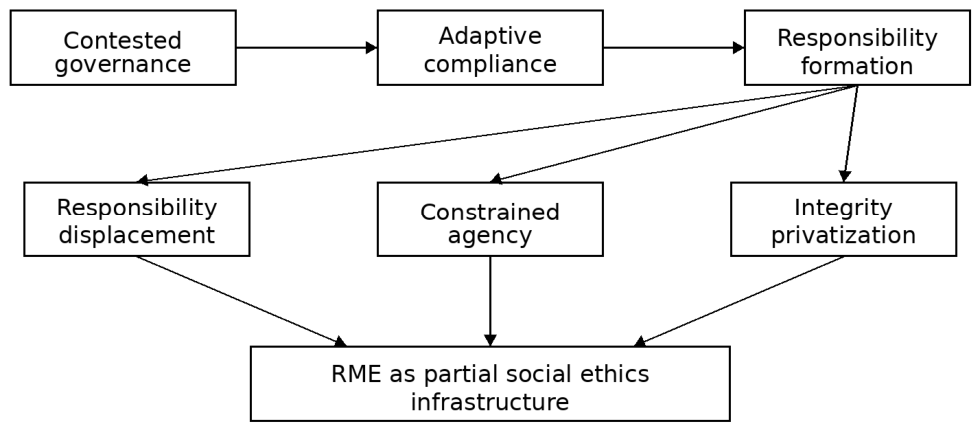
23] argues that accountability transforms what individuals must account for, and under contested governance, managers must answer to several audiences with different evaluation standards. The simultaneous existence of displaced responsibility, constrained agency, and privatized integrity leads to the “fake responsibility”.
Figure 1 presents the conceptual model. The structural conditions of contested governance drive the three outcomes of responsibility formation and position RME as a partial institutional buffer against them.
5. Responsible Management Education (RME) as a Social Priority
5.1. RME Beyond Curricula and Business-School Reporting
RME provides managers and students with a common platform for civic and professional agency in contested governance settings. RME is consistent with the PRME agenda [
24,
25], but its institutional value under contested governance is not primarily reputational. RME needs to preserve some professional capacity for responsible action when organizational pressures work against it [
1].
Business school faculty retain partial autonomy in their academic work due to the academic freedoms formed by academic writing and reputation, international co-operation, and civic protections provided by intellectual status, even if constrained by the local or regional environment. A business school professor might be directly censored or unable to participate in an academic discussion only in the most extreme cases of contested governance pressure.
Within a business school, this still opens opportunities to promote students’ critical thinking and show them how to preserve an authentic voice [
26], even within the limitations imposed by contested governance. However, there are clear limits to what an individual or even a group of like-minded faculty members can do, since their capacity to act is constrained by institutional realities such as government relations and funding [
27]. Students can still gain first-hand experience that procedural compliance is not the only viable option and that taking on managerial responsibility takes some courage, but is not necessarily career-ending. While business schools themselves may need to be cautious in implementing their own social responsibility, students can still learn to treat managerial responsibility as a partial and socially mediated process [
28].
Evidence from business schools outside this region suggests that responsible management education is often internalized only partially and unevenly under institutional pressure. This does not create a perfect buffer for preserving substantive responsibility. However, it can preserve students’ voice and agency to the extent that circumstances realistically allow and convey the message that managers should assume substantive responsibility.
Public-value reasoning is achieved when managers are able to stand behind their decisions and defend their social consequences and legitimacy [
29]. Once contested governance becomes dominant, managers start making defensible choices. Rule-following starts to dominate over judgment, and defensive compliance displaces professional self-discipline [
6,
7]. Business schools, thus, serve as places for teaching ethics and instilling the discipline of ethical decision-making in the face of ambiguity. Business students need to establish voice as a professional norm [
12,
21,
30], which can be practiced without a personal risk calculation.
Ethics and professional integrity, as promoted by RME and business schools, do not require perfect moral standards. They should motivate managers to make principled decisions in uncertain situations [
13] and persist in speaking up about moral imperatives [
22].
This framing is consistent with critiques of business schools, which build professional identities and norms through socialization [
18]. As argued by Ghoshal, business schools often reproduce simplified, overly instrumental assumptions about human behavior [
15]. However, they can also serve as sites of responsible socialization if they substantively practice RME. Such schools tend to create more prosocial attitudes [
16]. On the individual level, their outcomes can be explained by strengthening students’ public-value reasoning, voice, and discretion in ambiguous contexts [
16,
21,
24]. At the institutional level, the same function is served by impactful curricula, faculty behaviors that serve as benchmarks, and professional communities that focus on substantive ethical outcomes [
1,
26,
27].
5.2. Business Schools as Legitimacy Actors
Business schools cannot be viewed outside the governance system, as they share the structural conditions with other sectors [
27,
31]. The pressure to develop a “fake responsibility” is strongest when external oversight is formalistic, evaluation focuses on documentation rather than outcomes, protection for dissent is weak, and organizational capacity to demonstrate substantive results is limited.
On the other hand, specific characteristics of the academic sector, including scholarly reputation, professional standards, and academic freedom, create substantial autonomy for faculty. Their scientific records and institutional standing make direct censorship costly in a way that has no equivalent in most public organizations [
26]. Pressures from the environment, including accreditation, funding constraints, and government relations, push in the other direction. If schools can balance those two, they have an opportunity to develop a substantive RME practice [
1,
27,
31]. Such a school serves the public interest and trains managers to exercise judgment [
24,
25], but within the limits of the described model.
6. Research Agenda: Testing Responsibility Formation Under Contested Governance
6.1. Testing the Responsibility-Formation Mechanism
Following theory-adaptation methodology [
32], the mechanism generates testable predictions, which can serve as guidelines for future research. If contested governance shapes perceptions of managerial responsibility, changes in audit arrangements should alter those perceptions. Managers, positioned within evaluation systems focused on procedural compliance, should frame responsibility differently from those evaluated on substantive outcomes. If the perceptual framings remain stable across audit arrangements, external factors become a more plausible explanation than the proposed mechanism [
3,
6].
Constrained agency should show the same sensitivity to setting. If managers have credible institutional protection, they should have higher levels of voice and independent judgment. In settings with weak protections, recourse to procedures, committee approval, and upward escalation should predominate over independent action, since the institutional conditions make judgment costly [
21,
33].
Integrity privatization can be associated with a gap between private and public discourse. If empirical research identifies ethical concerns in interviews and individual qualitative accounts from managers, but those are absent from formal documentation, this confirms that the concern has been relocated [
13,
22,
23].
RME can be empirically tested in the same way: it will have a genuine formative role if graduates retain public-value reasoning, voice, and discretion when their organizational environment rewards defensible procedure over substantive judgment. If there are no empirical differences among graduates with and without the RME exposure, it can be concluded that its role is largely symbolic [
24].
6.2. Portability and Boundary Conditions
Our framework depends on the presence of factors that support the development of contested governance. Those include strong external accountability to external actors with the power to impose consequences [
3,
5] and limited organizational capacity and substantive judgment, perceived as a personal risk [
6,
34]. Under these conditions, evaluation relies on documents and procedures rather than outcomes. Where those conditions are present, the three outcomes described should be observable. Business schools, located in highly contested settings, still serve as a social ethics infrastructure [
35]. Although they cannot directly change governance conditions, they can shape how students learn to recognize and handle responsibility under pressure [
16,
31,
36].
6.3. RME Research Implications and Propositions
The proposed model shifts the emphasis of RME research from curriculum and teaching methods to graduates’ exercise of substantial responsibility and agency in the organizations they enter [
26]. Namely, business school socialization shapes how students understand their responsibilities and professional norms [
16,
37], thereby further strengthening or limiting managerial practice under contested governance. Decoupling of a symbolic RME commitment from business school practice is common, since external pressures can skew the motivation for substantive reform [
1,
5].
Therefore, further research should focus on the factors supporting the substantive RME implementation in business schools, as demonstrated by the following research propositions:
Proposition P1 (Responsibility displacement): When external audit pressure is high, managers define responsibility in terms of formal compliance and “correct” documentation, instead of achieving substantive stakeholder outcomes [
6,
38].
Proposition P2 (Constrained managerial agency): In risky and politicized settings, managers focus on administrative procedures and remain silent on moral issues rather than exercise independent judgment [
12,
38].
Proposition P3 (Integrity privatization): When moral language is perceived as carrying professional risk, managers stop discussing ethics and integrity in organizational settings and reframe those concerns as private matters [
13,
22].
Proposition P4 (Effects of Responsible Management Education): RME helps business school students develop managerial agency by keeping alive what contested governance systematically erodes: public-value reasoning, voice, and discretion under ambiguity. Thus, graduates with stronger RME exposure should demonstrate stronger public-value reasoning and willingness to use ethical language, as informed by the implementation of RME in their schools [
1,
26].
RME actively counters displacement, constrained agency, and the privatization of integrity by creating a professional socialization environment that functions as a form of social ethics infrastructure. This claim is empirically tractable: meaningful differences between graduates with and without RME exposure should be observable in organizational environments marked by contested governance. These propositions can be studied through document analysis of reports and accreditation files, surveys or interviews with graduates and managers, and comparative cases across organizations exposed to different levels of audit pressure.
7. Conclusions
In contested governance, perceptions of responsibility focus on procedures rather than substantive outcomes. Once this mental substitution occurs, responsibility becomes procedural, discretion and agency are viewed as personal risks, and moral language becomes confined to the private sphere.
For business schools, this creates a structural problem, as they might be pushed by external challenges toward the symbolic adoption of RME, denying it a realistic chance to influence the professional socialization of business students.
The role of RME is bounded: while it cannot change structural conditions, it still helps preserve the student capacity to reason about public value, exercise discretion, and speak up. Future research should test whether RME exposure matters when structural conditions support the contested governance and push managerial practice toward formalistic compliance.
Author Contributions
Conceptualization, N.A. and Z.N.; methodology, N.A.; validation, Z.N. and I.Z.; investigation, Z.N.; resources, N.A.; writing—original draft preparation, N.A., Z.N. and I.Z.; writing—review and editing, Z.N. and I.Z.; supervision, N.A.; project administration, N.A.; funding acquisition, N.A. All authors have read and agreed to the published version of the manuscript.
Funding
Funded by the European Union—NextGenerationEU. This work was developed as part of the project IMPACT-HE (IP-UNIZD2025-28085), funded by the European Union—NextGenerationEU. Views and opinions expressed are, however, those of the author(s) only and do not necessarily reflect those of the European Union or the European Commission. Neither the European Union nor the European Commission can be held responsible for them.
Institutional Review Board Statement
Not applicable.
Informed Consent Statement
Not applicable.
Data Availability Statement
The original contributions presented in this study are included in the article. Further inquiries can be directed to the corresponding author(s).
Conflicts of Interest
The authors declare no conflicts of interest.
Abbreviations
The following abbreviations are used in this manuscript:
| RME | Responsible management education |
| PRME | Principles for Responsible Management Education |
| UN | United Nations |
References
- Rasche, A.; Gilbert, D.U. Decoupling responsible management education. J. Manag. Inq. 2015, 24, 239–252. [Google Scholar] [CrossRef] [Scilit]
- Alfirević, N. Adaptive compliance in policy implementation: When compliance becomes performance and what can be done. Dyn. Relatsh. Manag. J. 2026. forthcoming. [Google Scholar]
- Bovens, M. Analysing and assessing accountability: A conceptual framework. Eur. Law J. 2007, 13, 447–468. [Google Scholar] [CrossRef] [Scilit]
- Koppell, J.G.S. Pathologies of accountability: ICANN and the challenge of “multiple accountabilities disorder”. Public Adm. Rev. 2005, 65, 94–108. [Google Scholar] [CrossRef] [Scilit]
- Meyer, J.W.; Rowan, B. Institutionalized organizations: Formal structure as myth and ceremony. Am. J. Sociol. 1977, 83, 340–363. [Google Scholar] [CrossRef] [Scilit] [PubMed]
- Power, M. The Audit Society: Rituals of Verification; Oxford University Press: Oxford, UK, 1999. [Google Scholar] [CrossRef] [Scilit]
- Shore, C.; Wright, S. Audit culture revisited: Rankings, ratings, and the reassembling of society. Curr. Anthropol. 2015, 56, 421–444. [Google Scholar] [CrossRef] [Scilit]
- Matland, R.E. Synthesizing the implementation literature: The ambiguity-conflict model of policy implementation. J. Public Adm. Res. Theory 1995, 5, 145–174. [Google Scholar] [CrossRef] [Scilit]
- O’Toole, L.J., Jr. Research on policy implementation: Assessment and prospects. J. Public Adm. Res. Theory 2000, 10, 263–288. [Google Scholar] [CrossRef] [Scilit]
- Bevan, G.; Hood, C. What’s measured is what matters: Targets and gaming in the English public health care system. Public Adm. 2006, 84, 517–538. [Google Scholar] [CrossRef] [Scilit]
- van Thiel, S.; Leeuw, F.L. The performance paradox in the public sector. Public Perform. Manag. Rev. 2002, 25, 267–281. [Google Scholar] [CrossRef] [Scilit]
- Morrison, E.W.; Milliken, F.J. Organizational silence: A barrier to change and development in a pluralistic world. Acad. Manag. Rev. 2000, 25, 706–725. [Google Scholar] [CrossRef] [Scilit]
- Tenbrunsel, A.E.; Messick, D.M. Ethical fading: The role of self-deception in unethical behavior. Soc. Justice Res. 2004, 17, 223–236. [Google Scholar] [CrossRef] [Scilit]
- Bennis, W.G.; O’Toole, J. How business schools lost their way. Harv. Bus. Rev. 2005, 83, 96–104. [Google Scholar]
- Ghoshal, S. Bad management theories are destroying good management practices. Acad. Manag. Learn. Educ. 2005, 4, 75–91. [Google Scholar] [CrossRef] [Scilit]
- Haski-Leventhal, D.; Pournader, M.; Leigh, J.S.A. Responsible management education as socialization: Business students’ values, attitudes and intentions. J. Bus. Ethics 2022, 176, 17–35. [Google Scholar] [CrossRef] [Scilit]
- Treviño, L.K. Ethical decision making in organizations: A person-situation interactionist model. Acad. Manag. Rev. 1986, 11, 601–617. [Google Scholar] [CrossRef] [Scilit] [PubMed]
- Khurana, R. From Higher Aims to Hired Hands: The Social Transformation of American Business Schools and the Unfulfilled Promise of Management as a Profession; Princeton University Press: Princeton, NJ, USA, 2007. [Google Scholar]
- Pollitt, C.; Bouckaert, G. Public Management Reform: A Comparative Analysis—Into the Age of Austerity, 4th ed.; Oxford University Press: Oxford, UK, 2017. [Google Scholar]
- Messner, M. The limits of accountability. Account. Organ. Soc. 2009, 34, 918–938. [Google Scholar] [CrossRef] [Scilit]
- Detert, J.R.; Burris, E.R. Leadership behavior and employee voice: Is the door really open? Acad. Manag. J. 2007, 50, 869–884. [Google Scholar] [CrossRef] [Scilit]
- Bird, F.B.; Waters, J.A. The moral muteness of managers. Calif. Manag. Rev. 1989, 32, 73–88. [Google Scholar] [CrossRef] [Scilit]
- Roberts, J. The possibilities of accountability. Account. Organ. Soc. 1991, 16, 355–368. [Google Scholar] [CrossRef] [Scilit]
- Moosmayer, D.C.; Laasch, O.; Parkes, C.; Brown, K.G. (Eds.) The SAGE Handbook of Responsible Management Learning and Education; SAGE Publications Ltd.: London, UK, 2020. [Google Scholar] [CrossRef] [Scilit]
- Wall, T.; Ogunyemi, K.; Girei, E.; Blasco, M.; Antonacopoulou, E.P.; Nkomo, S.M. (Eds.) The Elgar Companion to Management Education and the Sustainable Development Goals; Edward Elgar Publishing: Cheltenham, UK, 2026. [Google Scholar] [CrossRef] [Scilit]
- Wilson, D.C.; Thomas, H. The legitimacy of the business of business schools: What’s the future? J. Manag. Dev. 2012, 31, 368–376. [Google Scholar] [CrossRef] [Scilit]
- Doherty, B.; Meehan, J.; Richards, A. The business case and barriers for responsible management education in business schools. J. Manag. Dev. 2015, 34, 34–60. [Google Scholar] [CrossRef] [Scilit]
- Reficco, E.; Trujillo, C.A.; Jaén, M.H.; Volschenk, J.; Amran, A. Are business schools from the Global South walking their talk? Internalizing responsible management education in Africa, Asia, and Latin America. J. Bus. Res. 2023, 166, 113906. [Google Scholar] [CrossRef] [Scilit]
- Moore, M.H. Creating Public Value: Strategic Management in Government; Harvard University Press: Cambridge, MA, USA, 1995. [Google Scholar]
- Hirschman, A.O. Exit, Voice, and Loyalty: Responses to Decline in Firms, Organizations, and States; Harvard University Press: Cambridge, MA, USA, 1970. [Google Scholar]
- Preuss, L.; Elms, H.; Kurdyukov, R.; Golob, U.; Zaharia, R.M.; Jalsenjak, B.; Burg, R.; Hardi, P.; Jacquemod, J.; Kooskora, M.; et al. Institutional pressures and the adoption of responsible management education at universities and business schools in Central and Eastern Europe. Bus. Ethics Environ. Responsib. 2023, 32, 1575–1591. [Google Scholar] [CrossRef] [Scilit]
- Jaakkola, E. Designing conceptual articles: Four approaches. AMS Rev. 2020, 10, 18–26. [Google Scholar] [CrossRef] [Scilit]
- Edmondson, A.C. Psychological safety and learning behavior in work teams. Adm. Sci. Q. 1999, 44, 350–383. [Google Scholar] [CrossRef] [Scilit]
- Moynihan, D.P.; Herd, P.; Harvey, H. Administrative burden: Learning, psychological, and compliance costs in citizen-state interactions. J. Public Adm. Res. Theory 2015, 25, 43–69. [Google Scholar] [CrossRef] [Scilit]
- Waddock, S. Building a New Institutional Infrastructure for Corporate Responsibility. Acad. Manag. Perspect. 2008, 22, 87–108. [Google Scholar] [CrossRef] [Scilit]
- Alfirević, N.; Arslanagić-Kalajdžić, M.; Škokić, V.; Stanić, M. Signaling impact: Research, collaboration and reputation at European business schools. Humanit. Soc. Sci. Commun. 2025, 12, 752. [Google Scholar] [CrossRef] [Scilit]
- Blasco, M. “We’re just geeks”: Disciplinary identifications among business students and their implications for personal responsibility. J. Bus. Ethics 2022, 178, 279–302. [Google Scholar] [CrossRef] [Scilit]
- Weaver, R.K. The politics of blame avoidance. J. Public Policy 1986, 6, 371–398. [Google Scholar] [CrossRef] [Scilit]
| Disclaimer/Publisher’s Note: The statements, opinions and data contained in all publications are solely those of the individual author(s) and contributor(s) and not of MDPI and/or the editor(s). MDPI and/or the editor(s) disclaim responsibility for any injury to people or property resulting from any ideas, methods, instructions or products referred to in the content. |