1. Introduction
The integration of unmanned systems into collaborative operations with human operators has emerged as a transformative paradigm across multiple domains, from emergency response and disaster management to defense and surveillance operations. Manned–unmanned teaming (MUMT) represents the evolution from viewing unmanned assets as simple remote sensors to recognizing them as active partners capable of sophisticated collaboration with human teams. This paradigm shift promises significant benefits, including enhanced operational safety through reduced human exposure to hazardous environments, force multiplication through coordinated multi-asset operations, and improved mission effectiveness through complementary human–machine capabilities.
Aerospace companies and research organizations are investing in MUMT, proposing new concepts and teaming possibilities that span from airborne-only MUMT to connecting assets across all domains. However, there is no common language when it comes to MUMT, making it difficult to conduct a systematic comparison of the solutions and quantification of the level of teaming achieved or proposed, hindering the possibilities for systems interoperability. This issue becomes evident when looking at the terms adopted by different companies when proposing concepts and solutions related to MUMT.
In the academic literature, MUMT is usually classified as an example of human–autonomy teaming (HAT): humans and agents with “some degree of autonomy” working together towards a common goal. HAT often implicitly assumes that the agents working alongside humans have reached a very high level of automation or could even be autonomous. Hence, sometimes MUMT is seen as a special case of HAT, where the assets are highly automatic but not autonomous, as assumed by HAT.
In the following, we will use the term cognitive agent to refer to the entities humans team up with in MUMT and HAT; these can be either digital assistants, helping for instance with mission management, or the entities controlling the unmanned assets.
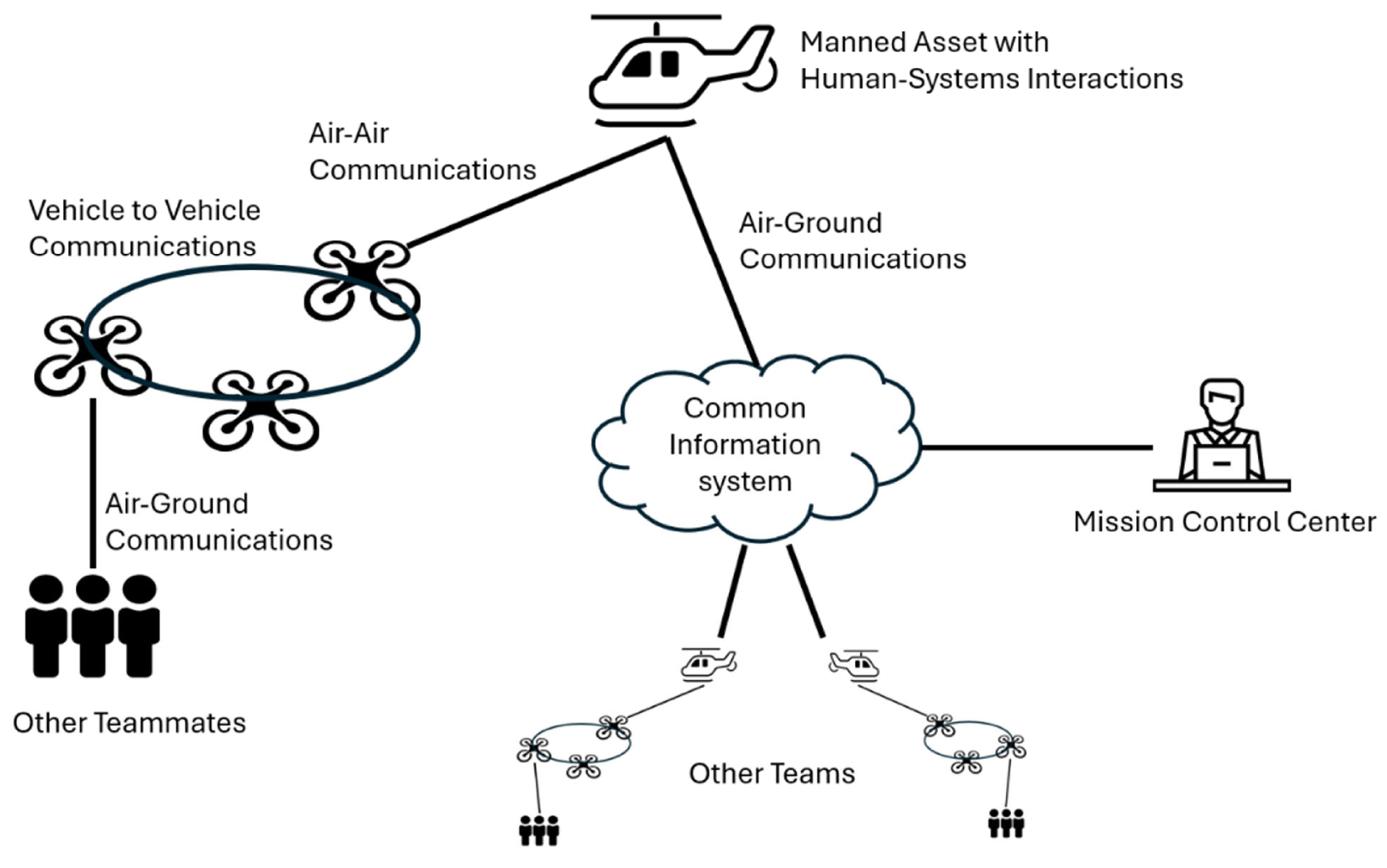
MUMT principles rely on a set of typical components illustrated in
Figure 1. These include:
Manned assets, such as aircraft with a human crew onboard, as well as other human teammates.
Unmanned assets with or without remote human crews, such as unmanned aircraft.
Payloads carried by the unmanned assets and adapted to their designated tasks. They might include imagery sensors (e.g., electro-optical, infrared, radar, lidar), communication relays and radio-frequency detection and localization devices, cargo delivery (e.g., first-aid kits, life-saving kits, parts and tools, personnel), and effectors (e.g., robotic arms, sprayers, floodlights, loudspeakers).
Secure wireless communication means between unmanned assets, typically vehicle-to-vehicle (V2V) communications, and between unmanned and manned assets (air–air and air–ground communications).
Human–system interaction devices adapted to the level of interaction between the crew onboard the manned asset, as well as human teammates, and the unmanned assets and their payload. These devices can take the form of ruggedized personal electronic devices, mission displays with bezel keys and/or multi-point tactile screens, head-worn and/or head-mounted displays, augmented/virtual/mixed reality devices, speech recognition and natural language processing, 3D audio, etc., together with mixed multi-modality capabilities.
For large-scale operations necessitating multiple teams to be deployed and coordinated in the mission theater, other components will include:
The mission control center, also known as the mission operation center, rescue coordination center or emergency operations center, depending on organizations and disciplines, with appropriate command, control, and communications;
A protected common information system enabling the sharing of data and information between the different assets according to their access rights.
Additionally, digital assistants may be part of the concept and aid humans in performing their tasks, including data analysis, decision-making, and task allocation to manned and/or unmanned assets, as well as allocated action execution. The level of assistance provided by digital assistants to the human will depend on the degree of involvement of the human, on one hand, and on the degree of autonomy of the digital assistant and of the unmanned assets on the other hand.
The aim of this article is to lay the foundations of a framework that can help engineers and researchers with the development of MUMT systems. More specifically, the objective of this taxonomy is the identification of the high-level capabilities that unmanned assets or digital assistants can provide to support humans, and the different levels of teaming that can be achieved. The result is a framework that can help researchers and engineers classify the tools and solutions already available from the perspective of an MUMT system, to understand how they fit together, and what gaps research should address to be able to develop a next-generation MUMT system.
2. Literature Review
Automation or autonomy of the unmanned assets is one of the most critical elements for the success of MUMT. The benefits of increasing the “intelligence” of the unmanned assets are twofold: a larger and more advanced set of tasks that can be performed, and improved usability of the unmanned assets by the operators, thanks to the possibility of specifying tasks at a higher level.
Over the years, many authors and organizations have proposed frameworks for autonomous systems based on the concept of levels of automation. The idea behind these frameworks is to provide a taxonomy for classifying the system’s independence from humans and the increasing number of functionalities required for achieving autonomy. For the creation of our framework for MUMT, we took inspiration from some of these works and built upon some of the results reported in the literature. Thus, before delving into the definition of our framework for MUMT, we briefly review some of the main results. One of the first definitions of levels of autonomy was presented in 1978 by Sheridan and Verplanck [
1]. The authors defined 10 levels of automation of decision-making and action selection, where the lowest level starts with the human being as the decision-making entity and executor, and the highest level ends with a complete shift away from the first level, where the computer is now fully autonomous and responsible for all decisions and actions. Kaber and Endsley, based on the Sheridan and Verplanck taxonomy, then extended the level categorization by assigning roles to humans and machines [
2]. There were four roles defined: monitoring, generating, selecting, and implementing. For example, in the first level of automation, which is the lowest, the human has all the above four roles, whereas in the highest level, the only actor is the computer.
Another key contributor to level-of-automation categorization is Parasuraman, who defined a new set of levels, with a focus on associating the levels of automation with generic
cognitive functions [
3]. These functions are
information acquisition,
information analysis,
decision selection, and
action implementation. Inspired by the two foregoing works, Save and Feuerberg proposed a taxonomy for human–automation interaction, based on two dimensions [
4]. The first dimension is represented by the four cognitive functions introduced by Parasuraman, and the second by the depth or levels of automation with respect to the functions. In this way, a high level of automation can be captured not only for action implementation, like in previous taxonomies, but also from the information and decision-making perspectives.
In [
5], the authors then introduced a taxonomy for autonomous flight with the intent of expanding the levels of driving automation published by the Society of Automotive Engineers. This taxonomy is based on the primary aviation tasks,
aviate,
navigate,
communicate,
manage systems, and
command decisions, and for each of them, the authors propose six levels of automation. Like other taxonomies, the first and last levels are the extremes (human-only and system-only, respectively) and the levels in between are the human–machine collaborative levels. It is worth mentioning that even for highly automated tasks, the human is still included to perform any necessary fallback function in case automation fails. Finally, we can note the General Automation Level Allocation (GALA) framework presented in [
6]. GALA was introduced in response to recognized limitations in existing levels of automaton frameworks, including a lack of versatility, limited precision in category definitions, and insufficient support for identifying human–automation interaction outcomes. GALA offers a two-dimensional approach designed to analyze and classify appropriate levels of automation for different information processing stages based upon hierarchical task analysis results.
In the industry, the
Society of Automotive Engineers (SAE) proposed its own framework for automation: the
SAE J3016 levels of driving automation [
7]. In the SAE’s vision, automation is at first a support offered to the driver. This framework is based on the concept of delegation of tasks: at the highest level, the “drive” task is completely delegated to the control system, with almost no support from the human. Finally, the European Union Aviation Safety Agency (EASA), in its guidance document for machine learning applications, proposes six levels for the classification of
artificial intelligence (AI) systems [
8]. In intermediate levels, the human and the AI-based system cooperate or collaborate in performing the task, but at the highest levels, the task is fully delegated to the system and the end user loses all authority over the task.
3. The Proposed Framework for Manned–Unmanned Teaming
3.1. Definitions
In the previous section we briefly introduced several terms (autonomous systems, HAT, agent, etc.) without providing specific details on their meaning, nor a formal definition. It is then the purpose of the present section to introduce and define the terminology that will be adopted in the following sections.
In everyday usage, the term autonomy has two main senses: the
self-sufficiency of a system, and its
self-directedness or freedom from external control [
9]. Effective autonomous systems require careful calibration of these dual aspects based on operational context. Misalignment creates predictable problems: systems with limited capabilities but excessive freedom lead to over-reliance and potential failures, while highly capable systems that are overly constrained result in underutilized technology. Additionally, even well-balanced systems can fail if their decision-making processes remain opaque to human operators. Successfully managing these trade-offs represents a core design challenge, as the optimal balance shifts depending on mission requirements and environmental constraints.
In the remainder of the document, we will make limited use of the term autonomy or autonomous system, mainly to denote agents with the highest level of automation that have reached the correct balance of self-sufficiency and self-directedness according to the functional role allocated to them. We believe that a proper definition of autonomy deserves a separate study and cannot be addressed with a few lines of text.
We will use the term cognitive agents to indicate those entities supporting or collaborating with humans in an MUMT system. This term was originally introduced in [
10].
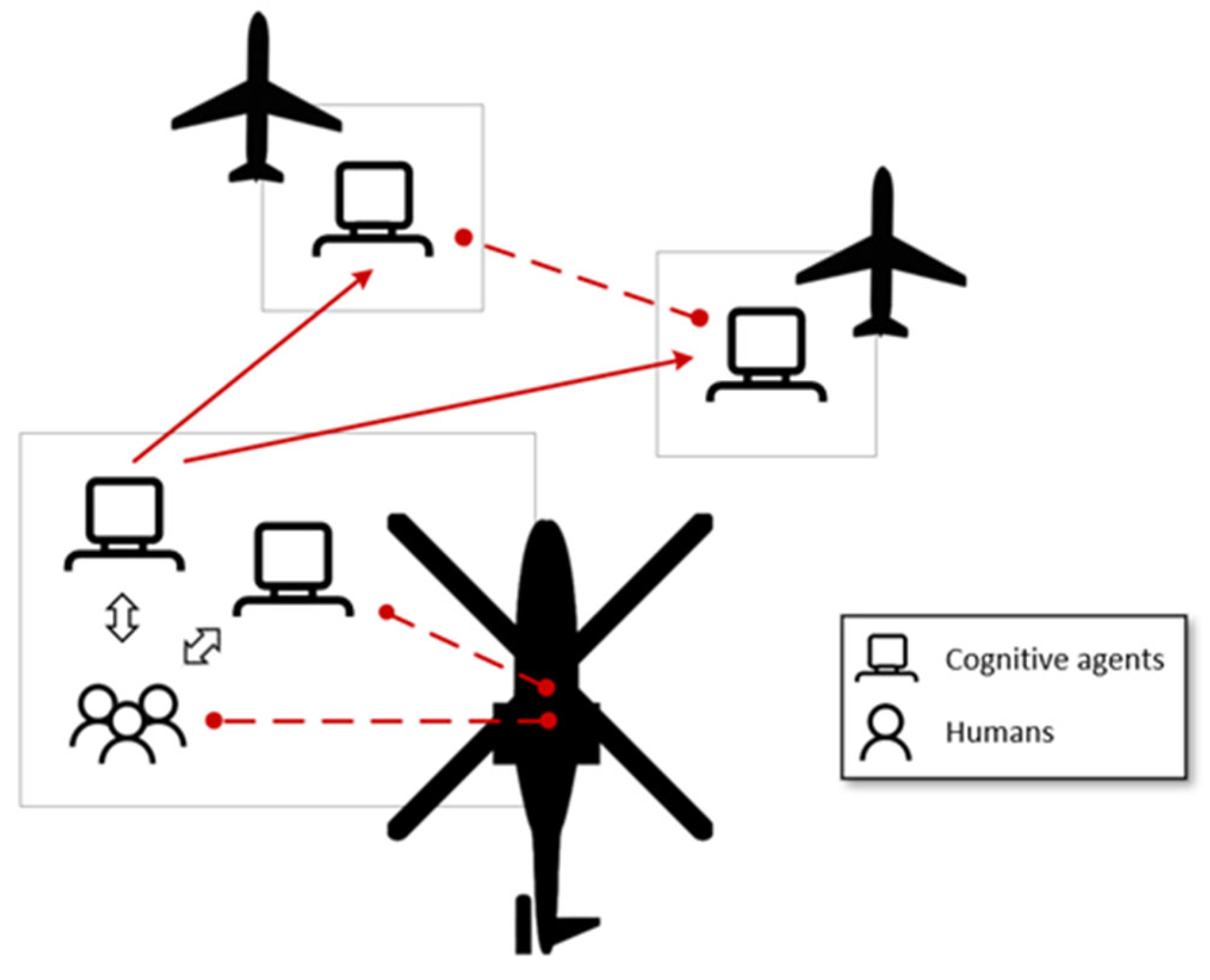
In the context of MUMT, cognitive agents can, for instance, control the unmanned asset, manage the interaction between humans and the unmanned assets, and support the humans with mission execution and control of the vehicle (
Figure 2). Since these agents will be characterized by different levels of automation or “intelligence”, the use of a generic term will simplify the discussion and avoid misunderstandings.
While it is relatively simple to define and understand human–human teaming, it is more challenging to define human–autonomy teaming since often the cognitive agent is seen as a tool and not as a peer in a team. However, we here want to adopt an idealized definition of HAT, where at the highest level of teaming, the cognitive agent is seen as a human-like team member. There are numerous challenges to be addressed to achieve such an ultimate vision. In this document, we will mention the ones that have an impact on MUMT.
MUMT commonly refers to the joint operation of manned and unmanned assets working together on shared objectives. We define manned assets as those with a human crew onboard, whereas unmanned assets are those without or not needing a human crew onboard, operated by automatic or remote control, or autonomous. In the commonly accepted use of MUMT, unmanned assets are not autonomous, but rather have a high level of automation and are used in a task delegation fashion. However, we believe that in the ultimate MUMT system, the unmanned assets are autonomous. One of the main discriminators between automatic and autonomous is the presence of decision-making functionalities that go beyond the implementation of predefined decision trees. Such functionality is required to achieve teaming with humans and to support them in the field, especially in complex scenarios or critical situations where humans might be overwhelmed by the mental and physical workload or incapacitated.
Even if the presence of autonomous systems might be seen as HAT, we prefer to adopt MUMT for this case as well, to highlight the presence of manned assets teaming up with automatic or autonomous unmanned assets. Furthermore, an autonomous cognitive agent might be present as well to simplify or support the mission execution and the management of unmanned assets in a digital assistant fashion.
By action we mean a set of basic operations that can be automated. For example, possible actions for an aerial vehicle are take-off or trajectory following. With the term task we denote instead a high-level representation of work to be done or undertaken. Examples of tasks are “explore and report”, “patrol an area and detect intruders”, and “find survivors in an area”.
The ability to perform a task requires the cognitive agent’s ability to break the task down into subtasks or actions that are executed if specific conditions are verified. The representation of the execution flow and of the decision tree will be referred to as the task execution plan. An example of a task execution plan is the flight plan created by a cognitive agent for performing an area exploration task.
Tasks that can be performed together with or alongside humans will be referred to as joint tasks. An example of a joint task is human and UAS joint patrolling of an area to detect intruders.
3.2. MUMT Dimensions
The objective of the framework proposed in this paper is to create a taxonomy that captures the main cognitive agents’ capabilities, and to determine how these can be executed in collaboration with humans. Most of the frameworks and taxonomies reviewed are based on the concept of delegation of tasks to the machine. The human is progressively removed from the loop as the level of automation increases and there is no space for teaming with the cognitive agents. In other words, the frameworks do not capture the possibility of humans and cognitive agents working together side-by-side as envisioned by the advanced MUMT concepts. Unlike prior frameworks, which treat automation as progressive task delegation from human to machine, the proposed taxonomy explicitly captures bidirectional collaborative teaming, heterogeneous capability profiles, and transparency requirements as first-class design criteria.
One of the challenges characterizing MUMT is the variety of situations and possible applications for the cognitive agents. Frameworks like SAE levels of driving automation are effective in capturing the way automation increases because they focus on a single (although complex) task. For MUMT systems we need to be able to abstract the definition of the main capabilities to provide a general framework that can be used in all the possible contexts of operations.
Cognitive agents’ support may come in different forms: they can collect and analyze information, helping with the data processing and the inference of new information items; they can suggest and provide plans for mission execution, contingency management, or for executing specific tasks; and they can execute a task, either as the sole executors or alongside humans. A cognitive agent could provide only one of these capabilities or a combination of them to provide advanced support to the humans. For instance, a cognitive agent could provide support in analyzing data and presenting inferred information to humans or can be equipped with advanced data processing capabilities that allow it to make decisions in the field and execute advanced tasks.
These capabilities can be classified into three groups:
information analysis and inference (IAI),
decision-making (DM), and
action execution (AX). These three groups of capabilities are an adaptation of the cognitive functionalities described in [
4], and in the following, they will sometimes be referred to as
cognitive functions. For each of these groups we can introduce
levels of teaming to indicate the level of collaboration between the human and the cognitive agent. To summarize, the three
MUMT dimensions introduced in our framework are:
Information analysis and inference: Functionalities for data processing, analysis, and inference of new information items. The level of teaming captures the cognitive agent’s ability to generate and process mission- and non-mission-related information to support decision-making and action execution.
Decision-making: Functionalities for planning and deciding the course of action to achieve the mission objectives. The levels of teaming specify the authority relationship between the human and the cognitive agent, as well as the ability to make decisions, either individually or together.
Action execution: Functionalities for executing actions and performing tasks. The levels of teaming define the cognitive agent’s ability to execute actions and tasks alongside or in collaboration with humans as one team.
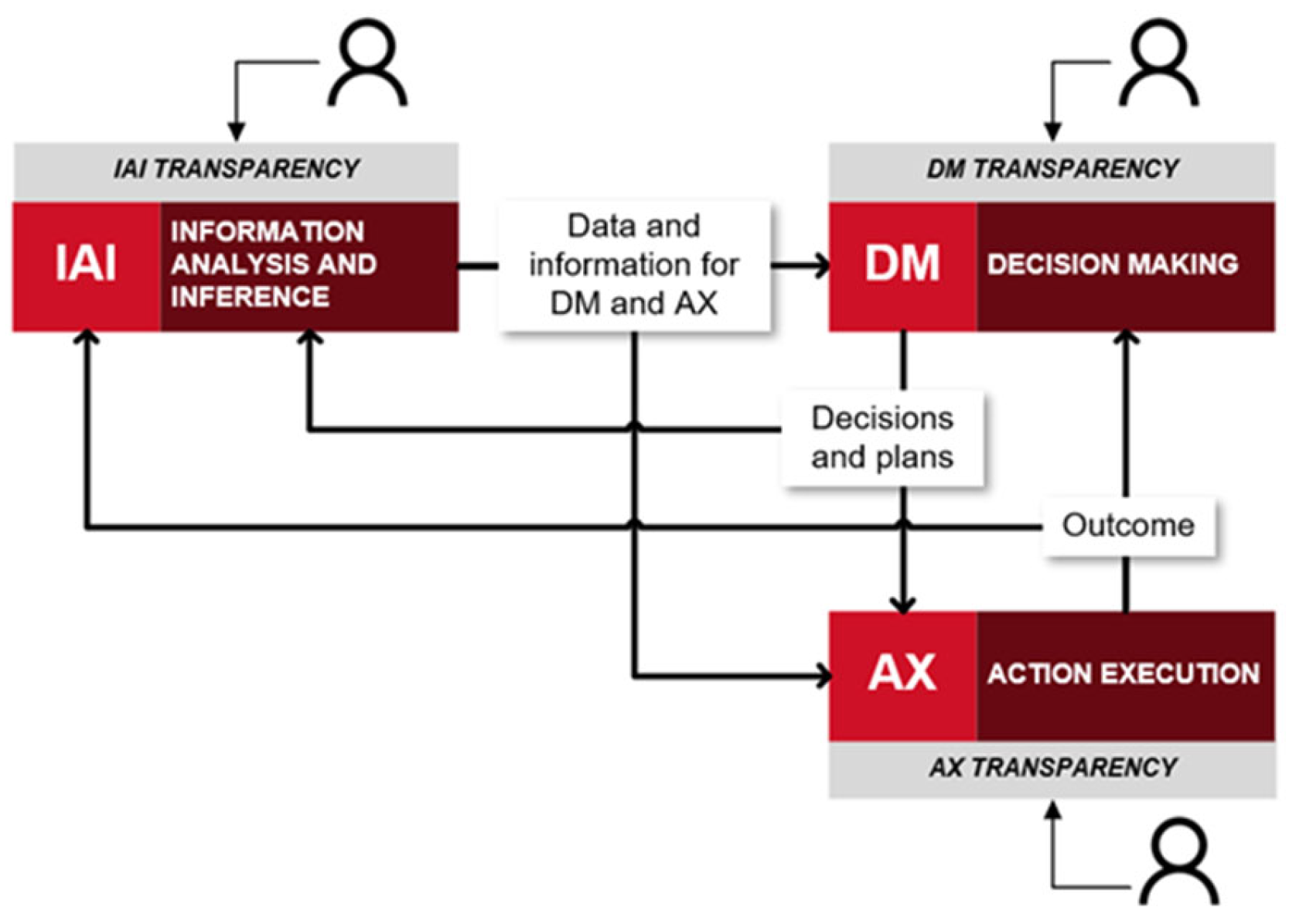
Figure 3 shows the relationships between the three dimensions we introduced. IAI functionalities are responsible for the collection and processing of the data and information required to plan and execute the mission and its tasks. The role of the human in this dimension is to review and validate the inference of new information that might be provided by the most advanced cognitive agent. For instance, information inferred by neural networks or by using machine learning models must be reviewed by a human, given the current lack of well-established and accepted methods for their validation and verification, to reduce false alarms or prevent feeding incorrect data to downstream systems.
DM functionalities are responsible for planning and deciding the best course of action to achieve the mission objectives. Here, we envision a collaboration between the human and the cognitive agent, where at the lowest level, the cognitive agent acts as an advisor, and at the highest, it is empowered to make the decisions and establish the plan. A critical aspect of the joint DM process is the assignment of clear rankings or authority levels to the humans and the cognitive agents involved. The outputs of the DM functionalities are the decisions made that might result, for instance, in tasks to be executed by the assets or plans to be implemented.
AX functionalities are responsible for the execution of the tasks assigned to the cognitive agent. At the lowest levels, tasks are executed only by a cognitive agent. At the highest levels, the cognitive agent can perform the task alongside humans, and coordinate its actions according to the human contribution to the task.
While this work focuses on HAT and specifically the interaction between human operators and autonomous systems, MUMT also requires consideration of additional factors beyond human–machine interaction. In particular, interoperability standards such as STANAG 4586 [
11] play a critical role in quantifying how easily the unmanned assets and the corresponding cognitive agents can be integrated into a team from both system engineering and human factor perspectives. Depending on the level of teaming of the cognitive agent controlling the unmanned asset, especially on AX, human operators are responsible in different capacities for the command and control of the vehicle and its payload. As the level of teaming increases, the workload on the human operators decreases and the number of operators can also be reduced. Although this aspect is outside the scope of this present work, it is an important consideration for broader MUMT concepts of operations (CONOPS).
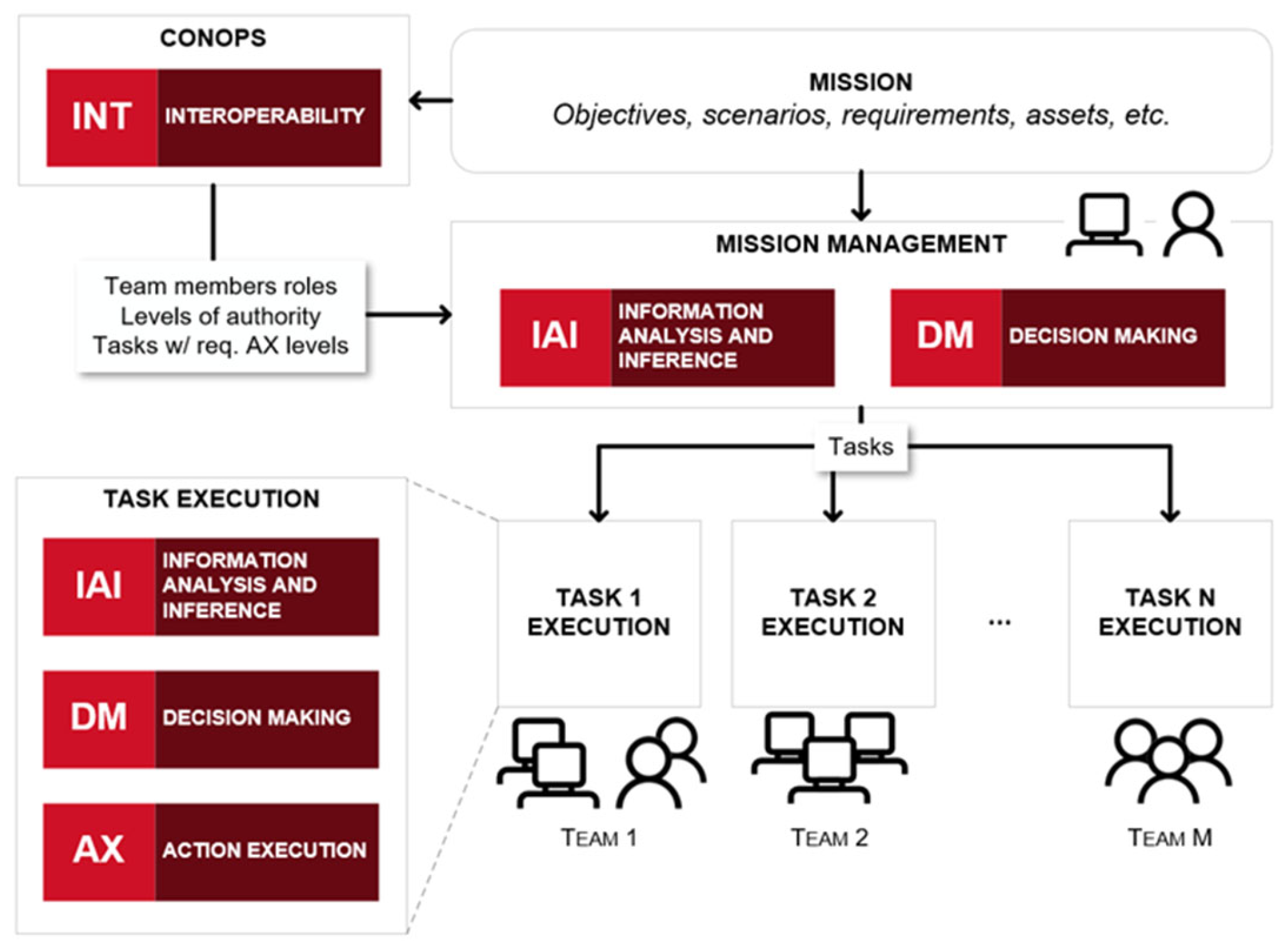
Figure 4 summarizes the role of the MUMT dimensions. The level of interoperability is defined by the CONOPS for the mission. The definition of the required level of interoperability identifies the roles of the different team members (humans and cognitive agents), their level of authority and the AX levels for the different tasks considered by the mission. Mission management requires the implementation of IAI and mission-oriented DM functionalities by the cognitive agents involved in the mission monitoring and control. The output is then the assignment of the tasks to the teams on the field. IAI, DM and AX are then required for performing the tasks. At this level, DM is oriented to the execution of the tasks and the management of the team responsible for that.
3.3. Intended Use of the Framework
The objective of the proposed framework is not to provide a prescriptive evaluation methodology for autonomy, but rather a common descriptive language for characterizing the roles, responsibilities, and interactions between humans and cognitive agents in MUMT systems. It is intended to support comparison of concepts, identification of capability gaps, communication between stakeholders, and high-level system architecture analysis.
The teaming levels defined should not be interpreted as rigid categories derived from quantitative thresholds or formal compliance criteria. Instead, they describe the intended operational role and authority distribution of the cognitive agents within a given concept of operations. The assignment of a level depends on engineering judgment and on how system designers intend the functionality to be used in practice.
The framework also intentionally allows heterogeneous combinations of levels across dimensions. For example, a system may provide advanced decision-support capabilities (high DM level) while relying on limited information inference capabilities (low IAI level), requiring humans to provide or validate critical data inputs. Such combinations are not considered inconsistencies, but rather useful descriptors of the allocation of responsibilities within the team. The granularity of the framework is specifically intended to expose these differences between information processing, decision authority, and task execution. For instance, a system with IAI-4 but DM-2 and AX-1 represents a trusted inference engine whose outputs are subject to joint human–agent decision-making before any execution is initiated, which is a plausible profile for an advanced sensor fusion system with conservative authority allocation.
To support consistent level assignment, the following heuristics apply. For IAI: If the output requires human validation before acting on it, the level is at most IAI-3; if it is acted upon directly, IAI-4. For DM: If the human must confirm before commitment, DM-2 or below; if the cognitive agent acts and the human reviews after the fact, DM-3 or above. For AX: If the execution plan requires approval before starting, AX-2; if execution begins autonomously with the plan available on request, AX-3 or above. Where evaluators disagree, the recommended approach is to adopt the most conservative level that both agree the system satisfies, and treat the higher candidate as a development target.
Empirical evaluation of MUMT systems should consider human factor indicators aligned with each dimension: situation awareness instruments (SAGAT, SART) for IAI; trust calibration scales for DM, particularly to detect overtrust at higher levels; and workload measures (NASA-TLX) for AX, especially during dynamic level transitions. Transparency requirements directly mediate cognitive burden across all three dimensions.
4. Information Analysis and Inference
Information analysis and inference levels quantify the cognitive agent’s capability of processing mission- and non-mission-related data and information to support decision-making and action execution. IAI functionalities are responsible for collecting and analyzing data, to generate information that can be further analyzed and processed to support decision-making and action execution. The information produced can support either humans or cognitive agents. In the latter case, high levels of IAI allow the automation of decision-making and action execution. Indeed, as will be shown in this section, the higher the IAI level, the higher the trust in the cognitive agent’s inference processes. As a result, the cognitive agent can take on more responsibilities since humans trust the IAI outputs.
4.1. IAI Levels of Teaming
Level IAI-0—Unaided analysis. The human team compares, combines, and analyzes different data.
Transparency. Not necessary.
Example: Inflight weather avoidance. Pilot manually reviews weather radar data and flight path to identify storm cells and plan route deviations.
Level IAI-1—Basic data analysis. The human team compares, combines, and analyzes the different data. The cognitive agents provide limited support through basic data filtering and processing.
Transparency. Not necessary since data processing and filtering functionalities are expected to be validated and verified.
Example: Inflight weather avoidance. The weather radar system processes raw data and displays filtered precipitation intensity levels for pilot analysis.
Level IAI-2—Automatic data and information analysis. As IAI-1, plus the cognitive agents produce information that can be used to trigger alerts and to request human team attention according to predefined or tunable parameters.
Transparency. The system shall be able to display the rules triggering the alerts, as well as the associated parameters and variables.
Example: Inflight weather avoidance. Weather radar automatically detects severe weather patterns and alerts the pilot when storm intensity exceeds safety thresholds.
Level IAI-3—Human-validated inference. As IAI-2, plus the cognitive agents can infer producing new information items which should be validated or reviewed by humans.
Transparency. As IAI-2, plus the system shall be able to explain the rationale behind the inference.
Example: Inflight weather avoidance. The weather analysis system predicts storm cell movement and suggests alternative flight paths for pilot validation before implementation.
Level IAI-4—Trusted inference. As IAI-3, but the information inferred and effective guidance produced by the cognitive agent do not require validation by humans.
Transparency. As IAI-3.
Example: Inflight weather avoidance. Weather avoidance system autonomously analyzes meteorological data, predicts storm evolution, and provides flight path modifications without requiring pilot confirmation.
4.2. Increasing the IAI Teaming Level
As the IAI level becomes higher, human attention reduces. Cognitive agents should ask for human intervention or will inform the human only when specific and predetermined events of interest occur. High levels of IAI can then be achieved as these functionalities become more and more accepted and the trust increases. Clearly, transparency plays an important role in increasing the acceptance of such tools and of their output, especially in all those situations where the latter contradicts human analysis or expectations.
4.3. IAI and DM
There might be situations where IAI functionalities need to make internal decisions concerning, for instance, the data to process based on external conditions or events. In some situations, these decisions must be made by the DM authority since the IAI functionality is either not able to decide or it is not trusted by the human team (for instance, the decision is made based on an inference that needs to be validated by a human). Notable examples are IAI functionalities based on multiple sensing systems. The set of sensors the IAI functionality can use is established at design time. The decision of which one to use can be either left to the functionality or accounted for by the decision-making authority. In the former case, the functionality is designed to use a given set of sensors and exclude some of them according to specific conditions. For instance, integrity monitoring algorithms can decide to exclude sensors whose measurements are corrupted by faults or malicious attacks. In other scenarios, a set of sensors can be excluded if they are not suitable for the task due to the current operating conditions. This decision might require human intervention or simply be accomplished by the functionality itself, if the IAI level is high.
5. Decision-Making
Decision-making levels quantify the ability of humans and cognitive agents to make decisions regarding mission tasks, either individually or together. DM is a critical functionality for MUMT as well as any collaborative system composed of humans and machines. When it comes to a mission, there are several levels of DM where a cognitive agent can contribute: the mission level, team level, and vehicle level. For the mission and team levels, the definition of the level of authority, or ranking, of the team members involved in the decisions is important. Indeed, not all the members are authorized to make the final decision, but they might act as advisors proposing alternative courses of action that can be accepted or not by the member with the highest DM authority. Therefore, the levels of teaming proposed for DM are based on authority: for each level, we define the ranking of the human and of the cognitive agent, to indicate who has the authority for making the decision.
The DM authority level for a cognitive agent is directly linked to the IAI level: a high level of IAI implies that the cognitive agent can infer independently the information required for DM, and that the humans trust the inference process.
The key discriminating criterion across levels is the locus of final authority. At DM-1, the cognitive agent produces options only when queried. At DM-2, both parties contribute but the cognitive agent’s output requires explicit human validation. At DM-3, the cognitive agent’s decisions take effect by default, with human intervention possible but not required. At DM-4, the human is informed rather than consulted; at DM-5, no human involvement is assumed.
5.1. DM Levels of Teaming
Level DM-0—Human. The human is the only authorized team member to make any decisions.
Human ranking: Top high. Cognitive agent ranking: None.
Transparency. Not required.
Level DM-1—Human limited. The human is the only authorized team member to make decisions. The cognitive agent generates on request decisions for the human.
Human ranking: High. Cognitive agent ranking: Low.
Transparency. Might be required (further explanation behind a cognitive agent’s choice that the human would show interest in).
Level DM-2—Human and cognitive agent joined. The human and cognitive agent are both authorized to make decisions and can make decisions jointly for the same actions, but the cognitive agent’s decisions would require human validation.
Human ranking: Medium–high. Cognitive agent ranking: Medium–low.
Transparency. Required but not necessarily as a human is still part of the DM.
Level DM-3—Cognitive agent limited. The cognitive agent is the primary decision-making authority. Its decisions take effect by default, but the human can intervene and override if deemed necessary.
Human ranking: Medium–low. Cognitive agent ranking: Medium–high.
Transparency. Required. The human must have sufficient visibility into the cognitive agent’s decisions to exercise meaningful oversight and intervene when appropriate.
Level DM-4—Cognitive agent highly autonomous. The cognitive agent is the only authorized team member to make decisions. The human can request to be informed of decisions made.
Human ranking: Low. Cognitive agent ranking: High.
Transparency. Might be required if requested.
Level DM-5—Cognitive agent fully autonomous. The cognitive agent is the only authorized team member to make decisions.
Human ranking: None. Cognitive agent ranking: Top high.
Transparency. Not required (assumption of full trust of the cognitive agent).
The transparency requirements described per level are directly linked to trust calibration: as cognitive agent authority increases, transparency shifts from optional to mandatory to support meaningful human oversight and prevent overtrust.
5.2. Dynamic Transition of DM Level
It is important to understand how to transition between the DM levels in case of a system or human failure or due to an immediate increase in mission risk and demands. If the human fails and the DM functionalities responsible for the mission management are below DM-3, then the mission will not be able to progress. It is important for the cognitive agent to be able to report back to another human authority the situation status and have fallback plans, or the intelligence to step up to a higher level of DM if required.
5.3. Conflicts Mitigation in DM
The DM levels introduced are based on the definition of a clear hierarchical authority relationship between the cognitive agent and the human. It should be noted that at no level do the cognitive agent and human have the same ranking, or in other words, are considered peers. This is essential for avoiding “deadlocks” in the decision-making process, where the two parties propose different plans but neither of them has the authority to make a final decision.
The other important element for conflict mitigation in DM is the availability of the same information to all the parties, which can be referred to as a common frame of reference. Hence, systems for shared situational awareness are required to provide the same data and information to all the team members involved in the decision. A challenging aspect for these systems will be the integration of information available only to the humans or inferred by them. Indeed, this type of information will be used by the human members to identify plans, but a cognitive agent that does not have access to this information might see the plan suggested by the humans as wrong or inefficient, leading to conflicts. This might not be a problem when humans have higher rankings, but in the levels where cognitive agents are ranked higher, it would cause frequent overrides by the humans, leading to trust and technology acceptance degradation. The problem can be solved by designing human–machine interfaces (HMIs) that allow humans to input information available to or inferred by them for the cognitive agent to consider during the decision-making process. However, the conceptualization of these HMIs is not trivial, and wrong designs might also lead in this case to acceptance issues caused, for instance, by the additional workload on humans required for inputting the information to the system.
6. Action Execution
Action execution levels quantify the capability of the cognitive agents to execute an action or complete a task, alongside or in collaboration with humans. AX functionalities are responsible for the execution of actions and/or tasks assigned to the cognitive agent. The most advanced MUMT concepts foresee close collaboration between the manned and unmanned assets. Through the different levels of teaming, we are able to capture ways teaming can be achieved, starting from no collaboration, i.e., the cognitive agents execute tasks on their own and without coordinating their actions with the humans, up to high levels of collaboration where the cognitive agents can proactively support the humans.
6.1. Action Execution Levels of Teaming
The key discriminating criterion is whether execution requires prior human approval (AX-2), proceeds autonomously with the plan available on request (AX-3), or involves active coordination during execution (AX-4 and above). The distinction between AX-5 and AX-6 is whether the cognitive agent awaits acceptance before increasing its involvement (AX-5) or acts immediately and requires only acknowledgment (AX-6).
Level AX-0—Human active control. Humans actively control the cognitive agent.
Transparency. Not required.
Example: area exploration for SAR. An operator controls a UAS to fly over the area to explore.
Level AX-1—Predefined action implementation. The cognitive agent can execute a set of well-defined actions.
Transparency. Not required since the functionalities for the action execution are expected to be validated and verified.
Example: area exploration for SAR. An operator creates a lawnmower trajectory for exploring an area. The trajectory is assigned to a UAS. The autopilot of the UAS follows the trajectory.
Level AX-2—Task execution subject to approval. The cognitive agent can perform tasks. The task execution plan must be reviewed and approved by humans before the cognitive agent can start the execution.
Transparency. The task execution plan is used by the humans to understand how the cognitive agent will execute the task. The plan shall provide enough information to help the humans understand non-obvious solutions, as well as the information and the metrics considered during the planning.
Example: area exploration for SAR. An operator assigns a UAS an area to explore. The UAS creates a flight plan for covering the assigned area and requests approval of the plan by the operator before starting the exploration. The task execution plan is composed of the flight plan. Some portion of the assigned area will not be explored since the altitude is outside the vehicle’s flight envelope. In the task execution plan, this portion of the area is highlighted and a motivation is provided (e.g., “altitude outside flight envelope”).
Level AX-3—Task execution. Same as AX-2, but the cognitive agent does not require approval from a human to execute the task.
Transparency. Same as AX-2, but the plan is now provided only upon request.
Example: area exploration for SAR. An operator assigns a UAS an area to explore. The UAS creates a flight plan for covering the assigned area and starts the exploration.
Level AX-4—Joint task execution. The task can be executed jointly by humans and the cognitive agent. The cognitive agent can quantify human contribution to the task and, based on that, coordinate or review the task execution.
Transparency. The task execution plan shall contain the conditions associated with the human contribution to the task that, when verified, result in a change of the execution flow. In addition, the task execution plan shall state how the human team’s contribution is monitored in terms of data used and metrics adopted.
Example: area exploration for SAR. The operator creates a joint task for exploring an area. The UAS creates a flight plan for exploring the area. During the task execution, the UAS monitors the position of the human team to determine if portions of the area assigned to the UAS are explored. If this happens, the UAS replans its flight to avoid flying over the explored portions. The task execution plan is composed of the initial flight plan, and it states that the position of the human team involved in the exploration is going to be monitored by the cognitive agent.
Level AX-5—Proactive joint task execution. The cognitive agent monitors the human team executing the joint task and provides real-time support if needed.
Transparency. Building on AX-4 transparency requirements, the task plan additionally specifies the conditions triggering increased cognitive agent involvement and the human team metrics monitored. Furthermore, the cognitive agent needs to communicate to the human team the availability for increasing its support and the need to obtain approval from the human team before proceeding.
Example: area exploration for SAR. The operator creates a joint task for exploring an area. The UAS explores the assigned area and detects that the human team has still to explore a large portion of their assigned area. The UAS then proposes to explore part of the unexplored portion by communicating the intention to the human team and providing the details of the area it will cover. If the human team approves, the UAS will start the exploration of the area. The task execution plan is the same as the one described for AX-4, with the addition of the condition that triggers the additional support from the UAS, along with the human team variables and metrics monitored.
Level AX-6—Joint task take-over. The cognitive agent can take over the full execution of a task if it considers the human team unfit. Such a decision is limited to the assigned task and can be made when an immediate reaction is required.
Transparency. Same as AX-5, with the addition of conditions that trigger the cognitive agent to take over the task, along with the data from the human team monitored and the metrics adopted. At this level, the cognitive agent does not have to wait for approval, but it must communicate its intention, and it must ensure the intention is acknowledged by the human team.
Example: area exploration for SAR. The operator creates a joint task for exploring an area. The UAS completes the exploration of the assigned area and checks the status of the human team. From the data, the UAS estimates that it will take a long time for the human team to explore their area, whereas the UAS can complete the exploration quicker. The UAV then decides to take over the task and communicates the intention to the human team, who acknowledge the intention.
6.2. The Role of HAT Interfaces
A crucial element for both task and joint task execution and monitoring is the availability of clear and simple HAT interfaces. The monitoring can take advantage of the task execution plan, which should be designed by the same team designing the functionalities implemented by the cognitive agents. Indeed, the designers are responsible for the inner workings of the functionalities and can work together with human factor experts in understanding what data and information needs to be exposed for implementing effective HAT interfaces. Joint task execution will require access to a common situational awareness view, or a common frame of reference, and the possibility for humans to input new information that needs to be shared with the cognitive agents. Furthermore, cognitive agents need a means of communicating their intentions in a format that humans in the field can easily understand.
6.3. AX and DM
In the execution of a task, there might be decisions the cognitive agent has to make to continue the execution. If such decisions do not impact or disrupt the mission execution and they can be automated, they belong to the AX domain. It is then the responsibility of the task designers to identify what events and conditions will require the intervention of the decision-making authority.
Example: flight planning. Consider, for instance, a task “fly from A to B”. A cognitive agent can use a flight planner to generate a flight plan and then start the flight. Because of an unexpected event (e.g., bad weather conditions), the cognitive agent might need to replan the flight and the ETA will change. The designer of “fly from A to B” can add a threshold for the maximum acceptable delay, which can be used to trigger the need to decide whether to continue with the task or abort it. In other words, for every replan that will result in a delay below the threshold, the cognitive agent can continue with the task, whereas in the other case, the decision-making authority needs to decide whether the cognitive agent can continue or not.
6.4. AX and IAI Levels
The AX level capabilities depend on the IAI level of the functionalities providing the data and information required for executing the action or task. It is possible to identify a minimum IAI level required for each AX level, as shown in
Table 1. Such a relation is based on the fact that the higher the AX level, the higher will be the “degree of autonomy” of the cognitive agents, which needs to be supported by more advanced IAI functionalities, and be independent from human validation for AX-5 and AX-6 levels, since at these levels the cognitive agent is capable of actively supporting the human team.
7. An Example of Application of the Framework
The following example is a conceptual illustration of an application of the framework and does not constitute empirical validation of the taxonomy.
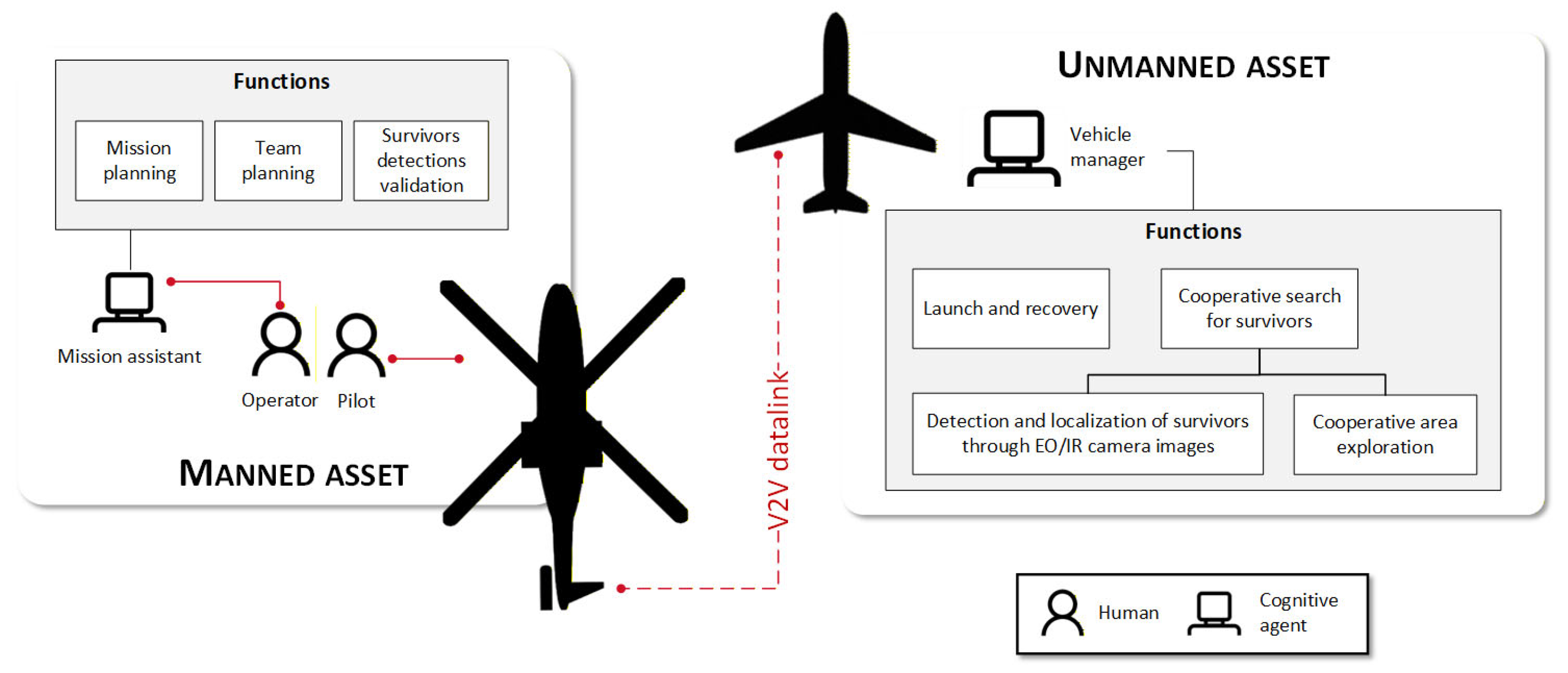
We now show how the framework can be used to classify cognitive agents’ capabilities in a simplified SAR mission, where manned and unmanned assets have to collaboratively explore an area to find survivors. The high-level architecture of the MUMT systems is shown in
Figure 5.
The crew of the manned asset is composed of a human pilot and a human operator, the latter controlling the unmanned asset through a cognitive agent, the mission assistant. The mission assistant provides mission- and team-level support for DM:
Mission planning: Functionalities for the identification of areas to explore according to the data and information available and received throughout the mission. These functionalities are classified as DM-2, i.e., the mission assistant can propose areas to explore but it is up to the human operator to accept the suggestions, and are supported by IAI-2 functionalities that automatically process the data available to identify new areas.
Team planning: Based on the assets’ health status and fuel or battery levels, it assigns areas to explore to the available assets. It is a DM-1 functionality, since it is queried by the human operator when needed, and it is supported by IAI-2 functionalities that collect data on the assets’ status and perform simple prognostics.
The unmanned asset is controlled by the vehicle manager cognitive agent. The vehicle manager provides functionalities for the automatic launch and recovery of the vehicle. The other main capability provided by the vehicle manager is the cooperative search for survivors functionality, which is composed of two sub-capabilities:
Cooperative area exploration, for coordinating the exploration with the manned asset, for instance, by replanning the search path to avoid areas already explored by the manned asset. The functionality is classified as AX-4, since the unmanned asset can explore the environment in collaboration with the manned asset, and DM-3, since new plans can be generated and implemented automatically but the operator can review them if needed.
Detection and localization of survivors through electro-optical/infrared (EO/IR) camera images, for controlling the acquisition and processing of the EO/IR camera. Note that its IAI capabilities are classified as IAI-3: the unmanned asset can process the images to detect survivors, but the positive detection must be validated by a human. This is done through the survivor detection validation functionality of the mission assistant. The functionality is also classified as DM-4: the vehicle manager can deviate from the search path if it needs to take more images of a possible survivor to confirm the detection.
The reader can refer to
Table 2 and
Table 3 for a detailed description of the functions provided by the cognitive agents and their classification according to the MUMT framework.
Experimental validation could be pursued through a human-in-the-loop simulation study in which independent evaluators classify the same system, with inter-rater reliability used as a reproducibility metric. A full validation program could include: expert elicitation workshops for level boundary refinement, human-in-the-loop simulation for SA and workload assessment per
Section 3.3 heuristics, and operational case-study application across MUMT domains.
8. A Comparison with the EASA AI Levels
Table 4 provides a comparison between the EASA AI levels [
8] and this framework. Rather than representing strict one-to-one equivalences, the associations should be interpreted as indicative correspondences intended to highlight similarities in operational roles, authority allocation, and human involvement. For each EASA AI level, the closest corresponding teaming levels for IAI, DM, and AX were identified based on the following rationale:
Level 1A—Human augmentation. AI provides only support with information acquisition and analysis. The definitions for IAI-2 and AI Level 1A match.
Level 1B—Human assistance. The AI provides decision options to the human, who is responsible for selecting the one the believes is the most appropriate. This is the same as in DM-1, but requires at least IAI-2 level; i.e., the AI needs to be able to gather and analyze the data used for the decision process.
Level 2A—Human–AI cooperation. The AI has automatic capabilities for IAI, DM and AX, but decisions and outputs must be validated by the human.
Level 2B—Human–AI collaboration. Increased AI ranking/authority, which leads to an increase in the DM level to DM-3.
Level 3A—Supervised advanced automation. Highly automatic AI, humans can only override. To reach this level, inference performed by the AI must be trusted, hence IAI-4.
Level 3B—Autonomous AI. AI is in charge of taking DM and AX. The information inferred for performing the missions is trusted.
Overall, the comparison suggests that the proposed MUMT taxonomy is broadly compatible with emerging regulatory classifications for AI-enabled aviation systems. The correspondence should not be interpreted as a definitive regulatory mapping, since actual classification may vary depending on implementation details, operational constraints, certification assumptions, and the specific distribution of authority between human operators and AI systems.
Table 4.
Comparison between MUMT framework and EASA AI levels.
Table 4.
Comparison between MUMT framework and EASA AI levels.
| EASA AI Levels | HAT Cognitive Functions Levels |
|---|
| AI Level | Function Allocated to the System to Contribute to the High-Level Task | Authority of the End User | IAI Level Required | DM Level Required | AX Level Required |
|---|
Level 1A
Human augmentation | Automation support for information acquisition
Automatic support for information analysis | Full | IAI-2
Automatic data and information analysis | - | - |
Level 1B
Human assistance | Automation support for decision-making | Full | IAI-2
Automatic data and information analysis | DM-1
Human limited | - |
Level 2A
Human-AI cooperation | Overseen and overridable automatic decision
Overseen and overridable automatic action implementation | Full | IAI-3
Human-validated inference
(IAI-2 minimum) | DM-2
Human and cognitive agent joined | AX-2
Task execution subject to approval
(AX-1 minimum) |
Level 2B
Human-AI collaboration | Overseen and overridable automatic decision
Overseen and overridable automatic action implementation | Partial | IAI-3
Human-validated inference
(IAI-2 minimum) | DM-3
Cognitive agent limited | AX-2
Task execution subject to approval
(AX-1 minimum) |
Level 3A
Supervised advanced automation | Supervised automatic decision
Supervised automatic action implementation | Upon alerting | IAI-4
Trusted inference
(IAI-3 minimum) | DM-4
Cognitive agent highly autonomous | AX-3
Task execution w/o approval
(AX-2 minimum) |
Level 3B
Autonomous AI | Non-supervised automatic decision
Non-supervised automatic action implementation | Not applicable | IAI-4
Trusted inference | DM-5
Cognitive agent fully autonomous | AX-3
Task execution w/o approval |
9. Conclusions
The objective of the framework proposed in this paper is to provide a taxonomy for classifying the different types of functionalities a cognitive agent can offer to simplify and enhance MUMT operations, ranging from simple tools for mission analysis to unmanned assets’ strategies for flying and working alongside human teams in the field. The MUMT framework can help in classifying what type of functionalities these tools are providing and what level of teaming is possible to achieve to create an organized catalog of solutions and speed up the development of integrated solutions for MUMT.
Data and information propagation across the assets is critical for the implementation of future MUMT operations. The development of systems and technologies for the creation of a common frame of reference, or shared situational awareness, shall be prioritized to simplify access to information for humans and cognitive agents, and enable joint decision-making.
Beyond interface interoperability, practical deployment raises further challenges. Distributed authority management becomes non-trivial when multiple cognitive agents hold different DM levels across concurrent sub-tasks. Communication degradation must trigger well-defined authority fallback rules, since a cognitive agent operating at DM-4 in nominal conditions cannot be assumed to behave safely without reliable data links. As the number of agents scales, hierarchical authority architectures will likely be necessary to keep coordination tractable.
The implementation of such a system clearly presents several challenges, such as the interoperability of the agents and the inclusion of human situational awareness. The former can be solved by introducing standard interfaces and data structures that allow interoperability among different systems. Indeed, asset interoperability will be a crucial element for the adoption of MUMT systems, especially in those contexts where different government bodies and organizations must collaborate and dynamically change teams as the mission evolves. The inclusion of human situational awareness is probably one of the most challenging aspects. It requires the analysis of the type of information a human can share to have them considered by a cognitive agent, and the way such information can be entered into the system. The latter can create additional workload on the humans that might be seen as unnecessary if the results are not in line with the expectations, preventing the adoption of such technology.