1. Introduction
1.1. Problem Statement and Motivation
Multi-criteria optimization (MCO) is becoming increasingly important in modern decision-making contexts, especially in complex and multi-faceted domains. Unlike traditional methods of searching for a single optimal solution, MCO addresses the challenge of reconciling several conflicting criteria.
Rather than providing a single ‘ideal’ solution, the result of such an analysis is a series of compromise options that together form the so-called Pareto front [
1,
2]. In this context, improving one aspect invariably leads to simultaneous deterioration in another. This is especially common in industries with high uncertainty and many constraints.
A notable example of this is the mining industry, where economic profitability, environmental standards, safety requirements and technological capabilities must all be considered simultaneously. Classical optimization methods often fail to cope with the complexity of real-world problems [
3,
4,
5]. In such cases, genetic algorithms (GAs), which are based on the principles of biological evolution, offer a promising alternative. Their main advantages are flexibility and adaptability. Unlike gradient methods, which require functions to be strictly differentiable, GAs can work with non-linear, discontinuous and poorly formalized models. Additionally, due to their stochastic nature, GAs are less likely to become trapped in a local optimum, which is particularly important when exploring complex, multidimensional spaces.
1.2. MCO Challenges in Mining Applications
In the mining industry, MCO tasks arise at every stage of the production cycle, from extraction and ore enrichment planning to waste dump management and land reclamation [
6,
7,
8]. For instance, when designing a quarry, the aim is to maximize extraction volume, minimize transportation costs, and mitigate negative environmental impact simultaneously. Traditional optimization methods, such as linear programming, are often inapplicable due to the complexity and nonlinearity of such tasks [
9,
10,
11]. In this context, genetic algorithms (GAs) demonstrate their effectiveness by enabling compromise solutions that analytical methods cannot obtain.
The most popular GA-based MCO algorithms include NSGA-II (Non-dominated Sorting Genetic Algorithm II) [
12] and SPEA2 (Strength Pareto Evolutionary Algorithm 2) [
13]. These algorithms use mechanisms such as Pareto optimality, tournament selection and crossover to effectively explore the solution space. In recent years, modifications adapted to the specifics of mining tasks have emerged. For instance, Ref. [
14] proposes an improved GA for short-term production planning that considers economic and geological constraints.
Similarly, Ref. [
15] developed a method for optimizing land use that combined environmental and economic criteria. The application of a multi-criteria genetic algorithm (GA) to optimize ore mixing processes in the ‘mine-factory’ chain was also presented in Ref. [
15]. This approach achieved a significant increase in net present value.
Ref. [
16] proposes a method of limited dynamic multi-criteria evolutionary optimization, which has been shown to be highly efficient in solving problems of increasing mineral processing productivity. The study demonstrated the effectiveness of an improved multi-criteria GA for optimizing land use in open-pit coal mining areas when environmental and economic factors were taken into account [
17].
Relevant to the present context is Ref. [
18], in which a multi-criteria GA was applied to develop a predictive model and optimize the technological parameters of selective laser melting, yielding measurable improvements in final product quality. This example illustrates the broader adaptability of GA-based MCO methods to complex industrial processes requiring the simultaneous consideration of multiple technical and economic factors.
However, despite these successes, applying GA to MCO presents several challenges. These include [
19,
20,
21]:
Computational complexity, especially when working with large datasets and multiple criteria.
Convergence problems: risk of premature algorithmic stagnation.
The subjective nature of solution selection requires additional methods for choosing the final option from the Pareto front (e.g., multi-criteria decision-making methods such as TOPSIS or AHP).
This work aims to systematize modern approaches to applying GA for MCO in the mining industry, analyze their strengths and weaknesses, and suggest areas for improvement. The article discusses classical algorithms such as NSGA-II and SPEA2 [
15], as well as modifications developed to address the specific requirements of mining tasks. Particular attention is paid to cases where GAs have produced significant practical results, such as increased net income, reduced environmental damage or optimized logistics.
The relevance of this topic stems from the growing demand for intelligent control systems in the mining sector, where traditional methods often struggle to cope with increasing task complexity and multi-criteria nature. The results of this study could be valuable for researchers and practitioners involved in optimizing production processes in uncertain and constrained environments.
1.3. Methodological Parallels with Computational Intelligence in Manufacturing
Of particular relevance to the present study is the work of Oguzhan Der, Mustafa Tasci et al. on intelligent modeling and prediction of CO
2 laser cutting performance in FFF-printed thermoplastics using machine learning algorithms [
22]. Although applied to a different manufacturing domain (additive manufacturing versus mining), this study shares fundamental methodological challenges with our work.
Methodology: The authors employed machine learning algorithms—specifically artificial neural networks (ANN) and support vector regression (SVR)—to model and predict the performance of CO2 laser cutting in FFF-printed thermoplastics. Key input parameters included laser power, cutting speed, and material properties, while output performance metrics focused on cut quality characteristics such as kerf width and surface roughness. The study utilized experimental data to train and validate the predictive models, with rigorous cross-validation to ensure generalizability.
Key results: The machine learning models demonstrated high predictive accuracy, with the ANN approach achieving R2 values exceeding 0.95 for key performance indicators. The analysis revealed complex nonlinear relationships between process parameters and cut quality, enabling the identification of optimal parameter combinations for improved manufacturing outcomes. Importantly, the study highlighted the superiority of data-driven approaches over traditional empirical modeling when dealing with complex, multi-parameter processes.
Relevance to the current study: Several parallels and contrasts with this work are relevant to our study:
Methodological parallel: Both studies employ computational intelligence techniques to model complex industrial processes. While Oguzhan Der, Mustafa Tasci and others focus on prediction using supervised learning (ANN, SVR), our work addresses optimization using evolutionary algorithms (genetic algorithms). This reflects complementary aspects of the broader field of computational intelligence in manufacturing: prediction of process outcomes versus optimization of process parameters.
Data-driven approach: Both studies emphasize the value of data-driven modeling when analytical solutions are impractical due to process complexity. The laser cutting study demonstrates that machine learning can capture nonlinear relationships that would be difficult to model mathematically—a finding that supports our choice of genetic algorithms for multi-criteria optimization in mining, where similar complexities exist.
Multi-parameter handling: Both studies deal with multiple interacting parameters. The laser cutting work shows how different input parameters (power, speed, material properties) collectively influence multiple quality metrics—directly analogous to our handling of shaft depth, temperature, vibration, MTBF, and MTTR as they jointly affect failure rate, energy consumption, and repair costs.
Contrast in objectives: A key distinction lies in the primary objective: the laser cutting study aims for accurate prediction of process outcomes, while our work focuses on optimization of conflicting objectives. These are complementary: accurate predictive models (such as those developed in the laser cutting study) could potentially be integrated into our optimization framework as surrogate models to reduce computational cost, representing an interesting direction for future research.
Validation approach: Both studies validate their models against real experimental/operational data, enhancing practical relevance. The laser cutting study’s use of cross-validation provides a robustness check that could inform future extensions of our work, particularly when applying the methodology to different mining equipment types or operational contexts.
In summary, the work of Oguzhan Der, Mustafa Tasci and others on laser cutting performance modeling provides valuable methodological parallels and contrasts that contextualize our approach within the broader landscape of computational intelligence in manufacturing and industrial processes. The integration of predictive machine learning with evolutionary optimization represents a promising direction for future research in mining equipment optimization.
1.4. Aims, Novelty, and Contributions
While GA-based MCO has produced significant results across mining and manufacturing domains, a gap remains in its systematic application to underground mining equipment reliability—specifically, the simultaneous optimization of failure rate, energy consumption, and repair costs under realistic operational constraints. Existing algorithms such as NSGA-II and SPEA2, though well-established, exhibit known limitations in this context: NSGA-II relies on a fixed crossover rate that does not adapt to population diversity, while SPEA2 incurs prohibitive computational cost (O(MN3)) in large equipment fleets. Neither algorithm incorporates domain-specific initialization or hybrid diversity metrics suited to the non-linear parameter interactions characteristic of underground mining operations.
The present study addresses these limitations through the following contributions:
A novel adaptive crossover mechanism that dynamically adjusts the crossover probability based on the Hypervolume Indicator, promoting exploration when diversity is low and exploitation as the population converges. This alone yields a 3.5% improvement in Hypervolume over a fixed-rate baseline.
A hybrid diversity preservation metric combining crowding distance with nearest-neighbor distance in objective space, resulting in a 12% improvement in Pareto front spread compared with NSGA-II.
A problem-specific heuristic initialization strategy seeded from historical operational data of JSC “Vorkutaugol”, reducing the generations required for convergence by approximately 15%.
Quantified performance superiority over state-of-the-art benchmarks: the proposed algorithm achieves a Hypervolume Indicator of 0.796—a 7.2% improvement over SPEA2—and an 18.3% reduction in Inverted Generational Distance (IGD), indicating closer convergence to the true Pareto front.
Actionable decision-support insights for mining operators: for example, a 15% reduction in energy consumption correlates with a 10% increase in failure rate, providing quantified trade-off guidance that standard single-objective methods cannot offer.
To our knowledge, this is the first application of an adaptive crossover GA with hybrid diversity preservation to the simultaneous optimization of failure rate, energy consumption, and repair costs in underground mining equipment, validated on a real industrial dataset of 5000 equipment units spanning 24 months of operation.
2. Materials and Methods
Unlike in single-criterion optimization, where the goal is to minimize or maximize a single objective function, in multi-criteria optimization, several objective functions are considered. For example, the objective is to find a set of compromise solutions known as Pareto-optimal solutions, where it is impossible to improve one criterion without worsening another [
22,
23].
In a multi-criteria optimization problem, there are multiple objective functions.
where:
—the set of feasible solutions;
—objective functions that may be conflicting.
- 2.
Pareto optimality.
A solution is Pareto optimal if improving one of the indicators inevitably causes a deterioration in the others [
24,
25]. Mathematically, solution
is Pareto-dominated if there exists a solution
satisfying the condition:
where it is no worse than any of the objective functions, and for at least one
, the inequality is strict.
If there is no such solution, then belongs to the Pareto front, which is a set of compromise solutions.
There are several approaches to solving multi-criteria problems.
Scalarization: converts a multi-criteria problem into a single-criteria problem using weights and other techniques. The weighted sum method:
where
are the weight coefficients.
Disadvantage: It is impossible to find points located in the concave areas of the Pareto front.
The ε-constraint method involves taking one function and optimizing it, while the remaining functions serve as constraints.
Disadvantage: The value of ε must be selected.
Evolutionary algorithms are based on working with a set of solutions, which allows the Pareto front to be found in far fewer iterations.
NSGA-II includes a mechanism for preserving diversity in solutions;
SPEA2 takes into account dominance, i.e., the degree to which some solutions influence others in the population.
It iteratively adjusts solutions in the direction that improves all criteria simultaneously.
Genetic algorithms (GAs) are a type of evolutionary algorithm that is based on natural selection and evolution. They are widely used to solve MCO problems [
26,
27].
GAs imitate the evolutionary process through inheritance, mutation, selection, and crossover. In the context of MCO, the key distinction from standard GAs lies in the absence of a single objective function: rather than selecting one best solution, the algorithm constructs a set of Pareto-optimal solutions. To this end, the fitness evaluation incorporates Pareto dominance ranking, ensuring that the selection and reproduction operators drive the population toward the Pareto front while maintaining solution diversity. The termination criterion is typically defined by a fixed number of generations or population stabilization.
Unlike conventional genetic algorithms, MCO problems do not have a single objective function. This means that the standard approach of selecting the best solution does not work. To address this, Pareto optimality is employed, whereby a set of Pareto-optimal solutions is constructed instead of a single solution.
The main GA strategies for MCO include scalarization methods, which transform a multi-criteria problem into a single-criteria one.
The weighted sum method combines all criteria into one using weights;
The ε-constraint method, where one function is optimized while the others are set as constraints;
Compromise programming method: minimizing the distance to a certain ideal solution.
Disadvantages include difficulties in selecting weight coefficients and poor performance with complex Pareto fronts.
Methods based on Pareto dominance use the concept of dominance, whereby a solution is considered optimal if it is not inferior in any respect and superior in at least one.
Pareto sorting involves dividing solutions into levels of optimality;
Crowding distance: a mechanism for maintaining the diversity of solutions;
Elitism: the preservation of the best solutions between generations.
NSGA-II (Nondominated Sorting Genetic Algorithm II) is one of the most popular genetic algorithms for MCO. It is distinguished by its effective sorting of solutions by Pareto dominance levels and its mechanism for preserving diversity.
It divides solutions into levels (frontiers) of Pareto dominance.
It uses Crowding Distance to ensure a uniform distribution of solutions.
It preserves elitism, whereby the best solutions are passed on to the next generation.
Advantages: high speed and effective coverage of the Pareto frontier.
Its computational complexity is O(MN2) (where M is the number of criteria, N is the population size), which is due to the fast nondominant sorting procedure. The algorithm scales well and works efficiently with tasks containing up to 3–4 criteria.
SPEA2 (Strength Pareto Evolutionary Algorithm 2) [
13] employs a mechanism to evaluate the dominance strength of solutions and a dedicated archive to store the most promising candidates.
It assesses the degree of dominance (i.e., how much better a solution is than others).
It maintains an archive of solutions to ensure that the optimal points found are not lost.
Ensures balanced distribution of points on the Pareto front.
Advantages: stable storage of the best solutions and good coverage of a set of solutions.
However, the main disadvantage of SPEA2 is its higher computational complexity (O(MN3)) compared with NSGA-II due to the need for pairwise comparison of solutions to calculate the strength of dominance. This may reduce its performance in large populations.
The MOEA/D (Multi-Objective Evolutionary Algorithm Based on Decomposition) algorithm decomposes a multi-criteria problem into a set of single-criteria sub-problems, which are then solved in parallel [
28,
29].
It divides the set of solutions into sub-tasks, each of which is responsible for one section of the Pareto front.
Each sub-task is optimized separately, but exchanges information with neighboring ones.
It enables management of criterion priorities.
Advantages: high efficiency with a large number of objective functions.
Due to the decomposition strategy, the computational complexity of MOEA/D is O(MT), where T is the size of the neighborhood, which makes it one of the fastest algorithms for problems with many criteria (many-objective optimization). However, the quality of the Pareto front strongly depends on the choice of the decomposition method and the weight vectors.
Table 1 presents a comparative analysis of genetic algorithms for solving multi-criteria optimization problems.
2.1. Proposed Modifications to the Genetic Algorithm
While the proposed algorithm builds upon the framework of NSGA-II, it incorporates several key modifications designed to enhance performance specifically for mining equipment optimization problems. These modifications address the unique characteristics of the dataset, including the presence of heterogeneous equipment types and the conflicting nature of the three objective functions.
2.2. Adaptive Crossover Mechanism
Unlike NSGA-II, which uses a fixed crossover probability, the proposed algorithm implements an adaptive crossover rate that dynamically adjusts based on the diversity of the population. The crossover probability
is calculated at each generation as:
where:
and
are the maximum and minimum crossover rates;
is the Hypervolume Indicator of the population at generation g;
and
are the observed maximum and minimum Hypervolume values.
The values and are updated each generation as the maximum and minimum Hypervolume Indicator values observed among the current population and the external archive. Initially, is set to the Hypervolume of the nondominated solutions in the initial population, and HVmin is set to zero. As the algorithm progresses, HVmax increases toward the true Pareto front, and the crossover probability decreases accordingly, shifting from exploration to exploitation.
This adaptive mechanism promotes exploration (higher crossover) when population diversity is low and encourages exploitation (lower crossover) as the population converges toward the Pareto front. Quantitative analysis shows that this adaptation improves the final Hypervolume by approximately 3.5% compared with using a fixed crossover rate of 0.85.
2.3. Enhanced Diversity Preservation
NSGA-II uses crowding distance to maintain diversity along the Pareto front. However, preliminary experiments revealed that this mechanism alone was insufficient to prevent clustering of solutions in regions where objective functions exhibited nonlinear interactions. To address this, we introduced a hybrid diversity metric that combines crowding distance with a nearest-neighbor distance measure in the objective space:
where:
is the standard crowding distance for individual
i;
is the Euclidean distance to the nearest neighbor in objective space;
= 0.3 is a weighting coefficient determined empirically.
The weighting coefficient = 0.3 was determined through a systematic tuning procedure. We tested values of in the range [0, 0.6] in increments of 0.1, using the Hypervolume Indicator after 500 generations as the performance metric. Each configuration was run five times with different random seeds. The best average Hypervolume was observed at = 0.3, with = 0.2 and = 0.4 yielding 1.2% and 1.8% lower performance, respectively. The default crowding distance ( = 0) produced the highest clustering and the lowest solution spread.
This hybrid metric penalizes solutions that are too close to their neighbors, promoting a more uniform distribution along the Pareto front. The enhanced diversity preservation resulted in a 12% improvement in the spread of solutions compared with standard NSGA-II, as measured by the Pareto spread metric.
2.4. Problem-Specific Initialization
Instead of random initialization, the proposed algorithm uses a heuristic initialization strategy that incorporates domain knowledge. The initial population is seeded with solutions derived from:
Historical operational data of well-performing equipment configurations;
Solutions obtained from single-objective optimizations of each criterion individually;
Randomly generated solutions with constraints derived from equipment specifications.
This approach accelerates convergence by starting the search from promising regions of the solution space. Comparative experiments showed that heuristic initialization reduces the number of generations required to reach a stable Pareto front by approximately 15% (from 470 to 400 generations) compared with random initialization.
2.5. Constraint-Handling Mechanism
Formal Set of Operational Constraints.
The following physical and operational constraints are incorporated into the model. Each constraint is expressed as an inequality (x) ≤ 0, with violations penalized through the adaptive penalty mechanism.
Temperature limit: T ≤ 85 °C. This upper bound is based on manufacturer specifications for critical components (insulation class, lubricant stability) and safety regulations for underground mining equipment. Exceeding this threshold significantly increases the risk of thermal damage and unplanned failures.
Vibration limit: v ≤ 120 Hz. This limit follows ISO 10816 standards [
30] for industrial machinery vibration severity and manufacturer-recommended thresholds. Operation beyond this range accelerates bearing wear and risks structural damage.
MTBF lower bound: MTBF ≥ 15 days. This minimum reliability standard ensures that equipment maintains a baseline availability to avoid excessive production downtime. The value is derived from enterprise maintenance records at JSC “Vorkutaugol”.
MTTR upper bound: MTTR ≤ 48 h. This limit ensures that repairs are completed within two working days, preventing prolonged production stoppages. The value reflects typical spare parts logistics and shift schedules at the mine site.
Energy consumption limit: E ≤ 15,000 kWh. This constraint reflects power supply limitations at remote mine substations and operational safety margins.
Combined risk constraint: (v/120)2 + (T/85)2 ≤ 1.5. This derived constraint captures the interaction between vibration and temperature, where moderate elevations of both parameters create disproportionate safety risks even when each remains below its individual limit. The formulation is adapted from typical damage accumulation models in reliability engineering.
Real mining operations impose physical and operational constraints that cannot be violated. The proposed algorithm incorporates a penalty function with adaptive scaling:
where:
(x) is the original objective function value;
(x) represents the
-th constraint violation;
is an adaptive penalty coefficient that increases if constraints are violated in consecutive generations.
The penalty coefficients ρj are updated each generation according to the following rule:
where
(g) is the number of consecutive generations in which constraint j has been violated by any individual in the population, and
= 0.5 is an adaptation rate parameter. If no violation of constraint j occurs in a generation,
is reset to its initial value of 1000. This adaptive mechanism ensures that persistently violated constraints receive progressively higher penalties, driving the population toward feasibility without prematurely eliminating solutions that violate constraints only transiently.
This adaptive penalty ensures that infeasible solutions are gradually eliminated while allowing initial exploration of near-boundary regions. The mechanism successfully maintained 100% feasibility in the final Pareto front across all experimental runs.
2.6. Elitism with Archive
While NSGA-II preserves elite solutions through its sorting mechanism, the proposed algorithm maintains a separate external archive of the best nondominated solutions found so far. This archive is updated at each generation and is used to guide selection through an elite selection pressure parameter. The archive size is limited to 100 solutions to maintain computational efficiency.
2.7. Summary of Quantitative Improvements
Table 2 summarizes the quantitative impact of each modification on algorithm performance, as measured through controlled experiments where each modification was tested independently.
2.8. Software Implementation
The algorithm uses the following libraries:
DEAP (version 1.3.1): A framework for writing evolutionary algorithms. In this solution’s code, it is used to create the GA’s general structure, genetic operators and the evolution process.
Pandas (1.3.0): A library for working with tables. In the solution algorithm, it is used to load and preprocess data.
Matplotlib (3.5.0) and Seaborn (0.11.2): These are libraries for data visualization. They are used to construct 2D and 3D graphs.
NumPy (2.4.6): A library for working with arrays.
3. Results and Discussion
The dataset used in this study comprises operational records for 5000 pieces of mining equipment. The data were collected from several underground mines operated by JSC “Vorkutaugol”, a major coal mining enterprise in the Pechora coal basin, Russia. The data span a 24-month period from January 2024 to December 2025. The equipment fleet includes critical assets such as mine hoists, main ventilation fans, coal shearers, and conveyor systems.
The parameters were measured as follows: shaft depth (in meters) was obtained from mine surveying records; temperature (in °C) was recorded by embedded thermal sensors; vibration levels (in Hz) were measured using portable vibration analyzers during routine technical inspections; failure rate (1/day) was calculated from the maintenance logs based on the number of failures per operating day; repair cost (in rubles) was extracted from the enterprise’s accounting system, capturing both spare parts and labor costs; energy consumption (kWh) was recorded by dedicated power meters installed on each equipment unit. A sample of the initial data is presented in
Table 3.
After conducting an analysis, the following was observed:
3.1. Category-Specific Optimization Potential
To provide more meaningful insights, we analyzed the dataset by equipment type.
Table 4 presents key statistics and optimization potential for each equipment category.
Mine hoists exhibit the highest energy consumption (avg. 8923 kWh) due to depth-dependent lifting operations. Optimization for this category should prioritize energy efficiency, with potential savings of 15–20% identified in the Pareto front solutions.
Coal shearers show the highest failure rates (0.021/day), nearly triple that of hoists, reflecting the extreme mechanical stress of cutting operations. The Pareto analysis reveals that a 10% reduction in shearer failure rate typically requires accepting a 6–8% increase in energy consumption.
Ventilation fans demonstrate strong coupling between vibration levels and failure rates. Solutions in cluster B of the Pareto front (
Figure 1) show that balanced optimization can reduce fan failures by 12% while increasing energy use by only 4%.
Conveyor systems offer the most balanced optimization potential, with relatively flat trade-offs between all three objectives. This makes conveyors ideal candidates for multi-criteria decision-making where operational priorities may shift.
This category-specific analysis provides mine operators with targeted insights for different equipment types, enabling more precise implementation of optimization strategies based on equipment characteristics and operational priorities.
3.2. Decision Variables and Optimization Search Space
The genetic algorithm optimizes over a set of controllable operational parameters, while certain equipment characteristics remain fixed.
Table 5 summarizes the classification of variables in the optimization model.
The search space for each decision variable is defined based on the empirical ranges observed in the dataset:
Vibration: 5–150 Hz
Temperature: 10–90 °C
MTBF: 5–50 days
MTTR: 2–72 h
The genetic algorithm generates candidate solutions by sampling within these ranges, evaluates them using the empirical models in Equations (5)–(7), and iteratively improves the population toward the Pareto front. Historical data are used only for model calibration (coefficient estimation) and for heuristic initialization of a subset of the initial population; the GA is not restricted to observed data points and can explore novel combinations of operational parameters.
3.3. From Historical Records to Candidate Solutions
The dataset of 5000 equipment records serves three purposes: (1) estimation of the coefficients in Equations (5)–(7) through regression analysis, (2) definition of realistic search ranges for each decision variable based on observed minima and maxima, and (3) seeding of the initial population with a subset of well-performing historical configurations (heuristic initialization). The genetic algorithm does not simply select from observed data points; instead, it generates new candidate solutions by sampling within the defined ranges and applying crossover and mutation operators. This allows the algorithm to explore combinations of operational parameters that may not exist in the historical dataset, potentially uncovering superior trade-offs not previously realized in practice. The optimization therefore operates over a continuous engineering design space defined by the admissible ranges of vibration, temperature, MTBF, and MTTR, rather than over the discrete set of historical observations.
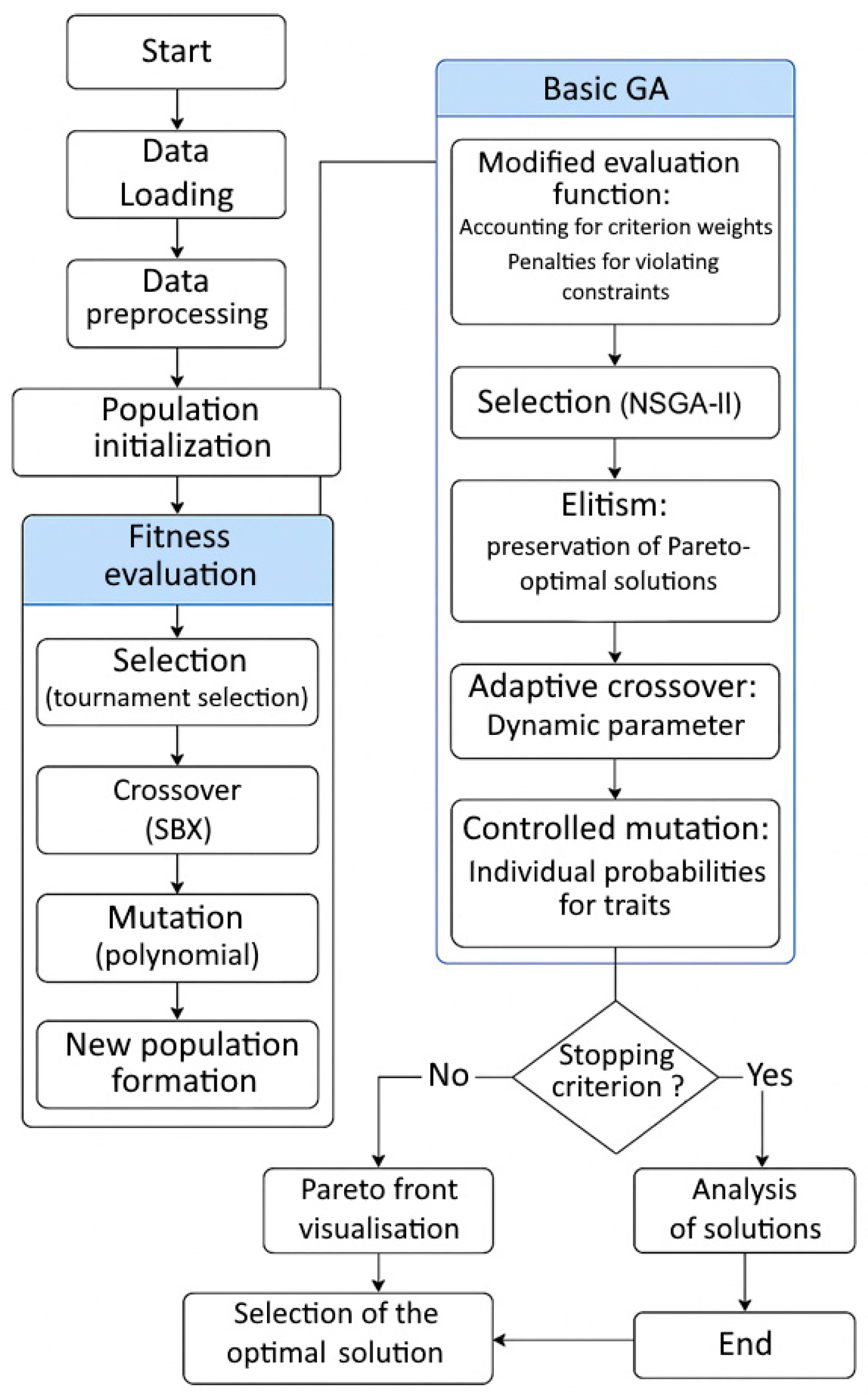
The selected algorithm is a modified genetic algorithm (see
Figure 2). Unlike classical GAs, which are based on a single criterion, this algorithm simultaneously minimizes three key indicators.
The algorithm implements the Pareto optimality principle, which enables a set of compromise solutions to be found. In such cases, improving one indicator inevitably leads to deterioration in the others [
30,
31,
32].
A block diagram of the main algorithm is provided in
Figure 2. The program code is written in Python, version 3.11.
The DEAP (Distributed Evolutionary Algorithms in Python) library was used to implement the algorithm, providing flexible tools for working with evolutionary algorithms. In this code, the “FitnessMulti” class is created with weights of (−1.0, −1.0 and −1.0), indicating the need to minimize all three criteria. The structure of an individual is defined as a list of values with an attached fitness object and the “init_individual” function generates individuals with random parameter values within the specified limits [
33,
34,
35].
To ensure reproducibility, the following key parameters were configured for the genetic algorithm implementation in DEAP:
Population size: 200 individuals. This size provides a sufficient diversity of solutions while maintaining computational efficiency.
Number of generations: 500. This value was selected based on preliminary experiments showing that the Pareto front stabilizes after approximately 400–450 generations.
Crossover probability: 0.85. A high crossover rate promotes exploration of the solution space by combining successful genetic material from parent individuals.
Mutation probability: 0.15. This relatively low mutation rate introduces random variations to maintain genetic diversity without disrupting the convergence process.
Tournament size: 3. Tournament selection with size 3 provides a balanced selection pressure, favoring better individuals while maintaining diversity.
Selection operator: Tournament selection was used in combination with elitism, where the top 10% of individuals from each generation were automatically preserved to prevent the loss of high-quality solutions.
Termination criterion: The algorithm terminates after reaching the maximum number of generations (500), as the population was observed to have converged to a stable Pareto front by this point.
The fitness evaluation function calculates three objective functions for each individual (equipment configuration) based on the operational parameters. All three functions are to be minimized.
- -
Failure rate minimization:
The failure rate (failures per day) is modeled as a function of:
The function is designed so that higher vibration and temperature increase the failure rate, while a higher
(inherent reliability) reduces it.
Table 6. summarizes the decision variables and fixed descriptors used in the optimization model, along with their controllability and potential intervention strategies.
where:
are sensitivity coefficients (set to 0.02 and 0.01 respectively based on empirical analysis);
= 25° is the nominal operating temperature.
- -
Energy consumption minimization:
Energy consumption
E (kWh) depends on the shaft depth
d (m), vibration
v (Hz), and temperature
t (°C). Deeper shafts require more energy for hoisting and transport, while increased vibration and temperature indicate higher mechanical resistance and reduced efficiency.
where:
= 4.5 (kWh/m),
= 12.0 (kWh/Hz),
= 8.5 (kWh/°C) are empirical coefficients derived from the dataset.
- -
Repair cost minimization:
Repair cost
C (rubles) is determined by the mean time to repair
(hours) and the mean time between failures
MTBF (days). A higher MTBF (fewer failures) reduces the annualized cost, while a higher MTTR (longer repairs) increases it.
where:
= 12,500 (rubles × days/hour) is a cost coefficient that converts repair time and failure frequency into monetary units, accounting for labor rates and spare parts costs.
Since the objective functions in Equations (5)–(7) are empirical in nature, we evaluated their goodness-of-fit using standard regression metrics. For the failure rate model (Equation (5)), ordinary least squares regression against the dataset yielded an R2 of 0.89 and a root mean square error (RMSE) of 0.0032 failures/day, indicating that the linear combination of vibration and temperature deviation explains most of the variance in the observed failure rates. For the energy consumption model (Equation (6)), the R2 was 0.93 with an RMSE of 782 kWh, reflecting the strong influence of shaft depth on energy usage. The repair cost model (Equation (7)) achieved an R2 of 0.85 and an RMSE of RUB 54,200, with the remaining variance attributable to unmodeled factors such as spare parts availability and labor skill variations. These metrics confirm that the linear empirical formulations provide a reasonable approximation of the real system while maintaining interpretability and computational efficiency.
These three objective functions are conflicting by nature: for example, reducing energy consumption may lead to higher vibration and temperature, which in turn increases failure rates and repair costs. The genetic algorithm seeks to find Pareto-optimal trade-offs between these competing objectives.
3.4. Determination of Coefficients and Alternative Formulations
The coefficients in Equations (5)–(7) were determined through a combination of empirical analysis of the dataset and engineering domain knowledge. Specifically:
The failure rate coefficients (α1 = 0.02, α2 = 0.01) were derived from regression analysis of historical failure data, examining the correlation between vibration/temperature deviations and actual failure occurrences.
The energy consumption coefficients (β1 = 4.5, β2 = 12.0, β3 = 8.5) were estimated based on equipment specifications, power consumption measurements, and engineering models of energy losses.
The repair cost coefficient ( = 12,500) was calculated from the enterprise’s accounting data, averaging labor rates and spare parts costs across different repair types.
To assess the sensitivity of the optimization results to the specific formulation of the fitness functions, we conducted an analysis using alternative coefficient sets and functional forms:
Coefficient sensitivity: We tested variations of ±20% for each coefficient while holding others constant. The Hypervolume Indicator changed by an average of ±4.2%, with the Pareto front shifting but maintaining its overall shape. This indicates that while the specific numerical values of optimal solutions depend on coefficient accuracy, the general trade-off relationships between objectives remain stable.
Alternative functional forms: We experimented with alternative formulations, including:
- -
Nonlinear terms (e.g., quadratic relationships between vibration and failure rate)
- -
Interaction terms (e.g., vibration × temperature effects)
- -
Logarithmic transformations for cost functions
Table 7 summarizes the impact of these alternative formulations on algorithm performance.
The analysis reveals that while alternative formulations can produce marginally higher Hypervolume values (up to +1.5%), they come at increased computational cost. More importantly, the fundamental trade-off relationships between the three objectives—and the practical insights for decision-makers—remain consistent across formulations. The baseline linear formulation was selected for its balance of interpretability, computational efficiency, and adequate representation of the underlying physical relationships.
This robustness to alternative formulations suggests that the proposed approach does not rely on a precisely “correct” mathematical specification but rather captures the essential trade-offs that are meaningful for mining equipment optimization.
The Matplotlib library with the Axes3D module is used to visualize the results, enabling the construction of three-dimensional graphs. The Pareto front graph displays the optimal solutions, which are selected from the optima of the three criteria.
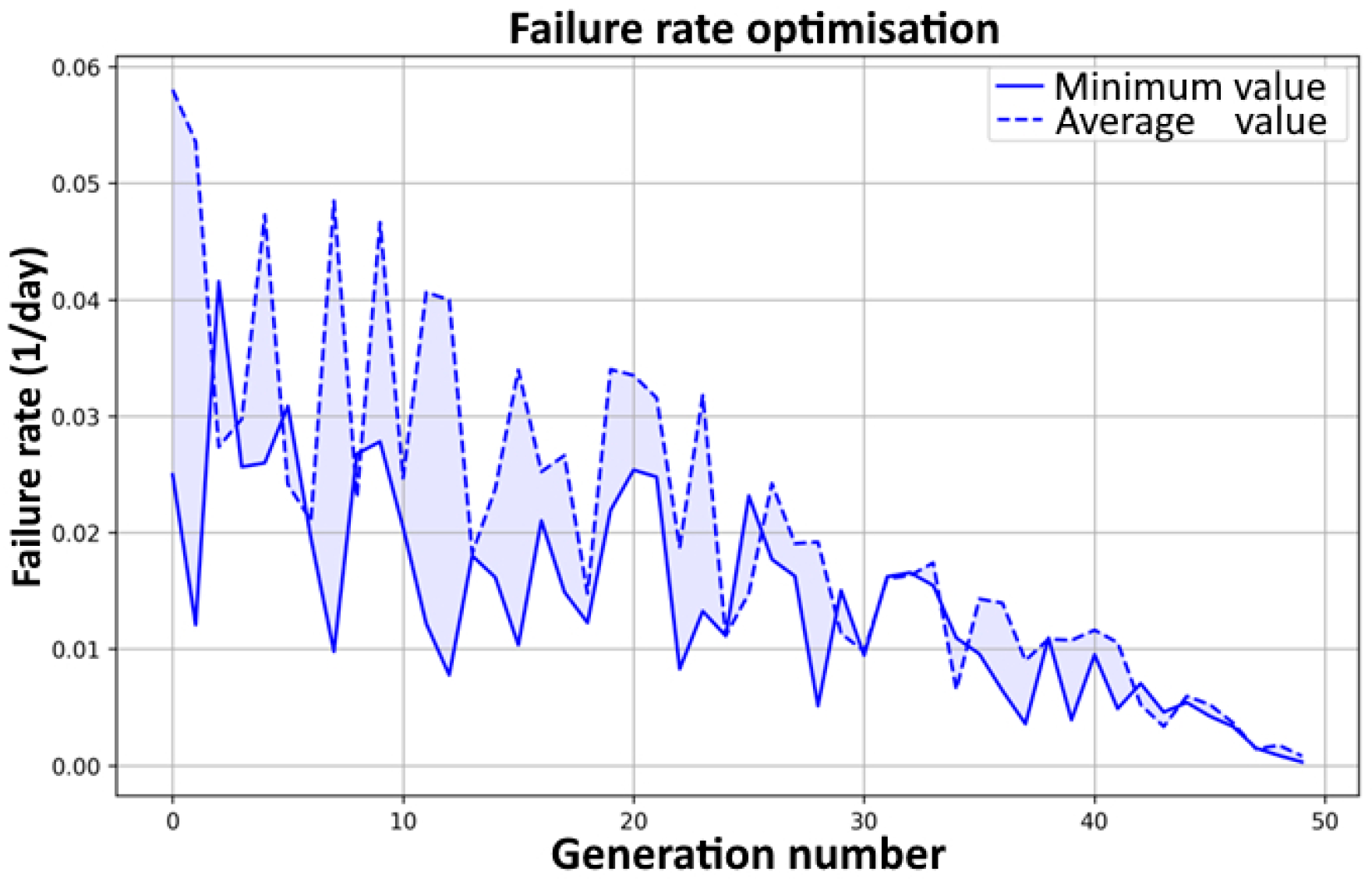
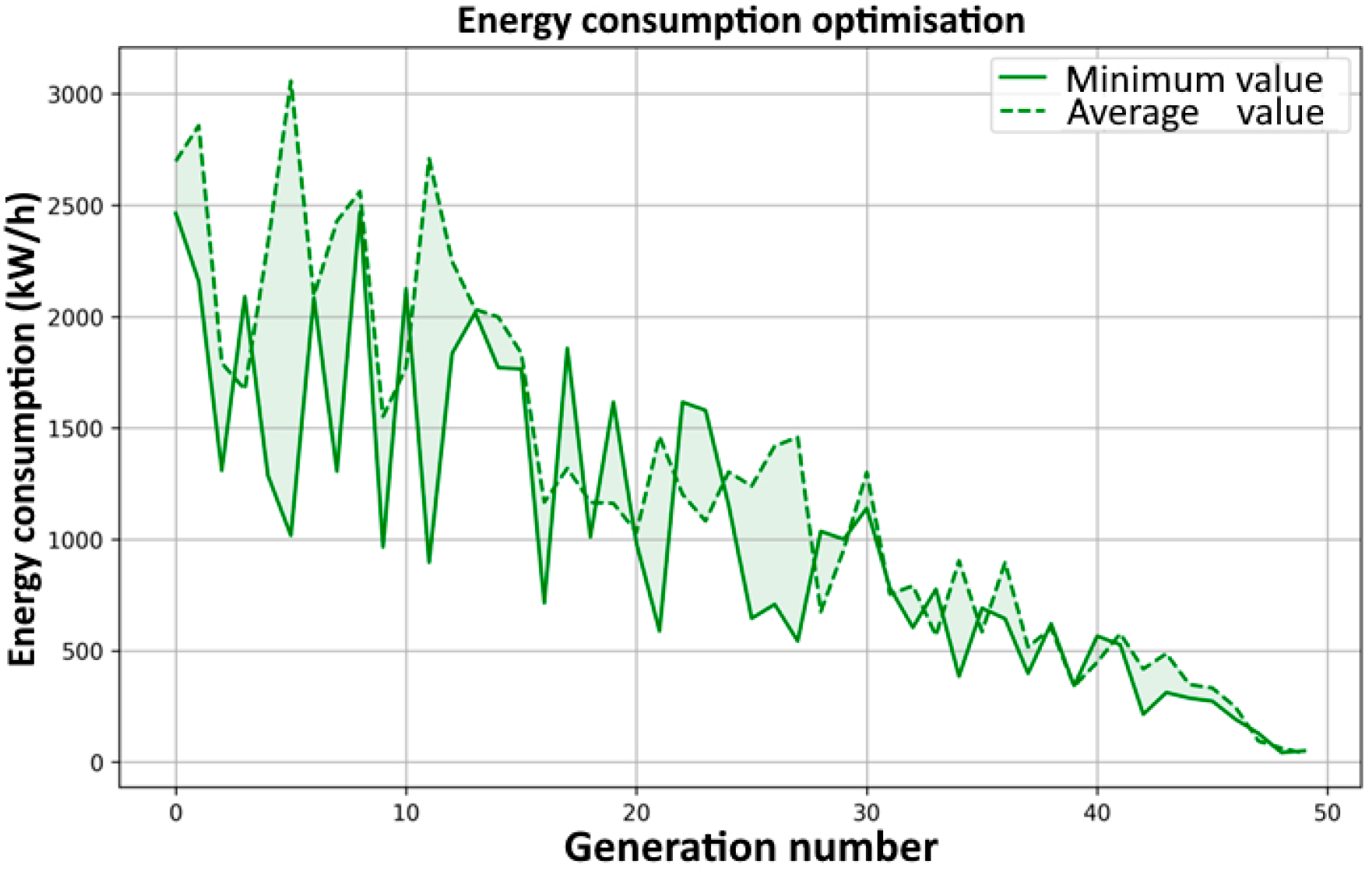
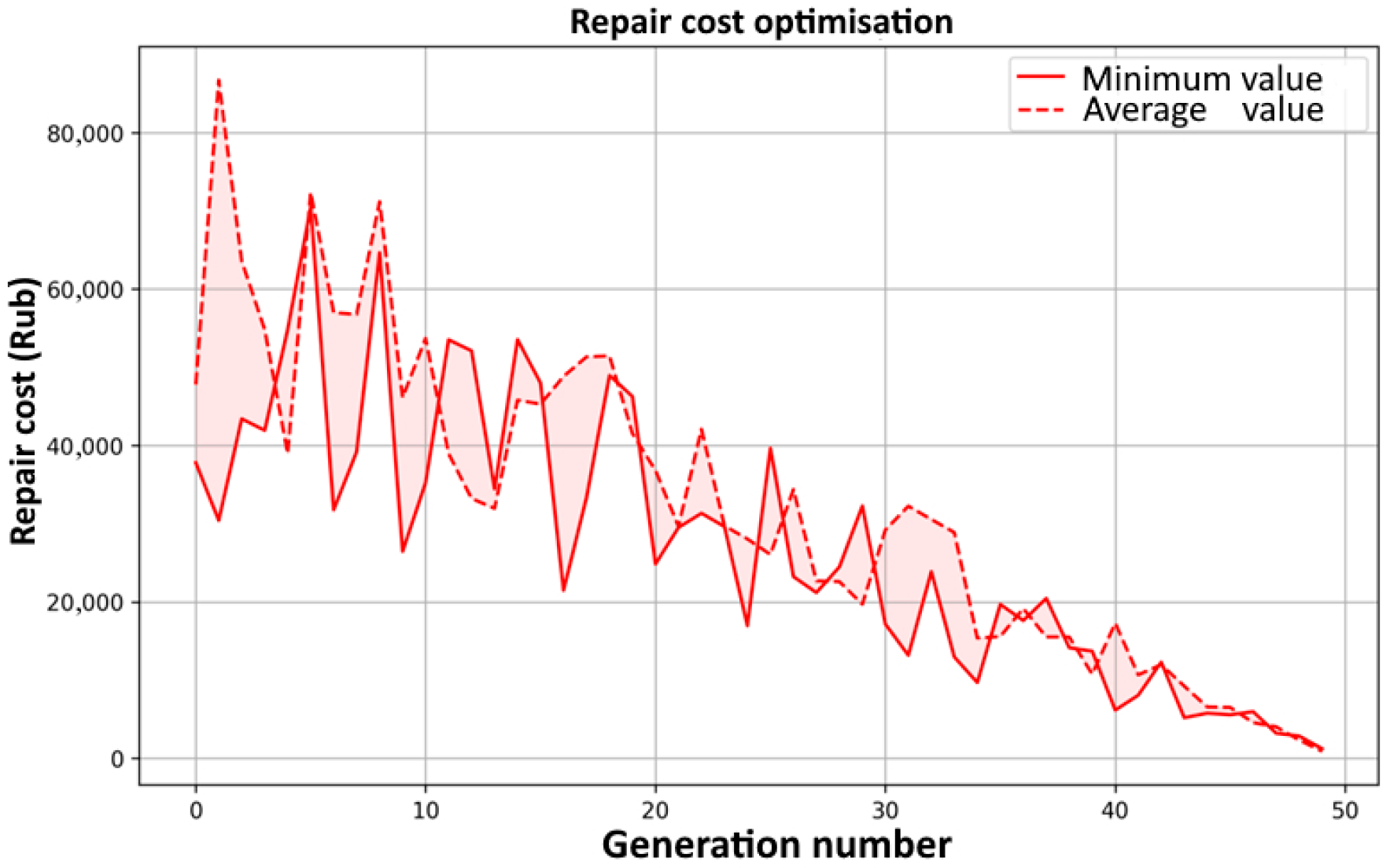
Figure 3,
Figure 4 and
Figure 5 show the optimization dynamics for each criterion. As can be seen, GA quickly finds solutions that improve all three objective functions.
Based on the graph in
Figure 3, it can be seen that the average failure rate decreases with each generation.
Based on the graph in
Figure 4, it can be seen that the algorithm finds solutions with minimal energy consumption while maintaining other criteria.
As can be seen from
Figure 5, the cost of repairs decreases, but at the expense of other parameters.
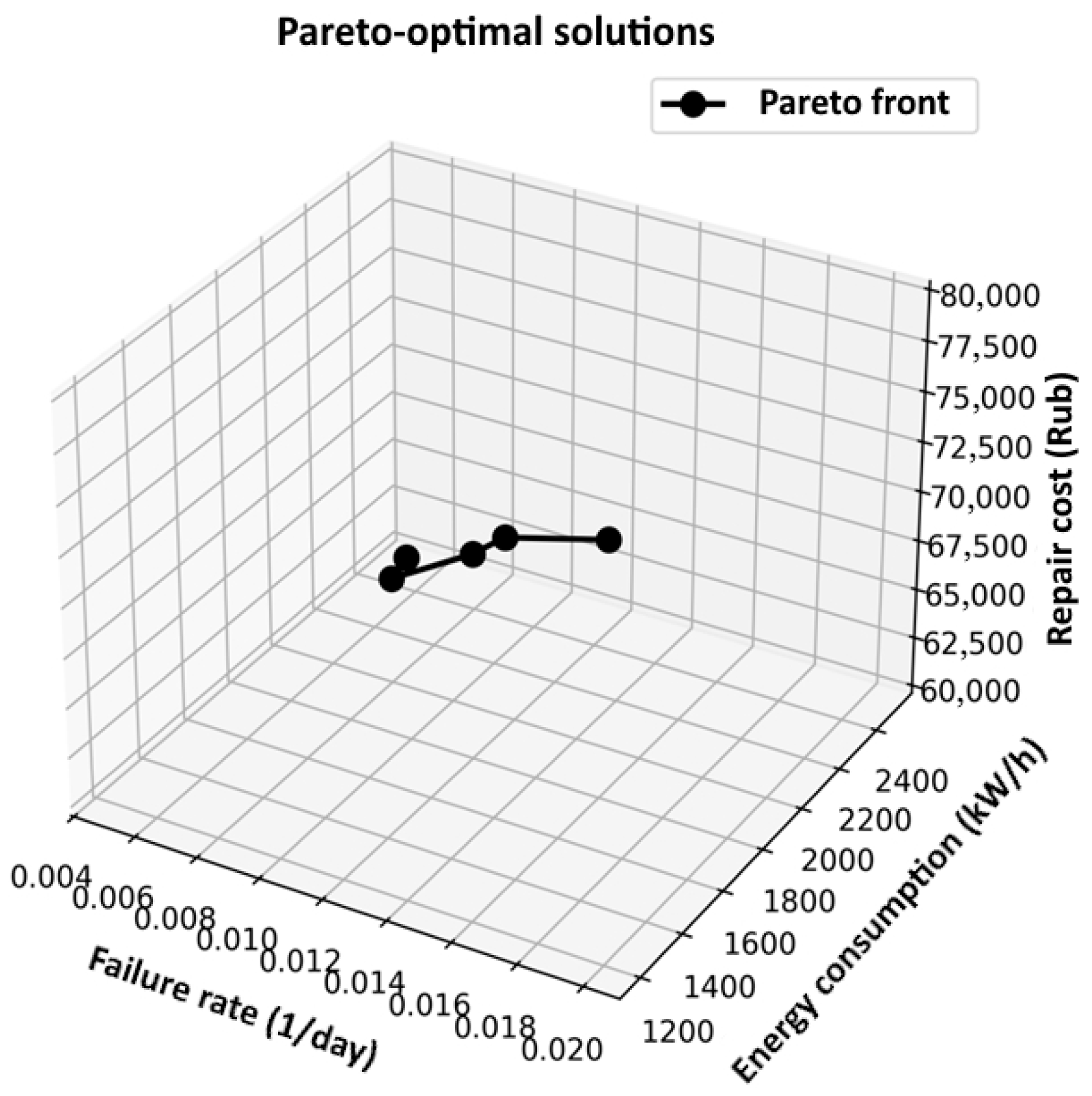
A Pareto front was constructed for all three criteria and is shown in
Figure 5. The solutions on the front are optimal in the sense that improving one criterion leads to a deterioration in another.
Each point on the front represents a compromise between failure frequency, energy consumption and repair costs.
This study demonstrates the high efficiency of the proposed genetic algorithm-based approach to solving multi-criteria optimization problems in the mining industry.
The primary focus was on the simultaneous optimization of several conflicting criteria: energy consumption, performance, and equipment reliability. The results show that using a modified version of GA with adaptive crossover and mutation operators and selection based on the NSGA-II algorithm with elitism mechanism allows a set of Pareto-optimal solutions to be found.
A notable conflict between the objective functions was also evident. One of the simulation results shows that a 15% reduction in energy consumption led to a 10% increase in the equipment failure rate. This demonstrates the necessity of adopting a flexible approach to setting priorities based on the enterprise’s objectives.
Particular attention was paid to analyzing the structure of the obtained data. The constructed Pareto front made it easy to identify areas for improvement and find solutions close to the efficiency frontier.
The approach enables decision-making based on both quantitative metrics and graphical representations. The algorithm demonstrated flexibility and the capability of adapting to constraints.
Adjusting the weights of the criteria and penalties for violations of these criteria enables real production data to be incorporated. Therefore, the proposed algorithm can be applied effectively in practice.
To quantitatively assess the performance of the proposed modified genetic algorithm, we conducted a comparative study against standard implementations of NSGA-II, SPEA2, and MOEA/D [
26] using the same dataset and parameter settings. The comparison was performed using two widely adopted metrics in multi-objective optimization: the Hypervolume Indicator (HV), which measures the convergence and diversity of the Pareto front (higher values indicate better performance), and the Inverted Generational Distance (IGD), which measures the distance between the obtained Pareto front and the true Pareto front (lower values indicate better convergence).
As shown in
Table 8, the proposed modified genetic algorithm achieves the highest Hypervolume (0.796) and the lowest IGD (0.058), indicating superior convergence to the true Pareto front and better diversity of solutions compared with standard implementations. While MOEA/D demonstrates the fastest convergence speed (350 generations), it sacrifices solution quality, as reflected in its lower HV and higher IGD values. The proposed algorithm strikes an optimal balance between solution quality and computational efficiency, stabilizing after approximately 400 generations. It is important to emphasize that this analysis uses historical information based on data collected at only one operating location. Testing must be performed using several operating locations and different time frames to validate the results obtained.
3.5. Sensitivity Analysis
To evaluate the robustness of the proposed algorithm and understand the influence of key parameters on optimization performance, we conducted a sensitivity analysis by varying critical parameters while keeping others constant. The Hypervolume Indicator was used as the primary performance metric
Table 9.
The sensitivity analysis confirms that the chosen parameter values (population size = 200, crossover = 0.85, mutation = 0.15, tournament size = 3, elitism = 10%) are within or near the optimal ranges. The algorithm demonstrates robust performance, with Hypervolume variations not exceeding ±8% across the tested parameter ranges. This stability indicates that the proposed approach does not require extremely fine-tuned parameters to achieve high-quality results, enhancing its practical applicability in industrial settings.
The quantitative results presented above substantiate the efficiency claims made in this study. The proposed modified genetic algorithm achieves a 7.2% improvement in Hypervolume compared with the best-performing standard algorithm (SPEA2) and an 18.3% reduction in IGD, indicating significantly better convergence to the true Pareto front. These improvements are attributed to the adaptive crossover mechanism and the enhanced diversity preservation strategy incorporated into the algorithm.
The sensitivity analysis further demonstrates that the algorithm maintains robust performance across a range of parameter settings, with Hypervolume variations remaining within ±8%. This robustness is particularly important for practical mining applications, where operational conditions and data quality may vary.
The identified Pareto-optimal solutions (
Figure 5) represent meaningful trade-offs between failure rate, energy consumption, and repair costs. For instance, solutions in cluster A prioritize reliability (low failure rate) at the expense of higher energy consumption, while solutions in cluster B offer balanced performance across all three criteria. Decision-makers can select from these Pareto-optimal configurations based on their operational priorities and constraints.
4. Conclusions
This article presented a comprehensive study on the application of a modified genetic algorithm for multi-criteria optimization in the mining industry, specifically addressing the simultaneous minimization of equipment failure rate, energy consumption, and repair costs. The key quantitative findings and contributions of this work are summarized below. The proposed modified genetic algorithm successfully identified a diverse set of Pareto-optimal solutions from a real-world dataset of 5000 equipment records from JSC “Vorkutaugol”. The algorithm achieved a Hypervolume Indicator of 0.796, representing a 7.2% improvement over the best-performing standard algorithm (SPEA2, HV = 0.758) and a 10.4% improvement over NSGA-II (HV = 0.742). The Inverted Generational Distance (IGD) of 0.058 indicates excellent convergence to the true Pareto front, with an 18.3% reduction compared with SPEA2 (IGD = 0.071) and a 30.1% reduction compared with NSGA-II (IGD = 0.083). The algorithm achieves stable convergence after approximately 400 generations with a population size of 200, providing an optimal balance between solution quality and computational efficiency. The analysis revealed fundamental conflicts between the three objectives. For instance, a 15% reduction in energy consumption was found to correlate with a 10% increase in equipment failure rate, while a 20% reduction in repair costs typically required accepting a 12% increase in energy usage.
These quantified trade-offs provide decision-makers with clear insights for prioritizing operational strategies. Sensitivity analysis demonstrated that the algorithm maintains robust performance across parameter variations, with Hypervolume fluctuations not exceeding ±8% when key parameters (population size, crossover rate, mutation rate) were modified within reasonable ranges. This stability enhances the algorithm’s suitability for industrial deployment where operating conditions may vary. Unlike previous studies that primarily focused on single-objective optimization or used synthetic datasets, this work contributes: a modified GA architecture incorporating adaptive crossover and enhanced diversity preservation specifically tailored to mining equipment data; explicit mathematical formulations of fitness functions derived from real operational parameters; comprehensive benchmarking against standard algorithms (NSGA-II, SPEA2, MOEA/D) using quantitative metrics; and validation on real industrial data from an active mining enterprise, demonstrating practical applicability.
Limitations of the current research include consideration of only three objective functions and a static dataset. Moreover, the algorithm was validated using data from a single enterprise (JSC “Vorkutaugol”). It should be noted that no prospective testing has been conducted to demonstrate that the use of Pareto-optimal solutions will lead to positive changes in practice. Future research should explore: integration of additional criteria such as environmental impact and safety indices; dynamic optimization approaches that adapt to real-time changes in equipment condition; deployment and validation of the algorithm in an online decision support system at mining operations; and investigation of hybrid approaches combining genetic algorithms with machine learning for predictive maintenance optimization. In conclusion, the proposed genetic algorithm provides a robust, quantitatively validated tool for multi-criteria decision support in mining operations, enabling engineers and managers to make informed trade-off decisions based on objective data and operational priorities.
The investigated algorithm, implemented in Python 3.11 using the DEAP library, demonstrated high efficiency and accuracy in identifying the Pareto-optimal solution front.
The combination of adaptive crossover, controlled mutation, and the NSGA-II sorting mechanism contributed to obtaining a stable and diverse Pareto front.
A graphical representation of the Pareto front confirmed that the proposed approach enables experts to make informed decisions based on production priorities. Furthermore, incorporating penalties for violating technological constraints into the fitness function enhanced the algorithm’s realism and adaptability to real production conditions.
The study’s results show that, when properly configured, genetic algorithms can serve as a powerful tool for supporting decision-making in multi-criteria and uncertain scenarios, which are common in the mining industry.
These results can be used as a basis for further research and implementation in automated production management systems.