Article

Aluminum Surface Quality Prediction Based on Support Vector Machine and Three Axes Vibration Signals Acquired from Robot Manipulator Grinding Experiment

by
Khairul Muzaka
1,
Liyanage Chandratilak De Silva
2 and
Wahyu Caesarendra
3,4,*
1
Ship Manufacturing Engineering Study Program, Department of Mechanical Engineering, Politeknik Negeri Banyuwangi, Banyuwangi 68461, Indonesia
2
Faculty of Integrated Technologies, Universiti Brunei Darussalam, Jalan Tungku Link, Gadong BE1410, Brunei
3
Department of Mechanical and Mechatronic Engineering, Faculty of Engineering and Science, Curtin University Malaysia, Miri 98009, Sarawak, Malaysia
4
Department of Electrical Automation Engineering, Faculty of Vocation, Institut Teknologi Sepuluh Nopember, Surabaya 60111, Indonesia
*
Author to whom correspondence should be addressed.
Automation 2026, 7(2), 55; https://doi.org/10.3390/automation7020055
Submission received: 15 February 2026 / Revised: 13 March 2026 / Accepted: 19 March 2026 / Published: 30 March 2026

Abstract

This research presents a machine learning-based vibration signal acquired from aluminum grinding experiment for potential application in smart and intelligent manufacturing. The study addresses the challenges of traditional surface finishing quality inspection by integrating vibration sensing and support vector machine (SVM). A robot manipulator lab grinding experiment consist of a four-axis DOBOT Magician with a handheld cylindrical grinding tool attached on the end-effector of the DOBOT Magician. This customized lab grinding experiment was designed to perform consistent surface finishing experiment for different aluminum work coupon and time duration. Triaxial accelerometer was used to collect the vibration signal and to investigate the most relevant vibration signal direction (x, y, and z) to the surface quality prediction of the aluminum work coupon. The vibration signal was acquired via LabVIEW and NI data acquisition (DAQ) system. The vibration features were extracted and analyzed using Python programming in Google Colab. The SVM algorithm in Python (3.11 and 3.12) is used to classify surface roughness quality into coarse, medium, and fine categories based on the extracted vibration features. Vibration feature parameters such as root mean square (RMS), Peak to RMS, Skewness, and Kurtosis were also investigated to determined which feature pairs are most critical for effective surface roughness monitoring and prediction using SVM classification. The classification model achieved high accuracy across all three vibration axes (x, y, and z), with the z-axis yielding the most consistent results. The proposed system has potential applications in real-time surface quality prediction within smart manufacturing practices aligned with Industry 4.0 principles.

1. Introduction

Smart and intelligent manufacturing integrates human knowledge, real-time data, and artificial intelligent (AI) to improve production. In smart and intelligent manufacturing, all required data inputs were used together to process and transform raw materials into quality outputs [1]. Continuous automation in smart and intelligent manufacturing is achieved through the integration of smart sensors and devices, advanced materials, big data analytics, and adaptive decision-making models across the production cycle. Furthermore, Intelligent Manufacturing Systems (IMS) strengthen the adaptability and competitiveness of manufacturing enterprises in response to the dynamic and volatile global market [2]. In the era of Industry 4.0, Intelligent Manufacturing Systems (IMS) employ service-oriented cloud architectures to facilitate collaborative interactions between humans and machines in manufacturing environments. This sophisticated integration creates a flexible ecosystem that supports the management of manufacturing components, labor, and stakeholders through advanced machining systems [3].
The important of surface evaluation study is presented in [4]. The surface evaluation has become a critical aspect of modern machining processes to ensure component quality, structural integrity, and functional efficiency. In addition, the article [4] presents a review study on the image processing methods for surface and tool condition assessments in machining. In the manufacturing industry, surface quality parameters such as surface roughness are monitored using both direct and indirect measurement methods [5]. Direct measurement refers to traditional surface quality inspection methods, typically carried out using contact-type (stylus) techniques. These methods are classified as contact approaches which typically using a device known as a profilometer or surface profiler. This instrument is equipped with a sensitive diamond-tipped stylus. Furthermore, the indirect method is noncontact and nondestructive methods or probe-based techniques such as X-ray reflectometry, speckle interferometry, ultrasonic evaluation, capacitance method, and pneumatic technique. The study is also present a new horizon of the research direction on the intelligent based on machine learning methods for automatic surface quality control systems [5].
In the traditional surface quality inspection methods, the manual measurements have safety and ergonomic risks for operators, particularly in high-volume production environments [6]. A number of previous studies which are discussed the manual surface finishing processes and traditional surface quality inspection methods has been presented. For example, variations in operator skill can result in inconsistent measurements and product quality [7], and the manual grinding processes affect process performance measures of specific energy consumption and material removal rate (MRR) [8]. An experimental study on how the manual grinding process affect the surface properties due to the excessive manual intervention which result to the low process efficiency is presented in [9]. In addition, the challenges of the traditional inspection method in the workpiece surface quality during grinding process are labor-intensive, subjective, and inefficient [10]. It emphasizes the need for automated monitoring systems to improve consistency and efficiency.
Industry 4.0 encourages manufacturers to improve production by adding surface roughness sensing technologies. These helps keep products high quality and speed up production. Vibration analysis is one of effective approaches in the indirect measurement methods especially for tool monitoring and surface quality inspection in the abrasive machining processes [11]. When the grinding tool with certain rotational speed presses the metal work coupon, it produces vibration signal that associated with the dynamical behavior of the metal-to-metal contact [12]. Vibration signals acquired during the grinding process have been shown as reliable indicators for performance monitoring. It because the grinding inspection method-based vibration signals is a more effective approach to monitor the variations in hardness and microstructure compared to conventional grinding methods [13]. Consequently, the integration of vibration sensing systems capable of capturing analog signals into the work coupon or tooling setup should be strongly considered. This strategy enhances process monitoring, improves measurement consistency, and facilitates adaptive control in advanced manufacturing environments.
Surface roughness of the metal workpiece is one of the most critical and difficult indicators to predict surface quality due to the random distribution of abrasive grains and the complexity of grinding mechanisms. To address the nonlinear relationship between surface roughness and process parameters, researchers increasingly employ intelligent models for classification and prediction. Guo et al. [14] analyzed grinding signals, identified optimal feature combinations, and developed a prediction model that incorporated grinding force, vibration, and acoustic emission data collected during the milling of C-250 maraging steel. A long short-term memory (LSTM) network algorithm was introduced in the study as a time-series analysis tool to predict workpiece roughness. Varma et al. [15] studied grinding of Inconel 800 alloy using machining speed, cutting depth, and feed rate as inputs, with surface roughness as the output. Their comparison showed ANFIS predicted more accurately than regression or neural network (NN) method. Genetic neural network, which combine genetic algorithm (GA) with NN improve the prediction accuracy by optimizing the prediction model parameters.
Liu et al. [16] proposed a reinforcement learing (RL) that combined self-organized map (SOM) and radial basis function (RBF) namely RLSOM-RBF. This method is developed to analyze an abrasive particle distribution in strip grinding by modeling the nonlinear link between process parameters and surface roughness. The SOM approach was improved with reinforcement learning and tested experimentally. Data from these tests were used to train and test the model with acceptable error confirming its ability to predict surface roughness in superalloy belt grinding. Utilizing a multi-layer sensor (MLP), Xiao et al. [17] introduced a model for predicting surface roughness in GH4169 superalloy belt grinding. Pandiyan et al. [11] employed a genetic algorithm based on k-nearest neighbor (KNN) combined with support vector machine (SVM) to investigate the tool wear condition and process in rigid tool cutting that involved belt grinding. The study analyzed the numerical characteristics of this process.
The proposed system potentially enhances process efficiency, reduces manual intervention, and supports future application for a real-time quality monitoring when the prediction model is embedded in the sensor-hardware monitoring system. This future application will contribute to safer and more adaptive smart manufacturing practices aligned with Industry 4.0.

2. Methods

This study employs selected time-domain features of vibration signals and SVM for aluminum surface quality prediction and classification. The vibration signals were collected from robot manipulator grinding experiment. The SVM method chosen based on its proven performance in numerous prior machine learning (ML) applications for surface roughness prediction and grinding wheel wear monitoring [18,19,20]. Furthermore, the results demonstrate that the ML based vibration features effectively predict and classify the surface quality category from different grinding stages. An example study comparing an SVM model with three other machine learning models, i.e., Radial Basis Function Neural Network (RBFNN), Generalized Regression Neural Network (GRNN), and an Ensemble of Tree for predicting noise and vibration in a diesel engine is presented in [21]. The results demonstrate the consistent performance of the SVM and the Ensemble of Trees compared to the other two ML models.

2.1. Support Vector Machine (SVM)

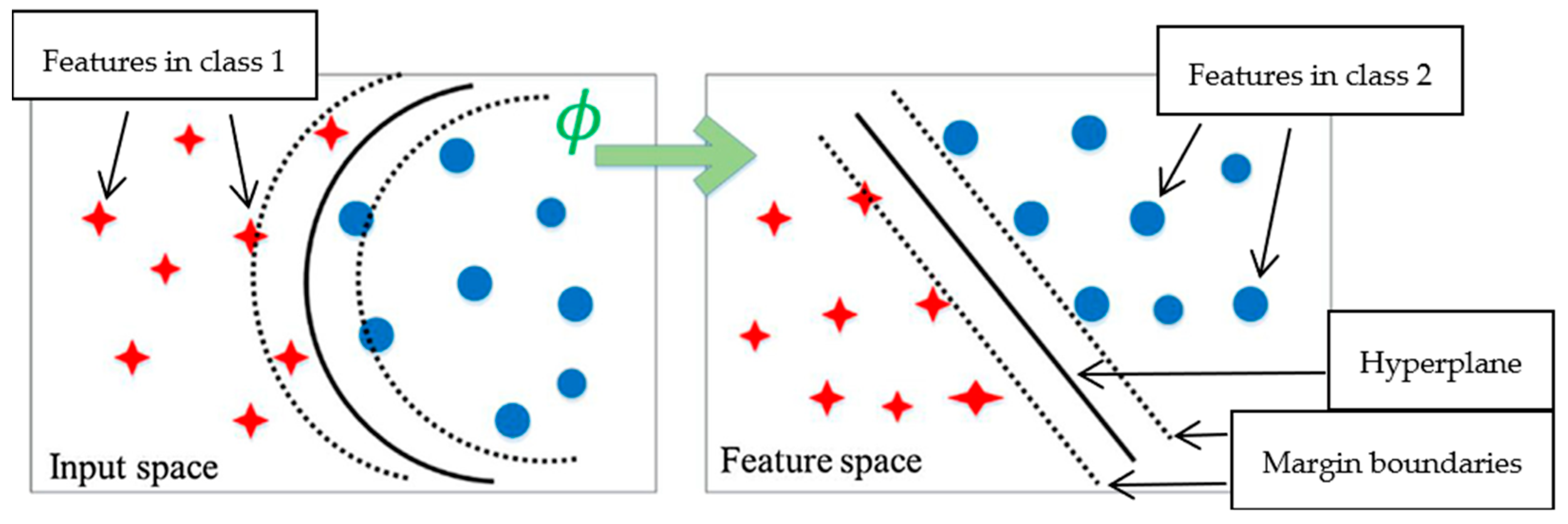
SVM is commonly used for classification and regression problems compared to other ML methods because of its strength. The key strength of an SVM classifier is its ability to determine an optimized decision boundary that maximizes the separation between classes. This optimal hyperplane is defined by only a small subset of training samples, known as support vectors, which serve as the core data structure of the SVM. SVM was initially used for linearly classification problems and it is extended for nonlinear classification. For nonlinear classification, feature samples are mapped from a finite-dimensional space to a higher-dimension space [22].
The ML methods such as Multilayer Perceptron (MLP), K-Nearest Neighbor (KNN) and SVM have been applied to predict the tangential force (Ft) and surface roughness (Ra) in the surface grinding process [23]. In another study, the SVM has been used for predicting the surface roughness in boring of steel based on vibration signal [24].
The effectiveness of SVM classification was evaluated against other classifiers, including Naïve Bayes, Decision Tree, and Bayes Net, with findings recommending SVM as the superior approach for grinding process monitoring [11]. The developed algorithm incorporates supervised learning techniques for robust classification, outlier detection, and regression methods that enhance prediction accuracy. Kernel tricks are employed to address both linear and nonlinear classification challenges. For linearly separable data, the hyperplane can be expressed as
f x = w T x + b = j = 1 n w j x j + b = 0
where w is an n-dimensional vector, and b is a scalar quantity that identifies the best separation hyperplane forgoes both classes’ maximum margin. Kernel methods transform the input data into a higher-dimensional feature space, increasing the ability to apply linear separation in nonlinear classification data issues. The SVM approach uses kernel functions’ non-linearity ϕ: XF to transform data from the input data space X to the features space F. The discriminant function in space F can be expressed as follows:
f x = w T x + b
By accurately mapping the input data x (in matrix form) into the features space and training SVM for mapped features ϕ(x), as depicted in Figure 1. It is possible to derive SVM from nonlinear data by classifying it as a linear partition. From the training examples, linear combinations can appropriately articulate the weight vectors, w = i = 1 n α i x i . Equation (2) has the following formula as its form:
f x = i = 1 n α i x i T x + b
The term F in the features space has the following formula:
f x = i = 1 n α i ( x i ) T ( x j ) + b
by substituting the outcomes of Equation (4) with kernel analogs K(xi, xj), nonlinear SVM can be trained.
K x i , x j = ( x i ) T ( x j )
Additionally, the kernel function represents the final nonlinear SVM classifier as follows:
f x = i = 1 n α i K ( x i , x j ) + b
The SVM method has been used to analyze and classify grinding operations in several ways, particularly for intelligent manufacturing, as demonstrated by Kishore et al. [24]. They installed intelligent sensors in their research and used the SVM method to investigate real-time milling performance.

2.2. Feature Extraction of Vibration Signal

Feature extraction of the vibration signal is typically used as a parameter for monitoring and diagnosing objects to represent their actual conditions [25]. Among the statistics used for signal monitoring, Root Mean Square (RMS) is a frequently used parameter [26]. RMS or the square root of the average square is a statistical method with a magnitude of 0.707 times the peak value of a sinusoidal motion wave. RMS is an effective tool for analyzing values that oscillate or fluctuate toward zero, such as vibrations in bearings, rotating equipment, or machining processes [27]. The Peak-to-RMS ratio is a measure of the crest factor of a vibration signal. It is defined as the ratio of the peak amplitude of the vibration signal to its RMS value [28].
Skewness represents the degree of asymmetry in a distribution and can be interpreted as the slope of the data distribution. In an asymmetric distribution, the mean, median, and mode differ in magnitude, resulting in concentration on one side and a curved shape. A positive curve occurs when the distribution has a longer tail on the right than on the left, indicating right Skewness or positive Skewness. In constrast, when the distribution has a longer tail on the left than on the right, it is considered left skewed or negatively skewed. Meanwhile, if the slope coefficient equals zero, then the distribution is symmetric [29].
Kurtosis measures the high and low levels of a frequency distribution graph, particularly regarding the concentration of values close to the mean compared to a normal distribution. It has several implications, including describing the shape of a data distribution, aiding decisions about normality, and assessing deviations from regression assumptions. In addition, Kurtosis serves as a measure of the weight of the tails of a distribution. A normal distribution exhibits Kurtosis equal to 3. A positive Kurtosis value indicates a heavy tail, while a negative value suggests a light tail. The comparison of tail heaviness or lightness to a normal distribution indicates whether the data distribution is flatter or less flat than a normal distribution [30]. The selected statistical time domain features used in this study is presented in Table 1 [31].

3. Experimental Setup and Vibration Data Acquisition

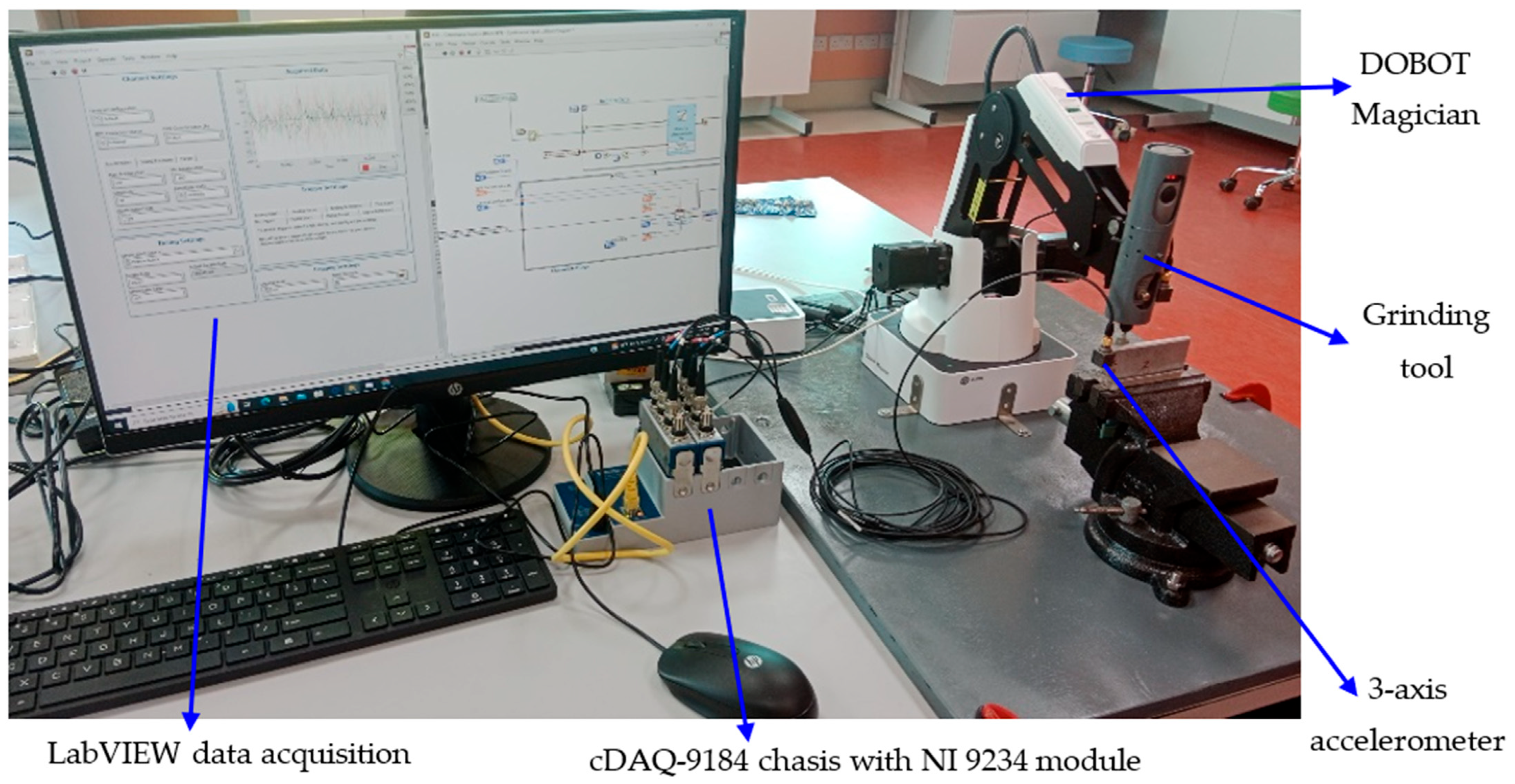
Triaxial Delta Tron Accelerometer type 4535-B-001 (Brüel & Kjær (HBK—Hottinger Brüel & Kjær), Nærum, Denmark) is used in this study to capture the vibration signal from three different dynamic direction from the contact between grinding bit and aluminum work coupon. The three axial acceleromter is connected to NI 9234 (National Instruments (NI), Austin, TX, USA) module and NI cDAQ-9184 (National Instruments (NI), Austin, TX, USA) chassis as a data acquistion (DAQ) system to convert from the analog vibration signal into digital signal. This DAQ system is then connected to the PC with pre-installed LabVIEW Academic Volume License 2023 Q1 with the USB cable. The sampling frequency during the experimental work is 10,000 Hz. The experimental setup that show the DAQ device, LabVIEW monitoring, sensor position on the aluminum work coupon, and the hand held grinding tool attached on the end-effector of the DOBOT Magician (desktop grade 4-axis robot, Shenzhen Yuejiang Technology Co., Ltd. (brand name: DOBOT), Shenzhen, China) is presented in Figure 2.

3.1. The Path of Cylindrical Grinding Wheel and Workpiece

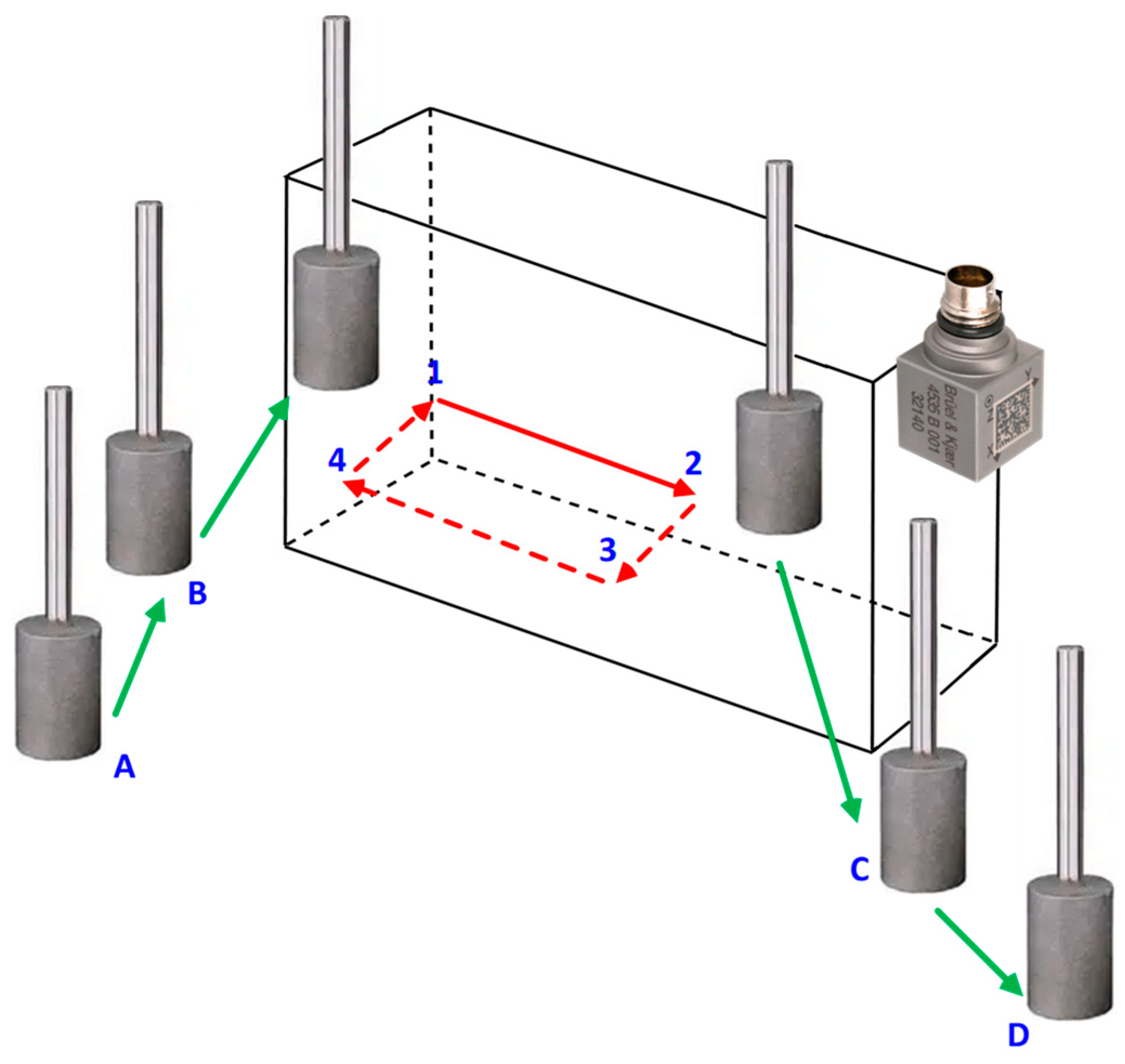
A customized robot manipulator grinding lab equipment has a handheld cylindrical grinding tool attached on the end-effector of the DOBOT Magician to grind the surface of the aluminum work coupon. The grinding bit has a size of 10 mm in diameter × 16 mm in height and rotates at 14,000 rpm. The DOBOT Magician was programmed to accommodate the consistent grinding process with predetermined path. An illustration path of the vertical grinding bit on the aluminum work coupon applied in the experiment is presented in Figure 3.
The robot manipulator grinding experiment initiates from position A of the grinding bit. The grinding bit is approaching the work coupon in position B and position 1 as presented in Figure 3. In position 1, the grinding bit is already pressed to the work coupon and it starts the grinding process. One cycle grinding process is represented by the sequential grinding bit movement from positions 1, 2, 3, to 4. The solid line arrow from position 1 to 2 indicates the contact between the grinding bit and the aluminum work coupon. In addition, the dashed line shows the retracting position of the grinding bit. The one cycle grinding cycle (from 1, 2, 3, to 4) is repeated according to the time duration.
The rotational speed of the grinding bit is maintained at a constant level, and its infeed position remains unchanged to simulate a uniform pressure force during grinding. At the same time, the grinding operations are divided into three consistent time durations, i.e., 5 min, 15 min, and 30 min, as presented in Table 2. The ginding experiment is to stop at the end of each time duration to enable the data saving and to avoid unexpected heat temperature.
To ensure consistency in identifying the three levels of surface roughness and the in-feed depth of the work coupon during the grinding experiment, several research parameters are kept constant. These include the grinding bit speed, the abrasive bit material, and the grinding method as presented in Table 3. The label of surface quality will be used further in SVM classification.

3.2. Vibration Data Acquisition, Feature Extraction, and SVM Classification

The correlation among cutting force, tool movement, and vibration in material removal phenomena and surface roughness can be used to monitor the abrasive machining process. The dynamic contact behavior between the grinding tool and the work coupon in the abrasive machining process becomes measurables using an accelerometer. The accelerometer captures the vibration signal that contains transient elastic energy. The transient elastic energy is released from high-frequency elastic or plastic shear stress phenomena during the material removal and deformation in the abrasive machining process. Remarkably, accelerometer sensors exhibit heightened sensitivity in the ultra-precision machining regime, an atypical feature within any abrasive machining process [32].
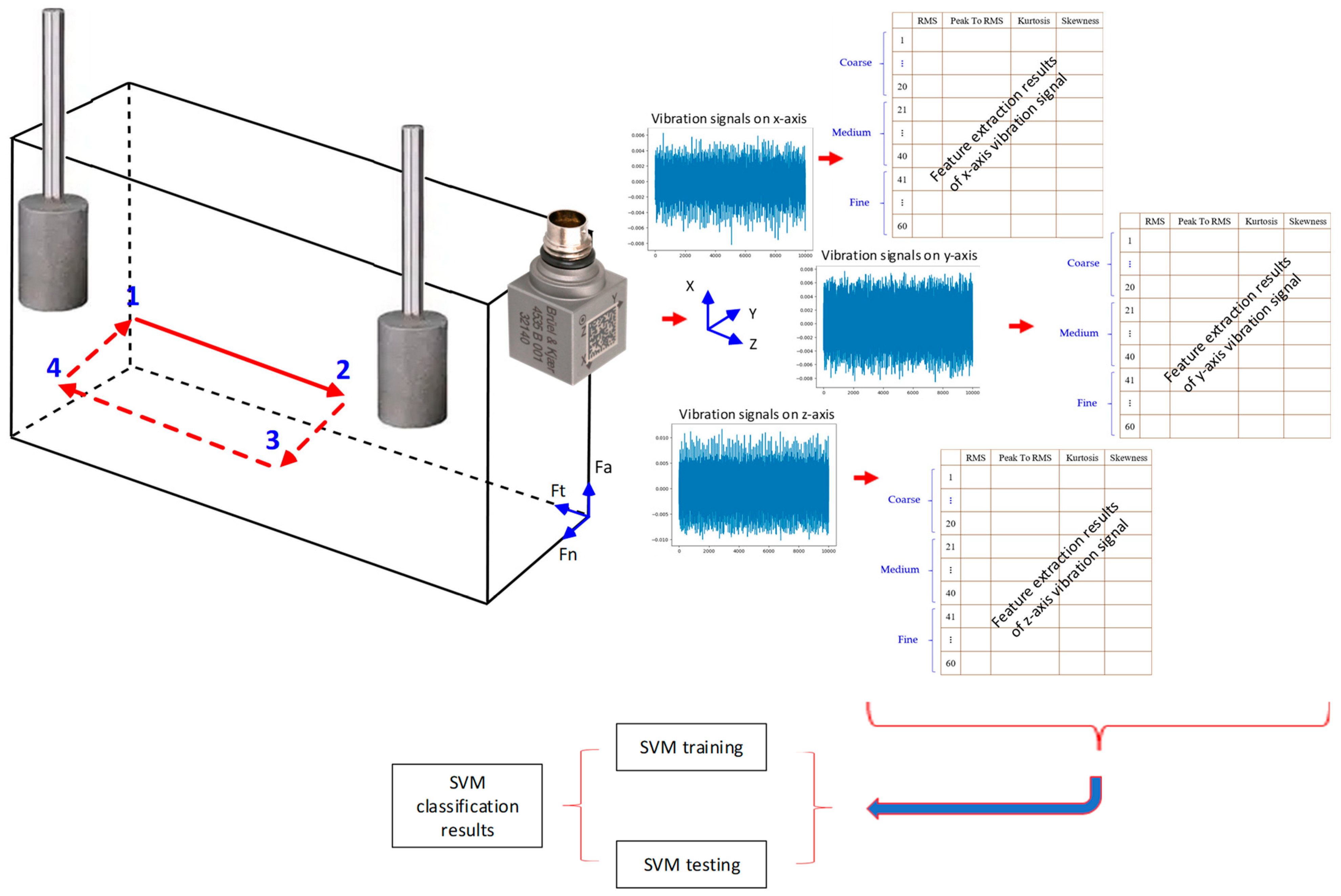
In the grinding experiment of the present study, vibration signals were acquired using a three-axis accelerometer attached to one side of the aluminum work coupon, as shown in Figure 4. This sensor position was selected because it does not interfere with the grinding bit’s motion path. LabVIEW DAQ programming was developed to capture vibration signals along three directions: the x-axis, y-axis, and z-axis. The grinding tool path was programmed using DOBOT Studio with Blocky (v1.9.4) as the core programming method to accommodate the motion as illustrated in Figure 3. The grinding process was divided into three stages: 5, 15, and 30 min time duration. These durations were then categorized as coarse, medium, and fine in the SVM classification.
In the first stage, the grinding experiment was run continuously for 5 min and stopped immediately once the timer reached 5 min to prevent excessive heat generation between the grinding bit and the aluminum work coupon. This intermittent break also allows the surface roughness measurement of the aluminum work coupon. Once the surface roughness measurement is completed in the first intermittent break, the experiment was continued for an additional 10 min. Thus, the total duration of the second stage was 15 min (5 min + 10 min). The second stage was also stopped promptly at 10 min to avoid overheating and to measure the surface roughness of the work coupon. After the second intermittent break, the third stage was conducted for another 15 min continuously. The experiment was stopped once the timer reached 15 min, resulting in a total duration of 30 min (5 min + 10 min + 15 min).
The overall vibration signal acquisition, signal processing, and feature extraction are illustrated in Figure 4. Although the grinding experiment was run in a specified time duration in each stage (coarse, medium, and fine), the vibration signal from the last five seconds from each stage was processed and used in the feature extraction method. The reason is (1) to be applied for the future real-time monitoring and prediction system and (2) to investigate that the latest five seconds vibration signal from the grinding process is correlated to the surface quality of the work coupon. With 10,000 Hz sampling frequency, the digitized vibration signal produced in 5 s is 50,000 samples. An example plot of the vibration data for each stage on the x-axis, y-axis, and z-axis direction is presented in Figure 4.
The selected features were calculated from one moving window containing 10,000 samples. For the five seconds data with 50,000 samples on stage 1 (coarse label), it will result in 20 data points of each RMS, Peak to RMS, Skewness, and Kurtosis feature. The total datasets are then 60 × 4 matrix size, as shown in a table inside Figure 4. The row of the matrix indicates the number of feature data points from the three stages and the column of the matrix refer to vibration feature parameters. This data processing and feature extraction method is also applied to the other two stages, i.e., stage 2 (medium label), and stage 3 (fine label). Prior to SVM classification, these feature datasets were initially plotted to visual observation. A detail of feature extraction results is presented in Section 4.
ML structures are explicitly built through algorithms to solve specific problems; for example, the coding structure presented by Sauter et al. [33] is only for detecting grinding burns they encounter. In this research, a comprehensive methodology research for categorizing vibrations in the grinding process to identify surface roughness has been shown in Figure 4. In this study, four aluminum work coupons were used, resulting in four datasets for each x-axis, y-axis, and z-axis. For SVM classification and prediction, these datasets were divided into two parts: 75% for training and 25% for testing.

3.3. A Brief Vibration Theory and Analysis of the Grinding Process in Three-Direction

Vibration analysis enhanced capabilities of surface quality monitoring and prediction [34]. In this study, the three-axis accelerometer attached on one side of the aluminum work coupon as presented in Figure 4 collects the vibration signal in three directions: x, y, and z. According to Figure 4, the accelerometer of the x-axis direction records the vibration signal from the vertical plane of the work coupon and the axis of rotation of the cylindrical grinding bit. In addition, the x-axis vibration signal associates with the axial force (Fa) of the grinding process. The accelerometer of the y-axis direction collects the vibration signal from the horizonal plane of the work coupon and the radial direction of the cylindrical grinding bit. The y-axis vibration signal therefore corresponds to the radial force (Fr). In the z-axis direction of the accelerometer, the vibration signal is acquired from the parallel direction to abrasive grinding path direction. Additionally, this direction is the tangential direction of the cylindrical grinding bit and therefore is associated with the tangential force (Ft).
In practical terms, the vibration signal in the Fa direction encounters minimal force resistance throughout the cylindrical vertical grinding process. Meanwhile, the vibration signal in the Fr direction acts perpendicular to the workpiece surface and pressing the grinding bit into the work coupon. However, the pressing force in the present study is maintain to be minimized. Therefore, the vibration of the Fr direction is less significant. The vibration signal from the tangential direction produces higher vibration signal data than the Fa and Fr vibration direction. The vibration signal of the Ft direction is related to material removal of the work coupon surface. As it is aligned with the abrasive grinding path direction and material removal, the alteration of the surface roughness of the work coupon can be monitored from the Ft. This theoretical information will be supported by vibration feature extraction and SVM classification results.

3.4. Surface Roughness Measurement

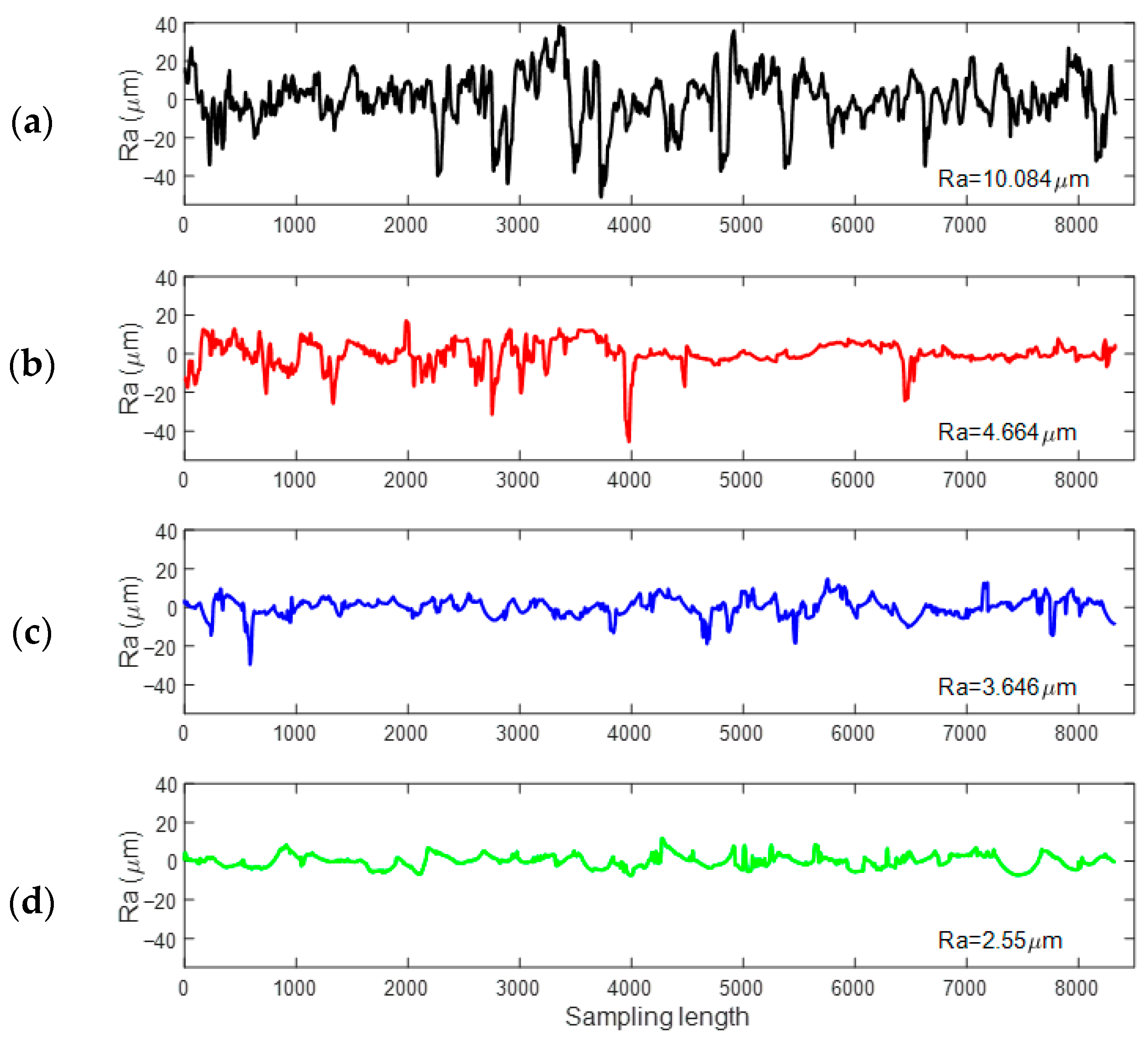
Before and after each grinding process, surface roughness measurement is conducted using Mitutoyo SJ-210 surface roughness testing tool, resulting in roughness data obtained during the grinding processes for 5, 15, and 30 min. The Mitutoyo SJ-210 surface roughness testing tool displays the average value of surface roughness (Ra) in micrometers (µm). This experiment was repetitively performed with other workpieces under identical parameter conditions. An example of the roughness measurement from one work coupon is presented in Figure 5.
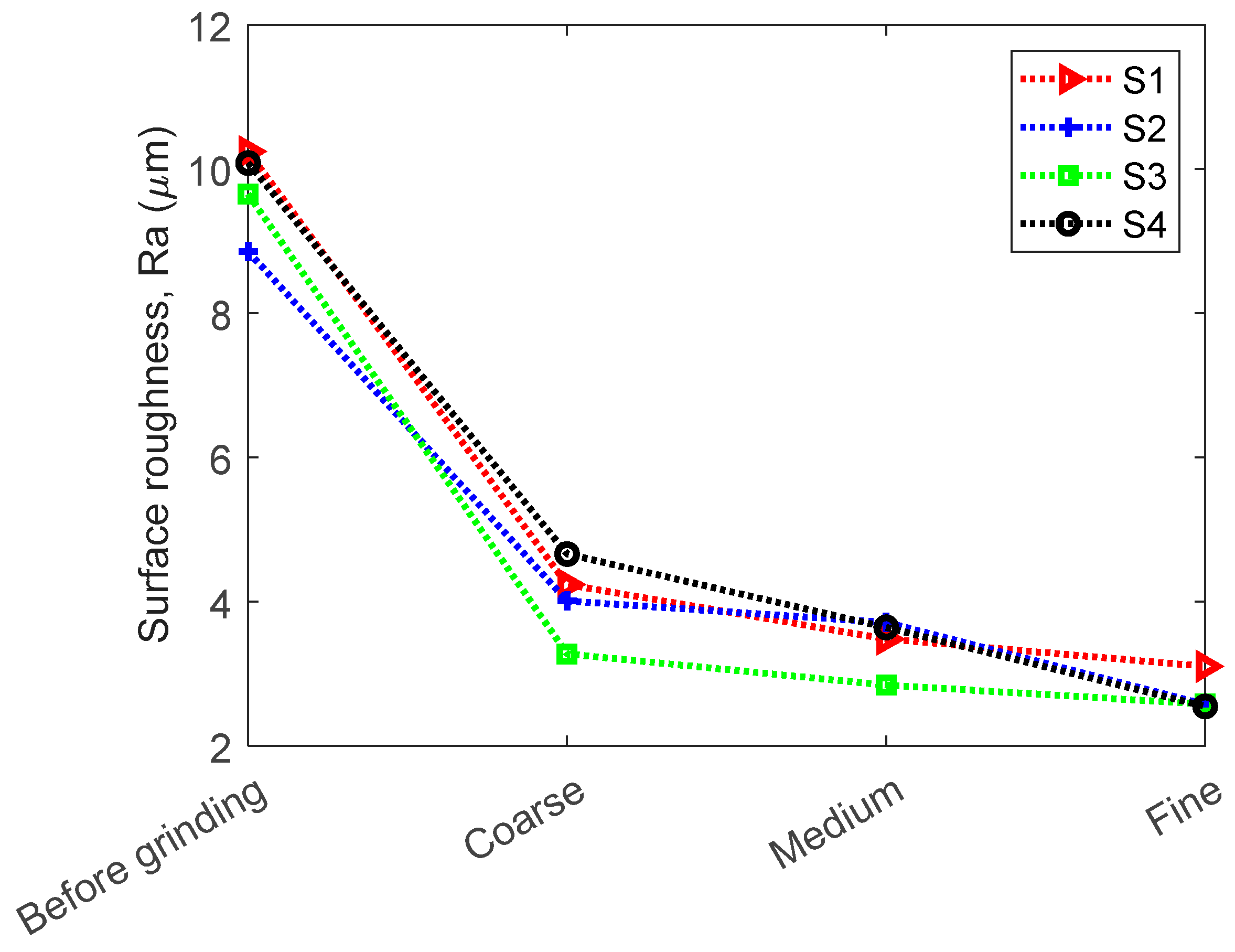
The surface roughness of a workpiece was measured both before and after the grinding process for durations of 5, 15, and 30 min, and the results are presented in Table 4. Table 4 illustrates the surface roughness of the experimental material, divided into four grinding process times (before the process, 5, 15, and 30 min). The empirical material used was nine rectangular aluminum boxes, which underwent vertical grinding. Prior to the vertical grinding process, the experimental material had a surface roughness of between 8.341 and 10.6 μm; the surface of the material was ground for five minutes and produced a surface roughness of between 3.941 and 4.835 μm, or a surface roughness reduction of around 50%. The following process was grinding the same surface for 15 min and measuring the surface roughness; the results were between 3.128 and 3.933 μm, or a reduction in roughness of around 60%. The percentage reduction in surface roughness becomes more fantastic, or the surface becomes smoother, when the grinding process continues for 30 min and produces a surface roughness value of 2.55 to 2.913 μm, or surface roughness decreases by 70%. Overall, there has been a consistent decrease in the surface roughness of the experimental material, which tends to be uniform during the vertical grinding process using a robotic arm. It can be clearly seen that the longer of the grinding process on the vertical test object, reduced the surface roughness, or the smoother the test object becomes.
Changes in surface roughness have been quantified in micrometer units (μm) and are categorized based on four durations of the vertical grinding process: before grinding, and after grinding for 5, 15, and 30 min, as seen in the line graph in Figure 6. During the initial 5 min of the vertical grinding process, a significant reduction in surface roughness of approximately 50% was observed across all tested materials. Subsequently, after extending the grinding process to 15 min, the measured surface roughness of the test material indicated an average decrease of 10%. Continuing the grinding process for 30 min resulted in a further average decrease of 10%, with a noticeable narrowing of the range of roughness differences. Overall, the roughness tester consistently recorded a decrease in surface roughness, leading to a uniformly smoother surface of the test material. The differences in surface roughness also became narrower, showcasing the effectiveness of the vertical grinding process with a robotic manipulator.

4. Results and Discussion

4.1. Feature Extraction of the Vibration Data

4.1.1. Feature Extraction of the X-Axis Vibration Data

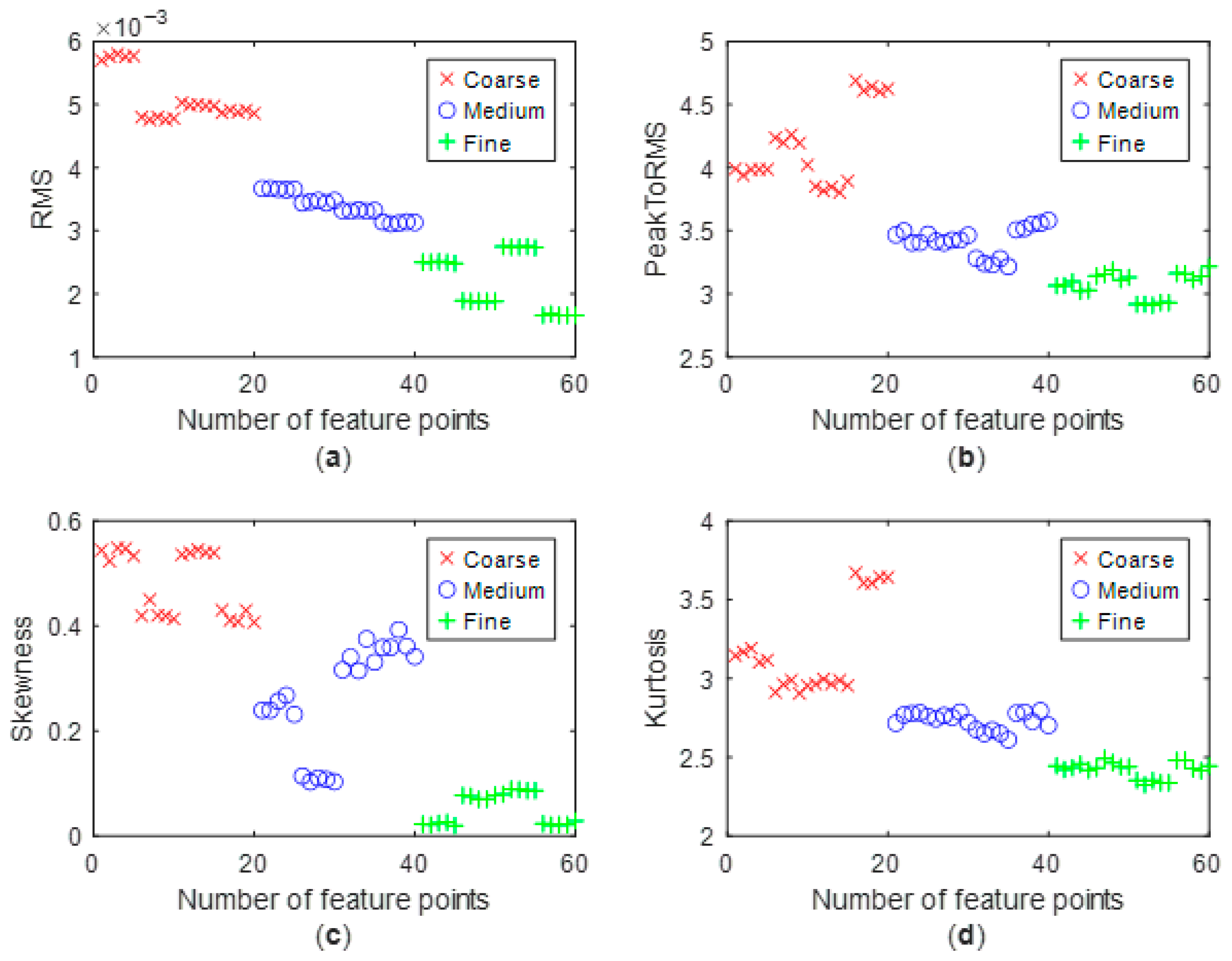
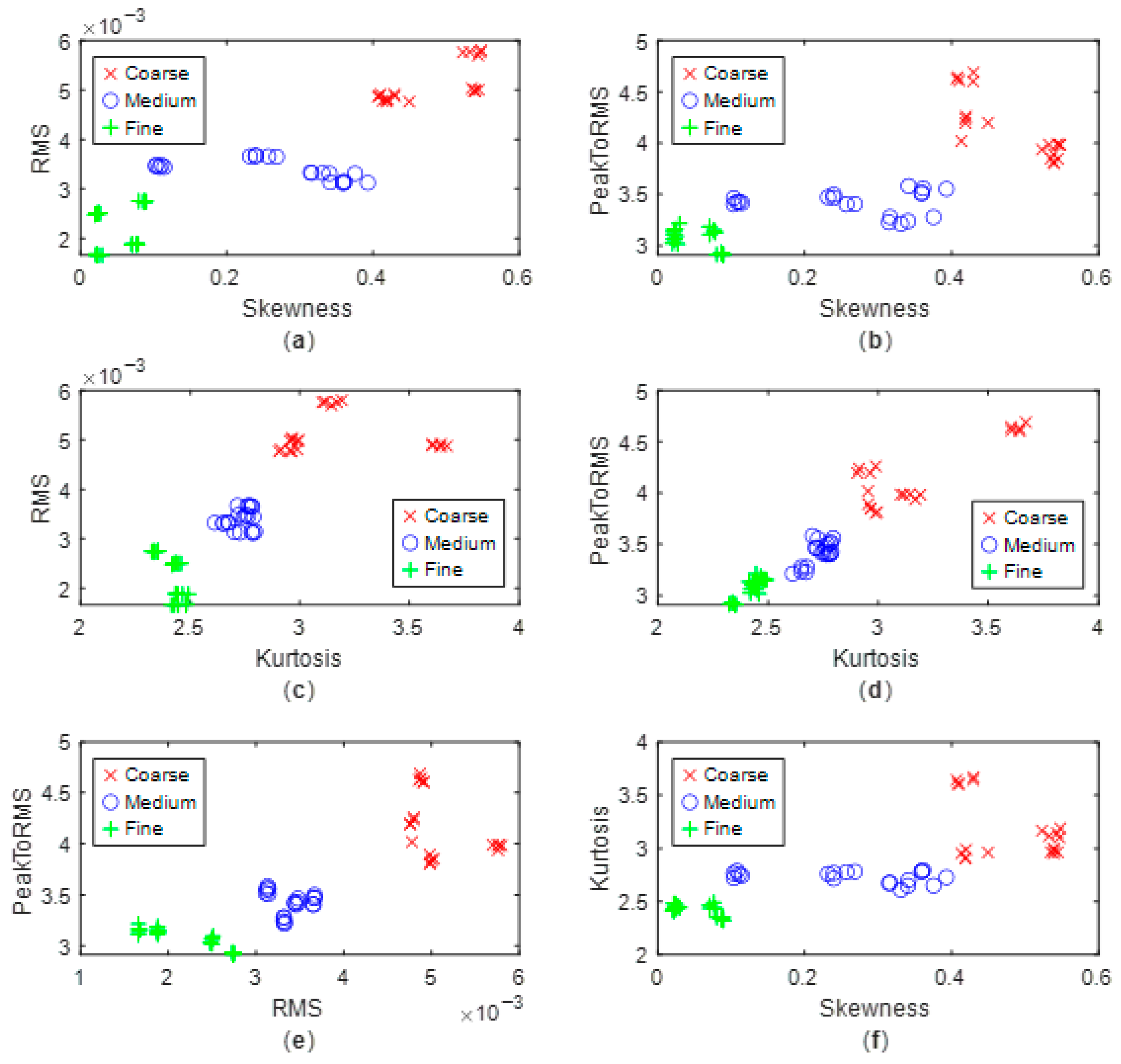
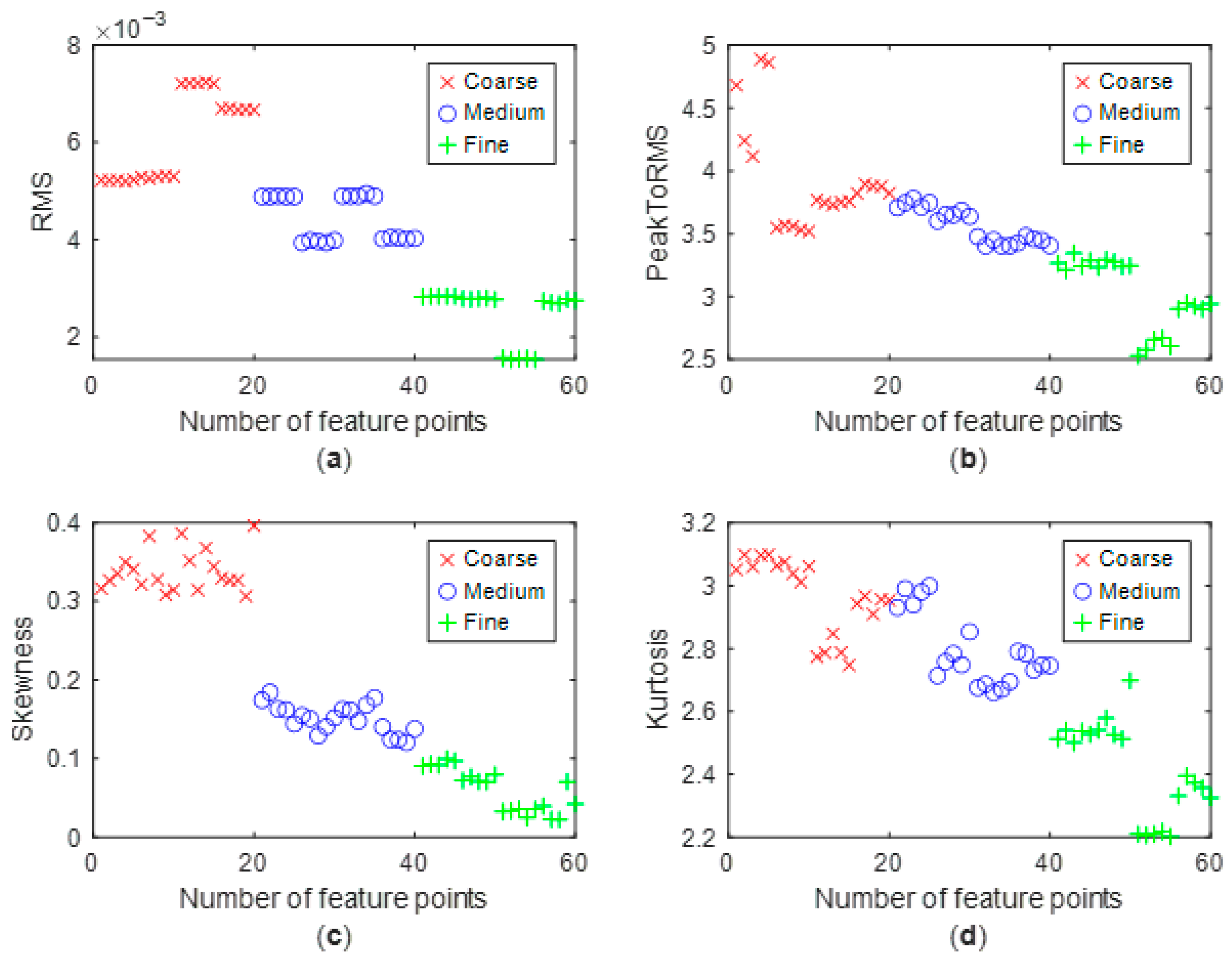
The calculated feature data, comprising RMS, Peak to RMS, Kurtosis, and Skewness on the x-axis vibration data, is presented in Figure 7a–d. Each figure consists of 60 feature points for where the first, the second and the last 20 feature points represents coarse (red), medium (blue), and fine (green) category, respectively. Although, the scattered trend was indicated in the figures, the overall pattern shows the decreasing value of each feature from the coarse to fine category.

4.1.2. Feature Extraction of the Y-Axis Vibration Data

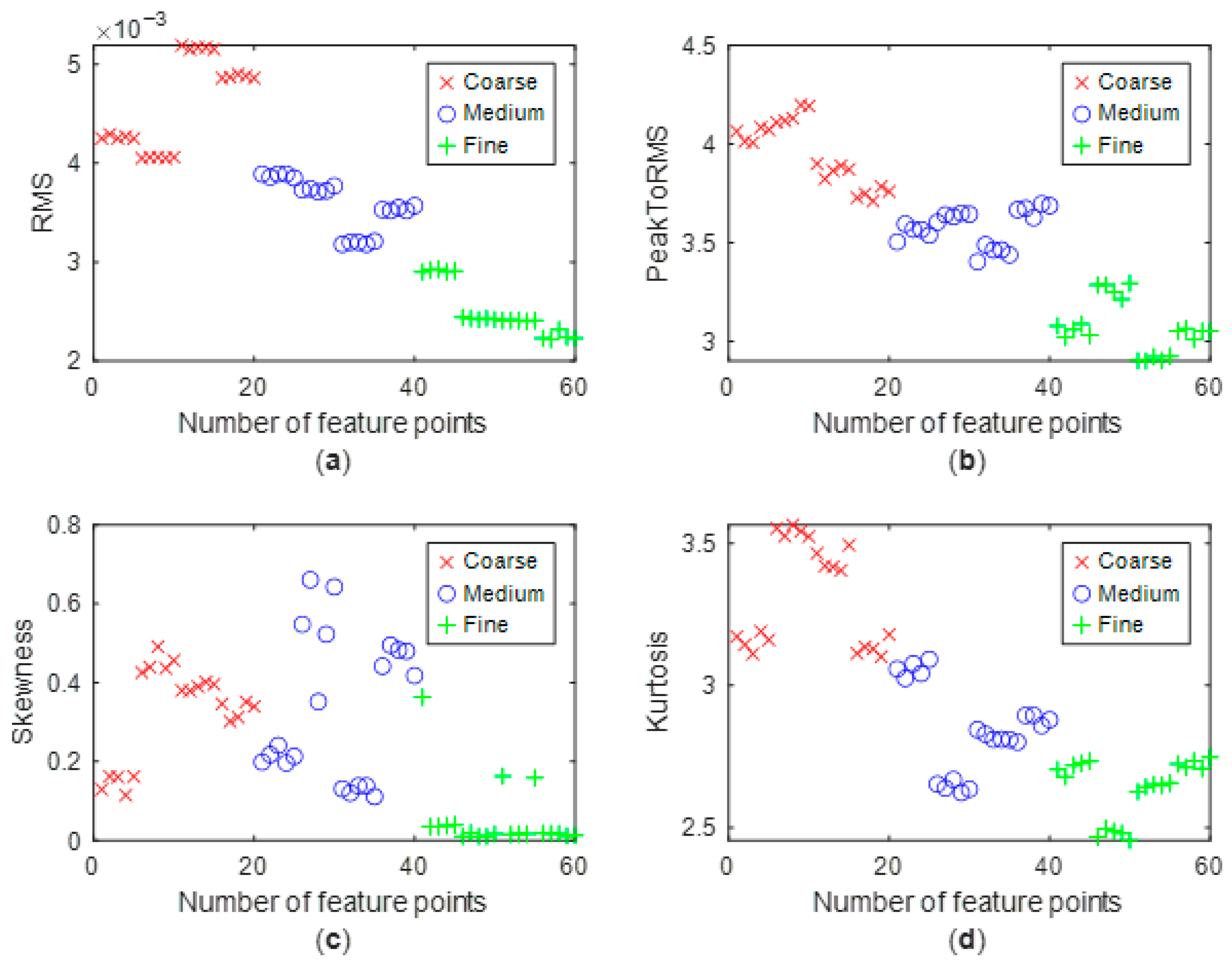
The RMS, Peak to RMS, Kurtosis, and Skewness on the y-axis vibration data is presented in Figure 8. A similar trend to the x-axis vibration data is also found in Figure 8 where the scattered feature points is visible even though the trend is decreasing. The obvious one is shown in the Skewness feature.

4.1.3. Feature Extraction of the Z-Axis Vibration Data

The RMS, Peak to RMS, Kurtosis, and Skewness on the z-axis vibration data presented in Figure 9 shows more continuous decreasing trend with also found scatter only for coarse category of the PeakToRMS feature. The feature plots on z-axis vibration data are better that the feature plots of the x-axis and y-axis vibration data.
A general conclusion can be drawn from the single feature plot is that all features shown a decreasing trend that related with the surface quality label. This indicated that the potential application for the in-process surface quality monitoring in the future study.

4.2. Pair Feature Plot of the Vibration Data

4.2.1. Pair Feature Plot of the X-Axis Vibration Data

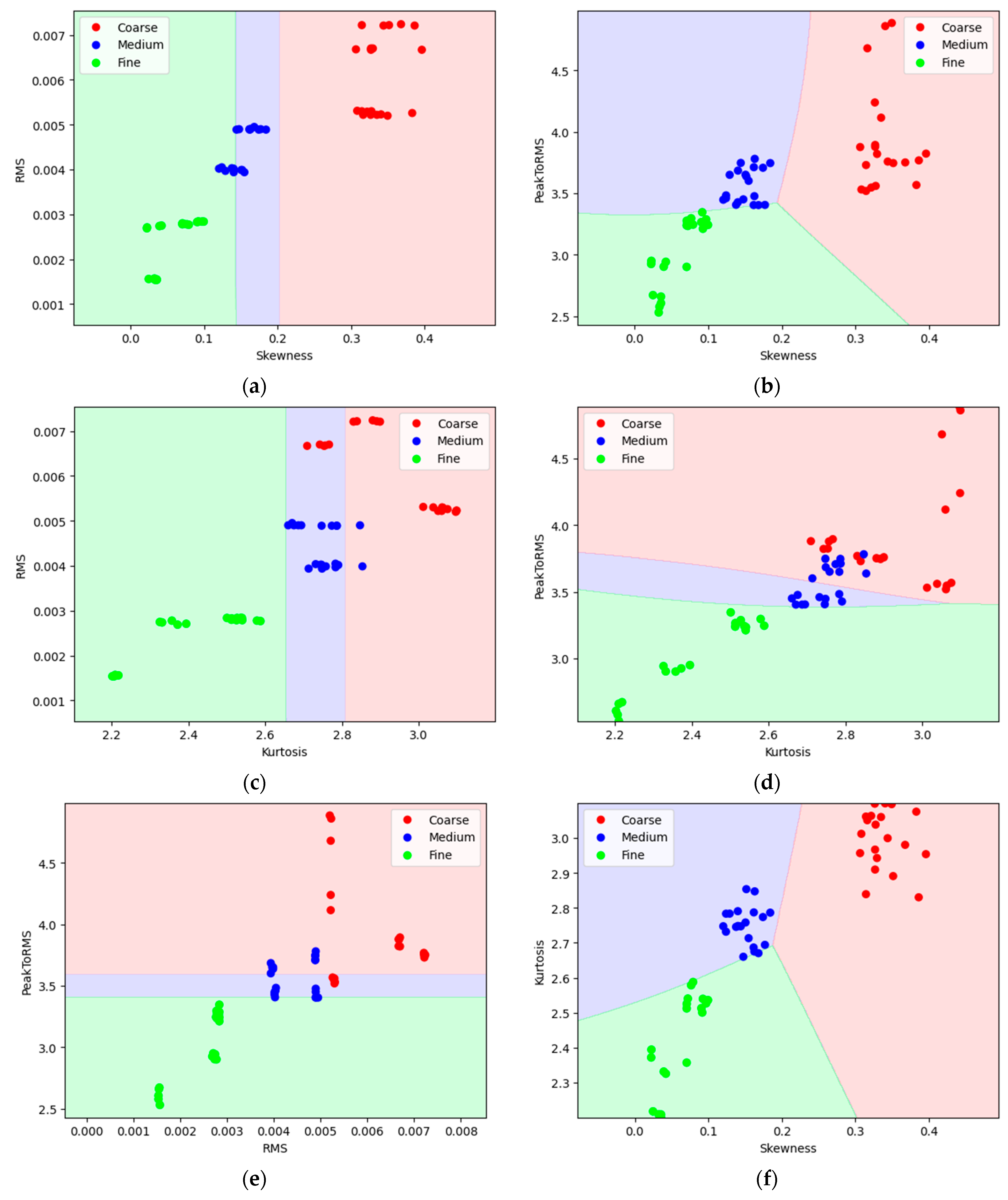
A pairwise feature plot extracted from the x-axis vibration data is presented in Figure 10. As shown in Figure 10a,c,e, the features pair plots reveal distinguishable patterns across different machining durations (5 min, 15 min, and 30 min) which therefore labeled as the surface roughness conditions (coarse, medium, and fine). The distance between each surface roughness label can also be easily observed. In particular, Figure 10a,c,e demonstrate consistent and clearly separated regions corresponding to coarse, medium, and fine surface roughness label. In contrast, Figure 10b,d,f show that the medium and coarse surface roughness conditions are closely clustered, with several feature points overlapping when Skewness and Kurtosis are plotted against Peak to RMS. However, the overlapping condition is still acceptable for SVM classification as there is gap between one surface roughness class with other classes. In the SVM method, the scattered data will also reduce the classification accuracy as the calculation of the hyperplane boundary will be challenging.

4.2.2. Pair Feature Plot of the Y-Axis Vibration Data

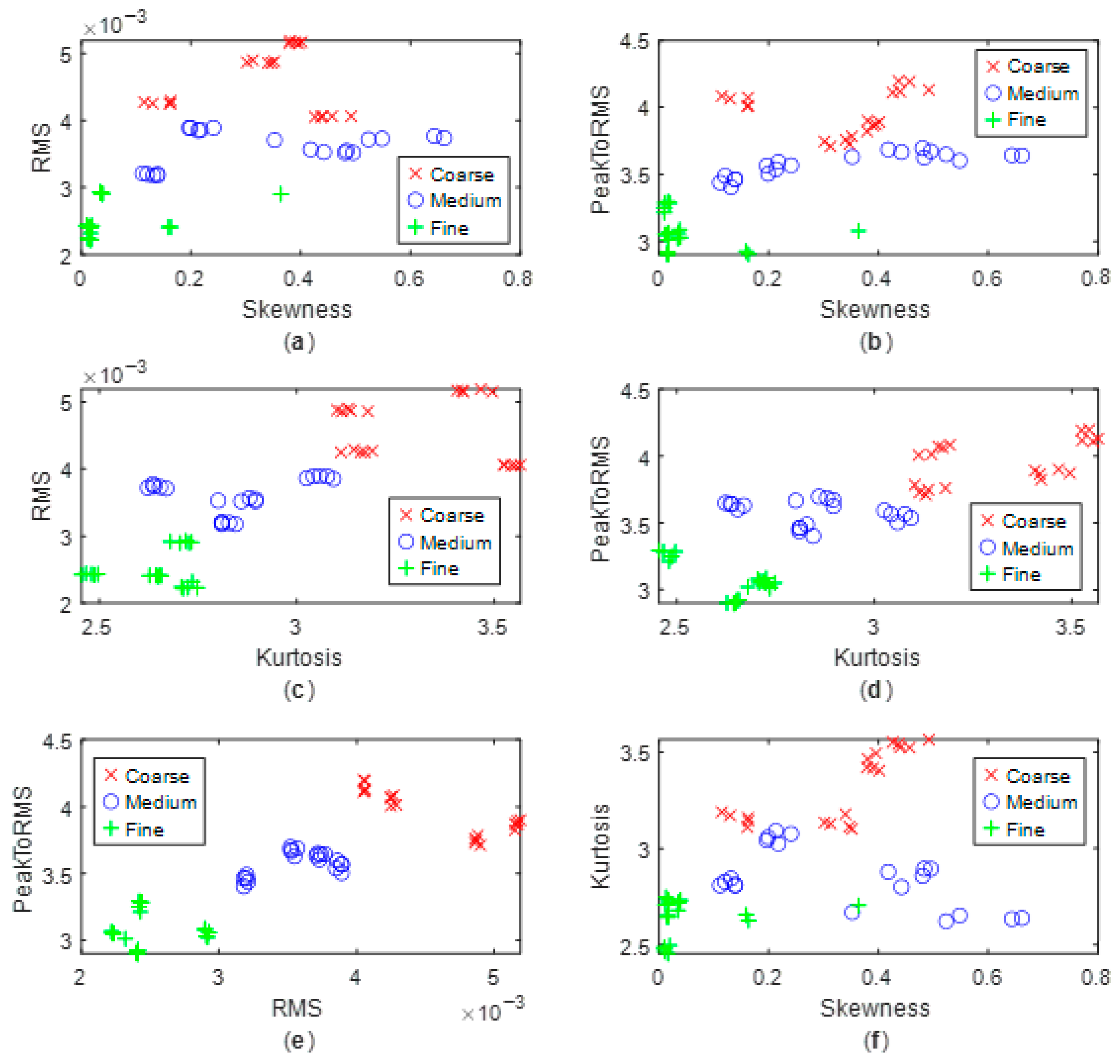
Similar to Section 4.2.1, a pair of two features plot of three surface roughness quality categories extracted from y-axis vibration data is presented in Figure 11. The pair two features plot reveals close and overlapping patterns across coarse, medium, and fine surface roughness label as presented in Figure 11a–d,f. In particular, Figure 11c shows distinguishable feature pair plot where the feature samples of coarse, medium, fine surface roughness classes are separated clearly. In addition, the medium surface roughness label has severe overlapping scattered condition in feature pair plots as presented in Figure 11a,f. While other figures closely clustered condition across three surface roughness labels, with several feature points overlapping each other. The scattered condition of feature pair plots in y-axis vibration dataset is more severe than the feature pair plots in x-axis vibration dataset. According to this overlapping and scattered feature pair plot result, the SVM classification method will be difficult to calculate the hyperplane. Therefore, the SVM classification and prediction accuracy will decrease. This preliminary hypothesis will be confirmed in Section 4.3.

4.2.3. Pair Feature Plot of the Z-Axis Vibration Data

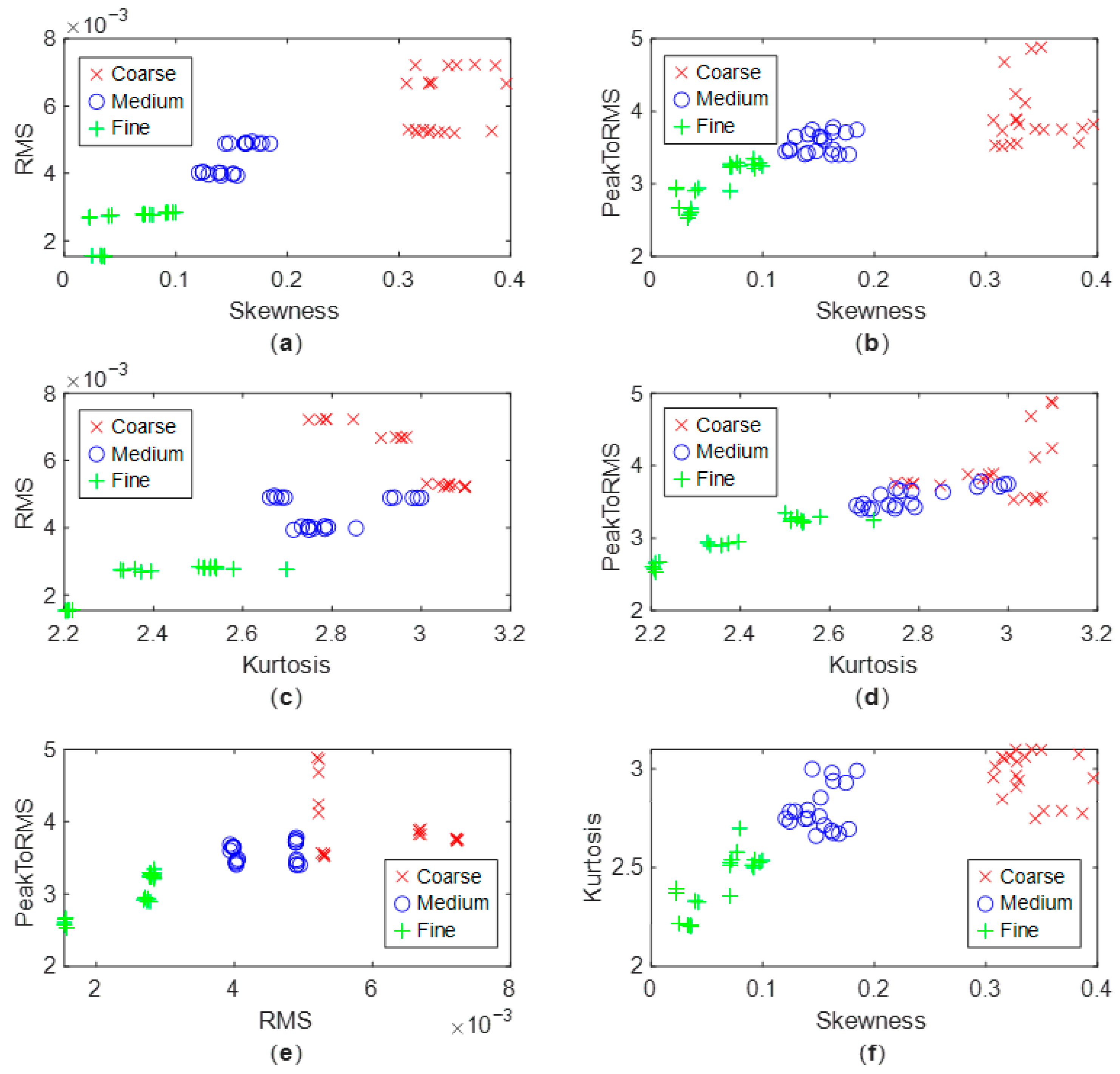
A pair of two features plot extracted from z-axis vibration data is presented in Figure 12. Differing from the results presented in Figure 10 and Figure 11, the pair two features plot in the z-axis vibration dataset reveals more clear patterns across different surface roughness quality labels. Figure 12a–c,e,f show a consistency and obviously distinguished area between fine, medium, and coarse surface roughness conditions. However, the medium surface roughness label in Figure 12d was overlapping with the fine surface roughness label. In addition, Figure 12d shows that some of the medium surface roughness feature samples tend to approach the fine surface roughness area and vice versa. This indicates the challenge in calculating the hyperplane boundary of the SVM classification compared to the other pair of two features plot presented in Figure 12a–c,e,f.

4.3. SVM Classification of the Feature Extraction Result

4.3.1. SVM Classification for Feature Extraction of the X-Axis Vibration Data

The SVM classification reports for the training datasets of the x-axis vibration data across six paired features are presented in Table 5, Table 6, Table 7, Table 8, Table 9 and Table 10. These reports summarize key evaluation metrics for the model, namely precision, recall, and F1-score. The metrics were used to assess the SVM model’s performance in classifying three surface roughness categories: coarse, fine, and medium. Overall, the recall and F1-scores for the coarse and fine categories were higher than those for the medium category. In contrast, the precision of the medium category was lower compared to the coarse and fine categories.
According to the SVM classification report, the highest accuracy of 0.83 was achieved with the feature pairs Kurtosis vs. RMS and Kurtosis vs. Peak to RMS. In contrast, the lowest accuracy was observed for the Skewness vs. RMS feature pair.
For the testing datasets, the SVM classification reports of six feature pairs are presented in Table 11, Table 12, Table 13, Table 14, Table 15 and Table 16. The overall performance pattern is similar the training datasets where the recall and F1-scores for the coarse and fine categories were generally higher than those for the medium category, although the differences were relatively modest. A notable gap was observed in the Skewness vs. RMS feature pair, which also appeared in the training dataset results. This feature pair yielded the lowest accuracy at 0.71. In contrast, the Skewness vs. PeakToRMS feature pair achieved the highest accuracy of 0.91.

4.3.2. SVM Classification for Feature Extraction of the Y-Axis Vibration Data

The SVM classification reports for the training datasets of the y-axis vibration data across six paired features are presented in Table 17, Table 18, Table 19, Table 20, Table 21 and Table 22. The Skewness vs. PeakToRMS, and Kurtosis vs. RMS has a similar pattern with the SVM classification repot of the training dataset of the x-axis where the f1-score of the course is the highest followed by fine and the lowest is the medium. For the other feature pairs, Skewness vs. RMS, Kurtosis vs. PeakToRMS, RMS vs. PeakToRMS, and Skewness vs. Kurtosis, has different pattern where f1-score of fine is the highest followed by course, and medium. The lowest accuracy of 0.62 was found in Skewness vs. RMS feature pair and the highest accuracy was shown in two feature pairs, i.e., Kurtosis vs. PeakToRMS and Skewness vs. Kurtosis. A unique result was found in the Skewness vs. RMS and Kurtosis vs. RMS where it was fault to classify the medium data. This indicate that the RMS feature was not appropriate for the y-direction.
In the testing datasets, the SVM classification report is presented in Table 23, Table 24, Table 25, Table 26, Table 27 and Table 28. It is shown that the f1-score has a similar pattern to the training datasets. In addition, the lowest and the highest accuracy of 0.44 and 0.78 were shown in the Skewness vs. RMS and Kurtosis vs. PeakToRMS feature pair, respectively.

4.3.3. SVM Classification for Feature Extraction of the Z-Axis Vibration Data

The SVM classification report of the training datasets of the z-axis vibration data presented in Table 29, Table 30, Table 31, Table 32, Table 33 and Table 34 demonstrate outstanding performance compared to the x-axis and y-axis vibration data. The notable result is presented in the Skewness vs. PeakToRMS and the Skewness vs. Kurtosis feature pair where all the metrics value such as precision, recall, and f1-score were higher than or equal to 0.85. All classes achieved excellent precision and recall values, while the weighted averages further validate the model’s robustness across the full dataset of 42 observations. The lowest accuracy of 0.71 was found in Kurtosis vs. RMS and Kurtosis vs. PeakToRMS feature pairs. The highest accuracy of 0.95 was shown in Skewness vs. PeakToRMS and Skewness vs. Kurtosis feature pairs.
Since the overall SVM classification metrics report of the training datasets of the z-axis vibration data better than x-axis and y-axis, the classification metrics report of the testing datasets of the z-axis vibration data which are presented in Table 35, Table 36, Table 37, Table 38, Table 39 and Table 40 were also better than the x-axis and y-axis. The lowest accuracy of 0.67 was found in the Kurtosis vs. PeakToRMS and RMS vs. PeakToRMS feature pairs. In addition, the highest accuracy of 0.89 was shown in Skewness vs. PeakToRMS feature pair. The overall SVM classification report of the z-axis vibration data in the testing stage shows better than the other two vibration axes (x-axis and y-axis).

4.4. Confusion Matrix of SVM Classification

4.4.1. Confusion Matrix of the SVM Classification for the X-Axis Vibration Data

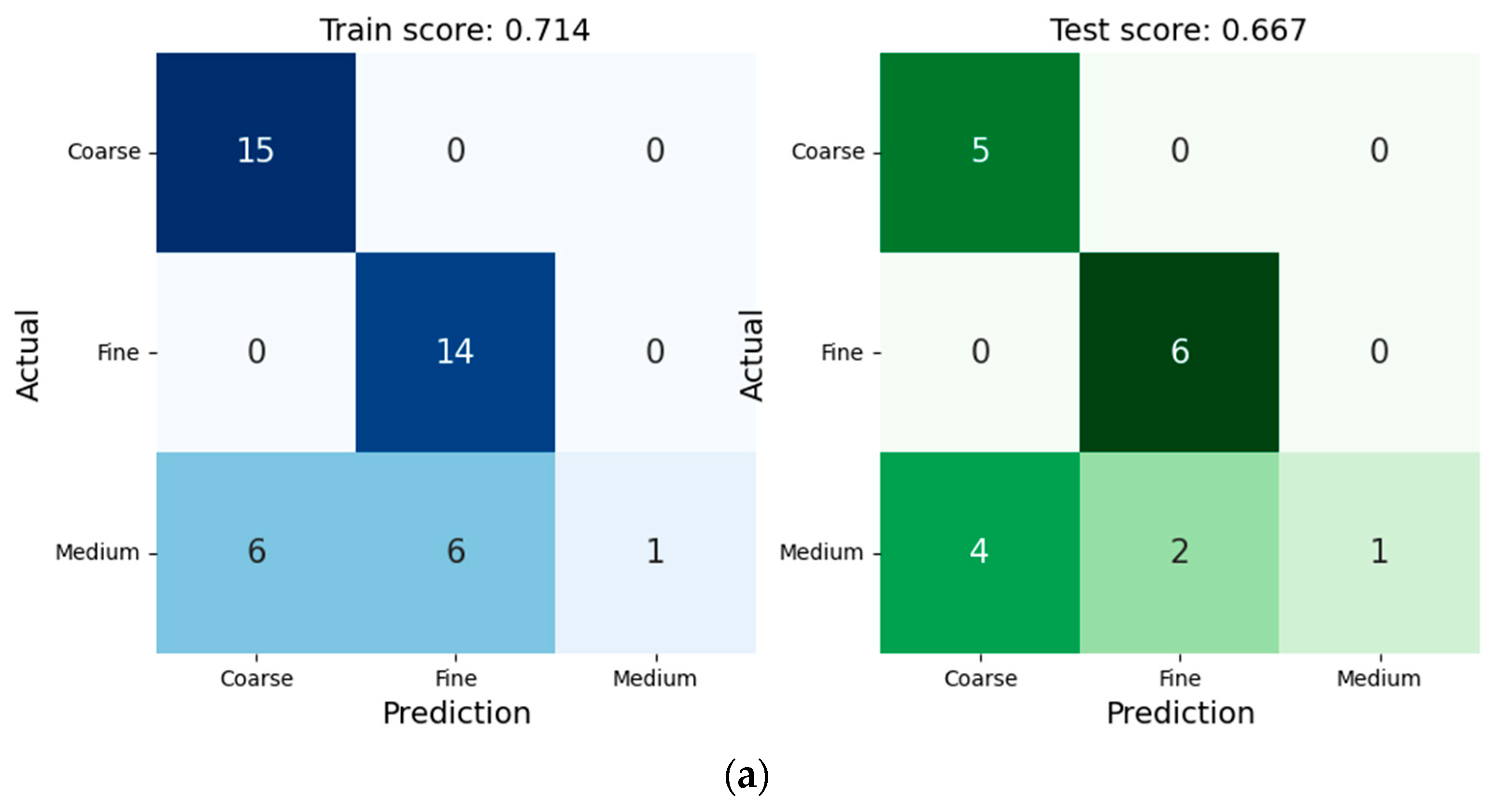
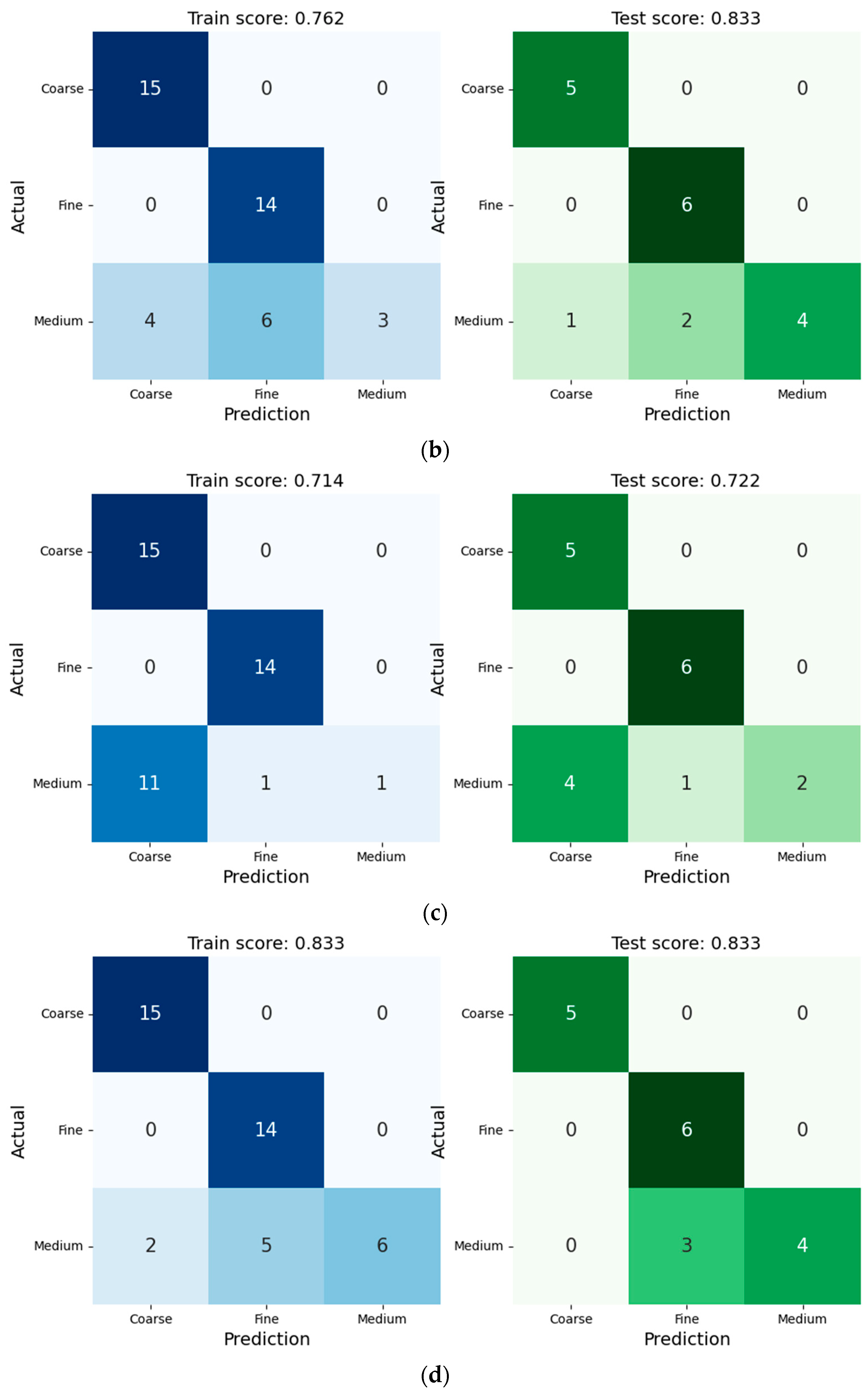
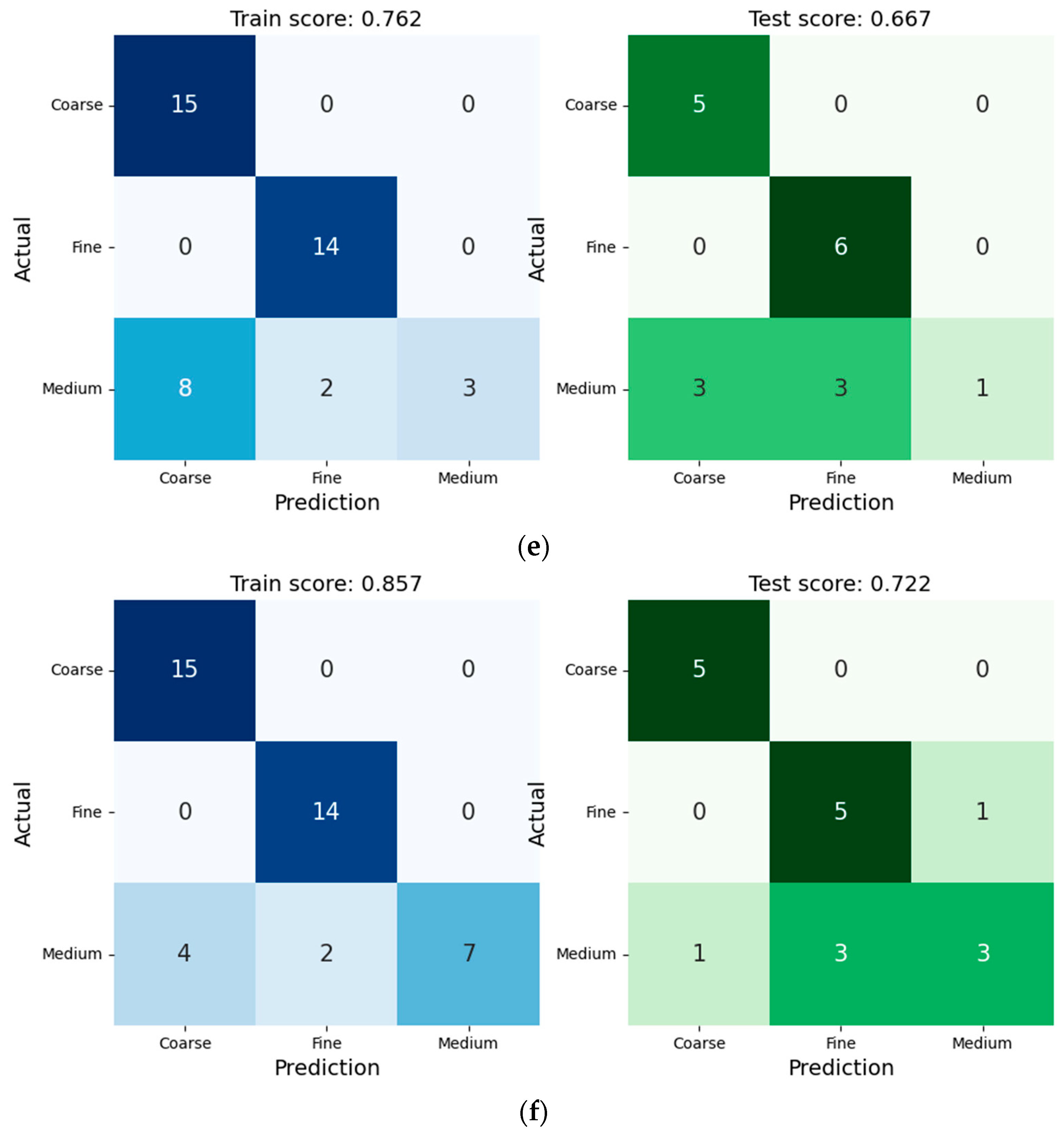
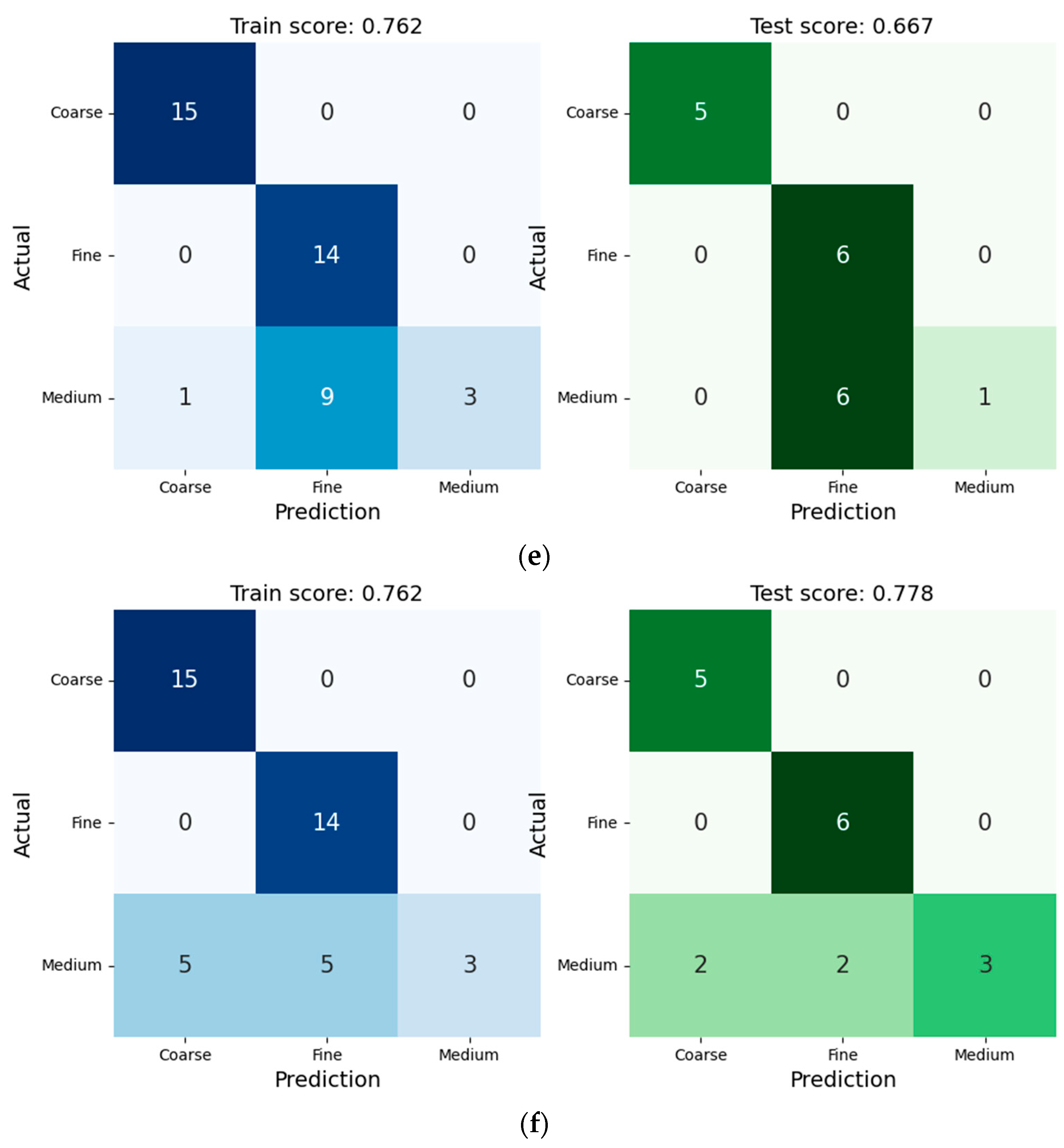
The confusion matrix provides a comprehensive evaluation of model performance by highlighting both classification accuracy and instances of misclassification. The confusion matrix of SVM classification for x-axis vibration data is presented in Figure 13. Similar to the previous sections, the discussion was focused on the investigation of the six combination feature pairs. Figure 13 shows the confusion matrix of the training and testing. In the training stage, the overall classification of the course and fine category show a perfect classification where all 15 feature data points are classified in the course category and 14 feature data points are classified in the fine category. However, the SVM training classification shows in accurate classification of the 13 feature data points where most of the feature data points were misclassified to the course and fine categories.
A similar classification pattern was also found when the SVM model was tested in the testing phase. Five feature data points were perfectly classified as the course category and six feature data points were predicted correctly in the fine category. However, the seven feature data points that should be belong to the medium category were mis predicted to other categories. The worse result is presented in the RMS vs. PeakToRMS feature pair where only one feature data point was correctly classified in the medium category and the other five feature datapoints were predicted in the fine category.
Table 41 and Table 42 show the misclassified samples of SVM training and testing in x-axis vibration dataset summarized from confusion matrices of Figure 13 which based on x-axis vibration dataset. According to the Table 41 and Table 42, SVM training and testing has zero misclassified samples and zero percentage error for coarse and fine surface quality label, respectively. In contrast, the medium surface quality label has a lot of misclassified samples and high percentage error. The misclassified samples in medium surface quality label were incorrectly predicted to other surface quality labels. This indicate that the features of medium surface quality are difficult to distinguish.

4.4.2. Confusion Matrix of the SVM Classification for the Y-Axis Vibration Data

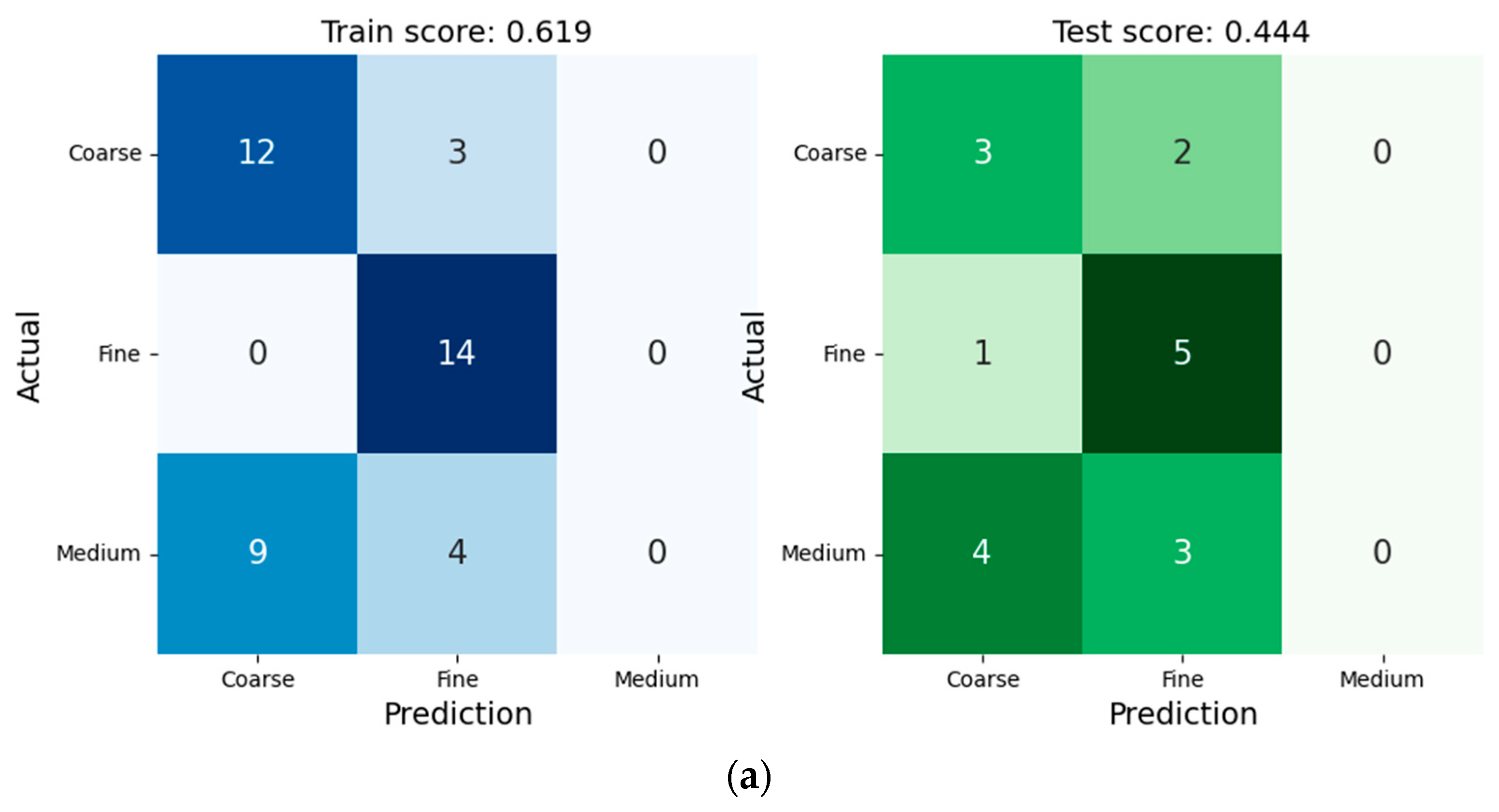
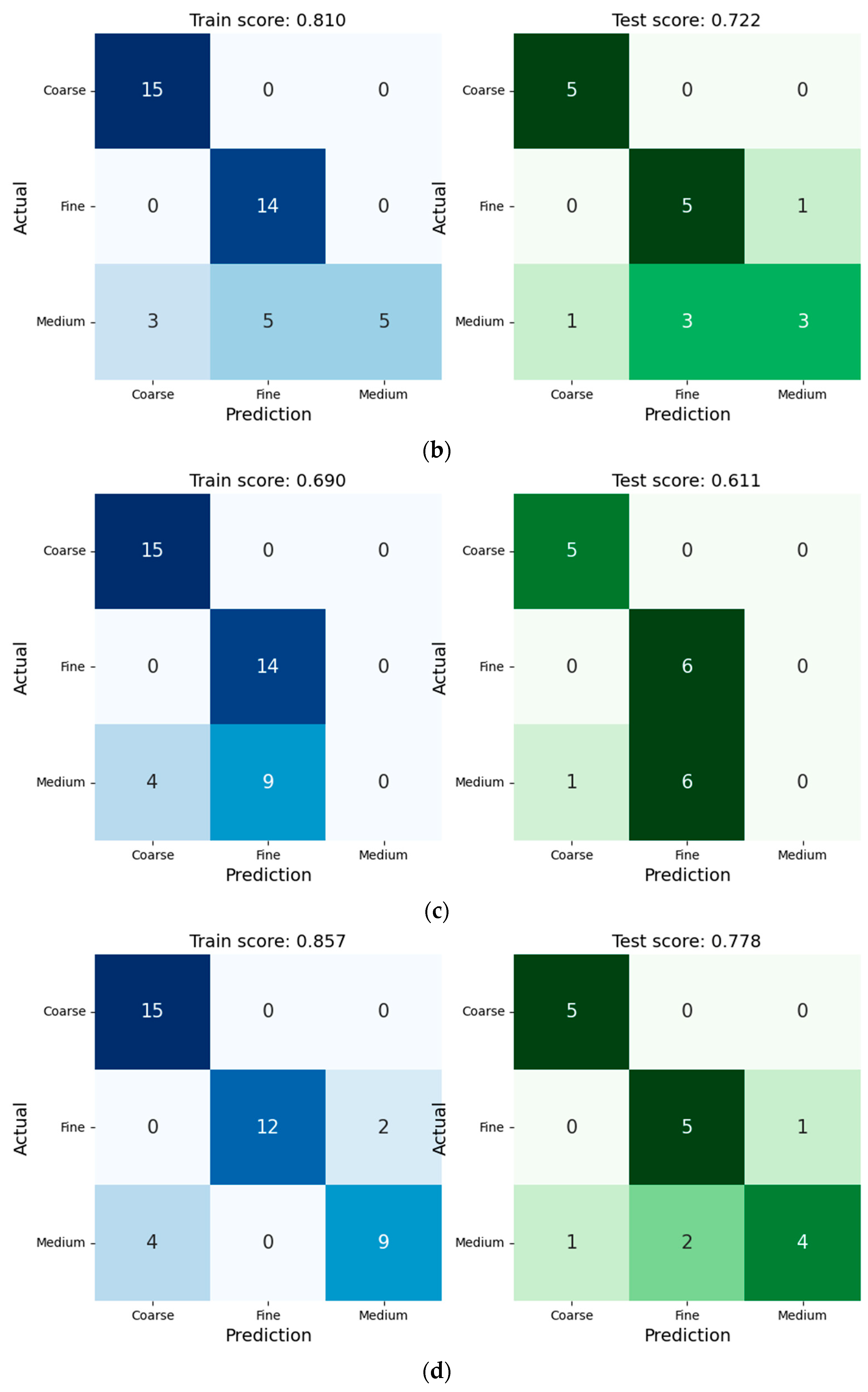
The confusion matrix of SVM classification for y-axis vibration data is presented in Figure 14. This differs from the confusion matrix result in Section 4.4.1 where all the feature data points of course and fine categories were predicted correctly in the training phase, the SVM classification of training datasets of the y-axis show less accurate as indicated in Figure 14a,d. In Figure 14a, three out of twelve feature data points of the course category were misclassified into the fine category. In addition, two out of fourteen feature data points of the fine category were incorrectly predicated to be in the medium category. Another notable result is shown in Figure 14a,c where all the fine feature data points were predicted incorrectly to other categories.
In the testing phase, the result is not even better that the training phase where there are a number of misclassification and mis predicted between one category and other categories. The misclassification failure for medium feature datasets was also presented in Figure 14a,c for the testing phase. This indicate that the y-axis vibration signal was not appropriate for predicting the surface quality of the aluminum workpiece in this study.
Table 43 and Table 44 show the misclassified samples of SVM training and testing summarized from confusion matrices of Figure 14 which based on y-axis vibration dataset. Differ with the result presented in Table 41 and Table 42, the SVM training and testing score of feature pair no. 1 in Table 43 and Table 44 for coarse surface roughness label has three and two misclassified samples with 20% and 40% error rates, respectively. A different result is also presented in fine label of the SVM testing where feature number 1, 2, 4, and 6 has one misclassified sample with a 16.67% error. Similar to Table 41, the medium samples are also having a high number of misclassified samples and percentage error.

4.4.3. Confusion Matrix of the SVM Classification for the Z-Axis Vibration Data

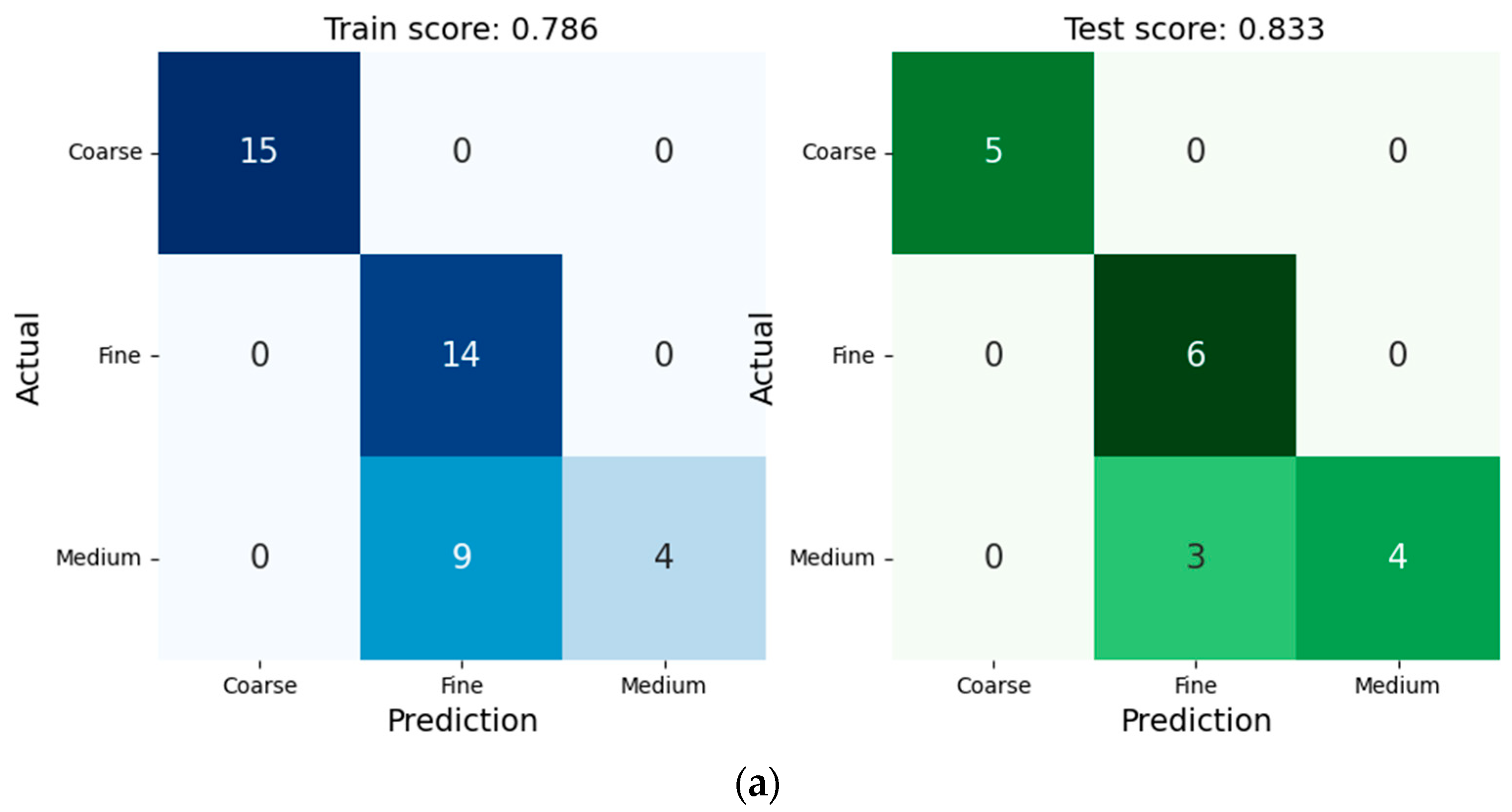
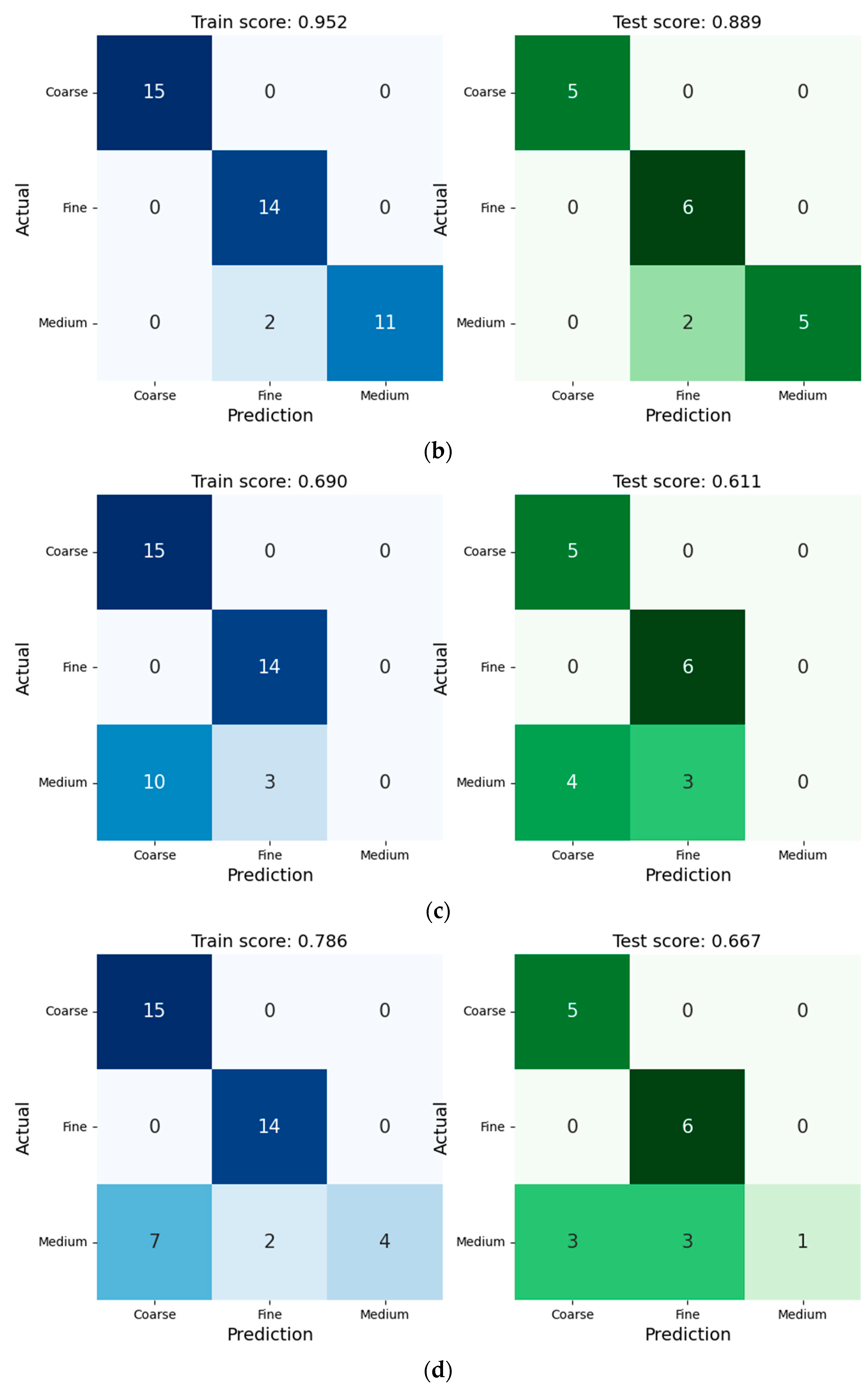
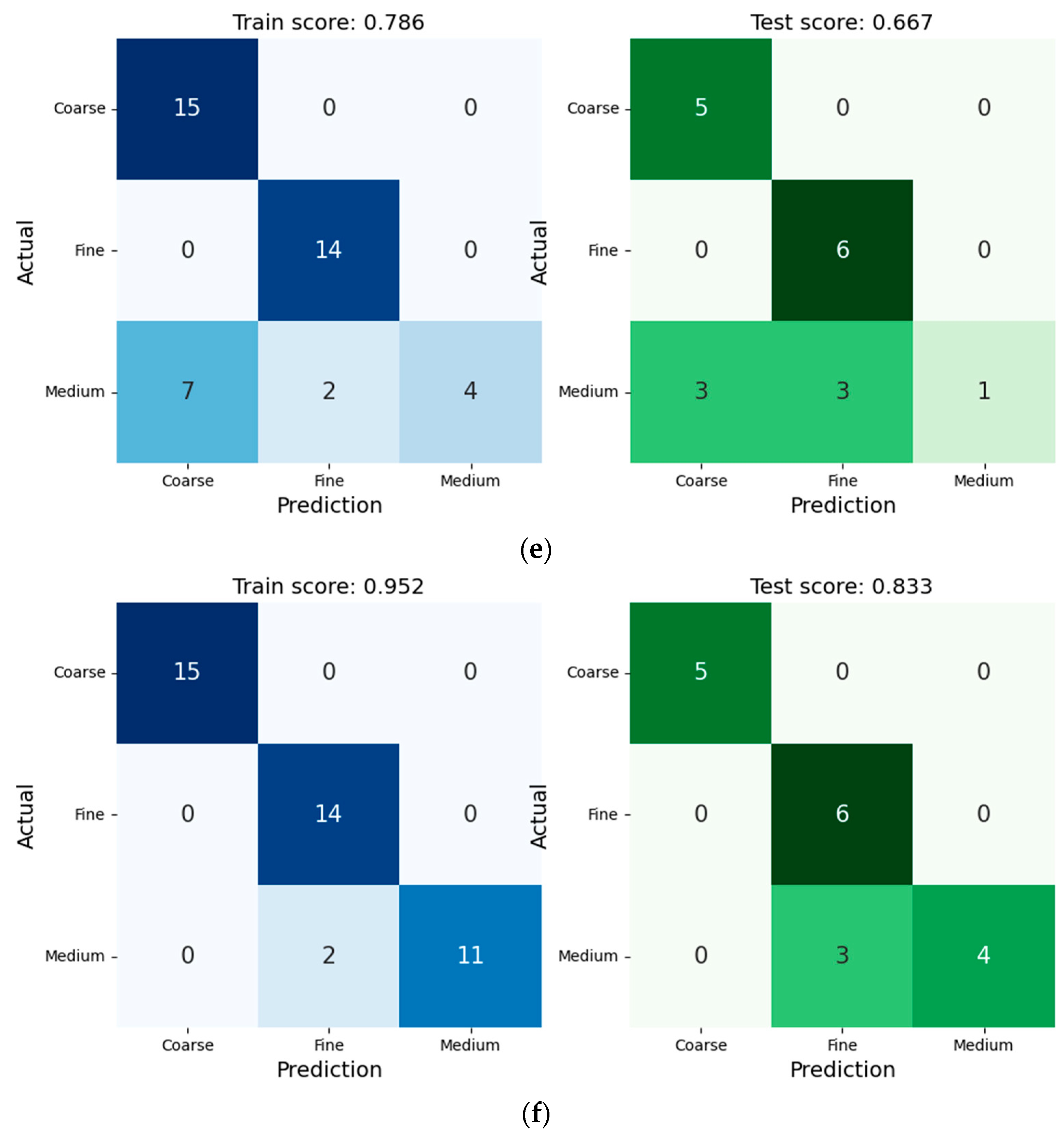
The confusion matrix of SVM classification for z-axis vibration dataset presented in Figure 15 shows better result compared to the SVM confusion matrix of x-axis and y-axis. This is proof by the accuracy of the training phase that has two feature pair plots achieved more than 95, i.e., Skewness vs. PeakToRMS and Skewness vs. Kurtosis with train score of 0.952. The general results show that the feature samples of the coarse and fine surface quality labels were predicted in the correct labels. In contrast, the medium feature samples have misclassified into the other categories. The lowest train score is shown in Figure 15c where all the feature samples of the medium category in the training phase were misclassified to other labels.
In the testing phase, the result is generally lower than the training phase. The only increasing result is observed in the Skewness vs. RMS feature pair, where the train score of 0.786 increases to 0.833 in the test score. During the testing phase, the z-axis vibration datasets presented better accuracy results compared to the results obtained from the x-axis and y-axis vibration datasets. In particular, the number of misclassified samples in the medium surface roughness class of the z-axis vibration dataset is lower than the number of misclassified samples in the medium class of the x-axis and y-axis vibration datasets. The lowest test score is also shown in Figure 15c, similar to the train score.
Table 45 and Table 46 show the misclassified samples of SVM training and testing summarized from confusion matrices of Figure 15 which based on z-axis vibration dataset. Similar to the result presented in Table 41 and Table 42, the SVM training and testing score of all feature pair plots achieved zero misclassified sample and zero error percentage. An improved result shown in the medium surface roughness label where the overall number of misclassified samples is decreased for all feature pair plots compared to the x-axis and y-axis vibration dataset. The lowest number of misclassified samples is achieved in feature pair no. 2 (Skewness vs. PeakToRMS) and no. 6 (Skewness vs. Kurtosis) with only two samples incorrectly predicted to other classes with a 15.38% error.

4.5. SVM Classification of Feature Space Mapping

4.5.1. SVM Classification of Feature Space Mapping for X-Axis Vibration Data

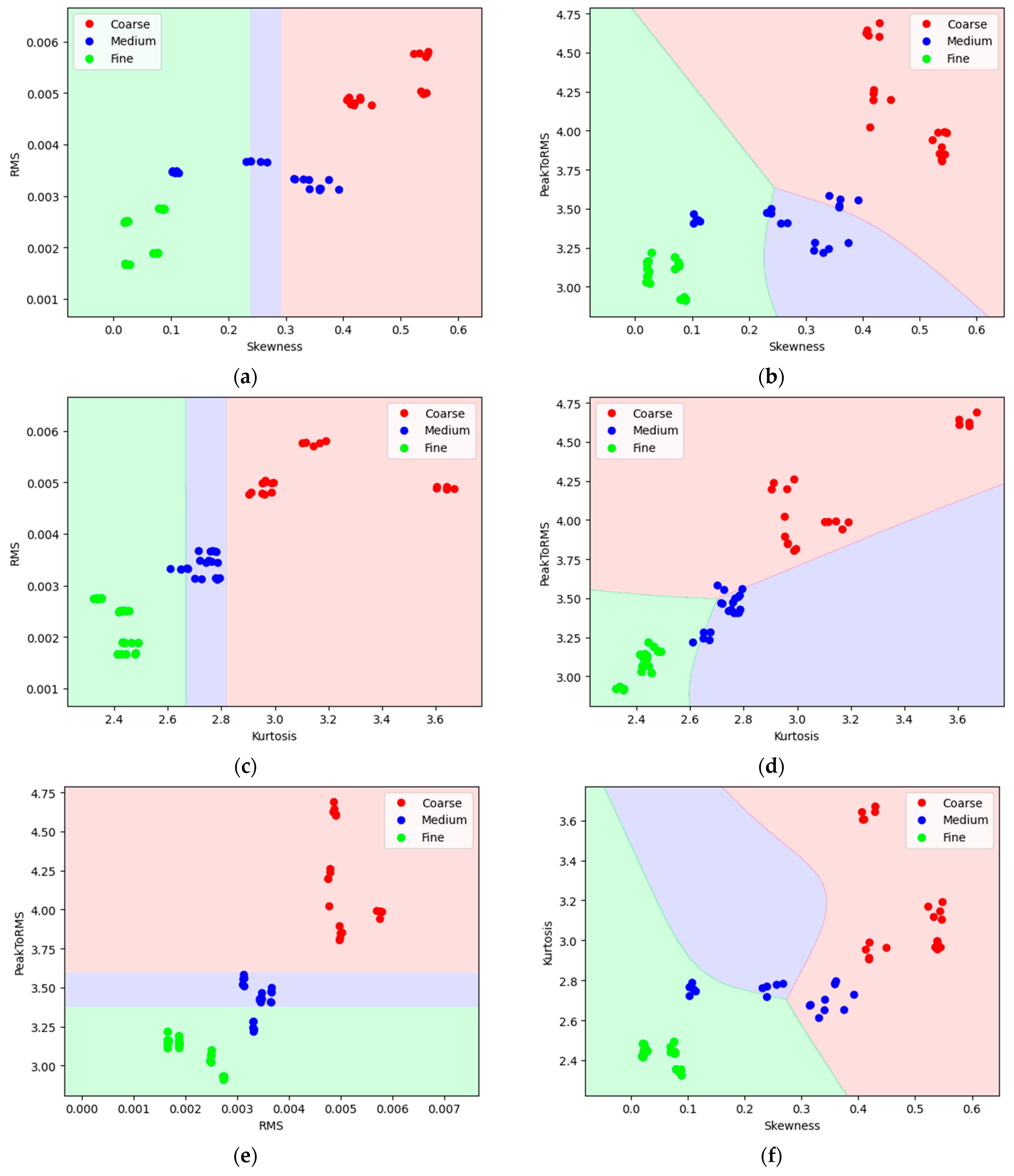
The SVM classification results of feature space mapping for x-axis vibration data are illustrated in Figure 16. In this figure, light magenta, light purple, and light green denote the coarse, medium, and fine categories, respectively. Additionally, Figure 16 presents six feature space mapping plots derived from six feature pairs, where red, blue, and green indicate the data points of the coarse, medium, and fine categories, respectively. The figure shows that most feature data points belonging to the coarse and fine categories were correctly predicted and classified within their respective regions of the feature space. In contrast, the medium category occupies a comparatively smaller region in the feature space mapping which leads the medium feature data points lays misclassified into coarse and fine categories. These results provide graphical insight into why the SVM classification performance reported in Section 4.3 and Section 4.4 is lower for the medium category compared to the coarse and fine categories.

4.5.2. SVM Classification of Feature Space Mapping for Y-Axis Vibration Data

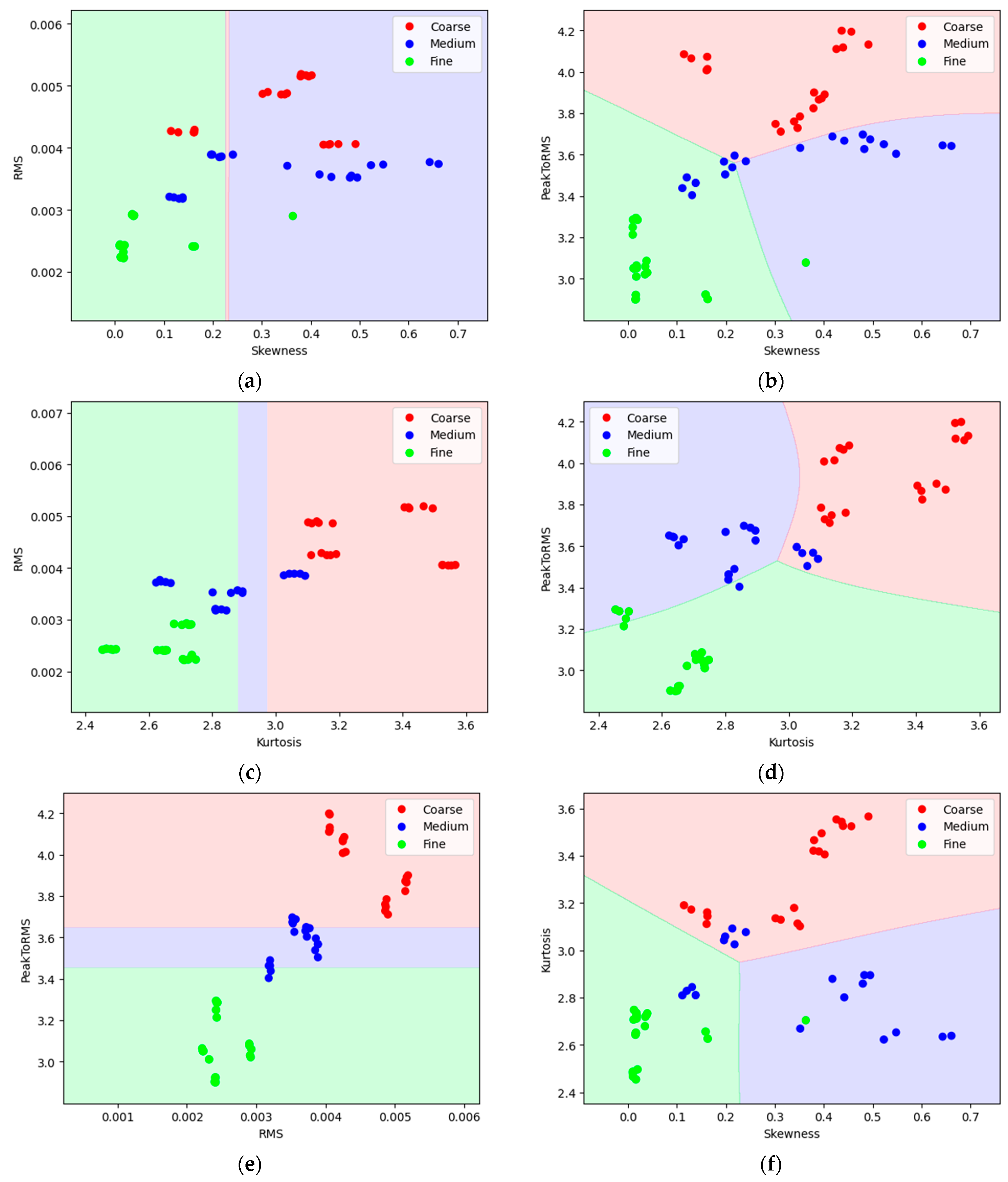
The SVM classification results of feature space mapping for y-axis vibration data are illustrated in Figure 17. Similar to Figure 16, light magenta, light purple, and light green denote the coarse, medium, and fine categories, respectively. In addition, red, blue, and green indicate the data points corresponding to the coarse, medium, and fine categories. Compared to Figure 16, Figure 17 exhibits a similar overall pattern but demonstrates poorer classification performance, particularly in the Skewness vs. RMS and Kurtosis vs. RMS feature pairs. This finding indicates that the RMS feature is not suitable for this application.

4.5.3. SVM Classification of Feature Space Mapping for Z-Axis Vibration Data

In line with the results presented in Section 4.2 and Section 4.3, the SVM classification results of feature space mapping for z-axis vibration data, shown in Figure 18, demonstrate improved classification performance. The feature data points of the coarse, medium, and fine categories were correctly mapped and classified in most of the SVM feature space mapping areas. The poorest performance is observed in the Kurtosis vs. RMS and RMS vs. Peak to RMS feature plots, where more than 50% of the medium-category data points were misclassified into other categories. This outcome indicates that the RMS feature is also unsuitable for this application. A notable result is presented in Figure 17b, corresponding to the SkPeak to RMSPeak to RMS feature pair, where all data points were correctly classified and predicted within their respective regions. This finding suggests that Skewness and Peak-to-RMS are more relevant features for predicting surface quality based on vibration signals in the z-axis (tangential direction).

5. Conclusions

A study on aluminum surface quality prediction using the SVM classification method based on vibration signals is presented. The SVM classification and prediction model was developed both empirically and mathematically by establishing the relationship between the vibration features of the vibration signals obtained from multistage grinding experiments and the corresponding surface quality categories (represented in surface roughness measurement). This study pursued two objectives: (1) to investigate the most appropriate time-domain features of vibration signals, and (2) to determine which vibration sensor features provides more reliable predictions of aluminum surface quality.
Table 41 summarizes the SVM classification and prediction results addressing these objectives. According to Table 41, the Skewness feature emerged as the most suitable, followed by the Kurtosis and PeakToRMS feature. This conclusion is supported by the higher accuracy achieved when feature pairs included Skewness, PeakToRMS, and Kurtosis compared with the other three features. In contrast, the RMS feature proved unsuitable, as its inclusion consistently reduced accuracy in feature pair analysis.
In a vibration signal from a grinding process, positive Skewness indicates an asymmetrical vibration pattern with more prominent, sharp positive impacts or peaks. This is a key indicator in the material interaction changes in the grinding process and may suggest imbalance [35]. For the Kurtosis feature, an excessive Kurtosis value in the health monitoring of the surface grinding process could indicate a developing crack or material removal [35]. Skewness and Kurtosis are the optimal features for the present study, as supported by the SVM classification results and theoretical analysis.
Surface quality alterations are more obvious in the z-axis vibration signal than in the x- and y-axis signals according to the SVM classification and prediction result presented in Table 47. The average training and testing accuracies for the z-axis, 0.825 and 0.75 respectively, are higher than the average training and testing accuracies for the x-axis and y-axis. According to this result, the optimal accelerometer orientation for this study is in the z-axis direction because its alignment with the tangential force direction of the grinding path as previously described theoretically in Section 3.3.
The findings of this study indicate that the SVM model effectively captures patterns associated with surface quality. SVM classification based on vibration sensor data in the tangential force (z-axis) of vertical grinding operations offers potential directions for future research in smart manufacturing, particularly when appropriate feature extraction techniques are applied. The mechanism for in-process surface grinding inspection in smart manufacturing requires compatible and sufficient hardware that can be integrated with the ML model, incorporating advanced vibration sensors, DAQ systems, and data mining capabilities. This mechanism also supports the development and improvement of adaptable ML models for decision-making purposes.
As this is a preliminary study aimed at identifying appropriate features and vibration data directions, future work will employ additional and other machine learning methods for comparison of the present study and incorporate a greater number of work coupons. Future studies will also include the development of the proposed mechanism for in-process surface quality inspection as presented in the aforementioned paragraph.

Author Contributions

Conceptualization, K.M. and W.C.; methodology, W.C.; software, K.M. and W.C.; validation, K.M., L.C.D.S. and W.C.; formal analysis, K.M. and W.C.; investigation, K.M. and W.C.; resources, L.C.D.S.; data curation, L.C.D.S. and W.C.; writing—original draft preparation, K.M. and W.C.; writing—review and editing, L.C.D.S. and W.C.; visualization, W.C.; supervision, L.C.D.S. and W.C.; project administration, L.C.D.S. and W.C.; funding acquisition, K.M. and W.C. All authors have read and agreed to the published version of the manuscript.

Funding

This research received no external funding. The APC was funded by Wahyu Caesarendra.

Institutional Review Board Statement

Not applicable.

Informed Consent Statement

Not applicable.

Data Availability Statement

Data is unavailable due to privacy. However, it can be share upon request to the corresponding authors.

Acknowledgments

The authors gratefully acknowledge Politeknik Negeri Banyuwangi for in-kind support of this study. The corresponding authors would like to thank Mochammad Denny Surindra for his assistance in the grinding experiment.

Conflicts of Interest

The authors declare no conflicts of interest.

References

  1. Zhong, R.Y.; Xu, X.; Klotz, E.; Newman, S.T. Intelligent manufacturing in the context of industry 4.0: A review. Engineering 2017, 3, 616–630. [Google Scholar] [CrossRef]
  2. Yu, K.; Qian, C.; Chen, J. How does intelligent manufacturing reconcile the conflict between process standards and technological innovation? J. Eng. Technol. Manag. 2022, 65, 101698. [Google Scholar] [CrossRef]
  3. Liu, Q.; Liu, Z.; Xu, W.; Tang, Q.; Zhou, Z.; Pham, D.T. Human-robot collaboration in disassembly for sustainable manufacturing. Int. J. Prod. Res. 2019, 57, 4027–4044. [Google Scholar] [CrossRef]
  4. Ercetin, A.; Der, O.; Akkoyun, F.; Gowdru Chandrashekarappa, M.P.; Şener, R.; Çalışan, M.; Olgun, N.; Chate, G.; Bharath, K.N. Review of Image Processing Methods for Surface and Tool Condition Assessments in Machining. J. Manuf. Mater. Process. 2024, 8, 244. [Google Scholar] [CrossRef]
  5. Ruzova, T.A.; Haddadi, B. Surface roughness and its measurement methods—Analytical review. Results in Surfaces and Interfaces 2025, 19, 100441. [Google Scholar] [CrossRef]
  6. Zen, Z.H.; Widia, M.; Sukadarin, E.H. Ergonomics risk assessment tools: A systematic review. Malays. J. Med. Health Sci. 2024, 20, 289–300. [Google Scholar] [CrossRef]
  7. Deshpande, A.; Dhakrao, R.; Bhawsar, V.; Bhavsar, S.; Rayjade, G.; Ranade, P. Measurement system scrutiny using gage R&R: Case study. Int. Res. J. Eng. Technol. 2020, 7, 4224–4229. [Google Scholar]
  8. Das, J.; Linke, B. Effect of manual grinding operations on surface integrity. Procedia CIRP 2016, 45, 95–98. [Google Scholar] [CrossRef]
  9. Das, J.; Bales, G.L.; Kong, Z.; Linke, B. Integrating operator information for manual grinding and characterization of process performance based on operator profile. J. Manuf. Sci. Eng. 2018, 140, 081011. [Google Scholar] [CrossRef]
  10. Kryukov, S.A.; Baidakova, N.V.; Bochkarev, P.Y. State of Problem of Technological Support of Workpiece Surface Quality During Grinding. In Proceedings of the 4th International Conference on Industrial Engineering; Radionov, A., Kravchenko, O., Guzeev, V., Rozhdestvenskiy, Y., Eds.; ICIE 2018; Lecture Notes in Mechanical Engineering; Springer: Cham, Switzerland, 2019. [Google Scholar] [CrossRef]
  11. Pandiyan, V.; Caesarendra, W.; Tjahjowidodo, T.; Tan, H.H. In-process tool condition monitoring in compliant abrasive belt grinding process using support vector machine and genetic algorithm. J. Manuf. Process. 2018, 31, 199–213. [Google Scholar] [CrossRef]
  12. Pandiyan, V.; Caesarendra, W.; Tjahjowidodo, T.; Praveen, G. Predictive modelling and analysis of process parameters on material removal characteristics in abrasive belt grinding process. Appl. Sci. 2017, 7, 363. [Google Scholar] [CrossRef]
  13. Meng, Q.; Guo, B.; Wu, G.; Li, C.; Xiang, Y.; Guo, Z.; Jia, J.; Zhao, Q. Accurate modeling and controlling of weak stiffness grinding system dynamics with microstructured tools. Mech. Syst. Signal Process. 2023, 201, 110659. [Google Scholar] [CrossRef]
  14. Guo, W.; Wu, C.; Ding, Z.; Zhou, Q. Prediction of surface roughness based on a hybrid feature selection method and long short-term memory network in grinding. Int. J. Adv. Manuf. Technol. 2021, 112, 2853–2871. [Google Scholar] [CrossRef]
  15. Varma, N.S.K.; Varma, I.R.P.K.; Rajesh, S.; Raju, K.S.R.; Raju, V.V.M.K. Prediction of surface roughness and MRR in grinding process on Inconel 800 alloy using neural networks and ANFIS. Mater. Today Proc. 2018, 5, 5445–5451. [Google Scholar] [CrossRef]
  16. Liu, Y.; Song, S.; Zhang, Y.; Li, W.; Xiao, G. Prediction of surface roughness of abrasive belt grinding of superalloy material based on RLSOM-RBF. Materials 2021, 14, 5701. [Google Scholar] [CrossRef] [PubMed]
  17. Xiao, G.; Xing, J.; Zhang, Y. Surface roughness prediction model of GH4169 superalloy abrasive belt grinding based on multilayer perceptron (MLP). Procedia Manuf. 2021, 54, 269–273. [Google Scholar] [CrossRef]
  18. Abu-Mahfouz, I.; El Ariss, O.; Esfakur Rahman, A.H.M.; Banerjee, A. Surface roughness prediction as a classification problem using support vector machine. Int. J. Adv. Manuf. Technol. 2017, 92, 803–815. [Google Scholar] [CrossRef]
  19. Çaydaş, U.; Ekici, S. Support vector machines models for surface roughness prediction in CNC turning of AISI 304 austenitic stainless steel. J. Intell. Manuf. 2012, 23, 639–650. [Google Scholar] [CrossRef]
  20. Lu, J.; Liao, X.; Li, S.; Ouyang, H.; Chen, K.; Huang, B. An effective ABC-SVM approach for surface roughness prediction in manufacturing processes. Complexity 2019, 2019, 3094670. [Google Scholar] [CrossRef]
  21. Uluocak, I.; Uludamar, E. Comparative evaluation of machine learning models for predicting noise and vibration of a biodiesel-CNG fuelled diesel engine. Measurement 2025, 249, 117021. [Google Scholar] [CrossRef]
  22. Guido, R.; Ferrisi, S.; Lofaro, D.; Conforti, D. An Overview on the Advancements of Support Vector Machine Models in Healthcare Applications: A Review. Information 2024, 15, 235. [Google Scholar] [CrossRef]
  23. Kishore, K.; Chauhan, S.R.; Sinha, M.K. Application of machine learning techniques in environmentally benign surface grinding 755 of Inconel 625. Tribology International 2023, 188, 108812. [Google Scholar] [CrossRef]
  24. Venkata Rao, K.; Murthy, P.B.G.S.N. Modeling and optimization of tool vibration and surface roughness in boring of steel using RSM, ANN and SVM. J. Intell. Manuf. 2018, 29, 1533–1543. [Google Scholar] [CrossRef]
  25. Shen, C.H. Acoustic emission based grinding wheel wear monitoring: Signal processing and feature extraction. Appl. Acoust. 2022, 196, 108863. [Google Scholar] [CrossRef]
  26. Yin, G.; Wang, J.; Guan, Y.; Wang, D.; Sun, Y. The prediction model and experimental research of grinding surface roughness based on AE signal. Int. J. Adv. Manuf. Technol. 2022, 120, 6693–6705. [Google Scholar] [CrossRef]
  27. Junior, P.O.C.; Aguiar, P.R.; Foschini, C.R.; França, T.V.; Ribeiro, D.M.S.; Ferreira, F.I.; Lopes, W.N.; Bianchi, E.C. Feature extraction using frequency spectrum and time domain analysis of vibration signals to monitoring advanced ceramic in grinding process. Inst. Eng. Technol. 2019, 13, 1–8. [Google Scholar] [CrossRef]
  28. Jain, P.H.; Bhosle, S.P. Study of effects of radial load on vibration of bearing using time-Domain statistical parameters. IOP Conf. Ser. Mater. Sci. Eng. 2021, 1070, 012130. [Google Scholar] [CrossRef]
  29. Cisar, P.; Cisar, S.M. Skewness and kurtosis in function of selection of network traffic distribution. Acta Polytech. Hung 2010, 7, 95–106. [Google Scholar]
  30. Kuntoğlu, M.; Salur, E.; Gupta, M.K.; Sarikaya, M.; Pimenov, D.Y. A state-of-the-art review on sensors and signal processing systems in mechanical machining processes. Int. J. Adv. Manuf. Technol. 2021, 116, 2711–2735. [Google Scholar] [CrossRef]
  31. Caesarendra, W.; Tjahjowidodo, T. A review of feature extraction methods in vibration-based condition monitoring and Its application for degradation trend estimation of low-speed slew bearing. Machines 2017, 5, 21. [Google Scholar] [CrossRef]
  32. Caesarendra, W.; Triwiyanto, T.; Pandiyan, V.; Glowacz, A.; Permana, S.D.H.; Tjahjowidodo, T. A CNN prediction method for belt grinding tool wear in a polishing process utilizing 3-axes force and vibration data. Electronics 2021, 10, 1429. [Google Scholar] [CrossRef]
  33. Sauter, E.; Sarikaya, E.; Winter, M.; Wegener, K. In-process detection of grinding burn using machine learning. Int. J. Adv. Manuf. Technol. 2021, 115, 2281–2297. [Google Scholar] [CrossRef]
  34. Wu, T.Y.; Lin, C.Y. Surface profile estimation in milling through vibration analysis and long short-term memory networks. Int. J. Adv. Manuf. Technol. 2025, 137, 2047–2060. [Google Scholar] [CrossRef]
  35. Skowronek, K.; Barszcz, T.; Antoni, J.; Zimrov, R.; Wyłomańska, A.B. Assessment of background noise properties in time and time–frequency domains in the context of vibration-based local damage detection in real environment. Mech. Syst. Signal Process. 2023, 199, 110465. [Google Scholar] [CrossRef]
Figure 1. Input space is mapped to feature space using kernel tricks.
Automation 07 00055 g001
Figure 2. A customized robot manipulator grinding lab experiment.
Automation 07 00055 g002
Figure 3. Illustration of the inlet and outlet vertical grinding path on the aluminum work coupon.
Automation 07 00055 g003
Figure 4. Flow process of vibration data acquisition, feature extraction and SVM classification.
Automation 07 00055 g004
Figure 5. The surface roughness measurement (S4) during the grinding experiment: (a) brand new grinding bit; (b) grinding bit 5 min used; (c) grinding bit 15 min used; (d) grinding bit 30 min used.
Automation 07 00055 g005
Figure 6. The accelerometer sensor captures vibration signal data in the three directions of the x, y, and z of four work coupon.
Automation 07 00055 g006
Figure 7. (a) RMS; (b) PeakToRMS; (c) Kurtosis, and (d) Skewness features of x-axis.
Automation 07 00055 g007
Figure 8. (a) RMS; (b) PeakToRMS; (c) Kurtosis, and (d) Skewness features of y-axis.
Automation 07 00055 g008
Figure 9. (a) RMS; (b) Peak to RMS; (c) Kurtosis, and (d) Skewness features of z-axis.
Automation 07 00055 g009
Figure 10. Pair feature plot for three surface conditions on x-axis: (a) Skewness vs. RMS; (b) Skewness vs. PeakToRMS; (c) Kurtosis vs. RMS; (d) Kurtosis vs. PeakToRMS; (e) RMS vs. PeakToRMS; (f) Skewness vs. Kurtosis.
Automation 07 00055 g010
Figure 11. Pair feature plot for three surface conditions on y-axis: (a) Skewness vs. RMS; (b) Skewness vs. PeakToRMS; (c) Kurtosis vs. RMS; (d) Kurtosis vs. PeakToRMS; (e) RMS vs. PeakToRMS; (f) Skewness vs. Kurtosis.
Automation 07 00055 g011
Figure 12. Pair feature plot for three surface conditions on z-axis: (a) Skewness vs. RMS; (b) Skewness vs. PeakToRMS; (c) Kurtosis vs. RMS; (d) Kurtosis vs. PeakToRMS; (e) RMS vs. PeakToRMS; (f) Skewness vs. Kurtosis.
Automation 07 00055 g012
Figure 13. Confusion matrix of SVM classification training and testing for the x-axis vibration data: (a) Skewness vs. RMS; (b) Skewness vs. PeakToRMS; (c) Kurtosis vs. RMS; (d) Kurtosis vs. PeakToRMS; (e) RMS vs. PeakToRMS; (f) Skewness vs. Kurtosis.
Automation 07 00055 g013aAutomation 07 00055 g013bAutomation 07 00055 g013c
Figure 14. Confusion matrix of SVM classification training and testing for the y-axis vibration data: (a) Skewness vs. RMS; (b) Skewness vs. PeakToRMS; (c) Kurtosis vs. RMS; (d) Kurtosis vs. PeakToRMS; (e) RMS vs. PeakToRMS; (f) Skewness vs. Kurtosis.
Automation 07 00055 g014aAutomation 07 00055 g014bAutomation 07 00055 g014c
Figure 15. Confusion matrix of SVM classification training and testing for the z-axis vibration data: (a) Skewness vs. RMS; (b) Skewness vs. PeakToRMS; (c) Kurtosis vs. RMS; (d) Kurtosis vs. PeakToRMS; (e) RMS vs. PeakToRMS; (f) Skewness vs. Kurtosis.
Automation 07 00055 g015aAutomation 07 00055 g015bAutomation 07 00055 g015c
Figure 16. SVM classification for x-axis vibration data of three surface quality montoring: (a) Skewness vs. RMS; (b) Skewness vs. PeakToRMS; (c) Kurtosis vs. RMS; (d) Kurtosis vs. PeakToRMS; (e) RMS vs. PeakToRMS; (f) Skewness vs. Kurtosis.
Automation 07 00055 g016
Figure 17. SVM classification for y-axis vibration data of three surface quality montoring: (a) Skewness vs. RMS; (b) Skewness vs. PeakToRMS; (c) Kurtosis vs. RMS; (d) Kurtosis vs. PeakToRMS; (e) RMS vs. PeakToRMS; (f) Skewness vs. Kurtosis.
Automation 07 00055 g017
Figure 18. SVM classification for z-axis vibration data of three surface quality montoring: (a) Skewness vs. RMS; (b) Skewness vs. PeakToRMS; (c) Kurtosis vs. RMS; (d) Kurtosis vs. PeakToRMS; (e) RMS vs. PeakToRMS; (f) Skewness vs. Kurtosis.
Automation 07 00055 g018
Table 1. A brief overview of applied statistical time domain feature extraction.
FeatureBrief DescriptionFormula
RMSIn vibration signals, the RMS typically increases as the fault of rotating machine develops. R M S = 1 N i = 1 N x i 2
Peak to RMSPeak to RMS is similar to crest factor which is defines as standard deviation of the vibration signal by RMS.PeakToRMS = std   deviation R M S
SkewnessSkewness uses its probability density function (PDF) to quantify the asymmetry behavior of the vibration signal. Skewness = i = 1 N x i m 3 N 1 σ 3
KurtosisKurtosis is the peak level of a distribution, which is usually taken relative to a normal distribution of the vibration signal. Kurtosis = i = 1 N x i m 4 N 1 σ 4
Table 2. Vertical grinding time duration and surface quality category.
Stage No.Grinding DurationLabel of Surface Quality
1After 5 min usedCoarse
2After 15 min usedMedium
3After 30 min usedFine
Table 3. Description of experimental setup.
Experimental SetupDescription
Grinding mechanismGrinding tool attached on DOBOT Manipulator (Shenzhen Yuejiang Technology Co., Ltd. (brand name: DOBOT), Shenzhen, China)
Grinding bit typeCylindrical
Grinding tool positionVertical direction to the workpiece
Grinding bit movementOne-way direction from right to the left
Abrasive bitAluminum oxide-150 grid size
Grinding speed14,000 rpm
WorkpieceAluminum 5052 with size 70 × 40 × 8 mm
Table 4. The surface roughness from difference surface quality label or class.
Work Coupon
Identification No.
Work Coupon
(Before Grinding)
(μm)
Surface Quality Label or Class (Time Duration)
Coarse (5 min)Medium (15 min)Fine (30 min)
(μm)(μm)(μm)
Surface #1 (S1)10.2444.2403.4853.106
Surface #2 (S2)8.8594.0123.7152.577
Surface #3 (S3)9.6543.2782.8462.583
Surface #4 (S4)10.0844.6643.6462.55
Table 5. Classification report for training data on the x-axis direction (Skewness vs. RMS).
Label/ClassPrecisionRecallF1-ScoreSupport
Coarse0.711.000.8315
Fine0.701.000.8214
Medium1.000.080.1413
Accuracy 0.7142
Macro avg0.800.690.6042
Weighted avg0.800.710.6242
Table 6. Classification report for training data on the x-axis direction (Skewness vs. PeakToRMS).
Label/ClassPrecisionRecallF1-ScoreSupport
Coarse0.791.000.8815
Fine0.701.000.8214
Medium1.000.230.3813
Accuracy 0.7642
Macro avg0.830.740.6942
Weighted avg0.820.760.7142
Table 7. Classification report for training data on the x-axis direction (Kurtosis vs. RMS).
Label/ClassPrecisionRecallF1-ScoreSupport
Coarse0.831.000.9115
Fine0.781.000.8814
Medium1.000.460.6313
Accuracy 0.8342
Macro avg0.870.820.8142
Weighted avg0.870.830.8142
Table 8. Classification report for training data on the x-axis direction (Kurtosis vs. PeakToRMS).
Label/ClassPrecisionRecallF1-ScoreSupport
Coarse0.881.000.9415
Fine0.741.000.8514
Medium1.000.460.6313
Accuracy 0.8342
Macro avg0.870.820.8142
Weighted avg0.870.830.8142
Table 9. Classification report for training data on the x-axis direction (RMS vs. PeakToRMS).
Label/ClassPrecisionRecallF1-ScoreSupport
Coarse0.941.000.9715
Fine0.611.000.7614
Medium1.000.230.3813
Accuracy 0.7642
Macro avg0.850.740.7042
Weighted avg0.850.760.7142
Table 10. Classification report for training data on the x-axis direction (Skewness vs. Kurtosis).
Label/ClassPrecisionRecallF1-ScoreSupport
Coarse0.751.000.8615
Fine0.741.000.8514
Medium1.000.230.3813
Accuracy 0.7642
Macro avg0.830.740.6942
Weighted avg0.820.760.7142
Table 11. Classification report for testing data on the x-axis direction (Skewness vs. RMS).
LabelPrecisionRecallF1-ScoreSupport
Coarse0.561.000.715
Fine0.751.000.866
Medium1.000.140.257
Accuracy 0.6718
Macro avg0.770.710.6118
Weighted avg0.790.670.5818
Table 12. Classification report for testing data on the x-axis direction (Skewness vs. PeakToRMS).
LabelPrecisionRecallF1-ScoreSupport
Coarse0.831.000.915
Fine0.751.000.866
Medium1.000.570.737
Accuracy 0.8318
Macro avg0.860.860.8318
Weighted avg0.870.830.8218
Table 13. Classification report for testing data on the x-axis direction (Kurtosis vs. RMS).
LabelPrecisionRecallF1-ScoreSupport
Coarse0.621.000.775
Fine0.671.000.806
Medium1.000.140.257
Accuracy 0.6718
Macro avg0.760.710.6118
Weighted avg0.780.670.5818
Table 14. Classification report for testing data on the x-axis direction (Kurtosis vs. PeakToRMS).
LabelPrecisionRecallF1-ScoreSupport
Coarse1.001.001.005
Fine0.671.000.806
Medium1.000.570.737
Accuracy 0.8318
Macro avg0.890.860.8418
Weighted avg0.890.830.8318
Table 15. Classification report for testing data on the x-axis direction (RMS vs. PeakToRMS).
LabelPrecisionRecallF1-ScoreSupport
Coarse1.001.001.005
Fine0.501.000.676
Medium1.000.140.257
Accuracy 0.6718
Macro avg0.830.710.6418
Weighted avg0.830.670.6018
Table 16. Classification report for testing data on the x-axis direction (Skewness vs. Kurtosis).
LabelPrecisionRecallF1-ScoreSupport
Coarse0.711.000.835
Fine0.751.000.866
Medium1.000.430.607
Accuracy 0.7818
Macro avg0.820.810.7618
Weighted avg0.840.780.7518
Table 17. Classification report for training data on the y-axis direction (Skewness vs. RMS).
Label/ClassPrecisionRecallF1-ScoreSupport
Coarse0.570.800.6715
Fine0.671.000.8014
Medium0.000.000.0013
Accuracy 0.6242
Macro avg0.410.600.4942
Weighted avg0.430.620.5042
Table 18. Classification report for training data on the y-axis direction (Skewness vs. PeakToRMS).
Label/ClassPrecisionRecallF1-ScoreSupport
Coarse0.831.000.9115
Fine0.741.000.8514
Medium1.000.380.5613
Accuracy 0.8142
Macro avg0.860.790.7742
Weighted avg0.850.810.7842
Table 19. Classification report for training data on the y-axis direction (Kurtosis vs. RMS).
Label/ClassPrecisionRecallF1-ScoreSupport
Coarse0.791.000.8815
Fine0.611.000.7614
Medium0.000.000.0013
Accuracy 0.6942
Macro avg0.470.670.5542
Weighted avg0.480.690.5742
Table 20. Classification report for training data on the y-axis direction (Kurtosis vs. PeakToRMS).
Label/ClassPrecisionRecallF1-ScoreSupport
Coarse0.791.000.8815
Fine1.000.860.9214
Medium0.820.690.7513
Accuracy 0.8642
Macro avg0.870.850.8542
Weighted avg0.870.860.8542
Table 21. Classification report for training data on the y-axis direction (RMS vs. PeakToRMS).
Label/ClassPrecisionRecallF1-ScoreSupport
Coarse0.651.000.7915
Fine0.881.000.9314
Medium1.000.230.3813
Accuracy 0.7642
Macro avg0.840.740.7042
Weighted avg0.830.760.7142
Table 22. Classification report for training data on the y-axis direction (Skewness vs. Kurtosis).
Label/ClassPrecisionRecallF1-ScoreSupport
Coarse0.791.000.8815
Fine0.881.000.9314
Medium1.000.540.7013
Accuracy 0.8642
Macro avg0.890.850.8442
Weighted avg0.880.860.8442
Table 23. Classification report for testing data on the y-axis direction (Skewness vs. RMS).
Label/ClassPrecisionRecallF1-ScoreSupport
Coarse0.380.600.465
Fine0.500.830.626
Medium0.000.000.007
Accuracy 0.4418
Macro avg0.290.480.3618
Weighted avg0.270.440.3418
Table 24. Classification report for testing data on the y-axis direction (Skewness vs. PeakToRMS).
Label/ClassPrecisionRecallF1-ScoreSupport
Coarse0.831.000.915
Fine0.620.830.716
Medium0.750.430.557
Accuracy 0.7218
Macro avg0.740.750.7218
Weighted avg0.730.720.7018
Table 25. Classification report for testing data on the y-axis direction (Kurtosis vs. RMS).
Label/ClassPrecisionRecallF1-ScoreSupport
Coarse0.831.000.915
Fine0.501.000.676
Medium0.000.000.007
Accuracy 0.6118
Macro avg0.440.670.5318
Weighted avg0.400.610.4718
Table 26. Classification report for testing data on the y-axis direction (Kurtosis vs. PeakToRMS).
Label/ClassPrecisionRecallF1-ScoreSupport
Coarse0.831.000.915
Fine0.710.830.776
Medium0.800.570.677
Accuracy 0.7818
Macro avg0.780.800.7818
Weighted avg0.780.780.7718
Table 27. Classification report for testing data on the y-axis direction (RMS vs. PeakToRMS).
Label/ClassPrecisionRecallF1-ScoreSupport
Coarse0.621.000.775
Fine0.671.000.806
Medium1.000.140.257
Accuracy 0.6718
Macro avg0.760.710.6118
Weighted avg0.780.670.5818
Table 28. Classification report for testing data on the y-axis direction (Skewness vs. Kurtosis).
Label/ClassPrecisionRecallF1-ScoreSupport
Coarse0.831.000.915
Fine0.620.830.716
Medium0.750.430.557
Accuracy 0.7218
Macro avg0.740.750.7218
Weighted avg0.730.720.7018
Table 29. Classification report for training data on the z-axis direction (Skewness vs. RMS).
Label/ClassPrecisionRecallF1-ScoreSupport
Coarse1.001.001.0015
Fine0.611.000.7614
Medium1.000.310.4713
Accuracy 0.7942
Macro avg0.870.770.7442
Weighted avg0.870.790.7642
Table 30. Classification report for training data on the z-axis direction (Skewness vs. PeakToRMS).
Label/ClassPrecisionRecallF1-ScoreSupport
Coarse1.001.001.0015
Fine0.881.000.9314
Medium1.000.850.9213
Accuracy 0.9542
Macro avg0.960.950.9542
Weighted avg0.960.950.9542
Table 31. Classification report for training data on the z-axis direction (Kurtosis vs. RMS).
Label/ClassPrecisionRecallF1-ScoreSupport
Coarse0.581.000.7315
Fine0.931.000.9714
Medium1.000.080.1413
Accuracy 0.7142
Macro avg0.840.690.6142
Weighted avg0.830.710.6342
Table 32. Classification report for training data on the z-axis direction (Kurtosis vs. PeakToRMS).
Label/ClassPrecisionRecallF1-ScoreSupport
Coarse0.681.000.8115
Fine0.881.000.9314
Medium1.000.310.4713
Accuracy 0.7942
Macro avg0.850.770.7442
Weighted avg0.840.790.7542
Table 33. Classification report for training data on the z-axis direction (RMS vs. PeakToRMS).
Label/ClassPrecisionRecallF1-ScoreSupport
Coarse0.681.000.8115
Fine0.881.000.9314
Medium1.000.310.4713
Accuracy 0.7942
Macro avg0.850.770.7442
Weighted avg0.840.790.7542
Table 34. Classification report for training data on the z-axis direction (Skewness vs. Kurtosis).
Label/ClassPrecisionRecallF1-ScoreSupport
Coarse1.001.001.0015
Fine0.881.000.9314
Medium1.000.850.9213
Accuracy 0.9542
Macro avg0.960.950.9542
Weighted avg0.960.950.9542
Table 35. Classification report for testing data on the z-axis direction (Skewness vs. RMS).
Label/ClassPrecisionRecallF1-ScoreSupport
Coarse1.001.001.005
Medium0.671.000.806
Fine1.000.570.737
Accuracy 0.8318
Macro avg0.890.860.8418
Weighted avg0.890.830.8318
Table 36. Classification report for testing data on the z-axis direction (Skewness vs. PeakToRMS).
Label/ClassPrecisionRecallF1-ScoreSupport
Coarse1.001.001.005
Medium0.751.000.866
Fine1.000.710.837
Accuracy 0.8918
Macro avg0.920.900.9018
Weighted avg0.920.890.8918
Table 37. Classification report for testing data on the z-axis direction (Kurtosis vs. RMS).
Label/ClassPrecisionRecallF1-ScoreSupport
Coarse0.561.000.715
Medium0.861.000.926
Fine1.000.290.447
Accuracy 0.7218
Macro avg0.800.760.6918
Weighted avg0.830.720.6818
Table 38. Classification report for testing data on the z-axis direction (Kurtosis vs. PeakToRMS).
Label/ClassPrecisionRecallF1-ScoreSupport
Coarse0.621.000.775
Medium0.671.000.806
Fine1.000.140.257
Accuracy 0.6718
Macro avg0.760.710.6118
Weighted avg0.780.670.5818
Table 39. Classification report for testing data on the z-axis direction (RMS vs. PeakToRMS).
Label/ClassPrecisionRecallF1-ScoreSupport
Coarse0.621.000.775
Medium0.671.000.806
Fine1.000.140.257
Accuracy 0.6718
Macro avg0.760.710.6118
Weighted avg0.780.670.5818
Table 40. Classification report for testing data on the z-axis direction (Skewness vs. Kurtosis).
Label/ClassPrecisionRecallF1-ScoreSupport
Coarse1.001.001.005
Medium0.671.000.806
Fine1.000.570.737
Accuracy 0.8318
Macro avg0.890.860.8418
Weighted avg0.890.830.8318
Table 41. Misclassified features of three surface quality labels in SVM training for x-axis vibration.
Feature Pair No. *CoarseMediumFine
Misclassified SamplesError (%)Misclassified SamplesError (%)Misclassified SamplesError (%)
1001292.3100
2001076.9200
3001292.3100
400753.8500
5001076.9200
6001076.9200
* Feature pair 1, 2, 3, 4, 5, and 6 refer to Skewness vs. RMS, Skewness vs. PeakToRMS, Kurtosis vs. RMS, Kurtosis vs. PeakToRMS, RMS vs. PeakToRMS, Skewness vs. Kurtosis, respectively.
Table 42. Misclassified features of three surface quality labels in SVM testing for x-axis vibration.
Feature Pair No. *CoarseMediumFine
Misclassified SamplesError (%)Misclassified SamplesError (%)Misclassified SamplesError (%)
100685.7100
200342.8600
300592.3100
400371.4300
500685.7100
600476.9200
* Feature pair No. 1, 2, 3, 4, 5, and 6 refer to Skewness vs. RMS, Skewness vs. PeakToRMS, Kurtosis vs. RMS, Kurtosis vs. PeakToRMS, RMS vs. PeakToRMS, Skewness vs. Kurtosis, respectively.
Table 43. Misclassified features of three surface quality labels in SVM training for y-axis vibration.
Feature Pair No. *CoarseMediumFine
Misclassified SamplesError (%)Misclassified SamplesError (%)Misclassified SamplesError (%)
13201310000
200861.5400
3001310000
400430.77214.29
5001076.9200
600646.1500
* Feature pair 1, 2, 3, 4, 5, and 6 refer to Skewness vs. RMS, Skewness vs. PeakToRMS, Kurtosis vs. RMS, Kurtosis vs. PeakToRMS, RMS vs. PeakToRMS, Skewness vs. Kurtosis, respectively.
Table 44. Misclassified features of three surface quality labels in SVM testing for y-axis vibration.
Feature Pair No. *CoarseMediumFine
Misclassified SamplesError (%)Misclassified SamplesError (%)Misclassified SamplesError (%)
12407100116.67
200457.14116.67
300710000
400342.86116.67
500685.7100
600457.14116.67
* Feature pair No. 1, 2, 3, 4, 5, and 6 refer to Skewness vs. RMS, Skewness vs. PeakToRMS, Kurtosis vs. RMS, Kurtosis vs. PeakToRMS, RMS vs. PeakToRMS, Skewness vs. Kurtosis, respectively.
Table 45. Misclassified features of three surface quality labels in SVM training for z-axis vibration.
Feature Pair No. *CoarseMediumFine
Misclassified SamplesError (%)Misclassified SamplesError (%)Misclassified SamplesError (%)
100969.2300
200215.3800
3001310000
400969.2300
500969.2300
600215.3800
* Feature pair 1, 2, 3, 4, 5, and 6 refer to Skewness vs. RMS, Skewness vs. PeakToRMS, Kurtosis vs. RMS, Kurtosis vs. PeakToRMS, RMS vs. PeakToRMS, Skewness vs. Kurtosis, respectively.
Table 46. Misclassified features of three surface quality labels in SVM testing for z-axis vibration.
Feature Pair No. *CoarseMediumFine
Misclassified SamplesError (%)Misclassified SamplesError (%)Misclassified SamplesError (%)
10033/700
20022/700
300710000
40066/700
50066/700
60033/700
* Feature pair No. 1, 2, 3, 4, 5, and 6 refer to Skewness vs. RMS, Skewness vs. PeakToRMS, Kurtosis vs. RMS, Kurtosis vs. PeakToRMS, RMS vs. PeakToRMS, Skewness vs. Kurtosis, respectively.
Table 47. A summary of SVM classification and prediction accuracy.
Feature PairX-Axis VibrationY-Axis VibrationZ-Axis Vibration
TrainingTestingTrainingTestingTrainingTesting
Skewness vs. RMS0.7140.6670.6190.4440.7860.833
Skewness vs. PeakToRMS0.7620.8330.8100.7220.9520.889
Kurtosis vs. RMS0.8330.6670.6900.6110.6900.611
Kurtosis vs. PeakToRMS0.8330.8330.8570.7780.7860.667
RMS vs. PeakToRMS0.7620.6670.7620.6670.7860.667
Skewness vs. Kurtosis0.7620.7780.8570.7220.9520.833
Average0.7780.7410.7660.6570.8250.75
Disclaimer/Publisher’s Note: The statements, opinions and data contained in all publications are solely those of the individual author(s) and contributor(s) and not of MDPI and/or the editor(s). MDPI and/or the editor(s) disclaim responsibility for any injury to people or property resulting from any ideas, methods, instructions or products referred to in the content.