

A Review of Control Solutions for Vehicle Platooning via Network Synchronisation Methods




Abstract
1. Introduction
1.1. Survey Methodology
- (i).
- A systematic search was conducted across primary academic databases, including IEEE Xplore, Scopus, Web of Science, and Google Scholar, using keywords such as “vehicle platoon,” “formation control of vehicles in platoon,” “distributed control of vehicle platoons,” and “consensus control of vehicle platoons.”
- (ii).
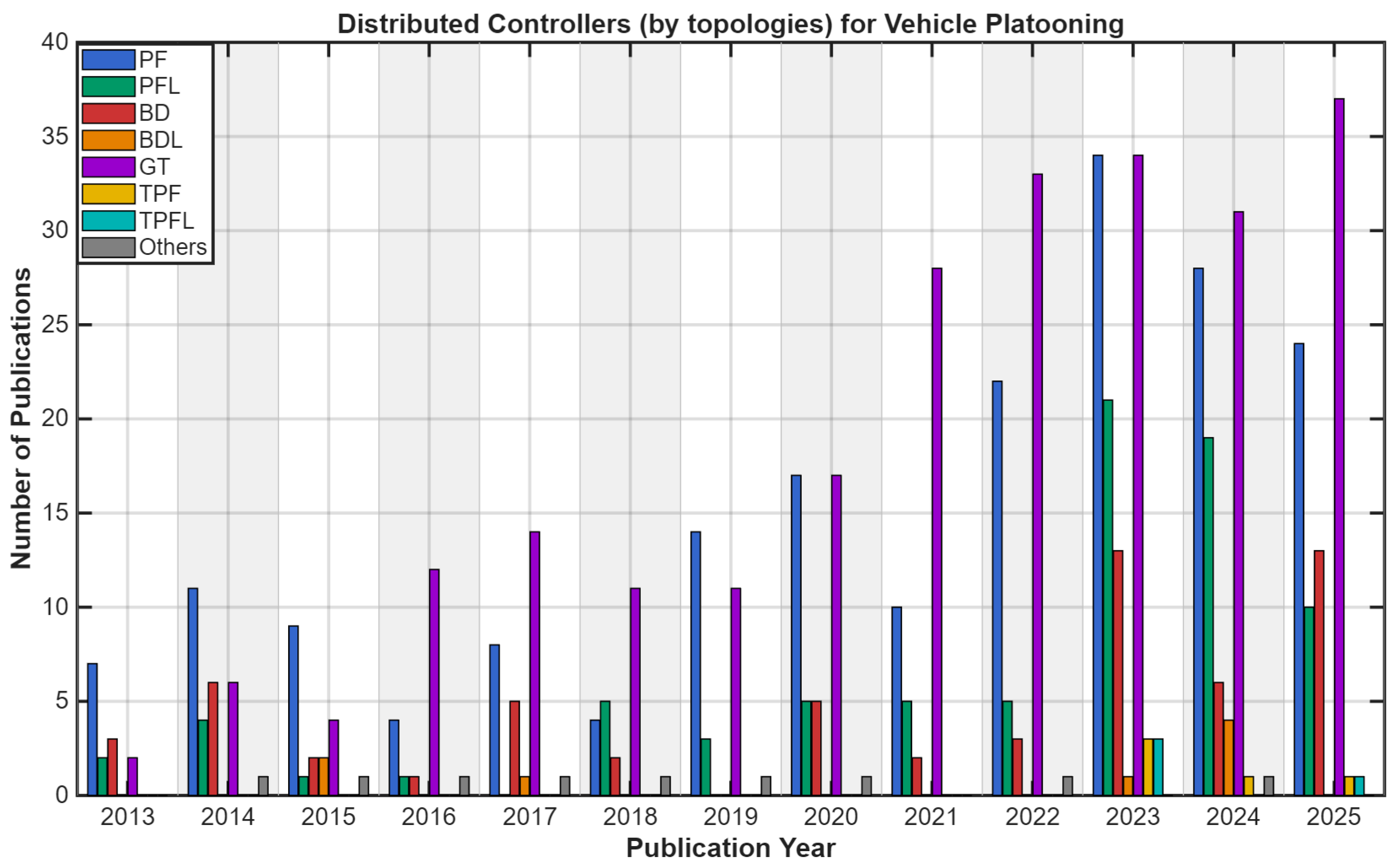
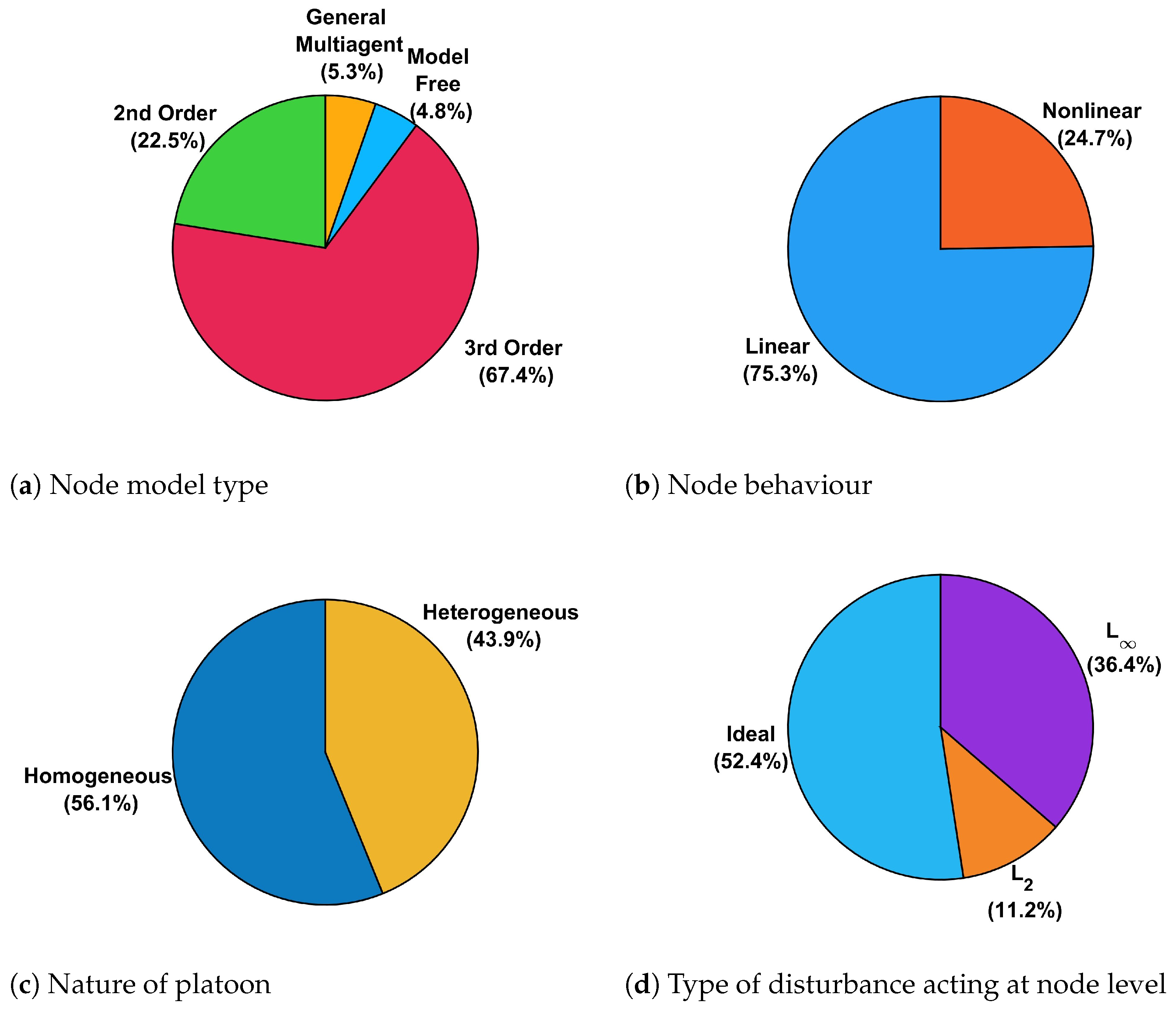
- The resulting literature was further classified broadly into two main categories based on the control structure: (i) control law related to a specific topology, e.g., control law catering to vehicles communicating in a PF, BD, etc., topology; (ii) control law addressing general topologies (GTs). The control law designed to make consensus of the vehicles’ states, thereby converging for a wide range of topologies, is known as the control law for general or generic topologies (GTs).This term has been coined in several publications, including [12,13,14,15,16,17,18], and refers to control laws that support platoon formation with vehicles communicating over a broad range of topologies. Figure 3 is plotted based on this classification.
- (iii).
- While Figure 3 is obtained from papers published from 2013 to 2025, the rest of the review paper reports the more recent work from 2018 to 2025, pertaining to GTs.
- (iv).
- The focus of the review is on the topic of distributed longitudinal control of vehicle platoons; hence, it excludes other areas of platooning, such as lateral control, two-dimensional control, traffic flow analysis, or human–vehicle interactions.
- (v).
- The final selection of the literature is peer-reviewed journal articles and conference proceedings published only in the English language between January 2013 and October 2025.
1.2. Previous Surveys on Distributed Control of Vehicles in a Platoon
1.2.1. Methods of Selection
1.2.2. Overview of Existing Surveys in Vehicle Platoon
- (i).
- Surveys centric to the four components of platoon
- (ii).
- Surveys centric to stability
- (iii).
- Surveys centric to Coordination, formation, and manoeuvres
- (iv).
- Surveys centric to influencing factors and consensus in uncertainties
- (v).
- Surveys centric to the CAV ecosystem and applications
1.2.3. Contribution of This Review Paper
2. Platoon Control Problem Formulation
- (i). Position error: This error measures how far the vehicle’s position is from the desired inter-vehicular spacing. The position error of vehicle i with respect to a neighbouring vehicle j and the leader 0, respectively, is:
- (ii). Velocity error: This error states the difference of velocities between the vehicles. This can be with respect to the follower or the leader vehicle. Convergence of this error to zero brings the synchronisation of all vehicles of the platoon. The velocity error is defined as
- (iii). Acceleration error: This refers to the difference between the acceleration of vehicles, either for the follower or the leader. It is responsible for the smooth and coordinated change of speed in a platoon. The acceleration errors with respect to neighbour j and leader 0 for vehicle i are given by:
3. Platoon System Modelling
3.1. Node Dynamic Modelling
3.1.1. First-Order Node Modelling
3.1.2. Second-Order Node Modelling
3.1.3. Third-Order Node Modelling
3.1.4. Data-Driven and Model-Free Node Modelling
3.1.5. General Modelling of Multiagent Systems
3.1.6. Challenges Pertaining to Node Modelling
3.2. Formation Geometry
3.2.1. Constant Distance Spacing (CDS)
3.2.2. Constant Time Headway (CTH)
3.2.3. Variable Time Headway (VTH)
3.3. Information Flow Topology
3.3.1. Undirected Topology
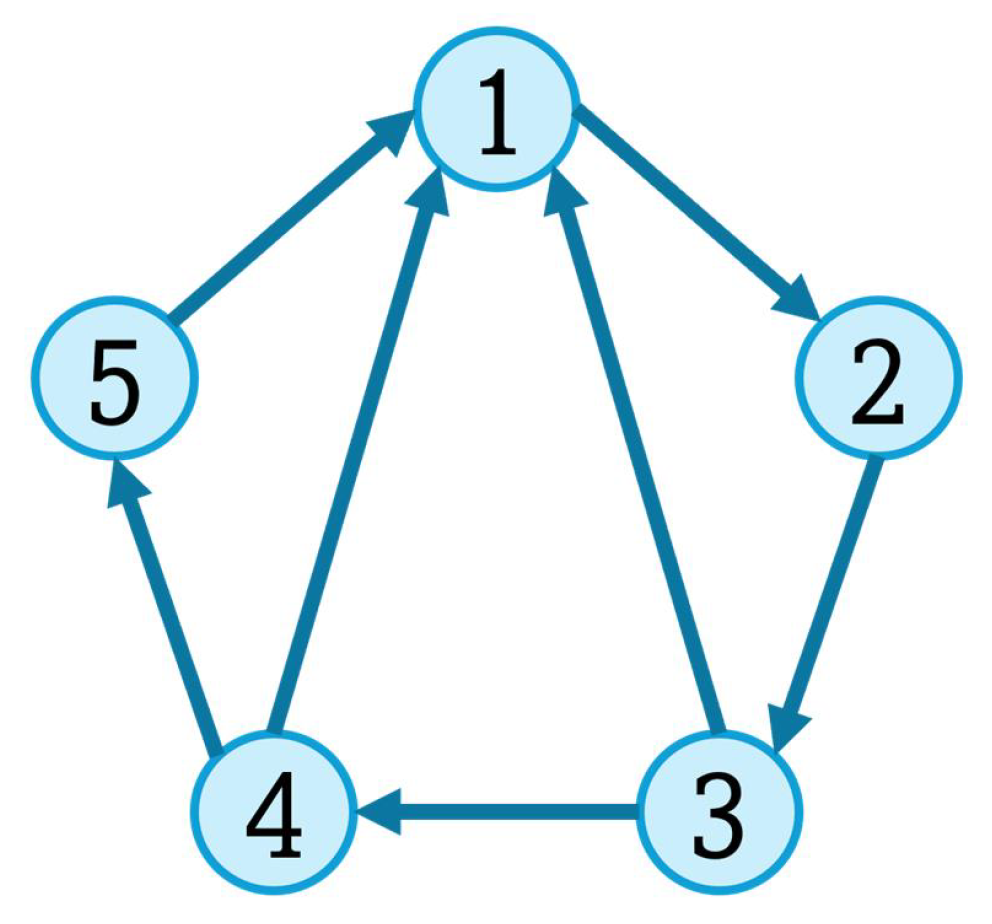
3.3.2. Directed Topology
3.3.3. Preliminaries on Network Modelling
- (i).
- Spanning Tree
- (ii).
- Directed Acyclic Graph (DAG)
- (iii).
- Importance of Laplacian and Information Matrix
- (iv).
- Influence of Information Flow Topology on Platoon Performance
- (v).
- a. Stability Margin
- (v).
- b. Scalability
- (v).
- c. Convergence
- (v).
- d. Robustness
3.3.4. Network Communication Issues in Vehicle Platooning
- (i).
- Ideal Network Communication
- (ii).
- Time-Varying Delay
- (iii).
- Time-Constant Delay
- (iv).
- Topology Disturbance
- (iv).
- a. Switching Topology
- (iv).
- b. Continuous Time-Varying Topology
- (v).
- Communication Packet Drops
4. Distributed Control Strategies
4.1. Continuous Time
4.2. Discrete Time
4.3. Event-Triggered
4.3.1. Design of Event-Triggered Scheme
4.3.2. Static Event-Triggered Control (SETC)
4.3.3. Dynamic Event-Triggered Control (DETC)
4.4. Distributed Linear Control (DLC)
- (i).
- Ideal Node with ideal communication
- (ii).
- Ideal Node with Communication Imperfections
- (iii).
- External Disturbance on the node with Communication Imperfection
4.5. Distributed Control (DHC)
- (i).
- Ideal Node with Communication Imperfection
- (ii).
- External Disturbance on the node with Communication Imperfection
4.6. Distributed Adaptive Control (DAC)
- (i).
- Ideal Node with Ideal Communication
- (ii).
- Ideal Node with Communication Imperfection
- (iii).
- External Disturbance on node with Communication Imperfection
4.7. Distributed Model Predictive Control (DMPC)
- (i).
- Ideal node with ideal communication
- (ii).
- Ideal node with Communication Imperfections
- (iii).
- External Disturbance on nodes with Communication Imperfections
4.8. Distributed Sliding-Mode Control (DSMC)
- (i).
- Ideal Node with Ideal Communication
- (ii).
- Ideal Node with Communication Imperfection
- (iii).
- External disturbance on the node with communication imperfection
4.9. Distributed Nonlinear Control (DNC)
- (i).
- Ideal Node with ideal communication
- (ii).
- Ideal Node with Communication Imperfection
- (iii).
- External disturbance on the node with communication imperfection
4.10. Distributed Artificial Intelligence (AI) Based Control
- (i).
- Ideal Node with Ideal Communication
- (ii).
- Ideal Node with Communication Imperfection
- (iii).
- External Disturbance on the node with Communication Imperfection
4.11. Distributed Control (Other Approaches)
4.11.1. Data-Driven Control
4.11.2. Optimal Control
4.11.3. Miscellaneous Distributed Controllers
4.12. Distributed Observer-Based Control
- (i).
- Ideal Node with Ideal Communication
- (ii).
- Ideal Node with Communication Imperfection
- (iii).
- External Disturbance on the Node with Communication Imperfection
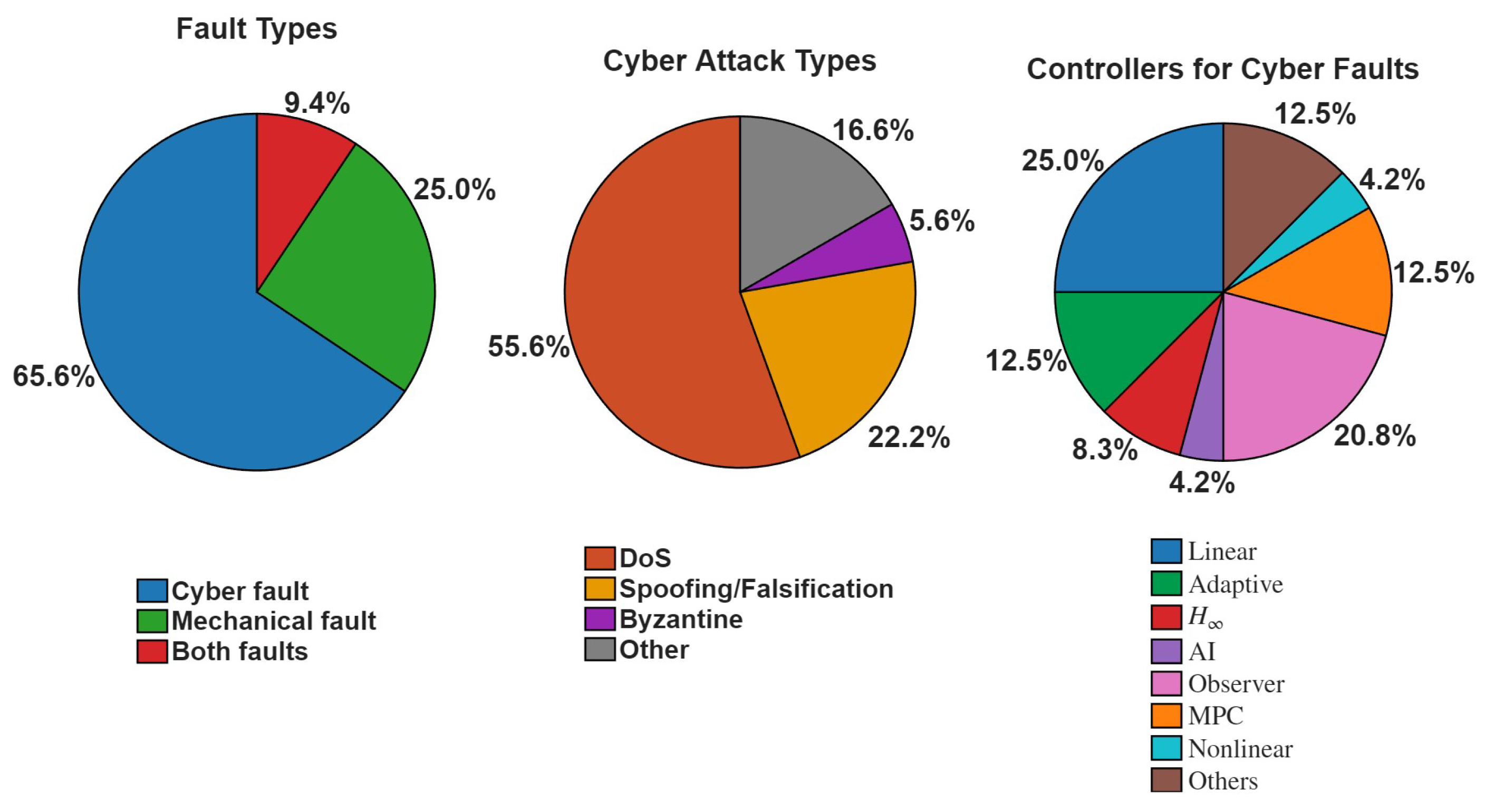
4.13. Observed Trends Across the Reviewed Literature
5. Countering Faults and Attacks
5.1. Denial-of-Service (DoS) Attacks
5.2. Data Integrity Attacks (Spoofing, Falsification and Byzantine Attacks)
5.3. Physical Faults and Mixed Cyber Physical Threats
5.4. Strategic Defence and Vulnerability Analysis
6. Platoon Performance Analysis and Stability Metrics
6.1. Internal Stability
- (i).
- Routh–Hurwitz Stability CriterionThe Routh–Hurwitz criterion is one of the most commonly used criteria for finding stability. It determines the platoon’s internal stability by calculating the characteristic matrix (or the characteristic equation in the case of the platoon’s decomposition into its individual subsystems) and examining its eigenvalues. If the real part of all the eigenvalues is negative, then the platoon is considered internally stable [40,71,88,137]. The closed-loop controlled dynamics of the full platoon system can be expressed in matrix form as:where is a vector of follower states (or error states), and is the Information matrix [71] and K is the controller gain. The decomposition of the closed-loop platoon system having N vehicles depends on the property of . If has real, distinct eigenvalues (in case of undirected topologies [71]), then decomposes into N independent modes of eigenvalue .where is the state error. Each mode has its own characteristic polynomial ; the Routh–Hurwitz test is applied to each to ensure [40,71]. If has repeated real eigenvalues or complex eigenvalues (directed topologies [12]), the decomposition is not directly applicable, and the stability test is carried out using an equivalent real-domain representation (or by forming the characteristic matrix of the closed loop platoon), as detailed in [12].
- (ii).
- Basic Lyapunov StabilityThis approach to stability analysis constructs a function similar to an energy, called a Lyapunov function, to evaluate the stability of the platoon in the vicinity of an equilibrium point. If the time derivative of this Lyapunov function is negative in the neighbourhood of the equilibrium, then the platoon is said to be asymptotically stable [37,88,136]. It is better if the platoon system does not experience any time delay; otherwise, modified forms of Lyapunov stability are used to address time delays. Consider the closed-loop platoon (error) model , where denotes the stacked platoon state-error vector, is the closed-loop system matrix. A standard Lyapunov candidate iswhere is the Lyapunov function, is a symmetric positive definite matrix (i.e., denotes positive definiteness). This gives , where is the time derivative of . Hence, internal stability follows if there exists , such thatwhere denotes negative definiteness, implying that as and thus the platoon state errors converge to zero [37,88].
- (iii).
- Lyapunov–Krasovskii StabilityIf a vehicle platoon experiences communication time delays (constant or varying), then one of the powerful methods of determining internal stability is by the Lyapunov–Krasovskii stability method. In this method of stability, Lyapunov–Krasovskii (LK) functionals are employed. These functionals include delay-dependent terms in addition to the basic Lyapunov function. The addition of extra terms captures the effect of past vehicle states on current stability [37,70]. A delayed closed loop platoon model can be represented as , where denotes the stacked platoon state-error vector, are constant system matrices, and is the communication delay, a common LK functional iswhere is symmetric positive definite, is symmetric positive semidefinite, and is the integration variable. Sufficient internal-stability conditions are obtained by enforcing through matrix inequalities [37,70].
- (vi).
- Lyapunov–Razumikhin StabilityLyapunov–Razumikhin-based stability method is another alternative approach to analyse the stability of a platoon in times of communication time delays. In this method of stability, a basic Lyapunov function is constructed along a condition that relates the delayed platoon state to the current platoon state [37,70]. A typical Lyapunov–Razumikhin starts with , , and thereby the Razumikhin condition is imposed. It is shown aswhere denotes the communication time delay, and is a chosen scalar value. In the Lyapunov–Razumikhin stability approach is upper-bounded by a negative expression, yielding internal stability under delay [37,70]. Compared with the Lyapunov–Krasovskii method for analysing stability, the Lyapunov–Razumikhin method is easier to implement and computationally lighter; however, the latter yields more conservative results [266].
- Note: When communication or actuation delays are present, internal stability is analysed using either time-domain or frequency-domain methodologies. The common time-domain methodologies include Lyapunov–Krasovskii functionals and Lyapunov–Razumikhin methods (discussed before), while popular frequency-domain methodologies include the Routh-Hurwitz Stability criterion (also discussed before). Other frequency-domain methods, such as Cluster Treatment of Characteristic Roots (CTCR) [40], the general Nyquist criterion [267] (these are not discussed), along with other less prominent time domain techniques, are placed in the “Others” category in Table 26.
6.2. String Stability
- (i).
- Lyapunov-basedThe string stability, when analysed using a Lyapunov-based method, treats the platoon error as an unforced system and focuses on the effect of initial perturbations [20]. Let be a collection of individual errors (e.g., vector of spacing errors) of all follower vehicles, where is column-stacking, N is the number of follower vehicles and is the individual error for vehicle i. Distinct from the method of analysis for internal stability using Lyapunov, which uses one Lyapunov matrix for the entire platoon state, Lyapunov-based string stability uses a composite Lyapunov function, which is a sum of individual vehicle contributions:where is constant. Then the Lyapunov function for the closed-loop platoon derivative should satisfy a uniform decay bound aswhere is constant and denotes the Euclidean norm. where the constants P and do not depend on the platoon length N. The inequalities above are obtained by substituting the closed-loop error model into and enforcing negativity via matrix inequalities during controller tuning [20].
- (ii).
- Input-to-output (IO)The input-to-output method treats string stability as a disturbance-to-output attenuation property, neglecting initial conditions of the platoon system [20]. It is commonly used in the frequency domain. It is often analysed assuming that the vehicles are communicating in a PF topology (even if the entire platoon is not). Defining the error propagation transfer function for the vehicle iwhere s is the Laplace variable and is the Laplace transform of the error of vehicle i with respect to its predecessor. The controller is IO string-stable ifwhere is the angular frequency, and denotes the norm. The key step is to derive from the closed-loop linear model (vehicle dynamics, controller, and the selected error signal), and then verify or enforce the bound to be string stable according to the condition in (48) [20,268].
- (iii).
- Input-to-state (IS)Input-to-state string stability accounts for both initial and persistent external perturbations. A platoon is ISS string-stable if there are a class function and a class function for whichwhere is the vector of string errors and are the disturbances, is the -norm, is the supremum norm over the interval , and denotes the Euclidean norm; and are standard classes of comparison functions, and denotes the class of functions that are unbounded. A typical route is to build an ISS–Lyapunov function satisfying for some class functions (i.e., comparison functions),Using comparison arguments, this differential inequality directly gives an ISS bound of the form above, which ensures that the disturbances will not cause unbounded growth of string errors, and that the effect of the initial conditions will decay with time in the form of [20].
6.3. Robust Stability
- (i).
- Communication imperfections: This category is discussed in detail in Section 3.3 and Section 5. Examples of this category include communication delays [163], packet drops [15], and malicious cyberattacks [162].
- (ii).
- (iii).
- Below are the two common methods to assess robust stability in the platoon:
- (i).
- Matrix Inequality-Based Analysis (LMI and Riccati Methods)
- (ii).
- Input-to-State Stability (ISS) Analysis
7. Simulation and Experimental Validation
- (i)
- MATLAB/Simulink
- Realism: It shows a high realism for the control loop fidelity if the modules of the vehicle, the actuator and the sensors are accurately modelled. It contains vehicle-modelling tool chains for making it realistic; however, the final level of realism is determined by model detail and parameter calibration selection [270].
- Scalability: It supports simulation of small to medium-length platoons. Extension to larger platoons is possible with model simplification; however, fine nonlinear dynamics, stiff solvers and small time steps add considerable computational cost and time.
- Constraints: Licensing restrictions and the availability of tools can restrict reproducibility. Real-time and hardware-oriented testing usually needs more real-time execution support (e.g., Simulink Real-Timing) and careful timing/IO configuration [271].
- (ii)
- Simulation of Urban Mobility (SUMO)
- Realism: It shows strong realism at the level of traffic-interaction (network flows, merging, intersections, and mixed traffic). Nevertheless, vehicle dynamics are typically simplified, so that low-level control validation is typically performed using co-simulation.
- Scalability: SUMO is well-suited to network-scale simulation of large numbers of vehicles, making it attractive for analysing platoons embedded in larger traffic networks.
- Constraints: Platooning control laws are not commonly designed within SUMO, but external controllers are coupled via interfaces such as TraCI; this introduces integration effort and requires the user to carefully consider what is being validated (controller validation, traffic-level interactions) [272,273].
- (iii)
- Plexe
- Realism: Realism is high for cooperative platooning functions if communication and mobility are represented together (e.g., communication performance like delays, latency, as well as vehicle motion), thereby enabling more implementation-relevant assessment than control-only simulations.
- Scalability: It supports moderate platoon sizes. However, larger scenarios are possible but are limited by the overhead of discrete-event network simulation and the complexity of multi-tool co-simulation.
- Constraints: Practical barriers include the engineering overhead of co-simulation software, cross-software parameter consistency (mobility, networking, and controller settings), and reproducibility and dependencies across software. The basis for such network mobility studies using the OMNeT++-SUMO co-simulation is summarised in the Veins documentation [274,275].
- (iv)
- CARLA (Car Learning to Act)
- Scalability: It supports limited traffic scaled when compared to traffic-only simulators due to the computational demands of rendering and sensor pipelines
- Constraints: Some of the common constraints are computation constraints, workload of the scenario authoring system, integration effort required for co-simulation with external control toolchains (if controllers are not implemented on CARLA) [276].
- (v)
- PreScan
- Realism: Realism is good for sensor-based validation workflows that can improve application relevance in comparison with only control algorithm validations.
- Scalability: It supports moderate fidelity, as when the scenario is complex and high-fidelity sensors are simulated, the number of vehicles is reduced.
- Constraints: Commercial licensing and proprietary components reduce accessibility. scenario and sensing constraints, as illustrated by works that adopt it for platooning-related validation [190].
8. Technology Readiness and Barrier Deployment
8.1. Technology Readiness
- (i).
- Distributed Linear Control:
- (ii).
- Adaptive and Learning-Based Control:
- (iii).
- Model Predictive Control (MPC):
8.2. Barriers to Deployment
- (i).
- Network Constraints and Stability Margins:
- (ii).
- Heterogeneity and Saturation:
- (iii).
- Sensor Accuracy and Estimation:
9. Conclusions and Future Research Directions
9.1. Conclusions
- (i).
- Topology and Performance Domains
- (ii).
- Robustness and Latency Management
- (iii).
- Heterogeneity, Disturbances, and Model Uncertainty.
- (iv).
- Validation and Technology Readiness.
9.2. Future Research Directions
- (i).
- Unified Control Frameworks for Realistic Multi-Factor Scenarios
- (ii).
- Formal Verification and Safety Guarantees for Learning-Based Methods
- (iii).
- Cyber-Physical Resilience
Author Contributions
Funding
Data Availability Statement
Conflicts of Interest
Appendix A. Network Synchronisation Framework
Appendix A.1. Modelling Network via Graph Theory
Appendix A.2. Diffusive Coupling and Pinning Control

References
- Wang, Z.; Wu, G.; Barth, M.J. A Review on Cooperative Adaptive Cruise Control (CACC) Systems: Architectures, Controls, and Applications. In Proceedings of the 21st International Conference on Intelligent Transportation Systems (ITSC), Maui, HI, USA, 4–7 November 2018; pp. 2884–2891. [Google Scholar]
- United States Department of Transportation. NHTSA Estimates for 2022 Show Roadway Fatalities Remain Flat after Two Years of Dramatic Increases. Washington, DC, USA, April 2023. Available online: https://www.nhtsa.gov/press-releases/traffic-crash-death-estimates-2022 (accessed on 3 December 2025).
- Brake, the Road Safety Charity. UK Collision and Casualty Statistics. United Kingdom. October 2023. Available online: https://www.brake.org.uk/get-involved/take-action/mybrake/knowledge-centre/uk-road-safety (accessed on 3 December 2025).
- United States Environmental Protection Agency. Carbon Pollution From Transportation. May 2023. Available online: https://www.epa.gov/transportation-air-pollution-and-climate-change/carbon-pollution-transportation (accessed on 3 December 2025).
- Department for Transport. Transport and Environment Statistics: 2023. United Kingdom. October 2023. Available online: https://www.gov.uk/government/statistics/transport-and-environment-statistics-2023/transport-and-environment-statistics-2023 (accessed on 3 December 2025).
- Green, M. How Long Does It Take to Stop? Methodological Analysis of Driver Perception–Brake Times. Transp. Hum. Factors 2000, 2, 195–216. [Google Scholar] [CrossRef]
- Rebelo, M.; Rafael, S.; Bandeira, J.M. Vehicle Platooning: A Detailed Literature Review on Environmental Impacts and Future Research Directions. Future Transp. 2024, 4, 591–607. [Google Scholar] [CrossRef]
- Li, S.E.; Zheng, Y.; Li, K.; Wang, J. An Overview of Vehicular Platoon Control under the Four-Component Framework. In Proceedings of the IEEE Intelligent Vehicles Symposium (IV), Seoul, Republic of Korea, 28 June–1 July 2015; pp. 286–291. [Google Scholar]
- Fakhfakh, F.; Tounsi, M.; Mosbah, M. Vehicle Platooning Systems: Review, Classification and Validation Strategies. Int. J. Netw. Distrib. Comput. 2020, 8, 203–213. [Google Scholar] [CrossRef]
- Nguyen, T.; Xie, M.; Liu, X.; Arunachalam, N.R.; Rau, A.; Lechner, B.; Busch, F.; Wong, Y.D. Platooning of Autonomous Public Transport Vehicles: The Influence of Ride Comfort on Travel Delay. Sustainability 2019, 11, 5237. [Google Scholar] [CrossRef]
- Badnava, S.; Meskin, N.; Gastli, A.; Al-Hitmi, M.A.; Ghommam, J.; Mesbah, M.; Mnif, F. Platoon Transitional Maneuver Control System: A Review. IEEE Access 2021, 9, 88327–88347. [Google Scholar] [CrossRef]
- Li, S.E.; Qin, X.; Zheng, Y.; Wang, J.; Li, K.; Zhang, H. Distributed Platoon Control under Topologies with Complex Eigenvalues: Stability Analysis and Controller Synthesis. IEEE Trans. Control Syst. Technol. 2019, 27, 206–220. [Google Scholar] [CrossRef]
- Elahi, A.; Alfi, A.; Chadli, M. Fixed-Time H∞ Consensus Control of Uncertain Vehicular Platooning Systems with Homogeneous Time-Varying Actuator Delay. IEEE Trans. Intell. Transp. Syst. 2024, 25, 11716–11728. [Google Scholar] [CrossRef]
- Xiao, S.; Ge, X.; Han, Q.-L.; Zhang, Y. Dynamic Event-Triggered Platooning Control of Automated Vehicles under Random Communication Topologies and Various Spacing Policies. IEEE Trans. Cybern. 2022, 52, 11477–11490. [Google Scholar] [CrossRef]
- Halder, K.; Montanaro, U.; Dixit, S.; Dianati, M.; Mouzakitis, A.; Fallah, S. Distributed H∞ Controller Design and Robustness Analysis for Vehicle Platooning under Random Packet Drop. IEEE Trans. Intell. Transp. Syst. 2022, 23, 4373–4386. [Google Scholar] [CrossRef]
- Zheng, Y.; Li, S.E.; Li, K.; Ren, W. Platooning of Connected Vehicles with Undirected Topologies: Robustness Analysis and Distributed H-Infinity Controller Synthesis. IEEE Trans. Intell. Transp. Syst. 2018, 19, 1353–1364. [Google Scholar] [CrossRef]
- Halder, K.; Gillam, L.; Dixit, S.; Mouzakitis, A.; Fallah, S. Stability Analysis with LMI-Based Distributed H-Infinity Controller for Vehicle Platooning under Random Multiple Packet Drops. IEEE Trans. Intell. Transp. Syst. 2022, 23, 23517–23532. [Google Scholar] [CrossRef]
- Yi, P.; Liao, J.; Zhao, D. Tube-Based Distributed Model Predictive Control for Connected Vehicle Platoons with Communication Delay. In Proceedings of the 43rd Chinese Control Conference, Kunming, China, 28–31 July 2024. [Google Scholar]
- Li, S.E.; Zheng, Y.; Li, K.; Gao, F.; Wu, Y.; Zhang, H.; Hedrick, J.K. Dynamical Modeling and Distributed Control of Connected and Automated Vehicles: Challenges and Opportunities. IEEE Intell. Transp. Syst. Mag. 2017, 9, 46–58. [Google Scholar] [CrossRef]
- Feng, S.; Zhang, Y.; Li, S.E.; Cao, Z.; Liu, H.X. String Stability for Vehicular Platoon Control: Definitions and Analysis Methods. Annu. Rev. Control 2019, 47, 81–97. [Google Scholar] [CrossRef]
- Li, Q.; Chen, Z.; Li, X. A Review of Connected and Automated Vehicle Platoon Merging and Splitting Operations. IEEE Trans. Intell. Transp. Syst. 2022, 23, 22790–22806. [Google Scholar] [CrossRef]
- Salek, M.S.; Basu Thakur, M.; Ala, P.S.K.; Chowdhury, M.; Schmid, M.; Murray-Tuite, P.; Khan, S.M.; Krovi, V. An Overview of Automated Vehicle Longitudinal Platoon Formation Strategies. ACM J. Auton. Transp. Syst. 2025, 3, 8. [Google Scholar] [CrossRef]
- Nandhini, M.; Mohamed Rabik, M. A Comprehensive Overview of the Alignment between Platoon Control Approaches and Clustering Strategies. Green Energy Intell. Transp. 2024, 3, 100223. [Google Scholar] [CrossRef]
- Viadero-Monasterio, F.; Meléndez-Useros, M.; Jiménez-Salas, M.; López Boada, B.; López Boada, M.J. Key Influencing Factors in Vehicle Platoons: A Systematic Study and Review. Evol. Syst. 2025, 16, 116. [Google Scholar] [CrossRef]
- Chu, D.; Zhao, C.; Wang, R.; Xiao, Q.; Wang, W.; Cao, D. A Survey of Multi-Vehicle Consensus in Uncertain Networks for Autonomous Driving. IEEE Trans. Intell. Transp. Syst. 2024, 25, 19319–19341. [Google Scholar] [CrossRef]
- Guanetti, J.; Kim, Y.; Borrelli, F. Control of Connected and Automated Vehicles: State of the Art and Future Challenges. Annu. Rev. Control 2018, 45, 18–40. [Google Scholar] [CrossRef]
- Xie, S.; Li, Z.; Arvin, F.; Ding, Z. A Review of Multi-Vehicle Cooperative Control System in Intelligent Transportation. Int. J. Automot. Manuf. Mater. 2023, 2, 5. [Google Scholar] [CrossRef]
- Soni, A.S.; Hu, H. Formation Control for a Fleet of Autonomous Ground Vehicles: A Survey. Robotics 2018, 7, 67. [Google Scholar] [CrossRef]
- Montanaro, U.; Dixit, S.; Fallah, S.; Dianati, M.; Stevens, A.; Oxtoby, D.; Mouzakitis, A. Towards Connected Autonomous Driving: Review of Use-Cases. Veh. Syst. Dyn. 2019, 57, 779–814. [Google Scholar] [CrossRef]
- Martínez-Díaza, M.; Al-Haddad, C.; Soriguera, F.; Antoniou, C. Platooning of Connected Automated Vehicles on Freeways: A Bird’s Eye View. Transp. Res. Procedia 2021, 58, 479–486. [Google Scholar] [CrossRef]
- Malik, S.; Khan, M.A.; El-Sayed, H. Collaborative Autonomous Driving—A Survey of Solution Approaches and Future Challenges. Sensors 2021, 21, 3783. [Google Scholar] [CrossRef] [PubMed]
- Jia, D.; Lu, K.; Wang, J.; Zhang, X.; Shen, X. A Survey on Platoon-Based Vehicular Cyber-Physical Systems. IEEE Commun. Surv. Tutor. 2015, 18, 263–284. [Google Scholar] [CrossRef]
- Lesch, V.; Breitbach, M.; Segata, M.; Becker, C.; Kounev, S.; Krupitzer, C. An Overview on Approaches for Coordination of Platoons. IEEE Trans. Intell. Transp. Syst. 2022, 23, 10049–10065. [Google Scholar] [CrossRef]
- Schwarting, W.; Alonso-Mora, J.; Rus, D. Planning and Decision-Making for Autonomous Vehicles. Annu. Rev. Control. Robot. Auton. Syst. 2018, 1, 187–210. [Google Scholar] [CrossRef]
- Wu, C.; Cai, Z.; He, Y.; Lu, X. A Review of Vehicle Group Intelligence in a Connected Environment. IEEE Trans. Intell. Veh. 2024, 9, 1865–1890. [Google Scholar] [CrossRef]
- Li, H.; Chen, Z.; Fu, B.; Wu, Z.; Ji, X. Event-Triggered Vehicle Platoon Control under Random Communication Noises. IEEE Access 2021, 9, 51722–51735. [Google Scholar] [CrossRef]
- Li, H.; Chen, Z.; Fu, B.; Wu, Z.; Ji, X. Consensus-Based Vehicle Platoon Control with Communication Noises. In Proceedings of the 40th Chinese Control Conference (CCC), Shanghai, China, 26–28 July 2021; pp. 7483–7488. [Google Scholar]
- Guo, H.; Liu, C.-L. Observer-Based Consensus Protocol of Vehicles Platooning with Time Delay. In Proceedings of the 33rd Chinese Control and Decision Conference (CCDC), Kunming, China, 22–24 May 2021; pp. 4949–4954. [Google Scholar]
- Ma, F.; Wang, J.; Yang, Y.; Wu, L.; Yang, L. Control Synthesis for Distributed Vehicle Platoon Under Different Topological Communication Structures; SAE Technical Paper 2019-01-0494; SAE: Washington, DC, USA, 2019. [Google Scholar]
- Zhang, Z.; Zhu, X. Internal Stability and String Stability Analysis for Vehicle Platoon with Time Delays via the Distributed PID Controller. In Proceedings of the 41st Chinese Control Conference (CCC), Hefei, China, 25–27 July 2022; pp. 49–54. [Google Scholar]
- Petrillo, A.; Salvi, A.; Santini, S.; Valente, A.S. Adaptive Multi-Agents Synchronization for Collaborative Driving of Autonomous Vehicles with Multiple Communication Delays. Transp. Res. Part Emerg. Technol. 2018, 86, 372–392. [Google Scholar] [CrossRef]
- Elahi, A.; Alfi, A.; Modares, H. Distributed Consensus Control of Vehicular Platooning under Delay, Packet Dropout and Noise: Relative State and Relative Input–Output Control Strategies. IEEE Trans. Intell. Transp. Syst. 2022, 23, 20123–20133. [Google Scholar] [CrossRef]
- Jond, H.B.; Yildiz, A. Connected and Automated Vehicle Platoon Formation Control via Differential Games. IET Intell. Transp. Syst. 2023, 17, 312–326. [Google Scholar] [CrossRef]
- Viadero-Monasterio, F.; Meléndez-Useros, M.; Jiménez-Salas, M.; López Boada, M.J. Fault-Tolerant Robust Output-Feedback Control of a Vehicle Platoon Considering Measurement Noise and Road Disturbances. IET Intell. Transp. Syst. 2025, 19, e70007. [Google Scholar] [CrossRef]
- Caiazzo, B.; Coppola, A.; Petrillo, A.; Santini, S. Distributed Nonlinear Model Predictive Control for Connected Autonomous Electric Vehicles Platoon with Distance-Dependent Air Drag Formulation. Energies 2021, 14, 5122. [Google Scholar] [CrossRef]
- Feng, J.; Gao, Z.; Guo, B. State-Feedback and Nonsmooth Controller Design for Truck Platoon Subject to Uncertainties and Disturbances. World Electr. Veh. J. 2024, 15, 251. [Google Scholar] [CrossRef]
- Coppola, A.; Lui, D.G.; Petrillo, A.; Santini, S. Distributed Fixed-Time Leader-Tracking Control for Heterogeneous Uncertain Autonomous Connected Vehicles Platoons. In Proceedings of the 29th Mediterranean Conference on Control and Automation (MED), Puglia, Italy, 22–25 June 2021; pp. 554–559. [Google Scholar]
- Ioannou, P.; Xu, Z. Throttle and Brake Control Systems for Automatic Vehicle Following. IVHS J. 1994, 1, 345–377. [Google Scholar] [CrossRef]
- Wen, S.; Guo, G. Sampled-Data Control for Connected Vehicles with Markovian Switching Topologies and Communication Delay. IEEE Trans. Intell. Transp. Syst. 2020, 21, 2930–2942. [Google Scholar] [CrossRef]
- Baldi, S.; Frasca, P. Adaptive Synchronization of Unknown Heterogeneous Agents: An Adaptive Virtual Model Reference Approach. J. Frankl. Inst. 2019, 356, 935–955. [Google Scholar] [CrossRef]
- Liangye, L.; Defeng, H.; Shiming, Y.; Shijian, D. Distributed Predictive Control for String Stability of Heterogeneous Vehicle Platoons with Multiple Communication Topologies. In Proceedings of the Chinese Control Conference (CCC), Guangzhou, China, 27–30 July 2019; pp. 2930–2935. [Google Scholar]
- Xiao, S.; Ge, X.; Han, Q.-L.; Cao, Z.; Zhang, Y.; Wang, H. Resilient Distributed Event-Triggered Control of Vehicle Platooning under DoS Attacks. IFAC-PapersOnLine 2020, 53, 1807–1812. [Google Scholar] [CrossRef]
- Shi, H.; Zhou, Y.; Wang, X.; Fu, S.; Gong, S.; Ran, B. A Deep Reinforcement Learning-Based Distributed Connected Automated Vehicle Control under Communication Failure. Comput.-Aided Civ. Infrastruct. Eng. 2022, 37, 2033–2051. [Google Scholar] [CrossRef]
- Liu, B.; Ding, Z.; Lv, C. Platoon Control of Connected Autonomous Vehicles: A Distributed Reinforcement Learning Method by Consensus. In Proceedings of the 21st IFAC World Congress, Berlin, Germany, 11–17 July 2020; pp. 15241–15246. [Google Scholar]
- Jun, M.; Zuo, L.; Yan, M. Q-Learning Based Model Unknown Vehicle Platoon Tracking Control with Switching Topologies. In Proceedings of the 42nd Chinese Control Conference (CCC), Tianjin, China, 24–26 July 2023; pp. 6446–6452. [Google Scholar]
- Chow, Y.; Nachum, O.; Duenez-Guzman, E.; Ghavamzadeh, M. A Lyapunov-based Approach to Safe Reinforcement Learning. In Advances in Neural Information Processing Systems; Wallach, H., Larochelle, H., Beygelzimer, A., d’Alché-Buc, F., Fox, E., Garnett, R., Eds.; Curran Associates, Inc.: Red Hook, NY, USA, 2019; Volume 32, pp. 8092–8101. [Google Scholar]
- Berkenkamp, F.; Turchetta, M.; Schoellig, A.P.; Krause, A. Safe Model-based Reinforcement Learning with Stability Guarantees. In Advances in Neural Information Processing Systems; Guyon, I., Luxburg, U.V., Bengio, S., Wallach, H., Fergus, R., Vishwanathan, S., Garnett, R., Eds.; Curran Associates, Inc.: Red Hook, NY, USA, 2017; Volume 30, pp. 908–918. [Google Scholar]
- Yang, J.; Chu, D.; Lu, L.; Meng, Z.; Deng, K. Model-data-driven Control for Human-leading Vehicle Platoon. Proc. Inst. Mech. Eng. Part D J. Automob. Eng. 2024, 239, 2616–2636. [Google Scholar] [CrossRef]
- Lui, D.G.; Petrillo, A.; Santini, S. Leader Tracking Control for Heterogeneous Uncertain Nonlinear Multi-Agent Systems via a Distributed Robust Adaptive PID Strategy. Nonlinear Dyn. 2022, 108, 363–378. [Google Scholar] [CrossRef]
- Arevalo-Castiblanco, M.F.; Tellez-Castro, D.; Sofrony, J.; Mojica-Nava, E. Adaptive Control for Unknown Heterogeneous Vehicles Synchronization with Unstructured Uncertainty. In Proceedings of the IEEE 4th Colombian Conference on Automatic Control (CCAC), Medellín, Colombia, 15–18 October 2019; pp. 1–6. [Google Scholar]
- Jiang, W.; Chen, Y.; Charalambous, T. Consensus of General Linear Multi-Agent Systems with Heterogeneous Input and Communication Delays. IEEE Control Syst. Lett. 2021, 5, 851–856. [Google Scholar] [CrossRef]
- Liu, J.; Dong, J. Fixed-Time Cooperative Fault-Tolerant Control of Heterogeneous Multi-Agent Systems via Learning-Based Uncertainty Estimation. IEEE Internet Things J. 2025, 12, 42803–42812. [Google Scholar] [CrossRef]
- Xu, Y.; Guo, G. Event-Triggered Control of Connected Vehicles under Multiple Cyber Attacks. Inf. Sci. 2022, 582, 778–796. [Google Scholar] [CrossRef]
- Zhang, H.; Liu, J.; Wang, Z.; Yan, H.; Zhang, C. Distributed Adaptive Event-Triggered Control and Stability Analysis for Vehicular Platoon. IEEE Trans. Intell. Transp. Syst. 2021, 22, 1627–1638. [Google Scholar] [CrossRef]
- Vlachos, E.; Lalos, A.S. ADMM-Based Cooperative Control for Platooning of Connected and Autonomous Vehicles. In Proceedings of the IEEE International Conference on Communications (ICC), Seoul, Republic of Korea, 16–20 May 2022; pp. 4242–4247. [Google Scholar]
- Resmi, R.; Mija, S.J.; Jacob, J. Discrete Laguerre-Based Model Predictive Control for Dynamic Consensus of a Vehicle Platoon with Time Delay. Int. J. Syst. Sci. 2022, 53, 2566–2583. [Google Scholar] [CrossRef]
- Wakasa, T.; Nagatani, Y.; Sawada, K.; Shin, S. Switched Pinning Control for Vehicle Platoons via Mixed Logical Dynamical Modeling. In Proceedings of the IEEE/SICE International Symposium on System Integration (SII), Honolulu, HI, USA, 12–15 January 2020; pp. 449–454. [Google Scholar]
- Liu, Y.; Li, Z.; Guo, G. Interaction Network-Based Resilient Consensus of Connected Vehicles against Cyber-Attacks. IET Control Theory Appl. 2023, 17, 744–756. [Google Scholar] [CrossRef]
- Guo, H.; Liu, J.; Dai, Q.; Chen, H.; Wang, Y.; Zhao, W. A Distributed Adaptive Triple-Step Nonlinear Control for a Connected Automated Vehicle Platoon with Dynamic Uncertainty. IEEE Internet Things J. 2020, 7, 3861–3871. [Google Scholar] [CrossRef]
- Qin, X.; Bian, Y.; Hu, Z.; Sun, N.; Hu, M. Distributed Vehicular Platoon Control Considering Communication Topology Disturbances. In Proceedings of the IEEE 23rd International Conference on Intelligent Transportation Systems (ITSC), Rhodes, Greece, 20–23 September 2020; pp. 1–6. [Google Scholar]
- Shen, Z.; Liu, Y.; Li, Z.; Nabin, M.H. Cooperative Spacing Sampled Control of Vehicle Platoon Considering Undirected Topology and Analog Fading Networks. IEEE Trans. Intell. Transp. Syst. 2022, 23, 18478–18491. [Google Scholar] [CrossRef]
- Linsenmayer, S.; Dimarogonas, D.V.; Allgöwer, F. Event-Based Vehicle Coordination Using Nonlinear Unidirectional Controllers. IEEE Trans. Control Netw. Syst. 2018, 5, 1575–1584. [Google Scholar] [CrossRef]
- Li, Y.; He, C. Connected Autonomous Vehicle Platoon Control Considering Vehicle Dynamic Information. In Proceedings of the 37th Chinese Control Conference (CCC), Wuhan, China, 25–27 July 2018; pp. 7834–7839. [Google Scholar]
- Zhu, Y.; Li, Y.; Yu, S. Nonlinear Longitudinal Control for Vehicle Platoon Considering the Effect of Electronic Throttle Opening Angle. In Proceedings of the 39th Chinese Control Conference (CCC), Shenyang, China, 27–29 July 2020; pp. 3196–3201. [Google Scholar]
- Xie, S.; Hu, J.; Ding, Z.; Arvin, F. Distributed Cooperative Autonomous Driving of Intelligent Vehicles Based on Spring-Damper Energy System. In Proceedings of the 2023 ICM—IEEE International Conference on Mechatronics; IEEE: Loughborough, UK, 2023. [Google Scholar]
- Mokari, H.; Firouzmand, E.; Sharifi, I.; Doustmohammadi, A. DoS Attack Detection and Resilient Control in Platoon of Smart Vehicles. In Proceedings of the 9th RSI International Conference on Robotics and Mechatronics (ICRoM), Tehran, Iran, 19 November 2021. [Google Scholar]
- Gao, T.; Tian, Y.; Tao, H.; Ni, Y. Vehicle Platoon Control Based on Information Exchanges in Internet of Vehicles. In Lecture Notes in Electrical Engineering; Ren, Z., Ed.; Springer: Singapore, 2023; Volume 934, pp. 985–995. [Google Scholar]
- Su, Y.; Yang, X.; Shi, P.; Wen, G.; Xu, Z. Consensus-Based Vehicle Platoon Control under Periodic Event-Triggered Strategy. IEEE Trans. Syst. Man Cybern. Syst. 2024, 54, 533–542. [Google Scholar] [CrossRef]
- Paré, P.E.; Hashemi, E.; Stern, R.; Sandberg, H.; Johansson, K.H. Networked Model for Cooperative Adaptive Cruise Control. IFAC-PapersOnLine 2019, 52, 151–156. [Google Scholar] [CrossRef]
- Zhang, P.; Tian, D.; Zhou, J.; Duan, X.; Sheng, Z.; Zhao, D.; Cao, D.; Bi, L. Efficient Robust Model Predictive Control for Behaviorally Stable Vehicle Platoons. IEEE Trans. Intell. Transp. Syst. 2024, 26, 1671–1688. [Google Scholar] [CrossRef]
- Hanif, O.; Gruber, P.; Sorniotti, A.; Montanaro, U. Network-Based Fractional-Order Control Algorithms for Vehicle Platooning. IEEE Access 2025, 13, 139992–140019. [Google Scholar] [CrossRef]
- Xiao, S.; Ge, X.; Han, Q.-L.; Zhang, Y. Secure and Collision-Free Multi-Platoon Control of Automated Vehicles under Data Falsification Attacks. Automatica 2022, 145, 110531. [Google Scholar] [CrossRef]
- Chen, J.; Liang, H.; Li, J.; Lv, Z. Connected Automated Vehicle Platoon Control with Input Saturation and Variable Time Headway Strategy. IEEE Trans. Intell. Transp. Syst. 2021, 22, 4929–4940. [Google Scholar] [CrossRef]
- Zhao, X.; Guo, S.; Mu, J.; He, D. Distributed Model Predictive Control for Vehicle Platooning with Intermittent Communication. In Proceedings of the 36th Chinese Control and Decision Conference (CCDC), Shenyang, China, 25–27 May 2024; pp. 869–874. [Google Scholar]
- Al-Darabsah, I.; Hsueh, K.-F.; Khalil, A.; Al Janaideh, M.; Campbell, S.A.; Kundur, D. Validation of an Autonomous Vehicle Platoons Model with Time-Varying Communication Delays. Chaos Solitons Fractals 2024, 184, 114983. [Google Scholar] [CrossRef]
- Han, J.; Zhang, J.; He, C.; Lv, C.; Li, C.; Hou, X.; Ji, Y. Adaptive Distributed Finite-Time Fault-Tolerant Controller for Cooperative Braking of the Vehicle Platoon. IET Intell. Transp. Syst. 2021, 15, 1562–1581. [Google Scholar] [CrossRef]
- Wen, J.; Wang, S.; Dai, M.; Lyu, N. A New Longitudinal Speed Control Method for Connected and Automated Vehicle Platooning under the Influence of Communication Delay. IEEE Trans. Veh. Technol. 2025, 74, 15050–15064. [Google Scholar] [CrossRef]
- Manfredi, S.; Petrillo, A.; Santini, S. Distributed PI Control for Heterogeneous Nonlinear Platoon of Autonomous Connected Vehicles. IFAC-PapersOnLine 2020, 53, 15229–15234. [Google Scholar] [CrossRef]
- Bifulco, G.N.; Coppola, A.; Mungiello, A.; Petrillo, A.; Santini, S. CAVs Platoons under Nonlinear Spacing Policy and Heterogeneous Communication Delays as a Formation Control Problem. In Proceedings of the European Control Conference (ECC), Stockholm, Sweden, 25–28 June 2024; pp. 1393–1398. [Google Scholar]
- Hao, Q.; Dong, J.; Zhao, J. Adaptive Cruise Control Algorithm for Persistence and Security of Distributed Heterogeneous Vehicle Platoon Based on Discrete-Time Control Barrier Function. IEEE Trans. Veh. Technol. 2025, 74, 15320–15330. [Google Scholar] [CrossRef]
- He, D.; Yang, Z.; Mu, J.; Li, Y. Distributed Model Predictive Platooning Control of Heterogenous CAVs under Markovian Switching Communication Topologies. IEEE Trans. Veh. Technol. 2026, 75, 145–155. [Google Scholar] [CrossRef]
- Coppola, A.; Lui, D.G.; Petrillo, A.; Santini, S. Cooperative Driving of Heterogeneous Uncertain Nonlinear Connected and Autonomous Vehicles via Distributed Switching Robust PID-Like Control. Inf. Sci. 2023, 625, 277–298. [Google Scholar] [CrossRef]
- Wang, W.; Wang, C.; Guo, Y.; Luo, X.; Gao, Y. Self-Triggered Consensus of Vehicle Platoon System with Time-Varying Topology. Front. Neurorobot. 2020, 14, 53. [Google Scholar] [CrossRef]
- Li, X.; Pham, D.T.; Zhang, X.; Zhao, Q. Impulsive Control of Second-Order Intelligent Vehicle Longitudinal Platooning under the Event-Triggered Mechanism. Int. J. Robust Nonlinear Control 2025, 35, 6475–6484. [Google Scholar] [CrossRef]
- Wu, Y.; Li, S.E.; Cortés, J.; Poolla, K. Distributed Sliding Mode Control for Nonlinear Heterogeneous Platoon Systems with Positive Definite Topologies. IEEE Trans. Control Syst. Technol. 2020, 28, 1272–1283. [Google Scholar] [CrossRef]
- Caiazzo, B.; Lui, D.G.; Petrillo, A.; Santini, S. Resilient Adaptive Finite-Time Fault-Tolerant Control for Heterogeneous Uncertain and Nonlinear Autonomous Connected Vehicles Platoons. IEEE Open J. Intell. Transp. Syst. 2023, 4, 481–492. [Google Scholar] [CrossRef]
- Huang, J.; Chen, J.; Yang, H.; Li, D. Vehicle Platoon Tracking Control Based on Adaptive Neural Network Algorithm. Int. J. Control Autom. Syst. 2023, 21, 3405–3418. [Google Scholar] [CrossRef]
- Zhu, Y.; Li, Y.; Zhu, H.; Yu, S.; Yuan, J.; Wen, G. Joint Sliding-Mode Controller and Observer for Vehicle Platoon Subject to Disturbance and Acceleration Failure of Neighboring Vehicles. IEEE Trans. Intell. Veh. 2023, 8, 2345–2357. [Google Scholar] [CrossRef]
- Wang, J.; Luo, X.; Zhang, Y.; Guan, X. Distributed Integrated Sliding Mode Control via Neural Network and Disturbance Observer for Heterogeneous Vehicle Systems with Uncertainties. Trans. Inst. Meas. Control 2023, 45, 2204–2215. [Google Scholar] [CrossRef]
- Wang, Y.; Dong, H.; Li, X. Distributed Cooperative Neural Control for Nonlinear Heterogeneous Platoon Systems with Unknown Uncertainties. Arab. J. Sci. Eng. 2024, 49, 15957–15970. [Google Scholar] [CrossRef]
- Zhang, L.; Jin, S.; Bu, X.; Yin, C. Disturbance Observer Based Model-Free Adaptive Longitudinal Control of Vehicle Platoon. In Proceedings of the IEEE 14th Data Driven Control and Learning Systems Conference (DDCLS), Wuxi, China, 9–11 May 2025; pp. 1–6. [Google Scholar]
- Zuo, L.; Peng, X.; Cheng, M.; Zhang, Z. Optimal Integral Sliding-Mode Based Nonlinear Vehicle Platoon Tracking Control with Directed Communication Topology and External Disturbance. Nonlinear Dyn. 2025, 113, 18107–18119. [Google Scholar] [CrossRef]
- Yu, Y.; Song, Z.; Meng, H. Practical Prescribed-Time Sliding-Mode Output Feedback Tracking Control for Heterogeneous Vehicle Platoon. Proc. Inst. Mech. Eng. Part I J. Syst. Control Eng. 2025, 239, 1066–1083. [Google Scholar] [CrossRef]
- Jiao, A.; Li, Y.; Yu, S.; Cui, Z. Nonlinear Longitudinal Control for Connected Vehicle Platoon Considering the Acceleration Difference. In Proceedings of the 39th Chinese Control Conference (CCC), Shenyang, China, 27–29 July 2020; pp. 5467–5472. [Google Scholar]
- Chen, J.; Li, J.; Xu, Z.; Wu, X. Cooperative Optimal Control for Connected and Automated Vehicles Platoon. Phys. A Stat. Mech. Its Appl. 2022, 607, 128197. [Google Scholar] [CrossRef]
- Yan, M.; Ma, W.; Zuo, L.; Yang, P. Distributed Model Predictive Control for Platooning of Heterogeneous Vehicles with Multiple Constraints and Communication Delays. J. Adv. Transp. 2020, 2020, 4657584. [Google Scholar] [CrossRef]
- Prayitno, A.; Nilkhamhang, I. V2V Network Topologies for Vehicle Platoons with Cooperative State Variable Feedback Control. In Proceedings of the Second International Symposium on Instrumentation, Control, Artificial Intelligence, and Robotics (ICA-SYMP), Bangkok, Thailand, 20–22 January 2021; pp. 1–4. [Google Scholar]
- Caiazzo, B.; Di Rosa, F.; Lui, D.G.; Petrillo, A.; Santini, S. Distributed Resilient Control for Autonomous Connected Vehicles Platoon over Uncertain V2X Communication Links. In Proceedings of the IEEE 26th International Conference on Intelligent Transportation Systems (ITSC), Bilbao, Spain, 24–28 September 2023; pp. 5241–5246. [Google Scholar]
- Zhao, C.; Duan, X.; Cai, L.; Cheng, P. Vehicle Platooning with Non-Ideal Communication Networks. IEEE Trans. Veh. Technol. 2021, 70, 18–32. [Google Scholar] [CrossRef]
- Oliveira, R.; Montez, C.; Boukerche, A.; Wangham, M.S. Co-Design of Consensus-Based Approach and Reliable Communication Protocol for Vehicular Platoon Control. IEEE Trans. Veh. Technol. 2021, 70, 9510–9524. [Google Scholar] [CrossRef]
- Gao, Y.; Wen, S.; Zhao, Y. Control of Connected Vehicles with Multi-Type Communication Topology and Delay. In Proceedings of the 35th Chinese Control and Decision Conference (CCDC), Yichang, China, 20–22 May 2023; pp. 798–803. [Google Scholar]
- Zhao, C.; Cai, L.; Cheng, P. Stability Analysis of Vehicle Platooning with Limited Communication Range and Random Packet Losses. IEEE Internet Things J. 2021, 8, 262–277. [Google Scholar] [CrossRef]
- Qin, X.; Bian, Y.; Yang, Z.; Hu, M. Distributed Vehicular Platoon Control with Heterogeneous Communication Delays. In Proceedings of the 23rd IEEE International Conference on Intelligent Transportation Systems (ITSC), Rhodes, Greece, 20–23 September 2020; pp. 3219–3224. [Google Scholar]
- Zegers, J.C.; Semsar-Kazerooni, E.; Ploeg, J.; van de Wouw, N.; Nijmeijer, H. Consensus Control for Vehicular Platooning with Velocity Constraints. IEEE Trans. Control Syst. Technol. 2018, 26, 1592–1605. [Google Scholar] [CrossRef]
- Wei, J.; Zhu, X.; Shen, Y. Assignment of Rightmost Pole in Vehicle Platoon Based on Proportional-Retarded Controller. In Proceedings of the 43rd Chinese Control Conference, Kunming, China, 28–31 July 2024; pp. 6445–6450. [Google Scholar]
- Prayitno, A.; Indrawati, V.; Nilkhamhang, I. A Comparative Study of Vehicle Platoon with Limited Output Information in Directed Topologies. In Proceedings of the Third International Symposium on Instrumentation, Control, Artificial Intelligence, and Robotics (ICA-SYMP), Bangkok, Thailand, 18–20 January 2023; pp. 110–113. [Google Scholar]
- Shen, Z.; Guo, H.; Liu, Y.; Li, Z.; Wu, Y. Cooperative Spacing Control of Vehicle Platoon via Relative Output Feedback Considering Analog Fading Networks. Int. J. Robust Nonlinear Control 2025, 35, 909–923. [Google Scholar] [CrossRef]
- Shen, Z.; Liu, Y.; Li, Z.; Wu, Y. Distributed Vehicular Platoon Control Considering Communication Delays and Packet Dropouts. J. Frankl. Inst. 2024, 361, 106703. [Google Scholar] [CrossRef]
- Jun, M.; Zuo, L.; Yan, M.; Zhang, J. Distributed Vehicle Platoon Tracking Control for Optimal Energy Consumption with Switching Topologies. In Proceedings of the 35th Chinese Control and Decision Conference (CCDC), Yichang, China, 22 May 2023; pp. 161–167. [Google Scholar]
- Zhao, Y.; Ni, J.; Hu, J. Dynamics Control of Topology Switching for Multi-Functional Unmanned Ground Vehicle Platoon with VCBDL Topology. Proc. Inst. Mech. Eng. Part D J. Automob. Eng. 2023, 237, 2708–2720. [Google Scholar] [CrossRef]
- Caiazzo, B.; Lui, D.G.; Mungiello, A.; Petrillo, A.; Santini, S. On the Resilience of Autonomous Connected Vehicles Platoon under DoS Attacks: A Predictor-Based Sampled Data Control. In Proceedings of the IEEE 26th International Conference on Intelligent Transportation Systems (ITSC), 24–28 September 2023; pp. 4907–4912. [Google Scholar]
- Khodadadi, S.; Tasooji, T.K.; Marquez, H.J. Observer-Based Secure Control for Vehicular Platooning under DoS Attacks. IEEE Access 2023, 11, 20542–20552. [Google Scholar] [CrossRef]
- Wei, H.; Zhang, H.; Al-Haddad, K.; Shi, Y. Ensuring Secure Platooning of Constrained Intelligent and Connected Vehicles against Byzantine Attacks: A Distributed MPC Framework. Engineering 2024, 33, 35–46. [Google Scholar] [CrossRef]
- Petrillo, A.; Pescapé, A.; Santini, S. A Secure Adaptive Control for Cooperative Driving of Autonomous Connected Vehicles in the Presence of Heterogeneous Communication Delays and Cyberattacks. IEEE Trans. Cybern. 2021, 51, 1134–1149. [Google Scholar] [CrossRef]
- Prayitno, A.; Indrawati, V.; Nilkhamhang, I. Distributed Model Reference Control for Synchronization of a Vehicle Platoon with Limited Output Information and Subject to Periodical Intermittent Information. Int. J. Appl. Math. Comput. Sci. 2023, 33, 537–551. [Google Scholar] [CrossRef]
- Shen, Y.; Zhu, X.; Yan, M.; Zuo, L. Most Exigent Eigenvalue Problem for the Stability Analysis of the Vehicle Platoon with Delay. IEEE Trans. Intell. Transp. Syst. 2025, 26, 12267–12286. [Google Scholar] [CrossRef]
- Zeng, H.; Ye, Z.; Zhang, D.; Lu, Q. Robust Distributed Model Predictive Control of Connected Vehicle Platoon against DoS Attacks. Intell. Robot. 2023, 3, 288–305. [Google Scholar] [CrossRef]
- Basiri, M.H.; Pirani, M.; Azad, N.L.; Fischmeister, S. Security-Aware Optimal Actuator Placement in Vehicle Platooning. Asian J. Control 2022, 24, 1557–1574. [Google Scholar] [CrossRef]
- Liu, F.; Long, Y.; Zhou, H. Analysis of Autonomous Vehicle Platoon with Disturbance Based on PLEXE. In Proceedings of the Chinese Control and Decision Conference (CCDC), Nanchang, China, 3–5 June 2019; pp. 134–139. [Google Scholar]
- Wu, Z.; Sun, J.; Xu, R. Consensus-Based Connected Vehicles Platoon Control via Impulsive Control Method. Phys. A Stat. Mech. Its Appl. 2021, 580, 126190. [Google Scholar] [CrossRef]
- Wang, W.; Wang, C.; Wang, Z.; Han, B.; He, C.; Cheng, J.; Luo, X.; Yuan, M.; Kurths, J. Nonlinear Consensus-Based Autonomous Vehicle Platoon Control under Event-Triggered Strategy in the Presence of Time Delays. Appl. Math. Comput. 2021, 404, 126246. [Google Scholar] [CrossRef]
- Zhang, L.; Sun, J.; Yang, Q. Distributed Model-Based Event-Triggered Leader–Follower Consensus Control for Linear Continuous-Time Multiagent Systems. IEEE Trans. Syst. Man Cybern. Syst. 2021, 51, 6457–6465. [Google Scholar] [CrossRef]
- Lei, L.; Liu, T.; Zheng, K.; Hanzo, L. Deep Reinforcement Learning Aided Platoon Control Relying on V2X Information. IEEE Trans. Veh. Technol. 2022, 71, 5811–5826. [Google Scholar] [CrossRef]
- Li, K.; Bian, Y.; Li, S.E.; Xu, B.; Wang, J. Distributed Model Predictive Control of Multi-Vehicle Systems with Switching Communication Topologies. Transp. Res. Part C Emerg. Technol. 2020, 118, 102717. [Google Scholar] [CrossRef]
- Hu, M.; Bu, L.; Bian, Y.; Qin, H.; Sun, N.; Cao, D.P.; Zhong, Z. Hierarchical Cooperative Control of Connected Vehicles: From Heterogeneous Parameters to Heterogeneous Structures. IEEE/CAA J. Autom. Sin. 2022, 9, 1590–1602. [Google Scholar] [CrossRef]
- Yan, M.; Tang, Y.; Yang, P. Consensus Based Control Algorithm for Nonlinear Vehicle Platoons in the Presence of Time Delays and Packet Losses. In Proceedings of the IEEE Conference on Decision and Control (CDC), Miami Beach, FL, USA, 17–19 December 2018; pp. 3339–3344. [Google Scholar]
- Zhang, L.; Sun, J.; Cai, T. Distributed Topology Switching Strategy Designing for Heterogeneous Vehicle Platoons. In Proceedings of the IEEE International Conference on Control and Automation (ICCA), Anchorage, AK, USA, 12–15 June 2018; pp. 734–738. [Google Scholar]
- Yang, L.; Liu, Y.; Sun, Z.; Yan, Q.; Qin, Z.; Wang, X. Stability Analysis of Connected Automated Vehicle Platoon Controller under Unreliable Communication Conditions. In Proceedings of the IEEE 26th International Conference on Intelligent Transportation Systems (ITSC), Bilbao, Spain, 24–28 September 2023; pp. 3647–3652. [Google Scholar]
- Zheng, Y.; Bian, Y.; Li, S.E.; Li, S. Cooperative Control of Heterogeneous Connected Vehicles with Directed Acyclic Interactions. IEEE Intell. Transp. Syst. Mag. 2019, 11, 108–124. [Google Scholar] [CrossRef]
- Zhan, J.; Zhang, L.; Chen, Y. Asynchronous Platoon Control for Connected Vehicles with Intermittent and Delayed Information Transmission. IEEE Trans. Autom. Control 2023, 68, 6875–6882. [Google Scholar] [CrossRef]
- Montanaro, U.; Fallah, S.; Dianati, M.; Oxtoby, D.; Mizutani, T.; Mouzakitis, A. On a Fully Self-Organizing Vehicle Platooning Supported by Cloud Computing. In Proceedings of the Fifth International Conference on Internet of Things: Systems, Management and Security (IoTSMS), Valencia, Spain, 15–18 October 2018; pp. 295–302. [Google Scholar]
- Chen, Y.; Yan, B. Vehicle Platoon Control Based on Third-Order Heterogeneous Model and Predictive Spacing Strategy. IEEE Trans. Intell. Transp. Syst. 2024, 25, 4458–4469. [Google Scholar] [CrossRef]
- Hu, J.; Bhowmick, P.; Arvin, F.; Lanzon, A.; Lennox, B. Cooperative Control of Heterogeneous Connected Vehicle Platoons: An Adaptive Leader-Following Approach. IEEE Robot. Autom. Lett. 2020, 5, 977–984. [Google Scholar] [CrossRef]
- Yu, G.; Wong, P.K.; Huang, W.; Zhao, J.; Wang, X.-B.; Yang, Z.-X. Distributed Adaptive Consensus Protocol for Connected Vehicle Platoon with Heterogeneous Time-Varying Delays and Switching Topologies. IEEE Trans. Intell. Transp. Syst. 2022, 23, 17620–17631. [Google Scholar] [CrossRef]
- He, C.; Li, Y.; Xu, J.; Hao, W. Third-Order Model Based Nonlinear Longitudinal Control for Heterogeneous Connected Vehicle Platoon. In Proceedings of the IEEE International Conference on Real-time Computing and Robotics (RCAR), Irkutsk, Russia, 4–9 August 2019; pp. 106–111. [Google Scholar]
- Guo, G.; Yang, D.; Zhang, R. Distributed Trajectory Optimization and Platooning of Vehicles to Guarantee Smooth Traffic Flow. IEEE Trans. Intell. Veh. 2023, 8, 684–694. [Google Scholar] [CrossRef]
- Li, Y.; Zhang, S.; Huang, L.; Huang, G. Nonlinear Longitudinal Cooperative Control of Heterogeneous Connected Vehicle Platoon Considering Car-Following Interactions and Communication Delay. Transp. B Transp. Dyn. 2023, 11, 1687–1706. [Google Scholar] [CrossRef]
- Razzaghpour, M.; Valiente, R.; Zaman, M.; Fallah, Y.P. Predictive Model-Based and Control-Aware Communication Strategies for Cooperative Adaptive Cruise Control. IEEE Open J. Intell. Transp. Syst. 2023, 4, 232–243. [Google Scholar] [CrossRef]
- Zhang, S.; Li, Y.; Huang, L.; Huang, X. Longitudinal Control of Heterogeneous Connected Vehicle Platoon Considering the Motion Coupling Interactions with Switching Topology. In Proceedings of the International Conference on Frontiers of Artificial Intelligence and Machine Learning (FAIML), Beijing, China, 14–16 April 2023; pp. 210–213. [Google Scholar]
- Chehardoli, H.; Shafie, E. Adaptive Resilient Observer-Based Control of Leader-Following Smart Vehicle Platoons Subject to Compound Cyber Attacks. Int. J. Dyn. Control 2025, 13, 32. [Google Scholar] [CrossRef]
- Li, H.; Wen, S.; Guo, G.; Liang, H.; He, J. An Improved Sliding Mode Control (SMC) Approach for Enhancement of Communication Delay in Vehicle Platoon System. IET Intell. Transp. Syst. 2022, 16, 958–970. [Google Scholar] [CrossRef]
- Chen, G.; Zhao, W.; Xia, J.; Wang, Z.; Park, J.H. Differentially Private Aperiodic Sampled-Data Consensus for Intelligent Interconnected Heterogeneous Vehicular Platoons. IEEE Syst. J. 2025, 19, 612–623. [Google Scholar] [CrossRef]
- Liang, X.; Gao, W.; Hu, C.; Chai, T. Cooperative Adaptive Cruise Control of Connected and Autonomous Vehicles via Hybrid Iteration. IEEE Trans. Veh. Technol. 2025, 1–12, Early Access. [Google Scholar] [CrossRef]
- Prayitno, A.; Indrawati, V.; Yusuf, Y.G. Neighborhood Controller-Local Observer in Adaptive Control Approach for Heterogeneous Vehicle Platoon Formation. In Proceedings of the International Seminar on Intelligent Technology and Its Applications (ISITIA), Surabaya, Indonesia, 26–27 July 2023; pp. 484–489. [Google Scholar]
- Guo, Z.; Fan, S.; Wang, X.; Wang, B.; Yan, J.-J.; Deng, C. Platoon Control for Cyber-Physical Vehicle Systems with Intermittent Communication. IEEE Internet Things J. 2025, 12, 35773–35783. [Google Scholar] [CrossRef]
- Elahi, A.; Alfi, A.; Modares, H. H∞ Consensus of Homogeneous Vehicular Platooning Systems with Packet Dropout and Communication Delay. IEEE Trans. Syst. Man Cybern. Syst. 2022, 52, 3680–3691. [Google Scholar] [CrossRef]
- Halder, K.; Montanaro, U.; Dixit, S.; Dianati, M.; Mouzakitis, A.; Fallah, S. Distributed Controller Design for Vehicle Platooning under Packet Drop Scenario. In Proceedings of the IEEE 23rd International Conference on Intelligent Transportation Systems (ITSC), Rhodes, Greece, 20–23 September 2020; pp. 1–6. [Google Scholar]
- Ouyang, Z.; Li, Z.; Chen, S.; Yang, Z. Distributed Vehicle Platoon Control with Leader Selection Strategy. In Proceedings of the 40th Chinese Control Conference (CCC), Shanghai, China, 26–28 July 2021; pp. 7536–7541. [Google Scholar]
- Zhao, Y.; Ni, J.; Hu, J. A Novel Platoon Topology and Performance Analysis with Cloud Brain Control Center for Multi-Functional Unmanned Ground Vehicle. Proc. Inst. Mech. Eng. Part D J. Automob. Eng. 2021, 237, 2458–2473. [Google Scholar] [CrossRef]
- Zhao, R.; Liu, G.; Wang, G.; Zhao, J. Distributed Event-Triggered Adaptive Robust Platoon Control of Connected Vehicles with Uncertainties Subject to Invalid Communication. Nonlinear Dyn. 2023, 111, 19187–19207. [Google Scholar] [CrossRef]
- Wang, L.; Hu, M.; Bian, Y.; Guo, G.; Li, S.E.; Chen, B.; Zhong, Z. Periodic Event-Triggered Fault Detection for Safe Platooning Control of Intelligent and Connected Vehicles. IEEE Trans. Veh. Technol. 2024, 73, 5064–5077. [Google Scholar] [CrossRef]
- Zhao, Y.; Liu, Z.; Wong, W.S. Resilient Platoon Control of Vehicular Cyber Physical Systems under DoS Attacks and Multiple Disturbances. IEEE Trans. Intell. Transp. Syst. 2022, 23, 10945–10956. [Google Scholar] [CrossRef]
- di Vaio, M.; Petrillo, A.; Santini, S. On the Robustness of a Distributed Adaptive Synchronization Protocol for Connected Autonomous Vehicles with Multiple Disturbances and Communication Delays. In Proceedings of the IEEE Conference on Decision and Control (CDC), Miami Beach, FL, USA, 17–19 December 2018; pp. 3622–3627. [Google Scholar]
- Li, S.E.; Gao, F.; Li, K.; Wang, L.-Y.; You, K.; Cao, D. Robust Longitudinal Control of Multi-Vehicle Systems—A Distributed H-Infinity Method. IEEE Trans. Intell. Transp. Syst. 2018, 19, 2779–2790. [Google Scholar] [CrossRef]
- Godinho, D.A.; Neto, A.A.; Souza, F.O. Distributed Control and Reorganization of Heterogeneous Vehicle Platoons Subject to Time Delay and Limited Communication Range. arXiv 2023, arXiv:2307.03714. [Google Scholar]
- Li, Y.; Chen, Y.; Li, S. Proportional-Integral Observer-Based Consensus Control for Heterogeneous Vehicular Platoon Systems with Mixed Disturbances and Unavailable Acceleration Information. Trans. Inst. Meas. Control 2025, 47, 1–14. [Google Scholar] [CrossRef]
- Li, H.; Chen, Z.; Fu, B.; Sun, M. Nonlinear Control of Heterogeneous Vehicle Platoon with Time-Varying Delays and Limited Communication Range. Int. J. Control Autom. Syst. 2023, 21, 1727–1738. [Google Scholar] [CrossRef]
- Zhu, Y.; Li, Y.; Hu, S.; Yu, S. Optimal Control for Vehicle Platoon Considering External Disturbances. In Proceedings of the IEEE 25th International Conference on Intelligent Transportation Systems (ITSC), Macau, China, 8–10 October 2022; pp. 453–458. [Google Scholar]
- Ge, X.; Xiao, S.; Han, Q.-L.; Zhang, X.-M.; Ding, D. Dynamic Event-Triggered Scheduling and Platooning Control Co-Design for Automated Vehicles over Vehicular Ad-Hoc Networks. IEEE/CAA J. Autom. Sin. 2022, 9, 31–46. [Google Scholar] [CrossRef]
- Zhang, J.; Peng, C.; Xie, X. Platooning Control of Vehicular Systems by Using Sampled Positions. IEEE Trans. Circuits Syst. II Express Briefs 2023, 70, 2435–2439. [Google Scholar] [CrossRef]
- Wu, G.; Chen, G.; Zhang, H.; Huang, C. Fully Distributed Event-Triggered Vehicular Platooning with Actuator Uncertainties. IEEE Trans. Veh. Technol. 2021, 70, 6601–6612. [Google Scholar] [CrossRef]
- Wang, J.; Guo, J.; Li, K.; Zheng, H. Distributed Adaptive Event-Triggered Control of Connected Automated Vehicle Platoon Systems with Spoofing Cyber Attacks. IEEE Trans. Veh. Technol. 2024, 73, 18186–18198. [Google Scholar] [CrossRef]
- Prayitno, A.; Nilkhamhang, I. Distributed Model Reference Control for Cooperative Tracking of Vehicle Platoons Subjected to External Disturbances and Bounded Leader Input. Int. J. Control Autom. Syst. 2022, 20, 2067–2080. [Google Scholar] [CrossRef]
- Prayitno, A.; Nilkhamhang, I. Distributed Model Reference Adaptive Control for Vehicle Platoons with Uncertain Dynamics. Eng. J. 2021, 25, 173–185. [Google Scholar] [CrossRef]
- Liu, C.; Zhao, J.; Patton, R.J. Distributed Antiattack Fault-Tolerant Tracking Control for Vehicle Platoon Systems under Cyber-Physical Threats. IEEE Trans. Ind. Inform. 2023, 19, 7825–7834. [Google Scholar] [CrossRef]
- Zhou, A.; Wang, J.; Peeta, S. Robust Control Strategy for Platoon of Connected and Autonomous Vehicles Considering Falsified Information Injected through Communication Links. J. Intell. Transp. Syst. 2023, 27, 735–751. [Google Scholar] [CrossRef]
- Zeng, H.; Ye, Z.; Zhang, D. Robust Model Predictive Control Based Cooperative Control of Uncertain Connected Vehicle Platoon Systems. In Proceedings of the International Conference on Control, Automation and Robotics (ICCAR), Beijing, China, 21–23 April 2023; pp. 256–262. [Google Scholar]
- Wu, Q.; Ge, X.; Han, Q.-L.; Cole, C.; Spiryagin, M. A Scalable Parallel Computing Method for Autonomous Platoons. Veh. Syst. Dyn. 2024, 62, 2283–2303. [Google Scholar] [CrossRef]
- Liu, C.; Xia, Z.; Patton, R.J. Distributed Fault-Tolerant Consensus Control of Vehicle Platoon Systems with DoS Attacks. IEEE Trans. Veh. Technol. 2024, 73, 14438–14449. [Google Scholar] [CrossRef]
- Ding, S.; Ai, H.; Xie, X.; Jing, Y. Distributed Adaptive Platooning Control of Connected Vehicles with Markov Switching Topologies. IEEE Trans. Intell. Transp. Syst. 2024, 25, 18421–18432. [Google Scholar] [CrossRef]
- Hendrix, C.; Bloom, G. Platoon Vulnerability Due to Network Topology and Targeted Vehicle. In Proceedings of the IEEE Consumer Communications & Networking Conference (CCNC), Las Vegas, NV, USA, 6–9 January 2024; pp. 771–776. [Google Scholar]
- Han, Q.; Ma, J.; Zuo, Z.; Wang, X.; Yang, B.; Guan, X. Resilient Event-Triggered Control of Vehicle Platoon under DoS Attacks and Parameter Uncertainty. IEEE Trans. Intell. Veh. 2025, 10, 169–178. [Google Scholar] [CrossRef]
- Ning, B.; Han, Q.-L.; Ge, X.; Sanjayan, J. A Zeroing Neural Network-Based Approach to Parameter-Varying Platooning Control of Connected Automated Vehicles. IEEE Trans. Intell. Veh. 2024, 9, 1977–1988. [Google Scholar] [CrossRef]
- Wang, J.; Zheng, H.; Guo, J.; Fan, J.; Li, K. Distributed Adaptive Robust H∞ Control of Intelligent-Connected Electric Vehicles Platooning Subject to Communication Delay. IET Intell. Transp. Syst. 2021, 15, 699–711. [Google Scholar] [CrossRef]
- Han, Q.; Xu, C.; Wang, X.; Yang, H.; Zuo, Z.; Yang, B.; Guan, X. Dynamic Event-Triggered Model Predictive Control for Multiple Platoons under Nonideal Communications. IEEE Internet Things J. 2025, 12, 29411–29426. [Google Scholar] [CrossRef]
- Li, Z.; Li, Z.; Liu, Y. Resilient Control Design of the Third-Order Discrete-Time Connected Vehicle Systems against Cyber-Attacks. IEEE Access 2020, 8, 157470–157482. [Google Scholar] [CrossRef]
- Wang, J.; Chen, X.; Guo, J.; Li, K.; Deng, X. Observer-Based Event-Triggered Platoon Control for Connected Automated Vehicles under FDI Attacks. IEEE Internet Things J. 2025, 12, 38783–38794. [Google Scholar] [CrossRef]
- Liu, P.; Ju, Y.; Ding, D.; Sun, Y.; Zhang, M. Sliding Mode Platooning Control of Automated Vehicles under Round-Robin Protocols. Int. J. Robust Nonlinear Control 2025, 35, 7736–7747. [Google Scholar] [CrossRef]
- Lv, Q.; Li, Y.; Yu, S.; Li, Y. Platoon Control for Connected Trucks Considering External Disturbances. In Proceedings of the CAA International Conference on Vehicular Control and Intelligence (CVCI), Tianjin, China, 29–31 October 2021; pp. 1–6. [Google Scholar]
- Li, Y.; Qin, Z.; Zhu, Y.; Yu, S.; Gao, X. Variable Time Headway Policy Based Platoon Control for Heterogeneous Connected Vehicles with External Disturbances. IEEE Trans. Intell. Transp. Syst. 2022, 23, 21190–21201. [Google Scholar] [CrossRef]
- Zeng, H.; Ye, Z.; Zhang, D. Dynamic Event-Triggering-Based Distributed Model Predictive Control of Heterogeneous Connected Vehicle Platoon under DoS Attacks. ISA Trans. 2024, 153, 1–12. [Google Scholar] [CrossRef]
- Zhu, Y.; Li, Y.; Zhu, H.; Yu, S.; Yuan, J.; Wen, G. Hierarchical Control of Connected Vehicle Platoon by Simultaneously Considering the Vehicle Kinematics and Dynamics. IEEE Trans. Intell. Veh. 2024, 9, 1333–1344. [Google Scholar] [CrossRef]
- Neto, A.A.; Mozelli, L.A. Robust Longitudinal Control for Vehicular Platoons Using Deep Reinforcement Learning. IEEE Trans. Intell. Transp. Syst. 2024, 25, 14401–14411. [Google Scholar] [CrossRef]
- Alsinai, A.; Piqueira, J.R.C.; Hassan, W.U.; Niazi, A.U.K.; Safder, F. Dynamic Nonlinear Control Strategies for Resilient Heterogeneous Vehicle Platooning and Handling Byzantine Attacks in Communication Networks. Heliyon 2025, 11, e41574. [Google Scholar] [CrossRef]
- Liu, J.; Dong, J. Hierarchical Prescribed-Time Platoon Control for Heterogeneous Vehicles with Actuator Faults and System Uncertainties. IEEE Trans. Intell. Transp. Syst. 2025, 26, 6965–6976. [Google Scholar] [CrossRef]
- Li, Y.; Qin, Z.; Zhu, H.; Peeta, S.; Gao, X. Platoon Control of Connected Vehicles with Heterogeneous Model Structures Considering External Disturbances. Green Energy Intell. Transp. 2022, 1, 100038. [Google Scholar] [CrossRef]
- Wang, B.; Su, R. A Distributed Platoon Control Framework for Connected Automated Vehicles in an Urban Traffic Network. IEEE Trans. Control Netw. Syst. 2022, 9, 1717–1730. [Google Scholar] [CrossRef]
- Tapli, T.; Akar, M. Cooperative Adaptive Cruise Control Algorithms for Vehicular Platoons Based on Distributed Model Predictive Control. In Proceedings of the Mediterranean Conference on Control and Automation (MED), Saint-Raphael, France, 15–18 September 2020; pp. 305–310. [Google Scholar]
- Gao, F.; Hu, X.; Li, S.E.; Li, K.; Sun, Q. Distributed Adaptive Sliding Mode Control of Vehicular Platoon with Uncertain Interaction Topology. IEEE Trans. Ind. Electron. 2018, 65, 6352–6361. [Google Scholar] [CrossRef]
- Sun, C.; Zhang, Y.; Xiahedan, H. Energy-Aware Distributed Sliding Mode Control for Heterogeneous Vehicle Platoons. In Proceedings of the International Conference on Robotics, Intelligent Control and Artificial Intelligence (RICAI), Nanjing, China, 6–8 December 2024; pp. 328–334. [Google Scholar]
- Bejarbaneh, E.Y.; Du, H. Cooperative Control of Vehicle Platoons with Unknown Dynamics Using Neural Network-Enhanced Reinforcement Learning. In Proceedings of the IEEE International Conference on Mechatronics (ICM), Wollongong, NSW, Australia, 28 February–2 March 2025; pp. 1–6. [Google Scholar]
- Guo, S.; Yang, J.; Zhang, K.; Zhang, S.; Chen, D.; Tang, C. Consensus Control and Sensor Fault Diagnosis of Heterogeneous Intelligent Connected Vehicles with Time-Varying Parameters and Random Noises under Zero-Trust Architecture. IEEE Trans. Veh. Technol. 2025, 74, 13713–13727. [Google Scholar] [CrossRef]
- Xie, M.; Ding, D.; Shen, B.; Song, Y. Learning-Based Platooning Control of Automated Vehicles under Constrained Bit Rate. IEEE Trans. Intell. Veh. 2024, 9, 1104–1117. [Google Scholar] [CrossRef]
- Wen, S.; Guo, G.; Zhao, Y. Practical Prescribed Performance Tracking Control and Optimization for Nonlinear Vehicular Platoon. IEEE Trans. Intell. Transp. Syst. 2025, 26, 9625–9639. [Google Scholar] [CrossRef]
- Wu, Z.; Sun, J.; Hong, S. RBFNN-Based Adaptive Event-Triggered Control for Heterogeneous Vehicle Platoon Consensus. IEEE Trans. Intell. Transp. Syst. 2022, 23, 18761–18772. [Google Scholar] [CrossRef]
- Liu, Y.; Yao, D.; Li, H.; Lu, R. Distributed Cooperative Compound Tracking Control for a Platoon of Vehicles with Adaptive NN. IEEE Trans. Cybern. 2022, 52, 7039–7049. [Google Scholar] [CrossRef]
- Gao, F.; Liu, B.; Qi, J.; Wang, C. Distributed Sliding Mode Control for Formation of Multiple Nonlinear AVs Coupled by Uncertain Topology. SN Appl. Sci. 2019, 1, 374. [Google Scholar] [CrossRef]
- Wei, J.; Liu, Y.-J.; Chen, H.; Liu, L. Fuzzy Adaptive Control for Vehicular Platoons with Constraints and Unknown Dead-Zone Input. IEEE Trans. Intell. Transp. Syst. 2023, 24, 4403–4412. [Google Scholar] [CrossRef]
- Wen, S.; Guo, G.; Zhao, Y.; Gao, Z. Adaptive Optimal Control for Vehicle Platoons with Uncertain Communication Topology. IEEE Trans. Veh. Technol. 2024, 73, 12500–12514. [Google Scholar] [CrossRef]
- Alsinai, A.; Piqueira, J.R.C.; Niazi, A.U.K.; Hassan, W.U.; Mustafa, M.W.; Zaidi, S.B.R. Optimising Consensus Efficiency in Autonomous Vehicle Platoons through Nonlinear Distributed Control. J. Control Decis. 2025, 1–12, Early Access. [Google Scholar] [CrossRef]
- Wang, B.; Shen, C.; Lin, C.; Deng, C.; Shi, Y. Distributed Cooperative Control and Robust Optimization for Nonlinear Connected Automated Vehicles with Unknown Reaction Time Delays and Jerk Dynamics. IEEE Trans. Intell. Transp. Syst. 2025, 26, 6715–6733. [Google Scholar] [CrossRef]
- Li, Z.; An, T.; Dong, B.; Yuan, X. Event-Triggered V2V Communication-Based Cooperative Adaptive Tracking Control for Nonlinear Vehicle Platoon Systems with Unknown Lag Time. Nonlinear Dyn. 2025, 113, 519–532. [Google Scholar] [CrossRef]
- Gao, J.; Peng, Z.; Jang, S.; Piao, C. Platoon Control Leveraging Network Performance and State Estimation under Dynamic V2V Network. IEEE Trans. Intell. Transp. Syst. 2025, 26, 12093–12105. [Google Scholar] [CrossRef]
- Zhu, P.; Jin, S.; Bu, X.; Hou, Z. Distributed Data-Driven Control for a Connected Autonomous Vehicle Platoon Subjected to False Data Injection Attacks. IEEE Trans. Autom. Sci. Eng. 2024, 21, 7527–7538. [Google Scholar] [CrossRef]
- Zhu, P.; Jin, S.; Yin, C. RBFNN-Based Event-Triggered Data-Driven Formation Control for a Connected Heterogeneous Vehicle Platoon. In Proceedings of the IEEE Data Driven Control and Learning Systems Conference (DDCLS), Kaifeng, China, 17–19 May 2024; pp. 122–127. [Google Scholar]
- Zhang, Y.; Hui, Y.; Chi, R. Adjacent Dynamic Linearization Based Data-Driven Iterative Learning Control for Vehicle Formation. In Proceedings of the IEEE Data Driven Control and Learning Systems Conference (DDCLS), Wuxi, China, 9–11 May 2025. [Google Scholar]
- Zhu, P.; Jin, S.; Bu, X.; Hou, Z. Distributed Data-Driven Control for a Connected Heterogeneous Vehicle Platoon under Quantized and Switching Topologies Communication. IEEE Trans. Veh. Technol. 2023, 72, 9796–9807. [Google Scholar] [CrossRef]
- Zhu, P.; Jin, S.; Bu, X.; Hou, Z. Distributed Data-Driven Event-Triggered Fault-Tolerant Control for a Connected Heterogeneous Vehicle Platoon with Sensor Faults. IEEE Trans. Intell. Transp. Syst. 2024, 25, 5498–5509. [Google Scholar] [CrossRef]
- Ma, Y.-S.; Che, W.-W.; Deng, C.; Wu, Z.-G. Data-Driven Distributed Vehicle Platoon Control for Heterogeneous Nonlinear Vehicle Systems. IEEE Trans. Intell. Transp. Syst. 2024, 25, 2373–2382. [Google Scholar] [CrossRef]
- Zhang, L.; Sun, J.; Lai, G. Event-Based Leader-Follower Consensus for Linear Multi-Agent Systems with Adaptive Weighting under Directed Communication Topologies. In Proceedings of the Asian Control Conference (ASCC), Kitakyushu, Japan, 9–12 June 2019; pp. 925–930. [Google Scholar]
- Li, J.; Wang, L.; Xu, M.; Fang, Y. Adaptive Event-Triggered Robust Model Predictive Control for Multiagent Systems with Time-Varying Delay under Arbitrary Network Topology. IEEE Syst. J. 2023, 17, 5381–5392. [Google Scholar] [CrossRef]
- Li, Y.; Zhang, H.; Wang, Z.; Huang, C.; Yan, H. Data-Based Distributed Model Predictive Control for Large-Scale Systems. Nonlinear Dyn. 2025, 113, 3965–3980. [Google Scholar] [CrossRef]
- Yan, C.; Yan, L.; Lv, Y.; Xia, Y. Fully Distributed Event-Triggered Anti-Windup Consensus of Heterogeneous Systems with Input Saturation and an Active Leader. IEEE Trans. Neural Netw. Learn. Syst. 2024, 35, 12993–13004. [Google Scholar] [CrossRef]
- Wijnbergen, P.; Jeeninga, M.; Besselink, B. Nonlinear Spacing Policies for Vehicle Platoons: A Geometric Approach to Decentralized Control. Syst. Control Lett. 2021, 153, 104954. [Google Scholar] [CrossRef]
- Yanakiev, D.; Kanellakopoulos, I. Nonlinear Spacing Policies for Automated Heavy-Duty Vehicles. IEEE Trans. Veh. Technol. 1998, 47, 1365–1377. [Google Scholar] [CrossRef]
- Liu, H.; Wang, Z.; Cui, J.; Zhang, Y. Close-Range Coordination to Enhance Constant Distance Spacing Policies for Platoons of Automated Vehicles. Sensors 2024, 24, 4753. [Google Scholar]
- Tsugawa, S.; Jeschke, S.; Shladover, S.E. A Review of Truck Platooning Projects for Energy Savings. IEEE Trans. Intell. Veh. 2016, 1, 68–77. [Google Scholar] [CrossRef]
- Shladover, S.E.; Su, D.; Lu, X.-Y. Impacts of Cooperative Adaptive Cruise Control on Freeway Traffic Flow. Transp. Res. Rec. 2012, 2324, 63–70. [Google Scholar] [CrossRef]
- Nowakowski, C.; O’Connell, J.; Shladover, S.E.; Cody, D. Cooperative Adaptive Cruise Control: Testing Drivers’ Choices of Following Distances; California PATH Research Report UCB-ITS-PRR-2010-01; California PATH Program, University of California at Berkeley: Berkeley, CA, USA, 2010. [Google Scholar]
- Milanes, V.; Shladover, S.E.; Spring, J.; Nowakowski, C.; Kawazoe, H.; Nakamura, M. Cooperative Adaptive Cruise Control in Real Traffic Situations. IEEE Trans. Intell. Transp. Syst. 2014, 15, 296–305. [Google Scholar] [CrossRef]
- Zhang, H.; Chen, J. Bipartite Consensus of Multi-Agent Systems over Signed Graphs: State Feedback and Output Feedback Control Approaches. Int. J. Robust Nonlinear Control 2017, 27, 3–14. [Google Scholar] [CrossRef]
- Fax, J.A.; Murray, R.M. Graph Laplacians and Stabilisation of Vehicle Formations. In Proceedings of the IFAC World Congress, Barcelona, Spain, 21–26 July 2002; pp. 55–60. [Google Scholar]
- Zheng, Y.; Li, S.E.; Wang, J.; Cao, D.; Li, K. Stability and Scalability of Homogeneous Vehicular Platoon: Study on the Influence of Information Flow Topologies. IEEE Trans. Intell. Transp. Syst. 2016, 17, 14–26. [Google Scholar] [CrossRef]
- Martín-Hernández, J.; Wang, H.; Van Mieghem, P.; D’Agostino, G. Algebraic Connectivity of Interdependent Networks. Phys. A Stat. Mech. Its Appl. 2014, 404, 92–105. [Google Scholar] [CrossRef]
- Xu, Q.; Chang, X.; Wang, J.; Chen, C.; Cai, M.; Wang, J.; Li, K.; Cao, D. Cloud-Based Connected Vehicle Control Under Time-Varying Delay: Stability Analysis and Controller Synthesis. IEEE Trans. Veh. Technol. 2023, 72, 14074–14086. [Google Scholar] [CrossRef]
- Zhang, L.; Orosz, G.; Huang, Y. Design and Analysis of Longitudinal Controller for the Platoon with Time-Varying Delay. IEEE Trans. Intell. Transp. Syst. 2022, 23, 21407–21418. [Google Scholar] [CrossRef]
- Ru, S.; Jiao, X. Robust H∞ Control of Heterogeneous Connected Vehicles Platoon with Random Time-Varying Communication Delay. Proc. Inst. Mech. Eng. Part I J. Syst. Control Eng. 2024, 238, 1437–1449. [Google Scholar] [CrossRef]
- Zheng, Y.; Li, S.E.; Wang, J.; Cao, D.; Li, K. Distributed Consensus Strategy for Platooning of Vehicles in the Presence of Time-Varying Heterogeneous Communication Delays. IEEE Trans. Intell. Transp. Syst. 2015, 16, 205–219. [Google Scholar]
- Khalifa, A.; Kermorgant, O.; Dominguez, S.; Martinet, P. Platooning of Car-like Vehicles in Urban Environments: Longitudinal Control Considering Actuator Dynamics, Time Delays, and Limited Communication Capabilities. IEEE Trans. Control Syst. Technol. 2020, 29, 2670–2677. [Google Scholar] [CrossRef]
- Wang, L.; Duan, Y.; Lai, Y.; Mu, S.; Li, X. V2I-Based Platooning Design with Delay Awareness. arXiv 2020, arXiv:2012.03243. [Google Scholar]
- Wang, M.; Hoogendoorn, S.P.; Daamen, W.; van Arem, B.; Happee, R. Situation-Aware Switching of the Communication Topology in Vehicle Platooning. IFAC-PapersOnLine 2021, 54, 78–84. [Google Scholar]
- Xiao, S.; Ge, X.; Han, Q.-L.; Zhang, Y. Adaptive Switched Control for Connected Vehicle Platoon with Unknown Actuator Faults Based on Filter-Connected Multiple Models Strategy. IEEE Trans. Syst. Man Cybern. Syst. 2022, 52, 7752–7765. [Google Scholar]
- Zhang, L.; Boukas, E.-K. Stability and Stabilization of Markovian Jump Linear Systems with Partly Unknown Transition Probabilities. Automatica 2009, 45, 463–468. [Google Scholar] [CrossRef]
- Liberzon, D. Switching in Systems and Control; Birkhäuser: Boston, MA, USA, 2003. [Google Scholar] [CrossRef]
- Kannan, R.S.; Cheng, L. Analysis of Packet Drops and Channel Crowding in Vehicle Platooning Using V2X Communication. In Proceedings of the IEEE Vehicular Technology Conference (VTC-Fall), Chicago, IL, USA, 27–30 October 2018; pp. 1–7. [Google Scholar]
- Wang, T.; Zhao, Y.; Liang, H.; Lam, H.K. Stability Analysis of Connected Vehicle Platoons with Markovian Packet Losses. IEEE Trans. Intell. Transp. Syst. 2025, 26, 6535–6548. [Google Scholar]
- Bae, J.; Choi, J.; Yi, K. Reducing Time Headway in Homogeneous CACC Vehicle Platoons in the Presence of Packet Drops. In Proceedings of the IEEE Intelligent Vehicles Symposium (IV), Paris, France, 9–12 June 2019; pp. 1726–1731. [Google Scholar]
- Lin, X.; Shi, Y.; Johansson, J. Distributed Model Predictive Control of Vehicle Platoons with Random Packet Loss. In Proceedings of the IEEE Conference on Decision and Control (CDC), Austin, TX, USA, 14–17 December 2021; pp. 1836–1841. [Google Scholar]
- Ahmed, A.; Guo, G. Event-Triggered-Based Robust Control of Heterogeneous Connected Vehicles Platoon with Communication Delay and Random Packet Loss. IEEE Trans. Intell. Transp. Syst. 2024, 25, 13808–13822. [Google Scholar]
- Halder, S.; Ahlawat, A. Stability Analysis with LMI-Based H∞ Approach for Synchronisation of Multi-Agent Systems. IEEE Access 2020, 8, 128152–128162. [Google Scholar]
- Tabuada, P. Event-Triggered Real-Time Scheduling of Stabilizing Control Tasks. IEEE Trans. Autom. Control 2007, 52, 1680–1685. [Google Scholar] [CrossRef]
- Dimarogonas, D.V.; Frazzoli, E.; Johansson, K.H. Distributed Event-Triggered Control for Multi-Agent Systems. IEEE Trans. Autom. Control 2012, 57, 1291–1297. [Google Scholar] [CrossRef]
- Heemels, W.P.M.H.; Johansson, K.H.; Tabuada, P. An Introduction to Event-Triggered and Self-Triggered Control. In Proceedings of the IEEE Conference on Decision and Control (CDC), Maui, HI, USA, 10–13 December 2012; pp. 3270–3285. [Google Scholar]
- da Silva, E.A.; Mozelli, L.A.; Neto, A.A.; Souza, F.O. Improving the Design of Linear Controllers for Platooning under Disturbances. IFAC-PapersOnLine 2025, 59, 109–114. [Google Scholar] [CrossRef]
- Heeger, D.J. Linear Systems; Center for Neural Science, New York University: New York, NY, USA, 2025; Available online: https://www.cns.nyu.edu/david/handouts/linear-systems/linear-systems.html (accessed on 6 June 2025).
- Apkarian, P.; Noll, D. The H∞ Control Problem Is Solved. AerospaceLab 2017, 13, 1–11. [Google Scholar]
- Tzafestas, S.G. Introduction to Mobile Robot Control; Elsevier: Amsterdam, The Netherlands, 2014. [Google Scholar]
- Rawlings, J.B.; Mayne, D.Q.; Diehl, M. Model Predictive Control: Theory, Computation, and Design, 2nd ed.; Nob Hill Publishing: Madison, WI, USA, 2017. [Google Scholar]
- Sliding Mode Controller. ScienceDirect Topics. Available online: https://www.sciencedirect.com/topics/engineering/sliding-mode-controller (accessed on 2 November 2025).
- Utkin, V.I. Sliding Mode Control Design Principles and Applications to Electric Drives. IEEE Trans. Ind. Electron. 1993, 40, 23–36. [Google Scholar] [CrossRef]
- Xu, G.; Wang, Z.; Li, C. Synchronization of Lorenz System Based on Fast Stabilization Sliding Mode Control. Math. Probl. Eng. 2015, 2015, 282919. [Google Scholar] [CrossRef]
- Yang, J.; Li, S.; Yu, X. Sliding-Mode Control for Systems with Mismatched Uncertainties via a Disturbance Observer. IEEE Trans. Ind. Electron. 2013, 60, 160–169. [Google Scholar] [CrossRef]
- Zhu, Y.; Zhu, F.; Lu, T. Distributed Integrated Sliding Mode Control for Vehicle Platoons Based on Disturbance Observer and Multi-Power Reaching Law. IEEE Access 2020, 8, 208459–208469. [Google Scholar]
- Khalil, H.K. Nonlinear Systems, 3rd ed.; Prentice Hall: Upper Saddle River, NJ, USA, 2002. [Google Scholar]
- Viadero-Monasterio, F.; Meléndez-Useros, M.; Jiménez-Salas, M.; López Boada, M.J. Robust Adaptive Heterogeneous Vehicle Platoon Control Based on Disturbances Estimation and Compensation. IEEE Access 2024, 12, 96924–96935. [Google Scholar] [CrossRef]
- Wang, Y.-E.; Sun, X.-M.; Wu, B. Lyapunov–Krasovskii Functionals for Input-to-State Stability of Switched Non-Linear Systems with Time-Varying Input Delay. IET Control Theory Appl. 2015, 9, 1717–1722. [Google Scholar] [CrossRef]
- Wang, X.; Lv, S.; Guo, X.; Li, X. Computation of the Exact Time Delay Margin for Vehicle Platoon Control Systems Using Algebraic Geometry Methods. J. Syst. Sci. Complex. 2024, 37, 1–20. [Google Scholar]
- Swaroop, D.; Hedrick, J.K. String Stability of Interconnected Systems. IEEE Trans. Autom. Control 1996, 41, 349–357. [Google Scholar] [CrossRef]
- Viadero-Monasterio, F.; Meléndez-Useros, M.; Jiménez-Salas, M.; Boada, B.L. Robust Adaptive Control of Heterogeneous Vehicle Platoons in the Presence of Network Disconnections with a Novel String Stability Guarantee. IEEE Trans. Intell. Veh. 2026, 11, 63–75. [Google Scholar] [CrossRef]
- MathWorks. Vehicle Dynamics Blockset. Available online: https://www.mathworks.com/products/vehicle-dynamics.html (accessed on 15 November 2025).
- MathWorks. Simulink Real-Time Documentation. Available online: https://www.mathworks.com/help/slrt/index.html (accessed on 15 November 2025).
- DLR Institute of Transportation Systems. SUMO Documentation: TraCI Protocol. Available online: https://sumo.dlr.de/docs/TraCI/Protocol.html (accessed on 15 November 2025).
- Acosta, A.F.; Espinosa, J.E.; Espinosa, J. TraCI4Matlab: Enabling the Integration of the SUMO Road Traffic Simulator and Matlab® through a Software Re-Engineering Process. In Modeling Mobility with Open Data; Behrisch, M., Weber, M., Eds.; Springer: Cham, Switzerland, 2015; pp. 155–170. [Google Scholar]
- Veins Project. Frequently Asked Questions (FAQ)—Veins: The Open Source Vehicular Network Simulation Framework. Available online: https://veins.car2x.org/documentation/faq/ (accessed on 15 November 2025).
- Segata, M.; Joerer, S.; Bloessl, B.; Sommer, C.; Dressler, F.; Lo Cigno, R. PLEXE: A Platooning Extension for Veins. In Proceedings of the IEEE Vehicular Networking Conference (VNC), Paderborn, Germany, 3–5 December 2014; pp. 53–60. [Google Scholar]
- Dosovitskiy, A.; Ros, G.; Codevilla, F.; Lopez, A.; Koltun, V. CARLA: An Open Urban Driving Simulator. arXiv 2017, arXiv:1711.03938. [Google Scholar] [CrossRef]
- Catozzi, S. Design of a NMPC System for Automated Driving and Integration into the CARLA Simulation Environment. Master’s Thesis, Politecnico di Torino, Turin, Italy, 2024. [Google Scholar]
- Chen, X.; Zhang, L.; Li, W. An Overview about Pinning Control of Complex Networks. In Proceedings of the International Conference on Modelling, Identification and Control (ICMIC), Wuhan, China, 24–26 June 2012. [Google Scholar]
- Wang, X.; Li, X.; Lu, J. Control and Flocking of Networked Systems via Pinning. IEEE Circuits Syst. Mag. 2010, 10, 83–91. [Google Scholar] [CrossRef]
- Olfati-Saber, R.; Fax, J.A.; Murray, R.M. Consensus and Cooperation in Networked Multi-Agent Systems. Proc. IEEE 2007, 95, 215–233. [Google Scholar] [CrossRef]
- Olfati-Saber, R.; Murray, R.M. Consensus Problems in Networks of Agents with Switching Topology and Time-Delays. IEEE Trans. Autom. Control 2004, 49, 1520–1533. [Google Scholar] [CrossRef]
- Ren, W.; Beard, R.W. Consensus Seeking in Multiagent Systems under Dynamically Changing Interaction Topologies. IEEE Trans. Autom. Control 2005, 50, 655–661. [Google Scholar] [CrossRef]
- Moreau, L. Stability of Multiagent Systems with Time-Dependent Communication Links. IEEE Trans. Autom. Control 2005, 50, 169–182. [Google Scholar] [CrossRef]
- Jadbabaie, A.; Lin, J.; Morse, A.S. Coordination of Groups of Mobile Autonomous Agents Using Nearest Neighbour Rules. IEEE Trans. Autom. Control 2003, 48, 988–1001. [Google Scholar] [CrossRef]
- Cao, Y.; Yu, W.; Ren, W.; Chen, G. An Overview of Recent Progress in the Study of Distributed Multi-Agent Coordination. IEEE Trans. Ind. Inform. 2013, 9, 427–438. [Google Scholar] [CrossRef]


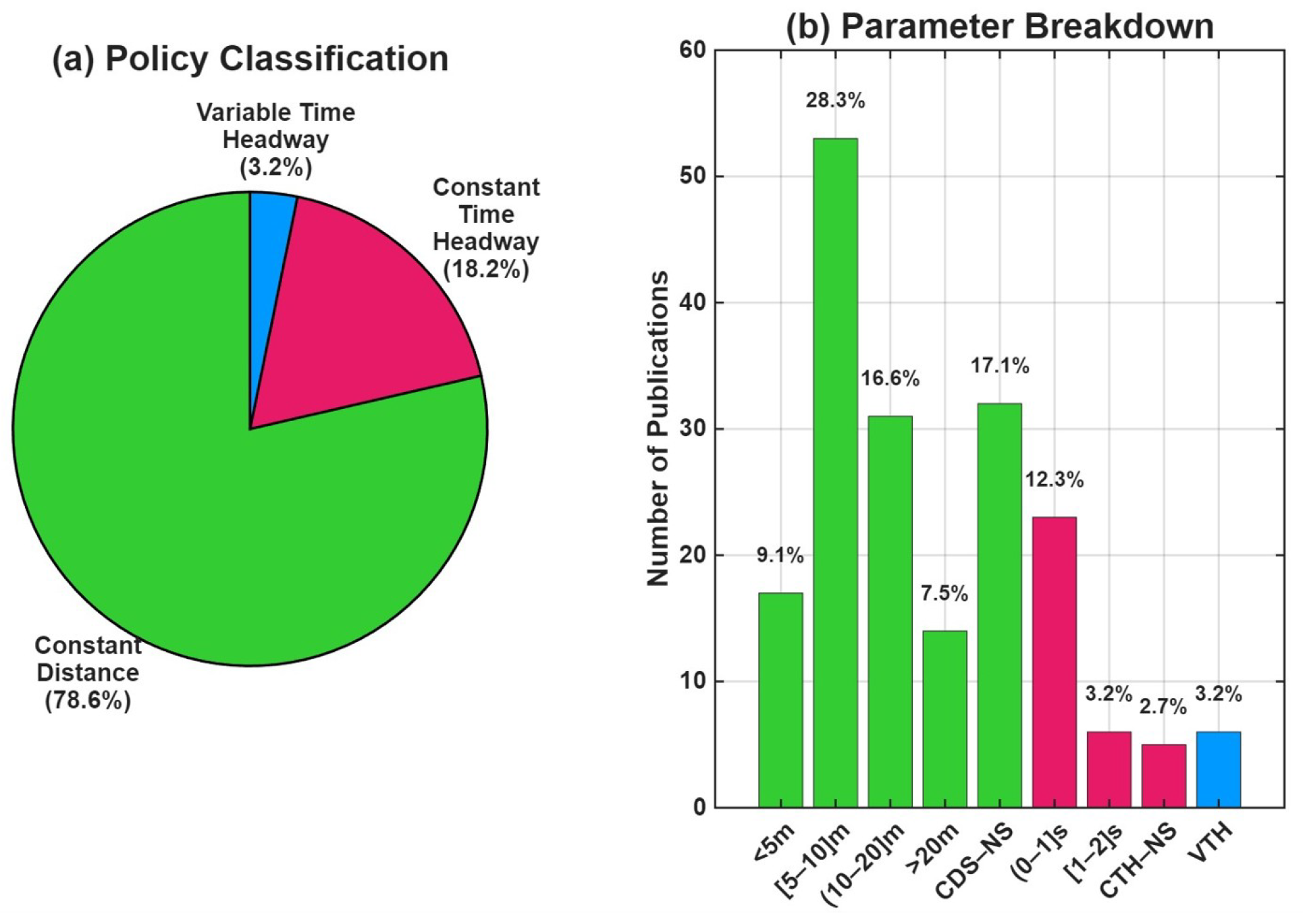


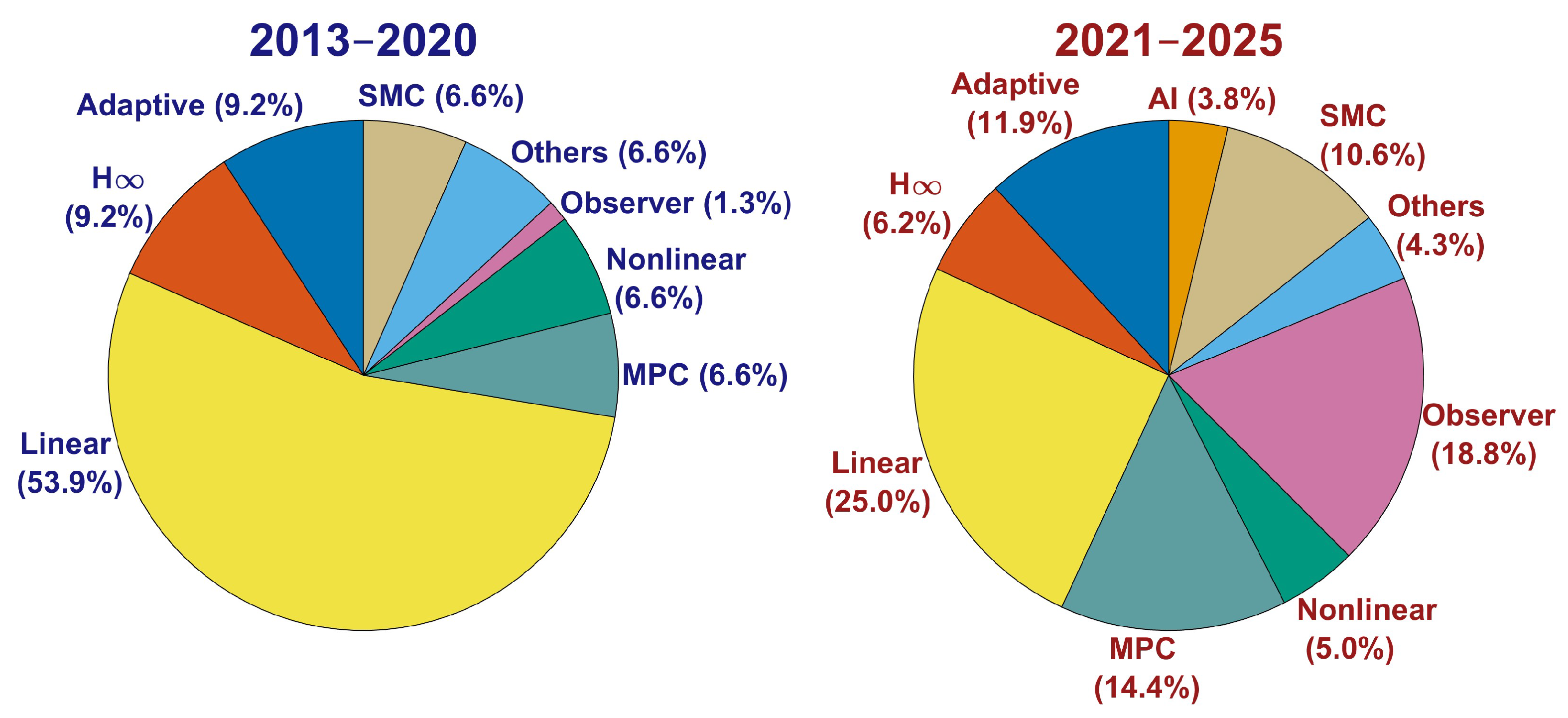



| Attributes | Literature Subjects Discussed | References |
|---|---|---|
| Node Dynamics | Modelling of individual vehicle dynamics in the platoon | [8,11,19,20,21,22,23,24,25,26,27,28] |
| Communication networks | Topologies between vehicles | [8,19,20,22,23,24,25,26,27,28,29,30,31,32] |
| Distributed Controllers | Distributed algorithms used for platoon control, e.g., MPC, SMC, etc. | [8,11,19,20,21,22,23,24,25,26,27,28,31,33] |
| Formation Geometry | How vehicles maintain their positions relative to each other | [8,19,20,21,22,23,24,25,27,28,30,31] |
| Performance and Stability metrics | Performance criteria such as stability (internal, string, robust), stability margin, coherence behaviour | [8,11,19,20,21,22,23,24,25,26,27,28,30,31,32] |
| Platoon Projects | Projects related to platoon | [21,26,27,29,30,32,33] |
| System Uncertainty and Robustness | Analysis and mitigation of factors like delays, packet loss, cyber attacks, and model uncertainties | [8,19,20,22,23,24,25,26,27,28,29,31,32,33] |
| Manoeuvres | Operations like merging, lane changing, etc. | [11,21,23,26,27,28,29,30,31,32,33,34] |
| Communication Architecture | Vehicular networking, V2V, V2I communication | [11,21,22,23,25,26,31,33] |
| Cybersecurity | Mitigation strategies regarding cyberfaults, DoS, etc. | [28,31] |
| Energy-based | Energy optimisation and all literature related to energy saving, fuel saving | [21,22,23,24,26,27,29,30,31,32,33] |
| Traffic Impact and Environmental Impacts | Effects on traffic flow, safety, environmental benefits | [21,22,23,24,25,26,27,28,29,30,31,32,33,34] |
| Node States | Node Dynamics | Disturbances | Platoon Nature: Homogeneous | Platoon Nature: Heterogeneous |
|---|---|---|---|---|
| First and Second Orders | Linear | Ideal | [38,43,64,65,67,71,73,74,75,76,77] | — |
| [78] | [79] | |||
| [47,63,80], [81] * | [72,82] | |||
| Nonlinear | Ideal | [83,84,85,86,87] | [45,51,88,89,90,91] | |
| — | [92] | |||
| [93,94] | [95,96,97,98,99,100,101,102,103] | |||
| Third | Linear | Ideal | [39,40,41,42,52,70,104,105,106,107,108,109,110,111,112,113], [114] *, [115,116,117,118,119,120,121,122,123,124,125,126,127,128,129,130,131,132] | [114] *, [133,134,135,136,137,138,139,140,141,142,143,144,145,146,147,148,149,150,151,152,153,154,155] |
| [14,15,16,17,37,156,157,158,159,160,161,162,163] | [164,165,166,167] | |||
| [12,36,49,168,169,170,171,172,173,174,175,176,177,178,179,180,181,182,183,184,185], [81]*, [186,187,188] | [13,18,189,190,191,192,193,194,195,196] | |||
| Nonlinear | Ideal | [197] | [198,199,200,201] | |
| — | [202] | |||
| [203] | [204,205,206,207,208,209,210,211,212,213] | |||
| Model free | — | Ideal | [54,55,214,215,216] | [53,217,218] |
| — | [219] | |||
| General Multiagent | Linear | Ideal | [61,66,220] | — |
| [221] | [50,62] | |||
| Nonlinear | Ideal | — | [59,222] | |
| — | [60,223] |
| Attribute | 2nd Order Model | 3rd Order Model |
|---|---|---|
| Realism | A simplified model that may not capture all real vehicle dynamics [42,156]. | Offers a more realistic representation of longitudinal dynamics [156]. |
| States | Includes position and velocity states to model vehicle dynamics. There is no actuator lag [178]. | In addition to position and velocity, acceleration is the third state present to model vehicle dynamics. An actuator lag is also present [138,178]. |
| Passenger Comfort | Not explicitly considered, as the model lacks jerk (change in acceleration) dynamics. | Allows for direct management of jerk to improve passenger comfort [42,156]. |
| Attribute | Nonlinear Model | Linear Model |
|---|---|---|
| Realism | A more realistic model depicting a vehicle’s inherent dynamics and physics by inherently including complex behaviours. This covers aspects such as drivetrain dynamics, physical input constraints, aerodynamic drag, and rolling resistance [51,54,88]. | A simplified model derived from a nonlinear model, which typically omits many of the complexities such as inherent nonlinearities and practical constraints on control inputs of the original dynamics [51,54]. |
| Suitability for Analysis | The complexity makes rigorous theoretical analysis and controller synthesis challenging [16,54]. | The simplified model enables straightforward stability proofs and the application of established control theory [51,54]. |
| Attribute | Physical Model | Data-Driven (Model-Free) |
|---|---|---|
| Requirement | Requires knowledge of the system dynamics, as the controller design depends on a mathematical model [222]. | Does not require a prior mathematical model. The controller design relies solely on the system’s input and output data, respectively, [216,222]. |
| Handling Uncertainty | Performance is heavily dependent on the model’s accuracy and can be very vulnerable to unmodelled dynamics and external disturbances [216]. | Well-suited for systems with unknown or stochastic characteristics, as it learns the behaviour directly from interaction with the system [53]. |
| Controller Design | Consists of a single phase where a controller is designed based on a known system matrix [222]. | Involves two main phases: a model learning phase from data, followed by a controller design phase based on the learned model [222]. |
| Policy | Typical Values | References |
|---|---|---|
| Constant Distance | <5 m | [38,51,62,65,75,78,85,100,155,159,173,177,179,195,206,212,219] |
| [5–10] m | [13,14,18,37,39,55,61,73,74,82,98,102,103,104,106,107,108,116,119,120,123,125,127,130,141,143,145,150,154,162,164,168,169,171,174,180,181,182,183,184,185,187,191,192,193,197,199,201,203,205,207,220,221] | |
| (10–20] m | [217] *, [41,47,59,63,66,81,84,86,88,90,91,96,101,115,121,124,134,135,136,139,140,163,186,196,200,213,214,216,218,222] | |
| >20 m | [15,16,17,49,52,64,77,117,118,153,157,170,176,211] | |
| Not Specified | [12,36,40,43,50,54,60,67,70,71,72,76,92,94,95,97,113,122,126,128,131,132,161,165,172,175,178,198,202,208,210,215,223] | |
| Constant Time Headway | (0–1] s | [217] *, [45,79,80,99,109,111,112,114,129,133,142,144,147,148,149,158,160,167,188,194,204,209] |
| [1–2] s | [42,53,138,151,156,166] | |
| Not Specified | [87,93,110,137,152] | |
| Variable Time Headway | [83,89,105,146,189,190] |
| Policy | Property | Advantages | Disadvantages | Typical Use Cases and Feasibility |
|---|---|---|---|---|
| CDS | Fixed inter-vehicular distance, independent of velocity [125,164]. |
|
| |
| CTH | Distance increases linearly with platoon velocity [142,159,209]. |
|
| |
| VTH | Nonlinear distance function of speed, often with quadratic terms [83,189]. |
|
| Attribute | Directed | Undirected |
|---|---|---|
| Characteristics | ||
| Mathematical Properties | ||
| Scalability and Disturbance Propagation |
|
|
| Type | Issues | References | |
|---|---|---|---|
| Undirected | Ideal (no issues) | [16,54,62,64,99,130,146,164,168,170,176,177,188,195,208,215,219] [71] * | |
| Time-varying delay | Heterogeneous | [18,161,202] | |
| Homogeneous | [131,169] | ||
| Time Constant delay | Homogeneous | [40,210] [66] * | |
| Switching Topology/Time Varying Topology | [93,127] | ||
| Fading channel/Packet drop | [15,17,179,203] [71] * | ||
| Directed | Ideal (no issues) | [43,45,47,50,51,59,60,72,73,74,77,79,82,86,88,90,96,98,100,101,102,103,104,116,123,132,133,139,142,145,152,153,154,158,172,189,193,194,196,197,200,201,205,206,212,214,216,218,220,222,223] | |
| Time-varying delay | Heterogeneous | [85,89,106,121,140,147,163,166,167,184,190,192] [84] *, [78] *, [144] * | |
| Homogeneous | [87,94,105,221] [136] *, [108] *, [109] *, [138] *, [49] *, [83] *, [185] *, [52] * | ||
| Time Constant delay | Heterogeneous | [61,113,165] | |
| Homogeneous | [38,76,115,135,159,178,211] [173] *, [42] * | ||
| Switching Topology/Time Varying Topology | [14,55,67,70,75,91,92,119,134,137,149,155,162,175,180,187,204,209] [49] *, [217] *, [83] *, [78] *, [144] * | ||
| Fading channel/Packet drop | [36,37,53,63,112,122,125,148,160,182,191] [136] *, [108] *, [109] *, [138] *, [173] *, [217] *, [84] *, [42] *, [185] *, [52] * | ||
| Both | Ideal (no issues) | [12,39,81,95,107,128,141,143,171,174,181,183,186,207] | |
| Time-varying delay | Heterogeneous | [150] [110] *, [41] *, [124] * | |
| Homogeneous | [13] [156] * | ||
| Time Constant delay | Heterogeneous | [111,151] | |
| Homogeneous | [114,126] [118] *, [198] * | ||
| Switching Topology/Time Varying Topology | [120,199] | ||
| Fading channel/Packet drop | [117,157,213] [110] *, [118] *, [41] *, [124] *, [198] *, [156] * | ||
| Not Stated | — | [65,80,97,129] | |
| Methodology | References |
|---|---|
| Solution of Riccati Equation | [12,39,70,107,113,116,117,119,139] |
| Routh–Hurwitz Criterion | [40,71,88,109,114,115,137,159,165] |
| Lyapunov Stability Solution of LMI | [49,78,87,92,108,110,111,112,120,136,138,158,170] |
| Other methods | [36,126,140,142] |
| Methodology | Focus On | References |
|---|---|---|
| LMI-Based for Disturbances | Focuses on robustness against model uncertainties and external disturbances, assuming ideal communication. | [16,164] |
| Stochastic LMI-Based for Network Imperfections like packet drops | Explicitly models random network imperfections like packet drops using stochastic variables and aims for performance. | [15,17,156,157] |
| Robust for Communication Delays and Uncertainties | Specifically handle significant time-varying delays alongside model uncertainties and disturbances. | [13,184] |
| Event-Triggered Control for Resource Efficiency | Focuses on optimising communication resource usage by deciding when to transmit data. | [14,169] |
| Methodology | References |
|---|---|
| Squared error of the states | [41,59,160,163,178,180,205,220,223] |
| Directly proportional to error of the states | [141,143,174,206] |
| Gradient based | [212] |
| Model Reference Adaptive Control | [50,60,173] |
| Others | [37,144,208] |
| Type | References |
|---|---|
| Quadratic tracking only | [65] |
| Quadratic tracking and control effort | [18,51,66,80,84,91,106,134,148,177,185,198,213,221,222] |
| Energy-aware augmentation | [45,90] |
| Type | Description | References |
|---|---|---|
| Actuator/Control input bounds | Hard/soft constraint on inputs or increments of input | [18,45,51,66,80,84,90,91,106,134,148,177,185,198,213,221,222] |
| Inter-vehicular spacing | Hard/soft constraint on distance/headway | [45,51,65,80,90,91,134,148,185,198,213] |
| State/Output bounds | Hard/soft constraint on states/outputs (e.g., position/velocity/acceleration) | [18,45,66,80,84,90,91,106,148,185,198,213,222] |
| Jerk bounds | Hard/soft constraint on the rate of change of acceleration (jerk) | [106,148] |
| Uncertainty bounds | Bounds on model parameter uncertainties | [90,177,222] |
| Surface Type | References |
|---|---|
| Linear Sliding Surface | [95,100,151,199,200,207] |
| Integral Sliding Surface | [47,98,99,102,188,189,190,192,196,204] |
| PID-type sliding surface | [146] |
| Nonlinear Sliding Surface | [97,103] |
| Type | References |
|---|---|
| Constant | [200] |
| Exponential | [95,99,151,199,207] |
| Power | [47,97,102,146] |
| Adaptive | [98] |
| Other | [103] |
| Not Mentioned | [189,190,204] |
| Type | References |
|---|---|
| Sign Function | [47,95,99,102,103,188,189,190], [196] * |
| Saturation Function | [196] *, [200] |
| Adaptive Switching Law | [97,192] |
| Not Mentioned | [151,204] |
| Methodology | References |
|---|---|
| Adaptive parameter estimation | [100,199,207] |
| Observer | [98,200] |
| Methodology | Nonlinear Element | References |
|---|---|---|
| Tan-h-based function of optimal-velocity | Nonlinear velocity function or a similar saturating function. | [73,74,85,104,145,147,149,167,210] |
| Others | Potential Energy based nonlinear function | [75] |
| Nonlinear event triggered function | [72] | |
| Input saturated | [83] |
| Methodology | Approach | References |
|---|---|---|
| Reinforcement learning (RL)—value-based (Q-learning/Deep Q-Network) | Agents iteratively learn policies through environmental interactions to maximise rewards; value-based RL, like Q-learning, estimates action values via policy iteration on system trajectories. | [54,55] |
| Deep reinforcement learning (DRL)—actor–critic | Integrates deep neural networks to handle complex, high-dimensional state spaces; actor–critic DRL uses an actor for action selection and a critic for value estimation; enables decentralised learning using local observations to adapt policies for tracking. | [53,133,193] |
| Adaptive optimal control—actor–critic (Hamilton–Jacobi–Bellman) | Employs actor–critic architectures to approximate optimal policies online using input–output data; approximates solutions to the Hamilton–Jacobi–Bellman equation; removes reliance on exact vehicle models or topological matrices; promotes model-free, robust platoon behaviour via learning and real-time adaptation. | [153,201,209] |
| Data-driven methods—radial basis function neural networks (RBFNNs); data-driven iterative learning | Directly uses system input/output data for controller design | [215,216] |
| Main Controller | Observer Type | References |
|---|---|---|
| Linear | Luenberger | [38,61,116,117,122,125] |
| Kalman filter | [42] | |
| PI/PID-inspired | [166] | |
| Other | [135] | |
| Adaptive | Adaptive | [64,79] |
| Luenberger | [154,178] | |
| Other | [101,155] | |
| SMC | Luenberger | [95,98,196] |
| Adaptive | [200] | |
| Other | [103] | |
| AI control | NN-based | [203] |
| Other control | Luenberger | [176,197] |
| NN-based | [183] | |
| Nonlinear-based | [211] |
| Attribute | DLC | DHC | DAC | DSMC | DMPC | AI Control |
|---|---|---|---|---|---|---|
| Core Mechanism | Fixed-gain state feedback [12]. Consensus-based constant-gain neighbour–leader coupling [88]. | LMI-based gain synthesis [16].
designs target disturbance-to-error attenuation [17]. Some formulations assume ideal communication (delay/drop neglected) [164]. | Online gain adjustment via adaptation laws [41,220].
Gradient/MRAC-type updates [141]. Neuro-adaptive variants with NN/RBF estimators [97,205]. | Sliding surfaces built from spacing/velocity errors [95,207].
Reaching/switching laws provide robustness [95]. Integral SMC variants may yield explicit delay bounds [190]. | Receding-horizon optimisation with prediction [134].
Neighbour-coupled MPC under constraints [106]. Distributed trajectory optimisation also reported [146]. | Model-free RL/DRL or NN policies [54,133].
Learning-based control under uncertain topology/dynamics [193,209,215]. |
| Computational load and Implementation | Low computational load [107,139].
Mostly offline tuning [39]. | Moderate load; offline LMI synthesis [164,169].
Lightweight online execution once gains are fixed [16]. | Moderate–high load due to continuous adaptation [141,205].
Mainly online due to parameter updates [64]. | Low–moderate load; online switching terms [95].
Higher complexity with observers/NN smoothing [100]. | High online cost (optimisation each step) [65,66].
Offline tuning of horizons/weights; online solve [134]. | High training cost [54].
Low-cost online inference after training [215]. |
| Performance: nonlinearity and disturbance | Typically linear/linearised; gain-limited rejection [39].
Noise-handling via relative-state/relative I/O designs [42]. | Explicit attenuation [17].
Robustness margins can be conservative [15]. Some works focus on disturbance rejection under ideal comm [164]. | Bounded disturbances handled via adaptation (UUB/ISS-type) [174].
NN/RBF estimators approximate unknown nonlinearities [97,205]. | Strong robustness to disturbances/nonlinearities [95].
Disturbance-observer/energy-aware SMC variants reported [200]. | Nonlinear/constraint-aware; tube/robust variants mitigate disturbances [18].
Performance depends on prediction/estimation quality [134]. | Robustness possible if trained across disturbances [193].
Generalisation remains data-dependent [53]. |
| Performance: mismatch and uncertainty | Sensitive to mismatch; robustness often implicit [113].
Works best under mild heterogeneity [39]. | Structured uncertainty via robust LMI synthesis [16].
Can be conservative for broad uncertainty sets [17]. | Main strength: online compensation of unknown parameters [174].
Often requires boundedness/PE-type assumptions [163]. | Robust to bounded uncertainties; adaptive SMC relaxes bounds [199].
Heterogeneous platoons under disturbances reported [190,200]. | Uncertainty handled via robust/stochastic constraints [18].
Prediction mismatch directly affects performance [65]. | Robust training can cover uncertainty [193].
Formal guarantees uncommon without safety layers [133]. |
| Performance: delays and packet drops | Sufficient conditions under bounded delays/drops [42].
Bounds may be conservative at scale [71]. | Admissible delay/drop parameters enter LMIs as feasibility regions [17,156].
Some works neglect delay/drop effects [164]. | Event-triggered/adaptive schemes tolerate variable delays/drops [144,160].
Explicit margins not always stated [163]. | Explicit delay margins reported in policy-specific designs (e.g., VTH) [190].
Packet-delivery probability modelled; quantitative errors reported [207]. | Predictive designs accommodate delays; tube MPC adds robustness [18].
Losses handled via estimation; computation heavy [66]. | Communication constraints handled in training; tolerance often empirical unless analysed [53,203].
Designs for uncertain topology without explicit bounds also reported [209]. |
| Performance: switching topology | Needs connectivity and dwell-time tools [93].
Often conservative under frequent switching [137]. | Markov/switching modelling supported via LMI synthesis [67].
Conservatism rises with many modes [157]. | Clear handling under Markov-switching formulations [180].
Requires transition/dwell-time constraints [209]. | Robust to uncertain interaction topology [199].
Random topology and delivery-probability coupling reported [207]. | Switching handled via dwell-time inside optimisation [119].
Complexity rises with mode changes [134]. | Topology adaptation via Q-learning/DRL [55,209].
Retraining/graph generalisation affects scalability [54]. |
| Model suitability and limitations | Best for linear/LTI or linearised dynamics [88].
Linearisation reduces realism [113]. | Best for linear/linearised models in LMI-based [17].
Some robust designs neglect comm imperfections [164]. | Linear/nonlinear models possible [143,208].
NN/fuzzy adds tuning/PE needs [60,97]. | Suited to nonlinear dynamics and matched disturbances [95].
Chattering/gain tuning central [151]. | Linear and nonlinear MPC reported [134].
Heavy computation; depends on prediction accuracy [65]. | Model-free/data-driven; suited to unknown dynamics [55,215].
Guarantees typically need safety layers [53,133]. |
| Type | Fault type | How Is Modelled | Addressed | References |
|---|---|---|---|---|
| Linear | Cyber fault | Additive faulty signal injected into the control law | Estimate the bounds of the fault term | [186] |
| Control law with random noise compensation | [152] | |||
| Communication delay | Event-triggered control | [52] | ||
| Switching-based controller | [76] | |||
| Communication delay and additive signals injected to states | Event-triggered control | [63] | ||
| Mechanical Faults | Additive faulty signal injected into the control law | Event-triggered control | [161] | |
| Both Cyber and mechanical faults | Additive faulty signal injected into the control law | Analysis-only; mitigation not addressed. | [181] | |
| Adaptive | Cyber fault | Additive faulty signal injected into the control law | Neural Network-based adaptive gains | [82] |
| Adaptive event-triggered communication | [172] | |||
| Communication time delay | Control law having time-varying delay | [124] | ||
| Mechanical Faults | Additive faulty signal injected into the control law | Estimate the bounds of the fault term | [86,96,195] | |
| Event-triggered control | [171] | |||
| MPC | Cyber fault | Switching Signal | Embedding timing bounds in control law | [127] |
| Additive faulty signal injected into the control law | Detect and isolate attack-corrupted data from prior broadcasted data | [123] | ||
| Event-triggered control | [191] | |||
| Observer Control | Cyber fault | Switching Signal | Estimate the states of its neighbours based on its onboard sensor | [122] |
| Additive faulty signal injected into the control law | Estimate the states of the vehicle based on its onboard sensor | [176,187] | ||
| Mechanical Faults | Additive faulty signal injected into the control law | Estimate fault detection and isolate the fault or compensate it | [175,202,218] | |
| Both Cyber and mechanical faults | Cyber fault—Time delay; Mechanical Fault—Additive faulty signal injected into the control law | Event-triggered control and estimate the states of the vehicle based on its onboard sensors | [150,179] | |
| Control | Cyber fault | Switching Signal | Control to find bounds on the allowable frequency and duration of attack | [162] |
| Intermittent V2V communication | Event-triggered control | [182] | ||
| AI Control | Cyber fault | Additive faulty signal injected into the control law | Learning-based estimation to actively compensate for the fault | [62] |
| Nonlinear Control | Cyber fault | Additive faulty signal injected into the control law | Compensates for the faulty signal | [194] |
| Others approaches | Cyber fault | Communication time delay | Estimate the delay created by the attack | [121] |
| Additive faulty signal injected into the control law | Estimate from past valid data; when the error exceeds a fixed threshold, activate the compensation algorithm. | [214] | ||
| Game-theoretic defence design | [128] |
| Fault Type | Fault Modelled as | Controller | |||||||
|---|---|---|---|---|---|---|---|---|---|
| Linear | Adaptive | MPC | AI | Nonlinear | Observer | Others | |||
| Cyber | Additive faulty signal in control law | [152,186] | [82,172] | [123,191] | — | [62] | [194] | [176,187] | [128,214] |
| Comm. delay in control law | [52,76] | [124] | — | — | — | — | — | [121] | |
| Comm. delay and Additive signal in control law | [63] | — | — | — | — | — | — | — | |
| Switching topology or intermittent comm. | — | — | [127] | [162,182] | — | — | [122] | — | |
| Mechanical | Additive faulty signal in control law | [86,96,161,171,195] | — | — | — | — | — | [175,202,218] | — |
| Cyber and Mechanical | Additive faulty signal in control law | [181] | — | — | — | — | — | — | — |
| Comm. delay and Additive signal in control law | — | — | — | — | — | — | [150,179] | — | |
| Methodologies | References |
|---|---|
| Routh–Hurwitz | [36,40,43,71,73,74,79,85,88,104,115,137,139,142,145,149,159,165,186,192,196,219] |
| Basic Lyapunov | [12,16,39,47,51,55,59,60,62,63,70,75,86,91,92,94,95,96,97,98,99,100,102,103,106,107,116,117,119,120,122,125,127,132,134,143,146,153,154,157,160,162,168,171,173,174,176,177,179,180,182,183,186,187,188,191,194,195,197,199,203,204,206,208,209,212,213,220,223] |
| Lyapunov–Krasovskii | [83] *, [17,41,42,49,52,76,78,87,89,105,108,111,121,124,131,135,136,144,147,150,156,161,163,169,170,172,184,190,210,221] |
| Lyapunov–Razumikhin | [83] *, [123,138,167] |
| Others | [15,61,66,72,81,85,112,118,126,130,140,152,193,214,217,218] |
| Methodologies | References |
|---|---|
| Lyapunov-based string stability | [82,143,183,192,205] |
| Input-to-output string stability | [36,38,40,51,63,80,83,85,99,100,102,103,105,111,112,135,138,140,142,144,146,147,151,158,160,164,167,176,180,181,184,185,190,193,214] |
| Input-to-State String Stability | [55,98,173,204,209] |
| Methodologies | References |
|---|---|
| Matrix Inequality-Based Analysis (LMI and Riccati Methods) | [12,15,16,17,80,92,112,121,127,161,162,163,182,184,221] |
| Input-to-State Stability (ISS) Analysis | [95,96,159,170,185,186,200,222] |
| Cases | Simulation Platform | Platoon Length (Incl. Leader) | References |
|---|---|---|---|
| Only simulations (platform used) | MATLAB/Simulink | <5 | [18,65,86,188] |
| 5–10 | [92,109,147,161,192] *, [43,45,47,51,75,77,84,87,96,108,111,121,122,131,136,144,160,163,167,176,181,185,191,197,198,200,201,203,205] | ||
| >10 | [15,17,80,112,113,151,157], [109] * | ||
| PLEXE | <5 | — | |
| 5–10 | [41,83,105,110,124,129] | ||
| >10 | — | ||
| Other simulators | <5 | [85,220] *, [202] | |
| 5–10 | [92,147,192] *, [89,91,132,148,165,187,193] | ||
| >10 | [178] | ||
| Not mentioned simulators | <5 | [97] *, [38,62,76,78,90,128,164,168,171,174,175,195,208,216] | |
| 5–10 | [117,159,179,180] *, [14,36,37,42,52,54,55,59,60,61,63,64,66,67,71,72,73,74,82,88,93,94,95,98,99,100,102,103,104,115,116,118,119,123,125,130,133,134,138,140,142,145,149,150,154,158,162,170,172,173,182,183,184,186,189,194,196,206,209,210,212,214,215,217,218,219,221,222,223] | ||
| >10 | [117,180,220] *, [12,39,70,81,126,137,141,146,152,156,169,207] | ||
| Number not mentioned | [16,49,53,79,139] | ||
| Experimental | Hardware setup | <5 | [106,114,204], [85,97,159,161] * |
| 5–10 | [179] *, [120,135,143,190] | ||
| >10 | [213] |
Disclaimer/Publisher’s Note: The statements, opinions and data contained in all publications are solely those of the individual author(s) and contributor(s) and not of MDPI and/or the editor(s). MDPI and/or the editor(s) disclaim responsibility for any injury to people or property resulting from any ideas, methods, instructions or products referred to in the content. |
© 2026 by the authors. Licensee MDPI, Basel, Switzerland. This article is an open access article distributed under the terms and conditions of the Creative Commons Attribution (CC BY) license.
Share and Cite
Hanif, O.; Gruber, P.; Sorniotti, A.; Montanaro, U. A Review of Control Solutions for Vehicle Platooning via Network Synchronisation Methods. Automation 2026, 7, 35. https://doi.org/10.3390/automation7010035
Hanif O, Gruber P, Sorniotti A, Montanaro U. A Review of Control Solutions for Vehicle Platooning via Network Synchronisation Methods. Automation. 2026; 7(1):35. https://doi.org/10.3390/automation7010035
Chicago/Turabian StyleHanif, Omar, Patrick Gruber, Aldo Sorniotti, and Umberto Montanaro. 2026. "A Review of Control Solutions for Vehicle Platooning via Network Synchronisation Methods" Automation 7, no. 1: 35. https://doi.org/10.3390/automation7010035
APA StyleHanif, O., Gruber, P., Sorniotti, A., & Montanaro, U. (2026). A Review of Control Solutions for Vehicle Platooning via Network Synchronisation Methods. Automation, 7(1), 35. https://doi.org/10.3390/automation7010035