


Abstract
Exoskeleton knee-assistance (EKA) systems are wearable robotic technologies designed to rehabilitate and improve impaired mobility of the lower limbs. Clinical exercises are conducted on disabled patients based on physically demanding tasks which are prescribed by expert physicians. In order to carry out good tracking of the desired tasks, efficient controllers must be designed. In this study, a novel control framework is introduced to improve the robustness characteristics and tracking precision of EKA systems. The control approach integrates a super-twisting sliding mode controller (STSMC) with a nonlinear disturbance observer (NDO) to ensure robust and precise tracking of the knee joint trajectory. An evaluation of the proposed system is conducted through numerical simulations under the influence of external disturbances. The findings reveal considerable enhancements to trajectory tracking accuracy and disturbance rejection when compared to conventional STSMCs and sliding mode perturbation observer (SMPO)-based STSMCs.
1. Introduction
World Health Organization (WHO) reports that strokes affect around 15 million people worldwide each year, causing permanent disability for 5 million individuals [1]. Neurological injuries such as strokes, heart attacks, and spinal cord injuries can cause loss of mobility, sensory and cognitive impairments, and reduced independence. Rehabilitation and repetitive task-specific therapy have shown promising results in improving recovery. Traditional rehabilitation exercises require direct physician supervision, making them costly and time-consuming. Actuated bio-engineering exoskeletons offer a promising alternative by reducing therapist workload, enabling repetitive motion without fatigue, and providing precise measurements (e.g., angle, velocity, torque) for patient progress evaluation. Clinical trials have confirmed their effectiveness in rehabilitation [2,3]. For successful use, exoskeletons must be customized to match human joint motion and ensure ergonomic comfort, particularly in lower-limb orthoses. Typically, the knee exoskeleton comprises two links connected to the thigh and shank, actuated by a DC motor to provide the required torque. Controlling exoskeletons poses significant challenges owing to the presence of inherent uncertainties, such as unpredictable forces from complex human–exoskeleton interactions in addition to environmental factors such as terrain and collisions that cause nonlinearities and joint misalignment [4,5]. Research in this field is active because lower-limb exoskeletons must manage unpredictable disturbances and adapt to individual biomechanics. Modern studies focus on combining robust observers with advanced control techniques to improve tracking, stability, and disturbance rejection for exoskeleton knee systems, significantly enhancing rehabilitation outcomes and daily usability. In [6], M. Zhang et al. proposed a second-order super-twisting controller (STSMC) for motion control. This is a rehabilitation exoskeleton device which is actuated by an artificial pneumatic muscle (PAM). Compared to classical SMCs, the STSMC showed better robust characteristics against uncertainties and disturbances. In [7], S. Aole et al. introduced an improved active disturbance rejection (I-ADRC) controller, differentiator (TD), and nonlinear state error feedback (NLSEF) for use in rehabilitation robots. The simulation of the proposed controller shows reduced trajectory tracking error, the elimination of random, constant, and harmonic disturbances, and robustness against parameter variations and under the influence of noise. In [8], Ezhilarasi, D. et al. proposed an adaptive super-twisting sliding mode controller (ASTSMC) to evaluate the performance of a suggested 6-DOF lower limb exoskeleton model for tracking trajectory under external disturbances and parametric uncertainties. The controller performance was evaluated under wind disturbances with varying velocities and directions. The suggested controller achieved superior tracking accuracy when compared to a constant gain STSMC on both flat and uneven terrain. In [9], M. Mokhtari et al. presented a hybrid optimal adaptive high-order super-twisting sliding mode (AHOSTWSM) impedance controller to control the motion of the lower limbs. The optimization technique was based on the Harmony Search Algorithm (HSA) and was used to tune the controller parameters. The researchers developed an optimal sliding mode controller (SMC); the performance of the AHOSTWSM was compared with that of the SMC. The results of the simulation demonstrated the controller’s enhanced performance compared to that of the SMC. In [10], M. Rastegar and H. Kobravi proposed a hybrid method that merges Functional Electrical Stimulation (FES) with mechanical actuators for knee joint motion control in rehabilitation, employing adaptive and PD controllers. The results of the simulation showed that this algorithm enhanced tracking performance and disturbance rejection during rehabilitation tasks. In [11], Yang Yong et al. developed a control scheme for hydraulic rehabilitation exoskeleton knee joints that were capable of achieving accurate trajectory tracking in the presence of nonlinearities, modeling uncertainties and external disturbances. The suggested algorithm integrates a disturbance observer-based radial basis function neural network (RBF-NN) to estimate and compensate for modeling uncertainties. Comparative simulations established that the proposed control algorithm efficiently compensates for modeling uncertainties and ensures high-precision trajectory tracking for the exoskeleton knee joint. In [12], Jin. X. and Guo. J suggested a model predictive (MPC) strategy to achieve a specified tracking performance for lower limb rehabilitation exoskeletons. The researchers integrated an extended state observer (ESO) with the MPC framework to estimate total system disturbances. The suggested ESO-MPC controller considerably improved tracking accuracy for lower limb motion under disturbances exceeding classical MPC and fuzzy PID methods by more than 34%. In [13], AL-Dujaili et al. proposed an Active Disturbance Rejection Control (ADRC) scheme for the exoskeleton robot. Two observers, represented by a linear extended state observer (LESO) and a nonlinear extended state observer (NESO), were included to estimate the states and uncertainties. Particle Swarm Optimization (PSO) was utilized to optimally tune the observer’s parameters. In [14], He D. et al. proposed a model-free super-twisting terminal sliding mode controller (MF-STTSMC) integrated with a sliding mode disturbance observer for tracking control and rejection disturbance for n-DOF upper-limb rehabilitation exoskeletons subject to backlash and hysteresis nonlinearities. A sliding mode disturbance observer was incorporated to identify and compensate for unmolded disturbances and hysteresis effects. The results of the simulation confirmed that the proposed controller efficiently mitigated errors induced by backlash and hysteresis; moreover, it was found to achieve high-precision trajectory tracking and demonstrated strong robustness against external disturbances and model uncertainties. In [15], Alawad Nasir Ahmed et al. developed an active disturbance rejection controller (ADRC) for the coordinated motion of hip and knee joints in a rehabilitation exoskeleton device. The ADRC applies an extended state observer (ESO) to approximate and compensate for disturbances and unknown modeling errors online. The proposed scheme demonstrated superior performance in trajectory tracking disturbance rejection and robustness compared to the classical PID controller. In [16], Qin Lang et al. developed a super-twisting sliding mode control (ST-SMC) algorithm for exoskeleton joint motors that leveraged a load observer to improve robustness and control effectiveness under uncertain load conditions and disturbances. This methodology integrates the advantages of back-stepping control and sliding mode strategies, enabling the system to perform real-time estimation and compensation for disturbances. The outcomes of both the simulations and the experiments indicate that the proposed controller improved stability for exoskeleton motors compared to classical control methods. In [17], Kl Espinosa-Espejel et al. proposed a control strategy employing Artificial Neural Networks (ANNs) for walking trajectory generation in a lower limb exoskeleton for use during rehabilitation. The effectiveness of the ANN-based controller was verified through both numerical simulations and experimental validations. In [18], H Tiaiba et al. developed an online adaptive super-twisting sliding mode controller, which was implemented for an upper limb exoskeleton robot targeting arm rehabilitation. The controller incorporated an optimized Particle Swarm Optimization (PSO) algorithm for real-time parameter adjustment. The proposed controller outperformed the classic super-twisting algorithm in both performance and efficiency. In [19], Chen Nengdi et al. developed an enhanced sliding mode control strategy, employing a fractional-order nonlinear disturbance observer (FONDOB) in conjunction with an extreme learning machine (ELM), aiming to estimate the system uncertainty and to ensure the walking stability of the lower limb exoskeleton. The results of the experiment showed that the proposed fractional-order controller demonstrated superior control performance compared to the classical integer-order sliding mode control. In [20], Y. Wang et al. developed a proportional derivative iterative learning control strategy for a multi-joint soft lower limb assistive exoskeleton to support flexion and extension of the hip and knee joint throughout the gait cycle. A mean-based prediction approach was utilized to forecast the human walking cycle. Unlike the above studies, the observer-based scheme was presented in order to estimate disturbance and to compensate within a controlled loop.
In this study, an NDO-based STSMC is designed for an EKA system to handle nonlinear dynamics and disturbances during knee movement. The SMC is a nonlinear and robust control scheme, which is designed for solving various nonlinear control problems. The mechanism of the SMC acts to drive the states of nonlinear systems to a sliding surface and to enforce them staying there, irrespective of the presence of disturbances and uncertainties. One reported critical problem with SMC is the chattering effect due to sharp switching of control law components. One solution to this problem is the use of super-twisting sliding mode control (STSMC), which is the modified version of SMC [21,22,23,24,25,26,27,28,29].
The STSMC is a powerful and effective algorithm used for stabilizing nonlinear systems. Complementing this, the NDO offers simple architecture, rapid response, and high accuracy in disturbance estimation; therefore, the control system can prevent excessive joint torques that might cause discomfort or injury.
The main contributions of this study are summarized as follows:
- A novel control framework is designed which integrates both STSMC and NDO to approximate the external perturbations and improve the robustness of a controlled medical robot.
- Stability analysis of an NDO-based controller is conducted to ensure tracking convergence in the presence of uncertainty.
- Comparative analysis of the NDO-based STSMC and the SMPO-based STSMC algorithms is carried out under unified conditions, including external disturbance, to reveal the differences in robustness and control effort.
The structure of this paper is organized as follows: Section 2 outlines the methodology, which includes detailed mathematical modeling of an exoskeleton knee-assistive system, and the proposed control approach. The simulated results are outlined in Section 3. Finally, Section 4 illustrates the conclusions of this study.
2. Materials and Methods
The following sections explain the two main steps to achieving this study’s objectives. Section 2.1 details the mathematical modeling of an exoskeleton knee-assistive system. This section comprehensively explains the state space form of the EAK system. Section 2.2 presents a nonlinear control strategy based on a super-twisting sliding mode controller with a disturbance observer.
2.1. Mathematical Modeling of an Exoskeleton Knee-Assistive System
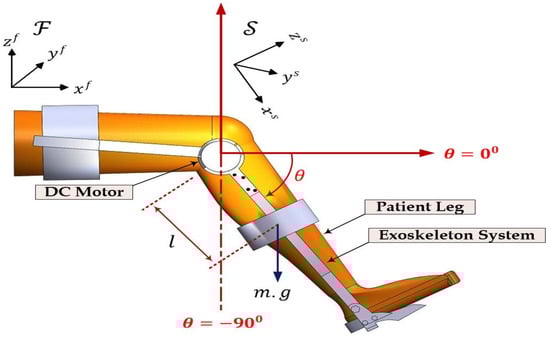
Figure 1 illustrates the geometric representation of an EKA system, which includes a fixed thigh link and a movable shin link actuated by a DC motor mounted at the knee joint. The motor generates the required torque for precise leg rotation, assisting impaired knees. The motion range is limited to between 0° (full extension) and 90° (resting posture). The system uses a fixed frame F and a rotating knee frame S, defined by angle and velocity . A coupled exoskeleton–leg model was derived via the Lagrangian method.
Figure 1.
Geometric representation of an EKA system.
Initially, we will consider the exoskeleton and human leg as a coupled system and describe them with the following mathematical relationship [30]:
where, represents the Lagrangian operator. and denote the gravitational and kinetic energies, respectively.
represents the inertia of the combined exoskeleton–human leg system.
where represents the gravitational torque which can be represented as follows:
where, denotes the mass of the coupled system, g the gravitational acceleration, and the distance between the knee joint and the center of gravity. The coupled system dynamics are then formulated based on the Euler–Lagrange equation as follows:
Here, represents the total external torque on the system, defined as , where is the motor-controlled input torque and is the friction torque expressed by
: viscous friction, : solid friction. The coupled system dynamics are given as follows:
denotes the load torque from system coupling. By renaming as and as , the state space form of the EAK system can be written as follows:
The nonlinear plant with internal/external disturbances is represented as follows:
where, is the output signal, represents the nonlinear dynamics, is the external disturbance, and is the control gain. The physical parameters of the EKA system are listed in Table 1 [30].
Table 1.
Identification parameters.
2.2. Control Methodology
To control the nonlinear dynamics of the exoskeleton knee system, the controller must ensure accurate tracking of the reference angle with minimal steady-state error, while avoiding overshoot and exceeding the maximum joint limit. To achieve this, a nonlinear control strategy based on a super-twisting sliding mode controller with a disturbance observer is proposed [31,32,33,34,35,36,37,38,39,40].
2.2.1. Nonlinear Disturbance Observer
For the purpose of designing the observer unit, the equation of state for the EAK system will first be rewritten as follows [41]:
where , , and, . The proposed corresponding nonlinear disturbance observer will be defined as follows:
where represent the output generated by the proposed observer, represents the internal variable of the proposed observer, is defined as the gain matrix, and is a real number that must be greater than zero, while represents a design function, which can be defined by
The estimation error of the disturbance observer and its corresponding time derivative are defined as follows:
The disturbance is considered time-varying and can be represented as follows:
Then,
Rewriting Equation (16), we obtain the following:
Multiplying both sides by the integrating factor produces the following:
Integrating Equation (18) during the period [0,t] yields the following:
Since , we then have
Thus,
As t → ∞, we then have
Therefore, the solution of Equation (17) is uniformly ultimate bounded, and the observer error state ultimately enters a small residual set around origin with a radius depends on the ratio . Thus, the disturbance estimate converges to zero provided that Equation (22) is satisfied to ensure asymptotic stability.
2.2.2. Super-Twisting Sliding Mode Controller Scheme Design
Let define the error between the angle and the desired angle
The first derivative of the error equation is given by
In the STSMC, the desired dynamic behavior of the system can be expressed as a mathematical condition called the sliding surface, which is typically formulated as a function of the system error and its time derivatives, defined as follows:
Now, by taking the time derivative of Equation (25), the following can be obtained:
In the design theory of STSMC, the control law is formulated with two parts: equivalent and switching , respectively.
The part can be derived by setting . Therefore, based on Equation (26), can be determined as follows:
Based on the super-twisting algorithm [42], the part is proposed to be
Then, the control law can now be written as
Accordingly, Equation (26) becomes
To guarantee asymptotic stability of the EAK system under the STSMC, the Lyapunov candidate function is selected as follows:
Taking the time derivative of Equation (32) and using Equation (30), the following can be obtained:
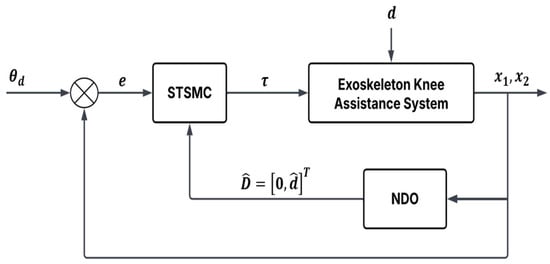
Thus, , , confirming that the NDO-based control system is asymptotically stable. Figure 2 illustrates the schematic diagram of the NDO-based STSMC applied to the EAK system.
Figure 2.
The NDO-based STSMC for the knee exoskeleton.
3. Results and Discussion
This section validates the effectiveness of the proposed controller through numerical simulations, employing the “Ode45” solver as the numerical integration method. In order to verify the efficiency of the proposed control framework in improving the performance of the system in terms of durability of performance in the presence of external disturbances and reducing the control effort, we conducted a performance comparison with the SMPO-based STSMC, as detailed in [43], and the classical STSMC. The gains of the proposed control frameworks were tuned via the Particle Swarm Optimization (PSO) algorithm [44]; the PSO-based gains are listed in Table 2.
Table 2.
The PSO-based gains of the proposed control frameworks.
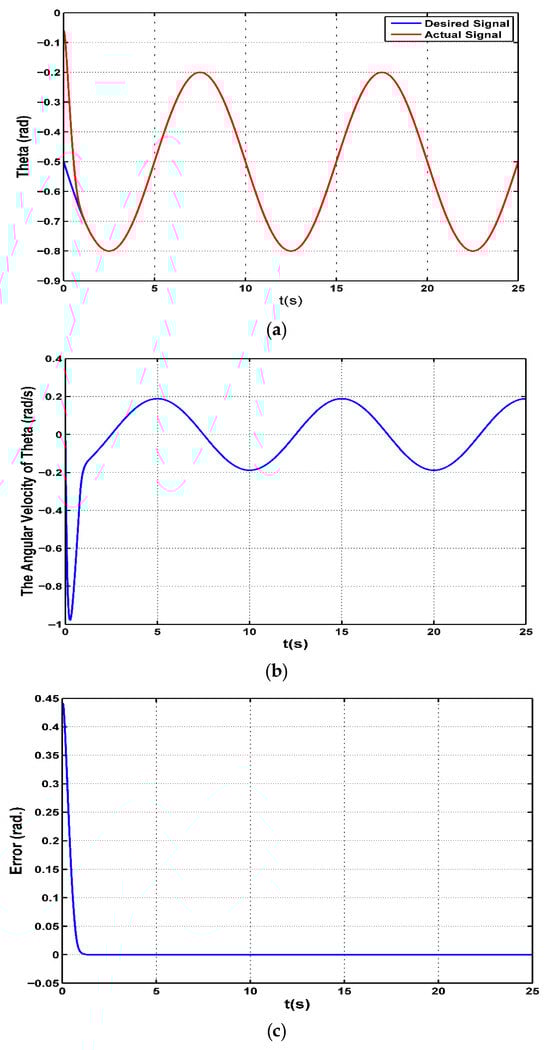
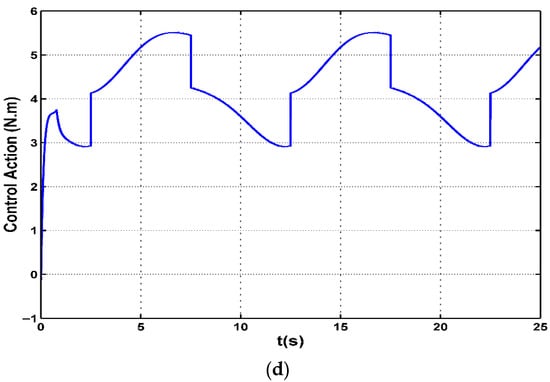
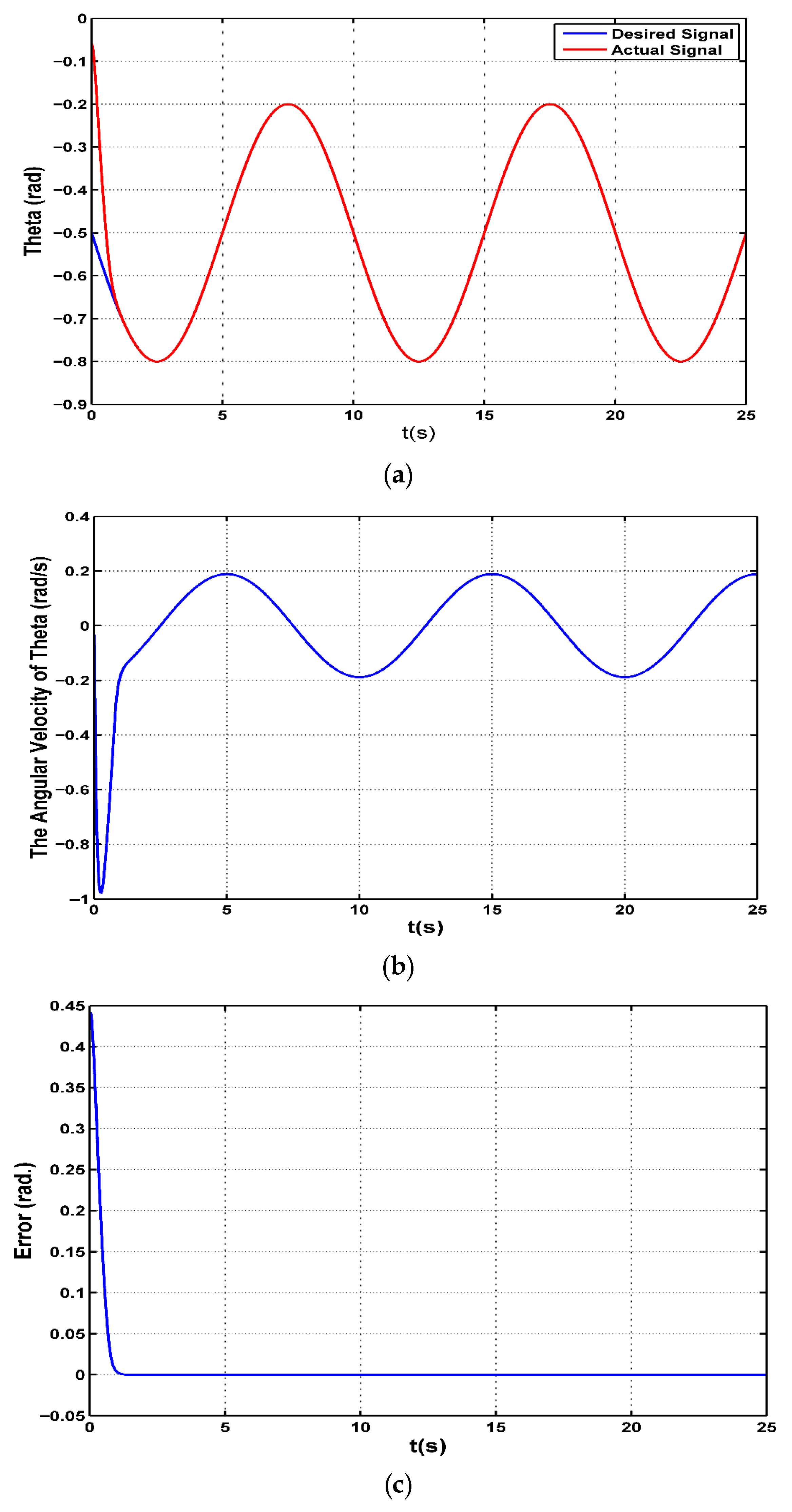
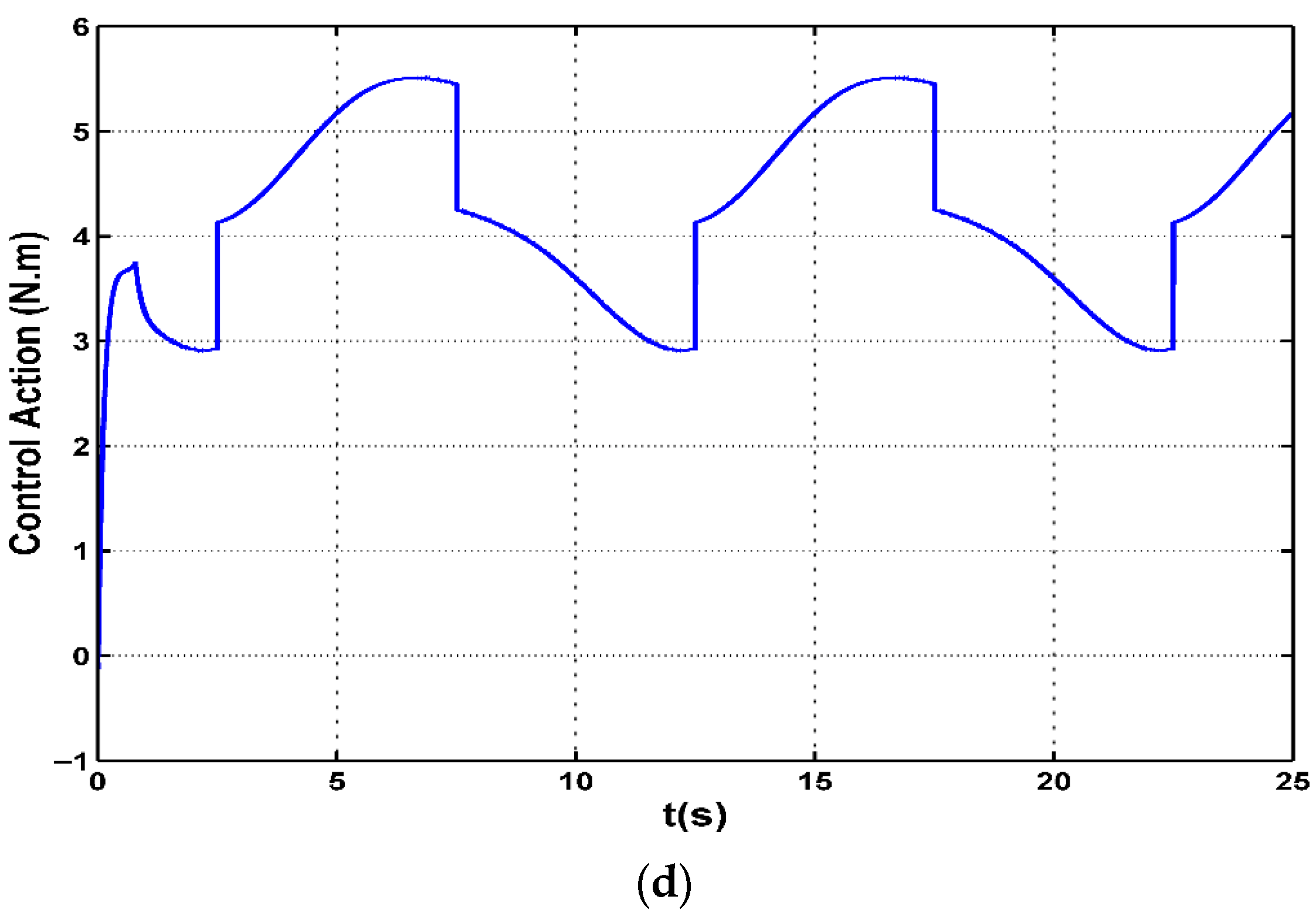
The tracked response of the EAK system under ideal conditions, in the absence of external disturbances and uncertainty based on classical STSMC, is depicted in Figure 3. Specifically, Figure 3a illustrates the knee angle trajectory, Figure 3b depicts the angular velocity response, Figure 3c shows the error signal, and Figure 3d provides the corresponding control action generated by the proposed controller. The results are utilized to highlight the capability of the STSMC in accurately tracking the desired knee angle.
Figure 3.
Dynamic responses of the (a) knee angle, (b) angular velocity, (c) error signal, and (d) the corresponding control signal under ideal conditions.
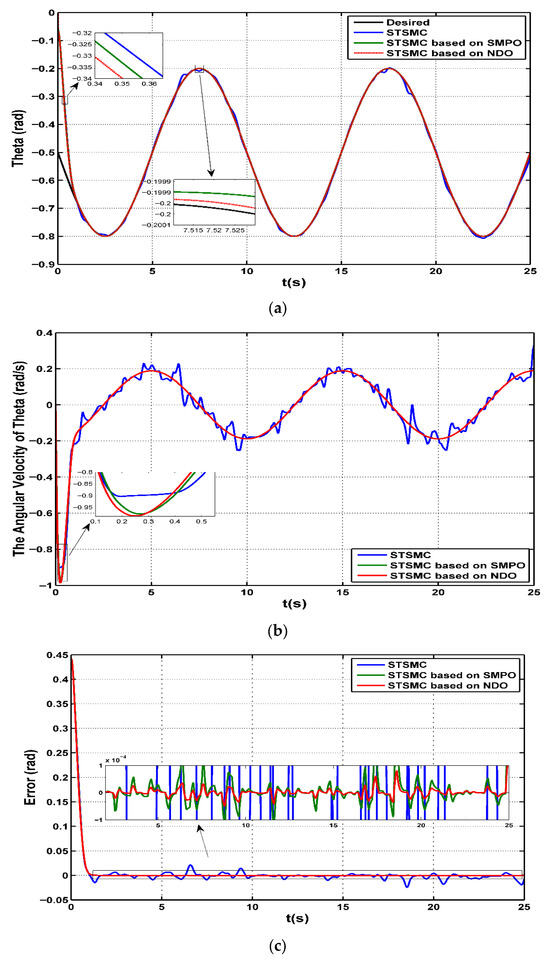
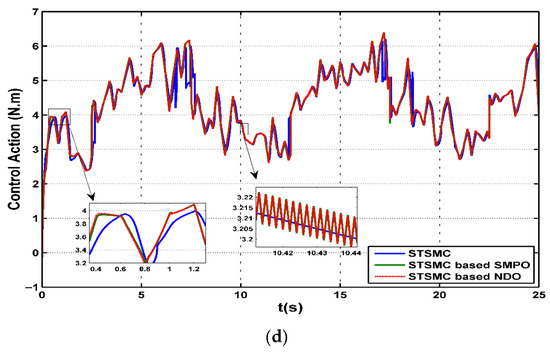
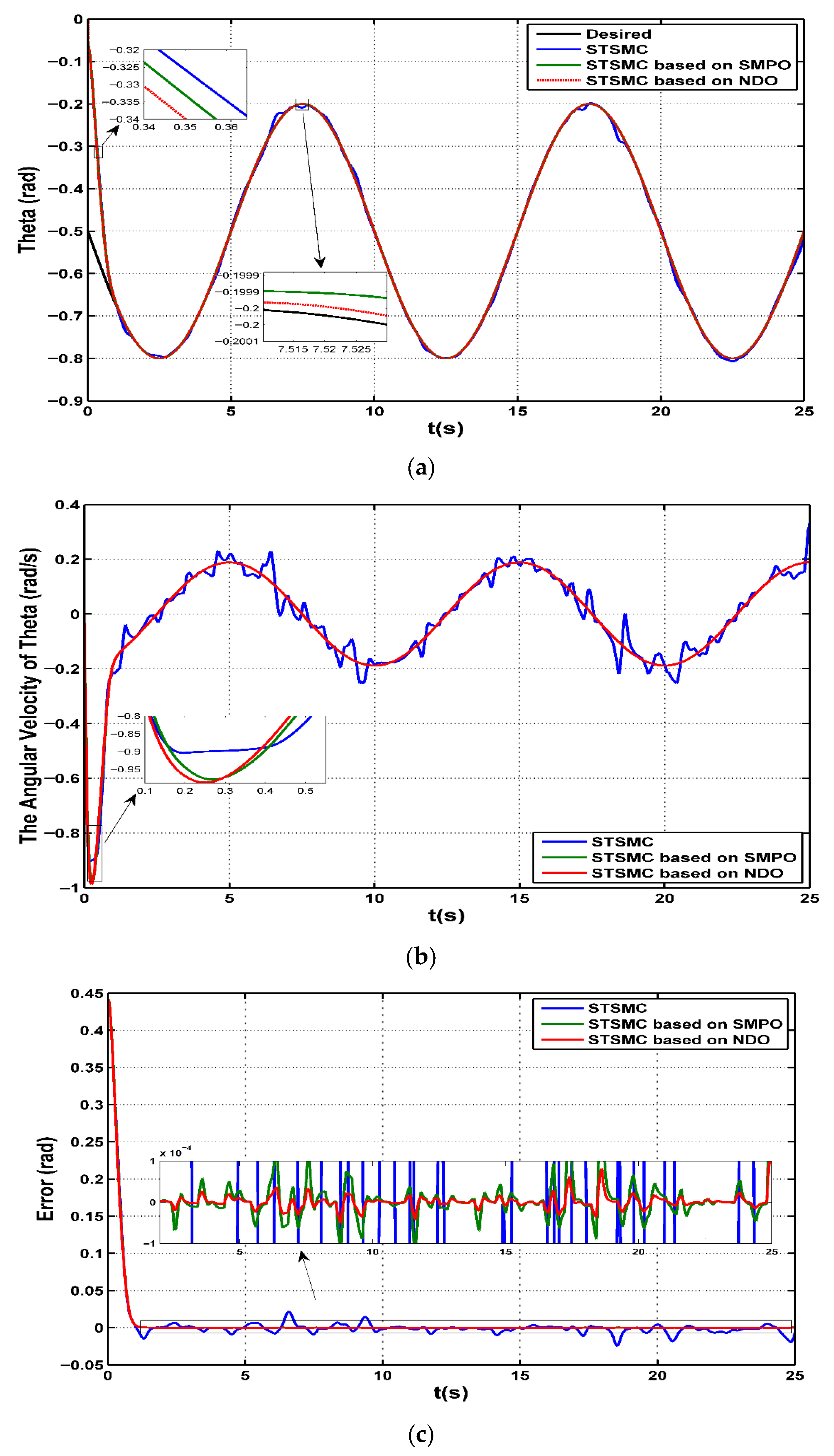
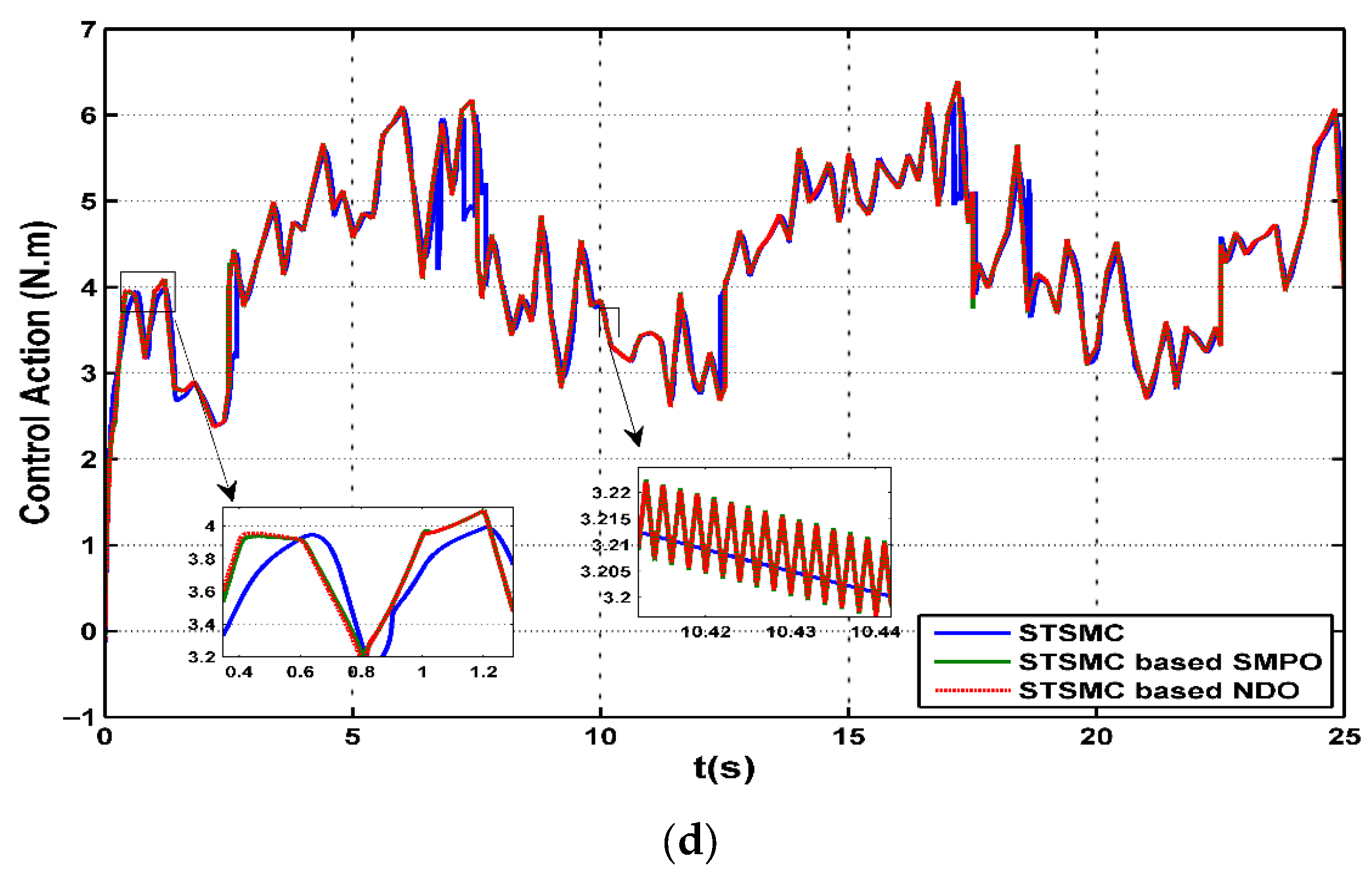
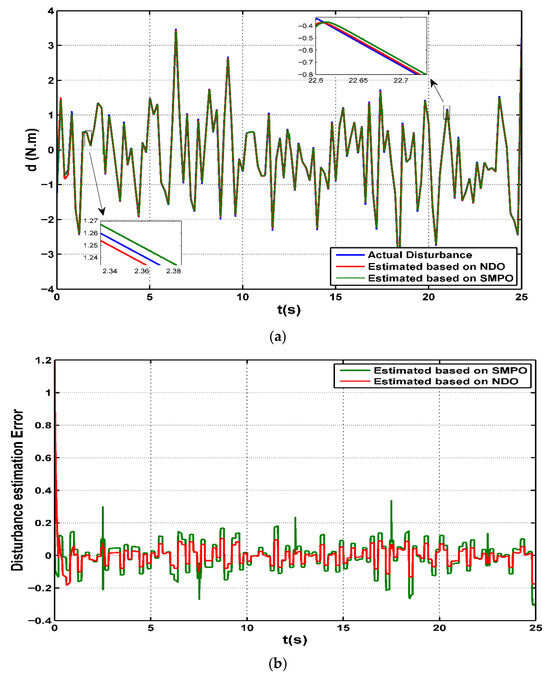
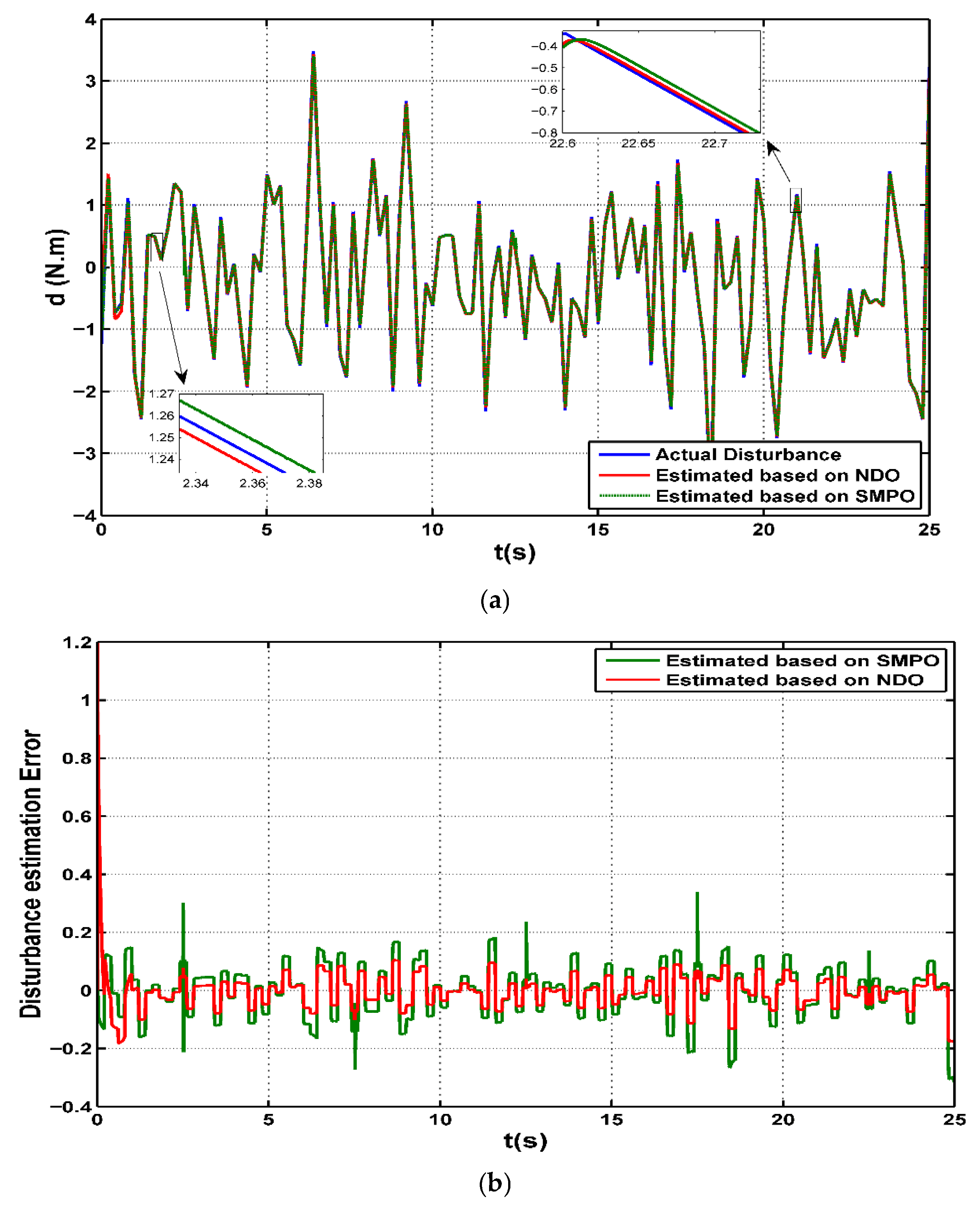
To assess the robustness of proposed observe-based controller, an external disturbance is introduced by exerting torque on the human leg during training,. Figure 4 presents the dynamic responses of the controlled system under turbulent conditions. Specifically, Figure 4a illustrates the knee angle trajectory, Figure 4b depicts the angular velocity response, Figure 4c shows the tracking error, and Figure 4d presents the corresponding control action generated by the proposed control frameworks. In addition, Figure 5 compares the performance of the NDO with that of the SMPO.
Figure 4.
Dynamic responses of the (a) knee angle, (b) angular velocity, (c) error signal, (d) and corresponding control action under turbulent conditions.
Figure 5.
Observer performance: (a) disturbance estimation, (b) disturbance estimation error.
To quantitatively evaluate the performance of the proposed control framework, a number of evaluation functions were used. The root mean square error (RMSE) and root mean square disturbance error (RMSDE) were used to measure the average tracking deviation over time, providing a reliable indicator of tracking accuracy. Additionally, time domain performance indices, integral of the time-weighted absolute error (ITAE), were used to evaluate the proposed control framework’s ability to minimize the steady-state error. Table 3 summarizes the overall efficiency of the EAK system under the proposed control frameworks.
Table 3.
Evaluation of the controlled exoskeleton knee-assist system.
The results of the simulation show that the NDO-based STSMC successfully achieved high-precision tracking performance even under external disturbances, which ensures that the movements required during the rehabilitation sessions are performed completely smoothly. The controller achieved lower RMSE, RMSDE, and ITAE values compared to classic STSMCs and SMPO-based STSMC methods, indicating strong robustness and effective disturbance rejection by the NDO.
4. Conclusions
In this work, the NDO-based STSMC is designed for trajectory tracking by estimating the external disturbance and to reject it within controlled EAK system. The proposed approach integrates the strengths of high-order STSMC with a disturbance observer to enhance the system’s robustness against uncertainties and external disturbance. The performance evaluation of the NDO-based STSMC algorithm showed better performance and robustness characteristics compared to the SMPO-based STSMC and classical STSMC algorithms. The superiority of its performance arises from the NDO’s capability to accurately estimate the external disturbances to be later compensated in the closed loop. In a numeric sense, the NDO-based STSMC exhibited a 22% lower root mean square disturbance error (RMSDE) compared to the SMPO-based STSMC.
In spite of its improved performance due to the proposed control framework, there are some challenging limitations to be solved in the future extension of this study. The noise and saturation of the actuator are the main limitations which have to be taken into account in the design of the proposed controller.
For future work, other control strategies can be suggested and compared to the proposed controller for the same application, such as Adaptive Neural Network Control, adaptive sliding mode control, and Predefined-Time Reliable Control [45,46,47]. Further extension of this study can be made by implementing the proposed control frame-work in a real-time environment. The embedded system design based on the FPGA and graphical system design (based on LabVIEW) can be developed to implement a real-world controlled medical system.
Author Contributions
Conceptualization, F.A.R. and A.F.H.; methodology, E.H.F.; software, A.J.H. and A.F.H.; validation, A.F.H.; formal analysis, F.A.R.; investigation, E.H.F.; resources, A.J.H.; data curation, A.F.H.; writing—original draft preparation, E.H.F.; writing—review and editing, A.J.H.; visualization, F.A.R.; supervision, A.J.H. and A.F.H. All authors have read and agreed to the published version of the manuscript.
Funding
This research received no external funding.
Institutional Review Board Statement
Not applicable.
Informed Consent Statement
Not applicable.
Data Availability Statement
The data presented is within the article.
Conflicts of Interest
The authors declare no conflicts of interest.
References
- Zhu, H. A Large-Scale Prospective Study on Functional Ability and Mortality Following Stroke Based on HRS Data Set: Implications for Rehabilitation. Front. Psychol. 2022, 13, 915653. [Google Scholar] [CrossRef] [Scilit] [PubMed]
- Mohammadi, A.; Marquez, H.J.; Tavakoli, M. Nonlinear Disturbance Observers: Design and Applications to Euler? Lagrange Systems. IEEE Control Syst. 2017, 37, 50–72. [Google Scholar] [CrossRef] [Scilit]
- Zhou, J.; Yang, S.; Xue, Q. Lower limb rehabilitation exoskeleton robot: A review. Adv. Mech. Eng. 2021, 13, 16878140211011862. [Google Scholar] [CrossRef] [Scilit]
- Andersson, R.; Björsell, N.; Systems, E.R. Exoskeleton Robotic Systems; MDPI: Basel, Switzerland, 2024; Volume 12. [Google Scholar] [CrossRef] [Scilit]
- Jayaraman, A.; Marinov, B.; Singh, Y.; Burt, S.; Rymer, W.Z. Current Evidence for Use of Robotic Exoskeletons in Rehabilitation. In Wearable Robotics; Elsevier: Amsterdam, The Netherlands, 2020; pp. 301–310. [Google Scholar] [CrossRef] [Scilit]
- Zhang, M.; Huang, J.; Cao, Y.; Zhang, H.-T. Super Twisting Control of Passive Gait Training Exoskeleton Driven by Pneumatic Muscles. In Proceedings of the 2019 International Symposium on Micro-NanoMechatronics and Human Science (MHS), Aichi, Japan, 1–4 December 2019; pp. 1–7. [Google Scholar] [CrossRef] [Scilit]
- Aole, S.; Elamvazuthi, I.; Waghmare, L.; Patre, B.; Meriaudeau, F. Improved Active Disturbance Rejection Control for Trajectory Tracking Control of Lower Limb Robotic Rehabilitation Exoskeleton. Sensors 2020, 20, 3681. [Google Scholar] [CrossRef] [Scilit]
- Ezhilarasi, D.; Nair, A.S. Modeling and Evaluation of Adaptive Super Twisting Sliding Mode Control in Lower Extremity Exoskeleton. Int. J. Precis. Eng. Manuf. Technol. 2021, 8, 901–915. [Google Scholar] [CrossRef] [Scilit]
- Mokhtari, M.; Taghizadeh, M.; Mazare, M. Impedance control based on optimal adaptive high order super twisting sliding mode for a 7-DOF lower limb exoskeleton. Meccanica 2021, 56, 535–548. [Google Scholar] [CrossRef] [Scilit]
- Rastegar, M.; Kobravi, H.R. A Hybrid-FES Based Control System for Knee Joint Movement Control. Basic Clin. Neurosci. J. 2021, 12, 441–452. [Google Scholar] [CrossRef] [Scilit]
- Yang, Y.; Dong, X.-C.; Wu, Z.-Q.; Liu, X.; Huang, D.-Q. Disturbance-observer-based Neural Sliding Mode Repetitive Learning Control of Hydraulic Rehabilitation Exoskeleton Knee Joint with Input Saturation. Int. J. Control. Autom. Syst. 2022, 20, 4026–4036. [Google Scholar] [CrossRef] [Scilit]
- Jin, X.; Guo, J. Disturbance rejection model predictive control of lower limb rehabilitation exoskeleton. Sci. Rep. 2023, 13, 19463. [Google Scholar] [CrossRef] [Scilit]
- Al-Dujaili, A.Q.; Hasan, A.F.; Humaidi, A.J.; Al-Jodah, A. Anti-disturbance control design of Exoskeleton Knee robotic system for rehabilitative care. Heliyon 2024, 10, e28911. [Google Scholar] [CrossRef] [Scilit]
- He, D.; Wang, H.; Tian, Y. Model-free super-twisting terminal sliding mode controller using sliding mode disturbance observer for n-DOF upper-limb rehabilitation exoskeleton with backlash hysteresis. Int. J. Control. 2024, 97, 756–772. [Google Scholar] [CrossRef] [Scilit]
- Alawad, N.A.; Humaidi, A.J.; Alaraji, A.S. Design of Active Disturbance Rejection Control for Rehabilitation-Assistant Device of Lower Limbs under Cross Coupling Effect. Proc. Inst. Mech. Eng. Part C J. Mech. Eng. Sci. 2024, 238, 7388–7398. [Google Scholar] [CrossRef] [Scilit]
- Qin, L.; Jiang, Z.; He, Z.; Yin, Y.; Ma, J.; Dai, J.; Li, W.; Zhang, Y. Super-Twisting Sliding Mode Control Strategy for Exoskeleton Joint Motor Based on Load Observer. J. Electr. Eng. Technol. 2025, 20, 2407–2417. [Google Scholar] [CrossRef] [Scilit]
- Espinosa-Espejel, K.I.; Rosales-Luengas, Y.; Salazar, S.; Lopéz-Gutiérrez, R.; Lozano, R. Active Disturbance Rejection Control via Neural Networks for a Lower-Limb Exoskeleton. Sensors 2024, 24, 6546. [Google Scholar] [CrossRef] [Scilit] [PubMed]
- Tiaiba, H.; Daachi, M.E.H.; Madani, T. Real-time adaptive super twisting algorithm based on PSO algorithm: Application for an exoskeleton robot. Robotica 2024, 42, 1816–1841. [Google Scholar] [CrossRef] [Scilit]
- Chen, N.; Wang, J.; Yun, L.; Zou, J.; Zhang, C. Research on Trajectory Tracking Control of Lower Limb Exoskeleton Based on Fractional Order Sliding Mode and Disturbance Observer. Adv. Theory Simul. 2025, 8, e00849. [Google Scholar] [CrossRef] [Scilit]
- Wang, Y.; Li, J.; Liang, P.; Ye, R. Dynamics Modeling and Control Strategy Research on Multi-Joint Soft Lower Limb Assistive Exoskeletons. J. Mech. Robot. 2025, 17, 071011. [Google Scholar] [CrossRef] [Scilit]
- Ridha, M.T.; Al-Samarraie, S.A. A Barrier Function-Based Integral Sliding Mode Control of Heart Rate During Treadmill Exercise. Math. Model. Eng. Probl. 2023, 10, 179–188. [Google Scholar] [CrossRef] [Scilit]
- Hamoudi, A.K.; Rasheed, L.T. Design of an Adaptive Integral Sliding Mode Controller for Position Control of Electronic Throttle Valve. J. Eur. Des Systèmes Autom. 2024, 57, 729–735. [Google Scholar] [CrossRef] [Scilit]
- Al-Tamimi, A.; MohammadRidha, T. Adaptive Sliding Mode Control for Structural Vibration Using Magnetorheological Damper. J. Robot. Control. (JRC) 2025, 6, 1308–1315. [Google Scholar]
- Husain, S.S.; Al-Dujaili, A.Q.; Jaber, A.A.; Humaidi, A.J.; Al-Azzawi, R.S. Design of a Robust Controller Based on Barrier Function for Vehicle Steer-by-Wire Systems. World Electr. Veh. J. 2024, 15, 17. [Google Scholar] [CrossRef] [Scilit]
- Ali, L.F.; AL-Samarraie, S.A.; Humaidi, A.J. Performance of Double Pipe Heat Exchanger—Partially Occupied by Metal Foam—Is Better Enhanced Using Robust Adaptive Barrier Function-Based Sliding Mode Control. Energies 2025, 18, 4671. [Google Scholar] [CrossRef] [Scilit]
- Rasheed, L.T. Performance of the adaptive sliding mode control scheme for output voltage control of the DC/DC buck converter system. IOP Conf. Ser. Mater. Sci. Eng. 2020, 881, 012118. [Google Scholar] [CrossRef] [Scilit]
- Al-Tamimi, A.; MohammadRidha, T. Comparison of Adaptive Sliding Mode Controllers in Earthquake Induced Vibrations. J. Robot. Control. (JRC) 2025, 6, 1041–1050. [Google Scholar] [CrossRef] [Scilit]
- Abbas, S.J.; Husain, S.S.; Al-Wais, S.; Humaidi, A.J. Adaptive Integral Sliding Mode Controller (SMC) Design for Vehicle Steer-by-Wire System. SAE Int. J. Veh. Dyn. Stab. NVH 2024, 8, 383–396. [Google Scholar] [CrossRef] [Scilit]
- AL-Samarraie, S.A.; Mahdi, S.M.; Ridha, T.M.M.; Mishary, M.H. Sliding mode control for electro-hydraulic servo system. Iraqi J. Comput. Commun. Control Syst. Eng. 2015, 15, 1–10. [Google Scholar]
- Sherwani, K.I.K.; Kumar, N.; Chemori, A.; Khan, M.; Mohammed, S. RISE-based adaptive control for EICoSI exoskeleton to assist knee joint mobility. Rob. Auton. Syst. 2020, 124, 103354. [Google Scholar] [CrossRef] [Scilit]
- Hameed, A.H.; Al-Samarraie, S.A.; Humaidi, A.J.; Saeed, N. Backstepping-Based Quasi-Sliding Mode Control and Observation for Electric Vehicle Systems: A Solution to Unmatched Load and Road Perturbations. World Electr. Veh. J. 2024, 15, 419. [Google Scholar] [CrossRef] [Scilit]
- Merazka, L.; Zouari, F.; Boulkroune, A. High-gain observer-based adaptive fuzzy control for a class of multivariable nonlinear systems. In Proceedings of the 2017 6th International Conference on Systems and Control (ICSC), Batna, Algeria, 7–9 May 2017. [Google Scholar]
- Hameed, A.H.; Al-Samarraie, S.A.; Humaidi, A.J. Ultimate bounded observer-based control of electrical vehicle driven by DC motor system with unmatched load torque. Adv. Mech. Eng. 2024, 16, 16878132241273549. [Google Scholar] [CrossRef] [Scilit]
- Hameed, A.H.; Al-Samarraie, S.A.; Humaidi, A.J. One-Instant Flux Observer design for Three-Phase induction motor with reduced bound active load rejection speed controller. An. Da Acad. Bras. Cienc. 2024, 96, e20240539. [Google Scholar] [CrossRef] [Scilit]
- Boulkroune, A.; Hamel, S.; Zouari, F.; Boukabou, A. Output-Feedback Controller Based Projective Lag-Synchronization of Uncertain Chaotic Systems in the Presence of Input Nonlinearities. Math. Probl. Eng. 2017, 2017, 8045803. [Google Scholar] [CrossRef] [Scilit]
- Waheed, Z.A.; Humaidi, A.J.; Sadiq, M.E.; Al-Qassar, A.A.; Hasan, A.F.; Al-Dujaili, A.Q.; Ajel, A.R.; Abbas, S.J. Control Of Elbow Rehabilitation System Based on Optimal-Tuned Backstepping Sliding Mode Controller. J. Eng. Sci. Technol. 2023, 18, 584–603. [Google Scholar]
- Haddad, M.; Zouari, F.; Boulkroune, A.; Hamel, S. Variable-structure backstepping controller for multivariable nonlinear systems with actuator nonlinearities based on adaptive fuzzy system. Soft Comput. 2019, 23, 12277–12293. [Google Scholar] [CrossRef] [Scilit]
- Hameed, A.H.; Al-Samarraie, S.A.; Humaidi, A.J. A novel control solution to nonlinear systems of unmatched perturbations with unknown bounds. Meas. Control. 2024, 58, 486–501. [Google Scholar] [CrossRef] [Scilit]
- Atiyah, H.A.; Hassan, M.Y. Outdoor Localization for a Mobile Robot under Different Weather Conditions Using a Deep Learning Algorithm. J. Eur. Syst. Autom. 2023, 56, 1–9. [Google Scholar] [CrossRef] [Scilit]
- Ghane, R.G.; Hassan, M.Y. Advanced Hybrid Nonlinear Control for Morphing Quadrotors. Math. Model. Eng. Probl. 2023, 10, 1216–1224. [Google Scholar] [CrossRef] [Scilit]
- Luning, M.A.; Xiao, Y.; Dongya, Z.; Spurgeon, S.K. Disturbance observer based sliding mode control for a continuous stirred tank reactor (CSTR). In Proceedings of the 2017 36th Chinese Control Conference (CCC), Dalian, China, 26–28 July 2017; pp. 3748–3753. [Google Scholar]
- Feng, Z.; Fei, J. Design and analysis of adaptive Super-Twisting sliding mode control for a microgyroscope. PLoS ONE 2018, 13, e0189457. [Google Scholar] [CrossRef] [Scilit]
- AL-Samarraie, S.A.; Salman, S.D. Backstepping nonlinear control for blood glucose based on sliding mode meal observer. Al-Nahrain J. Eng. Sci. 2018, 21, 436–444. [Google Scholar] [CrossRef] [Scilit]
- Raheem, R.S.; Hassan, M.Y.; Kadhim, S.K. Particle swarm optimization based interval type 2 fuzzy logic control for motor rotor position control of artificial heart pump. Indones. J. Electr. Eng. Comput. Sci. 2022, 25, 814–824. [Google Scholar] [CrossRef] [Scilit]
- Liu, Z.; Zhang, O.; Gao, Y.; Zhao, Y.; Sun, Y.; Liu, J. Adaptive Neural Network-Based Fixed-Time Control for Trajectory Tracking of Robotic Systems. IEEE Trans. Circuits Syst. II: Express Briefs 2023, 70, 241–245. [Google Scholar] [CrossRef] [Scilit]
- Liu, J. Predefined-Time Reliable Control for Robotic Systems with Prescribed Performance. IEEE Trans. Ind. Electron. 2025, 72, 11695–11703. [Google Scholar] [CrossRef] [Scilit]
- Liu, Z.; Liu, J.; Zhang, O.; Zhao, Y.; Chen, W.; Gao, Y. Adaptive Disturbance Observer-Based Fixed-Time Tracking Control for Uncertain Robotic Systems. IEEE Trans. Ind. Electron. 2024, 71, 14823–14831. [Google Scholar] [CrossRef] [Scilit]

Disclaimer/Publisher’s Note: The statements, opinions and data contained in all publications are solely those of the individual author(s) and contributor(s) and not of MDPI and/or the editor(s). MDPI and/or the editor(s) disclaim responsibility for any injury to people or property resulting from any ideas, methods, instructions or products referred to in the content. |
© 2026 by the authors. Licensee MDPI, Basel, Switzerland. This article is an open access article distributed under the terms and conditions of the Creative Commons Attribution (CC BY) license.