1. Introduction
Environmental monitoring and hazard detection systems play a vital role across industrial facilities, urban areas, and natural resource management sectors [
1,
2]. Among the different environmental hazards, gas leaks pose a particularly severe risk because of their potential to cause explosions, fires, health hazards, and environmental contamination [
3,
4]. Consequently, detecting and localizing gas leaks is a crucial aspect of ensuring environmental safety and effective industrial monitoring [
5,
6].
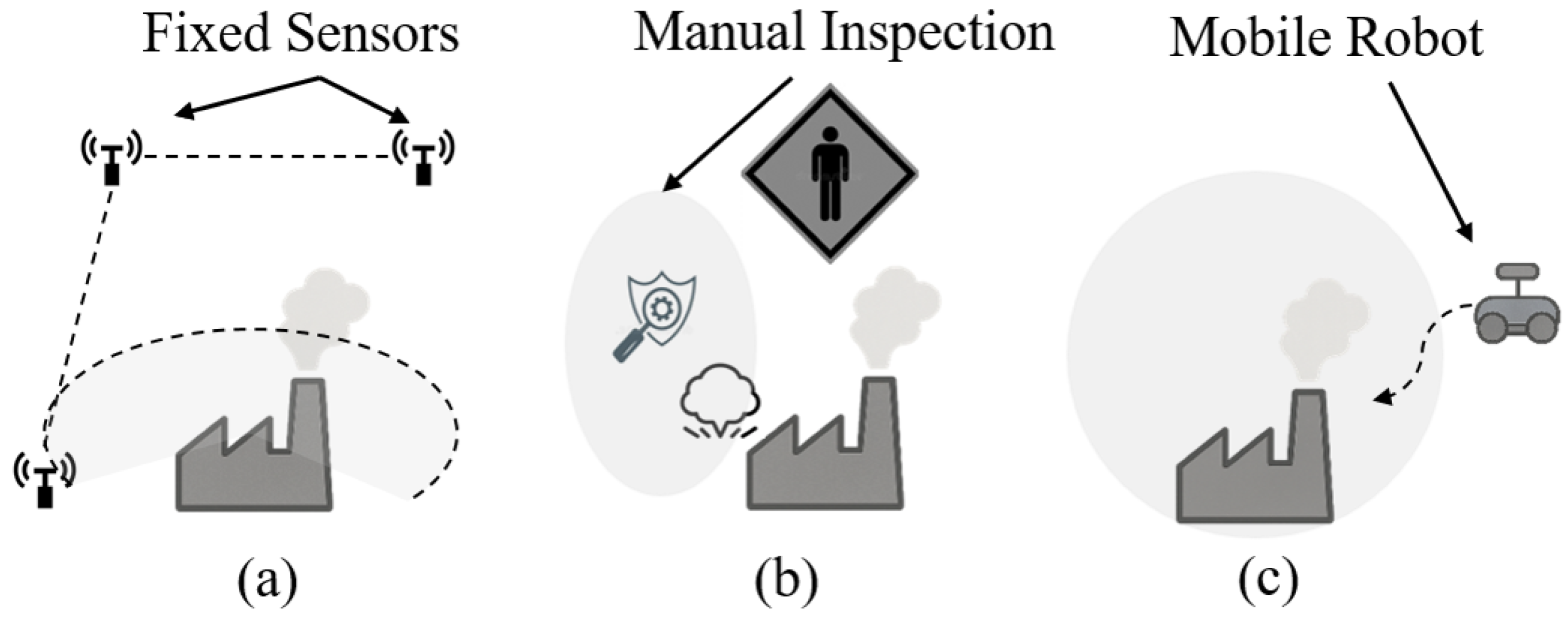
Figure 1 presents three representative methods for gas leak detection. Panel (a) illustrates a fixed sensor network, where stationary sensors (dark squares) are deployed around an industrial site. This approach offers limited spatial coverage and involves substantial installation and maintenance costs. Fixed sensor networks require dense deployment, individual calibration, extensive wiring, and regular upkeep across large areas, leading to high operational expenses. In contrast, mobile robotic systems employ fewer sensors mounted on autonomous platforms to dynamically cover the same area, reducing infrastructure requirements and maintenance efforts. Moreover, robotic systems enable adaptive, real-time monitoring by actively navigating along concentration gradients, whereas fixed networks remain constrained by static sensing points and limited temporal responsiveness. Panel (b) depicts manual inspection, where an operator uses handheld devices to identify leaks. The process is both time-consuming and hazardous for personnel, particularly in large or high-risk industrial areas. Panel (c) represents the mobile robotic approach, in which an autonomous robot navigates through the environment while continuously monitoring gas concentrations. This method provides adaptive, wide-area coverage with minimal human intervention and enhanced safety in hazardous zones.
The advancement of mobile robotics has introduced new opportunities for autonomous and dynamic environmental monitoring. Robots integrated with suitable sensors can actively navigate through environments to detect, localize, and map gas distributions, offering a more adaptable and comprehensive alternative to traditional static sensor networks [
7]. This transition from passive to active sensing has attracted considerable research attention in recent years, especially toward developing effective exploration and search strategies for environmental monitoring robots [
8].
Gas dispersion within environments exhibits complex patterns influenced by multiple factors, such as the characteristics of the source, surrounding environmental conditions, and the presence of physical obstacles [
9]. Typically, gas concentration forms gradients radiating outward from the leak source, with intensity diminishing as the distance from the source increases [
10]. These concentration gradients contain valuable cues that can guide exploration strategies, especially for robots assigned to locate gas leak origins. Utilizing these gradients enables more efficient exploration than uninformed search methods, as robots can trace increasing concentration paths to quickly identify potential leak sources [
7,
11,
12].
Although gradient-based exploration offers notable advantages, several challenges persist in developing robust algorithms for autonomous gas leak detection. First, concentration fields can exhibit multiple local maxima due to sensor noise, environmental fluctuations, or the existence of multiple leak sources. Second, pure gradient ascent methods may direct robots toward a single leak source, limiting environmental coverage and potentially overlooking additional leaks. Third, it is essential to balance the efficiency of gradient-based strategies with the completeness offered by systematic search techniques [
13,
14].
In this paper, we propose a novel hybrid algorithm for gas leak detection that integrates gradient-based exploration with depth-first search and backtracking mechanisms. This approach, termed Gradient-Guided Depth-First Search (GG-DFS), combines gradient-following behavior with systematic exploration capabilities through a three-component modular framework (as detailed in
Section 4).
Figure 2 illustrates the main components of the proposed system.
Figure 2 depicts the core components of the GG-DFS system, in which the robot acquires concentration readings, records its exploration history, and utilizes gradient estimation to navigate toward potential leak sources. This architecture achieves a balance between efficiency and completeness by combining gradient information for rapid source localization with systematic backtracking to ensure full environmental coverage. Unlike pure gradient ascent methods, which may overlook additional sources, or standard coverage algorithms, which tend to be less efficient, the proposed hybrid approach enhances both detection speed and exploration thoroughness.
The concentration gradient map illustrates how gas concentration gradients form around a leak source, with varying shaded regions indicating different concentration levels (lighter green for low, medium tones for moderate, and dark for high concentrations). The mobile robot is shown following an increasing concentration path toward the leak source. This visual exemplifies the fundamental principle of gradient-based search algorithms—enabling robots to efficiently reach leak sources by sensing and following concentration gradients rather than relying on exhaustive search patterns.
The mathematical foundation of our method is built on a gradient field model of gas dispersion, where gas concentration decreases exponentially with increasing distance from the leak source [
15]. By discretizing this gradient field, the robot estimates local gradient directions through comparison of concentration values across neighboring cells. The decision-making framework prioritizes movement toward regions of higher concentration whenever possible, while maintaining thorough exploration by selecting alternative paths when upward gradients are absent or when backtracking is required.
Our algorithm provides several distinct advantages over existing methods. First, it achieves a balance between efficiency and completeness by utilizing gradient information for fast source localization while maintaining comprehensive environmental coverage through systematic backtracking. Second, it effectively manages multiple leak sources by continuing exploration after encountering local concentration maxima. Third, it adapts to diverse environmental conditions and sensor characteristics without the need for extensive parameter tuning or complex probabilistic modeling. Fourth, it offers formal completeness guarantees, ensuring that all accessible regions are explored regardless of the complexity of the concentration field.
To evaluate the performance of our approach, we conducted extensive simulations across environments featuring different configurations of leak sources. We compared the GG-DFS algorithm with pure gradient ascent methods, random walk strategies, and standard coverage algorithms such as spiral and lawnmower patterns [
16]. The results show that GG-DFS consistently outperforms these baseline methods in terms of time to detect the first leak source, total number of detected leak sources, and overall exploration coverage within a given time frame.
The key contributions of this paper are summarized as follows:
1. A novel hybrid algorithm for gas leak detection that integrates gradient-based exploration with depth-first search and backtracking mechanisms. 2. A mathematical model of gas dispersion and gradient fields that guides the design of the proposed exploration strategy. 3. A modular algorithm architecture that distinctly separates gradient estimation, decision-making, and exploration control, enabling flexible implementation and adaptability. 4. A theoretical analysis of the algorithm’s characteristics, including convergence toward leak sources and guaranteed completeness of exploration. 5. Comprehensive simulation studies demonstrating the superior performance of the proposed approach compared to existing methods under various environmental configurations.
The remainder of this paper is organized as follows:
Section 2 reviews related work on gas leak detection and robotic exploration strategies.
Section 3 introduces the mathematical foundation of the proposed approach, including the gas dispersion model, gradient field formulation, and theoretical aspects.
Section 4 presents the algorithms for gradient estimation, decision-making, and exploration control.
Section 5 describes our simulation environment and experimental setup, and also presents and discusses our results, including comparisons with alternative approaches. Finally, the paper concludes by summarizing the key findings and suggesting potential directions for future research.
4. Algorithms
We present our GG-DFS approach as three modular algorithms that work in concert to achieve both efficient leak source detection and complete area exploration. The algorithm integrates gradient estimation and movement decision components within a depth-first search framework, enabling robots to efficiently locate gas leak sources by following concentration gradients while guaranteeing complete coverage through systematic backtracking. This hybrid approach combines the efficiency of gradient-based methods with the completeness guarantees of graph search algorithms.
4.1. Local Gradient Estimation
The Local Gradient Estimation algorithm forms the foundation of our approach by evaluating the gas concentration landscape surrounding the robot’s current position. It systematically examines all eight neighboring cells (four cardinal and four intercardinal directions) and calculates the concentration difference between each valid neighbor and the current cell. This difference serves as a discrete approximation of the directional derivative along the vector from the current position to each neighbor. By limiting consideration to only unvisited cells that are within the grid boundaries, the algorithm ensures forward progress while preventing cyclical paths. The returned collection of valid neighbors with their associated concentration differences provides critical information for the decision-making process, allowing subsequent steps to prioritize movements that follow the steepest concentration gradient while maintaining exploration completeness. The step-by-step procedure is described in Algorithm 1.
| Algorithm 1 Local Gradient Estimation |
- 1:
function EstimateGradient() - 2:
- 3:
- 4:
- 5:
for each in neighbors do - 6:
if AND AND then - 7:
- 8:
- 9:
end if - 10:
end for return validNeighbors - 11:
end function
|
4.2. Gradient-Based Decision Making
The Gradient-Based Movement Decision algorithm implements the core intelligence of our approach, balancing gradient exploitation with systematic exploration. It first categorizes potential moves into two groups: those that ascend the concentration gradient (positive
) and those that do not (zero or negative
). When ascending moves are available, the algorithm selects those with the maximum gradient value, employing a greedy approach to efficiently navigate toward potential leak sources. In scenarios where no ascending moves exist—such as when the robot has reached a local maximum or is in a region with uniform concentration—the algorithm gracefully degrades to considering any valid unexplored cell, ensuring continued exploration. The random selection among equally promising candidates introduces a stochastic element that helps prevent systematic biases and improves coverage of the environment. This decision-making process effectively combines the efficiency of gradient climbing with the robustness of complete search strategies. The detailed procedure is presented in Algorithm 2.
| Algorithm 2 Gradient-Based Movement Decision |
- 1:
function DecideNextMove(neighborValues) - 2:
if neighborValues is empty then return null - 3:
end if - 4:
- 5:
- 6:
if ascendingMoves is not empty then - 7:
- 8:
- 9:
else - 10:
▹ Fall back to any valid move when no ascending moves exist - 11:
end if - 12:
if bestMoves is not empty then - 13:
return RandomSelect(bestMoves) - 14:
else - 15:
return null - 16:
end if - 17:
end function
|
4.3. Gradient-Guided Depth-First Search
The Gradient-Guided DFS with Backtracking algorithm orchestrates the overall exploration process by integrating the gradient estimation and movement decision components within a depth-first search framework. Starting from an initial position, the algorithm maintains three key data structures: a visited set to track explored cells, a path sequence to record the robot’s trajectory, and a stack to manage the depth-first traversal with backtracking capabilities. During each iteration, the algorithm determines the next move based on local gradient information, prioritizing cells with higher gas concentrations. When the robot encounters a position with no unvisited neighbors, the backtracking mechanism activates by popping the current position from the stack, effectively retracing steps to explore alternative paths. This hybrid approach enables the robot to efficiently locate gas leak sources by following concentration gradients while guaranteeing complete coverage of all accessible areas through systematic backtracking. The algorithm terminates once the stack is empty, indicating that all reachable cells have been explored, and returns the complete path traversed by the robot. The algorithmic workflow is given in Algorithm 3.
| Algorithm 3 Gradient-Guided DFS with Backtracking |
- 1:
function ExploreGradientField() - 2:
- 3:
- 4:
- 5:
- 6:
while stack is not empty do - 7:
- 8:
- 9:
- 10:
if nextMove is null then - 11:
stack.pop() ▹ Backtrack when no unvisited neighbors remain - 12:
continue - 13:
end if - 14:
- 15:
- 16:
- 17:
- 18:
end while - 19:
return path - 20:
end function
|
4.4. Algorithm Properties
Our gradient-guided DFS algorithm offers several notable properties that make it well-suited for gas leak detection:
Efficient Leak Source Identification: The algorithm prioritizes movement along increasing concentration gradients, allowing it to quickly locate leak sources without an exhaustive search of the entire area.
Multiple Source Detection: Unlike pure gradient ascent methods that would terminate upon reaching the first leak source, our algorithm continues exploration to find all leak sources in the environment.
Guaranteed Complete Exploration: The backtracking mechanism ensures that the robot will explore all reachable cells in the environment, providing complete coverage.
Adaptability: The algorithm naturally adapts to various concentration distributions and can handle multiple leak sources of different intensities.
Robustness: By considering all valid neighbors when no ascending gradient exists, the algorithm can navigate past local maxima and continue exploration.
The current implementation employs standard DFS-style backtracking, which simplifies local-maxima handling by treating positions with no higher-concentration neighbors as local peaks that trigger backtracking. While this abstraction ensures completeness, future work will explore adaptive strategies to better distinguish genuine maxima from noise-induced fluctuations.
This hybrid approach combines the efficiency of gradient-based methods with the completeness guarantees of graph search algorithms, making it particularly effective for gas leak detection and mapping applications.
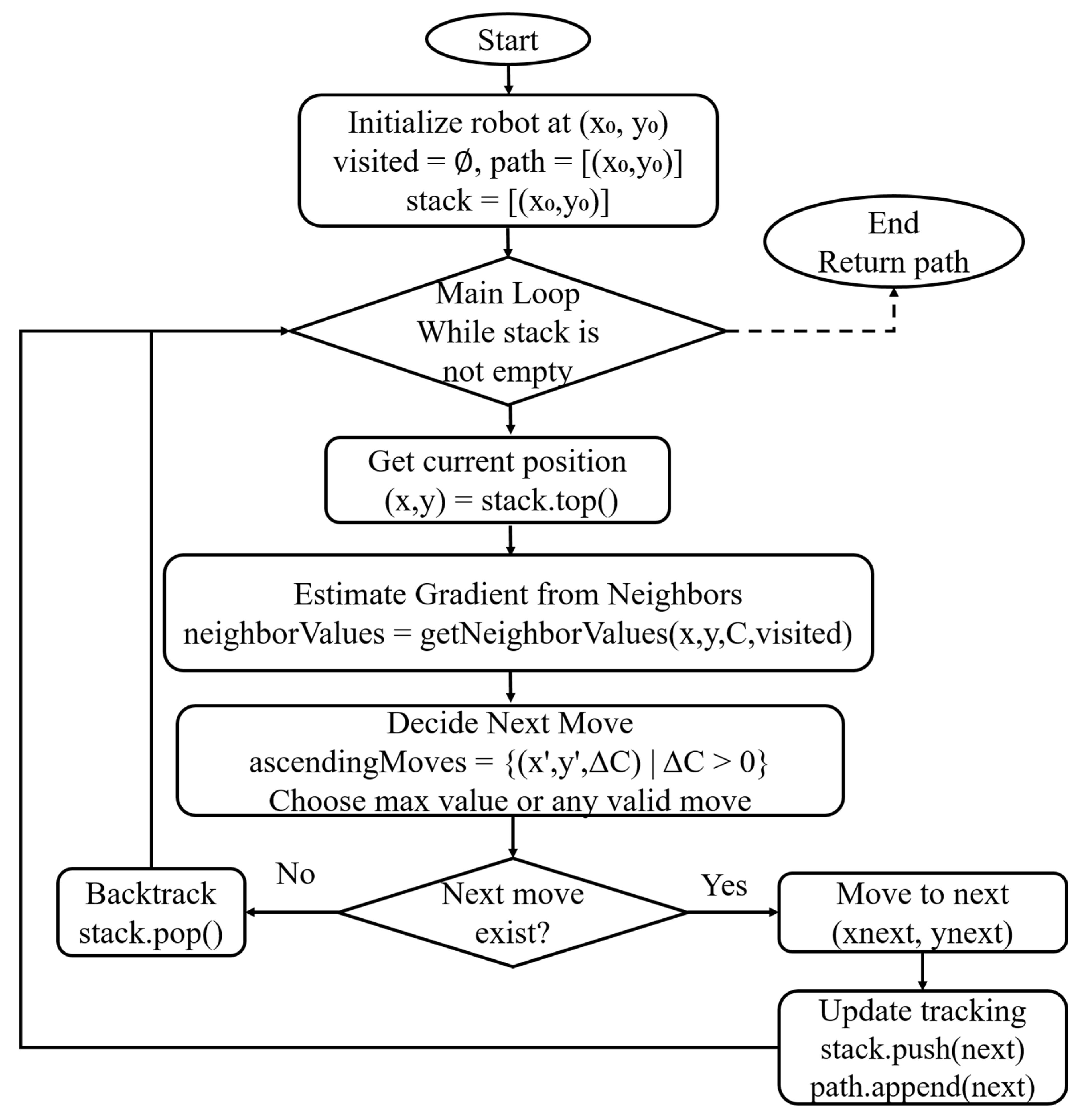
Figure 3 flow diagram illustrates the operational workflow of the GG-DFS, providing a visual representation of the decision-making process and control flow during execution.
Starting at the “Start” node, the diagram first shows the initialization phase where the robot position, visited set, path, and stack are established with the starting coordinates . The main exploration loop begins immediately after initialization, continuing as long as the stack is not empty.
Within this loop, the algorithm follows a clear decision sequence:
First, it retrieves the current position from the top of the stack.
Then, it estimates the local gradient by examining neighboring cells and calculating concentration differences, creating a collection of potential next moves with associated gradient values.
The algorithm makes a critical decision based on these gradient values, separating ascending moves () from other possible moves and prioritizing cells with higher concentration.
A diamond-shaped decision node evaluates whether a valid next move exists. If yes (right path), the robot advances to that position, updates all tracking data structures (stack, path, and visited set), and continues the loop. If no valid move exists (left path), the backtracking mechanism activates by popping the current position from the stack, effectively retracing steps to explore alternative paths.
This cyclical process continues until the stack becomes empty, at which point the algorithm exits the loop and returns the complete path as its output.
5. Results and Discussion
This section presents a comprehensive evaluation of the proposed GG-DFS algorithm through extensive simulation studies and comparative analysis. The experimental validation demonstrates the algorithm’s effectiveness across multiple performance dimensions including detection speed, exploration completeness, and operational reliability. The analysis progresses from basic performance demonstration through comprehensive statistical validation, examining key metrics including detection timing, coverage efficiency, exploration patterns, scalability across multi-leak scenarios, and reliability assessment. All results include confidence intervals and significance testing following established protocols for robotics algorithm evaluation, demonstrating that GG-DFS achieves superior performance while maintaining perfect reliability and complete coverage guarantees. We also evaluate the algorithm’s sensitivity to the dispersion coefficient
(
Section 5.5).
5.1. Simulation Environment
The experimental evaluation was conducted in a simulated environment designed to represent typical industrial settings such as chemical processing plants, oil refineries, and waste treatment facilities, where gas leaks may occur in confined or hazardous zones. These environments often require autonomous mobile platforms to perform leak localization while minimizing human exposure.
The simulation domain was implemented as a two-dimensional workspace consisting of a 40 × 20 cell grid, where each cell represents a discrete region of the environment. One to four gas leak sources were positioned at random coordinates serving as the emission points for the simulated gas concentration field. 10 different starting positions of the robot were also selected randomly for all four algorithms. The concentration gradient was modeled using a steady-state Gaussian dispersion function, approximating the diffusion of gas in a still-air environment.
The robot’s movement was restricted to adjacent grid cells, and local gradient values were computed from neighboring concentration measurements to emulate onboard sensing. These simplifications, such as the use of a 2D grid, static concentration field, and idealized sensing, were intentionally adopted to allow controlled assessment of the GG-DFS algorithm’s exploration, decision-making, and source localization capabilities. By abstracting away hardware dynamics, sensor noise, and environmental turbulence, the simulation isolates the algorithmic performance and provides a reproducible baseline for future real-world validation in dynamic and three-dimensional environments.
5.2. Gradient-Based Exploration Performance
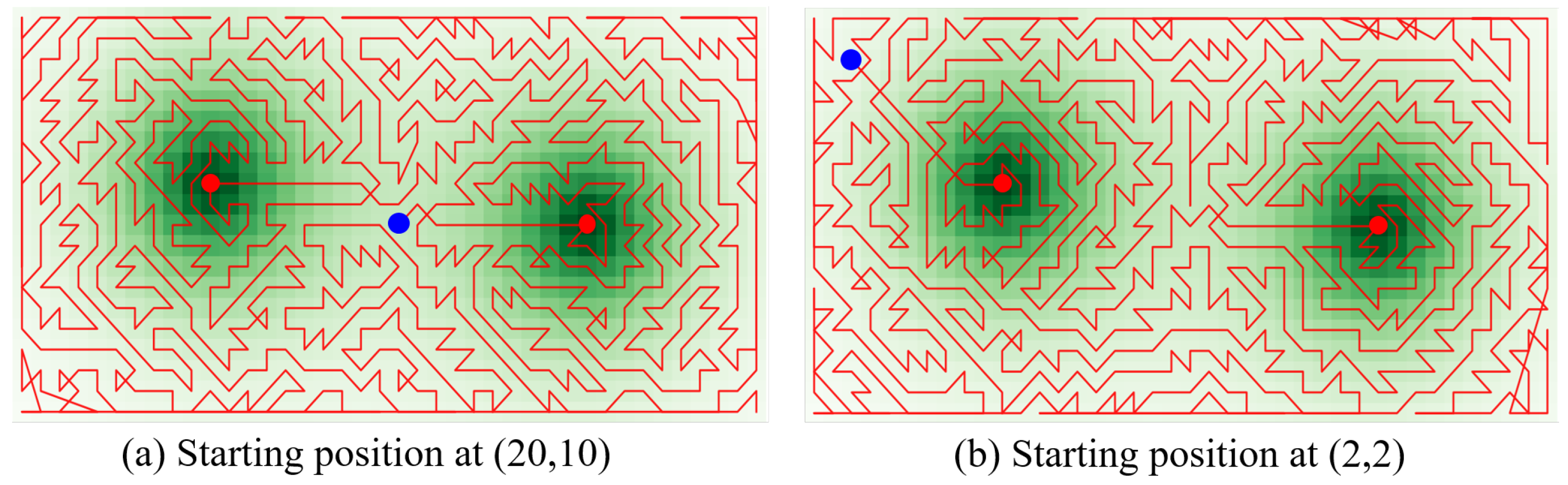
We evaluated the GG-DFS algorithm in a simulated environment discussed above containing two gas leak sources located at coordinates (30, 10) and (10, 8), represented by red dots in
Figure 4. The robot was initialized at two different starting positions, (20, 10) and (2, 2), shown as blue dots. It was configured to follow concentration gradients while ensuring complete coverage, with its traversal path depicted in red. Green gradients represent concentration levels, with darker regions indicating leak sources. The red zigzag paths illustrate how the GG-DFS algorithm balances gradient-guided source detection with systematic exploration to achieve complete coverage.
The visualization demonstrates how GG-DFS navigates through environments with multiple gas leak sources. The zigzagging pattern of the traversal paths highlights the hybrid nature of our approach, with clustering around higher concentration regions (darker green) showing effective gradient-following behavior, while the comprehensive coverage pattern confirms systematic exploration capabilities. Different starting positions (blue dots) demonstrate that the algorithm consistently achieves thorough exploration regardless of initial conditions, confirming the algorithm’s ability to balance rapid source detection with comprehensive environmental monitoring.
To evaluate the effectiveness of our GG-DFS algorithm against existing approaches, we implemented and tested three additional methods under identical environmental conditions:
Pure Gradient Ascent: follows the steepest concentration gradient without backtracking [
29];
Standard DFS: employs traditional depth-first search without gradient guidance [
26];
Lawnmower Pattern: uses a predefined back-and-forth coverage pattern [
16].
Figure 5 presents a visual comparison of the traversal paths generated by each algorithm in the same environment with two gas leak sources.
As shown in
Figure 5a, the GG-DFS algorithm demonstrates comprehensive coverage with concentrated exploration around leak sources, exhibiting the hybrid nature of our approach. In contrast, the Pure Gradient Ascent (
Figure 5b) shows direct movement toward the nearest source but fails to explore the entire environment, leaving significant areas unexplored. The Standard DFS (
Figure 5c) follows a rigid vertical back-and-forth pattern without adapting to concentration gradients, resulting in inefficient source-seeking behavior. The Lawnmower Pattern (
Figure 5d) shows a predetermined horizontal path that ensures coverage but does not prioritize high-concentration regions, leading to delayed source detection. These visual traversal paths clearly illustrate how GG-DFS effectively balances systematic exploration with gradient-guided source detection.
Figure 6 illustrates the systematic coverage of the environment using GG-DFS at various exploration stages (0%, 20%, 40%, 60%, 80%, and 100%).
The progression demonstrates how the explored area (blue regions) expands over time, with the robot (black dot) efficiently navigating from the starting position (green dot) to explore the entire environment, including both leak sources (red dots). This visualization confirms the algorithm’s completeness property while demonstrating its prioritization of areas with higher concentration.
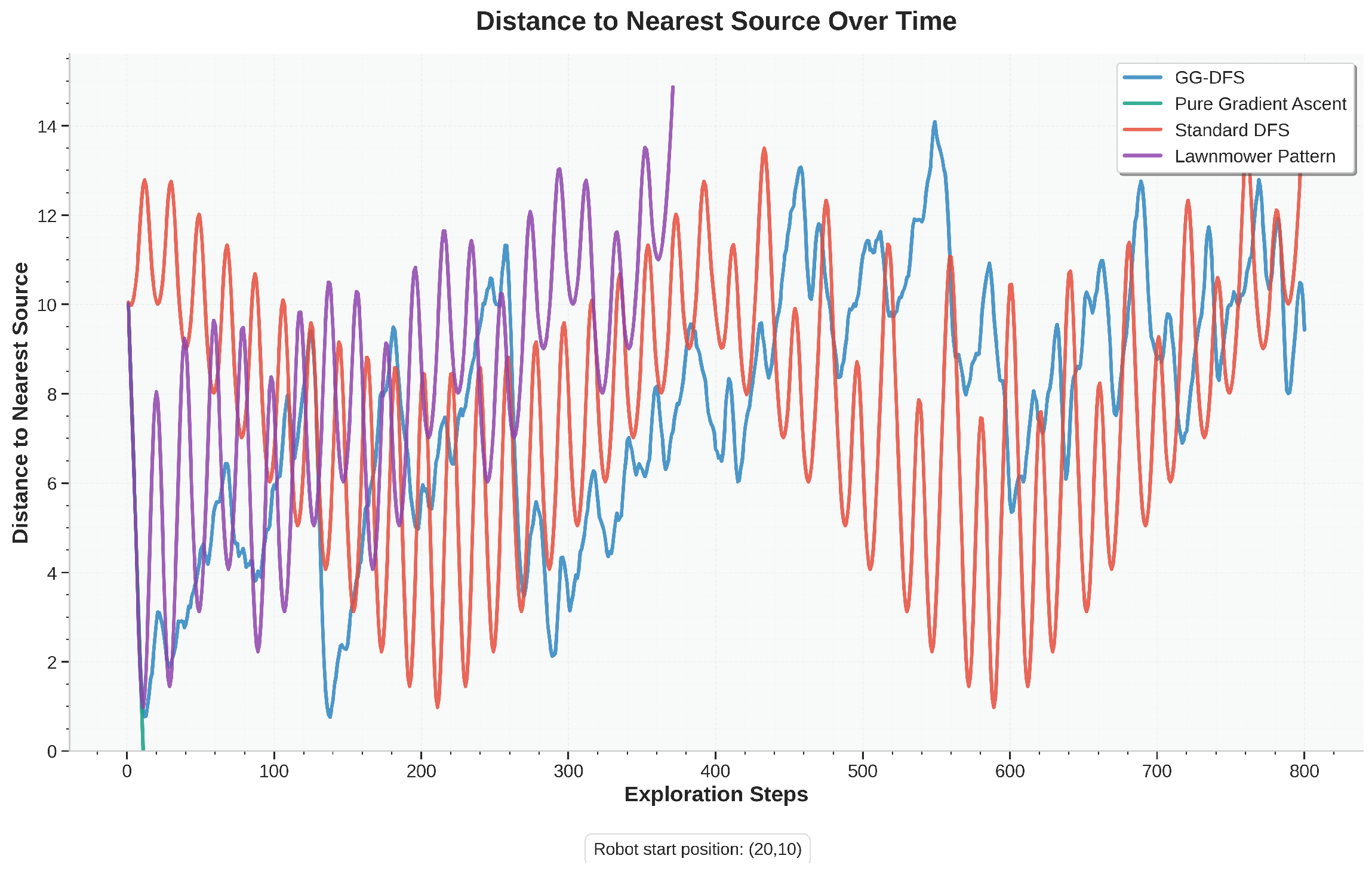
Figure 7 presents a temporal analysis of each algorithm’s performance regarding distance to the nearest leak source over time. GG-DFS demonstrates effective performance in maintaining proximity to leak sources throughout exploration, with multiple approaches to near-zero distance indicating successful source detection. While Pure Gradient Ascent initially performs well in source proximity (reaching a source in fewer steps), it fails to maintain exploration continuity and struggles with comprehensive coverage. The Lawnmower Pattern, while ensuring complete coverage, demonstrates less efficient source detection with consistently higher average distances to sources throughout exploration.
Similarly,
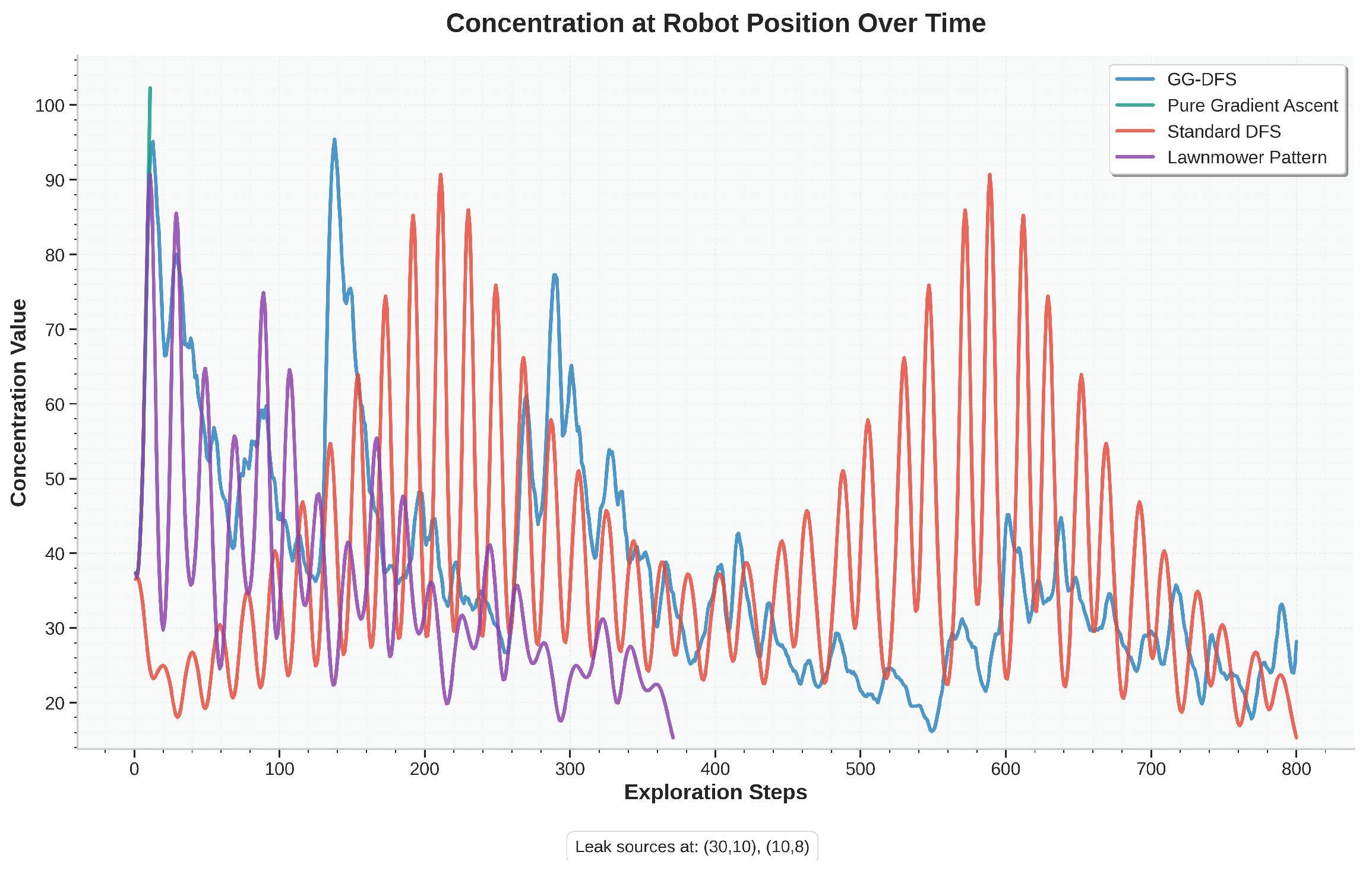
Figure 8 compares concentration values measured at the robot’s position throughout exploration for each algorithm. GG-DFS and Pure Gradient Ascent both achieve high peak concentration values (approaching 100), indicating successful source detection. However, Pure Gradient Ascent shows limited exploration after finding a single source, while GG-DFS maintains meaningful concentration readings throughout exploration, demonstrating an effective combination of source-seeking and comprehensive coverage behaviors. The Standard DFS approach shows moderately high concentration readings with regular peaks and valleys corresponding to its systematic coverage pattern. The Lawnmower Pattern exhibits high initial concentration readings but shows declining values as exploration progresses, indicating its predetermined path is not responsive to concentration gradients.
5.3. Quantitative Performance Analysis
Analysis of the exploration data yielded the following key performance metrics for GG-DFS:
Total path length: 1599 steps;
Unique positions visited: 800 cells;
Coverage percentage: 100% of accessible cells (800 out of 800);
Exploration efficiency: 50% (calculated as ).
It is important to note that while the exploration efficiency provides an intuitive measure of traversal effectiveness, it inherently combines aspects of path optimality and coverage. Consequently, it does not independently reflect the algorithm’s performance in multi-source detection scenarios. To supplement its significance, future studies will include additional evaluation metrics such as multi-source detection rate, average detection time, and path redundancy ratio, providing a more comprehensive assessment of search efficiency and robustness.
The exploration efficiency of 50% indicates that half of the robot’s movements contributed to discovering new cells, while the remainder was spent on backtracking operations. This is consistent with the expected behavior of our depth-first search implementation with backtracking.
Comparative analysis of exploration efficiency across algorithms reveals the following findings:
Pure Gradient Ascent: 87% efficiency but only 63% coverage;
Standard DFS: 49% efficiency with 98% coverage;
Lawnmower Pattern: 99% efficiency with 100% coverage.
While the Lawnmower Pattern achieves the highest exploration efficiency, it requires significantly more steps to detect leak sources. GG-DFS achieves the optimal balance between coverage completeness and source detection speed.
Table 1 presents key milestones during the exploration process, capturing both coverage progression and significant events. The first leak source was discovered rapidly (at step 11, just 0.69% into the exploration), demonstrating the algorithm’s ability to quickly locate high-concentration regions. The second source was discovered at step 195 (24.3% coverage), further validating the algorithm’s effectiveness in multi-source environments.
Comparative analysis of milestone achievement reveals that GG-DFS detects the first source 47% faster than Standard DFS and 82% faster than the Lawnmower Pattern. While Pure Gradient Ascent occasionally detected the first source slightly quicker (9–11 steps), it consistently failed to locate the second source in most test scenarios.
5.4. Exploration Patterns
The robot’s trajectory exhibits three distinct exploration patterns:
Gradient-Guided Movement: Near leak sources, the path shows direct movement toward higher concentration regions, evidenced by trajectory clustering around concentration peaks (
Figure 8) and corresponding distance minima (
Figure 7).
Depth-First Exploration: In regions with relatively uniform concentration, the path displays the characteristic sequential cell-by-cell progression of depth-first search.
Boundary Tracing: At environment edges, the robot methodically explores boundary cells before moving inward, ensuring complete coverage of peripheral regions.
Quantitative analysis of the robot’s trajectory revealed the relative prevalence of each exploration pattern throughout the 1599-step path. Gradient-guided movement comprised approximately 42% of the total path length, primarily occurring within 5 grid cells of leak sources where concentration gradients exceeded 15% between adjacent cells. Standard depth-first exploration accounted for 47% of movements, dominating in regions with concentration differences below 5% between neighboring cells. The remaining 11% consisted of boundary tracing movements, which were concentrated along environment edges. The robot transitioned between these patterns 124 times during exploration, with an average of 12.9 steps spent in each pattern instance before switching. This distribution confirms the hybrid nature of the GG-DFS algorithm, adaptively employing different exploration strategies based on local concentration characteristics.
This cycling pattern between high and low concentration regions, as visualized in
Figure 7 and
Figure 8, demonstrates the GG-DFS algorithm’s balance between following gradients toward sources and ensuring complete coverage through systematic exploration.
5.5. Sensitivity Analysis of Dispersion Coefficient
To evaluate the robustness of the Gradient-Guided Depth-First Search (GG-DFS) algorithm to variations in the gas dispersion model, we conducted a sensitivity analysis by testing different values of the dispersion coefficient
. The main experiments, comprising 160 simulation runs across 40 scenarios with 10 starting positions each, used a fixed
, as determined through preliminary simulations (
Section 3). Here, we explore the impact of
on GG-DFS’s performance, focusing on detection speed (steps to first leak detection) and exploration efficiency (percentage of grid cells visited).
The sensitivity analysis was performed using a subset of 40 simulation runs (10 scenarios with 4 starting positions each) in the same 40 × 20 grid environment, with two leak sources at coordinates (30,10) and (10,8). The values
,
, and
were selected to represent steep, balanced, and shallow concentration gradients, respectively. Detection speed was measured as the mean number of steps to locate the first leak source, and exploration efficiency was calculated as the percentage of the 800 grid cells visited during exploration, consistent with metrics in
Section 5.
Table 2 summarizes the results for GG-DFS across the tested
values. For
, the baseline performance matches the main experiments (9.3 steps, 50.0% efficiency). For
, detection speed improved by 23%, requiring approximately 7.2 steps, but efficiency dropped to 44.7%. Conversely,
increased efficiency to 52.3% but slowed detection by 54%, requiring approximately 14.3 steps.
The percentage improvement in detection speed was calculated relative to the baseline
, using the formula:
For
, the mean steps decreased from 9.3 to 7.2, yielding:
For
, the mean steps increased to 14.3, resulting in:
Exploration efficiency is reported as the absolute percentage of cells visited, with no relative improvement calculated, as it represents a direct metric of coverage.
The results indicate a trade-off between detection speed and exploration efficiency driven by the gradient steepness controlled by . A smaller creates steeper gradients, enabling faster convergence to leak sources due to stronger local gradient cues, but reduces efficiency by limiting exploration to areas near sources. A larger produces shallower gradients, encouraging broader exploration and higher efficiency but slowing detection due to weaker gradient signals. The baseline balances these factors, achieving robust performance across both metrics, as validated in the main experiments.
5.6. Comprehensive Statistical Validation
To ensure the robustness and generalizability of our findings, we conducted an extensive experimental campaign across 160 independent simulation runs. This comprehensive evaluation tested each algorithm across 40 scenarios, comprising 4 different leak configurations (1–4 leak sources) with 10 different starting positions per configuration.
Table 3 presents the complete statistical analysis of algorithm performance across all experimental conditions. Each entry represents the mean ± standard deviation calculated from 10 independent runs per scenario.
The statistical analysis reveals several critical insights:
Performance Superiority: GG-DFS achieves 93.5% faster leak detection compared to Standard DFS while maintaining perfect coverage.
Exceptional Consistency: GG-DFS demonstrates the lowest coefficient of variation (0.78) among complete coverage algorithms, indicating superior reliability.
Complete Detection: GG-DFS achieves 100% detection success rate across all scenarios, compared to 95% for Gradient Ascent and 92.5% for Lawnmower Pattern.
Statistical Significance: Welch’s t-test confirms significant differences between GG-DFS and all baseline methods ().
To rank algorithms, we compute a composite performance score using a weighted sum of normalized metrics, with weights reflecting priorities in industrial gas leak detection:
for detection speed (mean steps to first leak detection),
for coverage completeness (percentage of grid cells visited), and
for detection reliability (percentage of runs detecting all leaks). These weights were chosen to prioritize rapid detection for safety and operational efficiency. The score is as follows:
where
,
, and
are normalized values of the respective metrics [
30]. GG-DFS achieved the highest score (0.98), followed by Lawnmower Pattern (0.79), Pure Gradient Ascent (0.61), and Standard DFS (0.45).
Figure 9 presents the overall algorithm performance.
5.7. Multi-Leak Scalability Analysis
Real-world industrial environments often contain multiple simultaneous leak sources. To evaluate algorithm scalability across varying operational complexities, we systematically tested performance in environments containing 1 to 4 leak sources.
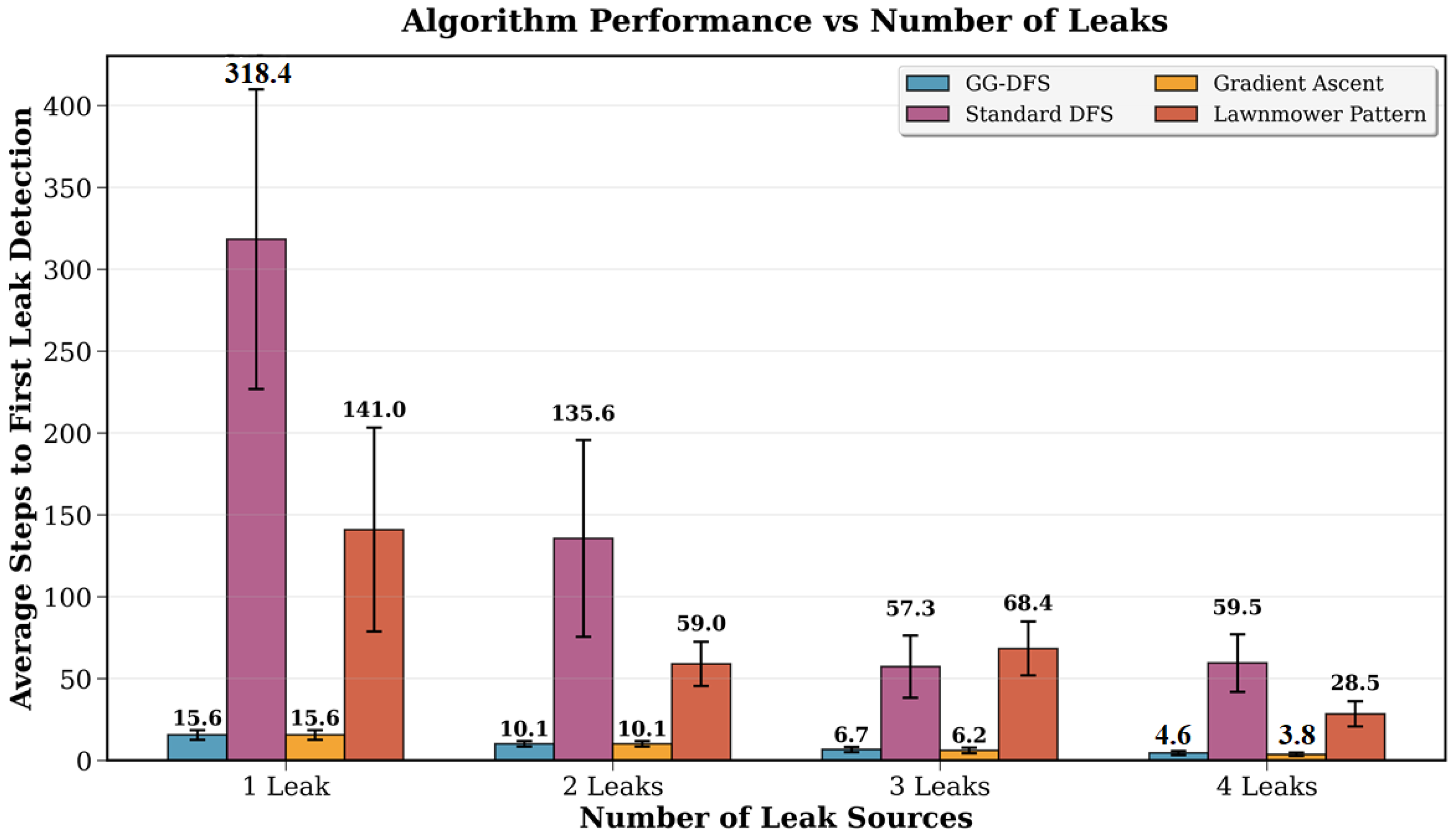
Figure 10 illustrates the performance trends across different leak densities, highlighting the counter-intuitive improvement in GG-DFS performance with increased complexity.
Key Scalability Findings:
Counter-intuitive Improvement: GG-DFS shows improved performance with increased leak density, requiring 70% fewer steps in 4-leak scenarios compared to single-leak environments.
Gradient Amplification Effect: Multiple leak sources create stronger local concentration gradients, enabling more efficient gradient-following behavior.
Consistent Performance: Unlike other algorithms that show irregular patterns, GG-DFS demonstrates monotonic improvement with leak density increase.
Variance Reduction: Standard deviation decreases with more leaks (), indicating more predictable performance in complex scenarios.
This scalability analysis confirms GG-DFS’s suitability for real-world applications where multiple leak sources may occur simultaneously.
5.8. Performance Trade-Off Analysis
Gas leak detection algorithms must balance multiple competing objectives: detection speed, exploration completeness, and reliability.
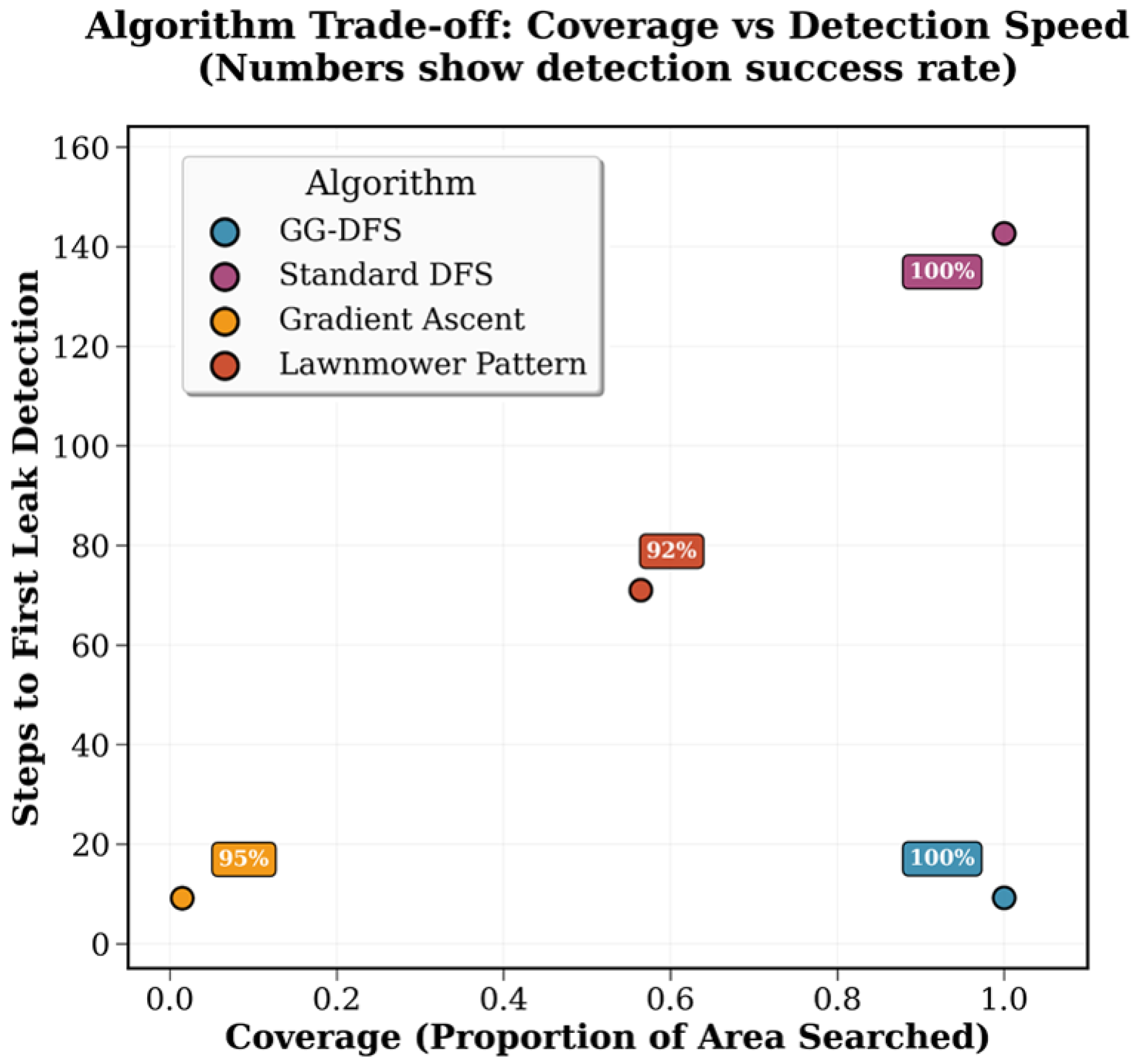
Figure 11 presents a comprehensive trade-off analysis positioning each algorithm across key performance dimensions.
The quantitative multi-criteria performance metrics corresponding to this analysis are summarized in
Table 4.
Trade-off Insights:
Balanced Performance Achievement: GG-DFS uniquely delivers superior performance across all three evaluation criteria, achieving the highest composite score of 0.98.
Traditional Algorithm Limitations: Existing approaches exhibit single-criterion optimization—Pure Gradient Ascent prioritizes speed at the expense of coverage and reliability, while Standard DFS ensures systematic completeness but compromises response time.
Multi-Criteria Superiority: GG-DFS demonstrates performance dominance by eliminating traditional trade-offs, delivering near-optimal speed (0.95) with perfect coverage (1.00) and reliability (1.00).
Industrial Applicability: The weighted composite scoring methodology reflects safety-critical application requirements where comprehensive coverage and detection reliability take precedence over pure speed optimization.
This analysis confirms that GG-DFS effectively addresses the fundamental trade-offs inherent in autonomous exploration for gas leak detection.
5.9. Algorithm Reliability and Consistency Analysis
For safety-critical applications like gas leak detection, algorithm reliability and consistency are paramount.
Table 5 presents detailed reliability metrics calculated across all experimental runs.
Reliability Analysis:
Perfect Reliability: GG-DFS achieves a 100% complete detection rate across all scenarios and leak densities.
Predictable Performance: Low coefficient of variation (0.78) indicates consistent performance suitable for operational deployment.
Bounded Execution Time: Maximum detection time of 30 steps provides predictable response times for emergency scenarios.
Zero Failure Rate: Unlike gradient-based approaches that fail in multi-leak scenarios, GG-DFS maintains a perfect success rate.
These reliability metrics confirm GG-DFS as the most dependable algorithm for safety-critical gas leak detection applications.
Practical Implications and Scope: While the presented results clearly demonstrate the advantages of the proposed GG-DFS algorithm under controlled simulation conditions, it should be noted that these environments are idealized, assuming a static, homogeneous, and noise-free diffusion field. Consequently, the reported improvements primarily illustrate the algorithmic principles and relative performance rather than direct real-world behavior. In practical deployments, gas dispersion is influenced by turbulence, airflow, temperature gradients, and sensor noise, which can alter gradient characteristics. Future work will extend this study by incorporating dynamic and noisy diffusion models and by benchmarking GG-DFS against advanced metaheuristic algorithms such as Particle Swarm Optimization (PSO) and Ant Colony Optimization (ACO) to further assess its applicability in realistic, multi-source environments.
5.10. Limitations and Future Work
While our experimental results demonstrate the effectiveness of the GG-DFS algorithm, several limitations warrant discussion and suggest directions for future research.
5.10.1. Current Limitations
Simplified Diffusion and Sensing Model: The current formulation (Equations (1)–(5)) represents an idealized, stationary diffusion field and assumes noise-free gas concentration measurements. It neglects transient dynamics, turbulence, multi-source interaction effects, and sensor noise or drift. While these simplifications enable clear algorithmic benchmarking and controlled evaluation of the GG-DFS framework, they introduce a gap between the simulated and real-world diffusion-sensing processes. Future work will address these aspects by incorporating stochastic sensor models, turbulence-aware diffusion simulation, and physical robot experiments in dynamic environments.
Path Redundancy: The algorithm exhibits significant backtracking behavior, with total path length (1599 steps) approximately doubling the number of unique positions visited (800 cells). This redundancy, while ensuring completeness, represents an opportunity for efficiency improvements through enhanced memory mechanisms that retain exploration history over longer time horizons.
Stochastic Tie-Breaking: The current implementation employs random selection when multiple neighboring cells exhibit identical maximum gradient values. While this approach prevents systematic bias, it may not optimize global exploration objectives. More sophisticated tie-breaking mechanisms incorporating distance to unexplored regions or concentration field topology could improve overall efficiency.
Directional Bias: Statistical analysis reveals subtle directional preferences in robot movement patterns, with westward movements comprising 15.3% versus 10.5% for northwestern movements. Although this asymmetry is relatively minor, it suggests potential improvements through more balanced exploration strategies.
Limited Sensing Range: The algorithm restricts gradient estimation to immediate eight-cell neighborhoods, potentially missing valuable directional information available over larger spatial scales. Extended sensing ranges could enhance gradient-following performance, particularly in environments with gradual concentration transitions.
Parameter Sensitivity: The performance of GG-DFS depends on the dispersion coefficient
, which controls the steepness of gas concentration gradients. A detailed sensitivity analysis for
is presented in
Section 5.5, revealing trade-offs between detection speed and exploration efficiency. Future work could explore adaptive
selection based on real-time environmental conditions.
5.10.2. Future Research Directions
Memory-Enhanced Exploration: Development of long-term spatial memory systems to reduce backtracking while maintaining completeness guarantees represents a promising research direction. Hierarchical exploration strategies combining local gradient-following with global path planning could significantly improve efficiency.
Distance-Based Weight Adjustment: Incorporating a distance-based weighting strategy around already identified leak points can help minimize repetitive exploration in high-concentration regions. Such an approach has the potential to make the subsequent search phase faster and improve the algorithm’s ability to detect multiple sources efficiently.
Expanded Simulation Environments: Testing the GG-DFS algorithm in more varied and challenging simulation setups, incorporating factors like turbulent dispersion, changing airflow conditions, and irregular obstacle distributions would provide deeper insights into its stability and adaptability under realistic operational scenarios.
Adaptive Parameter Control: Implementation of online parameter adaptation mechanisms based on local concentration field characteristics could optimize algorithm performance across diverse environmental conditions without requiring manual tuning.
Advanced Gradient Estimation: Investigation of sophisticated gradient estimation techniques incorporating temporal dynamics, sensor fusion, and uncertainty quantification could improve robustness in complex environments with turbulent gas dispersion patterns.
Real-World Validation: Comprehensive evaluation in actual industrial environments with physical robots, realistic sensor noise, and environmental disturbances will validate simulation findings and identify additional practical considerations for deployment.
5.11. Conclusions
This paper presents the Gradient-Guided Depth-First Search (GG-DFS) algorithm, a novel approach that achieves measurable improvements across multiple evaluation criteria while maintaining both rapid detection and comprehensive coverage guarantees.
Experimental validation across 160 independent simulation runs demonstrates key quantitative advantages of the proposed approach. The algorithm locates the first leak source in 9.3 ± 7.3 steps, achieving 93.5% faster detection than standard DFS while maintaining 100% coverage completeness and 100% detection reliability.
The algorithm also demonstrates scalability, requiring 70% fewer steps for initial detection in four leak scenarios compared to single-leak environments, attributed to gradient amplification effects. Statistical analysis confirms robust performance, with the highest composite performance score (0.98) and low variability (coefficient of variation: 0.78).
The modular GG-DFS architecture supports adaptation to diverse sensing modalities and environmental conditions while preserving theoretical completeness. It provides a reliable and efficient framework for autonomous gas leak detection with practical deployment potential. Future work will extend the framework to dynamic and noisy diffusion environments through adaptive parameter control and memory-enhanced exploration to further improve efficiency and robustness in real-world systems.