1. Introduction
The global textile sector has witnessed dramatic growth in the last few decades owing to rapid urbanization, population growth, fast fashion consumption, and industrialization. Even though the textile industry is a substantial source of income and job opportunities, it generates tremendous amounts of solid waste and environmental pollutants during production, utilization, and disposal processes. In particular, textile waste resulting from spinning mills, garment factories, used clothes, household textiles, and technical textile applications represents a severe environmental problem because of complex composition, long-term degradation, and accumulation in landfills [
1]. Moreover, the use of synthetic fiber materials such as polyester, nylon, acrylic, and polypropylene has increased this problem owing to their inherent non-biodegradable nature. It is reported that millions of tons of textile waste are produced annually all around the world; however, only a tiny percentage of this waste stream can be reused. Landfilling and incineration are two common traditional textile waste disposal practices that produce numerous environmental problems such as CO
2 emissions, release of harmful gases, microplastics, and soil contamination. Thus, finding sustainable and economically viable approaches for the valorization of textile waste is an important scientific objective for researchers in materials science, environmental engineering, and circular economy technologies [
2,
3,
4].
Various techniques have been proposed to convert textile waste into valuable products such as fuel gases, biochar, hydrogen, nanofibers, activated carbons, and functional carbon materials. Textile waste is an interesting precursor for making carbon materials owing to its rich carbon content and the molecular structure of organic biopolymers. Specifically, natural textiles comprise carbonaceous macromolecules like cellulose, lignin, hemicelluloses, and proteins; meanwhile, synthetic polymers mostly consist of aromatic and aliphatic chains having good thermal stability. Through controlled thermal treatment, these organic biopolymers can undergo a number of physicochemical reactions including dehydration, depolymerization, decomposition, cyclization, aromatization, and graphitization to generate porous carbon materials [
5,
6,
7].
In molecular transformation pathways, natural fiber biopolymers undergo dehydration and levoglucosan formation prior to generating aromatic structures, while synthetic textile precursors such as PET can experience ester cleavage and aromatic condensation reactions. Heteroatom-containing polymers and protein fibers can maintain heteroatomic bonds during the carbon formation process; therefore, surface polarity, electrochemical activity, and adsorption can be improved accordingly. Overall, there is a strong need for understanding the correlations between precursor composition and carbon evolution mechanisms to design tailor-made functional carbon materials for different purposes. Using textile-based carbon materials has become increasingly popular for applications including supercapacitors, batteries, capacitive deionization (CDI) [
8], electrocatalysis, adsorption systems, gas storage, sensors, electromagnetic shielding, and wearable electronics [
9]. High surface area, hierarchical porosity, light weight, chemical stability, and tunable surface functionality have made such materials promising building blocks for modern sustainable technologies [
10,
11,
12].
In particular, carbonized porous textiles demonstrate excellent performance in CDI systems owing to their outstanding ability of fast ion diffusion and conductivity. Additionally, the presence of heteroatoms and conductive polymers such as polyaniline (PANI) and polypyrrole (PPy) can further enhance electrochemical behaviors and multifunctionality of carbon materials. Despite challenges and different perspectives, the scientific community has made significant achievements in textile waste-to-carbon technology; it appears that the majority of the work conducted has been focused on synthesis and application aspects. There is a gap in the literature regarding the basic transformation mechanisms for carbonizing textile waste; therefore, gaining a comprehensive understanding in this field is crucial for optimizing processing parameters, improving carbon yield and performance, and controlling the porosity structure of the resulting carbon products. At the present time, the importance of developing sustainable materials has become even more pronounced owing to the ever-increasing demand for environmental resources [
13,
14,
15].
This review article discusses in detail molecular transformation pathways in the carbonization of textile materials to produce advanced functional carbon architectures. This paper is organized as follows. Initially, the chemical composition and characteristics of major textile precursors are considered, and then decomposition reaction, aromatization process, graphitic evolution, activation chemistry, and surface functionalization techniques are examined in detail. The evolution of physicochemical properties is studied by discussing available analytical methods, while applications in electrochemical storage, CDI, environmental remediation, sensing, and smart textiles are comprehensively reviewed.
Among these application areas, electrochemical technologies have emerged as one of the most important destinations for textile-derived carbon materials. The combination of hierarchical porosity, tunable surface chemistry, heteroatom doping, and graphitic conductivity enables efficient charge storage, ion transport, electrosorption, and catalytic reactions. Consequently, textile-derived carbons have attracted increasing attention as electrode materials for capacitive deionization, supercapacitors, metal-ion batteries, oxygen reduction reactions, hydrogen evolution reactions, and flexible wearable electrochemical devices. Understanding the molecular transformation pathways governing these electrochemical properties is therefore essential for rational material design and performance optimization.
Finally, current challenges, industrial scalability issues, and future research opportunities are discussed to provide insights into the development of next-generation textile-derived carbon materials for sustainable technological applications. The overall route for the conversion of textile waste into highly functionalized carbon materials via carbonization, activation, and surface modification is shown in
Figure 1. The major types of textile precursors along with their distinct chemical compositions are presented in
Table 1 [
16,
17,
18]. An overview of molecular transformation pathways in textile-derived carbon materials is shown in
Scheme 1.
2. Chemistry of Textile Precursors
The physicochemical characteristics and electrochemical functions of carbon-based textiles depend on the molecular composition and structural features of the initial fibers used. Textile fibers vary in terms of chemical composition, crystallinity, thermal stability, and heteroatom content, significantly affecting carbonization kinetics, pore formation, graphitization, and surface functionalities. Therefore, knowledge about the chemistry of textile materials is required for rational control of carbon transformation pathways.
As noted above, there are two types of textile fibers: natural and synthetic. Natural fibers consist of biopolymers (cellulose, lignin, hemi-cellulose, protein), while synthetic fibers comprise petroleum-based polymers with aromatic, ester, amide, nitrile, and aliphatic functions. Moreover, various mixed fibers that contain natural and synthetic materials pose additional challenges during decomposition and carbonization [
21,
22].
2.1. Natural Textile Fibers
Natural fibers are carbon-rich biomaterials, which can be readily utilized in the preparation of carbon materials via pyrolysis, due to high carbon content and excellent carbon yield. They also feature a wide range of oxygen functional groups, which promote the formation of oxygen-free char. Various types of natural textile fibers exist, including cotton, jute, hemp, silk, and wool [
23].
2.1.1. Cotton Fibers
Cotton fibers are widely employed in the textile industry and consist mainly of cellulose (90–95%). Cellulose is a linear polysaccharide with numerous -OH groups and β-(1→4)-linkage between D-glucose molecules. Hydrogen bonds are responsible for the semi-crystalline structure and thermal stability of cellulose material.
Thermal treatment leads to multiple complex transformations, such as dehydration, decarboxylation, and aromatization of cellulose fibers. First, the glycosidic bond breaks up at temperatures from 250 °C to 350 °C, producing levoglucosan, furans, aldehydes, and ketones. A further increase in temperature stimulates secondary reactions—condensation and cyclization of volatiles—leading to the formation of aromatic carbon structures. The gradual decrease in oxygen and hydrogen content promotes carbonization and the development of graphitic domains. Furthermore, abundance of hydroxyl groups provides conditions for chemical activation and heteroatom introduction, thus enhancing the adsorption capacity of final products. As a result, there is significant interest in the preparation of carbon materials from cotton fibers for various applications, including supercapacitors, adsorbents, and capacitive deionizers [
24,
25].
2.1.2. Jute and Lignocellulosic Fibers
Fibers based on jute, hemp, flax, and other bast plants have a lignocellulosic structure with cellulose, hemi-cellulose, and lignin [
8]. In contrast to pure cotton fibers, these materials have a relatively higher number of aromatic fragments and can provide increased yield of carbon during pyrolysis. Hemi-cellulose is an amorphous polysaccharide, which features lower thermal stability than cellulose and decomposes at low temperatures. Lignin is characterized by a crosslinked aromatic structure with methoxy, hydroxyl, and phenol groups. Thermal decomposition of lignin produces carbon-rich char via fragmentation of the structure and subsequent aromatic condensation reactions. Co-existence of cellulose and lignin affects pore formation and the carbonization process. While cellulose mostly produces volatiles and creates a microporous structure, lignin promotes carbon deposition, providing good carbon structure stability. As a result, lignocellulosic fibers usually produce highly porous carbons with higher carbon yield [
26,
27].
2.1.3. Protein-Based Fibers: Wool and Silk
In protein-based textile fibers such as wool and silk, there is a considerable amount of nitrogen and sulfur, which results from the structure of polypeptide chains and amino acid fragments of the molecules. Keratin proteins are found in wool fibers, while silk is composed of fibroin protein, consisting of glycine, alanine, and serine residues.
Protein fibers feature entirely different pyrolysis behavior in comparison with cellulose-based fibers. Thermal treatment causes peptide bond breakage, deamination, and desulfurization, producing volatiles that contain nitrogen and sulfur compounds. Partial heteroatom retention in the carbon matrix can create doped structures with increased polar and electrochemical properties. During pyrolysis, protein-derived nitrogen does not directly convert into oxidized nitrogen species; rather, nitrogen-containing intermediates undergo deamination and rearrangement reactions, resulting in stable nitrogen configurations such as pyridinic-N, pyrrolic-N, and graphitic-N within the carbon framework. Nitrogen functionalities, such as pyridinic-N, pyrrolic-N, and graphitic-N, can increase conductivity, wettability, and ion adsorption capacity. At the same time, sulfur groups can generate defects and improve the catalytic activity of materials. As a consequence, protein-based carbon structures have become interesting candidates for electrochemical energy storage devices, electrocatalysis, and sensing applications [
28,
29].
2.2. Synthetic Textile Fibers
Synthetic textile fibers are mostly produced by the thermal polymerization of petroleum derivatives with known molecular structures and remarkable thermal stability. Compared to natural polymers, synthetic fibers typically incorporate aromatic rings, ester bonds, amide bonds, or nitrile moieties to facilitate carbonization and graphitization processes [
30].
2.2.1. Polyester Fibers
Polyethylene terephthalate (PET) is one of the most widely used synthetic textile fibers owing to its mechanical strength and chemical resistance. PET fibers are characterized by a repeating structure of esterified aromatic molecules generated by the condensation of terephthalic acid and ethylene glycol. The presence of aromatic molecules in PET enables relatively high carbonization ability. Thermal degradation of PET involves the scission of ester bonds, generating acetaldehyde, CO, CO
2, and aromatics. Carbonization proceeds through successive deoxygenation and condensation reactions, forming a network of aromatic carbon structures. Aromaticity enhances the graphitization and electrical conductivity of PET-derived carbons, making polyester-based textile waste suitable for the production of conductive carbon materials. Nevertheless, the relatively low amount of oxygen functional groups compared to cellulose-based materials might limit carbon activation and porosity development if no additional activation treatments are applied [
7,
22].
2.2.2. Nylon Fibers
Nylon fibers are synthetic textile fibers consisting of amide groups within polyamide molecular chains. Typical nylons are nylon-6 and nylon-6,6, both having relatively high nitrogen content due to the presence of amide groups. Pyrolysis of nylon leads to chain scission, deamination, and cyclization reactions forming aromatic structures containing nitrogen atoms. Incorporation of nitrogen atoms into the carbon matrix creates doped carbons with higher conductivity and improved electrochemical performance. Nitrogen-doped carbons obtained from nylon fibers are successfully utilized in supercapacitors, oxygen reduction catalysts, and electrochemical desalination systems owing to superior wetting and charge transfer properties [
31,
32].
2.2.3. Acrylic and Polypropylene Fibers
The majority of acrylic textile fibers consist of polyacrylonitrile (PAN) polymers containing nitrile (-C≡N) groups in the molecular structure. PAN is considered the best raw material for high-performance carbon fibers due to high carbon yield and efficient graphitization during high-temperature treatments. PAN decomposes through cyclization and dehydrogenation, forming ladder-like aromatic structures, which eventually transform into graphitic carbon domains. Nitrile groups play a crucial role in promoting aromatization during pyrolysis. Polypropylene fibers are mostly constituted of aliphatic chains having lower carbon yield and negligible aromatic content. Thermal decomposition of polypropylene leads to random scission and the generation of volatile hydrocarbons [
33].
2.3. Blended Textile Systems
Modern textile products usually incorporate blended fibers with the purpose of improving mechanical properties and enhancing comfort, robustness, and economic performance. Examples of blended textile fibers include cotton/polyester, cotton/nylon, and wool/synthetic blends. While blended fibers offer many advantages regarding textile performance, they create considerable complexity during carbonization and activation procedures due to different decomposition behaviors and carbonization abilities. Decomposition of cellulose in cotton/polyester blend may result in oxygen-containing volatile compounds, which may react with aromatic PET decomposition intermediates. Differences in thermal stability and melting behavior between natural and synthetic fibers can further affect carbonization and pore formation. Despite all these disadvantages, blended textile fibers provide a wide variety of textile wastes with high availability and promising electrochemical and adsorptive capabilities. Recent studies proved that appropriate pretreatment techniques, adequate pyrolysis conditions, and carbon activation could help to overcome the difficulties related to the utilization of blended textile wastes. Moreover, the combination of oxygen-rich natural fibers and aromatic synthetic polymers can be regarded as a way of tuning the surface chemistry, conductivity, and porosity structure of carbons. The chemical structures and molecular carbonization pathways of major natural and synthetic textile fibers are comparatively illustrated in
Figure 2, whereas the dominant decomposition reactions and structural evolution mechanisms are summarized in
Table 2 [
34,
35].
3. Molecular Transformation During Carbonization
The transformation of polymers from textiles into carbon materials entails several intricate physical and chemical processes that occur during heating within an inert or partial oxygen atmosphere. The carbonization step is the most important phase that determines the structure, elemental content, porosity, electronic conductivity, and surface properties of carbon materials derived from textiles. In the course of carbonization, textile fibers are dehydrated, depolymerized, have their bonds broken, are cyclized, condensed, aromatized, and eventually graphite-structured through graphitization reactions.
The conversion processes depend greatly on the nature of the precursor, heating rate, reaction time, environment, and carbonization temperature. For example, the natural cellulose fiber undergoes extensive oxidation and aromatic group assembly. On the other hand, artificial polymers that possess aromatic rings and nitrogen atoms can be transformed to form graphite or heteroatom-doped carbon materials that possess electrochemical activity [
23,
40]. The carbonization temperature is highly dependent on the chemical nature of the textile precursor. Generally, cellulosic fibers undergo significant decomposition and aromatization within approximately 300–700 °C, whereas synthetic polymers such as PET, nylon, and PAN require higher temperatures (600–1200 °C) to achieve extensive carbon ordering and graphitic development. Therefore, a single temperature range cannot represent all textile-derived carbonization processes.
3.1. Fundamental Thermal Decomposition Mechanisms
The thermal decomposition of textile-derived polymers begins with the cleavage of weak chemical bonds and progresses through a sequence of fragmentation and recombination reactions. Initially, low-temperature heating removes physically adsorbed moisture and volatile impurities. As temperature increases, covalent bond dissociation initiates molecular rearrangement and carbon skeleton evolution. Several major reactions dominate the carbonization process, as described below.
3.1.1. Dehydration Reaction
Among the early transformations witnessed during the carbonization process, dehydration occurs especially within hydroxyl abundant natural fibers. Adjacent hydroxyl groups eliminate water molecules, resulting in unsaturated carbon atoms. Dehydration is effective in promoting:
- ➢
Diminution in oxygen content;
- ➢
The formation of double bonds;
- ➢
Conjugated system;
- ➢
Aromaticity.
These chemical changes have a profound effect on the efficacy of char formation and the yield of carbon. Acidic catalysts such as phosphoric acid are known to catalyze dehydration and restrain volatility. Consequently, porous carbon can be produced [
41].
3.1.2. Depolymerization and Chain Scission
As the temperature is elevated further, depolymerization takes place with the random or selective cleavage of molecular bonds depending on the polymer precursor structure. The breakdown of glycosidic bond in cellulose gives rise to levoglucosan while synthetic polymers are subjected to ester and amide bond cleavage reactions, for instance:
- ✓
PET, ester bond cleavage reaction;
- ✓
Nylon, amide bond dissociation reaction;
- ✓
PAN, nitrile cyclization reaction;
- ✓
Polypropylene, random chain scission reaction.
Volatiles formed include: aldehydes, ketones, hydrocarbons, CO, CO
2, NH
3, and small aromatic molecules. Simultaneously, residual carbonous components will undergo progressive condensation, leading to aromatic formation [
42].
3.1.3. Cyclization and Aromatization
Cyclization and aromatization represent some of the most vital molecular transformation processes during the carbonization process. Intramolecular and intermolecular condensation leads to the creation of aromatic and cyclic moieties by unstable intermediate compounds resulting from decomposition. Aromatization is characterized by:
- ✓
Increase in carbon density;
- ✓
Electrical conductivity;
- ✓
Decreased hydrogen/carbon ratio;
- ✓
Thermal stability.
The final process is the fusion of aromatic rings forming turbostratic carbon domains comprising sp
2 hybridized carbons [
33].
3.1.4. Graphitization and Structural Ordering
At elevated temperatures, disordered aromatic clusters may gradually reorganize into graphitic domains with improved crystallinity and electrical conductivity. Graphitization involves: alignment of graphene-like layers, removal of residual heteroatoms, reduction of structural defects, and enlargement of aromatic crystallites. However, complete graphitization is often limited in textile-derived carbons due to irregular precursor structures, heteroatom retention, and rapid volatile evolution. Consequently, most textile-derived carbon materials exhibit partially ordered turbostratic structures containing both amorphous and graphitic regions [
43].
3.2. Molecular Transformation of Cellulosic Textile Fibers
Cellulose-based textile fibers such as cotton and jute exhibit highly complex thermal decomposition behavior because of their oxygen-rich polysaccharide structures. The carbonization of cellulose generally occurs through multiple overlapping reaction pathways involving dehydration, depolymerization, levoglucosan formation, fragmentation, and aromatic condensation [
44].
3.2.1. Initial Decomposition Stage
Cellulose molecules start to break down in the temperature range of 200–300 °C by cleaving glycosidic bonds. At the same time, hydroxyl groups are taken away through dehydration reactions, which results in a decrease in oxygen content. This phase is marked by mass loss, volatile generation, and the breakdown of the structure. Among the main intermediates formed during cellulose pyrolysis is levoglucosan. Further breakdown of levoglucosan leads to the formation of furans, aldehydes, ketones, and other small oxygenated molecules [
45].
3.2.2. Formation of Aromatic Carbon Structures
When heating above 350 °C, unstable oxygen-containing intermediates are condensed and cyclized to form aromatic clusters and conjugated carbon networks. The gradual removal of hydrogen and oxygen atoms results in an increase in carbon content and structural order. In this phase:
- ➢
sp3 carbon decreases;
- ➢
sp2 aromatic carbon increases;
- ➢
Aromatic ring fusion occurs;
- ➢
Carbonaceous char develops rapidly.
Lignin-containing fibers like jute tend to show greater aromaticity and carbon yield as these fibers contain lignin, which is made up of phenolic aromatic structures that aid in the formation of char [
46].
3.2.3. High-Temperature Structural Evolution
At temperatures above 700 °C the carbonaceous substances gradually become more ordered through alignment of aromatic sheets, healing of defects, and limited formation of different areas of graphitic structure. Nonetheless oxygen-containing groups that have not been removed together with structural defects are frequently left within the carbon framework, which leads to better adsorption properties and surface hydrophilicity. The final characteristics of carbons derived from cellulose are mainly determined by: heating rate, activation conditions, precursor purity, and residence time [
47].
3.3. Molecular Transformation of Synthetic Textile Fibers
Synthetic textile polymers behave very differently in carbonization from natural fibers due to their intrinsic aromatic chemical structures, molecular design, and lower oxygen content.
3.3.1. Polyester (PET) Carbonization
The main breakdown of PET occurs practically at temperatures of 350 and 450 °C when chains are scissored through ester bond cleavage. The most typical volatiles are: acetaldehyde benzoic acid derivatives, CO and CO
2. In contrast to cellulose, PET has aromatic terephthalate units which partly decompose when heated. These aromatic sections support further reactions of polyaromatic compounds, leading to the development of graphitizable carbon and subsequent electrical conductivity. But, unless the carbon derived from PET is subjected to activation processes, it might show low porosity due to a lack of pore generation [
48].
3.3.2. Nylon Carbonization and Nitrogen Retention
Generally, thermal breakdown of nylon fibers takes place primarily by breaking the amide bonds and removing the nitrogen atoms. Pyrolysis intermediates containing nitrogen may go through cyclization and aromatic condensation reactions to form carbon frameworks that are nitrogen-doped. Different types of nitrogen atoms may be present as: pyridinic-N, pyrrolic-N, graphitic-N, and oxidized nitrogen species. Nitrogen retention has a really significant effect on electron transfer, electrochemical capacitance, ion adsorption, and catalytic activity, and due to this, nylon-derived carbons have shown extremely good performance in supercapacitors and electrochemical desalination systems [
49].
3.3.3. PAN Stabilization and Graphitic Carbon Formation
Polyacrylonitrile (PAN) is a textile polymer which possesses one of the most distinct carbonization mechanisms. Nitrile groups during the stabilization (200–300 °C) phase primarily form cyclization products, i.e., ladder-like conjugated structures, the latter being more stable thermally. Further carbonization at elevated temperatures facilitates the removal of hydrogen, formation of aromatic rings, incorporation of nitrogen, and ordering similar to graphite. Because of its high yield of carbon and graphitization potential, PAN is still among the most popular precursors for the manufacture of commercial carbon fibers [
50].
3.4. Influence of Carbonization Temperature on Structural Evolution
Carbonization temperature is really important in defining the structure, physical properties, and electrochemical properties of carbon materials made from textiles. The temperature at which the material is heated will affect the amount and type of carbon produced, the development of pores, the arrangement of graphite layers, electrical conductivity, the number of defects, and surface chemistry. When carbonizing, as the temperature goes up, increasingly the reaction sequence is dehydration, depolymerization, aromatization, and graphitization, which means the structure of the carbon matrix changes significantly [
51].
If the temperature is pretty low (300, 500 °C), the textiles will not thermally decompose completely so the carbon materials will still have relatively high oxygen content and be rich in surface functional groups like hydroxyl, carbonyl, and carboxyl groups. These materials are typically poorly conductive as they have a low degree of graphitic ordering and limited aromatic condensation. On the other hand, the oxygen-containing groups improve hydrophilicity and surface reactivity, which means low-temperature carbons can be good for adsorption and as supports for catalysts. In this temperature range, the aging process is mainly controlled by the release of water and volatiles, while the formation of stable graphitic domains is minimal [
33].
If the temperature is intermediate (600, 900 °C), the carbon framework experiences significant aromatization and structural reorganization as well as pore development due to the escape of volatile substances and continuous condensation of carbon. Carbon fibers prepared at this temperature range have very good electrical conductivity and are also structurally stable and retain surface groups. Both micropore and mesopore formation is improved, which helps with efficient ion transport and storage behavior. Therefore, carbons produced at these temperatures are the most common materials for capacitive deionization (CDI) electrodes, supercapacitors, and other electrochemical energy storage systems. This is the temperature range where most people obtain the best results in terms of porosity, conductivity, and the nature of the surface functional groups [
52].
When carbon materials are heated to very high carbonization temperatures of around or above 1000 °C, many changes occur in the graphitic order and structure, which produce carbon materials with very high electrical conductivity, low defects, and fewer oxygen atoms. High temperatures enable larger aromatic domains and graphitic layers to form through more carbon condensation and graphitization. Consequently, the electrical conductivity and structural stability of the carbon materials are greatly enhanced, these being primary features for conductive electrodes, electrocatalysis, and advanced energy storage devices. But too-high temperatures can also lead to the collapse of the pores, shrinkage of the structure, and a decrease in surface area as a result of excessive carbon packing. This porosity loss can be detrimental to adsorption capacity and electrochemical accessibility, especially in applications where high ion transport efficiency is important. Hence, adjusting the carbonization temperature is very important for designing the structure/property relationship of textile-derived carbon materials in line with particular application needs. Choosing the right thermal treatment condition is based on the desired compromise between porosity, conductivity, graphitic ordering, and surface functionality [
40].
3.5. Heteroatom Evolution and Defect Formation
Heteroatoms such as oxygen, nitrogen, sulfur, and phosphorus play critical roles in determining the electrochemical and adsorption properties of textile-derived carbons. During carbonization:
- ➢
Oxygen functionalities gradually decrease;
- ➢
Nitrogen species partially stabilize;
- ➢
Sulfur may form thiophenic structures;
- ➢
Defects and vacancies develop within the carbon matrix.
Defect-rich structures enhance: ion transport, adsorption affinity, surface wettability, and catalytic performance. Controlled heteroatom retention has therefore become an important strategy for designing advanced multifunctional carbon materials. The detailed molecular transformation mechanisms occurring during carbonization, including dehydration, cyclization, aromatization, and graphitization processes, are schematically presented in
Figure 3. The major thermal reactions and transformation stages are summarized in
Table 3 [
53].
From an electrochemical perspective, the evolution of defects, graphitic domains, and heteroatom functionalities during carbonization directly influences charge-transfer kinetics, electrical conductivity, ion accessibility, and surface redox activity. Pyridinic and graphitic nitrogen species can enhance electron transport and pseudocapacitive behavior, whereas oxygen-containing functional groups improve wettability and electrolyte interaction. Consequently, precise control of molecular transformation pathways is critical for tailoring textile-derived carbon materials toward high-performance electrochemical applications.
3.6. Carbonization of Blended and Dyed Textile Materials
In practical textile waste streams, blended fabrics such as cotton/polyester, cotton/spandex, wool/polyester, and polycotton are more common than single-component fibers. The thermal decomposition behavior of blended textiles is considerably more complex because each constituent exhibits different degradation temperatures and carbonization pathways. Cellulosic fibers generally decompose between 300 and 400 °C, whereas polyester and polyamide fibers require higher temperatures and exhibit different aromatic condensation mechanisms. Consequently, carbonization conditions must be optimized to accommodate the thermal behavior of all components. Multi-stage heating programs and controlled heating rates are frequently employed to minimize structural collapse and maximize carbon yield. The resulting carbon materials often exhibit hybrid pore structures and heterogeneous surface chemistry, which may be advantageous for adsorption and electrochemical applications.
Textile wastes frequently contain dyes, pigments, softeners, flame retardants, finishing agents, and inorganic additives. These components may significantly influence carbonization behavior and final carbon properties. Nitrogen-containing dyes may contribute to additional nitrogen doping, whereas inorganic pigments and metal-containing dyes can act as catalytic graphitization agents. Conversely, excessive impurities may block pore development or reduce carbon purity. Consequently, pretreatment procedures such as washing, solvent extraction, or chemical purification are often necessary to ensure reproducible material properties.
4. Activation and Surface Functionalization of Textile-Derived Carbon Materials
Although carbonization converts textile precursors into carbonaceous frameworks, the resulting materials often exhibit limited surface area, insufficient pore accessibility, and restricted electrochemical activity. Therefore, activation and surface functionalization processes are critically important for engineering the physicochemical properties of textile-derived carbons. Activation promotes the development of hierarchical pore structures and increases specific surface area, while surface functionalization modifies chemical composition, wettability, charge distribution, and interfacial reactivity.
The activation process generally involves the controlled removal of carbon atoms through physical or chemical reactions, producing microporous and mesoporous architectures suitable for adsorption and electrochemical applications. At the same time, the doped heteroatoms and the conductive polymer introduction might add more electroactive sites and also enhance the electrical conductivities. Through the combination of the regulated pore design and the change in surface chemistry, it is possible to prepare multifunctional carbon materials with excellent properties for capacitive deionization, supercapacitors, catalysis, and sensing [
56,
57].
4.1. Physical Activation Mechanisms
Physical activation is the process of gasifying pre-carbonized materials with oxidizing gases like steam or carbon dioxide at high temperatures, normally in the range of 700 to 1000 °C. The partial oxidation during the activation process is used as a tool to preferentially remove disordered carbon atoms, which in turn leads to the creation of interconnected porous networks and the enhancement of the surface area [
58].
4.1.1. Steam Activation
Due to its ease and ecological friendliness, steam activation has become one of the major methods for manufacturing porous carbon materials. The reaction that takes place between steam and carbon atoms during the high temperature treatment can be presented by the water/gas reaction:
At the same time, secondary reactions can occur as
The gradual elimination of the carbon atoms leads to the formation of micropores, mesopores, defect sites, and an enlarged surface area. In general, steam activation leads to the generation of carbons with a very high degree of pore connectivity, which ensures better ion transport, and a higher adsorption capacity. Still, too much activation can cause the structure to collapse and, at the same time, the mechanical stability may be diminished [
59,
60].
4.1.2. CO2 Activation
Carbon dioxide activation is another important physical activation method that proceeds through the Boudouard reaction:
Compared to steam activation, CO
2 activation proceeds more slowly and provides better control over pore development. This method preferentially removes amorphous carbon regions while preserving graphitic domains. The activation efficiency strongly depends on temperature, residence time, precursor structure, and carbon crystallinity. Textile-derived carbons activated with CO
2 often exhibit narrow micropore distribution, improved structural stability, and enhanced electrochemical behavior [
61].
4.2. Chemical Activation Mechanisms
Chemical activation is generally more effective than physical activation for generating highly porous carbon structures. In this method, textile precursors or pre-carbonized materials are impregnated with activating agents such as KOH, ZnCl
2, H
3PO
4, or NaOH prior to thermal treatment. Chemical activation simultaneously promotes dehydration, bond cleavage, volatile evolution, and pore generation [
62].
4.2.1. KOH Activation
Potassium hydroxide (KOH) is one of the most efficient activating agents for producing high-surface-area carbons with hierarchical porosity. During thermal activation, KOH undergoes multiple redox and intercalation reactions with carbon. The primary reactions include
Metallic potassium generated during activation can intercalate into carbon layers, expanding graphitic structures and promoting pore formation. Simultaneously, gas evolution creates extensive microporosity. KOH activation typically results in:
- ➢
Extremely high surface area;
- ➢
Interconnected pore networks;
- ➢
Enhanced ion diffusion;
- ➢
Improved electrical conductivity.
The activation process also introduces defects and oxygen-containing surface groups that improve electrochemical wettability and adsorption affinity [
8,
63].
4.2.2. ZnCl2 Activation
Zinc chloride functions primarily as a dehydrating agent during carbonization and activation. ZnCl2 promotes crosslinking reactions, suppression of tar formation, and stabilization of carbon frameworks. The activation mechanism involves dehydration of polymer chains, cleavage of C–O and C–C bonds, and enhanced char formation.
Regular example of dehydration reaction:
Generally, ZnCl
2 activation results in microporous structures, high C yield, and improved adsorption capacities. The issues related to the recovery of zinc residues have, however, restricted its large-scale applications [
64].
4.2.3. Phosphoric Acid Activation
Phosphoric acid (H
3PO
4) activation is especially helpful for textile precursors made of cellulose, as it induces dehydration and at the same time prevents excessive shrinkage during carbonization. The overall activation process can be summarized in three steps: phosphate ester formation, polymer chain cleavage, and crosslinked carbon network stabilization. Simplified esterification reaction:
Upon heating, phosphate bonds assist in structural expansion, pore formation, and aromatic condensation. Phosphoric acid activation is one of the methods leading to the formation of mesoporous carbon structures, a surface involuntarily rich in oxygen, and excellent adsorption capacity [
65].
4.3. Heteroatom Doping and Surface Chemistry Engineering
Including heteroatoms is a very effective way to change the electronic structure, polarity, and electrochemical properties of carbons extracted from fabrics. Nitrogen, sulfur, phosphorus, and oxygen heteroatoms not only change the distribution of electron density but also lead to the formation of defect-rich active sites [
66].
4.3.1. Nitrogen Doping
Nitrogen doping is a key method to enhance both the physicochemical and electrochemical properties of carbon materials made from fabrics. Incorporating nitrogen can be achieved in various ways, such as starting with nitrogen-rich textile raw materials, treating with ammonia, impregnating with urea, adding melamine, or coating with a conductive polymer. Nitrogen-containing compounds are transformed during the carbonization process through a series of cyclization, dehydrogenation, and aromatization reactions, leading to the emergence of stable nitrogen groups in the carbon matrix. The main nitrogen types found in carbon materials are pyridinic-N, pyrrolic-N, graphitic-N, and oxidized-N, each affecting the electronic structure and surface chemistry of the carbon differently.
Nitrogen atoms are usually introduced into the carbon lattice by the interaction of active carbon defect sites and nitrogen-containing intermediates formed during thermal decomposition. For example, a nitrogen incorporation reaction is
where C
∗ stands for an active defect site on the carbon surface.
Nitrogen doping results in significant changes like increased electrical conductivity, better surface wettability, enhanced pseudocapacitive behavior, and improved ion adsorption capabilities. Pyridinic and pyrrolic nitrogen forms are essential in elevating charge transfer and electrochemical activity, whereas graphitic nitrogen is mainly responsible for better electrical conductivity and structural endurance. In addition, nitrogen-containing functional groups make the carbon surface more hydrophilic, leading to easier electrolyte access and ion movement within the pores.
In CDI (capacitive deionization) systems, nitrogen-doped carbon materials show markedly better desalination capacity than undoped ones. This is attributable to stronger electrostatic interactions between the electrode surfaces and ions in the solution. Furthermore, nitrogen functional groups in the materials improve the affinity of ions, charge efficiency, and ion transport speed, leading to an increase in salt adsorption capacity. As a result, nitrogen doping is now a popular method for producing textile-based carbon electrodes of high performance for applications such as water purification, energy storage, and electrocatalysis [
67,
68].
4.3.2. Sulfur and Phosphorus Doping
Sulfur-containing functionalities may form through thiophene-like structures or sulfur bridges during carbonization:
Sulfur doping increases: structural defects, electrochemical reactivity, and catalytic activity. Similarly, phosphorus doping can improve charge redistribution, defect formation, and electron transfer kinetics. Phosphorus incorporation often occurs through phosphate linkages:
Co-doping with multiple heteroatoms frequently produces synergistic improvements in electrochemical performance [
69].
4.4. Conductive Polymer Functionalization
Surface modification with conductive polymers has emerged as a highly promising strategy for enhancing the electrochemical properties of textile-derived carbon materials. Conductive polymers such as polyaniline (PANI), polypyrrole (PPy), and PEDOT:PSS can provide pseudocapacitance, enhanced conductivity, surface redox activity, and improved ion transport [
70].
4.4.1. Polyaniline (PANI) Functionalization
PANI coating is generally achieved through oxidative polymerization of aniline monomers on carbon surfaces. The polymerization reaction may be represented as
Common oxidants include ammonium persulfate (APS), FeCl
3, and H
2O
2. The conductive emeraldine salt form of PANI significantly improves electrical conductivity, redox capacitance, and ion adsorption capability. The interaction between porous carbon frameworks and PANI nanostructures creates synergistic effects by combining electric double-layer capacitance, and faradaic pseudocapacitance [
71].
4.4.2. Polypyrrole (PPy) Modification
PPy coatings are commonly synthesized through oxidative polymerization of pyrrole monomers:
PPy-functionalized textile-derived carbons exhibit enhanced conductivity, improved electrochemical stability, and superior charge storage capability. The polymer coating can also improve surface wettability and facilitate ion diffusion within porous carbon matrices [
72].
4.5. Structure–Property Relationship After Activation
Activation and surface functionalization play crucial roles in tailoring the structural and functional properties of textile-derived carbon materials by modifying pore size distribution, graphitic ordering, surface polarity, electrical conductivity, and electrochemical activity. In general, micropores contribute to enhanced adsorption capacity, while mesopores facilitate rapid ion transport and electrolyte diffusion. Simultaneously, graphitic domains improve electrical conductivity, whereas heteroatom functionalities increase surface wettability and redox activity. Therefore, optimizing activation chemistry and functionalization strategies is essential for achieving an appropriate balance between porosity, structural stability, and overall functional performance for environmental and electrochemical applications. Various activation and surface functionalization mechanisms involved in tailoring porous textile-derived carbon materials are illustrated in
Figure 4, while the corresponding activation strategies and structural modifications are compared in
Table 4 [
73].
As summarized in
Table 4, different activation and functionalization strategies exert distinct effects on the structural and functional properties of textile-derived carbon materials. Chemical activation using KOH generally produces the highest surface area and well-developed microporosity, making it particularly suitable for adsorption and electrochemical applications. ZnCl
2 and H
3PO
4 activation typically yields higher carbon retention and mesoporous structures, respectively, whereas steam and CO
2 activation offer environmentally friendly alternatives with lower chemical consumption. Beyond activation, surface functionalization strategies such as nitrogen doping and PANI coating further enhance electrochemical performance through improved conductivity, wettability, active-site density, and pseudocapacitive behavior. Recently, self-activation has emerged as a sustainable approach that utilizes intrinsic mineral species within textile precursors to generate hierarchical porosity without external activating agents. Therefore, the selection of an appropriate activation or functionalization strategy should be guided by targeted application, desired pore architecture, electrochemical performance requirements, and sustainability considerations.
As summarized in
Table 5, different heteroatom dopants modify the structural, electronic, and electrochemical properties of textile-derived carbon materials through distinct mechanisms. Nitrogen doping is the most widely investigated strategy because it enhances electrical conductivity, surface wettability, and pseudocapacitive behavior through the formation of defect-rich active sites. Sulfur and phosphorus dopants contribute to charge redistribution, catalytic activity, and surface polarity, making them attractive for electrocatalytic and adsorption applications. Boron doping introduces electron-deficient sites that facilitate charge transfer and catalytic reactions. Moreover, co-doping strategies such as N/S and N/P doping often generate synergistic effects by combining multiple functionalities, resulting in enhanced electron transport, increased active-site density, and superior electrochemical performance. Therefore, the selection of an appropriate dopant depends on the targeted application and the desired balance between conductivity, catalytic activity, wettability, and charge storage capability.
5. Structural Evolution and Characterization of Textile-Derived Carbon Materials
The structural evolution of textile-derived carbon materials during carbonization and activation significantly determines their physicochemical properties and functional performance. Changes in morphology, graphitic ordering, pore architecture, defect density, and surface chemistry occur progressively as textile precursors transform into carbonaceous structures. Thus, it is crucial to use thorough characterization methods in order to grasp the connections among the chemistry of precursors, processing conditions, and the properties of resultant materials.
Various advanced characterization methods such as scanning electron microscopy (SEM), transmission electron microscopy (TEM), X-ray diffraction (XRD), Raman spectroscopy, Fourier transform infrared spectroscopy (FTIR), X-ray photoelectron spectroscopy (XPS), Brunauer–Emmett–Teller (BET) surface area analysis, and thermogravimetric analysis (TGA) to varying degrees are used for monitoring structural changes during the different phases of thermal conversion and activation. This section provides an in-depth review of the changes in the morphology and structure of textile-derived carbons and points out the main techniques used for analyzing structure–property relationships [
86].
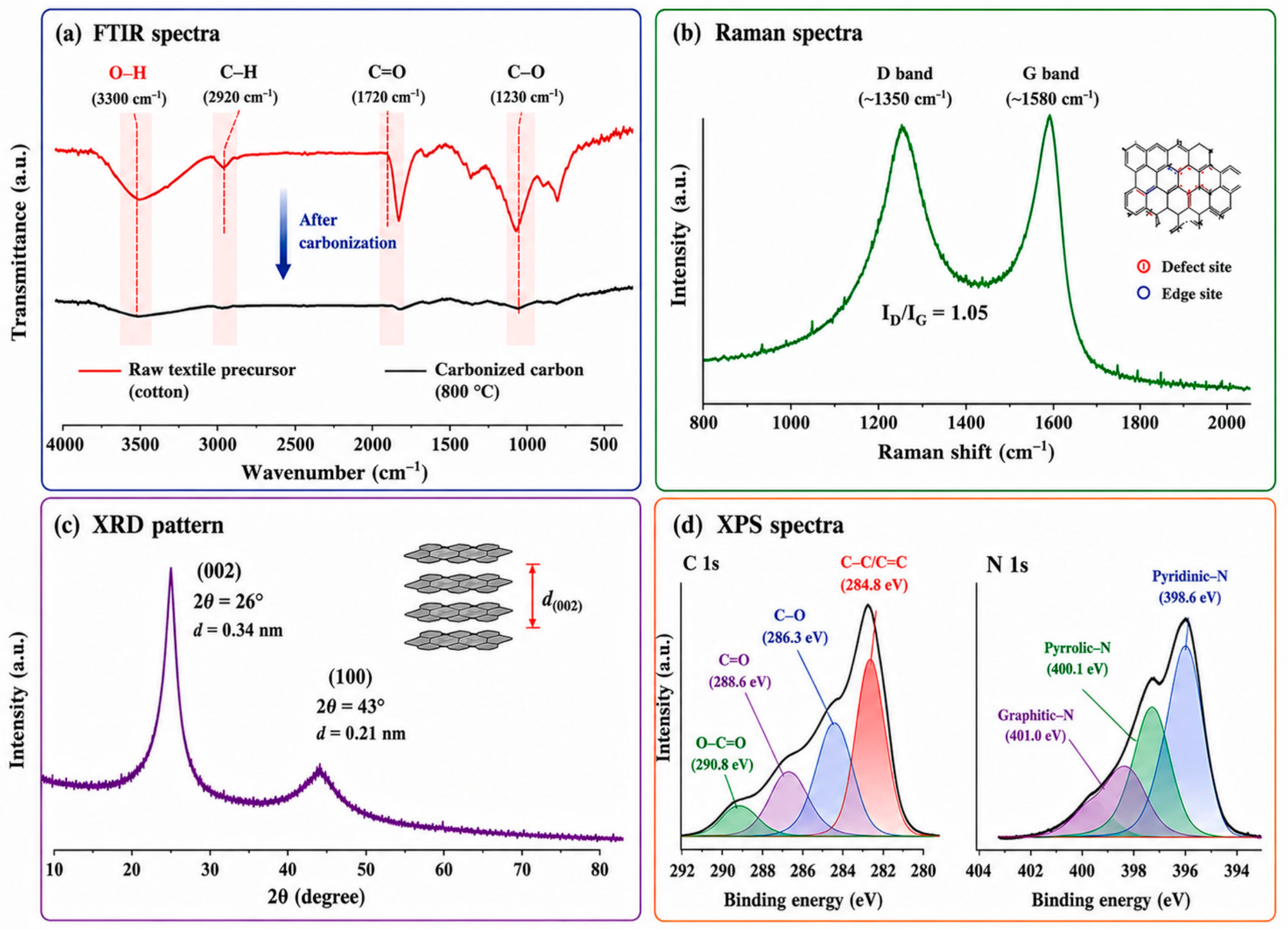
Figure 5 provides a schematic overview of representative characterization features commonly observed in textile-derived carbon materials. FTIR spectroscopy is used to monitor the removal of hydroxyl, carbonyl, and ether functional groups during carbonization. Raman spectroscopy provides information regarding graphitization and structural defects through the D and G bands. XRD analysis is commonly employed to evaluate crystallinity and graphitic ordering, while XPS enables identification of surface elemental composition and heteroatom configurations. Together, these techniques provide complementary insights into the structural evolution and surface chemistry of textile-derived carbon materials.
5.1. Morphological Changes During Carbonization and Activation
During thermal treatment, the morphology of textile-derived carbon materials goes through significant changes due to: volatile release, polymer chain scission, pore formation, and structural shrinkage. The final morphology is largely governed by: the type of precursor, heating rate, method of activation, and the temperature of carbonization [
87].
5.1.1. Fiber Shrinkage and Structural Breakdown
Textile fibers in the early stages of carbonization are dehydrated, softened and lose a huge amount of body mass due to the expulsion of volatile compounds. The fibers experience shrinkage, the polymer chains collapse, and the fibers’ diameter decreases. Cellulosic fibers usually undergo a higher amount of structural shrinkage because the removal of oxygen is more extensive. On the other hand, synthetic polymers can melt partially and reorganize during pyrolysis. A typical dehydration reaction is given below:
Most importantly, the degree of structural collapse decides the pore accessibility, the density of carbon, and also the mechanical stability of the final carbon material [
43].
5.1.2. Pore Formation and Surface Roughening
During activation, selective carbon gasification simultaneously produces micropores, mesopores, and introduces defect-rich surfaces to textile-derived carbon materials. Beyond this, the release of gases and the chemical etching of materials lead to the formation of rough surfaces and highly porous carbon structures. As a result, the accessible surface area is greatly increased. Among the activation methods, KOH treatment is the most efficient one to create hierarchical pores because of the intercalation-led expansion of the structure and the removal of carbon atoms. Most of the gasification reactions that result in pore formation involve
and
Images of activated textile-derived carbons using scanning electron microscopy (SEM) usually show that porous channels are interconnected, fiber surfaces are broken, and carbon frameworks resemble a sponge. Such hierarchically porous structures significantly facilitate the movement of ions, penetration of electrolyte, and adsorption of chemicals, thus making the material very compatible with the electrochemical and environmental sectors of the industry [
77,
88].
5.1.3. Nanostructure Development
Localized graphitic regions and nanocarbon structures can be generated at high temperature as a result of aromatic condensation and the rearrangement of structures. Depending on precursor chemistry and activation conditions, textile-derived carbons may exhibit: graphene-like sheets, turbostratic carbon layers, carbon nanofibers, or hollow porous architectures. Nitrogen-containing precursors such as nylon and PAN often facilitate defect-rich graphitic nanostructure formation because heteroatoms modify carbon growth pathways and inhibit excessive crystallization [
86].
5.2. X-Ray Diffraction (XRD) Analysis and Graphitic Ordering
X-ray diffraction is widely used to evaluate crystallinity, interlayer spacing, and graphitic ordering in carbon materials. Most textile-derived carbons exhibit partially ordered turbostratic structures containing both amorphous and graphitic regions [
89].
5.2.1. Graphitic Carbon Formation
The X-ray diffraction (XRD) patterns of textile-derived carbon materials typically exhibit a broad diffraction peak near
, corresponding to the (002) plane of graphitic carbon, while another weak peak near
is associated with the (100) plane. As the carbonization temperature increases, the diffraction peak intensity generally increases and the peak width decreases, indicating improved graphitic ordering and structural organization. The interlayer spacing (
) of graphitic carbon can be calculated using Bragg’s equation:
where
n is the diffraction order,
λ is the X-ray wavelength,
d is the interlayer spacing, and
θ is the diffraction angle. Smaller d
002 values indicate a higher degree of graphitization and enhanced structural ordering within the carbon framework [
90].
5.2.2. Effect of Activation on Crystallinity
Chemical activation generally increases disorder and defect density because pore formation disrupts graphitic alignment. Consequently, broadening of XRD peaks, reduced crystallite size, and increased amorphous character are commonly observed after activation. However, moderate disorder may enhance: adsorption behavior, electrochemical activity, and ion accessibility [
91].
5.3. Raman Spectroscopy and Defect Analysis
Raman spectroscopy is one of the most important techniques for evaluating graphitic ordering, structural defects, and sp
2 carbon evolution in textile-derived carbon materials. Typically, two major Raman bands are observed: the D-band near 1350 cm
−1 and the G-band near 1580 cm
−1. The D-band is associated with structural defects, disordered carbon, edge sites, and heteroatom incorporation, whereas the G-band corresponds to graphitic sp
2 carbon and in-plane C=C stretching of aromatic structures. The intensity ratio (
ID/
IG) is widely used to assess defect density and graphitization degree. Higher (
ID/
IG) values indicate greater structural disorder, increased defect density, and heteroatom-induced distortion, while lower (
ID/
IG) values generally suggest improved graphitic ordering and enhanced electrical conductivity [
92].
Structural Evolution with Temperature
As carbonization temperature increases, aromatic condensation increases, graphitic domains enlarge, and conductive pathways improve. However, activation treatments may reintroduce structural defects through pore generation and surface etching. Therefore, Raman analysis provides important insights into balancing: conductivity, defect density, and electrochemical activity [
93].
5.4. Fourier Transform Infrared Spectroscopy (FTIR)
Fourier transform infrared spectroscopy (FTIR) is widely used to investigate the evolution of surface functional groups during the carbonization and activation of textile-derived carbon materials. Typical FTIR spectra of textile precursors exhibit characteristic peaks corresponding to hydroxyl groups (~3200–3600 cm
−1), carbonyl groups (~1700 cm
−1), and C–O stretching vibrations (~1000–1300 cm
−1). At carbonization stage, hydroxyl as well as other oxygen-containing functional groups undergo decomposition stepwise, while aromatic C=C structures are revealed mostly as a result of an increase in aromatization and carbon content. One of the dehydration reactions can be written as follows:
The slow vanishing of oxygenated functional groups in the FTIR spectra can be taken as evidence that the polymeric textile structures are being converted thermally into stable aromatic carbon frameworks [
94].
Surface Functionalization
Upon activation or heteroatom doping, the appearance of new FTIR peaks corresponding to C, N, C, S, P, O, or conductive polymer functional groups is a possibility. An illustration is PANI-functionalized carbon materials; such materials typically display characteristic bands of quinoid stretching, benzenoid ring vibrations, and C, N stretching. These surface functionalities dramatically change the textile-derived carbon materials’ wettability, adsorption behavior, and electrochemical interactions, which is one of the ways through which their performances in environmental and energy-related applications are improved [
95].
5.5. X-Ray Photoelectron Spectroscopy (XPS)
XPS is a useful tool for obtaining elemental composition, oxidation states, and heteroatom configurations of textile-derived carbon materials. It is an analysis technique that is especially critical for investigating nitrogen-, sulfur-, and phosphorus-doped carbons. Nitrogen-doped carbon materials usually have structures with pyridinic-N, pyrrolic-N, and graphitic-N. Each one of them has a different effect on electrochemical performance. Pyridinic-N increases electron donation, catalytic activity, and ion adsorption behavior, whereas pyrrolic-N enhances pseudocapacitance, wettability, and defect formation. On the other hand, graphitic-N is associated with a great increase in electrical conductivity, electron transfer efficiency, and structural stability. Nitrogen content in the carbon matrix can be changed by the above reactions:
where C
∗ denotes a carbon defect site which is in an active state. The electrochemical and adsorption performance of textile-derived carbon materials is very highly affected by the types and quantity of the different nitrogen species present [
96].
Oxygen and Sulfur Functionalities
Oxygen-containing functional groups such as hydroxyl, carbonyl, and carboxyl are the major contributors to the hydrophilicity and adsorption capability of carbon materials derived from textiles by increasing the surface polarity and providing better interaction with water species. In the same way, sulfur groups like thiophene-S, sulfide-S, and oxidized sulfur raise not only the defect density but also the catalytic activity, which in turn leads to better electrochemical and adsorption performance of heteroatom-doped carbon materials [
97].
5.6. BET Surface Area and Porosity Analysis
The Brunauer–Emmett–Teller (BET) method can be considered as the main technique for the evaluation of specific surface area, pore volume, and pore size distribution of textile-derived carbon materials. Activated carbons produced from textile precursors often exhibit exceptionally high surface areas ranging from 1000 to 3000 m
2 g
−1, depending on the activation conditions and precursor chemistry. Micropores (<2 nm) provide high adsorption capacity and large electrochemical surface area, whereas mesopores (2–50 nm) facilitate ion transport, electrolyte diffusion, and rapid charge transfer. Therefore, hierarchical pore structures combining both micropores and mesopores are highly beneficial for capacitive deionization, supercapacitors, and catalytic applications. Nitrogen adsorption–desorption isotherms of activated textile-derived carbons are commonly classified according to IUPAC standards and frequently exhibit Type I isotherms for microporous materials or Type IV isotherms for mesoporous structures. The development of porosity is strongly governed by activation chemistry and carbon gasification mechanisms [
98].
5.7. Structure–Property Relationships
The functional performance of textile-derived carbon materials strongly depends on the interplay between graphitic ordering, defect density, heteroatom content, and pore architecture. Generally:
- ➢
High graphitization improves conductivity;
- ➢
Defects increase electrochemical activity;
- ➢
Heteroatoms enhance wettability;
- ➢
Micropores improve adsorption;
- ➢
Mesopores facilitate ion transport.
Therefore, optimizing structural evolution during carbonization and activation is essential for tailoring carbon materials for specific applications.
Figure 6 illustrates the progressive morphological and structural changes occurring during carbonization and activation, whereas
Table 6 summarizes the key characterization techniques and their analytical significance [
99].
6. Functional Applications of Textile-Derived Carbon Materials
Textile-derived carbon materials possess several advantages over conventional carbon materials. First, the inherent fibrous morphology provides interconnected porous networks without extensive templating procedures. Second, the abundance of naturally occurring heteroatoms in protein-based fibers enables in situ heteroatom doping during carbonization. Third, textile waste represents an inexpensive and sustainable feedstock, contributing to circular economy objectives. Furthermore, textile-derived carbons frequently exhibit hierarchical porosity that facilitates mass transport and ion diffusion.
Long-term durability depends on graphitization degree, pore structure stability, and surface functionalization. Highly graphitized textile-derived carbons generally demonstrate excellent cycling stability in electrochemical applications, often retaining more than 85–95% of their initial capacitance after thousands of charge-discharge cycles, whereas highly activated carbons may experience gradual performance loss due to structural degradation.
Due to their combination of hierarchical pores, easily changeable surface chemistry, and the possibility of controlling their graphitic structure, textile-derived carbon materials are extremely adaptable to various types of functional uses. The quality of these products depends to a great extent on the molecular changes they undergo, including carbonization processes, the chemistry of activation, the introduction of heteroatoms, and surface functionalization. Consequently, structure, property, performance relationships are at the core of describing how these materials behave when used in electrochemical, environmental, and advanced material systems.
This chapter talks about the main fields of use of textile-derived carbon materials where they have demonstrated the greatest potentials. It also shows how molecular transformation can influence functional performance [
102].
6.1. Capacitive Deionization (CDI) for Water Desalination
Capacitive deionization (CDI) is a water purification method that uses low voltage to extract ions from salt water or other contaminated water. Porous carbon electrodes are used in this case and the working principle is similar to a capacitor [
8]. Textile-derived carbon materials are excellent CDI electrodes because they offer high surface areas, pore networks that are interconnected, surface properties that can be changed, as well as being economically sourced. The main working of CDI involves the electrical double layer (EDL) formation at the electrode, electrolyte interface:
Here
and
stand for the positively and negatively charged ions, respectively [
103].
6.1.1. Ion Adsorption Mechanism
In the course of capacitive deionization (CDI), the positively charged ions move toward the negatively charged electrode (cathode) while the negatively charged ions move toward the positively charged electrode (anode), where they remain electrostatically confined inside the porous carbon electrodes resulting in production of fresh water. The pores smaller than 2 nm in diameter are highly effective for ion adsorption because they lead to an increase in electric field overlap, a higher charge storage density, and a better degree of ion confinement within the carbon framework. On the other hand, mesopores offer the advantages of faster ion transport, decreased diffusion resistance, and enhanced rate capability by serving as efficient routes for the movement of the electrolyte through the porous structure [
104].
6.1.2. Role of Molecular Transformation
The performance of CDI electrodes strongly depends on carbonization-induced molecular evolution:
Cellulose-derived carbons:
- ✓
high oxygen content → hydrophilicity
- ✓
abundant surface groups → ion affinity
Nitrogen-doped carbons (e.g., nylon/PAN-derived):
- ✓
enhanced pseudocapacitance
- ✓
improved conductivity
- ✓
stronger electrostatic interactions
Nitrogen functionalities contribute through:
This improves ion adsorption capacity and charge efficiency [
105].
6.1.3. Performance Enhancement Strategies
Key strategies include [
106]:
- ✓
KOH activation for high surface area
- ✓
heteroatom doping for charge modulation
- ✓
PANI coating for pseudocapacitance
- ✓
hierarchical pore engineering for fast ion transport
6.2. Supercapacitors and Energy Storage Devices
Supercapacitors store energy through: electrical double-layer capacitance (EDLC), and pseudocapacitance. Textile-derived carbons are ideal candidates due to their: high conductivity (after graphitization), tunable pore structure, and modifiable surface chemistry [
107].
6.2.1. Charge Storage Mechanism
Pseudocapacitive reactions (example for PANI):
These reversible redox reactions significantly increase capacitance [
108].
6.2.2. Influence of Carbon Structure
- ✓
Micropores: increase charge storage density;
- ✓
Mesopores: enhance ion diffusion;
- ✓
Graphitic domains: improve electrical conductivity;
- ✓
Defects/heteroatoms: introduce redox-active sites.
Nitrogen doping is particularly effective in improving capacitance through electron donation and improved wettability [
109].
6.2.3. Textile-Derived Carbon Electrodes
Various textile-derived carbon materials have been extensively explored as high-performance electrodes for electrochemical energy storage systems. Common precursors include (i) cotton-derived activated carbon, (ii) PAN-derived graphitic carbon, (iii) jute-based porous carbon, and (iv) polyaniline (PANI)-coated textile carbons. Owing to their hierarchical porosity, high surface area, conductive carbon frameworks, and surface functionalities, these materials can achieve high specific capacitance, excellent cycle stability, and rapid charge–discharge performance, making them highly promising for supercapacitor and related electrochemical applications [
110].
6.3. Environmental Remediation and Adsorption Systems
Textile-derived carbon materials are widely used in adsorption-based environmental applications due to their porous structure and surface reactivity.
6.3.1. Heavy Metal Adsorption
Carbon surfaces interact with metal ions through electrostatic attraction, surface complexation, and ion-exchange mechanisms. In textile-derived carbons, oxygen-containing functionalities such as phenolic hydroxyl (Ar–OH), carboxyl (–COOH), and carbonyl (C=O) groups located on defect sites and pore surfaces serve as important adsorption centers for metal ions. For example, phenolic hydroxyl groups can coordinate with Pb2+ ions through surface complexation reactions. In addition, nitrogen-containing functionalities such as pyridinic-N and pyrrolic-N may further enhance metal-ion binding through electron/donor interactions. Consequently, the type and distribution of surface functional groups play a critical role in determining heavy-metal adsorption performance.
For example, phenolic hydroxyl groups located on aromatic carbon domains may interact with Pb
2+ ions through surface complexation reactions:
where Ar represents an aromatic carbon surface containing oxygen-functionalized adsorption sites. Oxygen- and nitrogen-containing groups significantly enhance adsorption efficiency [
111].
6.3.2. Dye and Organic Pollutant Removal
Textile-based carbons are potent in absorbing: methylene blue, rhodamine B, and phenolic substances. Adsorption mechanisms encompass:
- ✓
π–π stacking interactions;
- ✓
Hydrogen bonding;
- ✓
Pore filling.
Aromatic carbon domains play a critical role in π–π interactions with dye molecules [
112].
6.3.3. Role of Activation Chemistry
Activations with KOH and H
3PO
4 hugely improve the adsorption performance by three means: expanding the surface area, creating pores of various sizes, and adding new functional groups [
113].
6.4. Sensors and Smart Textile Applications
The development of carbon materials from textile fibers has been leading to a variety of applications in flexible and wearable devices [
114], which suggests new opportunities in smart textiles [
9] and sensor tech [
115].
6.4.1. Strain and Pressure Sensors
A network of conductive carbon changes its resistance when deformed [
116]:
Mechanism:
- ✓
Microcrack formation;
- ✓
Contact resistance variation;
- ✓
Electron tunneling effects.
6.4.2. Chemical and Gas Sensors
Functional groups on carbon surfaces are interacting with gas molecules:
Improved sensitivity results from heteroatom doping, large surface area, and defect engineering [
117].
6.4.3. Wearable Electronics
Carbon-coated textile fibers can function as flexible electrodes, energy-harvesting fabrics, and physiological monitoring systems. Conductive polymer integration (e.g., PANI) improves flexibility, conductivity, and durability [
118].
6.5. Electrocatalysis and Energy Conversion
Carbon materials from textile have recently become popular as catalysts and catalyst supports for different energy conversion reactions due to the combination of their high surface area, conductive frameworks, and heteroatom functionalities that can be adjusted. In oxygen reduction reaction (ORR) systems, nitrogen-doped carbon materials show greater catalytic activity via pyridinic-N, graphitic-N, and defect-rich carbon edges, which serve as active sites. The ORR process can be represented as
Similarly, textile-derived defect-rich carbon materials can support hydrogen evolution reaction (HER) processes by facilitating proton reduction according to
The presence of structural defects and heteroatom functionalities improves hydrogen intermediate adsorption and accelerates reaction kinetics, thereby enhancing overall electrocatalytic performance in energy conversion applications [
119,
120].
6.6. Structure–Performance Relationship
The functional performance of textile-derived carbon materials is directly controlled by molecular transformation pathways as shown in
Table 7.
Thus, optimizing carbonization and activation chemistry is essential for achieving application-specific performance. The structure–property–application relationship of textile-derived carbon materials for environmental and electrochemical systems is illustrated in
Figure 7, while the major functional applications and performance requirements are summarized in
Table 8 [
125].
As shown in
Table 9, textile-derived carbon materials exhibit promising performance across a wide range of applications owing to their tunable pore structure, high surface area, and adaptable surface chemistry. Cotton-derived carbons have demonstrated considerable salt adsorption capacities in capacitive deionization systems, while PAN-derived carbons exhibit high specific capacitance, making them attractive for supercapacitor electrodes. Jute-derived carbons have shown excellent adsorption efficiency toward organic pollutants, whereas wool-derived carbons have demonstrated favorable electrocatalytic activity for oxygen reduction reactions. In addition, silk-derived carbon materials and textile waste-derived carbons have attracted increasing interest for sensing and smart textile applications because of their flexibility, conductivity, and integration potential. These examples highlight the versatility of textile-derived carbon materials and their potential for sustainable environmental, energy storage, catalytic, and wearable electronic technologies.
Beyond the quantitative performance metrics summarized in
Table 9, the practical implementation of textile-derived carbon materials in various technological fields is schematically illustrated in
Figure 8. Owing to their tunable porosity, high surface area, electrical conductivity, and surface functionality, these materials have demonstrated significant potential in environmental remediation, energy storage systems, electrocatalytic processes, sensing technologies, and wearable smart textile devices.
Figure 8 highlights the broad application spectrum of textile-derived carbon materials and demonstrates how precursor chemistry and structural engineering can be tailored to meet specific functional requirements. Porous carbon architectures are particularly advantageous for adsorption and capacitive deionization processes, whereas graphitized and heteroatom-doped carbons exhibit superior electrochemical and catalytic performance. Furthermore, the intrinsic flexibility of textile-derived carbon structures makes them attractive candidates for next-generation wearable electronics, flexible sensors, and smart textile systems. These diverse applications emphasize the growing importance of textile-derived carbon materials as sustainable alternatives for environmental, energy, and advanced functional technologies.
7. Challenges and Scale-Up Concerns in Textile-Based Carbon Materials
Although many advances have been made in developing carbon materials from textile waste, there are many crucial hurdles that prevent industrial implementation and scale-up at an advanced level. The problems encountered relate to the natural heterogeneity of textile precursors, complexity in molecular transformation, energy consumption, and issues related to achieving precise control over the resulting material’s structure. These problems require greater consideration to bridge the gap between research-level development and practical application [
132].
7.1. Feedstock Variability and Compositional Complexity
One of the biggest problems associated with textile-based carbon materials is the natural heterogeneity of the raw feedstock and its chemical complexity. As noted above, textile wastes may include a wide variety of natural fibers, synthetic polymeric materials, blending components, dyes, and other chemical substances used in the production process. This results in significantly different thermal transformations during the carbonization process. For example, cellulose is mostly transformed by dehydration and levoglucosan formation, polyester is cleaved by ester bonds and aromatically condensed, and nylon produces nitrogen-containing molecules during pyrolysis. Blended textiles will result in even greater problems due to simultaneous decomposition of different chemical entities and their effects on carbon formation mechanisms [
133].
7.2. Complexity of Molecular Transformation Control
Although carbonization involves well-known mechanisms such as dehydration, depolymerization, aromatization, and graphitization, controlling these reactions at the molecular level remains highly challenging. Key issues include:
- ✓
Simultaneous competing reactions;
- ✓
Uncontrolled volatile evolution;
- ✓
Non-uniform heat distribution;
- ✓
Random crosslinking of intermediates.
For example, during cellulose pyrolysis,
These reactions occur in parallel and are difficult to regulate precisely, leading to structural disorder, irregular pore formation, and variable surface chemistry.
Similarly, in synthetic polymers like PET, ester cleavage produces aromatic intermediates that may either condense into graphitic domains or volatilize depending on thermal conditions. Therefore, achieving precise molecular-level control over carbon formation remains a major scientific challenge [
134].
7.3. Energy-Intensive Processing and Environmental Concerns
Most carbonization and activation processes used for textile-derived carbon materials require high temperatures ranging from 400 to 1000 °C, making the production process highly energy-intensive. Chemical activation is most of the time associated with the use of corrosive chemicals such as KOH, ZnCl
2, and H
3PO
4, leading to environmental and safety concerns regarding the generation of corrosive wastes, post-treatment requirements, and the risk of metal ion contamination. Take the example of KOH activation which triggers reactions such as
However, this method is extremely efficient in opening pores; it also makes use of a large amount of thermal energy, and requires prolonged washing steps and treatment of the resulting wastewater. Likewise, activation with ZnCl
2 might result in the presence of zinc residues that need to be recovered and purified additionally. This is why the invention of low-temperature carbonization processes, environmentally friendly activation methods, and reusable activating agents is imperative for the sustainable, eco-friendly large-scale production of textile-derived carbon materials [
135].
7.4. Challenges of Structural Uniformity
Carbon materials derived from textiles are quite often structurally disordered and include, among others:
- ✓
Uneven pore distribution;
- ✓
Inconsistent graphitization;
- ✓
Variable defect density;
- ✓
Non-uniform heteroatom doping.
The main reasons for this non-uniformity are irregular precursor morphology, non-homogeneous heating, and unpredictable decomposition pathways. Even when everything is tightly controlled, the same precursor batch may surprisingly give rise to different carbon materials in terms of surface area, conductivity, and electrochemical performance. Such variations make it difficult to meet the strict material consistencies required by certain applications, such as energy storage devices, sensors, and industrial water treatment systems [
136].
7.5. Scalability and Industrial Production Barriers
In fact, synthesizing textile-derived carbons on a laboratory scale is already well documented; however, the path to industrial manufacturing is still full of obstacles. Key limitations include:
- ➢
Lack of continuous processing systems;
- ➢
Difficulty in controlling large-scale heat transfer;
- ➢
Variability in waste textile supply chains;
- ➢
Cost of post-processing (washing, activation, purification).
Industrial-scale reactors must ensure uniform temperature distribution, controlled residence time, and consistent activation conditions. However, current batch-based systems often lead to batch-to-batch variation, reduced reproducibility, and limited throughput [
132].
7.6. Cost and Economic Viability
Whereas textile waste serves as an easily accessible and inexpensive source material, the total cost of the functional carbon materials’ production is still largely determined by energy requirements, chemical reactants, purification costs, and machinery expenses. Indeed, higher-grade activated carbon and heteroatom-doped products may require multistep procedures, resulting in elevated costs. The central economic concern lies in finding a compromise between performance, cost, complexity, and efficiency. Hence, any commercialization of these materials is likely to hinge on streamlining the process, which will include developing one-pot activation, self-activating precursors, and waste-free processing [
7].
7.7. Environmental and Life-Cycle Sustainability
Even though the materials derived from textiles enjoy a reputation of being sustainable, life-cycle assessment (LCA) data for this remain scarce. Environmental impacts to consider would include the energy-consuming carbonization process, toxicity of chemicals employed for the material’s activation, gaseous emissions during the process of pyrolysis, and recyclability of the generated by-products. Importantly, gaseous emissions, such as CO, CO
2, NH
3, and HCN—the last being especially prominent among nitrogen-containing fibers—should be strictly controlled to prevent ecological damage. In turn, the sustainability of the process should be rigorously assessed to ensure the materials offer actual benefit in terms of a circular economy [
137].
7.8. Lack of Insight into In Situ Processes
While considerable advances have been made within this research field, there are no effective approaches to monitor molecular processes happening during carbonization. Indeed, most of the current research focuses on post-synthesis material characterization techniques and does not account for the presence of transient intermediate species. Thus, much is still unknown about the pathways taken for the formation of aromatic clusters, dynamics of pore formation, mechanisms of heteroatom migration, and kinetics of defect formation. These research gaps could be addressed by deploying in situ techniques, such as in situ Raman spectroscopy, in situ X-ray diffraction (XRD), Py-MS, and synchrotron analysis [
138].
7.9. Approaches to Address Emerging Challenges
A number of promising approaches could be applied to address the limitations mentioned above and improve the quality of produced carbon materials. First, feedstock standardization, including pre-selection and sorting of waste sources and segregation of natural and synthetic fibers, would help ensure the uniformity of the end-product. In addition, the move toward green methods of activating these materials, such as CO
2-based carbonation, biomass-based activating agents, and solvent-free synthesis, would address the issue of environmental pollution. Furthermore, precision can be achieved through introducing controlled carbonization techniques, including microwave-, plasma-, or hydrothermal-assisted systems. At the molecular level, the use of precursor engineering and doping during the synthesis phase enables one to create highly engineered polymer–carbon hybrids. Finally, integrating the process using continuous flow reactors along with energy recovery from gaseous by-products will be crucial for scalability. Major limitations related to feedstock, scalability, structure inconsistencies, and sustainable processes are outlined in
Figure 9, while possible strategies for overcoming them are provided in
Table 10 below [
139].
8. Emerging Research Trends and Future Perspectives
Some recent developments in the field of textile-derived carbon materials concern the use of eco-friendly activation techniques and integration into multifunctional devices. Among the various innovations in the field of activation techniques, the self-activation method [
140] has gained popularity because the inherent inorganic species available in textile wastes can act as in situ activating agents due to their presence in a pyrolysis reaction [
141]. In addition, self-activation techniques offer several benefits such as the simplicity of the process, reduction in costs, and environmental friendliness.
Similarly, reagent-less green activation techniques using controlled atmosphere, steam, CO
2, and biomass-derived activation species have been developed as a potential alternative to the conventional KOH and ZnCl
2 activation technique [
142]. These techniques not only address the issue of waste generation but also retain the desirable properties of porous structure and specific surface areas.
Yet another area of development is associated with doping isolated metal atoms into heteroatom-doped carbon materials. SACs obtained from textile waste-based carbon precursors demonstrate high atom economy [
143], tailorable electronic structure, and higher catalytic activity toward oxygen reduction reaction and hydrogen evolution reaction, among others. The presence of numerous defect sites and heteroatoms in textile-based carbons makes ideal anchoring sites for metal atoms [
142].
Furthermore, textile-derived carbon materials are increasingly being integrated into smart textile platforms. Recent studies have demonstrated flexible supercapacitors, wearable strain sensors, self-powered textile systems, electronic skins, and Internet-of-Things (IoT)-enabled smart garments incorporating carbonized textile architectures. These developments extend the utility of textile-derived carbons beyond traditional adsorption and energy storage applications toward next-generation wearable electronics and intelligent textile systems.
Future research should focus on scalable green manufacturing routes, precise heteroatom engineering, single-atom catalyst design, multifunctional smart textile integration, and life-cycle sustainability assessment to facilitate industrial implementation.
The synthesis of carbon materials based on textile precursors continues to be at an early and fast-evolving stage. This field offers great potential for both scientific and technological progress. Further research needs to go beyond mere carbonization of waste textiles to embrace molecular design and processing considerations. Knowledge of possible carbonization pathways for textile macromolecules represents the key to developing advanced carbon materials [
144].
8.1. Molecular-Level Engineering of Textile Precursors
Future progress will increasingly depend on the ability to design precursor chemistry before carbonization, rather than relying solely on post-carbonization modification.
Key directions include:
- ➢
Tailoring polymer chain structures to guide aromatization pathways;
- ➢
Introducing pre-designed heteroatoms into textile fibers;
- ➢
Blending natural and synthetic fibers to control carbon yield;
- ➢
Chemically modifying cellulose or PET before pyrolysis.
For example, introducing nitrogen-rich moieties into polymer chains can promote in situ doping during carbonization:
Such precursor engineering will enable predictable carbon structures with controlled defect density and functionality [
145].
8.2. Green and Sustainable Carbonization Pathways
Typically, carbonization through conventional methods is hindered by the consumption of a large amount of energy and the involvement of strong chemicals. Therefore, in future, it is necessary to focus on low-carbon and environmentally friendly conversion techniques. The hydrothermal carbonization (HTC) method is a great option since it can be carried out at relatively low temperatures (180–250 °C) while using water as the solvent that leads to hydrochar having oxygenated functionalities. Moreover, microwave-assisted carbonization can deliver quick and uniform heating, thus reducing energy consumption. On the other hand, plasma-based carbonization enables low-temperature activation along with specific surface modifications. The shift to such modern carbonization routes will be vital in lowering energy consumption, reducing greenhouse gas production, and generating minimal chemical wastes [
146].
8.3. Activation Methods of the Future and “Self-Activation”
The future of activation processes should rely less on chemicals and be aimed at introducing self-activation techniques. Some possible methods include intrinsic activation based on heteroatom-enriched precursors, catalytic activation due to metal nanoparticles within the activated material, activation assisted by CO
2, and biomaterial-based activation. One of the perspectives for further research is autogenic pore formation through the usage of decomposed gas products acting as an internal activating agent:
No additional corrosive substances like KOH and ZnCl
2 should be used anymore [
106].
8.4. Computational Design and AI-Based Material Engineering
Both artificial intelligence (AI) and machine learning (ML) can greatly contribute to material engineering and design of new types of textile-based carbons. AI can help to predict the yield of carbon based on a polymer structure, calculate the optimal temperature profile of the carbonization process, and analyze complex pore-forming mechanisms. Moreover, ML models may facilitate a correlation between the chemical structure of precursors and the final properties of the carbonized material, thus enabling heteroatom doping approaches [
147].
8.5. Real-Time Monitoring of Molecular Transformation
A major future direction is the development of in situ and operando characterization techniques to observe carbonization in real time. Important techniques include:
- ➢
In situ Raman spectroscopy (tracking D/G evolution);
- ➢
In situ XRD (graphitization monitoring);
- ➢
Pyrolysis mass spectrometry (volatile analysis);
- ➢
Synchrotron-based imaging.
These methods can help answer fundamental questions such as:
- ✓
How do aromatic clusters nucleate?
- ✓
When does pore formation initiate?
- ✓
How do heteroatoms migrate during carbonization?
Understanding these mechanisms will enable precise control over structural evolution [
10].
8.6. Multifunctional Carbon Materials for Emerging Technologies
Textile-derived carbon materials in future generations are predicted to move away from being used for only one function at a time to becoming versatile materials that can be used for different new technologies. In the area of smart wearables, these materials will help create flexible sensors, strain-sensitive fabrics, and physiological monitors. Furthermore, these materials will be essential in energy/water nexus systems, specifically in hybrid CDI and energy storage systems, and self-powered desalination systems. Hybrid electrode structures, which involve the integration of carbon/polymer/metal composite materials and hierarchical electrochemical interfaces, will also increase their applications. Self-healing capabilities in carbon textiles, through bio-based coatings, dynamic polymer networks, and reversible bonding systems, will guarantee that their integrated systems remain highly conductive and mechanically flexible [
148].
8.7. Circular Economy and Industrial Integration
Another one of the most important future tasks is to create an efficient integration of carbon materials obtained from textile waste within a circular economy concept. Such an approach would encompass all aspects of the process, starting from systematic recycling and preparation of textile waste to further carbonization and activation of such materials. In order to have a perfect closed cycle of operations, it is important to emphasize utilization of by-products of the process such as volatile matter and thermal energy as well as successful incorporation of obtained carbon materials into industries. However, further implementation of such process on the industrial scale would require certain changes to be made to legislation and development of infrastructure [
149].
8.8. Application-Specific Optimization
Future research should focus on application-driven carbon design, where structure is tailored for specific uses as shown in
Table 11 [
150].
This targeted approach will replace generic carbon synthesis strategies.
Future research directions and technological roadmaps for textile-derived carbon materials are illustrated in
Figure 10, whereas emerging research priorities and future development strategies are summarized in
Table 12.
9. Conclusions
Textile-derived carbon materials are emerging as an excellent class of functional materials toward the realization of sustainable materials for advanced applications in environmental protection, energy conversion, and electrochemistry. The current review aims at comprehensively examining the transformation processes involved in creating textile-derived porous carbon materials via various molecular pathways from precursor to product, with special consideration of their chemistry of transformation, thermal decomposition behavior, activation process, evolution of morphology and structure, and final product performance.
A series of molecular processes including dehydration, depolymerization, cyclization, aromatization, and graphitization guide the transformation of cellulose and/or lignocellulose-based textile precursors into thermally stable carbons with tunable porosity, defects, and surface functional groups. While the type of the initial precursor dictates the outcome of the transformation process, different types of precursors give rise to distinct types of products. The majority of cellulose-rich textile precursors tend to form oxygen-containing porous carbons after the reaction, while the presence of lignin favors the formation of aromatic chars and increased carbon yields. Meanwhile, synthetic polymers enriched in nitrogen, such as nylon and polyacrylonitrile fibers, favor the formation of heteroatom-doped graphitic carbon materials.
Activation process and functional surface modification proved vital in enhancing the functional properties of the resulting carbons. Physical activation by steam or carbon dioxide gasification and chemical activation with KOH, ZnCl2, and H3PO4 can increase the pore volume and accessible surface area of textile-derived carbon materials. At the same time, heteroatom doping and conducting polymer coating increase the number of electrochemically active sites, surface polarities, and surface conductivity. Textile-derived carbons have great potential for use as materials in energy storage and environmental remediation applications, namely, capacitive deionization, capacitors, adsorption materials, sensors, smart textiles, and electrocatalysts.
Additionally, the current review emphasizes the role of structure/function relationships in the performance improvement of textile-derived carbons. Micropores increase ion adsorption and energy storage ability, mesopores are conducive to fast diffusion, graphitic domains increase conductivity, and heteroatom functionalities provide more electroactive sites. Hence, it is important to have full control over the entire process from precursor synthesis to material production.
A key conclusion emerging from this review is that the electrochemical performance of textile-derived carbon materials is fundamentally governed by their molecular transformation pathways. Carbonization, activation, heteroatom retention, and structural ordering collectively determine pore architecture, conductivity, surface functionality, and electroactive site density. As a result, textile-derived carbons have demonstrated significant promise for capacitive deionization, supercapacitors, electrocatalysis, and next-generation wearable electrochemical systems, providing sustainable alternatives to conventional carbon materials.
However, numerous problems exist that hamper the scaling up of textile-derived carbons. Inconsistency in the feedstocks used, energy-intensive processing routes, the hazards caused by chemical activation, heterogeneous structure, and lack of mechanistic knowledge stand out among the biggest obstacles. Moreover, the absence of real-time carbonization monitoring impedes accurate control over the formation of pores and heteroatoms. These issues need to be addressed, especially the development of eco-friendly activation routes, low-energy processes, continuous carbonization equipment, and novel characterization techniques.
It appears crucial that future studies address molecular modification of textile precursors, artificial intelligence in material design, self-activation routes, and environmentally friendly circular economy approaches in order to develop sustainable textile materials. The utilization of microwaves, hydrothermal treatment, plasma treatment, and multifunctional hybrid carbons could prove beneficial to achieving the goal. New technologies such as smart textiles and hybrid energy/water nexus systems are bringing about a multitude of possibilities for the future applications of textile-derived carbons.
In conclusion, textile-derived carbon materials offer a fascinating blend of textile discipline, polymer science, and carbon industry. Through the control of molecular changes and the engineering of carbon structures, textile waste might be converted into high-value carbon-based materials with a wide range of uses in the energy, environment, and health sectors.



 ,
,