Communication

Chemo- and Regioselective 1,3-Dipolar Cycloaddition of Nitrile Imines to 5-Arylmethylene-2-methylthiohydantoins

by
Maria E. Filkina
,
Lev A. Lintsov
,
Victor A. Tafeenko
,
Maxim E. Kukushkin
and
Elena K. Beloglazkina
*
Department of Chemistry, Lomonosov Moscow State University, Leninskie Gory 1–3, Moscow 119991, Russia
*
Author to whom correspondence should be addressed.
Organics 2026, 7(1), 7; https://doi.org/10.3390/org7010007
Submission received: 31 December 2025 / Revised: 21 January 2026 / Accepted: 30 January 2026 / Published: 3 February 2026

Abstract

1,3-Dipolar cycloaddition reactions of nitrile imines are a powerful tool for the construction of spirocyclic frameworks, yet controlling chemoselectivity remains challenging when dipolarophiles contain multiple reactive sites. In this study, we investigated the cycloaddition of nitrile imines with 5-arylmethylene-2-methylthiohydantoins, which possess both exocyclic C=C and endocyclic C=N bonds. Nitrile imines were generated from hydrazonoyl chlorides under basic conditions and reacted with the thiohydantoin substrates under optimized reaction conditions. The cycloaddition proceeded smoothly, affording spiro-fused thiohydantoin–pyrazoline derivatives. In all cases, the reaction occurred selectively at the exocyclic C=C bond, while the C=N bond remained unreactive even in the presence of excess dipole. This chemoselectivity is attributed to the greater steric accessibility of the exocyclic double bond. These results clarify key factors governing nitrile imine chemoselectivity and provide a reliable approach to structurally complex spirocyclic thiohydantoin derivatives.

1. Introduction

The discovery of biologically active molecules remains one of the central challenges in modern organic and medicinal chemistry. Incorporation of spirocyclic motifs into molecular frameworks is known to enhance conformational rigidity, often improving the binding affinity and selectivity of small molecules toward biological targets [1,2,3]. In this context, 1,3-dipolar cycloaddition reactions represent an efficient and atom-economical strategy for the construction of spiro-fused molecular architectures [4,5,6]. Among available 1,3-dipoles, nitrile imines are particularly attractive due to their high reactivity and their ability to introduce pyrazole or pyrazoline fragments into complex molecular frameworks [7].
The use of dipolarophiles bearing exocyclic carbon–carbon or carbon–heteroatom multiple bonds enables efficient access to structurally diverse spirocyclic heterocycles. Nitrile imines readily undergo cycloaddition with C=C bonds of varying substitution patterns as well as with carbon–heteroatom double bonds [7,8]. Notably, these dipoles exhibit especially high reactivity toward C=S bonds [9,10], followed by C=N bonds [7,11], whereas cycloaddition to C=O bonds is generally the least favorable [7,12,13]. Importantly, the electronic nature of nitrile imine substituents strongly influences both reactivity and chemoselectivity, particularly in dipolarophiles containing multiple competing reaction sites [14,15].
Compounds incorporating the imidazolidine-2,4-dione (hydantoin) scaffold display a wide range of biological activities [16], and comparable levels of interest have been directed toward their thioanalogues [17,18,19]. Hydantoins offer five potential substitution sites, including two hydrogen-bond donors and two acceptors, and are readily accessible through established cyclization reactions, enabling facile structural diversification. Previous studies have demonstrated that thiohydantoins are highly promising substrates in 1,3-dipolar cycloaddition reactions for the synthesis of biologically active compounds, including potential anticancer agents. In particular, thiohydantoin-based dispiroindolinone derivatives have shown potent anticancer activity in both in vitro and in vivo models [20,21,22].
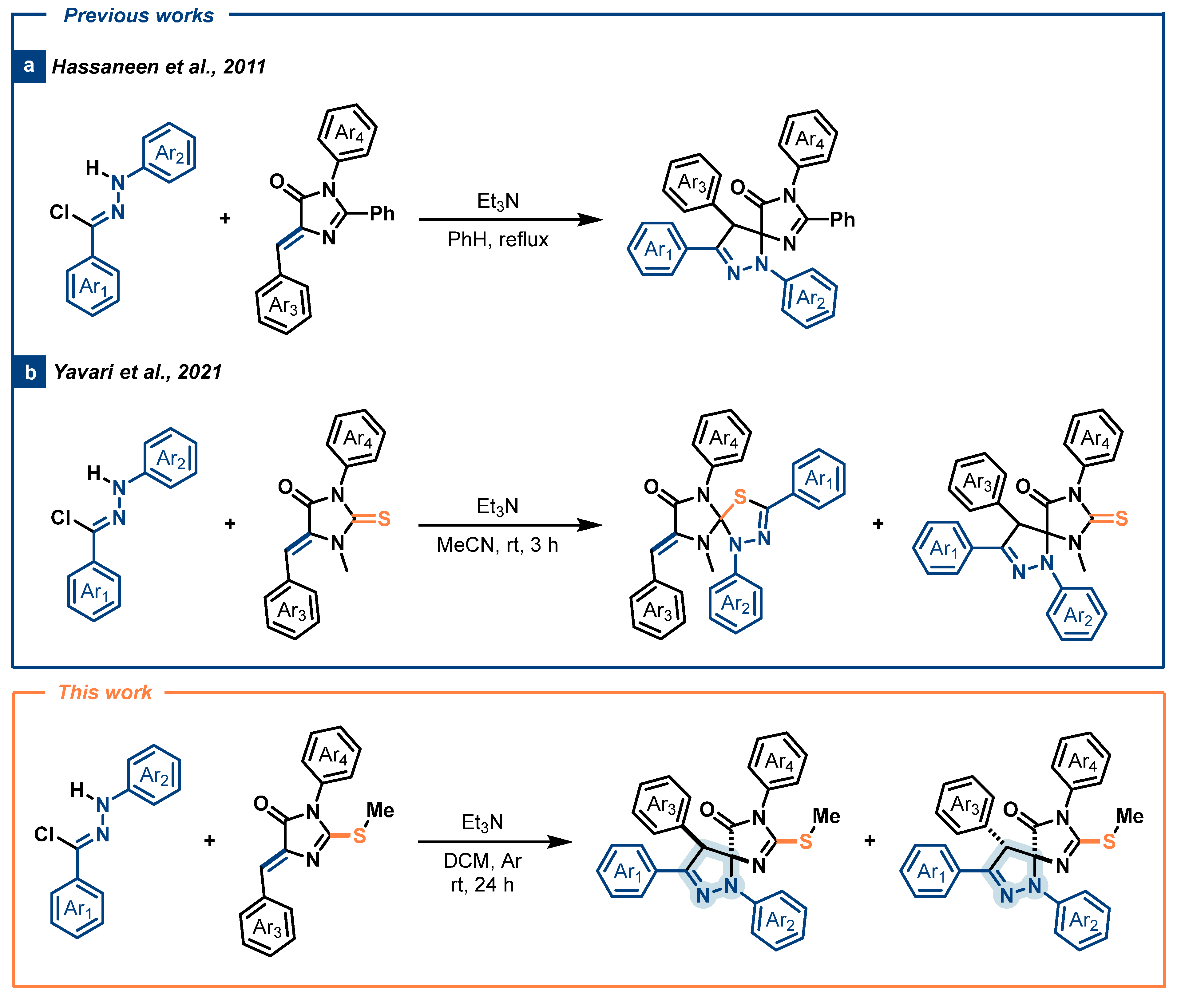
Hassaneen and co-workers conducted a detailed investigation of the regioselectivity of the cycloaddition of nitrile imine to imidazolinone derivatives [23] (Scheme 1a). The examined dipolarophile contains both an exocyclic C=C bond and an endocyclic C=N bond. Using equimolar amounts of the reactants, the authors observed complete regioselectivity, involving an attack of the nitrile imine nitrogen terminus at the more sterically hindered carbon of the exocyclic C=C bond. However, the possibility of cycloaddition at the endocyclic C=N bond upon increasing the concentration of the nitrile imine remains unexplored.
Yavari and co-workers reported that cycloaddition of nitrile imines to 5-arylidene-1-methyl-2-thiohydantoins proceeds competitively across both C=S and C=C bonds (Scheme 1b). While the C=S adduct typically predominates, the use of nitrile imines bearing electron-withdrawing nitro substituents results exclusively in cycloaddition at the C=S bond [24].
Building on our ongoing interest in nitrile imine cycloadditions with dipolarophiles containing multiple unsaturated functionalities [15,25,26], we report herein the use of 5-arylmethylene-2-methylthiohydantoins 5 as dipolarophiles for the construction of spiro-fused frameworks incorporating both thiohydantoin and pyrazoline fragments. These substrates contain two potentially reactive sites—C=C and C=N bonds—rendering them well suited for probing chemoselectivity in nitrile imine cycloaddition reactions (Scheme 1). In addition, the presence of a methylthio substituent provides a handle for further postsynthetic modification, as the S–Me group can be transformed into carbonyl [21], selenocarbonyl [27] functionalities or glycocyamidines [28,29].

2. Materials and Methods

2.1. General Methods

All solvents were purified and dried according to established procedures described previously in [30]. Commercially available reagents were used as received and were obtained from Sigma-Aldrich (St. Louis, MO, USA), ABCR (Karlsruhe, Germany), and AKSci (Burlington, VT, USA). Reaction progress was routinely monitored by thin-layer chromatography on silica gel plates containing a fluorescent indicator (254 nm), with visualization under UV light, unless stated otherwise.
1H and 13C{1H} NMR spectra were recorded on a BrukerAvance (Bruker BioSpin, Billerica, MA, USA) and Agilent 400-MR (Agilent Technologies, Santa Clara, CA, USA) spectrometers operating at 400 MHz for 1H and 101 MHz for 13C{1H}. Chemical shifts (δ) are reported in ppm relative to residual solvent signals [1H NMR: CDCl3 (7.27), DMSO-d6 (2.50); 13C{1H} NMR: CDCl3 (77.16), DMSO-d6 (39.52)]. Coupling constants (J) are given in Hertz (Hz). Signal multiplicities are denoted as s = singlet, d = doublet, dd = doublet of doublets, t = triplet, q = quartet, hept = heptet, m = multiplet, br = broad signal.
High-resolution mass spectra were acquired on a TripleTOF 5600+ quadrupole time-of-flight mass spectrometer (AB Sciex, Concord, Vaughan, ON, Canada) equipped with a DuoSpray ion source, using electrospray ionization in positive-ion mode. Typical acquisition parameters included a capillary voltage of 5.5 kV, nebulizer and curtain gas pressures of 15 and 25 psi, respectively, an ambient source temperature, a declustering potential of 20 V, and an m/z range of 100–1200. Elemental compositions were assigned based on accurate mass measurements and isotopic pattern analysis using PeakView software version 2.2 with Formula Finder module (SCIEX, Framingham, MA, USA), with a mass accuracy tolerance of ±5 ppm.
Infrared (IR) spectra were recorded on a Thermo Scientific Nicolet iS5 FT-IR spectrometer (Thermo Fisher Scientific, Waltham, MA, USA) equipped with iD1 transmission and/or iD7 ATR accessories. Samples were prepared as solids directly on the ATR diamond crystal or as thin films between NaCl plates for transmission mode, with spectra acquired in the range of 4000–400 cm−1 at a resolution of 4 cm−1.
Experimental procedures and characteristic data for all synthesized compounds are given in the Supplementary Information [25,30,31,32,33,34,35,36,37].

2.2. The 1,3-Dipolar Cycloaddition Reaction of Nitrile Imines with 5-Arylmethylene-2-methylthiohydantoins 5

General procedure: To a solution of hydrazonoyl chloride 2 (2.20 equiv.) and 5-arylmethylene-2-methylthiohydantoin 5 (1.00 equiv.) in 28 mL/1 mmol of DCM under an inert atmosphere, triethylamine (4.40 equiv.) in 21 mL/1 mmol of DCM was added dropwise while stirring for 15–20 min. After the addition, the reaction mixture was stirred for 24 h. Upon completion of the reaction, as monitored by TLC, the solvent was removed under reduced pressure. The crude mixture was then purified by column chromatography on silica gel using CH2Cl2/petroleum ether (1:1)—CH2Cl2 or CHCl3/petroleum ether (1:1)—CHCl3/MeOH (100:1) as the eluent to obtain the pure product.
  • (4R,5R)-4-(4-chlorophenyl)-8-(4-ethoxyphenyl)-7-(methylthio)-1,3-diphenyl-1,2,6,8-tetraazaspiro[4.4]nona-2,6-dien-9-one (6a)
Compound 6a was prepared from hydrazonoyl chloride 2a (0.081 g, 0.35 mmol), 5-arylmethylene-2-methylthiohydantoin 5a (0.060 g, 0.16 mmol) and TEA (0.098 mL, 0.7 mmol). Yield 0.053 g (59%). White solid.
Diastereomer 7a could be obtained only as a mixture with diastereomer 6a, and its yield was determined by 1H NMR analysis of the resulting mixture. Yield 7a 3%.
Chromatography: CHCl3/petroleum ether (3:1), Rf 0.55.
1H NMR (400 MHz, DMSO-d6) δ 7.61–7.54 (m, 2H), 7.43–7.31 (m, 7H), 7.21 (d, J = 8.1 Hz, 2H), 7.16 (d, J = 9.0 Hz, 2H), 7.09 (d, J = 8.9 Hz, 2H), 7.04 (d, J = 7.9 Hz, 2H), 6.96 (t, J = 7.4 Hz, 1H), 5.54 (s, 1H), 4.08 (q, J = 7.0 Hz, 2H), 2.00 (s, 3H), 1.35 (t, J = 7.0 Hz, 3H).
13C{1H} NMR (101 MHz, DMSO-d6) δ 177.74, 159.42, 149.18, 143.19, 132.53, 132.15, 131.84, 130.74, 129.40, 129.14, 128.99, 128.60, 128.05, 126.79, 123.59, 121.36, 115.38, 114.66, 91.02, 63.58, 61.94, 14.55, 12.46.
HRMS (ESI): calcd for C32H27ClN4O2S (M+Na) 589.1436, found 589.1439.
IR (cm−1): 1742 (C=O), 1597, 1564, 1509 (C=N, C=C arom.).
Mp 211–214 °C.
  • (4R,5R)-4-(4-chlorophenyl)-8-(4-ethoxyphenyl)-3-(4-methoxyphenyl)-7-(methylthio)-1-phenyl-1,2,6,8-tetraazaspiro[4.4]nona-2,6-dien-9-one (6b)
Compound 6b was prepared from hydrazonoyl chloride 2c (0.133 g, 0.51 mmol), 5-arylmethylene-2-methylthiohydantoin 5a (0.086 g, 0.23 mmol) and TEA (0.142 mL, 1.02 mmol). Yield 0.080 g (56%). White solid.
Chromatography: CHCl3/petroleum ether (3:1), Rf 0.35.
1H NMR (400 MHz, CDCl3) δ 7.47 (d, J = 8.9 Hz, 2H), 7.31–7.26 (m, 4H), 7.18–7.12 (m, 4H), 7.04–6.93 (m, 5H), 6.80 (d, J = 9.0 Hz, 2H), 5.19 (s, 1H), 4.06 (q, J = 7.0 Hz, 2H), 3.79 (s, 3H), 2.06 (s, 3H), 1.44 (t, J = 7.0 Hz, 3H).
13C{1H} NMR (600 MHz, CDCl3) δ 178.92, 164.34, 160.21, 159.96, 148.44, 143.83, 134.08, 131.74, 131.04, 129.11, 128.68, 128.63, 128.35, 124.13, 123.96, 121.96, 116.38, 115.48, 113.93, 92.20, 64.00, 63.86, 55.39, 14.87, 13.00.
HRMS (ESI): calcd for C33H29ClN4O3S (M+Na) 619.1541, found 619.1546.
IR (cm−1): 1752 (C=O), 1599, 1564 (C=N, C=C arom.).
Mp 170–171 °C.
  • (4R,5R)-3-(4-bromophenyl)-8-(3-chloro-4-fluorophenyl)-4-(4-methoxyphenyl)-7-(methylthio)-1-phenyl-1,2,6,8-tetraazaspiro[4.4]nona-2,6-dien-9-one (6c)
Compound 6c was prepared from hydrazonoyl chloride 2d (0.090 g, 0.29 mmol), 5-arylmethylene-2-methylthiohydantoin 5b (0.050 g, 0.13 mmol) and TEA (0.081 mL, 0.58 mmol). Yield 0.054 g (63%). White solid.
Diastereomer 7c could be obtained only as a mixture with diastereomer 6c, and its yield was determined by 1H NMR analysis of the resulting mixture. Yield 7c 2%.
Chromatography: CHCl3/petroleum ether (3:1), Rf 0.59.
1H NMR (400 MHz, DMSO-d6) δ 7.70–7.62 (m, 2H), 7.59–7.47 (m, 4H), 7.39–7.29 (m, 3H), 7.11 (d, J = 8.2 Hz, 2H), 7.07–7.01 (m, 2H), 6.96 (tt, J = 7.3, 1.1 Hz, 1H), 6.92–6.86 (m, 2H), 5.45 (s, 1H), 3.72 (s, 3H), 2.04 (s, 3H).
13C{1H} NMR (101 MHz, DMSO-d6) δ 177.35, 162.51, 158.97, 156.55, 148.68, 143.02, 131.57, 131.23, 130.19, 129.90, 129.52, 128.73, 128.65, 128.43 (d, J = 3.6 Hz), 124.34, 122.41, 121.39, 120.71 (d, J = 19.0 Hz), 118.22 (d, J = 22.6 Hz), 114.69, 113.53, 91.39, 62.43, 55.10, 12.65.
HRMS (ESI): calcd for C31H23BrClFN4O2S (M+Na) 671.0290, found 671.0285.
IR (cm−1): 1753 (C=O), 1596, 1564 (C=N, C=C arom.).
Mp 179–180 °C.
  • (4R,5R)-8-(3-chloro-4-fluorophenyl)-3,4-bis(4-chlorophenyl)-7-(methylthio)-1-phenyl-1,2,6,8-tetraazaspiro[4.4]nona-2,6-dien-9-one (6d)
Compound 6d was prepared from hydrazonoyl chloride 2b (0.118 g, 0.44 mmol), 5-arylmethylene-2-methylthiohydantoin 5c (0.077 g, 0.20 mmol) and TEA (0.123 mL, 0.88 mmol). Yield 0.096 g (78%). White solid.
Chromatography: CHCl3/petroleum ether (3:1), Rf 0.47.
1H NMR (400 MHz, CDCl3) δ 7.49–7.43 (m, 2H), 7.34–7.26 (m, 4H), 7.26–7.21 (m, 3H), 7.18 (dd, J = 6.3, 2.6 Hz, 1H), 7.15–7.10 (m, 4H), 7.06–6.97 (m, 2H), 5.17 (s, 1H), 2.10 (s, 3H).
13C{1H} NMR (101 MHz, CDCl3) δ 178.13, 163.11, 159.96, 157.44, 147.69, 143.32, 134.93, 134.53, 131.57, 131.04, 129.66 (d, J = 4.5 Hz), 129.26, 128.79, 128.62, 128.30, 127.24 (d, J = 7.9 Hz), 122.89, 122.60, 117.83, 117.60, 116.94, 92.50, 63.45, 13.12.
HRMS (ESI): calcd for C30H20Cl3FN4OS (M+Na) 631.0300, found 631.0298.
IR (cm−1): 1752 (C=O), 1597, 1564 (C=N, C=C arom.).
Mp 160–161 °C.
  • (4R,5R)-4-(4-chlorophenyl)-8-(4-ethoxyphenyl)-7-(methylthio)-3-(4-nitrophenyl)-1-phenyl-1,2,6,8-tetraazaspiro[4.4]nona-2,6-dien-9-one (6e)
Synthesis of the compound 6e was carried out according to general procedure from hydrazonoyl chloride 2e (0.161 g, 0.58 mmol), 5-arylmethylene-2-methylthiohydantoin 5a (0.099 g, 0.27 mmol) and TEA (0.162 mL, 1.16 mmol). Among the reaction mixture the target compound was not found.
  • (4R,5R)-4-(4-chlorophenyl)-8-(4-ethoxyphenyl)-7-(methylthio)-1-(4-nitrophenyl)-3-phenyl-1,2,6,8-tetraazaspiro[4.4]nona-2,6-dien-9-one (6f)
Compound 6f was prepared from hydrazonoyl chloride 2f (0.166 g, 0.60 mmol), 5-arylmethylene-2-methylthiohydantoin 5a (0.102 g, 0.27 mmol) and TEA (0.167 mL, 1.20 mmol). Owing to the very similar Rf values of the starting material 5a and the spiro adduct 6e, the latter could be isolated only as a mixture with 5a. As a result, we were able to isolate only traces (<5%) of the target compound 6f.
Chromatography: CHCl3/petroleum ether (3:1), Rf 0.43.
HRMS (ESI): calcd for C32H26ClN5O4S (M+Na) 634.1286, found 634.1281.

3. Results and Discussion

Hydrazonoyl chlorides served as nitrile imine precursors in this work and were prepared according to literature procedures [32] (Scheme 2).
Hydrazonoyl chlorides are convenient preparative precursors for the in situ generation of nitrile imines via base-promoted dehydrohalogenation. A series of hydrazonoyl chlorides 2ae was synthesized from commercially available benzoic acids and phenylhydrazines (Scheme 2). Following a reported protocol [32], phenylhydrazines were acylated with benzoyl chlorides to afford acylhydrazides 1ae, which were subsequently chlorinated using PPh3/CCl4 in anhydrous MeCN, providing nitrile imine precursors 2ae in good to excellent overall yields (see Supplementary Information, pp. S3–S5).
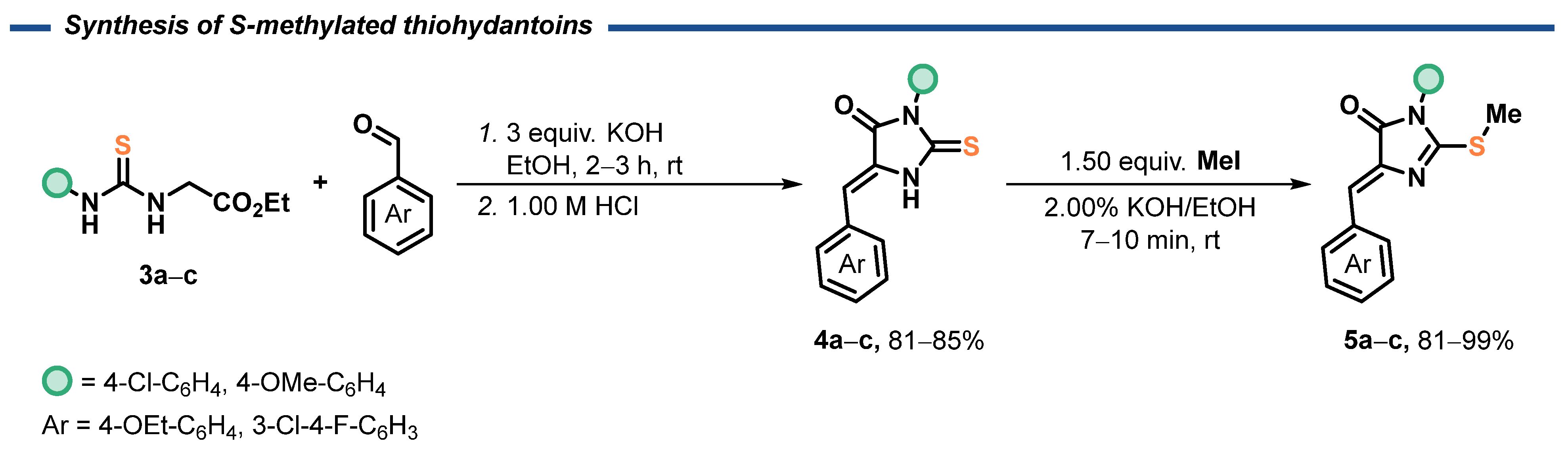
5-Arylmethylene-2-methylthiohydantoins were used as dipolarophiles in the 1,3-dipolar cycloaddition reactions and were prepared according to a reported method [34]. Condensation of thioureas 3ac [21] with aromatic aldehydes in 2% KOH/EtOH, followed by acidification, afforded 5-arylmethylene-2-thiohydantoins 4ac. Subsequent S-methylation under basic conditions yielded dipolarophiles 5ac in good to excellent yields (Scheme 3; see Supplementary Information, pp. S5–S10).
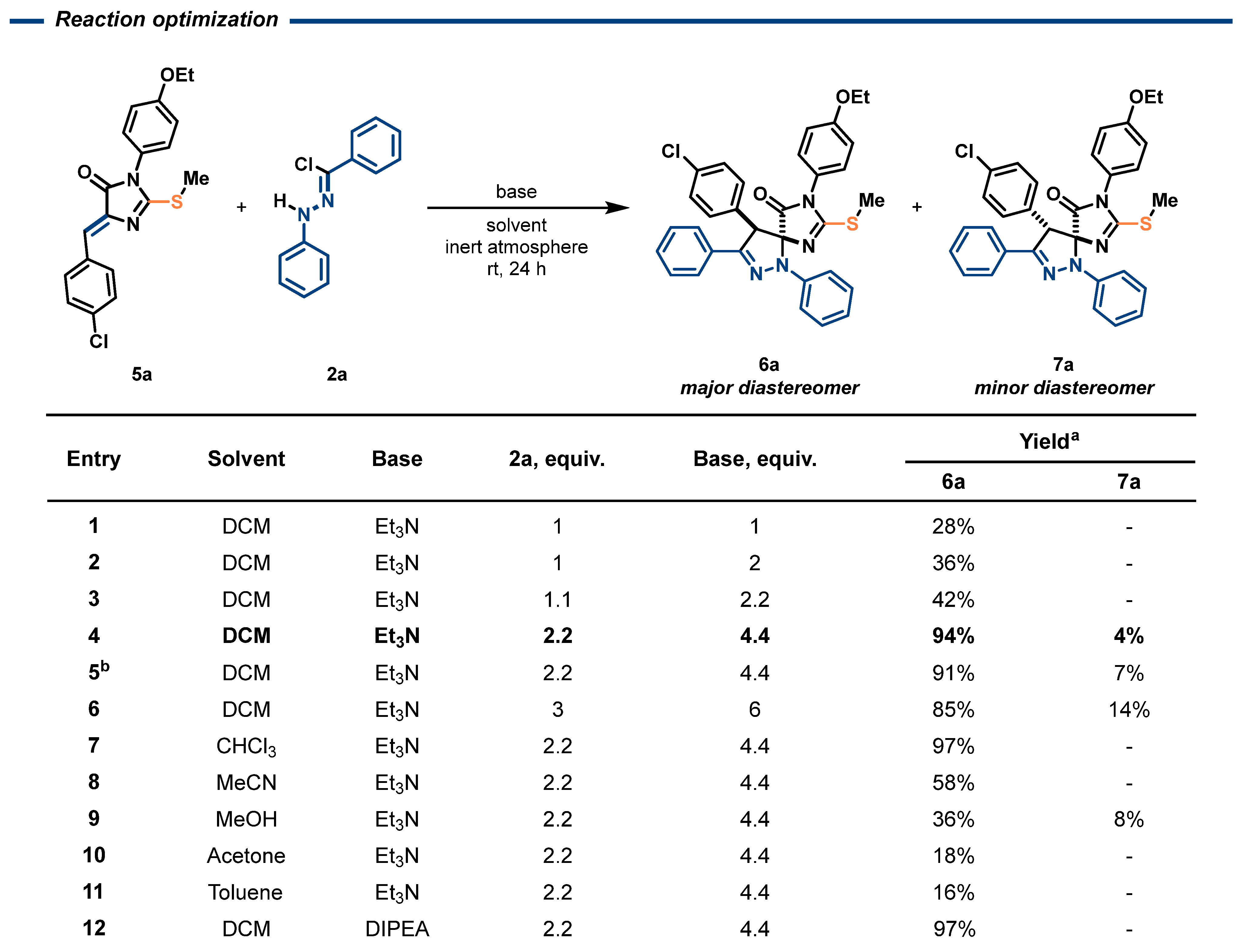
Next, the reaction conditions for the 1,3-dipolar cycloaddition of nitrile imines with 5-arylmethylene-2-methylthiohydantoins were optimized. Hydrazonoyl chloride 2a and 5-arylmethylene-2-methylthiohydantoin 5a were selected as model substrates. According to a previously reported protocol [25], hydrazonoyl chloride 2a and dipolarophile 5a were dissolved in dichloromethane (DCM), followed by dropwise addition of a triethylamine solution in DCM over 10–15 min under an inert atmosphere. The reaction mixture was then stirred at room temperature for 24 h (Figure 1).
A series of experiments demonstrated that altering the hydrazonoyl chloride 2a/Et3N ratio (entries 1–6) significantly influenced the reaction outcome. Increasing the nitrile imine concentration led to higher yields of 6a, with optimal results achieved using 2.2 equiv. of 2a and 4.4 equiv. of Et3N (entry 4). Under these conditions, however, a diastereomeric mixture of 6a (94%) and 7a (4%) was formed. Sequential addition of two equivalents of nitrile imine (entry 5), as well as further increases in its amount (entry 6), resulted in a higher proportion of diastereomer 7a.
Solvent screening (entries 7–11) showed that the highest yields were obtained in DCM and CHCl3 (entries 4 and 7). In contrast, the use of more polar solvents—MeCN (entry 8), MeOH (entry 9), acetone (entry 10), as well as toluene (entry 11)—led to decreased yields of cycloaddition product 6a, likely due to the limited solubility of 5a in these media. Substitution of Et3N with DIPEA had no significant effect on the reaction outcome (entry 12).
Thus, the cycloaddition of nitrile imines to 5-arylmethylene-2-methylthiohydantoin 5a proceeds chemoselectively at the exocyclic C=C bond, while the endocyclic C=N bond remains unreactive, even in the presence of excess nitrile imine (entry 6). The observed chemoselectivity can be attributed to the higher steric accessibility of the exocyclic double bond. Both outcomes—selective cycloaddition at an exocyclic C=C bond in the presence of an endocyclic C=N bond [23,38,39], as well as the reverse selectivity [40,41]—have been reported previously, indicating that chemoselectivity in nitrile imine cycloadditions is highly substrate- and substituent-dependent. In particular, nitrile imines bearing electron-withdrawing ethoxycarbonyl substituents favor cycloaddition at C=N bonds, whereas diaryl-substituted nitrile imines exhibit strict chemoselectivity toward C=C bonds [42].
Formation of a diastereomeric mixture is likely associated with partial E/Z isomerization of the exocyclic C=C bond of the starting dipolarophile under reaction conditions. Indeed, the 1H NMR spectrum of 5a recorded in CDCl3 shows partial signal doubling, indicating an isomeric mixture, whereas a single set of signals is observed in DMSO-d6. Accordingly, under reaction conditions in DCM or CHCl3, partial isomerization of the initial (Z)-5a to the E-isomer occurs, leading to formation of diastereomers 6a and 7a.
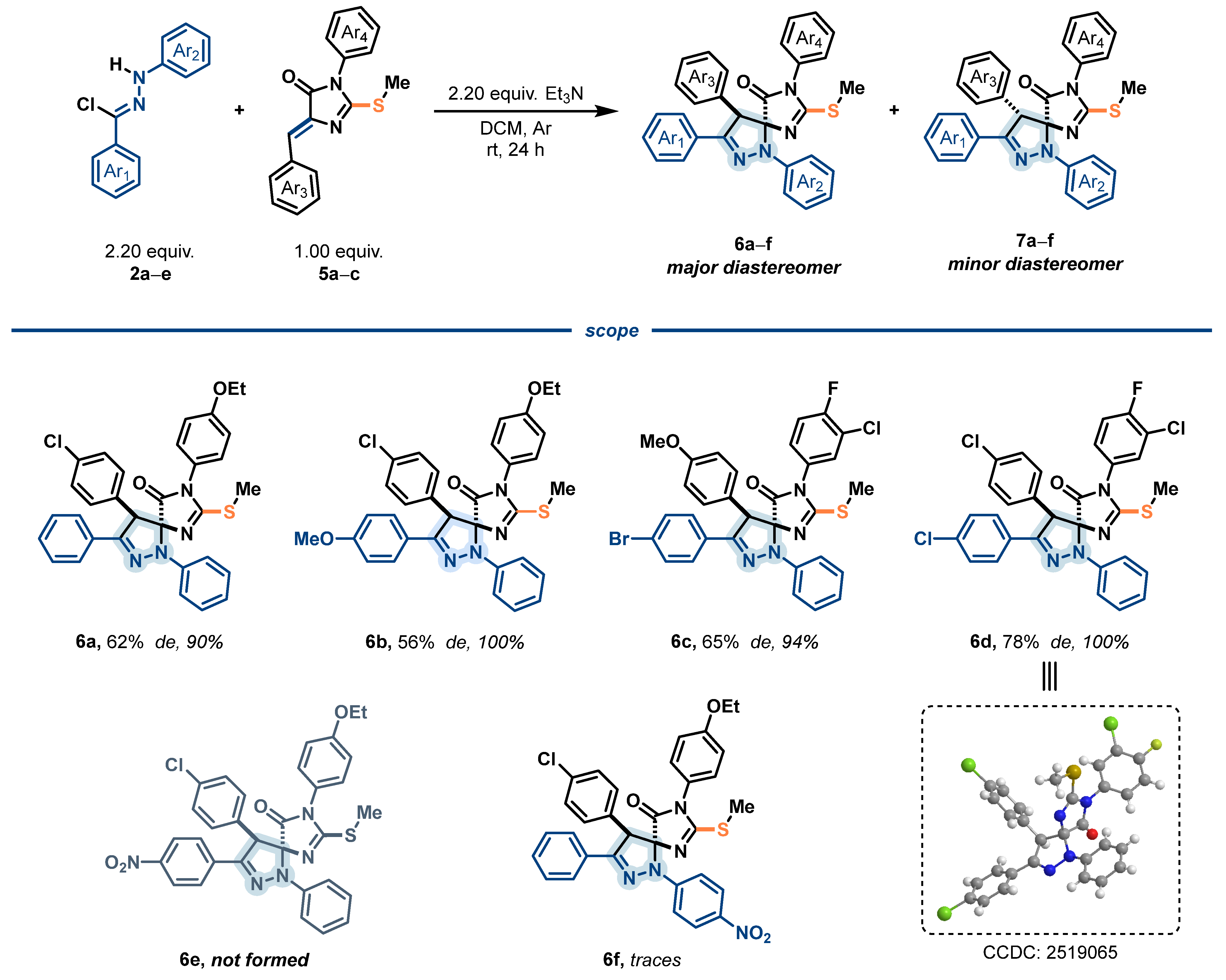
Using the optimized conditions, a series of compounds 6af was synthesized (Scheme 4). In some cases, diastereomers 7a and 7c were detected but they could be isolated only as mixtures with the major diastereomers 6. In contrast, cycloaddition products 6b and 6d were formed as single diastereomers. For compounds 6a and 7a, the reaction was also carried out using an alternative procedure described earlier (Figure 1, entry 5), in which 1.1 equiv of hydrazonoyl chloride 2a and 2.2 equiv of Et3N were initially added and the mixture was stirred for 2 days. A second portion of 2a (1.1 equiv) and Et3N (2.2 equiv) was then introduced, followed by stirring for an additional 3 days. Under these conditions, an increased proportion of the minor diastereomer 7a (16%) was observed, accompanied by a decrease in the yield of the major diastereomer 6a (36%).
The use of halogen-substituted hydrazonoyl chlorides 2b and 2d, unsubstituted 2a, and the electron-donating methoxy-substituted analog 2c afforded the corresponding cycloaddition products in good yields (56–78%). In contrast, reactions involving nitrile imines bearing electron-withdrawing substituents resulted in significantly lower yields of spiroimidazolones. Thus, when hydrazonoyl chloride 2e was employed, cycloaddition product 6e could not be isolated, and incomplete reagents conversion was observed, with starting materials recovered from the reaction mixture. In the case of hydrazonoyl chloride 2f, incomplete conversion of the starting 5-arylmethylene-2-methylthiohydantoin 5a also took place. Owing to the very similar Rf values of the starting material 5a and the spiro adduct 6f, the latter could be isolated only as a mixture with 5a in trace amounts (<5%).
The observed decrease in reactivity upon introduction of more electron-withdrawing substituents into the nitrile imine structure is consistent with literature reports indicating that such substituents reduce the reactivity of 1,3-dipoles toward the exocyclic C=C bond at the 5-position of thiohydantoin derivatives [15,24]. Although the introduction of electron-withdrawing substituents into the nitrile imine structure, as in the cases of compounds 6e and 6f, might be expected to alter the chemoselectivity of the cycloaddition toward addition at the C=N bond, as reported in related systems [42], no such cycloaddition products were observed in the present study.
Product structures were confirmed by 1H and 13C NMR spectroscopy and HRMS, while the structure of compound 6d was unambiguously established by single-crystal X-ray diffraction (see Supplementary Information, pp. S15–S16).
Overall, the results demonstrate that, regardless of the electronic nature of the nitrile imine, the 1,3-dipolar cycloaddition with 5-arylmethylene-2-methylthiohydantoins 5 proceeds regioselectively, with the N-terminus of the C–N–N fragment adding to the more sterically hindered carbon atom of the exocyclic C=C bond, in agreement with literature precedents[7,23]. In all cases, the reaction also remains chemoselective for the C=C bond.

4. Conclusions

In summary, we have demonstrated that 5-arylmethylene-2-methylthiohydantoins are effective dipolarophiles in the 1,3-dipolar cycloaddition of nitrile imines, despite the presence of multiple potentially reactive sites. Nitrile imines, generated in situ from hydrazonoyl chlorides, undergo cycloaddition in a highly chemo- and regioselective manner, reacting exclusively at the exocyclic C=C bond, while the endocyclic C=N bond remains inert even under conditions of excess dipole. Systematic optimization of the reaction conditions enabled the synthesis of a series of spiro-fused thiohydantoin–pyrazoline derivatives, with the observed diastereoselectivity explained by partial E/Z isomerization of the dipolarophile in the reaction conditions.
The dependence of reaction efficiency on the electronic nature of the nitrile imine substituents is consistent with known trends in nitrile imine reactivity and further supports the proposed selectivity rationale. Structural assignments were confirmed by spectroscopic methods and single-crystal X-ray diffraction.
Overall, this study expands the understanding of nitrile imine chemoselectivity toward multifunctional dipolarophiles and highlights 5-arylmethylene-2-methylthiohydantoins as versatile building blocks for the construction of structurally complex spirocyclic frameworks. The presence of a methylthio substituent additionally provides opportunities for postsynthetic modification, further enhancing the synthetic utility of the developed methodology.

Supplementary Materials

The following supporting information can be downloaded at https://www.mdpi.com/article/10.3390/org7010007/s1. Figure S1: X-ray structure of compound 6d; Table S1: Crystal data and structure refinement for 6d. Experimental procedures and characteristic data for all synthesized compounds are given in the Supplementary Information [25,30,31,32,33,34,35,36,37].

Author Contributions

Conceptualization, M.E.F., M.E.K. and E.K.B.; methodology, M.E.F.; validation, M.E.F. and V.A.T.; formal analysis, V.A.T.; investigation, M.E.F., L.A.L. and M.E.K.; data curation, M.E.F., L.A.L. and M.E.K.; writing—original draft M.E.F.; supervision, E.K.B.; project administration, M.E.F.; funding acquisition, M.E.K. and E.K.B. All authors have read and agreed to the published version of the manuscript.

Funding

The work was carried out within the framework of the State assignment of the Department of Organic Chemistry of the Faculty of Chemistry of Moscow State University on the topic: “Synthesis and study of physical, chemical and biological properties of organic and organoelement compounds” (CITIS number—AAAA-A21-121012290046-4). The authors are grateful for having been allowed to carry out X-ray diffraction measurements on a single-crystal X-ray diffractometer, Stoe STADI VARI PILATUS, purchased as part of the Development Program of Moscow State University named after M.V. Lomonosov [1832–2011]. This work, namely, the NMR study, was partly supported by the M.V. Lomonosov Moscow State University Program of Development.

Data Availability Statement

The data are available from the authors upon request.

Conflicts of Interest

The authors declare no conflicts of interest.

References

  1. Gupta, A.K.; Bharadwaj, M.; Kumar, A.; Mehrotra, R. Spiro-Oxindoles as a Promising Class of Small Molecule Inhibitors of P53–MDM2 Interaction Useful in Targeted Cancer Therapy. Top. Curr. Chem. 2017, 375, 3. [Google Scholar] [CrossRef]
  2. Hiesinger, K.; Dar’in, D.; Proschak, E.; Krasavin, M. Spirocyclic Scaffolds in Medicinal Chemistry. J. Med. Chem. 2021, 64, 150–183. [Google Scholar] [CrossRef]
  3. Bora, D.; Kaushal, A.; Shankaraiah, N. Anticancer Potential of Spirocompounds in Medicinal Chemistry: A Pentennial Expedition. Eur. J. Med. Chem. 2021, 215, 113263. [Google Scholar] [CrossRef]
  4. Kotha, S.; Deb, A.C.; Lahiri, K.; Manivannan, E. Selected Synthetic Strategies to Spirocyclics. Synthesis 2009, 2009, 165–193. [Google Scholar] [CrossRef]
  5. Dadiboyena, S. Cycloadditions and Condensations as Essential Tools in Spiropyrazoline Synthesis. Eur. J. Med. Chem. 2013, 63, 347–377. [Google Scholar] [CrossRef]
  6. Sami Shawali, A.; Osman Abdelhamid, A. Synthesis of Spiro-Heterocycles via 1,3-Dipolar Cycloadditions of Nitrilimines to Exoheterocyclic Enones. Site-, Regio- and Stereo-Selectivities Overview. Curr. Org. Chem. 2012, 16, 2673–2689. [Google Scholar] [CrossRef]
  7. Jamieson, C.; Livingstone, K. The Nitrile Imine 1,3-Dipole; Springer International Publishing: Cham, Switzerland, 2020. [Google Scholar]
  8. Deepthi, A.; Acharjee, N.; Sruthi, S.L.; Meenakshy, C.B. An Overview of Nitrile Imine Based [3+2] Cycloadditions over Half a Decade. Tetrahedron 2022, 116, 132812. [Google Scholar] [CrossRef]
  9. Huisgen, R.; Langhals, E. Thiones as Superdipolarophiles. Tetrahedron Lett. 1989, 30, 5369–5372. [Google Scholar] [CrossRef]
  10. Shawali, A.S.; Farghaly, T.A. Reactions of Hydrazonoyl Halides with Heterocyclic Thiones. Convenient Methodology for Heteroannulation, Synthesis of Spiroheterocycles and Heterocyclic Ring Transformation. Arkivoc 2008, 2008, 18–64. [Google Scholar] [CrossRef]
  11. Petrova, J.V.; Kukushkin, M.E.; Beloglazkina, E.K. 1,3-Dipolar Cycloaddition of Nitrile Imines and Nitrile Oxides to Exocyclic C=N Bonds—An Approach to Spiro-N-Heterocycles. Int. J. Mol. Sci. 2025, 26, 8673. [Google Scholar] [CrossRef] [PubMed]
  12. Guo, C.X.; Zhang, W.Z.; Zhang, N.; Lu, X.B. 1,3-Dipolar Cycloaddition of Nitrile Imine with Carbon Dioxide: Access to 1,3,4-Oxadiazole-2(3H)-Ones. J. Org. Chem. 2017, 82, 7637–7642. [Google Scholar] [CrossRef]
  13. Huisgen, R.; Grashey, R.; Seidel, M.; Knupfer, H.; Schmidt, R. 1.3-Dipolare Additionen, III. Umsetzungen Des Diphenylnitrilimins Mit Carbonyl Und Thiocarbonyl-Verbindungen. Justus Liebigs Ann. Chem. 1962, 658, 169–180. [Google Scholar] [CrossRef]
  14. Wang, Y.; Song, W.; Hu, W.J.; Lin, Q. Fast Alkene Functionalization In Vivo by Photoclick Chemistry: HOMO Lifting of Nitrile Imine Dipoles. Angew. Chem. Int. Ed. 2009, 48, 5330–5333. [Google Scholar] [CrossRef] [PubMed]
  15. Filkina, M.E.; Zhukov, E.A.; Tafeenko, V.A.; Semykin, A.V.; Kukushkin, M.E.; Nechaev, M.S.; Beloglazkina, E.K. Reactions of Nitrile Imines with Thiohydantoin Derivatives: Unexpected Chemoselectivity of the 1,3-Dipolar Cycloaddition: Preferential Addition of C=C Rather than C=S Bonds. ACS Omega 2025, 10, 40658–40667. [Google Scholar] [CrossRef] [PubMed]
  16. Konnert, L.; Lamaty, F.; Martinez, J.; Colacino, E. Recent Advances in the Synthesis of Hydantoins: The State of the Art of a Valuable Scaffold. Chem. Rev. 2017, 117, 13757–13809. [Google Scholar] [CrossRef]
  17. Cho, S.H.; Kim, S.H.; Shin, D. Recent Applications of Hydantoin and Thiohydantoin in Medicinal Chemistry. Eur. J. Med. Chem. 2019, 164, 517–545. [Google Scholar] [CrossRef] [PubMed]
  18. Dlin, E.A.; Averochkin, G.M.; Finko, A.V.; Vorobyeva, N.S.; Beloglazkina, E.K.; Zyk, N.V.; Ivanenkov, Y.A.; Skvortsov, D.A.; Koteliansky, V.E.; Majouga, A.G. Reaction of Arylboronic Acids with 5-Aryl-3-Substituted-2-Thioxoimidazolin-4-Ones. Tetrahedron Lett. 2016, 57, 5501–5504. [Google Scholar] [CrossRef]
  19. Khodair, A.I.; Bakare, S.B.; Awad, M.K.; Al-Issa, S.A.; Nafie, M.S. Design, Synthesis, and Computational Explorations of Novel 2-Thiohydantoin Nucleosides with Cytotoxic Activities. J. Heterocycl. Chem. 2022, 59, 664–685. [Google Scholar] [CrossRef]
  20. Ivanenkov, Y.A.; Kukushkin, M.E.; Beloglazkina, A.A.; Shafikov, R.R.; Barashkin, A.A.; Ayginin, A.A.; Serebryakova, M.S.; Majouga, A.G.; Skvortsov, D.A.; Tafeenko, V.A.; et al. Synthesis and Biological Evaluation of Novel Dispiro-Indolinones with Anticancer Activity. Molecules 2023, 28, 1325. [Google Scholar] [CrossRef]
  21. Kukushkin, M.; Novotortsev, V.; Filatov, V.; Ivanenkov, Y.; Skvortsov, D.; Veselov, M.; Shafikov, R.; Moiseeva, A.; Zyk, N.; Majouga, A.; et al. Synthesis and Biological Evaluation of S-, O- and Se-containing Dispirooxindoles. Molecules 2021, 26, 7645. [Google Scholar] [CrossRef]
  22. Beloglazkina, A.; Barashkin, A.; Polyakov, V.; Kotovsky, G.; Karpov, N.; Mefedova, S.; Zagribelny, B.; Ivanenkov, Y.; Kalinina, M.; Skvortsov, D.; et al. Synthesis and Biological Evaluation of Novel Dispiro Compounds Based on 5-Arylidenehydantoins and Isatins as Inhibitors of P53–MDM2 Protein–Protein Interaction. Chem. Heterocycl. Compd. 2020, 56, 747–755. [Google Scholar] [CrossRef]
  23. Miqdad, O.A.; Abunada, N.M.; Hassaneen, H.M. Regioselectivity of Nitrilimines 1,3-dipolar Cycloaddition: Novel Synthesis of Spiro[4,4]Nona-2,8-dien-6-one Derivatives. Heteroat. Chem. 2011, 22, 131–136. [Google Scholar] [CrossRef]
  24. Yavari, I.; Taheri, Z.; Sheikhi, S.; Bahemmat, S.; Halvagar, M.R. Synthesis of Thia- and Thioxo-Tetraazaspiro[4.4]Nonenones from Nitrile Imines and Arylidenethiohydantoins. Mol. Divers. 2021, 25, 777–785. [Google Scholar] [CrossRef]
  25. Filkina, M.E.; Baray, D.N.; Beloglazkina, E.K.; Grishin, Y.K.; Roznyatovsky, V.A.; Kukushkin, M.E. Regioselective Cycloaddition of Nitrile Imines to 5-Methylidene-3-Phenyl-Hydantoin: Synthesis and DFT Calculations. Int. J. Mol. Sci. 2023, 24, 1289. [Google Scholar] [CrossRef]
  26. Petrova, J.V.; Filkina, M.E.; Grishin, Y.K.; Roznyatovsky, V.A.; Tafeenko, V.A.; Nechaev, M.S.; Ugrak, B.I.; Dutova, T.Y.; Savin, A.M.; Boldyrikhin, A.Y.; et al. 1,3-Dipolar Cycloaddition of Nitrile Imines to 2-Imino-Thiazolo[3,2- a]Pyrimidin-3-Ones: Dipole-Initiated Thiazolone-Imidazolone Rearrangement. J. Org. Chem. 2025, 90, 14861–14870. [Google Scholar] [CrossRef] [PubMed]
  27. Alhasan, R.; Martins, G.M.; de Castro, P.P.; Saleem, R.S.Z.; Zaiter, A.; Fries-Raeth, I.; Kleinclauss, A.; Perrin-Sarrado, C.; Chaimbault, P.; da Silva Júnior, E.N.; et al. Selenoneine-Inspired Selenohydantoins with Glutathione Peroxidase-like Activity. Bioorg Med. Chem. 2023, 94, 117479. [Google Scholar] [CrossRef] [PubMed]
  28. Daboun, H.A.; Abd-Elfattah, A.M.; Hussein, M.M.; Shalaby, A.F.A. Reactions of Amino Acids on 2-Methylmercaptohydantoin Derivatives. Synthesis of Imidazoimidazoline and Imidazoquinazoline Derivatives. Z. Naturforschung B 1981, 36, 366–369. [Google Scholar] [CrossRef]
  29. Daboun, H.A.; Ibrahim, Y.A. Rearrangement of 3-arylhydantoins into 3-aminoglycocyamidines. J. Heterocycl. Chem. 1982, 19, 41–43. [Google Scholar] [CrossRef]
  30. Tietze, L.F.; Eicher, T. Reaktionen Und Synthesen Im Organisch-Chemischen Praktikum Und Forschungslaboratorium (2. Auflage), 117th ed.; Thieme Verlag: Stuttgart, Germany; New York, NY, USA, 1991. [Google Scholar]
  31. Jayaraman, A.; Cho, E.; Irudayanathan, F.M.; Kim, J.; Lee, S. Metal-Free Decarboxylative Trichlorination of Alkynyl Carboxylic Acids: Synthesis of Trichloromethyl Ketones. Adv. Synth. Catal. 2018, 360, 130–141. [Google Scholar] [CrossRef]
  32. Giustiniano, M.; Meneghetti, F.; Mercalli, V.; Varese, M.; Giustiniano, F.; Novellino, E.; Tron, G.C. Synthesis of Aminocarbonyl N.-Acylhydrazones by a Three-Component Reaction of Isocyanides, Hydrazonoyl Chlorides, and Carboxylic Acids. Org. Lett. 2014, 16, 5332–5335. [Google Scholar] [CrossRef]
  33. Remy, R.; Bochet, C.G. Application of Photoclick Chemistry for the Synthesis of Pyrazoles via 1,3-Dipolar Cycloaddition between Alkynes and Nitrilimines Generated In Situ. Eur. J. Org. Chem. 2018, 2018, 316–328. [Google Scholar] [CrossRef]
  34. Kuznetsova, O.Y.; Antipin, R.L.; Udina, A.V.; Krasnovskaya, O.O.; Beloglazkina, E.K.; Terenin, V.I.; Koteliansky, V.E.; Zyk, N.V.; Majouga, A.G. An Improved Protocol for Synthesis of 3-Substituted 5-Arylidene-2-Thiohydantoins: Two-Step Procedure Alternative to Classical Methods. J. Heterocycl. Chem. 2016, 53, 1570–1577. [Google Scholar] [CrossRef]
  35. Sun, Y.; Ding, M.W. Synthesis and Fungicidal Activities of 2-Alkylthio-5-Phenylmethylene-4h- Imidazol-4-Ones. Phosphorus Sulfur. Silicon Relat. Elem. 2003, 178, 2137–2145. [Google Scholar] [CrossRef]
  36. Ding, M.W.; Sun, Y.; Liu, Z.J. An Efficient Synthesis of 2-Alkylthio-5-Phenylmethylidene-4H-Imidazolin-4-Ones. Synth. Commun. 2003, 33, 1267–1274. [Google Scholar] [CrossRef]
  37. Renault, S.; Bertrand, S.; Carreaux, F.; Bazureau, J.P. Parallel Solution-Phase Synthesis of 2-Alkylthio-5-Arylidene-3,5-Dihydro- 4H-Imidazol-4-One by One-Pot Three-Component Domino Reaction. J. Comb. Chem. 2007, 9, 935–942. [Google Scholar] [CrossRef] [PubMed]
  38. Papadopoulos, S.; Stephanidou-Stephanatou, J. 1,3-Dipolar Cycloaddition Reactions of Nitrilimines with 1-aroyl-4,5-dihydro-3,4,4-trimethyl-5-methylene-1H.-pyrazoles. Synthesis of 6-aroyl-8,9,9-trimethyl-1,2,6,7-tetrazaspiro[4.4]Nona-2,7-dienes. J. Heterocycl. Chem. 1987, 24, 309–312. [Google Scholar] [CrossRef]
  39. Baba, N.; Soufiaoui, M. Cycloaddition Dipolaire 1,3 Des 4-Arylidene Oxazol-5- Ones Avec La Diphenylnitrilimine. Tetrahedron Lett. 1990, 31, 1709–1712. [Google Scholar] [CrossRef]
  40. Abdel Hafez, N.A.; Hassaneen, H.M.E.; Farghaly, T.A.; Riyadh, S.M.; Elzahabi, H.S.A. Synthesis of New Bis-Spiropyrazoles as Antitumor Agents under Ultrasound Irradiation. Mini-Rev. Med. Chem. 2018, 18, 631–637. [Google Scholar] [CrossRef]
  41. Liu, B.; Li, X.F.; Liu, H.C.; Yu, X.Y. Unexpected Nitrilimine Cycloaddition of Thiazolo[3,2-a]Pyrimidine Derivatives. Tetrahedron Lett. 2013, 54, 6952–6954. [Google Scholar] [CrossRef]
  42. Farghaly, T.A.; Abbas, I.M.; Hassan, W.M.I.; Lotfy, M.S.; Al-Qurashi, N.T.; Hadda, T. Ben Structure Determination and Quantum Chemical Analysis of 1,3-Dipolar Cycloaddition of Nitrile Imines and New Dipolarophiles and POM Analyses of the Products as Potential Breast Cancer Inhibitors. Russ. J. Org. Chem. 2020, 56, 1258–1271. [Google Scholar] [CrossRef]
Scheme 1. 1,3-Dipolar Cycloaddition of Nitrile Imines to Imidazolinone Derivatives (a) [23] and Arylidenethiohydantoins (b) [24].
Organics 07 00007 sch001
Scheme 2. Synthesis of hydrazonoyl chlorides 2ae.
Organics 07 00007 sch002
Scheme 3. Synthesis of 5-arylmethylene-2-methylthiohydantoins 5ac.
Organics 07 00007 sch003
Figure 1. Optimization of cycloaddition reaction conditions of hydrazonoyl chloride 2a with 5-arylmethylene-2-methylthiohydantoin 5a. Unless otherwise noted, reactions were carried out at room temperature under an argon atmosphere using 5-arylmethylene-2-methylthiohydantoin 5a (0.071 mmol, 0.026 g) and the corresponding hydrazonoyl chloride 2a in 3.5 mL of solvent for 24 h. a Product yields were determined by 1H NMR analysis of the crude reaction mixtures using CH2Br2 as an internal standard. b Initially, 1.1 equiv. of hydrazonoyl chloride 2a and 2.2 equiv of Et3N were added and the mixture was stirred for 6 h; a second portion of 2a (1.1 equiv) and Et3N (2.2 equiv) was then introduced, followed by stirring for an additional 6 h.
Organics 07 00007 g001
Scheme 4. Cycloaddition of hydrazonoyl chlorides 2 to 5-arylmethylene-2-methylthiohydantoins 5 in the presence of Et3N and the reaction scope.
Organics 07 00007 sch004
Disclaimer/Publisher’s Note: The statements, opinions and data contained in all publications are solely those of the individual author(s) and contributor(s) and not of MDPI and/or the editor(s). MDPI and/or the editor(s) disclaim responsibility for any injury to people or property resulting from any ideas, methods, instructions or products referred to in the content.