


Abstract
A sustainable hybrid material, CuO/Cu2O, was synthesized using an aqueous extract of Curcuma longa L. as a reducing and stabilizing agent. The material was characterized by UV-Vis spectroscopy, FTIR, XRD, SEM, EDX, and TEM. XRD analysis revealed peaks corresponding to CuO and Cu2O phases with crystallite sizes of 15.88 nm and 16.71 nm, respectively. TEM images showed nearly spherical particles with some agglomeration and an average particle diameter of 8.17 nm. The hybrid material exhibited catalytic activity toward the synthesis of 1,2,3-triazoles in water, under low catalyst loading and mild reaction conditions. This work highlights the potential of Curcuma longa-mediated synthesis as a low-cost, eco-friendly alternative for producing efficient catalysts, contributing to the advancement of green chemistry and sustainable nanomaterial applications in organic synthesis.
1. Introduction
The development of sustainable chemical processes has become a priority among researchers worldwide. Strategies that promote greater atom economy, avoid the use of organic solvents, and minimize environmental impacts are highly valued in chemical synthesis. In this context, click chemistry stands out for adhering to the principles of green chemistry, as it involves modular reactions with high yields, simple execution, minimal byproduct generation, and mild reaction conditions [1].
Click chemistry, independently introduced by Sharpless and Meldal in 2002, refers to the Cu(I)-catalyzed 1,3-dipolar cycloaddition (CuAAC) between an azide and a terminal or internal alkyne, forming a triazole ring [2]. This reaction is regioselective, producing 1,4-disubstituted 1,2,3-triazoles with excellent yields, selectivity, and atom economy [3,4,5,6,7,8,9,10]. The resulting heterocycle, 1,2,3-triazole, is a structural block present in numerous biologically active compounds [11,12]. Molecules containing this core exhibit a wide range of pharmacological properties, including anticancer [13], antimicrobial [14], anti-inflammatory [15], antimalarial [16], antidiabetic [17], and antiviral activities [18]. Due to the versatility of the triazole linkage, which acts as a peptide mimic, click chemistry is also widely applied in bioconjugation and peptide ligation processes [2]. Currently, its influence extends beyond organic synthesis, reaching areas such as polymer chemistry, drug discovery [3], and materials science [1].
Copper-catalyzed cycloaddition is the most explored click reaction, although other metals can be employed. Recently, nanoscale catalysts have attracted significant interest [19] due to their unique properties and high chemical activity. Nanoparticles (NPs) exhibit a high surface-area-to-mass ratio, enhancing catalytic efficiency by promoting interactions between reactants and active sites [20]. Among nanostructured materials, copper oxides stand out for their low cost and attractive physicochemical properties, such as large surface area, suitable redox potential, excellent electrochemical activity, high thermal conductivity, good stability, and relevant biological activities, including antioxidant, anticancer, and antibacterial effects [18,21,22].
Several conventional strategies, such as sol–gel processes, spraying, and mechanical milling, are employed in the synthesis of these materials [18]. However, such methods tend to be expensive, less sustainable, and often yield unsatisfactory results. In contrast, green synthesis emerges as an efficient and environmentally friendly alternative, using natural sources such as bacteria, fungi, algae, plants, enzymes, and yeasts [21,23]. Each biological system follows distinct mechanisms determined by the bioactive compounds present, which act as reducing and stabilizing agents for metal ions [21,22]. These methods not only employ clean solvents but also offer accessible and effective routes for nanoparticle production [24]. Among the most studied approaches, the use of plant extracts stands out [25].
Curcuma longa L., an herbaceous plant of the Zingiberaceae family, shows great potential for green synthesis. Widely used as a spice and natural dye, this plant also possesses various biological and pharmacological activities, including anti-inflammatory, antidiabetic, anticancer, and antidepressant effects [26,27,28]. Despite its potential, the application of Curcuma longa in nanoparticle synthesis, especially copper oxides, is still underexplored [29]. Existing studies generally focus on the biological properties of the nanoparticles [28,30]. These copper-based nanomaterials can act as efficient catalysts in various organic transformations, reinforcing the need for further research on their synthesis and functionality [31,32,33,34].
In this context, we present a simple and sustainable protocol for the synthesis of copper oxide nanoparticles using an aqueous extract of Curcuma longa L. The obtained material was applied as a catalyst in an efficient and reliable “one-pot” methodology for the synthesis of 1,2,3-triazole compounds.
2. Materials and Methods
2.1. Materials
All reagents were purchased from Sigma-Aldrich, Barueri, SP, Brazil and Synth, Diadema, SP, Brazil and all other reagents employed were of analytical grade. When they were not HPLC-grade solvents, they were purified by distillation. Thin-Layer Chromatography was carried out using Merck TLC 60 F254 silica gel plates, Barueri, SP, Brazil, visualized under UV light (254 nm), and stained with acidic vanillin solution. Flash column chromatography was performed using silica gel with a pore size of 60 Å, with a 230–400 Mesh (Sigma Aldrich, cat.# 22,719-6).
2.2. Preparation of Plant Extracts
The rhizomes of Curcuma longa L. were collected in the city of Toledo, Paraná, Brazil. The collected rhizomes were cleaned using a sodium hypochlorite solution at a concentration of 100 mg·L−1, followed by thorough rinsing with distilled water. After cleaning, the rhizomes were stored under refrigeration and protected from light. Ultrasound-Assisted Extraction (UAE) was performed using an Ultronique QR500, Ecosonics, Indaiatuba, SP, Brazil device equipped with a 13 mm diameter titanium probe. A total of 30 g of rhizome was ground in 50 mL of distilled water. After that, the extract was centrifuged to separate the particulates, and only the supernatant was collected for 10 min at room temperature, at 2500 rpm. The resulting extract was stored under refrigeration in the dark for subsequent use.
2.3. Synthesis of CuO/Cu2O NPs Using Curcuma longa Extract
Copper nanoparticles were synthesized using the following procedure: A total of 50 mL of the previously prepared aqueous extract was slowly added dropwise to a 100 mM copper sulfate precursor solution, ensuring homogeneous nanoparticle formation throughout the process [35]. During the addition, the mixture was vigorously shaken until a gradual color change to dark was observed, indicating the formation of copper nanoparticles. This transformation was monitored by UV-Vis and FT-IR spectroscopy (see Supplementary Materials).
After the addition was complete, the precipitate was centrifuged at 4000 rpm. The resulting solid was transferred to a Petri dish and dried in an oven at 100 °C. After drying, the material was stored in Eppendorf microtubes for further analysis. The solid was then subjected to a calcination process at 450 °C for 2 h and 30 min and stored for subsequent characterization.
2.4. Characterization of CuO/Cu2O
The absorbance spectrum of the green-synthesized CuO/Cu2O NPs was analyzed using UV–Vis spectroscopy (SHIMADZU UV-1800 Spectrophotometer, SHIMADZU CORPORATION, Kyoto, Japan) in the range of 300–800 nm. Fourier-transform infrared spectroscopy (FTIR) analysis was performed using a PERKIN ELMER Spectrum 100s (PerkinElmer Inc., Waltham, MA, USA) to determine the role of biomolecules in leaf extracts for metal reduction in the range of 400–4000 cm−1.
The phase composition and crystalline size were analyzed using X-ray diffraction (XRD) with a PANALYTICAL Aeris Research X-ray diffractometer (Malvern Panalytical, Worcestershire, UK). The crystallite size of the green-synthesized copper oxide nanoparticles was determined through the analysis of X-ray diffraction (XRD) peaks, by applying the Debye–Scherrer Equation (1):
where κ is an empirical constant with a value of 0.89, λ represents the wavelength of the X-ray source (1.5405 Å), β denotes the full width at half maximum (FWHM) of the diffraction peak, and θ corresponds to the angular position of the peak.
The surface and internal morphological characteristics, as well as the particle size, of CuO/Cu2O nanoparticles (NPs) were investigated using scanning electron microscopy (SEM; Shimadzu Superscan SS-550, SHIMADZU CORPORATION, Kyoto, Japan) and transmission electron microscopy (TEM; JEOL JEM-1400, JEOL Ltd., Tokyo, Japan), respectively.
For SEM analysis, the samples were prepared by depositing the material onto double-sided carbon adhesive tape mounted on a metal stub. Subsequently, the samples were sputter-coated with a thin gold layer approximately 30 nm thick. For TEM analysis, the sample was dispersed in purified water and subjected to ultrasonic treatment. A drop of the resulting suspension was then deposited onto the microscope grid.
2.5. General Procedure for Synthesis of 1,2,3-Triazoles
Benzyl bromide (1.5 equiv. 0.3 mmol, 35 μL), sodium azide (1 equiv. 0.2 mmol, 13 mg), water (1 mL), phenylacetylene (1.1 equiv. 0.22 mmol, 24 μL), and CuO/Cu2O (2 mg) were added to a glass vial. Then the reaction mixture was stirred at room temperature for 12 h. After this time, the product was extracted with dichloromethane (3 × 5 mL), and the organic phase was dried over anhydrous sodium sulfate (Na2SO4). The solvent was removed under reduced pressure using a rotary evaporator. The crude obtained was subsequently purified by column chromatography on silica gel using a mixture of hexane/ethyl acetate as the eluent to afford the desired products. All the products were characterized by nuclear magnetic resonance (NMR) spectroscopy in a Bruker Avance DPX 300 spectrometer (Bruker Corporation, Billerica, MA, USA) at 300 MHz (1H) and at 75 MHz (13C). Nuclear magnetic resonance (NMR) spectra were recorded in CDCl3 using a Bruker DPX 300 (1H at 300 MHz, 13C at 75 MHz). Chemical shifts, δ, are reported in parts per million (ppm) and are referenced to the residual solvent. 1H peaks are quoted to the nearest 0.01 Hz and 13C peaks are quoted to the nearest 0.1 Hz. The abbreviations utilized to report the peaks are s (singlet), d (doublet), t (triplet), dd (doublet of doublets), and m (multiplet). All the products are known compounds; the spectral data were identical to those reported in the literature, and the NMR spectra are available in Supplementary Materials.
3. Results
3.1. CuO/Cu2O NP Synthesis
During the dropwise addition in the nanoparticle synthesis, a visible color change was observed, transitioning from greenish to dark brown. This change is attributed to the formation and dispersion of copper-based nanoparticles [21,22,36].
The Curcuma longa L. extract contains various compounds responsible for nanoparticle formation, including polyphenols, terpenes, and curcuminoids. These compounds interact with copper ions to form complexes, leading to the reduction of Cu2+ to metallic copper (Cu0). Subsequently, copper reacts with atmospheric oxygen to form CuO/Cu2O nanoparticles. This process involves nucleation followed by nanoparticle growth until a stable size and morphology are achieved.
The phytochemicals in the plant extract not only promote the reduction of copper ions but also stabilize the nanoparticle clusters, preventing uncontrolled growth of the metal oxide [37].
3.2. UV-Vis Spectroscopy Analysis
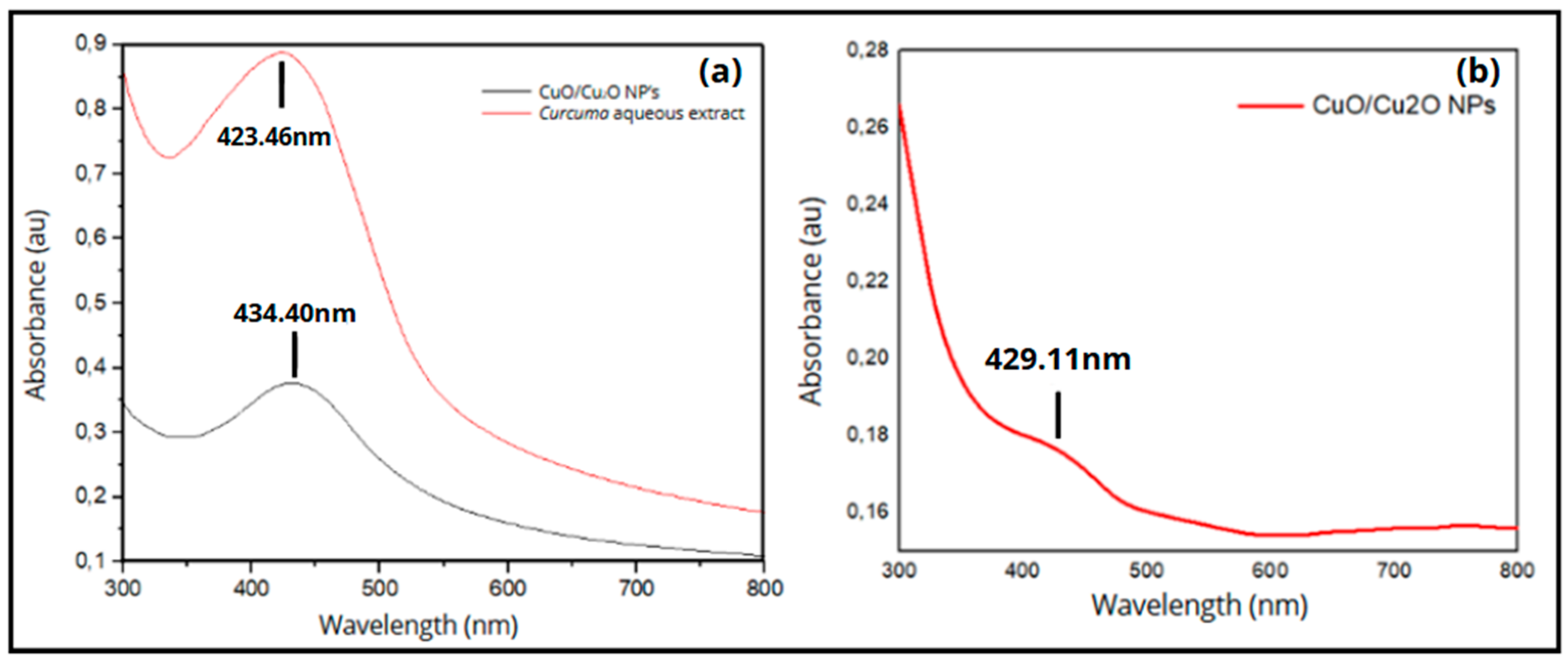
To investigate the optical properties of the synthesized material, Figure 1a presents a comparative absorption spectrum of the aqueous extract of Curcuma longa L. and the synthesized nanoparticles in dispersion. The extract exhibited a maximum absorption peak at 423.46 nm, attributed to curcuminoids, phenolic compounds, and flavonoids primarily due to π → π* transitions, with curcumin being the major contributor [38].
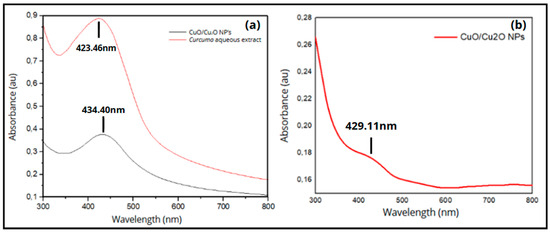
Figure 1.
UV–visible spectrum of aqueous extract of Curcuma longa L. and non-calcined CuO/Cu2O NPs (a); absorption spectrum of CuO/Cu2O NPs after calcination (b).
In contrast, the nanoparticle dispersion showed a broad absorption band centered at 434.40 nm, indicating changes in the system’s optical properties. This redshift is likely due to the interaction between reducing/stabilizing compounds and copper ions during nanoparticle nucleation.
After calcination, shown in Figure 1b, the absorption band shifted to 429.11 nm. The absence of sharp absorption bands suggests the decomposition of organic compounds during thermal treatment, with the inorganic phase becoming predominant.
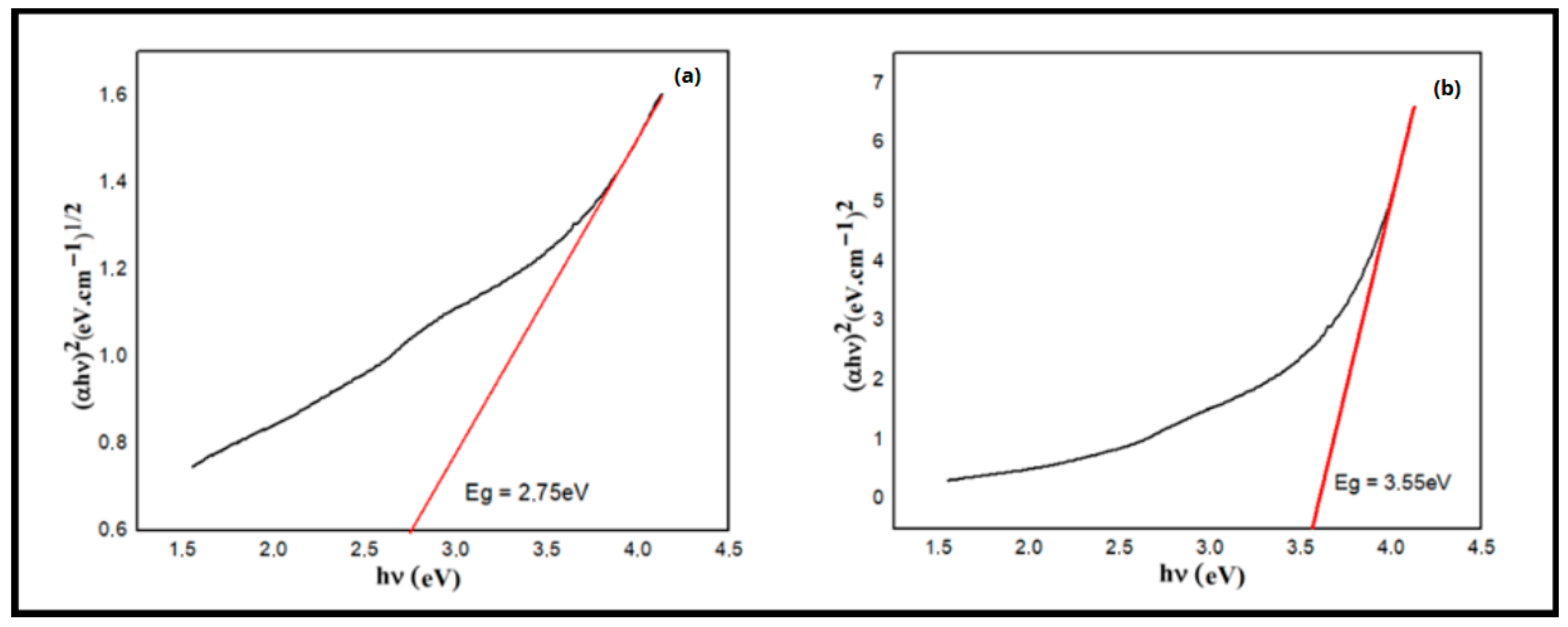
The optical bandgap energy was determined using Tauc plots (Figure 2), applying Equation (2) as follows for both indirect (a) and direct (b) allowed transitions of CuO/Cu2O.
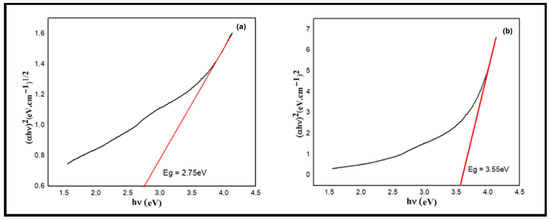
Figure 2.
Tauc plot for bandgap energy determination in (a) indirect and (b) direct electronic transitions.
Here, α is the absorption coefficient, h is Planck’s constant, ν is the vibration frequency, A is a proportionality constant, Eg is the bandgap energy, and n defines the nature of the electronic transition (n = 2 for direct transitions; n = ½ for indirect transitions).
Linear extrapolation of the plots gave a bandgap of 2.75 eV for indirect and 3.55 eV for direct transitions. These values are consistent with the literature for CuO and Cu2O nanostructures.
Bulk CuO typically exhibits a monoclinic structure with a bandgap ranging from 1.3 to 1.7 eV, while Cu2O shows a bandgap between 2.0 and 2.5 eV. In the nanoscale, factors such as crystal size, particle morphology, disorder, quantum confinement, and composition can significantly influence bandgap energy.
Literature reports have shown bandgap values between 1.92 and 2.38 eV for direct transitions (CuO), and between 1.67 and 1.84 eV for indirect transitions, depending on synthesis parameters. For example, increased copper sulfate concentration leads to larger particle sizes, which correlates with a reduced bandgap [39,40].
3.3. FTIR Analysis
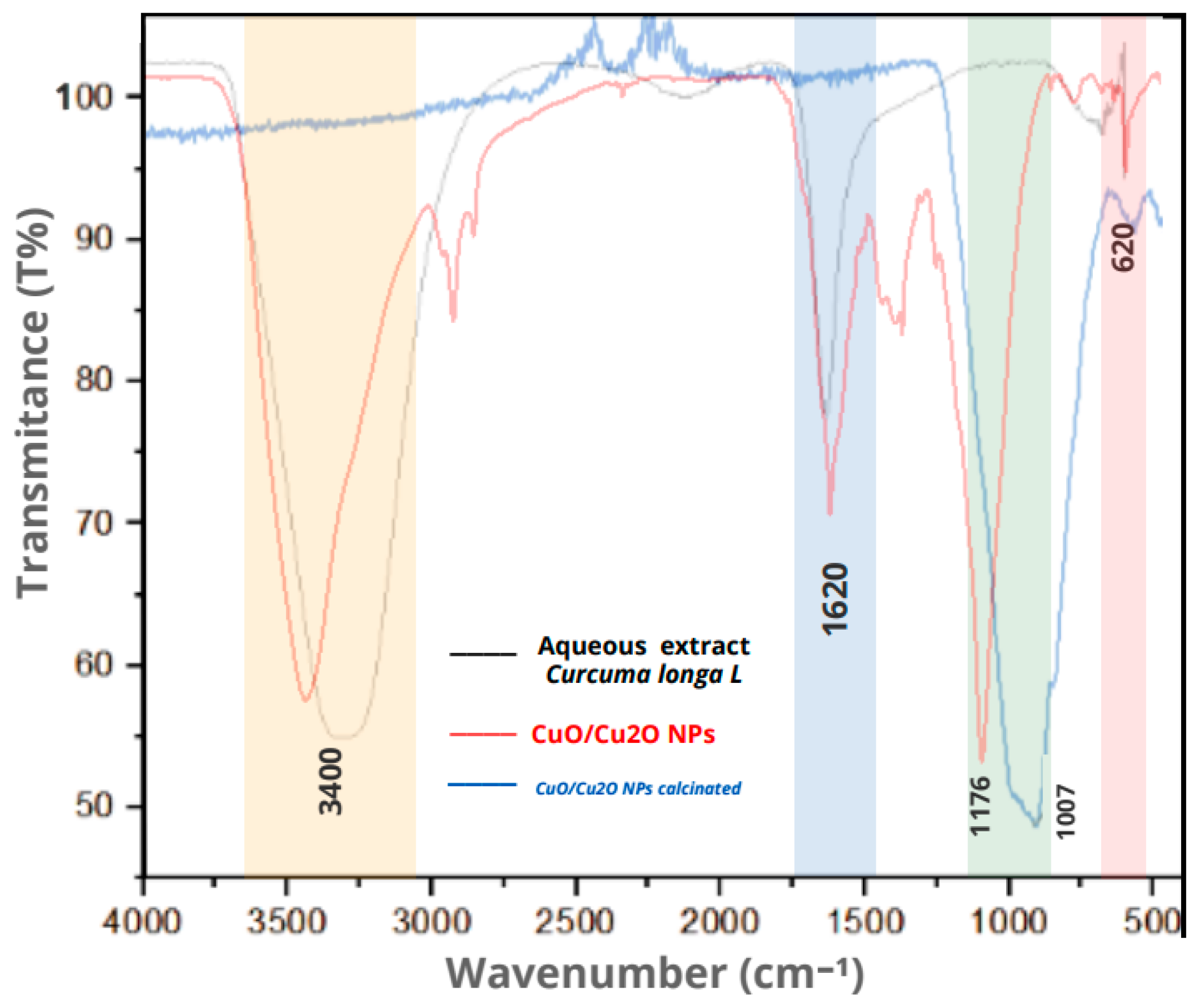
Figure 3 displays the FTIR spectrum of the Curcuma longa L. extract and the synthesized nanoparticles prior to calcination, while Figure 4 shows the spectrum of the nanoparticles after the calcination process.
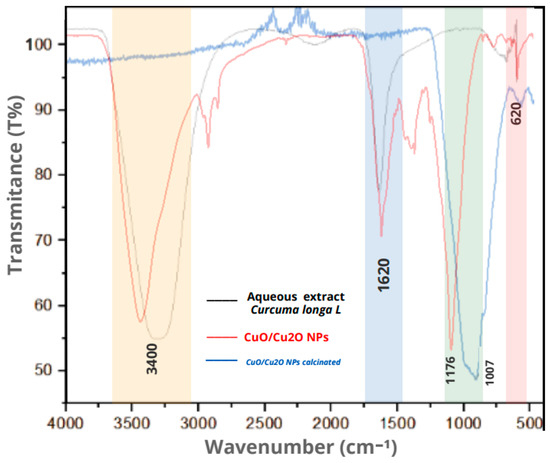
Figure 3.
FTIR spectrum of aqueous extract of Curcuma longa L. (black), non-calcined CuO/Cu2O NPs (red), and after calcination (blue).
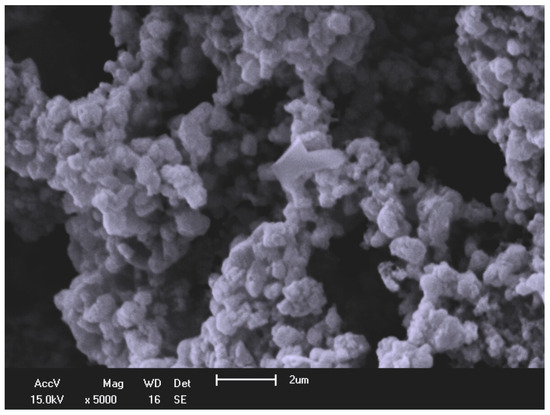
Figure 4.
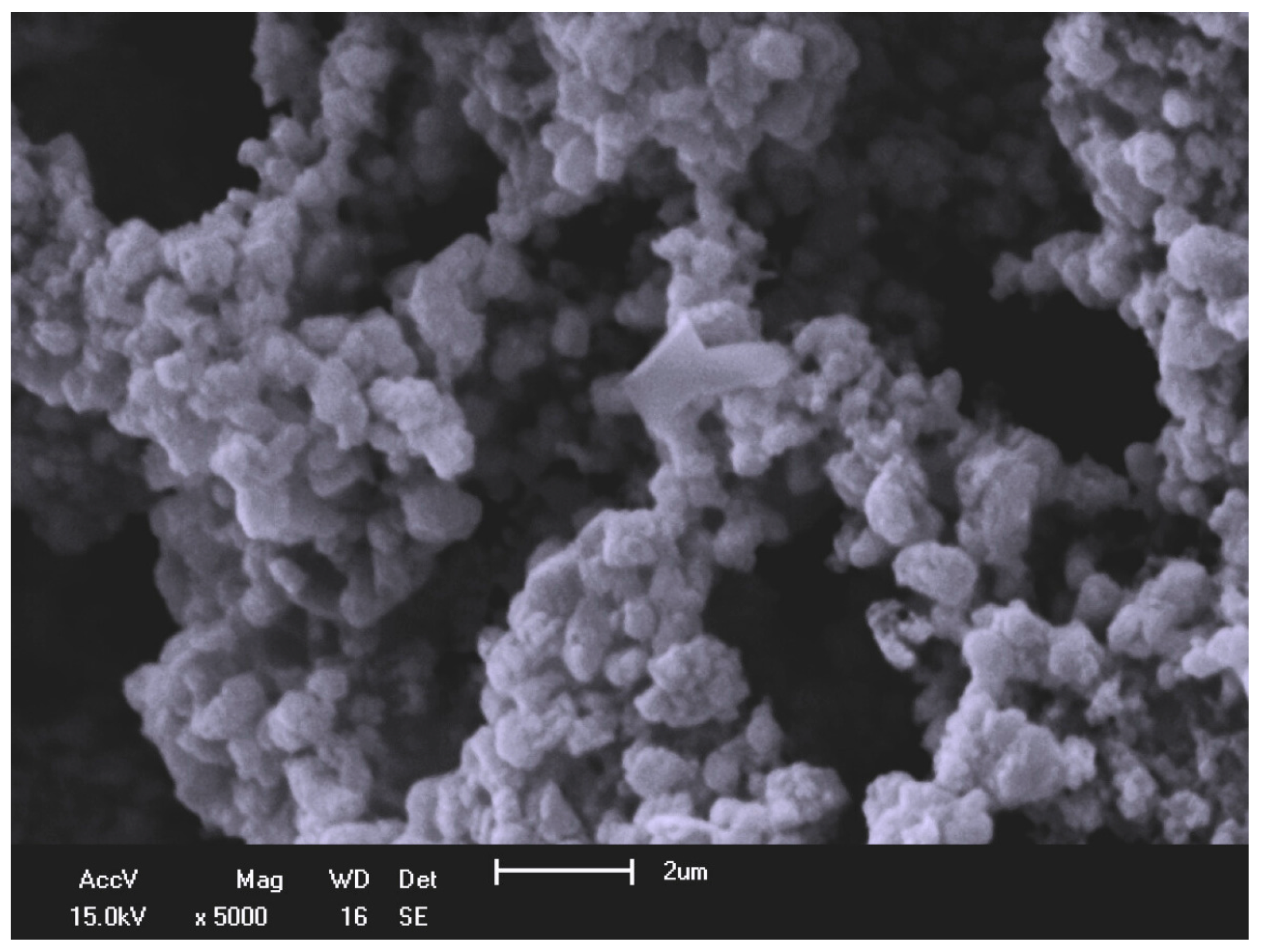
SEM image of calcined nanoparticles.
Both the extract and the non-calcined nanoparticles exhibited characteristic bands around 3400 cm−1 and 1620 cm−1, corresponding to the stretching vibrations of –OH and C=O groups, respectively. These bands indicate the presence of phytochemicals such as phenols and flavonoids, which act as reducing and stabilizing agents during nanoparticle synthesis.
Additionally, bands at approximately 1176 cm−1, attributed to C–O stretching, and 620 cm−1, associated with Cu–O lattice vibrations (phonon mode characteristic of copper oxide), were observed, confirming the formation of copper-based nanoparticles [40].
Following the calcination process, the disappearance of the bands associated with organic compounds confirms the effective removal of natural stabilizers from the extract. A broad band around 1007 cm−1 remained, which may be associated with C–C stretching vibrations [41].
Moreover, the persistence of a weaker band near 600 cm−1 indicates the continued presence of Cu–O bonds, confirming the structural integrity of copper oxide. These results demonstrate that the calcination process was effective in eliminating organic residues, resulting in a more structurally pure material.
3.4. Scanning Electron Microscopy (SEM) Analysis
The morphological and structural properties of the calcinated CuO/Cu2O nanoparticles were examined using scanning electron microscopy (SEM), as shown in Figure 4. The particles are clearly visible, exhibiting a non-uniform distribution with evident agglomerates. The presence of empty spaces or pores is attributed to the elimination of residual organic matter during the calcination process. This porosity can enhance the material’s catalytic activity, as it increases the surface area and, consequently, the number of available active sites [41].
The literature reports various possible morphologies for CuO nanoparticles, including spherical, oval, plate-like, rectangular, and cubic shapes. These differences arise from the diversity of plant extracts and precursors used, as well as the concentrations involved during synthesis [42,43,44]. Variations in sizes can be attributed to the concentration of the precursor used during synthesis, as well as the drying conditions of the material [41].
A study investigated the correlation between the morphology of CuO/Cu2O NPs and the concentration of the copper sulfate precursor (CuSO4·5H2O), using concentrations of 4, 6, 8, and 10 mM. The authors reported that nanoparticle structure and morphology changed significantly with increasing precursor concentration [39]. At lower concentrations, the nanoparticles were predominantly spherical and homogeneous, with a narrow size distribution range between 10 and 50 nm. In contrast, at higher concentrations, the particles exhibited spherical to rhombohedral morphologies, along with broader size distributions ranging from 80 to 150 nm.
3.5. X-Ray Diffraction (XRD) Analysis
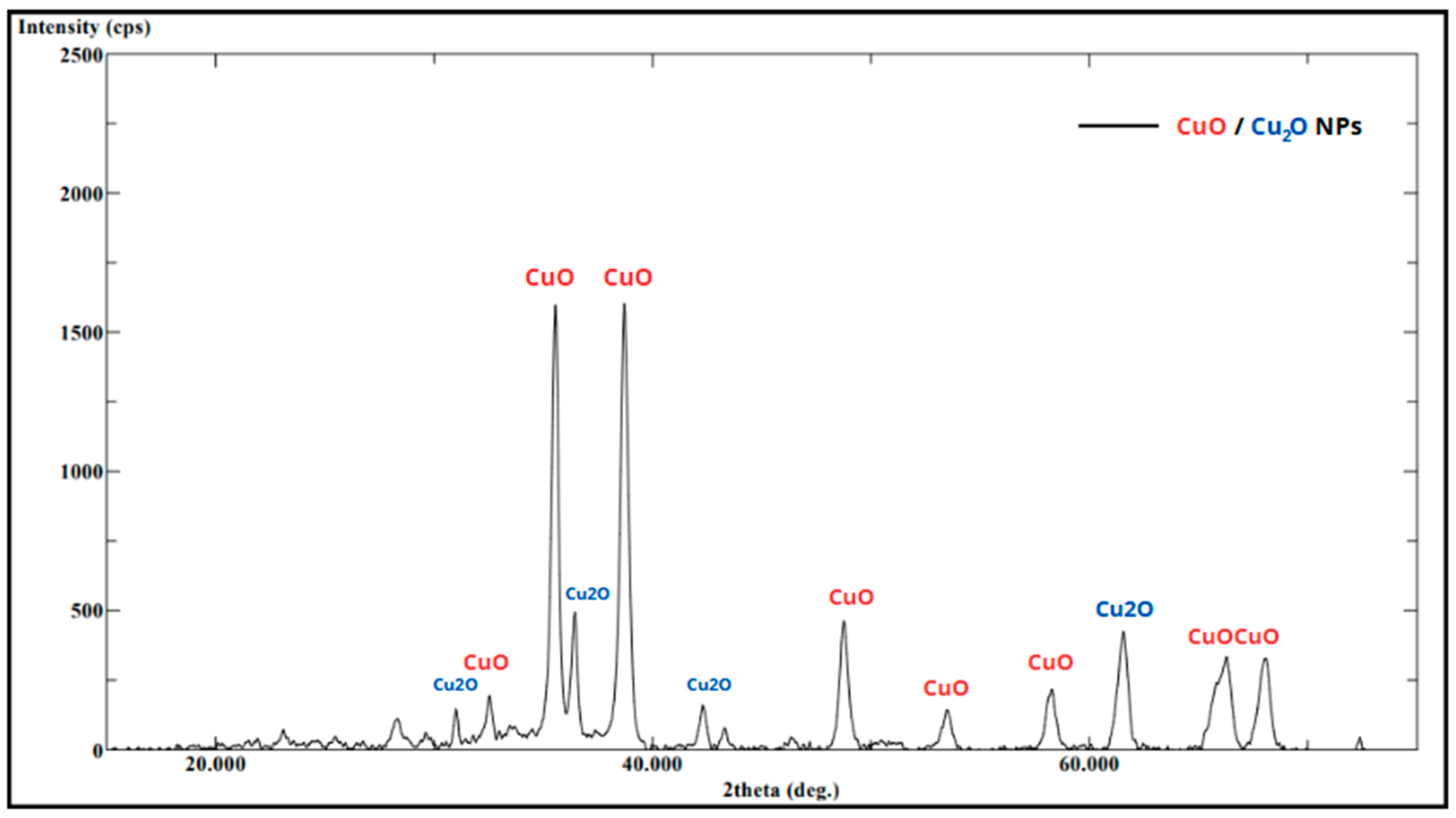
X-ray diffraction (XRD) analysis was performed to evaluate the purity, crystallinity, and average crystallite size of the synthesized material. As shown in Figure 5, the diffraction pattern revealed peaks at 32.51°, 35.54°, 38.71°, 48.70°, 53.45°, 58.20°, 66.19°, and 68.03°, which correspond to the Miller indices of (110), (−111), (111), (−202), (112), (202), (002), and (220), respectively.
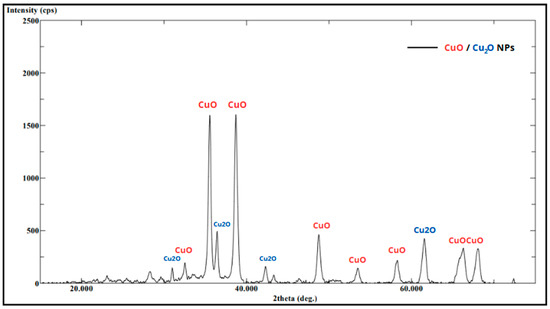
Figure 5.
X-ray diffraction (XRD) patterns of the CuO/Cu2O NP sample.
These diffraction peaks match the standard reference data from the Joint Committee on Powder Diffraction Standards (JCPDS card No. 48-1548) [45], confirming the formation of monoclinic phase CuO.
In addition, four other diffraction peaks observed at 30.97°, 36.45°, 42.23°, and 61.55° correspond to the planes (110), (111), (200), and (220), respectively, indicating the presence of Cu2O with a cubic crystal structure, consistent with JCPDS card No. 00-005-0667 [46].
These findings agree with previous studies reported in the literature, where similar diffraction patterns were observed for CuO/Cu2O-based materials synthesized using green methods [47,48]. Table 1 and Table 2 present the crystallite sizes calculated for each diffraction peak, as well as the average crystallite diameter of the material for both CuO and Cu2O phases.

Table 1.
Crystallite size results for CuO.
Table 2.
Crystallite size results for Cu2O.
It was observed that the average crystallite size for CuO was 15.88 nm, while for Cu2O it was 16.71 nm, which is consistent with some results reported [21,22,40]. Increasing the concentration of CuSO4·5H2O used in the synthesis leads to an increase in crystallite size, enhances the proportion of the CuO phase relative to Cu2O, and promotes a higher nucleation rate. As a result, the reaction time is reduced, favoring the formation of larger crystals [39].
3.6. Energy-Dispersive X-Ray (EDX) Analysis
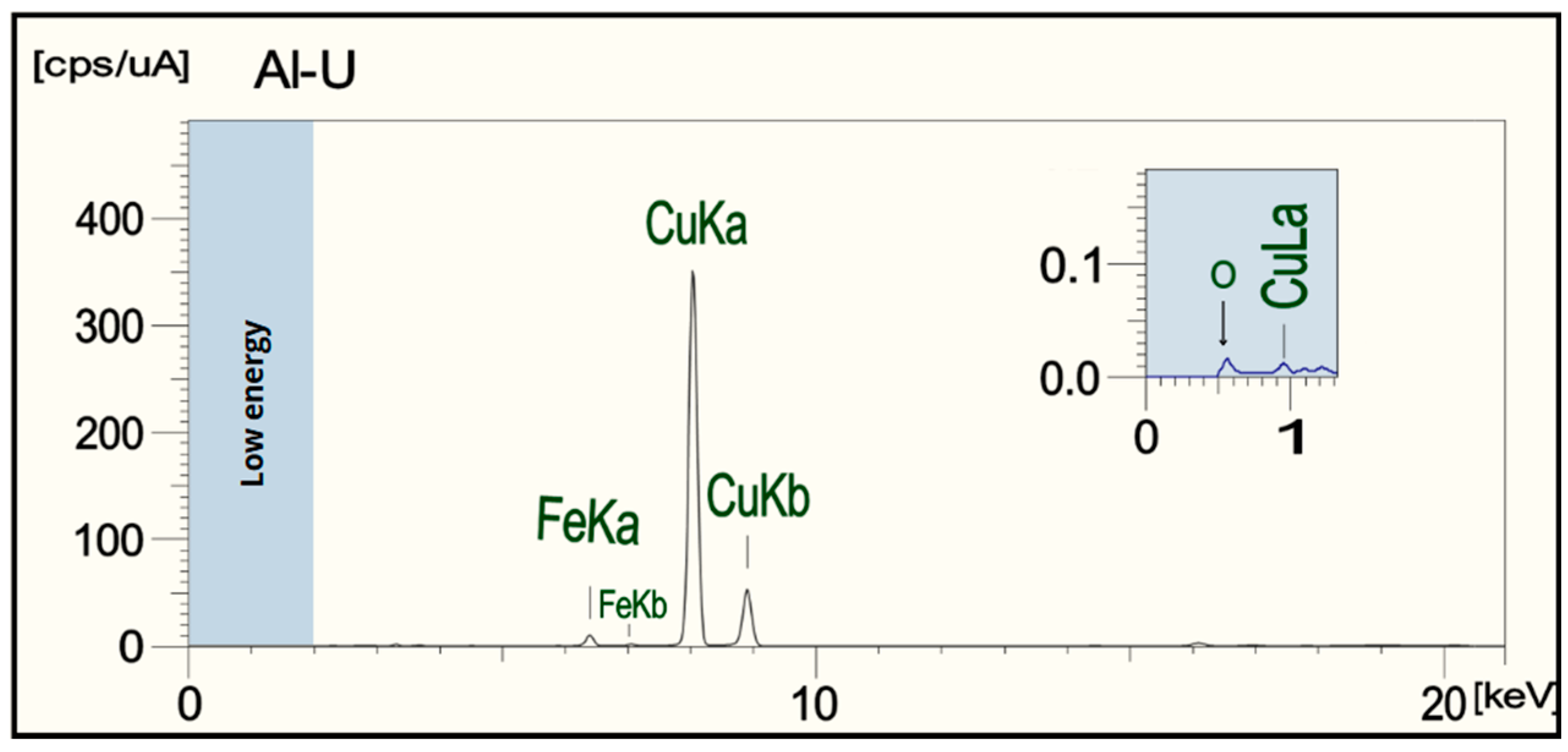
Energy-dispersive X-ray spectroscopy (EDX) analysis was performed to determine the elemental composition of the calcinated synthesized material, as shown in Figure 6.
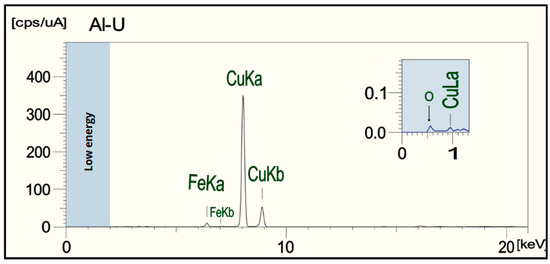
Figure 6.
EDX spectrum of calcined CuO/Cu2O nanoparticle sample.
The EDX results revealed a major presence of carbon (75.10%), followed by copper (20.80%), and trace amounts of other elements such as iron (1.04%), silicon (0.92%), and aluminum (0.73%).
The XRD diffractogram of the calcinated sample showed diffraction peaks consistent with the crystalline phases of CuO, supporting the hypothesis of copper oxide formation and reinforcing the interpretation that the carbon signal may correspond to undetected oxygen in the EDX analysis.
Thus, the findings in this study agree with the existing literature, validating the attribution of the carbon signal to oxygen presence, particularly in calcinated inorganic materials.
3.7. Transmission Electron Microscopy (TEM) Analysis
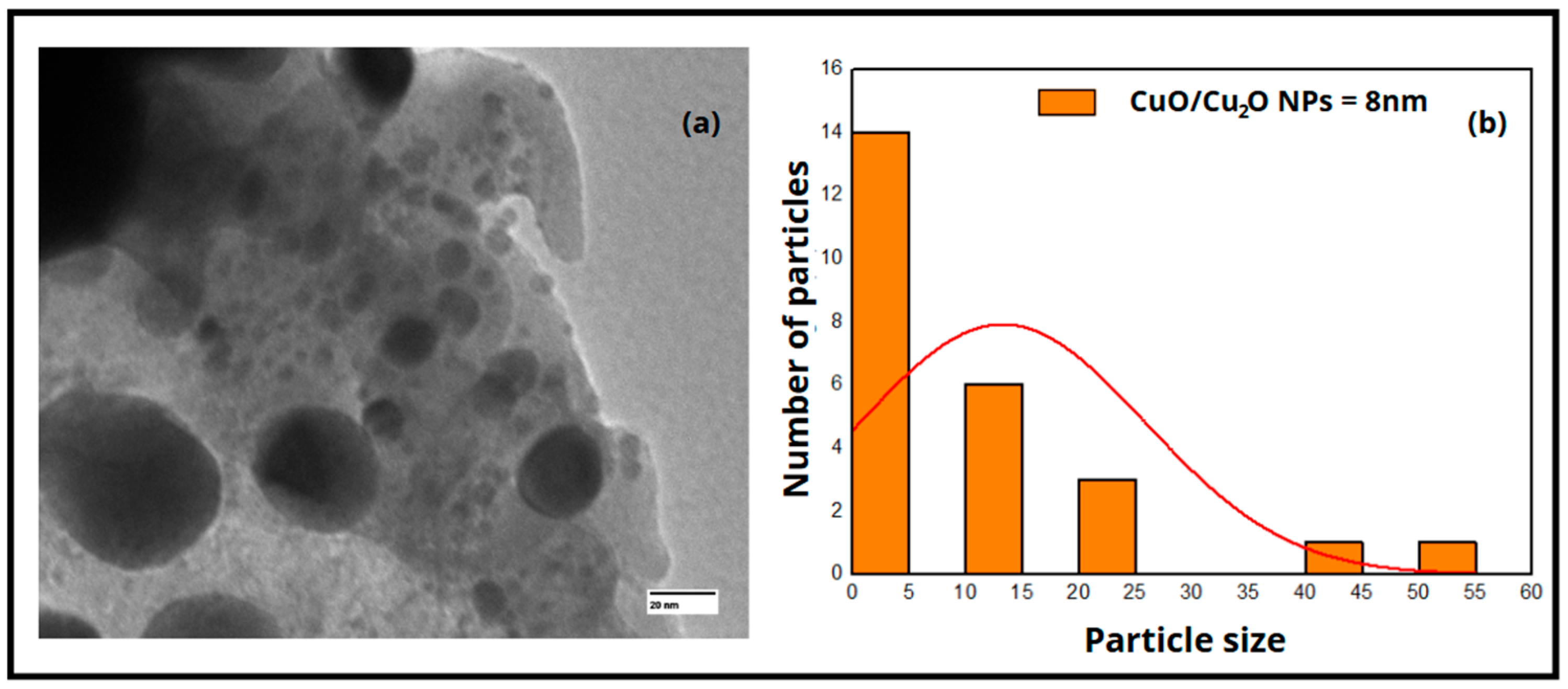
Figure 7a presents a transmission electron microscopy (TEM) image of CuO/Cu2O nanoparticles, which exhibit a predominantly near-spherical morphology. Figure 7b shows the histogram obtained from the TEM image analysis, revealing an average particle size of around 8 nm, in agreement with the crystallite size determined by X-ray diffraction.
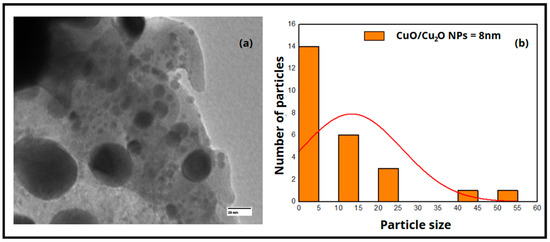
Figure 7.
TEM images of CuO/Cu2O nanoparticles biosynthesized by aqueous extract of Curcuma longa L. (a) and particle size distribution histogram (b).
This histogram is relevant for evaluating the particle size uniformity and understanding the synthesis process. The spherical and polydisperse morphology of CuO nanoparticles suggests a highly specific surface area, an essential characteristic for improving catalytic performance [49]. Since the greater availability of active sites favors photocatalytic and electrocatalytic activity, this property becomes especially advantageous for catalytic applications [29].
3.8. Catalytic Activity: CuO/Cu2O-Catalyzed One-Pot Synthesis of 1,2,3-Triazoles
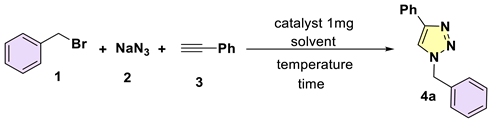
The catalytic efficiency of CuO/Cu2O material synthesized and assisted by the aqueous extract of Curcuma longa L. was evaluated in a one-pot methodology involving acetylenes, sodium azide, and benzyl bromides for the synthesis of 1,2,3-triazole.
In our initial study, a series of reactions was performed to determine the best reaction conditions, by using phenyl benzyl bromide 1, sodium azide 2, and acetylene 3 as the model substrates under ligand-free conditions for the synthesis of 1,2,3-triazole 4a (Table 3). The reaction between sodium azide and benzyl bromide produces the required organic azide in situ, avoiding an additional step of isolation and purification in the methodology.
Table 3.
Optimization of reaction conditions a.
Initially, the reaction was carried out in water and in the absence of a catalyst, resulting in no triazole formation under room temperature at 12 h (entry 1). Using the CuO/Cu2O catalyst in the reaction, it was found that time and temperature had a remarkable effect on the yield of product 4a (entries 2–4). However, the best result was found when the reaction was performed at room temperature for 12 h, where the desired product 4a was obtained in 96% yield (entry 4).
In order to demonstrate the importance of the calcination process, the reaction was carried out using the catalyst without calcination; under these conditions, the product was obtained with a decrease in yield from 95% to 80% (Table 3; entries 4 and 5).
We also tested acetonitrile and t-BuOH/H2O as the solvent (entries 6–8). In acetonitrile, only traces of the product were obtained, even under heated conditions, while the t-BuOH/water mixture (entry 8) also led to lower yields of 4a at 46%.
For comparison purposes, commercial CuO and Cu2O catalysts were evaluated individually to understand the behavior of each other, since the synthesized material has a hybrid structure composed of both oxides. Isolated CuO (entry 9) provided a 70% yield of 4a, while Cu2O (entry 10) resulted in an 86% yield.
The comparative analysis shows that the combination of the two phases in the synthesized system promotes a synergistic effect between the Cu+/Cu2+ oxidation states, favoring catalytic activity, a behavior widely reported in the literature for two-phase copper materials [50]. It is important to highlight that the methodology does not require any additives or ligands.
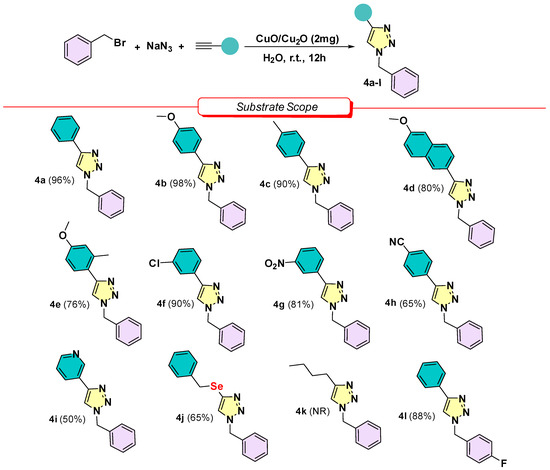
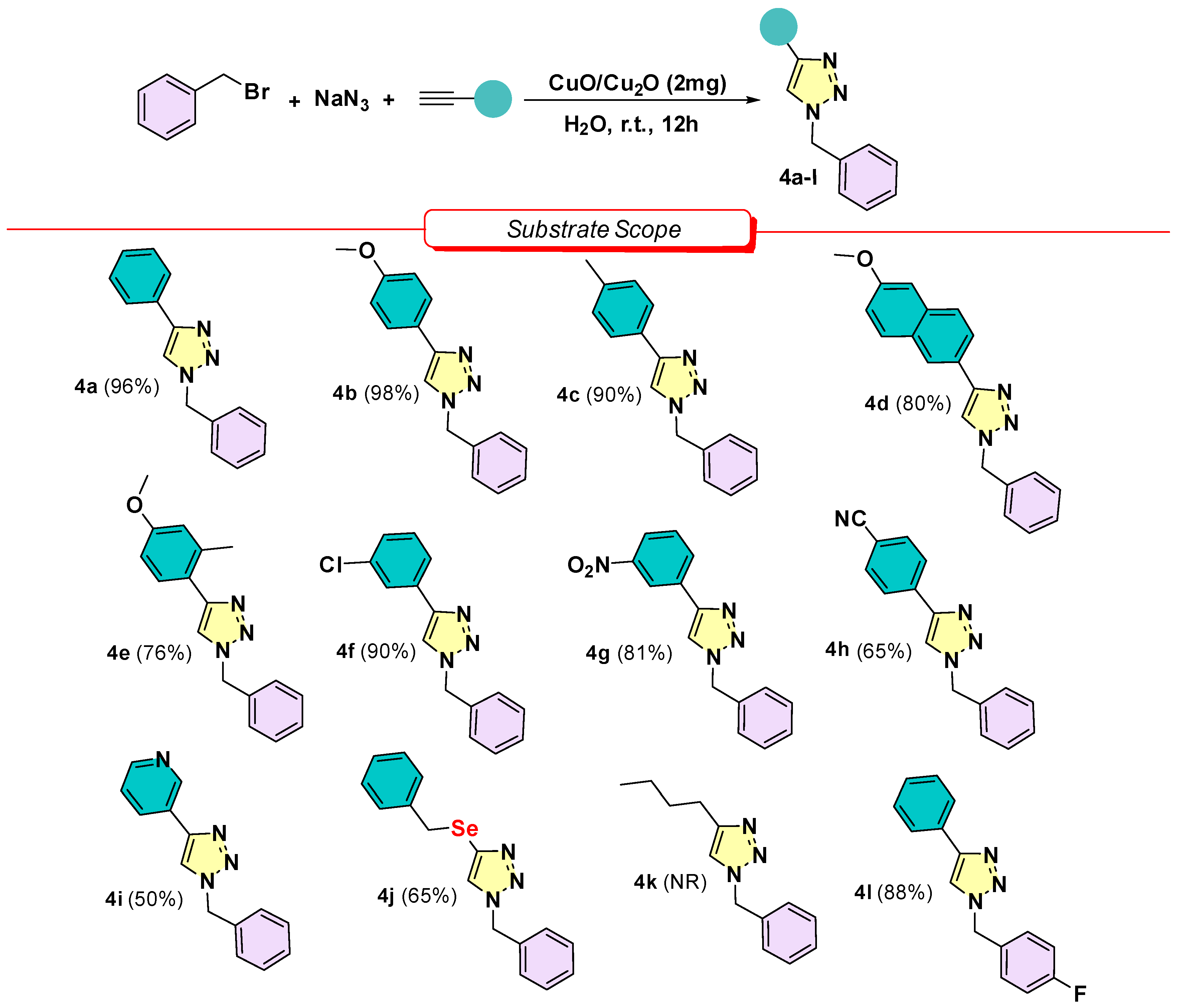
The evaluation of the reactivity of different alkynes 3a–l aims to establish the applicability and robustness of the catalyst toward substrates with varying electronic characteristics, thereby validating its performance under broader conditions (Scheme 1).
Scheme 1.
Synthesis of 1,2,3-triazoles catalyzed by CuO/Cu2O NPS a. a Reaction conditions: benzyl bromide 1 (0.22 mmol), sodium azide 2 (0.2 mmol), acetylenes 3a–l (0.22 mmol), CuO/Cu2O (2 mg), and H2O (1 mL) at room temperature for 12 h.
The standard phenylacethylene 3a enabled the preparation of product 4a with an excellent yield of 96%. The introduction of a methoxyl and methyl group at the para position of the aromatic ring in the acethylene 3b and 3c led to the products 4b and 4c in 98% and 90%, respectively, demonstrating the favorable influence of electron-donating groups and tolerance in the alkyne partner.
Extended aromatic systems to 2-ethynyl-6-methoxynaphthalene 3d were also evaluated, affording product 4d in excellent yield (80%). The aromatic ring disubstituted with methyl and methoxyl group 3e yielded the corresponding product 4e in 76% yield.
Additionally, we introduced electron-withdrawing groups in the aromatic ring of acethylene, such as m-Cl 3f, m-NO2 3g, and p-CN 3h, affording the formation of the products 4f, 4g, and 4h in good to high yields.
It is important to note that when using heteroaryl acethylene 3i, the desired perimidine 41 was obtained in 50% yield.
We also explored the functionalization of an alkyne partner with organoselenium substituent 3j, because of its important pharmacological activity. Thus, it was possible to synthesize the compound 4j in satisfactory yield at 65%.
In contrast, the reaction failed with alkynes bearing an alkyl group, being a limiting factor in the efficiency of this methodology. Finally, substitution in the aromatic ring of benzyl bromide 3l is suitable and led to the yield of triazole product 4l at 88%. As indicated in Scheme 1, in almost all cases, the reactions produced the corresponding products in good to excellent yields, offering notable features such as additive or ligand-free conditions, the use of water as a green solvent, and low catalyst loading.
The performances of various catalysts in different conditions in the model reaction (sodium azide, phenylacetylene, and benzyl bromide) were compared (Table 4). CuO/Cu2O NPs as catalysts were used in water as a green solvent at room temperature, in contrast to some nanoparticles or nanocomposites, which catalyze the same reaction at high temperature, in the presence of a co-catalyst or solid support [51,52].
Table 4.
Comparison of the catalytic production of compound 4a using CuO/Cu2O NPs against other catalysts reported in the literature.
4. Conclusions
This study successfully demonstrated a simple green synthesis of CuO/Cu2O nanoparticles using aqueous extract of Curcuma longa L. as a reducing and stabilizing agent, highlighting a sustainable approach. The resulting material exhibited nanostructure size, as evidenced by TEM. Structural and spectroscopic analyses confirmed the formation of high-purity CuO and Cu2O phases, as well as the effective removal of organic residues after calcination. Finally, CuO/Cu2O satisfactorily catalyzed a one-pot procedure for 1,2,3-triazoles in aqueous media at room temperature and ligand-free conditions, consistently affording the desired products in yields ranging from 50% to 98%, following an operationally simple protocol.
Supplementary Materials
The following Supplementary Materials can be downloaded at https://www.mdpi.com/article/10.3390/org7010006/s1. The supporting information contains the following captions: (1) Figures S1 and S2: Synthesis of CuO/Cu2O Nanoparticle. (2) General Procedure for synthesis of 1,2,3-triazoles. (3) Analytical Data. (4) Copies of NMR Spectra.
Author Contributions
Conceptualization, F.M. and C.F.A.O.; methodology, F.P., I.B.F., C.F.A.O. and G.P.; formal analysis, H.A.S., G.P., G.V.B. and J.C.M.W.; investigation, F.P. and I.B.F.; writing—original draft preparation, F.M. and F.P.; writing—review and editing, F.M., G.V.B., J.C.M.W., H.A.S. and C.F.A.O.; supervision, F.M. All authors have read and agreed to the published version of the manuscript.
Funding
This research received no external funding.
Data Availability Statement
The data presented in this study are available upon request from the corresponding authors. Data are contained within the article and Supplementary Materials.
Acknowledgments
The authors gratefully acknowledge CAM/NBQ-Unioeste for characterization analysis.
Conflicts of Interest
The authors declare no conflicts of interest.
References
- Mutlu, H.; Pektas, B.; Becer, C.R.; Kocaarslan, A. Green and Sustainable Chemistry Approaches on Azide-Based Click Reactions in Polymer Science. Macromol. Rapid Commun. 2025, 46, e00171. [Google Scholar] [CrossRef] [PubMed]
- Samai, S.; Atta, S.; Singh, M.S. Metal-catalyzed Azide-alkyne Cycloaddition-click Chemistry: An Update (2016–2025). Tetrahedron 2025, 191, 135061. [Google Scholar] [CrossRef]
- Haldón, E.; Nicasio, C.M.; Pérez, P.J. Copper-catalysed azide-alkyne cycloadditions (CuAAC): An update. Org. Biomol. Chem. 2015, 13, 9528–9550. [Google Scholar] [CrossRef] [PubMed]
- Campbell-Verduyn, L.S.; Mirfeizi, L.; Dierckx, R.A.; Elsinga, P.H.; Feringa, B.L. Phosphoramidite accelerated copper (I)-catalyzed [3 + 2] cycloadditions of azides and alkynes. Chem. Commun. 2009, 2139–2141. [Google Scholar] [CrossRef]
- Meng, X.; Xu, X.; Gao, T.; Chen, B. Zn/C-Catalyzed cycloaddition of azides and aryl alkynes. Eur. J. Org. Chem. 2010, 28, 5409–5414. [Google Scholar] [CrossRef]
- Suárez, J.R.; Trastoy, B.; Pérez-Ojeda, M.E.; Marín-Barrios, R.; Chiara, J.L. Nonafluorobutanesulfonyl Azide: A Shelf-Stable Diazo Transfer Reagent for the Synthesis of Azides from Primary Amines. Adv. Synth. Catal. 2010, 352, 2515–2520. [Google Scholar] [CrossRef]
- Garg, A.; Khupse, N.; Bordoloi, A.; Sarma, D. Ag–NHC anchored on silica: An efficient ultra-low loading catalyst for regioselective 1, 2, 3-triazole synthesis. New J. Chem. 2019, 43, 19331–19337. [Google Scholar] [CrossRef]
- Raj, J.P.; Gangaprasad, D.; Vajjiravel, M.; Karthikeyan, K.; Elangovan, J. CuO-Nanoparticles Catalyzed Synthesis of 1, 4-Disubstituted-1, 2, 3-Triazoles from Bromoalkenes. J. Chem. Sci. 2018, 130, 44. [Google Scholar] [CrossRef]
- Deraedt, C.; Pinaud, N.; Astruc, D. Recyclable catalytic dendrimer nanoreactor for part-per-million CuI catalysis of “click” chemistry in water. J. Am. Chem. Soc. 2014, 136, 12092–12098. [Google Scholar] [CrossRef]
- Willig, J.C.M.; Granetto, G.; Reginato, D.; Dutra, F.R.; Poruczinski, E.F.; Oliveira, I.M.; Stefani, H.A.; Campos, S.D.; Campos, E.A.; Manarin, F.; et al. A comparative study between Cu(INA)2-MOF and [Cu(INA)2(H2O)4] complex for a click reaction and the Biginelli reaction under solvent-free conditions. RSC Adv. 2020, 10, 3407–3415. [Google Scholar] [CrossRef]
- Neto, J.S.S.; Zeni, G. A decade of advances in the reaction of nitrogen sources and alkynes for the synthesis of triazoles. Coord. Chem. Rev. 2020, 409, 213217. [Google Scholar] [CrossRef]
- Gogoi, P.; Deori, K.; Sarma, D. Regioselective Synthesis of 1,4-disubstituted 1,2,3-triazoles: Advances in Click Chemistry and Multicomponent Reaction Engineering. Synlett 2025, 36, 2111–2127. [Google Scholar] [CrossRef]
- Vala, D.P.; Miller Dunne, A.; Atmasidha, A. Click-Chemistry Mediated Synthesis of OTBN-1,2,3-Triazole Derivatives Exhibiting STK33 Inhibition with Diverse Anti-Cancer Activities. Bioorg. Chem. 2024, 149, 107485. [Google Scholar] [CrossRef] [PubMed]
- Nural, Y.; Ozdemir, S.; Yalcin, M.S. New Bis-and Tetrakis-1,2,3-Triazole Derivatives: Synthesis, DNA Cleavage, Molecular Docking, Antimicrobial, Antioxidant Activity and Acid Dissociation Constants. Bioorg. Med. Chem. Lett. 2022, 55, 128453. [Google Scholar] [CrossRef]
- Ankali, K.N.; Rangaswamy, J.; Shalavadi, M.; Naik, N.; Krishnamurthy, G.N. Synthesis and Molecular Docking of Novel 1,3-Thiazole Derived 1,2,3-Triazoles and In Vivo Biological Evaluation for Their Anti- Anxiety and Anti-Inflammatory Activity. J. Mol. Struct. 2021, 1236, 130357. [Google Scholar] [CrossRef]
- Costa Souza, R.M.; Montenegro Pimentel, L.M.; Ferreira, L.K.M. Biological Activity of 1,2,3-Triazole-2-Amino-1,4-Naphthoquinone Derivatives and Their Evaluation as therapeutic Strategy for Malaria Control. Eur. J. Med. Chem. 2023, 255, 15400. [Google Scholar] [CrossRef] [PubMed]
- Ghanbarlou, M.; Karimian, S.; Doraghi, F. 4-Phenylthiazol-1,2,3-Triazole Derivatives as New Potential α-Glucosidase and α-Amylase Inhibitors. J. Mol. Struct. 2025, 1334, 141919. [Google Scholar] [CrossRef]
- Cao, X.; Wang, W.; Wang, S.; Bao, L. Asymmetric synthesis of novel triazole derivatives and their in vitro antiviral activity and mechanism of action. Eur. J. Med. Chem. 2017, 139, 718–725. [Google Scholar] [CrossRef]
- Gawande, M.B.; Goswami, A.; Felpin, F.X.; Asefa, T.; Huang, X.; Silva, R.; Varma, R.S. Cu and Cu-based nanoparticles: Synthesis and applications in catalysis. Chem. Rev. 2016, 116, 3722–3811. [Google Scholar] [CrossRef]
- Khezri, R.; Vahdat, S.M. Reactions and catalytic applications of metal and metal oxide nanoparticles in organic and inorganic chemistry. Inorg. Chim. Acta 2025, 588, 122842. [Google Scholar] [CrossRef]
- Shinde, S.; Parjane, S.; Turakane, H.; Basnet, P.; Oza, R.; Abhale, Y.; Pansambal, S.; Khoo, K.S.; Rahdar, A.; Ghotekar, S. Bio-inspired synthesis and characterizations of groundnut shells-mediated Cu/CuO/Cu2O nanoparticles for anticancer, antioxidant, and DNA damage activities. J. Sol-Gel Sci. Technol. 2023, 106, 737–747. [Google Scholar] [CrossRef]
- Cuong, H.N.; Pansambal, S.; Ghotekar, S.; Oza, R.; Hai, N.T.T.; Viet, N.M.; Nguyen, V.-H. New frontiers in the plant extract mediated biosynthesis of copper oxide (CuO) nanoparticles and their potential applications: A review. Environ. Res. 2022, 203, 111858. [Google Scholar] [CrossRef] [PubMed]
- Patil, S.; Chandrasekaran, R. Biogenic nanoparticles: A comprehensive perspective in synthesis, characterization, application and its challenges. J. Genet. Eng. Biotechnol. 2020, 18, 67. [Google Scholar] [CrossRef]
- Amor, M.L.B.; Zeghdi, S.; Laouini, S.E.; Bouafla, A.; Meneceur, S. pH reaction effect on biosynthesis of CuO/Cu2O nanoparticles by Moringa oleifera leaves extracts for antioxidant activities. Inorg. Nano-Met. Chem. 2023, 53, 437–447. [Google Scholar] [CrossRef]
- Nasrollahzadeh, M.; Ghorbannezhad, F.; Issaabadi, Z.; Sajadi, S.M. Recent Developments in the Biosynthesis of Cu-Based Recyclable Nanocatalysts Using Plant Extracts and their Application in the Chemical Reactions. Chem. Res. 2019, 19, 601–643. [Google Scholar] [CrossRef] [PubMed]
- Yan, H.; Wang, L.; Mu, Y. Biosynthesis of Ag/Cu nanocomposite mediated by Curcuma longa: Evaluation of its antibacterial properties against oral pathogens. Open Chem. 2024, 22, 20240059. [Google Scholar] [CrossRef]
- Sattar, Z.A.; Mohammed, A.M.; Khalaf, Y.H. Green synthesis of Curcuma longa-mediated Palladium nanoparticles as antioxidant, antimicrobial, and anticancer agents. Results Chem. 2024, 9, 101675. [Google Scholar] [CrossRef]
- Gangal, A.; Sethiya, N.K.; Duseja, M.; Shukla, R.K.; Bisht, D.; Rana, V.S. Green nanotechnology: Nanoparticle synthesis using Curcuma amada, Curcuma caesia, Curcuma longa, and Curcuma zedoaria. Green Chem. Lett. Rev. 2025, 18, 2449122. [Google Scholar] [CrossRef]
- Orhan, R. Green synthesis of CuO nanoparticles using Curcuma longa L. extract: Composite dielectric and mechanical properties. Mater. Test. 2025, 67, 1230–1241. [Google Scholar] [CrossRef]
- Elattar, K.M.; Ghoniem, A.A.; Al-Otibi, F.O.; Fakhouri, A.S.; Helmy, Y.A.; Saber, W.I.; Elsayed, A. Eco-friendly synthesis of Ag/CeO2 and CuO/CeO2 nanocomposites using Curcuma longa extract and assessment of their antioxidant, antifungal, and cytotoxic activities. RSC Adv. 2025, 15, 12100–12116. [Google Scholar] [CrossRef]
- Alinezhad, H.; Pakzad, K. C-S cross-coupling reaction using novel and green synthesized CuO nanoparticles assisted by Euphorbia maculata extract. Appl. Organomet. Chem. 2019, 33, e5144. [Google Scholar] [CrossRef]
- Halder, M.; Islam, M.M.; Ansari, Z.; Ahammed, S.; Sen, K.; Islam, S.M. Biogenic nano-CuO-catalyzed facile C-N cross-coupling reactions: Scope and mechanism. ACS Sustain. Chem. Eng. 2017, 5, 648–657. [Google Scholar] [CrossRef]
- Ghashang, M.; Kargar, M.; Shafiee, M.; Mansoor, S.; Fazlinia, A.; Esfandiari, H. CuO nano-structures prepared in rosmarinus officinalis leaves extract medium: Efficient catalysts for the aqueous media preparation of dihydropyrano [3, 2-c] chromene derivatives. Recent Pat. Nanotechnol. 2015, 9, 204–211. [Google Scholar] [CrossRef] [PubMed]
- Veisi, H.; Hemmati, S.; Javaheri, H. N-Arylation of indole and aniline by a green synthesized CuO nanoparticles mediated by Thymbra spicata leaves extract as a recyclable and heterogeneous nanocatalyst. Tetrahedron Lett. 2017, 58, 3155–3159. [Google Scholar] [CrossRef]
- Shende, S.; Ingle, A.P.; Gade, A.; Rai, M. Green synthesis of copper nanoparticles by Citrus medica Linn. (Idilimbu) juice and its antimicrobial activity. World J. Microbiol. Biotechnol. 2015, 31, 865–873. [Google Scholar] [CrossRef]
- Veisi, H.; Karmakar, B.; Tamoradi, T.; Hemmati, S.; Hekmati, M.; Hamelian, M. Biosynthesis of CuO nanoparticles using aqueous extract of herbal tea (Stachys lavandulifolia) flowers and evaluation of its catalytic activity. Sci. Rep. 2021, 11, 1983. [Google Scholar] [CrossRef]
- Maldonado, A.N.; Guadarrama, S.B.; Gomez, H.E.; López, L.F.; Acosta, K.R.; Nuñez, G.A.; Nava, R.D.C. Green synthesis of copper nanoparticles using different plant extracts and their antibacterial activity. J. Environ. Chem. Eng. 2022, 10, 107130. [Google Scholar] [CrossRef]
- Patra, D.; El Kurdi, R. Curcumin as a novel reducing and stabilizing agent for the green synthesis of metallic nanoparticles. Green Chem. Lett. Rev. 2021, 14, 474–487. [Google Scholar] [CrossRef]
- Jabeen, S.; Siddiqui, V.U.; Bala, S.; Mishra, N.; Mishra, A.; Lawrence, R.; Bansal, P.; Khan, A.R.; Khan, T. Biogenic synthesis of copper oxide nanoparticles from aloe vera: Antibacterial activity, molecular docking, and photocatalytic dye degradation. ACS Omega 2024, 9, 30190–30204. [Google Scholar] [CrossRef]
- Djamila, B.; Eddine, L.S.; Abderrhmane, B.; Nassiba, A.; Barhoum, A. In vitro antioxidant activities of copper mixed oxide (CuO/Cu2O) nanoparticles produced from the leaves of Phoenix dactylifera L. Biomass Convers. Biorefin. 2024, 14, 6567–6580. [Google Scholar]
- Karimzadeh, M.; Niknam, K.; Manouchehri, N.; Tarokh, D. A green route for the cross-coupling of azide anions with aryl halides under both base and ligand-free conditions: Exceptional performance of a Cu2O–CuO–Cu–C nanocomposite. RSC Adv. 2018, 8, 25755–25764. [Google Scholar] [CrossRef]
- Nethravathi, P.C.; Udayabhanu; Kumar, M.A.P.; Suresh, D.; Lingaraju, K.; Rajanaika, H.; Nagabhushana, H.; Sharma, S.C. Tinospora cordifolia mediated facile green synthesis of cupric oxide nanoparticles and their photocatalytic, antioxidant and antibacterial properties. Mater. Sci. Semicond. Process. 2015, 33, 81–88. [Google Scholar] [CrossRef]
- Liu, H.; Zheng, S.; Xiong, H.; Alwahibi, M.; Niu, X. Biosynthesis of copperoxide nanoparticles using Abies spectabilis plant extract and analyzing its antinociceptive and anti-inflammatory potency in various mice models. Arab. J. Chem. 2020, 13, 6995–7006. [Google Scholar] [CrossRef]
- Tahvilian, R.; Zangeneh, M.M.; Falahi, H.; Sadrjavadi, K.; Jalalvand, A.R.; Zangeneh, A. Green synthesis and chemical characterization of copper nanoparticles using Allium saralicum leaves and assessment of their cytotoxicity, antioxidant, antimicrobial, and cutaneous wound healing properties. Appl. Organomet. Chem. 2019, 33, e5234. [Google Scholar] [CrossRef]
- JCPDS Card No. 48-1548; Copper(II) Oxide (CuO), Monoclinic. International Centre for Diffraction Data (ICDD): Newtown Square, PA, USA, 2001.
- JCPDS Card No. 00-005-0667; Copper(I) Oxide (Cu2O), Cubic. International Centre for Diffraction Data (ICDD): Newtown Square, PA, USA, 1999.
- Rahmah, M.I.; Garallah, E.T. Preparation of copper oxides/polyvinyl alcohol nanocoatings with antibacterial activity. Chem. Data Collect. 2022, 39, 100869. [Google Scholar] [CrossRef]
- Manimehala, U.; Asha, S.; Tomy, M.; Anu, M.A.; Sumitha, M.S.; Kumar, P.; Xavier, T.S.; Binoy, J. Green synthesis of copper oxide nanoparticles from Camellia sinensis extract: Effects of calcination temperatures on antimicrobial activity. Biochem. Biophys. Res. Commun. 2025, 769, 151963. [Google Scholar] [CrossRef]
- Shkir, M.; Khan, F.S.; Alshahrani, T. Biosynthesis of CuO Nanoparticles Using Caralluma adscendens Leaf Extract for Developed Antibacterial and Photocatalytic Dye Degradation Properties. Mater. Chem. Phys. 2025, 344, 131118. [Google Scholar] [CrossRef]
- Maleki, A.; Panahzadeh, M.; Eivazzadeh-keihan, R. Agar: A natural and environmentally-friendly support composed of copper oxide nanoparticles for the green synthesis of 1, 2, 3–triazoles. Green Chem. Lett. Rev. 2019, 12, 395–406. [Google Scholar] [CrossRef]
- Mohamed, Y.M.A.; Abdel-Hafez, S.H.; Elsayed, H.; Taha, M.; Attia, Y. Efficient one-pot synthesis of 1,4-disubstituted-1,2,3-triazoles catalysed by NiO/Cu2O/CuO nanocomposites under microwave irradiation. Chem. Pap. 2024, 78, 7865–7876. [Google Scholar] [CrossRef]
- Pathak, C.; Borah, G. Cu2O/CuO@mont K 10 promoted one-pot synthesis of 1,2,3-triazoles through azide-alkyne cycloaddition reaction. Chem. Pap. 2022, 76, 4749–4761. [Google Scholar] [CrossRef]
Disclaimer/Publisher’s Note: The statements, opinions and data contained in all publications are solely those of the individual author(s) and contributor(s) and not of MDPI and/or the editor(s). MDPI and/or the editor(s) disclaim responsibility for any injury to people or property resulting from any ideas, methods, instructions or products referred to in the content. |
© 2026 by the authors. Licensee MDPI, Basel, Switzerland. This article is an open access article distributed under the terms and conditions of the Creative Commons Attribution (CC BY) license.