Article

Theoretical Development and Mathematical Formulation of Holographic Intelligent Surfaces with Magnetic Energy Harvesting

by
Ghaffer Iqbal Kiani
Department of Electrical and Computer Engineering, King Abdulaziz University, Jeddah 21589, Saudi Arabia
Telecom 2026, 7(5), 116; https://doi.org/10.3390/telecom7050116
Submission received: 6 July 2026 / Revised: 28 August 2026 / Accepted: 31 August 2026 / Published: 4 September 2026

Abstract

This paper proposes a novel framework integrating Holographic Intelligent Surfaces (HISs) with magnetic energy harvesting at the source node to enable energy-efficient wireless communication. In the proposed system, energy harvesting is performed at the transmitter using magnetic field coupling, eliminating reliance on conventional power supplies. The harvested energy is then used to generate and transmit signals, which are intelligently manipulated by the HIS to enhance propagation conditions between the source and the destination. By leveraging the continuous electromagnetic control capability of HIS, the system improves signal strength, coverage, and reliability. Analytical insights highlight the potential of combining magnetic energy harvesting with HIS to support sustainable and self-powered wireless networks, particularly for next-generation communication systems.

1. Introduction

The rapid growth of wireless communication systems has increased the demand for energy-efficient and sustainable technologies. Traditional communication networks rely heavily on battery-powered or grid-connected devices, which limits scalability and introduces maintenance challenges. Energy harvesting has emerged as a promising solution to address these issues by enabling self-powered communication nodes.
Among various energy harvesting techniques, magnetic energy harvesting offers a reliable and stable approach, particularly for short-range energy transfer. In this work, energy harvesting is performed at the source using magnetic field coupling, allowing the transmitter to operate without a conventional power source. This harvested energy is directly utilized for signal generation and transmission.
On the other hand, Holographic Intelligent Surfaces (HISs) represent an advanced evolution of reconfigurable surfaces, capable of controlling electromagnetic waves with high spatial resolution. Unlike traditional discrete metasurfaces, HISs provide nearly continuous control over the propagation environment, enabling precise beamforming and wave manipulation.
In the proposed system, the source transmits the signal using harvested magnetic energy, while the HIS assists transmission by shaping the wireless channel between the source and the destination. This joint design improves signal quality, extends coverage, and enhances overall system performance. The integration of magnetic energy harvesting with HISs opens new possibilities for green and autonomous wireless communication systems.
The validation presented in this work is based on theoretical analysis and Monte Carlo simulations, which are employed to verify the derived analytical expressions and assess the performance of the proposed Holographic Intelligent Surface with magnetic energy harvesting under different system configurations. The fabrication of a hardware prototype and its experimental characterization are beyond the scope of the present theoretical study. Nevertheless, experimental implementation represents an important next step toward practical validation of the proposed framework. Future work will therefore focus on the electromagnetic design and fabrication of a physical HIS with magnetic energy-harvesting capability, followed by experimental measurements to further validate the theoretical and simulation results.
Holographic wireless communications have recently emerged as a promising paradigm for sixth-generation (6G) networks by enabling continuous electromagnetic wave manipulation through holographic surfaces. Compared with conventional reconfigurable intelligent surfaces (RIS), holographic reconfigurable intelligent surfaces (HRIS) provide a nearly continuous aperture, resulting in higher spatial resolution, improved beamforming capability, and better spectral efficiency [1,2,3].
Several studies have investigated the evolution from conventional RIS toward holographic MIMO architectures. Joy et al. [1] presented a comprehensive overview of the transition from RIS to holographic MIMO surfaces, discussing the electromagnetic principles and implementation challenges. Dardari and Decarli [2] introduced the concept of holographic communications using intelligent surfaces, demonstrating their potential to improve wireless capacity through continuous aperture design.
Electromagnetic modeling has been an important research direction for HRIS systems. Dovelos et al. [4] developed an electromagnetic model for intelligent holographic reflecting surfaces operating in the terahertz band. Ma et al. [5] proposed a Hall-effect-based holographic RIS for electromagnetic recording, providing insights into practical hardware implementations of holographic surfaces.
Beamforming optimization has attracted considerable attention due to the large degrees of freedom offered by holographic surfaces. Wan et al. [6] investigated terahertz massive MIMO systems assisted by HRIS, showing significant improvements in beamforming gain and achievable throughput. Suban et al. [7] proposed an approximate message passing algorithm for beamforming optimization in THz massive MIMO systems, while Zeng et al. [8] designed a dual-polarized RIS antenna architecture for holographic MIMO communications to further enhance transmission performance.
Artificial intelligence has also been integrated into holographic communications. Adhikary et al. [9] proposed an AI-based framework that combines holographic MIMO with intelligent omni-surfaces for adaptive beamforming. Similarly, Gomathi et al. [10] integrated edge AI with holographic beamforming, demonstrating improved resource management and beam adaptation in future 6G networks.
The application of holographic surfaces has been extended to multiple wireless communication scenarios. Wang et al. [11,12] investigated localization using intelligent and synthetic holographic surfaces, demonstrating improved positioning accuracy. Vo et al. [13] applied HRIS to downlink NOMA IoT networks with short-packet communications, while Li et al. [14] analyzed achievable rates of intelligent omni-surface-assisted holographic MIMO systems. Singh et al. [15] further investigated multiple access techniques for HRIS-assisted near-field communications.
Recent studies have explored advanced communication techniques integrated with holographic surfaces. Chrysologou et al. [16] investigated THz-NOMA combined with HRIS, whereas Le et al. [17] proposed hybrid power-frequency multiple access for HRIS-based systems. Yang et al. [18] developed holographic-inspired channel estimation methods, and Ahmad et al. [19] proposed secure near-field communication using holographic beamforming. Furthermore, Nikmaleki and Eslami [20] demonstrated the integration of holographic antennas with RIS for integrated sensing and communication applications.
Beyond communication enhancement, holographic surfaces have also been considered for computation and signal processing applications. Chen et al. [21] investigated holographic computation offloading assisted by RIS in vehicular edge computing, while Torcolacci et al. [22] proposed orbital angular momentum (OAM)-based holographic MIMO systems to increase transmission capacity.
Recent studies have also investigated active RIS architectures in emerging wireless communication scenarios. For example, Ji et al. [23] investigated an active movable-element RIS-assisted vehicular semantic communication system, addressing the modeling and optimization of active RIS-enabled communication. Unlike these active RIS-based approaches, the present work focuses on Holographic Intelligent Surfaces with magnetic energy harvesting, with emphasis on the theoretical formulation and characterization of the joint communication and magnetic energy-harvesting mechanism.
Despite these significant advances, existing research primarily focuses on improving spectral efficiency, beamforming accuracy, localization, security, and communication reliability. The integration of intelligent holographic surfaces with wireless energy harvesting remains largely unexplored, particularly in systems that employ magnetic resonance energy harvesting. Existing HRIS studies generally assume externally powered communication devices and rarely investigate simultaneous wireless information and magnetic energy transfer. Consequently, the joint optimization of holographic beamforming, wireless communications, and magnetic energy harvesting represents an important open research problem for sustainable 6G networks.
Although related concepts involving Holographic Intelligent Surfaces, reconfigurable electromagnetic surfaces, and wireless energy harvesting have been investigated in the literature, the specific combination of a Holographic Intelligent Surface with magnetic energy harvesting has not been explicitly developed in the existing works considered in this study. In particular, the integration of the holographic surface formulation with a magnetic energy-harvesting mechanism and its corresponding theoretical characterization remains insufficiently explored. The present work addresses this gap by developing a unified theoretical framework for Holographic Intelligent Surfaces with magnetic energy harvesting and by deriving the fundamental relationships governing their operation and performance.

Paper Contributions

Motivated by the above research gap, this paper proposes a novel framework that integrates Holographic Intelligent Surfaces with magnetic energy harvesting at the transmitter. The main contributions of this work are summarized as follows:
  • We introduce a new HIS-assisted communication architecture in which the transmitter is powered exclusively through magnetic energy harvesting, eliminating dependence on conventional energy sources.
  • We develop a mathematical model for the harvested energy and incorporate it into the signal transmission process, linking energy availability directly to communication performance.
  • We analyze the impact of the harvesting duration factor α on system throughput and derive expressions that capture the trade-off between energy harvesting and data transmission.
  • We demonstrate that optimizing the harvesting duration significantly enhances data rates, especially in energy-constrained environments.
  • We provide statistical SNR analysis for HIS-assisted systems under magnetic energy harvesting and evaluate performance in terms of reliability and throughput.
The proposed approach establishes a new direction for self-powered HIS-based wireless systems, enabling sustainable and high-performance communication by jointly optimizing energy harvesting and intelligent surface-assisted transmission.
In the considered architecture, magnetic energy harvesting and information transmission constitute two distinct but interconnected processes. The source node S first harvests energy from an external time-varying magnetic field. The harvested energy is subsequently used to power the RF transmitter at S. During the communication phase, the information signal transmitted by S reaches the destination D through the direct path and the HIS-assisted reflected path. Therefore, the role of the HIS is to enhance the RF communication link through programmable electromagnetic reflections, whereas magnetic energy harvesting provides the energy required for the operation of the source node.
The HIS constitutes the main programmable propagation component of the proposed communication architecture. It is composed of a large number of controllable electromagnetic elements whose reflection characteristics can be adjusted to modify the propagation of the incident RF signal. In the considered system, the HIS is positioned between the source S and destination D and provides an additional reflected propagation path. The proposed model accounts for the contribution of the individual HIS elements to the equivalent communication channel.
The proposed system involves two complementary flows. First, an energy flow is established from the external magnetic field toward the source node S, where the incident magnetic energy is harvested and converted into usable electrical energy. Second, an information flow is established from S toward D. During this second stage, the HIS modifies the propagation environment by reflecting the incident RF signal toward the destination. Hence, magnetic energy harvesting determines the available energy at the source, whereas the HIS primarily affects the quality of the communication channel.
The main objective of this work is to develop a theoretical framework for an HIS-assisted communication system powered by magnetic energy harvesting. The magnetic harvesting mechanism determines the energy available at the source, whereas the HIS provides an additional programmable reflected path between the source and destination. Accordingly, the magnetic energy harvesting component and the HIS-assisted communication component are modeled separately and subsequently integrated into a unified theoretical framework.

2. Magnetic Energy Harvesting

A list of abbreviations is given in Abbreviations part.
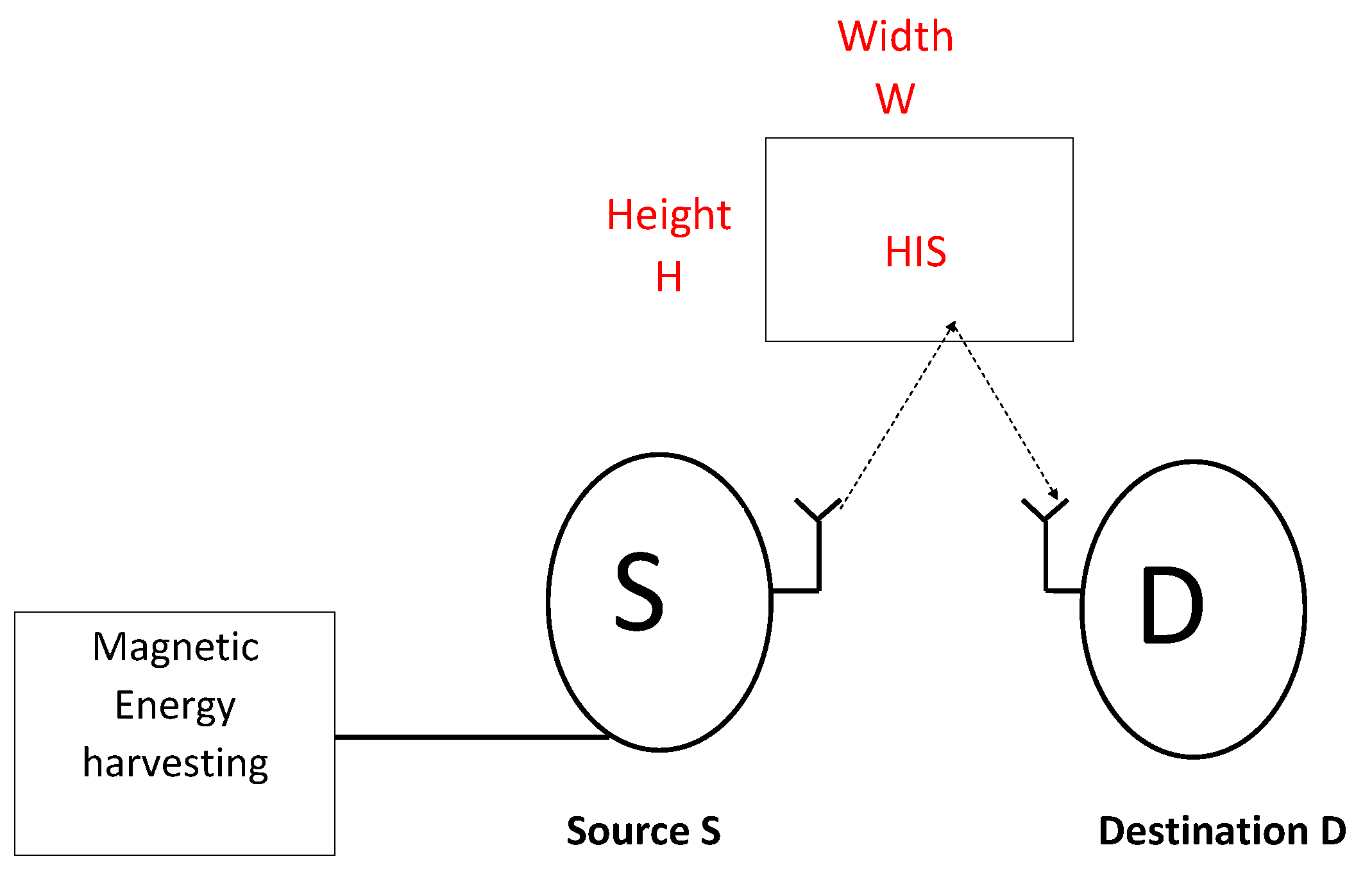
The system model is shown in Figure 1 where the source harvests power from a magnetic field and transmits packets to the destination using HIS. The HIS is modeled as an electrically controllable surface composed of N reflecting elements. Each element modifies the phase and amplitude of the incident RF signal according to its programmable reflection coefficient. The contribution of the nth HIS element to the received signal depends on the propagation channel from S to the element and from the element to D. Consequently, the equivalent HIS-assisted channel is obtained by coherently combining the contributions of all reflecting elements. Increasing the number of elements increases the number of contributing propagation paths and can provide a higher effective channel gain, subject to the effects of channel randomness and spatial correlation.
The randomness considered in the proposed system originates from both the magnetic energy harvesting process and the wireless communication channel. In practical scenarios, the harvested magnetic energy is not necessarily constant because the magnetic field strength may vary with time. Consequently, the amount of energy available at the source for RF transmission can be considered as a random quantity. This randomness directly affects the transmit energy and, consequently, the achievable throughput.
In addition, the RF communication links between the source S, the HIS elements, and the destination D are subject to multipath propagation, scattering, fading, and channel variations. Hence, the individual channel coefficients are also random variables. The equivalent HIS-assisted channel gain, obtained from the combination of the direct and reflected propagation paths, is therefore random as well. The joint randomness of the harvested energy and the equivalent communication channel motivates the use of statistical analysis to characterize the system performance and to evaluate metrics such as the achievable throughput.

2.1. Harvested Power from a Time-Varying Magnetic Field

We consider a magnetic energy harvesting system consisting of a coil with N turns and area A, placed in a time-varying magnetic field B ( t ) . The magnetic flux through the coil is
Φ B ( t ) = B ( t ) · A = B 0 A cos ( 2 π f t )
where
  • B 0 is the peak magnetic flux density (T);
  • f is the frequency of the magnetic field (Hz);
  • A is the area of one loop of the coil (m2).
We consider a magnetic energy harvesting system consisting of a coil with (N) turns and area (A), placed in the time-varying magnetic field generated by an external magnetic source. The magnetic flux density experienced by the harvesting coil depends on the distance between the source and the coil. In the following theoretical formulation, B 0 denotes the magnetic flux density amplitude at the location of the harvesting coil and is therefore considered as the effective local magnetic field strength. Accordingly, the magnetic flux through the coil is expressed as Φ B ( t ) = B ( t ) A = B 0 A cos ( 2 π f t )
In a practical implementation, B 0 is not spatially constant and decreases with the distance from the magnetic field source due to near-field attenuation and magnetic coupling losses. Therefore, increasing the source-to-coil distance reduces the magnetic flux linked with the harvesting coil and consequently decreases the induced electromotive force and the available harvested power. The exact attenuation behavior depends on the geometry and operating regime of the magnetic source and on the coupling between the source and harvesting coil. Thus, the formulation adopted in this work can be interpreted as a local-field model, where the distance-dependent effects are implicitly captured through the magnetic field amplitude B 0 at the coil position. A detailed electromagnetic coupling model incorporating the source geometry, coupling coefficient, and distance-dependent magnetic field attenuation is beyond the scope of the present theoretical formulation.

2.2. Induced Voltage from Faraday’s Law

According to Faraday’s law, the induced voltage in a coil of N turns is
E ( t ) = − N d Φ B ( t ) d t
E ( t ) = 2 π f N B 0 A sin ( 2 π f t )

2.3. Harvested Power Expression

Assuming the coil is connected to a purely resistive load R, the instantaneous power delivered to the load is
P ( t ) = E ( t ) 2 R = ( 2 π f N B 0 A ) 2 sin 2 ( 2 π f t ) R

2.4. Average Harvested Power

The average value of sin 2 ( 2 π f t ) over one period is 1 2 , so the average harvested power is
P = N 2 ( 2 π f ) 2 B 0 2 A 2 2 R
The harvested power can also be written as
P = 2 π 2 f 2 N 2 B 0 2 A 2 R

2.5. Parameter Interpretation

  • Magnetic flux density ( B 0 ): determines the strength of the magnetic field.
  • Coil area (A): larger area increases captured flux.
  • Frequency (f): higher frequency generally increases harvested power.
  • Load resistance (R): impacts power transfer efficiency.

2.6. Stochastic Modeling of Frequency

In practical environments, the frequency f may vary due to multiple electromagnetic sources. Hence, it is modeled as a Gaussian random variable:
f ∼ N ( m F , σ F 2 )

2.7. Harvested Energy

The harvested energy over a duration α F is
E = α F P
where 0 < α < 1 is the energy harvesting time fraction.

2.8. Symbol Energy

The transmitted energy per symbol is
E s = E ( 1 − α ) F T s = α T s P 1 − α
E s = ζ f 2
where
ζ = 2 π 2 B 0 2 A 2 N 2 α T s ( 1 − α ) R
The energy per transmitted symbol, denoted by E s , represents the amount of energy allocated by the source to transmit one information symbol.

2.9. Probability Density Function (PDF) of Symbol Energy

Since f is Gaussian, the PDF of E s is given by
f E s ( y ) = 0.5 ζ σ F 2 e − 0.5 y ζ σ F 2 + m F 2 σ F 2 y ζ m F 2 − 0.25
× I − 0.5 m F σ F 2 y ζ

3. Holographic Intelligent Surface Model

In the considered setup of Figure 1, communication between S and D is facilitated by an HIS that shapes the propagation environment.
The received signal is expressed as
y = ∫ 0 W ∫ 0 H h S H ( x , y ) Φ ( x , y ) h H D ( x , y ) d y d x s + n ,
where s is the transmitted symbol, and n represents additive noise.
To maximize signal strength, the HIS applies phase compensation:
Φ ( x , y ) = e − j ∠ h S H ( x , y ) − j ∠ h H D ( x , y ) .
The resulting equivalent channel gain becomes
Y = ∫ 0 W ∫ 0 H | h S H ( x , y ) | | h H D ( x , y ) | d y d x ,
and the instantaneous SNR is
Γ = E s N 0 Y 2 .
In this work, the term channel refers to an individual propagation link between two nodes or between a node and an HIS element. The equivalent channel gain denotes the aggregate effective channel resulting from the combination of the direct propagation path and the reflected paths through the HIS elements. It therefore incorporates the contributions of the individual propagation channels and the corresponding HIS reflection coefficients.

4. SNR Statistical Analysis

We consider Rayleigh fading for both links associated with the HIS. Accordingly, the channel coefficients are modeled as
h S H ( x , y ) ∼ CN ( 0 , β S H ) , h H D ( x , y ) ∼ CN ( 0 , β H D ) .

4.1. First-Order Moment of Y

Assuming independence between the channel magnitudes, the expected value of the equivalent channel gain can be expressed as
E [ Y ] = ∫ 0 W ∫ 0 H E [ | h S H ( x , y ) | ] E [ | h H D ( x , y ) | ] d y d x
which yields
E ( Y ) = π 4 W H β S H β H D = m Y .

4.2. Second-Order Moment of Y

Define
Y = ∫ 0 W ∫ 0 H Z ( x , y ) d y d x ,
where
Z ( x , y ) = | h ⠀ S H ( x , y ) | | h ⠀ H D ( x , y ) | .
For identical spatial coordinates, we obtain
E [ Z 2 ( x , y ) ] = β ⠀ S H β ⠀ H D .
Integrating over the surface gives
∫ 0 W ∫ 0 H E [ Z 2 ( x , y ) ] d y d x = W H β ⠀ S H β ⠀ H D .
For distinct spatial points, independence leads to
E [ Z ( x , y ) Z ( x ′ , y ′ ) ] = π 2 16 β ⠀ S H β ⠀ H D .
Thus, the total second-order moment becomes
E [ Y 2 ] = β ⠀ S H β ⠀ H D W H + π 2 16 ( W H ) 2 − W H .
The variance is then obtained as
Var ( Y ) = W H β ⠀ S H β ⠀ H D 1 − π 2 16 = σ Y 2 .

4.3. Spatially Correlated Case

When spatial correlation exists, correlation functions ρ S H and ρ H D must be incorporated. The second-order moment is then expressed as
E [ Y 2 ] = ∫ 0 W ∫ 0 H ∫ 0 W ∫ 0 H E [ | h S H ( x , y ) | | h S H ( x ′ , y ′ ) | ]
× E [ | h H D ( x , y ) | | h H D ( x ′ , y ′ ) | ] d x d y d x ′ d y ′ .
The expectations involving correlated Rayleigh envelopes are given by
E [ | h S H ( x , y ) | | h S H ( x ′ , y ′ ) | ] = π β S H 4
× 2 F 1 − 1 2 , − 1 2 ; 1 ; ρ S H 2 ( ( x , y ) , ( x ′ , y ′ ) ) ,
and similarly for the second link
E [ | h H D ( x , y ) | | h H D ( x ′ , y ′ ) | ] = π β H D 4
× 2 F 1 − 1 2 , − 1 2 ; 1 ; ρ H D 2 ( ( x , y ) , ( x ′ , y ′ ) ) .

5. SNR Analysis with HIS

The received SNR at the destination is written as
Γ = E s X ,
where
X = Y 2 N 0 .
Since Y is obtained as the sum of a large number of independent contributions across the surface, the central limit theorem allows approximating it as a Gaussian random variable with mean m Y and variance σ Y 2 .
Therefore, the cumulative distribution of X can be expressed as
F X ( x ) = Pr ( X ≤ x ) = Pr − N 0 x ≤ Y ≤ N 0 x ,
which leads to
F X ( x ) ≃ 1 2 erfc − N 0 x − m Y 2 σ Y
− 1 2 erfc N 0 x − m Y 2 σ Y .
The corresponding PDF is approximated as
p X ( x ) ≃ N 0 8 π μ 1 μ 2 σ Y 2 x exp − ( N 0 x − m Y ) 2 2 σ Y 2 + N 0 8 π μ 1 μ 2 σ Y 2 x exp − ( N 0 x + m A ) 2 2 σ Y 2 .
The Signal to Noise Ratio (SNR) Cumulative Distribution Function (CDF) becomes
F Γ ( y ) = ∫ 0 + ∞ f E s x F X ( y x ) d x .
Appendix A gives the PDF and CDF of SNR in closed form.
The accuracy of the Gaussian approximation based on the Central Limit Theorem depends on the number of terms contributing to the equivalent HIS channel gain. For a relatively large number of HIS elements, the aggregate channel gain results from the summation of a sufficiently large number of independent or weakly dependent random contributions, and its distribution can therefore be well approximated by a Gaussian random variable. In contrast, when the HIS size is small, the number of summation terms is limited, and the CLT approximation may exhibit deviations from the actual empirical channel-gain distribution. To account for this limitation, Monte Carlo simulations are employed to compare the theoretical results with the empirical behavior for different HIS sizes. The agreement is expected to improve as the number of HIS elements increases, which defines the practical applicability range of the adopted Gaussian approximation.

Error Probability and Throughput

An upper bound on the packet error probability is given by Burr et al. (2011) [24]
PEP ( α ) < F Γ ( w 0 ) ,
where
w 0 = ∫ 0 + ∞ 1 − 1 − SEP ( w ) P L d w .
For QAM modulation, the symbol error probability is
SEP ( w ) = 2 1 − 1 Q erfc 3 w Q − 1 .
For PSK modulation, it is expressed as
SEP ( x ) = erfc x 2 sin 2 π M .
The achievable throughput is defined as
T h r ( α ) = [ 1 − α ] [ 1 − P E P ( α ) ] ,
and the optimal harvesting ratio is obtained from
T h r m a x = T h r ( α ) 0 < α < 1 .

6. Discussion of Results

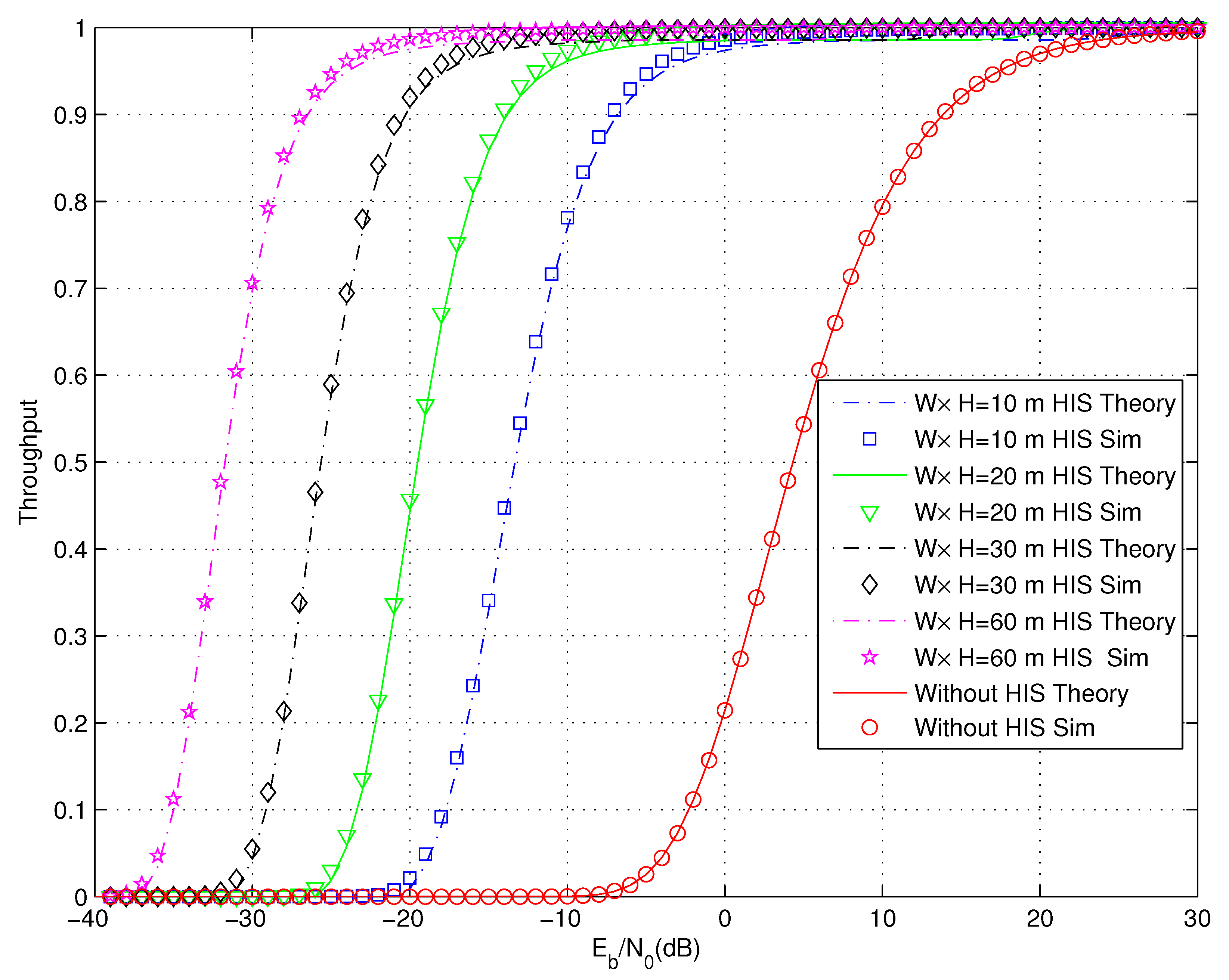
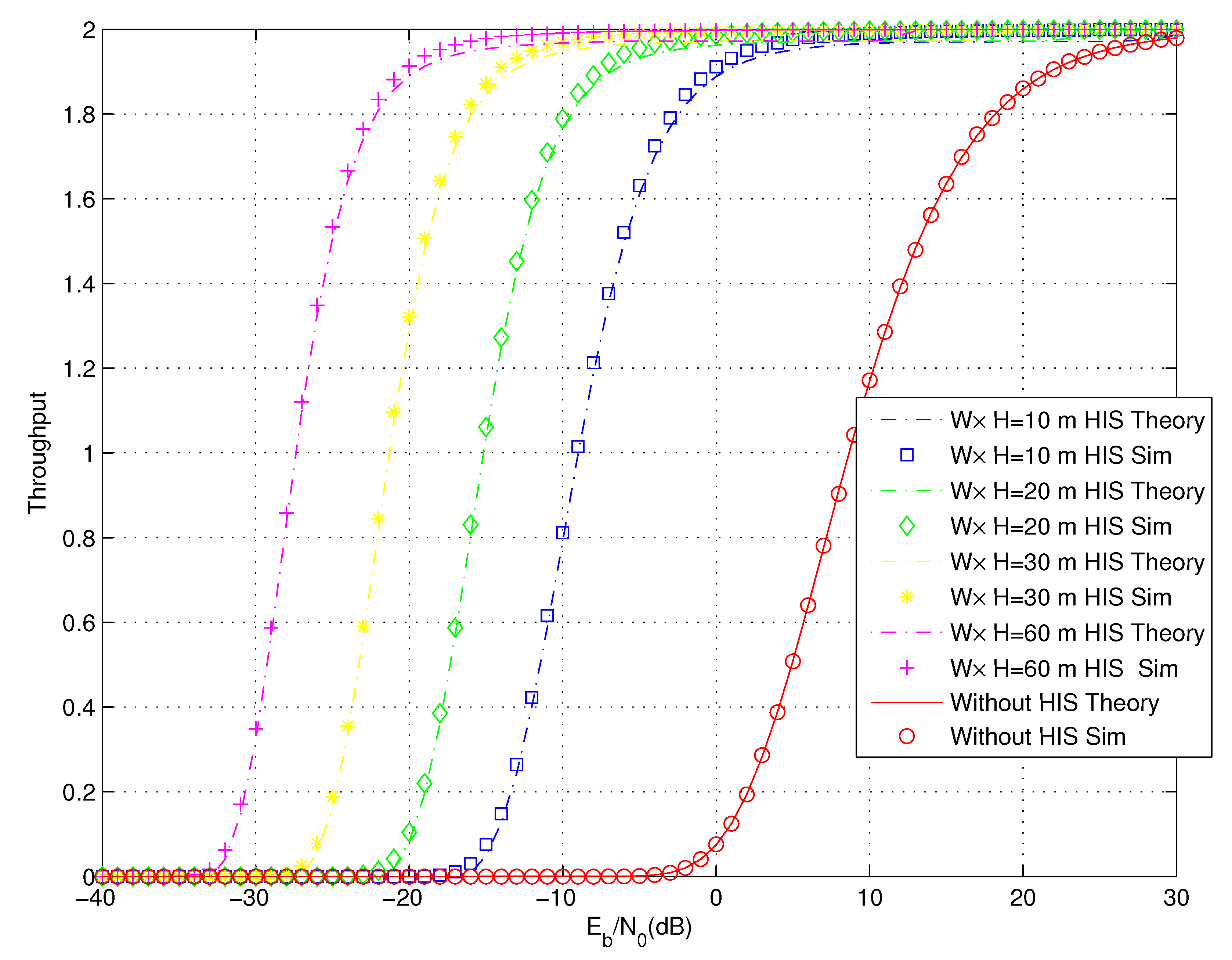
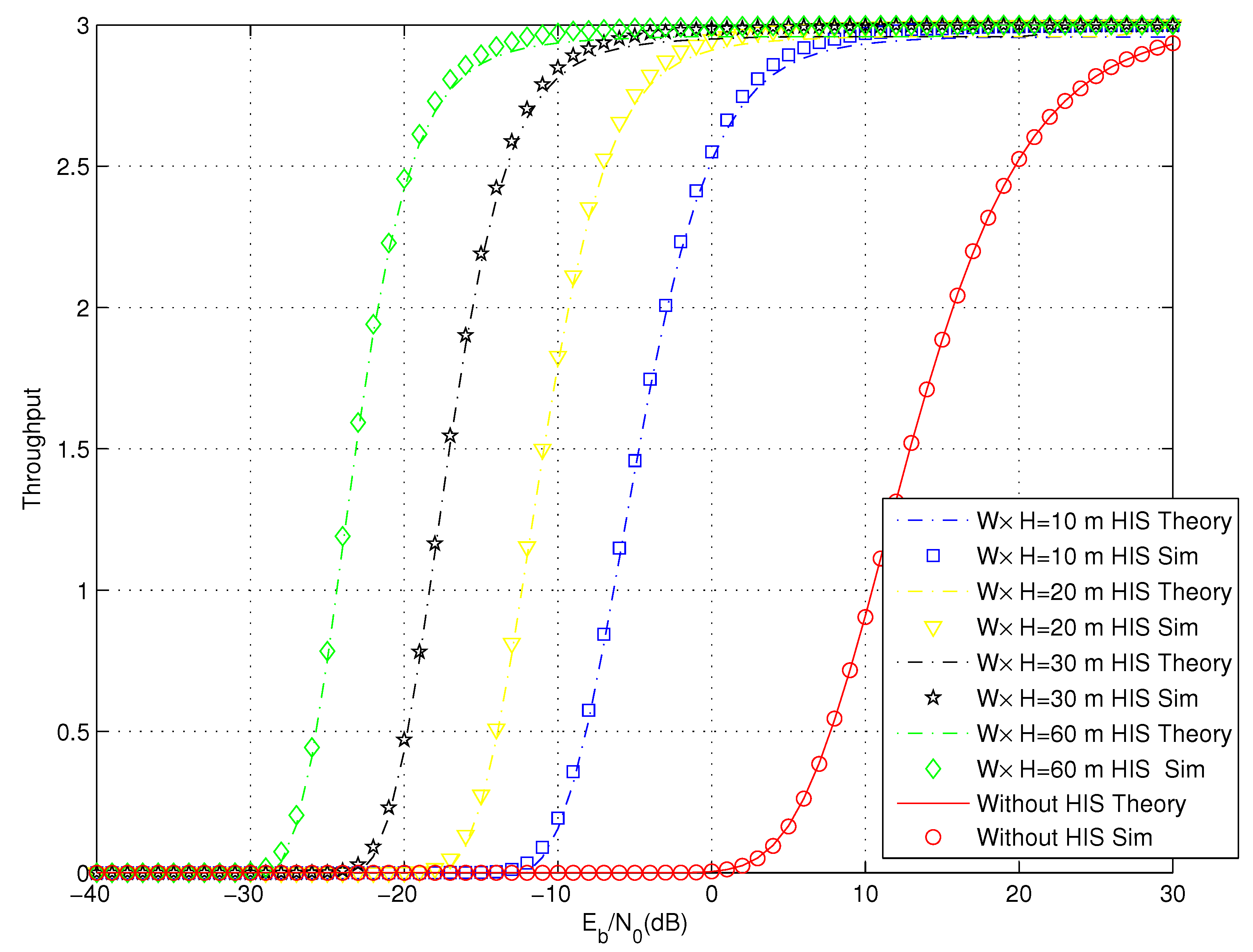
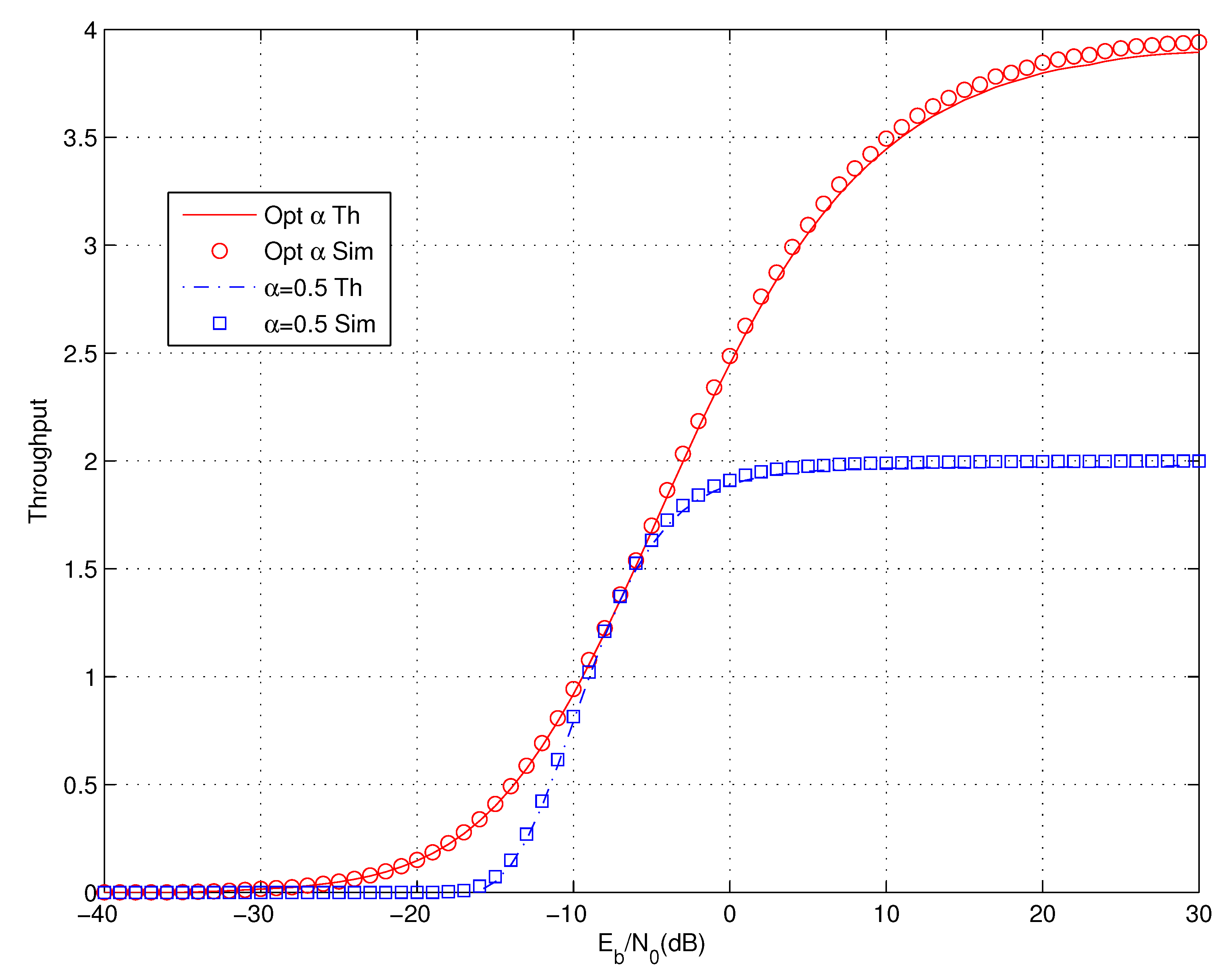
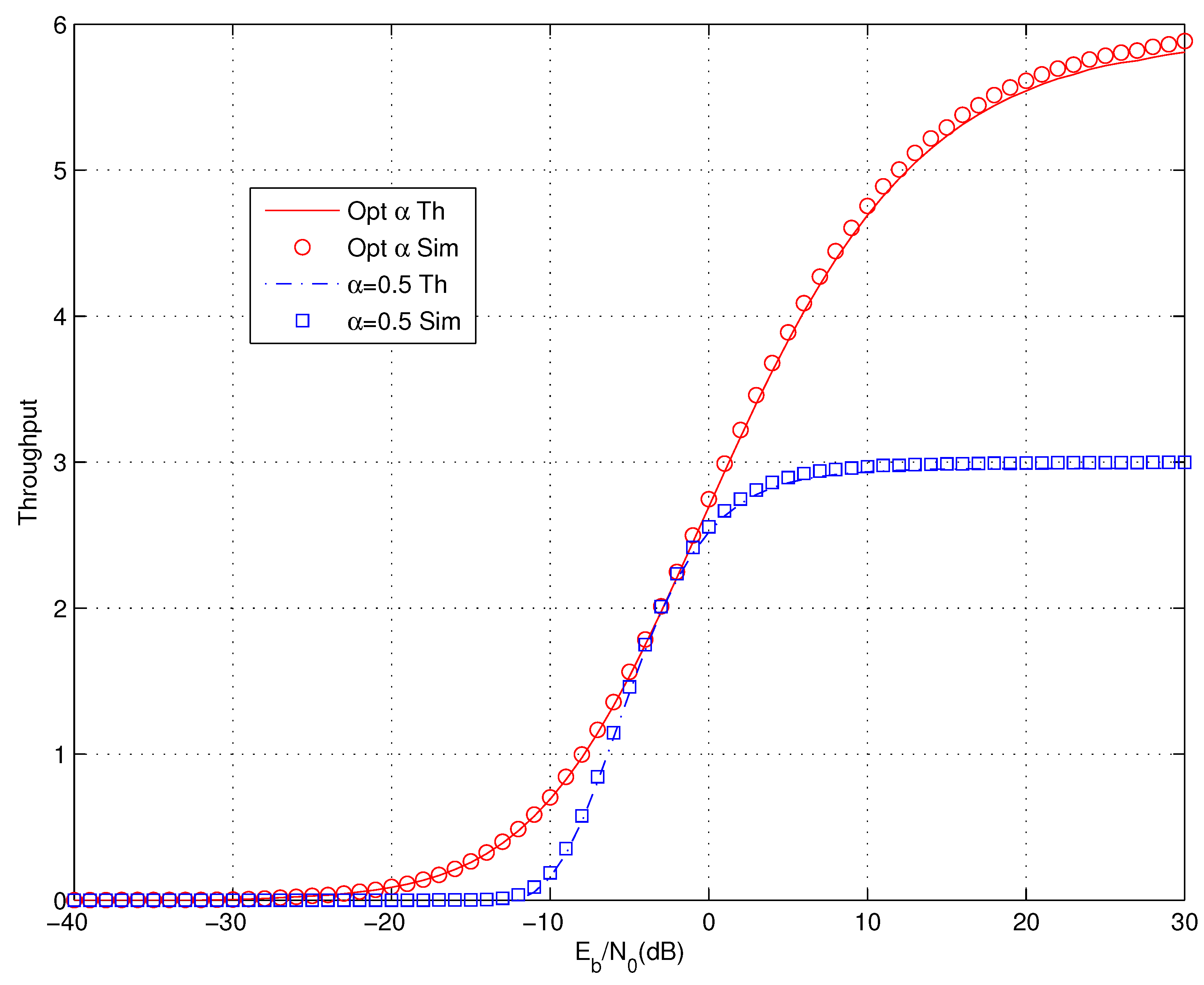
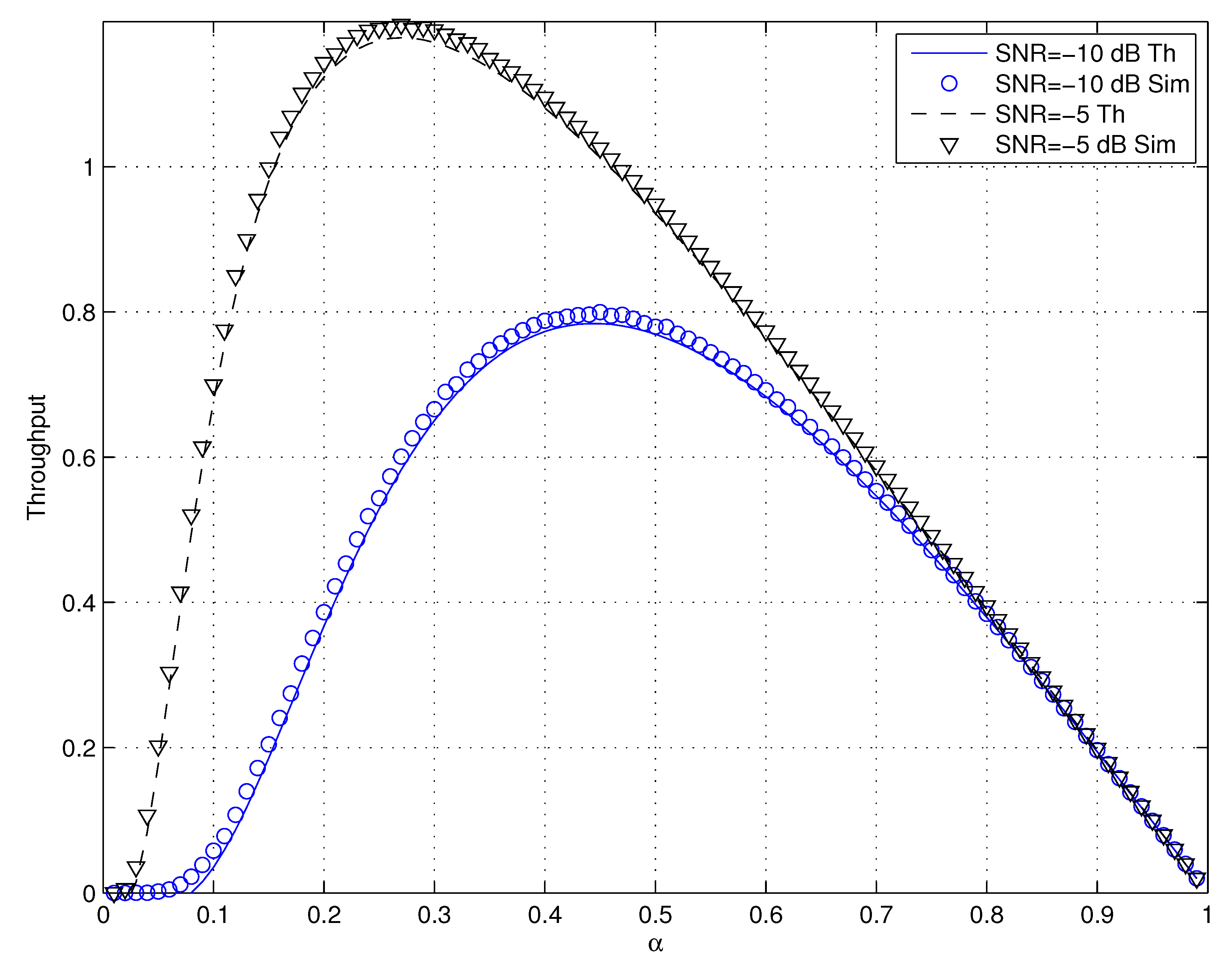
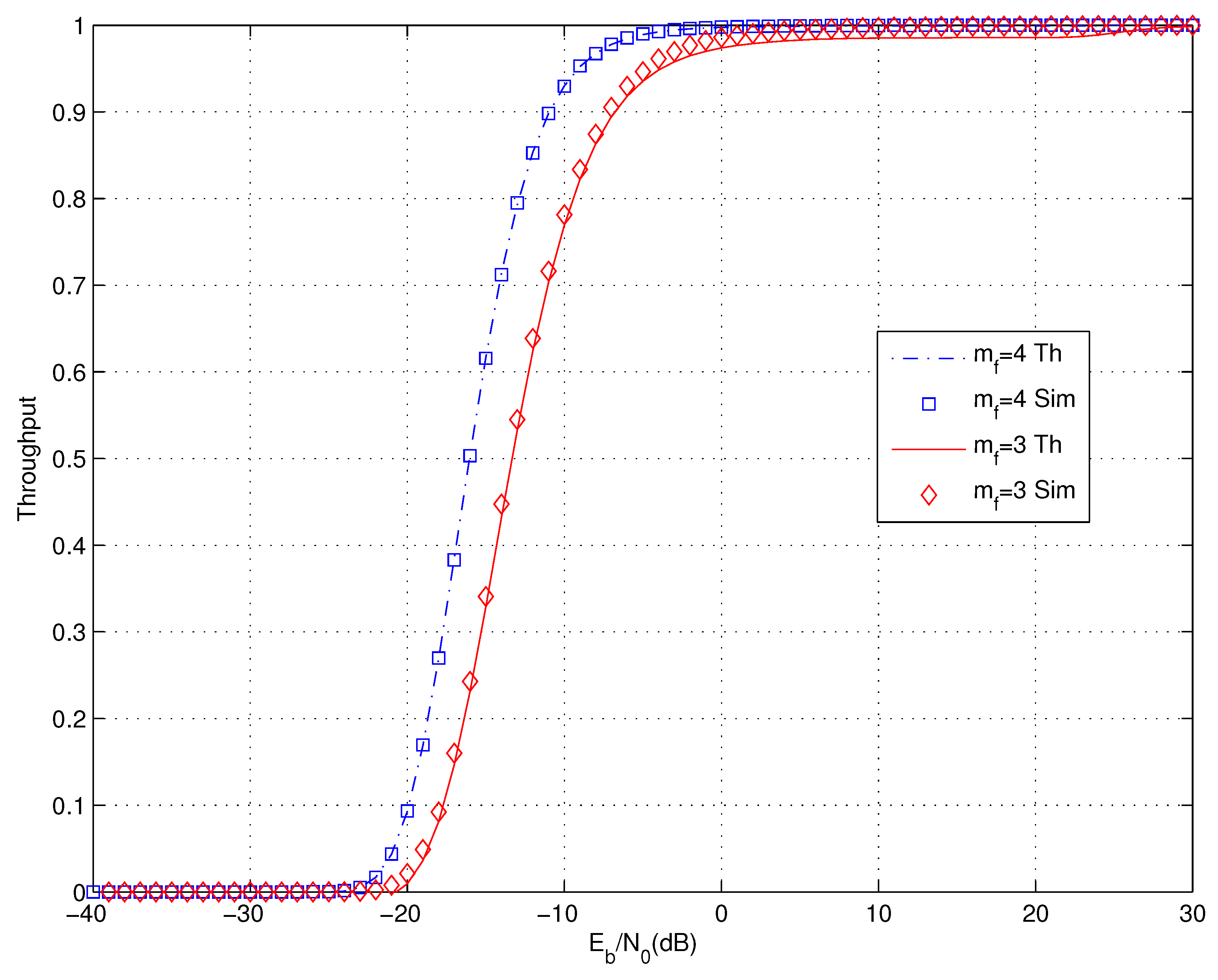
The theoretical results presented in Figure 2, Figure 3, Figure 4, Figure 5, Figure 6, Figure 7, Figure 8 and Figure 9 are obtained using Equations (11) and (35)–(41), which provide the analytical expressions required to evaluate the considered system performance.
In the Monte Carlo simulations, the HIS is explicitly represented by its individual reflecting elements. For each realization, the channel coefficients associated with the source-to-HIS and HIS-to-destination links are generated according to the adopted channel model. The contribution of each HIS element is then incorporated into the equivalent reflected channel, and the resulting channel gain is used to calculate the throughput. Therefore, the HIS is explicitly included in the simulation model rather than being represented solely by an empirical effective gain.
The numerical results clearly demonstrate the effectiveness of integrating RIS with magnetic energy harvesting in improving system performance. Figure 2, Figure 3 and Figure 4 show that the achievable throughput increases significantly with HIS dimension. This behavior is expected, as a larger HIS provides higher passive beamforming gain, leading to improved received signal power. The results also confirm that higher-order modulations (16-QAM and 64-QAM) benefit more from HIS assistance, although they require higher SNR to fully exploit their spectral efficiency. The values 10, 20, 30, and 60 in the figure legends denote the dimensions of the considered harvesting area, where W and H represent its width and height, respectively, and W × H represents the dimensions of the harvesting area in meters.
In the conventional configuration without an HIS, the source S communicates directly with the destination D through the direct propagation channel. The corresponding received signal is determined solely by this direct channel. In the proposed configuration, the HIS provides an additional controllable reflected path between S and D. By appropriately adjusting the reflection characteristics of its elements, the HIS modifies the effective propagation channel and can improve the received signal strength and consequently the achievable throughput. The magnetic energy harvesting process remains associated with the source node and provides the energy required for the RF transmission.
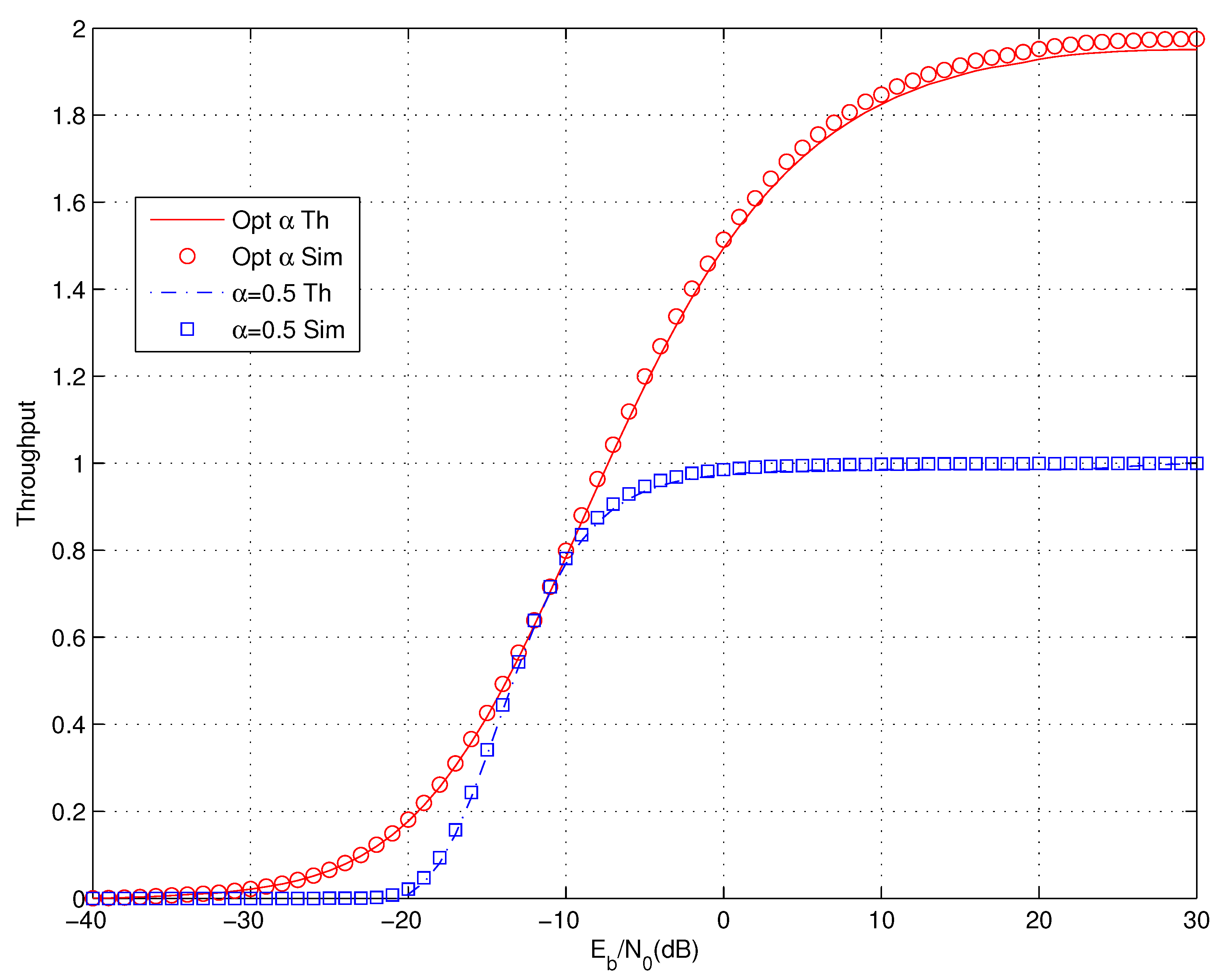
Figure 5, Figure 6 and Figure 7 individually illustrate the impact of the energy harvesting duration α from complementary perspectives. Figure 5 shows the throughput performance as a function of α , demonstrating that using a fixed value such as α = 0.5 can be suboptimal and that optimizing α can provide a significant throughput gain. Figure 6 further illustrates the corresponding variation in the harvested energy and transmit power, highlighting the benefit of allocating a longer duration to energy harvesting. Figure 7 emphasizes the resulting trade-off between energy harvesting and data transmission time, showing that increasing α improves the available transmit power but simultaneously reduces the time available for data transmission. Taken together, these three figures provide complementary evidence that jointly optimizing the energy harvesting and data transmission phases is essential for maximizing the system throughput.
Figure 8 further illustrates this trade-off by showing that the throughput is a unimodal function of α . The existence of a unique maximum confirms that the optimal harvesting duration can be efficiently obtained using simple search algorithms, as proposed in the paper.
Figure 9 demonstrates the influence of the magnetic field parameter m F , which reflects the average excitation level of the harvesting source. As m F increases, the harvested energy—and consequently the throughput—also increases. This confirms the direct relationship between magnetic field strength and communication performance, validating the system model.
Overall, the results verify that HIS significantly enhances the performance of magnetically powered communication systems. The combination of passive beamforming and optimized energy harvesting leads to notable gains in throughput and energy efficiency compared to conventional systems without HIS.
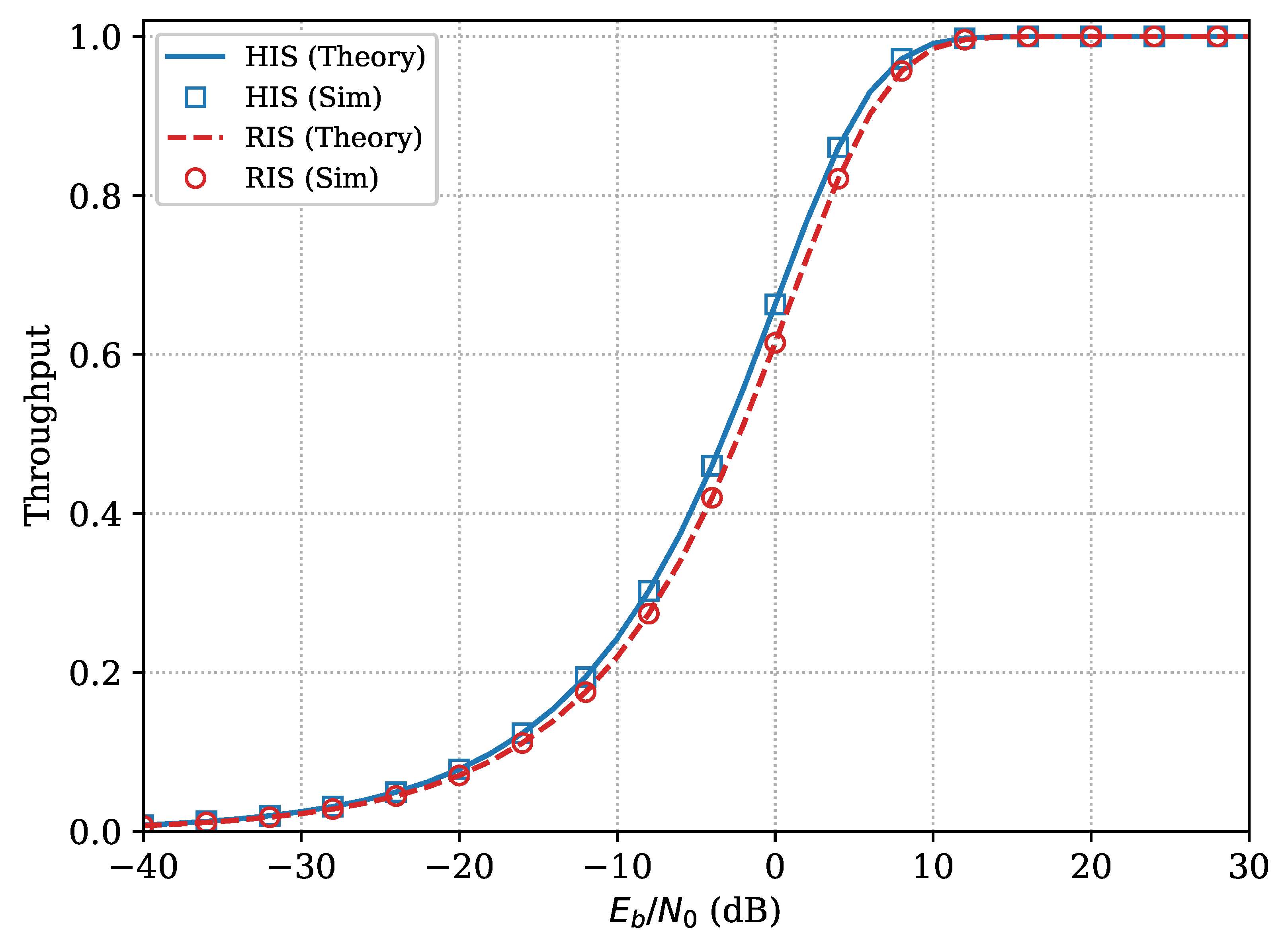
To further emphasize the advantage of the proposed HIS-assisted architecture, Figure 10 compares the achievable throughput of the HIS with that of a conventional discrete RIS, under identical channel statistics, aperture size (WH = 6), and magnetic energy harvesting parameters. Unlike the HIS, which provides (near) continuous phase control and therefore achieves perfect phase compensation across the aperture as in Equation (13), the conventional RIS relies on discrete phase shifters with finite resolution (b = 2 bits, i.e., four phase levels). This quantized control introduces a residual phase error at each reflecting element, which partially degrades the coherent combining gain of the equivalent channel. As illustrated in Figure 10, this results in an approximate 0.9 dB SNR penalty for the RIS relative to the HIS across the considered range of E b / N 0 , translating into a visibly right-shifted throughput curve. This outcome confirms that the near-continuous electromagnetic control enabled by the HIS yields a tangible performance gain over conventional discrete RIS architectures, particularly in energy-constrained scenarios where every decibel of harvested-energy efficiency directly impacts the achievable data rate.
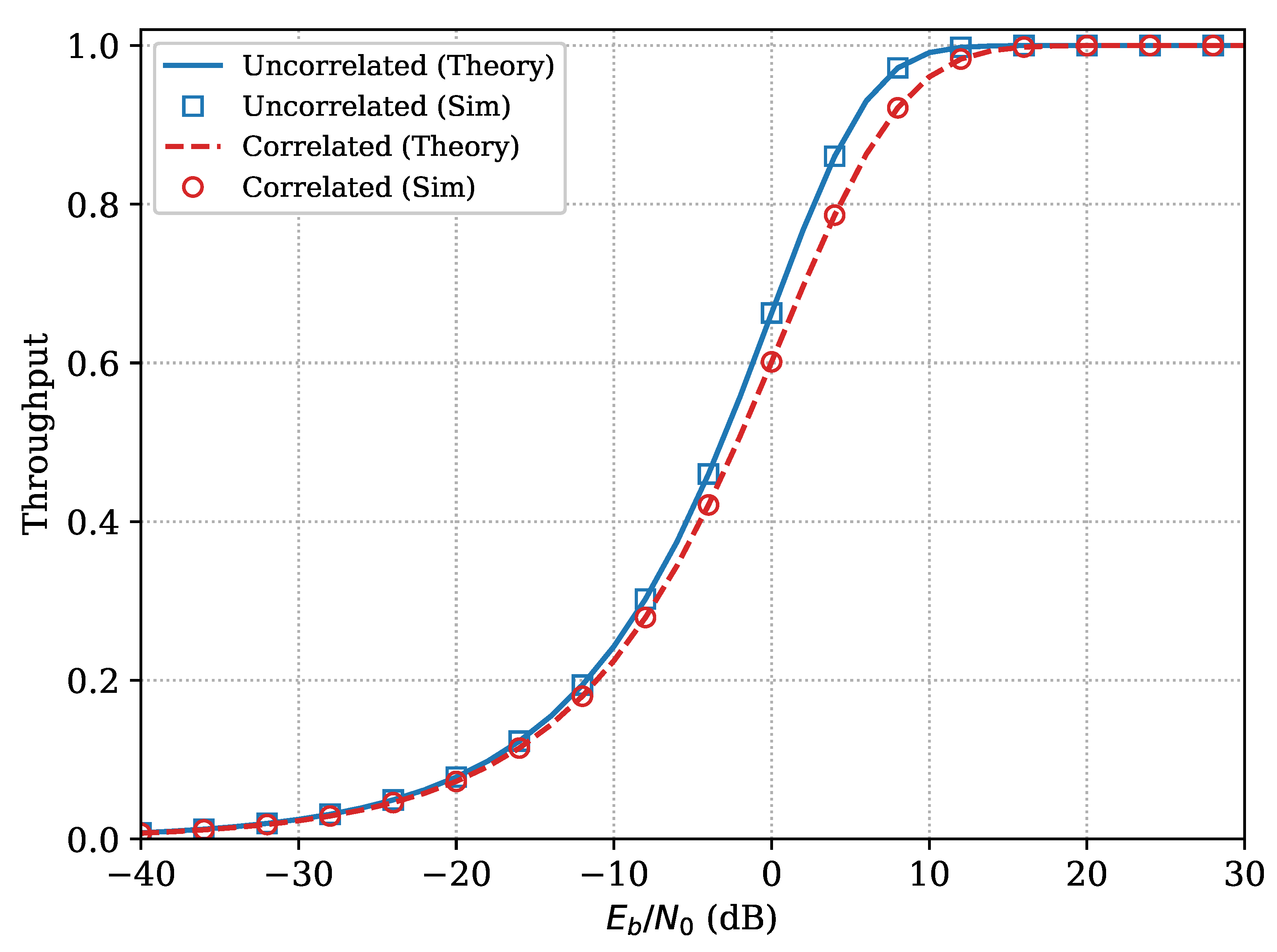
It should be noted that the throughput curves in Figure 2, Figure 3, Figure 4, Figure 5, Figure 6, Figure 7, Figure 8, Figure 9 and Figure 10 assume spatially uncorrelated fading over the HIS aperture. To assess the impact of spatial correlation, Figure 11 compares the uncorrelated and correlated cases ( W H = 6 , QPSK, α = 0.5 ). Spatial correlation is found to degrade throughput and should be accounted for in practical HIS deployments.
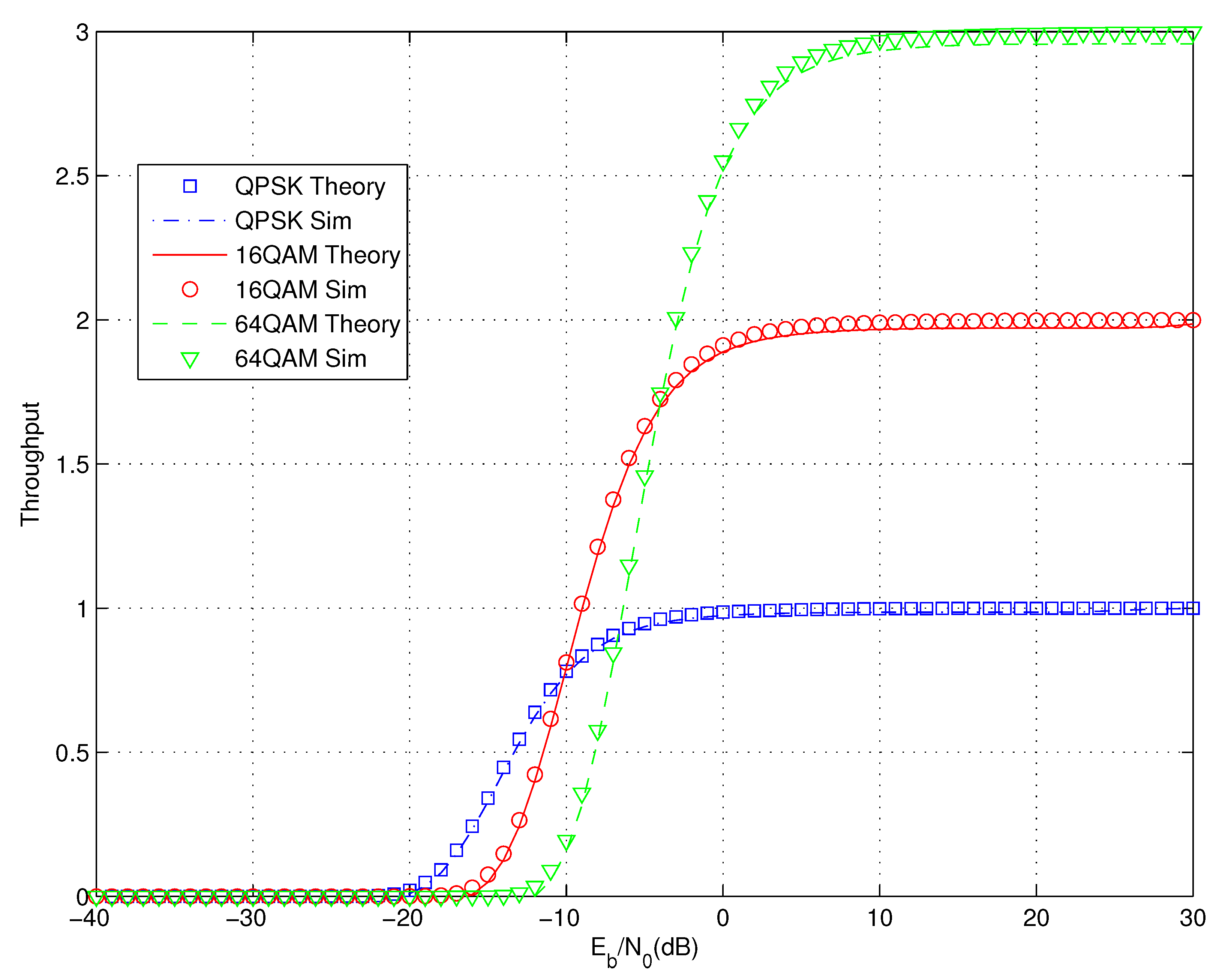
Figure 12 illustrates the throughput versus E b / N 0 for W H = 10 with QPSK, 16-QAM, and 64-QAM modulation schemes. At low E b / N 0 , QPSK provides the highest throughput due to its robustness against noise. As E b / N 0 increases, 16-QAM becomes more advantageous by providing a better balance between reliability and spectral efficiency. At high E b / N 0 , 64-QAM achieves the highest throughput due to its higher spectral efficiency. These results highlight the dependence of the optimal modulation scheme on the operating E b / N 0 regime.

7. Conclusions

This paper introduced a novel communication paradigm combining Holographic Intelligent Surfaces with magnetic energy harvesting at the source. By harvesting energy through magnetic fields, the source node becomes self-sustained, reducing dependence on external power supplies. The transmitted signal is then enhanced by the HIS, which intelligently controls the propagation environment to improve communication performance. The proposed approach demonstrates the potential for achieving energy-efficient, reliable, and scalable wireless systems. Future work may explore practical implementations, optimization strategies, and integration with emerging technologies such as 6G networks and the Internet of Things. The synergy between energy harvesting and intelligent surfaces is expected to play a key role in the development of sustainable wireless communication infrastructures.
The combination of magnetic energy harvesting and HIS-assisted communication is particularly relevant for future low-power wireless networks, where the availability of energy and the quality of the wireless propagation environment can jointly limit network performance. Magnetic energy harvesting can provide an additional energy source for communication nodes, while an HIS can improve the propagation conditions without requiring an active RF chain at the surface. Such an architecture may be relevant to battery-constrained IoT devices, low-power wireless sensors, and emerging self-sustaining communication systems. From a theoretical perspective, the proposed framework provides a unified model for studying the interaction between the available harvested energy and the HIS-assisted communication channel.
This work focuses on the theoretical development and mathematical formulation of Holographic Intelligent Surfaces with magnetic energy harvesting. The proposed framework is derived from the electromagnetic characteristics of the considered surface and the associated magnetic energy-harvesting mechanism. Accordingly, the study does not include an experimental setup or measurement campaign, as its primary objective is to establish and analyze the theoretical relationships governing the proposed system. Experimental implementation and measurement-based validation are considered beyond the scope of the present work and are identified as potential directions for future research.
Although a fabricated prototype is not presented in this work, the proposed Holographic Intelligent Surface with magnetic energy harvesting is established through a theoretical electromagnetic formulation and mathematical derivation. The objective of the present study is to develop the fundamental analytical framework and characterize the interaction between the holographic surface and the magnetic energy-harvesting mechanism. The fabrication of a physical prototype and its experimental characterization would provide an important next step in validating the proposed theoretical model and are therefore considered as part of our future work.
While the proposed framework is primarily theoretical, its practical validation through prototype implementation remains an important direction for future work. In particular, experimental prototypes will be developed to verify the feasibility of magnetic energy harvesting at the source and to assess the achievable energy-transfer and communication performance under realistic operating conditions. Such measurements will provide experimental validation of the theoretical analysis and help quantify the practical benefits and limitations of the proposed intelligent holographic surface architecture.
The proposed framework is validated through theoretical analysis and Monte Carlo simulations. The theoretical derivations establish the fundamental electromagnetic and energy-harvesting relationships governing the proposed Holographic Intelligent Surface with magnetic energy harvesting, while the Monte Carlo simulations provide a statistical evaluation of the derived analytical results under different system configurations and channel conditions. Although experimental measurements using a fabricated prototype are not considered in the present theoretical study, such an implementation would provide an important means of further validating the proposed framework and is therefore considered as a direction for future work. The proposed results are intended to provide theoretical insights into the performance and potential of the considered intelligent holographic surface architecture, rather than to represent experimental or fabricated-system validation. Prototype fabrication and experimental characterization are, therefore, identified as important perspectives for future work to further assess the practical feasibility of the proposed approach.


Funding

This research was funded by the Deanship of Scientific Research (DSR) at King Abdulaziz University, Jeddah, Saudi Arabia, under grant no. (IPP:550-135-2025).

Institutional Review Board Statement

Not applicable.

Informed Consent Statement

Not applicable.

Data Availability Statement

The original contributions presented in this study are included in the article. Further inquiries can be directed to the corresponding author.

Acknowledgments

This project was funded by the Deanship of Scientific Research (DSR) at King Abdulaziz University, Jeddah, Saudi Arabia, under Grant no. (IPP:550-135-2025). The author, therefore, acknowledges and expresses gratitude to DSR for technical and financial support.

Conflicts of Interest

The author declares no conflicts of interest.

Abbreviations

The following abbreviations are used in this manuscript:
HISHolographic Intelligent Surface
HRISHolographic Reconfigurable Intelligent Surface
MIMOMultiple-Input Multiple-Output
NOMANon-Orthogonal Multiple Access
IoTInternet of Things
PDFProbability Density Function
SNRSignal-to-Noise Ratio

Appendix A

The Mellin Transform is particularly suitable for the statistical analysis of the proposed equivalent channel gain because this gain involves products of random variables associated with the different propagation links. A key property of the Mellin Transform is that, for independent random variables, the Mellin Transform of their product is equal to the product of their individual Mellin Transforms. This property provides a convenient and tractable mathematical framework for characterizing the distribution of the multiplicative channel terms and facilitates the derivation of the statistical characteristics of the equivalent channel gain.
The Mellin transform of E s is given by
M E s ( s ) = 1 β 3 s − 3 k Γ 1 + 3 s − 3 k .
Let
Γ = E s Y 2 N 0 ,
and define
Z = E s Y 2 .
Since E s and Y 2 are statistically independent, the Mellin transform of Z is
M Z ( s ) = M E s ( s ) M Y 2 ( s ) .
The PDF of Y 2 is
f Y 2 ( y ) = 1 2 e − y + Δ 2 2 I − 1 2 Δ 2 y y Δ 2 − 1 4 .
Using the series expansion of the modified Bessel function and evaluating the Mellin integral yields
M Y 2 ( s ) = e − Δ 2 2 ∑ q = 0 ∞ Δ 2 q q ! Γ q + 1 2 Γ s + q − 1 2 2 s − q − 1 .
Therefore,
M Z ( s ) = 1 β 3 s − 3 k Γ 1 + 3 s − 3 k × e − Δ 2 2 ∑ q = 0 ∞ Δ 2 q q ! Γ q + 1 2 Γ s + q − 1 2 2 s − q − 1 .
Applying the inverse Mellin transform gives
f Z ( z ) = e − Δ 2 2 z ∑ q = 0 ∞ Δ 2 q 2 − q − 1 q ! Γ q + 1 2 × H 1 , 1 1 , 1 β 3 k z 2 0 , 3 k q − 1 2 , 1 .
Since
Γ = Z N 0 ,
the PDF of the instantaneous SNR is obtained by the transformation of variables as
f Γ ( γ ) = N 0 f Z ( N 0 γ ) ,
which gives
f Γ ( γ ) = e − Δ 2 2 γ ∑ q = 0 ∞ Δ 2 q 2 − q − 1 q ! Γ q + 1 2 × H 1 , 1 1 , 1 β 3 k N 0 γ 2 0 , 3 k q − 1 2 , 1 .
Using the integration property of the Fox H-function,
∫ 0 x 1 t H p , q m , n ( c t ) d t = H p + 1 , q + 1 m , n + 1 ( c x ) ,
the CDF of Z is obtained as
F Z ( z ) = e − Δ 2 2 ∑ q = 0 ∞ Δ 2 q 2 − q − 1 q ! Γ q + 1 2 × H 2 , 2 1 , 2 β 3 k z 2 ( 1 , 1 ) , 0 , 3 k q − 1 2 , 1 , ( 0 , 1 ) .
Finally, the CDF of the instantaneous SNR is
F Γ ( γ ) = F Z ( N 0 γ ) ,
or explicitly,
F Γ ( γ ) = e − Δ 2 2 ∑ q = 0 ∞ Δ 2 q 2 − q − 1 q ! Γ q + 1 2 × H 2 , 2 1 , 2 β 3 k N 0 γ 2 ( 1 , 1 ) , 0 , 3 k q − 1 2 , 1 , ( 0 , 1 ) .

References

  1. Joy, A.T.; Tishchenko, A.; Taghvaee, H.; Botham, P.; Burton, F.; Khalily, M.; Tafazolli, R. From Reconfigurable Intelligent Surfaces to Holographic MIMO Surfaces and Back. In Proceedings of the 2024 18th European Conference on Antennas and Propagation (EuCAP), Scotland, UK, 17–22 March 2024. [Google Scholar]
  2. Dardari, D.; Decarli, N. Holographic Communication Using Intelligent Surfaces. IEEE Commun. Mag. 2021, 59, 35–41. [Google Scholar] [CrossRef] [Scilit]
  3. Nadeem, Q.-U.-A.; Kaushik, A.; Di Renzo, M.; Dobre, O.A.; Swindlehurst, A.L.; Dajer, M.; Lee, D. Multi-Function Reconfigurable Intelligent and Holographic Surfaces for 6G Networks. IEEE Netw. 2025, 39, 10–13. [Google Scholar] [CrossRef] [Scilit]
  4. Dovelos, K.; Assimonis, S.D.; Ngo, H.Q.; Bellalta, B.; Matthaiou, M. Electromagnetic Modeling of Holographic Intelligent Reflecting Surfaces at Terahertz Bands. In Proceedings of the 2021 55th Asilomar Conference on Signals, Systems, and Computers, Pacific Grove, CA, USA, 31 October–3 November 2021. [Google Scholar]
  5. Ma, Y.; Shao, X.; Luo, W. Holographic Reconfigurable Intelligent Surface Based on Holl Effect for Electromagnetic Recording. In Proceedings of the 2021 Photonics and Electromagnetics Research Symposium (PIERS), Hangzhou, China, 21–25 November 2021. [Google Scholar]
  6. Wan, Z.; Gao, Z.; Gao, F.; Renzo, M.D.; Alouini, M.S. Terahertz Massive MIMO with Holographic Reconfigurable Intelligent Surfaces. IEEE Trans. Commun. 2021, 69, 4732–4750. [Google Scholar] [CrossRef] [Scilit]
  7. Suban, A.; Vasanth, S.; Vigneshwaran, M. Beamforming Technique for Terahertz Massive MIMO System Aided by Holographic Reconfigurable Intelligent Surfaces using Approximate Message Passing. In Proceedings of the 2024 International Conference on Integrated Circuits, Communication, and Computing Systems (ICIC3S), Una, India, 8–9 June 2024. [Google Scholar]
  8. Zeng, S.; Zhang, H.; Di, B.; Han, Z.; Vincent, H. Poor Dual-Polarized Reconfigurable Intelligent Surface-Based Antenna for Holographic MIMO Communications. IEEE Trans. Wirel. Commun. 2024, 23, 17339–17353. [Google Scholar] [CrossRef] [Scilit]
  9. Adhikary, A.; Munir, M.S.; Raha, A.D.; Qiao, Y.; Hong, S.H.; Huh, E.N.; Hong, C.S. An Artificial Intelligence Framework for Holographic Beamforming: Coexistence of Holographic MIMO and Intelligent Omni-Surface. In Proceedings of the 2023 International Conference on Information Networking (ICOIN), Bangkok, Thailand, 11–14 January 2023. [Google Scholar]
  10. Gomathi, S.; Kanakaraja, V.; Vasudevan, N.; Mahalingam, K.; Rachael, K.D. Integrating Edge AI with Holographic Beamforming Using AI-Driven Reconfigurable Intelligent Surfaces (RIS) in 6G Networks. In Proceedings of the 2025 International Conference on Computing and Communication Technologies (ICCCT), Goa, India, 14–15 February 2025. [Google Scholar]
  11. Win, M.Z.; Wang, Z.; Liu, Z.; Shen, Y.; Conti, A. Location Awareness Via Intelligent Surfaces: A Path Toward Holographic NLN. IEEE Veh. Technol. Mag. 2022, 17, 37–45. [Google Scholar] [CrossRef] [Scilit]
  12. Wang, Z.; Liu, Z.; Shen, Y.; Conti, A.; Win, M.Z. Holographic Localization with Synthetic Reconfigurable Intelligent Surfaces. IEEE J. Sel. Top. Signal Process. 2024, 18, 603–618. [Google Scholar] [CrossRef] [Scilit]
  13. Vo, D.T.; Nguyen, T.N.; Le, A.T.; Phan, V.D.; Voznak, M. Holographic Reconfigurable Intelligent Surface-Aided Downlink NOMA IoT Networks in Short-Packet Communication. IEEE Access 2024, 12, 65266–65277. [Google Scholar] [CrossRef] [Scilit]
  14. Li, Q.; El-Hajjar, M.; Sun, Y.; Hemadeh, I.; Tsai, Y.; Shojaeifard, A.; Hanzo, L. Achievable Rate Analysis of Intelligent Omni-Surface Assisted NOMA Holographic MIMO Systems. IEEE Trans. Veh. Technol. 2024, 73, 7400–7405. [Google Scholar] [CrossRef] [Scilit]
  15. Singh, S.; Singh, K.; Singh, S.K.; Shin, H.; Duong, T.Q. Multiple Access for Holographic Reconfigurable Intelligent Surface (HRIS)-Aided Near-Field Communications. IEEE Internet Things J. 2025, 12, 44678–44691. [Google Scholar] [CrossRef] [Scilit]
  16. Chrysologou, A.P.; Boulogeorgos, A.A.; Chatzidiamantis, N.D. When THz-NOMA Meets Holographic Reconfigurable Intelligent Surfaces. IEEE Commun. Lett. 2023, 27, 2516–2520. [Google Scholar] [CrossRef] [Scilit]
  17. Le, A.T.; Vu, T.H.; da Costa, D.B.; Voznak, M. Hybrid Power-Frequency Multiple Access with SIC-Free for Holographic Reconfigurable Intelligent Surface-Based Systems. IEEE Wirel. Commun. Lett. 2025, 14, 1566–1570. [Google Scholar] [CrossRef] [Scilit]
  18. Yang, J.; Lu, Z.; Yu, H.; Wei, L.; Huang, C. Holographic-Inspired Channel Estimation for Reconfigurable Intelligent Surface Systems. IEEE Wirel. Commun. Lett. 2025, 14, 4047–4051. [Google Scholar] [CrossRef] [Scilit]
  19. Ahmad, I.; Yang, L.; Alkhrijah, Y.; Huang, G.; Huang, M.; Alawad, M.A.; Li, X. Secure Near-Field Communication via Intelligent Reconfigurable Holographic Surface Beamforming. IEEE Netw. 2025, 1, 1–9. [Google Scholar] [CrossRef] [Scilit]
  20. Nikmaleki, E.; Eslami, M. Leveraging Holographic Antennas and Reconfigurable Intelligent Surface for Integrated Sensing and Communication. IEEE Commun. Lett. 2025, 29, 2850–2854. [Google Scholar] [CrossRef] [Scilit]
  21. Chen, M.; Xie, H.; Wang, X.; Xiao, W.; Farouk, A.; Liu, Z.; Chen, M.; Song, H.H. Holographic Counterpart Computation Offloading via Reconfigurable Intelligent Surfaces in VEC Consumer Electronics. IEEE Trans. Consum. Electron. 2025, 71, 5275–5286. [Google Scholar] [CrossRef] [Scilit]
  22. Torcolacci, G.; Decarli, N.; Dardari, D. OAM-based Holographic MIMO using Large Intelligent Surfaces. In Proceedings of the GLOBECOM 2022—2022 IEEE Global Communications Conference, Rio de Janeiro, Brazil, 4–8 December 2022. [Google Scholar]
  23. Ji, M.; Wu, Q.; Zhang, J.; Fan, P.; Wang, K.; Chen, W.; Mao, G.; Letaief, K.B. Active Movable-Element RIS Assisted Vehicular Semantic Communications: Modeling and Optimization. IEEE Trans. Wirel. Commun. 2026, 25, 20588–20605. [Google Scholar] [CrossRef] [Scilit]
  24. Xi, Y.; Burr, A.; Wei, J.B.; Grace, D. A general upper bound to evaluate packet error rate over quasi-static fading channels. IEEE Trans. Wirel. Commun. 2011, 10, 1373–1377. [Google Scholar] [CrossRef] [Scilit]
Figure 1. HIS with magnetic energy harvesting.
Telecom 07 00116 g001
Figure 2. Throughput of HIS with magnetic energy harvesting and QPSK.
Telecom 07 00116 g002
Figure 3. Throughput of HIS with magnetic energy harvesting and 16QAM.
Telecom 07 00116 g003
Figure 4. Throughput of HIS with MAGNETIC energy harvesting and 64QAM.
Telecom 07 00116 g004
Figure 5. Throughput for QPSK, α = 0.5 and optimal α .
Telecom 07 00116 g005
Figure 6. Throughput for 16QAM, α = 0.5 and optimal α .
Telecom 07 00116 g006
Figure 7. Throughput for 64QAM, α = 0.5 and optimal α .
Telecom 07 00116 g007
Figure 8. Throughput versus α .
Telecom 07 00116 g008
Figure 9. Throughput for m F = 3 , 4 and N = 8 .
Telecom 07 00116 g009
Figure 10. Throughput using HIS and RIS.
Telecom 07 00116 g010
Figure 11. Throughput versus E b / N 0 for HIS ( W H = 6 , QPSK, α = 0.5 ): uncorrelated vs. correlated fading.
Telecom 07 00116 g011
Figure 12. Throughput versus E b / N 0 for W H = 10 using QPSK, 16-QAM, and 64-QAM modulation schemes.
Telecom 07 00116 g012
Disclaimer/Publisher’s Note: The statements, opinions and data contained in all publications are solely those of the individual author(s) and contributor(s) and not of MDPI and/or the editor(s). MDPI and/or the editor(s) disclaim responsibility for any injury to people or property resulting from any ideas, methods, instructions or products referred to in the content.