Review

A Survey of Emerging Technologies for Secure Communication in 6G Networks

1
Department of Electrical Engineering, Islamic University of Madinah, Madinah 42351, Saudi Arabia
2
Department of Electrical, Computer and Biomedical Engineering, Toronto Metropolitan University, Toronto, ON M5B 2K3, Canada
3
Department of Electrical Engineering, Lakehead University, Barrie STEM Hub, Barrie, ON L4N 1R7, Canada
*
Author to whom correspondence should be addressed.
Telecom 2026, 7(3), 74; https://doi.org/10.3390/telecom7030074 (registering DOI)
Submission received: 18 March 2026 / Revised: 9 May 2026 / Accepted: 20 May 2026 / Published: 8 June 2026

Abstract

With the rapid proliferation in communication devices and the expansion of applications, future sixth-generation (6G) networks are expected to enable a truly connected world. They will allow large-scale use cases, such as the Internet of Things (IoT) and unmanned aerial vehicles (UAVs), providing significantly faster and more innovative services ubiquitously. However, challenges remain, particularly in security. The growing number of devices and increased connectivity may lead to a larger attack surface. Many emerging technologies are actively addressing these security and privacy concerns, ensuring that we can benefit from the advantages of 6G networks and applications without falling victim to malicious attacks. In this paper, we conduct a comprehensive literature review of emerging technologies for secure communication in 6G networks, including artificial intelligence (AI) and machine learning (ML), blockchain technology, quantum-safe communication, and physical-layer security. First, we discuss the architecture of 6G networks from a security perspective. Second, we review existing surveys on 6G security issues and provide a quantitative analysis to identify research gaps, including technology-driven silos and domain fragmentation. Third, we develop a hierarchical taxonomy of security challenges and attacks in 6G networks, covering physical-layer attacks, network-level threats, device vulnerabilities, data privacy concerns, and emerging application-specific risks. We then examine the roles of key enabling technologies and present a mapping between security threats and corresponding technological solutions, along with a unified evaluation framework to facilitate cross-technology comparison. Furthermore, we propose an integrated multi-technology security framework and discuss practical deployment challenges by bridging the gap between simulation-based studies and real-world implementations. Finally, we outline concrete future research directions for advancing secure 6G communication systems.

1. Introduction

While fifth-generation (5G) networks are still being deployed globally, the telecommunications industry and academia have already shifted toward developing sixth-generation (6G) networks [1]. Major initiatives such as the 6G Smart Networks and Services Joint Undertaking in the European Union and the Next G Alliance in North America underscore the global commitment to advancing and standardizing 6G networks [2]. These efforts aim to realize hyper-connected and intelligent systems that integrate diverse heterogeneous networks, supported by UAVs and satellite-based communications. These systems will leverage cutting-edge AI to deliver ubiquitous connectivity and seamless network coverage. Experts anticipate that 6G will achieve commercial deployment within the next 5 to 10 years [3].
Sixth-generation networks are expected to achieve unprecedented performance metrics, including peak data rates exceeding 1 Tbps, sub-millisecond latency, and significantly enhanced spectrum efficiency [4,5]. These advancements will enable transformative applications across sectors, such as healthcare, transportation, and energy management. However, the increased complexity and connectivity of 6G networks also introduce new security challenges that must be addressed to ensure the integrity, confidentiality, and availability of communications [6].

1.1. Architecture of 6G Networks: Security Context

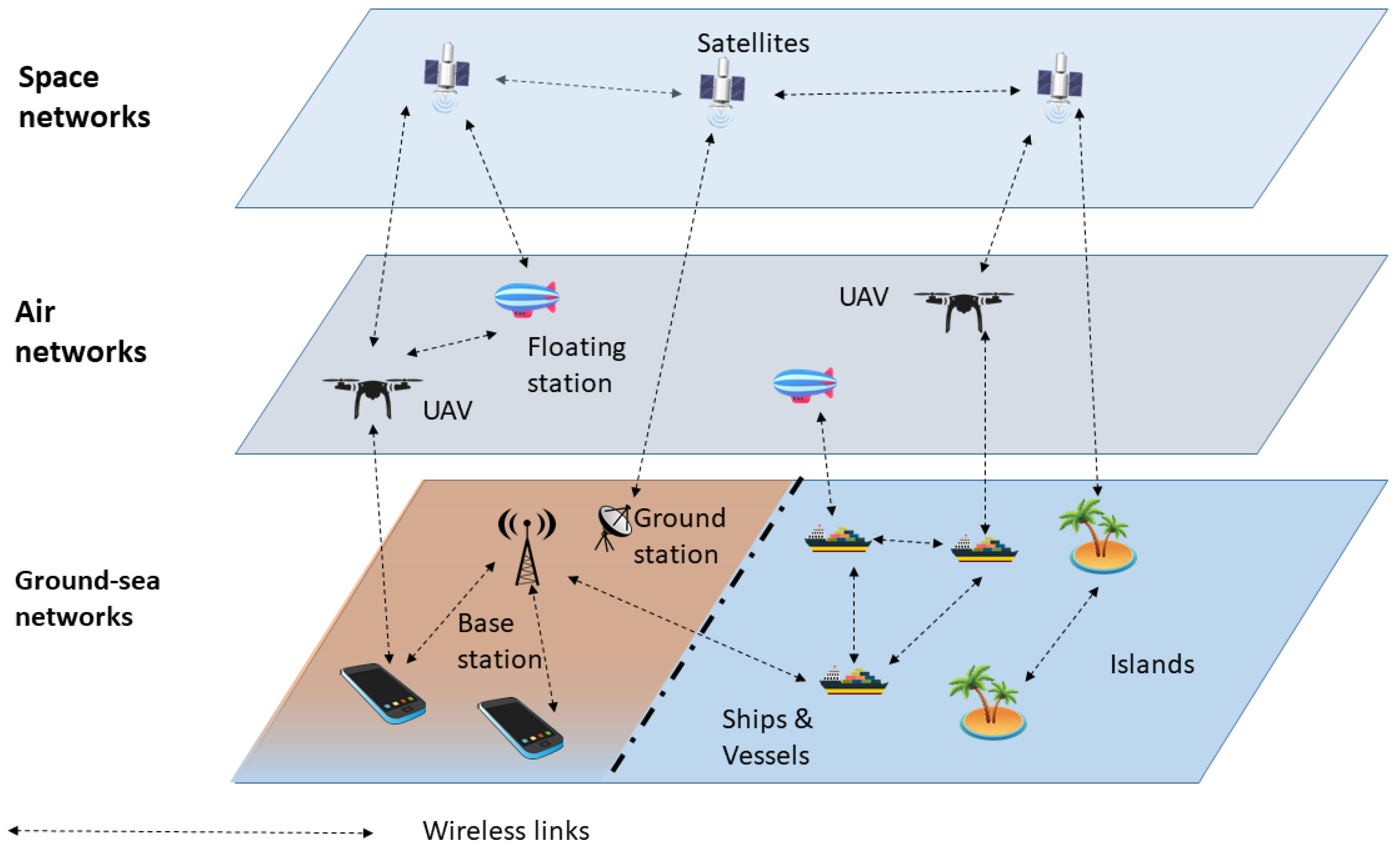
A possible architecture of 6G networks was proposed in [7]. The exact nature of 6G architecture has yet to be determined. Yet, it is expected that 6G networks will integrate space–air–ground–sea transmissions to provide ultra-reliable and ubiquitous coverage. Figure 1 shows the architecture of 6G networks, encompassing terrestrial, aerial and satellite networks, as first envisioned by 3GPP (the 3rd Generation Partnership Project) [8].
The envisioned 6G architecture integrates space, air, and ground–sea networks into a global, heterogeneous system. This multi-domain design supports ultra-reliable and ubiquitous connectivity; however, it simultaneously increases potential attack surfaces. Each architectural layer introduces distinct vulnerabilities, many of which have already been identified in recent studies.
Vulnerabilities in Space Networks (Satellites): Satellite links remain among the most exposed elements in the 6G ecosystem due to their open broadcast nature, which makes them inherently vulnerable to jamming, spoofing, and interception. The lack of substantial physical barriers allows adversaries to easily disrupt downlink or uplink channels by injecting interference or false signals. In addition to classical attacks, cross-link communications among satellites, intended to improve coverage and reduce latency, introduce new attack surfaces for interception, manipulation, and denial-of-service (DoS) attacks. Since satellites often serve as backbone nodes for both civilian and military communications, the consequences of such vulnerabilities can propagate across multiple domains simultaneously, amplifying systemic risk [9].
Vulnerabilities in Air Networks (UAVs and Floating Stations): Unmanned aerial vehicles and high-altitude platforms extend connectivity into areas underserved by terrestrial infrastructure, yet they are vulnerable to multiple forms of attack. Hijacking via control-channel takeover, GPS spoofing that misleads navigation systems, and signal-injection attacks targeting sensor data can compromise both flight safety and data integrity [10]. Floating stations, which rely heavily on stable line-of-sight links, are particular susceptible to man-in-the-middle (MITM) attacks and malicious relay disruptions, thereby enabling attackers to intercept or alter transmitted data. Given their mobility and potential use in emergency or battlefield scenarios, these vulnerabilities could quickly escalate into mission-critical failures.
Vulnerabilities in Ground–Sea Networks: Ground-based infrastructure, including terrestrial base stations and ground stations that link to satellites, faces risks spanning both physical and cyber dimensions. Physical-layer eavesdropping is particularly relevant in dense urban deployments, where attackers can exploit proximity to antenna arrays. At the cyber layer, edge nodes and IoT gateways provide entry points for malware injection or large-scale distributed denial-of-service (DDoS) attacks. Undersea communication cables and maritime IoT networks on ships and vessels add further complexity: vessels increasingly rely on digital connectivity for logistics and navigation, yet identity spoofing and data leakage attacks can expose sensitive maritime information to adversaries [11,12]. The growing interdependence of marine and terrestrial networks thus widens the security perimeter far beyond traditional land-based assets.
Cross-Layer Integration Risks: The architectural hallmark of 6G, tight integration across space, air, ground, and sea, creates not only opportunities but also amplifies risks at the interfaces. For example, handovers between UAVs and satellites expand the attack surface for relay manipulation, while maritime-to-satellite connectivity can be exploited for large-scale traffic analysis or routing disruption. Unlike previous generations of wireless communication networks, where each domain could often be secured in isolation, 6G’s layered heterogeneity demands cross-domain defense strategies capable of addressing vulnerabilities that migrate across multiple tiers.
Beyond this domain-based architecture, Letaief et al. highlight three functional features that will further define 6G networks: network intelligentization, network of subnetworks, and intelligent radio [7]. While these innovations enable highly adaptive and efficient operations, they also introduce unique security challenges that are inherent to the architecture.
Physical-Layer Vulnerabilities in New Spectrum Bands: The adoption of higher-frequency bands, particularly terahertz (THz) and millimeter wave (mmWave), offers vast new spectral resources for ultra-high-speed communication. However, these bands are susceptible to environmental interference and blockage, which adversaries can exploit through deliberate jamming or eavesdropping [13]. The fragile propagation characteristics of these signals make networks more susceptible to both brute-force and finely tuned interference attacks. As a result, physical-layer security must evolve in parallel with spectrum expansion to ensure reliable performance.
Data Security Risks at Edge and Fog Layers: The shift toward distributed computing in 6G means that massive volumes of data will be processed at edge and fog nodes rather than centralized cloud centers. While this improves latency and efficiency, it also enlarges the potential attack surface. Compromised nodes can lead not only to data leakage but also to deliberate data manipulation or local DoS attacks, which are exacerbated by the limited security resources often available at edge devices [14]. The difficulty of monitoring large numbers of geographically dispersed nodes makes this a persistent vulnerability that cannot be overlooked.
Adversarial AI in Intelligentized Networks: Artificial intelligence is expected to permeate all layers of 6G, orchestrating functions from spectrum allocation to traffic routing and security monitoring. Yet adversarial AI introduces a paradox: the very technology intended to defend the system can itself be corrupted. Attacks such as adversarial learning, model poisoning, or algorithmic takeover can undermine resilience, bias routing decisions, or disable anomaly detection mechanisms. Since AI models often function as “black boxes,” detecting such manipulations is extremely challenging, raising serious concerns for both trust and transparency [15].
Quantum Threats to Cryptographic Infrastructure: Advances in quantum computing pose an existential threat to current cryptographic algorithms, many of which could be broken in polynomial time by sufficiently robust quantum machines. For 6G networks, this threat is particularly acute, given their reliance on secure authentication and encrypted traffic across domains. Transitioning to post-quantum cryptographic schemes and exploring Quantum Key Distribution (QKD) are critical steps toward resilience. However, implementing QKD requires extensive infrastructure changes, including quantum-enabled channels and trusted relay nodes, which remain a formidable architectural challenge.
The above vulnerabilities and challenges illustrate that 6G architecture and security are deeply intertwined. The innovations that enable ubiquitous and intelligent connectivity, distributed computing, and advanced spectrum usage, simultaneously open the door to sophisticated, cross-layer attacks. Therefore, security cannot be treated as an afterthought but must be integrated into the architectural design itself. Addressing these vulnerabilities will require leveraging a new set of enabling technologies—such as AI/ML, blockchain, physical-layer security, and quantum-safe communication—whose role in safeguarding 6G networks is the central focus of this survey.

1.2. Contributions

This survey focuses on the emerging security landscape of 6G networks. The main contributions are as follows:
Quantitative gap analysis of existing surveys: Based on Table 1, we provide a quantitative analysis in Section 2.4 showing that a significant portion of existing works focuses on single technologies or specific domains, thereby revealing technology-driven silos and domain fragmentation in the literature.
Comprehensive and structured taxonomy: We propose a hierarchical taxonomy of 6G security challenges that clearly distinguishes between physical-layer attacks, network-level threats, device vulnerabilities, data privacy issues, and emerging application-specific risks.
Unified evaluation framework: We propose a set of common evaluation metrics (e.g., latency, energy efficiency, scalability, etc.) to enable consistent comparison across different security technologies.
Explicit mapping between threats and technologies: We introduce a mapping framework in Table 2 that systematically links major 6G security threats to enabling technologies such as AI/ML, blockchain, physical-layer security, and quantum-safe communication.
Integrated multi-technology security framework: Unlike prior surveys that discuss technologies in isolation, we present a unified framework that highlights how multiple technologies can be combined to achieve comprehensive 6G security.
Practical deployment insights: We bridge the gap between theory and practice by discussing real-world deployment challenges and providing actionable design guidelines for applying these technologies in 6G environments.

1.3. Organization of the Paper

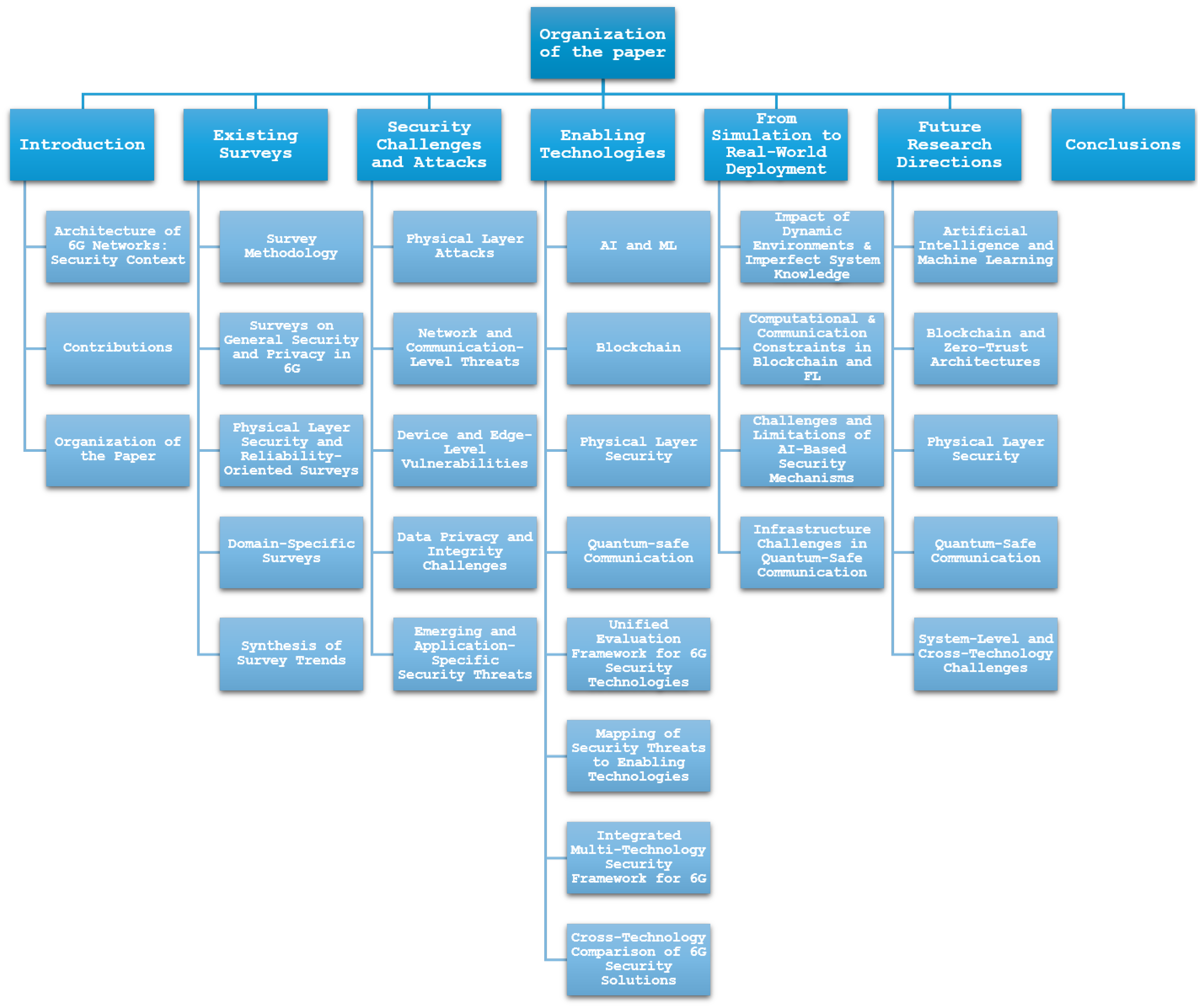
Figure 2 provides a brief overview of the paper through an organizational diagram. The remainder of this paper is organized as follows. Section 2 reviews existing surveys on 6G security and highlights research gaps. Section 3 presents a taxonomy of security challenges and attacks. Section 4 discusses the key enabling technologies and their roles in mitigating security risks. Section 5 examines practical deployment challenges, Section 6 outlines future research directions, and Section 7 concludes the paper.

2. Existing Surveys

The rapid emergence of 6G has motivated a series of survey papers addressing its unique security and privacy challenges. Rather than treating each survey in isolation, we group them into thematic clusters to highlight both the trends and the gaps across domains.

2.1. Survey Methodology

To ensure a comprehensive and systematic review, this survey adopts a structured methodology inspired by the PRISMA framework. Relevant literature was collected from major academic databases, including IEEE Xplore, Elsevier ScienceDirect, SpringerLink, and Google Scholar.
The search process was conducted using combinations of keywords such as “6G security”, “physical layer security”, “blockchain in wireless networks”, “federated learning for IoT security”, and “quantum-safe communication”. Only peer-reviewed journal articles and high-quality conference papers published between 2020 and 2025 were considered to ensure relevance to emerging 6G technologies.
An initial pool of papers was identified through keyword-based search, followed by a screening process to remove duplicates and irrelevant works. The remaining papers were filtered based on their relevance to 6G security challenges, proposed methodologies, and evaluation rigor. Selected papers were then categorized into thematic groups, including AI/ML-based security, blockchain-enabled security, physical-layer security techniques, and quantum-safe communication.
This systematic approach ensures that the survey provides a balanced and representative overview of current research trends, challenges, and future directions in 6G security.

2.2. Surveys on General Security and Privacy in 6G

Several works adopt a broad, cross-layer approach to security in 6G. Nguyen et al. [8] delivered one of the most comprehensive surveys on security and privacy for 6G to date. They systematically categorized emerging 6G technologies across multiple layers of the architecture and mapped the corresponding threats. Their contribution lies not only in identifying attack surfaces but also in drawing lessons from existing security architectures that can inform future 6G designs. Sun et al. [16] focused on machine learning integration, with a particular emphasis on privacy. The authors highlighted the trade-off between performance efficiency and user privacy, which is exceptionally intricate as ML becomes deeply embedded in 6G intelligence. They provided a wide-ranging overview of ML use cases in 6G, identified specific privacy vulnerabilities in ML-driven systems, and discussed privacy-preserving ML methods. Zuo et al. [17] connected blockchain and AI, treating them as joint enabling technologies. Their survey showed how both can address scalability and trust challenges in 6G wireless systems, offering insights into how decentralized security can complement AI-driven optimization.
Fadlullah et al. [18] conducted a survey of ML-based optimization techniques with the dual aim of balancing quality of service (QoS) requirements and addressing security constraints in 6G resource allocation. Notably, this work covered several network topologies to illustrate current trends and trade-offs between efficiency and protection. Duong et al. [19] provided a forward-looking overview of quantum-inspired ML applications in 6G, particularly in resource allocation and security. Their work underscored the feasibility of integrating quantum concepts into 6G ML to enhance protection and adaptability. Naeem et al. [28] examined reconfigurable intelligent surface (RIS)-based 6G networks, noting that despite the benefits of reconfigurability and low cost, these systems are inherently vulnerable. The survey carefully analyzed privacy and security threats in RIS environments, particularly when RIS is integrated with other technologies such as device-to-device communications, multi-access edge computing (MEC), and non-terrestrial networks.
The zero-trust paradigm was examined in [20], which discussed the role of authentication and access control in a zero-trust architecture. The authors provided practical case studies that clarified both the opportunities and the gaps in deploying zero-trust security in 6G. Adversarial ML was the explicit focus of [15], where theories and the latest defense mechanisms for adversarial attacks in IoT-enabled 6G systems were reviewed. The authors conducted Monte Carlo simulations to evaluate the effectiveness of these attacks and countermeasures. Yang et al. [21] explored Zero-Touch Networks (ZTNs), emphasizing automation and AutoML in mitigating security threats. Their contribution lay in case studies showing how dynamic 6G systems could self-adapt, while also exposing gaps in current AutoML-driven defense strategies.
Lessons learned: Collectively, these surveys demonstrate the centrality of ML, blockchain, and automation in 6G security research. Yet most of them treat technologies in isolation, leaving open the question of how to design integrated, multi-technology frameworks.

2.3. Physical-Layer Security (PLS) and Reliability-Oriented Surveys

The physical layer remains a recurring focus in 6G security literature, particularly given its role in Ultra-Reliable Low-Latency Communication (URLLC) and beyond. Reinforcement learning (RL) for PHY cross-layer security was explored in [22], which focused on countering jammers, eavesdroppers, and interference attackers using adaptive RL-based schemes. Pradhan et al. [23] presented a thorough survey on PLS for URLLC in 5G and 6G, introducing the extended class of Hyper Reliable Low-Latency Communication (HRLLC). Their study highlighted that physical-layer solutions must evolve to support reliability guarantees while defending against eavesdropping and interference in 6G. Kaur et al. [24] centered their work on RIS-assisted PLS, starting from conceptual foundations and key metrics before mapping out RIS-enabled 6G topologies. They reviewed state-of-the-art PLS techniques, including secret-key generation (SKG) and optimization-based schemes, and provided a taxonomy that links RIS design choices to security outcomes. Lohan et al. [25] expanded the scope to include both intentional (jamming) and unintentional interference, showing how AI-driven detection and mitigation techniques can support secure communications in UAV networks, vehicular systems, IoT, and THz bands. Illi et al. [26] surveyed PLS strategies specifically for IoT in 6G, covering confidentiality guarantees, message authentication, and malicious attack detection. They evaluated advanced technologies such as Non-Orthogonal Multiple Access (NOMA), joint communication and sensing, RIS, and THz communications, offering a balanced discussion of their potential and limitations.
Lesson learned: These studies highlight the critical role of PLS in reliability-focused services like URLLC/HRLLC; however, the majority of works remain technology-specific, e.g., RIS, NOMA, THz, etc. Cross-layer and cross-technology integration remains underdeveloped, indicating a key research gap.

2.4. Domain-Specific Surveys (Vehicular, UAV, and IoT)

A parallel line of work has focused on specific application domains where 6G security is most urgent. Aggarwal et al. [29] conducted a comprehensive survey of UAV communications in 6G, covering architecture, requirements, and use cases. A proposal for blockchain-based UAV security and a discussion of 6G-enabled UAV connectivity complemented their taxonomy of UAV solutions. The paper closed with a case study and outlined future research opportunities. Mao et al. [30] reviewed security at the 6G network edge, including edge computing, caching, and intelligence. Their work assessed the benefits and limitations of federated learning and blockchain in securing edge networks, while also cataloging threats against edge caching and edge AI.
In [27], a detailed survey of ML techniques for intelligent and secure vehicular networks was presented, emphasizing both threat detection and adaptive security. Kim et al. [31] reinforced these findings with another comprehensive survey of vehicle-to-everything (V2X) in 6G, which again analyzed architecture and standards and evaluated blockchain and Federated Learning (FL) for security solutions. The IoT dimension was addressed in [15] (adversarial ML in IoT) and [32] (PLS in IoT). These works reflect how IoT remains a highly vulnerable but central application area in 6G.
Lesson learned: Domain-focused surveys reveal a clear trend toward blockchain plus FL solutions in vehicular, UAV, and IoT security. However, cross-domain generalization is limited as solutions proposed for UAVs are rarely applied systematically to V2X or IoT, leaving the literature fragmented.

2.5. Synthesis of Survey Trends

When examining the above clusters side by side, three overarching trends emerge that together capture the current state and direction of 6G security survey research.
Single technology focus: A significant portion of the survey literature on 6G security focuses narrowly on a single enabling technology, often examining it in isolation from other concurrent developments. For instance, surveys on ML [16], blockchain [17], or reconfigurable intelligent surfaces (RIS) [28] provide valuable depth within each area but rarely connect the insights across domains. This results in what may be described as “technology-driven silos”, where the boundaries of inquiry are set by the chosen technology rather than by a holistic view of 6G network security. While such specialization produces detailed taxonomies and technical classifications, it also risks overlooking the synergies that could arise from combining complementary technologies. The lack of integrative approaches suggests that more work is needed to develop frameworks that synthesize multiple technologies into coherent, cross-cutting security architectures.
Domain specialization: Another recurring pattern is the strong concentration of surveys on a few dominant verticals, particularly UAV networks, vehicular networks, and the Internet of Things. These areas understandably attract scholarly attention due to their high vulnerability, large-scale deployment prospects, and direct societal impact. However, the emphasis on these domains leaves other application areas relatively underexplored. Healthcare networks, industrial IoT, and non-terrestrial networks, for example, appear sporadically in the literature but lack the systematic survey coverage that UAVs, V2X, and IoT receive. This uneven distribution highlights a gap in the survey landscape: specific verticals with equally critical security concerns are not being mapped with the same rigor. As 6G expands into diverse verticals, a more balanced survey effort will be necessary to ensure that security research keeps pace with the breadth of real-world deployments.
Attack-specific category: Finally, many surveys are structured around particular categories of attack or vulnerability, which, while analytically useful, can fragment the overall understanding of 6G security. For example, some works emphasize jamming resilience, others study adversarial ML attacks [33], while still others investigate vulnerabilities specific to RIS-assisted systems [28]. These targeted approaches provide in-depth assessments of individual threat landscapes but rarely extend into unified frameworks that span different types of attacks. As a result, the literature tends to accumulate detailed but compartmentalized knowledge, with limited cross-attack synthesis. A promising direction for future surveys is to bridge these fragmented perspectives by offering integrated frameworks that account for multiple classes of threats simultaneously and propose more comprehensive countermeasures.
Overall lessons learned: While the survey literature is rich and expanding, it remains fragmented by technology and domain. Our work extends these efforts by combining the most promising emerging technologies and comprehensively linking them to a wide range of security challenges, attacks, solutions, and evaluation metrics, followed by a reflective discussion of lessons learned.
Table 1 presents a detailed comparison of existing surveys in terms of publication year, addressed security issues, covered technologies, and key contributions. As observed, most survey papers have been published in the last four years and tend to focus either on a limited set of enabling technologies or on specific application domains such as vehicular networks and IoT systems. In particular, many studies address only a narrow subset of security challenges, such as jamming or DDoS attacks, without providing a comprehensive perspective. To further substantiate these observations, a quantitative analysis of the surveys listed in Table 1 is conducted. The results indicate that approximately 44% of the surveyed works concentrate on a single enabling technology (e.g., AI/ML, blockchain, or physical-layer security), while 56% consider multiple technologies. In addition, around 33% of the studies focus on domain-specific scenarios, including UAV networks, vehicular systems, IoT, and edge computing, whereas other important domains such as healthcare systems and industrial IoT remain underexplored.
Motivated by these limitations, this survey adopts a more comprehensive approach by integrating multiple emerging technologies and systematically linking security challenges, attacks, and corresponding solutions through unified tables and analytical discussions. This approach aims to provide a holistic and structured perspective on 6G security beyond existing fragmented studies.

3. Security Challenges and Attacks

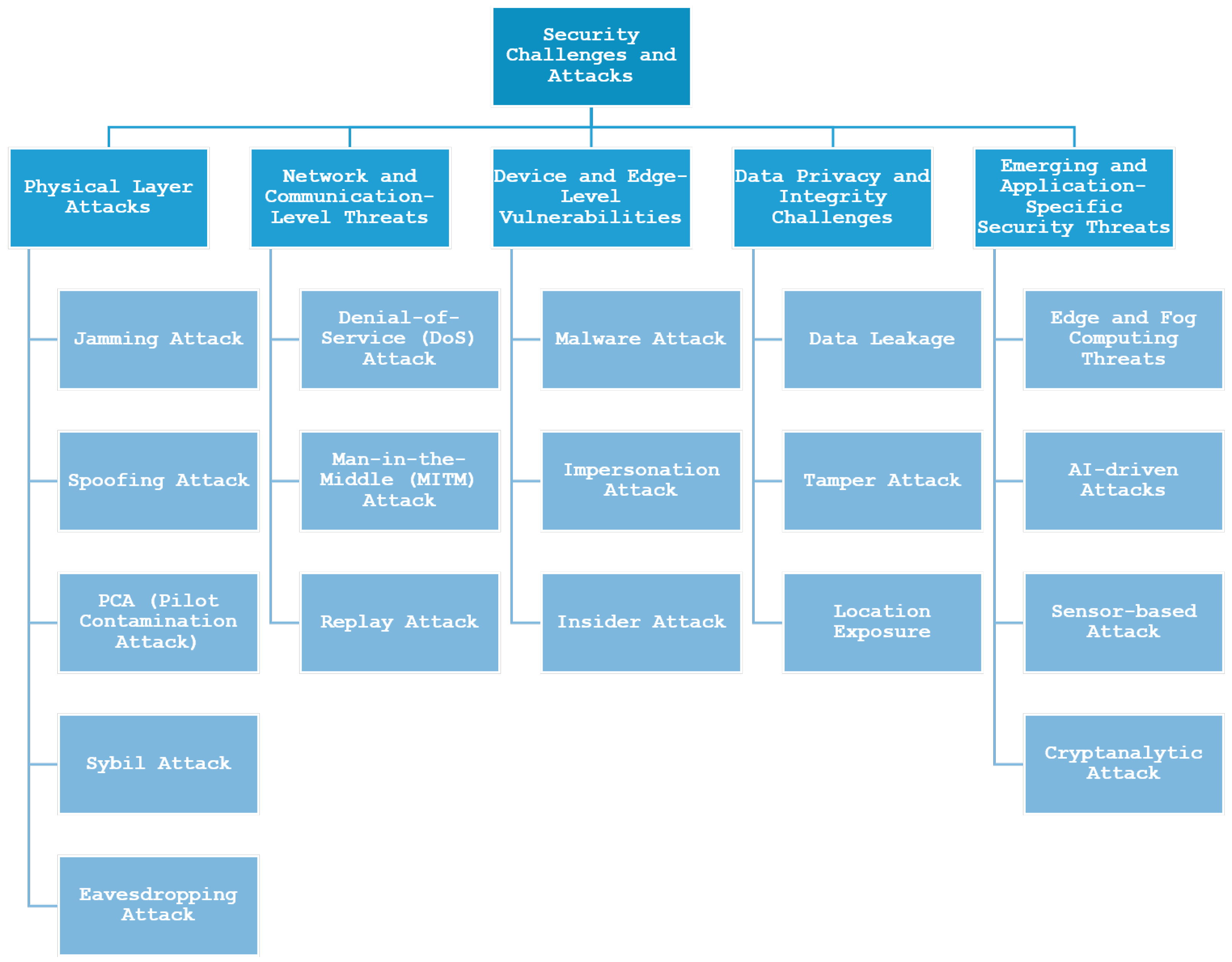
6G networks are expected to offer significantly higher data rates, ultra-low latency, and massive device connectivity, which greatly expand the potential attack surface. To improve clarity and consistency, the security challenges in 6G are categorized based on a hierarchical classification principle that distinguishes different abstraction levels in the network. Specifically, the taxonomy is organized into: (i) physical-layer attacks, (ii) network and communication-level threats, (iii) device and edge-level vulnerabilities, (iv) data privacy and integrity challenges, and (v) emerging and application-specific threats.

3.1. Physical-Layer Attacks

At the foundation of security in 6G networks is PLS, which plays a crucial role in protecting wireless networks against common radio signal attacks. Physical-layer security can leverage wireless channel characteristics, such as fading and noise, to safeguard the network. It is also resistant to cryptanalysis due to physical laws. The following subsections examine major attacks in this layer in 6G networks.

3.1.1. Jamming Attack

A jamming attack refers to a scenario where an attacker injects random jamming radio signals to channels in use to sabotage communication between legitimate mobile users and base stations or access points (APs) [33]. It can severely affect the quality of communication or cause a total disruption. Furthermore, it may increase the risk of more sophisticated attacks, such as DoS attacks.

3.1.2. Spoofing Attack

A spoofing attack happens when an attacker sends falsified signals or messages under the disguise of a fake identity to bypass proper authentication [34]. MAC addresses, IP addresses, and Radio Frequency Identification (RFID) tags can be spoofed by attackers to gain unauthorized access and enable further attacks.

3.1.3. Pilot Contamination Attack (PCA)

A PCA is a variation of a spoofing attack common in the physical layer [8]. In such malicious activity, an attacker intentionally sends spoofed up-link signals to the transmitter, resulting in degraded transmission for the legitimate user.

3.1.4. Sybil Attack

A sybil attack refers to a type of security threat where the attacker creates multiple fake identities or nodes to gain majority control of the system [35]. In 6G networks, particularly with the proliferation of IoT systems, Sybil attacks are considered a significant threat. For example, an attacker may use countless fake accounts to disrupt services, spread misinformation and compromise privacy in an IoT system.

3.1.5. Eavesdropping Attack

This attack occurs when an attacker secretly listens to the communication between parties, intercepting the exchanged messages. This type of attack is particularly dangerous because it enables attackers to gather information that can be used to carry out subsequent malicious activities [36]. Visible Light Communication (VLC), an important emerging technology for 6G wireless communication due to its greater interference resistance and fewer security vulnerabilities, is inherently vulnerable to eavesdropping attacks [37]. In [38], the authors discussed two types of eavesdropping attacks, namely internal and external, in 6G NOMA networks aided by an RIS. Internal eavesdropping refers to a scenario where an internal user within the NOMA network closer to the signal source attempts to intercept information intended to the user on the ‘far-end’. In contrast, external eavesdropping refers to an outsider who is not part of the NOMA network attempting to intercept communications.

3.2. Network and Communication-Level Threats

Sixth-generation networks are likely to inherit certain network vulnerabilities from previous generations. Emerging technologies that aim to achieve high-speed, low-latency, and ultra-reliable communication may increase the network’s vulnerability. These vulnerability factors often arise from weaknesses in network design, configuration, and protocols. Weak encryption and authentication, insecure network protocols, and unpatched network devices, such as routers, can provide malicious actors with opportunities to exploit systems and deliver attack payloads. In this section, we present common attacks that exploit vulnerabilities in 6G networks.

3.2.1. Denial-of-Service (DoS) Attack

In a DoS attack, an attacker attempts to render a network service or system unavailable by impersonating numerous network devices and continuously injecting unnecessary service requests, thus disrupting legitimate services [39]. A specific variation of this attack, called a DDoS attack, involves using multiple systems under the attacker’s control to deliver the attack. Standard DDoS attack methods include HTTP flooding, SYN flooding and UDP flooding. In each scenario, the attacker will flood the target with a large number of packets and requests to drown out the real message. The attackers can then exploit the system crash to gain access and launch additional attacks. In [40], the authors discussed DDoS attacks against access-side control points (CPs) in 6G Space–Air–Ground Integrated V2X Networks.

3.2.2. Man-in-the-Middle (MITM) Attack

An MITM attack happens when an attacker positions themselves between two communicating parties for the sake of intercepting messages [41]. The attacker may sometimes decrypt messages, alter them with false information, and resend them without being detected, resulting in a loss of confidentiality and integrity. Such an attack is more likely to occur in environments where authentication schemes and encryption algorithms are insufficient or weak. In [42], the authors discussed the likelihood of a Man-in-the-Middle attack during handover authentication in 6G satellite-terrestrial integrated network.

3.2.3. Replay Attack

Replay attack happens when an attacker intercepts the message exchanged between two parties, for example, an authentication request, saves the information and then retransmits it at a later time as if it is a new authentic request from the original sender [43] to realize malicious goals such as unauthorized entry or financial fraud.

3.3. Device and Edge-Level Vulnerabilities

Device vulnerabilities are weaknesses or flaws in device hardware and software. Malicious actors can exploit these vulnerabilities, leading to significant repercussions, particularly in 6G environments involving connected devices, such as IoT networks, mobile devices, and industrial systems. In 6G networks, security systems are expected to employ greater intelligence and automation to deter attacks. The AI-based intrusion prevention and detection systems connected to cloud servers can better safeguard devices than ever before. However, as the defensive system advances in its protective capabilities, malicious attackers may also become more resourceful. In this section, we provide a brief overview of attacks targeting device vulnerabilities in 6G networks.

3.3.1. Malware Attack

Malware, short for ‘malicious software’, refers to a type of software designed to exploit or compromise a device or network system. In a malware attack, an attacker may use various forms of malware or malicious code to gain access to and take control of a device or a network in order to steal, modify, delete, or encrypt confidential information. Common malware includes shellcode, backdoors and worms, etc. [44]. Shellcode is a small piece of code injected into a system memory or application process by an attacker to execute commands or escalate privileges. Backdoors are secret entry points installed by an attacker to bypass authentication and gain ongoing access to a compromised system, often to enable reconnaissance and further malicious behaviors. Worms are a class of self-replicating malware that propagates independently across networks by exploiting vulnerabilities in network protocols or applications. Unlike viruses, they do not require attachment to another program to spread.

3.3.2. Impersonation Attack

The difference between an impersonation attack and a spoofing attack is that in the former, an attacker steals the identity of a legitimate user through social engineering to trick the other communicating party into thinking that the attacker is the authentic user. It may not involve any technical manipulation at all [45]. Such an attack may result in the leakage of confidential data and credentials, which can be used for subsequent malicious activities.

3.3.3. Insider Attack

Insider attack, also known as privileged insider attack, happens when an insider within an organization takes advantage of access to sensitive information to facilitate or launch attacks [46]. This can occur with or without ill intent, as negligence or mishandling of data can inadvertently cause security breaches in the system.

3.4. Data Privacy and Integrity Challenges

Sixth-generation networks, due to the growing complexity and scale of connected devices, pose an increasing threat to data privacy integrity. The following section discusses some key threats to data privacy and integrity in 6G networks.

3.4.1. Data Leakage

Data leakage compromises data confidentiality and may result in financial losses and legal repercussions. In 6G networks, far more devices and applications will be in use thanks to the ultra-reliable and super-fast communication available. Applications such as smart vehicles and smart health will therefore store large amounts of personal data, for which privacy preservation is paramount to safeguard users’ rights. Malicious attackers, however, may attempt to invade users’ privacy for monetary gain, especially in large-scale industrial applications [47].

3.4.2. Tamper Attack

A tamper attack is another serious threat to data security in 6G networks as it involves unauthorized changes to data, which can undermine its confidentiality, integrity and availability. In [48], the authors discussed the possibility of a tamper attack in the vehicular controller area network.

3.4.3. Location Exposure

User location data can reveal significant insights into user behaviors and personal preferences. Therefore, location exposure is considered a massive threat in 6G networks, where data-driven applications will increasingly play a leading role. As an emerging technology for 6G, cell-free mMIMO (Massive MIMO) is vulnerable to location exposure due to its dense, distributed network topology [49].

3.5. Emerging and Application-Specific Security Threats

In addition to traditional attack categories, emerging technologies and application scenarios in 6G networks introduce new security challenges. These include threats related to edge computing, AI-driven systems, sensor-based applications, and cryptographic vulnerabilities in the context of quantum computing. Furthermore, application domains such as healthcare and industrial IoT introduce unique requirements in terms of privacy, reliability, and safety, which necessitate specialized security mechanisms.

3.5.1. Edge and Fog Computing Security Threats

Many 6G intelligent edge applications rely on data sharing among users and stakeholders, which, if compromised, could result in serious data leaks. For example, in e-healthcare, healthcare data frequently flows between medical devices and a central processing server via machine-to-machine communications. Malicious actors can intercept this data both during transit and after it reaches the remote server [2].

3.5.2. AI-Driven Attacks

AI and ML technologies have already been widely used in our daily lives to help with tasks. In 6G networks, they may be used ubiquitously. However, security in AI-based models is often ignored. Malicious actors may exploit AI-based models to generate misinformation and produce faulty predictions. In [50], the authors discussed the possibility of adversarial attacks on ML models that yield incorrect results in mmWave beam prediction.

3.5.3. Sensor-Based Attack

As one of the most promising applications in 6G networks, autonomous vehicles (AVs) rely heavily on sensor data to navigate and operate without human input. These sensors, including LiDAR, radar, cameras, and ultrasonic sensors, work together to provide real-time data about the vehicle’s surroundings. Malicious actors may use sensor-based attacks to target autonomous vehicles [51].

3.5.4. Cryptanalytic Attack

Cryptanalytic attacks such as password attacks and quantum attacks, aim to break the cryptographic algorithm and theoretically expose its keys [52]. Blockchain, whose foundation lies in cryptographic algorithms may be subject to such attacks.
In addition to the aforementioned attack categories, healthcare systems and industrial IoT (IIoT) environments introduce unique security challenges in 6G networks. These include strict data privacy requirements, real-time reliability constraints, and increased vulnerability to data leakage and system compromise. In healthcare applications, sensitive patient data must be protected against unauthorized access, while ensuring low-latency and high-reliability communication. Similarly, industrial IoT systems are exposed to risks such as operational disruption, device compromise, and cyber–physical attacks due to their tight integration with critical infrastructure. Figure 3 shows a taxonomy of the aforementioned common attacks for 6G networks in a hierarchical chart.

4. Enabling Technologies

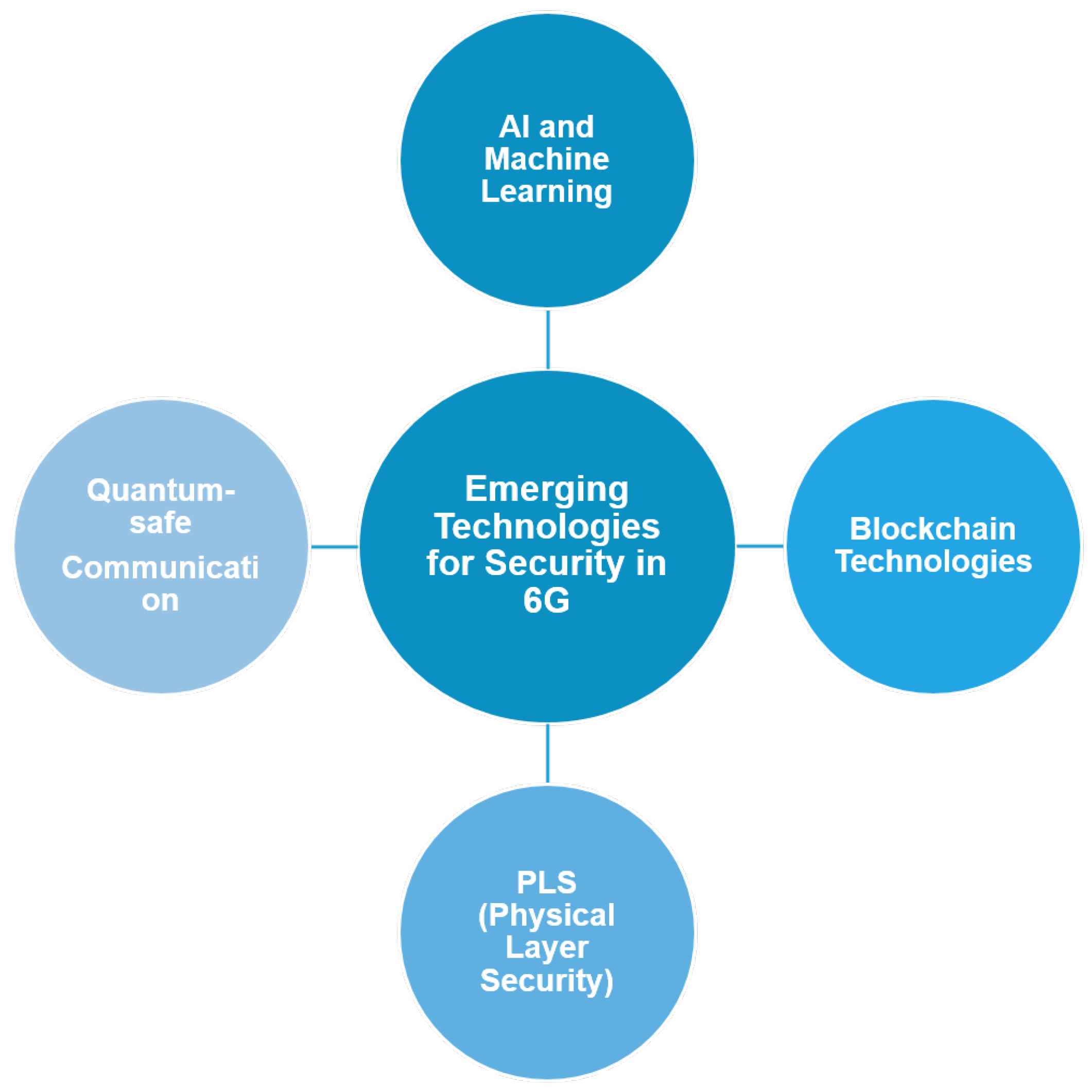
In this section, we present the bulk of our literature review by discussing the major enabling technologies and their potential role in the security of 6G communication. Figure 4 depicts the four emerging technologies we have identified in the literature. Existing surveys primarily focus on a single technology or on 6G in general. It is essential to combine these technologies in our discussion with a focus on security challenges and solutions.

4.1. AI and ML

AI and ML have already played a significant role in 5G networks, and with the development of 6G networks, they are expected to become even more pervasive. Their ability to provide adaptability, predictive modeling, and scalable defence makes them highly attractive for network security. The surveyed literature can be broadly grouped into several themes: AI-driven architectures and frameworks, attack detection and prevention, FL, and integration of AI with emerging technologies, as shown in Table 3.
AI-driven security architectures: A first line of work has focused on embedding AI into 6G network architectures to deliver dynamic and resilient defense. Rahman et al. [53] proposed a deep learning-assisted software-defined security architecture for OT-IT converged networks. By relying on security function virtualization, their model could automatically detect threats and was validated with simulation results showing a detection accuracy of 95%. Thacker et al. [54] emphasized resource allocation in mobile services and introduced an AI-based system that enabled dynamic and flexible on-demand resource management. Their solution mitigated security and privacy risks by integrating adaptive learning into allocation, thereby enhancing user security and privacy. Mao et al. [55] addressed IoT security under energy harvesting constraints by proposing an AI-based adaptive specification framework. Using extended Kalman filtering for energy prediction, they calculated optimal security configurations for each harvesting cycle, thereby ensuring protection without depleting energy resources. Chafika et al. [56] combined AI with Security-as-a-Service to realize distributed orchestration for network slicing. This framework allowed slices to evolve with localized control, improving scalability while embedding automated security management. Similarly, Munasinghe et al. [44] developed a machine-learning powered ZTA, demonstrating through simulation that their model could outperform perimeter-based approaches in threat containment. Garg et al. [2] advanced this direction by proposing a trusted AI-driven intelligent architecture for edge computing based on Explainable AI (XAI). Their case study illustrated applications ranging from healthcare to traffic management, showing how explainability can improve user trust. Taken together, these works demonstrate AI’s growing importance in the structural design of 6G security, although issues of computational overhead, scalability, and dependence on idealized simulation environments remain significant.
Attack detection and prevention: A large body of work applies AI and ML to detecting and mitigating attacks in 6G. Gaurav [35] presented deep learning techniques for intrusion detection across DoS, probing, and Sybil attacks, demonstrating that the approach can adapt to evolving attack patterns and improve detection accuracy. Rani et al. [58] proposed a deep hierarchical ML-based intrusion detection system (IDS) for 5G/6G device-to-device (D2D) networks. Compared with conventional methods such as RNN and LSTM, their IDS achieved a 56% reduction in training time, simplified model design, and an accuracy of 99.07%, while also detecting multiple and zero-day attacks. Begum et al. [51] designed a Sensor Attack Detection and Classification (SADC) framework for 6G vehicular networks. By combining GPS and LiDAR sensors with a pattern-based classification (PAC) algorithm, their system achieved 0.98% higher accuracy than baseline methods, with lower latency and higher detection success rates. Kianpisheh et al. [64] employed a collaborative FL scheme for DDoS detection and intelligent service control, thereby formulating an optimization problem that balances accuracy and response time. Results showed that their approach significantly reduced response time while maintaining a high accuracy. Kaur et al. [59] turned to interpretable ML, integrating XGBoost with SHapley Additive exPlanations (SHAP) and Local Interpretable Model-Agnostic Explanations (LIME) to strengthen IoT security, providing administrators with tools for transparent decision-making. For vehicular networks, Zhou et al. [39] proposed a deep learning enhanced access control system based on identity-based encryption, demonstrating that the scheme was IND-sID-CCA secure and capable of classifying malicious packets with 99.72% accuracy. Zhang et al. [48] introduced a weight-based ensemble ML algorithm (WBELA) for detecting anomalies in the CAN bus network. Their evaluation on open-source datasets showed superior performance in precision and false-positive rate compared with conventional IDS methods. Collectively, these studies highlight AI’s potential for intrusion detection and prevention but also reveal open issues, including its resilience against adversarial examples, computational demands, and generalizability across attack types.
Federated and collaborative learning: With the distributed nature of 6G, FL has become a prominent direction for privacy-preserving security solutions. Soltani et al. [60] surveyed challenges in deploying FL and AI-enabled security, pointing to communication overhead and non-IID data as persistent obstacles. Building on this, the authors of [61] proposed an unsupervised FL model to detect DDoS attacks in GTP tunnels. Their approach preserved data privacy while achieving competitive detection accuracy through local model training. In [62], anomaly detection was addressed using FL for 5G/6G network management automation, demonstrating the feasibility of privacy-preserving monitoring. The study in [63] further integrated FL with mmWave beam prediction, mitigating adversarial attacks while ensuring that user data privacy was not compromised during training. Kianpisheh et al. [64] extended FL to collaborative approaches for securing intelligent services, emphasizing trade-offs between recognition accuracy and response time. Together, these works underscore the potential of FL to provide decentralized and privacy-aware defenses, though challenges remain in scalability, convergence time, and the cost of communication rounds.
AI with emerging technologies: Researchers have also explored how AI can be combined with new 6G technologies to reinforce security. Garcia et al. [65] proposed a hybrid architecture in which AI-driven task offloading and quantum ML collaborate with post-quantum cryptography to ensure high performance and security. Their approach demonstrated that combining quantum resilience with AI resource allocation can improve the quality of user experience. Tuna et al. [66] studied AI-based beam selection strategies for distributed MIMO systems, demonstrating, through simulated adversarial scenarios, how gradient-based attacks could disrupt beam allocation, and proposed a mitigation strategy that restored performance under attack conditions. Powell et al. [67] developed the Small Set of Linearized Variables (SSOLV) framework, which combines deep learning with statistical analysis for training on Zeek datasets of real-time network activity, achieving high classification accuracy, precision, and recall. Catak et al. [50] focused on adversarial robustness in mmWave beam prediction models, using the fast gradient sign method to assess vulnerabilities and demonstrating that adversarial training can enhance resilience. Selvarajan et al. [68] developed the DANC3 classifier, an adaptive AI model for consumer electronics in 6G, achieving a transmission error rate of 1% across devices. These studies reveal that AI is not only supporting core security functions but also complementing emerging 6G technologies, although energy efficiency and robustness against sophisticated adversarial attacks remain unresolved.
Specialized AI-driven security methods: Finally, several works pursued narrower but important applications of AI for 6G security. The AutoSCA framework in [70] applied Bayesian optimization to enhance neural networks’ robustness against side-channel attacks on mobile devices. Tested across multiple architectures including MLPs and CNNs, the framework showed consistent effectiveness in resisting leakage exploitation. Begum et al. [51], beyond their vehicular framework, also demonstrated how pattern-based algorithms could be adapted to novel sensor-based threats. These contributions highlight that AI can be tailored to specialized domains and suggest that domain-specific algorithms will continue to play a role alongside general-purpose detection methods.
Lessons learned: The review of AI and ML for 6G security highlights both promising opportunities and unresolved challenges. On the positive side, advanced AI/ML algorithms can enhance 6G communications by being embedded across multiple network layers. Their adaptability makes them particularly effective for intrusion detection and prevention, a crucial capability given the massive volumes of data generated by cloud-connected devices. At the same time, these developments are a double-edged sword: the same algorithms that protect the network can also be exploited by malicious actors to launch adversarial ML attacks, creating more sophisticated threats. Another critical issue is data privacy, since users are often reluctant to share sensitive data with models that cannot guarantee protection during training. Privacy-preserving approaches, particularly FL, are emerging as promising techniques to address this limitation, but practical deployment remains in its early stages. Overall, AI and ML stand out as transformational tools for 6G security, yet their safe and responsible adoption will depend on advances in adversarial robustness, interpretability, and privacy assurance.

4.2. Blockchain

Blockchain technology is another enabling technology for 6G networks and has a vital role to play in the security domain. Whether the security challenge is secure data exchange or decentralized authentication, blockchain technology has the potential to offer trustworthy solutions. Table 4 presents the state-of-the-art literature on the application of blockchain to 6G security.
Foundational studies and frameworks: Several works investigated blockchain as a general framework for enhancing 6G security. Ramkumar et al. [71] conducted a conceptual research using secondary data collection, demonstrating how blockchain can strengthen trust and resilience in 6G. For data aggregation, the authors of [47] proposed a blockchain-based privacy-aware collection strategy for network-in-box (NIB) applications, ensuring secure aggregation performance. Ni et al. [72] designed a high-throughput shard blockchain system integrated with FL and digital twins, achieving 30× higher throughput than non-sharding approaches and demonstrating resilience against Byzantine faults. Khan et al. [73] examined the synergy between blockchain and 6G through a case study, highlighting its potential to enable secure, ubiquitous communication. In [52], a blockchain-enabled radio access network (B-RAN) was developed to preserve privacy and enhance efficiency. In contrast, the authors in [74] applied Distributed Ledger Technology (DLT) to evaluate the trustworthiness of 6G services.
Table 4. Blockchain technologies for security in 6G grouped by thematic categories.
Ref. No.YearSecurity ChallengeAttackSolutionEvaluation Metrics
Foundational Studies and Frameworks
[71]2020Role of blockchain in 6GN/ASecondary data collection study of blockchain applicationsConceptual insights
[47]2020Secure data aggregation in NIB appsInternal collusion attackBlockchain-based privacy-aware distributed collection (BPDC)Trusted task receiver selection rate (TRSR)
[73]2022Secure, ubiquitous communicationMalicious minersEnhanced delegated Proof-of-Stake (PoS) algorithmDetection time
[52]2022Privacy-preserving data sharingSelfish mining, consensus attacksBlockchain-based Radio Access Network (B-RAN) frameworkN/A
[74]2022Trust evaluation in 6G servicesMisreporting, collusionDLT-based trust assessmentAccuracy
Authentication and Access Control
[46]2022UAV and IoT device authenticationNode capture, tampering, insider attackNBA system with HPUFH + PbSSC algorithmsSecurity comparison metrics
[75]2022Tactile Internet authenticationReplay, MITMBlockchain + digital signature smart contractsAccuracy, transparency
[76]2024IoNMT authenticationData tamperingSmart contract-based decentralized protocolCost, execution time, energy consumption
[77]2020IoT authenticationSpoofing, impersonationBlockchain-based access and service provision schemeCommunication overhead, time
[78]2021IoV verification schemeIdentity forgeryBlockchain with signature + cachingHit rate, latency
[49]2023Lightweight multifactor authenticationSpoofing, replay, MITM, DoSBlockchain-PoS mutual authentication protocolAuthentication overhead
[79]2024IoT device securityUnauthorized accessBlockchain-based context-aware authentication and slicingLatency, packet loss rate
Data Security and Privacy Preservation
[72]2022High-throughput blockchain systemByzantine faultsShard blockchain + FL + digital twinThroughput, survival rate
[80]2023AI application data securityMalicious respondersBlockchain-based reputation managementEfficiency, scalability
[81]2022Transport system data securitySybil, replay, MITM, DoSBlockchain + LightGBM for IATSAccuracy, precision, recall, F1
[82]2023Data security in integrated networksData leaksBlockchain + AI for space–air–ground–underwater networksCase study performance
[83]2024Information sharing in ITSCollusion, replayReputation-based blockchain (Info-Chain)Packet loss rate
Blockchain with AI/Hybrid Approaches
[84]2022Edge caching confidentialityEavesdroppingBlockchain + physical-layer securitySecure transmission performance
[85]2024Collaborative intrusion detectionTrojans, botnets, DDoSAI + blockchain-based CIDSAccuracy, detection rate
[86]2024Train spectrum sharingN/ABlockchain + smart contracts for NGTNCost of trading, privacy
Authentication and access control: A large body of research applied blockchain to strengthen authentication in 6G. Raja et al. [46] proposed the Nexus of 6G and Blockchain for Authentication (NBA) system, which employs hybrid physical unclonable function hashing (HPUFH) and a pattern-based signal strength correlation (PbSSC) algorithm for UAV and sensor authentication, demonstrating both efficiency and security. Shahzad et al. [75] introduced a blockchain-based solution for secure tactile networks that combines smart contracts and digital signatures to enhance authentication and anonymization. Kumar et al. [76] extended this idea by creating a smart contract-based protocol for Internet of Nano Medical Things (IoNMT) networks, demonstrating improved energy and communication efficiency. Chen et al. [77] presented a blockchain-based identity framework for IoT applications, enabling unified authentication and service provisioning. In vehicular contexts, Wang et al. [78] designed a blockchain-based trusted verification scheme for the Internet of Vehicles (IoV), enabling anonymous service requests and mutual authentication via identity-based signatures. Khan et al. [49] proposed a lightweight blockchain-based multifactor mutual authentication protocol for 6G cell-free communications that mitigates spoofing, replay, MITM, and DoS attacks while maintaining efficiency. Finally, Alkwai et al. [79] developed a blockchain-driven context-aware model for secure authentication, handover, and network slicing, reporting improvements in latency and reliability.
Data security and privacy preservation: Blockchain has also been explored as a means to safeguard data in 6G applications. Ni et al. [72] introduced a blockchain sharding approach that integrates FL and digital twins to secure data aggregation and improve throughput under attack scenarios. Sun et al. [80] proposed blockchain-based data security for AI applications, validated through case studies on indoor positioning and mobile payment systems. Zhou et al. [81] integrated blockchain with LightGBM for intelligent autonomous transportation systems (IATS), achieving an 88.72% prediction accuracy and outperforming alternative methods. Li et al. [82] designed a blockchain-based data security framework for AI applications in integrated space–air–ground–underwater networks, demonstrating efficiency in a case study of indoor navigation. Yan et al. [83] introduced Info-Chain, a reputation-based blockchain for secure information sharing in 6G transportation, with a Proof-of-Reputation consensus mechanism and incentive models to improve robustness and honesty.
Blockchain with AI and hybrid approaches: Several studies highlight the synergy between blockchain and other enabling technologies. Sun et al. [84] combined blockchain with PLS to improve resilience against eavesdropping in edge caching, showing measurable improvements in secure transmission. Chelghoum et al. [85] developed a collaborative intrusion detection system (CIDS) integrating AI and blockchain, enabling distributed threat intelligence sharing to detect zero-day attacks. Asad et al. [86] presented a blockchain-based secure spectrum-sharing approach for next-generation train networks (NGTN), along with a blockchain-driven intelligent network architecture that supports multiple train applications while preserving privacy.
Lessons learned: From the reviewed literature, blockchain emerges as a highly promising enabler for 6G security due to its strengths in decentralized trust, data immutability, and robust consensus mechanisms. Most works apply blockchain for authentication, identity management, and access control, offering improved resistance to spoofing, tampering, and other attacks. Privacy-preserving frameworks demonstrate potential for protecting sensitive data in IoT, vehicular, and tactile networks. Furthermore, hybrid approaches demonstrate that combining blockchain with AI or PLS can significantly enhance robustness against advanced adversaries. However, several challenges remain, including the high computational cost, the scalability of consensus protocols, and the integration with latency-sensitive 6G applications. Addressing these limitations will be crucial for the practical adoption of blockchain in next-generation networks.

4.3. Physical-Layer Security

Physical-layer security is an advanced approach in wireless communication that protects data transmission by leveraging the inherent randomness and properties of the physical-layer communication channel, rather than relying solely on upper-layer cryptographic techniques. In the context of 6G, PLS is expected to become a key pillar of the security landscape, particularly with the adoption of novel transmission media and enabling technologies, including VLC, Molecular Communication, THz bands, Massive MIMO, and RIS. Table 5 summarizes recent contributions in this area.
AI/ML-enhanced PLS: Integrating AI into PLS design has shown promise for dynamic and adaptive security solutions. In [87], the authors introduced a deep learning-assisted zero-trust PLS framework that adapts to varying channel conditions. Simulation results confirmed that the intelligent layer outperformed traditional linear detection in multiple MIMO settings. Tashman et al. [36] proposed a FL approach in which BSs act as RL agents, enabling fast convergence and higher secrecy rates against eavesdropping. Similarly, Martins et al. [34] used deep learning-based channel prediction to detect spoofing attacks, demonstrating the value of combining channel state information analysis with upper-layer protocols.
Visible Light Communication (VLC): VLC has emerged as an alternative physical medium with inherent resistance to eavesdropping. Soderi et al. [37] combined watermarking with RGB LED jamming to create a watermark blind PLS scheme, which significantly improved confidentiality in VLC links. In [88], an enhanced version introduced watermarking with a jamming receiver, demonstrating that spread spectrum watermarking could further mitigate eavesdropping risks.
Reconfigurable Intelligent Surfaces (RIS) and Intelligent Omni-Surfaces (IOS): RIS and IOS are central to PLS research in 6G. The work in [38] proposed joint beamforming and power allocation for RIS-aided NOMA networks, addressing both internal and external eavesdroppers. Benaya et al. [89] formulated a secrecy-rate maximization problem for IOS-UAV systems and reported secrecy gains of 140% relative to baselines. Asif et al. [92] proposed a two-stage optimization strategy for IOS-assisted NOMA under hardware impairments, achieving superior sum secrecy rates. De Sena et al. [91] analyzed RIS-aided jamming attacks and developed countermeasures even with imperfect channel estimates. Cheng et al. [90] introduced movable antennas for secure transmission and formulated a joint optimization problem to minimize power consumption while maximizing secrecy rate. These studies highlight the flexibility and potential of RIS/IOS technologies in enhancing security at the physical layer.
Resource allocation and access control: Several studies investigated PLS-driven resource allocation and access control solution for 6G systems. Haq et al. [93] designed a NOMA resource allocation algorithm that simultaneously ensured QoS and secrecy rates. In [32], researchers linked PLS to cryptographic primitives including secret-key generation, device authentication using physical unclonable functions (PUFs), and multi-factor schemes. Their analysis showed that randomness in wireless channels can serve as a source of entropy for secure authentication and for anti-jamming resilience. Authors in [40] tackled DDoS defense in space–air–ground integrated V2X networks by deploying access-side control points for rapid mitigation.
Novel physical media: Beyond traditional RF and optical systems, new media have been considered for PLS. Guo et al. [94] explored molecular communication as a potential enabler of covert and resilient communication in environments where electromagnetic waves are ineffective. Although still conceptual, such approaches may open new directions for secure 6G applications. Yang et al. [95] discussed how THz communication could enhance secrecy in high-frequency bands via spectrum allocation and signal processing, while acknowledging unresolved challenges.
Lessons learned: Physical-layer security offers a fundamentally different paradigm from upper-layer cryptography by exploiting the intrinsic randomness of communication channels. Its main advantage lies in providing lightweight protection against eavesdropping without incurring the high computational costs of encryption. Several enabling technologies, such as VLC, RIS/IOS, massive MIMO, and THz communication, have shown substantial promise in improving secrecy capacity and mitigating physical-layer attacks. Moreover, the integration of AI and FL with PLS opens new opportunities for adaptive and intelligent defense strategies. However, challenges remain. Many of the proposed PLS schemes remain limited to simulations under idealized conditions, and their practical deployment in complex 6G environments remains uncertain. RIS and IOS solutions, while powerful, require precise channel estimation and incur hardware complexity. Emerging media such as molecular and THz communications are still at a very early stage, with many unresolved technical and security questions. Finally, while PLS provides a strong defense against passive eavesdroppers, it is less effective against active attacks such as jamming unless combined with higher-layer protocols. In conclusion, PLS has the potential to become a cornerstone of 6G security. Still, its success will depend on overcoming challenges of real-world deployment, channel estimation accuracy, and integration with complementary security mechanisms. Future work should focus on experimentally validated testbeds, lightweight hardware implementations, and cross-layer designs that blend PLS with cryptographic and AI-based defenses.


4.4. Quantum-Safe Communication

Quantum computing has the potential to undermine traditional encryption methods such as RSA and ECC and pose new security threats to 6G networks. Therefore, 6G networks must be equipped with quantum-safe cryptography and protocols to ensure secure communication. Table 6 lists recent work in this domain that addresses the security challenges posed by quantum computing for 6G security.
QKD and Cryptography: A large body of work focuses on Quantum Key Distribution (QKD) as a foundation for secure 6G communication. In [96], the authors introduced a QKD-based secure system for future optical networks. Building on this, the authors in [41] developed a simulation-based approach to QKD for IoT device-to-server encryption, demonstrating both simplicity and efficiency in deterring attacks. Deepanramkumar et al. in [97] proposed a quantum-secured IoT communication framework for 6G Cognitive Radio Networks (CRNs) that combines QKD with Public Key Infrastructure (PKI) and ML models for spectrum sensing and channel prediction. Zeydan et al. in [98] extended this line of research by integrating QKD with blockchain-based Self-Sovereign Identity (SSI) to strengthen identity management in Open Radio Access Network (O-RAN) systems, highlighting the potential of QKD to provide both privacy and efficiency across multiple 6G domains.
Post-Quantum Cryptographic Protocols: In addition to QKD, several studies explore post-quantum cryptography as a software-based defense against quantum attacks. Liu et al. in [99] presented a post-quantum secure ring signature (PRSG) scheme that enhances privacy in cybertwin-driven 6G networks. Their approach combined an accumulator based on a chameleon hash function with a double authentication preventing ring signature (DAPRS), supported by zero-knowledge proofs. Such protocols do not require immediate access to quantum hardware, making them practical transitional solutions for enhancing 6G cryptographic resilience.
Quantum-Safe Access and Privacy Protocols: Other efforts emphasize novel handshake and privacy-preserving protocols. Rawal in [100] introduced a quantum-safe access control handshake based on nested subset sequences and the random linear projection (RLP) protocol, which is computationally complex enough to resist quantum adversaries. Qu et al. in [101] proposed the quantum efficient privacy protection (QEPP) protocol for Internet of Vehicles (IoV). QEPP leverages quantum communication to transmit sensitive IoV data to the cloud securely, integrates quantum error-correction coding for resilience, and employs an enhanced Grover algorithm to accelerated data processing. These schemes show that quantum-based protocols can offer practical defenses in both cloud and vehicular contexts.
Quantum-Enabled Wireless Architectures: At the architectural level, the authors in [102] developed a distributed quantum computation protocol to ensure user privacy and data security in anonymous URLLC scenarios. Similarly, the study in [103] investigated quantum-enabled wireless communication frameworks for 6G, underscoring both the opportunities and challenges of embedding quantum technologies into large-scale network design. These works represent ambitious attempts to envision the role of quantum systems as integral components of future wireless infrastructure.
Lessons learned: Quantum-safe communication is emerging as a cornerstone of 6G security. QKD-based schemes provide theoretically unbreakable encryption by leveraging the laws of quantum mechanics, enabling detection of eavesdropping attempts. However, large-scale deployment is hindered by the limited availability and scalability of quantum hardware, including processors, memory, and repeaters. Post-quantum cryptographic approaches offer an interim safeguard that is deployable with current infrastructure, while quantum-safe access protocols extend security to cloud and IoV environments. Overall, progress in this area demonstrates the dual track of hardware-enabled and software-based quantum security, but also underscores that widespread adoption in 6G will require significant advances in the practicality and integration of quantum devices.

4.5. Unified Evaluation Framework for 6G Security Technologies

A major challenge in comparing different 6G security technologies lies in the lack of standardized evaluation metrics. Existing studies often use domain-specific metrics, such as accuracy for AI-based methods or secrecy rate for PLS, making direct technology comparison difficult.
To address this issue, we propose a unified evaluation framework as shown in Table 7 based on the following key criteria:
  • Latency: Time required to detect and mitigate attacks.
  • Energy Efficiency: Computational and communication energy consumption.
  • Scalability: Ability to support large-scale networks and devices.
  • Attack Resistance: Effectiveness against various types of attacks.
  • Deployment Complexity: Hardware, software, and infrastructure requirements.
This framework enables a more systematic comparison of technologies and highlights the trade-offs involved in selecting appropriate security solutions for different 6G scenarios.

4.6. Mapping of Security Threats to Enabling Technologies

To bridge the gap between identified 6G security threats and the enabling technologies discussed, Table 2 presents a mapping between major attack categories and the corresponding defense mechanisms. For example, PLS techniques can be used to mitigate spoofing attacks in satellite and aerial communication systems by exploiting channel characteristics for signal authentication. Similarly, blockchain-based mechanisms can enhance the security of UAV control channels by enabling decentralized identity verification and tamper-resistant logging, thereby reducing the risk of hijacking attacks. In addition, AI/ML-based methods can support the detection of anomalies such as jamming, intrusion, and DoS attacks through data-driven analysis. These observations highlight that no single technology is sufficient on its own, and that effective 6G security requires the coordinated use of multiple complementary approaches. This table also highlights that no single technology can address all types of attacks. Instead, a combination of multiple technologies is required to provide comprehensive security coverage. This observation motivates the need for integrated security frameworks discussed in the next subsection.

4.7. Integrated Multi-Technology Security Framework for 6G

While Section 4.1 and Section 4.2 discuss enabling technologies individually, secure 6G systems require their coordinated integration across multiple network layers. In practice, AI/ML, blockchain, PLS, and quantum-safe communication should not be treated as isolated solutions but as complementary components of a unified defense architecture.
AI/ML acts as the intelligence layer of the system, enabling real-time threat detection, anomaly identification, and adaptive decision-making. Blockchain provides a trust layer by ensuring secure and decentralized identity management, data integrity, and authentication. PLS offers protection at the physical layer by exploiting channel characteristics to prevent eavesdropping and jamming. Quantum-safe communication addresses long-term security by protecting cryptographic systems against quantum computing threats.
An integrated 6G security framework can be conceptualized as a layered architecture. At the physical layer, PLS techniques secure signal transmission against interception and interference. At the network and control layers, AI-driven mechanisms continuously monitor system behavior and detect anomalies. Blockchain operates as a distributed trust infrastructure that secures transactions and authentication processes. Finally, quantum-safe cryptographic methods ensure the long-term resilience of encryption schemes.
Such integration enables cross-layer security orchestration, where information from one layer enhances protection at another. For example, AI models can dynamically adjust PLS parameters based on detected threats, while blockchain can store and verify security events identified by AI systems. This synergy significantly improves the robustness and adaptability of 6G security solutions compared to single-technology approaches.

4.8. Cross-Technology Comparison of 6G Security Solutions

Table 8 provides a comparative overview of the main enabling technologies for 6G security. It can be observed that each technology exhibits distinct strengths and limitations, and no single approach can address all types of threats effectively. For example, AI/ML offers strong adaptability but introduces computational and interpretability challenges, while PLS provides lightweight protection but depends on accurate channel information. These observations highlight the importance of integrating multiple technologies to achieve robust and scalable 6G security.
In addition to commonly studied domains such as UAV and vehicular networks, these technologies are also applicable to emerging domains such as healthcare systems and industrial IoT. In these scenarios, secure data sharing, low-latency communication, and system reliability are critical requirements. AI/ML can support anomaly detection in medical data streams, blockchain can ensure data integrity and traceability, and PLS can enhance communication confidentiality in resource-constrained environments.

5. From Simulation to Real-World Deployment

Despite significant progress in 6G security research, many existing solutions are validated primarily through idealized simulation environments. In practice, real-world deployment introduces additional challenges such as dynamic network conditions, hardware limitations, imperfect system knowledge, and strict latency and energy constraints. These factors can significantly affect the performance and feasibility of proposed security mechanisms.

5.1. Impact of Dynamic Environments and Imperfect System Knowledge

In real-world 6G systems, network conditions are highly dynamic due to mobility, interference, and environmental variability. For example, in UAV-assisted communication systems, high mobility leads to channel estimation errors, which can significantly degrade the performance of PLS techniques that rely on accurate channel state information. As a result, security mechanisms designed under ideal assumptions may not perform reliably in practical deployments. Hybrid security frameworks that combine multiple technologies can improve efficiency. For instance, integrating AI/ML-based detection with PLS mechanisms enables adaptive protection while reducing reliance on computationally intensive cryptographic operations.

5.2. Computational and Communication Constraints in Blockchain and FL

Emerging security technologies such as blockchain and FL introduce significant computational and communication overhead. Blockchain-based mechanisms often suffer from high latency and energy consumption due to consensus protocols and distributed verification processes, making them difficult to deploy in ultra-reliable low-latency communication (URLLC) scenarios. Lightweight blockchain architectures should be adopted for resource-constrained environments. Instead of conventional consensus mechanisms, permissioned or edge-assisted blockchain designs can significantly reduce computational and communication overhead.
Similarly, FL, while enabling privacy-preserving model training, requires frequent communication between distributed nodes. This can result in substantial bandwidth consumption and slow convergence, particularly in large-scale or resource-constrained IoT environments. Communication overhead in federated learning can be mitigated through model compression, sparse updates, and adaptive communication scheduling. These techniques reduce bandwidth consumption and improve scalability in distributed environments.

5.3. Challenges and Limitations of AI-Based Security Mechanisms

AI/ML-based techniques have emerged as a key component in 6G security due to their ability to detect anomalies, classify threats, and enable adaptive defense strategies. However, their practical deployment introduces several challenges. The “black-box” nature of many AI models makes it difficult to interpret decision-making processes, which raises concerns about trust, transparency, and accountability in critical applications. This is particularly problematic in security-sensitive scenarios where explainability is essential. AI systems may also be vulnerable to adversarial attacks, where carefully crafted inputs can mislead models and degrade detection performance. Such attacks can compromise the reliability of AI-based security mechanisms in real-world environments. Addressing these challenges requires the development of explainable AI techniques, robust training methods, and lightweight model architectures that can operate efficiently under real-world constraints.

5.4. Infrastructure Challenges in Quantum-Safe Communication

In addition to the challenges discussed above, quantum key distribution (QKD) introduces significant deployment constraints. While QKD provides strong theoretical security guarantees, its practical deployment remains challenging. QKD systems require specialized optical hardware, dedicated communication channels, and trusted relay nodes, which significantly increase infrastructure complexity and cost. As a result, QKD is more suitable as a long-term security solution rather than an immediate deployment option. Hybrid approaches that combine post-quantum cryptography with classical methods may offer a more practical pathway for integrating quantum-safe security into 6G systems.

6. Future Research Directions

While significant progress has been made in developing security solutions for 6G networks, several critical challenges remain open. Future research should move beyond isolated technological advancements toward integrated, system-level security frameworks that address real-world constraints, scalability, and cross-layer interactions.

6.1. Artificial Intelligence and Machine Learning

AI/ML will play a central role in enabling intelligent and adaptive security mechanisms in 6G networks. However, several key challenges remain open:
  • Explainability and trust: Developing explainable AI (XAI) models to improve transparency and trust in security-critical applications.
  • Robustness against adversarial attacks: Designing models resilient to adversarial manipulation and data poisoning.
  • Efficient federated learning: Reducing communication overhead and improving convergence in distributed environments, particularly for resource-constrained IoT devices.
  • Cross-layer intelligence: Integrating AI across multiple network layers to enable coordinated threat detection and response.

6.2. Blockchain and Zero-Trust Architectures

Blockchain and zero-trust architectures (ZTA) offer decentralized and trustless security mechanisms, but their practical deployment introduces several research challenges:
  • Scalability and latency: Designing lightweight and low-latency blockchain protocols suitable for real-time 6G applications.
  • Integration with network slicing: Enforcing dynamic security policies across network slices using smart contracts.
  • Energy-efficient consensus mechanisms: Developing consensus protocols tailored for edge and IoT environments.
  • Interoperability: Ensuring seamless integration with existing network infrastructures and security frameworks.

6.3. Physical-Layer Security

Physical-layer security (PLS) provides lightweight protection at the transmission level, but its practical implementation remains challenging:
  • Channel uncertainty: Addressing the impact of imperfect channel state information, particularly in highly dynamic environments such as UAV-assisted networks.
  • RIS optimization: Developing efficient algorithms for real-time configuration of reconfigurable intelligent surfaces.
  • Energy-efficient protocols: Designing lightweight PLS mechanisms for energy-constrained devices.
  • Integration with higher-layer security: Combining PLS with cryptographic and AI-based techniques for enhanced protection.

6.4. Quantum-Safe Communication

Quantum computing poses significant threats to existing cryptographic systems, necessitating the development of quantum-safe communication mechanisms:
  • Post-quantum cryptography: Designing efficient and scalable cryptographic algorithms resistant to quantum attacks.
  • Hybrid security models: Combining classical and quantum-safe techniques for gradual deployment.
  • Infrastructure challenges: Addressing the high cost and complexity of QKD systems.

6.5. System-Level and Cross-Technology Challenges

In addition to individual technologies, several system-level challenges require further investigation:
  • Cross-layer security orchestration: Coordinating multiple security mechanisms across different layers of the 6G architecture.
  • Unified benchmarking frameworks: Developing standardized metrics and evaluation methodologies for comparing security solutions.
  • Experimental testbeds: Establishing realistic test environments to validate security mechanisms beyond simulation.
  • Security–latency–energy trade-offs: Understanding and optimizing trade-offs among performance, efficiency, and security.
  • Integrated space–air–ground–sea security: Designing unified security frameworks for heterogeneous 6G infrastructures.

7. Conclusions

In this study, we conducted a comprehensive literature review of emerging technologies for secure communication in 6G networks. We first presented an overview of the benefits and applications of 6G from a security perspective, followed by a review of existing surveys on 6G security. We summarized the main features of these works and provided a quantitative analysis to highlight research gaps. Second, we developed a hierarchical taxonomy of security challenges and attacks in 6G, as shown in Figure 3. Third, we examined major enabling technologies, including AI/ML, blockchain, physical-layer security (PLS), and quantum-safe communication, and their roles in enhancing 6G security. For each technology, we discussed the associated challenges, attacks, and solutions, and provided key insights. We further introduced a mapping between security threats and enabling technologies, along with a unified evaluation framework to support consistent cross-technology comparison. In addition, we discussed how these technologies can be integrated to achieve a more comprehensive and coordinated security solution. Finally, we examined practical deployment challenges and outlined future research directions to highlight remaining open problems.

Author Contributions

Conceptualization, S.Y.; methodology, S.Y., A.S.K. and W.E.; resources, S.Y.; writing—original draft preparation, S.Y.; writing—review and editing, S.Y., A.S.K., W.E. and A.A.; supervision, W.E. and A.A.; funding acquisition, W.E. All authors have read and agreed to the published version of the manuscript.

Funding

This research work was supported by the Natural Sciences and Engineering Research Council of Canada (NSERC).

Institutional Review Board Statement

Not applicable.

Informed Consent Statement

Not applicable.

Data Availability Statement

The original contributions presented in this study are included in the article. Further inquiries can be directed to the corresponding author.

Conflicts of Interest

The authors declare no conflicts of interest. The funders had no role in the design of the study; in the collection, analyses, or interpretation of data; in the writing of the manuscript; or in the decision to publish the results.

References

  1. Viswanathan, H.; Mogensen, P.E. Communications in the 6G Era. IEEE Access 2020, 8, 57063–57074. [Google Scholar] [CrossRef]
  2. Garg, S.; Kaur, K.; Aujla, G.S.; Kaddoum, G.; Garigipati, P.; Guizani, M. Trusted Explainable AI for 6G-Enabled Edge Cloud Ecosystem. IEEE Wirel. Commun. 2023, 30, 163–170. [Google Scholar] [CrossRef]
  3. Ahammadi, A.; Hassan, W.H.; Shamsan, Z.A. An Overview of Artificial Intelligence for 5G/6G Wireless Networks Security. In Proceedings of the International Conference on Cyber Resilience (ICCR), Dubai, United Arab Emirates, 6–7 October 2022; pp. 1–6. [Google Scholar]
  4. Saad, W.; Bennis, M.; Chen, M. A Vision of 6G Wireless Systems: Applications, Trends, Technologies, and Open Research Problems. IEEE Netw. 2020, 34, 134–142. [Google Scholar] [CrossRef]
  5. Yang, H.; Alphones, A.; Xiong, Z.; Niyato, D.; Zhao, J.; Wu, K. Artificial-Intelligence-Enabled Intelligent 6G Networks. IEEE Netw. 2020, 34, 272–280. [Google Scholar] [CrossRef]
  6. Aneesh, S.; Shaikh, A.N. A Survey for 6G Network: Requirements, Technologies and Research Areas. In Proceedings of the 2nd International Conference on Edge Computing and Applications (ICECAA), Namakkal, India, 19–21 July 2023; pp. 166–171. [Google Scholar]
  7. Letaief, K.B.; Chen, W.; Shi, Y.; Zhang, J.; Zhang, Y.J.A. The Roadmap to 6G: AI Empowered Wireless Networks. IEEE Commun. Mag. 2019, 57, 84–90. [Google Scholar] [CrossRef]
  8. Nguyen, V.L.; Lin, P.C.; Cheng, B.C.; Hwang, R.H.; Lin, Y.D. Security and Privacy for 6G: A Survey on Prospective Technologies and Challenges. IEEE Commun. Surv. Tutor. 2021, 23, 2384–2428. [Google Scholar] [CrossRef]
  9. Abdelsalam, N.; Al-Kuwari, S.; Erbad, A. Physical Layer Security in Satellite Communication: State-of-the-Art and Open Problems. arXiv 2023, arXiv:2301.03672. [Google Scholar] [CrossRef]
  10. Dang, Y.; Benzaïd, C.; Yang, B.; Taleb, T. Deep Learning for GPS Spoofing Detection in Cellular-Enabled UAV Systems. In Proceedings of the 2021 International Conference on Networking and Network Applications (NaNA), Lijiang City, China, 29 October–1 November 2021; pp. 501–506. [Google Scholar]
  11. Guo, H.; Li, J.; Liu, J.; Tian, N.; Kato, N. A Survey on Space-Air-Ground-Sea Integrated Network Security in 6G. IEEE Commun. Surv. Tutor. 2022, 24, 53–87. [Google Scholar] [CrossRef]
  12. Zhu, X.; Jiang, C. Integrated Satellite-Terrestrial Networks Toward 6G: Architectures, Applications, and Challenges. IEEE Internet Things J. 2022, 9, 437–461. [Google Scholar] [CrossRef]
  13. Giordani, M.; Zorzi, M. Non-Terrestrial Networks in the 6G Era: Challenges and Opportunities. IEEE Netw. 2021, 35, 244–251. [Google Scholar] [CrossRef]
  14. Yousefpour, A.; Fung, C.; Nguyen, T.; Kadiyala, K.; Jalali, F.; Niakanlahiji, A.; Kong, J.; Jue, J.P. All One Needs to Know About Fog Computing and Related Edge Computing Paradigms: A Complete Survey. J. Syst. Archit. 2019, 98, 289–330. [Google Scholar] [CrossRef]
  15. Son, B.D.; Hoa, N.T.; Chien, T.V.; Khalid, W.; Ferrag, M.A.; Choi, W.; Debbah, M. Adversarial Attacks and Defenses in 6G Network-Assisted IoT Systems. IEEE Internet Things J. 2024, 11, 19168–19187. [Google Scholar] [CrossRef]
  16. Sun, Y.; Liu, J.; Wang, J.; Cao, Y.; Kato, N. When Machine Learning Meets Privacy in 6G: A Survey. IEEE Commun. Surv. Tutor. 2020, 22, 2694–2724. [Google Scholar] [CrossRef]
  17. Zuo, Y.; Guo, J.; Gao, N.; Zhu, Y.; Jin, S.; Li, X. A Survey of Blockchain and Artificial Intelligence for 6G Wireless Communications. IEEE Commun. Surv. Tutor. 2023, 25, 2494–2528. [Google Scholar] [CrossRef]
  18. Fadlullah, Z.M.; Mao, B.; Kato, N. Balancing QoS and Security in the Edge: Existing Practices, Challenges, and 6G Opportunities with Machine Learning. IEEE Commun. Surv. Tutor. 2022, 24, 2419–2448. [Google Scholar] [CrossRef]
  19. Duong, T.Q.; Ansere, J.A.; Narottama, B.; Sharma, V.; Dobre, O.A.; Shin, H. Quantum-Inspired Machine Learning for 6G: Fundamentals, Security, Resource Allocations, Challenges, and Future Research Directions. IEEE Open J. Veh. Technol. 2022, 3, 375–387. [Google Scholar] [CrossRef]
  20. Nahar, N.; Andersson, K.; Schelén, O.; Saguna, S. A Survey on Zero Trust Architecture: Applications and Challenges of 6G Networks. IEEE Access 2024, 12, 94753–94764. [Google Scholar] [CrossRef]
  21. Yang, L.; Rajab, M.E.; Shami, A.; Muhaidat, S. Enabling AutoML for Zero-Touch Network Security: Use-Case Driven Analysis. IEEE Trans. Netw. Serv. Manag. 2024, 21, 3555–3582. [Google Scholar] [CrossRef]
  22. Lu, X.; Xiao, L.; Li, P.; Ji, X.; Xu, C.; Yu, S.; Zhuang, W. Reinforcement Learning-Based Physical Cross-Layer Security and Privacy in 6G. IEEE Commun. Surv. Tutor. 2023, 25, 425–466. [Google Scholar] [CrossRef]
  23. Pradhan, A.; Das, S.; Piran, M.J.; Han, Z. A Survey on Physical Layer Security of Ultra/Hyper Reliable Low Latency Communication in 5G and 6G Networks: Recent Advancements, Challenges, and Future Directions. IEEE Access 2024, 12, 112320–112353. [Google Scholar] [CrossRef]
  24. Kaur, R.; Bansal, B.; Majhi, S.; Jain, S.; Huang, C.; Yuen, C. A Survey on Reconfigurable Intelligent Surface for Physical Layer Security of Next-Generation Wireless Communications. IEEE Open J. Veh. Technol. 2024, 5, 172–199. [Google Scholar] [CrossRef]
  25. Lohan, P.; Kantarci, B.; Ferrag, M.A.; Tihanyi, N.; Shi, Y. From 5G to 6G Networks: A Survey on AI-Based Jamming and Interference Detection and Mitigation. IEEE Open J. Commun. Soc. 2024, 5, 3920–3974. [Google Scholar] [CrossRef]
  26. Illi, E.; Qaraqe, M.; Althunibat, S.; Alhasanat, A.; Alsafasfeh, M.; de Ree, M.; Mantas, G.; Rodriguez, J.; Aman, W.; Al-Kuwari, S. Physical Layer Security for Authentication, Confidentiality, and Malicious Node Detection: A Paradigm Shift in Securing IoT Networks. IEEE Commun. Surv. Tutor. 2024, 26, 347–388. [Google Scholar] [CrossRef]
  27. Tang, F.; Kawamoto, Y.; Kato, N.; Liu, J. Future Intelligent and Secure Vehicular Network Toward 6G: Machine-Learning Approaches. Proc. IEEE 2020, 108, 292–307. [Google Scholar] [CrossRef]
  28. Naeem, F.; Ali, M.; Kaddoum, G.; Huang, C.; Yuen, C. Security and Privacy for Reconfigurable Intelligent Surface in 6G: A Review of Prospective Applications and Challenges. IEEE Open J. Commun. Soc. 2023, 4, 1196–1217. [Google Scholar] [CrossRef]
  29. Aggarwal, S.; Kumar, N.; Tanwar, S. Blockchain-Envisioned UAV Communication Using 6G Networks: Open Issues, Use Cases, and Future Directions. IEEE Internet Things J. 2021, 8, 5416–5441. [Google Scholar] [CrossRef]
  30. Mao, B.; Liu, J.; Wu, Y.; Kato, N. Security and Privacy on 6G Network Edge: A Survey. IEEE Commun. Surv. Tutor. 2023, 25, 1095–1127. [Google Scholar] [CrossRef]
  31. Kim, M.; Oh, I.; Yim, K.; Sahlabadi, M.; Shukur, Z. Security of 6G-Enabled Vehicle-to-Everything Communication in Emerging Federated Learning and Blockchain Technologies. IEEE Access 2024, 12, 33972–34001. [Google Scholar] [CrossRef]
  32. Mitev, M.; Chorti, A.; Poor, H.V.; Fettweis, G.P. What Physical Layer Security Can Do for 6G Security. IEEE Open J. Veh. Technol. 2023, 4, 375–388. [Google Scholar] [CrossRef]
  33. Chorti, A.; Barreto, A.N.; Köpsell, S.; Zoli, M.; Chafii, M.; Sehier, P.; Fettweis, G.; Poor, H.V. Context-Aware Security for 6G Wireless: The Role of Physical Layer Security. IEEE Commun. Stand. Mag. 2022, 6, 102–108. [Google Scholar] [CrossRef]
  34. Martins, J.; Gomes, M.; Silva, V.; Dinis, R. Deep Learning-Based Channel Prediction for Wireless Physical Layer Security. In Proceedings of the IEEE International Mediterranean Conference on Communications and Networking (MeditCom), Madrid, Spain, 8–11 July 2024; pp. 114–118. [Google Scholar]
  35. Gupta, B.B.; Chui, K.T.; Gaurav, A.; Arya, V. Deep Learning Based Cyber Attack Detection in 6G Wireless Networks. In Proceedings of the IEEE 98th Vehicular Technology Conference (VTC2023-Fall), Hong Kong, China, 10–13 October 2023; pp. 1–5. [Google Scholar]
  36. Tashman, D.H.; Cherkaoui, S. Securing Next-Generation Networks Against Eavesdroppers: FL-Enabled DRL Approach. In Proceedings of the International Wireless Communications and Mobile Computing (IWCMC), Ayia Napa, Cyprus, 27–31 May 2024; pp. 1643–1648. [Google Scholar]
  37. Soderi, S.; Nicola, R.D. 6G Networks Physical Layer Security Using RGB Visible Light Communications. IEEE Access 2022, 10, 5482–5496. [Google Scholar] [CrossRef]
  38. Zhang, Z.; Zhang, C.; Jiang, C.; Jia, F.; Ge, J.; Gong, F. Improving Physical Layer Security for Reconfigurable Intelligent Surface Aided NOMA 6G Networks. IEEE Trans. Veh. Technol. 2021, 70, 4451–4463. [Google Scholar] [CrossRef]
  39. Zhou, Z.; Gaurav, A.; Gupta, B.B.; Lytras, M.D.; Razzak, I. A Fine-Grained Access Control and Security Approach for Intelligent Vehicular Transport in 6G Communication System. IEEE Trans. Intell. Transp. Syst. 2022, 23, 9726–9735. [Google Scholar] [CrossRef]
  40. Chen, X.; Feng, W.; Chen, Y.; Ge, N.; He, Y. Access-Side DDoS Defense for Space-Air-Ground Integrated 6G V2X Networks. IEEE Open J. Commun. Soc. 2024, 5, 2847–2868. [Google Scholar] [CrossRef]
  41. Al-Mohammed, H.A.; Yaacoub, E. On the Use of Quantum Communications for Securing IoT Devices in the 6G Era. In Proceedings of the IEEE International Conference on Communications Workshops (ICC Workshops), Montreal, QC, Canada, 14–23 June 2021; pp. 1–6. [Google Scholar]
  42. Xu, Z.; Peng, H.; Gu, K.; Li, X.; Huang, P. An Energy Efficient Access and Handover Authentication Scheme for 6G Satellite-Terrestrial Integrated Network. IEEE Trans. Green Commun. Netw. 2024, 9, 684–697. [Google Scholar] [CrossRef]
  43. Poongodi, M.; Hamdi, M.; Gao, J.; Rauf, H.T. A Novel Security Mechanism of 6G for IMD Using Authentication and Key Agreement Scheme. In Proceedings of the IEEE Globecom Workshops (GC Wkshps), Madrid, Spain, 7–11 December 2021; pp. 1–6. [Google Scholar]
  44. Munasinghe, S.; Piyarathna, N.; Wijerathne, E.; Jayasinghe, U.; Namal, S. Machine Learning Based Zero Trust Architecture for Secure Networking. In Proceedings of the IEEE 17th International Conference on Industrial and Information Systems (ICIIS), Peradeniya, Sri Lanka, 25–26 August 2023; pp. 1–6. [Google Scholar]
  45. Chaudhry, S.A.; Irshad, A.; Khan, M.A.; Khan, S.A.; Nosheen, S.; AlZubi, A.A.; Zikria, Y.B. A Lightweight Authentication Scheme for 6G-IoT Enabled Maritime Transport System. IEEE Trans. Intell. Transp. Syst. 2023, 24, 2401–2410. [Google Scholar] [CrossRef]
  46. Raja, G.; Senthivel, S.G.; Rajakumar, B.R.; Gurumoorthy, S.; Dev, K.; Magarini, M. Nexus of 6G and Blockchain for Authentication of Aerial and IoT Devices. In Proceedings of the IEEE International Conference on Communications (ICC), Seoul, Republic of Korea, 16–20 May 2022; pp. 1–6. [Google Scholar]
  47. Lin, H.; Garg, S.; Hu, J.; Kaddoum, G.; Peng, M.; Hossain, M.S. A Blockchain-Based Secure Data Aggregation Strategy Using Sixth Generation Enabled Network-in-Box for Industrial Applications. IEEE Trans. Ind. Inform. 2020, 17, 7204–7212. [Google Scholar] [CrossRef]
  48. Zhang, Z.; Cao, Y.; Cui, Z.; Zhang, W.; Chen, J. A Many-Objective Optimization Based Intelligent Intrusion Detection Algorithm for Enhancing Security of Vehicular Networks in 6G. IEEE Trans. Veh. Technol. 2021, 70, 5234–5243. [Google Scholar] [CrossRef]
  49. Khan, A.S.; Yahya, M.I.B.; Zen, K.B.; Abdullah, J.B.; Rashid, R.B.A.; Javed, Y.; Khan, N.A.; Mostafa, A.M. Blockchain-Based Lightweight Multifactor Authentication for Cell-Free in Ultra-Dense 6G-Based (6-CMAS) Cellular Network. IEEE Access 2023, 11, 20524–20541. [Google Scholar] [CrossRef]
  50. Catak, E.; Catak, F.O.; Moldsvor, A. Adversarial Machine Learning Security Problems for 6G: mmWave Beam Prediction Use-Case. In Proceedings of the IEEE International Black Sea Conference on Communications and Networking (BlackSeaCom), Bucharest, Romania, 24–28 May 2021; pp. 1–6. [Google Scholar]
  51. Begum, M.; Raja, G.; Guizani, M. AI-Based Sensor Attack Detection and Classification for Autonomous Vehicles in 6G-V2X Environment. IEEE Trans. Veh. Technol. 2024, 73, 5054–5063. [Google Scholar] [CrossRef]
  52. Sarveshwaran, V.; Manoharan, R.; Ramachandran, S.; Rajasekar, V. Blockchain Based Privacy Preserving Framework for Emerging 6G Wireless Communications. IEEE Trans. Ind. Inform. 2022, 18, 4868–4874. [Google Scholar]
  53. Rahman, M.A.; Hossain, M.S. A Deep Learning Assisted Software Defined Security Architecture for 6G Wireless Networks: IIoT Perspective. IEEE Wirel. Commun. 2022, 29, 52–59. [Google Scholar] [CrossRef]
  54. Thacker, C.; Pandey, A.K. AI System Security and Privacy Risks in Sixth-Generation (6G) Mobile Cloud Using High-Performance Computing Implementation. In Proceedings of the 3rd International Conference on Advance Computing and Innovative Technologies in Engineering (ICACITE), Greater Noida, India, 12–13 May 2023; pp. 1799–1803. [Google Scholar]
  55. Mao, B.; Kawamoto, Y.; Kato, N. AI-Based Joint Optimization of QoS and Security for 6G Energy Harvesting Internet of Things. IEEE Internet Things J. 2020, 7, 7032–7042. [Google Scholar] [CrossRef]
  56. Chafika, B.; Taleb, T.; Phan, C.T.; Tselios, C.; Tsolis, G. Distributed AI-Based Security for Massive Numbers of Network Slices in 5G & Beyond Mobile Systems. In Proceedings of the Joint European Conference on Networks and Communications & 6G Summit (EuCNC/6G Summit), Porto, Portugal, 8–11 June 2021; pp. 401–406. [Google Scholar]
  57. Saeed, M.M.; Saeed, R.A.; Gaid, A.S.A.; Mokhtar, R.A.; Khalifa, O.O.; Ahmed, Z.E. Attacks Detection in 6G Wireless Networks Using Machine Learning. In Proceedings of the 9th International Conference on Computer and Communication Engineering (ICCCE), Kuala Lumpur, Malaysia, 15–16 August 2023; pp. 6–11. [Google Scholar]
  58. Rani, S.V.J.; Ioannou, I.I.; Nagaradjane, P.; Christophorou, C.; Vassiliou, V.; Yarramsetti, H.; Shridhar, S.; Balaji, L.M.; Pitsillides, A. A Novel Deep Hierarchical Machine Learning Approach for Identification of Known and Unknown Multiple Security Attacks in a D2D Communications Network. IEEE Access 2023, 11, 95161–95194. [Google Scholar] [CrossRef]
  59. Kaur, N.; Gupta, L. Enhancing IoT Security in 6G Environment with Transparent AI: Leveraging XGBoost, SHAP and LIME. In Proceedings of the IEEE 10th International Conference on Network Softwarization (NetSoft), Saint Louis, MO, USA, 24–28 June 2024; pp. 180–184. [Google Scholar]
  60. Soltani, S.; Shojafar, M.; Taheri, R.; Tafazolli, R. Can Open and AI-Enabled 6G RAN Be Secured? IEEE Consum. Electron. Mag. 2022, 11, 11–12. [Google Scholar] [CrossRef]
  61. Sheikhi, S.; Kostakos, P. DDoS Attack Detection Using Unsupervised Federated Learning for 5G Networks and Beyond. In Proceedings of the Joint European Conference on Networks and Communications & 6G Summit (EuCNC/6G Summit), Gothenburg, Sweden, 6–9 June 2023; pp. 442–447. [Google Scholar]
  62. Jayasinghe, S.; Siriwardhana, Y.; Porambage, P.; Liyanage, M.; Ylianttila, M. Federated Learning Based Anomaly Detection as an Enabler for Securing Network and Service Management Automation in Beyond 5G Networks. In Proceedings of the Joint European Conference on Networks and Communications & 6G Summit (EuCNC/6G Summit), Grenoble, France, 7–10 June 2022; pp. 345–350. [Google Scholar]
  63. Abasi, A.K.; Aloqaily, M.; Guizani, M. 6G mmWave Security: Next-Gen Protection with Federated Learning. In Proceedings of the IEEE International Conference on Communications (ICC), Denver, CO, USA, 9–13 June 2024; pp. 4281–4286. [Google Scholar]
  64. Kianpisheh, S.; Taleb, T. Collaborative Federated Learning for 6G with a Deep Reinforcement Learning-Based Controlling Mechanism: A DDoS Attack Detection Scenario. IEEE Trans. Netw. Serv. Manag. 2024, 21, 4731–4749. [Google Scholar] [CrossRef]
  65. García, C.R.; Bouchmal, O.; Stan, C.; Giannakopoulos, P.; Cimoli, B.; Olmos, J.J.V.; Rommel, S.; Monroy, I.T. Secure and Agile 6G Networking–Quantum and AI Enabling Technologies. In Proceedings of the 23rd International Conference on Transparent Optical Networks (ICTON), Bucharest, Romania, 2–6 July 2023; pp. 1–4. [Google Scholar]
  66. Tuna, Ö.F.; Kadan, F.E. Security of AI-Driven Beam Selection for Distributed MIMO in an Adversarial Setting. IEEE Access 2024, 12, 42028–42041. [Google Scholar] [CrossRef]
  67. Powell, M.S.; Drozdenko, B.M. SSOLV: Real-Time AI/ML-Based Cybersecurity via Statistical Analysis. IEEE Access 2024, 12, 114786–114794. [Google Scholar] [CrossRef]
  68. Selvarajan, S.; Manoharan, H.; Khadidos, A.O.; Khadidos, A.O.; Alshareef, A.M.; Alsobhi, A. Secured 6G Communication for Consumer Electronics with Advanced Artificial Intelligence Algorithms. IEEE Trans. Consum. Electron. 2024, 70, 5711–5718. [Google Scholar] [CrossRef]
  69. Figetakis, E.; Hussein, A.R.; Ulema, M. Evolved Prevention Strategies for 6G Networks Through Stochastic Games and Reinforcement Learning. IEEE Netw. Lett. 2023, 5, 164–168. [Google Scholar] [CrossRef]
  70. Ahmed, A.A.; Hasan, M.K.; Memon, I.; Aman, A.H.M.; Islam, S.; Gadekallu, T.R.; Memon, S.A. Secure AI for 6G Mobile Devices: Deep Learning Optimization Against Side-Channel Attacks. IEEE Trans. Consum. Electron. 2024, 70, 3951–3959. [Google Scholar] [CrossRef]
  71. Ramkumar, G.; Sreeja, B.P.; Singh, D.P.; Perwej, Y.; Deepa, S.; Sakthivel, D. 6G-Secure Data Cluster Approach with Blockchain. In Proceedings of the 3rd International Conference on Intelligent Engineering and Management (ICIEM), London, UK, 27–29 April 2022; pp. 882–886. [Google Scholar]
  72. Ni, Q.; Linfeng, Z.; Zhu, X.; Ali, I. A Novel Design Method of High Throughput Blockchain for 6G Networks: Performance Analysis and Optimization Model. IEEE Internet Things J. 2022, 9, 25643–25659. [Google Scholar] [CrossRef]
  73. Khan, A.H.; Hassan, N.U.; Yuen, C.; Zhao, J.; Niyato, D.; Zhang, Y.; Poor, H.V. Blockchain and 6G: The Future of Secure and Ubiquitous Communication. IEEE Wirel. Commun. 2022, 29, 194–201. [Google Scholar] [CrossRef]
  74. Alonso-Lupez, J.A.; Hernández, L.A.M.; Arteaga, S.P.; Orozco, A.L.S.; Villalba, L.J.G.; Pastor, A.; García, D.L. Level of Trust and Privacy Management in 6G Intent-Based Networks for Vertical Scenarios. In Proceedings of the 1st International Conference on 6G Networking (6GNet), Paris, France, 6–8 July 2022; pp. 1–4. [Google Scholar]
  75. Shahzad, K.; Aseeri, A.O.; Shah, M.A. A Blockchain-Based Authentication Solution for 6G Communication Security in Tactile Networks. Electronics 2022, 11, 1374. [Google Scholar] [CrossRef]
  76. Kumar, N.; Ali, R. A Smart Contract-Based 6G-Enabled Authentication Scheme for Securing Internet of Nano Medical Things Network. Ad Hoc Netw. 2024, 163, 103606. [Google Scholar] [CrossRef]
  77. Chen, M.; Tan, C.; Zhu, X.; Zhang, X. A Blockchain-Based Authentication and Service Provision Scheme for Internet of Things. In Proceedings of the IEEE Globecom Workshops (GC Wkshps), Taipei, Taiwan, 7–11 December 2020; pp. 1–6. [Google Scholar]
  78. Wang, Y.; Tian, Y.; Hei, X.; Zhu, L.; Ji, W. A Novel IoV Block-Streaming Service Awareness and Trusted Verification Scheme in 6G. IEEE Trans. Veh. Technol. 2021, 70, 5197–5210. [Google Scholar] [CrossRef]
  79. Alkwai, L.M.; Yadav, K. Blockchain-Based Secure 5G/6G Communication for Internet of Things Devices in Consumer Electronic Systems. IEEE Trans. Consum. Electron. 2024, 70, 6327–6338. [Google Scholar] [CrossRef]
  80. Lioupa, A.; Memos, V.A.; Stergiou, C.L.; Ishibashi, Y.; Psannis, K.E. The Integration of 6G and Blockchain into an Efficient AIoT-Based Smart Education Model. In Proceedings of the 6th World Symposium on Communication Engineering (WSCE), Thessaloniki, Greece, 27–29 September 2023; pp. 1–5. [Google Scholar]
  81. Zhou, Z.; Wang, M.; Huang, J.; Lin, S.; Lv, Z. Blockchain in Big Data Security for Intelligent Transportation With 6G. IEEE Trans. Intell. Transp. Syst. 2022, 23, 9736–9746. [Google Scholar] [CrossRef]
  82. Li, W.; Su, Z.; Li, R.; Zhang, K.; Wang, Y. Blockchain-Based Data Security for Artificial Intelligence Applications in 6G Networks. IEEE Netw. 2020, 34, 31–37. [Google Scholar] [CrossRef]
  83. Yan, K.; Ma, W.; Yang, Q.; Sun, S.; Wang, W. Info-Chain: Reputation-Based Blockchain for Secure Information Sharing in 6G Intelligent Transportation Systems. IEEE Internet Things J. 2024, 11, 9198–9212. [Google Scholar] [CrossRef]
  84. Sun, W.; Li, S.; Zhang, Y. Edge Caching in Blockchain Empowered 6G. China Commun. 2021, 18, 1–17. [Google Scholar] [CrossRef]
  85. Chelghoum, M.; Bendiab, G.; Labiod, M.A.; Benmohammed, M.; Shiaeles, S.; Mellouk, A. Blockchain and AI for Collaborative Intrusion Detection in 6G-Enabled IoT Networks. In Proceedings of the IEEE 25th International Conference on High Performance Switching and Routing (HPSR), Pisa, Italy, 22–24 July 2024; pp. 179–184. [Google Scholar]
  86. Asad, S.M.; Zhang, X.; Sun, Y.; Rais, R.N.B.; Hussain, S.; Abbasi, Q.H.; Imran, M.A. Blockchain-Empowered Secure Spectrum Sharing for Next Generation Train Networks. IEEE Access 2024, 12, 66690–66700. [Google Scholar] [CrossRef]
  87. Kelley, B.; Ara, I. An Intelligent and Private 6G Air Interface Using Physical Layer Security. In Proceedings of the IEEE Military Communications Conference (MILCOM), Rockville, MD, USA, 28 November–2 December 2022; pp. 968–973. [Google Scholar]
  88. Soderi, S. Enhancing Security in 6G Visible Light Communications. In Proceedings of the 2nd 6G Wireless Summit (6G SUMMIT), Levi, Finland, 17–20 March 2020; pp. 1–5. [Google Scholar]
  89. Benaya, A.M.; Ismail, M.H.; Ibrahim, A.S.; Salem, A.A. Physical Layer Security Enhancement via Intelligent Omni-Surfaces and UAV-Friendly Jamming. IEEE Access 2023, 11, 2531–2544. [Google Scholar] [CrossRef]
  90. Cheng, Z.; Li, N.; Zhu, J.; She, X.; Ouyang, C.; Chen, P. Enabling Secure Wireless Communications via Movable Antennas. In Proceedings of the IEEE International Conference on Acoustics, Speech and Signal Processing (ICASSP), Seoul, Republic of Korea, 14–19 April 2024; pp. 9186–9190. [Google Scholar]
  91. de Sena, A.S.; Kibiłda, J.; Mahmood, N.H.; Gomes, A.; Latva-Aho, M. Malicious RIS versus Massive MIMO: Securing Multiple Access Against RIS-Based Jamming Attacks. IEEE Wirel. Commun. Lett. 2024, 13, 989–993. [Google Scholar] [CrossRef]
  92. Asif, M.; Bao, X.; Ihsan, A.; Khan, W.U.; Ahmed, M.; Li, X. Securing NOMA 6G Communications Leveraging Intelligent Omni-Surfaces Under Residual Hardware Impairments. IEEE Internet Things J. 2024, 11, 25326–25336. [Google Scholar] [CrossRef]
  93. Haq, A.U.; Muhammad, B.; Mihovska, A. Resource Allocation Ensuring Physical Layer Security in Cooperative Non-Orthogonal Multiple Access in 6G Networks. In Proceedings of the IEEE International Black Sea Conference on Communications and Networking (BlackSeaCom), Sofia, Bulgaria, 6–9 June 2022; pp. 274–281. [Google Scholar]
  94. Guo, W.; Abbaszadeh, M.; Lin, L.; Charmet, J.; Thomas, P.; Wei, Z.; Li, B.; Zhao, C. Molecular Physical Layer for 6G in Wave-Denied Environments. IEEE Commun. Mag. 2021, 59, 33–39. [Google Scholar] [CrossRef]
  95. Yang, N.; Shafie, A. Terahertz Communications for Massive Connectivity and Security in 6G and Beyond Era. IEEE Commun. Mag. 2024, 62, 72–78. [Google Scholar] [CrossRef]
  96. Moreolo, M.S.; Iqbal, M.; Nadal, L.; Muñoz, R. Efficient Solutions for Quantum Secure Communications in Future Optical Networks. In Proceedings of the 23rd International Conference on Transparent Optical Networks (ICTON), Bucharest, Romania, 2–6 July 2023; pp. 1–4. [Google Scholar]
  97. Deepanramkumar, P.; Sharmila, A.H. AI-Enhanced Quantum-Secured IoT Communication Framework for 6G Cognitive Radio Networks. IEEE Access 2024, 12, 144698–144709. [Google Scholar] [CrossRef]
  98. Zeydan, E.; Blanco, L.; Mangues-Bafalluy, J.; Aydeger, A.; Arslan, S.; Turk, Y. Integrating Quantum-Secured Blockchain Identity Management in Open RAN for 6G Networks. In Proceedings of the IEEE 49th Conference on Local Computer Networks (LCN), Normandy, France, 8–10 October 2024; pp. 1–7. [Google Scholar]
  99. Liu, J.; Yu, Y.; Li, K.; Gao, L. Post-Quantum Secure Ring Signatures for Security and Privacy in the Cybertwin-Driven 6G. IEEE Internet Things J. 2021, 8, 16290–16300. [Google Scholar] [CrossRef]
  100. Rawal, B.S. A Quantum Safe Approach for Security Challenges at the Edge of Cloud in 5G and Beyond. In Proceedings of the IEEE Cloud Summit, Washington, DC, USA, 27–28 June 2024; pp. 194–199. [Google Scholar]
  101. Qu, Z.; Chen, Z.; Ning, X.; Tiwari, P. QEPP: A Quantum Efficient Privacy Protection Protocol in 6G-Quantum Internet of Vehicles. IEEE Trans. Intell. Veh. 2024, 9, 905–916. [Google Scholar] [CrossRef]
  102. Zaman, F.; Paing, S.N.; Farooq, A.; Shin, H.; Win, M.Z. Concealed Quantum Telecomputation for Anonymous 6G URLLC Networks. IEEE J. Sel. Areas Commun. 2023, 41, 2278–2296. [Google Scholar] [CrossRef]
  103. Wang, C.; Rahman, A. Quantum-Enabled 6G Wireless Networks: Opportunities and Challenges. IEEE Wirel. Commun. 2022, 29, 58–69. [Google Scholar] [CrossRef]
Figure 1. Envisioned 6G architecture integrating space, air, and ground–sea networks.
Telecom 07 00074 g001
Figure 2. Organization of the paper.
Telecom 07 00074 g002
Figure 3. Common security threats and attacks.
Telecom 07 00074 g003
Figure 4. Four emerging technologies for security in 6G networks.
Telecom 07 00074 g004
Table 1. Existing surveys on security and privacy in 6G, organized by thematic clusters.
Ref.YearSecurity IssuesTechnologiesKey Contributions
General Security and Privacy in 6G
[8]2021Potential changes in the security architecture of 6G networksAI, Physical-Layer Security (PLS)A systematic overview of security and privacy issues based on prospective technologies for 6G in the physical, connection, and service layers.
[16]2020Privacy attacks on ML modelsMLA comprehensive survey of ML and privacy in 6G.
[17]2023Secure services in 6GBlockchain, AILatest achievement of joint AI and blockchain in 6G applications.
[18]2022Joint QoS and security provisioningAICombination of AI and classical optimization techniques to balance the service performance and security levels in 6G.
[19]2022Security attacks in 6G networks with quantum-inspired MLQuantum Computing, MLQuantum-inspired ML applications for 6G networks in terms of security and resource allocation.
[20]2024Attacks that originate within the network perimeterZero-Trust Architecture (ZTA)State-of-the-art authentication and access control techniques in different scenarios.
[21]2024Security issues and vulnerabilities associated with ZTNsAI/MLAdvanced AI/ML-based security mechanisms for ZTNs.
Physical-Layer Security (PLS) and Reliability-Oriented Surveys
[22]2023Potential attacks in 6G systemsRL, PLSA comprehensive survey on RL-based 6G PHY cross-layer security and privacy protection.
[23]2024Security threats in URLLCPLSAn in-depth review of the state-of-the-art PLS enhancements utilized to unleash secure URLLC.
[24]2024Reduction in eavesdropping and improvement in secrecyRIS, PLSA detailed literature review on RIS-assisted physical-layer security (PLS).
[25]2024Jamming and interferenceAI, PLSA detailed review of AI-based intentional-interference management such as jamming detection and mitigation.
[26]2024Securing IoT networksPLSPLS techniques for achieving confidentiality, authentication, and malicious node detection.
Domain-Specific Surveys (Vehicular, UAV, IoT, Edge)
[27]2020Security in intelligent vehicular networkMLA survey on various ML techniques applied to secure communication in vehicular networks.
[28]2023Security and privacy attacks in RIS-assisted 6G applicationsRISSecurity and privacy threats and challenges in RIS-assisted 6G applications.
[29]2021Security solutions for UAV communication in 6G-enabled networkBlockchainA broad survey on the architecture, requirements, and use cases of 6G technology.
[30]2023Security and privacy threats on the 6G network edgeFL, BlockchainA survey of security and privacy on 6G network edge.
[15]2024Adversarial attacks in IoT systemsDeep Learning, Multiple-Input Multiple-Output (MIMO)An extensive survey of adversarial attacks and defense methods in 6G network-assisted IoT systems.
[31]2024Confidentiality, Integrity, Availability, Authentication and Access Control in V2XFL, BlockchainAn overview of the security challenges and solutions for V2X communication in 6G.
Our Paper2025Potential security challenges and attacks in 6G networksAI/ML, Blockchain, PLS, Quantum ComputingQuantitative analysis of survey gaps. Hierarchical taxonomy of 6G security challenge. Unified evaluation framework. Threat–technology mapping framework. Integrated multi-technology security framework. Deployment challenges and design insights.
Table 2. Mapping of 6G security threats to enabling technologies.
Threat TypeAI/MLBlockchainPLSQuantum-Safe
Jamming AttackML-based detection and mitigationNot applicableBeamforming and interference suppressionNot applicable
Spoofing AttackAnomaly detectionIdentity verification via distributed ledgerSignal authenticationSecure cryptographic protocols
Sybil AttackBehavioral analysisDecentralized identity managementNot applicableNot applicable
EavesdroppingTraffic analysis detectionSecure data loggingSecrecy rate optimizationQuantum-resistant encryption
DoS/DDoS AttackIntrusion detection systemsDistributed trust mechanismsNot applicableNot applicable
MITM AttackPattern recognitionImmutable transaction verificationSecure channel designQuantum-safe key exchange
Table 3. AI technologies for security in 6G grouped by thematic categories.
Ref. No.YearSecurity ChallengeAttackSolutionEvaluation Metrics
AI-driven Architectures and Frameworks
[53]2022Security architectureMultiple attacksEnsemble of deep learning modelsN/A
[54]2023Resource allocationN/AAI-based allocation with security guaranteesLatency, flexibility
[55]2020Data privacy and confidentiality in IoTN/AAdaptive security configuration and AI-based joint QoS optimizationNetwork throughput, working time
[56]2023Network slicing security orchestrationN/ASecurity-as-a-Service with AIScalability, distribution
[44]2023Secure networkingUNSW-NB15 datasetZTA and regression modelsConfusion matrix
[2]2023Edge computing security and privacyN/ATrusted AI based on XAIN/A
Attack Detection and Prevention
[57]2023Attack detectionDDoSRandom Forest and SVMConfusion matrix
[35]2023Attack detectionDoS, probe, SybilDeep learningN/A
[58]2023Intrusion detection in D2DDDoSDeep hierarchical neural networksAUC-ROC
[51]2024Attack detection in vehicular networksMalicious sensorsGPS/LiDAR + PAC algorithmAccuracy, latency, detection success rate
[59]2024IoT SecurityCIC-IoT-2023 datasetXGBoost, SHAP and LIMEN/A
[39]2022Access control in VANETsDDoSIdentity-based encryption + DLAccuracy
[48]2021Intrusion detectionTamper attackMulti-objective optimizationAUC
Federated and Collaborative Learning
[60]2022FL challengesN/AOverview of AI-enabled FL limitationsConceptual
[61]2023Attack detectionDDoSUnsupervised FL modelConfusion matrix
[62]2022Anomaly detectionUNSW-NB15 datasetZTA and federated learningConfusion matrix
[63]2024mmWave securityFGSM adversarial attackFL-based beam predictionMSE
[64]2024Intelligent service controlDDoSCollaborative FL approachAccuracy
AI with Emerging Technologies
[65]2023Hybrid architectureN/AAI + quantum ML with post-quantum cryptographyPerformance, QoE
[66]2024Beam selection in distributed MIMOAdversarial attacksAI-driven beam strategy + mitigationRSRP
[67]2024Real-time AI/ML cybersecurityN/ASSOLV framework with DL + statisticsAccuracy, precision, recall
[50]2022mmWave robustnessFGSM adversarial attacksAdversarially trained ML modelsRobustness metrics
[68]2024Consumer electronics securityN/ADANC3 adaptive deep classifierError rate
Specialized AI-driven Methods
[69]2023Intrusion preventionAttacker probing topologyStochastic games + RLBreach probability
[70]2024Secure AISide-channel attacksAutoSCA with Bayesian optimizationN/A
Table 5. Physical-Layer Security (PLS) technologies for 6G grouped by thematic categories.
Ref. No.YearSecurity ChallengeAttackSolutionEvaluation Metrics
AI/ML-enhanced PLS
[87]2022Intelligent PLSN/AML-based zero-trust layerValidation accuracy, BER
[34]2024Spoofing detectionSpoofing attackChannel state information prediction + DL authenticationDetection accuracy
[36]2024PLS enhancementEavesdroppingFL + deep RLSecrecy rate
VLC
[37]2022VLC confidentialityEavesdroppingRGB watermarking + jammingConfidentiality gain
[88]2020VLC PLSEavesdroppingWatermark + jamming receiverN/A
RIS and IOS
[38]2021RIS-aided PLS in NOMAInternal or external eavesdroppingBeamforming + power allocationN/A
[89]2023IOS + UAV secrecyEavesdroppingIOS + UAV jammingAverage secrecy rate
[90]2024Secure transmissionEavesdroppingMovable antenna optimizationSecrecy rate
[91]2024RIS under jammingJamming attacksGradient-based defensesSystem sum rate
[92]2024IOS-assisted IoT NOMAHardware impairmentsResource allocation strategySum secrecy rate
Resource Allocation and Access Control
[93]2022NOMA resource allocationEavesdroppingSecure NOMA algorithmSecrecy rate
[32]2023Physical-layer authenticationJamming attackSecret-key generation + PUFsN/A
[40]2024DDoS defense in V2XAccess-side DDoSControl points at edgeDetection rate
Novel Physical Media
[94]2021Molecular communication PLSN/ASecure MC conceptN/A
[95]2024THz communication PLSN/ASpectrum allocation, signal processingN/A
Table 6. Quantum-safe technology for security in 6G.
Ref. No.YearSecurity ChallengeAttackSolutionEvaluation Metrics
Quantum Key Distribution (QKD) and Cryptography
[96]2023Quantum secure communicationQuantum computer-based cryptanalysisQuantum key distribution (QKD)Security analysis (no explicit metrics reported)
[41]2021IoT device securityMan-in-the-middle attackQuantum key distribution (QKD)Thresholds, key length per device
[97]2024Secure spectrum access in CRNsGeneral quantum adversary modelQuantum-secured IoT communication framework (QKD + PKI + ML)Accuracy, encryption and decryption time
[98]2024Identity management in O-RANIdentity spoofing and quantum threatsQKD with blockchain-based SSIConceptual framework (no metrics reported)
Post-Quantum Cryptographic Protocols
[99]2021Post-quantum securityForgery and replay attacks (cryptographic level)Post-quantum secure ring signature (PRSG, DAPRS, ZK proofs)Security and privacy analysis
Quantum-Safe Access and Privacy Protocols
[100]2024Cloud and edge securityProtocol breach attemptsQuantum-safe access control handshake (nested subset + random linear projection protocol)Complexity analysis (NP-hard security)
[101]2024Privacy protection in IoVPrivacy leakage and eavesdroppingQEPP protocol with error correction + Grover algorithmPrivacy preservation and quantum data recovery
Quantum-Enabled Wireless Architectures
[102]2023URLLCData exposure in URLLCDistributed quantum computation protocolDegree of anonymity
[103]2022Quantum-enabled wireless frameworksTheoretical vulnerabilities (no explicit attack)Quantum-enabled wireless architectureTheoretical framework (no metrics reported)
Table 7. Unified evaluation framework for 6G security technologies.
TechnologyLatencyEnergyScalabilitySecurityComplexity
AI/MLMediumHighHighHighMedium
BlockchainHighHighMediumHighHigh
PLSLowLowMediumMediumLow
QuantumHighHighLowVery HighVery High
Table 8. Cross-Technology Comparison of 6G Security Solutions.
TechnologyApplication ScenariosTarget ThreatsStrengthsLimitationsDeployment Complexity
AI/MLIoT, UAV, edge networksDoS, anomaly detection, intrusionAdaptive, data-drivenHigh computation, black-box natureMedium–High
BlockchainIoT, UAV, V2XIdentity attacks, data integrityDecentralized trustHigh latency, scalability issuesHigh
PLSWireless PHY, UAV, satelliteEavesdropping, jammingLow overhead, PHY-level protectionRequires accurate CSILow–Medium
Quantum-SafeLong-term secure communicationCryptographic attacksFuture-proof securityHigh infrastructure costVery High
Disclaimer/Publisher’s Note: The statements, opinions and data contained in all publications are solely those of the individual author(s) and contributor(s) and not of MDPI and/or the editor(s). MDPI and/or the editor(s) disclaim responsibility for any injury to people or property resulting from any ideas, methods, instructions or products referred to in the content.