
Article

On the Effect of the Time Step in Discrete-Time Framework Analysis

by
Mario E. Rivero-Ángeles
1,*,
Izlian. Y. Orea-Flores
1,*,
Iclia Villordo Jiménez
2 and
Yesenia E. Gonzalez-Navarro
2
1
Instituto Politécnico Nacional (CIC-IPN), Network and Data Science Laboratory, Av. Juan de Dios Bátiz S/N, Nueva Industrial Vallejo, Mexico City 07700, Mexico
2
Unidad Profesional Interdisciplinaria en Ingeniería y Tecnologías Avanzadas del Instituto Politécnico Nacional (UPIITA-IPN), Av. Intituto Politécnico Nacional 2580, La Laguna Ticomán, Mexico City 07340, Mexico
*
Authors to whom correspondence should be addressed.
Telecom 2026, 7(2), 30; https://doi.org/10.3390/telecom7020030

Submission received: 24 November 2025 / Revised: 23 January 2026 / Accepted: 4 March 2026 / Published: 10 March 2026

Abstract

In classic communication systems, signals and data were mostly continuous in time, such as voice (fixed and mobile telephony, and radio systems) and video signals (Television services), Conversely, in modern communication systems, most signals are packet-based (text and images in messaging services and social media) and even continuous-time data has to be converted into a discrete-time nature data, such as video and voice services that are now discretized to be sent in packet-based communication systems. However, these classic communication systems were analyzed, studied, and designed using continuous-time analysis, such as the classic Erlang-B formula. This classic analysis can still be used in modern systems, but a discrete-based framework provides a seamless analysis and yields more accurate results. In this work, the effect of the system’s elementary time step is analyzed, and guidelines for its selection are provided to adequately analyze continuous-time systems within a discrete-time framework. To demonstrate the utility of the discretization and to consider these guidelines, we developed a mathematical analysis based on a discrete-time Markov chain to study a system with a buffer capacity under conventional and bursty traffic, which is commonly found in an Internet of Things application. The derived formulas allow us to quantify system performance under a discrete framework. This, in turn, allows us to provide some relevant guidelines for the elementary time step selection to adequately analyze continuous-time systems under a discrete-time framework.

1. Introduction

In the literature, it is common to model continuous processes in communication systems, such as arrivals, departures, or any other activity that occurs in the system, using mathematical tools that are continuous in nature. However, in modern networks, packet-switching technologies now dominate mainstream communication technology. Even telephone systems and video are now packet-based, although their main signals are continuous in nature [1,2]. Therefore, the use of classical analysis, such as the Erlang-B, poses additional challenges for the design and study of modern communication systems. In this regard, we consider a continuous process to be one in which events can occur at any instant, while a discrete process is one in which events can occur only at specific, well-defined instants.
In view of this, it is convenient to model the arrival and service departures as discrete-time processes for mathematical analysis, with the basic unit being the time slot (denoted by T s l o t ). Several works that analyze continuous-time systems under a discrete-time framework have been reported in the open literature, such as [3], which presents a discrete-time Markovian model of a cell with a finite number of users generating ON/OFF sessions following a geometric distribution. However, as the GSM time frame structure is assumed, the authors of [3] consider only a unique and particular value for the system’s elementary time step (20 ms). In [4], it is stated that when a discrete time is considered and the time slot interval is sufficiently small, the arrival process within each time slot can be well approximated by a Bernoulli process. A similar discrete model for the discrete telephonic process is proposed in [5].
Although the time slot is a direct and easy value for the time step, it is not the best option for the accuracy of the arrival and departure processes, as we discuss in detail later in this work. More importantly, none of these previous works discuss, evaluate, or formally address the effect of the system’s elementary time step on the accuracy of the models’ performance evaluation. Additionally, no general guidelines are provided for selecting the appropriate time slot value. In fact, to the best of our knowledge, the effect of the relative size of the elementary time step on the accuracy of the performance evaluation of continuous-time systems analyzed within a discrete-time framework has not been previously investigated in the open literature. Moreover, the inter-arrival time has been assumed constant and considerably larger than the time slot duration, leading to imprecise results in the discrete-time analysis. This research task is especially relevant in systems where channel holding times (or any other inter-event duration within a given telecommunication-time-interval variable) are comparable to the time slot interval.
Finally, as stated in the reference [6], Section 2.3, the continuous-time system can be discretized by considering that the arrivals to the system take values in a discrete set, and a deterministic constant output that depends on the available bandwidth (as it is also considered in this work). However, no further details are given on the appropriate output periods that allow simplifying the number of arrivals to the system. In this brief report, we focus on Wireless Sensor Networks (WSNs) and Internet of Things (IoT) applications and consider the use of buffers in bursty traffic conditions, which are not accounted for in the original Erlang-B formula, which was primarily focused on voice services. As such, we provide results that would allow a careful selection of the time step in IoT applications.
Our contribution, compared to previously published work, can be summarized as follows: The effect of the system’s elementary time step is analyzed, and guidelines for its selection are provided to adequately analyze continuous-time systems within a discrete-time framework. We do not focus on the packet-based nature of traffic. Rather, we consider a continuous process, such as voice services, that must be transmitted using a packet-based system, such as a VoIP system. Building on this, when the communication system is fundamentally designed to transmit discrete chunks of information, data that is continuous in nature (such as classic voice and video, as well as modern services like vehicular event monitoring and environmental data like temperature and humidity) can be analyzed within a discrete framework. In this regard, the time step for events to occur in the system must be carefully selected to provide an adequate approximation of the continuous process. This issue has been largely overlooked in the literature, where arbitrary time step durations are used that are not proven to accurately describe the continuous process. By first proposing two different models, one where the time step is sufficiently small (we provide clear values to consider a time step sufficiently small), and one model where the time step can be arbitrarily large. Based on these findings, we extend the first model to account for buffers and bursty traffic conditions, which, to the best of our knowledge, have not been previously considered. This extension demonstrates the practical utility of our approach by considering system values that entail an adequate approximation. Specifically, our contributions from the queuing theory perspective are as follows:
  • An approximated mathematical model for a general system without buffer capacity when the time reference is sufficiently small compared to the reference time of the event. Additionally, a model with the same structure but without time step restrictions is developed, in which the steady-state probabilities are derived.
  • A second proposed model, where buffers are available, and bursty traffic conditions are present. In this case, we assume arrivals following a BMBP (Bernoulli-Modulated Bernoulli Process) to model bursts of traffic commonly observed in Wireless Sensor Networks (WSNs). Indeed, under normal conditions, such systems typically experience sparse traffic, with few packets transmitted. However, when an event is detected, nodes transmit large numbers of packets to alert to its occurrence. In a continuous framework, bursty traffic is commonly modeled as an MMPP (Markov-Modulated Poisson Process). However, in the discrete-time environment, we propose using Bernoulli processes to replace Poisson processes.
The rest of the paper is organized as follows: We present related works to our proposal in Section 2. Then, in Section 3, we present the main assumptions and limitations of our analysis. Then, in Section 4, we present the teletraffic analysis that derives the main expressions for calculating the blocking probability in a discrete framework. Then, in Section 5, we provide the main numerical results to conclude with important conclusions and discussion.

2. Related Works

We now briefly discuss some related works. Discrete analysis of continuous processes has been applied in various communication systems, including 5G and beyond networks, IoT, VANETs, aerospace systems, WLANs, and other types of networks, all of which are relevant to both current and future communication systems. For instance, in [7], a prediction of interference in links of ultra-reliable low-latency communication services in 5G-and-beyond systems is proposed. It is done using a second-order DTMC to achieve higher prediction accuracy, and the authors set the time step to 0.01 s. In [8], the authors apply a DTMC to analyze the busy and idle times of primary users in Cognitive Radio Networks (CRNs) in scenarios with high demand or high-traffic applications for the Internet of Things (IoT) in 5G and beyond-5G networks. The time step is a mini-slot. In [9], the authors proposed two analyses based on a DTMC with a time step of one slot, which models two random access schemes with intra- and intercluster concurrent transmissions for uplink IoT traffic in 5G networks and beyond, with and without access control. In [10], a DTMC with a time step of one slot is introduced to analyze the throughput and access delay distribution of IEEE 802.11e EDCA networks under saturated traffic in Industrial Internet of Things (IIoT) scenarios. Also, DTMC models are found in analysis for Vehicular Networks, as in [11], it is proposed a Markov State Transition Process with a time step of one slot, to evaluate the probability of packet reception for LTE combined with four transmission errors in Vehicle Ad Hoc Network (VANET), which is one of the important means to realize intelligent transportation system, which can improve road safety and traffic efficiency. In [12], a two-dimensional DTMC with a time step of one slot is developed, and a Vehicle Density-driven Adaptive Resource Reservation (VD-ARR) method is proposed, with a reinforcement learning architecture, to dynamically adjust reservation parameters and mitigate persistent collision issues. On the other hand, in aerospace systems, this type of analysis is commonly employed. For instance, in [13], two DTMCs are defined with a time step of one slot, modeling two simplified beam-hopping modes for satellite communications: probabilistic and deterministic beam hopping. In the first model, the user state considers only the user queue length; in the second model, it includes both the user queue and the time slot index. In [14], the authors propose a cooperative communication approach to design a radio frequency (RF) energy harvesting (EH) policy for relay nodes in space-air-ground networks, encompassing low Earth orbit (LEO) satellites, high-altitude platforms (HAP), and user devices on the ground. A DTMC with a time step of one slot is used to analyze the energy-harvesting model of this complex system. Other networks have been proposed to cover future traffic loads, and these networks use DTMCs to model their behavior. For example, in [15], a queueing analysis using a DTMC with a time step of one slot is proposed, which considers cross-layer scheduling for low-latency communication in next-generation industrial cyber-physical systems. In addition, in [16], a model is presented in which LoRa devices are perceived as interacting with a two-dimensional DTMC with a time step of one slot. Each chain jointly tracks the number of packets in the buffer and the node’s protocol state to investigate the performance of adaptive LoRa networks with dynamic Spreading Factor (SF) allocation, accounting for Duty Cycle (DC) restrictions. In [17], a Geo/PH/1 DTMC with a time step of one slot is proposed to evaluate how the backoff scheme affects the performance of Statistical Priority-based Multiple Access (SPMA) networks with N-priority services. In [18], a DTMC model with a time step of one slot is designed for a CSMA/CD-based IEEE 802.11 distributed coordination function, with in-band full-duplex (IBFD) capabilities. The objective is to analyze the performance of Medium Access Control for an IBFD communications system. In [19], it is studied an STA-initiated Full Duplex MAC protocol in which the Access Point can transmit on the downlink while receiving on the uplink. Authors model cross-layer interactions between the FD MAC protocol and transport layer protocols such as Transmission Control Protocol (TCP) and User Datagram Protocol (UDP) with a DTMC with a time step of one slot.

3. System Model

In this section, we explain in detail the main assumptions for the arrival and departure of users based on a continuous process (Poisson process), which is commonly used in telecommunication services. This continuous process can be described in terms of the number of arrivals and departures in a Time slot duration, as we now detail. For all the presented systems, we perform a call-level analysis since we consider that, when nodes arrive at the system, a channel is assigned to the transmission of the packets of that node until it has no more packets left to transmit, as would happen during a burst of traffic when nodes in a WSN detect an event. We do not study the individual packet transmission but only the channel holding time. After the node finishes transmitting its packets, the channel is freed and becomes available to other nodes.
We first consider a Blocked Customers Cleared (BCC) policy with S servers, as in [20]. We consider that during active periods, voice packets are generated deterministically every T s l o t seconds. A typical value used for T s l o t is 20 ms [1]. Also, packet spacing of 10 and 20 ms has been used in [2]. Call arrivals are assumed to follow a Poisson process with rate 1 / λ . This continuous-time process can also be described by a discrete-time process as in [21]. Indeed, the probability that n packets arrive in a time slot interval ( t T s l o t , t ) is given by:
P A ( n ) = P { N ( t T s l o t , t ) = n } = ( λ T s l o t ) n e λ T s l o t n !
where N ( t T s l o t , t ) is the number of events in the interval [ t T s l o t , t ] , and λ is the arrival rate to the system. Call duration is also to be exponentially distributed with mean 1 / μ .
Then, we can see that the probability that a user leaves the system in the j t h time slot after call initiation is given by
P j = [ 1 e ( μ T s l o t ) ] e ( j 1 ) μ T s l o t
for j = 1, 2, …. From this, we can infer that the probability that a user finishes their session in a particular time slot can be assumed to be geometrically distributed with parameter:
P s = 1 e μ T s l o t .
Then, we consider that U m , is a binomial random variable that represents the case that a certain number of users finish the call in the m t h time slot. Hence,
P ( U m = j ) = m j P s j ( 1 P s ) m j .
where P s is defined in Equation (3). Based on the previous description, the classic Erlang-B formula can be formulated in a discrete framework, as shown in [20]. Specifically, we study two different discrete systems: Bernoulli–Geometric and Poisson–Geometric. in the former, we assume that the time slot is sufficiently small such that only one arrival per time slot is possible while the latter is more suitable to the case where the time slot is sufficiently high such that multiple arrivals can occur during a time slot, Note that these assumptions are related not only to the time slot duration, but to the system conditions (given by λ and μ ) and the system configuration/operation in the sense that there might be systems where it is not possible for multiple arrivals, for example, in a Wireless Sensor Network (WSN) where nodes report their information in an established order after the occurrence of an event, and there are systems where multiple arrivals in a small time duration are possible, such as in a Vehicular Area Network (where multiple vehicles can transmit an emergency message when an event occurs in their vicinity).

3.1. Bernoulli–Geometric (B-G) Model

In the continuous case, this system corresponds to an M/M/S queue, while in the discretized case, it corresponds to a Bernoulli/Geo/S model. This model is developed for systems in which the duration of the time slot is considerably shorter than the average inter-arrival time. Consequently, under these conditions ( T s l o t < < 1 / λ ), it is reasonable to assume that the probability of two or more arrivals occurring within a single slot is negligible, as described by Equation (1). Therefore, we have:
P ( N ( t T s l o t , t ) 2 ) 0 .
Additionally, it should be noted that, given the small value of T s l o t , the following assumption is justified.
P { N ( t T s l o t , t ) = 1 } = P a = ( λ T s l o t ) e ( λ T s l o t )
Therefore, the arrival process is modeled as a Bernoulli process with parameter P a . For the case of the system’s departures, when T s l o t < < 1 / μ , it can be seen that the probability that two or more users leave the system in the same time slot is almost zero. Hence, to simplify the mathematical analysis and as an approximation, it is considered that only one user can leave the network in a given time slot.
We can observe that the arrival process can be assumed to be a Bernoulli process with parameter P a . As for the call termination process, in the case that T s l o t < < 1 / μ , it can be observed that the probability of two or more such events occurring in the same time slot is negligibly small. Accordingly, to facilitate the mathematical analysis and to obtain numerical results, it is assumed that only one user can exit the telephone system during a single time slot.
The aforementioned system is now modeled as a Discrete-Time Markov Chain (DTMC), with the time step given by the time slot duration, T s l o t . The states of the chain correspond to the number of users active in the system, that is, those who are attended by the telephone system, when there are S servers available. As such, the valid system state space is { Ω n : 0 n S }. Then the system transitions from state n to state k occur as follows:
  • To state k = n 1 for n 1 with probability P s ( n ) = P ( U n = 1 ) = n P s ( 1 P s ) ( n 1 ) when a user leaves the system.
  • To state k = n + 1 for n S 1 with probability P a when a new user arrives to the system.
  • To state k = n for 1 n S 1 ) with probability 1 P a P s ( n ) when neither an arrival occurs nor a departure from the system.
  • To state k = n for n = S with probability 1 P s ( n ) when no departures occur, since no arrivals are possible at this point, given that all servers are occupied.
  • To state k = n for ( n = 0 ) with probability 1 P a when no arrivals occur since there are no users in the system that can leave.
This chain is solved by considering irreducible conditions using:
Π P = Π ,
where Π is the vector of the probabilities in the steady state ( [ π 0 , π 1 , . . . , π S ] ), and P is the transition probabilities matrix whose elements are calculated using the system described above. Then, we can obtain the probability that the system is found in state i as
π i = P a i j = 1 i P s ( i ) π 0
and
π 0 = 1 i = 0 S P a i j = 1 i P s ( j )
It is important to note that in these equations, P s ( i ) are different from Equation (2) since they represent the probability that one user leaves the system, while (2) is the probability that a user remains in the j time slots. From this, the blocking probability, i.e., the probability that a user arriving at the system cannot find available servers, is given by
P b = P a S + 1 j = 1 S P s ( j ) π 0
It is essential to note that, in this model, only one user can be blocked per time slot, given the assumption that only a single arrival occurs during each time slot. Therefore, the probability of a blocking occurring in a time slot is equivalent to the user’s blocking probability. The choice of the time slot duration is essential for accurately approximating the continuous model, which is described by the Erlang B formula and discussed in the numerical results section.

3.2. Poisson–Geometric (P-G) Model

The previous model can be used only under very specific conditions that may not occur in many practical systems. Hence, it is important to develop a new mathematical model that can be used in any circumstance. In this second model, the assumption that only a single arrival or departure can occur within a given time slot is no longer maintained. Consequently, arrivals are no longer considered Bernoulli processes but are regarded as a Poisson process. Departures, on the other hand, are still considered geometric random variables because any number of users could leave the system in both the previous and the new models. From this, we can see that this system corresponds to an M/Geo/S queue. This modified system is also characterized by a Discrete-Time Markov Chain (DTMC), similar to the approximation presented with the Bernoulli–Geometric assumption; however, it differs in that transitions can occur from any state to any other state within the chain. As such, the valid system state space is also { Ω n : 0 n S }. By carefully observing the previous model, it is clear that transitions from the chain can occur only to neighbor states, precisely because of the assumption of single arrivals. In view of this, the valid state transitions from state i are given as follows:
  • To state j > i for j S with probability k = 0 i P A ( j i + k ) P S ( i , k ) in case that j i arrivals occur in the same time slot. Note that the maximum state that it can reach is S, but no more arrivals occur that overflow the system.
  • To state j > i for j = S with probability k = 0 i 1 n = 0 j i + k 1 P A ( n ) P S ( i , k ) . This transition, along with the previous one, considers all possible events (both arrivals and departures) that could occur to increase the number of users in the system. Unlike the previous transition, in this case, there could be many more arrivals blocked, leaving the system with S servers occupied.
  • To state j < i with probability k = 0 i P A ( k ) P S ( i , i j + k ) when there are i j departures in the same time slot.
  • To state j = i for j , i S with probablility k = 0 i P A ( k ) P S ( i , k ) when multiple departures occur but maximum i arrivals occur.
  • To state j = i for j , i = S with probability ( 1 P s ) i + k = 1 i [ 1 n = 0 k 1 P A ( n ) ] P S ( i , k ) when more than k arrivals occur but the departures compensate and leave the chain in state j.
Then,
P S ( i , k ) = i k P s k ( 1 P s ) i k .
Given the complexity of this model, we solve it numerically using the Gauss–Seidel method for the set of linear equations in (7) as described in Appendix A.
We now derive the blocking probability. Consider that the system is in state S j , then, users are blocked when the same time slot happens if there are j + 1 arrivals and fewer than j departures, or j + 2 arrivals and fewer than j + 1 departures, and so on and so forth. As such, the blocking probability is given by the following expression:
P b = π S j = 0 S S j P s j ( 1 P s ) S j i = j + 1 P A ( i ) + π S 1 j = 0 S 1 S 1 j P s j ( 1 P s ) S 1 j i = j + 2 P A ( i ) + + π 0 S + 1 P A ( i )
where all possible combinations are considered. From this, we can rearrange the terms to express it as
P b = k = 0 S π k j = 0 k k j P s j ( 1 P s ) k j 1 i = 0 j + S k P A ( i )
These previous models were used in [20] to study a cognitive radio system where the primary network was a telephone system. That is the reason for using the BCC model. However, we now extend such models to consider a system with buffer capacity, which was not previously developed in this study and is more suitable for IoT applications, as well as the assumption of bursty traffic. The use of the presented discretization tool in systems with buffers and under bursts of traffic perfectly exemplifies the utility of the proposed analyses in a discrete framework.

4. Teletraffic Analysis

We now use the Bernoulli–Geometric model previously described to study a system with buffers, which accurately describes a WSN for IoT applications, where packets are delay-tolerant in nature and can be stored in a buffer until a server becomes available to be processed. We first model a system under conventional assumptions, i.e., under a Bernoulli process, and then we present the model under bursty traffic conditions.

4.1. System with Buffer

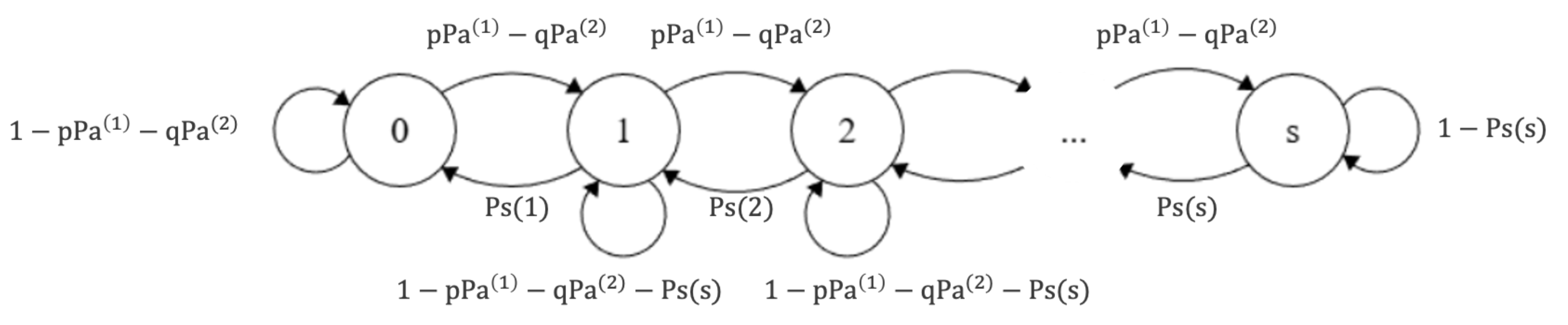
The system with the capacity to queue up to Q packets in a buffer can be considered an extension of the previous Bernoulli–Geometric model, but now, the system can transition to states ( S + 1 ) , ( S + 2 ) , ( S + 3 ) , , ( S + Q ) as depicted in Figure 1. From this, we can see that this system corresponds to a Bernoulli/Geo/S/Q queue with valid system state space { Ω n : 0 n S + Q }. It is important to note that the departure probability remains constant in these states since nodes can only leave the system after being served.
As such, the Discrete-Time Markov Chain is now described by the following state transitions from state ( i ) :
  • To state k = i 1 for S > i 1 with probability P s ( i ) = i P s ( 1 P s ) ( i 1 ) when a user leaves the system, and there are no packets waiting to be served in the buffer.
  • To state k = i 1 for S + Q > i S with probability P s ( S ) = S P s ( 1 P s ) ( S 1 ) when a user leaves the system, but there are packets in the buffer. The reason for this is that only the S packets being served can leave the system, while the packets in the buffer (which are not being served) cannot.
  • To state k = i + 1 for i S + Q 1 with probability P a when a new user arrives to the system. In this case, packet arrivals are independent of the buffer’s state.
  • To state k = i for 1 i S 1 ) with probability 1 P a P s ( i ) when neither an arrival occurs nor a departure from the system when no packets are in the buffer.
  • To state k = i for 1 i S + Q 1 ) with probability 1 P a P s ( S ) when neither an arrival nor a departure from the system occurs when there are packets in the buffer.
  • To state k = i for i = S + Q with probability 1 P s ( i ) when no departures occur, since no arrivals are possible at this point, given that all servers are occupied and the buffer is fully occupied.
  • To state k = i for ( i = 0 ) with probability 1 P a when no arrivals occur since there are no users in the system that can leave.
Solving this system using Π P = Π , just as in the previous cases. However, note that the vector Π and matrix P are different for each system, and after some algebraic manipulation, we obtain:
π i = P a i j = 1 i P s ( i ) π 0
for 0 i S 1 , and
π ( S + j ) = P a S ( P a P s ( s ) ) j k = 1 S P s ( k ) π 0
for S j Q . Using the normalization condition where
j = 0 S + Q π j = 1
We obtain the expression for π 0 as
π 0 = 1 k = 0 S 1 ( P a k j = 1 k P s ( j ) ) + ( P a S j = 1 S P s ( j ) ) ( P s ( S ) [ 1 ( P a P s ( S ) ) Q + 1 ] P s ( S ) P a )
From these expressions, we can obtain the blocking probability, the average length of the queue, and the congestion probability (the probability that an arriving packet has to wait in the buffer to be served) respectively as
P B = P a × π ( S + Q )
L ¯ = k = 0 Q k × π ( S + k )
C ¯ = P a k = 0 Q π ( S + k )

4.2. Bursty Traffic Conditions

Traffic in the IoT context has been identified as bursty in nature. For instance, in [22], the authors modeled data bursts using a Tiered Markov-Modulated stochastic process that mimics the characteristics of real IoT traffic across different applications. In [23], the data traffic of an IoT node is modeled as a Markov-modulated Poisson Process. In [24], the authors proposed two models for bursty traffic using S-ALOHA with Binary Exponential Back-off: a probability model and a Markov Process, yielding expressions for system performance indicators. Based on these models, we now model a system with buffers for bursty traffic conditions by extending the previous system using a Bernoulli-Modulated Bernoulli Process with two phases (BMBP-2) model. In this case, we assume that the system is found under low traffic conditions, with arrival rate λ 1 , for an average time 1 / p where p is the probability to change to state with arrival rate λ 2 ; and is under high traffic conditions (bursts of traffic), with arrival rate λ 2 , for an average time 1 / q where q is the probability to change to state of arrival rate λ 1 . In this case, we assume that λ 2 > > λ 1 and also that the time during the traffic burst is short, then p 1 . From this, we define the burstiness coefficient as β = λ 2 / λ 1 in order to study the system under different burst intensities.
Building on this, this system corresponds to a BMBP-2/Geo/S/Q queue with a valid system state space { Ω n : 0 n S + Q }, and the previously described Markov chain can be extended by simply modifying the packet arrival probability as
P a ( 1 ) = λ 1 T s l o t e λ 1 T s l o t
and
P a ( 2 ) = λ 2 T s l o t e λ 2 T s l o t
Note that the departure probability is not modified by this bursty traffic condition. Hence, the total packet arrival rate can be expressed as:
P a ( T ) = p × λ 1 T s l o t e λ 1 T s l o t + q × λ 2 T s l o t e λ 2 T s l o t
From this description, it is clear that the Discrete-Time Markov chain described above still models this system by substituting P a with P a T , as shown in Figure 2.

5. Numerical Results

In this section, numerical results are presented to quantitatively evaluate the impact of the time slot duration on the accuracy of our proposed approaches. Recall that we presented these models by assuming that the time slot is sufficiently small or big such that one or multiple arrivals can occur during this time. From the results presented in this section, we can clearly state how big or how small in numerical terms, such that these assumptions are valid.
Additionally, the circumstances under which our discrete-time Erlang-B models are appropriate are delineated. Numerical and simulation results presented herein assume that 1 / λ = 10 s. According to [25,26] the average voice call in many scenarios is given by 1 / μ = 180 s all along the day. Consequently, this specific value is utilized for the numerical analyses.
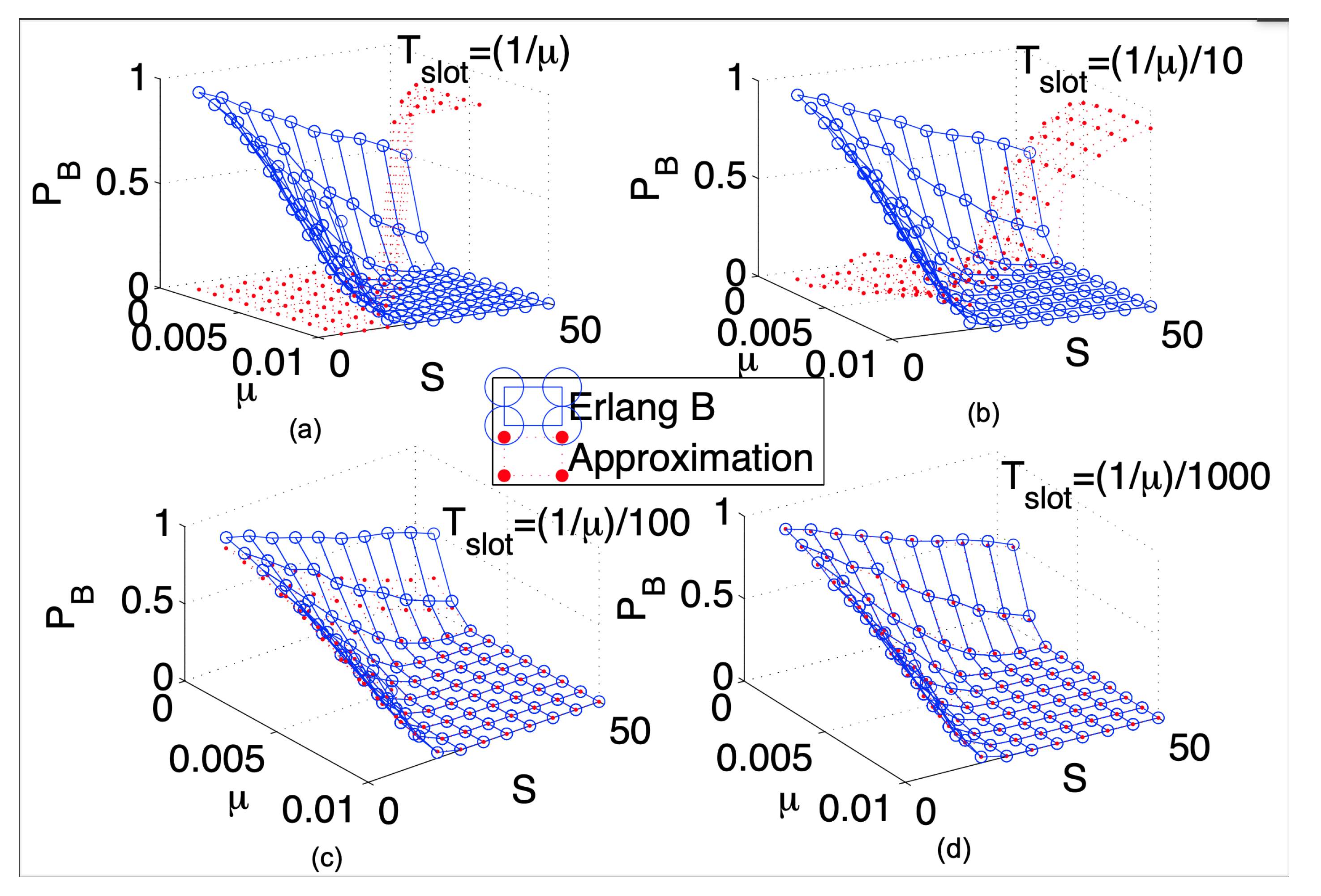
The impact of the duration of the time slot on the accuracy of the approximation within the Bernoulli–Geometric model is initially examined as shown in Figure 3. The blue surface illustrates the blocking probability for the continuous-time model. It is evident that this probability remains unaffected by variations in the size of the time slot. Conversely, the red surface corresponds to the first discrete-time model, which is based on an approximation that allows only one or no arrivals within a given time slot, as well as one or no departures. Consequently, the accuracy of this B-G model is highly dependent on the value of the time slot. The primary contribution of this research is to establish guidelines for selecting an adequate time slot value in relation to the average inter-arrival and service times. In this context, Figure 3 clearly demonstrates that when the time slot is of the same order of magnitude or at least one order of magnitude smaller than the average service time, this B-G model yields less accurate results. Conversely, for average service times that are two or more orders of magnitude smaller than the time slot, this approximation, designed to significantly simplify the mathematical analysis, provides accurate outcomes. We can see that when the approximation is accurate, the blocking probability clearly increases as the offered load ( a = λ / μ ) increases or the number of servers decreases, as the Erlang B formula predicts. However, when the approximation is not accurate, the blocking probability does not follow this behavior.
For the Poisson–Geometric model, as discussed in [20], the duration of the time slot has no apparent effect on the analytical model compared to the simulation results. This is because we no longer assume that only one arrival can happen during a time slot. Instead, we consider all possible cases (i arrivals, for i = 0 , 1 , 2 , ) and compute the blocking probability accordingly. However, it’s essential to note that this model is more complex and requires greater computational resources to generate these results.
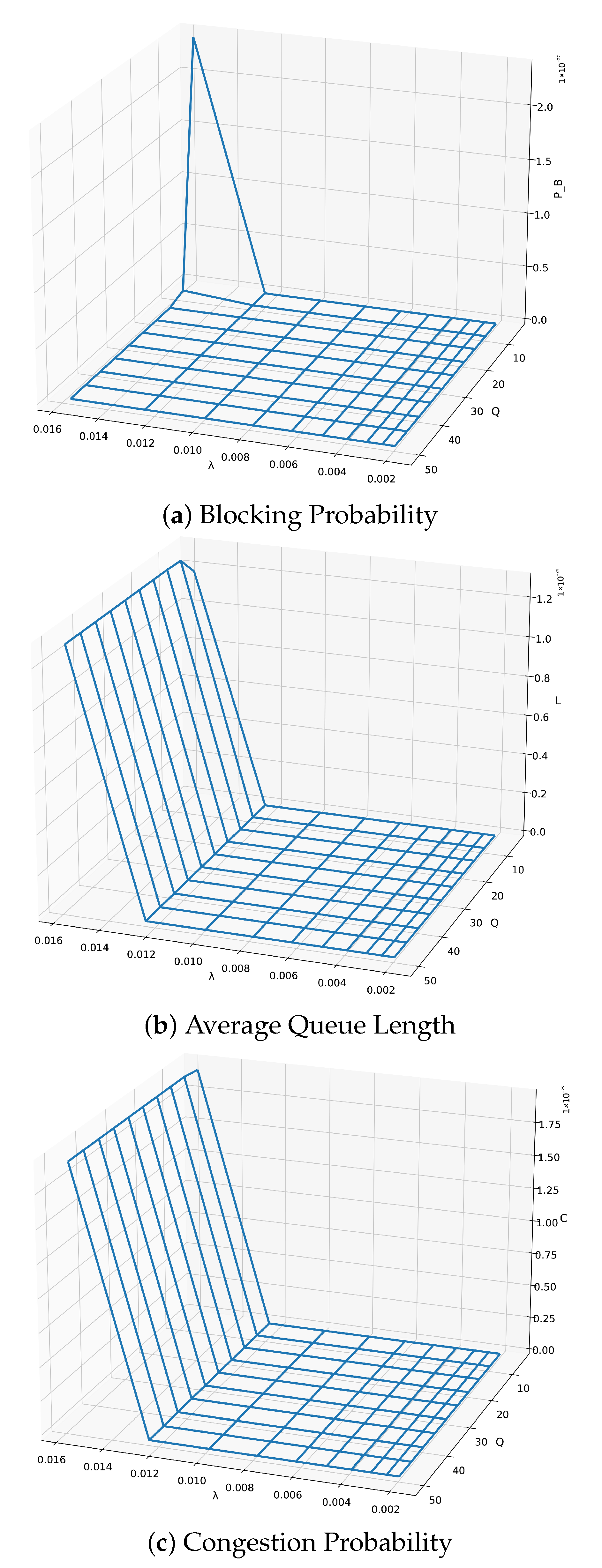
Based on these results, we now study the system with buffers and under bursty traffic conditions using the Bernoulli–Geometric model, which yields very accurate results for T s l o t much smaller than 1 / λ and 1 / μ . Since this model is no longer adequate for voice services and is more focused on delay-tolerant services, we now use μ = 0.001 . First, for a conventional traffic environment, we obtain the blocking probability, P B , the average queue length, L ¯ , and congestion probability, C ¯ , as depicted in Figure 4. We can observe that this discretized system can be used to determine an adequate value of the buffer size, Q, under the conditions that the time slot is much lower than the arrival and departure rates. Although this restriction may not apply to some modern communication systems, such as cellular networks during peak traffic, it can be adequate in WSNs and IoT environments, where events occur infrequently and are far apart. In these figures, we can see that the blocking and congestion probabilities as well as the average queue length increase as λ increases, as expected. Additionally, as Q increases, the congestion probability and average queue length decrease, as the probability of finding more nodes buffered in the queue increases due to the increased availability for this to occur. Furthermore, the blocking probability also decreases as Q increases, since in high-traffic conditions, it is more likely to have nodes queued up instead of being blocked.
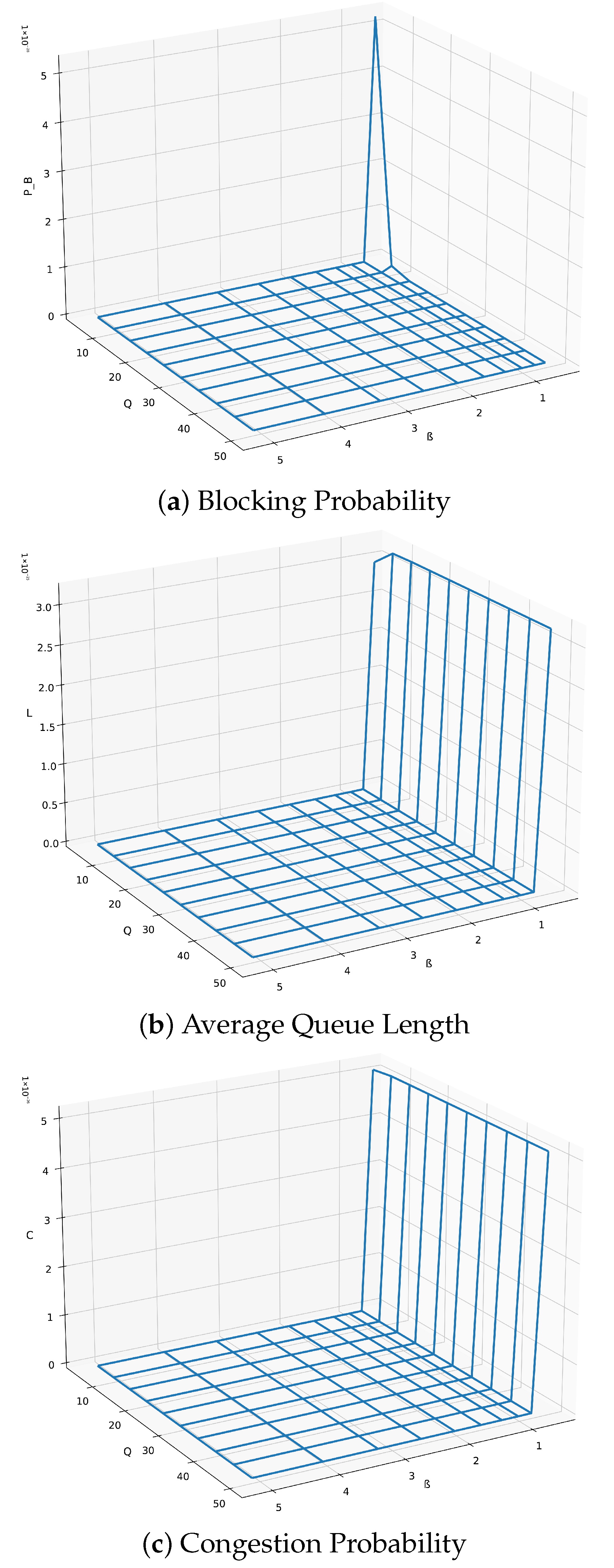
Building on this, in WSNs and IoT applications, it is common to find bursty traffic, where, in the event of an occurrence, many nodes transmit simultaneously. As such, based on the aforementioned bursty traffic model developed above, we now present the system’s performance results for different traffic burst intensities, β , in terms of the blocking probability, average queue length, and congestion probability, shown in Figure 5, with β = λ 2 / λ 1 , λ 2 > > λ 1 , and p = 0.9 .
This demonstrates the utility of our discretization tool: By determining the appropriate values of the arrival and departure rates, we can achieve an adequate approximation with the Bernoulli–Geometric model, which is both simple and accurate. In other words, if we did not have these basic guidelines for the size of the time step, we would be forced to use the much more complex Poisson–Geometric model. Building on this, we selected the arrival rates in a bursty traffic environment to be in accordance with an adequate approximation. Indeed, instead of incrementing λ 2 , we opted to decrease λ 1 . If this careful selection of the system’s parameters is not possible, this approximation will not yield accurate results.
For these results we use p = 0.9 , so that most of the time the system is in normal traffic conditions, i.e., under an arrival rate of λ 1 , high traffic conditions are given by λ 2 = 0.001 ; to modify the value of β , we reduce the value of λ 1 such that the time step remain much lower that the arrival and departure average times. Based on the traffic bursts illustrated in Figure 5, we observe the effect of the burstiness. We can see that as β increases, i.e., the difference among the arrival rates is higher, the system performance, in terms of blocking and congestion probabilities, and queue length, improves (the performance metrics decrease) since the normal traffic is lower. This would enable a more effective system design in future applications. In these results, we observe a similar behavior to that in normal traffic conditions, where the blocking and congestion probabilities and the average queue length are lower. This is because the system remains in low-traffic conditions for extended periods, and only experiences brief bursts of traffic at high arrival rates. This is clearly demonstrated: as β increases, the system remains in low-arrival-rate conditions for longer periods, exhibiting low congestion and blocking probabilities, as well as low queue lengths. When traffic is more similar, it is when β = 2 , and in this case, congestion and blocking probabilities are highest, and the average queue length is also highest.

6. Conclusions and Discussion

In this work, the effect of the system’s time step was investigated, and guidelines for its selection were provided to adequately analyze continuous-time systems under a discrete-time framework. To this end, the basic Erlang B model is used as an example to investigate the effect of the time-step size on the accuracy of performance evaluation of continuous-time systems, especially when either channel holding times or other inter-event times are comparable to the time-slot interval. Two analytical approaches are proposed and developed for this BCC system: The Bernoulli–Geometric and Poisson–Geometric models. The derived formulas have allowed us to quantify the effect of the time-discretization of the considered continuous-time system on its performance evaluation through a discrete-time framework.
We then extended this basic BCC system to include buffer capabilities, which are more useful in IoT applications and Wireless Sensor Networks, where data packets arriving at the concentrator or sink node can be queued and wait to be served. This is because, in these applications, data is delay-tolerant in most cases, unlike voice packets in a BCC system. By extending the basic model to account for buffers and traffic bursts, we aim to demonstrate the utility of analyzing the system within a discrete framework despite the continuous nature of the events. Indeed, even though bursty traffic is commonly modeled as a continuous system, such as the MMPP, we can discretize these dynamics to obtain a fully discrete model, which is much easier to manage and develop. In this sense, even the Poisson–Geometric model can be extended to account for buffers and traffic bursts when the discretization conditions of the Bernoulli–Geometric model are not met.
Additionally, this discrete model can be further used in modern communication systems such as Vehicular Networks and Peer-to-Peer networks in the context of the Internet of Things (IoT), where multiple sources with different time frames coexist, and a continuous model would not capture the dynamics of the system. In future work, we intend to develop performance analyses of continuous processes in a discrete framework based on the findings of this work, such as analyses of voice and video transmission over the internet, comparisons between packet-level and fluid models, and consideration of arrival correlations.

Author Contributions

Mathematical model, M.E.R.-Á.; formal analysis, M.E.R.-Á.; original draft preparation, M.E.R.-Á.; methodology, I.Y.O.-F.; conceptualization, Y.E.G.-N.; validation, I.Y.O.-F., I.V.J. and Y.E.G.-N.; investigation, I.Y.O.-F., I.V.J. and Y.E.G.-N.; resources, I.Y.O.-F., I.V.J. and Y.E.G.-N.; writing, M.E.R.-Á., I.V.J. and Y.E.G.-N.; review and editing, I.Y.O.-F., I.V.J. and Y.E.G.-N.; supervision, I.Y.O.-F., I.V.J. and Y.E.G.-N.; project administration, I.V.J. All authors have read and agreed to the published version of the manuscript.

Funding

This research was funded by IPN SIP Project grant number Multi-2026-0012-M1.

Data Availability Statement

The original contributions presented in this study are included in the article. Further inquiries can be directed to the corresponding authors.

Conflicts of Interest

The authors declare no conflict of interest.

Appendix A. Gauss-Seidel Numerical Solution

We now briefly describe the Gauss–Seidel numerical solution to solve the Markov chains in this work. Step 1—Propose a valid solution of the system, in this case, we select 1 / [ n u m b e r o f s t a t e s ] . Step 2—Calculate π 1 using the current solution. Step 3—Calculate π 2 using the previously calculated value of π 1 and the proposed values otherwise. Step 4—Calculate the rest of the steady state probabilities as in step 3, i.e., using the calculated values in this iteration whenever possible and the proposed values in the previous iteration. Step 5—Calculate the error by
ϵ = i = 0 N ( π i p r e v o u s i t e r a t i o n π i c u r r e n t i t e r a t i o n )
Step 6—If ϵ < 1 × 10 6 , then normalize, else go to step 2 to calculate a new iteration.

Appendix B. Key Formulas

Table A1. Key formulas.
FormulaDescription
P a = ( λ T s l o t ) e ( λ T s l o t ) Arrival probability for normal traffic conditions
P s ( n ) = n P s ( 1 P s ) ( n 1 ) Departure probability
π i = P a i j = 1 i P s ( i ) π 0 Steady state probability for i < S for the Bernoulli–Geometric model with buffer and normal traffic
π ( S + j ) = P a S ( P a P s ( s ) ) j k = 1 S P s ( k ) π 0 Steady state probability for i > S for the Bernoulli–Geometric model with buffer and normal traffic
P B = P a × π ( S + Q ) Blocking probability for the Bernoulli–Geometric model with buffer and normal traffic
L ¯ = k = 0 Q k × π ( S + k ) Average queue length for the Bernoulli–Geometric model with buffer and normal traffic
C ¯ = P a k = 0 Q π ( S + k ) Congestion probability for the Bernoulli–Geometric model with buffer and normal traffic
P a ( T ) = p × λ 1 T s l o t e λ 1 T s l o t + q × λ 2 T s l o t e λ 2 T s l o t Arrival probability for bursty traffic conditions

References

  1. Bi, Q.; Vitebsky, S.; Yang, Y.; Yuan, Y.; Zhang, Q. Performance and capacity of cellular OFDMA systems with voice-over-IP traffic. IEEE Trans. Veh. Technol. 2008, 57, 3641–3652. [Google Scholar] [CrossRef]
  2. Karapantazis, S.; Pavlidou, F.-N. VoIP: A Comprehensive survey on a promising technology. Comput. Netw. 2009, 53, 2050–2090. [Google Scholar]
  3. Baynat, B.; Eisenmann, P. Towards an Erlang-like formula for GPRS/EDGE network engineering. In Proceedings of the IEEE ICC’2004, Paris, France, 20–24 June 2004; pp. 3689–3695. [Google Scholar]
  4. Li, H.; Han, Z. Socially optimal queuing control in cognitive radio networks subject to service interruptions: To queue or not to queue? IEEE Trans. Wirel. Commun. 2011, 10, 1656–1666. [Google Scholar] [CrossRef]
  5. Veretennikov, A.Y. On mixing rate and convergence to stationary regime in discrete time Erlang problem. Autom. Remote Control. 2009, 70, 1992–2002. [Google Scholar] [CrossRef]
  6. Whitt, W. An Introduction to Stochastic-Process Limits and Their Applications to Queues; Section 2.3; AT&T Labs-Research, The Sahnnon Laboratory: Florham Park, NJ, USA, 2001. [Google Scholar]
  7. Salehi, F.; Mahmood, A.; Mahmood, N.H.; Gidlund, M. Reliable Interference Prediction and Management with Time-Correlated Traffic for URLLC. In Proceedings of the IEEE Global Communications Conference: Wireless Communications, GLOBECOM, Kuala Lumpur, Malaysia, 4–8 December 2023; pp. 6699–6704. [Google Scholar]
  8. Sethi, S.K.; Mahapatro, A. Analysis and Implementation of Markov Chain-Based Model for Spectrum Defragmentation in Cognitive Radio-Enabled IoT Networks in 5G. In Proceedings of the International Conference on Quantum Technologies, Communications, Computing, Hardware and Embedded Systems Security (iQ-CCHESS), Valavoor, India, 15–16 September 2023. [Google Scholar]
  9. Kumar, A.; Martinez-Bauset, J.; Li, F.Y.; Florea, C.; Dobre, O.A. Understanding Inter- and Intra Cluster Concurrent Transmissions for IoT Uplink Traffic in MIMO-NOMA Networks: A DTMC Analysis. IEEE Internet Things J. 2024, 11, 14328–14343. [Google Scholar] [CrossRef]
  10. Li, J.; Jiao, K.; Zhou, Z.; Duan, S.; Mo, L. A Slotted Markov Model for EDCA Mechanism in QoS-Aware Industrial IoT Networks: Throughput and Delay Analysis under Saturated Condition. In Proceedings of the 40th Youth Academic Annual Conference of Chinese Association of Automation (YAC), Zhengzhou, China, 17–19 May 2025; pp. 1916–1921. [Google Scholar]
  11. Gai, X.; Li, Z.; Zhang, Y.; Li, S.; Meng, G.; Iv, L. Research on Model and Simulation of Vehicle Network Based on LTE Technology. In Proceedings of the IEEE International Symposium on Broadband Multimedia Systems and Broadcasting (BMSB), Beijing, China, 14–16 June 2023. [Google Scholar]
  12. Zhou, X.; Hui, F.; Liu, J.; Wang, W.; Zhang, J. Resource Reservation in C-V2X Networks for Dynamic Traffic Environments: From Vehicle Density-Driven to Deep Reinforcement Learning. IEEE Trans. Veh. Technol. 2025, 74, 17429–17444. [Google Scholar] [CrossRef]
  13. Feng, Y.; Sun, Y.; Peng, M. Performance Analysis in Satellite Communication with Beam Hopping Using Discrete-Time Queueing Theory. IEEE Internet Things 2024, 11, 11679–11692. [Google Scholar] [CrossRef]
  14. Raj, R.; Selvamuthu, D.; Mishra, D. Traffic Control and Energy Harvesting in High Altitude Platforms: A Semi-Markov Process Approach. In Proceedings of the IEEE Globecom Workshops (GC Wkshps), Cape Town, South Africa, 8–12 December 2024. [Google Scholar]
  15. Li, L.; Chen, W. A Tractable Approach for Queueing Analysis on Buffer-Aware Scheduling. IEEE Trans. Commun. 2025, 73, 14014–14031. [Google Scholar] [CrossRef]
  16. Bouazizi, Y.; Benkhelifa, F.; ElSawy, H.; McCann, J.A. SF-Adaptive Duty-Cycled LoRa Networks: Scalability, Reliability, and Latency Tradeoffs. IEEE Trans. Commun. 2025, 73, 1042–1057. [Google Scholar] [CrossRef]
  17. Zhang, Y.; Zhang, Z.; Sun, H.; Wang, X. On the Backoff Scheme for SPMA Network: A Spatio-Temporal Mathematical Model. IEEE Commun. Lett. 2023, 27, 2541–2545. [Google Scholar] [CrossRef]
  18. Sarmad, W.; Shahid, S.M.; Karasan, E.; Kwon, S. Performance Analysis of an In-Band Full-Duplex MAC Protocol for Future Wireless Networks. IEEE Syst. J. 2024, 18, 415–425. [Google Scholar] [CrossRef]
  19. Pai, V.U.; Mehta, N.B.; Singh, C. Novel Insights from a Cross-Layer Analysis of TCP and UDP Traffic over Full-Duplex WLANs. IEEE Trans. Mob. Comput. 2025, 24, 3288–3301. [Google Scholar] [CrossRef]
  20. Garrido, H.A.A.; Rivero-Angeles, M.E.; Aguirre-Anaya, E.; Cruz-Perez, F.; Castellanos, L.; Valdz-Hernandez, G. Performance Analysis of a Wireless Sensor Network with Cognitive Radio Capabilities in Structural Health Monitoring Applications: A Discrete Model. Int. J. Distrib. Sens. Netw. 2018, 14, 1550147718774001. [Google Scholar] [CrossRef]
  21. Ny¡iyato, D.; Hossain, E. A novel analytical framework for integrated cross-layer study of call-level and packet-level QoS in wireless mobile multimedia networks. IEEE Trans. Mob. Comput. 2007, 6, 322–335. [Google Scholar] [CrossRef]
  22. Hussein, D.H.; Ibnkahla, M. A Novel Mathematical Framework for Modeling Application-Specific IoT Traffic. IEEE Internet Things J. 2024, 11, 2364–2381. [Google Scholar] [CrossRef]
  23. Laner, M.; Svoboda, P.; Nikaein, N.; Rupp, M. Traffic models for machine type communications. In Proceedings of the 10th International Symposium Wireless Communication Systems, Chengdu China, 6–8 January 2013; pp. 1–5. [Google Scholar]
  24. Feng, Y.H.; Rong, Z.W.; Feng, Y. IoT System Evaluation Methods for Very Bursty Traffic with Contention Based Access. In Proceedings of the 2017 IEEE/CIC International Conference on Communications in China, Qingdao, China, 22–24 October 2017. [Google Scholar]
  25. Heegaard, P.E. Next Generation Teletraffic and Wired/Wireless Advanced Networking. In Empirical Observations of Traffic Patterns in Mobile and IP Telephony; Lecture Notes on Computer Science; Springer: Berlin/Heidelberg, Germany, 2007; Volume 4712, pp. 26–37. [Google Scholar]
  26. Biernacki, A. VoIP Source Model Based on the Hyperexponential Distribution. Trans. Eng. Comput. Technol. 2006, 11, 202–206. [Google Scholar]
Figure 1. Markov chain for the system with buffers of length Q.
Telecom 07 00030 g001
Figure 2. Markov chain for the system with buffers of length Q in bursty traffic conditions.
Telecom 07 00030 g002
Figure 3. Analytical and simulation results depicting the blocking probability in relation to the number of servers and average service holding time, represented as 1 / μ for the Bernoulli–Geometric model for (a) T s l o t = 1 / μ , (b) T s l o t = ( 1 / μ ) / 10 , (c) T s l o t = ( 1 / μ ) / 100 , and (d) T s l o t = ( 1 / μ ) / 1000 .
Telecom 07 00030 g003
Figure 4. System performance for different values of λ and buffer length, Q, with S = 10 , T s l o t = 10 .
Telecom 07 00030 g004
Figure 5. System performance for different values of β and buffer length, Q, with S = 10 , T s l o t = 10 , p = 0.9 .
Telecom 07 00030 g005
Disclaimer/Publisher’s Note: The statements, opinions and data contained in all publications are solely those of the individual author(s) and contributor(s) and not of MDPI and/or the editor(s). MDPI and/or the editor(s) disclaim responsibility for any injury to people or property resulting from any ideas, methods, instructions or products referred to in the content.