
SpIDER: Space Satellite Intrusion Detection Using Explainable Reinforcement Learning for Next-Generation Satellite Communication Networks


Abstract
1. Introduction
- We examine the application of space satellite intrusion detection systems by analyzing both space traffic and terrestrial ground station traffic alongside ordinary local area network internet traffic using the STIN and NSL-KDD datasets. This allows us to directly compare satellite-style and traditional LAN intrusion detection performance within a unified framework.
- We implement the popular deep Q-network (DQN) reinforcement learning algorithm to detect cyberattacks on space satellite traffic and classical LAN traffic. We compare our DQN-based SpIDER framework against several well-known machine learning algorithms (support vector machines, naive Bayes, and multilayer perceptron) to assess where reinforcement learning is competitive or advantageous.
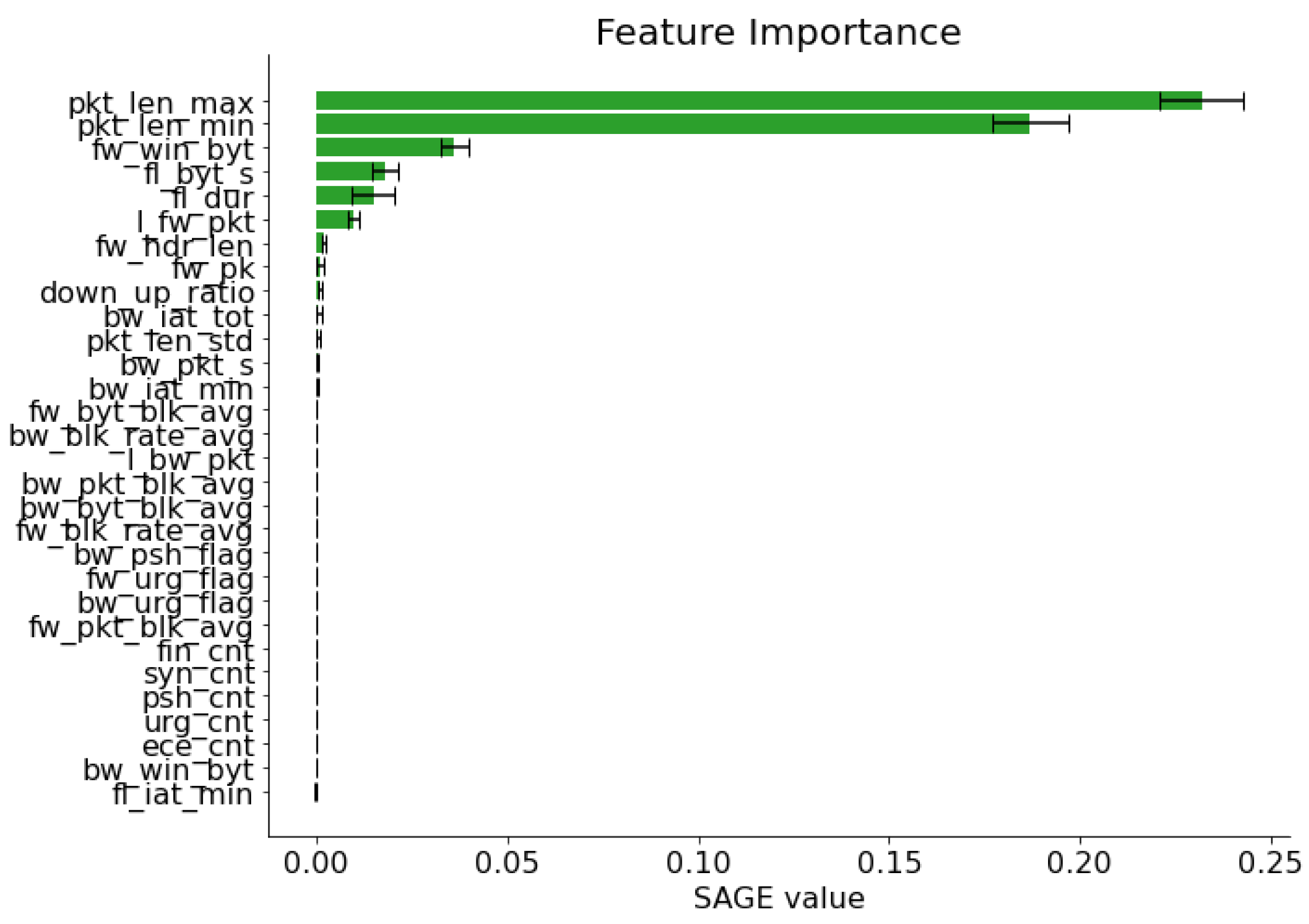
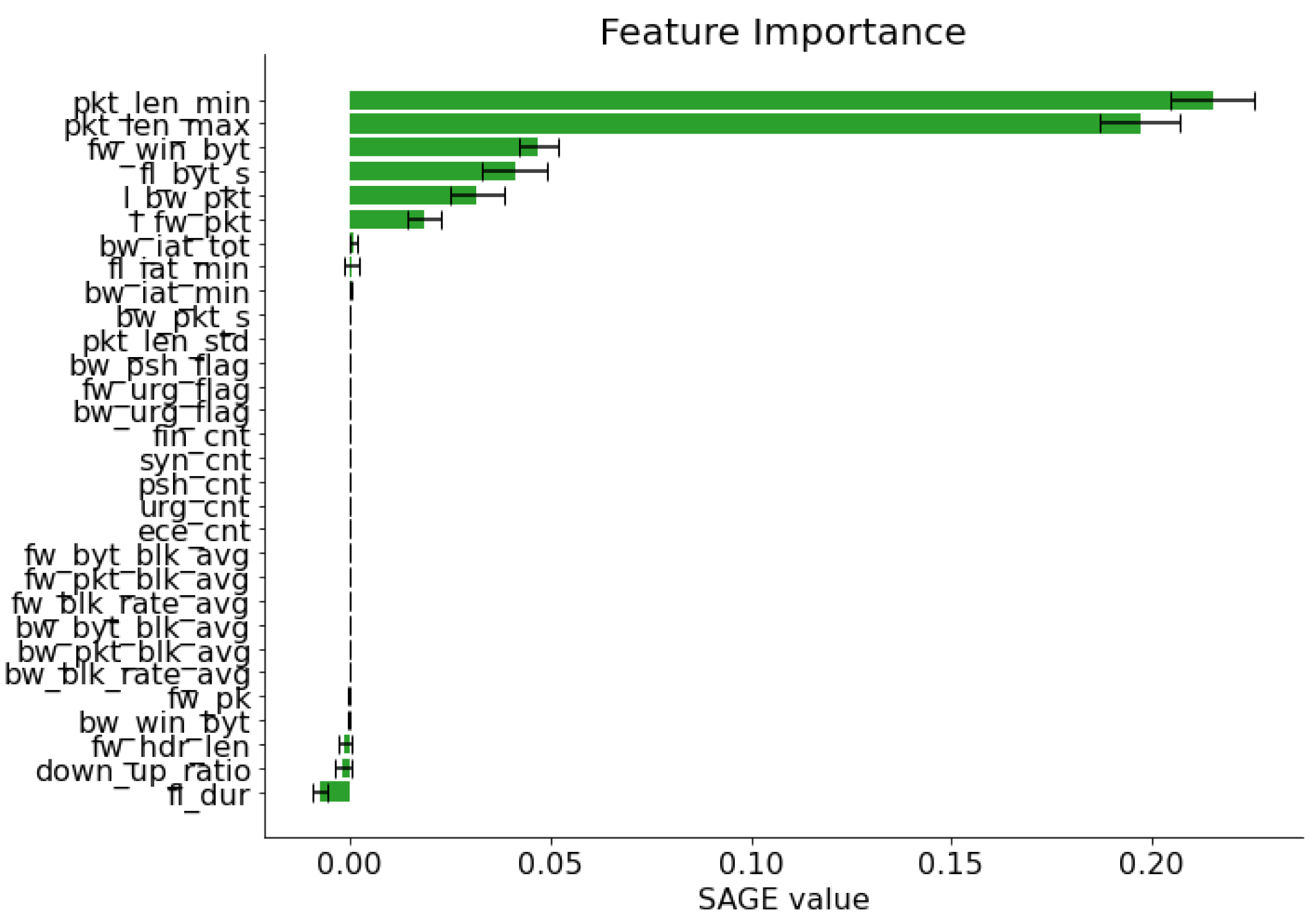
- We apply Shapley Additive Global Explanations (SAGE) to assess which dataset features meaningfully contributed to the predictions of our reinforcement learning model used in our framework. This global analysis provides insight into which network features are most important for detecting attacks in satellite versus terrestrial environments and can inform future feature engineering and telemetry design.
2. Literature Review
2.1. Machine Learning Applications for Space Security and Anomaly Detection
2.2. Intrusion Detection Using Reinforcement Learning Approaches
3. Methodology
3.1. Datasets
3.1.1. STIN Dataset
3.1.2. NSL-KDD Dataset
3.2. Deep Q-Networks
3.3. Shapley Additive Global Importance
4. Results
4.1. Performance Metrics
4.2. Numerical Results
4.2.1. STIN Satellite Dataset
4.2.2. STIN Terrestrial Dataset
4.2.3. NSL-KDD Dataset
4.3. SAGE Plots
5. Discussion
6. Conclusions
Funding
Informed Consent Statement
Data Availability Statement
Conflicts of Interest
References
- Prol, F.S.; Ferre, R.M.; Saleem, Z.; Välisuo, P.; Pinell, C.; Lohan, E.S.; Elsanhoury, M.; Elmusrati, M.; Islam, S.; Çelikbilek, K.; et al. Position, navigation, and timing (PNT) through low earth orbit (LEO) satellites: A survey on current status, challenges, and opportunities. IEEE Access 2022, 10, 83971–84002. [Google Scholar] [CrossRef]
- Kidd, C.; Levizzani, V.; Bauer, P. A review of satellite meteorology and climatology at the start of the twenty-first century. Prog. Phys. Geogr. 2009, 33, 474–489. [Google Scholar] [CrossRef]
- Chen, Y.; Ma, X.; Wu, C. The concept, technical architecture, applications and impacts of satellite internet: A systematic literature review. Heliyon 2024, 10, e33793. [Google Scholar] [CrossRef] [PubMed]
- Lundberg, S.M.; Lee, S.I. A unified approach to interpreting model predictions. In Proceedings of the 31st International Conference on Neural Information Processing Systems (NIPS’17), Long Beach, CA, USA, 4–9 December 2017; pp. 4768–4777. [Google Scholar]
- Ribeiro, M.T.; Singh, S.; Guestrin, C. “Why should i trust you?” Explaining the predictions of any classifier. In Proceedings of the 22nd ACM SIGKDD International Conference on Knowledge Discovery and Data Mining, San Francisco, CA, USA, 13–17 August 2016; pp. 1135–1144. [Google Scholar]
- Covert, I.; Lundberg, S.M.; Lee, S.I. Understanding global feature contributions with additive importance measures. Adv. Neural Inf. Process. Syst. 2020, 33, 17212–17223. [Google Scholar]
- Koroniotis, N.; Moustafa, N.; Slay, J. A new Intelligent Satellite Deep Learning Network Forensic framework for smart satellite networks. Comput. Electr. Eng. 2022, 99, 107745. [Google Scholar] [CrossRef]
- McMahan, B.; Moore, E.; Ramage, D.; Hampson, S.; y Arcas, B.A. Communication-efficient learning of deep networks from decentralized data. In Proceedings of the Artificial Intelligence and Statistics, PMLR, Fort Lauderdale, FL, USA, 20–22 April 2017; pp. 1273–1282. [Google Scholar]
- Salim, S.; Moustafa, N.; Hassanian, M.; Ormod, D.; Slay, J. Deep-Federated-Learning-Based Threat Detection Model for Extreme Satellite Communications. IEEE Internet Things J. 2024, 11, 3853–3867. [Google Scholar] [CrossRef]
- Li, K.; Zhou, H.; Tu, Z.; Wang, W.; Zhang, H. Distributed Network Intrusion Detection System in Satellite-Terrestrial Integrated Networks Using Federated Learning. IEEE Access 2020, 8, 214852–214865. [Google Scholar] [CrossRef]
- Kricheff, S.; Maxwell, E.; Plaks, C.; Simon, M. An Explainable Machine Learning Approach for Anomaly Detection in Satellite Telemetry Data. In Proceedings of the 2024 IEEE Aerospace Conference, Big Sky, MT, USA, 2–9 March 2024; pp. 1–14. [Google Scholar] [CrossRef]
- Gunn, L.; Smet, P.; Arbon, E.; McDonnell, M.D. Anomaly detection in satellite communications systems using lstm networks. In Proceedings of the 2018 Military Communications and Information Systems Conference (MilCIS), Canberra, Australia, 13–15 November 2018; pp. 1–6. [Google Scholar]
- Zeng, Z.; Jin, G.; Xu, C.; Chen, S.; Zeng, Z.; Zhang, L. Satellite Telemetry Data Anomaly Detection Using Causal Network and Feature-Attention-Based LSTM. IEEE Trans. Instrum. Meas. 2022, 71, 1–21. [Google Scholar] [CrossRef]
- Kocher, G.; Kumar, G. Machine learning and deep learning methods for intrusion detection systems: Recent developments and challenges. Soft Comput. 2021, 25, 9731–9763. [Google Scholar] [CrossRef]
- Dina, A.S.; Manivannan, D. Intrusion detection based on machine learning techniques in computer networks. Internet Things 2021, 16, 100462. [Google Scholar] [CrossRef]
- Lopez-Martin, M.; Carro, B.; Sanchez-Esguevillas, A. Application of deep reinforcement learning to intrusion detection for supervised problems. Expert Syst. Appl. 2020, 141, 112963. [Google Scholar] [CrossRef]
- Tavallaee, M.; Bagheri, E.; Lu, W.; Ghorbani, A.A. A detailed analysis of the KDD CUP 99 data set. In Proceedings of the 2009 IEEE Symposium on Computational Intelligence for Security and Defense Applications, Ottawa, ON, Canada, 8–10 July 2009; pp. 1–6. [Google Scholar]
- Kolias, C.; Kambourakis, G.; Stavrou, A.; Gritzalis, S. Intrusion detection in 802.11 networks: Empirical evaluation of threats and a public dataset. IEEE Commun. Surv. Tutor. 2015, 18, 184–208. [Google Scholar] [CrossRef]
- Caminero, G.; Lopez-Martin, M.; Carro, B. Adversarial environment reinforcement learning algorithm for intrusion detection. Comput. Netw. 2019, 159, 96–109. [Google Scholar] [CrossRef]
- Rookard, C.; Khojandi, A. RRIoT: Recurrent reinforcement learning for cyber threat detection on IoT devices. Comput. Secur. 2024, 140, 103786. [Google Scholar] [CrossRef]
- Sethi, K.; Sai Rupesh, E.; Kumar, R.; Bera, P.; Venu Madhav, Y. A context-aware robust intrusion detection system: A reinforcement learning-based approach. Int. J. Inf. Secur. 2020, 19, 657–678. [Google Scholar] [CrossRef]
- Kivity, A.; Kamay, Y.; Laor, D.; Lublin, U.; Liguori, A. kvm: The Linux virtual machine monitor. In Proceedings of the Linux Symposium, Ottawa, ON, Canada, 27–30 June 2007; Volume 1, pp. 225–230. [Google Scholar]
- Li, T.; Zhou, H.; Luo, H.; Yu, S. SERvICE: A software defined framework for integrated space-terrestrial satellite communication. IEEE Trans. Mob. Comput. 2017, 17, 703–716. [Google Scholar] [CrossRef]
- Zhang, J.; Wang, Z.; Ma, N.; Huang, T.; Liu, Y. Enabling efficient service function chaining by integrating NFV and SDN: Architecture, challenges and opportunities. IEEE Netw. 2018, 32, 152–159. [Google Scholar] [CrossRef]
- Rookard, C. Cyber Threat Detection using Multifaceted Machine Learning Approaches. Ph.D. Thesis, University of Tennessee, Knoxville, TN, USA, 2024. [Google Scholar]



| Model | ||||
|---|---|---|---|---|
| SVM | NB | MLP | SpIDER | |
| Accuracy | 0.9998 (0.00020) | 0.9998 (0.00010) | 0.9998 (0.00010) | 0.9998 (0.00004) |
| Precision | 0.9998 (0.00020) | 0.9998 (0.00010) | 0.9998 (0.00010) | 0.9998 (0.00004) |
| Recall | 0.9998 (0.00020) | 0.9998 (0.00010) | 0.9998 (0.00010) | 0.9998 (0.00004) |
| F1 Score | 0.9998 (0.00020) | 0.9998 (0.00010) | 0.9998 (0.00010) | 0.9998 (0.00004) |
| G-Mean | 0.9998 (0.00020) | 0.9998 (0.00010) | 0.9998 (0.00020) | 0.9998 (0.00004) |
| Model | ||||
|---|---|---|---|---|
| SVM | NB | MLP | SpIDER | |
| Accuracy | 0.9926 (0.0010) | 0.7357 (0.0252) | 0.9952 * (0.0009) | 0.7696 (0.0270) |
| Precision | 0.9926 (0.0010) | 0.7398 (0.0297) | 0.9952 * (0.0009) | 0.7313 (0.0496) |
| Recall | 0.9926 (0.0010) | 0.7357 (0.0252) | 0.9952 * (0.0009) | 0.7446 (0.0739) |
| F1 Score | 0.9926 (0.0010) | 0.6698 (0.0300) | 0.9952 * (0.0009) | 0.7696 (0.0270) |
| G-Mean | 0.9958 (0.0006) | 0.8436 (0.0162) | 0.9973 * (0.0005) | 0.8646 (0.0163) |
| Model | ||||
|---|---|---|---|---|
| SVM | NB | MLP | SpIDER | |
| Accuracy | 66.61 (0.34) | 26.92 (0.00) | 68.00 (1.23) | 76.71 * (1.29) |
| Precision | 53.25 (1.40) | 24.77 (0.00) | 52.05 (0.84) | 73.35 * (1.23) |
| Recall | 66.61 (0.34) | 26.92 (0.00) | 68.00 (1.23) | 80.34 * (1.26) |
| F1 Score | 58.68 (0.76) | 17.89 (0.00) | 58.42 (1.05) | 76.71 * (1.29) |
| G-Mean | 75.03 (0.69) | 48.39 (0.00) | 74.87 (0.95) | 80.49 * (0.91) |
Disclaimer/Publisher’s Note: The statements, opinions and data contained in all publications are solely those of the individual author(s) and contributor(s) and not of MDPI and/or the editor(s). MDPI and/or the editor(s) disclaim responsibility for any injury to people or property resulting from any ideas, methods, instructions or products referred to in the content. |
© 2026 by the author. Licensee MDPI, Basel, Switzerland. This article is an open access article distributed under the terms and conditions of the Creative Commons Attribution (CC BY) license.
Share and Cite
Rookard, C. SpIDER: Space Satellite Intrusion Detection Using Explainable Reinforcement Learning for Next-Generation Satellite Communication Networks. Telecom 2026, 7, 3. https://doi.org/10.3390/telecom7010003
Rookard C. SpIDER: Space Satellite Intrusion Detection Using Explainable Reinforcement Learning for Next-Generation Satellite Communication Networks. Telecom. 2026; 7(1):3. https://doi.org/10.3390/telecom7010003
Chicago/Turabian StyleRookard, Curtis. 2026. "SpIDER: Space Satellite Intrusion Detection Using Explainable Reinforcement Learning for Next-Generation Satellite Communication Networks" Telecom 7, no. 1: 3. https://doi.org/10.3390/telecom7010003
APA StyleRookard, C. (2026). SpIDER: Space Satellite Intrusion Detection Using Explainable Reinforcement Learning for Next-Generation Satellite Communication Networks. Telecom, 7(1), 3. https://doi.org/10.3390/telecom7010003