Article

Co-Hydrothermal Carbonization of Cacao (Theobroma cacao) Shells with LDPE: Hydrochar Characterization, Comparative Pyrolytic Kinetic Study, and Thermodynamic Property Determination


by
Mariane Fe A. Abesamis
1,
Alec Paolo V. Dy Pico
1,
Rosanne May E. Marilag
2,
Javinel P. Servano
2,
Queenee Mosera M. Ibrahim
2,
Cymae O. Oguis
2,
Alexander Jr. Q. Bello
2,
Kenth Michael U. Uy
1,
Joevin Mar B. Tumongha
1,
Rodel D. Guerrero
1,2,
Ralf Ruffel M. Abarca
1,2 and
Alexander O. Mosqueda
1,2,*
1
Waste Valorization and Energy Laboratory, Center for Energy Research and Technology, Mindanao State University—Iligan Institute of Technology, Andres Bonifacio Avenue, Iligan City 9200, Philippines
2
Department of Chemical Engineering and Technology, College of Engineering, Mindanao State University—Iligan Institute of Technology, Iligan City 9200, Philippines
*
Author to whom correspondence should be addressed.
Fuels 2026, 7(2), 27; https://doi.org/10.3390/fuels7020027
Submission received: 29 January 2026 / Revised: 11 March 2026 / Accepted: 24 March 2026 / Published: 24 April 2026

Abstract

In the Philippines’ agricultural setup, pre-harvest cacao (Theobroma cacao) fruits are wrapped with low-density polyethylene (LDPE) for moisture retention and damage protection. Responding to the growing concern for its waste volume and scarcity of treatment, this research explores the co-hydrothermal carbonization (co-HTC) of cacao shells (CS) and LDPE as a method to convert agricultural waste with plastic into hydrochar for potential energy applications. Thus, observations on the thermal, physicochemical, and morphological changes from feedstocks to hydrochar are carried out. Optimal conditions of 200 °C for 60 min resulted in hydrochar with 21.11 MJ/kg and appreciable thermal properties. SEM micrographs show that hydrochar had increased surface area, a good fuel characteristic, and surface flaking on oversized LDPE film, suggesting relative LDPE degradation. EDX analysis reveals C, K, Ca, and Zn metals that affect chemical pathways. FTIR analysis further supports chemical synergy by preservation of functional groups innate from both parent materials. Kinetic and thermal evolutions are also investigated to reveal the influence of pretreatment on the stability of cacao shell-dominated hydrochar and the effectivity of biomass integration to facilitate relatively easier cracking of LDPE. The findings support co-HTC as a viable technology to enhance the circular economy by valorizing LDPE and cacao shells while promoting energy recovery and solid fuel production.

1. Introduction

Plastics have been produced and used for a variety of applications in different industries around the world. Plastic production has increased from about 2 million tons in 1950 to a worldwide scale of 400.3 million tons in 2022 and is thus expected to exponentially increase in the coming years [1]. However, plastics also constitute a major threat to the environment due to their resistance to degradation. Plastics take significant time to degrade, ranging from several decades to hundreds of years [2].
The worldwide annual production of non-degradable plastic ranges from 350 million to 400 million tons. In 2020 alone, nearly 400 million tons of plastics were produced globally [3]. Of this, 5 to 13 million tons of waste plastic are released into the ocean yearly, which has negative consequences on ecology [4,5].
Globally, only 18% of plastic waste is recycled, and 24% is incinerated. The remaining 58% is either landfilled or enters the natural environment, where plastics accumulate and persist for a long period of time [3]. These wastes release toxins into the soil, water, and air as they weather and react with the natural environment through different mechanisms, such as UV radiation, heat, pressure, and interaction with chemicals and with living organisms [3,5].
Polyethylene and polypropylene represent about 92% of the synthetic plastics produced, and they are used for production of plastic bags, disposable containers, bottles, packaging materials, etc. One particular application of polyethylene, particularly low-density polyethylene (LDPE), is protective sleeves for cacao fruits. The primary impediment encountered in cacao production is the impact of insects that feed on cacao leaves and fruits. To effectively safeguard cacao fruit, a recommended approach is to use LDPE sleeves.
Cacao production generates substantial waste, with approximately 80% of the cacao fruit discarded, including shells and pod husks, which are often used as cacao tree fertilizers. This practice, however, emits rancid odors and crop-related infections [6]. Cacao shells (CS) with attached LDPE sleeves are usually disposed of in low-lying areas or landfills, with a fraction subjected to incineration. In response to this underlying concern, a promising approach has emerged, involving the conversion of such waste materials into hydrochar, a coal-like product, through the application of a hydrothermal carbonization (HTC) process [7].
Interestingly, studies have shown that biomass and plastics make up an effective solid fuel when converted into hydrochar [8]. For instance, investigation for the co-HTC of corn stover with waste polyurethane found an effective reduction of nitrogen and oxygen contents, improving the overall fuel quality of hydrochar [9]. Another study examined the co-HTC of polyvinyl chloride with various lignocellulosic biomasses, including pine, bamboo, corncob, wheat stalk, and corn stalk. The study reveals that the interactions between PVC and biomass components enhanced the fuel properties and combustion behaviors of the resulting hydrochars [10]. Sawdust and polypropylene were also hydrothermally co-processed for supercapacitor applications [11]. HTC was also successfully done with both the unary system and mixtures of bioplastics and conventional plastic wastes, including LDPE. While particularly effective for their physical separation, the necessity for high-temperature conditions deemed the process for lone plastics substantially energy-intensive [12]. Co-HTC of water hyacinth and LDPE was observed in a study by Ong et al., 2024, which revealed a saturation point for LDPE loading before the lowering of HHV [13].
Moreover, co-HTC has been shown to effectively reduce ash content and enhance the grindability and combustion properties of hydrochar, making it a viable alternative to fossil fuels in various applications [14]. In particular, co-HTC of plastic and plastic polymers has been effective in reducing the inorganic content of biomass, which would have led to operational issues such as slagging and fouling during combustion or pyrolysis and otherwise lead to increased fuel properties [8].
However, co-processing plastics also introduces complexities, including phase separation, formation of tar or waxy residues, and operational challenges like reactor clogging or inconsistent product quality. These factors highlight the need for optimized feedstock blending ratios, pre-treatment, and controlled operating conditions to fully harness the benefits of plastics in WTE applications.
As reported research on the topic is still nonexistent, this study pioneers the investigation on the co-HTC of LDPE and CS. The findings specifically showcase the growing potential of plastic decomposition within a biomass-rich hydrothermal environment. Furthermore, this study offers insights into the fuel characteristics and thermal stability of hydrochar synthesized from the blending of biomass and plastic, providing a new framework for maximizing energy recovery from agricultural waste streams.

2. Materials and Methods

2.1. Sample Preparation

Cacao shells and LDPE were obtained from post-harvest processing residues of cacao (Theobroma cacao) from a farm in Davao City, Philippines. The LDPE sleeves collected from each cacao fruit were carefully removed and preserved for subsequent analysis. Cacao shells were isolated from pulps and beans by manual deseeding and were sun-dried for a week. The empty cacao shells were then weighed and cut into small 2 cm cubes. Oven drying was then conducted at a 105 °C for 24 h. The collected LDPE sleeves were also cut into 2 cm strips in preparation for subsequent experimental procedures.

2.2. Co-Hydrothermal Carbonization

Weight compositions of CS and LDPE were set as received from the actual tree upon harvest, comprising the deseeded CS and the whole LDPE sleeve of raw cacao fruit, which account to 98% and 2% of the feedstock mass, respectively. The raw feedstocks were prepared in a mass ratio of 1:8 with water at wet weight basis, respectively. The mixture was placed into the batch-type 0.5 L autoclave reactor at a heating rate of 7 °C/min. The reactor was then purged with 99.99% high-purity nitrogen gas to simulate an oxygen-free environment. After the system was sealed, it was heated up to the predetermined reaction temperature and held for 60 min. The reactor was then quenched to room temperature, and the resulting product was removed and vacuum-filtered. The solid hydrochar residue was washed with distilled water and oven-dried for 24 h at 105 °C. After drying, the mass of the hydrochar yield was determined and its % mass yield was calculated using Equation (1) shown below.
M Y ,   % = m H C m r a w   f e e d × 100

2.3. Experimental Design and Statistical Analysis

For the co-HTC optimization experiments, Response Surface Methodology with Central Composite Design (CCD) was employed to observe the relationships between the co-HTC parameters (reaction temperature and residence time) and the resulting % hydrochar mass yield. Table 1 shows the factor levels and desired response for the co-HTC of CS with LDPE using the CCD. The significance of each of these parameters to the response was determined using a two-way analysis of variance (ANOVA).

2.4. Optimization of Co-HTC Experiment Parameters

Optimization of the reaction parameters was done, aiming to maximize the % hydrochar mass yield, and the optimum reaction temperature and residence time were determined. After determining these parameters, two more HTC runs were performed following these parameters and were then subjected to characterization and further analyses. The optimization framework of this study designates hydrochar mass yield as the sole primary response variable, treating the higher heating value (HHV) strictly as a lower-bound constraint (≥20 MJ/kg). This maximizes total energy recovery by preventing the thermodynamic waste associated with high-severity HTC processes, where marginal gains in energy densification are negated by disproportionate reductions in mass yield [15].

2.5. Characterization of Optimized Hydrochar

Hydrochar fractions derived from co-HTC were separated based on particle size distribution. The three samples were labeled as follows: (1) undersized hydrochar (less than 100 microns), (2) oversized hydrochar (greater than 100 microns), and (3) oversized LDPE. The resulting samples from co-HTC pretreatment were deployed for characteristic examination through analytical techniques: Bomb Calorimetry using Sundy SDAC1000 Bomb Calorimeter (Hunan Sundy Science and Technology Co., Ltd., Changsha, China) for HHV, Attenuated Total Reflectance-Fourier Transform Infrared (ATR-FTIR) spectroscopy analysis using a Shimadzu IRTracter-100 spectrometer (Shimadzu Corporation, Kyoto, Japan) for identification of functional groups and assessment of changes in chemical composition, and Scanning Electron Microscopy–Energy-Dispersive X-ray (SEM-EDX) using the SEM JSM-IT200 (JEOL Ltd., Tokyo, Japan) for analysis of the surface morphology and determination of the elemental composition.

2.6. Thermal Analysis via Pyrolysis of Hydrochar Fractions

To assess the thermal behavior and pyrolytic potential of each hydrochar fraction, the samples underwent Thermogravimetric Analysis (TGA) using a TGA 4000 instrument (PerkinElmer Inc., Shelton, Connecticut). TGA was conducted with samples being heated from 40 °C to 660 °C under continuous flow of nitrogen gas at 20 mL/min to maintain an inert environment. The heating rate was set to 20 °C/min. The TGA instrument continuously recorded mass loss, generating thermogravimetric and decomposition stages, and evaluating thermal stability. This data is critical in understanding the pyrolysis performance and energy recovery capability of the hydrochar.
TGA was also utilized to examine the pyrolysis mechanism through kinetics modeling. In thermal analysis of coal and biomass, the Coats–Redfern (CR) equation is widely used as a non-isothermal model-fitting technique with a simplified single-step reaction mechanism, averaging out complexities. The linear representation of this method is presented in Equation (2):
ln g α T 2 = ln A R β E a 1 2 R T E a E a R T
where g(α) is the integral form of the kinetic model, T is the absolute temperature (K), A is the pre-exponential factor (min−1), β is the heating rate (K/min), Ea is the activation energy (J/mol or kJ/mol), and R is the universal gas constant (8.314 J/mol·K).
From the linear plot of the left side of Equation (2) and 1/T, the slope and intercept can be used to identify the kinetic parameters. The activation energy, Ea, is determined from the line’s slope, while the pre-exponential factor, A, comes from its intercept. The temperature-dependent rate constant, k, can therefore be achieved using the Arrhenius equation:
k = A e x p E a R T
Several kinetic models listed in Table 2 were evaluated [16,17], and the model with the highest coefficient of determination was selected as the best fit.
Thermodynamic parameters, including enthalpy change (ΔH), Gibbs free energy change (ΔG), and entropy change (ΔS), were derived from activation energy values and pre-exponential factors obtained through the CR kinetic model. The maximum decomposition temperature for each blend was used in the thermodynamic computations. The following equations were applied:
Δ H   =   E a     R T  
Δ G = E a + R T m ln K b T h A
Δ S = Δ H Δ G   T m
where R is the gas constant (0.008314 kJ/mol K), Kb is Boltzmann’s constant (1.381 × 10⁻²³ m2 kg/s−2 K−1), h is Planck’s constant (6.626 × 10⁻³⁴ m2 kg/s), and Tm is the maximum temperature at which decomposition occurs. These dictate the energy requirements and spontaneity of the pyrolysis reactions under catalytic conditions.

3. Results and Discussion

3.1. Co-HTC Results of CS-LDPE Samples and Statistical Analysis

From RSM-CCD, experiments were set to a total of 13 runs. Table 3 shows the summary of the results from the HTC experiments. Temperature and residence time were used as varying conditions to determine solid recovery by mass yield.
The two-way ANOVA, as shown in Table 4, suggested a quadratic model with an R2 value of 0.9624 favoring a quadratic model, indicating a good fit for predicting % mass yield values given reaction parameters. With an F-value of 35.88, there is only <0.01% chance that this could occur due to noise. This indicates that the model used is significant. Fit statistics of this model further reveals a predicted R2 of 0.8580, which is in reasonable agreement with the adjusted R2 of 0.9356, giving a difference of less than 0.2. Furthermore, the adequate precision is 21.019. This measures the signal-to-noise ratio of which a desirable figure should be greater than 4. The lack-of-fit F-value is 0.8885, with a 51.95% chance that this could occur due to noise. Non-significant lack-of-fit is good as this ascertains fitting of the model. All of these support the credibility of the model to navigate the design space.
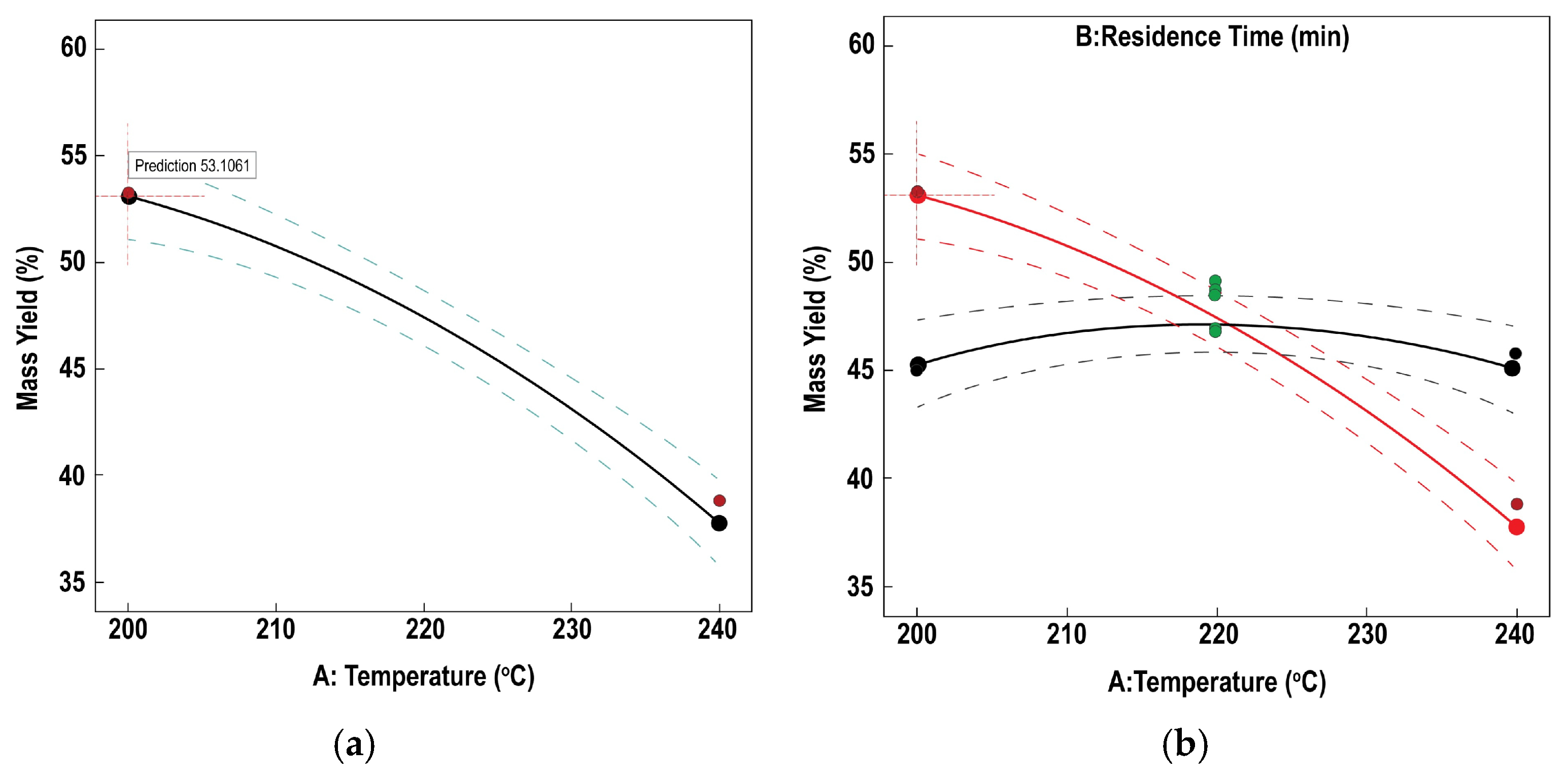
In addition, temperature and the interaction of both factors are significant model terms. As for temperature (A), it is well documented that it is the most significant parameter affecting hydrochar yield. It has a negative effect on mass yield such that increasing it reduces solid return of hydrochar, as shown in Figure 1.
Temperature and residence time (AB) were also found to have a significant interactive effect on hydrochar yield. At a shorter residence time, hydrochar yield does not significantly change as temperature is increased. The reaction is dominated by the initial hydrolysis of hemicellulose and the beginning of cellulose degradation. At this stage, the reaction has not progressed enough for the differences in temperature to cause massive secondary degradation. However, at longer periods, increasing the temperature decreases hydrochar mass yield. Higher temperatures significantly accelerate dehydration and decarboxylation reactions. These “secondary” reactions lead to the loss of oxygen and hydrogen as CO2 and H2O, effectively “burning off” mass to increase the carbon density. Consequently, at longer durations, a higher temperature leads to a much steeper decline in mass yield. This phenomenon was also observed by Luthfi, et al., 2024 [18].

3.2. Optimization and Validation of Co-HTC Process Conditions

Upon optimization of the reaction parameters to maximize the % mass yield, the optimum reaction temperature and residence time were determined to be 200 °C and 60 min, respectively, with a desirability of 0.993. By statistical analysis and significance, these optimized parameters predict a mass yield of 53.106%. Additionally, two separate co-HTC runs were performed following these optimized parameters. These gave mass yields of 52.2146% and 51.1415%, revealing a −2.69% average deviation. This relatively small deviation affirms that the model effectively captures the system behavior and can be used to reliably predict outcomes in co-HTC of CS and LDPE.

3.3. Characterization of Optimum Hydrochar Fractions

3.3.1. Fuel Analysis of Optimum Hydrochar

In Table 5, data for the ultimate analyses of raw CS and LDPE were retrieved from previous studies [19,20], while elemental composition of optimum hydrochar was numerically obtained by Nuchhen estimation [21], except the sulfur content, which is typically considered negligible, expressed through Equations (7)–(10):
C   =     35.9972   +   0.7698 V M   +   1.3269 F C   +   0.3250 A S H
H = 55.3678 0.4830 V M 0.5319 F C 0.5600 A S H
O = 223.6805 1.7226 V M 2.2296 F C 2.2463 A S H
N = 100 C + H + O
HTC significantly increased the FC of cacao shell to hydrochar, as well as decreased its volatile matter, ash, and moisture contents. The optimum hydrochar also possesses lower H and O contents and higher C from its biomass parent which in turn elevated its measured HHV of 21.11 MJ/kg, making carbonization effective and improving its fuel characteristics. The high C content of LDPE may have contributed to the added carbon concentration of optimum hydrochar.

3.3.2. Functional Group Analysis of Hydrochar Fractions

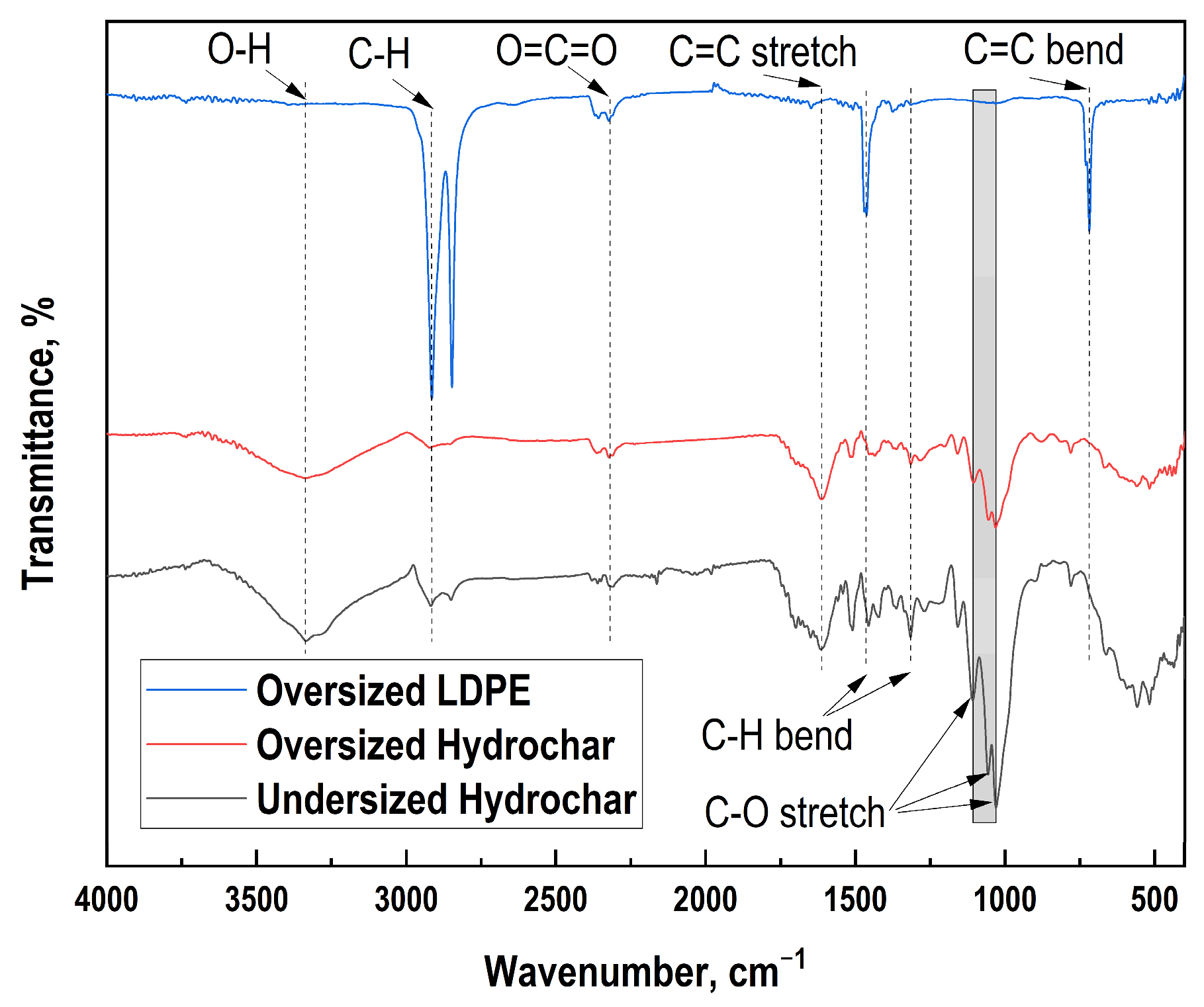
In Figure 2, stacked FTIR spectra provide compelling evidence of undersized hydrochar, oversized hydrochar, and oversized LDPE samples resulting from the co-HTC treatment. The analysis of these spectra reveals fascinating insights into the materials post-treatment. The undersized hydrochar, for instance, presents a classic fingerprint of biomass-derived hydrochar, indicating that the de-oxygenation and aromatization processes have successfully occurred, yet it crucially retains significant amounts of oxygen-containing functional groups (as evidenced by prominent O-H and C-O stretches in the spectral data) [22,23]. Similarly, the oversized hydrochar exhibits a highly consistent chemical nature to its undersized counterpart. While subtle differences in relative peak intensities might hint at slight variations in the degree of carbonization, specific functional group content, or the concentration of inorganic matter, possibly tied to different particle sizes or densities achieved during separation, their overall chemical identity as hydrochar remains highly consistent [24].
The hydrochar fractions are rich in oxygen-containing groups and aromatic structures, evidently found in fingerprint regions, which is consistent with the transformation of biomass during HTC [25]. The LDPE fraction almost exclusively contains aliphatic hydrocarbons, confirming its polyethylene nature. This suggests that polyethylene did not completely degrade. However, the detection of CO2 in post-HTC LDPE indicates a decarboxylation reaction due to interaction with high-temperature water which may not signify full polymer cracking but indicates partial melting of LDPE. Meanwhile, both the undersized and oversized hydrochar fractions show very similar functional group profiles, although distinct peaks are evident in the oversized hydrochar, which is potentially influenced by the particle sizes and residues from co-HTC treatment with LDPE.

3.3.3. Surface Morphology

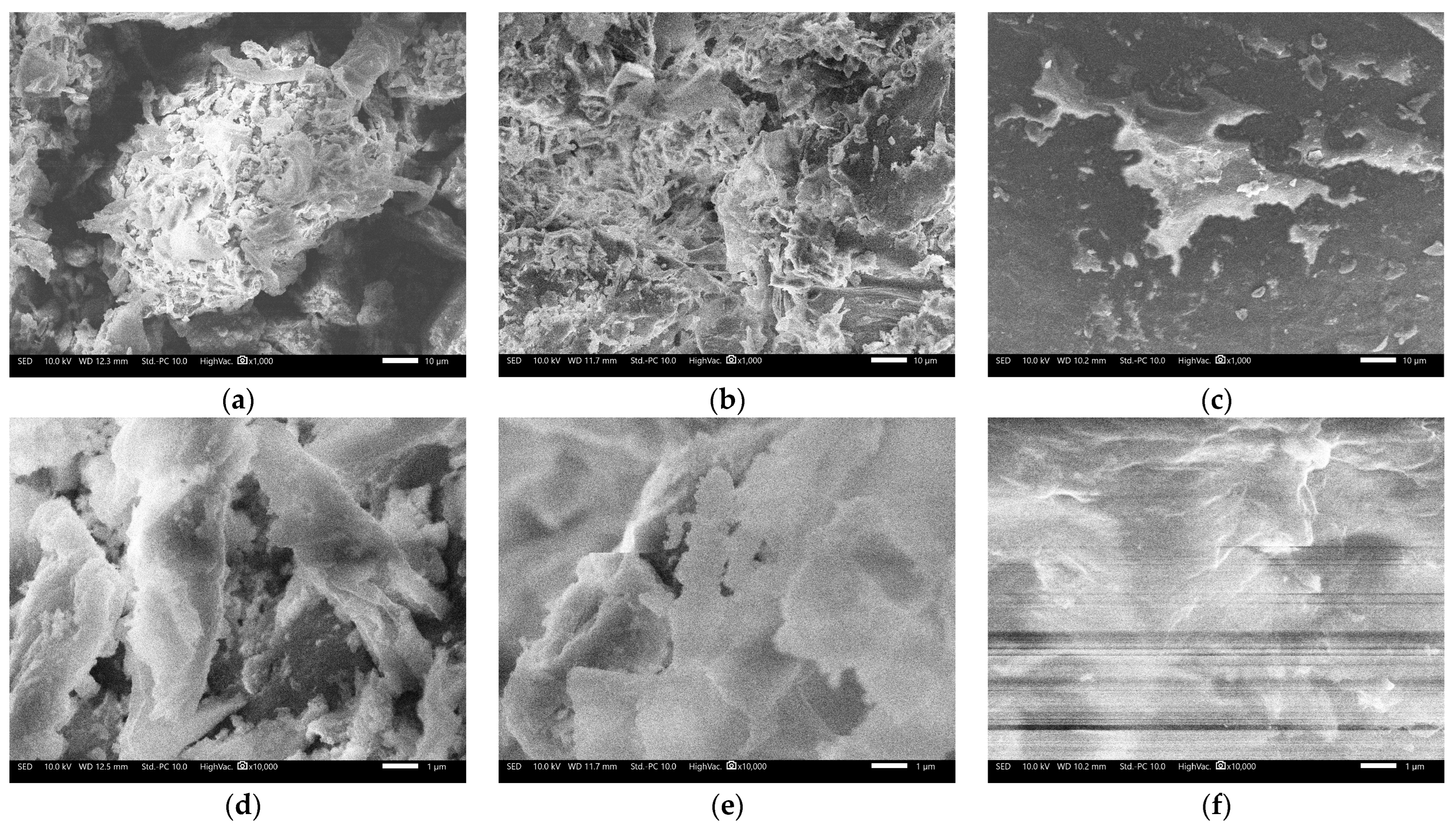
Figure 3 shows that the undersized hydrochar shows an irregular, rough, and highly fibrous surface structure. This is indicative of the decomposition and re-polymerization reactions after HTC treatment, which forms a carbonaceous network with varying degrees of porosity and surface roughness. The fibrous structure suggests high surface area, which is advantageous for energy applications. The absence of melting or fused structures further confirms minimal influence from LDPE in this fraction. The oversized hydrochar presented a heterogeneous and more irregular and coarse structure under SEM imaging. Compared to the undersized sample, this fraction showed a mix of porous and dense regions. These features suggest partial melting or fusion, potentially indicating the interaction between the biomass and LDPE during co-hydrothermal carbonization. The irregularity in the structure hints at uneven heat transfer or incomplete decomposition, which is common when plastics are blended with wet biomass in thermal processes.
In contrast, the SEM images of the oversized LDPE sample present a more homogeneous and slightly glossy surface, lacking the fibrous and porous characteristics seen in the undersized and oversized hydrochar samples, but possessing disoriented particles attached on the surface that would have been otherwise smooth in a pure LDPE. The surface appears flaky and rough, which is indicative of degradation of amorphous regions. The disturbed texture suggests melting and resolidification of LDPE during co-hydrothermal carbonization at 200 °C, which is below its full decomposition temperature but enough to soften or fuse the plastic, which corroborates the FTIR findings. This suggests that co-HTC of plastic wastes with CS resulted in bond cleavage, with the solid residue forming a carbonaceous backbone structure of the original plastic polymer [26].

3.3.4. Elemental Analysis

Table 6 presents the elemental composition of undersized hydrochar, oversized hydrochar, and oversized LDPE, revealing distinct differences reflecting feedstock interactions during co-HTC treatment. Carbon content notably increases with particle size within 83.79% to 99.19%, with oversized LDPE exhibiting the highest carbon purity, consistent with its characteristic polymer [27]. Oversized hydrochar also shows a higher carbon content than undersized hydrochar, indicating the influence of incorporated polymer residues and potentially the presence of inorganic elements [28].
Furthermore, a few trace elements (S, K, Ca, and Zn) were detected inherent from the feedstocks. Undersized hydrochar contains K, Ca, and Zn, which tend to accumulate in the solid residue during co-HTC due to their low volatility. K and Ca are common ash-forming elements in plant biomass, while Zn is a known trace micronutrient. Interestingly, only Ca was detected in oversized hydrochar, likely from CS ash agglomerates. In oversized LDPE, small traces of S and K were found. HTC of LDPE evidently produces sulfur-free hydrochar thus a biomass-to-plastic migration of sulfur might have occurred [26]. During co-HTC at 200 °C, hydrolysis of biomass produces organic acids and sulfate ions (SO42−) that promote electrophilic sulfonation reactions with alkene groups generated from LDPE thermal softening. Sulfur compounds from biomass, such as thiols and sulfates, initially migrate to the aqueous phase before chemically bonding with LDPE chain fragments but at very trace amounts [26,29].

3.4. Thermal Degradation Analysis of Optimized Hydrochar

3.4.1. Thermal Decomposition Behavior

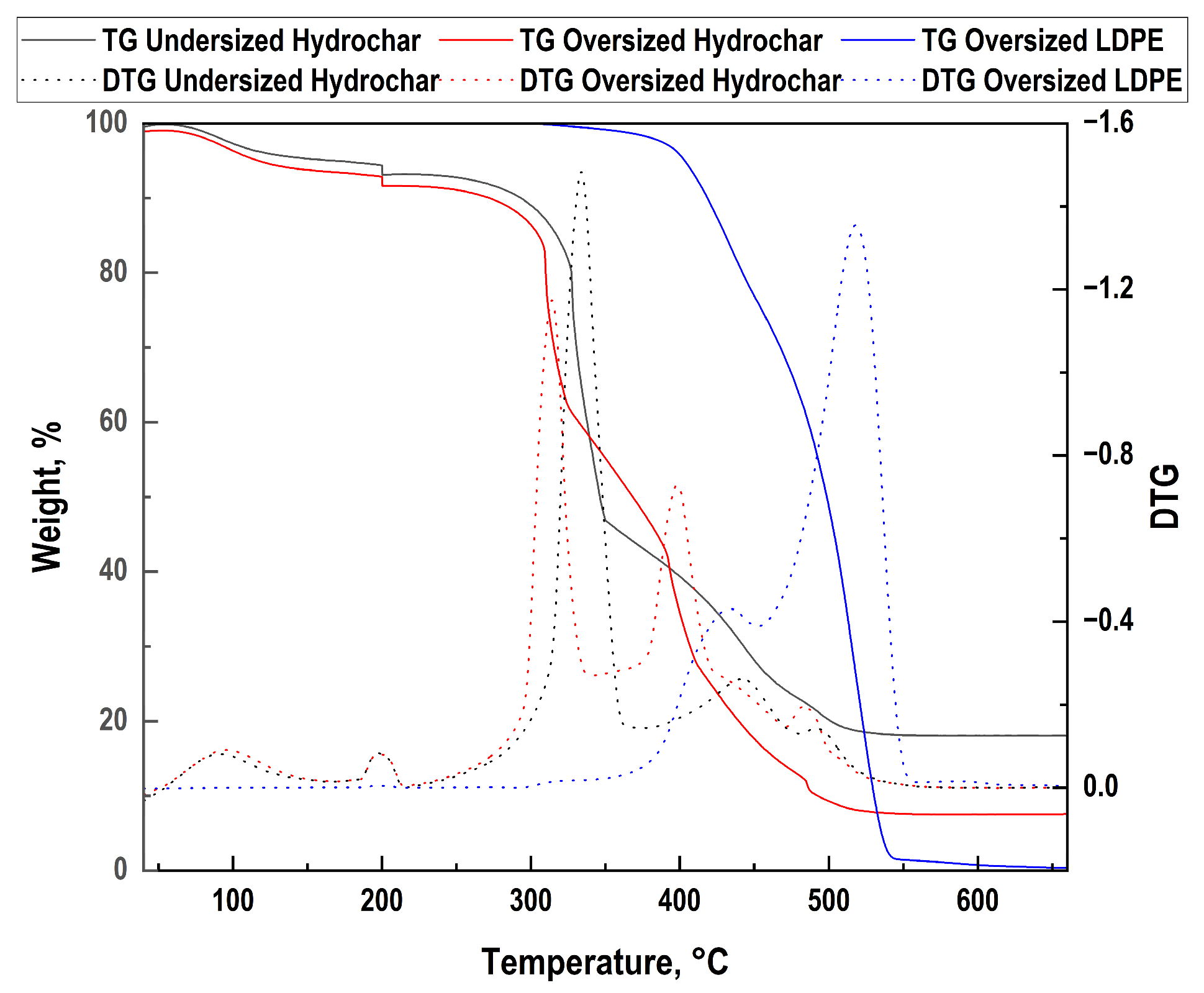
The thermal decomposition characteristics of the undersized hydrochar, oversized hydrochar and the oversized LDPE were analyzed via pyrolysis in TGA with corresponding sample parameters: test type—thermal stability test; temperature of 40 to 650 °C; N2 gas flow rate of 20 mL/min; and heat flow rate of 20 °C/min. The analysis illustrated differences in degradation temperature for both hydrochars and the oversized LDPE. The TG and DTG curves, showing mass loss with respect to temperature, of hydrochar fractions overlap and are shown for comparison. Figure 4 illustrates the TG/DTG curves of these hydrochar fractions.
In the low-temperature region (50–100 °C), minimal weight loss was observed, corresponding to the evaporation of residual moisture and free water, primarily from the hydrochar fractions. Between 100 and 150 °C, a slight mass reduction was detected in the hydrochars, potentially due to the release of low-molecular-weight volatile organics derived during HTC, while LDPE remained thermally stable due to its hydrophobic and chemically inert structure. The enhanced thermal reactivity of undersized hydrochar (steeper slope) is likely due to its larger surface area and more exposed functional groups compared to oversized hydrochar.
The most significant mass loss occurred in the 250–350 °C range, where both hydrochar fractions began active pyrolysis, as evidenced by a sharp weight reduction. This region corresponds to the thermal decomposition of remaining cellulose and hemicellulose-derived intermediates in the hydrochar, while LDPE began to soften and undergo initial chain scission. Complete degradation of LDPE occurred in the 350–550 °C range, marked by a steep mass drop at ~424 °C, showing an early degradation process compared its typical decomposition behavior (about 457 °C) [30]. Meanwhile, the hydrochar fractions continued to decompose, primarily through lignin breakdown and secondary cracking reactions.
These results confirm that co-HTC pre-treatment significantly stabilizes the feedstock and enables staged decomposition during pyrolysis. LDPE enhances the carbon richness and thermal reactivity of the hydrochar, while cacao shell biomass contributes structure and porosity. The combined effect promotes cleaner, energy-dense hydrochar and potentially higher bio-oil or syngas yields during pyrolysis.
The DTG analysis provides valuable insight into the thermal decomposition behavior of the hydrochar fractions and LDPE after co-HTC. The undersized hydrochar exhibited two major degradation peaks: one at approximately 310 °C, corresponding to the decomposition of volatile organics and hemicellulose–cellulose-derived intermediates, and a second, broader peak around 410 °C, associated with the breakdown of thermally stable lignin structures. The higher peak intensity and earlier onset for undersized hydrochar suggest faster overall degradation kinetics, potentially due to its larger surface area and reactivity. The oversized hydrochar followed a similar two-stage pattern, with one peak (~310 °C) being slightly sharper and shifted, while the second peak was observed at approximately 390 °C, which tended to overlap the undersized hydrochar, indicating a more homogeneous carbon matrix likely influenced by the increased LDPE content. The oversized hydrochar’s peak occurring slightly later and being less intense reflects slower heat diffusion and possibly more thermally stable intermediates, influenced by its larger particle size and potentially different structural modifications during co-HTC.
In contrast, the LDPE sample demonstrated a single, intense degradation peak around 490 °C, which aligns with the characteristic pyrolytic breakdown of polyolefin chains. This rapid decomposition is typical of LDPE’s thermal cracking, yielding alkenes and paraffinic compounds with minimal char residue, as investigated by the study of Das and Tiwari (2017) [31]. The sharper degradation transitions observed in LDPE-containing hydrochar suggest that the inclusion of plastic during HTC affects not only the thermal stability of the resultant hydrochar but also its devolatilization kinetics during pyrolysis. Furthermore, the enhanced carbonization and energy density observed in DTG peaks support the viability of co-HTC as a pretreatment for thermochemical valorization of mixed organic–plastic waste streams.

3.4.2. Kinetic and Thermal Parameters

The kinetic parameters were derived using the CR method, assuming a simplified single-step reaction mechanism. Table 7 shows the kinetic parameters obtained for the individual pyrolysis of undersized hydrochar, oversized hydrochar, and oversized LDPE samples during the devolatilization stage at 240–519 °C. The model with the highest R2 was selected as the estimated activation energy for each type of hydrochar fraction.
All 16 solid-state reaction models have been fitted into Equation (2). The model with the highest correlation (largest R2 value) indicates the best-fitted linear line, which is selected as the most appropriate model to describe the reaction. From the results, the first-order model consistently achieved the highest R2 for all hydrochar fractions among all other models. Utilizing the model, the Ea was calculated at 43.084 kJ/mol for undersized hydrochar, 38.484 kJ/mol for oversized hydrochar, and 120.896 kJ/mol for oversized LDPE.
The higher apparent activation energy of undersized hydrochar compared with the oversized hydrochar implies that particle size dictates the thermal stability of hydrochar. Lower-particle-sized hydrochar exhibited higher resistance to bond breaking once initiated. Smaller particles have increased surface area and reactive site density, but this heightens intraparticle diffusion resistance for evolved volatiles during pyrolysis, which may have raised effective Ea due to particle-size-dependent heat transfer efficiency.
The subsequent lower activation energy of undersized and oversized hydrochars indicate that these fractions involve easily decomposable volatiles, potentially a characteristic of fibrous solid-state reactions. In contrast, oversized LDPE possesses a much higher activation energy, characteristic of the stable materials that require robust thermal degradation of long-chain polyethylene and requiring significant energy to break the strong C-C bonds through random chain scission or depolymerization.
Reinforcing the earlier observation on the undersized and oversized hydrochars, Table 8 shows that the lowering of activation energy alongside the increase in particle size is supported by decreased collision frequency. The surface area loss reduces collision frequency often from steric hindrance. This slows the overall rate despite potentially lower Ea, common in treated mixed materials where cross-linking restricts chain mobility [32,33]. However, despite lower A, oversized hydrochar displayed lower Tmax than that of undersized hydrochar, which is uncommon as decreased A typically shifts the Tmax to higher values in pyrolysis kinetics. This trend deviation may be attributed to the treated LDPE residues mixing with the hydrochars. Metal impurities from LDPE lower the energy barrier more than A restricts frequency by providing alternative low-energy reaction pathways. The presence of Ca and K in oversized hydrochar, as shown in Table 6, may have acted as base catalyst precursors and stabilized intermediates, often dominating over low A to lower Tmax. In a study by Yu et al., 2021, it was found that AAEMs, including Ca and K, have a positive effect on the pyrolysis of hydrochar via ion exchange, forming AAEM-carboxylates which inhibit the generation of cross-linked structures, thereby delaying thermal decomposition [34]. Undersized hydrochar may have possessed alkalis K and Ca, but its Zn content cancels the catalytic effect.
Oversized LDPE exhibited a high Ea of 120.896 kJ/mol, but this is lower than the reported 271 kJ/mol for pyrolysis of LDPE [35]. This lowered value can be associated with the cleavage of C-C bonds in long-chain polyethylene structures. This process aligns with random chain scission mechanisms, commonly reported in polyolefin pyrolysis. The high A in oversized LDPE indicates rapid degradation once the activation threshold is reached.
The remaining thermodynamic values across samples support the non-spontaneous and endothermic nature of pyrolysis, requiring external energy to sustain decomposition.
From Table 9, it can be observed that the thermal degradation peak temperature virtually remains unchanged but with a large difference on the apparent activation energy. From an activation energy of raw LDPE at 242.9 kJ/mol, the hydrothermally treated LDPE has relatively lower thermal stability at an activation energy of 128.85 kJ/mol. This reinforces the effectivity of the hydrothermal treatment to destabilize LDPE and make it more easily susceptible to inner bond breakage when subjected to thermal regime. This further supports the effectivity of the co-HTC pathway towards relatively easier cracking of LDPE.

4. Conclusions

The present study showed the feasibility and advantages of utilizing hydrochar derived from the co-HTC of CS and LDPE as a waste management mechanism of biomass–plastic waste blends for solid fuel application. Morphological analysis through SEM-EDX revealed distinct surface features across the three hydrochar fractions, supporting the effectiveness of sieving as a separation method. The elemental analysis confirmed the presence of both organic (biomass) and inorganic (polymer) elements, aligning with the expectation that the carbon content increases with particle size within 83.79% to 99.19% of fractions. FTIR analysis confirmed the presence of both biomass (cellulose/lignin) and plastic-derived (polyethylene structures) functional groups in the hydrochar fractions, indicating chemical interaction and partial degradation of LDPE during co-HTC. And lastly, TGA showed that the produced hydrochar exhibited enhanced thermal stability compared to untreated biomass and altered pyrolysis kinetics of LDPE. Moreover, the activation energy values and thermal decomposition profiles indicate favorable characteristics for pyrolytic fuel production and energy recovery. Furthermore, studies that utilize hydrothermal carbonization as a thermal degradation process can also be done for other types of plastics and biomass. Future research is still needed to explore specific interactive mechanisms to improve its efficiency for real-world applications.

Author Contributions

Writing—Original Draft, M.F.A.A.; Writing—Review and Editing, M.F.A.A.; Visualization, Software, and Data Validation, A.P.V.D.P.; Data Curation, Q.M.M.I., C.O.O., A.J.Q.B., R.M.E.M., and J.P.S.; Methodology, K.M.U.U. and J.M.B.T.; Validation, R.D.G. and R.R.M.A.; Conceptualization, A.O.M.; Funding Acquisition, A.O.M. All authors have read and agreed to the published version of the manuscript.

Funding

This research was funded by the Department of Science and Technology—Philippine Council for Industry, Energy, and Emerging Technology Research and Development (DOST-PCIEERD), with a Funding number 11217.

Data Availability Statement

The authors confirm that all data used in this study are openly available within the article. Further inquiries can be directed to the corresponding authors.

Acknowledgments

The authors would like to acknowledge the immense support of the Department of Science and Technology—Philippine Council for Industry, Energy, and Emerging Technology Research and Development (DOST-PCIEERD) for providing research funding, and to the Mindanao State University—Iligan Institute of Technology for providing the laboratory facilities, equipment, analyses, and materials.

Conflicts of Interest

The remaining authors declare that the research was conducted in the absence of any commercial or financial relationships that could be construed as a potential conflict of interest.

References

  1. Rafey, A.; Siddiqui, F.Z. A review of plastic waste management in India—Challenges and opportunities. Int. J. Environ. Anal. Chem. 2023, 103, 3971–3987. [Google Scholar] [CrossRef]
  2. Chamas, A.; Moon, H.; Zheng, J.; Qiu, Y.; Tabassum, T.; Jang, J.H.; Abu-Omar, M.; Scott, S.; Suh, S. Degradation rates of plastics in the environment. ACS Sustain. Chem. Eng. 2020, 8, 3494–3511. [Google Scholar] [CrossRef]
  3. Yao, D.; Li, H.; Mohan, B.C.; Prabhakar, A.K.; Dai, Y.; Wang, C.-H. Conversion of Waste Plastic Packings to Carbon Nanomaterials: Investigation into Catalyst Material, Waste Type, and Product Applications. ACS Sustain. Chem. Eng. 2022, 10, 1125–1136. [Google Scholar] [CrossRef]
  4. Jambeck, J.R.; Geyer, R.; Wilcox, C.; Siegler, T.R.; Perryman, M.; Andrady, A.; Narayan, R.; Law, K.L. Marine pollution. Plastic waste inputs from land into the ocean. Science 2015, 347, 768–771. [Google Scholar] [CrossRef]
  5. Ghatge, S.; Yang, Y.; Ahn, J.-H.; Hur, H.-G. Biodegradation of polyethylene: A brief review. Appl. Biol. Chem. 2020, 63, 27. [Google Scholar] [CrossRef]
  6. Vásquez, Z.S.; de Carvalho Neto, D.P.; Pereira, G.V.M.; Vandenberghe, L.P.S.; de Oliveira, P.Z.; Tiburcio, P.B.; Rogez, H.L.; Neto, A.G.; Soccol, C.R. Biotechnological approaches for cocoa waste management: A review. Waste Manag. 2019, 90, 72–83. [Google Scholar] [CrossRef]
  7. Arellano, O.; Flores, M.; Guerra, J.; Hidalgo, A.; Rojas, D.; Strubinger, A. Hydrothermal Carbonization of Corncob and Characterization of the Obtained Hydrochar. Chem. Eng. Trans. 2016, 50, 235–240. [Google Scholar]
  8. Shen, Y. A review on hydrothermal carbonization of biomass and plastic wastes to energy products. Biomass Bioenergy 2020, 134, 2–18. [Google Scholar] [CrossRef]
  9. Islam, M.T.; Reza, T.; Klinger, J.; Saha, N. Co-hydrothermal carbonization (Co-HTC) of biomass-plastic blend: Enhancement of fuel quality. In Proceedings of the 2021 AIChE Annual Meeting, Boston, MA, USA, 7–11 November 2021. [Google Scholar]
  10. Niedzwiecki, L.; Moscicki, K.; Bijl, A.; Owczarek, P.; Arora, A.; Wnukowski, M.; Aragon-Briceno, C.; Vishwajeet; Pawlak-Kruczek, H.; Bramer, E.; et al. Influence of Hydrothermal Carbonization on Catalytic Fast Pyrolysis of Agricultural Biomass. Appl. Sci. 2023, 13, 4190. [Google Scholar] [CrossRef]
  11. Sekar, S.; Venkatachalam, C.D.; Sengottian, M.; Ravichandran, S.R. Hydrothermal co-processing of plastic waste with lignocellulosic biomass and its application as a supercapacitor material. J. Energy Storage 2024, 104, 114475. [Google Scholar] [CrossRef]
  12. Marchelli, F.; Gioia, C.; Lombini, S.; Andreottola, G.; Fiori, L. Hydrothermal carbonization of bioplastics and plastics: A promising approach for handling mixed waste. Chem. Eng. J. 2026, 532, 174526. [Google Scholar] [CrossRef]
  13. Ong, M.Y.; Nomanbhay, S.; Rosman, C.U.A.A.C.; Yusaf, T.; Silitonga, A.S. Hydrochar production through co-hydrothermal carbonization of water hyacinth and plastic waste. IOP Conf. Ser. Earth Environ. Sci. 2023, 1372, 012034. [Google Scholar] [CrossRef]
  14. Barontini, F.; Vitolo, S.; Gori, R.; Trivelli, L.; Puccini, M. The Hydrothermal Carbonization Process for Waste Valorisation: A Study on the Effect of Process Conditions on the Yield and Properties of Hydrochars from Municipal Solid Waste. Chem. Eng. Trans. 2023, 99, 181–186. [Google Scholar]
  15. Missaoui, A.; Bostyn, S.; Belandria, V.; Cagnon, B.; Sarh, B.; Gökalp, I. Hydrothermal carbonization of dried olive pomace: Energy potential and process performances. J. Anal. Appl. Pyrolysis 2017, 128, 281–290. [Google Scholar] [CrossRef]
  16. Mian, I.; Li, X.; Jian, Y.; Dacres, O.D.; Zhong, M.; Liu, J.; Ma, F.; Rahman, N. Kinetic study of biomass pellet pyrolysis by using distributed activation energy model and Coats Redfern methods and their comparison. Bioresour. Technol. 2019, 294, 122099. [Google Scholar] [CrossRef]
  17. Monir, M.U.; Shovon, S.M.; Akash, F.A.; Habib, M.A.; Techato, K.; Aziz, A.A.; Chowdhury, S.; Prasetya, T.A.E. Comprehensive characterization and kinetic analysis of coconut shell thermal degradation: Energy potential evaluated via the Coats-Redfern method. Case Stud. Therm. Eng. 2024, 55, 104186. [Google Scholar] [CrossRef]
  18. Luthfi, N.; Fukushima, T.; Wang, X.; Takisawa, K. Significance and Optimization of Operating Parameters in Hydrothermal Carbonization Using RSM–CCD. Thermo 2024, 4, 82–99. [Google Scholar] [CrossRef]
  19. Adeboye, B.S.; Idris, M.O.; Adedeji, W.O.; Kayode, O.; Adefajo, A.A.; Rabiu, K.O. Thermogravimetric Analysis and Kinetic Study on the Pyrolysis of Some Post-Consumer Plastic Wastes. Prem. J. Eng. Appl. Sci. 2022, 3, 1–9. [Google Scholar]
  20. Adeyanju, A.A. Comparisons of Cocoa Pod Husks and other Biomass Wastes for Syngas Production. E3S Web Conf. 2022, 336, 00037. [Google Scholar] [CrossRef]
  21. Nhuchhen, D.R. Prediction of carbon, hydrogen, and oxygen compositions of raw and torrefied biomass using proximate analysis. Fuel 2016, 180, 348–356. [Google Scholar] [CrossRef]
  22. Magdziarz, A.; Wilk, M.; Wądrzyk, M. Pyrolysis of hydrochar derived from biomass—Experimental investigation. Fuel 2020, 267, 117246. [Google Scholar] [CrossRef]
  23. Wu, S.; Wang, Q.; Cui, D.; Sun, H.; Yin, H.; Xu, F.; Wang, Z. Evaluation of fuel properties and combustion behaviour of hydrochar derived from hydrothermal carbonisation of agricultural wastes. J. Energy Inst. 2023, 108, 101209. [Google Scholar] [CrossRef]
  24. Teribele, T.; Costa, M.E.G.; Sales da Silva, C.d.M.; Pereira, L.M.; Bernar, L.P.; de Castro, D.A.R.; Assunção, F.P.d.C.; Santos, M.C.; Brandão, I.W.d.S.; Shultze, C.J.N.; et al. Hydrothermal Carbonization of Corn Stover: Structural Evolution of Hydro-Char and Degradation Kinetics. Energies 2023, 16, 3217. [Google Scholar] [CrossRef]
  25. Raja, W.; Ali, U.; Gupta, A.; Kumar, P. Agricultural Waste Management by Hydrothermal Carbonization. IARS Int. Res. J. 2022, 12, 82–88. [Google Scholar] [CrossRef]
  26. Che, C.A.; Heynderickx, P.M. Hydrothermal carbonization of plastic waste: A review of its potential in alternative energy applications. Fuel Commun. 2024, 18, 100103. [Google Scholar] [CrossRef]
  27. Canopoli, L.; Coulon, F.; Wagland, S.T. Degradation of excavated polyethylene and polypropylene waste from landfill. Sci. Total Environ. 2020, 698, 134125. [Google Scholar] [CrossRef]
  28. Ainali, N.M.; Bikiaris, D.N.; Lambropoulou, D.A. Aging effects on low- and high-density polyethylene, polypropylene and polystyrene under UV irradiation: An insight into decomposition mechanism by Py-GC/MS for microplastic analysis. J. Anal. Appl. Pyrolysis 2021, 158, 105207. [Google Scholar] [CrossRef]
  29. Wang, Z.; Huang, J.; Wang, J.; Hu, Z.; Xu, M.; Qiao, Y. Co-hydrothermal carbonization of sludge and food waste for hydrochar valorization: Effect of mutual interaction on sulfur transformation. Sci. Total Environ. 2023, 905, 167318. [Google Scholar] [CrossRef]
  30. Upare, D.P.; Lee, C.W.; Lee, D.K.; Kang, Y.S. Effect of acidity of solid acid catalysts during non-oxidative thermal decomposition of LDPE. Carbon Lett. 2025, 35, 277–285. [Google Scholar] [CrossRef]
  31. Das, P.; Tiwari, P. Thermal degradation kinetics of plastics and model selection. Thermochim. Acta 2017, 654, 191–202. [Google Scholar] [CrossRef]
  32. Polgar, L.M.; Kingma, A.; Roelfs, M.; van Essen, M.; van Duin, M.; Picchioni, F. Kinetics of cross-linking and de-cross-linking of EPM rubber with thermoreversible Diels-Alder chemistry. Eur. Polym. J. 2017, 90, 150–161. [Google Scholar] [CrossRef]
  33. Sbirrazzuoli, N.; Vyazovkin, S. Two step model for crosslinking polymerization with account of diffusion. Chem. Eng. J. 2024, 481, 148414. [Google Scholar] [CrossRef]
  34. Yu, J.; Guo, Q.; Ding, L.; Gong, Y.; Yu, G. Study on the effect of inherent AAEM on char structure evolution during coal pyrolysis by in-situ Raman and TG. Fuel 2021, 292, 120406. [Google Scholar] [CrossRef]
  35. Xie, W.; Su, J.; Zhang, X.; Li, T.; Wang, C.; Yuan, X.; Wang, K. Investigating kinetic behavior and reaction mechanism on autothermal pyrolysis of polyethylene plastic. Energy 2023, 269, 126817. [Google Scholar] [CrossRef]
Figure 1. (a) Significant interaction of Temperature with Mass Yield, (b) Two-factor interaction with Mass Yield, where the black line represents the shorter residence time and the red line represents the longer period.
Fuels 07 00027 g001
Figure 2. Stacked normalized IR spectra of undersized hydrochar, oversized hydrochar, and oversized LDPE.
Fuels 07 00027 g002
Figure 3. Micrograph (SEM images) obtained for hydrochar fractions after co-HTC treatment. (a) Undersized hydrochar @1000x, (b) Oversized hydrochar @1000x, (c) Oversized LDPE @1000x, (d) Undersized hydrochar @10,000x, (e) Oversized hydrochar @10,000x, (f) Oversized LDPE @10,000x.
Fuels 07 00027 g003
Figure 4. TG/DTG curves of undersized hydrochar, oversized hydrochar and oversized LDPE.
Fuels 07 00027 g004
Table 1. Summary of experimental design.
Reaction Parameter−1 Level+1 LevelResponse
Reaction Temperature200 °C240 °CMass Yield (%)
Residence Time30 min60 min
Table 2. Mathematical expressions for g(α) according to different solid-state reaction mechanism models.
Mechanismg(α)Code
Power Lawn = 1/2α1/2P2
n = 1/3 α1/3P3
n = 1/4 α1/4P4
Chemical ReactionsFirst order−ln(1 − α)R1
One-and-a-half order2[(1 − α)−1.5 − 1]R1.5
Second order[1/(1 − α)] − 1R2
Diffusion ReactionOne-dimensional diffusionα2D1
Two-dimensional diffusion(1 − α) − ln(1 − α) + αD2
Three-dimensional diffusion—Jander [1 − (1 − α)1/3]2D3
Three-dimensional diffusion—Gistling–Brounsthein(1 −  2 3 ) − (1 − α)2/3D4
Phase Interfacial ReactionOne dimensionαP1
Two dimensions (Cylindrical)1 − (1 − α)1/2C1
Three dimensions (Sphere)1 − (1 − α)1/3C2
Nucleation and Growth ReactionTwo-dimensional[−ln(1 − α)]1/2A2
Three-dimensional[−ln(1 − α)]1/3A3
2/3 Avrami Erofeev[−ln(1 − α)]2/3A4
Table 3. Summary of experimental runs and results.
Temperature, °CResidence Time, minMass Yield, %
240.030.0045.72
220.045.0049.09
200.060.0053.22
248.345.0037.49
220.045.0048.55
220.045.0048.67
240.060.0038.82
220.045.0046.69
220.066.2146.11
220.023.7946.21
191.745.0049.80
220.045.0046.92
200.030.0045.03
Table 4. ANOVA for HTC conditions at 95% confidence level.
SourceSum of SquaresdfMean SquareF-Valuep-Value
Model206.67541.3335.88<0.0001
A-Temperature121.091121.09105.10<0.0001
B-Residence Time0.1632210.16320.14170.7178
AB56.94156.9449.430.0002
A227.00127.0023.440.0019
B23.5313.533.070.1233
Residual8.0671.15
Lack-of-Fit3.2331.080.88850.5195
Pure Error4.8441.21
Cor Total214.7312
Table 5. Ultimate and proximate compositions of optimum hydrochar.
ElementUltimate AnalysisProximate AnalysisHHV (MJ/kg)
C (%)H (%)O (%)N
(%)
S (%)M (%)FC (%)VM (%)Ash (%)
Cacao Shell39.875.9645.330.740.1312.6618.4260.957.9716.20
Optimum Hydrochar 56.175.0231.846.97-2.5231.4060.046.0421.11
LDPE93.765.740.50--1.20-98.300.5040.60
Table 6. EDX mean elemental composition of hydrochar fractions.
ElementC (%)S (%)K (%)Ca (%)Zn (%)
Undersized Hydrochar83.79-9.082.744.39
Oversized Hydrochar90.40--9.60-
Oversized LDPE99.190.801.28--
Table 7. Activation energy (Ea) and reaction model for pyrolysis of the hydrochar fractions.
SampleEa (kJ/mol)Reaction ModelR2 (%)
Undersized Hydrochar43.085R192.347
Oversized Hydrochar38.484R196.931
Oversized LDPE120.896R198.196
Table 8. Thermokinetic parameters for pyrolysis of the hydrochar fractions.
SampleTmax E a
( k J mol )
H
( k J mol )
G
( J mol )
S
( J mol   K )
A
( min 1 )
Undersized334.6143.08538.0331.826 × 105−237.931769.311
Oversized314.5038.48433.6001.774 × 105−244.830324.758
Oversized LDPE518.06120.896114.3192.284 × 105−144.2187.87 × 107
Table 9. Comparative analysis on kinetic parameters of oversized LDPE and raw LDPE.
SamplesTmax (°C)Ea (kJ/mol)
Oversized LDPE518.06128.85
Raw LDPE [19]519.00242.90
Disclaimer/Publisher’s Note: The statements, opinions and data contained in all publications are solely those of the individual author(s) and contributor(s) and not of MDPI and/or the editor(s). MDPI and/or the editor(s) disclaim responsibility for any injury to people or property resulting from any ideas, methods, instructions or products referred to in the content.