1. Introduction
In oil and gas development, accurate identification of the production profile is fundamental for establishing rational production strategies and optimizing wellbore management. Nowadays, horizontal wells have become a key tool in hydrocarbon exploitation because they significantly increase the contact area between the wellbore and the reservoir, thereby enhancing production [
1]. However, horizontal wells in heterogeneous reservoirs also present certain drawbacks. Due to reservoir heterogeneity around the wellbore and associated pressure-drop effects, different perforation clusters contribute unevenly to production, resulting in reduced output. Therefore, investigating the production profiles of gas wells is an effective means of improving recovery efficiency [
2,
3,
4].
Conventional production logging methods, such as the Production Logging Tool (PLT), estimate productivity distribution along the wellbore by measuring flow velocity and fluid phase behavior inside the borehole [
5]. Although these tools can directly measure fluid parameters, they require multiple logging runs [
6]. Moreover, the data obtained represent only specific intervals at discrete times, which prevents real-time monitoring of gas migration within the wellbore. As a result, such methods are inherently limited in both dynamic monitoring capability and full-well coverage [
7].
Distributed Fiber-Optic Sensing (DFOS) has introduced a new paradigm for continuous monitoring in oil and gas wells. Distributed Temperature Sensing (DTS), based on the Raman scattering effect in optical fibers, enables continuous temperature measurements along the entire wellbore, and the production rates of individual intervals can be inverted through a wellbore–formation coupled heat-transfer model [
8,
9]. Since Ramey proposed the first classical wellbore heat transmission model in 1962 and derived analytical solutions for temperature variation with time and depth [
10], wellbore heat-transfer theory has served as the theoretical foundation of DTS interpretation models. Hasan and Kabir later developed improved models that more comprehensively describe the coupled heat transfer between wellbore and formation under transient conditions, overcoming limitations of Ramey’s approximations [
11]. Yoshioka further established a steady-state wellbore–reservoir coupled thermal model, providing solutions for temperature profiles in near-horizontal wells under steady-flow conditions [
12]. For conventional horizontal wells, Yoshioka and colleagues also proposed temperature models to interpret gas production profiles from DTS measurements [
13,
14].
Numerous new applications of DTS have emerged in the oil and gas industry, such as monitoring CO
2 sequestration [
15], long-term wellbore integrity surveillance [
16], production profiling [
17,
18] (Ouyang and Belanger, 2004; Jin et al., 2019), thermal characterization of hydraulic fracturing [
19], and assessment of fracturing efficiency [
20].
The high temporal and spatial resolution of DTS allows real-time acquisition of full-well responses under various production regimes, enabling quantitative interpretation. However, fiber attenuation (hydrogen-induced loss) reduces monitoring capability, and the trade-off between signal-to-noise ratio and resolution is strongly influenced by gauge length selection [
21]. Compared with PLT, DTS monitoring still offers significant advantages, such as reduced on-site manpower, lower risk to wellbore integrity and tool loss, and avoidance of production downtime [
22,
23].
DTS has therefore become an important tool in oil and gas well monitoring, particularly for acquiring high-resolution temperature profiles along the entire wellbore. Nevertheless, relying on DTS alone for production profile interpretation has inherent limitations. Its spatial resolution and accuracy are constrained by fiber scattering properties and signal attenuation, leading to high noise in distal intervals [
24]. Furthermore, DTS interpretation depends heavily on numerical models, and if factors such as gas compressibility and frictional losses are not adequately accounted for, substantial errors may result [
25]. Temperature calibration using high-precision bottomhole gauges can mitigate some of these uncertainties [
26]. Consequently, DTS is better suited as a complementary tool to be integrated with other interpretation methods or sensing techniques, rather than serving as a standalone approach.
Complementary to DTS is Distributed Acoustic Sensing (DAS), a technology based on the principle of coherent optical interference, which transforms optical fibers into linear arrays of sensors capable of capturing vibration energy along the wellbore.
DAS has been applied in various fields, including passive seismic imaging in urban environments [
27], gas-lift monitoring [
28], and multiphase flow rate measurements [
29] (Fidaner, 2017). In production monitoring, DAS data have been used to correlate acoustic intensity along the wellbore with inflow rates [
30,
31].
DAS records the acoustic response or strain rate along the wellbore, from which fluid migration activities can be inferred based on energy features. However, the amplitude of acoustic signals is strongly influenced by flow regime, completion structure, and coupling quality. Consequently, high acoustic energy does not necessarily correspond to high production, and misinterpretations can occur during wellbore backflow or gas–liquid phase transitions [
32].
In recent years, joint interpretation of DTS and DAS has become a research hotspot. To address their complementary limitations, multi-source data fusion strategies have been proposed, although a unified coupled model and standardized application framework are still lacking [
33].
This study aims to overcome the individual limitations of DTS and DAS in horizontal gas well production profiling by developing a joint interpretation method based on physical constraints and multi-source fusion. In the proposed approach, the Joule-Thomson effect is considered in the interpretation of DTS temperature responses for gas wells, while apparent velocity features extracted from DAS are employed as prior constraints to enhance the accuracy of interval production identification. Field applications demonstrate that this method performs robustly under high-, medium-, and low-production regimes as well as shut-in conditions, providing a reliable solution for production profiling under complex operational scenarios.
2. Monitoring Methods and Interpretation Models
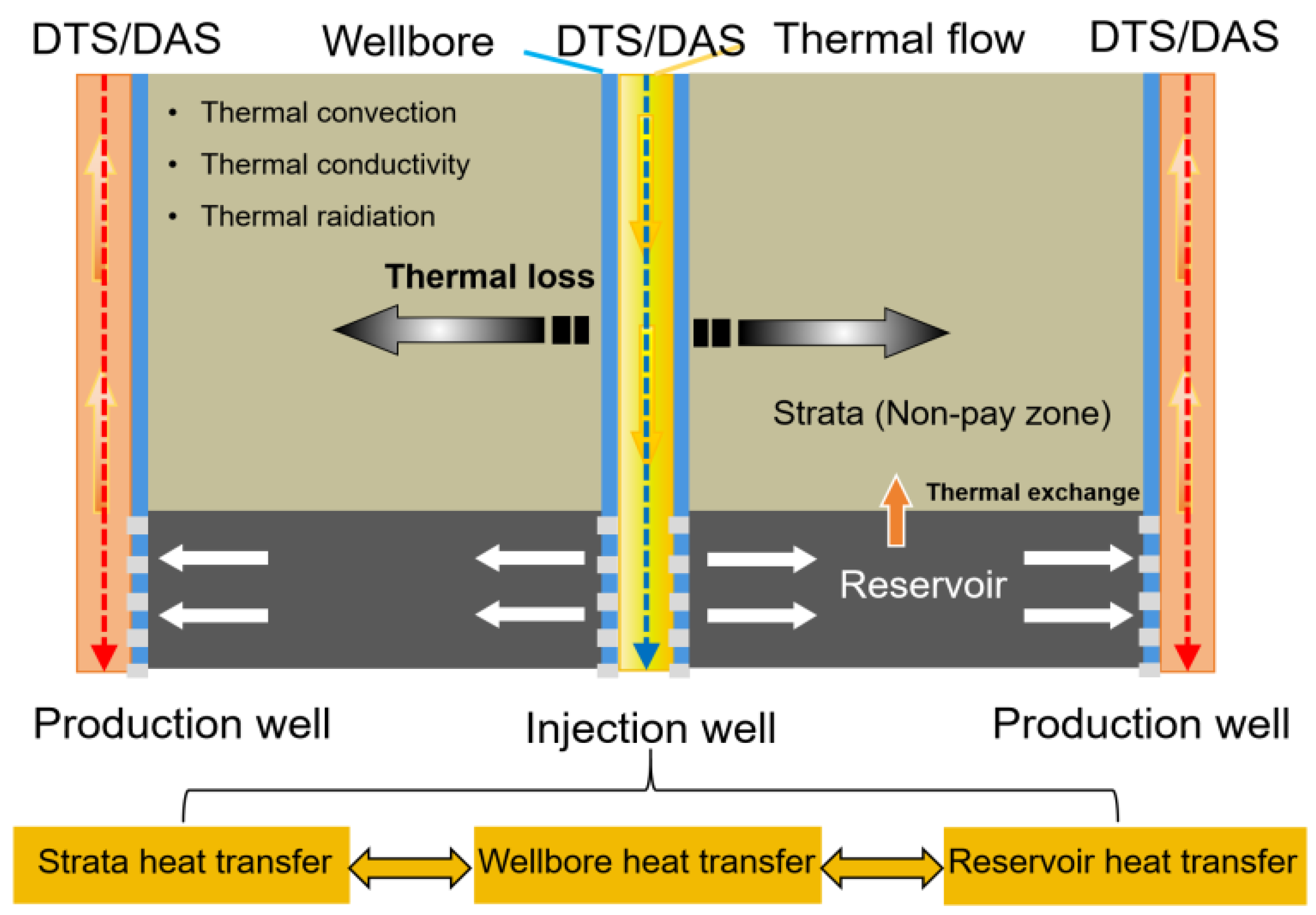
The conceptual interpretation framework used in this study is illustrated in
Figure 1. DTS and DAS systems are deployed in the production well. Through heat exchange between the wellbore and the reservoir/formation, DTS and DAS can detect the corresponding phase variations along the optical fiber. After being processed by interrogators, the DTS and DAS data are acquired and subsequently analyzed using their respective interpretation models to enable quantitative profiling of well production.
2.1. DTS-Based Production Profiling Model
The DTS technique acquires real-time temperature profiles along the wellbore using optical fibers. Heat transfer between wellbore fluid and the surrounding formation is primarily governed by convection and conduction, and the coupled process can be described using a one-dimensional heat-transfer model that assumes quasi-steady thermal behavior within short production windows.
where
is the wellbore fluid temperature;
is the formation/reference temperature (obtained from shut-in stabilization or forward-modeled geothermal gradients);
denotes the axial flow velocity and is assumed to be locally constant within each discretized segment, representing an average velocity over the interval;
are fluid density and specific heat;
is the cross-sectional area of the wellbore;
is the effective thermal diffusivity of the fluid;
is the wellbore-formation heat-transfer coefficient; the term
represents an equivalent linear heat source induced by fluid inflow or outflow at perforated intervals. It accounts for the enthalpy exchange between reservoir fluids and the wellbore flow and is proportional to the local mass flow rate and the temperature difference between the inflowing fluid and the wellbore; and
is the convective heat-transfer coefficient between the wellbore and the formation. In this study, the steady-state assumption refers to quasi-steady thermal behavior within short production windows, rather than fully steady flow conditions, which allows the temperature field to be interpreted as locally stabilized during each operating regime. In gas wells, temperature variations along the wellbore are influenced not only by conductive and convective heat transfer, but also by thermodynamic effects associated with gas expansion, such as the Joule–Thomson effect. In this study, the Joule–Thomson effect is not modeled as a separate explicit source term in the governing equation. Instead, its influence is inherently embedded in the measured DTS temperature profiles under different operating conditions, which are interpreted through comparison with the reference geothermal profile and calibrated using downhole pressure and temperature measurements. This treatment is consistent with the practical objective of production interval discrimination rather than a fully closed thermodynamic energy balance. It should be noted that the term ‘steady-state’ in this study does not imply fully stabilized flow conditions over long time scales. Instead, it refers to quasi-steady thermal behavior within limited production windows during which operational parameters (e.g., production rate and pressure) remain approximately constant. Under such conditions, the thermal response along the wellbore evolves slowly compared to the time scale of flow redistribution, allowing the temperature field to be interpreted as locally stabilized for inversion purposes.
The left-hand side of Equation (1) represents convective heat transport, while the terms on the right-hand side correspond to axial conduction, heat sources due to segmental inflow/outflow, and heat dissipation to the formation, respectively.
The DTS-based inversion is performed under well-defined physical constraints. The reference temperature is derived from the geothermal profile or synthetic geothermal curve constructed during shut-in conditions. Boundary conditions are imposed at the wellhead and bottomhole based on measured temperature data, while thermal and fluid properties are treated as effective parameters representative of average wellbore conditions. The inversion is further regularized to ensure smooth variation in segmental flow contributions along the wellbore, preventing non-physical oscillations.
By discretizing the wellbore along its length into grid nodes with spacing , and assuming M perforation intervals, the source terms can be denoted as .
The inflow/outflow term is treated as a constant within each perforated interval, and the parameter vector is expressed as .
By applying a second-order finite difference to Equation (1), the following linear system is obtained (Equation (2)):
Here, denotes the coefficient matrix after discretization, which is derived from the expansion of Equation (1). The wellbore parameters include the cross-sectional area and the wellbore-formation heat-transfer coefficient . The fluid parameters include density , specific heat , velocity . The thermal parameter is the effective thermal diffusivity , while the discretization step is the grid spacing . Thus, matrix encapsulates the physical properties of the coupled wellbore—fluid—formation system.
is the temperature vector at the discretized grid points of the wellbore. is the segmental source matrix that maps the production parameters of each perforation interval onto the grid nodes. represents the effective heat-source intensity of each perforated interval. denotes the reference temperature, which includes the baseline geothermal distribution.
By fitting the model to the measured DTS temperatures
, the parameter
are obtained using a least-squares optimization (Equation (3)):
where
is the weighting matrix;
is the regularization parameter;
is the first-order difference operator, which imposes smoothness on the solution to avoid abrupt changes in flow rates between adjacent intervals. This constitutes a form of Tikhonov (L2) regularization.
By applying the proportional relationship between heat energy and flow rate, the segmental production parameter
can be mapped to the volumetric flow rate of interval
m, denoted as
, as shown in Equation (4):
where
is a comprehensive coefficient that includes fluid density and specific heat, wellbore parameters, interval characteristics, and heat-transfer correction factors. The total measured production is used for a one-time calibration of
in Equation (4), after which the contributions of different regimes and time periods can be compared. In this study,
β is treated as a calibration coefficient determined from the total measured production and is primarily used for relative comparison of interval contributions across different production regimes, rather than as an absolute physical constant.
The normalized contribution of each interval is then expressed as Equation (5):
If negative apparent velocity and backflow are present during the shut-in period (causing temperatures not to fully recover to the original geothermal state), the shut-in temperature cannot be directly used as the reference; denotes the volumetric flow rate of the j-th perforation interval; and the summation is taken over all perforated intervals along the wellbore. Instead, a synthetic geothermal gradient curve must be applied for production inversion.
2.2. DAS Signal Processing and Velocity Feature Extraction
The DAS technique employs interferometric demodulation, using the optical fiber as a continuously distributed acoustic sensor array. Fluid flow, gas–liquid interactions, and wellbore structural variations induce phase changes in the backscattered light, which manifest as variations in acoustic energy amplitude and frequency characteristics.
The raw DAS data are first read and resampled, followed by preprocessing steps including detrending to remove low-frequency drift. Subsequently, frequency-band energy analysis is applied to the preprocessed data.
The full-band signal is divided into multiple frequency bands, and the Short-Time Fourier Transform (STFT) is applied to calculate the distribution of acoustic energy in the depth-time domain for each band:
where
represents the amplitude of the time—frequency spectrum.
The root-mean-squared (RMS) values of the spectral amplitudes within each frequency band are then calculated, yielding the frequency-band energy distribution.
denotes the frequency-band energy at depth z and time window t, which is calculated as the RMS amplitude of the band-pass filtered DAS signal within the selected time window. Here, represents the i-th discrete sample (amplitude) of the band-limited signal in that time window, and N is the total number of samples used to compute .
Finally, a waterfall plot of the DAS data is generated, representing the spatiotemporal evolution of acoustic energy across multiple frequency bands.
The frequency-band energy waterfall plots of DAS data can be used to calculate time delays between neighboring time windows via the cross-correlation method. Cross-correlation measures the similarity of two time series at different time lags. In DAS velocity extraction, this approach is employed to compute the propagation delay of acoustic signals recorded at different fiber locations (channels).
For two channels located at depths
and
, with recorded signals
and
, the cross-correlation function
is given by:
where
is the time delay. The lag value
at which
reaches its maximum corresponds to the travel time of the signal between depths
and
.
The apparent velocity is then estimated from the slope:
where
is the gauge length.
In Equation (9), represents the apparent velocity of coherent acoustic energy propagation along the fiber, rather than the true fluid velocity. The apparent velocity is calculated from the slope of linear features identified in the depth–time energy spectrum. These linear features are first detected using cross-correlation between neighboring channels to estimate time delays, and then enhanced and aggregated using the Hough transform. The slope is therefore determined from multiple correlated points forming a continuous inclined feature, rather than from arbitrarily selected individual points. This procedure ensures robustness and reproducibility of the apparent velocity estimation.
It should be emphasized that the apparent velocity extracted from DAS data in this study is not intended to represent the true fluid velocity. Instead, it is used as a diagnostic feature to identify the direction and continuity of fluid migration along the wellbore. Although the estimated apparent velocity may be influenced by factors such as window length, signal-to-noise ratio, and acquisition parameters, these uncertainties do not affect its primary role in distinguishing upward flow from downward backflow. Therefore, the analysis focuses on the sign and persistence of apparent velocity features rather than their absolute magnitude.
Furthermore, straight-line detection is applied to the waterfall energy plot . In the analysis of DAS spectrogram features, the key objective is to robustly identify the “inclined features” in the depth—time domain energy spectrum that represent fluid migration trajectories. Every point (time, depth) along a straight line in the energy spectrum (i.e., the apparent velocity feature) satisfies a linear relationship.
For a straight line in the energy spectrum, the relationship can be expressed as:
where
v is the velocity and
c is the intercept. The Hough transform maps these points from the
domain into the parameter space
. Collinear points in the original spectrum converge to a single intersection point in parameter space.
Based on the extracted energy spectrum
, the energy threshold is defined as:
where
and
are the mean and standard deviation of
, respectively. When
, the corresponding event in the waterfall plot is identified as a significant acoustic energy response.
2.3. Joint Interpretation of DTS and DAS
Using a single data source to determine producing intervals and production rates often introduces errors. To reduce such uncertainty, this study proposes a ternary discrimination matrix based on temperature, acoustic energy, and apparent velocity. The joint interpretation rules are summarized in
Table 1.
In gas wells, the Joule-Thomson effect may cause either heating or cooling (with the sign depending on the prevailing pressure conditions). Therefore, the interpretation of the temperature difference must be calibrated against operational context.
After one-time calibration of against the total measured production, the DTS-inverted segmental flow allocation should spatially align with the intervals identified by DAS as “confirmed inflow.” Intervals interpreted as “wellbore disturbance” should not be assigned as productive zones, thereby ensuring the physical model remains consistent and closed.
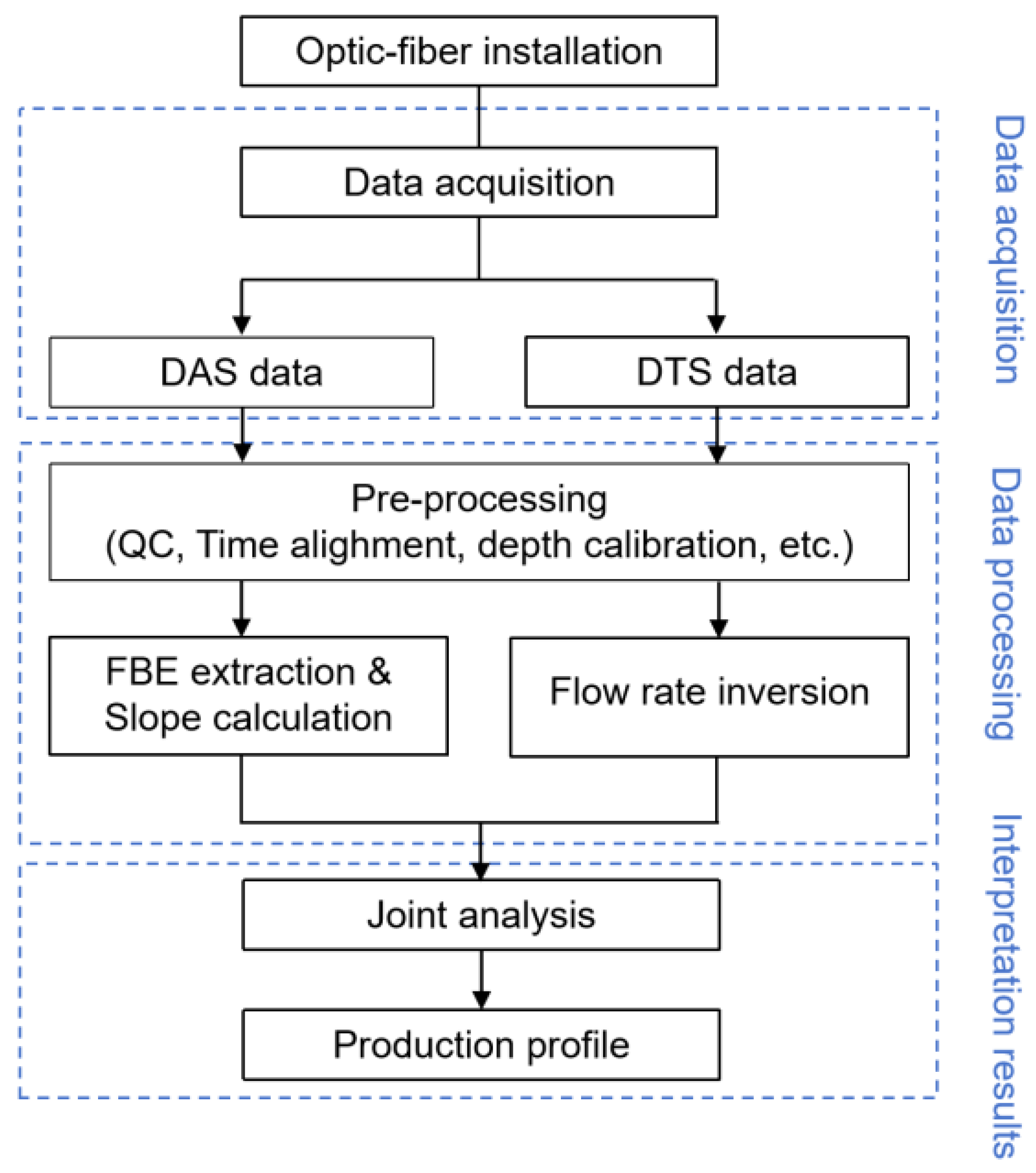
Based on this interpretation workflow, the technical route for production profiling using DTS and DAS data is illustrated in
Figure 2. Two optical fibers deployed via coiled tubing are used to simultaneously acquire DAS and DTS data. The raw monitoring data undergo quality control, time synchronization, depth correction, and DTS temperature calibration as preprocessing steps. Subsequently, frequency-band acoustic energy is extracted from DAS data, while flow rates are inverted from DTS data. The combined interpretation of DTS and DAS results provides a comprehensive and robust production profile.
3. Field Application and Data Processing
3.1. Well Conditions and Geological Background
The target well is a horizontal shale gas production well completed with hydraulic fracturing. The maximum measured depth (MD) is 5173.78 m, with a well inclination of 100.35°, azimuth of 27.7°, closure distance of 1972.85 m, and closure azimuth of 52.77°.
The well was designed with 24 fracturing stages, and the actual number of stages completed was also 24. The perforated intervals extend from 2948 m to 4406 m, with a total perforation length of 1458 m. The average stage length is 60.75 m, comprising 148 perforation clusters and a total of 864 perforation shots. An 89 mm perforating gun was used, and dissolvable bridge plugs (DBPs) were employed as stage-isolation tools.
The first stage consisted of 5 clusters, while each of the remaining stages contained 6 clusters. The shot density was 16 shots per meter, and each cluster had a perforation length of 0.5 m with a phasing angle of 60°. The first stage was perforated using coiled tubing (CT), whereas all subsequent stages were perforated by wireline-conveyed multi-cluster perforating.
3.2. Monitoring System Deployment
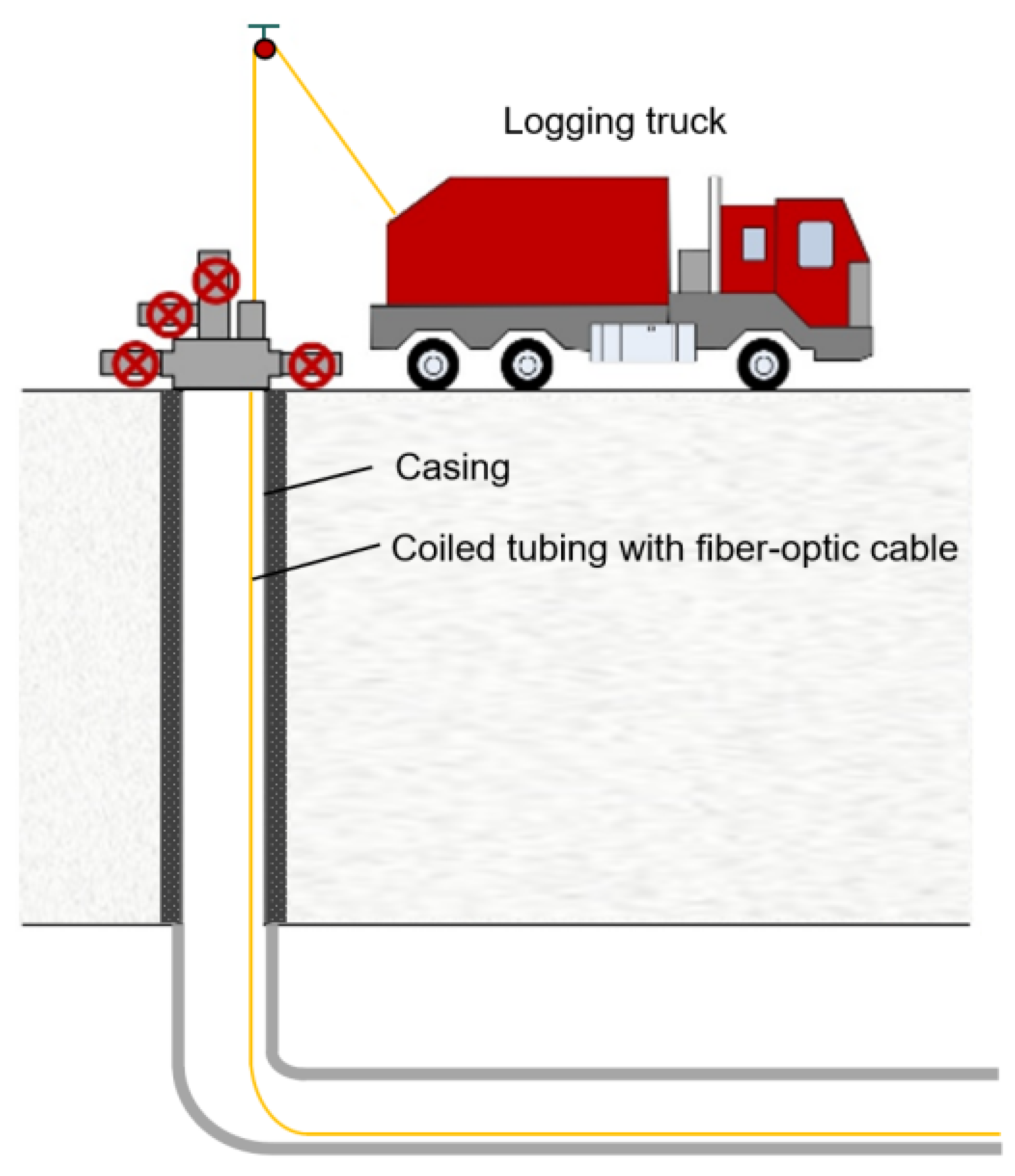
During the deployment of the DAS system, the optical fibers were conveyed into the well using coiled tubing, as illustrated in
Figure 3. The internal fiber bundle consisted of two single-mode fibers and two multi-mode fibers. The single-mode fibers were designated for recording DAS signals, while the multi-mode fibers were used for recording DTS signals. Additionally, one spare single-mode fiber and one spare multi-mode fiber were included; in the event of abnormal attenuation, the spare fibers could be used.
The attenuation specifications were as follows: for the multi-mode fibers, the attenuation at 1310 nm wavelength did not exceed 0.36 dB/km; for the single-mode fibers, the attenuation at 1550 nm wavelength did not exceed 0.20 dB/km.
In the field application, two interrogator units were used: one for DAS and one for DTS. Data acquisition was conducted in continuous mode. For DAS, the pulse repetition frequency was 10 kHz with a gauge length of 2 m, while for DTS, one temperature profile was recorded every minute with a gauge length of 1 m. The raw DAS data were stored in TDMS format, and DTS data were stored in XML format. These formats are native outputs of the DAS and DTS interrogators used in this study. They preserve original metadata, time stamps, and acquisition parameters, facilitating reliable post-processing, synchronization, and interoperability with vendor-provided software. In addition, storing data in native formats avoids unnecessary conversion during field acquisition and supports efficient handling of large-volume distributed sensing data.
Prior to fiber deployment, the DAS and DTS units were connected to test the functionality of each fiber. GPS time synchronization was performed on both units to ensure temporal alignment.
The low-, medium-, and high-production regimes in this study are defined based on the operational production rates and corresponding time windows recorded in the field operation log. Specifically, the high-production regime corresponds to a stable production rate of 85,000 m
3/day, the medium-production regime to 55,000 m
3/day, and the low-production regime to 30,000 m
3/day. Each regime was maintained for approximately 8 h, followed by a 24-h shut-in period. The detailed timing and operational conditions of each regime are documented in the job log and summarized in
Section 4.1.
Four testing regimes were conducted during the field trial: 85,000 m3/day regime, tested for 8 h; 55,000 m3/day regime, tested for 8 h; 30,000 m3/day regime, tested for 8 h; shut-in regime, tested for 24 h.
According to on-site production testing, the gas output was approximately 112,500 m3/day, with water production between 2 and 3 m3/day. Since water production was relatively low, the interpretation in this study focuses primarily on gas production profiling, while the effect of water is neglected.
4. Results and Analysis
4.1. Monitoring Profile Results
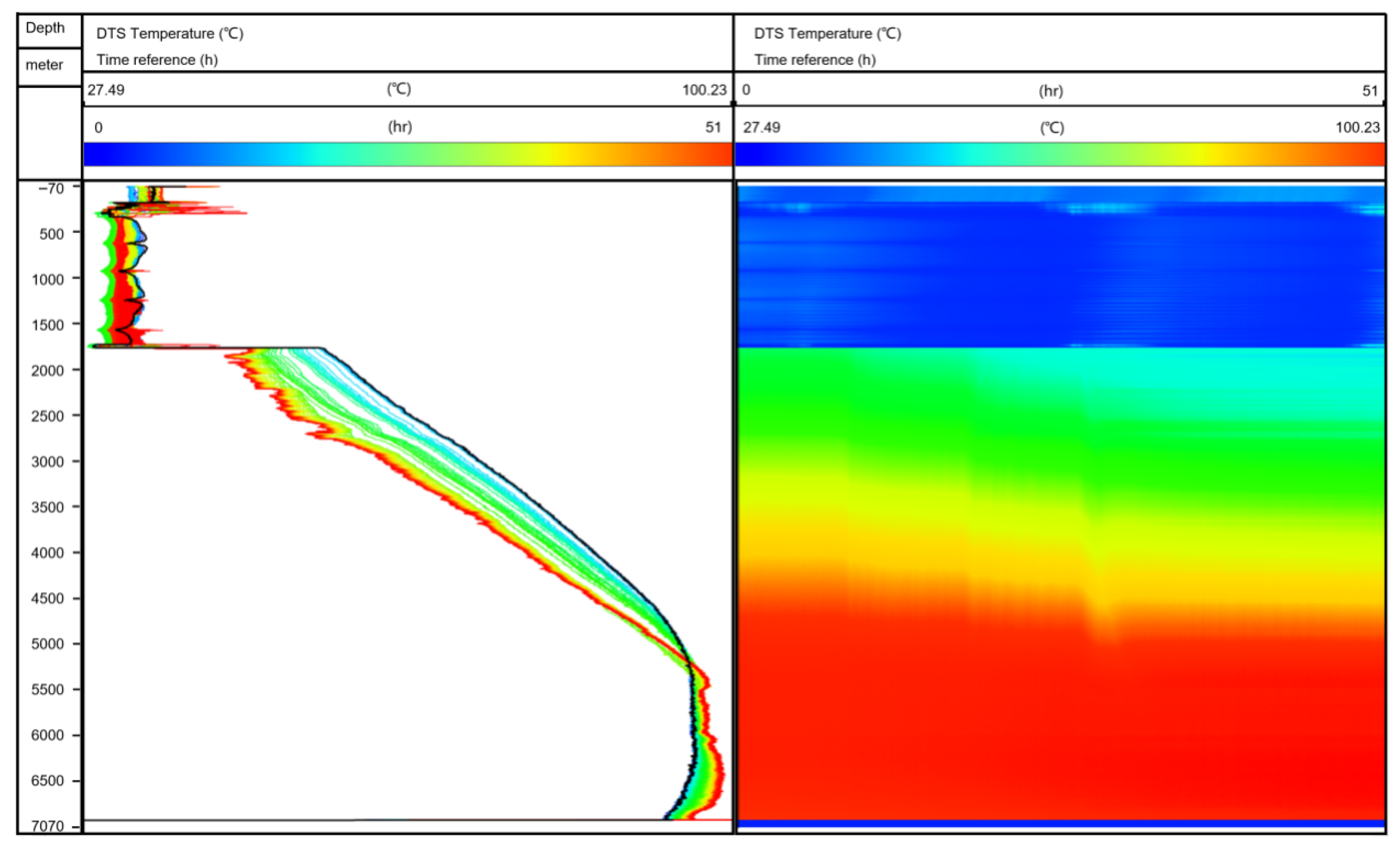
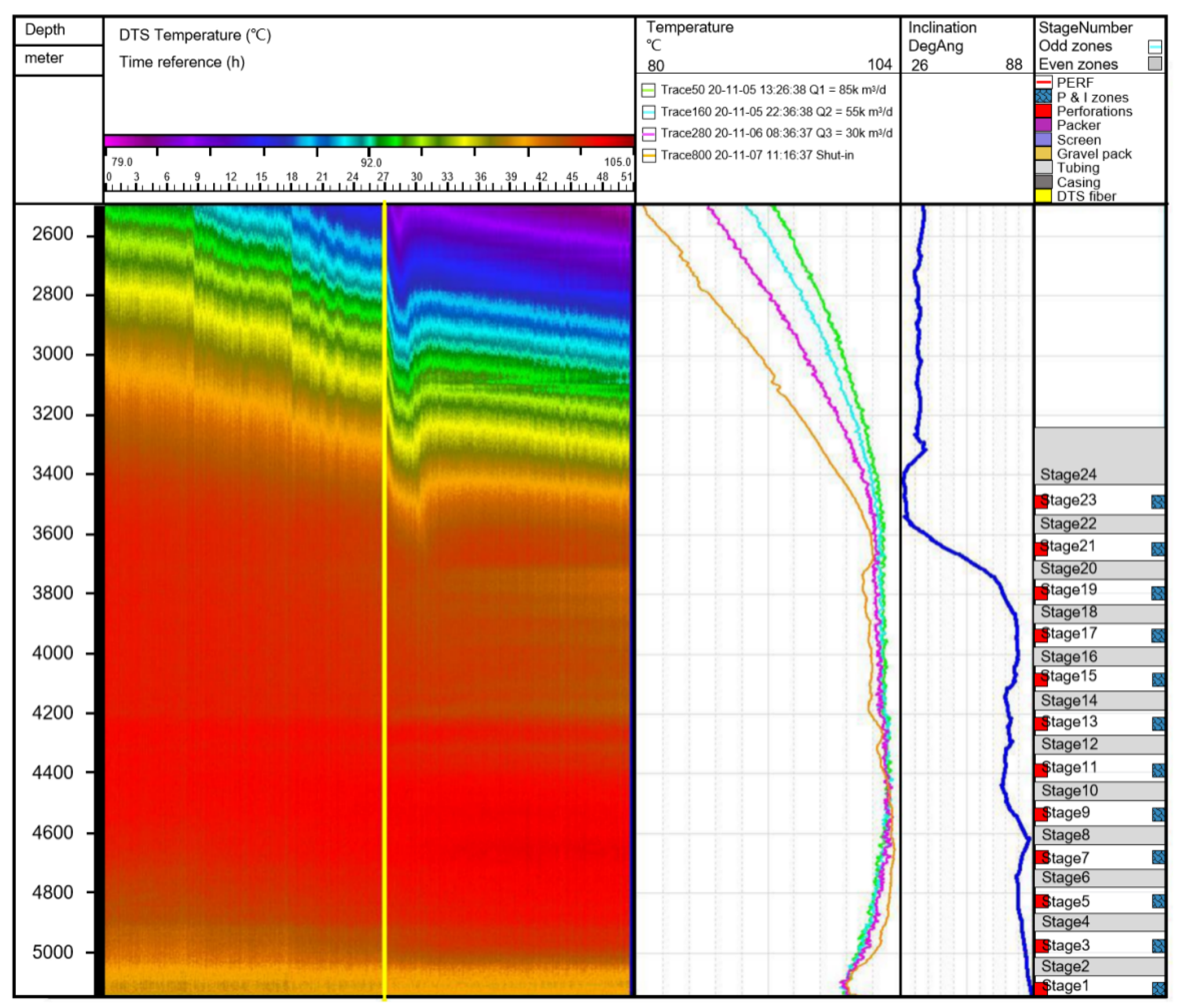
Based on the monitored DTS data, signals from the surface, the wellbore, and invalid temperature measurements can be clearly distinguished, as shown in
Figure 4.
Figure 4 provides an overview of the DTS monitoring data. In the left panel, temperature curves along the fiber are plotted against depth, where the horizontal axis represents temperature magnitude. The color sequence of the curves indicates the chronological order of acquisition, which allows comparison of temperature profiles at different times. The right panel shows the corresponding temperature waterfall plot, where the horizontal axis represents time and the color scale indicates temperature magnitude.
The apparent transition observed at approximately 1750 m in
Figure 4 is associated with the depth-reference correction applied to the fiber-measured coordinate. The DTS/DAS depth is initially referenced to the interrogator (fiber length), rather than the wellhead-based measured depth of the wellbore. Therefore, a uniform depth shift was applied to align the fiber-based depth with the true wellbore depth starting from the wellhead. After this correction, the depth axis used in the analysis represents the wellbore depth referenced to the wellhead. The fiber depth marker at the well bottom was 6915 m, while the actual depth of the fiber at the coiled tubing bottom was 5158.25 m. Therefore, a depth correction of 1756.75 m upward was applied to the fiber-measured depth, completing the depth calibration for both DTS and DAS data. The depth discrepancy does not originate from measurement errors of the DAS or DTS systems. Instead, it arises because the depth coordinate of the fiber is referenced to the interrogator, rather than the wellhead. As a result, the measured fiber length includes the entire optical path from the interrogator to the bottom of the well. To ensure consistency with the actual wellbore geometry, a uniform depth shift was applied to both DAS and DTS data to align the fiber-based depth with the true wellbore depth.
When the operating regime changed, the bottomhole pressure gauge recorded synchronous variations in both temperature and pressure. Since the bottomhole temperature measurement is highly sensitive to environmental changes, it was used to perform temperature calibration for the DTS data.
Figure 5 DTS temperature profiles along the entire wellbore under different production regimes. Overall, the temperature variations clearly reflect the transitions in wellbore production status:
High-production stage (8.5 × 10⁴ m3/d): The geothermal gradient along the wellbore decreases significantly. In particular, the temperature around the major perforation intervals is notably higher than in adjacent well sections, indicating localized heating caused by fluid inflow.
Shut-in stage: The DTS data show that the wellbore temperature gradually returns to the original formation temperature. In some reservoir intervals, however, the temperature is slightly lower than that of surrounding sections, which may be attributed to cooling effects caused by fluid reinjection following shut-in.
The third panel (Inclination DegAng) shows the wellbore inclination angle as a function of depth. It represents the deviation of the wellbore from vertical and provides geometric information on the trajectory of the horizontal section, which is helpful for correlating temperature responses with wellbore geometry. The fourth panel (Stage Number) denotes the hydraulic fracturing stage number along the wellbore. It indicates the current reservoir interval corresponding to each depth and provides a direct link between DTS temperature responses and the fractured stages contributing to production. In
Figure 5, the time axis of the temperature colormap is plotted in absolute time (hh:mm:ss), corresponding to the actual acquisition time during field monitoring. In contrast, the time axis used in the waterfall-style representation is relative time, referenced to the beginning of each selected production regime. This relative time representation is adopted to facilitate comparison of temporal evolution patterns under different operating conditions.
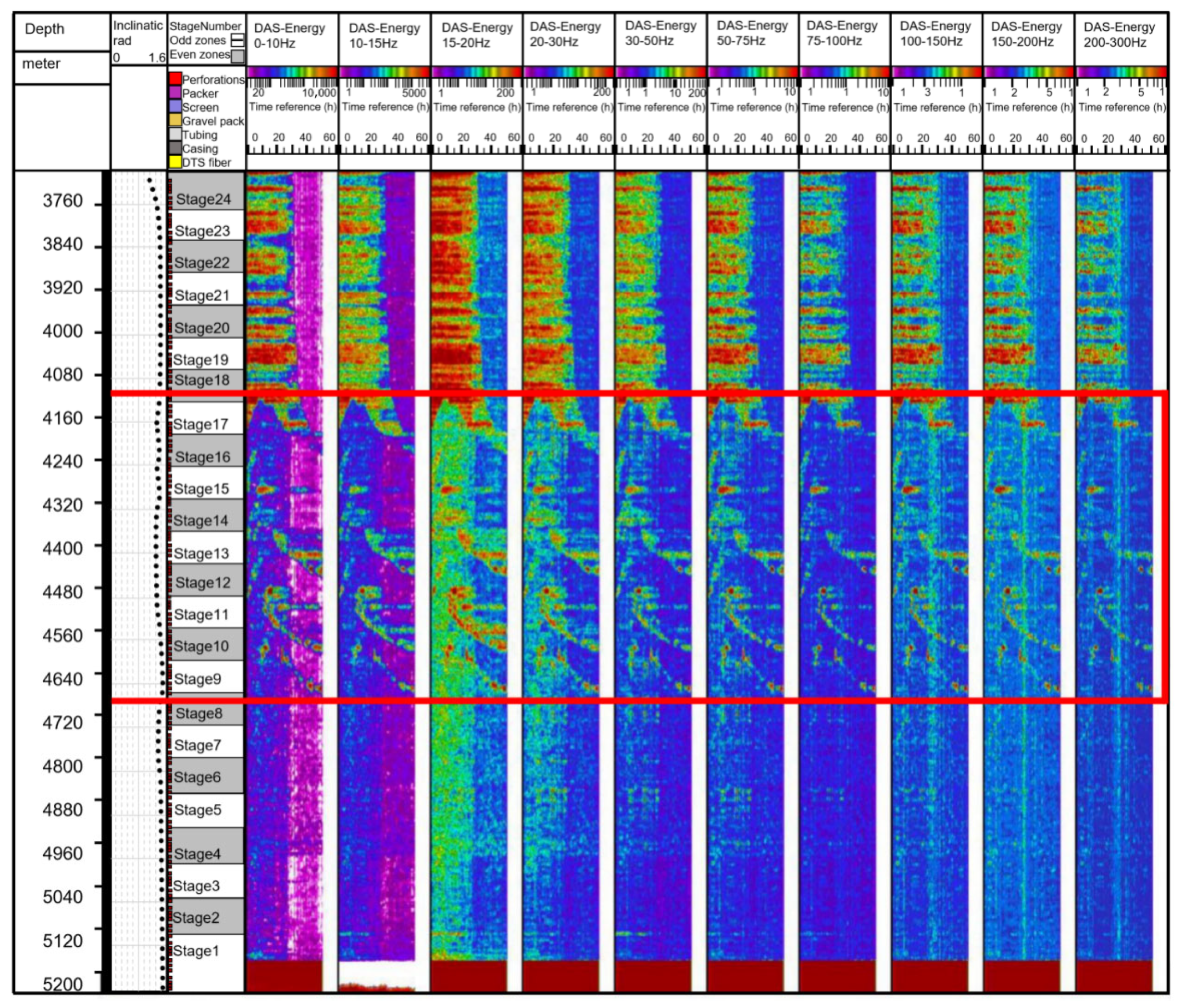
The region highlighted by the red box corresponds to the depth interval of 4126–4641 m. Within this area, distinct negative apparent velocity features can be observed, as indicated by the red rectangle, as shown in
Figure 6.
The stages shown in
Figure 6 correspond to the same hydraulic fracturing stages and depth intervals as those presented in
Figure 5. Therefore, identical stage numbers in both figures refer to the same physical locations along the wellbore. In
Figure 6, positive apparent velocities indicate upward fluid migration along the wellbore toward the surface, whereas negative apparent velocities indicate downward flow or backflow toward the formation, which is commonly observed during shut-in conditions.
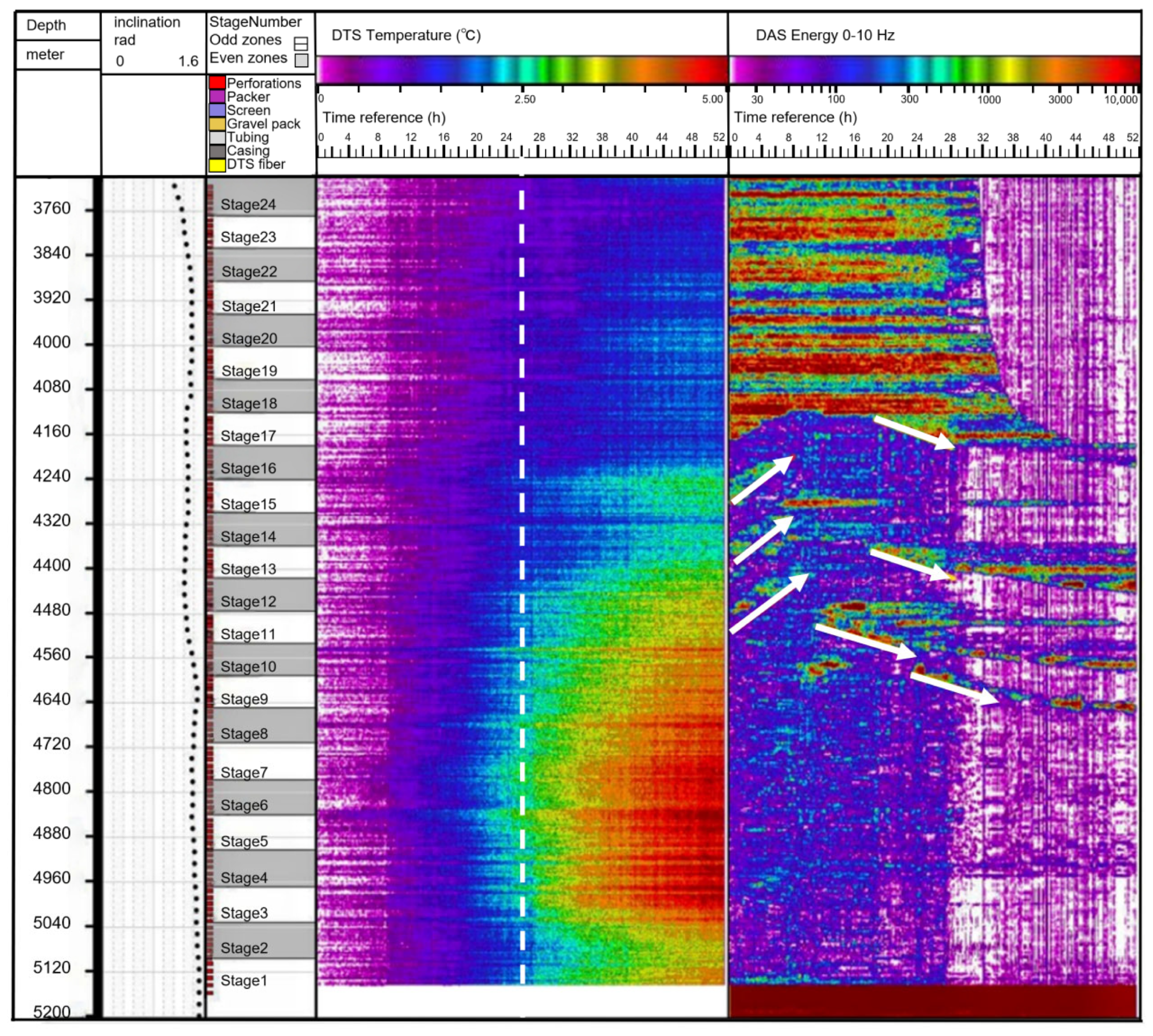
Figure 7 illustrates the combined DTS temperature and DAS energy responses under different production regimes. The high-, medium-, and low-production regimes are identified in the left part of the figure, prior to the white dashed vertical line. The white dashed line marks the onset of the shut-in period, after which production is stopped and only pressure and temperature recovery processes are observed. To improve visibility, the flow-related features in
Figure 7 are highlighted using white arrows instead of colored lines. The arrows indicate representative upward and downward flow patterns inferred from the DAS energy distribution. As shown in
Figure 7, the shut-in period begins at the time indicated by the white dashed vertical line. This time corresponds to the end of the low-production regime and marks the start of a 24-h shut-in period, during which production is stopped and pressure and temperature recovery are monitored.
As shown in
Figure 7, strong acoustic energy responses were observed in the upper producing interval (3710–4126 m). However, because very similar high-energy responses were also detected in the overlying wellbore flow sections, these signals cannot be directly interpreted as production from perforation clusters.
During the high-production regime, positive apparent velocity features were observed in the interval from 4126 m to 4486 m, highlighted by the red line at approximately 0.16 m/min. These features indicate upward gas migration along the wellbore during production.
Starting from 21:00 and lasting for 11.5 h, negative apparent velocity features were observed from 4126 m to 4641 m under medium-production conditions, highlighted by the yellow line at about 0.09 m/min. These phenomena persisted through the low-production stage and remained evident during shut-in. When transitioning to lower production rates, the negative apparent velocity features indicated backflow of fluids within the wellbore. During the shut-in period, this backflow fluid continuously re-entered the reservoir.
The temperature variations observed in
Figure 7 are primarily caused by changes in production rate and flow conditions along the wellbore. During higher production regimes, increased gas flow enhances convective heat transfer between the wellbore fluid and the surrounding formation, leading to more pronounced temperature anomalies. As the production rate decreases, the convective effect weakens and conductive heat exchange becomes dominant. During the shut-in period, the absence of flow allows the temperature field to gradually recover toward the formation temperature, reflecting thermal equilibration.
The joint interpretation process follows a sequential logic. First, DTS temperature inversion provides a preliminary estimation of interval flow contribution based on thermal response. Second, DAS frequency-band energy is used to identify zones with significant flow-induced acoustic activity. Third, apparent velocity extracted from DAS determines the direction of fluid movement, distinguishing reservoir inflow from wellbore backflow. Finally, DTS-derived flow profiles are validated and constrained by DAS velocity features, ensuring that only intervals exhibiting both consistent thermal response and positive apparent velocity are classified as producing zones.
4.2. Joint DTS—DAS Discrimination
Figure 7 presents waterfall plots of DTS and DAS data for the producing intervals, showing how acoustic energy varies with time and depth under different production regimes. It can be observed that during the production stages, some wellbore sections exhibit strong acoustic energy responses. In the shut-in stage, although the overall acoustic energy decays, certain intervals still maintain relatively high responses.
- (1)
Frequency-Band Energy Characteristics
Low-frequency bands (0–10 Hz, 10–15 Hz): High acoustic energy responses are observed both in the main producing intervals and in the overlying wellbore flow zones, indicating that these frequency bands are more sensitive to general flow disturbances.
Mid-frequency bands (15–100 Hz): High-energy responses are more concentrated within the producing intervals, which allows better differentiation between reservoir inflow and wellbore flow.
High-frequency bands (>100–150 Hz): Signal energy is relatively weak and primarily attributed to local turbulence or mechanical noise.
- (2)
Velocity Feature Analysis
Inclined feature lines in the depth–time plots (
Figure 7) were extracted using the cross-correlation and Hough transform methods, yielding the following observations:
High-production stage (8.5 × 10⁴ m3/d): A clear positive apparent velocity feature (approximately 0.16 m/min, highlighted by the red line) was identified within the depth interval of 4126–4486 m, indicating upward fluid migration along the wellbore.
Medium-production stage (5.5 × 10⁴ m3/d): The first negative apparent velocity feature (approximately 0.09 m/min, highlighted by the yellow line) appeared at 4470 m and persisted for about 11.5 h, which is inferred to be associated with backflow caused by pressure decline in the wellbore.
Low-production stage (3 × 10⁴ m3/d): Negative apparent velocity features became more pronounced in the depth range of 4350–4600 m, likely related to local variations in gas density and redistribution of flow within the wellbore.
Shut-in stage: Negative apparent velocity features persisted throughout the entire shut-in period, while high acoustic energy responses remained undiminished, suggesting continuous downward fluid movement and reinjection into the formation.
Joint Interpretation
Positive apparent velocity features typically correspond to upward movement of production fluids along the wellbore. Negative apparent velocity features, in contrast, are likely associated with wellbore backflow or reservoir reinjection during shut-in. By comparing velocity features with DTS-inverted flow profiles, it is possible to confirm whether perforated intervals contribute to actual production, thereby avoiding the misinterpretation of wellbore flow as reservoir inflow.
By superimposing DTS temperature inversion results with DAS frequency-band energy and apparent velocity features, the following conclusions can be drawn:
High-production stage: The high-temperature intervals identified by DTS are highly consistent with the high-energy positive apparent velocity intervals observed in DAS, confirming these zones as the main producing layers.
Medium- and low-production stages: In some perforation intervals, DTS temperature variations are not significant, yet DAS shows sustained negative apparent velocity with high acoustic energy, indicating that these zones function as wellbore backflow channels rather than producing intervals.
Shut-in stage: The temperature decline recorded by DTS exhibits a temporal delay relative to the negative apparent velocity with high acoustic energy observed by DAS, reflecting the hysteresis of temperature response to flow processes.
The joint interpretation results demonstrate that relying solely on DTS or DAS can lead to errors in identifying producing intervals. In contrast, the integration of both methods effectively distinguishes wellbore disturbances from actual inflow, thereby improving the accuracy of production profile interpretation.
To improve the visual identification of interpreted zones,
Figure 7 explicitly highlights key flow features using white arrows and a white dashed line. Upward-pointing arrows indicate intervals with positive apparent velocity, interpreted as active reservoir inflow during production. Downward-pointing arrows mark zones with negative apparent velocity, corresponding to wellbore backflow or reinjection, particularly during medium-, low-production, and shut-in stages.
It should be noted that elevated temperatures do not necessarily coincide with high-production stages. Due to thermal hysteresis and delayed heat exchange between the wellbore and formation, high-temperature anomalies may persist into the shut-in period even after flow has ceased. Therefore, temperature alone is insufficient to identify producing intervals, and the joint interpretation with DAS velocity features is essential.
4.3. Gas Production Profile
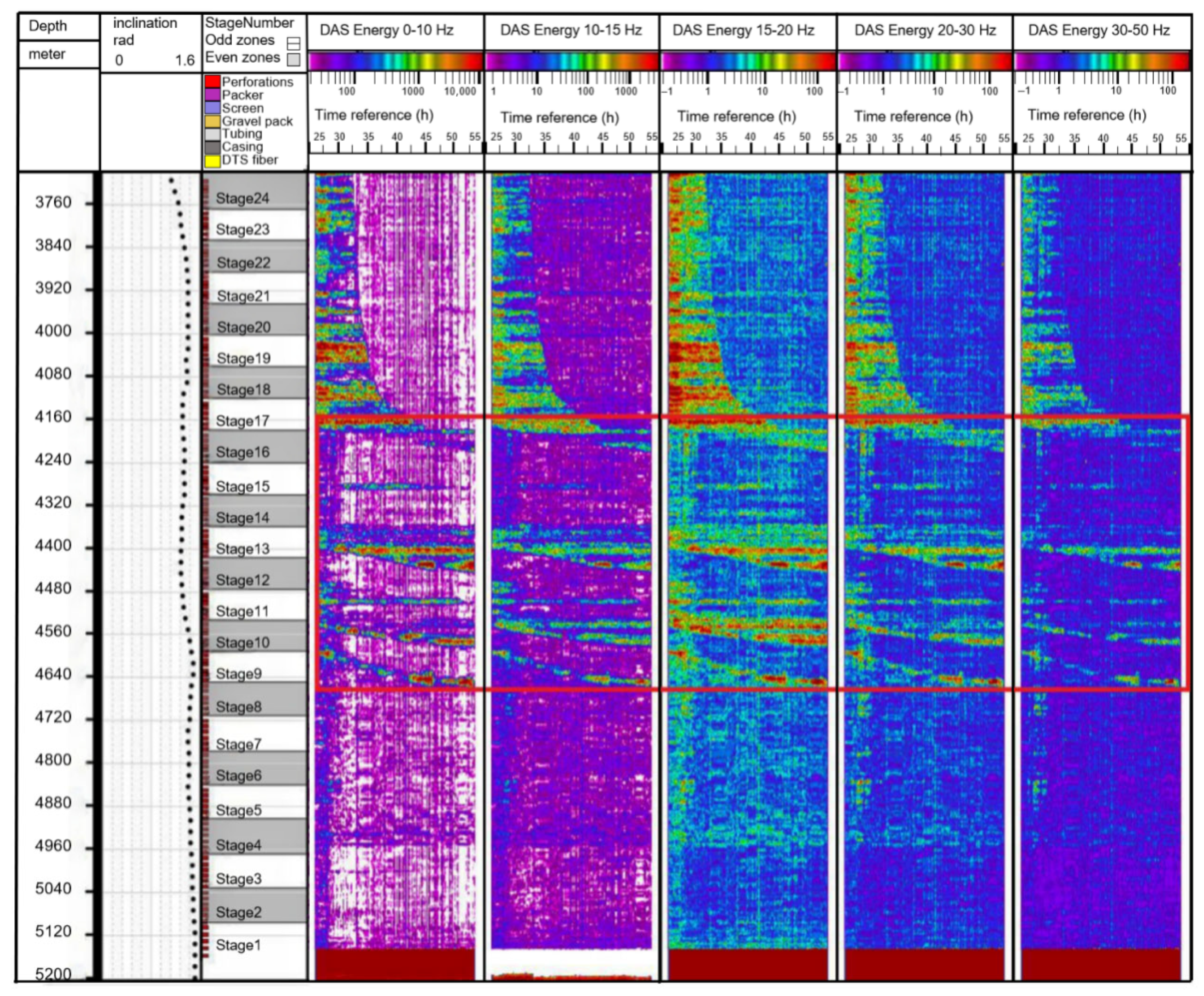
During the shut-in period, negative apparent velocity features extended throughout the entire duration, while strong acoustic energy responses persisted until the end, as highlighted by the red rectangle. This indicates that backflow fluid was being reinjected into the reservoir during shut-in, as shown in
Figure 8.
The negative apparent velocity features in the DAS data suggest fluid movement from the wellbore back into the formation. The upper producing intervals were clearly affected by the advancing front of the backflow, which caused a slower thermal recovery during shut-in, as illustrated by the red box in the figure. Under such conditions, stable shut-in data above 4640 m cannot be directly used as geothermal references, because the downward fluid movement and reinjection distort the thermal response. Therefore, quantitative results can only be obtained using a forward-modeled geothermal gradient curve, as shown in
Figure 9.
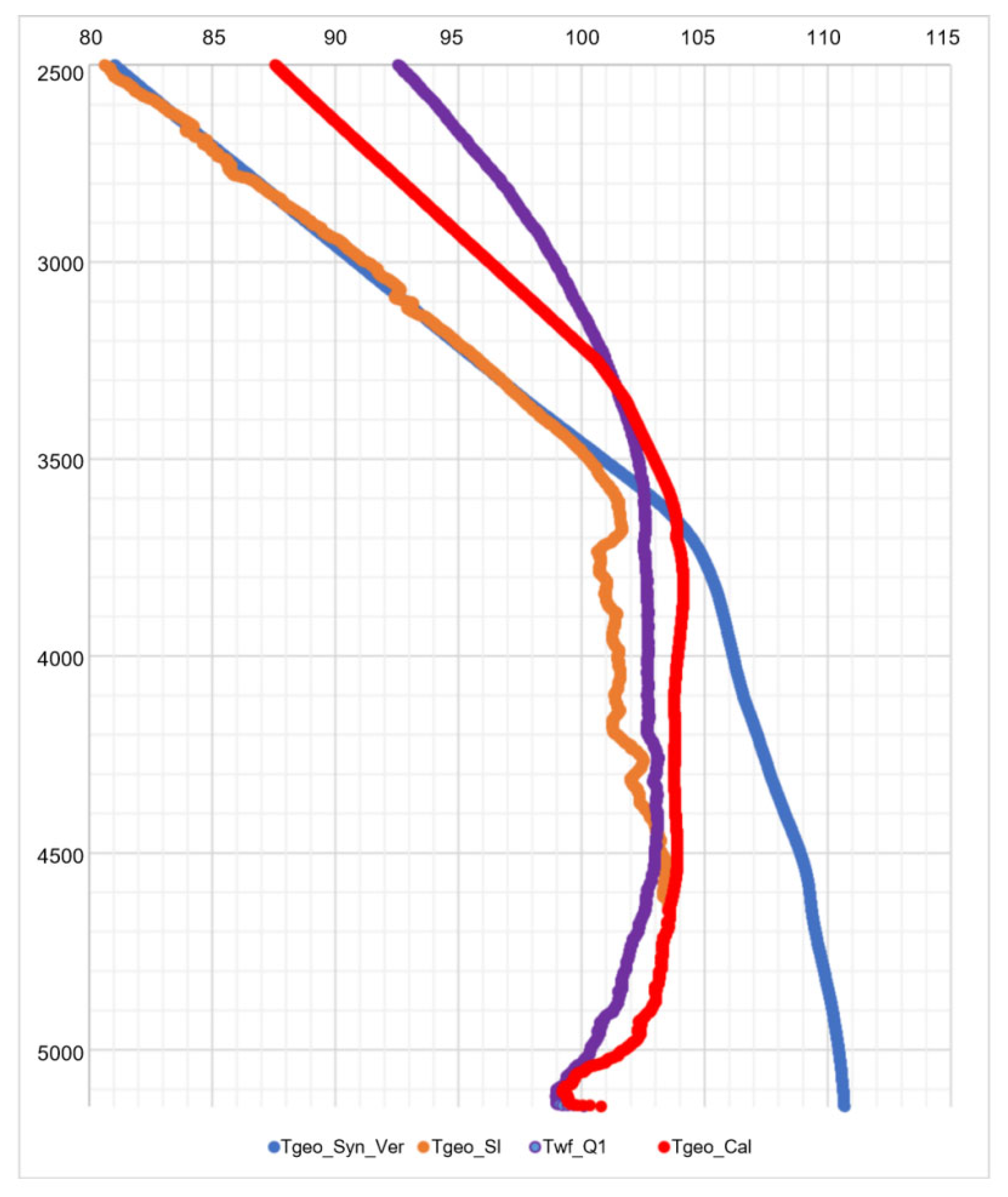
Figure 9 illustrates the construction of the synthetic geothermal profile. The vertical axis represents depth, while the horizontal axis denotes temperature. Different colored curves correspond to geothermal profiles derived under different conditions and stages. Specifically, the orange curve represents the average temperature profile during the last 5 h of the shut-in period; the purple curve shows the fluid temperature measured during 8 h of high-rate production; the blue curve represents the initial geothermal profile calculated from the temperature gradient and true vertical depth (TVD) after shut-in; and the red curve denotes the final calibrated synthetic geothermal profile.
The synthetic geothermal profile shown in
Figure 9 was constructed to provide a reference temperature distribution during the shut-in period when backflow prevents full thermal recovery. First, an initial geothermal gradient was estimated based on the TVD and the stabilized temperature recorded at the end of shut-in in non-affected intervals. This gradient was then adjusted using the average DTS temperature profile measured during the last hours of shut-in, excluding intervals exhibiting persistent negative apparent velocity. The final synthetic geothermal profile therefore represents a physically consistent reference temperature under undisturbed conditions and is used as the baseline for production interpretation.
The initial geothermal gradient can be expressed as:
where
is the reference temperature at the wellhead,
is the geothermal gradient estimated from stabilized sections, and
is the true vertical depth.
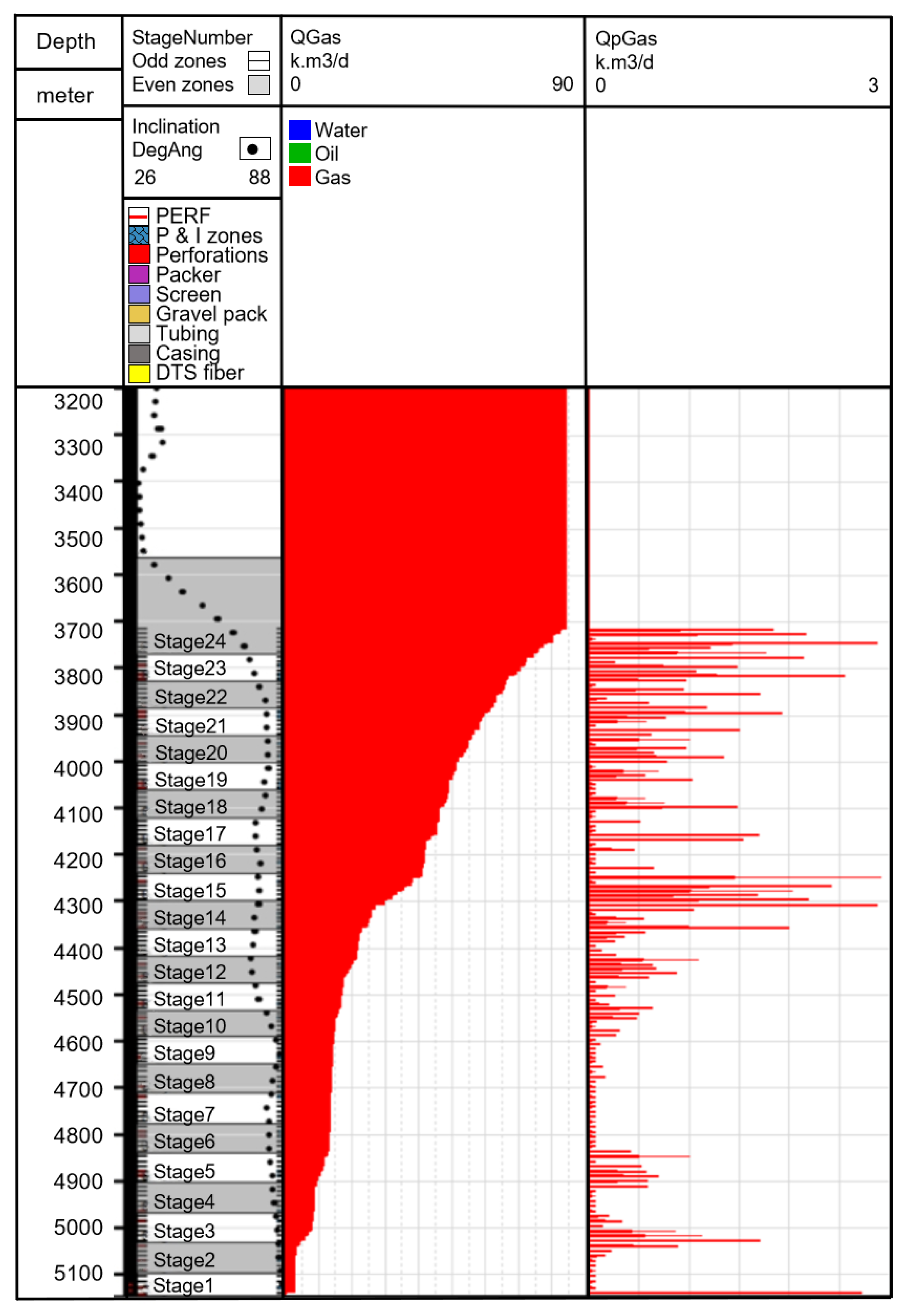
According to the flow distribution calculated by the temperature inversion model, the contribution rate of the main producing intervals during the high-production stage can reach up to 11.38%. In contrast, during the low-production stage, the differences in contribution among perforation intervals were significantly reduced.
Figure 10 presents the joint interpretation results of DTS temperature and DAS energy attributes under different production regimes. The figure illustrates how temperature anomalies and acoustic energy variations are spatially and temporally correlated along the wellbore. Zones exhibiting consistent DTS cooling/heating responses together with elevated DAS energy are interpreted as active inflow intervals, whereas zones with weak acoustic responses and muted temperature changes indicate limited or no contribution to production. These results demonstrate that the joint DTS–DAS discrimination method effectively identifies producing stages and supports the production profiling conclusions presented in this study.
The regime dependency of flow characteristics is directly supported by the consistent change in apparent velocity patterns across high-, medium-, low-production, and shut-in stages, as shown in
Figure 7 and
Figure 8. Each operating regime exhibits a distinct combination of temperature response and velocity direction, confirming that flow behavior is controlled by production conditions.
5. Discussion
The field application results of this study demonstrate that DTS and DAS have distinct yet complementary advantages in horizontal well production profiling. DTS temperature profiles are highly sensitive to low-velocity flow and changes in reservoir contribution, making them effective in capturing variations in temperature gradients under different production regimes. DAS, on the other hand, excels in detecting transient flow events and identifying flow direction, particularly in capturing persistent negative apparent velocity features during shut-in. When combined, the two methods effectively reduce interpretation errors caused by signal interference or response hysteresis when using a single technique alone.
DAS results show that some zones with high acoustic energy are not actually producing intervals, but instead reflect wellbore flow disturbances. Relying solely on acoustic energy distribution could therefore lead to misinterpretation, mistaking turbulent wellbore flow for reservoir inflow. DTS inversion results, however, did not reveal significant temperature anomalies in these intervals, confirming that the high acoustic energy signals originated from non-reservoir responses. This discrepancy highlights the necessity of multi-parameter joint interpretation to differentiate between wellbore and reservoir flows in multi-layered horizontal wells.
During high-production stages, positive apparent velocity features are concentrated in the main producing intervals and align closely with temperature elevation zones, indicating upward fluid transport into the production system. In medium- and low-production stages, multiple negative apparent velocity features emerge, reflecting backflow processes caused by declining wellbore pressure. Persistent negative velocity features observed during shut-in suggest that some fluids continue to migrate downward and re-enter the reservoir after production stops, potentially affecting reservoir pressure recovery and requiring consideration in production optimization.
The observed backflow features in DAS are interpreted as acoustic responses associated with the movement of gas–liquid or gas–gas interfaces within the wellbore after shut-in. In wells without inflow control valves (ICVs), the wellbore remains hydraulically connected along its length, allowing pressure redistribution and interface-driven fluid reinjection into the formation. This process produces continuous and trackable depth–time trajectories in DAS data. In contrast, plug or isolation failure during stimulation typically generates localized and abrupt acoustic responses concentrated near the previously isolated perforation clusters. The observed DAS signatures in this study are therefore more consistent with interface-driven backflow in a non-ICV completion than with mechanical isolation failure.
Despite the effectiveness of the joint interpretation method in this study, certain limitations remain. DTS temperature responses exhibit time lag, limiting their ability to identify short-duration flow events. DAS signals are susceptible to mechanical vibrations and wellbore conditions, necessitating improvements in signal-to-noise ratio. Furthermore, data interpretation depends heavily on system calibration and parameter selection, and variations in wellbore structure or fluid properties may compromise inversion accuracy.
Future research should consider combining DAS phase information with acoustic energy amplitude to enhance flow direction discrimination. The development of multi-physics coupled inversion models may also unify the interpretation of temperature and acoustic data. Additionally, machine learning methods could be applied to continuously acquired DAS and DTS data for automated identification of producing intervals.
Compared with single-method interpretation, the joint DTS–DAS approach provides three key advantages. DTS alone is sensitive to thermal changes but suffers from hysteresis and ambiguity during shut-in, while DAS alone may misinterpret wellbore disturbances as inflow. Their integration combines temperature sensitivity with flow direction constraints, reduces false identification of producing zones, and enables robust discrimination across different production regimes.
Uncertainty quantification is an important aspect of production profiling; however, the primary objective of this study is not to derive absolute flow rates with quantified confidence intervals, but to reduce misinterpretation between reservoir inflow and wellbore-related flow through multi-physics constraints. Key uncertainties associated with DTS inversion (e.g., thermal parameters, reference temperature selection) and DAS analysis (e.g., noise level, window length) may affect the absolute magnitude of inferred parameters, but they do not alter the consistency of the joint discrimination results, which rely on relative thermal responses and the sign of apparent velocity. A comprehensive quantitative uncertainty propagation framework will be considered in future work.
Direct quantitative comparison with conventional PLT data is not available for the present case due to operational constraints. However, the proposed joint DTS–DAS interpretation provides a measurable improvement in production profiling from an engineering decision perspective. In the present case, several intervals exhibiting elevated DTS response or high DAS energy alone were excluded as producing zones after joint interpretation, illustrating the reduction in false-positive classifications. Compared with DTS-only interpretation, which may misidentify thermally disturbed wellbore flow as reservoir inflow, and DAS-only interpretation, which may overemphasize high acoustic energy unrelated to production, the combined workflow introduces an additional physical constraint through apparent velocity direction. This significantly reduces the risk of false-positive identification of producing intervals, particularly under low-rate and shut-in conditions. Therefore, the quantitative benefit of the joint approach is reflected in improved discrimination reliability rather than absolute flow-rate accuracy.
From an operational perspective, the deployment of distributed fiber-optic sensing systems is subject to practical constraints, including fiber installation, coupling quality, and data management requirements. Fiber deployment in horizontal wells may be challenged by wellbore geometry, completion design, and mechanical protection of the cable. In the present study, fiber installation was conducted using coiled tubing, which ensured stable coupling and minimized operational risk. Although the initial deployment cost of distributed sensing systems may be higher than that of single-run PLT operations, DTS–DAS monitoring provides continuous, non-intrusive measurements over extended periods, reducing the need for repeated logging runs and production interruptions. These characteristics make the proposed workflow particularly suitable for long horizontal wells and complex operating conditions.
These findings demonstrate that the proposed DTS–DAS workflow provides a practical and reliable alternative for production profiling in horizontal gas wells where conventional logging is operationally constrained.