Article

Numerical Study on the Deposition Characteristics of a Polydisperse Particle Group with Real-World Size Distribution in a Wall-Flow Diesel Particulate Filter


1
Ocean College, Binzhou Polytechnic, Binzhou 256603, China
2
University Library, Binzhou Polytechnic, Binzhou 256603, China
3
Marine Engineering College, Dalian Maritime University, Dalian 116026, China
4
Merchant Marine College, Shanghai Maritime University, Shanghai 201306, China
*
Author to whom correspondence should be addressed.
Fuels 2026, 7(1), 14; https://doi.org/10.3390/fuels7010014
Submission received: 15 December 2025 / Revised: 16 February 2026 / Accepted: 26 February 2026 / Published: 28 February 2026

Abstract

The global effort to mitigate hazardous particulate matter (PM) emissions from diesel engines relies significantly on advances in separations technologies. The diesel particulate filter (DPF) is a critical component designed to trap soot and ash from diesel engine exhaust, ensuring cleaner emissions and compliance with environmental regulations. In the current paper, a gas-particle two-phase flow model in the microchannels of a DPF is developed. A novel statistical approach based on probability sampling is proposed aimed at generating a particle ensemble that adheres to the real-world soot particle size distribution (PSD). The Eulerian-Lagrangian approach is employed to model the soot-laden gas flow, where the gas phase flow field is solved in the Eulerian framework, while the particle phase motion is tracked in the Lagrangian framework. The results demonstrate that the through-wall velocity plays a predominant role in the overall deposition behavior of the mixed-sized particle group. Increasing upstream velocity shifts initial particle deposition positions further from the channel inlet and enhances mass accumulation at the channel’s terminal section. Reduced filtration wall permeability promotes the uniformity of soot deposition along the channel. A permeability of 5 × 10⁻¹³ m2 is identified as the critical threshold, below which the soot deposition distribution approaches near-complete uniformity.

1. Introduction

Cleaning the transportation sector, a major source of anthropogenic air pollution, has become an increasingly urgent global priority. Diesel engines, despite their high efficiency and durability, are significant emitters of nitrogen oxides (NOx), particulate matter (PM), carbon monoxide (CO), and hydrocarbons (HC) [1,2,3], which poses severe threats to public health (e.g., respiratory and cardiovascular diseases) and environmental quality (e.g., haze formation) [4,5,6,7]. These challenges directly contradict the United Nations Sustainable Development Goals (SDGs), particularly Goal 3 (Good Health and Well-being) and Goal 11 (Sustainable Cities and Communities).
PM is widely recognized to be one of the most harmful components of diesel exhaust [8,9,10]. These microscopic particles, consisting of carbonaceous soot, heavy metals, and various organic compounds [11,12], can penetrate deep into the respiratory system when inhaled, leading to a host of adverse health effects, ranging from respiratory ailments to cardiovascular diseases [13,14]. Moreover, the presence of PM in the atmosphere significantly degrades air quality, contributing to haze formation and reducing visibility [15]. In response to these pressing issues, regulatory bodies around the world have been continuously tightening emission standards. Stringent limits have been imposed on the allowable levels of PM in diesel engine emissions, such as US EPA Tier 3, Euro VI and China VI standards [16]. These regulations have, in turn, spurred the development and evolution of advanced after-treatment technologies [17,18,19,20].
DPFs stand out as the most recognized and effective devices for removing PM from diesel engine exhaust [21,22,23,24,25]. The DPF features a honeycomb structure with microscopic channels, where each channel is sealed at one end and open at the opposite end, with neighboring channels arranged in a reverse plugging pattern. Such alternating blockage forces exhaust gases to pass through the porous walls of the channels, trapping soot particles via mechanisms like impaction and interception [26]. As a result, the alternating arrangement not only ensures efficient filtration but also contributes to the widespread soot deposition across the filter, which is beneficial for maintaining optimal pressure drop and filtration efficiency. In general, the filtration efficiency of DPFs can reach remarkably high levels, often exceeding 90% or even higher under optimal conditions [27,28,29,30].
Naturally, as soot deposits accumulate inside the filter, there is a consequent gradual rise in exhaust backpressure. If left unchecked, the increasing backpressure can negatively impact engine performance and fuel efficiency [31,32]. To prevent such issues, the DPF is typically equipped with a regeneration process. When the level of soot accumulation reaches a predetermined threshold, the control system initiates regeneration. The DPF regeneration process involves increasing the temperature within the DPF to the soot ignition point, either passively through the use of catalysts or actively by introducing additional heat from sources like post-injection or an electric heater [32]. The high temperatures cause the accumulated soot to oxidize, effectively burning it off and converting it into ash and gases that are then expelled from the filter. Upon completion of the regeneration cycle, the DPF can resume optimal operation, ensuring effective particulate capture without compromising engine performance.
Nevertheless, it is imperative to address the major challenges encountered in DPFs’ practical application. One of the primary concerns revolves around the optimal timing for regeneration [33] and the fitting temperature control strategy required during this process [34]. As mentioned above, regeneration is essential for DPFs to regain superior filtration performance by burning off the accumulated soot. However, initiating regeneration too frequently can lead to increased fuel consumption and higher operational costs, while delaying it can result in reduced engine performance and potential damage to the DPF.
The temperature rise during DPFs’ regeneration process must be carefully managed. Achieving necessary high temperatures for efficient soot combustion without overheating and damaging the filter material is a delicate balance. Insufficient temperatures lead to slow regeneration. Worse still, residual soot may be left behind, which can clog the filter gradually over time. On the other hand, excessively high temperatures can cause thermal stress or even melting of the ceramic structure, leading to catastrophic failure of the DPF [35]. Additionally, the energy consumed during regeneration represents a significant portion of the overall operational cost of maintaining a DPF system. Minimizing this energy expenditure while ensuring effective regeneration is a challenge faced by engineers and manufacturers alike. Innovations in regeneration strategies, such as passive regeneration methods or improved active regeneration techniques, are continuously being explored to improve thermal behavior during DPFs’ regeneration.
The soot deposition distribution inside the DPF serves as the initial condition for its regeneration process. Extensive research efforts have been dedicated to conduct an in-depth investigation into the movement and deposition characteristics of soot particles. Liu et al. developed a two-dimensional gas-particle two-phase flow model for the microchannels of DPFs, assuming one-way coupling due to the extremely dilute particle concentration [36]. The study investigated the motion and deposition of soot particles with diameters of 20 nm and 1000 nm. Bensaid et al. used Euler-Euler method to examine trapping behavior of DPFs for four particle sizes: 100 nm, 200 nm, 500 nm, and 2000 nm [37,38]. The numerical results demonstrated that particle size significantly influences filtration efficiency, with the most penetrating sizes ranging from 200 to 500 nm. Sbrizzai presented a three-dimensional computational approach to investigate the behavior of diesel soot particles within the micro-channels of a DPF [39]. In the numerical simulations, two particle sizes were used with dimensions of 0.2 μm and 2 μm. The larger particles measuring 2 μm showed a greater tendency to deposit towards the end of the filter, whereas virtually no particle deposit in the inlet section of the DPF. Kong et al. developed a two-dimensional pore-scale model using LBM to study filtration dynamics in DPFs, considering the real porous structure [40,41]. Soot particles of 10 nm, 100 nm, and 1000 nm were examined to assess the impact of particle size on deposition distribution. At a constant upstream velocity, larger particle diameters led to deposition profiles shifting more toward the downstream in the inlet channel.
It is worth noting that while using monodisperse particle populations in DPF filtration simulations facilitates the investigation of motion and deposition characteristics for specific particle sizes, it cannot capture the overall behavior and deposition patterns of polydisperse particle populations with real-world size distributions. Researchers have also attempted to study the deposition characteristics of mixed-sized particle groups in the DPF. Guo et al. developed a one-dimensional model to study the soot loading performance of DPFs [42]. The study utilized a group of particles with nine different particle sizes, ranging from 7.5 nm to 750 nm, with varying concentrations, to represent the particle size distribution characteristic of diesel engine exhaust particles. A non-uniform through-wall velocity distribution was obtained from the flow field solver, resulting in a U-shaped soot layer distribution above the porous wall. Piscaglia established a two-dimensional CFD model to study the mechanism of soot deposition on the porous wall surface in a DPF [43]. The study employed a squared distribution based on the input Sauter mean radius to characterize the sizes of the injected particles. The simulation results enhance the understanding of soot deposition mechanisms and their interaction with the hydrodynamic behavior within DPFs. Li et al. investigated the dynamic progression of deep-bed filtration in a gasoline particulate filter with an inhomogeneous filtration wall structure, accounting for variations in PSDs [44]. The real-world PSD was represented by the logarithmic Rosin-Rammler distribution, and a particle diameter range from 10 nm to 600 nm was taken into account. The study indicated that the majority of particles were trapped in the upper section of the porous wall, where a more significant reduction in porosity and permeability was observed during the dynamic filtration process.
No doubt, the previous investigations substantially extend our knowledge and deepen our understanding of the DPFs’ trapping performance. Nevertheless, existing research methods still have their limitations, as most of them were carried out under simplified or idealized conditions. Both laboratory experiments and numerical simulations usually used mono-disperse soot particles with a single, well-defined size, which deviated significantly from the actual complex and polydisperse nature of soot particle populations emitted from real diesel engines. As a result, the understanding of the deposition behavior of soot particle populations with a realistic size distribution within the DPF remains relatively scarce. This gap in knowledge hinders the further optimization of DPF design and performance. In this study, we aim to bridge this gap by conducting an investigation into the overall deposition characteristics of soot particle populations that conform to the real-world size distribution. To this end, we assemble a mixed-sized soot particle group that obeys the true PSD using statistical methods with probability sampling. On the platform of the commercial CFD software ANSYS Fluent 15.0, a parallel program for DPF trapping is developed through secondary development with user-defined functions (UDFs). This program enables tracking and calculation of the movement and deposition locations of mixed-sized particle groups with a real-world PSD.

2. Mathematical Model

2.1. Model Description

The Euler-Lagrange method is utilized in this paper due to its high accuracy in calculating particle trajectories. This method, when addressing two-phase flow problems, involves examining the gas phase and the particle phase in different coordinate systems. The gas phase is treated as a continuous medium, whose flow dynamics are described by solving the continuity, momentum, and energy equations in the Eulerian coordinate system. Meanwhile, the particle phase is treated as discrete mass points, whose motion trajectories are determined by solving Newton’s equations of motion in the Lagrangian coordinate system.
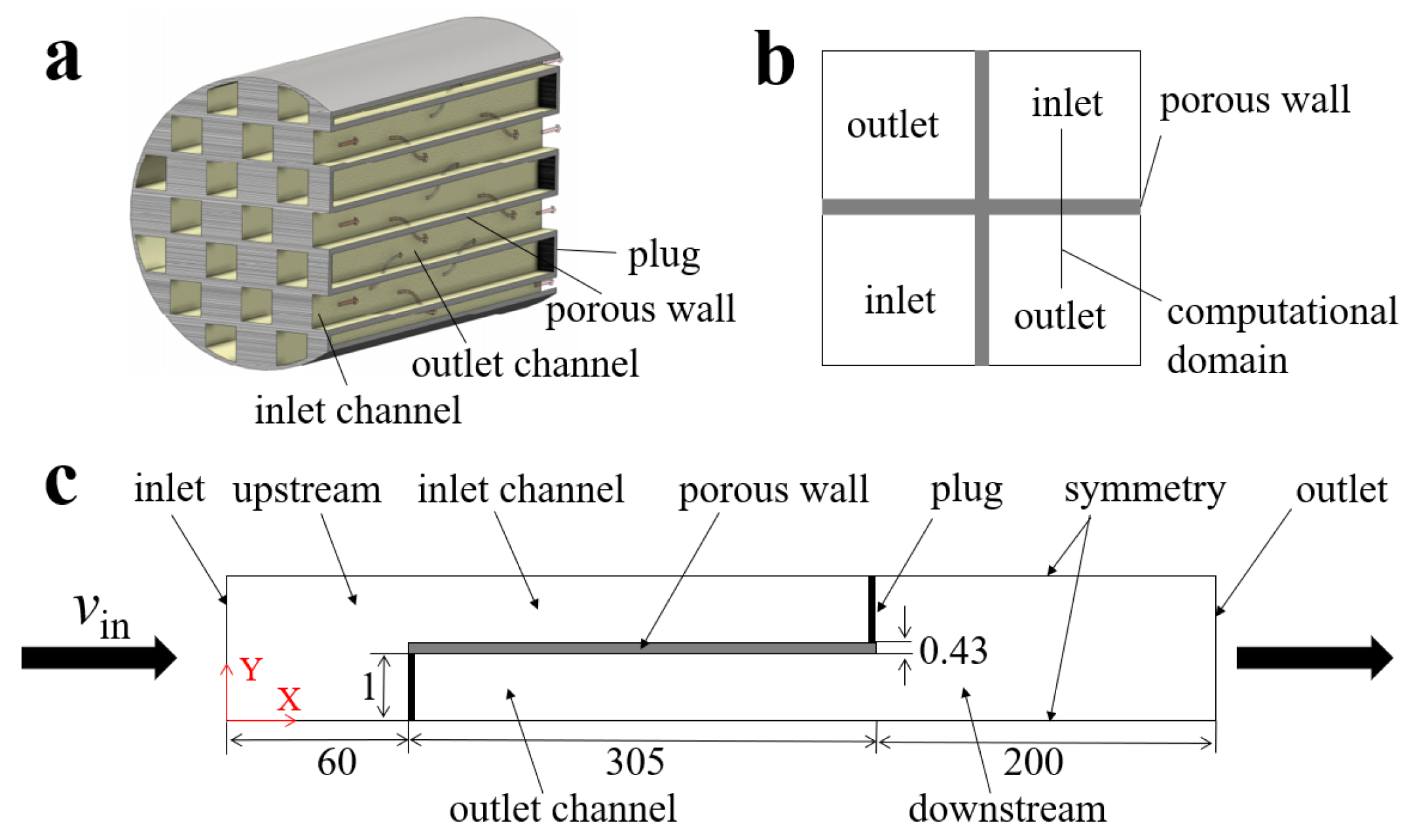
On account of the symmetric structure, half of a pair of adjacent channels is designated as the computational domain. Figure 1a–c illustrate the structure scheme of a wall-flow DPF, cross-sectional and longitudinal views of the computational domain, respectively. To ensure a fully developed flow and stabilize the simulation, a 60 mm upstream extension is added at the entrance and a 200 mm downstream extension is appended at the exit, as shown in Figure 1c. The geometrical specifics of the computational domain are provided in Table 1.
The mathematical model for the DPF’s microchannels formulated in this study is based on the following assumptions:
(1)
Since the Reynolds number of the gas flowing through the channel is below 2000, the flow regime is considered laminar [36].
(2)
The filtration wall exhibits uniform properties in porosity, micropore diameter, and permeability [45].
(3)
Given the extremely low volume fraction of soot particles in diesel engine exhaust, the interactions between particles and the force exerted by the particle phase on the gas phase are deemed negligible. That is, the coupling between the gas and particle phases is one-way [36].
(4)
Once soot particles come into contact with the wall surface, they adhere to it immediately on the spot [46].

2.2. Flow Field Modeling

The governing equations for the flow in the inlet and outlet channels are as follows:
u i x i = 0
ρ g u j u i x j = P x i + μ 2 u i x j 2
where ρ g represents the gas density, and μ denotes the gas viscosity, and P stands for the gas pressure.
The governing equations for the flow in the porous wall are given as
u w 1 = 0 u w 2 y = 0
P x = 0 P y = μ 2 u w 2 x 2 + μ u w 2 k w
where k w represents the wall permeability, and u w denotes the through-wall velocity, and subscripts 1 and 2 represent the components in the x direction and y direction, respectively.
The energy conservation equation of the gas phase is given as
k cond · ( T ) c ρ g u T x + v T y + ε = 0
where T represents the absolute temperature of the fluid, and k cond is the coefficient of heat conduction, and ε is the viscosity damping term.

2.3. Particle Motion Modeling

Almost all the exhaust particles are nanometer dimension. For nano-scale particles, compared with the drag force and the Brownian force, the impacts of other forces such as the Basset force and the gravitational force on their motion are essentially negligible. Accordingly, the equation of motion for the soot particles can be expressed as
d u p d t = F D i + F B
where u p represents the particle velocity, and F D denotes the drag force per unit particle mass, and F B stands for the Brown force per unit particle mass. F D is usually written as
F D i = 3 μ C D R e p 2 d p 2 ( 2 ρ p + ρ g ) u u p 1 S C F
where d p represents the particle diameter, and ρ p denotes the particle density, and C D stands for the drag coefficient, which changes with particle Reynolds number, R e p number. C D is given as
C D = 24 R e p ( R e p < 1 ) C D = 24 R e p 1 + 1 6 R e p 2 3 ( 1 < R e p < 1000 ) ,
where R e p is defined as
R e p = ρ g d p | u u p | μ
The Stokes-Cunningham slip factor, denoted as S C F , is defined as
S C F = 1 + 2 λ d p 1.257 + 0.4 e 0.55 d p / λ
where λ is the molecular mean free path of the gas, which is given as
λ = μ ρ g π m 2 R T
F B is simulated as a Gaussian white noise random process
F B = ζ 6 π d p μ k B T Δ t
where k B represents the Boltzmann constant, and Δ t denotes the time step magnitude, and ζ stands for the Gaussian random number.

2.4. Meshing, Boundary Conditions, Physical Properties and Calculation Methods

The computational domain is discretized with 339,000 quadrilateral elements of varying sizes. The nodes are uniformly distributed along the axial direction with a total of 11,301 nodes. Along the radial direction, 31 nodes are arranged, with 11 nodes allocated to each of the two channel sections and 11 nodes to the filtration wall section. Under this arrangement, the minimum mesh volume is 2.15 × 10 9 m3, and the maximum mesh volume is 5 × 10 9 m3. A sensitivity analysis confirms that this grid configuration is fully sufficient for the computational requirements, ensuring the reliability and accuracy of the subsequent study.
The inlet of the physical model is set as a velocity-inlet boundary condition, while the outlet is defined as a pressure-outlet boundary condition with the value set to atmospheric pressure. Both the upper and lower boundaries are configured as symmetric boundary conditions. The plugs at the end of the inlet channel and the front of the outlet channel are defined as no-slip wall boundary conditions.
The base case is defined by an inlet temperature of 600 K, an inlet velocity of 2 m/s, an inlet gas density of 0.54 kg/m3, an inlet gas viscosity of 3.2 × 10 5 Pa · s , a particle density of 2000 kg/m3, and a filtration wall permeability of 2.5 × 10 12 m2. Among these, the inlet velocity (ranging from 1 m/s to 4 m/s) and filtration wall permeability (ranging from 1 × 10 13 m2 to 1.25 × 10 11 m2) are influencing factors and are thus set as variables, while the other parameters remain constant.
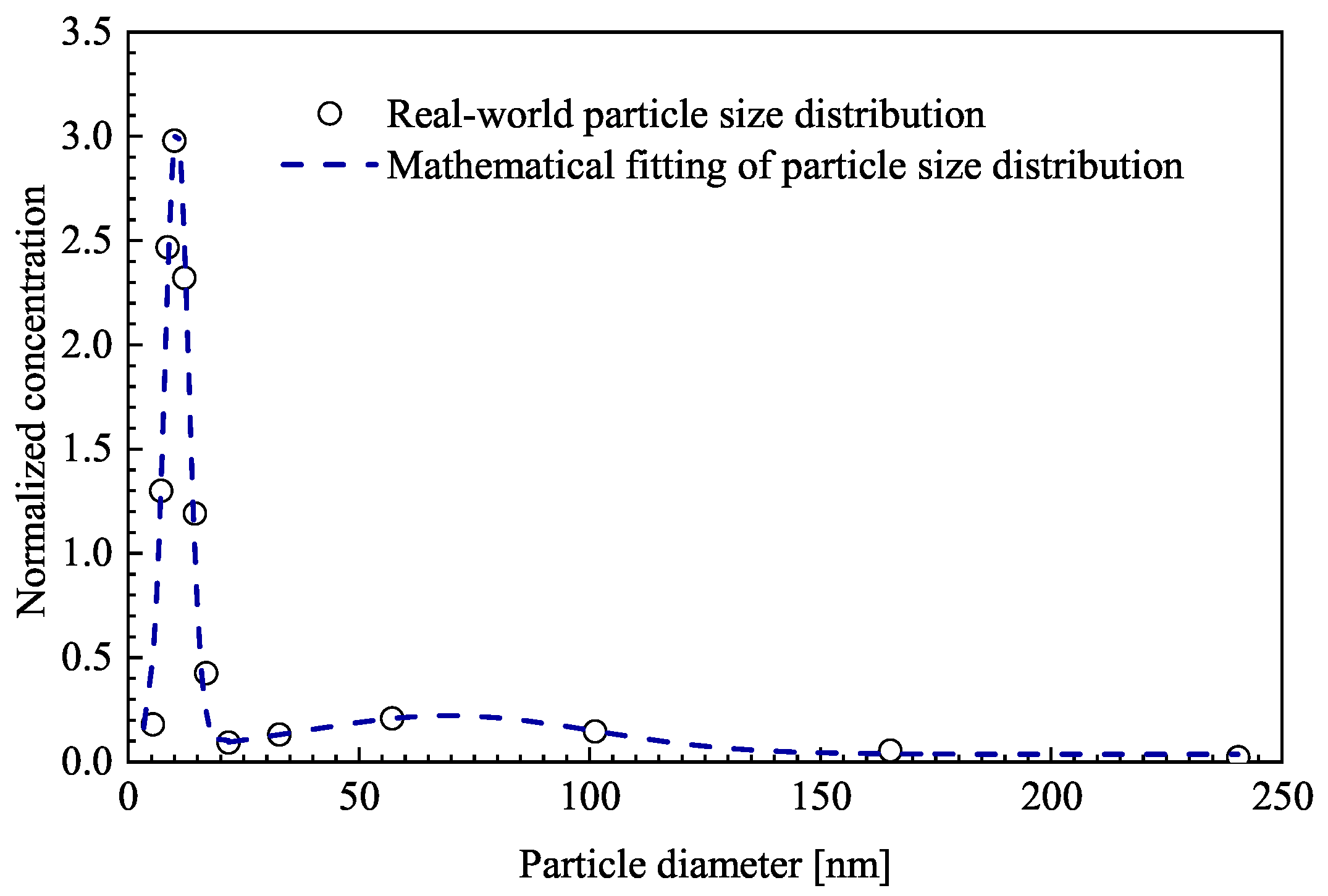
The real-world PSD utilized in this study is derived from the classical experimental data [47], which provides particle counts and masses across various size ranges, thereby facilitating the plotting of PSD curves. Mathematical fitting then yields a function to represent the distribution, which captures the information on the proportion or probability of particles within different size ranges in the entire population. Based on the number concentration of particles in various size ranges, the fitted distribution function enables the determination of the proportion of particles within specific size ranges. In this way, a set of particles with different sizes is extracted from the overall population to create a mixed-sized particle group sample. Accordingly, the PSD of this sample follows the previously fitted function, thus enabling it to represent the real-world PSD from diesel engines.
In light of the size distribution characteristics of diesel engine exhaust particles, Gaussian probability function is applied for mathematical fitting [47]. The corresponding expression is as follows:
y = y 0 + a w π / 2 · e 2 ( x b ) 2 w 2
where x represents the particle diameter. The values of the parameters in different particle size ranges are presented in Table 2.
Figure 2 presents a comparison between the real-world PSD and the fitted function.
Given the one-way coupling between the gas phase and the particle phase, the equations for the gas phase are initially solved in the absence of the particle phase by using the conventional SIMPLE algorithm. Upon convergence of the continuous phase calculation, a total of 1,000,000 particle parcels are injected from randomly distributed point sources situated along the inlet boundary. Each particle parcel contains particles of the same diameter. The number of particles in each parcel is calculated based on the number concentration corresponding to the particle diameter. In our simulations, UDFs are employed to (1) generate particle ensembles conforming to a real-world PSD, using the Gaussian fit from Equation (12) and parameters in Table 2; (2) inject particle parcels from random points on the inlet boundary after flow field convergence; (3) track the motion of particles by solving Equation (5), which accounts for drag and Brownian forces; and (4) handle the interaction between particles and the porous wall surface by adhering particles to the wall surface upon contact, and recording the deposited mass in a local User-Defined Memory (UDM) variable.
To quantitatively evaluate the uniformity of soot deposition, we define a non-uniformity parameter σ p , given by the following equation:
σ p = 1 n i = 1 n m i m total m ¯ m total 2
where m total denotes the total amount of soot deposition, and m i is the local amount of soot deposition, and m ¯ is the average amount of soot deposition, and n is the number of partitions.

3. Results and Analysis

3.1. Model Validation

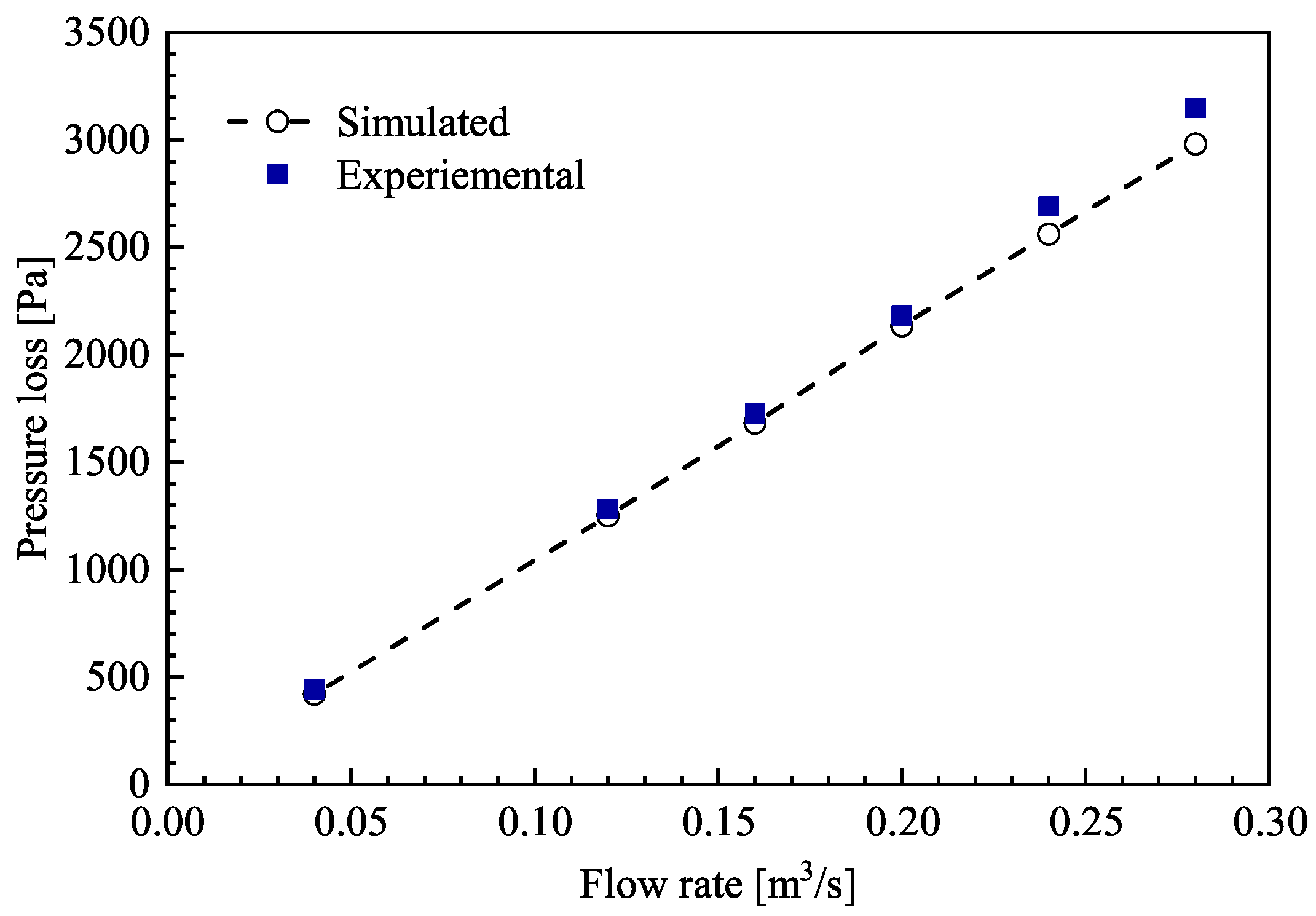
In view of the operational constraints, it poses a stern challenge to acquire the flow field distribution inside the channels via experimental measurement without altering the original structural dimensions. In the current study, we use the pressure drop characteristic curve, which depicts the relationship between the pressure drop across the DPF and the flow rate, as measured by Liu et al. [36] in their experiment, to validate the developed model. The diesel engine equipped in the experiment is a six-cylinder, four-stroke, turbocharged, and intercooled engine. The DPF is a Corning EX-80 cordierite filter, featuring a diameter of 229 mm, a length of 305 mm, a channel width of 2 mm, and a filtration wall thickness of 0.43 mm. The pressure drop across the DPF is gauged by installing ring-shaped pressure gauges at both the inlet and outlet ends of the DPF. By adjusting the opening of the bypass valve, the exhaust flow rate passing through the DPF can be varied, facilitating the collection of pressure drop data under a wide range of operating conditions.
The inlet flow was characterized by a temperature of 600 K, a viscosity of 3.2 × 10⁻⁵ Pa · s, and a density of 0.54 kg/m3. The outlet was set to a pressure of 1 atm. The inlet volume flow rate varied from 0.04 to 0.28 m3/s, which could be converted into inlet velocities of 1–6.8 m/s for the two-dimensional simulation. Figure 3 presents the comparison between the simulation results and experimental measurements. As is evident from the figure, the variation trends of the two are in concord. Despite the more pronounced deviation between numerical results and experimental outcomes at high exhaust flow rates, the maximum relative error, defined here as the largest value of the absolute deviation divided by the experimental value, remains acceptable at 5.66%. Hence, the established model is applicable to simulating and analyzing the gas-solid two-phase flow within the DPF channels.

3.2. Analysis of Through-Wall Velocity Distribution

Since the flow field distribution inside the DPF channels has a substantial impact on the soot deposition behavior therein [36,43], the upstream velocity and the filtration wall permeability, as key factors influencing this distribution, predictably play a critical role. In this subsection, four different upstream velocities, namely 1 m/s, 2 m/s, 3 m/s and 4 m/s, as well as four different filtration wall permeabilities, specifically 1 × 10 13 m2, 5 × 10 13 m2, 2.5 × 10 12 m2 and 1.25 × 10 11 m2, are picked to examine the effects of the upstream velocity and the filtration wall permeability on the through-wall velocity distribution.
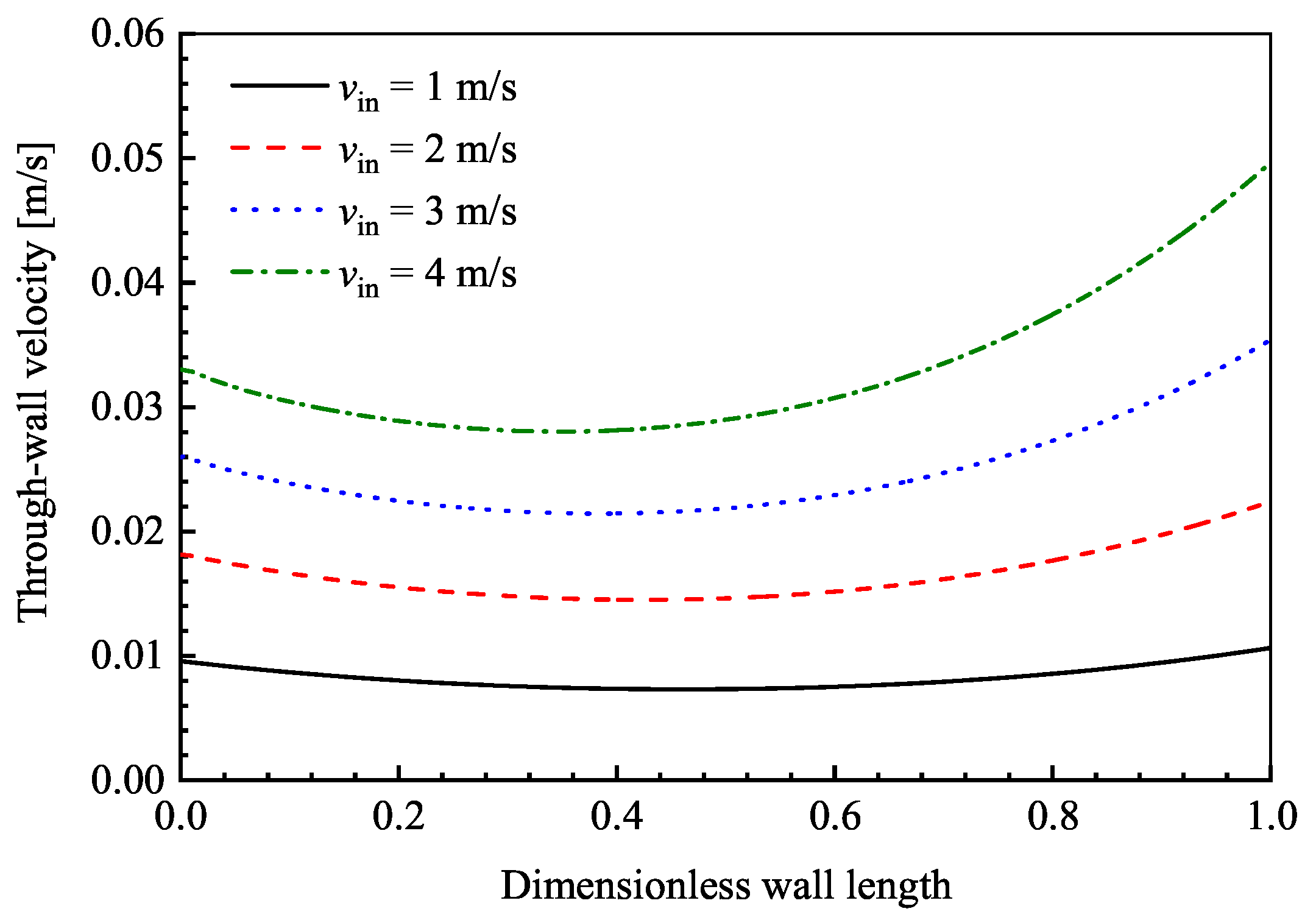
Figure 4 shows the distributions of the through-wall velocity under various upstream velocities.
From the figure, it is clear that, in all cases, the through-wall velocity decreases initially and then increases along the positive axial direction. The minimum velocity occurs at a position approximately 0.4 times the channel length from the entrance. The velocity at the exit end is higher than that at the entrance. This observation is particularly evident at higher upstream velocities. As a matter of fact, as the upstream velocity rises, the through-wall velocity shows an overall increase. At the same time, the velocity fluctuations become more noticeable, thereby resulting in a more uneven distribution.
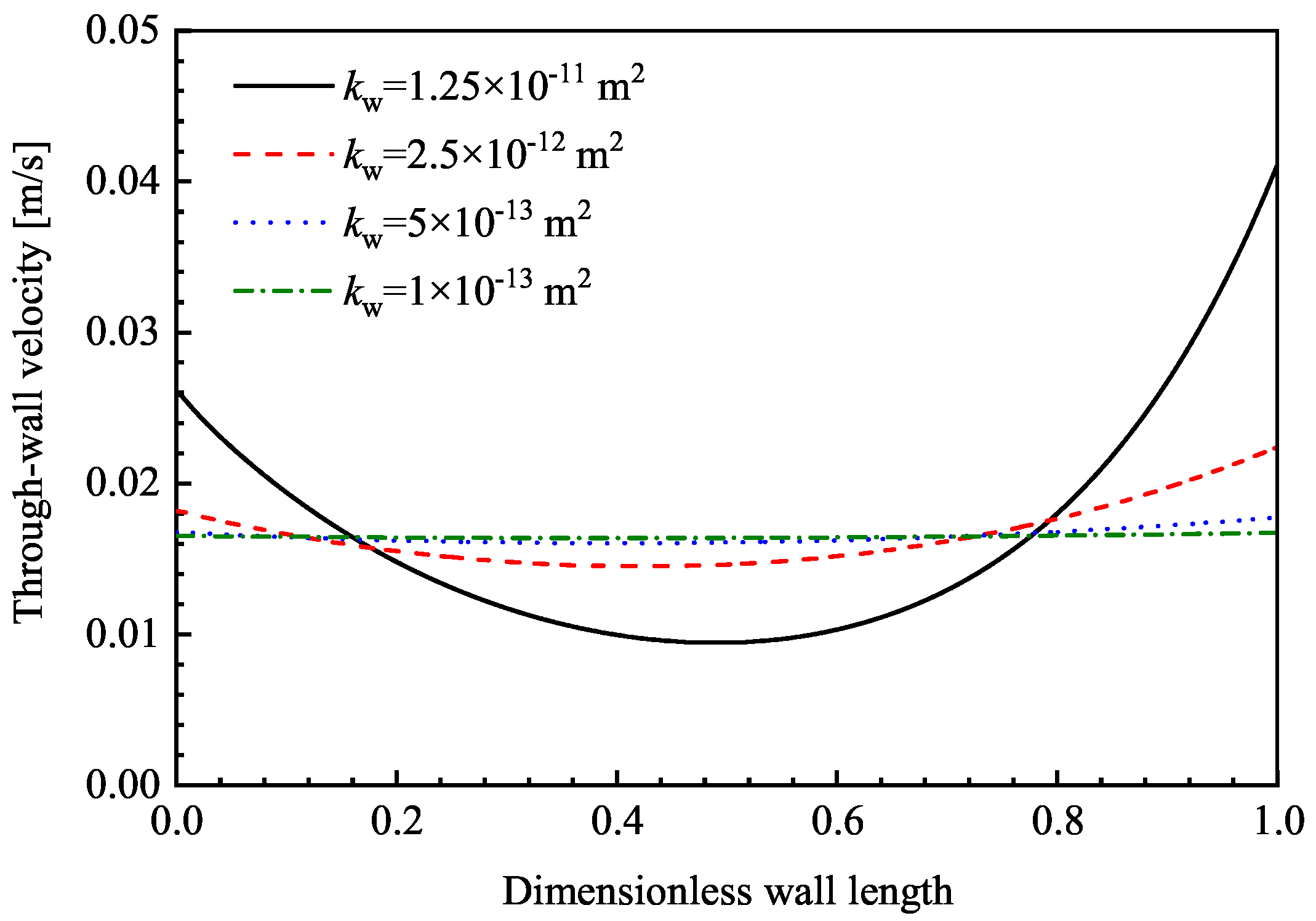
Figure 5 presents the distributions of the through-wall velocity under various filtration wall permeabilities.
As is seen from the figure, when the permeability is 1.25 × 10 11 m2, there exists a relatively large fluctuation amplitude in the through-wall velocity, with the minimum velocity roughly located at the midsection of the channel. This feature sets the operating condition apart from the other three simulation cases, creating a noticeable distinction. As the permeability reduces to 2.5 × 10 12 m2, while the pattern of lower velocities in the middle and higher velocities at both ends persists, the extent of velocity fluctuation shows marked decrease. With further reductions in filtration wall permeability to 5 × 10 13 m2 and 1 × 10 13 m2, the through-wall velocity achieves a highly uniform distribution. Accordingly, a permeability of 5 × 10 13 m2 appears to be a critical threshold, below which the through-wall velocity distribution tends towards uniformity.

3.3. Effects of Upstream Velocity on Particle Deposition

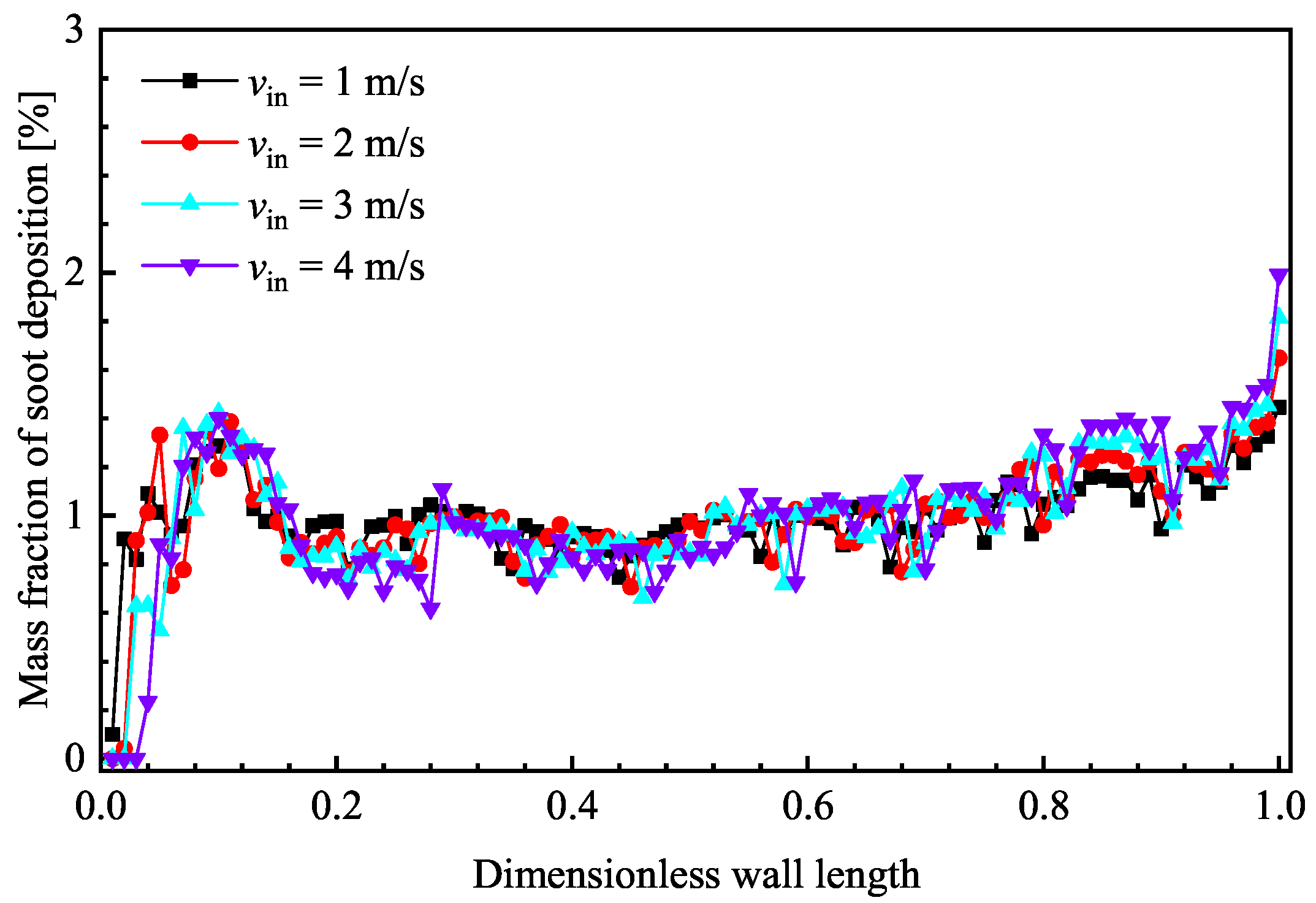
The upstream velocity plays a crucial role in shaping through-wall velocity profile, as shown previously in Figure 4, thereby exerting an influence on the spatial distribution of particle deposition. Figure 6 illustrates the distributions of particle deposition along the channel length at various upstream velocities. The y-axis stands for the proportion of soot deposition, defined as the ratio of local soot deposition to the total soot deposition, expressed as a percentage. The figure reveals a consistent correlation between the soot deposition distribution and the through-wall velocity profile, both characterized by concavity in the middle region and convexity at both ends. As the upstream velocity increases, the soot deposition distribution changes significantly: firstly, the position where soot particles begin to deposit gradually moves downstream; secondly, in the front and middle sections of the channel, specifically the region ranging from 0.2 to 0.55 times the channel length from the entrance, the proportion of soot deposition decreases, whereas in the mid-to-rear sections of the channel, specifically the region ranging from 0.55 to 1 times the channel length from the entrance, the proportion of soot deposition increases correspondingly. From the perspective of particle motion decomposition, the time a particle travels in the inlet channel before touching the wall is determined by the radial component of velocity. An increase in the upstream velocity directly enhances the axial component of particle velocity. Consequently, despite identical residence times being maintained, particles exhibit extended travel distances in the inlet channel.
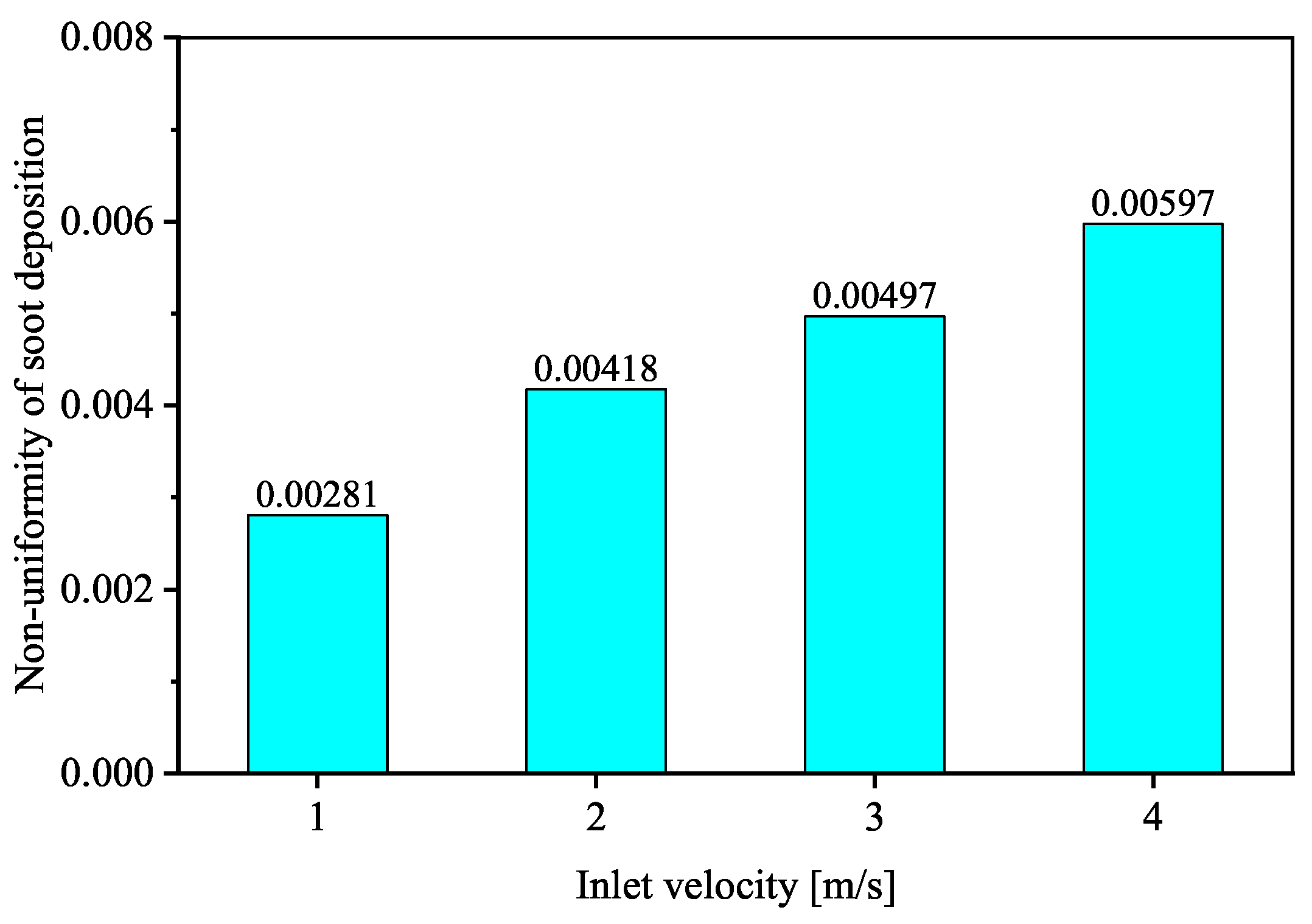
Figure 7 demonstrates the axial non-uniformity of soot deposition under various upstream velocities. The data clearly indicate a positive correlation between the non-uniformity and the upstream velocity. Factually, higher upstream velocities intensify through-wall velocity fluctuations, as shown in Figure 3. It should also be noted that the sizes of the injected and tracked particles range from 5 nm to 240 nm, with the majority concentrated around 10 nm, as clearly shown in Figure 2. For small-sized particles, lower inertia enables better flow adaptation despite Brownian motion slightly reducing drag force dominance. As a result, the deposition distribution retains the fundamental characteristics of the through-wall velocity.

3.4. Effects of Filtration Wall Permeability on Particle Deposition

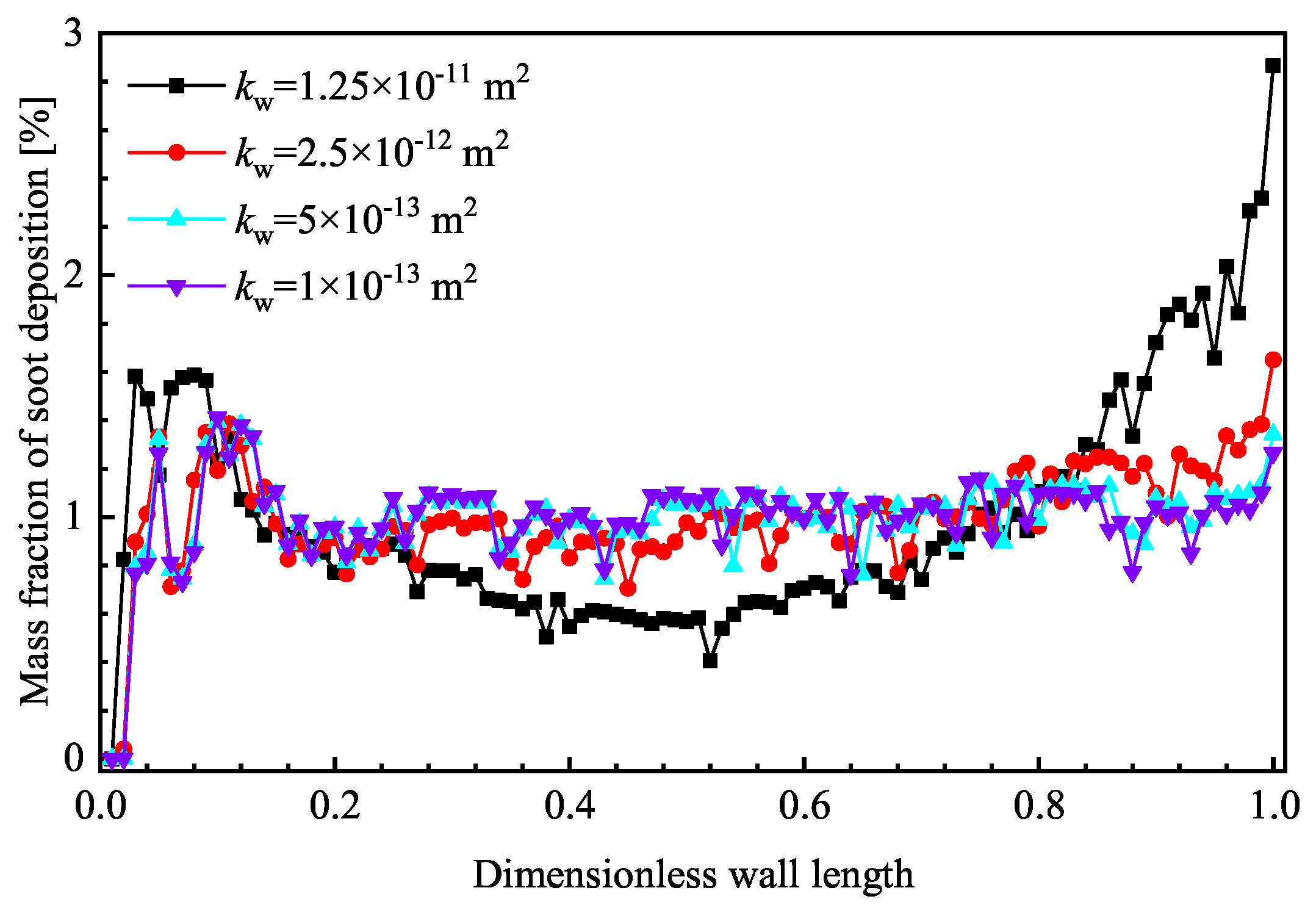
Filtration wall permeability determines the difficulty of the flow through the filtration wall, thereby necessarily impacting the velocity field and the particle deposition behavior. Figure 8 presents the distributions of particle deposition along the channel length at various filtration wall permeabilities.
On the whole, as filtration wall permeability decreases, the soot deposition distribution tends towards greater uniformity. By comparing Figure 5 and Figure 8, it can be observed that the soot deposition distribution is highly similar to the through-wall velocity profile. This further indicates that the through-wall velocity plays a predominant role in the global deposition behavior of the mixed-sized particle ensemble. Specifically, in the case of k w = 1.25 × 10 11 m2, the soot deposition distribution is notably non-uniform, with enhanced accumulation near the inlet and outlet ends but significantly less in the middle region, clearly distinguishing this case from the other three. In comparison, the soot deposition distribution in the case of k w = 2.5 × 10 12 m2 becomes much more uniform. As for the cases of k w = 5 × 10 13 m2 and 1 × 10 13 m2, the soot deposition distributions show negligible differences between them. Hence, a permeability of 5 × 10 13 m2 appears to be a critical threshold, below which the soot deposition distribution tends towards uniformity.
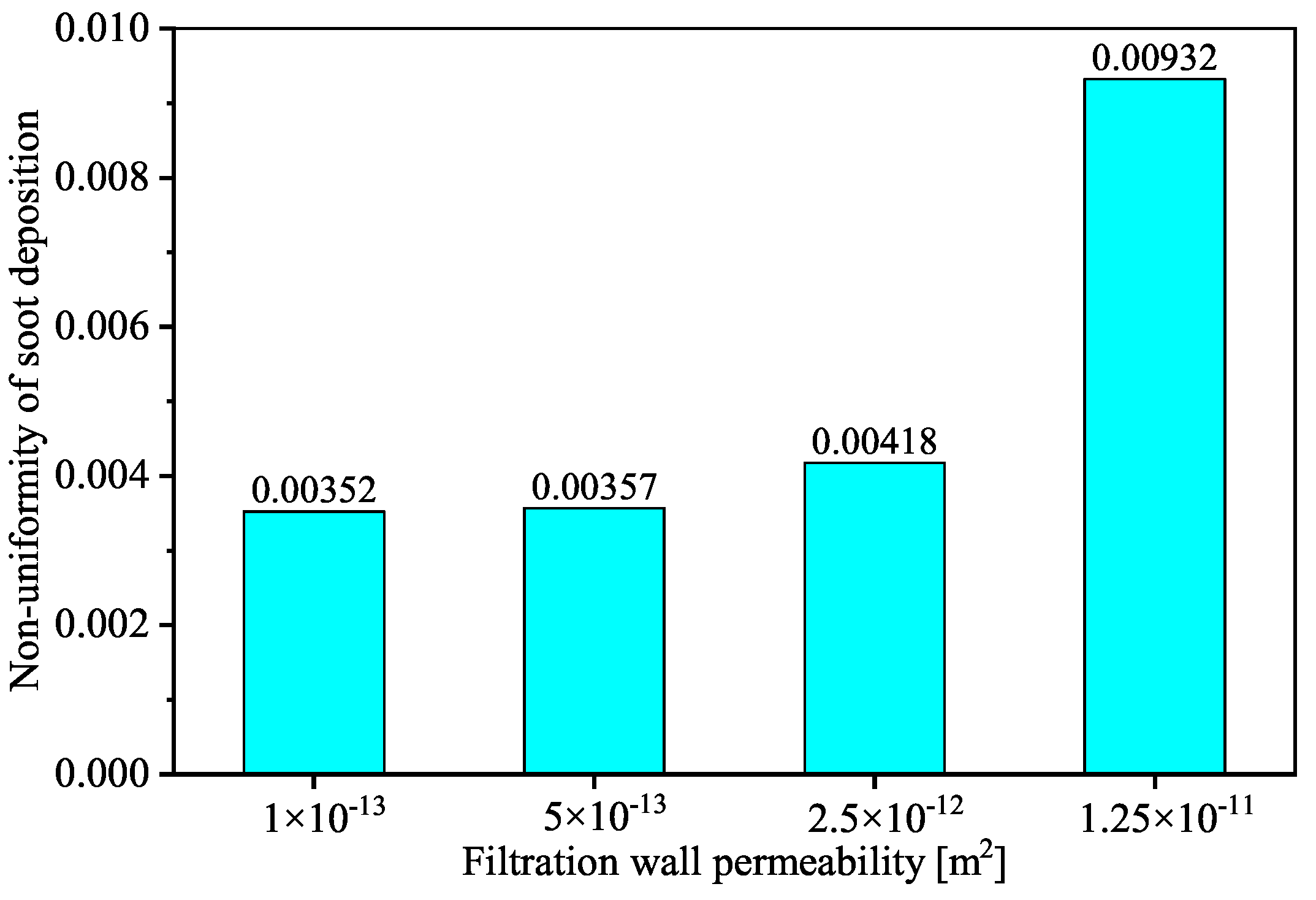
Figure 9 shows the axial non-uniformity of soot deposition under various filtration wall permeabilities.
As illustrated by the qualitative analysis of Figure 7, when the filtration wall permeability decreases from 1.25 × 10 11 m2 to 5 × 10 13 m2, the non-uniformity of soot deposition distribution remarkably reduces, with the non-uniformity dropping from 0.00932 to 0.00357. Nevertheless, as the filtration wall permeability further decreases from 5 × 10 13 m2 to 1 × 10 13 m2, the non-uniformity of the soot deposition distribution remains substantially unchanged, with no significant further reduction observed.

4. Conclusions

In this paper, a novel statistical method based on probability sampling is proposed to construct a soot particle ensemble that conforms to the real-world PSD. The Lagrangian approach is used to track the movement trajectories of the particle ensemble in the DPF’s microchannels, enabling the acquisition of spatial deposition profiles along the channel length. The dependences of particle ensemble deposition distribution on the upstream velocity and the filtration wall permeability are examined. The following main conclusions are drawn:
(1)
The through-wall velocity plays a predominant role in the overall deposition behavior of the mixed-sized particle group.
(2)
Increasing upstream velocity shifts initial particle deposition positions further from the channel inlet and enhances mass accumulation at the channel’s terminal section.
(3)
As the filtration wall permeability decreases, the uniformity of soot deposition along the channel is promoted. A permeability of 5 × 10 13 m2 is identified as the critical threshold, below which the soot deposition distribution approaches near-complete uniformity.
Future studies should focus on developing a transient deep-bed filtration model to simulate the dynamic deposition process of particle ensembles, which will address the relationship between pressure drop and soot loading, enabling the predictions of spatiotemporal evolution of soot deposition and facilitating the optimization of the DPF’s structure and operation.

Author Contributions

Z.W.: Conceptualization, Methodology, Formal analysis, Validation, Writing—original draft; Z.L.: Methodology, Formal analysis, Data curation, Writing—original draft; L.M.: Investigation, Formal analysis, Validation; W.M.: Investigation, Formal analysis, Data curation; X.W.: Data curation, Visualization; Z.Z.: Writing—review & editing, Funding Acquisition; X.Z.: Writing—review & editing, Funding Acquisition; G.J.: Software, Supervision. All authors have read and agreed to the published version of the manuscript.

Funding

This research was supported by National Natural Science Foundation of China (No. 51876107) and Scientific Research Fund of Binzhou Polytechnic (Grant No. 25-ZJZX-041).

Data Availability Statement

The datasets are made available upon reasonable request to the corresponding author.

Acknowledgments

The authors are grateful to many colleagues with whom they had the privilege to interact and collaborate over the years and whose work is partially referenced in this article.

Conflicts of Interest

The authors declare that the research was conducted in the absence of any commercial or financial relationships that could be construed as a potential conflict of interest.

References

  1. Çilğın, E.; Deviren, H.; Arpa, O. Acetone and nanoparticles effect on performance and exhaust emissions of a diesel engine. Case Stud. Therm. Eng. 2023, 52, 103755. [Google Scholar] [CrossRef]
  2. Yildiz, I.; Caliskan, H.; Mori, K. Effects of cordierite particulate filters on diesel engine exhaust emissions in terms of pollution prevention approaches for better environmental management. J. Environ. Manag. 2021, 293, 112873. [Google Scholar] [CrossRef] [PubMed]
  3. Uludamar, E.; Özgür, C. Optimization of exhaust emissions, vibration, and noise of a hydrogen enriched fuelled diesel engine. Int. J. Hydrogen Energy 2022, 47, 37090–37105. [Google Scholar] [CrossRef]
  4. Vergel-Ortega, M.; Valencia-Ochoa, G.; Duarte-Forero, J. Experimental study of emissions in single-cylinder diesel engine operating with diesel-biodiesel blends of palm oil-sunflower oil and ethanol. Case Stud. Therm. Eng. 2021, 26, 101190. [Google Scholar] [CrossRef]
  5. Huang, Z.; Huang, J.; Luo, J.; Hu, D.; Yin, Z. Performance enhancement and emission reduction of a diesel engine fueled with different biodiesel-diesel blending fuel based on the multi-parameter optimization theory. Fuel 2022, 314, 122753. [Google Scholar] [CrossRef]
  6. Sharma, H.; Mahla, S.K.; Dhir, A. Effect of utilization of hydrogen-rich reformed biogas on the performance and emission characteristics of common rail diesel engine. Int. J. Hydrogen Energy 2022, 47, 10409–10419. [Google Scholar] [CrossRef]
  7. Arora, P.; Verma, P.; Lodi, F.; Jafari, M.; Zare, A.; Stevanovic, S.; Bodisco, T.A.; Brown, R.J.; Ristovski, Z. Particulate emissions and soot characterisation of diesel engine exhaust for steady-state operating condition using dioctyl phthalate blends with diesel. Fuel 2023, 340, 127527. [Google Scholar] [CrossRef]
  8. Zhu, Q.; Zong, Y.; Tan, Y.R.; Lyu, J.; Yu, W.; Yang, W.; Kraft, M. Evaluating the effect of n-butanol additive on particulate matter emission in diesel engine. Fuel 2023, 332, 126003. [Google Scholar] [CrossRef]
  9. Mohankumar, S.; Senthilkumar, P. Particulate matter formation and its control methodologies for diesel engine: A comprehensive review. Renew. Sustain. Energy Rev. 2017, 80, 1227–1238. [Google Scholar] [CrossRef]
  10. Jiang, H.; Wu, G.; Li, T.; He, P.; Chen, R. Characteristics of particulate matter emissions from a low-speed marine diesel engine at various loads. Environ. Sci. Technol. 2019, 53, 11552–11559. [Google Scholar] [CrossRef]
  11. Tabor, J.; Sarver, E.; Saylor, J.R. A fog-and-tube scrubber for the removal of diesel particulate matter from engine exhaust. Aerosol Air Qual. Res. 2021, 21, 210134. [Google Scholar] [CrossRef]
  12. Gao, J.; Ma, C.; Xing, S.; Sun, L. Oxidation behaviours of particulate matter emitted by a diesel engine equipped with a NTP device. Appl. Therm. Eng. 2017, 119, 593–602. [Google Scholar] [CrossRef]
  13. Geng, Y.; Cao, Y.; Zhao, Q.; Li, Y.; Tian, S. Potential hazards associated with interactions between diesel exhaust particulate matter and pulmonary surfactant. Sci. Total Environ. 2022, 807, 151031. [Google Scholar] [CrossRef] [PubMed]
  14. Liu, H.; Wang, G.; Zhang, J.; Lu, B.; Li, D.; Chen, J. Inhalation of diesel exhaust particulate matter induces locomotor hyperactivity and its relationship with brain and gut metabolism. Environ. Int. 2024, 183, 108359. [Google Scholar] [CrossRef]
  15. Fu, M.; Jin, T.; Qu, L.; Liu, S.; Lu, K.; Tao, Y.; Zhao, S.; Li, Z.; Li, P.; Liu, J. The effect of multiple factors on water-soluble inorganic ions in diesel particulate matter emissions. J. Hazard. Mater. 2023, 459, 132236. [Google Scholar] [CrossRef]
  16. Ravi, S.S.; Osipov, S.; Turner, J.W.G. Impact of modern vehicular technologies and emission regulations on improving global air quality. Atmosphere 2023, 14, 1164. [Google Scholar] [CrossRef]
  17. Apicella, B.; Mancaruso, E.; Russo, C.; Tregrossi, A.; Oliano, M.M.; Ciajolo, A.; Vaglieco, B.M. Effect of after-treatment systems on particulate matter emissions in diesel engine exhaust. Exp. Therm. Fluid Sci. 2020, 116, 110107. [Google Scholar] [CrossRef]
  18. Lapuerta, M.; Rodríguez-Fernández, J.; Sánchez-Valdepeñas, J. Soot reactivity analysis and implications on diesel filter regeneration. Prog. Energy Combust. Sci. 2020, 78, 100833. [Google Scholar] [CrossRef]
  19. Russell, A.; Epling, W.S. Diesel oxidation catalysts. Catal. Rev. 2011, 53, 337–423. [Google Scholar] [CrossRef]
  20. Ayodhya, A.S.; Narayanappa, K.G. An overview of after-treatment systems for diesel engines. Environ. Sci. Pollut. Res. 2018, 25, 35034–35047. [Google Scholar] [CrossRef]
  21. Luo, J.; Zhang, H.; Liu, Z.; Zhang, Z.; Pan, Y.; Liang, X.; Wu, S.; Xu, H.; Xu, S.; Jiang, C. A review of regeneration mechanism and methods for reducing soot emissions from diesel particulate filter in diesel engine. Environ. Sci. Pollut. Res. 2023, 30, 86556–86597. [Google Scholar] [CrossRef]
  22. Huang, Y.; Ng, E.C.Y.; Surawski, N.C.; Zhou, J.L.; Wang, X.; Gao, J.; Lin, W.; Brown, R.J. Effect of diesel particulate filter regeneration on fuel consumption and emissions performance under real-driving conditions. Fuel 2022, 320, 123937. [Google Scholar] [CrossRef]
  23. Duan, L.; Tan, P.; Yin, Y.; Li, Y.; Lou, D.; Hu, Z. Effect of ash on temperature and particulate emission characteristics of diesel particulate filter during active regeneration. J. Clean. Prod. 2023, 426, 138980. [Google Scholar] [CrossRef]
  24. Meng, Z.; Ou, J.; Wang, W.; Huang, J.; Liu, J. Comparison of the use of real diesel soot and soot surrogate in the performance analysis of diesel particulate filters. J. Clean. Prod. 2024, 442, 141009. [Google Scholar] [CrossRef]
  25. Lou, D.; Chen, Y.; Zhang, Y.; Jue, K.; Tan, P.; Hu, Z.; Fang, L. Analysis of temperature and pressure characteristics in catalyzed diesel particulate filter operation for heavy-duty diesel engine. Fuel 2022, 328, 125248. [Google Scholar] [CrossRef]
  26. Guan, B.; Zhan, R.; Lin, H.; Huang, Z. Review of the state-of-the-art of exhaust particulate filter technology in internal combustion engines. J. Environ. Manag. 2015, 154, 225–258. [Google Scholar] [CrossRef]
  27. Stamatellou, A.-M.; Stamatelos, A. Overview of Diesel particulate filter systems sizing approaches. Appl. Therm. Eng. 2017, 121, 537–546. [Google Scholar] [CrossRef]
  28. Adler, J. Ceramic diesel particulate filters. Int. J. Appl. Ceram. Technol. 2005, 2, 429–439. [Google Scholar] [CrossRef]
  29. Yang, J.; Stewart, M.; Maupin, G.; Herling, D.; Zelenyuk, A. Single wall diesel particulate filter (DPF) filtration efficiency studies using laboratory generated particles. Chem. Eng. Sci. 2009, 64, 1625–1634. [Google Scholar] [CrossRef]
  30. Tan, P.; Cao, C.; Hu, Z.; Lou, D. Modeling of soot fragmentation that proceeds in a catalyzed diesel particulate filter of a diesel engine. Chem. Eng. J. 2019, 375, 122110. [Google Scholar] [CrossRef]
  31. Ebrahimnataj, M.R.; Ehteram, M.A.; Sahebi, M.; Abdolmaleki, S. Numerical and experimental study on the gaseous emission and back pressure during regeneration of diesel particulate filters. Transp. Res. Part D Transp. Environ. 2018, 62, 11–26. [Google Scholar] [CrossRef]
  32. Swanson, J.; Watts, W.; Kittelson, D.; Newman, R.; Ziebarth, R. Filtration efficiency and pressure drop of miniature diesel particulate filters. Aerosol Sci. Technol. 2013, 47, 452–461. [Google Scholar] [CrossRef]
  33. Iorio, S.D.; Beatrice, C.; Guido, C.; Giacomo, N.D.; Napolitano, P.; Vassallo, A. Analysis of particle mass and size emissions from a catalyzed diesel particulate filter during regeneration by means of actual injection strategies in light duty engines. SAE Int. J. Engines 2011, 4, 2510–2518. [Google Scholar] [CrossRef]
  34. Dawei, Q.; Jun, L.; Yu, L. Research on particulate filter simulation and regeneration control strategy. Mech. Syst. Signal Process. 2017, 87, 214–226. [Google Scholar] [CrossRef]
  35. Bai, S.; Wang, C.; Li, D.; Wang, G.; Li, G. Influence of the idle-up strategy on the thermal management of diesel particulate filter regeneration during a drop to the idle process. Appl. Therm. Eng. 2018, 141, 976–980. [Google Scholar] [CrossRef]
  36. Liu, Y.; Gong, J.; Fu, J.; Cai, H.; Long, G. Nanoparticle motion trajectories and deposition in an inlet channel of wall-flow diesel particulate filter. J. Aerosol Sci. 2009, 40, 307–323. [Google Scholar] [CrossRef]
  37. Bensaid, S.; Marchisio, D.L.; Fino, D.; Saracco, G.; Specchia, V. Modelling of diesel particulate filtration in wall-flow traps. Chem. Eng. J. 2009, 154, 211–218. [Google Scholar] [CrossRef]
  38. Bensaid, S.; Marchisio, D.L.; Fino, D. Numerical simulation of soot filtration and combustion within diesel particulate filters. Chem. Eng. Sci. 2010, 65, 357–363. [Google Scholar] [CrossRef]
  39. Sbrizzai, F.; Faraldi, P.; Soldati, A. Appraisal of three-dimensional numerical simulation for sub-micron particle deposition in a micro-porous ceramic filter. Chem. Eng. Sci. 2005, 60, 6551–6563. [Google Scholar] [CrossRef]
  40. Kong, X.; Li, Z.; Shen, B.; Wu, Y.; Zhang, Y.; Cai, D. Simulation of flow and soot particle distribution in wall-flow DPF based on lattice Boltzmann method. Chem. Eng. Sci. 2019, 202, 169–185. [Google Scholar] [CrossRef]
  41. Kong, X.; Shi, J.; Wang, G.; Li, Y. Numerical analysis on flow field characteristics and particle deposition distributions of DPF channels with different lengths based on lattice Boltzmann method. Powder Technol. 2024, 448, 120237. [Google Scholar] [CrossRef]
  42. Guo, Z.; Zhang, Z. A one-dimensional numerical model for diesel particulate trap performance study during loading and regeneration. Int. J. Engine Res. 2005, 6, 247–262. [Google Scholar] [CrossRef]
  43. Piscaglia, F.; Rutland, C.J.; Foster, D.E. Development of a CFD model to study the hydrodynamic characteristics and the soot deposition mechanism on the porous wall of a diesel particulate filter. SAE Tech. Pap. 2005. [Google Scholar] [CrossRef]
  44. Li, Z.; Yan, F.; Kong, X.; Shen, B.; Li, Z.; Wang, Y. Simulation of soot particle deposition inside porous walls based on lattice Boltzmann method for diesel particulate filter. J. Environ. Chem. Eng. 2021, 9, 105396. [Google Scholar] [CrossRef]
  45. Di Sarli, V.; Di Benedetto, A. Modeling and simulation of soot combustion dynamics in a catalytic diesel particulate filter. Chem. Eng. Sci. 2015, 137, 69–78. [Google Scholar] [CrossRef]
  46. Dahneke, B. Particle bounce or capture—Search for an adequate theory: I. Conservation-of-energy model for a simple collision process. Aerosol Sci. Technol. 1995, 23, 25–39. [Google Scholar] [CrossRef]
  47. Eastwood, P. Particulate Emissions from Vehicles; John Wiley & Sons: Hoboken, NJ, USA, 2008. [Google Scholar]
Figure 1. Structure scheme of a wall-flow DPF (a), cross section (b), and longitudinal section (c) of computational domain.
Fuels 07 00014 g001
Figure 2. Comparison between the real-world soot PSD and the fitted function.
Fuels 07 00014 g002
Figure 3. Comparison of the predicted and experimental pressure loss [36] as a function of flow rates.
Fuels 07 00014 g003
Figure 4. Through-wall velocity distributions under different inlet velocities.
Fuels 07 00014 g004
Figure 5. Through-wall velocity distribution under different filtration wall permeabilities.
Fuels 07 00014 g005
Figure 6. Soot deposition distributions under different velocities.
Fuels 07 00014 g006
Figure 7. Non-uniformity of the soot deposition distribution under different inlet velocities.
Fuels 07 00014 g007
Figure 8. Soot deposition distributions under different filtration wall permeabilities.
Fuels 07 00014 g008
Figure 9. Non-uniformity of the soot deposition distribution under different permeabilties.
Fuels 07 00014 g009
Table 1. Geometrical specifics of the computational domain.
Geometric ParametersValue
Channel length (mm)305
Channel width (mm)2
Filtration wall thickness (mm)0.43
Length of added upstream zone (mm)60
Length of added downstream zone (mm)200
Table 2. The values of the parameters in Equation (13).
x (nm) y 0 w (nm)a (nm)b (nm)
(5, 22]0.10325.1490718.9099510.50144
(22, 240]0.0368362.9314614.5897369.40012
Disclaimer/Publisher’s Note: The statements, opinions and data contained in all publications are solely those of the individual author(s) and contributor(s) and not of MDPI and/or the editor(s). MDPI and/or the editor(s) disclaim responsibility for any injury to people or property resulting from any ideas, methods, instructions or products referred to in the content.