Article

Pd-Induced Electronic Activation and Strain-Tunable Adsorption-Coupled Electronic Modulation in Janus ZrSSe Monolayers


1
Beijing Key Laboratory of Passive Safety Technology for Nuclear Energy, North China Electric Power University, Beijing 102206, China
2
School of Nuclear Science and Engineering, North China Electric Power University, Beijing 102206, China
3
Northwest Institute of Nuclear Technology, Xi’an 710024, China
*
Author to whom correspondence should be addressed.
Electron. Mater. 2026, 7(2), 13; https://doi.org/10.3390/electronicmat7020013
Submission received: 17 April 2026 / Revised: 28 May 2026 / Accepted: 5 June 2026 / Published: 8 June 2026

Abstract

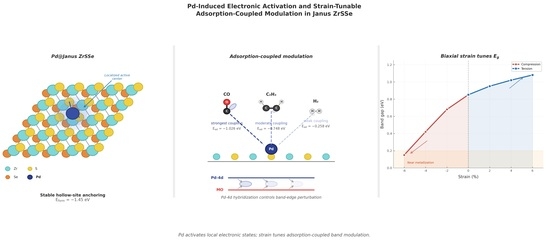
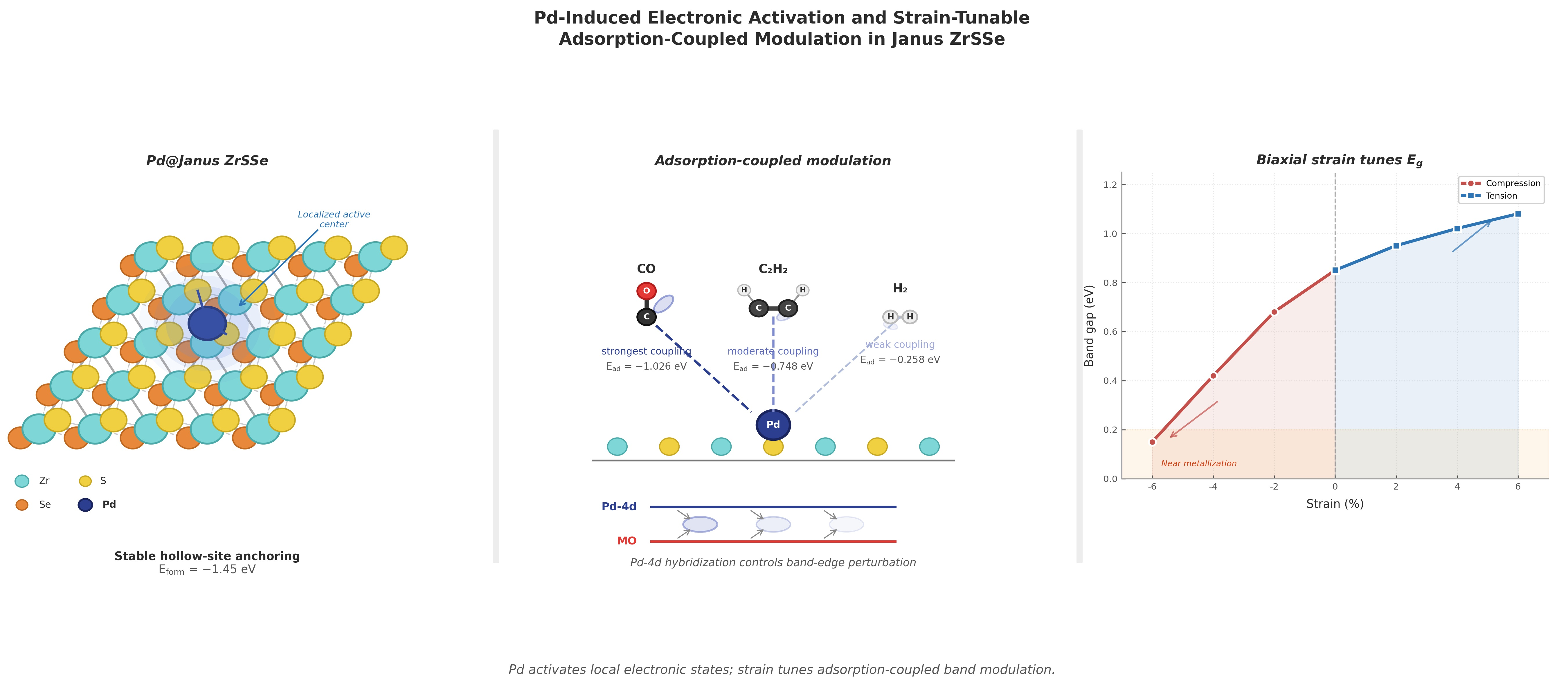
Pd-decorated Janus ZrSSe monolayers provide a promising platform for adsorption-coupled electronic modulation in two-dimensional materials. Using first-principles density functional theory, we systematically investigate the structural stability, electronic properties, and adsorbate-induced electronic response of Pd-modified Janus ZrSSe. The results show that Pd is most stably anchored at the hollow site on the S-terminated surface, with a formation energy of 1.45 eV, while substitutional incorporation remains energetically unfavorable even after HSE06 refinement. Compared with pristine ZrSSe, Pd decoration markedly strengthens the interaction with adsorbates, leading to strong chemisorption for CO ( 1.026 eV) and C2H2 ( 0.748 eV), whereas H2 remains comparatively weakly bound ( 0.258 eV). Electronic-structure analysis reveals that CO induces the most pronounced perturbation because of strong orbital hybridization between Pd 4d states and C/O 2p states, resulting in the largest band-edge modulation among the three adsorbates. More importantly, biaxial strain provides an effective external degree of freedom for continuously tuning the electronic structure: tensile strain widens the band gap, whereas compressive strain systematically narrows it and ultimately drives a semiconductor-to-metal transition at sufficiently large compression. These findings establish Pd-decorated Janus ZrSSe as a strain-tunable electronic material in which adsorption, orbital hybridization, and band-edge evolution are intimately coupled, offering fundamental insights into controllable electronic modulation in polar two-dimensional systems.

Graphical Abstract

1. Introduction

Adsorption-induced perturbations at solid surfaces are a central topic in surface and condensed-matter physics because they can reshape local bonding, redistribute charge, and generate interfacial dipoles, thereby modifying the electronic structure and transport characteristics of low-dimensional materials. Two-dimensional (2D) systems are particularly attractive in this context because their atomic-scale thickness maximizes surface exposure and makes their carrier density and band-edge states highly sensitive to external perturbations. In contrast to graphene, semiconducting 2D transition metal dichalcogenides (TMDs) provide intrinsic band gaps and chemically tunable electronic structures, making them versatile platforms for studying how adsorption affects local orbital hybridization and near-Fermi-level states [1,2,3].
Janus TMD monolayers offer an especially appealing symmetry-broken platform for such studies. By replacing one of the two equivalent chalcogen layers in M X 2 with a different chalcogen species, an M X Y structure is formed that lacks out-of-plane mirror symmetry [1,4]. Experimental advances have demonstrated that such atomically thin polar crystals can be stabilized [5]. The built-in out-of-plane dipole in Janus monolayers gives rise to chemically inequivalent terminations, modified work functions, and enhanced electromechanical responses [6,7,8]. These characteristics make Janus systems highly attractive for studies of adsorption-coupled electronic phenomena, since the intrinsic polarity can steer charge transfer, adsorption energetics, and band-edge alignment in an asymmetric manner [9,10].
A complementary strategy for activating 2D electronic materials is transition-metal decoration, which introduces localized d states that can hybridize with adsorbate orbitals. This effect is often rationalized within the Hammer–Nørskov d-band framework, where the position and filling of the d band govern the strength of adsorbate–surface coupling [11,12,13]. Among noble metals, Pd is a prototypical activator because it combines strong chemical affinity with versatile catalytic behavior [14]. When introduced on 2D semiconductors, Pd can create localized active electronic centers that strongly perturb adsorption-induced charge redistribution and band-edge states. Representative experiments have shown that Pd decoration can markedly enhance adsorption-induced electronic response in MoS2-based heterostructures [15]. In parallel, strain engineering provides a continuous external handle for modifying bond lengths, orbital overlap, and symmetry, and has become a general route for tuning band structures and phase stability in 2D materials [16,17,18,19,20]. In Janus crystals, strain can couple to the intrinsic dipole and piezoelectric polarization, offering an additional degree of freedom for regulating adsorption-coupled electronic modulation.
Within this context, Janus ZrSSe has emerged as a stable group-IV TMD-derived monolayer with intrinsic polarity and electronically tunable behavior. Previous first-principles studies have shown that ZrSSe is mechanically and dynamically stable and may exhibit enhanced thermoelectric performance compared with ZrS2 [21]. Its electronic and optical properties are also sensitive to biaxial strain, including a possible strain-driven semiconductor–metal transition [8]. More recently, gas adsorption on pristine and metal-modified Janus ZrSSe has begun to be explored in the context of adsorption-induced electronic modulation, for example through NO adsorption and transition-metal-modified selectivity studies [22,23]. Nevertheless, a systematic understanding of how Pd decoration and biaxial strain jointly regulate adsorption energetics, charge redistribution, orbital hybridization, and band-edge evolution in Janus ZrSSe remains limited.The deliberate selection of H2, CO, and C2H2 as target analytes in this work is strongly motivated by the critical practical demand for early safety warning and fault diagnosis in lithium-ion batteries. During the thermal runaway process of LIBs, these evolved gases serve as key characteristic indicators at different failure stages. Moreover, owing to their high flammability, toxicity, and explosion risk, they can readily trigger secondary catastrophic fires. Driven by this important practical requirement, the present work systematically investigates the related adsorption and electronic-response behaviors [24,25].
In this work, we employ first-principles density functional theory to investigate the adsorption and electronic response of CO, H2, and C2H2 on pristine and Pd-decorated Janus ZrSSe monolayers. These molecules serve as representative adsorbates for probing how chemically distinct species modulate the local electronic structure of a Pd-activated Janus surface [26,27,28]. We first determine the energetically preferred Pd incorporation motifs and clarify the stability difference between substitutional and adatom-decorated configurations. We then analyze how Pd-induced local d states reshape adsorption behavior through charge redistribution, differential charge density, and orbital hybridization. Finally, by applying biaxial strain, we elucidate how mechanical control tunes the band gap and can even induce metallization of the host material. This work establishes Pd-decorated Janus ZrSSe as a strain-tunable electronic material in which adsorption, local electronic activation, and band-edge modulation are intimately coupled.

2. Materials and Methods

2.1. First-Principles Framework

All density functional theory (DFT) calculations were performed using the Vienna Ab initio Simulation Package (VASP) [29,30]. The electron-ion interactions were described by the projector augmented wave (PAW) method [31,32], and the valence electron wavefunctions were expanded in a plane-wave basis with a cutoff energy of 500 eV. The generalized gradient approximation (GGA) parameterized by Perdew, Burke, and Ernzerhof (PBE) was employed for the exchange-correlation functional [33]. To strictly account for the long-range van der Waals interactions involved in gas adsorption, the DFT-D3 dispersion correction scheme was applied in all calculations [34]. The Brillouin zone integration was sampled using a 3 × 3 × 1 Monkhorst–Pack grid for geometric optimizations and a denser 6 × 6 × 1 grid for static electronic structure analysis [35]. Convergence criteria were set to 10 5 eV for energy and 0.01 eV/Å for the Hellmann–Feynman forces. Furthermore, to more accurately describe the localized d electrons associated with Pd incorporation, the HSE06 hybrid functional was employed to refine the formation energies of all considered Pd configurations, including both substitutional and adatom-decorated structures [36]. The HSE06 results were used specifically for formation-energy evaluation, whereas the electronic properties, including band structures and band gaps, were calculated at the PBE level for consistency with geometry optimization and to maintain a uniform basis for comparison.

2.2. Electronic Response Descriptors and Adsorption Kinetics

The Pd–ZrSSe monolayer was modeled using a 3 × 3 × 1 supercell with a vacuum layer of 20 Å along the z-direction to eliminate spurious periodic interactions. The structural stability was evaluated based on the binding energy, calculated as the energy difference between the Pd-decorated system and the sum of the pristine monolayer and isolated Pd atom.
To characterize the adsorption-induced electronic response of the system, the electrical conductivity ( σ ) was estimated from the semiconductor band gap ( E g ) using the Arrhenius-type relation [37]:
σ = λ · exp E g 2 k B T
where λ is a constant prefactor, k B is the Boltzmann constant, and T is the absolute temperature. Accordingly, an adsorption-induced relative conductivity change (S) is defined as S = | ( σ gas 1 σ pure 1 ) | / σ pure 1 , where σ pure and σ gas denote the conductivity of the monolayer before and after gas adsorption, respectively.
The kinetic reversibility of adsorption is reflected by the recovery time ( τ ), which represents the characteristic time required for gas desorption. This parameter was estimated using the transition state theory expression [38,39]:
τ = A 1 · exp | E ad | k B T
where E ad is the adsorption energy of the gas molecule, and A is the attempt frequency, assumed to be 10 12 s−1 following standard literature values for 2D materials [40]. Biaxial strain ( ε ) was simulated by scaling the in-plane lattice constants, defined as ε = ( a a 0 ) / a 0 , where a and a 0 are the strained and equilibrium lattice constants, respectively.

3. Results and Discussion

3.1. Pristine Janus ZrSSe: Structural and Electronic Baseline

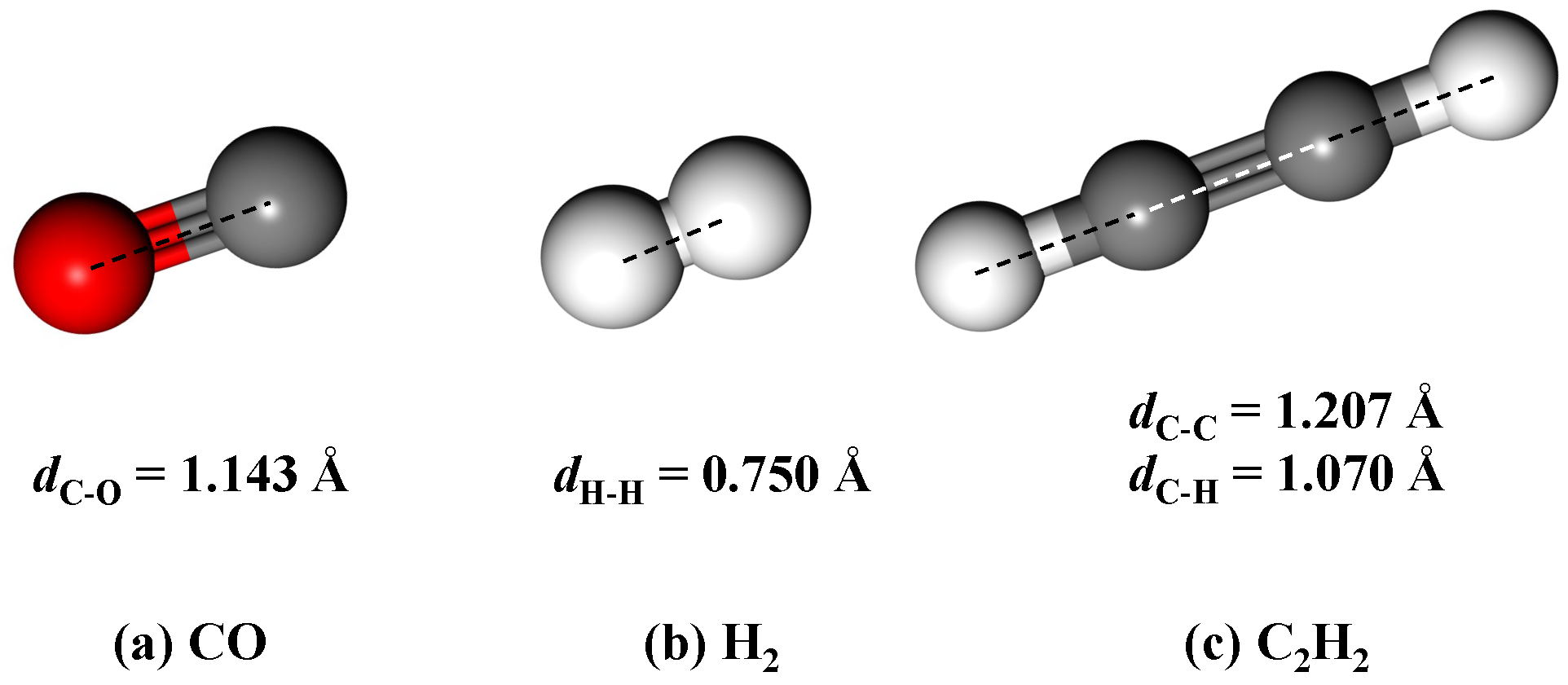
We begin by establishing the reference geometries for the adsorbates and the pristine Janus substrate. The optimized gas-phase molecules (Figure 1) exhibit equilibrium bond lengths of 1.143 Å for C–O in CO, 0.750 Å for H–H in H2, and 1.207 Å (C≡C)/1.070 Å (C–H) in C2H2, consistent with their typical molecular characteristics.
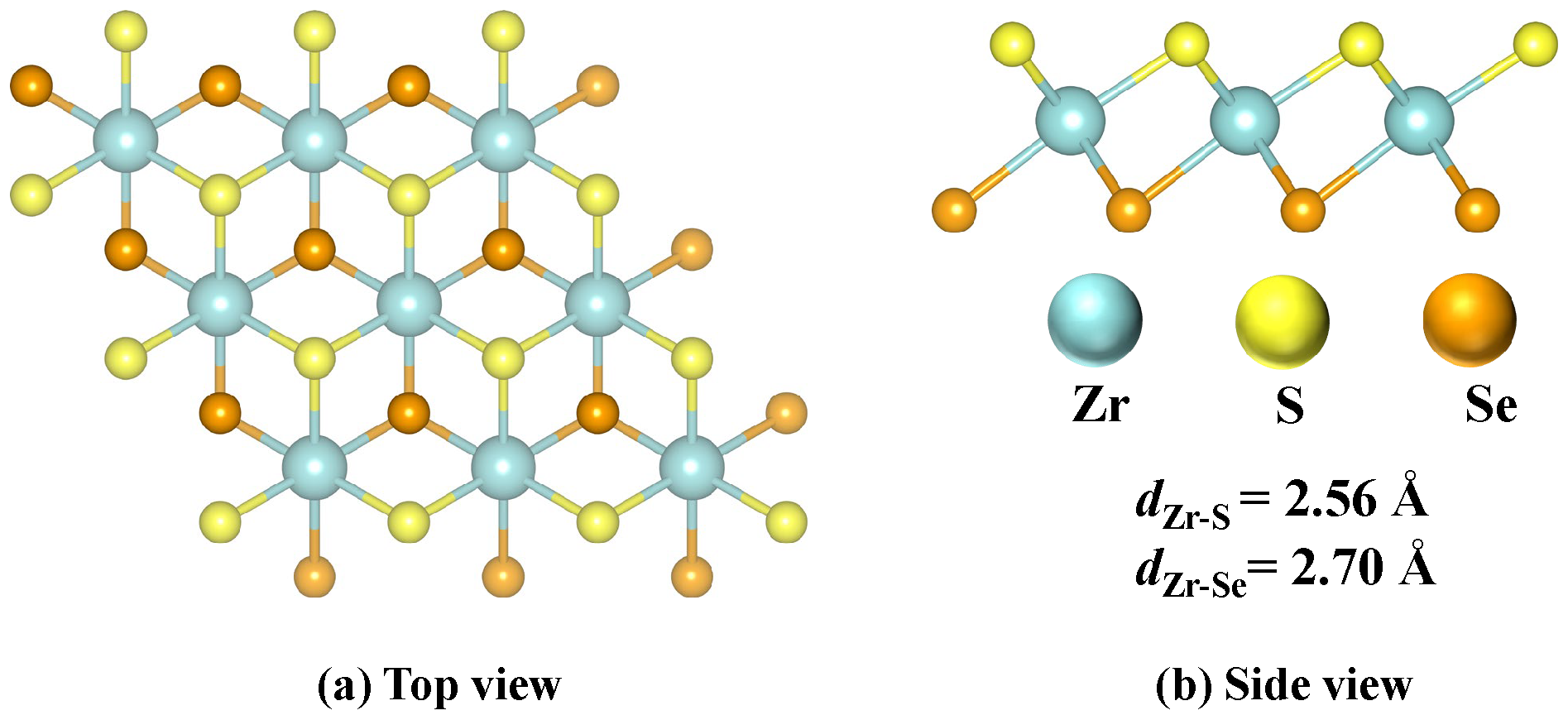
The Janus ZrSSe monolayer (Figure 2) adopts a three-layer X–Zr–Y configuration with S and Se occupying the two inequivalent chalcogen planes. Such out-of-plane compositional asymmetry breaks mirror symmetry and is known to generate an intrinsic vertical polarity (built-in dipole) in Janus transition-metal dichalcogenides, which can amplify the electronic response to external perturbations such as adsorption and strain [41]. After structural relaxation, the lattice constant of ZrSSe is determined to be 3.70 Å, the Zr–S and Zr–Se bond lengths are 2.56 Å and 2.70 Å, respectively, in good agreement with prior first-principles reports on ZrSSe [8,21].
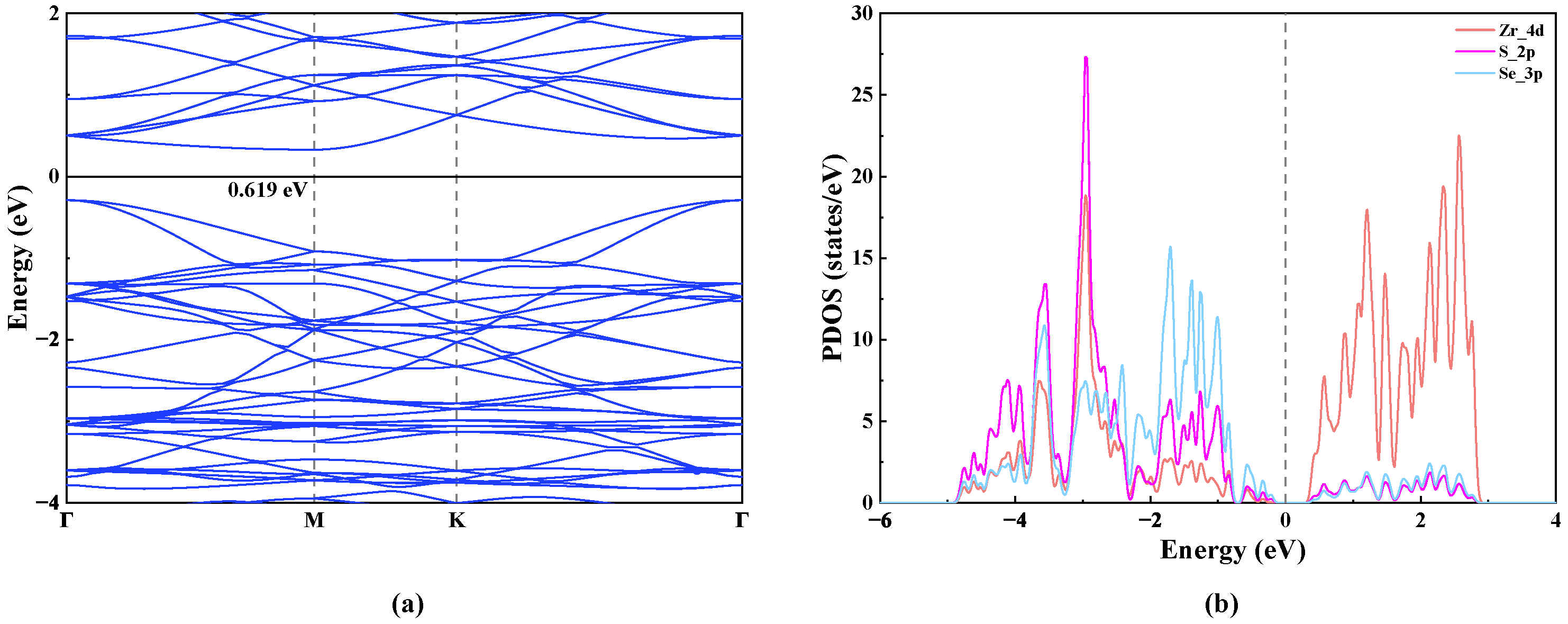
The pristine ZrSSe is predicted to be a narrow-gap semiconductor. At the PBE level used for geometry and baseline electronic trends, the band gap is 0.619 eV (Figure 3), close to previously reported values (∼0.60 eV) [8,21]. The projected density of states (PDOS) indicates that the band edges are dominated by Zr-4d states with appreciable hybridization with chalcogen p orbitals (S-2p and Se-3p), providing a clear orbital picture for how local perturbations (e.g., metal decoration or molecular adsorption) can modulate the near-gap electronic structure.

3.2. Weak Adsorption and Limited Electronic Perturbation on Pristine ZrSSe

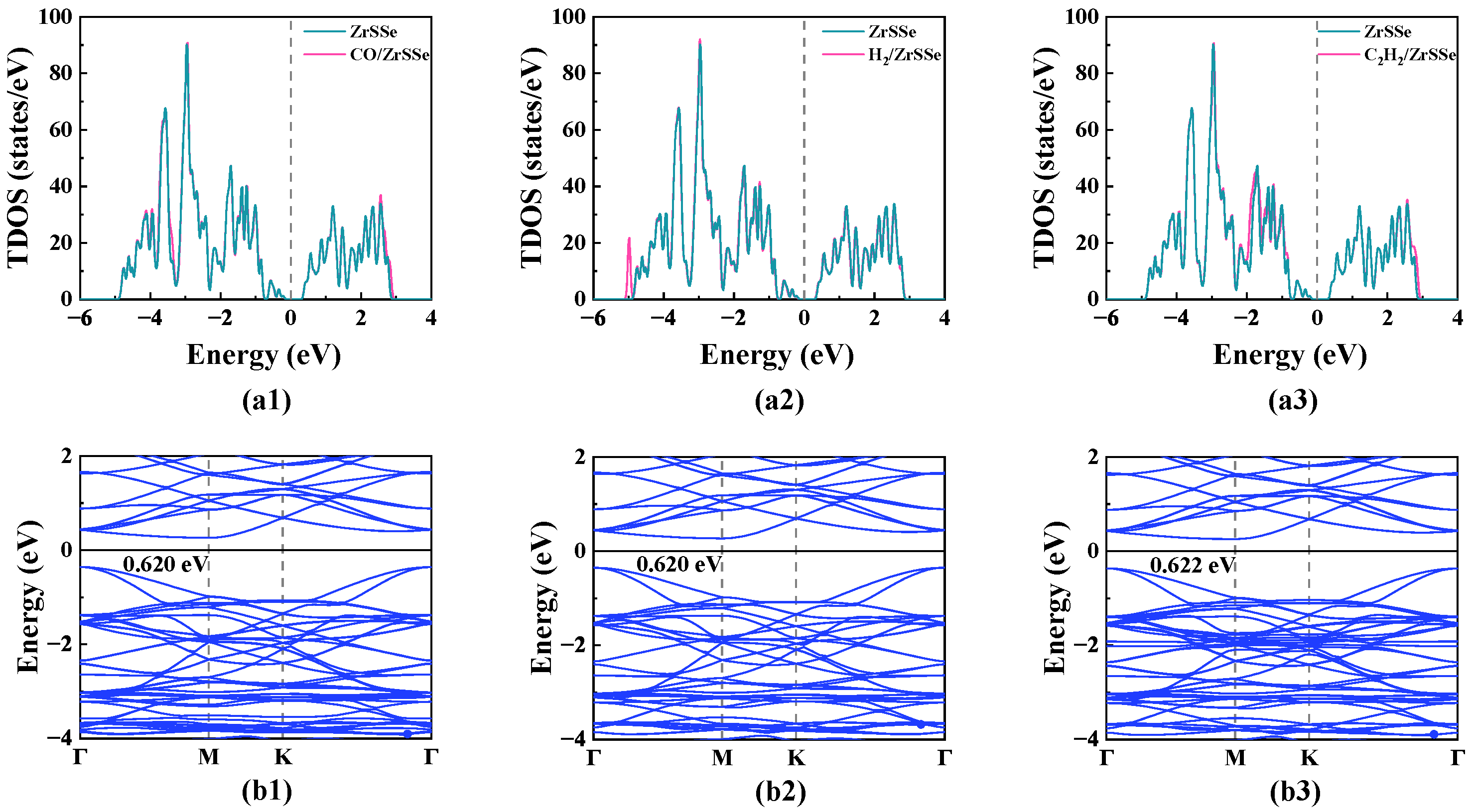
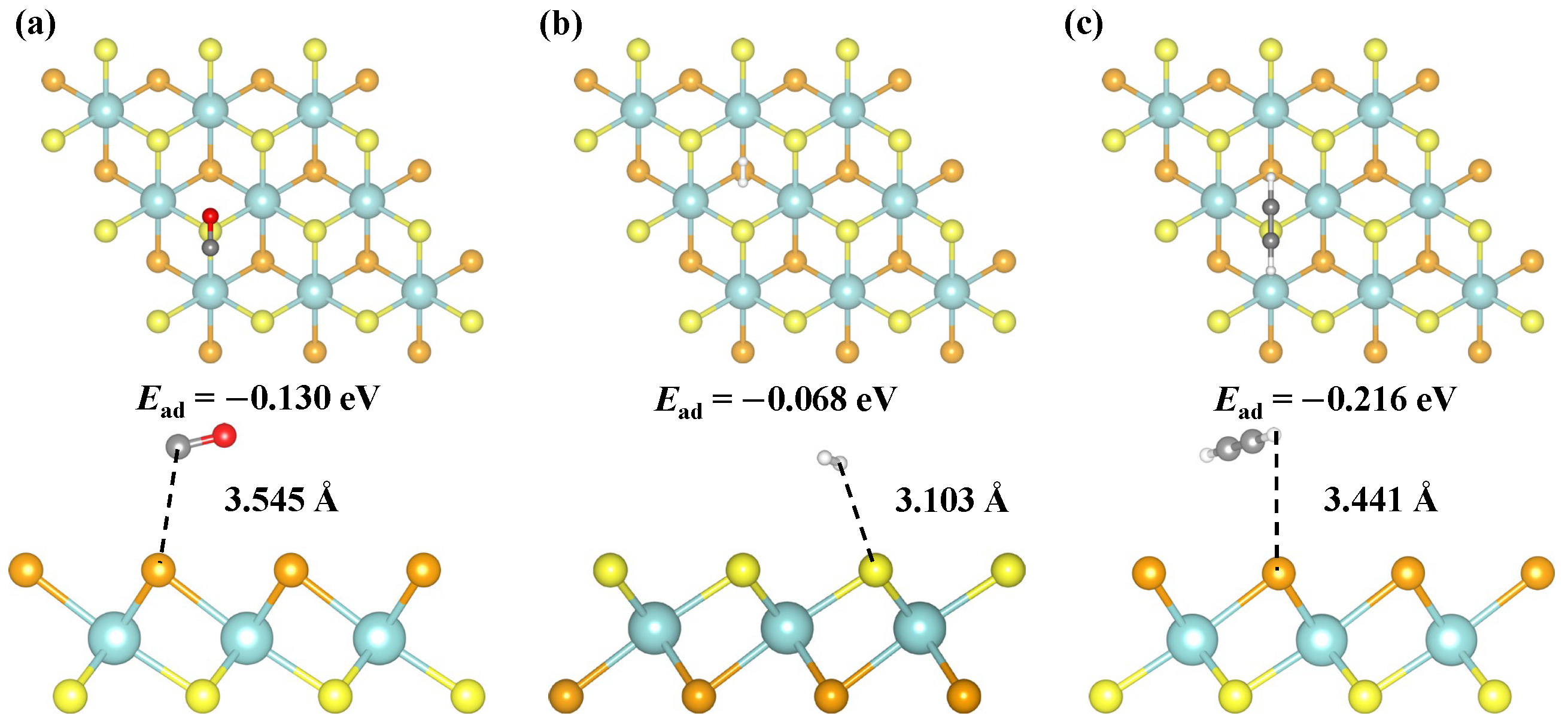
In this work, adsorption behaviors are classified according to the adsorption energy criterion: | E ad | < 0.5 eV is considered physisorption, whereas | E ad | > 0.5 eV indicates chemisorption. Figure 4 summarizes the most stable adsorption configurations of CO, H2, and C2H2 on pristine ZrSSe. The adsorption energies are modest, i.e., E ad = 0.130 eV (CO), 0.068 eV (H2), and 0.216 eV (C2H2), with relatively large molecule–surface separations of 3.545, 3.103, and 3.441 Å, respectively (Table 1). Consistently, Bader analysis yields only small net charge transfer ( | Q CT |     0.09 e ), indicating that the interaction is dominated by weak electrostatic and van der Waals contributions rather than appreciable chemical bonding. Subsequently, we calculated the total density of states and electronic band structures of the three gas adsorption systems, as shown in Figure 5, and compared them with the pristine ZrSSe system. The overall TDOS distributions of the three adsorption systems are similar to that of pristine ZrSSe, indicating that the introduction of gas molecules does not cause significant changes to the electronic density of states of the system. Further analysis of the band structures reveals that ZrSSe maintains its semiconducting nature after the adsorption of CO, H2, and C2H2, with band gaps of 0.620 eV, 0.620 eV, and 0.622 eV, respectively, which are very close to the band gap value of pristine ZrSSe. These results suggest that pristine ZrSSe exhibits only limited electronic perturbation upon adsorption of these small molecules.

3.3. Energetic Preference and Stability of Pd Decoration: Emergence of a Localized Active Center

To introduce a well-defined adsorption center while preserving the two-dimensional character, we examined Pd incorporation in both substitutional and adatom-decorated forms on the inequivalent S and Se sides. The formation/binding energetics (Table 2) show that substitutional configurations are energetically unfavorable at both the PBE and HSE06 levels. In particular, the HSE06 formation energies for Pd substitution are 1.17 eV on the S surface and 0.61 eV on the Se surface, confirming that substitution is consistently disfavored relative to Pd adatom decoration. Although the formation energy of 0.61 eV is higher than the surface adsorption energy, it is not prohibitively high. Considering the typical chemical vapor deposition growth temperature of approximately 800 K, the thermal fluctuation energy suggests that a minority of substitutional defects could equilibrium-exist or freeze-in during the high-temperature growth phase. Nevertheless, under standard gas sensing operating conditions (298 K to 498 K), the surface adsorption configurations remain energetically far more favorable and thermodynamically stable, thus acting as the predominant modification mechanism governing the long-term sensing performance. Therefore, while minority substitutional configurations might exist as secondary defects from the growth stage, the Pd atom still prefers to undergo physical or chemical adsorption on the surface of the two-dimensional material rather than substituting its intrinsic atoms as the primary sensing active sites. In addition, adatom decoration can be stabilized, especially at high-symmetry hollow sites.
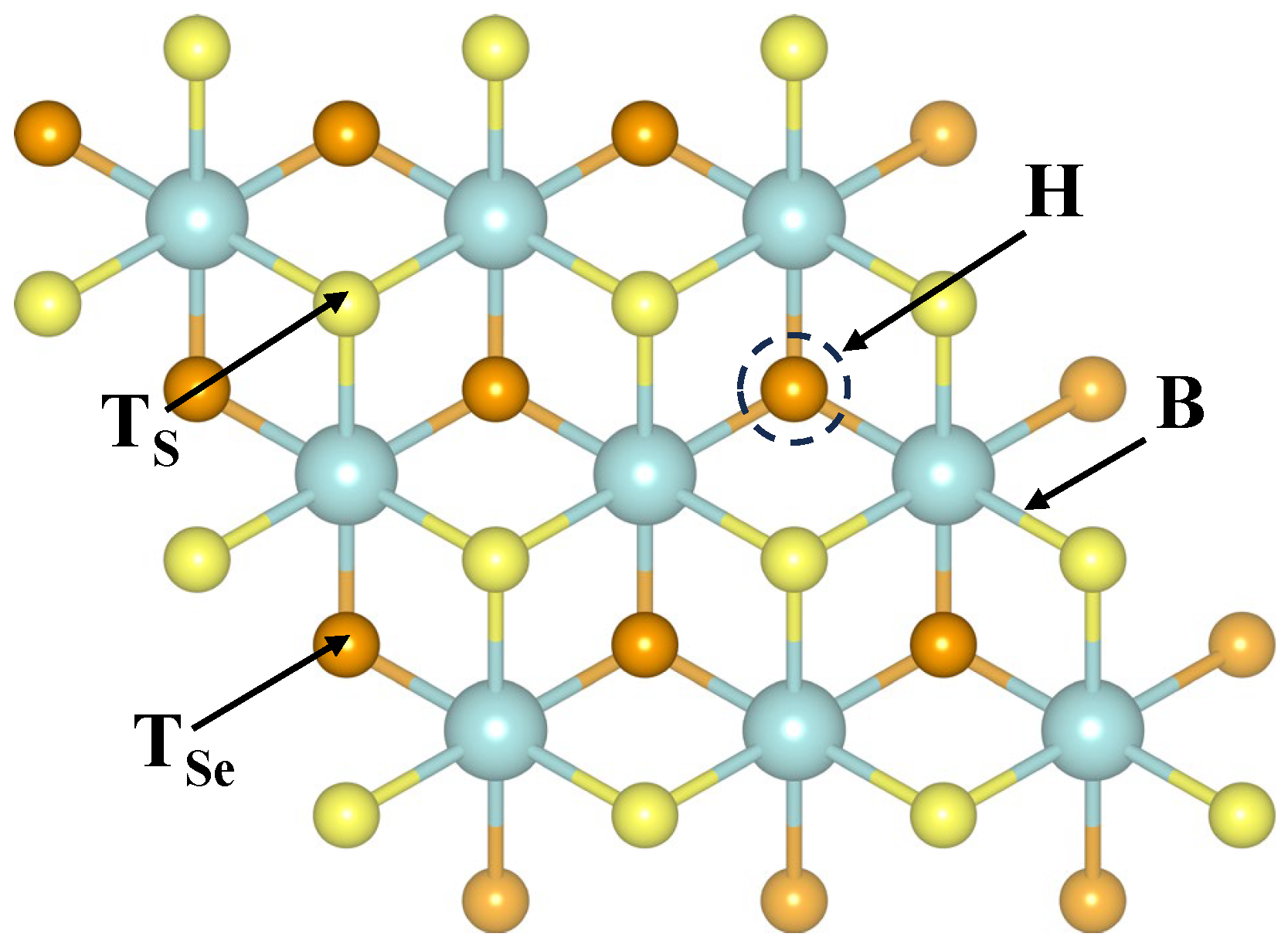
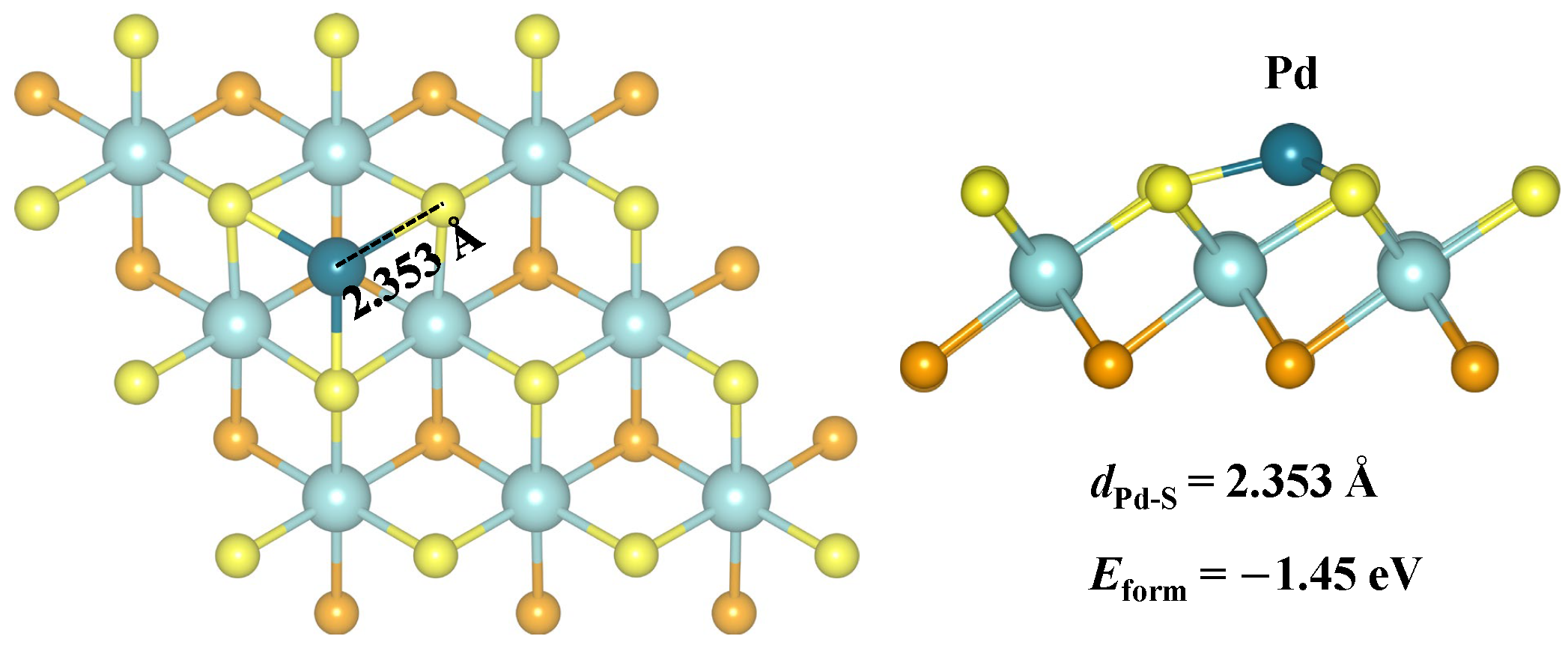
Among all considered adatom sites (Figure 6), Pd at the hollow site on the S side is the most stable structure. Importantly, when the energetics are refined using the hybrid functional for improved treatment of localized d electrons, the corresponding formation energy becomes 1.45 eV (Table 2), indicating a strong thermodynamic driving force toward Pd anchoring on the S-terminated face. The optimized geometry (Figure 7) reveals a short Pd–S bond length of 2.353 Å, consistent with the formation of a chemically bound Pd–S coordination environment.
Dynamical stability was evaluated via vibrational analysis. The absence of imaginary frequencies (48.95–375.88 cm−1 for Pd–ZrSSe) confirms that the decorated configuration corresponds to a true local minimum on the potential-energy surface. Therefore, Pd decoration on the S-side hollow site provides a physically well-justified and stable platform to study adsorption-induced electronic modulation on a Janus substrate.

3.4. Adsorption on Pd–ZrSSe: Bonding Characteristics, Charge Redistribution, and Band-Edge Modulation

3.4.1. Adsorption Energetics and Geometrical Fingerprints

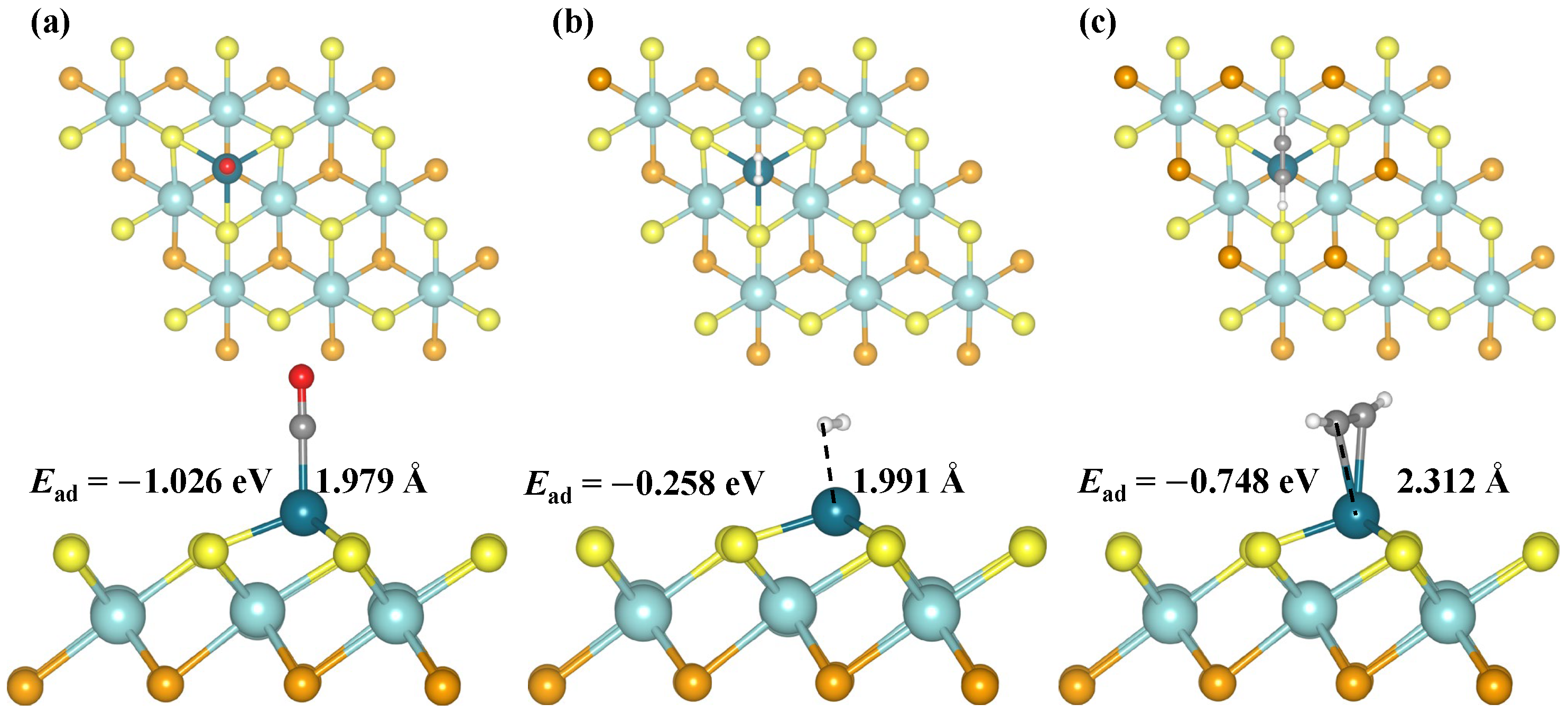
With Pd providing a localized d-electron center, the adsorption behavior changes qualitatively (Figure 8 and Table 3). CO binds most strongly with E ad = 1.026 eV and forms a short Pd–C bond of 1.979 Å in an end-on configuration. C2H2 also exhibits strong binding ( E ad = 0.748 eV), adopting a nearly parallel geometry with Pd–C distances down to 2.312 Å, indicating the formation of a Pd–C2H2 π -complex-like interaction. In contrast, H2 remains weakly bound ( E ad = 0.258 eV) and does not show clear chemical bond formation, despite a short geometric proximity to Pd (1.991 Å). These trends establish the adsorption-strength hierarchy of CO > C2H2≫ H2.

3.4.2. Charge Transfer Versus Chemical Bonding: Differential Charge Density and Bader Analysis

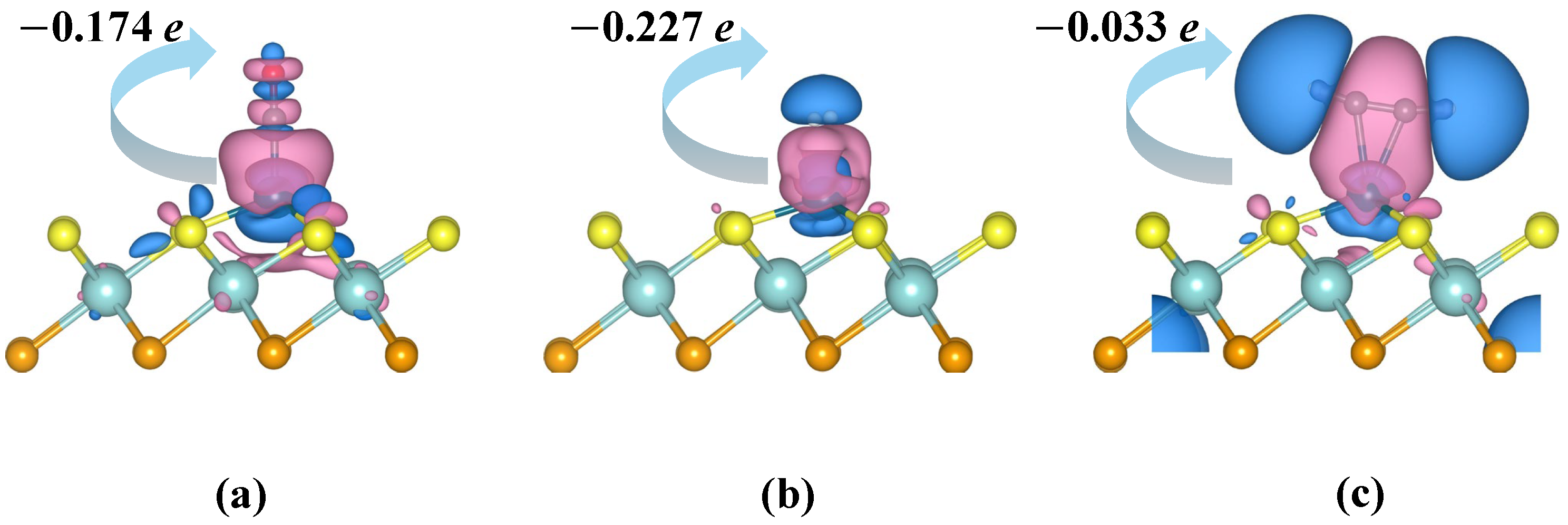
To quantify electron redistribution, we analyzed both Bader charge transfer and charge-density difference (CDD). Here, a negative Q CT value denotes electron transfer from the Pd–ZrSSe substrate to the adsorbate; accordingly, CO, H2, and C2H2 gain 0.174 , 0.227 , and 0.033 e (Table 3), respectively, indicating that all three molecules behave as net electron acceptors [42,43]. The CDD isosurfaces in Figure 9 provide crucial additional insight: for CO and C2H2, electron accumulation is localized in the Pd–C bonding region, consistent with genuine bond formation and substantial orbital overlap. For H2, however, the redistribution is comparatively diffuse with minimal accumulation directly between H2 and Pd, suggesting that its larger apparent Q CT mainly reflects polarization/charge rearrangement in the vicinity of the Pd center rather than a strong covalent interaction. It is worth emphasizing that the numerical value of Q CT alone (e.g., 0.227 e for H2) is insufficient and potentially misleading for characterizing the adsorption type. It is fundamentally crucial to emphasize that the numerical value of Q CT from Bader population analysis should not be used alone for characterizing or classifying the adsorption type (physisorption vs. chemisorption). This limitation is particularly prominent at heavy-metal/light-gas interfaces, where the electronic density is highly diffuse and the mathematical zero-flux surfaces can partition the spatial grid with inherent ambiguity. Therefore, rather than relying on total atomic charges, our diagnostic approach strictly leads with the 3D charge density difference and thermodynamic analysis to determine the interaction nature. As visualized in the real-space CDD plots, the larger apparent Q CT of H2 compared to CO does not denote a localized chemical bond. Instead, it reflects an integrated charge transfer/rearrangement within specific bonding and diffuse molecular regions under intense substrate polarization. Due to the absence of core electrons in Hydrogen, the shared valence electrons are localized by the zero-flux grid predominantly into the boundary of the H atoms, yielding a higher apparent atomic sum. Consequently, guided by the CDD and orbital hybridization traits, CO is verified as localized chemisorption, whereas H2 remains a physisorption state dominated by regional polarization. To accurately distinguish between physisorption and chemisorption, this quantitative charge analysis must be coupled with the visualization of spatial charge redistribution, underscoring the necessity of a multifaceted theoretical approach.
Vibrational analyses further support the stability of the adsorbed complexes, with no imaginary frequencies found for CO/Pd–ZrSSe (43.53–2062.26 cm−1), H2/Pd–ZrSSe (50.43–3713.41 cm−1), and C2H2/Pd–ZrSSe (5.44–3392.13 cm−1).

3.4.3. Orbital Hybridization and Band-Gap Response

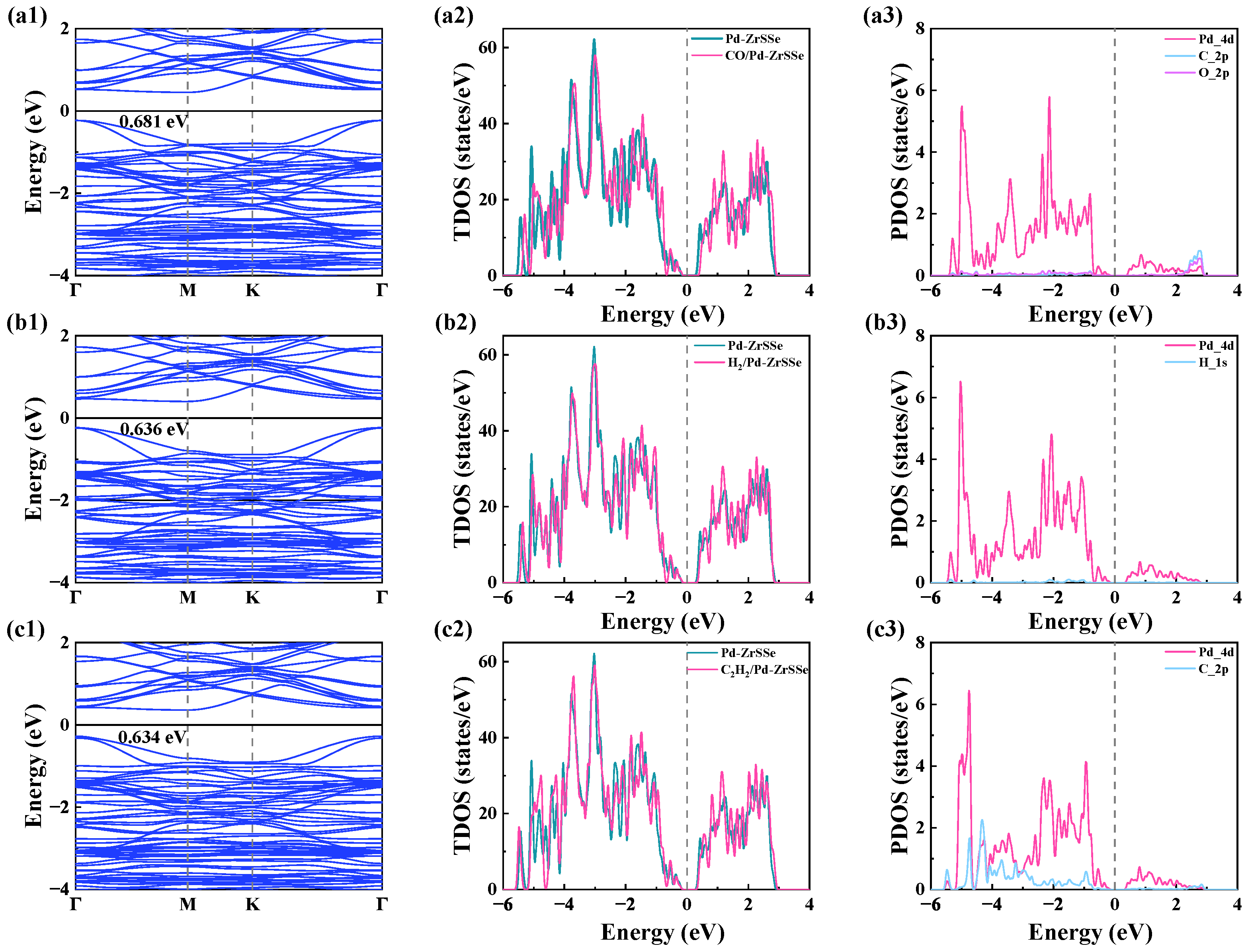
The adsorption-induced electronic response is clarified by TDOS/PDOS and band structures (Figure 10). For CO adsorption, the TDOS exhibits an overall rightward shift relative to the bare Pd–ZrSSe reference, and the PDOS reveals pronounced hybridization between Pd-4d and C-2p/O-2p states in the range of approximately 4 to 2 eV. This hybridization is consistent with strong metal–molecule coupling at the Pd site and rationalizes the largest adsorption energy among the three molecules. For C2H2, moderate TDOS shifting and Pd-4d/C-2p hybridization (around 5.5 to 4 eV) indicate a substantial, but weaker, coupling than in CO. In contrast, H2 adsorption produces only minor TDOS changes and negligible PDOS overlap between Pd-4d and H-1s, consistent with its physisorption-like interaction.
At the band-structure level, adsorption modulates the gap size: the calculated gaps for CO/Pd–ZrSSe, H2/Pd–ZrSSe, and C2H2/Pd–ZrSSe are 0.681, 0.636, and 0.634 eV, respectively (Figure 10). Therefore, CO induces the most pronounced band-edge renormalization, while H2 and C2H2 produce comparatively smaller changes. From a condensed-matter perspective, such adsorption-driven band-gap modulation provides a direct microscopic mechanism for the electronic response of the system: perturbing the near-gap states changes the thermal activation barrier for carriers and thus the conductivity.
For completeness, we estimated the conductivity change using the Arrhenius-type relation and obtained indicative relative conductivity variations of 528% (CO), 163% (H2), and 153% (C2H2) [38]. Within this simplified model, the pronounced conductivity variation induced by CO is a direct consequence of its strongest Pd-mediated hybridization and the associated largest band-structure perturbation.

3.4.4. Desorption Kinetics as an Energetic Consequence of Binding Strength

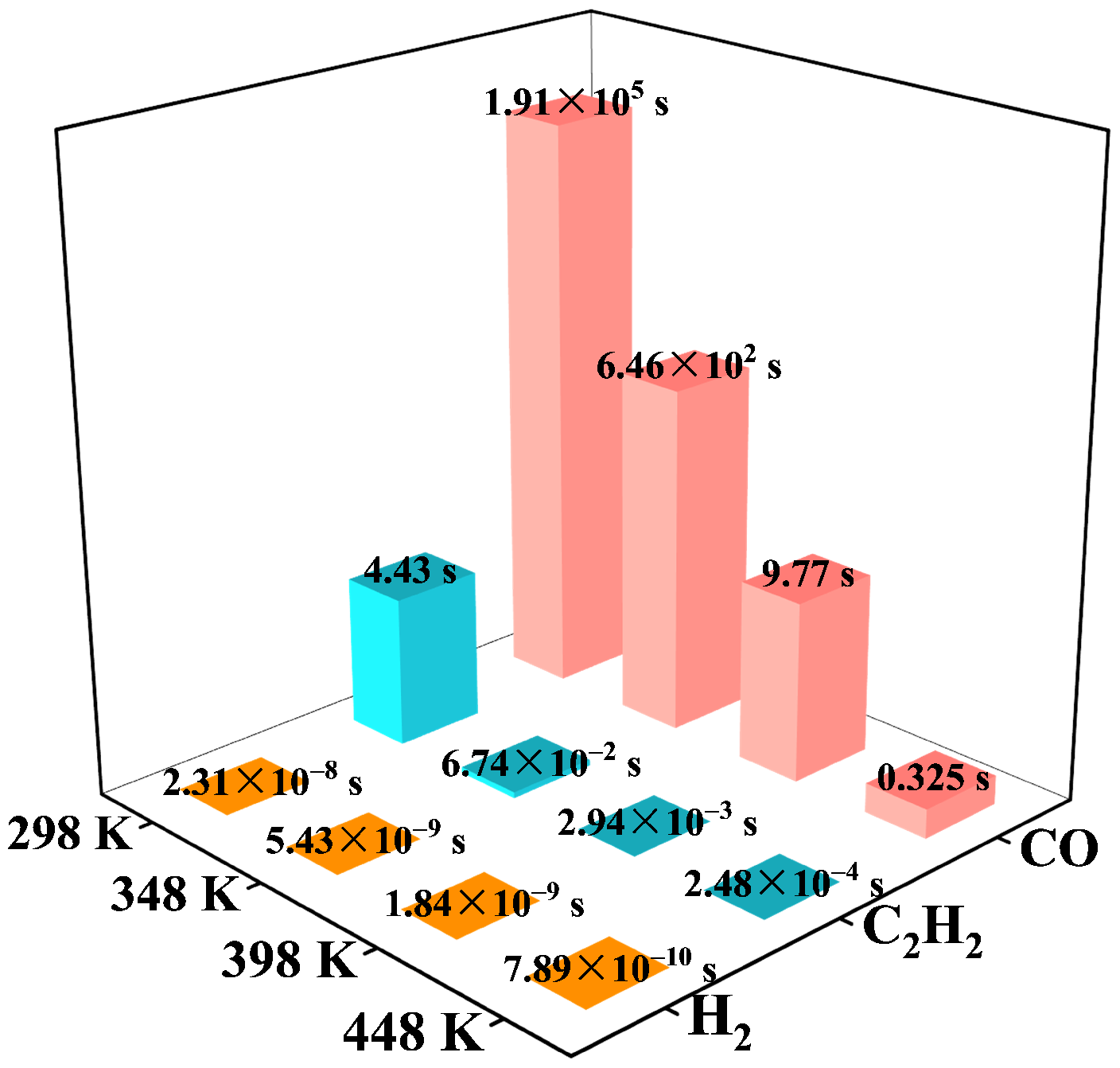
The kinetic reversibility of adsorption is closely linked to the binding strength between the adsorbate and the Pd–ZrSSe surface. Using the transition-state-theory estimate [38], the recovery time exhibits a strong temperature dependence (Figure 11). CO desorption is slow at 298 K ( 1.91 × 10 5 s) but accelerates rapidly at elevated temperatures (9.77 s at 398 K and 0.325 s at 448 K), reflecting its strong chemisorption. C2H2 shows a moderate room-temperature recovery time (4.43 s) and becomes very fast upon heating. By contrast, H2 desorption is ultrafast over the entire considered temperature range, consistent with its weak interaction. These trends follow naturally from the adsorption energy hierarchy and reinforce the physical picture established above: Pd introduces a strong d-state adsorption center whose coupling is molecule dependent.

3.5. Biaxial Strain as a Control Knob: Charge Transfer Tuning and Gap Engineering

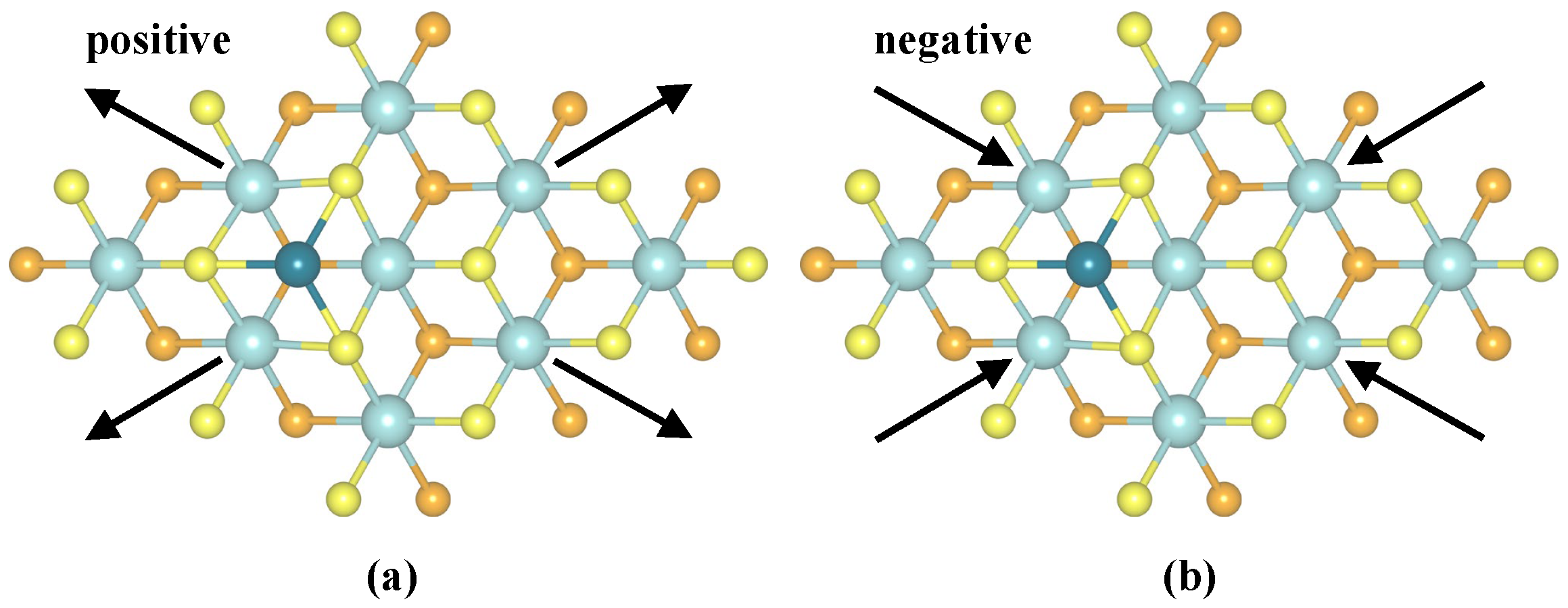
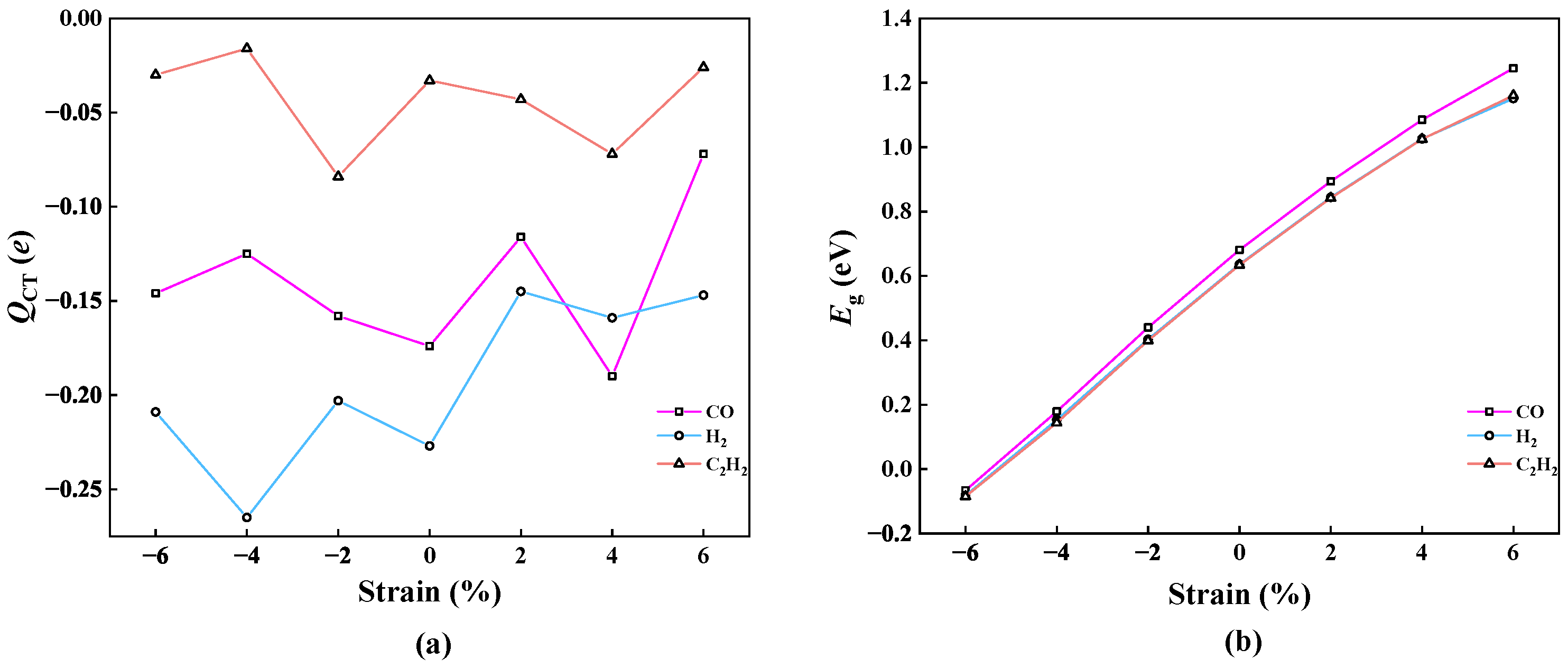
Janus monolayers are intrinsically susceptible to strain due to their broken out-of-plane symmetry and internal polarity [41,44]. We therefore investigated biaxial strain as a generic and experimentally accessible parameter to tune the electronic response (Figure 12). The strain dependence of charge transfer and band gap is summarized in Figure 13.
For charge transfer (Figure 13a), H2 maintains the largest | Q CT | across the full strain range, and its interaction is strongly strain dependent: compressive strain enhances the electron-accepting character (from 0.227 e at 0% to ∼ 0.265 e at 4 %), whereas tensile strain reduces it (down to ∼ 0.147 e at + 6 %). In comparison, CO and C2H2 exhibit smaller-amplitude, non-monotonic variations of Q CT , indicating a more intricate interplay between geometric deformation and Pd–molecule hybridization.
More strikingly, the band gap displays an almost linear dependence on biaxial strain for all adsorption systems (Figure 13b): compressive strain narrows the gap, while tensile strain widens it. Under sufficiently strong compression, the gap approaches closure, signaling a strain-driven semiconductor-to-metal transition. Specifically, as derived from our quantitative threshold analysis, the precise critical strain value for metallization in the Pd-decorated Janus ZrSSe system is approximately 6 % under biaxial compression, where the band gap completely vanishes. Physically, this behavior can be understood as strain-modulated orbital overlap and level alignment (Zr-d, chalcogen-p, and Pd-d contributions) near the band edges; increasing overlap under compression promotes band broadening and gap closure, while tensile strain reduces overlap and opens the gap. Compared with the prior work on pristine ZrSSe monolayers [8], where strain simply alters the intrinsic atomic distances, our system introduces a novel strain-modulated interfacial orbital hybridization mechanism. Under compression, the spatial overlap between the localized d-orbitals of the Pd adatom and the neighboring chalcogen p-orbitals is strongly enhanced, heavily regulating the gas adsorption strength and charge transfer pathways. Consequently, biaxial strain serves as an effective tuning knob (with an ideal window within ± 3 % ) to simultaneously optimize the gas sensitivity and recovery time, effectively breaking the conventional trade-off in 2D gas sensors. Therefore, beyond molecule-specific adsorption effects, Pd–ZrSSe provides a clear example of a Janus 2D platform where the electronic ground state itself (semiconducting versus metallic) can be tuned continuously by mechanical deformation.
Overall, the strain results demonstrate that (i) charge redistribution at the Pd active site is mechanically tunable, and (ii) the band-gap response can be engineered over a wide range up to gap closure. These are general condensed-matter features of Pd–ZrSSe that are expected to be relevant to a broad range of contexts where controllable adsorption-induced electronic modulation is desired.

4. Conclusions

In summary, first-principles calculations demonstrate that Pd decoration provides an effective route for electronically activating the Janus ZrSSe monolayer while preserving its mechanically tunable character. The Pd adatom is most stably anchored at the hollow site on the S-terminated surface, forming a robust Pd–S coordination environment that serves as a localized active electronic center. In contrast to pristine ZrSSe, which exhibits only weak interaction with CO, H2, and C2H2, Pd decoration markedly strengthens the adsorption of CO and C2H2, whereas H2 remains comparatively weakly bound. This molecule-dependent behavior originates from the different degrees of hybridization between Pd 4d states and the molecular orbitals of the adsorbates.
The electronic response follows the same trend. CO induces the largest perturbation of the near-Fermi electronic structure and the most pronounced band-gap modulation because of its strongest Pd-mediated coupling, while H2 and C2H2 lead to comparatively smaller changes. The corresponding recovery-time behavior is consistent with the adsorption-strength hierarchy, further confirming that the interaction between the Pd active center and the adsorbates is strongly molecule dependent. In addition, biaxial strain provides an efficient external control parameter for tuning both charge redistribution and band structure: tensile strain widens the band gap, whereas compressive strain narrows it and can ultimately trigger a semiconductor-to-metal transition under sufficiently large compression.
Overall, these results establish Pd-decorated Janus ZrSSe as a strain-tunable 2D electronic material in which adsorption, local electronic activation, orbital hybridization, and band-edge evolution are intimately coupled. This work provides a clear microscopic picture of controllable adsorption-induced electronic modulation in polar two-dimensional systems and offers a useful framework for the design of electronically responsive Janus materials.

Author Contributions

G.Y.: Conceptualization, Methodology, Investigation, Formal Analysis, Writing—Original Draft. L.W.: Investigation, Validation, Formal Analysis. L.L.: Methodology, Data Curation, Visualization. Q.Z.: Conceptualization, Resources, Writing—Review and Editing, Funding Acquisition. X.O.: Supervision. All authors have read and agreed to the published version of the manuscript.

Funding

This work was supported by the National Natural Science Foundation of China under Grant No. 12275083.

Data Availability Statement

All data that support the findings of this study are included within the article.

Conflicts of Interest

The authors declare no conflicts of interest.

References

  1. Schedin, F.; Geim, A.K.; Morozov, S.V.; Hill, E.W.; Blake, P.; Katsnelson, M.I.; Novoselov, K.S. Detection of individual gas molecules adsorbed on graphene. Nat. Mater. 2007, 6, 652–655. [Google Scholar] [CrossRef] [PubMed]
  2. Kumar, R.; Goel, N.; Hojamberdiev, M.; Kumar, M. Transition metal dichalcogenides-based flexible gas sensors. Sens. Actuators A Phys. 2020, 303, 111875. [Google Scholar] [CrossRef]
  3. Meng, Z.; Stolz, R.M.; Mendecki, L.; Mirica, K.A. Electrically-transduced chemical sensors based on two-dimensional nanomaterials. Chem. Rev. 2019, 119, 478–598. [Google Scholar] [CrossRef]
  4. Zhang, J.; Jia, S.; Kholmanov, I.; Dong, L.; Er, D.; Chen, W.; Guo, H.; Jin, Z.; Shenoy, V.B.; Shi, L.; et al. Janus monolayer transition-metal dichalcogenides. ACS Nano 2017, 11, 8192–8198. [Google Scholar] [CrossRef] [PubMed]
  5. Harris, S.B.; Lin, Y.C.; Puretzky, A.A.; Liang, L.; Dyck, O.; Berlijn, T.; Eres, G.; Rouleau, C.M.; Xiao, K.; Geohegan, D.B. Real-Time diagnostics of 2D crystal transformations by pulsed laser deposition: Controlled synthesis of Janus WSSe monolayers and alloys. ACS Nano 2023, 17, 2472–2486. [Google Scholar] [CrossRef]
  6. Dong, L.; Lou, J.; Shenoy, V.B. Large in-plane and vertical piezoelectricity in Janus transition metal dichalchogenides. ACS Nano 2017, 11, 8242–8248. [Google Scholar] [CrossRef]
  7. Li, F.; Wei, W.; Wang, H.; Huang, B.; Dai, Y.; Jacob, T. Intrinsic electric field-induced properties in Janus MoSSe van der Waals structures. J. Phys. Chem. Lett. 2019, 10, 559–565. [Google Scholar] [CrossRef]
  8. Vu, T.V.; Tong, H.D.; Tran, D.P.; Binh, N.T.; Nguyen, C.V.; Phuc, H.V.; Do, H.M.; Hieu, N.N. Electronic and optical properties of Janus ZrSSe by density functional theory. RSC Adv. 2019, 9, 41058–41065. [Google Scholar] [CrossRef]
  9. Xu, B.; Qian, C.; Zuo, L.; Zhao, W.; Ma, S.; Zhang, J.; Wang, Y.; Zhang, M.; Yi, L. First-principles study of the monolayer SnSSe for gas sensing applications. Chem. Phys. 2024, 586, 112389. [Google Scholar] [CrossRef]
  10. Xue, C.; Lin, L.; Xie, K.; Zhang, Z.; Wang, P. Adsorption of toxic gases by Janus MoSeTe monolayers doped with transition metals and surface defects: A first-principles study. Colloids Surf. A Physicochem. Eng. Asp. 2024, 694, 134131. [Google Scholar] [CrossRef]
  11. Hammer, B.; Nørskov, J.K. Electronic factors determining the reactivity of metal surfaces. Surf. Sci. 1995, 343, 211–220. [Google Scholar] [CrossRef]
  12. Pettersson, L.G.M.; Nilsson, A. A molecular perspective on the d-band model: Synergy between experiment and theory. Top. Catal. 2014, 57, 2–13. [Google Scholar] [CrossRef]
  13. Andersen, M. Revelations of the d band. Nat. Catal. 2023, 6, 460–461. [Google Scholar] [CrossRef]
  14. Darmadi, I.; Nugroho, F.A.A.; Langhammer, C. High-performance nanostructured palladium-based hydrogen sensors—current limitations and strategies for their mitigation. ACS Sens. 2020, 5, 3306–3327. [Google Scholar] [CrossRef] [PubMed]
  15. Hao, L.; Liu, Y.; Du, Y.; Chen, Z.; Han, Z.; Xu, Z.; Zhu, J. Highly enhanced H2 sensing performance of few-layer MoS2/SiO2/Si heterojunctions by surface decoration of Pd nanoparticles. Nanoscale Res. Lett. 2017, 12, 567. [Google Scholar] [CrossRef]
  16. Duerloo, K.A.N.; Li, Y.; Reed, E.J. Structural phase transitions in two-dimensional Mo-and W-dichalcogenide monolayers. Nat. Commun. 2014, 5, 4214. [Google Scholar] [CrossRef]
  17. Roldán, R.; Castellanos-Gomez, A.; Cappelluti, E.; Guinea, F. Strain engineering in semiconducting two-dimensional crystals. J. Phys. Condens. Matter 2015, 27, 313201. [Google Scholar] [CrossRef] [PubMed]
  18. Deng, S.; Sumant, A.V.; Berry, V. Strain engineering in two-dimensional nanomaterials beyond graphene. Nano Today 2018, 22, 14–35. [Google Scholar] [CrossRef]
  19. Dai, Z.; Liu, L.; Zhang, Z. Strain engineering of 2D materials: Issues and opportunities at the interface. Adv. Mater. 2019, 31, 1805417. [Google Scholar] [CrossRef]
  20. Liu, H.; Huang, Z.; He, C.; Wu, Y.; Xue, L.; Tang, C.; Qi, X.; Zhong, J. Strain engineering the structures and electronic properties of Janus monolayer transition-metal dichalcogenides. J. Appl. Phys. 2019, 125, 082516. [Google Scholar] [CrossRef]
  21. Guo, S.; Li, Y.; Guo, X. Predicted Janus monolayer ZrSSe with enhanced n-type thermoelectric properties compared with monolayer ZrS2. Comput. Mater. Sci. 2019, 161, 16–23. [Google Scholar] [CrossRef]
  22. Zhang, M.; Xia, J.; Guo, G.; Guo, G.; Xiao, L.; You, M.; Luo, S.; Chen, Q.; Luo, C.; He, C.; et al. DFT study on the Janus ZrSSe monolayer for its potential application in NO gas sensing. Langmuir 2024, 40, 17348–17357. [Google Scholar] [CrossRef]
  23. He, W.; Xu, Y.; Wu, Z.; Hou, Z.; Qin, W.; Liu, X.; Shi, J.; Long, Y. Adsorption of Nitrogen-Containing Toxic Gases on Transition Metal (Pt, Ag, Au)-Modified Janus ZrSSe Monolayers for Sensing Applications: A DFT Study. ACS Appl. Nano Mater. 2025, 8, 3163–3174. [Google Scholar] [CrossRef]
  24. Feng, X.; Ouyang, M.; Liu, X.; Lu, L.; Xia, Y.; He, X. Thermal runaway mechanism of lithium ion battery for electric vehicles: A review. Energy Storage Mater. 2018, 10, 246–267. [Google Scholar] [CrossRef]
  25. Wang, H.; Wu, S.; Shao, C.; Luan, W.; Chen, H. Thermal runaway and gas generation dynamics in aged Lithium-ion batteries under low temperatures. J. Energy Storage 2025, 124, 116852. [Google Scholar] [CrossRef]
  26. Golubkov, A.W.; Fuchs, D.; Wagner, J.; Wiltsche, H.; Stangl, C.; Fauler, G.; Voitic, G.; Thaler, A.; Hacker, V. Thermal-runaway experiments on consumer Li-ion batteries with metal-oxide and olivin-type cathodes. RSC Adv. 2014, 4, 3633–3642. [Google Scholar] [CrossRef]
  27. Koch, S.; Fill, A.; Birke, K.P. Comprehensive gas analysis on large scale automotive lithium-ion cells in thermal runaway. J. Power Sources 2018, 398, 106–112. [Google Scholar] [CrossRef]
  28. Hu, D.; Huang, S.; Wen, Z.; Gu, X.; Lu, J. A review on thermal runaway warning technology for lithium-ion batteries. Renew. Sustain. Energy Rev. 2024, 206, 114882. [Google Scholar] [CrossRef]
  29. Kresse, G.; Furthmüller, J. Efficient iterative schemes for ab initio total-energy calculations using a plane-wave basis set. Phys. Rev. B 1996, 54, 11169. [Google Scholar] [CrossRef]
  30. Kresse, G.; Hafner, J. Ab initio molecular dynamics for liquid metals. Phys. Rev. B 1993, 47, 558. [Google Scholar] [CrossRef]
  31. Blöchl, P.E. Projector augmented-wave method. Phys. Rev. B 1994, 50, 17953. [Google Scholar] [CrossRef]
  32. Kresse, G.; Joubert, D. From ultrasoft pseudopotentials to the projector augmented-wave method. Phys. Rev. B 1999, 59, 1758. [Google Scholar] [CrossRef]
  33. Perdew, J.P.; Burke, K.; Ernzerhof, M. Generalized gradient approximation made simple. Phys. Rev. Lett. 1996, 77, 3865. [Google Scholar] [CrossRef] [PubMed]
  34. Grimme, S.; Antony, J.; Ehrlich, S.; Krieg, H. A consistent and accurate ab initio parametrization of density functional dispersion correction (DFT-D) for the 94 elements H-Pu. J. Chem. Phys. 2010, 132, 154104. [Google Scholar] [CrossRef]
  35. Monkhorst, H.J.; Pack, J.D. Special points for Brillouin-zone integrations. Phys. Rev. B 1976, 13, 5188. [Google Scholar] [CrossRef]
  36. Krukau, A.V.; Vydrov, O.A.; Izmaylov, A.F.; Scuseria, G.E. Influence of the exchange screening parameter on the performance of screened hybrid functionals. J. Chem. Phys. 2006, 125, 224106. [Google Scholar] [CrossRef]
  37. Babariya, B.; Gupta, S.K.; Gajjar, P. Effect of Pd/Pt decoration on MoSSe monolayer for CH4 signature through surface adsorption mechanism. Sci. Rep. 2023, 13, 22062. [Google Scholar] [CrossRef] [PubMed]
  38. Zhang, Y.; Chen, Y.; Zhou, K.; Liu, C.; Zeng, J.; Zhang, H.; Peng, Y. Improving gas sensing properties of graphene by introducing dopants and defects: A first-principles study. Nanotechnology 2009, 20, 185504. [Google Scholar] [CrossRef] [PubMed]
  39. Cui, H.; Jia, P.; Peng, X. Adsorption of SO2 and NO2 molecule on intrinsic and Pd-doped HfSe2 monolayer: A first-principles study. Appl. Surf. Sci. 2020, 513, 145863. [Google Scholar] [CrossRef]
  40. Vadalkar, S.; Chodvadiya, D.; Som, N.N.; Vyas, K.N.; Jha, P.K.; Chakraborty, B. An ab-initio study of the C18 nanocluster for hazardous gas sensor application. ChemistrySelect 2022, 7, e202103874. [Google Scholar] [CrossRef]
  41. Lu, A.; Zhu, H.; Xiao, J.; Chuu, C.; Han, Y.; Chiu, M.; Cheng, C.; Yang, C.; Wei, K.; Yang, Y.; et al. Janus monolayers of transition metal dichalcogenides. Nat. Nanotechnol. 2017, 12, 744–749. [Google Scholar] [CrossRef]
  42. Tang, W.; Sanville, E.; Henkelman, G. A grid-based Bader analysis algorithm without lattice bias. J. Phys. Condens. Matter 2009, 21, 084204. [Google Scholar] [CrossRef] [PubMed]
  43. Yu, M.; Trinkle, D.R. Accurate and efficient algorithm for Bader charge integration. J. Chem. Phys. 2011, 134, 064111. [Google Scholar] [CrossRef] [PubMed]
  44. Wang, D.; Lan, T.; Pan, J.; Liu, Z.; Yang, A.; Yang, M.; Chu, J.; Yuan, H.; Wang, X.; Li, Y.; et al. Janus MoSSe monolayer: A highly strain-sensitive gas sensing material to detect SF6 decompositions. Sens. Actuators A Phys. 2020, 311, 112049. [Google Scholar] [CrossRef]
Figure 1. Ball-and-stick models of the optimized gas-phase structures for (a) CO, (b) H2, and (c) C2H2. These molecules are used as references for the adsorption study, with their calculated equilibrium bond lengths indicated in angstroms (Å).
Electronicmat 07 00013 g001
Figure 2. Optimized atomic structure of the pristine ZrSSe monolayer, shown from the (a) top and (b) side perspectives. The calculated equilibrium bond lengths are d Zr S = 2.56 Å and d Zr Se = 2.70 Å. Zr, S, and Se atoms are depicted as cyan, yellow, and orange spheres, respectively.
Electronicmat 07 00013 g002
Figure 3. Calculated electronic properties of the pristine ZrSSe monolayer. (a) Electronic band structure calculated using the PBE functional, indicating an indirect band gap of 0.619 eV. (b) Partial density of states (PDOS) projected onto the Zr 4d, S 2p, and Se 3p orbitals. The Fermi level is set to 0 eV.
Electronicmat 07 00013 g003
Figure 4. Top and side views of the most stable adsorption configurations for (a) CO, (b) H2, and (c) C2H2 molecules on the pristine ZrSSe monolayer. For each system, the calculated adsorption energy ( E ad in eV) and the equilibrium vertical distance between the molecule and the surface (in Å) are indicated.
Electronicmat 07 00013 g004
Figure 5. The calculated total density of states (TDOS) and electronic band structures for the CO, H2, and C2H2 adsorption systems on the ZrSSe monolayer. Top row (a1a3): TDOS of the (a1) CO/ZrSSe, (a2) H2/ZrSSe, and (a3) C2H2/ZrSSe systems. The TDOS of pristine ZrSSe is also shown (magenta lines) for comparison. Bottom row (b1b3): Corresponding electronic band structures for the (b1) CO, (b2) H2, and (b3) C2H2 adsorbed systems, with calculated band gaps of 0.620 eV, 0.620 eV, and 0.622 eV, respectively. The Fermi level is set to 0 eV.
Electronicmat 07 00013 g005
Figure 6. The four considered high-symmetry adsorption sites, labeled TS, TSe, B, and H, on the pristine ZrSSe monolayer.
Electronicmat 07 00013 g006
Figure 7. Optimized geometry (top and side views) of the most stable Pd–ZrSSe monolayer, with the Pd adatom located at the hollow (H) site. The calculated formation energy is 1.45 eV, and the resulting Pd-S bond length is 2.353 Å.
Electronicmat 07 00013 g007
Figure 8. Top and side views of the most stable adsorption configurations for (a) CO, (b) H2, and (c) C2H2 molecules on the Pd–ZrSSe monolayer. For each system, the calculated adsorption energy ( E ad in eV) and the shortest adsorption distance to the Pd atom (in Å) are indicated.
Electronicmat 07 00013 g008
Figure 9. Visualization of the charge density difference (CDD) for the adsorption of (a) CO, (b) H2, and (c) C2H2 on the Pd–ZrSSe monolayer. Pink isosurfaces represent electron accumulation, while blue represents electron depletion, both rendered at a level of 0.001 e3. The net Bader charge transferred from the substrate to each adsorbate is indicated above each panel.
Electronicmat 07 00013 g009
Figure 10. Analysis of the electronic properties for the (a1a3) CO, (b1b3) H2, and (c1c3) C2H2 adsorption systems on the Pd–ZrSSe monolayer. The left column (a1,b1,c1) presents the electronic band structures, with the calculated band gap for each system indicated. The middle column (a2,b2,c2) displays the total density of states (TDOS), comparing the adsorbed systems (pink lines) with the bare Pd–ZrSSe substrate (cyan lines). The right column (a3,b3,c3) shows the partial density of states (PDOS) projected onto the relevant atomic orbitals to illustrate chemical hybridization. The Fermi level is set as the zero of energy.
Electronicmat 07 00013 g010
Figure 11. Comparison of the calculated recovery times ( τ ) for CO, C2H2, and H2 adsorbates on the Pd–ZrSSe monolayer at different temperatures (298, 348, 398, and 448 K). The results highlight the strong temperature dependence of the desorption kinetics, particularly for CO, and illustrate the distinct kinetic reversibility associated with different adsorption strengths.
Electronicmat 07 00013 g011
Figure 12. Schematic illustration of applied biaxial strain directions on the Pd–ZrSSe monolayer. (a) Positive strain (tensile force) and (b) negative strain (compressive force).
Electronicmat 07 00013 g012
Figure 13. Strain engineering of the electronic properties for CO, H2, and C2H2 adsorbed on the Pd–ZrSSe monolayer. (a) The calculated charge transfer ( Q CT ) from the monolayer to the adsorbate as a function of applied biaxial strain. (b) The corresponding band gap ( E g ) of the adsorption systems under different strain levels.
Electronicmat 07 00013 g013
Table 1. Adsorption properties of different gas molecules on ZrSSe.
SystemConfig. E ad (eV) d ad (Å) Q CT (e)Type
CO/ZrSSeFigure 4a−0.1303.545−0.070Physical
H2/ZrSSeFigure 4b−0.0683.103−0.083Physical
C2H2/ZrSSeFigure 4c−0.2163.441−0.089Physical
Table 2. Formation energies ( E form ) of Pd–ZrSSe monolayer at different sites.
Doping TypeSurfaceSite E form (PBE, eV) E form (HSE06, eV)
SubstitutionalS-surface2.441.17
Se-surface1.950.61
AdsorptionS-surfaceTS1.740.42
B0.48−0.70
H−0.26−1.45
Se-surfaceTSe1.960.62
B−0.27−0.69
H−0.005−1.16
Table 3. Adsorption properties of different gas molecules on Pd–ZrSSe.
SystemConfig. E ad (eV) d ad (Å) Q CT (e)Type
CO/Pd–ZrSSeFigure 8a−1.0261.979−0.174Chemical
H2/Pd–ZrSSeFigure 8b−0.2581.991−0.227Physical
C2H2/Pd–ZrSSeFigure 8c−0.7482.312−0.033Chemical
Disclaimer/Publisher’s Note: The statements, opinions and data contained in all publications are solely those of the individual author(s) and contributor(s) and not of MDPI and/or the editor(s). MDPI and/or the editor(s) disclaim responsibility for any injury to people or property resulting from any ideas, methods, instructions or products referred to in the content.