Article

Numerical Study on Wake Characteristics and Fatigue Loads of Turbine Arrays with Different Layouts in Multiple Hills Terrain

1
College of Mechanics and Engineering Science, Hohai University, Nanjing 211100, China
2
College of Mechanics and Engineering Science, Jiangsu Province Engineering Research Center of Wind Turbine Structures, Hohai University, Nanjing 211100, China
3
Institute of Geotechnical Engineering, BOKU University, Feistmantelstrasse 4, 1180 Vienna, Austria
*
Author to whom correspondence should be addressed.
Modelling 2026, 7(4), 131; https://doi.org/10.3390/modelling7040131
Submission received: 12 May 2026 / Revised: 25 June 2026 / Accepted: 27 June 2026 / Published: 30 June 2026

Abstract

Recognizing that efficient and high-fidelity simulation of wind farms in mountainous terrain remains a significant challenge, this study adopted an integrated Large Eddy Simulation (LES) and Dynamic Wake Meandering (DWM) approach to conduct medium-fidelity fluid–structure interaction analysis of a wind farm situated on multiple-hill terrain. Furthermore, a comparative investigation with a flat wind farm was conducted to elucidate the coupled effects of turbine layout and terrain conditions on wake characteristics and structural loads. Results show that the terrain-induced vortical structures in the mountainous wind farm significantly enhance the wake meandering amplitude and expansion rate, leading to higher overall turbulence intensity compared to the flat wind farm. Due to the higher wake recovery rate in the mountainous wind farm, the power gain from lateral offset is more limited. Both wind farms reach their maximum power output at a lateral offset of one turbine rotor diameter (1D) under the present setup, beyond which no further increase is observed. The streamwise decay of the terrain-induced flow acceleration effect is identified as the primary cause of power differences among front-row turbines located on distinct hills within the mountainous wind farm. Furthermore, the terrain-induced vortices create more non-uniform inflow conditions in the mountainous wind farm, causing certain turbines to exhibit peak short-term equivalent fatigue loads with a distribution pattern distinct from the flat wind farm. Due to the generally higher turbulence intensity, all turbines in the mountainous wind farm experience increased fatigue loads compared to the flat wind farm.

1. Introduction

In response to climate change and growing environmental concerns, global efforts to expand renewable energy have intensified, with wind power emerging as a key player [1]. However, conventional wind farms located on flat terrain are no longer sufficient to meet the rising energy demands, prompting the need for new site development. Wind conditions in complex terrain pose significant challenges, including increased turbulence, wind shear, and flow separation [2], all of which introduce greater uncertainties in power prediction and load analysis compared to ideal conditions. Although complex terrain is not ideal for wind farm development, the diminishing availability of suitable flat sites makes such research increasingly critical.
Research on wind turbines over complex terrain has focused on the influence of hill geometry, slope gradient, and turbine placement relative to topography on wake evolution and power performance. When positioned at the hill crest, a turbine benefits from terrain-induced acceleration, which enhances local inflow velocity and improves power output, while increasing the slope angle further intensifies this acceleration near the crest, leading to higher turbine performance within the examined parameter range [3]. Despite variations in slope, the far-wake velocity deficit profile preserves its self-similar structure and remains approximately Gaussian in shape [4]. Turbines installed on the windward slope experience a favorable pressure gradient generated by the terrain, which accelerates the incoming flow such that steeper slopes increase local inflow velocity, enhance power production, and promote faster wake recovery [5]. In contrast, turbines located on the leeward slope are subjected to adverse pressure gradients and potential flow separation, with increasing slope amplifying flow instability and consequently reducing power output while slowing wake recovery rates [3,5]. For turbines operating upstream of a hill on flat terrain, the wake interacts with the terrain-induced acceleration zone; enhanced turbulence may accelerate wake recovery but can simultaneously weaken the vertical acceleration region over the hill, whose spatial extent decreases as the slope increases [3,6]. Conversely, turbines installed downstream of a hill encounter incoming flow structures reshaped by the upstream terrain, with steeper hills generating stronger terrain-induced turbulence that accelerates wake recovery in the downstream region [7]. Beyond slope effects, hill shape also exerts a significant influence on wake behavior, as forward-facing step geometries induce higher turbulence intensity and faster wake recovery compared with smoother sinusoidal hills [3,4,5]. Parked turbines in complex topography further illustrate the dominant role of terrain, since their inflow velocity and turbulence characteristics are governed primarily by terrain-induced flow modification [8]. Terrain-induced flow modulation likewise has important implications for structural loading because variations in slope and topographic features alter inflow shear, turbulence intensity, and unsteady velocity fluctuations, thereby affecting blade-root bending moments and overall aerodynamic loads [9,10]. Taken together, the effects of terrain shape, slope gradient, and turbine placement on wake evolution, power performance, and structural loading have been systematically characterized, and the underlying physical mechanisms are comparatively well understood. In realistic mountainous wind farms, however, multiple terrain features interact to further modify flow structures, wake dynamics, and load characteristics, making it essential to clarify these coupled effects in order to improve performance prediction and layout optimization under complex terrain conditions.
In practical wind farms, multi-hill terrain, which is a common scenario, can significantly affect overall wind farm performance beyond the influence of individual hills on wind turbines through interactions between hills. Within studies based on idealized or simplified hill configurations, multi-hill terrain is commonly categorized into three representative types: (i) the upwind hill is substantially higher than the downwind hill; (ii) the two hills are of comparable height; (iii) the upwind hill is considerably lower than the downwind one [11]. Under this classification framework: (i) the flow over the upstream hill notably influences the downstream hill [12], (ii) flow separation induced by the upwind hill attenuates the speed-up effect on the downwind hill [13], and (iii) the impact of the upwind hill on the downwind one is relatively limited [12]. Most existing studies on multiple hills are conducted within this classification framework. Subsequent investigations over repeated hills further reveal enhanced wake deflection, elevated turbulence levels, and terrain-dependent modifications of turbine performance, all of which reflect the distinctive feature of multi-hill terrain: the superposition and mutual modulation of wakes across successive elevations [11,14,15]. Despite these advances, most studies emphasize isolated indicators, such as wake trajectory, turbulence intensity, or power variation, limiting their focus to either the transient evolution of wake trajectories during turbine operation or the pursuit of maximum power output, while fluid–structure interaction simulation and fatigue loads in wind farms remain insufficiently clarified. For instance, few studies have quantified the coupling between the wake trajectory and power maximization [11,14], nor have they elucidated the magnitude and underlying drivers of fatigue-load variations under power-optimized operating conditions [15]. Investigations conducted in real wind farms further demonstrate that terrain complexity introduces site-specific wake characteristics. Reported findings include terrain-conditioned variations in wake recovery rates, locally defined induction-related parameters tailored to particular sites, and empirical relationships between wake-width growth and measures of terrain complexity [16,17,18,19]. However, because hill geometry, surface roughness, atmospheric stability, and turbine layout are strongly coupled and site-specific, the resulting relationships are difficult to generalize and unsuitable for systematic parameter comparison across different terrains. Three principal gaps persist: turbine representations remain overly simplified, preventing high-fidelity numerical investigation of realistic turbine–wake–terrain interactions [16]; comprehensive characterization of flow over successive hills is lacking, with limited attention paid to the resulting fatigue-load responses [17,18,19]; and the mechanistic understanding of terrain-induced flow modulation remains superficial due to the absence of controlled comparisons with flat-terrain wind farms under identical inflow conditions. To elucidate the underlying physical mechanisms, this study considers an idealized spanwise-invariant configuration of continuous steep hills under atmospheric boundary-layer inflow and examines the fluid–structure interaction between multiple wind turbines and successive hills, with particular emphasis on wake evolution and fatigue-load responses, thereby informing wind farm layout optimization and safety assessment in complex terrain.
Analytical methods for wind farms in complex terrain fall into two main categories: wind-tunnel experiments and numerical simulations. Wind-tunnel tests control inflow speed, thermal stability, surface roughness, and slope angle to study turbine performance under various conditions [20,21,22,23,24]. While accurate, they are costly and unsuitable for large-scale applications. Among numerical approaches, LES has been rigorously validated, demonstrating close concordance with wind-tunnel measurements [25,26]. LES offers considerable flexibility, allowing for integration with other approaches to form more efficient computational frameworks [27,28] and enabling parametric studies on slope [29], inflow speed, surface roughness, and turbine positioning [30]. Moreover, LES captures full-field flow structures and resolves fine-scale turbulent features [31]. However, its high computational cost limits application to large wind farm simulations. Wake models like the Jensen model [32] and improved Gaussian-type versions [33,34] provide simpler alternatives but are limited to static, two-dimensional approaches with reduced accuracy in complex terrain. The dynamic three-dimensional DWM model [35] incorporates real-time boundary conditions but lacks independent predictive capability in realistic settings. This study extends the applicability of the DWM model to complex terrain by developing a integrated LES-DWM framework. Here, LES resolves the terrain-modulated background flow, providing the necessary inflow conditions to overcome the inherent limitations of the stand-alone DWM in non-uniform topography. This strategy balances accuracy and computational cost, enabling the feasible analysis of large wind farms in realistic terrain and demonstrating substantial potential for engineering implementation.
The remaining structure of this study is organized as follows: Section 2 describes the addressed research problems and the setup of computational cases. Section 3 introduces the research methodology, elaborating on the principles of LES and the DWM model, the integration of the two methods, and the calculation approach for fatigue loads. Section 4 presents a detailed analysis of turbine power performance, fatigue loads, wake deficit, and turbulence intensity under various arrangements, along with an analysis of the flow field. Section 5 provides a summary of the research findings and prospects for future work.

2. Problem Statement and Numerical Case Configuration

The scarcity of viable plain terrain is compelling the wind energy sector to confront the challenges of complex topography. In this context, our research aims to decipher how farm layout governs wake interactions in complex terrain, specifically probing the effects of lateral turbine spacing and topographical variations on wake development and fatigue loads.
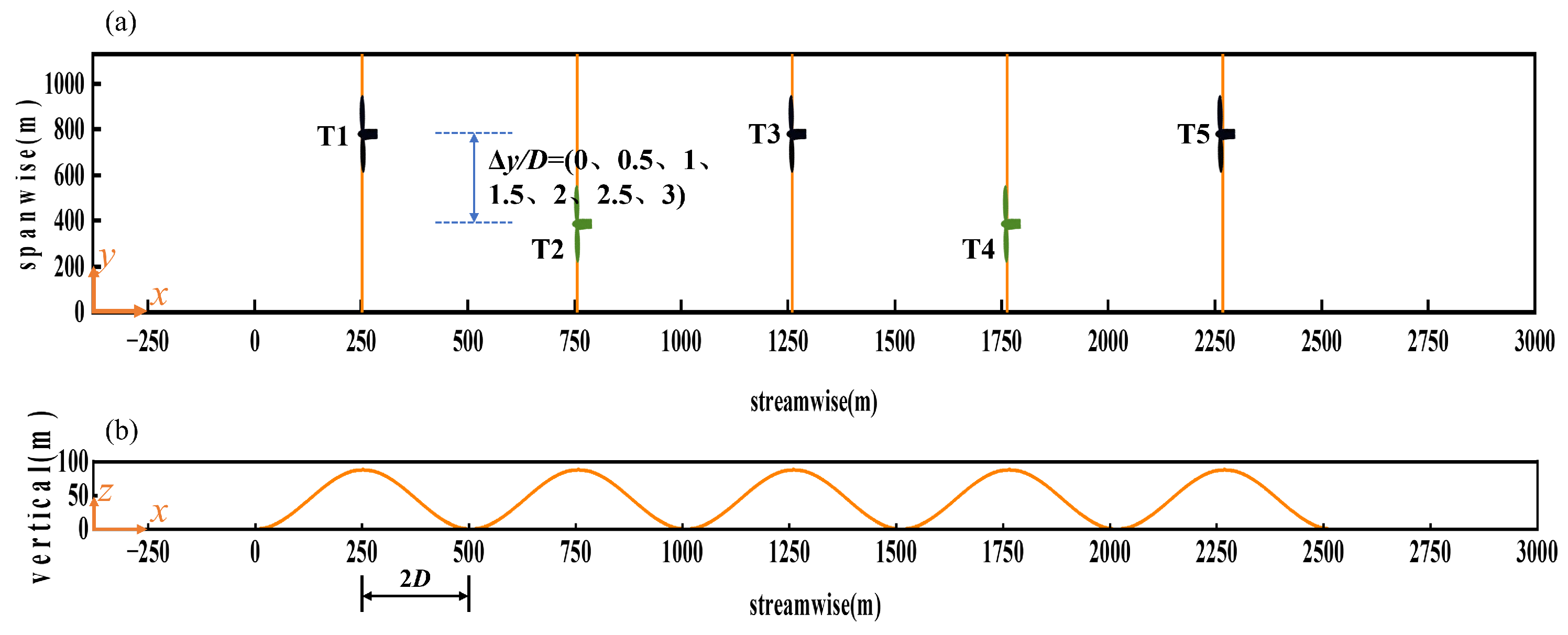
The multiple-hill terrain for this study is derived from the wind-tunnel configuration described by Hyvärinen et al. [11], as shown in Figure 1. It consists of five consecutive two-dimensional hills, the geometry of which is represented by the following shape function:
h / D = 0.35 1 cos π x / 2 D , 0 < x < 2520 ,
where h is the hill height; x is the streamwise coordinate; and 2D is the half-hill length, which also serves as the characteristic length of the hill, as illustrated in Figure 1. The hill height is comparable to the hub height. The inflow condition represents a realistic atmospheric boundary-layer flow, with the wind-speed profile following a logarithmic law. The wind speed at hub height is 8 m/s [7], and the surface roughness is set to 0.001 m, consistent with standard practice.
The background inflow, accounting for terrain effects but excluding wind turbines, was simulated for 20,000 s in SOWFA to ensure statistical convergence. The wind farm simulation in FAST.Farm ran for 2000 s, with the last 2000 s of the precursor wind field used for the simulation. This duration is sufficient for wind farm simulation, as the wake from the upstream turbine takes less than 500 s to develop and reach the boundary of the computational domain. Therefore, at least the last 1500 s of the 2000 s simulation are within the statistical convergence stage, which is sufficient to capture fully developed wake evolution and reliable load statistics. In this study, to enhance simulation accuracy and reduce costs, the grid length was kept identical in the x, y, and z directions within each resolution domain, and a 0.1 s time step and 5 m grid length were selected for the high-resolution domain, while a 1.0 s time step and 10 m grid length were used for the low-resolution domain. The aerodynamic response time step was set to be 0.00625 s, which is significantly smaller than the high-resolution wind-field time step to ensure the required precision [36].
The wind farm layout is presented in Figure 1. The coordinate system is defined with the origin ( x = 0 ) at the toe of the windward slope of the first hill, the crest of the first hill positioned at x = 2 D , and subsequent hill crests maintaining a streamwise spacing of 4D. In Figure 1a, orange lines indicate the crest locations of each hill. For clarity, turbines are designated as T1, T2, etc., corresponding to their respective hill-crest positions. To examine the influence of lateral offset on wind farm performance, T2 and T4 are synchronously displaced along the y-direction, with offsets ranging from 0 to 3D in 0.5D increments, generating a series of cases with varying lateral spacing ( Δ y ).

3. Numerical Methods

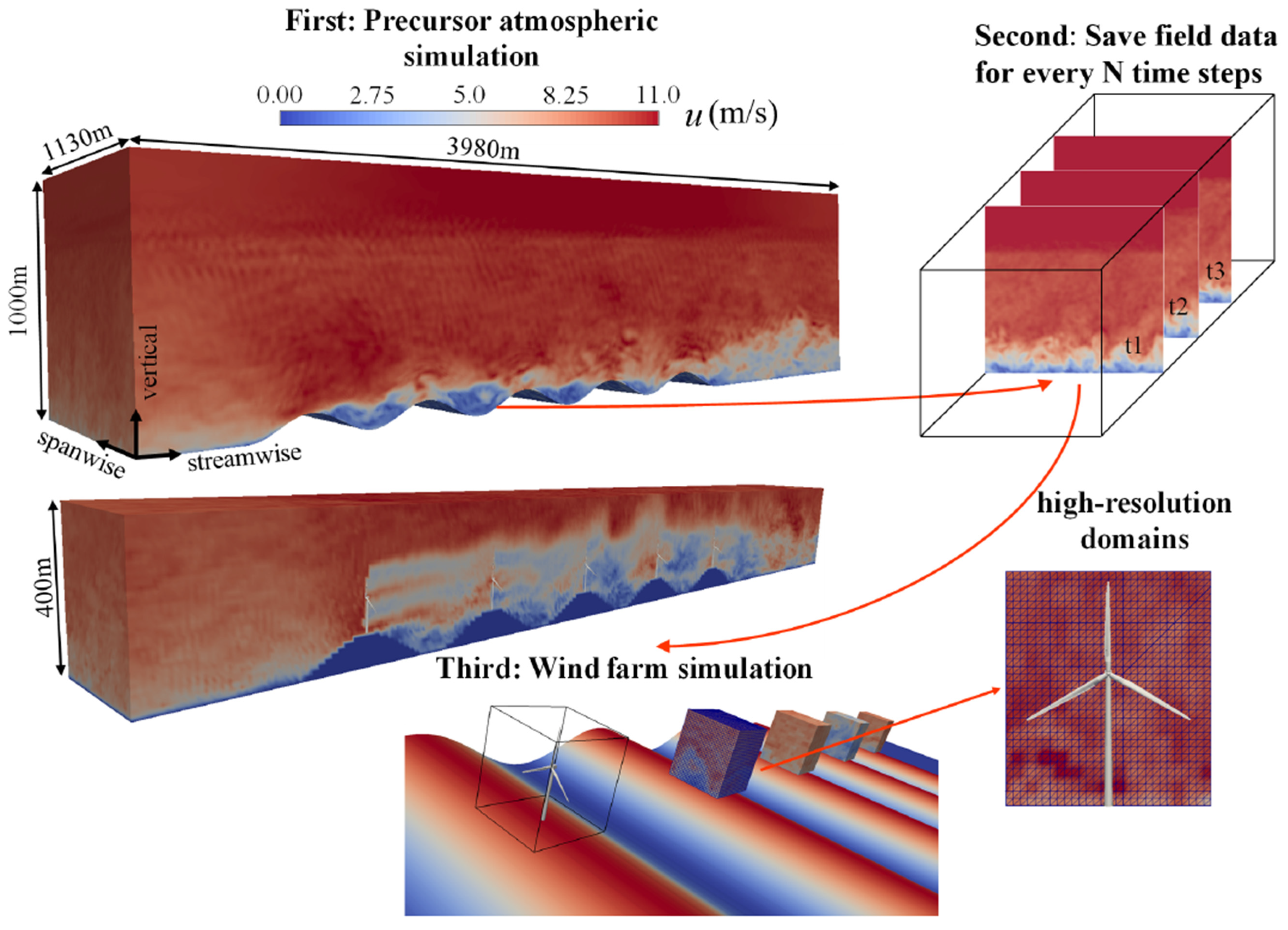
In this study, the numerical simulation of the wind farm is performed based on the combination of the DWM model and LES, with the NREL 5-MW Baseline turbine model [37] adopted. LES is used to calculate the terrain-included background wind field, which is then combined with the DWM model to perform calculations under various arrangements, aiming to analyze the influence of continuous hills on turbine wake characteristics and fatigue loads. The workflow is illustrated in Figure 2, and the second step presents data at different time instants for a cross-plane of the entire flow field, where the legend indicates the velocity magnitude, while the terrain in the third step is colored by elevation. The integration of LES and DWM retains the advantages of both methods: it reduces computational resource consumption, accelerates calculations, and compensates for the limitation of DWM in simulating wind farms in complex terrain. Meanwhile, it ensures a certain level of accuracy, making it suitable for the simulation of wind farms in complex terrain or large-scale wind farms.

3.1. Workflow of the Integrated LES-DWM Framework

In this study, two solvers—FAST.Farm and SOWFA—are used in combination. The terrain-included background wind field is derived from simulations performed by SOWFA, while subsequent wind farm calculations are conducted using FAST.Farm. This approach is adopted because FAST.Farm cannot simulate complex terrain, and its environmental wind module supports precursor simulation data from high-fidelity tools such as SOWFA [36], enabling effective integration of the two tools to achieve higher-precision simulations. Hence, the terrain-included background wind field is simulated by SOWFA.
In this study, the term fluid–structure interaction is strictly reserved to describe the two-way aeroelastic coupling within the FAST.Farm solver. Within the coupled LES-DWM-FAST.Farm framework, the LES module (SOWFA) is responsible solely for resolving the background atmospheric flow field over the complex terrain, providing the ambient inflow conditions. It does not receive structural displacement feedback; thus, the global system operates under a one-way flow-to-structure data transfer at this scale. The actual aeroelastic computation is executed within the high-fidelity FAST.Farm solver. Here, aerodynamic forces acting on the turbine blades and tower—calculated based on the local flow field modified by the DWM model—induce structural deflections and vibrations. This iterative process ensures that aerodynamic loads and structural responses are solved simultaneously, capturing the dynamic interplay between the incoming wind and the mechanical components of the turbine.
Within the coupled LES-DWM framework, the computational domain is structured into nested high- and low-resolution regions. The low-resolution domain encompasses the entire wind farm and is employed to simulate large-scale wake dynamics and flow interactions. High-resolution domains are local, turbine-centered sub-regions fully embedded within the low-resolution domain [38]; each encloses a single turbine and is dedicated to calculating detailed aerodynamic loads. Importantly, the mesh spacing and time step of the low-resolution domain are selected as integer multiples of those in the high-resolution domain. This integer-ratio constraint permits efficient structured-grid interpolation between the two domains, ensuring physically consistent data transfer with minimal computational overhead.
To incorporate terrain-modulated atmospheric boundary-layer effects, the background wind field is first generated using the ABLsolver in the SOWFA framework. Because the native SOWFA grid is considerably finer than the FAST.Farm high- and low-resolution grid, a Delaunay triangulation-based interpolation scheme is applied to map the high-fidelity SOWFA flow data onto the coarser FAST.Farm nodes [39]. The overall workflow proceeds as follows: (i) import the terrain model into SOWFA and solve the background wind field under prescribed initial and boundary conditions; (ii) downscale the SOWFA wind field via Delaunay triangulation interpolation to obtain flow data on the FAST.Farm high- and low-resolution grid; (iii) embed turbine models into FAST.Farm, configure relevant operational parameters, and execute the final coupled simulation using the nested high-/low-resolution domains.

3.2. Principles of LES and Generation of Atmospheric Boundary-Layer Inflow

The SOWFA tool employed in this study is fundamentally built upon an LES methodology tailored for atmospheric boundary-layer modeling. The turbulent atmospheric wind field is simulated using the LES method. The filtered form of the continuity equation is given as
u ¯ j x j = 0
where the overline denotes spatial filtering and u ¯ j = u j u j represents the resolved-scale velocity vector (instantaneous velocity ( u j ) minus the subfilter-scale velocity ( u j )).
Given that the computational domain is relatively small compared to the planetary scale, the Coriolis effect is considered negligible and, thus, omitted from the momentum equation.
The filtered momentum equation is
u ¯ i t + x j ( u ¯ j u ¯ i ) = p ¯ x i 1 ρ 0 p 0 ( x , y ) x i τ i j D x j + g θ ¯ θ 0 θ 0 δ i j ,
where t is time, p ˜ is the density-normalized deviation of the resolved-scale static pressure from its time average, p 0 ( x , y ) is the mean static pressure at the surface, and ρ 0 is the constant density of incompressible flow with a value of 1.225 kg/m3. The term τ i j D denotes the deviatoric part of the fluid stress tensor, while the logarithmic inflow is used in simulating the atmospheric boundary-layer wind field, which is responsible for calculating the surface shear stress. θ ¯ is the resolved potential temperature, θ 0 is the reference temperature, and δ i j is the Kronecker delta.
In LES, turbulence is decomposed into resolvable-scale motions (containing large-scale fluctuations) and subgrid-scale motions (encompassing all small-scale fluctuations) via a filtering operation [39]. The resolvable-scale motions are directly computed numerically, while the effects of subgrid-scale turbulence on mass, momentum, and energy transport are modeled using a Smagorinsky subgrid-scale closure [40]. This ensures closure of the governing equations for the resolvable scales [41,42]. This approach effectively resolves the filtered Navier–Stokes equations to represent atmospheric boundary-layer flows. The filtered equations are given as follows:
τ i j = 2 ( c s Δ ) 2 ( 2 S i j S i j ) 1 / 2 = 2 ν S G S S i j ,
S i j = 1 2 u i x j + u j x i ,
θ t + ( u j θ ) x j = q j x j ,
where Δ = ( Δ x Δ y Δ z ) 1 / 3 is the filter scale, dependent on the size of the computational grid. S i j represents the rate-of-strain tensor, with sub-grid scale (SGS) viscosity ( ν S G S ) defined by the Smagorinsky model and c s as the Smagorinsky constant. q j = k S G S θ x j represents the temperature flux influenced by viscosity and sub-grid scales, with k S G S = ν S G S Pr t ; P r t is the turbulent Prandtl number, the value of which is adjusted to achieve simulation of complex flows.
LES is capable of simulating transient flows and capturing rapidly varying flow characteristics in the atmospheric boundary layer. Additionally, it can reproduce flow behaviors induced by topographic changes such as wind-speed variations and vortex formation and, thus, exhibits advantages in handling complex terrain and inhomogeneous flows. Its simulation results generally agree well with measured data [25,43]. When LES is used to simulate the atmospheric boundary layer, the height of the computational domain typically needs to reach or exceed 1000 m during calculations, as the temperature inversion layer usually extends above 750 m. In this study, the height of the computational domain adopted for the simulation is 1000 m.

3.3. Fundamental Principles of the DWM Model

The FAST.Farm tool utilized in this study is fundamentally based on a dynamic wake-modeling approach. As a three-dimensional wake model, its primary advantage over traditional wake models lies not only in its ability to simulate three-dimensional wake diffusion but, more importantly, in its capacity to reproduce the real-time dynamic behavior of wakes. This enables a more physically realistic simulation of wind farm wake effects. The main idea behind the DWM model is to capture wake features pertinent to accurate prediction of wind farm power performance and turbine loads, including the wake-deficit evolution and the wake meandering and wake-added turbulence [36].
In the DWM model, the wake-flow processes are treated via the “splitting of scales”, in which small turbulent eddies affect wake-deficit evolution and large turbulent eddies affect wake meandering. In addition, the experimental results reported by Bingöl et al. [44] indicate that the evolution of wake deficit can be handled independently of large-scale wake meandering, allowing the two processes to be decoupled and addressed separately. Thus, the DWM model consists of two main components: a wake-deficit module and a wake-meandering module, which are executed sequentially.
In this study, the governing equations are the steady-state thin shear-layer approximation of the Navier–Stokes equations [36]. The turbulence closure is captured by using an eddy-viscosity formulation, dependent on small turbulent eddies, as proposed by Ainslie [45,46]. The balance of momentum and continuity is maintained through two equations. In addition, the flow is assumed to be axisymmetric ( / θ = 0 ), and the evolution of the wake deficit is solved on an axisymmetric finite difference grid. The wake deficit is calculated on a fixed number of wake planes, each with fixed radial grid nodes. Similar to the approach for wake-deficit evolution, this module simulates the flow in the thin shear layer for quasi-steady-state conditions of an axisymmetric coordinate system by solving the steady-state Reynolds-averaged Navier–Stokes equations [38]. Turbulence closure is achieved through the eddy-viscosity formulation. By applying the thin shear-layer approximation, the pressure term is omitted, and it is assumed that the radial velocity gradient vastly exceeds the axial velocity gradient. With these simplifications, the governing equations for momentum and mass conservation are formulated in a discretized numerical form [35] as shown below:
u u x + v u r = 1 r r ν T r u r ,
1 r r ( r v ) + u x = 0 ,
where u and v denote the mean velocity components in the streamwise (x) and radial (r) directions, respectively, and ν T represents the eddy viscosity. Although the governing equations given in Equations (7) and (8) are expressed in continuous form, their numerical solution in FAST.Farm is discretized on a series of wake planes that form a two-dimensional axisymmetric grid in the streamwise direction, with finite difference approximations applied radially at each plane.
The near-wake correction computes the axial and radial wake velocity deficits at the rotor plane, which serve as the inlet boundary condition for the wake-deficit evolution sub-model. To enhance the accuracy of the far-wake solution, the near-wake correction accounts for the velocity drop and the radial expansion of the wake in the pressure-gradient region immediately downstream of the rotor—effects not considered in the wake-deficit evolution solution. In the DWM model, the wake-meandering process is treated pragmatically [47] by modeling the meandering as a passive tracer. The wake deficit is transported transversely (both horizontally and vertically) within a moving frame of reference. This reference frame is defined based on the local, spatially averaged ambient wind field, which includes the large-scale turbulent eddies across cross-sectional planes of the wake.

3.4. Fatigue Loads and Their Calculation Principles

In a wind farm, downstream turbines are subjected to higher fatigue loads than upstream ones under the action of unsteady wakes. The blades and tower are the most critical fatigue-prone components; therefore, the in-plane and out-of-plane shear forces and bending moments at the blade root, as well as the fore-aft and lateral shear forces and bending moments at the tower base, are regarded as the key fatigue-load indicators in this study [48].
The main key parameters are expressed as follows:
R F = R F x 2 + R F y 2 ,
R M = R M x 2 + R M y 2 ,
T F = T F x 2 + T F y 2 ,
T M = T M x 2 + T M y 2 ,
The definitions of the parameters in Equations (9)–(12) are provided in Table 1. Although the long-term damage-equivalent load (DEL) is the preferred choice for fatigue-load analysis, its calculation incurs excessive computational costs. Therefore, this study adopts the short-term DEL, whose calculation is performed using MLife—a fatigue-load estimation program developed by the National Renewable Energy Laboratory (NREL) [49]. Fatigue-load estimation is fundamentally based on the rainflow counting algorithm, a method for identifying and counting fatigue cycles from a time series. Subsequent cumulative damage calculation is conducted in accordance with the S-N curve [50]. The short-term DELs are calculated as follows:
D j S T = i n j i N j i = n j S T e q N j e q ,
n j S T e q = f e q T j ,
N j e q = L j u l t | L j M F | 1 2 D E L j S T F m ,
where D j S T is the short-term damage rate for time series j, n j i represents the number of cycles corresponding to the i-th load amplitude, N j i is the number of cycles to failure, f e q denotes the frequency of the short-term equivalent fatigue load, T j is the elapsed time of time series j, n j S T e q is the total equivalent fatigue-load count for time series j, D E L j S T F is the short-term damage-equivalent load with respect to a fixed mean value for time series j, and N j e q signifies the equivalent number of cycles to failure for time series j.
The short-term DELs were calculated using MLife, following the rainflow counting algorithm and the Palmgren–Miner linear damage accumulation rule. The S-N curve parameters and the Wöhler exponent (m) were assigned based on the component material properties: for blade components, a Wöhler exponent of m = 8 was adopted, consistent with typical composite-material fatigue behavior. For tower components, a Wöhler exponent of m = 3 was used, reflecting the joint characteristics of welded steel [49,50]. The equivalent frequency was set to f eq = 1 Hz , and the design lifetime was defined as 20 years (equivalent to 6.3072 × 10 8 s). The equivalent number of cycles for the design lifetime is calculated as n eq = f eq × T design = 6.3072 × 10 8 cycles. The ultimate load ( L ult ) for each channel was defined as the maximum load value observed in the simulation time series, and mean-load correction was applied using the Goodman correction method.

3.5. Validation of Numerical Methods

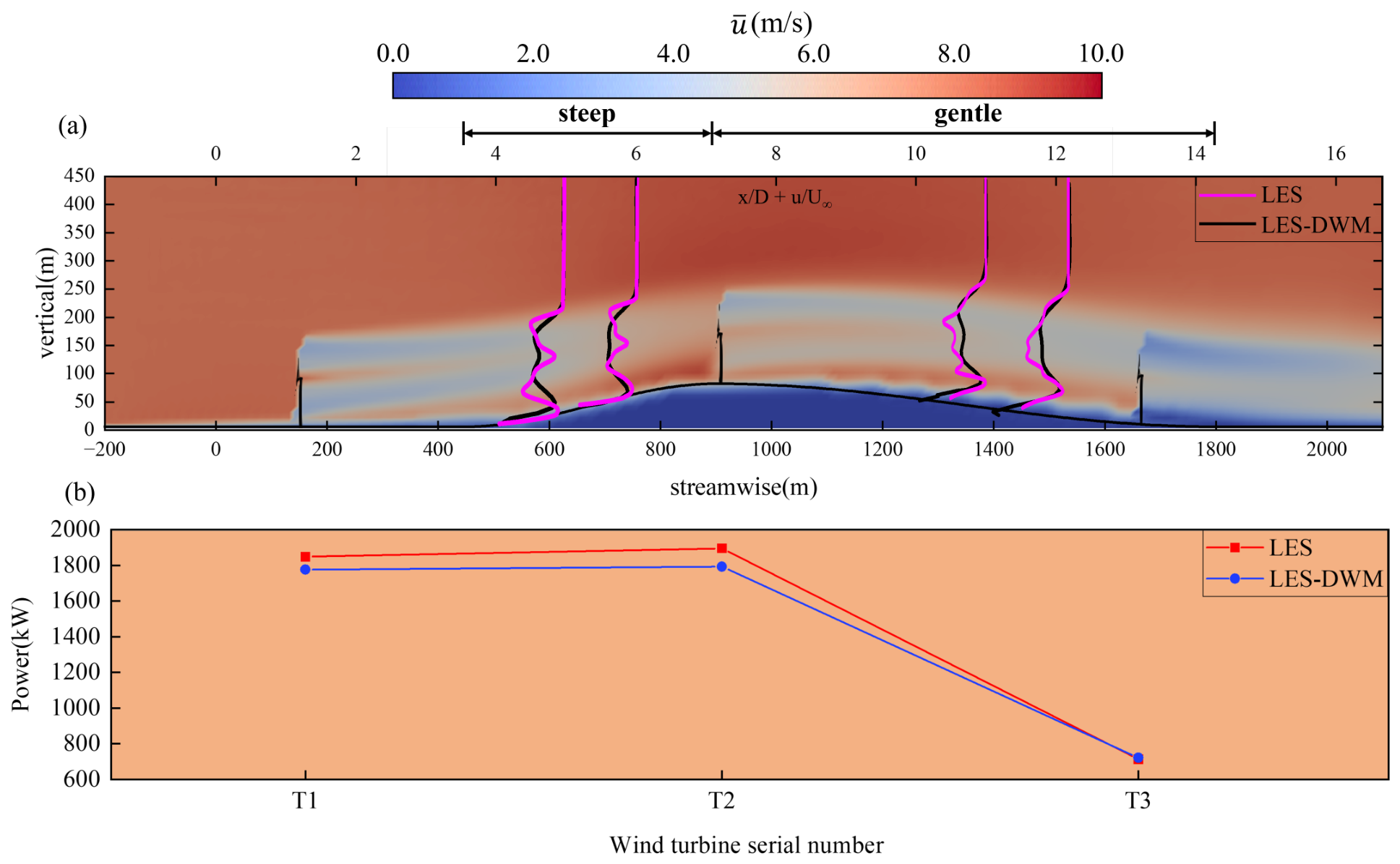
Since the accuracy of SOWFA for atmospheric boundary-layer simulation has been widely validated, the methodological verification concentrates on the performance of the integrated LES-DWM framework [51,52,53]. A hill with a pronounced asymmetry between its windward and leeward slopes (as shown in Figure 3) was designated as the validation case to represent the complex topographies simulated in this study. The terrain is modeled using a two-dimensional approach, with its geometry described by the following topographic equation:
h = 40 cos π 450 ( x 900 ) + 40 , 450 x < 900 40 cos π 900 ( x 900 ) + 40 , 900 x < 1800 ,
where h is the hill height and x is the streamwise coordinate.
An 8 m/s inflow velocity was implemented in an idealized modeling framework. Figure 3 and Table 2 and Table 3 present a comparative analysis of wind farm performance derived from two numerical methodologies—specifically, a high-fidelity LES and a multi-fidelity approach in which LES-generated background flow fields serve as input for FAST.Farm-based wind farm simulations. As can be seen in Figure 3 and Table 2, the results of LES and the LES-DWM combination agree well. In Figure 3a, the top axis represents the normalized position and velocity, with the position normalized by dividing by D and the velocity normalized by dividing by the inflow velocity. In the meantime, the velocity distributions in the far-wake regions of the first two turbines exhibit good agreement between the pure LES and the coupled LES-DWM approaches. Although slight discrepancies are observed in the wake center, these do not compromise the overall simulation accuracy.
To quantitatively assess the model’s performance, Table 3 summarizes the relative errors of four key wake quantities at x / D = 5 : centerline position, velocity deficit, wake width, and turbulence intensity. For T1, the errors are 2.13%, 7.63%, 7.69%, and 5.63%, respectively; for T2, the corresponding errors are 8.22%, 9.34%, 7.72%, and 6.89%. All errors remain within 10%, confirming that the LES-DWM framework faithfully reproduces the wake characteristics resolved by the full LES, including the terrain-induced wake meandering and turbulence recovery. Furthermore, the power errors of the three turbines do not exceed 5%, and the errors of the short-term DELs for the three turbines are within 10%. In addition to the integral DEL errors, we also quantified the errors of individual fatigue-load channels between LES and LES-DWM, as summarized in Table 4. The errors for all channels remain below 10%, further demonstrating that the coupled framework provides reliable fatigue-load predictions at the channel level. Both the LES and LES-DWM simulations show that the power output of the second turbine is close to that of the first turbine, suggesting that the multiple-hill terrain facilitates wake recovery. These results demonstrate that the LES-DWM method can accurately simulate the coupling effect between turbine wakes on the windward slope and complex terrain flows. Both the power output and short-term DEL errors of the third turbine are the smallest, which indicates that LES-DWM can accurately simulate the wake superposition effect of turbines on complex terrain. To further validate the LES-DWM framework against the pure LES, the time-averaged velocity profiles at selected downstream locations are compared in Figure A1 (Appendix A). The results show that the LES-DWM framework reproduces the main wake features, including the velocity deficit and wake recovery, with minor discrepancies confined to the near-wake region.
A quantitative comparison of the computational cost is presented in Table 5. The pure LES of the three-turbine case requires 164 CPU cores and runs for approximately 105 wall-clock hours: 72 h for the initial 18,000 s of background terrain flow, followed by 33 h for the final 2000 s with the turbines activated, resulting in a total of 17,220 core hours. In contrast, the LES-DWM framework runs the background LES for the full 20,000 s on 164 cores, taking approximately 80 h. The DWM module then runs for the final 2000 s on only 24 cores, taking approximately 5.5 h, using the background flow data extracted from the 18,000–20,000 s interval of the completed background LES. This brings the total wall-clock time for the LES-DWM framework to approximately 85.5 h, with a total core-hour cost of 13,252 core hours (13,120 for the background LES and 132 for the DWM module). Compared to the pure LES, this represents a saving of approximately 23.0% in computational time for a single simulation. Although the time saving per simulation is modest, the true advantage of the LES-DWM framework becomes evident in parametric studies involving multiple cases—such as yaw-angle adjustments or layout optimization—where the environmental conditions remain unchanged. In such scenarios, the background LES needs to be performed only once, and its results can be reused across all subsequent cases. The DWM module then handles the turbine-scale simulations for each case independently, requiring significantly less computational effort. In contrast, the pure LES must be executed from scratch for every individual case, repeating the entire simulation workflow each time. Therefore, when multiple cases are considered, the LES-DWM framework offers substantial cumulative savings in both computational cost and time, making it highly efficient for systematic parametric studies and layout optimization in complex terrain.
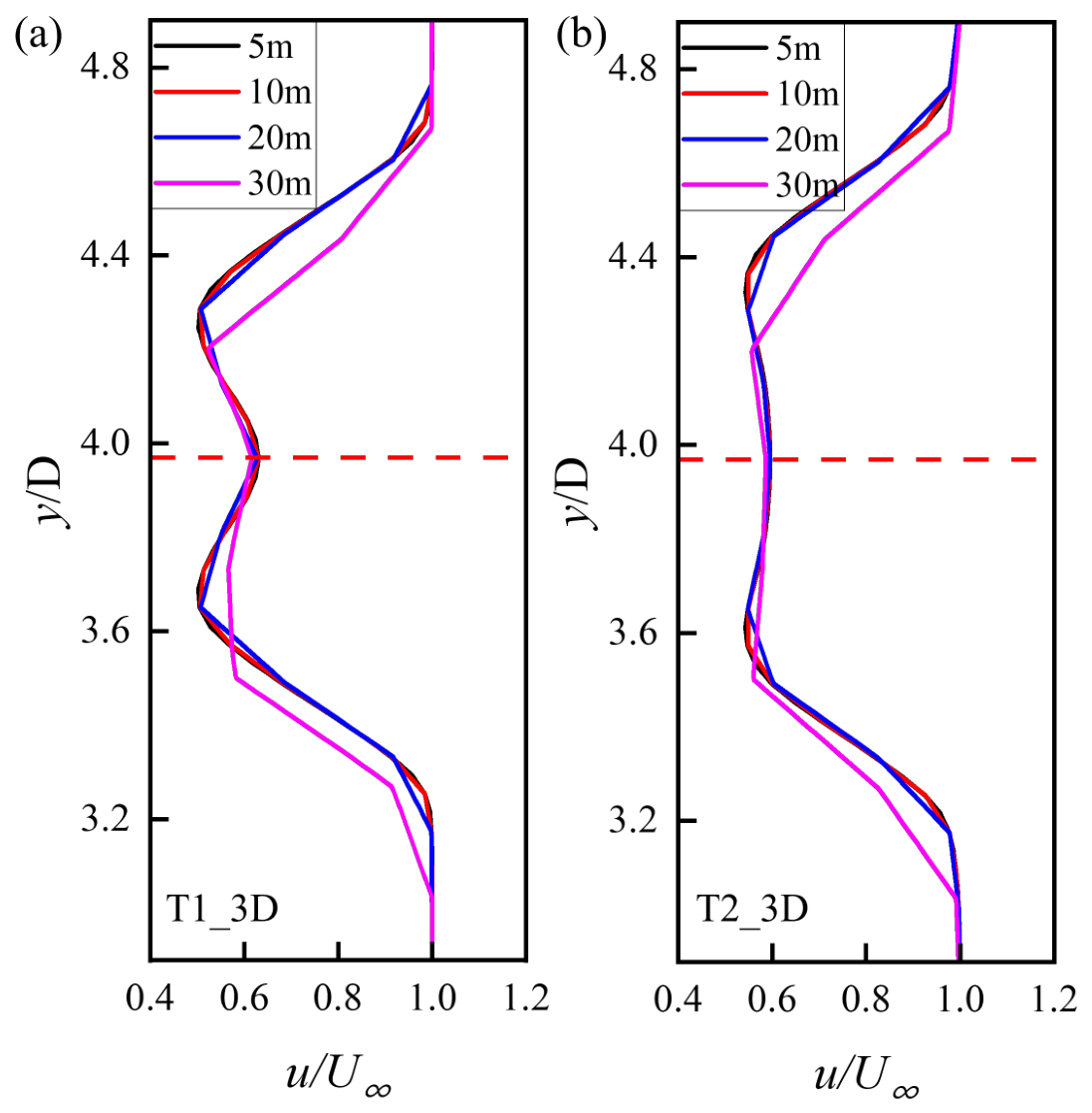
In the meantime, we conducted a grid independence validation to ensure that grid resolution did not significantly affect the wake simulation results. To meet the requirements, we compared different grid resolutions, with particular focus on the impact of 5 m, 10 m, 20 m, and 30 m grid resolutions on the wind turbine wake behavior. As quantitatively summarized in Table 6, taking the 5 m grid results as the benchmark, the 10 m grid yields a power error of only 0.176% for T2 (with T1 showing zero error across all resolutions) and velocity errors at representative downstream locations of 2.069%, 1.813%, 0.897%, and 0.849%. In contrast, the 30 m grid produces substantially larger velocity errors, reaching up to 27.436% at T1_3D and 21.984% at T2_3D.
In addition to power and velocity, we also quantified the grid sensitivity of individual fatigue-load channels. As shown in Table 7, the resultant fatigue-load errors for the 10 m grid are zero across all channels for both turbines, indicating that the coarse grid captures the overall loading magnitude with excellent fidelity. For the 20 m grid, the resultant errors remain very small, with a maximum of 1.149% for T1 T M and 1.653% for T2 T M . The 30 m grid yields larger but still moderate resultant errors, reaching up to 3.831% for T1 T M and 4.959% for T2 T M . These results demonstrate that the grid convergence of the resultant fatigue loads is well behaved and that the 10 m grid provides highly accurate predictions of the overall loading levels. To complement analysis of the resultant load, we also quantified the grid sensitivity of individual fatigue-load channels. As summarized in Table 8, the 10 m grid yields errors below 1% for all fatigue channels when compared to the 5 m benchmark, with most channels showing zero or negligible deviations. For example, the maximum errors for T2 at 10 m are 0.60% ( R F x ), 0.66% ( T F x ), and 0.42% ( T M x ). In contrast, the 30 m grid produces substantially larger deviations, with errors reaching up to 5.00% for T2 T M y and 3.95% for T2 T F x .
As shown in Figure 4, the results from the 5 m and 10 m grids are very close, with minimal differences, indicating that these finer grid resolutions effectively capture the physical characteristics of the wake and that the wake evolution remains stable. Furthermore, the deviations of the position of the wake centerline remain below 1% for all grid resolutions, confirming that grid resolution has a negligible influence on wake centerline tracking. In contrast, there are significant differences in the wake structure and wind-speed distribution between the 20 m and 30 m grids. Particularly with the 30 m grid, the wake displacement becomes unacceptable. Based on this quantitative assessment, the 10 m grid resolution is selected for all subsequent simulations, as it achieves accuracy comparable to the 5 m benchmark while substantially reducing computational cost.

4. Results and Discussion

4.1. Inflow Conditions

The inflow boundary conditions for the mountainous-terrain case are summarized in Appendix B (Table A1), and the corresponding vertical profile of the streamwise velocity is shown in Figure A2. This section describes the boundary conditions imposed in the LES domain and the resulting inflow characteristics at the first turbine location for both terrain cases, including hub-height velocity, turbulence intensity, wind shear, and rotor-plane statistics. A comparison of the baseline inflow conditions between the flat and mountainous-terrain cases is presented in Table 9. Although the two cases share the same boundary condition of U = 8 m / s , the mountainous terrain significantly modifies the inflow at the first turbine location. Specifically, the hub-height velocity increases from 7.97 m/s (flat) to 10.02 m/s (mountainous), driven by the hill-induced flow acceleration, while the turbulence intensity decreases slightly from 5.25% to 4.16%. The most notable difference lies in the wind-shear exponent, which rises from 0.12 in the flat case to 0.398 in the mountainous case, indicating a substantially stronger vertical velocity gradient induced by the terrain. These differences underscore the importance of terrain-induced effects on subsequent turbine performance and wake development.

4.2. Power

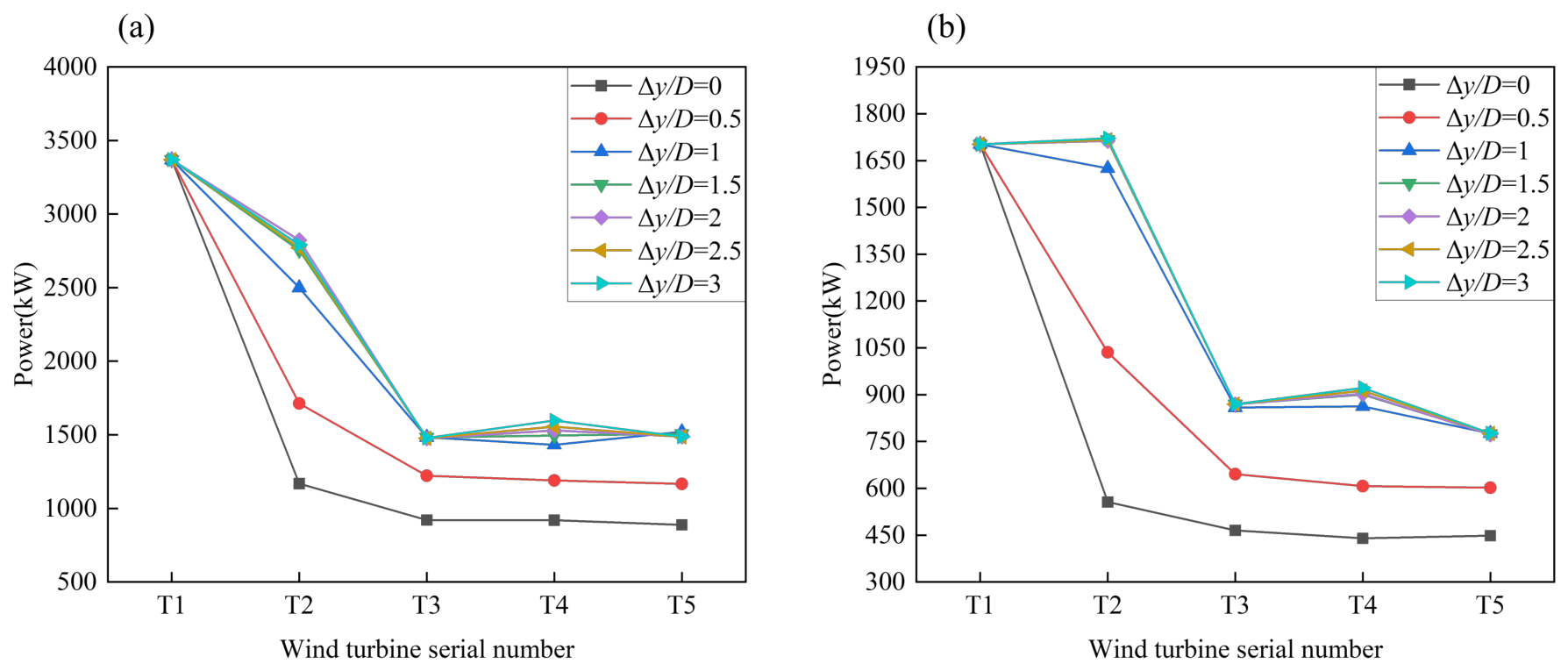
The most immediate impact of altering the wind turbine layout is reflected in the power output characteristics. To analyze the influence of lateral offset distance ( Δ y / D ) on power characteristics, the average power distribution was calculated, as presented in Figure 5. It shows that when Δ y / D 1 , the power of each turbine (except T1) increases with the lateral offset distance in both the mountainous and flat wind farms. In flat terrain, the power output of all turbines except T1 plateaus after Δ y / D > 1, showing no significant variation with further increases in lateral offset distance. In contrast, the mountainous wind farm exhibits different characteristics: the power output of T4 continues to increase slightly as Δ y / D increases from 1 to 3. Furthermore, in the flat wind farm, the power output of T2 approaches that of T1 when Δ y / D 1 . However, in the multiple-hill case, the power output of T2 remains significantly lower than that of T1, representing the most pronounced difference between the two wind farm types.
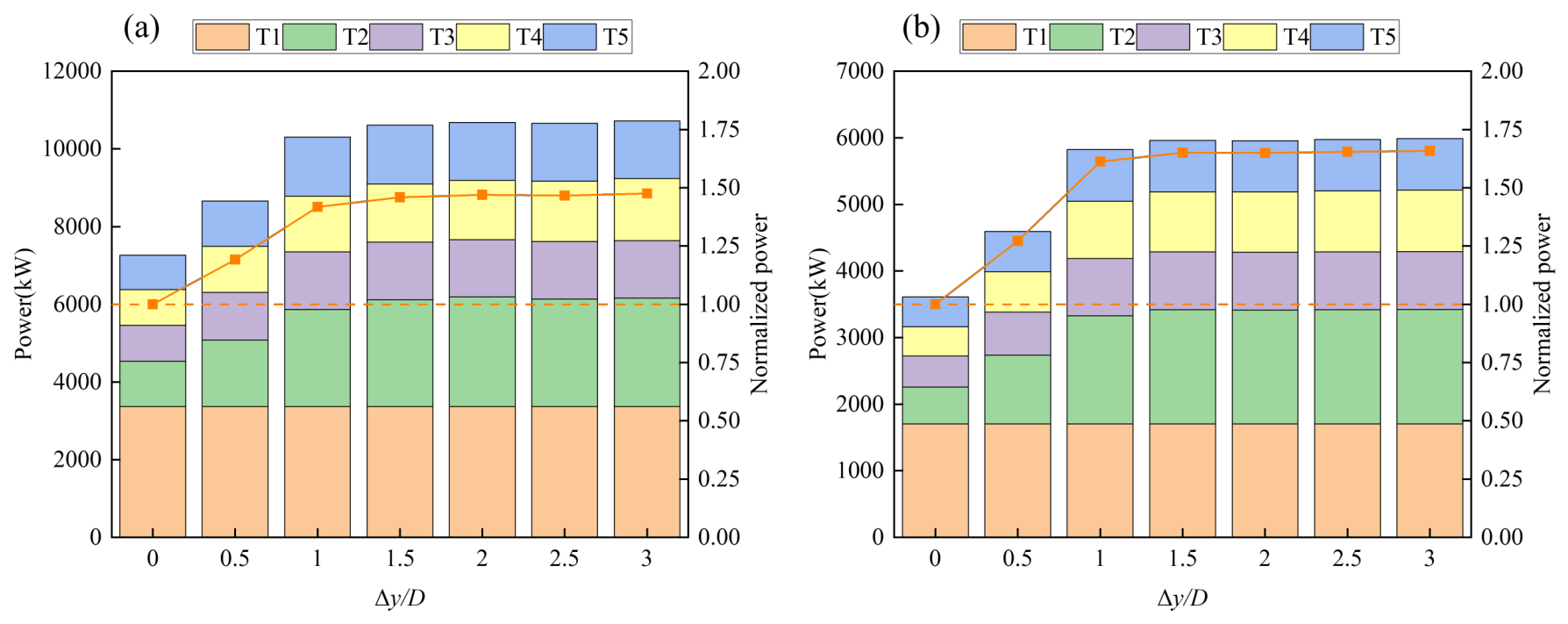
In addition to collecting the time-averaged power of each turbine, we summed their outputs to obtain the total power of the wind farm, which was then normalized. The bar charts in Figure 6 represent the magnitude of this total power, while the line charts denote its normalized proportion. The power normalization in Figure 6 was performed using the power at Δ y / D = 0 as the reference, following the analytical method proposed by Zhang et al. [3]. As evidenced by the total power, the inflection point of normalized power occurs under the same arrangement for both mountainous and flat wind farms. However, the total power of the mountainous wind farm exhibits slight fluctuations when Δ y / D 1 , which are primarily related to T4 (from Figure 5)—a phenomenon not observed in the flat wind farm. This turbine is positioned on the leeward side of the second hill, where the terrain-induced flow separation and recirculation create a highly non-uniform inflow environment. As the lateral offset increases, the wake from upstream turbines may intermittently interact with these terrain-generated vortical structures. It is also evident that for the normalized power, the improvement rate when transitioning from a tandem to a staggered configuration is higher in the flat wind farm than in the mountainous one. This indicates a greater potential for power improvement in flat wind farms. The difference in power improvement potential between flat and mountainous wind farms stems from their distinct wake recovery characteristics. In flat wind farms, wake recovery is slow, resulting in low energy utilization efficiency in tandem layouts, presenting significant potential for power improvement through layout optimization. In contrast, mountainous wind farms exhibit faster wake recovery and higher initial energy utilization efficiency, leading to relatively limited potential for further power improvement.
The power output of each turbine in a wind farm is affected by the farm layout. When Δ y / D 1 , the power of T2, T3, T4, and T5 increases with the lateral displacement in both mountainous and flat wind farms. When Δ y / D > 1, the power of all turbines remains essentially unchanged. The most prominent difference between mountainous and flat wind farms lies in T2: the power output of T2 in mountainous wind farms is lower than that of T1, whereas the power output of T2 in flat wind farms is comparable to that of T1. From the perspective of total power output, the mountainous wind farm exhibits higher initial wind energy utilization efficiency, while its potential for subsequent improvement is more limited compared to the flat wind farm.

4.3. Fatigue Loads

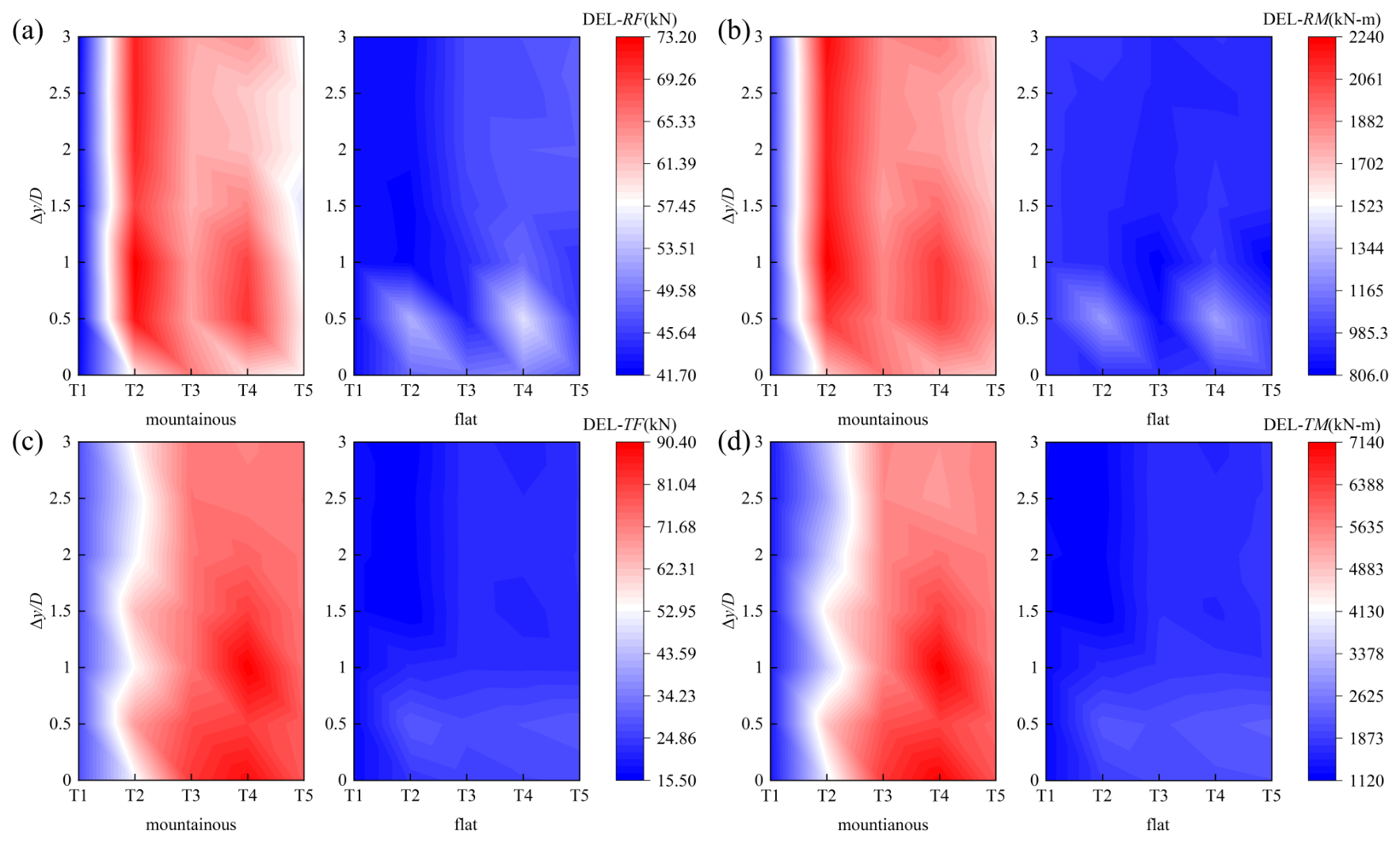
In addition to power generation, fatigue load is another critical aspect of wind turbine research [38]. To balance accuracy and computational efficiency, this study employs short-term DELs for the blade-root combined shear force (DEL- R F ), the blade-root combined bending moment (DEL- R M ), the tower-base combined shear force (DEL- T F ), and the tower-base combined bending moment (DEL- T M ); the corresponding results are presented in Figure 7, displayed in the form of a two-dimensional heatmap, following the methodology of Thedin et al. [54]. A comparison of the fatigue loads on T1 in Figure 7 shows that despite differences in inflow wind speed between the multiple-hill and flat terrains, the short-term DEL values for the various layouts are relatively close. Apart from T1, the short-term DELs of all components for the remaining turbines (T2–T5) in the mountainous wind farm are significantly higher than those in the flat terrain under identical working conditions. Further observation of Figure 7a,b reveals that in the mountainous wind farm, the DEL- R F and DEL- R M of T2 reach their maximum values at Δ y / D = 0.5, then stabilize, with values notably higher than those of other turbines. Meanwhile, the short-term blade-root DELs of T4 increase at Δ y / D = 0.5, begin to decline between Δ y / D = 1 and 1.5, and stabilize within the range of Δ y / D = 1.5 to 3. In contrast, in the flat wind farm, the short-term blade-root DELs of T2 and T4 peak at Δ y / D = 0.5, decrease as the lateral distance continues to increase, and remain largely unchanged from Δ y / D = 1 to 3. This difference highlights the fundamental distinction in how short-term blade-root DELs vary with layout between mountainous and flat wind farms.
As shown in Figure 7, the variation trends of short-term DEL- T F and DEL- T M in the flat wind farm are generally consistent with those of the short-term blade-root DEL. In particular, the short-term DELs of both T2 and T4 reach their maximum values at Δ y / D = 0.5, then decrease and stabilize. However, the variations in short-term blade-root DELs are more pronounced, whereas the change in short-term tower-base DELs are relatively moderate. Although the maximum values occur under the same layout condition, the range of variation in short-term tower-base DELs are notably smaller than that in short-term blade-root DELs. In contrast, the short-term DEL- T F and short-term DEL- T M of turbines in the mountainous wind farm differ from the short-term blade-root DELs, as evidenced by the fact that the maximum values of the short-term DEL- T F and short-term DEL- T M occur not at T2 but at T4. In the mountainous wind farm, the short-term tower-base DEL of T4 reaches its maximum at Δ y / D = 0 and 1, then decreases and stabilizes within the range of Δ y / D = 1 to 3. Specifically, peak fatigue loads in the mountainous case exceed those in the flat case by 36% ( R F ), 66.4% ( R M ), 130.95% ( T F ), and 120% ( T M ). The most striking disparity emerges in the tower-base shear force ( T F , 130.95%), underscoring the fact that terrain-induced amplification is most severe for tower loads. Conversely, the blade-root shear force ( R F , 36%) exhibits the smallest increment, indicating that, under the present configuration, topographic effects pose a greater threat to tower integrity than to blade-root fatigue life.
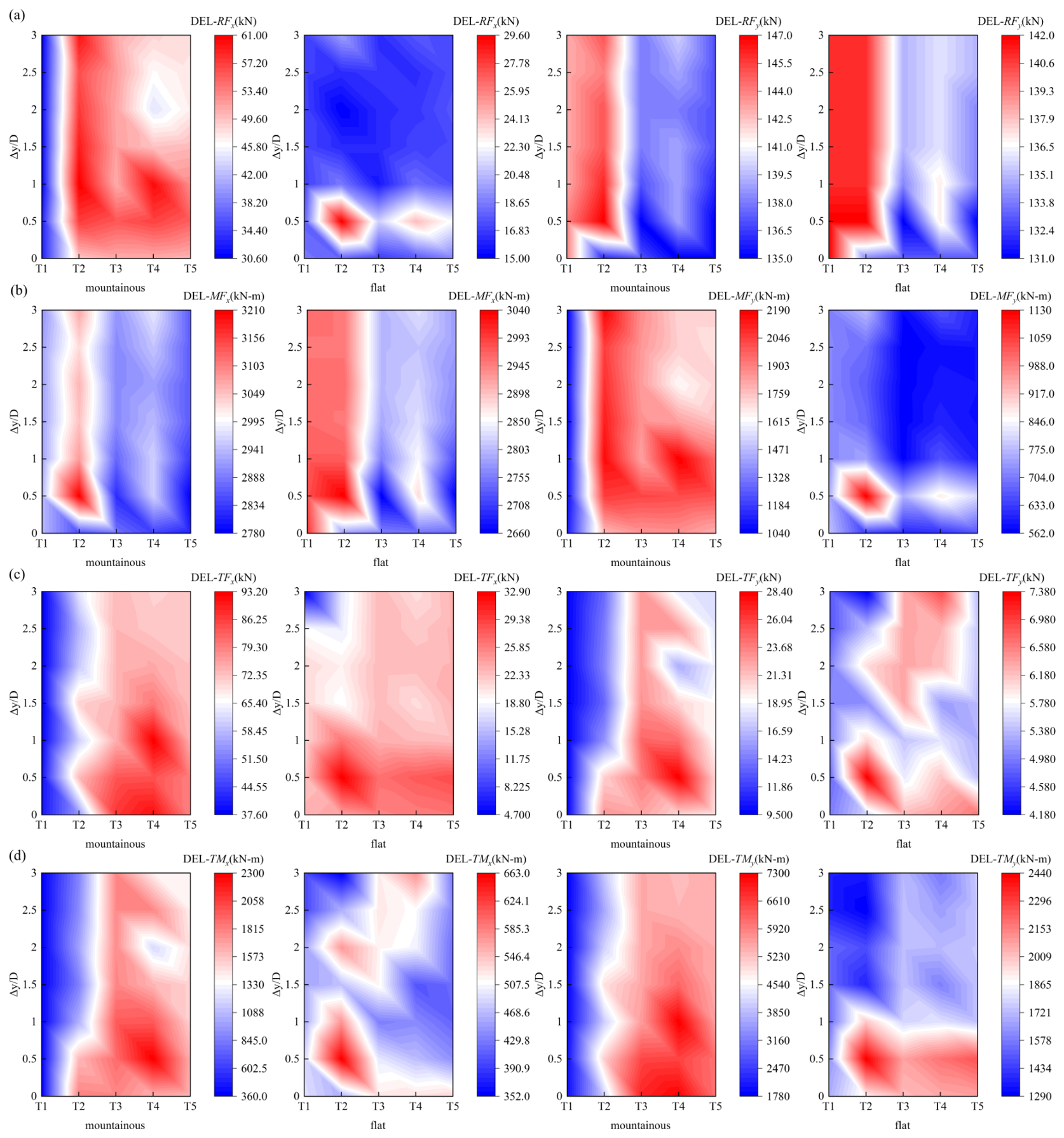
It should be noted that the combined load magnitudes ( R F , R M , T F , and T M ), defined as the Euclidean norms of their respective orthogonal components, are adopted in this study as compact metrics for comparative assessment across different turbines and operating conditions. However, fatigue damage is inherently nonlinear and phase-dependent, and rainflow counting performed on combined resultant signals does not strictly preserve the damage contributions from individual signed load channels. To justify this simplification, the fatigue behavior of each directional component was examined. As shown in Figure 8, the trends of the combined blade-root loads are predominantly governed by their dominant directional components. The out-of-plane shear ( R F x ) largely determines R F , while the in-plane bending moment ( R M y ) dominates R M . The complementary components ( R F y and R M x ) exhibit substantially smaller magnitudes and narrower variation ranges across all simulated cases and therefore contribute minimally to the overall trend. Hence, the combined loads ( R F and R M ) effectively reproduce the parametric trends of their dominant components. For the tower-base loads, the two directional components of each combined load—namely, T F x versus T F y and T M x versus T M y —exhibit comparable magnitudes and similar parametric sensitivities. The combined quantities ( T F and T M ) therefore provide a representative measure of the combined loading response. Accordingly, while the use of resultant magnitudes does not replace a full multiaxial fatigue analysis, it offers a valid and practical approximation for the comparative and parametric purposes of the present study. For completeness, the individual signed-channel DELs are also presented in Table 1 to support the interpretation of the resultant-based results.
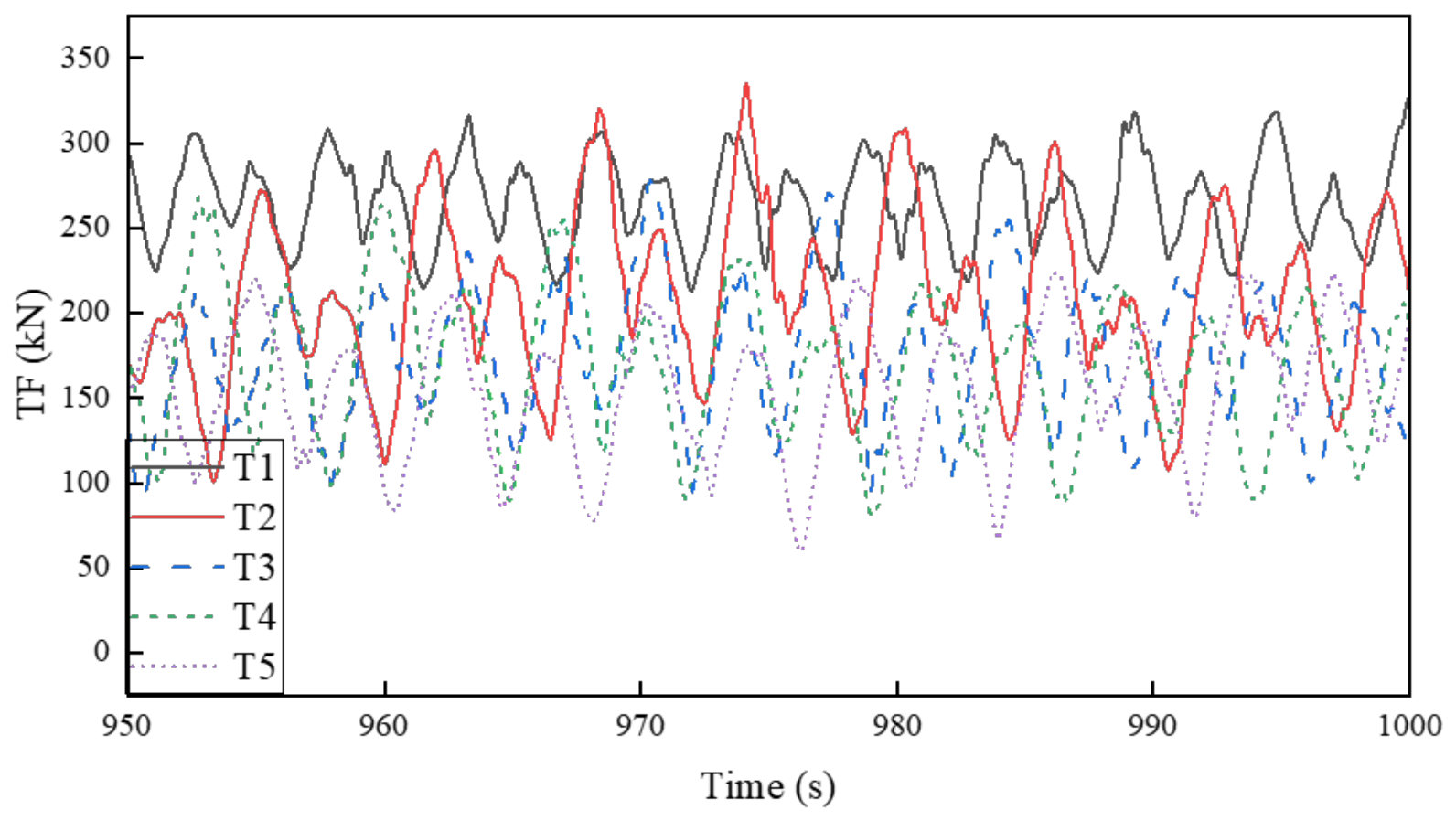
To directly support the interpretation of fatigue-load peaks, Figure 9 presents the time history of the resultant tower-base shear force (TF) for all five turbines over the period from 950 to 1000 s as a representative example. A clear peak is observed at t = 975 s, where T2 reaches 320 kN—substantially higher than its surrounding values and exceeding all other turbines at the same instant. This peak coincides with the moment when the mountainous terrain induces the strongest asymmetric inflow across the rotor plane of T2, as confirmed by the rotor-plane velocity distribution at this instant (Figure 9). The combination of hill-top acceleration and leeward flow separation creates a vertical velocity gradient across the T2 rotor disk, with the lower half of the rotor experiencing significantly lower velocity than the upper half. This differential loading leads to large cyclic variations in blade-root bending moments, resulting in the observed DEL peak. Notably, T1 also exhibits a local peak at the same instant (310 kN), suggesting that terrain-induced vortices intermittently impinge on T1. However, the peak at T2 remains the most pronounced, confirming that terrain-induced asymmetric inflow is the primary driver of fatigue-load peaks in the mountainous wind farm.
In summary, the influence of wind speed on the short-term DELs of various wind turbine layouts is not significant. In the flat wind farm, the short-term DELs at the blade root and tower base for both T2 and T4 peak at Δ y / D = 0.5. Under other layout conditions ( Δ y / D 0.5 ), the short-term DELs across all turbines remain relatively similar without notable variations. In contrast, the short-term DEL distribution in the mountainous wind farm exhibits more complex characteristics: the maximum short-term blade-root DELs occur for T2 at Δ y / D 0.5 , while the maximum short-term tower-base DELs appear for T4 at Δ y / D = 1. With the exception of T1, the short-term DELs of the other turbines in the mountainous wind farm are generally higher than those in the flat wind farm, reflecting the considerable influence of terrain conditions on the short-term DELs of downstream turbines.

4.4. Analysis of the Physical Mechanism

4.4.1. Wake Deficit

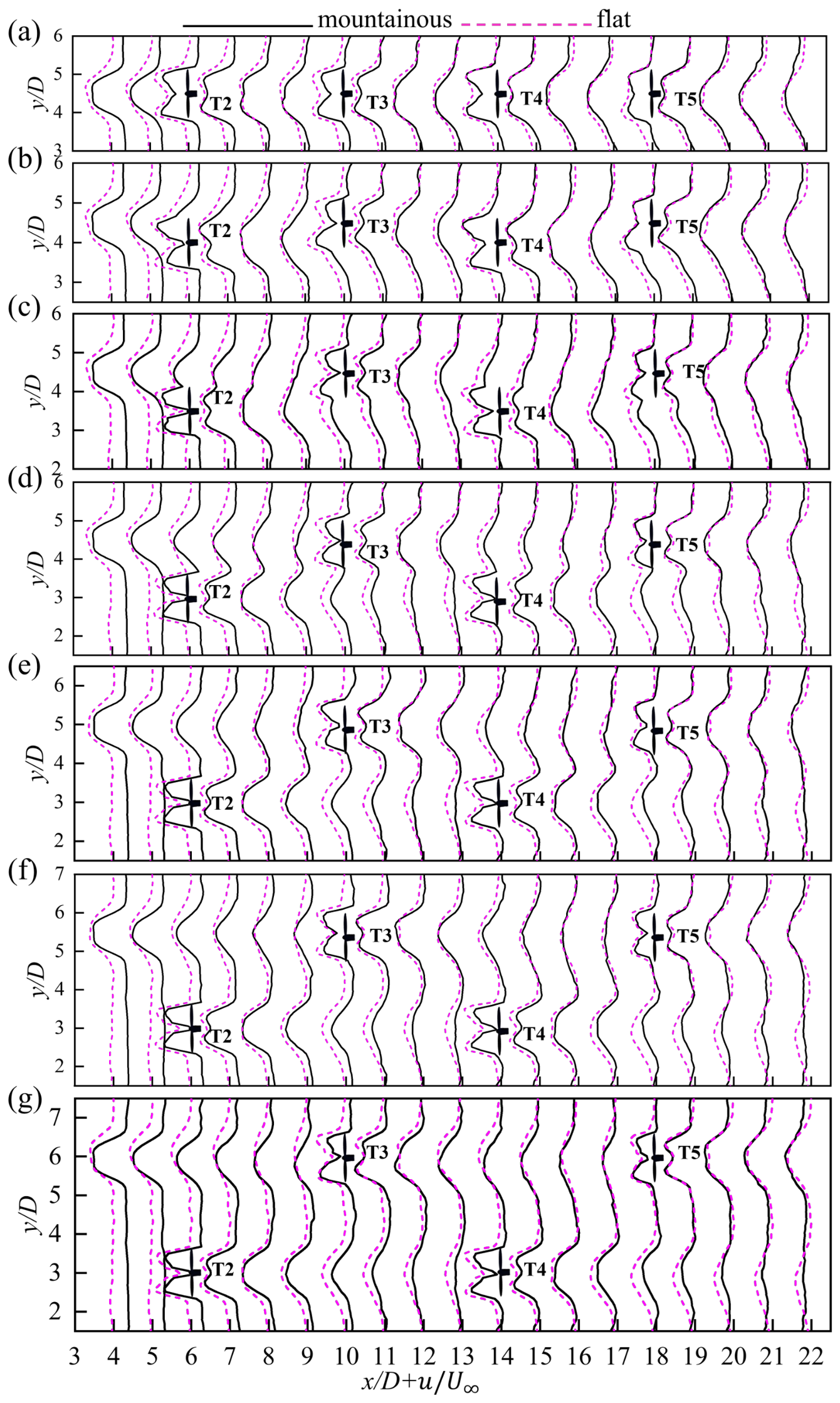
A comprehensive understanding of wake characteristics is essential for accurately assessment of the operational status of wind turbines. In this study, the investigation of their core characteristics mainly includes wake deficit, velocity field distribution, and the evolution of turbulence intensity. Figure 10 presents the wind profiles on the horizontal plane at hub height under different layouts of the mountainous wind farm, from which the wake deficit is distinctly discernible. Since T1 remains in a fixed position, its wake remains unchanged before reaching T2. Therefore, the velocity contour in Figure 10 is plotted starting from 2D downstream of T1.
Figure 10a shows that the ambient flow speed at T1 and T2 in the mountainous wind farm is higher than that in the flat wind farm, while the ambient flow speed begins to converge near T4. This explains why the power output of the turbines in the first two rows of the mountainous wind farm is significantly higher than in the flat wind farm and accounts for the difference in the power output of T2 between the two configurations. The terrain-induced acceleration effect decays streamwise, resulting in a lower inflow speed at T2 than at T1, even in layouts where power remains unaffected by Δ y . This explains why the power output of T2 remains lower than that of T1. The acceleration effect stems from the increase in mean flow velocity due to topographic constraints under mass conservation. This effect is particularly pronounced at the hills located in the first two rows.
Further observation of the velocity profile in Figure 10g reveals that the wake of T2 in the mountainous wind farm recovers almost to the ambient flow level before reaching the downstream turbine, whereas in the flat wind farm, the wake remains in a noticeable deficit until the downstream turbine position. This indicates a faster wake recovery rate in the multiple-hill case (1.17 times that of the flat case), consistent with the normalized total power results. The wake-deficit curves of the last turbine row show a distinct inflection point in the flat wind farm, which is absent in the multiple-hill case, suggesting a significantly higher wake expansion rate in the mountainous wind farm.
Figure 10a–g additionally demonstrate that as Δ y increases, the flow speed at T2 rises in both wind farms, reaching a maximum at Δ y / D = 1 before stabilizing. This implies that a lateral spacing of 3D is unnecessary to avoid wake interference, a trend consistent with Hyvärinen et al. [14] and in agreement with the earlier power analysis.

4.4.2. Velocity Field Analysis

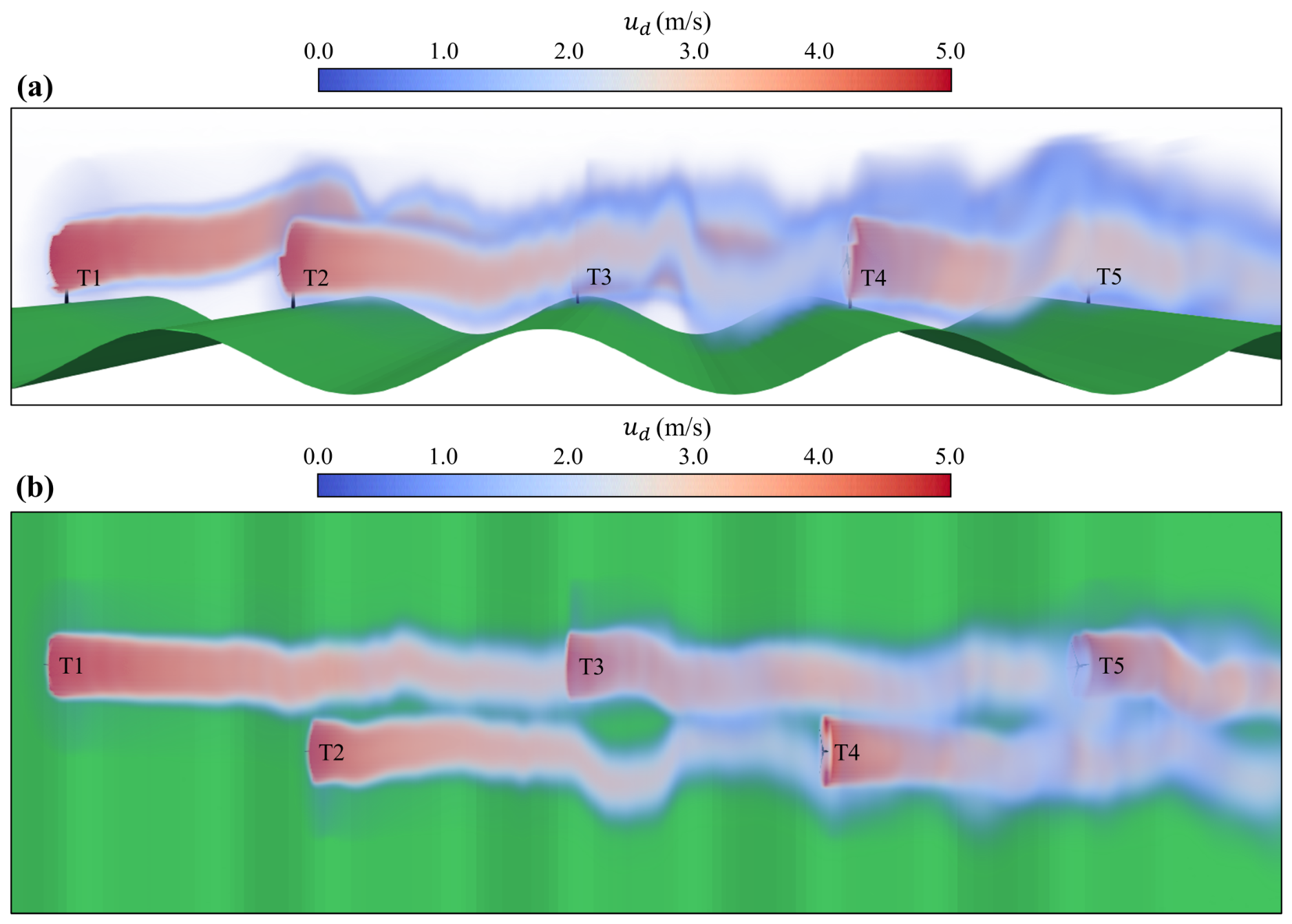
As a three-dimensional dynamic wake model, the DWM captures the unsteady meandering of wakes in real time. Figure 11 presents the instantaneous wake-volume rendering from both top and front views of the mountainous wind farm at Δ y / D = 1.5, clearly showing significant wake meandering in both horizontal and vertical planes. The characteristics of wake meandering in the horizontal plane, in particular, align with observations reported by Hyvärinen et al. [11]. As visible in Figure 11a, the wake trajectory in the mountainous wind farm is influenced by the terrain, leading to pronounced meandering that correlates with the undulating topography. However, the wake does not strictly follow the terrain contours; its evolution is also affected by inflow conditions, turbulence structures, and other factors. The underlying flow mechanisms will be further discussed in subsequent analysis of the flow field.
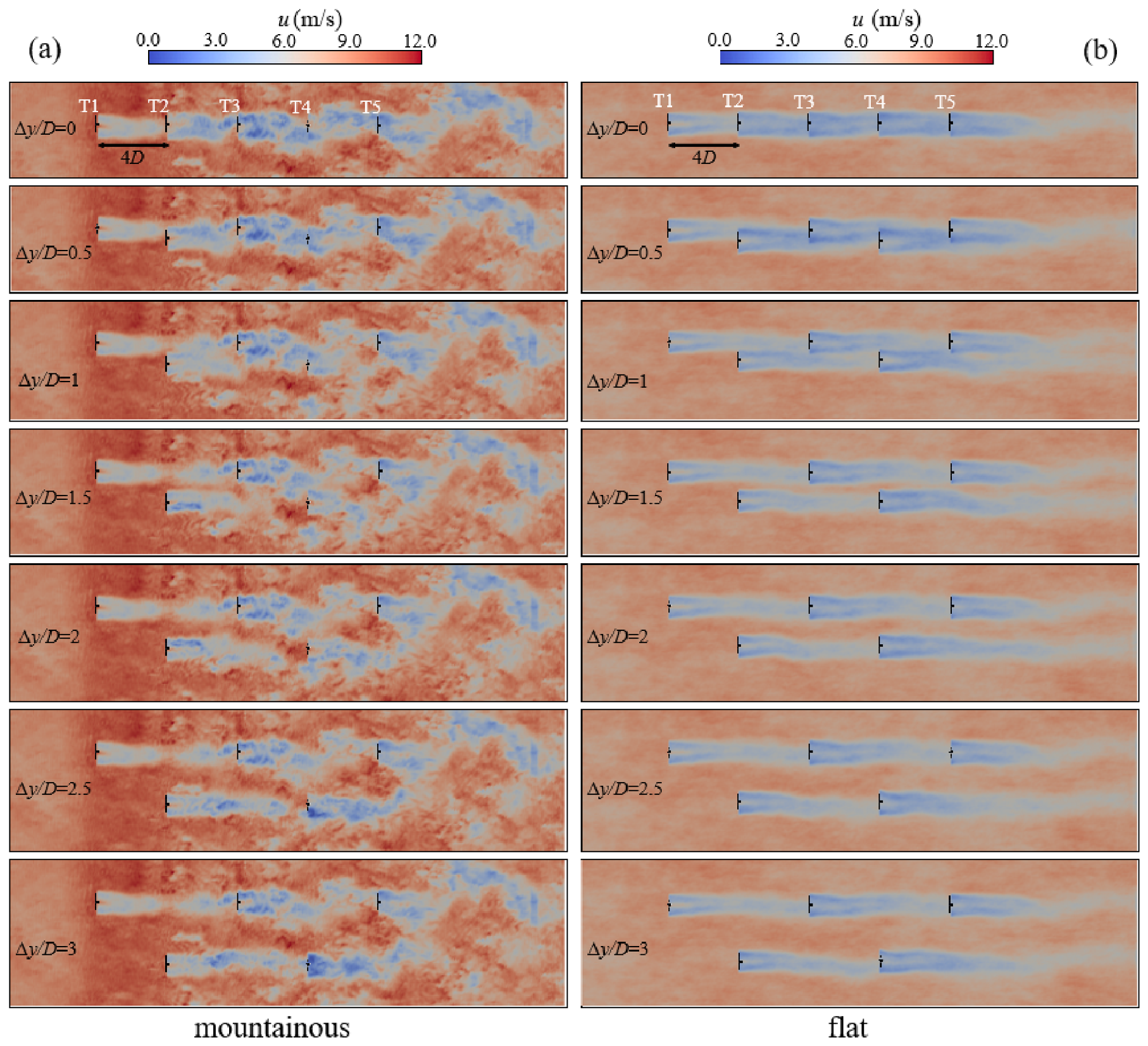
The analysis of the flow field is primarily conducted by examining the velocity contours in vertical planes and in the horizontal plane at hub height. Figure 12 shows instantaneous velocity contours in the horizontal plane at hub height for the mountainous and flat wind farms under different layouts, while Figure 13 presents instantaneous velocity contours on the vertical plane along the hub centerline for the mountainous and flat wind farms at lateral offsets of Δ y / D = 0, 1, and 3. Previous analysis of wake-deficit curves in the horizontal plane at hub height revealed the decay rate of the speed-up effect. This phenomenon is further clearly demonstrated in Figure 12, where the ambient flow speeds around the first two rows of turbines are significantly higher than those downstream. Figure 12 also shows that although wake meandering occurs in the flat wind farm, its magnitude is substantially greater in the multiple-hill cases.
As indicated by the earlier power analysis, the total power output of both wind farms reaches its maximum at Δ y / D = 1, then stabilizes. This trend is reflected in the wake evolution shown in Figure 12 for the flat wind farm, where at Δ y / D = 1; the turbines in the rear row of different columns are located at the edge of the wake generated by the turbines in the front rows of distinct upstream columns, resulting in a limited influence of the upstream wake on the inflow of the downstream turbines. As Δ y increases further, the wakes of the front and rear rows exhibit clear separation, indicating that wake interference is essentially eliminated. In the mountainous wind farm, however, although wake meandering is more pronounced and the upstream wake still affects the inflow of downstream turbines at Δ y / D = 1, causing local velocity deficits, the power output reaches its maximum, just as in the flat wind farm. This suggests that the enhanced wake meandering in complex terrain promotes wake recovery and compensates for the energy loss.
Furthermore, the wake interaction pattern provides a physical explanation for the fatigue-load distribution. In a tandem layout, the downstream turbine is located in the center of the wake, resulting in relatively uniform force distribution and consequently lower short-term DELs. However, as shown in Figure 12, at Δ y / D = 0.5, the downstream turbine is subjected to asymmetric loading from the partial wake of the upstream turbine, leading to a significant increase in short-term DELs in T2 and T4, reaching respective maximum values. The increase in the short-term blade-root DELs of T2 and T4 in the mountainous wind farm can be partly attributed to this asymmetric loading state induced by the wake.
Figure 13 reveals that significant flow separation occurs in the wake region downstream of the hill, attributable to its slope exceeding the threshold of 0.3 proposed by Mason and King [55]. The wake in the mountainous wind farm further exhibits interactions with terrain-induced vortices, including their merging and breakdown—a phenomenon not prominent in flat terrain. The terrain-generated vortices, varying in scale, critically influence the wake dynamics. This means that larger vortices modulate the wake meandering, whereas smaller ones affect the evolution of the wake deficit, alongside processes of vortex merging and wake splitting. This mechanistic understanding explains the intensified wake meandering in the mountainous wind farm, as evidenced in Figure 12.
By integrating the findings from Figure 12 and Figure 13, it is revealed that the flow structure within the mountainous wind farm exhibits significantly stronger flow disturbances compared to the flat case. These disturbances, manifested as large-scale vortex structures induced by the terrain, lead to enhanced wake meandering and a broader area of influence. The effect is particularly pronounced for T3, which contributes to the slight increase in power output of T4, even within the Δ y / D = 1 to 3 range. As observed in Figure 13a, the terrain in the mountainous wind farm generates large-scale concentrated vortices that propagate downstream, affecting the flow velocity in the lower part of the T2 rotor. In comparison, the inflow speed in the upper part of the T2 rotor remains relatively higher when Δ y / D 0.5 . Since the flow velocity at T2 ranks second only to that at T1 among all turbines within the mountainous wind farm, the resulting inflow non-uniformity is intensified, causing stronger asymmetric loading and, consequently, the highest short-term DELs at the blade root of T2. For T4, the concentrated vortices influence a more extensive area, affecting the entire rotor diameter rather than being limited to its lower section. Combined with a lower inflow speed compared to T2, this results in less severe asymmetric loading. Thus, although the short-term DELs at the blade root of T4 increase, they remain lower than those of T2.
The loading pattern at the tower base in the mountainous wind farm differs somewhat from that at the blade root, and their dynamic responses are not fully consistent. The large-scale concentrated vortices induced by the terrain affect an extended region, leading to maximum values in the short-term DELs at the tower base of T4. Overall, the analysis of Figure 12 and Figure 13 confirms that flow disturbance-induced asymmetric loading has the most significant impact on the DELs at both the blade root and the tower base.

4.4.3. Turbulence Intensity

Since the streamwise velocity fluctuations have the most significant and pronounced impact on wind turbine wakes, they are selected as the focus of this study [3,25]. This section specifically analyzes the effect of streamwise velocity fluctuations on wake behavior, while the influence of spanwise and vertical velocity fluctuations is not considered here. Hereafter, turbulence intensity refers to streamwise velocity fluctuations.
The hub-height turbulence intensity of the wind farms was calculated as presented in Figure 14. As shown in the Figure 14, the turbulence intensity in the mountainous wind farm is, overall, two to three times higher than that in the flat wind farm. Moreover, the increase in turbulence intensity for downstream turbines is more pronounced in the multiple-hill configuration. Consequently, all turbines in the mountainous wind farm experience notably higher fatigue loads across various layouts compared to their flat-terrain counterparts. This also explains the greater wake-meandering magnitude and higher wake-recovery rate observed in the mountainous wind farm than that in the flat cases.
Figure 14 demonstrates the spatially limited nature of wake interaction effects. For both mountainous and flat wind farms, vortices generated by front-row turbine wakes exert a discernible influence on the turbulence intensity of downstream turbines when the lateral offset is within 1D. Beyond this threshold, however, turbulence intensity exhibits negligible variation with further increases in lateral distance. Figure 14a shows that after the flow passes the first hill in the mountainous wind farm, terrain effects cause a significant increase in turbulence intensity. From T2 to T5, the turbulence intensity around the turbines increases markedly with successive downstream positions. Comparison of Figure 14a,b reveals that the wake influence area is larger in the mountainous wind farm than that in the flat terrain, resulting in significantly higher turbulence intensity and a more extensive affected region compared to the flat wind farm. This suggests that the wake interactions occurring within the terrain-preconditioned flow lead to a greater enhancement of turbulence intensity than the terrain effect alone. Furthermore, Figure 14 shows that the turbulence intensity at downstream turbines decreases as Δ y / D increases within the range of Δ y / D 1 . This trend is more evident in the mountainous wind farm than that in the flat wind farm.
Table 10 decomposes the turbulence intensity at x/D = 3 downstream of each turbine into terrain-induced and wake-induced contributions. The terrain-only TI varies from 8.84% (T1) to 16.85% (T4), reflecting the increasing terrain-induced turbulence as the flow moves over the multiple hills. The wake-induced TI, calculated as the difference between the full-field and terrain-only TI, ranges from 6.78% (T1) to 20.19% (T5). The terrain contribution accounts for 40.6% to 56.6% of the total TI across the five turbines. These results demonstrate that both terrain- and wake-induced turbulence contribute significantly to the total TI, with terrain-induced turbulence dominating in the near-wake region of the first turbine and wake-induced turbulence becoming increasingly important for downstream turbines.
In summary, the wake expansion rate and recovery rate in the mountainous wind farm are both greater than those in the flat wind farm. Additionally, the multiple-hill terrain induces concentrated vortices that cause asymmetric loading on T2, resulting in the highest short-term blade-root DELs. Analysis of the wake deficit curves and wake contours further reveals the streamwise decay of the terrain-induced speed-up effect, which is consistent with the earlier power analysis. The higher turbulence intensity observed in the mountainous wind farm relative to that in the flat wind farm is primarily attributed to wake effects, with terrain being a secondary contributing factor.

5. Conclusions

This study presents a novel approach by integrating LES with the DWM model to achieve efficient, medium-fidelity fluid–structure interaction simulation of a large wind farm situated on complex terrain with five hills. Through a comparative analysis of wake characteristics and fatigue loads between mountainous and flat wind farms under different layout configurations, it is found that terrain influences wind farm performance in a comprehensive manner. The main conclusions are summarized as follows:
  • The mountainous wind farm exhibits a wake recovery rate (∼)17% higher than that of the flat terrain and higher overall energy utilization efficiency. This is primarily due to its substantially higher turbulence intensity (∼2–3× that of the flat terrain), along with the larger meandering magnitude and wider spatial influence of the wake, which enhance wake recovery and compensate for energy loss. Consequently, the potential for further power improvement through layout optimization is more limited compared to the flat wind farm. The total power stabilizes at Δ y / D = 1 and does not increase with further increases in Δ y . Despite not being affected by the wake of T1, the power output of T2 cannot reach the level of T1 because of the streamwise decay of the terrain-induced speed-up effect.
  • The dominant factors affecting short-term DELs are asymmetric inflow and turbulence intensity. The mountainous wind farm exhibits substantially higher fatigue loads across all load types, with peak DEL increases of 36% (RF), 66.4% (RM), 130.95% (TF), and 120% (TM) compared to the flat case. Under the same layout conditions, turbines in the mountainous wind farm experience significantly higher short-term DELs, resulting from more intense terrain-induced flow disturbances. The maximum short-term blade-root DEL occurs at T2 when Δ y / D = 0.5 , while the maximum short-term tower-base DEL occurs at T4 when Δ y / D = 1 . These extreme values are attributed to the combined effects of terrain-induced concentrated vortices, asymmetric loading from upstream turbine wakes, and differences in dynamic response among turbine components.
These findings are specific to the simulated conditions: neutral ABL inflow, the NREL 5-MW turbine, idealized 2D sinusoidal hills with a fixed streamwise spacing of 4D, short-term DELs, and a ∼10% domain blockage. Consequently, the conclusions are subject to the following limitations. While the present study focuses on neutral atmospheric boundary-layer inflow, stable stratification is expected to suppress wake mixing and meandering, delay wake recovery, and potentially exacerbate fatigue loading. Furthermore, the scope is confined to wind farm layout configurations, omitting turbine yaw effects. Moreover, limiting the analysis to a single turbulent inflow realization implies that the reported power, turbulence intensity, and DEL values are conditional statistics; thus, they may not encapsulate the full spectrum of inter-realization variability. To enable more comprehensive optimization, future work should refine inflow velocities to match pressure losses and incorporate thermal stratification alongside active control strategies.


Author Contributions

Conceptualization, Z.X.; methodology, Y.H. and Y.X.; software, S.L. and Y.X.; validation, Z.C.; formal analysis, Y.H.; investigation, Y.H.; resources, Z.X.; data curation, Y.H.; writing—original draft preparation, Y.H.; writing—review and editing, Z.X. and S.L.; visualization, Y.H.; supervision, Z.X.; project administration, Z.X.; funding acquisition, Z.X. All authors have read and agreed to the published version of the manuscript.

Funding

This work was supported by the National Natural Science Foundation of China (Grant No. 11872174) and the Open Fund of the Key Laboratory of the Ministry of Education for Coastal Disaster and Protection, Hohai University (Grant No. J202202).

Data Availability Statement

The raw data supporting the conclusions of this article will be made available by the authors upon request.

Conflicts of Interest

The authors declare no conflicts of interest.

Appendix A

Figure A1 presents a comparison of the time-averaged streamwise velocity profiles obtained from the pure LES and the coupled LES-DWM framework at selected downstream locations for T1, T2, and T3. The results demonstrate that the LES-DWM framework reproduces the main features of the wake velocity profiles resolved by the full LES, including the velocity-deficit magnitude, the wake width, and the lateral distribution of the wake. Minor discrepancies are observed in the near-wake region, where the DWM model slightly overpredicts the velocity deficit due to its axisymmetric wake assumption. However, these differences diminish further downstream as the wake evolves and recovers. Overall, the comparison confirms that the LES-DWM framework provides a reasonable representation of the time-averaged wake structure, supporting its applicability for engineering analysis in complex terrain.
Figure A1. Comparison of time-averaged velocity profiles between pure LES and LES-DWM for T1, T2, and T3.
Modelling 07 00131 g0a1

Appendix B

Table A1 presents the inflow boundary conditions at x = 100 m for the mountainous terrain case. The streamwise velocity increases from 7.42 m/s at 50 m height to 9.25 m/s at 400 m height, following a power-law profile with an exponent of approximately 0.10. The turbulence kinetic energy (TKE) decreases monotonically with height, from 0.48 m2/s2 near the surface to 0.08 m2/s2 at 400 m. The corresponding turbulence intensity ranges from 9.4% at 50 m to 3.0% at 400 m, with a value of 7.3% at the hub height (100 m). These values are consistent with neutral atmospheric boundary-layer conditions. The vertical profile of the streamwise velocity is also shown in Figure A2.
Figure A2. Vertical profile of streamwise velocity at the inflow boundary ( x = 100 m).
Modelling 07 00131 g0a2
Table A1. Inflow boundary conditions at x = 100 m for different heights.
Height (m)TKE (m2/s2) U x (m/s) I u (%)
500.48257.42489.36
1000.34267.99167.32
1500.27008.40196.18
2000.16498.64034.70
2500.15358.85144.43
3000.14368.99684.21
3500.10959.14793.62
4000.07809.25373.02
I u = 2 k / 3 / U x × 100 % (assuming isotropic turbulence).

References

  1. Porté-Agel, F.; Bastankhah, M.; Shamsoddin, S. Wind-Turbine and Wind-Farm Flows: A Review. Bound.-Layer Meteorol. 2020, 174, 1–59. [Google Scholar] [CrossRef] [PubMed]
  2. Mattuella, J.M.L.; Loredo-Souza, A.M.; Oliveira, M.G.K.; Petry, A.P. Wind Tunnel Experimental Analysis of a Complex Terrain Micrositing. Renew. Sustain. Energy Rev. 2016, 54, 110–119. [Google Scholar] [CrossRef]
  3. Zhang, Z.; Huang, P.; Bitsuamlak, G.; Cao, S. Large-Eddy Simulation of Wind-Turbine Wakes over Two-Dimensional Hills. Phys. Fluids 2022, 34, 065123. [Google Scholar] [CrossRef]
  4. Dar, A.S.; Porté-Agel, F. Wind Turbine Wakes on Escarpments: A Wind-Tunnel Study. Renew. Energy 2022, 181, 1258–1275. [Google Scholar] [CrossRef]
  5. Dar, A.S.; Gertler, A.S.; Porté-Agel, F. An Experimental and Analytical Study of Wind Turbine Wakes under Pressure Gradient. Phys. Fluids 2023, 35, 045140. [Google Scholar] [CrossRef]
  6. Yan, S.; Shi, S.; Chen, X.; Wang, X.; Mao, L.; Liu, X. Numerical Simulations of Flow Interactions between Steep Hill Terrain and Large Scale Wind Turbine. Energy 2018, 151, 740–747. [Google Scholar] [CrossRef]
  7. Yang, X.; Howard, K.B.; Guala, M.; Sotiropoulos, F. Effects of a Three-Dimensional Hill on the Wake Characteristics of a Model Wind Turbine. Phys. Fluids 2015, 27, 025103. [Google Scholar] [CrossRef]
  8. Kozmar, H.; Bartoli, G.; Borri, C. The Effect of Parked Wind Turbines on Wind Flow and Turbulence over a Complex Terrain. Wind Energy 2021, 24, 1337–1347. [Google Scholar] [CrossRef]
  9. Tian, W.; Ozbay, A.; Hu, H. An Experimental Investigation on the Aeromechanics and Wake Interferences of Wind Turbines Sited over Complex Terrain. J. Wind Eng. Ind. Aerodyn. 2018, 172, 379–394. [Google Scholar] [CrossRef]
  10. Tian, W.; Ozbay, A.; Hu, H. Terrain Effects on Characteristics of Surface Wind and Wind Turbine Wakes. Procedia Eng. 2015, 126, 542–548. [Google Scholar] [CrossRef]
  11. Hyvärinen, A.; Lacagnina, G.; Segalini, A. A Wind-Tunnel Study of the Wake Development behind Wind Turbines over Sinusoidal Hills. Wind Energy 2018, 21, 605–617. [Google Scholar] [CrossRef]
  12. Kim, H.G.; Lee, C.M.; Lim, H.C.; Kyong, N.H. An Experimental and Numerical Study on the Flow over Two-Dimensional Hills. J. Wind Eng. Ind. Aerodyn. 1997, 66, 17–33. [Google Scholar] [CrossRef]
  13. Carpenter, P.; Locke, N. Investigation of Wind Speeds over Multiple Two-Dimensional Hills. J. Wind Eng. Ind. Aerodyn. 1999, 83, 109–120. [Google Scholar] [CrossRef]
  14. Hyvärinen, A.; Segalini, A. Effects from Complex Terrain on Wind-Turbine Performance. J. Energy Resour. Technol. 2017, 139, 051205. [Google Scholar] [CrossRef]
  15. Segalini, A. Boundary-Layer Aerodynamics over Long Wind Farms over hilly Terrains. J. Phys. Conf. Ser. 2023, 2505, 012007. [Google Scholar] [CrossRef]
  16. Berg, J.; Troldborg, N.; Sørensen, N.N.; Patton, E.G.; Sullivan, P.P. Large Eddy Simulation of Turbine Wake in Complex Terrain. J. Phys. Conf. Ser. 2017, 854, 012003. [Google Scholar] [CrossRef]
  17. Politis, E.S.; Prospathopoulos, J.; Cabezon, D.; Hansen, K.S.; Chaviaropoulos, P.K.; Barthelmie, R.J. Modeling Wake Effects in Large Wind Farms in Complex Terrain: The Problem, the Methods and the Issues. Wind Energy 2012, 15, 161–182. [Google Scholar] [CrossRef]
  18. Gao, X.; Chen, Y.; Xu, S.; Gao, W.; Zhu, X.; Sun, H.; Yang, H.; Han, Z.; Wang, Y.; Lu, H. Comparative Experimental Investigation into Wake Characteristics of Turbines in Three Wind Farms Areas with Varying Terrain Complexity from LiDAR Measurements. Appl. Energy 2022, 307, 118182. [Google Scholar] [CrossRef]
  19. Wang, Q.; Luo, K.; Yuan, R.; Wang, S.; Fan, J.; Cen, K. A Multiscale Numerical Framework Coupled with Control Strategies for Simulating a Wind Farm in Complex Terrain. Energy 2020, 203, 117913. [Google Scholar] [CrossRef]
  20. Howard, K.B.; Hu, J.; Chamorro, L.P.; Guala, M. Characterizing the Response of a Wind Turbine Model under Complex Inflow Conditions. Wind Energy 2015, 18, 729–743. [Google Scholar] [CrossRef]
  21. Howard, K.B.; Chamorro, L.P.; Guala, M. A Comparative Analysis on the Response of a Wind-Turbine Model to Atmospheric and Terrain Effects. Bound.-Layer Meteorol. 2016, 158, 229–255. [Google Scholar] [CrossRef]
  22. Yan, B.; Tang, S.; Yu, M.; Qian, G.; Chen, Y. Atmospheric Turbulence Effects on Wind Turbine Wakes over Two-Dimensional Hill: A Wind Tunnel Study. Energies 2025, 18, 2865. [Google Scholar] [CrossRef]
  23. Chen, Y.; Yan, B.; Yu, M.; Huang, G.; Qian, G.; Yang, Q.; Zhang, K.; Mo, R. Wind Tunnel Study of Wind Turbine Wake Characteristics over Two-Dimensional Hill Considering the Effects of Terrain Slope and Turbine Position. Appl. Energy 2025, 380, 125044. [Google Scholar] [CrossRef]
  24. Yang, J.; Feng, K.; Yang, H.; Wang, X. Experimental Study on the Influence of a Two-Dimensional Cosine Hill on Wind Turbine Wake. Machines 2022, 10, 753. [Google Scholar] [CrossRef]
  25. Shamsoddin, S.; Porté-Agel, F. Large-Eddy Simulation of Atmospheric Boundary-Layer Flow through a Wind Farm Sited on Topography. Bound.-Layer Meteorol. 2017, 163, 1–17. [Google Scholar] [CrossRef]
  26. Bhuiyan, M.A.S.; Alam, J.M. Scale-Adaptive Turbulence Modeling for LES over Complex Terrain. Eng. Comput. 2022, 38, 1995–2007. [Google Scholar] [CrossRef]
  27. Liu, L.; Stevens, R.J.A.M. Effects of Two-Dimensional Steep Hills on the Performance of Wind Turbines and Wind Farms. Bound.-Layer Meteorol. 2020, 176, 251–269. [Google Scholar] [CrossRef]
  28. Shamsoddin, S.; Porté-Agel, F. Wind Turbine Wakes over Hills. J. Fluid Mech. 2018, 855, 671–702. [Google Scholar] [CrossRef]
  29. Yang, Q.; Zhang, X.; Li, T.; Law, S.; Zhou, X.; Lu, D. Study on Wind Turbine Wake Effect and Analytical Model in Mountainous Terrain. Renew. Energy 2025, 244, 122613. [Google Scholar] [CrossRef]
  30. Yang, Q.; Zhou, T.; Yan, B.; Liu, M.; Van Phuc, P.; Shu, Z. LES Study of Topographical Effects of Simplified 3D Hills with Different Slopes on ABL Flows Considering Terrain Exposure Conditions. J. Wind Eng. Ind. Aerodyn. 2021, 210, 104513. [Google Scholar] [CrossRef]
  31. Mishra, A.; Arya, N.; Bhattacharya, A. Wake Steering of Wind Turbine in the Presence of a Two-Dimensional Hill. Phys. Fluids 2024, 36, 045125. [Google Scholar] [CrossRef]
  32. Tian, W.; Zheng, K.; Hu, H. Investigation of the Wake Propagation behind Wind Turbines over Mountainous Terrain with Different Slope Gradients. J. Wind Eng. Ind. Aerodyn. 2021, 215, 104683. [Google Scholar] [CrossRef]
  33. Wang, T.; Cai, C.; Wang, X.; Wang, Z.; Chen, Y.; Song, J.; Xu, J.; Zhang, Y.; Li, Q. A New Gaussian Analytical Wake Model Validated by Wind Tunnel Experiment and LiDAR Field Measurements under Different Turbulent Flow. Energy 2023, 271, 127089. [Google Scholar] [CrossRef]
  34. Lopes, A.M.G.; Vicente, A.H.S.N.; Sánchez, O.H.; Daus, R.; Koch, H. Operation Assessment of Analytical Wind Turbine Wake Models. J. Wind Eng. Ind. Aerodyn. 2022, 220, 104840. [Google Scholar] [CrossRef]
  35. Shaler, K.; Jonkman, J. FAST.Farm Development and Validation of Structural Load Prediction against Large Eddy Simulations. Wind Energy 2021, 24, 428–449. [Google Scholar] [CrossRef]
  36. National Renewable Energy Laboratory. FAST.Farm User’s Guide and Theory Manual; OpenFAST Documentation; National Renewable Energy Laboratory: Golden, CO, USA, 2021. [Google Scholar]
  37. Jonkman, J.M.; Butterfield, S.; Musial, W.; Scott, G. Definition of a 5-MW Reference Wind Turbine for Offshore System Development; Technical Report; National Renewable Energy Laboratory: Golden, CO, USA, 2009. [Google Scholar]
  38. Ye, S.; Wang, Q.; Mu, Y.; Luo, K.; Fan, J. Loads and Fatigue Characteristics Assessment of Wind Farm Based on Dynamic Wake Meandering Model. Renew. Energy 2024, 236, 121419. [Google Scholar] [CrossRef]
  39. Churchfield, M.J.; Lee, S.; Moriarty, P.J. Overview of the Simulator for Wind Farm Application (SOWFA); Technical Report; National Renewable Energy Laboratory: Golden, CO, USA, 2012. [Google Scholar]
  40. Smagorinsky, J. General Circulation Experiments with the Primitive Equations. Mon. Weather Rev. 1963, 91, 99–164. [Google Scholar] [CrossRef]
  41. Storey, R.C.; Cater, J.E.; Norris, S.E. Large Eddy Simulation of Turbine Loading and Performance in a Wind Farm. Renew. Energy 2016, 95, 31–42. [Google Scholar] [CrossRef]
  42. Churchfield, M.J.; Lee, S.; Michalakes, J.; Moriarty, P.J. A Numerical Study of the Effects of Atmospheric and Wake Turbulence on Wind Turbine Dynamics. J. Turbul. 2012, 13, N14. [Google Scholar] [CrossRef]
  43. Yang, X.; Pakula, M.; Sotiropoulos, F. Large-Eddy Simulation of a Utility-Scale Wind Farm in Complex Terrain. Appl. Energy 2018, 229, 767–777. [Google Scholar] [CrossRef]
  44. Bingöl, F.; Mann, J.; Larsen, G.C. Light Detection and Ranging Measurements of Wake Dynamics, Part I: One-Dimensional Scanning. Wind Energy 2010, 13, 51–61. [Google Scholar] [CrossRef]
  45. Ainslie, J.F. Calculating the Flowfield in the Wake of Wind Turbines. J. Wind Eng. Ind. Aerodyn. 1988, 27, 213–224. [Google Scholar] [CrossRef]
  46. Ainslie, J.F. Wake Modelling and the Prediction of Turbulence Properties. In Proceedings of the 8th British Wind Energy Association Conference, Cambridge, UK, 19–21 March 1986; pp. 115–120. [Google Scholar]
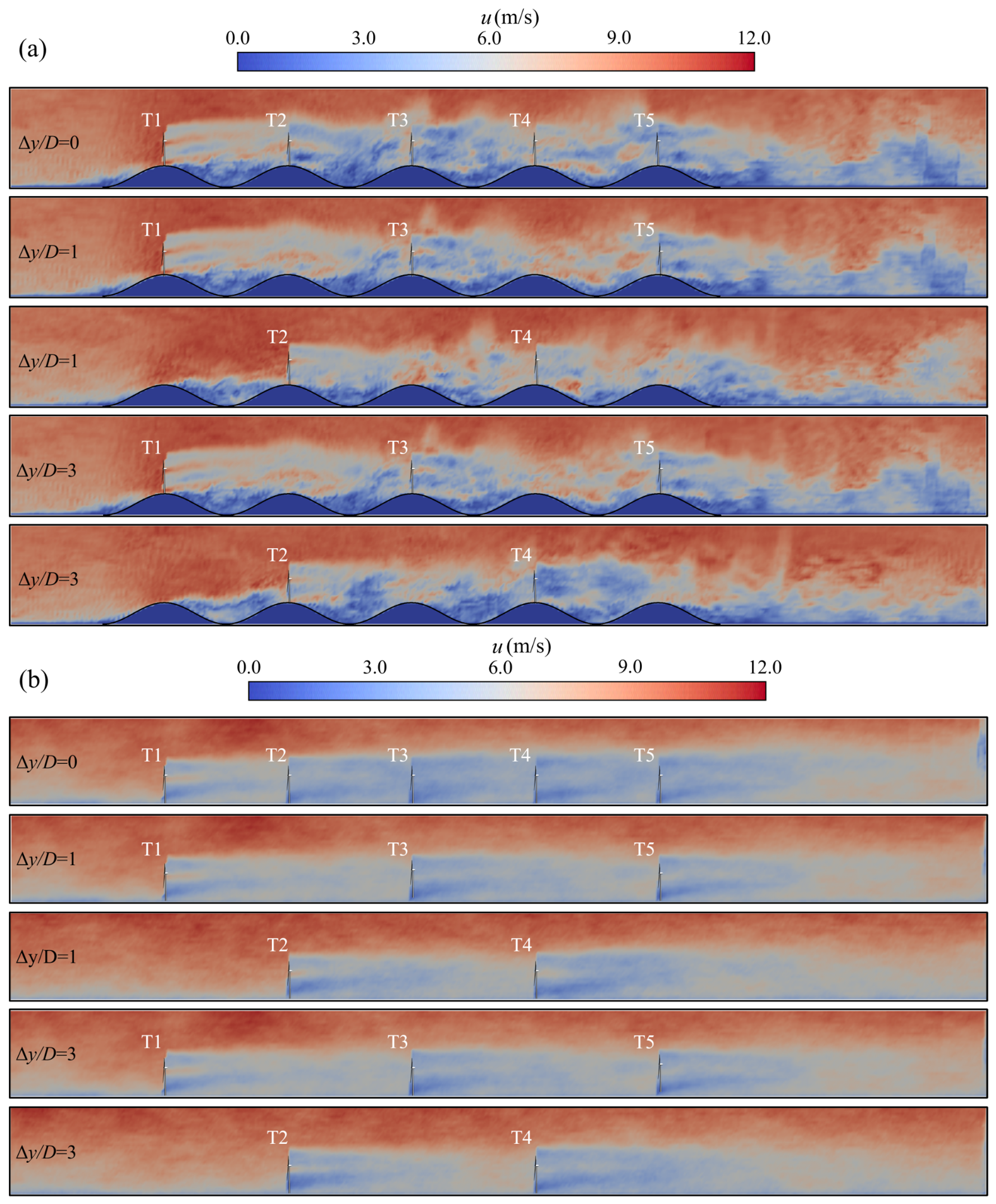
  47. Larsen, G.C.; Madsen, H.A.; Thomsen, K.; Larsen, T.J. Wake Meandering: A Pragmatic Approach. Wind Energy 2008, 11, 377–395. [Google Scholar] [CrossRef]
  48. Sun, J.; Chen, Z.; Yu, H.; Gao, S.; Wang, B.; Ying, Y.; Sun, Y.; Qian, P.; Zhang, D.; Si, Y. Quantitative Evaluation of Yaw-Misalignment and Aerodynamic Wake Induced Fatigue Loads of Offshore Wind Turbines. Renew. Energy 2022, 199, 71–86. [Google Scholar] [CrossRef]
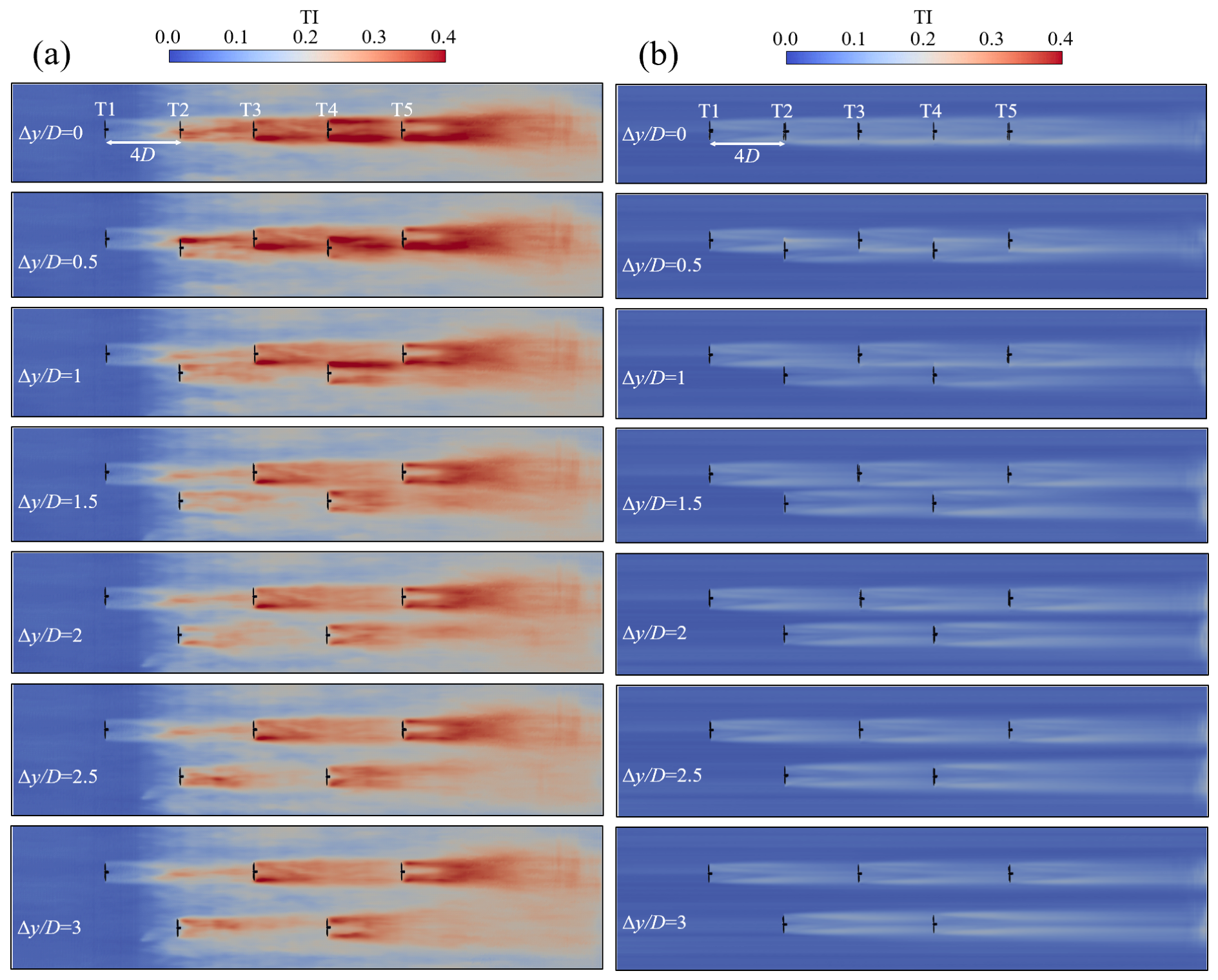
  49. Hayman, G. MLife Theory Manual for Version 1.00; National Renewable Energy Laboratory: Golden, CO, USA, 2012. [Google Scholar]
  50. Downing, S.D.; Socie, D.F. Simple Rainflow Counting Algorithms. Int. J. Fatigue 1982, 4, 31–40. [Google Scholar] [CrossRef]
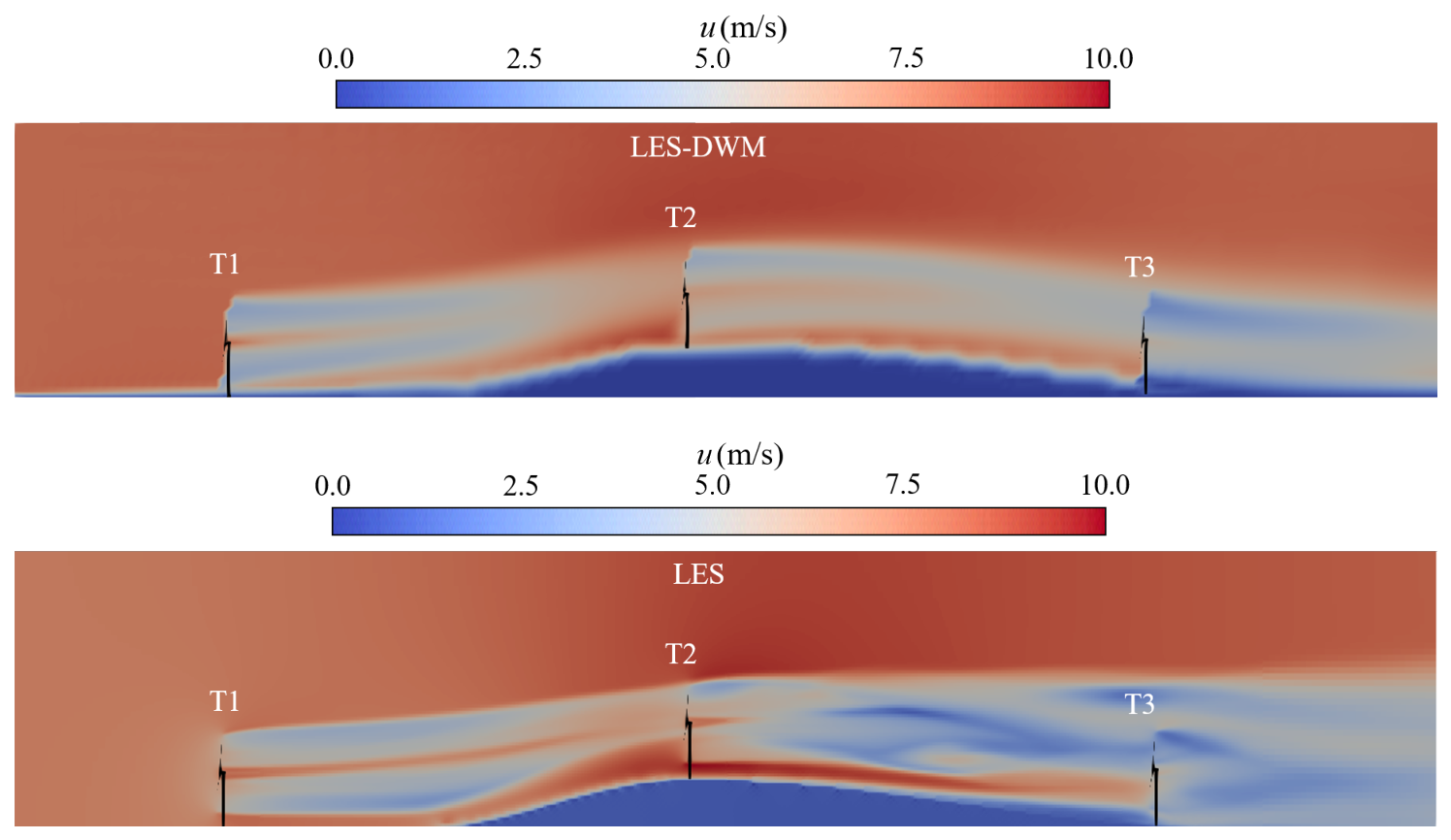
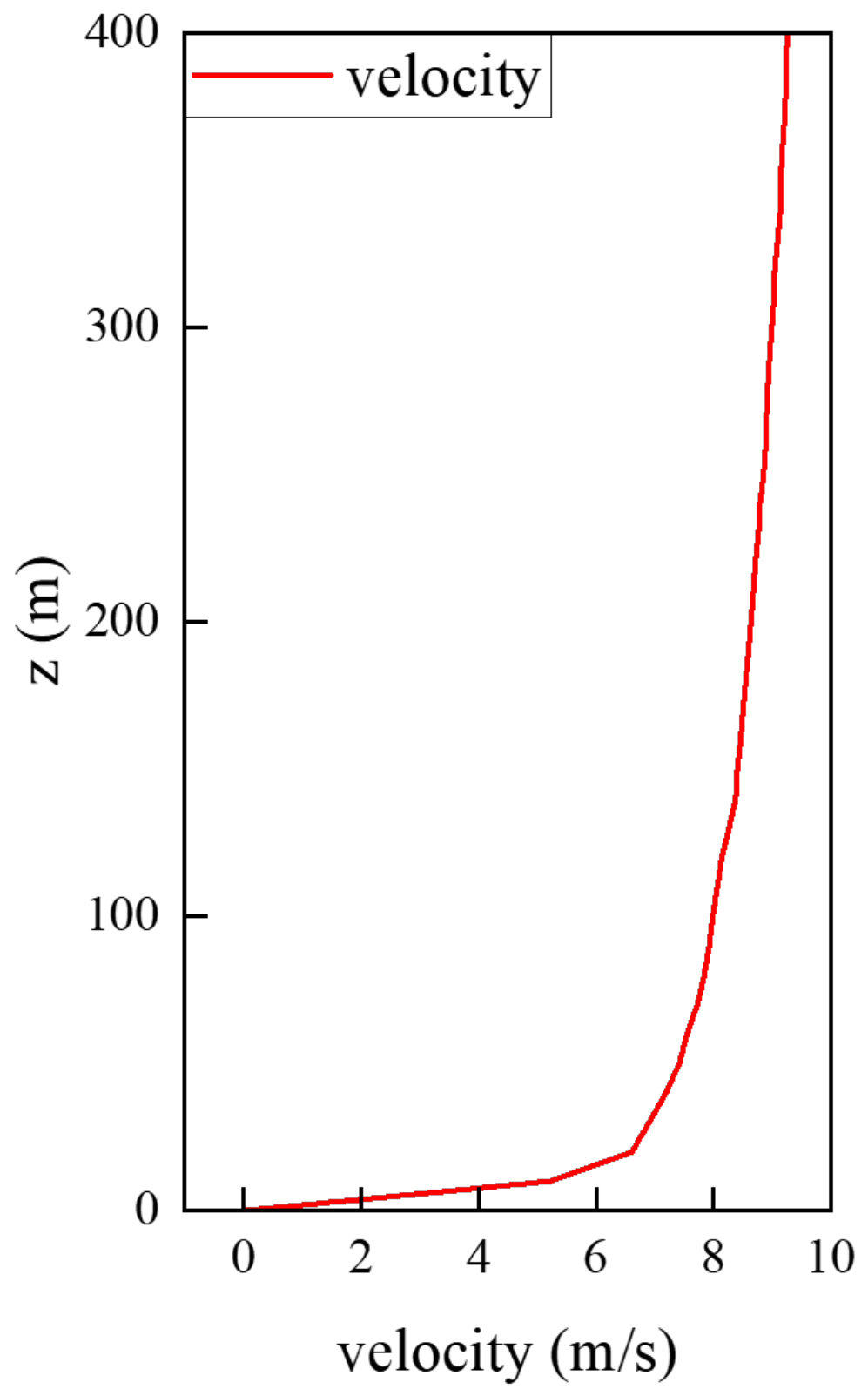
  51. Xin, Z.; Liu, S.; Cai, Z.; Liao, S.; Huang, G. Numerical Study on the Yaw Control for Two Wind Turbines under Different Spacings. Appl. Sci. 2022, 12, 7098. [Google Scholar] [CrossRef]
  52. Zhang, R.; Xin, Z.; Huang, G.; Yan, B.; Zhou, X.; Deng, X. Characteristics and Modelling of Wake for Aligned Multiple Turbines Based on Numerical Simulation. J. Wind Eng. Ind. Aerodyn. 2022, 228, 105097. [Google Scholar] [CrossRef]
  53. Wei, D.; Zhao, W.; Wan, D.; Xiao, Q. A New Method for Simulating Multiple Wind Turbine Wakes under Yawed Conditions. Ocean Eng. 2021, 239, 109832. [Google Scholar] [CrossRef]
  54. Thedin, R.; Barter, G.; Jonkman, J.; Mudafort, R.; Bay, C.J.; Shaler, K.; Kreeft, J. Load Assessment of a Wind Farm Considering Negative and Positive Yaw Misalignment for Wake Steering. Wind Energ. Sci. 2025, 10, 1033–1053. [Google Scholar] [CrossRef]
  55. Mason, P.J.; King, J.C. Measurements and Predictions of Flow and Turbulence over an Isolated Hill of Moderate Slope. Q. J. R. Meteorol. Soc. 1985, 111, 617–640. [Google Scholar] [CrossRef]
Figure 1. Arrangement of wind turbines in the wind farm: (a) top view; (b) front view.
Modelling 07 00131 g001
Figure 2. Schematic diagram of the workflow of the LES-DWM framework.
Modelling 07 00131 g002
Figure 3. Hub-height vertical cross-section velocity contour and time-averaged power, where U denotes the boundary-layer inflow velocity. (a) Velocity contour from LES-DWM; (b) time-averaged power from LES and LES-DWM.
Modelling 07 00131 g003
Figure 4. Wind-speed curves for wind turbines T1 and T2 in the horizontal plane at hub height after 3D, (a) T1, and (b) T2.
Modelling 07 00131 g004
Figure 5. Average power output: (a) mountainous wind farm; (b) flat wind farm.
Modelling 07 00131 g005
Figure 6. Total power output: (a) mountainous wind farm; (b) flat wind farm.
Modelling 07 00131 g006
Figure 7. Contour of fatigue loads for each turbine in every layout of mountainous and flat wind farms: (a) DEL- R F ; (b) DEL- R M ; (c) DEL- T F ; (d) DEL- T M .
Modelling 07 00131 g007
Figure 8. Contour of fatigue loads for each turbine in every layout of mountainous and flat wind farms: (a) blade-root shear ( R F x , R F y ); (b) blade-root moment ( R M x , R M y ); (c) tower-base shear ( T F x , T F y ); (d) tower-base moment ( T M x , T M y ).
Modelling 07 00131 g008
Figure 9. Load-time histories of all five turbines from 950 s to 1000 s. A clear peak is observed at t = 975 s, where T2 reaches 320 kN, which is significantly higher than other turbines at the same instant.
Modelling 07 00131 g009
Figure 10. Time-averaged wind profiles on the horizontal plane at hub height for different layouts of the mountainous wind farm, where U represents the inflow velocity: (a) Δ y / D = 0 ; (b) Δ y / D = 0.5 ; (c) Δ y / D = 1 ; (d) Δ y / D = 1.5 ; (e) Δ y / D = 2; (f) Δ y / D = 2.5 ; (g) Δ y / D = 3 .
Modelling 07 00131 g010
Figure 11. Instantaneous wake-volume rendering of the mountainous wind farm at Δ y / D = 1.5, with the wake colored by the absolute velocity deficit ( u d ): (a) front view; (b) top view.
Modelling 07 00131 g011
Figure 12. Instantaneous velocity contour of the horizontal plane at hub height under different lateral spacing layouts: (a) mountainous wind farm; (b) flat wind farm.
Modelling 07 00131 g012
Figure 13. Instantaneous velocity contours on the vertical plane defined by the hub centerline at lateral offsets of Δ y / D = 0, 1, and 3: (a) mountainous wind farm; (b) flat wind farm.
Modelling 07 00131 g013
Figure 14. Contour of turbulence intensity in the horizontal plane at hub height under different lateral spacing layouts: (a) mountainous wind farm; (b) flat wind farm.
Modelling 07 00131 g014
Table 1. Definition of load channels: notation, unit, direction, and physical meaning.
NotationUnitDirection and Physical Meaning
Blade root loads
R F x kNOut-of-plane (flapwise) shear force at the blade root
R F y kNIn-plane (edgewise) shear force at the blade root
R M x kN-mIn-plane (edgewise) bending moment at the blade root
R M y kN-mOut-of-plane (flapwise) bending moment at the blade root
Tower base loads
T F x kNFore–aft shear force at the tower base
T F y kNSide-to-side shear force at the tower base
T M x kN-mRoll moment at the tower base (caused by side-to-side forces)
T M y kN-mPitching moment at the tower base (caused by fore–aft forces)
Combined loads
R F kNCombined in-plane and out-of-plane shear force at the blade root
R M kN-mCombined in-plane and out-of-plane bending moment at the blade root
T F kNCombined fore–aft and side-to-side shear force at the tower base
T M kN-mCombined roll (side-to-side) and pitching (fore–aft) moment at the tower base
The coordinate system follows the FAST convention: x is the streamwise (downwind) direction, z is vertically upward, and y completes the right-handed frame. Positive values of R F x , R M x , T F x , and T M y act in the streamwise direction (downwind/flapwise/fore-aft); positive values of R F y , R M y , T F y , and T M x act in the lateral direction ( + y ), consistent with the right-hand rule.
Table 2. Fatigue loads and their relative errors for the three wind turbines. The errors in the table represent the absolute values of the relative errors.
RF (kN) RM (kN-m) TF (kN) TM (kN-m)
LESLES-DWMErrorLESLES-DWMErrorLESLES-DWMErrorLESLES-DWMError
T149.645.48.47%8708215.63%21.619.59.72%92910007.64%
T252.748.67.78%168016601.19%26.525.34.53%124012201.61%
T354.457.55.70%172016603.49%62.565.04.00%541051604.62%
Table 3. Comparison of relative percentage errors between LES-DWM and full LES at x / D = 5 .
TurbineError (%)
Centerline PositionVelocity DeficitWake WidthTurbulence Intensity
T12.133.637.695.63
T28.229.347.726.89
Table 4. Relative errors of individual fatigue-load channels between LES and LES-DWM.
TurbineError (%)
RF x RF y RM x RM y TF x TF y TM x TM y
T110.080.005.670.009.524.559.520.53
T22.953.973.594.897.999.005.308.25
T35.052.197.414.625.473.897.221.04
Table 5. Comparison of computational cost between pure LES and the LES-DWM framework.
Pure LESLES-DWMSaving (%)
Background LESDWM Module
CPU cores16416424
Simulated physical time (s)20,00020,0002000
Wall-clock time (h)105805.5
Total core-hours17,22013,12013223.0
The pure LES simulates 18,000 s of background flow on 164 cores (72 h), followed by 2000 s with turbines on the same 164 cores (33 h), totaling 105 h and 17,220 core hours. The LES-DWM framework runs the background LES for the full 20,000 s on 164 cores (80 h); the DWM module then runs for the final 2000 s on 24 cores (5.5 h) using the extracted background flow data, totaling 85.5 h and 13,252 core hours. The saving is calculated as (pure LES core hours − LES-DWM core hours)/pure LES core hours × 100%.
Table 6. Grid convergence study: relative errors and wake centerline positions for different grid resolutions (relative to 5 m benchmark).
GridPower Error (%)Velocity Error (%)Centerline Max Dev. (%)
T1_3DT2_3DT2_4DT2_5D
10 m0.176 (T2)2.0691.8130.8970.849 < 1
20 m0.286 (T2)4.8815.2813.0531.935 < 1
30 m1.124 (T2)27.43621.98415.40511.500 < 1
Table 7. Grid convergence study: fatigue-load errors for different grid resolutions (relative to 5 m benchmark).
TurbineGridError (%)
RF RM TF TM
T110 m0000
20 m0001.149
30 m00.1352.2223.831
T210 m0000.826
20 m00.1100.6671.653
30 m00.2203.9744.959
Table 8. Grid convergence study: fatigue-load channels at different grid resolutions (absolute values and relative errors, with 5 m grid as benchmark).
GridFatigue-Load Values
RF x (kN) RF y (kN) RM x (kN-m) RM y (kN-m) TF x (kN) TF y (kN) TM x (kN-m) TM y (kN-m)
5 m T110.20138.002850.00228.000.320.065.1824.80
5 m T216.70131.002690.00595.0015.202.87239.001200.00
10 m T110.20138.002850.00228.000.320.065.1724.80
10 m T216.60131.002690.00594.0015.102.86238.001200.00
20 m T110.10138.002850.00227.000.320.065.1524.50
20 m T216.60131.002690.00593.0015.102.85237.001180.00
30 m T110.00138.002850.00225.000.310.065.3223.90
30 m T216.50131.002690.00587.0014.602.79233.001140.00
GridError (%)
RF x RF y RM x RM y TF x TF y TM x TM y
10 m T10.000.000.000.000.000.000.190.00
10 m T20.600.000.000.170.660.350.420.00
20 m T10.980.000.000.440.000.000.581.21
20 m T20.600.000.000.340.660.700.841.67
30 m T11.960.000.001.323.130.002.703.63
30 m T21.200.000.001.343.952.792.515.00
Errors are calculated as (Grid − 5 m) / 5 m × 100%. The 10 m grid yields errors below 1% for all channels, confirming its adequacy for fatigue-load predictions.
Table 9. Comparison of inflow conditions between flat and mountainous-terrain cases before turbine insertion.
ParameterFlat TerrainMountainous Terrain
Boundary condition U = 8 m / s (same for both)
Hub-height inflow velocity (m/s)7.97010.017
Turbulence intensity (%)5.2464.160
Wind-shear exponent ( α )0.1200.398
Table 10. Turbulence intensity at x / D = 3 downstream of each turbine for terrain-only and full-field simulations.
TurbineTurbulence Intensity (%)Wake-Induced TI (%)Terrain Contribution (%)
Terrain OnlyFull Field
T18.8415.636.7856.56
T213.2932.7519.4640.59
T315.8229.3713.5553.86
T416.8531.9515.0952.75
T516.6836.8820.1945.23
Wake-induced TI = Full-Field TI − Terrain-Only TI. Terrain contribution = (Terrain-Only TI/Full-Field TI) × 100%.
Disclaimer/Publisher’s Note: The statements, opinions and data contained in all publications are solely those of the individual author(s) and contributor(s) and not of MDPI and/or the editor(s). MDPI and/or the editor(s) disclaim responsibility for any injury to people or property resulting from any ideas, methods, instructions or products referred to in the content.